Anagrams, but where you can break apart letters: "Anagraphs"
suckerpinch
AI-assisted summary of Anagrams, but where you can break apart letters: "Anagraphs" — original source. Check the original for full context.
Source published:
Key ideas
- Tom Murphy VII generalizes anagrams into 'anagraphs' by decomposing characters into reusable sub-letter atomic components like stems, dots, hooks, and primitives. (5:14)
- Words are encoded as multisets of atomic shapes, allowing direct matching and recursive subset searches to identify multi-word transformations like 'YouTube' into 'rocketry' or 'fun alone'. (6:41)
- The generalized kerning problem under arbitrary rewrite rules is mathematically undecidable, although restricted anagraph models with fixed atomic decompositions remain solvable. (10:01)
- Decomposition rules with ambiguous alternatives create infinite scrap loops, producing surplus pieces out of thin air unless strictly constrained. (8:52)
Detailed notes
## Background Published on YouTube by suckerpinch on December 18, 2017, this video explores several generalizations of traditional anagrams. The creator demonstrates how breaking apart and rotating physical or typographic letterforms leads to a new computational system called "anagraphs."
## TL;DR Frustrated by the rigid constraints of standard word anagrams, suckerpinch investigates what happens when letters can be physically rotated, sliced, and broken down into their fundamental typographic components. To systematically test this idea, he constructs a custom font engine and develops an algorithm that treats words as multisets of geometric atoms, allowing complex phrases like "YouTube" to be cleanly rewritten into pairs like "fun alone" or "rocketry." Along the way, he navigates the dangers of infinite decomposition loops and the mathematical undecidability of arbitrary rewriting rules, before concluding with animated transitions and pixel-level deconstructions designed primarily for comedic insults.
## Atmosphere & style The presentation is dry, playful, and relentlessly nerdy, moving seamlessly between hands-on tinkering and rigorous theoretical computer science. Suckerpinch's narration blends deadpan observational humor—exemplified by digressions criticizing font-design conventions and rants about the popular misuse of the word "inception"—with genuine computational ambition. Watching it feels like looking over the shoulder of a brilliant, slightly obsessive engineer who is happy to build an entire bespoke font engine just to make a sophisticated wordplay joke.
## Bulletin - [05:14](https://www.youtube.com/watch?v=qTBAW-Eh0tM&t=314s) Tom Murphy VII generalizes anagrams into 'anagraphs' by decomposing characters into reusable sub-letter atomic components like stems, dots, hooks, and primitives. - [06:41](https://www.youtube.com/watch?v=qTBAW-Eh0tM&t=401s) Words are encoded as multisets of atomic shapes, allowing direct matching and recursive subset searches to identify multi-word transformations like 'YouTube' into 'rocketry' or 'fun alone'. - [10:01](https://www.youtube.com/watch?v=qTBAW-Eh0tM&t=601s) The generalized kerning problem under arbitrary rewrite rules is mathematically undecidable, although restricted anagraph models with fixed atomic decompositions remain solvable. - [08:52](https://www.youtube.com/watch?v=qTBAW-Eh0tM&t=532s) Decomposition rules with ambiguous alternatives create infinite scrap loops, producing surplus pieces out of thin air unless strictly constrained.
## Key takeaways - [00:02](https://www.youtube.com/watch?v=qTBAW-Eh0tM&t=2s) Traditional anagrams are constrained by discrete letter identities, but physical letters naturally invite rotations and flips such as M to W or p to d. - [00:02](https://www.youtube.com/watch?v=qTBAW-Eh0tM&t=2s) Destructive letter modifications require strict conservation of plastic fragments, where scraps cut from one letter must be repurposed elsewhere. - [02:06](https://www.youtube.com/watch?v=qTBAW-Eh0tM&t=126s) Standard typographic font design starting with 'Hamburgevons' biases typography toward 'H fonts' rather than representative statistical distributions. - [02:06](https://www.youtube.com/watch?v=qTBAW-Eh0tM&t=126s) Lowercase characters decompose into recurring geometric atoms, including ticks, dots, hooks, and un-decomposable primitives like c, e, o, r, and s. - [05:14](https://www.youtube.com/watch?v=qTBAW-Eh0tM&t=314s) A custom vector font engine was required to keep decomposed atomic fragments proportionally consistent across arbitrary glyph compositions. - [05:14](https://www.youtube.com/watch?v=qTBAW-Eh0tM&t=314s) The term 'anagraph' combines 'anagram' with the acronym RAF (Rotate And Pluck Fragments) to distinguish sub-letter permutations from stereoscopic anaglyphs. - [06:41](https://www.youtube.com/watch?v=qTBAW-Eh0tM&t=401s) Anagraph resolution functions via canonical multiset signatures, allowing recursive dictionary search for valid single- and multi-word subsets. - [06:41](https://www.youtube.com/watch?v=qTBAW-Eh0tM&t=401s) Popular usage of 'inception' to describe recursion or nesting is a misnomer, as the word and film refer specifically to seeding or originating an idea. - [08:52](https://www.youtube.com/watch?v=qTBAW-Eh0tM&t=532s) Ambiguous rewrite rules introduce cyclical non-determinism, enabling infinite generation of surplus component scraps. - [10:01](https://www.youtube.com/watch?v=qTBAW-Eh0tM&t=601s) The generalized kerning transformation problem is formally undecidable, leading Murphy to separate the rigorous 51-minute mathematical proof into a companion video. - [10:01](https://www.youtube.com/watch?v=qTBAW-Eh0tM&t=601s) Enforcing a unique atomic decomposition per glyph preserves decidability and keeps practical computational search tractable. - [10:51](https://www.youtube.com/watch?v=qTBAW-Eh0tM&t=651s) Collision-avoidance trajectory pathfinding for moving glyph fragments was bypassed to avoid prohibitive animation engineering overhead. - [10:51](https://www.youtube.com/watch?v=qTBAW-Eh0tM&t=651s) Deconstructing characters further into raw pixel grids maximizes the anagram search space, simplifying the generation of arbitrary phrases and comedic insults.
## Detailed walkthrough ### [00:02](https://www.youtube.com/watch?v=qTBAW-Eh0tM&t=2s) Physical Letter Limits, Rotations, and Cutting Plastic
Anagrams are fundamentally about rearranging the letters of a word to form new words, but practicing anagrams with physical plastic letters quickly reveals the limitations of simple permutations. In the real world, you naturally want to manipulate letters more freely—specifically by rotating or flipping them upside down. For instance, the letters in "béchamel" can be rearranged into "chewable" by flipping an `M` upside down to produce a `W`. Among English capital letters, `M` and `W` represent the only viable flip pair. Shifting to lowercase letters provides a few more rotational pairs: flipping turns a `p` into a `d`, an `n` into a `u`, and a `b` into a `q`.
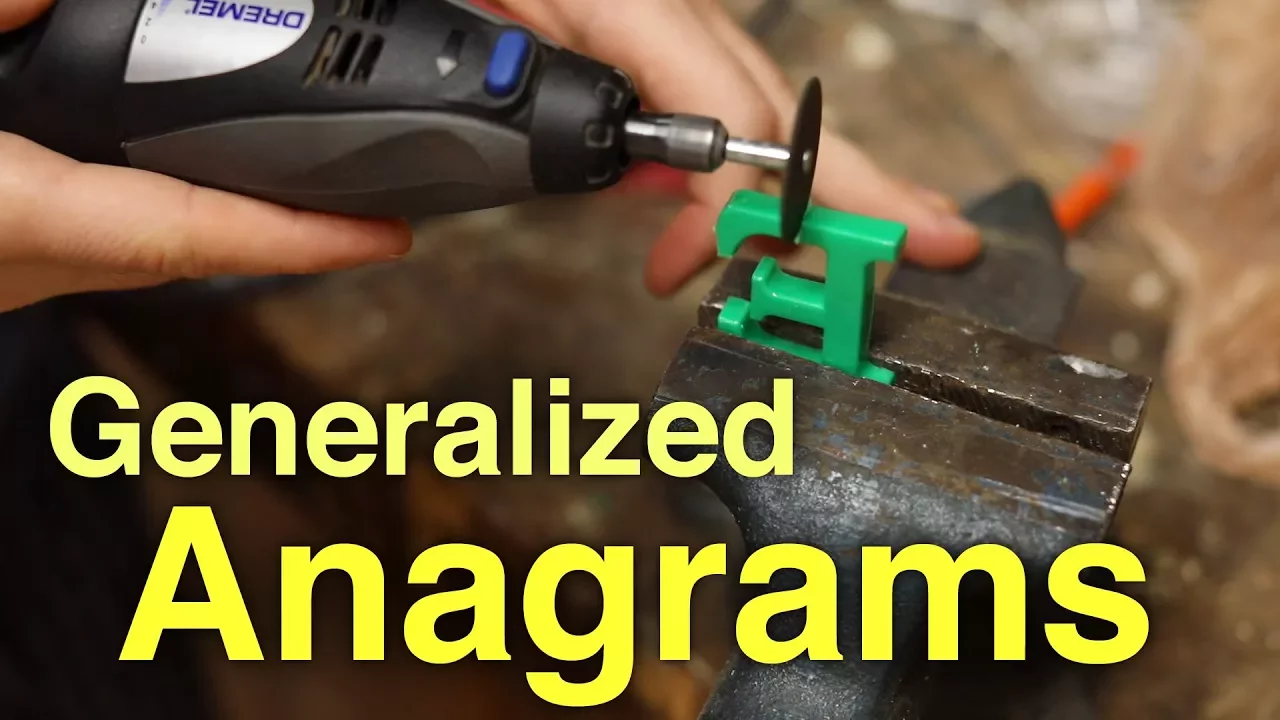
Beyond mere rotation, physical letterforms invite destructive modification. An uppercase `E` closely resembles an `F`, differing only by its bottom horizontal stroke. By physically slicing off that lower plastic bar—analogous to cutting the horn off a unicorn to yield a horse—you produce an `F`. However, strict anagramming rules forbid simply throwing away leftover scraps. A leftover plastic fragment must be repurposed, such as transforming an `F` into an `A` or an `O` into a `Q`. Because English contains very few words featuring both `E` and `Q`, finding valid matches under this exact rule is rare, though one solution resolves nicely: modifying "hogwash" into "come on for hoodoo gods."
- Rotating pairs in capital letters: `M` $\leftrightarrow$ `W`. - Rotating pairs in lowercase letters: `p` $\leftrightarrow$ `d`, `n` $\leftrightarrow$ `u`, and `b` $\leftrightarrow$ `q`. - “Unless you tolerate rotting walls when making anagrams, you should allow rotating letters.”
---
[02:06](https://www.youtube.com/watch?v=qTBAW-Eh0tM&t=126s) Typographic Deconstruction and the "Hamburgevons" Rant
To systematically exploit letter shapes, lowercase letters are much more fertile ground than uppercase letters because their constituent forms share many recurring sub-elements. In traditional type design, typographers start designing a typeface using the sample word "Hamburgevons" (or "Hamburgefonts") under the rationale that these characters encompass nearly all fundamental design motifs needed across the entire alphabet. suckerpinch strongly objects to this standard pedagogical tool, arguing that starting with `H` inherently forces the design of the entire font to become an "H font" rather than allowing varied exploration.
suckerpinch points out how suspicious the test phrase is: it embeds the word "hamburger" alongside "font," which reflects the exact obsession of typographers rather than a neutral, statistically balanced letter set like *Wheel of Fortune*'s `R-S-T-L-N-E`. Instead, suckerpinch suggests substituting "tofu" for "font" to create "tofuburger," since the letter shapes match closely anyway.
Letter decomposition breaks down common typographic forms into interchangeable geometric components: - A lowercase `b` splits into an `l` (vertical stem) and an `o` (counter/bowl). Recombining an `l` and an `o` yields not just `b`, but also `d`, `p`, and `q`. - The letter `l` can be bisected into two vertical pieces, each equivalent to the vertical bar of an `i` (a stroke height). - The dot (tittle) of an `i` functions as an independent component that is also shared with `j`. - A hooked tail completes a `j`, a motif that also recurs in letters like `f`. - Complex glyphs like the stacked two-story `g` can be swapped for a simpler single-story schoolbook `g`, which decomposes neatly into a `j` hook, a stem, and a `c` shape. - Certain letters resist breakdown and remain primitive: `c`, `e`, `o`, `r`, and `s`. While one might attempt to build an `s` out of curved `c` fragments, it scales poorly and ends up disproportionately large.
```mermaid flowchart TD accTitle: Typographic Letter Decomposition accDescr: Diagram illustrating how letters decompose into reusable atomic shapes like ticks, hooks, dots, and primitives.
subgraph Primitives["Atomic Pieces"] DOT["dot (·)"] TICK["tick (vertical bar / stem)"] HOOK["hook (curved tail)"] C_SHAPE["primitive: c"] O_SHAPE["primitive: o"] end
subgraph Assembly["Composed Letters"] I["i = dot + tick"] L["l = tick + tick"] J["j = dot + tick + hook"] B["b / d / p / q = l + o"] G["schoolbook g = c + tick + hook"] end
DOT --> I TICK --> I TICK --> L DOT --> J TICK --> J HOOK --> J L --> B O_SHAPE --> B C_SHAPE --> G TICK --> G HOOK --> G ```
- Final atom inventory: primitive glyphs `c`, `e`, `o`, `r`, `s`, and component fragments `dot`, `tick`, and `hook`. - “I actually think that the letter that you start drawing first has such a big impact on the design of the font, which I guess the whole point of this, that you shouldn't always start with the letter H, otherwise you're only gonna get H fonts.”
---
[05:14](https://www.youtube.com/watch?v=qTBAW-Eh0tM&t=314s) Custom Font Engine, Kerning Pairs, and Coining "Anagraph"
Because off-the-shelf fonts do not guarantee that reassembled components maintain consistent proportions across different glyphs (for example, constructing a `y` out of standard pieces might leave it awkwardly tall), suckerpinch built a dedicated, computational font editor. In this custom tool, letterforms are designed directly out of atomic shapes ("atoms"). Altering an underlying atom immediately updates every letter in the font where that atom appears.
A major development hurdle was kerning: the system initially lacked spacing correction, resulting in visually jarring text. Fixing it required dedicating an entire afternoon to writing spacing logic and manually fine-tuning kerning distances across all $26^2 = 676$ letter pairs.
With the glyph metrics established in memory, a new terminology was needed. Standard "anagram" only implies reordering whole characters, while "anaglyph" already designates stereoscopic 3D images with red/cyan filters. To describe this new system, suckerpinch coined the portmanteau **Anagraph**: combining **anag** (from anagram) and **raf** (an acronym for *Rotate And Pluck Fragments*).
- Anagraph breakdown example for the word **YouTube**: - $1 \times \text{c}$ - $1 \times \text{e}$ - $1 \times \text{o}$ - $3 \times \text{r}$ - $8 \times \text{ticks}$ - $1 \times \text{hook}$ - “Generalized kerning is more interesting computationally than you might think.”
---
[06:41](https://www.youtube.com/watch?v=qTBAW-Eh0tM&t=401s) Generating Anagraphs, Multi-Word Subsets, and the Inception Digression
The anagraph generation algorithm treats words as multisets of atomic shapes. By decomposing a target word into its atoms, sorting those atoms, and encoding them into counts, each word receives a canonical signature. Any other word sharing that exact count vector is an anagraph; for example, the atomic signature of **YouTube** identically matches that of **rocketry**.
To solve for multi-word phrases, the generator checks whether the atomic signature of a dictionary word forms a strict subset of the target pool. Subtracting the constituent atoms of the word **fun** ($2 \times \text{r}$, $5 \times \text{ticks}$, $1 \times \text{hook}$) from **YouTube** leaves behind the exact set of atoms required to form the word **alone**, proving that "fun alone" is a valid multi-word anagraph of "YouTube." The engine searches through every subset match recursively until the atom pool is empty.
This mention of recursion triggers an impassioned rant about the persistent misuse of the word *inception* in popular culture. Christopher Nolan’s film *Inception* portrays nested dreams, which led mainstream internet culture to use "inception" as a synonym for recursion, nesting, or induction. suckerpinch points out that this is an outright misuse of ordinary English: *inception* means creation or beginning. Within the plot of the film, characters infiltrate dreams specifically to plant an idea into a subject’s subconscious so they believe they originated it themselves—that act of seeding an idea is the inception, not the nesting of dreams.
- “Inception, the word inception, does not mean recursion or nesting or induction... it's a normal English word, it means creation or beginning, and in the movie it's used in exactly the normal sense of that word and it's not subtle or subtext at all.”
---
[08:52](https://www.youtube.com/watch?v=qTBAW-Eh0tM&t=532s) Non-Deterministic Decomposition and the Infinite Scrap Loophole
A core assumption of the generation algorithm is that every letter possesses a single, unique atomic decomposition. If an alphabet allows multiple ambiguous decomposition rules, the algorithm breaks, and formal language paradoxes arise. For example, consider a set of rules where: 1. A `b` can be split into $l + o$. 2. A `b` can alternatively be split into $l + c$. 3. An `o` can be split into $c + c$.
Under these rewrite rules, an infinite resource leak appears:
$$\text{b} \xrightarrow{\text{Rule 1}} \text{l} + \text{o} \xrightarrow{\text{Rule 3}} \text{l} + \text{c} + \text{c} \xrightarrow{\text{Rule 2}} \text{b} + \text{c}$$
By taking a `b`, expanding it into `l` and `o`, unpacking `o` into two `c` pieces, and recombining one `c` with the `l` to reform `b`, you return to the starting state while leaving behind an extra, newly created `c`. Repeating this loop produces an infinite quantity of surplus letters out of thin air. Consequently, allowing ambiguous or cyclic decomposition rules without strict constraints makes the puzzle computationally unfeasible or non-terminating.
- “I could just keep doing that to create an infinite number of leftover C's, so I have to be careful about what rules I actually allow if I want this problem to be easily solvable.”
[10:01](https://www.youtube.com/watch?v=qTBAW-Eh0tM&t=601s) The Kerning Problem and Undecidability
Tom Murphy VII (suckerpinch) introduces what he calls the "kerning problem" in the context of letter manipulation and anagrams. He reveals that this problem is mathematically undecidable: given arbitrary replacement or merging rules, no general computer algorithm can ever determine whether one word can be transformed into another word. Recognizing how surprising this theoretical result is, he originally intended to explain the full proof in this video. However, his self-described "editorial board" vetoed the idea on the grounds that it was far too boring for a brisk, ten-minute video. Instead, he spun off the full technical breakdown into a separate 51-minute video that functions as a blend of a rigorous computer science lecture and a sleep aid for anyone who wants to dive deep into the formal details.
In that extended video, he also proves that the "anagraphing" problem itself actually remains solvable, even when dealing with rewrite rules that produce potentially infinite cycles. For his practical implementation here, the challenge is simplified because every letter was constructed explicitly from discrete geometric "atoms." Because each letter has a single, unique atomic decomposition, checking and matching pieces becomes straightforward.
- Arbitrary rewriting rules make the general kerning problem computationally undecidable, meaning no algorithm exists that can decide word transformation in all cases. - The technical explanation was offloaded to a 51-minute companion video serving as a computer science lecture/sleep aid. - In contrast to general rewrite systems, anagraphing remains decidable even under rules permitting infinite derivations. - Because suckerpinch built each letter from explicitly defined atoms, each letter has a fixed, unique decomposition that avoids computational complexity in his project.
As suckerpinch puts it: “That problem is actually unsolvable in the sense that with arbitrary rules there's no computer program that could tell whether one word can be kerned into another word using those rules.”
[10:51](https://www.youtube.com/watch?v=qTBAW-Eh0tM&t=651s) Animating Transitions and Pixel-Level Anagraphs
Once valid pairs of anagraphs are found, the pieces must be animated to move from the source word into the target word. suckerpinch notes that he could have easily spent an entire additional day fine-tuning collision avoidance algorithms to prevent the moving letter fragments from overlapping, describing it jokingly as a kind of "self-driving characters problem." Ultimately, he decided against burning endless time on collision pathfinding because the simpler animation already looked acceptable and he didn't want to "die of old age while working on this video."
Reflecting on the practical applications of anagraphs, he observes that the ultimate purpose of this technology is almost exclusively comedic slander: rearranging names or words into insults. Finding insulting anagrams becomes vastly easier if letters are broken down into something even more fundamental than vector shapes—namely, raw pixels. To illustrate this concept, he ends the video with animations breaking down words down to pixel grids to spell out insults, including roasting the letter "S" as a "garbage letter" before morphing into playful closing sequences accompanied by music.
- Polishing the transitions to prevent overlapping letter fragments was skipped to avoid an endless rabbit hole of character collision avoidance. - Suckerpinch identifies the primary utility of letter-splitting technology: rearranging names into unflattering insults. - Decomposing characters into individual pixels drastically expands the search space, allowing nearly any source word to morph into harsh phrases.
As suckerpinch humorously observes: “By the way I realized the main use of this technology is to malign things by rearranging their names into something unflattering and it's a lot easier to find unflattering things if we break down letters into something even more primitive than these shapes like say pixels.”
## Notable quotes > [06:41](https://www.youtube.com/watch?v=qTBAW-Eh0tM&t=401s) Inception, the word inception, does not mean recursion or nesting or induction... it's a normal English word, it means creation or beginning, and in the movie it's used in exactly the normal sense of that word and it's not subtle or subtext at all. — suckerpinch
## Mentioned suckerpinch, Tom Murphy VII, YouTube, Christopher Nolan, Inception, Wheel of Fortune
## Video description In this video I explore several generalizations of anagrams.
Addendum containing more technical explanations: https://youtu.be/8_npHZbe3qM
[Source](https://www.youtube.com/watch?v=qTBAW-Eh0tM)