Pampena Beats Haran in $120 Coin Wager to Expose Human Anti-Streak Bias
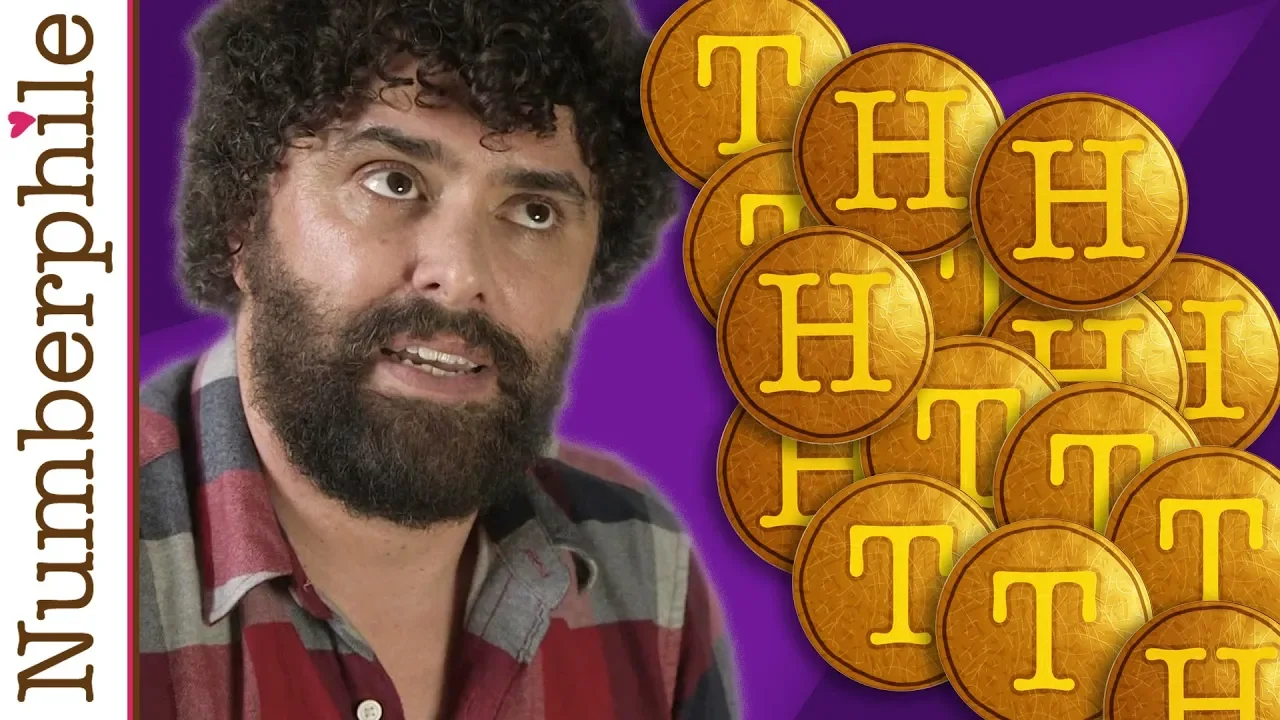
Randomness is Random - Numberphile — Numberphile

Numberphile

Humans attempting to fake randomness instinctively alternate outcomes to avoid streaks, discarding over half of all mathematically possible sequences where clusters naturally occur.

AI-assisted summary of Randomness is Random - Numberphile — original source. Check the original for full context.

Source published:

Key ideas

  • Human intuition severely restricts the outcome space when faking coin flips, intuitively avoiding clusters due to the Gambler's Fallacy. (3:44)
  • Out of 1,048,576 possible permutations for twenty coin tosses, only 242,830 (23.2%) restrict the maximum streak length to three or fewer. (3:44)
  • Over 54.4% of all twenty-flip coin sequences naturally contain streaks of five or more or multiple streaks of four. (6:48)
  • True randomness is fundamentally 'lumpy' and incompressible, containing apparent patterns layered upon patterns rather than alternating homogenously. (6:48)

Detailed notes

## Background Published on YouTube by the channel Numberphile on December 18, 2018, this video features Simon Pampena and is supported by the Mathematical Sciences Research Institute (MSRI). The show notes include promotional links for the sponsor Brilliant, as well as links to additional coin-related videos and other collaborations featuring Pampena.

## TL;DR Presenter Simon Pampena challenges host Brady Haran to mentally simulate a sequence of 20 coin flips, successfully predicting Brady's choices and winning over a hundred dollars in the process. Simon uses this demonstration to explain the Gambler's Fallacy, showing how human intuition mistakenly avoids streaks and clusters to make sequences look 'mixed up.' By analyzing the 1,048,576 possible permutations of 20 coin tosses, he reveals that true randomness is inherently 'lumpy' and that over half of all genuine sequences contain long streaks of five or more or multiple streaks of four.

## Atmosphere & style The video has a lively, playful, and slightly tense atmosphere as Simon confidently escalates the financial stakes of his predictions while Brady reacts with good-natured skepticism. Simon's energetic, enthusiastic delivery makes the mathematical breakdown feel like a thrilling psychological reveal. The dynamic between the two hosts is warm and humorous, blending the excitement of a high-stakes game with clear, accessible scientific insights.

## Bulletin - [03:44](https://www.youtube.com/watch?v=tP-Ipsat90c&t=224s) Human intuition severely restricts the outcome space when faking coin flips, intuitively avoiding clusters due to the Gambler's Fallacy. - [03:44](https://www.youtube.com/watch?v=tP-Ipsat90c&t=224s) Out of 1,048,576 possible permutations for twenty coin tosses, only 242,830 (23.2%) restrict the maximum streak length to three or fewer. - [06:48](https://www.youtube.com/watch?v=tP-Ipsat90c&t=408s) Over 54.4% of all twenty-flip coin sequences naturally contain streaks of five or more or multiple streaks of four. - [06:48](https://www.youtube.com/watch?v=tP-Ipsat90c&t=408s) True randomness is fundamentally 'lumpy' and incompressible, containing apparent patterns layered upon patterns rather than alternating homogenously.

## Key takeaways - [00:00](https://www.youtube.com/watch?v=tP-Ipsat90c&t=0s) Simon Pampena demonstrates how human cognitive biases make imagined sequences of coin flips predictable. - [00:00](https://www.youtube.com/watch?v=tP-Ipsat90c&t=0s) Brady Haran privately records twenty imagined coin tosses, which Simon attempts to guess one by one. - [00:00](https://www.youtube.com/watch?v=tP-Ipsat90c&t=0s) Simon leverages Brady's urge to balance outcomes to successfully win escalated bets of $20 and $100. - [03:44](https://www.youtube.com/watch?v=tP-Ipsat90c&t=224s) Brady's sequence suffers from the Gambler's Fallacy, the mistaken belief that independent past flips influence future odds. - [03:44](https://www.youtube.com/watch?v=tP-Ipsat90c&t=224s) Humans attempting to fake randomness produce overly homogeneous sequences that avoid realistic clustering. - [03:44](https://www.youtube.com/watch?v=tP-Ipsat90c&t=224s) There are exactly 2^20 (1,048,576) ordered permutations for a sequence of twenty binary coin flips. - [03:44](https://www.youtube.com/watch?v=tP-Ipsat90c&t=224s) Sequences with streaks capped at three represent only 242,830 permutations, or 23.2% of the total mathematical space. - [06:48](https://www.youtube.com/watch?v=tP-Ipsat90c&t=408s) While a streak of four is rare in four flips (1 in 16), twenty flips offer numerous positions for streaks of four, five, or six to occur. - [06:48](https://www.youtube.com/watch?v=tP-Ipsat90c&t=408s) Allowing a maximum streak of three plus at most a single streak of four accounts for only 478,520 permutations (45.6%). - [06:48](https://www.youtube.com/watch?v=tP-Ipsat90c&t=408s) Genuine randomness naturally embraces long runs, with more than half of all twenty-flip sequences featuring multiple streaks of four or streaks of five-plus. - [06:48](https://www.youtube.com/watch?v=tP-Ipsat90c&t=408s) True random data holds high information complexity and cannot be compressed into simple alternating rules.

## Detailed walkthrough ### [00:00](https://www.youtube.com/watch?v=tP-Ipsat90c&t=0s) Testing Human Intuition of Randomness with a Coin Game

Simon Pampena challenges Brady Haran to test his ability to generate true randomness purely in his imagination. He asks Brady to pretend to be an imaginary coin flipper, mentally flipping a coin twenty times and recording the sequence of heads and tails on a notepad without showing anyone. Simon announces his intention to make money off Brady's psychological tendencies. Handing Brady a small stack of pennies that Brady is allowed to keep, Simon sets up the ground rules: for every coin flip prediction Simon makes, a penny is placed on the line. If Simon guesses Brady's hidden result correctly, Brady must hand over a coin from his stack; if Simon misses, Brady keeps the penny.

The game begins with small stakes, but Simon immediately starts calling out Brady's choices. Simon correctly predicts heads on the very first flip and collects a penny. After predicting tails on the second and third flips—both of which turn out to be heads—Simon senses Brady's psychological urge to balance things out. For the fourth flip, Simon abruptly escalates the stakes: he wagers twenty US dollars that Brady picked tails. Brady reveals that it was indeed tails and sheepishly accepts the loss, protesting, “Okay. I don't remember agreeing to that,” while Simon sets his newly won twenty-dollar claim aside and resumes the game.

Predicting Brady's moves based on human cognitive bias, Simon continues through the twenty flips. Whenever Brady lingers on a single result, Simon anticipates an immediate alternation. The sequence of calls moves briskly: tails (correct), heads, tails (correct), heads (incorrect), tails (incorrect, it was a head), heads (correct), tails (correct), heads (correct), tails (incorrect), tails (correct), heads (incorrect), head (correct), tail (correct), tail (incorrect), head (correct). With just one flip remaining, Simon raises the stakes dramatically once more. He places a hundred-dollar bet on the twentieth flip being tails. After a tense pause, Brady confesses that the final flip was indeed tails, sending Simon into celebration. Brady laments how much the demonstration ended up costing him, but Simon remarks that Brady simply gave into common mental patterns.

- Ground rules: 20 sequential coin flips imagined and written down privately by Brady. - Small wagers of 1 penny per flip, interspersed with two high-stakes bets of $20 (on flip 4) and $100 (on flip 20), both won by Simon. - Brady’s actual written sequence began with a run of three heads (H, H, H, T) and thereafter alternated frequently, never producing a streak longer than two of the same outcome.

---

[03:44](https://www.youtube.com/watch?v=tP-Ipsat90c&t=224s) The Gambler's Fallacy and the "Lumpiness" of Permutations

Looking over Brady's sheet, Simon immediately diagnoses why Brady was so easy to read: his imagined list falls prey to the classic Gambler's Fallacy. Brady's longest streak was three heads right at the start, followed by rapid alternation between heads and tails, never exceeding a run of two in a row for the rest of the sequence. As Simon explains, the Gambler's Fallacy is the mistaken belief that past independent events influence future probabilities—even though a fair coin maintains an exact 50/50 probability on every flip regardless of history. People instinctively assume that five or six heads in a row is wildly improbable, leading them to avoid clusters when trying to fake randomness. Simon points out:

> “Now a lot of people think well, how does that work? Because you know, you're flipping coins, surely it's not very likely to have, you know, five heads in a row, six heads in a row. But this is the nature of randomness, randomness is very lumpy, right?”

Brady's generated sequence is what mathematicians would describe as overly homogeneous because it is far too evenly mixed. In twenty coin flips, there are $2^{20}$ possible permutations in fixed order, which equals exactly 1,048,576 possibilities. Simon crunches the numbers to show how severely human intuition restricts the outcome space. If you look at all possible permutations of twenty coin tosses that restrict the maximum streak of heads or tails to at most three in a row, there are only 242,830 such sequences. This means Brady drew his sequence from a narrow pool representing just 23.2%—less than one-quarter—of all mathematically possible permutations. By deliberately avoiding streaks to make the sequence "look mixed up," Brady ironically made his sequence predictable and unrepresentative of genuine randomness.

```mermaid flowchart TD accTitle: Permutation Breakdown of Twenty Coin Flips accDescr: A tree showing all 1,048,576 permutations divided into those with max streaks of three, those with one streak of four, and all other streaks. Total["All Permutations of 20 Flips<br/>2^20 = 1,048,576 (100%)"]

subgraph Restricted["Human Intuition Biases"] S3["Max streak of 3<br/>242,830 permutations (23.2%)"] S4["Max streak of 3 + exactly one streak of 4<br/>478,520 permutations (45.6%)"] end

subgraph TrueRandom["True Random Space"] Remaining["Multiple streaks of 4, streaks of 5+<br/>569,056 permutations (54.4%)"] end

Total --> S3 Total --> S4 Total --> Remaining ```

---

[06:48](https://www.youtube.com/watch?v=tP-Ipsat90c&t=408s) Why True Randomness Embraces Long Streaks and Complex Patterns

Brady defends his choices by noting that he was not consciously setting a rule to cap streaks at three; rather, his subconscious naturally steered him away from clusters. Simon explains that humans tend to think small-mindedly: while having four heads in a row out of four flips is indeed rare (1 in 16), in a sequence of twenty flips, the opportunity for streaks opens up dramatically. A run of four, five, or six heads or tails can appear anywhere along the twenty positions, and every single position where that streak occurs still leaves all remaining positions free to permute into millions of variations.

Simon notes that when he runs this experiment with school children, they will occasionally include a streak of four, but almost never more than once. Simon crunched the data for that scenario as well: the total number of permutations of twenty flips that allow a maximum streak of three plus at most a single streak of four is 478,520. That accounts for only 45.6% of all possibilities. In other words, over half of all genuine twenty-flip coin sequences will contain either multiple streaks of four or streaks of five or more. When people try to be random, they systematically discard more than half of the mathematical universe. Simon reflects on how true randomness can be identified through information compressibility, drawing an analogy to genetics:

> “Because the DNA sequence contains so much information it actually in a way contains lots of patterns. So the way you can think of randomness is it's something that actually has patterns on patterns on patterns on patterns.”

Brady jokes that if he had only written heads on the final flip, he would have won the hundred-dollar bet, maintaining that Simon was simply lucky. Simon counters that Brady's sequence followed the arc of a formulaic Hollywood movie script—starting with a big action sequence of three heads to look daring, and then settling into a safe, predictable alternating rhythm for the remainder.

- Total permutations of 20 binary choices: $2^{20} = 1,048,576$. - Permutations with a maximum streak length of 3: $242,830$ ($23.2\%$). - Permutations with a maximum streak of 3 plus at most one streak of 4: $478,520$ ($45.6\%$). - Over $54.4\%$ of all true twenty-flip coin sequences contain longer runs (streaks of 5 or more) or repeated runs of four. - In Kolmogorov complexity terms, true randomness cannot be compressed or described by simple alternating shorthand; it inherently forms arbitrary clumps and apparent patterns without underlying physical rules.

[12:22](https://www.youtube.com/watch?v=tP-Ipsat90c&t=742s) Brilliant Gift Subscriptions and Wrapping Up

Brady transitions into discussing the sponsor for the video, Brilliant, noting that viewers have likely heard him praise the platform before. While the site is renowned for mathematics, Brady emphasizes that it also features an extensive catalog covering science and computer science. Although plenty of content is accessible for free, a premium membership unlocks additional learning material. Brady suggests an idea for viewers looking for presents: giving a Brilliant membership as a gift. He explains that it takes only a few clicks to deliver hours, days, or even years of fun, education, and entertainment to a friend or family member, noting how difficult it can be to find thoughtful and original gifts. As Brady puts it, “Go to brilliant.org/numberphile, follow the easy links to a gift subscription and feed the brain of someone you care about.”

To close out the shoot, Brady checks in to see if they have covered everything, asking, “Alright, anything else?” Simon Pampena immediately quips back, “Yeah, where's my money?”

- Brilliant covers subjects across mathematics, science, and computer science. - Gift subscriptions can be set up in a few clicks via `brilliant.org/numberphile`.

## Notable quotes > [06:48](https://www.youtube.com/watch?v=tP-Ipsat90c&t=408s) So the way you can think of randomness is it's something that actually has patterns on patterns on patterns on patterns. — Simon Pampena

## Mentioned Simon Pampena, Brady Haran, Brilliant, Numberphile, Pete McPartlan, Mathematical Sciences Research Institute (MSRI), Science Sandbox, Simons Foundation, Math For America

## Video description Featuring Simon Pampena... Check out Brilliant (and get 20% off their premium service): https://brilliant.org/numberphile (sponsor) More links & stuff in full description below ↓↓↓

More coin-related videos: http://bit.ly/coins_videos

More videos with Simon Pampena: http://bit.ly/Pampena_Videos Simon on Twitter: https://twitter.com/mathemaniac

Numberphile is supported by the Mathematical Sciences Research Institute (MSRI): http://bit.ly/MSRINumberphile

We are also supported by Science Sandbox, a Simons Foundation initiative dedicated to engaging everyone with the process of science. https://www.simonsfoundation.org/outreach/science-sandbox/

And support from Math For America - https://www.mathforamerica.org/

NUMBERPHILE Website: http://www.numberphile.com/ Numberphile on Facebook: http://www.facebook.com/numberphile Numberphile tweets: https://twitter.com/numberphile Subscribe: http://bit.ly/Numberphile_Sub

Videos by Brady Haran Animation and editing in this video by Pete McPartlan

Patreon: http://www.patreon.com/numberphile

Numberphile T-Shirts: https://teespring.com/stores/numberphile

Brady's videos subreddit: http://www.reddit.com/r/BradyHaran/

Brady's latest videos across all channels: http://www.bradyharanblog.com/

Sign up for (occasional) emails: http://eepurl.com/YdjL9

[Source](https://www.youtube.com/watch?v=tP-Ipsat90c)

中文简报

潘佩纳在120美元抛硬币赌局中击败哈兰,揭示人类反连胜偏差 人类试图伪造随机性时会本能地交替选择结果以避免连续出现,从而排除了数学上超过半数自然会出现聚集的可能序列。 主持人西蒙·潘佩纳向搭档布雷迪·哈兰发起挑战,要求他在脑海中模拟20次抛硬币的序列,西蒙成功预测了布雷迪的选择,并在此过程中赢得了100多美元。西蒙借助这次演示解释了“赌徒谬误”,展示了人类直觉如何为了让序列看起来“混乱”而错误地回避连胜和聚集现象。通过分析20次抛硬币可能产生的1,048,576种排列,他指出真正的随机本质上是“成块聚集”的,并且在所有真实序列中,超过半数都包含5次及以上的长连胜,或多次4连胜。 人类直觉在伪造抛硬币结果时会严重限制结果空间,受赌徒谬误影响本能地回避聚集现象。 (3:44) 在20次抛硬币的1,048,576种可能排列中,只有242,830种(23.2%)的最大连续长度限制在3次或更少。 (3:44) 在所有20次抛硬币的序列中,超过54.4%自然包含5次及以上的连续,或多次4次连续。 (6:48) 真正的随机本质上是“成块”且不可压缩的,其中包含层层叠叠的表面模式,而非均匀交替出现。 (6:48)

Reading summary

Simon Pampena demonstrates that human intuition fails to mimic true randomness because people instinctively avoid clusters and over-alternate outcomes, inadvertently eliminating more than half of all mathematically possible permutations. The Gambler's Fallacy and Alternation Bias (3:44) When people attempt to simulate random sequences—such as mentally generating twenty coin flips—they frequently succumb to the Gambler's Fallacy. This bias is the mistaken belief that past outcomes in an independent process dictate future probabilities to force an immediate 50/50 balance. In Pampena's demonstration, Brady Haran began with a run of three heads but then rapidly alternated between heads and tails, never producing a subsequent streak longer than two. By anticipating Brady's psychological urge to break streaks and restore balance, Pampena was able to systematically predict outcomes and win wagers throughout the sequence. Mathematical Underrepresentation of Streaks (3:44) A sequence of twenty binary choices yields $2^{20}$, or 1,048,576, ordered permutations. Pampena's combinatorial breakdown reveals that sequences restricted to a maximum streak of three account for only 242,830 permutations, or 23.2% of all possibilities. Permitting at most one streak of four alongside runs of three expands the set to 478,520 permutations, representing 45.6% of the total. By avoiding consecutive identical outcomes to make a sequence look mixed, human intuition naturally selects from an overly homogeneous minority of the available outcome space. The Inherent Lumpiness of True Randomness (6:48) Contrary to common intuition, true randomness is inherently "lumpy." More than 54.4% of genuine twenty-flip sequences contain either multiple streaks of four or streaks of five or more. While a four-head run across four flips has a 1-in-16 probability, twenty flips provide numerous positions where streaks can emerge, leaving the remaining positions open to millions of variations. Pampena notes that true randomness mirrors complex information structures, such as DNA sequences, in that it cannot be compressed into a neat alternating shorthand; it naturally exhibits apparent clumps and patterns without any underlying governing rule. Pampena concludes that people attempting to fabricate randomness produce formulaic sequences that are predictable precisely because they deliberately avoid clusters. While Brady Haran maintained that Pampena's high-stakes betting wins on the 4th and 20th flips involved an element of luck, the mathematical distribution shows that true chance permits far more clustering than human intuition expects.

精炼阅读摘要

数学传播者 Simon Pampena 通过硬币预测实验指出,人类直觉在模拟随机时往往会陷入“赌徒谬误”,误将频繁交替视为随机并刻意规避连续重复;然而在数学本质上,真实的随机性具有显著的“聚集性”(lumpy),其结果空间在很大程度上正是由长连胜或长连续模式所主导的。 硬币假想实验:直觉伪随机的可预测性 (0:00) 在节目展示的实验中,Simon Pampena 要求 Brady Haran 在脑海中构想连续抛掷二十次硬币的结果,并在不公开的情况下写下这串正反面序列。Simon 提出以此进行下注游戏,基础赌注为每枚硬币一美分,若猜中 Brady 的记录则赢得硬币,反之则由 Brady 保留。在预测过程中,Simon 敏锐地利用了人类试图在短时间内维持正反平衡的心理倾向。例如在 Brady 开局写下连续三次正面后,Simon 准确预判对方会因心理补偿而转向反面,并突然追加二十美元高额赌注获胜;而在第二十次抛掷时,Simon 再次押注一百美元判定其为反面并再度猜中。 Brady 最终记录的真实序列呈现出极其鲜明的心理偏见特征:仅在开头出现了唯一的连续三次正面,其余部分则陷入频繁的正反交替,后续序列中再也没有出现超过两次的连续相同结果。Simon 据此指出,普通人在试图表现出“随机感”时,往往会下意识地回避连续结果,这种自以为在模拟混乱的心理机制,反而暴露出极其公式化且易于被算法或观察者预测的固定节律。 赌徒谬误与样本空间的直觉压缩 (3:44) Simon 分析指出,Brady 的假想序列精准落入了经典的“赌徒谬误”(Gambler's Fallacy)陷阱。赌徒谬误的本质在于误以为先前的独立随机事件会对未来的概率产生制约,但事实上每一枚质地均匀的硬币在每次抛掷时,出现正反面的概率始终是完全独立的 50%。人们往往直觉地认为连续出现五次或六次正面是极其罕见且不真实的事件,因而在主观编造数据时会刻意制造均匀分布,导致生成的序列呈现出过度的同质性(homogeneous)。 数学组合的严谨计算揭示了人类直觉与实际概率分布的巨大脱节。二十次独立的二元抛掷在固定顺序下共有 2 的 20 次方、即 1,048,576 种可能的排列组合。Simon 计算指出,如果将序列中正面或反面的最长连续次数严格限制在三次及以内,符合条件的排列仅有 242,830 种,仅占全部数学可能性的 23.2%。这意味着 Brady 在试图让序列“看起来很乱”时,其潜意识实际上直接剔除了超过四分之三的客观可能性,将选择范围压缩在不到四分之一的狭隘样本空间内。 真实随机的聚集特性与复杂信息结构 (6:48) 针对 Brady 辩称自己并未刻意设定规则而是下意识避免重复,Simon 进一步阐释了局部视角与全局视角的数学差异。单纯在连续四次抛掷中出现四次正面确实概率较低(十六分之一),但在多达二十次抛掷的全局长序列中,连续四次、五次甚至六次相同结果可以出现在二十个位置中的任意区段,而序列的其余位置仍可衍生出数以万计的变化组合。数据显示,若将限制放宽至最长连击为三次加上最多一次连续四次相同结果,总组合数也仅为 478,520 种,占总空间的 45.6%。换言之,在真正的二十次随机硬币抛掷中,超过 54.4%(569,056 种)的序列必然包含多次连续四次或至少一次连续五次以上的长连击出现。 Simon 借用信息论与基因序列(DNA)的类比说明,真正的随机性在柯尔莫哥洛夫复杂度(Kolmogorov complexity)的意义上是不可压缩的,它无法被简单的交替缩写所概括。正因为随机过程包含了极高的信息量,它在微观上反而必然会形成看似规律的“聚集块”以及多层叠加的表象模式。人类因厌恶聚集而制造的均匀交替,实际上是在抹杀随机性中最核心的复杂特征。 Brady 认为 Simon 在最后一次高额押注中的胜利存在侥幸成分,但 Simon 坚称 Brady 的序列完全符合可预测的人类叙事套路。该讨论最终表明,由于人类认知普遍误将“均匀分布”等同于“随机”,人在主观模拟几率时往往会系统性地规避长连击,导致生成的伪随机序列远比客观的数学随机更容易被规律性破解。

Source quotes

[6:48] Simon Pampena: So the way you can think of randomness is it's something that actually has patterns on patterns on patterns on patterns.

Original transcript

[0:00] I want to actually see if I can test your abilities with randomness, if you can do me something, do me a favour. [0:05] So, you know, flipping a coin: heads or tails? Alright, so I want you to be a [0:10] coin flipper in your mind and I want you to flip a coin in your mind randomly 20 times and [0:18] write down the result here, but don't show me. [0:24] You've done 20? Okay. Now, I don't want to see. [0:27] But, what's going to happen is I'm gonna try and make money off your list. [0:33] So what I'm gonna do is I'm gonna give you a bunch of pennies and you don't have to pay me back, [0:38] they're yours. And these are mine. I [0:42] bet to play and if I win you give me that amount and if I lose you keep that amount, [0:47] all right? So I'm just going to put a penny down, [0:50] there's one penny riding on this. [0:52] Okay. So my first prediction is that you flipped a head. - (Brady: Yes) - Yes! [1:00] So Brady says head. So, I'm gonna take one of your coins from your stack, [1:04] okay, I gave them to you anyway, so you shouldn't be too [1:07] miffed. Put another coin in. Okay, I'm gonna predict tails. - (Brady: No) - Oooh [1:14] So you've said head. Okay next I'm going to predict tails. - (Brady: No) [1:21] Not tails. Next I'm going to predict tails and I'm going to bet [1:29] 20 dollars... [1:33] ...that I'm right. What did you - what was it, heads or tails? - (Brady: It was tails) [1:43] You owe me 20 bucks. - (Brady: Okay. I don't remember agreeing to that) [1:50] So I'm just gonna put that aside. All right, shall we keep playing? [1:57] I'm gonna bet another coin, just remember you owe me 20 US, I want it in US if that's okay? Okay, I'm gonna bet another coin. [2:05] I'm gonna predict tails. - (Brady: Yeah) - It is tails? Okay tails it is. Alright, so I get another coin there. [2:13] I'm going to predict heads. I'm going to predict tails. [2:18] Tails it is. [2:20] So that was another coin from you. Heads? [2:23] (Brady: No) [2:24] No, okay, so you get to keep that. Tails? - (Brady: No mate, it's a head) [2:28] It's a head so you get that. Heads? Heads it is. [2:33] Alright, so I get another coin from you. This is turning out [2:35] alright. You remember you've got the 20 to give me? - (Brady: Yeah, yeah) - Okay. I'm gonna predict [2:40] tails? - (Brady: Yeah) - It is a tail. [2:43] - (Yeah) - So I get another coin from you. Heads? - (Yeah) [2:47] It is a head. Okay, I'm gonna predict a tail. Is it a tail? - (Brady: No) - Tail? - (Yep) [2:53] Okay, I'm going to predict a head? - (No) [2:56] Okay, you get that coin. I'm gonna predict another head. - (Yep) [3:00] It was a head so I get a coin from you. Tail? - (Yep) - Was a tail. And I predict another tail? - (No) [3:07] It's a head. So I'm going to predict a head. - (Correct) - Last one, umm [3:22] For a hundred bucks: tail. [3:31] (Brady: ...Yeah) - It is a tail? - (Yeah) [3:35] YES! [3:39] (Brady: That was expensive) - That was expensive, you should have listened to the way I said this. You've done something fantastic for me, [3:44] you have been really bad at creating random sequences. As I can see here [3:49] the longest run that you've had is right at the beginning, [3:51] it was three heads, and then you've pretty much alternated between tails and heads, tails and heads; the most [3:57] run that you've had of tails or heads is two in a row. And you showed a pattern there. [4:03] This demonstrate something called the Gambler's Fallacy. The gambler's fallacy is, says that [4:08] what's happened before [4:11] has an impact of what will happen next. If we were using a coin, every time you flip it there's an equal probability [4:18] that you're going to get a head or a tail. Now a lot of people think well, how does that work? [4:22] Because you know, you're flipping coins, [4:25] surely it's not very likely to have, you know, five heads in a row, six heads in a row. [4:30] But this is the nature of randomness, [4:33] randomness is very lumpy, right? And lumpiness means that you do get streaks, which is part of the gambler's [4:41] lexicon, you know, there's like, we have a gambling streak. So you actually have not produced a very good random sequence. [4:47] (Brady: I didn't put enough long streaks in) [4:48] He didn't put enough streaks in, no. This, this is actually - would be termed homogeneous. [4:55] Because it's actually quite mixed. The number of ways that we can have twenty heads or tails, [5:00] the number of permutations we can have, is pretty big. So we can basically get a head or a tail in each position and [5:06] there's 20 positions. [5:08] So the total number of permutations, not combinations, like fixed order, is 2 to the power [5:15] 20. And that turns out to be [5:20] 1,048,576. [5:23] Because you've done a permutation [5:26] which has a maximum [5:28] streak of either three heads or three tails, you only had one little tiny streak right at the beginning, which was quite interesting. [5:35] That is a subset of every single permutation. [5:38] But this is actually representative of the way you think, and not just you Brady, [5:42] a lot of people think exactly like you. If they were to do random they think mixed up, right? [5:47] That's what people think. But random isn't mixed up, it - random is, [5:52] well it's random. [5:53] In actual fact [5:54] it has a [5:54] different nature to the idea of being mixed up. Because if it was evenly mixed up, as I've just shown I've made a lot of [6:00] money off you, you end up being predictable. And randomness is unpredictable. So [6:04] I've actually crunched the numbers and I can tell you how many permutations [6:09] have a maximum of three heads or three tails as a streak: [6:15] 242,830. [6:18] So you can see that's a much smaller number than this. And an actual fact it turns out to be [6:25] 23.2% [6:26] of [6:27] all possible permutations. [6:29] It's less than 1/4. So out of all the possible permutations you can have, the pool that you would choose from, [6:36] okay, only is you're only getting one in four. [6:41] So can see just by that logic alone why this, [6:45] well, it's not random. [6:48] All right? - (Brady: Of course, Simon, I wasn't consciously limiting myself to streaks of three.) [6:52] (I guess my brain was somehow.) - Well, that's a natural thing to do, because we think streaks are [6:58] unlikely. We tend to think very small mindedly. [7:01] So if you were just dealing with say four in a row, [7:04] Having four heads or four tails in a row [7:07] is actually in the minority. Because there's only one way you can get four heads in a row, and only one way you can get [7:11] four tails in a row. But we did 20 and [7:14] so straight after you did four heads or four tails, [7:17] imagine if after that you did head tails, head tails, head tails. There's a whole heap of different permutations [7:22] you can get, which at the beginning have four heads or four tails. [7:26] Now that's part of how randomness works, is the fact that, sure, if you're dealing with a small sample [7:34] you can expect things to be quite mixed up, but that's because there's not many permutations. [7:39] Head, tail, head, tail, tail, head, tail, head is actually, you know, in the same ballpark number as [7:46] big streaks. But when you're dealing with very long streaks [7:49] then you could have head, head, head, head, head, head, head, and then you've still got all the [7:55] permutations left to go, which is still a huge number. It's not just in that position; [7:59] you could get a streak of six heads in a row or six tails in a row at any point and, [8:06] and, and if you do that you end up with a whole bunch of permutations [8:10] which have a streak of six heads or a streak of six tails. I've done this with school kids plenty of times and [8:16] what has happened, in my empirical evidence, [8:19] all right, is that you do have kids putting in a streak of four heads or four tails but only once. [8:25] They'll only do a maximum of once. So I actually crunched the numbers and I wanted to work out if, [8:30] how many, how many permutations of 20 heads or tails where you had a maximum of three heads or three tails and, and just one [8:39] streak of four. It's basically what you've done, plus you also allow four heads or four tails. Now- - (Brady: Only once?) [8:47] Only once. That's basically all of this plus one streak of [8:53] four heads or four tails. I really had to crunch the numbers for this, I'm telling you. [8:58] So the total number is [9:00] 478,520. And that corresponds to [9:07] 45.6% of all permutations. [9:11] (Brady: Oh that's bigger than I expected!) [9:13] It is bigger but it's still less than half. So this is kind of the limit of what you're normally [9:20] mathematically literate [9:22] person [9:23] thinks about randomness. They actually, over, over twenty [9:27] flips of heads or tails will actually cut out half of all permutations as possibilities. [9:32] Now half is pretty significant when we're talking about probability, right? It's like, half. [9:38] You'd actually get rounded down. [9:40] (Brady: So you're telling me that over half of all the times I do this, with a coin, I will have a streak of four twice, twice or a streak of five or-?) - Exactly, exactly. [9:51] More streaks of four in a row and longer streaks. It's because I've chosen quite a lengthy number of flips, [9:58] so we've done twenty. If it's 16 [10:00] it doesn't work as much. The nature of randomness really presents itself in the length of the number of flips. The way we can think [10:07] about it is how [10:09] predictable is your sequence? Really all you need to know is, is there a way that you can write your [10:15] sequence down of heads and tails? [10:17] Is there a way to do it [10:19] that it's simpler? And if there is some sort of order or pattern to it, then you can actually make it simpler. [10:25] But if your sequence is actually very complicated [10:28] it's actually harder to write it any smaller than it is. And there is a way of categorising [10:33] a random sequence by saying, the easiest way to write this sequence down is just write it. The DNA sequence [10:39] which makes up me and [10:41] the fabulous person you are Brady, is actually a near random sequence. Because the DNA sequence contains so much information [10:47] it actually in a way contains lots of patterns. [10:51] So the way you can think of randomness is it's something that actually has patterns on patterns on patterns on patterns. [10:59] And that actually fits in very much with the way gamblers think where they say, oh, I can see a pattern here, [11:04] I can predict what's going to happen next. [11:07] But that's, that's just randomness at work. [11:10] Randomness shows patterns, but there's no logic to it. It's not following rules of science or physics or anything, [11:17] it's the way randomness is. [11:19] (Brady: Do you know how- I just wish, if I'd just made that last one a head I would have won.) - Yeah [11:26] (If I'd just made the last one a head!) [11:29] (And it wouldn't- and it still would have just been a streak of three) [11:33] Yeah, well, 'cause- - (Brady: You were lucky, you were just lucky.) [11:35] No, well, because you proved to me that, that you weren't gonna do it again. [11:40] I think- - (Brady: I'd done it once before!) [11:41] You started! You started big. This is basically, you did, [11:45] this is like a Hollywood script. You start with a big action sequence at the beginning and then it becomes formulaic. [11:52] (Brady: Bit like this video?) [11:59] Thanks [12:02] Well, today's episode sponsor Brilliant is full of courses and quizzes and puzzles and lots of them touch on the Gambler's Fallacy, [12:11] randomness, probability in all sorts of ways. [12:17] And this is just a small smattering of the great bounty of stuff [12:22] you're gonna find on the site, which I'm sure you've heard me talk about before. It's amazing for mathematics [12:26] but there's also loads of science and computer science on there as well. [12:30] Lots of it's free, but you can also get a premium membership that unlocks all sorts of other goodies. [12:35] I know some of you are doing that already [12:37] but here's something you might not have thought of: buying someone else a Brilliant membership as a gift. [12:43] It's so easy, with just a few clicks you're giving someone you care about hours, days, maybe years of fun, [12:50] education, [12:52] entertainment. It's so had coming up with thoughtful and original gifts for people these days, [12:57] someone in your life might really like this. Really clever, a little bit different. [13:02] Go to brilliant.org/numberphile, [13:05] follow the easy links to a gift subscription and feed the brain of someone you care about. [13:15] (Brady: Alright, anything else?) Simon: Yeah, where's my money?