Summers Backs Fed Hikes to Cool Labor as Stewart Cites Profit Markups
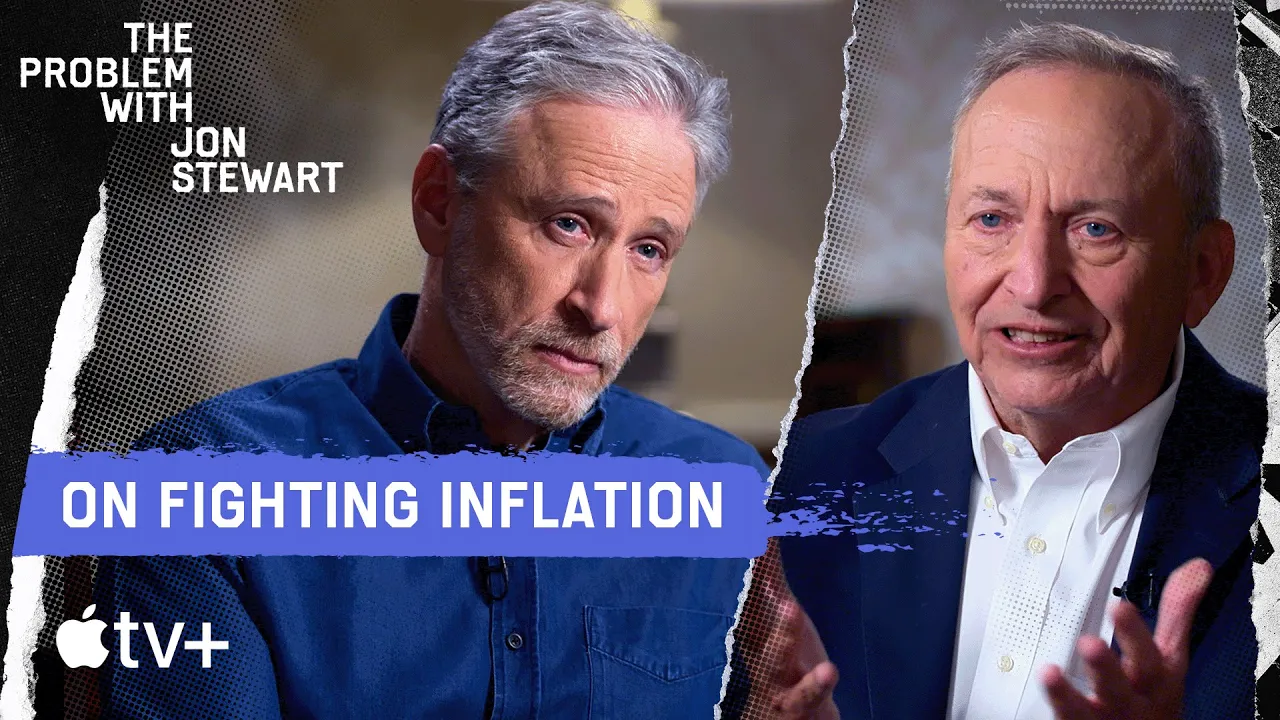
The Problem With Jon Stewart
Federal Reserve rate hikes force workers to shoulder the burden of inflation through job cuts, even as corporate profit margins and supply disruptions drive the vast majority of price surges.
AI-assisted summary of Interview with Larry Summers, Former Secretary of the Treasury | The Problem with Jon Stewart — original source. Check the original for full context.
Source published:
Key ideas
- Larry Summers frames post-pandemic inflation as an aggregate demand crisis caused by fiscal stimulus outpacing productive capacity, while Jon Stewart cites San Francisco Fed findings that demand accounted for only 30% to 35% of inflation and wages just 20%. (0:00)
- Stewart contrasts the 2008 financial bailout with 2020 pandemic aid, arguing that directing 70% of household relief to basic necessities like food and rent fueled a faster employment rebound than bank-centered liquidity. (1:52)
- Summers emphasizes that working-class, Black, and Hispanic households bear the heaviest burden from rising living costs, making inflation rather than unemployment their primary economic concern. (1:52)
- Stewart challenges the policy asymmetry in central banking, arguing corporate profit markups of up to 70% are accepted as market forces, while worker wage gains are treated as threats requiring interest rate hikes to loosen the labor market. (4:24)
Detailed notes
## Background Published on YouTube on March 17, 2023, by the official channel for The Problem With Jon Stewart, this video features an interview clip with former Treasury Secretary Larry Summers. The program's description frames the conversation around the Federal Reserve actively suppressing worker gains to tame inflation, pointing viewers to the full episode titled 'The Inflation Blame Game' streaming on Apple TV+.
## TL;DR In this economic debate, former Treasury Secretary Larry Summers defends Federal Reserve interest rate hikes as a necessary, if unpleasant, intervention to cool aggregate demand and curb inflation that severely erodes working-class purchasing power. Jon Stewart vigorously counters using Federal Reserve data, arguing that corporate profit margins and supply chain snarls drove the vast majority of price increases rather than worker wages. Stewart accuses institutional economic policy of imposing an unfair double standard that accepts corporate markups as natural market forces while actively targeting worker leverage through engineered job losses. Summers acknowledges deep structural wealth inequality but insists central bankers lack the policy mandates to resolve socioeconomic divides, maintaining that a cooler labor market is an unavoidable consequence of stabilizing the broader economy.
## Atmosphere & style The exchange operates as a high-stakes, intellectually combative clash between orthodox macroeconomic policy and progressive economic skepticism. Jon Stewart delivers an animated, morally indignant performance, puncturing traditional economic models with sharp statistical rebuttals and fiery interruptions. Larry Summers counters with a measured, clinical demeanor, leaning into technocratic analogies before turning the focus directly back onto Stewart and his corporate distributor, Apple. The dynamic is charged and relentlessly fast-paced, crackling with pointed personal challenges while remaining grounded in substantive economic disagreement.
## Bulletin - [00:00](https://www.youtube.com/watch?v=tU3rGFyN5uQ&t=0s) Larry Summers frames post-pandemic inflation as an aggregate demand crisis caused by fiscal stimulus outpacing productive capacity, while Jon Stewart cites San Francisco Fed findings that demand accounted for only 30% to 35% of inflation and wages just 20%. - [01:52](https://www.youtube.com/watch?v=tU3rGFyN5uQ&t=112s) Stewart contrasts the 2008 financial bailout with 2020 pandemic aid, arguing that directing 70% of household relief to basic necessities like food and rent fueled a faster employment rebound than bank-centered liquidity. - [01:52](https://www.youtube.com/watch?v=tU3rGFyN5uQ&t=112s) Summers emphasizes that working-class, Black, and Hispanic households bear the heaviest burden from rising living costs, making inflation rather than unemployment their primary economic concern. - [04:24](https://www.youtube.com/watch?v=tU3rGFyN5uQ&t=264s) Stewart challenges the policy asymmetry in central banking, arguing corporate profit markups of up to 70% are accepted as market forces, while worker wage gains are treated as threats requiring interest rate hikes to loosen the labor market.
## Key takeaways - [00:00](https://www.youtube.com/watch?v=tU3rGFyN5uQ&t=0s) Larry Summers uses an overflowing bathtub analogy to argue that government stimulus injected excessive demand into a fixed-capacity economy, driving up prices and wages. - [00:00](https://www.youtube.com/watch?v=tU3rGFyN5uQ&t=0s) Jon Stewart counters that San Francisco Fed data shows demand drove only 30% to 35% of inflation and wages roughly 20%, pointing to corporate profits and supply chokepoints as major drivers. - [00:00](https://www.youtube.com/watch?v=tU3rGFyN5uQ&t=0s) Summers defends aggressive monetary tightening through a medical analogy, asserting that painful policy side effects are necessary to avert the greater damage of persistent inflation. - [00:00](https://www.youtube.com/watch?v=tU3rGFyN5uQ&t=0s) Stewart notes that over decades preceding the inflation spike, CEO compensation surged 1,500% and equities rose 150% while real wages stagnated, arguing workers are unfairly scapegoated. - [00:00](https://www.youtube.com/watch?v=tU3rGFyN5uQ&t=0s) Summers concedes income inequality is a severe structural flaw, but contends the Federal Reserve's toolkit of interest rates and money supply cannot solve socioeconomic inequality. - [01:52](https://www.youtube.com/watch?v=tU3rGFyN5uQ&t=112s) Stewart argues that post-2008 quantitative easing funneled capital to Wall Street banks and produced a sluggish, jobless recovery, while pandemic cash transfers drove an immediate employment rebound. - [01:52](https://www.youtube.com/watch?v=tU3rGFyN5uQ&t=112s) Approximately 70% of pandemic stimulus checks were spent immediately on survival essentials, primarily groceries and rent. - [01:52](https://www.youtube.com/watch?v=tU3rGFyN5uQ&t=112s) Summers points out that non-college-educated, Black, and Hispanic voters consistently rank inflation as their chief crisis because price spikes directly erode real purchasing power. - [01:52](https://www.youtube.com/watch?v=tU3rGFyN5uQ&t=112s) Stewart criticizes central banking orthodoxy for attempting to curb inflation by slowing borrowing and throwing millions out of work rather than addressing corporate windfalls. - [04:24](https://www.youtube.com/watch?v=tU3rGFyN5uQ&t=264s) Summers dismisses the concept of 'greedflation,' stating it is untenable to claim corporations abruptly became greedy during the pandemic. - [04:24](https://www.youtube.com/watch?v=tU3rGFyN5uQ&t=264s) Stewart highlights corporate earnings calls showing executives boasting of record margins and cost markups as high as 70% above baseline expenses. - [04:24](https://www.youtube.com/watch?v=tU3rGFyN5uQ&t=264s) Summers notes Apple's market capitalization grew by roughly $1.2 trillion—around $4,000 per American citizen—challenging whether companies should be forced to sell goods below clearing prices. - [04:24](https://www.youtube.com/watch?v=tU3rGFyN5uQ&t=264s) Stewart identifies a policy double standard: corporate price increases are excused as normal supply and demand, but worker wage gains are treated as an inflationary threat. - [04:24](https://www.youtube.com/watch?v=tU3rGFyN5uQ&t=264s) Summers concedes that while workers should seek maximum wages, the functional objective of Federal Reserve rate hikes is to cool aggregate demand and produce a looser labor market.
## Detailed walkthrough ### [00:00](https://www.youtube.com/watch?v=tU3rGFyN5uQ&t=0s) Diagnosing Inflation: Bathtub Demand vs. Profits and Supply Chains
Larry Summers opens by framing the inflation surge through a classic aggregate demand model, relying on a plumbing analogy: the federal government pumped massive stimulus into an economy with fixed productive capacity, creating an overabundance of demand that inevitably bid up both prices and wages. In his formulation, “You put too much demand into the economy, and you get high and rising prices.” Jon Stewart immediately pushes back with competing economic data, citing San Francisco Federal Reserve research indicating that demand accounted for only 30% to 35% of inflation, while wage increases accounted for roughly 20%. Stewart stresses that corporate profit margins and supply chain disruptions made up massive shares of price increases, yet the primary remedy being deployed by economic authorities focuses almost exclusively on depressing wages and cooling the labor market.
Summers counters with a clinical metaphor, comparing aggressive monetary tightening to medical treatment: certain severe diseases require drugs with unpleasant side effects that no doctor or patient wants, but failing to treat the underlying illness creates far worse devastation in the long run. Stewart rejects the premise that labor is the sickness, pointing out that over decades of economic growth, stock market valuations rose 150% and CEO compensation exploded by 1,500%, while real wages for ordinary workers remained essentially stagnant. Accusing Summers of fundamentally misdiagnosing the problem, Stewart argues that the policy architecture punishes ordinary employees for systemic imbalances they did not cause.
Summers acknowledges that income inequality represents the single most severe structural flaw in the modern American economy, agreeing that economic policy ought to support a strategy of strengthening labor power. However, he draws a sharp boundary around institutional mandates, questioning whether the central bank—whose tools are strictly confined to setting short-term interest rates and adjusting the money supply—possesses the tools or authority to restructure socioeconomic cleavages.
```mermaid flowchart TD accTitle: Competing Diagnoses of Inflation accDescr: Diagram contrasting Larry Summers demand-pull inflation view with Jon Stewart profit and wage distribution critique.
subgraph SummersView["Summers: Demand-Pull Model"] S1["Massive Fiscal Stimulus"] --> S2["Excess Aggregate Demand"] S2 --> S3["Bathtub Overflows: Prices & Wages Spike"] S3 --> S4["Fed Solution: Hike Rates to Cool Demand"] end
subgraph StewartView["Stewart: Structural & Profit-Driven Model"] J1["Supply Chain Chokepoints"] & J2["Corporate Margin Expansion (30-40%)"] --> J3["Cost-of-Living Crisis"] J4["Wages (~20%) & Demand (30-35%)"] --> J3 J3 --> J5["Policy Disconnect: Punishing Workers via Layoffs"] end ```
- **San Francisco Fed breakdown cited by Stewart:** Demand-driven pressures account for approximately 30% to 35% of inflation, with wage increases driving only around 20%. - **Wealth distribution contrast:** Stewart notes CEO compensation skyrocketed by 1,500% and stock market assets grew by 150%, whereas baseline worker wages remained largely flat prior to the inflationary spike.
---
[01:52](https://www.youtube.com/watch?v=tU3rGFyN5uQ&t=112s) Monetary Policy, Pandemic Stimulus, and the Working-Class Reality
The debate turns to historical monetary interventions, sparking an energetic exchange over the aftermath of the 2008 Great Financial Crisis. When Summers suggests that critics could argue the Federal Reserve should never have cut interest rates in 2009, Stewart enthusiastically concurs with shouts of “Boom!” and “Yes!” Summers reminds Stewart that progressives at the time actively clamored for rock-bottom interest rates so everyday Americans could secure affordable auto loans, buy homes, and return to work. Stewart counters that 2008-era monetary easing funneled liquidity straight into the financial sector, leaving corporate bankers to decide who received capital. By contrast, Stewart defends the pandemic relief efforts as the rare instance where government performed its duty properly: direct stimulus was spent overwhelmingly on basic necessities, with roughly 70% going directly toward rent and food, fueling a lightning-fast employment rebound compared to the grueling, jobless recovery of 2009 that enriched Wall Street while leaving workers stranded.
Summers confronts Stewart’s defense of the pandemic response by centering on the lived experience of working-class families who bear the brunt of rising prices. He argues that non-college-educated, Black, and Hispanic voters consistently identify inflation, rather than unemployment, as the nation's most pressing emergency because price hikes directly erode their purchasing power. Delivering a pointed critique of Stewart's perspective, Summers remarks, “So while you may see this as having been tremendously successful, our fellow Americans who don't live as comfortably as you and I do have a lot of questions, Jon, about what's happened.”
Stewart insists that he does not fault struggling families for their frustration, but argues that central bankers are prescribing a cure worse than the disease. Rather than tackling corporate windfalls that make up 30% to 40% of inflation, policy tools focus on dampening demand by driving up borrowing costs until businesses slow hiring. Stewart summarizes the human cost of this orthodoxy: “We're going to throw 10 million of them out of work, so that we all don't have to share that burden.”
- **Stimulus allocation:** Stewart highlights that 70% of pandemic relief checks were immediately spent by households on survival essentials—primarily groceries and rent. - **Recovery comparison:** The post-2020 labor market experienced an immediate vertical plunge followed by a rapid recovery due to bottom-up stimulus, whereas the post-2008 bank-led easing resulted in a sluggish employment recovery alongside a surging stock market.
---
[04:24](https://www.youtube.com/watch?v=tU3rGFyN5uQ&t=264s) Corporate Greed, Apple, and the Asymmetry of Market Forces
Addressing corporate profits, Summers firmly rejects the progressive narrative that inflation stemmed from sudden corporate malfeasance, stating, “I don't think it's a tenable view that, all of a sudden, corporations became greedy.” Stewart counters that corporate executives have spent consecutive earnings calls openly bragging to shareholders about record-shattering margins, boasting that they were "killing it" while maintaining markups as high as 70% above baseline costs. To test the logic, Summers turns the camera on Stewart himself, proposing a hypothetical scenario in which demand for shrewd television commentary exploded: Stewart would inevitably negotiate higher pay and leverage the market, yet no one would label him a price gouger for taking what the market bore. Stewart responds without hesitation: “I would absolutely call myself a gouger.”
Summers then targets Stewart’s distributor, pointing out that *The Problem with Jon Stewart* airs on Apple TV, a division of Apple Inc., which is capitalized at roughly five times the value of ExxonMobil. Summers notes that since the pandemic stimulus took effect, Apple's market capitalization expanded by approximately $1.2 trillion—equivalent to nearly $4,000 for every American citizen. When Summers asks whether Apple should be compelled to sell iPhones below market-clearing prices and risk inventory shortages, Stewart embraces the comparison, declaring that Apple and ExxonMobil are indeed gouging, and uses it to expose what he views as a fundamental double standard in capitalist logic.
Stewart points out that whenever corporations leverage tight product markets, economists accept price hikes as ordinary supply and demand; yet the moment workers gain temporary leverage in a tight labor market to bargain for higher wages, policymakers label it an inflationary crisis requiring intervention. Although Summers insists that “Every worker should get as high a wage as they can” and denies wanting to curb worker wages directly, he concedes the functional objective of Federal Reserve interest rate hikes: by dampening overall demand growth across the economy, the central bank aims to cool down activity, which Summers admits will inevitably produce “a somewhat looser labor market.”
- **Apple market valuation growth:** Summers notes Apple's total market value grew by approximately $1.2 trillion during the post-stimulus period, representing roughly $4,000 per American citizen. - **Profit margins and markups:** Stewart highlights corporate earnings calls showing pandemic-era markups reaching up to 70%, arguing that institutional policy protects corporate pricing power while actively suppressing wage-earner leverage.
## Notable quotes > [04:24](https://www.youtube.com/watch?v=tU3rGFyN5uQ&t=264s) I don't think it's a tenable view that, all of a sudden, corporations became greedy. — Larry Summers
> [00:00](https://www.youtube.com/watch?v=tU3rGFyN5uQ&t=0s) You put too much demand into the economy, and you get high and rising prices. — Larry Summers
## Mentioned Apple, Apple TV, ExxonMobil, Federal Reserve, Federal Reserve Bank of San Francisco, Jon Stewart, Larry Summers, The Problem with Jon Stewart
## Video description Danger! Workers are doing too well! Call the Fed to shut that down! A conversation with former Treasury Secretary Larry Summers.
Watch the full interview in our latest episode, “The Inflation Blame Game,” now streaming on Apple TV+. https://apple.co/TheInflationBlameGame
The Problem With Jon Stewart is now streaming on Apple TV+ https://theproblem.link/AppleTV
Listen to The Problem With Jon Stewart podcast on Apple Podcasts, where available. https://theproblem.link/ApplePodcast
Subscribe to The Problem with Jon Stewart’s YouTube channel: https://theproblem.link/YouTube
Follow The Problem With Jon Stewart Instagram: https://theproblem.link/Insta
Twitter: https://theproblem.link/Twitter
Follow Apple TV: Instagram: https://theproblem.link/AppleTVInsta
Facebook: https://theproblem.link/AppleTVFacebook
Twitter: https://theproblem.link/AppleTVTwitter
Giphy: https://theproblem.link/AppleTVGiphy
Follow Apple TV+ Instagram: https://theproblem.link/AppleTVPlusInsta
Apple TV+ is a streaming service with original stories from the most creative minds in TV and film. Watch now on the Apple TV app: https://apple.co/AppleTVapp
#TheProblemWithJonStewart #inflation #economy
[Source](https://www.youtube.com/watch?v=tU3rGFyN5uQ)