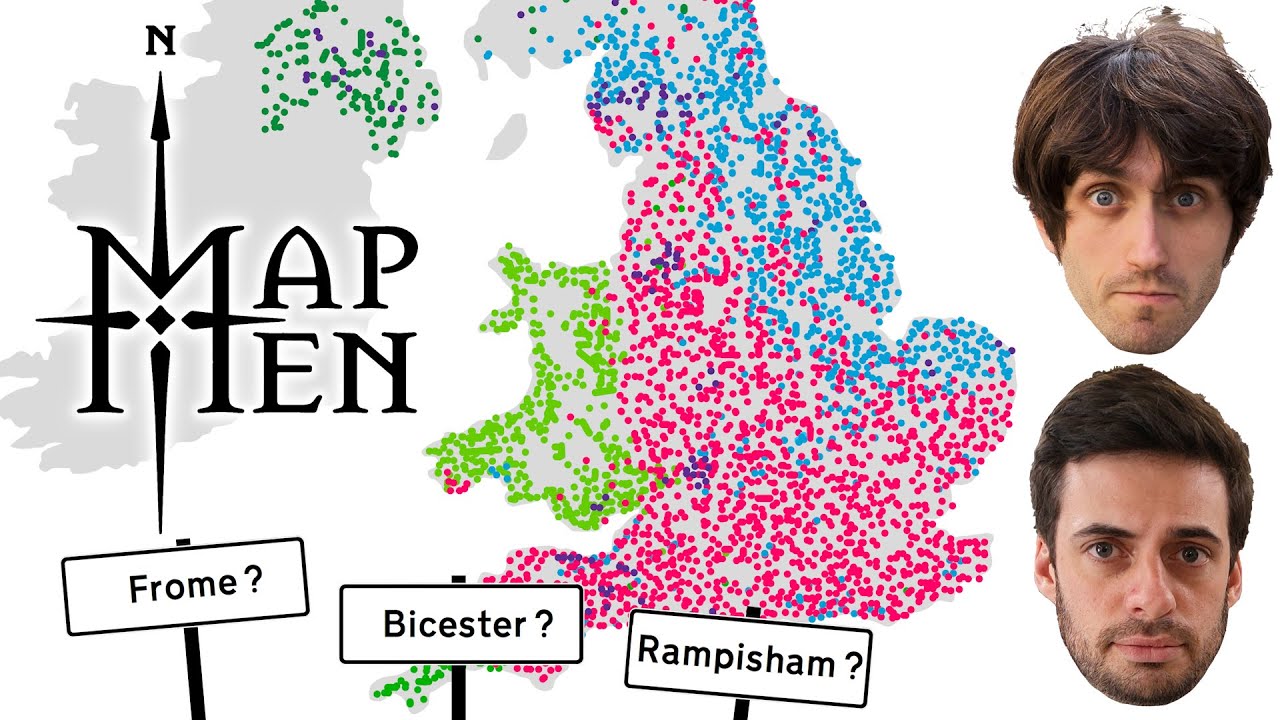
British place names are uniquely misleading because they frequently look simple and phonetic while hiding unpredictable pronunciations, with the Somerset town of Frome officially ranked as the nation's most mispronounced. (0:00)
Apparent spelling conventions in Britain are consistently undermined by irregular exceptions, meaning correct pronunciation can generally only be learned individually. (2:05)
The distribution of British toponyms directly maps successive historical invasions, with distinct Celtic, Roman, Anglo-Saxon, and Viking suffixes defining different geographic regions. (3:20)
Centuries of spoken language contraction by an illiterate population, while formal spellings remained frozen in medieval records, created the modern chasm between spelling and sound. (5:23)
Detailed notes
## Background
This video was written, presented, and edited by Jay Foreman and Mark Cooper-Jones, and published on the Map Men YouTube channel on December 14, 2020. The accompanying description promotes their book 'This Way Up - When Maps Go Wrong' and directs viewers to Patreon and production credits.
## TL;DR
Jay Foreman and Mark Cooper-Jones explore why British place names are infamously difficult for outsiders to pronounce, pointing out that seemingly simple spellings often hide deceptive phonetic traps. They illustrate how Britain's linguistic map was built through successive layers of Celtic, Roman, Anglo-Saxon, and Viking naming conventions, each leaving distinct regional roots like '-cester' or '-by.' The duo explain that widespread historical illiteracy allowed spoken pronunciations to rapidly streamline over centuries while written spellings remained rigidly frozen. Using the Somerset town of Frome as an ultimate case study, they demonstrate how ancient Celtic origins drifted the furthest from modern orthography, concluding with a comedic sponsor segment for Surfshark VPN.
## Atmosphere & style
The presentation is brisk, irreverent, and sharp-witted, driven by the dynamic double-act energy between Jay Foreman's eccentric theatricality and Mark Cooper-Jones's dry, pedantic counterweight. Visual comedy—from cooking up the English language in kitchen bowls to staging an absurd tourist humiliation itinerary—keeps the rigorous etymological history bouncy and engaging. Watching the video feels like an entertaining pub lecture that effortlessly blends linguistic scholarship with playful British satire.
## Bulletin
- [00:00](https://www.youtube.com/watch?v=uYNzqgU7na4&t=0s) British place names are uniquely misleading because they frequently look simple and phonetic while hiding unpredictable pronunciations, with the Somerset town of Frome officially ranked as the nation's most mispronounced.
- [02:05](https://www.youtube.com/watch?v=uYNzqgU7na4&t=125s) Apparent spelling conventions in Britain are consistently undermined by irregular exceptions, meaning correct pronunciation can generally only be learned individually.
- [03:20](https://www.youtube.com/watch?v=uYNzqgU7na4&t=200s) The distribution of British toponyms directly maps successive historical invasions, with distinct Celtic, Roman, Anglo-Saxon, and Viking suffixes defining different geographic regions.
- [05:23](https://www.youtube.com/watch?v=uYNzqgU7na4&t=323s) Centuries of spoken language contraction by an illiterate population, while formal spellings remained frozen in medieval records, created the modern chasm between spelling and sound.
## Key takeaways
- [00:00](https://www.youtube.com/watch?v=uYNzqgU7na4&t=0s) Unlike obviously foreign or complex global place names, British toponyms look deceptively straightforward but feature unintuitive phonetic traps.
- [00:00](https://www.youtube.com/watch?v=uYNzqgU7na4&t=0s) Survey data ranks the Somerset town of Frome (pronounced 'Froom') as Britain's most frequently mispronounced settlement name.
- [02:05](https://www.youtube.com/watch?v=uYNzqgU7na4&t=125s) Pronunciation patterns across the UK regularly conflict with hard rules, such as '-cester' turning into 'ster' in Leicester but remaining articulated in Cirencester.
- [02:05](https://www.youtube.com/watch?v=uYNzqgU7na4&t=125s) Due to irregular exceptions across suffixes, the only reliable way to master British place names is memorising each one individually.
- [02:05](https://www.youtube.com/watch?v=uYNzqgU7na4&t=125s) English toponymy evolved from a multi-layered linguistic recipe blending Celtic substrates, Germanic Anglo-Saxon, Old Norse, and Norman French.
- [03:20](https://www.youtube.com/watch?v=uYNzqgU7na4&t=200s) Celtic settlement names containing elements like 'Aber', 'Tre', 'Loch', and 'Bryn' survive primarily in the western fringes of the island.
- [03:20](https://www.youtube.com/watch?v=uYNzqgU7na4&t=200s) Roman military camps derived from the Latin 'castra' established common British place name endings such as '-caster', '-cester', and '-chester'.
- [03:20](https://www.youtube.com/watch?v=uYNzqgU7na4&t=200s) Anglo-Saxon Germanic vocabulary forms the dominant naming layer across southern and central England, visible in suffixes like '-ham', '-ton', '-bury', and '-ford'.
- [03:20](https://www.youtube.com/watch?v=uYNzqgU7na4&t=200s) Norse settlements ending in '-by', '-thwaite', '-thorpe', and '-kirk' physically delineate the historical boundaries of the Danelaw across northern and eastern England.
- [05:23](https://www.youtube.com/watch?v=uYNzqgU7na4&t=323s) The divergence between spelling and pronunciation was driven by widespread historical illiteracy, as everyday speakers shortened words while written forms stayed static.
- [05:23](https://www.youtube.com/watch?v=uYNzqgU7na4&t=323s) Frome's anomalous pronunciation stems from its ancient Celtic root 'Frama', meaning the local river's original sound drifted further over time than newer Anglo-Saxon names.
## Detailed walkthrough
### [00:00](https://www.youtube.com/watch?v=uYNzqgU7na4&t=0s) The Traps of British Place Names and the Tourist Humiliation Tour
Jay Foreman and Mark Cooper-Jones introduce the notoriously treacherous world of British toponymy. Jay opens by demonstrating how absurdly difficult a place name might seem—asking what would happen if a simple-looking name were actually pronounced *"Grrrrrrrrrrr-immeeeeeee-SSSS-zzzzz-P"*—before bluntly clarifying, "We'd be lying, it's Grimsby." While odd place names exist worldwide, such as California’s Zzyzx, Slovenia’s Ptuj, Greenland’s Qeqertarsuatsiaat, or the famously elongated Welsh promotional creation Llanfairpwllgwyngyllgogerychwyrndrobwllllantysiliogogogoch, British place names are uniquely frustrating. They do not look obviously foreign or unpronounceable; rather, as Mark explains, “British place names cause more trouble than most because they often look straightforward, but contain nonsensical phonetic traps that are impossible to predict.”
```mermaid
flowchart TD
accTitle: Itinerary for Maximising Tourist Humiliation
accDescr: A sequential flow of difficult British place names paired with their non-intuitive phonetic pronunciations.
A["Beaulieu<br>('Byoo-lee')"] --> B["Rampisham<br>('Ransom')"]
B --> C["Mousehole<br>('Mowzell')"]
C --> D["Towcester<br>('Toaster')"]
D --> E["Gotham<br>('Goat'em')"]
E --> F["Quernmore<br>('Kwormer')"]
F --> G["Alnwick<br>('Annick')"]
```
To demonstrate the point, they test viewers on the Somerset town spelled F-R-O-M-E. While visitors naturally guess "Froam," the pair mockingly announce it is "blitheringly obvious" that the town is pronounced "Froom." In fact, Frome holds the distinction of being officially named Britain's most mispronounced place name according to proper surveys. To celebrate this linguistic cruelty, the duo design an itinerary crafted specifically to humiliate unsuspecting foreign tourists:
- **Beaulieu** — pronounced *Byoo-lee*
- **Rampisham** — pronounced *Ransom*
- **Mousehole** — pronounced *Mowzell*
- **Towcester** — pronounced *Toaster*
- **Gotham** — pronounced *Goat'em*
- **Quernmore** — pronounced *Kwormer*
- **Alnwick** — pronounced *Annick* (situated right by Newcastle, or *New Cassel* as locals pronounce it)
[02:05](https://www.youtube.com/watch?v=uYNzqgU7na4&t=125s) Phonic Rules, Inevitable Exceptions, and the Recipe for English
Jay and Mark explain that in English, no letter is safe from having multiple pronunciations—or being dropped entirely. Even when patterns appear, they are immediately undermined by irregular exceptions.
| Standard Spelling Pattern | Intended General Rule | Canonical Examples | The Inevitable Exception |
|:--- |:--- |:--- |:--- |
| **-cester** | Pronounced **"ster"** | Leicester, Worcester, Gloucester | **Cirencester** (*pronounces the "cester"*) |
| **W-** (start of final syllable) | Letter is **silent** | Norwich, Berwick, Southwark | **Sandwich** (*articulates the "w"*) |
| **-er-** | Pronounced **"ar"** | Berkshire, Clerkenwell, Hertfordshire | **Berkhamsted** (*retains the "er" sound*) |
Because of these pervasive contradictions, Jay delivers the bleak truth: “The only way to be absolutely sure of pronouncing British place names correctly is to live here long enough to learn every single one of them one at a time.”
To understand how this linguistic mess came to be, the hosts break down the recipe of the English tongue. Using mixing bowls and culinary props, they demonstrate combining a hefty base of Germanic Anglo-Saxon, a healthy dash of Old Norse, a huge dollop of Norman French, and just a subtle hint of Celtic to provide flavor. This concoction is then stirred across centuries until the Great Vowel Shift fundamentally alters the soundscape into modern English.
[03:20](https://www.youtube.com/watch?v=uYNzqgU7na4&t=200s) The Invader Map: Celtic, Roman, Anglo-Saxon, and Viking Settlements
The history of invasions that shaped Britain remains preserved in the country's settlement names. By examining a linguistic map of Great Britain, one can see exactly where different cultural and military groups established roots:
```mermaid
flowchart LR
accTitle: Linguistic Invasions and Settlement Naming Elements
accDescr: Flowchart linking invading historical cultures to their common place name markers across Britain.
subgraph Celtic["Celtic (Oldest Substrate)"]
C1["Tre, Loch, Bryn, Aber<br>(e.g., Aberystwyth)"]
end
subgraph Roman["Roman (Latin 'Castra')"]
R1["-caster, -cester, -chester, -xeter<br>(e.g., Chester, Lancaster)"]
end
subgraph AngloSaxon["Germanic Anglo-Saxon (Dominant Group)"]
A1["-ham, -hurst, -ley, -bury, -ford,<br>-port, -mere, -stead, -ton, -wick"]
end
subgraph Viking["Viking / Old Norse (The Danelaw)"]
V1["-thwaite, -thorp, -kirk, -by<br>(e.g., Grimsby)"]
end
```
- **Celtic**: The oldest surviving names on the map contain elements like *Tre*, *Loch*, *Bryn*, and *Aber*. For instance, Aberystwyth designates the mouth (*Aber*) of the river Ystwyth. Though once spoken across the entire island, Celtic languages were pushed to mountainous western fringes because, as Jay notes, low-lying middle-England inhabitants were comparatively worse at fending off invaders.
- **Roman**: Latin influence entered via Roman fortifications derived from *castra* (fort), generating the common suffixes *-caster*, *-cester*, *-chester*, and *-xeter*. The Romans did not stay long, however, and many of their unwieldy formal designations vanished; settlements like *Belgic Oppidum* were eventually replaced by simpler names like Braintree.
- **Anglo-Saxon**: The Germanic tribes represent the dominant layer across southern and central England. Their presence is signaled by suffixes such as *-ham*, *-hurst*, *-ley*, *-bury*, *-ford*, *-port*, *-mere*, *-stead*, *-ton*, *-stow*, *-wick*, and *-wich*. A town like Buckingham literally translates to low-lying land belonging to an early Anglo-Saxon named Bucca.
- **Vikings**: Sweeping in from Scandinavia in the 9th century, the Norse invaders brought violent raids along with the systematic renaming of settlements. Viking settlements end in *-thwaite*, *-thorp*, *-kirk*, and *-by*. Grimsby translates directly to "Grim's village," named after a Viking founder. Plotting these Scandinavian toponyms visibly maps the historical borders of the Danelaw without needing any artificial borderlines drawn on the map.
[05:23](https://www.youtube.com/watch?v=uYNzqgU7na4&t=323s) Time, Illiteracy, and the Mystery of Frome
While military invasions brought competing vocabularies into Britain, Mark highlights that the true culprit behind the bizarre modern pronunciations was the passage of time combined with historical illiteracy. Over the centuries, locals working in fields and markets did not want to waste effort articulating every syllable of polysyllabic words; they rapidly elided endings like *-cester* into *-ster*. Because the vast majority of ordinary working people could neither read nor write, written orthography remained frozen in old medieval registers while spoken language moved forward. Mark summarizes the consequence cleanly: “And while the English language has continued to gradually evolve, our place names haven't.”
This historical gap explains Britain's most mispronounced town: **Frome**. Unlike surrounding Anglo-Saxon names, Frome traces its lineage back to the surviving Celtic word *Frama*, meaning fair, fine, or brisk—almost certainly a description of the flow of the local river. As the oldest linguistic remnant in the region, its phonetic sound has drifted the furthest from modern English orthography, turning it into an enduring trap for visitors.
[06:15](https://www.youtube.com/watch?v=uYNzqgU7na4&t=375s) Commercial Break: Fooling Netflix with Surfshark VPN
The episode transitions into a comedic sketch where Jay speaks in a cartoonish, exaggerated American accent, dropping phrases like "Golly darn tootin' gee whizz, hot diggety woo!" and "Yippee ki whee buckaroo!" When a bewildered Mark asks what on earth he is doing, Jay insists he is trying to trick his computer into believing he is physically located in the United States so he can access the US Netflix catalog, which includes British titles unavailable on the UK platform.
Mark steps in to break the illusion and transition to their sponsor, Surfshark VPN:
- Surfshark operates as an app and browser extension that masks IP addresses to keep private data secure while allowing users to spoof their digital location worldwide.
- Unlocking the US streaming catalog provides access to titles unavailable in the UK, such as *The West Wing*, *Dexter*, *Broadchurch*, *The Walking Dead*, *Twin Peaks*, *All Dogs Go to Heaven*, vintage James Bond films, *The Twilight Zone*, *Muppets Most Wanted*, and *Fiddler on the Roof*.
- The software runs on computers, phones, and devices like the Amazon Fire TV Stick to play content directly on home televisions.
- Surfshark allows a single account to be used on an unlimited number of devices simultaneously.
- Viewers are offered an 84% discount with four extra months free using promo code `mapmen`, supported by a 30-day money-back guarantee.
The bit ends with Jay immediately pivoting from an American cowboy caricature to a chaotic Australian accent—muttering "shrimp on the barbie" and "Woolloomooloo"—only for Mark to dryly point out that Surfshark works in Australia as well.
## Notable quotes
> [00:00](https://www.youtube.com/watch?v=uYNzqgU7na4&t=0s) British place names cause more trouble than most because they often look straightforward, but contain nonsensical phonetic traps that are impossible to predict. — Mark Cooper-Jones
> [02:05](https://www.youtube.com/watch?v=uYNzqgU7na4&t=125s) The only way to be absolutely sure of pronouncing British place names correctly is to live here long enough to learn every single one of them one at a time. — Jay Foreman
## Mentioned
Jay Foreman, Mark Cooper-Jones, Surfshark VPN, Netflix, Amazon Fire TV Stick, The West Wing, Dexter, Broadchurch, The Walking Dead, Twin Peaks, All Dogs Go to Heaven, The Twilight Zone, Muppets Most Wanted, Fiddler on the Roof
## Video description
📕 Buy the MAP MEN BOOK 'This Way Up - When Maps Go Wrong' https://lnk.to/mapmen
See new episodes early, and behind-the-scenes extras...
http://www.patreon.com/mapmen
Written, presented and edited by
JAY FOREMAN @jayforeman
MARK COOPER-JONES @markcooperjones
Director/DOP
JADE NAGI @jade_nagi
Thanks for help with graphics
PETER HAYES
Wacky Wheels music by
MARK KLEM
Royalty free Music by Giorgio Di Campo for FreeSound Music
http://freesoundmusic.eu
https://www.facebook.com/freemusicfor...
https://youtube.com/freesoundmusic
original video: https://youtu.be/EIzfOQTRxc0
## Background
本期视频由科普幽默频道 Map Men(由杰伊·福尔曼与马克·库珀-琼斯主创)于 2020 年 12 月 14 日发布在 YouTube 上。视频简介宣传了他们的实体书《This Way Up - When Maps Go Wrong》与 Patreon 众筹页面,内容则聚焦于英国地名令人抓狂的发音规律与历史渊源。
## TL;DR
视频深入探讨了为什么大量英国地名的拼写与实际读音严重脱节,甚至成为让外国游客频频出丑的语音陷阱。两位主持人归纳了部分规律及其层出不穷的例外,并指出其深层原因在于英国历史上凯尔特语、罗马拉丁语、盎格鲁-撒克逊语和维京古诺斯语的层层叠加与交融。随着数百年间口语发音为了省事不断缩略演化,而古代不识字的平民又无法更改官方书面拼写,最终在现代地图上留下了大量看似平平无奇、实则反直觉的历史语音化石。
## Atmosphere & style
全片充斥着典型的英式冷幽默、自嘲与辛辣讽刺,杰伊与马克之间的双簧捧哏默契十足、节奏明快。视觉上穿插了生动的地图图层动画、街头无厘头采访和夸张的颜艺表演,让原本枯燥的词源历史学变得极其生动爆笑。整期节目在荒诞不经的喜剧表演与严谨扎实的语言地理学知识之间切换自如,营造出一种既令人捧腹又干货满满的观影体验。
## Bulletin
- [00:00](https://www.youtube.com/watch?v=uYNzqgU7na4&t=0s) 萨默塞特郡的小镇 Frome 获评全英国被念错频率最高的地名,其拼写看似读作“froam”,实际读音却为“Froom”,源于两千年前形容清澈河流的古凯尔特语词汇“Frama”。
- [02:49](https://www.youtube.com/watch?v=uYNzqgU7na4&t=169s) 英国地名难以掌握的核心原因在于历史入侵造成的“语言炖菜”效应,地名层层叠加了凯尔特语、罗马拉丁语、日耳曼盎格鲁-撒克逊语和古诺斯语(维京语)的词根印记。
- [04:44](https://www.youtube.com/watch?v=uYNzqgU7na4&t=284s) 带“-thwaite”、“-thorp”、“-kirk”及“-by”后缀的地名精准映射出公元9世纪维京人占领的“丹麦法区”(Danelaw)势力范围,无需现代画线即可还原历史疆界。
- [04:44](https://www.youtube.com/watch?v=uYNzqgU7na4&t=284s) 英国地名读音与拼写严重脱节的根本动力在于时间演变与大众文盲:历史上的当地平民为了省时口头吞音简化,但缺乏读写能力导致羊皮纸上的古老拼写原封不动保留至今。
## Key takeaways
- [00:00](https://www.youtube.com/watch?v=uYNzqgU7na4&t=0s) 英国地名的难点不仅在于拼写复杂,更在于许多看似平常规则的单词内部暗藏完全不可预测的语音陷阱。
- [00:00](https://www.youtube.com/watch?v=uYNzqgU7na4&t=0s) 全英被念错频率最高的镇名 Frome 实际发音为“Froom”,其语源为形容水流的古凯尔特语“Frama”,是岛上最古老的语言化石之一。
- [01:29](https://www.youtube.com/watch?v=uYNzqgU7na4&t=89s) 英国地名的通用发音规则极不可靠,例如“-cester”常缩读为“-ster”(如 Leicester),但 Cirencester 却不遵循这一规则。
- [01:29](https://www.youtube.com/watch?v=uYNzqgU7na4&t=89s) 词尾音节开头的“W”在多数地名中保持静音(如 Norwich、Southwark),但在 Sandwich 中却必须发音。
- [01:29](https://www.youtube.com/watch?v=uYNzqgU7na4&t=89s) 掌握英国地名读音没有绝对规律可循,唯一的可靠方式是在本地长期生活并逐一单独记忆。
- [02:49](https://www.youtube.com/watch?v=uYNzqgU7na4&t=169s) 现代英语地名是多轮外族入侵与语言融合的产物,涵盖了凯尔特语、盎格鲁-撒克逊语、古诺斯语以及诺曼法语的层层叠加。
- [02:49](https://www.youtube.com/watch?v=uYNzqgU7na4&t=169s) 最古老的凯尔特语地名词根(如 Aber、Tre、Loch)现多退缩在威尔士、苏格兰等边缘山地地带。
- [02:49](https://www.youtube.com/watch?v=uYNzqgU7na4&t=169s) 带有“-caster”、“-cester”或“-chester”后缀的地名均源自罗马拉丁语词汇“castra”,代表当年的罗马军营或要塞。
- [02:49](https://www.youtube.com/watch?v=uYNzqgU7na4&t=169s) 盎格鲁-撒克逊语构成了英格兰南部地名的主要基底,常见词缀包括 ham、bury、ford、ton 与 wick。
- [04:44](https://www.youtube.com/watch?v=uYNzqgU7na4&t=284s) 维京人在9世纪席卷不列颠并热衷重命名定居点,其代表性词缀(如 by、thorp、thwaite)在现代地图上的分布完全吻合历史上的“丹麦法区”。
- [04:44](https://www.youtube.com/watch?v=uYNzqgU7na4&t=284s) 地名拼读脱节的深层社会原因是古代口语发音在几百年间被文盲居民因图快而简化,但书面拼写却停滞在羊皮纸的历史阶段。
## Detailed walkthrough
### [00:00](https://www.youtube.com/watch?v=uYNzqgU7na4&t=0s) 英国地名的发音陷阱与最易念错的“Frome”
英国地名对初来乍到者而言充满着陷阱。以格里姆斯比(Grimsby)为例,它看似简单,但如果有人告诉你它发音像是一连串怪异的“Grrrrr-imme-SSSS-zzzzz-P”,那纯粹是胡扯——它就老老实实念作“Grimsby”。然而,许多英国地名对外国人来说确实极其刁钻,杰伊·福尔曼(Jay Foreman)与马克·库珀-琼斯(Mark Cooper-Jones)开玩笑称,念错地名的游客甚至可能面临被监禁甚至杀头的风险。虽然全球各地都有难读的地名,比如加利福尼亚的 Zzyzx、斯洛文尼亚的普图伊(Ptuj)、格陵兰的凯凯塔苏瓦齐亚特(Qeqertarsuatsiaat),以及威尔士为了旅游推广而故意发明的冗长地名“Llanfairpwllgwyngyllgogerychwyrndrobwllllantysiliogogogoch”,但英国地名的狡猾之处在于:它们表面上平平无奇,内里却暗藏着毫无规律可循的语音陷阱。
以萨默塞特郡的小镇“Frome”为例,按英语常规拼读几乎所有人都会脱口而出念成“froam”,但当地正确读音其实是“Froom”。根据一项严肃的调查统计,Frome 摘得了“全英国被念错频率最高的地名”的桂冠。节目中甚至穿插了一段街头冷幽默采访,当杰伊请求一位路人“能否帮我把 Frome 读错一下”时,路人漫不经心地随口回答:“朴茨茅斯(Portsmouth)。”
关于英国地名为何如此折磨人,马克 sharp 地指出:“British place names cause more trouble than most because they often look straightforward, but contain nonsensical phonetic traps that are impossible to predict.”(“英国地名引起的麻烦比大多数地方都要多,因为它们表面上看起来平平无奇,却暗藏着完全无法预测、不合常理的语音陷阱。”)
### [01:29](https://www.youtube.com/watch?v=uYNzqgU7na4&t=89s) 羞辱外国游客的路线图与不可靠的发音“通用规则”
为了将这种“嘲讽因不熟悉本地怪异发音而频频出错的外国游客”的英式恶趣味发挥到极致,两人特别规划了一条堪称“全英游客公开处刑”的旅行路线。在这条线路上,几乎每一个地名的实际读音都在挑战现代拼读常识:
- 汉普郡的 **Beaulieu**:不读法语腔,而是读作 **Byoo-Lee**;
- 多塞特郡的 **Rampisham**:直接缩水读成 **Ransom**;
- 康沃尔郡的 **Mousehole**:看似“老鼠洞”,当地却念作 **Mowzell**;
- 北安普敦郡的 **Towcester**:拼写冗长,读音却等同于烤面包机 **Toaster**;
- 诺丁汉郡的 **Gotham**:不念蝙蝠侠的哥谭,而念 **Goat'em**;
- 兰开夏郡的 **Quernmore**:读作 **Kwormer**;
- 诺森伯兰郡的 **Alnwick**:读作 **Annick**;甚至连它临近的大城市纽卡斯尔(Newcastle),当地人也要念成偏硬的 **New Cassel**。
在英语地名中,几乎没有哪个字母是安全的,它们不仅拥有数十种不同的发音可能,甚至还会随时保持沉默。虽然两位主持人好心地归纳了三条基础规则,但现实中往往充斥着背叛规则的例外:
1. **以“-cester”结尾通常念作“-ster”**:例如莱斯特(Leicester)、伍斯特(Worcester)、格洛斯特(Gloucester)。*例外*:赛伦塞斯特(Cirencester)就不按套路出牌。
2. **位于末尾音节开头的“W”通常不发音**:例如诺维奇(Norwich)、伯里克(Berwick)、萨瑟克(Southwark)。*例外*:三明治小镇(Sandwich)里的 W 偏偏发音清晰。
3. **字母组合“E-R”常念作“ar”**:例如伯克郡(Berkshire)、克勒肯维尔(Clerkenwell)、赫特福德郡(Hertfordshire)。*例外*:同样位于赫特福德郡的伯克姆斯特德(Berkhamsted),开头的“Berk-”却发出完全不同的音。
杰伊面对这种混乱局面,无奈地向观众坦白:“The only way to be absolutely sure of pronouncing British place names correctly is to live here long enough to learn every single one of them one at a time. Sorry.”(“想要百分之百正确念出英国地名的唯一方法,就是在这里住得足够久,逐个把它们全都学一遍。抱歉啦。”)
### [02:49](https://www.youtube.com/watch?v=uYNzqgU7na4&t=169s) 历史侵略者的“语言大杂烩”与地图上的词根烙印
制造出这些混乱发音的罪魁祸首究竟是谁?答案需要追溯到英国历史上的数次外族入侵与融合。英语的形成就像是一道复杂的炖菜:以日耳曼盎格鲁-撒克逊语(Germanic Anglo-Saxon)为锅底,加入一大勺古诺斯语(Old Norse),倒进大剂量的诺曼法语(Norman French),最后再点缀上一丝几乎察觉不到、却至关重要的凯尔特语(Celtic)。这锅大杂烩在历史长河中持续搅拌了几百年,直到元音彻底发生大推移,现代英语才终于定型。
```mermaid
flowchart TD
accTitle: 英国地名语源演变图
accDescr: 展示凯尔特语、罗马拉丁语、盎格鲁-撒克逊语及维京古诺斯语对英国地名特征的影响与代表词根。
subgraph Layers["历史入侵与语言层层叠加"]
direction TB
C["凯尔特语基层 (Celtic)<br/>词根: Tre, Loch, Bryn, Aber"]
R["罗马统治 (Latin)<br/>词根: castra -> caster, cester, chester, xeter"]
A["盎格鲁-撒克逊主导 (Anglo-Saxon)<br/>词根: ham, bury, ford, ton, stead, wick"]
V["维京人占领 (Old Norse)<br/>词根: thwaite, thorp, kirk, by"]
end
subgraph Examples["现代地理代表"]
direction TB
EX_C["Aberystwyth<br/>(Ystwyth 河口)"]
EX_R["Braintree<br/>(原 Belgic Oppidum / Castra)"]
EX_A["Buckingham<br/>(Bucca 拥有的低地)"]
EX_V["Grimsby<br/>(Grim 的村庄 / 丹麦法区)"]
end
C --> EX_C
R --> EX_R
A --> EX_A
V --> EX_V
```
现代不列颠地图直观地展示了各个历史时期的入侵者在土地上烙下的语言印记:
- **凯尔特语(最古老层)**:包含“Tre”、“Loch”、“Bryn”和“Aber”等词汇。例如阿伯里斯特威斯(Aberystwyth),其中“Aber”意为河口,合起来正是“Ystwyth 河的入海口”,这与该地今天的地理位置分毫不差。凯尔特语曾遍布整个不列颠群岛,但如今退居到偏远的山地地带,因为英格兰中低洼平原的原住民在抵抗外敌入侵方面表现得较为软弱。
- **罗马拉丁语**:凡是带有“-caster”、“-cester”、“-chester”或“-xeter”后缀的地名,原本都是罗马时期的军营要塞,源于拉丁语单词“castra”(军营)。不过罗马人撤离得早,诸如“Castra Exploratorum”或“Belgic Oppidum”这类拗口的罗马原始地名大多未能流传下来,后者后来被更务实地改名为布伦特里(Braintree)。
- **日耳曼盎格鲁-撒克逊语**:在地图上占据了最庞大的比例,以浅粉色大面积统治了英格兰南部。带有 ham、hurst、ley、bury、ford、port、mere、stead、ton、stow、wick、wich 等词缀的地名几乎都来自撒克逊语。比如白金汉(Buckingham),在字面上指的便是一个名叫 Bucca 的盎格鲁-撒克逊人所拥有的一块低洼地。
### [04:44](https://www.youtube.com/watch?v=uYNzqgU7na4&t=284s) 维京人的“定居点改名狂潮”与时间造成的语音脱节
公元9世纪,维京人从斯堪的纳维亚半岛席卷而来,不仅带来了劫掠,还热衷于给沿途的中小型定居点重新命名。如果一个地名以“-thwaite”(林间空地)、“-thorp”(小村)、“-kirk”(教堂)或“-by”(村落)结尾,它几乎必然带着维京血统。例如开篇提到的格里姆斯比(Grimsby),字面意思就是“Grim 的村庄”,据传得名于一位性格极其“乐观向上”的重要维京人 Grim。在地图上标记这些维京后缀时,其分布范围惊人地精准还原了历史上由维京势力掌控的“丹麦法区”(Danelaw)与盎格鲁-撒克逊势力的分野,甚至无须额外用红笔画线勾勒边界。
然而,各种入侵带来的方言混杂只是地名难以拼读的成因之一,真正让发音彻底脱缰的催化剂是漫长的时间演化。关于拼写与读音严重脱节的深层原因,杰伊解释道:“Over hundreds of years, locals who were too busy to pronounce all the syllables in "cester" reduced it to "ster" to save time. But they couldn't read or write, so the spelling stayed the same.”(“几百年来,当地人忙得没空念完‘cester’里的所有音节,为了省时间就把它缩略成了‘ster’;但他们又不会读写,于是拼写便原封不动地保留了下来。”)在平民普遍文盲的年代,口语随着时光推移在不断简化和演变,而羊皮纸上的书面拼写却被定格在了历史中,最终在英国版图上留下了无数个语音地雷。
至于开篇那个全英最难念的小镇 Frome,它并非出自撒克逊或维京语,而是罕见地源于一个幸存下来的凯尔特语单词“Frama”,意为“清澈、优美或湍急”,最初用来形容当地流淌的美丽河流。作为不列颠群岛上最古老的语言遗存,它历经两千年的演变,成为与现代拼读习惯偏离最远的地名也就不足为奇了。
### [06:15](https://www.youtube.com/watch?v=uYNzqgU7na4&t=375s) 假装美国人与 Surfshark VPN 赞助
节目尾声,杰伊突然换上一副夸张滑稽的美国乡村口音大呼小叫。面对马克的疑惑,杰伊解释自己正试图用极其逼真的口音骗过电脑,好让自己看上美区 Netflix 独占的剧集——甚至包括一些英国本土流媒体反而没有的英国本土节目。
马克随即打断了这出闹剧,指出靠口音骗电脑是愚蠢的,不如直接使用本期节目的赞助商 Surfshark VPN。马克详细介绍了该服务的核心功能与福利:
- **跨区解锁流媒体**:用户可利用 Surfshark 的应用程序或浏览器插件将设备虚拟定位到世界各地,解锁诸如《白宫风云》(The West Wing)、《嗜血法医》(Dexter)、《小镇疑云》(Broadchurch)、《行尸走肉》(The Walking Dead)、《双峰》(Twin Peaks)、多部 007 系列电影等在英国无法收看的影视资源。
- **设备支持与隐私保护**:支持亚马逊 Firestick,便于在电视大屏观看;通过隐藏真实 IP 地址保护个人网络数据安全;并且是业内唯一支持单个账户在无限台设备上同时使用的 VPN。
- **专属优惠与保障**:观众使用优惠码“mapmen”可享受 84% 的折扣并免费赠送 4 个月时长,同时附带 30 天无理由退款保证。
广告最后,马克立刻换上一口地道的澳大利亚俚语进行即兴调侃,证明该服务在澳洲同样好使。
## Notable quotes
> [00:00](https://www.youtube.com/watch?v=uYNzqgU7na4&t=0s) British place names cause more trouble than most because they often look straightforward, but contain nonsensical phonetic traps that are impossible to predict. — Mark Cooper-Jones
> [04:44](https://www.youtube.com/watch?v=uYNzqgU7na4&t=284s) Over hundreds of years, locals who were too busy to pronounce all the syllables in "cester" reduced it to "ster" to save time. But they couldn't read or write, so the spelling stayed the same. — Jay Foreman
> [01:29](https://www.youtube.com/watch?v=uYNzqgU7na4&t=89s) The only way to be absolutely sure of pronouncing British place names correctly is to live here long enough to learn every single one of them one at a time. — Jay Foreman
## Mentioned
Jay Foreman, Mark Cooper-Jones, Grimsby, Frome, Portsmouth, Beaulieu, Rampisham, Mousehole, Towcester, Gotham, Quernmore, Alnwick, Newcastle, Leicester, Worcester, Gloucester, Cirencester, Norwich, Berwick, Southwark, Sandwich, Berkshire, Clerkenwell, Hertfordshire, Berkhamsted, Aberystwyth, Braintree, Buckingham, Surfshark VPN, Netflix, The West Wing, Dexter, Broadchurch, The Walking Dead, Twin Peaks, 007, Amazon Firestick
## Video description
📕 Buy the MAP MEN BOOK 'This Way Up - When Maps Go Wrong' https://lnk.to/mapmen
See new episodes early, and behind-the-scenes extras...
http://www.patreon.com/mapmen
Written, presented and edited by
JAY FOREMAN @jayforeman
MARK COOPER-JONES @markcooperjones
Director/DOP
JADE NAGI @jade_nagi
Thanks for help with graphics
PETER HAYES
Wacky Wheels music by
MARK KLEM
Royalty free Music by Giorgio Di Campo for FreeSound Music
http://freesoundmusic.eu
https://www.facebook.com/freemusicfor...
https://youtube.com/freesoundmusic
original video: https://youtu.be/EIzfOQTRxc0
[Source](https://www.youtube.com/watch?v=uYNzqgU7na4)
Source quotes
[0:00] Mark Cooper-Jones: British place names cause more trouble than most because they often look straightforward, but contain nonsensical phonetic traps that are impossible to predict.
[4:44] Jay Foreman: Over hundreds of years, locals who were too busy to pronounce all the syllables in "cester" reduced it to "ster" to save time. But they couldn't read or write, so the spelling stayed the same.
[1:29] Jay Foreman: The only way to be absolutely sure of pronouncing British place names correctly is to live here long enough to learn every single one of them one at a time.
Source quotes
[0:00] Mark Cooper-Jones: British place names cause more trouble than most because they often look straightforward, but contain nonsensical phonetic traps that are impossible to predict.
[2:05] Jay Foreman: The only way to be absolutely sure of pronouncing British place names correctly is to live here long enough to learn every single one of them one at a time.
Original transcript
[0:00] British place names can be tricky to pronounce.
[0:02] Take this place. Looks simple, but what if we told you it was pronounced Grrrrrrrrrrr-immeeeeeee-SSSS-zzzzz-P?
[0:10] We'd be lying, it's Grimsby.
[0:12] But other places can be genuinely fiddly for foreigners.
[0:14] And tourists who get it wrong risk being imprisoned, or killed.
[0:18] In today's programme, we're going to ask why British place names are so hard to pronounce...
[0:24] - Is there an "and" coming?
- No, I'm done.
[0:26] Welcome to Map Men.
[0:27] - We're the men
- And here's the map.
[0:29] ♫ Map Men, Map Men
♫ Map, Map, Map, Map Men, Men
[0:35] There are difficult-to-pronounce place names all over the world.
[0:38] California has Zzyzx, Slovenia has Ptuj, Greenland has...
[0:43] Qeqertarsuatsiaat
[0:44] Even Welsh natives struggle with this one...
[0:46] And tonight we can expect to see heavy showers spreading from the west into...
[0:51] ...Wales.
[0:52] But deliberately hard-to-pronounce names invented for promotional purposes like
[0:55] Llanfairpwllgwyngyllgogerychwyrndrobwllllantysiliogogogoch aside
[0:59] - Showoff.
- British place names cause more trouble than most
[1:02] because they often look straightforward, but contain nonsensical phonetic traps that are impossible to predict.
[1:07] Try this one.
[1:08] Go on, say it out loud, in your room or on your train.
[1:11] - Ha! Ha! Ha! Ha!
- Ha! Ha! Ha! Ha!
[1:13] Wrong! It's not "froam"!
[1:15] F-R-O-M-E, it should be blitheringly obvious, is pronounced "Froom".
[1:18] But if you did say "froam", don't worry, you're in good company.
[1:21] Frome is officially the most mispronounced place name in Britain, and that's according to a proper survey.
[1:25] Excuse me, could you mispronounce Frome for me?
[1:27] - Portsmouth.
- That'll do.
[1:29] There's nothing more fun than laughing at tourists who don't know how to say something properly simply because
[1:33] they're from a different country and could never reasonably be expected to have predicted a local pronunciation
[1:37] that contradicts the basic rules of language.
[1:38] So, we've created the perfect travel agent's itinerary for maximising tourist humiliation across the country.
[1:44] - Starting in Beaulieu...
- Byoo Lee
[1:47] - Head over to Rampisham
- Ransom
[1:48] - Then down to Mousehole
- Mowzell
[1:50] - Next, travel north up to Towcester
- Toaster
[1:53] - then a quick jaunt to Gotham
- Goat'em
[1:55] - followed by a stop in Quernmore
- Kwormer
[1:57] - before finishing up in Alnwick
- Annick, which is near Newcastle.
[2:01] Or, as the people from the city itself say, New Cassel.
[2:03] When will they learn?
[2:05] As you can hear, no letter in the English alphabet is safe from being pronounced any of dozens of different ways.
[2:09] including, not at all.
[2:10] Thankfully, there are some general rules you can stick to,
[2:13] and because we're nice, we'll help the un-British amongst you through a couple of basics.
[2:17] "cester" is pronounced "ster"
[2:19] Leicester, Worcester, Gloucester.
[2:20] W, at the start of the final syllable, is silent.
[2:22] Norwich, Berwick, Southwark.
[2:24] "E-R" is pronounced "ar"
[2:25] Berkshire, Clerkenwell, Hertfordshire
[2:27] But before you get too reassured, for every rule in the English language, there are always exceptions,
[2:31] such as the "cester" in...
[2:33] Cirencester
[2:34] The W in...
[2:34] Sandwich
[2:35] And the "er" sound in...
[2:37] Ergh, this is disgusting.
[2:38] Oh sorry, Berkhamsted.
[2:40] which is in Hertfordshire.
[2:41] The only way to be absolutely sure of pronouncing British place names correctly
[2:44] is to live here long enough to learn every single one of them one at a time. Sorry.
[2:49] So who were the complete 'ankers that invented these rules?
[2:52] It's time for an English lesson.
[2:54] To make an English language, you start with a base of Germanic Anglo-Saxon,
[2:58] mix in a healthy dash of Old Norse,
[3:00] a huge dollop of Norman French,
[3:02] and just a barely detectable hint of Celtic. Trust me, it'll make all the difference.
[3:07] Stir it up for hundreds of years until the vowels really start to shift, and then...
[3:18] English.
[3:20] Excitingly, by looking at a map of Britain today, we can clearly see which invaders influenced our language where
[3:25] by plotting the origins of British place names.
[3:28] Hooraaay!
[3:29] This marvellous, messy, multicoloured map shows which languages different British place names belong to
[3:34] and is a living history of our early settlers and subsequent invaders.
[3:37] The oldest place names here are of Celtic origin.
[3:40] This is where you'll find all the place names with words like Tre, Loch, Bryn and Aber.
[3:43] Such as Aberystwyth, meaning the mouth - Aber - of the river Ystwyth.
[3:47] which, coincidentally is exactly where we find Aberystwyth today.
[3:50] Celtic languages were once spoken all across the British Isles, but are now reduced to a small minority of mountain-dwellers.
[3:55] And that's because low-lying middle-England Brits turned out to be more worse at resisting invading armies.
[4:00] First up were the Romans who brought in Britain's Latin influences
[4:03] - Like the rumba?
- No, like boring Latin.
[4:05] Anywhere that ends in caster, cester, chester, or xeter was a Roman fort
[4:09] from the Latin word "castra" meaning Roman fort.
[4:12] But the Romans didn't stay long.
[4:13] So although their naming system was long lasting, the actual names they used weren't.
[4:17] which is perhaps unsurprising when we learn they used names like Castra Exploratorum and Belgic Oppidum
[4:22] which was sensibly renamed Braintree.
[4:25] Next, in light pink, we have the biggest group, Germanic Anglo-Saxon.
[4:29] Any place containing the words ham, hurst, ley, bury, ford, port, mere, stead, ton, stow, wick, wich, or mere
[4:34] are of good old Anglo-Saxon origin, and massively dominate southern England.
[4:38] Like Buckingham.
[4:39] Or, a low lying area of land, belong... ing, to an Anglo-Saxon called Bucca.
[4:44] Perhaps the most upheavalling thing to happen to Britain's place names was the Vikings
[4:48] who swept in from Scandinavia in the 9th century committing brutal crimes including rape, pillage,
[4:53] and the renaming of small to medium-sized settlements.
[4:56] You can tell a place was named by the Vikings if it ends in thwaite, thorp, kirk, or by.
[5:00] Such as our old friend Grimsby, named after an important Viking called Grim famed for his infectious positive energy
[5:06] Grimsby literally means "Grim's village".
[5:08] Really?!
[5:10] We're all familiar with these common settlement suffixes, but what's so striking is
[5:13] how clearly this map of Viking place names reflects the extent of the Viking invasions.
[5:17] You can practically see the exact location of the Danelaw, dividing Viking and Anglo-Saxon England
[5:21] without needing to draw it on with thick red pen.
[5:23] Following all these invasions, Britain was littered with place names that originated in different languages and accents
[5:28] But the final thing that would make its place names truly unpronounceable, was time.
[5:33] Over hundreds of years, locals who were too busy to pronounce all the syllables in "cester"
[5:37] reduced it to "ster" to save time. But they couldn't read or write, so the spelling stayed the same.
[5:41] And while the English language has continued to gradually evolve, our place names haven't.
[5:45] Resulting in a language landscape littered with phonetic booby traps.
[5:48] But what about Frome?
[5:50] Which linguistic group is responsible for Britain's so-called hardest place name?
[5:54] Unusually for a place name in England, Frome is from a surviving Celtic word - Frama - which means fair, fine, or brisk.
[5:59] Probably describing the flow of its lovely river.
[6:02] It's not really surprising that the oldest language in these islands is the one that's drifted the furthest from pronounceability.
[6:07] So don't forget to join us for the next episode of Map Men...
[6:11] - Is that the end of your sentence?
- Yeah, I'm done.
[6:15] Golly darn tootin' gee whizz, hot diggety woo!
[6:18] What are you doing?
[6:19] I'm putting on an American accent to fool my computer into thinking I'm in America.
[6:23] Yippee ki whee buckaroo!
[6:25] Why are you doing that?
[6:27] Because I want to watch all my favourite programmes on Netflix.
[6:29] But you've already got Netflix.
[6:30] Yes, but American Netflix has programmes that we don't get on UK Netflix
[6:34] including, curiously, some British programmes.
[6:36] So that's why I'm doing this really convincing accent so that my computer will let me access all the content I want.
[6:41] Zip-a-dee-doo-dah, garsh darn it, yee-haw!
[6:44] Suit yourself.
[6:45] Hey, wait!
[6:46] Aren't you going to tell me that's a really silly thing to do and instead I should use Surfshark?
[6:51] Oh, we're doing an advert!
[6:53] Surfshark is an app and browser extension that lets you place your laptop or phone anywhere in the world.
[6:57] So you can access content that you may not usually be able to see in your country.
[7:00] Such as, for example, shows on US Netflix that you don't get in the UK, including the West Wing, Dexter, Broadchurch,
[7:05] The Walking Dead, Twin Peaks, All Dogs Go To Heaven, loads of James Bond films, the original Twilight Zone,
[7:08] Muppets Most Wanted and Fiddler on the Roof.
[7:10] And those are just ten examples from one streaming service in one country.
[7:14] Imagine the smorgasbord of content from across the planet you're missing out on without Surfshark.
[7:18] And it works on an Amazon Firestick, which means you can watch all this stuff on a proper telly.
[7:22] As well as country hopping, Surfshark makes your internet safer by masking your IP address, keeping your data private.
[7:27] Also, Surfshark is the only VPN that lets you have one account on an unlimited number of devices.
[7:32] Do you want to try out Surfshark for your very self?
[7:34] - Darn tootin'!
- Darn tooting indeed.
[7:35] Click the link in the description and use the code "mapmen" to get 84% off Surfshark, plus 4 months extra for free.
[7:41] And just between you and me, Surfshark offer a thirty day money-back guarantee
[7:45] so there's no risk in trying it out just to see if you like it.
[7:47] Surfshark sounds bonzer mate, g'day, shrimp on the barbie, Woolloomooloo, Woolloomooloo...
[7:51] It works in Australia as well.
[7:52] Ah, strewth.