Sentdex Replaces GTA V Engine With Playable Nvidia GameGAN Model
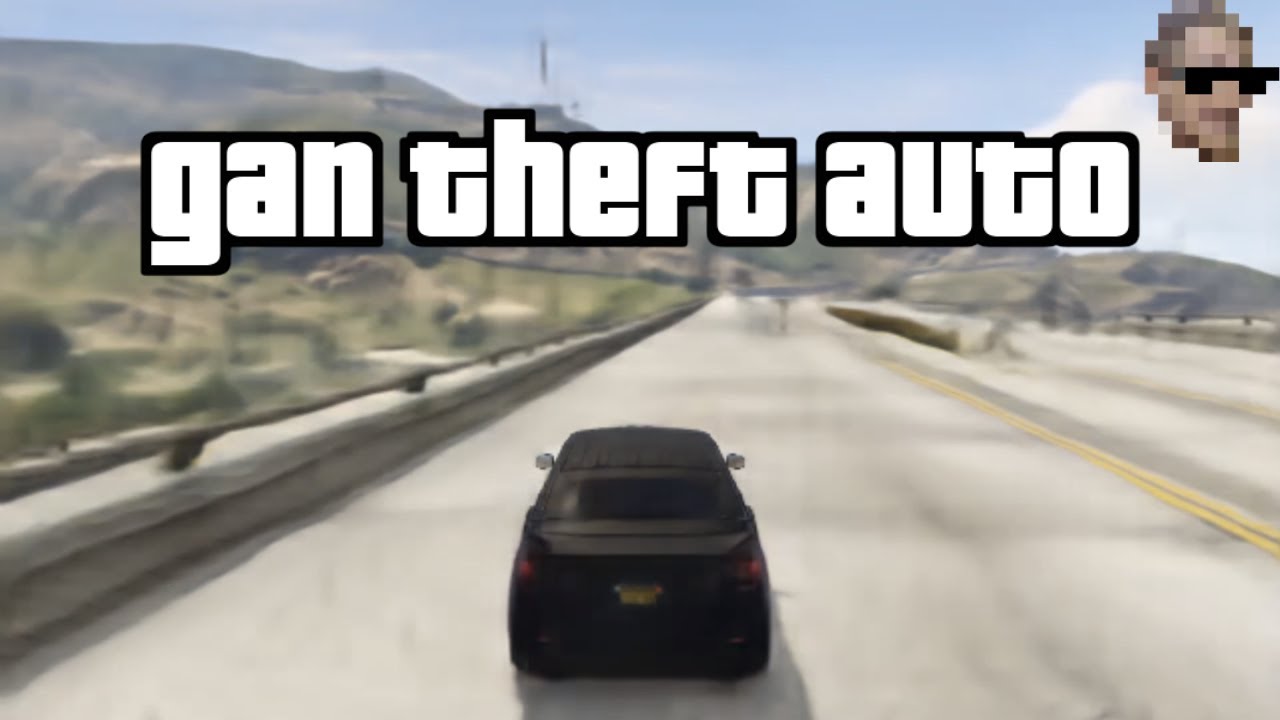
sentdex
Generative neural networks can eliminate conventional 3D game engines and hardcoded physics pipelines by directly learning physical dynamics from video data.
AI-assisted summary of Playing a Neural Network's version of GTA V: GAN Theft Auto — original source. Check the original for full context.
Source published:
Key ideas
- Sentdex and Daniel Kukieła created 'GAN Theft Auto', a playable simulation where a neural network directly acts as the game engine, generating frames in real time from player keyboard inputs without traditional physics code or 3D rendering pipelines. (0:04)
- Data harvesting was accelerated using 12 automated bots running simultaneously in a single Grand Theft Auto V instance with collisions and mutual visibility disabled, generating driving data along a shared highway stretch. (5:19)
- Model training was powered by an NVIDIA DGX Station A100 featuring 320 GB of VRAM across four 80 GB GPUs, cutting down training times for both GameGAN and roughly 30 custom super-sampling models. (5:19)
- The neural engine exhibited emergent real-world behaviors, including barrier scraping physics, background parallax of distant mountains, third-person camera horizon tilt, and the initiation of PIT maneuvers during car collisions. (10:05)
Detailed notes
## Background Published on YouTube by sentdex on June 18, 2021, this video showcases "GAN Theft Auto," an interactive recreation of Grand Theft Auto V built using a Generative Adversarial Network. Based on a fork of NVIDIA's GameGAN research, the project replaces the traditional game engine entirely so that the neural network itself serves as the playable environment.
## TL;DR Sentdex and collaborator Daniel Kukieła trained a GameGAN model to generate a fully playable driving slice of Grand Theft Auto V directly from player keyboard inputs and previous frame states. To harvest sufficient training data under tight deadlines, the team deployed 12 parallel, rules-based bot drivers in a single game instance before training the network on an NVIDIA DGX Station A100 equipped with 320 GB of VRAM. Paired with a custom 8x super-sampling model to sharpen the raw, low-resolution output, the neural engine demonstrated emergent behaviors including realistic wall scraping, specular lighting, dynamic drop shadows, background parallax, and partial vehicle collisions. Sentdex reflects on the future of entirely AI-driven engines trained on real-world footage and releases the weights and starter dataset to GitHub for community experimentation.
## Atmosphere & style The video carries an earnest, enthusiastic, and inquisitive tone, driven by sentdex's infectious geeky delight as he watches complex rendering behaviors emerge spontaneously from raw neural weights. His delivery is conversational, methodical, and humble, treating technical bugs like splitting police cars or vanishing geometry with amused curiosity rather than frustration. Watching the demonstration feels like peering through a fuzzy, dreamlike digital haze where a familiar game world slowly crystallizes into coherent reality through pure matrix multiplication.
## Bulletin - [00:04](https://www.youtube.com/watch?v=udPY5rQVoW0&t=4s) Sentdex and Daniel Kukieła created 'GAN Theft Auto', a playable simulation where a neural network directly acts as the game engine, generating frames in real time from player keyboard inputs without traditional physics code or 3D rendering pipelines. - [05:19](https://www.youtube.com/watch?v=udPY5rQVoW0&t=319s) Data harvesting was accelerated using 12 automated bots running simultaneously in a single Grand Theft Auto V instance with collisions and mutual visibility disabled, generating driving data along a shared highway stretch. - [05:19](https://www.youtube.com/watch?v=udPY5rQVoW0&t=319s) Model training was powered by an NVIDIA DGX Station A100 featuring 320 GB of VRAM across four 80 GB GPUs, cutting down training times for both GameGAN and roughly 30 custom super-sampling models. - [10:05](https://www.youtube.com/watch?v=udPY5rQVoW0&t=605s) The neural engine exhibited emergent real-world behaviors, including barrier scraping physics, background parallax of distant mountains, third-person camera horizon tilt, and the initiation of PIT maneuvers during car collisions.
## Key takeaways - [00:04](https://www.youtube.com/watch?v=udPY5rQVoW0&t=4s) GAN Theft Auto replaces traditional hand-crafted 3D graphics and collision engines with a pure tensor-based neural network model executing in Python. - [00:04](https://www.youtube.com/watch?v=udPY5rQVoW0&t=4s) The runtime pipeline pairs raw low-resolution GameGAN predictions with an 8x super-sampling upscaling model to produce a smooth, playable visual display. - [02:05](https://www.youtube.com/watch?v=udPY5rQVoW0&t=125s) The architecture builds on NVIDIA's GameGAN research, which features distinct memory modules for static and dynamic objects to retain world state across navigation. - [02:05](https://www.youtube.com/watch?v=udPY5rQVoW0&t=125s) Early experiments with CartPole failed due to minimal motion dynamics, prompting the creation of a custom driving game called 'Vroom' to provide continuous turning feedback. - [05:19](https://www.youtube.com/watch?v=udPY5rQVoW0&t=319s) Training at scale was facilitated by an NVIDIA DGX Station A100 equipped with four 80 GB GPUs, offering 320 GB of combined VRAM. - [05:19](https://www.youtube.com/watch?v=udPY5rQVoW0&t=319s) Twelve rules-based bot agents drove simultaneously inside a single GTA V instance with collision clipping disabled to rapidly capture the necessary training trajectories. - [07:24](https://www.youtube.com/watch?v=udPY5rQVoW0&t=444s) Initial models broke down upon hitting obstacles because the automated collection bots had originally been programmed never to crash into barriers. - [07:24](https://www.youtube.com/watch?v=udPY5rQVoW0&t=444s) Retraining with intentional wall impacts and police cruiser interactions successfully taught the network barrier resistance, scraping friction, and multi-vehicle dynamics. - [07:24](https://www.youtube.com/watch?v=udPY5rQVoW0&t=444s) Complex physical and lighting properties emerged naturally from the model, including dynamic specular highlights on windshields and authentic vehicle drop shadows. - [10:05](https://www.youtube.com/watch?v=udPY5rQVoW0&t=605s) Advanced spatial dynamics emerged in later iterations, such as background mountain parallax and camera horizon tilt corresponding to steering maneuvers. - [12:11](https://www.youtube.com/watch?v=udPY5rQVoW0&t=731s) Multi-car collision handling occasionally manifested bizarre visual artifacts, such as vehicles duplicating into two objects, blurring, or vanishing into thin air. - [12:11](https://www.youtube.com/watch?v=udPY5rQVoW0&t=731s) Steering into the rear quarter of a police vehicle demonstrated authentic physical resistance and initiated an emergent PIT maneuver rotation. - [13:53](https://www.youtube.com/watch?v=udPY5rQVoW0&t=833s) Sentdex envisions future video game engines and operating systems becoming largely neural-based, with real-world video potentially training realistic 'IRL GAN' physics. - [15:22](https://www.youtube.com/watch?v=udPY5rQVoW0&t=922s) The project repository was made publicly available on GitHub with base weights, the super-sampler, and a starter dataset for community experimentation.
## Detailed walkthrough ### [00:04](https://www.youtube.com/watch?v=udPY5rQVoW0&t=4s) GAN Theft Auto: Playing Inside a Neural Network Environment
Sentdex introduces "GAN Theft Auto," a project where the player drives directly inside an interactive world generated entirely by an artificial neural network. The network was trained by observing an AI bot drive along a specific stretch of highway in *Grand Theft Auto V*, learning how to generate each subsequent visual frame in real time from prior frames paired with keyboard steering inputs. Unlike recent deep learning research focused on post-processing GTA V to look photorealistic, this neural network does not sit on top of a traditional 3D graphics pipeline. Instead, it replaces the game engine entirely: there are no pre-programmed collision boundaries, physics calculations, or engine rules coded by Rockstar Games or the project creators. Every visual element—from player-controlled steering and wall impacts to traffic behavior, distant scenery shifts, and dynamic lighting reflections—is generated on the fly.
```mermaid flowchart LR accTitle: GAN Theft Auto Runtime Pipeline accDescr: Diagram showing player inputs feeding into the GameGAN model and super-sampling upscale. subgraph Input ["Player Actions"] K["Keypresses (A / D / W / S)"] P["Previous Frame State"] end subgraph Model ["Neural Engine"] G["GameGAN Model (Python / PyTorch)"] end subgraph Output ["Display Pipeline"] N["Native Low-Res Frame"] S["8x Super-Sampling Model"] D["Playable Output Display"] end K --> G P --> G G --> N N --> S S --> D N -.->|"Recirculated State"| P ```
The system operates simply as a Python model running on a GPU, ingesting keyboard presses from the user and streaming out raw pixel arrays. To make the native low-resolution feed more visually appealing, an integrated super-sampling model upscales the imagery, while the raw, blocky output remains visible in a smaller preview box at the bottom of the screen. Because the entire simulation is essentially pure tensor computation, GAN Theft Auto is platform-agnostic and can run on virtually any operating system capable of executing matrix mathematics on an accelerated graphics card. As sentdex observes when contrasting this setup with conventional gaming AI:
> “So we're used to seeing AI playing within environments, but here the AI is the environment; it's just a model that we're running with Python that takes key presses from me, the player, and outputs pixel values.”
- **Engine Architecture**: Completely neural-based; eliminates traditional hand-crafted physics, hardcoded boundary geometry, and standard rendering pipelines. - **Hardware Portability**: Runs across operating systems provided the machine supports matrix math, display output, and GPU acceleration. - **Display Setup**: Features an upscaled primary viewport paired with a native-resolution picture-in-picture window at the bottom-center.
---
[02:05](https://www.youtube.com/watch?v=udPY5rQVoW0&t=125s) Origins in NVIDIA's GameGAN and Early Experiments with CartPole and Vroom
The initiative began as a joint effort between sentdex and Daniel Kukieła, building directly on NVIDIA's original GameGAN research. GameGAN represents a significant evolution beyond naive generative adversarial networks that map control inputs to video frames. Crucially, the architecture incorporates distinct memory modules for static versus dynamic objects, allowing the simulation to retain world state when the player leaves an area and later returns. Sentdex had been eager to interact with this technology ever since NVIDIA demonstrated GameGAN recreating *Pac-Man*, but the source code, pre-trained weights, and training datasets remained unavailable for an extended period. When NVIDIA eventually published the code, it shipped without pre-trained checkpoints or training corpora, forcing the team to build their own pipelines from scratch.
```mermaid flowchart TD accTitle: Research Evolution from Pac-Man to Custom Environments accDescr: Flowchart tracing development from NVIDIA Pac-Man demo down to the custom Vroom environment. A["NVIDIA GameGAN Paper & Pac-Man Demo"] --> B["Code Released (No Models or Datasets)"] B --> C["CartPole Experiment (OpenAI Gym)"] C -->|"Inconclusive / Minimal Motion"| D["Daniel Builds 'Vroom' Environment"] D --> E["Training on BOXX Station (2x Quadro RTX 8000)"] E --> F["Successful Track Memory & Car Steering"] ```
Their initial training experiment attempted to replicate the classic OpenAI Gym CartPole environment, where a player balances a vertical pole on a moving cart. The results were disappointing from start to finish, which sentdex hypothesized might stem from the nature of CartPole itself—the objective requires moving as little as possible, providing scarce dynamic variance, or perhaps the recording bot failed to supply diverse gameplay data. To overcome this limitation, Daniel Kukieła developed a bespoke driving game called "Vroom," visually inspired by OpenAI Gym's CarRacing environment. Written from the ground up to feature perpetual movement and heavy cornering, Vroom gave GameGAN continuous visual feedback. Training began on BOXX workstations equipped with dual NVIDIA Quadro RTX 8000 GPUs. Early Twitter demos showed grainy, foggy results, but the car turned realistically and its wheels rotated on keypresses. Within a few days of additional compute, the network accurately modeled track departures, off-road driving across grass, and returning to the exact same persistent raceway.
> “From the moment I saw the Pac-Man video, I just had to play in the environment, I wanted it so bad, but the code and the models and even the data to train a model was not really made available for quite some time.”
- **Early Hardware**: Initial training runs took place locally using BOXX workstation setups powered by two Quadro RTX 8000 GPUs. - **CartPole Pitfalls**: Static target dynamics made it poorly suited for GameGAN’s motion-dependent learning mechanisms. - **Vroom Testbed**: Built from scratch by Daniel Kukieła to guarantee continuous turning, steering, and camera displacement.
---
[05:19](https://www.youtube.com/watch?v=udPY5rQVoW0&t=319s) Scaling Up: The DGX Station A100 and Automated GTA V Data Harvesting
Following the success of the Vroom proof of concept, NVIDIA reached out and offered sentdex access to a DGX Station A100 equipped with four 80 GB A100 GPUs, providing an unprecedented pool of 320 GB of high-bandwidth VRAM. Armed with enterprise-grade compute, sentdex decided the logical next frontier was modeling *Grand Theft Auto V*, coining the project title "GAN Theft Auto." Because access to the DGX Station was time-limited, gathering hundreds of hours of manual gameplay driving was out of the question, as it would have taken months to collect the required volume of frame data.
```mermaid flowchart TD accTitle: Parallelized Data Harvesting Architecture accDescr: Architecture showing 12 automated bots running in parallel inside a single GTA V instance. subgraph GTA ["Single GTA V Game Instance"] B1["Bot Agent 1"] B2["Bot Agent 2"] B3["Bot Agent 3"] B12["...up to 12 Parallel Bots"] end subgraph Sync ["World State Modifications"] M1["Shared Highway Stretch"] M2["Invisibility Toggled"] M3["Collision Clipping Disabled"] end subgraph DGX ["DGX Station A100 (320 GB VRAM)"] T["GameGAN Batch Training"] end GTA --> Sync Sync -->|"Concurrent Video & Action Streams"| DGX ```
Daniel Kukieła stepped in once again to automate data generation by programming a deterministic, rules-based bot to navigate GTA V's highways. To maximize throughput against the clock, Daniel configured 12 autonomous bots to operate simultaneously inside the exact same GTA V game instance along the identical highway corridor. To prevent traffic jams and interference, the bots were rendered invisible to one another with car-to-car collision clipping disabled, allowing all 12 vehicles to record independent driving trajectories across the same asphalt in parallel. After gathering the initial dataset, the team ran a 6-epoch training pass on the DGX Station. Despite heavy native pixelation, the generated world was instantly identifiable as GTA V, accurately reproducing the player's real-time keyboard inputs, cast shadows beneath the vehicle, light glinting off the rear windshield, and the distant background scrolling accurately through turns.
> “Playing GTA manually to collect the data really wasn't going to be an option because it would take us months to get enough, so again Daniel stepped in to bend GTA to his will and created a rules-based AI to drive around GTA and collect the data.”
- **Compute Specifications**: NVIDIA DGX Station A100 containing 4 × 80 GB A100 GPUs (320 GB total VRAM). - **Parallel Collection**: 12 bot drivers ran concurrently in a single game instance with collision clipping disabled to accelerate dataset creation. - **Epoch 6 Milestones**: Real-time steering response, accurate directional shadow casting, background parallax, and window glare.
---
[07:24](https://www.youtube.com/watch?v=udPY5rQVoW0&t=444s) Incorporating Wall Collisions, Police Chases, and 8x Super Sampling
The baseline 6-epoch model possessed a critical flaw: it lacked environmental constraints. Because the autonomous collection bots had been programmed never to crash, the model had never observed wall collisions during training. Consequently, whenever sentdex attempted to steer into a roadside barrier during inference, the neural network rapidly desynchronized and became confused. Recognizing that GameGAN is theoretically capable of understanding rigid obstacles, the team redesigned the data generation routines to force bot collisions into concrete highway dividers and introduced secondary vehicles in the form of police cruisers to teach the network multi-car interactions. Daniel modified GTA V scripts to reliably spawn police vehicles into the bots' recording sessions, overcoming engine glitches to capture realistic vehicle impacts and roadside friction.
```mermaid flowchart LR accTitle: Native Output Upscaling Comparison accDescr: Visual pipeline comparing low-resolution native GameGAN output to the chosen 8x super-sampled visual frame. subgraph ModelOutput ["Raw Generation"] R["Native GameGAN Output (Low-Resolution / Heavy Pixelation)"] end subgraph SuperSampling ["Model Selection"] E["Evaluated 30 Distinct Upscaling Models"] C["Selected Best-Performing 8x Model"] end subgraph Final ["Inference Display"] F["Enhanced High-Fidelity Feed with Smooth Lighting & Edges"] end R --> E E --> C C --> F ```
To resolve the severe graininess of the raw GameGAN output, sentdex and Daniel trained 30 separate super-sampling models, eventually selecting an 8x upscaling model that produced the cleanest visual clarity. The resulting combined pipeline exhibited striking emergent physical and lighting properties. When driven into concrete highway barriers, the car no longer broke the model; instead, the neural network forced the car straight, realistically simulating friction as the vehicle scraped along the wall. Furthermore, the network accurately simulated complex specular lighting, rendering changing sunbeams striking the matte paint of the car body and shifting across the rear glass as the vehicle changed heading relative to the sky.
> “The wall collisions did eventually work to the point at least where the car approaches the wall, hits the wall, and then is like forced, you know, to turn straight and kind of slide against the wall, so I think that modeling of physics is actually kind of cool; we didn't really know if that would work or not, and it turns out it would.”
- **Collision Physics**: The model learned barrier resistance, forcing steering realignment and visual vehicle scraping upon impact. - **Vehicle Diversity**: Limited strictly to player vehicles and standardized police cruisers to avoid overwhelming the model's visual memory. - **Super-Sampling Scale**: Selected the best out of 30 experimental models to achieve an 8× resolution enhancement over native GameGAN output. - **Lighting Fidelity**: Successfully rendered dynamic specular reflections across matte body panels and transparent rear windshield glass relative to directional sunlight.
[10:05](https://www.youtube.com/watch?v=udPY5rQVoW0&t=605s) Emerging Physics, Parallax, and Vehicle Dynamics
Sentdex highlights that the generative model does not simply reproduce static frames; it organically captures nuanced physics concepts that typically require dedicated game engines. Beyond dynamic light casting, the vehicle's shadow updates accurately beneath the car as it maneuvers. While these shadow calculations are standard in modern 3D titles, having them emerge purely from an artificial neural network remains deeply impressive.
After training roughly 30 super-sampler models and cycling through multiple GameGAN architectures to incrementally improve visual fidelity, Sentdex noticed an unexpected breakthrough in one of the later iterations: genuine background parallax. As the car travels forward along the highway, distant mountain ranges approach at the correct speed relative to the vehicle's forward motion. Sentdex marveled: “I just I never expected that that would be modeled at all, but it was and it like just really blew me away.”
In addition to parallax, the model recreated subtle third-person camera dynamics. Whenever the car turns, the horizon line rolls slightly to mirror the vehicle's body roll and perspective shift, matching Grand Theft Auto V's native camera feel. Sentdex reflected on the achievement: “Overall I think it did really well here, I mean this is definitely Grand Theft Auto 5, only it's completely generated for us by an AI and we get to play within it and that is just incredibly awesome to me.”
- Trained approximately 30 super-sampler models alongside numerous GameGAN candidate models. - Emergent behaviors modeled: dynamic vehicle drop shadows, accurate distance scaling for distant mountain terrain, and camera horizon tilt during sharp steering. - The neural network generates the entire interactive visual and physical environment from scratch without relying on traditional 3D polygon renderers.
---
[12:11](https://www.youtube.com/watch?v=udPY5rQVoW0&t=731s) Environmental Limits and Vehicle Collision Quirks
The training dataset was restricted to a relatively short stretch of highway, leaving the upper limits of the environment's roaming range untested. Sentdex noted that systematically widening the roam boundary stood out as an obvious next step, though time constraints prevented them from pushing the model size to see where it broke down.
Handling dynamic interactions with other traffic proved far more erratic. In one bizarre glitch, GAN Theft Auto resolved a front-end crash with a police vehicle by cleanly splitting the police car into two separate objects. While other cars frequently blurred into visual noise or vanished entirely into thin air, certain test runs showed surprisingly coherent physical boundaries. Sentdex demonstrated a side-by-side view featuring the raw GameGAN output on the left (complete with live keypress overlays in the upper left corner) and an upscaled stream on the right.
In this collision sequence, Sentdex repeatedly steered hard left into a police car, but the neural network refused to let the player phase through it. Instead, the player's car dragged straight along the police cruiser's flank. When struck closer to its rear axle, the cruiser visibly rotated into the beginning of an authentic PIT maneuver before destabilizing and blinking out of existence altogether.
```mermaid flowchart TD accTitle: Vehicle Interaction Flow in GAN Theft Auto accDescr: Pipeline showing player input, neural network collision simulation, and visual failure modes. subgraph Inputs["Player Controls"] A["Steering & Throttle Inputs"] end
subgraph Simulation["GAN Environment Modeling"] B["GameGAN Prediction"] C{"Collision Check"} D["Emergent Physical Resistance<br>(Car Dragging & Pivot)"] end
subgraph FailureModes["Model Instability"] E["Car Splits into Two"] F["Entity Blurs Out"] G["Entity Vanishes Entirely"] end
A --> B B --> C C -->|"Coherent Contact"| D C -->|"Uncertain Geometry"| E C -->|"Latent Fade"| F C -->|"State Collapse"| G ```
- Training scope was confined to a single highway section; scaling to an open-world map remained untried. - Collision attempts produced bizarre artifacts, ranging from car duplication to abrupt disappearance. - Partial collision mechanics manifested naturally: physical obstruction prevented clipping, and rear-quarter impacts initiated genuine PIT maneuver vehicle rotation.
---
[13:53](https://www.youtube.com/watch?v=udPY5rQVoW0&t=833s) Future Prospects of AI Game Engines and Real-World Simulators
Sentdex and his collaborator pulled the entire project together in approximately two months of cumulative effort, starting with very little prior background in Generative Adversarial Networks. Given that steep learning curve, Sentdex expressed genuine pride in the results and voiced optimism about the broader implications for interactive software, stating: “I kind of think there's no reason that we won't have a future where many game engines are entirely or even mostly AI-based like this, or even things like operating systems or in other programs.”
Looking beyond recreating pre-rendered video games, Sentdex floated the idea of building an “IRL GAN” or “NVGAN” trained directly on real-world footage. While traditional video game development has historically struggled to craft truly believable real-time physics, an AI model could theoretically bypass synthetic physics engines entirely by directly learning real-world physical dynamics from camera data.
Sentdex closed by thanking NVIDIA for publishing the original GameGAN research and for providing the DGX Station A100 (equipped with 80GB GPUs), which enabled them to conduct rapid model iteration at “warp speed.”
- Development timeline: roughly two months total, built by developers new to GAN architectures. - Speculative next step: an “IRL GAN” or “NVGAN” trained on real-world footage to learn organic physical laws directly from reality. - Compute hardware: NVIDIA DGX Station A100 (80GB).
---
[15:22](https://www.youtube.com/watch?v=udPY5rQVoW0&t=922s) Model Release, Inference Performance, and Community Collaboration
Sentdex made the base GAN Theft Auto model, the accompanying super-sampler, and a starter slice of the training data publicly available on GitHub for viewers to test on their own machines. Because the code was strictly built for proof-of-concept experimentation, no optimization passes were made to streamline inference speeds; consequently, player frame rates will vary widely depending on their local GPU setup.
Due to bandwidth constraints, the massive full training dataset could not be hosted publicly. However, Sentdex issued an open invitation to the community: anyone who builds a promising architecture or fork using the starter data is encouraged to get in touch, and Sentdex’s team may train that promising model on their full dataset using the DGX Station.
- Artifacts hosted publicly via GitHub: base GameGAN weights, super-sampler model, and sample training slices. - The release code features unoptimized inference; frame rates depend heavily on consumer hardware. - The complete dataset remains unhosted due to raw file size, but community members with promising architectures can request full-scale training runs on Sentdex's DGX Station hardware.
## Notable quotes > [00:04](https://www.youtube.com/watch?v=udPY5rQVoW0&t=4s) So we're used to seeing AI playing within environments, but here the AI is the environment; it's just a model that we're running with Python that takes key presses from me, the player, and outputs pixel values. — sentdex
> [13:53](https://www.youtube.com/watch?v=udPY5rQVoW0&t=833s) I kind of think there's no reason that we won't have a future where many game engines are entirely or even mostly AI-based like this, or even things like operating systems or in other programs. — sentdex
## Mentioned GAN Theft Auto, GameGAN, NVIDIA, Grand Theft Auto V, Rockstar Games, Python, PyTorch, sentdex, Daniel Kukieła, Pac-Man, CartPole, OpenAI Gym, Vroom, BOXX, Quadro RTX 8000, DGX Station A100, GitHub
## Video description GAN Theft Auto is a Generative Adversarial Network that recreates the Grand Theft Auto 5 environment. It is created using a GameGAN fork based on NVIDIA's GameGAN research.
With GAN Theft Auto, the neural network *is* the environment and you can play within it.
Github: https://github.com/sentdex/GANTheftAuto/
Unboxing and reviewing the DGX Station A100 80GB: https://www.youtube.com/watch?v=0mAesfFt4us
Neural Networks from Scratch book: https://nnfs.io
Channel membership: https://www.youtube.com/channel/UCfzlCWGWYyIQ0aLC5w48gBQ/join Discord: https://discord.gg/sentdex Reddit: https://www.reddit.com/r/sentdex/ Support the content: https://pythonprogramming.net/support-donate/ Twitter: https://twitter.com/sentdex Instagram: https://instagram.com/sentdex Facebook: https://www.facebook.com/pythonprogramming.net/ Twitch: https://www.twitch.tv/sentdex
[Source](https://www.youtube.com/watch?v=udPY5rQVoW0)