Building a Marsbase is a Horrible Idea: Let’s do it!
Kurzgesagt – In a Nutshell
AI-assisted summary of Building a Marsbase is a Horrible Idea: Let’s do it! — original source. Check the original for full context.
Source published:
Key ideas
- Establishing a semi-permanent Mars outpost faces severe environmental hurdles, including toxic perchlorate-laced regolith, surface radiation doses 50 times higher than Earth's, and an atmosphere just 1% as dense as Earth's. (0:00)
- Renewable power is largely impractical on Mars due to weak sunlight, global dust storms, negligible wind density, and a cold planetary core, making Earth-supplied nuclear reactors the only viable short-term power source. (1:43)
- Habitats must be designed as windowless, rounded mounds buried under dry ice and a meter of local dirt to survive internal atmospheric pressure and deep-space radiation. (3:04)
- Because orbital alignment allows travel between Earth and Mars only once every two years, an outpost would remain critically vulnerable to supply chain failures and emergencies. (6:43)
Detailed notes
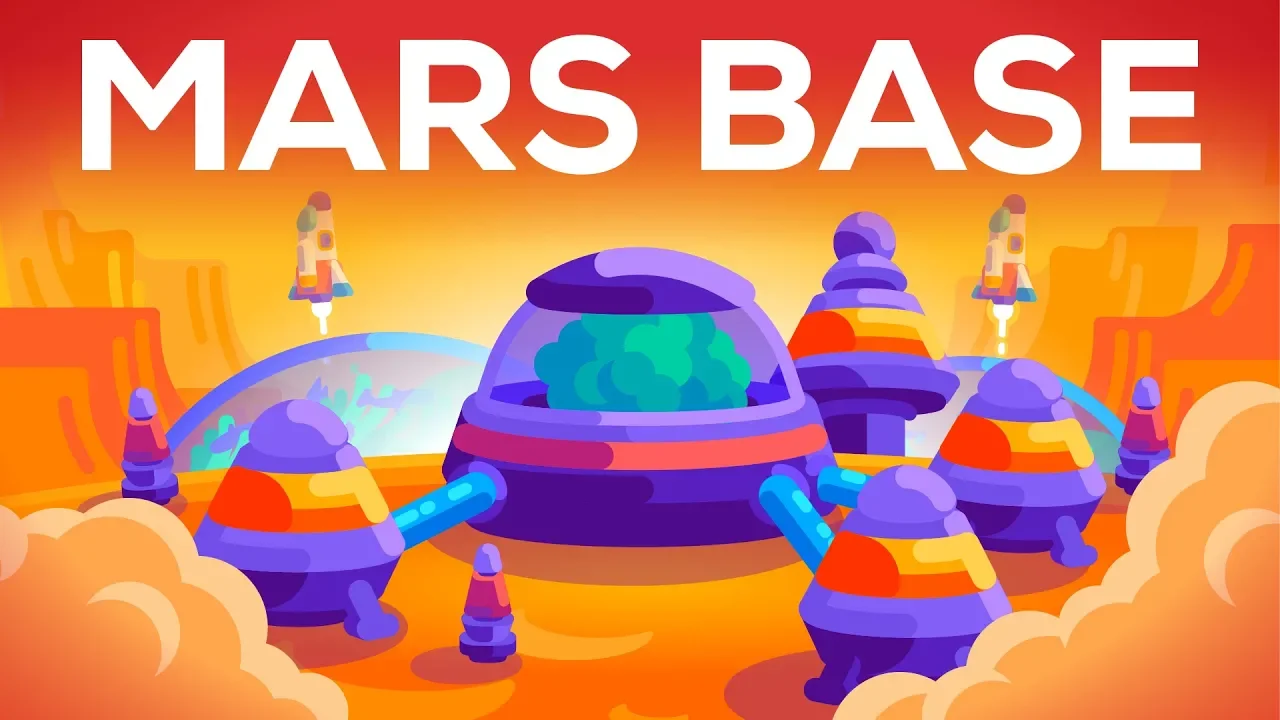
## Background Published on YouTube by Kurzgesagt – In a Nutshell on February 3, 2019, this video breaks down the daunting realities of human colonization on the Red Planet. As noted in the video's description, humanity's innate drive to explore leads us to embrace even the most hostile environments, prompting an investigation into how building a functioning Mars base would actually work and how nerve-wracking the endeavor would be.
## TL;DR While Mars appears superficially hospitable, it is a freezing, radioactive desert with toxic soil, an unbreathable atmosphere, and severe energy shortages that necessitate Earth-supplied nuclear power. To survive, pioneers must live in rounded, windowless pressurized bunkers buried beneath frozen carbon dioxide and dirt, utilizing teleoperated rovers and rear-docking spacesuits to minimize radiation and toxic dust exposure. Astronauts face bodily deterioration from 38% gravity, psychological strain from long-term sensory deprivation, and a precarious supply line tied to planetary launch windows occurring only once every two years. Despite these brutal conditions, mastering this grueling outpost phase represents the critical gateway toward establishing a permanent multi-planetary civilization.
## Atmosphere & style The presentation pairs Kurzgesagt's crisp, colorful aesthetic and Steve Taylor's measured, analytical narration with an unflinching and darkly humorous dose of scientific reality. It systematically deconstructs romantic sci-fi tropes, evoking a genuine sense of claustrophobia as it describes astronauts trapped in buried, windowless tunnels facing lethal dust and years-long isolation. Despite the grim technical hurdles and the chilling prospect of resupply ships arriving to find a dead colony, the video ultimately pivots to an exhilarating, hopeful celebration of human stubbornness and exploratory ambition.
## Bulletin - [00:00](https://www.youtube.com/watch?v=uqKGREZs6-w&t=0s) Establishing a semi-permanent Mars outpost faces severe environmental hurdles, including toxic perchlorate-laced regolith, surface radiation doses 50 times higher than Earth's, and an atmosphere just 1% as dense as Earth's. - [01:43](https://www.youtube.com/watch?v=uqKGREZs6-w&t=103s) Renewable power is largely impractical on Mars due to weak sunlight, global dust storms, negligible wind density, and a cold planetary core, making Earth-supplied nuclear reactors the only viable short-term power source. - [03:04](https://www.youtube.com/watch?v=uqKGREZs6-w&t=184s) Habitats must be designed as windowless, rounded mounds buried under dry ice and a meter of local dirt to survive internal atmospheric pressure and deep-space radiation. - [06:43](https://www.youtube.com/watch?v=uqKGREZs6-w&t=403s) Because orbital alignment allows travel between Earth and Mars only once every two years, an outpost would remain critically vulnerable to supply chain failures and emergencies.
## Key takeaways - [00:00](https://www.youtube.com/watch?v=uqKGREZs6-w&t=0s) Mars appears deceptively welcoming at first glance with its polar ice caps and comparable day length, but it is actually a freezing, radioactive desert with unbreathable air and toxic soil. - [00:00](https://www.youtube.com/watch?v=uqKGREZs6-w&t=0s) Establishing a semi-permanent outpost represents the grueling 'Phase Two' of colonization, which must precede any ambitious long-term plans to terraform Mars. - [01:43](https://www.youtube.com/watch?v=uqKGREZs6-w&t=103s) Solar energy on Mars operates at only 40% of terrestrial efficiency and is regularly disrupted by massive dust storms, while wind and geothermal alternatives remain unviable. - [01:43](https://www.youtube.com/watch?v=uqKGREZs6-w&t=103s) Initial Martian settlements will depend entirely on nuclear reactors and fuel transported from Earth due to the lack of easily accessible local radioactive minerals. - [01:43](https://www.youtube.com/watch?v=uqKGREZs6-w&t=103s) Habitats must be built with rounded, smooth profiles to withstand the extreme pressure differential created by pressurizing a breathable atmosphere inside a 1% density CO2 environment. - [03:04](https://www.youtube.com/watch?v=uqKGREZs6-w&t=184s) Mars lacks a protective magnetic field and dense atmosphere, exposing unshielded surface explorers to 50 times the radiation experienced on Earth and exceeding astronauts' lifetime radiation limits in just three years. - [03:04](https://www.youtube.com/watch?v=uqKGREZs6-w&t=184s) Habitats require radiation shielding made from frozen atmospheric carbon dioxide and a one-meter layer of local soil, turning living quarters into windowless underground bunkers. - [03:04](https://www.youtube.com/watch?v=uqKGREZs6-w&t=184s) Martian dust is electrostatically charged, fine enough to breach mechanical seals, and contaminated with dangerous perchlorate salts, necessitating external spacesuit docking ports. - [04:48](https://www.youtube.com/watch?v=uqKGREZs6-w&t=288s) Farming on Mars requires decontaminating alkaline soil, washing out toxic perchlorate salts, and supplementing it with biological waste, though closed-loop aquaponics provides a viable dietary alternative. - [04:48](https://www.youtube.com/watch?v=uqKGREZs6-w&t=288s) Mars' surface gravity is only 38% of Earth's, triggering progressive muscle atrophy, bone density loss, and cardiovascular deterioration that require continuous exercise to mitigate. - [04:48](https://www.youtube.com/watch?v=uqKGREZs6-w&t=288s) Confinement in cramped, windowless tubes with repetitive tasks and extreme sensory deprivation demands psychological screening similar to Antarctic expeditions or submarine crews. - [06:43](https://www.youtube.com/watch?v=uqKGREZs6-w&t=403s) The supply line between Earth and Mars is constrained by orbital mechanics that only permit travel windows once every two years, leaving colonists helpless in rapid-onset crises. - [06:43](https://www.youtube.com/watch?v=uqKGREZs6-w&t=403s) Despite the extreme risks and hostile conditions, enduring the brutal outpost phase is the essential prerequisite to building an interplanetary civilization and terraforming a second world.
## Detailed walkthrough ### [00:00](https://www.youtube.com/watch?v=uqKGREZs6-w&t=0s) The Grim Reality of the Red Planet
Humanity is an expansionist species that spreads into every available niche, from blistering deserts and lonely islands to the highest mountain ranges. Establishing a foothold on Mars and building the first permanent colony outside Earth—or even eventually terraforming it into a second blue world—feels like a natural continuation of that drive. However, long before grand visions of terraforming can materialize, humanity must complete the grueling "Phase Two" of colonization: establishing a semi-permanent outpost to lay the infrastructure for a larger presence.
At first glance, Mars seems oddly welcoming, featuring polar ice caps, sprawling valleys, subsurface liquid water, and a day length only slightly longer than Earth's. In reality, that appearance is deceptive:
> “Mars is awful.”
The Red Planet is a freezing, radioactive desert where the soil is poisonous, breathing is impossible, and daily existence is intensely stressful. The pioneers who take on the challenge will face unprecedented problems, though there are plenty of volunteers willing to go, supported by existing technologies. For the purpose of planning an outpost, the scenario assumes previous scouting missions have identified a site, stockpiled preliminary tools and resources, and that an active Moon base already operates as a mission hub.
---
[01:43](https://www.youtube.com/watch?v=uqKGREZs6-w&t=103s) Energy Poverty and Atmospheric Containment
The immediate obstacle facing any outpost is severe energy poverty. Due to its distance from the Sun, Mars receives solar energy that is only 40% as effective as on Earth, and even this weakened sunlight is regularly blotted out for days at a time by massive dust storms. Other renewable solutions fall short: wind turbines are useless in an atmosphere with barely any density, and geothermal energy is unviable because the planet's interior is far too cold.
```mermaid flowchart TD accTitle: Mars Outpost Energy Constraints accDescr: Flowchart showing why renewables fail on Mars and why Earth-supplied nuclear power is required. subgraph S1["Environmental Realities"] A["Weak Sunlight<br/>(40% of Earth's)"] B["Massive Global Dust Storms"] C["Thin Atmosphere & Cold Core"] end subgraph S2["Power Source Failures"] D["Solar Insufficient Alone"] E["Wind & Geothermal Unfeasible"] end subgraph S3["Initial Solution"] F["Earth-Supplied Nuclear Reactor & Fuel"] end A --> D B --> D C --> E D --> F E --> F ```
As a result, nuclear power represents the only practical short-term choice. Because Mars lacks readily accessible radioactive minerals, both the nuclear reactor and its fuel must be transported across space from Earth to sustain the base during its early operational years.
Energy alone means nothing if the crew cannot breathe. Mars' atmosphere has only 1% the density of Earth's and consists primarily of carbon dioxide ($CO_2$). Habitats must therefore be artificially pressurized with an oxygen and nitrogen blend. To withstand the massive differential pressure between the inside and outside, structures cannot have standard corners or flat surfaces, which act as structural weak points; instead, they must be constructed with rounded, smooth profiles, accompanied by flawlessly reliable, airtight airlocks.
- Mars surface solar power efficiency: 40% of terrestrial levels - Atmospheric density: roughly 1% of Earth's, dominated by $CO_2$ - Habitat design requirement: rounded, smooth shapes to survive pressure strain without rupturing
---
[03:04](https://www.youtube.com/watch?v=uqKGREZs6-w&t=184s) Radiation, Mars Dust, and Toxic Regolith
Lacking both a strong intrinsic magnetosphere and a dense atmosphere, Mars offers almost no defense against deep-space radiation, allowing half of all incoming radiation to reach ground level. A human standing unprotected on the surface absorbs 50 times the radiation dose they would on Earth. In fact, spending just three years on the Martian surface exceeds the maximum lifetime radiation limit permitted for NASA astronauts over their entire professional careers, massively elevating cancer risks.
```mermaid flowchart LR accTitle: Radiation Shielding Strategy accDescr: Process of shielding habitats using local atmospheric CO2 and Martian dirt to create windowless bunkers. A["Harvest Atmospheric CO2"] --> B["Freeze into Thick Dry Ice Shell"] B --> C["Bury Under 1 Meter of Dirt"] C --> D["Windowless, Burial-Mound Habitats"] D --> E["Radiation Lowered to Survivable Levels"] ```
To engineer passive radiation shielding, habitats can be coated in a dense outer shell of frozen carbon dioxide extracted straight from the air, topped off with a one-meter layer of local dirt. While this reduces radiation exposure to levels survivable over long durations, it extracts a heavy psychological price:
> “From the inside, most living spaces will be windowless tunnels. From the outside, they'll look like burial mounds.”
Because this shielding offers zero protection outdoors, routine physical tasks on the surface will be assigned to remote-controlled teleoperated rovers, keeping personnel sealed inside. Remaining indoors also limits contact with Martian dust. Far finer than terrestrial sand, Martian dust slips inside mechanical gears and sensitive electronics. In addition, the dry environment gives the particles a strong electrostatic charge, causing them to cling tenaciously to spacesuits and gear.
Martian dust poses a severe chemical threat: the soil contains dangerous concentrations of toxic perchlorate salts, making chronic inhalation potentially fatal. To minimize contamination inside the living quarters, spacesuits could be configured to dock externally to the habitat wall, allowing astronauts to climb into the suit directly through a rear hatch without ever carrying the contaminated exterior fabric into the living quarters.
---
[04:48](https://www.youtube.com/watch?v=uqKGREZs6-w&t=288s) Feeding the Crew, Low Gravity, and Isolation
While water can be extracted from thick glacial sheets if the settlement is situated near the Martian poles, food production presents severe agronomic challenges. Martian soil is alkaline and devoid of the fixed nitrogen compounds essential for plant biology. Removing toxic perchlorate salts from the regolith is a slow, costly, and energy-hungry process. Even after decontamination, the dirt must be enriched with recycled biological waste before crops can be sown. As an alternative, closed-loop aquaponics systems could cultivate fish and crops concurrently, enriching the astronauts' diet with better flavor and fresh nutrients, which provides a critical morale boost for an isolated, exhausted crew.
An even deeper physiological hurdle is gravity:
> “Mars has only 38 percent of Earth's surface gravity, which could cause muscle-wasting, bone loss, and cardiovascular problems.”
Until rotating centrifugal living quarters are developed, astronauts must rely on rigorous daily exercise routines simply to slow the rate of bodily decay. Furthermore, personnel will be forced to spend years confined in cramped, windowless tubes alongside the exact same people, running repetitive maintenance cycles day in and day out with limited contact with Earth. Much like scientists wintering at Antarctic research bases or crew members on long submarine patrols, potential Martian pioneers must endure rigorous psychological screening to weed out anyone who cannot withstand prolonged sensory deprivation and isolation.
- Martian surface gravity: 38% of Earth's gravity - Primary health risks: progressive bone demineralization, muscle atrophy, and cardiovascular decline - Psychological stressors: confinement in windowless tunnels, strict daily monotony, isolation, and high-stakes operational stress
---
[06:43](https://www.youtube.com/watch?v=uqKGREZs6-w&t=403s) The Razor-Thin Supply Line and the Dream of a Multi-Planetary Future
Once built, an initial base could potentially endure for several decades, but it remains utterly dependent on regular shipments of spare components, nuclear reactor fuel, replacement crews, and specialized resources sent from Earth. The celestial mechanics connecting the two planets make this supply chain extraordinarily fragile. Earth and Mars are separated by tens of millions of kilometers, aligning favorably for launch windows only once every two years.
> “If there's an emergency in the colony, Earth wouldn't be able to help until the next travel window opens. Helpers may arrive on a planet filled with corpses.”
Establishing Phase Two of colonization is arguably the most brutal endeavor humanity will ever undertake. Yet human stubbornness and an innate appetite for extreme frontiers make it an irresistible challenge. Pushing past this punishing initial stage unlocks the possibility of a bustling interplanetary civilization: cities glowing across the dark Martian plains, orbital space manufacturing networks, deep-space transfer hubs, and the long terraforming effort needed to secure a multi-planetary future for humankind.
## Notable quotes > [06:43](https://www.youtube.com/watch?v=uqKGREZs6-w&t=403s) If there's an emergency in the colony, Earth wouldn't be able to help until the next travel window opens. Helpers may arrive on a planet filled with corpses. — Steve Taylor
> [04:48](https://www.youtube.com/watch?v=uqKGREZs6-w&t=288s) Mars has only 38 percent of Earth's surface gravity, which could cause muscle-wasting, bone loss, and cardiovascular problems. — Steve Taylor
## Mentioned Kurzgesagt – In a Nutshell, Steve Taylor, Epic Mountain, NASA, Mars, Earth, Moon
## Video description Get your Mars Base Poster here: shop.kurzgesagt.org
Humans love to explore. Strangely enough even horrible places – like Mars. Let’s see how building a Mars base could work and how insanely nerve-wracking exactly it would be.
Sources & Further Reading: https://sites.google.com/view/sourcesmars/
OUR CHANNELS ▀▀▀▀▀▀▀▀▀▀▀▀▀▀▀▀▀▀▀▀▀▀▀▀▀▀ German Channel: https://kgs.link/youtubeDE Spanish Channel: https://kgs.link/youtubeES
HOW CAN YOU SUPPORT US? ▀▀▀▀▀▀▀▀▀▀▀▀▀▀▀▀▀▀▀▀▀▀▀▀▀▀ This is how we make our living and it would be a pleasure if you support us!
Get Merch designed with ❤ from https://kgs.link/shop Join the Patreon Bird Army 🐧 https://kgs.link/patreon
DISCUSSIONS & SOCIAL MEDIA ▀▀▀▀▀▀▀▀▀▀▀▀▀▀▀▀▀▀▀▀▀▀▀▀▀▀ Reddit: https://kgs.link/reddit Instagram: https://kgs.link/instagram Twitter: https://kgs.link/twitter Facebook: https://kgs.link/facebook Discord: https://kgs.link/discord Newsletter: https://kgs.link/newsletter
OUR VOICE ▀▀▀▀▀▀▀▀▀▀▀▀▀▀▀▀▀▀▀▀▀▀▀▀▀▀ The Kurzgesagt voice is from Steve Taylor: https://kgs.link/youtube-voice
OUR MUSIC ♬♪ ▀▀▀▀▀▀▀▀▀▀▀▀▀▀▀▀▀▀▀▀▀▀▀▀▀▀ 700+ minutes of Kurzgesagt Soundtracks by Epic Mountain:
Spotify: https://kgs.link/music-spotify Soundcloud: https://kgs.link/music-soundcloud Bandcamp: https://kgs.link/music-bandcamp Youtube: https://kgs.link/music-youtube Facebook: https://kgs.link/music-facebook
The Soundtrack of this video: Soundcloud: https://bit.ly/2TqO6jh Bandcamp: https://bit.ly/2S5YzDY Youtube: https://bit.ly/2CZ6PeN Facebook: http://bit.ly/2qW6bY4
🐦🐧🐤 PATREON BIRD ARMY 🐤🐧🐦 ▀▀▀▀▀▀▀▀▀▀▀▀▀▀▀▀▀▀▀▀▀▀▀▀▀▀ Many Thanks to our wonderful Patreons from http://kgs.link/patreon who support us every month and made this video possible:
Alberto, Rain Babauta, michael mckinnie, Zabeer Hossain, Patrick Belfry, GeF, Jaden Lem, Cathulhu, Clement Kuo, Kinga Stroińska, Guido Jossels, Damon Bradley, Filip Cerny, Sebastian Kroll, Foxyboxes, Karsten Müller-Bier, Geoff French, Solara570, Aaron Massey, Lee Pomelie, Joel TJ, Maurice Nilles, Joseph Hutchins, Jaski, Ben Lutz, Lukas Zivny, Joonas Javanainen, Will Watts, Gardan, Jorge Pérez, MadByte, Stephen Grose, Nikolas Heberer, Kirby Glover, xhantus404, Benjamin Chalker, ParallaxCore, Turtle, Tom Hutton, Nico Meyer, Anthony Pardini-Bielecki, Laura Starkey, Jai Fox, Victor Hernandez, Ainsley, Revan Tair, Maciej Brzyski, Teemu Leisti, Miguel Diaz, Xierumeng, berk ozdilek, Damien Cassan-Barnel, Michael Kretzschmar, Angelos Manousaridis, Nicolas Molin, Christiaan Magre, onno424, bugcaptor, Aidan Rooney, Marcos Garcia, Chris Thompson, Colm Foley, Ramsey Elbasheer
Help us caption & translate this video!https://www.youtube.com/timedtext_cs_panel?c=UCsXVk37bltHxD1rDPwtNM8Q&tab=2
[Source](https://www.youtube.com/watch?v=uqKGREZs6-w)