Todd Becker Reverses Myopia by Rejecting Standard Corrective Lenses
AncestryFoundation
Standard corrective lenses permanently worsen nearsightedness by triggering eyeball elongation, a degenerative cycle that can be reversed naturally through targeted active focusing at the edge of blur.
AI-assisted summary of Myopia: A Modern Yet Reversible Disease — Todd Becker, M.S. (AHS14) — original source. Check the original for full context.
Source published:
Key ideas
- Myopia rates correlate heavily with industrialization, schooling, and close-up near-work rather than pure genetics, evidenced by historical shifts such as Alaskan Eskimo populations jumping from near-zero to over 50% incidence following compulsory schooling. (4:07)
- The Incremental Retinal Defocus Theory shows that minus lenses push the focal plane behind the retina during near-work, driving axial elongation, whereas plus lenses focus light in front of the retina to stimulate axial shortening. (11:37)
- The hormetic 'print pushing' protocol trains vision by operating at the 'Edge of Blur' (D2) during daily reading or screen time, supplemented by low-powered plus lenses (+1.00 to +2.00 D) to encourage optical remodeling. (16:34)
- For distance training, Becker recommends stepping down minus lens prescriptions in increments of -0.50 diopters and practicing active focus to fuse refractive ghost images (diplopia) into single sharp contours. (21:04)
Detailed notes
## Background Presented by Todd Becker, M.S. at the Ancestral Health Symposium (AHS14) and published on YouTube by the AncestryFoundation on August 12, 2014, this lecture explores the biology and epidemiology of myopia. According to the video description, while nearsightedness is conventionally treated as an irreversible genetic disorder, its correlation with schooling and industrialization points to environmental near-work, which can be naturally reversed through specific active focusing practices.
## TL;DR Becker argues that progressive myopia is primarily driven by prolonged close-up work that locks the ciliary muscle into spasm, which standard minus-lens prescriptions worsen by projecting hyperopic defocus and triggering permanent axial elongation of the eyeball. Grounding his approach in the Incremental Retinal Defocus Theory and the biological principle of hormesis, he outlines a method to stimulate structural shortening of the eye. His protocol involves 'print pushing' along the edge of blur, stepping down distance prescriptions sequentially, utilizing low-powered plus reading glasses during computer tasks, and actively training image fusion. In the concluding Q&A, Becker addresses practical concerns such as correcting asymmetrical eye strength, screen ergonomics, and preventing pediatric myopia.
## Atmosphere & style The presentation carries an encouraging, analytical, and accessible tone, blending personal storytelling with clinical optics. Becker speaks with calm, modest confidence, opening with photos of his own glasses-free transformation before transitioning into structured scientific diagrams and gym-inspired analogies like comparing corrective lenses to robotic exoskeletons. The room feels engaged and inquisitive, fostering an interactive, workshop-like dynamic as audience members eagerly troubleshoot their own refractive quirks and screen habits.
## Bulletin - [04:07](https://www.youtube.com/watch?v=x5Efg42-Qn0&t=247s) Myopia rates correlate heavily with industrialization, schooling, and close-up near-work rather than pure genetics, evidenced by historical shifts such as Alaskan Eskimo populations jumping from near-zero to over 50% incidence following compulsory schooling. - [11:37](https://www.youtube.com/watch?v=x5Efg42-Qn0&t=697s) The Incremental Retinal Defocus Theory shows that minus lenses push the focal plane behind the retina during near-work, driving axial elongation, whereas plus lenses focus light in front of the retina to stimulate axial shortening. - [16:34](https://www.youtube.com/watch?v=x5Efg42-Qn0&t=994s) The hormetic 'print pushing' protocol trains vision by operating at the 'Edge of Blur' (D2) during daily reading or screen time, supplemented by low-powered plus lenses (+1.00 to +2.00 D) to encourage optical remodeling. - [21:04](https://www.youtube.com/watch?v=x5Efg42-Qn0&t=1264s) For distance training, Becker recommends stepping down minus lens prescriptions in increments of -0.50 diopters and practicing active focus to fuse refractive ghost images (diplopia) into single sharp contours.
## Key takeaways - [01:50](https://www.youtube.com/watch?v=x5Efg42-Qn0&t=110s) Myopia is a refractive disorder where light converges in front of the retina; severe cases significantly increase the risk of retinal detachment, cataracts, floaters, and macular degeneration. - [06:57](https://www.youtube.com/watch?v=x5Efg42-Qn0&t=417s) While genetic susceptibility exists, environmental exposure to intensive near-work acts as the necessary trigger for progressive refractive error. - [08:41](https://www.youtube.com/watch?v=x5Efg42-Qn0&t=521s) Prolonged screen and reading time locks the ciliary muscle into an involuntary spasm (pseudomyopia), preventing the crystalline lens from flattening out for distance vision. - [08:41](https://www.youtube.com/watch?v=x5Efg42-Qn0&t=521s) Prescribing standard minus lenses creates hyperopic defocus during near-work, triggering a biological signaling cascade that permanently elongates the sclera and eyeball. - [11:37](https://www.youtube.com/watch?v=x5Efg42-Qn0&t=697s) Human biometric studies confirm that minus lenses prompt axial elongation within an hour, while plus lenses prompt the eye to shorten over the same time frame. - [14:01](https://www.youtube.com/watch?v=x5Efg42-Qn0&t=841s) Standard corrective glasses act like an optical exoskeleton: by eliminating focusing effort, they foster ciliary and scleral atrophy, worsening the underlying condition. - [16:34](https://www.youtube.com/watch?v=x5Efg42-Qn0&t=994s) Print pushing requires identifying the Edge of Focus (D1), operating within the mildly blurred Edge of Blur (D2), and avoiding the illegible Edge of Readability (D3). - [16:34](https://www.youtube.com/watch?v=x5Efg42-Qn0&t=994s) Once unassisted reading can be pushed comfortably past 20 inches, low-powered plus lenses (+1.00 to +2.00 D) act as optical resistance weights to continue stimulating axial shortening. - [21:04](https://www.youtube.com/watch?v=x5Efg42-Qn0&t=1264s) Distance vision can be rehabilitated by wearing progressively under-corrected lenses (e.g., stepping down from -3.00 D to -2.50 D) during daily walks and non-driving activities. - [22:36](https://www.youtube.com/watch?v=x5Efg42-Qn0&t=1356s) Active focusing involves consciously relaxing the visual system to merge refractive double images (diplopia) into a single, sharp contour on high-contrast distant edges. - [23:49](https://www.youtube.com/watch?v=x5Efg42-Qn0&t=1429s) Unlike the classical Bates Method, which relied on relaxation and an erroneous extraocular muscle model, modern active focus manipulates retinal defocus directly during daily desk work. - [33:52](https://www.youtube.com/watch?v=x5Efg42-Qn0&t=2032s) Unequal vision between eyes (anisometropia) should be balanced by temporarily occluding or winking the stronger eye to force the weaker eye to adapt. - [37:25](https://www.youtube.com/watch?v=x5Efg42-Qn0&t=2245s) Enlarging computer font sizes does not relieve near-work accommodation strain unless the physical screen distance is pushed further away. - [37:25](https://www.youtube.com/watch?v=x5Efg42-Qn0&t=2245s) Equipping children with mild +1.00 D reading glasses during sustained study sessions can prevent the onset of lens-induced juvenile myopia. - [38:59](https://www.youtube.com/watch?v=x5Efg42-Qn0&t=2339s) Active focusing works bidirectionally: farsighted individuals can counter presbyopia by pulling reading material into their near blur threshold.
## Detailed walkthrough ### [00:00](https://www.youtube.com/watch?v=x5Efg42-Qn0&t=0s) Introduction and Personal Story
Todd Becker opens his presentation by asking the audience how many people wear glasses or contact lenses, noting with a nod to the sea of raised hands that it represents “a pretty good percentage of the audience.” Turning attention to the slides, he displays two personal photographs of himself and his daughter. The first was taken approximately twenty years earlier on a carousel at the San Francisco Zoo when his daughter was about one year old, while the second is a recent photo. Beyond the obvious change of his hair turning gray, Becker highlights a critical contrast: in the older photograph, he was wearing glasses, whereas in the modern one, he no longer needs them.
His talk tells the story of how he investigated the biology of nearsightedness and successfully eliminated his glasses, dividing the presentation into two distinct halves. The first half addresses the underlying root causes of myopia, since understanding etiology is an essential prerequisite to reversing the condition. The second half covers his specific active focusing method—a technique sharing similarities with other approaches but containing his own distinctive twist. To emphasize the contemporary urgency of the topic, Becker shows an image of high school students in Singapore using iPads during an English language arts class, pointing out that every single girl in the room is wearing corrective eyewear.
[01:50](https://www.youtube.com/watch?v=x5Efg42-Qn0&t=110s) What is Myopia and Why It Matters
Moving into definitions, Becker explains that myopia, known colloquially as nearsightedness, is a refractive disorder of the eye. Light rays coming from distant objects converge in front of the retina rather than directly on its surface, causing distance vision to appear blurry. It is the single most common refractive error worldwide, and its prevalence and severity are climbing steadily. Becker emphasizes that myopia is not merely an inconvenience of blurred distance vision, warning: “severe myopia can lead to macular degeneration cataracts eye floaters uh retinal detachment in serious cases so it's something to be concerned about.” While the lecture focuses specifically on myopia due to its prevalence, he notes that the underlying physiological principles apply equally to hyperopia (farsightedness), which represents the reciprocal optical condition.
[02:52](https://www.youtube.com/watch?v=x5Efg42-Qn0&t=172s) Nature vs. Nurture: Genetics vs. Environmental Evidence
Becker addresses the long-standing debate over whether myopia is genetically predetermined or driven by environmental factors, emphasizing that convincing evidence exists on both sides of the aisle. On the genetic side, classic twin and parent-child studies reveal significantly higher concordance rates between identical twins than between fraternal twins or random chance. Geneticists have also pinpointed specific mutations linked to severe refractive errors, such as *SCO2*, a gene involved in copper metabolism. Furthermore, stark differences exist across ethnic and geographical populations: - In parts of East Asia, myopia rates reach 70% to 90%. - In the United States and Europe, prevalence hovers around 30% to 40% (roughly one-third of the population). - In traditional African populations, myopia remains remarkably rare.
Conversely, environmental influences are supported by striking historical spikes in myopia among indigenous populations following the introduction of compulsory schooling. School achievement and educational attainment show strong positive correlations with myopia severity. Most importantly, experimental work demonstrates that retinal defocus induced by sustained near-work serves as a direct driver of axial elongation.
[04:07](https://www.youtube.com/watch?v=x5Efg42-Qn0&t=247s) Historical and Epidemiological Patterns
To illustrate that near-work has driven refractive error for well over a century, Becker reviews an 1880s study of Dutch military recruits that categorized myopia incidence by pre-enlistment occupation: - Farmers and fishermen: ~2.5% - Leather workers (coarse manual labor): ~5% - Handcraft workers and jewelers (fine near-vision tasks): ~12% - Merchants and clerks (intensive paperwork and accounting): ~15% - Advanced university students: ~33% (one in three recruits)
Examining longitudinal trends since 1970 reveals that myopia has nearly doubled across every age demographic, with especially sharp increases in high (severe) myopia. Becker presents a landmark 1969 investigation conducted by Francis Young among Alaskan Eskimo communities. In that population, formal Western schooling had been introduced roughly 30 to 40 years prior. Among elders over the age of 40 who never attended school, the incidence of myopia was virtually zero. Among younger generations who attended Western schools, the rate skyrocketed to over 50%. Becker cites further corroborating research from contemporary Germany, where myopia incidence scales directly with educational attainment: approximately 20% among those without completed secondary education, climbing to 35% among secondary graduates, and exceeding 50% among university graduates. International comparisons among young schoolchildren aged 7 to 9 show that highly intensive academic systems, such as Singapore's, yield a 34% prevalence rate, compared to 7% to 8% in the United States and only 3% in rural Nepal.
[06:57](https://www.youtube.com/watch?v=x5Efg42-Qn0&t=417s) Diet, Gene-Environment Interactions, and Susceptibility
Becker acknowledges alternative environmental hypotheses, highlighting Loren Cordain’s work linking modern diets to visual deterioration. Cordain argued that elevated carbohydrate consumption, hyperinsulinemia, essential fatty acid deficiencies (notably fish oils), and mineral deficiencies stimulate excess eye growth. Cordain discounted genetics after finding that children on the island of Vanuatu attended school eight hours daily yet exhibited only a 2% myopia rate.
Becker challenges this either-or framing, arguing that genetics and environment operate together through epigenetic susceptibility: “it's not genetics or environment but I think the two come together and if you if you think about it in terms of epigenetics or environment acting on the genes it's kind of like alcoholism right you can have a gene for predilection to alcoholism but if you're not exposed to alcohol you won't you won't have that condition.” He cites a 2002 paper by Douglas Frederick showing that individuals with genetic markers for myopia who engage in intense near-work develop severe myopia (exceeding two diopters). Those with the same genetic markers who avoid intensive near-work develop little to no refractive error, illustrating that environmental exposure is required to trigger the underlying genetic vulnerability.
[08:41](https://www.youtube.com/watch?v=x5Efg42-Qn0&t=521s) The Mechanism: From Normal Accommodation to Pseudomyopia and Axial Elongation
Turning to visual anatomy, Becker details how a healthy eye adjusts its focus via the crystalline lens. When looking at distant targets, incoming light rays travel virtually parallel to one another; the ciliary muscle relaxes, flattening the lens so that minimal focusing power is required to land the image precisely on the retina. When gazing at near objects, the ciliary muscle contracts, allowing the flexible crystalline lens to thicken and increase its curvature, magnifying and refracting light rays more sharply. A healthy eye moves smoothly between these flattened and thickened states throughout the day.
```mermaid flowchart TD accTitle: The Vicious Cycle of Progressive Myopia accDescr: Progression from sustained near work and ciliary spasm to distance blur, corrective minus lenses, hyperopic defocus during near work, and permanent axial elongation.
subgraph S1["Phase 1: Functional Adaptations"] A["Sustained Near-Work\n(Screens, reading)"] --> B["Ciliary Muscle Spasm\n(Lens remains thickened)"] B --> C["Pseudomyopia\n(Distance blur; focal point in front of retina)"] end
subgraph S2["Phase 2: Optical Correction"] C --> D["Minus Lenses Prescribed\n(Concave distance glasses)"] D --> E["Clear Distance Vision Restored"] end
subgraph S3["Phase 3: Structural Remodeling"] D --> F["Wearing Minus Lenses for Near-Work"] F --> G["Hyperopic Defocus\n(Focal plane pushed behind retina)"] G --> H["Axial Elongation\n(Eyeball physically lengthens)"] H --> I["True Myopia Worsens\n(Requires stronger prescription)"] end
I --> D ```
Problems begin when individuals spend long, uninterrupted hours fixed on computer screens, books, or smartphones. Prolonged close work locks the ciliary muscle into an involuntary spasm, preventing the lens from flattening back out when looking away into the distance. This state—known as pseudomyopia or ciliary spasm—causes distant images to converge in front of the retina, creating blur. Although initially temporary, continuous near-work makes this spasm chronic. When patients report this distance blur to an optometrist, they are routinely prescribed concave minus lenses to push the distant image back onto the retina.
However, standard minus lenses introduce a harmful optical side effect: when worn while performing near-work, the corrective lens pushes the near focal plane behind the retina, generating hyperopic defocus. In response to this backward blur, a biological feedback pathway signals the sclera of the eye to grow, physically elongating the axial length of the eyeball. Once the eyeball permanently elongates, the individual can see near work comfortably, but distance vision becomes even blurrier than before. This structural shift leads the patient straight back to the optometrist for an even stronger pair of minus glasses, setting off a progressive cycle of deepening myopia.
[11:37](https://www.youtube.com/watch?v=x5Efg42-Qn0&t=697s) Incremental Retinal Defocus Theory and Axial Elongation
Todd Becker recalls his own personal struggle with deteriorating eyesight: going to the optician, receiving a stronger prescription, and falling into a vicious cycle where the process repeated itself continuously. To explain the underlying biology of this progression, Becker introduces the "Incremental Retinal Defocus Theory," developed by George K. Hung and Kenneth J. Ciuffreda. While early foundational data on ocular adaptation was derived from animal models such as chicks and primates, Becker emphasizes compelling, recent human research made possible by high-precision optical equipment like modern biometers or interferometers, which track minute changes in the eye's axial length during active focusing.
```mermaid flowchart LR accTitle: Incremental Retinal Defocus Mechanism accDescr: Diagram showing how minus and plus lenses alter the eye's axial length via neuromodulators and scleral remodeling. subgraph Defocus["Lens Exposure"] direction TB Minus["Minus Lens (Overminus)"] Plus["Plus Lens (Overplus)"] end
subgraph Biology["Biological Response"] direction TB Neuro["Neuromodulators Secreted"] Sclera["Scleral Elasticity Modified"] end
subgraph Adaptation["Axial Length Outcome"] direction TB Elongate["Eye Elongates (+5 to 10 µm)"] Shorten["Eye Shortens (~10 µm)"] end
Minus -->|"Focus falls behind retina"| Neuro Plus -->|"Focus falls in front of retina"| Neuro Neuro --> Sclera Sclera -->|"Minus stimulus"| Elongate Sclera -->|"Plus stimulus"| Shorten ```
When a human subject is fitted with a minus lens, the focal point falls behind the retina. In response, neuromodulators are secreted that alter the elasticity and remodeling of the scleral tissue, prompting the axial length of the eyeball to elongate. In human trials over the course of a single hour, an eye can lengthen significantly. Conversely, introducing a plus lens causes the image to focus in front of the retina, driving the eye to shorten over the same one-hour window. Neutral lenses produce no measurable shift. Becker underscores that this structural plasticity is two-sided: the very mechanism responsible for myopic progression can theoretically be harnessed in reverse to shorten the eyeball and reverse myopia.
- A normal human eye measures roughly 25 millimeters in total axial length. - The Incremental Retinal Defocus Theory provides experimental proof that lens-induced defocus directly controls scleral growth and axial dimension. - “So there's a theory called the incremental retinal defocus Theory and this was developed by Hung and Ciuffreda, and there's some very interesting recent data in humans showing that if you actually fit a person with a minus lens, right, the axis of the eye will grow,” explains Todd Becker.
---
[14:01](https://www.youtube.com/watch?v=x5Efg42-Qn0&t=841s) Hormesis, the SAID Principle, and the Eyeglasses Crutch
To bridge laboratory observations with a actionable recovery protocol, Becker turns to a core principle featured on his blog, *Getting Stronger*: hormesis. Hormesis describes an adaptive biological phenomenon whereby a low dose of an otherwise damaging or lethal stressor stimulates protective repair pathways and supercompensation. Familiar examples include exercise, immunizations, calorie restriction, thermal stress (heat and cold shock), ultraviolet radiation, dietary phytonutrients, and skin calluses formed from playing guitar or walking barefoot. Becker argues that active optical focusing acts as a direct analog to physical resistance training.
```mermaid flowchart TD accTitle: Applying the SAID Principle to Vision accDescr: Contrast between the degenerative crutch model and the adaptive hormetic training model. subgraph Crutch["Optometric Exoskeleton Model"] direction TB C1["Minus Lenses Prescribed"] --> C2["Zero Focusing Effort Required"] C2 --> C3["Ciliary & Scleral Atrophy"] C3 --> C4["Worse Myopia & Stronger Prescription"] end
subgraph Hormesis["Hormetic Training Model"] direction TB H1["Active Challenge at Edge of Blur"] --> H2["Specific Imposed Demand (SAID)"] H2 --> H3["Micro-Stimulus & Neurochemical Signaling"] H3 --> H4["Axial Shortening & Functional Clarity"] end ```
In strength training, lifting weights imposes microtrauma on muscle fibers, eliciting a compensatory rebuilding process governed by the SAID principle (Specific Adaptation to Imposed Demands). Training must occur at the optimal threshold—the "edge of failure"—because overtraining causes destructive injury, while undertraining produces zero stimulus. Becker uses an analogy to illustrate modern optometric care: if someone joined a gym to build strength, an optometrist’s equivalent approach would be outfitting them with a powered robotic exoskeleton (a technology proposed for military soldiers carrying heavy gear). While the exoskeleton offers instant ease and amplified performance, continuous wear leads to muscular atrophy—mirroring what astronauts suffer in zero gravity. Removing the device leaves the individual far weaker than when they started. Becker contends that standard corrective lenses act as an optical exoskeleton, eliminating the eye's natural focusing demand and systematically deteriorating distance vision.
- Hormesis functions by activating endogenous cellular defense, remodeling, and repair mechanisms in response to controlled stressors. - “Well, my argument is this is exactly what you're doing when you're wearing glasses: you're weakening your eyes,” states Todd Becker.
---
[16:34](https://www.youtube.com/watch?v=x5Efg42-Qn0&t=994s) Practical Protocols: The Three Edges, Print Pushing, and Plus Lenses
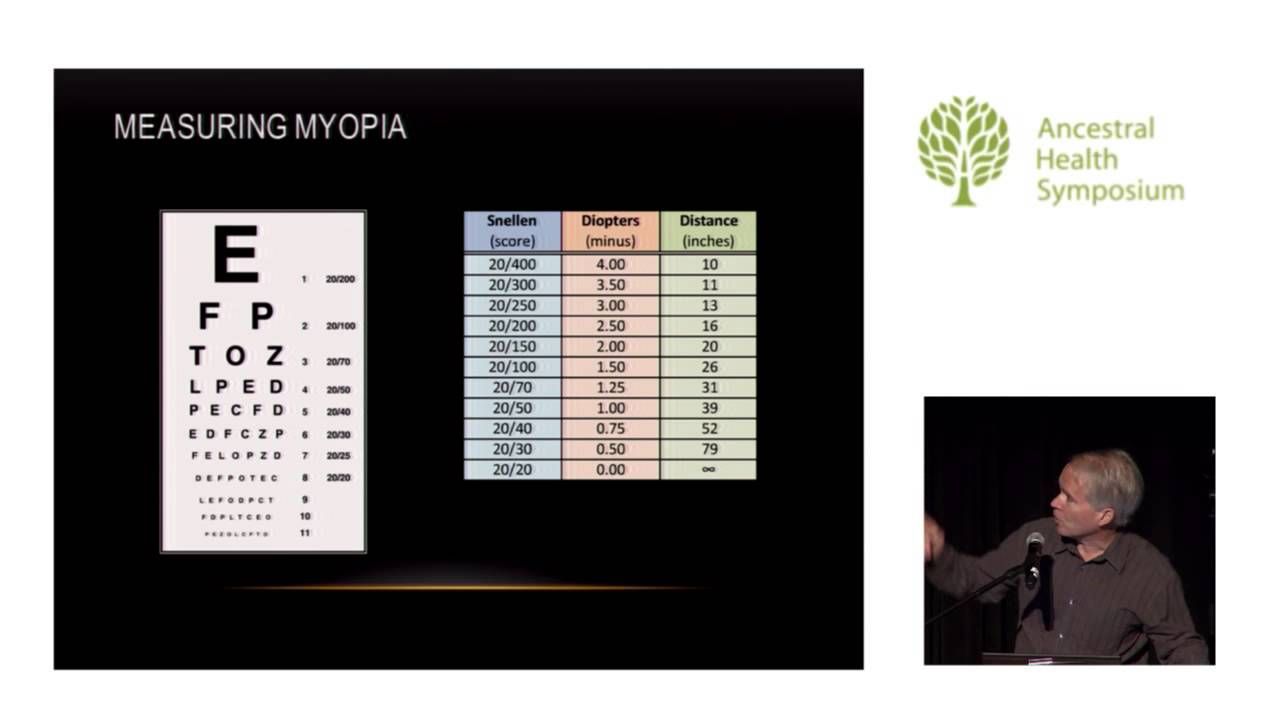
Implementing an optical hormetic routine requires first quantifying baseline acuity using a standard Snellen eye chart viewed from 20 feet. For instance, reading only down to the fifth line (PECFD) reflects 20/40 visual acuity, which corresponds roughly to a -0.75 diopter prescription (allowing sharp, unassisted vision out to about 52 inches). To actively rehabilitate sight, Becker advises individuals to completely remove their glasses during reading and near-work and implement the "print pushing" technique. Using a photograph of his daughter seated before a computer to demonstrate, Becker demarcates three distinct operating distances:
| Threshold | Label | Description & Training Application | |:--- |:--- |:--- | | **Edge of Focus** | **$D_1$** | The furthest distance where text remains completely sharp and clear. Pull the print inward from here for relaxed reading. | | **Edge of Blur** | **$D_2$** | The distance just beyond $D_1$ where print first begins to soften or blur. This is the optimal hormetic training zone. | | **Edge of Readability** | **$D_3$** | The distance where text degrades into illegibility. This is pushed too far and does not produce a productive stimulus. |
The training protocol consists of pushing reading material just beyond $D_1$ into $D_2$, oscillating deliberately along this boundary for two to four hours a day during ordinary reading or screen work, while taking short breaks every 15 to 30 minutes. The slight optical strain should feel mildly challenging but never painful. Over days and weeks, both $D_1$ and $D_2$ migrate outward away from the eyes. Once an individual can comfortably push text out to 20 inches unassisted, the natural focal range is exhausted, requiring the introduction of low-powered plus lenses (over-the-counter reading glasses between +1.00 and +2.00 diopters). Becker compares wearing plus readers to running with weighted vests: it artificially handicaps the eye, forcing it into optical defocus to stimulate further axial shortening and visual recovery.
- For people with mild myopia (under -2.00 diopters), drug store reading glasses (+1.00, +1.25, +1.50) provide the required focal challenge at normal 15- to 20-inch reading distances. - Snellen acuity should be re-evaluated weekly under standardized conditions to objectively chart distance gains. - “If you really want to work on reversing your myopia, you have to read without glasses,” Becker emphasizes.
---
[21:04](https://www.youtube.com/watch?v=x5Efg42-Qn0&t=1264s) Distance Training and the Vacation Revelation
For activities outside of close work—such as going on walks, watching television, sitting in an audience, or riding as a car passenger (cautioning never to do so while driving)—Becker prescribes wearing progressively under-corrected distance lenses. If a patient’s current distance prescription is -3.00 diopters, they should drop down to -2.50 diopters. If a local optometrist refuses to prescribe weaker corrections, inexpensive frames and lenses can be ordered directly through online optical discount retailers like Zenni Optical for roughly $20. By steadily stepping down through -2.50, -2.00, and -1.50 diopter pairs as distance clarity improves, the eyes adapt continuously to low-grade distance blur.
Turning to a playful, active method reminiscent of movement coach Darryl Edwards, Becker recounts the personal story of how he stumbled upon his breakthrough distance focusing technique. While on vacation on the opposite side of the United States, Becker realized he had accidentally left his glasses at home. Facing two weeks without corrective eyewear, his initial reaction was profound frustration, as he could not read the books he had packed and the outside world appeared as an indistinct blur. Resolving to make the best of the situation, he embarked on long walks to explore what his uncorrected visual system was capable of discerning, which led directly to his observation of distant ghosted images.
- Budget optical retailers allow users to self-order customized, under-corrected glasses in -0.50 diopter decrements without paying typical clinic markups. - Stepping down prescription strength provides a gentle, ongoing distance challenge that prompts continuous axial adaptation during everyday mobility. - “So I was without glasses for two weeks, and at first I was very frustrated; I'd brought some good books to read, and my eyes were all blurry,” recalls Todd Becker.
[22:36](https://www.youtube.com/watch?v=x5Efg42-Qn0&t=1356s) Active Focus, Diplopia, and Image Fusion
Todd Becker details the physical sensation of practicing active focus at distance. Looking at high-contrast distant objects—such as the sharp edge of a building or overhead telephone wires set against the sky—reveals a crisp primary image alongside a faint secondary ghost image. While known medically as diplopia (double vision), which warrants seeing an eye doctor if sudden or present in only a single eye, Becker explains that in mild myopia it is typically just an innocuous refractive phenomenon.
Rather than viewing this ghosting as an obstacle, Becker discovered it can be used as a focusing tool. By fixing one's gaze on the double image, one image appears noticeably darker and bolder than the other. With sustained, relaxed attention, the darker image becomes more defined while the faint secondary image fades away, until the two images suddenly merge together into a single, razor-sharp contour. Becker realized that learning to actively coax these overlapping images into fusion was the key to unlocking distance vision without corrective lenses, pairing this distance technique with plus-lens reading glasses during computer work.
```mermaid flowchart TD accTitle: Active Focus Image Fusion Process accDescr: Steps to achieve image fusion through active focusing on high-contrast distant targets.
subgraph Detection["1. Target Acquisition"] A["Focus on high-contrast object<br>(building edge, telephone wire)"] --> B["Notice crisp primary image + faint ghost image (refractive diplopia)"] end
subgraph Convergence["2. Active Focusing"] B --> C["Observe that one contour is darker than the other"] C --> D["Sustain relaxed attention as dark contour intensifies and faint contour fades"] end
subgraph Fusion["3. Resolution"] D --> E["Images fuse into a single sharp image"] end ```
[23:49](https://www.youtube.com/watch?v=x5Efg42-Qn0&t=1429s) Practical Implementation: Time Commitment, Mindset, and the Bates Method
Addressing common practical concerns, Becker outlines the time investment, mental approach, and expectations required for reversing myopia. He stresses that reversing refractive error is not an isolated workout routine: “First of all, you've got to have the right mindset: these are not exercises that you do like going to the gym; these are activities you integrate into your daily activity while you're working at the computer, while you're at work every day, or while you're going for walks.” He recommends logging two to four hours a day of print pushing—working without plus lenses if one has high myopia, or using low-powered plus lenses if one has mild myopia. Crucially, visual challenge should feel slightly awkward, but never painful; if eye strain or redness occurs, one should pause and rest for several days before resuming.
Becker cautions that because it took years for the eyeball to elongate, structural remodeling will not happen overnight. Progress often mirrors weight lifting or fat loss, exhibiting non-linear plateaus followed by sudden jumps in visual acuity. Becker contrasts this approach with the classical Bates Method: while William Bates correctly observed eye strain and pseudomyopia, Bates relied on a flawed anatomical model, erroneously believing that external extraocular muscles reshaped the eyeball rather than the ciliary muscle altering the crystalline lens. Furthermore, Bates had no concept of axial elongation or the time-averaged signal described by the incremental retinal defocus theory. Relaxing and gazing into the distance provides relief, but it does nothing to prevent axial remodeling for modern workers tethered to computer screens for eight hours a day. Print pushing solves this by actively manipulating the focal plane right at the boundary between clarity and blur.
- **Blog & Resources**: Becker documents these methods and real-world case studies on his website, *GettingStronger.org*, highlighting two main resources: the article "Improve Vision and Throw Away Your Glasses" and a community forum thread titled "Eyesight Without Glasses," both with over 100,000 views. - **Patience and Trajectory**: Most individuals notice initial functional improvements within a few weeks, with early adaptations occurring faster before settling into a stepped pattern of progress. - **The Bates Difference**: Bates focused purely on relaxation and distance viewing, leaving office workers unprotected against near-point hyperopic defocus; print pushing actively challenges the eye's focal threshold while sitting at the screen.
[28:34](https://www.youtube.com/watch?v=x5Efg42-Qn0&t=1714s) Summary: Cultivating Distance Habits and Everyday Visual Habits
Becker brings his core presentation to a close by framing the visual system as an adaptive physiological organ. Just like skeletal muscle or metabolic pathways, the eye remodels in direct response to the demands placed on it. Chronic close-up work with books, video games, and particularly smartphones locks the ciliary muscle in spasm; compensating with ever-stronger minus prescriptions projects a hyperopic defocus onto the peripheral retina, driving the axial length of the eyeball to elongate. Reversing this damage requires systematically reversing the environmental stimulus.
To put this into practice, Becker urges the audience to turn seeing into an engaging everyday practice. Rather than viewing visual rehabilitation as a tedious chore, people should treat it like a game: sitting as far back as possible in lecture halls, backing away from television screens, and reading at the outer limit of legibility. When walking along outdoor trails, one can actively trace intricate tree branches, foliage, and sky shadows to pull distant details into focus. For those with mild myopia or improving vision, working with plus lenses accelerates recovery, yielding a sharp, crystal-clear world once the lenses are removed. As Becker emphasizes: “What I can tell you is the more you do this and the more disciplined you are about doing it, the better your results will be.” He shares recommended literature for further study, highlighting texts by David De Angelis, Jacob Liberman, and Otis Brown alongside his own site.
[31:28](https://www.youtube.com/watch?v=x5Efg42-Qn0&t=1888s) Q&A: Maintenance, Digital Screens vs. Books, and Correcting Unequal Vision
Opening the floor to questions, an attendee asks whether vision correction requires lifelong maintenance once normalized, or if a person is permanently cured. Becker explains that vision behaves like general physical conditioning: once you are fit, you only need occasional maintenance. He keeps a pair of plus lenses nearby and slips them on if doing extensive reading, but primarily maintains his vision simply by sitting further back from screens and refusing to slip back into the bad postural habits that caused the problem initially.
Another attendee asks whether reading from paper books is inherently superior to training in front of computer displays, given the warnings about digital devices. Becker replies that while reading a well-lit physical book is ideal, working on a computer screen presents no fundamental physiological disadvantage as long as proper lighting and sufficient distance are maintained.
A third attendee then raises a family pattern of severe vision discrepancies, sharing that his brother has extreme 20/1,000 vision in both eyes, whereas he himself has an asymmetric split: one eye tests at 20/20 while the other sits around 20/400. In clinical exams, he jokes that he cannot read the giant top letter on the Snellen chart with his bad eye, but gets by because he has already memorized what it is.
Becker identifies this as anisometropia leading to functional amblyopia, noting that he also has an asymmetry with one slightly farsighted eye and one nearsighted eye. To correct an imbalance, the brain's tendency to rely on the dominant eye must be interrupted. Becker instructs: “If you have the two different eyes, block one eye and work with the weaker eye, because your stronger eye is going to dominate and do more work for you.” This can be accomplished by placing an occluder patch over one spectacle lens, covering the good eye with a hand, or alternating deliberate winks while reading, noting with a smile that the winking muscles quickly adapt with practice.
[33:52](https://www.youtube.com/watch?v=x5Efg42-Qn0&t=2032s) Addressing Uneven Vision, Severe Prescriptions, and Replacement Glasses
An audience member asks about dealing with an asymmetry in eye strength, explaining that reading is easy at certain distances but becomes difficult when the eyes compete for dominance. Todd Becker suggests that when the eyes differ significantly, one should isolate and train the weaker eye first so the two can work together harmoniously: “I think you probably want to work your weaker eye first until it gets closer because it's much easier to do this method when your eyes are close.” He shares from his own personal experience that his left eye had been weaker, so he spent dedicated time strengthening it until both eyes became evenly balanced.
When the attendee asks how someone with very high myopia—such as her brother, who would practically have his nose touch the screen to reach the edge of readability—can start, Becker confirms that while that starting point is tough, they can begin by using a weakened minus prescription. Trimming a few diopters off the normal prescription brings the focal point out to a comfortable, reasonable working distance. In response to another attendee's concern about the recurring cost of replacing lenses as one's eyesight progressively improves, Becker recommends ordering through discount online retailers like Zenni Optical, where frames can cost around $6 and complete glasses run approximately $15 to $30.
Another audience member with an asymmetrical prescription of -6.50 D in one eye and -5.00 D in the other asks whether to step down both eyes simultaneously or bring the -6.50 D eye down to -5.00 D first. Becker advises treating the imbalance just like an imbalance in muscle strength at the gym, winking or covering the stronger eye with a patch or diffuser to let the weaker eye catch up on a Snellen chart:
> “It's just like what what if you went into the gym and you had one a strong right arm and a weaker left arm you you would want to work the weaker arm first until they were both similar.”
- **Unequal refractive error:** Becker advises temporarily patching, diffusing, or winking the stronger eye while practicing active focus until the weaker eye matches it. - **Extreme myopia workaround:** Rather than leaning unnaturally close to a screen, reduce the strength of a minus prescription by several diopters to push the focal boundary outward. - **Affordable progression:** Inexpensive online optical outlets make it feasible to purchase sequential, reduced-power glasses without prohibitive costs.
---
[36:17](https://www.youtube.com/watch?v=x5Efg42-Qn0&t=2177s) Axial Length Changes and Visual Acuity vs. Optical Correction
An audience member asks Becker whether he has tracked changes in his own eye's axial length throughout the process. Becker explains that measuring axial length requires specialized, sophisticated clinical instrumentation that he does not personally possess. He notes that the scientific study he cited in the talk followed 28 patients whose ocular dimensions were tracked, showing measured shifts of several microns.
The attendee raises a skeptical counterpoint, suggesting that the method might merely be training the brain's visual acuity through practice rather than genuinely reversing structural, optical defects. Becker acknowledges the distinction, agreeing that if someone has other ocular conditions outside simple refractive myopia, active focus exercises will not correct those broader issues: “Yeah if you have other eye conditions outside of you know myopia uh yes this doesn't deal with those.”
```mermaid flowchart TD accTitle: Active Focus Correction Pathway accDescr: Flowchart illustrating how active focus interacts with axial length versus other ocular conditions.
subgraph Intervention["Intervention"] A["Active Focus Practice"] end
subgraph Outcomes["Targeted Condition vs. Structural Limits"] B["Axial Length Dynamics"] C["Visual Acuity Improvement"] D["Other Optical / Eye Pathology"] end
A -->|"Stimulates micrometric changes"| B A -->|"Sharpens edge resolution"| C A -.->|"Does not correct"| D ```
---
[37:25](https://www.youtube.com/watch?v=x5Efg42-Qn0&t=2245s) Screen Distance, Font Sizes, and Pediatric Prevention
A listener asks about a common practice in the tech industry: increasing screen font sizes while sitting at the exact same close viewing distance. Becker points out that while font size and distance are mathematically linked, enlarging the text without moving farther away does not relieve the underlying optical strain. The essential trigger for reversing myopia is shifting the physical focal plane farther away, meaning that if you enlarge the text, you must push your screen back accordingly: “So you want you want to increase the distance whatever the font size is by moving back farther and farther progressively.”
When asked how to prevent children who currently have 20/20 vision from ever developing myopia, Becker emphasizes fundamental visual hygiene: avoiding excessive, hunched near-work and keeping reading material at a safe distance. For extended periods of reading or studying, he recommends that kids wear weak over-the-counter reading glasses (plus lenses around +1.00 diopter) purchased cheaply from a local pharmacy to neutralize near-work accommodation strain. He proposes a simple test: “Do it an experiment have them put the plus lenses on and read for an hour and take them off and ask them do you now see the world more crisply and clearly than you did before just ask them.”
- **Font scaling rule:** Enlarging screen font is only beneficial if it is paired with pushing the screen farther away to expand the working distance. - **Preventative plus lenses:** Wearing +1.00 D readers during sustained near-work prevents school-age children from developing progressive lens-induced myopia.
---
[38:59](https://www.youtube.com/watch?v=x5Efg42-Qn0&t=2339s) Night Driving, Presbyopia, Super-Vision, and Retinal Disease Risk
An attendee asks for guidance on age-related reading difficulty (presbyopia) accompanied by poorer night vision while driving. Becker notes that these conditions typically co-occur as the visual system ages, but they can be supported holistically. In addition to practicing active focusing at night to sharpen edge contrast on car lights, he points to dietary support, particularly a low-insulin diet and ample phytonutrients to support photoreceptor (rod and cone) health in low-light and color detection settings.
A final attendee asks whether continuing the practice past 20/20 vision could overcorrect the eye and induce hyperopia (farsightedness). Becker recounts an interview from his website with a student who successfully improved beyond 20/20 to reach 20/15 "super vision." He clarifies that the active focus mechanism works bidirectionally: farsighted individuals can improve their near vision by pulling reading material into their near blur threshold, allowing the eye to adapt flexibly in both directions. Continual practice will not accidentally induce hyperopia as long as one alternates distances and trains dynamic range: “You basically can change the shape of your eye in either direction by using active focusing right.”
In closing, an audience member inquires whether improving myopia lowers the risk of serious ocular pathologies like macular degeneration. Becker confirms that reducing myopia could help lower long-term risks, observing that extreme axial elongation is an established contributor to severe conditions: “If you look at some of the causal contributors to macular degeneration retinal detachment eye floaters you'll see myopia listed prominently there it's not the only cause but there is a connection there.”
- **Metabolic and nutritional factors:** A low-insulin diet and high-phytonutrient intake protect rod and cone health, aiding dark adaptation and night driving. - **Super-vision threshold:** Active focus practice can sharpen acuity past standard 20/20 down to 20/15. - **Bidirectional training:** Hyperopia can be counter-trained using the reverse technique—pulling text closer to the eye to stimulate near-point accommodation. - **Pathology risk mitigation:** Lowering myopia can reduce elevated risks of retinal tears, retinal detachment, vitreous floaters, and macular degeneration.
## Notable quotes > [16:34](https://www.youtube.com/watch?v=x5Efg42-Qn0&t=994s) If you really want to work on reversing your myopia, you have to read without glasses — Todd Becker
> [38:59](https://www.youtube.com/watch?v=x5Efg42-Qn0&t=2339s) You basically can change the shape of your eye in either direction by using active focusing — Todd Becker
> [31:28](https://www.youtube.com/watch?v=x5Efg42-Qn0&t=1888s) If you have the two different eyes, block one eye and work with the weaker eye, because your stronger eye is going to dominate and do more work for you. — Todd Becker
## Mentioned Todd Becker, AncestryFoundation, Ancestral Health Symposium, SCO2, Francis Young, Loren Cordain, Douglas Frederick, George K. Hung, Kenneth J. Ciuffreda, Incremental Retinal Defocus Theory, Getting Stronger, Zenni Optical, William Bates, David De Angelis, Jacob Liberman, Otis Brown
## Video description Myopia, or near-sightedness, is generally assumed to be an irreversible, genetically determined condition that can only be ameliorated with corrective lenses or surgery. Its prevalence is 30-40% in the U.S. and Europe, and more than 50% in some Asian countries, but it is rare in Africa and in pre-industrial cultures. The incidence of myopia correlates with IQ, school achievement, and industrialization, suggesting that an environmental factor is at work—namely, near-work. This talk will review the biology and epidemiology of myopia and present experimental evidence that myopia can be reversed naturally by specific focusing techniques and practices.
Abstracts and information about the Ancestral Health Symposium can be found at www.ancestralhealth.org/ahs14-program.
[Source](https://www.youtube.com/watch?v=x5Efg42-Qn0)