Chinampas of Mexico: Most Productive Agriculture EVER?
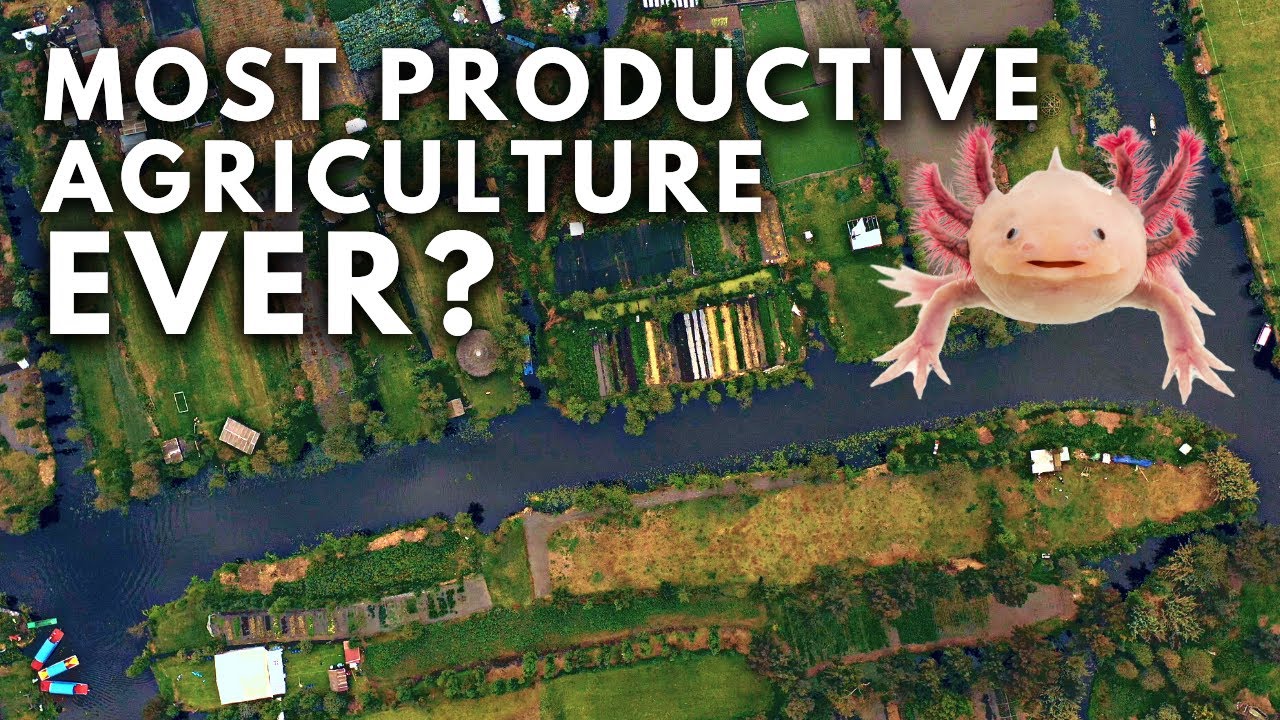
Andrew Millison
AI-assisted summary of Chinampas of Mexico: Most Productive Agriculture EVER? — original source. Check the original for full context.
Source published:
Key ideas
- The chinampas of Xochimilco feature sediment with roughly 11% organic matter, forming a self-watering sponge that allows seed-starting blocks to grow for 30 days without surface irrigation under mulch. (2:46)
- Constructed up to 12 meters wide using anchored ahuejote willows, chinampas function as agroforestry systems that continuously hydrate crops through subsurface capillarity. (4:32)
- The chinampa network has plummeted from over 100,000 hectares pre-conquest to approximately 2,200 hectares today due to 500 years of lake drainage and modern urban encroachment. (10:07)
- Arca Tierra utilizes gravel-and-reed biofilters along tertiary canals to filter polluted runoff, exclude predatory invasive carp and tilapia, and regenerate critical habitats for the endangered axolotl. (8:20)
Detailed notes
## Background Published on YouTube by permaculture instructor Andrew Millison on April 14, 2022, this video documents his journey to the historic chinampas, or floating gardens, of Xochimilco in Mexico City. The presentation explores the Arca Tierra restoration project led by Lucio Usobiaga, which revitalizes ancient Aztec and pre-Aztec wetland agriculture by integrating contemporary permaculture, agroforestry, and syntropic farming practices.
## TL;DR Permaculture educator Andrew Millison investigates the ancient chinampa system of Mexico City to assess its reputation as one of history's most productive agricultural methods. Guided by Arca Tierra founder Lucio Usobiaga, the tour reveals how indigenous builders transformed shallow lakes into fertile, self-irrigating islands framed by ahuejote willows and nutrient-rich volcanic sediment containing 11% organic matter. The exploration addresses the urgent environmental threats facing the surviving 2,200 hectares, including sewage runoff, groundwater depletion, and urban encroachment. To counter these challenges, Arca Tierra blends ancestral techniques with academic research, using gravel-and-reed biofilters to protect endangered axolotls and creating viable economic linkages between chinampa farmers and urban consumers.
## Atmosphere & style The film strikes an inquisitive, reverent, and grounded tone, pairing quiet permaculture fieldwork with deep admiration for Mesoamerican engineering. Traveling through misty canals framed by ahuejote trees, the dialogue between Millison and Usobiaga feels unhurried and collaborative, centered on tactile details like crumbling rich lake soil in hand or inspecting aquatic biofilters. The experience balances a sobering historical awareness of five centuries of water mismanagement with hopeful inspiration, presenting a living aquatic sanctuary that perseveres right on the edge of a sprawling megacity.
## Bulletin - [02:46](https://www.youtube.com/watch?v=86gyW0vUmVs&t=166s) The chinampas of Xochimilco feature sediment with roughly 11% organic matter, forming a self-watering sponge that allows seed-starting blocks to grow for 30 days without surface irrigation under mulch. - [04:32](https://www.youtube.com/watch?v=86gyW0vUmVs&t=272s) Constructed up to 12 meters wide using anchored ahuejote willows, chinampas function as agroforestry systems that continuously hydrate crops through subsurface capillarity. - [10:07](https://www.youtube.com/watch?v=86gyW0vUmVs&t=607s) The chinampa network has plummeted from over 100,000 hectares pre-conquest to approximately 2,200 hectares today due to 500 years of lake drainage and modern urban encroachment. - [08:20](https://www.youtube.com/watch?v=86gyW0vUmVs&t=500s) Arca Tierra utilizes gravel-and-reed biofilters along tertiary canals to filter polluted runoff, exclude predatory invasive carp and tilapia, and regenerate critical habitats for the endangered axolotl.
## Key takeaways - [00:00](https://www.youtube.com/watch?v=86gyW0vUmVs&t=0s) The pre-Aztec and Aztec chinampas in the Basin of Mexico were artificial islands that sustained hundreds of thousands of people across interconnected lakes. - [00:00](https://www.youtube.com/watch?v=86gyW0vUmVs&t=0s) Spanish colonizers systematically dismantled indigenous water infrastructure, draining the lakes and leaving Xochimilco as the sole surviving redoubt. - [02:46](https://www.youtube.com/watch?v=86gyW0vUmVs&t=166s) Due to the closed, endorheic mountain basin, millennia of runoff concentrated rich volcanic minerals and organic matter into the lakebed sediments. - [02:46](https://www.youtube.com/watch?v=86gyW0vUmVs&t=166s) Laboratory-tested chinampa topsoil contains around 11% organic matter, functioning as an extraordinarily fertile, moisture-retentive sponge. - [04:32](https://www.youtube.com/watch?v=86gyW0vUmVs&t=272s) Perimeters were engineered using native ahuejote willow stakes that root into the lakebed, stabilizing banks against erosion and tapping water tables 1.5 meters below. - [04:32](https://www.youtube.com/watch?v=86gyW0vUmVs&t=272s) Chinampas are limited to roughly 12 meters in width to enable single-farmer management, canoe access, and natural subsurface capillary hydration from surrounding waters. - [04:32](https://www.youtube.com/watch?v=86gyW0vUmVs&t=272s) A three-tier canal hierarchy (primary for transport, secondary for canoes, and tertiary for irrigation) organizes the agricultural water network. - [08:20](https://www.youtube.com/watch?v=86gyW0vUmVs&t=500s) Tertiary canals are critical breeding grounds for the endangered native axolotl, a neotenic salamander that serves as a vital bio-indicator of ecosystem health. - [08:20](https://www.youtube.com/watch?v=86gyW0vUmVs&t=500s) Gravel-and-reed biofilters installed by Arca Tierra clean incoming irrigation water and block invasive predatory carp and tilapia from entering axolotl refuges. - [10:07](https://www.youtube.com/watch?v=86gyW0vUmVs&t=607s) Urban pressures, including unsewered settlements on 300 hectares and excessive groundwater extraction from the Xochimilco aquifer, threaten canal levels and water quality. - [12:22](https://www.youtube.com/watch?v=86gyW0vUmVs&t=742s) Arca Tierra bridges ancestral farming knowledge with academic research, integrating syntropic agriculture and permaculture to build a resilient food and economic model. - [13:47](https://www.youtube.com/watch?v=86gyW0vUmVs&t=827s) The universal earthwork pattern of chinampas demonstrates how wetland management should deepen low channels for water management and raise mounds for continuous agricultural yield. - [13:47](https://www.youtube.com/watch?v=86gyW0vUmVs&t=827s) Year-round fertility and high output in chinampas rely fundamentally on closed-loop care, returning dredged silt and organic matter back into the soil system. - [15:11](https://www.youtube.com/watch?v=86gyW0vUmVs&t=911s) Direct-to-consumer food distribution and community agritourism connect urban Mexico City residents to the living heritage and restoration of the chinampas.
## Detailed walkthrough ### [00:00](https://www.youtube.com/watch?v=86gyW0vUmVs&t=0s) The Ancient Floating Gardens of Mexico City
High in the southern basin of Mexico, the valley that now cradles Mexico City was once dominated by five interconnected lakes. On an island within this watery landscape, the Aztecs founded their legendary capital, Tenochtitlan. Yet even before the rise of the Aztec empire, native peoples had devised an extraordinary solution to cultivate food across the flooded terrain: artificial islands and peninsulas woven into a labyrinth of canals, known as *chinampas*. These raised garden beds served as the agricultural engine of the valley, feeding hundreds of thousands of people in what was effectively a thriving aquatic paradise.
Following the Spanish conquest in 1521, the intricate waterworks and canal networks were systematically dismantled. Over the subsequent five centuries, the Spanish and their successors drained the lakes, channeled the rivers, and expanded modern Mexico City directly over the ruins of Tenochtitlan, burying almost the entire chinampa system under concrete and asphalt. Today, only one surviving redoubt remains in the southern borough of Xochimilco. Permaculture instructor Andrew Millison journeys here to examine whether this ancient design represents the most productive agricultural system in human history, and what practical lessons it offers for modern ecological crises.
---
[02:46](https://www.youtube.com/watch?v=86gyW0vUmVs&t=166s) The Black Gold of Xochimilco: Soil and Basin Geology
Inspecting the rich earth on a chinampa alongside Lucio Usobiaga, the head of the Arca Tierra restoration project, Andrew marvels at the physical quality of the soil. As Lucio crumbles a clump of dark, silky sediment in his hands, he explains that it contains roughly 11% organic matter—an extraordinarily high concentration that farmers refer to as the "black gold of Xochimilco." Because the Basin of Mexico is a closed, endorheic mountain bowl without a natural outlet, millennia of volcanic and organic sediment washed down the slopes and accumulated on the lakebeds. This geological trap created a virtually inexhaustible reservoir of mineral wealth and fertility.
```mermaid flowchart TD accTitle: Geology and Construction of Chinampa Soil accDescr: Diagram illustrating mountain runoff settling into the lakebed and being dredged into moisture-retaining chinampa seed beds.
subgraph BasinGeology ["Closed Basin Hydrology"] A["Mountain Slopes & Volcanic Runoff"] -->|"Millennia of Erosion"| B["Endorheic Lake Basin"] B --> C["Deep Mineral & Nutrient-Rich Sediments"] end
subgraph ChinampaSoil ["Chinampa Soil Building"] C -->|"Scooped with shovels / buckets"| D["Lake Mud Mixed with Organic Matter"] D --> E["Spongelike Soil Block (11% Organic Matter)"] E -->|"Covered with mulch"| F["Self-Watering Seedbed (Retains water for 1 month)"] end ```
The soil's structural behavior is as remarkable as its chemistry. When lake mud is layered with decomposed vegetation, it forms a cohesive, moisture-retentive sponge. Farmers can shape this sediment into small seed-starting blocks, plant directly into them, and allow crops to germinate and grow for an entire month without requiring surface watering, provided the surface remains covered with mulch. Lucio notes that this landscape did not merely exploit nature; it enriched it, recalling: “This man-made intervention, created more biodiversity so that everyone thrived together.”
- **Nutrient Profile:** A friend of Lucio describes the lake sediments as a "thousand-year reservoir of nutrients and minerals." - **Organic Matter Content:** Laboratory-tested chinampa topsoil registers around 11% organic matter. - **Water Independence:** Seed blocks cut from the lake mud hold sufficient capillary moisture to go 30 days without irrigation when properly mulched.
---
[04:32](https://www.youtube.com/watch?v=86gyW0vUmVs&t=272s) Construction, Agroforestry, and the Ahuejote Willows
Building a chinampa was an ingenious form of biological engineering that transformed shallow lake shallows into productive land. Workers drove a rectangular perimeter of native willow stakes, known as *ahuejotes*, directly into the lakebed. Reeds and branches were then woven between the stakes to form a four-sided permeable wicker fence. The interior was packed with alternating layers of aquatic vegetation, weeds, brush, and thick lake mud hauled up with buckets and long shovels. Over time, the organic filler decomposed into dark humus, while the ahuejote posts took root, grew branches, and sent deep anchor roots downward to prevent the island's banks from eroding into the surrounding water.
```mermaid flowchart LR accTitle: Chinampa Construction and Hydrological Loop accDescr: Flowchart detailing the steps from driving ahuejote stakes to forming a self-irrigating agroforestry system.
subgraph Framework ["Perimeter Framework"] S["Ahuejote Willow Stakes"] -->|"Driven into lake bottom"| P["Porous Perimeter Fence"] W["Woven Reeds & Branches"] --> P end
subgraph BedBuilding ["Soil Layering"] P --> F["Fill: Aquatic Weeds & Brush"] F --> M["Cap: Dredged Lake Mud"] M --> D["Decomposition into High-Humus Sponge"] end
subgraph ForestCycle ["Agroforestry Water Cycle"] D --> T["Rooted Ahuejote Trees"] T -->|"Roots tap lake 1.5m down"| H["Foliage Pumping & Mulch"] H -->|"Mulch dropped on soil"| R["Moisture Retention & Shading"] end ```
Lucio stresses that the chinampa is fundamentally an agroforestry system rather than a pure field crop plot. The traditional plots were engineered as long, narrow rectangles never exceeding 12 meters (about 40 feet) in width, a dimension that allows a single farmer to manage the plot while ensuring that lake water continuously infiltrates the root zone via subsurface capillarity. The ahuejote willows tap the water table just 1.5 meters beneath the surface, pumping moisture and nutrients into canopy foliage. When leaves fall or are trimmed as mulch, they create a living irrigation blanket on the soil surface, prompting Lucio to observe: “As we say, this is an agriculture based more on process than on inputs.”
- **Maximum Width:** Built up to 12 meters (40 feet) wide to allow easy irrigation access, canoe transport, and subsurface capillary hydration from both flanks. - **Salt Management:** Surrounding water channels enable natural leaching and flushing of mineral salts from the soil during heavy seasonal rains. - **Canal Network Hierarchy:** - *Primary canals:* Large thoroughfares navigated by barges hauling mud, bulk compost, and harvested crops. - *Secondary canals:* Medium waterways sized for passenger and work canoes (*trajineras*). - *Tertiary canals:* Narrow ditches just wide enough to dip irrigation buckets, too small for boat navigation.
---
[08:20](https://www.youtube.com/watch?v=86gyW0vUmVs&t=500s) The Axolotl and Biofilter Refuges
While primary and secondary canals carry transport traffic, the narrow tertiary channels are now at the center of ecological conservation in Xochimilco. These backwaters serve as the frontline for reintroducing native fauna, chief among them the iconic axolotl (*Ambystoma mexicanum*). As a neotenic, fully aquatic salamander revered in Aztec mythology as an incarnation of the god Xolotl, the animal possesses the extraordinary ability to regenerate amputated limbs, spinal tissue, and vital organs, making it invaluable to global medical science. However, habitat degradation and the historical introduction of predatory invasive carp and tilapia pushed the wild axolotl to the brink of extinction.
Because farmers pull irrigation water from these same tertiary ditches, water purity is critical for both the food supply and amphibian survival. The Arca Tierra project constructs gravel-and-reed biofilters across the mouths of the tertiary channels. Water drawn from the larger canal system must percolate through a crushed-gravel bed planted with dense stands of aquatic reeds, which filter out suspended solids and absorb contaminants while blocking invasive carp and tilapia from entering. These tertiary dead-ends become enclosed miniature bioreserves where axolotls, native frogs, and freshwater crustaceans can breed safely, prompting Lucio to emphasize: “Axolotls, as biologists say, they are bio-indicators that the ecosystem is healthy.”
---
[10:07](https://www.youtube.com/watch?v=86gyW0vUmVs&t=607s) Water Crisis and the Mission of Arca Tierra
The chinampa heartland faces extreme environmental pressures. At its pre-conquest zenith, the valley contained over 100,000 hectares of chinampas; today, barely 2,200 hectares remain. Lucio pulls no punches when assessing the historical legacy of the Spanish arrival, bluntly stating: “Since the Spanish conquest, the water management is basically a history of bad decisions.” Whereas indigenous hydraulic engineers operated sophisticated dykes and sluices that regulated freshwater and saltwater levels across five lakes, colonial administrators opted to drain rivers, desiccate lake beds, and pave over floodplains, instigating chronic regional water scarcity.
```mermaid flowchart TD accTitle: Modern Threats to the Xochimilco Chinampas accDescr: Diagram mapping historical decline, aquifer over-extraction, urbanization, and sewage pollution affecting the chinampas.
subgraph Shrinkage ["Spatial Reduction"] H1["Historical: >100,000 Hectares"] -->|"500 Years of Drainage & Paving"| H2["Present: 2,200 Hectares Remaining"] end
subgraph UrbanPressures ["Hydrological & Biological Stresses"] U["300 Ha of Unregulated Urban Encroachment"] -->|"No Municipal Sewage"| P["Pathogen & Graywater Pollution"] A["Over-Pumping of Xochimilco Aquifer"] -->|"Extraction exceeds recharge"| S["Canal Subsidence & Drying"] P --> C["Degraded Canal Water Quality"] S --> C end
subgraph Interventions ["Arca Tierra Solutions"] C --> B["Gravel & Reed Biofilters"] B --> R["Clean Water for Crops & Axolotls"] R --> M["Direct-to-Consumer Market & Agritourism"] end ```
Modern Xochimilco relies on treated wastewater plants to sustain its canal levels, and while this treated supply meets irrigation criteria, nearby informal urban settlements have encroached upon 300 hectares of the chinampa zone. Lacking municipal sewer infrastructure, these settlements discharge raw domestic wastewater directly into the canals, introducing dangerous pathogens. Simultaneously, Mexico City pumps groundwater from the local Xochimilco aquifer far faster than it can naturally recharge, threatening the entire water table. To counter this decay, Arca Tierra operates as an economic and ecological lifeline, linking smallholder chinampa growers directly with urban consumers through sustainable food boxes, while offering rural agro-tourism that introduces city dwellers to the cultural and biological heritage of the chinampas.
[12:22](https://www.youtube.com/watch?v=86gyW0vUmVs&t=742s) Regenerating the Landscape Through Arca Tierra
The Arca Tierra initiative focuses on reinforcing a broader network dedicated to sound farming and an improved food system. Andrew Millison observes that the project has gained significant momentum by demonstrating the deep cultural and ecological significance of the chinampas, blending ancient infrastructure with permaculture design to tackle modern environmental problems. Lucio Usobiaga explains that their vision treats agriculture not merely as a production technique, but as a holistic pathway to restore landscapes, food quality, culture, and social ties, alongside reviving the historic water systems of the Valley of Mexico. To accomplish this, they pair the deep-rooted knowledge of ancestral inhabitants with modern university research.
Beyond growing crops, the ecosystem teems with life, resonating with birdsong and sheltering amphibians, crustaceans, and a rich variety of wild plants. Usobiaga emphasizes that transitioning toward an agroforestry model will expand this biodiversity, capture greater amounts of carbon, and enhance the visual beauty of the landscape. However, the critical hurdle remains economic and social: establishing a profitable and highly productive framework capable of attracting more farmers back onto the water.
Lucio Usobiaga articulates the core mission of their work: “What we would like to promote is farming as a way of regeneration of landscape, of food, of culture, of social relations, and also to try to rehabilitate the water systems that used to be in Mexico City, taking ancient knowledge from the people that understood this environment very well, and also backing all that information with scientific knowledge, with researchers from universities.”
- Arca Tierra combines ancestral aquatic farming techniques with scientific backing from academic researchers. - The wetlands host thriving populations of birds, amphibians, crustaceans, and diverse plants. - Implementing agroforestry and syntropic principles is designed to elevate carbon sequestration while maintaining economic returns for local cultivators.
---
[13:47](https://www.youtube.com/watch?v=86gyW0vUmVs&t=827s) Universal Lessons and Unrivaled Productivity
The structural pattern of the chinampas holds valuable design lessons for wetland management around the globe. Rather than draining marshes, the system relies on deepening the low channels to hold water while elevating adjacent mounds into productive islands. Millison highlights that this approach amplifies both biodiversity and agricultural yield in wet environments, standing as a living, field-tested model of long-term resilience.
```mermaid flowchart TD accTitle: Chinampa Wetland Transformation Pattern accDescr: A flow diagram showing how wet marsh areas are divided into deep water channels and raised cultivation mounds.
subgraph Marshland["Original Wetland Condition"] Wet["Wet, swampy landscape prone to waterlogging"] end
subgraph Earthworks["Hydrological Earthmoving"] Deepen["Excavate and lower low areas<br/>(Deep water channels & canals)"] Elevate["Build up excavated muck and silt<br/>(Raised cultivation islands)"] end
subgraph Outcomes["Ecological & Productive Yields"] WaterBenefits["Aquatic habitat, biofiltration & transport"] LandBenefits["Year-round fertile crops, syntropic agroforestry & carbon capture"] end
Wet --> Deepen Wet --> Elevate Deepen --> WaterBenefits Elevate --> LandBenefits ```
When asked whether chinampas truly represent the most productive farming methodology in human history, Usobiaga suggests that while declaring an absolute number one is difficult, they indisputably belong at the top. The pre-Columbian builders developed a sharp sensibility that joined human craftsmanship with elemental forces—water, solar energy, organic nutrients, and silt minerals. This balance turned the chinampas into the premier agricultural powerhouse of Mesoamerica, capable of generating harvests throughout the entire calendar year provided that growers consistently replenish the system.
Lucio Usobiaga sums up the balance achieved by the ancient designers: “In my opinion, this still is one of the best examples of how humans can thrive with nature, can co-create.”
- **Wetland earthworks pattern:** Lower channel beds to manage hydrology; raise fertile beds above the waterline for continuous cropping. - **Year-round output:** Constant capillary moisture and nutrient-rich canal dredging made this the most productive system in Mesoamerica. - **Ecological principle:** Abundant, uninterrupted yield relies on a continuous loop of returning organic matter and care to the soil and water.
---
[15:11](https://www.youtube.com/watch?v=86gyW0vUmVs&t=911s) Reflections on an Ancient Living Legacy
Millison reflects on his time navigating the canals, remarking that the reality on the ground far exceeded what he had envisioned from his background in permaculture. Rather than encountering a static historical relic, he found an operational hub where Arca Tierra is actively applying advanced syntropic agriculture, agroforestry, and wetland biofiltration to clean water and expand wildlife habitats.
Equally striking is their social outreach. Arca Tierra hosts regular gatherings and public-facing events that draw urban residents out of the sprawl of Mexico City and straight into the historic agricultural waters. Drifting through the canals by boat among native birds, trees, and active farmers, Millison notes how vanishingly rare it is to find an ancient food-growing system that is not only intact within a modern megacity, but actively evolving and demonstrating how humanity can steward the Earth for centuries.
Andrew Millison captures his surprise at the project's scale: “I didn't realize that they were actually already deep into integrating more contemporary ecological practices like syntropic agriculture and agroforestry.”
Andrew Millison emphasizes the enduring relevance of the site: “Everywhere we go here we see the legacy of ancient cultures that have survived here for millennia off of the land, and we have a lot to learn from them.”
- Arca Tierra has redesigned working chinampas using integrated biofilters to treat incoming irrigation water. - Community events bridge the gap between urban Mexico City consumers and rural chinampa cultivators. - The living canals serve as a functioning model for ecological restoration within one of the largest metropolitan regions on Earth.
## Notable quotes > [10:07](https://www.youtube.com/watch?v=86gyW0vUmVs&t=607s) Since the Spanish conquest, the water management is basically a history of bad decisions. — Lucio Usobiaga
> [12:22](https://www.youtube.com/watch?v=86gyW0vUmVs&t=742s) What we would like to promote is farming as a way of regeneration of landscape, of food, of culture, of social relations, and also to try to rehabilitate the water systems that used to be in Mexico City. — Lucio Usobiaga
## Mentioned Andrew Millison, Lucio Usobiaga, Arca Tierra, Xochimilco, Tenochtitlan, Valley of Mexico, Basin of Mexico, Mexico City, Saskia Madlener, Daniel Cespedes
## Video description Permaculture instructor Andrew Millison journeys to the legendary chinampas of Mexico City, known as the Floating Gardens of Xochimilco. We visit Lucio Usobiaga, who heads up the Arca Tierra project, which is restoring the health and viability of the chinampas while introducing contemporary concepts like Syntropic Agriculture, Agroforestry, and Permaculture. The chinampas are the last vestiges of the ancient agricultural system of the Aztec and pre-Aztec civilizations. This video examines the situation, and explores what can be learned from them.
Credits (corrected): Written & Directed by Andrew Millison
Saskia Madlener Assistant Director Producer
Daniel Cespedes Editor, Cinematography & Aerial Photography
Arca Tierra: https://arcatierra.com/
Subscribe to this channel: https://www.youtube.com/user/amillison?sub_confirmation=1
Andrew Millison’s links: https://www.andrewmillison.com/ https://permaculturedesign.oregonstate.edu/
JOIN THIS CHANNEL to get access to uncut video content and live Q & A sessions: https://www.youtube.com/channel/UCgb_TbreMgfDdLKkr4yYJHw/join
SIGN UP FOR ANDREW'S FREE EMAIL NEWSLETTER: https://share.hsforms.com/1X79TznHYRCWc-8xE3hty7Q9opt
[Source](https://www.youtube.com/watch?v=86gyW0vUmVs)