Sam Battle Strips Bristol House Organ for Museum MIDI Overhaul
LOOK MUM NO COMPUTER
Dismantling a sprawling residential pipe organ required severing its legacy electro-pneumatic harness on site because modern Arduino MIDI decoders will replace the original switchboard mechanics.
AI-assisted summary of I BOUGHT A WHOLE CHURCH ORGAN - Part 1 The Organs Removal — original source. Check the original for full context.
Source published:
Key ideas
- Sam Battle of LOOK MUM NO COMPUTER salvaged an authentic church organ from a residential home in Bristol, where it had been integrated across multiple rooms and chimney voids since 1975. (0:00)
- The entire extraction, transport, and unloading process was completed in a single 20-hour push, successfully fitting the entire instrument into one long-wheelbase Ford Transit van. (14:17)
- Due to time constraints and the complexity of telephony-gauge wiring harnesses, original control cables were snipped indiscriminately, with plans to replace the electro-pneumatic preset relays with modern Arduino-based MIDI drivers. (4:28)
- The salvaged instrument is slated for reassembly and public interactive display at This Museum Is (Not) Obsolete once the wind system is recommissioned. (14:17)
Detailed notes
## Background Published on YouTube by LOOK MUM NO COMPUTER on May 23, 2022, this video documents the beginning of an ambitious restoration project. The creator purchased a full-sized church organ that had been retrofitted inside a domestic house and embarked on removing it to bring back to This Museum Is (Not) Obsolete.
## TL;DR Host Sam Battle travels to Bristol to dismantle and collect a massive church organ that was salvaged in 1975 and retrofitted directly into a residential home. Facing complex logistics, the crew navigates delicate lead pipework, dense telephone cabling, a massive windchest, and bass pipes recessed directly through a chimney breast. After cutting through legacy wiring harnesses and splitting a heavy cast-iron blower, they successfully pack the entire instrument into a single Transit van. The episode ends back at the museum workshop, outlining plans to rebuild the organ with modern MIDI controls.
## Atmosphere & style The video carries an energetic, chaotic DIY spirit paired with genuine awe at vintage electromechanical engineering. Sam's frantic, humor-laced narration contrasts with the sheer physical exhaustion of a grueling 20-hour removal day. Watching it feels like a high-stakes, breathless rescue mission where improvisation, wire clippers, and raw enthusiasm triumph over impossible spatial and logistical odds.
## Bulletin - [00:00](https://www.youtube.com/watch?v=8PwwRR8deHk&t=0s) Sam Battle of LOOK MUM NO COMPUTER salvaged an authentic church organ from a residential home in Bristol, where it had been integrated across multiple rooms and chimney voids since 1975. - [14:17](https://www.youtube.com/watch?v=8PwwRR8deHk&t=857s) The entire extraction, transport, and unloading process was completed in a single 20-hour push, successfully fitting the entire instrument into one long-wheelbase Ford Transit van. - [04:28](https://www.youtube.com/watch?v=8PwwRR8deHk&t=268s) Due to time constraints and the complexity of telephony-gauge wiring harnesses, original control cables were snipped indiscriminately, with plans to replace the electro-pneumatic preset relays with modern Arduino-based MIDI drivers. - [14:17](https://www.youtube.com/watch?v=8PwwRR8deHk&t=857s) The salvaged instrument is slated for reassembly and public interactive display at This Museum Is (Not) Obsolete once the wind system is recommissioned.
## Key takeaways - [00:00](https://www.youtube.com/watch?v=8PwwRR8deHk&t=0s) The church pipe organ was preserved and installed directly into a private Bristol home in 1975 after its original church was converted into flats. - [00:00](https://www.youtube.com/watch?v=8PwwRR8deHk&t=0s) The instrument went unsold on eBay for two months before being acquired for installation at This Museum Is (Not) Obsolete. - [02:02](https://www.youtube.com/watch?v=8PwwRR8deHk&t=122s) The organ's preset combination mechanism functions as an electromechanical analog computer, utilizing pneumatic bellows to swing gang-switch bus bars across rows of contacts. - [02:02](https://www.youtube.com/watch?v=8PwwRR8deHk&t=122s) Decades of sunlight exposure and gravity warped delicate lead alloy pipes, necessitating solder repairs before sounding again. - [04:28](https://www.youtube.com/watch?v=8PwwRR8deHk&t=268s) Dismantling work was abruptly halted when live mains voltage was discovered running through parts of the console's internal wiring harness. - [04:28](https://www.youtube.com/watch?v=8PwwRR8deHk&t=268s) The previous homeowner knocked a structural opening through the masonry chimney breast to accommodate towering wooden bass pipes beneath normal residential ceilings. - [07:13](https://www.youtube.com/watch?v=8PwwRR8deHk&t=433s) Static wind pressure is stabilized by a leather reservoir counterweighted with scrap iron pieces rather than calibrated springs. - [07:13](https://www.youtube.com/watch?v=8PwwRR8deHk&t=433s) The main windchest segregates airflow into four core tonal ranks: Trumpet, Principal, Viola, and Flute. - [07:13](https://www.youtube.com/watch?v=8PwwRR8deHk&t=433s) The electric blower includes an automatic mechanical shutter linkage that drops over the intake to throttle airflow when bellows reach capacity. - [07:13](https://www.youtube.com/watch?v=8PwwRR8deHk&t=433s) To safely extract the heavy cast-iron blower assembly down domestic stairs, the crew had to split the electric motor from its outer housing on-site. - [13:25](https://www.youtube.com/watch?v=8PwwRR8deHk&t=805s) Actuating an individual pipe relies on a multi-stage compound pneumatic relay, where pilot bellows trigger intermediate valves before releasing wind to the pipe foot. - [13:25](https://www.youtube.com/watch?v=8PwwRR8deHk&t=805s) Despite widespread doubts, the console, chests, blower, and full complement of pipes were successfully loaded into a single long-wheelbase Ford Transit van. - [14:17](https://www.youtube.com/watch?v=8PwwRR8deHk&t=857s) Several large bass zinc pipes feature historical cut-and-shut bends from previous retrofits, posing challenging metallurgical repairs due to zinc soldering difficulties. - [14:17](https://www.youtube.com/watch?v=8PwwRR8deHk&t=857s) Rebuilding priorities focus on recommissioning the high-pressure air blower, test-firing individual pipe chests, and mapping out gallery floor space for public playability.
## Detailed walkthrough ### [00:00](https://www.youtube.com/watch?v=8PwwRR8deHk&t=0s) The Road to Bristol and the House Built Around an Organ
The journey begins at around six o'clock in the morning, driving all the way across England toward Bristol to collect an impulsive, outsized purchase. As Sam Battle from *LOOK MUM NO COMPUTER* explains, the adventure traces back roughly a year earlier to a viral real estate listing that circulated widely on blogs: a standard residential home in Bristol with a massive pipe organ integrated directly into its living spaces. The instrument had been rescued from a local church slated for decommissioning in 1975; the church organist wished to preserve it, and her husband painstakingly relocated and retrofitted the sprawling assembly throughout the house. After resurfacing on eBay, the listing sat unsold for two months before Sam stepped in.
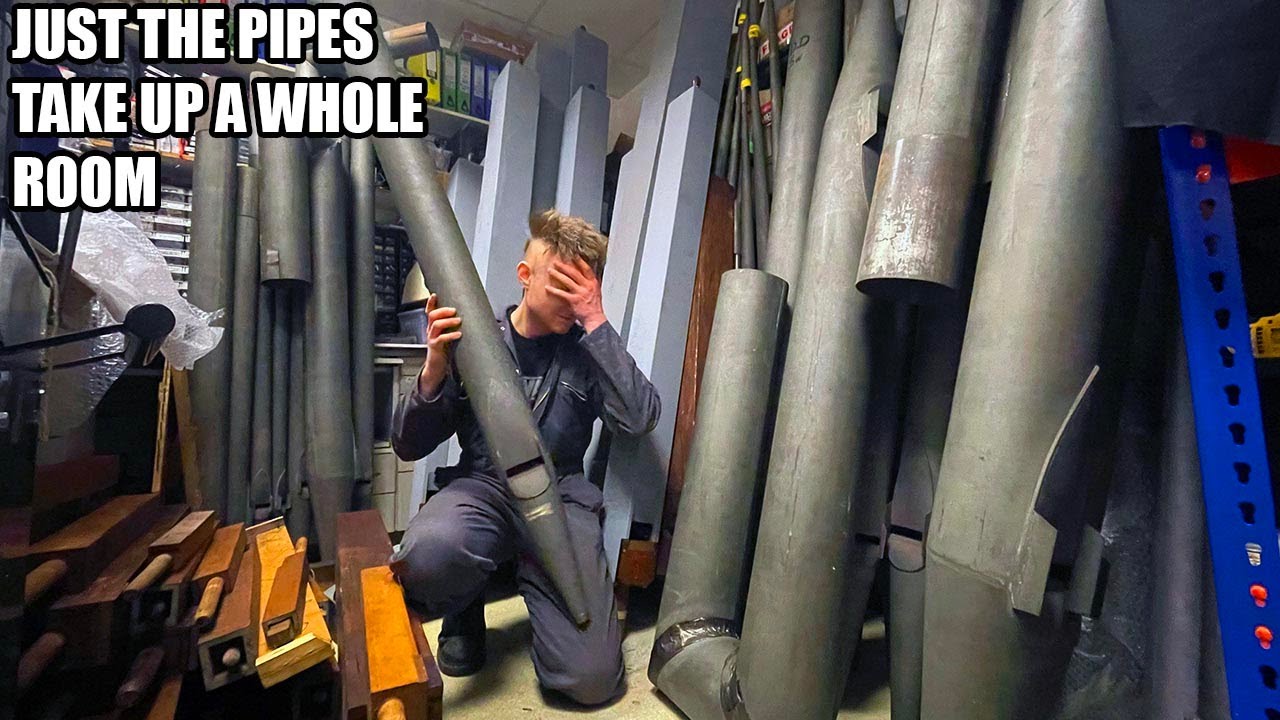
Arriving on site, the sheer physical footprint of the organ immediately threatens the logistics of the transport van. The pipework and wind trunks do not just furnish the home—they physically dominate it, passing across floor levels, stretching overhead, and cantilevering precariously across stairwells. While confronting the towering wooden and metal pipes, the crew inspects the console and controls, relieved to discover that individual components appear modular enough to detach, even as doubts arise about structural integrity and clearance.
“So I'm picking up a literal church organ that is hopefully gonna fit in this van; I'm really worried that it's not all gonna fit,” Sam admits before laying eyes on the full installation.
- The organ was originally salvaged and built into the Bristol residence around 1975 after the church was decommissioned for residential flats. - The eBay listing remained active without a buyer for approximately two months prior to purchase. - The console controls and switches feature original paper and card labeling preserved beneath decades of house dust.
```mermaid flowchart TD accTitle: Organ Air and Control Path accDescr: Flow diagram showing the electro-pneumatic air and control routing found in the Bristol house.
subgraph WindGeneration["Wind Generation & Regulation"] A["Mains Electric Blower / Pump"] -->|"Pressurized Air"| B["Bellows Chamber & Shutter"] B --> C["Weighted Air Reservoir"] end
subgraph Distribution["Distribution & Stops"] C -->|"Main Wind Trunk"| D["Stop Control Box"] D -->|"Divided Air Channels"| E["Ranks: Trumpet / Principal / Viola / Flute"] end
subgraph Action["Keying & Sound"] F["Console Keyboards & Presets"] -->|"Wiring Harness / Solenoids"| G["Pipe Chest Pallets"] E --> G G --> H["Pipework (Lead, Zinc, Wood, Reeds)"] end ```
[02:02](https://www.youtube.com/watch?v=8PwwRR8deHk&t=122s) Decoding the "Computer Plane" and Organ Mechanics
Upon closer inspection of the organ’s internal routing, the team finds extensive telephone-gauge switchboard cabling linking the console to an intricate electro-pneumatic relay mechanism. Referred to colloquially by someone on site as a "computer plane," the assembly consists of gang-switch preset boards where moving air actuates internal bellows to swing an entire contact bus bar upward, closing circuits across long rows of contacts simultaneously. This mechanical logic board operates essentially as an electromechanical analog computer, governing preset combinations and ranks across the stops.
Attention then shifts to the physical condition of the hardware. The central air reservoir and blower setup occupy a tight corner, looking heavy but manageable compared to the dread of handling the metal pipework. While the thicker structural zinc pipes remain intact, the delicate high-register ranks made of soft lead alloy show significant vulnerability. Certain small pipes have already warped and bent over under their own weight—accelerated by decades of direct sunlight from an adjacent window—leaving them hanging loosely from their rack boards.
Assessing the risk of irreversible structural damage to the soft metal pipes during removal, Sam notes: “I mean, we're not organ specialists, are we?”
- The preset switching assemblies rely on pneumatic bellows that physically lift gang-switch contact plates to connect entire ranks. - Signal interconnects throughout the instrument use multi-conductor telephony wire rather than modern multi-core or ribbon cables. - The soft lead pipes show localized bending from heat and physical contact, requiring eventual solder repairs.
[04:28](https://www.youtube.com/watch?v=8PwwRR8deHk&t=268s) Hacking the Rat's Nest and Removing the Largest Pipes
To reach the chests and soundboards, the team crawls beneath the framework to map out the solenoids and pallet magnets. The wiring runs directly through structural timber, terminating in an impenetrable tangle of wires that would take weeks to systematically map and desolder on site. Sam decides on an aggressive field triage: severing the wiring harness indiscriminately with snips, reasoning that the original electro-pneumatic preset boards will ultimately be superseded by custom Arduino-driven MIDI decoders when the organ is rebuilt at the museum. The work halts abruptly when live mains current is discovered still running to parts of the electrical harness.
Once the electrical snarl is cut free, removal turns to the largest wooden bass pipes. To house these towering low-frequency pipes inside a standard residential room, the previous installer had knocked a physical passage straight through the house's masonry chimney breast, allowing the tops of the pipes to extend into the void of the chimney. One by one, the team unhooks and wrangles the massive wooden pipes—nicknamed "torpedoes"—down through the staircase, maneuvering them around walls while trying to protect the house's drywall and paint.
Surveying the extreme measures taken to accommodate the bass ranks, Sam remarks: “They knocked a hole in the chimney to make space for the pipes; that is dedication.”
- A live mains voltage line was found active inside the console control wiring during dismantling. - Bass pipes were recessed directly into the chimney masonry to overcome standard domestic ceiling height limits. - The installation contains roughly 24 large wooden pedal/bass pipes across the main ranks. - The electro-mechanical preset switchboards are earmarked to be retained as aesthetic museum display pieces while modern MIDI-to-solenoid drivers take over playing duties.
[07:13](https://www.youtube.com/watch?v=8PwwRR8deHk&t=433s) The Wind System, Stop Controls, and Dismantling the Blower
With the pipes cleared, the team accesses the mechanical wind system. The system relies on a central leather reservoir weighted down with pieces of scrap iron to maintain constant, stable static wind pressure. Flexible but brittle air ducting feeds from the blower into a manifold chest. Opening up the air distributor uncovers the mechanical slider stop chest, divided into four dedicated ranks labeled for the core tonal sections: Trumpet (*Trump*), Principal (*Prin*), Viola, and Flute. By blocking or admitting wind through leather-faced stopper flaps, the organist could activate or mute these sections.
The electric blower pump presents the heaviest physical hurdle of the day. The cast-iron turbine is far too heavy to be carried down the stairs intact, forcing the team to strip the enclosure and split the motor from its housing. Removing the intake duct exposes a mechanical shutter mechanism linking the blower chamber directly to the reservoir: as the bellows fill to capacity, a mechanical linkage drops the shutter plate over the intake, throttling the airflow to prevent over-pressurization. After freeing the blower, the team extracts the remaining air trunks, fighting through rusted wood screws and old glue seals.
Inspecting the passive pneumatic regulator, Sam highlights the engineering: “Now on this side, amazingly enough, it's got this little shutter system so when the bellows get too full, it lowers it down and lowers the amount of airflow going through, absolutely ingenious.”
- The windchest features four switchable ranks: Trumpet, Principal, Viola, and Flute. - Static wind pressure is governed mechanically using cast-iron counterweights seated atop the leather reservoir bellows. - The main air blower relies on a heavy cast-iron housing and motor assembly coupled to a variable mechanical throttling shutter.
[11:44](https://www.youtube.com/watch?v=8PwwRR8deHk&t=704s) Cutting Wires and Dismantling the Console
As the teardown of the organ reaches its electrical nerve center, Sam inspects the rectifier unit and the dense, sprawling wire looms that route down to the keyboard manuals and the bass pedals. Finding the entire assembly anchored in place by an ordinary, everyday domestic hardware bracket provokes disbelief and laughter: “this thing is gonna be oh my god it's just held up by a shelf bracket”. The tangled mass of legacy connections presents a massive removal headache, leading the crew to make quick, decisive work by taking snips directly to the massive bundles of cabling.
With the wires severed, work shifts to liberating the console itself. Stripped down to its keybeds, the sheer quantity of cabling spilling out remains overwhelming. Sam highlights the vintage power supply unit tucked away inside, admiring its heavy, utilitarian construction while realizing the physical reality of hauling the hefty wooden console out of the building: “so many wires the power supply is really old school really old school look at that power supply”.
- **Electrical infrastructure**: Heavy-duty vintage rectifier and old-school power supply unit feeding individual note contacts. - **Console cabling**: Hundreds of discrete wires routed from the manuals and pedalboard were sheared through to separate the console from the chamber.
```mermaid flowchart TD accTitle: Electro-Pneumatic Valve Chain accDescr: Flow diagram showing how initial air triggers bellows and multiple valves to sound the organ pipe. subgraph AirSupply["Air Inflow"] A["Pressurized air enters chest"] end subgraph PneumaticActuation["Pneumatic Relay"] B["Air pushes small internal bellow"] C["Bellow pushes first inner valve"] D["Secondary valve pulls back"] end subgraph SoundOutput["Pipe Voicing"] E["Air channel opens to blow pipe"] end
A --> B B --> C C --> D D --> E ```
[13:25](https://www.youtube.com/watch?v=8PwwRR8deHk&t=805s) Pneumatic Mechanics and Van Packing Triumph
Just as the team thinks the hard physical labor is behind them, another set of components is spotted still mounted high up, prompting a groan of realization that they had completely forgotten about them. Before packing them away, Sam investigates the intricate electro-pneumatic valve mechanism operating the pipes. He traces the convoluted physical chain reaction: air enters the chest, actuates a tiny internal bellow, which depresses an inner valve that subsequently triggers a larger valve, ultimately pulling back to vent high-pressure air into the foot of the pipe. Baffled by the mechanical complexity required just to sound a note, Sam remarks: “that's just ridiculous why is it like that”.
Outside, the crew manages the seemingly impossible logistical feat of stuffing the entire disassembled church organ—console, windchests, blower parts, and giant ranks of pipes—into a single long-wheelbase Ford Transit van. Defying skepticism from everyone who claimed the instrument would never fit into one vehicle, Sam proudly celebrates the packed cargo hold: “all of the naysayers were saying it wasn't going to happen well look at that mum”.
- **Pneumatic mechanism**: Uses compound air stages where pilot bellows actuate intermediate valves to switch primary wind pressure to the pipes. - **Logistics**: The entire organ apparatus was wedged into a single long-wheelbase (LWB) Transit van for the drive back.
[14:17](https://www.youtube.com/watch?v=8PwwRR8deHk&t=857s) Arrival at This Museum Is (Not) Obsolete and Future Plans
After an exhausting 20-hour day of deconstruction, hauling, and driving, the organ is safely unloaded inside the workshop at This Museum Is (Not) Obsolete. Looking over the monumental pile of timber, metal, and mechanisms, Sam outlines the road map for resurrecting the instrument. The immediate priority is getting the air blower pump wired and running, followed by testing the chests to get the first raw acoustic sounds out of the pipes. A major spatial puzzle remains: figuring out where to permanently assemble and display this massive installation inside the museum gallery so visitors can directly play and experience it.
Inspecting the physical condition of the pipework, Sam points out that several of the larger pipes were previously bent over or subjected to historical "cut and shut" mends to squeeze under low church ceilings. Because they are fabricated from zinc, resoldering and straightening them presents a significant metallurgical challenge that may require leaving them in their modified state. Wrapping up, Sam directs viewers to his Patreon for detailed build updates, invites the public to come see the project in person during open museum weekends, and signs off with his signature encouraging motto: “don't be scared to try it welcome to the museum”.
- **Work duration**: A non-stop 20-hour effort to extract, transport, and unload the instrument. - **Pipe condition**: Large bass pipes feature historical bent-over "cut and shut" alterations; zinc construction makes re-soldering and straightening particularly tricky. - **Next milestones**: Re-commission the high-pressure wind pump, wire test benches to get audio output, and determine museum floor placement.
## Mentioned LOOK MUM NO COMPUTER, Sam Battle, Bristol, eBay, Ford Transit, Arduino, This Museum Is (Not) Obsolete, Patreon
## Video description Sign up to the mailing list here: https://lookmumnocomputer.os.fan/signup I Bought A Church Organ, Follow along on this project! if youd like to see more videos on this project and much much more, you can support here :- https://www.patreon.com/lookmumnocomputer or you can drop a super thanks on the button below the video! it also makes @THISMUSEUMISNOTOBSOLETE get bigger and better. :) ------------ THIS MUSEUM IS (NOT) OBSOLETE Open This Weekend! :- https://this-museum-is-not-obsolete.com/ ------- List of Gear/Electronics I USE :- https://www.lookmumnocomputer.com/stuff-i-use ------- PART 2 VIDEO IS NOW UP :- https://www.youtube.com/watch?v=mWACB04iKT8 ------- THANKUS HUMUNGOUSO to :- CoFFeeTaBLesE David Dolphin casey Miles Flavel Scott Armstrong worldofchris Casey MattFollowell (PDP-7) Nicole LArett ------------- if you want to donate to the electronic component fund! Paypal :- https://www.paypal.me/lookmumnocomputer ------------- SPOTIFY :- http://bit.ly/LMNCSpotify Facebook :- https://www.facebook.com/LOOKMUMNOCOMPUTER Website :- https://www.lookmumnocomputer.com Instagram :- https://www.instagram.com/lookmumnocomputer/
[Source](https://www.youtube.com/watch?v=8PwwRR8deHk)