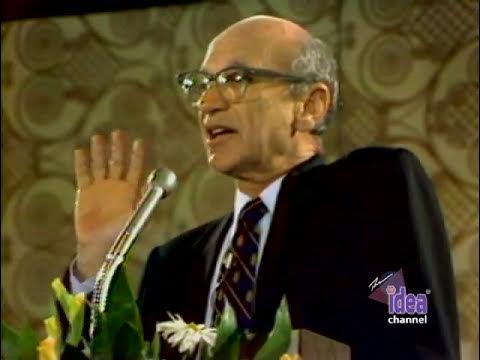
Friedman Blames Federal Reserve Money Printing for Inflation
Free To Choose Network
Curing inflation requires the federal government to reduce spending and print less money, accepting a temporary recession as the unavoidable cost of ending monetary overexpansion.
Milton Friedman argues that inflation is always and everywhere a monetary phenomenon, originating solely from government printing presses rather than corporate greed, labor unions, or foreign oil shocks. (8:29)
Empirical data across the United States, West Germany, and Japan demonstrates that price levels track the quantity of money per unit of output with an approximate two-year lag. (38:52)
Inflation functions as an unlegislated hidden tax through direct purchasing power extraction, bracket creep pushing taxpayers into higher nominal rates, and the depreciation of outstanding public debt. (19:44)
To permanently curb inflation and break the post-1960 stop-and-go cycle of escalating peaks and troughs, the government must reduce spending and gradually slow monetary growth over a three-to-four-year span. (48:51)
Detailed notes
## Background
This video was published on YouTube by the Free To Choose Network on March 21, 2016, documenting a 1978 lecture delivered at the University of San Diego and the San Diego Chamber of Commerce. According to the page description, the program examines inflation as an exclusively monetary phenomenon caused by the government expanding the money supply faster than output to fund its expenditures without directly raising taxes, arguing that the only genuine remedy is cutting government spending and printing less money.
## TL;DR
Milton Friedman presents the fundamental thesis that inflation is always and everywhere a monetary phenomenon, originating solely from government monetary authorities rather than popular scapegoats like trade unions, greedy corporations, or foreign oil shocks. Drawing on centuries of empirical data across multiple nations, he explains that inflation operates as an unlegislated, hidden tax that enriches governments through direct seigniorage, tax bracket creep, and real debt repudiation. Friedman traces the post-1960 American stop-and-go monetary cycle of escalating inflationary peaks and troughs, demonstrating that wage-price controls and piecemeal reforms merely suppress or exacerbate the issue. Concluding with an extended question-and-answer session, he argues that halting inflation requires disciplined reductions in federal spending and monetary expansion, advocating across-the-board budget cuts, constitutional spending constraints, and structural tax reductions to curb state excess.
## Atmosphere & style
The presentation carries the brisk, intellectually self-assured energy of an academic masterclass tailored for a civic and business audience. Friedman speaks with disarming clarity, pairing sharp historical anecdotes and witty analogies—such as comparing monetary expansion to an alcoholic bender—with rigorous statistical charts and policy analysis. The tone transitions seamlessly from genial professorial exposition to incisive polemical critique as he systematically dismantles conventional economic myths during the audience Q&A, creating an engaging, combative, yet thoroughly persuasive atmosphere throughout.
## Bulletin
- [08:29](https://www.youtube.com/watch?v=B_nGEj8wIP0&t=509s) Milton Friedman argues that inflation is always and everywhere a monetary phenomenon, originating solely from government printing presses rather than corporate greed, labor unions, or foreign oil shocks.
- [38:52](https://www.youtube.com/watch?v=B_nGEj8wIP0&t=2332s) Empirical data across the United States, West Germany, and Japan demonstrates that price levels track the quantity of money per unit of output with an approximate two-year lag.
- [19:44](https://www.youtube.com/watch?v=B_nGEj8wIP0&t=1184s) Inflation functions as an unlegislated hidden tax through direct purchasing power extraction, bracket creep pushing taxpayers into higher nominal rates, and the depreciation of outstanding public debt.
- [48:51](https://www.youtube.com/watch?v=B_nGEj8wIP0&t=2931s) To permanently curb inflation and break the post-1960 stop-and-go cycle of escalating peaks and troughs, the government must reduce spending and gradually slow monetary growth over a three-to-four-year span.
## Key takeaways
- [05:25](https://www.youtube.com/watch?v=B_nGEj8wIP0&t=325s) Inflation is fundamentally a monetary disease caused solely by the rapid expansion of fiat currency by the central bank and government authorities.
- [05:25](https://www.youtube.com/watch?v=B_nGEj8wIP0&t=325s) Scapegoats such as greedy businesses, labor unions, and OPEC are political diversions, as none possess the legal printing press required to create money.
- [08:29](https://www.youtube.com/watch?v=B_nGEj8wIP0&t=509s) Over a century of data proves that inflation never occurs without excessive monetary growth, and excessive monetary growth never fails to produce inflation.
- [28:25](https://www.youtube.com/watch?v=B_nGEj8wIP0&t=1705s) Under floating exchange rates, inflation is not an international contagion but a purely domestic outcome determined by national central banks.
- [17:01](https://www.youtube.com/watch?v=B_nGEj8wIP0&t=1021s) Governments rely on inflation to fund spending programs without enacting explicit taxes that voters can reject at the ballot box.
- [19:44](https://www.youtube.com/watch?v=B_nGEj8wIP0&t=1184s) Inflation enriches the state through three channels: direct resource extraction via newly created currency, bracket creep from progressive income taxes, and debt repudiation.
- [26:08](https://www.youtube.com/watch?v=B_nGEj8wIP0&t=1568s) Federal Reserve errors stem from misguidedly attempting to manage interest rate levels instead of strictly targeting the aggregate quantity of money.
- [31:31](https://www.youtube.com/watch?v=B_nGEj8wIP0&t=1891s) Monetary policy acts like an addiction: the initial stimulus feels positive, while the painful withdrawal of higher unemployment and slower growth follows later as an unavoidable side effect.
- [38:52](https://www.youtube.com/watch?v=B_nGEj8wIP0&t=2332s) Monetary transmission entails an overall lag of roughly two years, requiring five to six months to impact aggregate spending and an additional 12 to 18 months to alter consumer prices.
- [46:58](https://www.youtube.com/watch?v=B_nGEj8wIP0&t=2818s) Price and wage controls fail to halt inflation; they merely conceal price pressures temporarily before leading to explosive shortages and distortions when removed.
- [48:51](https://www.youtube.com/watch?v=B_nGEj8wIP0&t=2931s) Since 1960, economic policy has been trapped in a stop-and-go cycle where each subsequent trough and peak in inflation reaches a higher baseline level.
- [01:10:12](https://www.youtube.com/watch?v=B_nGEj8wIP0&t=4212s) Every federal budget is effectively balanced in real terms, as all expenditures must be paid for either through explicit taxes, borrowing, or the inflation tax.
- [01:12:30](https://www.youtube.com/watch?v=B_nGEj8wIP0&t=4350s) Constraining government expansion requires institutional mechanisms like constitutional spending limitations or broad tax cuts that limit the revenue Congress can spend.
- [01:23:26](https://www.youtube.com/watch?v=B_nGEj8wIP0&t=5006s) Individual commercial banks can only lend against reserves, but the Federal Reserve exercises absolute aggregate control over the total volume of money in the banking system.
## Detailed walkthrough
### [00:55](https://www.youtube.com/watch?v=B_nGEj8wIP0&t=55s) A Cryogenic Tale and Inflation as a Social Disease
Milton Friedman opens his talk by addressing the evening's subject: money and inflation. He quips that while everyone is undoubtedly interested in the inflation half of the topic, most people are also keenly interested in the money half, albeit from a rather different perspective. To illustrate the true nature of runaway inflation, Friedman tells the story of a man who decides to take advantage of cryogenics. Before placing himself in a deep freeze for twenty years, the man leaves all of his worldly belongings and securities with his stockbroker, instructing him to manage the portfolio as best he can.
When the twenty years elapse, the man is unthawed, emerges from the deep freeze, and immediately rushes to a telephone to call his broker. The broker delivers fantastic news, telling him that his investments have multiplied tenfold and twentyfold, making him a multi-millionaire many times over. The man is completely ecstatic as he listens to the figures—until the telephone operator suddenly cuts in to announce: “Sorry, your three minutes are up. That'll be $250,000 for the next three minutes, please.”
Moving from the humorous anecdote to historical reality, Friedman warns that inflation is a societal pathology. Left unchecked, it is not merely disruptive; it has historically proven capable of unraveling entire civilizations. The most extreme classic examples occurred in Germany, Austria, and Russia following the First World War. In those hyperinflations, employers had to pay their workers three times a day—after breakfast, lunch, and dinner—so that laborers could dash into the streets to spend their wages before the currency completely lost its purchasing power.
Even short of hyperinflation, unchecked price increases wreak severe political havoc. Friedman points to South America, observing that runaway inflation brought down Brazil's government prior to 1964, sparking a revolution to halt the economic chaos. Similarly, in Chile, the runaway inflation under Salvador Allende was a primary catalyst for the economic collapse that ultimately paved the way for a military dictatorship. While the United States is nowhere near that extreme, Friedman insists the nation must diagnose the affliction, understand its cause, evaluate the cure and its unavoidable side effects, and recognize what will happen if it is left untreated.
- As Friedman puts it: “Inflation is a disease. It's a dangerous disease for a society. It is sometimes a fatal disease for a society.”
---
[05:25](https://www.youtube.com/watch?v=B_nGEj8wIP0&t=325s) The Scapegoats and the Printing Press
Friedman presents the core thesis of monetary economics: inflation is always and everywhere an issue of monetary expansion outpacing real production. Because modern governments maintain a statutory monopoly over the money supply, price inflation in America originates exclusively in Washington, D.C. Yet governments are inherently human institutions that consistently refuse to shoulder the blame when economic disasters strike.
Instead of taking responsibility, politicians in Washington routinely deflect by offering an array of convenient villains. They allege that inflation is generated by greedy businessmen jacking up prices, grasping labor unions demanding excessive wages, spendthrift consumers running up debt, or foreign Arab oil sheiks manipulating global energy markets. Friedman acknowledges that human nature entails self-interest—businessmen can be greedy, unions can be grasping, and many a husband complains that his wife is a spendthrift consumer—but none of these groups possesses the mechanical means to create inflation. None of them has a printing press in their basement churned up to manufacture legal tender; that press belongs exclusively to the federal government.
Friedman also rebuts the ideological argument, popular in the Eastern Bloc, that inflation is an inherent failure of capitalism. Modern European economic data contradicts this claim. Yugoslavia, a communist country, suffered from some of the most aggressive inflation in Europe, whereas Switzerland, a capitalist economy, maintained one of the lowest inflation rates. At the same time, capitalist nations like the United Kingdom and Italy suffered painful double-digit inflation rates between 20 and 25 percent. Economic systems as an ideology do not dictate the price level; the quantity of fiat currency produced does.
```mermaid
flowchart TD
accTitle: Government Monopolies and the Source of Inflation
accDescr: Diagram illustrating how official scapegoats are harmless compared to the government printing press that drives inflation.
subgraph Scapegoats ["Alleged Culprits (No Currency Presses)"]
A["Greedy Businessmen"]
B["Grasping Trade Unions"]
C["Spendthrift Consumers"]
D["Arab Oil Sheiks"]
end
subgraph TrueSource ["Actual Monetary Engine"]
Gov["Government in Washington"]
Press["Monopoly Over Money Supply<br/>(Printing Press)"]
Gov --> Press
end
Press -->|"Excessive expansion relative to output"| Infl["Price Inflation"]
Scapegoats -.->|"Blamed by politicians, but cannot create money"| Infl
```
- When discussing the source of currency expansion, Friedman observes: “Only Washington has that printing press and therefore only Washington can produce inflation.”
- On the ideological debate surrounding price stability, he summarizes: “Inflation is not a capitalist phenomenon, it is not a communist phenomenon, it is a printing press phenomenon.”
---
[08:29](https://www.youtube.com/watch?v=B_nGEj8wIP0&t=509s) Empirical Proof: The Money Supply and the Price Level
While declaring inflation a printing press phenomenon identifies the immediate mechanical cause, Friedman notes that one must eventually ask the deeper question: *why* does the government increase the money supply so rapidly? Before tackling that ultimate political question, he emphasizes that the fundamental empirical link between money and prices is undeniable. Economic data spanning over a century in the United States and over two centuries in both Great Britain and Sweden demonstrates an ironclad law: no inflation has ever occurred without an extremely rapid increase in the money supply, and no rapid increase in the money supply has ever failed to produce an inflation.
To demonstrate this empirically, Friedman presents time-series charts. The first slide displays economic data for the United States over a thirteen-year window from 1964 through 1976. The chart plots two distinct metrics:
1. The quantity of money per unit of output (solid line), measured for a year ending six months prior to the price index to account for transmission lag.
2. The Consumer Price Index (dashed line).
Both lines are benchmarked to a base value of 100 in 1970 to align their scales. Friedman stresses that aside from meeting at the 1970 base point, no mathematical trick forces the curves together, yet they trace each other almost indistinguishably across the entire 13-year period—a correlation that holds equally across a full century of American data. Moving to the second slide, Friedman displays the identical metric for West Germany. Although German money growth temporarily ran ahead of prices during the early 1970s, the two metrics inevitably converged back together, illustrating that while monetary expansion takes a year or two to filter through the broader economy, its effect on price levels is inexorable.
- Regarding the universal history of currency expansion, Friedman states: “The first step toward understanding the cause of inflation is to recognize that it is always and everywhere a monetary phenomenon.”
- In describing the correlation shown on the charts, he highlights that the monetary indicator is lagged by six months relative to prices to accurately represent the transmission mechanism.
[12:19](https://www.youtube.com/watch?v=B_nGEj8wIP0&t=739s) International Comparisons and the Trade Union Fallacy
Milton Friedman examines international charts to illustrate that the correlation between money growth and price increases holds across distinct economic environments. Looking at Japan, he points out that although the country underwent a significantly larger price rise than either the United States or Germany, it subsequently performed a remarkable turnaround by reining in its money supply, dragging its annual inflation rate down from nearly 30 percent to approximately 7 percent. Turning next to the chart for Great Britain, each sequential example displays higher inflation, yet every single case demonstrates the exact same synchronization between the quantity of money and the level of prices.
Friedman uses this contrast between Japan and the United Kingdom to dismantle a widespread political explanation: the assertion that militant trade unions cause inflation by pushing up wages. If aggressive labor unions were truly responsible for Britain's economic distress, that theory fails entirely to explain Japan, where unions are comparatively weak and wield little influence over national wage trends. To drive the point home, he introduces a dramatic chart from Brazil, quipping that this represents genuine inflation rather than the "baby inflations" seen in Western nations—even if Argentina and Chile had inflations so large they would not fit on the display room's screen. Because Brazil operated under a military government where labor unions had no power other than serving as instruments of the state apparatus, union activity could not possibly account for Brazilian price hikes, leaving monetary expansion as the sole viable explanation.
As Friedman puts it: “You can see very clearly that you can explain it by changes in the quantity of money.”
- Japan reduced its inflation rate from nearly 30 percent per year down to roughly 7 percent by strictly controlling money supply growth.
- The British experience is frequently blamed on aggressive trade union wage demands, yet Japan showed higher inflation during that earlier interval despite having much weaker unions.
- Brazil experienced massive inflation under a military dictatorship where labor unions had no independent authority or bargaining power.
---
[15:17](https://www.youtube.com/watch?v=B_nGEj8wIP0&t=917s) Gold Discoveries and the Shift to Government-Dominated Money
The historical record spanning hundreds of years across numerous nations demonstrates an unbroken connection between the volume of money and price levels, without any exceptions. However, establishing this empirical link is only first base; the crucial question is why the money supply expands faster than real output. Friedman notes that a century earlier—a fitting topic in California—monetary expansion occurred naturally through physical discoveries of precious metals. The late 1840s and early 1850s brought the California Gold Rush alongside major gold strikes in Australia, triggering a worldwide wave of inflation. A similar global price rise took place from the 1890s through 1913, fueled by the perfection of the cyanide extraction process for low-grade ore in South Africa and supplemented by gold discoveries in Alaska.
Those episodes, Friedman observes with wry nostalgia, belonged to the era when physical limits still restrained governments. In modern times, the old discipline of gold has been abandoned in favor of what authorities consider a far more sophisticated system: unbacked, government-dominated fiat currency. Because paper money can be generated without digging ore from the ground, contemporary inflations no longer stem from mining technology or lucky prospectors. Instead, modern inflation is manufactured entirely by governments creating immense quantities of money out of thin air.
Reflecting on this transformation, Friedman remarks: “Today you have inflations because governments create a very large quantity of money.”
---
[17:01](https://www.youtube.com/watch?v=B_nGEj8wIP0&t=1021s) Inflation as Unlegislated Taxation to Finance Government Spending
Addressing why modern governments flood the economy with money, Friedman highlights the primary culprit: paying for government spending. While it is easy to place the blame entirely on political figures, he insists that ordinary citizens bear responsibility because voters continuously demand programs and expenditures while refusing to shoulder visible taxes. If the federal government spends $450 billion but collects only $400 billion through conventional levies, that remaining $50 billion does not simply vanish or get paid by the tooth fairy. Real government taxation is defined by total resources spent, and any difference beyond explicit tax revenue must be made up either through borrowing or through the creation of new currency.
For politicians in Washington, printing money is an enticing funding mechanism because it bypasses the legislative pain of open taxation. No member of the House of Representatives or the Senate ever campaigns on a platform of enacting an explicit 10 percent inflation tax on their constituents. Instead, inflation operates as a silent, invisible tax enacted without a vote, allowing politicians to deliver lavish spending packages to interest groups without visibly raising tax rates.
Friedman captures this legislative evasion plainly: “Inflation is a tax which is imposed without representation and which nobody has to vote for.”
```mermaid
flowchart TD
accTitle: The Mechanics of Inflationary Finance
accDescr: Flowchart illustrating how constituent demands for spending lead to budget shortfalls that are funded by monetary expansion and paid via the inflation tax.
subgraph Demands ["Political Demand"]
A["Citizens Demand More Public Spending"] --> B["Reluctance to Levy Direct Taxes"]
end
subgraph BudgetGap ["The Deficit"]
B --> C["Spending Exceeds Explicit Tax Revenue<br>e.g., $450B Outlays vs. $400B Taxes"]
C --> D["$50B Deficit Must Be Funded"]
end
subgraph MonetaryTax ["The Hidden Extraction"]
D --> E["Treasury / Central Bank Expands Money Supply"]
E --> F["Inflation Tax Imposed Without Legislation"]
F --> G["Purchasing Power Extracted from the Public"]
end
```
---
[19:44](https://www.youtube.com/watch?v=B_nGEj8wIP0&t=1184s) The Three Ways Government Extracts Revenue from Inflation
Friedman explains that inflation delivers tax revenues to the government through three distinct channels. The first channel is direct: newly created money acts as a literal receipt for resources taken by the state. While earlier societies relied on the physical printing press, modern financial authorities achieve the identical result electronically through bookkeeping ledgers, checks, and computer-generated bank deposits. By injecting these newly minted claims into the economy, the state acquires real goods and services without having extracted a single cent of direct taxation beforehand.
The second revenue mechanism is bracket creep within a progressive income tax system. If inflation drives prices up by 10 percent and a worker receives a corresponding 10 percent wage increase, the worker’s real purchasing power has not improved. However, the progressive tax code automatically bumps them into a higher tax bracket, causing their income tax bill to jump by roughly 15 percent on average. Consequently, the widely celebrated presidential and congressional tax cuts are pure political theater; inflation steadily ratchets tax collections upward in the background, allowing lawmakers to enact cosmetic rate reductions that return only a fraction of the automatic tax increases already harvested.
The third channel is the covert repudiation of public debt. Although citizens frequently worry about the ballooning national debt, Friedman points out that the open, bonded debt has actually declined as a percentage of national income compared to several decades earlier. This decline occurs because recurring budget deficits are routinely depreciated away by issuing inflated dollars, leaving past purchasers of government securities bearing the ultimate loss.
Exposing the illusion behind headline-grabbing fiscal policy, Friedman concludes: “Inflation has raised taxes and the so-called tax cuts have given back a small part of that to the taxpayer, but the actual taxes that taxpayers have paid have gone up as a result of the automatic effects of inflation.”
- Direct extraction: The state issues new money—historically on paper, now through central bank deposits and accounting entries—to purchase goods directly from the market.
- Bracket creep: A 10 percent rise in both prices and wages pushes workers into steeper income brackets, producing an estimated 15 percent increase in individual tax liabilities.
- Debt reduction: High inflation depreciates the real purchasing power of outstanding public bonds, allowing the government to pay back lenders with significantly debased currency.
[24:05](https://www.youtube.com/watch?v=B_nGEj8wIP0&t=1445s) Inflation as a Government Resource and Historic Currency Debasement
Milton Friedman details how inflation serves as a hidden method of repudiating public debt. Anyone purchasing a long-term government bond and redeeming it down the line receives currency with diminished purchasing power relative to what was originally paid. To make matters worse, bondholders must pay income taxes on nominal interest receipts that do not even cover their real losses. Through this process, bondholders have effectively “paid the government for the privilege of lending to it,” allowing real sovereign debt to shrink silently. Friedman remarks: “So inflation is a marvelous resource for a government in all three of these ways.”
Friedman points out that using monetary creation to finance state spending stretches back thousands of years. During the Roman Empire, Emperor Diocletian addressed fiscal pressures not with modern paper printing presses, but by debasing coinage: replacing high-grade silver denarii with base metal alloys until the coins were reduced to mere copper coated in a thin wash of silver. With dry humor, Friedman recalls discovering that historical account in the exact same year the United States Treasury eliminated silver from American coinage, swapping it for copper coins clad in nickel.
```mermaid
flowchart LR
accTitle: Government Debt Repudiation via Inflation
accDescr: Process showing how inflation and taxes erode the real value of government bonds for lenders.
subgraph Investor ["Bondholder Action"]
A["Buys long-term bond"] --> B["Receives nominal interest"]
end
subgraph Erosion ["State Extraction"]
B --> C["Taxes assessed on nominal gains"]
C --> D["Principal repaid in depreciated dollars"]
end
D --> E["Real government debt declines"]
```
- A bondholder receives diminished purchasing power upon redemption while simultaneously paying income taxes on nominal interest.
- Emperor Diocletian diluted the Roman denarius from full-bodied silver to copper coated with a silver wash.
- The U.S. Treasury mirrored this historic debasement by replacing silver coinage with copper clad in nickel.
---
[26:08](https://www.youtube.com/watch?v=B_nGEj8wIP0&t=1568s) The Modern Drivers: Full Employment Mandates and Central Bank Errors
Beyond the historical imperative to fund state spending, Friedman highlights two twentieth-century developments that feed monetary overexpansion. First, Western governments adopted official full-employment policies after World War II. In practice, these commitments did not deliver permanent employment stability; rather, whenever unemployment ticked upward, political authorities felt compelled to intervene by expanding spending and the money supply to prime the economic pump. This provides temporary relief only as long as people remain unaware of the underlying currency dilution, but as soon as the public catches on, the stimulus converts entirely into price inflation.
Second, Friedman identifies recurrent policy errors by central banks. Referring to remarks by Professor Bernard Siegan regarding the Federal Reserve’s record, Friedman notes that between 1929 and 1933 the U.S. money stock contracted by one-third, precipitating the Great Depression. While the Fed learned from that disaster, government agencies rarely repeat the identical mistake; instead, modern central banks err in the opposite direction. They do this by fundamentally misapprehending their core institutional duty: “Their mistake has almost always been caused by confusing their function, by thinking that they had something to do with interest rates instead of recognizing that their real function was to control the quantity of money.”
- Post-WWII full-employment policies lead politicians to increase spending and print money whenever unemployment threatens to rise.
- Between 1929 and 1933, the Federal Reserve allowed the U.S. money supply to shrink by one-third, triggering economic catastrophe.
- Central banks err on the side of overexpansion by attempting to manage interest rate levels instead of regulating the money supply.
---
[28:25](https://www.youtube.com/watch?v=B_nGEj8wIP0&t=1705s) Debunking Common Scapegoats: Trade Unions and International Inflation
Friedman addresses the popular belief that trade unions or foreign shocks trigger inflation. While labor unions can inflict grave economic damage—as evidenced in contemporary Britain—they do not generate general price rises. Higher nominal wages represent an effect, not a cause, of currency expansion. Similarly, government officials routinely point abroad, claiming they are merely victims of an inevitable wave of worldwide inflation over which they have no control.
Friedman explains that while international inflation spillovers were real prior to 1971 under the Bretton Woods fixed exchange rate regime (during which U.S. inflation was transmitted directly to foreign central banks linked to the dollar), that dynamic vanished once currencies began floating against one another. Under flexible exchange rates, domestic monetary policy solely determines the domestic price level. As Friedman puts it: “Inflation is a worldwide phenomenon, but it is not an international phenomenon.” He compares it to high taxes: taxation is pervasive across the globe because individual states adopt similar domestic policies, not because it is transmitted across borders. This explains why inflation rates vary radically among developed nations under floating rates.
[31:31](https://www.youtube.com/watch?v=B_nGEj8wIP0&t=1891s) The Productivity Fallacy and the Medical Analogy of Inflation
Friedman turns to another frequent objection: that lagging productivity causes inflation, and boosting productivity is its proper cure. He clarifies that although his analysis tracks the money supply relative to units of output, productivity fluctuations are negligible compared to shifts in money creation. Raising real annual output growth from 3 percent to 4 percent would represent an extraordinary 33⅓ percent leap in national economic performance, yet it would reduce annual inflation by merely a single percentage point. Therefore, regarding inflation, “productivity is very much of a bit actor on the stage. The lead, the hero or the villain, as you wish it, is not productivity but what happens to the quantity of money.”
Ending inflation requires a remedy that is technically straightforward: “in order to stop inflation you have to have the government spend less and print less.” The true hurdle is the political will to endure the withdrawal. Friedman compares the dilemma to a physician's patient whose fingers and toes were falling off from a severe vascular illness; the patient could be cured easily by quitting smoking, but steadfastly refused to stop. He then likens inflation to alcoholism, where the immediate experience is pleasant while the agonizing physical consequences only arrive after the bender: “The thing about alcoholism is that when you go out on a toot the good effects come first and the bad effects only come the next morning when you have the hangover. That's exactly the way it is with inflation.”
- Raising real economic growth from 3% to 4% yields only a 1 percentage point drop in the inflation rate.
- The sole effective prescription to halt inflation is for the government to curtail its spending and reduce money creation.
- Halting inflation requires breaking a behavioral addiction analogous to severe tobacco dependency or an alcohol bender.
[35:24](https://www.youtube.com/watch?v=B_nGEj8wIP0&t=2124s) The Addiction Analogy and the Winners of Inflation
Milton Friedman compares the trajectory of monetary expansion and contraction to the progression and treatment of alcoholism. When monetary expansion starts, the initial results appear entirely positive: it makes business boom and rapidly expands output. The destructive consequences—namely inflation—only emerge later after working their way through the economic system. Conversely, attempting to cure inflation mirrors the ordeal of an alcoholic attempting to sober up. When someone tries to shake a craving for alcohol, the immediate consequences are agonizing, while the healthy, beneficial payoff only arrives later once the withdrawal is conquered. Friedman notes: “Just as inflating stimulates the economy temporarily, so slowing down inflation slows down the economy temporarily.”
Friedman argues that a more practical reason inflation proves difficult to stop is that society is not genuinely united in wanting to halt it. While everyone instinctively answers that they oppose inflation, probing beneath the surface reveals that many have quietly profited. The chief beneficiary is the Federal Treasury, which inflates away its real debt burdens. However, almost every individual who bought a home over the prior three decades has gained immensely from inflation by paying off fixed mortgage debt with depreciated dollars. This uneven distribution transforms inflation into a destructive social malady:
> “Indeed, one of the things that makes inflation such a bad social disease is precisely that it tends to be divisive because some people do very well during an inflation period and some people do very badly.”
Friedman dryly observes that when most people say they want to end inflation, they simply mean they want the goods they purchase to get cheaper while the products and services they sell get more expensive. Because every transaction involves a buyer and a seller, Friedman quips, “that’s a neat trick if you can do it.” As a consequence, public calls to halt inflation remain insincere, summarized by the rule: “Everybody wants to stop inflation at somebody else's expense.”
```mermaid
flowchart TD
accTitle: The Asymmetric Dilemma of Inflation and Its Cure
accDescr: Diagram illustrating how inflation delivers immediate benefits followed by delayed harm, while stopping inflation brings immediate pain before long-term health.
[38:52](https://www.youtube.com/watch?v=B_nGEj8wIP0&t=2332s) Side Effects, Lags, and the Mechanics of Price Increases
Friedman cautions that the painful fallout of an inflation cure should never be mistaken for the cure itself. He draws a medical comparison: if a doctor prescribes bed rest after an appendectomy, a patient cannot skip the surgery, stay in bed, and expect to be healed. Similarly, unemployment is merely an unfortunate side effect rather than a remedy. Friedman stresses: “I can tell you a hundred ways to create unemployment that will produce more inflation not less.” While conventional opinion once treated inflation and unemployment as strict opposites, the experience of the late 1960s and 1970s made it undeniable that both can surge together, forcing economists to invent terms such as “stagflation” and “slumpflation.”
The necessity of passing through a phase of slowed growth and higher unemployment stems from the long time delays between when the government starts the printing press and when real-world output and prices react:
1. **Initial liquidity surge (months 0 to 6):** When the government prints and disperses cash to pay its expenses, initial recipients—such as government employees—spend their higher salaries at local shops. Shopkeepers, unaware of the systemic shift, happily sell goods at existing prices, assuming the spike in foot traffic is uniquely their good fortune.
2. **Intermediate production response:** A shoe manufacturer notices surging orders, concludes that public demand for shoes has surged, and tries to ramp up operations. Soon, however, he realizes that labor and leather have grown pricier across the entire economy.
3. **Price adjustments (months 18 to 24):** Only after costs mount does the manufacturer mark up his final prices to keep the business solvent.
Friedman points out that historical records demonstrate these distinct timing intervals:
- In the United States over the previous century, an increase in the money supply has typically taken roughly 5 to 6 months to trigger noticeably higher spending.
- It then takes an additional 12 to 18 months for that heightened spending to translate into outright price increases.
- In both the United States (dating back a century to available records) and Great Britain (spanning 200 years of data), there is an average lag of roughly two years between an acceleration in the growth of money and its ultimate inflationary impact.
When the government reverses course and constricts spending, the process runs identically in reverse. Businesses initially observe flagging sales, see unwanted inventories build up on store shelves, and cut back production schedules and staffing. Only after an extended interval do producers moderate their price hikes or lower price tags, making an interim economic slowdown inescapable.
[43:51](https://www.youtube.com/watch?v=B_nGEj8wIP0&t=2631s) Long-Term Neutrality and the Case for Gradualism and Indexing
Friedman turns to the long-run neutrality of inflation, stating that once an economy fully incorporates price increases into everyday operations, trend inflation ceases to dictate real economic vitality:
> “We have a great deal of evidence that the average rate of inflation over a period of time has no relationship at all to the average rate of growth or the average level of unemployment.”
If an economy becomes habituated to a continuous 10 percent inflation rate, public behavior seamlessly recalibrates: wages predictably climb 10 percent faster each year, prices advance by an extra 10 percent, and baseline interest rates move from 5 percent to 15 percent to absorb the loss in purchasing power. Economic stimulus does not stem from inflation itself, but entirely from unexpected inflation. Much like an alcoholic or drug addict who initially feels a buzz from a single drink or dose but progressively requires a half bottle or escalating quantities to feel the same sensation, an economy needs ever-larger doses of unexpected inflation to produce temporary output gains.
Because sudden withdrawal creates harsh economic dislocations, Friedman insists on a structured path toward price stability:
- **Gradual deceleration:** Given that the prevailing baseline inflation in the United States sits around 7 percent, Friedman argues that trying to slash it to zero within a single year would be reckless. Instead, policymakers should phase the reduction over a three- to four-year timeline to give businesses and households sufficient runway to adjust long-term contracts and wage expectations.
- **Escalator clauses and tax indexing:** Friedman urges the adoption of widespread escalator clauses—especially across government debt obligations and federal taxation. He denounces the prevailing tax framework as a “disgrace and a scandal” because unadjusted tax brackets automatically push taxpayers into higher marginal rate brackets solely due to inflation. He bitterly notes the hypocrisy of federal lawmakers: “Congress has been very quick to index its own salaries. Congress has been very quick to index the salaries of government employees, but it has been very reluctant to apply the same” protections to the citizens who pay their bills.
[46:58](https://www.youtube.com/watch?v=B_nGEj8wIP0&t=2818s) Perverse Indexing and the Deceit of Wage and Price Controls
Milton Friedman suggests that while government currently indexes taxes so that inflation pushes citizens into higher tax brackets, the policy should run in the opposite direction. He argues for indexing tax rates downward to protect taxpayers, alongside a mischievous proposal for political accountability: indexing congressional and bureaucratic pay inversely. As Milton Friedman puts it: “And I assure you, if you did that you'd cure inflation real fast.”
Moving to the broader consequences of inaction, Friedman warns that failing to eradicate inflation leaves society with no pleasant options; uncontrolled inflation inevitably generates high unemployment. A major catalyst for this damage is the recurring political temptation to implement wage and price controls. Governments turn to these measures not to halt inflation, but to mask their own economic stimulus. By creating an artificial freeze, politicians attempt to reap the short-term popularity of expansionary spending while convincing the public that decisive action is being taken against rising prices. This deception inevitably collapses when the suppressed pressures burst forth, as occurred following President Richard Nixon's 1971 price freeze.
```mermaid
flowchart TD
accTitle: The Cycle of False Cures
accDescr: Diagram illustrating how government monetary expansion leads to wage and price controls, artificial suppression, and eventual explosive inflation.
subgraph Expansion ["Monetary Expansion"]
A["Government inflates money supply to pay bills"]
B["Inflationary pressure emerges"]
end
subgraph Suppression ["Political Cover-Up"]
C["Wage and price controls enacted with fanfare"]
D["Inflation concealed for 1–2 years"]
end
subgraph Fallout ["Economic Reality"]
E["Shortages and market distortion"]
F["Explosive inflation and high unemployment"]
end
A --> B
B --> C
C --> D
D --> E
E --> F
```
- Friedman proposes indexing salaries of officials so that every 5% inflation results in a 5% cut to their pay.
- Wage and price controls serve as a political camouflage that temporarily holds down measured inflation for a year or two before creating an explosion in prices.
- The 1971 controls under Richard Nixon produced disastrous economic outcomes once the artificial price caps were removed.
---
[48:51](https://www.youtube.com/watch?v=B_nGEj8wIP0&t=2931s) Eisenhower's Resolve and the Escalating Inflation Roller Coaster
Tracing the modern origin of American inflation to the 1950s Korean War era, Friedman recounts how the United States broke free of creeping inflation through a deliberate political sacrifice. President Dwight D. Eisenhower acted as an uncommonly nonpolitical leader who was willing to imperil the presidential campaign of his own vice president, Richard Nixon, to restore stability. Eisenhower reined in money creation and federal outlays, accepting recessions in 1958 and 1960 to crush inflation down from 3–3.5% to essentially zero.
John F. Kennedy inherited this stable baseline, but from 1960 onward, economic policy devolved into a damaging stop-and-go cycle. Every time inflation surged, authorities slammed on the brakes, causing a downturn. As soon as joblessness climbed, panic ensued, prompting officials to abandon restraint, stomp on the accelerator, and print more money. Crucially, this cycle did not oscillate around a flat line; instead, each subsequent peak and trough reached higher than the last, mimicking an escalating addiction where ever-larger doses are required to produce a temporary high.
- Eisenhower permitted the 1958 and 1960 recessions to eliminate an inflation rate that was viewed at the time as an intolerable 3% to 3.5%.
- Nixon imposed wage and price controls in 1971 when inflation reached a trough of roughly 4.5%.
- By 1976, following an acute recession to discipline price increases, the lowest rate achieved was 5%, a baseline higher than the peaks of the 1960s.
---
[52:49](https://www.youtube.com/watch?v=B_nGEj8wIP0&t=3169s) The High Price Paid for Squandered Gains
Friedman illustrates how recent monetary management mirrors this destructive pattern. Between January 1974 and January 1975, the Federal Reserve restrained the growth of M2—which includes circulating currency along with commercial bank demand and time deposits—to an annual rate of 6.8%. This disciplined braking action succeeded in pulling year-over-year inflation down to roughly 5% by the end of 1976. However, from January 1975 onward, the Federal Reserve accelerated M2 growth back to 10% annually.
Friedman explains that this sharp expansion forecloses any soft landing, locking the nation into rising baseline inflation around 7% to 9%. The true economic heartbreak is that the American public has repeatedly borne the pain of restraint—surging unemployment, shuttered enterprise, and deep recessions—only for authorities to surrender the gains at the finish line by restarting the monetary printing press.
- Definition of M2: Friedman offers an apology for using the "unlovely name," clarifying that it comprises currency in circulation plus all commercial bank time and demand deposits.
- January 1974 to January 1975: M2 growth dropped to 6.8%, driving inflation down to 5% by late 1976.
- January 1975 to mid-1977: M2 accelerated to a 10% annual rate, priming the next wave of high inflation.
- Friedman warns: “The tragedy of this whole history is that we have time and again—four times now—paid the price of stopping an inflation and not gotten the benefit.”
---
[55:02](https://www.youtube.com/watch?v=B_nGEj8wIP0&t=3302s) Bad Options Ahead and the Path to a Painful Cure
Because the money supply has already expanded rapidly, Friedman asserts that monetary authorities have no good choices left. A sudden contraction to arrest inflation will trigger a sharp recession by late 1978 or early 1979, whereas keeping the gas pedal down will plunge the United States back into double-digit inflation. Friedman does not place primary blame on the Federal Reserve governors, arguing that politicians and policymakers respond to voter pressures. Until citizens deliver an unmistakable mandate demanding stability regardless of short-term hardship, Washington will continue swinging along the roller coaster.
Closing his presentation with a medical metaphor, Friedman reminds the audience that rare is the treatment that allows a gravely ill patient to rise overnight completely healed. The underlying economic vitality and productivity of the American economy remain resilient despite poor policy decisions, but recovery requires accepting unavoidable pain. As Milton Friedman concludes: “Sooner or later, I am sure we shall get up the will to cure it, but we shall not cure it, or continue it, without paying a price either way.”
Transitioning into the audience Q&A session at, an attendee asks whether President Jimmy Carter should direct his anti-inflation policies through the Federal Reserve or through Congress. Friedman clarifies that the presidency wields immense influence but meager direct statutory control. The president cannot unilaterally appropriate expenditures or run the printing press; true fiscal and monetary power resides collectively with Congress and the Federal Reserve Board.
- The Federal Reserve's immediate dilemma: Induce a painful recession by late 1978/early 1979 through abrupt monetary tightening, or trigger double-digit inflation by persisting at current money growth rates.
- The two-year missed window: Maintaining the modest money supply trajectory of 1974–1975 would have permanently broken the back of inflation without the need for fresh economic trauma.
- Presidential power dynamics: President Carter lacks direct authority over the money spigot, as institutional power belongs exclusively to Congress (the purse) and the Federal Reserve (monetary authority).
[59:05](https://www.youtube.com/watch?v=B_nGEj8wIP0&t=3545s) Making It Politically Profitable for Congress to Do the Right Thing
An audience member asks whether the American electorate needs to replace the members of Congress in order to step off the inflationary treadmill. Milton Friedman firmly rejects this premise, clarifying that the public harbors a deep misunderstanding about how political representation functions. Politicians in Washington operate within a business where they compete with one another to win votes, and individual members of Congress will vote in favor of sound policies if they believe doing so serves their electoral interests.
Friedman explains that successful reform does not depend on electing moral paragons, but rather on altering political incentives so that lawmakers are forced to act responsibly: “The way you solve things is by making it politically profitable for the wrong people to do the right things.” His remark triggers immediate laughter and applause from the audience, highlighting his pragmatic philosophy of political economy.
```mermaid
flowchart TD
accTitle: Political Incentive Structure
accDescr: Flowchart contrasting the common misconception of electing the right people with Milton Friedman's model of political profitability.
subgraph Misconception["Common Misconception"]
A["Elect 'Right People'"] --> B["Good Policy Results"]
end
subgraph FriedmanModel["Friedman's Economic Model"]
C["Public Political Pressure"] --> D["Alters Electoral Incentives"]
D --> E["Makes Sound Policy 'Politically Profitable'"]
E --> F["Even the 'Wrong People' Adopt Right Policies"]
end
```
[01:00:10](https://www.youtube.com/watch?v=B_nGEj8wIP0&t=3610s) The Global Shift in Attitudes: Inflation Over Unemployment
A questioner remarks that Friedman sounds overly optimistic in asserting that the public is prepared to accept a slowdown of the monetary printing presses, noting that such evidence remains entirely invisible to him. Friedman clarifies that he is not pointing to an explicit demand to halt printing presses, but to a profound, long-term shift in broader public sentiment regarding the competence and scope of the state. While people ten or twenty years earlier believed Washington could solve every conceivable problem simply by throwing money at it, widespread disillusionment with government solutions has taken root internationally.
Crucially, the global electorate has shifted its primary anxiety from unemployment to inflation, rendering inflation-fueled job stimulus politically counterproductive. Friedman points to Great Britain under its Labour government, where Prime Minister James Callaghan publicly admitted at the Labour Party Conference the preceding September that spending out of a recession was no longer viable:
> “Prime Minister Callaghan found it politically profitable to say, we used to think that if you had unemployment and a recession, the way to get out of it was by spending more money or cutting taxes, but if that was once a solution it is no longer an option open to us.”
Friedman notes that Callaghan recognized that such stimulus produces only temporary relief while guaranteeing higher inflation. Looking toward the 1980 U.S. presidential election, Friedman argues that Jimmy Carter faces an identical trap: stepping on the monetary accelerator might generate an artificial boom, but the resulting double-digit inflation would inflict far greater political damage on his reelection chances than the short-term prosperity would help.
[01:03:48](https://www.youtube.com/watch?v=B_nGEj8wIP0&t=3828s) Centralization, Federal Grants, and the Wealthiest County
The discussion shifts to federalism when an attendee asks how Washington's unchecked ability to print money undermines the vitality of state and municipal governments. Friedman agrees that the monopoly on the printing press has centralized authority in Washington at the expense of city halls and statehouses. While the preservation of federalism is essential to the nation's strength, current funding mechanisms deceive local governments:
```mermaid
flowchart LR
accTitle: The Federal Grant Discount
accDescr: Diagram tracing local tax dollars sent to Washington and returning reduced by bureaucratic overhead.
subgraph GrantCycle["The Two-Way Revenue Trip"]
Taxpayer["Local Taxpayers"] -->|Sends $1.00| Washington["Washington Bureaucracy"]
Washington -->|"Minus Bureaucratic Overhead (Discount)"| Grant["Federal Grant ($0.80)"]
Grant --> StateLocal["State & City Programs"]
end
```
When an agency employee asks whether local officials harm their communities by chasing matching grants that distort local priorities, Friedman confirms that citizens mistakenly believe Washington funding represents free money paid by someone else: “And yet, I think sooner or later the public will wake up to the idea that they really aren't doing themselves any favor by sending a dollar to Washington, and getting 80 cents back.”
Addressing the future of students seeking careers, Friedman responds to a teacher's concern about young people flocking to government jobs rather than the private sector:
- Young people gravitate toward civil service because the federal government offers inflated salaries and benefits.
- To demonstrate how government power concentrates wealth, Friedman challenges the audience to name the county with the highest average personal income in the United States.
- Rejecting guesses like San Diego County, California's wealthy Marin County, Westchester, or affluent Connecticut enclaves, he reveals the answer: “It's Fairfax County in Virginia, the bedroom of the Washington civil servants.”
- He emphasizes that it remains the public's democratic duty to reverse this trend and ensure civil service is no longer the nation's most lucrative career refuge.
[01:07:52](https://www.youtube.com/watch?v=B_nGEj8wIP0&t=4072s) The Fallacy of Cost-Push Inflation
A questioner asks Friedman to assess the frequent claim that monetary tightening cannot cure current inflation because the problem is driven by "cost-push" pressures rather than traditional "demand-pull" dynamics. Friedman brushes off the argument as another transparent political excuse. He asserts that blaming structural costs is merely a convenient tactic used by monetary authorities to evade responsibility: “It's another example of the people who produce the inflation trying to find scapegoats for their own deficiencies.”
Friedman argues that so-called cost-push inflation does not exist as an independent phenomenon; it is strictly the lagged byproduct of earlier monetary expansion. When excess money enters the economy, it initially drives up retail and wholesale consumer prices before working its way through wages and raw material contracts, creating the false optical illusion that escalating costs are initiating the inflationary surge.
[01:08:49](https://www.youtube.com/watch?v=B_nGEj8wIP0&t=4129s) Monetary Restraint and the Confederate Printing Press
Milton Friedman explains that when wages lag behind price increases, a "make-up period" follows, which creates the deceptive appearance of cost-push inflation. However, historical evidence consistently refutes the idea that inflation operates independently of the money supply. Looking at the American experience—including every dip on the economic roller coaster—each slowdown in the inflation rate was directly preceded by a reduction in monetary growth. Anyone who claims that inflation fails to respond to monetary discipline is simply ignoring historical reality.
Friedman illustrates this point with a dramatic historical anecdote uncovered by one of his doctoral students while writing a dissertation on inflation in the Confederacy during the Civil War. In the later stages of the conflict, the Southern government financed nearly all of its war efforts by running the printing press, driving the inflation rate up to four or five percent per month or even higher. At one point, Northern troops overran the Confederate printing facility, halting the presses entirely for two weeks. Friedman notes the immediate result, drawing laughter from the audience: “And lo and behold, within two weeks the inflation stopped.” This episode provides clean, undeniable proof that halting the expansion of the money supply halts inflation in its tracks.
- The Confederate inflation rate ran at roughly 4% to 5% or more per month.
- A two-week operational stoppage caused by Union forces overrunning the Confederate press brought the inflation to a complete standstill within two weeks.
[01:10:12](https://www.youtube.com/watch?v=B_nGEj8wIP0&t=4212s) The National Debt, Big Spenders, and Fiscal Conservatives
An audience member raises a question about James M. Buchanan’s writings on the monetization of the debt, asking about Buchanan's apparent conclusion that the national debt cannot be reduced without triggering a severe depression. Friedman clarifies whether the question refers to the funded debt (government bonds) or unfunded obligations. The funded debt, Friedman points out, has actually been reduced every single year in real terms when measured against prices or national income relative to where it stood immediately after World War II. The government accomplished this reduction not by paying down principal with tax surpluses, but by inflating it away. However, the unfunded debt—consisting of $3 trillion or more in future commitments under Social Security and other programs—presents a far tougher challenge.
Friedman then takes a sharp detour to critique traditional "fiscal conservatives." He argues that by obsessing over debt totals and balanced budgets, fiscal conservatives inadvertently act as enablers for big-spending politicians. Big spenders introduce massive new programs, creating large deficits; fiscal conservatives panic, scratch their heads, and insist on raising taxes to balance the books; and the moment the ledger is balanced, the big spenders launch another spending spree. Friedman summarizes this trap directly: “And the so-called fiscal conservatives are turned out to do the dirty work for the big spenders.”
```mermaid
flowchart TD
accTitle: The Tax and Spend Cycle
accDescr: Diagram showing how fiscal conservatives enable big spenders by raising taxes to cover deficits.
subgraph Phase1 ["1. Spending Expansion"]
A["Big spenders create new programs"] --> B["Budget deficit emerges"]
end
subgraph Phase2 ["2. Conservative Reaction"]
B --> C["Fiscal conservatives demand balanced budget"]
C --> D["Taxes are increased to cover the deficit"]
end
subgraph Phase3 ["3. Repeat Cycle"]
D --> E["Budget is temporarily balanced"]
E --> A
end
```
Friedman urges the audience to ignore nominal budget balances and look strictly at total outlays: “Every budget is balanced. There is no such thing as an unbalanced federal budget.” The public pays for every dollar the government spends, whether through direct taxes, borrowing, or the hidden tax of inflation. The primary objective must always be limiting total government spending as a share of national income.
- Funded debt (Treasury bonds) has fallen substantially in real terms relative to GDP since World War II through inflationary monetization.
- Unfunded federal liabilities, primarily driven by Social Security, exceed $3 trillion.
[01:12:30](https://www.youtube.com/watch?v=B_nGEj8wIP0&t=4350s) Incumbency Advantage and Grassroots Spending Limitations
Another questioner asks about the political process, arguing that incumbent politicians have effectively insulated themselves from voter backlash. By voting themselves lavish perks and turning congressional seats into constituent-service machines, incumbents secure re-election regardless of their ideological votes or economic stewardship. Many citizens who believe in the free market have grown cynical, giving up on voting altogether, which leaves high-spending politicians entrenched.
Friedman agrees that incumbency provides an enormous advantage. He notes that initiatives for public financing of elections and campaign finance laws that cap private donations were specifically designed to shield incumbents from serious outside challengers. However, Friedman insists that Congress will ultimately yield if public sentiment becomes strong enough. Rather than giving up, voters are beginning to route around politicians entirely through structural constitutional reforms:
> “And I would say that the most encouraging move I've seen around is one which started in this state, and that is a move to take the total budget out of hands of the elected representatives and determine it through a constitutional amendment.”
Friedman points to California's Proposition 1 from five years prior. Although it was defeated after aggressive campaigns from interest groups—most notably the state education association—a nearly identical amendment appeared on the ballot in Michigan, facing the exact same organized propaganda. Despite these initial losses, Friedman highlights a surging grassroots movement, predicting that within four to five years, at least half a dozen states will adopt constitutional tax or spending limitations. He also cites federal momentum: a task force within the Southern Governors' Conference, headed by Governor James B. Edwards of South Carolina, drafted a spending limitation amendment for the U.S. Constitution that was formally endorsed by the conference, with companion bills introduced by members of the House and Senate.
- California's Proposition 1 (a constitutional spending limit) failed five years earlier.
- Michigan voters rejected a similar constitutional tax-limitation ballot measure the previous year under identical opposition campaigns led by public education unions.
- Governor James B. Edwards of South Carolina chaired the Southern Governors' Conference task force that drafted and secured endorsement for a federal spending limitation amendment.
[01:16:34](https://www.youtube.com/watch?v=B_nGEj8wIP0&t=4594s) Cutting the Budget Across the Board
A listener returns to Friedman's prescription for curing inflation—reducing government spending—and asks which specific government departments or programs are most amenable to spending cuts. Friedman gives an uncompromising response: “Every area... I think that the only way to reduce government spending is across the board, cut every single appropriation first year by 10 percent, the next year by 20 percent, and just keep going. Why do you want to choose?”
The questioner challenges this approach, observing that higher unemployment is an inevitable short-term byproduct of curing inflation, which would automatically drive up public assistance and welfare costs. Friedman counters that attempting to cut spending through piecemeal program-by-program "reform" is a political dead end: “Every one of us would like to reform a program but if you try to achieve a reduction in spending via reform you won't get it.” Imposing strict, across-the-board budget reductions creates the necessary discipline first, which in turn forces administrators to execute genuine welfare and administrative reforms rather than simply demanding larger appropriations.
[01:17:40](https://www.youtube.com/watch?v=B_nGEj8wIP0&t=4660s) Welfare Inefficiencies, Temporary Unemployment, and Consumer Protection
Milton Friedman argues that the existing welfare apparatus fails to reach its intended recipients. If one calculates the total sum the federal government spends on programs designated as poverty programs and divides it by the total number of individuals classified as poor, those individuals would theoretically rank among the wealthiest in the nation if the cash actually reached them. Instead, bureaucratic overhead and misallocation divert that money to many other parties. Friedman acknowledges to a questioner that while curing inflation might cause a short-term rise in unemployment and temporarily boost certain welfare expenditures, that reality remains entirely compatible with cutting total government expenditures across the board.
```mermaid
flowchart TD
accTitle: The Fallacy of Consumer Protection vs Free Trade
accDescr: A diagram contrasting regulatory restrictions with free trade competition.
subgraph RegulatoryPath["Regulatory Restriction Approach"]
Lobby["Special-Interest Lobbying"] --> Regs["Import Quotas & Bans<br>(Japanese TVs, Taiwan Shoes, Saccharin)"]
Regs --> Harm["Limits Choice & Raises Prices for Consumers"]
end
subgraph MarketPath["Market Competition Approach"]
FT["Free Trade & Open Markets"] --> Choice["Expanded Consumer Choice"]
Choice --> Protection["Genuine Consumer Protection"]
end
```
When asked for his assessment of consumer protection legislation and its effect on economic freedom, Friedman dismisses most of it as a misnomer. Rather than protecting the public, such laws merely codify into statute the biases of well-organized, small lobbying groups. He asks whether it genuinely protects a consumer to have a government bureaucrat dictate whether they may consume saccharin, answering that the consumer is actively harmed rather than protected. He points out the glaring hypocrisy of self-styled consumer protection advocates who remain completely silent when the government imposes import quotas or negotiated voluntary restraints on inexpensive Japanese television sets or shoes from Taiwan, measures that directly penalize ordinary buyers. Real protection, Friedman insists, stems from competition and open markets.
> “The welfare system today does not help the people who really need it.” — Milton Friedman
> “I think the most effective protection the consumer can get is free competition.” — Milton Friedman
- Welfare program spending per poor individual would place designated poor people among the country's rich if transferred directly.
- Consumer protection regulations often reflect the preferences of narrow lobby groups rather than the welfare of buyers.
- Trade restrictions cited include import quotas and voluntary export restraints on Japanese televisions and Taiwanese footwear.
---
[01:19:58](https://www.youtube.com/watch?v=B_nGEj8wIP0&t=4798s) Oil Price Shocks and Capital Gains Indexation
An audience member poses two questions: first, whether the surge in global petroleum prices caused worldwide inflation, and second, whether the capital gains tax and the double taxation of dividends might be eliminated. Friedman rejects the petroleum hypothesis outright, calling the oil price surge a convenient scapegoat for inflation-generating governments rather than an actual cause. To demonstrate this, he contrasts West Germany and Japan: both nations imported nearly all of their oil, yet during the OPEC crisis, West Germany held its peak inflation rate to around 6 percent, whereas Japan’s inflation soared to 30 percent. The OPEC cartel and petroleum shortages transferred wealth to oil-producing Arab nations, making oil-importing countries poorer, but that reduction in wealth had only a trivial, one-time effect on the price level rather than driving sustained high inflation rates.
Turning to tax policy, Friedman considers the complete elimination of the capital gains tax or dividend double taxation unlikely, though incremental reforms might occur. The far more urgent issue, he argues, is indexing the capital gains tax base to inflation. Because the cost basis of an asset is not adjusted for declining purchasing power, investors are subjected to punitive taxes on purely nominal paper profits rather than real increases in economic value.
> “The increase in petroleum products has been a negligible cause of higher rates of inflation. It's been an excuse for governments that have produced the inflation.” — Milton Friedman
> “You are not taxing real capital gains. You are taxing purely paper gains which simply reflect inflation.” — Milton Friedman
- West Germany capped its inflation rate at roughly 6% despite importing virtually all its petroleum.
- Japan, under identical global oil import conditions, experienced inflation surging up to 30%.
- Capital gains reforms must focus primarily on indexation to stop taxing inflationary paper gains.
---
[01:22:04](https://www.youtube.com/watch?v=B_nGEj8wIP0&t=4924s) Tax Cuts to Constrain Government Spending
With the session nearing its conclusion, a participant asks about a proposal by Congressman Jack Kemp of New York for permanent tax cuts—inspired by President John F. Kennedy's 1963 tax reduction initiative—aimed at stimulating the economy during a slowdown and potentially expanding government revenues. Friedman clarifies that while he does not subscribe to Kemp’s specific economic justifications, he heartily endorses the policy itself on fundamental political grounds.
Friedman observes that Congress operates on an incentive structure where it routinely spends every dollar the tax system brings in, along with an additional margin of borrowed money. Although Congress will inevitably run a deficit, that deficit is not infinitely elastic; widening shortfalls eventually impose political pressure and resistance. Therefore, cutting tax revenues serves as the only pragmatic, external mechanism—apart from constitutional spending limits—to starve the government apparatus and force spending down.
> “Well, I have long ago concluded that I am in favor of reducing taxes at any time under any circumstances for any excuse, that that's the only effective way to exert pressure on government spending.” — Milton Friedman
> “Congress will spend whatever the tax system will yield plus a good deal more, but that plus a good deal more is not infinitely elastic.” — Milton Friedman
- Congressman Jack Kemp proposed permanent across-the-board tax cuts modeled partly on the Kennedy-era 1963 cuts.
- Friedman advocates cutting taxes under any circumstance to constrain congressional expenditures.
---
[01:23:26](https://www.youtube.com/watch?v=B_nGEj8wIP0&t=5006s) The Fallacy of Composition in Money Creation
In the final exchange, an audience member working in the banking industry asks how the money supply can be kept in check when an individual can walk into a bank, draw on an approved line of credit, receive a deposit credit, and thereby appear to expand the money supply (M2) on demand. Friedman immediately corrects the premise, explaining that an individual bank can only extend credit if it holds the underlying reserves required to back the deposit. While a single bank can acquire reserves by pulling them away from a competitor, the total volume of reserves across the entire banking system is strictly controlled by the Federal Reserve.
```mermaid
flowchart LR
accTitle: The Fallacy of Composition in Banking Reserves
accDescr: Diagram illustrating how individual loan creation is bound by fixed aggregate Federal Reserve reserves.
subgraph MacroLevel["System-Wide Reality (Macro)"]
FED["Federal Reserve"] -->|"Fixes aggregate volume"| TotalReserves["Total Bank Reserves"]
end
subgraph MicroLevel["Individual Illusion (Micro)"]
Borrower["Individual Borrower"] -->|"Draws line of credit"| LocalBank["Local Bank"]
LocalBank -.->|"Must obtain reserves from"| Competitor["Other Banks"]
Competitor -->|"Forces contraction at"| RestOfSystem["Broader Banking System"]
end
TotalReserves -->|"Acts as hard ceiling on"| MicroLevel
```
Friedman uses this scenario to explain what he views as the central paradox of economics: it is conceptually straightforward, yet constantly misunderstood because virtually every fundamental economic rule involves a fallacy of composition—what is true for an isolated individual is the exact opposite of what is true for the aggregate whole. To a single customer, bank deposits or paper dollars in a wallet appear entirely subject to personal discretion, but across society, total money functions like a game of musical chairs determined entirely by the central bank. Similarly, a shopper enters a store seeing a fixed shelf price and assumes an infinite supply of goods to buy, whereas for the whole nation, the physical stock of goods is fixed at any given moment, and prices are the flexible mechanism that moves up or down to clear the market. When the banker remarks that expanding credit within the system depends on "who gets there first," Friedman agrees completely as the event concludes.
> “What's true for the individual is the opposite of what's true for everybody together.” — Milton Friedman
> “The Federal Reserve determines the total quantity of money and then it is shared out among the people.” — Milton Friedman
- An individual bank can only create deposits if it secures the requisite reserves from another institution.
- The Federal Reserve determines the total aggregate supply of reserves, capping overall monetary expansion.
- Micro-level perceptions (fixed prices, flexible quantities) invert macro-level realities (fixed short-run quantities, flexible market-clearing prices).
## Notable quotes
> [08:29](https://www.youtube.com/watch?v=B_nGEj8wIP0&t=509s) The first step toward understanding the cause of inflation is to recognize that it is always and everywhere a monetary phenomenon. — Milton Friedman
> [17:01](https://www.youtube.com/watch?v=B_nGEj8wIP0&t=1021s) Inflation is a tax which is imposed without representation and which nobody has to vote for. — Milton Friedman
> [05:25](https://www.youtube.com/watch?v=B_nGEj8wIP0&t=325s) Inflation is not a capitalist phenomenon, it is not a communist phenomenon, it is a printing press phenomenon. — Milton Friedman
> [59:05](https://www.youtube.com/watch?v=B_nGEj8wIP0&t=3545s) The way you solve things is by making it politically profitable for the wrong people to do the right things. — Milton Friedman
> [01:17:40](https://www.youtube.com/watch?v=B_nGEj8wIP0&t=4660s) I think the most effective protection the consumer can get is free competition. — Milton Friedman
## Mentioned
Bernard Siegan, Bretton Woods, Congress, Diocletian, Dwight D. Eisenhower, Fairfax County, Federal Reserve, Jack Kemp, James B. Edwards, James Callaghan, James M. Buchanan, Jimmy Carter, John F. Kennedy, Labour Party, Milton Friedman, OPEC, Proposition 1, Richard Nixon, Salvador Allende, Social Security, Southern Governors' Conference, United States Treasury
[17:21] Milton Friedman: Inflation is a tax which is imposed without representation and which nobody has to vote for.
[46:58] 米尔顿·弗里德曼: Wage and price controls are not a cure for inflation. In fact, wage and price controls, you will find are imposed by governments that want to inflate but want to conceal it from the populace.
[70:12] 米尔顿·弗里德曼: Keep your eye on one thing and one thing only, how much government is spending, because that's the true tax.
[59:05] Milton Friedman: The way you solve things is by making it politically profitable for the wrong people to do the wrong things.
[28:24] Milton Friedman: As long as countries have variable floating, flexible exchange rates between their currencies, inflation is a national phenomenon, and not an international phenomenon.
[43:39] Milton Friedman: It isn't inflation that produces a stimulus; it's only higher inflation than you expected.
[38:52] Milton Friedman: So unemployment is not a cure for inflation, but it is an almost inevitable side effect of an effective cure.
[82:14] Milton Friedman: Well, I have long ago concluded that I am in favor of reducing taxes at any time under any circumstances for any excuse, that that's the only effective way to exert pressure on government spending.
Source quotes
[8:29] Milton Friedman: The first step toward understanding the cause of inflation is to recognize that it is always and everywhere a monetary phenomenon.
[17:01] Milton Friedman: Inflation is a tax which is imposed without representation and which nobody has to vote for.
[5:25] Milton Friedman: Inflation is not a capitalist phenomenon, it is not a communist phenomenon, it is a printing press phenomenon.
[59:05] Milton Friedman: The way you solve things is by making it politically profitable for the wrong people to do the right things.
[77:40] Milton Friedman: I think the most effective protection the consumer can get is free competition.
Original transcript
[0:05] Music
[0:09] Reality
[0:10] captured in user friendly
[0:12] symbols and processed
[0:13] for understanding.
[0:18] Music
[0:32] The Idea Channel
[0:55] The topic I am going to talk
[0:56] about tonight--I had thought
[0:58] it was announced,
[0:59] if not it will come as a
[1:01] surprise to you but I hope not
[1:02] as an unpleasant surprise is
[1:04] the topic of money and inflation.
[1:07] It's not a topic I think
[1:08] there's anybody in this room
[1:10] who is uninterested in,
[1:11] at least the inflation half of it.
[1:14] Most of you
[1:14] are also very interested
[1:16] in the money half,
[1:17] but from a different point of view.
[1:20] Whenever I talk
[1:21] about inflation, I am
[1:21] reminded of a wonderful
[1:23] story about the man
[1:25] who decided to take advantage
[1:27] of the growing science of
[1:28] cryogenics--that's the
[1:30] science of freezing people
[1:32] up so that they can be in
[1:33] deep freeze for a time and
[1:34] then restored to life--and
[1:36] he got himself put into
[1:38] the deep freeze for a
[1:39] twenty-year period. And of
[1:41] course before he went into
[1:42] the deep freeze he left
[1:44] all his securities and his
[1:45] worldly belongings at his
[1:47] broker's with instructions to
[1:50] do the best he could for him.
[1:53] And twenty years later,
[1:55] after the deep freeze had
[1:56] worked, he was
[1:57] unthawed and came out of
[1:59] the deep freeze, and of
[2:00] course the first thing he
[2:01] did was to run to the
[2:02] telephone to call his broker.
[2:05] And his broker said
[2:06] to him, "Well you know,
[2:08] you're a millionaire
[2:09] many times over." "Oh, really?"
[2:11] said the man.
[2:12] "What happened to this stock?"
[2:13] And the broker said it went
[2:14] from here to here;
[2:15] you know...
[2:16] it multiplied ten times...
[2:17] twenty times.
[2:19] "What happened to this stock?"
[2:20] He kept on going.
[2:21] But suddenly, the telephone
[2:23] operator interrupted, the
[2:24] man was just ecstatic the
[2:26] telephone operator
[2:27] interrupted and said,
[2:29] "Sorry, your three minutes
[2:30] are up. That'll be
[2:31] $250,000 for the next
[2:33] three minutes, please."
[2:34] (Laughter)
[2:42] That's real inflation.
[2:46] That's at the
[2:48] moment a story, but it's
[2:51] not a story which does not
[2:53] have some examples in history.
[2:56] Inflation is a disease.
[3:01] It's a dangerous
[3:03] disease for a society.
[3:06] It is sometimes a fatal
[3:07] disease for a society.
[3:10] It's a disease that if
[3:12] allowed to rage unchecked
[3:14] can destroy a society,
[3:16] and we have many such
[3:17] examples. The classic
[3:20] examples, of course, are
[3:22] the extreme examples of
[3:25] Germany, of Austria, of
[3:28] Russia after the First
[3:30] World War when inflation
[3:34] really did reach levels at
[3:36] which the kind of
[3:37] apocryphal story I told
[3:38] you was a literal
[3:40] description of the
[3:41] reality, when inflation
[3:44] reached levels at which
[3:46] employers would pay their
[3:48] workers three times a
[3:49] day--after breakfast,
[3:50] lunch, and dinner--so they
[3:52] could go out and spend the
[3:53] money before it lost all
[3:54] its value. That's the real
[3:56] extreme cases. But you
[3:59] don't have to go to such
[4:00] extreme cases to see the
[4:02] enormous harm which
[4:04] inflation left unchecked
[4:06] can do. You have many
[4:09] examples in South America.
[4:12] Brazil, before 1964, was
[4:16] brought down by an
[4:17] inflation that led to a
[4:19] revolution that toppled
[4:21] the existing government in
[4:23] order to stem the
[4:24] inflation. In the famous
[4:26] case of Chile with Mr.
[4:29] Allende in power, he
[4:31] produced an inflation
[4:33] which was one of the major
[4:34] factors that caused the
[4:35] economic catastrophe that
[4:37] led to the replacement of
[4:38] his government by a
[4:40] military dictatorship. We
[4:43] are nowhere near that
[4:45] stage in the United
[4:46] States, but it behooves us
[4:48] as a nation to pay
[4:49] attention to this disease,
[4:51] to ask ourselves what is
[4:54] the cause of the disease,
[4:56] how do you cure the
[4:57] disease, what are the
[5:00] effects of the cure, what
[5:04] are the side effects of
[5:05] it, and what will happen
[5:06] if we don't cure it? And I
[5:09] propose to discuss the
[5:10] topic tonight under those
[5:12] headings, and then go on
[5:14] to consider in somewhat
[5:16] more specific detail the
[5:19] experience of the United
[5:20] States over the past
[5:22] decade or two, and the
[5:24] present situation that we
[5:25] face. Now the first step
[5:30] toward understanding the
[5:31] cause of inflation is to
[5:34] recognize that it is
[5:36] always and everywhere a
[5:38] monetary phenomenon. It's
[5:41] always and everywhere a
[5:43] result of too much money,
[5:47] of a more rapid increase
[5:49] in the quantity of money
[5:50] than in output. Moreover,
[5:54] in the modern era, the
[5:56] important next step is to
[6:00] recognize that today
[6:02] governments control the
[6:04] quantity of money so that,
[6:06] as a result, inflation in
[6:08] the United States is made
[6:11] in Washington and nowhere
[6:12] else. Of course no
[6:16] government, any more than
[6:17] any one of us, likes to
[6:18] take responsibility for
[6:19] bad things. We are all of
[6:21] us human. If something bad
[6:23] happens, it wasn't our
[6:24] fault. And the government
[6:26] is the same way, so it
[6:29] doesn't accept
[6:30] responsibility for
[6:31] inflation. If you listen
[6:33] to people in Washington
[6:34] talk, they will tell you
[6:36] that inflation is produced
[6:37] by greedy businessmen, or
[6:40] it's produced by grasping
[6:41] unions, or it's produced
[6:43] by spendthrift consumers,
[6:46] or maybe it's those
[6:48] terrible Arab sheiks who
[6:49] are producing it. Now of
[6:53] course businessmen are
[6:54] greedy. Who of us isn't?
[6:57] Trade unions are grasping.
[6:59] Who of us isn't? And there
[7:02] is no doubt that the
[7:03] consumer is a spendthrift.
[7:05] At least every man knows
[7:06] that about his wife. But
[7:10] none of them produces
[7:11] inflation for the very
[7:13] simple reason that neither
[7:14] the businessmen, nor the
[7:17] trade union, nor the
[7:18] housewife has a printing
[7:22] press in their basement on
[7:23] which he or she can turn
[7:24] out those green pieces of
[7:26] paper we call money. Only
[7:28] Washington has that
[7:29] printing press and
[7:31] therefore only Washington
[7:31] can produce inflation. If
[7:34] you listen to the people
[7:36] from the communist world,
[7:37] they will tell you
[7:38] inflation is a capitalist
[7:39] phenomenon. That's not
[7:42] true. If you look at
[7:44] Europe today, one of the
[7:46] most rapid rates of
[7:48] inflation in Europe has
[7:49] been in Yugoslavia which
[7:51] is a communist country.
[7:53] One of the slowest rates
[7:54] of inflation has been in
[7:56] Switzerland which is a
[7:58] capitalist country. So
[8:00] inflation is not a
[8:01] capitalist phenomenon, but
[8:04] neither is it a communist
[8:05] phenomenon. If Switzerland
[8:08] has low inflation, the
[8:10] United Kingdom in recent
[8:11] years has had inflation
[8:13] rates running up to 20-25
[8:15] percent a year. Italy has
[8:17] inflation rates today of
[8:19] that order of magnitude.
[8:22] Inflation is not a
[8:23] capitalist phenomenon, it
[8:24] is not a communist
[8:25] phenomenon, it is a
[8:26] printing press phenomenon.
[8:29] Now in saying that
[8:31] inflation is a printing
[8:32] press phenomenon, in
[8:34] saying that inflation is
[8:35] always caused by a more
[8:39] rapid increase in the
[8:40] quantity of money than in
[8:42] output, you are only at
[8:43] the beginning of the
[8:44] problem, because you must
[8:46] distinguish the immediate
[8:48] cause from the more
[8:50] ultimate cause. You must
[8:52] ask: why is it that the
[8:53] quantity of money
[8:54] increases too rapidly? But
[8:56] before I go on to that
[8:58] question, I just want to
[9:00] settle for once and for
[9:01] all the point that
[9:03] inflation is a monetary
[9:04] phenomenon. That
[9:06] proposition has been
[9:08] documented over and over
[9:09] again. We have evidence
[9:11] for the United States for
[9:12] over a hundred years, for
[9:13] Great Britain for two
[9:14] hundred years, for Sweden
[9:15] for two hundred years.
[9:17] There has never in history
[9:19] been an inflation that was
[9:21] not accompanied by an
[9:23] extremely rapid increase
[9:24] in the quantity of money.
[9:26] There has never in history
[9:27] been an extremely rapid
[9:28] increase in the quantity
[9:29] of money without an
[9:30] inflation. But in order to
[9:32] persuade you of this
[9:33] quickly and with a minimum
[9:35] waste of time, I have
[9:37] brought a few pictures
[9:38] along to show you that
[9:40] will graphically
[9:41] illustrate the proposition
[9:43] about the relation between
[9:46] money and inflation. And
[9:48] I'd like to, if we can
[9:50] start with the first of
[9:51] those slides now. Maybe
[9:53] you can make out that
[9:54] there are two lines on
[9:55] that chart. That chart is
[9:58] for the United States and
[10:00] it covers the thirteen
[10:01] years from 1964 through
[10:07] 1976. In one of those
[10:10] charts, the solid line is
[10:13] the quantity of money per
[10:15] unit of output and the
[10:17] other line, which is the
[10:18] dashed line, is the
[10:21] consumer price index.
[10:24] Those two lines cross at
[10:26] 1970 because that's the
[10:27] way they are constructed.
[10:29] Both of those series were
[10:31] expressed on 1970 as the
[10:33] base of 100 in order to
[10:35] try to get the two series
[10:38] in the same scale. But
[10:41] there is nothing
[10:42] whatsoever in the
[10:44] arithmetic of it to make
[10:45] those two curves the same
[10:46] elsewhere. And I may say
[10:49] that the quantity of money
[10:51] that's plotted there is
[10:53] the quantity of money for
[10:54] a year ending six months
[10:57] before the price index. So
[10:59] that you are not...
[11:02] there's nothing funny
[11:03] about that and you can see
[11:06] that the two lines are
[11:07] almost indistinguishable.
[11:09] Now I've got a segment of
[11:10] thirteen years up there,
[11:12] but if I had a segment of
[11:13] a hundred years the
[11:15] relationship would be the
[11:16] same way throughout the
[11:18] whole of that period. But,
[11:20] you may say, that's only
[11:21] for the United States, but
[11:26] what about other
[11:27] countries? And so let's
[11:28] have the next slide. The
[11:30] next slide is for Germany
[11:32] for the same period, and
[11:34] again you will see the
[11:35] same story. Now the
[11:37] interesting thing here is
[11:39] that you can see that the
[11:40] quantity of money for a
[11:41] while in the later...in
[11:42] the seventies was running
[11:46] ahead of the price index,
[11:48] but now they are coming
[11:49] back together again, and
[11:51] that's a behavior you very
[11:53] often observe. The
[11:55] quantity of money per unit
[11:57] of output is the major
[11:58] factor that from the
[12:00] immediate sense determines
[12:01] the price index but it
[12:02] doesn't operate
[12:03] instantaneously. Sometimes
[12:05] there are delays of a year
[12:07] or two, but sooner or
[12:08] later they all come back
[12:10] together. Well, the United
[12:11] States and Germany are
[12:12] very similar countries.
[12:14] What about another
[12:15] country? Let's have the
[12:16] third chart. And the third
[12:19] chart there is supposed to
[12:21] be for Japan, and I can't
[12:23] read it. Is that what it
[12:24] says up there? That's for
[12:27] Japan, and you will notice
[12:30] that Japan experienced a
[12:31] much greater price rise
[12:33] than either the United
[12:34] States or Germany did, but
[12:36] Japan has now been coming
[12:38] back. It's done a
[12:39] remarkable job of
[12:40] controlling the quantity
[12:41] of money and, as a result,
[12:44] the rate of price
[12:45] inflation in Japan has
[12:47] come down from close to 30
[12:48] percent a year to where
[12:49] today, in the period after
[12:51] this chart, it's back down
[12:53] to about 7 percent. But
[12:54] again, you have the same
[12:56] synchronism between the
[12:58] two charts. Now...the next
[12:59] chart... let's have the
[13:01] next chart which is for
[13:04] Great Britain. You can see
[13:07] each one of these shows a
[13:08] little bit more inflation
[13:09] than the preceding one,
[13:11] but in each one of them
[13:12] you again have the same
[13:13] relationship in every case
[13:15] between the quantity of
[13:16] money and prices. Now one
[13:19] of the interesting things
[13:20] about that comparison
[13:21] between Japan and the
[13:22] United Kingdom is you will
[13:24] hear many people telling
[13:26] you that the real reason
[13:27] you have inflation is
[13:28] because of trade unions.
[13:30] If you listen to anybody
[13:31] telling you about Great
[13:33] Britain's plight, they
[13:34] will tell you that the
[13:35] real problem in Great
[13:36] Britain is that you have
[13:37] such strong trade unions-
[13:39] that they push up wages
[13:40] and that causes inflation.
[13:43] Well if that explains this
[13:44] relationship for Britain,
[13:46] what explains the previous
[13:47] chart for Japan where
[13:49] trade unions are not very
[13:51] important, are much weaker
[13:52] than they are in Great
[13:53] Britain? Or what explains
[13:55] the next chart, which is a
[13:57] honey, for Brazil? Can we
[13:59] have the last chart? Now
[14:00] that's an inflation that's
[14:01] really an inflation.
[14:02] That's none of these baby
[14:06] inflations we've been
[14:11] playing with. Of course
[14:15] there are still better
[14:16] ones in Argentina and
[14:17] Chile, but we don't have a
[14:19] big enough room. Now
[14:23] here...if trade unions
[14:25] caused inflation...As you
[14:27] know, Brazil has a
[14:28] military government and
[14:30] trade unions have
[14:31] absolutely nothing to say
[14:32] about anything, except as
[14:33] they are branches of the
[14:35] government apparatus. So
[14:38] that it's clear that you
[14:39] cannot explain in the case
[14:41] of Brazil the inflation by
[14:45] trade unions, but you can
[14:46] see very clearly that you
[14:48] can explain it by changes
[14:49] in the quantity of money.
[14:51] Thank you. We can have the
[14:52] lights back on now. As I
[14:58] say, that's a very small
[15:00] sample of the evidence
[15:02] that is available on the
[15:04] linkage between the
[15:05] quantity of money on the
[15:07] one hand, and prices on
[15:08] the other. That evidence
[15:10] is available for hundreds
[15:12] of years in many countries
[15:14] and there are no
[15:15] exceptions. But that only
[15:17] gets you to first base.
[15:20] The question is: why is it
[15:23] that the quantity of money
[15:24] increases relative to
[15:25] output? If you go back a
[15:29] hundred years ago- and
[15:31] here in California this is
[15:33] very appropriate to go
[15:34] back a little more than a
[15:35] hundred years ago,
[15:37] sometimes the quantity of
[15:38] money increased more
[15:39] rapidly than output
[15:41] because of discoveries of
[15:42] gold or precious metals.
[15:44] As you know you had the
[15:46] Gold Rush in California in
[15:47] the late 1840s, early
[15:50] 1850s, you had the
[15:52] Australian gold
[15:53] discoveries in the same
[15:54] period--in the 1850s, and
[15:56] you had a worldwide
[15:57] inflation as a result. In
[16:00] the 1890s to 1913, you had
[16:02] a worldwide inflation
[16:05] because of the perfection
[16:09] of the cyanide process for
[16:10] extracting gold from
[16:12] low-grade ore which
[16:13] produced an outpouring of
[16:15] gold from South Africa to
[16:19] supplement the gold
[16:20] strikes up in Alaska. But
[16:23] those were the good old
[16:24] days, before the days when
[16:26] government discovered that
[16:28] it could escape from that
[16:31] relic of an earlier time,
[16:33] the discipline of gold,
[16:35] and that it had a much
[16:36] more scientific method of
[16:37] controlling the quantity
[16:38] of money by ending the
[16:42] link to gold and instead
[16:45] turning to
[16:46] government-dominated
[16:47] money, and today you do
[16:50] not have inflations for
[16:51] those reasons. Today you
[16:55] have inflations because
[16:57] governments create a very
[16:59] large quantity of money.
[17:01] The question is: why do
[17:02] governments do that? And
[17:04] today in the main there
[17:07] are fundamentally three
[17:08] reasons, in my opinion,
[17:12] why we have experienced
[17:13] inflation and why it is a
[17:15] threat. The first and by
[17:18] far the most important is:
[17:21] in order to pay for
[17:24] government spending. Of
[17:27] course... I say that
[17:29] government does this;
[17:30] that's wrong. The
[17:32] government doesn't do it.
[17:33] You do it, I do it, we the
[17:35] citizens do it. We tell
[17:37] the people in
[17:38] Washington--we tell out
[17:39] congressmen, and our
[17:40] senators and our
[17:41] representatives: "We want
[17:43] you to spend more money on
[17:44] us, but we don't want you
[17:47] to put any taxes on us, oh
[17:48] no! We don't want you to
[17:50] levy taxes. We want you to
[17:51] spend more but we don't
[17:53] want you to tax more."
[17:56] There is no way you can do
[17:57] the one without the other.
[18:00] The real tax on the
[18:01] American people is what
[18:02] government spends. If the
[18:07] federal government spends
[18:08] $450 billion and only
[18:10] raises $400 billion in
[18:13] taxes, who do you suppose
[18:15] pays that other 50 billion
[18:17] dollars? Do you suppose
[18:20] the tooth fairy does?
[18:26] You pay it and I pay it, and
[18:28] one of the ways we pay it
[18:30] is by the tax which we
[18:32] call inflation. Inflation
[18:35] is from this point of view
[18:36] a form of taxation. If
[18:39] government spends more
[18:40] than it takes in, in the
[18:42] form of things that are
[18:43] called taxes, it has to
[18:45] meet the difference either
[18:48] by printing money or by
[18:50] borrowing from the public
[18:52] at large. Printing money
[18:56] is a very attractive
[18:58] device because inflation,
[19:02] from the point of view of
[19:03] a person sitting in
[19:05] congress or in the senate,
[19:06] is a wonderful tax. He
[19:08] doesn't have to vote for
[19:09] it. Have you ever known of
[19:12] a congressman who got up
[19:13] and said, "I vote to
[19:14] impose a tax in the form
[19:16] of inflation of 10 percent
[19:18] next year"? No sirree.
[19:22] Inflation is a tax which
[19:25] is imposed without
[19:26] representation and which
[19:28] nobody has to vote for.
[19:30] And of course it's a
[19:31] marvelous tax from the
[19:32] point of view of a
[19:33] congressman trying to meet
[19:35] the demands of his
[19:36] constituents for more
[19:38] spending. Inflation yields
[19:44] tax revenue in three
[19:48] different ways. It yields
[19:50] it directly. We think of
[19:52] these pieces of paper we
[19:54] carry in our pocket as
[19:55] money but it would be just
[19:57] as accurate to think of
[19:59] those as receipts for the
[20:02] taxes you've paid. If you
[20:05] pay the government $100
[20:06] directly in taxes, the
[20:07] government sends you back
[20:08] a receipt, "You paid us
[20:09] $100 in taxes." Well now,
[20:12] the beauty of printing
[20:13] money is that the receipt
[20:15] is right straight with the
[20:16] payment of taxes. What you
[20:18] are getting is not money
[20:20] but tax receipts. And from
[20:24] the point of view of the
[20:25] government, those pieces
[20:27] of paper--and I'm
[20:28] exaggerating, of course;
[20:29] they are not really pieces
[20:30] of paper, that's only the
[20:31] primitive way of doing it.
[20:32] In our modern age we do it
[20:34] in a more sophisticated
[20:35] way through using a
[20:38] bookkeeper's pen or a
[20:39] computer instead of having
[20:40] to turn the printing
[20:41] press. It's in a form
[20:43] called deposits, one of
[20:45] the most misleading terms
[20:46] in the human language.
[20:48] When I think of a deposit,
[20:50] I think I put something
[20:51] there and there it is. But
[20:53] you know, when you go into
[20:54] a bank and deposit money,
[20:56] the people behind the
[20:57] counter run as fast as
[20:58] they can to another part
[20:59] of the bank to pay it out
[21:00] over another counter in
[21:01] the form of loans. It's
[21:03] not deposited there. And
[21:06] similarly, when the
[21:08] government sends a check,
[21:11] it may in effect be doing
[21:13] the equivalent of printing
[21:14] paper money. I won't go
[21:17] into the details of that
[21:19] process. You will get the
[21:20] right answer if you think
[21:22] of it strictly as printing
[21:24] paper money. So when the
[21:32] government gets revenue
[21:33] from inflation directly in
[21:35] the form of these pieces
[21:36] of paper, it can go out
[21:38] and spend without having
[21:39] gotten taxes from anybody.
[21:41] But it also gets revenue
[21:43] in two other ways. In the
[21:45] first place, with the kind
[21:47] of tax system we have,
[21:50] inflation raises other
[21:52] kinds of taxes without
[21:53] anybody having to vote for
[21:54] it. You might think that
[21:59] if prices go up by 10
[22:00] percent and your income
[22:02] goes up 10 percent you are
[22:04] in the same position as
[22:05] you were before, but you
[22:06] are not. You are pushed up
[22:09] into higher brackets of
[22:10] the income tax and on the
[22:12] average, if prices go up
[22:15] 10 percent and your income
[22:16] goes up 10 percent, your
[22:19] taxes will go up 15
[22:20] percent. So the congress
[22:24] again is in a marvelous
[22:26] position. It can vote to
[22:28] lower tax rates when in
[22:30] fact taxes are going up.
[22:32] There's a lot of talk in
[22:33] the papers these days and
[22:35] the news these days about
[22:37] the president proposing a
[22:38] tax cut next year. That's
[22:42] pure fiction. Nobody is
[22:44] proposing a tax cut. These
[22:46] much publicized tax cuts
[22:48] of the past few years have
[22:49] not been tax cuts at all.
[22:53] Inflation has raised taxes
[22:55] and the so-called tax cuts
[22:56] have given back a small
[22:57] part of that to the
[23:00] taxpayer, but the actual
[23:02] taxes that taxpayers have
[23:04] paid have gone up as a
[23:07] result of the automatic
[23:08] effects of inflation. In
[23:10] the third place, the
[23:13] government gets revenue
[23:15] from inflation by
[23:17] repudiating its debt. Many
[23:21] people keep worrying about
[23:22] the government debt.
[23:24] That's not something you
[23:25] should worry about because
[23:27] the government debt today
[23:29] is smaller--that is, the
[23:32] announced government debt,
[23:34] the open and above-board
[23:35] government debt, bonds
[23:37] outstanding and the
[23:38] like--is smaller as a
[23:40] percentage of the national
[23:41] income than it was 20-30
[23:46] years ago. How can that
[23:48] happen? Every year we have
[23:50] deficits. How can the debt
[23:51] be going down? Because
[23:54] those are not real
[23:55] deficits. They are
[23:56] deficits that have been
[23:58] financed by inflation.
[24:02] Anybody who has bought
[24:03] government securities in
[24:04] the past ten years has
[24:05] paid the government for
[24:06] the privilege of lending
[24:07] to it. Anybody who has
[24:15] bought a long-term
[24:17] government bond and then
[24:18] redeemed it has gotten
[24:19] back an amount of money
[24:21] which has less purchasing
[24:22] power, less ability to buy
[24:25] goods and services, than
[24:27] the sum he initially paid
[24:28] for the bond. And to add
[24:30] insult to injury, he has
[24:32] had to pay taxes on what
[24:33] they call interest, and as
[24:38] a result, the debt has
[24:41] gone down in meaningful
[24:42] terms. So inflation is a
[24:47] marvelous resource for a
[24:48] government in all three of
[24:50] these ways. That I think
[24:55] has been the main reason
[24:56] throughout history, not
[24:59] only now but going back
[25:00] for thousands of years.
[25:02] You know you had a great
[25:03] inflation during the time
[25:05] of the Roman Empire when
[25:07] Diocletian was emperor. He
[25:09] did it in a different way.
[25:11] He did it by taking nice,
[25:13] good, full-bodied silver
[25:15] coins and replacing the
[25:17] silver by an alloy that
[25:21] was worthless until there
[25:23] was less and less silver,
[25:24] until one of the history
[25:26] books talks about the
[25:27] ancient denarius which
[25:29] used to be a full-bodied
[25:30] silver coin finally having
[25:32] become in Diocletian's era
[25:34] little more than a copper
[25:36] coin with a wash of
[25:37] silver. Now I happened to
[25:40] come across that quotation
[25:42] the same year in which the
[25:44] American Treasury was
[25:45] replacing our full-bodied
[25:46] silver coin by a copper
[25:49] coin with not even a wash
[25:51] of silver, only of nickel.
[25:54] History does repeat
[25:55] itself. So that's been
[26:01] always throughout history
[26:02] a major reason why you
[26:04] have had creation of money
[26:05] to finance government
[26:07] expenditures. But we've
[26:08] added another reason in
[26:10] these days, and that's
[26:12] allegedly to promote full
[26:14] employment. In the postwar
[26:16] world, after World War II,
[26:19] every country in the West
[26:20] has had a full employment
[26:21] policy which means not
[26:25] that we have had full
[26:26] employment--on the
[26:27] contrary, as you know, we
[26:28] have been having
[26:29] increasing unemployment in
[26:30] recent years--but that
[26:32] every time for quite a
[26:34] period there was a threat
[26:36] of unemployment or
[26:37] unemployment started to
[26:38] rise, there was a strong
[26:41] tendency by government to
[26:42] say, "We've got to do
[26:43] something about this: we
[26:44] have to print more money,
[26:46] we have to spend more
[26:47] money, we have to
[26:49] stimulate the economy,"
[26:51] the result of which has
[26:53] been to create an
[26:55] increased quantity of
[26:56] money that in the first
[26:57] instance has had some
[26:59] favorable effects on
[27:00] employment but only
[27:02] temporarily, only so long
[27:03] as you could fool the
[27:04] people. And then when
[27:07] people got on to what was
[27:09] going on, it came out in
[27:10] the form of inflation. In
[27:13] the United States, we have
[27:14] also had, and in most
[27:16] countries, a third less
[27:19] important factor that has
[27:20] contributed to excessive
[27:22] increases in the quantity
[27:23] of money, and that has
[27:25] been mistaken policies by
[27:26] the central bank.
[27:28] Professor Siegan referred
[27:30] to the mistake of the
[27:33] Federal Reserve Bank in
[27:34] the late '20s and early
[27:36] '30s. From 1929 to 1933
[27:40] the quantity of money in
[27:41] the United States went
[27:42] down by a third, and that
[27:45] was a major factor that
[27:46] produced the catastrophe.
[27:49] That was the great mistake
[27:50] of the Federal Reserve. It
[27:52] learned from that mistake.
[27:55] Government agencies, like
[27:56] people, don't always make
[27:58] the same mistake the next
[27:59] time; they make a
[28:00] different one. And since
[28:03] that period, the central
[28:04] banks have tended to make
[28:05] the mistake in the
[28:06] opposite direction. Their
[28:08] mistake has almost always
[28:10] been caused by confusing
[28:13] their function, by
[28:14] thinking that they had
[28:15] something to do with
[28:16] interest rates instead of
[28:18] recognizing that their
[28:19] real function was to
[28:20] control the quantity of
[28:21] money. Now most of you
[28:25] will be inclined to say,
[28:28] "Well that's all very
[28:29] well, but aren't there
[28:31] some important things
[28:32] you've left out?" Of
[28:34] course the most obvious
[28:35] thing you would have told
[28:36] me I left out was trade
[28:38] union behavior, but I hope
[28:41] I have already persuaded
[28:42] you that that's not a
[28:45] fundamental source of
[28:46] inflation. Trade unions
[28:48] may do a great deal of
[28:49] harm in a great many ways.
[28:51] Trade unions have done
[28:52] Britain enormous harm, but
[28:55] they are not responsible
[28:56] for Britain's inflation.
[28:58] Higher wages are in the
[28:59] main a consequence of
[29:01] inflation and not a cause
[29:02] of it. And as I say, the
[29:04] examples of these charts I
[29:05] gave you before, I hope,
[29:07] will show that anybody who
[29:09] thinks that's a
[29:10] fundamental cause of
[29:11] inflation had better pause
[29:13] for a bit. But there are
[29:15] two other factors that
[29:16] people are inclined to
[29:17] cite. One is to say, "What
[29:21] about international
[29:22] influences?" The
[29:24] government is particularly
[29:26] fond of citing this, to
[29:27] say, "Oh well, you mustn't
[29:29] blame us for inflation.
[29:30] We've imported it from
[29:31] abroad. There's a
[29:33] worldwide inflation and
[29:34] how can you expect the
[29:36] United States to stay
[29:38] clear of inflation if all
[29:39] the rest of the countries
[29:40] of the world are
[29:41] inflating?" That was a
[29:44] valid explanation before
[29:47] 1971 when we had a
[29:50] worldwide system of fixed
[29:52] exchange rates. In that
[29:54] case it is true that
[29:58] inflation in one country
[29:59] would tend to spill over
[30:00] into another because it
[30:02] would influence the
[30:03] quantity of money. In that
[30:05] case it was inflation in
[30:08] the United States that
[30:11] produced inflation in many
[30:12] countries around the world
[30:14] because their currencies
[30:15] were linked through a
[30:18] fixed exchange rate with
[30:19] ours. But today that
[30:21] explanation is not valid.
[30:24] As long as countries have
[30:27] variable floating,
[30:28] flexible exchange rates
[30:30] between their currencies,
[30:32] inflation is a national
[30:33] phenomenon, and not an
[30:34] international phenomenon.
[30:36] And the proof of that is
[30:37] very simple. Inflation is
[30:40] a worldwide phenomenon,
[30:46] but it is not an
[30:48] international phenomenon.
[30:50] You know in every country
[30:51] of the world you have too
[30:52] high taxes, but high
[30:54] taxation is not an
[30:55] international phenomenon.
[30:57] It's just that all the
[30:58] nations of the world do it
[30:59] at the same time. In the
[31:01] same way you have
[31:02] inflation in many
[31:03] countries. But if it were
[31:05] an international
[31:06] phenomenon, how come it's
[31:07] roughly zero to 1 percent
[31:08] in Switzerland, 4 to 5 or
[31:10] 6 percent in Germany, 10
[31:12] percent in France, 18
[31:14] percent in Great Britain,
[31:16] maybe higher than that in
[31:18] Italy, and so on down the
[31:20] line? No...inflation is a
[31:23] national phenomenon
[31:25] produced by monetary
[31:27] policy and other policies
[31:29] within the countries. Now
[31:31] the second argument that
[31:32] will be made: "You've left
[31:34] out of this picture
[31:35] productivity." In those
[31:37] charts, what was it that I
[31:40] connected with prices? It
[31:43] was not simply the
[31:44] quantity of money; it was
[31:45] the quantity of money per
[31:47] unit of output. And it's
[31:49] true, anything that
[31:51] increases output will tend
[31:53] to hold down prices. So
[31:56] it's very common for
[31:57] people to say, "Well, the
[31:58] real source of inflation
[32:02] is that our productivity
[32:04] has not been increasing as
[32:05] much as it should," or to
[32:07] say that the real cure for
[32:08] inflation is to increase
[32:10] productivity. Now
[32:12] productivity is an
[32:13] enormously important
[32:14] phenomenon. From the point
[32:16] of view of our standard
[32:17] life, of how well we live,
[32:20] there's nothing that is
[32:21] more important. If we can
[32:23] get a rate of real growth
[32:26] of 3 percent instead of 2
[32:27] percent, that will make a
[32:29] great difference over a
[32:30] period of time. And I
[32:32] don't doubt that one of
[32:33] our national problems is
[32:35] the fall off in the growth
[32:37] in productivity. But from
[32:39] the point of view of
[32:40] inflation it's the wrong
[32:41] order of magnitude. It
[32:44] would be a tremendous
[32:45] achievement to raise the
[32:48] average rate of growth of
[32:49] real output in this
[32:50] country from 3 percent a
[32:51] year to 4 percent a year.
[32:53] That would be a 33-1/3
[32:54] percent increase. It would
[32:56] be a dramatic change, but
[32:59] it would reduce the rate
[33:00] of inflation by 1
[33:01] percentage point a year.
[33:04] And from that point of
[33:05] view, the possible
[33:08] variations in the quantity
[33:09] of money are much greater
[33:11] than the variations in
[33:12] output and productivity.
[33:14] So from the point of view
[33:15] of inflation, productivity
[33:19] is very much of a bit
[33:21] actor on the stage. The
[33:23] lead, the hero or the
[33:25] villain, as you wish it,
[33:27] is not productivity but
[33:29] what happens to the
[33:30] quantity of money.
[33:34] Now...so much for the
[33:35] cause of inflation. It's
[33:38] very easy to say what the
[33:39] cure is. There's no
[33:41] problem how to stop
[33:43] inflation. That's the
[33:44] easiest thing in the world
[33:45] to say: in order to stop
[33:47] inflation you have to have
[33:49] the government spend less
[33:51] and print less. That's the
[33:53] only way you are going to
[33:54] stop inflation. That's the
[33:57] one and only cure. But you
[34:00] know, the real problem
[34:02] isn't to know how to cure
[34:03] inflation; the real
[34:05] problem is to have the
[34:06] political will to do so.
[34:08] If I may go back to my
[34:10] medical analogy, some
[34:12] years ago my physician
[34:13] told me about a young man
[34:15] who was a patient of his
[34:17] who had a debilitating
[34:18] disease as a result of
[34:20] which his fingers were
[34:21] threatening to fall off,
[34:23] his toes were threatening
[34:24] to fall off, and my
[34:26] physician said: "You know,
[34:27] that young man could be
[34:28] cured in no time. The only
[34:30] thing he has to do to be
[34:31] cured is to stop smoking,
[34:34] but I cannot in any way
[34:36] bring him to stop smoking.
[34:37] He refuses to do it." Now
[34:40] the disease was curable in
[34:42] one sense but it was not
[34:44] easy to do it. An analogy
[34:46] that in some ways is much
[34:48] closer to the problem of
[34:49] inflation--it's a very
[34:51] literal analogy but also
[34:53] something of a medical
[34:54] analogy--is alcoholism.
[34:58] The thing about alcoholism
[35:00] is that when you go out on
[35:01] a toot the good effects
[35:03] come first and the bad
[35:05] effects only come the next
[35:06] morning when you have the
[35:07] hangover. That's exactly
[35:10] the way it is with
[35:11] inflation. When you start
[35:14] inflating the good effects
[35:16] come first. After all, the
[35:18] government's printing
[35:19] money, everybody thinks
[35:20] he's richer--he's got all
[35:21] these pieces of paper, and
[35:24] initially it does have
[35:25] that effect. It makes
[35:27] business good, it expands
[35:28] output. It's only after a
[35:31] while, when it has worked
[35:32] its way through to
[35:33] inflation, that the bad
[35:35] effects come later and you
[35:37] then have inflation.
[35:42] Similarly, on the other
[35:44] side, the great problem in
[35:46] curing an alcoholic is
[35:49] that the bad effects come
[35:50] first and the good effects
[35:52] come later when you try to
[35:54] cure it. If a man who has
[35:56] been subject to a craving
[35:58] for alcohol goes off the
[36:01] wagon, it's terrible. He's
[36:03] got a terrible time
[36:06] getting rid of his
[36:07] craving, but if he can
[36:08] once succeed in doing so
[36:10] everything will be fine.
[36:11] It's exactly the same
[36:12] thing with inflation. If
[36:16] you succeed in slowing
[36:21] down inflation, you will
[36:23] initially have some very
[36:25] difficult times. Just as
[36:28] inflating stimulates the
[36:31] economy temporarily, so
[36:33] slowing down inflation
[36:35] slows down the economy
[36:36] temporarily. A more direct
[36:41] reason why it's difficult
[36:43] to apply the cure is
[36:45] because it's not so clear
[36:47] that people want to stop
[36:49] inflation. If I ask
[36:51] people, are you in favor
[36:52] of inflation or not?
[36:54] Everybody is against
[36:55] inflation. But when I
[36:57] explore a little bit
[36:58] further, if I say to
[36:59] people, tell me, have you
[37:01] gained from inflation? "Oh
[37:03] no," they say, "I haven't
[37:05] gained." And yet the fact
[37:06] is that a great many
[37:07] people have gained from
[37:08] inflation. There are many,
[37:10] many people who have
[37:11] benefited. Of course the
[37:13] major gainer from
[37:14] inflation is the Federal
[37:15] Treasury, as I have
[37:16] already said. But almost
[37:19] everybody who has bought a
[37:20] home in the past thirty
[37:22] years has gained from
[37:23] inflation. He was able to
[37:25] borrow on a mortgage which
[37:27] inflation has paid off
[37:29] along with paying off the
[37:30] government debt so that
[37:32] almost all homeowners in
[37:33] this country are
[37:34] beneficiaries from
[37:35] inflation. Indeed, one of
[37:37] the things that makes
[37:39] inflation such a bad
[37:43] social disease is
[37:45] precisely that it tends to
[37:47] be divisive because some
[37:50] people do very well during
[37:52] an inflation period and
[37:53] some people do very badly.
[37:55] And as a result, the
[37:56] population gets split into
[37:59] people who are seemingly
[38:00] in great prosperity and
[38:02] people who are in great
[38:03] distress. When most people
[38:07] say they want to stop
[38:09] inflation, what they mean
[38:11] is that they want the
[38:13] prices of the things they
[38:14] buy to go down and the
[38:18] prices of the things they
[38:19] sell to go up. But since
[38:24] what one man sells is what
[38:25] another man buys, that's a
[38:27] neat trick if you can do
[38:29] it. And as a result,
[38:32] people aren't really
[38:33] serious when they say they
[38:34] want to stop
[38:35] inflation--certainly not
[38:36] in the early stages, not
[38:37] before they fully
[38:38] understand, not before it
[38:40] has gotten to the point
[38:42] where it is really
[38:43] creating serious social
[38:44] problems. Everybody wants
[38:46] to stop inflation at
[38:49] somebody else's expense.
[38:52] Now I've already said that
[38:55] if you start to cure
[38:56] inflation you will get
[38:58] some bad effects first.
[39:02] Let me emphasize that
[39:04] those bad effects are not
[39:05] themselves the cure; they
[39:08] are side effects of a
[39:10] cure. If you have your
[39:12] appendix out, if you go to
[39:14] a doctor and he says, "You
[39:16] have appendicitis. You've
[39:17] got to take your appendix
[39:18] out. But after your
[39:20] appendix is out you'll
[39:21] have to stay in bed. It
[39:22] used to be two weeks, now
[39:23] it's ten minutes, but
[39:27] you'll have to stay in bed
[39:28] for a little bit," and you
[39:30] say to him, "Well, you
[39:31] know, I think I'll just
[39:32] stay in bed and not have
[39:33] the operation." That isn't
[39:35] going to cure you. And in
[39:38] the same way, unemployment
[39:41] is not a cure for
[39:42] inflation. I can tell you
[39:44] a hundred ways to create
[39:46] unemployment that will
[39:48] produce more inflation not
[39:50] less. I may say, that used
[39:52] to be a proposition that
[39:53] people found it difficult
[39:55] to understand, but the
[39:57] experience of the past ten
[39:59] years or so has done a
[40:00] great deal to make people
[40:02] understand that it's
[40:03] perfectly possible to have
[40:05] unemployment and inflation
[40:07] go along simultaneously.
[40:09] In fact we have coined
[40:10] some ugly new words like
[40:12] "stagflation" and
[40:14] "slumpflation" to try to
[40:16] explain this phenomenon--I
[40:18] shouldn't say to explain
[40:19] it, to name it. So
[40:22] unemployment is not a cure
[40:23] for inflation, but it is
[40:27] an almost inevitable side
[40:30] effect of an effective
[40:32] cure. Now why should that
[40:35] be? Why is it that there
[40:38] seems to be no way to cure
[40:40] inflation without going
[40:42] through at least a
[40:43] temporary period of
[40:45] relatively slow growth and
[40:47] relatively high
[40:48] unemployment? The answer
[40:51] is fundamentally because
[40:55] of the time delays between
[40:59] the turning of the
[41:00] printing press and the
[41:02] ultimate effects on output
[41:05] and on prices. Both ways
[41:09] you produce the same
[41:10] result. Look on the
[41:11] upgrade. Suppose the
[41:12] government first prints
[41:13] money and spends it to pay
[41:15] for its expenses. To begin
[41:18] with, the people who find
[41:22] themselves doing better
[41:23] business don't know what
[41:24] the explanation is.
[41:27] Government is paying more
[41:28] money, its employees have
[41:30] better salaries, they are
[41:31] coming to the store and
[41:32] buying more goods, the
[41:34] storekeeper is delighted
[41:35] to sell them at the same
[41:36] prices as before. Each man
[41:39] thinks this is something
[41:40] special happening to him.
[41:42] The shoe manufacturer
[41:43] says, "Ah! Look, I can
[41:45] sell more shoes. The
[41:46] demand for shoes is going
[41:47] up." He doesn't recognize
[41:50] that what's really
[41:51] happening is that demand
[41:52] is going up everywhere and
[41:54] that not only is the
[41:55] demand for shoes going up,
[41:56] but he's going to have to
[41:57] pay more to get labor,
[41:58] he's going to have to pay
[41:59] more to get leather, he's
[42:00] going to have to pay more
[42:01] to produce his products.
[42:04] But when that shows up,
[42:06] when after awhile he finds
[42:08] out that his costs are up,
[42:11] then he suddenly discovers
[42:12] that he has to raise his
[42:13] prices to make both ends
[42:15] meet. And that's why on
[42:17] the average in the United
[42:19] States over the past
[42:20] hundred years an increase
[42:22] in the quantity of money
[42:23] has taken about five or
[42:25] six months to affect
[42:26] people's spending. The
[42:28] first thing that happens
[42:29] is people just have bigger
[42:30] bank accounts. Then it
[42:31] takes them a little while
[42:32] to realize that and they
[42:33] start spending it. And
[42:35] then it's another twelve
[42:38] to eighteen months before
[42:40] that works through into
[42:41] prices. So on the average
[42:44] over the past hundred
[42:46] years, and in Britain it
[42:48] has been for two hundred
[42:49] years--I say a hundred
[42:51] years because that's as
[42:52] far back as our data go in
[42:54] the United States--there
[42:56] has been about a two year
[42:57] interval between a more
[42:59] rapid increase in the
[43:00] quantity of money on the
[43:01] one hand, and the
[43:04] inflationary effects of it
[43:05] on the other. But the same
[43:07] thing happens the other
[43:08] way. If the government
[43:10] slows down its spending,
[43:12] in the first instance
[43:13] people simply experience
[43:15] that as slower demand for
[43:17] their products and they
[43:20] tend to retrench. They
[43:22] tend to say, "Well, my
[43:23] inventories are going up.
[43:24] I'd better cut back
[43:25] production." It's only
[43:27] after a considerable
[43:28] interval that that's
[43:30] reflected in lower prices
[43:32] or in a slower rate of
[43:33] increase in prices and
[43:34] works its way through. So
[43:39] there is no way that I
[43:41] know to avoid the interim
[43:44] effect of slowing down
[43:45] inflation. In the long run
[43:51] there is no relation
[43:52] between inflation and
[43:53] unemployment. On the
[43:55] average, suppose a country
[43:58] gets accustomed to 10
[43:59] percent inflation. That's
[44:02] perfectly livable, that's
[44:03] something people can get
[44:04] along with. What will
[44:06] happen? Everybody will
[44:08] know that it's going on.
[44:09] All wages will
[44:10] automatically tend to go
[44:11] up by 10 percent more a
[44:12] year than they otherwise
[44:13] would. All prices will
[44:15] tend to go up by 10
[44:16] percent more. Instead of
[44:17] interest rates being 5
[44:19] percent, they will be 15
[44:20] percent. Everything will
[44:22] get adjusted to it. We
[44:25] have a great deal of
[44:26] evidence that the average
[44:28] rate of inflation over a
[44:30] period of time has no
[44:32] relationship at all to the
[44:34] average rate of growth or
[44:36] the average level of
[44:37] unemployment. The thing is
[44:39] that only surprises
[44:40] matter. It isn't inflation
[44:46] that produces a stimulus;
[44:49] it's only higher inflation
[44:50] than you expected. It's
[44:52] only the surprise. If you
[44:54] get adjusted to it, it
[44:56] doesn't do any good. It's
[44:57] just like again alcoholism
[44:58] and drug addiction. When a
[45:02] fellow first gets started
[45:05] on drinking, all it takes
[45:07] is one drink to make him
[45:09] happy. But after his body
[45:11] gets adjusted to that, it
[45:12] takes a little more, and
[45:13] pretty soon he's taking a
[45:14] half a bottle. Similarly
[45:18] with drugs. It takes
[45:19] bigger and bigger doses to
[45:20] have the same effect. And
[45:22] similarly with inflation.
[45:24] As a country gets
[45:25] accustomed to higher and
[45:26] higher rates of inflation,
[45:29] it needs a bigger dose to
[45:31] have any stimulating
[45:32] effect. So in the long
[45:36] run there is no relation,
[45:38] but in the short run there
[45:39] certainly is. There is no
[45:41] way to avoid these side
[45:43] effects, but those side
[45:45] effects can be minimized
[45:48] by trying to take the cure
[45:50] gradually instead of
[45:53] overnight. Here we are in
[45:56] this nation with a base
[45:58] rate of inflation at the
[45:59] moment somewhere around 7
[46:00] percent. It would be a
[46:02] mistake to try to bring
[46:03] that down to zero next
[46:04] year. We ought to do it
[46:06] over a three or four year
[46:07] period to give people a
[46:08] chance to adjust. We can
[46:11] also minimize the side
[46:12] effects of inflation in my
[46:15] opinion by adopting a
[46:17] widespread program of
[46:18] escalator clauses,
[46:19] particularly with respect
[46:21] to government obligations,
[46:24] particularly with respect
[46:26] to taxes. I think it is a
[46:28] disgrace and a scandal
[46:29] that we have not had
[46:32] legislation which has
[46:35] adjusted the income tax
[46:37] system so that inflation
[46:40] does not automatically
[46:41] raise rates. Congress has
[46:43] been very quick to index
[46:45] its own salaries. Congress
[46:48] has been very quick to
[46:50] index the salaries of
[46:51] government employees, but
[46:54] it has been very reluctant
[46:57] to apply the same
[46:58] principle to the taxes
[47:00] that it imposes on the
[47:01] citizen. I must say myself
[47:04] I would go the other way.
[47:08] I would like to see the
[47:09] taxes indexed and with
[47:11] respect to the salaries of
[47:12] congress and of government
[47:13] officials, I would index
[47:15] them perversely; every 5
[47:18] percent inflation is a 5
[47:19] percent reduction in their
[47:20] salaries. And I assure
[47:22] you, if you did that you'd
[47:23] cure inflation real fast.
[47:28] One more general point.
[47:31] What if we don't cure
[47:32] inflation? We have no good
[47:35] choices. If we don't cure
[47:40] inflation, if we continue
[47:41] at high rates of
[47:42] inflation, we'll also have
[47:43] high unemployment. One of
[47:46] the main reasons is
[47:48] because of the false cures
[47:50] that will be attempted. In
[47:52] every country that has had
[47:53] great inflation the
[47:54] governments have resorted
[47:56] sooner or later to wage
[47:57] and price controls,
[48:00] supposedly as an attempt
[48:01] to cure inflation. We did
[48:04] that in this country in
[48:05] 1971 with disastrous
[48:07] results. Wage and price
[48:10] controls are not a cure
[48:11] for inflation. In fact,
[48:14] wage and price controls,
[48:15] you will find are imposed
[48:16] by governments that want
[48:18] to inflate but want to
[48:19] conceal it from the
[48:21] populace. Governments want
[48:23] to get a short-term
[48:24] benefit by pumping up the
[48:26] economy, but they want the
[48:29] populace to think they're
[48:30] doing something about
[48:31] inflation, so they
[48:33] announce with great
[48:34] fanfare that they are
[48:35] fixing prices and wages.
[48:38] But the result is only to
[48:40] hold down, to conceal the
[48:42] inflation for a year or
[48:43] two and then have it blow
[48:44] up, which is of course
[48:46] exactly what happened
[48:47] after 1971. In light of
[48:51] this background, I come to
[48:53] the final point I want to
[48:54] make. I think it's very
[48:55] instructive to look at
[48:57] recent U.S. history. Our
[48:59] inflation really started
[49:01] in the postwar period in
[49:02] the 1950s. In the 1950s,
[49:07] we first had a very
[49:08] substantial inflation
[49:09] during the Korean War and
[49:11] then after that was over
[49:14] we had a creeping
[49:16] inflation. It was an
[49:21] accident that that 1950s
[49:23] inflation didn't continue
[49:26] and grow from that point
[49:27] on, but we had a political
[49:29] accident. We had a
[49:31] nonpolitical president who
[49:33] was willing to risk the
[49:36] election of his vice
[49:39] president in order to stop
[49:40] the inflation. Mr.
[49:43] Eisenhower was willing to
[49:45] take the unpopular
[49:46] measures that stopped
[49:49] inflation, that put us
[49:52] back on a noninflationary
[49:54] course, by approving
[49:57] measures that led to a
[49:59] series of recessions in
[50:01] 1958 and then in 1960, by
[50:04] holding down government
[50:06] spending, holding down
[50:07] government money creation,
[50:09] so that from an inflation
[50:12] rate--which at that time
[50:14] was regarded as
[50:15] terrible--of 3 to 3-1/2
[50:16] percent it was brought
[50:18] back to essentially zero.
[50:21] Our real inflation started
[50:24] in the early 1960s when
[50:28] John F. Kennedy inherited
[50:31] this windfall of a
[50:32] noninflationary
[50:33] environment as a result of
[50:35] President Eisenhower's
[50:36] policies. And from 1960 on
[50:40] we have been on a roller
[50:41] coaster. We have been
[50:42] going up in inflation, we
[50:44] have been coming down, we
[50:45] have been going up and we
[50:47] have been coming down.
[50:48] Every time we go up there
[50:50] is a great outcry that we
[50:51] have to do something about
[50:52] stopping inflation, and so
[50:54] we tend to step on the
[50:55] brakes. That tends to
[50:56] produce a down turn. But
[50:57] the moment unemployment
[50:58] starts going up, there is
[51:00] an even bigger outcry, "We
[51:02] have to do something about
[51:03] the unemployment." So we
[51:05] reverse and step on the
[51:06] accelerator instead of the
[51:07] brakes, and we're off
[51:09] again. But this roller
[51:10] coaster is around an
[51:12] upward level. It has not
[51:14] been on the level. Each
[51:16] peak has been higher than
[51:17] the preceding peak. Each
[51:19] trough has been higher
[51:21] than the preceding trough.
[51:23] In 1961 the lowest rate of
[51:26] inflation at that time was
[51:27] 1 percent. In 1967, the
[51:31] next trough, the lowest
[51:33] rate of inflation was
[51:34] 2-1/2 percent. In 1971,
[51:39] before Mr. Nixon
[51:40] introduced price controls
[51:42] in order to control what
[51:44] was then supposed to be
[51:45] the horrendous rate of
[51:46] inflation of 4-1/2
[51:49] percent, in that period
[51:51] the lowest rate was about
[51:52] 4 percent. In 1976, last
[51:57] year, when again we went
[51:59] through a recession to
[52:00] stop the inflation, the
[52:01] lowest rate was 5 percent.
[52:05] So each bottom rate has
[52:07] been higher than the
[52:08] preceding one. Similarly,
[52:09] each top rate has been
[52:10] higher than the preceding.
[52:12] In 1966 we reached 4
[52:15] percent. In 1969 we
[52:18] reached 6 percent. In 1974
[52:22] we reached 12 percent. In
[52:24] 1979 we will reach--you
[52:27] fill in the numbers. It's
[52:30] not a pleasant prospect.
[52:33] So we've been on a roller
[52:34] coaster, going up and up
[52:37] and up, and we have been
[52:39] on that roller coaster
[52:40] because of the problem
[52:41] that I have mentioned that
[52:42] we get accustomed to our
[52:44] addiction and we need
[52:46] bigger doses to get
[52:47] another high. If we look
[52:49] at the most recent period,
[52:53] we've had the same
[52:56] situation again. From
[52:59] January 1974 to January
[53:03] 1975 the quantity of money
[53:08] defined to include the
[53:10] currency in your pockets
[53:12] and all deposits at
[53:13] commercial banks, demand
[53:14] and time, what has come in
[53:17] the jargon of the
[53:19] literature to be known as
[53:22] M2--I apologize for having
[53:24] given it that unlovely
[53:26] name-but M2 grew in that
[53:28] year at 6.8 percent a
[53:31] year. That was a
[53:32] relatively low rate and it
[53:34] was that that was
[53:35] responsible for the
[53:36] tapering off of inflation
[53:38] so that by the end of '76
[53:41] it was down to about 5
[53:42] percent on a year to year
[53:44] basis. But in the period
[53:46] from January '75 to now,
[53:50] the money supply has been
[53:51] running at the annual rate
[53:52] of 10 percent a year--M2,
[53:54] this quantity of
[53:56] money--and that portends
[53:59] an increase in the
[54:00] inflation rate. We are
[54:02] now... have hit the bottom
[54:04] and we are now on the way
[54:05] up. We had a temporary
[54:06] bulge in January-February
[54:08] as a result of the very
[54:09] hard winter, but the more
[54:11] fundamental phenomenon is
[54:13] that we are now on an
[54:14] upgrade, we will probably
[54:16] hit 7 to 9 percent next
[54:17] year or something like
[54:18] that, and the base rate
[54:20] of inflation today is
[54:21] somewhere in that level.
[54:23] The tragedy of this whole
[54:25] history is that we have
[54:30] time and again--four times
[54:31] now--paid the price of
[54:35] stopping an inflation and
[54:37] not gotten the benefit. We
[54:40] stepped on the brakes, we
[54:42] have slowed down the
[54:43] monetary expansion, we've
[54:44] taken a recession, we've
[54:46] had unemployment, and then
[54:48] just as inflation is
[54:49] starting to taper off we
[54:51] throw the whole ballgame
[54:52] away by going to the races
[54:55] again with the printing
[54:57] press. Unfortunately,
[55:02] given these mistakes, at
[55:05] the present time the
[55:07] options open to this
[55:08] country are only bad
[55:09] options. We don't have
[55:10] good options. If you were
[55:13] sitting in at the Federal
[55:14] Reserve Board and deciding
[55:15] on monetary policy, you
[55:16] mustn't suppose you would
[55:17] have anything good you
[55:18] could do. Whatever you do
[55:20] is bad. Given the amount
[55:23] of money that has now been
[55:26] pumped into the economy,
[55:29] you have only two bad
[55:30] choices. If you slow down
[55:32] drastically in order to
[55:33] try to hold back
[55:34] inflation, the economy
[55:37] will experience a
[55:38] recession in late '78 or
[55:40] early '79 and it may be a
[55:43] fairly severe recession.
[55:45] Alternatively, you can
[55:47] say, "Well we can't do
[55:48] that. We've got to step on
[55:49] the gas, keep doing what
[55:51] we are doing now." Then
[55:53] you are condemning the
[55:54] economy to going into
[55:55] another period of
[55:56] double-digit inflation.
[55:59] Two years ago there was a
[56:00] choice. Having paid the
[56:02] price for slowing down the
[56:03] inflation, we should have
[56:06] continued on a relatively
[56:07] slow rate of monetary
[56:08] growth and then we would
[56:10] by now be well on the way
[56:12] to a cure for our
[56:13] inflation. But we have not
[56:17] done so. And as I say, I
[56:19] don't really blame the
[56:20] people who are doing it.
[56:21] The real blame has to be
[56:22] put on us, the citizens,
[56:25] the voters of this
[56:26] country, for not telling
[56:28] our government what we
[56:29] want them to do. And I am
[56:32] afraid that we shall have
[56:34] to go through several more
[56:36] of these swings in the
[56:38] roller coaster before the
[56:41] American people decide
[56:43] that they have had enough
[56:44] of it and that it's time
[56:46] to bring it to an end,
[56:47] that it's time to send an
[56:49] unmistakable message to
[56:51] Washington, "We want you
[56:52] to stop the roller
[56:54] coaster." When we do,
[56:56] there is no technical
[56:57] difficulty about stopping
[56:58] it. Let me emphasize it
[57:04] will not be costless to
[57:05] stop it, but it will not
[57:07] be costless to continue
[57:08] what we are doing. If I
[57:10] may conclude with my
[57:11] medical analogy: if you
[57:14] are sick, it's very, very
[57:16] seldom that a doctor can
[57:17] give you a cure which will
[57:18] enable you to rise from
[57:20] your bed the next day a
[57:21] whole person completely
[57:24] unaffected by your
[57:25] illness. We have a disease
[57:29] called inflation.
[57:31] Fortunately our basic
[57:33] constitution is strong.
[57:35] This is a strong, healthy
[57:36] country although we have
[57:37] been doing our best to
[57:38] make it unhealthy. We have
[57:40] been doing our best to
[57:41] take measures that will
[57:42] reduce our productivity,
[57:45] but nonetheless we are
[57:46] still a pretty strong,
[57:47] healthy country. There is
[57:49] nothing basically wrong
[57:50] with us, but we have been
[57:52] suffering from a
[57:53] self-imposed disease of
[57:54] inflation. Sooner or
[57:56] later, I am sure we shall
[57:59] get up the will to cure
[58:00] it, but we shall not cure
[58:02] it, or continue it,
[58:05] without paying a price
[58:06] either way. Thank you.
[58:29] Dr. Friedman, if you were
[58:30] advising President Carter,
[58:32] would you advise him to
[58:33] work through the Federal
[58:34] Reserve or through
[58:35] congress to implement your
[58:37] recommendations? I'm not
[58:41] sure those are different
[58:42] and I'm not sure it's
[58:43] really President Carter
[58:44] who'd work through them.
[58:45] You know, the president
[58:47] has a lot of influence but
[58:49] very little power. The
[58:51] president does not pass
[58:52] the appropriation bills;
[58:54] the president has no
[58:55] direct control over the
[58:56] Federal Reserve printing
[58:57] press. The real sources of
[59:00] power in this respect are
[59:02] the congress and the
[59:03] Federal Reserve, together
[59:05] and jointly, and I believe
[59:07] that's where the public at
[59:10] large has to bring
[59:11] political pressure to bear
[59:14] to produce the right kind
[59:15] of policy. We need to
[59:16] change congress to get off
[59:18] the treadmill? No, we
[59:19] don't need to change
[59:20] congress, excuse me. You
[59:22] know, people have a great
[59:23] misunderstanding about
[59:24] this. People in congress
[59:28] are in a business, they're
[59:30] trying to buy votes,
[59:32] they're in the business of
[59:34] competing with one another
[59:35] to get elected. The same
[59:37] congressman will vote for
[59:38] a different thing if he
[59:40] thinks that's politically
[59:41] profitable. You don't have
[59:42] to change congress. People
[59:44] have a great misconception
[59:45] in this way. They think
[59:46] the way you solve things
[59:47] is by electing the right
[59:48] people. It's nice to elect
[59:51] the right people, but that
[59:52] isn't the way you solve
[59:53] things. The way you solve
[59:55] things is by making it
[59:56] politically profitable for
[59:58] the wrong people to do the
[60:00] right things. (Laughter
[60:04] and applause) You said,
[60:10] rather optimistically I
[60:11] think- that you have
[60:12] detected a trend wherein
[60:15] the public will accept a
[60:16] slowing down of the
[60:18] rolling of the printing
[60:19] presses. I confess that
[60:20] that trend is invisible to
[60:22] me, and I wondered what
[60:23] evidence of it you have
[60:24] seen. I was really not
[60:26] referring directly to a
[60:27] trend to slow the printing
[60:28] presses, but a more
[60:30] fundamental trend in
[60:33] people's ideas and
[60:34] attitudes toward the role
[60:37] of government. Ten years
[60:39] ago, twenty years ago, it
[60:41] was widely taken for
[60:42] granted that there was
[60:44] hardly any problem the
[60:45] solution of which did not
[60:47] reside in Washington, did
[60:49] not reside in throwing
[60:50] more money at the problem.
[60:52] Very few people believe
[60:54] that anymore today. People
[60:56] are greatly disillusioned
[60:57] about what government can
[60:58] accomplish. In the more
[60:59] particular area you are
[61:00] describing, worldwide and
[61:04] not merely in this country
[61:06] the public at large has
[61:07] shifted its major emphasis
[61:09] from unemployment to
[61:10] inflation. It is not any
[61:13] longer politically popular
[61:16] to reduce unemployment by
[61:18] creating inflation. If you
[61:20] take a case like Great
[61:21] Britain, which has in some
[61:22] ways been in the forefront
[61:23] of this, ten...twenty
[61:26] years ago it would have
[61:27] been said that it was
[61:28] absolutely politically
[61:29] intolerable to have had
[61:31] rates of unemployment of
[61:32] the kind that Britain has
[61:33] had. But today the Labour
[61:35] government in Britain
[61:36] finds it popular,
[61:38] politically popular,
[61:39] politically profitable, to
[61:42] put its emphasis on
[61:43] reducing the rate of
[61:44] inflation. In Britain,
[61:46] last September at the
[61:47] Labour Party Conference,
[61:48] Prime Minister Callaghan
[61:50] found it politically
[61:51] profitable to say, we used
[61:53] to think that if you had
[61:56] unemployment and a
[61:57] recession, the way to get
[61:58] out of it was by spending
[61:59] more money or cutting
[62:00] taxes, but if that was
[62:02] once a solution it is no
[62:04] longer an option open to
[62:05] us. I'm not quoting
[62:06] precisely, but the sense
[62:07] of it. He said, because
[62:09] we have learned that that
[62:11] only works temporarily but
[62:12] the ultimate result is
[62:13] more inflation. So you
[62:16] have in Britain, and in
[62:17] other countries around the
[62:18] world, a willingness on
[62:21] the part of the population
[62:22] at large to stand for
[62:27] measures directed at
[62:28] reducing inflation. The
[62:30] same thing is true in this
[62:31] country. Every public
[62:32] opinion poll has shown
[62:35] that inflation is a
[62:36] problem that the public at
[62:37] large is more concerned
[62:38] about than the problem of
[62:39] unemployment. It will not
[62:41] be...you see I think
[62:43] President Carter faces a
[62:44] real dilemma at the moment
[62:47] with respect to his own
[62:48] election prospects in
[62:49] 1980. He cannot
[62:53] control...I said before
[62:54] that he has much influence
[62:55] but little power. He
[62:56] cannot really control it
[62:57] but suppose he could, what
[62:58] should he do? He's facing
[63:00] a dilemma. Ten years ago
[63:03] the answer would have been
[63:04] obvious: step on the gas,
[63:06] print money, create a
[63:08] great period of prosperity
[63:10] by 1980--but with
[63:11] double-digit inflation.
[63:13] The double-digit inflation
[63:14] will do him more political
[63:15] harm than the boom will do
[63:17] him good. So I think
[63:19] there is a very strongly
[63:20] detectable change in the
[63:22] attitudes of the public at
[63:23] large. On the one hand
[63:27] they are more inclined to
[63:28] attribute the responsibility
[63:31] for inflation to government
[63:32] and to be more conscious
[63:33] of it. And on the other,
[63:35] they have less rosy views
[63:38] about the power of
[63:39] government to cure all
[63:40] ills. Thank you very much.
[63:48] Let's have some more
[63:49] people come up to increase
[63:51] our inventory. Professor
[63:55] Friedman, for the federal
[63:56] government's ability and
[63:58] willingness to produce
[63:59] unlimited amounts of
[64:00] money, what are the
[64:01] implications for the
[64:02] concept of a vital local
[64:04] and state government
[64:05] and...the broader
[64:06] question, implications for
[64:07] the concept of federalism?
[64:10] Well, obviously one of the
[64:13] trends that has been
[64:14] reducing the viability of
[64:16] local and state government
[64:17] has been a trend toward
[64:18] centralization, a trend
[64:20] toward enhancing the power
[64:21] and the strength of
[64:23] Washington at the expense
[64:24] of the state house and of
[64:25] city hall. And no doubt,
[64:28] the fact that Washington
[64:30] possesses a printing
[64:31] press, and the city hall
[64:33] and the state house do
[64:34] not, has been a factor
[64:36] that has been contributing
[64:37] to that. But again, we
[64:39] come back to the same
[64:40] question that has come up
[64:41] before: will that
[64:43] continue, is that
[64:46] necessary? Is it
[64:47] inevitable that the
[64:48] federal government will
[64:49] grow in power? If it is,
[64:51] if it does, then I agree
[64:53] with you that we would be
[64:54] headed toward a unified
[64:57] centralized country. I
[64:59] think one of our great
[65:00] strengths as a country is
[65:01] precisely the federal
[65:02] system; precisely that we
[65:04] have a distribution of
[65:05] power, that we do have
[65:07] states which attach
[65:09] loyalties to themselves,
[65:11] which have independent
[65:12] powers. So I think there
[65:15] is a trend in your
[65:16] direction, but I don't
[65:17] think it necessarily needs
[65:19] to continue or necessarily
[65:20] will continue. As a member
[65:23] of a government agency, do
[65:24] we do ourselves a
[65:26] disservice by quickly
[65:28] pursuing federal grants
[65:31] and funding to meet our
[65:33] needs when often those
[65:34] grants are not our
[65:35] priorities but just where
[65:36] we can get matching money?
[65:38] Well, you have a dilemma
[65:40] there. Given the program,
[65:43] given that there is a
[65:44] federal program, I can't
[65:45] blame you for trying to go
[65:46] get it. And yet, I think
[65:48] sooner or later the public
[65:50] will wake up to the idea
[65:52] that they really aren't
[65:53] doing themselves any favor
[65:55] by sending a dollar to
[65:57] Washington, and getting 80
[65:58] cents back. That's been
[66:01] the experience. What we
[66:03] have had...it's a great
[66:04] defect of the
[66:08] centralization and it's
[66:11] very hard to understand
[66:12] why people allow
[66:13] themselves to be fooled,
[66:15] but somehow they have the
[66:16] impression that if the
[66:17] money comes from
[66:18] Washington, somebody else
[66:19] is going to pay for it.
[66:20] But of course it's a
[66:21] two-way trip and there is
[66:23] a discount taken off in
[66:24] Washington as it turns
[66:25] around. I don't know if I
[66:29] can ask one more question
[66:30] but since I deal with high
[66:32] school students and I am
[66:33] concerned about economic
[66:34] education in our schools,
[66:37] what is your barometer as
[66:38] you talk to young people?
[66:40] What is their projection
[66:42] of the business economy? I
[66:44] deal with many young
[66:45] people who go into
[66:46] government thinking that
[66:48] that's where the jobs are,
[66:49] and that concerns me. What
[66:51] is your forecast? Again
[66:54] that is not preordained.
[66:57] We're masters of our own
[66:58] destiny; that depends what
[67:00] we as a people decide. If
[67:02] we as a people decide we
[67:03] want to continue on the
[67:04] path we've been going on,
[67:05] which I hope we won't, but
[67:08] if we do, why then your
[67:10] youngsters are better off
[67:11] going in to Washington;
[67:12] they will get better
[67:13] salaries. Do you people
[67:16] know what the highest
[67:17] average income county in
[67:19] the United States is? It's
[67:23] not San Diego County; it's
[67:25] not even Marin County;
[67:27] it's not Westchester; it's
[67:29] not any of those fancy
[67:31] Connecticut counties; it's
[67:32] Fairfax County in
[67:33] Virginia, the bedroom of
[67:35] the Washington civil
[67:36] servants. That's the
[67:37] highest average income
[67:39] county in the country. So
[67:41] you would be telling the
[67:42] students right if you said
[67:44] to them, "If you want to
[67:45] make an income, go to work
[67:46] for Washington." But it's
[67:47] up to us as citizens to
[67:50] make that no longer true.
[67:52] Thank you. Recently we've
[67:59] heard that the inflation
[68:01] currently experienced in
[68:02] this country won't respond
[68:03] to monetary restraint
[68:05] because it's cost-push
[68:07] inflation and not
[68:08] demand-pull. What response
[68:11] would you have to that
[68:12] analysis, if any? It's
[68:14] another example of the
[68:16] people who produce the
[68:17] inflation trying to find
[68:20] scapegoats for their own
[68:21] deficiencies. Of course
[68:23] the inflation will respond
[68:25] to monetary restraint.
[68:27] There is no such thing as
[68:28] cost-push inflation except
[68:31] in the form of the delayed
[68:33] effect of monetary
[68:34] inflation. If you have a
[68:36] monetary inflation that
[68:37] starts to push up prices
[68:39] it tends to hit retail and
[68:41] wholesale prices first,
[68:42] the prices you and I pay.
[68:44] It's only later that it
[68:46] works its way through
[68:47] costs, but then costs fall
[68:49] behind prices and there is
[68:51] a make-up period, and
[68:53] during that period you
[68:54] have what looks like
[68:55] cost-push inflation. But
[68:57] there has never been an
[68:58] inflation in history that
[68:59] didn't respond to monetary
[69:00] restraint. If you look
[69:02] at American experience it
[69:03] responded to monetary
[69:04] restraint. If you take
[69:06] that roller coaster I was
[69:07] telling you about, on each
[69:08] occasion the slow-down in
[69:10] the rate of inflation was
[69:11] preceded by a slower rate
[69:13] of monetary growth, and
[69:15] you have much more
[69:16] dramatic examples of that.
[69:20] The most dramatic example
[69:22] from American history of
[69:23] how inflation responds to
[69:24] monetary restraint was one
[69:26] that was once dug up by a
[69:27] student of mine when he
[69:28] was writing his
[69:29] dissertation on inflation
[69:31] in the Confederacy during
[69:32] the Civil War. And in the
[69:35] later parts of that war,
[69:36] you know the South
[69:37] financed the war almost
[69:39] entirely by printing press
[69:40] money and the rate of
[69:41] inflation during the Civil
[69:43] War in the South...I don't
[69:44] know... got up to
[69:45] something like 4 or 5
[69:47] percent a month or more.
[69:50] But at one point in the
[69:51] later part of the war the
[69:52] Northern army overran the
[69:54] place in the South where
[69:55] they were printing money
[69:57] and for two weeks the
[69:58] printing presses couldn't
[69:59] operate. And lo and
[70:00] behold, within two weeks
[70:01] the inflation stopped.
[70:02] (Laughter) And you've got
[70:06] many, many examples like
[70:07] that, so that what you can
[70:09] say to people is they are
[70:11] kidding themselves.
[70:12] Yes sir? I have been
[70:15] re-reading James Buchanan
[70:19] on the monetization of the
[70:20] debt and his conclusion
[70:23] that we can't possibly
[70:24] reduce the debt because of
[70:25] the depression effects
[70:26] that would result; in
[70:28] other words, we're stuck
[70:29] with it forever. What's
[70:30] your opinion on that?
[70:32] Which debt are you
[70:33] speaking of now? Are you
[70:34] speaking of the funded
[70:35] debt, the bonds? The
[70:37] funded debt. The funded
[70:38] debt--we've been reducing
[70:39] it every year. It's much
[70:41] smaller now in real terms,
[70:45] i.e., divided by prices or
[70:46] divided by income, than it
[70:48] was right after World War
[70:49] II. And how have we been
[70:50] reducing the debt? By
[70:52] monetizing it, by paying
[70:54] it off through inflation.
[70:56] Now when you come to the
[70:57] unfunded debt, this three
[70:59] trillion or more of
[71:01] obligations under Social
[71:03] Security and other
[71:04] programs, that's a much
[71:05] more difficult task. I
[71:06] think I may say, if you'll
[71:07] pardon me for a digression
[71:09] here for a moment- that
[71:10] those fiscal conservatives
[71:13] who keep their eye on
[71:14] balancing the budget and
[71:15] on the debt are making a
[71:16] great mistake and in fact
[71:19] that they have been the
[71:21] handmaidens of the big
[71:22] spenders. What has
[71:24] happened over and over
[71:25] again is that the big
[71:27] spenders get off and start
[71:28] spending money; this
[71:30] produces a deficit. The
[71:32] fiscal conservatives
[71:33] scratch their heads and
[71:34] say, "My God, we've got to
[71:35] do something about that
[71:36] deficit." So they go to
[71:37] work and raise the taxes
[71:39] to pay for the deficit,
[71:41] and as soon as they get
[71:42] the budget balanced again
[71:43] the big spenders are off
[71:44] to the next lap. And the
[71:46] so-called fiscal
[71:47] conservatives are turned
[71:48] out to do the dirty work
[71:50] for the big spenders. As
[71:52] I said before, keep your
[71:54] eye on one thing and one
[71:56] thing only, how much
[71:57] government is spending,
[71:58] because that's the true
[71:59] tax. Every budget is
[72:01] balanced. There is no such
[72:03] thing as an unbalanced
[72:04] federal budget. You're
[72:06] paying for it. If you're
[72:08] not paying for it in the
[72:09] form of explicit taxes,
[72:11] you're paying for it
[72:12] indirectly in the form of
[72:13] inflation or in the form
[72:15] of borrowing. The thing
[72:16] you should keep your eye
[72:17] on is what government
[72:19] spends, and the real
[72:21] problem is to hold down
[72:22] government spending as a
[72:25] fraction of our income.
[72:26] And if you do that, you
[72:27] can stop worrying about
[72:28] the debt. I have two very
[72:30] different questions but
[72:31] first I wonder if you
[72:32] would comment on an
[72:33] assertion with regard to
[72:35] your theory on the
[72:36] political process. It
[72:37] seems to me that the
[72:38] incumbents who disagree
[72:39] with you and with me are
[72:40] one step ahead of us and
[72:42] are so carefully
[72:43] insulating themselves in
[72:44] the political process by
[72:45] giving themselves vast
[72:47] perquisites and benefits
[72:48] of incumbency so we have
[72:50] people voting for their
[72:51] re-election not on the
[72:52] basis of their policies or
[72:54] their issue positions or
[72:55] their votes, but whether
[72:56] or not they are being
[72:57] serviced in their
[72:58] district, which is a
[72:59] vastly different situation
[73:00] than it was years ago.
[73:02] Well that may well be
[73:03] true. I agree with you
[73:07] that incumbency is an
[73:08] enormous advantage these
[73:09] days, that the drive of
[73:11] course for governmental
[73:12] financing of elections is
[73:15] really a drive to
[73:16] strengthen the power of
[73:17] incumbents and make it
[73:18] more difficult for anybody
[73:20] to challenge them, that
[73:23] the bill that was passed
[73:25] about campaign financing
[73:27] limiting private funds was
[73:28] also a major step toward
[73:31] increasing the advantages
[73:32] of incumbents. But I
[73:34] nonetheless believe that
[73:38] if the public at large
[73:39] feels strongly enough
[73:40] about a subject, congress
[73:41] will listen and act in
[73:42] accordance with it. Aren't
[73:45] some of the same people
[73:46] who feel strongly about
[73:47] this the same people who
[73:48] are so cynical and
[73:50] skeptical of the political
[73:50] process, therefore taking
[73:52] themselves out of the
[73:53] voting process? I'm not
[73:55] sure whom you are
[73:56] referring to at this
[73:57] stage--the people who
[73:58] don't vote? Well I'm
[73:59] talking about...we see
[74:00] more and more people
[74:01] becoming disenchanted who
[74:02] believe strongly in the
[74:03] free market, who are just
[74:04] giving up and saying, "No
[74:05] matter whom I vote for,
[74:06] the policies continue,"
[74:07] and as they take
[74:08] themselves out of the
[74:09] political process we're
[74:10] left with a proportionally
[74:11] large percentage of the
[74:12] others. But there is more
[74:13] than one way to make
[74:14] themselves effective. I
[74:15] understand your point. And
[74:17] I would say that the most
[74:18] encouraging move I've seen
[74:20] around is one which
[74:22] started in this state, and
[74:25] that is a move to take the
[74:27] total budget out of hands
[74:29] of the elected
[74:30] representatives and
[74:31] determine it through a
[74:32] constitutional amendment.
[74:33] That was the Proposition 1
[74:34] fight that was started
[74:35] here five years
[74:37] ago...unfortunately was
[74:39] defeated. But I am very
[74:44] much encouraged by the
[74:46] strength which the
[74:48] movement for such
[74:49] amendments around the
[74:50] country and at the federal
[74:51] level is gaining. As you
[74:57] know, last year Michigan
[74:59] had a similar proposition
[75:00] on its ballot and it was
[75:01] defeated, too. It's very
[75:03] interesting to compare the
[75:05] propaganda that was put
[75:06] out in California and
[75:07] Michigan five years apart
[75:09] on the same proposition.
[75:10] It was the same propaganda
[75:11] financed and fostered by
[75:13] the same groups, primarily
[75:15] the state education
[75:17] association, making the
[75:19] same kind of misstatements
[75:21] about the proposition,
[75:29] and in both cases with
[75:30] considerable success.
[75:31] But in both of those
[75:32] states and in a considerable
[75:33] number of others there is
[75:35] a grass roots movement
[75:36] that is growing, and I
[75:38] think we're going to see
[75:39] in the next four or five
[75:40] years at least a half
[75:41] dozen states adopt tax
[75:45] limitation or spending
[75:46] limitation amendments of
[75:47] that kind. In addition,
[75:49] on the federal level the
[75:50] Southern Governors'
[75:51] Conference a few years ago
[75:53] had a task force which
[75:55] drew up a federal
[75:56] amendment to limit federal
[75:57] spending. That task force
[76:00] was headed by Governor
[76:02] James Edwards of South
[76:03] Carolina. Unless I am
[76:04] mistaken, the Southern
[76:06] Governors' Conference has
[76:07] endorsed that proposal.
[76:09] There are various
[76:10] congressmen and senators
[76:14] who have introduced
[76:15] similar budget limitation
[76:17] amendments in congress.
[76:20] So I think that there is a
[76:21] strong chance that we have
[76:23] a movement underway which
[76:26] will give people something
[76:27] to vote for that they
[76:29] think will be effective
[76:31] over and beyond voting for
[76:32] particular individuals.
[76:34] Dr. Friedman, part of the
[76:35] twofold cure you suggested
[76:37] tonight would be a
[76:38] reduction of government
[76:39] spending. What areas of
[76:41] government spending would
[76:42] you suggest are most
[76:43] amenable to reduction?
[76:44] Every area...I think that
[76:47] the only way to reduce
[76:48] government spending is
[76:49] across the board, cut
[76:51] every single appropriation
[76:54] first year by 10 percent,
[76:56] the next year by 20
[76:57] percent, and just keep
[76:58] going. Why do you want to
[77:00] choose? The reason I asked
[77:02] that is because it seems
[77:03] to me that higher
[77:05] unemployment is a
[77:06] short-term side effect of
[77:07] your inflation cure. Then
[77:08] welfare costs are going to
[77:09] go up as a result. Well
[77:11] that depends, you see the
[77:13] problem you are raising is
[77:14] the following one. Every
[77:16] one of us would like to
[77:18] reform a program but if
[77:20] you try to achieve a
[77:22] reduction in spending via
[77:24] reform you won't get it.
[77:26] But if you first achieve a
[77:27] reduction in spending
[77:28] through across the board
[77:30] cuts- that will force you
[77:32] to engage in the kind of
[77:33] reform you're talking
[77:34] about. And I quite agree
[77:35] with you. I don't think
[77:37] we need to spend more
[77:38] money on welfare, not at
[77:40] all. If we had a more
[77:41] sensible welfare system we
[77:43] would spend less and yet
[77:44] give help where it's
[77:45] really needed. The welfare
[77:47] system today does not help
[77:49] the people who really need
[77:50] it. If you take the total
[77:52] amount of money which the
[77:54] government is now spending
[77:55] on programs labeled as
[77:57] poverty programs to help
[77:58] the poor and count how
[78:00] much that amounts to for
[78:01] each person who is
[78:02] designated as poor, it
[78:03] turns out that if they
[78:04] were getting it they would
[78:05] be among the rich people
[78:06] in this country. But of
[78:09] course they aren't getting
[78:10] it; it's going to lots of
[78:12] other people. So I agree
[78:14] with you that a temporary
[78:17] increase in unemployment
[78:18] in the process of curing
[78:21] inflation might very well
[78:23] cause an increase in some
[78:25] kinds of expenditures on
[78:27] the welfare side, but I
[78:29] think that is not
[78:30] inconsistent with cutting
[78:31] expenditures in general.
[78:34] Also, what is your opinion
[78:35] of consumer protection
[78:36] legislation as it affects
[78:38] economic freedom? Well,
[78:39] most consumer protection
[78:41] legislation is not
[78:42] consumer protection
[78:43] legislation. It's the
[78:45] enacting into the laws of
[78:47] the prejudices of a small
[78:49] group of people who have
[78:50] organized themselves into
[78:52] an effective lobbying
[78:53] group. Is the consumer
[78:55] really being protected, by
[78:57] having somebody else
[78:58] decide for him whether he
[78:59] may use saccharin or not?
[79:01] He's not being protected;
[79:02] he's being hurt.
[79:08] The most anti-consumer
[79:09] measures on the books that
[79:11] have been taken in recent
[79:13] months have been the
[79:15] imposition of quotas or
[79:18] their equivalent,
[79:19] voluntary restraints, on
[79:20] the imports of TVs from
[79:22] Japan and of shoes from I
[79:25] think it was Taiwan. Did
[79:28] you hear any of these
[79:29] consumer protection
[79:30] agencies get up and
[79:31] protest about that? Where
[79:33] were they when we really
[79:34] needed them? I think the
[79:37] most effective protection
[79:39] the consumer can get is
[79:41] free competition. If you
[79:42] really want to have a
[79:43] pro-consumer protection
[79:45] move, then you ought to
[79:47] join yourself with other
[79:49] people in promoting free
[79:51] trade. (Applause) I have
[79:58] two questions. The first
[79:59] is: how detrimental do you
[80:01] believe the significant
[80:03] increase in petroleum
[80:04] products has been to the
[80:05] rates of inflation
[80:06] throughout the world? Not
[80:07] at all. The increase in
[80:09] petroleum products has been
[80:10] a negligible cause of
[80:11] higher rates of inflation.
[80:13] It's been an excuse for
[80:15] governments that have
[80:16] produced the inflation.
[80:17] After all, if petroleum
[80:19] prices are the basic cause
[80:21] of inflation, how can you
[80:22] explain the very different
[80:24] impacts on different
[80:26] countries? Here are Japan
[80:27] and Germany; they both
[80:29] import almost all of their
[80:30] oil. It should hit them
[80:31] alike. Germany went
[80:33] through with a maximum
[80:34] rate of inflation around 6
[80:35] percent; Japan got
[80:37] up to 30 percent.
[80:39] What happened is that not
[80:41] the increase in petroleum
[80:42] prices but the OPEC cartel
[80:45] and the reduction in
[80:46] availability of petroleum
[80:47] has produced a transfer of
[80:49] wealth from the rest of
[80:51] the world to the Arab
[80:53] countries; it's made us
[80:54] poorer. To a very small
[80:56] extent, insofar as it has
[80:57] made us poorer, it's had a
[80:58] slight effect on making
[80:59] prices higher. But it has
[81:01] had a very trivial effect
[81:03] on the rates of inflation.
[81:04] The second question is:
[81:06] what do you believe the
[81:07] probability might be of
[81:09] the removal of the capital
[81:10] gains tax as well as the
[81:12] removal of the double
[81:13] taxation on dividends?
[81:15] Well I think there is a
[81:16] possibility that you will
[81:18] move in both those
[81:19] directions but I think
[81:20] it's very dubious that you
[81:21] will go all the way in
[81:22] either case. I may say
[81:27] I think the more important
[81:29] point about capital gains
[81:31] is not so much about
[81:32] whether it's removed, but
[81:33] about whether the base for
[81:35] calculating capital gains
[81:36] is indexed. That's the
[81:38] really important question.
[81:40] It would be well worth
[81:41] paying the price of
[81:43] getting rid of the special
[81:44] treatment of capital gains
[81:45] if you could get the base
[81:47] of capital gains indexed,
[81:49] because the problem with
[81:50] capital gains taxation now
[81:51] is you are not taxing real
[81:52] capital gains. You are
[81:54] taxing purely paper gains
[81:56] which simply reflect
[81:57] inflation. That's part of
[82:01] the whole problem of tax
[82:02] indexation. Dr. Friedman,
[82:05] one more question about
[82:06] tax reform... And one more
[82:08] question is right, because
[82:09] we're coming to the end of
[82:10] our time. We've got one
[82:11] more gentleman there and
[82:12] we will try to handle both
[82:13] of these if we can.
[82:14] Congressman Kemp of New
[82:16] York has a proposal for a
[82:18] permanent tax cut--I don't
[82:20] know of how
[82:21] much--partially in
[82:22] emulation of President
[82:23] Kennedy in 1963, I
[82:25] believe, the idea being
[82:27] that if you cut taxes in
[82:28] times of a slowdown you
[82:30] will pick up the economy
[82:32] and perhaps even produce
[82:33] more revenue for the
[82:34] government. Now given your
[82:35] skepticism about tax
[82:37] reform, is this perhaps
[82:38] one proposal you might
[82:39] endorse? Well, I have long
[82:41] ago concluded that I am in
[82:43] favor of reducing taxes at
[82:45] any time under any
[82:46] circumstances for any
[82:47] excuse, that that's the
[82:50] only effective way to
[82:53] exert pressure on
[82:54] government spending.
[82:56] Congress will spend
[82:57] whatever the tax system
[82:58] will yield plus a good
[83:00] deal more, but that plus a
[83:03] good deal more is not
[83:04] infinitely elastic. There
[83:05] is some pressure on them
[83:06] when it gets large, and
[83:07] therefore the only
[83:08] effective way in my
[83:10] opinion, other than these
[83:11] kinds of constitutional
[83:12] amendments I was talking
[83:13] about before, of bringing
[83:15] down spending is to reduce
[83:16] taxes. So as I say I don't
[83:19] go along with Mr. Kemp's
[83:20] reasons, but I'm in favor
[83:22] of cutting taxes.
[83:26] I'm associated with the
[83:27] banking system, and I
[83:29] do... I won't hold that
[83:30] against you. ... I do have
[83:32] a line of credit and this
[83:34] relates to M2. I go in
[83:36] tomorrow and sign a piece
[83:37] of paper; the bank will
[83:38] write out a deposit ticket
[83:40] thereby the money supply
[83:42] is increased. How do you
[83:43] stop that? Oh no, the bank
[83:45] will only be able to do
[83:46] that if it can find the
[83:47] reserves and for the
[83:48] banking system as a whole,
[83:50] one bank can always get
[83:51] reserves from another
[83:52] bank. But the great
[83:54] mistake that everybody
[83:55] makes about many different
[83:57] items--it's not only
[83:58] this--is to confuse what's
[84:01] true for the individual
[84:02] with what's true for the
[84:02] society as a whole. The
[84:04] most fascinating thing
[84:05] about economics--you know
[84:07] in a way it's always an
[84:09] interesting thing about
[84:10] economics--is it's the
[84:11] most trivial subject in
[84:12] the world and yet so many
[84:15] people misunderstand it,
[84:16] and it is so hard for
[84:17] people to understand it.
[84:18] Why? I believe a major
[84:20] reason is because almost
[84:22] every interesting economic
[84:23] proposition has the
[84:25] following characteristic:
[84:26] what's true for the
[84:27] individual is the opposite
[84:29] of what's true for
[84:30] everybody together. It
[84:32] looks to you as if you can
[84:34] decide how many pieces of
[84:35] paper you carry in your
[84:36] pocket and how much cash
[84:37] you have. It looks to you
[84:39] as if you can decide how
[84:40] many deposits you have.
[84:41] It's true you can, but to
[84:44] everybody together it's a
[84:45] game of musical chairs.
[84:47] The Federal Reserve
[84:48] determines the total
[84:49] quantity of money and then
[84:51] it is shared out among the
[84:52] people. Your bank can
[84:54] increase its deposits by
[84:56] attracting reserves away
[84:57] from another bank, but
[84:58] that puts pressure on
[84:59] another bank to contract.
[85:00] The total amount of
[85:02] reserves will set a limit
[85:03] to it. Let me give you
[85:04] some other examples. It
[85:06] looks to you when you go
[85:12] to the store and you see
[85:14] an object offered for sale
[85:16] as if the price is fixed
[85:18] and the amount available
[85:19] for you to buy is
[85:20] indefinite. If you want to
[85:22] buy two pairs of shoes at
[85:23] that price, you can buy
[85:24] two pairs; three pairs,
[85:25] you can buy three pairs.
[85:27] To the whole country
[85:28] together there are a
[85:29] certain number of pairs of
[85:30] shoes available at the
[85:31] moment, and the price is
[85:32] what's free to move up or
[85:34] down to equate the number
[85:36] of pairs of shoes people
[85:37] want to buy to the pairs
[85:38] available. You try this
[85:40] out: on almost every
[85:41] proposition, what's true
[85:43] for the country as a whole
[85:44] is the opposite of what's
[85:45] true for the individual.
[85:46] And that's equally true
[85:48] with the proposition you
[85:49] are presenting. It sort of
[85:51] depends on who gets there
[85:53] first, then. Yes, it does.
[85:54] It does very much so.
[85:55] Thank you.