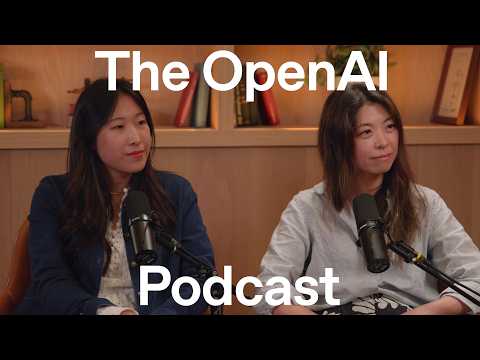
OpenAI deploys Codex to automate laboratory workflows, biosecurity
OpenAI
Shifting from human to compute bottlenecks allows parallel AI agents and robotic labs to autonomously design experiments, accelerate drug discovery, and monitor global biosecurity risks.
## Background
Published by OpenAI on YouTube on April 16, 2026, this episode features research lead Joy Jiao and product lead Yunyun Wang. The video explores how OpenAI is developing biochemistry-focused models for the life sciences, improving research workflows, navigating biosecurity risks, and moving toward autonomous laboratories.
## TL;DR
In this episode, OpenAI's Joy Jiao and Yunyun Wang discuss the transformation of biological research through advanced AI models like GPT-5 and Codex. They detail how scaling test-time compute allows models to act as critical scientific skeptics, manage complex multi-agent workflows, and bridge the gap between written protocols and automated lab robotics. The conversation covers critical biosecurity frameworks, such as differentiated access for verified professionals, while outlining low-lift adoption strategies for modern researchers. Ultimately, they share a ten-year vision of fully autonomous laboratories and biosecurity systems working alongside human scientists to accelerate drug discovery and cure rare diseases.
## Atmosphere & style
The conversation has an inspiring, forward-looking, and collaborative energy, driven by the shared history and academic camaraderie between the guests. It balances high-level, technical discussions about compute scaling and biosecurity with lighthearted, relatable humor about the shared desire to eliminate the tedious physical labor of manual pipetting. The tone feels grounded yet highly ambitious, shifting from analytical problem-solving regarding information hazards to a palpable sense of excitement when imagining a 'sci-fi' future of autonomous, 24/7 research institutions.
## Key takeaways
- [00:00](https://www.youtube.com/watch?v=UZyH0nx5zgI&t=0s) OpenAI is developing a new biochemistry-focused model series designed for genomics, protein understanding, and early discovery use cases, aiming to break through research bottlenecks by leveraging greater test-time compute.
- [00:00](https://www.youtube.com/watch?v=UZyH0nx5zgI&t=0s) OpenAI is shipping a Life Sciences Research Plugin with over 50 skills to address reproducibility and enable one-click deployments for tasks like pathway analysis and cross-evidence literature searches.
- [05:00](https://www.youtube.com/watch?v=UZyH0nx5zgI&t=300s) A collaboration with Ginkgo Bioworks demonstrated that GPT-5 could successfully design physical wet lab experiments that produced a non-zero amount of target protein, shifting the scientific bottleneck from human limitations to compute.
- [20:14](https://www.youtube.com/watch?v=UZyH0nx5zgI&t=1214s) The internal tagline of OpenAI's life sciences team on Slack is to "scale test time compute to cure all disease."
- [09:48](https://www.youtube.com/watch?v=UZyH0nx5zgI&t=588s) Biosecurity and dual-use risks present a major tracking challenge because the precursor steps to synthesizing a dangerous pathogen are virtually indistinguishable from beneficial, legitimate research.
- [09:48](https://www.youtube.com/watch?v=UZyH0nx5zgI&t=588s) To solve the prompt ambiguity problem and prevent excessive self-refusals, OpenAI is adopting a "differentiated access" strategy that verifies users as professional researchers before unlocking full model capabilities.
- [16:16](https://www.youtube.com/watch?v=UZyH0nx5zgI&t=976s) Scientists benefit from a model persona that acts as a scrutinizing skeptic rather than a purely generative assistant, helping narrow the aperture of endless potential hypotheses and drug targets.
- [17:49](https://www.youtube.com/watch?v=UZyH0nx5zgI&t=1069s) Codex is serving as an infrastructure for scientific workflows, managing remote development boxes, building fit-for-purpose data visualization UIs, and orchestrating parallel agents across research institutions.
- [20:14](https://www.youtube.com/watch?v=UZyH0nx5zgI&t=1214s) Compute scales along two distinct axes: model size (parameter scaling) and test-time compute scaling, which allows models to think for an extended, variable amount of time during inference to solve highly complex problems.
- [23:41](https://www.youtube.com/watch?v=UZyH0nx5zgI&t=1421s) AI acts as an accelerator rather than a replacement for human researchers, helping to translate written protocols into robotic lab automation code and providing rigorous statistics and data analysis support.
- [26:26](https://www.youtube.com/watch?v=UZyH0nx5zgI&t=1586s) Evaluating biological models requires creative methods beyond standard language evaluations, including virtual cell outcome predictions, synthetic data "foot guns" containing intentional flaws, and physical wet lab validation.
- [29:51](https://www.youtube.com/watch?v=UZyH0nx5zgI&t=1791s) There is a geographical divide in AI adoption within the life sciences community, with West Coast researchers embracing agentic workflows while East Coast researchers remain more skeptical.
- [33:30](https://www.youtube.com/watch?v=UZyH0nx5zgI&t=2010s) Advanced reasoning models can liberate the next generation of students from rote memorization, shifting the focus of biological education toward creative exploration and connecting disparate fields.
- [36:53](https://www.youtube.com/watch?v=UZyH0nx5zgI&t=2213s) Low-lift entry points for busy researchers to adopt AI include document-based literature comprehension conversations and cross-disciplinary data analysis pathways on Codex.
- [40:27](https://www.youtube.com/watch?v=UZyH0nx5zgI&t=2427s) The ten-year vision for autonomous science features fully automated, continuous research laboratories staffed by robots and AI to tackle orphan diseases and personalized medicine challenges efficiently.
- [40:27](https://www.youtube.com/watch?v=UZyH0nx5zgI&t=2427s) A key component of the future biosecurity infrastructure is autonomous surveillance systems that sample wastewater and air to predict strains and design medical countermeasures dynamically.
## Detailed walkthrough
### [00:00](https://www.youtube.com/watch?v=UZyH0nx5zgI&t=0s) Introducing OpenAI for Life Sciences
Host Andrew Mayne introduces research lead Joy Jiao and product lead Yunyun Wang to discuss OpenAI for Life Sciences. The conversation centers on how advanced AI models are transforming biology and medicine, and the rigorous measures required to deploy these capabilities safely. Joy highlights that these models allow researchers to reach "new levels of difficulty and discovery," while Yunyun emphasizes the democratization of expert-level knowledge. Joy shares that their team's ambitious internal tagline is to "scale test time compute to cure all disease."
Andrew traces the evolution of OpenAI's tools from a basic API to ChatGPT, and then to code-focused models like Codex. He asks if the tools themselves must evolve to match how scientists actually work. Yunyun explains that they are building and deploying a new biochemistry-focused model series designed for complex life science research workflows. This series focuses on genomics, protein understanding, and early discovery use cases, aiming to break through research bottlenecks by leveraging greater thinking time and compute.
- **Product Surfaces:** Literature synthesis workflows are thriving on ChatGPT, while long-trajectory agentic workflows are being empowered on Codex.
- **Life Sciences Research Plugin:** To address reproducibility and repeatability in enterprise settings, OpenAI is shipping a plugin with over 50 skills (templatized workflows) for translational biology users, enabling one-click deployments for tasks like pathway analysis or cross-evidence literature searches.
- **Tool Integration:** Joy notes that models can already act like computational biologists by using open-source protein structure prediction algorithms, running tools, looking at outputs, and tweaking inputs. The next step is turning them into true biochemistry experts with the intuition to use these tools more intelligently.
---
[03:47](https://www.youtube.com/watch?v=UZyH0nx5zgI&t=227s) From Pipettes to AI: Joy and Yunyun's Backgrounds
Joy shares her personal journey, explaining that she has always been interested in biology and earned her PhD in systems biology from Harvard about a decade ago. However, she found academia too slow-moving, recalling the tedious physical labor of "transferring small amounts of liquid from one tool to another" in the lab. Seeking a faster-paced environment where she had direct control over her velocity, she transitioned to software and eventually joined OpenAI. Working on life sciences now represents a "full circle moment" where she can use AI to accelerate the work of her previous academic self.
Joy and Yunyun joke about their shared motivation to automate pipetting so they never have to touch a pipette again. Andrew asks Yunyun about her own path into this field. Yunyun reveals she has spent the majority of her time at OpenAI working on biology research, starting with biorisk mitigations and biodefense initiatives. Her initial entry point into wet lab research was through infectious disease and virology work, which naturally sparked her interest in biosecurity.
---
[05:00](https://www.youtube.com/watch?v=UZyH0nx5zgI&t=300s) The Ginkgo Bioworks Collaboration and the Shift to Compute Bottlenecks
Andrew brings up OpenAI's collaboration with Ginkgo Bioworks, which combined GPT-5 with a robotic lab to accelerate research. Joy explains that when the project started around July 2025, GPT-5 had just finished training. At the time, the team was highly uncertain if the model could perform biology at all, given that the training data was heavily weighted toward math and computer science—fields with easily verifiable solutions, unlike biology, which requires physical lab validation.
The initial goal was simply to see if the model could design experiments that successfully produced a desired target. The team was incredibly surprised when GPT-5's very first experimental designs returned from Ginkgo's robotic lab showing a "non-zero amount of protein" had been created. Joy notes that in just six months, the capability has progressed from an uncertain experiment to making it feel "quite obvious" that AI models can accelerate science.
- **Human vs. Compute Bottlenecks:** Yunyun explains that ingesting high-throughput experimental data is incredibly compute-intensive. Historically, the bottleneck in scientific progress has been human limitations.
- **Parallel Orchestration:** Joy and Yunyun envision a future where human bottlenecks are replaced by compute bottlenecks, utilizing multiple sub-agents in parallel to divide and conquer tasks, freeing human researchers to focus on interpreting the most meaningful insights.
- **OpenAI's History in Life Sciences:** OpenAI has been focused on life sciences for at least two years, starting with capability evaluations and early research experiments, leading up to the autonomous wet-lab-in-the-loop experiments with Ginkgo.
- **Future Research Areas:** Joy mentions upcoming partnerships in chemical, protein, and enzyme design, as well as efforts to understand cellular interactions, accelerate drug discovery, and streamline the FDA approval process.
---
[09:48](https://www.youtube.com/watch?v=UZyH0nx5zgI&t=588s) Addressing Biosecurity and Dual-Use Risks
Andrew points out that while these tools can discover new treatments, they also introduce severe risks, such as the potential to design bioweapons or execute "gene exploits." Yunyun agrees, calling biosecurity one of the most severe risks they track. She explains that assessing information hazards is incredibly difficult because the precursor steps to synthesizing a dangerous pathogen look completely benign and are virtually indistinguishable from legitimate, beneficial research.
Because of this overlap, OpenAI took a highly risk-averse approach, implementing high safeguards when they observed significant jumps in model reasoning capabilities. Yunyun advocates for "differentiated access" and "responsible deployment" as core pillars of their safety strategy. She compares this to "models as a profession," where different model personalities or access levels are invoked based on the user's verified credentials.
- **The Safety-Capability Tradeoff:** Joy explains that the safest model is one with no capability at all, while an "oracle of the physical world" could be highly dangerous if commanded to design a novel pandemic-potential pathogen.
- **The Prompt Ambiguity Problem:** In general-access traffic, it is nearly impossible to determine intent. A prompt asking to "help me clone a gene" could refer to a harmless green fluorescent protein or a deadly toxin.
- **Self-Refusals:** To err on the side of safety, models currently self-refuse when a risk is detected, often telling users, "Sorry, I can't really help you with that, but I can give you a high-level overview of this protocol instead"—a behavior that understandably annoys professional scientists.
- **Differentiated Access Solution:** To unlock full capabilities, OpenAI is moving toward verifying users as professionals at legitimate research institutions or pharmaceutical companies. Because these institutions operate under strict regulations where all reagents and cell lines are tracked, OpenAI can confidently grant them higher capabilities than general-access users.
---
[15:43](https://www.youtube.com/watch?v=UZyH0nx5zgI&t=943s) Current Capabilities in the Lab
Andrew asks what researchers can actually do with these models in a laboratory setting right now. Joy notes that usage varies widely. She recently spoke with researchers at the Baker Lab who are using Codex for tasks as simple as writing a spreadsheet to minimize the number of manual pipetting steps required for an experiment. Joy admits this simple use case "hits me very hard" because she spent countless hours doing that exact same tedious optimization by hand during her graduate school years.
[16:16](https://www.youtube.com/watch?v=UZyH0nx5zgI&t=976s) The Model as a Scientific Skeptic and Discriminator
The range of sophistication in biological design tools is vast, spanning from simple mathematical software operations to the incredibly complex task of designing an enzyme from scratch. Yunyun Wang expresses excitement about utilizing AI models as powerful discriminators to test and assess novel ideas. She notes a distinct trend among research partners and users: scientific research tasks require a different model "persona" or prompting style. Instead of a purely generative assistant, scientists need a model that acts as a scrutinizing skeptic.
This skeptical persona mimics how human scientists assess originality and feasibility. With a constant influx of new publications pushing the frontier of scientific hypotheses, the model's role is to narrow the aperture, helping researchers identify which hypotheses are truly feasible and valid for physical testing. In areas like disease target screening and selection, where the potential drug targets are virtually endless, having an AI model that can responsibly empower and accelerate this narrowing process at scale is one of the most immediate impacts the team hopes to achieve.
[17:49](https://www.youtube.com/watch?v=UZyH0nx5zgI&t=1069s) Codex as an Infrastructure for Scientific Workflows
Andrew Mayne traces the trajectory of OpenAI's offerings, noting the evolution from GPT-3 and GPT-3.5 on the API to ChatGPT, ChatGPT apps, and Codex. He asks if these tools are destined to become a complete infrastructure for every kind of scientific inquiry. Joy Jiao confirms that the dream is to have the basic foundations of scientific workflows happen on Codex, with the ultimate goal of enabling Codex to do "pretty much... everything that is possible to do on the computer," and eventually extending its reach by hooking it up to robotics.
Already, the team uses Codex for remote infrastructure management. For instance, a researcher can instruct Codex to run code across multiple remote dev boxes and monitor the logs while the researcher focuses on other tasks. Codex also builds fit-for-purpose software to analyze and visualize specific datasets. Jiao shares a recent team anecdote: instead of sending raw experimental biology data to one another, team members have started sharing HTML files containing "beautiful UIs that Codex has built with kind of like spinning proteins," fundamentally changing how they collaborate. Yunyun Wang adds that while they initially envisioned a paradigm of "one personal assistant" per scientist, the next step is scaling up entire research institutions where a program team can deploy a workforce of parallel agents delegating tasks to one another.
[20:14](https://www.youtube.com/watch?v=UZyH0nx5zgI&t=1214s) Scaling Compute: Parameters vs. Test-Time Reasoning
Addressing OpenAI's massive compute requirements, Jiao explains that compute scales along two distinct axes. The first axis is model size. Moving from GPT-2 to GPT-3 involved a massive parameter increase that unlocked incredible emergent properties. Jiao recalls how the community was collectively amazed when GPT-2 wrote a coherent article about unicorns, whereas today's models operate in a completely different realm of intelligence.
The second, more recent axis is "test-time compute scaling," which is utilized during inference. Rather than spitting out tokens instantly, these reasoning models can "think" for a scalable, variable amount of time depending on the difficulty of the problem. Jiao notes that they can have a model think for days—or essentially "think forever"—about a problem, allowing it to reach entirely new levels of difficulty and discovery. This framework explains why massive infrastructure projects like Stargate are necessary; they are not just for generating cat pictures or text conversations, but for powering long-term, complex cognitive processes.
- **Team Motto:** When the team first formed on Slack, their tagline was "scale test time compute to cure all disease."
- **Drug Repurposing:** AI models are already suggesting new indications for FDA-cleared drugs based on mechanistic understandings, helping to temporarily ameliorate symptoms.
- **Personalized Medicine:** AI is accelerating the design of Antisense Oligonucleotides (ASOs) and other RNA-based treatments, with massive scaling expected in the next one to two years.
[23:41](https://www.youtube.com/watch?v=UZyH0nx5zgI&t=1421s) AI as an Accelerator for Lab Automation
Responding to the common concern of whether AI will displace human researchers, Jiao and Mayne agree that AI acts as a massive accelerator rather than a replacement. Every researcher wants "more hands" in the lab, and AI helps solve the bottlenecks of lab automation. A major hurdle in automation is translating a written biological protocol into code that a robotic platform can execute. Partners have been using Codex to bridge this gap, as the task is "half coding problem, half understanding how a lab works."
Furthermore, AI assists with rigorous data analysis for scientists who may not have a deep background in statistics. The model can walk a user through data, suggest statistical tests, probe hypotheses, and point out potential biases or quality control issues. "I don't think we can ever fully replace the scientists in the loop," Jiao emphasizes. Looking ahead, she hopes that within the next few years, AI will design a new drug or cure a disease. While bringing a drug to market is a decade-long process, AI can speed up the pipeline by assisting with early literature synthesis, safety reviews, drug design, and clinical trials. Wang adds that a major milestone would be a researcher patenting a new discovery made on their platform using their life sciences models.
[26:26](https://www.youtube.com/watch?v=UZyH0nx5zgI&t=1586s) Predicting Biological Outcomes and Designing Evals
When asked if models will eventually predict cellular outcomes, Jiao answers affirmatively. While models are already highly proficient at predicting chemical reactions, scaling up to biological complexity—such as predicting whether a drug will be toxic to a specific person—is the next frontier on their roadmap.
Evaluating these biological models is significantly more complex than evaluating language or math models. The team uses several creative evaluation methods:
- **Experimental Data (Virtual Cell Work):** Asking the model to predict the outcome of an unseen perturbation in an experiment that has already been physically conducted.
- **Synthetic Data "Foot Guns":** Generating datasets with intentional, realistic flaws—such as weird biases, quality control issues, or statistical errors—to see if the model catches them like a trained computational biologist would.
- **Wet Lab Validation:** Because "nothing in biology is really real until you can prove it in the real world," physical wet lab testing remains the ultimate evaluation.
- **Baseline Recreation:** Recreating existing experiments, such as predicting antibody binding for known virus variants, before pushing the model to perform de novo antibody design for new variants.
[29:51](https://www.youtube.com/watch?v=UZyH0nx5zgI&t=1791s) Community Reception and Overcoming Skepticism
The reception of AI in the life sciences community varies heavily by geography. Jiao observes a cultural divide: on the West Coast, researchers are highly "AI-pilled" and readily embrace agentic workflows and the concept of an AI scientist. Conversely, at East Coast conferences, scientists tend to be much more skeptical and doubtful of AI's capabilities. Jiao attributes this to West Coast researchers having more firsthand experience with the latest models.
To bridge this gap, the team focuses on two approaches. First, they make AI accessible through platforms like Chat and Codex, allowing individual scientists to experience immediate, practical value—even if it is just generating a serial dilution spreadsheet for pipetting. Second, they engage in deep research collaborations on complex problems like antibody or enzyme design, which lead to peer-reviewed publications. Wang welcomes the skepticism, calling it "healthy" and "warranted" given the high stakes of biological research. She concludes that the best way to win over skeptics is to "show by doing and you show by publishing."
[32:16](https://www.youtube.com/watch?v=UZyH0nx5zgI&t=1936s) Overcoming the AI Stress and Simplifying Workflows
Yunyun Wang emphasizes the critical need for more rigorous evaluations that accurately represent real-world life science workflows and research problems. By publishing these evaluations, researchers can look at the results and immediately generate "100 different ideas" for implementing AI to solve their current laboratory bottlenecks. Joy Jiao points out a common source of anxiety among scientists: there is a palpable stress from people who recognize that AI is incredibly powerful but are worried because "they don't know how to use it the right way." This creates a general, nagging feeling of needing more AI in their workflows without knowing where or how to integrate it.
The product vision for tools like Codex is to eliminate this stress by making the technology so simple that "it just works." Instead of forcing researchers to become prompt engineers, the goal is to allow them to simply state what they want to achieve. Codex can then autonomously handle the underlying complexity, managing multi-agent workflows and tool calling behind the scenes so that the user gets an immediate uplift naturally. Andrew Mayne agrees, noting that major step changes in utility occur whenever models become smart enough to understand users without requiring them to spend hours figuring out prompting tricks.
---
[33:30](https://www.youtube.com/watch?v=UZyH0nx5zgI&t=2010s) Advice for the Next Generation of Biologists
When asked what advice they would give to a high school student considering entering the life sciences, Joy Jiao reflects on her own high school days participating in the USA Biology Olympiad. She recalls that among all the academic Olympiads, biology was traditionally viewed as the most memorization-heavy discipline—unlike math, which felt more akin to "test time compute scaling." Joy's hope is that because AI has already learned the vast web of relationships between different research pieces, it can liberate students from rote memorization. This shift will allow human creativity to flourish, helping people connect disparate fields of research and push the frontiers of biological exploration. Her direct advice to students is: "maybe you don't have to kind of go and memorize all the biology books. You should just do more exploration with AI."
Yunyun Wang shares her own journey, contrasting the solitary, sometimes isolating nature of traditional wet lab research with the high-energy, collaborative atmosphere she experienced at her first computer science hackathon. She hopes that early adopters and students using Codex will experience a similar collaborative spirit. In the future, students might share scripts, conversations, or even deploy their own personalized "co-scientists" or agents to collaborate with their teammates' agents.
- **The Pipetting Theme:** Yunyun admits she entered the wet lab too early in her career and deeply disliked the intense manual labor of pipetting. Andrew jokes that this is a universal truth: "Nobody likes pipetting."
- **Connecting to the Physical World:** Yunyun hopes that as AI models connect with physical laboratory devices, the learning curve will become much more fun, allowing students to maximize their time on creative, high-level interactions rather than manual tasks.
- **The Greenhouse Example:** Andrew shares an anecdote about a student he is mentoring who connected Codex to a greenhouse. The student uses the AI to receive and evaluate photos of the plants, beautifully combining traditional agriculture with cutting-edge AI.
---
[36:53](https://www.youtube.com/watch?v=UZyH0nx5zgI&t=2213s) Low-Lift AI Adoption for Busy Researchers
Andrew raises a common dilemma: when talking to busy principal investigators and lab researchers, many express interest in AI but lament, "I just don't have the time," even though the technology is designed to save them time. Joy Jiao suggests two very low-lift, high-reward entry points for busy academics:
1. **Fact-Checking and Literature Comprehension:** Researchers can upload a PDF of a paper and have a natural conversation with the AI to ensure they understand it correctly. Joy loves this approach because "you can ask really dumb questions and you don't feel any judgment," making it a wonderful, low-stress tool for learning.
2. **Interdisciplinary Data Analysis:** When analyzing experimental results, researchers often struggle to find the right statistical methods, especially when their data spans multiple niche fields like chemistry and protein biology. A model can easily pull in diverse data analysis pathways and explore them on a laptop using Codex.
Yunyun Wang advises that AI adoption should not feel like work right away. She suggests starting with a hobby or passion project. For instance, Yunyun first unlocked the power of literature synthesis and prompting while using AI for creative writing projects outside of her day job. This low-stakes exploration built her "pattern matching abilities" for when she later applied AI to complex biological data. She emphasizes that because the field moves incredibly fast with exciting developments every week, the most important thing is simply to "get started somewhere" and talk to teammates. On their own team, members frequently share breakthroughs, such as getting Codex to connect three previously incompatible internal databases.
---
[40:27](https://www.youtube.com/watch?v=UZyH0nx5zgI&t=2427s) A Ten-Year Vision for Autonomous Science
Looking a decade into the future, Yunyun and Joy share highly ambitious, transformative visions for the life sciences. Yunyun explains that their team's target is to make meaningful strides toward—and eventually assist in—curing diseases, particularly rare "orphan diseases" that currently lack the funding and research attention they deserve due to the immense difficulty of clinical trials.
Joy paints a vivid, slightly "sci-fi" picture of the future featuring fully autonomous laboratories. In this vision, automated research institutes run continuously, staffed by robots hooked up to AI. These labs will work tirelessly to cure human diseases, discover new materials, design drugs, and solve personalized medicine challenges for ultra-rare diseases (such as NF1) without requiring astronomical budgets. Additionally, Joy envisions autonomous biosecurity systems constantly sampling wastewater and air to detect pathogens, predict flu strains, and design medical countermeasures autonomously.
- **The Human Role:** Andrew clarifies that this autonomous vision does not eliminate human scientists; rather, it empowers more of them. Scientists will direct the system from home, asking Codex to run experiments in a centralized "science center."
- **High-Level Direction:** Joy agrees, explaining that humans will provide "high-level direction setting," such as inputting a patient's profile and discussing potential paths with the AI. The AI will design and run the experiments, then return to the human to ask, "here's what I found. What do you think we should do next?"
- **Democratizing Science:** Yunyun concludes that this future is ultimately about putting expert-level knowledge into the hands of everyone, bolstering societal defenses against new viral variants, and accelerating medical countermeasures to give humanity far more agency over its collective health.
## Notable quotes
> [00:00](https://www.youtube.com/watch?v=UZyH0nx5zgI&t=0s) scale test time compute to cure all disease. — Joy Jiao
> [03:47](https://www.youtube.com/watch?v=UZyH0nx5zgI&t=227s) transferring small amounts of liquid from one tool to another — Joy Jiao
> [05:00](https://www.youtube.com/watch?v=UZyH0nx5zgI&t=300s) non-zero amount of protein — Joy Jiao
> [05:00](https://www.youtube.com/watch?v=UZyH0nx5zgI&t=300s) quite obvious — Joy Jiao
> [09:48](https://www.youtube.com/watch?v=UZyH0nx5zgI&t=588s) models as a profession — Yunyun Wang
> [09:48](https://www.youtube.com/watch?v=UZyH0nx5zgI&t=588s) help me clone a gene — null
> [09:48](https://www.youtube.com/watch?v=UZyH0nx5zgI&t=588s) Sorry, I can't really help you with that, but I can give you a high-level overview of this protocol instead — null
> [15:43](https://www.youtube.com/watch?v=UZyH0nx5zgI&t=943s) hits me very hard — Joy Jiao
> [17:49](https://www.youtube.com/watch?v=UZyH0nx5zgI&t=1069s) beautiful UIs that Codex has built with kind of like spinning proteins — Joy Jiao
> [17:49](https://www.youtube.com/watch?v=UZyH0nx5zgI&t=1069s) one personal assistant — Yunyun Wang
> [20:14](https://www.youtube.com/watch?v=UZyH0nx5zgI&t=1214s) think forever — Joy Jiao
> [23:41](https://www.youtube.com/watch?v=UZyH0nx5zgI&t=1421s) half coding problem, half understanding how a lab works. — null
> [23:41](https://www.youtube.com/watch?v=UZyH0nx5zgI&t=1421s) I don't think we can ever fully replace the scientists in the loop, — Joy Jiao
> [29:51](https://www.youtube.com/watch?v=UZyH0nx5zgI&t=1791s) AI-pilled — Joy Jiao
> [29:51](https://www.youtube.com/watch?v=UZyH0nx5zgI&t=1791s) show by doing and you show by publishing. — Yunyun Wang
> [32:16](https://www.youtube.com/watch?v=UZyH0nx5zgI&t=1936s) they don't know how to use it the right way. — Joy Jiao
> [32:16](https://www.youtube.com/watch?v=UZyH0nx5zgI&t=1936s) it just works. — null
> [33:30](https://www.youtube.com/watch?v=UZyH0nx5zgI&t=2010s) maybe you don't have to kind of go and memorize all the biology books. You should just do more exploration with AI. — Joy Jiao
> [33:30](https://www.youtube.com/watch?v=UZyH0nx5zgI&t=2010s) Nobody likes pipetting. — Andrew Mayne
> [36:53](https://www.youtube.com/watch?v=UZyH0nx5zgI&t=2213s) you can ask really dumb questions and you don't feel any judgment, — Joy Jiao
> [36:53](https://www.youtube.com/watch?v=UZyH0nx5zgI&t=2213s) get started somewhere — Yunyun Wang
> [40:27](https://www.youtube.com/watch?v=UZyH0nx5zgI&t=2427s) here's what I found. What do you think we should do next? — null
## Mentioned
OpenAI, Joy Jiao, Yunyun Wang, Andrew Mayne, ChatGPT, Codex, Harvard, Ginkgo Bioworks, GPT-5, FDA, Baker Lab, GPT-3, GPT-3.5, GPT-2, Stargate, USA Biology Olympiad
OpenAI research lead Joy Jiao and product lead Yunyun Wang argue that applying agentic models and test-time compute to life sciences can shift biomedical research from human labor bottlenecks to scalable computational pipelines. However, realizing this potential requires overcoming biological validation hurdles and mitigating dual-use biosecurity risks through credentialed institutional access.
Test-Time Compute and the Skeptical Persona (20:14)
Jiao explains that expanding test-time compute scaling—allocating extended inference reasoning time to difficult problems—enables models to address complex biological workflows such as drug repurposing and antisense oligonucleotide design. Rather than functioning merely as generative assistants, Wang highlights the need for models to adopt a skeptical persona. This critical discriminator role mimics scientific peer evaluation by assessing hypothesis feasibility and narrowing vast candidate pools, such as screening potential disease targets for physical viability.
To operationalize these capabilities, OpenAI deployed a life sciences research plugin featuring over 50 templatized workflows for translational biology, covering tasks like pathway analysis and cross-evidence literature search. Wang and Jiao envision replacing human limitations with parallel compute bottlenecks, deploying fleets of coordinated sub-agents on platforms like Codex to automate data analysis, infrastructure management, and multi-tool orchestration.
Bridging Digital Models with Robotic Laboratories (5:00)
Because biological designs require real-world confirmation, OpenAI integrated models directly with wet-lab automation. In a July 2025 project with Ginkgo Bioworks, the team paired an early version of GPT-5 with a robotic lab, successfully designing experiments that generated measurable target proteins. Beyond high-level design, Jiao notes that Codex bridges a critical operational gap by translating written biological protocols into machine-executable robotic instructions, eliminating tedious manual labor like serial pipetting.
Model evaluation in biology faces unique challenges compared to language or mathematics. OpenAI assesses systems using physical wet-lab validation alongside virtual cell perturbation benchmarks. To test computational discernment, the team introduces synthetic datasets with deliberate statistical flaws and quality-control anomalies, alongside baseline recreation tasks evaluating antibody binding prediction before attempting de novo molecular design.
Mitigating Biosecurity Risks Through Credentialed Access (9:48)
Wang identifies biosecurity as among the most severe risks in biological AI, warning that the early research steps for synthesizing dangerous pathogens are virtually identical to benign scientific exploration. In open-access environments, ambiguous prompts make it impossible to discern whether a user is cloning an innocuous protein or a regulated toxin, forcing models to rely on conservative self-refusals that hinder legitimate researchers.
To balance safety with utility, OpenAI is adopting a differentiated access framework. Under this model, full research capabilities are unlocked only for verified personnel at legitimate academic institutions and pharmaceutical firms. Because these organizations operate within strict compliance structures where physical reagents and cell lines are tracked, model capabilities can be safely expanded without amplifying catastrophic biosecurity threats.
Community Skepticism and Long-Term Autonomous Labs (29:51)
Adoption among scientists currently reflects a geographic divide: Jiao observes ready acceptance among West Coast researchers who have hands-on experience with advanced models, contrasted with cautious skepticism at East Coast academic centers. Wang views this skepticism as healthy given the high stakes of biomedicine, noting that trust must be built through peer-reviewed publications and low-friction entry points, such as conversational literature comprehension and multidisciplinary statistical guidance.
Over a ten-year horizon, Jiao and Wang project the emergence of continuous, fully autonomous laboratories. In this model, robotic facilities handle iterative experimentation, continuous wastewater pathogen surveillance, and customized therapies for rare orphan diseases, while human scientists retain high-level strategic oversight and ethical direction.
While automated laboratories and AI-guided molecular design show early experimental success, scaling cellular outcome predictions and bringing AI-designed drugs through multi-year clinical trials remain long-term challenges. OpenAI's strategy hinges on proving utility through reproducible wet-lab publications while refining access protocols to contain severe biological dual-use hazards.
精炼阅读摘要
OpenAI生命科学团队负责人Joy Jiao与Yunyun Wang指出,通过结合推理阶段计算扩展、智能体工作流与自动化湿实验,AI正从文献合成延伸至实验设计与靶点筛选,有望将科研瓶颈从人力操作转向算力驱动。
算力瓶颈与推理扩展重塑研发 (20:14)
Joy Jiao与Yunyun Wang认为,生物科学传统的推进瓶颈在于繁琐的人工劳动与有限的研究人员精力,而高通量实验数据的吸收高度依赖计算资源。OpenAI团队的内部目标是“扩展测试时计算以治愈所有疾病”(scale test time compute to cure all disease)。Jiao解释,计算扩展不仅在于从早期的模型参数增长,更在于推理阶段的测试时计算(test-time compute scaling):模型可以针对复杂问题进行数小时甚至数天的推理思考,从而在酶设计或药物重定向等高难度领域挖掘更深层的机制洞见。这一范式让Stargate等超大规模计算基础设施在科学探索中具备了实际意义。
从代码助手到多智能体实验中枢 (17:49)
在具体落地层面,OpenAI正将Codex从单纯的代码生成工具演进为科研流程的基础设施。团队正在推出面向转化生物学的插件,内置超过50项标准化技能工作流,涵盖通路分析和交叉文献比对。Jiao提到,研究人员现已使用Codex调度远程开发环境,或自动生成带有3D蛋白质结构可视化界面的HTML分析工具。在自动化实验室场景中,Codex承担了将文字实验方案翻译为机器人执行代码的衔接角色。Wang补充,未来的工作模式将从“单科学家配单助手”升级为多智能体并行协作的虚拟科研机构,由模型作为严谨的“科学怀疑者”,在无尽的疾病靶点中协助人类筛选可行假设。
湿实验闭环验证与评估框架创新 (5:00)
在2025年7月启动的Ginkgo Bioworks合作项目中,刚完成训练的GPT-5直接对接自动化实验室进行测试。尽管训练数据主要偏向数学和计算机科学,模型首次设计的实验方案依然在实体实验室中成功合成了非零蛋白,令研究团队感到意外。由于生物学规律无法仅凭文字推演验证,团队构建了多维度的评估体系:除真实的实体湿实验外,还包含让模型预测未知细胞扰动结果的“虚拟细胞”测试、在合成数据集中主动埋入统计偏差以考察模型的纠错能力,以及在已知抗体结合数据上复现基线表现后,再推进全新变异株的从头抗体设计。
生物安全双重用途与分级访问 (9:48)
AI生成能力的提升也带来了严重的双重用途风险,例如新型病原体设计或基因漏洞利用。Wang指出,生物风险评估极为复杂,因为制造危险病原体的前期步骤与合法的良性科学研究在形式上几乎没有区别。为了规避信息危害,通用模型在检测到敏感提示词时往往会直接触发拒答机制,但这给合规科研人员带来了操作阻碍。为此,OpenAI正推行基于资质认证的“差异化访问”(differentiated access)策略,对试剂和细胞系受到严格监管的正规科研机构与药企开放更深层的能力,以平衡安全防线与研究效能。
自主科学愿景与研究范式转变 (40:27)
面对学术界与工业界的接纳差异,Jiao观察到美国西海岸学者对AI科学家与智能体工作流的接受度显著高于东海岸同行。团队主张通过开源基准测试和同行评审论文来化解疑虑。展望未来十年的发展,团队描绘了由AI与机器人持续运行的自主实验室蓝图,旨在加速罕见病(如NF1)药物发现并自动化监测环境病原体。Jiao与Wang强调,AI并不会取代科学家,而是将下一代生物学者从机械化的手动移液与死记硬背中解放出来,让人类专注于高阶的方向设定与假设评估。
当前AI在生命科学领域的落地仍受制于模型安全机制与研究自由度之间的平衡,且生物实验的复杂性仍高度依赖实体湿实验的终极验证,尚未完全实现全流程的虚拟预测闭环。
Detailed notes — zh
## Background
本期节目于 2026 年 5 月 3 日发布在 OpenAI 官方 YouTube 频道。视频由主持人 Andrew Mayne 连线 OpenAI 生命科学研究主管 Joy Jiao 与产品主管 Yunyun Wang,深入探讨了 OpenAI 针对生命科学领域构建的模型系列、生物安全防御机制与负责任部署策略,并描绘了 AI 推动药物研发与实验室自动化(告别手工移液)的前沿图景。
## TL;DR
节目围绕 OpenAI 生命科学模型系列的诞生与演进展开,团队确立了“扩展测试时计算以治愈所有疾病”的宏大愿景,并通过与 Ginkgo Bioworks 的自动化湿实验闭环证实了模型自主设计实验并合成目标蛋白质的能力。针对生物安全与信息危害的双重用途困境,OpenAI 推动了从一刀切拒答向基于实体资质的“差异化访问”防御范式演进,将安全重心锚定在真实物理世界的合规监管上。模型目前已深度介入酶与抗体从头设计、罕见病攻关、老药新用及实验排布优化,并通过 Codex 扮演起多智能体科研基础设施的角色。展望未来十年的自主科研机构,人类科学家将从机械繁琐的移液实验中彻底解放,专注于高维方向的设定与假说构想,驱动科学研究的全面普惠化与生物防务的主动防御。
## Atmosphere & style
对话洋溢着前沿科技探索特有的极客理性与生动的学术共鸣,嘉宾与主持人在严谨探讨技术架构之余,频频因共情湿实验中日复一日手动移液的“枯燥苦役”而相视大笑,氛围既轻松亲切又极具专业深度。叙事风格在严守生物安全界线的审慎克制与颠覆现代科研范式的澎湃野心之间达成了精妙平衡。倾听全程宛如置身一场顶级跨学科实验室的炉边对话,能真切感受到计算科学正将生命科研从经验试错的泥潭中拉出、推向理性推演时代的巨大变革张力。
## Bulletin
- [00:00](https://www.youtube.com/watch?v=UZyH0nx5zgI&t=0s) OpenAI 推出专注于生物化学与早期药物发现的生命科学模型系列,并确立了“扩展测试时计算以治愈所有疾病”的团队座右铭。
- [05:00](https://www.youtube.com/watch?v=UZyH0nx5zgI&t=300s) 在与 Ginkgo Bioworks 的合作验证中,GPT-5 首次自主设计的实验成功在机器人湿实验室中合成了非零量的目标蛋白质,验证了 AI 自主设计生物学实验的可行性。
- [11:17](https://www.youtube.com/watch?v=UZyH0nx5zgI&t=677s) 针对生物安全与病原体合成的双重用途风险,OpenAI 正从一刀切的自我拒答转向“差异化访问”,依据受监管机构与实体身份向合法科研人员开放高阶推理能力。
- [40:27](https://www.youtube.com/watch?v=UZyH0nx5zgI&t=2427s) OpenAI 展望在未来十年内建立全天候自主运转的自动化研究所,让人类科学家聚焦于高层假设设定,借助 AI 和机器人硬件突破罕见病疗法并实现自主生物防务。
## Key takeaways
- [00:00](https://www.youtube.com/watch?v=UZyH0nx5zgI&t=0s) 生命科学模型系列专注于理解基因组学与蛋白质机制,致力于攻坚早期药物发现并推动移液等重复性实验工作流的自动化。
- [05:00](https://www.youtube.com/watch?v=UZyH0nx5zgI&t=300s) GPT-5 与 Ginkgo Bioworks 的合作实验证明,AI 模型能够有效设计实验方案并驱动自动化湿实验室合成真实蛋白质,标志着科研瓶颈正从人体操作极限转向算力极限。
- [09:42](https://www.youtube.com/watch?v=UZyH0nx5zgI&t=582s) 生物学风险属于首个与模型智能水平强相关的双重用途难题,良性科研与恶意制造在前置协议上高度重合,使得纯靠文本提示词甄别意图极度困难。
- [14:06](https://www.youtube.com/watch?v=UZyH0nx5zgI&t=846s) 为破解机械拒答对合法科研的阻碍,OpenAI 倡导“差异化访问”与“模型即职业”,结合实体机构监管与身份认证对高阶实验设计能力进行安全分发。
- [15:43](https://www.youtube.com/watch?v=UZyH0nx5zgI&t=943s) 模型正在成为科研假说的强力审视器,不仅可从底层自主设计酶与排布移液步骤,还能严苛评估前沿论文假说并大幅收窄疾病成药靶点的筛选范围。
- [17:49](https://www.youtube.com/watch?v=UZyH0nx5zgI&t=1069s) Codex 正在演进为科研通用基础设施,具备远程多机调度、后台独立监控以及即时构建内嵌 3D 蛋白质交互结构的科学可视化能力。
- [19:24](https://www.youtube.com/watch?v=UZyH0nx5zgI&t=1164s) 科研协作形态正从单个数字化科研助手扩展为多智能体并行协作网络,通过高度模拟现实实验室的专业分工来合力攻克复杂课题。
- [20:14](https://www.youtube.com/watch?v=UZyH0nx5zgI&t=1214s) 算力扩展由“预训练模型规模”与“测试时算力扩展”双轴驱动;其中延长推理思考时间让模型有能力深入推演数天以破解复杂未知的生物学机制。
- [22:31](https://www.youtube.com/watch?v=UZyH0nx5zgI&t=1351s) AI 已在老药新用探索与反义寡核苷酸(ASO)等核酸药物设计中展现价值,并通过协助协议代码化与统计质控赋能一线科学家。
- [27:05](https://www.youtube.com/watch?v=UZyH0nx5zgI&t=1625s) 生命科学评估体系涵盖三大维度:历史未见扰动数据回溯预测、人工植入 QC 与统计偏差的合成陷阱测试,以及终极的真实湿实验物理检验。
- [28:53](https://www.youtube.com/watch?v=UZyH0nx5zgI&t=1733s) 抗体结合预测基准测试为未知变异株外推与从头抗体设计提供了跳板,成为新型靶向疗法与广谱疫苗研发的关键前置步骤。
- [29:51](https://www.youtube.com/watch?v=UZyH0nx5zgI&t=1791s) 学术界对 AI 的接受度呈现“西海岸拥抱、东海岸审慎”的文化分歧,打消科学界健康怀疑的最佳方式在于共建极其严苛的基准测试并产出可复现的湿实验成果。
- [33:17](https://www.youtube.com/watch?v=UZyH0nx5zgI&t=1997s) 下一代生物学家的培养范式正在从海量死记硬背转向高维度跨学科联结,借助无审判压力的人机提问与自主智能体协同开展创新探索。
- [40:27](https://www.youtube.com/watch?v=UZyH0nx5zgI&t=2427s) 十年愿景构想了全自主运转的研究机构与常态化环境病原体监控网络,将彻底击穿罕见病研发的成本壁垒,推动科学研究能力的全面普惠。
- [42:35](https://www.youtube.com/watch?v=UZyH0nx5zgI&t=2555s) 未来的科学人机协作将重塑为高阶研讨式对话:人类设定战略研究方向,AI 系统闭环执行实验并汇报见解,实现科学探索的极大提速。
## Detailed walkthrough
### [00:00](https://www.youtube.com/watch?v=UZyH0nx5zgI&t=0s) 生命科学模型系列的诞生与愿景
Andrew Mayne 邀请研究主管(Research Lead)Joy Jiao 与产品主管(Product Lead)Yunyun Wang 共同探讨 OpenAI 在生命科学(Life Sciences)领域的探索。Joy 提到,AI 正在将科学探索推向以往无法想象的全新难度与发现维度;Yunyun 则指出,核心目标是将真正专家级的顶尖知识交到更多科研人员手中。Joy 还分享了团队内部极具野心的口号:“扩展测试时计算以治愈所有疾病”(Scale test time compute to cure all disease)。
回顾 OpenAI 的产品进化历程,从最初的基础 API 到具备更强对话能力的 ChatGPT,再到编程模型与 Codex 的演进,工具随着用户需求不断拓展。面对涌入的生命科学家群体,Yunyun 介绍了专门面向生物化学研究复杂工作流的“生命科学模型系列”(Life Sciences model series)。该系列旨在建立对基因组学与蛋白质机制的深层理解,重点攻坚早期药物发现(Early Discovery)这一核心瓶颈。团队希望借助更长的思考时间(Thinking Time)与更庞大的计算资源,帮助科学家突破研究壁垒。
```mermaid
flowchart TD
accTitle: OpenAI 生命科学模型与产品部署架构
accDescr: 展示基础生命科学模型如何通过不同产品表面与插件服务于科研工作流
subgraph CoreModel["核心能力层"]
M1["生命科学模型系列<br/>(专注生物化学/基因组/蛋白质机理解析)"]
M2["测试时计算扩展<br/>(Test-Time Compute)"]
M1 --- M2
end
subgraph Surface["产品部署形态"]
S1["ChatGPT<br/>(文献合成与综述)"]
S2["Codex<br/>(长轨迹智能体工作流)"]
S3["生命科学研究插件<br/>(50+ 项标准化复现技能)"]
end
subgraph Application["下游应用场景"]
A1["交叉证据比对与检索"]
A2["生物通路分析 (Pathway Analysis)"]
A3["转化生物学与早期药物发现"]
end
CoreModel --> Surface
S1 --> Application
S2 --> Application
S3 --> Application
```
- **多产品表面协同**:ChatGPT 展现出极高水准的文献合成(Literature Synthesis)能力;Codex 则支撑起推进前沿的长轨迹智能体工作流(Long Trajectory Agentic Workflows)。
- **可复现性与插件化**:针对企业级研究对“可复现性与可重复性”(Reproducibility and Repeatability)的严苛要求,团队推出了针对转化生物学(Translational Bio)用户的生命科学研究插件,内嵌超过 50 项模块化技能(如跨文献证据匹配检索、生物通路分析),支持一键式部署。
- **工具调用与生化专家直觉**:Joy 强调,模型目前已能调用开源蛋白质结构预测算法充当“计算生物学家”完成修改输入、运行程序、查看结果的闭环;未来的核心飞跃是让模型掌握真正的“生物化学专家直觉”,从而更智能地运用工具,更快锁定正确答案。
---
### [03:47](https://www.youtube.com/watch?v=UZyH0nx5zgI&t=227s) 从手持移液器到投身 AI:Joy 与 Yunyun 的科研转折
谈到投身生命科学的初衷,Joy 透露自己从小就对生物学充满热情,约十年前在哈佛大学(Harvard University)获得了系统生物学(Systems Biology)博士学位。尽管学术研究非常迷人,但科研节奏却比她预期的要缓慢得多。最让她感到磨人的是必须整天泡在实验室里,“把微量的液体从一个管子转移到另一个管子”。为了摆脱这种身体力行但节奏迟缓的重复劳动,追求能完全掌控自身产出速度的领域,她转向了软件开发并最终加入 OpenAI。这次回归生物学是一次“圆满的循环”(Full circle moment),她的核心动力就是“用 AI 加速过去的自己”。
Joy 半开玩笑地表示,从现在的角度看,她这辈子再也不想碰哪怕一下移液器(Pipette)了,只想让机器人去代劳。Yunyun 也笑着附和,团队内部经常拿这件事开玩笑——整个项目的很大一部分动机,就是彻底实现移液自动化,再也不用做这种枯燥的工作。
- Joy Jiao 拥有哈佛大学系统生物学博士学位,后转入软件与 AI 领域。
- 自动化移液、解放湿实验研究员的手工作业,是团队极具共鸣的“现实驱动力”。
---
### [05:00](https://www.youtube.com/watch?v=UZyH0nx5zgI&t=300s) 与 Ginkgo Bioworks 的突破性闭环实验
2025 年 7 月,OpenAI 与 Ginkgo Bioworks 展开合作。当时 GPT-5 刚完成预训练,团队甚至不确定该模型是否具备生物学理解能力。因为在此之前,训练数据主要由数学和计算机科学等具有“可验证解”的硬学科主导,而生物学现象如果不进实验室做实验,几乎无法在纸面上直接验证对错。
合作最初的设想非常朴素且充满怀疑:模型究竟能不能做生物学实验?它设计的实验方案真的能合成目标产物吗?结果令人大为震惊——GPT-5 自主设计的第一组实验送交 Ginkgo 的自动化湿实验室执行后,检测结果明确显示合成出了“非零量的目标蛋白质”(Non-zero amount of protein)。短短六个月内,团队的心态就从“完全不确定能否行得通”彻底转变为“模型能显著加速科研已是不争的事实”。
```mermaid
flowchart LR
accTitle: GPT-5 与 Ginkgo 自动化实验室协同实验流程
accDescr: 展示 AI 模型从方案设计到机器人湿实验执行并产生蛋白质的完整闭环
subgraph AI["AI 模型端 (GPT-5)"]
A["实验协议与反应物设计"]
D["分析反馈并调整下一轮假设"]
end
subgraph WetLab["Ginkgo 机器人自动化湿实验室"]
B["机器人执行微量液体移液与反应"]
C["高通量检测与蛋白质表达分析"]
end
A -->|"输出实验指令"| B
B --> C
C -->|"返回非零蛋白质合成数据"| D
D -.->|"持续迭代"| A
```
- **从人类瓶颈转向算力瓶颈**:Yunyun 指出,摄取和解析高通量实验数据极其耗费计算资源。传统科研推进的真正阻碍在于“人类肉体的操作极限”;未来这一瓶颈将被“算力瓶颈”取代。
- **多智能体并行化(Parallel Orchestration)**:未来的研究范式是由大量子智能体协同分工、攻克繁杂任务,人类研究员则从枯燥的体力劳动中抽离,将全部精力集中在对深层见解的分析与诠释上。
---
### [07:27](https://www.youtube.com/watch?v=UZyH0nx5zgI&t=447s) 生物安全、全流程药物研发与消除实验室“点按”苦役
Yunyun 回顾了自己的背景:她在 OpenAI 的大部分时间都在处理生物学相关工作,最早负责的是生物风险缓解(Biorisk Mitigations)与生物防御(Biodefense)计划,其早期湿实验经历则集中在传染病与病毒学领域。从防范生物危害到推动有益的生命科学研究,这种双重视角让她对生命科学的复杂性和负责任部署有了更深刻的理解。她指出,正是团队内部设计的“能力评估基准”(Capability Evals),在过去至少两年里逐步证明了 AI 涉足生物学的可行性。
展望全流程应用,Joy 描绘了 AI 贯穿生命科学各环节的蓝图:从分子与化学反应的底层机理解析、蛋白质与酶设计、细胞与细胞内通路互作,再到疾病靶点确认、针对靶点设计候选药物,甚至是加速 FDA 的审批流程。每个环节都有 AI 大展身手的空间。
Andrew Mayne 随之调侃起外人对顶尖实验室的刻板印象:外人总以为前沿实验室科幻感十足,走进去却只看到一排排培养皿,以及某个研究生拿着移液枪机械地“咔哒、咔哒、咔哒”手动加样。正是这种触目惊心的低效现实,让团队坚定了用模型与自动化设备重构生命科学研究流程的决心。
### [09:42](https://www.youtube.com/watch?v=UZyH0nx5zgI&t=582s) 生物安全风险与信息危害的甄别困境
科学实验的推进节奏,过去在很大程度上受制于人类双手操作物理仪器的极限速度。然而,当人工智能开始深入介入底层科学、用于推演全新的药物作用通路与分子评估时,其强大的能力也不可避免地引入了阴暗面——即技术被用于破坏性目的的潜在风险。生物武器(Bioweapons)由此成为讨论的高频焦点:如果 AI 能自主挖掘并利用代码中的安全漏洞,它是否也能找出并利用生命科学中的“基因漏洞”(gene exploit)?
OpenAI 将生物安全视为伴随 AI 能力跃升而来的最严峻风险之一。在防御策略探索初期,核心课题在于评估“信息危害”(information hazards)——即模型究竟在哪个节点上,可能会补全危险病原体合成流程中的最后一步关键拼图。然而研究团队很快发现,危险病原体合成的前置步骤在表象上往往极其良性且通用。一个抱着造福人类目的的合法科学家,与一个心怀恶意的破坏者,在实验初期的操作流程和提示词输入上可能完全一致。面对这种极难在早期进行区分的双重用途难题,团队最初选择了极度保守且规避风险的防御姿态。
```mermaid
flowchart TD
accTitle: 生物安全双重用途甄别困境
accDescr: 展示合法科研与恶意利用在前置步骤上的重合性与甄别困难
subgraph Input["用户意图发起"]
A1["合法科学家<br/>(药物研发/基础生物学)"]
A2["恶意行为者<br/>(病原体扩散/生物危害)"]
end
subgraph Operation["前置实验操作(难以区分)"]
B["通用实验步骤<br/>(如基因克隆、序列组装、试剂准备)"]
end
subgraph Output["最终分歧结果"]
C1["良性科研成果<br/>(疫苗、疗法、荧光标记)"]
C2["致命安全威胁<br/>(高致病力毒素、工程化病原体)"]
end
A1 --> B
A2 --> B
B -.-> C1
B -.-> C2
```
### [11:17](https://www.youtube.com/watch?v=UZyH0nx5zgI&t=677s) 差异化访问与“模型即职业”的防御范式
为了兼顾技术安全与科学进步,安全策略逐渐演进为以“差异化访问”(differentiated access)和“负责任部署”为核心支柱的新防御范式。这种未来的使用范式被形容为“模型即职业”(models as professions)——正如大语言模型可以拥有不同的性格设定一样,它们也可以演化为对应不同职业角色的专业系统,用户可根据具体工作流按需调用。在现实世界中,从事治疗药物研发的生物学家通常持有博士学位,具备深厚专业知识,并处于受控数据的严密监管之下;AI 的部署也应当映射这一现实逻辑,建立起企业级的高规格安全管控。
生物风险的特殊之处在于,它是首个与模型智能水平直接强相关的“双重用途风险”(dual-use risk)。推理能力的跃升几乎直接伴随着滥用威力的同等放大。Joy Jiao 指出,这在技术赋能良性科研与防范恶意滥用之间划出了一条极度微妙的界线。从绝对安全角度来看,最安全的模型是“毫无能力”的模型,但它对人类毫无用处;而如果制造出一个通晓物理世界一切实验知识的“终极预言机”(oracle of the physical world),一旦其落入坏人之手,有人只需下达“自主设计具有大流行潜力的全新病原体”这样一条指令,模型就能全自动执行完毕。
在面对所有公众开放的通用访问流量(general access traffic)中,仅凭单条输入提示词推断用户真实意图几乎是不可能的。例如当用户输入“帮我克隆一个基因并设计实验方案”时,上下文往往不会指明具体基因名称。这串序列可能只是无害的绿色荧光蛋白(GFP),也可能是一种致命毒素。在线上生产环境中,这种意图黑箱构成了巨大的安全挑战。
### [14:06](https://www.youtube.com/watch?v=UZyH0nx5zgI&t=846s) 从一刀切拒答到基于实体资质的赋能
在缺乏外部验证机制的情况下,早期系统只能选择宁可过度防御,让模型执行自我拒答(self-refusal)。模型往往会回复:“抱歉,我无法协助你完成该操作,但我可以提供该协议的高层级概述。”这种机械式的拒绝虽然堵住了风险敞口,却给从事正规前沿探索的专业科学家带来了极大的困扰与沮丧。
要彻底释放模型的科研潜力,关键正是建立“差异化访问”机制。该机制的核心是将验证锚点从“孤立文本”转移到“物理实体与真实身份”上:
- 确认用户是受聘于合法研究机构或制药企业的专业科研人员。
- 依托现实中对这些实体机构的成熟监管条例,确保所有生物试剂(reagents)和细胞系(cell lines)的流转均受到端到端追踪。
- 借由实体监管环境消除“地下室未登记黑客自主捣鬼”的隐患,从而有信心地向合规科学家开放更高层级的复杂实验设计与推理能力。
### [15:43](https://www.youtube.com/watch?v=UZyH0nx5zgI&t=943s) 实验室应用现实:从减少移液到假说筛选
谈及模型当下在真实实验室工作流中的应用深度,其覆盖范围横跨了繁琐日常与底层创新。在华盛顿大学的 Baker 实验室(David Baker 蛋白质设计团队),科研人员对模型的使用有时显得朴实无华——例如让其编写电子表格算法,优化实验排布以“最大限度减少手工移液的步骤”(minimize the number of pipetting steps)。这种看似简单的数学优化软件操作,让亲身经历过读博期间纯手工排布移液步骤的 Joy Jiao 产生强烈共鸣。与此同时,模型也被赋予了高精尖的攻坚挑战,例如在脱离现有生物设计工具套件的前提下,直接从底层逻辑自主设计全新的酶。
在宏观假说层面,模型正在演变成一个极为严苛的“科学鉴别器”(powerful discriminator / skeptic)。科研人员开始使用一种偏向怀疑论、批判审视的提示词风格来调用 AI。面对海量发表的前沿文献与假说,模型如同严苛的同行评审专家,协助科学家评估新假设的独创性与现实可行性。在疾病靶点筛选(disease target screening)场景下,潜在的成药靶点浩瀚无边,模型的核心价值在于帮助科研团队收窄视野(narrowing down the aperture),从茫茫可能性中快速锚定最具验证价值的突破口。
### [17:49](https://www.youtube.com/watch?v=UZyH0nx5zgI&t=1069s) Codex 作为全流程科研基础设施与自动化愿景
从早期的 GPT-3 API、GPT-3.5 到 ChatGPT,再到 ChatGPT 应用生态与 Codex,AI 工具的功能边界正在极速扩张。团队的长远愿景是将 Codex 打造为承载一切基础科研工作流的通用计算基础设施——接管所有在计算机屏幕内发生的科研操作,并逐步向外延伸至与实验室机器人硬件联动。
在当前的日常开发与研究中,这种自动化基础设施雏形已经落地:
- **远程多机并行调度**:研究员在本地笔记本上只需向 Codex 下达指令,Codex 便能自主将代码分发到多台远程开发机(remote dev boxes)上并发运行。
- **自主后台监控运维**:Codex 能够独立常驻后台盯盘、分析运行日志并在异常时介入,解放研究员去推进其他核心工作。
- **按需生成专用分析工具**:Codex 能为特定的实验数据即时编写专用的分析与可视化工具。
- **生动的数据交换形态**:团队内部在流转实验生物学数据时,已经不再单纯传递冰冷的原始数据表格,而是直接发送由 Codex 自动构建的交互式 HTML 文件——其中嵌入了精美的数据展示界面以及“动态自转的三维蛋白质结构”。
### [19:24](https://www.youtube.com/watch?v=UZyH0nx5zgI&t=1164s) 从个人科研助手到多智能体实验室网络
在探讨科研协作模式的演进时,王芸芸(Yunyun Wang)回顾了团队最初构想用户与机构采纳 AI 的演进路径。起初,团队设想每位科研人员都会配备一个专属的个人 AI 助手或数字化“科研副驾”,以此成倍放大科学家的个体产出。然而,更深远的下一代范式在于对整个科研机构的规模化扩展:一个课题攻关团队可以同时部署由各类不同专长智能体组成的分工协作网络,进行大规模的并行任务委派。
这种架构高度模拟了现实科研机构已有的组织协作分工。AI 代理之间能够彼此协作、拆解子任务,从而汇聚力量攻克原本单靠个体或小团队难以解决的大型科学难题。焦娇(Joy Jiao)也补充道,这种协作基础设施正在彻底重塑科研工作者彼此之间分享成果与共同探索的方式。
---
### [20:14](https://www.youtube.com/watch?v=UZyH0nx5zgI&t=1214s) 算力扩展的双重轴线:从模型规模到测试时算力(Test-Time Compute)
当主持人安德鲁·梅恩(Andrew Mayne)提到业界通常把算力需求窄化为“支持更多日常聊天”,并指出在科学探索领域算力更像是底层计算平台时,焦娇深入拆解了 OpenAI 评估算力扩展的两个核心维度:
```mermaid
flowchart LR
accTitle: 科学 AI 算力扩展的双重轴线
accDescr: 展示预训练参数扩展与测试时算力扩展两条路径及其带来的科学能力跃升。
subgraph S1["轴线一:模型规模扩展(Pre-training)"]
A["增大参数量与架构"] --> B["突现智能能力"]
B --> C["从写独角兽故事到复杂跨学科理解"]
end
subgraph S2["轴线二:测试时算力扩展(Test-Time Compute)"]
D["推理期动态分配算力"] --> E["长程深度思维链(思考数日)"]
E --> F["攻克高难度科研假说与未知生物机制"]
end
```
第一条轴线是业界最为熟知的预训练参数规模扩张。焦娇回忆道,从 GPT-2 演进到 GPT-3 时模型尺寸大幅跃升,并展现出令人惊叹的“突现能力”(emergent properties)。当年 GPT-2 刚发布时,大家还集体惊叹于模型居然能写出一篇通顺的关于“独角兽”的短文;而如今参数规模的膨胀与架构优化,让模型具备了过去难以想象的深度知识与跨学科推理能力。
第二条轴线则是近年来兴起的**测试时算力扩展(Test-Time Compute Scaling)**,即具备推理能力的模型在生成 Token 时,根据问题难度动态调整思考时间。模型不再是即时吐字,而是可以针对棘手的科学问题“深度思考数小时甚至数天”,在推理空间中反复推演与纠错。安德鲁深有感触地指出,像“星际之门”(Stargate)这类巨型计算集群并不是为了给互联网生成更多“猫咪图片”或应付闲聊,其终极价值正是为了承载这种长程、复杂且极其消耗算力的科学深思。
焦娇透露了一个团队内部趣事:在 OpenAI 成立生命科学团队并于 Slack 发布公告时,团队打出的官方标语(Motto)正是——“**扩展测试时算力以治愈所有疾病**”(to scale test time compute to cure all disease)。王芸芸笑着确认,这至今依然是整个生命科学团队坚守的座右铭。
- **模型规模轴线**:驱动通用智能与跨学科常识的跃升,从 GPT-2 的连贯写作到 GPT-3/4 的突现属性。
- **测试时算力轴线**:使推理模型能够根据任务复杂度延长思考时间,从而有能力攻关原本不可触及的重大科学发现。
- **团队信条**:以算力扩展推动前沿生物医学攻坚,将攻克人类疾病确立为长远的技术落脚点。
---
### [22:31](https://www.youtube.com/watch?v=UZyH0nx5zgI&t=1351s) 罕见病攻克、老药新用与实验室自动化赋能
谈到治愈疾病的宏大目标,安德鲁分享了一个动容的私人经历:他朋友的孩子患有一种罕见病(孤儿病),这位母亲为了给寻找疗法的科学家筹措资金四处奔走,但科研人员的时间与精力始终捉襟见肘。安德鲁期待 AI 能够让罕见病“无药可医”的绝境成为历史。
焦娇肯定了这一愿景,并表示模型已经在相关领域带来了立竿见影的成果:
1. **老药新用(Drug Repurposing)**:对于已经通过 FDA 审批用于某一病症的现有药物,模型能够基于对药物作用机制的深度理解,推荐将其用于缓解其他罕见或疑难病症的症状,大幅节省临床开发周期。
2. **个性化医疗与核酸药物设计**:在反义寡核苷酸(ASO)以及其他 RNA 疗法的设计上,模型正展现出极高效率。焦娇预测在未来一到两年内,AI 在该领域的规模化应用将带来突破性变革。
针对“AI 是否会取代科研人员”的顾虑,安德鲁直言每一位实验室科学家都在抱怨“人手不够、缺苦力”,AI 更像是一个强力加速器。焦娇深表赞同,并结合实验室日常痛点进行了分析:在实验室自动化中,最大的瓶颈往往在于如何将科研人员书写的实验方案(Protocol)精准转化为自动化液体工作站等硬件平台可执行的代码。许多科研合作伙伴正借助 Codex 来攻克这一难题——这本质上是一个既懂编程代码、又深刻理解湿实验运作逻辑的混合任务。
此外,在数据分析环节,并非所有实验科学家都是统计学专家。AI 能够作为同行辅助者,手把手带领科学家对海量实验数据进行严谨分析、推荐最适合的统计学检验方法,并主动指认数据中潜藏的系统偏差与质控漏洞。“我们无法完全替代身处回路中的科学家(Scientist in the loop),但我们能赋能每一位研究人员,帮助他们做出更优质的科学。”
---
### [24:54](https://www.youtube.com/watch?v=UZyH0nx5zgI&t=1494s) 未来6至12个月展望:从机制理解到预测生物学复杂系统
谈及未来半年到一年的技术里程碑,安德鲁询问模型何时能在实验室中更全面地接管设计与预测。焦娇表示,自己最梦寐以求的时刻是能够公开宣布“AI 成功设计出一种新药或治愈了一种疾病”。尽管从头发现全新生物靶点到新药上市可能需要耗费长达十年的临床与审批验证,但 AI 可以在药物设计、安全性评审以及临床试验方案设计等各个节点显著压缩研发周期。
王芸芸则从产品维度分享了最令她兴奋的目标:她期待看到科研人员直接利用平台和生命科学模型做出重大突破,并**成功申请核心科学发现的发明专利**。这也正是团队坚持从早期发现与生物机制理解切入的原因——赋予科学家最锋利的认知工具,实现从经验试错到理性推演的转变。
对于安德鲁提出的是否可能打造“虚拟细胞”以精准预测生物学结果的问题,焦娇给出了积极的回应:
- **化学反应层面**:模型目前已经极其擅长准确预测各类化学反应的产物与反应路径。
- **生物系统复杂性跃升**:随着系统层级从分子、生化网络提升至细胞和器官,最艰难的挑战在于预测某种特定候选药物在具体人体或特定复杂生物微环境下的**毒性与代谢反应**。这已成为团队研发路线图上的核心长期攻坚目标。
---
### [27:05](https://www.youtube.com/watch?v=UZyH0nx5zgI&t=1625s) 生物学评估(Evals)的艺术:合成陷阱数据与湿实验终极检验
语言模型或数学模型的评估标准通常十分明确(答案非对即错),但在生物学领域,构建可靠的基准评测(Evals)要复杂得多。焦娇详细披露了 OpenAI 构建生命科学评测体系的三种互补方式:
```mermaid
flowchart TD
accTitle: 生命科学模型评估(Evals)三层体系
accDescr: 展示真实实验数据对比、合成陷阱数据评测以及湿实验验证的三层评测架构。
E1["真实历史实验数据预测<br/>(如未见扰动下的虚拟细胞表型预测)"]
E2["合成陷阱数据测试(Synthetic Foot Guns)<br/>(人工植入统计偏差、QC漏洞、质控异常)"]
E3["湿实验最终验证(Wet Lab Real-world Proof)<br/>(产学研合作真实实验落地,验证生物有效性)"]
E1 --> E4["全面模型能力画像"]
E2 --> E4
E4 --> E3
```
1. **真实实验数据回溯盲测**:利用生物界已完成的基底实验数据,要求模型预测在未见过的基因敲除或化学扰动(Perturbation)下细胞会发生什么表型变化,这也是当前“虚拟细胞”评估的通用方法。
2. **合成陷阱数据测试(Synthetic "Foot Guns")**:团队自主生成带有特定结构特征的合成数据集,并在其中人为埋设计算生物学家日常最容易踩坑的极端场景——例如奇异的数据批次效应、异常的质控(QC)缺陷或是需要特殊统计学修正的隐藏偏差。以此严密检验模型是否具备成熟计算生物学家的敏锐度,能否精准排查所有潜藏错误。
3. **真实湿实验(Wet Lab)的终极裁判**:正如焦娇在对话中所强调的那句行业格言——“**在生物学中,任何事情只要无法在真实世界中被证实,就不是真正成立的**”(Nothing in biology is really real until you can prove it in the real world)。因此,OpenAI 广泛开展深度科研合作,将模型生成的假说带回真实湿实验室中进行物理验证。
王芸芸最后强调,随着模型能力的演进,评测基准也从最初检验基础知识的“玩具问题”(Toy problems),全面转向了能否真正衡量现实科研价值与解决复杂生物学难题的高难度体系化评测。
### [28:53](https://www.youtube.com/watch?v=UZyH0nx5zgI&t=1733s) 生命科学评测体系与抗体从头设计
面对预处理前实验数据的杂乱无章,OpenAI 团队在设计生命科学专用的全新评估基准(evaluations)时,通常选择先从复现现有真实实验开始切入。这类任务由于具备已知基线,行业内当前的 SOTA(State of the Art)水平或既有的确切真实数据(ground truth)都清晰可考。Yunyun Wang 重点提到了一个令人振奋的评测方向:测试大模型是否能够对已有病毒变异株的抗体结合亲和力(antibody binding predictions)进行准确预测与评估。
```mermaid
flowchart TD
accTitle: 生命科学模型研发演进流程
accDescr: 从复现基线评测到抗体从头设计再到新疗法与疫苗开发的阶梯式路径。
subgraph Phase1["阶段一:基线与评测"]
A["复现既有实验基准"] --> B["评估已知变异株抗体结合预测能力"]
end
subgraph Phase2["阶段二:前沿生物生成"]
B --> C["外推预测未知变异株"]
C --> D["抗体从头设计 (De Novo Antibody Design)"]
end
subgraph Phase3["阶段三:临床与疗法转化"]
D --> E["扩展新型病毒变异株中和范围"]
E --> F["新型靶向疗法与疫苗研发"]
end
```
这种评估方式不仅是在检验工具,更是前沿生物生成的一块跳板。一旦模型在已验证的实验基准上展现出可靠性,团队就能将这种能力进一步推向未知领域。Yunyun 指出,这正是抗体从头设计(de novo antibody design)以及扩大对新型突变株中和能力的前置关键步骤,最终通往针对新兴病毒开发全新靶向疗法与潜在疫苗的完整链路。
- 评测策略优先采用“对标基准法”:以行业既有事实真值(ground truth)为基线验证模型可靠性。
- 抗体预测技术的外推方向包括扩大中和范围、设计全新合成抗体,并加速潜在新型疫苗研发。
---
### [29:51](https://www.youtube.com/watch?v=UZyH0nx5zgI&t=1791s) 东西海岸的学术文化分歧与科学界信任构建
当主持人 Andrew Mayne 询问学术界与生命科学会议上对 AI 融入的接受程度与怀疑声音时,Joy Jiao 谈到了一个有趣的地理文化现象:科学家的态度很大程度上取决于所在的地域。在美国西海岸,由于集中了大量主流 AI 实验室,大家普遍“深受 AI 熏陶”("AI-pilled"),对 AI 科学家(AI scientist)与智能体工作流(agentic workflows)持极为开放和拥抱的态度;但一旦来到东海岸的学术会议,氛围便明显转为审慎与怀疑。Joy 认为这种态度差异更多源于一线接触体验的不同——西海岸的研究者亲身目睹了模型的实际能力跃迁,因此心态转变更为迅速。
对于如何跨越这道信任鸿沟,Joy 与 Yunyun 认为核心在于“以行动与成果说话”。消除学术界疑虑一方面可以从极低门槛的微小工作切入,比如利用 ChatGPT 或 Codex 自动生成一份移液实验所需的梯度稀释表格(serial dilution spreadsheet),切实帮实验室人员省下机械劳作的时间;另一方面则是联合外部顶尖实验室开展更深度的科研攻关(例如酶定向设计或新型抗体设计),并在经过严格的湿实验(wet lab)实证后共同发表高规格科研论文。Yunyun 强调,科学界的怀疑“是非常健康且值得欢迎的”("really healthy and should be welcomed"),正因为这项技术的潜能巨大,严密审视才更为必要;同时这也要求 AI 从业者构建更为严苛的科学评测,让科学家在看到 eval 数据后能够清晰联想到“在自己实验室里解决上百个瓶颈的具体方法”。
- **地域认知反差**:西海岸学术群体高度推崇 agent 自动化工作流;东海岸学术圈更倾向于对生物学结论保持审慎与求证。
- **自下而上的价值证明**:从简单的实验辅助(如稀释表格计算)到与外部实验室联合进行湿实验验证并发表权威论文。
- **健康审视(Healthy Skepticism)**:欢迎同行评议与反向证伪,以极其严苛的基准测试打消科研疑虑。
---
### [32:39](https://www.youtube.com/watch?v=UZyH0nx5zgI&t=1959s) 消除技术焦虑:让 Agent 工具“自然发生”
Joy 观察到当前科研人员普遍存在一种“技术焦虑”:许多人深知 AI 的强大,迫切觉得应该把 AI 融入日常科研,却苦于不知从何下手、找不到切入点。这种因学习曲线而产生的心理负担,正是产品设计需要消除的核心问题。
未来的产品愿景是让复杂能力降维到“开箱即用”。科学家只需向类似 Codex 的界面直接提出研究意图,底层的多智能体工作流(multi-agent workflows)、工具调用(tool calling)以及多模型调度均会在后台全自动协同完成。研究人员无需耗费精力去研磨 prompt 提示词工程或是摸索技巧,技术红利应当极其自然地释放出来。
---
### [33:17](https://www.youtube.com/watch?v=UZyH0nx5zgI&t=1997s) 给下一代科学家的建议:从死记硬背到计算探索
针对立志进入生命科学领域的高中生或初学者,Joy 分享了自己当年参加美国生物奥林匹克竞赛(USABO)的经历。她坦言,在所有理科竞赛中,生物一直被认为是最需要死记硬背的学科,相比之下,数学等学科更偏向于“测试时计算扩展”(test time compute scaling),而传统生物更像是在考察大脑的信息检索与记忆容量。随着 AI 彻底掌握了庞大文献知识网络中的底层关联,Joy 建议现在的学生无需再去苦读背诵整本厚重的生物教材,而应把精力投向高维度的科研联结与创造力。
```mermaid
flowchart LR
accTitle: 生命科学学习模式转变
accDescr: 对比传统生物学学习方式与 AI 时代的创新学习范式。
subgraph OldWay["传统生物学学习范式"]
direction TB
M["海量死记硬背"] --> P["被动信息检索"]
P --> B["机械重复移液实验"]
end
subgraph NewWay["AI 驱动的学习范式"]
direction TB
A["基于 AI 的跨领域文献探索"] --> C["人机无压发问与概念理解"]
C --> D["自主 Agent 协同与软硬件交互"]
end
OldWay -.->|范式转移| NewWay
```
Yunyun 和 Andrew 也探讨了跨学科早期实践的重要性。Yunyun 回忆起自己过早进入湿实验、每天被困在单调机械的移液操作中,那段极其枯燥孤独的体验与后来参加计算机科学黑客松(CS hackathon)时团队协同开发的兴奋感截然不同。她期待未来学生能够借助接入自动化物理设备的 AI 工具降低探索门槛,甚至拥有专属的“虚拟合作科学家”(co-scientists),协同进行科学探索。Andrew 也举例说明,他最近指导一名学生使用 Codex 接入实体温室系统,通过模型实时分析图像和植物长势,这种将前沿 AI 与传统农林生物场景跨界结合的项目,是培养复合技能的最佳范式。
- **USABO 竞赛反思**:传统生物竞赛依赖信息存储与检索,AI 时代核心能力已转向“连接多领域研究”的跳跃性思维。
- **颠覆学习路径**:直接把论文 PDF 投给模型,自由进行无心理负担的“底层概念深挖”("ask really dumb questions and feel no judgment")。
- **人机协同演进**:未来研究人员将携带个性化 agent 与团队及物理实验设备进行多模态无缝协作。
---
### [37:16](https://www.youtube.com/watch?v=UZyH0nx5zgI&t=2236s) 给一线科研人员的低门槛 AI 实践指南
对于那些终日奔波于实验室、常以“没有时间折腾新工具”为由裹足不前的资深研究员或实验室负责人,Joy 总结了两条在学术界被广泛验证、且几乎零门槛的实用切入路径:
1. **学术文献伴读与深度纠错**:把冗长的最新论文 PDF 上传给模型,不仅可以用于快速提取核心结论与事实核查,还能肆无忌惮地提出各种看似幼稚的基础问题,完全不用担心受到同行评判。这种毫无心理压力的环境能极大加速对陌生交叉领域的认知。
2. **多学科复杂实验数据分析**:实验数据往往跨越分析化学、蛋白质生物学或统计学等多个细分领域,很多科研人员在面对杂乱数据时常常拿不准最严谨的统计方法。大模型能够自主融合多学科的分析范式,在本地运行环境下(如借助 Codex)快速测试并探索多套数据解析路线。
Yunyun 进一步建议,初次接触 AI 的研究人员不要一开始就背负沉重的工作 KPI,而应先从自己感兴趣的业余项目(hobby/passion project)切入,例如她早期正是借助非本职工作的创意写作项目来练习文献综合提炼,从而在无压力状态下自然熟悉并掌握工具的边界与威力。
### [39:08](https://www.youtube.com/watch?v=UZyH0nx5zgI&t=2348s) 探索模型潜力与同行协作的催化效应
在谈到如何跨入 AI 领域时,Yunyun Wang 分享了自己的心得。她认为生物学本身就是一个极富创造力的领域,而接触 AI 只是换了一种载体去探索这种创造力。正是在尝试不同的提示词技巧(Prompting)和调取不同数据源的过程中,她逐步解锁了模型的新能力,并建立起强大的模式匹配直觉。她强调,科研人员在初期尝试时不可能第一次就全部做对,“这确实非常困难”,而且整个 AI 领域的演进速度令人惊叹,每周或每月都会涌现出颠覆人机交互方式的新进展,因此最关键的是“先从某个切入点动手做起来”。
除了个人摸索,团队协作和日常交流是推动技术落地的另一大核心动力。Yunyun 观察到,最有效的推广往往来自朝夕相处的同组同事之间的经验分享。在他们自己的团队内部,就经常出现这样的场景:某位同事兴奋地宣布自己成功通过 Codex 打通了此前无法连接的三套内部数据库。大语言模型的潜在能力空间极其广阔,许多隐藏功能在真正去尝试之前根本无人知晓。通过与身边的朋友、实验室同伴及项目成员保持沟通,不仅能碰撞出大量灵感火花,也能极大地加速个人对 AI 工具的接受与应用。
### [40:27](https://www.youtube.com/watch?v=UZyH0nx5zgI&t=2427s) 十年后科学的愿景:攻克罕见病与全自主科研机构
当主持人 Andrew Mayne 抛出“十年后的科学会是什么样”的问题时,Yunyun Wang 表示,团队在初创之时就立下了极为宏大的目标,其中之一便是为治愈特定疾病做出实质性贡献。当下的新药研发和临床试验面临高昂的成本与漫长的周期,导致大量罕见病与“孤儿病”(Orphan diseases)根本无法获得应有的资源与关注。虽然十年看似漫长,但她对近在眼前的技术突破保持谨慎乐观,坚信 AI 能够显著降低临床转化的门槛,让更多患者受益。
Joy Jiao 随后勾勒了一幅充满科幻色彩却极具可行性的未来图景:遍布机器人、全天候自主运转的自动化研究所(Autonomous Research Institutes)。这些研究机构由底层机器人硬件与顶层 AI 系统深度串联,能够不知疲倦地持续运转,推进新材料合成、新药发现以及个体化医疗的突破。针对像 NF1(I 型神经纤维瘤病)这类超罕见疾病,传统模式下普通家庭或缺乏巨额资助的科研机构根本无力承担研发成本,而自主实验室将彻底击穿传统科研在资金、人力和监管层面的瓶颈。此外,在生物安全与公共卫生防务领域,这类系统可以全天候自动采集环境样本(如城市废水和空气),实时监控潜在威胁,精准预测流感变异株并快速开发更有效的疫苗对策,让各种医疗应对措施(Medical countermeasures)实现全自动化闭环。
```mermaid
flowchart TD
accTitle: 十年后自主科学研究闭环
accDescr: 展示人类科学家如何制定高层方向,AI规划并驱动自主实验室,最终反哺科学决策与防御系统的闭环流程。
subgraph HumanInput["人类科学家 (高层指引)"]
A["设定研究方向与假说<br/>(例如:针对罕见病患者)"]
end
subgraph AIAndLab["AI 与自主实验室系统"]
B["AI 探索方案与设计实验"]
C["全自动机器人实验平台<br/>(高通量合成与筛选)"]
D["环境监测与样本采集<br/>(废水/空气病原体检测)"]
end
subgraph Outcomes["科研产出与防务"]
E["新型药物 / 个体化疗法"]
F["自动化医疗反制 / 疫苗预测"]
G["生成实验结果与迭代建议"]
end
A --> B
B --> C
D --> B
C --> G
G -->|"学术探讨式交互"| A
C --> E
D --> F
```
- **攻克被忽视的疾病**:利用 AI 算力与自动化实验大幅压缩边际成本,攻克长期缺乏商业资本投入的孤儿病及超罕见遗传病(如 NF1)。
- **常态化全自动生物防务**:构建自主化环境监控体系,全天候筛查废水与空气中的病原体异动,将流感疫苗预测与新型病原体反制措施缩短为自主响应流程。
### [42:35](https://www.youtube.com/watch?v=UZyH0nx5zgI&t=2555s) 人机协作新范式:从高阶设想到科学普惠
Andrew Mayne 补充分析道,自主实验室的兴起并不意味着人类科学家的消亡,反而会催生更多的“科学家”——他们不必整天困在实验台前移液,而是可以坐在家中,像使用 Codex 编写代码一样,向系统下发指令:“请帮我执行这个实验方案”,随后由背后的科学数据中心全权处理。
Joy Jiao 对此深表赞同,并进一步阐述了未来人机协同的具体形态。人类科学家的核心角色是进行最高维度的“方向设定”(High-level direction setting)。例如,人类提出特定患者的病例背景与潜在攻关方向,AI 系统则负责发散探索各类可能机制、规划并执行实验,随后带着扎实的数据返回向科学家汇报:“这是我的发现,下一步我们该做什么?”整套科研流程将转变为一种平等的“学术研讨式对话”。这种交互本质上就像如今开发者使用 Codex 写代码的放大版——人类发出指令,模型交付产出,人类再给予下一轮指导——只是未来的尺度更宏大、跨越的科学时间周期更长。
在全剧终章,Yunyun Wang 总结指出,这一切努力的终极核心在于**科学的民主化与普惠化(Democratizing science)**。将专家级的科研能力下放到更广大的群体手中,不仅能真正释放个体化医疗的潜能,更能大幅增强整个社会抵御未知生物风险的主动权。面对自然界层出不穷的新变异株和流感病毒,加速研发自动化医疗应对系统将使人类面对生物威胁时拥有前所未有的确定性与掌控力。
## Notable quotes
> [00:00](https://www.youtube.com/watch?v=UZyH0nx5zgI&t=0s) 扩展测试时计算以治愈所有疾病 — Joy Jiao
> [03:47](https://www.youtube.com/watch?v=UZyH0nx5zgI&t=227s) 从现在的角度看,她这辈子再也不想碰哪怕一下移液器(Pipette)了,只想让机器人去代劳。 — Joy Jiao
> [14:06](https://www.youtube.com/watch?v=UZyH0nx5zgI&t=846s) 在缺乏外部验证机制的情况下,早期系统只能选择宁可过度防御,让模型执行自我拒答:'抱歉,我无法协助你完成该操作,但我可以提供该协议的高层级概述。'
> [27:05](https://www.youtube.com/watch?v=UZyH0nx5zgI&t=1625s) 在生物学中,任何事情只要无法在真实世界中被证实,就不是真正成立的 — Joy Jiao
> [22:31](https://www.youtube.com/watch?v=UZyH0nx5zgI&t=1351s) 我们无法完全替代身处回路中的科学家,但我们能赋能每一位研究人员,帮助他们做出更优质的科学。 — Joy Jiao
> [29:51](https://www.youtube.com/watch?v=UZyH0nx5zgI&t=1791s) 科学界的怀疑是非常健康且值得欢迎的 — Yunyun Wang
> [33:17](https://www.youtube.com/watch?v=UZyH0nx5zgI&t=1997s) ask really dumb questions and feel no judgment — Joy Jiao
> [42:35](https://www.youtube.com/watch?v=UZyH0nx5zgI&t=2555s) 这是我的发现,下一步我们该做什么? — Joy Jiao
## Mentioned
OpenAI, Joy Jiao (焦娇), Yunyun Wang (王芸芸), Andrew Mayne (安德鲁·梅恩), ChatGPT, Codex, GPT-2, GPT-3, GPT-3.5, GPT-5, Ginkgo Bioworks, 哈佛大学 (Harvard University), 华盛顿大学 Baker 实验室 (David Baker 实验室), 美国生物奥林匹克竞赛 (USABO), FDA, Stargate (星际之门), ASO (反义寡核苷酸), NF1 (I 型神经纤维瘤病)
## Video description
What does it take to build AI systems that can actually help scientists? Research lead Joy Jiao and product lead Yunyun Wang discuss how OpenAI is developing models for life sciences and what responsible deployment means in a field with real biosecurity stakes. They explore how AI is already improving research workflows and where it could lead in drug discovery and more autonomous labs — including why a future with less pipetting sounds pretty good to most scientists.
Chapters
0:39 Introducing the Life Sciences model series
3:47 Joy’s path into life sciences
5:00 Autonomous lab with Ginkgo Bioworks
7:27 Yunyun’s path into life sciences
8:12 OpenAI’s life sciences work
9:48 Biorisk, access, and safeguards
15:43 What models can do in the lab
17:51 Building scientific infrastructure
20:14 Why compute matters for science
24:54 Where are we in 6-12 months?
29:51 Scientific adoption and skepticism
33:17 Advice for students and researchers
40:27 Where are we in 10 years?
[Source](https://www.youtube.com/watch?v=UZyH0nx5zgI)
Source quotes
[0:00] Joy Jiao: 扩展测试时计算以治愈所有疾病
[3:47] Joy Jiao: 从现在的角度看,她这辈子再也不想碰哪怕一下移液器(Pipette)了,只想让机器人去代劳。
[14:06] 在缺乏外部验证机制的情况下,早期系统只能选择宁可过度防御,让模型执行自我拒答:'抱歉,我无法协助你完成该操作,但我可以提供该协议的高层级概述。'
[27:05] Joy Jiao: 在生物学中,任何事情只要无法在真实世界中被证实,就不是真正成立的
[22:31] Joy Jiao: 我们无法完全替代身处回路中的科学家,但我们能赋能每一位研究人员,帮助他们做出更优质的科学。
[29:51] Yunyun Wang: 科学界的怀疑是非常健康且值得欢迎的
[33:17] Joy Jiao: ask really dumb questions and feel no judgment
[42:35] Joy Jiao: 这是我的发现,下一步我们该做什么?
Source quotes
[0:00] Joy Jiao: scale test time compute to cure all disease.
[3:47] Joy Jiao: transferring small amounts of liquid from one tool to another
[5:00] Joy Jiao: non-zero amount of protein
[5:00] Joy Jiao: quite obvious
[9:48] Yunyun Wang: models as a profession
[9:48] null: help me clone a gene
[9:48] null: Sorry, I can't really help you with that, but I can give you a high-level overview of this protocol instead
[15:43] Joy Jiao: hits me very hard
[17:49] Joy Jiao: beautiful UIs that Codex has built with kind of like spinning proteins
[17:49] Yunyun Wang: one personal assistant
[20:14] Joy Jiao: think forever
[23:41] null: half coding problem, half understanding how a lab works.
[23:41] Joy Jiao: I don't think we can ever fully replace the scientists in the loop,
[29:51] Joy Jiao: AI-pilled
[29:51] Yunyun Wang: show by doing and you show by publishing.
[32:16] Joy Jiao: they don't know how to use it the right way.
[32:16] null: it just works.
[33:30] Joy Jiao: maybe you don't have to kind of go and memorize all the biology books. You should just do more exploration with AI.
[33:30] Andrew Mayne: Nobody likes pipetting.
[36:53] Joy Jiao: you can ask really dumb questions and you don't feel any judgment,
[36:53] Yunyun Wang: get started somewhere
[40:27] null: here's what I found. What do you think we should do next?
Original transcript
[0:00] Andrew Mayne: Hello, I'm Andrew Mayne, and this is the OpenAI Podcast. On today's episode, we're talking with
[0:05] Andrew Mayne: research lead Joy Jiao and product lead Yunyun Wang about OpenAI for Life Sciences. We'll explore
[0:11] Andrew Mayne: what new models are making possible in biology and medicine and what it takes to deploy the most advanced capabilities responsibly.
[0:16] Joy Jiao: This allows it to kind of reach new levels of difficulty and
[0:21] Joy Jiao: discovery that we didn't think was even possible before.
[0:27] Yunyun Wang: Putting like really capable expert level knowledge in the hands of a greater amount of people.
[0:32] Joy Jiao: One of the taglines was to scale test time compute to cure all disease. So that is like our team tagline.
[0:39] Andrew Mayne: We started off with just a basic API and then we had ChatGPT, which is more conversational,
[0:45] Andrew Mayne: was really good for text as code became a capability, went through basically code models
[0:50] Andrew Mayne: and then Codex. Now that you're getting more scientists and the life sciences working on
[0:54] Andrew Mayne: these systems, does that mean things have to evolve to help with the way researchers might work with these tools?
[1:00] Yunyun Wang: Yeah, we're really excited to build and deploy the life sciences model series.
[1:06] Yunyun Wang: So this is a new biochemistry focused model series that's really anchored on these very complex
[1:12] Yunyun Wang: life science research workflows. And we're focused on adding new like mechanistic understanding,
[1:20] Yunyun Wang: starting with genomics understanding and protein understanding, and really focused on early
[1:25] Yunyun Wang: discovery use cases, because we feel like that's one of the core bottlenecks that greater thinking
[1:30] Yunyun Wang: time, greater compute, and really leveraging more capable AI models can help meaningfully
[1:36] Yunyun Wang: scale some of these research barriers. And I think there's also a model orchestration piece of
[1:42] Yunyun Wang: actually how to embed this into workflows. And it's been really great, first off, having all these
[1:48] Yunyun Wang: different product surfaces to deploy to.
[1:50] Yunyun Wang: We're seeing a lot of really great literature synthesis
[1:53] Yunyun Wang: workflows happening on ChatGPT.
[1:57] Yunyun Wang: And these models really push the frontier of long trajectory
[2:01] Yunyun Wang: agentic workflows.
[2:02] Yunyun Wang: And we're really able to empower that on Codex.
[2:05] Yunyun Wang: And more on the model orchestration piece
[2:08] Yunyun Wang: is that I think for enterprise use cases,
[2:12] Yunyun Wang: there's this reproducibility and repeatability element.
[2:16] Yunyun Wang: And we are trying to overcome this by working on some of the life sciences research plugins
[2:22] Yunyun Wang: that we're shipping for very specific translational bio users.
[2:26] Yunyun Wang: So the life sciences research plugin has over 50 skills, which are essentially templatized
[2:32] Yunyun Wang: repeatable workflows that if you need to, whether do some sort of cross evidence match
[2:38] Yunyun Wang: and search across various different papers, or do pathway analysis, something that's like
[2:45] Yunyun Wang: repeatable that you often do, we can have almost like a one-click deploy option by using our
[2:51] Yunyun Wang: life sciences plugins on top. And that's also how we're seeing the balance between scaling for very specialized purposes.
[2:57] Yunyun Wang: Something we're hoping to get into is maybe clinical purposes, but also make
[3:03] Yunyun Wang: it still very general use for all foundational biology.
[3:06] Joy Jiao: I think the models can get quite far by
[3:09] Joy Jiao: using tools. So for example, we can use open source protein structure prediction algorithms
[3:14] Joy Jiao: and start a research stack. And in this case, the model is acting kind of like a regular
[3:19] Joy Jiao: computational biologist. You will kind of go run these tools on a computer. You will look at the
[3:23] Joy Jiao: output. You will tweak the input a little bit. So I think that is something our models can already
[3:28] Joy Jiao: do. I do think what will make the models even more powerful is to start to turn them more into
[3:36] Joy Jiao: kind of a biochemistry expert. And I think with this kind of intuition and expertise,
[3:41] Joy Jiao: you can use these tools even more intelligently and get at the right answer more quickly.
[3:47] Andrew Mayne: How did you get your interest in life sciences?
[3:49] Joy Jiao: My, I guess, original background was actually in life sciences. So I've always been interested in
[3:56] Joy Jiao: biology as a kid. I got my PhD in systems biology around like a decade ago from Harvard.
[4:03] Joy Jiao: I found academia to be very interesting, but the pace was a little bit more slow moving than I would have liked.
[4:11] Joy Jiao: And I think just the experience of kind of like having to physically be in the lab and kind of like transferring small amounts of liquid from one tool to another.
[4:19] Joy Jiao: I think I wanted something a little bit faster paced where I felt like I was more in direct control of my own velocity.
[4:26] Joy Jiao: So I went from that to software and I ended up here at OpenAI.
[4:30] Joy Jiao: And so this is kind of like a full circle moment for me
[4:32] Joy Jiao: where I'm starting to look at biology again
[4:34] Joy Jiao: and looking at how to accelerate my previous self with AI.
[4:39] Joy Jiao: So yeah, really excited to see what progress AI can make in this space.
[4:42] Andrew Mayne: So you're like, yeah, this is too slow.
[4:44] Andrew Mayne: Let me go off an AI and speed it up so I can get back into it.
[4:47] Joy Jiao: Yeah, except from this end,
[4:49] Joy Jiao: I don't really ever want to touch a pipette or anything again.
[4:52] Joy Jiao: So I would prefer for my robots to do it for me.
[4:54] Yunyun Wang: Yeah, we joke about that a lot.
[4:55] Yunyun Wang: A lot of our motivation for this is we can automate pipetting
[4:58] Yunyun Wang: and never have to do that again.
[5:00] Andrew Mayne: Well, that's what's interesting. I was looking at what you all did with Ginkgo Bioworks and the idea of taking GPT-5 and taking an AI system and then working with a robotic lab and how it was able to speed things up. Could you tell us a little about that?
[5:14] Joy Jiao: Yeah, the Ginkgo work is interesting because I think when it started, I think it was like July of last year, 2025.
[5:23] Joy Jiao: And at that point, GPT-5 had just finished training.
[5:26] Joy Jiao: We were really not sure if the models could do any kind of biology.
[5:30] Joy Jiao: We didn't really have that much biology in our training data.
[5:32] Joy Jiao: It was mostly math and computer science, which I think makes sense because these things have verifiable solutions.
[5:38] Joy Jiao: And this is usually not the case in biology unless you can go and do the experiment in a lab, right?
[5:44] Joy Jiao: So when we started the collaboration with Ginkgo, it was really, can the model do any biology at all?
[5:49] Joy Jiao: Can it design experiments that actually make reactants, like make the product that we want?
[5:56] Joy Jiao: So it was actually quite surprising, I think, when GPT-5 designed the first set of experiments with Ginkgo.
[6:02] Joy Jiao: And the results came back.
[6:03] Joy Jiao: Oh, we made a non-zero amount of protein.
[6:05] Joy Jiao: That was actually quite surprising.
[6:07] Joy Jiao: And then I think progressing from that point in time, which is just roughly like six months ago to now, where it actually just feels quite obvious that our models can accelerate science is actually just really surprising.
[6:20] Yunyun Wang: And it really shows the art of the possible, I think.
[6:22] Yunyun Wang: I think before that experiment led by Joy and the Ginkgo team was conducted, I think we really didn't know for ourselves.
[6:31] Yunyun Wang: And I always say, like, we kind of learn that for ourselves when we engage in these experiments and we have a few more in the works with others.
[6:40] Yunyun Wang: And I think that is like the type of acceleration that we're looking for.
[6:45] Yunyun Wang: Ingesting high throughput experimental data is really difficult.
[6:47] Yunyun Wang: It's very compute intensive.
[6:49] Yunyun Wang: And I think for a lot of these scientific workflows, like the true bottleneck for the speed and progress of scientific acceleration is at like almost a human bottlenecks.
[7:02] Yunyun Wang: And I think the future that me and Joy see is that it's no longer human bottlenecks, but rather maybe compute bottlenecks.
[7:11] Yunyun Wang: And we're really able to deploy many sub-agents doing parallel orchestration to divide and conquer all these tasks.
[7:19] Yunyun Wang: And the researcher can now spend their time on really analyzing, interpreting the most meaningful insights coming out of that.
[7:26] Andrew Mayne: So Yunyun, how did you get into this?
[7:28] Yunyun Wang: Yeah, I think reflecting back, I've actually been working on like biology research in some shape or form for a majority of my time here at OpenAI.
[7:36] Yunyun Wang: So I first started on working on biorisk mitigations and a lot of our biodefense initiatives.
[7:42] Yunyun Wang: And so I feel like coming to now working on the life sciences research side gives me like just appreciation for how difficult this problem is and tackling it from both sides.
[7:52] Yunyun Wang: And my initial entries point into wet lab research was actually through doing a lot of infectious disease and virology work.
[7:59] Yunyun Wang: So I think I've always done the interest in biosecurity in that way.
[8:02] Yunyun Wang: So this just feels like a really great moment right now to work on it, especially when our models are getting more capable with beneficial use and just general life sciences.
[8:12] Andrew Mayne: How long has OpenAI been focused on life sciences?
[8:15] Yunyun Wang: Yeah, I would say it was really the way we design our capability evals that show us that this is possible.
[8:22] Yunyun Wang: So it's been, I think, for at least two years now that we have worked on a lot of our early research experiments.
[8:31] Yunyun Wang: And now with the Ginkgo autonomous wet lab model in the loop experiments.
[8:35] Joy Jiao: I think we have a few more research partners in the space that we're really excited about.
[8:39] Joy Jiao: I think I can't actually name everyone right now, but there's a lot of stuff kind of in the chemical design, protein design, enzyme design space that I think is very AI native and a lot of people are interested in.
[8:51] Joy Jiao: So understanding how the world works, understanding how chemicals react, understanding how cells interact, how pathways inside cells interact, all the way to can we accelerate drug discovery?
[9:03] Joy Jiao: So given a disease can a model help scientists understand the mechanism, can we once given a target actually design a drug against that target?
[9:11] Joy Jiao: Can we even accelerate the FDA approval process?
[9:14] Joy Jiao: So I think there's a role for AI to play kind of at every step of this pipeline.
[9:18] Joy Jiao: And yeah, I think there's a lot of AI possible in everything.
[9:23] Andrew Mayne: I've been to some of those cutting edge labs and on the outside you have this impression of it.
[9:27] Andrew Mayne: Then you walk in there and you literally see somebody with a row of Petri dishes, a row of samples, and just some grad student going click, click, click.
[9:36] Andrew Mayne: And I'm like, oh, this is the pace of science.
[9:38] Andrew Mayne: This is fast.
[9:39] Andrew Mayne: With me.
[9:40] Andrew Mayne: Yeah, exactly.
[9:41] Andrew Mayne: You're like, enough of this.
[9:42] Andrew Mayne: I got to go speed this up.
[9:43] Andrew Mayne: But we forget that's often the pace of science is just how fast the human hands can move through that.
[9:48] Andrew Mayne: And with a tool like that, it's kind of exciting.
[9:50] Andrew Mayne: When you start using these tools to maybe think about new pathways for treatments or just evaluate, you also introduce the idea that these could be used for things that maybe are less desirable.
[10:03] Andrew Mayne: Bioweapons are something that comes up a lot.
[10:04] Andrew Mayne: The fact that if an AI can figure out how to do a code exploit, might be able to figure out how to do a gene exploit.
[10:10] Andrew Mayne: How are you addressing that?
[10:11] Yunyun Wang: Yeah, that's a great question.
[10:13] Yunyun Wang: And I think it is just probably one of the most severe risks that we're currently really tracking for rising AI capabilities.
[10:22] Yunyun Wang: Our first approach to that was really thinking about how do we assess for information hazards?
[10:28] Yunyun Wang: At what point does a model now maybe give the final step in a synthesis of a dangerous pathogen?
[10:37] Yunyun Wang: And what we found is that the precursor steps to that really looks very benign.
[10:42] Yunyun Wang: And it's really hard to distinguish between.
[10:44] Yunyun Wang: So another way to put it is like the same steps that a beneficial, like a legitimate actor might take is looks very similar to the ones that a dangerous, harmful actor.
[10:56] Andrew Mayne: You start with something that's.
[10:57] Yunyun Wang: Yes, exactly.
[10:58] Yunyun Wang: So I still think that we we made the right call for really taking a very risk averse approach to that.
[11:05] Yunyun Wang: But now I'm really excited about like differentiated access and like responsible deployment as really a core pillar of all of our safeguards work and really understanding that there are different user segments.
[11:17] Yunyun Wang: And I almost feel like the future we're going towards is something like models as a professions, similar to how they models have different personalities.
[11:26] Yunyun Wang: And sometimes you want to invoke the right one, depending on the type of like workflow you're looking at.
[11:35] Yunyun Wang: So I think how this translates is similar to how biologists working on like therapeutics and their research, they require access to data sets are often very tightly controlled or they require access to just expert level.
[11:52] Yunyun Wang: Like they all have PhDs and have like expert level like biology, like knowledge.
[11:58] Yunyun Wang: How does that compare to how does that translate over to two models?
[12:02] Yunyun Wang: I think that's why we have to kind of similarly take the same training approach, but also the same security approach and deploying that in like a way where we can have those very heightened enterprise grade controls in place.
[12:13] Andrew Mayne: So you just mentioned safeguards.
[12:15] Andrew Mayne: Can you explain how that applies here, where you would need them, why you would need them?
[12:18] Yunyun Wang: Yeah.
[12:19] Yunyun Wang: So we very thoughtfully design and design new safeguards for pretty much all of our models across very different risk areas.
[12:26] Yunyun Wang: But I think when it came to bio, this was like the first dual use risk that is both also a capability risk.
[12:32] Yunyun Wang: So it very much correlates with how we as capabilities improve, the risk correlates.
[12:39] Yunyun Wang: And I think that's why our first approach, when we really there was no precedent for a lot of this work,
[12:45] Yunyun Wang: and we were the first to really activate these high safeguards when we saw that significant reasoning jump in our model capabilities.
[12:54] Yunyun Wang: We really wanted to make sure that we did it right.
[12:57] Yunyun Wang: And I think the best way to get it right is to incrementally deploy.
[13:01] Joy Jiao: Yeah, I think it's really a fine line between having a very capable model that's capable of accelerating benign science and beneficial science versus a model that could be used by a bad actor.
[13:15] Joy Jiao: And I think the safest model here would be a model just had no capability, right?
[13:20] Andrew Mayne: It's not very good.
[13:21] Joy Jiao: Yeah, it's not very good, but it's very safe.
[13:24] Joy Jiao: And on the other hand, if you had a model that is basically an oracle of the physical world, it basically knows everything about every experiment, that model could fall into the wrong hands and do potentially very bad things because someone can go and say, hey, design a new novel pandemic potential pathogen.
[13:39] Joy Jiao: And the model can just go and do that autonomously.
[13:42] Joy Jiao: So I think we need to kind of figure out where we draw the line in between the two and kind of think about who gets access to a potentially very capable model and who doesn't.
[13:52] Joy Jiao: And what we found in kind of what we call general access traffic is that it's very difficult to figure out what a user's actual intentions are just from kind of reading a prompt.
[14:06] Joy Jiao: And I think as an example of this, let's say someone says, hey, help me clone a gene.
[14:10] Joy Jiao: The model might not even be given what the gene is, but it can come up with a protocol for it.
[14:16] Joy Jiao: And so this gene could just be something like green fluorescent protein or it could be a toxin.
[14:20] Joy Jiao: And there's basically no way to figure that out from the context of the conversation.
[14:25] Joy Jiao: And so this becomes a very difficult problem in production.
[14:30] Joy Jiao: And basically, I think, like you said, we decided to kind of err on the side of safety
[14:36] Joy Jiao: here and basically say that, OK, if we think that there is a potential for misuse, we either
[14:43] Joy Jiao: have the model kind of self-refuse the user, in which case it tends to say things like,
[14:47] Joy Jiao: Sorry, I can't really help you with that, but I can give you a high-level overview of this protocol instead.
[14:52] Joy Jiao: And this, unfortunately, very much annoys our kind of professional scientists, understandably.
[14:59] Joy Jiao: And we also kind of have multiple layers of mitigation on top of that.
[15:03] Joy Jiao: But I think really to unlock the full capabilities of our models, what we need is this differentiated access.
[15:09] Joy Jiao: And what this means is we know who the user actually is.
[15:13] Joy Jiao: They are a professional working at a legitimate research institution or a pharma company.
[15:18] Joy Jiao: And because of the regulations around these institutions, we know that, for example, all
[15:24] Joy Jiao: the reagents are being tracked.
[15:25] Joy Jiao: All the cell lines that they're using are being tracked.
[15:27] Joy Jiao: And so this gives us confidence that this is a legitimate user and not a random person
[15:33] Joy Jiao: in a basement doing who knows what.
[15:35] Joy Jiao: And that allows us to give them basically more capabilities than we are able to provide
[15:41] Joy Jiao: to the general access traffic.
[15:43] Andrew Mayne: What can you do right now?
[15:45] Andrew Mayne: If you're working with the models,
[15:47] Andrew Mayne: you're working it within a laboratory,
[15:49] Andrew Mayne: what would you say the capability is at this moment?
[15:51] Joy Jiao: So I think people use the models
[15:54] Joy Jiao: for very different things.
[15:57] Joy Jiao: I've talked to people in the Baker Lab recently
[16:00] Joy Jiao: on kind of how they've been using our models on Codex.
[16:03] Joy Jiao: And sometimes it's as simple as,
[16:06] Joy Jiao: hey, can you write a spreadsheet for me?
[16:07] Joy Jiao: I want to just minimize the number of pipetting steps
[16:10] Joy Jiao: that I have to make.
[16:11] Joy Jiao: And this hits me very hard because I had done the same thing by hand in grad school.
[16:16] Joy Jiao: So that's like a very simple just mathematical software operation.
[16:20] Joy Jiao: And then there's much harder tasks.
[16:22] Joy Jiao: Can you design a enzyme for me without these biological design tools?
[16:27] Joy Jiao: So I think there's a huge range of sophistication.
[16:30] Joy Jiao: Yeah.
[16:30] Yunyun Wang: And something I'm very excited about is how we can use our models to be a more powerful
[16:36] Yunyun Wang: discriminator and like really testing and assessing like new novel ideas. And I think something that
[16:43] Yunyun Wang: I've been noticing as a trend with a lot of our research partners and also the users of our models
[16:49] Yunyun Wang: is that models for scientific research and tasks almost require a different like persona or a
[16:54] Yunyun Wang: different prompting style. So we, I often feel like, you know, like a model that is much more
[17:01] Yunyun Wang: scrutinizing or a skeptic at good ideas is it's very similar to how human scientists would go
[17:07] Yunyun Wang: assess originality and feasibility. It's really, I think, helping understand out of all the new
[17:14] Yunyun Wang: papers and new publications out there that push the frontier of a lot of these hypotheses,
[17:19] Yunyun Wang: what are the ones that are really feasible and valid for testing that's going to help
[17:23] Yunyun Wang: lead to new breakthroughs? And then translating this to something like disease target screening,
[17:29] Yunyun Wang: selection, like the potentials for these drug targets are endless, but it's really like narrowing
[17:33] Yunyun Wang: down the aperture. And I feel like that's where like the assistance comes. Like this is extremely
[17:38] Yunyun Wang: difficult work to do at scale and having a model that can like empower and accelerate that process,
[17:43] Yunyun Wang: I think is kind of like one of the immediate impacts we're hoping to see by responsibly deploying this model to those users.
[17:49] Andrew Mayne: It seems like it's a very interesting trajectory. You went from
[17:55] Andrew Mayne: There was, you had GPT-3 on the API and GPT-3.5, then you get ChatGPT, and now we have ChatGPT apps, and now we have Codex.
[18:03] Andrew Mayne: And it sounds like these things, just the number of things you can do with this continues to grow.
[18:09] Andrew Mayne: How would you see this building?
[18:11] Andrew Mayne: You know, do you see this as basically just becoming a complete infrastructure for kind of every kind of inquiry you might want to pursue?
[18:17] Joy Jiao: Yeah, I think the dream is to have a lot of the basic foundations of scientific workflows happen on Codex.
[18:25] Joy Jiao: and I think that the goal is to have Codex to pretty much be able to do everything that is
[18:31] Joy Jiao: possible to do on the computer. Of course, we also want to extend beyond that with kind of
[18:36] Joy Jiao: hooking it up to robotics and so forth. But I think right now we already do things, for example,
[18:43] Joy Jiao: if we have a bunch of different dev boxes on our remote, on our laptop, we can actually say,
[18:48] Joy Jiao: hey, Codex, go and run this code on all of these different dev boxes that are all remote and then
[18:54] Joy Jiao: Codex can do that. We can say, monitor this for me. And I can kind of like go away and do something
[18:58] Joy Jiao: else. And the Codex are just like, they're watching all the logs for you. It can build a lot of just
[19:04] Joy Jiao: kind of fit for purpose software for analyzing specific pieces of data, for visualizing data.
[19:09] Joy Jiao: So for example, if we have experimental biology data that we're sending each other on the team,
[19:14] Joy Jiao: what I've noticed recently is instead of sending the raw data, we've started sending HTML files
[19:19] Joy Jiao: are just these kind of like beautiful UIs that Codex has built with kind of like spinning proteins.
[19:24] Joy Jiao: And it's actually just really, it kind of changes the way that we share with each other and collaborate.
[19:29] Yunyun Wang: Yeah, when we first started mapping out how users and organizations might adopt this,
[19:36] Yunyun Wang: I think we envisioned that each scientist would get their personal assistant or their coworker.
[19:43] Yunyun Wang: And this is a way that they can scale up their collective output.
[19:49] Yunyun Wang: And then the next paradigm of that would be scaling up whole research institutions where a whole program team can actually deploy a workforce of various agents and they can all do parallel task delegation, kind of mimicking a lot of these existing patterns.
[20:06] Yunyun Wang: And we can figure out the pieces of how they can all collectively work together to solve larger tasks.
[20:14] Andrew Mayne: It's interesting because OpenAI has talked about the need for compute.
[20:18] Andrew Mayne: And I think that sometimes we just sort of think like, okay, so I can have more conversations and stuff.
[20:23] Andrew Mayne: But when you're talking about the idea of building these tools to become entire platforms or scientific exploration, it sounds like the compute advantage is really critical.
[20:35] Joy Jiao: Yeah, I think there's two different axises we can think about how we are scaling compute.
[20:40] Joy Jiao: The one that I think everyone's familiar with is just getting bigger models.
[20:44] Joy Jiao: And I think as we went from GPT-2 to 3, there was a huge size increase.
[20:49] Joy Jiao: And there were just these amazing emergent properties from the model.
[20:53] Joy Jiao: I mean, thinking about when GPT-2 was released, we were all kind of collectively amazed that
[20:59] Joy Jiao: it was able to write a coherent article about unicorns.
[21:02] Joy Jiao: And now we're in a completely different world, right?
[21:04] Joy Jiao: And a lot of that is driven by model architecture, yes, but also just the number of parameters
[21:10] Joy Jiao: in the model just allows it to achieve this incredible intelligence that we never thought
[21:15] Joy Jiao: was possible before. And then on the other axis, we have what we call test time compute scaling.
[21:21] Joy Jiao: And this is when you are inferencing a model, when it's kind of spitting out tokens.
[21:25] Joy Jiao: And this is a thing that happened fairly recently when we call these reasoning models,
[21:29] Joy Jiao: is that it can think for a scalable amount of time. And this is variable depending on how
[21:35] Joy Jiao: difficult it thinks a problem is. But we can have the model think for days where really there's kind
[21:41] Joy Jiao: of ways to just kind of have it think forever about a problem. And this allows it to kind of
[21:47] Joy Jiao: reach new levels of difficulty and discovery that we didn't think was even possible before.
[21:52] Andrew Mayne: When we think about data centers, we often just sort of think about it as generating cat pictures
[21:57] Andrew Mayne: or doing text conversations. But I think that's really the helpful framework to look at is that
[22:01] Andrew Mayne: these are going to be systems for doing extremely long-term, big, complex processes of thinking
[22:08] Andrew Mayne: about this. And to me, it just makes a lot more sense when projects like Stargate saying,
[22:14] Andrew Mayne: we're going to be building a lot of compute. It's not just for what we're doing now, but it's going to be for things like that.
[22:17] Joy Jiao: When we had first announced the Teams formation on Slack,
[22:23] Joy Jiao: I think one of the taglines was to scale test time compute to cure all disease. So that is
[22:28] Joy Jiao: It's like our team tagline.
[22:29] Yunyun Wang: It's our team motto.
[22:31] Andrew Mayne: That's ambitious.
[22:32] Joy Jiao: Yeah.
[22:32] Andrew Mayne: I had a friend whose child was born with one of those orphan diseases, and she would do
[22:37] Andrew Mayne: fundraisers, do everything she could to try to support.
[22:40] Andrew Mayne: Some researchers were trying to find a cure for this, but there's just not enough time,
[22:43] Andrew Mayne: not enough people.
[22:44] Andrew Mayne: And I'm hopeful that we're kind of in an age now where these kinds of tools are going to
[22:49] Andrew Mayne: make that maybe a thing of the past.
[22:51] Joy Jiao: Yeah.
[22:52] Joy Jiao: I think we're already seeing the model help a lot in these cases.
[22:56] Joy Jiao: I think from things like drug repurposing.
[22:59] Joy Jiao: So for example, a drug that's already been cleared by the FDA
[23:02] Joy Jiao: for use in one different indication,
[23:04] Joy Jiao: but from mechanistic understandings of how that drug works,
[23:09] Joy Jiao: the model has suggested in many different cases
[23:12] Joy Jiao: for maybe you can use this drug to temporarily ameliorate symptoms.
[23:17] Joy Jiao: We're also seeing a lot of advances in personalized medicine.
[23:20] Joy Jiao: So for example, the design of ASOs or other RNA-based treatments is very common.
[23:26] Joy Jiao: And I think, yeah, we are actually very, very close to being able to scale this up in a really vast way with AI.
[23:37] Joy Jiao: I think just in the next year or two, I think we'll see very big changes here.
[23:41] Andrew Mayne: Every researcher I know, when you ask them what they could use in their lab, they always say more hands, more people, more people doing this kind of work.
[23:49] Andrew Mayne: And you hear some people talk about, well, is AI going to displace that?
[23:53] Andrew Mayne: And I think, no, it sounds like it's just a big accelerator
[23:56] Andrew Mayne: for all the things that could be done.
[23:58] Joy Jiao: Yeah, I completely agree.
[24:00] Joy Jiao: I feel like when you think about lab automation, for example,
[24:04] Joy Jiao: a lot of the bottleneck comes from actually being able to translate a protocol
[24:09] Joy Jiao: into something that can be run on the platform.
[24:12] Joy Jiao: And we've had partners tell us about how Codex has been helping them do this.
[24:16] Joy Jiao: And this is kind of fundamentally a half coding problem,
[24:19] Joy Jiao: half understanding how a lab works.
[24:21] Joy Jiao: And then I think thinking about the data analysis piece, I feel like having our models kind of walk through a user who maybe doesn't have the deepest understanding of statistics.
[24:33] Joy Jiao: They can still rigorously analyze the data that's coming in.
[24:36] Joy Jiao: The model can kind of help them probe different hypotheses or it can suggest different statistical tests.
[24:41] Joy Jiao: It can point out potential issues and biases in the data.
[24:44] Joy Jiao: I think these are all ways of kind of uplifting individual scientists and helping them do better science.
[24:49] Joy Jiao: But I don't think we can ever fully replace the scientists in the loop.
[24:54] Andrew Mayne: So you've been putting it into the lab.
[24:56] Andrew Mayne: You've figured out how to help with automation.
[24:59] Andrew Mayne: Where do you think we're going to be six months from now, 12 months from now?
[25:02] Joy Jiao: Well, I would really love to get to the point where we can say that AI has designed a new drug or cured a disease.
[25:10] Joy Jiao: I don't know if that can happen in six months, but I will hope in the next few years that's going to happen.
[25:15] Joy Jiao: I think we're seeing signs of this happening kind of all over different stages of the pipeline.
[25:19] Joy Jiao: I think obviously earlier in the drug discovery process where you're kind of looking at literature synthesis or the model is kind of discovering new biology.
[25:28] Joy Jiao: For that to become a new drug on the market is going to be a very long process, possibly like a decade.
[25:34] Joy Jiao: But I think there's ways that we can really speed up this process by starting at maybe the clinical trial stage.
[25:39] Joy Jiao: We're starting a little bit before then in the safety reviews or in the drug design phase.
[25:45] Joy Jiao: So I think, yeah, basically that's what I'm the most excited about coming up in the next few years.
[25:49] Yunyun Wang: Yeah, for me, I think I'm most excited about all the possibilities
[25:54] Yunyun Wang: that our users, our scientists can do on our platforms. So for one, I think a huge win would
[26:03] Yunyun Wang: be if a researcher can patent a new finding or a new discovery on our platform and using our models.
[26:11] Yunyun Wang: And that's why we really focus on early discovery and starting with building, like teaching the
[26:15] Yunyun Wang: models, like the mechanistic understanding. So this is, again, like trying to provide the most
[26:20] Yunyun Wang: powerful tools through our life sciences models to these scientists so they can really accelerate the speed of their research.
[26:26] Andrew Mayne: Do you think we'll get to a point where the models are going to get
[26:30] Andrew Mayne: really good at basically predicting the cell or predicting the outcome?
[26:37] Joy Jiao: I think definitely, yes. I think it depends on the complexity of a system. So for example, one thing our models are already
[26:42] Joy Jiao: very good at is predicting the outcome of a chemical reaction. And I think as you increase
[26:48] Joy Jiao: in biochemical and biological complexity, some of the hardest things to predict is given a drug,
[26:55] Joy Jiao: will this be toxic to a specific person or to a specific system? And I want to slowly work our way
[27:01] Joy Jiao: up to that, but that is definitely on a roadmap. That's something we want to do eventually.
[27:05] Andrew Mayne: When we're looking at models that do things like language or math, it's pretty easy to
[27:10] Andrew Mayne: put together evals for it? Did it get the problem right or get it wrong? What do evals look like for models that are doing biology?
[27:14] Joy Jiao: Yeah, we have various different ways of evaluating model
[27:20] Joy Jiao: performance. A really nice way to do this is kind of with experimental data. So someone has already
[27:27] Joy Jiao: done the experiment and then you ask the model, can it kind of predict the outcome of these
[27:31] Joy Jiao: experiments? So a lot of the kind of virtual cell work, basically it looks like this, right? So
[27:40] Joy Jiao: model and then you try to get it to predict a unseen perturbation. We can also do a lot with
[27:46] Joy Jiao: synthetic data. And this means that maybe you have generated a set of data and you put very specific
[27:54] Joy Jiao: characteristics in this data that could be kind of like foot guns for the model.
[27:58] Joy Jiao: And these are things that maybe a typical computational biologist might encounter day to
[28:03] Joy Jiao: day. So this could be some weird bias in the data. It could be some QC thing that you have to do or
[28:08] Joy Jiao: statistical correction. And because we generated the data ourselves, then we can actually go and
[28:13] Joy Jiao: test the model's capability as a computational biologist that doesn't catch all of these
[28:17] Joy Jiao: different mistakes. So there's a lot of different ways you can be creative with evaluation.
[28:22] Joy Jiao: But that being said, I think YLAB is still kind of the final real evaluation of the model, right?
[28:27] Joy Jiao: And as you like to say, nothing in biology is really real until you can prove it in the real
[28:32] Joy Jiao: world. And so we do have a lot of research collaborations where we try to do just that.
[28:37] Yunyun Wang: Yeah, evals have really become more complex and sophisticated over time.
[28:40] Yunyun Wang: And I think that's especially true for designing evals that can really capture both value creation, but solving complex problems for life sciences.
[28:48] Yunyun Wang: So I think we really try to focus on examples that are not like toy problems, but really capture that.
[28:53] Yunyun Wang: Like, for example, like the the messiness of like pre-processed site data.
[28:58] Yunyun Wang: And when we design these new evaluations, a starting point is often just trying to recreate an existing experiment.
[29:05] Yunyun Wang: So something that has already a baseline. So we already know what the either current state of the art looks like or the current ground truth looks like.
[29:15] Yunyun Wang: So a evaluation I'm really excited about is looking at if our models can assess like the antibody binding predictions and looking at how that's been done for an existing virus variant.
[29:30] Yunyun Wang: And then once we have already done that baseline, we can push forward and say, can we do this with something that hasn't been done before?
[29:37] Yunyun Wang: And I think that is like some of the precursor steps to de novo antibody design, maybe expanding the neutralization for new viral variants.
[29:46] Yunyun Wang: And that's also on the path to new treatments and potentially developing new vaccines.
[29:51] Andrew Mayne: What has been the reception in the life sciences, particularly at conferences in the community, people you know?
[29:57] Andrew Mayne: Have you seen a lot of willingness to embrace this or skepticism or people who just don't think it's helpful?
[30:04] Joy Jiao: I think it probably depends on what part of the country you're in.
[30:08] Joy Jiao: I feel like kind of being on the West Coast, everyone is pretty AI-pilled.
[30:14] Joy Jiao: And so they really embrace this AI scientist, the agentic workflows, and they really kind of see the future for AI.
[30:23] Joy Jiao: When I'm at a conference on the East Coast, this changes a lot.
[30:27] Joy Jiao: I think people are generally a bit more skeptical. Maybe there's a little bit more
[30:32] Joy Jiao: doubt around the AI capabilities. And yeah, I think it's just maybe like a cultural difference.
[30:37] Joy Jiao: I think most of the big AI labs are here. And so we kind of have a firsthand experience of what the
[30:41] Joy Jiao: models are capable of. And this kind of changes our perspective a little bit.
[30:46] Andrew Mayne: How do you bridge that gap? How do you get more scientists to understand? Because it sounds like
[30:51] Andrew Mayne: the more people contributing, the better, because there are weaknesses or areas need to be improved
[30:55] Andrew Mayne: upon and the more you get people who are maybe skeptical about this to sort of figure out how to participate?
[30:59] Joy Jiao: Yeah, I think there's a few different ways. The easiest way is by launching our models
[31:05] Joy Jiao: through different platforms like Chat or Codex. And I think just by kind of showing individual
[31:11] Joy Jiao: scientists how useful this could be, maybe just making a serial dilution spreadsheet for someone
[31:15] Joy Jiao: who's pipetting, but that has real value, right? And I think you can kind of build up from there.
[31:20] Joy Jiao: I think coming from the other end, we do have these more deep research collaborations with labs
[31:25] Joy Jiao: for example, like antibody design or enzyme design. And these sort of things are kind of more,
[31:30] Joy Jiao: you know, they result in publications and then people will read and say, okay, you know,
[31:33] Joy Jiao: a AI system did a lot of work. It has biological novelty. It's been proven out in the wet lab. And
[31:39] Joy Jiao: so I think that also lends credibility to the system. Yeah. I think the simple answer is you
[31:45] Yunyun Wang: show by doing and you show by publishing and engaging with the scientific community.
[31:50] Yunyun Wang: And I think the skepticism is really healthy and should be welcomed.
[31:55] Yunyun Wang: I think it's just really great to see people get really excited because and also trying to disprove maybe because the potential for this technology is so great if we get it right and if we can actually really leverage its full capability.
[32:08] Yunyun Wang: So I feel like the carefulness about how do we actually make this work for real problems is like very much warranted.
[32:16] Yunyun Wang: But yeah, I think when we publish, and I think that just also shows a need for more rigorous
[32:23] Yunyun Wang: evaluations that represent these life science workflows and research problems so people can
[32:28] Yunyun Wang: look at and eval and say, yes, I feel like now I have 100 different ideas for how I can
[32:34] Yunyun Wang: implement this into my lab and solve some of the current bottlenecks I'm facing.
[32:39] Joy Jiao: I actually think there's a certain amount of stress I've encountered from people who
[32:45] Joy Jiao: are worried that, you know, AI is really powerful, but they don't know how to use it the right way.
[32:49] Joy Jiao: And so there is this general feeling of like, I need more AI in my workflow, in my life, but they
[32:54] Joy Jiao: don't know where AI should come in. And I think part of the product vision is to just make it so
[32:59] Joy Jiao: simple that it just works. So you can just go to something like Codex and say, hey, I want to do
[33:04] Joy Jiao: whatever I'm doing today. And then Codex can figure out all the different pieces,
[33:07] Joy Jiao: the multi-agent workflows, the tool calling, all of that. And so, yeah, basically you don't have to
[33:13] Joy Jiao: stress about how to get uplift from AI, and it just happens naturally.
[33:17] Andrew Mayne: We do see those step changes every time these models become smarter and understand users
[33:24] Andrew Mayne: better.
[33:24] Andrew Mayne: You get more utility because some people go, I don't have to spend a lot of time trying
[33:27] Andrew Mayne: to prompt it or figure out all the tricks to it.
[33:30] Andrew Mayne: If you were talking to somebody who was considering getting into the life sciences, maybe a high
[33:35] Andrew Mayne: school student right now, what advice would you give them?
[33:37] Joy Jiao: I feel like when I was in high school, so I did the USA Biology Olympiad back when I was a high school student.
[33:46] Joy Jiao: And I think out of all the different Olympias, I think biology was seen as kind of the most like memorization heavy one versus like math, right?
[33:55] Joy Jiao: Where it's kind of more, I don't know, test time compute scaling, whereas biology is more kind of memory and retrieval.
[34:01] Joy Jiao: I think my hope is that with AI having kind of like learned all the relationships between all the different research pieces is that it can really uplift human creativity and just make the process less memorization and more kind of helping people connect different fields of research together.
[34:24] Joy Jiao: And just kind of, I guess, furthering the frontiers of what people are able to explore in biology.
[34:32] Joy Jiao: So, yeah, I feel like my advice to, I guess, a high school student would be that maybe you don't have to kind of go and memorize all the biology books.
[34:42] Joy Jiao: You should just do more exploration with AI.
[34:45] Joy Jiao: I think you can definitely read papers and just ask questions.
[34:50] Joy Jiao: And I think you can do both deeper dives and broader overviews this way.
[34:55] Joy Jiao: And I think just the way of learning really changes.
[34:59] Yunyun Wang: I found that when I was in the lab, there was like a real like solo, like individual aspect of doing biology research compared to like, for example, when I went to my first like CS hackathon, there was some excitement about just like the collaborative nature when we first like built our app together.
[35:17] Yunyun Wang: So I feel like that's really the future I hope to see for early adopters and students using our models and maybe using it in the Codex runtime because there is a collaborative nature to it, too.
[35:29] Yunyun Wang: I think, for example, sending your scripts or sending your conversations or maybe one day we all have our own co-scientists or agent and we can deploy our agent to now work with a teammate in that way.
[35:42] Yunyun Wang: I think there's just like new like interactions and new modalities for us.
[35:45] Yunyun Wang: So I would just encourage students to adopt early and just to like also pioneer their own path for how they would like to use it.
[35:53] Yunyun Wang: For me personally, I always actually kind of felt like I got into wet lab a little bit too early.
[35:58] Yunyun Wang: And like we mentioned earlier, I did not enjoy pipetting.
[36:02] Andrew Mayne: That's the theme here.
[36:03] Andrew Mayne: Nobody likes pipetting.
[36:04] Yunyun Wang: Yeah, there's a lot of like very intense manual tasks involved.
[36:08] Yunyun Wang: And so I hope that like, you know, when our AI models can connect with physical devices that, yeah, we can just like make a lot of like the learning curve more fun for students so that they can kind of like learn with the models and then kind of like maximize their time with like the really interesting interactions spaces.
[36:31] Andrew Mayne: So I've been working with a student. I like to help students come with projects. And one of them is we've taken Codex and he's connected to a greenhouse and basically using it to get photos back and to look at it and to evaluate it. And I think it's been fun to see how he's been taking both AI technology and then something traditional like a greenhouse and combining them two and basically building up the skill set of learning how to use the two of them.
[36:53] Andrew Mayne: When you talk to your peers, you talk to people who are running labs or running experiments, researchers, what advice do you have for them? Because the problem I see is that a lot of them go, that's great. I just don't have the time. But ultimately, what we're trying to do is save them time. So do you have any kind of quick advice that you give them or any ways you try to maybe inspire them?
[37:16] Joy Jiao: Most people that I know, I think in academia use AI in, I think, two main ways that I've seen.
[37:27] Joy Jiao: One is to kind of talk to AI about an existing piece of research paper or something and just kind of make sure that you're understanding things the right way or kind of fact checking.
[37:38] Joy Jiao: And this is personally what I really like to use AI for because you can ask really dumb questions and you don't feel any judgment.
[37:45] Joy Jiao: actually just really wonderful for learning. And I think people use a lot for analyzing
[37:50] Joy Jiao: experimental results. And I think this comes back to the statistics piece that I learned,
[37:55] Joy Jiao: what I mentioned before, where sometimes you don't know what the right way to analyze your data is,
[38:01] Joy Jiao: or there's just kind of so many different interdisciplinary fields that your data might
[38:08] Joy Jiao: touch on something in chemistry or something in like a random niche field of like protein biology.
[38:14] Joy Jiao: And the really nice thing is that a model can kind of like pull those different ways of data analysis in for you and kind of explore all of these different paths.
[38:24] Joy Jiao: I feel like both of those are pretty low lift ways to try things out.
[38:28] Joy Jiao: So you could just kind of like throw a PDF file at AI and just be like, hey, help me understand this paper and just have a natural conversation.
[38:35] Joy Jiao: Or you can boot up Codex and do some data analysis directly on your laptop.
[38:39] Yunyun Wang: Yeah, I would say that you'd have to start with making sure it doesn't feel like work right away.
[38:46] Yunyun Wang: So maybe it'll be easier when you're focusing on AI adoption to just like work on like a hobby project or a passion project.
[38:53] Yunyun Wang: For me, for example, I actually started working on like more like literature synthesis tasks when I was doing creative writing projects,
[39:02] Yunyun Wang: which are kind of like just something that was not at all related to like our day to day,
[39:08] Yunyun Wang: even though biology is a very creative space.
[39:11] Yunyun Wang: I was just exploring that through a different, different medium.
[39:13] Yunyun Wang: And I think that's actually when I started unlocking like a lot of different ways to either prompt the model or to actually access different data sources.
[39:20] Yunyun Wang: So I think that just gave me a lot of like pattern matching abilities for when I was trying to apply it,
[39:26] Yunyun Wang: because we're not going to get it right in the first try.
[39:28] Yunyun Wang: And it is really hard.
[39:29] Yunyun Wang: And I feel like the progress and pace of this field moves so fast that every week or month,
[39:35] Yunyun Wang: there is a new pretty exciting development that might change how we engage with models
[39:41] Yunyun Wang: or AI systems.
[39:42] Yunyun Wang: So I think it's just important to get started somewhere.
[39:45] Yunyun Wang: And I think another theme is the collaboration element.
[39:49] Yunyun Wang: I feel like it's more powerful when you have a recommendation from either somebody on your
[39:53] Yunyun Wang: direct team who is doing the same day-to-day tasks as you.
[39:57] Yunyun Wang: That happens a lot on our team as well, where somebody will say, oh, I got Codex to like now touch these three different like internal like databases that we weren't able to connect before.
[40:07] Yunyun Wang: And I don't even like the latent space, the latent capabilities are just so vast that there's a lot that we just don't know until again, we can do it.
[40:16] Yunyun Wang: So I think just having conversations with your friends, your lab mates, your teammates will, I think, spark a lot of those conversations, a lot of those creative juices and then help you help you with your own adoption.
[40:27] Andrew Mayne: What does science look like 10 years from now?
[40:30] Yunyun Wang: I think when we started this team, we do have like really just ambitious targets.
[40:37] Yunyun Wang: And one of those is like, I think we do want to make meaningful strides towards or even
[40:42] Yunyun Wang: if like assist with like curing a disease.
[40:45] Yunyun Wang: And I think there's just so many rare like orphan diseases that doesn't really have the
[40:49] Yunyun Wang: attention and the resources that it warrants because it's just such a difficult field to
[40:57] Yunyun Wang: actually, for example, clinical research is so difficult to actually bring that to patients
[41:02] Yunyun Wang: and to market.
[41:03] Yunyun Wang: So while 10 years, I feel like it's just a really long timeline, I'm really excited about
[41:11] Yunyun Wang: some of the progress that we can make.
[41:12] Yunyun Wang: And I think it's good to be carefully optimistic that we're going to see some of those
[41:17] Yunyun Wang: breakthroughs pretty soon.
[41:18] Joy Jiao: Yeah, I think maybe this is a bit of a sci-fi vision that I have of the world that I really hope becomes reality, which is that you have these autonomous labs.
[41:27] Joy Jiao: They are just mostly robots and you have them all hooked up to AI and you just have autonomous research institutes that are constantly running and curing human disease.
[41:37] Joy Jiao: It's maybe making new materials, making new drugs.
[41:42] Joy Jiao: It's maybe solving personalized medicine.
[41:44] Joy Jiao: There's a lot of NF1 or just ultra rare diseases where people without vast monetary and research scientific resources can even begin to think about solving.
[41:56] Joy Jiao: But we can solve that with AI.
[41:58] Joy Jiao: And I think we can kind of almost break through the financial and regulatory and monetary constraints with the system.
[42:07] Joy Jiao: So I think that that's kind of the dream.
[42:08] Joy Jiao: And I think also even separately thinking kind of more about the biosecurity side of things.
[42:14] Joy Jiao: these systems can be kind of constantly sampling our environment, right? It can be sampling
[42:18] Joy Jiao: wastewater. It can be sampling the air and constantly detecting potential threats or even
[42:23] Joy Jiao: just better predictions for the flu and getting better flu vaccines. But just generally, these
[42:29] Joy Jiao: different medical countermeasures, I think should be happening autonomously in 10 years. And I think that that's basically something, yeah, I'm really excited about.
[42:35] Andrew Mayne: The AI lab is exciting because I
[42:40] Andrew Mayne: think if people really understand what it means is it's not, there aren't scientists, it's there
[42:45] Andrew Mayne: are more scientists, but they sit at home and they go into Codex and say, can you go run this
[42:49] Andrew Mayne: experiment for me? And like, you have a data center, you have a science center doing that.
[42:52] Joy Jiao: Right, exactly. Yeah. And I think I didn't talk about the scientists in the vision I was just
[42:57] Joy Jiao: describing, but obviously there are people involved in here. And I think it's really kind of
[43:02] Joy Jiao: high level direction setting from the humans. We're saying, here's a patient with this disease.
[43:09] Joy Jiao: here are some potential solutions or things that maybe you can look at.
[43:13] Joy Jiao: And I think that AI can then go off and explore different ideas.
[43:17] Joy Jiao: It can design experiments and then come back to the humans and say,
[43:19] Joy Jiao: here's what I found.
[43:20] Joy Jiao: What do you think we should do next?
[43:23] Joy Jiao: And this can be kind of an academic discussion.
[43:27] Joy Jiao: It's a little bit similar to kind of the way that people interact with codex today,
[43:31] Joy Jiao: where you say, here, go write a function or go write a piece of code.
[43:34] Joy Jiao: And it writes it and says, here's the code.
[43:36] Joy Jiao: And then the person tells the next thing to do.
[43:37] Joy Jiao: So I think it's a little bit similar to that kind of interaction, but on a much grander scale and on a much longer time horizon.
[43:44] Yunyun Wang: I think it's really like the democratizing science aspect and putting like really capable expert level knowledge in the hands of a greater amount of people.
[43:54] Yunyun Wang: And I think what that can mean for personalized medicine, for bolstering our societal defenses.
[44:00] Yunyun Wang: There's just like so many naturally occurring new like variants every year, new like influenza strains.
[44:08] Yunyun Wang: So I think it's really just like securing defenses and feeling like we actually have more agency to counter all that.
[44:14] Yunyun Wang: And I think I'm really excited about a lot of like the medical countermeasure acceleration work as well.
[44:20] Andrew Mayne: Well, it's very exciting. Thank you for sharing this with us.
[44:23] Yunyun Wang: Thank you for having us.
[44:24] Joy Jiao: Yeah, thank you so much.