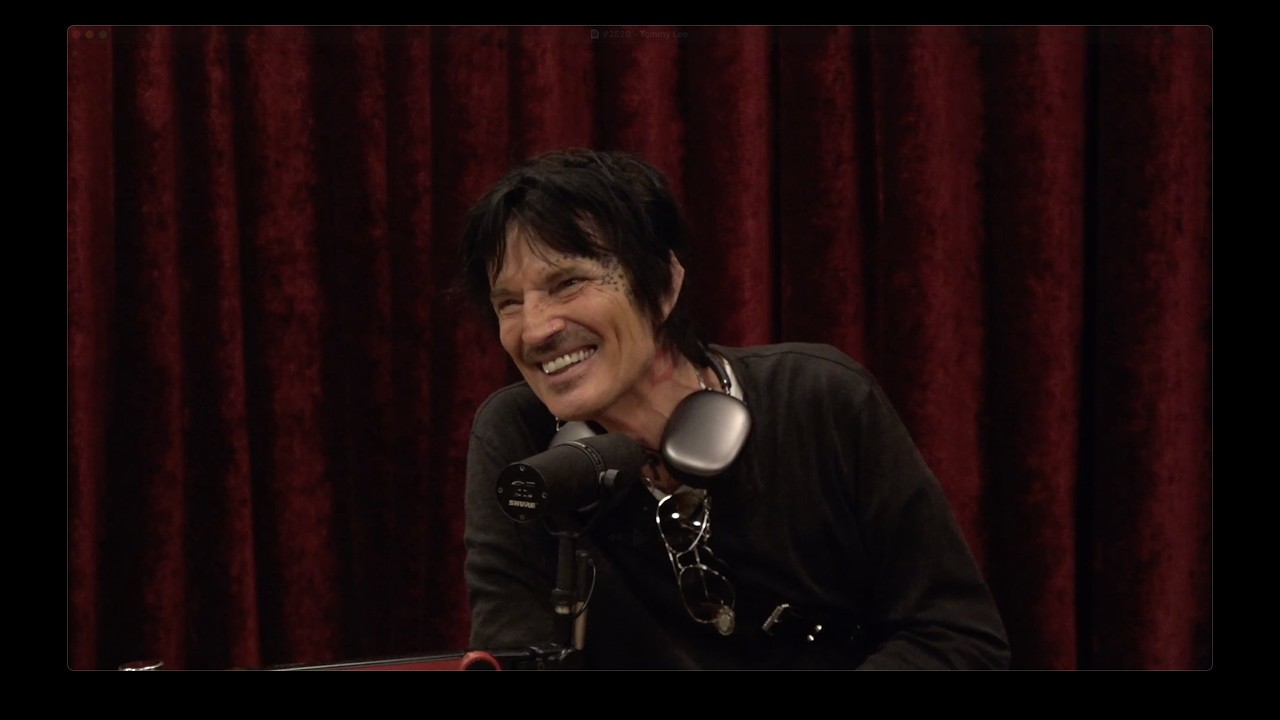
Mötley Crüe's Tommy Lee Rejects EV Transition in Supercar Market
PowerfulJRE
The music industry veteran and host argue that luxury electric vehicles are viewed as disposable electronics rather than valuable analog investments, threatening the traditional supercar experience.
## Background
Published on YouTube by the channel PowerfulJRE on June 30, 2026, this episode of the Joe Rogan Experience features solo musician, producer, and Mötley Crüe co-founder/drummer Tommy Lee. The description highlights Lee's latest album, "Tommyland Rides Again," and promotes Mötley Crüe's upcoming Return of the Carnival of Sins Tour.
## TL;DR
In this wide-ranging conversation, Joe Rogan and Tommy Lee reflect on the wild heights of 1980s rock stardom, discussing the early days of Mötley Crüe, innovative drum stunts like the gyroscopic wheel, and the band's strict independence from record labels. They contrast the visceral, timeless power of analog music and live performances against the oversaturated modern landscape of short attention spans and content fatigue. The discussion also spans personal milestones, Lee's unexpected eight-year obsession with the art of bonsai, and a deep dive into automotive design, comparing classic internal combustion masterpieces to modern electric vehicles.
## Atmosphere & style
The conversation carries a highly energetic, nostalgic, and brotherly vibe, flowing seamlessly between gritty rock 'n' roll war stories and grounded personal passions. Rogan brings his signature curiosity and animated humor, which perfectly complements Lee's enthusiastic, unfiltered, and self-professed "full on" personality. Listening feels like sitting in on a casual, late-night garage hang between two peers who share a deep, visceral appreciation for raw mechanical power, artistic freedom, and high-octane creative energy.
## Key takeaways
- [00:01](https://www.youtube.com/watch?v=q8HRqmkEKWw&t=1s) Tommy Lee's son is getting married after being together with his partner for seven years, a patient approach that Lee contrasts with his own relationship history.
- [00:25](https://www.youtube.com/watch?v=q8HRqmkEKWw&t=25s) To protect his sons from the destructive influences of Los Angeles, Tommy Lee kept them grounded by putting them to work with the crew while touring.
- [05:35](https://www.youtube.com/watch?v=q8HRqmkEKWw&t=335s) Reflecting on his career, Tommy Lee notes that Mötley Crüe never had a veteran rock mentor and attributes their success to luck, talent, and perfect timing.
- [13:56](https://www.youtube.com/watch?v=q8HRqmkEKWw&t=836s) The massive volume of daily uploads on streaming platforms like Spotify has created content fatigue and shortened modern audience attention spans.
- [20:14](https://www.youtube.com/watch?v=q8HRqmkEKWw&t=1214s) Mötley Crüe strictly maintained creative freedom by banning record label executives from Elektra Records from entering their recording studio.
- [24:32](https://www.youtube.com/watch?v=q8HRqmkEKWw&t=1472s) The sudden collapse of Billy Squier's career following his 1984 music video for 'Rock Me Tonight' serves as a major cautionary tale in the music industry.
- [36:56](https://www.youtube.com/watch?v=q8HRqmkEKWw&t=2216s) Tommy Lee has developed an intensive, eight-year obsession with the art of bonsai, inspired by traditional Japanese gardens, and now enters his trees into professional shows.
- [55:06](https://www.youtube.com/watch?v=q8HRqmkEKWw&t=3306s) A Prenuvo body scan showed Tommy Lee's lungs to be completely clear, despite a long history of smoking and a temporary relapse tied to drinking habits.
- [01:21:11](https://www.youtube.com/watch?v=q8HRqmkEKWw&t=4871s) David Goggins refuses to listen to music while running to build pure mental strength, a philosophy that Tommy Lee strongly disagrees with for his own workouts.
- [01:24:14](https://www.youtube.com/watch?v=q8HRqmkEKWw&t=5054s) Tommy Lee describes the 1980s music scene as an era where people could get away with anything due to the total absence of phone cameras.
- [01:28:51](https://www.youtube.com/watch?v=q8HRqmkEKWw&t=5331s) The physical demands of playing inverted on Tommy Lee's custom gyroscopic drum kits require extra spring mechanisms on the pedals and hi-hats to counter gravity.
- [01:30:31](https://www.youtube.com/watch?v=q8HRqmkEKWw&t=5431s) Tommy Lee's massive stadium roller coaster drum rig, the Cruecifly, requires him to use an oxygen bottle immediately following his nine-minute solo performance.
- [01:46:11](https://www.youtube.com/watch?v=q8HRqmkEKWw&t=6371s) Joe Rogan and Tommy Lee trace a dramatic evolution in communication technology from 1980s answering machines and pagers to the modern iPhone.
- [01:58:53](https://www.youtube.com/watch?v=q8HRqmkEKWw&t=7133s) Enzo Ferrari intentionally delivered the Ferrari Testarossa without a factory stereo, believing the car's engine note was the only melody a driver needed.
- [02:11:42](https://www.youtube.com/watch?v=q8HRqmkEKWw&t=7902s) Joe Rogan and Tommy Lee criticize Ferrari's new electric vehicle concept, designed with input from Jony Ive, for resembling a sanitized, plain iPhone.
- [02:14:57](https://www.youtube.com/watch?v=q8HRqmkEKWw&t=8097s) Public interest in premium electric vehicles is dropping rapidly, with electronic cars viewed as disposable junk compared to analog internal combustion vehicles that gain value.
- [02:18:40](https://www.youtube.com/watch?v=q8HRqmkEKWw&t=8320s) Mötley Crüe is launching The Return of the Carnival of Sins Tour, continuing to find fulfillment as multiple generations of fans attend their live stadium shows.
## Detailed walkthrough
### [00:01](https://www.youtube.com/watch?v=q8HRqmkEKWw&t=1s) Gold Teeth, Family Milestones, and Living Contrarily
Joe Rogan welcomes Tommy Lee to the studio, immediately noticing a diamond embedded in his tooth. Rogan mentions that his friend Cam recently got a gold tooth, which initially led him to tease him, but ultimately made him want one himself. Rogan notes he has a cap from a previous root canal that he is seriously considering swapping out for gold to capture that "little pirate thing" or "outcasty" aesthetic, which Lee enthusiastically encourages. Lee shares that he is only in town briefly and must head right back home to Los Angeles immediately after the podcast because his 29-year-old son is getting married.
Reflecting on his son's upcoming wedding, Lee admits he has been "tripping out" over how quickly time flies. He expresses immense pride that his son has been with his partner for seven years, pointing out with a laugh that he is thrilled his son did "exactly the opposite of his dad." By exercising patience and putting time into the relationship, his son has built a solid foundation. Rogan notes that growing up with a rockstar father and experiencing a chaotic lifestyle might naturally make a child crave stability, a yard, and a picket fence. Lee completely agrees, stating he is genuinely happy his son "pumped the brakes" to ensure he was building something real.
---
[00:25](https://www.youtube.com/watch?v=q8HRqmkEKWw&t=25s) Navigating the Madness of Los Angeles and Rock Stardom
The conversation shifts to the unique perils of growing up in Los Angeles, particularly with a famous parent. Rogan points out how incredibly easy it is to ruin one's life when surrounded by the wrong crowds and bad influences, observing that people often fall down destructive rabbit holes simply because "everybody else is doing it." Lee agrees, describing LA as a major hub for people getting strung out, noting that even good, intelligent people make a single bad decision and find themselves trapped if they have a "shady friends" magnet attached to them.
Rogan muses that while he does not live in the rock and roll world, it clearly acts as a magnet for eccentric and unstable individuals. He emphasizes how nearly impossible it must be to maintain normalcy when your baseline comparison is a circle of chaotic people, exclaiming to Lee, "you're the fucking drummer in Mötley Crüe. I mean, how are you supposed to be normal?" Rogan describes the surreal nature of performing on stage in front of a literal sea of humanity singing along, a bizarre reality that few can comprehend. Lee shares that he used to bring his sons out on tour to spend time together and keep them grounded by putting them to work. One son joined the lighting crew, while the other hilariously demanded to be in charge of the after-show passes so he could head out during the set and "hit all the chicks." Lee fondly recalls the pride and emotion of watching his son completely run the backstage scene, admitting it "brings a tear to my eye."
* **Son's Age:** 29 years old.
* **Relationship Duration:** 7 years before getting married.
* **Touring Duties:** One son worked with the lighting crew; the other managed the after-show guest passes.
---
[05:35](https://www.youtube.com/watch?v=q8HRqmkEKWw&t=335s) The Blur of Fame and The Rolling Stones' Switch
When asked how surreal it feels to look back at achieving the ultimate dream of rock stardom, Lee confesses that he still pinches himself daily. He attributes their massive success to a rare alignment of luck, talent, and perfect timing. When those elements collided, things moved at "supersonic speeds," leaving much of his career as a complete blur where he frequently relies on others to remind him of the crazy things they actually did. Asked if any veteran rock icons mentored him or offered advice on how to survive the madness, Lee states he never had a mentor figure like that. This prompts Rogan to bring up Keith Richards, marveling at how The Rolling Stones are still touring and performing spectacularly into their 80s, recalling how incredible they were when he saw them at the Circuit of the Americas (COTA) in Austin a few years prior.
Lee shares a wild story from when Mötley Crüe opened for The Rolling Stones at a stadium in Toronto on Halloween. Twenty minutes before the Stones were scheduled to take the stage, their tour manager invited Lee back to their dressing room. Lee walked into their world to find a personal bartender slinging drinks, with Mick Jagger relatively sober but Keith Richards and Ronnie Wood completely hammered—"walking on their lips" and practically falling over with their guitars. Lee was certain there was no way they could perform. However, the moment the lights went out and they kicked into "Start Me Up," an internal switch flipped. Suddenly, they were "fucking money," rocking out with absolute precision. Lee attributes this to them being masters of their craft who have done it for so long they know exactly how to control their altered states. Rogan observes that some musicians simply prefer to get messed up beforehand to ride the experience "like a wild bull."
---
[10:28](https://www.youtube.com/watch?v=q8HRqmkEKWw&t=628s) Timeless Performers and Ageless Passion
Rogan shifts topics to highlight another inspirational, ageless performer, pulling up a recent video of Rick Springfield on Instagram to show Lee. Rogan emphasizes that Springfield is 76 years old, yet he performs his classic hit "Jessie's Girl" with the raw passion and enthusiasm of someone who just wrote it. While watching the clip, Lee remarks that Springfield looks ripped and incredible, as if he works out every day, easily passing for a 30-year-old. Rogan finds it deeply inspiring, noting that while many people in their mid-70s are essentially waiting to die, Springfield is on stage shirtless, absolutely crushing life. Lee declares, "That's gonna be me still... rocking."
Rogan reflects on how much the music landscape has shifted since the 1980s, noting that during that era, the concept of an "old rock star" traveling the world didn't really exist. When the Stones toured in the late 80s for a new album, the general public reaction was confusion over why they hadn't retired. Today, musicians realize there is no reason to stop doing the most amazing thing a human being can do. Rogan notes a similar evolution occurred in hip-hop; older legendary acts like Public Enemy and Run-DMC used to be pushed aside as part of a young man's game, but they are now touring successfully and gaining renewed appreciation, citing an instance where Bruce Springsteen brought Public Enemy up on stage during one of his concerts.
---
[13:56](https://www.youtube.com/watch?v=q8HRqmkEKWw&t=836s) The Modern Music Deluge and Content Fatigue
Lee notes that while the enduring relevance of classic music is incredible, the current state of the industry is overwhelming due to sheer volume. He points out that Spotify reportedly releases roughly 300,000 songs a day, creating an immense amount of static that makes it impossible for even industry professionals like himself to keep track. He argues that this massive excess has "blown a hole through" original, high-quality music because so much of the modern output ends up sounding identical. Rogan agrees that while exceptional, undeniable music will always find a way to break through and go viral, there is an abundance of great music that listeners will simply never discover unless a friend personally introduces them to it.
The duo laments the death of traditional gatekeepers like mainstream radio and MTV, which previously acted as centralized hubs letting youth culture know exactly when a major band like Mötley Crüe dropped a new album or music video. While both agree it is fundamentally positive that anyone can upload music today, giving rise to more independent artists, it has created severe consumer fatigue across all entertainment mediums, including movies and television. Lee jokes about people paying for thousands of streaming subscriptions and still scrolling endlessly without finding anything to watch, suggesting society needs to "peel it back a little bit." Rogan compares the current state of entertainment consumption to modern dating apps; if a viewer experiences even three seconds of boredom while watching a movie on Netflix, they immediately "swipe" to the next option without giving the content a fair chance to develop.
* **Daily Spotify Uploads:** Approximately 300,000 songs per day.
* **Historical Discovery Hubs:** Traditional Radio and MTV music videos.
[17:45](https://www.youtube.com/watch?v=q8HRqmkEKWw&t=1065s) The Death of the Audience Attention Span
Joe Rogan and Tommy Lee express deep concern over how modern streaming platforms and social media have radically diminished human attention spans. Rogan notes that he would love to see internal data from Netflix regarding how long an average viewer actually watches a show or movie before shutting it off. He bets that while audiences in the old days routinely watched a film all the way to the end, only about 20% do so today. Tommy thinks that estimate might even be generous, lamenting, "everybody, it's short attention span life right now."
This shift forces creators across all artistic domains—whether filmmaking or songwriting—to compress their work to satisfy an impatient audience. Rogan explains that creators are essentially dealing with "six-year-olds," meaning that if a piece of art does not instantly grip the viewer within three or four seconds, they will simply skip to the next option. Consequently, artists feel compelled to put all their best material right at the very beginning, a compromise both men find highly detrimental to artistic integrity because it entirely eliminates the room for slow-burning suspense.
---
[20:14](https://www.youtube.com/watch?v=q8HRqmkEKWw&t=1214s) Industry Vampires and the War on Creative Freedom
The conversation pivots to classic rock tracks that would likely fail to get produced under today's hyper-impatient standards. Rogan highlights Led Zeppelin's "Whole Lotta Love," pointing out how the song bizarrely dissolves into a minute and a half of abstract sounds and cymbals before roaring back with an iconic guitar solo. Similarly, when Lynyrd Skynyrd initially released "Free Bird," their record label strongly opposed it, arguing that a seven-minute track took far too long to get going and would never fly. Rogan adamantly states that it went on to become one of the greatest anthems in history, featuring "perhaps the greatest guitar solo in the history of the fucking human race."
Tommy explains that this friction always stems from the "money people" at record labels who view art purely as a financial commodity to be pimped out. Because executives are always hunting for the next big act to fund their luxury lifestyles, their creative advice is notoriously terrible. Tommy shares a specific rule that Mötley Crüe enforced while signed to Elektra Records to protect their own work.
> "They were never allowed in the studio. No one from the label was ever allowed. We allowed them once, and he came in and started making like... making changes or suggesting edits and stuff. We're like, 'Out. Out. You'll get it when it's done here.'"
Rogan is disgusted by the thought of non-musicians trying to alter creative works when they have no understanding of music or what key a song is in. He references a lyric from country artist Zach Bryan's song "Cold Damn Vampires," which perfectly describes how corporate structures build empires off the blood and labor of creators while baselessly tricking themselves into believing they possess genuine artistic insight.
---
[24:32](https://www.youtube.com/watch?v=q8HRqmkEKWw&t=1472s) The Cautionary Tale of Billy Squier
Rogan brings up a legendary cautionary tale about the dangers of listening to record executives: the career-altering downfall of rock star Billy Squier. Back when Rogan was in high school, Squier was an absolute superstar and a massive sex symbol with huge hits like "The Stroke" and "Lonely Is the Night." However, his career ground to a sudden halt following the release of his 1984 music video for "Rock Me Tonight."
The video featured Squier dancing around a bedroom with pastel-colored satin sheets, wearing a pink tank top, and performing effeminate, bizarre choreography that included skipping around and crawling on his hands and knees. Rogan recalls the immediate and harsh cultural backlash from kids in high school, who instantly dismissed Squier because of it.
Rogan reads an excerpt from the 2011 book *I Want My MTV: The Uncensored Story of the Music Video Revolution*, which labeled it one of the worst music videos ever made. The text notes that Squier's concert ticket sales collapsed immediately after the premiere, leading him to fire his managers and accuse director Kenny Ortega of deceiving him and altering his original concept. Rogan insists that Squier easily had the talent to be as enduring as John Mellencamp, making it a tragedy that a single poorly conceptualized music video completely derailed his trajectory.
---
[29:08](https://www.youtube.com/watch?v=q8HRqmkEKWw&t=1748s) The Visceral Drug of Great Music
Reflecting on long-term success, Rogan commends Tommy on how Mötley Crüe has managed to endure across generations. Rogan confesses that whenever he is working out in the gym and "Kickstart My Heart" comes on, he instantly gets a surge of physical strength. Tommy is deeply humbled by the feedback, mentioning how rewarding it is to hear their music used as the literal soundtrack to high-energy American culture, like the opening kickoff of the Super Bowl.
Rogan requests his producer to play a snippet of "Kickstart My Heart" in the studio, despite knowing they will have to cut the audio out of the final YouTube upload to prevent the corporate "money people" from demonetizing the episode. Rogan describes the track as pure, unadulterated fuel.
> "If you were running in a race and you're thinking about quitting and that song comes on your headphones, you're like, 'Let's fucking go. LET'S FUCKING GO.' You know, like songs like that, they really do give you energy. They're really are like a drug."
The two men marvel at the profound biological power of music. While a brilliant joke loses its potency after you hear it a few times, a legendary song can be put on loop indefinitely without losing its impact. Rogan notes that sound frequencies possess the unique capability to alter a person's physical state, give them goosebumps, and literally change the frequency of their soul.
---
[32:23](https://www.youtube.com/watch?v=q8HRqmkEKWw&t=1943s) Sound Frequencies and the 432 Hz Conspiracy
Harnessing this concept of physical sound manipulation, Tommy asks Rogan if he has heard about recent reports claiming a doctor in Asia is on the verge of treating cancer using targeted sound frequencies. While Rogan hasn't seen those specific reports, neither man would be surprised given how deeply frequencies interact with human biology.
Tommy introduces the popular historical conspiracy theory surrounding standard musical tuning. He explains that master classical composers like Bach and Beethoven originally tuned their music to a fundamental pitch of $432\text{ Hz}$, which is widely believed to be a natural, healing frequency. However, the conspiracy alleges that during the Nazi regime, Joseph Goebbels or Adolf Hitler spearheaded a global shift to change the standard pitch of music up to $440\text{ Hz}$.
According to the theory, this higher frequency is inherently more aggressive and tense, and it was intentionally pushed onto the public to induce angst and compliance while priming wartime soldiers for conflict. Hearing this, Rogan offers a sharp, witty dose of historical context, jokingly reminding Tommy, "well, they were also given meth."
[34:22](https://www.youtube.com/watch?v=q8HRqmkEKWw&t=2062s) Sound, Frequencies, and the Healing Power of Music
Joe Rogan and Tommy Lee transition from discussing historical military stimulants to the profound therapeutic potential of audio frequencies. When asked by Lee if he believes in sound therapy or frequency healing, Rogan affirms that "sound has a profound effect on the human body". They discuss sound baths and meditation experiments where people lie on their backs to absorb healing vibrations. Rogan points out that the sudden energy surge from a great song—like Mötley Crüe's "Kickstart My Heart"—is concrete proof of how sound fundamentally shifts human emotion and physical chemistry.
The duo highlights that music should be a standard component of medical recovery. Rogan jokes that listening to "some dope music" in a hospital bed after surgery is a massive upgrade over listening to other patients moan in agony in the next room. Lee completely agrees, emphasizing the critical value of intentionally introducing positive vibes and life-giving energy into a healing environment.
* Rogan notes that a song's impact is multidimensional: the sound waves, the messaging in the lyrics, the singer's vocal texture, and the shared visual energy of a crowd all interact to alter a person's state of mind.
* Lee mentions that when he isn't in the mood for active listening, he regularly keeps high-definition YouTube videos of traditional Japanese gardens playing at home just to anchor himself in a chill, grounding background space.
[36:56](https://www.youtube.com/watch?v=q8HRqmkEKWw&t=2216s) Tommy Lee’s Eight-Year Obsession with Bonsai
Lee reveals a deep passion for the ancient art of bonsai, a hobby he picked up roughly eight years prior to the conversation. Whenever Mötley Crüe toured Japan, Lee found himself magnetically drawn to the temple gardens in Kyoto and across the country. He describes walking through them with his "jaw on the floor," completely overwhelmed by a sense of peace he had never experienced anywhere else. Driven to bring that feeling into his everyday life, he began studying online tutorials and eventually built a dedicated workshop at his home.
Rogan asks whether a bonsai is simply a standard tree that would grow to full size if left alone, which Lee confirms. Lee explains that the practice centers around strategically dwarfing the plant through meticulous care, noting a common misconception: the word "bonsai" literally translates to "tree in pot" rather than referencing a specific genetic species of tree. Rogan pulls up data indicating that the practice originated in 6th-century China before being adopted and adapted by Japanese masters. Lee boasts an impressive personal collection, which includes two ancient specimens that are over 300 years old.
* Lee describes his daily routine as spending hours in his workshop tending to benches of "in-progress" trees, which involves bending branches, wiring, pruning, and treating the plants for pests.
* Lee's 300-year-old tree is a redwood featuring a massive trunk packed tightly into a remarkably small pot, leading Rogan to joke, "That seems rude," given how spectacular and massive redwoods grow in the wild forests of Northern California.
* Lee has recently transitioned from a private practitioner to an exhibitor, having entered his custom-trained trees into two professional bonsai shows this year.
* Lee reflects on how the slow, meticulous nature of the craft serves as the ultimate balancing tool to the chaotic, fast-paced life of a rock star: "It lets me escape everything for a couple of hours... I check out."
[42:52](https://www.youtube.com/watch?v=q8HRqmkEKWw&t=2572s) The Strategic Architecture of Zen Gardens
The conversation shifts to the broader cultural philosophy underpinning Japanese design. Lee explains that his journey into bonsai opened his eyes to the strict, highly intentional rules governing Zen gardens. He highlights a striking rule of thumb: "You’ll never find a straight path. Ever." Whether walking on land or crossing water via a zigzagged or highly arched bridge, the lines are deliberately curved to disrupt momentum.
Lee explains that the chief objective of a Zen garden's layout is to force a visitor to "slow the [f***] down." Because straight sightlines are eliminated, new vistas are only revealed once a person physically rounds a corner. This architectural choice demands that individuals pause at each transition, look out, take in their surroundings, and remain fully present in the moment. Lee attributes this practice to helping him manage a life that is otherwise constantly rushed. Rogan notes how deeply attractive this sense of flow and artistic clarity is to modern society, pointing out that high-end contemporary home architecture heavily borrows this minimalist, peaceful Japanese flavor to make residences feel like sanctuaries rather than rigid museums.
[46:16](https://www.youtube.com/watch?v=q8HRqmkEKWw&t=2776s) Disconnecting from Cities and the Importance of Green Spaces
Sharing his past experience living in a house perched on a hill with a massive view, Lee admits that static city views ultimately offer very little to a person's well-being compared to the restorative energy of navigating a winding, natural sanctuary. Rogan echoes this sentiment, noting that while staying in a hotel in the middle of New York City offers an exciting, "dope" rush, living permanently buried in concrete messes with his headspace. Both men express a deep, almost instinctual need to see green, living trees to feel regular mental clarity. Lee jokes that he must have been a tree in a past life because his eyes automatically lock onto vegetation the second he enters any urban environment.
Rogan praises the visionary designers of New York City for preserving Central Park, emphasizing what a monumental triumph it is to keep a massive, undeveloped sanctuary right in the center of the world's dense financial hub. Rogan tasks his producer with looking up the park's exact size, guessing it sits somewhere between 1,000 and 2,000 acres. The actual figure is confirmed to be 843 acres. They express deep gratitude toward the historic figures who protected the space from "vampires"—the greedy developers who perpetually look to slice up public parks to erect profitable apartment complexes.
* Rogan mentions his recurring comedy show format, *Protect Our Parks*, co-hosted with comedians Ari Shaffir, Shane Gillis, and Mark Normand.
* Rogan explains that the ironic name originated from an early episode where Shaffir went on an intense tirade attempting to save a local park that developers ultimately demolished anyway.
[50:16](https://www.youtube.com/watch?v=q8HRqmkEKWw&t=3016s) The Dangers and Ethics of Urban Horse Carriages
Lee brings up a tragic video he stumbled across on Instagram while traveling to the studio, detailing an accident where a horse drawing a tourist carriage in New York City panicked and bolted. The runaway horse violently flipped the carriage, throwing the driver completely out of the cart. The driver subsequently died from his injuries on the way to the hospital. While the footage Lee saw did not capture what initially startled the animal, the incident sparks a passionate critique from both men regarding the ethics of using horses for urban entertainment.
Rogan, an avid lover of horses, voices sharp opposition to the entire practice of urban horse-and-buggy rides. He states flatly that horses have absolutely no business "clicking around on the asphalt" in the middle of busy, loud city streets. He dismisses the industry as a "gross touristy thing" that completely strips the animals of their natural lifestyle, arguing that horses belong strictly in wide-open fields and mountain ranges where they can run and graze freely.
[51:27](https://www.youtube.com/watch?v=q8HRqmkEKWw&t=3087s) The Unpredictability of Horses and Animal Connections
Joe Rogan and Tommy Lee react to a chaotic video of a horse-drawn carriage accident where the driver accidentally left his seat—supposedly to take a photo of the passengers. When the family started climbing back into the buggy, the horse got spooked and quickly "peels out," taking a sharp right turn that flips the entire carriage over. The harrowing footage prompts Rogan to declare that he does not mess around with riding horses, prompting Tommy to agree and share that he once "got my ass thrown off" a horse and decided he was completely done with it. Rogan notes that while it is a different story for a professional cowboy who handles them daily, he does not personal need to ride animals for entertainment.
Rogan relates this to a trip to Thailand where he rode elephants. He explains that elephants require establishing a relationship first by feeding them sugarcane, petting them, and offering up peaceful, gentle energy before they will lift a leg to let you climb onto their backs to go through the jungle. Even so, Rogan admits he would have been perfectly happy just hanging out and feeding them without riding them, joking that the concept feels bizarre: "Like King Chimp. I'm King Chimp on the big ass [__] elephant. Look at me." Despite the danger, both men acknowledge that horses are beautiful and form incredibly deep bonds with humans. Tommy mentions that he knows people who have a "next level love" for them, operating like real-life horse whisperers. Tommy recalls doing equine therapy for a couple of days while staying at a rehab facility and found the experience genuinely cool.
* **The Illusion of Calm:** Rogan observes that horses are mostly peaceful and chill, especially once they are broken, but they still possess massive "chompers" and incredible jaw power that can easily clamp down on a hand if they get annoyed.
---
[55:06](https://www.youtube.com/watch?v=q8HRqmkEKWw&t=3306s) Smoking Vices, Recovery, and Health Statistics
Tommy expresses his excitement that he is allowed to smoke inside Rogan's studio, prompting Rogan to offer to light up a cigar with him. Tommy admits he has been smoking "forever" and once attempted to quit a few years prior. He managed to go nearly a year before relapsing. When Rogan asks what brought him back, Tommy points to his drinking habits at the time, explaining that having a cocktail or a beer and smoking cigarettes just go hand-in-hand in the world of rock and roll. His original motivation to quit stemmed from a phase where he wanted to hit the reset button and "quit [__] everything." Rogan remarks that smoking is often the very last vice to go for people going through recovery. Tommy notes that figures like Keith Richards are still out there ripping cigarettes and doing fine. He adds that he recently had his lungs checked via a Prenuvo body scan, and the doctors told him he was completely clear, which left him incredulous but relieved.
Rogan uses the Perplexity AI search tool to look up the exact percentage of cigarette smokers who actually develop lung cancer. While Rogan initially guesses it is under 5%, the live search results clarify that roughly 10% to 20% of people who smoke during their lives will develop lung cancer, with many studies settling around 15% (or 1 in 7 current smokers). In contrast, people who have never smoked face only a 1% to 2% lifetime risk. Rogan points out that while only a minority of smokers get cancer, smoking still accounts for 80% to 90% of all lung cancer deaths.
* **The Nicotine and COVID-19 Anomaly:** Tommy recalls hearing confusing reports during the pandemic suggesting smokers had some natural prevention against COVID-19, noting that he personally never caught the virus.
* **The Mediterranean Diet Contradiction:** Rogan brings up a study indicating that people in Europe who consume high-polyphenol diets rich in extra virgin olive oil, fruits, and wine seem to show better cardiovascular health profiles. However, the data confirms that a good diet only modestly improves risk markers and cannot entirely neutralize or cancel out the cancer and lung damage caused by smoking.
---
[01:02:00](https://www.youtube.com/watch?v=q8HRqmkEKWw&t=3720s) Cognitive Benefits of Tobacco and Pink Floyd Anecdotes
The conversation shifts to the perceived cognitive benefits of tobacco among highly creative and intelligent people. Rogan notes that a massive percentage of people in Alcoholics Anonymous rely heavily on coffee and cigarettes because it offers a "very manageable high" that leaves you feeling just slightly lightheaded. Rogan mentions a piece of trivia he heard from comedian Tony Hinchcliffe, claiming that the members of Pink Floyd were "high as [__] on cigarettes" and smoked all day long while writing *The Wall*. However, producer Jamie pulls up a live search showing that guitarist David Gilmour actually claimed he never smoked cigarettes, and that the band's habits were famously more centered around marijuana and hashish. Rogan laughs off the mistake, admitting he accidentally repeated misinformation spread by Hinchcliffe.
Despite the mix-up, Rogan recalls the incredible experience of hanging out with bassist Roger Waters when he appeared on the podcast, followed by attending his politically loaded live concert. Rogan describes the show as insane, featuring massive screens and jaw-dropping visuals. He laughs remembering how their mutual friend, comedian Ari Shaffir, was completely "high as [__] on acid" during the concert and spent the middle of the show weeping. Tommy laughs, saying he doesn't think he could handle taking acid around that many people, but Rogan respects Shaffir's composure, calling him an "experienced passenger" who can ride heavy psychedelic waves without throwing up.
* **Stephen King's Writing Block:** Rogan shares that author Stephen King explicitly stated that his writing suffered after he quit smoking cigarettes, claiming his synapses simply did not fire as fast without them.
* **The Return of Senses:** Tommy remembers that during his brief stint of quitting smoking, the most immediate change he noticed was that his taste receptors unclogged and absolutely everything tasted better.
---
[01:05:34](https://www.youtube.com/watch?v=q8HRqmkEKWw&t=3934s) Appreciating Survival and the Lack of Flying Cars
Reflecting on their wild pasts, Rogan asks Tommy if he ever looks back and wonders how he is still alive. Tommy confesses that he pinches himself on a daily basis because, technically speaking, he shouldn't be here. He attributes his survival to a genuine desire to stay alive and witness the future, though he admits he is a bit pissed off that technology hasn't advanced as fast as promised. "The year 2000, I mean, where's my [__] spaceship?" Tommy asks, joking that society was supposed to be "full Jetsons" by now and concluding that the creators of those futuristic promises lied. Rogan argues that the lack of flying cars is a practical logistical issue, pointing out that managing traffic on a standard grid is easy because authorities can simply close off a street to catch someone, whereas flying commuters would create complete chaos.
The Risks of Flying Cars and Stolen Planes
Joe and Tommy begin discussing the concept of flying cars, noting that tech companies are actively working on them. Tommy mentions a company called Jetson (transcribed as "Jet One") that makes a one-man drone helicopter. While Tommy and his manager joked about getting a couple of them, Joe warns him against it, advising to "let those things get worked out for a few years" and let the "eggheads" iron out the early bugs, drawing a parallel to how glitchy early cell phones used to be. They wonder about the catastrophic failures that could happen, like running out of battery or gas mid-air. Tommy recalls a time when he was 16 and his friend's 1970 Chevrolet Chevelle ran out of gas, perfectly coasting right up to the gas station pump with no pushing required. However, they laughingly agree that if a personalized drone goes on empty, the consequence is just falling to pieces.
This leads Joe to bring up a Hulu documentary about Richard Russell, the airport ground crew worker who stole a Horizon Air passenger plane in Seattle, flew it over Puget Sound, and eventually crashed it on a remote island. Joe describes the tragic but surreal nature of the event, where the man was having casual radio conversations with air traffic control. The authorities tried to guide him to a safe landing, but Joe notes that "the moment he got off the ground, he's a dead man" because he didn't actually know how to land. Tommy mentions seeing clips of the audio where the man just seemed ready to "wrap it up" and even joked about whether the airline's insurance would cover the incident. They find out the documentary is called *Sky King*—the viral nickname given to him by the internet. Joe muses that giving him a "rad title" like that might unfortunately encourage other people to try similar reckless stunts.
- Jetson makes a one-man drone helicopter that looks like a personal flying car.
- The 2018 Horizon Air Q400 incident involved a 70-minute unauthorized flight over Puget Sound before crashing on Ketron Island.
- A Hulu documentary titled *Sky King* chronicles the event.
---
Living in LA and the "Stupid World"
The conversation about human stupidity prompts Tommy to mention his recently released song, "Stupid World." He explains that the track is a direct response to modern society reaching "epic stupid proportions," where not a single day goes by without him seeing something entirely ridiculous. Joe points out that Tommy lives in Los Angeles, which he calls "one of the stupidest places on earth." Tommy agrees with a laugh, questioning his own choices on why he still lives there despite his love for the city. Joe acknowledges that LA is incredibly beautiful with perfect weather and mostly cool people, but emphasizes that it is slowly turning into a "new Detroit."
Joe explains that the traditional economic lifeblood of Los Angeles—the film business, television, and late-night TV—has completely dried up, removing the core industry that once made the city special. Because remote work and shifting industries mean people no longer *have* to stay, Joe criticizes the local government for punishing residents with heavy taxes, overwhelming regulations, and making it incredibly difficult to safely conduct business or "just feel normal." He expresses frustration with officials who gaslight the public about these issues and act surprised when people flee the state. Tommy adds that while he hears about the mass exodus from LA, he hasn't personally noticed a change in the relentless traffic, making him wonder if the statistics are sometimes overhyped. Joe responds that the numbers are real, but LA is simply so massive that even losing millions of people doesn't fix the congestion.
- Tommy Lee released a song titled "Stupid World" addressing modern societal absurdity.
- Joe compares LA's current economic trajectory to the decline of Detroit due to the entertainment industry drying up.
- The gridlock traffic remains unbearable, particularly commuters driving to Orange County or Irvine via the 405 freeway at 4:00 PM.
---
The Commute and Stress Decouplers
They discuss the brutal reality of Southern California commuting, particularly for people who live in safe, suburban areas like Irvine but commute daily to LA. Joe says he could never handle a standard three-hour daily round-trip commute unless he gamed the system by waking up at 5:00 AM, driving to an LA gym before the rush, and only dealing with traffic on the way home. Tommy reflects on how tragic it is that people waste years of their finite lifespans sitting in gridlock for a drive that would only take 20 minutes without traffic.
Joe points out that the silver lining of a long commute is the ability to listen to audiobooks and podcasts. He shares that his Tesla's Autopilot feature acts as a massive "stress decoupler" during heavy traffic. By letting the car handle lane changes, braking, and stopping at red lights while he simply keeps his hands lightly on the wheel, he can decompress without the rage of stop-and-go driving. Tommy notes that he personally prefers audiobooks over physical reading because his eyes get strained and tired when trying to read text at night, causing him to lose interest. Joe agrees that reading in bed puts him to sleep, but points out that physical reading allows your imagination to uniquely construct the characters' voices, which doesn't happen with narrated tapes.
---
Multitasking, Music, and David Goggins
For Joe, consuming audiobooks is purely a matter of time management. Because he frequently interviews high-level guests like astrophysicists with complex theories, he has to diligently absorb large volumes of data in short windows. He maximizes his schedule by listening to audiobooks in the gym, in the sauna, and during his commute. Tommy mentions that it's easy to get distracted during a heavy workout and lose track of what the narrator is saying. Joe admits that if a workout gets too intense, he has to turn the book off, agreeing with the philosophy of "do what you're doing when you're doing it." They both dismiss the idea of multitasking as a myth, with Joe stating that you are always "robbing from Peter to pay Paul" by dividing your cognitive focus.
While Joe prefers working out in absolute silence when trying to focus deeply, he makes a strict exception for music. He and Tommy agree that music provides essential energy and acts as the "ultimate companion" for a workout because it fuels you without distracting you with complex concepts. Joe then contrasts this with extreme athlete David Goggins, who famously refuses to listen to music while training because he considers it "cheating." Tommy initially confuses Goggins with biohacker Bryan Johnson—the "live forever guy" who uses his son's blood plasma—but Joe clarifies that Goggins is the ultra-hardcore former Navy SEAL. Joe describes Goggins' unbelievable cardiovascular feats, noting that he famously runs professional fighters into the ground while casually talking to them.
- Joe listens to technical audiobooks in the sauna, car, and gym to prepare for complex podcast guests.
- David Goggins famously ran eight 100-mile ultramarathons over eight consecutive weekends (800 miles total).
- Goggins rejects workout music to avoid using it as a psychological crutch.
What aspect of Tommy's new music or his experiences traveling on tour would you like to explore next?
By the way, to unlock the full functionality of all Apps, enable [Gemini Apps Activity](https://myactivity.google.com/product/gemini).
[01:21:11](https://www.youtube.com/watch?v=q8HRqmkEKWw&t=4871s) The Brutal Reality of David Goggins and the Power of Music
Joe Rogan describes the unfathomable physical endurance of ultra-marathon runner David Goggins, noting that he is in "insane shape" at 50 years old despite having completely destroyed knees that are bone-on-bone. Goggins refuses to listen to music while running because he considers it "cheating." Tommy Lee strongly disagrees with this mindset for himself, laughing and admitting, "I like to cheat... Give me that fucking music." Rogan explains that to Goggins, the mental strength must come entirely from the brain because "that music's not always going to be there."
The two reflect on the intense psychological battles Goggins faces when running 100-mile races eight weekends in a row. They joke about the internal conversations one must have during such intense suffering, imagining arguments between self-doubt and motivation. Rogan notes that at Goggins' level, it is no longer just a regular internal dialogue but a constant process of "crushing down weakness" and battling demons. They conclude that the world needs all types of people—from David Goggins to rock stars like Tommy Lee and David Lee Roth—to make it beautiful.
* Goggins runs 100-mile races up to eight weekends in a row.
* Tommy Lee views music as an "awesome supplement" rather than cheating.
[01:24:14](https://www.youtube.com/watch?v=q8HRqmkEKWw&t=5054s) Blowing Up in 1980 and the Wild West Era of Rock
Joe Rogan asks Tommy Lee about the exact year Mötley Crüe broke out, and Lee confirms it was around 1980 when he was only 17 or 18 years old. They marvel at how different the world was back then, long before the internet or cell phones, realizing that Jimmy Carter was still the president right before Ronald Reagan took office in 1981. Lee mentions the band's biographical film *The Dirt* and shares how 18-year-old fans frequently email him asking if the rock 'n' roll lifestyle was truly as wild as depicted in the movie.
Lee answers those kids with a definitive "100%," adding that young fans today are often bummed out because they realize they "will never ever get to experience that." He describes the 1980s music scene as "full on till the wheels fall off," a unique era where "you could get away with fucking murder" because there were no phone cameras tracking your every move. Looking at an archival photo of the band from their *Too Fast for Love* era, Rogan comments that it looks like another world, even noting that the font of the band's name looks ancient.
* Mötley Crüe broke out around 1980.
* Tommy Lee was 17 to 18 years old when the band achieved massive fame.
* The band's early days are famously documented in their autobiography and movie, *The Dirt*.
[01:27:17](https://www.youtube.com/watch?v=q8HRqmkEKWw&t=5237s) DIY Drum Risers and Homemade Backyard Pyro
Looking closer at the early band photo, Tommy Lee points out their "cheesy cloth backdrop" and recalls the early days playing at the Whisky a Go Go. He shares a fond memory of building his very first illuminated drum riser from scratch alongside his dad and his drum tech. Lee's dad was a mechanic who enthusiastically supported his son's rock aspirations, even going so far as to manufacture custom, highly illegal pyrotechnics in their backyard.
Lee details how his dad would cut big blocks of wood, run electrical prongs through them, connect wires, place a pipe over the setup, and fill it with gunpowder. They would test these homemade bombs in the backyard, sending massive mushroom clouds into the sky and leaving the neighbors completely bewildered. "He just loved it," Lee says warmly, noting that his dad would also load all the gear into his van and personally drive Lee to his gigs, calling him "the best dad fucking ever."
[01:28:51](https://www.youtube.com/watch?v=q8HRqmkEKWw&t=5331s) Playing Drums Upside Down in a Gyroscope
The conversation shifts to a photo of Tommy Lee's legendary "hamster wheel" drum kit setup. Lee explains that the rig was fully gyroslipped, allowing him to loop around from right to left and back to front, playing completely upside down. Rogan asks how difficult it is to physically play from that position, and Lee explains that it requires completely altering his playing dynamics. Without gravity pulling his hands down toward the drums, he has to actively push against gravity, making the performance three times harder physically.
In addition to the physical toll, Lee had to invent technical modifications to make the drum kit function upside down:
* **Bass Drum Pedals:** The chain-driven footboards would flop down due to gravity when inverted, requiring Lee to install custom springs underneath the pedals to keep them taut and upright.
* **Cymbals and Hi-Hats:** Standard cymbals are designed to hang downward. When flipped upside down, the two hi-hat cymbals would naturally fall open, forcing him to add another spring mechanism to keep them closed so he could manually control them.
[01:30:31](https://www.youtube.com/watch?v=q8HRqmkEKWw&t=5431s) The Inception of the Drum Stunt and Burning 13 Miles of Cardio
Tommy Lee reveals that his obsession with crazy drum stunts began before Mötley Crüe even formed. He recalls watching the Pat Travers Band live, featuring the legendary Tommy Aldridge on drums. While Aldridge was absolutely "murdering the fucking drums" during his solo, Lee noticed people in the crowd leaving to grab a beer, use the restroom, or smoke a joint in the lobby. Lee realized Aldridge had failed to hold the audience's visual attention because people simply couldn't see what a drummer was doing behind the kit. From that moment on, Lee vowed to find a way to give the audience a better view.
This evolution ultimately led to his massive stadium roller coaster rig—dubbed the "Cruecifly"—which traveled from the front of the arena to the back while spinning upside down. Lee admits the 9-minute stunt is incredibly grueling, requiring him to hit an oxygen bottle immediately after finishing while guitarist Mick Mars plays a solo. Years ago, out of curiosity, Lee clipped a jogging pedometer to his shoe during a two-hour show; when he checked it afterward, it read **13.3 miles**, explaining why he and fellow drummer Travis Barker stay so lean despite eating whatever they want. Rogan agrees that drumming is the most athletic, sports-like role in all of music, and Lee takes pride in that, noting that the drummer acts as the "heartbeat" responsible for setting the pace and physically moving the crowd.
[01:37:22](https://www.youtube.com/watch?v=q8HRqmkEKWw&t=5842s) Self-Taught Rhythm and the Marching Band Foundation
Tommy Lee describes the intense, draining, but ultimately "rad" physical nature of drumming, emphasizing that he absolutely lives for it. When asked if he took formal lessons, Lee reveals that he was entirely self-taught in his early years. His first structured musical experience came early in high school when he joined the marching band. However, he clarifies that it wasn't a traditional drum kit experience; it was rigid drum corps training focused on rudiments.
Lee's true introduction to the drum kit happened when he managed to convince his school to let him borrow their jazz drum set. He would bring the kit home, put on his favorite records, and simply play along. He explains that he never took physical lessons because music "was just in me." He possesses a natural ability to hear a rhythm and instantly replicate it. He even figured out how to hold the sticks entirely on his own, moving naturally from tapping with forks and spoons as a child to handling proper drumsticks without conventional instruction. Joe Rogan notes how remarkable it is that so many legendary musicians are self-taught, prompting Lee to cite Jimi Hendrix as a prime example of someone who just figured it out on his own, famously playing a right-handed guitar upside down and left-handed. They agree that teaching yourself allows you to develop a completely unique style.
* **Early Experience:** High school marching band and drum corps rudiments.
* **First Kit:** Borrowed a jazz drum set from his school to practice at home by playing along to records.
* **Stick Grip:** Completely self-taught and intuitive, skipping conventional training.
---
[01:39:03](https://www.youtube.com/watch?v=q8HRqmkEKWw&t=5943s) The Tribal Power of the Drum Circle
Rogan reflects on the evolution of drumming, noting that compared to early rock and roll, elite modern drummers like Tommy Lee and Travis Barker play with an immense level of power. Lee agrees passionately, pivoting to the primal energy of a drum circle. He describes how a gathering of multiple drummers organically grows into a massive, heavy, tribal force where everyone becomes entirely captivated and moved by the rhythm.
Lee contrasts the aggressive power of percussion with the emotional weight of a piano, noting that while the right chords on a piano can make a listener cry, the power of rhythm serves a completely different, visceral purpose. He admits that his obsession with rhythm made him a permanent class clown during his school days. He was constantly getting into trouble for loudly tapping on the classroom tables, or sitting in the back making realistic water-dripping noises that had the entire class looking around for a leak. Rogan points out that drums have been deeply embedded in human tribal culture since the beginning of time. He highlights historical uses, such as drum cadences played on ancient ships to keep rowers in perfect pace, proving that humans have always inherently understood the vital importance of a rhythmic heartbeat.
---
[01:41:00](https://www.youtube.com/watch?v=q8HRqmkEKWw&t=6060s) Exploring New Sonic Textures: From Bongos to Hang Drums
When Rogan asks if he ever plays around with bongos, Lee confirms that he loves hand percussion, including bongos and congas. He shares that over the last couple of years, he has fallen in love with playing a hand drum—often referred to as a hang drum—which he jokingly describes as looking like a "flying saucer." He praises the instrument for being incredibly melodic, beautiful, and "zeny sounding." Because it bridges the gap between percussion and melody, it allows him to craft unique, captivating rhythms based on how the steel is tuned. For Lee, the hang drum offers a soothing, peaceful escape that represents the total opposite of his aggressive style with Mötley Crüe.
Lee emphasizes that even after decades of playing, he is still fundamentally "on the hunt" for new sounds that can physically move a listener and get deep inside them. Self-identifying as a sonic "tweaker," he explains his process of taking random objects and manipulating them until they function as percussion. For example, he describes hitting large elkhorns that produce a sound mimicking a wood block, but pitched way down into a deep, resonant note. "That's my job," Lee says with a smile. "I'm here to move you, man." Rogan laughs, noting that being a legendary rock percussionist is a "cool job" that definitely "doesn't suck."
---
[01:43:04](https://www.youtube.com/watch?v=q8HRqmkEKWw&t=6184s) The Chaos and Freedom of the Songwriting Process
Rogan asks Lee about his specific creative process when building a new song, wondering if he begins with a strict beat in his head or simply jams until inspiration strikes. Lee admits that his method changes every time, lacking any strict formula. Sometimes a personal experience will spark a single word or a vocal chant, which prompts him to pick up a guitar and write a heavy riff. Other times, he creates a "killer beat" first and layers the guitars on top of it.
Lee laughs at artists who maintain a rigid, methodical approach, such as always writing the lyrics first. Speaking like a true drummer, Lee argues that you have to get people to move physically before you can seduce them with complex lyricism. He insists that listeners won't stick around to hear the words if the rhythm doesn't captivate them from the very first second. Rogan agrees that having multiple creative pathways is far superior because it prevents songs from sounding repetitive. Lee also details his recording workflow, explaining that while he still writes on paper, he heavily utilizes computers to build fully realized demos. Because he plays guitar, bass, drums, and sings, he can present highly polished tracks to Mötley Crüe while still leaving intentional space for the other three members to inject their own creativity.
---
[01:46:11](https://www.youtube.com/watch?v=q8HRqmkEKWw&t=6371s) 15 Trillion Miles: Measuring Time Since 1980 with Perplexity
Rogan reflects on the extraordinary longevity of Mötley Crüe, noting that the band initially hit the scene in 1980. Looking back from 46 years later, Rogan finds it beautiful that Lee’s passion for music has only grown more intense over time. Rogan then takes a deep, philosophical turn, contemplating how much the physical world has changed since 1980. He describes how the entire solar system is spiraling through the galaxy as the galaxy moves through deep space, meaning mankind has traveled millions of miles across the cosmos since the band's debut.
To visualize this, Rogan pulls up a video on the studio monitor showing the sun hurling through space like a comet with the planets trailing behind it in a helix spiral. Fascinated, Rogan decides to use Perplexity AI to look up exactly how far the solar system has traveled through the universe since 1980. While Rogan initially guesses 100 million miles, the AI returns the answer in light-years, stating the solar system has moved roughly two to three light-years. When they look up the mileage of a single light-year, they discover it equals 5.88 trillion miles.
Rogan calculates that Earth has hurtled over 15 trillion miles through the universe since Mötley Crüe first formed, leading Lee to break out in laughter and declare that they are "old as shit." Rogan marvels at how much human reality has shifted during that massive cosmic journey, charting the timeline of communication technology that the band lived through.
* **Technology Timeline Alterations:** Answering machines $\rightarrow$ Pagers $\rightarrow$ Motorola Brick Phones $\rightarrow$ T-Mobile Sidekicks $\rightarrow$ iPhones and the modern Internet.
* **Cosmic Distance Traveled:** Approximately 2 to 3 light-years (over 15 trillion miles) traversed by the solar system since 1980.
---
[01:51:25](https://www.youtube.com/watch?v=q8HRqmkEKWw&t=6685s) 1982 Dream Cars: Corvettes vs. "Disgusting" Fox Body Mustangs
Rogan asks Lee what it was like to experience astronomical fame at just 18 years old, saying it must have been completely bizarre to hold the keys to literally anything he wanted. When asked about the very first crazy purchase he made once he started earning serious money, Lee proudly reveals that he bought his ultimate dream car: a champagne-colored 1982 Corvette with removable T-tops.
```
1982 Automotive Styling Comparison (According to Joe Rogan)
┌───────────────────────────────┬───────────────────────────────┐
│ Classic & Dope │ "Plastic Garbage" │
├───────────────────────────────┼───────────────────────────────┤
│ • 1982 Chevrolet Corvette │ • 1982 Ford Mustang │
│ • Fiberglass Body Aesthetics │ • 1982 Chevrolet Camaro │
└───────────────────────────────┴───────────────────────────────┘
```
Rogan highly praises the purchase, stating that the 1982 Corvette was one of the absolute only American cars from that specific era worth buying because its sleek style held up. Rogan pulls up an image of the exact silvery-gold Corvette Lee owned, and both men admire its timeless fiberglass design.
The conversation turns highly animated and humorous as Rogan contrasts the Corvette with the rest of the 1982 American automotive market. Rogan orders his producer to pull up a 1982 Fox Body Mustang, ruthlessly mocking its design by saying it looks like a "Gremlin" and "straight horseshit." Rogan jokingly blames the ugly, boxy, plastic car designs of the early 1980s on the Nixon administration blocking drugs from reaching car designers. To wash out the bad taste of the 1982 Mustang, Rogan has the pinnacle of muscle cars pulled up on screen: a 1969 Boss 429 Mustang. They marvel at the aggressive, beautiful styling of the 1969 model, lamenting how drastically American car styling fell apart by the time the 1980s arrived, with the sole exception of the Corvette line.
> "That looks like a gremlin. It looks like straight horseshit. That's whatever the fuck the Russians did to us to make us make cars like... look at how ugly that is. That is fucking disgusting."
[01:54:20](https://www.youtube.com/watch?v=q8HRqmkEKWw&t=6860s) Custom Corvettes and the Appeal of Shelby Cobras
Joe Rogan and Tommy Lee marvel over a photo of Lee's old 1982 Chevrolet Corvette, noting that the distinct, swerving body styles of that era beautifully persisted before unfortunately declining in quality during the 1990s. Rogan jokes that someone out there is unknowingly driving around in Tommy Lee’s actual 1982 Corvette, likely converted into a modern resto-mod with updated brakes, suspension, and a modern engine. Lee fondly recalls how he and a friend modified that car early on, installing an "insane" blower and injection system. Long before contemporary tuned exhausts or electronic straight-pipe kits existed, they fabricated custom cutouts controlled by two choke levers hidden right inside the glove box. If the police pulled them over, they could simply push the levers back in, instantly re-engaging the mufflers to mask the deafening sound coming straight from the headers.
Rogan observes that while modern custom cars feature exhaust switches, few achieve that raw, authentic straight-pipe volume. They agree that rock and roll and muscle cars are inextricably linked. Lee admits he always coveted a classic Shelby Cobra for its throaty, massive four-inch side pipes on such a lightweight fiberglass body. Rogan describes the Cobra as essentially "a go-kart with a 427 in it" that just does burnouts constantly. He admits the lack of a roof, roll bar, or substantial safety features freaks him out, remarking that it amounts to sitting behind a massive engine on four wheels where "one bad move" means you are done.
Looking at a modern carbon fiber recreation online by Classic Recreations—the same company famous for 1967 Shelby GT500 continuations—they are stunned by the specifications. The car boasts a staggering 1,000 horsepower, a total weight of just 2,300 pounds, and a carbon fiber body shell that weighs a mere 88 pounds. Lee calls the vehicle "straight trouble," while Rogan celebrates it as a testament to American automotive preposterousness.
* **Vehicle Specifications:** Classic Recreations Shelby Cobra replica featuring 1,000 horsepower, a total vehicle weight of 2,300 lbs, and an ultra-lightweight carbon fiber body weighing only 88 lbs.
---
[01:58:53](https://www.youtube.com/watch?v=q8HRqmkEKWw&t=7133s) The Ferrari Testarossa and Enzo's Philosophy
When Rogan asks about other wild automotive purchases from his early rockstar days, Lee shares a story about buying a Ferrari Testarossa—the iconic *Miami Vice* car—around the same time his Mötley Crüe bandmate Nikki Sixx bought one. Lee hired a car broker to track down a pristine, brand-new black-on-black model and had it shipped from Florida to Los Angeles. As he pulled the protective plastic off the seats, he noticed a blank cover panel where the stereo should have been. When he questioned the delivery representative, the man explained that Enzo Ferrari firmly believed the only music a driver should listen to was the pure melody of the engine. Lee jokes about his reaction at the time: "Well, that’s rad and everything, Enzo. But bro, I just spent a quarter of a million dollars and I want to crank shit loud as fuck here." Because car audio technology was limited back then, Lee had to customize the sound system himself, squeezing an Alpine receiver, door speakers, and a Bazooka bass tube behind the seats.
Rogan completely understands the sentiment, noting that while American muscle cars possess a classic roar, Ferrari engines have a spectacular, melodic engineering whine that evokes images of "wine and pasta and a windy road." Rogan defends the massive price tag of exotic cars, asserting that "rich people aren't stupid"—if Ferraris weren't genuine artistic masterpieces of engineering, wealthy buyers wouldn't keep purchasing them. However, both men agree that Ferrari made a massive mistake by moving away from traditional manual transmissions and abandoning the tactile, satisfying experience of a clacking gated shifter, a feature that Porsche was smart enough to retain.
* **Testarossa Purchase Price:** Approximately $250,000 in the mid-to-late 1980s.
* **Audio Upgrades:** Alpine receiver combined with a Bazooka subwoofer tube squeezed behind the seats.
---
[02:02:59](https://www.youtube.com/watch?v=q8HRqmkEKWw&t=7379s) Critiguing Modern Supercars and the Evolution of Speed
The conversation shifts to modern design missteps, with Rogan heavily criticizing Ferrari's recently teased electric vehicle concept, calling it an ugly, boring "monstrosity" that looks like cheap internet engagement bait or a 1982 Ford Mustang. While the concept features suicide doors, Rogan argues those only look good on a 1965 Lincoln Continental. Mentioning the Continental prompts Lee to reveal he is currently considering purchasing a mint 1965 black convertible Continental resto-mod equipped with a modern engine and perfect upgraded suspension. Rogan points out that parking such a massive car is like "parking a yacht." Rogan contrasts the electric concept with what he considers Ferrari's ultimate modern masterpiece, the mid-engine 458 Italia, praising its flawless aesthetic lines. Lee shares that he bought a Ferrari F8 Tributo, which shares a similar badass design language.
They also dissect the distinct cultural reputations of rival supercar brands. Rogan and Lee note that owning a Ferrari somehow carries a sophisticated aura, whereas driving a Lamborghini can often make someone look "ostentatious," "obnoxious," or like a "douchebag," perhaps due to the flashy scissor doors and its popularity in rap videos. Despite the stereotype, they acknowledge that Lamborghinis sound spectacular, possessing a higher, aggressive bark compared to Ferrari. Rogan reflects on how wild it is that a person can simply walk into a dealership today and purchase a factory-standard Corvette ZR1 pushing over 1,000 horsepower and a 0-to-60 mph time of two seconds. Rogan notes that back in the 1980s, an 18-year-old rockstar handling a high-horsepower car had absolutely no anti-lock brakes, traction control, or electronic "nannies" to save them from "pure madness."
* **Modern Corvettes:** The modern Chevrolet Corvette ZR1 delivers 1,000 horsepower straight from the factory floor and accelerates from 0 to 60 mph in roughly 2 seconds.
[02:09:51](https://www.youtube.com/watch?v=q8HRqmkEKWw&t=7791s) The High-Tech Science of Racing Lines
Tommy Lee recalls his time spending a brief stint at the Skip Barber Racing School, revealing that his inner Libra compels him to learn about every single apex and deep technical detail of driving. Joe Rogan echoes the sentiment, emphasizing that if a driver does not respect entering a 100-mile-per-hour turn, they will absolutely spin out or die. Tommy describes how fascinating it was to grasp racing lines, realizing that a fast lap isn't achieved by just driving down the middle of the track. Instead, you have to hug the outside edge, cut hard to the inside, and manipulate the geometry of the track to shave down your lap times.
Joe mentions Circuit of the Americas (COTA) as a prime example of a highly demanding track packed with twists, turns, and a massive straightaway where drivers can truly "get after it." He points out that performance isn't even primarily about acceleration; a massive part of high-level racing is mastering extreme braking and turning. Both agree that having money is worth it if only to experience a high-performance machine capable of these feats, comparing a great car to an immersive amusement park ride. Even at perfectly normal speeds, hearing the mechanical roar of the engine and shifting your own gears delivers a unique visceral experience.
---
[02:11:42](https://www.youtube.com/watch?v=q8HRqmkEKWw&t=7902s) The Downfall of Electric Ferraris and Design Infiltration
Joe launches into a passionate critique of Ferrari's newly revealed electric car, calling it a "stupid Ferrari piece of [sh*t]" that completely robs the driver of a real mechanical experience. Tommy laughs, saying that without the sound and fury, a buyer is just "grooving on the emblem" of a car that could have easily been built by Hyundai. Joe expresses disbelief at Ferrari's creative direction, hoping the management team "smacks somebody who made that" to bring them back to reality. Joe notes that one of the primary designers involved was Jony Ive, who famously designed the iPhone, which explains why the car looks so sleek, plain, and sanitized.
Tommy and Joe joke that an iPhone designer shouldn't automatically be given the keys to a design room for a multi-million-dollar supercar, with Joe adding that someone paying top dollar expects an aggressive piece of rolling art. They estimate the electric vehicle might be priced around $333,000 or $400,000, and Joe jokingly bets that only a couple of "super rich retards" will actually buy it. They compare the electric blunder to the stunning, hyper-aggressive gasoline models Ferrari produces simultaneously, such as the SF90. Tommy asks Jamie to pull up the Ferrari website to look at the sleek designs, admiring the styling cues taken from the legendary LaFerrari.
* **Ferrari Models Discussed:** LaFerrari, SF90, F80
* **Estimated EV Price Tag:** Between $333,000 and $400,000
* **The "Design Culprit":** Formally attributed to former Apple designer Jony Ive
---
[02:14:57](https://www.youtube.com/watch?v=q8HRqmkEKWw&t=8097s) The Allure of Analog Engines vs. Disposable Tech
While Jamie searches Google Images for a 2024 Ferrari SF90, Tommy jokes that the designers who ruined the electric model must be undercover corporate spies from Lamborghini sent to sabotage the brand from the inside. He hilariously compares the vehicle's creative misstep to the director responsible for Billy Squier's notoriously career-damaging rock music video. Joe agrees that a toxic culture of "yes men" must have allowed the bland electric concept to get green-lit. However, Joe reminds Tommy that great companies make blunders all the time, just like a legendary rock band occasionally puts out a "shitty record."
Joe emphasizes that public interest in electric cars is cratering, noting that used models from premium brands like Porsche (the Taycan) or Audi drop to half-price after just a couple of years because nobody wants them. He explains that society inherently views electronics as disposable junk—no one wants a ten-year-old cell phone, so they apply that same logic to a ten-year-old Tesla. Conversely, an internal combustion engine is a totally different story; a 2005 Porsche has seen its value skyrocket because collectors crave the raw mechanical feel and auditory roar of a traditional engine. Tommy agrees, noting that as the world becomes increasingly digital and artificial, people's desire for tactile, raw, and live experiences is returning in full force.
---
[02:18:40](https://www.youtube.com/watch?v=q8HRqmkEKWw&t=8320s) Mötley Crüe and the Cross-Generational High of Touring
Tommy announces that Mötley Crüe is launching The Return of the Carnival of Sins Tour in mid-July. He shares how incredibly pumped he is after taking a rare, intentional year-and-a-half break. The band had previously wrapped a massive stadium tour alongside Def Leppard that kept them traveling across the globe for a grueling two and a half years straight. Tommy realizes that, until this recent break, he hadn't taken proper time off to just enjoy being home since 2016. Joe chuckles about the duality of a musician's life, explaining that the grass is always greener: when you are ripping it out on the road, it's radical, but eventually, you get so exhausted you'd "shoot your own mom in the back to sleep in your [f*cking] bed." Yet, stay home too long, and the itch to get back out hits you all over again.
Tommy says what keeps him completely in love with touring after all these decades is a beautiful, full-circle phenomenon he has only experienced recently. He tells Joe to imagine sitting behind the drum kit, looking out at a crowd, and seeing original fans who now have their own ten-year-old kids sitting up on their shoulders. These young kids are throwing up the devil horns, air-drumming, and screaming the lyrics to "Shout at the Devil" for the very first time. Tommy smiles warmly, stating that watching a whole new generation get introduced to the music "really puts a [f*cking] nail in it" and ensures the experience never gets old. Joe congratulates Tommy on an amazing life and an incredible ride. The two share mutual expressions of love, cap off the conversation, and sign off from the podcast.
* **Upcoming Tour:** The Return of the Carnival of Sins Tour (Starting mid-July)
* **Previous Tour:** A 2.5-year global stadium run alongside Def Leppard
* **Classic Track Mentioned:** "Shout at the Devil"
## Notable quotes
> [20:14](https://www.youtube.com/watch?v=q8HRqmkEKWw&t=1214s) They were never allowed in the studio. No one from the label was ever allowed. We allowed them once, and he came in and started making like... making changes or suggesting edits and stuff. We're like, 'Out. Out. You'll get it when it's done here.' — Tommy Lee
> [29:08](https://www.youtube.com/watch?v=q8HRqmkEKWw&t=1748s) If you were running in a race and you're thinking about quitting and that song comes on your headphones, you're like, 'Let's fucking go. LET'S FUCKING GO.' You know, like songs like that, they really do give you energy. They're really are like a drug. — Joe Rogan
> [01:21:11](https://www.youtube.com/watch?v=q8HRqmkEKWw&t=4871s) I like to cheat... Give me that fucking music. — Tommy Lee
> [01:24:14](https://www.youtube.com/watch?v=q8HRqmkEKWw&t=5054s) full on till the wheels fall off — Tommy Lee
> [01:24:14](https://www.youtube.com/watch?v=q8HRqmkEKWw&t=5054s) you could get away with fucking murder — Tommy Lee
> [01:41:00](https://www.youtube.com/watch?v=q8HRqmkEKWw&t=6060s) That's my job. I'm here to move you, man. — Tommy Lee
> [01:46:11](https://www.youtube.com/watch?v=q8HRqmkEKWw&t=6371s) old as shit — Tommy Lee
> [01:51:25](https://www.youtube.com/watch?v=q8HRqmkEKWw&t=6685s) That looks like a gremlin. It looks like straight horseshit. That's whatever the fuck the Russians did to us to make us make cars like... look at how ugly that is. That is fucking disgusting. — Joe Rogan
> [01:58:53](https://www.youtube.com/watch?v=q8HRqmkEKWw&t=7133s) Well, that’s rad and everything, Enzo. But bro, I just spent a quarter of a million dollars and I want to crank shit loud as fuck here. — Tommy Lee
> [02:11:42](https://www.youtube.com/watch?v=q8HRqmkEKWw&t=7902s) stupid Ferrari piece of [sh*t] — Joe Rogan
> [02:11:42](https://www.youtube.com/watch?v=q8HRqmkEKWw&t=7902s) grooving on the emblem — Tommy Lee
> [02:18:40](https://www.youtube.com/watch?v=q8HRqmkEKWw&t=8320s) really puts a [f*cking] nail in it — Tommy Lee
## Mentioned
Joe Rogan, Tommy Lee, Cam, Mötley Crüe, Los Angeles, Keith Richards, The Rolling Stones, Circuit of the Americas, Austin, Toronto, Mick Jagger, Ronnie Wood, Rick Springfield, Instagram, Spotify, MTV, Netflix, Led Zeppelin, Lynyrd Skynyrd, Elektra Records, Zach Bryan, Billy Squier, Kenny Ortega, John Mellencamp, Super Bowl, YouTube, Bach, Beethoven, Joseph Goebbels, Adolf Hitler, Kyoto, China, Japan, Northern California, New York City, Central Park, Ari Shaffir, Shane Gillis, Mark Normand, Thailand, Prenuvo, Alcoholics Anonymous, Tony Hinchcliffe, Pink Floyd, David Gilmour, Roger Waters, Stephen King, David Goggins, Jimmy Carter, Ronald Reagan, The Dirt, Whisky a Go Go, Pat Travers Band, Tommy Aldridge, Cruecifly, Mick Mars, Travis Barker, Jimi Hendrix, Perplexity AI, Motorola, T-Mobile, Apple iPhone, Chevrolet Corvette, Ford Mustang, Chevrolet Camaro, AMC Gremlin, Richard Nixon, Shelby Cobra, Classic Recreations, Shelby GT500, Ferrari Testarossa, Nikki Sixx, Enzo Ferrari, Alpine, Bazooka, Porsche, Lincoln Continental, Ferrari 458 Italia, Ferrari F8 Tributo, Lamborghini, Chevrolet Corvette ZR1, Skip Barber Racing School, COTA, Hyundai, Jony Ive, Apple, iPhone, SF90, LaFerrari, F80, Porsche Taycan, Audi, Tesla, The Return of the Carnival of Sins Tour, Def Leppard, Shout at the Devil
Mötley Crüe的Tommy Lee拒绝超跑市场的电动化转型
这位音乐界资深人士与主持人认为,豪华电动汽车被视为一次性电子产品而非有价值的模拟时代投资,对传统的超跑体验构成了威胁。
在这场涉及广泛的对话中,Joe Rogan与Tommy Lee回顾了20世纪80年代摇滚明星巅峰时期的疯狂岁月,探讨了Mötley Crüe的早期历程、陀螺滚轮等创新的架子鼓特技表演,以及乐队对唱片公司的严格独立性。他们将模拟音乐和现场演出那种直击人心、历久弥新的力量,与当今注意力短暂、内容疲劳的过度饱和现状进行了对比。讨论还涉及个人生活的重要节点、Lee出人意料地长达八年对盆栽艺术的痴迷,并深入探讨了汽车设计,将经典内燃机杰作与现代电动汽车进行了对比。
Tommy Lee 谈及育儿理念,表示曾让儿子们在乐队巡演期间承担灯光与后台通行证管理等幕后工作,以避免他们迷失在洛杉矶的不良社交圈中。 (0:25)
为保护创作自由,Mötley Crüe 曾明令禁止 Elektra Records 唱片公司高层进入录音室,拒绝非音乐人干预专辑制作。 (20:14)
受日本传统庭园启发,Tommy Lee 潜心钻研盆栽艺术长达八年,不仅收藏了树龄超300年的盆景,如今还开始参展专业赛事以平衡摇滚生活的浮躁。 (36:56)
尽管拥有长达数十年且屡次因饮酒而复吸的烟瘾史,Tommy Lee 透露最近的 Prenuvo 全身扫描显示其肺部指标完全健康清澈。 (55:06)
Reading summary
Musician Tommy Lee and Joe Rogan explore the discipline of lifelong musicianship, contrasting the tactile, analog roots of classic rock with the fast-paced fatigue of modern digital culture. They argue that preserving creative autonomy and finding personal grounding through physical craft are essential to surviving the chaos of fame.
Artistic Autonomy and the Evolution of Longevity (20:14)
Reflecting on Mötley Crüe's breakout around 1980, Tommy Lee describes the era as an unmonitored frontier where artists developed without the scrutiny of mobile cameras or immediate online criticism. To preserve their artistic integrity, Lee recounts how the band banned Elektra Records executives from ever entering their recording studio after an executive attempted to dictate musical changes. Joe Rogan points to Billy Squier's career collapse following his 1984 'Rock Me Tonight' video as a primary cautionary tale of allowing commercial directors and label handlers to override an artist's core identity.
Both men observe that the cultural timeline for musical careers has expanded dramatically. Rather than retiring in their youth, artists like The Rolling Stones and 76-year-old Rick Springfield continue to perform at elite physical levels. Lee notes that Mötley Crüe's ongoing tours now draw cross-generational audiences, seeing original fans bringing their young children to shows, demonstrating that authentic rock music retains an enduring cultural power.
The Physical Athletics and Mechanics of Percussion (90:31)
Lee characterizes drumming as an inherently athletic pursuit, shaped by his self-taught background and early training in high school marching band drum corps. Driven to solve the problem of audiences losing visual interest during drum solos, Lee developed theatrical rigs, including a gyroscopic 'hamster wheel' and the 'Cruecifly' stadium roller coaster. Playing inverted required custom mechanical engineering, including installing tension springs beneath bass drum pedals and hi-hats to counteract gravity. The physical exertion remains immense; Lee recalls recording 13.3 miles on a pedometer during a single two-hour show and frequently needing supplemental oxygen immediately after his solo.
Rogan and Lee highlight percussion as a primal, biological force that shifts human biochemistry and emotional states. While Rogan cites endurance athlete David Goggins—who refuses to train with music because he views external motivation as 'cheating'—Lee embraces musical energy as an essential catalyst, arguing that rhythm serves as the heartbeat that physically commands human movement.
Digital Deluge and the Loss of Patience (13:56)
The conversation shifts to the modern entertainment landscape, where Lee notes that Spotify reportedly ingests approximately 300,000 new tracks daily. Both men argue that this massive volume creates severe consumer fatigue and dilutes originality. The erosion of centralized cultural platforms like mainstream radio and MTV, combined with algorithmic feeds, has radically compressed listener patience. Rogan and Lee assert that modern creators are forced to front-load compositions within the first three to four seconds to prevent skips, eliminating the creative room for extended, slow-building arrangements like Led Zeppelin's 'Whole Lotta Love' or Lynyrd Skynyrd's 'Free Bird.'
Rogan extends this critique of modern culture to the automotive industry, arguing that consumers treat electric supercars like disposable smartphones that rapidly lose value. In contrast, they observe that classic analog machinery—such as Lee's early 1982 Chevrolet Corvette or roaring internal combustion Ferrari engines—retains lasting prestige because drivers crave unmediated, visceral feedback over sanitized electronic convenience.
Decompressing Chaos Through Bonsai and Zen Architecture (36:56)
To counter the frenetic energy of the entertainment industry and urban Los Angeles, Lee details his eight-year dedication to the traditional art of bonsai, maintaining a private workshop that houses specimens over 300 years old. Inspired by temple gardens in Kyoto, Lee explains that traditional Japanese landscape architecture deliberately avoids straight paths, employing curves and bridges to disrupt physical momentum and force visitors to pause, observe, and remain present.
Rogan emphasizes that regular exposure to natural green spaces is vital for cognitive clarity, praising the civic foresight behind preserving sanctuaries like the 843-acre Central Park amidst dense commercial high-rises. Both agree that intentional, patient practices like bonsai and immersion in nature provide a necessary counterbalance to the overstimulation of modern city life.
The dialogue underscores that sustained artistic and personal well-being depends on resisting algorithmic trends and commercial interference. Lee and Rogan conclude that whether through the raw discipline of analog musicianship or the deliberate stillness of nature, finding tactile, unhurried pursuits remains the most reliable antidote to contemporary culture's shrinking attention spans.
精炼阅读摘要
在这期播客中,摇滚乐队Mötley Crüe鼓手Tommy Lee与Joe Rogan回顾了乐队自1980年成军以来的历程,深入探讨了打击乐与声音频率对人类神经和体能的生理驱动,并反思了现代快餐化娱乐与过度数字化对受众专注力及创作深度的侵蚀。两人强调,无论在高强度的现场演出、自然禅宗的园艺哲学,还是传统内燃机的机械声浪中,真实、具身且带有粗粝感的体验远胜于算法主导的数字快消文化。
鼓乐的竞技体能与倒置装置革新 (90:31)
Tommy Lee与Joe Rogan将鼓手定义为乐队中极具运动属性与原始动能的核心“心跳”。Lee透露自己早年完全是自学成才,从高中鼓乐队的基本功起步。由于注意到传统现场演出中鼓手常被遮挡在套鼓后而失去观众视线,他开创性地设计了360度旋转的“仓鼠轮”鼓架以及在体育场上空滑行的“Cruecifly”过山车鼓架。在完全倒置的演奏状态下,人体失去重力辅助必须对抗反作用力,导致体能消耗增加两倍;同时,脚踩踏板与踩镲(hi-hat)会因重力自然下垂或张开,迫使他自行改装加装弹簧以维持机械张力。Lee曾在一场两小时的演出中佩戴计步器,测得运动量相当于跑了13.3英里(约21.4公里),高强度演出后常需立刻吸氧。
二人进一步探讨了鼓乐的原始与部落属性。与钢琴唤起悲伤等复杂情感不同,打击乐和鼓圈能激发身体层面的本能冲动。Lee坚持以律动为先的创作方法,认为唯有先通过节奏调动听众的身体参与,复杂的歌词和旋律才能发挥作用;其近期更拓展到手碟(hang drum)等空灵乐器,探寻节奏与旋律结合的新声学边界。
声音生理效应与流媒体专注力危机 (13:56)
对谈探讨了音乐作为“生理兴奋剂”的独特机制。Rogan指出,如《Kickstart My Heart》这类高能曲目在运动时能直接带来力量爆发,声音振动具备改变身心机能与情绪状态的实证潜力。他们提及了声音疗法与关于音高标准的历史传说——古典大师曾采用432赫兹作为天然治愈频率,而传闻二战期间推行440赫兹标准音高是为了制造社会焦虑并激发战斗服从性(Rogan则幽默指出当时的士兵实际上普遍服用了甲基苯丙胺)。
与持久经典形成鲜明对照的是流媒体时代的过载危机。Lee援引数据指出,Spotify据报道每天上传约30万首新歌,浩瀚的噪音让即使顶尖的原创作品也极易被掩埋;加之电台与MTV等集中式筛选中枢的消亡,大众娱乐陷入严重的同质化与内容审美疲劳。流媒体还剧烈压缩了受众的注意力跨度,创作者被迫迎合“六岁小孩”般的耐心,必须在前3至4秒内抛出亮点,彻底抹杀了慢热铺垫的艺术空间。二人感叹,若置于今日的算法逻辑下,齐柏林飞艇(Led Zeppelin)或Lynyrd Skynyrd带有冗长前奏与独奏的历史名作将极难获得唱片公司的支持。
盆栽与枯山水:狂躁生活中的减速美学 (36:56)
在巡演的狂热生活之外,Tommy Lee展示了长达八年的日本盆栽(Bonsai)爱好。他在随队巡演日本期间被京都寺庙园林的静谧感震撼,随后在洛杉矶家中建立专业工坊,每天投入数小时为树木缠线定型、修剪根枝和除虫。Lee澄清“盆栽”字面意指“盆中之树”,而非特定矮生树种,其个人藏品中甚至包含两株树龄超过300年的红杉。
Lee阐述了日本禅宗园林“永无直路”的空间哲学:无论是碎石步道还是跨水拱桥,刻意设计的曲折转角旨在阻断行人的行进惯性,迫使其慢下来观察周围,在每一步的转换中保持专注与存在感。Rogan深表认同,指出长期身处混凝土高楼容易造成精神压抑,并高度赞赏当年规划者在寸土寸金的纽约曼哈顿中心保留了843英亩的中央公园,认为抵御商业资本侵蚀城市绿色空间对维护公众心理健康至关重要。
机械声浪与模拟触感对抗数字快消品 (118:53)
汽车文化与机械工程构成了两人审视现代设计的另一视角。Lee回忆了成名后购置的1982年款雪佛兰科尔维特(Corvette)并加装手控排气切断阀,以及随后购入的法拉利Testarossa。交付法拉利时,工作人员解释Enzo Ferrari坚信“引擎声即是车内唯一该听的音乐”因此未标配音响,Lee不得不自行改装加装低音单元,但二人均认可高转速内燃机独特的机械乐章。
他们尖锐批评了现代超级跑车的纯电化转型,尤其是法拉利由前苹果设计总监Jony Ive参与的电动概念车,认为其光滑平淡的外形更像数字产品或大众家用车,丧失了机械艺术应有的侵略性与灵魂。Rogan分析指出,如保时捷Taycan等高端二手电动车往往在数年内价值减半,因为大众潜意识里将其视同快速贬值的旧手机;反观2005年款保时捷等经典燃油车因不可复制的换挡手感与排气咆哮而在二手市场持续飙升。两人一致认为,在高度数字化的今天,公众对具身、模拟和纯机械触感的渴望正在强劲复苏。
摇滚生命力的跨代传承与不老激情 (10:28)
回顾自1980年出道以来的四十余年,两人感叹摇滚艺人职业生命的范式转变。在20世纪80年代,“年老摇滚巨星”几乎不可想象,但如今如80多岁的滚石乐队(The Rolling Stones)仍在全球巡演,76岁的Rick Springfield依然在台上赤膊高歌,打破了衰老的传统定义。Lee坚定表示自己也将持续活跃在舞台上。
Lee透露Mötley Crüe在经历一年半的休整后,即将于7月中旬开启“The Return of the Carnival of Sins”新一轮巡演。他提到支撑自己奔波演出的核心动力,是近年来在台下看到了原初乐迷带着自己十岁左右的孩子前来观演,年轻一代骑在父母肩上做出摇滚手势并跟唱经典曲目。这种跨越世代的连接,不仅印证了厚重摇滚作品抵抗时间侵蚀的能力,也赋予了老牌音乐人在历经名利喧嚣后更为纯粹的巡演意义。
本期对话呈现了Tommy Lee在狂野摇滚形象之外作为鼓手、园艺工匠和机械爱好者的多维生活方式。两位对话者对流媒体算法、快餐化内容及过度电子化持有明确的批判态度,但节目也留下了一个时代性的疑问:在注意力已被碎片化短视频彻底重塑的当下,年轻一代艺术家是否还能跨越算法牢笼,创造出如20世纪80年代那般具有长期生命力与实体影响力的文化作品。
Detailed notes — zh
## Background
本期节目由 PowerfulJRE 频道于 2026 年 6 月 30 日在 YouTube 平台发布。节目简介指出,本期嘉宾是传奇摇滚乐队 Mötley Crüe 的联合创始人兼当家鼓手、多风格独立音乐人与词曲创作者 Tommy Lee;他带来了全新个人专辑《Tommyland Rides Again》,并正筹备即将展开的“The Return of the Carnival of Sins”新一轮巡回演出。
## TL;DR
在长达两个多小时的深度对谈中,Tommy Lee 与 Joe Rogan 围绕传奇摇滚乐手波澜壮阔的生涯轨迹展开交流。两人回顾了 1980 年代日落大道狂野肆意的法外年代,拆解了过山车鼓台、全向翻转装置背后硬核的力学改造与堪比半马的体能消耗,并畅谈了老牌乐手与经典摇滚所承载的永恒能量。此外,话题还广泛跨越到盆栽艺术与禅宗庭院哲学带来的身心治愈、洛杉矶生活与通勤困境、硬核改装车与经典超跑设计美学,以及现场音乐如何实现跨越两代人的精神传承。
## Atmosphere & style
整场对谈兼具老友叙旧的松弛感与热血沸腾的摇滚荷尔蒙,录音室内烟雾缭绕、笑声与脏话交织,氛围极其酣畅淋漓。两位年逾半百的硬汉在追忆往昔放荡狂欢的荒唐岁月时充满惊险与自嘲,而在触及盆栽修剪、大自然治愈力与台下年轻一代乐迷狂欢时,又流露出罕见的沉静、敬畏与动容温情。听众能真切感受到一种在极致喧嚣与禅意内省之间反复碰撞的生命张力,真实、狂放且底色温暖。
## Bulletin
- [55:06](https://www.youtube.com/watch?v=q8HRqmkEKWw&t=3306s) 汤米·李分享长达40余年摇滚生涯后的身心状态,即便长期抽烟且经历狂野巡演生活,近期 Prenuvo 全身扫描显示其肺部和内脏指标完全正常,同时他将盆栽艺术作为日常平衡浮躁心态的核心锚点。
- [01:33:31](https://www.youtube.com/watch?v=q8HRqmkEKWw&t=5611s) 打鼓具备极高竞技体育属性,汤米·李通过佩戴机械计步器实测发现,一场2小时的高强度现场演出消耗运动量高达13.3英里(约21.4公里),相当于一场半程马拉松。
- [02:00:00](https://www.youtube.com/watch?v=q8HRqmkEKWw&t=7200s) 罗根与汤米探讨汽车与音乐工业趋势,批评法拉利涉足数码极简风纯电超跑丧失机械灵魂,并指出二手豪华电动车两年内折价近半,反映出消费者将电动车视作易贬值数码产品、而非如经典燃油车般具备保值与情感溢价。
- [14:15](https://www.youtube.com/watch?v=q8HRqmkEKWw&t=855s) 针对流媒体信息过载(如 Spotify 日增几十万首新歌),创作者被迫在前几秒堆砌爆点,但经典摇滚名作(如《Free Bird》与《Whole Lotta Love》)证明长叙事与铺垫往往才是成就传世艺术的关键。
## Key takeaways
- [05:36](https://www.youtube.com/watch?v=q8HRqmkEKWw&t=336s) 摇滚巨星的巅峰成名依赖天赋、运气与时机三者的奇迹交汇,年轻时超音速的走红往往让生活陷入极度混乱与记忆模糊。
- [07:41](https://www.youtube.com/watch?v=q8HRqmkEKWw&t=461s) 老牌摇滚大师展现出极强的舞台本能,滚石乐队在后台登台前即使酩酊大醉,灯光熄灭音乐一响依然能凭借深层肌肉记忆完美发挥。
- [16:32](https://www.youtube.com/watch?v=q8HRqmkEKWw&t=992s) 现代音乐流媒体平台每日涌入海量新歌形成信息噪点,导致短视频算法毒害创作耐心,扼杀了传统音乐需要铺垫与长叙事的艺术空间。
- [21:00](https://www.youtube.com/watch?v=q8HRqmkEKWw&t=1260s) 唱片工业商业资本与纯粹艺术创作存在天然矛盾,高管的外行干预和短期逐利诉求往往会亲手毁掉有潜力的艺术家。
- [24:32](https://www.youtube.com/watch?v=q8HRqmkEKWw&t=1472s) 比利·斯奎尔因《Rock Me Tonight》MV 中过于阴柔违和的形象导致主流商业生涯迅速断送,成为流行音乐史上最著名的公关与形象灾难案例。
- [30:34](https://www.youtube.com/watch?v=q8HRqmkEKWw&t=1834s) 音乐具备改变人体神经振动与生理机能的强大魔力,高能旋律能在瞬间唤醒斗志,具有脱口秀等形式无法比拟的重复激活效应。
- [41:16](https://www.youtube.com/watch?v=q8HRqmkEKWw&t=2476s) 盆栽艺术与禅宗庭院非直线步道设计强迫人放缓节奏、专注当下,成为摇滚乐手在高压喧嚣生活中对抗浮躁的绝佳平衡器。
- [49:37](https://www.youtube.com/watch?v=q8HRqmkEKWw&t=2977s) 大都市不适合马车观光与娱乐性骑乘,马匹的天性属于自然原野,城市路面强行役用存在严重的动物伦理问题与失控安全隐患。
- [01:00:54](https://www.youtube.com/watch?v=q8HRqmkEKWw&t=3654s) 医学研究表明健康的地中海饮食多酚虽然改善心血管指标,但根本无法抵消吸烟对肺部与心血管造成的实质致癌与病变风险。
- [01:11:12](https://www.youtube.com/watch?v=q8HRqmkEKWw&t=4272s) 洛杉矶由于过度监管、繁重税负及恶劣的交通通勤问题,正在面临影视娱乐工业流失与核心人才外流的“新底特律”危机。
- [01:18:26](https://www.youtube.com/watch?v=q8HRqmkEKWw&t=4706s) 真正的高强度专注排斥所谓的多任务处理(Multitasking),在极限训练中音乐是唯一不打乱思维逻辑且能持续提供能量的精神补剂。
- [01:27:41](https://www.youtube.com/watch?v=q8HRqmkEKWw&t=5261s) 倒立旋转与过山车鼓台需要对踏板弹簧和镲片悬挂进行逆重力机械改造,且在9分钟缺氧与严重充血状态下对核心肌群带来极限负荷。
- [01:40:28](https://www.youtube.com/watch?v=q8HRqmkEKWw&t=6028s) 自学成才的摇滚击鼓强调律动重于文字,现代顶尖摇滚鼓手以部落仪式般的击打力量成为整支乐队的能量引擎与绝对中枢。
- [02:07:53](https://www.youtube.com/watch?v=q8HRqmkEKWw&t=7673s) 高性能跑车极速突破后容错率极低,老式肌肉车缺乏电子驾驶辅助全凭肉身操控,带来极致驾驶乐趣的同时也潜藏致命风险。
- [02:18:00](https://www.youtube.com/watch?v=q8HRqmkEKWw&t=8280s) 跨界数码设计削弱了传统超跑的机械灵魂,豪华电动车因数码快消品属性在二手市场快速贬值,反衬出内燃机操控与声浪的情感价值。
- [02:20:31](https://www.youtube.com/watch?v=q8HRqmkEKWw&t=8431s) 在数字化制作与 AI 泛滥的当下,现场真实的汗水与原始生命力更显珍贵,老乐迷将孩子扛在肩头比划摇滚手势完成了跨代际的艺术精神闭环。
## Detailed walkthrough
### [00:01](https://www.youtube.com/watch?v=q8HRqmkEKWw&t=1s) 钻石牙、海盗风范与节目录制开场
节目在轻松热烈的寒暄中开始。Joe Rogan 刚确认录制设备运转正常,一眼就注意到 Tommy Lee 牙齿上的闪光点,随即问起他是不是在牙上镶了钻石。Tommy Lee 笑着确认后,Joe 分享起自己朋友 Cam 最近刚镶了一颗金牙的趣事。Joe 最初还拿这件事调侃朋友,但看久了自己也有些心动。Joe 提到自己之前做过根管治疗,嘴里刚好有一颗牙套,他正认真琢磨着干脆也换成金牙。
两人打趣这种装扮自带一种“略带流浪汉与叛逆气质”的海盗范儿(pirate vibe)。虽然 Tommy 对能来录制节目感到非常兴奋,但也遗憾自己无法在奥斯汀久留,节目一录完就必须立刻动身赶回洛杉矶。
### [01:09](https://www.youtube.com/watch?v=q8HRqmkEKWw&t=69s) 儿子大婚:避开摇滚老爹覆辙与洛杉矶的诱惑陷阱
Tommy 解释自己急着返程是因为 29 岁的儿子马上要结婚了。看着儿子走到成家立业这一步,Tommy 感到既恍惚又感慨,忍不住惊叹“时间究竟都飞到哪儿去了”。令他无比欣慰和自豪的是,儿子与未婚妻已经相恋长跑了整整七年,两人的相处模式其实早已如同夫妻,如今只是正式办个仪式。儿子这种充满耐心、步步为营的情感态度,恰好与 Tommy 年轻时冲动狂热的作风截然相反。Tommy 坦言,这样懂得沉淀感情、踩下刹车的生活方式,生存率和幸福指数都会高得多。
Joe 对此深表赞同,直言如果一个孩子的父亲是传奇乐队 Mötley Crüe 的鼓手 Tommy Lee,自幼在极致混乱喧嚣的摇滚光环下长大,内心往往反而极度渴望平稳——想要的是“带白色篱笆的小院子”和安宁的生活。两人深入探讨了洛杉矶这座城市的危险生态:特别是身为摇滚明星的后代,身边总是充斥着各种形形色色的恶劣诱惑和心怀鬼胎的狐朋狗友。在洛杉矶,因一时走错圈子、染上毒品(如冰毒)而毁掉一生的聪明人和好人比比皆是。这种堕落往往并非源于愚蠢,而仅仅是因为在充满诱惑的环境中做出了一个错误决定,随后便坠入万劫不复的深渊。
### [03:37](https://www.youtube.com/watch?v=q8HRqmkEKWw&t=217s) 摇滚乐的狂乱生态与带儿子巡演的荒唐趣事
谈及摇滚圈的特质,Joe 直言虽然自己并非圈内人,但摇滚界无疑是对全天下疯子和怪人最具磁吸力的地方。身处其中的人无时无刻不在与周遭的极端混乱做对比,想要在这个圈子里找到情绪稳定、心智健全的人几乎是天方夜谭。作为 Mötley Crüe 的当家鼓手,在成千上万如潮水般合唱的狂热乐迷面前轰击底鼓,这种超越现实的人生体验外人根本无法感同身受。
为了能在巡演期间多陪伴孩子,Tommy 过去常常把两个儿子带上巡演大巴,并给他们安排具体工作:
- 其中一个儿子配上了无线对讲机,老老实实加入灯光组给工作人员打下手。
- 另一个儿子则打起了自己的小算盘,主动要求掌管所有后台通行证(after-show passes),以便在老爹台上全力演奏时,拿着厚厚一叠通行证在场下四处搭讪漂亮姑娘,招呼她们“待会儿演出结束都来后台玩”。
- 看着儿子在台下如鱼得水地“掌控全场”,Tommy 笑着表示这一幕甚至让他“感动得眼角泛泪”。
### [05:36](https://www.youtube.com/watch?v=q8HRqmkEKWw&t=336s) 恍如隔世的成名历程与 80 岁依然狂暴的滚石乐队
回顾自己波澜壮阔的职业生涯,Tommy 坦言直到今天自己依然每天都会掐自己一下,难以置信这一切是真的发生过。他认为在音乐界能取得这种巅峰成就,离不开三大要素的奇迹交汇:
- **运气(Luck)**
- **才华(Talent)**
- **时机(Timing)**
一旦这三者完美重合,成功就会以超音速呼啸而至。正因一切发生得太快太烈,Tommy 回忆里的许多疯狂岁月都变成了一片模糊,经常需要旁人提醒才能恍然记起“我们当年居然干过这事”。
当 Joe 问起当年是否有老一辈摇滚巨星作为导师传授生存之道时,Tommy 表示完全没有,大家都是在野蛮生长中硬撑过来。两人随即聊到了传奇乐团滚石乐队(The Rolling Stones),惊叹于主唱 Mick Jagger 和吉他手 Keith Richards 如今虽已年逾八旬,但在得州美洲赛道(COTA)的演唱会现场依然活力四射,Mick 在台上满场飞奔跳跃的状态简直匪夷所思。
```mermaid
flowchart TD
accTitle: 摇滚巨星成功的核心驱动要素
accDescr: 展示天赋、运气与时机三者结合后带来的超音速成名轨迹
subgraph CoreFactors ["成功的三大核心要素"]
A["天赋 Talent"]
B["运气 Luck"]
C["时机 Timing"]
end
CoreFactors --> D["三者完美交汇"]
D --> E["超音速成名呼啸而至"]
E --> F["生活陷入极速狂欢与记忆模糊"]
```
### [07:41](https://www.youtube.com/watch?v=q8HRqmkEKWw&t=461s) 滚石后台传奇:登台前 20 分钟酩酊大醉的摇滚大师
Tommy 随即分享了一段 Mötley Crüe 在某年万圣节(多伦多体育场)为滚石乐队暖场的惊险奇遇。在自己的暖场演出结束后,滚石的巡演经理来到更衣室通知 Tommy,说 Mick Jagger、Ronnie Wood 和 Keith Richards 想见他。
Tommy 兴奋地前往滚石的后台休息室,眼前的景象令他大开眼界:滚石乐队巡演时竟然自备了一名专属调酒师现场疯狂摇酒。当时距离正式开场仅剩 20 分钟:
- 主唱 Mick Jagger 保持着清醒克制。
- 吉他手 Keith Richards 与 Ronnie Wood 却早已喝得酩酊大醉,甚至连路都走不稳,抱着吉他东倒西歪、近乎失控("walking on their lips")。
- Tommy 当时内心暗自惊呼:“这怎么可能上台?他们绝对不可能弹得了琴!”
然而,当拍完合照、现场灯光骤然熄灭的一瞬间,奇迹发生了。开场标志性的《Start Me Up》吉他扫弦一响,两人仿佛体内被按下了开关,刹那间进入无可挑剔的顶级摇滚状态,技术精准、状态拉满。Tommy 惊叹这些老牌摇滚大师几十年来对自身状态的掌控力已至化境,哪怕神智看似被酒精彻底淹没,肌肉记忆与舞台本能依然能在登台瞬间接管一切。正当两人感叹部分乐手喜欢带着这种“如同骑野牛般”的醉态与刺激去感受舞台时,Joe 兴奋地掏出手机,准备向 Tommy 展示另一位年逾七旬依然状态惊人的摇滚老将 Rick Springfield 的震撼视频。
### [10:47](https://www.youtube.com/watch?v=q8HRqmkEKWw&t=647s) 76 岁依然硬核的摇滚老炮:Rick Springfield 的舞台活力
Joe Rogan 和 Tommy Lee 正在观看一段在 Instagram 上分享的现场视频。画面中的主角是现年 76 岁的摇滚歌手 Rick Springfield,他正在台上演唱自己的代表作《Jessie's Girl》。Joe 赞叹对方的身材练得极好,肌肉线条分明,整个人看起来就像 30 岁的青年,更令人震撼的是他演唱时的激情和投入,"仿佛这首歌是他刚刚才写出来的一样"。
Tommy Lee 对此深感共鸣,感叹许多人到了 76 岁已经在等待生命走向终点,而 Rick Springfield 却脱掉上衣在台上狂野炸场。Joe 回忆道,在 1980 年代几乎没有真正意义上的“高龄摇滚巨星”在四处巡演;直到 1988 或 1989 年左右 The Rolling Stones 发行新专辑并开启巡演,当时大众甚至还抱有怀疑态度,以为老一辈乐手早就该退休了。如今时代彻底改变,老牌艺人们不再选择淡出舞台——无论是摇滚乐队还是像 Public Enemy 这样的 Hip-hop 先驱(Bruce Springsteen 还曾邀请他们同台演出),他们都在舞台上证明自己依然无可替代。
- Rick Springfield 以 76 岁高龄赤膊登台巡演,舞台感染力与健美体态令人惊叹。
- 1980 年代曾普遍认为摇滚与巡演是年轻人的专利,如今摇滚乐手与嘻哈老炮均以高龄活跃在一线。
---
### [14:15](https://www.youtube.com/watch?v=q8HRqmkEKWw&t=855s) 信息过载与内容噪点:当 Spotify 每天涌入 30 万首歌
两人随后探讨了音乐行业的深刻剧变。Tommy Lee 指出,如今市场上充斥着过量的内容,例如 Spotify 每天平台上线的新歌就高达几十万首,形成了一股巨大的“信息噪点”(static)。就连身处行业前沿的资深音乐人自己都无法跟上这股洪流,普通乐迷更无从筛选。大量歌曲听起来千篇一律,只有真正原创、具有不可否认(undeniable)品质的硬核作品才能突破重围。
Joe 对比了过去与现在的音乐发现方式。在过去,没有所谓的算法信息茧房,年轻人在收音机里听到 Mötley Crüe 的新单曲,或是守在 MTV 台看最新 MV 发布,便立刻去唱片行买实体专辑;而现在虽然人人都能上传作品、创作者门槛大幅降低,但由于缺乏统一的推广中心与电台机制,除非有朋友主动推荐,否则许多极其优秀的作品很可能会彻底被淹没在海量数据中。
```mermaid
flowchart TD
accTitle: 传统与现代音乐消费模式对比
accDescr: 对比传统媒介集中筛选分发与现代流媒体去中心化海量冲击的差异
subgraph Legacy["传统模式 (1980s-1990s)"]
Radio["收音机 / MTV 集中分发"] --> Fan1["乐迷同步获取新专辑消息"]
Fan1 --> Physical["购买实体唱片 / 深入完整聆听"]
end
subgraph Modern["流媒体模式 (当下)"]
Upload["海量低门槛上传 (日增约30万首)"] --> Noise["信息噪音与内容同质化"]
Noise --> Viral["仅极少数超强共鸣作品或口口相传能破圈"]
end
```
---
### [16:32](https://www.youtube.com/watch?v=q8HRqmkEKWw&t=992s) 短暂专注力时代的创作危机:从流媒体跳过到经典名曲的铺垫
过量内容带来的负面效应不仅限于音乐,还渗透到了电影、剧集以及整个娱乐行业。Tommy Lee 与 Joe 讨论道,现在的观众拥有上千个订阅服务,却依然觉得无片可看。这种心态就像在滑动约会软件一样,只要对方稍有不顺眼就立即划走;在 Netflix 上看电影也是如此,只要前几秒感觉平淡,观众便会直接按下退出键。
Joe 认为现代人的“短视频专注力”(short attention span)正在反向毒害创作环境。Tommy Lee 坦言,这逼得现在的创作者必须把最抓耳、最震撼的内容全堆在开头前 3 到 4 秒,否则就会被直接淘汰,完全没有给悬念、叙事铺垫留出空间。Joe 列举了摇滚史上的不朽名作来说明这一现象的荒谬性:
- **Led Zeppelin 的《Whole Lotta Love》**:曲中包含长达一分半钟充满打击乐与迷幻声响的怪异实验段落,随后才爆发惊世骇俗的吉他独奏,若放在当今的短视算法下根本不可能通过审核。
- **Lynyrd Skynyrd 的《Free Bird》**:在当年推出时就曾被唱片公司批评前奏太长、整首歌长达 7 分多钟“绝对不会火”,但它最终成为了摇滚史上最伟大的赞歌之一,并留下了人类历史上最耀眼的吉他独奏结尾。
### [21:00](https://www.youtube.com/watch?v=q8HRqmkEKWw&t=1260s) 唱片高管与创作冲突:商业吸血鬼与《Free Bird》的教训
谈话从林纳德·斯金纳德(Lynyrd Skynyrd)那首传奇摇滚名作《Free Bird》切入。乔·罗根(Joe Rogan)感叹那段吉他独奏堪称“人类有史以来最伟大的吉他独奏之一”,在演出现场总是能彻底点燃全场,然而当年唱片公司的高管们却抱怨它“太长了”,甚至断言歌迷没有这种耐心。罗根痛斥这正是音乐产业中“出资方”的典型嘴脸:那些掌握资本的人对艺术创作毫无敬意,心里只有赚大钱和买劳斯莱斯,为了榨取最大利益不惜把艺术家当成工具反复剥削;一旦一个艺人榨不出油水,他们转头就会去捧五分钱乐队(Nickelback)或下一个新面孔。因为他们的出发点永远是利润最大化,所以给出的艺术建议往往极其糟糕。
汤米·李(Tommy Lee)对此深有共鸣。他回忆起当年克鲁小丑乐团(Mötley Crüe)签约埃列克特拉唱片(Elektra Records)时的铁律:唱片公司的人绝不允许踏进录音室半步。曾经有一次公司代表破例进了棚,立刻开始对作品指手画脚、建议删减编辑,乐队当场毫不留情地把人轰了出去,撂下一句硬气的话:“等我们做完了你自然会拿到(You'll get it when it's done)。”罗根指出,这些发号施令的高管甚至连基本的乐理都不懂,连歌在什么调上都搞不清楚,只知道“太长了”、“要更快进入高潮”,并靠着寄生在真正有才华的创作者身上膨胀出莫名其妙的自尊心。
罗根还引用了乡村音乐唱作人扎克·布莱恩(Zach Bryan)的歌曲《Cold Damn Vampires》,歌词犀利地揭露了音乐工业的本质——那群吸血鬼企图“用你创造的事物去筑造属于他们的帝国”。他们总是装出一副洞悉一切的专家模样,拿着统计数据指点江山,对艺术家说“汤米,根据数据,到了鼓独奏这里观众就会转台,这段独奏长了14秒”。艺术家因为忙于创作无法亲自兼顾发行与商业推广,不得不依赖商业团队,但许多音乐人正是因为听信了这帮商业人士的外行指导,最终亲手葬送了自己的职业生涯。
```mermaid
flowchart TD
accTitle: 唱片工业创作者与资本方的对抗架构
accDescr: 展示纯粹艺术创作与追求利润的商业高管之间在制作理念和决策上的冲突。
subgraph Creative["艺术创作端 (艺术家)"]
Artist["创作者 (如 Mötley Crüe)"]
Work["纯粹作品 (如超长吉他/鼓独奏)"]
Artist -->|"专注于表达与能量"| Work
end
subgraph Business["商业资本端 (唱片公司)"]
Suit["商业高管 / 资本中介"]
Demand["商业诉求 (追逐跑车、缩短时长、迎合注意力)"]
Suit -->|"基于利润与数据干预"| Demand
end
Suit -.->|"外行指导 / 试图强行修改"| Work
Artist -->|"设立界限:驱逐出录音室"| Suit
```
- **资本与艺术的天然矛盾**:商业高管追逐的是两百万美元的柯尼塞格(Koenigsegg)超跑与利润报表,缺乏对音乐艺术本身的感知力。
- **克鲁小丑的录音棚禁令**:埃列克特拉唱片的高管仅被允许进棚一次,在试图插手歌曲剪辑后被乐队永久下达逐客令。
- **《Cold Damn Vampires》**:扎克·布莱恩笔下对行业吸血鬼的生动控诉,道出资本靠剥削原创者心血建立商业帝国的残酷现实。
---
### [24:32](https://www.youtube.com/watch?v=q8HRqmkEKWw&t=1472s) 一支 MV 毁掉一个巨星:Billy Squier 与《Rock Me Tonight》悲剧
为了说明盲从行业建议有多致命,罗根提到了20世纪80年代硬摇滚歌手比利·斯奎尔(Billy Squier)的悲惨教训。罗根回忆自己高中时期,斯奎尔是当之无愧的超级巨星,凭借《The Stroke》和《Lonely Is the Night》等经典硬摇滚金曲红极一时。斯奎尔在舞台上敞开胸膛、唱功爆炸、充满雄性荷尔蒙,原本完全有潜力比肩约翰·梅伦坎普(John Mellencamp)并长盛不衰。然而,他在1984年推出的单曲《Rock Me Tonight》音乐录影带,却成了流行音乐史上最著名的“自杀式惨剧”。
在录音室里,罗根和工作人员调出了这支由肯尼·奥特加(Kenny Ortega)执导的音乐录像带。视频中,斯奎尔身穿粉色无袖背心,在铺着柔和色彩缎面床单的床上扭动,随后在地板上做着极其古怪柔弱的跳跃、爬行与滑步。罗根和汤米·李边看边惊呼不可思议。罗根戏谑地模仿当时幕后人员可能给出的荒唐指导:“‘我需要你更松弛、更自由,展现出脆弱的一面!趴在地上爬行,表现出快要爬不动的挣扎感,姑娘们就喜欢看男人艰难地爬行!’到底是谁对他做了这种事?”
罗根引用了2011年出版的摇滚编年史《I Want My MTV: The Uncensored Story of the Music Video Revolution》,该书将这支视频评为史上最糟糕的音乐录影带之一。这支录影带播出后,斯奎尔原本硬汉、性感的摇滚形象瞬间崩塌,高中生和摇滚乐迷无法接受这种过分阴柔的风格转向,甚至嘲弄“这到底在干什么”。随之而来的是全国巡演门票销量的雪崩式暴跌。虽然导演奥特加否认篡改概念,但斯奎尔坚信是这支视频彻底摧毁了自己的主流单曲生涯,并在不久后解雇了整个管理团队。仅仅因为一支糟糕透顶的 MV,一位巨星的大好前程便就此陨落。
- **形象错位引发的灾难**:斯奎尔原本是充满性吸引力的硬摇滚硬汉,视频中粉色背心与爬行扭动的阴柔视觉彻底背离了核心乐迷的审美预期。
- **立竿见影的市场溃败**:视频播出后演唱会门票销量应声暴跌,直接导致斯奎尔在主流商业乐坛迅速边缘化。
- **《I Want My MTV》的定性**:这支 MV 在流行文化史中被公认为音乐录像带革命时期最具破坏力的灾难案例之一。
---
### [29:08](https://www.youtube.com/watch?v=q8HRqmkEKWw&t=1748s) 纯粹的肾上腺素燃料:《Kickstart My Heart》的永恒能量
谈完斯奎尔的陨落,罗根转而赞叹克鲁小丑乐团以及同时代伟大乐队所展现的惊人生命力。即便过去了数十年,他们的作品依然保持着旺盛的感染力与穿透力。罗根激动地向汤米·李坦言,自己至今在健身房举铁时只要听到《Kickstart My Heart》,浑身就会立刻涌出无穷的力量,整个人仿佛被注入了兴奋剂,如同在肌肉和神经里打了药一样嗨。
汤米·李深感欣慰地表示,这种来自观众的反馈让他觉得一切都值了;尤其是坐在电视机前看超级碗(Super Bowl)开球时,听到全场炸响《Kickstart My Heart》的节奏,那种成就感无可替代。兴奋之余,罗根让制作人杰米(Jamie)切入原版录音室音轨,想在播客里当场重温那股劲爆的鼓点与吉他轰鸣,但紧接着他又自嘲地提醒必须在 YouTube 最终剪辑版中掐掉音乐,否则就会被版权系统黄牌警告。罗根忍不住再次怒喷版权机制背后的资本运作:真正的创作者汤米·李本人就坐在眼前,大家纯粹是在致敬和推广这首伟大的音乐,但唯利是图的“版权金钱机器”依然会无情阻拦。
罗根将《Kickstart My Heart》形容为“有史以来最能代表美国精神的歌曲之一”,它不仅仅是一首摇滚乐,更是纯粹的“精神燃料”。罗根形容,如果你在参加长跑比赛且已经精疲力竭、濒临放弃,只要耳机里突然切出这首歌的前奏,你就会瞬间爆发出“去他妈的,老子冲了!(Let's fucking go!)”的狂暴斗志。这种能从生理和情绪上给予听众能量的作品,是真正经得起时间考验的传世之作。
### [30:34](https://www.youtube.com/watch?v=q8HRqmkEKWw&t=1834s) 音乐的魔力:振动频率对灵魂与肉体的掌控
汤米·李(Tommy Lee)与乔·罗根(Joe Rogan)热烈探讨了音乐对人类身体与精神状态不可思议的控制力。汤米感叹,当一首对胃口的歌曲击中你时,那种体验简直令人发狂——全身汗毛竖立,整个人起满鸡皮疙瘩,有一股电流般的震颤穿透骨髓,仿佛某种外力彻底接管了肉体。汤米直言,这种令人发麻、毛孔倒竖的感觉极具感染力,他甚至渴望能将那种感觉“装进瓶子里”,然后不断重新复刻。
乔·罗根完全认同这种看法,他将音乐定义为“用声波频率对人类情感的完美封装”,并盛赞这是人类有史以来最伟大的发明与成就之一。罗根对比了听笑话与听音乐的心理机制:一个绝妙的笑话第一次听会让人捧腹大笑,第二次听效果减半,听到第三次就会变得乏味甚至无聊;但一首伟大的歌曲却拥有无限复活的力量。罗根提到自己在健身房锻炼时,经常把同一首歌开启单曲循环,听成百上千遍也不觉得腻。每次音乐前奏重新响起,整个人瞬间又被拉回热血沸腾的状态,心中高呼“让我们大干一场吧”("let's fucking go")。在他看来,音乐真正改变了人体与灵魂实际振动的频率。
- 音乐与幽默的持久度差异:优秀的脱口秀笑话听两三遍就会失去冲击力,而顶级的音乐却能单曲循环数百次依然引发全身亢奋。
- 生理共鸣:特定音符与旋律能在瞬间诱发立毛肌收缩(鸡皮疙瘩)和神经末梢的麻刺感,彻底转变人的意识与身体状态。
---
### [32:23](https://www.youtube.com/watch?v=q8HRqmkEKWw&t=1943s) 声波疗法假说与 440Hz 音高阴谋论
随着话题延展到频率对生理机能的影响,汤米向罗根打听起关于声波治疗的传闻。汤米提到,自己最近在某处看到报道,称中国或日本有医生正在尝试利用特定频率的声波来治愈癌症,这让他对频率与人体细胞的共振原理感到无比着迷。罗根表示自己尚未听说过这个具体案例,但鉴于声波对机体的深远影响,出现这类医疗探索并不令人意外。
两人随即聊起了音乐界流传已久的“432 Hz 与 440 Hz”调谐阴谋论。汤米向听众解释,古典时期的巴赫(Bach)与贝多芬(Beethoven)等大师最初是将乐器标准音高定在 432 Hz;但坊间传闻在二战时期,希特勒与纳粹政权推动将国际标准音高强行提高到 440 Hz。据说 440 Hz 的声波频率更具侵略性与攻击性,能让士兵产生更多的焦躁情绪与冲锋冲动。罗根打趣地补充道,当时纳粹士兵还被大量配发甲基苯丙胺(冰毒),“如果在冰毒的基础上再配上德语版的《Kickstart My Heart》,那当时世界可真就彻底遭殃了”。
抛开阴谋论,罗根指出声音疗法(如声波浴 sound baths 与冥想共振)确实有其科学依据。一首杰出歌曲的杀伤力融合了音频频率、歌词信息、歌手声线以及现场演奏的视觉能量。罗根认为,如果一个刚做完大手术的病人躺在医院病床里,与其忍受隔壁病友痛苦的呻吟,不如听一些带感的音乐,积极的振动频率与好心情无疑应当作为术后机体自我修复的重要辅助手段。
---
### [36:08](https://www.youtube.com/watch?v=q8HRqmkEKWw&t=2168s) 京都庭园的禅意与迷上盆栽艺术的契机
为了调节日常的精神状态,汤米分享了他独特的减压方式:他在家中经常不需要特意“聆听”音乐,而是将其作为纯粹的环境背景声。他最喜欢在电视上播放油管(YouTube)里关于日本京都禅意庭园的高清视频。伴随着空灵悠扬的背景乐,画面里呈现着精致的锦鲤池、庭木与盆景,这种宁静的氛围能立刻让他紧绷的心神进入另一个祥和的维度。
当罗根问起汤米是如何彻底迷上盆栽(Bonsai)时,汤米讲述了一段始于八年前的执着爱好。作为 Mötley Crüe 的鼓手,他曾多次随乐队前往日本巡演。每一次踏上日本的土地,他都会专门跑去各地的寺庙和传统庭园漫步。那些令人屏息的静谧美感让他震惊得合不拢嘴,整个人被深沉的平和感彻底击中。大约八年前,汤米下定决心必须将这种禅意融入自己的日常生活。他开始在网上狂看修剪盆栽的教程视频,并一头扎了进去,至今乐此不疲。
汤米在家里搭建了一间完备的盆栽工作坊(workshop)。他通常以亲近自然和修剪树木开启新的一天,在工作台前一泡就是几个小时。整个打理体系非常严密:工作台上整齐排列着正在造型中的半成品、需要进行弯枝(bending)处理的植株、防治病虫害的养护区,以及需要通过精密缠绕金属线(wiring)来引导走势和修剪(pruning)的树木。对汤米而言,这几个小时的繁杂工序是他从喧嚣现实中抽离、彻底放空大脑的绝佳避难所。
---
### [38:45](https://www.youtube.com/watch?v=q8HRqmkEKWw&t=2325s) 盆栽的历史渊源与 300 年树龄的红杉藏品
罗根向汤米请教盆栽的基本原理:盆栽树木是否本质上就是野生环境里能长成参天大树的普通树种?汤米给出了肯定的回答。他解释道,很多人对盆栽有误解,以为那是一种特殊的矮小树种,但日文中“Bonsai”(盆栽)的字面含义其实就是“盆中之树”(tree in a pot)。种植者通过持续修剪根系和枝杈,将其生理机能限制并矮化(dwarfing),最终在极小的空间内呈现出岁月沧桑的微缩自然景观。
关于盆栽的历史源流,汤米提到虽然日本的盆栽享誉全球,台湾与中国大陆也拥有极高水准的作品,但这项技艺最早其实起源于公元 6 世纪的中国(即中国传统盆景),后来传入日本并演变出了独具特色的日式流派。罗根在一旁顺手用手机查阅维基百科印证了这一历史脉络,被汤米笑着调侃为“行走的维基百科”。
随后,罗根提及汤米手中收藏的名贵老桩。汤米透露,自己确实拥有两棵树龄超过 300 年的稀世古树:
- **树木历史来源**:这些古树要么在 300 年前就有人开始培育,要么是一百年前从大自然中挖掘采集的老桩(山采/Yamadori),在随后上百年的岁月里被历代匠人不断回缩修剪、切断粗根,才得以保持在盆中存活。
- **藏品真相澄清**:工作室展示的照片中有一棵小巧秀丽的刺柏(juniper),汤米澄清那并非 300 年的老桩;他真正拥有 300 多年历史的是一棵珍贵的红杉(redwood)。
- **粗鲁的艺术**:这棵 300 年的红杉拥有极其粗壮苍劲的树干,整棵树却被牢牢限制在一个狭小的花盆中。罗根忍不住半开玩笑地吐槽,把本来能在北加州原始森林里顶天立地、巨大到甚至能凿出隧道开汽车穿过的加州红杉巨木,硬生生塞进一个小盆里,“对红杉来说未免显得有点太残忍和粗鲁了(seems rude)”。
### [41:16](https://www.youtube.com/watch?v=q8HRqmkEKWw&t=2476s) 盆栽艺术:摇滚巨星的生活平衡器
对大自然奇迹的惊叹逐渐引向了汤米·李(Tommy Lee)鲜为人知的一面——盆栽艺术。汤米分享道,自己近期甚至开始带着精心培植的作品去参加专业展览。在过去长达七八年的摸索实践中,他一直专注于沉淀学习,直到今年才首次正式选送了两盆作品参展。乔·罗根(Joe Rogan)由衷赞叹这是个极酷的爱好,并一针见血地指出,细致雕琢盆栽与在聚光灯下疯狂嘶吼的摇滚明星生活简直是“截然相反的两极”,正因如此,它才成为调和浮躁心态的绝佳平衡工具。
汤米对此深有同感。他透露,身边的音乐圈同行和乐手朋友们看到他的动态后,个个都表现出极大的好奇心,纷纷追问他关于盆栽的门道。汤米推测,或许是因为朋友们见证了他这些年性格与心境上的微妙蜕变,亲眼看到了这门艺术给他带来了何等纯粹的快乐,以至于大家都跃跃欲试,渴望在自己的混乱生活中也能寻得这样一份平静。罗根则感叹,人们只要联想到禅宗庭院与盆栽,脑海中就会浮现出澄澈宁静与心无旁骛的专注状态,这种活在当下的定力,与窝在家里点外卖、过着一团糟的日子形成了鲜明对比,对现代人有着强大的精神吸引力。
- 汤米·李潜心研习盆栽技艺已有七至八年,此前一直处于学习沉淀阶段,直到今年才开始送作品参展,目前已参加了两次盆栽展。
- 摇滚乐手的高压与喧嚣生活在修剪枝叶的精细劳作中得到中和,盆栽成为汤米稳定情绪、平衡生活的核心锚点。
---
### [42:32](https://www.youtube.com/watch?v=q8HRqmkEKWw&t=2552s) 禅宗庭院的哲学:没有一条直线,只为让你慢下来
当话题深入到设计背后的文化底蕴时,汤米充满热情地拆解了日式禅宗庭院的核心逻辑。他感叹日本人做事有着极强的目的性与哲学思辨,尤其是禅宗庭院中一条不可动摇的黄金法则:“在禅园中,你永远、永远不可能找到一条笔直的路径。”庭院设计者处心积虑、极具战略性地将步道设计成蜿蜒曲折的弧度,其核心目的就是强迫访客从踏入园子的第一秒起就“彻底慢下来”。在曲径通幽的环境中,前方的景致绝不会提前暴露,唯有拐过弯角的一瞬,新的景观才霍然展开。即便遇到湖泊或池塘,水上的桥梁也绝少采用直线,要么是高高拱起的圆拱桥,要么是折线蜿蜒的“之”字形桥(九曲桥),让漫步者在每一次转折处不由自主地驻足、眺望、回归当下。
```mermaid
flowchart LR
accTitle: 禅宗庭院动线设计哲学
accDescr: 展示日式禅宗庭院如何通过非直线设计达到让人慢下来并专注当下的目的。
subgraph Design["空间构建手法"]
A["曲折步道 (Curved Path)"]
B["拱桥与折线桥 (Zigzag Bridge)"]
end
subgraph Experience["漫步心理演变"]
C["强迫放缓脚步"]
D["转角揭示新景致"]
end
subgraph State["精神升华"]
E["驻足凝视 & 活在当下"]
end
A --> C
B --> C
C --> D
D --> E
```
汤米将这种造景哲学直接融入了自己的日常生活。他坦言外界节奏永远喧嚣嘈杂,而清晨打理盆栽便成了他开启一天的最佳仪式,只要在清晨找回这种内在专注,接下来的整天都会顺风顺水。罗根赞同道,这种借由自然流动而艺术化重组的造景方式拥有无与伦比的感染力。两人进一步观察到,现代高端建筑与住宅设计正在大量汲取这种日式极简主义美学,人们越来越倾向于打造一个充满庇护感的静谧绿洲,而非冰冷炫富的“博物馆”。以往那种在山顶豪宅开一面巨大玻璃窗俯瞰整座城市的做法,看久了也不过是一幅毫无生机的静态背景,远不及推门漫步在蜿蜒庭院中所带来的精神疗愈。
---
### [46:07](https://www.youtube.com/watch?v=q8HRqmkEKWw&t=2767s) 绿意与心灵疗愈:纽约中央公园的奇迹与“保护公园”
自然的治愈力引发了两人对现代城市环境的探讨。罗根提到自己每次去纽约出差,住在高楼林立的闹市中心虽然会感到震撼,但绝对无法长期定居,因为置身于钢筋水泥丛林中会极度损耗心力;人唯有看到树木、绿地和鲜活的生命,身心才能重获舒展。汤米随即打趣道,自己常怀疑在前世可能就是一棵树,因为他每到一个陌生的大城市,目光绝不看摩天大楼,第一反应永远是在视野里寻找树木的踪影。
罗根高度评价了纽约规划建造中央公园(Central Park)的先见之明。在世界顶级大都会的寸土寸金之地,竟然完整保留了一片由参天树木、蜿蜒步道和小湖泊交织而成的巨大绿洲。在猜测中央公园面积时,汤米与罗根估算在 1000 至 2000 英亩之间,随后确认其实际占地为 843 英亩。两人痛骂那些利欲熏心的地产投机者就像“吸血鬼”,无时无刻不在觊觎这块宝地,恨不得将其蚕食瓜分建满公寓楼。罗根提及自己与阿里·沙菲尔(Ari Shaffir)、肖恩·吉利斯(Shane Gillis)和马克·诺曼德(Mark Normand)合作的播客节目《保护我们的公园》(Protect Our Parks)其名称便源于此:当时沙菲尔在节目中狂怒抗议某个小公园将被强拆改建公寓,然而众人虽然借着喝酒插科打诨呼吁保留,现实中那座公园最终还是未能逃脱被水泥吞噬的宿命。
- 纽约中央公园实际面积为 843 英亩(约 341 公顷),成为抵御过度商业开发、庇护城市居民精神健康的最后堡垒。
- 罗根与其喜剧演员好友们的特别节目《Protect Our Parks》命名初衷正是由于阿里·沙菲尔对地产商推倒城市绿地改建公寓楼的愤怒抗议。
---
### [49:37](https://www.youtube.com/watch?v=q8HRqmkEKWw&t=2977s) 观光马车翻车悲剧与城市动物伦理
话题由中央公园延伸到了汤米在来录音室路上刷到的一桩惨剧。他在 Instagram 上看到一段令人心碎的视频:在中央公园附近,一匹拉着观光马车的马匹不知因何突然受惊失控狂奔,拉拽的马车瞬间倾覆,车夫被猛烈甩飞了出去,最终在送医途中伤重不治身亡。虽然视频并未记录下马匹最初受惊的诱因,但整个车仰马翻的惨烈画面令汤米极为震惊。
这一事件激起了两人对城市观光马车产业的强烈声讨。罗根指出,尽管很多游客抱有一种所谓的“复古浪漫”幻想,觉得坐在马车后座漫游街头很有情调,但让马匹在充斥着噪音、尾气和坚硬柏油路的大都市里穿行根本就是虐待动物。罗根情绪激动地强调,马的天性属于广阔无垠的原野与起伏连绵的群山,它们应当在草地上自由奔跑、悠闲啃草,而不是蹄铁踏在坚硬发烫的沥青路面上受惊受苦,这种完全迎合低俗旅游业的商业运作早该被彻底取缔。
### [51:27](https://www.youtube.com/watch?v=q8HRqmkEKWw&t=3087s) 惊马翻车意外与对骑乘动物的反思
乔·罗根(Joe Rogan)与汤米·李(Tommy Lee)正在观看并讨论一段马车失控翻车的惊险视频。当时马车夫为了给车厢里的乘客拍照,违规离开了驾驶位;就在一家人正往车里爬的时候,马匹突然受惊,在完全无人操控的情况下骤然加速狂奔,紧接着一个急转弯,整辆马车直接侧翻倒地。罗根感叹,现实中马匹和奶牛一样,根本不属于现代街道,防暴警察骑马维持秩序已经够离奇了,而这种马车事故更是因为驾驶员擅离职守导致的悲剧。
看着画面中翻覆的马车,两人一致表示对骑马毫无好感。罗根坦言自己以前骑过马,但体验极差;汤米·李也随声附和,透露自己当年曾被马狠狠从背上摔下来,从此敬而远之,心想“我可去你的吧,我受够了”。罗根认为,如果作为牛仔把骑马当成日常工作倒也罢了,但若是纯粹为了娱乐而骑乘动物,实在毫无必要。他回忆起自己去泰国骑大象的经历:在骑象之前,游客必须先和象建立情感联结,给它们喂甘蔗、抚摸它们并释放平和友善的气场;大象认可后才会抬起腿让游客踩着爬上后背,带着人慢悠悠穿过丛林。然而整趟旅程下来,罗根心里的真实想法却是“我其实根本不需要骑上去,喂喂它们、待在一起就足够酷了”,坐在那头庞然大物背上只让他觉得自己像个愚蠢滑稽的“猩猩大王(King Chimp)”。
- 马车翻车事故起因:驾驶员擅离座位帮乘客拍照,乘客重新上车时马匹受惊疾驰,猛打方向导致车厢彻底倾覆。
- 两人对骑乘的态度:双双曾遭遇坠马,均认为除非是牛仔日常作业,否则纯粹为娱乐骑乘毫无吸引力。
- 泰国的骑象反思:尽管大象通过甘蔗喂食与气场互动表现得极为温顺,但罗根认为“纯欣赏与互动”远好于高高在上骑着大象拍照取乐。
### [54:00](https://www.youtube.com/watch?v=q8HRqmkEKWw&t=3240s) 马匹的治愈力量与隐藏的危险
尽管抗拒骑乘,两人都承认人类与马匹之间存在着一种极其深厚、独特的情感羁绊。汤米·李提到身边有些朋友就像“马语者”一样,能与马建立超乎寻常的心灵交流。罗根随即提到现代广泛应用的马匹辅助治疗(Equine Therapy),汤米·李对此深有体会,透露自己当年在戒毒康复中心(Rehab)时就接受过这种疗法——康复所安排他们与马匹共同生活了几天,那种平静祥和的氛围让他完全理解了这项治疗的神奇效果。
罗根表示,马匹就像森林与树木一样带有一种安抚人心的魔力,特别是经过驯化的马,通常非常温顺放松,喜欢人类上前抚摸。但与此同时,它们庞大的体型与生理结构也潜藏着巨大的杀伤力。汤米·李坦言,每次喂马时看到那一口巨大的牙齿(Chompers)都感到发毛,生怕手指被卷进去。罗根也提醒,马的咬合力和硕大的头颅拥有惊人的破坏力,如果有人不知轻重惹恼了它们,一旦被那张大嘴死死咬住手掌,后果不堪设想。
```mermaid
flowchart TD
accTitle: 人与马匹的双重互动关系
accDescr: 展示人类与马匹互动中的心理治愈作用与潜在生理危险两面性。
subgraph Therapy["心理治愈层面"]
A["温顺特质与平和气场"] --> B["马匹辅助治疗 (Equine Therapy)"]
B --> C["戒毒康复与心灵舒缓"]
end
subgraph Hazard["生理危险层面"]
D["受惊失控或被激怒"] --> E["巨大的头部与咬合力"]
E --> F["严重咬伤与踩踏翻车"]
end
```
### [55:06](https://www.youtube.com/watch?v=q8HRqmkEKWw&t=3306s) 录音室点烟:摇滚乐手的戒烟失败与全身体检
闻到录音室里的烟味,汤米·李惊讶地赞叹在这个演播室里居然能抽烟。罗根笑着确认自己平时经常在里面抽雪茄,并热情邀请汤米一起点上。当罗根问起他抽了多久时,汤米苦笑称“感觉抽了一辈子”。他回忆起几年前曾试图戒烟,甚至咬牙坚持了快一年,但最终还是功亏一篑。追溯复吸的原因,汤米解释道,自己当时还在喝酒,而酒精与香烟往往如影随形——只要手里端着鸡尾酒或啤酒,下意识就会找烟,这种习惯与摇滚乐文化早已深深绑定在一起。
汤米谈到,当初之所以戒烟,只是因为当时处于一种想要“彻底按下一键重启键(Hit the reset button)”的人生阶段,试图戒掉所有不良嗜好。罗根指出,香烟往往是戒瘾康复者最后放下的一个恶习。汤米深以为然,并搬出滚石乐队的吉他手基思·理查兹(Keith Richards)作为例证,调侃道那位老兄至今仍在疯狂抽烟却依然活得好好的。更令人称奇的是,汤米·李透露自己不久前刚去做了 Prenuvo 全身核磁共振扫描,结果出来后医生告诉他,他的肺部和内脏指标完全正常。汤米当场难以置信地反复核对报告单,怀疑是不是搞错了名字:“这绝不可能,你们确定这不是拿了别人的体检单吗?”
- 戒烟经历:数年前曾戒烟将近一年,但因饮酒习惯与摇滚生活方式的诱导最终复吸。
- 心理动机:戒烟源于对生活全盘“重置”的冲动,但烟瘾成了最难斩断的残留习惯。
- Prenuvo 全身体检奇迹:长期抽烟的汤米·李在全身深度扫描中,肺部未检测出任何异常病变,连他本人都觉得不可思议。
### [57:34](https://www.youtube.com/watch?v=q8HRqmkEKWw&t=3454s) 抽烟、肺癌概率与橄榄油的抗氧化假说
罗根随后与汤米探讨起吸烟与肺癌之间的真实统计关联。罗根指出,普通大众对吸烟致癌的认知往往存在概率上的错觉:在整个人群中,罹患肺癌的绝对比例其实很小;即使在吸烟群体内部,真正患上肺癌的也只占一部分,但由于吸烟者患癌率远高于不吸烟者,统计数据看起来才格外触目惊心。为了弄清具体数据,罗根让制作人杰米(Jamie)当场使用 Perplexity 进行事实检索。
Perplexity 给出的统计数据显示:吸烟者一生中患肺癌的概率大约在 10% 到 20% 之间(多项研究的中位数约为 15%,即约七分之一的吸烟者会患病);相比之下,终生不吸烟者的肺癌终身患病率仅为 1% 至 2%。尽管吸烟者中患癌的是少数,但吸烟这一行为本身却占据了所有肺癌死亡病因的 80% 至 90%。汤米顺势提到新冠疫情期间曾有传闻称“烟民对新冠病毒有免疫力”,并庆幸自己当时确实从未感染过,引发两人对尼古丁与病毒受体相互作用的短暂讨论。随后,罗根提起了前一天探讨过的一项欧洲研究假说:地中海地区人群膳食中含有极高比例的多酚(Polyphenols),特别是长期大量摄入特级初榨橄榄油,其强大的抗氧化能力似乎中和了日常生活和吸烟带来的部分自由基损伤,从而在一定程度上降低了有害风险。罗根一边开玩笑说“有烟就抽吧,多蘸点初榨橄榄油”,一边顺口问汤米是否吸食过浸泡了 PCP 的香烟(Sherm)。汤米爽快承认,那都是自己当年高中时期的荒唐往事了。
- 肺癌风险数据对比(Perplexity 检索结果):
- 长期吸烟者患肺癌几率:约 10%–20%(多项大型研究平均约为 15%,或每 7 名吸烟者中有 1 人患病)。
- 终身不吸烟者患肺癌几率:仅为 1%–2%。
- 致死占比:吸烟致病占到了全部肺癌死亡总数的 80%–90%。
- 尼古丁与健康讨论:涉及疫情期间尼古丁可能影响受体感染的传闻,汤米表示自己全程未曾中招。
- 橄榄油多酚假说与 Sherm 趣谈:欧洲高橄榄油摄入人群疑似具有更高的抗氧化屏障;罗根调侃“蘸着橄榄油抽像抽 Sherm”,汤米坦白高中时代确实尝试过浸泡 PCP 的毒品香烟。
### [01:00:54](https://www.youtube.com/watch?v=q8HRqmkEKWw&t=3654s) 地中海饮食无法抵消烟草损害与成瘾替代
随着谈话转向吸烟的健康影响,乔·罗根提到了一篇近期阅读的研究文章,探讨欧洲人、尤其是地中海饮食模式下的吸烟人群。地中海饮食富含植物营养素,人们从水果、蔬菜、全谷物、茶、橄榄油和葡萄酒中摄入大量的多酚类物质。观察性研究表明,高多酚摄入确实有助于改善心血管健康指标,降低长期心脏病风险与全因死亡率。然而,科学证据十分明确:健康的饮食根本无法抵消吸烟造成的严重机体损伤。吸烟不仅导致肺癌,还会极大地损害心血管系统,多酚所具有的抗氧化与抗炎功效无法彻底中和烟草引发的癌症与心脏病风险。
听到吸烟风险的研究结论,汤米·李半开玩笑地笑骂那些泼冷水的研究人员为“讨厌鬼”,并感叹人活在世上总得有一些小嗜好。罗根也深有同感地指出,在“戒酒匿名会”(AA)中,绝大多数成功戒酒的人几乎每天都离不开大量咖啡和卷烟。对许多戒断了烈性毒品或酒精的人来说,抽烟能带来一种非常可控、轻微的上头感,让人感到放松和安心,成为他们面对日常压力时必不可少的替代品。
- 地中海饮食中富含的多酚主要来自水果、蔬菜、全谷物、茶叶、橄榄油及葡萄酒。
- 尽管多酚能改善心血管指标,但无法中和烟草引发的心脏病、肺损伤或肺癌风险。
- 戒酒匿名会(AA)成员中普遍存在用大量咖啡与香烟替代酒精的现象。
### [01:02:11](https://www.youtube.com/watch?v=q8HRqmkEKWw&t=3731s) 尼古丁与创造力:从斯蒂芬·金到平克·弗洛伊德的传闻
罗根接着谈到尼古丁对认知功能的特殊刺激,并抛出一个传闻:平克·弗洛伊德(Pink Floyd)乐队在创作史诗级专辑《The Wall》期间整天烟不离手,处于极度兴奋的创作状态。汤米对此颇感意外,随后罗根又分享了著名惊悚作家斯蒂芬·金(Stephen King)的亲身体验——斯蒂芬·金在戒烟后曾坦言自己的写作受到了严重干扰,感觉脑神经突触的激发速度明显变慢了。许多极富创造力的人、学者和大学教授都长期依赖烟草来维持思维敏锐度。
两人随即聊到了戒烟带来的生理感官变化。汤米回忆起自己曾短时间戒过烟,最明显的体验就是“所有食物尝起来都变好吃了”。罗根指出,每一顿饭后或喝完饮品立刻连抽几根烟,烟雾必定会麻痹口腔、堵塞味蕾受体。然而,场边制作团队很快查证并纠正了关于平克·弗洛伊德的传闻:吉他手大卫·吉尔摩(David Gilmour)公开表示自己从不抽香烟,乐队当年更多是吸食大麻和哈希混合物。罗根恍然大悟地大笑,打趣道这又是好友托尼·辛奇克利夫(Tony Hinchcliffe)在四处散布谣言,结果被自己信以为真地传播了开来。
- 斯蒂芬·金曾表示戒烟直接影响了他的写作灵感,感觉脑神经突触激发迟缓。
- 汤米·李证实戒烟后味觉会在短时间内大幅提升,因为烟尘不再麻痹口腔与味蕾。
- 澄清事实:大卫·吉尔摩从不吸烟,平克·弗洛伊德当年主要接触的是大麻与哈希,并非整天狂抽香烟。
### [01:04:10](https://www.youtube.com/watch?v=q8HRqmkEKWw&t=3850s) 罗杰·沃特斯的震撼舞台与阿里的迷幻泪水
尽管平克·弗洛伊德抽烟创作的说法不实,但话题顺势转向了乐队灵魂人物罗杰·沃特斯(Roger Waters)。罗根兴奋地回忆起罗杰·沃特斯曾做客自己的播客,录完节目后大家还一起出去狂欢并观看了他的演唱会。年逾古稀的罗杰在舞台上依然全功率爆发、状态惊人,舞台背后巨大的环形屏幕搭配极具政治隐喻与思想深度的视觉特效,与现场演奏的《The Wall》曲目完美融合,整场演出中一堵巨墙随着曲目推进慢慢在舞台上被砌筑起来,现场视听冲击力令人震撼。
现场还发生了一段滑稽又动人的插曲:喜剧演员阿里·沙菲尔(Ari Shaffir)当时嗑了大剂量的迷幻药(LSD),在震天撼地的演出中感动得彻底崩溃,像个纯爷们一样在台下号啕痛哭、泪流满面。汤米听后直呼疯狂,表示如果自己在那种几万人的密集人群中嗑迷幻药肯定会彻底精神过载。罗根笑着解释道,阿里是个经验丰富的“老乘客”,即便在汹涌的迷幻浪潮中被冲得五味杂陈,也能安稳乘风破浪而不至于当场吐出来。
```mermaid
flowchart TD
accTitle: Roger Waters Concert Experience
accDescr: Diagram illustrating Roger Waters' stage spectacle and the reaction of Rogan's group.
subgraph Stage["罗杰·沃特斯现场呈现"]
A["高强度舞台现场演练"] --> B["政治隐喻震撼视觉大屏"]
B --> C["巨墙随着演出曲目逐步砌成"]
end
subgraph Reaction["现场观众沉浸体验"]
C --> D["乔·罗根:视听双重震撼"]
C --> E["阿里·沙菲尔服用 LSD 后当场感极而泣"]
end
```
### [01:05:34](https://www.youtube.com/watch?v=q8HRqmkEKWw&t=3934s) 活着就是奇迹与“说好的飞天飞船呢?”
看着那些历经风浪依然坚挺的摇滚老炮,罗根询问汤米·李是否也曾回望过去,感慨自己居然能活着走到今天。汤米坦言自己几乎每天都会“掐自己一下”确认现实,按照他早年那些疯狂的生活方式,医学与常理上讲自己早就不该存在了。他认为自己能幸存下来的很大一部分原因是他对生命依旧抱有强烈的渴望,还想亲眼看看未来世界的变化。
但谈到未来,汤米立刻话锋一转,满腹牢骚地抱怨科技发展太慢,根本没有达到童年时的预想。他愤怒地质问:“2000年早就过去了,我那艘他妈的小飞船在哪呢?”在经典科幻动画片《杰森一家》(The Jetsons)里描绘的个人飞行载具直到现在都没有普及。罗根分析道,限制空中飞行的不是科技本身,而是社会管控难题:地面车辆可以通过红绿灯、划线道路和封锁路口来进行有效拦截,头顶还有直升机打探照灯追踪;一旦人人开着飞行器自由乱窜,甚至发生抢银行后直接升空四散逃逸,治安系统将彻底瘫痪。
- 汤米·李坦言自己经常掐自己确认现实,认为在经历了极端摇滚生涯后能幸存下来完全是奇迹。
- 汤米抱怨现实并未兑现动画《杰森一家》(The Jetsons)预言的未来图景,个人飞行器仍未走进日常。
- 罗根指出个人飞行器的最大障碍是社会管控:地面交通有固定道路和封锁机制,空中四维逃窜极难追踪。
### [01:07:20](https://www.youtube.com/watch?v=q8HRqmkEKWw&t=4040s) 单人飞行汽车的故障恐惧与偷飞机的地勤
两人随后聊到了目前已经出现的单人飞行器与四轴飞行无人机,比如名为 Jetson One 的单人飞行设备,外观就像一台可以坐人的大型无人机。汤米笑称自己和经纪人曾认真讨论过是否该买两台来玩,但罗根劝告千万别成了初代小白鼠去送死。早期产品就像早期的第一代智能手机一样充斥着故障隐患,这种高空设备一旦在几千英尺高空死机、电池耗尽或者油料见底,后果就是机毁人亡,绝对不能在它尚不成熟前冒险。
提到燃油耗尽,汤米分享了自己16岁高一时的一段神奇经历:当时朋友开着一辆经典的1970年雪佛兰 Chevelle 跑车去接他,车子半路彻底断油,但凭借着完美的下坡惯性,他们竟一路滑行并分毫不差地稳稳停在了加油站的油机旁,整套操作一气呵成、宛如神迹。然而,如果在天空中开着小无人机燃油见底亮红灯(“on E”),结局可就只剩粉身碎骨了。罗根接着提到了那部轰动一时的纪录片——西雅图机场一名毫无飞行执照的地勤小哥(理查德·罗素)偷开庞巴迪客机升空并在空中与空管对话的悲剧事件,指出这种行为从轮子离地的那一刻起,就已经注定了绝无生还可能的死局。
- 汤米与经纪人曾考虑购买诸如 Jetson One 这样的单人飞行载具,罗根建议等工程师修掉初代 Bug 再考虑。
- 汤米回忆16岁时搭乘朋友的 1970 年雪佛兰 Chevelle,在发动机完全熄火缺油后精准滑行停靠在加油机旁。
- 罗根提及西雅图机场地勤偷开客机的真实事件,感叹非专业人员把大型飞机开上天就等于宣判了死刑。
### [01:09:37](https://www.youtube.com/watch?v=q8HRqmkEKWw&t=4177s) “空中之王”与新纪录片:疯狂又令人唏嘘的盗机事件
两人由飞行话题聊到了一部关于“空中之王”(Sky King,即 2018 年地勤人员理查德·罗素盗取地平线航空客机事件)的全新 Hulu 纪录片。乔·罗根(Joe Rogan)和汤米·李(Tommy Lee)回忆起当年的现场音频录音:空管人员拼命试图安抚并劝说他降落,但他听起来早已心意已决,完全没打算平安返回,只是在普吉特海湾(Puget Sound)上空完成了长达 70 分钟的疯狂特技飞行后坠毁在偏远岛屿上。汤米感叹道,虽然这是个悲剧,但媒体和公众给他冠以“Sky King”这个帅气的称号确实很酷;罗根则指出,这种浪漫化的称呼反而可能产生负面诱导,促使其他心理脆弱或愚蠢的人效仿,“因为人们实在太蠢了”。
说到愚蠢,汤米借此提到了自己刚发行两周的新单曲《Stupid World》。他坦言这首歌的灵感正是来源于当下的现实:整个世界似乎已经陷入了一种“史诗级愚蠢”的泥潭,几乎没有哪一天不让人感到荒谬绝伦。罗根随即打趣道,汤米自己就住在地球上最愚蠢的地方之一——洛杉矶。
- **盗机事件背景**:地平线航空(Horizon Air)地勤人员理查德·罗素(Richard Russell)私自驾驶客机在普吉特海湾上空盘旋 70 分钟,最终坠机身亡,Hulu 近期为此推出了名为《Sky King》的深度纪录片。
- **汤米·李新歌**:新发布的单曲《Stupid World》旨在讽刺当代社会各种刷新下限、令人匪夷所思的荒唐现状。
---
### [01:11:12](https://www.youtube.com/watch?v=q8HRqmkEKWw&t=4272s) 洛杉矶的衰落:重税、监管与“新底特律”危机
谈到洛杉矶,汤米苦笑着承认自己每天也在心里反问“我到底为什么还住在这儿”。两人都承认,洛杉矶拥有得天独厚的优势——近乎完美的天气、迷人的自然风光,绝大多数普通市民也非常友善酷炫。然而,在罗根看来,这座城市正在不可逆转地滑向“新底特律”(New Detroit)的深渊。原本定义洛杉矶并赋予其独特灵魂的支柱产业正在全面萎缩:电影业几乎彻底枯竭,电视剧制作全面外流,曾经红极一时的深夜脱口秀也日落西山,没有任何从业者必须留在这里了。
更糟糕的是当地的管理方式。罗根愤怒地抨击加州政府一方面通过严苛的税收、繁琐的官僚监管让营商和日常生活变得难以忍受,让治安环境持续恶化,另一方面却对人口流失的数据视若无睹,疯狂向外界进行“煤气灯操纵”(gaslighting)。汤米对此深有同感,指出官方每次面对人口出逃还表现出一副不可思议的惊讶模样,实在可笑至极。
- **影视娱乐工业枯竭**:好莱坞电影制作、电视剧集以及深夜电视秀等核心支柱大幅萎缩,洛杉矶不再具备留住创意人才的绝对吸引力。
- **营商与生活困境**:沉重的税收负担、过度监管以及治安恶化,导致企业运营和普通人的日常生活成本极高。
---
### [01:13:30](https://www.youtube.com/watch?v=q8HRqmkEKWw&t=4410s) 405号公路的噩梦:通勤如何偷走生命的时间
汤米提到一件怪事:虽然媒体铺天盖地报道“人们正在大举逃离洛杉矶”,他内心甚至会暗爽“赶紧滚吧,人少点更好”,但在实际生活中却根本感觉不到人变少了——路上的车流依旧水泄不通。罗根解释道,人口流失的数据是千真万确的,但洛杉矶的人口基数实在太庞大,就算流失五百万人,它依然过载拥挤。这里的交通状况简直到了“疯狂”(bananas)的地步,在下午 4 点开车前往橙县(Orange County)简直就是一次对人生意义的拷问,令人抓狂到想拔枪自尽。
两人深入剖析了通勤对生命的巨大吞噬。如果在洛杉矶上班、家住尔湾(Irvine),即使借助 Waze 导航绕小路避开惨绝人寰的 405 号公路,单程往往也要耗费一个半小时。罗根表示,如果换作自己必须在两地通勤,他宁愿早上 5 点摸黑起床,一路畅通开到洛杉矶,在当地找一家健身房锻炼,至少能省下一半堵车的时间;但现实中有无数上班族每天被迫在车里耗上整整三个小时,而如果没有堵车,那段路程原本只需要 20 到 25 分钟。汤米感慨道,人生在世最宝贵的就是时间,把每天在车里荒废的时间经年累月地相加,换算下来等于白白葬送了生命中的好几年。
---
### [01:15:34](https://www.youtube.com/watch?v=q8HRqmkEKWw&t=4534s) 特斯拉自动驾驶与有声书:在堵车与碎片时间中自救
面对无法避免的通勤折磨,罗根分享了自己的生存秘诀:有声书(Audiobooks / Books on tape)与特斯拉的全自动驾驶(FSD)。罗根形容特斯拉的自动驾驶是无与伦比的“压力解耦器”(stress decoupler)。在极其恶劣的堵车路况下,只需开启自动驾驶,双手搭在方向盘上保持注视,车辆就会自动跟车、变道、识别红绿灯,完全不需要人类神经紧绷地在油门和刹车之间来回频繁切换。
```mermaid
flowchart LR
accTitle: 碎片化时间吸收知识流程
accDescr: 展示乔·罗根如何利用健身、桑拿和自动驾驶通勤时间听有声书完成播客对谈准备
subgraph Commute["通勤减压场景"]
A["开启特斯拉自动驾驶"] --> B["双手搭方向盘 / 释放脚部操作"]
end
subgraph AudioPrep["音频信息输入"]
C["健身房训练"]
D["蒸桑拿"]
B -.-> E["车内播放有声书"]
C -.-> E
D -.-> E
end
subgraph Output["知识吸收与对谈"]
E --> F["每天积累数小时高密度信息"]
F --> G["消化天体物理学家等硬核嘉宾理论"]
end
```
汤米提到,自己看纸质书时眼睛很容易疲劳,专注力下降后便会昏昏欲睡并丧失兴趣,相比之下听音频更轻松且容易坚持。罗根也承认纸质阅读确实是自己的催眠利器,但他更倾向听书的主要原因在于“时间效率”。作为播客主持人,他经常需要面对带着复杂理论前来的专业学者(例如天体物理学家),根本抽不出连续几小时静坐阅读。通过在健身房举铁、在桑拿房流汗以及在特斯拉车内通勤时全程佩戴耳机听书,他每天能榨出两到三小时的高效学习时间,在不牺牲作息的前提下高密度吸收海量知识。
### [01:18:26](https://www.youtube.com/watch?v=q8HRqmkEKWw&t=4706s) 健身房里的专注与“多任务处理”的谎言
乔·罗根与汤米·李聊起了在健身房锻炼时的注意力分配。汤米提到,在训练时如果戴着耳机听播客或有声书,一旦分心就会忍不住倒回去重放,心里暗骂:“他刚才到底他妈的说了什么?”罗根深有同感地表示,一旦出现这种情况,他通常会直接关掉音频,因为训练强度太高时,大脑根本无法同时消化严肃的信息。两人一致认为古话说得对:“做什么事就专心做什么事。”
罗根直言,很多人自诩能够“多任务处理”(Multitasking),但这在现实中根本不存在,所谓的多任务不过是“拆东墙补西墙”(robbing Peter to pay Paul)。当你试图将注意力分摊到两件重要的事情上时,必然会削弱在两边的表现与投入程度;除非其中一件事极其微不足道、完全不需要动脑,否则一心二用只会让两件事都做不好。汤米对此深表赞同,并透露自己效果最好的几次训练其实都是在完全的寂静中完成的,因为在挑战高难度动作时,必须全身心专注于当下的动作本身。
### [01:19:33](https://www.youtube.com/watch?v=q8HRqmkEKWw&t=4773s) 音乐是补剂还是作弊:大卫·戈金斯的极致疯狂
在探讨健身专注度时,两人强调音乐是有声书唯一的例外。音乐不会用密集的歌词逻辑打乱思维,听众可以在高强度动作中随时忽略音乐,而在组间休息时重新感受节拍带来的能量,因此音乐被视为锻炼时最完美的“燃料”。然而,罗根随即引出了一位反其道而行之的极致人物——前海豹突击队队员大卫·戈金斯(David Goggins)。戈金斯在训练时坚决不听任何音乐,因为在他看来听音乐是“作弊”。
汤米一时将戈金斯与硅谷著名的抗衰狂人布莱恩·约翰逊(Bryan Johnson,注射自己儿子血浆以求延年益寿的科技富豪)搞混了,罗根迅速予以纠正。罗根解释道,戈金斯是极具传奇色彩的超级马拉松运动员,曾经创下在连续八个周末跑完八场100英里极限马拉松的恐怖纪录(相当于在两个月内狂奔了800英里)。这位年近50岁的硬汉经常会在家里突发奇想,当场背上沉重的背包出门来一场60英里的负重行军(rucking),不跑完绝不罢休。由于数十年来常人难以想象的高负荷冲击,戈金斯的膝盖软骨早已磨损殆尽,骨头直接摩擦骨头,即便经历多次手术也毫不在意。职业格斗选手曾受邀与他一同训练,结果往往被练到当场呕吐无法坚持,而戈金斯在整个过程中甚至还能轻松地与人边跑边聊。
- **大卫·戈金斯惊人战绩**:连续8个周末跑完8次100英里超级马拉松(总计800英里)。
- **极限日常**:临时起意即可背上背包进行60英里负重徒步行军(rucking)。
- **身体损耗**:年近50岁,膝关节处于“骨碰骨”(bone on bone)的极度损伤状态,经历多次手术依然保持超人级别的训练强度。
### [01:21:43](https://www.youtube.com/watch?v=q8HRqmkEKWw&t=4903s) 拥抱“作弊”与直面心魔:世界需要形形色色的人
得知戈金斯将音乐视为作弊后,汤米大笑着表示自己举双手赞成“作弊”:“如果听音乐算作弊,那我就要狠狠作弊!给我那该死的音乐!”在他看来,音乐根本不是偷懒,而是一种无与伦比的精神补剂和灵感之源。罗根解释了戈金斯的极端逻辑:戈金斯认为真正的精神韧性必须百分之百源自大脑核心,不能依赖外界辅助,因为在最险恶的战场或极限困境中,音乐不可能永远陪伴在侧,戈金斯是在借由跑步深入精神的暗黑领域,借由巨大的肉体苦难完成深度的自我探索,与内心的心魔与软弱肉搏。
两人感叹世界之大,正因为存在形形色色极端迥异的灵魂,世界才显得格外丰富和精彩。人类既需要大卫·戈金斯这种将肉体与意志逼入绝境的苦行僧,也同样需要像汤米·李和戴维·李·罗斯(David Lee Roth)这样肆意挥洒狂放生命力的摇滚传奇。
### [01:23:46](https://www.youtube.com/watch?v=q8HRqmkEKWw&t=5026s) 1980年代的狂野岁月:《劣迹》、威士忌酒吧与自制鼓台
话题转回到汤米·李的成名经历。罗根询问 Mötley Crüe(克鲁小丑乐团)究竟是哪一年彻底爆火的,汤米回忆那是在1980年前后,当时他年仅17到18岁。两人对照时代背景感叹万千:那是没有互联网、没有智能手机的年代,里根尚未就任总统(1981年正式就职),白宫的主人还是吉米·卡特。
汤米谈到了根据乐队自传改编的传记电影《劣迹》(*The Dirt*)。电影赤裸裸地呈现了乐队早期在洛杉矶日落大道充斥着酒精、毒品与放荡的混乱生活。汤米提到,许多当今只有18岁左右的年轻歌迷在看完电影后发邮件问他:“你们当年玩摇滚时真的有那么夸张吗?”汤米给出的回答永远是“百分之百属实”。在那个没有手机摄像头监控的年代,年轻人可以“为所欲为甚至逃脱杀人罪责”(literally get away with murder),那是一个真正的“法外狂欢”时代,年轻人们为自己再也无法体验那种狂野而深感沮丧。
现场屏幕展示了一张 Mötley Crüe 早期在著名演出场所 Whisky a Go Go(威士忌加戈酒吧)的怀旧照片,背景正是他们的早期代表作《Too Fast for Love》时期。看着照片中带着褶皱的廉价背景布、古老粗糙的字体设计,汤米深情地指着画面中的设备回忆,那座镶嵌着彩灯的架子鼓升降台(drum riser),正是当年他自己、他的父亲以及他的鼓技师三人亲手用工具敲打制作出来的。
### [01:27:41](https://www.youtube.com/watch?v=q8HRqmkEKWw&t=5261s) 父亲的“硬核手工”与倒立打鼓的力学改造
汤米·李(Tommy Lee)回忆起自己的父亲,言语中充满敬意与感激。他的父亲是一名机械师,动手能力极强,也是 Tommy 音乐道路上最铁杆的后盾。在早年没有专业舞台设施时,父亲便直接说:“你需要个鼓台?行,咱们造。”他不仅给乐队搭建鼓台和灯架,甚至在自家庭院里自制舞台烟火特技:用大木块钻孔、装上电极插头,连上一根细导线,外面套上管子再塞满火药。两人就在后院搞测试,突然间火光冲天,巨大的蘑菇云升腾而起,邻居们惊恐万分地探头大喊:“这他妈搞什么鬼?!”父亲却乐在其中,平日里还开着大面包车载着满满当当的设备送 Tommy 奔赴各处演出。
随着演出的规模升级,Tommy 开始尝试疯狂的“仓鼠轮”(Hamster Wheel)与全方位陀螺仪鼓台,整套鼓可以前后、左右全向旋转,甚至直接倒立悬空打鼓。乔·罗根(Joe Rogan)感叹在这种姿势下打鼓简直不可思议。Tommy 解释说,倒立演奏从物理力学上彻底推翻了平时的习惯——原本挥棒有重力往下拽,现在却必须逆着重力“推”出去,体能消耗瞬间飙升三倍。此外,整套鼓组的机械结构也必须大改:
- **地鼓踏板(Bass drum pedals)**:原本是链条驱动的踏板,倒置时踏板面会直接下垂,必须在下方加装强力弹簧保持张力,让踏板在倒立时维持原位。
- **踩镲(Hi-hat)**:倒立时两片镲片会自动受重力垂开,无法闭合,同样需要额外加装弹簧强行拉紧,才能用脚进行机械控制。
- **吊镲(Cymbals)**:常规镲片的自然悬挂方式完全不适用于倒挂,全套硬件都经过了针对性的改装。
```mermaid
flowchart TD
accTitle: 倒立打鼓的力学改造与调整
accDescr: 展示倒立击鼓带来的物理挑战及对应的机械硬件改造方案
subgraph Challenge["倒立带来的物理挑战"]
C1["重力反转<br>挥棒需逆重力推击,体能消耗增加3倍"]
C2["踏板下坠<br>地鼓链条踏板失去自重支撑"]
C3["镲片张开<br>踩镲片受重力影响自然下垂分离"]
end
subgraph Fixes["机械硬件定制方案"]
F1["体能与发力模式重新训练"]
F2["踏板底部加装强力张紧弹簧"]
F3["踩镲架内嵌弹簧拉紧闭合"]
end
C1 --> F1
C2 --> F2
C3 --> F3
```
---
### [01:30:31](https://www.youtube.com/watch?v=q8HRqmkEKWw&t=5431s) 从看演出走神到“过山车鼓台”的诞生
谈及为何要搞出这些反人类的特技,Tommy 透露这一创意的萌芽始于少年时代看的一场 Pat Travers 乐队演出。当时传奇鼓手汤米·奥尔德里奇(Tommy Aldridge)在台上进行独奏,鼓棒翻飞、长发狂甩,技术堪称炸裂。然而站在椅子上狂热观望的 Tommy 扫视四周,却发现大部分观众纷纷趁着鼓独奏离席:有人去买啤酒,有人上厕所,有人买周边,还有人去大厅抽大麻。Tommy 当时极为震撼与费解:“那哥们儿把鼓都快打烂了,所有人居然在往外走?”那一刻他意识到,纯粹的技术展示未能真正抓住观众视线,因为观众根本看不清鼓手在层层器材后的动作,远不如吉他手直观。
为了打破这种局面,Tommy 开启了每年“一代比一代更离谱”的舞台装置演变,最新也是最震撼的一代便是名为“The Cruecifly”的巨型过山车鼓台。这套轨道从舞台前沿一路铺设到整个体育场或场馆的后方,他在打鼓的同时沿着轨道旋转、倒吊滑行,最低处甚至近在咫尺,观众几乎伸手就能摸到他。
伴随这种极致视效而来的是近乎虚脱的生理负荷:
- 整个特技鼓独奏持续整整 9 分钟,飞到底后再原路倒着滑回去。
- 血液倒流导致极其严重的头部充血(head rush),核心肌群必须全程发力锁定躯干。
- 演出结束后他几乎直接累瘫,必须在后台立刻吸纯氧才能缓过气来,趁着吉他手 Mick Mars 进行独奏的短短几分钟喘息争分夺秒恢复。
---
### [01:33:31](https://www.youtube.com/watch?v=q8HRqmkEKWw&t=5611s) 鼓手是整支乐队的心脏:堪比半程马拉松的体能消耗
Rogan 将打鼓的高强度比作数分钟内全程极限速度的空击拳击训练(shadow boxing),感叹如果一个鼓手停打几年再重拾,重新建立体能几乎需要极为漫长的时间。Tommy 对此完全认同:“当你全开爆发时,一切都在高速运转,手脚疯狂砸击,这是整个音乐界里最具竞技体育性质的事情。”
Tommy 分享了一件亲身测试的趣事:他多年来一直纳闷,为什么自己从高中到现在体重从来没变过,而且日常毫无节制,想吃什么吃什么,从不遵循任何严苛的食谱。多年前,他买了一只跑步者常用的老式机械计步器夹在鞋上,想测试一场两小时的现场演出自己究竟能消耗多少运动量。演出结束后,他全身湿透、双耳蜂鸣、身体近乎散架;取下计步器一看,上面赫然显示跑了 **13.3 英里**(约 21.4 公里)——足足相当于一场半程马拉松的距离。Rogan 提到 Blink-182 的鼓手 Travis Barker 也是同样极度精瘦的身材,两人都依靠这种疯狂的有氧负荷将热量完全燃烧。
两人一致认为,在所有乐器演奏中,没有哪样能像打鼓这样直接等同于硬核体育竞技,这也是为什么业内极少见到体型严重走样的职业摇滚鼓手。Tommy 总结道,俗话说“一支乐队的上限完全取决于他们的鼓手”,鼓手就是整支乐队的“心跳”,肩负着绝对的核心职责。台上台下所有人的晃动与摇摆,节拍与能量全由鼓手在驱动,“你能真切感受到是你在握着方向盘掌控全场”,那种能量输出与反馈是无与伦比的体验。
### [01:37:19](https://www.youtube.com/watch?v=q8HRqmkEKWw&t=5839s) 自学成才的鼓手:从学校借爵士鼓到原始律动的力量
谈到击鼓这项体力消耗极大却又让人极度上瘾的工作时,Tommy Lee 直言打鼓虽然责任重大、令人筋疲力尽,但他就是为这种纯粹的狂热而活。当 Joe Rogan 询问他是找老师学过还是全凭自学时,Tommy Lee 透露自己其实从未正规上过击鼓课程。高中早年他曾参加过行进管乐队(marching band),但那主要是军鼓队(drum corps)的基础节拍训练(rudiments),并没有接触整套架子鼓。实际上,他在读小学/初中时设法说服学校,把校内的一套爵士架子鼓借回家练习。他每天跟着自己最喜欢的唱片边听边模仿敲击,全凭过人的听力摸索——只要耳朵听到某种节奏,脑子里立刻就能理解并敲出来。
至于握槌姿势,他也根本没有受过正规指导,纯粹是小时候拿着叉子和勺子乱敲后自然演变出来的握法。Joe Rogan 感慨许多最伟大的音乐人都是野路子自学出身,正如 Jimi Hendrix 自学吉他,因此才会倒拿着右手琴反向弹奏,自创一派。两人探讨道,当今摇滚乐中的鼓手(例如 Tommy Lee 本人或 Blink-182 的 Travis Barker)与早期摇滚时代相比,展现出的力量感和冲击力要强劲得多。Tommy Lee 形容,置身于非洲鼓圈(drum circle)之类多名鼓手合奏的场合时,节奏会逐渐发酵成一种纯粹原始的部落狂热,整个人都会被律动彻底支配。这种力量相比钢琴用精妙和弦让人落泪的温柔,是一种更加直接、更具侵略性的震撼体验。
```mermaid
flowchart TD
accTitle: Tommy Lee 自学击鼓的演进路径
accDescr: 展示 Tommy Lee 从早期敲餐具到自学爵士鼓套件,再到现代高能量摇滚击鼓的演进过程。
subgraph Early["启蒙与自学阶段"]
A["日常敲击<br/>(刀叉与勺子)"] --> B["军乐队训练<br/>(Drum Corps 基础基本功)"]
B --> C["借用学校爵士鼓套件<br/>(跟随唱片纯靠听力自学)"]
end
subgraph Style["个人风格成型"]
C --> D["独创非传统握槌方式"]
D --> E["原始部落式律动<br/>(Drum Circle 共鸣)"]
end
subgraph Modern["现代摇滚击鼓"]
E --> F["高爆发力竞技级演奏<br/>(如 Tommy Lee & Travis Barker)"]
end
```
- **军乐队经历**:早期仅参与行进管乐队练习鼓队基本功(rudiments),直到借出学校爵士鼓才开始系统接触全套架子鼓。
- **耳音天赋**:自学核心在于极强的听觉重现能力,无需乐理教学即可直接同步唱片中的鼓点。
- **时代演进对比**:现代顶尖摇滚鼓手的打击力度与冲击力,相较于早期摇滚乐已经产生了质的飞跃。
---
### [01:40:04](https://www.youtube.com/watch?v=q8HRqmkEKWw&t=6004s) 骨子里的敲击冲动:从课堂捣蛋到手碟与声音探索
Tommy Lee 坦言自己从小就有停不下来的律动强迫症,在学校里几乎天天惹麻烦。他总是不由自主地用手指和笔敲打课桌,老师不得不频频警告他“能不能别敲桌子了”。甚至坐在教室后排时,他还会模仿水滴滴落的逼真杂音,逗得全班同学四处张望寻找哪里漏水,成了不折不扣的班级活宝。Joe Rogan 指出,打击乐是人类文明自诞生起就融入骨髓的部落文化,古代战船上甚至专门配备鼓手通过击鼓为划桨手规定划桨节奏。这种与心脏跳动频率共振的声音,是人类最古老的心智连接方式。
谈及打击乐器的多样性,Tommy Lee 表示自己广泛涉猎手鼓类乐器,包括邦戈鼓(bongos)和康加鼓(congas)。近年来,他迷上了一种形似飞碟的手碟/悬挂鼓(Hang drum / Hand drum)。与摇滚鼓套件那种充满进攻性、排山倒海的力量不同,手碟既具备打击乐的节奏感,又带有柔和悠扬的旋律性,能发出一种极具禅意、抚慰人心的空灵声效。作为一名自嘲的“声音偏执狂”(tweaker),Tommy Lee 始终在搜寻能触动灵魂的新奇打击音色。他甚至会敲击挂在墙上的麋鹿角等非乐器物件,通过后期大幅度降调(pitch down),将其调制成类似木鱼却又带有独特低频音高的全新采样。在他看来,想方设法用节奏去打动人、带动人摇摆,就是他作为鼓手毕生的天职。
- **课堂恶作剧**:不仅在桌上频繁敲打节拍,还擅长用嘴模仿滴水声引发课堂骚动。
- **航海与节奏历史**:古代桨帆船通过鼓手击鼓统一步调,佐证打击乐在人类历史中调节体能与心理节律的悠久根基。
- **手碟(Hang Drum)探索**:具备飞碟外形与旋律打击特性,提供与硬摇滚截然相反的冥想式、宁静的音乐体验。
- **奇特音效采样**:尝试敲击鹿角等天然物品并配合音高调节技术,转化为独特的低音打击乐音色。
---
### [01:43:08](https://www.youtube.com/watch?v=q8HRqmkEKWw&t=6188s) 创作方法论:律动先行与留白艺术
对于新歌的创作流程,Tommy Lee 坦言自己并没有固定的公式。灵感有时源于生活中的某段经历触发的单字或一句呼喊(chant),促使他顺势拿起吉他写出一段精彩的旋律;有时则完全始于脑海中浮现的一个绝妙鼓点(killer beat),随后再铺设吉他声轨。他并不认同某些音乐人“歌词必须永远排在第一位、其他都不重要”的刻板观念。Tommy Lee 以标准鼓手的视角戏称,如果在前几秒连听众的身体都无法用节奏带动起来,听众根本没有耐心留下来去细品歌词中自以为精妙的文字诱惑;音乐的首要任务,是在听众接触到旋律和歌词之前,就先让他们不由自主地跟着摇摆。
在记录灵感方面,Tommy Lee 既会用纸笔记录,也极度依赖电脑制作 Demo。作为能够包揽吉他、贝斯、鼓声与演唱的全能乐手,他完全可以在电脑中独立完成一首听起来已经高度成型的完整歌曲。但在把 Demo 拿给 Mötley Crüe 的其他队友之前,他总是刻意不把所有编曲彻底封死,而是保留充足的修改空间。因为乐队还有另外三位同样具备充沛创作欲望的成员,必须留下相互碰撞和发挥的余地。这种保持多种创作路径、不拘泥于单一范式的习惯,正是防止作品陷入同质化套路的关键。
- **反向创作哲学**:主张“律动先于歌词”,强调身体产生共鸣是吸引听众沉浸于旋律与词作的前提。
- **全乐器制作能力**:在电脑制作 Demo 阶段,Tommy Lee 能够独立录制并编曲吉他、贝斯、打击乐及人声。
- **乐队协作留白**:刻意避免将 Demo 细节完全固化,为 Mötley Crüe 内部其他三位创作者保留协同完善的空间。
---
### [01:46:14](https://www.youtube.com/watch?v=q8HRqmkEKWw&t=6374s) 四十六载未凉的热血与宇宙漫游的遐想
Joe Rogan 感慨道,Mötley Crüe 早在 1980 年就已声名鹊起,如今跨越了四十余年,Tommy Lee 依然对自己所做的事业抱有如此狂热的爱意,这是人一生中最难能可贵的状态——找到一项你深爱的事物,并且这份热情不仅历久弥新,反而随着岁月流逝愈发炽热。Tommy Lee 对此深表认同,惊叹于时光飞逝与这份热爱的持久。
顺着 1980 年这一时间节点,Joe Rogan 展开了一段充满宏大宇宙视角的漫谈。他提到在 1980 年那个时代,世界与如今截然不同;更不可思议的是,如果把视角拉升到宇宙尺度,整个太阳系都在银河系中螺旋穿梭,而银河系又在浩瀚无垠的宇宙深空中高速飞行。从 1980 年乐队诞生至今的几十年间,地球与人类在宇宙深空中实际上已经飞驰了数亿英里的漫长距离,这种维度的变迁让人细思极恐却又无比敬畏。
- **长盛不衰的激情**:自 1980 年成立至今已逾 40 年,Tommy Lee 依然维持着初创期的音乐执念与活力。
- **宇宙尺度的空间位移**:Joe Rogan 借时间跨度引申出天文学思考,指出地球跟随太阳系与银河系的公转,在几十年间已在深空中穿越了天文数字般的距离。
### [01:47:09](https://www.youtube.com/watch?v=q8HRqmkEKWw&t=6429s) 宇宙穿行与自1980年以来的光年距离
Joe Rogan 与 Tommy Lee 聊起了人类对太阳系的认知误区。大多数人直觉上认为太阳静止在太阳系中央,各大行星只是平铺着绕圈公转;但实际上整个太阳系都在以极高的速度穿越宇宙空间,太阳如同一颗巨大的火球疾驰前行,行星则像螺旋轨迹一样跟在周围旋转。这意味着地球绝非停留在原地打转,早在 1980 年,人类所处的物理宇宙坐标与如今相比早已发生了巨变。Tommy 感慨当时的世界、人们的思想、信息传播方式乃至对现实的定义都全然不同。两人回顾了技术的飞速演进:从早期的电话留言机、传呼机(BP机)、摩托罗拉“大哥大”大砖头手机,到 T-Mobile Sidekick、智能手机 iPhone 以及无处不在的互联网。在当年,兜里揣着一台摩托罗拉砖头机简直就是身份地位的绝对象征。
看着演播室屏幕上展示的太阳系在星际空间中螺旋穿行的动态演示,Tommy 惊讶于地球作为“距离太阳第三颗的蓝色星球”究竟已经跑了多远。Rogan 提议用 AI 搜索引擎 Perplexity 来测算自 1980 年 Mötley Crüe 崭露头角以来,太阳系在宇宙中到底移动了多长距离,并打趣道这种“查些没用的冷知识”正是 AI 最好用的地方。Tommy 随口瞎猜了 1 亿英里,但 Perplexity 给出的单位是光年——大约移动了 2 到 3 光年。随后 Rogan 进一步换算:一光年约等于 5.88 万亿英里,而一万亿就是一千个十亿;两至三光年意味着自 Mötley Crüe 成立以来,地球在宇宙空间中已经狂奔了超过 15 万亿英里。面对这串令人眩晕的天文数字,两人纷纷自嘲“我们真的太老了”,但也为自己居然不知不觉在宇宙中“旅行”了 15 万亿英里而感到不可思议。
- 太阳系运动模式:并非二维静态公转,而是太阳高速穿梭、行星伴随螺旋绕行的动态轨迹。
- 通信工具演变历程:电话留言机 $\rightarrow$ 寻呼机 $\rightarrow$ 摩托罗拉大砖头手机 $\rightarrow$ Sidekick $\rightarrow$ 智能手机与互联网。
- 天文换算数据:1 光年约为 5.88 万亿英里($5.88 \times 10^{12}$ 英里);自 1980 年至今太阳系位移约 2 至 3 光年,累计位移超过 15 万亿英里。
```mermaid
flowchart LR
accTitle: 太阳系螺旋运动与时空距离演变
accDescr: 描述从1980年到如今,太阳系在星际空间中高速穿梭所累积的天文尺度位移与通信技术变迁。
subgraph Timeline["时代参照"]
A["1980年: Mötley Crüe成立 / 大哥大时代"]
B["现代: 智能手机 / AI / 全球互联网"]
end
subgraph Motion["星际运动轨迹"]
C["太阳牵引全系统极速穿梭"]
D["八大行星呈螺旋轨迹伴飞"]
end
subgraph Scale["位移规模计算"]
E["位移约 2 - 3 光年"]
F["1 光年 ≈ 5.88 万亿英里"]
G["累计航程 15+ 万亿英里"]
end
A --> C
C --> D
D --> B
B --> E
E --> F
F --> G
```
### [01:51:25](https://www.youtube.com/watch?v=q8HRqmkEKWw&t=6685s) 18岁成名与第一辆梦想座驾:1982年款雪佛兰 Corvette
话题转到年少成名的经历。Rogan 询问 Tommy 在 18 岁就红遍大江南北是种什么体验,Tommy 直言那种感觉“极其诡异”,就像是一个年轻人突然拿到了通往世界上任何大门的钥匙,想干什么就能干什么。当被问到赚到人生第一笔大钱(cheddar)后买了什么疯狂的东西时,Tommy 透露他的第一笔大采购就是自己的梦想之车——一辆 1982 年款雪佛兰 Corvette(C3),带有标志性的可拆卸 T-top 车顶,车漆则是独特的香槟金(介于银色与金色之间)。
```
_______
// || \\
_____//___||___\\_____ <- 1982 Corvette T-Top: 香槟金色车漆
) _ _ \_
|_/ \________/ \_______|
\_/ \_/
```
Rogan 评价道,在 1982 年那个美国汽车工业设计的低谷期,Corvette 几乎是唯一拿得出手、至今看依然帅气的美系车。演播室调出了当年其他车型的图片进行对比:1982 年的福特野马(Fox body Mustang)外形扁平如同小怪兽(Gremlin),被 Rogan 毫不留情地痛批“丑得像坨热狗屎”,直斥是当年尼克松政府禁毒政策让设计师失去灵感导致的工业灾难;雪佛兰 Camaro 也充斥着廉价塑料感。而 1982 款 Corvette 之所以能保持优雅流畅的曲线,是因为它采用了玻璃纤维车体,不受冲压钢板造型限制。相比之下,1969 年款的 Boss 429 Mustang 才是美式肌肉车的巅峰之作。看到自己当年同款 Corvette 的照片,Tommy 兴奋不已,两人还一起猜测如今到底是谁收藏了当年 Tommy Lee 开过的那辆车,很可能已经被后来的车主改造成了性能更强悍的 Resto-mod(经典复古改装车)。
- 少年成名:18 岁便获得名利与绝对自由,宛如持有肆意妄为的“万能钥匙”。
- 人生首台豪车:1982 年款雪佛兰 Corvette C3,香槟金(Champagne)配色,配备可拆卸 T-top 车顶。
- 车型审美对比:1982 款 Fox-body 野马与 Camaro 被评为美系车设计的黑暗期,而 1969 款 Mustang Boss 429 则是公认的肌肉车巅峰。
### [01:54:59](https://www.youtube.com/watch?v=q8HRqmkEKWw&t=6899s) 硬核排气阀门改装与极致的 Shelby Cobra
聊到改装车,Tommy 兴奋地讲述了他当年和哥们儿对那辆 1982 款 Corvette 进行的疯狂改装。他们直接给车子加装了机械增压器(Supercharger)和燃油喷射系统,使其动力大爆发。在那个还没有现代电子排气阀门遥控器的年代,他们为了对付交警,自制了一套极其暴力的排气切断装置(Exhaust Cutouts):他们在副驾驶手套箱里安装了两个类似阻风门拉杆的机械手柄。当拉出手柄时,排气瓣膜会完全打开,废气不经过任何消音器,直接从排气歧管(Headers)通过直排管(Straight pipes)轰鸣喷射,声浪震耳欲聋;而一旦在街上看到巡警出现,只需快速将手套箱里的两个拉杆按回去,排气就会瞬间重新导回原厂消音器,整台车瞬间变得安安静静。Rogan 称赞这种摇滚乐与肌肉车的深度结合简直酷炫无比。
随后 Tommy 谈到了另一台他一生梦寐以求、但始终没有入手的神车——谢尔比眼镜蛇(Shelby Cobra)。那辆车有着粗暴裸露的 4 英寸侧出排气管,声浪浑厚低沉。Rogan 形象地形容它就像是“装了一台 427 大排量 V8 发动机的卡丁车”,全车身采用超轻玻璃纤维打造,几乎毫无自重却有着毁天灭地的马力,稍微给油就会原地疯狂烧胎打滑。但 Rogan 也指出开这种车让人提心吊胆:车身极小,没有车顶,甚至许多复刻版本连防滚架都没有,挡风玻璃也只有巴掌大,驾驶员等于直接肉身骑在一台装了四个轮子的巨型发动机上,一旦发生车祸没有任何缓冲区,“哪怕犯一个微小的失误整个人就彻底交代了”,但这种极致危险与狂野的外形,正是它最令人着迷的魅力所在。
- 手套箱机械排气阀:手套箱内设双阻风门手柄,拉出即为排气歧管直通排气(炸街模式),按回则经消音器(静音模式),专用于规避交警抓捕。
- 改装配置:加装机械增压器(Blower)与喷射系统,实现大马力输出。
- Shelby Cobra 427 特性:4 英寸侧置粗排气管、全玻璃纤维超轻车身、极高推重比;极度缺乏安全保护(无顶棚、无厚重车门碰撞缓冲),被戏称为“装在轮子上的大号 V8 引擎”。
### [01:57:18](https://www.youtube.com/watch?v=q8HRqmkEKWw&t=7038s) 碳纤维经典车复刻与千匹马力怪兽
乔·罗根与汤米·李聊起了当下汽车圈风靡的高端经典车复刻(Recreations)。罗根指出,那些真正的原版古董车如今动辄价值数百万美元,但现在市面上有很多工艺精湛的复刻车,能让驾驶者花更少的钱获得一模一样甚至超越原版的驾驶乐趣。汤米非常赞同,直言虽然复刻版转手卖不了原版那么夸张的天价,但“谁在乎呢?开着爽就完事了”。紧接着,两人在屏幕上看到了一款由 Classic Recreations 打造的全碳纤维车身复刻车型,被其夸张的规格彻底震撼。
屏幕上的这辆碳纤维怪兽不仅车身带有宽体轮拱,整车重量更是轻得不可思议。罗根惊呼,整个碳纤维外壳居然只有88磅(约40公斤),而整车总重也仅仅只有2300磅(约1043公斤)。在这副羽量级骨架上,厂家塞进了一台输出高达1000匹马力的强悍引擎。这意味着除了那88磅的外壳,剩下的2000多磅全都是悬挂、车架、轮毂和暴躁的发动机。汤米打趣说这台车开上路“绝对是惹大麻烦的祸根”,罗根则感叹这纯粹是极致的驾驶乐趣,浓缩了最狂野的美式机械魅力。
- **整车重量**:约 2,300 磅(1,043 公斤)。
- **碳纤维车壳重量**:仅 88 磅(约 40 公斤)。
- **发动机动力**:1,000 匹马力。
- **制造厂商**:Classic Recreations(以打造顶级复刻版 1967 福特野马 Shelby GT500 闻名)。
---
### [01:58:53](https://www.youtube.com/watch?v=q8HRqmkEKWw&t=7133s) 二十五万美元买法拉利特斯塔罗萨,中控居然空空如也
罗根询问汤米还买过哪些疯狂的座驾,汤米回忆起了当年法拉利特斯塔罗萨(Ferrari Testarossa,《迈阿密风云》同款经典名车)刚问世时的荒诞往事。当时他和 Mötley Crüe 的贝斯手尼基·希克斯(Nikki Sixx)几乎同一时间订购了该车。汤米托汽车经纪人从佛罗里达州弄来一辆全黑涂装(外黑内黑)的特斯塔罗萨运到洛杉矶,在当时花费了整整25万美元。当崭新的超级跑车从运输拖车上倒下来时,汤米兴奋地撕掉座椅上的塑料保护膜,运车人员开始向他交接车内各项功能。
然而,当汤米拉开方向盘右侧原本应该安装车载音响的盖板时,里面竟然空无一物。汤米诧异地质问:“收音机在哪里?”对方一本正经地回答:“恩佐·法拉利(Enzo Ferrari)认为,你唯一应该聆听的音乐就是引擎的声音。”这让汤米哭笑不得:“恩佐,你这套理论确实很酷,但我他妈刚刚花了整整25万美元,我想在车里把音乐开到震天响,一边超速狂飙!谁会只听引擎啊?”由于特斯塔罗萨座舱极其狭窄,根本容不下常规低音炮,汤米只能在座椅后方硬塞进一根圆筒低音炮(Bazooka tube),并更换了车门扬声器与 Alpine 车载主机,这才终于让爱车有了震撼的声浪和重低音。
---
### [02:01:13](https://www.youtube.com/watch?v=q8HRqmkEKWw&t=7273s) 引擎的旋律、消逝的金属换挡手柄与法拉利的魅力
尽管法拉利不配音响的做法极为离谱,但罗根与汤米都承认,法拉利发动机的声浪确实如同天籁。罗根表示,美式肌肉车的声浪一直是他的最爱,但法拉利自吸发动机的轰鸣则具有一种独特的旋律感和艺术气息,“就像是工程学与红酒、意面以及蜿蜒山路结合出的产物”,完全是一件能够合法上路的工程艺术品。针对有人质疑法拉利是否溢价过高,罗根直言有钱人绝不是傻子,如果法拉利不值这个价,富豪们就不会前赴后继地购买;只要亲自开过,就会明白它确实值那个天价。
不过,罗根对法拉利近年来的决策表达了极其强烈的不满,首当其冲的就是法拉利彻底取消了经典的手动挡:
- **手动挡的灵魂缺失**:罗根认为法拉利砍掉带有标志性金属换挡限位槽(Gated Shifter)的手动变速箱是巨大的失误。过去开法拉利换挡时,挡杆在金属卡槽中发出清脆的“咔哒”声是整个驾驶体验的核心灵魂。
- **保时捷的明智选择**:保时捷是极少数依然保留手动挡的超跑厂商,他们清醒地意识到纯粹的人车互动是无可取代的。
---
### [02:02:59](https://www.youtube.com/watch?v=q8HRqmkEKWw&t=7379s) 炮轰法拉利纯电新车与钟情1965款林肯大陆
谈及现代法拉利的走向,两人的话题转到了法拉利最新公布的纯电动车型上,随后爆发出毫不留情的吐槽。罗根直呼这台纯电法拉利简直是“一坨狗屎”,外观平庸到了极点,看起来毫无灵气,像极了1982年款福特野马那种毫无美感的方盒子造型,甚至让人怀疑是不是有人为了网上博眼球而伪造的恶搞假图。即便车内采用了对开门(Suicide Doors)设计,也丝毫无法掩盖整体设计的廉价与乏味。
```mermaid
flowchart LR
accTitle: 汽车设计审美的两极分化
accDescr: 对比法拉利纯电概念车被批评平庸丑陋,与1965款林肯大陆及458经典设计的优雅高级形成鲜明反差。
subgraph Negative["令人失望的现代设计"]
direction TB
E["法拉利纯电新车"] -->|槽点| E1["方正单调的外形如同82款野马"]
E -->|槽点| E2["毫无辨识度的廉价内饰"]
end
subgraph Positive["经得起时间考验的经典审美"]
direction TB
L["1965款林肯大陆"] -->|亮点| L1["经典对开门 + 现代V8引擎重构"]
F["法拉利 458 Italia"] -->|亮点| F1["宾尼法利纳巅峰线条 + 自吸绝响"]
end
```
提到对开门,两人顺势聊到了心目中的美学典范——1965款林肯大陆(Lincoln Continental)。汤米兴奋地透露,他正好认识一位朋友正在出售一辆经过现代化改装(Restomod)的1965款黑色敞篷林肯大陆,配备了全新的现代引擎和定制悬挂。汤米正心动想买下它,但罗根笑着调侃说,开着那辆车去任何地方都得为停车发愁,“那简直不是在停车,而是在泊一艘巨大的游艇”。
---
### [02:04:39](https://www.youtube.com/watch?v=q8HRqmkEKWw&t=7479s) 审美巅峰458 Italia、F8 Tributo与法拉利vs兰博基尼的社会刻板印象
为了说明法拉利设计水准的剧烈滑坡,罗根让导播调出 Ferrari 458 Italia 的照片。罗根由衷地赞叹458是法拉利有史以来最伟大的杰作之一,堪称工业设计巅峰,无论是车身比例还是流畅的空气动力学线条,都展现了无可比拟的优雅美感。想到制造出458这种绝世尤物的公司,如今竟然能造出那种令人作呕的平庸电车,罗根气得直接隔空爆粗口。汤米也表示自己买过一辆法拉利 F8 Tributo,它在血统和设计线条上都延续了458和488的基因,驾驶性能同样令人叹为观止。
两人最后探讨了法拉利与兰博基尼(Lamborghini)之间微妙的社会文化反差:
| 维度 | 法拉利 (Ferrari) | 兰博基尼 (Lamborghini) |
|:--- |:--- |:--- |
| **社会标签** | 优雅、成熟、精湛的工程艺术、富有教养 | 张扬、浮夸、充满暴发户气息(“Douchy”) |
| **公众感知** | 即使价格昂贵,旁人依然觉得车主具备高雅品味 | 经常与炫耀财富的网红或说唱歌手租赁跑车产生关联 |
| **性能本质** | 两人一致认可两者在机械性能上都是顶级跑车,但品牌承载的文化气质截然不同 |
### [02:06:37](https://www.youtube.com/watch?v=q8HRqmkEKWw&t=7597s) 兰博基尼的声浪与张扬形象
两人探讨了驾驶兰博基尼与法拉利在外界眼光中的微妙差异。Joe Rogan 提到自己有一位非常富有的朋友酷爱法拉利,却坚决不肯开兰博基尼,理由是觉得开兰博基尼出门太招摇,甚至会让自己看起来像个纯粹为了炫耀的“自大狂”(douchebag)。Tommy Lee 对此深表赞同,直言兰博基尼标志性的剪刀门和张扬的外形确实侵略性过强、过于引人侧目。不过他们都承认兰博基尼在机械层面令人惊叹,尤其是那独具一格的高亢声浪,比法拉利更加尖锐高昂,咆哮起来极具震慑力。
话题随后延伸到兰博基尼近期的车型迭代。他们讨论起厂方最新推出的宽体超跑(Temerario),感叹车身尺寸巨大得简直像一辆拖车;同时也聊到了更加轻巧灵动的 Huracán。Rogan 回忆起自己曾在赛道上开过一次兰博基尼,感觉底盘调校稍显松散,但那种狂暴的动力依然让人印象深刻。
- 开兰博基尼容易被贴上炫耀、招摇(ostentatious)的标签,而法拉利在某些富豪车主眼中则相对内敛一些。
- 兰博基尼的排气声浪相比法拉利更为高亢撕裂,呈现出截然不同的听觉冲击。
- 讨论涉及了兰博基尼全新发布的宽体超跑 Temerario 以及车身相对小巧紧凑的 Huracán。
### [02:07:53](https://www.youtube.com/watch?v=q8HRqmkEKWw&t=7673s) 千匹猛兽与致命微误:年轻车手的极速危险
谈到超跑的动力,两人由衷感叹当年才18岁、年少轻狂的摇滚乐手手握如此惊人的马力,居然能活到今天简直是个奇迹。高性能车在突破每小时100英里并逼近200英里(约320公里)时,驾驶体验会发生质的蜕变。在那种极速状态下,司机的神经会被瞬间绷紧,因为心里很清楚:“只要犯下哪怕一丁点微小的失误,整个人生就彻底结束了(it's over)。”发动机就在身后运转,车辆一旦失控冲出路面,车体就会像手风琴一样瞬间折叠,将驾驶员碾得粉碎。
Rogan 提到了最新的克尔维特 ZR1(Corvette ZR1),出厂原装就拥有高达1000匹马力,0到60英里加速仅需2秒左右。荒谬之处在于,任何手里有钞票的普通人都能直接走进克尔维特展厅,刷卡提车然后轰着油门扬长而去。按理说开这种危险机器的人至少应该考取飞行员执照,或者仅限在赛道上行驶。Tommy 回忆起自己年轻时开过的改了机械增压的老款克尔维特,当时的车既没有牵引力控制系统(TCS),也没有防抱死刹车(ABS),更没有任何电子驾驶辅助,整台车就像脱缰野兽般全凭驾驶者肉身硬抗,纯粹充斥着疯狂。
- 新款克尔维特 ZR1 原厂具备 1000 匹马力,0-60 mph 加速在 2 秒级别,门槛低到任何有现金的人都能买来上路。
- 极速逼近 200 mph 时容错率为零,中后置引擎布局在发生严重碰撞时车身容易像手风琴般压缩变形。
- 80年代的老式肌肉跑车缺乏牵引力控制与防抱死系统等“电子保姆”,危险系数极高。
### [02:09:48](https://www.youtube.com/watch?v=q8HRqmkEKWw&t=7788s) 赛道切弯的物理学与真实机械的过山车体验
Tommy 分享了自己在著名的 Skip Barber 赛车学校接受专业培训的经历。他打趣说自己天秤座的性格促使他必须彻底搞懂关于赛车物理与切入弯心(Apex)的一切技术细节。在赛道上,如果不懂得以每小时100英里的速度如何入弯,结果只能是打滑甩尾甚至是致命车祸。赛道走线绝非在路中间匀速行驶,而是必须紧贴外道、切入内侧弯心、再利用出弯角度提高圈速。精准掌控刹车点和油门踩下时机的学问极其深奥,其技术复杂程度远远超出普通人的认知。
Rogan 以奥斯汀的美洲赛道(Circuit of the Americas / COTA)为例,指出长直道拼加速固然痛快,但真正的精髓在于高难度组合弯中的重刹与变向控制。在他看来,拥有财富最值得的体验之一就是感受一台顶尖跑车的机械反馈:即便只是以正常速度代步,只要自己亲手推拉挡杆换挡、倾听内燃机的轰鸣与震动,整个过程就如同一场令人着迷的“游乐场过山车之旅”。相比之下,法拉利等厂商随大流推出的纯电动车完全失去了内燃机的灵魂,在 Rogan 眼中那只是一堆代步废铁,驾驶者不过是在为车头上的车标买单,那种平庸的体验换成一台现代(Hyundai)电动车也毫无区别。
- Tommy Lee 曾在 Skip Barber 赛车学校系统学习过赛道物理学与弯道攻角(Apex)技巧。
- 赛道驾驶的核心决策在于重刹时机与走线规划,而不仅仅是直道上的加速爆发。
- 机械换挡与内燃机引擎声浪提供了如同游乐场机动游戏般的感官沉浸感,这是纯电动车无法替代的。
### [02:11:46](https://www.youtube.com/watch?v=q8HRqmkEKWw&t=7906s) 批判苹果风设计跨界与法拉利美学的巅峰
两人将炮火集中到法拉利聘用前苹果首席设计师乔纳森·伊夫(Jony Ive)参与设计的纯电动车型上。Rogan 尖锐地批评道,如果让一个平日里可能开着福特 Escort 或丰田普锐斯(Prius)的极简数码设计师来设计超跑,结果必然是一场灾难。花几十万美元购买法拉利的车主追求的是摄人心魄的机械艺术品,而不是一台长得像大号 iPhone 的光滑极简电子产品。这类售价高达三四十万美元的纯电超跑根本没有真正的拥趸,注定只有极少数盲目炫富的人才会掏钱买单。
```mermaid
flowchart LR
accTitle: 超跑体验维度对比
accDescr: 对比传统机械超跑与跨界纯电超跑在设计哲学与感官体验上的差异
subgraph Mechanical["传统内燃机艺术 (SF90 / LaFerrari)"]
A["空气动力学雕塑"] --> B["自吸/混动机械轰鸣"]
B --> C["换挡反馈与过山车级纯粹驾驶感"]
end
subgraph Electric["跨界纯电路线 (Jony Ive / 电子化设计)"]
D["数码极简风外壳"] --> E["电机无声加速"]
E --> F["沦为昂贵数码家电与品牌溢价玩具"]
end
```
随后,他们在网络上调出法拉利一系列巅峰代表作的实图。从划时代的混动旗舰 LaFerrari、全新发布的顶级超跑 F80,到被两人一致赞叹为艺术极品的 SF90 Stradale。Rogan 指着屏幕上线条凌厉、充满空气动力学力量感的 SF90 赞叹不已,直言这是有史以来最漂亮的跑车之一。他们感到无比费解:一家能够创造出 LaFerrari 和 SF90 这种工业美学巅峰奇迹的公司,怎么会容忍自己同时去制造那种毫无灵魂的数码极简风平庸产品。
- 前苹果首席设计官 Jony Ive 跨界参与法拉利设计,被批评为用设计数码产品的思路毁掉了超跑应有的肌肉感与艺术美学。
- 预计售价高达三四十万美元的纯电法拉利在传统车迷眼中缺乏机械吸引力。
- 两人对法拉利 SF90、LaFerrari 以及全新 F80 的外形设计与空气动力学细节给予了极高的赞誉,称其为不可复制的艺术杰作。
### [02:15:40](https://www.youtube.com/watch?v=q8HRqmkEKWw&t=8140s) 商业失误、电动车贬值与内燃机的情感共鸣
乔·罗根与汤米·李(Tommy Lee)顺着法拉利最新推出的纯电概念设计展开了一场充满讽刺意味的调侃。汤米开玩笑猜测,操刀那款车的人八成是兰博基尼派来的商业间谍,潜入法拉利内部故意从根基上毁掉品牌,“就像当年给比利·斯奎尔(Billy Squier)拍那支灾难性音乐录影带的导演一样”,凭一己之力让巨星生涯急刹车。两人感叹,法拉利这样底蕴深厚的传奇品牌,内部难道全是一群唯唯诺诺的“点头先生”(yes men),面对如此平庸乃至怪异的设计竟然无人站出来踩刹车。罗根坦言,商业巨头犯蠢在所难免,“就像每支顶级乐队偶尔也会发一张烂专辑一样”,法拉利终究底子过硬,即使在电动车上摔跟头也完全可以承认失误并重新调整航向。
两人的话题随之延伸到整个电动汽车市场的现状。罗根指出,大部分传统车企生产的豪华电动车在二手市场上根本无人问津,像保时捷 Taycan 或奥迪的 e-tron 系列,落地仅仅两三年,在二手市场价格便直接腰斩。罗根剖析了背后的消费心理机制:大众在潜意识里把电子科技产品视作快消品或可替代品,“你不会想去买别人十年前用过的旧手机,同样你也不会想买一台开了十年的二手特斯拉”,即便老款特斯拉本身依然跑得很好,消费者依然会嫌弃其技术陈旧。相反,机械内燃机却有着截然不同的收藏逻辑与情感溢价,比如一辆 2005 年的经典保时捷不仅没有沦为废铁,行情反而一路水涨船高,引来大批车迷抢购收藏。罗根认为,在当今一切都走向电气化、驾驶感愈发麻木平淡的时代,人们反倒无比怀念引擎轰鸣声、机械震颤以及人车沟通的真实驾驶质感。
- 比利·斯奎尔(Billy Squier)梗:调侃毁掉法拉利纯电外形的设计师,手法堪比 1984 年那支以滑稽舞步毁掉摇滚歌手硬汉形象的音乐录影带(《Rock Me Tonite》)导演。
- 二手豪华电动车折价:保时捷 Taycan 与奥迪电动车在二手市场行情惨淡,两三年车龄折价可达 50%。
- 电子产品 vs 机械发动机:消费者倾向于将电动车当作数码消费品(迭代即抛弃),而像 2005 年款保时捷等经典燃油车则因声浪与操控质感被视作保值艺术品。
---
### [02:18:16](https://www.youtube.com/watch?v=q8HRqmkEKWw&t=8296s) 数字化浪潮下的现场渴望与巡演生活的拉扯
罗根顺势把汽车的机械感映射到音乐领域:随着人工智能(AI)和数字化制作日益泛滥,音乐作品虽然变得平滑完美,却也越来越缺乏人性的温度;正因如此,乐迷反而会前所未有地渴望走向现场,去感受未经修饰、充满汗水与原始生命力的真实表演。汤米完全认同这种观点,并透露克鲁小丑乐队(Mötley Crüe)即将于 7 月中旬再度启程展开新一轮巡演。谈及即将到来的舞台,汤米显得异常兴奋,因为在出发前他终于获得了一段极为罕见的休整期。
汤米回顾了此前与威豹乐队(Def Leppard)联袂举行的全球体育场大型巡演,那场跨越五大洲的漫长征程足足持续了两年半之久,强度令人精疲力竭。巡演结束后,乐队做出决定,给自己放一个超过一年的长假。汤米感慨道,自己上一次真正意义上停下脚步歇息还要追溯到 2016 年;过去这整整一年能安稳待在家里度过夏天,让他体会到了久违的幸福。然而他也承认,巡演音乐人的内心永远在经受“围城”般的拉扯——“这山望着那山高(The grass is always greener)”。在路上没日没夜演出时,疲惫会让人抓狂到“恨不得从背后给亲妈来一枪,只为了能睡上自己家里的床”;可一旦在家待得太久、与世隔绝,骨子里的躁动又会跳出来,让人急不可耐地想冲出去把舞台掀翻。如何在家庭的平静与舞台的狂热之间找到平衡,是一辈子的修行。
- 全球体育场巡演体量:克鲁小丑与威豹乐队联合举办的跨国体育场巡演长达两年半,跨度极大。
- 自 2016 年以来的首个长假:乐队在漫长巡演后特意休整了一年多,汤米得以完整享受在家的夏日时光。
- 巡演艺术家的心理博弈:长年在外的身体极度渴望家庭归属感,而居家过久又会产生迫切重返巡演舞台的冲动。
---
### [02:20:31](https://www.youtube.com/watch?v=q8HRqmkEKWw&t=8431s) 两代人的摇滚回响:看见乐迷把孩子扛在肩头
对于汤米历经数十载依然对现场击鼓保持着滚烫的热爱,罗根赞叹不已。汤米随即动情地向罗根分享了支撑他在鼓凳上不知疲倦的最核心原因。他让罗根试着换位思考:当你坐在几万人的体育场后方奋力敲击鼓槌,看着台下那些陪伴你半辈子的老乐迷如今也为人父母,把他们自己的孩子稳稳扛在肩头;那些不过十来岁的小孩骑在大人的脖子上,高高举起象征摇滚的“恶魔角”手势,跟着节奏疯狂地模仿空气架子鼓,扯着稚嫩的嗓子一起嘶吼经典名曲《Shout at the Devil》。
在汤米看来,这种两代人跨越时空的摇滚交接是一种“完美的闭环”。看着崭新的一代人在现场第一次感受重金属摇滚的震撼与洗礼,那种视觉与心灵的冲击感无论经历多少次都绝不会令人厌倦,这正是唯有时间积淀才能赋予艺术家的至高奖赏,也是彻底让他死心塌地热爱巡演的终极动力。罗根由衷赞叹汤米拥有如此波澜壮阔且充满激情的传奇人生,并感谢他抽空前来录音室畅聊。对谈在两人互道珍重与热烈拥抱的温馨氛围中正式收尾。
- 演出现场的代际闭环:老乐迷将大约 10 岁左右的孩子扛在肩膀上,孩子们一边比划恶魔角、模仿击鼓,一边高唱经典曲目《Shout at the Devil》。
- 岁月的终极奖赏:汤米直言这种两代人同台狂欢的画面是只有经历漫长时间跨度才能见证的奇迹,也是他至今永不厌倦舞台的核心支柱。
- 节目收尾:乔·罗根向汤米波澜壮阔的人生致敬,汤米表达了登门做客与畅谈的喜悦,两人在互相告白与祝福中道别。
## Notable quotes
> [07:41](https://www.youtube.com/watch?v=q8HRqmkEKWw&t=461s) walking on their lips — Tommy Lee
> [21:00](https://www.youtube.com/watch?v=q8HRqmkEKWw&t=1260s) You'll get it when it's done — Tommy Lee
> [21:00](https://www.youtube.com/watch?v=q8HRqmkEKWw&t=1260s) 用你创造的事物去筑造属于他们的帝国 — Joe Rogan
> [24:32](https://www.youtube.com/watch?v=q8HRqmkEKWw&t=1472s) 这到底在干什么 — Joe Rogan
> [29:08](https://www.youtube.com/watch?v=q8HRqmkEKWw&t=1748s) 去他妈的,老子冲了!(Let's fucking go!) — Joe Rogan
> [42:32](https://www.youtube.com/watch?v=q8HRqmkEKWw&t=2552s) 在禅园中,你永远、永远不可能找到一条笔直的路径。 — Tommy Lee
> [01:05:34](https://www.youtube.com/watch?v=q8HRqmkEKWw&t=3934s) 2000年早就过去了,我那艘他妈的小飞船在哪呢? — Tommy Lee
> [01:21:43](https://www.youtube.com/watch?v=q8HRqmkEKWw&t=4903s) 如果听音乐算作弊,那我就要狠狠作弊!给我那该死的音乐! — Tommy Lee
> [01:27:41](https://www.youtube.com/watch?v=q8HRqmkEKWw&t=5261s) 你需要个鼓台?行,咱们造。 — Tommy Lee 的父亲
> [01:30:31](https://www.youtube.com/watch?v=q8HRqmkEKWw&t=5431s) 那哥们儿把鼓都快打烂了,所有人居然在往外走? — Tommy Lee
> [01:58:53](https://www.youtube.com/watch?v=q8HRqmkEKWw&t=7133s) 恩佐·法拉利(Enzo Ferrari)认为,你唯一应该聆听的音乐就是引擎的声音。 — 运车人员
> [01:58:53](https://www.youtube.com/watch?v=q8HRqmkEKWw&t=7133s) 恩佐,你这套理论确实很酷,但我他妈刚刚花了整整25万美元,我想在车里把音乐开到震天响,一边超速狂飙!谁会只听引擎啊? — Tommy Lee
> [02:18:16](https://www.youtube.com/watch?v=q8HRqmkEKWw&t=8296s) 恨不得从背后给亲妈来一枪,只为了能睡上自己家里的床 — Tommy Lee
## Mentioned
Joe Rogan, Tommy Lee, Mötley Crüe, Tommyland Rides Again, The Return of the Carnival of Sins Tour, The Rolling Stones, Mick Jagger, Keith Richards, Ronnie Wood, Start Me Up, Rick Springfield, Jessie's Girl, Public Enemy, Bruce Springsteen, Spotify, Netflix, Led Zeppelin, Whole Lotta Love, Lynyrd Skynyrd, Free Bird, Nickelback, Elektra Records, Zach Bryan, Cold Damn Vampires, Koenigsegg, Billy Squier, The Stroke, Lonely Is the Night, John Mellencamp, Rock Me Tonight, Kenny Ortega, I Want My MTV: The Uncensored Story of the Music Video Revolution, Kickstart My Heart, Super Bowl, YouTube, Bach, Beethoven, Central Park, Ari Shaffir, Shane Gillis, Mark Normand, Protect Our Parks, Prenuvo, Perplexity, Stephen King, Pink Floyd, The Wall, David Gilmour, Tony Hinchcliffe, Roger Waters, The Jetsons, Jetson One, Richard Russell, Horizon Air, Sky King, Hulu, Stupid World, Tesla, David Goggins, Bryan Johnson, David Lee Roth, The Dirt, Whisky a Go Go, Too Fast for Love, The Cruecifly, Tommy Aldridge, Pat Travers, Mick Mars, Travis Barker, Blink-182, Jimi Hendrix, Chevrolet Corvette, Ford Mustang, Shelby Cobra, Classic Recreations, Ferrari Testarossa, Nikki Sixx, Enzo Ferrari, Porsche, Lincoln Continental, Ferrari 458 Italia, Ferrari F8 Tributo, Lamborghini, Lamborghini Temerario, Lamborghini Huracán, Skip Barber Racing School, Circuit of the Americas, Jony Ive, Ferrari SF90 Stradale, LaFerrari, Ferrari F80, Porsche Taycan, Audi e-tron, Def Leppard, Shout at the Devil
## Video description
Tommy Lee is a genre-spanning solo musician, producer, and songwriter as well as the drummer and co-founder of Mötley Crüe. His latest album is “Tommyland Rides Again.” See him live with Mötley Crüe on The Return of the Carnival of Sins Tour beginning July 17.
https://www.youtube.com/tommylee
https://www.motley.com
https://www.tommylee.com
Perplexity: Download the app or ask Perplexity anything at https://pplx.ai/rogan.
Don’t miss out on all the action this week at DraftKings! Download the DraftKings app today! Sign-up using https://dkng.co/rogan or through my promo code ROGAN.
[Source](https://www.youtube.com/watch?v=q8HRqmkEKWw)
Source quotes
[7:41] Tommy Lee: walking on their lips
[21:00] Tommy Lee: You'll get it when it's done
[21:00] Joe Rogan: 用你创造的事物去筑造属于他们的帝国
[24:32] Joe Rogan: 这到底在干什么
[29:08] Joe Rogan: 去他妈的,老子冲了!(Let's fucking go!)
[42:32] Tommy Lee: 在禅园中,你永远、永远不可能找到一条笔直的路径。
[65:34] Tommy Lee: 2000年早就过去了,我那艘他妈的小飞船在哪呢?
[81:43] Tommy Lee: 如果听音乐算作弊,那我就要狠狠作弊!给我那该死的音乐!
[87:41] Tommy Lee 的父亲: 你需要个鼓台?行,咱们造。
[90:31] Tommy Lee: 那哥们儿把鼓都快打烂了,所有人居然在往外走?
[118:53] 运车人员: 恩佐·法拉利(Enzo Ferrari)认为,你唯一应该聆听的音乐就是引擎的声音。
[118:53] Tommy Lee: 恩佐,你这套理论确实很酷,但我他妈刚刚花了整整25万美元,我想在车里把音乐开到震天响,一边超速狂飙!谁会只听引擎啊?
[138:16] Tommy Lee: 恨不得从背后给亲妈来一枪,只为了能睡上自己家里的床
Source quotes
[20:14] Tommy Lee: They were never allowed in the studio. No one from the label was ever allowed. We allowed them once, and he came in and started making like... making changes or suggesting edits and stuff. We're like, 'Out. Out. You'll get it when it's done here.'
[29:08] Joe Rogan: If you were running in a race and you're thinking about quitting and that song comes on your headphones, you're like, 'Let's fucking go. LET'S FUCKING GO.' You know, like songs like that, they really do give you energy. They're really are like a drug.
[81:11] Tommy Lee: I like to cheat... Give me that fucking music.
[84:14] Tommy Lee: full on till the wheels fall off
[84:14] Tommy Lee: you could get away with fucking murder
[101:00] Tommy Lee: That's my job. I'm here to move you, man.
[106:11] Tommy Lee: old as shit
[111:25] Joe Rogan: That looks like a gremlin. It looks like straight horseshit. That's whatever the fuck the Russians did to us to make us make cars like... look at how ugly that is. That is fucking disgusting.
[118:53] Tommy Lee: Well, that’s rad and everything, Enzo. But bro, I just spent a quarter of a million dollars and I want to crank shit loud as fuck here.
[131:42] Joe Rogan: stupid Ferrari piece of [sh*t]
[131:42] Tommy Lee: grooving on the emblem
[138:40] Tommy Lee: really puts a [f*cking] nail in it
Original transcript
[0:01] Joe Rogan podcast. Check it out.
[0:03] >> The Joe Rogan Experience.
[0:06] >> TRAIN BY DAY. JOE ROGAN PODCAST BY
[0:08] NIGHT. All day.
[0:12] >> We up. We rolling. Thanks for the heads
[0:14] up so I'm not tripping later going,
[0:15] "Hey, dude.
[0:18] >> Good to see you, man."
[0:19] >> Yeah, good to see you, too.
[0:20] >> What's cracking? You got a diamond in
[0:21] your tooth? Is that what's going on?
[0:22] >> Yeah.
[0:22] >> Nice. Nice.
[0:24] >> That's fun. My friend Cam just got a
[0:26] gold tooth and I was giving him a hard
[0:28] time and then I was like, "Damn, I think
[0:29] I want one."
[0:31] >> Yeah, you got to get one, dude.
[0:32] >> I'm thinking of getting a gold tooth. I
[0:34] have a cap on one of my I had a root
[0:36] canal. I've got a cap out of one of
[0:37] them. I think I'm going to swap it out
[0:38] for a gold tooth.
[0:40] >> Do it. Do it. [ __ ] yeah.
[0:42] >> I got one back here somewhere.
[0:45] >> It's just that little like I don't know
[0:47] that little pirate thing starts to
[0:48] happen.
[0:50] >> I know. It's just a little little
[0:52] outcasty.
[0:53] >> Yeah. Yeah. Yeah. So, what's cracking,
[0:54] brother? How you doing?
[0:56] >> I'm I'm good, man. I'm uh I'm stoked to
[1:00] be here to see you.
[1:01] >> Stoked to have you here.
[1:03] >> Yeah, man. I [ __ ] I wish I was staying
[1:05] longer now. Um but uh we'll make the
[1:08] best of
[1:09] >> How long are you staying? How long are
[1:10] you in town for?
[1:11] >> I'm I'm leaving after
[1:12] >> right after this.
[1:13] >> After you. Yeah.
[1:14] >> Where you headed?
[1:15] >> Back home, LA. Um my son is getting
[1:19] married.
[1:20] >> Oh, congratulations.
[1:22] >> Thanks. Thanks. which is such a trip,
[1:24] dude. You know, like he's 29 and um he's
[1:29] getting married and I'm just I've been
[1:32] kind of tripping out on that. Like,
[1:33] dude, where the [ __ ] did that time a go?
[1:38] >> Right.
[1:38] >> And like I'm so [ __ ] happy for him
[1:43] that
[1:44] he's been seeing this girl for seven
[1:47] years. I'm so proud that he did exactly
[1:50] the opposite of his dad.
[1:52] >> You know what I mean? Like he he he
[1:54] knows and they're they've been
[1:57] >> basically they've been married, you
[1:59] know?
[2:00] >> So they're just making it official now.
[2:03] >> And I'm just so happy for him. I'm like
[2:04] I'm I tell them all the time like so
[2:07] happy for you, dude. like you you know
[2:10] you you you use some patience and some
[2:13] love and like mix it all around and put
[2:15] some time in there and you know shit's
[2:18] like your your survival rate is going to
[2:21] be way better way better and that makes
[2:24] me really happy
[2:25] >> and your happiness rate I think if
[2:27] you're a kid and your dad is Tommy Lee
[2:29] and you you've had such a [ __ ] crazy
[2:32] chaotic life he's probably like slow
[2:34] down give me a [ __ ] yard and a picket
[2:36] fence and whoa
[2:37] Totally. Totally. That's why like in,
[2:40] you know, in, you know, in the drift of
[2:42] everything, I'm really surprised and I'm
[2:44] really happy he just like
[2:46] >> pumped the brakes, you know, just like
[2:49] make sure that what he's doing is
[2:51] >> the real [ __ ]
[2:52] >> Yeah. I mean, especially in LA with a
[2:55] rockstar dad, it's like there's so many
[2:57] bad influences. There's so many ways you
[2:59] could go where you could just ruin your
[3:01] [ __ ] life. It's so easy to ruin your
[3:03] life if you're in the wrong circles,
[3:05] >> dude. so easy,
[3:08] >> right?
[3:08] >> Cuz everybody else is doing it, too.
[3:10] You're like, "Hey, I guess we're doing
[3:11] meth."
[3:12] >> I know. [ __ ]
[3:14] >> I'm [ __ ] just I I mean, I know people
[3:17] that are good people that have fallen
[3:19] down that rabbit hole and they're not
[3:21] bad people. They're not even stupid,
[3:23] man. They just made a bad decision for
[3:26] whatever reason and then next thing you
[3:29] know, they're all strung out. And it's
[3:31] like LA is the hub of that. Yeah.
[3:34] There's so much of that going on in LA.
[3:36] >> Yeah. And if you are have any sort of
[3:40] that sort of [ __ ] magnet attached to you
[3:43] >> like you know the shady friends and the
[3:46] most circles you just kind of
[3:49] >> and all of a sudden
[3:50] >> you're just [ __ ]
[3:54] >> I mean I don't live in the rock and roll
[3:55] world but I think that's probably the
[3:57] most attractive to like crazy people
[4:00] like that world. That is the world where
[4:02] if you're a [ __ ] cook, like you
[4:04] gravitate towards that world, you know?
[4:06] >> It's probably so hard to find like sane
[4:10] balanced people that are
[4:12] >> Yeah.
[4:12] >> You know?
[4:13] >> Yeah.
[4:14] >> They have their [ __ ] together. It's like
[4:15] it's almost impossible. So like you're
[4:17] just comparing yourself to the other
[4:19] chaotic people you're around and
[4:21] >> you're the [ __ ] drummer in MLY Crew.
[4:24] I mean, how are you supposed to be
[4:25] normal? What the [ __ ] are you talking
[4:27] about? What kind of life is that? That's
[4:29] such a bizarre life. It's the craziest
[4:32] life of all time. You're [ __ ]
[4:34] slamming the drums on stage in front of
[4:36] literally a sea of human beings singing
[4:40] along to your music. That's nobody can
[4:42] understand that.
[4:43] >> I know, man. Yeah, they've And yeah,
[4:47] they've seen it all. They've seen it
[4:48] all. Like I put him to work out on tour,
[4:50] you know, just so you know, we could
[4:53] hang out and spend time. You're like,
[4:56] you know, get him a a radio. All of a
[4:59] sudden, they're part, one of my sons is
[5:01] part of the lighting crew helping those
[5:03] guys. My other son is like, all he's all
[5:06] he wants to know about is like, "Dad, I
[5:09] want to be in charge of all the after
[5:11] show passes. I'll go out while you're
[5:13] playing and I'm going to hit all the
[5:15] chicks."
[5:17] And like my son is out there just just
[5:20] stack of passes. Come on back
[5:21] afterwards. Come on back. you know, and
[5:24] then watching him like have just just
[5:28] running it, right? It's just like
[5:32] brings a tear to my eye, man.
[5:35] >> That's cool. That's very cool. When you
[5:37] look back, like how much of a dream does
[5:39] it feel? I mean, it's got to feel very
[5:42] bizarre that you, you know, every young
[5:45] guy who plays music wants to be in a
[5:48] gigantic band. They all want to be rock
[5:50] stars. And when it actually happens for
[5:52] you and then you're looking back on it,
[5:53] like how [ __ ] surreal does it all
[5:55] feel?
[5:56] >> It's Dude, I pinch myself still daily,
[6:00] literally. And I'm
[6:03] I'm just [ __ ] I don't know, man. I'm
[6:05] just lucky to be here. I'm I'm lucky I
[6:08] get to do this. I always say to people
[6:11] like there's there's a couple of things
[6:13] that are involved with that whole thing.
[6:15] There's
[6:17] some luck, some talent,
[6:20] some timing of things. And when those
[6:24] things kind of all line up, um, and it
[6:27] happens for you, it just happens at
[6:29] [ __ ] supersonic speeds where
[6:33] >> like a lot of it's a [ __ ] blur. Like
[6:35] a ton of it's a blur where you have to
[6:37] have somebody else like remind you.
[6:39] You're like, "Oh [ __ ] that's right. I
[6:41] totally forgot we did that." You know,
[6:43] like about crazy times.
[6:45] >> Yeah.
[6:46] >> Yeah. It's a trip, dude. I I I spend a
[6:48] lot of time like
[6:51] hanging on,
[6:53] >> right?
[6:54] >> [ __ ] Here we go.
[6:56] >> Did you get a chance like when you were
[6:58] coming up to talk to any other rock
[6:59] stars? Did anybody give you advice on
[7:01] how to handle things like what it's how
[7:03] weird it's going to be?
[7:04] >> No. I'm trying to think of any sort of a
[7:08] mentor kind of dude on like how to
[7:11] survive the [ __ ]
[7:12] >> Like pull Keith Richards aside and say,
[7:15] "Hey man, how about a few tips?
[7:18] >> How'd you do this? He's still here,
[7:20] >> bro. I saw them at Kota at the Circuit
[7:22] of the Americas a couple years back."
[7:24] >> They were [ __ ] incredible, man.
[7:26] Incredible.
[7:27] >> Insane.
[7:28] >> They're like, "What is How old is Keith,
[7:30] >> dude?"
[7:31] >> Are they like 80? He's got to be.
[7:33] >> Mick is like 80, bro. Mick is moving
[7:36] around and dancing and singing.
[7:38] >> Insane.
[7:39] >> Insane,
[7:40] >> dude. And I'll let me tell you a fun
[7:42] quick little story here. Molly Crew gets
[7:47] to open up for the Rolling Stones. This
[7:49] was on Halloween. I forget what [ __ ]
[7:52] year. Um, we're at some stadium and I
[7:54] think it was Toronto. We got to open for
[7:57] them and we were so [ __ ] pumped.
[7:59] We're like, "Dude, are you kidding me?
[8:02] we get the [ __ ] do this. Um, anyway,
[8:05] we play we play our show back in the in
[8:09] dressing room after we're done. The
[8:13] Stones tour manager comes into the
[8:15] dressing room and goes, "Tommy."
[8:17] I was like, "Yeah." He goes, he goes,
[8:20] "Mick, Bronny, Keith would like to see
[8:22] you." And I was like,
[8:25] Brad, I [ __ ] head over there and
[8:28] dude, this is
[8:32] 20 minutes before they're to go on. I go
[8:34] into their their world and they got they
[8:37] bring a bartender around with them. So,
[8:40] there's a guy set up just slinging
[8:43] [ __ ] drinks. Mi uh Mick isn't
[8:46] hammered, but [ __ ] Keith and Ronnie,
[8:49] dude. They were [ __ ] walking on their
[8:52] lips. I'm talking shitty like [ __ ]
[8:57] right just falling over with their
[9:00] guitars
[9:01] >> 20 minutes before they go on stage.
[9:02] >> I'm like, how are these guys going to
[9:05] [ __ ] There's no way they're playing.
[9:07] I'm sorry. There's no way. No [ __ ]
[9:10] way. And all of a sudden, we took a
[9:14] couple of photos and it was like, "Let's
[9:15] go to the stage." And I'm like, "Oh, I
[9:17] got to see this. I'm walking with them."
[9:18] Right? They get up there, [ __ ] lights
[9:21] go out. Boom. They [ __ ] I think they
[9:24] started with Start Me Up
[9:28] and got them. And it was like a switch
[9:32] flipped. All of a sudden, those guys
[9:35] were [ __ ] money. Like 100% [ __ ]
[9:39] rocking out. I was like, "How did they
[9:42] just go? They've been doing it for so
[9:44] long that they just they're masters of
[9:47] the controls. They're like, "Yeah, okay,
[9:49] >> I guess we can get this amount of [ __ ]
[9:51] up and then we can go." Like, it's okay.
[9:54] >> I think some guys just That was a crazy
[9:56] level. Like,
[9:57] >> I wish I saw that.
[9:58] >> You could barely talk and then they went
[10:00] up there and [ __ ] ripped it.
[10:02] >> I wish I saw that.
[10:04] >> Some guys just want to be [ __ ] up to
[10:06] just feel the experience. just to just
[10:08] ride it like a wild bull, you know,
[10:11] >> just wherever you land.
[10:13] >> That's where some guys like to do it. I
[10:15] mean, and rock, I don't have to tell
[10:16] you, rock and roll music is the heart of
[10:19] that. That's where it really goes down
[10:21] where a lot of guys like to get [ __ ]
[10:22] up before they play. You know, you want
[10:24] to see something [ __ ] inspirational.
[10:26] I'm going to show you something crazy.
[10:28] >> Always.
[10:29] >> This is uh Have you seen Jamie? Have you
[10:32] seen uh Rick Springfield lately? I I did
[10:36] just see him and I I was like, "Whoa,
[10:38] >> I'm going to send you a video and it's
[10:40] going to blow you away. This is
[10:41] literally bananas." This is Rick
[10:44] Springfield. He's not [ __ ] like 76
[10:47] years old. Okay. 76
[10:49] >> 76
[10:50] >> 76 and he's singing Jesse's Girl like he
[10:53] just wrote it.
[10:54] >> Is it this video right here?
[10:55] >> And he's [ __ ]
[10:56] >> Yeah. Play start for Put the headphones
[10:58] on,
[10:58] >> bro.
[10:59] >> Put the headphones on and back this up
[11:00] from the beginning.
[11:04] >> Whoa. Oh, he's
[11:04] >> Well, I just sent it to you on uh
[11:06] Instagram.
[11:06] >> He's ripped.
[11:07] >> I just can't get the the
[11:08] >> Click on the other link then. The one
[11:10] that I send you on Instagram
[11:14] >> because you can't First of all, he looks
[11:16] [ __ ] incredible. Like he's working
[11:18] out every day or something. I mean, I
[11:19] don't even understand it. He looks like
[11:20] a 30-year-old guy.
[11:21] >> Yeah.
[11:22] >> And he's singing this song like he just
[11:24] wrote it,
[11:29] >> bro. 76.
[11:39] I feel so dirty when they start talking.
[11:52] >> Yeah, dude.
[11:53] >> That's crazy. [ __ ]
[12:02] Amazing, man.
[12:03] >> Amazing.
[12:04] >> That That's [ __ ] inspirational. Like
[12:06] >> inspirational, bro. 76 years old. And
[12:08] the passion and enthusiasm is what kills
[12:10] me. This is not a guy who's like just
[12:12] going out there and going through the
[12:14] motions. He's singing that song like he
[12:16] just wrote it.
[12:17] >> Yeah, totally.
[12:18] >> [ __ ] yeah, Rick Springfield.
[12:20] >> Yeah, good job, bro.
[12:21] >> Yeah, that's amazing. I I've been
[12:24] sending that to everybody. I'm like,
[12:25] [ __ ] yeah.
[12:26] >> That is I saw that I saw that clip and I
[12:28] was like, whoa. A lot of people in their
[12:30] 76 are basically waiting to die.
[12:32] >> This dude's on stage with no shirt on
[12:35] [ __ ] crushing life,
[12:36] >> dude. I love it. I love it. That's gonna
[12:39] That's gonna be me still 10 years old
[12:42] rocking [ __ ]
[12:43] >> Well, I remember in the 80s there were
[12:45] no old rock stars. Like no one was out
[12:49] there touring that was an old rock star.
[12:52] >> You're right. You're right.
[12:53] >> And then the Stones released a new
[12:55] album. I think it was like 88 or 89 and
[12:58] everybody was like, "Wow, they're going
[13:00] to tour again." It was almost like,
[13:01] "Aren't they done with this? Like
[13:03] they're older now."
[13:04] >> Yeah.
[13:05] >> And then it started being a thing where
[13:07] a bunch of older guys would like go out
[13:10] on tour that hadn't been on tour in a
[13:11] while. And
[13:12] >> now it's no and people are like, "Why
[13:14] are we retiring? Like why why would I
[13:17] stop doing the most amazing thing that a
[13:19] human being ever gets to do?"
[13:20] >> Yeah. That you love to do.
[13:22] >> No, let me stop doing that. It was like
[13:24] a thing with hip-hop, hip-hop artists,
[13:27] too. They would get to an older age and
[13:29] people just didn't appreciate them
[13:30] anymore. It's like it was like a young
[13:32] guy's game. But now a lot of those older
[13:34] guys are going on tour too and people
[13:36] realize like, "Oh, these guys are
[13:37] [ __ ] dope." Like I saw Run DMC went
[13:40] on or excuse me um uh Public Enemy went
[13:43] on with uh I think it was
[13:45] >> I think it was Bruce Springsteen. I
[13:47] think Bruce Springsteen had them go up
[13:48] in one of his concerts. I'm like, "Fuck
[13:50] yeah. Look at these dudes. They're
[13:51] killing it. They're still getting after
[13:53] it. That's the best, man. You got to
[13:56] love that. And I think that resur I
[14:00] don't know if you call it a resurgence
[14:02] or just that that style of like there's
[14:05] certain things that were that were
[14:08] really great that have, you know, stood
[14:10] the test of time. And I and I really
[14:13] think that
[14:15] ju the way [ __ ] is now, man, there is
[14:19] too [ __ ] much. Like there's too much
[14:22] music. Like Spotify releases like 300
[14:26] [ __ ] thousand songs a day.
[14:29] >> Really?
[14:30] >> Who the [ __ ] is listening to all this
[14:32] music? Dude, I'm in the business. And if
[14:34] I can't keep up, how can a fan of music
[14:36] keep up? So, I just I think that the the
[14:39] the
[14:41] excess of it it's just static and it's
[14:45] really blown a hole through for, you
[14:49] know, uh original stuff, you know, um
[14:54] really good stuff because a lot of the
[14:55] stuff is all kind of sounding the same
[14:57] now. And but I just I think that it's
[15:01] that it's been a a a cool progression
[15:05] that's that's sort of fueled that. I
[15:09] don't know if I'm making sense. I'm kind
[15:10] of getting
[15:11] >> No, you're making sense.
[15:11] >> You know what I'm trying to say? Like
[15:13] there's so much static now that
[15:16] >> um the the the the sort of the
[15:19] >> something has to be undeniable to break
[15:21] through.
[15:21] >> The authentic stuff still [ __ ] holds
[15:24] water big time. And you know,
[15:27] >> well, there's always like one song that
[15:29] all of a sudden resonates and just goes
[15:31] super viral because people listen to it
[15:33] and go, "Holy shit."
[15:35] >> Yeah. There's always going to be
[15:37] something that's exceptional. But I do
[15:38] agree. It's impossible. There's a lot of
[15:40] great music that I don't know anything
[15:42] about and then someone turns me on to it
[15:43] and I'm like, "How the [ __ ] did I not
[15:45] know this guy?"
[15:45] >> Yeah. Yeah. And had your friend not
[15:49] turned you on to that, you would you'd
[15:52] never [ __ ] know.
[15:53] >> Well, there's no real radio anymore. No.
[15:56] >> Right. So, how do you find out? When I
[15:58] was a kid, when I was in high school,
[15:59] like if a new Mly Crew song came out, it
[16:02] was on the [ __ ] radio and then you
[16:04] knew. All right, the new album's out.
[16:06] Let's go get the new album. And that was
[16:07] with every major band. It was like, then
[16:10] you got MTV. MTV came along. Oh, the
[16:13] music video's out. The album's out.
[16:15] >> But now it's like anyone can just put
[16:18] stuff up, you know, which is great.
[16:21] >> Yeah. Which
[16:22] >> But it's also
[16:23] >> it's look, it's it's all overall
[16:25] positive because you have more artists
[16:27] and more people that are doing what they
[16:28] want to do. More people that are making
[16:30] music, which is awesome.
[16:32] >> But like it's the same thing with
[16:34] movies. Can I imagine you had to watch
[16:35] every movie ever made? You You'd have to
[16:37] be a million years old.
[16:39] >> You'd never finish.
[16:40] >> Exactly.
[16:41] >> There's not enough hours in the day.
[16:42] >> Yeah. It's the same It's the same
[16:44] musically
[16:46] what's happening musically that's
[16:48] happening with everything entertainment,
[16:51] films, te television shows. There's
[16:55] >> an abundance of like it's just too much.
[16:58] How do how do people I mean people got
[17:01] these you know uh you know
[17:05] you know TV packages where they've got
[17:08] subscriptions 4,000 different places and
[17:11] you still can't find anything to watch.
[17:13] You're like what the what the [ __ ] is
[17:15] happening here everybody? We got to like
[17:18] peel it back a little bit. Make it a
[17:20] little easier here.
[17:21] >> Well, there's so many options.
[17:22] >> It's almost like dating apps, right?
[17:24] Like if someone if some chick is chewing
[17:27] her food with her mouth open up being
[17:28] like swipe like who's next. Yeah. Like
[17:31] people get they don't get a chance to
[17:32] know anybody. And I think that's also
[17:34] the same thing with movies and TV shows.
[17:36] Cuz if you're watching Netflix, if you
[17:37] get bored for 3 seconds, you're like,
[17:39] "Fuck this movie. What else is on? Bip,
[17:42] you know, okay, try this one." And you
[17:43] watch that for 10 minutes, not [ __ ]
[17:45] this. I would like to see their numbers
[17:46] of like how long people actually watch a
[17:49] show or a movie on Netflix before they
[17:51] shut it off. I bet it's way different
[17:53] than in the past. I bet in the old days
[17:55] most people watch the movie to the end.
[17:58] >> Sure.
[17:58] >> I bet now it's like 20%.
[18:00] >> Oh, dude. If that
[18:02] >> I'll bet. Yeah. Um I'm just going to say
[18:04] a little bit more
[18:04] >> if that. Yeah. Everybody It's short
[18:06] attention span life right now. It's very
[18:08] very bad for you. Yeah, sometimes you
[18:11] got to just take something in
[18:13] >> and and that and that affects the people
[18:14] who create the stuff because you you
[18:17] realize
[18:19] >> I'm dealing with a bunch of [ __ ]
[18:20] six-year-olds here and if if my [ __ ]
[18:23] isn't banging within the first whether
[18:26] it's a movie or a song or whatever it
[18:28] is, whatever your
[18:30] >> art is,
[18:32] >> if it's not [ __ ] ripping your face
[18:35] off and grabbing your attention within
[18:37] three or four seconds, you're you're
[18:39] Next, next.
[18:41] >> Exactly.
[18:41] >> Next. When that's just the world we're
[18:43] in. So that then that affects people who
[18:45] make the the stuff because they they
[18:48] really got to put the best [ __ ] up front
[18:51] quick or else you're going to lose
[18:53] everybody
[18:54] >> 100%.
[18:54] >> And that's that sucks.
[18:56] >> Yeah.
[18:57] >> They don't have to give into that.
[18:59] >> Nobody's got time for for suspense or,
[19:02] you know, ah, [ __ ] that. This summer,
[19:04] the Cup is taking over the US and only
[19:06] DraftKings has you covered every step of
[19:09] the way. Follow every group stage upset,
[19:11] every knockout round thriller, every
[19:14] stoppage time moment that flips the
[19:16] whole tournament. Sweat all the big
[19:18] matches you love in real time with a
[19:20] seamless experience built for the
[19:22] world's biggest stage. No matter where
[19:25] you're watching, you're always connected
[19:27] and in the game with one app. New
[19:30] DraftKings customers sign up with code
[19:32] Rogan. Spend five bucks to get 200 in
[19:35] rewards within 21 days. That's code
[19:38] Rogan in partnership with DraftKings.
[19:41] The crown is yours. Bet with DK
[19:43] Sportsbook. Gambling Problem? Call 1800
[19:45] gambler. 1800 my reset. New York, call
[19:47] 8778 and wire. Text hope and Y.
[19:50] Connecticut, call 888789777
[19:52] or visit ccpg.org. On behalf of bootill
[19:55] casino in Kansas. Bet text pass through
[19:56] may apply in Illinois. 21 and over. Void
[19:58] in Ontario. Event contract trading with
[20:00] DraftKings. Predictions involves risk of
[20:01] loss. Sportsbook bonus bets expire in 7
[20:03] days. $50 in predictions dollars issued
[20:05] weekly for 3 weeks expire in one year.
[20:07] Redeem one non-withdrawable reward.
[20:08] Availability varies. Predictions offer
[20:10] void in New York. Ends June 28th. Terms
[20:12] at dk&ng.co/audio.
[20:14] >> Well, think about some of the songs from
[20:16] the past that would never pass muster
[20:18] today that are just amazing classics
[20:19] like Whole Lot of Love. So, A Whole Lot
[20:21] of Love. You have a minute and a half
[20:23] [ __ ] sounds with symbols before it comes
[20:27] back to this insane guitar solo. Yeah.
[20:29] Right.
[20:29] >> Yeah. You're right. like you
[20:34] >> it's like the most bizarre song ever.
[20:36] >> Yeah. Kind of drum soloy kind of
[20:38] >> Yeah.
[20:39] >> off. I And classically Freeird when
[20:43] Leonard Skinnard released Freeird,
[20:45] they're like, "No, no, no. This song
[20:46] takes way too long to get going. It's so
[20:49] long. It's like a seven minute song. You
[20:51] got to This is never going to fly." I
[20:53] meanwhile is one of the greatest anthems
[20:55] in the history of the world and perhaps
[20:57] the greatest guitar solo in the history
[20:59] of the [ __ ] human race.
[21:00] >> Right. Right.
[21:01] >> You know, Freeird when that dude gets
[21:03] going and you see it live and
[21:05] everybody's
[21:06] >> the whole [ __ ] place is going off.
[21:09] >> One of the greatest guitar solos in the
[21:11] history of the [ __ ] human race. And
[21:13] their record company was like, "It's too
[21:14] long."
[21:15] >> Yeah.
[21:15] >> People don't have any attention span for
[21:16] this guys.
[21:17] >> God, even back then, people were [ __ ]
[21:19] hating. Well, it's always the people
[21:21] that are the money people because all
[21:23] they give a [ __ ] about is money and
[21:25] you're in the creative side of it and
[21:27] the money people are just pimping out
[21:29] the creative side of it and they're just
[21:31] trying to get you to suck as many dicks
[21:33] as they can because they want to buy a
[21:35] Rolls-Royce. So, like come on, suck that
[21:37] dick. Let's go. And they don't give a
[21:40] [ __ ] about you or your reputation
[21:42] because then they got [ __ ] Nickelback
[21:44] over here and this guy over there and
[21:45] there's always a new band they can push
[21:47] and pimp. Yeah.
[21:48] >> And so they just want to make the
[21:49] maximum amount of money possible. So
[21:51] they have always have shitty advice cuz
[21:53] they advice their advice is based on
[21:55] making money.
[21:55] >> Yeah. Yeah. And for that and for that
[21:58] reason
[22:00] >> um when we were on uh Electro Records
[22:04] they were never allowed in the studio.
[22:06] No one from the label was ever about. We
[22:08] allowed them once and he came in and
[22:10] started making like
[22:12] >> making changes or suggesting edits and
[22:15] stuff. We're like
[22:16] >> out
[22:18] out.
[22:19] >> Yeah.
[22:19] >> You'll get it when it's done here.
[22:21] >> Oh god. So gross.
[22:24] >> Yeah, dude.
[22:25] >> And here here's some guy making those
[22:27] kind of calls who has no not a musician.
[22:30] Has no idea about what key the [ __ ]
[22:32] song's in. All he knows is it's too
[22:35] long. Yeah.
[22:36] >> And we got to get to it quicker.
[22:38] >> Well, it's these people that have ego
[22:41] for no real reason. They're just kind of
[22:44] they're just involved with other great
[22:46] creative people and that's what they
[22:48] sell. That's their business is to sell
[22:50] stuff that's awesome. And somehow or
[22:52] another they think it makes them
[22:53] awesome.
[22:55] >> Yeah.
[22:55] >> It's very weird. Like you know Zack
[22:57] Bryan, he's got a great song called uh
[23:00] Dam I think it's Damn Cold Vampires or
[23:02] Cold Damn Vampires. It's a great [ __ ]
[23:04] song about
[23:04] >> It's a [ __ ] tongue twister.
[23:06] >> It's a great [ __ ] song. It's about
[23:08] the music industry and it's about these
[23:09] vampires that are just just sucking
[23:14] blood out of these artists and was a
[23:17] great song the great line of the song
[23:18] trying to make make an empire of the
[23:21] things that you create.
[23:23] >> They're making an empire from other
[23:25] people's work. That's what they're
[23:27] doing. But they somehow or another think
[23:29] that they're responsible and that they
[23:31] have an insight and they're I'm good at
[23:33] my job, Tommy Lee. And let me tell you
[23:35] something, kid. I know music. And that
[23:37] drum solo 14 seconds too long.
[23:41] >> I'm going to tell you why. I'm going to
[23:42] show you these statistics. So this is
[23:43] what we've got a guy. We got the best
[23:46] guy. The best statistics guy. He knows
[23:48] when people are t and when they get to
[23:50] this [ __ ] part of the drum solo, they
[23:52] tune out. Tommy,
[23:53] >> we got to stop them from tuning out.
[23:55] >> Totally. because I want to get a Konis
[23:57] egg. I want to get one of them [ __ ]
[23:58] $2 million cars. You know, these [ __ ]
[24:02] they're just they're they exist in every
[24:04] every walk of life where one person is
[24:07] like, you know, a creative type that's
[24:09] not businessoriented. And you need a
[24:11] business person. Yes.
[24:12] >> So, the business people come in cuz
[24:13] they're someone's got to sell it. You're
[24:14] not going to [ __ ] sell it. What are
[24:16] you going to do? You got to make your
[24:17] own record company. You got to hire your
[24:18] own executives and to do your own
[24:20] promotion. Get the [ __ ] out of here. You
[24:21] can't. So they come along and they get
[24:24] involved and they [ __ ] it all up.
[24:26] >> Yeah.
[24:27] >> And how many guys have listened to them
[24:28] and ruined their careers because they
[24:30] listen to him?
[24:31] >> Oh man.
[24:32] >> Do you know the Billy Squire story?
[24:36] >> So Billy remind me cuz I think I
[24:38] >> Billy Squire was the [ __ ] when I was in
[24:41] high school. He had that song Lonely as
[24:43] the Night. Oh my god.
[24:44] >> I I love Billy Squire
[24:46] >> dude. The stroke. He was fantastic. And
[24:49] he did one music video where it was like
[24:54] very effeminite. It was like really
[24:56] weird.
[24:56] >> Oh, was it when it was he was in his
[24:58] pajamas or something?
[24:59] >> It was really weird. And everybody was
[25:02] like, "Nope."
[25:03] >> Yeah. What is he doing?
[25:04] >> Yeah, it was really weird. And to this
[25:06] day, I don't know if that was his idea
[25:08] or somebody else's idea. They just took
[25:10] a wild chance. I don't know. I pray to
[25:14] God it was his idea because at least
[25:16] like he's creative. He made a creative
[25:18] decision. didn't work out, whatever.
[25:20] >> Yeah, fine.
[25:21] >> But if someone tanked his career because
[25:24] they wanted him to act feminine in in a
[25:28] song, it was like very the reaction was
[25:31] crazy because this guy was like a sex
[25:34] symbol. He was like, you know, shirt
[25:36] down to his, you know, open up down to
[25:38] his pants and [ __ ] he was a bad
[25:40] [ __ ] on stage. Sing his ass off.
[25:43] HE'S A STAR. One music video tanked him.
[25:46] I think it was my kind of lover. I think
[25:49] that was the song where
[25:51] >> See if you can find what the the video
[25:53] was. This is it.
[25:54] >> There's a documentary someone made on uh
[25:57] Facebook I found it
[25:58] >> about this whole thing. Yeah.
[25:59] >> So like this this is it.
[26:01] >> Yeah. So it's it was very weird. Like
[26:03] >> what song is it? Can you hear?
[26:05] >> Uh well yeah we're going to have to cut
[26:08] it up though.
[26:09] >> So it was somebody else's idea. Is that
[26:11] that guy with the face? That guy with
[26:12] the faces looks like the guy looks like
[26:15] the kind of guy that would tell you give
[26:17] you [ __ ] Yeah, he's crawling around on
[26:19] his knees and his hands is at his knees.
[26:21] >> It was weird. It was very weird.
[26:24] >> [ __ ] What song was this?
[26:25] >> Like just
[26:26] >> you know like if he was like look at
[26:28] this. Look at him skipping around and it
[26:31] was very odd. That guy that seems like
[26:33] the type of guy that would give you the
[26:34] bad advice.
[26:35] >> Something me tonight.
[26:37] >> What's the name of the song?
[26:38] >> I want to
[26:39] >> [ __ ]
[26:40] >> I don't know. I'll look up. familiar
[26:41] with that title.
[26:42] >> Yeah, I don't know either.
[26:43] >> But I know. Yeah, I get it. I remember
[26:45] that.
[26:45] >> And everybody's like, "Nope."
[26:47] >> Yeah,
[26:48] >> that's a rap. And that guy should have
[26:50] had like [ __ ] 50 giant albums. That
[26:53] guy was amazing.
[26:54] >> Yeah.
[26:55] >> Such a incredible singer, man.
[26:57] >> So, Rock Me Tonight, 1984.
[27:04] >> Have to cut that out.
[27:05] >> Yeah, we'll cut that part out. But you
[27:06] can see him dancing around like Look at
[27:08] this. Yeah.
[27:09] >> Don't do that, buddy. What is this? He's
[27:12] like,
[27:13] >> "Yeah, what?
[27:14] >> Don't do that."
[27:15] >> Yeah. We need you on the ground swarming
[27:17] around. Hopefully
[27:18] >> I hopefully it was his idea.
[27:19] >> Yeah. And he just
[27:20] >> My god, if this was somebody else's
[27:21] idea, like I want you to be looser. I
[27:24] want you to be looser. I want you to be
[27:25] more more free.
[27:27] >> I want you I want you to be like I want
[27:29] to feel it. I want to feel I want to
[27:32] feel your vulnerable side. I want you on
[27:34] your hands and knees. I want you
[27:36] crawling. This is what I want you to I
[27:38] want you like this. Like you barely can
[27:40] crawl. Like you're having a hard time
[27:42] crawling. That's what girls like. Girls
[27:44] like a guy who struggles to crawl.
[27:46] >> Yes, dude.
[27:49] >> Oh, what the [ __ ] did you do to him?
[27:52] >> Oh my god.
[27:52] >> WHAT DID YOU DO TO HIM?
[27:54] >> I KNOW. I hope it was his idea. Despite
[27:57] its major success, the song is sometimes
[27:59] associated with the end of his career as
[28:01] a singles musician due to the music
[28:02] video, which is described as one of the
[28:04] worst ever in a 2011 book I Want My MTV:
[28:08] The Uncensored Story of the Music Video
[28:10] Revolution.
[28:12] >> Wow.
[28:13] >> Shows Squire dancing around in a bed
[28:15] with pastel colored satin sheets and
[28:17] wearing a pink tank top. Squire's
[28:19] concert ticket sales immediately
[28:21] declined and he later fired his
[28:24] managers. He has accused Ortega of
[28:26] deceiving him and altering his original
[28:28] concept, which Ortega denies. While
[28:30] Squire remains steadfast that the video
[28:32] was solely responsible for the initial
[28:34] decline of his popularity, other
[28:36] commentators are less certain. Well, I'm
[28:38] pretty certain. I remember it. I
[28:40] remember it. I remember kids in high
[28:41] school going, "What the [ __ ] bro?
[28:43] >> What the [ __ ] is Billy Squire doing,
[28:45] bro? That shit's gay, bro."
[28:47] >> Cuz Billy Squire was the man. I mean,
[28:51] >> he could have been another John Melon
[28:53] camp. He could have been He could have
[28:54] gone on forever
[28:55] >> for sure.
[28:56] >> Like what the [ __ ] dude? 84 one song,
[28:59] one music video.
[29:02] >> Insane. That is really crazy if you
[29:05] think about it.
[29:06] >> Yeah.
[29:07] >> It's nuts.
[29:08] >> Well, that's the craziest thing about
[29:10] you think about like the success of Mly
[29:12] Crew and of bands like from your era.
[29:14] The fact that you guys endured for so
[29:17] long. Like still to this day, bro, if
[29:20] I'm working out in the gym and kickstart
[29:22] my heart comes on, I swear to God I get
[29:24] stronger.
[29:31] [ __ ] YOU. LIKE YOU GET PUMPED, MAN.
[29:33] That's that be that song's a drug. Yeah,
[29:35] that one, man. I can't tell you how fun
[29:39] how how um rewarding that is to like sit
[29:43] back and like I don't know, the Super
[29:45] Bowl's on and the [ __ ] KICKOFF YOU
[29:49] DUDE, WE GOT TO CUT IT OUT, but I want
[29:50] to hear it. Throw Kickstart my heart on.
[29:53] We'll cut it. We have to cut it out for
[29:54] YouTube. Otherwise, we'll get docked
[29:56] with
[29:58] >> the [ __ ] money people come involved.
[30:00] Meanwhile, we're just promoting music.
[30:01] Godamn it. With Tommy Lee, you
[30:03] [ __ ]
[30:04] >> Yeah, right.
[30:04] >> But this [ __ ] this [ __ ] song. Oh,
[30:08] is this live? Don't give me a live one.
[30:09] Give me the actual one. Bro, that was
[30:11] one of the most American songs that's
[30:13] ever been made. Ever. Ever.
[30:16] That song is fuel. You know that that
[30:19] song is [ __ ] fuel. If you were
[30:21] running in a race and you're thinking
[30:22] about quitting and that song comes on
[30:23] your headphones, you're like, "Let's
[30:24] [ __ ] go. LET'S [ __ ] GO."
[30:28] >> YOU KNOW, like songs like that, they
[30:30] really do give you energy. They're they
[30:32] really are like a drug.
[30:34] >> Yeah, they're they're definitely uh
[30:36] they're injected.
[30:39] >> Yeah. Like changes your state, you know?
[30:41] >> I love that one. Isn't that [ __ ]
[30:43] wild? the power that music has. Like the
[30:46] Reich kind of song, you know,
[30:48] everybody's different, but there's
[30:50] nothing better than like it [ __ ] like
[30:53] I get [ __ ] goosebumps, bro. If
[30:56] something comes along that just and it
[30:58] it gets inside you. Yeah.
[31:00] >> It's [ __ ] infectious. And all of a
[31:02] sudden you're like, dude, it's taking
[31:03] over my whole body. I'm [ __ ] tingling
[31:06] my hair standing up
[31:09] >> and you're like, what is that?
[31:10] >> Yeah.
[31:11] >> What the [ __ ] is that? Like I I want to
[31:13] [ __ ] bottle that up and try to
[31:15] recreate whatever that is.
[31:17] >> Yeah. It's a it's just an encapsulation
[31:20] of emotion with sound frequencies that
[31:23] just changes your physical state. It
[31:26] does something to you that's like it's
[31:27] one of the most amazing creations that
[31:30] human beings
[31:31] >> have have ever done. One of the one of
[31:33] the most amazing accomplishments that
[31:35] human beings have ever done is that just
[31:36] make incredible music
[31:38] >> because it's one of the things that it
[31:40] affects us in a way that like like
[31:42] nothing else and you can hear them over
[31:44] and over and over and over again. Like a
[31:46] great joke is awesome the first time,
[31:49] >> but after you hear it the second time it
[31:50] loses a little of its power. The third
[31:52] time it gets a little boring.
[31:54] >> A a great song I could listen to that I
[31:57] sometimes when I'm working out I just
[31:58] put something on repeat. I'm like, "Oh,
[32:00] I just want to hear this song, one song
[32:01] over and over and over again. Wear that
[32:03] [ __ ] out, but I don't care. It's so
[32:05] good. I don't give a [ __ ] I I just want
[32:08] to feel let's [ __ ] go." And every
[32:09] time it comes back on, [ __ ] yeah. And
[32:12] we're back. You know, it's like it's it
[32:15] changes the frequency of your actual
[32:18] soul. Like your body gets moved by it.
[32:22] You feel different.
[32:23] >> You I want to ask you a question because
[32:25] you're into all this [ __ ] crazy [ __ ]
[32:28] Um,
[32:29] I saw somewhere recently, and this just
[32:32] goes along with that feeling, euphoric
[32:35] feeling you get when the the right notes
[32:38] or frequencies
[32:40] uh hit you. Um I saw that through sound
[32:45] certain frequencies like some dude in
[32:47] China, some doctor in China or is it
[32:51] Japan has is this close to healing
[32:55] [ __ ] cancer through through sound
[32:59] through frequency?
[33:00] >> Really?
[33:00] >> Have you No, I haven't seen that seen
[33:03] any of this.
[33:03] >> I haven't seen it, but I wouldn't be
[33:05] surprised. I I wouldn't either because
[33:08] uh you know it it just fascinates me
[33:10] because there is those frequencies out
[33:13] there that you know about them 432 432
[33:16] hertz you heard about that stuff.
[33:18] um
[33:18] >> explain to people. So,
[33:20] >> well, it's just um
[33:23] there there's some weird uh what do you
[33:26] call it? Conspiracy theories about
[33:29] originally our music like Bach Beethoven
[33:32] back in those days was tuned to 432
[33:38] hertz
[33:42] and and this is the conspiracy [ __ ]
[33:45] part about it at some point and People
[33:48] say Hitler changed the the the tuning,
[33:52] the pitch of music and now everything
[33:56] was raised to 440 instead of, you know,
[34:02] uh
[34:02] >> 432.
[34:03] >> Instead of 432,
[34:05] now it's at 440. It's it's up and it's
[34:08] and the frequency is more aggressive.
[34:11] And it was it said that it was done to
[34:14] give the soldiers more [ __ ] you
[34:17] know, angst and crank this music.
[34:19] >> Well, they were also given a meth.
[34:21] >> Excuse me.
[34:22] >> They were also given the meth between
[34:24] meth and kickstart my heart.
[34:26] >> [ __ ] so.
[34:27] >> If the Nazis had kickstart my heart
[34:29] would have been a real problem,
[34:30] >> dude. No. No.
[34:31] >> Kickstart my heart in German.
[34:33] >> Yeah.
[34:34] >> Oh my lord.
[34:34] >> Yeah, that would have been a real
[34:35] problem.
[34:36] >> Yeah. I just I'm just curious because I
[34:37] know that you're into that kind of
[34:39] stuff. um if the any sound uh therapy or
[34:43] healing through through frequencies uh
[34:45] if you've heard any of that stuff.
[34:47] >> Well, I know people do sound baths where
[34:49] you know they'll do these meditation
[34:51] experiments where they lie on their back
[34:52] and they have someone like that that's
[34:54] making sounds and
[34:56] >> there's something to it. But just think
[34:58] about like what we were saying with
[34:59] Kickstart My Heart like when you you
[35:01] hear a great song it changes the way you
[35:03] feel. It changes your feeling. It gives
[35:05] you more energy. It really does. So
[35:08] obviously sound has a profound effect on
[35:10] the human body and it's not just like
[35:13] you inter there's a lot of aspects to a
[35:15] great song right it's the sound it's
[35:17] also the messaging that's in the lyrics
[35:18] it's like there's a lot of go there's a
[35:20] lot going on the the voice of the singer
[35:22] you know the the visuals of everybody
[35:24] [ __ ] rocking out on stage
[35:25] >> sure
[35:26] >> that also contributes to it but the
[35:28] actual sound itself is affecting your
[35:30] body in a very profound way and I
[35:32] wouldn't be surprised that there's ways
[35:34] that sound could provide like
[35:36] therapeutic
[35:37] therapeutic uh benefits to like people
[35:39] that are injured, that are healing,
[35:41] sickness. I'm sure. I mean, if you were
[35:43] lying in a hospital bed and you felt
[35:45] like [ __ ] because you just had surgery,
[35:47] but you're listening to some dope music,
[35:48] wouldn't that be better than just
[35:50] listening to people moan in the next
[35:52] room like,
[35:54] >> "Fuck, get me out of here."
[35:56] >> Yeah. You're inputting something
[35:58] nice.
[35:59] >> Should be a part of your recovery.
[36:01] >> Yeah, for sure. getting positive vibes
[36:02] in, getting like things that give you
[36:05] good feeling and good energy.
[36:07] >> I do that all the time, man. I'll sit at
[36:09] home if you know when you're in the mood
[36:12] to not really listen to music, but hear
[36:16] music where it's just playing in the
[36:18] background. And I I'll I'll just put
[36:21] there's these YouTube videos of um these
[36:23] beautiful
[36:25] Japanese gardens in Kyoto or whatever.
[36:28] And there's like high deaf shots of
[36:30] these just beautiful, you know, bonsai
[36:33] trees, koi ponds, uh, big naki bonsai,
[36:38] like and it's just so chill. And with
[36:42] that music and I just I just put it on
[36:44] and it's kind of on a lot actually. And
[36:46] I find myself that's where I go to like
[36:50] >> just like I don't know.
[36:52] >> Yeah. It puts you in a different state.
[36:53] >> Puts me in a different space, you know?
[36:56] I I dig it, man. You got really into
[36:58] bonsai.
[36:59] >> Yeah, dude.
[37:00] >> How did that start?
[37:02] >> All the all the times that we've gone to
[37:05] Japan, I every sing every time I went
[37:08] there, I always went to the to the
[37:11] Japanese gardens of the temples and I
[37:13] would just I'd walk around and just be
[37:14] like my jaw on the floor like I've never
[37:17] seen anything this [ __ ] peaceful and
[37:20] beautiful and just like I don't know.
[37:24] was just came over this feeling every
[37:26] time I went I came over me and I just I
[37:28] started studying it. This is like eight
[37:31] years ago. I was like I I I need this in
[37:35] my life somehow. I don't know what this
[37:36] is but let me go down you know down the
[37:40] down the tube here and figure out what
[37:42] that what that is and how I can get this
[37:44] some of this into my life. And I found
[37:46] some [ __ ] videos on doing bonsai work
[37:49] on trees. And I I started and I haven't
[37:52] stopped. And it's been hands down the
[37:55] coolest [ __ ] thing I've ever gotten
[37:58] into, man. Like I'll be out there for
[38:01] hours every day. Like I'll start my day
[38:04] just being with nature and being with
[38:06] the trees that I'm working on. And I got
[38:09] like a workshop, dude. It's like a
[38:11] there's like in progress uh works on the
[38:15] bench. There's other ones on bending. Uh
[38:18] there's ones that um you know uh uh
[38:21] treating for pests, you know. Um there's
[38:24] it's a whole world and wiring
[38:26] everything, training it to where you
[38:28] want to go, pruning. It's just it it
[38:31] lets me escape everything for a couple
[38:35] of hours. I I just I just I don't know,
[38:38] man. I just I check out.
[38:40] >> How many years you've been doing this
[38:41] now?
[38:41] >> I've been probably eight years now I've
[38:44] been doing it. Eight years.
[38:45] >> And so is a bonsai tree a regular tree
[38:50] that would grow big if you didn't [ __ ]
[38:52] with it?
[38:53] >> Yes. Yes.
[38:54] >> Okay. And then you can get it to this
[38:55] incredible beautiful artistic shape
[38:58] years. Small.
[39:00] >> Yes. It's you're you're basically you
[39:02] keep kind of dwarfing it and the and
[39:05] everybody gets this confused. Um, and
[39:08] they just think uh bonsai is like that's
[39:11] the the tree. Bonsai means tree and pot.
[39:16] That's what that that means actually. It
[39:19] doesn't mean the actual bonsai tree. It
[39:21] means tree and pot. And
[39:22] >> how long is the study of bonsai? How
[39:24] long is the practice been around?
[39:26] >> Dude, I [ __ ] I have no idea. And you and
[39:30] you find that other parts of the world
[39:32] now that you get into it. I mean there's
[39:34] in Taiwan and China there are some
[39:38] [ __ ] insane Bonsai and I think it
[39:40] actually originated in China and the
[39:42] Japanese took it and altered it in ways
[39:46] and did it their sort of their version
[39:47] but I think it originated in China if
[39:50] I'm not mistaken.
[39:51] >> Something like that. Yeah. Uh 6th
[39:53] century China and then they brought it.
[39:57] >> [ __ ] dude.
[39:58] >> Wow.
[39:59] >> [ __ ] Wikile over here.
[40:02] So, don't you have a tree that's 300
[40:04] years old?
[40:05] >> Yes, I do. Over 300. I have I have I
[40:08] have two of them that are over 300 years
[40:10] old.
[40:11] >> So, someone was working on them over 300
[40:14] years ago.
[40:16] >> Well,
[40:17] either that or it was collected maybe a
[40:20] hundred years ago and then over that
[40:23] time it's just constantly been, you
[40:25] know, cut back and cut back like what
[40:28] you'll do.
[40:28] >> But it's a part of a tree that's 300
[40:30] years ago.
[40:31] >> Yeah. It's It's still It's the same
[40:33] tree,
[40:33] >> right?
[40:34] >> But it's just It's never been It's It's
[40:37] always getting its roots cut.
[40:38] >> Is that it? Is that your tree? The 300-y
[40:40] old tree?
[40:41] >> No, no, no. That's just a That's just a
[40:43] a a small juniper that I have.
[40:46] >> It's beautiful.
[40:47] >> The 300y old one is a is a redwood.
[40:51] >> It's [ __ ] trunk on it like this and
[40:54] it's smashed into a pot about this big.
[40:58] >> That seems rude.
[40:58] >> It's about not that. for redwood. That
[41:01] seems rude cuz if you go to like
[41:03] Northern California and you go to the
[41:05] redwood forest, they're [ __ ]
[41:06] spectacular.
[41:08] >> Yeah,
[41:08] >> those things are wild.
[41:10] >> Insane.
[41:10] >> That redwood forest is so incredible.
[41:12] There's the one that you drive through.
[41:14] >> Yeah.
[41:15] >> Yeah.
[41:15] >> Yes.
[41:16] >> They cut a hole in it in like the 1920s
[41:18] or whatever.
[41:19] >> It's really I can't believe they did
[41:21] that. But the tree is still alive and
[41:23] you drive through the tree. It's so
[41:26] crazy.
[41:26] >> That was cool, too. Yeah, that that that
[41:29] one I showed um not too long ago in a
[41:32] exhibition.
[41:33] >> Oh, so you go to bonsai shows.
[41:35] >> Yeah, I I I just started entering some
[41:38] of my trees that I've been working on.
[41:40] Uh I've I've done two so far. I just now
[41:43] like just this year uh entered a couple
[41:46] trees.
[41:46] >> That's awesome.
[41:47] >> The rest of the this these other seven
[41:49] years or eight years of practicing is
[41:51] just learning, you know?
[41:53] >> What a cool hobby.
[41:54] >> Yeah, it's it's [ __ ] rad, dude. It
[41:56] really is. It's also like the complete
[41:58] opposite of being a rock star.
[42:00] >> Totally.
[42:02] >> Like what a great balancing tool,
[42:05] >> you know?
[42:05] >> I know, man. It's It's interesting
[42:07] because a lot of lot of, you know, my my
[42:11] peers, musical buddies, like they're
[42:13] they're all of them are super
[42:15] interested. They're like, "Dude, what
[42:17] what's up with the bonsai?" Like, I like
[42:19] they they're curious. They want to know
[42:21] >> cuz maybe they've seen
[42:23] >> me, you know, maybe change a little bit
[42:25] over the years or they've seen how much
[42:27] joy it [ __ ] brings me and they're
[42:28] like, I think I want some of that. I'm
[42:31] not sure.
[42:32] >> Well, there's something about like a zen
[42:34] garden that you associate with like
[42:35] bonsai and peacefulness and clarity.
[42:38] >> Yes.
[42:39] >> You know, just peace of mind.
[42:41] >> Yeah.
[42:42] >> Just clean mind. Like your mind is pure.
[42:45] or you're like you're really in the
[42:47] moment
[42:48] >> rather than just being a [ __ ] mess
[42:50] ordering Uber Eats.
[42:52] >> You know what I mean? Yeah.
[42:54] >> It's like there's something that that's
[42:56] very spiritually attractive to people
[42:58] about th those practices.
[42:59] >> Yes. And and that and that's it too. It
[43:02] it really has a lot to do with sort of
[43:04] the the the
[43:06] culture of all of it. Like when you
[43:08] start going down that hole about design
[43:10] and all that stuff, you start to you
[43:13] start to realize that everything that at
[43:16] least the Japanese um do is with such
[43:20] [ __ ] purpose. Like you'll notice in
[43:23] you know and I didn't notice this stuff
[43:25] until later. I was like, "Oh, I get it
[43:27] now. There's serious rules about how
[43:30] they build a Zen garden. You'll never
[43:33] find a straight path.
[43:36] Ever. I don't care how far you look,
[43:38] you'll never find a straight path going
[43:40] through a a Zen garden. They
[43:43] specifically and strategically
[43:46] curve the path to slow you down. When
[43:49] you get to when you get when soon as you
[43:52] walk into a garden, the number one
[43:55] >> objective is to get you to slow the [ __ ]
[43:59] down. And there's no straight path. and
[44:02] everything. You don't nothing becomes
[44:05] revealed to you until you come around
[44:07] that corner. So you're always even if
[44:11] there if you're going across a a lake or
[44:13] a pond, there's never a straight very
[44:17] rarely a straight bridge. It's either
[44:19] arked or the bridge zigzags
[44:23] across.
[44:25] There's never a straight line. And what
[44:27] what that's how that's what that's meant
[44:29] to do is get you to stop at each corner
[44:33] and look out and just take take it in
[44:35] and [ __ ] be present.
[44:37] >> And and that's to me it's like that's
[44:41] the deeper meaning of all this for me.
[44:43] It it's really got me to slow the [ __ ]
[44:45] down because everything is just kind of
[44:49] >> right
[44:50] >> all the time. So, you know, that it's
[44:55] just I get I don't know how to explain
[44:58] it sometime. It's hard to explain that
[45:00] state, but that that's what I that's
[45:03] what I get from it. And every day, it's
[45:04] the best way to start start your day,
[45:07] man. It can only get [ __ ] amazing
[45:10] after that because you're you kind of
[45:12] set yourself up for having a [ __ ]
[45:15] super rad day. Like, do you know what I
[45:17] mean? Like, like, I'm good. Let's go.
[45:20] >> Right. Well, it makes sense. I mean,
[45:22] there's something about those Zen
[45:23] gardens that's so attractive to people.
[45:25] Yeah.
[45:26] >> It's obvious there's something going on
[45:27] with that design, with that flow of
[45:30] nature and the way it's artistically
[45:33] pieced together. It's very exciting to
[45:34] people.
[45:35] >> And you see it, man. I don't know if
[45:37] you've noticed, you had to notice. You
[45:39] see it in a lot of the like newer
[45:41] architecture. A lot of [ __ ] designs
[45:44] and homes are being built with that sort
[45:47] of very minimal um Japanese
[45:51] flavor that is just meant to have your
[45:54] home be a peaceful place and not like a
[45:56] [ __ ] museum or this or that. Like
[45:59] it's really
[46:01] >> um Yeah.
[46:02] >> Yeah. It's more It's more peaceful like
[46:05] in the actual design itself
[46:07] >> versus like some house with big giant
[46:09] ass [ __ ] windows overlooking the big
[46:11] city and [ __ ] rocks everywhere and
[46:14] like slow down.
[46:16] >> Yeah. Yeah. And I've had that. I've done
[46:19] that before with the house on the top of
[46:20] the hill with the views. And I mean, the
[46:22] view is just kind of the view. It
[46:24] doesn't really do anything.
[46:25] >> It's very different than having, you
[46:28] know, a beautiful winding
[46:30] sanctuary to to to to cruise through.
[46:35] You know,
[46:36] >> I think nature is very therapeutic and
[46:37] if you can put nature in an artistic
[46:39] form like a zen garden,
[46:41] >> it's very therapeutic. But that's a way
[46:44] better view. The view of nature is a way
[46:46] always a way. Well, look, you whenever I
[46:48] go to New York City and I'm staying in a
[46:50] hotel and I'm in the middle and you see
[46:52] all the buildings like, "Wow, this is
[46:53] crazy. You're in the center of it. This
[46:54] is [ __ ] dope." But I don't want to
[46:57] live there.
[46:58] >> Right. Right.
[46:58] >> I like to visit, but I don't think it's
[47:00] good for me at least. I don't think it's
[47:02] good for my head space to live there. I
[47:04] like to see trees.
[47:06] >> I like to see nature. I like to see
[47:08] green. I like to see things that are
[47:09] alive. That makes me feel better.
[47:11] >> Yeah. You know, it's funny, dude. I tell
[47:13] people I think I think I was a [ __ ]
[47:15] tree like in a past life because I I'm
[47:18] I'm I'm like maybe you were a tree too.
[47:21] I'm like you like the I don't know if
[47:23] you're like this gnarly about it but
[47:27] every time I go into a city the first
[47:29] thing I look look at is the trees. Like
[47:34] whether it's a big city wherever I'll
[47:36] find the tree because that's the first
[47:38] thing I'm looking for.
[47:39] >> I don't look at the buildings. I don't
[47:42] look, you know, up and or down. I'm I'm
[47:45] always like looking for the tree
[47:48] >> and it's it's just it I don't know, man.
[47:50] >> Well, human beings are very connected to
[47:51] plants where they're very connected to
[47:53] nature, period. It's one of the most
[47:54] brilliant things that the designers of
[47:56] New York City did is make Central Park.
[47:59] >> Ah, have that giant park. It's an
[48:01] enormous park in the center of the city.
[48:03] I was staying at a hotel last year and
[48:05] it was like on the edge of the park and
[48:07] like from the window you look out you
[48:08] see the whole park like straight like
[48:10] this is [ __ ] incredible that they did
[48:12] that cuz it's so big and it's it's just
[48:16] trees. It's just trees and paths and
[48:18] little lakes and everything and go
[48:20] wander around like hey get the [ __ ] out
[48:22] of these buildings for a while. And it's
[48:23] like for a person living in New York
[48:25] City having that right there in the
[48:28] center is gigantic. I don't know what
[48:31] percentage of people take advantage of
[48:32] it, but they should all It would make
[48:34] them all better. It'd all feel better.
[48:36] >> It's a little center retreat, man.
[48:39] >> Oh, an amazing one. It's [ __ ] huge.
[48:41] Like, how many acres is Central Park?
[48:44] Let's find that out. Let's guess.
[48:46] >> I'm going to guess 1,000 acres.
[48:51] If I had to guess, maybe 2,000 acres.
[48:54] How big is it?
[48:55] >> 843.
[48:57] >> Yeah, 843 acres. So, it's this amazing
[49:00] huge park in the center of the biggest
[49:03] city in the world and you see all these
[49:06] giant crazy [ __ ] buildings and then
[49:08] none of them in the center. It's
[49:10] beautiful.
[49:11] >> [ __ ] props to that those people or
[49:14] whoever that didn't sell that space.
[49:16] >> How many [ __ ] vampires are trying to
[49:18] take over that and put a big shitty ass
[49:20] building in the middle of it? We don't
[49:22] need 800 acres. 500 acres is plenty.
[49:25] Plenty plenty plenty. We'll just make
[49:28] those 500 acres even better and no one's
[49:30] going to complain. Put on a bunch of
[49:31] money [ __ ]
[49:32] >> Yeah. Hats off to homeless and whatever
[49:34] we're going to do.
[49:35] >> Whoever like held that down for them,
[49:37] man.
[49:38] >> They've lost a few parks. That's one of
[49:40] our shows that we do with uh Ari Shafir,
[49:42] Shane Gillis, and Mark Norman is protect
[49:44] our parks.
[49:45] >> Oh, but we're not really protecting
[49:47] parks. We're just getting drunk and
[49:48] talking [ __ ] It's called Protect Our
[49:50] Parks because Ari on one of the early
[49:52] episodes was ranting and raving about
[49:54] they're going to [ __ ] take down this
[49:56] park and turn it into apartment
[49:58] buildings and they wound up doing it.
[49:59] They they killed the park.
[50:01] >> Oh man,
[50:02] >> vampires. They just want to suck out all
[50:04] the trees and just make money. These
[50:06] dirty [ __ ]
[50:07] >> Oh man, pretty soon they going to have
[50:09] no place to go, man.
[50:11] >> Yeah. Well, I think Central Park is
[50:13] safe. And that's the greatest park in
[50:15] the world. It really is the greatest
[50:16] park in any city in the world. It's so
[50:18] crazy you mentioned that because on the
[50:20] way here I was flicking through
[50:22] Instagram and I saw
[50:25] sorry that this happened. Um some dude
[50:29] got killed that one of the horses took,
[50:32] you know, the horse and buggy thing
[50:34] >> just [ __ ] launched and you see the
[50:37] dude that the horse flips the cart
[50:41] >> and the dude gets flung out and then he
[50:44] dies. He died on the way to the
[50:46] hospital. Why did the horse freak out?
[50:49] Do we know what happened? I
[50:50] >> I I don't It didn't show it. It just
[50:52] showed like somebody else has had
[50:54] footage of it like just the horse
[50:56] freaking out.
[50:57] >> Oh [ __ ]
[50:58] >> And then peeling out and you see the
[51:00] thing flip over and you're like, "Oh
[51:01] man, dude."
[51:02] >> You know, I love horses and I'm not a
[51:05] fan of horses walking around the city. I
[51:07] think it's [ __ ]
[51:08] >> I get that people think it's romantic to
[51:10] ride on the back of a buggy with a
[51:12] horse. Yeah. Yeah. Yeah.
[51:14] >> It's not right.
[51:15] >> No. A horse is supposed to be in the
[51:17] [ __ ] fields and the mountains. A
[51:18] horse is supposed to be running around
[51:20] and eating,
[51:20] >> clicking around on the asphalt. Dude,
[51:23] [ __ ] all that. I don't like it. It's
[51:25] just a gross touristy thing. I mean,
[51:27] it's cool to see them every now and
[51:29] then,
[51:30] >> you know? I know cops like to use them
[51:32] when they're breaking up riots and [ __ ]
[51:34] which is kind of crazy. But the the
[51:36] reality is a horse is not supposed to be
[51:37] there. Just like a cow's not supposed to
[51:39] be there. If you had cows walking down
[51:40] the street, you'd be like, "Why the [ __ ]
[51:42] is this cow here?" This was likely an
[51:43] accident cuz the uh driver Yeah, the
[51:46] driver I guess they call him wasn't
[51:49] >> Oh, dude.
[51:50] >> In the right spot. Like left his seat.
[51:52] >> What?
[51:52] >> Yeah. He left
[51:53] >> never supposed to leave their seat. It
[51:54] says to take maybe a photo of the
[51:56] passengers in the carriage and when the
[51:57] family was climbing back in horse got
[51:59] spooked.
[52:00] >> Oh no.
[52:02] >> It happened very fast. But
[52:04] >> yeah, the driver's not in it. The
[52:05] driver's not in it, dude. It just peels
[52:07] out.
[52:08] >> Oh [ __ ] man. And you see it just go and
[52:12] just made a make kind of a hard right
[52:14] and the buggy just
[52:16] [ __ ]
[52:17] >> flips over and go.
[52:18] >> I don't [ __ ] with horses, man.
[52:20] >> Yeah, dude.
[52:21] >> I don't ride them. I have I've ridden a
[52:23] horse before. I don't like it,
[52:25] >> dude. I've same here. I've done it. I
[52:27] got my ass thrown off.
[52:29] >> Yeah.
[52:29] >> And I was like, I'm good. I'm cool.
[52:32] >> It's just not good. It's just I mean
[52:34] look
[52:36] >> if you're a a cowboy and you're riding
[52:38] horses and everything that's kind of a
[52:39] different thing.
[52:40] >> Sure.
[52:40] >> You know if you're doing it every day
[52:41] that's a different thing but for me it's
[52:43] like I don't need to ride them. I get it
[52:45] >> for entertainment purposes.
[52:47] >> It's like I went to Thailand and we rode
[52:48] elephants. We had to ride elephants and
[52:50] the elephants don't mind because you
[52:52] establish a relationship with them
[52:54] first. You feed them sugar cane and you
[52:56] know you pet them and you hang out with
[52:57] them and then they decide whether or not
[52:59] you're cool. And if you give them like
[53:01] peaceful, gentle, friendly energy,
[53:03] they're like, "Sure, come on up." And
[53:04] they lift their leg up and you step on
[53:05] top of them and you climb on their back
[53:07] and they gently take you through the
[53:09] jungle. But I'm like, "I didn't need to
[53:10] do that. I could have just hung out with
[53:12] them. That would have been plenty cool.
[53:13] I'm happy just feeding them. I don't
[53:15] need to ride them."
[53:16] >> Yeah. Yeah. Yeah.
[53:17] >> Like King Chimp. I'm King Chimp on the
[53:20] big ass [ __ ] elephant. Look at me.
[53:23] >> You know, it's very weird. Yeah. It's
[53:24] weird. But,
[53:26] >> you know, people like it and they're
[53:28] beautiful animals.
[53:29] >> Oh my god, they're beautiful.
[53:31] >> I don't need to ride animals. I I get
[53:33] it. People like to do it. I don't have a
[53:34] problem with people doing it, but it's
[53:36] not me.
[53:36] >> Yeah, I'm rather Look at them.
[53:38] >> I'm with you.
[53:39] >> Yeah. But horses and people have like a
[53:43] crazy relationship. You know, people
[53:45] that have horses like they they're
[53:47] bonded to that animal like no other
[53:49] animal.
[53:49] >> Oh, yeah. I I I know a few that are just
[53:53] like horse whisperer kind of [ __ ] like
[53:55] where you're like whoa this is this is
[53:58] some next level love.
[54:00] >> Yeah, they do a lot of there's there's a
[54:02] therapy with that too. They do incline
[54:04] therapy for a lot of people.
[54:05] >> I did that one time at out a rehab. They
[54:08] took us to have like a couple of days
[54:11] with just with horses and it was cool
[54:13] man. I get it.
[54:14] >> Yeah,
[54:15] >> I get it. Yeah.
[54:15] >> Well, again it's like just like the
[54:18] trees and the forest. It's like
[54:19] something peaceful about horses.
[54:20] >> Yeah.
[54:21] >> You know, they're mostly most of the
[54:23] time they're especially if they're
[54:24] broken, they're pretty chill. They just
[54:26] want to hang out.
[54:26] >> Yeah. Yeah.
[54:27] >> You come up and pet them and they like
[54:29] it and it's like, wow.
[54:31] >> Like, oh,
[54:33] >> puts you in check.
[54:34] >> Their big ass teeth freak me out when
[54:36] you're feeding them. You're like, you
[54:37] don't want to get your fingers in there,
[54:39] dude.
[54:39] >> People have been bitten by them, too.
[54:40] >> Chompers.
[54:41] >> If you're someone's a dick, you get a
[54:43] horse annoyed and they bite you like,
[54:45] bro.
[54:45] >> Oh, dude.
[54:46] >> Yeah. That's got to [ __ ]
[54:49] >> Can you imagine all that jaw power,
[54:51] >> dude? The size of her [ __ ] head.
[54:54] >> Just clamping down on your hand. [ __ ]
[54:57] you. I want a carrot, [ __ ]
[55:00] Give me the [ __ ] carrot.
[55:06] >> That's so rad. You can smoke in here.
[55:07] >> Yes, I can.
[55:09] >> Yeah, I smoke cigars.
[55:10] >> Of course, I'll fire up with you. All
[55:13] right.
[55:16] How long you been smoking?
[55:19] >> God,
[55:21] forever.
[55:21] >> You ever tried to quit?
[55:23] >> I have. And I quit for a This is a few
[55:27] years ago. I quit for like
[55:30] [ __ ]
[55:32] I almost made it a year and then I was
[55:36] like, "God, I got to feel like after a
[55:38] few months you're out of the woods."
[55:39] >> Yeah. I It I don't know. It just didn't
[55:42] It didn't last. It just didn't [ __ ]
[55:44] last, man.
[55:45] >> What brought you back?
[55:47] >> Um,
[55:50] you know what?
[55:52] Probably because I was drinking at the
[55:54] time. Like, they kind of go hand in
[55:56] hand. If you're having a cocktail or a
[55:58] beer or whatever, you're having a smoke.
[56:00] Chances chances are,
[56:01] >> right?
[56:02] >> And I don't know, man. I was just
[56:05] >> you're sitting there and you're having a
[56:06] drink and you're like, where's a
[56:08] cigarette? It's just I don't know. It's
[56:11] like rock and roll. They just go
[56:13] together for some reason. So, I failed.
[56:16] >> Well, why did why did you quit
[56:18] originally? What was the
[56:20] >> um
[56:20] >> was the thought behind it?
[56:21] >> Um
[56:26] I think I was just trying to quit
[56:28] [ __ ] everything, you know? You just
[56:30] like, that's it. [ __ ] everything. I'm
[56:32] just going to take a break and [ __ ]
[56:34] hit the reset button on everything. I
[56:36] think I was going through that phase cuz
[56:38] I hadn't never tried that.
[56:41] tried everything else but nothing. Um
[56:45] uh and yeah, I don't know, man.
[56:49] >> It's the last vice of a lot of people in
[56:51] recovery.
[56:51] >> Yeah. And then you and you got and then
[56:53] you know you got guys like Keith
[56:55] Richards who's just ripping cigarettes
[56:57] still and I'm like he's fine.
[57:00] and and like I I've I've gotten I've
[57:03] gotten my [ __ ] my lungs and done the
[57:06] whole like pruvo like body scan to see
[57:10] all your [ __ ] and they're like you're
[57:14] good. I'm like
[57:16] are you sure? Wait, let me see the like
[57:19] you know the the the paperwork is this a
[57:22] different lease or a different guy like
[57:25] because that's [ __ ] impossible.
[57:27] They're like, "You're good."
[57:30] I was like, "All right." So that there's
[57:32] really no reason to quit.
[57:34] >> Well, there's a it's actually a very
[57:36] small percentage of people Well, first
[57:39] of all, it's a very small percentage of
[57:41] people that get lung cancer, the general
[57:43] population. And then when you add in
[57:46] cigarette smokers, it's a small
[57:48] percentage of cigarette smokers that get
[57:50] lung cancer.
[57:51] >> Oh.
[57:52] >> But more cigarette smokers get lung
[57:54] cancer than regular people. And so
[57:57] that's why when you look at the
[57:59] percentage of people that get lung
[58:01] cancer that smoke cigarettes, that's why
[58:03] it looks so high.
[58:05] >> Ah,
[58:05] >> so if you like let's let's find the
[58:07] numbers. Put it into perplexity, please.
[58:09] >> Let's uh what percentage of cigarette
[58:12] smokers get lung cancer?
[58:15] >> And I think it's less than 5%. I think
[58:17] it's a very small number. And then you
[58:20] got to think people that are smoking
[58:21] cigarettes, how many of them are smoking
[58:23] two, three packs a day?
[58:25] >> Oh yeah, that that's crazy. I don't.
[58:26] >> And how many of them are smoking just a
[58:28] few cigarettes a day?
[58:30] >> I bet a lot. I bet a lot of people that
[58:32] are a little hesitant, they only smoke
[58:34] like a half a pack
[58:35] >> or a little bit less.
[58:36] >> Yeah.
[58:37] >> Like, so what does it say, Jamie?
[58:40] >> It's still calculating.
[58:42] >> No, typing it. Sorry. Oh, sorry.
[58:44] >> And isn't there something about like
[58:46] nicotine? Like when COVID happened, they
[58:49] were like, "If you're a smoker, you're
[58:50] good." And I never got [ __ ] CO.
[58:52] >> Yes.
[58:53] >> And I was like, "Yay, nicotine." Well,
[58:55] there's something about smoking
[58:56] cigarettes that's supposed to be like
[58:57] really good to prevent COVID and they
[59:00] it's really confusing to people.
[59:01] >> So crazy.
[59:02] >> Yeah. Uh 10 to 20% of people who smoke
[59:04] at some point in their lives will
[59:06] develop lung cancer
[59:08] >> with many studies landing about 15%. I
[59:10] thought it was a lot less than that.
[59:12] large study estimates that 15 out of a
[59:14] 100 current smokers will get lung cancer
[59:15] over the but that's estimated from a
[59:18] study another analysis found roughly one
[59:22] in seven current smokers develop lung
[59:24] cancer
[59:25] people who never smoke have a 1 to 2%
[59:28] chance or lifetime risk of lung cancer.
[59:31] >> Wow.
[59:32] >> Yeah. people who never smoke. O overall
[59:34] only a minority of smokers get lung
[59:36] cancer, but smoking still causes about
[59:39] 80 to 90% of the lung cancer death. Oh,
[59:42] this is something we talked about
[59:43] yesterday, Jamie, that we forgot to look
[59:44] up. Um, there was some sort of a study
[59:47] that's connecting people that live in
[59:50] Europe that have high polyphenol diets,
[59:52] like so they have like they they use a
[59:55] lot of olive oil.
[59:56] >> Oh, yeah. And olive oil seems to
[59:59] protect. And it's a very controversial
[60:01] statement because people think, "Oh my
[60:02] god, you're promoting cigarettes." I
[60:04] don't think they're promoting
[60:05] cigarettes. I just think they're just
[60:06] looking at data that these people that
[60:08] have high olive oil content in their
[60:10] diets seem to not have any problems with
[60:13] cigarettes or not have nearly as many
[60:15] problems.
[60:15] >> Oh wow.
[60:16] >> Yeah. Which makes sense cuz olive oil is
[60:18] so good for you. You got to think it's
[60:20] got to balance out a lot of the free
[60:22] radicals and [ __ ] that you're
[60:23] getting from life.
[60:24] >> Yes. It makes sense that it would apply
[60:26] to smoking as well.
[60:27] >> You totally Yeah, that's Yeah, I heard
[60:29] that. That's
[60:30] >> So, smoke them if you got them.
[60:32] >> [ __ ] dude.
[60:32] >> Get some extra virgin olive oil. Let's
[60:34] [ __ ] go.
[60:35] >> Dip them.
[60:38] >> Dip them like sherm. Have you ever tried
[60:40] sherm?
[60:41] >> Yeah. A long time ago.
[60:42] >> Did you Whoa.
[60:43] >> Yeah. [ __ ] high school days, man.
[60:45] Absolutely.
[60:46] >> People in Europe who eat high polyphenol
[60:49] diets but still uh but smoke still face
[60:52] the full very high health risks of
[60:54] smoking. Diet cannot cancel out
[60:56] cigarette damage. It can only modestly
[60:58] improve overall risk markers. But uh
[61:00] there was an article that I had read
[61:03] that they were connecting it. They were
[61:05] talking about Europeans. Yeah, here it
[61:08] is. especially meditarian rich uh plant
[61:10] diets. Consume substantial polyphenols
[61:12] from fruits, vegetables, and whole
[61:14] grains, tea, olive oil, and wine. Holy
[61:16] polyphenol intake is linked to more to
[61:19] uh better cardiovascular risk profiles
[61:21] and lower long-term heart disease risk
[61:23] and overall overall mortality in
[61:26] observational studies because that's the
[61:27] other thing about cigarettes. It's not
[61:30] just cancer, it's also heart disease.
[61:32] And so polyphenols have antioxidants and
[61:35] anti-inflammatory effects, but current
[61:38] evidence does not show they can
[61:40] neutralize the cardiovascular cancer or
[61:42] lung damage risk from smoking. What it
[61:45] means for smokers,
[61:48] >> haters,
[61:52] >> you have to have some vices. Most of the
[61:54] people I know that in Alcoholics
[61:55] Anonymous, they [ __ ] drink coffee
[61:57] every day and they smoke cigarettes.
[61:59] >> Yeah.
[61:59] >> Big percentage of them.
[62:00] >> Ripping cigarettes. Yeah,
[62:02] >> cuz it gets you a little high.
[62:03] >> Yeah.
[62:04] >> But it's like a very manageable high.
[62:06] Yeah. Like the cigarette high is like,
[62:07] "Oh, I'm all right."
[62:08] >> Yeah. It's just like a little
[62:09] lightheaded.
[62:10] >> Yeah.
[62:11] >> Okay, cool.
[62:11] >> But also like good for cognitive
[62:14] function, you know?
[62:16] >> Oh,
[62:16] >> like you know Pink Floyd when they wrote
[62:18] The Wall, they were high as [ __ ] on
[62:20] cigarettes. Those guys smoke cigarettes
[62:22] all day long.
[62:22] >> What?
[62:23] >> Yeah. Yeah. Those dudes smoked a ton of
[62:25] cigarettes.
[62:26] >> Get out of here. Is that coffee, dude?
[62:28] >> Get in there, dog.
[62:28] >> [ __ ] yeah. Thank you, bro.
[62:30] >> My pleasure. Yeah. Yeah. Tony Hinchcliff
[62:33] told me that and he's a a giant
[62:35] cigarette fan.
[62:37] >> Um Stephen King said that too. When he
[62:39] stopped smoking cigarettes, it affected
[62:42] his writing.
[62:43] >> Oh, whoa.
[62:44] >> Yeah. He said his kidnaps just didn't
[62:45] fire as fast anymore.
[62:47] >> It's like that was one of the things
[62:48] that I really noticed when I quit
[62:50] smoking.
[62:51] >> That's wild.
[62:52] >> Yeah.
[62:53] >> Huh.
[62:54] >> Doesn't that make sense though?
[62:55] >> It it Yeah, it does. I remember um
[62:58] quitting for a short time there. I I
[63:01] remember everything tasting better.
[63:03] >> Oh [ __ ]
[63:04] >> Yeah. Like everything just ta tasted
[63:06] better.
[63:07] >> Yeah.
[63:07] >> You know,
[63:08] >> of course pounding a cigarette
[63:10] immediately following every single meal
[63:12] or drink.
[63:13] >> It's got to numb the inside of your
[63:15] mouth in some way or dull your senses.
[63:17] >> Something.
[63:18] >> You're caking it with smoke. Of course,
[63:20] it's going to
[63:21] >> clog up the old taste receptors.
[63:23] >> Yeah, dude.
[63:24] >> Yeah. But a lot of creative people swear
[63:27] by cigarettes, man.
[63:30] >> I think there's there's some benefit to
[63:32] it.
[63:33] >> Yeah. Hopefully.
[63:35] >> No, I think there is. I think there's
[63:36] some cognitive benefit. There's just way
[63:38] too many like super creative people and
[63:41] a lot of intelligent people, a lot of
[63:43] professors use tobacco.
[63:45] >> David Gilmore says he never smoked
[63:47] cigarettes.
[63:49] David Gilmore, but didn't Roger Waters.
[63:52] >> This is this goes on to say that some of
[63:53] the band did smoke cigarettes, but it's
[63:55] more about their marijuana and has hashi
[63:57] smoking
[63:59] tobacco.
[63:59] >> So Tony Henchcliffe spreading
[64:01] misinformation and here I am repeating
[64:03] it.
[64:03] >> Uh he might have he could have been told
[64:05] though.
[64:06] >> Yeah, I'm sure he was told like
[64:07] >> Well, Roger, we all did hang out with
[64:09] Roger that one night.
[64:10] >> That was pretty dope. We got to see
[64:12] Roger Waters live and we he came on the
[64:14] podcast. We hung out and then we went to
[64:16] see his concert. It was insane. Oh, I
[64:19] bet it was [ __ ] Rob.
[64:20] >> He another legend was still like full
[64:22] power on stage. It's incredible.
[64:24] >> That's the best.
[64:25] >> The show was amazing. And it's like he
[64:27] has these enormous screens behind him.
[64:30] So the show is like it's the music, but
[64:32] it's also these incredible visuals that
[64:34] you're watching while the music is
[64:35] playing.
[64:36] >> Yeah.
[64:37] >> You know, and his is so politically
[64:39] loaded. So it's, you know, you see all
[64:41] this crazy [ __ ] like while he's singing
[64:43] these songs like when they're playing
[64:44] the wall. It's like [ __ ]
[64:46] >> Yeah. I I remember seeing one of those
[64:48] tours. I maybe it was I don't know where
[64:50] but the wall is slowly building over the
[64:52] whole set.
[64:54] >> It's [ __ ] crazy.
[64:55] >> And when we went to see him, Ari was
[64:56] high as [ __ ] on acid and he's crying in
[64:58] the middle of the show. He's crying like
[64:59] a man. He's weeping.
[65:02] >> It was [ __ ] phenomenal.
[65:04] >> Oh my god, dude. I don't know if I could
[65:07] handle that.
[65:09] >> Yeah, I don't know either.
[65:10] >> Jesus. Like, get the [ __ ] out of here
[65:12] with the acid. We're just going to go
[65:14] see the concert. I'm not doing that.
[65:15] Yeah, dude. [ __ ] Around all those
[65:18] people,
[65:19] >> I'd probably I don't know if that'd be a
[65:21] good one.
[65:22] >> Probably not a good one, but Ari's a
[65:23] experienced passenger.
[65:26] >> You know what I mean?
[65:28] >> He can ride some waves.
[65:29] >> Good boy.
[65:30] >> He could ride some waves without
[65:32] throwing up.
[65:34] >> Do you ever look back and just say,
[65:36] "God, it's a a wonder I'm still alive."
[65:39] >> Dude, I told you earlier, I pinch myself
[65:42] on a daily basis. I really do.
[65:45] that like I shouldn't technically be
[65:48] here,
[65:49] >> right?
[65:51] >> And maybe you shouldn't. I don't know.
[65:52] Who knows? We all got our our thing. But
[65:56] man, I'm really lucky to be here. And I
[65:59] think it's cuz I want to be here. Like
[66:02] >> um you know what I mean? Like like I
[66:04] want to be here. Like I want to [ __ ]
[66:06] see. I'm kind of pissed because
[66:09] um I feel like we're not even close to
[66:12] where we should be. I mean, the year
[66:15] 2000, I mean, where's my [ __ ]
[66:17] spaceship? You know, the little
[66:20] >> right,
[66:20] >> you know, like, where is that? There was
[66:23] supposed to be full Jetsons, bro.
[66:26] They're extremely late or it's never
[66:28] going to happen.
[66:30] >> I think there's a real problem with
[66:31] people flying around.
[66:32] >> They lied.
[66:33] >> The people the problem with people
[66:35] flying around is you got to catch them.
[66:38] >> You know what I mean? Whereas if they're
[66:40] on the street, just close off the street
[66:42] and then you catch them,
[66:43] >> right?
[66:44] >> Yeah.
[66:44] >> If people are flying around like the
[66:47] bank and they
[66:49] >> and they just go off like No, no, no,
[66:53] no. You can't have that for everybody.
[66:54] You got to have people corral in nice
[66:58] like very clean lines. We can block
[67:01] these lines off very obvious paths.
[67:04] >> Use lights to start.
[67:05] >> Fly over them in helicopters. Put a
[67:07] spotlight down on them. So you follow
[67:09] them around. That's what people like.
[67:12] They don't like this idea of the jets
[67:14] and like that's not
[67:16] >> [ __ ] I want that, dude. I want my own
[67:18] little
[67:19] >> Well, they do have flying cars now.
[67:21] >> I saw some of those. There's a couple.
[67:23] There's like a one company called Jet
[67:25] One.
[67:26] >> It's like this little Looks like a
[67:27] little It's like a oneman drone for
[67:29] helicopters. I'm like
[67:31] >> Me and my manager were always like,
[67:32] "Should we go [ __ ] get a couple of
[67:34] these?"
[67:35] >> You don't want to die that way.
[67:37] >> Yeah. Let those things get worked out
[67:38] for a few years.
[67:39] >> Yeah. It's probably It needs a little
[67:40] bit more time for it to be soup. But
[67:43] >> Yeah, man. Because I mean, think about
[67:44] like how glitchy early cell phones were.
[67:47] You know what I mean?
[67:48] >> Right.
[67:49] >> Let that [ __ ] get ironed out.
[67:51] >> Yeah.
[67:52] >> Let the eggheheads work on that for a
[67:54] little bit. Polish it up nice.
[67:56] >> Fix all the bugs.
[67:58] >> Yeah.
[67:58] >> It's like I don't know what happens when
[68:00] those things crash. Like, do you get a
[68:03] warning when they're about to die? Like,
[68:04] do you
[68:05] >> do they run out of batteries? Does it
[68:06] run out of gas? Is it allowed to run out
[68:08] of gas? Can you just be an [ __ ] and
[68:10] just fly until you run out of gas and
[68:12] and die?
[68:13] >> Yeah.
[68:13] >> Or solar charging.
[68:15] >> I think I can make it home. Like, how
[68:17] many guys have done that in their cars?
[68:18] I think I can make it home.
[68:21] >> When I was in high school, my friend
[68:23] picked me up in his buddy's 1970 Chevel.
[68:25] [ __ ] amazing. Chevel. So dope. And I
[68:28] remember he ran out of gas and we
[68:29] coasted perfectly right to the gas
[68:32] station.
[68:33] >> No way. Yeah, it was like we shut the
[68:35] car and we got out like that was amazing
[68:38] just cuz you know we're 16. It ran out
[68:40] of gas at the pump. I was like this is
[68:43] perfect.
[68:43] >> No pushing, no nothing. Just
[68:46] >> But if you're in one of them little
[68:47] drones and that [ __ ] goes goes on E.
[68:51] >> Yeah.
[68:52] >> Yeah. It's [ __ ]
[68:57] parts.
[68:58] >> Yeah.
[68:59] >> Yeah. Not good. Not good. Did you see
[69:00] that uh documentary that they did about
[69:02] that kid that stole a plane?
[69:04] >> He stole a plane. He was like working at
[69:06] an airport and he stole a plane and
[69:09] hijacked it and then flew it and crashed
[69:11] it and died.
[69:12] >> Yes.
[69:12] >> But he's like having conversations with
[69:14] them.
[69:14] >> Yeah. He's talking to him going like I
[69:16] don't know what I'm doing, man. But you
[69:18] know this one's for the I don't know.
[69:20] >> He's just and they were just like I
[69:23] could run it, dude. Well, they were
[69:25] trying to get him to land, but they were
[69:26] trying to get him to land it, but the
[69:28] reality was like he's no way he was
[69:29] going to figure out how to land that
[69:30] thing. He's dead. He's a dead man. The
[69:32] moment he got off the ground, he's a
[69:33] dead man.
[69:34] >> Yeah.
[69:35] >> And he just stole the plane. And there's
[69:37] a whole documentary about it. It's
[69:39] apparently very interesting.
[69:41] >> Oh, wow. I don't I have not seen the
[69:43] documentary, but I've seen clips of them
[69:45] trying to talk him talk him down, and he
[69:48] just seemed like he wasn't that wasn't
[69:50] an option. He just seemed like this.
[69:53] >> He was ready to wrap it up.
[69:54] >> He was taking this this was this that
[69:56] that that one flight.
[69:58] >> Yeah. Ready to wrap it up. Yeah.
[70:00] >> Hope your insurance covers this.
[70:03] >> [ __ ]
[70:04] >> But yeah, I think flying cars will
[70:07] probably be a thing one day. For 70
[70:09] minutes, the world watched in disbelief
[70:11] as a stolen Horizon airplane soared over
[70:13] Puget Sound for crashing on a remote
[70:15] island. Now, a new Hulu documentary
[70:18] reveals the man behind the controls and
[70:20] the quiet struggle that led him there.
[70:22] >> Oh, I got to watch this. What's it
[70:24] called? What's
[70:24] >> Sky King?
[70:25] >> It's what?
[70:26] >> Sky King. It's called
[70:27] >> Sky King.
[70:28] >> Poor dude.
[70:29] >> Oh, damn. Well, at least they they gave
[70:32] him a rad title.
[70:34] >> Yeah. Well, the unfortunate thing is
[70:36] that might encourage other people to do
[70:37] it as well.
[70:38] >> Oh, yeah.
[70:38] >> People are very stupid,
[70:41] >> dude. People are stupid. I I just
[70:43] released a song called Stupid World a
[70:45] couple weeks ago and that's exactly what
[70:49] that's about. It's literally we have
[70:52] gotten to a place where everything to me
[70:55] like we are at just epic stupid
[70:58] proportions where you're just like not a
[71:01] day goes by where I'm like that's
[71:03] [ __ ] ridiculous. That's stupid.
[71:05] >> Like how stu like how stupid can we get?
[71:09] And anyway, I wrote this track. It's
[71:11] called stupid world.
[71:12] >> You live in LA, which is one of the
[71:14] stupidest [ __ ] places on earth,
[71:16] >> dude. I know. It's [ __ ] insane. I'm
[71:19] like, and I'm doing the same thing, too.
[71:21] Like, why do I live here? I mean, I love
[71:24] I love it there, but in the same way,
[71:26] there's always in the back of my head is
[71:29] why
[71:29] >> look, it's the mo one of the most
[71:31] beautiful places on earth. The weather's
[71:32] perfect.
[71:33] >> Yes.
[71:33] >> Most of the people are very friendly.
[71:35] Most of the people are cool. You know,
[71:37] it's like it's only a percentage of the
[71:38] people that are that suck.
[71:41] >> It's a large percentage, but it's only a
[71:43] percentage. The most the majority of the
[71:45] people are cool. The problem is it's
[71:47] like slowly becoming a new Detroit.
[71:50] >> It's like slowly the the film business
[71:53] is like dried up.
[71:55] >> Yeah.
[71:55] >> Like completely dried up. Television
[71:57] completely dried up. Late night TV, it's
[72:00] it's dried up, man. And then that was
[72:03] fueling a giant part of like what made
[72:06] LA special.
[72:07] >> I know.
[72:08] >> And it's just dried up, man. Nobody has
[72:10] to be there anymore. And they make it
[72:11] intolerable. They make you seem like you
[72:15] have to be there. So they just punish
[72:17] you with taxes and they punish you with
[72:20] regulations. They punish you with they
[72:23] make it everything very difficult to
[72:25] conduct business. Very difficult to be
[72:27] safe. Very difficult to just feel
[72:29] [ __ ] normal.
[72:30] >> Yeah. And they get surprised when people
[72:32] leave. Like, what do you want?
[72:34] >> Yeah.
[72:34] >> What do you think you're doing to that
[72:35] place?
[72:36] >> Like, you guys can see the statistics.
[72:38] Stop [ __ ] gaslighting the world,
[72:40] >> right?
[72:41] >> You guys [ __ ] this place sideways. And
[72:42] you want to keep doing it.
[72:44] >> And the weirdest thing is, you know,
[72:46] like,
[72:47] >> you know, you hear and you see, oh man,
[72:49] [ __ ] a bunch of people are leaving LA.
[72:51] And part of me is like, [ __ ] yes, get
[72:55] the [ __ ] out of here. There's too many
[72:56] people here, so go. But then I realize
[73:01] nothing's really changed and I don't
[73:03] really notice that people have left. The
[73:07] traffic's still the same. A bunch of
[73:09] shit's exactly the same. And you tell me
[73:12] this many people left. I don't see it.
[73:14] Well,
[73:14] >> and I wonder if that's not not maybe a I
[73:18] don't know a hyped statistic on
[73:21] >> Yeah. It's not a scientific analysis.
[73:23] No, like the numbers are real. People
[73:25] have left LA, but it doesn't matter. You
[73:27] could lose five million people and LA is
[73:29] still too big.
[73:30] >> The traffic's bananas,
[73:32] >> dude. It's [ __ ] It's [ __ ] It's
[73:35] bananas. If you want to go to Orange
[73:37] County at 4:00 or shoot yourself, like,
[73:40] it's a real that's a real decision.
[73:43] >> Drive to Orange County at 4:00 in the
[73:44] afternoon. You're like, "What the [ __ ]
[73:46] am I doing with my life? This is crazy."
[73:48] >> Yeah. And don't even think about hitting
[73:50] the 405.
[73:52] >> No.
[73:52] >> At all. Like,
[73:53] >> no.
[73:54] >> No. You're going to have to go some
[73:55] sideways. Yeah,
[73:56] >> you're going to have to go some You're
[73:58] going to have to use ways.
[73:59] >> Yeah.
[74:00] >> And even then you're [ __ ] Even then
[74:02] it's an hour and a half. If you live in
[74:04] like Irvine and you commute to LA, good
[74:06] God bless you,
[74:07] >> dude.
[74:08] >> God bless you. Yeah.
[74:09] >> How do you do it?
[74:10] >> I don't know.
[74:11] >> People do it every day. They just want
[74:13] to live in a place like Irvine. Real
[74:14] safe, real nice.
[74:16] >> But I got to work in LA. [ __ ] it. I'll
[74:18] just drive in every day.
[74:19] >> [ __ ] just all [ __ ] mad and just
[74:22] >> I would get up at 5 in the morning and
[74:23] just go to the gym. That's what I would
[74:25] do. I get up 5 in the morning, drive to
[74:27] LA. I get a membership in LA at the gym.
[74:29] That way I'm driving with no traffic. At
[74:31] least one way. At least getting there. I
[74:33] have no traffic.
[74:34] >> Yeah.
[74:34] >> And then you deal with the home commute.
[74:36] But doing it to both to and from
[74:39] >> [ __ ] you. [ __ ] you. I'm not doing that.
[74:42] >> It's too gnarly.
[74:43] >> I'd rather get up at 5 in the morning. I
[74:46] I I I would I can't imagine even doing
[74:48] it once a day, but there's a lot of
[74:50] people that do three hours a day minimum
[74:52] in their car and they they really live
[74:55] 20 minutes away. If they didn't have
[74:58] traffic, they would be there in 25
[74:59] minutes. Man, that's that's pretty crazy
[75:03] when you realize all we have here on
[75:05] this planet is time
[75:07] >> and you you realize that kind of time
[75:11] you're
[75:12] >> wasting
[75:12] >> wasting and you're never going to get
[75:14] back and you're like if I do this
[75:16] consecutive consecutively every single
[75:19] day I wonder what add that time up over
[75:23] you know whatever
[75:25] however many years and I I'll bet you
[75:28] people would freak the [ __ ] Yeah. You
[75:30] lost years of your life.
[75:31] >> I just lost years of my life in the
[75:33] [ __ ] car.
[75:34] >> Yeah. But the good thing is one thing
[75:37] that you can do in the car is listen to
[75:39] books on tape.
[75:41] >> Yeah.
[75:41] >> And books on tape are amazing. And you
[75:44] know podcast too for some people. Yeah.
[75:46] But for me it's uh a lot of it is books
[75:48] on tape cuz like you'll get lost in a
[75:50] book and it doesn't even really bother
[75:52] you that much. And the one of the crazy
[75:55] if you have a Tesla, my Tesla does auto
[75:58] driving. So if I want to, if I'm leaving
[76:01] here and there's some crazy traffic for
[76:03] some reason, I just go I just turn it on
[76:07] and it goes.
[76:08] >> I don't have to hit the blinkers. I
[76:11] don't have to change lanes. I don't have
[76:12] to stop at red lights. It does
[76:14] everything
[76:15] >> destressed.
[76:16] >> And all I have to do is just keep my
[76:17] fingers on the wheel
[76:19] >> just like this.
[76:20] >> Oh. to make it look like you're
[76:21] >> chill. No, you're supposed to like stay
[76:22] contact with the wheel and just keep
[76:24] your eyes on the road, but you don't
[76:25] have to think at all.
[76:27] >> No, you can't do that. You're not
[76:28] supposed to do that. It probably would
[76:29] still work. I don't even know what
[76:31] happens if you just go
[76:32] >> I think it shuts down after a second
[76:34] starts to
[76:34] >> recognizes that you're doing that and
[76:36] shuts down. But the reality is like that
[76:39] as a stress decoupler, there's nothing
[76:42] like it.
[76:42] >> Oh man, the best.
[76:43] >> You just put your fingers on the wheel
[76:45] and just chill. And now all you're doing
[76:47] is sitting for an hour and a half
[76:48] instead of like constantly hitting the
[76:50] brakes, constantly hitting the gas,
[76:51] constantly hitting the brakes. Now
[76:52] you're just chilling and you get just
[76:54] like listen to your book on bonsai.
[76:56] >> Yeah. No, that is that is nice, man. I
[76:59] don't know about you, but like if I
[77:00] start like, you know, you start reading
[77:02] a book,
[77:03] >> just you know your eyes focusing and
[77:06] reading, you they get tired. So you get
[77:10] more in listening to it an auditory
[77:13] version of it rather than for me at
[77:15] least sort of sort of eyes stressing on
[77:19] reading and doing all that. I just I get
[77:22] tired and then [ __ ] lose interest.
[77:24] >> Yeah, that's that's there's definitely
[77:26] something to that. Well, reading always
[77:28] makes me want to go to sleep.
[77:30] >> Yes.
[77:30] >> One thing, especially reading at night,
[77:31] it helps me fall asleep. Yeah. But
[77:33] there's uh there's also something about
[77:35] reading in your head because you create
[77:38] the voices and you create everything
[77:40] like you use your imagination when
[77:42] you're just reading. That doesn't exist
[77:44] with books on tape.
[77:46] >> Yes.
[77:46] >> But with with audiobooks I don't have
[77:49] the time. So for me it's a time thing.
[77:51] Like if I have a guest coming on and the
[77:53] guest is like an astrophysicist that has
[77:55] some very bizarre theory about something
[77:57] like I need to absorb the information
[77:59] and I have a limited amount of time. So
[78:01] I listen to audio books in the gym. I
[78:03] listen to audiobooks in the sauna and I
[78:05] listen to it in the car on the way to
[78:07] work. And so that all together is a
[78:10] couple hours in a day.
[78:12] >> So I can do that and get a lot of
[78:14] information in where I wouldn't I would
[78:16] I don't have the couple hours to sit
[78:18] down and just read.
[78:20] >> I just I don't I wish I did. I don't.
[78:22] Yeah.
[78:22] >> So I can still get all that data and
[78:24] that information, but I have to be very
[78:26] v uh diligent about actually listening.
[78:29] >> Yeah. That's the thing cuz especially at
[78:31] the gym,
[78:32] >> you can get a little just distracted and
[78:35] you're like, "What the [ __ ] did he just
[78:36] say?" And you have to back it up. And
[78:38] >> when that happens, I generally I just
[78:40] shut it off. I'm like, "This workout's
[78:41] too intense. I can't really pay
[78:42] attention."
[78:43] >> Yeah. You can Yeah. What do they say? Do
[78:46] what you're doing when you're doing it.
[78:47] >> Yeah.
[78:48] >> People People think they're
[78:51] multitasking, right?
[78:52] >> That doesn't [ __ ] exist. You really
[78:55] >> Yeah. Whatever. You're sort of
[78:57] multitasking, but you're robbing from
[78:59] Peter to pay Paul.
[79:00] >> Thank you very much.
[79:01] >> Yeah, you're taking away some of your
[79:03] attention on what you're doing to pay
[79:04] attention to this other thing, and it's
[79:06] definitely making you less good at
[79:08] either one of those things.
[79:09] >> And if one of them is very simple and
[79:11] it's like it doesn't matter, okay, you
[79:12] could be distracted, right?
[79:14] >> But if it's two important things, you're
[79:16] robbing each important thing. You're
[79:18] robbing attention from the these things.
[79:20] >> Yeah.
[79:20] >> There it is.
[79:21] >> Yeah.
[79:22] >> There it is. Well, I've always find that
[79:23] like my best workouts are in silence.
[79:26] It's like you don't it's so hard to work
[79:28] out. Like you really need to only be
[79:30] thinking about what you're doing.
[79:31] >> And if you add in a bunch of stuff
[79:33] >> except music.
[79:34] >> Music is always fuel for workouts.
[79:36] That's different. Books. It's like music
[79:39] you can listen and then stop listening.
[79:41] You could do be in the middle of the
[79:42] set. It doesn't distract you with
[79:44] lyrics. It just keeps just gives you
[79:46] some energy in the air. Music is the
[79:48] ultimate companion for working out.
[79:50] >> Yeah. No doubt. No doubt.
[79:52] >> So much so that David Gogggins doesn't
[79:54] use it cuz he says it's cheating.
[79:56] >> What? He goes, "It's cheating." You
[79:58] know, cuz he's just a complete total
[80:00] psycho.
[80:01] >> Is that that like uh is that that like
[80:04] uh
[80:04] >> ultramarathon guy? Yeah.
[80:06] >> Oh, okay. I thought it was the Live
[80:07] Forever guy. The
[80:08] >> Oh, no, no, no. That's Brian Johnson.
[80:10] That's the guy who like has his son's
[80:12] blood injected into him.
[80:13] >> Yeah, that dude. Sorry, I'm confusing
[80:15] this.
[80:15] >> David Gogggins is a totally different
[80:16] guy. He's the Navy Seal who uh run he I
[80:20] think how many ultramarathons did he run
[80:22] in a month?
[80:23] >> Something insane.
[80:25] >> He runs 100 mile races and he's he's
[80:28] like a insane fitness freak.
[80:30] >> Oh wow.
[80:31] >> And when he works out he has he's these
[80:33] workouts where like famously he'll take
[80:34] like professional fighters and they work
[80:36] out with them and they can't keep up and
[80:37] they're just throwing up and they just
[80:39] can't can't believe how much this guy
[80:40] works. And he's doing it easy where he's
[80:42] just talking to them the entire time and
[80:44] they can't keep up. He finished eight
[80:46] 100mile marathons in eight consecutive
[80:49] weekends.
[80:50] >> So he ran 800 miles in eight weekends.
[80:57] >> He's a nut.
[80:58] >> And he does like he'll he'll be like at
[81:01] home and just decide uh I'm going to do
[81:03] a 60 mile ruck right now and just like
[81:06] throws on a backpack, gets outside and
[81:09] starts rucking. And he'll just do 60
[81:11] miles. And so he'll go out there for
[81:13] hours and hours just decides this is
[81:15] what I'm going to do and I'll not stop
[81:16] until I'm done. And he does it all the
[81:17] time.
[81:18] >> Whoa.
[81:18] >> He's in insane shape. And he's 50.
[81:21] >> Wow.
[81:21] >> He's insane. He also has no knees. His
[81:24] knees are completely destroyed.
[81:25] >> Oh. From pounding arm.
[81:27] >> They're bone on bone. He's had a ton of
[81:28] operations. Doesn't care. Keeps going on
[81:31] on bone on bone. Like what? It's just a
[81:34] maniac.
[81:35] >> He's a complete and total maniac. But he
[81:37] doesn't use music because he says it's
[81:38] cheating.
[81:39] >> Wow.
[81:41] That's amazing.
[81:43] >> But that just shows you I like to cheat.
[81:45] I like to use that music. I like to
[81:48] cheat. I need to cheat to get that
[81:49] energy extra. I mean, I can do it myself
[81:52] maybe. But why would I when I go
[81:57] I mean, give me that [ __ ] Give me
[81:59] that [ __ ] music.
[82:00] >> Yeah, man.
[82:01] >> If it's cheating, I'm going to cheat at
[82:02] that.
[82:03] >> Yeah, that's that's that's not cheating.
[82:05] >> I don't think of it as cheating.
[82:06] >> That's called inspiration.
[82:07] >> Yes. It's an awesome supplement. That's
[82:09] what I call it. There you go.
[82:10] >> But for him, it's all about mental
[82:12] strength. And so he considers it
[82:14] cheating to use that mental strength
[82:16] like to your mental strength should be
[82:18] right from your brain. He goes, "You
[82:20] can't always count on that music. That
[82:21] music's not always going to be there."
[82:23] Like, okay.
[82:24] >> Uh,
[82:25] >> I guess so.
[82:25] >> He kind of has a I I get it. Like do
[82:28] what you're doing when
[82:29] >> for what he does, he kind of has a
[82:31] point.
[82:32] >> Yeah, I could see that. He's He's
[82:34] focusing.
[82:35] >> Yeah.
[82:36] >> No, no distractions.
[82:37] >> Yeah. He says he's gaining knowledge. He
[82:39] says, "I'm I'm gaining knowledge. I'm
[82:41] acquiring knowledge."
[82:43] >> I believe him. I believe him because
[82:45] he's he's thinking he's going into the
[82:46] dark realms of his mind, you know,
[82:49] intense suffering, running 100 mile
[82:51] races eight weekends in a row.
[82:53] >> He's doing some serious other work while
[82:56] he's running.
[82:57] >> That's the real like deep introspective
[83:00] work. You want to find out who you
[83:01] really are? Run eight 100m races in 8
[83:04] weeks.
[83:05] >> Imagine those conversations you're
[83:06] having with yourself. What the [ __ ] am I
[83:08] doing? No, dude. You got this. You got
[83:10] this. No, dude. You're an idiot.
[83:13] >> No, bro. [ __ ] yes.
[83:15] >> I think he probably used to have those
[83:17] conversations. Now it's just Now it's
[83:19] just battling demons. It's all just
[83:21] demons just crushing down negative
[83:23] thoughts,
[83:24] >> crushing down weakness, you know?
[83:27] >> I know.
[83:28] >> [ __ ]
[83:29] >> There's a lot of different kinds of
[83:30] people in this world, Tommy.
[83:31] >> Yeah, there are, dude. It's pretty crazy
[83:33] out there.
[83:33] >> And I bet you've met every variety of
[83:35] them.
[83:35] >> Just about. Oh my god,
[83:39] that's funny.
[83:40] I
[83:42] >> Wow. I know. There's some crazy people
[83:44] in this world.
[83:45] >> Yeah, there is.
[83:46] >> But we need all of them, you know. We
[83:47] need our Tommy Lees, we need our David
[83:49] Lee Ross, we need our, you know, we need
[83:52] our David Gogggins. We need all those
[83:53] people. That's what makes the world
[83:55] beautiful is that there are so many
[83:57] different people. You can meet someone
[83:58] like, "Fuck, I never met a guy like
[84:00] him." That's nuts.
[84:01] >> Yeah, that is one. It is wonderful.
[84:03] Isn't it wonderful? I mean, you must
[84:05] have met every [ __ ] human being
[84:06] that's ever lived practically,
[84:08] >> dude. I feel like it just about.
[84:14] >> I mean, been you've been famous since
[84:16] what year? Like, what year did Mley Crew
[84:18] really break out?
[84:18] >> It's like 80.
[84:20] >> 80. That's nuts.
[84:22] >> Yeah.
[84:23] >> Boy, the world was a different place,
[84:25] >> bro.
[84:28] >> The world was a different place. No
[84:30] internet.
[84:31] >> No. No cell phones. No. Who was
[84:33] president in 1980?
[84:35] >> Uh, was that even Reagan yet? Uh,
[84:40] >> almost.
[84:41] >> When did Reagan become president?
[84:44] >> [ __ ]
[84:45] Reagan was president when I was in high
[84:47] school.
[84:48] >> Who the [ __ ]
[84:48] >> That was in the 80s.
[84:51] >> What year? Jimmy
[84:52] >> started in ' 81.
[84:53] >> 81. So 1980 Reagan wasn't even president
[84:57] yet.
[84:57] >> [ __ ] Who was president? Had to be Jimmy
[85:00] Carter, right? That sounds right. Wasn't
[85:02] it Jimmy Carter before Reagan?
[85:04] >> Yeah.
[85:04] >> Yeah.
[85:04] >> So, it was Jimmy Carter,
[85:06] >> then Ronald Reagan.
[85:08] >> Whoa, dude.
[85:09] >> Wow. Ain't that nuts?
[85:10] >> 1980.
[85:12] >> What was that scene like, bro?
[85:16] That was still to this day. Um um
[85:22] Mley did uh we did this movie called The
[85:26] Dirt and it's based on our autobiography
[85:32] um from you know certain years from this
[85:34] year to this year and it it kind of like
[85:38] it shows how it [ __ ] was. And one of
[85:42] one of the coolest things ever is when
[85:45] uh you know I'll see you know emails
[85:47] from fans or questions from fans and
[85:51] they're like dude
[85:53] was it and these are from like you know
[85:56] 18year-old kids. They're like was it
[85:58] really like that when you guys were
[86:01] rocking [ __ ] like that? I was like 100%.
[86:04] They're like, "Fuck,
[86:08] we we"
[86:10] And they're bummed. They're like, "We
[86:12] will never ever get to experience that.
[86:16] Fuck."
[86:17] It's like, it was just full on till the
[86:20] wheels fall off. No,
[86:23] you could get away with [ __ ] murder.
[86:26] Literally, there was no phones and no.
[86:29] This was at a time where
[86:33] anything
[86:35] anything goes
[86:37] pretty much.
[86:39] >> Pretty much.
[86:40] >> How old were you in 1980?
[86:41] >> In 1980, I was uh 18.
[86:45] >> Jesus Christ.
[86:47] >> Seven. 18. 17.
[86:49] >> So, you're blowing up at 18 years old.
[86:52] How the [ __ ] did you manage? I know,
[86:55] dude.
[86:56] >> Look at that picture. That's crazy.
[86:59] >> That looks like a picture from like
[87:01] 1940,
[87:02] >> right?
[87:02] >> Looks like it's another world.
[87:04] >> I know.
[87:05] >> Even the font from Mly Crew.
[87:08] >> Yeah.
[87:08] >> Looks ancient.
[87:09] >> Totally.
[87:10] >> Wow. God, dude.
[87:12] >> What is that? Is that even seem real
[87:13] when you look at that picture?
[87:15] >> Um,
[87:17] look at our [ __ ] little cheesy cloth
[87:19] backdrop.
[87:20] >> That's dope.
[87:20] >> See the wrinkles in the fabric? That's
[87:22] the whiskey.
[87:23] >> The whiskey. Too Fast for Love. [ __ ]
[87:25] great song.
[87:26] >> And that [ __ ] drum riser that that
[87:30] right there with the lights in it and
[87:32] stuff.
[87:32] >> Yeah.
[87:34] >> My dad [ __ ] and my dad, myself, and
[87:38] my drum tech, we built that riser, dude.
[87:41] >> Like it had [ __ ] switches. My dad was
[87:43] a mechanic. Uh and so he my dad built
[87:47] he, you know, he was like, "You need a
[87:50] drum riser. All right, let's go." I
[87:53] mean, dude, he would My dad would built
[87:56] us pyro [ __ ] he like drilled out
[88:00] these uh or cut cut these big uh uh
[88:05] blocks of wood, ran electrical uh prongs
[88:08] up through the wood and then you take a
[88:11] little small wire and you connect the
[88:13] tube, put a pipe over it, fill it with
[88:16] gunpowder, and we'd be out in my
[88:18] backyard, dude, and the neighbors would
[88:20] be all a sudden just like fire.
[88:24] There's these [ __ ] mushroom clouds in
[88:27] my backyard and the neighbors are like,
[88:29] "What the [ __ ] is going on?" And my dad
[88:31] like he just he loved it. He's like
[88:33] making bombs, lighting rigs, drum
[88:36] risers. He and he would drive me he
[88:38] would drive me to the gigs and uh in his
[88:42] van with all my [ __ ] like I had the best
[88:45] dad [ __ ] ever, by the way. That's
[88:46] awesome.
[88:47] >> Yeah. And here here's a mechanic. Okay,
[88:49] >> look at this [ __ ] setup, bro. This is
[88:51] nuts.
[88:52] >> Oh, dude. Right.
[88:53] >> The hamster wheel.
[88:56] >> That is crazy.
[88:57] >> Yeah, that's nuts,
[88:58] >> bro. You were doing drums like halfway
[89:00] upside down.
[89:01] >> Dude, the thing is gyroscoped. It went
[89:04] around, you know, right to left, uh,
[89:06] back to front.
[89:08] >> What is it like trying to play the drums
[89:09] from that position, though? That's got
[89:11] to be very weird,
[89:12] >> dude. It is insane. Like, I had to like
[89:15] I had to change so many dynamics. Like
[89:19] think about it. Instead of gravity uh
[89:23] instead of gravity pulling your hand
[89:25] down. Right.
[89:26] >> Right.
[89:27] >> Now you've got to push.
[89:29] >> Oh yeah.
[89:30] >> You're upside down. So it becomes three
[89:32] times harder physically. And um and also
[89:36] you had to make adjustments. So um I
[89:38] don't know how much you know about
[89:39] drums, but on your pedals, they're foot
[89:42] pedals for your bass drums, right? Well,
[89:45] and those are chain driven pedal
[89:47] footboards. So, when you go upside down,
[89:52] they fall. So, I had to put springs I
[89:55] had to put springs underneath the pedals
[89:57] to keep them taut so they would stay up.
[90:00] You know what I'm saying?
[90:01] >> Oh, yeah.
[90:02] >> So, I had And with symbols, they they
[90:05] they're meant to hang a certain way.
[90:07] They're not meant to hang upside down.
[90:09] So, I had to make all these crazy
[90:10] adjustments technically to pull it off.
[90:13] But um we figured it out with the high
[90:15] hat too cuz a high hat would you know
[90:17] the two symbols that
[90:20] >> they would just if you're upside down
[90:22] they just they just go open. They open.
[90:24] >> Right.
[90:25] >> So I had to do another spring as well to
[90:28] keep that closed so I could manually
[90:30] drive it.
[90:31] >> It's all this crazy [ __ ]
[90:32] >> Why did you decide to do that? Like what
[90:34] was it? Just something rad. You know
[90:37] what? That all started. Um, and it's
[90:40] kind of been my thing throughout
[90:42] history. And every year I do something
[90:44] [ __ ] different and crazier. Of
[90:46] course, everybody's like, "What are you
[90:48] going to do next year? What are you
[90:48] going to do next year?" Um, that's sort
[90:51] of like that's where it all started. And
[90:53] and it really started when I went to go
[90:56] see it was [ __ ] Pat Travers.
[91:01] Um, do you remember Pat Travers band?
[91:03] No. Boom. Boom. Out go the Lights.
[91:05] >> Oh, yeah. Yeah. Yeah.
[91:06] >> Yeah. Okay.
[91:07] >> Yeah. Anyway, they were cool. And I went
[91:09] to go see them and Tommy Aldrich was the
[91:12] drummer. And this is before Mley. I'm
[91:16] just like, "Whoa, dude. I'm like a
[91:18] [ __ ] kid standing on the chair." [ __ ]
[91:20] yeah. Right. And it's drum solo time.
[91:24] And And he's a badass. And he's just
[91:26] he's [ __ ] ripping, dude. All you see
[91:29] is sticks flying and hair [ __ ] going.
[91:31] He's shredding. And I'm looking around
[91:34] and I and I'm watching people go get a
[91:37] beer, people going to pee, going to get
[91:40] a t-shirt, going out to the lobby to
[91:42] [ __ ] smoke a joint. What? I don't
[91:44] know. Whatever. Everybody's kind of
[91:45] leaving. And I'm like, where the [ __ ] is
[91:48] everybody going? That guy is murdering
[91:51] the [ __ ] drums right now. And y'all
[91:53] are like, he failed to capture their
[91:56] attention. And from that moment on, I
[91:59] went, I need to figure out a how to give
[92:03] the audience a better view of what
[92:06] you're actually doing there because
[92:08] people can't see. It's not like a guitar
[92:11] where you can you can see.
[92:13] >> Oh, there's the that's the roller
[92:14] coaster. That's the that that's the
[92:17] that's the crucify, dude.
[92:18] >> That's so dope.
[92:19] >> That's the the latest one. That thing
[92:21] went from the front all the way to the
[92:23] back of the [ __ ] arena or stadium.
[92:26] That's crazy, dude.
[92:28] >> And look at And then it it starts it
[92:30] starts twirling as it's going down.
[92:33] >> Oh my god, you're upside down. That's so
[92:35] sick.
[92:35] >> Look at that, dude.
[92:36] >> That is so sick.
[92:39] >> The audience must goanas.
[92:41] >> Yeah. At one point the roller coaster
[92:43] comes down and it's literally almost
[92:45] just they could almost touch you.
[92:47] >> Wow.
[92:47] >> Look at that [ __ ] dude. That I think
[92:49] that is
[92:50] >> How do you not get a crazy head rush
[92:51] when you're upside down banging on the
[92:53] drums,
[92:54] >> dude? It is so gnarly. I'm I'm wrecked.
[92:57] It's 9 minutes total.
[92:58] >> Must do a lot for your core, too, right?
[93:01] Hold yourself,
[93:02] >> dude. I'm on the oxygen bottle. When
[93:06] When I finish, I go all the way out and
[93:08] then I do it all backwards.
[93:10] >> Whoa.
[93:10] >> And go back and do it backwards. And by
[93:12] the time I get done, I'm sitting there
[93:14] with the oxygen going
[93:17] while Mick does a guitar solo. I just
[93:20] need a couple seconds cuz I am [ __ ]
[93:22] done. I can imagine, man. It's
[93:24] incredible cardio. I mean, just it's
[93:27] like shadow boxing for minutes at a
[93:29] time. Hardcore, super fast.
[93:31] >> Yeah.
[93:32] >> I've always admired the physical
[93:34] fitness. Yeah.
[93:35] >> Just constantly. And you know what
[93:37] that's like, man, after a [ __ ] minute
[93:38] of that, you're like
[93:40] >> I know. The physical fitness involved in
[93:42] playing drums must be really crazy.
[93:44] Like, if you didn't play drums for like
[93:45] a few years and then picked it up again
[93:47] and started again, it' probably take
[93:48] forever to get that endurance back.
[93:50] >> Forever, dude. Because it's so like when
[93:52] you're going off, dude, you're so fast.
[93:56] >> It's so fast, dude.
[93:59] It's like everything's [ __ ] moving.
[94:01] You're pounding your feet and everything
[94:03] like [ __ ] man.
[94:04] >> I know.
[94:04] >> It's one of the most athletic things in
[94:06] all of music.
[94:07] >> It It really is, man. And And I had this
[94:11] I was like, "Okay, how come I've weighed
[94:15] the same weight since [ __ ] high
[94:18] school till today?"
[94:20] >> Right? And I'm like, that's [ __ ]
[94:22] weird. And I eat kind of whatever the
[94:24] [ __ ] I want to eat. Like I don't there's
[94:25] no I don't like diet or or have some
[94:28] strict, you know, regimented food
[94:31] program. I was like, I'm going to
[94:34] [ __ ] I I got to see I I got one of
[94:36] those, this was years ago, was like a
[94:39] pedometer you clip onto your shoe like
[94:41] joggers would use it to see how there's
[94:44] like the old version. You just clipped
[94:46] it on your on your shoe and it told you
[94:48] how many miles you did. like a little
[94:51] tachometer. Not a tachometer, but
[94:53] pedometer.
[94:54] >> Pedometer. Yeah.
[94:55] >> So, I'm like I get one, I clip it on.
[94:58] I'm like, I'm wondering what how many
[95:01] [ __ ] miles I'm doing after a two hour
[95:04] show. I don't know. [ __ ] Who knows? I
[95:07] know. I'm sweaty as [ __ ] And I'm I'm
[95:10] after the show, alls I hear is ringing
[95:12] in my ear and I'm [ __ ] I got I'm
[95:16] wrecked.
[95:16] >> I'm done. And um I [ __ ] took it off
[95:20] after the show and I looked down and it
[95:22] said 13.3 miles and I was like
[95:27] so that's why I don't [ __ ] that's why
[95:30] I'm just skinny [ __ ] and like I just I
[95:33] sweat it out.
[95:34] >> Travis Barker. Same deal.
[95:36] >> Same deal.
[95:36] >> Yeah. I mean he works out a lot as well,
[95:38] but it's like same deal.
[95:39] >> Yeah. Yeah.
[95:40] >> It's like incredible amounts of cardio.
[95:42] The amount of I wonder how many calories
[95:44] you burn in a two-hour show. It's got to
[95:46] be off the charts.
[95:46] >> Yeah. That I haven't measured just
[95:48] >> because it's not just jogging. Like it's
[95:50] not like you're running 13 miles.
[95:51] Obviously, you're sitting still, but the
[95:53] pounding of the arms. Yes. And the
[95:55] breathing, you know, you got to [ __ ]
[95:58] Yeah. It's like, God.
[96:00] >> Yeah. Everything's going, man. You're
[96:02] firing on a whole cylinder.
[96:03] >> For sure. The most athletic thing in all
[96:06] of music. For sure. Nothing even close,
[96:09] right?
[96:09] >> Yeah. No.
[96:10] >> I mean, playing guitar is you're moving
[96:12] your hands and everything, but it's not
[96:14] not not nearly. Drums are like a It's
[96:16] more like a sport.
[96:17] >> It really is.
[96:18] >> It really is.
[96:18] >> It really is. Like you don't see a
[96:20] really out of shape drummer.
[96:22] >> No.
[96:23] >> You know, it's almost like you can't be
[96:25] to keep up.
[96:26] >> No, I know. And yet everybody's you're
[96:28] kind of like
[96:30] >> you're the [ __ ] heartbeat, man. You
[96:32] you're you're really everybody's kind
[96:34] of, you know, people say you're you're
[96:37] only as good your band's only as good as
[96:39] your drummer. And that's really [ __ ]
[96:41] it's really true. And I'm not just
[96:43] saying that cuz I'm a [ __ ] drummer,
[96:44] but drummer has a lot of responsibility,
[96:47] man. Everybody, all the people that you
[96:50] see out there that are [ __ ] moving,
[96:52] I'm I'm responsible for for a lot of
[96:55] that. I'm not saying it for all of it,
[96:57] but you sort of set the pace,
[96:59] >> you know? Um,
[97:02] >> and and you you're making people
[97:05] physically move, right? Like, and that
[97:08] that's that takes that takes a lot of
[97:10] work, you know? the amount of energy
[97:12] you're putting out, you're getting back
[97:14] and you're seeing it and you're like,
[97:15] "Fuck, I'm driving here."
[97:17] >> Yeah.
[97:17] >> And that's a that's a cool place to be,
[97:19] but it is a responsibility and it is
[97:22] physical and it's draining, but but it's
[97:24] [ __ ] rad. I live for it, you know?
[97:26] >> Did you take lessons to learn how to
[97:28] drum or did you learn on your own?
[97:30] >> Um, I I didn't really take lessons like
[97:34] I I learned on my own until I mean like
[97:38] kind of early in in high school. I
[97:41] played in the marching band, but that
[97:43] wasn't really like drums. That was like
[97:45] more like like a drum core stuff like
[97:48] rudiments and like you know drum core
[97:51] [ __ ] and not really the whole kit till
[97:54] later. Um, I I got the school, my high
[97:57] school to let me or sorry, my grade
[98:00] school to let me borrow the drum the
[98:03] jazz drum set at the school and I'd
[98:06] bring it home and then I started just
[98:08] like listening to my favorite [ __ ] and I
[98:11] would just play along and so I never
[98:13] really took any physical lessons. I just
[98:17] was just in me, man. I was just like I'm
[98:19] really good at hearing something and
[98:20] going, "Oh, okay. I got it. Okay." Did
[98:23] you have to learn how to hold the
[98:24] sticks? Do you hold the sticks in a
[98:25] conventional way that like like you're
[98:27] taught or did you just figure it out on
[98:28] your own?
[98:29] >> Um just I just figured it out on my own.
[98:31] Just
[98:33] >> probably just moved on from the the the
[98:35] forks and the spoons.
[98:37] >> It's interesting how many great
[98:38] musicians learned on their own.
[98:40] >> Yeah. Like Hrix Hris taught himself to
[98:42] play guitar. That's why he played it
[98:44] upside down left-handed.
[98:45] >> He just made it work.
[98:46] >> Yeah.
[98:47] >> Yeah.
[98:47] >> Just figured out how to do it on his
[98:49] own. It's really interesting how like
[98:52] with, you know, when you just get an
[98:54] instrument and listen to other people
[98:56] use it and learn how they're doing it
[98:58] and just kind of [ __ ] around with it and
[99:00] figure it out
[99:00] >> and then doing it your own way. Yeah.
[99:03] >> Of course. And then Whoa. Then you got
[99:05] your own thing, which is that's
[99:06] wonderful, man. Well, if you think about
[99:08] early rock and roll versus the way drums
[99:11] are played like like you play or like
[99:13] Travis plays like some elite drummer
[99:15] plays, it's like drums are so it's like
[99:18] it's so much more powerful now than ever
[99:20] before.
[99:21] >> I know, man. God. And then that thing
[99:25] happens. I don't know if you've ever
[99:26] been around like a like a drum circle.
[99:29] The more drummers there are, like all of
[99:31] a sudden it just it becomes this this
[99:34] thing. It grows into this tribal like
[99:37] dude everybody's just being moved by
[99:39] rhythm and [ __ ] that's so powerful. It's
[99:43] like, you know, I don't know that that
[99:45] kind of it's it's a more aggressive
[99:47] power than the kind of power where you
[99:50] can make somebody [ __ ] cry playing
[99:51] the piano, playing the right chords, you
[99:53] know,
[99:54] >> I watch them cry,
[99:56] >> right? But yeah, that's fun, man.
[99:59] There's nothing better than
[100:01] >> than rhythm, man. That's I live for that
[100:04] [ __ ]
[100:04] >> No, I can tell. I always get in trouble
[100:06] all the time, man, in school cuz I'd
[100:08] always be like,
[100:12] always, always, "Dude, can you stop
[100:14] tapping on the tables?" Yep. Sorry. We
[100:17] sit back in the back of class and be
[100:19] like
[100:22] making like water drip noises.
[100:25] Everyone's looking around for a leak.
[100:28] Class clown. Well, there's something
[100:29] about drums that it's like a part of
[100:31] like tribal culture like from the
[100:33] beginning of human time. Like people
[100:35] pounding on drums.
[100:38] I mean, yeah. They pounded it on ships
[100:40] to keep pace with the rowing. You know,
[100:43] there was a guy that was the drummer on
[100:44] a ship. Yeah.
[100:45] >> You know, to keep make sure everybody
[100:47] keeps pace. It's kind of wild.
[100:49] >> Isn't that cool?
[100:49] >> You know that they they knew even back
[100:52] then there's something about the sound
[100:53] of drums that's important.
[100:58] the the the the the
[101:00] heartbeat.
[101:00] >> Do you ever [ __ ] around with bongos?
[101:03] >> Oh, sure. Yeah, that those a lot of hand
[101:06] uh instruments, bongos, congas. Um I
[101:09] just of the last couple years been
[101:11] playing um uh a hand drum. People call
[101:15] them a hang drum. Hand drum. You know
[101:17] them? Have you seen them? They're like
[101:18] they look like a [ __ ] flying saucer.
[101:20] >> Oh yeah, I have.
[101:22] >> And they're really melodic. really
[101:24] beautiful zeny sounding uh instrument.
[101:27] That's cool because it's percussive and
[101:30] melodic. So, you can come up with these
[101:32] really bitching depending on how the
[101:34] instruments tuned and stuff. But that's
[101:37] been a lot of fun. That that's cool.
[101:38] Like sort of
[101:41] uh a different kind of rhythm, but it's
[101:44] it's a it's a soothing one. It's a total
[101:47] opposite of the aggressive [ __ ] you
[101:49] know.
[101:49] >> Right. Right. Right. Well, I mean, it
[101:52] must be fun since you've been playing
[101:54] drums for so long, just experiment with
[101:56] different things.
[101:58] >> I love that, man. There I'm always
[102:01] searching for uh a new sound, you know,
[102:06] um a new percussive sound that moves you
[102:09] and makes you [ __ ] I don't know, that
[102:12] gets inside you, right?
[102:14] >> Like
[102:15] >> I'm always on the hunt, dude. I'm such a
[102:17] tweaker. Like I'll find something that
[102:20] sonically sounds like a drum. It could
[102:22] be a drum. It's not. And I'll make it
[102:25] I'll turn it into something that sounds
[102:27] like a drum. And all of a sudden, you
[102:29] know, that you know, I don't know,
[102:31] hitting on these elorns or something
[102:33] sounds like a wood block, but pitched
[102:37] way way down. It sound more sounds like
[102:39] a note going.
[102:42] I don't know. Like I I'm just I love I
[102:45] love percussion and rhythm. So, I'm
[102:47] always [ __ ] around trying to find
[102:49] find uh something that moves us, you
[102:52] know?
[102:53] >> That's my job.
[102:54] >> Yeah. Cool. I'm here to move you, man.
[102:59] >> It's a cool [ __ ] job.
[103:01] >> Yeah. I like it, man.
[103:02] >> It doesn't suck.
[103:03] >> No,
[103:03] >> it doesn't suck.
[103:04] >> No. When when you're working on a new
[103:08] song, when you're creating a new song,
[103:09] what is your process? Do you do you have
[103:12] a beat in your head? Do you do you sit
[103:14] down and just start [ __ ] around until
[103:17] something comes to you? Like how do you
[103:18] do it?
[103:19] >> You know what? It's always different. I
[103:20] wish I could say I had like a a thing.
[103:24] >> I really don't, man. Like, you know,
[103:26] it'll be uh something that happened to
[103:29] me or something I'm experiencing will
[103:32] spark a word or a a chant all of a
[103:36] sudden, you know, then that'll I'll pick
[103:38] up a [ __ ] guitar and be like, "Oh,
[103:40] this is killer." Or sometimes they come
[103:42] with a beat. I'm like, "Oh, this is a
[103:44] [ __ ] killer beat. This would be
[103:46] great." And then I'll start with a beat
[103:47] and then start then add guitars. It's
[103:50] never really there's not really like a
[103:52] format. I just kind of go with what
[103:54] whatever sort of inspiring me at the
[103:56] time that feel like I need to write
[103:58] about. Um,
[104:02] yeah, there's not really like a a way. I
[104:04] know a lot of people have sort of
[104:06] methodical way like, well, I start with
[104:08] the lyric first. Always the lyric first.
[104:10] Nothing else is important. Okay, dude.
[104:14] Why don't we get Why don't we get people
[104:16] to move first before you try to seduce
[104:18] them with these [ __ ] crazy words?
[104:21] Actually, no one's going to
[104:22] >> smoking like a true drummer.
[104:24] >> No one's going to even get to these
[104:25] [ __ ] words if you can't get them to
[104:28] stay listening,
[104:29] >> right?
[104:30] >> Or to move. They're like, "Oh, this is
[104:31] nice."
[104:32] >> Right.
[104:32] >> Isn't that the like isn't that the key
[104:34] moment when you're like, "Oo, this is
[104:36] cool." before you've even heard of a a
[104:39] lyric or a melody.
[104:41] That's that's kind of my object like my
[104:45] priority is like is it moving me?
[104:48] >> Yeah.
[104:48] >> Okay, let's go.
[104:49] >> It seems like having a bunch of
[104:50] different methods to get there is
[104:52] probably better anyway.
[104:53] >> Yes.
[104:54] >> Cuz there's all sorts of different paths
[104:56] to get to the prize,
[104:57] >> right?
[104:58] >> And having a bunch of different methods
[105:00] of creativity is probably better. Frees
[105:03] you up more
[105:04] >> different results, right? instead of
[105:05] being that, okay, well, it's going to
[105:07] start to sound the same if you keep
[105:09] using the same method.
[105:11] >> Yeah.
[105:12] >> When you write, do you write down on
[105:14] paper or do you just Yeah.
[105:16] >> Yeah. paper?
[105:18] >> Yeah.
[105:19] >> Do you ever write on computer or do you
[105:21] ever like just write in your own head?
[105:23] You ever just like
[105:24] >> I use a computer a lot too. Um, a lot
[105:26] for excuse me for demos. That's a really
[105:29] quick way to, you know, where I can I
[105:32] can present a song to the band where,
[105:34] you know, [ __ ] I play guitar, sing,
[105:37] drums, bass. So, I'll I'll bring in
[105:40] demos that
[105:42] >> totally created by you.
[105:43] >> So, yeah, it just sounds they sound
[105:44] finished, you know. It's like, okay, and
[105:47] then, you know, then we'll go from
[105:49] there. So yeah, I I always try to like,
[105:53] you know, not not finish everything
[105:56] entirely because, you know, when you're
[105:58] in a band with three other guys who also
[106:00] create, kind of leave it open for that.
[106:02] But um but yeah, I use the computer a
[106:06] lot to com sort of compose the ideas and
[106:08] get them recorded,
[106:11] sort of produce them. It's really
[106:14] beautiful that you know, Mly Crew hit in
[106:18] 1980. Here we are 46 years later and you
[106:23] still love it.
[106:24] >> I know.
[106:25] >> That's so awesome.
[106:26] >> Isn't that crazy?
[106:27] >> That's what everybody wants in this
[106:28] life. Something that they're passionate
[106:30] about that remains a passion. It stays
[106:35] and if anything grows as a passion,
[106:38] still exciting, still enticing, still
[106:41] captivates you.
[106:42] >> Yeah.
[106:43] >> 1980
[106:45] >> the world was a different place. I mean,
[106:48] think about where we were in the
[106:50] universe in 1980 and how the entire
[106:53] solar system is spiraling through the
[106:56] galaxy, which is spiraling through
[106:58] space. Like, we've moved how many
[107:01] [ __ ] million miles
[107:05] >> since 1980.
[107:06] >> I know that's that's hard to think
[107:07] about. You know, have you ever seen what
[107:09] the the you know, we we always want to
[107:11] think about the sun being in the center
[107:14] of our solar system and the planets
[107:16] spinning around it, but have you ever
[107:17] seen what the whole solar system looks
[107:19] like? Like moving through space?
[107:22] >> The whole thing's moving through space.
[107:25] It's not stationary.
[107:27] >> It's not like we're sat there and we're
[107:29] just spinning around.
[107:30] >> Yeah. And everybody else is just
[107:32] >> [ __ ] whole thing is hurling through
[107:34] space. So in 1980 we were in a totally
[107:39] different spot in the universe.
[107:42] >> That's crazy. That is crazy.
[107:45] >> The world was different. People were
[107:47] different. Information was different.
[107:51] Our version of reality was different.
[107:53] >> Everything
[107:54] >> Everything was different. [ __ ] And you
[107:58] wrote it out from answering machines to
[108:01] pagers
[108:03] to [ __ ] sidekicks to iPhones to the
[108:07] internet to everything like
[108:09] >> remember the Motorola brick phone.
[108:11] >> Oh yeah.
[108:12] >> Yeah, dude.
[108:13] >> You were a pimp if you had one of those.
[108:14] >> [ __ ] yeah.
[108:17] >> Look at it. This is what it looks like.
[108:18] This is See, mo most people think our
[108:21] solar system looks like, but this is
[108:22] what it actually is doing.
[108:24] >> Oh, it's true. how our our solar system
[108:26] actually moves. So, look, the sun's
[108:28] hurling through space and all the
[108:30] planets are spinning around it as it
[108:32] hurls through space.
[108:33] >> Isn't that crazy?
[108:35] >> Where's Earth there?
[108:36] >> Earth is the third planet from the sun.
[108:38] >> Oh,
[108:39] >> the blue one right there.
[108:40] >> So, just think about that.
[108:42] >> How many rips?
[108:43] >> Yeah. How many rips have we done since
[108:46] 1980,
[108:48] >> bro? How we're in a different place in
[108:50] the [ __ ] universe
[108:52] >> than we were in 1980.
[108:54] >> Whoa.
[108:55] >> How far? How? Let's ask this. How far
[108:58] has the solar system moved through the
[109:00] universe since 1980? Let's ask
[109:02] perplexity that.
[109:04] >> Oh my god.
[109:05] >> That this is one of the best uses of AI.
[109:08] Stupid information like that.
[109:09] >> Yes. Yeah, it is. It is.
[109:14] I'm gonna guess
[109:16] 100 million miles.
[109:20] Just a wild guess.
[109:23] I have no idea. I might be off by a 100
[109:25] million.
[109:29] >> It's giving me light years. Not
[109:31] >> well. Let me see what it looks like.
[109:33] Roughly two to three. I think a
[109:35] lightyear is a trillion miles.
[109:38] >> Whoa, dude.
[109:39] >> Two to three light years through space.
[109:41] Okay. How many miles is a lightyear? Put
[109:45] that in.
[109:46] >> Oh, I didn't say miles. I think I
[109:47] >> Right. But how many miles is a
[109:48] lightyear?
[109:55] >> I think it's a trillion miles.
[109:59] >> [ __ ] We're going in.
[110:01] >> Oh, a lightyear is 5.88 trillion miles,
[110:04] >> dude.
[110:05] >> Okay, so think about that. Think about
[110:08] how many trillions of miles
[110:12] Earth has traveled through the universe
[110:15] since Mley crew bust out onto the scene.
[110:18] >> Dude,
[110:18] >> think of that.
[110:19] >> And a trillion is a thousand billion,
[110:22] right?
[110:22] >> Yes. A thousand billion. How many
[110:24] thousand billion miles has the Earth
[110:29] >> moved through? So it was like two to
[110:31] three.
[110:33] It was two to three light years.
[110:35] >> Mhm.
[110:35] >> Okay. And each lightyear is how many
[110:38] trillion?
[110:39] >> 5.88.
[110:40] >> 5.88. How about that? So you're dealing
[110:43] with roughly
[110:45] 15 plus trillion miles, dude. We're old.
[110:52] >> Old as [ __ ]
[110:54] >> 1980. I was in junior high school.
[110:56] >> I don't know about old, but [ __ ] We've
[110:57] traveled.
[110:58] >> We have [ __ ] trad.
[111:00] >> We have [ __ ] traveled.
[111:01] >> Damn.
[111:02] >> But that's that's a freaky thing to
[111:04] think about. how far how and we're in a
[111:07] different place in the universe.
[111:09] >> Well, thank you for that bit of
[111:10] information. That's nice to
[111:13] to I don't know. It just think about,
[111:16] >> dude, you know how many miles I [ __ ]
[111:17] traveled, bro?
[111:18] >> Yeah.
[111:20] >> 15 plus trillion trillion
[111:22] >> just since Mley crew bust out onto the
[111:24] scene.
[111:25] >> What was it like being that famous at
[111:27] 18? That had to be nuts.
[111:29] >> It's [ __ ] bizarre, dude.
[111:31] Like I don't I don't even know how to
[111:34] explain it. Just imagine having the the
[111:38] [ __ ] I don't know the keys to a
[111:41] [ __ ]
[111:46] pretty much anything you wanted to do.
[111:48] Try.
[111:49] >> What was the first crazy thing you
[111:50] bought when you first started making
[111:51] cheddar? F
[111:52] >> first thing I bought was uh at was my a
[111:56] [ __ ] dream car. It was a [ __ ] 82
[111:59] Corvette
[112:01] >> te-top.
[112:02] >> Nice.
[112:03] >> T-tops popped out.
[112:05] >> What color?
[112:06] >> It was a champagne colored.
[112:07] >> Ooh, nice.
[112:09] >> Yeah, it's kind of silvery gold kind of
[112:12] a
[112:13] >> [ __ ] rad, dude. Like all my I don't
[112:16] know when you're a kid.
[112:17] >> In 82 the Corvette was one of the only
[112:19] American cars worth buying cuz in 82
[112:23] they were still dope looking. Like pull
[112:25] up a 1982 Corvette. Yeah, they're still
[112:28] Mustangs looked like hot dog [ __ ] in 82.
[112:31] They look [ __ ] terrible. They look
[112:34] terrible. Camaros look like [ __ ]
[112:36] Everything looked like [ __ ] They were
[112:37] all like plastic garbage. That's still
[112:40] dope.
[112:40] >> Yeah.
[112:41] >> Like that's still dope today.
[112:42] >> That's the color I had, dude.
[112:44] >> Look at that.
[112:45] >> That's the one.
[112:46] >> Look at that. Make that bigger. Look at
[112:48] that.
[112:48] >> That's
[112:49] >> That is a [ __ ] dope car today. Yeah,
[112:53] >> it's one of the only American cars from
[112:55] 1982 that looks dope today. Like, pull
[112:58] up a 1982 Mustang.
[113:02] >> 1982 Mustang is going to make you want
[113:04] to vomit.
[113:05] >> Oh, dude.
[113:06] >> I know a lot of people that are like
[113:07] fans of the Fox body.
[113:10] >> LOOK AT THAT.
[113:10] >> WHAT is that?
[113:11] >> Looks like a [ __ ]
[113:12] >> bro. That looks like a gremlin.
[113:14] >> It looks like straight horseshit. That's
[113:17] whatever the [ __ ] Russians did to us
[113:20] to make us make cars like
[113:23] or really the Nixon administration by
[113:25] [ __ ] blocking drugs. Look at how ugly
[113:28] that is. That is [ __ ] disgusting.
[113:31] >> That is so dude.
[113:33] >> Look how [ __ ] disgusting that is. Now
[113:35] I want you to do this. Pull up a 1969
[113:38] Boss 429 Mustang.
[113:42] >> Put up the pinnacle.
[113:44] The pinnacle of muscle cars. Look at
[113:47] that [ __ ]
[113:48] >> Yeah, right.
[113:50] >> Look at that. [ __ ] hell.
[113:51] >> Look at the difference between 1969
[113:54] and that [ __ ] dog [ __ ] 1982
[113:58] >> extended [ __ ] Look at that
[114:01] thing. Godamn America.
[114:04] >> That's a real car. But they they block
[114:06] the drugs. They kept those car makers
[114:08] from having drugs and they all make
[114:10] garbage except Corvette.
[114:12] >> Yeah.
[114:13] >> Corvette still stuck with that style
[114:16] because Corvettes were fiberglass. So
[114:18] they weren't as limited in terms of like
[114:20] the shapes, you know, they had those
[114:22] cool swerv
[114:25] they kept those
[114:26] >> until, oddly enough, the '9s. They
[114:29] started getting shitty in the '9s.
[114:31] >> Yeah.
[114:31] >> Look at you, dog.
[114:32] >> Yeah. There it is, dude.
[114:33] >> Look at you, dog.
[114:35] >> Wow. That's crazy.
[114:37] >> That's nuts, dude.
[114:38] >> I wonder who's got that car.
[114:39] >> I don't know.
[114:40] >> Somebody has Tommy Lee's 1982 Corvette.
[114:43] >> Somebody.
[114:44] >> They have to.
[114:45] >> You know, that thing's still running.
[114:47] Yeah, probably. Hopefully.
[114:49] >> Yeah.
[114:49] >> Well, they a lot of those they take them
[114:51] and make resto mods out of them now.
[114:53] They'll put like a modern engine and
[114:55] modern brakes and everything so they
[114:56] handle better and modern suspension.
[114:58] >> Yeah.
[114:59] >> I immediately [ __ ]
[115:02] me and my buddy just took that car and
[115:06] [ __ ] put a [ __ ] blower and an
[115:09] injection on it. It's [ __ ] insane,
[115:12] dude. In the glove box. This is before
[115:15] like now we have, you know, a bunch of
[115:18] super rad tuned exhaust, you know, uh,
[115:21] you know, straight pipe [ __ ] loud as
[115:23] [ __ ] This is before that. And we we
[115:26] made a couple of cutouts and in the
[115:28] glove box, like if the cops were to
[115:30] come, you just open the glove box and
[115:32] take these two they they're like choke
[115:34] levers.
[115:34] >> Mhm. And you you pull them pull them out
[115:38] and the flaps would disconnect them and
[115:41] just go straight from the headers out
[115:43] and bypass the mufflers.
[115:46] >> So it just be LIKE
[115:49] and if the cops are coming you just push
[115:51] these two choke levers in and back to
[115:54] the mufflers all quiet.
[115:58] >> Yeah, they have switches for that now
[115:59] with a lot of cars like custommade cars.
[116:01] They have exhaust switches that do that,
[116:03] but they don't do it to that extent
[116:04] where it just goes straight pipes.
[116:06] >> Yeah. Yeah. That must sound that must
[116:09] have sounded [ __ ] amazing,
[116:11] >> dude. So rad.
[116:12] >> Yeah. I mean, there's nothing like rock
[116:14] and roll and muscle cars. Like those are
[116:16] two things that are like completely
[116:17] connected forever.
[116:19] >> Yeah. Another [ __ ] rad car that I I
[116:21] never got, but I always wanted to was
[116:24] like the [ __ ] the Shelby Cobra.
[116:26] >> Oh yeah.
[116:27] >> The big [ __ ] pipes blowing right just
[116:29] loud as [ __ ] It's like 4 inch exhaust.
[116:32] Like y dude, that shit's throaty and
[116:35] just
[116:35] >> tiny little car. Little fiberglass car.
[116:38] [ __ ]
[116:39] >> Go-kart with a 427 in it.
[116:41] >> Crazy power. No weight at all. It weighs
[116:44] nothing.
[116:44] >> Yeah. It just does burnouts the whole
[116:46] time. It's too much.
[116:48] >> I have a buddy of mine who has one of
[116:49] those. It's nuts. Like, but it it freaks
[116:51] me out. It's like there's no protection
[116:52] here. If you get in an accident like
[116:54] this, there's like nothing to this car,
[116:57] >> you know? You have no roof. You don't
[116:58] even have a roll bar. It's like just got
[117:00] this little tiny windshield and you're
[117:02] you're behind the wheel of an engine.
[117:04] Just a giant engine with four wheels.
[117:05] >> Yeah. You're done.
[117:06] >> Yeah.
[117:07] >> One bad move.
[117:08] >> Pretty dope.
[117:09] >> Yeah. Super rad.
[117:11] >> Yeah. Like one of those. Like look at
[117:13] that [ __ ] thing,
[117:13] >> dude. I'm sorry, but that's the [ __ ]
[117:16] sick [ __ ] Radical looking.
[117:18] >> And it's Oh, look at the flared wheel.
[117:20] >> The thing is too, they make a lot of
[117:22] recreations now. Like the old ones are
[117:24] worth like millions of dollars,
[117:25] >> dude. I know.
[117:27] >> Yeah. But you can get a recreation and
[117:29] experience the exact same thing,
[117:31] >> dude. Sure.
[117:32] >> There's a ton of recreations now and
[117:34] they're [ __ ] great
[117:35] >> and they look the same and it's like,
[117:37] yeah, it's not worth as much money, but
[117:38] who [ __ ] cares? Just go drive it.
[117:40] It's awesome.
[117:41] >> Yeah, if you just
[117:42] >> Look at that thing. Jeez,
[117:43] >> bro. Look, that thing carbon fiber. Oh
[117:47] my goodness. Look at that [ __ ] thing.
[117:48] It's all carbon fiber.
[117:49] >> Oh, [ __ ] Let's
[117:50] >> That must weigh 14 lbs.
[117:52] >> Let's go get a couple, dude.
[117:53] >> Dude, who's making that?
[117:56] >> Click on that link. Who's making that
[117:57] [ __ ] thing?
[117:58] >> Realm.
[117:59] >> Yeah, it probably is.
[118:01] >> Well, I know. Uh, yeah. Classic
[118:03] Recreations. That same company that does
[118:04] those dope uh 67 GT500s.
[118:09] >> They're making a classic recreations.
[118:12] 1,000 HORSEPOWER.
[118:13] >> OH, DUDE.
[118:14] >> DUDE, it weighs 2,300 lb. That's nuts.
[118:18] >> 1,000.
[118:19] But the the body, the carbon fiber body
[118:22] is only 88 lb.
[118:25] Unbelievable.
[118:27] >> So, it's 2,000 power 2,000 lb of
[118:30] suspension, frame, and wheels, and
[118:33] engine, and that's it. Look at that.
[118:35] That's sick. That's so sick.
[118:38] >> That's just [ __ ] straight trouble
[118:40] right there.
[118:41] >> That's going to get you in trouble.
[118:42] Yeah.
[118:42] >> Or not. Or just enjoy yourself.
[118:44] >> Just fun. Yeah.
[118:44] >> But it's Oh, America. [ __ ] yeah.
[118:48] >> [ __ ] I love those cars.
[118:50] >> What else did you buy that horsepower?
[118:52] >> I know. Preposterous. Yeah.
[118:53] >> What else did you buy that's nuts?
[118:55] >> Um, when they first came out, um, me and
[119:00] my bass player bought like almost
[119:02] [ __ ] at the same time, uh, the
[119:04] Ferrari had come out with the
[119:06] Tessterosa.
[119:07] >> Oh, the Miami Vice car.
[119:09] >> Totally, dude.
[119:10] >> Yeah.
[119:10] >> Yeah. [ __ ] I had a car broker find me
[119:14] a black on black one.
[119:16] >> Oh, man.
[119:16] >> And just like [ __ ] Okay, this is
[119:20] insane.
[119:21] The listeners will probably appreciate
[119:23] this. You buy a [ __ ] car for 200 at
[119:26] the time $250,000 for the Tessterosa.
[119:30] G get it shipped from it came in from
[119:33] from Florida to LA. I'm pulling the
[119:36] plastic off the seats. This is brand
[119:38] [ __ ] new. Back it down the [ __ ]
[119:41] carrier and I'm in. The dude's kind of
[119:44] showing me, you know, what's up. And I
[119:47] [ __ ] I look in the, you know, to the
[119:50] right of the steering wheel, there's
[119:52] like a like a looks like a cover. So I
[119:55] grab it and you open it up at that where
[119:58] the stereo would be. I open it up and I
[120:02] go, "Where's the stereo?" The guy goes,
[120:06] "Oh, Enzo
[120:10] believed that the music that you should
[120:12] be listening to is the sound of the
[120:15] engine." And I'm like, "Well, that's
[120:19] [ __ ] rad and everything, Enzo. But
[120:21] but bro, I just spent a quarter of a
[120:24] million dollars and I want to [ __ ]
[120:26] crank [ __ ] loud as [ __ ] here and
[120:29] breaking the speed limit. Like, come on.
[120:32] Who does that?" And I so I had to go I
[120:34] got got a stereo at the time. There was
[120:37] there there was no uh subwoofers. There
[120:40] was a bazooka tube was a available. You
[120:42] could drop there's no room too. So you
[120:45] could you could get a bazooka tube
[120:46] behind the seats,
[120:48] >> right?
[120:48] >> And some [ __ ] you know, for a
[120:50] subwoofer and some other speakers in the
[120:53] doors and
[120:53] >> decent door speakers. Decent. They were
[120:56] only decent back then.
[120:57] >> Yeah. and I had an Alpine receiver, but
[121:00] and I got it to to to bump. But
[121:03] >> I just found it [ __ ] just shocking
[121:05] that like
[121:06] >> that that much money for a car and you
[121:09] still don't get a stereo.
[121:11] >> It's pretty ridiculous.
[121:12] >> Yeah.
[121:13] >> But they did sound incredible.
[121:16] >> And I totally get it. Like
[121:18] >> the sound that those things make is just
[121:21] like it's heavenly.
[121:23] >> It's totally different than the American
[121:24] sound of the muscle car sound. The
[121:26] muscle car sounds my all-time favorite,
[121:28] >> but there's something melodic about
[121:30] those Ferrari angels.
[121:35] >> There's like a sound just like it.
[121:37] >> Oh, there's a sound that it has. It's
[121:39] like it's it's so spectacular. It's just
[121:41] engineering and it's wine and pasta and
[121:44] a [ __ ] windy road and
[121:46] >> totally, you know, BONJOURO.
[121:53] >> [ __ ] yes.
[121:53] >> [ __ ] yeah, man. H
[121:55] >> those things are
[121:56] >> there's something special and again it's
[121:58] a what is that? It's a piece of passion.
[121:59] It's artwork. It's artwork that's you
[122:02] know
[122:03] >> made into an engineering form.
[122:05] >> Yeah. That we get to play with.
[122:07] >> Yeah.
[122:08] >> Basically a race car.
[122:09] >> Yeah.
[122:10] >> You know
[122:11] >> like a friend of mine we were talking
[122:12] about like Ferrari. You think Ferraris
[122:13] are worth it? I go listen man. Rich
[122:15] people aren't stupid.
[122:16] >> They're not stupid. If Ferraris weren't
[122:18] worth it they wouldn't keep buying them.
[122:20] Have you ever driven one?
[122:21] >> Yeah.
[122:22] >> I go no. Trust me they're [ __ ] worth
[122:23] it. Like, yeah, it's a ridiculous amount
[122:25] of money. It's not worth it really for a
[122:27] normal person, but if you have like an
[122:29] insane amount of money and you could
[122:31] experience that,
[122:32] >> the thing Ferrari [ __ ] up on big time
[122:35] is they took away the manual
[122:36] transmission.
[122:38] >> They [ __ ] that up.
[122:39] >> Yeah,
[122:39] >> they [ __ ] that up. Porsche is the only
[122:41] one who kept it. They're the only ones
[122:42] smart enough to realize like there's a
[122:44] part of the experience
[122:46] >> that you got to [ __ ]
[122:50] that gated shifter where you're clacking
[122:52] them in there in a Ferrari.
[122:54] >> Yeah.
[122:55] >> Bring it back. Cut this [ __ ]
[122:57] >> Yeah,
[122:57] >> guys are silly.
[122:59] >> Dude, did you see the [ __ ] electric
[123:01] car they just released?
[123:02] >> Which one?
[123:03] >> The Ferrari.
[123:04] >> Oh, it's dog [ __ ]
[123:05] >> dude.
[123:06] >> They [ __ ] that up. Hardcore. That
[123:07] looks like a joke. It looks like it
[123:09] looks like something that someone made
[123:12] for just to get engagement online. Like
[123:14] it's fake, but it's real.
[123:16] >> I know. I couldn't I was like
[123:18] >> it looks as those 1982 Mustangs.
[123:21] >> Yes. It looks like a
[123:23] >> pull a picture of the Ferrari electric
[123:25] car.
[123:26] >> Oh yeah.
[123:27] >> It Ferrari.
[123:28] >> Look at it, dude.
[123:29] >> It looks so boring.
[123:31] >> What the
[123:31] >> And so nothing.
[123:33] >> Look at it. Even inside. Like this looks
[123:35] like cheap dog [ __ ]
[123:37] >> Yeah. Yeah. I don't understand it.
[123:39] >> I don't get it either. I thought it was
[123:41] like a joke.
[123:42] >> I know.
[123:43] >> You know, like you know,
[123:44] >> like look at this. It's got suicide
[123:45] doors, which is kind of dope.
[123:47] >> That's kind of cool.
[123:47] >> But you know what? It's really dope on a
[123:49] 65 Continental. Not on this [ __ ]
[123:51] thing.
[123:52] >> Look at ugly. You ugly [ __ ]
[123:55] monstrosity.
[123:56] >> That's funny you mentioned that car.
[123:58] That's another one of my favorites.
[124:00] >> Oh, 65 Continental. Oh, yeah. [ __ ]
[124:03] >> I know a guy who's got one for sale
[124:05] that's a resto mod and I'm [ __ ]
[124:06] really thinking about it.
[124:08] >> It's a 65 black convertible with the
[124:11] suicide doors and it's just
[124:14] >> it's mint and it's got a new engine in
[124:16] it like a a modern engine and it's got
[124:18] [ __ ] a perfect suspension in it. It
[124:20] looks so radical.
[124:22] >> There's something about that car
[124:24] especially in a convertible. The 65.
[124:26] >> The convertible is my that's my jam
[124:28] right there.
[124:29] >> Good luck parking anywhere. Yeah,
[124:30] >> you might as well be parking a yacht.
[124:32] It's a [ __ ] boat, dude.
[124:34] >> It's so big. It's so big.
[124:37] >> It's so big. But it's so sick. It's just
[124:39] I can't understand how Ferrari can make.
[124:41] Now, I want you to pull up a Ferrari 458
[124:44] Italia.
[124:46] >> So, I think the 458 is their
[124:48] masterpiece. I think it's the best
[124:49] looking Ferrari that they ever made.
[124:51] There's a lot of them that look great.
[124:53] There's a lot of them that are amazing.
[124:54] But for me, there's something about when
[124:56] they came up with the 458,
[124:59] it just they nailed it. You look at
[125:01] that. Oh my god, look at that [ __ ]
[125:04] thing. That is a work of art.
[125:07] >> It's so beautiful. And it it's a lot of
[125:10] people think it's the greatest Ferrari
[125:11] ever. When you drive, also doesn't have
[125:13] a manual transmission, which sucks a fat
[125:15] dick. But other than that, go back to
[125:17] that last picture that you had of that
[125:18] that one. Look at that one. Make that
[125:20] bigger. Look at that color. Oh, it's a
[125:23] shitty picture, but god, it's [ __ ]
[125:25] beautiful.
[125:26] >> Amazing. Beautiful.
[125:27] >> Now, think of the company that made that
[125:29] also made that. Go with that black one
[125:31] right there where your cursor just was.
[125:32] Click on that one. Oh, baby.
[125:35] >> Look how sick that is.
[125:37] >> Yeah.
[125:37] >> And how do you go from that to that
[125:39] electric piece of [ __ ] you guys just
[125:41] released? [ __ ] you.
[125:44] >> [ __ ] you for doing that. How dare you?
[125:46] >> I I uh I bought a uh an F8 to Tributo.
[125:52] Oh, those
[125:53] >> which is very very similar to that. And
[125:56] that [ __ ] car is badass.
[125:58] >> No, they make incredible cars. They make
[126:01] incredible and somehow or another less
[126:03] douchy than a Lamborghini.
[126:05] >> I don't know how they did it.
[126:07] >> Yeah.
[126:07] >> You know what I mean? It's like
[126:09] something about a Ferrari that you have
[126:10] one, it's sophisticated,
[126:12] >> you know?
[126:13] >> Yeah.
[126:13] >> Whereas if you have a Lamborghini, like
[126:15] look at this douchebag. This [ __ ]
[126:17] mean Lamborghinis are awesome.
[126:19] >> Yeah,
[126:19] >> they're awesome. But why is that? Why
[126:21] are they like attached to I guess
[126:23] because it's kind of like I don't know
[126:27] uh
[126:28] I don't know maybe rappers or something
[126:30] started started I don't know started
[126:32] leasing them too and
[126:34] >> it doesn't make any sense. It's like
[126:36] there's something about them that's more
[126:37] ostentatious. It's more obnoxious.
[126:40] >> The doors maybe just like just too
[126:43] showy.
[126:44] >> I know. I have a buddy of mine who loves
[126:45] Ferrari. He's a rich guy and he loves
[126:46] Ferrari. I can't drive a Lamborghini.
[126:48] I'm like why not? He's like, "It's just
[126:50] I don't want I feel like a douchebag."
[126:53] >> I'm like, "Okay,
[126:55] >> I know what you're saying. There's a
[126:56] there's a real thing there, but I don't
[126:58] know why because Lamborghinis are
[127:00] [ __ ] amazing."
[127:01] >> Yeah, they [ __ ] too have an amazing
[127:03] sound different from Ferrari. Little
[127:05] higher, whinier,
[127:07] >> but sick.
[127:07] >> But they bark. I mean,
[127:08] >> yeah. Like, what is the latest
[127:10] Lamborghini? They have some crazy new
[127:13] one that they just released last year.
[127:15] That's It's insane. It's as wide as a
[127:18] [ __ ] trailer. It's It's huge.
[127:20] >> Um XJ
[127:22] >> I don't know the name of it. I've never
[127:24] had a Lamborghini.
[127:26] >> Yeah, me either.
[127:26] >> I drove one once once on a track. It was
[127:28] a little loose.
[127:30] >> Um which one's that?
[127:32] >> Tamar
[127:33] >> Tamareno.
[127:34] Tamario.
[127:37] Tamario. That looks amazing.
[127:40] >> Whoa, dude.
[127:41] >> Yeah,
[127:42] >> that's pretty e
[127:44] >> that one. There we go. Huracan. That's
[127:46] another sick one.
[127:47] >> Oh, the Huracan. Yeah,
[127:48] >> that's a little smaller and lighter, I
[127:49] think.
[127:51] >> Yeah, dude.
[127:53] >> It's also amazing you give an
[127:54] 18-year-old kid that kind of power in a
[127:57] car and you're still alive.
[128:01] >> I I know. I know. Oh, dude. [ __ ] Yeah,
[128:07] those th those kind of cars will will
[128:10] definitely check you uh keep you in
[128:13] check too because it's it's not until
[128:16] you know over a 100 miles an hour
[128:20] getting closer to 200 miles an hour to
[128:22] where you're in that car and you're like
[128:25] it hits you. You go, if I make one
[128:29] [ __ ] tiny little error here,
[128:32] >> it's over.
[128:33] >> It's over.
[128:34] >> It's over. Yeah,
[128:35] >> the motor's in the [ __ ] back.
[128:37] >> Yeah.
[128:37] >> And if this thing runs into off the road
[128:41] or whatever, it's just going to
[128:43] accordion
[128:44] >> right into me
[128:45] >> and you're you're you are done.
[128:48] >> It's kind of amazing. You just buy one.
[128:50] >> You know, I thought about that now. Like
[128:52] they have the new Corvette ZR1. It has
[128:55] a,000 horsepower from the factory. So,
[128:57] you could just go into a Corvette
[128:59] dealership if you got the cash, slap
[129:01] down some money, and you have a 1000
[129:03] horsepower car that goes 0 to 60 in 2
[129:05] seconds, and you just go out there and
[129:07] [ __ ] bye.
[129:09] >> Good luck.
[129:13] >> Be be safe.
[129:14] >> Yeah. Like, what are you doing? How are
[129:15] you allowed to have that? Like, that you
[129:17] should have to have a pilot's license to
[129:19] drive one of those things.
[129:19] >> Totally. Or just, you know, racetrack
[129:22] only, whatever.
[129:23] >> Right. But imagine you're an 18-year-old
[129:25] rockar. Here. Here you go. All of a
[129:28] sudden,
[129:28] >> dude, you've got one. And back then, the
[129:30] Corvettes like yours, especially when
[129:32] you put a blower on it, those [ __ ]
[129:34] things had no traction control. They had
[129:36] no anti-lock brakes. There's no nannies.
[129:39] There was nothing to protect you. No,
[129:41] >> it was just madness. Just pure madness.
[129:45] >> Did you ever take it to a track or
[129:46] anything? Uh,
[129:47] >> no. Never did.
[129:48] >> Have you ever driven around a track? You
[129:49] ever done that?
[129:50] >> Yes.
[129:50] >> That's fun.
[129:51] >> Yeah, that is fun.
[129:52] >> Yeah,
[129:53] >> that is fun. I went to I spent some time
[129:55] at the Skip Barber school.
[129:57] >> Oh, really?
[129:58] >> Yeah. Yeah. I had to of course the Libra
[130:02] in me has to [ __ ] learn about
[130:04] everything apex and study like there's
[130:08] there's a lot of physical and you know
[130:11] technical things about driving. Oh yeah.
[130:13] >> If if you don't understand about going
[130:15] into a turn at [ __ ] 100 miles an
[130:18] hour, you're going to [ __ ] die.
[130:21] >> Mhm. you know, so I was like, "Ah,
[130:23] >> you're definitely going to spin out."
[130:24] Yeah. Learning learning how to do it is
[130:26] was really interesting to me. It was
[130:28] really interesting to realize like the
[130:30] lines that you take. Like you don't just
[130:32] go in the middle of the track all the
[130:34] way. No, you're hugging the outside edge
[130:35] then the inside edge and cutting the
[130:37] lines to make a quicker time and knowing
[130:40] when to break and knowing when you
[130:41] accelerate and it's so interesting.
[130:44] >> It's a lot, man.
[130:45] >> Very technical.
[130:46] >> Yeah.
[130:46] >> A lot more technical than anybody would
[130:48] ever think. You think you're just kind
[130:49] of steering the car like No, no, no.
[130:50] There's a lot of decisions to be made.
[130:53] There's a lot going on, especially on a
[130:55] really windy turn like this. That's what
[130:57] Kota looks like. That's the track,
[130:59] Circuit of the Americas. And that that
[131:00] one is like there's so much turns and
[131:03] there's a long straightaway you could
[131:05] really [ __ ] get after it,
[131:07] >> right?
[131:08] >> Yeah.
[131:08] >> And it's not even about the
[131:09] acceleration. A lot of times it's about
[131:11] the braking.
[131:12] >> Yeah. I mean, [ __ ]
[131:13] >> Breaking and turning, dude. But it's
[131:14] like that's one of the things that I say
[131:16] like is really worth it about having
[131:18] money is like experiencing a great car
[131:21] >> because it's like an amusement park
[131:22] ride.
[131:23] >> Yes.
[131:24] >> Even when you're not even going fast,
[131:26] just driving normal speeds around. It's
[131:28] like if you're shifting your own gears
[131:29] and you hear that engine, it's like
[131:31] >> Yeah. It's like an amusement park ride,
[131:34] >> you know? It's not it's not just you're
[131:36] not just driving a car. You're you're
[131:38] >> experiencing something that you know the
[131:40] other people aren't. If you're driving
[131:42] that stupid Ferrari piece of [ __ ]
[131:44] electric car, you're not experiencing
[131:45] that.
[131:46] >> No,
[131:46] >> you know.
[131:47] >> No, no. You're just grooving on the
[131:49] emblem.
[131:50] >> Yeah. Yeah. They got you. That could
[131:52] have been a Hyundai easily,
[131:54] >> dude. I couldn't believe it. I was like,
[131:56] they did not do this.
[131:57] >> Well, I hope they rebound.
[131:59] >> I hope they like smack somebody who made
[132:02] that and go, "Hey, bro."
[132:03] >> They will. I think one of the designers
[132:05] was one of the guys who was involved in
[132:09] designing the iPhone and it [ __ ]
[132:11] looks like it.
[132:11] >> No,
[132:12] >> that's what's got that's why it's got
[132:13] all the
[132:14] >> I was
[132:15] >> Yes.
[132:15] >> No,
[132:17] >> that and so
[132:18] >> that guy's awesome. How did he do that?
[132:20] >> That started to make sense. I was like,
[132:21] "Okay,
[132:22] >> I would ask him before I even talked to
[132:24] him about him like, "What kind of cars
[132:25] do you have?
[132:26] >> Do you have a car? What do you drive?"
[132:29] And if he's like, "I drive an Escort."
[132:31] Like, [ __ ] you. Okay, get the [ __ ] out
[132:33] of here. Yeah,
[132:34] >> I have a Prius. Go eat [ __ ] Eat all the
[132:37] [ __ ] that's ever been [ __ ] [ __ ] you.
[132:40] >> Out of the design room.
[132:41] >> You can't You can't design a [ __ ]
[132:43] Ferrari just cuz you made an iPhone.
[132:45] You're going to make it look sweet and
[132:47] plain.
[132:47] >> Yeah.
[132:48] >> No, it's got to look like art, you
[132:50] [ __ ] Someone's paying a4
[132:51] million dollars for this thing. And now
[132:53] a lot more.
[132:55] >> I think the electric car is I want to
[132:57] say three 33.
[133:00] I bet they're going to sell two,
[133:02] >> right?
[133:03] >> Two retards. Two [ __ ] super rich
[133:05] retards are going to buy that [ __ ]
[133:06] thing.
[133:06] >> Ain't nobody going to spend $400,000 on
[133:09] this electric thing.
[133:12] >> Meanwhile, the other cars they make are
[133:13] [ __ ]
[133:14] >> Yeah, I know. What the [ __ ] you guys
[133:17] doing?
[133:18] >> What is the the the latest one? What is
[133:20] the the What is their their main one
[133:23] now? The sleek wicked one like the
[133:26] advanced version of the 458 like the one
[133:29] they have now. Like what is it called?
[133:30] >> Uh
[133:31] >> SF [ __ ] is it called?
[133:34] >> SF90.
[133:34] >> SF90. Yeah, that's what it is. SF90.
[133:37] That thing's insane. That's gorgeous.
[133:39] >> Yeah, dude.
[133:40] >> That's a gorgeous car.
[133:41] >> My favorite.
[133:42] >> How do they go from an SF90? They're
[133:43] selling that at the same time as they're
[133:45] selling the hunk of junk. SF90 is one of
[133:47] the most best looking cars ever.
[133:50] >> Yeah,
[133:50] >> it's incredible. We'll pull up a picture
[133:52] of one of those, Jamie.
[133:53] >> I'm on their website.
[133:55] >> And have you dude, have you seen the
[133:57] body? I love the LaFerrari. The body
[134:01] style and the Laafer.
[134:02] >> Yeah, that's it. That's the one.
[134:04] >> Oh, dude. That's got some LaFerrari in
[134:06] the end.
[134:07] >> Oh, so this is like all the cars they've
[134:09] ever made, J.
[134:09] >> I'm on their website. I'm just
[134:11] >> Oh, no. Understand. This is all the cars
[134:13] that they make and all the cars they
[134:14] like. That's gorgeous, man. That is
[134:16] gorgeous.
[134:17] >> Hit the la Ferrari.
[134:20] >> Yeah, dude.
[134:24] >> Look at that thing. Jesus.
[134:25] >> What is the F80? Click on the F80. Oh my
[134:29] god. Gorgeous.
[134:31] >> Gorgeous.
[134:34] >> When it says all models, they don't have
[134:37] the
[134:39] >> What is it?
[134:40] >> What I was looking for. I was trying to
[134:41] find what I went to the website to find
[134:43] their newest car.
[134:44] >> I know, but I think like some of them I
[134:46] It's not the newest car. Like it might
[134:48] have been like last year a year ago.
[134:51] >> Well, they would be sharing it somewhere
[134:54] on here, I would imagine.
[134:57] No, it's real. Jamie, just Google. Okay.
[135:00] I'm just saying just Google um put pull
[135:03] up an image of Ferrari 2024 Ferrari uh
[135:07] SF90 and you'll see it.
[135:11] >> There it is. That's it.
[135:12] >> Oh, the wing.
[135:14] >> Well, that's uh that's one that's like
[135:16] primed for racing. But you go to images,
[135:18] please.
[135:19] >> There we go. That's it.
[135:23] So, how does a company make that? Like
[135:25] look how gorgeous that is. That's
[135:27] incredible. That's so beautiful. I know.
[135:29] >> How does a company make that? And then
[135:31] that Johnny Ivy piece of [ __ ]
[135:33] >> [ __ ] thing. There's like three three
[135:35] dudes. One dude like I guess designed
[135:38] the iPhone and there's a there's two
[135:40] other designers involved.
[135:42] >> They probably worked for Lamborghini.
[135:43] They probably they're probably spies.
[135:45] They probably, you know, they
[135:46] infiltrated and decided to like ruin it
[135:48] from the inside. Probably the same guy
[135:50] that made Billy Squire's music video.
[135:52] >> Dude, that guy has got to be stopped.
[135:56] [ __ ] that guy.
[135:57] >> He's like, "Listen to what I did for
[135:58] Billy Squire. I can do this to Ferrari.
[136:01] >> I can thank them."
[136:02] >> I took Ferrari down.
[136:04] >> Yeah. With one one whack ass [ __ ]
[136:08] electric car.
[136:09] >> Yes. I sold them a phone design.
[136:12] >> Yeah. Just But you know, that's what
[136:15] happens.
[136:16] >> Yeah.
[136:16] >> You let people, you know, you don't have
[136:18] enough people that are smart, that are
[136:21] artistic around that are going to look
[136:22] at that and go, "Hey, hey, hey. No.
[136:25] >> Yeah. No. Yeah. What's with all the Yes,
[136:27] men. There had to be somebody that went,
[136:29] "What are we doing?"
[136:30] >> I don't know how the [ __ ] off ever got
[136:33] green lit by someone at Ferrari. How do
[136:35] you not look at all the other cars that
[136:37] you've made and then look at that one
[136:38] and goes
[136:41] >> No. No.
[136:42] >> Nobody was doing that.
[136:43] >> I don't get it.
[136:44] >> No.
[136:45] >> But you know, companies make blunders.
[136:48] >> Yeah.
[136:48] >> You know, every now and then a band puts
[136:50] out a shitty record.
[136:51] >> You know what it happens. It happens. I
[136:54] get it.
[136:54] >> I mean, Ferrari's still Ferrari. They'll
[136:56] bounce back, but you know, guys,
[136:58] >> they can always go, "Hey, we're not in
[137:00] the electric car business, okay? We
[137:02] [ __ ] up."
[137:02] >> Well, that's what they probably should
[137:04] because most of the other car companies
[137:06] that do make electric cars, people
[137:07] really don't want them.
[137:08] >> You know, like the Porsches, the tyans,
[137:11] like those Audi's, like the Audi ones
[137:13] that are just like a couple of years
[137:15] old, they're you can get them for like
[137:16] half price. Nobody wants them.
[137:18] >> I know.
[137:18] >> Nobody wants electric cars, especially
[137:20] used electric cars.
[137:22] >> Yeah. That's weird.
[137:23] >> It is. But if you think about it, like
[137:25] electronics we think of as disposable,
[137:27] >> right? You think Nobody You don't want
[137:29] to buy someone's phone from 10 years
[137:30] ago.
[137:31] >> No. No.
[137:31] >> Right. So, you don't want to buy a Tesla
[137:33] from 10 years ago either. No.
[137:34] >> Right. Meanwhile, they're great. There's
[137:36] nothing wrong with them. Get a 10-y old
[137:37] Tesla. It's a [ __ ] awesome car. Yeah.
[137:39] >> But you don't want it.
[137:40] >> Yeah.
[137:41] >> People think of electronics as something
[137:42] you throw out and get new. But engines,
[137:46] that's a different story.
[137:47] >> Yeah.
[137:47] >> You know, like a 2005 Porsche is still
[137:50] very valuable. Well, people love those
[137:52] things.
[137:52] >> Oh, yeah. Those things have gone through
[137:54] the roof
[137:55] >> lately. Like with the Porsches, I just
[137:58] know so many guys that are just like
[138:01] buying them up, collecting them.
[138:03] >> Well, I think also as things become more
[138:05] electric and more numb, people like they
[138:08] really love the sound of engines and the
[138:11] feel that you get from those cars, the
[138:13] actual experience of it.
[138:15] >> Yeah.
[138:15] >> You know?
[138:16] >> Yeah. It's like as things get more and
[138:18] more digital, I think with AI and music
[138:20] and everything, people are going to want
[138:22] to see live performances more, you know,
[138:25] >> and no doubt. Yeah.
[138:27] >> I think they they they want that
[138:29] experience, the experience of like raw
[138:32] live, something that makes you feel
[138:34] alive, something.
[138:36] >> All about the experience, man. All about
[138:39] it.
[138:40] >> Are you You guys are touring again.
[138:42] Yeah. Coming up um mid July we're out.
[138:46] >> How [ __ ] pumped are you for that?
[138:47] >> Couple months. So pumped because
[138:50] >> I've actually um we've been home. We
[138:53] just we we did u this big uh stadium
[138:57] tour with De Leopard went all around the
[139:01] world. That tour was [ __ ] two and a half
[139:04] years long. Wow. Like dude it was that's
[139:07] insane. So, um, and I I started to
[139:11] realize I'm like, "Fuck,
[139:13] I can't remember the last time I've been
[139:16] home like with a with a break." Like, we
[139:20] intentionally were like, "Let's just
[139:22] [ __ ] take a year
[139:25] or more than a year off." and like and
[139:29] um it wasn't until 2016 was the last
[139:32] time um we had like taken a taken a
[139:37] break. Um so for me um it's just been
[139:42] [ __ ] wonderful. I I I actually
[139:45] enjoyed the whole
[139:47] last summer at home and you know going
[139:51] now going into summer now we're getting
[139:53] ready to go back out but just having
[139:54] that time at home was really [ __ ]
[139:56] cool. So, I'm super pump. The grass is
[139:59] always greener, dude.
[140:01] >> You know, when you're out there [ __ ]
[140:02] ripping it, you're like, "This is
[140:03] [ __ ] red." And then after a while,
[140:05] you're like, "I'd shoot my own mom in
[140:07] the back to sleep in my [ __ ] bed,
[140:10] >> you know?" You know, and then then when
[140:13] you're at home too long, you're like,
[140:15] "Dude, I got to get out of here,
[140:17] >> right?"
[140:18] >> You know, I got to go [ __ ] go do the
[140:20] [ __ ] Um, so it's I don't know. That's a
[140:23] weird balance. you know, you're you're
[140:25] you're happy until it's too much and
[140:27] then, you know,
[140:29] >> well, it's just achieving the balance.
[140:31] But it's awesome that you still love it
[140:33] so much after all all these years.
[140:35] >> Oh, man.
[140:36] >> It really is.
[140:37] >> Dude, let me just tell there's nothing
[140:39] better than imagine, right?
[140:44] Let's trade places for a second. You're
[140:46] back there. You're playing drums and
[140:48] you've been doing this for a while.
[140:51] long enough to see this is the [ __ ]
[140:53] best in the world.
[140:56] You see your fans all of a sudden your
[140:59] fans have had children. Now their
[141:01] children are on the shoulders
[141:05] of their of their [ __ ] parents who
[141:08] were your fans. Now they're bringing
[141:10] their kids to the show and their [ __ ]
[141:13] kids are on their dad's shoulder going
[141:16] shout shout with the [ __ ] de devil
[141:19] horns up and you're like you're sitting
[141:21] there going like dude that kid
[141:27] what is he [ __ ] 10 and he's just
[141:30] [ __ ] you know and like
[141:33] >> he's air druming.
[141:34] >> Yeah. just to to see that you're you've
[141:36] you've sort of you know you've I don't
[141:39] know just you've done a a full circle to
[141:41] where now it's a whole another
[141:43] generation that's just now seeing this
[141:46] for the first time and they're [ __ ]
[141:49] and you and you're sitting back there
[141:50] playing going like
[141:52] >> that's pretty [ __ ] incredible.
[141:54] >> It's pretty [ __ ] that that doesn't
[141:56] get old, man. To watch that happen is
[142:00] probably why the become the reason why I
[142:03] love it. so much that really like puts a
[142:06] [ __ ] nail in it. You know what I
[142:07] mean? [ __ ] it.
[142:08] >> That's that's like and that can only be
[142:10] achieved through through time.
[142:13] >> Yeah.
[142:13] >> Right. So that's that's nothing I've
[142:15] ever experienced until until recently in
[142:18] the last few years. I you look out and
[142:20] you see a whole bunch of kids, man, and
[142:23] they're all just checking it out for the
[142:25] first time, maybe.
[142:26] >> Wow.
[142:27] >> For sure. Some of them, right? And
[142:30] you're like, dude, [ __ ] This is wild.
[142:34] Wild.
[142:35] >> That's awesome, man.
[142:36] >> Yeah, that's beautiful,
[142:36] >> brother. You've had an amazing life.
[142:38] It's been an amazing ride and I'm so
[142:40] happy that you're enjoying it so much.
[142:42] >> Thanks, bud. Thank you, man.
[142:43] >> Thank you for being here, man. It was
[142:44] really cool. Really enjoyed it.
[142:46] >> Thank you for having me, man. My
[142:47] pleasure. My pleasure. I've been wanting
[142:49] to come by and see you and come hang out
[142:51] and talk [ __ ]
[142:53] >> I'm glad we did it. I'm glad we did it.
[142:55] All right. Thank you. Bye, everybody. I
[142:57] love you, too, brother. Bye.