Private Equity Targets $40 Billion Youth Sports Market as Costs Soar
Wendover Productions
The influx of corporate capital into American youth sports enforces a hyper-competitive, pay-to-play model that causes a 70% childhood burnout rate while failing to match the athletic success of public funding systems.
AI-assisted summary of How Private Equity Ruined American Youth Sports — original source. Check the original for full context.
Source published:
Detailed notes
## Background Published on June 30, 2026, on YouTube by the channel Wendover Productions, this video explores how private equity has impacted youth sports in America. The page description encourages viewers to sign up for Nebula at a discounted rate to watch exclusive content like Day Pass, while providing various social media links and production credits.
## TL;DR The video examines how youth sports in the United States have ballooned into a commercialized, $40 billion-a-year industry driven by private equity investment. Using the Red Rock Rave volleyball tournament as a backdrop, it illustrates the crushing hidden costs, deceptive promises of college scholarships, and predatory 'stay-to-play' models that lock out lower-income families. Ultimately, this pay-to-play structure distorts athletic development, leads to a 70% childhood burnout rate by age 13, and stands in stark contrast to successful, non-commercialized international models like Norway's.
## Atmosphere & style The presentation is analytical, deeply researched, and sharp, capturing the frantic, overwhelming sensory overload of packed tournament convention halls. It blends a sober, objective journalistic critique with a sense of growing dismay over the commodification of childhood joy. Watching it feels like a sobering look behind the curtain of suburban parenting culture, moving from a jaw-dropping breakdown of hidden fees into a broader, urgent warning about a systemic public health crisis.
## Key takeaways - [00:00](https://www.youtube.com/watch?v=DPeRd48YfqY&t=0s) The Red Rock Rave national qualifier exemplifies the massive commercialization of youth sports, hosting nearly 1,000 teams and 24,000 attendees in a single weekend. - [01:46](https://www.youtube.com/watch?v=DPeRd48YfqY&t=106s) Youth sports tournaments impose heavy hidden costs on families, including mandatory "stay-to-play" hotel blocks, strict outside food bans, and high spectator and streaming fees. - [04:04](https://www.youtube.com/watch?v=DPeRd48YfqY&t=244s) Competitive youth club seasons easily approach $11,500 annually due to opaque club dues, extensive travel costs, and continuous tournament expenses. - [04:04](https://www.youtube.com/watch?v=DPeRd48YfqY&t=244s) Parents tolerate extreme financial burdens out of a desire for college athletic scholarships, despite the reality that fewer than 6% of youth volleyball players ever play in college. - [06:43](https://www.youtube.com/watch?v=DPeRd48YfqY&t=403s) Private equity firms have heavily invested in the $40 billion youth sports market, with organizations like League One Volleyball (LOV) relying on youth club dues to fund professional operations. - [09:17](https://www.youtube.com/watch?v=DPeRd48YfqY&t=557s) The commercialization of youth sports has distorted developmental incentives, prioritizing the sale of scholarship dreams over teaching the game. - [09:17](https://www.youtube.com/watch?v=DPeRd48YfqY&t=557s) The high cost of competitive clubs creates a wealth barrier, effectively locking low-income and working-class families out of high school and elite sports. - [09:17](https://www.youtube.com/watch?v=DPeRd48YfqY&t=557s) The American pay-to-play model stands in stark contrast to European systems like FC Barcelona's La Masia, which uses professional revenues to fund free youth development upward. - [11:38](https://www.youtube.com/watch?v=DPeRd48YfqY&t=698s) The U.S. university system shields professional leagues from the financial obligation of funding grassroots youth sports by acting as an insulated developmental intermediary. - [11:38](https://www.youtube.com/watch?v=DPeRd48YfqY&t=698s) The financial barriers in American youth sports have contributed to a rise in second-generation professional dominance, where elite training access favors wealthy athletic families. - [11:38](https://www.youtube.com/watch?v=DPeRd48YfqY&t=698s) Hyper-commercialization hurts international competitiveness, as evidenced by US Men's Soccer struggles and Norway's massive Olympic success using a non-commercialized approach. - [14:33](https://www.youtube.com/watch?v=DPeRd48YfqY&t=873s) Norway's sporting success disproves the myth that participation trophies dilute competitiveness, showing that prioritizing intrinsic joy and development yields superior athletic results. - [15:27](https://www.youtube.com/watch?v=DPeRd48YfqY&t=927s) The hyper-competitive and expensive landscape has caused a public health crisis, resulting in 70% of U.S. children quitting organized sports by age 13 due to burnout. - [15:27](https://www.youtube.com/watch?v=DPeRd48YfqY&t=927s) Dropping out of youth sports leads to broader societal risks, including lower self-esteem, higher obesity rates, and a generational cycle of physical inactivity.
## Detailed walkthrough ### [00:00](https://www.youtube.com/watch?v=DPeRd48YfqY&t=0s) The Loud Reality of National Qualifiers
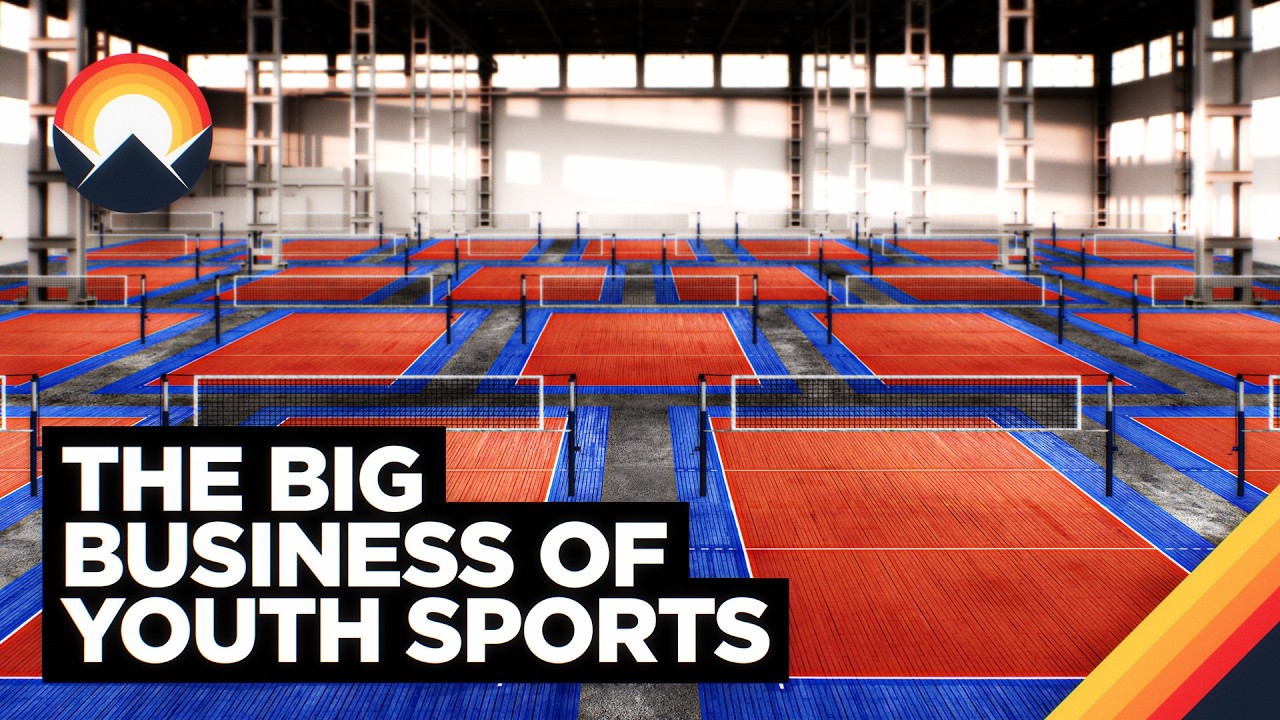
Every April for three days, the Bayside exhibit halls at the Mandalay Bay South Convention Center in Las Vegas transform into a stark manifestation of the commercialization gripping American youth sports. Crews work on Good Friday of Easter weekend to convert the massive venue into exactly 123 uniform volleyball courts. What follows is an absurdly hectic stretch where each court sees non-stop play from 7:30 a.m. to 9:30 p.m. by a rotating schedule of eight teams. In total, nearly 1,000 teams pass through the event. Given that an average team includes 10 players, two coaches, and an equal number of family members, a conservative estimate places the crowd at roughly 24,000 people. The environment is uncomfortably loud—filled with a deafening mix of whistles, squeaking shoes, and screaming U11 to U15 girls—and features long lines for overpriced concessions inside a completely windowless space.
Yet, for the competitors, this tournament—the Red Rock Rave—is everything. Sanctioned by USA Volleyball (USAV), the sport’s governing body, it serves as a prestigious national qualifier. Depending on their division, teams that finish first, second, or third earn a coveted bid to the USAV Nationals in Indianapolis or Minneapolis. Securing a spot at nationals is a massive milestone for clubs, coaches, and players alike. Across the 950 teams fighting it out in Las Vegas, chasing one of the mere 31 available bids is the ultimate dream, and everyone is paying a steep price to pursue it.
* **Total Teams:** Approximately 950 to 1,000 teams. * **Total Attendance:** Conservatively 24,000 people (averaging 24 people per team). * **Tournament Schedule:** Continuous play from 7:30 a.m. to 9:30 p.m. across 123 courts. * **Bids Available:** Only 31 total bids to the USAV Nationals.
[01:46](https://www.youtube.com/watch?v=DPeRd48YfqY&t=106s) The Avalanche of Hidden Tournament Costs
Participating in a national qualifier is big business for clubs, regional hosts, hotels, and sanctioning bodies. To even enter the Red Rock Rave, each team pays a $950 registration fee, which is merely the tip of the financial iceberg. The event operates under a strict "stay-to-play" model facilitated by KC Sports Housing, requiring teams to book their lodging exclusively through a select handful of partnered hotels like the Mandalay Bay or Luxor to be allowed to play. While this quid pro quo setup offers relatively competitive gaming and non-gaming hotel rates, it restricts consumer choice. In other tournament markets, it prevents parents from utilizing cheaper alternatives like Airbnb, Vrbo, or staying with friends, often leaving them with artificially high rates.
Because only a fraction of the teams are local, families fly or drive in from states as far-reaching as Colorado, California, Idaho, Texas, Missouri, and even Hawaii. A three-night hotel stay combined with flights or gas means a mother-daughter duo faces a bare minimum travel cost of $1,000. If a spouse or sibling joins, that weekend travel baseline quickly jumps to around $1,500.
Once inside the venue, outside food and drink are strictly prohibited, forcing families to buy $12 chicken sandwiches, $10 pizza slices, or $16 acai bowls. To commemorate the experience, parents shell out another $50 for a tournament hoodie. Spectators are hit with individual entry fees of $27.50 plus processing, or $65.40 for a three-day pass. Even relatives staying home must pay an entry-level streaming subscription fee of $44.85 to watch the matches online. Furthermore, while the youth coaches themselves are minimally compensated, parents are on the hook for their hotel rooms and travel stipends.
* **Team Entry Fee:** $950 per team. * **Weekend Travel Cost:** $1,000 minimum for a parent and child; roughly $1,500 if more family members attend. * **Concession Prices:** $12 chicken sandwiches, $10 pizza slices, and $16 acai bowls. * **Spectator Admission:** $27.50 plus processing for a daily ticket, or $65.40 for a 3-day pass. * **Streaming Subscription:** $44.85 for the entry-level broadcasting service.
[04:04](https://www.youtube.com/watch?v=DPeRd48YfqY&t=244s) The Five-Figure Reality of Club Dues and the College Dream
The financial commitment begins long before the tournament weekend. During the tryout window in July, parents commit to opaque club dues ranging from $2,500 to $7,000 per season, depending on the club's prestige, age group, and travel schedule. These dues are rarely itemized; parents are simply given a flat total and told it covers tournament entry fees, gym space rentals, coaching compensation, and insurance. When adding up the club dues, travel, food, and endless "nickel-and-diming," a single tournament weekend costs at least $2,000. Multiplied across four travel tournaments and added to the baseline dues, a typical competitive club season easily nears $11,500. For a child playing continuously from age 12 through their 18s year, a family faces six subsequent years of these five-figure seasons.
Parents tolerate this massive financial investment because they are chasing their own version of the dream: a college athletic scholarship. They hope to offset the ballooning costs of higher education, which routinely run anywhere from $25,000 to $65,000 a year or more. Lower tiers of collegiate sports like Division II, Division III, or the NAIA exist, but they do not offer the elusive full ride that covers all tuition, fees, room, and board, and many do not even offer partial athletic scholarships.
Tournament organizers and local clubs intentionally drown out the sobering reality that fewer than 6% of youth volleyball players will ever play in college, and a mere 1.2% to 2% will make it to Division I. Instead, organizers heavily market the number of college scouts in attendance, and clubs explicitly showcase their rare collegiate alumni to secure a child's commitment and lock in the parents' money. Culturally, sending a child into college athletics functions as a major badge of honor and a symbol of "good parenting" within suburban social circles.
* **Annual Club Dues:** Opaque fees ranging from $2,500 to $7,000. * **Total Seasonal Cost:** Approaching $11,500 per year when combining dues and travel. * **Long-Term Investment:** Over $70,000 if a player stays in club sports from ages 12 to 18. * **Collegiate Odds:** Fewer than 6% of youth players play in college; only 1.2% to 2% reach Division I.
[06:43](https://www.youtube.com/watch?v=DPeRd48YfqY&t=403s) Private Equity Enters the Arena
This deeply ingrained, highly lucrative dream has turned youth sports into a $40 billion a year sector growing at an annual rate of 8% to 10%. This staggering revenue generation has caught the attention of corporate investors, leading to a dramatic private equity invasion. Across the courts at the Red Rock Rave, a minimalist jersey logo reading "LOV" (pronounced *love*) represents League one Volleyball. LOV is a two-year-old upstart professional league that currently operates six pro teams, but its highly unique business model relies on owning 90 youth volleyball clubs across the United States.
LOV markets this integration as an aspirational, empowering, and grassroots-friendly pipeline to the professional ranks. The company is proudly women-led and features partial team ownership by prominent current and former female athletes. For youth players at acquired chapters—such as Club V in Salt Lake City—the branding brings excitement, especially when professional LOV players walk into their local training gyms, making the big leagues feel genuinely attainable.
However, private equity firms did not inject capital out of pure altruism. To fund and sustain the professional side of the operation while maximizing investor returns, LOV relies heavily on youth club dues, and corporate incentives require those dues to increase. LOV has secured brand partnerships with Adidas and Skims, broadcast deals with USA Network and ESPN, and has garnered nearly $200 million in total funding. This financial backing is led by the Atwater Group, alongside Ares Management, Left Lane Capital, and Synergy Sports Capital. Highlighting these corporate ties, LOV’s CEO, Katlyn Gao, is a veteran of Bain Capital. Investors are banking heavily on the robust, recession-proof outlook of the youth sports market, explicitly utilizing media and entertainment strategies to keep the youth pipeline full and the cash flowing.
* **Youth Sports Market Size:** A $40 billion annual industry growing at 8% to 10% per year. * **LOV Youth Infrastructure:** Owns 90 youth volleyball clubs nationwide to feed its 6 professional teams. * **Total Funding:** Approximately $200 million raised from private equity and venture capital. * **Key Institutional Investors:** Atwater Group, Ares Management, Left Lane Capital, and Synergy Sports Capital.
[09:17](https://www.youtube.com/watch?v=DPeRd48YfqY&t=557s) Skewed Incentives and Pay-to-Play Access
The massive influx of corporate money has distorted the developmental incentives of youth sports. Because the financial system is structured like a triangle—where the vast majority of the participants and the cash sit at the grassroots youth level—the primary pressure on clubs is not actually to teach the game. Instead, clubs are incentivized to aggressively "sell dreams of bids and college scholarships" to ensure their facilities remain fully booked and their club dues keep rolling in.
This environment has created a severe barrier to entry. As children age out of introductory public recreational programs, they find that publicly funded middle school and high school sports teams are hyper-competitive and carry very few roster spots. To even make a high school team, a teenager practically must have years of elite club experience. When club participation costs upwards of $10,000 a year, the sport immediately locks out a massive swath of the population, framing the game as an exclusive luxury for the wealthy and upper-middle class.
This hyper-individualistic, pay-to-play model is uniquely American and stands in stark contrast to international systems. For example, at *La Masia*, the hallowed youth training academy of FC Barcelona in Spain, the financial triangle is completely flipped. Elite young soccer players like Lionel Messi, Andrés Iniesta, and Lamine Yamal were scouted, vetted, and brought into the academy at no cost to their families. Because FC Barcelona generates massive revenues at the professional top of the triangle, it reinvests those profits back into its youth infrastructure, training and even paying prospects to ensure a steady stream of world-class talent.
* **Systemic Barrier:** High school roster scarcity forces mandatory club participation, excluding low-income families. * **International Contrast:** European academies like *La Masia* fund youth development upward from top-tier professional revenues rather than charging parents.
[11:38](https://www.youtube.com/watch?v=DPeRd48YfqY&t=698s) The Broken American Development Pipeline
Even in traditional American sports that generate immense domestic revenue, the financial pressures on youth players mirror those found in volleyball. In baseball, a player can no longer rely solely on their local middle or high school team to get noticed; they must join expensive travel baseball circuits. The dream here is arguably more intoxicating, as high-level 18-year-olds can technically be drafted straight into Major League Baseball (MLB) with multi-million dollar signing bonuses, while others chase collegiate scholarships. Yet, across baseball, hockey, football, and basketball, almost none of the multi-billion dollar profits generated from massive corporate sponsorships and broadcast deals trickle down to fund grassroots youth development.
This breakdown occurs because the expensive American university system acts as an insulated intermediary. Colleges offer top athletes scholarships, stipends, and Name, Image, and Likeness (NIL) deals, but they do not invest in foundational youth programs. By serving as the default developmental pipeline, the university system effectively shields major professional leagues from the financial pressure to fund youth sports. The entire structure relies entirely on the individual drive of children and the deep pocketbooks of parents.
This hyper-competitive system is ultimately failing to produce broad athletic success, and telling indicators are emerging across the sports landscape. The highest echelons of American sports are seeing a distinct rise in second-generation professional athletes. For example, Ethan Holliday, who signed the largest high school baseball signing bonus, is the son of former MLB All-Star Matt Holliday. Similarly, Asjia O'Neal and sisters Madison and Avery Skinner—who dominate the US women's national volleyball team—are the daughters of former NBA players. While these athletes are exceptionally driven and deserving, their genetic advantages are heavily multiplied by extreme financial advantages, granting them lifetime access to elite training and coaching that normal families cannot afford.
The consequences are clear on the international stage. Despite having more youth soccer players than any other nation, the United States men's national soccer team failed to qualify for the 2018 World Cup. In 2022, they were easily eliminated by the Netherlands, a country with a population smaller than New York State. Meanwhile, at the Winter Olympics, a tiny nation like Norway—with a population of under 6 million—dominated the medal count, securing 18 gold medals (six more than the US) and 41 total medals (eight more than the US) by rejecting the American hyper-commercialized model.
* **Second-Generation Athletic Dominance:** Prominent stars like Ethan Holliday, Asjia O'Neal, and the Skinner sisters benefit from parental access to elite, private infrastructure. * **US Soccer Failures:** Structural focus on profitable travel tournaments over player development led to missing the 2018 World Cup and a round-of-16 exit in 2022. * **The Norwegian Model Efficiency:** Norway won 41 total medals and 18 golds at the Winter Olympics, outperforming the heavily populated US through a non-commercialized approach.
[14:33](https://www.youtube.com/watch?v=DPeRd48YfqY&t=873s) The Myth of the Participation Trophy vs. The Norwegian Success Model
Older generations of coaches and leaders frequently lament that modern youth sports have been diluted by the concept that "everyone now gets a participation trophy." However, this narrative is completely false; youth sports in the United States have never been more intensely competitive than they are today. In fact, American sports culture might actually benefit from a shift toward participation. Norway's overwhelming sporting success offers a stark contrast, largely attributed to a youth model that prioritizes finding joy in the sport and fostering an internal love for practice, rather than obsessing over results, scores, and final standings.
While critics might dismiss Norway's dominance as mere culture and heritage carrying a small nation to the top of the Winter Olympics leaderboard, the data proves otherwise. Their success transcends winter climates: Norway boasts the best triathletes in the world, distance runners who routinely outperform both East Africans and Americans, and a men's beach volleyball partnership that outperforms anything the United States can produce. The US is an unapologetically sports-obsessed and massive nation, yet in global sports, it often performs only moderately well. The talent exists in America, but the current hyper-competitive system denies it the opportunity to thrive.
[15:27](https://www.youtube.com/watch?v=DPeRd48YfqY&t=927s) The Public Health Crisis of Youth Burnout
The consequences of this commercialized, hyper-competitive landscape extend far beyond national team rosters and elite athletic achievement; it has escalated into a major public health issue. During a 2025 congressional hearing, the Subcommittee on Early Childhood, Elementary, and Secondary Education detailed the severe negative ramifications that declining youth sports participation has on children. With a staggering 70% of all US kids quitting organized sports by the age of 13, a massive portion of the population is missing out on the foundational benefits that athletics provide.
Without sports, children face significantly higher risks of negative self-image, increased rates of obesity, and lower academic success. Furthermore, they are statistically less likely to become active parents who raise active children in the future, creating a generational cycle of inactivity. The current system relies on hyper-specialization that burns children out and a results-oriented approach that leaves too many kids out in the cold. Pushing youth programs to maximize wins, produce single-minded winners, and generate more dollars ultimately sets society up to lose in the long run.
* 70% of all US children quit organized sports by age 13. * Negative outcomes of dropping out include lower self-esteem, higher obesity rates, lower academic achievement, and a lower likelihood of raising active children.
[16:18](https://www.youtube.com/watch?v=DPeRd48YfqY&t=978s) Misaligned Incentives and the Value of Creator-Driven Media
The theme of misaligned incentives leading to poor outcomes is also the core focus of the latest episode of *Unsealed* titled "The Virus That Infected Boeing," produced by the channel Mustard and available on the streaming platform Nebula. For fans of Mustard’s hyper-detailed, cinematic 3D motion graphics covering aviation and engineering history, the episode serves as a deeper companion piece to their recent YouTube release regarding the context behind the first Boeing 707 barrel roll. This content ecosystem demonstrates the distinct value that Nebula offers as a creator-built streaming service.
Because Nebula is designed and shaped by the creators themselves, it can be run in a way that allows creators to pursue high-quality, deeply researched content without being constrained by the YouTube algorithm. Under the "Nebula Plus" umbrella, when teams like Mustard compile exhaustive research and airtight scripts, ideas that do not perfectly fit the primary video are preserved rather than discarded. This system creates a win-win scenario: fans get an extra 20-minute, hyper-detailed standalone video to dive into, Nebula adds premium content to its catalog, and creators maximize the utility of their extensive research.
* Featured Series: *Unsealed* episode "The Virus That Infected Boeing" by Mustard. * Nebula Perks: Includes "Nebula First" videos that release early and completely ad-free, such as *Tom Scott's England*, alongside Nebula Originals like the comedy series *Abolish Everything*, the travel competition *Jet Lag: The Game*, and the documentary project *Scav*. * Subscription Offer: Annual subscriptions are available for 50% off using the link `nebula.tv/wendoverproductions`, reducing the price to $30 per year (or $2.50 per month).
## Notable quotes > [00:00](https://www.youtube.com/watch?v=DPeRd48YfqY&t=0s) Every April for three days, the Bayside exhibit halls at the Mandalay Bay South Convention Center in Las Vegas transform into a stark manifestation of the commercialization gripping American youth sports.
> [00:00](https://www.youtube.com/watch?v=DPeRd48YfqY&t=0s) Across the 950 teams fighting it out in Las Vegas, chasing one of the mere 31 available bids is the ultimate dream, and everyone is paying a steep price to pursue it.
> [01:46](https://www.youtube.com/watch?v=DPeRd48YfqY&t=106s) The event operates under a strict "stay-to-play" model facilitated by KC Sports Housing, requiring teams to book their lodging exclusively through a select handful of partnered hotels like the Mandalay Bay or Luxor to be allowed to play.
> [04:04](https://www.youtube.com/watch?v=DPeRd48YfqY&t=244s) When adding up the club dues, travel, food, and endless "nickel-and-diming," a single tournament weekend costs at least $2,000.
> [04:04](https://www.youtube.com/watch?v=DPeRd48YfqY&t=244s) Tournament organizers and local clubs intentionally drown out the sobering reality that fewer than 6% of youth volleyball players will ever play in college, and a mere 1.2% to 2% will make it to Division I.
> [06:43](https://www.youtube.com/watch?v=DPeRd48YfqY&t=403s) This deeply ingrained, highly lucrative dream has turned youth sports into a $40 billion a year sector growing at an annual rate of 8% to 10%. This staggering revenue generation has caught the attention of corporate investors, leading to a dramatic private equity invasion.
> [06:43](https://www.youtube.com/watch?v=DPeRd48YfqY&t=403s) To fund and sustain the professional side of the operation while maximizing investor returns, LOV relies heavily on youth club dues, and corporate incentives require those dues to increase.
> [09:17](https://www.youtube.com/watch?v=DPeRd48YfqY&t=557s) Instead, clubs are incentivized to aggressively "sell dreams of bids and college scholarships" to ensure their facilities remain fully booked and their club dues keep rolling in.
> [09:17](https://www.youtube.com/watch?v=DPeRd48YfqY&t=557s) When club participation costs upwards of $10,000 a year, the sport immediately locks out a massive swath of the population, framing the game as an exclusive luxury for the wealthy and upper-middle class.
> [11:38](https://www.youtube.com/watch?v=DPeRd48YfqY&t=698s) By serving as the default developmental pipeline, the university system effectively shields major professional leagues from the financial pressure to fund youth sports.
> [11:38](https://www.youtube.com/watch?v=DPeRd48YfqY&t=698s) While these athletes are exceptionally driven and deserving, their genetic advantages are heavily multiplied by extreme financial advantages, granting them lifetime access to elite training and coaching that normal families cannot afford.
> [14:33](https://www.youtube.com/watch?v=DPeRd48YfqY&t=873s) Older generations of coaches and leaders frequently lament that modern youth sports have been diluted by the concept that "everyone now gets a participation trophy." However, this narrative is completely false; youth sports in the United States have never been more intensely competitive than they are today.
> [15:27](https://www.youtube.com/watch?v=DPeRd48YfqY&t=927s) With a staggering 70% of all US kids quitting organized sports by the age of 13, a massive portion of the population is missing out on the foundational benefits that athletics provide.
> [15:27](https://www.youtube.com/watch?v=DPeRd48YfqY&t=927s) Pushing youth programs to maximize wins, produce single-minded winners, and generate more dollars ultimately sets society up to lose in the long run.
## Mentioned Mandalay Bay South Convention Center, Las Vegas, Red Rock Rave, USA Volleyball, USAV, Indianapolis, Minneapolis, KC Sports Housing, Mandalay Bay, Luxor, Airbnb, Vrbo, Colorado, California, Idaho, Texas, Missouri, Hawaii, League One Volleyball, LOV, Club V, Salt Lake City, Adidas, Skims, USA Network, ESPN, Atwater Group, Ares Management, Left Lane Capital, Synergy Sports Capital, Katlyn Gao, Bain Capital, La Masia, FC Barcelona, Spain, Lionel Messi, Andrés Iniesta, Lamine Yamal, Major League Baseball, MLB, Ethan Holliday, Matt Holliday, Asjia O'Neal, Madison Skinner, Avery Skinner, NBA, United States men's national soccer team, World Cup, Netherlands, New York State, Winter Olympics, Norway, Subcommittee on Early Childhood, Elementary, and Secondary Education, Unsealed, The Virus That Infected Boeing, Mustard, Nebula, YouTube, Boeing 707, Nebula Plus, Nebula First, Tom Scott's England, Nebula Originals, Abolish Everything, Jet Lag: The Game, Scav, Sam Denby, Tristan Purdy, Christine Benedetti, Alexander Williard, Sara Stoltman, Gabriel Ferreras, Austin Glass, Kate Ermolenkko, Manni Simon, Dony Bullen, Simon Buckmaster
[Source](https://www.youtube.com/watch?v=DPeRd48YfqY)