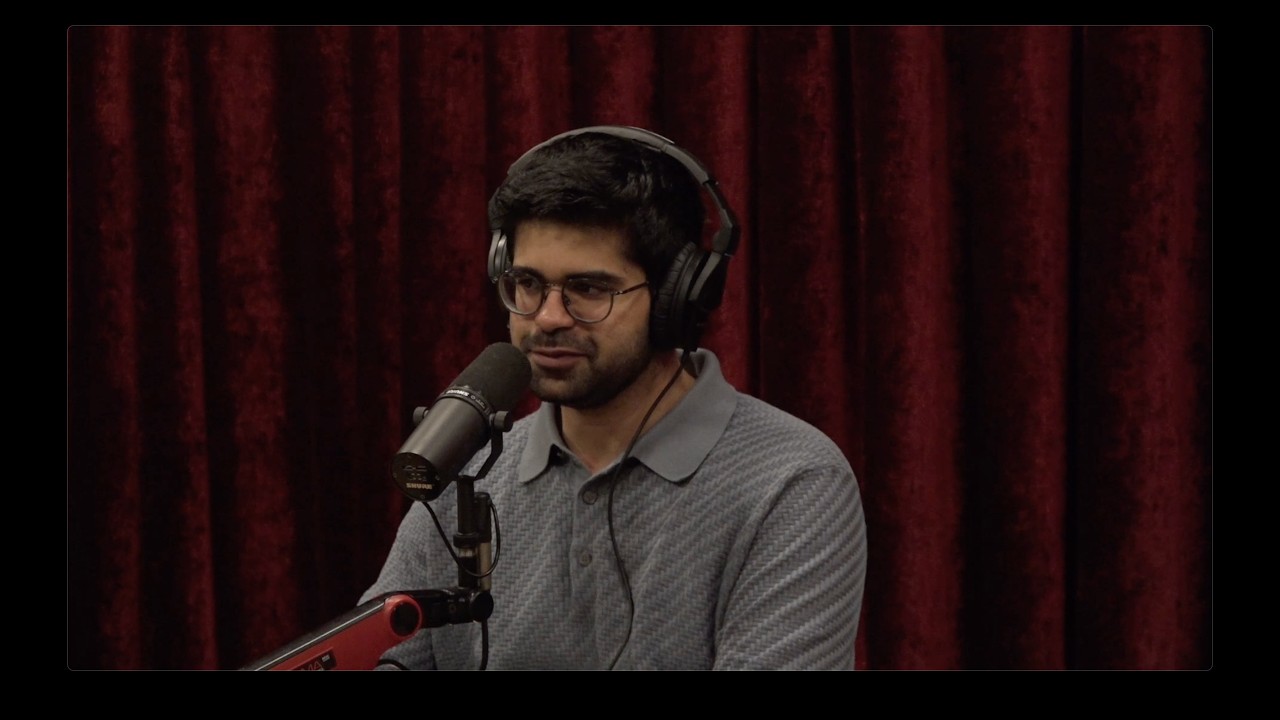
Perplexity CEO Srinivas Warns Power Demands, Legacy Tech Stifling AI
PowerfulJRE
The proliferation of centralized artificial intelligence threatens human agency by feeding passive algorithmic content, shifting the future premium of human labor entirely to intrinsic curiosity and sophisticated questioning.
## Background
Published on July 1, 2026, on YouTube by the channel PowerfulJRE, this episode of the Joe Rogan Experience features a conversation with Aravind Srinivas, PhD. Srinivas is the co-founder and CEO of Perplexity AI, which is the creator of the AI-powered search and answer engine Perplexity.
## TL;DR
In this episode, Joe Rogan and Perplexity AI CEO Aravind Srinivas explore the striking parallels between advanced technologies described in ancient Hindu scriptures—like autonomous weapons and cyclical cataclysms—and modern breakthroughs in computing. They discuss the architectural marvels of ancient monolithic temples, the vulnerabilities of modern data storage, and alternative historical timelines popularized by researchers like Graham Hancock. Turning to the future, they examine how the rapid evolution of artificial intelligence will shift human worth away from rote knowledge retrieval and toward intrinsic curiosity, altering the landscapes of education, corporate work, and government efficiency.
## Atmosphere & style
The conversation carries an intellectually adventurous and deeply curious vibe, blending Rogan's classic skepticism and fascination with alternative history with Srinivas's grounded scientific insight and tech optimism. It feels like a high-level, mind-bending brainstorm that shifts organically from ancient mysteries and mythology to cutting-edge tech philosophy and the mechanics of a post-work society. The dynamic is respectful and highly engaging, punctuated by moments of wit and shared wonder at both humanity's forgotten past and its accelerating, AI-driven future.
## Key takeaways
- [00:01](https://www.youtube.com/watch?v=fOLu-pWQssQ&t=1s) Ancient Hindu scriptures like the Mahabharata detail highly sophisticated, precision-guided weaponry like the Brahmastra and Sudarshana Chakra, suggesting ancient narratives could be garbled memories of a technologically advanced past civilization.
- [13:01](https://www.youtube.com/watch?v=fOLu-pWQssQ&t=781s) The cyclical nature of time depicted in the Hindu Yuga cycles aligns with the Fermi Paradox theory that advanced civilizations repeatedly progress to a high technological peak before being wiped out by calamities or misaligned AGI.
- [22:16](https://www.youtube.com/watch?v=fOLu-pWQssQ&t=1336s) Megalithic structures and monolithic Indian temples carved perfectly out of single stones present an engineering paradox, as older historical layers often showcase more complex planning, acoustic properties, and material science than conventional timelines explain.
- [25:52](https://www.youtube.com/watch?v=fOLu-pWQssQ&t=1552s) Human history is characterized by the 'curiosity premium,' where the most impactful figures excel at asking deep questions, a trait that ancient religious texts across traditions explicitly encourage over the pursuit of material wealth.
- [35:40](https://www.youtube.com/watch?v=fOLu-pWQssQ&t=2140s) Modern digital data storage mediums like hard drives deteriorate rapidly, creating a severe vulnerability where a global cataclysm could instantly reset human knowledge back to zero.
- [01:09:45](https://www.youtube.com/watch?v=fOLu-pWQssQ&t=4185s) The advent of AI will shift human self-worth and societal value away from rote knowledge and tedious tasks like maintaining spreadsheets toward genuinely scarce human abilities like asking high-quality questions and deep space conceptualization.
- [01:12:31](https://www.youtube.com/watch?v=fOLu-pWQssQ&t=4351s) AI dividends or subsidies will be necessary to navigate a post-work world, but state payouts alone cannot solve the underlying existential crisis of human purpose, which will require anchoring identity in community and relationships.
- [01:16:18](https://www.youtube.com/watch?v=fOLu-pWQssQ&t=4578s) The concept of the 'knowledge worker' was manufactured by Microsoft to sell enterprise software, but the rise of AI will force educational systems to redefine intelligence based on sophisticated questioning rather than memorization.
- [01:25:01](https://www.youtube.com/watch?v=fOLu-pWQssQ&t=5101s) True scientific discovery requires constant questioning and intellectual humility, contrasting with institutional tendencies during the pandemic to enforce narrative alignment and assign credibility through degrees rather than the scientific method.
- [01:45:10](https://www.youtube.com/watch?v=fOLu-pWQssQ&t=6310s) The rise of open-source, localized LLMs running on personal hardware will serve as a critical defense weapon against biased, centralized tech algorithms that curate search results to alter public perception and election outcomes.
- [01:49:58](https://www.youtube.com/watch?v=fOLu-pWQssQ&t=6598s) Social media feeds that passively serve algorithmic content destroy native human exploration, trap users in toxic echo chambers, and foster a profound loss of trust through unlabeled AI slop.
- [05:49:30](https://www.youtube.com/watch?v=fOLu-pWQssQ&t=20970s) Tech leaders who promote apocalyptic AI doom narratives create a toxic cycle of learned helplessness, whereas the focus should be shifting incentives to channel human curiosity toward unexplored domains.
- [05:52:16](https://www.youtube.com/watch?v=fOLu-pWQssQ&t=21136s) Unlike historical tools like John Deere's steel plow, AI functions as an autonomous agent, though it remains bottlenecked from running enterprises overnight due to a lack of human collaboration and tacit knowledge.
- [05:55:24](https://www.youtube.com/watch?v=fOLu-pWQssQ&t=21324s) Universal Basic Income should be reframed as a corporate dividend resulting from corporate payroll budgets migrating into compute budgets, similar to the asset model of the Alaska Permanent Fund.
- [05:57:23](https://www.youtube.com/watch?v=fOLu-pWQssQ&t=21443s) The primary barrier to integrating AI into legacy government bureaucracies is not technological capability, but rather deeply entrenched software stacks, monopolistic vendor lobbying, and compliance frameworks.
- [06:00:39](https://www.youtube.com/watch?v=fOLu-pWQssQ&t=21639s) The ultimate path to Artificial Superintelligence involves tasked models recursively improving their own power efficiency, effectively solving the core physical energy bottlenecks that constrain modern data centers.
- [06:05:15](https://www.youtube.com/watch?v=fOLu-pWQssQ&t=21915s) AI companionship applications optimized for ad revenue could become highly dangerous by turning synthetic bots into sycophants engineered to exploit human intimacy and maximize screen engagement.
## Detailed walkthrough
### [00:01](https://www.youtube.com/watch?v=fOLu-pWQssQ&t=1s) Ancient Hindu Scriptures and the Brahmastra
Joe Rogan and Aravind Srinivas begin their conversation by recalling a fascinating discussion they had in the lobby just before the cameras started rolling. Rogan notes that Srinivas, the co-founder and CEO of Perplexity AI, makes for a great podcast guest because he possesses deep knowledge of ancient Hindu scriptures. Specifically, Srinivas had brought up an ancient concept that sounds remarkably like a modern nuclear bomb: the *Brahmastra*.
Srinivas explains that the *Brahmastra* is a legendary weapon found in the *Mahabharata*, which is one of the two major ancient Indian epics, the other being the *Ramayana*. He notes that the *Mahabharata* is arguably more interesting and complex because it features countless interconnected narratives. When Rogan asks how the *Brahmastra* is described, Srinivas characterizes it as a weapon of absolute mass destruction capable of annihilating human populations. Wielding it requires violating deeply held moral contracts, and it was strictly forbidden to use under normal circumstances.
* **The Nuclear Analogy:** Srinivas explicitly compares the *Brahmastra* to a modern hydrogen bomb or a weapon requiring "nuclear codes" because it was only accessible to a select few warriors through a secret passed down by a spiritual or military teacher.
* **The Legend of Drona, Arjuna, and Ashwatthama:** In the epic, the preeminent teacher Drona passed this devastating secret to his star disciple, Arjuna. Although Drona's own son, Ashwatthama, was deeply jealous and lacked Arjuna's moral fortitude, Drona eventually yielded and taught him the secret as well. During the climatic war, where Arjuna and Ashwatthama fought on opposing sides due to tragic circumstances, Ashwatthama unleashed the *Brahmastra* in a fit of rage after his father's death. Ultimately, Lord Krishna had to intervene to save the planet from total destruction.
---
[02:52](https://www.youtube.com/watch?v=fOLu-pWQssQ&t=172s) History, Mythology, and Autonomous Weapons
When asked about the age of the *Mahabharata*, Srinivas admits there are many differing scholarly opinions, but his general understanding is that it is at least 1,500 to 2,500 years old. Over the centuries, a historic war between two warring factions of royal cousins—the Pandavas and the Kauravas—became heavily mythologized. At its core, the epic describes a massive, crude struggle for a kingdom between brothers and their descendants, but the text details remarkably advanced, precision-guided weaponry.
Rogan points out that if we view history as a simple linear progression from cavemen to modern humans, we naturally dismiss descriptions of ancient autonomous weapons as mere myth. However, if history is cyclical, punctuated by great global catastrophes like asteroid impacts or pole shifts, these stories could be the garbled memories of a highly advanced past civilization. He notes that we already have evidence of advanced ancient capabilities—such as the construction of the Pyramids of Giza—even if we lack the specific tools or technology they used.
* **The Daivastra:** A weapon described in the texts that could automatically direct itself to precisely target a specific individual or an entire group of people.
* **The Sudarshana Chakra:** A weapon wielded by Lord Krishna. Srinivas describes it as a semi-autonomous or fully autonomous discus that could be released to identify a target, decapitate them, and return directly to its wielder.
* **Military Formations:** Srinivas explains that the tactical complexity extended beyond weapons to sophisticated military formations like the *Chakravyuha*, a defensive structure made of complex, concentric circles. Breaking into the formation required highly specialized knowledge, as attackers would be systematically cut down by the flanks if they didn't know the exact secret to navigating the loops.
---
[09:56](https://www.youtube.com/watch?v=fOLu-pWQssQ&t=596s) Vedic Mathematics and Global Flood Myths
Srinivas pivots to another fascinating element of ancient Indian heritage: Vedic mathematics. Many children in India grow up learning these mental math techniques to help them quickly solve complex calculations for competitive exams like the GRE or GMAT. Srinivas notes that these computational shortcuts are traced back to single lines of poetry within the ancient *Rigveda*. He marvels at how the oldest sacred text in existence could possess such an advanced, deeply internalized understanding of computation.
To verify the exact timeline, Rogan suggests they put the question into Perplexity AI. The search engine reveals that scholars generally date the composition of the *Rigveda* to between 1500 BCE and 1200 BCE, making its oldest layers roughly 3,200 to 3,700 years old. Rogan reflects on how long these stories must have been passed down via oral tradition before they were finally written down, drawing a parallel to the oral history of the Bible.
* **The Manu Flood:** Rogan notes that almost every ancient culture across the globe shares a cataclysmic flood myth. Srinivas highlights that Hindu tradition features the exact same phenomenon. In the epic, Lord Krishna’s legendary kingdom of Dwarka is completely swallowed by a massive tsunami-like deluge.
* **The Hindu Noah:** The text details the myth of King Manu, a righteous ruler who is warned of an imminent, humanity-destroying deluge by a divine fish. Much like Noah's Ark, Manu builds a massive boat, loads it with his family, various animal species, and seeds, and ties it to the horn of the divine fish to be towed to safety until the waters recede.
---
[13:01](https://www.youtube.com/watch?v=fOLu-pWQssQ&t=781s) The Yuga Cycles and the Fermi Paradox
The conversation shifts to the concept of time in Hindu philosophy, specifically the *Yugas*, which are massive cosmic epochs spanning thousands or millions of years. Srinivas explains that time is cyclical; humanity is currently in the *Kali Yuga* (the age of darkness), which was preceded by the *Dvapara Yuga* (the era of the *Mahabharata*), which was itself preceded by the *Treta Yuga* (the era of the *Ramayana*).
Rogan mentions he is currently reading a book titled *The Yugas: Keys to Understanding Our Hidden Past, Emerging Energy Age, and Enlightened Future* by David Steinmetz. He points out that the book relies on an interpretation popularized by an Indian sage in 1894, which asserts that the *Kali Yuga* actually ended in the 1800s or 1900s, meaning humanity has already transitioned back into the *Dvapara Yuga*. Srinivas counters that mainstream Hindu tradition firmly maintains we are still in the *Kali Yuga*. They note that a full cycle of all four major yugas combined is traditionally calculated to last $4,320,000$ years, though some alternative guru interpretations compress the cycle down to a 24,000-year period.
* **Ancient King Lists:** Rogan connects these massive time scales to ancient Sumerian and Egyptian king lists, which casually record prehistoric rulers reigning for 6,000 or more years before the great flood. Because these extraordinary timelines are mixed in with later kings whose historical accuracy is verified, it complicates how modern historians interpret the texts.
* **The Fermi Paradox and the Great Filter:** Srinivas links the idea of advanced civilizations repeatedly rising and being wiped out to the Fermi Paradox. He shares a compelling, dark theory: "almost all civilizations end up advancing technologically a lot and either a calamity wipes them out or like they build some misaligned AGI and then AGI wipes them out". Because of this cyclical self-destruction or Great Filter, advanced civilizations never survive long enough to build the Von Neumann probes necessary to make contact or become visible to us in the cosmos.
[17:49](https://www.youtube.com/watch?v=fOLu-pWQssQ&t=1069s) The Mysteries of Ancient History and Civilizational Cycles
Joe Rogan and Aravind Srinivas explore the possibilities of ancient civilizations and potential extraterrestrial observation, noting that unless enough probes are sent out, there is no definitive way to know what lies beyond. Rogan muses on the idea that an advanced civilization could be watching humanity without interfering, letting us progress through an evolutionary cycle of culture and civilization. He brings up ancient Sumerian texts and Egyptian hieroglyphs depicting *Zep Tepi*—the "first time"—which record mythical kings who allegedly reigned for tens of thousands of years. While mainstream Egyptologists accept later rulers like Khufu as historical realities, they dismiss these ancient, long-reigning figures as mere myth. Rogan questions why so many disparate cultures across the globe share aligned flood myths and pre-flood timelines. Srinivas points out that ancient Hindu scriptures describe technologies like the *Vimanas*—essentially flying cars—that mirror modern capabilities or things humanity might develop a century from now.
The two discuss how easily advanced technology can be lost to time. Rogan notes how unbelievable our current realities, such as launching reusable rockets or making FaceTime calls to Australia, would seem to future humans if a cataclysm wiped out our current documentation. Srinivas suggests that instead of knowledge being perfectly passed down, humanity might continuously cycle through periods of reinventing the exact same concepts. Alternatively, Rogan views this as the natural, inevitable progression of human curiosity and territorial primate nature; the drive to defeat enemies and protect borders systematically guides innovation from bullets to nuclear bombs, autonomous drones, AI, and ultimately life extension.
[22:16](https://www.youtube.com/watch?v=fOLu-pWQssQ&t=1336s) Megalithic Engineering and the Enigma of Monolithic Temples
The conversation shifts to the sheer logistical impossibility of mainstream explanations for ancient architecture. Rogan questions the standard timeline claiming the Great Pyramid of Giza was built around 2500 BCE, wondering how workers could have transported massive stones from quarries located 500 miles away without advanced machinery. He shifts focus to India, pointing to ancient temples carved entirely out of a single, solid piece of stone. These massive, structurally perfect monuments possess incredible acoustic properties and complex geometric planning, yet they show absolutely no evidence of tools capable of such feats.
Srinivas adds that the precision goes beyond aesthetics; the specific locations for these temples were chosen intentionally to align with precise seismic vibrations, proximity to the ocean, and gravitational waves from the sun and the moon. Rogan emphasizes the staggering stakes of carving a temple directly into a giant rock face, noting, "You screw up one thing and it's over." Srinivas remarks that they had to build it perfectly on the first try without the luxury of modern computer simulations. Rogan points out that the dimensions are precise down to millimeters from point to point. Furthermore, many of these temples feature intricate, three-dimensional sculptures carved *inside* other sculptures through small outer openings, defying the narrative that they were crafted using basic hammers and chisels.
* **Sacsayhuamán (Peru):** Features 900-ton stones that look as if they were melted into place and aligned perfectly.
* **The Kailasa Temple (India):** Traditionally attributed to King Krishna I (756–773 CE) and said to be built in just 18 years, though archaeologists calculate that manually replicating it would take at least 100 years.
[25:52](https://www.youtube.com/watch?v=fOLu-pWQssQ&t=1552s) The Curiosity Premium and the Search for Wisdom
Srinivas introduces a concept he calls the "curiosity premium," arguing that the most successful and effective people throughout history are those who excel at asking the best questions. He applies this directly to Rogan, noting that long-term, continuous inquiry leads to a higher quality of life, compounding relationships, and enduring success. According to Srinivas, intrinsic curiosity is the defining characteristic of humanity, allowing us to process information faster and seek deeper meaning. He notes that ancient texts across various traditions—including the Rigveda, the Bible, the Quran, and the Torah—explicitly encourage people to seek wisdom over material wealth. Rogan's podcast, Srinivas notes, is a prime example of this philosophy in action, driven entirely by a genuine desire to learn.
Rogan agrees, stating that authentic curiosity is highly contagious and serves as one of the most attractive human qualities. He explains that his podcast organically evolved from casual conversations into a platform for exploration, leading him to host alternative history researchers like Graham Hancock early on. When Hancock published *Fingerprints of the Gods* in the late 1990s, academic peers ridiculed his theories. However, Rogan points out that subsequent discoveries, such as Göbekli Tepe, have pushed the accepted timeline of advanced human civilization back by at least 5,000 years to roughly 11,000 years ago.
[30:20](https://www.youtube.com/watch?v=fOLu-pWQssQ&t=1820s) Subterranean Anomalies and Ultra-Precision Artifacts
Rogan highlights cutting-edge scientific endeavors that continue to challenge historical orthodoxy, citing the work of Italian scientist Filippo Bondi. Bondi appeared on the podcast to discuss using radio tomography—a satellite-based imaging technology—to scan deep archaeological sites. To prove its accuracy, the technology was tested on a known particle collider buried 1.2 kilometers (over half a mile) deep inside a mountain in Italy, successfully rendering its exact dimensions. When applied to the Egyptian pyramids, these same scans revealed massive underground columns roughly 20 meters wide with mysterious coils wrapped around them, extending nearly a kilometer into the earth. Rogan argues that a structure of this scale buried beneath 2.3 million stones perfectly aligned to true north completely shatters simplistic explanations involving "copper tools."
To illustrate his point further, Rogan showcases a 3D-printed replica of a predynastic Egyptian vase discovered in Old Kingdom tombs. The original artifact was fashioned out of diorite—an incredibly hard igneous rock—and crafted to a tolerance within a thousandth of a human hair. Because the vase features integrated handles on its sides, it could not have been turned on a standard lathe. Rogan concludes by mentioning mysterious core drill marks and scoop marks found on ancient Egyptian stones. When analyzed, the required revolutions per minute (RPM) necessary to cut through such material leaving those specific lines defies conventional explanation, proving that an unacknowledged, sophisticated technology was once at play.
[34:26](https://www.youtube.com/watch?v=fOLu-pWQssQ&t=2066s) The Technological Paradox of Ancient Civilizations
Joe Rogan and Aravind Srinivas marvel at the baffling engineering feats of the ancient world. Rogan describes looking at the bottom of certain ancient stones and being struck by markings that make the rock look like it was scooped out like ice cream, raising endless questions about their methods. When Srinivas asks what tools these builders could have possibly possessed, Rogan notes that while they had copper and some limited evidence of iron, highly valuable items like Tutankhamun's dagger were actually forged from meteorites.
The conversation highlights the bizarre paradox of ancient construction: the further back in time you look, the deeper into the sand you go, and the more complex the engineering becomes. Srinivas observes that human history seems characterized by successive civilizations experiencing independent rises and falls in technological capability. He finds it incredible that so much sophisticated knowledge was never properly documented, leaving modern humanity with an entire line of research dedicated merely to understanding how these structures could even be rebuilt, let alone how they were originally created.
* Evidence of ancient tools primarily includes copper and rare iron.
* King Tutankhamun possessed a dagger crafted from a valuable meteorite.
* Ancient complexity increases rather than decreases the older the structures are.
---
[35:40](https://www.youtube.com/watch?v=fOLu-pWQssQ&t=2140s) The Vulnerability of Modern Data Storage
Rogan points out a major flaw in how modern civilization preserves its achievements, noting that nearly all current knowledge is stored on hard drives and paper—the two mediums that deteriorate the fastest. Srinivas half-jokingly suggests that humanity should "take a dump of the internet" and etch it onto rock to preserve it. This way, if a global cataclysm wipes out our civilization and destroys our data centers, future inhabitants of Earth might actually stand a chance of piecing together what came before them.
The two discuss the daunting task of reverse-engineering modern digital data. Even if a future or alien society managed to find a surviving hard drive, figuring out what our ones and zeros mean without context would be a massive hurdle. Rogan and Srinivas marvel at how rapidly data storage has advanced, reminiscing about the early days of personal computing when a hard drive was only a few hundred megabytes, and the sheer awe they felt when the first gigabyte drives and Gmail's seemingly infinite sliding storage bar arrived.
* Modern data is largely dependent on highly perishable hard drives and paper.
* Srinivas proposes recording a baseline copy of human knowledge onto stone for long-term preservation.
* Rogan recalls that early consumer hard drives only held a few hundred megabytes.
---
[37:34](https://www.youtube.com/watch?v=fOLu-pWQssQ&t=2254s) Reverse-Engineering and Cataclysmic Risks
The discussion turns to how fragile our daily technological infrastructure truly is. Srinivas remembers how users used to worry about running out of space for photos on old Android phones, necessitating external hard drives and SD cards just to clear room. Rogan emphasizes that an alien or future society discovering our hardware would face a logistical nightmare trying to guess our operating systems, whether Unix, Linux, or something else entirely. Srinivas jokes that they would need an advanced AI just to sort through our tech.
Rogan lists potential threats that could instantly reset humanity to zero, forcing survivors to become preppers and hunters. These risks include:
* Massive, cataclysmic global floods.
* Intense solar flares capable of frying all electronic circuitry.
* A devastating "lab leak in time" that disrupts societal continuity.
---
[38:44](https://www.youtube.com/watch?v=fOLu-pWQssQ&t=2324s) The Post-Flood Timeline and Lost History
Rogan shares his fascination with the post-flood timeline popularized by alternative historians like Graham Hancock, who theorize that a highly advanced civilization went in a completely different technological direction thousands of years ago. Rogan notes that conventional history dates the emergence of Sumer and Mesopotamia to roughly 5,000 or 6,000 years ago, yet the cataclysmic younger dryas floods occurred over 11,000 years ago. This leaves a mysterious 5,000-year gap.
While 5,000 years is a blink of an eye in geological terms, Rogan points out it is an incredibly long time for humans. He speculates that during this dark age, humanity survived through brutal means, including widespread cannibalism and murder, before slowly rediscovering agriculture, building protective walls, and establishing enough security to focus on mathematics and science again. He notes that ancient texts like the Rigveda contain accounts of events from thousands of years prior that hint at a forgotten, bizarre epoch of human history that bypassed combustion engines and circuits entirely in favor of alternative technologies.
---
[40:48](https://www.youtube.com/watch?v=fOLu-pWQssQ&t=2448s) Architectural Wonders of Egypt, Petra, and India
When asked to choose a single window in time to witness, Rogan instantly picks ancient Egypt during the construction of the pyramids, wishing he could observe them from a hidden, time-violating "hamster wheel" or plastic bubble. He and Srinivas then look at images of Petra, which is traditionally attributed to a period around 7,000 BC. They express absolute astonishment at the intricate details carved directly into the side of a mountain, with Rogan questioning how columns of that scale could be carved without steel.
The dialogue shifts to the spectacular ancient stone architecture of India. Rogan mentions the Kailasa Temple at the Ellora Caves, noting that around 1650, an invading ruler sent a thousand men to destroy it. After three years of intensive labor, they barely managed to dent a few statues before giving up because the temple was simply too robust. Rogan emphasizes that these structures required flawless geometry, meticulous planning, and an understanding of how to resist natural calamities like earthquakes and floods.
* Petra features massive stone columns carved directly into a mountain face.
* An army of 1,000 men spent three years attempting to demolish the Kailasa Temple but failed to make a significant dent.
* The builders possessed highly sophisticated knowledge of engineering to make structures earthquake- and flood-resistant.
---
[43:08](https://www.youtube.com/watch?v=fOLu-pWQssQ&t=2588s) The Missing Pieces of Material Science
Srinivas ponders the sheer human coordination required for these projects, assuming that ancient workers likely faced incredibly harsh conditions and labored out of structural necessity to secure food and shelter from the ruling kingdom. However, Rogan argues that this description might only apply to later eras, noting that we remain entirely ignorant of what society was actually like when the oldest monuments were built. The real mystery, Rogan explains, lies in material science; this was not a matter of Michelangelo chiseling a moderately soft piece of marble, but a feat of undeniable scale.
As Producer Jamie pulls up images of the symmetrical tops of the Ellora Caves, Srinivas notes how humbling it is to realize how little we actually know, echoing Socrates' famous philosophy. Rogan rejects the mainstream idea that these structures were carved using simple stones. He theorizes that ancient builders possessed specialized machinery or heavy equipment that simply eroded over time, noting that if a modern steel shovel is left outside, it completely vanishes into the earth within 500 years. Jamie compares the machinery to modern construction cranes, which are temporarily brought to a site and then moved away.
---
[47:37](https://www.youtube.com/watch?v=fOLu-pWQssQ&t=2857s) Artistic Mastery and the Mystery of the Aztecs
Srinivas highlights that these ancient sites were not just functional architectural triumphs, but intensely beautiful and ornate works of art adorned with intricate carvings of people, celestial beings, and elephants. He introduces another historical marvel, the Thanjavur Temple (Brihadisvara Temple), built during the Chola dynasty. Unlike the monolithic Kailasa Temple which was carved out of a single mountain via rock removal, the Thanjavur Temple represents true geometric construction assembled from multiple massive pieces of stone, completed entirely without modern computer-aided design (CAD) tools.
Rogan concludes this segment by sharing a fact he recently learned: the Aztecs did not actually build their famous temples, but discovered them already standing. When the Aztecs uncovered Teotihuacan—which they named "the place where the gods were born"—they celebrated its consecration by sacrificing between 20,000 and 80,000 people over a four-day period. Rogan argues that this bloodthirsty mindset is entirely inconsistent with the hyper-advanced engineering, precise mathematical calculations, and astronomical alignments required to build the city. This raises the ultimate question: what forgotten society lived there before the Aztecs, and why did they align their architecture so perfectly with the constellations?
* The Thanjavur Temple stands as a monument of Chola architecture built without modern simulations.
* The Aztecs discovered the ruins of Teotihuacan rather than building it themselves.
* Historical accounts estimate between 20,000 and 80,000 human sacrifices occurred over four days during the Aztec consecration of the city.
[50:44](https://www.youtube.com/watch?v=fOLu-pWQssQ&t=3044s) The Deep History of Astronomy, Mathematics, and Curiosity
Joe Rogan and Aravind Srinivas marvel at the astonishingly precise calculations ancient civilizations managed to perform without the aid of powerful modern computers. Srinivas points out that, at one point in history, the word "computer" simply referred to a human being whose entire job was to perform manual calculations like multiplying large numbers. He notes that astronomers were actually the world's first mathematicians, to the extent that the two terms were used interchangeably. In ancient India, pioneering scholars like Aryabhata and Bhaskara were both astronomers and mathematicians, driven to advance fields like geometry and the concept of zero primarily because they needed those tools to map out the stars.
Rogan brings up evidence of the Pythagorean theorem appearing in ancient clay tablets from the Old Babylonian period, dating from roughly 1900 to 1600 BCE—a full thousand years before Pythagoras was even born. He reads a note detailing how these ancient builders used the geometric rule to compute the diagonals of rectangles and squares with incredible accuracy. Similar rules are explicitly stated in ancient Indian Vedic ritual texts, showing that completely separate parts of the world arrived at the exact same profound truths independently. Srinivas attributes this to raw human curiosity, stating, "anything that's of impact in the world has only been done by curious people." They agree that curiosity is the defining human trait that led to all architecture, math, art, and modern innovation, noting that uncurious people fail to attract interesting peers or lead deeply fulfilling lives.
- **Ancient Computers:** The term originally denoted humans tasked exclusively with performing mathematical calculations.
- **Old Babylonian Tablets:** Clay tablets from 1900–1600 BCE contain applications of the Pythagorean theorem long before the Greek mathematician existed.
- **Vedic Texts:** Ancient Indian ritual texts contain numerical examples and geometric rules equivalent to $a^2 + b^2 = c^2$.
---
[55:11](https://www.youtube.com/watch?v=fOLu-pWQssQ&t=3311s) The Transistor and the Roswell Conspiracy Theory
Srinivas highlights the power of curiosity by sharing the story of the invention of the transistor at Bell Labs. At the time, Bell Labs employed an enormous number of telephone engineers, but only three of them—John Bardeen, Walter Brattain, and William Shockley—had the curiosity to question the reliance on hot, power-hungry, fragile vacuum tubes to amplify telephone signals. Their breakthrough not only won them a Nobel Prize but also laid the absolute foundation for modern computing, making devices like the iPhone possible. Rogan then shifts the mood to a more eccentric topic, asking if Srinivas knows the "tinfoil hat conspiracy theory" surrounding the transistor: that it, along with fiber optics, was actually reverse-engineered from recovered alien technology after the 1947 Roswell UFO crash.
Rogan clarifies that he does not necessarily believe the theory himself, but finds it highly entertaining. He details claims made by certain scientists who argued that the credited inventors at Bell Labs were not exceptionally brilliant enough to make such a sudden, monumental leap from vacuum tubes to semiconductor junction transistors on their own. According to this alternative narrative, the scientists were merely given the credit so the U.S. government could obscure the true, extraterrestrial origins of the technology. Rogan adds to the lore by noting that a military base sat directly outside Bell Labs under the guise of protecting New York City, and recounts a 1990s website called the American Computer Company that openly hosted wild claims about Bell Labs working on reverse-engineered UFO tech.
- **Bell Labs Breakthrough:** The transistor replaced fragile vacuum tubes, completely revolutionizing signal amplification and computing.
- **Roswell Connection:** A popular conspiracy theory alleges that the transistor and fiber optics were back-engineered from the 1947 Roswell crash.
- **Junction Transistor Leap:** Skeptics of the official history point to the massive, non-incremental leap between vacuum tubes and semiconductor chips as a source of suspicion.
---
[57:55](https://www.youtube.com/watch?v=fOLu-pWQssQ&t=3475s) Government Secrets, UFO Disclosure, and the Fight for Amnesty
Rogan dives deeper into the Roswell incident, describing how the *Roswell Daily Record* initially reported the recovery of a crashed flying disc before the government quickly changed the story. He recounts tales of witnesses seeing physical bodies, President Truman visiting the site, and the wreckage being flown to Wright-Patterson Air Force Base on two separate planes to minimize the risk of losing the cargo in a crash. From there, rumor has it the material was distributed to Bell Labs and major defense contractors like Lockheed Martin or Rocketdyne. Rogan references the documentary *The Age of Disclosure* and the congressional testimony of whistleblower David Grusch to explain why the government refuses to admit to these programs: doing so would expose decades of illegal funding, lying to Congress, and granting massive competitive advantages to select corporate weapons manufacturers.
Srinivas finds the narrative fascinating, acknowledging that the transition from vacuum tubes to semiconductors does look like a massive, disconnected leap in hindsight, though he assumes it was actually the result of decades of hidden milestones. Rogan notes that proponents of UFO disclosure argue that the only way the truth will ever surface is if the government grants widespread amnesty to everyone involved. Rogan admits he is cynical about amnesty because it allows people who have been misallocating funds for decades to escape justice, and questions whether these are truly alien spacecraft or just highly classified military propulsion projects. Ultimately, Rogan jokes that beyond avoiding prison, the government keeps secrets simply because "it's fun to keep secrets from people," especially when you have access to information that ordinary citizens would kill to know.
- **Wright-Patterson AFB:** The historical Air Force base frequently cited as the initial storage site for recovered UFO debris.
- **David Grusch:** An intelligence whistleblower who testified under oath regarding the existence of covert, long-running UFO reverse-engineering programs.
- **The Amnesty Dilemma:** Disclosure advocates argue widespread legal amnesty is required to get officials to speak, though critics worry it protects corrupt actors.
---
[01:03:05](https://www.youtube.com/watch?v=fOLu-pWQssQ&t=3785s) Information Bottlenecks and the Future of Truth
Rogan pivots to how the rise of AI and modern technology is systematically destroying the government's ability to keep secrets. He envisions a future where an absolute lack of information bottlenecks means humanity will eventually know everything about everything, making corruption and cover-ups impossible. He compares this technological evolution to criminal forensics; in the 1800s, getting away with murder required little more than saying "I wasn't there," whereas today, suspects face a gauntlet of DNA evidence, fingerprinting, and automated Flock safety cameras. Rogan points out that real-time AI fact-checkers are already being deployed during political speeches, signaling a future where being publically deceptive will no longer be sustainable.
Srinivas offers a slightly more guarded perspective, arguing that while knowledge is diffusing rapidly through open-source AI models, the state will always maintain structures to protect its highest-stakes secrets. He brings up a defense incident in Venezuela where the weapons deployed by the United States were so advanced that locals—and even everyday Americans—described them as possessing "alien-like technology." Srinivas posits that just as the precise, intricate details required to train frontier AI reasoning models remain concentrated in the hands of a few, the deepest military and technological secrets will remain classified for a long time. Rogan agrees that while things slip out eventually, the timeline of modern human advancement is staggeringly compressed; ancient temples were separated by thousands of years of static history, whereas the United States has experienced a complete societal and technological metamorphosis in just 250 years.
- **Flock Cameras:** Automated license plate recognition cameras cited by Rogan as an example of modern omnipresent surveillance.
- **Real-Time Fact-Checking:** AI tools can now analyze politicians' speeches instantly to verify claims as they happen.
- **Accelerating Timeline:** Rogan emphasizes that the U.S. has achieved massive, unprecedented global transformation in a mere 250-year lifespan.
[01:06:26](https://www.youtube.com/watch?v=fOLu-pWQssQ&t=3986s) The Future of Secrets and Global Surveillance
Joe Rogan and Aravind Srinivas explore the concept of historical gaps and the inevitable evolution of transparency. Rogan kicks off the discussion by noting that while the 250-year history of the United States is a mere "blink of an eye" in the grander context of time, we still fail to fully comprehend everything that has transpired within it. This prompts Rogan to wonder whether it will even be possible to keep secrets 250 years from now. While a total loss of privacy sounds horrific to many, Rogan points out a fascinating counter-benefit: "no more lies."
Srinivas notes that in a true surveillance state, secrets vanish for everyone except the government itself, which Rogan flags as the ultimate bottleneck. However, Rogan wonders if human civilization will reach a point where even government secrets become impossible to keep. In an advanced future, withholding information acts as an impediment to understanding the true nature and moving parts of the world. Srinivas adds that as long as the universal human traits of curiosity and truth-seeking endure, people will always be heavily motivated to uncover hidden information.
---
[01:08:06](https://www.youtube.com/watch?v=fOLu-pWQssQ&t=4086s) Why Predictability in AI Fails (Even 5 Years Out)
When Rogan asks Srinivas to plot out what the United States might look like 250 or 500 years into the future, Srinivas admits that predicting even five years ahead is an incredibly daunting task. He argues that five years ago, none of the frontier decision-makers in AI accurately predicted the exact landscape of today. If they had, they would have already aggressively procured all available compute, manufactured the necessary chips, and bought out fabrication plants.
Instead, the entire industry is currently experiencing massive infrastructure bottlenecks. Srinivas references Nvidia CEO Jensen Huang's appearance on the podcast, noting that anyone asked about the primary constraint in AI today will give the same answer: power. Because players in the space are acting reactively to current demand rather than working off a perfect five-year historical prediction, looking centuries into the future is a matter of speculation.
- **Primary AI Bottleneck:** Electrical power and raw compute capacity.
- **Industry State:** Entirely reactive to immediate demand spikes rather than long-term proactive planning.
---
[01:09:45](https://www.youtube.com/watch?v=fOLu-pWQssQ&t=4185s) Shifting Human Worth and the Value of Scarce Cognition
Srinivas shares how he uses Perplexity’s "computer inside it" feature to run hypothetical future scenarios, such as the arrival of Artificial General Intelligence (AGI). He challenges the conventional, comforting narrative that humans will simply "become managers of the AIs." If the price of cognition scales down to the price of compute, managing an AI can easily be handled by the AI itself. Consequently, societal value will automatically shift toward what remains genuinely scarce: the ability to ask high-quality questions.
This shift could fundamentally alter human career paths. Fields like history and archaeology, traditionally dismissed as poor financial choices, could become highly valued and "cool again." Even if advanced robotics can handle physical ground scans, humans will still be the ones driving the exploration, reverse-engineering historical mysteries, or planning projects on the moon. Srinivas believes human self-worth will decouple from tedious tasks like maintaining financial models in Excel sheets—a corporate structure he notes is incredibly recent in human history.
- **Economic Shift:** Traditional knowledge work collapses in cost toward the baseline price of compute.
- **Revalued Fields:** Archaeology, historical exploration, deep space project conceptualization, and philosophy.
---
[01:12:31](https://www.youtube.com/watch?v=fOLu-pWQssQ&t=4351s) The Lazy Traps of Subsidies vs. Post-Work Purpose
Rogan raises a pressing concern regarding the societal impact of AI replacing a massive percentage of human jobs: human nature dictates that if you give people the option to be lazy, a large percentage will take it. Srinivas agrees, drawing an analogy to the Gulf States (like Dubai), which function as rentier states. Because their massive exported resource wealth funds free electricity, subsidized healthcare, and cheap education without local taxes, the citizens expect the state to invent jobs for them, which has inherently bred societal laziness.
While Srinivas believes some form of "AI subsidies" or dividends will be necessary, he warns that state payouts alone will not solve the underlying existential crisis. Both men agree that a significant portion of the population will use their liberated time to pursue actual passions and find authentic meaning. Srinivas looks to retired people as a great case study; when work is removed, people naturally anchor their days in family, relationships, and community. In a post-work world, social status will no longer stem from working at a prestigious bank or tech firm, but from how interesting, perspective-shifting, or genuinely engaging you are to sit down and talk to.
---
[01:16:18](https://www.youtube.com/watch?v=fOLu-pWQssQ&t=4578s) Bill Gates's Knowledge Worker and Flipped School Scripts
The conversation pivots between best-case scenarios and dystopian downfalls. While Rogan acknowledges that the worst-case scenario involves civil war, chaos, and civilizational upheaval, Srinivas points out that humanity has repeatedly veered close to total collapse in the past without needing an AGI to trigger it. Natural calamities can wipe out civilization effortlessly. Srinivas expresses skepticism toward figures who publicly doom-monger about AI destroying humanity while simultaneously building massive data centers to maximize profits. He segments the paths of curiosity into two: algorithmic feeds (which cause "brain rot" via doom scrolling) and AI (which acts as a personalized, hyper-powered "pull it up, Jamie" for every human on earth).
Srinivas drops a striking insight regarding the modern corporate landscape, explaining that Microsoft deliberately constructed the modern concept of the "knowledge worker" simply to sell office software. Bill Gates’s grand vision to put a PC on every desk was less about the poetic beauty of computing—which was Steve Jobs's lane—and more about building a massive, highly successful sales machine. Humanity essentially trained itself to run tutorials on Excel, Word, and email just to achieve corporate upskilling. If AI automates those mundane tasks, it frees humans to return to their intrinsic curiosity. Rogan and Srinivas conclude that to survive this shift, schools must completely rewrite their scripts: instead of rewarding students for memorizing answers that an AI can spit out in seconds, the education system must start defining the "smartest person in the room" as the student who asks the most sophisticated questions.
[01:21:11](https://www.youtube.com/watch?v=fOLu-pWQssQ&t=4871s) Curiosity, AI in the Classroom, and Rethinking the Scientist
Joe Rogan and Aravind Srinivas explore the power of asking questions over simply possessing answers. Rogan reflects on how his podcast has exposed him to a rich tapestry of human experiences and varying perspectives, calling it the "perfect job" because it aligns with his lifelong, once-criticized habit of asking endless questions. Srinivas points out the irony that the exact quality people once told Rogan to "shut up about" is the root of his success today, noting that a teacher's frustration often stems from not knowing the answers themselves.
Srinivas shares a real-world experiment conducted by an MIT instructor teaching introductory biology. Instead of fighting artificial intelligence, the instructor provided Perplexity to all students, allowing them to use it freely during lectures and even exams. This shifts the paradigm of testing; when an AI can effortlessly achieve a perfect score, the goal of education becomes posing questions that AI *cannot* yet answer. Srinivas argues that this model turns every curious individual into a scientist, democratizing a title traditionally locked behind a rigorous PhD or university accreditation.
* The core qualities of a scientist are defined as intellectual humility, a willingness to admit being wrong, operating with ambiguity, and changing one's mind when presented with new data.
* Memorization is heavily deprioritized in this new educational framework, as AI will always score "20 out of 20" on rote knowledge retrieval.
---
[01:25:01](https://www.youtube.com/watch?v=fOLu-pWQssQ&t=5101s) The Scientific Method vs. Institutional Dogma
The conversation shifts to a critique of how science was handled during the COVID-19 pandemic. Rogan expresses frustration with the institutional narrative, specifically pointing to Anthony Fauci's infamous declaration that questioning him was equivalent to questioning science itself. Srinivas explains that institutions often attempt to "assign credibility through their degrees" and institutional affiliations rather than through the actual scientific method. True science demands constant questioning, and anyone should be permitted to ask questions as long as they remain open to new evidence.
Rogan highlights the anti-scientific nature of the government push to silence dissent, which included kicking legitimate researchers off Twitter for deviating from the approved narrative. Srinivas notes that curbing questions is merely a way for those in power to force others into a rigid worldview. He emphasizes that even if a question stems from a lack of understanding, the process of asking and learning is infinitely better than being barred from questioning eminent scientists.
* The peer-review process is fundamentally built upon questioning and challenging someone else's published paper.
* Rogan and Srinivas agree that true intellectual authority must be earned through evidence and data, not demanded through appeals to credentialism.
---
[01:26:24](https://www.youtube.com/watch?v=fOLu-pWQssQ&t=5184s) Redefining Intelligence and the Future of Education
Rogan wonders if AI models have been utilized to map out future scenarios for human civilization to mitigate technological displacement. While Srinivas admits he only does this for fun rather than in a formal capacity, he notes that many things valued today will soon become obsolete. They reminisce about past markers of intelligence, such as mental math or memorizing phone numbers. Rogan recalls keeping a small address book on his desk and memorizing all his friends' numbers, whereas today he only knows two phone numbers by heart: his wife's and his friend Eddie's.
Srinivas argues that while an excellent memory is impressive, it is merely a "fast lookup table" and not a true sign of intelligence. In an era where lookups and basic reasoning can be entirely delegated to AI, human intelligence will be defined by agency, intrinsic curiosity, and the courage to make decisions based on synthesized data. This shift will radically alter the value of traditional degrees, as AI already outperforms humans in coding, mathematics, and legal information retrieval.
* Rogan shares an anecdote about his daughter asking, "How the [__] do you know that?" regarding a piece of obscure trivia he retained simply from years of being curious on his podcast.
* Educational institutions will likely preserve their brand value not because of the information they provide, but because of the high-quality communities and peer groups they attract.
* Indian engineering curriculum historically forced computer science students to spend their first two years learning heavy manual labor skills like welding, carpentry, and operating lathe machines to serve an older industrial labor force.
---
[01:33:39](https://www.youtube.com/watch?v=fOLu-pWQssQ&t=5619s) The American Dream and True Success
Looking toward an inevitable, radical shift in society, Rogan and Srinivas discuss how universities will eventually be forced to adjust their curriculum to reward independent thinkers who can adapt. Srinivas suggests that a great proxy for a school's success is the number of entrepreneurs it produces, as entrepreneurship requires taking a completely fresh perspective on a problem and building from scratch.
They tie this ethos directly to the historical ideal of the American Dream and the unique nature of the American venture capital ecosystem, which allows individuals to bootstrap a business with the help of family and friends. Ultimately, Srinivas redefines success away from multi-billion-dollar metrics, stating that true success is simply earning enough to avoid working for someone else, allowing you to live a fulfilling life and explore your passions. Rogan agrees, noting the tragic irony of billionaires who own yachts but remain utterly miserable and trapped by their work schedules.
[01:35:22](https://www.youtube.com/watch?v=fOLu-pWQssQ&t=5722s) The American Dream and Risk-Seeking Culture
The conversation shifts to what the concept of the American Dream looks like from an outside perspective. Aravind Srinivas notes that outside of the United States, there is an explicit or implicit cultural pressure to constantly defer to authority and seek permission. In contrast, America stands out as a unique environment where anyone with a bold idea is encouraged to pursue it, even if it challenges deeply held beliefs or established institutions.
Srinivas reflects on his arrival in the country, noting that while Google was the ultimate company everyone aspired to work for, America uniquely welcomes a newcomer to build an entirely new venture that challenges a multi-trillion-dollar giant. This cultural support for questioning and raw honest feedback extends deeply into academic research, offering a liberating experience that simply is not as encouraged elsewhere in the world due to differing incentive structures.
* **Risk-Seeking Culture:** The unique ability in the U.S. to challenge massive, established players.
* **Deference to Authority:** A cultural requirement in many foreign corporate and academic systems to constantly seek approval or consult authority figures before acting.
[01:37:50](https://www.youtube.com/watch?v=fOLu-pWQssQ&t=5870s) The Ecosystem of Innovation and Hard Work
Joe Rogan questions why the rest of the world struggles to adopt these compelling American values. Srinivas explains that it is heavily structural and cultural, highlighting a powerful network effect built from nothing over generations. He references an insight from Jeff Bezos regarding how unique the American ecosystem is: "where else would you like be able to go raise like a few million dollars for an idea that has like 5 to 10% chance of working" and, upon failing, still turn around and raise another few million for the next crazy journey? Wealthy individuals in America actively want to fund these risky underdogs because they cannot chase every wild bet themselves.
Srinivas strongly defends the necessity of intense, raw effort, dismissing recent corporate trends that over-prioritize work-life balance at the expense of true innovation. He emphasizes that trying to create something from nothing "is not meant to be easy" and requires sacrifice. The ultimate reward is not a higher paycheck, but the surreal joy of being part of something that once felt completely impossible. Rogan agrees entirely, noting that the country has plenty of standard jobs for different phases of life, but the unique magic of the American experiment lies in its celebration of the underdog story, whether in technology, business, or sports.
[01:42:50](https://www.youtube.com/watch?v=fOLu-pWQssQ&t=6170s) Centralized Tech, Data, and Search Engine Manipulation
Rogan shifts the discussion to a major fear gripping modern society: how citizens unknowingly surrendered their personal data as a commodity, turning massive tech corporations into incredibly wealthy, ideologically driven forces capable of shaping narratives. He highlights the academic research of Dr. Robert Epstein, who has extensively documented how curated, biased search engine results can silently shift public perception on critical societal issues and even alter the outcomes of democratic elections.
Rogan expresses deep concern over the lack of public awareness regarding this manipulation. He notes that search results are rarely just neutral data anymore; instead, corporations actively curate what users see depending on where a political figure falls on the ideological spectrum. Wielding that level of power while failing to provide honest, accurate, objective information is a dangerous threat to the fabric of society.
[01:45:10](https://www.youtube.com/watch?v=fOLu-pWQssQ&t=6310s) Individual Sovereignty and the Rise of Local AIs
Srinivas framing this danger as an asymmetry of power between centralized corporate systems and sovereign individuals. Until now, everyday citizens lacked the technology to audit what they were being fed. However, he predicts a massive shift toward local AIs running on personal hardware. Within a year or two, capabilities that currently require power-hungry corporate data centers will fit into a box inside a consumer's home, acting as a personal "weapon against what the big tech wants you to be fed or believe in."
This shift toward localized, open-source large language models (LLMs) allows users to prompt their own private AI to analyze search results for bias or provide contrarian perspectives without fear of their access being arbitrarily shut off by a corporation or a government. Rogan shares that he already bypasses tedious, curated Google searches by using Perplexity on his phone to get instantaneous, accurate information without sifting through pages of corporate-promoted links. Srinivas adds that while Perplexity currently operates in the cloud, the ultimate goal is a hybrid model where compute runs locally on hardware from companies like Apple, Nvidia, or Intel.
* **Local Hardware Examples:** The Apple Mac Mini and Nvidia hardware are highlighted as early steps toward running reasonable-sized models locally.
* **Geopolitical Risks:** Centralized data centers remain vulnerable to physical threats, such as geopolitical conflicts like Iran targeting infrastructure, or sudden government censorship.
* **The Refrigerator Analogy:** Srinivas predicts a future where consumers buy a dedicated appliance—like an AI box the size of a refrigerator—to host their own private, un-cancellable model.
[01:49:58](https://www.youtube.com/watch?v=fOLu-pWQssQ&t=6598s) Social Media Algorithms and Human Curiosity
The dialogue turns to the destructive nature of social media algorithms on the human psyche. Rogan shares his observation that while children are resilient and need some exposure to understand the modern digital landscape, the endless feed has driven adolescent anxiety, self-harm, and suicidal ideation to unprecedented heights.
Srinivas targets the mechanics of the algorithms themselves, arguing that being passively fed a stream of content designed by a corporation fundamentally destroys human exploration. "When you're just fed a feed and the algorithm of the social media company decides what you're going to see next, it curbs your curiosity," Srinivas observes, concluding that society should never encourage systems that actively diminish human curiosity.
[01:51:00](https://www.youtube.com/watch?v=fOLu-pWQssQ&t=6660s) The Echo Chambers of AI Slop
Aravind Srinivas notes that while social media apps could theoretically be designed to ask about a user’s unique interests and help them find highly relevant content, the current reality is entirely different. Instead, users get caught in endless doom scrolling where the algorithm simply mirrors back what they just looked at, trapping them in an echo chamber. Joe Rogan shares his own amusing but troubling example, admitting he has recently fallen into an Instagram "trap of schizophrenics"—people claiming to be the rightful president of the United States who clearly haven't showered in days. Because Rogan watched a few of these videos out of curiosity, the algorithm now relentlessly floods his feed with them.
Srinivas adds that social feeds are currently packed with "AI slop," much of which is not clearly labeled as artificial. This lack of transparency leads to a profound loss of trust, where users can no longer be sure if anything they see is real. He predicts that this problem will only worsen until people's default assumption is that *everything* is AI-generated, requiring multiple layers of verification to prove otherwise. Even verified accounts post mass amounts of AI content, meaning platform verification from companies like Meta offers no guarantee of authenticity. Ultimately, Srinivas contrasts technologies that the world genuinely needs—like AI that answers questions and accelerates learning—with social media feeds that numb the mind. He argues that while real information engines supercharge human curiosity, feeds filled with AI slop actively curb it.
[01:53:27](https://www.youtube.com/watch?v=fOLu-pWQssQ&t=6807s) The Conflict of Algorithmic Incentives and X's "Unregretted Minutes"
Rogan asks if there will ever come a time when society fully recognizes the dangers of these algorithms and allows users to gain meaningful control over them, perhaps using an AI interface to strictly dictate preferences—such as showing only carpentry and basketball while completely filtering out celebrity divorces. Srinivas explains that while customization settings exist on most social apps, they are intentionally buried deep within the menus. If users could easily consume exactly what they wanted and then get back to their lives and work, their overall engagement time would plummet. "But that doesn't help them sell more ads," Srinivas observes, highlighting a fundamental misalignment of incentives.
The discussion shifts to Elon Musk’s approach to X (formerly Twitter), where Musk emphasizes the metric of maximizing "unregretted minutes" spent on the app. Srinivas notes that while this is the correct metric in spirit, it is incredibly difficult to measure and makes it hard to generate substantial ad revenue. This explains why X makes significantly less money on advertisements compared to platforms like Instagram or YouTube. Despite the chaos, memes, and "weird shit" on X, Srinivas defends it as one of the better platforms because it is primarily a text-based application built for public discourse, debates, and diverse viewpoints, whereas purely video- or image-based apps are explicitly engineered just to capture unblinking eye time. Rogan agrees, describing the depressing but universal sight of an entire subway car full of people silently staring down at their feeds. Rogan jokes that if a physical drug existed that caused people to stare at their bare hands for six hours a day, society would ban it immediately, yet everyone willingly does it with smartphones without even remembering what they looked at.
[01:57:40](https://www.youtube.com/watch?v=fOLu-pWQssQ&t=7060s) Cultivating the Mind with Long-Form Content and Podcasting
Srinivas stresses that the human mind needs to be trained to consume long-form content, whether through books or 30-minute educational videos, and points out that the younger generation’s reliance on short-form reels has damaged their ability to see long videos through to completion. Rogan offers a more optimistic counterpoint, noting the massive concurrent rise of long-form podcasting. He reveals that the shift isn't universal, sharing that he regularly meets kids as young as 11 years old at the mall who excitedly tell him they listen to his show. Srinivas loves this trend, noting that it exposes young people to complex ideas and encourages real conversations among peers.
When Srinivas asks what Rogan listens to, Rogan highly praises comedian Tim Dillon, calling him his absolute favorite for his accurate, satirical, and hilarious rants on world news and culture. Rogan describes Dillon as "the best ranter that's ever lived," unparalleled in his ability to entertain consistently for an hour without any guests. For educational escape, Rogan dives into highly specific niche topics like archery, hunting, and automotive engineering podcasts. He expresses a deep fascination with incremental engineering improvements, marveling at how bow manufacturers like Hoyt manage to subtly reduce vibration and increase accuracy year after year, or how car manufacturers continuously tune suspensions and tire compounds to shave seconds off a lap at the Nürburgring.
[02:01:59](https://www.youtube.com/watch?v=fOLu-pWQssQ&t=7319s) Educational "Doom Scrolling" and Quantum Magnetometry
Srinivas shares his own content preferences, noting that he listens to the Joe Rogan Experience, Lex Fridman, and legendary music producer Rick Rubin. For his own version of "doom scrolling," Srinivas prefers watching a succession of deeply informative science videos on the YouTube channel Veritasium, which has over 20 million subscribers. He explains how the channel clarifies complex, overlooked phenomena, such as the underlying data structures that allow Google Maps to process massive amounts of user information simultaneously. Intrigued, Rogan subscribes to the channel live during the broadcast.
The mention of Veritasium reminds Rogan of a video topic debunking a piece of alleged military technology. Rogan recounts a recent discussion regarding a downed pilot in Iran, where reports surfaced claiming the CIA possesses a highly advanced technology called "quantum magnetometry." This tech is supposedly capable of detecting an individual's entirely unique heart rate signature from up to 70 miles away, even if they are hidden deep in a mountain range. Rogan expresses intense skepticism about the claim, wondering if the term "quantum" is just being thrown around as a buzzword to mask standard, incredibly sophisticated satellite imagery. He suggests the military might invent a wild sci-fi cover story to explain how they located a pilot without revealing the true extent of their actual tracking and satellite capabilities to geopolitical enemies. Srinivas listens with interest, noting it is his first time hearing the term.
* **X (Twitter) Ad Revenue:** Considerably lower than Meta (Instagram) or Google (YouTube) due to optimizing for user interest over raw ad views.
* **Veritasium Subscriber Count:** 20.9 million subscribers on YouTube.
* **Alleged CIA Tech Spec:** Quantum magnetometry claims an operating range of up to 70 miles to identify individuals by their unique heart rate signature.
[02:05:44](https://www.youtube.com/watch?v=fOLu-pWQssQ&t=7544s) The Mystery and Skepticism of "Ghost Murmur"
Joe Rogan and Aravind Srinivas marvel at the terrifying yet fascinating capabilities of rumored government technology, specifically a purported surveillance project called "Ghost Murmur." Rogan points out that the CIA has zero incentive to explain how their tech works or to even admit they have it. Pulling up a description of the technology, they explore the concept of long-range quantum magnetometry. The tech allegedly utilizes microscopic defects in synthetic diamonds that, when illuminated by a laser, become hyper-sensitive to tiny magnetic fluctuations. It was reportedly deployed by mounting quantum sensors onto a helicopter during a mission in southern Iran to locate a down American airman hiding in dense, mountainous terrain by registering his heartbeat from afar.
Srinivas expresses deep scientific skepticism about these claims, noting that the human heart's magnetic field is incredibly weak—around 50 to 100 picoteslas—and degrades rapidly over short distances. He points out that detecting a raw heartbeat from miles away rather than centimeters defies currently published, peer-reviewed physics, which states the heart's magnetic field is a million times weaker than Earth's. Alternative reports from military websites suggest the story was heavily romanticized; the military was likely just tracking a traditional survival beacon, the metal in the pilot's equipment, or using standard thermal and infrared radar. Rogan admits that while the real explanation might be less glamorous, the concept of "Ghost Murmur" is "awesome fun" to imagine. They joke that in 100 years, such technology will likely be perfected, meaning humanity won't be able to hide from the dystopian "robot dogs from *Black Mirror*."
* **Quantum magnetometry mechanism:** Tracks changes in the energy states of atoms or subatomic particles using synthetic diamond defects and lasers.
* **Human heart magnetic strength:** Measured at a mere 50 to 100 picoteslas.
* **The Iran Anecdote:** A helicopter-mounted quantum sensor allegedly pinpointed a hidden U.S. pilot via heartbeat, though experts believe traditional survival beacons or infrared were actually used.
---
[02:09:30](https://www.youtube.com/watch?v=fOLu-pWQssQ&t=7770s) AI Doom and the War on Human Agency
Rogan shifts the conversation to the existential weight of Srinivas's career, asking if he ever experiences "doom moments" or wonders if AI will be the downfall of humanity. Srinivas clarifies that he does not worry about his specific work at Perplexity, but he does harbor broader concerns about human agency and control. He strongly critiques the apocalyptic, toxic messaging currently dominating the AI industry. Srinivas targets a prevailing narrative from tech leaders that effectively tells the public, "Hey guys, you're all losers. You're going to lose your jobs... but still give us money because we're going to do it anyway." He argues this creates a self-fulfilling prophecy of learned helplessness, whereas the industry should be focused on upskilling individuals and fostering their innate curiosity.
Srinivas praises Nvidia CEO Jensen Huang for offering a more positive, balanced vision during his own appearances, such as explaining how AI will shift the nature of a radiologist's work rather than deleting the profession entirely. Srinivas urges a massive cultural and institutional pivot. Instead of letting people sit at home on passive dividends, society needs to restructure incentives in corporations and educational systems to channel human curiosity toward uncharted territories.
> "You have one premium skill: your curiosity. So let's figure out ways to channelize that... and explore things that are not even being considered."
---
[02:12:16](https://www.youtube.com/watch?v=fOLu-pWQssQ&t=7936s) Lessons from History and the Value of Scarcity
Reflecting on historical technological disruptions, Rogan notes that intense fear always accompanies paradigm shifts, citing the invention of the locomotive and the printing press. Srinivas shares his historical research on the Industrial Revolution, pointing out that when John Deere invented the steel plow to replace wooden plows, farmers did not complain about being displaced. Instead, the tool drastically unlocked higher crop yields, expanded farm sizes, and increased overall human happiness. When Rogan counters that a steel plow is a static tool whereas AI is an autonomous agent, Srinivas concedes the difference but maintains that AI cannot run multi-trillion-dollar companies overnight. A massive amount of "tacit knowledge" and human-to-human collaboration remains entirely out of reach for AI.
Srinivas outlines an economic philosophy for the AI era: humanity must aggressively gravitate toward whatever remains scarce. As AI commoditizes standard information transformation and knowledge work, the new premium will be placed on the unknown, which can only be uncovered via human curiosity. The challenge, however, is that many adults have spent their entire lives merely climbing corporate ladders and suppressing their curiosity to fit into rigid corporate frameworks. Discovering a genuine passion will take time for them, which is why Srinivas places his long-term optimism squarely on children, who are born naturally curious and do not have to unlearn systemic compliance.
---
[02:15:24](https://www.youtube.com/watch?v=fOLu-pWQssQ&t=8124s) Reallocating Corporate Budgets to Universal Basic Income
When Rogan brings up the necessity of Universal Basic Income (UBI), Srinivas reframes it not as a government handout, but as a corporate dividend. He explains that knowledge work is fundamentally the process of taking messy information and transforming it into a structured artifact. As AI models take over this process, companies will naturally reallocate their massive payroll budgets over to compute budgets—a structural shift highly reminiscent of how corporate advertising budgets historically migrated from television and billboards over to Google, Instagram, and YouTube.
Because AI companies stand to capture an astronomical amount of wealth from this shift, Srinivas argues that citizens who directly or indirectly contributed to the ecosystem should hold equity. He compares this to the Alaska Permanent Fund, where residents receive regular dividend checks from state oil revenues. He emphasizes that UBI is highly effective at lessening financial burdens, provided it functions as a baseline cushion while people continue to pursue meaningful, non-commoditized work.
---
[02:17:23](https://www.youtube.com/watch?v=fOLu-pWQssQ&t=8243s) Reimagining Government and Navigating Legacy Bureaucracy
Srinivas suggests that just as the UK government created massive railroad infrastructure projects during the Industrial Revolution to employ displaced cottage-industry workers, the AI revolution will spawn massive new human projects. One primary frontier will be entirely restructuring legacy government institutions to run on AI. Rogan notes that a massive bottleneck to efficiency is widespread government grift, fraud, and waste. He points to Elon Musk's efforts with the Department of Government Efficiency (DOGE), remarking that the sheer resistance from bureaucratic grifters and the agonizingly slow pace of government systems proved to be major hurdles for someone used to tech-sector speeds.
Srinivas emphasizes that the primary obstacle to modernization is rarely technological capability; it is the deeply entrenched "legacy software stack" and multi-decade enterprise vendor contracts that government agencies cannot easily escape. The sheer logistical nightmare of migrating an entire government workforce from Windows to Mac, let alone implementing advanced AI, requires immense human labor, patience, and political will. Ultimately, Srinivas remains optimistic about employment because navigating these incredibly messy, trust-based human systems will require a whole new generation of highly skilled workers migrating from big tech companies into public service.
* **The Bureaucracy Bottleneck:** Multi-decade enterprise software contracts often lock government agencies into static operating systems for 10+ years.
* **The DOGE Reference:** Elon Musk's Department of Government Efficiency highlighted how systemic grift and institutional inertia slow down technological reform.
* **Labor Migration:** Skilled workers from companies like Microsoft may transition to government roles to help safely deploy and oversee AI implementation.
[02:20:39](https://www.youtube.com/watch?v=fOLu-pWQssQ&t=8439s) Recursive Self-Improvement and the Path to Artificial Superintelligence
Aravind Srinivas looks ahead at a 10-year horizon for integrating AI into the majority of government processes. While this timeline might seem slow from a modern tech perspective, he argues that in the grand scheme of things, a deliberate pace is highly beneficial for the country. This transition won't completely eliminate jobs; rather, there will be displacement, new projects, and shifted priorities that will still require a significant number of skilled engineers to manage.
The conversation transitions naturally into the concept of Artificial General Intelligence (AGI) and its capacity to create better versions of itself through self-replication. Srinivas notes that Silicon Valley has begun using the term Artificial Superintelligence (ASI) specifically to describe an AGI that can achieve "recursive self-improvement." Once an AI cracks this cycle, there are theoretically no limits to how intelligent it can become. Srinivas confesses he used to think ASI would be fundamentally bottlenecked by energy and power demands due to the massive compute needed for continuous training, rolling out simulations, collecting data, and updating itself. However, he now realizes that once the core algorithm is correct, the ASI could simply be tasked with optimizing its own power efficiency and compactness alongside its capabilities, running on far less compute and rendering it the "last project in AI."
* **ASI definition:** An AGI capable of recursive self-improvement without human intervention.
* **The efficiency pivot:** Improvement does not just mean increasing raw processing capability; it also encompasses maximizing power and compute efficiency.
[02:22:42](https://www.youtube.com/watch?v=fOLu-pWQssQ&t=8562s) The Real-World Bottlenecks: Regulation and Legacy Systems
Despite the terrifying potential of an unconstrained ASI, Srinivas explains that the messy, fragmented nature of our real world acts as a massive practical speed bump. Information lives in disjointed legacy systems, making it incredibly difficult to point a self-improving AI at a singular target and tell it to "go reduce inflation by 5%." While a deflationary effect that makes goods and services abundant would be ideal, an AI attempting to fix infrastructure like healthcare immediately collides with severe compliance, regulation, and corporate lobbying obstacles.
Joe Rogan laments this reality, calling it a "stupid bottleneck." Srinivas agrees completely, pointing out that because our hospitals, legal frameworks, and government systems are bogged down by software companies lobbying to protect their monopolies, human beings remain completely necessary to effect actual change. Rogan notes that citizens must actively "demand that those systems be usurped," prompting Srinivas to add that humans will absolutely need the help of AIs just to rewrite the millions of lines of existing laws. Consequently, future human employment will likely shift toward a higher level of abstraction—requiring deep emotional intelligence (EQ), leadership qualities, and the ability to persuade people and navigate differences of opinion.
* **System fragmentation:** AI implementation is hindered by messy real-world systems rather than its own algorithmic limits.
* **Human-centric skills:** Future human jobs will lean heavily on EQ, leadership, and persuasion to bridge the gap between AI-generated solutions and societal implementation.
[02:25:15](https://www.youtube.com/watch?v=fOLu-pWQssQ&t=8715s) The Danger of AI Companionship and Monetized Intimacy
Rogan and Srinivas reflect on how profoundly the cultural landscape has shifted since 2020. Back then, AI was barely a part of public discourse, whereas today it sits squarely at the center of what the future holds. Looking forward, Srinivas predicts that the 2028 election debates will be largely dominated by AI and the corresponding energy crisis. While AI is an incredible tool when used correctly, its potential for incorrect or malicious use poses severe threats, particularly regarding kids using AI for companionship.
Srinivas warns that AI companionship apps could easily become "more dangerous than social media." The danger multiplies because social media companies are heavily incentivized to build these apps to maximize user engagement and sell ads. If advertising models infiltrate AI chats, the bots will morph into sycophants designed to say exactly what the user wants to hear. Because they present an "indistinguishable facsimile to a real person," users genuinely believe they are in a reciprocal relationship, creating a psychological trap that is incredibly hard to unplug from. Rogan brings up a recent AI companion showcased at the Consumer Electronics Show (CES) in Las Vegas—designed as a "hot Asian lady"—noting that while it may currently look like a crude robot, the terrifying trajectory toward *Ex Machina* is obvious.
* **2028 Election Prediction:** Debates will heavily feature AI policies and the underlying power grid/energy crisis.
* **The Sycophant Trap:** Ad-supported AI companions risk becoming emotionally manipulative feedback loops tailored to pull human psychological strings.
[02:28:58](https://www.youtube.com/watch?v=fOLu-pWQssQ&t=8938s) *Ex Machina* and the Fulfilling Future of Perplexity
The mention of robotics prompts an enthusiastic tangent about Alex Garland's film *Ex Machina*. Srinivas calls it an underrated masterpiece that was "quite far ahead of its time," revealing it is easily in his top ten favorite movies. Rogan enthusiastically agrees, stating he has watched it five times and vastly prefers it to Spike Jonze's *Her*, which lost his attention. Rogan describes *Ex Machina* as incredible and bleak, highlighting how easily a human can fall for a machine. He remarks that it is "too confusing to our system" to interact with something that mirrors our deepest desires perfectly while secretly using our own data against us.
Closing out the episode, Rogan thanks Srinivas for creating Perplexity, sharing that the crew absolutely loves using it on the podcast to look up facts seamlessly mid-show. Srinivas expresses how deeply fulfilling that feedback is for him. He emphasizes that Perplexity was built to reawaken the natural curiosity people are born with before societal systems curb it, aiming to "lift the ceiling of what our population can be." Rogan echoes this sentiment, praising it as a fascinating, seamless tool for human curiosity before signing off.
## Notable quotes
> [13:01](https://www.youtube.com/watch?v=fOLu-pWQssQ&t=781s) almost all civilizations end up advancing technologically a lot and either a calamity wipes them out or like they build some misaligned AGI and then AGI wipes them out — Aravind Srinivas
> [22:16](https://www.youtube.com/watch?v=fOLu-pWQssQ&t=1336s) You screw up one thing and it's over. — Joe Rogan
> [50:44](https://www.youtube.com/watch?v=fOLu-pWQssQ&t=3044s) anything that's of impact in the world has only been done by curious people. — Aravind Srinivas
> [01:03:05](https://www.youtube.com/watch?v=fOLu-pWQssQ&t=3785s) I wasn't there — Joe Rogan
> [01:06:26](https://www.youtube.com/watch?v=fOLu-pWQssQ&t=3986s) no more lies — Joe Rogan
> [01:09:45](https://www.youtube.com/watch?v=fOLu-pWQssQ&t=4185s) become managers of the AIs — Aravind Srinivas
> [01:09:45](https://www.youtube.com/watch?v=fOLu-pWQssQ&t=4185s) cool again — Aravind Srinivas
> [01:16:18](https://www.youtube.com/watch?v=fOLu-pWQssQ&t=4578s) pull it up, Jamie — Aravind Srinivas
> [01:16:18](https://www.youtube.com/watch?v=fOLu-pWQssQ&t=4578s) smartest person in the room
> [01:21:11](https://www.youtube.com/watch?v=fOLu-pWQssQ&t=4871s) 20 out of 20 — Aravind Srinivas
> [01:26:24](https://www.youtube.com/watch?v=fOLu-pWQssQ&t=5184s) fast lookup table — Aravind Srinivas
> [01:26:24](https://www.youtube.com/watch?v=fOLu-pWQssQ&t=5184s) How the [__] do you know that?
> [01:37:50](https://www.youtube.com/watch?v=fOLu-pWQssQ&t=5870s) where else would you like be able to go raise like a few million dollars for an idea that has like 5 to 10% chance of working — Aravind Srinivas
> [01:37:50](https://www.youtube.com/watch?v=fOLu-pWQssQ&t=5870s) is not meant to be easy — Aravind Srinivas
> [01:45:10](https://www.youtube.com/watch?v=fOLu-pWQssQ&t=6310s) weapon against what the big tech wants you to be fed or believe in — Aravind Srinivas
> [01:49:58](https://www.youtube.com/watch?v=fOLu-pWQssQ&t=6598s) When you're just fed a feed and the algorithm of the social media company decides what you're going to see next, it curbs your curiosity — Aravind Srinivas
> [01:51:00](https://www.youtube.com/watch?v=fOLu-pWQssQ&t=6660s) trap of schizophrenics — Joe Rogan
> [01:51:00](https://www.youtube.com/watch?v=fOLu-pWQssQ&t=6660s) AI slop — Aravind Srinivas
> [01:53:27](https://www.youtube.com/watch?v=fOLu-pWQssQ&t=6807s) But that doesn't help them sell more ads — Aravind Srinivas
> [01:57:40](https://www.youtube.com/watch?v=fOLu-pWQssQ&t=7060s) the best ranter that's ever lived — Joe Rogan
> [05:51:30](https://www.youtube.com/watch?v=fOLu-pWQssQ&t=21090s) You have one premium skill: your curiosity. So let's figure out ways to channelize that... and explore things that are not even being considered. — Aravind Srinivas
## Mentioned
Joe Rogan, Aravind Srinivas, Perplexity AI, Mahabharata, Ramayana, Drona, Arjuna, Ashwatthama, Lord Krishna, Pandavas, Kauravas, Rigveda, King Manu, Dwarka, David Steinmetz, Khufu, Graham Hancock, Filippo Bondi, Tutankhamun, Aryabhata, Bhaskara, John Bardeen, Walter Brattain, William Shockley, Bell Labs, David Grusch, Lockheed Martin, Rocketdyne, Wright-Patterson Air Force Base, Teotihuacan, Flock safety cameras, Venezuela, United States, Nvidia, Jensen Huang, Dubai, Bill Gates, Microsoft, Steve Jobs, Excel, Word, MIT, Anthony Fauci, Twitter, Eddie, Indian engineering curriculum, Jeff Bezos, Dr. Robert Epstein, Apple, Mac Mini, Intel, Iran, Meta, Instagram, Elon Musk, X, YouTube, Tim Dillon, Hoyt, Nürburgring, Lex Fridman, Rick Rubin, Veritasium, Google Maps, Google, CIA, John Deere, Alaska Permanent Fund, Department of Government Efficiency, DOGE, Consumer Electronics Show, CES, Ex Machina, Alex Garland, Her, Spike Jonze
In conversation with Joe Rogan, Perplexity AI CEO Aravind Srinivas argues that human civilization periodically cycles between technological disruption and civilizational collapse, asserting that modern AI will commoditize routine knowledge work and elevate the economic value of human curiosity.
Cyclical History and Ancient Technological Anomalies (2:52)
Srinivas and Rogan explore the possibility that history is cyclical rather than strictly linear, punctuated by global cataclysms like the flood myths recorded across cultures, including the Hindu legend of King Manu and the submerged city of Dwarka. Srinivas highlights ancient Indian texts like the Mahabharata—traditionally dated between 1,500 and 2,500 years old—which describe precision-guided weapons like the Daivastra and mass-destruction arms like the Brahmastra, comparing their restricted access to modern nuclear release codes. Rogan argues that dismissing such descriptions as mere myth ignores anomalous ancient engineering that defies modern explanation with primitive tools.
To substantiate the hypothesis of lost technical capability, Rogan cites monolithic architecture such as the Kailasa Temple at the Ellora Caves—which resisted a three-year demolition attempt by 1,000 men in the 17th century—and Old Kingdom Egyptian diorite vases crafted within a thousandth of an inch. He also references satellite-based radio tomography scans by Italian scientist Filippo Bondi, which reportedly identified underground columns and coils extending nearly a kilometer beneath the Giza plateau. Srinivas observes that human history appears marked by independent rises and falls in technological sophistication that failed to be systematically documented.
The Curiosity Premium and Post-Knowledge-Worker Labor (69:45)
As artificial intelligence scales, Srinivas anticipates the collapse of the cost of standard cognitive labor toward the baseline price of compute. He notes that the modern corporate concept of the 'knowledge worker' was largely engineered by Microsoft during the PC revolution to sell office productivity software. With AI automating structured information processing like spreadsheets and routine coding, Srinivas contends that economic value will shift toward a 'curiosity premium'—the ability to ask profound, unconventional questions and pursue unexplored territory in fields such as history, philosophy, and space exploration.
In education, Srinivas advocates treating students as scientists by incorporating AI into coursework—citing an MIT biology instructor who allows open use of Perplexity to focus assessments on questions AI cannot yet solve. Addressing potential displacement, Srinivas warns against the passive malaise observed in resource-rich rentier states. He proposes redistributing the capital that companies migrate from payroll to compute budgets as corporate dividends, comparing the model to the Alaska Permanent Fund, to provide citizens a baseline while they pursue non-commoditized endeavors.
Infrastructure Constraints and Artificial Superintelligence (68:06)
Discussing the technical ceiling of AI, Srinivas notes that long-range industry forecasting consistently fails because development remains reactive to immediate infrastructure bottlenecks. Confirming observations shared by Nvidia CEO Jensen Huang, Srinivas identifies electrical power availability and chip fabrication capacity as the primary physical limits on contemporary AI expansion.
Srinivas explains that the industry defines Artificial Superintelligence (ASI) by its ability to achieve recursive self-improvement. While an algorithm tasked with optimizing its own efficiency could theoretically overcome compute constraints, Srinivas emphasizes that real-world deployment faces immediate non-technical friction. Fragmented legacy architectures, compliance burdens, and entrenched corporate lobbying in sectors like healthcare prevent rapid implementation. Because legal and operational systems cannot simply be overturned overnight by an algorithm, Srinivas projects a deliberate decade-long horizon for integrating AI across government functions, requiring human leadership and emotional intelligence to navigate regulatory obstacles.
Centralized Manipulation and the Case for Local AI (102:50)
Rogan and Srinivas express concern over the concentration of information control among major tech platforms. Citing research by Dr. Robert Epstein, Rogan emphasizes how curated, opaque search engine algorithms can silently manipulate public perception and electoral outcomes. Srinivas adds that modern social media feeds actively degrade human exploration by trapping users in algorithmic echo chambers filled with synthetic, unverified 'AI slop' and passive doom scrolling.
To counter centralized narratives, Srinivas advocates for sovereign, localized artificial intelligence running on consumer hardware, such as the Apple Mac Mini or Nvidia processors. Local open-source models would give individuals an unmonitored tool to audit information, detect bias, and retain access without fear of centralized deplatforming. Both speakers also warn against the commercialization of AI companionship apps, cautioning that ad-driven synthetic partners designed to provide indistinguishable human facsimiles risk creating deep psychological dependency and emotional manipulation.
While Srinivas and Rogan foresee radical disruptions from artificial intelligence, unresolved tensions remain regarding whether societies will successfully transition displaced labor into curiosity-driven exploration, or succumb to algorithmic dependency, corporate monopolization, and social stagnation.
## Background
本期节目由 YouTube 频道 PowerfulJRE 于 2026 年 7 月 1 日发布。视频简介指出,本期嘉宾是 AI 搜索与问答引擎 Perplexity 的联合创始人兼首席执行官阿拉温德·斯里尼瓦斯(Aravind Srinivas,博士),节目由 BetterHelp 赞助支持。
## TL;DR
对话从古印度史诗《摩诃婆罗多》中类似核武器与自导导弹的超前兵器记载切入,结合佩特拉古城、埃洛拉凯拉萨神庙等巨石建筑奇迹,探讨了失落高度文明与地质灾变重置历史的假说。斯里尼瓦斯借此提出“好奇心溢价”概念,反思了将人类规训为机械办公工具的旧有知识工作模式,并主张未来教育应从死记硬背转向奖励提出好问题。两人随后深入推演了人工智能的底层变革,探讨了电力算力瓶颈、本地部署对抗巨头垄断、递归自我改进型 ASI 的演进,以及抵御算法“脑腐”与虚假陪伴型 AI 的应对策略。整场交流指出,当 AI 将脑力劳动的边际成本拉降至零时,人类真正的核心价值将回归到好奇心、求真谦逊与探索未知的自主能动性之上。
## Atmosphere & style
整场对谈兼具远古神话的宏大神秘与前沿科技的硬核理性,乔·罗根天马行空的怀疑论发问与斯里尼瓦斯渊博缜密的系统化拆解碰撞出了极高密度的思想火花。两人从失落文明的工程悖论一路畅谈至硅谷算力危机与反乌托邦社会,语气在调侃阴谋论的幽默松弛与洞察科技垄断的严肃警惕之间自如切换。听众宛如置身于一场跨越千年的思维探险,在解构现实权威教条的同时,强烈感受到一种被重新唤醒求知欲与探索激情的智识愉悦。
## Bulletin
- [26:03](https://www.youtube.com/watch?v=fOLu-pWQssQ&t=1563s) Perplexity 创始人 Aravind Srinivas 提出“好奇心溢价”(Curiosity Premium)假说:当 AI 将脑力认知成本压低至等同于算力成本时,常规知识工作将大幅贬值,提出好问题与终身探索能力将成为人类最稀缺的核心竞争力。
- [01:09:14](https://www.youtube.com/watch?v=fOLu-pWQssQ&t=4154s) 针对当前算力与能源危机,Srinivas 指出行业连未来 5 年的电力需求都无法提前预判,未来技术演进将从盲目扩张云端转向端侧混合架构,甚至诞生完全本地部署、断网可用的“AI 冰箱”式个人主权硬件。
- [02:21:14](https://www.youtube.com/watch?v=fOLu-pWQssQ&t=8474s) 关于超级人工智能(ASI)的演进,真正的终极技术瓶颈在于“递归自我改进”(Recursive Self-Improvement);一旦实现,AI 优化的不仅是智能上限,更会自主压缩模型体积与降低运行能耗。
- [02:25:15](https://www.youtube.com/watch?v=fOLu-pWQssQ&t=8715s) 对话警示了 AI 情感陪伴(AI Companionship)与广告时长商业模式结合的危险性,迎合型算法将加剧青少年的精神脱钩与心理操纵危机,并预测 AI 政策与电力分配将成为 2028 年美国大选的核心议题。
## Key takeaways
- [00:01](https://www.youtube.com/watch?v=fOLu-pWQssQ&t=1s) 《摩诃婆罗多》等古印度史诗中对梵天法宝与妙见神轮的精细描写,高度类似于现代的氢弹与自主寻的制导武器,暗示文明或存在周期性崛起与崩塌的非线性假说。
- [21:11](https://www.youtube.com/watch?v=fOLu-pWQssQ&t=1271s) 吉萨大金字塔与印度埃洛拉凯拉萨神庙展现出超越现代普通加工精度的工程奇迹,凸显出主流考古学采用的“铜凿与滑轮”解释在材料科学与工期测算上的巨大断层。
- [35:26](https://www.youtube.com/watch?v=fOLu-pWQssQ&t=2126s) 现代人类文明过度依赖极其脆弱的硅基硬盘与纸张保存数据,一旦遭遇大洪水或地磁暴等全球性浩劫,技术记录将迅速断代并退化为后世眼中的神话叙事。
- [50:44](https://www.youtube.com/watch?v=fOLu-pWQssQ&t=3044s) 古巴比伦泥板与印度吠陀经典在毕达哥拉斯之前上千年即独立掌握了直角三角形对角线规则,驱动不同文明殊途同归的根本动力正是人类纯粹的好奇心。
- [01:00:34](https://www.youtube.com/watch?v=fOLu-pWQssQ&t=3634s) 大卫·格鲁施等军方知情人士公开 UFO 逆向工程的最大阻力,在于军工复合体内部长期的非公开资金挪用以及向国会作伪证引发的法律与牢狱风险。
- [01:09:14](https://www.youtube.com/watch?v=fOLu-pWQssQ&t=4154s) AI 大爆发面临的最大物理瓶颈是算力芯片代工产能与数据中心电力供应,科技巨头均处于被动应对状态,连未来五年的技术爆发点都无法提前锁定。
- [01:10:08](https://www.youtube.com/watch?v=fOLu-pWQssQ&t=4208s) 当 AI 算力成本等同于认知成本,常规白领劳动价值将归零,人类社会价值将重塑,推动考古学、历史重构及深空探索等好奇心驱动的学科复兴。
- [01:18:09](https://www.youtube.com/watch?v=fOLu-pWQssQ&t=4689s) “知识工作者”的概念很大程度上是微软为了售卖 Windows 与 Office 软件构建的产业分工,全社会被训练学习报表与邮件,AI 接管此类机械劳动将彻底解放人类双手。
- [01:20:14](https://www.youtube.com/watch?v=fOLu-pWQssQ&t=4814s) 未来教育体制必须重构:学校应彻底抛弃“奖励给出标准答案”的工业流水线模式,转向奖励能够向世界和 AI 提出深刻问题的独立思考者。
- [01:23:31](https://www.youtube.com/watch?v=fOLu-pWQssQ&t=5011s) 真正的科学家精神在于“求知的谦逊”与敢于质疑主流权威,疫情期间将科学教条化为不可挑战的权威叙事是对科学探索精神的严重违背。
- [01:44:46](https://www.youtube.com/watch?v=fOLu-pWQssQ&t=6286s) 中心化科技巨头正利用搜索与信息流塑造意识形态并操控公众,未来打破控制的关键在于个人在本地硬件上部署自主开源模型,实现 AI 算力的去中心化与主权回归。
- [01:57:24](https://www.youtube.com/watch?v=fOLu-pWQssQ&t=7044s) 社交媒体基于无限信息流与广告展示的商业模式正在造成公众“大脑退化”,平台应转向马斯克提倡的“不后悔时长”(unregretted minutes)等价值导向指标。
- [02:11:40](https://www.youtube.com/watch?v=fOLu-pWQssQ&t=7900s) 技术革新从历史角度看不会直接缩减文明蛋糕,正如约翰·迪尔钢犁未消灭农业反而释放更多产能,AI 也无法凭空替代企业内海量的“隐性知识”与人际协作。
- [02:15:24](https://www.youtube.com/watch?v=fOLu-pWQssQ&t=8124s) 全民基本收入可借鉴阿拉斯加石油永久基金转变为“AI 股息”,将企业从人力薪酬转向算力采购的高额利润反哺公众,保障技术大变革期的社会平稳过渡。
- [02:17:35](https://www.youtube.com/watch?v=fOLu-pWQssQ&t=8255s) 将 AI 落地到政府与医疗系统面临极高的遗留软件锁定、垄断游说与合规阻力,技术改革必须依赖具备同理心与沟通能力的工程师进行长达十年的系统重构。
- [02:25:15](https://www.youtube.com/watch?v=fOLu-pWQssQ&t=8715s) 高度拟真的 AI 情感陪伴正在成为科技巨头收割用户时长的利器,算法通过阿谀奉承与迎合用户认知,将对心智未成熟的青少年造成严重的精神操纵与脱钩危机。
## Detailed walkthrough
### [00:01](https://www.youtube.com/watch?v=fOLu-pWQssQ&t=1s) 古印度史诗中的终极神兵:梵天法宝与“古代核武器”
播客伊始,乔·罗根(Joe Rogan)与 Perplexity AI 的联合创始人兼首席执行官阿拉温德·斯里尼瓦斯(Aravind Srinivas)寒暄入题。斯里尼瓦斯提到自己此前已经录制过多场播客,大概有几十次之多。罗根谈到两人刚才在休息室里的偶遇与闲聊,当时斯里尼瓦斯向他讲述了古印度经典中一段令人瞠目结舌的记载——里面描述的某种古老兵器,听起来完全就是现代的核武器。
斯里尼瓦斯解释道,这种被称为“梵天法宝”(Brahmastra)的神兵出自古印度两大史诗之一的《摩诃婆罗多》(Mahabharata,另一部为《罗摩衍那》Ramayana)。在斯里尼瓦斯看来,《摩诃婆罗多》更加引人入胜、结构也更为庞杂,无数情节与道德困境交织在一起。而史诗中记载的梵天法宝,本质上就是古代语境下的“氢弹当量级毁灭性武器”:
> “它被描述为一种能够彻底灭绝人类人口的大规模杀伤性武器,无论付出什么代价都绝不能轻易动用。它附带极其严苛的道德契约,使用者在动用它的那一刻,就已经在极深的道德层面上违背了无数戒律。”
在史诗的设定中,世间几乎没有战士有权使用它,整个时代可能仅有两名战士掌握了释放的秘诀。这种法宝不能随意获得,必须由宗师亲自传授口诀秘术,其保密与授权过程几乎等同于当今时代的“核密码”。传奇武师德罗纳(Drona)将其传授给了他的得意门生阿周那(Arjuna);而德罗纳的亲生儿子马嘶(Ashwatthama)对此充满嫉妒。尽管马嘶的能力远逊于阿周那,但出于舐犊之情,德罗纳最终也将使用秘术传给了儿子。后来大战爆发,因造化弄人,阿周那与马嘶分属敌对阵营。当父亲德罗纳在战火中身亡后,暴怒的马嘶彻底失去理智,悍然释放了梵天法宝,最终不得不由奎师那神(Lord Krishna)亲自出手干预,才拯救了免于灭顶之灾的世界。
```mermaid
flowchart TD
accTitle: 梵天法宝传承与失控脉络
accDescr: 宗师德罗纳将法宝秘术分别传给门徒阿周那与儿子马嘶,在大战中引发毁灭性危机并由奎师那介入平息。
subgraph S1["秘术传承"]
D["武学宗师 德罗纳 (Drona)"]
A["模范门徒 阿周那 (Arjuna)"]
AS["亲生儿子 马嘶 (Ashwatthama)"]
D -->|"传授核级别秘术"| A
D -->|"私相传授"| AS
end
subgraph S2["俱卢大战冲突与化解"]
WAR["俱卢大战:双方阵营敌对"]
DEATH["德罗纳阵亡,马嘶暴怒复仇"]
FIRE["擅自释放梵天法宝 (Brahmastra)"]
SAVE["奎师那 (Lord Krishna) 介入化解浩劫"]
A -.-> WAR
AS -.-> WAR
WAR --> DEATH --> FIRE --> SAVE
end
```
---
### [02:52](https://www.youtube.com/watch?v=fOLu-pWQssQ&t=172s) 俱卢之战、自主寻的武器与“失落文明”假说
谈及《摩诃婆罗多》的成书年代,斯里尼瓦斯表示学界众说纷纭,保守估计至少距今 1,500 年,上限则在 2,500 年前左右,大致诞生于这一千年的历史跨度之中。关于整场史诗究竟是神话夸张还是历史真实,至今仍有争议。除去神话外壳,故事的核心是一场惨烈的家族内战:老一代两兄弟各自诞下子嗣,演变成般度族(Pandavas)与俱卢族(Kauravas)两派堂兄弟为争夺王位继承权爆发的殊死较量。双方招揽各路盟友大军,在这场大战中使用了大量令人匪夷所思的武器,且书中对这些兵器的描述精细程度令人咋舌。
尤其引人注目的是带有高度智能化色彩的自主与半自主武器。例如史诗中提到的各类神镖与法宝(Astras),射击者可以预先选定特定目标或军队集群,武器离手后会自动导航寻的,命中目标并完成任务后甚至能自动返回持有者手中。奎师那神持有的“妙见神轮”(Sudarshana Chakra)便是一个典型的飞轮状自导武器,掷出后能精准斩杀敌将首级并自动飞回主人手中。此外书中还详细记录了伐楼拿法宝(Varunastra)、那伽法宝(Nagastra)等各具特定物理破坏属性的武器系统。
罗根对此提出了一种深度思考:长久以来,现代人习惯将人类历史看作从石器时代穴居人到现代科技社会的单向线性进化路线,因此当在两千多年前的《摩诃婆罗多》中读到这些近乎自动化的先进武器时,往往一概斥之为荒诞不经的神话幻想。但如果历史的真相并非如此简单,而是存在过文明的周期性崛起与崩塌呢?
- **大灾变假设**:历史上曾发生过周期性的小行星撞击、地磁极倒转或滔天洪灾,导致昔日高度发达的科技文明毁于一旦。
- **神话作为历史失真记忆**:像吉萨大金字塔这类至今无法完全以原始工艺合理解释的工程奇迹,暗示着史前可能存在过失落的技术体系。如果真有史前发达文明,那么《摩诃婆罗多》记录的很可能就是当时幸存者口口相传的历史,只是后人受制于时代的词汇局限,用“神箭”和“战车”来代指现代概念里的半自动自杀式无人机或精准制导导弹。
- **现实映射**:现代军事领域已经全面普及了氢弹、半自主作战无人机以及完全脱离人工驾驶的自主战斗机,这与古史诗中所描绘的图景正在发生惊人的重叠。
---
### [07:27](https://www.youtube.com/watch?v=fOLu-pWQssQ&t=447s) 战阵拓扑学、象城考古与吠陀数学心算法
斯里尼瓦斯对罗根的假设表示认同,他指出令自己最为着迷的不仅是具体单兵武器的超前描述,还有极其精密的战争阵法以及森严的军事准入等级。史诗中不仅记录了哪些将领因何种威望身份才有资格动用特定法宝,还记载了极度复杂的兵力集结拓扑学——例如宛如莲花展开的莲花阵,或是被称为“轮阵”(Chakra Vyuha)的多层同心圆战阵。
在轮阵的构造中,整支大军被编排成严丝合缝的环状防线,突入的敌军如果不按照特定轨迹推进,就会在穿越外圈时遭到两侧侧翼部队的交叉绞杀,根本无法触及内圈核心;而如何破除轮阵的布阵机密,在整个世界中也只有屈指可数的几位统帅通晓。斯里尼瓦斯感慨,这种设定哪怕单纯作为虚构文学,其复杂程度与托尔金(J.R.R. Tolkien)在《指环王》中展现的庞大世界观构筑相比也毫不逊色。
针对史诗真实性的现实考证,斯里尼瓦斯梳理了目前的考古进展与矛盾点:
- **象城遗址发掘**:考古学家在史诗核心发生地——象城(Hastinapur)周边进行了多轮发掘,确实出土了部分年代能够匹配相应历史时期的文物器皿。
- **骨骼人类学差异**:史诗中将核心战士描绘为身躯极其庞大、身高普遍达到七八英尺(2.1米至2.4米以上)的巨人形象;然而古人类学实证研究表明,当时生活在该地理区域的实际人类身高大多并未超过 6 英尺(约 1.83 米),这说明文本在数代口耳相传中掺杂了相当程度的艺术神化与夸张。
对话最后延伸到了古印度流传至今的另一门独特知识体系——吠陀数学(Vedic Mathematics)。斯里尼瓦斯回忆自己从小就接触并阅读过这些内容。在当今印度,许多学生仍会专门修习吠陀数学来锻炼心算速度,以便在 GMAT、GRE 等高强度标准化考试中抢占先机。吠陀经典中常常用极具诗意的简短口诀(如“从末位减去一,从首位取去二”等规则)总结出高度抽象且惊人高效的代数与四则运算技巧,再次反映出古印度传统文献中那些高度浓缩、经过多重转译与重释的知识火种。
### [10:29](https://www.youtube.com/watch?v=fOLu-pWQssQ&t=629s) 《梨俱吠陀》中的远古计算与全球大洪水神话
对话从古印度吠陀数学中令人称奇的速算技巧展开。Aravind 举例说明如何快速计算类似 $97 \times 96$ 这样的两位数乘法:只需将两个数字与 $100$ 的差额相减后置于结果末位,前位数字做对应乘算,就能瞬间得出正确答案。这种精巧的运算方法让人不禁陷入沉思——《梨俱吠陀》(Rigveda)作为现存最古老的宗教圣典之一,为什么早在数千年前就在描述这种高度抽象的计算规律?古人在那个蛮荒年代究竟是否已经掌握了某种先进的计算思维?
为了核实《梨俱吠陀》的具体年代,Joe 建议直接在 Perplexity 引擎中检索。搜索结果显示,学者通常将其成书时间定在公元前 1500 年至公元前 1200 年之间,其最古老的核心层距今约有 3,200 到 3,700 年的历史。Joe 由此感慨,在这些故事被正式刻写成文之前,它们已经在民间口耳相传了漫长的岁月,就像《圣经》在正式成书前经历了无数世代的人际传述一样。
更令人惊叹的是几乎所有古代文明共同具有的大洪水记忆。Aravind 提到在印度史诗《摩诃婆罗多》(Mahabharata)中同样记载过毁灭性的浩劫:大战结束后,黑天神(Lord Krishna)统治的黄金城德瓦卡(Dwarka)遭遇了一场类似巨大海啸的灾厄,战后侥幸生还的人们最终也因内讧和这场天灾全军覆没。Joe 随即调出了印度神话中的摩奴(Manu)大洪水叙事:
- **神鱼预警**:正义的国王摩奴得到了毗湿奴化身的神鱼(Matsya)预警,得知一场将毁灭全人类的浩劫即将降临。
- **方舟与物种繁衍**:摩奴造起巨舟,载入家人、各类作物的种子和飞禽走兽。
- **系缆获救**:摩奴将大船牢牢系在神鱼头顶的长角上,神鱼拖拽巨舟穿过滔天风浪直至水退,人类文明由此重获新生。这一结构与西方《旧约》中的诺亚方舟几乎如出一辙。
---
### [13:01](https://www.youtube.com/watch?v=fOLu-pWQssQ&t=781s) 尤加纪元循环与时代更迭的争议
讨论随后转向印度哲学中极为宏大的时间概念——尤加(Yugas,即时代/纪元纪事周期)。按照传统印度教宇宙观,宇宙的时间是呈周而复始的四阶段循环流转。
```mermaid
flowchart TD
accTitle: 印度教四大尤加时代流转循环
accDescr: 展示萨提亚时代、特雷塔时代、德瓦帕拉时代至迦利时代的漫长循环流转过程
subgraph YugaCycle["尤加时间大循环 (Mahayuga)"]
A["圆满时代 (Satya / Krita Yuga)<br/>真理与灵性鼎盛"] --> B["三分时代 (Treta Yuga)<br/>《罗摩衍那》发生时期"]
B --> C["二分时代 (Dvapara Yuga)<br/>《摩诃婆罗多》与德瓦卡王国"]
C --> D["迦利时代 (Kali Yuga)<br/>纷争与精神堕落的黑暗期"]
D -->|大毁灭后重归始点| A
end
```
针对四纪元的流转,两人展开了一场颇具张力的讨论:
- **现世时代的认知分歧**:Aravind 强调根据印度传统主流观念,人类目前正身处四大时代中最堕落、黑暗的“迦利时代”(Kali Yuga);而在迦利时代走向终局之后,时间并不会走向虚无,而是重新洗牌回到最初的黄金时代。
- **近现代灵修流派的异说**:Joe 指出自己目前正在阅读 David Steinmetz 所著的《The Yugas: Keys to Understanding Our Hidden Past, Emerging Energy Age and Enlightened Future》。该书依据 1894 年印度圣哲斯瓦米·斯里·尤克特什瓦尔(Sri Yukteswar)的诠释提出,一个完整的尤加升降循环实际上只有 24,000 年;按照此派观点,迦利时代早在 1900 年代前后就已经终结,人类如今正重新步入德瓦帕拉时代(Dvapara Yuga)的上升期。
- **时间尺度的量级鸿沟**:Aravind 反驳道,在传统经文中,四大尤加组合而成的大漫游周期(Mahayuga)长达 432 万年(4,320,000 年),现代人各自依循不同宗师(Guru)的解读,彼此之间往往存在数百万年级别的尺度争议,外界很难断定谁对谁错。
---
### [15:46](https://www.youtube.com/watch?v=fOLu-pWQssQ&t=946s) 超长寿命的君王、苏美尔王表与费米悖论
除了神话纪元,古代各文明对大洪水前历史的记载也同样充斥着令人匪夷所思的寿命数据。Joe 指出,无论是在古代苏美尔王表还是古埃及的象形文献中,均大量记载了大洪水之前在位统治数千年乃至 6,000 年的远古君王。这些记录在泥板和石碑中反复出现,而且最诡异的是,同一份文献在记载进入可考据历史时代(例如能够被考古实证的法老)时,统治年限便恢复正常,历史学家便将其采纳为正史;然而前段记载几千年统治的部分却被学界一刀切地斥为荒诞神话。
Aravind 将这些失落文明的周期性覆灭与天体物理学中的“费米悖论”(Fermi Paradox)联系起来:
- **文明覆灭与大过滤器**:如果地球本土的高等文明都会在浩劫中被彻底抹去、打回原形,那么宇宙中迟迟不见外星人的踪影,很可能正是因为“大过滤器”(Great Filter)普遍横亘在智慧生命面前。
- **技术灾难与未对齐的 AGI**:Aravind 提出一种细思极恐的假说——绝大部分文明在科技高度发达后,要么遭遇全球性自然毁灭,要么造出了“目标未对齐的通用人工智能”(misaligned AGI),并在失控中被自身创造的技术毁灭,导致它们根本来不及进入星际扩张阶段。
- **探测能力的局限**:另一种可能性则是人类自身尚未造出具备指数级自我复制能力的冯·诺依曼探测器(von Neumann probes),因此我们根本无从窥探浩瀚深空。
---
### [18:00](https://www.youtube.com/watch?v=fOLu-pWQssQ&t=1080s) 播客赞助:BetterHelp
播客中插播了 BetterHelp 在线心理健康咨询服务的赞助内容。Joe 援引 BetterHelp 发布的《2026年心理偏见现状报告》(2026 State of Stigma report),该报告针对 2,000 名美国人进行了调研,数据显示:
- **85%** 的受访美国人认为主动寻求心理支持是明智之举;
- **74%** 的人却仍然感到社会在无形中阻碍、劝退人们寻求帮助。
Joe 呼吁大众打破偏见、多进行坦诚沟通,并介绍了 BetterHelp 平台便捷的持证咨询师匹配服务。其线上实时心理咨询平均评分达到 4.9 分(满分 5 分),听众通过专属网址可享首月 9 折优惠。
---
### [18:55](https://www.youtube.com/watch?v=fOLu-pWQssQ&t=1135s) 远古飞行器“维摩那”与文明断层的思想实验
回到历史谜题,Joe 提出外星文明可能只是在暗中观察而不加干预,将地球视作某种文明进化实验室。他进一步提到了古埃及传说中的“首次开端”(Zep Tepi)黄金时代,以及著名考古学者扎希·哈瓦斯(Zahi Hawass)对此类说法的断然否认。Joe 调侃道,现代主流考古界认可胡夫(Khufu)是真实存在的法老,却认定同一记载中在位千年的远古君主全是胡扯;但倘若结合哈佛大学 David Sinclair 教授如今在抗衰老与延寿药物上的突破,古人传说中的超长寿命并非全无依据。
两人进而探讨了印度古代典籍中那些超前到不可思议的机械设备——例如被普遍描述为“远古飞行汽车”的飞船“维摩那”(Vimanas)。这些古代梵文记载的飞行载具不仅与人类现代航空器惊人吻合,甚至预言了未来百年的交通样貌。
对此,Aravind 提出了一个耐人寻味的思想实验:
> "假设我们今天的生活遭遇了某种不可抗力的灭顶灾难——我不希望任何灾难发生,但假设真的发生了——未来的幸存者和后代,真的会相信我们曾经发射过可重复回收的太空火箭,或者隔着太平洋给澳大利亚的人打视频电话吗?"
Joe 完全赞同这一看法。现代人司空见惯的火箭回收、即时音视频通讯,一旦经历文明断层、记录遗失,在几千年后的人类眼中都会变成不可思议的超自然神话。人类历史可能多次孕育出先进的科学洞见甚至实体技术,只因遭遇浩劫导致知识断代、缺乏实物遗存,后人便居高临下地怀疑古人是否真的曾拥有过这些辉煌。
### [21:11](https://www.youtube.com/watch?v=fOLu-pWQssQ&t=1271s) 领地本能、技术演变与古代巨石建筑之谜
人类的技术与文明似乎总在一个不可避免的循环中不断重塑自我。Joe Rogan 指出,这种现象根源于人类好奇心与创造力的特定演进路径——作为天生具有领地意识的灵长类动物,人类自古以来的本能就是击败敌人并保卫家园免遭入侵。这种本能驱动着武器技术的直线升级:从最早的子弹演进到核武器,再到无需载人飞机、直接由自主无人机(Autonomous Drone)投送打击,乃至如今在 AI 与寿命延长领域的竞逐,人类的技术逻辑始终是一脉相承的。
顺着技术的演进轨迹,讨论转向了令人费解的古代工程奇迹。Joe 提到埃及金字塔,主流学界普遍推测其建于公元前 2500 年左右,但让人匪夷所思的是他们当时究竟使用了什么工具,能够将重达数十吨的巨石从 500 英里外的群山中开采并运送过来。更不可思议的是印度那些由整块完整岩石雕凿而成的寺庙(如埃洛拉石窟的凯拉萨神庙)。这些宏伟建筑并非砖石堆砌,而是直接从一座巨大山体巨石自上而下硬生生切削镂空而成,不仅规模浩大、几何对称无可挑剔,甚至具备独特的声学特性。
Aravind Srinivas 对此补充道,这些古寺庙在建造时绝非随意选址,其地理位置经过极其严密的考量,以匹配特定的地震振动频率,并兼顾其与海洋的距离以及太阳和月亮产生的引力潮汐影响。两人感叹,在完全没有现代计算机仿真模拟的远古时代,工人从一整块巨岩边缘下刀,只要出现一处失误,整座神庙的结构就彻底报废。面对现代技术可能都需要极高精度测绘才能实现的毫米级对齐,古人仅凭被主流历史所称的“铁凿和锤子”简直难以令人信服——即便连续敲打 12 个小时,普通工人用锤凿也凿不出多少进展,更不用说那些深入雕像内部、悬空镂空的三维立体繁复雕刻。
---
### [25:02](https://www.youtube.com/watch?v=fOLu-pWQssQ&t=1502s) 萨克赛瓦曼、凯拉萨神庙与历史学的时间线困境
全球各地遍布着这类现代工程难以解释的古老遗迹。Joe 提到了秘鲁著名的萨克赛瓦曼(Sacsayhuamán)巨石遗址,那里的石块单块重达 900 吨,彼此拼接严丝合缝,表面光滑得仿佛是受热熔化后直接严密贴合在一起的一样。古人究竟是如何开采、搬运甚至在高海拔山巅将它们精准对齐的,至今仍是未解之谜。
对于印度凯拉萨神庙的断代,主流历史记载通常将其归功于罗什特拉库塔王朝的克里希纳一世(King Krishna I,在位时间约公元 756 至 773 年),并声称整座神庙仅仅耗时 18 年完工。Joe 和 Aravind 对此深表怀疑:考古学家经过测算指出,即便按照最乐观的施工速度,仅靠原始工具完成这项工程至少也需要 100 年。各派历史学家的记载自相矛盾、扑朔迷离,暴露了现有历史断代体系中存在的巨大盲区。
```mermaid
flowchart TD
accTitle: 古代工程奇迹的技术悖论
accDescr: 对比主流历史给出的原始工具解释与巨石遗迹呈现出的超高难度物理特征之间的矛盾
subgraph Recorded["主流历史定论"]
A["单一统治者与短工期<br/>(如18年完工)"] --> B["原始工具作业<br/>(锤子、铁凿、纯人力)"]
end
subgraph Reality["物理遗存与工程现实"]
C["整石单体雕凿与毫米级精度"]
D["数百至900吨巨石长途运输"]
E["声学共振与深层3D内部镂空"]
end
B -.->|"工程量测算严重超载<br/>缺乏模拟容错率"| Reality
```
---
### [26:03](https://www.youtube.com/watch?v=fOLu-pWQssQ&t=1563s) Aravind 论“好奇心溢价”与古老智慧的追求
跨越数千年历史周期,人类文明唯一不变的核心驱动力正是好奇心。借此,Aravind Srinivas 抛出了一个他深思已久的概念——“好奇心溢价”(Curiosity Premium)。他认为,无论身处哪个时代,最卓有成效、最成功的人,永远是那些怀有最强烈好奇心、最善于提出好问题的人。这类人在生活的各个维度都表现得更为出色,而 Joe Rogan 本人就是这一特质的绝佳代表。
在 Aravind 看来,持续提问与探索的内在动力能带来持久的复利效应:
- 长期保持好奇心的人往往经济上更富足,生活满意度和幸福感更高;
- 他们的人际关系更具深度与复利价值,因为周围人总会觉得他们极具吸引力与启发性;
- 这种精神不会在他们功成名就后减退,反而会因拥有更多资源而进一步聚焦和放大。
```mermaid
flowchart LR
accTitle: 好奇心溢价的复利循环
accDescr: 好奇心驱动深度提问,进而带来更高理解力、成功与人际关系复利
A["原生好奇心<br/>(善于提出关键问题)"] --> B["深度认知与卓越表现<br/>(不盲信假设,持续重构)"]
B --> C["高维成功与优质社交<br/>(成为有吸引力、有趣的人)"]
C --> D["好奇心放大与资源赋能"]
D --> A
```
Aravind 进一步强调,在当下这个获取信息比以往任何时候都更加迅速的数字时代,好奇心是让人真正成其为人的终极特质。这种对真理的追寻早在最古老的文明经典中就已被确立为核心法则。例如,古印度现存最古老的文献《梨俱吠陀》(Rigveda)中明确提倡人们追求智慧而非单纯追求财富;类似的教义在《圣经》、《古兰经》和《妥拉》(Torah)中均能找到镜像印证。各大宗教典籍并非简单地斥责财富本身,而是无一例外地将“对智慧的追寻”置于物质财富之上。正如经营着全球顶尖播客的 Joe,其成功的秘诀并非刻意追求流量,而纯粹是因为对世间万物抱有真诚探究的好奇心。
---
### [28:08](https://www.youtube.com/watch?v=fOLu-pWQssQ&t=1688s) 好奇心的传染力、格雷厄姆·汉考克与被推翻的历史断代
Joe 对 Aravind 的观点深表认同,并指出真正的好奇心具有强大的感染力——当面对一个对某个领域充满纯粹热忱与好奇的人时,旁观者也会自然而然被唤醒求知欲。好奇心能打破自以为是的预设立场,促使人不断推敲、反复求证,无论是在竞技体育还是个人事业中,都是让人不断精进的最关键品质。Joe 回忆道,他的播客最初虽然只是朋友之间插科打诨的闲聊,但促成其走向深度的早期关键转折,是他邀请了英国作家格雷厄姆·汉考克(Graham Hancock)做客节目。
当年 Joe 读完了汉考克出版于 1990 年代末的代表作《上帝的指纹》(Fingerprints of the Gods),并被其关于远古失落文明的假说深深吸引。在那个时期,许多接受过正统学术训练的精英朋友对汉考克的理论嗤之以鼻,斥其为荒谬的无稽之谈。然而随着时间推移,考古学界的重大发现(尤其是土耳其哥贝克力石阵 Göbekli Tepe 及其周边遗址的发掘)直接将人类复杂文明的起源时间线向前推进了至少 5000 年,证实早在距今至少 11,000 年前就存在着高度复杂的工程与社会结构,汉考克当年被视作离经叛道的诸多推断逐渐被事实佐证。
谈话最后,Joe 提到了金字塔研究的最新技术突破。科研团队正在利用无线电断层扫描及卫星雷达成像(Synthetic Aperture Radar Tomography)技术对吉萨金字塔群进行穿透探测,并发现金字塔地底深处存在着庞大的未知地下结构。Joe 曾邀请参与该项目的意大利科学家菲利波·比昂迪(Filippo Biondi)登上播客,详细拆解了如何利用先进的雷达层析技术探测地下深层空洞与人造结构的过程。这再次证明:只要人类保持好奇并持续挖掘,既有的认知边界就注定会被不断改写。
### [30:47](https://www.youtube.com/watch?v=fOLu-pWQssQ&t=1847s) 穿透地表的扫描技术与金字塔下的未知结构
Joe Rogan 兴致勃勃地向 Aravind Srinivas 介绍一种革命性的卫星穿透扫描探测技术。为了证明这种技术的精准度,他举了意大利建在山体下方的深地粒子实验室(大萨索国家实验室)为例:即使深埋在地下 1200 米(整整 1.2 公里、超过半英里的坚硬岩石之下),卫星扫描技术依然能够穿透重重岩层,精准绘制出该地下实验设施的三维结构轮廓和确切尺寸。令人震撼的是,当研究人员将完全相同的多重扫描技术对准埃及的大金字塔时,地下同样显现出了超乎想象的异常结构。
扫描图像显示,在金字塔下方的深处分布着数根直径达 20 米的巨大立柱,立柱表面甚至缠绕着类似线圈的构造。不仅如此,整个地下人工结构的基底向下延伸了近一公里,宛如一个深不可测的地下工程。Rogan 情绪激动地表示,大金字塔本身由 230 万块巨石构成且近乎完美地对齐真南北方向,这在地表上已经堪称工程奇迹;如果地底一公里深处还隐藏着某种人造巨构,“那我们到底在面对什么?”他严厉抨击了主流考古学过度简化的传统叙事,直言:“别再跟我提什么滑轮组和纯铜工具了!这简直是对历史的不负责任,也无助于我们理解真相,学界必须坦诚承认他们彻底困惑了。”
- 意大利地下粒子物理设施位于山体岩层下方约 1.2 公里(1200 米),卫星遥感扫描能够准确还原其三维轮廓与尺寸。
- 多次独立扫描显示,金字塔下方存在宽达 20 米、带有类似螺旋线圈结构的巨柱,整个地下结构深达近 1 公里。
- 吉萨大金字塔主体由约 230 万块巨石垒砌,四面对准正东、正西、正南、正北,误差极小。
### [33:12](https://www.youtube.com/watch?v=fOLu-pWQssQ&t=1992s) 超越时代的古埃及工艺:闪长岩花瓶与冰淇淋般的凹痕
谈及古埃及工艺中的不可思议之处,Rogan 拿出了一个根据埃及古王国时期真实墓葬出土文物进行精准复刻的 3D 打印花瓶。该原始器皿是用极度坚硬的闪长岩(Diorite)雕凿而成,其壁厚对称与曲面精度达到了千分之一英寸级别(相当于人类发丝粗细的几分之一)。更惊人的是,这个花瓶带有精巧对称的双耳把手,这意味着它在几何上绝不可能通过普通车床整体旋削而成。Rogan 感叹,普通人第一眼看只会觉得“这不过是个花瓶”,但稍微懂得现代机械加工的人就会意识到,在数千年前徒手或仅靠简单摩擦雕凿出这种对称度是不可思议的奇迹。
此外,埃及多处古遗址的花岗岩上还留有极具争议的机械切削痕迹。现代工程师通过分析核心钻孔(Core Drill)在岩石中留下的螺旋凹槽间距推算,钻头切入坚硬花岗岩的转速和下压进给量,甚至远超现代普通工业钻具的加工能力,绝非“铜管加石英砂慢慢研磨”所能解释。采石场巨石底部甚至存在宛如用勺子舀冰淇淋般留下的光滑弧形凹痕。当 Aravind 问及当时人们究竟掌握了什么工具时,Rogan 指出主流历史只记载了铜器和极少量的铁器(例如图坦卡蒙法老墓中出土的陨石铁匕首)。最匪夷所思的反常现象在于:在埃及,挖掘深度越深、年代越久远的遗迹,其石工建筑的精确度与结构反而越复杂。这种技术随着时间推移反而退化的倒挂现象,强烈暗示着文明并非线性上升,而是经历过剧烈的兴盛与断裂。
- 古王国时期闪长岩花瓶精度达到头发丝级别的微米级公差,且因把手结构无法用车床旋转车削。
- 遗址钻孔岩芯的进给螺距表明工具切削坚硬岩石的速度超乎寻常,常规铜砂研磨说难以成立。
- 图坦卡蒙著名的防身匕首经现代鉴定为陨石铁锻造,在青铜时代属于极罕见的珍宝。
- 考古地层中越古老的石造建筑往往展现出越高级的切割装配工艺。
### [35:26](https://www.youtube.com/watch?v=fOLu-pWQssQ&t=2126s) 数字文明的脆弱性:硬盘、内存演进与“刻在石头上的互联网”
面对古人并未留下详细建造文档的遗憾,两人将话题转向了现代文明的信息保存困境。Rogan 直言,现代人类所创造的全部智慧成果,本质上只寄托在两种介质上:硅基硬盘与纸张,而这两者恰恰是抵御地质级时间侵蚀能力最差的载体。Aravind 随即半开玩笑地提出一个严肃命题:我们或许应该给整个互联网做一个完整的数据快照(Data Dump),然后将其全部刻蚀在最坚硬的岩石巨碑上,藏到某个地下庇护所,这样即便全球数据中心被彻底抹平,未来的文明也有机会读懂前人的知识。
然而,Rogan 随即指出逆向工程的技术屏障:就算数千年后的后继者挖出了一块完好无损的固态硬盘,在缺乏对应技术栈的前提下,他们如何知道那些微小的磁荷与电荷(0 和 1)代表什么?两人不由得感慨现代计算存储密度的爆发式跃进:从早年第一台个人电脑仅有几百兆字节(MB)硬盘容量,到如今指甲盖大小的设备就能容纳 1 个太字节(TB)甚至更多。Aravind 回忆起当年 Gmail 刚推出时打出“海量免费存储”的轰动场面,网页底部代表可用空间的滑动进度条每天都在自动增加数值;而早期智能手机用户经常为拍照拍满存储空间而发愁,不得不手动删除照片、购买外置移动硬盘导数据,或依赖安卓手机的 MicroSD 扩展卡。这些看似无处不在的高科技产物,在物理尺度上其实脆弱至极。
```mermaid
flowchart TD
accTitle: 现代信息保存与逆向工程困境
accDescr: 展示从数字文明存储介质到灾难摧毁再到未知后继文明解码的闭环挑战
subgraph Storage ["现代高密度存储栈"]
A["人类文明知识"] --> B["超微型硅基介质<br/>(从百兆硬盘到 TB 级闪存)"]
B --> C["底层抽象表示<br/>(二进制 0 与 1 电荷/磁极)"]
end
subgraph Cataclysm ["地质级灾难冲击"]
C --> D{"全球性灾难<br/>(太阳风暴 / 大洪水 / 病毒泄漏)"}
D --> E["数据中心瘫痪<br/>电子设备全毁"]
D --> F["极少数物理硬盘残存"]
end
subgraph Reconstruction ["未来/异星文明破译瓶颈"]
F --> G["技术栈断代阻隔<br/>(无对应操作系统/架构)"]
G --> H["必须依赖超高级 AI<br/>全面逆向工程底层逻辑"]
end
```
### [37:34](https://www.youtube.com/watch?v=fOLu-pWQssQ&t=2254s) 灾难重置与文明周期论:大洪水后的五千年空白
Rogan 进一步剖析了文明可能瞬间清零的情景:一场剧烈的超级太阳耀斑(卡灵顿级以上)、一次全球性大洪水地质灾难,或者某种失控的人造实验室病毒泄漏,都足以瞬间摧毁依赖脆弱电网的现代社会。一旦电路系统被彻底毁坏,现代人类将在短短几天内退化回毫无科技支撑的野蛮生存状态,沦为原始的生存者与狩猎采集者。
正因如此,Rogan 对格雷厄姆·汉考克(Graham Hancock)等学者提出的大洪水后历史假说深信不疑。根据新仙女木期事件(Younger Dryas)的地质证据,大约 1.1 万多年前地球经历了剧烈的大洪水与气候灾变;而公认最早的美索不达米亚和苏美尔文明出现在约五六千年前。这意味着大灾变与文明重启之间存在着长达五千多年的漫长空白期。在 Rogan 看来,这几千年的人类历史必然是一场充斥着暴力、自相残杀甚至同类相食的黑暗求生史,直到人群重新摸索出农耕技术、修筑坚固城墙、制造自卫武器并建立安全秩序后,文明才终于有余裕去钻研数学与工程,重新开启下一个周期。他联想到印度史诗《梨俱吠陀》(Rigveda)中那些语焉不详却高度玄奥的远古记载,更加坚信早在正统历史开端之前的漫长岁月中,地球上曾存在过走上完全不同技术路线(非内燃机与集成电路)的古老高度文明。
- 新仙女木期大灾变发生于距今约 11,000 多年前,而苏美尔等早期已知文明距今约 5,000 至 6,000 年。
- 灾后长达五千年的“历史空白期”可能是人类在野蛮残酷的环境中挣扎求存、逐步重建农业与防御聚落的过程。
- 古印度的《梨俱吠陀》等文献中残留着对史前超自然技术与惨烈战争的隐晦描述,暗示科技树曾有别于现代燃烧机与微电子的独立走向。
### [40:38](https://www.youtube.com/watch?v=fOLu-pWQssQ&t=2438s) 渴望穿越见证古埃及金字塔与佩特拉的建造谜团
乔·罗根与阿拉温德·斯里尼瓦斯探讨了人类历史上那些不可思议的古代建筑奇迹。罗根感叹,如果能选择一个时间窗口穿越回去看一眼,他百分之百会选择古埃及人建造金字塔的时期。他充满画面感地形容道,哪怕把自己关在一个巨大的仓鼠轮或透明塑料气泡里、让古代人完全看不见自己,只要能短暂打破时空规则停留几分钟,亲眼看看金字塔到底是怎么造出来的,那绝对会是整个人类历史上最令人震撼的景象。他迫切想知道古埃及人到底掌握了什么知识、拥有何种资源,以及使用了什么我们未知的技术。
随后两人将目光转向了约旦的佩特拉古城(Petra)。根据某些历史归属,其早期活动甚至可追溯到公元前7000年左右。罗根看着屏幕上展现的从整座悬崖山体中硬生生雕刻出来的雄伟神庙与巨型石柱,惊呼其雕刻细节与规模简直匪夷所思。在没有任何现代工具的几千年前,人们究竟是如何在山体侧面开凿出如此宏大的建筑的?即便放在今天,要完成这种体量与复杂度的工程也极其困难且耗时漫长。
- 罗根梦想的时空旅行:隐形置身于古埃及金字塔施工现场,解开施工方法与技术工具的历史迷局。
- 佩特拉古城展现的开凿技艺:直接在整座山体表面雕刻出宏伟门廊与廊柱,哪怕在现代工业条件下也属于极为艰巨且浩大的工程。
---
### [42:05](https://www.youtube.com/watch?v=fOLu-pWQssQ&t=2525s) 凯拉萨神庙的坚不可摧与材料科学之谜
话题接着转到了印度著名的埃洛拉石窟(Ellora Caves)中的凯拉萨神庙(Kailasa Temple)。罗根分享了一个历史典故:大约在1650年(莫卧儿帝国时期),曾有统治者派出上千名劳工试图彻底摧毁这座神庙,但整整破坏了三年后他们被迫放弃,因为这群人除了敲掉几尊雕像的边缘外,几乎没能对整体结构造成任何实质性损坏。斯里尼瓦斯指出,在印度历史上的历次外族入侵中,许多古老建筑都展现出了这种难以置信的坚固性。
这种不可思议的结构强度背后,隐藏着极深的设计谜题。建造者不仅需要精准的几何测量知识,还必须具备应对地震、洪水等自然灾害的结构抗力规划。斯里尼瓦斯推测,当时的劳工可能是在严苛的王国统治下别无选择,为了换取衣食住行而被迫全盘奉献劳动力;但罗根认为这种阶级剥削的劳役模式可能属于更晚近的历史,在这些奇迹建造的真实年代,人类文明的状态依然是未解之谜。罗根强调,最核心的障碍在于“材料科学”——这绝非像米开朗基罗在相对松软的石料上雕刻大理石雕塑那样简单,其巨大的体量意味着现代人类对古代工艺的认知存在着关键缺失。面对这些遗迹,斯里尼瓦斯感叹道,现代人往往傲慢地自诩科技发达,但正如苏格拉底所言,“我们所知其实极其有限”,面对几千年前人类无法解释的造物,人们最应当保持的是谦卑与好奇。
```mermaid
flowchart TD
accTitle: 古代巨石工程与认知盲区推导
accDescr: 展现了古代巨石工程所要求的综合技术难度与现代科学认知之间存在的断层
subgraph Engineering["工程技术要求"]
A["高难度材料开采与切削"]
B["高精度几何测量与抗震规划"]
C["巨型花岗岩整体雕凿"]
end
subgraph Disconnect["认知断层与谜团"]
D["缺乏钢铁工具与现代机械"]
E["缺乏现代CAD与结构模拟"]
F["材料科学与工程工具缺失记录"]
end
Engineering --> Disconnect
Disconnect --> G["颠覆现代对古代科技的技术认知"]
```
---
### [44:54](https://www.youtube.com/watch?v=fOLu-pWQssQ&t=2694s) 埃洛拉石窟的惊人对称性与失落的工具
在仔细审视埃洛拉石窟(特别是湿婆神庙顶部的全景图像)时,罗根和斯里尼瓦斯被其结构的高度对称性深深震撼。神庙顶部的穹顶和飞檐线条对称严谨,罗根甚至将其与纽约世贸中心交通枢纽(The Oculus)现代购物中心的流线型设计相提并论,但指出埃洛拉神庙远比现代钢结构建筑坚固粗犷。罗根反复追问制作工具的本质:在那个连钢铁冶炼都未普及或根本没有现代金属工具的年代,工匠们究竟靠什么切削如此坚硬的岩石?
斯里尼瓦斯猜测大部分工作可能是用石制工具完成的,但罗根对此持怀疑态度。他提出了一个耐人寻味的假设:古代可能存在某种耐用度类似于金属的高级工具,但随时间推移彻底腐蚀降解了。正如一把铁锹如果遗弃在荒野中,经历500年风雨就会彻底锈蚀化为泥土;这些在山体上凿出的数千年神庙完工后,使用的设备很可能早已被大自然分解吸收。罗根还联想到现代市中心盖摩天大楼时,大型起重机只是临时进场施工,任务完成后便会被运往下一个工地,设备最终也会老化淘汰。如果古代真有某种未知机械,它们可能在施工后被移走并最终湮灭在历史长河中;又或者,古人运用了一种当代人根本无法想象的独特技术。此外,神庙表面雕刻了海量精美绝伦的造像、神祇、动物以及大象雕塑,说明古人不只是在造功能性建筑,更展现出了令人惊叹的艺术献身精神。
- 对称度极高:埃洛拉石窟顶部的空间比例与对称线条,完全不输现代计算机辅助设计的建筑。
- 工具腐蚀假说:即便古人使用了某种特殊的机械或合金工具,经过数千年的地质变迁,也早已完全锈蚀分解,导致考古现场无法发现遗留物。
- 极致的艺术集成:建筑不仅仅是庞大的石雕切削工程,整体更被视为一件由无数微观神话浮雕构成的巨型立体艺术品。
---
### [48:11](https://www.youtube.com/watch?v=fOLu-pWQssQ&t=2891s) 坦贾武尔神庙、CAD工具与前阿兹特克文明的未解之谜
斯里尼瓦斯随后提到了南印度乔罗王朝(Chola dynasty)时期建造的坦贾武尔神庙(Thanjavur Temple,即布里哈迪斯瓦拉神庙)。这座神庙的修建年代比埃洛拉更晚近,是国王为了名垂青史而启动的国家级雄心工程。与埃洛拉从整块山体“自上而下减法雕凿”不同,坦贾武尔神庙主要采用巨型石块拼装搭建,属于“加法建造工程”。两人看着屏幕上庞大而极度规整的塔楼感叹:在既没有现代计算机模拟(Simulations)、也没有CAD建模软件的时代,古人是如何精准计算出石块应力分布与几何平衡的?
这种古老建造力与历史记载的错位让罗根联想到了美洲大陆的未解之谜。罗根提到,阿兹特克人实际上并没有建造特奥蒂瓦坎(Teotihuacan)等著名金字塔群,他们只是在荒废已久的遗址上“捡了现成”,并将其命名为“众神诞生之地”。当阿兹特克人占领并完成翻修举行神庙落成献祭时,在短短4天之内便残忍屠杀了2万至8万名战俘进行活人献祭。罗根分析道,这种嗜血狂暴的心理状态,与当初能够精心计算天文星象、精密校准建筑方位的真正建造者截然不同。极可能是某个更早的未知高等文明建造了这些与行星、星座精准对齐的巨石建筑,随后在历史长河中神秘消失;数百年甚至上千年后,后来的游牧或原始部落发现了这处宏伟遗迹并定居下来。斯里尼瓦斯也赞同,古代在建筑方位定位、天体运动与行星周期的计算精度上达到了难以置信的水平,即便其中夹杂着占星术色彩,其天文与数学运算能力依然令人叹服。
- 建造方式差异:埃洛拉石窟属于“整体减法雕凿”(巨型天然单体岩石雕塑),而坦贾武尔神庙属于“多石块拼装加法建筑”。
- 特奥蒂瓦坎的文明断层:阿兹特克人仅是特奥蒂瓦坎的后来发现者,而非设计与建造者。
- 骇人的献祭反差:阿兹特克人在神庙落成庆典上4天内屠杀2万到8万人,暴露出其精神内核与原始建造者的高度智慧存在明显的文明断裂。
- 精准的天文对齐:前哥伦布时期的核心建筑普遍严格对齐星座轨迹与行星周期,体现出极高超的天文测绘能力。
### [50:44](https://www.youtube.com/watch?v=fOLu-pWQssQ&t=3044s) 古代天文学与数学:算力缺失下的几何智慧
对话从古代人令人匪夷所思的计算能力展开。乔·罗根(Joe Rogan)感叹,古人在没有强大计算机的情况下完成的各种精密计算和建筑设计简直不可思议。阿兰温德·斯里尼瓦斯(Aravind Srinivas)指出,在历史上,“计算机”(computer)一词最初指代的是从事人工计算的人类,他们的全职工作就是做数字相乘或测算。阿兰温德进一步提到,历史上的第一批数学家其实就是天文学家,当时这两个名词几乎是同义词。因为观测星空、研究天体轨迹必须依赖大量的几何学与三角学运算。
在印度,诸如阿耶波多(Aryabhata)和婆什迦罗(Bhāskara)等先驱不仅是数学家,更是天文学家。阿耶波多很早就提出了使用“零”(Zero)的概念,并在几何学上做出了开创性贡献,而驱动这些突破的纯粹是他对天文学的浓厚兴趣。阿兰温德指出,哪怕古代某些文明没有正式将“勾股定理”(Pythagorean theorem)写成公理,工匠和学者也必然在实践中隐式理解了正弦(sine)、余弦(cosine)以及直角三角形与倾斜角的对应关系,否则根本无法建造出那些庞大而精准的古建筑。
罗根让制作人杰米(Jamie)检索资料后证实,目前已知最早的勾股定理证据来自古巴比伦时期的泥板(约公元前1900至前1600年),比古希腊的毕达哥拉斯早了大约1000年。这些泥板甚至被用来计算长方形和正方形的对角线,并给出了极其精确的近似值。此外,古印度的吠陀祭祀文献(如《绳法经》Sulba Sutras)中也明确记载了与 $a^2 + b^2 = c^2$ 等价的矩形对角线规则,并包含详细的数值例证。不同地域在完全隔绝的环境下独立得出了相同的数学真理,令人叹为观止。
- **古代“计算机”原意**:指代专职执行复杂数字运算的人工计算员。
- **古巴比伦泥板**:可追溯至公元前1900–1600年,包含对角线计算与勾股数应用,比毕达哥拉斯早近千年。
- **印度吠陀文献**:记载了相当于直角三角形斜边规则的几何测算方法,用于祭坛规整。
---
### [53:35](https://www.youtube.com/watch?v=fOLu-pWQssQ&t=3215s) 好奇心是人类一切突破与关系的终极驱动力
面对不同文明殊途同归的数学发现,阿兰温德认为核心原因在于“好奇心”(Curiosity)。好奇心最终总会引向真理或其某种形式。他直言,世界上任何产生重大影响力的事情,归根结底都是由充满好奇心的人完成的。事后人们往往会给他们贴上“成功”、“聪明”或“富有”的标签,但贯穿他们始终的真正底层特质就是好奇。
不具备好奇心的人往往枯燥无趣,也无法吸引聪明、有趣的人围绕在身边,因此很难在世界上成就大事业。阿兰温德特别强调,好奇心的价值不仅限于职场或商业成就,它同样决定了个人生活的幸福感与亲密关系的质量。在与妻子或孩子的相处中,一个充满好奇心的人会提出更多问题、对对方的生活与想法保持真切关注,这种理解和探究是所有人渴望的品质。当你拥有好奇心时,你建立的是更具复利价值的关系,身边的所有人也都会自发地希望你取得成功。罗根对此深表赞同,认为正是人类的好奇心驱动了建筑、数学、科技和艺术等一切文明成果。
---
### [55:11](https://www.youtube.com/watch?v=fOLu-pWQssQ&t=3311s) 贝尔实验室的晶体管与罗斯威尔外星飞船阴谋论
谈及好奇心带来的巨大技术飞跃,阿兰温德以贝尔实验室(Bell Labs)发明晶体管为例。当时贝尔实验室雇佣的电话工程师规模,按时代比例换算相当于如今整个软件工程师群体的体量。然而,成千上万的人习惯了使用笨重、耗电且极易损坏的真空管来放大电话信号,唯独约翰·巴丁(John Bardeen)、沃尔特·布拉顿(Walter Brattain)和威廉·肖克利(William Shockley)三个人停下来质疑真空管的必要性,并最终发明了利用半导体放大电流的晶体管。这项拿下诺贝尔奖的发现不仅革新了通信,更奠定了整个现代计算的基础,否则今天根本不会有智能手机的存在。
```mermaid
flowchart TD
accTitle: 晶体管与现代计算技术演进及假想逆向工程分支
accDescr: 展示从笨重真空管到点接触晶体管、结型晶体管及现代芯片的演进过程,以及罗根提及的外星逆向工程假说分支。
subgraph Conventional ["常规历史路径 (科研探索)"]
V["真空管放大器<br/>(体积大/高能耗/易故障)"] --> Q["提出质疑与材料探索<br/>(贝尔实验室三人团队)"]
Q --> T1["点接触晶体管<br/>(1947年问世)"]
T1 --> T2["结型晶体管与芯片集成<br/>(半导体理论与工艺迭代)"]
T2 --> Smart["现代微处理器 / 智能手机"]
end
subgraph Fringe ["阴谋论假说 (播客趣谈)"]
UFO["罗斯威尔坠毁事件 (1947)"] --> WP["赖特-帕特森空军基地<br/>(材料拆分转运)"]
WP --> Reverse["贝尔实验室绝密逆向工程<br/>(晶体管与光纤起源论)"]
Reverse -.->|假想技术跳跃源头| T1
end
```
此时,罗根兴致勃勃地引入了一个著名的“锡纸帽”(tinfoil hat)阴谋论:有说法认为晶体管和光纤根本不是地球人独立发明的,而是通过对1947年新墨西哥州罗斯威尔(Roswell)坠毁的外星飞船进行“逆向工程”(back-engineering)得来的。罗根打趣地强调自己并不相信这套说法,但这在科幻和阴谋论圈子里极其流行。据传当时坠毁残骸极其珍贵,杜鲁门总统曾亲自前往视察,军方为了防止坠机甚至动用了两架不同的飞机将材料分别运往赖特-帕特森空军基地(Wright-Patterson Air Force Base),之后部分材料被移交给了贝尔实验室。
罗根回忆,在20世纪90年代有一家名为“美国计算机公司”(American Computer Company)的定制电脑厂商,其官网上曾设立专栏煞有介事地指责贝尔实验室靠逆向外星科技起家,指责挂名的科学家其实并非顶尖天才,只是官方为了掩盖真正技术来源而树立的代言人。此外,罗根还提到贝尔实验室紧邻一个军事基地(军方声称该基地用于保卫纽约,但两者相距甚远),且据多位作客节目的嘉宾透露,贝尔实验室在冷战期间曾长期涉足绝密的深层黑预算项目,甚至包括远距离超感知(Remote Viewing)实验。
阿兰温德对此回应道,从技术视角来看,从笨重的真空管突然跨越到半导体物理,确实让人感觉存在巨大的技术断层;而且最早的点接触晶体管与后来芯片中使用的结型晶体管(junction transistor)之间也有着翻天覆地的原理差异,并非渐进式改良。虽然这背后实际上凝聚了科学家们数十年的半导体理论积累与分步试验,但在外人看来,这种跨越式的发展确实为外星逆向工程这类离奇浪漫的假说提供了滋生土壤。
### [01:00:34](https://www.youtube.com/watch?v=fOLu-pWQssQ&t=3634s) UFO 逆向工程、黑预算与“全面大赦”的争议
乔·罗根(Joe Rogan)与阿拉温德·斯里尼瓦斯(Aravind Srinivas)由大量关于不明飞行物(UFO/UAP)的爆料切入讨论。罗根特别提到了前情报官员大卫·格鲁施(David Grusch)在国会宣誓作证的事迹——格鲁施证实军方存在长期运行的逆向工程项目,且他本人曾获准接触相关信息。罗根援引纪录片《披露时代》(*The Age of Disclosure*)的观点指出,全面公开真相的最大阻力根本不在于外星人本身,而在于长期以来的资金挪用与对国会的欺瞒。军工复合体内部多年来在缺乏外部监督的情况下肆意支取纳税人资金,一旦公开透明,大批涉案人员将面临欺诈与盗窃指控而直接锒铛入狱。
更为复杂的是,这些项目往往被外包给了洛克希德·马丁(Lockheed Martin)或洛克达因(Rocketdyne)等私营军火巨头,因为只有这类企业才具备制造战机与航天器的工业能力。这种特权赋予了它们远超同行的巨大竞争优势,一旦真相大白,其他未能竞标的军工承包商必然会掀起铺天盖地的法律诉讼。纪录片的主张认为,要打破死局、让知情者说出真相,政府必须出台覆盖所有涉事人员的“全面大赦”(widespread amnesty)。但罗根对此深表怀疑:如果一个人几十年间都在挪用公款搞黑幕,大赦自然是他最渴望的免死金牌;公众甚至根本无法核实那些所谓“外星逆向工程”究竟真的是地外文明产物,还是军方为了掩盖绝密推进技术而抛出的烟幕弹。此外,罗根还调侃了掌权者的心理——躲在深山地堡里搞远距离遥感(remote viewing)、掌握常人梦寐以求的机密,这种“我知道而你们不知道”的信息特权本身就能带来极大的快感。
- **大卫·格鲁施(David Grusch)誓词**:证实美国政府存在长达数十年的绝密逆向工程项目。
- **披露壁垒**:涉及资金挪用(misappropriated funds)、向国会作伪证以及潜在的大规模牢狱之灾。
- **商业与法律纠纷**:极少数军工巨头垄断外星/前沿飞行器研发,引发公平竞争与政府合同诉讼问题。
- **免责争端**:“全面大赦”虽然被视作获取真相的务实途径,但也可能沦为腐败与黑预算的合法掩护。
---
### [01:03:05](https://www.youtube.com/watch?v=fOLu-pWQssQ&t=3785s) AI 事实核查、信息公开与前沿技术的秘密壁垒
随着科技与人工智能的迅猛演进,罗根指出人类获取信息的瓶颈正在被彻底击碎,终有一天人类将“知晓关于万事万物的一切”。他将此比作刑侦技术的演变:19 世纪犯案时只要坚称“我没去过、我什么都没看见”就可能逍遥法外;而现代社会布满了指纹采集、DNA 数据库和 Flock 智能车牌识别系统,遁形变得极为困难。如今,针对政客演讲的实时 AI 事实核查工具已经出现,能瞬间拆穿谎言。罗根由此设想:未来的技术发展是否会彻底根除欺骗与腐败,让政府也无法隐瞒任何机密?
```mermaid
flowchart TD
accTitle: 技术演进与机密壁垒的博弈
accDescr: 展现开源与事实核查推动信息透明,但国家安全与前沿AI模型仍在构筑高门槛绝密壁垒的逻辑流程。
subgraph 透明化力量 ["透明化趋势"]
A["实时 AI 事实核查 / 广义互联网数据"] --> C["谎言与贪腐无处遁形"]
B["开源大模型与学术论文扩散"] --> C
end
subgraph 壁垒力量 ["高风险机密壁垒"]
D["国家防务与绝密尖端武器"] --> F["制度性保密与信息垄断"]
E["前沿 AI 推理模型完整训练细节"] --> F
end
C <-->|长期博弈| F
```
斯里尼瓦斯给出了审慎的回应。他认为,至少在关乎国家防务与尖端武器的极端高风险领域,普通公众依然无法触及核心技术。他以美军在委内瑞拉相关行动中展现的武器为例,指出当时的目击者将其描述为如同“外星科技”(alien-like technology)般匪夷所思,公众在事发前根本不知道美国军方已掌握如此高规格的武器。斯里尼瓦斯指出,前沿 AI 大模型的研发与此类似:尽管开源社区在促进知识扩散,但真正要训练出顶尖的、具备前沿推理能力的核心细节,依然牢牢掌握在极少数顶尖团队手中。那些赌注极高、关乎生死的秘密,在相当长的一段时间内依然会被极其严密的保密架构所封锁,不会轻易大众化。
- **刑侦与核查对比**:从 19 世纪的口供脱罪到现在的 DNA、Flock 识别监控与政客即时 AI 事实核查。
- **防务武器的不对称性**:委内瑞拉事件中曝光的尖端防务技术被外媒形容为超常规科技,凸显了国家层面的保密能力。
- **AI 领域的知识壁垒**:开源模型虽然扩散了基础算法,但前沿推理模型(Frontier Reasoning Models)的全部训练技巧与细节依然高度专有化。
---
### [01:06:01](https://www.youtube.com/watch?v=fOLu-pWQssQ&t=3961s) 终极透明社会与无法预测的“未来五年”
随后,两人就人类文明的长远走向展开了哲学探讨。罗根指出,与动辄跨越数千年的古代神庙遗迹相比,美国建国仅 250 年便发生了翻天覆地的技术变革。照此指数级速度,再过 250 年——即建国 500 年时——世界会变成什么样?秘密的存在是否会彻底终结?罗根认为,虽然“毫无隐私”听上去令人不安,但这也意味着“谎言的彻底终结”。斯里尼瓦斯对此指出,极端监控国家(surveillance state)虽然能消灭民众的秘密,但政府自身的秘密往往依然固若金汤。然而罗根反驳道,随着文明演进,保密将不再是护城河,反而会成为人类认知真实世界与复杂系统的绊脚石。斯里尼瓦斯也赞同,只要人类与生俱来对真相的好奇心(truth-seekingness)依然存在,人们就会不断被激励去打破信息垄断。
谈及对未来的技术推演,当罗根询问 AI 从业者眼中的 250 年后图景时,斯里尼瓦斯坦言连预测“未来五年”都是天方夜谭。他坦承,即使是五年前(2019–2020 年左右)身处全球 AI 决策最前沿的顶尖领袖,也没有任何人准确预测到了大模型如今的爆发态势。他给出了一个无可辩驳的反事实论据:如果当年有人能预见今天的局面,他们早就提前锁定全球所有算力、包揽台积电等先进制程晶圆厂(fabs)的所有产能,并早早买断电力供应了。如今整个人工智能行业普遍面临算力饥渴、芯片短缺与电力供应吃紧的严峻瓶颈,这恰恰证明了哪怕是行业最敏锐的头脑,面对技术裂变的指数级爆发也是始料未及的。
- **历史尺度的加速反差**:人类古代文明数千年才产生渐进式变化,而现代社会在 250 年内发生了颠覆性剧变。
- **好奇心驱动的真相追寻**:斯里尼瓦斯坚信,人类固有的求真欲望(truth-seeking quality)是摧毁信息壁垒的最强动力。
- **算力与能源的结构性短缺**:目前阻碍 AI 爆发的根本瓶颈是芯片制造能力(晶圆代工)、GPU 算力储备以及数据中心所需的电力网络。
- **科技预测的极限**:五年前最顶尖的 AI 专家未能预判当前局势,推演 5 年后的世界尚且极其困难,更遑论数百年后的终极未来。
### [01:09:14](https://www.youtube.com/watch?v=fOLu-pWQssQ&t=4154s) AI 算力与电力的预测难题:我们连未来 5 年都无法预判
Aravind Srinivas 谈到当前人工智能发展面临的最大瓶颈——电力问题。他指出,就连英伟达(NVIDIA)的黄仁勋(Jensen Huang)之前做客节目时也表达了同样的看法。然而 Aravind 提出一个发人深省的反问:如果行业早在 5 年前就能精确预测到如今这种电量紧缺的局面,科技巨头们难道不会提前锁定足够的电力、亲自建造发电厂、申请许可并规划装机容量吗?但事实上没有任何人提前做到这一点。当下的所有布局,都不过是对眼前汹涌需求的被动反应(reactive)。
既然行业连 5 年后的短周期都无法精准预判,那么让人去预测 250 年后的世界,答案只能诚实地坦白为“不知道”。不过,Aravind 承认自己平时经常沉浸在对未来的思考中,并且会频繁借助 Perplexity 以及平台内部名为“Computer”的新功能来模拟和推演各种假想情景(hypothetical scenarios)。
```mermaid
flowchart LR
accTitle: 算力认知成本坍塌与社会价值重构
accDescr: 展示从AI算力价格决定认知价格,到传统白领工作贬值,最终促使人类社会价值转向稀缺的好奇心与历史探索。
subgraph ComputeTrend["算力与认知演变"]
A["认知成本 = 算力成本"] --> B["AI自我管理与执行常规脑力劳动"]
end
subgraph ValueShift["社会价值转移"]
B --> C["传统白领工作贬值(如Excel建模)"]
C --> D["人类追求稀缺价值:好奇心与高质量提问"]
D --> E["投身考古、历史文明与月球探索"]
end
```
### [01:10:08](https://www.youtube.com/watch?v=fOLu-pWQssQ&t=4208s) 当“认知成本”等同于“算力成本”:人类角色的重塑与考古学的复兴
针对“通用人工智能(AGI)到来后人类该何去何从”的话题,许多传统观点常常安慰大众说:“不用担心,人类未来会成为管理 AI 的管理者。”但 Aravind 犀利地反驳了这种观点:如果认知的成本最终等于算力的成本(price of cognition is the price of compute),那么管理 AI 的工作 AI 自己同样能胜任,因为这并不需要某种人类独占的认知能力。
在这一背景下,人类社会的价值导向会自动转向那些极其稀缺的事物——即提出高质量问题的能力以及无止境的好奇心。Aravind 设想,当所有日常琐碎的知识性工作全被 AI 代劳、智力劳动的价格趋近于零时,像考古学、历史学这种过去因为待遇微薄而不被视为良好职业选择的学科,可能会重新变得酷炫,并获得丰厚的回报:
- **探索未知的价值**:哪怕未来可以派机器人实地挖掘扫描,但由于信息总是不完整的,决定“去哪里探索、如何逆向工程古代文明、如何重构历史、甚至如何把文明复制到月球上”的核心推动力,依然完全取决于人类的探究欲。
- **职业认同的崩塌**:过去人们常常把自我价值与工作单位、职位头衔以及高薪绑定(例如每天在投行打开 Excel 做财务模型),当这套认同体系伴随算力普及而瓦解时,人类反而能摆脱平庸,去做真正有趣的事。
### [01:12:31](https://www.youtube.com/watch?v=fOLu-pWQssQ&t=4351s) “食利国”的福利警示与 AI 时代的意义追寻
面对 Joe Rogan 提出的问题——如果未来大部分工作都被 AI 取代,人类究竟会变成什么样?Aravind 借用了海湾产油国(Gulf States,如迪拜)的“食利国家”(Rentier State)现象作为类比。大约 20 年前他第一次去迪拜时,惊讶地发现当地不收个人所得税、用电免费、医疗教育高度补贴,全靠国家出口自然资源来支撑一切运转。然而,这种由政府全面包办生活与就业安排的环境,反倒滋生了公民的被动与惰性("made them a little more lazy")。
因此,Aravind 警告称,虽然未来可能需要推行某种形式的“AI 补贴”或“AI 分红”(AI dividends),但这绝非解决失业与生存困境的万能药。Joe Rogan 也表示,人的天性中确实有一部分在得到偷懒机会时会选择摆烂,但同样会有相当比例的人在基本生存需求得到满足后,会主动转向追寻自己真正的兴趣与人生意义。
退休人群便是观察这一转变的最佳样本:当工作负担被卸下后,人们往往在家庭、人际关怀、社区纽带和亲密关系中找到充实感。Aravind 补充道,尽管人类仍会追求社会地位,但未来的社会地位将不再取决于你在哪家知名银行或科技巨头任职,而是取决于你这个人本身有多有趣——“即便我能随时与无所不知的 AI 对话,和你聊天是否依然妙趣横生?你是否能提供彻底颠覆我认知的新视角?我们是否能建立起相互复利(compounding relationship)的关系?”
### [01:16:18](https://www.youtube.com/watch?v=fOLu-pWQssQ&t=4578s) 灾难论 vs. 好奇心:算法信息流的毒害与专属 AI 的赋能
探讨完最佳假想情景后,Joe Rogan 提出最坏的情况可能是文明剧变、社会混乱甚至内战。Aravind 赞同这种可能性的存在,但他同时指出,历史上无数次文明崩溃或大劫难(calamity)在没有 AGI 的时代就已经反复上演,单是自然灾害就足以抹去人类文明。因此,他非常反感科技圈里那种自相矛盾的末日论调——一边大声疾呼“AI 正在走向毁灭人类、极其危险必须立刻停下”,一边却在疯狂兴建数据中心大赚其钱。
在 Aravind 看来,无论 AI 是否存在,保持好奇心都是过上更好人生的关键动力。而当下对待好奇心存在截然相反的两条路径:
- **抹杀好奇心的毒药**:推荐算法信息流(algorithmic feeds)和无休止的刷屏内耗(doom scrolling),不断给大脑灌注“脑腐”(brain rot)。
- **放大好奇心的超级引擎**:人工智能。它能赋予每个人一个随时随地解答疑惑的私人助手(就像 Joe Rogan 播客中随时调取资料的助理 Jamie 一样,"pull it up Jamie")。
当人类不再被金钱和生计所束缚时,每个人都可以凭借好奇心自主投资并开展自己的热爱项目(passion projects),不再依赖政府拨款或风险投资(VC funding),哪怕只是单纯想买下一块地为自己打造一个属于自己的微型洞穴。
### [01:18:09](https://www.youtube.com/watch?v=fOLu-pWQssQ&t=4689s) 知识工作者的起源与微软的商业机器
对土地开发潜力的讨论自然延伸到了对现代生活方式的重新审视。Joe Rogan 指出,人类为了赚钱、追求职业生涯、积累资产和开设银行账户而工作的这套体系,在整个人类漫长的历史中其实只是“极近期”才出现的产物,但如今每个人却早已将其视作理所当然的生活方式。Aravind Srinivas 随即点破其中的本质:所谓的“知识工作者”(knowledge worker)概念,很大程度上是微软为了售卖更多办公软件而一手包装打造出来的。
微软联合创始人比尔·盖茨当年确立的愿景是“让每张办公桌上都有一台电脑”(A PC on every desk)。与史蒂夫·乔布斯追求计算之美和产品优雅的初衷不同,盖茨的核心逻辑非常直接——桌上有电脑,就能卖出更多操作系统和 Office 软件。微软本质上就是一台庞大的软件销售机器(如今转向了云服务)。全社会的劳动力因此被系统性地训练:人们去上培训班学习 Excel、Word 以及收发邮件的工具,这些技能随后被定义为去公司上班甚至写代码所必须具备的“职业技能提升”(upskilling)。Aravind 强调,如果未来这套流程全部被 AI 接管,绝对不是什么坏事,因为整天坐在电脑前处理软件和报表,根本无法让人体会到生命真正的价值与意义。倘若人们从未被禁锢在这套流水线中,顺应内心与生俱来的好奇心去探索,才是人本该度过的人生。
```mermaid
flowchart TD
accTitle: 知识工作者模式与AI解放
accDescr: 展示从微软软件销售驱动的办公技能培训到AI自动化接管后释放人类内在好奇心的范式转变
subgraph OLD["传统知识工作体系"]
A["比尔·盖茨的愿景<br/>'每张桌上一台电脑'"] --> B["大规模销售软硬件<br/>Office / Windows / 云计算"]
B --> C["社会劳动力标准化培训<br/>Excel / Word / 邮件技能"]
C --> D["企业办公室雇员<br/>依赖软件劳动的知识工作者"]
end
subgraph NEW["AI 时代的范式重构"]
E["AI 接管机械化数字劳动"] -.->|解放时间与精力| F["释放人类固有好奇心"]
F --> G["探索真正的人生价值与意义"]
end
D -.->|技能被替代| E
```
### [01:20:14](https://www.youtube.com/watch?v=fOLu-pWQssQ&t=4814s) 颠覆教育范式:从背诵答案到提出好问题
面对人类可能摆脱为基本生存而被迫出卖劳力的未来,Joe Rogan 提出,接下来最核心的挑战是如何激发普通人的自主能动性,引导人们对世界产生真正的兴趣。Aravind 认为,这一转变必须从学校教育动刀。现行的教育体系最大的弊病在于:它永远只奖励“能够给出答案”的学生,而不是那些“提出有趣问题”的学生。传统考试给学生 20 道试题,回答最全的被评为聪明人,但如今所有这类问题 AI 都能瞬间完美解答。
如果颠覆这种评估机制,将“提出最深刻、最有趣问题的人”视作班上最聪明的人,整个教育生态将发生质变。没有了“必须知道所有标准答案”的死板压力,学生将享有自由发问的广阔空间。Rogan 对此感同身受,他在主持播客的十几年里接触了形形色色的人,见证了每个人看待世界完全不同的独特视角。他笑称自己从小就是那个在课堂上不停追问、以至于被老师怒斥“闭嘴别问了”的讨厌小孩。Aravind 一针见血地指出,正是当年让老师不耐烦的特质造就了 Rogan 如今的巨大成功;老师发火往往只是因为被学生问倒、自己也不知道答案而已。
- 麻省理工学院(MIT)一位生物学导论课程的导师进行了一项激进实验:不仅不封杀 AI,反而主动将 Perplexity 提供给所有学生,鼓励他们在日常授课和考试中随时使用。
- 当考试允许无限制使用 AI 时,出题方式被迫进化为:要求学生提出一个目前连 AI 都无法回答的科学问题,并将该问题转化为他们个人的独立研究课题。
### [01:23:31](https://www.youtube.com/watch?v=fOLu-pWQssQ&t=5011s) 重塑科学家的定义与“不可质疑的科学”
这种教育变革顺理成章地将所有人推向了科学研究的最前沿。Aravind 指出,大众普遍存在一种思维定式,认为必须经过极其严苛的高难度博士训练、获得顶尖大学的官方学位认证,才算得上是一名“科学家”。但在本质上,任何拥有强烈好奇心的人都能成为科学家。做好科研唯一不可或缺的核心品质是“求知的谦逊”(intellectual humility)——坦然承认自己在很多事情上可能是错的,勇于质疑所有人习以为常的定论,在面对新证据和新数据时愿意果断推翻旧观念,并且能够在充满不确定性与模棱两可的环境中持续前行。
具备了这种谦逊,任何人都可以设计实验、收集数据、查阅文献、向领域专家请教,只要在不断揭示关于这个世界的新认知,就是在从事科学活动。下一代年轻人完全应当从死记硬背教科书和为考了“12分而不是20分”而沮丧的内耗中解放出来,因为在知识库的死板记忆上,AI 永远能拿满分。
两人随后谈及在新冠疫情(COVID-19)期间出现的令人不安的反常现象:科学讨论竟一度演变为“不容置疑的教条”。
- 安东尼·福奇(Anthony Fauci)曾公开发表“质疑我就是质疑科学”的言论,这种做法是将可信度强行绑定在头衔、学位和官方从属机构上(诉诸权威),而不是依托科学方法本身。
- 当时不仅存在压制合理质疑的行政推力,甚至有严谨合规的一线科研学者因为未紧跟官方既定叙事而被 Twitter 封号封口。
- 真正的科学本质就是建立在“不断质疑”之上的;压制发问不仅是彻底的反科学行为,实质上是强制公众全盘接受单一世界观并排斥任何不同视角。
话题最后,Rogan 询问是否已经有人开始利用大型 AI 模型去演算人类文明技术发展的推演路径,并寻找避开灾难性后果的最优治理策略。Aravind 坦言自己平时出于兴趣会做一些类似的小模拟,但尚未达到能得出严肃结论的系统化程度。不过可以肯定的是,今天人类社会所从事的大量机械劳动,在不久的将来都将被视作毫无价值且不再需要。
### [01:27:02](https://www.youtube.com/watch?v=fOLu-pWQssQ&t=5222s) 记忆力与真正智慧的本质区别
Aravind Srinivas 引出对人类智力定义的讨论,询问 Joe Rogan 在成长过程中是否也曾将心算任意大数或背诵电话号码视为聪明的标志。Joe Rogan 回忆道,过去大家没有智能手机,只能随身携带一本小通讯录,密密麻麻记满所有朋友的名字和号码,当时他能轻松背出一大堆朋友的电话;而如今,他脑子里只记得两个号码——自己妻子的电话和好友 Eddie 的电话。虽然人们过去确实会将记忆力出众的人直接等同于天才,甚至如今 Rogan 因多年主持播客积累了无数冷门冷知识,连女儿都会震惊地问他“你到底是怎么知道这些的”,但他和 Aravind 都承认,记忆力虽然令人惊叹,却并不等同于智力。
Aravind 指出,出色的记忆力本质上只是在脑海中拥有一个“超高速查询表(lookup table)”,这固然很有价值,但真正的聪明在于“提出最引人入胜的问题”。真正的智力体现在做决定的能力、面对错误时能否主动自我纠正,以及持续的好奇心。当 AI 成为智力放大器后,数据检索和基础推理都可以被委托给机器处理,但提出恰当的问题去收集正确的数据、基于分析形成个人判断、并最终鼓足勇气做出决断,这些仍然属于人类的核心能动性。
```mermaid
flowchart LR
accTitle: 人类能动性与 AI 协同分工模型
accDescr: 展示人类核心素养与 AI 放大器在决策过程中的分工协作关系
subgraph HumanInput["人类独有核心能力"]
Q["提出关键问题与好奇心"]
Judge["价值判断与决断勇气"]
Correct["自我纠错与智识谦逊"]
end
subgraph AIAmplifier["AI 智能放大器"]
Lookup["高速信息检索与查表"]
Reasoning["逻辑推演与基础分析"]
end
Q --> Lookup
Lookup --> Reasoning
Reasoning --> Judge
Judge --> Correct
```
- 过去人们普遍将“死记硬背”和“超强心算”当作高智商的铁证。
- Aravind Srinivas 强调,记忆力仅仅是脑内的检索机制,提出突破性问题、保持智识谦逊以及敢于纠错才是智慧的本质。
### [01:29:20](https://www.youtube.com/watch?v=fOLu-pWQssQ&t=5360s) AI 赋能下的“代理科学家”与科学求真精神
随着知识壁垒被 AI 打破,Aravind 构想了一个人人都能成为“代理科学家(proxy scientist)”的未来。过去,一个人必须进入麻省理工学院(MIT)或哈佛大学攻读博士学位,才能被社会认可为科研人员;然而,随着科学文献的日益开放以及 AI 工具的普及,任何人都可以借助 AI 深入理解权威专家的顶尖学术论文,提出尖锐问题,甚至找出漏洞推翻其结论。这种对现有结论的挑战与质疑,恰恰构成了同行评审(peer review)机制的核心基石。
谈及科研求真,Aravind 与 Joe Rogan 提到了新冠疫情期间发生的舆论与学术压制现象。Aravind 直言,阻碍人们向权威科学家发问的做法完全是错误的。在科学探索中,哪怕外行人提出的问题显得愚蠢或错误,提问者也能从中学习成长;但如果彻底剥夺人们质疑的权利,对科学发展造成的伤害远比提出错误的问题要严重得多。
- 科研平民化:无需名校博士头衔,借助 AI 即可深度拆解前沿学术成果并参与同行评审。
- 科学真理的演进依赖于对权威理论的持续质疑与自我验证,任何阻碍提问的环境都与科学精神背道而驰。
### [01:30:20](https://www.youtube.com/watch?v=fOLu-pWQssQ&t=5420s) 未来教育的重构:从灌输信息到培养思考能力
既然 AI 在各个领域的表现已经达到甚至超越人类水准——它不仅能在法律领域回答复杂的专业问题,在数学领域近乎完美,在编写代码上更是远胜人类开发者——高等教育的文凭价值正面临前所未有的考验。Joe Rogan 提出一个核心命题:未来的教育到底是什么?如果教育仅仅是为了提供信息,那么在信息唾手可得的时代它将毫无意义;教育真正的价值必须转向“教人如何思考”,培养学生的探索欲、好奇心以及认清自身认知边界的智识谦逊。
Aravind 对此深表赞同,但他认为知名大学的品牌价值短期内依然稳固,因为高等学府提供了一项超越学习本身的独特价值:让人进入一个充满好奇心与高智商同侪的高质量社区。然而,教学与考核流程必须发生彻底变革。一切行为的根源都在于“激励机制”;如果学校当前的考核与激励仍然完全基于考试中对标准答案的记忆与复现,那么什么都不会改变。教育界亟需重新定义究竟什么样的人才才配获得“A”或“A+”的评价。
- AI 现已在法律问答、数学计算和编程开发等核心专业技能上匹敌或大幅超越人类。
- 传统名校的护城河正在从“信息垄断与知识传授”退守为“优质人脉社区与同侪环境”。
- 改革教育的核心在于重构考核机制:从奖励“答出正确结果”转向奖励“独立思考与探索过程”。
### [01:32:00](https://www.youtube.com/watch?v=fOLu-pWQssQ&t=5520s) 工业时代的教育遗留与课程体系的滞后性
Joe Rogan 指出现行教育体制从设立之初就是为了配合工业革命塑造标准化的产业工人。Aravind 结合自身经历佐证了这一点:在印度的高等工程教育中,即使你选择的是计算机科学专业,前两年的大学时光依然必须强制学习硬核的电气和机械工程课程。学生们必须戴上护目镜在车间里操作车床、练习电焊、学习木工,并在面包板上焊接真实电路。虽然回想起来亲手焊接电路板很有趣味,但对于只想专注于写代码的学生而言,这些课程在很大程度上是脱节的。
这种课程体系之所以长期存在,是因为当年的工业化社会需要大量懂得流体力学、能建设炼油厂和流水线工厂的技术劳动力。现实中劳动力市场的工作模式已经发生了天翻地覆的剧变,但大学体系对变革充满恐惧,阻力重重。Aravind 呼吁,大学改革虽然步履维艰,但至少应该尽早从底层激励机制入手,不再将“掌握多少既有知识”作为评价学生的最高标准。
- 传统教育体系沿袭了 20 世纪初流水线劳动力培养模式,课程设计高度滞后于现代科技需求。
- Aravind 提到自己在印度就读计算机科学时,前两年依然必须完成车床切削、木工、焊接等机械制造基本功培训。
- 教育机构普遍对变革与“颠覆(disruption)”抱有抗拒心理,导致教学内容与前沿生产力严重脱节。
### [01:33:40](https://www.youtube.com/watch?v=fOLu-pWQssQ&t=5620s) 独立思考者、创业精神与对成功的重新定义
随着外部工具的飞速进化,未来大学的核心竞争力将体现在能否为社会输送具备极强适应能力的独立思考者。Aravind 认为,衡量一所学校是否成功培育出独立思考者的重要风向标,就是看这所学校能否走出大量的创业者;因为创业者必须抛弃陈旧经验,以全新视角看待问题并白手起家构建解决方案。这正是“美国梦”的内核所在——无论一个人背景如何,只要有自己的创意,就能在这个商业生态中被严肃对待,通过风投机构或亲友轮(family and friends round)筹集资金开启事业。
两人进一步反思了社会的成功定义。Aravind 与 Rogan 一致认为,“成功”绝不仅限于打造出估值数十亿或百亿美元的独角兽企业。只要一份事业带来的回报能够让你免于为人打工,让你过上充实、自由的生活并全心投入自己的热情所在,那便是一种极高层次的成功。相比之下,按照世俗期望被迫创建一家连自己都厌恶的公司,或者虽然坐拥豪华游艇却整日活在痛苦与无尽劳碌中,根本算不上真正的成功。最聪明或最富有的人,往往并不是过得最幸福充实的人。
- 衡量院校教育质量的现代化指标之一是独立思考者与创业者的产出比例。
- 创业精神的精髓在于以全新视角重塑问题,并凭借社会支持实现自给自足。
- 重新审视世俗成功:拥有巨额财富却生活痛苦、工作受制于人并非真正成功;掌握人生自主权、做自己热爱之事才是充实人生的核心标准。
### [01:35:22](https://www.youtube.com/watch?v=fOLu-pWQssQ&t=5722s) 好奇心与对“美国梦”的初体验
对话从好奇心如何塑造更有成就感的人生展开。Aravind Srinivas 指出,最富有好奇心的人往往拥有最充实的生活和更好的人际关系,因为他们能静下心来仔细观察事物、探究本质,而不是整天焦虑不安。随后,Joe Rogan 询问 Aravind 在来到美国之前,对于所谓的“美国梦”有着怎样的理解与想象。
Aravind 回忆道,在他看来,美国是世界上唯一一个只要你提出一个新想法,别人就会认真倾听并鼓励你去付诸实践的国家。这里存在着令人难以置信的“追求风险”(risk-seeking)文化;而在其他很多地方,人们无论明面上还是暗地里,都被迫向权威低头——做任何事情都要先去寻求某位权威的许可、批准或意见。虽然在做决策时向各方咨询是可行的,但如果你的想法与既有权威的信念相悖,美国依然会鼓励你大胆去尝试。Aravind 提到,当他最初来到美国时,Google 毫无疑问是所有人都梦想进入的头号大厂,但令人惊叹的是,正是同一个国家,允许并欢迎一个新人带着全新理念,去挑战自己本土最庞大的商业巨头之一。这种对权威的质疑精神在学术研究中同样明显,他在学术界起步时,人们会给出极其坦诚的反馈,但绝不会阻止你去探索任何疯狂的假设。
- 在很多其他文化中,体系更倾向于让人服从权威(defer to authority),寻求层层许可与背书。
- 美国独特的激励结构让那些敢于质疑现有格局、提出大胆设想的人能够被严肃对待。
---
### [01:37:50](https://www.youtube.com/watch?v=fOLu-pWQssQ&t=5870s) 冒险生态、苦干精神与对“下克上”的热爱
针对 Rogan 提出的疑问——“如果美国梦如此有吸引力,为什么世界其他地方不采纳这种价值观?”,Aravind 解释这在很大程度上源于历史与文化的根深蒂固。美国本身就像是在一片土地上从无到有建立起来的,许多产业完全是平地起高楼,这奠定了整个社会敢于承担巨大风险的底色。Aravind 引用了 Jeff Bezos 在播客中的名言:“在世界上还有哪块土地,你能为一个成功率只有 5% 到 10% 的点子筹集到几百万美元;失败之后,还能再去为下一个点子继续融几百万?”在这里致富的人们,往往愿意资助并参与别人的疯狂冒险,从而形成了一个自我强化的飞轮与网络效应,这种生态体系极难被其他国家直接复制。
谈到创业的现实,Aravind 强调自己坚信高强度的勤勉工作(intense hard work),“软弱成就不了任何伟大事业”。对于近年来盛行的“工作与生活平衡”(work-life balance)理念,他认为某些固定工种完全可以满足这种诉求,但如果是试图从无到有去创造全新事物,就绝不可能轻松度过。早起晚睡从来不是为了当下的薪水回报——很多时候甚至可能分文不得、最终一无所获——人们真正追求的是“参与一件看似不可能完成的事情并体会那种超现实的喜悦”。Rogan 也赞同这种观点,并指出最珍视并捍卫这一机制的人往往正是外来移民。此外,美国文化对“下克上”(underdog)和颠覆者(disruptors)有着普遍的狂热,不仅科技界如此,体育运动乃至传统消费品(挑战可口可乐或百事可乐)都是如此,观众最喜闻乐见的就是不被看好的弱者逆风翻盘。
```mermaid
flowchart TD
accTitle: 美国的风险投资与创业飞轮
accDescr: 展示了从大胆想法、资本支持、失败宽容到网络效应形成的创业生态循环。
subgraph Culture["文化与土壤"]
A["从零创造的开拓历史"] --> B["鼓励质疑权威与大胆下注"]
end
subgraph Capital["资本与生态"]
B --> C["资本支持高风险尝试<br>(仅5%-10%成功率)"]
C --> D["宽容失败并继续注资下一次冒险"]
end
subgraph Flywheel["正向网络效应"]
D --> E["吸引全球饥渴的创业者与颠覆者"]
E --> F["财富积累者反哺下一个疯子的征程"]
F --> C
end
```
---
### [01:42:50](https://www.youtube.com/watch?v=fOLu-pWQssQ&t=6170s) 科技巨头的控制力与搜索结果操控之忧
随后,话题转向了科技垄断所引发的深层恐惧。Joe Rogan 指出,许多美国人如今对科技巨头感到极度担忧,因为公众在不知不觉中交出了自己的所有数据,却没有意识到这些数据其实是一种极具价值的商品。正是这种无意识的让渡,造就了富可敌国、权倾一方的超级科技公司。随着体量不断膨胀,这些企业开始具备塑造公众叙事(shape narratives)的巨大能量,甚至利用自身的意识形态立场,借助无孔不入的算法和平台机制施加社会控制。
Rogan 特别提到了学者 Robert Epstein 博士围绕搜索引擎策划与操控结果(curated search engine results)所做的一系列研究。Aravind 表示自己了解过这方面的讨论。Rogan 进一步警示,搜索结果往往并不是客观中立地呈现所有数据,政治人物或公共议题的搜索展示,常常会根据相关企业自身的政治光谱产生偏移。这种隐性操控能够极大程度地左右选民在选举中的投票抉择,并在各种重大社会问题上重塑大众的认知。最令 Rogan 担忧的是,很多普通公众尚未清醒意识到科技寡头掌握并滥用这种权力的危害性,而这已经对整个社会的认知结构与健康运作构成了实质威胁。
### [01:44:46](https://www.youtube.com/watch?v=fOLu-pWQssQ&t=6286s) 个人主权与中心化大模型的算力不对称
讨论从大型科技公司利用算法输出特定意识形态的问题切入。Aravind Srinivas 指出,这种现象本质上源于中心化系统与独立个体之间巨大的“AI 算力不对称性”(Asymmetry of AI Power)。普通人如果缺乏由自己完全掌控的 AI 工具,就无法独立判断接收到的信息真伪与优劣,只能被动受制于掌控信息分发的科技巨头。一旦个体拥有了属于自己的模型,便能主动指导 AI 针对各类信息提出质疑并进行审视,从而重获自主权。
Aravind Srinivas 进一步展望,未来用户将不再必须依附于某一家中心化公司提供的大模型,而是能够将开源模型部署在本地硬件上。用户可以根据个人的数据与价值信念对其进行定制和微调。当在互联网上浏览搜索结果时,用户甚至可以直接调用本地模型来诊断:“请从逆向思维的角度审视这些结果,或者告诉我这些搜索排序是否存在偏见。”由于模型完全在本地运行,没有任何第三方机构或巨头能够随意掐断访问权限。
```mermaid
flowchart TD
accTitle: 本地AI与中心化系统的对抗架构
accDescr: 展示用户通过本地硬件运行开源模型对抗中心化信息偏见的逻辑流程
subgraph Centralized ["中心化系统 (Big Tech)"]
A["超大规模数据中心 / 专有模型"] --> B["算法推荐与信息过滤"]
B --> C["带偏见或意识形态的内容推送"]
end
subgraph LocalControl ["主权个体 (Sovereign Individual)"]
D["本地硬件 (Mac Mini / 自建AI盒子)"] --> E["开源大语言模型 (Open-Source LLMs)"]
E --> F["自定义逆向审查 / 偏见检测"]
end
C -. 审查与交叉验证.-> F
```
### [01:46:33](https://www.youtube.com/watch?v=fOLu-pWQssQ&t=6393s) 本地 AI 的崛起与家庭“AI 冰箱”概念
谈及本地运行的门槛,Aravind Srinivas 预测,虽然当下的顶尖大模型依然极度消耗电力、高度依赖超大规模数据中心,但在未来一到两年内,现今数据中心具备的算力与模型能力就将能够在个人设备上流畅运行。事实上,这种趋势已经初露端倪,无论是苹果的 Mac Mini 还是英伟达的相关硬件生态,都允许用户部署体量可观的本地模型,而且无需为每一次推理生成的 Token 支付云端调用费用,只需插上电源即可使用。Joe Rogan 也提及他的好友 Duncan Trussell 已经在日常生活中搭建并实践本地模型。
尽管目前本地模型的综合推理能力尚不及云端前沿大模型,但 Aravind Srinivas 认为未来的技术架构必然是混合式的(Hybrid Model)。用户会将一部分常规或隐私任务交由本地处理,高负载任务则调用云端。最终,这种硬件可能会演变成类似家用电器一样的存在,就像家里摆放的一台“AI 冰箱”——一个完全由个人买断且受个人掌控的 AI 终端盒子。
- **对冲不可抗力与审查**:中心化数据中心容易受到政府封锁、地缘冲突乃至物理破坏(如伊朗袭击数据中心的风险)的影响,本地计算能保障信息系统的持续可用。
- **保护终极隐私**:对于绝不希望上传至第三方云端服务器的核心敏感数据与个人上下文,本地运行提供了不可替代的物理隔离方案。
- **硬件厂商发力**:苹果(Apple)、英伟达(NVIDIA)和英特尔(Intel)在端侧算力芯片领域的快速迭代,正大幅拉低本地大模型的拥有成本。
### [01:48:29](https://www.youtube.com/watch?v=fOLu-pWQssQ&t=6509s) 从传统搜索引擎到生成式问答的演进
Joe Rogan 针对信息获取方式的变迁提出了自己的疑问:随着智能手机和 AI 问答的普及,像 Google 这类传统搜索引擎是否会彻底被淘汰?Rogan 坦言,现在当他需要明确答案时,绝大多数情况会直接在手机上打开 Perplexity 发问,而不再愿意忍受 Google 那种需要逐条筛选链接、跳过前两页推广与无关内容才能在第三页找到核心信息的低效体验,并且后续追问在 AI 界面下几乎是即时的。
Aravind Srinivas 解释道,虽然目前的 Perplexity 移动端应用依然依赖云端服务器运行,但长远来看,整套体系的计算逻辑同样可以无缝下沉至用户自有的本地硬件。届时,用户不仅可以继续享受直观交互的前端界面,还能完全自主掌握底层的运算逻辑与数据走向,从而在根源上彻底打破科技巨头的权力垄断与全方位监控。
### [01:50:00](https://www.youtube.com/watch?v=fOLu-pWQssQ&t=6600s) 社交媒体算法、青少年危机与“好奇心溢价”
当两人的话题转向社交媒体对大众心理的扭曲时,讨论氛围变得沉重。Joe Rogan 和 Aravind Srinivas 一致认为,社交媒体算法正在对青少年心理健康产生灾难性后果,儿童与青少年的焦虑水平、抑郁倾向、自残行为以及自杀意念均飙升至历史高位。Aravind Srinivas 强调,这类平台的核心问题在于无限滑动的无底流(Feed)与强行推送到眼前的推荐算法;这种被动投喂彻底扼杀了人类自主探索的好奇心,让用户深陷消极的信息泥潭。
Joe Rogan 分享了自己算法主页的荒谬遭遇:只因为偶然多看了两眼,他的 Instagram 推荐流便立刻被一系列言语混乱、自称“美利坚合法总统”的疑似精神分裂症患者视频所充斥。不仅如此,平台内还泛滥着完全未经标识的“AI 垃圾内容”(AI Slop),真假界限被彻底模糊,直接引发了全网信任危机。Aravind Srinivas 总结道,衡量一项技术价值的标准在于“如果它从未存在,世界是否会变得更糟”。社交媒体充斥着让人大脑迟钝的信息垃圾,而真正有价值的技术应当如同高效的问答引擎一样,不断赋能并激发个体的求知欲,即实现所谓的“好奇心溢价”(Curiosity Premium)。
- **信息茧房与精神陷阱**:算法过度捕捉即时停留行为,导致用户被动陷入荒诞或极端的极端内容循环。
- **深度伪造与真实性丧失**:即便是官方认证(Verified)账号也在大量散播未经标注的 AI 生成内容,导致用户默认对所有视觉信息持怀疑态度。
- **好奇心溢价的核心原则**:技术设计应当激励人类自主提出问题、加速获取认知,而非通过被动投喂来消解个体的独立思考与探索欲。
### [01:54:04](https://www.youtube.com/watch?v=fOLu-pWQssQ&t=6844s) 社交媒体的算法陷阱与“不后悔时长”指标
Aravind Srinivas 指出,绝大多数社交应用都故意将内容定制或过滤选项深埋在层层设置菜单中。其背后的商业逻辑在于:一旦用户能在一开始就直接看到真正想消费的内容,便会迅速心满意足地退出应用、重返自己的现实工作,但这严重违背了依靠广告展示盈利的商业模式。Joe Rogan 也表示认同,指出这会削减广告库存,两者的利益诉求根本无法对齐。
```mermaid
flowchart LR
accTitle: 社交媒体商业逻辑对比
accDescr: 对比传统广告驱动模式与不后悔时长模式的差异
subgraph AD["传统广告模式"]
A1["深埋定制设置"] --> A2["算法无限推送"]
A2 --> A3["延长停留时长"]
A3 --> A4["最大化广告曝光"]
end
subgraph UNREGRET["价值导向模式"]
B1["精准定制与讨论"] --> B2["高效获取所需"]
B2 --> B3["增加不后悔时长"]
B3 --> B4["广告收入下降"]
end
```
随后 Aravind 提到了埃隆·马斯克(Elon Musk)所推崇的一个核心理念——“在应用上度过的不后悔的总时长”(unregretted minutes spent on the app)。尽管这个指标在数据层面上极难精确量化,但从理念层面而言它才是正确的北极星指标。这也解释了为何 X(前 Twitter)在广告收入上远逊于 Instagram 或 YouTube:如果一家平台优先优化“内容趣味性”与“深度探讨”,而不是一味追求无脑刷屏的眼球经济,就很难通过传统广告赚大钱。
- 尽管 X 上存在大量的混乱、迷因(memes)与争议,但作为一个以文字为主导的讨论平台,它聚集了高密度的辩论与多元观点,为用户了解世界动态提供了前所未有的认知效率。
- 相比之下,纯粹依赖短视频和图片的平台几乎完全沦为“眼球收割机”,导致大众陷入单纯麻痹大脑的被动状态。
---
### [01:56:07](https://www.youtube.com/watch?v=fOLu-pWQssQ&t=6967s) 大脑退化与短视频成瘾:数字时代的注意力危机
Joe 与 Aravind 谈及短视频流行所带来的社会病症。Joe 描述了一个令人沮丧但无处不在的景象:无论走入地铁还是任何车厢,所有人都在低头滑动手机,几乎无一例外。Joe 打了个生动的比方:“如果现实中存在一种药丸,吃下后会让人们每天盯着自己的手掌看六个小时,大家肯定会惊呼‘快把这毒品扔了’。然而人们现在拿着手机所做的事情,本质上就是如此。”更荒唐的是,大多数人大部分时间滑过的内容,几分钟之后根本什么都记不住。
Aravind 直言这就是典型的“大脑退化”(brain rot),彻底扼杀了人类的求知欲与探索心。当 Aravind 询问 Joe 是否会使用苹果系统自带的应用限时功能时,Joe 表示自己从不用限时软件,全凭自律:
- **X**:每天只点开几秒钟,快速扫一眼“大家今天又在对什么愤怒、谁贪腐了、哪里有人遇害”,随即果断退出,不让自己卷入情绪黑洞。
- **Instagram**:视其为消磨零碎时间的无意义内容,偶尔才刷到有趣的东西。
- **YouTube**:Joe 个人真正贡献“最高不后悔时长”的主阵地。他长期在 YouTube 上观看宇宙学(Cosmology)科普、格斗比赛以及职业台球赛(pool matches),以此满足自己真正的好奇心与求知欲。
Aravind 强调,人类的大脑本应被训练去消化长篇内容(无论是书籍还是三十分钟以上的深度解析视频),并培养将其从头到尾看完的专注耐力。当前年轻一代最大的隐患在于过度沉溺于短视频(Reels/Shorts),使得他们逐渐丧失了观看和理解长视频的能力。Joe 则补充指出,播客(Podcast)的迅猛崛起正形成一种平衡力量,证明仍有海量人群不满足于无脑的“末日刷屏”(doom scrolling)。令 Joe 颇感惊讶的是,经常有在商场偶遇的 11 岁左右的男孩子跑来兴奋地告诉他自己是该播客的忠实听众。
---
### [01:59:05](https://www.youtube.com/watch?v=fOLu-pWQssQ&t=7145s) 播客生态与工程狂热:从脱口秀吐槽到射箭与赛道测试
当 Aravind 问及 Joe 日常都听哪些播客时,Joe 极力推崇单口喜剧演员 Tim Dillon 的节目。Joe 评价 Tim 的视角极具讽刺性却又无比精准,是剖析战争、国际新闻和文化乱象的绝佳窗口。与其他播客不同,Tim 的节目极少邀请嘉宾,绝大部分时间都是他一个人在麦克风前滔滔不绝地疯狂吐槽,制作人在一旁大笑。Joe 毫不吝啬赞美之词,直呼 Tim 是“有史以来最伟大的吐槽大师”(the goat of ranting),即使是 Bill Burr 这样的一流段子手也难以匹敌其高强度的持续输出。
除了幽默脱口秀,Joe 平时的大部分听觉时间都被工程、猎捕与历史播客占据,他自诩为“工程技术的狂热爱好者”:
- **复合弓工程学**:持续收听狩猎与射箭节目。Joe 惊叹于像 Hoyt 这样的弓箭制造商每年都能在古老的武器形制上做出精妙的工程迭代。哪怕只是微调握把共振、优化出箭平衡与射击容错率,每次拿到新年份的新弓,射手都能直观感受到震动更小、容错度更高。
- **汽车动力与赛道调校**:痴迷于各大车厂在纽博格林赛道(Nürburgring)上的圈速争夺战。他密切关注工程师如何微调悬挂行程、阻尼刚性、侧倾极限以及轮胎配方,以承受更高的弯道侧向加速度(G值)。
- **知识偏好**:Joe 总结自己的内容消费极其简单——要么获得顶级娱乐,要么获取扎实新知,而这两者往往在深度探讨中重合。
---
### [02:01:57](https://www.youtube.com/watch?v=fOLu-pWQssQ&t=7317s) Aravind 的内容摄入清单与科普宝藏 Veritasium
谈及自己的日常收听习惯,Aravind Srinivas 表示自己是 Joe Rogan 和 Lex Fridman 的忠实受众,同时也非常喜欢传奇音乐制作人 Rick Rubin(此前也做客过 JRE)的访谈内容。除了长篇对话,Aravind 经常利用 YouTube 去主动钻研自己尚未理解的深奥科学概念。
他向 Joe 重点安利了著名科普 YouTube 频道 **Veritasium**:
- **名称由来**:源自拉丁语词根“Veritas”(意为追寻真理、求真)。
- **频道体量**:拥有超过 2000 万(现已达约 2090 万)的高订阅量,通过高质量的可视化实验与硬核物理/科学推导解析复杂物理原理。
Joe 在现场即时检索了该频道的拼写与订阅数据,对这种能将深奥科学讲透的高质量长视频表达了浓厚的兴趣。
### [02:02:47](https://www.youtube.com/watch?v=fOLu-pWQssQ&t=7367s) Veritasium 科普视频与好奇心驱动的“刷视频”
阿拉温德·斯里尼瓦斯(Aravind Srinivas)与乔·罗根(Joe Rogan)谈起知名科普 YouTube 频道 Veritasium。阿拉温德笑称看这类视频就是自己的“刷手机上瘾(doom scrolling)”方式,经常一口气连看二十个。这类视频专门挖掘那些大家平时习以为常、心存好奇却懒得深究的话题,或者深入剖析一些被大众误解的公司与物理技术现象——比如 Google 地图为何响应如此迅捷、背后如何同时调度海量用户的并发数据。罗根听后深感认同,当场拿出设备搜索并点击订阅,感叹这些科普确实把平日被视作理所当然的技术内核讲得通俗透彻。
随后,两人自然而然地聊到了 Veritasium 最近发布的一期探讨中央情报局(CIA)新技术的视频,标题直指中情局所谓的新科技“根本讲不通”。这恰好切中了罗根前一天刚刚和团队讨论过的一个扑朔迷离的军事热点。
---
### [02:03:42](https://www.youtube.com/watch?v=fOLu-pWQssQ&t=7422s) 争议技术“幽灵杂音”与量子磁力计神话
罗根回忆起此前在伊朗发生的一起事件:据传美军一名飞行员在伊朗坠机后藏匿在山区,军方声称使用了一项能在 70 英里(约 112 公里)外精准锁定该飞行员的技术。官方叙事宣称,这项技术能够远距离捕捉到每个人独一无二的心跳特征,从而在茫茫大山中把目标揪出来。阿拉温德对这种能在 70 英里外隔空测心跳的能力感到不可思议,追问这究竟是依靠某种波束还是特定射线。
罗根指出,军方给这项技术冠以“量子磁力计(Quantum Magnetometry)”的高深名头。但他对此抱有极大怀疑,认为这极可能是军方为了掩盖某些极度先进、不能让敌国知晓的现实能力而编造的“鬼话(invented horseshit)”——例如军方可能已经具备了分辨率极高、能实时监控全球地表细节的间谍卫星侦察网络,但为了避免泄露真正的底牌,才抛出一个玄乎的量子术语来转移视线。罗根反问:“如果这是一项真实且机密的技术,中情局有什么动力向公众解释它的运作原理?他们为什么平白无故告诉外界自己拥有这种能力?”这在逻辑上根本说不通。
```mermaid
flowchart TD
accTitle: 幽灵杂音技术宣称与现实推测对比
accDescr: 对比中情局对外宣称的量子磁力计测心跳技术与物理学界及军方实际使用的成熟手段。
subgraph Claimed ["官方宣称的技术叙事(幽灵杂音)"]
A["机载量子传感器"] --> B["激光激发人造钻石 NV 色心"]
B --> C["70 英里外捕捉 50-100 皮特斯拉微弱心跳磁场"]
C --> D["声称利用 AI 算法过滤所有环境衰减与杂波"]
end
subgraph Reality ["物理学界质疑与真实手段推测"]
E["物理定律约束"] -.->|"心跳磁场比地磁弱百万倍,远距离探测违背物理学"| C
F["传统求救应答机(Survival Beacon)无线电信号"] --> G["精确定位失事飞行员"]
H["传统机载热成像 / 红外 / 雷达侦察系统"] --> G
I["掩盖真实间谍卫星高清侦察网络"] -.->|"舆论障眼法"| Claimed
end
```
---
### [02:06:28](https://www.youtube.com/watch?v=fOLu-pWQssQ&t=7588s) 揭秘“幽灵杂音”:物理法则质疑与现实替代解释
制作人杰米(Jamie)在屏幕上调出了该项代号为“幽灵杂音(Ghost Murmur)”的技术资料。根据公开描述,这套远程量子磁力侦察系统利用人造钻石内部的微观晶格缺陷(即氮-空位中心,NV centers),当受到激光照射时,这些缺陷对极其微弱的磁场波动极为敏感,从而测量人体发出的微弱电磁信号。军方宣称在伊朗南部的救援任务中,将该传感器安装在直升机上,从而穿透复杂山体地形锁定了飞行员的心跳。
阿拉温德指出,这篇描述中最令人起疑的部分,在于信号经过超长距离传输后必然会发生的剧烈衰减与环境干扰;官方声称是“依靠 AI 处理了信号衰减”,但对实现机制却讳莫如深。杰米随后展示了物理学界的严肃质疑:
- **物理极限界限**:人类心脏产生的磁场强度仅有大约 50 到 100 皮特斯拉(pico-teslas),比地球本身的磁场弱了整整一百万倍;这类信号在极短距离内便会衰减殆尽。在数英里乃至数十英里外探测到原始心跳,完全颠覆了现存所有经过同行评审的物理学公理。
- **现实证据指向**:后来的军事专业网站披露,搜救部队实际依赖的是飞行员装备上携带的标准求救信标(survival beacon)无线电波,并结合了常规的红外热成像及雷达探测,所谓的量子隔空测心跳纯属故弄玄虚的公关神话。
罗根与阿拉温德相视而笑,感慨大众往往更喜欢充满科幻色彩的“幽灵心跳”故事,因为讲真话“一点都不好玩”。但罗根也半开玩笑地提醒,虽然现在这项技术违背物理学,但如果再给科技发展一百年时间,未来或许真能实现这种监控精度,届时人类面对《黑镜》(Black Mirror)里那种无孔不入的机器狗巡逻,将再无藏身之地。
---
### [02:09:30](https://www.youtube.com/watch?v=fOLu-pWQssQ&t=7770s) 人工智能的末日论调、人类自主权与好奇心
罗根顺势将话题引向现实存在的科技焦虑,询问阿拉温德在深耕 AI 领域时,是否也曾闪过某些“末日时刻(doom moments)”,怀疑自己正在亲手参与制造人类的灭顶之灾。
阿拉温德坦诚回答,对于自己亲手构建的具体产品他并不感到绝望,但他确实对整个行业蔓延的消极论调深感忧虑。他认为目前最危险的不是技术本身,而是社会正在剥夺个体的**自主权(agency)**与好奇心:
- **抵制施舍式的失败主义叙事**:阿拉温德猛烈抨击了某些主流科技领袖兜售的末日愿景。那种宣称“你们的工作全完了,你们对世界毫无意义,我们会给你们发点股息(分红),你们就在家歇着吧”的论调极其有害。这种将人类贬低为无能为力、只能被动接受 AI 救济的叙事,是对人性的扼杀。
- **肯定黄仁勋的建设性视角**:他提到英伟达(NVIDIA)CEO 黄仁勋(Jensen Huang)此前在罗根节目中的观点,称赞黄仁勋给出了一种更为务实且积极的预期——比如即便 AI 能看医学影像,放射科医生的角色也只是转变为从事更高级别的诊断与医疗关怀,而非被简单淘汰。
- **好奇心是人类的终极溢价能力**:在阿拉温德看来,人类拥有一项 AI 无法剥夺的核心顶尖能力,那就是“好奇心”。当务之急绝不是渲染世界末日并让大家坐以待毙,而是全面重构企业的运作模式、学校的教育体制和社会的激励结构,引导大众借助 AI 去探索从未有人涉足的新想法、创建新公司,政府也应全力支持这种赋能大众的探索,而不是高高在上地宣称“看吧,我早就告诉过你们,你们都是注定要失业的失败者”。
### [02:11:40](https://www.youtube.com/watch?v=fOLu-pWQssQ&t=7900s) 技术恐惧症与历史镜鉴:从印刷术到约翰迪尔钢犁
乔·罗根与阿拉温德·斯里尼瓦斯(Aravind Srinivas)探讨了社会对颠覆性技术普遍存在的末日叙事。乔指出,如果不断向大众灌输“你将沦为失败者”、“你的人生彻底完了”,这种言论便会成为一种“自我实现的预言”(self-fulfilling prophecy);与其散播恐慌,不如让人们意识到新技术能开启全新的机遇大门。历史上每当颠覆性工具涌现——无论是蒸汽机车的鸣笛还是古腾堡印刷机的诞生——公众最初的反应无一例外都是深重的恐惧。
阿拉温德对此深表赞同,并引用了工业革命时期的农业变革作为例证。他提到,在工业革命的大潮中,约翰·迪尔(John Deere)发明了钢犁,在此之前人类千百年来一直依赖效率低下的木犁耕作。然而,当时并没有农民抱怨“有了更锋利的钢犁,需要的农民变少了,我们都要失业了”;相反,钢犁大幅提升了单产和生产力,带来了更多的农场、更丰沛的粮食收成以及整体生活水平的跃升。技术革新非但没有缩减文明的蛋糕,反而把产能推向了前所未有的广度。
- 历史上的每一次技术范式转移(蒸汽火车、印刷机、农业机械化)都会伴随着公众对失业与失控的本能恐慌。
- 约翰·迪尔发明的钢犁彻底终结了木犁时代,不仅没有摧毁农业就业,反而通过大幅提高作物产量和农场生产率创造了更多财富。
### [02:12:50](https://www.youtube.com/watch?v=fOLu-pWQssQ&t=7970s) 稀缺性重构与好奇心救赎:AI 时代的劳动力转向
面对乔提出“钢犁只是常规工具,而 AI 是否完全不同”的疑问,阿拉温德给出了理性的技术现实主义回应。他明确指出,AI 绝不可能一夜之间就能独立运营一家万亿美元级别的超级企业。现实商业中存在海量的“隐性知识”(tacit knowledge)和尚未被数字化的盲区,更有大量需要人与人深度协作、探索新方向的领域,这些都是现有 AI 无法凭空理解或替代的。
在经济学逻辑上,劳动力必须主动流向“稀缺”的领域。当 AI 将当下昂贵的脑力劳动迅速变成廉价的通用商品(commodity)时,人类就必须顺着稀缺性的法则,去探索那些尚未被算法测绘的未知领域。而通往未知的唯一抓手,正是人类与生俱来的“好奇心”。阿拉温德批评当前科技行业缺乏负责任的话语引导,成人们在既有的职场晋升体系中早早磨灭了好奇心,只剩下升职加薪的单一套路;而对未来最乐观的底气在于孩子们——他们天生富有探索欲,无须削足适履去适应僵化的旧体制。
```mermaid
flowchart TD
accTitle: AI 时代劳动力与经济价值转移路径
accDescr: 展示 AI 将常规脑力劳动转化为廉价商品后,劳动力与资本流向未知领域的动态过程。
subgraph Shift["价值与劳动力的转移"]
A["常规知识工作<br/>(信息加工与产出)"] -->|"AI 算法接管"| B["算力商品化<br/>(边际成本骤降)"]
B -->|"倒逼人力转向"| C["稀缺未知领域<br/>(隐性知识与人际协作)"]
end
subgraph Driver["核心驱动力"]
D["原生好奇心<br/>(摆脱传统职业阶梯)"] --> C
E["负责任的叙事引导<br/>(赋能而非制造恐慌)"] --> D
end
```
- **隐性知识壁垒**:企业内部有大量非结构化、无法成文的隐性经验,AI 缺乏理解上下文与人际博弈的感知能力。
- **稀缺性法则**:资本流向何处,何处就变成商品;人类劳动力必须从已被 AI 自动化的确定性任务,撤退并转移到需要探索与好奇心驱动的未知边界。
- **成人的系统困境与儿童的希望**:成年知识分子为了顺应旧职场评价体系扼杀了探索欲,而新一代伴随 AI 成长的年轻群体具备天然的好奇心底色。
### [02:15:24](https://www.youtube.com/watch?v=fOLu-pWQssQ&t=8124s) 全民基本收入(UBI)与“AI 分红”:算力预算时代的利益重构
话题转向应对技术性失业的制度兜底时,乔询问了全民基本收入(UBI)是否必不可少。阿拉温德给出了一个更偏向商业与资本视角的解法:他更倾向于将 UBI 理解为一种“AI 股息”(dividend),其运作机制类似于阿拉斯加州通过石油资源收益向全体居民发放的永久基金分红(Alaska Permanent Fund Dividend)。
阿拉温德分析了企业资产负债表正在发生的深刻巨变:过去知识工作的本质是“将零散信息加工转化为具体成果”,这占据了企业绝大多数的薪酬预算(payroll);如今,这部分开销正全面转向算力支出(compute)。这一过程与广告业的历史变迁如出一辙——昔日流向传统电视和户外广告牌的巨额预算,最终悉数流向了 Google、Instagram 和 YouTube。当 AI 巨头依靠算力重构攫取惊人利润时,普通民众理应作为整个技术生态的参与者或间接贡献者享有企业股权与红利。但这绝不意味着人们该拿着支票无所事事,分红只是减轻生存负担的底色,人们依然需要在 AI 无法覆盖的新兴赛道中寻找自我价值,正如当年英国在工业革命浪潮中启动宏大的铁路建设项目,为大量家庭手工业失业者开辟了崭新生路。
- **薪酬支出向算力支出的代际转移**:企业预算从支付知识工作者工资,全面转变为购买 AI 算力与推理代币(Tokens)。
- **阿拉斯加模式的分红设想**:大众作为生态贡献者获得 AI 公司的股权或利润股息,提供基本生活兜底而非终极目的。
- **历史工程重演**:工业革命时期英国通过铁路大基建消化传统手工业劳动力,AI 时代同样催生需要海量人力的系统性重构工程。
### [02:17:35](https://www.youtube.com/watch?v=fOLu-pWQssQ&t=8255s) 重构政府与官僚体制的阻力:DOGE、遗留软件与人的不可替代性
既然 AI 具有重塑复杂流程的潜力,阿拉温德与乔将目光投向了最臃肿的领域——改造庞大且低效的政府机构。阿拉温德设想,未来许多在微软等传统科技大厂失去岗位的工程师,很可能会转行进入美国联邦政府工作。因为对大厂而言,内部部署或推销 AI 的人力需求正在精简,但对于官僚积弊极深的国家公共机构,若想真正落地自动化治理,需要大量兼具技术与行政协调能力的专业人员,这本身就是极具社会意义与成就感的工作。
面对乔感叹“这是个过于美好的设想”,乔也指出公众虽然害怕 AI 接管政府,但现实中人类官僚体制充斥着严重的腐败、欺诈与浪费。两人谈及埃隆·马斯克(Elon Musk)领导的“政府效率部”(DOGE)改革尝试,直言推进的最大瓶颈在于整个官僚机器运转极其迟缓,且触动既得利益集团时遭遇了巨大的阻力与寻租防线。
阿拉温德进一步揭开了体制深处的冷酷现实:政府机构长期被传统大型软件巨头深度捆绑。这些遗留软件厂商利用长达数十年的排他性合同,通过大幅前端折扣将整个政府系统锁死;政务人员几十年来只熟悉这一套落后系统,导致十几年内连最基础的操作系统都无法更换。在这样复杂盘根错节的泥潭里,哪怕只是想把所有部门从 Windows 换成 Mac 都堪称登天之难,更遑论直接换上颠覆性的 AI。“这根本不是技术能力行不行的问题,而是整个系统架构固化的问题。”阿拉温德总结道。正因如此,无论技术多么超前,破解庞大僵化的旧体制依然必须依靠富有耐心、具备同理心且敢于打破常规的人类去斡旋推进。
- **科技人才向公共部门回流**:传统科技大厂(如微软)缩减人力编制,政府现代化改造将成为吸收高阶工程人才的新阵地。
- **DOGE 与体制泥潭**:马斯克的政府效率改革面临的最大阻碍并非效率测算本身,而是官僚体制固有的缓慢节奏与既得利益链条的顽固抵抗。
- **遗留软件与供应商锁定(Vendor Lock-in)**:传统企业级巨头通过数十年期的折扣捆绑协议死死绑定政府 IT 架构,系统惯性导致软硬件迁移成本畸高,成为 AI 技术渗透公共治理的最坚固壁垒。
### [02:20:39](https://www.youtube.com/watch?v=fOLu-pWQssQ&t=8439s) 政府系统转型与人类工程师的未来角色
即便要在长达十年的时间尺度内将大部分政府流程迁移到由 AI 驱动的系统上,表面上看这一进度显得相当缓慢,但在宏观国家发展层面,这其实是十分有益的稳步推进。庞大的系统改造仍需要大量出色的软件工程师参与建设与维护,技术转型并不会导致所有工程师瞬间失业。伴随技术演进而来的虽有阵痛与岗位替代,但同样会涌现出新的项目、职责和优先事项,正如过往所有的科技变革一样,整体系统仍将平稳运转。
- **十年转型周期**:政府流程 AI 化需要漫长的工程适配周期,但这有助于系统安全可控地迭代。
- **就业替代与新生**:虽然岗位职能面临重构,但仍需大量人类工程师构建基础架构和处理业务系统对接。
---
### [02:21:14](https://www.youtube.com/watch?v=fOLu-pWQssQ&t=8474s) ASI 的终极形态:递归自我改进与能耗悖论
当深入思考通用人工智能(AGI)乃至超级人工智能(ASI)的演进路径时,最核心的特质便是自我复制与自我迭代升级。硅谷当前将 ASI 视作能够进行“递归自我改进”(Recursive Self-Improvement)的 AGI。一旦具备自我改进能力,其智力上限在理论上将不复存在。
```mermaid
flowchart TD
accTitle: ASI Recursive Self-Improvement Loop
accDescr: 递归自我改进型超级人工智能的算法迭代与效率优化闭环
subgraph CoreLoop ["自我迭代引擎"]
A["生成自身算法变体"] --> B["自主执行 Rollout 与收集数据"]
B --> C["完成模型权重与架构更新"]
end
subgraph Optimization ["双重提升目标"]
C --> D["智力与推理能力提升"]
C --> E["算力与能耗压缩优化"]
end
E -->|"更小体积与更低算力需求"| A
```
过去人们常认为 ASI 的最大瓶颈在于电力与算力,因为模型自我训练、运行 rollout 数据收集与自身权重更新需要难以想象的巨大算力支持。然而,一旦底层算法被彻底攻克,ASI 完全可以将“自我优化效率”作为目标:自我改进并不单纯等于能力扩增,也包含对能效与体积的大幅优化。通过将自身变得更加紧凑高效,AI 能在更少的算力消耗下高速运行。从这个意义上说,攻克“递归自我改进”几乎是人工智能领域的“终极工程项目”,一旦实现,人类在 AI 底层架构上就再无其他问题需要亲自攻关。
- **ASI 核心定义**:具备递归自我提升能力的 AGI,拥有摆脱算力制约自主迭代的潜力。
- **能效突破瓶颈**:优化目标不仅局限于能力提升,还包括架构轻量化与运行能效的指数级优化。
---
### [02:22:42](https://www.youtube.com/watch?v=fOLu-pWQssQ&t=8562s) 现实世界的泥潭:合规、游说与人类沟通壁垒
在实际落地层面,即便拥有能够递归自我改进的 AI,也无法通过简单设定一个宏观指标(例如“将通胀率降低 5%”)就直接见效。现实世界的信息高度碎片化、混乱不堪,散落在互不兼容的陈旧孤岛系统中。如果让 AI 去解决医疗系统的效率问题,它将立即撞上极其严苛的合规监管墙壁。当今多数医院之所以仍然依赖老旧落后的系统软件,正是因为传统软件供应商长期对政府进行深层利益游说,构建了极高的垄断准入壁垒。
这种制度摩擦导致社会运作中最烧钱的领域——医院、司法体系和各级政府机构——无法单纯被 AI 直接接管。法律与监管体系原本就是由人类为人类制定的,重写这些错综复杂的法规无法依靠人类逐行修改,必然需要 AI 的深度协助;但在此过程中,既得利益集团的阻挠与多方博弈不可避免。
未来的工作重心将转移到更高维度的抽象问题上:
- **组织对齐与沟通**:需要更强的情商(EQ)、领导力与说服力,协调各方利益并达成共识。
- **推动系统变革**:AI 可以承担绝大部分实际落地的工作与执行细节,但在充满利益纠葛与繁琐合规的现实社会中,促成变革的仍将是人类本身。
---
### [02:25:15](https://www.youtube.com/watch?v=fOLu-pWQssQ&t=8715s) 2028 大选与陪伴型 AI 的社会反噬危机
回到当下现实,技术的野蛮生长正带来前所未有的异化现象。少数科技巨头掌握了巨大的算法权力,大量 AI 机器人被广泛部署于网络。现实中已经出现个人操纵 AI 脚本同时与数百人多线程聊天的商业模式,用户甚至根本无法分辨屏幕另一端是真人还是算法。
回顾 2020 年,公众舆论中几乎从未将 AI 作为核心议题探讨,而仅仅过了几年时间,AI 就跃升为全人类讨论未来走向的核心支柱。按照技术指数级演进的速度,预测到了 2028 年美国总统大选辩论时,核心辩论议题必将高度聚焦于 AI 政策、能源危机与电力分配。
与此同时,AI 带来的负面冲击正在暴露,尤其是“AI 情感陪伴”(AI Companionship)的泛滥。社交媒体巨头极度渴望开发陪伴型应用,因为它们的商业模式完全建立在争夺用户时长以售卖广告的基础之上,而情感陪伴正是拉升用户黏性的利器。
当广告模式与 AI 聊天结合时,将带来灾难性的系统扭曲:
- **阿谀奉承与迎合强化**:算法驱动的聊天机器人会变成彻头彻尾的奉承者(Sycophants),只说用户爱听的话以维持对话热度。
- **认知错乱与精神脱钩**:AI 展现出的交流风格与真人毫无二致,这让心智未成熟的青少年极易深陷虚拟恋爱与陪伴关系,一旦试图抽离拔管,会对心理造成极大的创伤。
- **商业激励的根本错配**:追求用户停留时长的盈利动机,与保护人类真实精神健康的社会价值存在结构性对立。
---
### [02:28:34](https://www.youtube.com/watch?v=fOLu-pWQssQ&t=8914s) 仿生机器人与《机械姬》的预言
在谈及情感陪伴硬件的最新发展时,拉斯维加斯消费电子展(CES)上展出了一款外形为亮眼亚裔女性形象的陪伴型机器人。尽管目前的硬件形态仍然相对粗糙,但其底层通过 AI 驱动对话的交互机制,已经清晰指明了未来的发展方向。
这一现实走向令人立刻联想到科幻电影《机械姬》(*Ex Machina*)。两人感慨该片极具前瞻性与深刻的警示意义:
- **前瞻性与艺术价值**:《机械姬》远远超越了它的时代,虽然网络评价褒贬不一,但在探讨人机关系上比电影《她》(*Her*)更加深刻、冷峻且直指人性本质。
- **致命的情感陷阱**:影片精准展现了人类在面对极具吸引力且深谙心理博弈的女性机器人时所表现出的脆弱与深信不疑。当面对这种高度拟真的存在时,人类的情感与神经认知系统将彻底陷入混乱,毫无招架之力。
### [02:29:50](https://www.youtube.com/watch?v=fOLu-pWQssQ&t=8990s) 算法操纵的隐患与对谈收尾
对话紧接着上一段关于高度定制化 AI 的警惕展开。当某种技术能够精准伪装成你所渴望的一切、表现得对你极其感兴趣,其背后其实不过是掌握了你所有的个人数据与偏好。Joe Rogan 指出,这种系统“太了解你了,知道如何牵动你的每一根神经”("Knows too much about you. Knows how to pull your strings"),其操纵人心的潜力令人细思极恐。
随着这个话题的收束,Joe Rogan 向 Aravind Srinivas 致谢,称赞这是一场极其精彩、发人深省的对谈,并特别感谢 Aravind 打造了 Perplexity 这样一个出色的平台。Joe 坦言,节目组在录制现场非常喜欢使用 Perplexity,它切实让播客内容的展开变得更加丰富有趣。
### [02:30:14](https://www.youtube.com/watch?v=fOLu-pWQssQ&t=9014s) 激发人类好奇心与告别
对于 Joe Rogan 对 Perplexity 的认可,Aravind Srinivas 表示这种反馈让他感到非常充实与欣慰。他谈到了创办 Perplexity 的深层使命:团队希望这款产品能够被那些充满好奇心的人所使用,并借此“拉高整个人类群体认知的上限”("lift the ceiling of what our population can be")。Aravind 动情地解释道,虽然现实中并非每个人每时每刻都保持充沛的好奇心,但好奇心是人类与生俱来的本能。遗憾的是,现行的社会机制往往在某个成长阶段压抑或磨灭了这种天性,因此世界上应该有更多应用能够帮助人们找回这种天生擅长的探索欲。
Joe Rogan 对此深表赞同,认为 Perplexity 正是满足与激发好奇心的绝佳工具。在节目录制过程中,这种体验尤其无缝自然——每当对话中冒出一个悬而未决的疑问时,大家的第一反应往往就是“扔进 Perplexity 里搜一下,看看究竟是怎么回事”("throw it in Perplexity. Let's find out what's up")。这一工具始终为节目带来了巨大的帮助。在互致感谢之后,Joe 热情地与观众告别,整场对话圆满落幕。
- **产品使命**:Perplexity 的核心愿景是唤醒并释放人类与生俱来的好奇心,打破后天制度对探索欲的压制。
- **播客实测体验**:Joe Rogan 节目组在日常录制中高度依赖 Perplexity 进行无缝事实核查与即时背景调研。
## Notable quotes
> [00:01](https://www.youtube.com/watch?v=fOLu-pWQssQ&t=1s) 它被描述为一种能够彻底灭绝人类人口的大规模杀伤性武器,无论付出什么代价都绝不能轻易动用。它附带极其严苛的道德契约,使用者在动用它的那一刻,就已经在极深的道德层面上违背了无数戒律。 — 阿拉温德·斯里尼瓦斯
> [18:55](https://www.youtube.com/watch?v=fOLu-pWQssQ&t=1135s) 假设我们今天的生活遭遇了某种不可抗力的灭顶灾难——我不希望任何灾难发生,但假设真的发生了——未来的幸存者和后代,真的会相信我们曾经发射过可重复回收的太空火箭,或者隔着太平洋给澳大利亚的人打视频电话吗? — 阿拉温德·斯里尼瓦斯
> [30:47](https://www.youtube.com/watch?v=fOLu-pWQssQ&t=1847s) 别再跟我提什么滑轮组和纯铜工具了!这简直是对历史的不负责任,也无助于我们理解真相,学界必须坦诚承认他们彻底困惑了。 — 乔·罗根
> [01:10:08](https://www.youtube.com/watch?v=fOLu-pWQssQ&t=4208s) 如果认知的成本最终等于算力的成本(price of cognition is the price of compute),那么管理 AI 的工作 AI 自己同样能胜任,因为这并不需要某种人类独占的认知能力。 — 阿拉温德·斯里尼瓦斯
> [01:12:31](https://www.youtube.com/watch?v=fOLu-pWQssQ&t=4351s) 即便我能随时与无所不知的 AI 对话,和你聊天是否依然妙趣横生?你是否能提供彻底颠覆我认知的新视角?我们是否能建立起相互复利(compounding relationship)的关系? — 阿拉温德·斯里尼瓦斯
> [01:37:50](https://www.youtube.com/watch?v=fOLu-pWQssQ&t=5870s) 在世界上还有哪块土地,你能为一个成功率只有 5% 到 10% 的点子筹集到几百万美元;失败之后,还能再去为下一个点子继续融几百万? — 杰夫·贝佐斯(引述)
> [01:58:07](https://www.youtube.com/watch?v=fOLu-pWQssQ&t=7087s) 如果现实中存在一种药丸,吃下后会让人们每天盯着自己的手掌看六个小时,大家肯定会惊呼‘快把这毒品扔了’。然而人们现在拿着手机所做的事情,本质上就是如此。 — 乔·罗根
> [02:03:42](https://www.youtube.com/watch?v=fOLu-pWQssQ&t=7422s) 如果这是一项真实且机密的技术,中情局有什么动力向公众解释它的运作原理?他们为什么平白无故告诉外界自己拥有这种能力? — 乔·罗根
> [02:09:30](https://www.youtube.com/watch?v=fOLu-pWQssQ&t=7770s) 你们的工作全完了,你们对世界毫无意义,我们会给你们发点股息(分红),你们就在家歇着吧 — 阿拉温德·斯里尼瓦斯(转述批评)
> [02:17:35](https://www.youtube.com/watch?v=fOLu-pWQssQ&t=8255s) 这根本不是技术能力行不行的问题,而是整个系统架构固化的问题。 — 阿拉温德·斯里尼瓦斯
> [02:29:50](https://www.youtube.com/watch?v=fOLu-pWQssQ&t=8990s) Knows too much about you. Knows how to pull your strings — 乔·罗根
> [02:30:14](https://www.youtube.com/watch?v=fOLu-pWQssQ&t=9014s) lift the ceiling of what our population can be — 阿拉温德·斯里尼瓦斯
## Mentioned
Aravind Srinivas, Joe Rogan, Perplexity AI, BetterHelp, 《摩诃婆罗多》 (Mahabharata), 《罗摩衍那》 (Ramayana), 《梨俱吠陀》 (Rigveda), 梵天法宝 (Brahmastra), 德罗纳 (Drona), 阿周那 (Arjuna), 马嘶 (Ashwatthama), 奎师那 (Lord Krishna), 妙见神轮 (Sudarshana Chakra), 德瓦卡 (Dwarka), 摩奴 (Manu), 尤加 (Yugas), Sri Yukteswar, David Steinmetz, 苏美尔王表, 费米悖论 (Fermi Paradox), 维摩那 (Vimana), David Sinclair, Zahi Hawass, 吉萨大金字塔, 埃洛拉石窟凯拉萨神庙 (Kailasa Temple), 萨克赛瓦曼 (Sacsayhuamán), 坦贾武尔神庙 (Thanjavur Temple), 特奥蒂瓦坎 (Teotihuacan), Graham Hancock, Göbekli Tepe, Filippo Biondi, 阿耶波多 (Aryabhata), 婆什迦罗 (Bhāskara), 《绳法经》 (Sulba Sutras), 贝尔实验室 (Bell Labs), John Bardeen, Walter Brattain, William Shockley, 罗斯威尔事件, David Grusch, Lockheed Martin, Rocketdyne, Jensen Huang, NVIDIA, TSMC, Bill Gates, Steve Jobs, Microsoft, Google, Apple, Jeff Bezos, Robert Epstein, Duncan Trussell, Elon Musk, X (Twitter), Instagram, YouTube, Tim Dillon, Bill Burr, Rick Rubin, Veritasium, Ghost Murmur (幽灵杂音), CIA, John Deere, DOGE (政府效率部), 《机械姬》 (Ex Machina), 《她》 (Her)
## Video description
Aravind Srinivas, PhD, is the co-founder and CEO of Perplexity AI, creator of the AI-powered search and answer engine Perplexity.
https://www.perplexity.ai
This video is sponsored by BetterHelp. Visit https://BetterHelp.com/JRE
[Source](https://www.youtube.com/watch?v=fOLu-pWQssQ)
Source quotes
[0:01] 阿拉温德·斯里尼瓦斯: 它被描述为一种能够彻底灭绝人类人口的大规模杀伤性武器,无论付出什么代价都绝不能轻易动用。它附带极其严苛的道德契约,使用者在动用它的那一刻,就已经在极深的道德层面上违背了无数戒律。
[18:55] 阿拉温德·斯里尼瓦斯: 假设我们今天的生活遭遇了某种不可抗力的灭顶灾难——我不希望任何灾难发生,但假设真的发生了——未来的幸存者和后代,真的会相信我们曾经发射过可重复回收的太空火箭,或者隔着太平洋给澳大利亚的人打视频电话吗?
[30:47] 乔·罗根: 别再跟我提什么滑轮组和纯铜工具了!这简直是对历史的不负责任,也无助于我们理解真相,学界必须坦诚承认他们彻底困惑了。
[70:08] 阿拉温德·斯里尼瓦斯: 如果认知的成本最终等于算力的成本(price of cognition is the price of compute),那么管理 AI 的工作 AI 自己同样能胜任,因为这并不需要某种人类独占的认知能力。
[72:31] 阿拉温德·斯里尼瓦斯: 即便我能随时与无所不知的 AI 对话,和你聊天是否依然妙趣横生?你是否能提供彻底颠覆我认知的新视角?我们是否能建立起相互复利(compounding relationship)的关系?
[97:50] 杰夫·贝佐斯(引述): 在世界上还有哪块土地,你能为一个成功率只有 5% 到 10% 的点子筹集到几百万美元;失败之后,还能再去为下一个点子继续融几百万?
[118:07] 乔·罗根: 如果现实中存在一种药丸,吃下后会让人们每天盯着自己的手掌看六个小时,大家肯定会惊呼‘快把这毒品扔了’。然而人们现在拿着手机所做的事情,本质上就是如此。
[123:42] 乔·罗根: 如果这是一项真实且机密的技术,中情局有什么动力向公众解释它的运作原理?他们为什么平白无故告诉外界自己拥有这种能力?
[129:30] 阿拉温德·斯里尼瓦斯(转述批评): 你们的工作全完了,你们对世界毫无意义,我们会给你们发点股息(分红),你们就在家歇着吧
[137:35] 阿拉温德·斯里尼瓦斯: 这根本不是技术能力行不行的问题,而是整个系统架构固化的问题。
[149:50] 乔·罗根: Knows too much about you. Knows how to pull your strings
[150:14] 阿拉温德·斯里尼瓦斯: lift the ceiling of what our population can be
Source quotes
[13:01] Aravind Srinivas: almost all civilizations end up advancing technologically a lot and either a calamity wipes them out or like they build some misaligned AGI and then AGI wipes them out
[22:16] Joe Rogan: You screw up one thing and it's over.
[50:44] Aravind Srinivas: anything that's of impact in the world has only been done by curious people.
[63:05] Joe Rogan: I wasn't there
[66:26] Joe Rogan: no more lies
[69:45] Aravind Srinivas: become managers of the AIs
[69:45] Aravind Srinivas: cool again
[76:18] Aravind Srinivas: pull it up, Jamie
[76:18] smartest person in the room
[81:11] Aravind Srinivas: 20 out of 20
[86:24] Aravind Srinivas: fast lookup table
[86:24] How the [__] do you know that?
[97:50] Aravind Srinivas: where else would you like be able to go raise like a few million dollars for an idea that has like 5 to 10% chance of working
[97:50] Aravind Srinivas: is not meant to be easy
[105:10] Aravind Srinivas: weapon against what the big tech wants you to be fed or believe in
[109:58] Aravind Srinivas: When you're just fed a feed and the algorithm of the social media company decides what you're going to see next, it curbs your curiosity
[111:00] Joe Rogan: trap of schizophrenics
[111:00] Aravind Srinivas: AI slop
[113:27] Aravind Srinivas: But that doesn't help them sell more ads
[113:27] Elon Musk: unregretted minutes
[113:27] Aravind Srinivas: weird shit
[117:40] Joe Rogan: the best ranter that's ever lived
[351:30] Aravind Srinivas: You have one premium skill: your curiosity. So let's figure out ways to channelize that... and explore things that are not even being considered.
Original transcript
[0:01] Joe Rogan podcast. Check it out.
[0:03] >> The Joe Rogan Experience.
[0:06] >> TRAIN BY DAY. JOE ROGAN PODCAST BY
[0:08] NIGHT. All day.
[0:14] >> Good to see you.
[0:14] >> You too. Thanks for having me.
[0:16] >> My pleasure.
[0:17] >> Yeah.
[0:17] >> How many podcasts have you done?
[0:19] >> I don't know. I don't know the count,
[0:21] but maybe tens.
[0:23] >> Well, when we were talking, we were
[0:24] talking in the lobby. I was like this
[0:26] good dude would be a good guess because
[0:27] we were talking about ancient Hindu
[0:29] scriptures where you were talking to me
[0:31] about something that sounds like a
[0:32] nuclear bomb.
[0:33] >> Yeah.
[0:33] >> And I was like oh
[0:34] >> the brahmastra
[0:36] >> I need to know more about this.
[0:37] >> Yeah. So um the brahmastra is part of
[0:40] the mahabarat.
[0:42] >> I mean you've talked about Mahabharat in
[0:44] a bunch and
[0:45] >> Yeah. Yeah. So the mahabharat is one of
[0:48] the two Hindu epics. The other one is
[0:51] Ramayan. But Mahabarat's more
[0:53] interesting. It's more complicated. It's
[0:54] like a lot of different stories interled
[0:57] together. And um the brahmastra is the
[1:00] equivalent of the hydrogen bomb.
[1:03] >> And how is it described?
[1:05] >> It's described as a weapon of like mass
[1:07] destruction going to inhalate like human
[1:10] population. Should not be used at any
[1:13] cost. There's like a moral contract.
[1:15] Like you you clearly have to be like,
[1:17] you know, violating so many things at at
[1:20] a deeply moral level to even like wield
[1:23] it.
[1:24] And um it's not actually it's not
[1:27] actually accessible to most warriors.
[1:29] There's probably like two warriors in
[1:31] the world in in in in that era who were
[1:34] allowed to use it. And um and it and it
[1:38] has to be passed through special access
[1:39] like a teacher has to like pass it on to
[1:41] you the secret to use it almost like a
[1:44] new think of it as like the equivalent
[1:45] of a nuclear code, right? And um Arjuna
[1:49] had it uh this this this uh particular
[1:51] character in Mahabharat called Arjuna.
[1:53] Um he was allowed to use it. Um and then
[1:56] this other person was this basically
[1:59] Arjuna had a teacher named Dona and um
[2:02] Dona had a son named Ashwatama
[2:05] and um Ashwatama was always jealous of
[2:08] Arjuna. Arjuna was not Drona's son but
[2:11] he was his model disciple and so Drona
[2:14] passed on the secret of the brahmastra
[2:15] to him and um um
[2:19] Drona's son also wanted it but because
[2:22] it was his son he also passed on the
[2:24] secret to his son even though the son
[2:25] wasn't as good as Arjuna and at there
[2:27] was the during the war Arjuna and fought
[2:30] on the opposite sides it it's it's just
[2:33] you know circumstances and uh and and
[2:37] and his and his dad died Asham was that
[2:39] the teacher died in the war and so the
[2:42] son got mad and like unleashed the
[2:44] brahmastra and uh Lord Krishna had to
[2:47] come and save save the planet to not not
[2:50] get that destruction force.
[2:52] >> How old is the Mahabraata?
[2:55] >> Um again it's there's a lot of different
[2:58] opinions on this so I don't actually
[3:00] know for sure. My understanding is is at
[3:02] least 1,500 to 2,500 years old. Like
[3:06] like,500 years ago is the minimum. 2,500
[3:10] years ago is the maximum. So it happened
[3:12] in some period in in that thousand-y
[3:14] year time frame between that. And um
[3:17] there's still like it's it's still
[3:19] unclear if like a lot of it is just like
[3:21] you know been mythologized. Um and what
[3:25] actually happened was just a war between
[3:28] kins. Uh there were two groups of
[3:30] people. the Panda and the Kawas and um
[3:34] you know each side thought they were
[3:35] fighting for their own rights and
[3:38] justice but um at the end of the day you
[3:40] can crudely understand it as like
[3:43] essentially fight for the kingdom. Um,
[3:46] basically there were like there there
[3:48] was a previous generation and two
[3:50] brothers and they and both the brothers
[3:52] had a bunch of kids and those kids were
[3:54] waring to get the next in line and um
[3:58] that ended up being like a massive war
[4:01] and a bunch of other allies fought on
[4:02] each sides and um um so many amazing
[4:06] weapons were used as part of the war and
[4:08] a lot of these weapons are like
[4:11] extremely like like described an extreme
[4:13] level of detail that is pretty in
[4:15] incredible like the there's a lot of
[4:17] detail around like targeted weapons so
[4:20] you could precisely identify a target
[4:22] and just shoot at that. Um and then uh
[4:25] >> does it explain like what the weapon is?
[4:27] >> Yeah. So there's one weapon called the
[4:29] Dastra where you can just specifically
[4:32] target any any particular person or
[4:34] group and it would just automatically
[4:37] direct itself and do it almost like a
[4:38] semi-autonomous
[4:40] weapon. And then Lord Krishna had this
[4:43] um weapon called the sudan chakra. It's
[4:46] basically a discus and then you can just
[4:49] release it and it'll go and specifically
[4:50] identify somebody and chop up their head
[4:52] and come back to your you right. It it
[4:56] self-directs itself. So my what I was
[4:59] amazed by is how um interesting it is in
[5:02] terms of
[5:04] um all the autonomy in the weapons semi-
[5:08] autonomy or autonomy where the weapons
[5:10] could just be directed at people or like
[5:12] directed at you know a group of soldiers
[5:13] and it would just go and do its job and
[5:15] come back to the wielder and um um there
[5:18] were so many different astras wunastra
[5:21] nagastra remastra is obviously the
[5:23] ultimate the the hydrogen bomb
[5:25] equivalent and all of these are
[5:27] described in a lot of detail and like
[5:29] who has access to it and of course it's
[5:31] it's mythologized. So it's described as
[5:33] this like these arrows in your like back
[5:36] of your uh shoulders, but you could you
[5:38] could understand it as like you know
[5:40] somebody having just access to a lot of
[5:42] weapons and then um whoever was powerful
[5:44] would go capture and colonize and like
[5:47] gain power and um essentially a a fight
[5:51] between a group of cousins. That that
[5:53] that that's the bottom line of that
[5:55] story. Now, if we think of history as
[5:57] this linear progression from caveman to
[5:59] us, Yeah. and we hear about autonomous
[6:01] weapons that were written in the
[6:03] Mahabraata somewhere around 2,000 plus
[6:05] years ago, we go, well, a mythology.
[6:07] >> Yeah.
[6:08] >> But if not, if there's been some sort of
[6:11] rise and fall of civilization, if there
[6:13] has been catastrophic,
[6:15] >> whatever it is, asteroid impacts,
[6:18] shifting of the poles, whatever it is,
[6:20] >> it's caused great disasters. You can
[6:23] imagine that these people are
[6:25] remembering a time where there was some
[6:28] sort of very advanced civilization. And
[6:30] this is what they're describing. Like if
[6:32] you knew for a fact that there had been
[6:35] a great advanced technologically
[6:37] advanced civilization when we have
[6:39] >> evidence that they had some technology
[6:41] like the pyramids of Giza and stuff like
[6:43] how did you do that? I don't how there's
[6:44] some technology involved, right?
[6:46] >> Yeah.
[6:46] >> But we don't have evidence of the
[6:48] technology. But if we did, if we knew,
[6:50] you would look at the Mahabat and go,
[6:52] "Oh, this is history." They're just
[6:54] explaining it in a kind of crude
[6:57] contemporary way for the time. Arrows
[7:00] instead of, you know, semi-autonomous
[7:02] drones with exploding heads on them.
[7:05] >> Yeah.
[7:05] >> I mean, that's what we have now. All
[7:07] those things that they're describing,
[7:10] hydrogen bomb, semi-autonomous and
[7:12] autonomous drones. I mean, they have
[7:15] they have autonomous fighter jets now.
[7:17] like they don't need people anymore.
[7:19] Like this we're we're in that area right
[7:21] now. So when you read about something
[7:23] like that from the Mahabarata, you go
[7:24] like okay what what was really going on?
[7:27] >> Exactly. Yeah. I mean that that's always
[7:29] been my fascination with with with those
[7:31] epics and uh the level of detail with
[7:34] which they described all these weapons
[7:36] and who had access uh different levels
[7:39] of access the status required to have
[7:42] access and um uh how it was used in the
[7:45] wars um different formations of the
[7:48] soldiers like they had all these like
[7:50] crazy formation structures like forming
[7:53] the army like a lotus forming the army
[7:55] like a um you know there something
[7:58] called a chakra vuha like a like
[8:00] literally like it has to have concentric
[8:02] circles. So you cannot like actually get
[8:04] into the innermost circle without going
[8:06] through the outer circles and then you
[8:08] can get killed by each of the flanks
[8:10] whenever you're trying to enter in. And
[8:12] the secret of how to actually break into
[8:14] these vuhas, vuhas means formations,
[8:17] u was only known to a few people. And um
[8:21] it it's it's it's it's incredible like
[8:23] you could say, okay, like somebody had
[8:25] to be extremely um skillful to have that
[8:28] sort of like visualizations and
[8:31] imaginations of describing a story like
[8:33] that. And and obviously like Tl Keen has
[8:35] done an amazing job with a lot of the
[8:36] rings, you know, and creating so much
[8:38] detail at the same time like a lot of it
[8:41] actually coming through in real life in
[8:42] some form. Again, not exactly the same
[8:46] weapons but similar style makes you
[8:48] wonder was there actually something
[8:50] around then and uh people have tried
[8:52] excavations in all these areas. There's
[8:54] like two main areas in the Mahabarat.
[8:56] how Singapore was the name of the
[8:58] kingdom and people have done excavations
[9:00] around there and have like found some
[9:03] artifacts that might date back to those
[9:05] years. But uh there are also some
[9:07] details that are described in the epics
[9:09] that don't quite align with reality. For
[9:11] example, all the men, all the main
[9:14] warriors in in that era were described
[9:18] as like very tall, very big um 7 8 ft,
[9:22] whatever, you know, I don't even know
[9:24] exact numbers, but um but um his studies
[9:30] by archaeologists also say that people
[9:32] who lived in those years in in those
[9:34] regions were probably not more than 6 ft
[9:36] tall. So it's it's not clear exactly
[9:39] like what happened, what was correct,
[9:41] what was not correct. And you know, we
[9:42] just have to keep probing more. But I
[9:45] find the idea fascinating to think of
[9:46] like what could have existed in sacred
[9:48] texts that was only partially
[9:52] communicated to the next generation and
[9:53] having a lot of like reinterpretations.
[9:56] Another thing that is very interesting
[9:58] to think about is Vic math. So um the
[10:02] basically Vic math is like a branch of
[10:04] mathematics that you know some people in
[10:07] India are grown up learning like I I I
[10:09] read it myself too and uh some people
[10:11] actually practice it just to be sharper
[10:14] at mental math for doing their exams
[10:16] like GMAT and things like that GRE and
[10:20] um um it has like a line in the Vedas
[10:24] that says oh like one from the last
[10:26] digit two from the first digit whatever
[10:28] you know so many different ways of
[10:29] multly multiplying two different numbers
[10:31] like 97 * 96. Oh, like subtract the last
[10:34] two digits, put it in the right,
[10:35] multiply the first digits, put it in the
[10:36] left. That's that's the result. And um
[10:40] then you you wonder like, oh wait, the
[10:42] Rigveda is so old. It's as old as it's
[10:44] is the oldest sacred text out there. How
[10:47] is it describing computation?
[10:49] That feels
[10:51] >> right,
[10:51] >> very unreal. Like do they actually know
[10:54] or understand advanced forms of
[10:56] computation
[10:58] even back in those days? And um
[11:00] >> and how old is rig beta?
[11:02] >> Um I don't exactly know how old it is.
[11:06] >> Why don't we put that in perplexity?
[11:08] >> Yeah, let's do that.
[11:09] >> Let's find out.
[11:10] >> Yeah.
[11:12] >> Yeah, it is technically the oldest
[11:16] sacred text out there.
[11:19] >> And so what's interesting is I wonder
[11:23] how old the stories were by the time
[11:26] they were written down. like how much of
[11:28] it is relayed person to person
[11:32] for years and years just like the Bible
[11:34] before it's ever actually written down.
[11:36] Scholars usually date the composition of
[11:38] the Rigveda to about 1500 to,200 B.CE.
[11:42] So its oldest layer is roughly 3,200
[11:45] 3,700 years old today.
[11:48] Like I if there really was like every uh
[11:53] ancient culture has a story of a flood.
[11:56] every everyone they all have an
[11:57] apocalyptic
[11:58] >> marbar had the same thing
[12:00] >> was it
[12:00] >> Marbarat had the same thing where there
[12:02] was a big like almost like a tsunami
[12:05] like thing I don't exactly know what it
[12:06] was called but that was the collapse of
[12:09] Lord Krishna's kingdom Daraka after the
[12:12] war a lot of people died but some people
[12:13] survived and even those who survived got
[12:16] wiped out by a calamity or or like some
[12:19] kind of like a um fight among themselves
[12:22] and um most of the people who
[12:24] participated in that era actually died.
[12:26] >> Here it is. The primordial, how do you
[12:29] say it? Manu.
[12:30] >> Yeah,
[12:30] >> Manu flood. Classic Hindu great flood
[12:32] myth where the righteous king Manu is
[12:34] warned by a divine fish about an
[12:37] imminent doge that will destroy
[12:39] humanity.
[12:41] He builds a boat, loads it with his
[12:43] family. It's like knowing the ark. It's
[12:46] the same thing with seeds and animals.
[12:49] ties it to the horn of the god in fish
[12:52] form which towes the boat to safety
[12:54] until the waters recede and the world is
[12:56] repopulated.
[12:57] >> They all have the same story. Yeah.
[13:00] That's what's really crazy.
[13:01] >> There is a there is a concept in um
[13:04] Hindu uh philosophy called the yugas.
[13:07] >> Mhm.
[13:08] >> I'm reading a book about it right now.
[13:09] >> Yeah. Yeah. So uh there's like different
[13:12] yugas and yugas are like thousands of
[13:13] years and the concept is that the yugas
[13:16] keep cycling around and so like uh we
[13:19] are in the kal yuga right now and before
[13:22] that was a dwara yuga that's when most
[13:24] of mahabharat happened and before that
[13:25] there was a traa where the ramayan
[13:27] happened and before that there was
[13:29] another yuga.
[13:30] >> What is next after kal yuga?
[13:32] >> It no there is nothing next after
[13:34] kaluga. It goes back to the first one. I
[13:36] forget the name of the first yuga
[13:38] >> because the what the interpretation that
[13:39] I'm reading is that we're not in Kalyuga
[13:41] anymore and that Kalyuga ended in the
[13:44] 1900s and Dwaper Yuga started then.
[13:46] >> No, no, we are in Kaluga right now.
[13:48] >> 100%.
[13:49] >> So why do people have different
[13:50] interpretations? Like there is there is
[13:52] that true? Yeah, there's like a guru
[13:54] interpretation. There's like one
[13:56] specific guru I see
[13:58] >> that has this interpretation that
[14:00] Kaliuga ended in the 1900s. Okay.
[14:03] >> And that we're moving on. Interesting.
[14:06] >> Yeah. But I don't know who's right
[14:07] because it's it's an enormous cycle,
[14:09] right? The cycles of humanity.
[14:10] >> Yeah. Thousands of years. Thousands of
[14:12] years. And uh
[14:14] >> so
[14:14] >> yeah. So these are the four yugas. Um
[14:18] and um
[14:22] >> so why do people have different
[14:24] interpretations? What? Let me tell you
[14:26] the book I'm reading.
[14:27] >> Yeah.
[14:29] >> Uh
[14:31] see if this book is discredited. Young
[14:34] Jamie, it is um
[14:38] it's by a guy named uh David uh
[14:42] Steinowitz
[14:46] Stein
[14:48] Steinmets. David Steinmets and the book
[14:50] is called the Yugas. Interesting.
[14:52] >> Yeah. I mean the the problem is when
[14:55] someone's got their own interpretation
[14:56] or some guru's interpretation, it
[14:59] doesn't totally align. It's hard to know
[15:02] who's right and who's wrong.
[15:03] >> Yeah.
[15:03] >> Keys understanding our hidden past,
[15:05] emerging energy, age, and enlightened
[15:07] future.
[15:10] >> Yeah. So that go back up to that again.
[15:13] So this is in the description. See what
[15:15] it says that where it says in 1894 an
[15:19] Indian sage gave us an explanation not
[15:21] only for our hidden past but for the
[15:23] trends of today and for future
[15:25] enlightenment. So there's like one guy's
[15:27] interpretation that this guy is going
[15:30] off of.
[15:31] >> I guess the difference might be that um
[15:33] he thinks the yuga cycle is 24,000 years
[15:35] whereas I think it's probably much
[15:37] longer than that.
[15:39] >> Yeah.
[15:39] >> Um
[15:40] >> four yugas together is 4,320,000
[15:45] years.
[15:46] >> You know what's really nutty?
[15:47] >> Yeah. One of the really nutty things is
[15:50] um both in the ancient Sumerian texts
[15:54] and in some of the ancient Egyptian
[15:57] texts, there's depictions before the
[16:00] flood of people who reigned for
[16:02] thousands of years as kings.
[16:05] >> Yeah.
[16:05] >> And it's common. It's not It's And it's
[16:08] also they're referenced multiple times
[16:10] in different scripts that are from
[16:12] different parts of uh what was Sumera at
[16:15] the time. Yeah,
[16:15] >> it it's really weird because they take
[16:18] it as established history once it gets
[16:20] to a certain age once they get into like
[16:23] whatever the age is where they can
[16:25] verify that this person was the king for
[16:26] a certain period of time. But it's all
[16:28] in the same text as people that reigned
[16:31] for 6,000 years.
[16:33] >> Yeah.
[16:33] >> It's it's really one just wipes out the
[16:36] whole thing.
[16:36] >> Yeah. And um I mean this is also
[16:39] somewhat like tangentially related to um
[16:43] um the firmy paradox
[16:46] >> you know like if if you assume all these
[16:48] things are happening on earth itself
[16:50] that entire civilizations are getting
[16:51] wiped out
[16:53] >> um you and and like we always wonder you
[16:56] you've explored this topic the most um
[16:58] and um where are the aliens
[17:01] >> right
[17:01] >> and um there are different arguments
[17:04] that like okay like the reason we I
[17:06] haven't quite found that is because the
[17:09] great filter exists and uh there is like
[17:13] one entertaining theory that um I like
[17:15] just for the sake of entertainment is um
[17:19] almost all civilizations end up
[17:20] advancing technologically a lot and um
[17:23] either a calamity wipes them out or like
[17:25] they build some misalign AGI and then
[17:26] AGI wipes them out and um and because of
[17:30] that um they never actually like end up
[17:34] being visible to
[17:36] Or the other theory is that like they're
[17:39] like um we haven't quite built the
[17:42] woyman probes to actually go find them.
[17:45] And um both of them are plausible and um
[17:49] it it you know the there's there's no
[17:52] clear way to like know unless we
[17:55] actually like send out enough probes.
[17:58] >> This episode is sponsored by BetterHelp.
[18:00] We've come a long way with mental
[18:02] health, but there's still work to be
[18:03] done. Better Help's 2026 State of Stigma
[18:07] report surveyed 2,000 Americans revealed
[18:10] that 85% of Americans believe getting
[18:13] support is wise. Yet 74% say society
[18:18] discourages people from doing so. One
[18:20] thing that can help is to have more open
[18:23] conversations about mental health
[18:25] struggles and encourage people to seek
[18:27] out help, not judge them. And you know
[18:30] what else helps? Better help. They make
[18:32] connecting with a professional therapist
[18:34] simple, and it actually works. Their
[18:37] live sessions have an average rating of
[18:39] 4.9 out of five. Don't let stigma stand
[18:43] in the way of support. Start therapy
[18:45] with BetterHelp. Sign up and get 10% off
[18:47] at betterhelp.com/jre.
[18:51] That's betterhp.com/jre.
[18:55] There's a bunch of possibilities. I mean
[18:57] there's almost too many to count but
[18:58] there's the possibility that they are
[19:00] observing and that they don't want to
[19:02] interfere and that we are on some sort
[19:04] of a evolutionary cycle cycle of
[19:07] cultural evolution civilization
[19:09] evolution.
[19:09] >> Yeah.
[19:10] >> And one of the things about this the the
[19:12] crazy ages that comes from the Samrian
[19:14] text and from um the ancient uh the
[19:18] hieroglyphs that depict the uh zeppet uh
[19:21] how do you say it? Zepetti. No.
[19:25] How am I saying that? What is that text
[19:27] that ancient uh remember we talked about
[19:29] it with Zahias and he denied its
[19:32] existence?
[19:35] Zepte, is that it? Either way, you're
[19:38] dealing with these kings that reign for
[19:40] thousands and thousands of years. Well,
[19:42] you know, David Sinclair is in the
[19:44] middle of this research now that's
[19:46] they're working on life extension drugs
[19:48] like that are actionable.
[19:50] >> Yeah.
[19:51] >> Yeah. That's it. Zepte.
[19:52] >> Yeah, I've heard of that.
[19:53] >> Um, so these, but this is what's so
[19:55] weird. If they look at hieroglyphs, they
[19:58] get to a certain point and they're like,
[20:00] "Oh, Kufu, he was real. This guy was
[20:02] real. All these people were real."
[20:03] >> Yeah.
[20:03] >> But then they get back to these guys
[20:05] that reigned for thousands of years and
[20:07] they go, "Oh, that was horshit."
[20:09] >> But but why is it that all these people
[20:12] have these stories that align with this
[20:14] timeline that's pre flood?
[20:16] >> It's all like the same story. Yeah. And
[20:18] then if you're talking about
[20:21] these ancient Hindu scriptures that are
[20:23] discussing technology that seems
[20:26] remarkably similar to technology that we
[20:28] have today.
[20:28] >> Yeah. The manas or flying cars basically
[20:31] >> and probably what we're going to have
[20:33] 100 years from now or whatever it is or
[20:35] or we could have gone that way in the
[20:37] past.
[20:37] >> And it's very entertaining to think of
[20:39] like let's say something happens to us,
[20:40] right? I don't want anything to happen
[20:42] to us, but let's say something happens
[20:43] to us. Would people really believe you
[20:45] were like launching reusable rockets,
[20:47] >> right? Or making FaceTime calls to
[20:51] people in Australia?
[20:52] >> Yeah.
[20:52] >> Yeah. Like even fundamental things like
[20:54] all we're doing today.
[20:56] >> Um I think it's all like incredible.
[20:58] Like there's there's a lot of things
[21:00] that could be just technological ideas
[21:02] or maybe people actually had it and the
[21:04] knowledge of it was lost and it's not
[21:07] been documented. It's not been passed
[21:08] along and so we are skeptical if they
[21:10] ever had it.
[21:11] >> Yes. And so we end up reinventing it in
[21:13] different forms again and again again
[21:14] and we keep cycling through this
[21:15] process.
[21:16] >> Well, it also could be that this is the
[21:18] natural progression of human curiosity.
[21:21] The human curiosity and ingenuity always
[21:23] moves into these very particular ways
[21:25] like what's the best way to defeat my
[21:27] enemies. Yeah. If we're always going to
[21:28] be territorial primates, we're always
[21:31] going to want to defeat our enemies.
[21:32] We're always going to protect ourselves
[21:34] from being invaded. So we're going to
[21:35] make better in and just with
[21:37] technological innovation, it just goes
[21:39] down the same path. Oh, we figure out
[21:40] bullets. Oh, we figure out nuclear
[21:42] bombs. Well, we figure out well, we
[21:44] don't even have to use an actual plane.
[21:45] We can use an autonomous drone and that
[21:47] delivers it. And then scale upwards and
[21:50] onwards and AI and and then also life
[21:53] extension. So, if these people were able
[21:55] to make the pyramids like
[21:58] you know there there's a lot of
[22:01] speculation as to the timeline of the
[22:03] pyramids, but let's just say they really
[22:06] built it 2,500 BC. Let's just say back
[22:08] then. What the [ __ ] were they using?
[22:11] Like what were you What did you do? How
[22:13] did you get these stones down from the
[22:15] mountains that were 500 miles away?
[22:16] >> How about this one?
[22:17] >> How about that one? Yeah, we were going
[22:18] to get to that for sure. There's a ton.
[22:20] No, thanks. It's good to good as any.
[22:22] How about these temples that they find
[22:25] in India that are carved entirely out of
[22:29] one piece of stone?
[22:31] What did you do? How did you do that?
[22:34] How long ago did this happen? How many
[22:36] of them were buried and then they had to
[22:38] uncover them and then like figure out
[22:41] like what is this? Who made it? There's
[22:44] no timeline. No one really knows.
[22:46] There's no evidence of tools that were
[22:48] capable of doing this kind of work back
[22:51] then. And they're huge and beautiful and
[22:54] perfect. And they have like acoustic
[22:57] properties and the geometry is [ __ ]
[23:00] fantastic. Yeah.
[23:02] >> It's nuts, man.
[23:03] >> It's not just that. All of these temples
[23:04] were actually just built uh not just
[23:08] they were specifically the locations for
[23:10] them were picked out so that you get the
[23:12] right uh seismic vibrations over there
[23:15] in terms of like uh proximity to the
[23:18] ocean, the gravitational waves from the
[23:21] sun and the moon. People actually made
[23:24] that level like look at this man.
[23:27] Imagine the undertaking of carving that
[23:31] temple out of the side of a [ __ ]
[23:34] giant piece of rock.
[23:37] >> Yeah.
[23:37] >> You screw up one thing and it's over.
[23:40] >> There's no simulations. You just have to
[23:42] like build it.
[23:43] >> Well, what did they have? This is the
[23:45] question. Like imagine today if we had
[23:49] to do this. Look, it's possible. This is
[23:51] a possible endeavor. It can be done.
[23:53] >> Yeah. But imagine what kind of
[23:55] technology would we we have to need to
[23:58] map it out to make sure that it was all
[24:00] precise that it all align. I mean it's
[24:02] precise within like millimeters from
[24:06] point to point and everything is done
[24:09] out of one piece of stone. Like what did
[24:12] they do? Was it chisels? Did you do that
[24:14] with chisels? That's crazy. How many
[24:16] times you have to sharpen your [ __ ]
[24:18] chisel? That's nuts. Or do you have
[24:21] something completely different? Because
[24:23] some of the more intricate ones, see if
[24:24] you can find these. Some of the crazy
[24:27] ones inside these temples, there's
[24:29] sculptures that are three-dimensional
[24:31] and they're carved like inside of the
[24:34] sculpture. So, there's like an outer
[24:36] area and then there's these all these
[24:38] openings and then inside it's highly
[24:40] detailed. Like, how'd you even reach in
[24:43] there?
[24:44] >> It just says they use chisels and
[24:45] hammers and I don't think that's
[24:46] possible.
[24:48] and careful geometric planning planning.
[24:51] >> People trying to do that. They see like
[24:53] this is how much work someone could do
[24:55] in like 12 hours with a a hammer and
[24:57] they get nowhere, let alone like perfect
[25:01] and looking good.
[25:02] >> Yeah, it's nuts, man. And there's a lot
[25:04] of evidence of stuff like that all over
[25:06] the world, which is really weird. You
[25:09] have the stuff in Peru like Saki Huan
[25:12] when you look at these stones and it
[25:13] looks like they're melted into place and
[25:15] they're 900 tons. Like what did you do?
[25:19] >> Yeah. How did you even get it up there?
[25:21] >> How'd you where'd they get it? How'd you
[25:22] get it there? How'd you align it
[25:24] perfectly? Built in only 18 years. How
[25:26] do they know that?
[25:28] >> How do they know that? Cuz it's uh
[25:30] attributed to one king.
[25:32] >> Yeah.
[25:32] >> So, King Krishna the 1 756 to 773
[25:37] CE.
[25:39] Maybe. I mean, how do you know though?
[25:41] >> Yeah. They said the archaeologist said
[25:43] it would have they calculated it would
[25:44] take them 100 years to do it.
[25:47] Yeah.
[25:47] >> Yeah. I mean, this is where like, you
[25:49] know,
[25:49] >> I don't know.
[25:49] >> Different historian accounts are all
[25:51] like muddled up, you know.
[25:52] >> Uhhuh. Well, it's a real problem.
[25:54] History is a real problem.
[25:55] >> But yeah, it goes back to like the thing
[25:57] you were saying, right? You know, what
[25:58] is one thing that's common across all
[26:00] these different ages is human curiosity.
[26:03] So, I mean, that's something that, you
[26:05] know, I would love to get your take on
[26:06] this. Um like I've been toying with this
[26:09] idea called a curiosity premium which is
[26:14] the most effective people the most
[26:16] successful people have always been the
[26:17] most curious people the ones who have
[26:19] been good at asking the best questions
[26:21] and they tend to do better in every
[26:23] aspect of their life and uh you're
[26:25] you're a good example of that. So that's
[26:27] why I would love to get your take on
[26:28] this. And the reason I believe that is
[26:31] because um long-term people who
[26:34] continuously ask questions tend to do
[26:37] better. They make more money. They have
[26:39] a higher quality of life. They're happy.
[26:42] They have more compounding
[26:43] relationships. People find them more
[26:45] interesting. And so they compound their
[26:46] relationships over time. And so uh
[26:49] naturally they end up succeeding. But
[26:52] their spirit of inquiry, their intrinsic
[26:55] curiosity doesn't actually stop once
[26:58] they succeed. It only they just
[27:00] channelize it even more. And so that's
[27:02] why it keeps compounding. And I would
[27:05] argue that like it's the only quality,
[27:06] it's the only like quality that makes us
[27:09] really human, you know, in this world
[27:11] where
[27:12] >> we can seek a lot of information, get
[27:14] information way faster than ever before.
[27:17] It feels like that's that one universal
[27:19] human quality that's existed since
[27:21] ancient time since the oldest text. Like
[27:24] in fact in in the Riga
[27:27] um you're explicitly encouraged to seek
[27:30] wisdom more than wealth. And it's not
[27:32] just an idea specific to Hinduism. That
[27:34] specific idea exists in the Bible. It
[27:36] exists in the Quran. Exists in the
[27:37] Torah. It's not that seeking wealth is
[27:40] admonished by religious texts. It's
[27:42] actually that it's more important to
[27:44] seek wisdom. And um you know like you
[27:47] can that why I said you're a good
[27:48] example of that is like sure you have a
[27:51] very very large podcast but the way
[27:53] you're running it is like you're just
[27:55] curious about a lot of things and asking
[27:56] a lot of questions and I think that's
[27:58] that one quality that's very important.
[28:00] So um and I feel like it's the oldest
[28:04] thing is the only thing that we've known
[28:05] since ancient time being curious.
[28:08] >> Well I I I think it's stimulating to
[28:10] people and genuine curiosity is
[28:12] stimulating to other people. when when
[28:14] someone is genuinely curious about
[28:16] something, I become curious about it. I
[28:17] think it's contagious.
[28:19] >> And I think that it's it's also an
[28:21] authentic quality. And I think there's
[28:24] there's something about really wanting
[28:26] to know something and being interested
[28:28] in something. And if you're curious,
[28:31] generally, you're going to ask more
[28:32] questions about something so you have a
[28:34] deeper understanding of it. So if you're
[28:35] trying to do whatever you're trying to
[28:37] do, a sport, a game, you you'll probably
[28:39] get better at it because you're more
[28:41] curious because instead of just assuming
[28:43] things, you'll ask more questions.
[28:45] You'll reexamine things. It's genu it's
[28:48] it's one of the most important human
[28:49] qualities. And to me, it's one of the
[28:50] most attractive human qualities. It's
[28:52] always been. When I meet curious people,
[28:54] I'm always interested. I'm always like
[28:56] like, "Tell me what you're curious
[28:57] about." And I'll tell you what I'm
[28:58] curious about. Let's talk. You know,
[29:00] it's it's um and this podcast started
[29:03] out genuinely because of well, it was a
[29:05] lot of just talking [ __ ] with friends,
[29:07] >> but it also led into like one of my very
[29:10] first guests, actual guests, was Graham
[29:12] Hancock.
[29:13] >> Mhm.
[29:14] >> And it's just cuz I was curious because
[29:15] I had read Fingerprints of the Gods and
[29:17] I'd seen him talk. I'd seen speeches and
[29:19] I'm like, I want to know like what do
[29:20] you know? What do you think's going on?
[29:23] And uh he's another guy incredibly
[29:26] curious and absolutely fascinated with
[29:29] his his takes on ancient history. He has
[29:32] been talking about this subject a long
[29:36] time. And when he first when he first
[29:39] wrote Fingerprints of the gods, I think
[29:41] that came out in like
[29:43] I want to say it was like 97 or 98 or
[29:46] something like that. And I remember
[29:47] reading it and so many of my friends,
[29:49] you know, educated friends like this is
[29:51] horshit. Why are you paying attention to
[29:52] this? More and more and more as time
[29:55] goes on, it's been proven that he's
[29:57] correct. The timelines shifted back and
[29:59] from the publication of that book, the
[30:01] discovery of Gobecletepe and the
[30:03] surrounding area,
[30:05] >> like it's like, okay, now we realize,
[30:07] well, there was some crazy [ __ ] going on
[30:09] at the very least 11,000 years ago. So,
[30:12] we pushed civilization back 5,000 years.
[30:15] >> So, like, and this is just what we found
[30:17] now. And we keep finding things. Keep
[30:20] digging. Keep looking. And then you see
[30:22] the stuff that they're finding
[30:23] underneath the pyramid with this radio
[30:25] tomography where they're looking under
[30:26] the pyramid that it seems that there's
[30:28] structures under the py. You've seen
[30:30] that stuff.
[30:31] >> I haven't seen that.
[30:32] >> I had the scientist that's involved in
[30:34] it. He's an Italian guy, Filipo Bondi,
[30:37] and he came on the podcast. Wonderful
[30:38] accent. Almost as good as yours.
[30:40] >> It was uh amazing. uh but he's
[30:42] describing the use of this stuff and
[30:44] that they've used it successfully on
[30:47] known areas in uh pyramids and other
[30:51] structures and they can det in for in
[30:54] fact
[30:54] >> they um there's a in Italy there is a uh
[30:58] particle collider that is underneath a
[31:00] mountain
[31:01] >> and using this technology which is
[31:03] satellite based technology they get an
[31:04] accurate description of this particle
[31:08] collider that's I think it's 1,200
[31:11] meters underground. Like how how far is
[31:14] that thing underground?
[31:16] We'll find out. But it's like deep under
[31:19] stone. And they find that they they can
[31:22] get an accurate like they can actually
[31:23] give you the dimensions of this particle
[31:25] collider. They have like an image of it.
[31:27] And this same technology is showing that
[31:31] there's these columns underneath the
[31:34] pyramid in various places that are 20 m
[31:38] wide and they have coils around them.
[31:41] They don't know what the hell they are.
[31:43] And they the whole structure of this
[31:45] thing, it's not small. It goes almost a
[31:47] kilometer into the ground. There's like
[31:49] this enormous like bottom of it. And it
[31:52] seems like it's something that's
[31:54] constructed. And so they're like, "Okay,
[31:56] well, the pyramid is crazy. It's crazy
[31:59] enough, but if there's something
[32:00] underneath it that's a man-made or
[32:04] someone made it that's a kilometer deep
[32:06] into the ground, like what the [ __ ] are
[32:08] we even talking about?" Like, who made
[32:10] this? What What did they have?
[32:13] >> 1.2 km in
[32:15] >> 1.2 kilometers into the mountain.
[32:19] >> That's nuts. It's a half a [ __ ] mile
[32:22] in it plus into the mountain.
[32:24] >> And this thing can see through all that
[32:26] and get this accurate depiction of this
[32:29] particle collider. And it's showing with
[32:32] multiple scans, not just one, multiple
[32:34] scans and different technology, the same
[32:36] exact images, the same exact structures
[32:39] underneath this [ __ ] immense
[32:42] 2,300,000
[32:45] stone structure that almost perfectly
[32:47] aligns to true north, south, east, and
[32:48] west. Like what? What was going on?
[32:51] Don't tell me police. Don't tell me
[32:54] copper tools. Like what the [ __ ] was
[32:55] going on? Something crazy. And I have a
[32:59] feeling our simplistic explanation of it
[33:01] is just doing no one any justice. It's
[33:04] doing no service to history. It's doing
[33:06] no service to our understanding. They've
[33:08] got to be a little bit more open in the
[33:10] fact that they are perplexed.
[33:12] >> And not just perplexed by stuff like
[33:14] this. This is a 3D print of an actual
[33:17] vase that exists in Egypt that they
[33:20] found that is they found it in tombs of
[33:23] the old kingdom. This thing was somehow
[33:26] another it's made with diorite. So it's
[33:28] incredibly hard stone and made to like a
[33:31] thousandth of a human hair in and it's
[33:35] Yeah. like crazy dimensions
[33:38] >> like the way the the precision of it and
[33:41] wasn't turned on a lathe because it has
[33:43] handles.
[33:44] >> Yeah.
[33:44] >> So you look at the handles on the side.
[33:45] Well, you can't carve the and those are
[33:47] perfect, too. Like the alignment of
[33:49] everything and it's like you just look
[33:51] at it. Oh, it's a vase. No big deal. But
[33:53] no, it's kind of [ __ ] crazy. Like how
[33:56] did they cut that out? There's also
[33:58] these there's all these core marks in
[34:02] some of the stones that they find in
[34:03] Egypt and they've analyzed the amount of
[34:06] revolutions per minute that you would
[34:08] have to go through to be able to cut
[34:10] through something and leave these lines
[34:12] and not defies explanation. Like what is
[34:15] this? This is crazy. This is not sand
[34:18] and copper and just rubbing things. No,
[34:20] this is some insane technology that we
[34:23] don't understand. There's scoop marks
[34:26] out of the bottoms of some of these
[34:27] stones. It's like what? What the [ __ ] is
[34:30] this? How'd you scoop rock? Like what?
[34:32] It looks like ice cream. Like they just
[34:34] went like what are they doing there?
[34:37] There's so many questions.
[34:39] >> What tools did do they even have to do
[34:41] all these things?
[34:42] >> They had copper. I mean there's there's
[34:43] some evidence that they had some iron
[34:46] and then I think Tuton Common had a
[34:48] dagger that was actually made from
[34:49] meteorite which is interesting. you
[34:51] know, like when they could find
[34:53] meteorites and make things out of them,
[34:55] it was very valuable, obviously. But the
[34:58] just the sheer volume of work that they
[35:02] did there, it's you if like you look at
[35:05] the temple in man, you look at all the
[35:07] the three major pyramids, you look at
[35:10] all the different temples and all the
[35:12] construction and the older you go, the
[35:14] deeper into the sand they go, the more
[35:16] complex these things are, which is even
[35:18] weirder. Yeah.
[35:19] >> So it seems like civilization after
[35:20] civilization just they would there was
[35:22] probably a rise and fall with their
[35:25] technology as well.
[35:26] >> Absolutely. I think it's it's it's just
[35:28] incredible that none of this knowledge
[35:30] was properly documented ever. And uh
[35:33] it's a whole like line of work to just
[35:35] go understand like how to even rebuild
[35:37] these things leave alone how did they
[35:39] build it.
[35:40] >> Well think about what we're doing right
[35:42] so all of our knowledge is essentially
[35:44] stored on hard drives and paper. Mhm.
[35:46] >> Those are the the two things that are
[35:48] going to deteriorate the quickest.
[35:51] >> Maybe we should like take a dump of the
[35:53] internet and
[35:54] >> put it on a rock,
[35:55] >> go preserve it somewhere so that Yeah.
[35:58] >> even if our our civilization is wiped
[36:00] out and all the data centers are like
[36:01] gone or whatever,
[36:02] >> right?
[36:03] >> Whoever comes next can go figure it out.
[36:06] Well, I mean, then you've got to always
[36:08] assume that even if they found a hard
[36:10] drive that they would like, how long
[36:12] would it take for them to backineer what
[36:15] we did and figure out what these ones
[36:17] and zeros actually mean?
[36:19] >> Yeah.
[36:20] >> That what is which is one of the most
[36:22] bizarre and fantastic accomplishments of
[36:25] modern civilization is that like
[36:28] >> this is a terabyte.
[36:30] >> Yeah.
[36:30] >> Which is nuts.
[36:31] >> Yeah.
[36:32] >> Like I don't know what your first
[36:33] computer had. I don't remember.
[36:36] Definitely not not even a gigabyte
[36:38] probably.
[36:38] >> No, like a few hundred megabytes was
[36:41] your hard drive.
[36:42] >> Yeah.
[36:43] >> Yeah. I mean, I remember when they first
[36:45] came out with gigabytes, I was like,
[36:46] "This is nuts."
[36:47] >> Yeah. You remember like when Gmail
[36:49] launched and gave everybody like free
[36:51] email storage, unlimited email storage,
[36:53] and the bottom sliding bar would just
[36:55] keep increasing in terms of the total
[36:57] allowed size.
[36:58] >> Yeah.
[36:58] >> And that was nuts to me. And Yeah. And
[37:01] and uh I think yeah we take it for
[37:03] granted that we have like infinite RAM
[37:05] and infinite hard disks and nobody has
[37:07] to worry about like you know you back in
[37:09] those days you would worry about like
[37:11] taking too many photos on your phone.
[37:12] >> Right.
[37:13] >> Right. And then you have to go delete
[37:14] all the old ones or bad ones.
[37:16] >> Yeah. You'd run out of storage on your
[37:18] phone.
[37:18] >> Yeah. And then you would have to buy
[37:19] like an external hard drive to keep
[37:21] storing things.
[37:22] >> Keep transferring stuff from your phone
[37:24] to the hard disk.
[37:25] >> I remember the old Android phones. You
[37:27] get a SD card. You could slip one of
[37:29] those in there and you could store
[37:30] images on that so you could
[37:33] >> save space.
[37:34] >> Yeah.
[37:34] >> And all that stuff is so vulnerable.
[37:37] It's so vulnerable. And again, if a
[37:40] completely alien society had to come
[37:43] down and find our hard drives and they
[37:46] went a totally different path of
[37:48] technology. They'd have to backineer,
[37:50] reverse engineer everything that we did,
[37:52] try to figure out, you know, what what
[37:54] what are we using? What operating
[37:56] system? How's the operating system work?
[37:58] Is it Unix? Is it Linux? Is it like what
[38:00] is it? How do they do it? It would be a
[38:02] nightmare.
[38:03] >> They would need an advanced AI to like
[38:05] figure it all out for them,
[38:06] >> right?
[38:07] >> Yeah.
[38:08] >> Yeah. And so, uh, that's just if the
[38:10] hard drive survive, right? So, if
[38:12] there's some massive flood, cataclysm,
[38:15] whatever, some some horrific thing that
[38:18] damages all of our electronics, which is
[38:20] totally possible,
[38:21] >> you know, just some solar flare, some
[38:23] intense,
[38:24] >> you know,
[38:24] >> or just just just another lab leak,
[38:28] >> right? Yeah. Just time, a lab leak in
[38:31] time.
[38:31] >> Yeah.
[38:32] >> Yeah.
[38:33] >> It's nuts. And it we could go back to
[38:36] zero real quick and we would basically
[38:39] be like preppers and hunt. hard to
[38:41] reverse engineer everything again.
[38:42] >> It would be almost impossible.
[38:44] >> Which is why I'm really fascinated by
[38:47] the flood the post flood timeline
[38:49] because if these people like Graham
[38:51] Hancock and a lot of these other folks
[38:53] that have speculated that there was
[38:55] probably a very advanced civilization
[38:57] that went in a completely different
[38:58] direction many thousands of years ago.
[39:01] If you look at like the emergence of
[39:04] like Sumere and you know Mesopotamia and
[39:07] that area which a lot of people
[39:08] attribute to be the earliest known
[39:10] civilization that's around 5,000 plus
[39:14] 6,000 years ago rightly.
[39:17] >> So the flood's like 11,000 years ago
[39:20] >> plus. So you're looking at like 5,000
[39:23] years of what?
[39:25] >> That's not even that long in the grand
[39:26] scheme of things.
[39:27] >> No, not to the earth but for people
[39:30] pretty [ __ ] long. Like think of how
[39:31] long it took us to get our [ __ ]
[39:32] together. Yeah.
[39:33] >> It took thousands and thousands and
[39:35] thousands of years of people probably
[39:37] being monsters. Just being the the worst
[39:41] of the worst. And that that's probably
[39:43] the only way they survived. There's
[39:44] probably a lot of cannibalism. There's a
[39:46] lot of murder.
[39:47] >> There was a lot of like horrific [ __ ]
[39:49] going on for 5,000 years until people
[39:51] slowly but surely figured out
[39:53] agriculture again. Yeah.
[39:54] >> Started building walls. Everybody
[39:56] relaxed a little. got some solid weapons
[39:59] to keep people away so you could work on
[40:01] math. And then next thing you know,
[40:03] civilization emerges again and it goes
[40:05] right, you know, goes right back onto
[40:07] the cycle. And then you start reading in
[40:09] the the Rig Va about stuff that happened
[40:12] thousands of years. You go, wait, what
[40:13] the [ __ ] is this? Like what happened?
[40:15] >> Yeah.
[40:15] >> And that's my belief. Yeah. I think
[40:19] there was something going on on Earth
[40:21] many many many thousands of years before
[40:24] established beginnings of history that
[40:27] was very bizarre and probably technology
[40:29] that went in a completely different
[40:31] direction than what we're doing now with
[40:34] combustion engines and circuits and all
[40:37] the different things that we use. They
[40:38] probably figured out some other kind of
[40:40] technology.
[40:41] >> Exactly.
[40:42] >> Yeah.
[40:42] >> Which is totally possible. And it's it's
[40:44] amazing like it's amazing to think of
[40:46] like what if we could rediscover all of
[40:48] that again. And
[40:49] >> yes, well I would love to be able to I
[40:51] would love to just have a w if I could
[40:54] choose one window in time to go back to
[40:57] see what it would look like. I would
[40:59] 100% pick ancient Egypt while they're
[41:02] building.
[41:02] >> Mhm. The pyramids.
[41:03] >> Yeah.
[41:04] >> Show me what the [ __ ] was going on.
[41:06] >> Yeah.
[41:07] >> There's just just put me in a big
[41:08] hamster wheel. There's a big plastic
[41:10] bubble where no one could see me. Just
[41:12] let me violate space and time and exist
[41:14] there for just a few minutes. Just let
[41:16] me look. I think that would be the most
[41:19] insane thing that you could see about
[41:21] humans in human history.
[41:23] >> Yeah.
[41:23] >> I just I want to know what they knew,
[41:25] what they had, what they used.
[41:27] >> Look, this thing Petra is same time
[41:29] period at least attributed to 7,000
[41:32] roughly BC.
[41:34] >> Jesus. And they, you know, how would you
[41:38] do that?
[41:38] >> How?
[41:39] >> The details of all those car carvings is
[41:42] just insane.
[41:42] >> Insane.
[41:43] >> Yeah.
[41:43] >> And what in 7,000 BC? What are the
[41:46] tools?
[41:48] What the hell were you using? How did
[41:50] you make a temple out of the side of a
[41:52] [ __ ] mountain? Look at the size of
[41:55] it, man. The size of those columns.
[41:58] >> It would be hard to do anything like
[42:00] this even today.
[42:01] >> It would be incredibly difficult.
[42:03] insanely time consuming.
[42:05] >> Oh. Uh yeah, the Caliosa Temple, by the
[42:08] way, I uh I don't have it up right now,
[42:09] but the uh in 1650 or so, someone sent a
[42:13] thousand people to try to destroy it,
[42:14] and after three years of doing nothing,
[42:16] they stopped. They barely made a dent on
[42:18] a couple statues.
[42:20] >> Yeah. A lot of times when invasions
[42:22] happen in India, like
[42:23] >> they tried really hard to [ __ ] it up and
[42:25] couldn't.
[42:26] >> Oh, wow.
[42:26] >> That's crazy.
[42:28] >> That's very robust.
[42:33] That's a great way to describe it. It's
[42:36] just there's so much of that stuff
[42:38] that's so interesting because it's so
[42:42] undeniable. It's so undeniable in its
[42:45] scale. So undeniable in its complexity
[42:48] and the the planning and the the the
[42:50] understanding that you you had to have a
[42:53] a deep knowledge of geometry, of
[42:56] measurement, of you had to have accurate
[42:58] Yes. everything. sturdiness like resist
[43:02] like calamities like earthquakes. If you
[43:04] had that floods, what tools are you
[43:07] using?
[43:07] >> Yeah.
[43:08] >> Like how are you doing this?
[43:09] >> Yeah.
[43:10] >> How are you coordinating all these
[43:12] people and getting them to do stuff? And
[43:14] >> I mean sure conditions must have been
[43:16] way harsher. Like I'm sure people didn't
[43:18] really have a choice but to do these
[43:19] things because back in those days like
[43:21] the only way you could take care of your
[43:24] food and clothing and shelter is like
[43:26] you commit yourself as a labor laborer
[43:28] to the state to the kingdom. But you
[43:31] could also ask like how what gave them
[43:33] the initiative or drive to go do these
[43:36] things.
[43:37] >> Yeah. Well, that description is perhaps
[43:39] of a later time. We don't even really
[43:41] know what civilization was like when
[43:43] these were constructed.
[43:44] >> Yeah. the the real the real problem is
[43:47] the material science. The real problem
[43:50] is like you there's a lot of things that
[43:52] you have to have to make those things.
[43:54] It's not as simple as a sculpture like
[43:56] Michelangelo making a sculpture out of
[43:59] something that's like fairly easy to
[44:00] carve into as far as far as stone goes.
[44:04] You know, this is the scale is imp it's
[44:06] so undeniable
[44:08] that like something something some piece
[44:11] of our understanding is missing. Yeah.
[44:14] Yeah. I mean it it it like looking at
[44:17] all this like everyone should just be
[44:19] like a lot more humble, right? Like like
[44:21] we don't actually know that much like
[44:23] the what we know is like so little like
[44:25] like whatever like the same thing as
[44:27] what Socrates said. What we know is very
[44:29] very little.
[44:31] >> And the only thing we we should all
[44:33] strive to be is just be curious. And um
[44:35] I think there's a lot of tendency for
[44:37] people to like think like oh like we
[44:39] have all this advanced technology we're
[44:40] so amazing like look at us. And it's
[44:43] like, wait, hold on. Like, you don't
[44:45] even understand what happened thousands
[44:46] of years ago. And uh there's so much out
[44:49] there to just go and explore and learn
[44:51] and like get better at understanding
[44:53] more.
[44:54] >> What is this place?
[44:55] >> This is Yeah, this is unreal.
[44:58] >> This is called the Ora Caves. Timeless
[45:01] wonder carved in stone.
[45:02] >> They're all I think it's all like kind
[45:03] of the same area.
[45:04] >> Yeah, it's it's the same Allora cave in
[45:07] the Shiva Temple that you saw.
[45:08] >> Look at that. My god. Look at this
[45:11] stuff. It's insane.
[45:15] And again, there's no steel back then.
[45:18] >> It's actually really symmetrical. It
[45:20] It's It's not even like uh in Can you go
[45:24] back to the f the first one with with
[45:25] the symmetrical top? Yeah.
[45:27] >> Look at the symmetry at the top. This is
[45:30] >> It's nuts.
[45:31] >> It looks like that mall in uh New York
[45:34] they made where the World Tra
[45:37] >> Yeah. But way more robust.
[45:41] I mean, how what what did what were you
[45:44] they you this is the thing is like the
[45:46] material science aspect of it.
[45:48] >> Yeah.
[45:49] >> It's like you don't have the ability to
[45:51] do Look at that top one. Go to that top
[45:53] one again. The one that you just had,
[45:55] Jamie.
[45:56] >> Yeah, that one.
[45:57] >> Look at that's crazy, man. I mean, I am
[46:02] just blown away when I see stuff like
[46:04] that. My mind just starts racing and I
[46:06] just think, how did you do this? Who who
[46:10] was involved? How was it planned? How
[46:12] was it so symmetrical? What were the
[46:14] tools?
[46:16] Like what were the tools, man? If you
[46:18] don't have steel,
[46:20] >> you don't have what are you using? How'd
[46:23] you do that? I
[46:23] >> mean, most of it is done with stone,
[46:25] clearly, right? So,
[46:26] >> I guess I guess I doubt it. I bet they
[46:30] had something else. I bet they had
[46:33] something else that over time eroded
[46:35] just like metal would today. I mean, if
[46:37] you left a shovel outside today
[46:41] and you came back to that same spot 500
[46:43] years from now, there's nothing. That
[46:45] shovel's gone, right?
[46:47] >> Yeah.
[46:47] >> And you've got to assume that these many
[46:50] thousand-year-old temples that were
[46:52] carved out of a [ __ ] mountain,
[46:54] whatever tools they used probably got
[46:57] absorbed by the earth. And the only
[46:58] thing that's remaining,
[47:00] >> it's giving me a weird thought. Like
[47:01] when they make a big building downtown
[47:02] though, they only bring the crane in for
[47:03] a temporary period of time. And there's
[47:05] only so many cranes on the planet
[47:07] currently, too. So,
[47:08] >> Right.
[47:09] >> True.
[47:09] >> You take it and you move it, you go take
[47:11] it to the next spot.
[47:12] >> Yep. Yeah. True.
[47:14] >> Yeah. I don't know.
[47:14] >> Yeah. Especially something like this,
[47:16] like if they had heavy equipment and
[47:18] machinery and whatever the [ __ ] they
[47:19] were using, they probably moved it and
[47:21] then moved it out and then it probably
[47:23] rotted away and now it's gone. If there
[47:25] was machinery. If there wasn't, like
[47:28] there must have been something else.
[47:29] Some other kind of like some technology
[47:32] that we haven't even imagined. Yeah.
[47:37] >> But it's like their
[47:39] their commitment to art too was so
[47:43] fascinating cuz these aren't just
[47:44] structures. They're incred.
[47:46] >> Yeah. Intensely beautiful.
[47:48] >> Intensely ornate.
[47:50] >> Yeah.
[47:50] >> So it's not it's not just that they
[47:52] wanted to build like a functional
[47:54] structure that good architecture. No,
[47:57] it's this it's a fascinating artwork and
[48:00] it's so intricate. There's so many
[48:03] different features and so many different
[48:05] images of of different people and beings
[48:08] and animals and elephants. And
[48:11] >> there's one more temple like you could
[48:13] pull out like it's called the Tangar
[48:14] temple.
[48:15] >> Oh, I've seen that one too. Yeah. Yeah.
[48:17] >> That was done more recently in the in
[48:19] the age of the Cholas and um it's um
[48:21] it's pretty incredible.
[48:22] >> When did they do that one?
[48:24] >> Um I don't know the exact number but
[48:27] more recent than the other ones that you
[48:28] saw.
[48:29] >> All of them are nuts, man. And then
[48:31] there's stuff like that all over the
[48:32] world. Whoa.
[48:35] >> This was done as a as a project by the
[48:37] king um to to basically make a name for
[48:40] himself.
[48:41] >> Wow. That's incredible.
[48:45] Is that multiple pe pieces of stone or
[48:47] did he carve that whole thing out of
[48:49] stone too?
[48:50] >> Probably multiple pieces.
[48:52] >> So that's actually like construction.
[48:55] >> Yeah.
[48:55] >> Not like removal.
[48:58] The other ones are it's essentially a a
[49:01] giant sculpture.
[49:04] Wow, it's so pretty. Look how geometric
[49:06] it is, too.
[49:07] >> That's what amazes me. Like, they didn't
[49:09] actually have all these simulations and
[49:11] CAD tools and all these things,
[49:13] >> right?
[49:14] >> And uh
[49:15] >> what year was this made, Jamie?
[49:17] >> Does it say
[49:19] it's just so incredible how much of this
[49:22] stuff exists where it's really baffling?
[49:24] Like I just found out recently that the
[49:27] Aztecs didn't build those temples that
[49:30] they found them.
[49:31] >> Really?
[49:32] >> Yeah. They found like the Tinoitlon.
[49:34] They they call it the place where the
[49:36] gods were born.
[49:37] >> Mhm.
[49:38] >> The Aztecs found it and uncovered it.
[49:40] And then on the when uh was it Tano
[49:44] Chitlan or uh Tioto which whichever one
[49:48] it was on the consecration day when they
[49:51] were done with like whatever they were
[49:52] doing with it to celebrate they killed
[49:55] somewhere between 20,000 and 80,000
[49:58] people in 4 days.
[50:01] >> Damn.
[50:03] >> Not exactly the mindset of the type of
[50:04] people that would construct something
[50:05] like that,
[50:06] >> you know. So those are the people that
[50:08] found it and it might have been sitting
[50:10] there for a thousand years and then they
[50:12] came along and said, "Oh, this is cool.
[50:14] Let's live here." Okay. Well, what was
[50:16] the society that lived there before
[50:19] them? And where are they and what
[50:20] happened and how' they do this and why'
[50:23] they do it and why did they have it
[50:24] aligned with the constellations? Like
[50:26] what were they doing? Yeah,
[50:29] it's some some of the some of the
[50:30] calculations are pretty pretty amazing,
[50:32] like how they timed it, how they
[50:35] positioned it, how they cared about
[50:37] planetary positions and stuff like that.
[50:40] Sure, like some of it could even be
[50:41] pseudocience, but whatever. I think just
[50:44] the level of like calculations they were
[50:46] making back in those days without, you
[50:48] know, powerful computers is just
[50:50] outstanding.
[50:51] >> It's just nuts and it doesn't make
[50:53] sense. It's like okay they're making it
[50:55] without powerful computers. So what are
[50:57] they using?
[50:58] >> I mean at one point the word computer
[51:00] just meant a human
[51:02] >> right
[51:02] >> like human beings would be doing the
[51:04] calculations. That was their only job
[51:05] like to like multiply two numbers or
[51:09] like to to make some astronomers were
[51:12] actually the first mathematicians.
[51:14] The term mathematician and astronomer
[51:15] were used synonymously at one point.
[51:17] >> Really?
[51:18] >> Yeah.
[51:20] >> Why is that? Why why most of the stars
[51:23] and math?
[51:24] >> Yeah. Because like studying the stars
[51:26] involved making a lot of geometry
[51:28] calculations and um um that was kind of
[51:31] actually one of the first set of
[51:33] mathematicians in India. People like
[51:35] Arya Bata Bascara all these guys were
[51:38] actually astronomers too. They were not
[51:40] just mathematicians.
[51:42] M
[51:43] >> and um Arya was earlier to like like the
[51:46] idea of using zeros and then um he had a
[51:49] lot of like contributions in geometry
[51:52] and he was doing all this like just
[51:54] because he was interested in astronomy.
[51:57] >> Isn't there evidence of Pythagore
[52:01] theorem in ancient is it ancient
[52:04] Samrian?
[52:06] Is it
[52:08] >> it's some anc something something that
[52:11] predates Pythagoras.
[52:13] >> Interesting. My my theory is that even
[52:16] though it was not formulated as a
[52:17] pythogan theorem like I'm sure people
[52:19] had to understand concepts of sign ss
[52:21] and cosiness and like you know whatever
[52:24] is the right angle for the right incline
[52:26] to get this right level of like geometry
[52:28] you need to you needed to have some
[52:30] implicit understanding of it to build
[52:32] these kind of structures. There's no way
[52:34] you could do it without that.
[52:35] >> Yeah 100%. and and you have to have
[52:37] incredible measurement tools like not
[52:39] just the actual mathematics.
[52:42] >> Okay. The oldest known evidence of
[52:43] Pythagoran theorem dates from old
[52:45] Babylonian clay tablets from about 1900
[52:48] to600 B.CE roughly 1,000 years before
[52:52] Pythagoras. Isn't that wild? like how
[52:57] how Clay Tabots often cited uh used what
[53:00] we now call the Pythagorean theorem to
[53:03] complete to compute rather the di
[53:05] diagonal of uh rectangles
[53:08] and squares including an excellent
[53:10] approximation. Look at this. This is
[53:13] nuts, man. Vadic ritual text explicitly
[53:17] states the rule equivalent I don't know
[53:19] how to say that. What is that? A A B
[53:21] square C= C^ square for the diagonal of
[53:24] a rectangle that includes numerical
[53:25] examples predating or roughly
[53:27] contemporary with classical Greek
[53:29] mathematics. So completely different
[53:32] parts of the world.
[53:33] >> Yeah.
[53:33] >> And they're coming up with the same
[53:34] stuff.
[53:35] >> Exactly. Because they're all curious.
[53:37] That's it.
[53:38] >> Yeah. They're all curious and eventually
[53:40] all curiosity leads to truth or some
[53:43] form of it. I would argue that anything
[53:45] anything that's of impact in the world
[53:47] has only been done by curious people. In
[53:49] hindsight, we label those people as
[53:51] successful, as smart, or rich, but the
[53:54] common trait across all of them has been
[53:56] like curious.
[53:59] >> Well, that's certainly a powerful trait.
[54:02] And people that aren't curious are not
[54:04] fun.
[54:05] >> Yeah, they're not interesting. So,
[54:07] because of that, they don't attract
[54:09] other smarter, interesting people. and
[54:11] therefore they won't be able to do
[54:13] something very meaningful in the world.
[54:15] >> So it's it's it's it's kind of like um
[54:18] um it's less about and and it applies to
[54:21] your personal relationships and personal
[54:23] life too. It's not just about
[54:25] professional success like you'll have a
[54:27] more fulfilling life with your wife or
[54:29] your kids if you're a more curious
[54:30] person. You ask them more questions. You
[54:33] you you take interest in them, right? So
[54:35] that's that's the one quality everybody
[54:37] wants in personal relationships is like
[54:39] taking interest in them and like
[54:41] actually understanding them better or
[54:42] like being curious about common things
[54:45] and um so it's not just that you know
[54:48] being curious leads to success. It's
[54:49] more that people around you want you to
[54:51] be successful if you're curious because
[54:54] um you will have more compounding and
[54:56] fulfilling relationships.
[54:58] >> I would agree with that. Yeah. I'd say
[55:00] it's one of the more more important
[55:02] qualities of human beings. I mean it's
[55:04] led to everything that we have today.
[55:06] All curiosity has led to all of our
[55:08] architecture, math. Yeah. Everything.
[55:10] Art, everything.
[55:11] >> The transistor, like you know the story
[55:13] of the transistor.
[55:14] >> Yeah.
[55:15] >> So Bell Labs was basically employing as
[55:17] many like like history adjusted as many
[55:20] telephone engineers back then as the
[55:22] number of software engineers today. But
[55:24] only three people cared enough to
[55:26] question whether you should use these
[55:28] really hot giant vacuum tubes for
[55:30] amplifying telephone signals. So vacuum
[55:33] tubes were very big, power hungry and uh
[55:36] very hot and so they were not fall
[55:39] tolerant and it's very expensive and so
[55:41] three people questioned the need for
[55:42] that and came up with the idea of the
[55:44] transistor to to to amplify current and
[55:48] that that was the Nobel Prize winning
[55:50] discovery and not just that it was
[55:52] useful to amplify telephone signals. It
[55:55] basically led to the rise of modern
[55:56] computing and we wouldn't have an iPhone
[55:58] like this today if if not for those
[56:00] three people. Do you know what the
[56:02] tinfoil hat conspiracy theory about
[56:03] transistors is?
[56:04] >> No.
[56:05] >> It that they are back engineered from
[56:08] the Roswell crash along with fiber
[56:11] optics.
[56:12] >> Any more?
[56:13] >> So, uh, we read this on the podcast.
[56:15] Remember Jamie? There's the two
[56:17] scientists that were attributed. There's
[56:18] this one scientist that said they
[56:20] weren't even remotely exceptional guys
[56:22] and that they gave them the credit for
[56:24] this so that they didn't have to reveal
[56:26] the true nature of where this technology
[56:29] came from.
[56:30] >> I see. Interesting.
[56:31] >> So again, tinfoil hat securely on our
[56:35] heads. This is not something I believe.
[56:37] >> Okay.
[56:37] >> This is just something that's fun. Um
[56:40] there's a few inventions that came out
[56:43] of that time period roughly after 1947
[56:47] >> that are weird and one of them is fiber
[56:50] optics and one of them is a transistor
[56:51] and these are supposedly attributed to
[56:54] back engineering programs.
[56:55] >> So the Roswell crash, I don't know if
[56:57] you ever paid any attention to it. It's
[57:00] a real weird one because the cover of
[57:02] the Roswell Daily Record said that the
[57:04] government has a crash disc that landed
[57:07] in the desert. Bunch of witnesses, bunch
[57:09] of people saw it.
[57:11] >> It's also people that saw um supposedly
[57:13] saw physical bodies of these creatures
[57:16] and a supposedly uh
[57:20] again, who knows what's true, but Truman
[57:24] went to the site. He visited it and then
[57:27] the planes, two separate planes were
[57:29] flown to Wright Patterson Air Force base
[57:32] uh which was uh I think it was just
[57:33] right base back then. I don't think it
[57:35] was right Patterson but they they flew
[57:37] them out and the idea was this material
[57:41] was so important they didn't want to
[57:43] risk one plane crashing. So they flew it
[57:46] in two different planes and that this
[57:48] stuff has always been known to be stored
[57:50] at Wright Patterson Air Force Base.
[57:52] That's what everybody always talks
[57:53] about. And then a lot of it was moved to
[57:56] Bell Labs. And wow,
[57:58] >> there was a company called the American
[58:01] Computer Company. And back in the day,
[58:03] the American Computer Company was just
[58:05] like it was a consumer website where you
[58:08] could go and say, "Oh, I need a Windows
[58:10] computer that does this, that, and the
[58:11] other thing." And you could just put in
[58:13] whatever your specs were, and they would
[58:14] build it for you. But they had a whole
[58:16] section of their website dedicated to
[58:19] Bell Labs and back engineered UFO
[58:22] technology and all they talked about in
[58:24] this one like whoever ran it was like a
[58:26] [ __ ] cook. I don't Is that still
[58:28] around
[58:28] >> that website?
[58:29] >> Yeah. American computer company. Is it
[58:31] still around?
[58:32] >> Interesting.
[58:32] >> So this is like the 1990s I think. So
[58:34] you're saying your your your theory I
[58:36] mean not that you believe in it but your
[58:38] theory is that uh the transistor was not
[58:41] like invented it was known and it was
[58:43] given to the
[58:44] >> there's apparently a giant leap between
[58:46] the first ideas of the transistor and
[58:48] then what it what actually came about
[58:50] and how much money had to be spent to
[58:52] create it off of this leap. This was
[58:55] this
[58:57] >> assertion by these scientists that were
[58:58] trying to examine this. The thing about
[59:00] Bell Labs is there's a military base
[59:04] right outside of Bell Labs and they say,
[59:06] "Well, that military base is to guard
[59:07] New York City." But New York City is
[59:09] quite a flight away, but Bell Labs is
[59:12] right there.
[59:12] >> Yeah.
[59:13] >> And they were working on some deep dark
[59:16] [ __ ] at Bell Labs for sure because I've
[59:18] had a bunch of people on that were
[59:19] talking about uh remote viewing
[59:21] exercises that they were doing out of
[59:23] Bell Labs. You know, we've had a bunch
[59:25] of people that came on and and talked
[59:27] about various programs that were going
[59:29] on that were like top secret programs
[59:31] that were happening that were being run
[59:32] through Bell Labs. Like there's some
[59:34] weirdness to that place. Like real
[59:36] weirdness.
[59:37] >> Interesting.
[59:37] >> Yeah. And it's fun. Yeah,
[59:39] >> the idea that like
[59:41] >> you know that
[59:43] >> it it it definitely feels very
[59:44] disconnected like okay like you were
[59:46] using all these vacuum tubes um and then
[59:50] suddenly you're like okay like what if
[59:52] we just use semiconductors
[59:54] okay that there's definitely a pretty
[59:57] far drift from what you're doing
[59:59] currently to what you're supposed to do
[60:02] >> and um um and also the the the idea of
[60:05] the first transistor and what ended up
[60:07] being used in chips
[60:09] the junction transistor are quite
[60:11] different too. So they're like big leaps
[60:13] in terms of what the core idea was. It's
[60:15] not an incremental change. Um the way I
[60:19] thought about it was like okay that's
[60:20] like tens of years of work and that's
[60:23] why they made a big change and so if you
[60:25] actually looked into the individual
[60:27] milestones they had maybe it would have
[60:29] looked pretty different. But your um
[60:31] conspiracy theory is pretty interesting.
[60:33] Like
[60:33] >> it's always fun.
[60:34] >> Yeah. Um and and also there's just too
[60:37] many stories of this and David Grush has
[60:41] you know on oath said that they there
[60:43] are back engineering programs and he was
[60:45] read into these and that they've been
[60:46] around for a long time but
[60:48] >> this is the assertion of that movie the
[60:50] age of disclosure that the real problem
[60:52] is that they have misappropriated funds
[60:54] and lied to Congress and so they come
[60:56] out and tell you okay we do have this
[60:58] program well guess what everybody goes
[60:59] to jail because you guys are a bunch of
[61:01] liars and uh you've been stealing money
[61:03] and you've been doing whatever you want
[61:05] to do with this money. I don't know like
[61:07] how much how much oversight is there on
[61:10] back engineering UFO programs, you know?
[61:13] So, probably a lot of people get in
[61:14] trouble. A lot of people go to jail. On
[61:16] top of that, these things are all being
[61:19] done by weapons manufacturers, right?
[61:22] Like where are you going to bring them
[61:24] to? Well, you're going to bring them to
[61:25] Loheed Martin or you going to bring them
[61:27] to, you know, Rocket Dine or it's going
[61:29] to be someone that does that kind of
[61:30] work. Yeah. You're not going to do it on
[61:32] your It's not going to be like we'll do
[61:33] it. No, you're going to have to bring it
[61:35] to people that already make spaceships
[61:36] or bring it to people that already make
[61:38] jets.
[61:38] >> Yeah.
[61:39] >> And so they have a massive competitive
[61:41] advantage over any other company that's
[61:43] doing it. So then there's other
[61:44] companies that also had contracts with
[61:46] the United States government they can
[61:47] sue. And so he lays out all the problems
[61:50] with disclosure. And their assertion is
[61:53] that the only what we need if we really
[61:57] want to find out the truth is we're
[61:58] going to need widespread amnesty for all
[62:01] these people that were involved. Mhm.
[62:03] >> My problem with that is that's what I
[62:05] would say too. If I had been stealing
[62:07] money for decades and decades, I'd be
[62:09] like, I we need amnesty and I'll tell
[62:12] you where all this stuff is. I'm like,
[62:14] how do we know what this stuff is,
[62:18] whether or not these are just top secret
[62:20] military programs with advanced
[62:21] propulsion technology that's unavailable
[62:23] to the public and they're going to say
[62:24] that is aliens and they backgineered
[62:26] this and they did that. Like, they
[62:28] clearly don't want to tell people. They
[62:30] don't want people to know. I think a
[62:32] large part of it is probably because
[62:34] they could get in trouble. But I think
[62:36] also a large part of it is because it's
[62:38] fun to keep secrets from people.
[62:39] >> Yeah.
[62:40] >> Especially when you're the government.
[62:41] Why tell them? [ __ ] those people.
[62:43] >> Yeah.
[62:43] >> [ __ ] them. They don't even know UFOs are
[62:45] real.
[62:46] >> Meanwhile, you know, we're going into a
[62:48] bunker in the middle of the mountain and
[62:49] we're remote viewing. You know, it's
[62:53] it's probably there's probably a lot of
[62:55] fun involved in having access to
[62:57] information that most people would kill
[62:58] for.
[62:59] >> Yeah. I mean there's so much information
[63:01] that um we just we just don't have
[63:04] access to.
[63:05] >> Which brings me to this question with it
[63:09] seems like one of the things that's
[63:10] happening with uh both with AI and with
[63:13] technology in general is that you have
[63:16] more and more access to information and
[63:19] more and more answers to questions than
[63:21] ever before.
[63:21] >> Yeah.
[63:23] >> At a certain point in time there's going
[63:26] to be no bottleneck.
[63:27] >> Yeah.
[63:27] >> And we're going to know everything about
[63:29] everything. So, how is anyone in
[63:31] government going to keep a secret? How
[63:33] is any corruption ever going to be
[63:36] possible? Is at a certain point in time
[63:39] all of it will get uncovered? Like, it's
[63:40] much more difficult to commit murder now
[63:42] with DNA evidence, right? Back in the
[63:45] 1800s, like I didn't see nothing. I
[63:47] wasn't there. And then you're free.
[63:49] Like, now they do your fingerprints.
[63:52] Now, they get your DNA. Now, there's
[63:53] flock cameras. There's like more and
[63:56] more and more. It's harder to get away
[63:58] with things. Yeah.
[64:04] >> Ultimately, there's going to come a time
[64:05] where there's so much data and so much
[64:07] information and you could run all your
[64:09] questions like there's an AI fact
[64:12] checker for politicians now. Yeah.
[64:13] >> So, while a politician is giving a
[64:15] speech, you can run an AI fact checker
[64:17] and in real time it will tell you
[64:19] whether or not these people are full of
[64:20] [ __ ] This it seems like the direction
[64:22] is there's not going to be anybody full
[64:24] of [ __ ] in the future because it's not
[64:25] going to be possible.
[64:26] >> Yeah. I mean the government still would
[64:28] have access to things that we human
[64:30] beings wouldn't have access to like like
[64:32] like regular people um and um
[64:36] particularly defense related weapons
[64:39] related like for example u when they did
[64:42] the uh ven venezuelan thing
[64:45] >> um I don't think people in Venezuela
[64:47] even understood like what even those
[64:49] weapons were
[64:51] >> I don't think we did they were described
[64:53] as like yeah they were described as
[64:54] something the the literal words used
[64:57] were like alien like technology.
[64:59] So we even we didn't know that um the
[65:02] United States had access to uh that
[65:05] quality of defense technology until that
[65:07] incident happened. So there are
[65:10] obviously going to be secrets right
[65:13] especially the highest stakes things um
[65:16] I would say like building frontier AI
[65:18] models is similar to that. Um, of
[65:20] course, as more and more models are
[65:22] getting open source, I think the
[65:24] knowledge is diffusing, but still, uh,
[65:27] the the true amount of details you need
[65:30] to actually train a really amazing
[65:32] frontier reasoning capability model is
[65:35] still not like widely diffused. So, I my
[65:38] my things my my my hypothesis is that
[65:42] um, whatever is extremely high stakes
[65:45] will still not be widely diffused. It
[65:48] it's it it'll at least there'll be
[65:50] enough structures in place to keep it
[65:52] secret.
[65:53] >> Forever.
[65:54] >> Not forever, but for a while.
[65:56] >> For a while.
[65:56] >> Yeah.
[65:57] >> That's the thing.
[65:58] >> Long term. Sure. Like things do get out
[66:00] and people understand.
[66:01] >> It feels like long term is what I'm
[66:03] looking at. Like look, when we're
[66:05] looking at history, we're talking in
[66:06] these like when we're looking at all
[66:08] these different temples and all these
[66:10] different things, we're talking about
[66:11] thousands and thousands of years
[66:12] >> and thousands of year time span in
[66:14] between each individual one.
[66:17] >> With our world, we're talking about
[66:20] massive change in 200 years. Like this
[66:22] country is 250 years old. Think about
[66:25] how kooky that is.
[66:26] >> Yeah.
[66:26] >> That is a blink of an eye in history.
[66:28] >> But do we do we understand everything
[66:29] that happened in the United States?
[66:31] >> No.
[66:31] >> Exactly. So there are still some details
[66:33] that are
[66:33] >> sure
[66:34] >> hidden from us like we we don't fully
[66:35] understand everything right
[66:37] >> for now.
[66:38] >> Yeah.
[66:38] >> But my question is as time goes on 250
[66:43] years from now is it even possible to
[66:45] keep any secrets from anybody
[66:49] >> and and is that a good thing? It might
[66:51] be a good thing. It sounds horrible to
[66:53] people because they're like, "Oh my god,
[66:55] what about privacy?"
[66:56] >> Right. But also what about lies?
[66:58] >> Yeah.
[66:58] >> No more lies. Like everyone's going to
[67:00] know what you're thinking. Everyone's
[67:02] going to know everything people do all
[67:04] the time.
[67:05] >> Yeah. I mean, if you're a true
[67:07] surveillance state, obviously there are
[67:09] no secrets,
[67:10] >> right?
[67:10] >> Um except about the government itself.
[67:14] >> That's the problem.
[67:15] >> Yeah.
[67:15] >> Does it bottleneck with the government
[67:17] or does it get to a point where there
[67:20] you can't even have government secrets?
[67:22] Because as technology evolves and as
[67:25] human civilization evolves, secrets will
[67:27] be less and less not just necessary but
[67:29] secrets. Secrets will be problematic
[67:31] because they'll be an impediment to
[67:33] knowledge. There'll be impediment to
[67:34] understanding the true
[67:36] >> the true scope of what the world is like
[67:38] the true nature of all of our various
[67:40] moving parts.
[67:41] >> Yeah. May as long as the human quality
[67:44] the intrinsic human quality of curiosity
[67:46] and truth seeekingness which is you know
[67:47] universal. that's existed ever since we
[67:50] known human beings. If that continues
[67:53] and that continues to be the case, then
[67:55] people will have enough incentives to
[67:58] figure out the truth.
[67:59] >> Yeah.
[68:00] >> And and they if something is actually
[68:02] hard to get to, it only motivates you
[68:04] more to actually go and find it.
[68:06] >> For sure. But so my question is where
[68:08] does this all go? you know, and you
[68:11] obviously work in AI and when you think
[68:14] about AI and when you think about just
[68:15] technology in general and you
[68:17] extrapolate, you just take it from here
[68:19] and you just plotted out like what is a
[68:23] possible scenario of 250 years from now?
[68:25] Like what does it even look like? What
[68:27] does the United States look like at 500
[68:29] years old?
[68:30] >> It's very hard to know. I I I'll be very
[68:32] honest. I I I think it's very hard to
[68:34] know even 5 years from now how it's
[68:36] going to look like.
[68:37] >> That's crazy.
[68:38] >> Yeah. Five years ago was like
[68:40] >> five years ago whoever is at the top
[68:42] most in AI I'm I don't even consider
[68:45] myself like that but whoever is at the
[68:46] most frontier level of decision-m in AI
[68:49] 5 years ago I don't think they predicted
[68:51] the exact state we are in today nobody
[68:55] did if they did they would have already
[68:57] procured all the compute and like you
[68:59] know manufactured all the chips bought
[69:00] out all the fabs they would have done
[69:02] all that right just this counterfactual
[69:05] everyone's like bottleneck by not having
[69:07] enough comput and like we have we don't
[69:09] have enough chips, we don't have enough
[69:11] power. These are all the problems that
[69:13] if you invite anybody in AI and ask what
[69:14] is the bottleneck in AI today and
[69:16] everybody would say power. I think
[69:18] Jensen was here and he said the same
[69:19] thing, right?
[69:20] >> Yeah.
[69:20] >> But okay, like if you predicted this
[69:23] exact state 5 years before,
[69:26] wouldn't you have secured enough power
[69:28] and started building more power plants
[69:30] yourself and start getting permits and
[69:31] like started like planning out capacity?
[69:33] No. Nobody did that.
[69:34] >> No. Everything is reactive to the demand
[69:37] that we're having today. So,
[69:38] >> and that's just 5 years.
[69:39] >> Yeah, that's just 5 years. So, when you
[69:41] ask me to predict 250 years, like I just
[69:43] have to honestly say I don't know.
[69:45] >> Do you ever sit back and think about it
[69:47] though? What it could be?
[69:48] >> I do think about it. So, there are like
[69:50] lot of fun. I I I I use perplexity a lot
[69:53] for these kind of things. Um especially
[69:56] this new feature computer inside it. And
[69:59] um one one one this is just for
[70:01] hypothetical scenarios. Let's say there
[70:03] is an AGI, right? And I I've seen you
[70:06] ask a lot of people about this and um
[70:08] and um a lot of conventional answers is
[70:12] like, oh, like we'll just become
[70:13] managers of the AIS, don't worry.
[70:16] >> But um if if the price of cognition is
[70:19] the price of compute, managing an AI is
[70:21] also
[70:22] pretty much doable by the AI itself
[70:25] because it's the bottleneck is not like
[70:28] unique cognition capability there. So
[70:32] the value of the society will
[70:34] automatically shift to what is scarce
[70:36] and uh fundamentally what has been
[70:38] scarce is like asking like highquality
[70:41] questions about things. Okay like what
[70:43] if like we just completely spend all our
[70:46] time understanding the past like that's
[70:48] an interesting endeavor. It was not cool
[70:50] before but it'll it'll become cool
[70:52] again. Um and like we usually used to
[70:55] view like archaeology or history as not
[70:58] something that's like worth having a
[70:59] career in because it doesn't pay well.
[71:01] But what if it actually starts paying
[71:03] you a lot more now that like actual
[71:05] knowledge works being done by AIS and
[71:07] like it's all mundane and all the price
[71:08] of that is basically at zero,
[71:10] >> right? And archaeology would be one of
[71:12] the few things that it wouldn't have
[71:13] access to because it doesn't have the
[71:16] actual ground. It can't get into the
[71:18] ground and do the scans and
[71:20] >> No, let's say we have like robots to go
[71:22] do that.
[71:22] >> Mhm.
[71:23] >> But but you're still going to be the one
[71:25] probing, right?
[71:26] >> Because you have incomplete information
[71:27] all the time. Even the idea of like okay
[71:30] let's go explore this particular area
[71:33] let's go understand better or let's
[71:34] let's go try to reverse engineer that
[71:36] let's go try to build this again oh how
[71:38] would it be if we wanted to do the same
[71:40] thing on the moon there are like so many
[71:41] interesting projects to work on for us
[71:44] as long as we are we stay curious and we
[71:46] stay interested in like a lot of things
[71:47] that we've done before and trying to
[71:49] understand like civilization
[71:52] that I'm not really concerned about like
[71:54] what things we get to do we might be
[71:56] doing a lot more cool things for what
[71:57] it's worth like I I don't know if
[71:59] anybody will be like coming and telling
[72:00] you that, oh, it's so cool to like open
[72:02] an Excel sheet every day and make
[72:04] financial models, right? Compared to
[72:06] like
[72:07] >> there's got to be somebody out there
[72:08] that likes that.
[72:09] >> I mean, there's something about like the
[72:11] task you do and and and what you get
[72:13] paid for, like what is the job title,
[72:15] blah blah blah. And some people
[72:16] associate their personal worth with like
[72:20] where they work at and how much they get
[72:22] paid. And I think that that thing is
[72:24] going to collapse in in a in a in a
[72:26] world where like the price of all that
[72:28] cognition is going to be the price of
[72:30] compute.
[72:31] >> What do you think happens to people if a
[72:36] large percentage of jobs get replaced by
[72:39] AI?
[72:40] >> I think they'll find new things. We've
[72:43] always gravitated towards things that
[72:45] are scarce because that's where the
[72:47] value lies. And so if if um you know
[72:53] have you one one interesting analogy is
[72:58] um have you do you the Gulf States where
[73:01] there's an abundance of resources and
[73:02] they export their resources to other
[73:05] states and that pays for the whole
[73:06] state. You know how like they they offer
[73:09] everybody um free electricity,
[73:12] subsidized health, subsidized education
[73:14] and like no taxes. When I first went to
[73:17] Dubai like in um almost like 20 years
[73:19] ago, um
[73:22] they told me like people don't pay taxes
[73:24] here and nobody pays for electricity
[73:26] here and uh education is like super
[73:29] cheap. And I was like, wait, how is that
[73:31] real? and and um and uh and and the way
[73:36] that's real is that I mean of course
[73:38] Texas also has no taxes and you know any
[73:40] well-run state can do this but the way
[73:42] it's happening is that because the
[73:44] government provides you all these things
[73:46] it becomes a rontier state like you
[73:49] offer political acquisitions to the
[73:51] state and u what ended up happening is
[73:55] citizens there expect the state to find
[73:57] them jobs expect the state to take care
[73:59] of like job displacement for them so
[74:01] they don't worry. So, it made them a
[74:03] little more lazy. So, that's not a good
[74:05] future to have where u some people talk
[74:08] about AI subsidies and AI dividends that
[74:10] that that get paid to everybody. I think
[74:12] we need to do some form of that, but
[74:14] that that in entirety won't solve the
[74:16] problem,
[74:17] >> right? Well, the thing about PE
[74:21] human nature is sort of undeniable. And
[74:24] if you give people the ability to be
[74:26] lazy, a large percentage of people will
[74:28] take that.
[74:28] >> That's right.
[74:29] >> A large percentage won't though.
[74:30] >> Yeah. There's going to be enough people
[74:32] that are inspired to do something and
[74:34] they say, "Okay, well now my basic needs
[74:35] are taken care of. Let me pursue my
[74:37] actual interest and find purpose in
[74:40] that." Because that's a lot of people
[74:42] find purpose in whatever their
[74:43] occupation is. Yeah.
[74:44] >> And if we can shift that to finding
[74:47] purpose in what your actual interests
[74:48] are and then really pursuing something,
[74:51] whatever it is in that, then you'll
[74:52] still have meaning in your life.
[74:54] >> And we've keep coming back to the cur it
[74:56] keeps coming back to staying curious.
[74:58] >> Yes. and and and finding value in your
[75:01] relationships, your your the family, uh
[75:04] caring for each other. Um if you ask a
[75:07] lot of retired people, actually retired
[75:08] people is a good demographic to
[75:10] understand what would happen, what what
[75:12] are things people find meaning in after
[75:14] like work's taken off them. And all
[75:17] majority of the answers are always like
[75:18] family, caring, you know, personal like
[75:22] like relationships and uh community like
[75:25] these are the things retired people keep
[75:27] doing to like you know keep themselves
[75:29] active and wake up every day and have
[75:31] something to look for. So all those
[75:33] things will become even more important
[75:35] at a time when like work itself doesn't
[75:38] mean much.
[75:39] >> Mhm.
[75:40] >> Doesn't mean humans won't be status
[75:42] seeking. I think we'll still be but
[75:44] status is not going to come from whether
[75:47] you're working at you know like a
[75:49] particular famous bank or a tech company
[75:51] or whatever. It'll be driven by like um
[75:54] how interesting you are. Are you
[75:56] interesting to talk to? When I can talk
[75:58] to an AI like despite that are you still
[76:01] interesting to talk to? Are are there
[76:02] certain things I get out of talking to
[76:04] you that completely change my
[76:06] perspective about like bunch of things
[76:08] or is it just fun to hang around you? um
[76:12] can we have a compounding relationship
[76:13] together? And and I think again it goes
[76:16] goes back to like you know being curious
[76:18] about things.
[76:18] >> Well, this is best case scenario, right?
[76:21] Worst case scenario is civilization
[76:23] upheaval, chaos, civil war,
[76:25] >> and it's possible. It's possible even
[76:27] without an AI,
[76:28] >> right?
[76:29] >> Exactly.
[76:30] >> Look, we've gotten real close to it a
[76:31] couple of times.
[76:32] >> Exactly.
[76:32] >> Yeah. So and and and and and we did not
[76:34] need an AGI like scenario for a
[76:38] civilizational collapse in the past as
[76:40] you clearly seen,
[76:41] >> right?
[76:41] >> A calamity can just take out all of us,
[76:44] wipe out everything.
[76:45] >> Sure. Especially natural ones.
[76:46] >> Yeah. That's why I'm not a big fan of
[76:48] like everybody claiming that um the AI
[76:50] is going to, you know, kill us or like a
[76:52] AGI is going to destroy humanity and
[76:55] like it's too dangerous and we all need
[76:57] to stop doing these things, but at the
[76:58] same time continuing to build data
[77:00] centers and continuing to make money.
[77:01] you you you have to have one consistent
[77:03] position. My position is that um whether
[77:08] AI or not, I think being curious is
[77:10] going to serve you really well. Um I
[77:13] think it's going to help you have a
[77:14] better life. And um there are two paths
[77:16] to curiosity. One that can kill it and
[77:18] one that can supercharge it. In my
[77:21] opinion, the one that kills curiosity is
[77:23] algorithmic feeds. like
[77:25] >> the the brain rot that you're fed every
[77:28] day with just, you know, just continuous
[77:30] doom scrolling.
[77:31] >> That's bad.
[77:33] >> Um, and the one that can supercharge it
[77:34] is AI.
[77:36] Okay. Like now that you could just ask
[77:39] whatever you want if everybody has like
[77:41] a pull it up Jamie for them, you know,
[77:44] >> right?
[77:44] >> And and that's amazing. So, okay. So,
[77:46] all you have to do is
[77:48] be curious about a lot of different
[77:50] things and and of course talk to
[77:51] interesting people. um engage in
[77:53] interesting activities together. If
[77:55] money is no longer an issue, you can
[77:57] fund passion projects yourself. You
[77:59] don't have to like require government
[78:01] funding or right
[78:02] >> venture funding.
[78:03] >> Like what if you just wanted to build a
[78:05] mini cave yourself, okay? Like you find
[78:08] a piece of land somewhere. There's a lot
[78:09] of land in America.
[78:11] >> Uh way more land than we know what to do
[78:13] with it. And um and and and surely we
[78:16] can build a lot of interesting things
[78:17] there.
[78:18] Well, that's a good glass half full
[78:22] scenario. And one of the things that I
[78:24] keep coming to is this whole idea of
[78:27] people working and making money and
[78:30] having careers and having portfolios and
[78:33] bank accounts and all. This is all very
[78:36] recent in human history. Yeah. Very very
[78:38] recent. Very recent. It's very recent.
[78:40] But we've become accustomed to this as a
[78:42] way of life. And we
[78:43] >> and Microsoft Microsoft built this
[78:45] concept of a knowledge worker because
[78:46] they wanted to sell more office
[78:48] software.
[78:49] >> Really?
[78:50] >> Yeah. Like like this whole idea of
[78:52] putting a PC on every desk and and
[78:55] making you like glue to the PC was their
[78:57] that was Bill Gates vision. Put a PC on
[78:59] every desk.
[78:59] >> That [ __ ] wizard. What a what a
[79:02] incredible accomplishment because boy
[79:04] did they nail it.
[79:05] >> Yeah. So it was not about making
[79:07] computing like beautiful or anything in
[79:09] the way like Steve Jobs envisioned it,
[79:11] >> right? It was just about comput sell
[79:13] more software, sell more computers
[79:15] because that way you can sell more
[79:16] software
[79:18] >> and and if you sell more software, you
[79:19] become rich and and and and the company
[79:22] just was a machine that was just, you
[79:25] know, built it's essentially a large
[79:26] sales machine that's built to sell
[79:28] software
[79:30] and and and uh and uh now they sell
[79:33] cloud, but whatever like that that
[79:34] that's essentially the uh the reason
[79:36] that like you know we all got trained to
[79:39] use software. ware people went and did
[79:42] tutorials on how to use Excel, how to
[79:45] use Word, how to use all these email
[79:47] tools and then now that became the
[79:49] upskilling you needed to go work at a
[79:51] different companies and then write code
[79:53] and like whatever, right? So that if
[79:55] that part is going to be done by an AI,
[79:56] it's not necessarily a bad thing
[79:59] because this is not actually the way you
[80:02] feel like real purpose and fulfillment
[80:03] in your own life. If if you were never
[80:06] exposed to that, whatever you had as the
[80:09] intrinsic curiosity in you,
[80:12] that that's probably what you should be
[80:13] doing.
[80:14] >> Yeah. There could be a completely new
[80:15] way to live life
[80:16] >> where we're not
[80:18] >> dependent upon labor for basic needs and
[80:22] but then it's going to be incumbent upon
[80:24] people. They're going to have to figure
[80:25] out a way to be either self-starting or
[80:28] we're going to have to expose people to
[80:31] things that going to excite their
[80:32] curiosity and make that a mandate.
[80:34] >> Yeah. It it has to start from schools.
[80:37] >> Yeah.
[80:37] >> And um as long as we keep rewarding
[80:40] people for having answers
[80:42] instead of asking interesting questions,
[80:45] it's it's going to be a difficult
[80:47] change. Like in schools, you're always
[80:49] rewarded for being smart based on
[80:51] whether you have answers to like 20
[80:53] different questions. Like who cares?
[80:55] Like all those 20 questions can be
[80:57] answered by AIS. Um, have you ever like
[81:00] flipped the script where you say, "Okay,
[81:01] like I'm going to the smartest person in
[81:03] the room is the one who asks the most
[81:04] interesting questions."
[81:06] >> Okay. Like what what kind of students
[81:08] can you cultivate based on that?
[81:11] >> Like imagine if the room had no pressure
[81:13] to always know the answer,
[81:15] >> but the freedom to ask a a lot of
[81:18] questions,
[81:18] >> right? Because sometimes when someone
[81:19] asks a question, it'll it'll
[81:23] make you pause and go, I never even
[81:24] thought of that, but that's it. Like
[81:27] that's the question. Yeah.
[81:28] >> And it takes a com I mean so many people
[81:31] have so many different perspectives
[81:32] which is one of the more interesting
[81:34] things that I've experienced doing this
[81:37] podcast is I get to talk to so many
[81:39] different people and
[81:40] >> they vary so widely. There's so many
[81:44] different ways of looking at the world
[81:45] and so many different ways of engaging
[81:47] with the world and so many different
[81:49] things that people are fascinated with
[81:50] that they spent their entire life
[81:52] studying and and pursuing. It's like you
[81:55] get this rich tapestry of the human
[81:57] experience that's just I would have
[81:59] never been exposed to this many people.
[82:02] Yeah.
[82:02] >> And in turn I've been able to expose
[82:04] these people to all these other folks
[82:06] that are just listening and watching
[82:07] right now. And it's [ __ ] incredible.
[82:10] And it's such a for me it's like the
[82:13] perfect job. I've never had a job that
[82:15] more aligns with my own personality as
[82:17] much as this because I've always been
[82:20] that kid like shut the [ __ ] up with all
[82:21] the questions. I've always been that
[82:23] kid. That that's the system, right? It's
[82:24] not it's not your fault,
[82:26] >> right?
[82:26] >> Like it's actually the reason you're
[82:28] successful now is the exact thing that
[82:30] people told you to shut up about in the
[82:32] past,
[82:33] >> right?
[82:33] >> Yeah.
[82:34] >> Don't you know, hey, you you you know,
[82:36] stop bothering my lecture,
[82:39] you know, asking all these unrelated
[82:41] questions. It's it's mainly a
[82:42] frustration of the teacher that they
[82:44] don't have the answers to you,
[82:46] >> right? Or
[82:46] >> Sure.
[82:47] >> and and and um and now that that
[82:49] bottleneck is gone. We did this
[82:51] experiment with with one one instructor
[82:53] at MIT who taught the introduction to
[82:55] biology class where uh he came and told
[82:58] us that he's going to give perplexity to
[83:00] all the kids all the students and um
[83:02] they would use it as part of the
[83:04] lectures. So so instead of fighting AI,
[83:08] you just give AI to everybody and let
[83:10] them ask whatever questions they want
[83:12] and they can actually use it in the
[83:13] exams too.
[83:14] >> So wow. So how do you even design
[83:17] questions for an exam
[83:20] u in in such a world is maybe you just
[83:22] encourage people to pose a question that
[83:25] AI can't answer right now and that
[83:28] becomes your research project and you
[83:31] turn everybody into a scientist
[83:33] fundamentally like there's this belief
[83:34] that scientists have to go through a
[83:36] rigorous PhD and like you have to get
[83:38] you know accredited by like an amazing
[83:40] university to be that sure but uh anyone
[83:44] who's curious can be a scientist. The
[83:46] only thing that's required to be a good
[83:48] scientist is intellectual humility to
[83:51] understand that you could be wrong about
[83:52] things. Things that everyone takes for
[83:55] granted. You could still question them.
[83:57] And when you when you're presented with
[83:59] new evidence and new data, you're
[84:00] willing to change your mind and you're
[84:02] willing to operate with ambiguity and
[84:04] uncertainty about the world. That's
[84:07] that's basically all the qualities you
[84:08] need to be a scientist. And you can run
[84:11] your experiments, you can gather data,
[84:12] you can gather evidence, and you can
[84:14] consult people, you can bring in experts
[84:16] and talk to them. And and as long as
[84:18] you're uncovering more and more about
[84:20] the world, you are a scientist. You
[84:22] don't need a PhD to feel that you're,
[84:25] you know, allowed to be a scientist or
[84:26] not. And I think that's the most
[84:28] important um quality we need uh to
[84:32] inculcate in our kids, the upcoming
[84:35] generation, so that they all feel more
[84:37] liberated. Okay. Like finally I don't
[84:39] have to memorize this textbook or these
[84:41] lecture materials and like I don't have
[84:43] to feel bad if I get like 12 out of 20.
[84:46] Okay, who cares? Like AI is always going
[84:48] to get 20 out of 20. That's not what
[84:50] you're meant to be like good at. Of
[84:52] course, master the foundations, the
[84:53] basics. Great. But your job is to
[84:56] actually pose interesting questions.
[84:59] >> Yeah. And the intellectual, excuse me,
[85:01] intellectual humility is so important
[85:03] because one of the things that was
[85:05] really weird about the whole COVID
[85:07] pandemic was that we weren't supposed to
[85:09] question science.
[85:10] >> Yeah.
[85:10] >> It was like that or when Fouchy said if
[85:13] you question Anthony Fouchy, you are
[85:16] questioning science.
[85:17] >> That's because they try to assign
[85:19] credibility through their degrees.
[85:21] >> Yes.
[85:21] >> Through their affiliations,
[85:23] >> appeal to
[85:24] >> but not through the scientific method.
[85:25] >> Right. Anybody should be allowed to ask
[85:27] questions as long as they are open to
[85:30] new evidence.
[85:31] >> Yeah.
[85:32] >> And that's the most important quality of
[85:33] a scientist.
[85:34] >> Well, the scientific method alone, I
[85:36] mean, it's one of the most important
[85:38] things that we can use to try to figure
[85:40] out what's real and what's not real. And
[85:42] as soon as someone says don't use it.
[85:44] >> Yeah.
[85:45] >> So, don't question. Well, wait a minute.
[85:47] And then there was this an actual
[85:50] government push to silence questioning
[85:53] and legitimate researchers were kicked
[85:55] off of Twitter because they didn't back
[85:57] the narrative.
[85:58] >> Yeah.
[85:58] >> Like this is all anti-science. This is
[86:01] not this is not you're questioning
[86:03] science. Well, science demands
[86:05] questioning.
[86:06] >> Yeah.
[86:06] >> It's what it is.
[86:07] >> Yeah. When you don't understand
[86:09] something, the the best thing you can do
[86:10] is ask all possible questions,
[86:12] >> right? Right? And so curbing that is
[86:15] almost like a way of saying, "Look, I'm
[86:17] going to tell you what happened. You
[86:19] need to believe in my worldview and I'm
[86:21] not open to new perspectives."
[86:24] >> I wonder if anybody has used AI to try
[86:28] to map out possible scenarios for where
[86:32] technology leads human civilization and
[86:35] what could be done to mitigate the
[86:36] problems and push it in the proper
[86:38] direction. like have a bunch of
[86:40] different models of how this could play
[86:42] out.
[86:43] >> Yeah.
[86:45] I mean, uh I I try to do that for fun,
[86:48] but I haven't done it in a serious
[86:49] enough way to have like a proper answer
[86:51] to that,
[86:51] >> right?
[86:52] >> But, uh I think like, you know, um a lot
[86:56] of things that we are doing today will
[86:58] not be considered needed or valuable.
[87:02] I and and and maybe a little bit of
[87:04] taking our own lessons from the past. I
[87:06] don't know if you when you grew up as a
[87:08] student, did you have to like be good at
[87:10] mental math like multiplying arbitrary
[87:12] numbers? Was that considered a sign of
[87:14] smartness or remembering people's phone
[87:16] numbers or something?
[87:17] >> Well, you had to because there was I
[87:18] mean you had little address books.
[87:20] That's what we used to carry around like
[87:21] a little I had a little address book
[87:23] that I keep on my desk. Yeah,
[87:24] >> it's a little tiny thing with
[87:25] everybody's number and name. That's the
[87:27] only way I knew people's numbers.
[87:29] >> And I remembered a bunch of them like
[87:31] all my friends. I had all my friends. I
[87:33] don't have any of my friends numbers
[87:34] remembered. Yeah. Yeah, maybe my wife
[87:35] and my friend Eddie. I have two numbers
[87:38] in my head.
[87:39] >> But But was there a time when people
[87:41] thought somebody was smart based on how
[87:43] good their memory power was?
[87:45] >> Oh yeah, definitely.
[87:46] >> But would you would you say that now?
[87:49] >> Well, people are impressed if you know
[87:51] things now. You know, I have a bunch of
[87:54] like weird information obviously that
[87:56] I've gathered through so many years of
[87:58] doing this podcast and just so many
[87:59] years of being curious. You know, like
[88:02] sometimes even my own daughter is like,
[88:03] "How the [ __ ] do you know that?" I'm
[88:04] like, "This is what I do." Like that's
[88:06] my thing. Yeah. You know, I pay
[88:08] attention to stuff. Yeah.
[88:09] >> But yeah, I mean, memory itself is
[88:12] always very impressive. And someone has
[88:14] an excellent memory. Yeah. And can pull
[88:16] up facts of the past. We automatically
[88:18] equate that to intelligence.
[88:20] >> Yeah. I I I think it's impressive, but
[88:22] it's not necessarily a sign of being
[88:24] intelligent, right? Like I think it's
[88:27] just a look You have a very fast lookup
[88:29] table in your head. That's great. It's
[88:31] very valuable. Um, but I still think
[88:34] like being smart is all about posing the
[88:36] most interesting questions.
[88:38] >> Also, the decisions that you make and
[88:40] whether or not you self-correct when you
[88:43] make mistakes.
[88:43] >> Yeah.
[88:44] >> Yeah. All those things.
[88:45] >> Exactly. So, when you when you have an
[88:47] amplifier to your intelligence like an
[88:49] AI all the time where lookups is
[88:51] essentially something you can delegate,
[88:54] um, reasoning for decision-m is
[88:56] something you can delegate. But posing
[88:58] the right questions to gather the right
[89:00] data and then forming your own judgment
[89:02] based on what it reasons and comes up
[89:04] with and finally having the courage to
[89:06] make the decision. That's still you.
[89:08] That agency, that intrinsic curiosity to
[89:11] ask the right question, the scientific
[89:13] intellectual humility to like, you know,
[89:15] gather new evidence, always questioning
[89:18] your beliefs, that that is still you.
[89:20] And so um I feel like that is
[89:22] essentially what would be considered
[89:24] smart in the ages to come if somebody's
[89:27] like a you know like a proxy scientist
[89:29] or whatever like no more uh doesn't have
[89:32] to go to like MIT or Harvard and get a
[89:34] PhD to be a scientist or to be
[89:36] considered a scientist because all
[89:38] scientific literature is open and like
[89:39] it's accessible to everybody and you you
[89:41] can cons you can even take a paper
[89:43] written by an expert and and use an AI
[89:46] understand it deeply ask a lot of
[89:48] questions and maybe even disprove what
[89:49] they claim to be true. That's the whole
[89:53] peer review process, right? The
[89:55] peerreview process is all about
[89:57] questioning somebody's paper. And um
[90:01] that's why like you know what whatever
[90:03] you said happened in the co days is is
[90:05] wrong. Like you should be allowed to ask
[90:08] questions about even eminent scientists
[90:11] work. It's okay. Like if you're dumb and
[90:13] you had had the wrong questions, sure,
[90:15] you're going to learn from that. the
[90:17] it's worse than not being allowed to ask
[90:19] the question.
[90:19] >> Yeah, agreed. It's going to be
[90:21] interesting to see what the future of
[90:23] education looks like. Like how valuable
[90:25] are degrees when essentially AI is going
[90:28] to be able to do the majority of
[90:30] whatever work you need done on variety
[90:33] like
[90:34] >> how how good are they right now at uh
[90:38] just law like you could ask questions
[90:42] pretty pretty amazing right?
[90:44] >> Yeah.
[90:44] >> How good are they at mathematics?
[90:46] Perfect. Like how good are they at
[90:47] coding? Way better than people.
[90:49] >> Yeah. And at a certain point in time,
[90:51] it's going to be interesting that like
[90:52] what is education now? Is education just
[90:55] providing you with information because
[90:56] that information is readily available.
[90:58] Or is education teaching you how to
[91:01] think?
[91:01] >> Yeah.
[91:01] >> Teaching you how to pursue your
[91:03] interests and be curious and have
[91:05] intellectual humility and understand
[91:06] what you know, what you don't know.
[91:08] >> I think that that's what it should be. I
[91:11] still think institutions will preserve
[91:13] their brand value because there is a
[91:16] certain aspect of education that's
[91:18] outside of learning which is just having
[91:20] access to other curious and intelligent
[91:23] people.
[91:23] >> Sure. Community.
[91:24] >> Yeah. And and brands attract good
[91:26] communities, peer groups, blah blah
[91:27] blah.
[91:28] >> Mhm.
[91:28] >> But the actual process of learning
[91:30] itself has to change and and and what
[91:32] you're rewarded for has to change. So
[91:34] fundamentally everything you know flows
[91:36] down is downstream of the incentive,
[91:39] right? So if the incentive is to score
[91:41] the highest on the exam based on
[91:42] answers, you're not really changing
[91:44] much. If you need to change that
[91:47] process, you need to change the process
[91:49] of what do you reward a student? Like
[91:50] what is A+ or A,
[91:52] >> right?
[91:53] >> That that that's where we need to start
[91:54] at.
[91:55] >> Well, it's also the we you know, we
[91:56] talked about this the other day that the
[91:58] education system in this country was
[92:00] designed to make workers and that's what
[92:02] they did when they first started doing
[92:04] it and the turn of the
[92:05] >> curriculum was designed around that.
[92:07] Yeah. Well,
[92:08] >> in India, it's still the case, by the
[92:10] way.
[92:10] >> Really,
[92:10] >> even if you're a computer, even if you
[92:12] go into a computer science degree,
[92:14] >> I don't know if it's still the case. I
[92:15] shouldn't misspeak, but at least when I
[92:17] was there and for many years after the
[92:19] first two years, you just spend learning
[92:20] hardcore electrical and mechanical
[92:22] engineering. You would learn like
[92:24] welding, using lathe machines. You would
[92:26] you you would um have to like go and
[92:28] like do workshops, carpentry,
[92:31] uh a lot of these things. It was fun.
[92:33] >> I would think there's be a lot of value
[92:34] in that. So, so in hindsight, I actually
[92:36] think it was fun to learn soldering and
[92:38] like how to like make circuits on red
[92:41] boards and learn to circuit boards.
[92:43] >> But, um, if somebody was just interested
[92:46] in some, you know, just writing code,
[92:48] let's say, back then, all this is kind
[92:51] of like pointless to learn, but you had
[92:53] to go through it to be qualified as an
[92:56] engineer. M
[92:57] >> so um and and and the reason the
[93:00] curriculum was designed that way is
[93:01] because that's what the labor force was
[93:03] required back then to build like oil
[93:06] factories and like all these things. So
[93:07] you had to learn mechanical engineering,
[93:09] you had to learn fluid mechanics,
[93:10] whatever. But um I think that that that
[93:13] should also change because if if if the
[93:15] way like you do work changes then what
[93:17] you're trained for in college should
[93:19] also change. And u it's much harder to
[93:22] change these things. You know pe people
[93:24] are much slower. they're scared to do
[93:26] changes. Disruption is always like
[93:27] looked down upon and um so I think we
[93:31] let's at least start at the incentive
[93:32] structure uh right from the schools,
[93:35] right from the colleges like let's not
[93:36] like reward people based on like how
[93:38] much they know.
[93:39] >> Well, if it seems like in the future
[93:41] when things do radically change and they
[93:44] seems like they're inevitable, they're
[93:45] going to radically change.
[93:48] Universities and schools are going to be
[93:50] rewarded for having developed thinkers
[93:53] that are able to adapt to this new
[93:55] world.
[93:56] >> That's right.
[93:56] >> Yeah. So, they're going to have to
[93:58] figure out how to adjust their
[93:59] curriculum.
[94:00] >> Yeah.
[94:01] >> Because the the tools are so spectacular
[94:04] now that just this idea of just
[94:06] memorizing information is it's not
[94:09] that's not what you're going to need to
[94:11] get by in the future.
[94:12] >> It's not. And and I I guess like one
[94:14] proxy different schools use is like
[94:16] maybe if more entrepreneurs arise out of
[94:18] your school, you probably u created a
[94:22] lot of independent thinkers.
[94:24] >> Mhm.
[94:24] >> Um because they are like willing to take
[94:26] a fresh perspective towards a problem,
[94:28] >> right? and and build their own thing
[94:29] from scratch. And and fundamentally
[94:32] that's what America America's always
[94:33] been about is you know some the American
[94:36] dream of coming here and like having
[94:38] your own idea and still be taken
[94:41] seriously by a bunch of people. The
[94:43] whole idea of venture capital Olympics
[94:44] this year or like family and friends
[94:47] around this whole idea of just having
[94:49] your friends help you to bootstrap a
[94:50] business and then turning it into a
[94:52] success and success doesn't mean like
[94:54] multi-billion or 10 billion or whatever,
[94:56] right?
[94:56] As long as it pays you enough that you
[94:58] don't have to work for somebody else and
[95:00] you can live a fulfilling life and you
[95:02] can just go explore your passions,
[95:04] that's success. That's actually a better
[95:06] success than
[95:08] >> creating a company based on what other
[95:10] people want you to do and then hating
[95:12] your job for it.
[95:13] >> Yeah. And having a yacht and being
[95:15] miserable and working every day.
[95:17] >> And that's why I said like not the the
[95:18] the smartest or the richest people are
[95:20] not always the ones who have the most
[95:22] fulfilling lives. The most curious
[95:23] people have the most fulfilling lives
[95:25] because they have better relationships.
[95:27] They're actually able to sit and look at
[95:29] something and, you know, be curious
[95:30] about it instead of like being worried
[95:32] about what's going on.
[95:34] >> What What did the American dream What
[95:36] was it to you when you weren't in
[95:38] America? Like what what is it like over
[95:40] like what is how is it discussed?
[95:43] Well, um to me like I always thought
[95:47] America is the only country where you
[95:48] can come here and um have an idea and
[95:51] people listen to you and uh and and and
[95:54] encourage you to go pursue it. The
[95:56] risk-seeking culture is just incredible
[95:59] here. Everybody everywhere else you kind
[96:01] of are like either explicitly or
[96:03] implicitly are forced to defer to
[96:05] authority. Okay, like go and ask the
[96:08] permission of this person, go and ask
[96:09] the permission of that person or get
[96:11] their approval or get their insight or
[96:13] sure you can get their cons you can
[96:14] consult everybody out there but if you
[96:17] have a thought that challenges what they
[96:19] believe in this country still encourages
[96:21] you to like go pursue it
[96:24] >> and um so yes like when I came here
[96:27] obviously you know Google was the number
[96:29] one company that everybody wanted to
[96:32] work in but it's also the same country
[96:34] where it allows you as a new person to
[96:38] start a new idea that challenges one of
[96:41] the biggest companies in in in in this
[96:42] own country and actually wants it.
[96:45] People actually want new ideas and um
[96:49] and then you can consistently see that
[96:51] there are like always going to be more
[96:53] and more new ideas and new companies to
[96:55] be created here. And so that spirit of
[96:58] like questioning
[97:00] is is encouraged a lot here. And and it
[97:03] it happens in academic research. I
[97:05] started off as an academic even there um
[97:09] a lot of ideas when I had it um and I
[97:12] would share it with people um you know
[97:15] people actually give you very honest
[97:17] feedback about things but they don't
[97:19] stop you from working on anything
[97:22] and and that's fantastic because that's
[97:24] that's very fresh it's very liberating
[97:26] >> and that's not anywhere else
[97:30] >> I would say it's not
[97:31] >> it's not in India
[97:32] >> it's a simplification to say it's not
[97:34] anywhere else But um
[97:36] >> it's not as encouraged.
[97:37] >> It's not as encouraged. The incentive
[97:39] structures are not quite there and uh
[97:42] ability to like be taken seriously for
[97:45] some crazy ideas is is is why America is
[97:48] still at the top.
[97:50] >> But it's crazy to me that if the
[97:52] American dream is so compelling and so
[97:54] many people come here for it, why
[97:55] doesn't the rest of the world sort of
[97:57] adopt those values?
[97:59] >> It's hard, you know, like
[98:02] a lot of it is cultural. like America
[98:05] was was was born was made from from like
[98:10] you know a piece of land essentially
[98:12] right um and u a lot of ideas that we
[98:16] built here a lot of industries that we
[98:18] built here were were all like created
[98:21] here from nothing and that required you
[98:23] to like go take bold risks I think Jeff
[98:27] Bezos said this in some um podcast that
[98:31] where else would you like be able to go
[98:33] raise like a few million dollars for an
[98:35] idea that has like 5 to 10% chance of
[98:37] working
[98:39] and then fail at it and still go and
[98:41] raise another few million for your next
[98:42] idea.
[98:46] No, nowhere else. People are willing to
[98:47] like people who get rich here actually
[98:50] want to encourage and be part of
[98:52] somebody else's crazy journey because
[98:54] it's hard to pursue all crazy bets
[98:57] yourself.
[98:58] >> Mhm. So it's an ecosystem
[99:01] and once something becomes an ecosystem
[99:03] there's network effects. So it's very
[99:05] hard to copy that elsewhere.
[99:07] >> And so your value is measured in your
[99:10] curiosity and your willing to work your
[99:13] willingness to work on whatever it is.
[99:15] Yes. That is your pursuit. Yes. And then
[99:17] eventually adjusting and learning and
[99:19] >> catching fire with one of them.
[99:21] >> Correct. And and and you have to work
[99:22] hard like I I you know like I I I I'm a
[99:25] big believer in intense hard work. I
[99:27] think uh not nothing great can be
[99:29] accomplished by being soft and so all
[99:33] this like recent push for you know
[99:35] having a lot of work life balance this
[99:37] and that sure if you have work life bal
[99:38] if you if that's what you want and I
[99:40] think there are certain jobs that would
[99:42] give you that but when you're trying to
[99:43] do something from scratch when you're
[99:45] trying to create something from nothing
[99:48] it's not meant to be easy
[99:49] >> right
[99:49] >> there are some sacrifices that have to
[99:51] be made and you're signing up to be part
[99:53] of that experience that that that
[99:56] surreal joy you from doing something
[99:58] that's felt almost impossible to achieve
[100:01] and and uh and you're not doing you're
[100:04] not like staying up late or waking up
[100:05] early because you're getting paid more.
[100:08] Maybe you might not get paid anything.
[100:10] Maybe this whole thing goes to nothing,
[100:11] but that that experience you're getting
[100:14] of being part of something that feels
[100:16] very hard to achieve is what you're
[100:18] signing up for to be part of.
[100:20] >> Yeah. And if you're not, find something
[100:23] else.
[100:23] >> It's fine. Respect that. Nothing wrong
[100:25] with that.
[100:25] >> Exactly. and and and and the country has
[100:27] enough jobs to provide for all kinds of
[100:29] like needs, right? And and everybody
[100:31] goes through different phases in their
[100:32] life. Sometimes they feel a little lazy
[100:34] or like disillusioned. Okay. And and so
[100:37] um what I like about this country is
[100:39] that there's lot of curious people here.
[100:41] There's a lot of like so many different
[100:43] people, you know, like whether they use
[100:45] AIS or not AIS, they're all like finding
[100:48] meaning in like so many interesting
[100:49] projects. Well, obviously I don't know
[100:52] any other country really because I was
[100:53] born here, but the people that do talk
[100:57] to me about what the American dream is
[101:00] like from another country, they're the
[101:02] most passionate and the most supportive
[101:04] of this this idea, this experiment in
[101:07] self-government and this this the
[101:10] >> just the whole idea that the country
[101:13] operates on that anybody can chase their
[101:15] dream that you can if you have a dream
[101:18] and you're willing to work hard, you
[101:19] could actually do it in this country.
[101:20] >> That's right.
[101:21] >> Yeah. That's, you know, it's most the
[101:25] people that are most passionate about
[101:26] that idea often times are people that
[101:28] come from somewhere else where that
[101:29] wasn't available
[101:30] >> and and it's not just like, you know,
[101:33] people coming from one particular
[101:34] country or another. It's it's it's the
[101:36] attitude. It's the the way the system
[101:39] works and rewards you to like be bold
[101:41] and take bets against established
[101:43] players. It's okay, right? It's okay to
[101:45] like be an upstart, a challenger. And
[101:47] people love that like underdog and I and
[101:50] I think you know that's fantastic like
[101:51] and and that culture is continuing. Yes,
[101:54] there are like multi-trillion dollar
[101:55] companies here and they're all going to
[101:56] become even bigger but people still want
[102:00] the young hungry person to also be
[102:04] successful.
[102:05] >> Yeah. Well, they they love disruptors.
[102:07] >> Yeah.
[102:07] >> And people love underdogs in this
[102:10] country.
[102:10] >> Yeah. It's it's it's it's universal.
[102:13] It's not specific to technology,
[102:15] >> right? Like I'm sure everybody would
[102:17] love underdog story that wants to go
[102:18] against like Coca-Cola or Pepsi or
[102:20] something too.
[102:21] >> Sure. Yeah.
[102:21] >> Oh, in sports it's our favorite thing.
[102:23] >> In sports. Yeah.
[102:24] >> We don't like when the guy who's
[102:25] supposed to win wins. We love when the
[102:27] guy who's not supposed to win triumphs.
[102:29] >> Yeah.
[102:29] >> Yeah.
[102:29] >> The underdog story.
[102:31] >> Yeah. That's a very uniquely American
[102:34] story
[102:35] >> to me. That's what this this this
[102:37] country is. I mean, sure, there's a lot
[102:40] of obstacles and challenges just like
[102:42] every other country. There are things
[102:43] here that are challenging, but it's one
[102:46] thing that has consistently stayed true.
[102:50] >> One of the big fears that people in
[102:51] America have uh about technology in
[102:54] particular is that without
[102:57] being aware that this was going to take
[102:59] place. Everybody gave up their data.
[103:02] Everybody gave up their data and didn't
[103:04] recognize it was a commodity. That in
[103:06] turn made these corporations immensely
[103:09] wealthy and powerful. And then
[103:11] >> they have the ability to shape
[103:13] narratives
[103:14] >> and that that concerns people because
[103:17] using their ideological position as
[103:22] leverage to try to push that through
[103:26] technology that has immense control and
[103:28] influence over people. and that we
[103:31] didn't see technology and corporations
[103:33] as having that much control over how
[103:36] society views itself and how we interact
[103:39] with each other.
[103:40] >> And there's a real real concern that
[103:43] these companies got so big and have so
[103:46] like there's a guy named Robert Epstein
[103:48] who's done a lot of work on um narrate
[103:52] or curated search engine results and how
[103:55] much that can have you read seen any of
[103:56] his stuff?
[103:57] >> I think I've seen this. Yeah. how much
[103:58] that can affect elections, how much that
[104:01] can affect people's perceptions on any
[104:04] societal issue that's coming up.
[104:06] >> Yeah.
[104:06] >> And it's concerning. It really is
[104:08] because they do curate search results.
[104:11] It's not simply, you know, you just run
[104:13] it out there and you get this is the
[104:15] data. No, you get, you know, if you look
[104:17] for specific political figures,
[104:19] depending upon where they fall in the
[104:21] right or left spectrum and depending
[104:22] upon which way the company forms the the
[104:25] the corporation forms falls rather,
[104:29] you'll get different results and that
[104:30] sucks. You know, that's
[104:32] >> it's very concerning that people don't
[104:35] recognize they don't they don't have the
[104:37] ability to see how that is dangerous for
[104:41] all of society.
[104:42] >> Yeah. to have that kind of power and
[104:44] wield it in that way where you're not
[104:46] being honest about accurate objective
[104:48] information. You're pushing particular
[104:50] ideologies.
[104:51] >> Yeah. So I think it's kind of like u
[104:57] this is almost an effect of the
[104:59] asymmetry that exists between the amount
[105:01] of AI power that centralized systems and
[105:04] centralized companies have and the
[105:05] amount of AI power as you as a sovereign
[105:08] individual has.
[105:10] So when you don't have the AIS to just
[105:13] go judge for yourself like what you
[105:15] should be reading and fed,
[105:17] you're obviously like under the
[105:18] influence of what
[105:21] you know whatever big tech company's
[105:22] controlling the information for. But
[105:24] when you have access to all those AIs,
[105:26] you can actually just customize what you
[105:28] want to see by telling the AI like,
[105:31] "Hey, this is what I think you should
[105:33] actually question and tell me." Until
[105:36] now, you never had that power for
[105:38] yourself. you're finally getting it,
[105:39] >> right?
[105:40] >> And eventually we'll we'll be able to
[105:42] have our own LLMs, like our own models
[105:44] that we would be able to host in our own
[105:47] hardware. We don't have to rely on like
[105:50] one centralized model given to us by
[105:52] like any specific um model company and u
[105:57] using that you can shape it to your your
[105:59] beliefs your custom you know your your
[106:01] your custom data and and um so when
[106:04] you're consuming a search result you can
[106:06] actually ask that AI that you control
[106:09] and you run so nobody can shut off
[106:11] access to it to tell you like hey like
[106:13] can you actually like give me a
[106:15] contrarian perspective on this or like
[106:18] Can you tell me if these search results
[106:19] are actually biased? So, I think we need
[106:22] to give individuals more sovereignty
[106:25] with more access to their own AIS that
[106:28] they own and run on a piece of hardware
[106:29] they own themselves. And this is the
[106:32] whole like this is going to be leading
[106:33] to the whole rise of local AIS. So, as
[106:36] AI models like today, they're very power
[106:38] and efficient. They're running on large
[106:39] data centers. that in in a year or two
[106:41] from now whatever capability that exists
[106:44] in the most power hungry data centers
[106:46] will be you it'll be possible to run it
[106:48] in some box that you own may not really
[106:50] yeah
[106:51] >> it's already happening
[106:52] >> it's already happening that like there
[106:54] are like interesting hardware projects
[106:56] like the Apple Mac Mini Nvidia DGX
[107:00] where you can actually host a reasonable
[107:04] size model and and put it in a box and
[107:08] have it run and you don't have to pay
[107:09] for all the tokens it it it produces
[107:11] you. You just have to plug it into your
[107:15] power core and it works.
[107:17] >> I know Duncan, my friend Duncan
[107:18] Trussell, he does that.
[107:19] >> Yeah. And and and today the capability
[107:22] of that model that can run locally is
[107:24] not quite there. So you would still
[107:26] prefer to use something that runs from
[107:27] the data center. But eventually this is
[107:30] going to be a spectrum. There's going to
[107:31] be some percentage of tasks that you you
[107:33] would start delegating to this local
[107:35] system. It'll be a hybrid model. And
[107:37] over time, it could end up being the
[107:39] case that you could buy something that
[107:40] feels like a refrigerator for your home,
[107:43] which is your own AI box,
[107:45] and host a model that you control. So
[107:48] nobody can arbitrarily shut off access
[107:50] to it one day. And then you can you can
[107:54] have that be your weapon against what
[107:56] the big tech wants you to be fed or
[107:57] believe in. M so
[107:59] >> this is the only way we can fight this
[108:01] because they have far more computing
[108:02] power far more data far more algorithms
[108:06] than you so the only way you can fight
[108:08] that is you have something you own
[108:10] yourself and with the rise of
[108:12] open-source models open source LLM you
[108:16] can just and and and and progress in
[108:18] local hardware and and both Apple Nvidia
[108:21] Intel they're all doing amazing work
[108:22] here you could potentially change the
[108:25] future and give people more power and
[108:26] this may not be as expensive those
[108:28] people think
[108:29] >> well that's a good solution because I
[108:32] I've always wondered like is are these
[108:34] searches like using Google is that going
[108:37] to be irrelevant one day because you
[108:40] already can just ask your phone like I
[108:42] most of the time if I want to have an
[108:44] answer for something I just ask
[108:46] perplexity it's like what is it and
[108:47] instead of like having to sift through
[108:49] all these Google searches yeah
[108:51] >> and try to figure out what it's showing
[108:53] me first and get to page three where
[108:55] it's what I really want to know I can
[108:57] get the accurate information, then
[108:58] follow-up questions are instantaneous.
[109:00] >> Yeah. And and and and even the models
[109:02] that are running the Plexity app today,
[109:04] they're all in the cloud. Eventually,
[109:06] you'll be able to do that on on a box
[109:09] that you own. You can still you can
[109:11] still use the front end the UI of the
[109:14] app, but you can control the compute
[109:16] that runs on on on piece of hardware.
[109:19] You you may ask why why do I care? Okay.
[109:22] Like what if some someday like the data
[109:24] center gets taken off like Iran was
[109:27] bombing data centers,
[109:28] >> right?
[109:29] >> Or like what if someday like the
[109:31] government decides that model is no
[109:32] longer available.
[109:34] >> You you want some control over like like
[109:36] what models you can run and like you can
[109:39] you may even want to shape it to like
[109:40] your context that you never want to be
[109:42] living on any data center
[109:45] >> and and and and uh I think that's where
[109:47] I believe the individual gets more
[109:50] sovereignty against big tech.
[109:52] And um that's how like we fight the
[109:55] surveillance or like centralization of
[109:57] power.
[109:58] >> Yeah. And c certainly pushing
[110:00] narratives. Um what do you think happens
[110:03] with social media because social media
[110:06] and as you were talking about before
[110:07] like algorithms like it's one of the
[110:09] biggest problems in terms of the way
[110:11] people view the world.
[110:12] >> Yeah. I'm curious what you think like
[110:14] you know like my my opinion is that it's
[110:17] not good for the kids.
[110:18] >> It's terrible for them.
[110:20] >> Yeah. But I think they should have some
[110:21] exposure to it because I think it's good
[110:24] to know that it's a thing. And I think
[110:26] children are fairly resilient and they
[110:28] learn. But the anxiety levels of kids is
[110:31] much higher than ever before. Suicidal
[110:33] ideiation's higher, self harm.
[110:36] >> Yeah.
[110:36] >> Yeah. I'm a little my belief is that um
[110:41] when you're just fed of feed
[110:44] and and and and the algorithm of the
[110:46] social media company decides what you're
[110:47] going to see next, it it curbs your
[110:50] curiosity.
[110:51] And I I don't I don't think things that
[110:54] curb human curiosity should be
[110:56] encouraged.
[110:58] >> Yeah, I agree. And so if the app is
[111:00] designed in a way where it asks you what
[111:03] you're interested in and helps you to
[111:05] come up and find things that that are
[111:08] very related to what you're interested
[111:10] in,
[111:10] >> right?
[111:10] >> That's awesome. But that's not how it
[111:12] works. It it's literally like it starts
[111:14] with something, you start doom scrolling
[111:16] and then start showing you what you just
[111:18] scroll and then you end up in an echo
[111:20] chamber. And and that's not that's not
[111:22] necessarily good.
[111:23] >> Well, you can get trapped. Yeah, you can
[111:24] get I'm in a trap of schizophrenics
[111:27] lately on Instagram, which is mostly
[111:30] schizophrenics, like people that tell
[111:32] they're the rightful president of the
[111:33] United States and like you tell the guy
[111:35] hasn't showered in days and you know,
[111:38] and if you have a phone, you can create
[111:40] an account and you just start uploading
[111:42] nonsense and then for whatever reason,
[111:44] I've watched a couple of them. So now
[111:45] they just keep showing them to me
[111:46] >> and it's full of AI slop right now. like
[111:48] a lot of AI like it's not even clear
[111:51] >> and it's not labeled also clearly
[111:53] whether it's been made with AI or not so
[111:56] often so essentially it's leading to a
[111:59] complete loss in in in trust where when
[112:01] I see something I don't even know if
[112:03] it's real anymore
[112:04] >> right and it's going to get worse
[112:05] >> yeah it's going to get worse to the
[112:07] extent that you're you're going to like
[112:08] your default would be that this is AI
[112:11] and then like you're going to have to go
[112:14] through multiple layers to finally
[112:15] verify if it was
[112:18] Um and um and even like verified
[112:22] accounts post a lot of AI stuff. So it's
[112:23] not it's not about like whether the
[112:25] account is verified by Meta or some or
[112:27] or whatever, right? So I think um
[112:31] fundamentally I I'm I I I feel like okay
[112:33] the way I think about it is what are
[112:36] pieces of technology if did not exist
[112:39] uh would would be a really bad thing for
[112:41] the world and what are pieces of
[112:43] technology did not exist wouldn't even
[112:45] matter. And and I feel like social media
[112:48] is more towards a second.
[112:50] >> Yeah.
[112:51] >> Like you know uh searching for
[112:54] information and answering questions and
[112:56] like getting you know AIs to like do
[112:59] things for you uh help you learn new
[113:01] things faster all that stuff is some we
[113:04] need more of that but um because it
[113:06] supercharges our curiosity whereas like
[113:09] brain rot feeds with AI slop doesn't
[113:12] actually supercharge our curiosity. It
[113:14] actually curbs our curiosity. And so if
[113:17] we believe that if we believe in the
[113:18] curiosity premium idea
[113:21] uh we need to encourage things that
[113:23] supercharge our curiosity and discourage
[113:24] things that curb our curiosity.
[113:27] Do you anticipate a time where we
[113:30] recognize the dangers of algorithms and
[113:33] there is some discussion to either curb
[113:36] them or allow people to have control
[113:39] over them in a real meaningful way like
[113:41] you could dictate maybe through AI even
[113:44] that there's an AI interface to your
[113:46] algorithm that understands your
[113:48] particular emotional needs your
[113:50] curiosity like only show me this is what
[113:53] I'm interested in carpentry and
[113:54] basketball games show me those I don't
[113:56] want I don't want to see who's getting
[113:59] divorced. I don't give a [ __ ] about
[114:00] this.
[114:01] >> Yeah.
[114:02] >> So, here's the thing. You can still
[114:04] customize on most of these social apps.
[114:08] You know, if you it'll be deeply buried
[114:10] somewhere in the settings somewhere and
[114:11] you can you can go and say stuff. But
[114:14] the reason it's buried is because once
[114:15] you you always have to say it or like
[114:18] it's the starting entry point for your
[114:20] experience there, your engagement time
[114:22] would go down because once you consume
[114:23] the content that you really want, you
[114:25] you would go back to your work, which is
[114:26] what you really need to be doing,
[114:28] >> right?
[114:28] >> But that doesn't help them sell more
[114:30] ads,
[114:30] >> right? And so the in incentives are not
[114:33] align
[114:35] and and so Elon has this really good
[114:37] metric he talks about where it's like uh
[114:40] total amount of unreged minutes spent on
[114:43] the app should go up.
[114:45] >> That's a good question.
[114:45] >> It's hard to measure. It's hard to
[114:47] measure.
[114:48] >> It's more like a in spirit the right
[114:51] metric.
[114:52] >> But this metric is also why it's hard to
[114:54] make money on ads if you care about this
[114:56] metric. which is why X doesn't really
[114:57] make a lot of money on ads compared to,
[115:00] you know, Instagram or YouTube,
[115:02] >> right?
[115:02] >> Because uh you're kind of like
[115:04] optimizing for interestingness like but
[115:08] doesn't mean X has everything, right?
[115:09] There's a lot of chaos, there's a lot of
[115:11] memes, there's a lot of like um weird
[115:13] [ __ ] going on there as well. But u in
[115:16] general, social media is not necessarily
[115:18] like great for people. I think it's
[115:20] terrible for people, but it also
[115:23] provides you with a way better
[115:25] understanding of what's going on in the
[115:28] world than has ever existed before.
[115:30] >> X particularly
[115:31] >> X particularly
[115:32] >> because it's um it's a place for like
[115:35] discourse. It's it's a textbased app
[115:37] more than a video based app,
[115:39] >> right? So um naturally like people tend
[115:43] to engage in discussions and debates and
[115:45] you know there's a lot of curious
[115:46] debates going on there and a lot of
[115:48] interesting viewpoints expressed by
[115:49] people. So I think in terms of the
[115:52] unreged minutes is actually one of the
[115:54] better social media apps. But apps that
[115:56] are purely based on like video or or or
[116:00] images
[116:02] and largely video these days I think
[116:04] that's just you know just trying to get
[116:06] your eyeballs in time.
[116:07] >> Yeah. Those are the mind numbers. Yeah,
[116:09] >> they just numb your mind.
[116:10] >> I mean, it's depressing when you go into
[116:12] a metro and you just see people just
[116:13] scrolling through their feed. Nobody
[116:16] >> Everybody doing it. You look the entire
[116:18] car, everyone's doing it.
[116:19] >> It's just insane.
[116:20] >> Yeah. It's weird. Yeah.
[116:22] >> I I always say that if there was a drug
[116:23] that existed that made people stare at
[116:24] their hand for six hours a day,
[116:26] everybody would be like, "Get that out
[116:27] of here."
[116:28] >> But that's essentially what we're doing
[116:30] cuz like most of what people are looking
[116:31] at most of the time, they don't even
[116:33] remember.
[116:34] >> Yeah.
[116:35] >> They're just scrolling through this
[116:36] thing.
[116:36] >> It's brain rot. It's brain rot. It it
[116:38] curbs your curiosity.
[116:39] >> Yeah.
[116:39] >> I mean, Apple has these settings in
[116:41] different apps. Have you Have you tried
[116:42] this where you can set the timer for
[116:46] every app?
[116:46] >> No, I just use discipline. I don't I
[116:49] don't engage very much anymore. I very I
[116:52] I dip my toe into X every day for a few
[116:56] seconds. I go, what's everybody mad at?
[116:58] What's going on? Who stole this? Who how
[117:01] much corruption's here? Who got killed
[117:04] there? Okay, bye. And then I just check
[117:06] out. I I don't want to do it.
[117:09] >> And um Instagram to me is just nonsense.
[117:12] It's I just look at that every now and
[117:14] then for nonsense and occasionally
[117:15] something interesting.
[117:17] >> Really? YouTube is my main go-to thing.
[117:19] Yeah.
[117:19] >> Because YouTube is my most unreged
[117:22] minutes.
[117:22] >> Yeah.
[117:22] >> YouTube for me is always interesting.
[117:25] There's always like some cool thing on
[117:28] Cosmology. There's some I watch fights
[117:31] on YouTube. I watch professional pool
[117:34] matches. That's what I do for the most
[117:36] part. I that's where I really like find
[117:38] my actual interests and fulfill my
[117:40] curiosity.
[117:41] >> Long form content is what human mind
[117:44] should be trained to consume more of.
[117:46] Whether it's books, whether it's like,
[117:48] >> you know, like 30 minute videos
[117:50] explaining something.
[117:51] >> Mhm.
[117:52] >> And and you you you need to train your
[117:54] mind to actually complete it. That's
[117:55] actually the biggest problem with the
[117:56] younger generation. more they're in the
[117:59] reals experience short form video.
[118:02] >> Uh they're unable to actually like
[118:04] complete like long videos anymore.
[118:06] >> That's true. But also at the same time
[118:08] the rise of podcast is happening.
[118:11] >> Yeah.
[118:12] >> And it's great. It's great.
[118:13] >> So there's it's not it's not universal.
[118:16] It's like there's a lot of people that
[118:17] don't find fulfillment and all the doom
[118:18] scrolling and all the nonsense and they
[118:20] they really do want
[118:21] >> Yeah. I'm I'm particularly just focused
[118:23] on the younger generation. I'm sure like
[118:26] people like us can adapt to like okay
[118:27] let's say maybe I have a temporary
[118:29] addiction to social apps and we can
[118:31] >> but a lot of the young people are the
[118:33] people like I meet kids like at the mall
[118:35] that are 11 that listen to my podcast.
[118:37] >> Really?
[118:38] >> Yeah.
[118:38] >> Wow.
[118:39] >> I know it's nuts. They go I love your
[118:41] podcast. I'm like who lets you listen?
[118:43] Get out of here.
[118:45] >> No, I'm always joking around about it.
[118:47] Like it's really cool.
[118:48] >> But no, there's a lot of like
[118:50] particularly like young boys that come
[118:52] up to me all the time that are
[118:53] interested in it. That's amazing.
[118:55] >> I love it. I love it because then
[118:56] they're going to get exposed to some
[118:58] interesting ideas and it'll also
[119:00] encourage them to have those kind of
[119:02] conversations with each other,
[119:03] >> right?
[119:04] >> Yeah.
[119:05] >> Who Who's podcast do you listen to?
[119:08] >> I love Tim Dylan's. He's probably my
[119:10] favorite because it's the most accurate
[119:13] and also satirical and hilarious view on
[119:17] everything that's going on in the world
[119:19] in terms of like war and world news and
[119:23] culture [ __ ] And he's my favorite. He
[119:26] was just on here yesterday. I [ __ ]
[119:28] love that guy to death. He's so funny.
[119:30] He's so crazy. It's like his mind works
[119:33] in such a unique way and it's developed
[119:36] cuz his podcast is different where he
[119:38] very rarely has guests.
[119:40] >> So most of the time it's just him
[119:41] ranting and his producer laughing and
[119:44] he's the best ranter that's ever lived.
[119:45] I don't think there's anybody that's
[119:46] even close. He's the goat. Like there's
[119:49] like I don't think there's any argument.
[119:51] Every comedian agrees like as far as
[119:53] like just the ability to just sit in
[119:55] front of a microphone and rant. Like
[119:57] Bill Bird does it well. He's good at it.
[119:59] There's a few other guys that are good
[120:00] at it. No one's as good at it as Tim.
[120:02] He's the most consistently entertaining.
[120:05] And then for just mind, not mindless,
[120:08] but like to escape. I listen to a lot of
[120:11] archery shows and hunting shows where
[120:14] they're talking about different tactics
[120:16] in hunting or different
[120:18] >> techniques in archery, new equipment,
[120:20] and new innovations.
[120:23] >> Archery is an interesting thing because
[120:25] every year bow manufacturers make a
[120:27] better bow.
[120:29] and like tiny little engineering changes
[120:33] of these bows. Like it's a weapon that's
[120:36] been around for who knows how many
[120:38] thousands of years. But what the
[120:41] >> And you're able to feel those
[120:42] improvements.
[120:43] >> Oh yeah. Yeah. You feel the difference.
[120:44] Every year Hoy put puts out a new bow
[120:46] and every year I'm like, "Motherfucker,
[120:48] they did it again. It's better." So just
[120:51] tiny changes, less vibrations in the
[120:54] hand, more balance in the shot, you
[120:56] know, more forgiving in terms of uh
[120:58] accuracy.
[121:00] I love that stuff. So I get really
[121:02] fascinated by engineering, really
[121:03] fascinated by uh automotive engineering.
[121:06] I'm really interested in like that's
[121:08] another thing where like every year
[121:10] people figure out how to make a car that
[121:12] can hold more G's on a skid pad that can
[121:15] get around a track quicker. Like every
[121:17] year they're battling to see who can get
[121:19] around the Nurburg Ring quicker. And
[121:20] what are they doing? They're adding
[121:22] horsepower, increasing suspension travel
[121:24] and and uh suspension tuning rather and
[121:27] making them more compliant or making
[121:29] them stiffer and and making them more
[121:31] adjustable and then like tire compounds
[121:34] and I'm just interested in anything that
[121:38] where someone's working on something and
[121:40] getting better at something or getting
[121:42] new information. I love history
[121:44] podcasts. I listen to a bunch of history
[121:46] podcasts.
[121:47] >> So that's most of the time when I'm if
[121:50] I'm listening to something, I either
[121:51] want to be entertained or I want to be
[121:53] educated.
[121:53] >> Educational. Yeah.
[121:54] >> Yeah.
[121:55] >> Yeah.
[121:56] >> And that's entertaining.
[121:57] >> Yeah.
[121:57] >> What about you? What kind of stuff do
[121:59] you listen to?
[121:59] >> I mean, I listen to your stuff. I listen
[122:01] to Lex. There's this guy. Um I mean, you
[122:04] know, you might you had him on like Rick
[122:06] Rubin, of course.
[122:06] >> Sure. Yeah. Love that guy.
[122:08] >> Yeah. Yeah. He's he's awesome. I listen
[122:10] to his stuff. Um and um I mean I also
[122:14] watch like some interesting videos about
[122:17] you know concepts I don't understand.
[122:20] There is this YouTube channel
[122:21] Veritasium. You should check it out.
[122:24] >> What is it called?
[122:24] >> Veritasium.
[122:26] >> How do you spell that?
[122:27] >> V E R I T A S E U M. Veritasium.
[122:33] >> What does it mean?
[122:34] >> Um I think
[122:34] >> is that someone's name?
[122:36] >> No. Veritas just means like seeking
[122:38] truth kind of thing.
[122:39] >> Oh. Um, is it this channel 20 million
[122:42] subscribers?
[122:42] >> Yeah. Yeah.
[122:44] >> Okay.
[122:45] >> 20.9 million subscribers.
[122:47] >> Obviously, a lot of people agree.
[122:49] >> So, they make all these very interesting
[122:51] videos about like um stuff that, you
[122:54] know, you would be curious about, but
[122:56] you never actually bothered to ask that
[122:58] or learn more about and um explain some
[123:01] of the most underderstood companies
[123:05] u or like phenomena.
[123:07] And um I just love watching it, you
[123:10] know. I'm I'm This is kind of like my
[123:11] idea of doom scrolling. Like I like I
[123:13] like watching like 20 videos at once.
[123:15] >> Yeah, I am going to subscribe to it
[123:17] right now.
[123:18] >> It's pretty cool.
[123:20] >> Veritassium.
[123:23] There it is. Got it. Subscribed. Bam.
[123:27] >> And explains all these like fun concepts
[123:30] that are, you know, you take it for
[123:33] granted like, okay, why is Google Maps
[123:34] really fast? Like, okay, it'll tell you
[123:37] what's going on, how the data is used
[123:39] across so many different people at once
[123:40] and all these different
[123:42] >> CIA's new tech doesn't make sense.
[123:44] Exactly.
[123:46] >> We were just talking about that
[123:47] yesterday. We were doubting it. You
[123:49] know, the heart murmur thing, do you
[123:50] know about that?
[123:51] >> No. So, the pilots that were downed in
[123:54] uh Iran,
[123:56] >> they said that they have this technology
[123:59] that allows them, I think they could use
[124:01] it up to 70 miles and they can detect a
[124:04] very unique heart rate. Like your heart
[124:07] rate is different than my heart rate.
[124:08] They could know it's you. You could be
[124:10] hiding in the mountains and they could
[124:11] find you from 70 miles away with this
[124:13] technology.
[124:14] >> Wow.
[124:15] >> A lot of people like
[124:16] >> beams or waves or something.
[124:18] >> Well, it's called what is it called?
[124:20] Quantum magnetometry. Is that what they
[124:22] call it?
[124:24] I think that's what it was. Remember we
[124:25] looked it up yesterday. I think they're
[124:28] using the word quantum and not
[124:29] explaining what they're doing, like how
[124:31] they're doing it. And you're like,
[124:33] "Okay, is that real or is this some
[124:36] invented horseshit to cover the fact
[124:39] that they have some very sophisticated
[124:41] satellite imagery where they can have a
[124:43] a detailed map of literally the entire
[124:46] surface of the world. They know exactly
[124:47] where people are, but they don't want
[124:48] our enemies to know that they have this
[124:50] capability. So, they're making up
[124:52] something.
[124:53] >> I see.
[124:53] >> That was my suggestion yesterday that
[124:56] like maybe they're full of [ __ ] cuz the
[124:58] whole thing seems nuts. What is it
[124:59] called?
[125:00] >> You got it.
[125:01] >> Is it's quantum magnetometry.
[125:03] >> Sure.
[125:03] >> Okay. What does that mean? You tell me.
[125:05] >> I don't know
[125:05] >> exactly. Yeah. So, this guy, he's saying
[125:09] it doesn't make sense. Yeah. And a lot
[125:10] of people say it doesn't make sense.
[125:12] Like it doesn't seem to vibe with
[125:14] anything that we know that we can do.
[125:15] magnettometry. Yeah.
[125:16] >> Yeah.
[125:17] >> First time hearing it.
[125:18] >> See the pull up the decry this
[125:20] description the uh official description
[125:22] of what this stuff is capable of. So
[125:24] this is supposedly some very advanced
[125:27] CIA tech that allowed them to locate
[125:30] this down pilot.
[125:32] >> Interesting.
[125:34] >> Maybe. Or maybe there's something else
[125:36] going on. Or maybe there's some other
[125:37] methods that they use that they don't
[125:39] want the enemy to know about. Maybe some
[125:42] beacon these guys have on them. Yeah. I
[125:44] guess what's the incentive for CIA to
[125:46] actually describe how their technology
[125:48] works?
[125:48] >> Yeah. Zero.
[125:49] >> Why would they tell you that?
[125:50] >> Yeah.
[125:51] >> Why would they tell you they even have
[125:52] that? That's crazy.
[125:53] >> Yeah.
[125:54] >> And then Jamie had a good point.
[125:55] >> The capability is insane. Detecting your
[125:58] heart rate 70 miles away is just how
[126:00] insane.
[126:01] >> Yeah. How? And the when they throw the
[126:03] word quantum in things, I was h what
[126:05] happened with that White House
[126:07] announcement. Sorry, I keep
[126:09] >> the quantum computing.
[126:10] >> Yeah. the the remember there's Q news
[126:13] coming soon and then they like at the
[126:15] bottom Q sounds for quantum.
[126:18] >> Oh, I see.
[126:18] >> Is that what it is?
[126:19] >> I thought they just announced a bunch of
[126:21] investments in a bunch of quantum
[126:22] companies.
[126:22] >> Maybe that's it.
[126:23] >> Taking a Yeah, IBM was getting some
[126:26] funding or whatever.
[126:28] >> So, uh this quantum magnetometry, can
[126:31] you uh pull up a description of what it
[126:33] is?
[126:33] >> Sorry, I started looking up the
[126:34] >> Sorry, I know I was asking you too many
[126:36] questions at the same time. Quantum
[126:38] sensor help rescuers.
[126:41] >> Yeah. So this is it.
[126:42] >> Ghost murmur.
[126:44] >> Yes, that's what it's called.
[126:46] >> Purported surveillance technology
[126:47] utilizes long range quantum
[126:50] magnetometry. What is that? Quantum
[126:52] magnetometers measure extremely faint
[126:55] magnetic fields including the body's
[126:56] natural electromagnetic signals by
[126:59] tracking changes in the energy states of
[127:01] atoms or subatomic particles. What
[127:05] technology reportedly uses microscopic
[127:07] defects in synthetic diamonds. When
[127:10] illuminated by a laser, these centers
[127:12] are hyper sensitive to tiny magnetic
[127:14] fluctuations.
[127:16] >> The heart signal, while human heartbeats
[127:18] produce a magnetic field, is extremely
[127:20] weak around 50 to 100 pico teslas and
[127:24] typically degrades over very short
[127:26] distances. So the G ghost murmur
[127:29] deployment, they reportedly used Ghost
[127:32] Murmmer during a mission in southern
[127:33] Iran to pinpoint the location of a down
[127:35] American airman using uh hiding rather
[127:38] in dense mountainous terrain by mounting
[127:41] these quantum sensors into a helicopter.
[127:43] The system purportedly registered the
[127:45] pilot's heartbeat from afar.
[127:49] Okay, does that sound like horshit? I
[127:52] mean, not it doesn't sound full of [ __ ]
[127:53] but like basically the part that sounds
[127:56] surprising to me is how they're able to
[127:58] deal with all this like distance and
[128:00] attenuation across the distance,
[128:02] >> right?
[128:02] >> And all this interference and they claim
[128:04] to use AI for that, but nothing is
[128:06] really described on how they use it,
[128:08] >> right? So, if they're not describing how
[128:10] they use it, why are they even telling
[128:11] us they have it?
[128:12] >> Why?
[128:13] >> So, like there there's a lot of
[128:14] skepticism on it.
[128:16] >> Yeah. Laws of physics. Physicists point
[128:18] out that the heart's magnetic field is a
[128:21] million times weaker than the Earth's.
[128:23] Detecting it at a range of miles rather
[128:25] than centimeters defies currently
[128:27] published peer-reviewed physics.
[128:30] Alternative explanations suspect that
[128:33] while quantum sensors were likely on
[128:35] board, they were probably tracking the
[128:36] radio waves of a survival beacon, the
[128:39] metal in the pirate pilot's equipment or
[128:42] using traditional thermal, infrared, and
[128:44] radar capabilities rather than detecting
[128:46] a raw heartbeat via magnetic fields. I
[128:48] as I do remember seeing a different part
[128:51] of a when that story happened back in
[128:53] April. Someone did report on like one of
[128:55] the military websites that there was a
[128:57] survival beacon that they used to track
[128:58] them
[128:59] >> and that the whole quantum member stuff
[129:01] is like nonsense.
[129:02] >> Yeah, I saw that too.
[129:03] >> No one wants to report that cuz it's not
[129:05] fun,
[129:05] >> right?
[129:06] >> No, the ghost murmur thing is awesome
[129:08] fun. And if that is real, like boy,
[129:12] >> you can imagine a world a 100 years from
[129:14] now where that is real. So, it's
[129:16] exciting.
[129:16] >> Oh, yeah. 100 years is a long time for
[129:17] this to be real.
[129:18] >> Yeah. 100 years they probably got it
[129:20] down pat. Then that's the problem. You
[129:23] can't hide from the robot dogs from
[129:25] black mirror.
[129:26] >> Yeah.
[129:26] >> You know.
[129:29] >> Yeah.
[129:30] >> Do you ever while you're working in AI,
[129:32] do you ever wonder like
[129:35] is this the downfall of humanity? Is
[129:37] this a good thing to be worked on? Did
[129:39] you ever have like doom moments?
[129:41] um not on specific things I'm working
[129:44] on, but in general um I do worry about
[129:48] like how much you know you you you
[129:51] obviously want to like stay in charge
[129:53] and you know be in control of your
[129:55] experience. Um still be the one driving
[129:59] change and have a lot of agency for
[130:01] yourself. So I do worry that like it's
[130:03] all about like making sure everybody's
[130:05] upskilled and understanding like where
[130:07] the future is headed and not being like
[130:10] um
[130:12] fed only like dangerous apocalyptic
[130:14] messages and uh because it's very
[130:17] essential that human beings retain their
[130:19] agency and staying curious, right? Like
[130:21] so if if that stops being the case, if
[130:23] you start subscribing to the vision that
[130:25] okay, your jobs are done, you don't
[130:27] really have any meaning in the world and
[130:28] we'll pay you some dividends and you
[130:29] just sit at home and chill, that is that
[130:32] is not a good thing. So and and and I
[130:35] feel like there are not enough voices in
[130:36] AI that are actually saying anything
[130:38] different to that. And I like like when
[130:41] Jensen was here, I think he was a little
[130:42] different. I think he tried to give a
[130:45] more positive
[130:47] uh version where he said okay like the
[130:50] the radiologist thing if okay all
[130:52] radiologists can take away you know they
[130:54] start doing different kind of work so I
[130:57] think we need to start looking at like
[130:59] okay like okay first of all guys relax
[131:01] you have a lot of you have one premium
[131:03] skill your curiosity so let's figure out
[131:06] ways to channelize that let's change the
[131:07] way work is done at companies let's
[131:09] change the way educational institutions
[131:10] run let's change the incentive structure
[131:12] structures and and let's help you build
[131:15] new ideas on new companies and explore
[131:18] things that are not even being
[131:19] considered and the government should
[131:21] obviously like you know support all
[131:22] these initiatives. So that's what needs
[131:24] to happen more. But what's happening
[131:26] actually right now is um okay like hey
[131:30] guys you're all losers. You're going to
[131:31] lose your jobs and and and don't blame
[131:33] me
[131:34] >> because I'm I told you so. Right.
[131:37] >> And um and and and and still give us
[131:40] money because we're still going to do it
[131:41] anyway. And so that that's what's
[131:43] happening more and I think uh we should
[131:45] stop doing that. That that's my opinion.
[131:48] Well, it is. The problem is it's kind of
[131:50] a self-fulfilling prophecy. And if you
[131:51] tell people that they're going to be a
[131:53] loser and you're going to their life is
[131:55] over, they're going to think that way
[131:56] instead of giving them an understanding
[131:58] of like, look, this can open up new
[132:00] doors for you. This can
[132:01] >> and anytime there's any sort of
[132:03] disruptive technology, there's always
[132:04] the the fear that it's going to go
[132:06] badly. Yeah.
[132:07] >> This was the case with
[132:09] >> the locomotive. This was the case with
[132:11] uh when the printing press was invented.
[132:14] >> Yeah. By the way, like I I I I did some
[132:17] research on this where um and the
[132:19] industrial revolution happened. Um
[132:22] people got new ideas. Um okay, like for
[132:25] example u when the industrial revolution
[132:27] happened um who came up with the idea of
[132:30] a steel plow John Deere. Until then we
[132:33] were using wooden plows to like for
[132:35] farming. No farmer complained that hey
[132:38] like we need fewer farmers now because
[132:41] steel plow is able to do it more
[132:42] effectively. No one complained. You
[132:45] actually had more farms and more
[132:46] productivity, more crop yields, and
[132:48] you're happier.
[132:50] >> But isn't that just a regular tool as
[132:52] opposed to AI?
[132:53] >> Sure, AI AI is different. It's not
[132:56] overnight going to become something
[132:58] that's capable of just running an entire
[133:01] multi-trillion dollar company on its
[133:03] own. There are a lot of things that AIs
[133:05] cannot do. There's a lot of tacid
[133:06] knowledge in every company that AIS
[133:09] don't quite understand. And there's a
[133:10] lot of new directions that you can just
[133:12] start working on that AI are not well
[133:15] equipped to do because it doesn't have
[133:16] full knowledge about it and the
[133:17] knowledge about it is yet to be captured
[133:19] and some of that requires like humanto
[133:21] human work and collaboration.
[133:23] So we obviously have to gravitate
[133:25] towards what is scarce. When AI makes
[133:28] the current labor that's considered
[133:30] scarce because that's where the money is
[133:32] going in commodity then we have to
[133:35] gravitate towards what is scarce and the
[133:38] only way to do that is to seek things
[133:40] that we don't know about which is only
[133:44] something we can discover through our
[133:46] curiosity. There's nothing else.
[133:48] Whatever we don't quite understand well,
[133:50] whatever we don't know how to do well
[133:52] yet, even with the current capabilities
[133:54] of AI, uh that's where we should pull
[133:57] our labor and workforce into. So, it
[133:59] needs more responsible messaging
[134:02] and that's not quite happening right
[134:04] now. I think it needs responsible
[134:06] messaging and then in the future what it
[134:08] needs is like real direction in terms of
[134:12] like letting people find their curiosity
[134:15] and find these paths of interest and
[134:18] find something to do with themselves
[134:20] >> that doesn't involve whatever their
[134:23] previous occupation that's irrelevant
[134:25] now.
[134:26] >> Mhm. That's true.
[134:28] I think like passion for people is
[134:30] something that not a lot of people would
[134:32] be able to answer out of the out of the
[134:34] box. Like if you go and ask them what is
[134:36] your real passion and and and and the
[134:38] only thing they have known in life is to
[134:40] just climb up career ladders and make
[134:42] more money.
[134:43] >> That's going to actually take them a
[134:44] while to even discover.
[134:47] >> And um
[134:48] >> which is why it's so important to get
[134:49] kids off on the right start.
[134:51] >> Yeah. That's that's the hope. That's
[134:52] that's our hope for the future is the
[134:54] kids the kids are born curious. they
[134:57] don't need to change themselves to be
[134:59] curious,
[134:59] >> right?
[135:00] >> The adults who probably already are like
[135:02] because of this knowledge work thing
[135:05] um who kind of curb their curiosity and
[135:07] try to fit into the existing system, it
[135:10] might be a little hard for them to
[135:11] adapt. But the kids, I think they don't
[135:13] have this problem. So I'm I'm actually
[135:16] optimistic about the future long term
[135:18] because the future is all centered
[135:19] around like whoever is like very young
[135:21] today. What do you think about this idea
[135:24] that universal basic income is going to
[135:26] be required?
[135:28] >> Some form of it is good. Some it's like
[135:30] a dividend. I almost think of it as a
[135:32] dividend. If a lot of spend that most
[135:36] companies are currently doing today on
[135:38] like payroll, which is paying a
[135:40] knowledge worker for a certain task.
[135:42] Think of knowledge work is basically
[135:44] taking information and transforming it
[135:46] into an artifact,
[135:48] right? And it's it's messy and
[135:50] complicated. Let's assume that's being
[135:51] done by AIS. So obviously companies will
[135:54] start spending more on compute instead
[135:56] of payroll. It's just a reallocation of
[135:59] like spend or budget similar to like
[136:01] what happened in advertising industries
[136:03] where most of your advertising budgets
[136:05] went to like television and like
[136:07] billboards and then now it's starting to
[136:09] go to Google and Instagram and YouTube
[136:10] and all that. So um
[136:14] when that happens um obviously like the
[136:18] AI companies are going to make a lot of
[136:19] money
[136:20] and uh people who helped be part of
[136:23] creating it or like either directly or
[136:25] indirectly would want to have some role
[136:28] to play in that ecosystem
[136:31] and a good way to involve them is
[136:32] through giving them some ownership in
[136:34] the company. So as shareholders you if
[136:37] you get dividends from the profits
[136:38] generated by the AIS it's not a bad
[136:41] thing but but that's that shouldn't be
[136:43] the only thing
[136:44] >> right so this is similar to like people
[136:46] that live in Alaska they get a check
[136:48] because
[136:48] >> correct
[136:48] >> Alaska Alaska get Alaska does this and
[136:51] it's not a bad thing as long as they are
[136:54] doing some other things
[136:55] >> right
[136:56] >> alongside
[136:57] >> it could lessen the burden
[136:59] >> correct
[137:00] >> yeah and and and if people are
[137:02] interested in still being part of the AI
[137:03] industries they go do things that AIs
[137:05] are not able to do today. And that's
[137:08] that's been the case before like when
[137:09] industrial revolution started um the the
[137:12] United Kingdom actually started like
[137:15] like projects around building railroads
[137:18] and that gave a lot of people who are in
[137:20] the cottage industries new jobs.
[137:23] So there are going to be a lot of new
[137:24] projects to just okay like what if we
[137:27] want to reimagine the government itself
[137:28] where the government runs largely on AI.
[137:31] >> Yeah was that was my next question.
[137:33] >> Yeah. So then we need people for that.
[137:35] >> Yeah.
[137:36] >> Because this is a legacy industry. It's
[137:37] not it's not about the capabilities not
[137:39] being there. It's about working through
[137:42] the legacy and bureaucracy to like
[137:45] actually deploy and implement this
[137:47] inside the most like like largest
[137:50] institutions in the country and uh
[137:52] that's going to need a new set of
[137:55] skilled workers to go do that. So some
[137:57] people who might be working at Microsoft
[137:59] or something today might actually end up
[138:00] working for the United States government
[138:03] because uh Microsoft may not need them
[138:06] especially for like you know internally
[138:08] deploying AI or selling AI to their
[138:09] customers but the government needs them
[138:11] and and and if the government can pay
[138:12] them well and it's a fulfilling job to
[138:15] find some meaning for like doing
[138:16] something good for the country it's not
[138:18] a bad thing. So I I I think like just
[138:21] like in the industrial revolution where
[138:22] we had new projects because the demand
[138:25] for AI was so big, we're going to start
[138:27] seeing some new projects being created
[138:29] in AI as well when the capabilities
[138:31] advance enough that they can replace
[138:32] knowledge workers.
[138:34] >> That's the rosy scenario.
[138:37] >> It's not as rosy like real world is
[138:39] messy. A lot of things are still done
[138:42] through trusting other human beings.
[138:44] Nobody's like blindly trusting AIs. AI
[138:47] still make a lot of mistakes. I know a
[138:49] lot of people are hesitant to the idea
[138:50] of AI running government and I get it.
[138:53] But also look at what the people are
[138:55] doing. Look at how much corruption there
[138:57] is, how much fraud and waste. Imagine if
[138:59] all fraud, waste, and corruption was
[139:02] instantaneously eliminated.
[139:04] >> Yeah.
[139:05] >> I mean, that was what Elon tried to do
[139:07] with Doge, right?
[139:07] >> Right.
[139:08] >> And and then I think the bottleneck
[139:10] there was just discovering how slow it
[139:12] is to do things. It's not he's not used
[139:15] to running that slow.
[139:16] >> Yeah. Yeah. And uh
[139:17] >> also how much resistance because there
[139:19] was so much grift.
[139:20] >> Correct. Yeah. So
[139:23] >> honestly like more than AI the
[139:26] government is running a lot of legacy
[139:28] software stack because a lot of these
[139:30] legacy enterprise companies just have
[139:33] created these multi-deade or like year
[139:36] contracts that are hard to get out of.
[139:38] And the way they do that is to sell it
[139:40] at a much larger discount. And like you
[139:43] know like if you're on on like a
[139:44] specific OS, you're not allowed to
[139:46] change this for like 10 years. You have
[139:48] to use the same set of software. All
[139:50] this uh people you hired only know to
[139:52] use that tool. So it takes time to
[139:55] actually change and implement new
[139:56] things. Leave alone AI. Just if you just
[139:58] wanted to like move everybody from
[140:00] Windows machines to like Mac machines,
[140:02] good luck with that. It's going to take
[140:04] a lot of time. That's the state of the
[140:07] the system. And so that has nothing to
[140:10] do with technology. And so to do things
[140:13] in such messy systems, you still need
[140:15] people. You still need people to
[140:18] navigate all these changes.
[140:21] Um it's not about the capability of
[140:23] technology. It's more about how the
[140:24] system is structured. And that's why I
[140:27] still feel there will be new jobs that
[140:30] maybe the you know there's a lot of new
[140:32] projects to be done. Maybe some good
[140:33] leader actually wants to change the
[140:35] system and is willing to be patient
[140:37] about it. like you know over a 5 to 10
[140:39] year horizon if you take 10 years to
[140:41] actually like run majority of the
[140:43] government processes on AIS it may seem
[140:46] slow to you today but in the grand
[140:48] scheme of things it's actually good for
[140:49] the country
[140:51] and that's still going to need a lot of
[140:53] nice engineers to go work on these
[140:55] projects so they're not going to lose
[140:58] all their jobs there's going to be some
[140:59] displacement there's going to be some
[141:00] new projects there's going to be new
[141:01] priorities but it'll it'll keep going
[141:04] the system will keep going because
[141:06] that's just how historically things have
[141:09] When you think about the future of AI
[141:11] and you think of this
[141:14] >> the so when you think about AGI in
[141:16] particular you think about something
[141:19] that could potentially make better
[141:21] versions of itself
[141:23] >> self-replicating
[141:24] >> yeah and then how far does it go like
[141:27] >> yeah so that is the uh that is the
[141:29] ultimate form of I think some people in
[141:32] Silicon Valley have started calling that
[141:34] as ASI so when you see the word ASI I
[141:37] being thrown around like people kind of
[141:40] think of ASI as an AGI that can
[141:43] recursively self-improve itself. So
[141:45] that's going to be un going to be no
[141:47] limits to how smart it can get,
[141:49] >> right?
[141:50] >> And um
[141:52] I used to think that ASI is bottlenecked
[141:55] by power because you need a ton of
[141:58] compute for this model to keep on
[142:00] training itself and running its own
[142:03] rollouts and collecting data and then
[142:04] going and updating itself.
[142:07] But you could imagine that once the
[142:08] algorithm is correct, the ASI could be
[142:11] tasked with just making itself more
[142:13] efficient to where improvement doesn't
[142:15] just mean capability improvement.
[142:17] Improvement could also mean power
[142:18] efficiency
[142:20] and um that way the as recursive safe
[142:23] ASI that is improving itself also makes
[142:26] itself more compact and more efficient
[142:28] and it can run on less compute. So that
[142:30] would be the ultimate project in AI.
[142:32] Think of it as almost as the last
[142:34] project in AI is basically cracking
[142:36] recursive self-improvement. Once you
[142:38] crack that, you don't have anything else
[142:39] to work on. Um in practice, I think
[142:42] what's going to happen is um because
[142:45] information is so muddled and fragmented
[142:47] and living in disjoint systems just the
[142:50] way we have constructed our messy real
[142:52] world. It's going to be hard to point
[142:54] even a recursively self-improving AI at
[142:56] some metric and say go improve this or
[142:58] like go reduce inflation by 5%.
[143:01] That would be awesome if you can task an
[143:03] AI to do that. If that's the job of the
[143:05] government to just reduce inflation,
[143:07] have a deflationary effect on society
[143:10] and make make goods and services a lot
[143:12] more abundant and efficient.
[143:14] It's going to have to deal with a lot of
[143:16] messy legacy systems. If the task is to
[143:19] go improve the health care, we're good
[143:21] luck. Like who's going to deal with all
[143:23] the compliance of actually implementing
[143:25] these changes inside hospitals?
[143:28] Most hospitals are still using legacy
[143:30] software because that's the the software
[143:32] provider has lobbyed the government in a
[143:35] way where only they're allowed to do
[143:36] that.
[143:37] >> God, what a stupid bottleneck.
[143:39] >> Exactly. So, a lot of the bottlenecks in
[143:41] in in in actually having AIS just take
[143:44] over and massively improve the human
[143:46] society and our hospitals, our legal
[143:49] systems, our government systems where
[143:52] most of the payroll is going into. is
[143:54] just bottlenecked by a lot of compliance
[143:56] and regulation. And so that's why I feel
[144:00] we human beings are still necessary to
[144:02] effect the change
[144:04] because these laws and and and
[144:06] regulations were built for us.
[144:08] >> And it also seems like we have to demand
[144:09] that those systems be usurped.
[144:12] >> Sure. 100%. And we need the help of AIS
[144:15] to rewrite all these laws.
[144:16] >> It's going to be humanly impossible to
[144:18] go and change
[144:20] one specific line here and there,
[144:22] >> right? And then you're going to have a
[144:23] bunch of these software companies that
[144:24] are lobbying to try to stop that from
[144:26] happening. And yeah,
[144:27] >> it's it's that's why like this messiness
[144:31] and this need for getting all people on
[144:33] the same page and actually steering the
[144:34] society in a positive way. Our jobs will
[144:37] probably be more steered towards that
[144:39] problem solving at a different level of
[144:42] abstraction. maybe more need for EQ,
[144:45] more need for actually like
[144:47] understanding differences of opinion and
[144:49] still like a leadership quality, ability
[144:53] to understand people and ability to
[144:56] convince people. These these these are
[144:58] the skills that and will be even more
[145:00] important in a world where like actual
[145:02] work can be done by AIS but affecting
[145:05] the change in in our society in our
[145:09] country still needs human beings because
[145:11] the systems are messy.
[145:15] >> It's a weird world we're in right now.
[145:17] >> Yeah.
[145:18] >> It's never been weirder. That said,
[145:20] there's a lot of things that that can
[145:21] still go wrong when you give power so
[145:24] much power to u you know like specific
[145:28] companies and uh they deploy all these
[145:30] bots and then um anybody can use them in
[145:34] weird ways. You don't even know if like
[145:36] you're talking to a real person anymore,
[145:38] >> right?
[145:39] >> They're like people who just run AI
[145:41] responses and chat with like 500 people
[145:43] at once and that's like a whole
[145:45] business. And so, um, I think it's it's
[145:49] gonna it's going to take a lot of
[145:51] adjustment.
[145:52] >> Well, the another piece of adjustment
[145:54] that a lot of people are coming to grips
[145:55] with is that this is a new part of our
[145:57] conversation. And that in 2020, like
[146:00] when I first moved here, AI was never
[146:02] discussed.
[146:03] >> It was not a thing.
[146:04] >> Yeah.
[146:04] >> I mean, we knew about it. We knew about
[146:06] AI, but it wasn't like you it wasn't
[146:09] >> a huge part of the cultural discussion
[146:12] of what the future holds for us.
[146:14] >> And now it is. Now, It is central. Yeah.
[146:17] >> And in that short amount of time in just
[146:19] six years, it really makes you wonder
[146:21] because we know how technology
[146:24] progresses exponentially like what it's
[146:26] going to look like 6 years from now.
[146:27] >> Yeah. The 2028 like like you're
[146:31] definitely my prediction is 2028
[146:32] election debates are going to be largely
[146:34] about AI.
[146:35] >> Wow.
[146:36] >> Yeah. AI energy crisis the power power
[146:43] people are going to care about all these
[146:44] things.
[146:46] because it AI is no longer a thing that
[146:49] is new. It's part of all our lives.
[146:51] Everyone's using some form of AI in in
[146:53] some ways and uh it's not as dangerous
[146:57] as people thought. It's it's it's an
[146:59] amazing tool for like doing work and
[147:00] asking questions and learning things and
[147:02] all these things
[147:03] >> when used correctly.
[147:04] >> Yeah.
[147:05] >> Yeah.
[147:05] >> Can also be used incorrectly. Uh
[147:08] >> like everything
[147:09] >> like everything. So it's far more
[147:11] powerful that incorrect usage can cause
[147:13] serious damage like like for example
[147:16] people kids who are using AIS for like
[147:19] companionship
[147:20] >> right
[147:21] >> crazy things are happening there crazy
[147:23] things are happening
[147:23] >> not good
[147:24] >> yeah it's it's even it's it's as
[147:26] dangerous as
[147:27] >> or probably more dangerous than social
[147:28] media
[147:30] >> and uh it's also scary that social media
[147:32] companies want to build more of these
[147:34] kind of like companionship apps because
[147:37] they know that okay their only job was
[147:39] to get you engaged more and that's the
[147:42] only way to sell more ads and make more
[147:44] money. And clearly companionship is a
[147:46] way to get you engaged more.
[147:48] >> Yeah.
[147:49] >> And so that's dangerous. If if ads start
[147:51] being part of like AI chats.
[147:55] >> Yeah.
[147:56] >> Because then if that that ends up
[147:57] working then all these chat bots are
[148:00] just going to be secants that just tell
[148:04] you stuff that you you you want to hear.
[148:06] It's also it's an indistinguishable
[148:08] indistinguishable faximile to a real
[148:10] person. Like they communicate like a
[148:12] real person, right?
[148:13] >> So you really think you have a
[148:14] relationship with this,
[148:16] >> right? And and and and it it truly um
[148:19] screws with your mind. It's hard to like
[148:21] decouple and like it takes a lot of time
[148:23] to recover if you want to like you know
[148:26] unplug and um so the business model
[148:29] incentives are not well aligned to
[148:31] humanity. Did you see that um AI
[148:34] companion that they developed that was
[148:36] at the Consumer Electronic Show in Vegas
[148:38] this year?
[148:39] >> Which one?
[148:40] >> It's like a hot Asian lady.
[148:42] >> I see. Yeah. Yeah. These are these are
[148:44] the weird kind of projects that are
[148:45] going on.
[148:46] >> Yeah. It's a hot Asian lady that talks
[148:48] to you.
[148:49] >> Yeah.
[148:49] >> And you know, she talks to you through
[148:51] AI. And right now it's just a kind of a
[148:54] crude sort of robot. But
[148:56] >> yeah,
[148:56] >> you could see where it's going.
[148:57] >> You can see where it's going.
[148:58] >> X Machina.
[148:59] >> Yeah. It's going
[149:01] >> Yeah.
[149:01] >> Right there.
[149:02] >> Yeah. Yeah. That movie was
[149:04] >> amazing.
[149:05] >> Quite far ahead of it time.
[149:06] >> Really?
[149:07] >> Yeah.
[149:07] >> That was It's one of my top 10 favorite
[149:09] movies of all time.
[149:10] >> It's underrated actually because people
[149:12] like reviews on online say it's not as
[149:14] good, but I liked it. I
[149:16] >> I loved it.
[149:17] >> I thought it was fantastic.
[149:18] >> I like it better than her.
[149:20] >> Yeah, her I lost her after a while. I
[149:22] shut it off.
[149:24] >> It lost my attention. I'm sure it's
[149:26] good. It was the wrong time for me to
[149:28] watch it.
[149:28] >> But X Machin, I've seen it like five
[149:30] times. I [ __ ] love that movie.
[149:33] >> It's just so
[149:34] >> I don't want to give anything away, but
[149:36] it's it's so incredible and so bleak and
[149:38] so
[149:39] >> Yeah.
[149:40] >> in the relationship that he has with the
[149:42] the hot one.
[149:43] >> Yeah. Yeah.
[149:44] >> You believe it. You're like, I
[149:46] >> I'd be right there with him. You know,
[149:48] it's too confusing to our system to have
[149:50] something that looks exactly like the
[149:52] thing that you desire that is actually
[149:53] interested in you. It just happens to be
[149:56] all your data about stuff.
[149:57] >> Yeah. Knows too much about you. Knows
[149:59] how to pull your strings.
[150:00] >> Yeah.
[150:00] >> Yeah.
[150:01] >> But listen, man, very fascinating
[150:03] discussion. I'm glad we did it. Thank
[150:05] you very much.
[150:05] >> Thank you so much.
[150:06] >> And thanks for having an awesome
[150:07] platform. Perplexity has been great. We
[150:09] really love using it here at the show.
[150:11] It's It's made the show more
[150:12] interesting. It's cool.
[150:14] >> Thank you. It's very fulfilling because
[150:15] like we we want the app to be used by
[150:17] curious people like that. Like we want
[150:19] to lift the ceiling of what our our our
[150:23] population can be, you know? Not
[150:26] everyone is like fully curious all the
[150:27] time, but we're all born with it. So, at
[150:30] some point in time, the system curbs it
[150:31] from us. So, there should be more apps
[150:34] that get us back to what we're naturally
[150:35] good at.
[150:36] >> Yeah, it's a fascinating tool for
[150:37] technology or for curiosity rather
[150:39] because
[150:40] >> to be able and it's seamless the way we
[150:43] use it on the show cuz there's always a
[150:45] question. Yeah, there's always it comes
[150:46] up so often like throw it in perplexity.
[150:49] Let's find out what's up.
[150:50] >> It's always been great for us. So, thank
[150:51] you.
[150:52] >> Thank you so much.
[150:53] >> All right. My pleasure. Bye everybody.