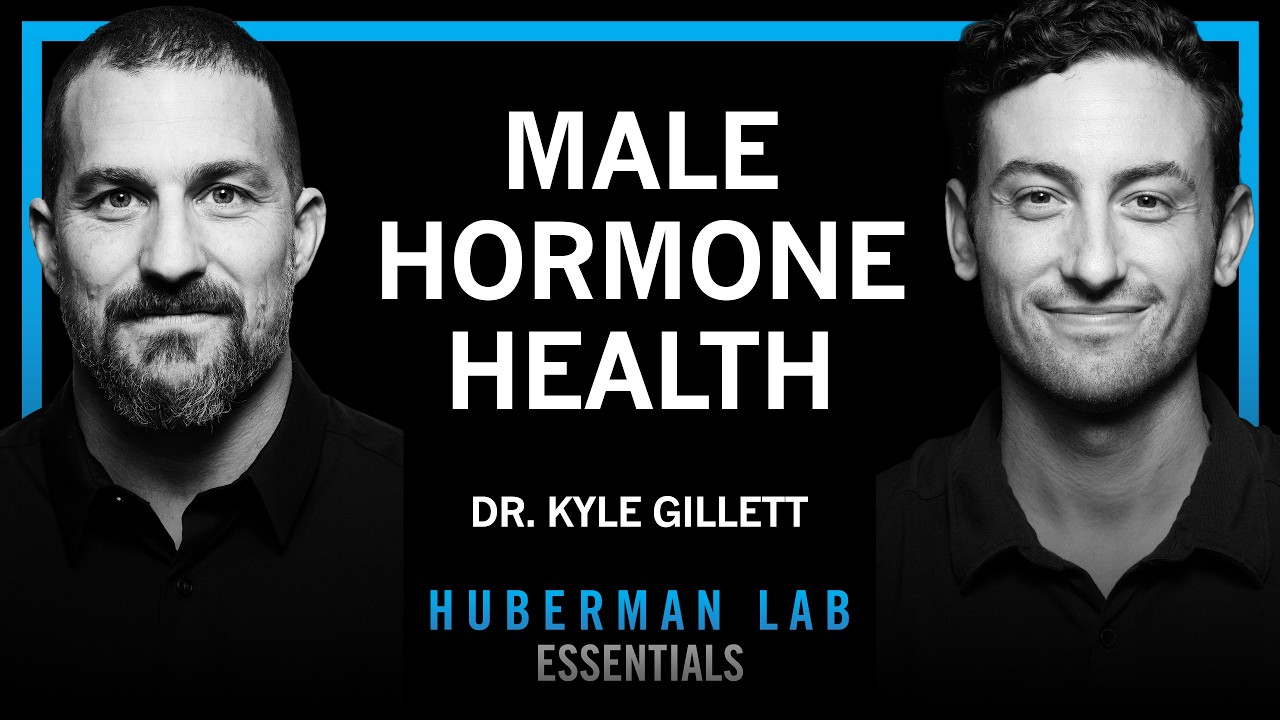
DR GILLETT WARNS YOUNG MEN ON TRT RISKS TO FERTILITY AND MANIA
Andrew Huberman
Exogenous testosterone therapy permanently overrides natural biological rhythms and poses multi-system risks to fertility, cardiovascular health, and mental stability for young men with healthy baseline levels.
## Background
Published on YouTube on July 2, 2026, by Andrew Huberman, this Huberman Lab Essentials episode features dual board-certified physician Dr. Kyle Gillett. The discussion covers science-based tools for optimizing male hormones across the lifespan, focusing on blood work, nutrition, exercise, and various pharmaceutical and supplement interventions.
## TL;DR
The episode provides a comprehensive guide to male hormone optimization, starting with the foundational lifestyle pillars of regular blood testing, stress management, a balanced diet, and consistent physical activity. Dr. Gillett details how natural supplements like creatine, L-carnitine, Tongkat Ali, and Fadogia agrestis work biochemically to improve testosterone and androgen receptor density. The dialogue also addresses the risks and clinical realities of exogenous testosterone therapy, the misuse of SERMs like Clomid, and tactical approaches for managing prostate health and hair loss. Ultimately, it emphasizes a holistic, multi-system medical approach to maintaining vitality and physiological balance.
## Atmosphere & style
The tone is intensely analytical, professional, and dense with clinical expertise, driven by the intellectual synergy between Huberman and Dr. Gillett. It feels like sitting in on a high-level medical consultation, where complex endocrine cascades are broken down into precise, actionable science. The atmosphere is serious and grounded, devoid of hype, trading typical wellness trends for rigorous physiological explanations and candid warnings about modern health fads.
## Key takeaways
- [00:20](https://www.youtube.com/watch?v=O-groYMqrQw&t=20s) Regular blood work is recommended roughly every six months to track hormone metrics like total testosterone, free testosterone, and sex hormone-binding globulin (SHBG).
- [02:17](https://www.youtube.com/watch?v=O-groYMqrQw&t=137s) Extreme dietary restrictions, such as strict vegan or carnivore diets, are highly discouraged for teenagers and young adults as they can significantly deplete free androgens needed for development.
- [05:36](https://www.youtube.com/watch?v=O-groYMqrQw&t=336s) Losing fat through a caloric deficit benefits testosterone levels in individuals with excess adipose tissue, whereas a caloric deficit lowers testosterone in lean individuals.
- [05:36](https://www.youtube.com/watch?v=O-groYMqrQw&t=336s) Chronic over-stress creates a domino effect that disrupts other healthy foundational pillars like exercise and proper nutrition.
- [07:56](https://www.youtube.com/watch?v=O-groYMqrQw&t=476s) Engaging in vigorous exercise longer than an hour is not hormonally beneficial, and an optimal routine consists of vigorous exercise 3 to 4 times a week.
- [08:59](https://www.youtube.com/watch?v=O-groYMqrQw&t=539s) Exogenous Testosterone Replacement Therapy (TRT) in young men with healthy baseline testosterone levels is highly discouraged due to fertility risks and severe multi-system health complexities.
- [10:32](https://www.youtube.com/watch?v=O-groYMqrQw&t=632s) Creatine safely optimizes hormones by aiding ATP storage and modestly shifting the balance of testosterone conversion, without accelerating hair loss beyond one's genetic baseline.
- [14:16](https://www.youtube.com/watch?v=O-groYMqrQw&t=856s) High oral doses of L-carnitine suffer from poor bioavailability and can be converted by gut bacteria into TMAO, a compound linked to cardiovascular risks.
- [16:28](https://www.youtube.com/watch?v=O-groYMqrQw&t=988s) L-carnitine and low-dose tadalafil share the unique medical property of increasing androgen receptor density in cells.
- [17:29](https://www.youtube.com/watch?v=O-groYMqrQw&t=1049s) Vitamin D3 optimizes testosterone production by resolving deficiencies, while boron serves as an acute tactical tool to lower SHBG and free up bound testosterone.
- [19:10](https://www.youtube.com/watch?v=O-groYMqrQw&t=1150s) Tongkat Ali works by upregulating key enzymes in the steroidogenesis cascade, making it highly effective at preserving testosterone during low-carbohydrate or low-calorie diets.
- [19:10](https://www.youtube.com/watch?v=O-groYMqrQw&t=1150s) Fadogia agrestis increases native testosterone production by stimulating the pituitary gland to release luteinizing hormone (LH).
- [23:56](https://www.youtube.com/watch?v=O-groYMqrQw&t=1436s) Clinical testosterone therapy requires expert multi-system management because exogenous hormones permanently override natural daily pulsatile rhythms, posing risks to cardiovascular, dermatological, and mental health.
- [28:32](https://www.youtube.com/watch?v=O-groYMqrQw&t=1712s) Selective estrogen receptor modifiers (SERMs) like Clomiphene are unsuited for long-term testosterone optimization and can cause permanent visual disturbances.
- [31:06](https://www.youtube.com/watch?v=O-groYMqrQw&t=1866s) Alcohol consumption directly upregulates the aromatase enzyme, which converts active testosterone into estrogen, in a strictly dose-dependent manner.
- [31:06](https://www.youtube.com/watch?v=O-groYMqrQw&t=1866s) Daily low-dose tadalafil (2.5 to 5 mg) serves as a continuous tonic for micro-circulation, protects prostate health, and cuts nighttime urination episodes in half.
- [33:59](https://www.youtube.com/watch?v=O-groYMqrQw&t=2039s) Topical caffeine and ketoconazole can penetrate the scalp to weakly crowd out dihydrotestosterone (DHT) from hair follicles without systemic side effects.
- [35:15](https://www.youtube.com/watch?v=O-groYMqrQw&t=2115s) Topical dutasteride is uniquely effective for hair loss prevention because its fast half-life at low doses prevents it from reducing systemic DHT levels, unlike topical finasteride or spironolactone.
Dr. Andrew Huberman introduces the episode, welcoming dual board-certified physician Dr. Kyle Gillett to discuss science-based tools for male hormone optimization across the lifespan. To set the stage, Huberman asks what all males should do—or avoid doing—to maintain healthy hormone levels as they age.
Dr. Gillett uses a car manufacturing analogy, explaining that just as a new vehicle coming off the assembly line undergoes a full diagnostic workup, humans should monitor their biological progress across their lifespan. While major changes happen during puberty, human development never truly ends. When asked what specific markers to look for in a blood panel, Gillett highlights the importance of checking testosterone alongside sex hormone-binding globulin (SHBG) or looking directly at free testosterone.
- **SHBG Definition:** Sex hormone-binding globulin is the protein that binds up androgens and estrogens in the body; the stronger the androgen, the tighter it binds.
- **Role of DHT:** During puberty, dihydrotestosterone (DHT)—the strongest bioidentical androgen—plays a major role in developing secondary sexual characteristics. High SHBG can keep DHT elevated by preventing its metabolism, though it leaves less free DHT available.
- **Testing Frequency:** Dr. Gillett recommends that individuals work with their physicians using shared decision-making to get follow-up blood work done roughly every **6 months**.
---
[02:17](https://www.youtube.com/watch?v=O-groYMqrQw&t=137s) Dietary Pillars & Development
Shifting the conversation to daily protocols, Dr. Gillett outlines the foundational lifestyle pillars, starting with diet, exercise, and sleep. During development, it is critical not to prematurely exclude foods that are actively supporting growth. For instance, eliminating dairy can suppress insulin-like growth factor 1 (IGF-1) and free IGF-1, which are crucial for long bone growth, skin and hair growth, and genital development.
The discussion expands to the impact of extreme dietary choices in early adulthood. While a pure carnivore or strict vegan diet might be a reasonable option for someone in their late 20s, Dr. Gillett warns that it is a "horrible idea" for teenagers and individuals in their early 20s because it is likely to drastically reduce free androgens, leaving less testosterone available to act on receptors throughout the body.
- **Vitamin D:** Essential for testosterone production, bone mineralization, and stature. Optimizing growth hormone and IGF-1 up to roughly age 25 helps maximize bone density.
- **Estrogen Balance:** Adequate free estrogen (but not too much) is needed during growth to stockpile bone and prevent osteoporosis or fractures later in life.
- **Fiber Intake:** Paramount for establishing the "set point" of the gut microbiome. Prebiotic fiber acts like "fish food" for a healthy gut, which can be thought of as an aquarium where dietary choices skew the balance toward beneficial or detrimental bacteria. Essential fatty acids and prebiotic fiber remain crucial throughout life, especially in the 20s and 30s to support ongoing brain development.
Huberman revisits a point from a previous conversation regarding the relationship between caloric restriction and testosterone. Dr. Gillett confirms Huberman's summary: if an individual carries excess adipose tissue, losing that fat through controlled caloric restriction and exercise will ultimately benefit their testosterone levels. However, for lean individuals who do not have excess body fat, entering a caloric deficit will actually lower testosterone.
Beyond nutrition, Dr. Gillett identifies stress management as the next crucial pillar. During puberty and a person's 20s and 30s, individuals are actively learning how to cope with stress and deciding where to direct their effort. If someone becomes chronically over-stressed, it creates a domino effect that causes the other lifestyle pillars to crumble—leading them to stop exercising and eating well.
- **Mechanisms of a Caloric Deficit:** A deficit leaves fewer building blocks for hormones, induces a catabolic state, lowers signaling from growth hormone and IGF-1, and elevates SHBG, which subsequently drives down free androgens and free estrogens.
- **Life Purpose & Self-Actualization:** Dr. Gillett notes the importance of finding a life purpose—which he refers to as "spirit"—corresponding to the self-actualization component of Maslow’s hierarchy of needs. Huberman adds that finding a purpose isn't about locked-in, permanent choices, but rather about picking a goal, achieving it, assessing, and then choosing the next one.
---
[07:56](https://www.youtube.com/watch?v=O-groYMqrQw&t=476s) Exercise Regimens & TRT in Young Adults
When establishing a sustainable exercise routine that supports healthy hormone status, Dr. Gillett recommends engaging in vigorous exercise **3 to 4 times a week**. Individuals can overlay this with an additional 3 to 4 sessions of less intense physical activity. However, he warns against over-training, citing clinical data tracking ratings of perceived exertion.
Huberman transitions to a growing cultural trend that he views as highly concerning: young men in their teens, 20s, or 30s utilizing exogenous Testosterone Replacement Therapy (TRT) despite already having healthy blood levels within the standard reference range of **300 to 900 ng/dL**. Given the clear risks to fertility and the complexities of managing proper dosages, Huberman expresses astonishment that anyone not being financially compensated for an elite athletic endeavor would take the leap. Dr. Gillett firmly agrees, stating that the benefits almost never outweigh the detriments for young men, outside of exceedingly rare clinical conditions like Kallmann syndrome.
> "It is not hormonally helpful to train, especially regularly train, vigorously for longer than an hour."
---
[10:32](https://www.youtube.com/watch?v=O-groYMqrQw&t=632s) Supplements for Testosterone, Creatine & Hair Loss
For men looking to naturally optimize their hormones without shutting down their body's endogenous production, Dr. Gillett introduces creatine as a premier foundational supplement. Creatine aids in amino acid synthesis, mitigates oxidative stress, acts as a backup fuel source for cellular mitochondria by holding backup ATP, slightly bumps total testosterone, and increases the conversion of testosterone into DHT.
Because DHT drives male pattern baldness, a widespread "mythology" persists that creatine accelerates hair loss. Huberman asks directly if creatine supplementation actually speeds up balding. Dr. Gillett clarifies that fearing hair loss is a very poor reason to avoid creatine. It will not push an individual to supra-physiological androgen levels; rather, it simply brings a person to what they are naturally and genetically inclined to have.
- **Creatine & DHT Dynamics:** In men whose conversion of testosterone to DHT is already naturally high, creatine typically has no additional effect. It merely resets the homeostatic balance between testosterone being aromatized into estrogen versus being 5-alpha reduced into DHT. For men with naturally low 5-alpha reductase activity, creatine simply returns them to a normal baseline.
- **Beta-Alanine (Betaine):** Mentioned alongside creatine as a tool for amino acid synthesis and energy shunting. For individuals who are "non-responders" to standard creatine, increasing the dose to 10 grams or introducing its chemical cousin, betaine, can be highly effective.
- **Betaine Dosages:** Typically taken at **1 to 3 grams**. Many commercial creatine formulations explicitly mix in betaine because it assists the body in processing methionine and homocysteine. Huberman, a regular creatine user, asks how to know if adding betaine is necessary; Dr. Gillett answers that a standard blood test showing persistently elevated homocysteine (an inflammatory marker) is the best indicator.
The conversation moves to L-carnitine, which can be administered either orally via capsules or through prescription-only intramuscular injections. Dr. Gillett explains that because injectable L-carnitine is an aqueous solution lacking a carrier oil (unlike testosterone esters), it will burn intensely and fail to disseminate properly through the body if it is accidentally injected too superficially into subcutaneous fat. Furthermore, while injections can yield localized effects, oral ingestion suffers from incredibly poor bioavailability—often around only **10%**.
To overcome this poor absorption rate, Dr. Gillett notes that oral doses must be substantially higher, typically ranging from **1,000 mg to 5,000 mg (1 to 5 grams) per day**. However, high oral doses bring a distinct gut health risk involving trimethylamine N-oxide (TMAO), a compound linked to cardiovascular risks and potential carcinogenicity. Both carnitine and choline (such as alpha-GPC) can be converted into TMAO by specific gut bacteria if an individual has a dysregulated microbiome.
- **Allicin:** A compound found in garlic that can effectively decrease the bacterial conversion of carnitine and choline into TMAO.
- **Berberine:** Also lowers TMAO conversion, likely by altering the composition of the gut microbiome.
- **Microbiome Optimization:** While not every individual taking high-dose L-carnitine needs to supplement with allicin, anyone running a high oral protocol should closely evaluate their gut health to mitigate TMAO accumulation.
[16:28](https://www.youtube.com/watch?v=O-groYMqrQw&t=988s) L-Carnitine, Berberine, and Androgen Receptor Density
Andrew Huberman and Dr. Kyle Gillett discuss the proper administration and physiological mechanisms of L-carnitine, alongside compounds used to manage its side effects. Huberman shares his personal protocol, noting that he will continue taking 600 mg of garlic with his L-carnitine to mitigate TMAO production, but has decided to skip berberine entirely due to "brutal headaches" and intense carbohydrate cravings brought on by dropped blood sugar. Dr. Gillett elaborates that berberine has numerous complex systemic effects, including triggering the "dawn phenomenon" where it silently tanks a person's blood sugar during sleep.
Shifting back to the core mechanism of L-carnitine, Dr. Gillett explains that it functions structurally as a shuttle, formally tied to carnitine palmitoyltransferase, moving essential nutrients from outside the mitochondria directly into them. Crucially for hormone optimization, L-carnitine boasts a rare property shared by the medication tadalafil: it increases the density of androgen receptors within the cellular cytoplasm. This means that even if a patient's baseline testosterone levels and overall receptor sensitivity remain entirely unchanged, more testosterone will successfully bind to cells simply because there are more physical receptors available. When Huberman asks if athletes or patients need to cycle L-carnitine, creatine, or betaine, Dr. Gillett delivers a definitive answer: "No reason to cycle any of those."
[17:29](https://www.youtube.com/watch?v=O-groYMqrQw&t=1049s) Broad Stroke Hormone Optimization: Vitamin D3 and Boron
Huberman pivots the conversation to broader tools for enhancing a male's hormonal profile. He emphasizes looking at subjective markers rather than just chasing laboratory metrics, raising practical questions: "Do people feel like they are going to have more energy as a consequence of doing these things? Are they going to have the more optimized libido? Are they going to have more optimized recovery from exercise?" Huberman rightly notes that shifting a patient's total testosterone from 600 to 800 ng/dL isn't automatically beneficial, particularly if estrogen rises concurrently and induces unwanted side effects.
Dr. Gillett highlights two foundational over-the-counter tools: vitamin D3 and boron. Vitamin D3 is a sterol hormone; correcting a baseline deficiency directly optimizes testosterone production. Boron serves as an acute tactical tool to lower Sex Hormone-Binding Globulin (SHBG). Huberman reminds the audience that SHBG acts like a molecular sponge, attaching to testosterone and severely limiting the amount of "free testosterone" available to exert its biological impact on cells. Dr. Gillett notes that boron is highly depleted in the soils of many Western countries but remains exceptionally dense in the soils of Greece and Turkey. Consequently, consuming raisins or dates sourced from those regions provides a natural, potent dose of boron, which likely explains why the historical and modern reference ranges for normal testosterone are notably higher in those Mediterranean countries.
- **Boron Dosing:** 5 to 12 mg per day for acute SHBG suppression (not a sustained long-term effect).
[19:10](https://www.youtube.com/watch?v=O-groYMqrQw&t=1150s) The Steroidogenesis Cascade: Tongkat Ali and Fadogia Agrestis
The conversation moves into herbal compounds that directly influence the steroidogenesis cascade—the biological pathway where the body synthesizes sterol hormones out of a cholesterol backbone. Dr. Gillett explains that these pathways can shunt cholesterol into vitamin D, testosterone, estrogens, or progestogens. Tongkat Ali (also known as longjack) works by upregulating several key enzymes across multiple conversion steps in this synthesis process. Dr. Gillett notes that insulin and IGF-1 naturally act as upregulators of these steps as well. Therefore, if a person is running a protocol where growth hormone, insulin, and IGF-1 are suppressed—such as during a low-carbohydrate diet or a significant caloric deficit to cut body weight—Tongkat Ali becomes "theoretically especially powerful" to preserve hormonal output.
Huberman shares that his personal blood work reveals Tongkat Ali successfully drives an increase in his free testosterone alongside a slight bump in luteinizing hormone (LH). Dr. Gillett adds that in his clinical practice, he observes Tongkat Ali raising DHEA and actively driving down high SHBG. Interestingly, clinical data shows that if a patient has an already perfectly normal SHBG level, Tongkat Ali leaves it completely unaffected, yet still successfully boosts their total and free testosterone.
For patients searching for alternatives to exogenous testosterone replacement therapy (TRT) or DHEA, Dr. Gillett introduces *Fadogia agrestis*. Rather than mimicking LH directly, *Fadogia agrestis* stimulates the pituitary gland to release more natural luteinizing hormone. This LH then travels to and binds with the LH receptors on the Leydig cells in the testes, signaling them to increase the manufacturing and release of native testosterone. Addressing rampant online concerns regarding testicular cellular toxicity seen in a prominent rodent study, Dr. Gillett puts the risk into perspective. The rats in that study were completely deprived of supporting antioxidants, yet an back-calculated, translated human equivalent dose proved safe.
- **Tongkat Ali Dosing:** 300 to 1,200 mg per day, heavily dependent on standardizing the active pharmacological plant compound, eurycomanone.
- **Fadogia Agrestis Safe Dose Baseline:** An average of 300 mg per day represents the human equivalent dose where no toxicity was observed in the data.
- **Fadogia Agrestis Clinical Protocols:** To maximize safety, Dr. Gillett frequently protocols 600 mg every other day, or 600 mg three times a week (typically on a Monday, Wednesday, and Friday schedule).
[23:56](https://www.youtube.com/watch?v=O-groYMqrQw&t=1436s) Testosterone Therapy Dosing Protocols and Multi-System Risks
Huberman addresses the massive cultural shift toward "testosterone therapy" rather than strict replacement, noting that many modern men are seeking treatment with baseline levels already sitting healthy at 600 to 800 ng/dL. They are looking to augment performance, motivation, and recovery rather than replace a profound clinical deficit. Huberman asks Dr. Gillett to map out a modern clinical approach for a hypothetical patient presenting with a 600 ng/dL baseline, normal estrogen, but reporting soft subjective symptoms like reduced drive and sluggish recovery. He specifically asks if micro-dosing frequently is superior to the "old-school way" of administering a massive 100 to 200 mg single injection once every two weeks.
Dr. Gillett states that the clinical entry point depends entirely on the patient's baseline SHBG and free testosterone. If a man has an ultra-high SHBG that leaves him with an abysmal free testosterone level of 2, his dosing needs will be radically different to establish a healthy, eugonadal free hormone profile. For a standard patient using common esters like testosterone cypionate or enanthate, Dr. Gillett favors a total weekly volume of 100 to 120 mg. This is divided into micro-doses administered every other day, three times a week, or occasionally twice a week for individuals with higher SHBG.
Dr. Gillett warns that a true clinician managing testosterone therapy must possess multi-system "prowess" across every single organ system, because exogenous testosterone permanently overrides the body's natural pulsatile daily rhythm (which is naturally high in the morning and low in the evening) with an unwavering, artificial steady state.
- **Typical Physiology Dosing:** Two 60-mg injections of testosterone cypionate per week to hit a 120 mg total is a very common, highly stable starting baseline.
- **Dermatological Side Effects:** Development of severe acne, skin pathologies, and unpredictable bruising.
- **Aesthetic and Mental Changes:** Rapid hair loss and significant mental status alterations; because testosterone is heavily dopaminergic, it can occasionally unmask or induce full manic or bipolar episodes.
- **Cardiovascular and Hematological Risks:** Development of microvascular ischemic disease, systemic ferritin buildup driven by parallel escalations in estrogen, lipid panel degradation, and the total suppression of natural fertility.
- **Clinical Requirement:** "If your physician that is managing or prescribing your testosterone therapy or your HRT is not well-versed in these systems, you would want him or her to be part of an interdisciplinary team," covering hematology, lipidology, and cardiology.
[28:32](https://www.youtube.com/watch?v=O-groYMqrQw&t=1712s) The Misuse of Clomiphene (Clomid) and SERMs
Huberman inquires about the surging trend of men utilizing clomiphene (Clomid)—often taken as two 50 mg tablets per week—as an alternative strategy to avoid exogenous injections or creams while attempting to bump luteinizing hormone and overall testosterone. Dr. Gillett delivers a highly critical review of long-term selective estrogen receptor modifier (SERM) usage for optimization. Mechanistically, Clomid functions at the level of the hypothalamus and the pituitary gland by executing negative feedback inhibition; it effectively crowds out native estrogen molecules by binding directly to the estrogen receptors there.
Huberman questions the fundamental logic of using such a compound, asking: "Why would I want to take something that would increase the activity of an estrogen receptor? I just can't find the rationale for that." Dr. Gillett clarifies that a SERM's legitimate clinical utility is almost exclusively as an explicit, highly temporary bridge designed to kickstart a system when a patient's natural testosterone is so low that it cannot recover on its own. It is completely unsuited for long-term testosterone optimization because there are five distinct estrogen and estrogen-related receptor pathways in the body. Every SERM carries a highly chaotic, unique systemic profile—inhibiting receptors selectively in one tissue type while aggressively activating them in another. For instance, Clomid binds to and inhibits vital estrogen receptors located directly inside the human eye, frequently triggering permanent or highly disruptive visual changes and blurry vision, especially as doses scale.
[31:06](https://www.youtube.com/watch?v=O-groYMqrQw&t=1866s) Alcohol, Aromatase, and the Emerging Benefits of Low-Dose Tadalafil
The conversation shifts to lifestyle variables, specifically the molecular impact of alcohol consumption on hormone profiles. Dr. Gillett confirms that alcohol drastically and directly upregulates *aromatase*, the specific enzyme responsible for converting active testosterone directly into estrogen, and the effect is strictly dose-dependent. He advises a strict limit of no more than three to four standard drinks every two weeks, noting that a single massive restaurant pour of wine often contains five standard drinks on its own. Beyond upregulating aromatase, alcohol carries a heavy caloric burden of 7 kcal/g (nearly rivaling pure fat at 9 kcal/g) and is profoundly GABAergic. This intense activation of inhibitory neurotransmission alters the master signaling cascade from the brain, suppressing the release of LH and FSH, and crushing natural testosterone production in a manner highly reminiscent of opiates.
Finally, Huberman transitions to an emerging trend in preventative medicine: the prescribing of daily low-dose tadalafil (Cialis) within a 2.5 to 5 mg range. While traditionally known for erectile dysfunction, progressive physicians are deploying it continuously to optimize prostate health and enhance micro-vascular blood flow to the entire male genitalia. Dr. Gillett strongly validates this trend, calling tadalafil a "very underrated medication." He notes that its deployment age depends completely on individual patient indications, pointing out that because it functions inherently as a smooth-muscle relaxant and blood pressure medication, it mildly lowers systemic blood pressure. However, he differentiates that true clinical blood pressure management or erectile dysfunction protocols typically leverage maximum doses closer to 20 mg, whereas the 2.5 to 5 mg daily protocol acts as a highly effective, continuous tonic for micro-circulation and prostate protection.
[33:03](https://www.youtube.com/watch?v=O-groYMqrQw&t=1983s) Tadalafil, Side Effects, and Nocturia
Dr. Kyle Gillett outlines the potential side effects and unexpected benefits of using tadalafil. When taken consistently at higher doses, it can subtly affect the cones in the eye, specifically impairing red-green color discrimination. However, this visual effect is completely reversed once the medication is stopped. Because of this, Dr. Gillett notes with a touch of humor that if you do not strictly require "really really good red green discrimination," you can manage higher doses, though he generally recommends a conservative daily dose of just 2 to 5 mg, capping it at a maximum of 10 mg.
Beyond its primary uses, tadalafil shares a unique property with L-carnitine by increasing the density of androgen receptors, offering an intriguing benefit for hormone optimization. Furthermore, it serves as a powerful tool for individuals suffering from nocturia—the frequent need to urinate at night. Dr. Gillett explains that taking tadalafil can effectively "cut the episodes in half," reducing a patient's nightly bathroom trips from two to one. This reduction dramatically improves overall sleep quality, which secondarily provides a massive boost to growth hormone production and testosterone optimization. Andrew Huberman highlights this, confirming that a daily dose of 2.5 to 5 mg is typical to achieve these protective prostate and sleep-enhancing effects.
* Tadalafil can cause reversible red-green color blindness at high doses.
* Recommended daily dosage ranges from 2 to 5 mg, with a maximum cap of 10 mg.
* Increases androgen receptor density similarly to L-carnitine.
* Cuts nocturia episodes in half, safeguarding sleep quality to naturally optimize testosterone and growth hormone.
[33:59](https://www.youtube.com/watch?v=O-groYMqrQw&t=2039s) Hair Loss and Topical Anti-Androgens
Huberman transitions the conversation to hair loss prevention, a topic of intense interest for his audience. He notes that common oral medications like Propecia target the dihydrotestosterone (DHT) system because DHT receptors on the scalp trigger male pattern baldness, even though the same hormone promotes facial hair growth. Huberman asks if blocking this pathway systemically risks diminishing a man's sex drive, motivation, and general vigor, and whether topical alternatives can selectively save scalp hair without these systemic side effects.
Dr. Gillett confirms that individuals with a mild genetic predisposition can successfully opt for topical anti-androgens instead of oral medications. He surprises Huberman by naming ketoconazole and caffeine as two such topical options. When Huberman asks how one even gets caffeine into a hair follicle, Dr. Gillett explains that topically applied caffeine penetrates the scalp to "crowd out" androgens. While the effect is admittedly weak, it is just potent enough to be clinically significant. For this reason, caffeine is frequently bundled into specialized topical formulations alongside other mild anti-androgens like ketoconazole.
* Oral DHT blockers risk systemic side effects like lowered libido, reduced motivation, and decreased vigor.
* Topical anti-androgens offer a localized alternative for individuals with a mild predisposition to hair loss.
* Topically applied caffeine physically penetrates the scalp to weakly crowd out DHT from hair follicles.
[35:15](https://www.youtube.com/watch?v=O-groYMqrQw&t=2115s) Comparing Topical Finasteride, Dutasteride, and Spironolactone
Dr. Gillett issues a strong warning regarding topical spironolactone. Because of its specific molecular size, it is heavily absorbed systemically into the bloodstream. He cautions male listeners to never use topical spironolactone unless specifically directed by a physician. Topical finasteride is also composed of a relatively small molecule and experiences systemic absorption, though to a lesser degree; utilizing topical finasteride typically results in a 30% reduction in systemic DHT levels.
In contrast, Dr. Gillett highlights topical dutasteride as a uniquely effective alternative. While it may experience a tiny amount of systemic absorption, its half-life at lower doses is incredibly fast. Consequently, topical dutasteride does not reduce systemic DHT levels at all. Dr. Gillett notes that he has observed this distinct advantage "anecdotally on many people on topical dutasteride therapy," making it a compelling option for preserving hair without altering full-body hormone chemistry. Huberman closes the discussion by expressing deep gratitude to Dr. Gillett, praising his immense knowledge and his exceptional ability to share science-based medical insights in an actionable way.
* **Topical Spironolactone:** Highly absorbed systemically; strictly warned against for male patients unless explicitly prescribed.
* **Topical Finasteride:** Partially absorbed systemically, typically lowering circulating DHT levels by roughly 30%.
* **Topical Dutasteride:** Possesses a rapid half-life at low doses, effectively leaving systemic DHT levels completely untouched.
## Notable quotes
> [07:56](https://www.youtube.com/watch?v=O-groYMqrQw&t=476s) It is not hormonally helpful to train, especially regularly train, vigorously for longer than an hour.
> [16:51](https://www.youtube.com/watch?v=O-groYMqrQw&t=1011s) No reason to cycle any of those. — Kyle Gillett
> [17:29](https://www.youtube.com/watch?v=O-groYMqrQw&t=1049s) Do people feel like they are going to have more energy as a consequence of doing these things? Are they going to have the more optimized libido? Are they going to have more optimized recovery from exercise? — Andrew Huberman
> [23:56](https://www.youtube.com/watch?v=O-groYMqrQw&t=1436s) If your physician that is managing or prescribing your testosterone therapy or your HRT is not well-versed in these systems, you would want him or her to be part of an interdisciplinary team — Kyle Gillett
> [28:32](https://www.youtube.com/watch?v=O-groYMqrQw&t=1712s) Why would I want to take something that would increase the activity of an estrogen receptor? I just can't find the rationale for that. — Andrew Huberman
Dual board-certified physician Dr. Kyle Gillett outlines an evidence-based framework for male hormone optimization, prioritizing routine diagnostic monitoring, lifestyle foundations, and targeted non-suppressive compounds over premature clinical interventions. He cautions that aggressive pharmaceutical approaches like exogenous testosterone and selective estrogen receptor modulators carry multi-system risks that generally outweigh benefits in healthy men.
Diagnostic Biomarkers and Lifestyle Foundations (0:00)
Dr. Gillett advises regular blood testing every six months using shared decision-making with a physician, highlighting total testosterone, free testosterone, and sex hormone-binding globulin (SHBG). SHBG binds circulating androgens and estrogens; high levels reduce bioavailable free testosterone and dihydrotestosterone (DHT). Lifestyle fundamentals establish the baseline for these markers. Gillett warns that restrictive diets such as strict carnivore or vegan regimens are ill-advised for adolescents and young adults because they can lower insulin-like growth factor 1 (IGF-1) and free androgens essential for tissue growth and bone mineral accrual. Furthermore, while controlled caloric deficits improve testosterone in men with excess adipose tissue, caloric restriction in lean individuals elevates SHBG, induces catabolism, and depresses free hormone levels.
Physical training and toxin management further dictate endocrine status. Gillett recommends three to four vigorous exercise sessions weekly, cautioning that vigorous workouts exceeding one hour become hormonally counterproductive. On alcohol, Gillett reports a direct, dose-dependent upregulation of aromatase—the enzyme converting testosterone to estrogen—alongside GABAergic suppression of luteinizing hormone (LH) and follicle-stimulating hormone (FSH). He advises capping intake at three to four standard drinks every two weeks to prevent endocrine disruption.
Nutraceutical Strategies for Hormones and Receptors (10:32)
For individuals seeking natural optimization, several non-suppressive compounds enhance synthesis pathways or tissue sensitivity. Creatine supports mitochondrial ATP synthesis and normalizes 5-alpha reductase activity; Gillett clarifies that it does not induce supra-physiological DHT or accelerate hair loss beyond genetic baselines. For non-responders or individuals with elevated homocysteine, betaine (1 to 3 grams) assists methionine processing. L-carnitine, dosed orally at 1,000 to 5,000 mg daily to overcome its 10% bioavailability, increases cytoplasmic androgen receptor density. Because high oral carnitine doses can be converted by gut bacteria into trimethylamine N-oxide (TMAO)—a compound linked to cardiovascular risk—co-administration with allicin (garlic extract) or berberine helps inhibit this conversion.
Direct endocrine modulation can be targeted with micronutrients and botanical extracts. Boron (5 to 12 mg daily) serves as an acute tool to suppress elevated SHBG, freeing circulating testosterone, while vitamin D3 corrects foundational sterol deficiencies. In the steroidogenesis cascade, Tongkat Ali (300 to 1,200 mg daily) upregulates steroid synthesis enzymes, making it particularly useful for preserving hormone output during caloric deficits. To stimulate Leydig cell output, Gillett cites Fadogia agrestis as an LH-releasing agent, recommending protocols like 300 mg daily or 600 mg every other day to remain safely below rodent-observed cellular toxicity thresholds.
Clinical Liabilities of TRT and SERMs (7:56)
Both Huberman and Dr. Gillett express deep concern regarding the growing trend of young men initiating exogenous Testosterone Replacement Therapy (TRT) despite having normal baseline levels between 300 and 900 ng/dL. Exogenous administration permanently replaces natural circadian pulsatility with a flat steady state, shuts down fertility, and introduces systemic risks including lipid panel degradation, microvascular ischemic disease, ferritin accumulation, severe acne, and potential manic psychological episodes driven by dopaminergic stimulation. When medically necessary, Gillett favors micro-dosing protocols—typically 100 to 120 mg of testosterone cypionate weekly, split into bi-weekly or alternate-day injections—under interdisciplinary monitoring across cardiology and hematology.
Gillett delivers an equally strong warning against using clomiphene (Clomid) or other selective estrogen receptor modulators (SERMs) as long-term testosterone boosters. While occasionally used as short-term bridges to stimulate pituitary LH release after severe suppression, SERMs bind erratically across five distinct estrogen receptor classes throughout the body. In ocular tissues, Clomid frequently inhibits essential estrogen receptors, causing visual disturbances and blurry vision that can become persistent.
Microvascular Support and Targeted Hair Preservation (31:06)
Daily low-dose tadalafil (2.5 to 5 mg) is highlighted as an emerging adjunct for men's preventative health. Beyond mild systemic blood pressure reduction and enhanced genital micro-circulation, tadalafil shares L-carnitine’s ability to increase androgen receptor density. Clinically, Gillett notes that low-dose tadalafil roughly halves nocturia episodes; by preventing frequent nighttime awakenings, it consolidates deep sleep architecture vital for endogenous growth hormone and testosterone secretion. Reversible red-green color discrimination impairment represents its main dose-dependent side effect.
To manage male pattern baldness without the systemic vigor and libido side effects of oral 5-alpha reductase inhibitors, localized alternatives can be deployed. While topical spironolactone is strongly discouraged due to rapid systemic absorption, topical caffeine and ketoconazole offer mild, localized competition at scalp androgen receptors. Topical finasteride still triggers an approximate 30% reduction in circulating DHT, whereas topical dutasteride exhibits a rapid localized clearance at low doses, effectively protecting scalp follicles without suppressing systemic DHT levels.
Gillett and Huberman emphasize that optimizing male endocrine health relies on sustaining fundamental sleep, nutritional, and training habits rather than pursuing arbitrary laboratory targets. While non-suppressive supplements and localized topicals provide measurable functional improvements, systemic pharmaceutical interventions override natural autoregulation and require specialized, interdisciplinary medical oversight.
[7:56] It is not hormonally helpful to train, especially regularly train, vigorously for longer than an hour.
[16:51] Kyle Gillett: No reason to cycle any of those.
[17:29] Andrew Huberman: Do people feel like they are going to have more energy as a consequence of doing these things? Are they going to have the more optimized libido? Are they going to have more optimized recovery from exercise?
[23:56] Kyle Gillett: If your physician that is managing or prescribing your testosterone therapy or your HRT is not well-versed in these systems, you would want him or her to be part of an interdisciplinary team
[28:32] Andrew Huberman: Why would I want to take something that would increase the activity of an estrogen receptor? I just can't find the rationale for that.
Original transcript
[0:00] Welcome to Huberman Lab Essentials,
[0:01] [music] where we revisit past episodes
[0:04] for the most potent and actionable
[0:06] science-based [music] tools for mental
[0:08] health, physical health, and
[0:09] performance.
[0:11] I'm Andrew Huberman, and I'm a professor
[0:13] of neurobiology and ophthalmology at
[0:15] Stanford School of Medicine. And now,
[0:17] for my discussion with Dr. Kyle
[0:19] Gillette. Dr. Gillette, great to have
[0:21] you back.
[0:22] >> Great to be back. Thank you.
[0:24] >> I'd like to begin with a question about
[0:26] what all males ought to do in order to
[0:29] optimize their hormones. What should
[0:31] they be doing, what should they avoid
[0:32] doing if the goal is to have a long arc
[0:35] of healthy hormone optimization
[0:37] throughout the lifespan?
[0:38] >> There's many things that you should do.
[0:41] An analogy that I often make is when
[0:43] there's a brand new car that comes off
[0:45] the assembly line, you do a full scope
[0:47] of diagnostic workup, hook it up to the
[0:49] computer, and I think we should do the
[0:50] same thing with humans as well. During
[0:53] puberty, you know, obviously you're a
[0:55] functioning human, but I would say
[0:57] there's still development, and I think
[0:59] that the human always develops. I don't
[1:02] think development ever ends, but you
[1:04] want to monitor that progress across a
[1:06] person's lifespan.
[1:08] >> What do you think are the key things to
[1:10] look for in blood work? I mean,
[1:12] testosterone is always the topic that
[1:14] comes up in the context of male hormone
[1:16] optimization, but certainly there are a
[1:17] lot of other hormones that are important
[1:18] as well.
[1:19] >> Mhm. And with testosterone, you want to
[1:21] get either testosterone and a SHBG or a
[1:23] free testosterone.
[1:24] >> Could you define SHBG for our listeners,
[1:26] please?
[1:27] >> It is sex hormone binding globulin. It
[1:29] is the protein that binds up all
[1:31] androgens and estrogens in the body. So,
[1:34] the stronger the androgen, the stronger
[1:36] it binds. During puberty, strong
[1:39] androgens, especially DHT, which is the
[1:41] strongest bioidentical androgen,
[1:44] has a huge role, a prominent role in
[1:47] secondary sexual characteristics.
[1:50] And if your SHBG is very high, then your
[1:52] DHT can run higher because it's not
[1:54] metabolized, but there's not quite as
[1:57] much free DHT. So, you want to balance
[1:59] between um a high enough free DHT and a
[2:03] high enough total DHT. So, assuming that
[2:05] there's no major intervention, how often
[2:08] do you recommend that people get their
[2:09] blood work done? Using shared
[2:11] decision-making with their physician,
[2:14] usually a good follow-up is about 6
[2:16] months.
[2:16] >> So, on a daily basis, uh maybe you could
[2:18] just take us through the arc of a day
[2:20] and um
[2:21] and push out some of the protocols that
[2:23] you use or the things that you like to
[2:24] see your male patients use in order to
[2:26] try and optimize their hormone status.
[2:29] >> I'll briefly touch on some of the
[2:30] lifestyle pillars to start. Diet and
[2:32] exercise are the first two.
[2:34] Um in puberty, sleep is particularly
[2:37] important, of course.
[2:38] Um but with diet and exercise, uh
[2:41] throughout a
[2:43] lifespan, you want to not exclude things
[2:47] that are helping you. For example,
[2:49] during puberty, if you're consuming
[2:51] dairy and then all of a sudden you cut
[2:52] out all dairy, dairy can help increase
[2:54] IGF-1 and free IGF-1.
[2:56] >> And what And just uh again, for our
[2:58] audience, maybe you just mention what IG
[3:00] what having enough IGF-1 can do for us
[3:02] that's beneficial is
[3:03] >> It helps you grow. It uh helps with uh
[3:06] genital development, secondary sexual
[3:08] characteristics, and long bone growth.
[3:11] Um skin growth, hair growth, a host of
[3:13] things.
[3:14] >> So, getting an array of nutrients that
[3:16] include dairy, what other sorts of
[3:18] nutrients are important during
[3:19] development?
[3:20] >> You want to have adequate vitamin D.
[3:22] Vitamin D helps with testosterone
[3:23] production. It helps again with bone
[3:26] mineralization
[3:27] and stature. Um after an age of about
[3:31] 25, and there's not a strict cut-off,
[3:34] but up to about age of 25, optimizing
[3:36] your growth hormone and IGF-1 helps with
[3:39] bone density and bone growth.
[3:41] So, uh from the dietary standpoint, you
[3:44] want to have enough free estrogen, not
[3:46] too much when you're growing, but you
[3:48] want to help um
[3:50] basically stockpile bone to prevent a
[3:53] risk of osteoporosis or thin bones
[3:55] fractures when you're older.
[3:57] >> I realize that some of this relates to
[3:59] ethics and food allergies and things of
[4:00] that sort, but would you say that on
[4:03] balance that most people would benefit
[4:06] from eating a combination of you know,
[4:09] quality proteins from animal sources and
[4:11] non-animal sources, fruits, vegetables,
[4:13] and starches? I mean, what do you think
[4:16] for instance about people following a
[4:17] pure carnivore or a very
[4:20] pure vegan diet in their 20s and 30s?
[4:23] >> In their late 20s, it might be a
[4:24] reasonable option. In early 20s and
[4:27] certainly teens, it is a horrible idea
[4:29] because it is likely to significantly
[4:31] decrease your free androgens. So, you
[4:33] will have less testosterone acting on
[4:35] receptors through the body.
[4:37] >> Are there any other micronutrients or
[4:39] macronutrients that people in their 20s
[4:41] and 30s should emphasize?
[4:42] >> Fiber is going to be paramount in kind
[4:45] of like setting your set point of your
[4:47] gut microbiome the rest of your life.
[4:49] There is prebiotic fiber, which you can
[4:52] think of as fish food for your good gut
[4:54] microbiome. Your gut microbiome's kind
[4:56] of like an aquarium or a fish tank. Any
[4:59] fiber or food that you're putting in
[5:00] your gut, it's either going to it's
[5:02] going to skew your gut microbiome
[5:04] towards something that is more
[5:05] beneficial or or more detrimental.
[5:08] >> And would you say that the prebiotic
[5:10] fiber and the getting essential fatty
[5:12] acids, that would be important to do
[5:15] throughout the lifespan or just for
[5:16] people in their 20s and 30s?
[5:18] >> Throughout the lifespan, um particularly
[5:20] important in the teenage, 20s, 30s
[5:23] because it helps with brain development.
[5:25] Um you're certainly more of an expert
[5:27] than me when it comes to
[5:29] um brain development, but it does
[5:31] continue to develop through really
[5:33] throughout the lifespan, but certainly
[5:34] through the 20s and 30s as well.
[5:36] >> In a previous discussion of ours, I
[5:37] asked you about um caloric restriction
[5:40] and testosterone. And if I recall
[5:41] correctly, the idea was that if somebody
[5:44] is overweight, they have an excess fat
[5:46] adipose tissue, then getting rid of some
[5:48] of that adipose tissue by through
[5:50] caloric restriction and exercise,
[5:51] provided it's done not too fast in a
[5:53] healthy way, is going to be beneficial
[5:55] for testosterone in the long run. But
[5:58] that
[5:59] for individuals who are not carrying an
[6:01] excess of body fat, caloric restriction
[6:02] is actually going to lower testosterone.
[6:06] First of all, do I have that correct?
[6:08] And second, are there any um addendums
[6:10] to that that you'd like to to give us
[6:12] now?
[6:13] >> That's correct. Um if you look at an
[6:16] individual in a caloric deficit, several
[6:19] changes will happen. One is that they'll
[6:21] have less building blocks for hormones.
[6:24] Another is that they will be in a
[6:25] catabolic state more often, so that
[6:27] balance of anabolism and catabolism will
[6:30] be different. They'll likely have less
[6:32] signaling from growth hormone and IGF-1,
[6:35] and they'll also have the high SHBG that
[6:38] we defined earlier as the binding
[6:39] protein, so their free androgens and
[6:42] free estrogens will go down.
[6:44] >> Now, what are some of the other pillars
[6:46] of creating a the proper environment for
[6:48] hormone optimization?
[6:49] >> Uh stress is probably the next one. Um
[6:52] during
[6:53] uh
[6:54] both puberty but also the 20s and 30s,
[6:57] individuals are
[6:59] figuring out how they want to cope with
[7:00] stress and also figuring out what they
[7:03] want to choose to put their effort into.
[7:06] So if someone is over stressed, then it
[7:08] can have uh it can
[7:10] put all the other lifestyle pillars and
[7:12] then they stop dieting well, um they
[7:14] stop exercising, and everything else can
[7:17] go askew.
[7:18] >> What would the be some of the additional
[7:19] things that everybody should do?
[7:21] >> Another one is finding what your purpose
[7:24] is in life. So I call this spirit, but
[7:26] it's really just the self-actualization
[7:28] component of Maslow's hierarchy of
[7:30] needs, which is basically your physical
[7:32] needs, your mental needs, and then your
[7:34] purpose in life, what you really like to
[7:36] do.
[7:36] >> The idea is not to pick the end goal,
[7:39] it's to pick a goal, and then once you
[7:41] reach that goal to assess and then pick
[7:44] another goal and so on. I think
[7:46] sometimes when people hear about picking
[7:47] a purpose, they're like, "Oh my
[7:48] goodness, I have to define it." Sort of
[7:49] like naming oneself, that you you you
[7:51] actually can change your your your goals
[7:54] and purpose over time. I'd like to
[7:56] return to the key things that people
[7:59] should do, or I should say the key
[8:00] things that men should do to optimize
[8:02] their hormones. What do you think is a
[8:03] healthy, sustainable exercise regimen
[8:07] that
[8:08] anyone can follow that will also support
[8:11] their hormone status?
[8:12] >> For really vigorous exercise, around
[8:15] three to four times a week is very
[8:17] sustainable over a long period of time.
[8:20] On top of that, you could add in three
[8:21] or four more instances of less vigorous
[8:25] exercise. When they study the effect of
[8:28] exercise, specifically vigorous
[8:29] exercise, um one area that's been
[8:32] studied is uh vigorous exercise episodes
[8:35] lasting longer than an hour.
[8:37] And they usually track it by a rating of
[8:40] perceived exertion, which isn't perfect,
[8:42] and it's not extremely actionable, but
[8:44] it's helpful for clinical science. But
[8:45] the takeaway from that is basically do
[8:48] not It is not
[8:50] hormonally helpful to train, especially
[8:54] regularly train,
[8:56] uh vigorously for longer than an hour.
[8:58] >> These days,
[9:00] for better or for worse, I think for
[9:02] worse,
[9:03] younger guys are asking about and using
[9:07] testosterone replacement therapy,
[9:09] so-called TRT. Why in the world would
[9:13] any male in his teens or 20s,
[9:17] or even 30s, whose blood levels of
[9:20] testosterone and estrogen are at the
[9:22] appropriate levels, meaning within the
[9:23] normal reference range, why would they
[9:25] use
[9:26] take exogenous testosterone,
[9:29] given all the negative effects on
[9:31] fertility,
[9:32] um some of the challenges that it can
[9:33] present if the dosages aren't quite
[9:35] right, et cetera?
[9:36] Why would they that? Certainly, if they
[9:39] are not being paid for a particular
[9:42] endeavor, like they're not making money.
[9:43] If they are playing a sport, chances are
[9:45] they're not allowed to do that anyway.
[9:46] It's It's on the banned substances list.
[9:48] So, to me it just seems like a crazy
[9:50] idea. Um
[9:52] but then again, I'm of a generation that
[9:54] really hasn't thought about doing that
[9:56] stuff until people were in their 40s and
[9:57] 50s at or even never.
[10:00] So,
[10:01] is there ever a case for somebody in
[10:02] their 20s or 30s to take testosterone
[10:05] if their blood levels are within the 300
[10:08] to 900
[10:10] nanograms per deciliter reference range?
[10:12] >> You know, everyone has their different
[10:13] reason
[10:14] uh as far as like when does the benefit
[10:17] outweigh the detriment? Not very often
[10:20] if you're um in your 20s and certainly
[10:23] uh probably almost hardly never. There's
[10:25] always, you know, rare cases like
[10:26] Kallmann syndrome and whatnot, but um
[10:30] almost never if you're very young.
[10:32] >> Okay, so for people in their 20s, 30s,
[10:34] and beyond, 40s, etc., whose uh
[10:37] testosterone and estrogen levels are at
[10:39] the appropriate ratios and in the within
[10:41] the normal reference range, uh libido,
[10:44] energy, recovery, etc. and are feeling,
[10:47] you know, at least um workable for for
[10:49] their lifestyle,
[10:51] for those people,
[10:52] what can they do besides get great
[10:55] sleep, train but not too hard or too
[10:57] often, etc., etc.? What are some of the
[10:59] things in the realm of supplementation
[11:01] that can help them optimize their
[11:03] testosterone and estrogen without
[11:06] suppressing their own endogenous
[11:08] production of testosterone and estrogen?
[11:10] >> Let's mention creatine as the first one.
[11:13] Creatine is interesting because it has
[11:14] multiple different effects. It helps
[11:16] with amino acid synthesis. It also helps
[11:18] with oxidative stress. It can also serve
[11:21] as the backup fuel tank for your
[11:23] mitochondria, so kind of holding backup
[11:25] ATP, and it does slightly increase total
[11:28] testosterone, and And also increases the
[11:31] conversion of testosterone to
[11:32] dihydrotestosterone.
[11:34] So potentially it's especially useful in
[11:38] men in their even their teenage years
[11:40] and their 20s.
[11:41] >> You mentioned the conversion of
[11:42] testosterone to dihydrotestosterone and
[11:44] there is mythology out there that
[11:46] creatine can increase hair loss. I'm
[11:48] guessing because there's at least one
[11:49] study showing that creatine can increase
[11:51] DHT, dihydrotestosterone and DHT is one
[11:55] of the primary hormones that can promote
[11:57] male pattern baldness.
[11:59] So the question therefore is does
[12:02] creatine supplementation
[12:05] increase the rate of hair loss?
[12:07] >> In each individual
[12:09] preventing hair loss is a very poor
[12:12] reason to take creatine because it's not
[12:14] going to take you to a supra
[12:16] physiological level.
[12:17] It's not going to
[12:19] you know increase your androgens to an
[12:22] unnormal level of binding.
[12:26] So I feel like
[12:27] this if that was a reason to not take
[12:30] creatine for hair loss, then that's
[12:32] >> sorry, you mean hair loss is not a
[12:34] reason to avoid taking creatine?
[12:36] >> Correct. Hair loss is not a reason to
[12:38] avoid taking creatine. It think of it as
[12:41] just
[12:42] bringing you to what you are
[12:45] naturally inclined to have. If your
[12:47] conversion of testosterone to DHT is
[12:49] already high, then often creatine does
[12:51] not affect this.
[12:53] It just kind of resets your balance
[12:55] between testosterone being aromatized to
[12:58] estrogen or being 5 alpha reduced DHT.
[13:02] So it's not going to speed up hair loss
[13:03] more than just naturally being male
[13:06] does. So in some individuals it will
[13:08] have no effect. In some individuals for
[13:11] whatever reason they have almost no 5
[13:13] alpha reductase activity, it will return
[13:15] them to natural or normal.
[13:17] >> So what other supplement based tools can
[13:20] people consider?
[13:21] >> Another one we can loop in with creatine
[13:22] is beta-alanine. Some people are
[13:24] non-responders to creatine so you can
[13:26] increase that to 10 g or you can use its
[13:29] cousin beta ean to help with amino acid
[13:32] synthesis and shunting of energy. Along
[13:35] with that, I would put L-carnitine.
[13:37] >> Beta ean, uh do you recall uh
[13:40] what dosage people typically would take
[13:43] if they're a creatine non-responder?
[13:45] >> 1 to 3 g. In fact, yeah, several
[13:48] versions of creatine have beta ean mixed
[13:50] in because it helps with the processing
[13:53] of methionine and homocysteine.
[13:55] >> So, if somebody is already taking
[13:56] creatine and likes it and responds to
[13:58] it, I'll raise my hand, such as myself,
[14:00] would adding beta ean help or is it
[14:03] redundant with creatine?
[14:05] >> Only if their homocysteine is
[14:06] persistently elevated. And homocysteine
[14:08] is kind of like an inflammatory marker
[14:10] that can build up if you're not
[14:12] converting enough of it downstream.
[14:14] >> How would I know?
[14:15] >> Um just a blood test.
[14:16] >> So, L-carnitine, uh what are the ways to
[14:19] take L-carnitine? I know that there's an
[14:21] oral form, so capsules, and there's
[14:22] injectables. The injectables, I think
[14:24] you need a prescription. Is that right?
[14:26] >> Correct. You need a prescription for the
[14:27] injectables or you should really get a
[14:29] prescription for the injectables.
[14:32] For when you inject it, um
[14:34] of course, at the supervision of your
[14:36] doctor, it's usually done
[14:37] intramuscularly. It's an aqueous
[14:39] solution, so it does not have like an
[14:41] oil or a carrier oil in it like TR like
[14:43] testosterone esters do.
[14:45] Um however, if you inject it too
[14:48] superficially, it's not going to make a
[14:50] rake anything. Often, it just burns if
[14:51] you inject it subcutaneously and it does
[14:54] not uh disseminate throughout the body
[14:56] as well.
[14:57] L-carnitine potentially has localized
[15:00] effects if you inject it. If you ingest
[15:03] it orally, then it has a very low
[15:06] bioavailability, maybe only 10%.
[15:08] >> So, what are the dosages of L-carnitine
[15:10] that one needs to ingest then if they
[15:12] want to get a benefit because I thought
[15:14] only 10% is being absorbed, uh it's
[15:17] probably a lot of L-carnitine. How much
[15:19] should people take per day?
[15:20] >> Usually, I recommend uh for oral
[15:22] L-carnitine between 1,000 mg and up to 4
[15:26] or 5,000 mg.
[15:28] >> So, 1 to 4, maybe even 5 g.
[15:31] >> Correct.
[15:31] >> Okay.
[15:32] >> Up to 5 g a day. If you're on that much,
[15:35] especially if you have a dysregulated
[15:37] gut microbiome, you should be concerned
[15:39] with TMAO, which is a potential
[15:41] carcinogen that both carnitine and
[15:43] choline can convert into.
[15:45] And your gut microbiota determine how
[15:48] much that happens.
[15:49] >> Is it true that I can offset any
[15:51] negative effects of alpha-GPC,
[15:53] uh choline that is, and L-carnitine um
[15:56] that I take by ingesting garlic? Is that
[15:59] right?
[15:59] >> There's a compound in garlic called
[16:01] allicin. I believe it's a l l i c i n.
[16:04] It's also part of the scientific name,
[16:05] the genus of uh types of garlic.
[16:09] And this can help decrease the
[16:10] conversion to TMAO. Berberine actually
[16:12] slightly decreases the conversion to
[16:14] TMAO as well. Um probably through
[16:16] alteration of the gut microbiome. And
[16:18] then just um optimizing your gut
[16:20] microbiome can decrease conversion. So,
[16:22] not everyone needs allicin, but it's
[16:24] something that you should certainly
[16:25] consider if you were on a high dose.
[16:28] >> I'm going to continue to take the 600 mg
[16:31] of garlic every time I take my
[16:33] L-carnitine, but I'm going to skip the
[16:35] berberine cuz berberine gives me brutal
[16:36] headaches and it makes me crave
[16:37] carbohydrates because it drops my blood
[16:39] sugar.
[16:40] >> It has many other effects, including the
[16:41] dawn phenomenon where it drops your
[16:43] blood sugar when you're sleeping and you
[16:45] can't even realize it.
[16:46] >> Okay, and what we did not talk about is
[16:48] what L-carnitine does.
[16:50] >> It's a shuttle. So, I think it's named
[16:52] carnitine palmitoyl coenzyme A.
[16:55] Basically, it's it just takes nutrients
[16:58] from outside your mitochondria and puts
[17:00] them in. It also has a unique effect,
[17:02] well, not too unique because tadalafil
[17:04] actually has this effect as well, is
[17:06] that it increases the density of the
[17:08] androgen receptor in the cytoplasm of
[17:11] your cells.
[17:12] So, even if your androgen receptor
[17:14] sensitivity doesn't change and even if
[17:16] your testosterone does not change, you
[17:19] will have more testosterone binding to
[17:21] that increased number of receptors.
[17:23] >> Does one need to cycle L-carnitine,
[17:25] creatine, betaine?
[17:27] >> No reason to cycle any of those.
[17:29] >> What other supplements can one use to
[17:31] try and improve hormone profiles? And
[17:34] And here I realize we're using a very
[17:36] broad brush, because when we say improve
[17:37] hormone profiles, what are we really
[17:38] talking about? And for me at least, I I
[17:42] think about the subjective
[17:44] um stuff. [clears throat] You know, do
[17:45] people feel like they are going to have
[17:47] more energy as a consequence of doing
[17:49] these things? Are they going to have the
[17:51] more optimized libido? Are they going to
[17:53] have more optimized uh recovery from
[17:55] exercise, right? Because I mean, it it's
[17:57] not clear to me that taking one's
[17:58] testosterone from 600 to 800 is always
[18:01] going to be a good thing, especially if
[18:02] estrogen is increasing in parallel. That
[18:04] could cause issues. It could certainly
[18:06] make things better. It could certainly
[18:08] make things worse.
[18:09] >> Right?
[18:09] >> Let's briefly mention vitamin D, which
[18:11] is also a hormone. It's actually a
[18:12] sterol hormone. And have if you have
[18:15] deficient vitamin D, and you replace it,
[18:18] then you will optimize your
[18:19] testosterone.
[18:21] Let's also mention boron. So, if you
[18:22] have a very high SHBG, boron can acutely
[18:25] help lower it, usually in a dose of 5 to
[18:27] 12 mg per day. It's not really a
[18:30] sustained effect, but uh boron is
[18:33] depleted in soils in many countries. I
[18:35] believe it's very high in soils in
[18:37] Greece and Turkey. So, eating dates or
[18:39] raisins that are from those areas
[18:40] potentially have more boron. Boron also
[18:43] meet might be one of the reasons why the
[18:45] reference range for testosterone is much
[18:48] higher in those countries than other
[18:50] countries.
[18:51] >> And just to remind people that SHBG, sex
[18:53] hormone binding globulin, is attaching
[18:55] to the testosterone molecule and
[18:57] limiting the amount of so-called free
[18:58] testosterone that's available to have
[19:00] its impact on cells. Okay, so vitamin
[19:02] D3. I'm guessing you're talking about
[19:03] vitamin D3 specifically when you say
[19:05] vitamin D. And then boron, 5 to 12 mg
[19:08] per day. Right? Um and then what are
[19:10] some of the other things to optimize uh
[19:13] testosterone that are in supplement
[19:14] form?
[19:15] >> We can talk about things that affect the
[19:17] steroidogenesis cascade. So, we could
[19:19] touch on tongkat ali. I know we've
[19:20] talked about that a little bit before.
[19:22] It's also
[19:22] >> I'm guessing a number of people probably
[19:23] haven't heard that conversation.
[19:25] >> Also known as longjack, and that
[19:27] upregulates several different enzymes in
[19:30] the steroidogenesis cascade. And by
[19:32] that, um, what you mean if, and this is
[19:35] another good thing to Google. I think
[19:36] anybody interested in hormone
[19:38] optimization should understand where
[19:40] where sterol hormones come from. They
[19:42] come usually from cholesterol, and they
[19:45] can be shunted off to vitamin D very
[19:46] easily. They can be shunted off to
[19:49] testosterone or estrogens or
[19:51] progestogens quite easily as well.
[19:54] But tongkat helps with the conversion of
[19:57] multiple key steps where you synthesize
[20:00] testosterone.
[20:02] Another, um,
[20:04] think of it as like a coenzyme or a
[20:05] cofactor or an upregulator of these
[20:07] steps is insulin and IGF-1.
[20:11] So, a good rule of thumb is if you are
[20:13] not expecting as much growth hormone,
[20:15] insulin, and IGF-1, for example, lower
[20:18] carb diets, caloric deficits, you're
[20:21] trying to cut body fat or body weight,
[20:24] then tongkat is going to be
[20:26] theoretically especially powerful.
[20:29] >> What sorts of dosages of tongkat do you
[20:31] recommend to your patients?
[20:33] >> Anywhere from 300 to 1,200 mg a day.
[20:37] With tongkat, you need to be careful
[20:40] with the standardization
[20:42] because and if you're thinking about a
[20:44] general tongkat supplement, which is by
[20:46] far the most well-studied,
[20:48] then, um, you're looking at the
[20:50] eurycomanone content, which is a plant
[20:53] compound that is likely the main, um,
[20:56] active pharmacological effect. So,
[20:58] that's the compound that's having the
[21:00] effect on the body.
[21:01] And if you standardize the eurycomanone
[21:04] very, very high, then theoretically
[21:07] you're having more effect at a lower
[21:09] dose.
[21:09] >> My blood work tells me that it causes an
[21:11] increase in free testosterone for me,
[21:14] and also a slight increase in
[21:15] luteinizing hormone for me. Um what are
[21:18] some of the other effects on various
[21:20] hormones that you've observed in the
[21:21] blood work of your patients taking
[21:23] Tongkat Ali?
[21:24] >> Tongkat can also slightly increase DHEA.
[21:27] And if you have a very high SHBG, again,
[21:30] that's the protein that binds up your
[21:32] androgens and estrogens, an extremely
[21:34] important protein.
[21:36] Uh the higher your SHBG, the more it
[21:38] helps decrease it. So, they've studied
[21:41] Tongkat in uh
[21:43] populations with very normal SHBGs, and
[21:45] it does nothing for SHBG.
[21:47] >> Interesting. Does that mean it does
[21:49] nothing for somebody overall? So, if
[21:51] somebody has SHBG that's in the normal
[21:53] range, will taking Tongkat benefit them
[21:55] in any other way?
[21:57] >> Yes. It It'll increase their total and
[21:59] free testosterone.
[22:00] >> What are some of the other hormones that
[22:03] you uh prescribe to your patients who do
[22:06] not want to go on testosterone
[22:07] replacement therapy or take exogenous
[22:09] DHEA or anything like that?
[22:12] >> We could talk about Fadogia next. Uh
[22:14] Fadogia's interesting because it's a
[22:15] genus of plants. Fadogia uh agrostis is
[22:18] one of them. There's many others that
[22:19] are very interesting.
[22:21] Um that species is likely the most
[22:23] well-studied, and it will increase LH.
[22:26] So,
[22:27] >> Luteinizing hormone.
[22:28] >> I would not consider it an LH mimetic,
[22:30] so it doesn't really mimic it, but it
[22:31] increases the release of luteinizing
[22:33] hormone from the pituitary It's a
[22:35] hormone that binds to the Leydig cell,
[22:38] to the LH receptor, kind of like hCG
[22:40] does,
[22:41] and it will increase the release of
[22:43] testosterone.
[22:44] >> What dosages uh do you have patients
[22:47] take? I've heard of uh some potential
[22:49] toxicity to the testicular cells.
[22:52] >> There was one study, and this is a rat
[22:53] study, but you can equate the dose of
[22:56] toxicity in rats and humans. They did
[22:58] not give these rats any antioxidants,
[23:01] but it increases a couple different um
[23:04] like pro-inflammatory markers. One is
[23:06] GGT or gamma glutamyltransferase.
[23:09] Comes from both the testes and the
[23:10] liver, and one is alkaline phosphatase,
[23:13] also known as alk phos, again coming
[23:15] from both areas.
[23:17] There are several different ways that
[23:18] you can attenuate this increase, and you
[23:20] can also just check to see if you have
[23:21] increased. In the rat dose that equates
[23:25] with humans that had no effect, so the
[23:27] safe dose was an average of 300
[23:30] >> mg a day. So, that would be 300 mg a day
[23:33] in humans is the dosage that did not
[23:36] have toxicity. Correct?
[23:37] >> Correct. And often, even if there is
[23:39] toxicity in rats, there is not toxicity
[23:43] in humans, so it's not directly
[23:44] equitable, but to be safe,
[23:47] um another regimen that I have people
[23:49] take is 600 mg every other day or 600 mg
[23:53] three times a week, often Monday,
[23:55] Wednesday, Friday.
[23:56] >> My understanding is that nowadays a lot
[23:58] of people are using testosterone. Let's
[24:00] not even call it replacement therapy,
[24:01] because some of these people have 600,
[24:03] 700, or even, you know, 800 ng per
[24:06] deciliter leads. So, they're not
[24:08] replacing anything that is diminished.
[24:10] They're just trying to augment what's
[24:11] already there, increase what's already
[24:13] there. My understanding is that taking a
[24:15] low dose more frequently is going to be
[24:17] more beneficial than the kind of
[24:19] old-school way of giving, you know, 100
[24:22] or even 200 mg in a single injection
[24:24] once every 2 weeks. Is that right? And
[24:26] And what do you do with your patients?
[24:27] So, let me give you a hypothetical.
[24:29] Somebody comes into your office, they
[24:31] um you do their blood work, and they
[24:33] have um
[24:34] blood levels of
[24:36] let's say 600 ng per deciliter
[24:38] testosterone. Their estrogen is also in
[24:40] normal range. Everything else checks
[24:42] out, but they're complaining of, you
[24:44] know, a slightly diminished libido,
[24:46] slightly poor recovery from workouts,
[24:48] maybe, um you know, reduced motivation
[24:50] and drive, although no major depression,
[24:53] and you come to the conclusion that
[24:54] testosterone therapy, not replacement,
[24:57] but testosterone therapy might be a good
[24:58] option to explore. What's a typical
[25:00] dosage range and frequency of
[25:03] administration range that
[25:05] you might consider exploring?
[25:07] >> Some of this depends on the SHBG and
[25:09] free testosterone as well. So, if that
[25:10] same individual had a very high SHBG,
[25:13] which again is the binding protein that
[25:14] binds up the testosterone and all
[25:16] androgens and estrogens,
[25:18] if it is extremely high and they have a
[25:20] free testosterone of two,
[25:23] then they might need a different dose
[25:24] because they need enough testosterone in
[25:26] order to
[25:28] have a normal eugonadal free
[25:31] testosterone.
[25:32] But, a general normal dosing range,
[25:34] especially for someone starting, is
[25:36] around 100 to 120 mg divided over the
[25:40] course of a week, usually either every
[25:43] other day or three times a week,
[25:45] occasionally twice a week. Many people
[25:47] with SHBG a bit higher can get away
[25:50] pretty easily with twice a week. This is
[25:52] assuming that the ester is cypionate or
[25:54] enanthate.
[25:55] >> So, two 60-mg injections of testosterone
[25:58] cypionate per week.
[25:59] >> Yeah, very common dosing.
[26:01] >> To hit that 120 mg per week as kind of
[26:03] the typical average. Correct.
[26:04] >> And I would consider this like a
[26:06] physiologic eugonadal dose. For many
[26:09] people, even 200 mg a week is far above
[26:13] the reference range. All of this is said
[26:15] with the caveat that testosterone is
[26:17] normally released in a pulsatile manner.
[26:20] So, it's high in the morning, low in the
[26:21] evening. Whereas, if you're on
[26:23] testosterone therapy, then
[26:27] you're going to have a steady state. So,
[26:29] your testosterone level is going to be
[26:31] pretty much the same even in the
[26:33] evening.
[26:33] >> In your experience, when patients do
[26:35] that, they I'm guessing they report the
[26:37] normal constellation of positive
[26:38] effects, you know, improved mood,
[26:40] improved energy, improved sleep,
[26:41] recovery, etc.
[26:43] What are some of the hazards or things
[26:45] that um can crop up in blood work or
[26:47] just subjectively that can be warning
[26:50] signs that even a dosage of 120 mg
[26:53] divided into these two or three dosages
[26:55] per week can is too high.
[26:56] >> So, this is when you really have to be
[26:59] at least well-versed in every organ
[27:02] system, not just the gonadal
[27:05] like, you know, genital system.
[27:07] You need to have,
[27:09] you know, dermatology prowess. Acne is a
[27:12] very common change. Lots of different
[27:15] skin pathologies or even bruising can be
[27:17] related to hormone replacement.
[27:20] Hair loss is very common to see as well.
[27:23] Mental status changes. It could
[27:25] occasionally it even induces a manic or
[27:27] a bipolar episode because testosterone
[27:29] is also dopaminergic.
[27:31] And then cardiovascularly, not just in
[27:33] the heart, but also concerns for like
[27:35] microvascular ischemic disease, ferritin
[27:38] buildup because the estrogen also
[27:40] increases.
[27:41] And then fertility concerns as well and
[27:44] lipid concerns, too. So, you really have
[27:46] to be, you know, hematologist,
[27:47] dermatologist, cardiologist, um
[27:51] a lipidologist, the whole nine yards.
[27:53] >> So,
[27:54] another reason or set of reasons rather
[27:57] to
[27:58] uh
[27:59] if one is considering using testosterone
[28:01] therapy to really do this in close
[28:03] communication with a really good
[28:05] physician cuz that's a lot to monitor.
[28:07] Knowing whether or not you have acne or
[28:08] not is one thing. But knowing whether or
[28:09] not your LDL is going up, your apoB is
[28:12] going up, that's a whole other biz and
[28:13] that needs to be done through blood work
[28:15] is what I'm hearing.
[28:16] >> Correct. And if your physician that is
[28:18] managing or prescribing your
[28:21] testosterone therapy or your HRT is not
[28:24] well-versed in these systems, you would
[28:26] want him or her to be part of an
[28:28] interdisciplinary team where they have
[28:29] other experts that can monitor those
[28:31] systems.
[28:32] >> There are males out there who want to
[28:34] increase their testosterone
[28:36] and other hormones, maybe growth
[28:38] hormone, etc., who opt to not take
[28:41] exogenous testosterone. So, no cream, no
[28:43] pellet, no no pill, no injectable
[28:46] cypionate, but decide to take clomiphene
[28:49] a couple times a week.
[28:52] My understanding, I've never done this,
[28:53] I would say if I had, my understanding
[28:55] is that
[28:56] taking clomiphene
[28:57] maybe two 50 mg tablets a week is what I
[29:01] hear people are doing, will increase
[29:03] what? Luteinizing hormone?
[29:06] The various estrogen receptor subunits?
[29:08] Could you explain how clomiphene would
[29:09] benefit anyone and is this a good
[29:11] strategy? I'm I'm hearing that it's
[29:13] being done quite a lot now.
[29:14] >> It will increase testosterone in a
[29:16] dose-dependent manner, but it has many
[29:19] other pharmacodynamic effects, which is
[29:21] the effect of the drug on the body,
[29:23] other than its effect on the
[29:24] hypothalamus and the pituitary. So, in
[29:26] the hypothalamus and the pituitary
[29:29] it uh does what's called negative
[29:31] feedback inhibition um or it it blocks
[29:35] the action of estrogen. So, it crowds
[29:38] out estrogen from the estrogen receptor
[29:41] on the hypothalamus and the pituitary.
[29:43] >> Why would I want to take something that
[29:45] would increase the activity of an
[29:47] estrogen receptor?
[29:49] I just can't find the rationale for
[29:51] that.
[29:51] >> The main rationale behind taking a SERM
[29:54] is as a very temporary measure that is
[29:58] not going to suppress pituitary or
[30:00] hypothalamic function if your
[30:02] testosterone is just so drastically low
[30:05] that it is unlikely to recover any what
[30:08] anyway. So, most of the time it is not
[30:11] clinically useful and um SERM should not
[30:14] be prescribed very often, certainly not
[30:16] as long-term testosterone replacement um
[30:20] or testosterone optimization in most
[30:22] individuals. There's always exceptions
[30:24] to everything,
[30:25] but um there's five different estrogen
[30:28] and estrogen-related receptors. There's
[30:31] two main estrogen receptors and clomid
[30:34] and every SERM has a very unique profile
[30:37] because they selectively inhibit some
[30:40] receptors in some tissues, but not other
[30:42] receptors in other tissues. For example,
[30:45] um Clomid can inhibit receptors that are
[30:47] in the eye, and it can cause um visual
[30:50] changes, blurry vision, um especially at
[30:54] higher doses.
[30:56] And it also acts in every other tissue
[30:58] of the body. So, side effects from
[31:01] Clomid and other selective estrogen
[31:03] receptor modifiers are very common.
[31:05] >> Alcohol, does it increase aromatase, the
[31:08] enzyme that converts testosterone into
[31:10] estrogen, or not? And
[31:12] um is there a dose dependence there?
[31:14] >> It significantly does. There is a dose
[31:17] dependence. In general, I would not
[31:19] recommend more than
[31:21] uh three to four, you know, standard
[31:24] drinks. Uh one huge glass of wine is
[31:26] probably five standard drinks every 2
[31:29] weeks. The other thing to keep in mind
[31:30] with alcohol is it has a lot of
[31:32] calories, 7 kcal per gram, almost as
[31:35] much as fat, which is nine. And then
[31:37] it's also very GABAergic, so it it it
[31:40] can activate inhibitory
[31:42] neurotransmission, um and that can also
[31:45] affect how many how much uh LH and FSH
[31:49] is released. So, that can also decrease
[31:52] testosterone, almost kind of uh similar
[31:55] to how opiates can decrease
[31:57] testosterone.
[31:58] >> I want to go back to the prostate and
[32:00] talk to you about something that's kind
[32:02] of a newer emerging trend. I know that
[32:04] um you've talked to a little bit about
[32:06] this in uh previous podcast, that a
[32:08] number of men I should say a number of
[32:10] physicians are
[32:12] prescribing low-dose tadalafil, also
[32:15] known as Cialis, to their male patients.
[32:17] So, in dosage ranges of like 2.5 mg to 5
[32:20] mg per day, but not for erectile
[32:22] dysfunction, but rather for improving
[32:24] prostate health. And presumably they get
[32:27] sort of a boost in terms of blood flow
[32:29] um to the genitalia as well. But again,
[32:31] not specifically to deal with uh
[32:33] erectile dysfunction, but to deal with
[32:36] prostate health and blood flow to the
[32:38] prostate. Is that something that you
[32:40] sometimes often prescribe to your
[32:41] patients and of what age?
[32:43] >> Tadalafil is a very underrated
[32:45] medication. Um the age would kind of
[32:47] depend on the indication.
[32:50] So, tadalafil is also a blood pressure
[32:53] medication. It can very slightly
[32:54] decrease blood pressure, especially at
[32:56] higher doses.
[32:57] At higher doses, it theor- a a high dose
[33:00] would be 20 mg, not 2.5 mg. But
[33:03] consistently, it can somewhat affect
[33:06] with the cones in the eye that have to
[33:08] do with red and green sight. Although,
[33:10] if you remove it, that effect is
[33:11] reversed. So, basically, if you don't
[33:13] need really really good red green
[33:15] discrimination, you can take higher
[33:16] doses. But in general, I recommend no
[33:19] higher than 10 mg a day, usually just 2
[33:22] or 5 mg.
[33:24] One uh other benefit or other use of
[33:28] tadalafil is that it increases the
[33:29] density of the androgen receptor,
[33:32] similarly to L-carnitine.
[33:35] So, that's an interesting benefit.
[33:36] Another benefit is that if you give it
[33:38] to people with nocturia, which is
[33:40] urinating at night in general, it will
[33:42] cut the episodes in half. So, it could
[33:44] go from two to one, which can make a big
[33:46] difference for your sleep, which will
[33:48] secondarily make a big difference for
[33:50] your growth hormone and testosterone
[33:51] optimization.
[33:52] >> Interesting. So, you said 2.5 to 5 mg
[33:55] per day is kind of typical for these
[33:56] prostate enhancing effects.
[33:58] >> Yes.
[33:59] >> I get a lot of questions about drugs to
[34:02] offset hair loss. Most of those drugs
[34:04] are going to operate through the DHT
[34:06] system, the dihydrotestosterone system,
[34:08] for the reasons we talked about before,
[34:09] DHT receptors being on the scalp and uh
[34:11] causing beard growth on the face. Is it
[34:13] the case that a number of people taking
[34:15] um things like Propecia and other things
[34:18] to block DHT or disrupt the DHT pathway
[34:22] are going to experience diminished um
[34:25] sex drive, diminished um
[34:27] you know, kind of motivation and general
[34:29] vigor? And if so, are there alternatives
[34:31] like topical DHT antagonists that they
[34:33] might use um if they want to keep their
[34:36] hair but not have those negative
[34:38] effects?
[34:39] >> Many people that have just a bit of
[34:41] predisposition, they can use things that
[34:43] are topical anti-androgens.
[34:47] Ketoconazole is one of them. Caffeine is
[34:49] actually another one.
[34:50] >> Wait, you have to explain how this
[34:51] works. How do people get caffeine into
[34:54] the hair follicle?
[34:55] >> Topically, the caffeine enters the scalp
[34:58] and crowds out like somewhat crowds out
[35:00] the androgen. It is a weak effect. It's
[35:03] likely just strong enough to be
[35:05] clinically significant. Usually,
[35:07] caffeine is put into formulations with
[35:09] other things like ketoconazole that are
[35:12] also weak anti-androgens. Of note,
[35:15] spironolactone can be prescribed
[35:16] topically but is it is absorbed
[35:18] systemically because the size of the
[35:20] molecule. So, unless your doctor
[35:22] specifically prescribes that for you,
[35:24] especially as a male, do not use topical
[35:26] spironolactone.
[35:28] Topical finasteride is also a smaller
[35:30] molecule, so it is also systemically
[35:33] absorbed. But it is not extremely well
[35:36] systemically absorbed. If you take
[35:38] topical finasteride, then usually your
[35:40] systemic DHT will decrease by about 30%.
[35:44] Topical dutasteride
[35:46] is likely a tiny bit systemically
[35:48] absorbed but it's unique because its
[35:49] half-life is much faster at a lower
[35:51] dose. So, topical dutasteride will not
[35:55] affect your systemic DHT at all and I've
[35:57] seen this anecdotally on many people on
[35:59] topical dutasteride therapy.
[36:01] >> On behalf of the audience and and just
[36:03] for myself, thank you so much. You have
[36:05] an immense amount of knowledge and
[36:06] you're exquisitely good at sharing it
[36:08] with people in an actionable way. So,
[36:10] thank you.
[36:11] >> My pleasure. [music]