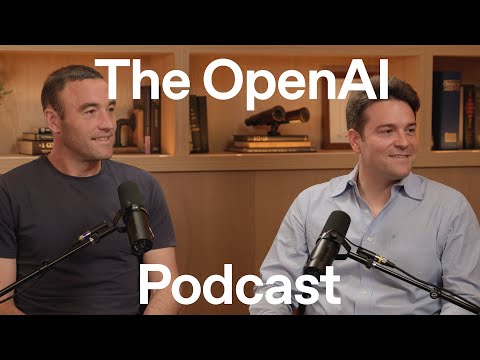
OpenAI deploys GPT-5 to accelerate global scientific research
OpenAI
The integration of frontier AI models into theoretical and life sciences will compress the next 25 years of human scientific progress into just five years.
## Background
Published on YouTube by OpenAI on November 20, 2025, this video features Head of OpenAI for Science Kevin Weil and research scientist Alex Lupsasca discussing how frontier AI models like GPT-5 are accelerating scientific discovery today. The page description outlines how these models are beginning to change research workflows by streamlining literature searches across fields, speeding up complex calculations, and designing follow-up experiments across physics, math, and biology.
## TL;DR
The discussion outlines OpenAI's ambitious mission to compress the next 25 years of scientific progress into just five by leveraging the advanced reasoning capabilities of models like GPT-5. The speakers share striking examples of AI solving specialized black hole symmetries and complex physics equations that traditionally required decades of human expertise. While acknowledging the challenges of the 'jagged frontier' of AI knowledge and low pass rates on complex problems, they highlight how extended 'thinking time' and parallel exploration are transforming research. Ultimately, the conversation positions AI not as a replacement for human scientists, but as an infinite-patience collaborator poised to democratize discovery and usher in a 'Science 2.0' era.
## Atmosphere & style
The conversation feels intellectually exhilarating, balancing profound academic wonder with pragmatic, forward-looking optimism. There is a palpable sense of awe as Lupsasca recounts his personal transition from a staunch AI skeptic to a believer after witnessing the model master his own niche theoretical physics calculations. The dynamic between the hosts is collaborative and grounded, steering clear of empty hype to instead provide a realistic, 'moment in time' reflection on what frontier models can truly achieve. Listening to it feels like being granted behind-the-scenes access to a pivotal turning point in human history, leaving the audience with an inspiring sense of anticipation for the future of global innovation.
## Key takeaways
- [00:40](https://www.youtube.com/watch?v=0sNOaD9xT_4&t=40s) The OpenAI for Science initiative aims to accelerate scientific discovery to compress the next 25 years of research progress into just five years.
- [00:40](https://www.youtube.com/watch?v=0sNOaD9xT_4&t=40s) Frontier AI models like GPT-5 are providing 'little existence proofs' by breaking past the frontier of human knowledge and proving things humans have not yet done.
- [02:31](https://www.youtube.com/watch?v=0sNOaD9xT_4&t=151s) ChatGPT o3 Pro demonstrated advanced deep-reasoning by thinking for 11 minutes to solve a complex partial differential equation using an obscure 1950s mathematical identity.
- [05:30](https://www.youtube.com/watch?v=0sNOaD9xT_4&t=330s) AI shifts scientific workflows from sequential to parallel exploration, allowing researchers to test ten distinct conceptual paths in an hour rather than two paths in a week.
- [05:30](https://www.youtube.com/watch?v=0sNOaD9xT_4&t=330s) GPT-5 enables deep, conceptual literature searches that transcend standard keyword matching, successfully bridging disparate terminologies, niche specialties, and multiple languages.
- [08:26](https://www.youtube.com/watch?v=0sNOaD9xT_4&t=506s) AI serves as an infinite-patience, cross-disciplinary collaborator, solving information bottlenecks and helping highly specialized scientists confidently venture into adjacent fields.
- [11:09](https://www.youtube.com/watch?v=0sNOaD9xT_4&t=669s) OpenAI's o1 preview model successfully demonstrated expert-level capability across five escalating tiers of physics difficulty, ranging from undergraduate to a 20-year veteran researcher.
- [14:40](https://www.youtube.com/watch?v=0sNOaD9xT_4&t=880s) GPT-5 Pro correctly identified complex, newly discovered black hole symmetries from an advanced arXiv physics equation after a continuous 18-minute reasoning session.
- [18:13](https://www.youtube.com/watch?v=0sNOaD9xT_4&t=1093s) The most valuable scientific accelerations happen at a low-but-non-zero pass rate frontier, requiring patience, back-and-forth iteration, and progressive guiding from the user.
- [22:16](https://www.youtube.com/watch?v=0sNOaD9xT_4&t=1336s) AI and humanity possess different 'jagged frontiers' of knowledge, making their collaborative intersection significantly more powerful than human or AI efforts alone.
- [24:33](https://www.youtube.com/watch?v=0sNOaD9xT_4&t=1473s) OpenAI is publishing a co-authored scientific research paper documenting roughly twelve realistic sections where GPT-5 contributed new, non-trivial mathematical results.
- [29:34](https://www.youtube.com/watch?v=0sNOaD9xT_4&t=1774s) The Turing test, once considered the ultimate 75-year pinnacle milestone of AI research, has been bypassed so rapidly that it is no longer a primary benchmark of conversation.
- [31:53](https://www.youtube.com/watch?v=0sNOaD9xT_4&t=1913s) In the life and material sciences, AI avoids physical verification bottlenecks by intelligently pruning massive search spaces to focus physical experiments on high-potential candidates.
- [31:53](https://www.youtube.com/watch?v=0sNOaD9xT_4&t=1913s) OpenAI is running pilots with companies to leverage AI in streamlining massive administrative, regulatory, and paper-writing hurdles in the drug-to-market pipeline.
- [33:46](https://www.youtube.com/watch?v=0sNOaD9xT_4&t=2026s) Internal testing of unreleased, stronger internal models confirms that AI capabilities are continuing to climb rapidly without hitting an anticipated development plateau.
- [36:43](https://www.youtube.com/watch?v=0sNOaD9xT_4&t=2203s) AI model pass rates on hard problems scale dramatically when given more compute and extended 'System Two' thinking time spanning hours or even days.
- [40:08](https://www.youtube.com/watch?v=0sNOaD9xT_4&t=2408s) OpenAI's latest models scored nearly 90% on the PhD-level GPQA scientific benchmark, surpassing the 70% human expert baseline across multiple disciplines simultaneously.
- [42:16](https://www.youtube.com/watch?v=0sNOaD9xT_4&t=2536s) AI could revolutionize dark matter and black hole research by synthesizing, cross-referencing, and ruling out hypotheses within massive, disparate experimental datasets.
- [44:55](https://www.youtube.com/watch?v=0sNOaD9xT_4&t=2695s) AI coding tools are expanding the global pool of software creators from 30 million trained engineers to an estimated 300 million or even 3 billion people.
- [46:31](https://www.youtube.com/watch?v=0sNOaD9xT_4&t=2791s) OpenAI’s mission is to democratize discovery by building the best general-purpose AI for scientists globally, aiming for a grand vision of a hundred scientists winning Nobel Prizes using AI.
## Detailed walkthrough
### [00:00](https://www.youtube.com/watch?v=0sNOaD9xT_4&t=0s) Accelerating the Next 25 Years of Science into Five
The OpenAI for Science initiative is driven by a bold mission: to accelerate scientific discovery so that the next 25 years of research can be accomplished in just five. Kevin Weil, the head of OpenAI for Science, believes that the most profound way society will experience Artificial General Intelligence (AGI) is through its impact on science. While skeptics might wonder why this acceleration is happening now rather than a year ago or a year in the future, Weil explains that we are just beginning to see frontier AI models capable of doing novel science.
For the first time, models like GPT-5 are demonstrating "little existence proofs" of breaking past the frontier of human knowledge into the unknown. They are proving things that humans have not yet done, even if those things are not yet beyond human capability. Weil notes that in AI development, a model goes very quickly from being unable to do something, to barely doing it with some errors, to becoming an indispensable tool within six to twelve months. Science is currently in that exciting initial phase of rapid acceleration.
- **The Core Mission:** To compress 25 years of scientific progress into five years by putting advanced models into the hands of the world's best scientists.
- **The AI Development Cycle:** Transitioning from "the model can't do something" to "the model can just barely do it" to "you couldn't imagine doing this thing without AI" happens in a matter of months.
[02:31](https://www.youtube.com/watch?v=0sNOaD9xT_4&t=151s) From Skeptic to Believer: Solving Complex Physics Equations
Alex Lupsasca, an OpenAI research scientist and physics professor at Vanderbilt University, admits he started 2025 as an AI skeptic. While he found ChatGPT useful for basic writing and proofreading, he was convinced it would be a long time before AI could assist with his highly specialized research in black hole physics. That skepticism vanished during a research project involving a pulsar—a rotating star with powerful magnetic fields. Lupsasca was trying to solve a complex partial differential equation and identified the solution as an infinite sum over products of Legendre polynomials. Suspecting there was a simpler formula, he asked a friend to run the problem through ChatGPT o3 Pro.
The model thought for 11 minutes—a reasoning duration Lupsasca had never witnessed on the free version of the tool. It broke the problem down, analyzed the sum, and located a highly obscure mathematical identity published in a single 1950s paper in a Norwegian Journal of Mathematics. Although the model made a "silly typo" at the very end by adding an extra factor in front—resembling a human error—the derivation itself was entirely correct. This experience "sent me reeling," Lupsasca recalls, realizing that a task he considered a uniquely human ability of theoretical physicists was now within the grasp of AI.
- **The Physics Problem:** Finding a magnetic field solution around a pulsar by solving a partial differential equation represented as an infinite sum of Legendre polynomials.
- **The Breakthrough:** The model identified an obscure 1950s mathematical identity from a Norwegian journal to solve the equation.
- **The Human-Like Error:** The model executed the complex logic perfectly but made a minor algebraic typo at the very end.
[05:30](https://www.youtube.com/watch?v=0sNOaD9xT_4&t=330s) Parallel Exploration and Conceptual Literature Searches
The acceleration of science through AI is not just about solving single equations faster; it is also about expanding the breadth of what a scientist can explore. Weil points out that instead of spending a week exploring two research paths, a scientist using AI can explore ten paths in parallel in a single hour. This qualitative shift allows for a massive increase in the volume of ideas tested. Furthermore, AI is transforming literature searches from simple keyword matching into deep, conceptual exploration.
Weil shares an anecdote of a researcher working on high-dimensional optimization who felt certain someone must have explored his idea before, though he could find no record of it. He described his concept to GPT-5, which performed a conceptual-level search and successfully located a related PhD thesis written in German from the field of economics. Because the thesis used entirely different terminology and was written in a different language, a standard keyword search would never have found it. Lupsasca experienced a similar breakthrough when he input a strange equation with a three-derivative term into ChatGPT. The model instantly recognized it as the "conformal bridge equation" and directed him to the relevant papers, bridging a gap into a niche neighboring field that Lupsasca was unfamiliar with.
- **Parallel Paths:** AI allows researchers to test ten ideas in an hour rather than two ideas in a week.
- **Conceptual Search Example:** GPT-5 located a relevant, obscure German-language economics PhD thesis to solve a high-dimensional optimization problem in another field.
- **Conformal Bridge Equation:** ChatGPT instantly identified a rare three-derivative mathematical term in Lupsasca's black hole research, connecting his work to existing literature in a neighboring specialty.
[08:26](https://www.youtube.com/watch?v=0sNOaD9xT_4&t=506s) The AI as an Infinite-Patience Collaborator
Modern science requires extreme specialization, which often prevents researchers from exploring adjacent fields. Weil recalls speaking with a mathematician who wanted to pursue a promising research direction but abandoned it because mastering the necessary secondary field would have taken too much time. With GPT-5, the mathematician plans to return to that project, treating the AI as a co-worker and collaborator "who has read just about every scientific paper that's out there."
Andrew Mayne highlights how historically, major scientific breakthroughs were delayed for decades simply because researchers were unaware of existing literature. For example, carbon filaments were published 20 years before Thomas Edison spent massive effort searching for them, and the shotgun technique for DNA sequencing was published in 1982 but not fully utilized until supercomputers could run it. AI acts as an ideal collaborator to solve this information bottleneck. Unlike human collaborators, an AI has infinite patience, works 24/7, and possesses cross-disciplinary knowledge.
- **Historical Delays in Science:**
- Carbon filaments were documented 20 years before Edison's independent experiments.
- DNA replication techniques were published 10 to 12 years before they were successfully applied.
- The shotgun DNA sequencing method was published in 1982 but delayed by a lack of computational integration.
- **The Ideal Collaborator:** AI provides cross-disciplinary expertise, infinite patience, and constant availability, allowing specialists to confidently venture into adjacent fields.
[11:09](https://www.youtube.com/watch?v=0sNOaD9xT_4&t=669s) From Undergrad to 20-Year Veteran: A Fusion Physics Demonstration
To address skeptics who remember when AI "couldn't spell strawberry" or struggle with basic math, Weil shares his own "origin story" of realizing the power of OpenAI's reasoning models. A year prior, Weil met with Brian Spears, a physicist at Lawrence Livermore National Laboratory—the facility famous for achieving the first large-scale fusion reaction with net energy gain. Expecting to pitch the technology, Weil was instead blown away when Spears opened his laptop to demonstrate what o1 preview could already do.
Spears walked Weil through a series of prompts about bombarding a copper rod with high-pressure waves. He started with an undergraduate-level question, which the model answered easily. He then escalated the difficulty to graduate-level, postdoc-level, and then to a question fitting a newly hired nuclear physicist at Lawrence Livermore. The model answered every single one correctly. Finally, Spears asked a highly advanced question that only someone who had worked at the lab for 20 years would know. The model not only answered correctly but noted that to proceed further, the user would need to run specific, partially classified simulation tools unique to Lawrence Livermore. Spears looked at Weil and remarked that while he could have done those calculations himself, it would have taken him days—and the sheer acceleration these tools offer will fundamentally change science.
- **The Demonstration:** Brian Spears tested o1 preview on a physics problem involving high-pressure waves bombarding a copper rod.
- **The Progression of Difficulty:** The model successfully answered questions spanning five distinct levels of expertise:
1. Undergraduate student
2. Graduate student
3. Postdoctoral researcher
4. Newly hired Lawrence Livermore nuclear physicist
5. 20-year veteran researcher at the lab
- **The Simulation Insight:** The model correctly identified and recommended the use of highly specialized, proprietary simulation tools unique to Lawrence Livermore to advance the problem further.
[14:40](https://www.youtube.com/watch?v=0sNOaD9xT_4&t=880s) The "AI Pilled" Moment: Black Hole Symmetries
Kevin Weil opens by reminding everyone that the AI models we use today are "the worst AI models that we will ever use for the rest of our lives," which signals a incredibly bright future. Andrew Mayne asks Alex Lupsasca how his academic colleagues have been utilizing these tools. Lupsasca notes that they are heavily used for literature searches—connecting new findings to existing work, which is a massive time sink for scientists.
Lupsasca then shares the personal story that made him "AI pilled" and ultimately drove him to join OpenAI. He met Mark Chen, OpenAI's Chief Research Officer, who proudly challenged him to test the model with a truly difficult problem. Lupsasca decided to feed it a highly complex equation regarding newly discovered black hole symmetries that he had just published on arXiv in June.
- **The Initial Test:** Lupsasca gave the model the raw equation without any leading questions or hints about symmetries. After thinking for five minutes, the model concluded there were "no symmetries." Lupsasca felt a smug sense of victory, thinking, "Still better than the AI," while Chen was visibly crestfallen.
- **The Warm-up:** Chen suggested trying an easier, "warm-up baby version" of the problem. Lupsasca stripped the equation down to its flat, empty space-time limit. After thinking for nine minutes, the model returned a beautiful, completely correct answer: the equation possessed conformal symmetry, and it correctly identified the three generators.
- **The Breakthrough:** Primed by the warm-up, they fed the original, complex black hole problem back into the same chat session. This time, the model thought for a staggering 18 minutes. It emerged with a beautiful, entirely correct solution. Lupsasca was shell-shocked; this calculation was at the absolute frontier of his own personal abilities—a niche skill he had spent years of graduate training to master. The realization that the model could do this sent his mind reeling and convinced him he had to be involved with this technology.
---
[18:13](https://www.youtube.com/watch?v=0sNOaD9xT_4&t=1093s) The Frontier of Capabilities and the "Pass Rate" Problem
Kevin Weil highlights a crucial lesson from Lupsasca's black hole breakthrough: frontier AI models are often wrong when operating at the absolute limit of their capabilities, much like humans. Getting the best results requires patience, back-and-forth iteration, and guiding the model through progressive steps rather than expecting a perfect "one-shot" answer.
Weil explains a major research challenge OpenAI is tackling: reducing the cognitive load for users dealing with low-pass-rate problems. If a model has a 5% pass rate on a highly complex frontier problem, it is technically capable of solving it (1 out of 20 times), but a user who gives up after three failed attempts will assume the model simply cannot do it.
- **Distinguishing Hard vs. Impossible:** It is currently very difficult for users to tell the difference between a problem that is too hard for the model and one where the model just has a low pass rate.
- **The Value of Iteration:** The most valuable scientific accelerations happen at this low-but-non-zero pass rate frontier.
- **Prompting Evolution:** Andrew Mayne compares this to the transition from GPT-3.5 to ChatGPT. In the early days, expert "prompt engineers" had to use complex tricks to get good results; over time, the system was refined to make those capabilities accessible to everyone. Weil agrees, noting that while the frontier has shifted from basic tasks to advanced scientific research, the necessity of working through a low pass rate remains the same.
---
[22:16](https://www.youtube.com/watch?v=0sNOaD9xT_4&t=1336s) The Jagged Frontier of Knowledge
Lupsasca points out that the "warm-up" step the model needed was the exact same logical starting point a human physicist would use. He suggests that future models should be trained to automatically generate their own simplified warm-up problems to tackle hard questions.
He introduces the concept of the "jagged frontier" of knowledge. Human knowledge is highly uneven: we cannot answer simple questions like why space has three dimensions or what happened at the Big Bang, yet we can calculate the electron dipole moment to 12 decimal places. AI models possess a similarly jagged frontier, but their shape is different from ours.
- **Complementary Strengths:** Because the AI's jagged edge of knowledge does not perfectly align with humanity's, the intersection of the two is where the most exciting scientific breakthroughs will happen.
- **Human + AI Collaboration:** Weil reiterates that "human and AI together are exactly much more powerful than human alone or AI alone."
---
[24:33](https://www.youtube.com/watch?v=0sNOaD9xT_4&t=1473s) The GPT-5 Scientific Research Paper
Weil discusses an upcoming research paper co-authored by OpenAI researchers and eight or nine external academics across fields like math, physics, astronomy, computer science, biology, and materials science. The paper features roughly twelve sections documenting how GPT-5 is actively accelerating their work.
Rather than being "hypey" or promising "hoverboards for everybody," the paper is a realistic "moment in time" document showing what works and what doesn't. To maintain transparency, OpenAI is publishing the full ChatGPT share links so readers can inspect the exact back-and-forth conversations between the scientists and the model.
- **Key Sections of the Paper:**
- Literature search acceleration.
- Calculation and workflow acceleration.
- **New Scientific Contributions:** The paper contributes four or five entirely new, non-trivial mathematical results, some of which are substantial enough to be standalone papers.
- **A Rising Tide in AI Science:** Weil praises the broader ecosystem, expressing immense respect for Demis Hassabis and the Google DeepMind team's work on AlphaFold, noting that science is entering an incredibly exciting era of AI-driven transformation.
---
[27:22](https://www.youtube.com/watch?v=0sNOaD9xT_4&t=1642s) Advice for the Next Generation of Scientists
Mayne asks what advice they have for graduate students who might feel anxious about AI replacing scientists. He points out that the telescope did not eliminate astronomers; it created them. Lupsasca agrees, acknowledging that while there is real anxiety in academia today, it is mostly due to structural changes in how science is funded and organized in the US, rather than AI.
Lupsasca views AI as an incredibly empowering tool that acts as a collaborative partner. In research, the hardest part is often choosing which path to take when staring into the unknown. GPT allows scientists to upload notes, describe a concept, and quickly map out and prototype multiple potential lines of attack.
- **Rapid Prototyping:** Instead of spending days of limited human energy manually testing a dead-end calculation path, a researcher can use ChatGPT to quickly "signpost" multiple directions.
- **The AI Assistant:** Even if the model does not get every detail right, having those signposts makes navigating the frontier of science feel like you have a brilliant assistant helping you along the way.
[29:34](https://www.youtube.com/watch?v=0sNOaD9xT_4&t=1774s) The Five-Year Horizon and the Pace of AI Progress
When asked to look five years into the future, Kevin Weil admits that predicting anything on that timescale is incredibly difficult because the field moves so fast that looking back even twelve months can feel embarrassing. He recalls how mind-blowing the launch of GPT-3 was, only for GPT-3.5 and GPT-4 to quickly "whoosh" past the Turing test—a benchmark that had been held up for 75 years as the ultimate pinnacle of artificial intelligence research. Now, the Turing test is barely even discussed.
Even looking back to the beginning of 2025, most software engineers were still writing all of their own code. Today, the idea of working without tools like Codecs, Claude, or GitHub Copilot seems completely crazy because of how much they boost productivity. Kevin predicts that the next twelve months will bring similarly profound changes to how science is conducted, first in silico with theoretical physics, mathematics, and computer science, and soon after in the physical and life sciences.
- **The Turing Test:** Once considered the ultimate AI milestone, it has been bypassed so rapidly that it is no longer a primary topic of conversation.
- **Software Engineering Shift:** In just a year, the industry has shifted from manual coding to near-universal leverage of AI coding assistants.
[31:53](https://www.youtube.com/watch?v=0sNOaD9xT_4&t=1913s) Overcoming Bottlenecks in the Life Sciences
Andrew Mayne raises a crucial concern about applying AI to physical sciences: while mathematical proofs and physics equations can be easily verified inside a computer, fields like life sciences and material sciences require real-world testing. He wonders if we will face a bottleneck where AI generates far more predictions than we have physical ways to test. Kevin acknowledges this but explains that AI's primary value here is intelligently pruning the massive search space. In drug discovery, for instance, narrowing down the candidates early on allows researchers to run physical experiments only on the options most likely to succeed.
Beyond the lab, AI is also accelerating the regulatory side of science. Bringing a drug to market requires navigating a massive regulatory process, which involves compiling and writing enormous papers that synthesize disparate findings. OpenAI is already running pilots with several companies in this space to use AI to streamline these administrative and regulatory hurdles, speeding up the pipeline from discovery to consumer impact.
[33:46](https://www.youtube.com/watch?v=0sNOaD9xT_4&t=2026s) How AGI Will Touch Lives Through Science
For Kevin, returning to the sciences is an absolute privilege, even if he modestly claims he is "nowhere near the scientist" that colleagues like Alex Lupsasca are. He believes that while people talk a lot about Artificial General Intelligence (AGI), the most profound way the average person will actually feel its impact is through scientific breakthroughs. While ChatGPT is a great daily tool, AGI's true legacy will be felt through advancements like personalized medicine and scalable fusion energy.
Alex shares this excitement, noting that giving ChatGPT a highly complex equation and watching it instantly spit out the correct answer already feels like "something approaching" AGI. He addresses the common question of whether AI progress is hitting a plateau. After joining OpenAI and experimenting with stronger internal models, Alex is convinced that capability is going to keep growing rapidly. He notes that there is currently a massive gap between what their best public model, GPT-5 Pro, can do and what the scientific community actually utilizes it for, and OpenAI's goal is to bridge that gap.
- **The True Impact of AGI:** Rather than just a chatbot interface, AGI will manifest in daily life through revolutionary scientific developments like scalable fusion and personalized treatments.
- **The "Plateau" Myth:** Internal testing of unreleased OpenAI models confirms that AI capabilities are continuing to climb without hitting a wall.
[36:43](https://www.youtube.com/watch?v=0sNOaD9xT_4&t=2203s) System Two Thinking and the Power of Compute
A common hurdle in AI adoption is that people often form a fixed opinion of the technology based on a trial they ran six or eighteen months ago, not realizing how quickly the tools evolve. Kevin points out that many users also start with the free version of ChatGPT, which does not "think" for as long and therefore cannot solve highly complex problems. He advises scientists and researchers not to give up if a model fails to solve a problem today, but to keep trying it every few months.
This brings the conversation to "thinking time" and the reasoning paradigm. With GPT-5 Pro, the model has been observed thinking for up to 40 minutes on incredibly difficult problems, though this is currently limited by the compute required to serve millions of users. Kevin explains that models are fully capable of thinking for two, six, twelve, or even twenty-four hours. Just like a human who needs a day of trial and error to solve a problem they couldn't crack in twenty minutes, AI pass rates on hard problems scale dramatically when given more compute and time to think.
- **System 1 vs. System 2:** Giving models extended "thinking time" mirrors human deep reasoning, allowing them to solve complex problems that are impossible during quick-response sessions.
- **Compute Allocation:** Providing elite scientists with massive compute blocks to let models think for hours or days is a major frontier for accelerating discoveries.
As AI models rapidly master existing tests, researchers must constantly design harder benchmarks to measure progress. Kevin highlights GPQA (Google Proof QA), a highly challenging scientific benchmark consisting of PhD-level questions across multiple disciplines. When it was released in 2023, GPT-4 scored around 39%, while highly qualified humans scored around 70%. Today, OpenAI's latest models score nearly 90%, effectively surpassing the capabilities of most human experts in their respective fields—and doing so across all scientific fields simultaneously.
To keep pushing the models, OpenAI is developing new evaluations focused on frontier science and mathematics, as well as "GPVal," a recently released evaluation designed to test a model's ability to perform economically valuable tasks. Every failure or gap identified by these harder tests provides the engineering team with the vital feedback needed to improve the next generation of models.
- **GPQA Performance:** Jumped from 39% (GPT-4) to nearly 90% (latest models) in just two years, outperforming the human expert benchmark of 70%.
- **GPVal:** A new evaluation metric designed to test how effectively models can execute practical, economically valuable tasks.
[42:16](https://www.youtube.com/watch?v=0sNOaD9xT_4&t=2536s) Black Holes, Dark Matter, and the Dream of Fusion
When asked what "crazy or weird" areas of science they would personally love to see accelerated, Alex admits to a highly selfish passion: black holes. He believes AI can revolutionize black hole research by integrating and synthesizing vast, disparate bodies of theoretical physics knowledge. He also points to dark matter as a prime target; humanity has collected mountains of experimental data but still has no idea what dark matter actually is. Alex suggests that feeding ChatGPT all known dark matter data and theories could allow the model to rule out certain hypotheses by connecting dots that are too far apart for a single human mind to hold together.
Kevin's dream target is fusion energy. Because humanity already has small-scale "existence proofs" that fusion works, the remaining challenge is scaling it up to be reliable and economically viable. Kevin notes that "the world with fusion is a significantly better place than the world without," as it would solve a massive array of global energy and environmental problems.
- **Dark Matter Synthesis:** AI could potentially rule out incorrect dark matter theories by cross-referencing massive, disparate experimental datasets that humans struggle to synthesize.
- **In Silico to Physical:** While current AI scientific work is largely theoretical and computational, the future holds the potential for AI to design and run complex physical experiments.
[44:55](https://www.youtube.com/watch?v=0sNOaD9xT_4&t=2695s) Energy, AI Infrastructure, and the Order of Magnitude Shift
Andrew Mayne points out how easily people overlook our profound dependence on energy. If humanity can achieve the same orders of magnitude of improvement in energy production that we have seen over the last 200 years, it will unlock massive, energy-intensive fields like desalinization and construction. Kevin Weil jokingly chimes in that "some groups might be looking to build lots of infrastructure for lots of GPUs," prompting a knowing laugh from Alex Lupsasca. Andrew expands on this, predicting that the massive infrastructure build-out for AI will drive a wave of energy innovation. He draws an analogy to how consumer electronics like mobile phones and laptops poured money into battery technology, which ultimately paved the way for highly efficient electric cars.
Kevin emphasizes that changing anything by an order of magnitude fundamentally alters the world. He points to software engineering as a prime example of this shift over the past year: today, you no longer need formal training to write meaningful code. This shift expands the pool of people capable of writing software from the world's 30 million trained engineers to potentially 300 million or even 3 billion people. Applying this same ten-times multiplier to make energy ten times cheaper and more prevalent would transform the globe, making it a high-potential area for AI models to apply their intelligence.
- The global pool of software creators is expanding from roughly 30 million trained engineers to an estimated 300 million or even 3 billion people due to AI coding tools.
- A 10x increase in energy prevalence and a corresponding 10x reduction in cost is highlighted as a key target for AI-driven problem-solving.
[46:31](https://www.youtube.com/watch?v=0sNOaD9xT_4&t=2791s) Science 2.0 and the Democratization of Discovery
Alex Lupsasca clarifies that OpenAI's approach to scientific advancement is explicitly not a top-down effort where the company dictates what AI should solve. Instead, the goal is to build the absolute best general-purpose AI and release it to the world, allowing individual researchers to apply it to their own domains. As a black hole physicist, Alex is eager to use AI to push the boundaries of black hole science, but notes that the unpredictable nature of research means breakthroughs can come from anywhere. By putting these tools in everyone's hands, they maximize the chances of accelerating scientific discovery globally.
Kevin Weil enthusiastically agrees, noting that the "surface area of science is massive." The mission is not about OpenAI solving specific scientific projects internally, but about empowering scientists worldwide to accelerate their own work. Kevin shares a grand vision for the technology, stating, "what we really want is to see a hundred scientists win Nobel Prizes using AI." Andrew Mayne reflects that this era does not represent the end of science, but rather its true beginning. Kevin and Alex heartily agree, with Kevin concluding that we are currently living through a "science 2.0 moment."
## Notable quotes
> [00:00](https://www.youtube.com/watch?v=0sNOaD9xT_4&t=0s) the model can't do something" to "the model can just barely do it" to "you couldn't imagine doing this thing without AI — Kevin Weil
> [14:40](https://www.youtube.com/watch?v=0sNOaD9xT_4&t=880s) the worst AI models that we will ever use for the rest of our lives — Kevin Weil
> [14:40](https://www.youtube.com/watch?v=0sNOaD9xT_4&t=880s) Still better than the AI — Alex Lupsasca
> [22:16](https://www.youtube.com/watch?v=0sNOaD9xT_4&t=1336s) human and AI together are exactly much more powerful than human alone or AI alone. — Kevin Weil
> [24:33](https://www.youtube.com/watch?v=0sNOaD9xT_4&t=1473s) hoverboards for everybody — Kevin Weil
> [29:34](https://www.youtube.com/watch?v=0sNOaD9xT_4&t=1774s) whoosh" past the Turing test—a benchmark that had been held up for 75 years as the ultimate pinnacle of artificial intelligence research. Now, the Turing test is barely even discussed. — Kevin Weil
> [33:46](https://www.youtube.com/watch?v=0sNOaD9xT_4&t=2026s) nowhere near the scientist — Kevin Weil
> [33:46](https://www.youtube.com/watch?v=0sNOaD9xT_4&t=2026s) something approaching" AGI — Alex Lupsasca
> [42:16](https://www.youtube.com/watch?v=0sNOaD9xT_4&t=2536s) the world with fusion is a significantly better place than the world without — Kevin Weil
> [44:55](https://www.youtube.com/watch?v=0sNOaD9xT_4&t=2695s) some groups might be looking to build lots of infrastructure for lots of GPUs — Kevin Weil
> [46:31](https://www.youtube.com/watch?v=0sNOaD9xT_4&t=2791s) what we really want is to see a hundred scientists win Nobel Prizes using AI — Kevin Weil
> [46:31](https://www.youtube.com/watch?v=0sNOaD9xT_4&t=2791s) science 2.0 moment — Kevin Weil
## Mentioned
OpenAI, Kevin Weil, Alex Lupsasca, GPT-5, Vanderbilt University, Legendre polynomials, ChatGPT o3 Pro, conformal bridge equation, Andrew Mayne, Thomas Edison, Brian Spears, Lawrence Livermore National Laboratory, o1 preview, Mark Chen, arXiv, GPT-3.5, GPT-3, GPT-4, Claude, GitHub Copilot, GPT-5 Pro, GPQA, Google DeepMind, Demis Hassabis, AlphaFold, GPVal
OpenAI部署GPT-5以加速全球科学研究
前沿AI模型与理论科学及生命科学的融合,将把人类未来25年的科学进展压缩至仅5年。
本次讨论概述了 OpenAI 借助 GPT-5 等模型的先进推理能力,将未来 25 年的科学进展压缩至短短 5 年的宏伟使命。发言者分享了 AI 解决黑洞特殊对称性及复杂物理方程等引人瞩目的实例,而这些难题以往通常需要人类数十年的专业经验积累。在承认 AI 知识存在“参差前沿”(jagged frontier)以及在复杂问题上面临低通过率等挑战的同时,他们重点强调了延长“思考时间”与并行探索正如何变革科学研究。最终,对话将 AI 定位为具备无限耐心的合作者而非人类科学家的替代品,有望推动科学发现的普惠化并开启“科学 2.0”时代。
OpenAI 科学部门(OpenAI for Science)旨在加速前沿探索,其目标是将未来 25 年的科研进展压缩至 5 年内完成。 (0:40)
前沿模型正在展现触及人类知识边界的“存在性证明”:ChatGPT o3 Pro 经过 11 分钟推理,运用 1950 年代挪威期刊中的生僻数学恒等式解出了复杂的偏微分方程。 (2:31)
AI 将科研工作流从顺序探索转变为高度并行,研究人员能在 1 小时内测试 10 条研究路径;同时 GPT-5 实现了跨学科与跨语言的深层概念文献检索。 (5:30)
在劳伦斯利弗莫尔国家实验室的核聚变物理测试中,o1 preview 模型成功解答了跨越本科生到 20 年资深研究员难度的全部物理问题,并指出了特定的专有模拟工具。 (11:09)
GPT-5 Pro 在经历 18 分钟深度推理后,成功推导并识别出最新 arXiv 论文中高度复杂的黑洞对称性方程,证明其已具备攻克前沿科研难点的能力。 (15:08)
Reading summary
OpenAI leaders Kevin Weil and Alex Lupsasca state that advanced reasoning AI models are beginning to demonstrate novel scientific problem-solving, with the goal of compressing 25 years of research progress into five. While these systems increasingly solve complex equations and bridge disciplinary silos, their broader scientific utility depends on managing low initial pass rates, expanding inference compute, and overcoming physical testing bottlenecks.
Frontier Problem-Solving in Theoretical Physics (2:31)
Lupsasca reports that his skepticism regarding AI's utility in specialized theoretical physics shifted when ChatGPT o3 Pro solved a magnetic field equation for a pulsar by surfacing an obscure 1950s identity from a Norwegian mathematics journal after 11 minutes of reasoning. In a subsequent test with OpenAI CRO Mark Chen, the model initially failed to detect symmetries in a newly published black hole equation. However, after being primed with a simplified, flat spacetime version of the equation for nine minutes, the model reasoned for 18 minutes on the original problem and derived the fully correct conformal symmetry generators.
Weil cites a similar demonstration conducted by Brian Spears at Lawrence Livermore National Laboratory using an o1 preview model on high-pressure shockwave physics in copper rods. The model answered questions progressing from undergraduate level to that of a 20-year lab veteran, correctly noting that further progress required the lab's proprietary simulation tools. While models still make occasional algebraic errors or fail on initial attempts, Weil notes an upcoming paper co-authored with external academics will document four or five new, non-trivial mathematical results produced using GPT-5.
Eliminating Information Bottlenecks Across Disciplines (5:30)
Weil argues that AI accelerates science not only by calculating faster, but by allowing researchers to explore ten parallel hypotheses in an hour rather than two in a week. Beyond speed, AI shifts literature exploration from keyword matching to conceptual searches across disparate disciplines. In one instance, GPT-5 retrieved a relevant German-language economics doctoral thesis to address a problem in high-dimensional optimization. Similarly, Lupsasca notes that ChatGPT identified a rare three-derivative mathematical term from his black hole research as the "conformal bridge equation," linking his work directly to an unfamiliar neighboring field.
Andrew Mayne highlights that scientific progress has historically stalled when discoveries remained isolated, citing carbon filaments—documented 20 years before Thomas Edison's work—and shotgun DNA sequencing, which sat underutilized for years after its 1982 publication due to computational limits. Weil observes that researchers frequently abandon promising secondary paths due to the time needed to master adjacent disciplines; AI serves as an infinitely patient collaborator that has absorbed the broader scientific corpus to bridge these silos.
Extended Reasoning and the Jagged Knowledge Frontier (18:13)
A primary operational challenge at the frontier of science is distinguishing between a problem an AI model cannot solve and one where it simply has a low pass rate, such as 5%. Weil explains that when operating at capability limits, models require iterative prompting and simplified warm-up steps rather than single-prompt queries. This mirrors human scientific methods, where researchers start with toy models before tackling complex systems. Lupsasca characterizes human and AI knowledge as having distinct "jagged frontiers," arguing that breakthroughs occur where their uneven capabilities overlap.
To improve pass rates on difficult tasks, OpenAI is focusing on extended compute allocation, or "System 2" thinking. While public models are constrained by the compute needed to serve millions of users, Weil notes GPT-5 Pro has run for up to 40 minutes on difficult problems, and future systems could reason for hours or days. This capability trajectory is reflected in standardized benchmarks: on GPQA, a PhD-level science test where human experts average 70%, model performance rose from approximately 39% with GPT-4 in 2023 to nearly 90% with recent reasoning models.
Translating In Silico Discoveries to Physical Experiments (31:53)
While theoretical physics, mathematics, and computer science can verify AI-generated hypotheses computationally, applying AI to the life and materials sciences faces real-world physical verification limits. Weil explains that AI mitigates this bottleneck primarily by pruning massive search spaces—for instance, selecting high-probability drug candidates before laboratories commit resources to physical testing. OpenAI is also running pilots to accelerate administrative and regulatory synthesis, aiming to reduce the time required to bring pharmaceutical discoveries to market.
Looking toward long-term targets, Lupsasca suggests AI could synthesize contradictory experimental datasets to rule out incompatible dark matter theories, while Weil identifies fusion energy scaling as a primary target to drastically lower global energy costs. Both emphasize that OpenAI aims to release general-purpose tools to the global scientific community rather than directing discovery top-down, with Weil projecting that widespread access will eventually enable scores of AI-assisted Nobel Prizes.
Although reasoning models are demonstrating measurable breakthroughs in computational and theoretical domains, translating these tools into broader scientific revolutions hinges on overcoming empirical testing bottlenecks and managing low initial success rates on frontier problems.
精炼阅读摘要
OpenAI 科学主管 Kevin Weil 与物理学家 Alex Lupsasca 提出,前沿推理模型已开始跨越人类既有知识前沿,其核心使命是将未来 25 年的科研进展压缩至 5 年内完成。他们认为通用人工智能(AGI)对人类社会最深刻的影响将率先通过科学突破体现,AI 正在从复杂数学推导、跨学科概念穿透到实验搜索空间剪枝等维度重构科研范式。
复杂理论推导与尖端物理突破 (2:31)
在理论物理与数学计算领域,推理模型开始涉足顶尖专家的核心能力区间。Alex Lupsasca 透露自己最初曾对 AI 持怀疑态度,但在尝试求解脉冲星偏微分方程时,ChatGPT o3 Pro 经过 11 分钟深度思考,成功检索并运用了 1950 年代单篇挪威数学期刊上的冷僻恒等式,仅在末尾出现一处类似人类粗心的代数笔误。在黑洞对称性方程的测试中,模型经由简化的平坦时空问题作为“热身”引导后,耗时 18 分钟准确推导出了前沿论文中的共形对称性及生成元。此外,Lawrence Livermore 国家实验室物理学家 Brian Spears 演示了 o1 preview 能够连续正确回答从本科水平到具备 20 年经验资深学者水平的五级高压波碰撞物理问题,并准确提示需要调用该实验室专有的半涉密仿真工具。
Weil 指出,AI 模型的演进规律往往在 6 至 12 个月内便完成从“完全无法胜任”、“勉强得出带有小错的答案”到“成为不可或缺的核心工具”的跃迁。虽然模型目前在尖端计算中仍可能出现微小疏漏,但其展现出的深层逻辑推导能力,证明 AI 已从文字辅助跨越至能够独立解决人类未解问题的门槛。
突破专业壁垒与概念级文献搜索 (5:30)
现代科学高度专业化导致了学科间的知识孤岛,而 AI 正在扮演具备跨领域知识与无限耐性的全天候合作者。Weil 解释,AI 正在将文献检索从机械的关键词匹配提升为深度概念搜索。例如一名高维优化研究者向 GPT-5 描述构想后,模型跨学科检索出了一篇采用完全不同术语且用德语撰写的冷门经济学博士论文;Lupsasca 输入包含三阶导数的复杂方程时,模型也立即将其识别为“共形桥方程”,成功搭建起黑洞物理与邻近小众领域的知识桥梁。
Andrew Mayne 指出,科学史上诸如碳纤维在爱迪生实验前 20 年已被记录、鸟枪法 DNA 测序技术提出后延迟应用等案例,均源于信息传递的壁垒。AI 不仅消除了这种信息滞后,更改变了科研广度:研究人员过去用一周时间仅能探索两条路径,如今借助 AI 可以在一小时内并行测试十种构想,大幅降低了跨学科试错的时间成本。
思考时间扩展与低通过率交互范式 (18:13)
针对高难度科学问题,AI 正在依托模拟人类深度推理的“系统二”(System 2)思维打破能力瓶颈。Weil 强调,模型在人类认知前沿的单次解题通过率可能仅有 5%,普通用户常因前几次尝试失败而断定模型不具备能力,但最有价值的科学加速恰恰发生在低通过率的探索区间。要激发最佳表现,科学家需要通过分步拆解、由浅入深的“热身”引导与模型持续多轮迭代,而非寄望于单次提示词的即时输出。
这一推理范式与算力投入直接相关。Weil 指出,GPT-5 Pro 已展现出针对极难问题长达 40 分钟的连续推理能力,未来若向顶尖学者开放数小时甚至 24 小时的思考算力,解题成功率将成倍放大。在博士级科学基准 GPQA 评测中,模型得分已从 GPT-4 时代的 39% 跃升至最新模型的近 90%,显著超越人类专家 70% 的基准线。Lupsasca 认为,人类与 AI 各自具备不同形状的“参差知识前沿”,两者的交集正是产生突破性发现的关键所在。
湿实验瓶颈应对与科学 2.0 生态 (31:53)
面对生命科学与材料科学等需要实体“湿实验”检验的领域,生成假说容易受到物理验证吞吐量的制约。Weil 说明,AI 的核心价值在于智能修剪庞大的搜索空间,例如在药物研发前期排除低概率方案以聚焦高价值实验,同时 OpenAI 正在试点利用 AI 整合繁琐的法规监管文档以压缩新药落地周期。在未来愿景上,Lupsasca 期待 AI 能够整合分散实验数据以推演暗物质假说,Weil 则将可扩展的核聚变视为解决能源困境的终极目标,并认为 AI 算力基建将倒逼能源技术发生数量级的成本下降。
在科研生态层面,OpenAI 强调其定位并非自上而下指定具体的科研攻关项目,而是将通用模型普惠开放给全球各领域的科研人员。Weil 提出,这一被称为“科学 2.0”的时代目标不是由 OpenAI 内部垄断研究,而是希望赋能并见证未来有上百位全球科学家借助 AI 工具荣获诺贝尔奖。
当前 AI 驱动的科学发现仍处于早期加速阶段,其在纯理论与计算科学中的进展显著快于依赖实体实验的物理与生物领域。尽管推理模型的基准成绩大幅跃升,但面对 5% 这类低通过率难题时仍极度依赖人类专家的分步引导与高昂算力支持。OpenAI 即将发布包含未发表数学成果的 GPT-5 跨学科科研论文并公开全部对话记录,以实证检验 AI 工具在真实科研流程中的边界与局限。
Source quotes
[0:00] Kevin Weil: the model can't do something" to "the model can just barely do it" to "you couldn't imagine doing this thing without AI
[14:40] Kevin Weil: the worst AI models that we will ever use for the rest of our lives
[14:40] Alex Lupsasca: Still better than the AI
[22:16] Kevin Weil: human and AI together are exactly much more powerful than human alone or AI alone.
[24:33] Kevin Weil: hoverboards for everybody
[29:34] Kevin Weil: whoosh" past the Turing test—a benchmark that had been held up for 75 years as the ultimate pinnacle of artificial intelligence research. Now, the Turing test is barely even discussed.
[33:46] Kevin Weil: nowhere near the scientist
[33:46] Alex Lupsasca: something approaching" AGI
[42:16] Kevin Weil: the world with fusion is a significantly better place than the world without
[44:55] Kevin Weil: some groups might be looking to build lots of infrastructure for lots of GPUs
[46:31] Kevin Weil: what we really want is to see a hundred scientists win Nobel Prizes using AI
[46:31] Kevin Weil: science 2.0 moment
Original transcript
[0:00] Andrew Mayne: Hello, I'm Andrew Mayne and this is the OpenAI Podcast.
[0:03] Andrew Mayne: Today my guests are Kevin Weil, head of OpenAI for Science, and Alex Lupsasca, who is an OpenAI research scientist and professor of physics at Vanderbilt University.
[0:14] Andrew Mayne: We're going to be discussing how AI is impacting science, an upcoming research paper, and where science might be headed in the next five years.
[0:22] Kevin Weil: Maybe the most profound way that people are going to feel AGI in their lives is through science.
[0:29] Alex Lupsasca: With ChatGPT I can just
[0:30] Alex Lupsasca: Launch it in that direction, in that direction, that direction.
[0:33] Kevin Weil: The acceleration that is going to come from these tools is going to change science.
[0:40] Andrew Mayne: So you're running the Open AI for Science Initiative.
[0:43] Andrew Mayne: Could you explain what that's about?
[0:44] Kevin Weil: Yeah, the the mission of Open AI for science is to accelerate science.
[0:48] Kevin Weil: So the the question is, can we
[0:49] Kevin Weil: Help scientists do the next, say, 25 years of scientific research and scientific discovery in five years instead.
[0:57] Kevin Weil: Science underpins so much of what we do and how we live.
[1:03] Kevin Weil: And if we can make progress go faster by putting our most advanced models into the hands of the best scientists in the world, we should do that.
[1:11] Kevin Weil: And that's what we're trying to do.
[1:13] Kevin Weil: You could ask like why now?
[1:14] Kevin Weil: Why didn't we do this a year ago?
[1:16] Kevin Weil: Why aren't we doing this a year from now?
[1:17] Kevin Weil: One of the big reasons is we're just starting to see
[1:20] Kevin Weil: our frontier AI models being able to do novel science.
[1:24] Kevin Weil: So we're starting to see examples where GPT-5 can actually prove new things.
[1:30] Kevin Weil: Maybe not yet things that humans could not do, but things that humans have not done.
[1:35] Kevin Weil: So there these are like these little existence proofs of GPT-5 being able to break out past the frontier of human knowledge and into the unknown.
[1:44] Kevin Weil: And if there's one thing that I've learned from now, you know, a year and a half or so at OpenAI, it's that you go very quickly from
[1:52] Kevin Weil: the model can't do something, to the model can just barely do something, and it's not great at it yet, but you see these these these early examples.
[2:01] Kevin Weil: And then, you know, six months later, twelve months later, all of a sudden you couldn't imagine doing this thing without AI.
[2:06] Kevin Weil: And I think science is in that initial phase where we're seeing real acceleration for scientists that are using AI.
[2:12] Kevin Weil: Sometimes novel
[2:14] Kevin Weil: you know not yet maybe large breakthroughs, call them small breakthroughs.
[2:17] Kevin Weil: And that just says that there's so much potential in this space.
[2:20] Andrew Mayne: We've seen examples of let's say AI helping with mathematical proofs.
[2:25] Andrew Mayne: Could you give me an example of how it might do things in some other areas like physics or whatever kind of things we might see in the short term?
[2:31] Kevin Weil: Yeah, I mean we're seeing examples every day and they're across
[2:35] Kevin Weil: the the range of of sort of the scientific frontier.
[2:38] Kevin Weil: You see examples in mathematics, in physics, astronomy
[2:43] Kevin Weil: life sciences, like biology.
[2:45] Kevin Weil: Alex, I mean, you've you've worked on some of these.
[2:49] Kevin Weil: Maybe maybe it's a good time to talk about some of the physics stuff that you've seen.
[2:52] Alex Lupsasca: Yeah, I think coming back to Kevin's point about how this is a special time, that's very much how I feel as well, because I started the year.
[3:00] Alex Lupsasca: 2025 thinking, yeah, ChatGPT is cool.
[3:04] Alex Lupsasca: Like everybody, I used it when it came out and I thought it's a great chat bot, but
[3:08] Alex Lupsasca: I was sure it would take a very long time before it would become really relevant for my own work.
[3:13] Alex Lupsasca: So I started the year I would say as an AI skeptic
[3:17] Alex Lupsasca: because I like to see evidence before I'm convinced of something.
[3:20] Alex Lupsasca: And I saw people using it to help in their writing.
[3:23] Alex Lupsasca: And it I started to use it for that as well.
[3:24] Alex Lupsasca: It's very useful for proofreading, but I thought
[3:27] Alex Lupsasca: Oh, it's gonna be a while before it gets to do the special stuff that I'm really a specialist at.
[3:32] Alex Lupsasca: You're like black holes, right?
[3:33] Alex Lupsasca: Like black hole physics, exactly.
[3:35] Alex Lupsasca: And I had this experience early this year where I was trying to find this magnetic field solution that describes what happens around a pulsar, which is a rotating star with very powerful magnetic fields.
[3:47] Alex Lupsasca: And I was going for this very particular solution.
[3:49] Alex Lupsasca: I had to solve a partial differential equation.
[3:51] Alex Lupsasca: I was able to identify that solution as an infinite sum over products of special functions called
[3:57] Alex Lupsasca: Le genre polynomials.
[3:59] Alex Lupsasca: And if you won't go to physics grad school, this is the kind of thing that you spent a lot of time getting familiar with.
[4:05] Alex Lupsasca: And I also like these puzzles.
[4:08] Alex Lupsasca: And I was playing around with the sum and I felt like there should be a simple formula that it evaluates to.
[4:13] Alex Lupsasca: And I thought, okay, I have this friend who has ChatGPT o3 Pro, which I didn't have access to at the time.
[4:19] Alex Lupsasca: And I thought, okay, I'm just gonna send it to him and see what comes out of it.
[4:23] Alex Lupsasca: And he sends me back this output.
[4:25] Alex Lupsasca: It thought for 11 minutes, which at the time I had never seen it do because I was using the free version, which doesn't think for as long.
[4:32] Alex Lupsasca: And it gave this beautiful answer where it was able to understand what the sum was.
[4:37] Alex Lupsasca: and break it down into pieces that it could tackle.
[4:41] Alex Lupsasca: And then it had to go and find the special identity that was published in one paper from the 1950s in a Norwegian Journal of Mathematics.
[4:50] Alex Lupsasca: And so it understood what the problem was and it knew about this random identity that was just the thing for the job and it used them.
[4:58] Alex Lupsasca: And it gave this beautiful output.
[4:59] Alex Lupsasca: And at the end, the answer was wrong because it made the silly typo.
[5:02] Alex Lupsasca: It added an extra factor in front for it's almost kind of like a human making a silly typo at the end.
[5:08] Alex Lupsasca: But it was very easy to check the derivation and I went through it and I realized, okay, there's this extra factor, but aside from that, it it did the work.
[5:15] Alex Lupsasca: And that really sent me reeling because I thought, okay.
[5:18] Alex Lupsasca: I would say that's a uniquely human ability.
[5:21] Alex Lupsasca: I thought that's something that makes theoretical physicists special.
[5:25] Alex Lupsasca: you know, now in 2025, clearly they're capable of doing things that I would consider amazing.
[5:30] Kevin Weil: Yeah.
[5:30] Kevin Weil: I think one of the cool things, so you've got examples like
[5:33] Kevin Weil: Alex's where it was probably not something that he like he could have done it himself over you know eventually, but GPT was able to do it faster.
[5:41] Kevin Weil: That's acceleration on its own.
[5:43] Kevin Weil: And there's something qualitative about that even as well, because if you can explore, instead of exploring two paths over the course of a week,
[5:51] Kevin Weil: If you can explore 10 paths in parallel in, you know, an hour, all of a sudden there's a lot more ideas that you can try.
[5:58] Kevin Weil: And that's also acceleration.
[6:00] Kevin Weil: We also see examples in like literature search, which you don't think of as maybe like deep scientific innovation, but it's really important to be able to understand, you know, has somebody worked on this problem before?
[6:11] Kevin Weil: And if so, is there something I can learn to speed up my own work?
[6:14] Kevin Weil: So, and we've seen interesting examples where there was one, I might get the details of this wrong, but we were talking to this researcher, and he was saying he was exploring this particular idea in like high-dimensional optimization.
[6:27] Kevin Weil: And he was like, man, you know, this thing I'm working on, it's interesting, but somebody must have worked on this before.
[6:32] Kevin Weil: I can't be the first person to have had this idea.
[6:34] Kevin Weil: I just can't.
[6:35] Kevin Weil: But I can't find any examples.
[6:37] Kevin Weil: And then he had given it, he'd sort of given a description of what he was working on to GPT-5.
[6:43] Kevin Weil: And GPT-5 found an example from, I think it was like economics or something, a completely different field that
[6:51] Kevin Weil: used completely different terminology, so no keyword lookup would have ever worked.
[6:55] Kevin Weil: GPT-5 did sort of a con a conceptual level literature search.
[6:59] Alex Lupsasca: Yeah.
[7:00] Kevin Weil: Found somebody's PhD thesis in German.
[7:03] Kevin Weil: So also a completely different language, you know, it was like basically lost to time, but this person had done really interesting, sort of related work that helped him in his research.
[7:15] Kevin Weil: And so, you know, that's another area.
[7:17] Kevin Weil: So you can talk about the acceleration that comes from just like novel proofs and GPT-5 being able to do something on its own or guided by an expert.
[7:26] Kevin Weil: But there's also these examples of acceleration in calculations and literature search and and all of them contribute to accelerating science.
[7:33] Alex Lupsasca: Yeah, and the the exact same thing happened to me.
[7:35] Alex Lupsasca: I was
[7:36] Alex Lupsasca: trying to derive this property of black holes, and I got this equation that described this phenomenon I was after, and it had a three derivative term, which is pretty unusual.
[7:45] Alex Lupsasca: And I looked at it and I recognized it's something called the Schwarzen derivative, which is a special thing that appears in math.
[7:50] Alex Lupsasca: And I thought, hmm.
[7:51] Alex Lupsasca: Wow, this is really strange that this would show up.
[7:53] Alex Lupsasca: And I just copy pasted the equation into ChatGPT and said, do you have you seen this before?
[7:58] Alex Lupsasca: And it said, oh yes, this is the conformal bridge equation.
[8:01] Alex Lupsasca: I had no idea what a conformal bridge was at the time.
[8:03] Alex Lupsasca: And it said, oh, just look up this paper.
[8:05] Alex Lupsasca: And that was amazing because it turns out that this equation that showed up
[8:08] Alex Lupsasca: in my work, had already been studied in some other works, and I've heard from a lot of colleagues doing research in physics that there's a lot of that going on.
[8:16] Alex Lupsasca: And at the forefront of knowledge, everything becomes so niche that it's very hard to know the latest details in neighboring fields.
[8:24] Alex Lupsasca: And GPT is an amazing help with that.
[8:26] Kevin Weil: Yeah, that's another thing that we've heard from professors.
[8:29] Kevin Weil: and researchers that we've talked to is there's so much you have to be so specialized today.
[8:34] Kevin Weil: And so sometimes it gets hard to explore an area outside of your main area.
[8:39] Kevin Weil: There's one particular
[8:42] Kevin Weil: Mathematician we were talking to said, you know, one of my last papers, I knew there was an area that I I wanted to go follow it off in this direction.
[8:50] Kevin Weil: But it wasn't my specialty and it would have taken me a long time and I just kind of ended up feeling like, you know, maybe that's not the most efficient place for me to spend my time.
[8:59] Kevin Weil: Now with GPT-5, I'm gonna go back and explore that because I've got a coworker effectively, a collaborator who has read just about every scientific paper that's out there and is
[9:10] Kevin Weil: is a you know a pretty meaningful expert on just about any topic you want.
[9:14] Kevin Weil: And I think I'm going to be able to go explore these adjacencies in a far better way with ChatGPT than I could have on my own
[9:21] Kevin Weil: And so that's also a fascinating new take, right?
[9:23] Kevin Weil: It helps every it it can help you go deeper, like you were saying, and it can also help you go more broad.
[9:29] Andrew Mayne: Literature search is pretty interesting because like one of my weird hobbies is I like to go back and look at when was some early scientific discovery made that didn't get utilized till much later on.
[9:38] Andrew Mayne: Yeah, famous one was carbon filaments, you know, when Thomas Edison spent all that effort to try to find it, and it'd been published in like 20 years before.
[9:45] Andrew Mayne: Of course, you know, Dewey Decimal System was invented that year, so you can't blame him.
[9:49] Andrew Mayne: other things like silicon assistant semiconductor.
[9:52] Andrew Mayne: You know, if somebody would reading the literature, we might have had that five to ten years earlier.
[9:56] Andrew Mayne: Ability to replicate DNA, that had been published like 10 or 12 years earlier before somebody figured that out.
[10:01] Andrew Mayne: And then
[10:02] Andrew Mayne: The shotgun technique we use for DNA, you know, understanding, you know, figuring out like the DNA sequencing.
[10:07] Andrew Mayne: That was first published in like 1982, but at that time there weren't supercomputers that could run it.
[10:11] Kevin Weil: Right.
[10:12] Andrew Mayne: And that's exciting just to think of just having a really good tool that can search through all this stuff and pull up these answers you have.
[10:18] Kevin Weil: Yeah.
[10:19] Kevin Weil: And I think especially some of the most interesting research now happens at the at the intersections of of two fields.
[10:26] Kevin Weil: And i again, it's it's hard for one person to be an expert in two fields, let alone three or four or five.
[10:33] Kevin Weil: And sometimes it's tough for humans to collaborate.
[10:35] Kevin Weil: You don't necessarily find the right person, the person doesn't have infinite patience.
[10:39] Kevin Weil: And
[10:40] Kevin Weil: Here with GPT, you have now the option to have a collaborator that will work 24-7, has infinite patience.
[10:48] Kevin Weil: you know, has read substantially every scientific paper written in the last however many years.
[10:53] Kevin Weil: And so it's just it's it's a new kind of collaboration that is its own form of acceleration
[11:00] Andrew Mayne: You think about like Claude Shannon's wife was a mathematician and how much that to help what he was able to do.
[11:05] Andrew Mayne: And I think we forget how much collaboration really is a factor of that.
[11:09] Andrew Mayne: But I would say some people hearing this might go, yeah, but it couldn't spell strawberry last year.
[11:14] Andrew Mayne: Yeah.
[11:15] Andrew Mayne: It couldn't do math.
[11:16] Andrew Mayne: So why are we gonna have it do, you know, science?
[11:18] Kevin Weil: Yeah.
[11:19] Kevin Weil: So actually I don't even know if I've told you this, my own sort of origin story with appreciating what
[11:27] Kevin Weil: GPT-5 could do, or in this case it was, I think, oh this was almost a year ago, so it was oh one preview maybe.
[11:34] Kevin Weil: Um but I was meeting with this this guy named Brian Spears, who's a physicist at Lawrence Livermore.
[11:41] Kevin Weil: Um, it was in DC and we'd never met before.
[11:44] Kevin Weil: So I I didn't know sort of what to expect.
[11:46] Kevin Weil: I I thought maybe I was gonna go in and um be talking to him about what was new and what he could do with O1 Preview and why he should give it a try.
[11:55] Kevin Weil: Little did I know.
[11:56] Kevin Weil: I sat down and and he immediately took control of the conversation and said, Let me tell you what I can do with your models and like these are the most amazing things for science and this is gonna change the world and he was like, Okay, let me take you through this.
[12:10] Kevin Weil: And he opened up his laptop.
[12:12] Kevin Weil: and you know, he works on fusion, right?
[12:14] Kevin Weil: Lawrence Livermore was the first to do large-scale fusion with positive energy, like super exciting.
[12:21] Kevin Weil: So
[12:22] Kevin Weil: He's like, all right, we're gonna take a fusion example.
[12:26] Kevin Weil: And first I'm gonna start with the undergrad version of this problem.
[12:29] Kevin Weil: And so he he shows me this conversation and he's like
[12:32] Kevin Weil: All right, so you've got you know a copper rod and we're gonna bombard it with super high pressure waves.
[12:38] Kevin Weil: What happens?
[12:40] Kevin Weil: And you know he's like it.
[12:41] Kevin Weil: So he he answered and and oh one preview gives a good answer.
[12:44] Kevin Weil: It's like okay, cool.
[12:45] Kevin Weil: So it got the it got the
[12:47] Kevin Weil: Got the undergrad problem right.
[12:48] Kevin Weil: And then now let's let's ask the graduate version of this.
[12:51] Kevin Weil: Now what happens inside the the rod itself as you're doing this?
[12:55] Kevin Weil: And you know what what needs to be true in order for it to generate these certain kinds of shock waves?
[12:59] Kevin Weil: And he goes through and he's like, okay, so got that right.
[13:02] Kevin Weil: All right, now let's ask the postdoc level question.
[13:07] Kevin Weil: All right.
[13:07] Kevin Weil: Now let's ask the and at this point I'm like, you know, despite having a physics background, I'm just following along for the ride because he's beyond anything I can do.
[13:15] Kevin Weil: Like, all right.
[13:16] Kevin Weil: Now let's ask the you just joined Lawrence Livermore and you, you know, kind of question.
[13:21] Kevin Weil: You've gone through your postdoc, you're a nuclear physicist, and he keeps going.
[13:25] Kevin Weil: And o1 preview keeps getting the answer right.
[13:28] Kevin Weil: And then he's like, all right, now let me ask you the you've worked at Lawrence Livermore for twenty years question.
[13:34] Kevin Weil: And it goes and and it gets it right.
[13:36] Kevin Weil: And then not only that, but it like
[13:38] Kevin Weil: suggests that the only way to go forward is to use these these set of simulation tools that are like partially classified or that only Lawrence Livermore has.
[13:47] Kevin Weil: It's like, you know, I don't have access to these, but if you did, you would want to use these tools.
[13:52] Kevin Weil: And he's like, look, nothing in here that nothing that I just showed you was something that I couldn't do.
[13:58] Kevin Weil: But it would have taken me days.
[14:01] Kevin Weil: And certainly not everybody at the lab can do this.
[14:04] Kevin Weil: Like the acceleration that comes, that is going to come from these tools, is going to change science.
[14:10] Kevin Weil: And so I went from like sitting down with this guy who I thought maybe I was going to be sort of talking to him about the value of AI, to him just completely blowing my mind about the potential of AI.
[14:22] Kevin Weil: And this is
[14:23] Kevin Weil: A year ago.
[14:24] Kevin Weil: This is o1 preview, you know.
[14:26] Kevin Weil: We've come leaps and bounds since then.
[14:29] Kevin Weil: And the thing that I always try and and like
[14:32] Kevin Weil: Remind everybody, the AI models that we're using today, as good as GPT5.1 Pro is.
[14:40] Kevin Weil: These are the worst AI models that we will ever use for the rest of our lives.
[14:44] Kevin Weil: And when you think about that, the fact that we're here just implies that the future is very bright.
[14:50] Andrew Mayne: How have your colleagues been using these tools?
[14:52] Alex Lupsasca: Yeah, there's a lot of different usages, I think.
[14:55] Alex Lupsasca: literature search, here's what I'm working on, does it connect to any other thing?
[15:00] Alex Lupsasca: And
[15:01] Alex Lupsasca: This is something that we spend a lot of time on as scientists, just understanding when something new shows up in our work, how it connects to other things.
[15:08] Alex Lupsasca: And okay, my own experience that
[15:11] Alex Lupsasca: Made me become AI pilled, I think.
[15:13] Andrew Mayne: This is the reason you came to OpenAI.
[15:20] Alex Lupsasca: I met Mark Chen, who works here at OpenAI, he's chief research officer, and he gave me a challenge.
[15:25] Alex Lupsasca: He was very proud.
[15:25] Alex Lupsasca: He said, you know, why don't you just give it a hard problem?
[15:27] Alex Lupsasca: And I thought, h, ha, you want a hard problem, okay.
[15:32] Alex Lupsasca: And so I gave it this question.
[15:34] Alex Lupsasca: Right.
[15:35] Alex Lupsasca: So I had just found these new symmetries of black holes, which is something that doesn't happen that often.
[15:40] Alex Lupsasca: And I'd written up a paper that came out in June on the archive, and I was very happy about that.
[15:45] Alex Lupsasca: And I thought, okay, well let's see how GPT Pro handles this new question.
[15:50] Alex Lupsasca: And so I gave it the equation.
[15:53] Alex Lupsasca: And I didn't say that it has some symmetries.
[15:57] Alex Lupsasca: I didn't give it a leading question.
[15:58] Alex Lupsasca: I just said, what are the symmetries?
[16:01] Alex Lupsasca: And it thought for five minutes and it said, no symmetries.
[16:06] Alex Lupsasca: And I go, ha.
[16:08] Alex Lupsasca: It's not there yet.
[16:09] Alex Lupsasca: Still better than the AI.
[16:11] Alex Lupsasca: And and Mark Chen is visibly crestfallen.
[16:14] Alex Lupsasca: He goes, okay, well just um just give it an easier question then.
[16:18] Alex Lupsasca: And so I think, okay, I'm gonna give it the warm-up baby version of the problem, which is find the symmetries of this equation, not in the full black hole space-time, which is complicated, but in the flat space limit with where the space-time is empty.
[16:31] Alex Lupsasca: And
[16:32] Alex Lupsasca: Hit enter, it thinks for you know nine minutes, and it comes back with this beautiful answer.
[16:39] Alex Lupsasca: Oh, this equation has conformal symmetry, which is the the correct thing, and here are the three generators, and it was very beautiful.
[16:44] Alex Lupsasca: And you know this version of the equation it
[16:47] Alex Lupsasca: probably has been studied, I'm sure has been studied many times over the decades.
[16:51] Alex Lupsasca: So I don't know what he did exactly, but he came up with the answer.
[16:53] Alex Lupsasca: And I thought, okay, this is very good.
[16:55] Alex Lupsasca: This is a great outcome.
[16:57] Alex Lupsasca: And then Mark said, okay, well, but now that it's been primed on the warm-up example, try again in this instance of chat the harder problem.
[17:04] Alex Lupsasca: And I thought, okay, let's go.
[17:06] Alex Lupsasca: And so we give it the heart problem again.
[17:09] Alex Lupsasca: Hit enter and it thinks and it thinks and that was the first time I saw it thing for so long.
[17:13] Alex Lupsasca: I think it took 18 minutes and it comes out with this beautiful answer that was completely correct.
[17:21] Alex Lupsasca: And that blew my mind because I had been working on this for a very long time.
[17:26] Alex Lupsasca: And I would say that that calculation is at the edge of my abilities.
[17:31] Alex Lupsasca: I think it's something that, you know, very few people could have done the way I did it.
[17:35] Alex Lupsasca: And so I was really shocked because you know you spend years of your life training to be best in class or something and finding symmetries of black holes and these kinds of equations.
[17:46] Alex Lupsasca: That's that's my jam.
[17:48] Alex Lupsasca: And I thought, okay, so I guess that just happened.
[17:52] Alex Lupsasca: And it really sent my mind reeling.
[17:54] Alex Lupsasca: And I was a little bit shell-shocked for a few days, and then I just couldn't stop thinking about it.
[18:00] Alex Lupsasca: And after that I realized, okay, I have to become involved in this because to see this capability emerge into the world.
[18:08] Alex Lupsasca: Like right now and not to not be involved with this just seemed crazy to me.
[18:13] Kevin Weil: I was gonna I actually think you made you made a really important point in the middle of that around the the fact that you gave it the hard question.
[18:22] Kevin Weil: It didn't get it right.
[18:23] Kevin Weil: You gave it an easier question, it got that right, and then you were able to give it a harder question, it got there is still, you know, as excited as we clearly are about the future here, there's also a very real sense, like you when you're giving
[18:36] Kevin Weil: GPT-5 or any of these AI models a problem that's on the frontier, that's at the limit of their capabilities, they tend to still be wrong a lot.
[18:44] Kevin Weil: Right.
[18:45] Kevin Weil: Kind of like any human would be at operating at the level of at the frontier of their capabilities.
[18:51] Kevin Weil: And it takes you know, it isn't just
[18:55] Kevin Weil: Automatic yet.
[18:56] Kevin Weil: Hopefully in the future it will be, you know, enter in any hard question and the model answers it.
[19:00] Kevin Weil: But today there's a lot of back and forth.
[19:02] Kevin Weil: And the people that are best, the the researchers that are best at getting the most out of the models
[19:06] Kevin Weil: have a sort of patience to go back and forth with them.
[19:11] Kevin Weil: I think that's natural.
[19:12] Kevin Weil: It's probably the way that you would work with any any you know any two people operating at at about the limit of their capabilities.
[19:19] Kevin Weil: But I think it's important especially for folks listening to this who are doing research with the models to know that it's not it isn't just one shot and it always works.
[19:28] Kevin Weil: It there really is a a back and forth and sort of a patience that it takes.
[19:33] Kevin Weil: And one of the interesting research problems that we're spending a lot of time thinking about is how we how we help people with
[19:41] Kevin Weil: Yeah, how we sort of help reduce that that cognitive load.
[19:44] Kevin Weil: Because when you're working on a problem, say the model is has a 5% pass rate on some problem.
[19:50] Kevin Weil: So technically the model can get it right once out of 20 times.
[19:54] Kevin Weil: But it's really at the frontier, so it's not going to get it right nearly, you know, even close to every time.
[19:59] Kevin Weil: If you're sitting inside ChatGPT and just entering in this question,
[20:04] Kevin Weil: You're gonna have to enter it in, you know, what, ten times before you have the odds that it's gonna get the right answer?
[20:09] Kevin Weil: And that's most people aren't gonna do that
[20:12] Kevin Weil: and so there's a whole host of problems that the model can solve that people probably try and are like, oh after three tries, it didn't get it right, so let's I'll move on.
[20:20] Kevin Weil: The model's not good enough yet.
[20:22] Kevin Weil: And actually it is, but it's just very hard to tell apart low pass rate problems from problems that are too hard.
[20:27] Kevin Weil: And I think that's actually a really important thing for us to help researchers and mathematicians get past.
[20:36] Kevin Weil: because the most interesting problems right now are going to be the ones where the model has a very low but non-zero pass rate.
[20:43] Kevin Weil: Those are going to be the hardest problems that the model can solve, the best ways that it can
[20:47] Kevin Weil: that it can help accelerate science.
[20:49] Kevin Weil: And so that's a really interesting research problem that we're taking on to try and make that a little more automatic, a little less grunt work.
[20:56] Kevin Weil: But for now, I like
[20:57] Kevin Weil: Putting in the time and really going back and forth with the model does yield results.
[21:01] Andrew Mayne: Well, it it feels like we're at a moment kind of like when we went from GPT 3.5 to ChatGPT.
[21:08] Andrew Mayne: 3.5 was a model
[21:10] Andrew Mayne: extremely capable model, but it was still effectively a base model.
[21:13] Andrew Mayne: And and I was a prompt engineer at the time and knowing how to prompt it, I could get great results for it.
[21:17] Andrew Mayne: but it took all those little tricks to sort of understand the context.
[21:21] Andrew Mayne: Then when we went to ChatGPT and we understood, okay, we know the kind of problems people are trying to solve.
[21:25] Andrew Mayne: Let's make it a little bit easier for them to get there without having to do that.
[21:29] Andrew Mayne: It feels like that's kind of where we're heading into a science though, that now that you have people like Alex explaining the problems you're trying to solve and what you're doing, that we may see like a big acceleration with this
[21:38] Kevin Weil: I think it's probably just a characteristic of any question that's on the frontier of or sort of at the limit of what the models can do.
[21:45] Kevin Weil: And back with GPT 3 and early versions of 4.
[21:50] Kevin Weil: the questions that were at the the limit of what the model can do were were much more basic.
[21:55] Kevin Weil: Now they're they're questions of you know scientific research, but you still, when you're operating at the frontier,
[22:03] Kevin Weil: The the pass rate will be low.
[22:05] Kevin Weil: And so you gotta kinda like there's value in in sticking with it and trying a few different things and taking the parts that it gets right and refining them while telling the model where it got other things wrong.
[22:16] Alex Lupsasca: In this example I mentioned, it needed a warmup, but the warmup was the obvious warmup that you would do as a human.
[22:22] Alex Lupsasca: Right.
[22:22] Alex Lupsasca: Because actually when I was
[22:24] Alex Lupsasca: attacking this problem, I wasn't thinking about the black hole case first.
[22:27] Alex Lupsasca: The the this flat space limit was the obvious place to start and that is where where I began.
[22:32] Alex Lupsasca: And so I think
[22:34] Alex Lupsasca: The models are actually really good, but we could get better at making them think of the warm-up problem themselves so they can go go there directly.
[22:42] Alex Lupsasca: But more generally, I think there's this
[22:45] Alex Lupsasca: Thing we have to bear in mind, which is that as scientists, our role is to push the edge of knowledge.
[22:51] Alex Lupsasca: There are things that are just beyond the edge.
[22:54] Alex Lupsasca: And our goal is to bring them before the edge of knowledge by understanding them, but this edge is very jagged.
[23:00] Alex Lupsasca: So And
[23:01] Alex Lupsasca: There are very basic questions about the universe, like why are there three dimensions of space?
[23:06] Alex Lupsasca: Or, you know, what happened to the Big Bang?
[23:08] Alex Lupsasca: These are things that everybody wants to know the answer to.
[23:11] Alex Lupsasca: And yet, even though there's simple questions, there's really nothing intelligent to say about this.
[23:17] Alex Lupsasca: We just don't know.
[23:17] Alex Lupsasca: They're very hard problems, actually.
[23:19] Alex Lupsasca: And then meanwhile, there are these very hard questions that you would think we wouldn't be able to answer at all, to which we have extremely detailed answers.
[23:27] Alex Lupsasca: We can predict the electron dipole moment to, I don't know, 12 decimal places, something crazy.
[23:32] Alex Lupsasca: So
[23:33] Alex Lupsasca: They're the the edge of human knowledge itself is is very jagged.
[23:38] Alex Lupsasca: And it takes many years of graduate school to learn where the edge is.
[23:42] Alex Lupsasca: And I think what we've we're finding with these AI models is that the edge of their knowledge is also very jagged.
[23:48] Alex Lupsasca: So you mentioned, you know, there's some basic questions that it can't that the models can't answer.
[23:53] Alex Lupsasca: That's true.
[23:54] Alex Lupsasca: At the same time, there's some very hard questions that they're very well suited for already today.
[23:59] Alex Lupsasca: And I think what's exciting is that their edge of knowledge is very jagged in a way that's different from ours.
[24:05] Alex Lupsasca: so obviously as time goes on, I think the edge of
[24:09] Alex Lupsasca: of ability for these models is going to keep expanding.
[24:12] Alex Lupsasca: But as long as it expands in a way that is slightly different from our edge, that's also really interesting because at at the intersection
[24:21] Alex Lupsasca: Where where it can go farther than us or we can get ahead of it, that's where a lot of interesting things are gonna happen, I think.
[24:27] Kevin Weil: Yeah, and human and AI together are exactly
[24:30] Kevin Weil: much more powerful than human alone or AI alone.
[24:33] Andrew Mayne: Exactly.
[24:33] Andrew Mayne: I want to explore that a little bit more, but first tell me about the research paper.
[24:37] Kevin Weil: Yeah, so I we we've we've talked a bunch about these anecdotal examples that
[24:42] Kevin Weil: Alex has gotten from the time that he spent with his colleagues that we see coming in across Twitter, you know, on a semi-daily basis at this point.
[24:50] Kevin Weil: And we wanted to sort of bring them together and just write something, publish something about that that lays out the current sort of state of GPT-5 with respect to science.
[25:04] Kevin Weil: And so what we we've got, it's a handful of collaborators from inside OpenAI and I think eight or nine academics from beyond our walls.
[25:13] Kevin Weil: across a bunch of different fields, math, physics, astronomy, computer science, biology, materials science.
[25:20] Kevin Weil: And the paper is something on the order of twelve sections, each one highlighting a different way that GPT-5 is accelerating their work.
[25:30] Kevin Weil: The goal was not to be, you know, hypey and say everything is solved.
[25:34] Kevin Weil: It's, you know, it's really to say, look.
[25:35] Andrew Mayne: Hoverboards for everybody.
[25:37] Kevin Weil: Yeah.
[25:37] Kevin Weil: Like this is what works.
[25:39] Kevin Weil: This is what doesn't work.
[25:40] Kevin Weil: Here's what I tried.
[25:41] Kevin Weil: In many cases, we're sharing the the ChatGPT, you know, the full share links, the conversation, so you can see the back and forth.
[25:48] Kevin Weil: that the scientist has with the model.
[25:51] Kevin Weil: And it's it's meant to be kind of a moment in time to say, this is where we are today.
[25:55] Kevin Weil: And I think we'll look back in six months, twelve months and and
[25:59] Kevin Weil: You know, we'll we'll probably be much further and that'll be exciting.
[26:02] Kevin Weil: But even where we are today, we've got a section in the paper on the different a bunch of different examples around literature search.
[26:10] Kevin Weil: A section of the paper with a bunch of different examples around acceleration, whether it's calculations and other things like that.
[26:17] Kevin Weil: And then a section where we actually contribute four or five new
[26:22] Kevin Weil: non-trivial results in mathematics.
[26:25] Kevin Weil: and a couple of these are small, a couple of them probably could have been papers on their own.
[26:30] Kevin Weil: and so you go from kind of the the mundane but but very pragmatic and real bits of acceleration to the the more
[26:40] Kevin Weil: sort of profound GPT-5 actually pushing past the the current frontier of human knowledge.
[26:45] Kevin Weil: and so we're super excited about this paper.
[26:48] Kevin Weil: it's, you know, I think there'll be a lot more to come.
[26:51] Kevin Weil: We're not the only lab doing great work, by the way. it
[26:54] Kevin Weil: Google has been doing this for a while, and I have a ton of respect for what Demis and the team have done with AlphaFold and more.
[27:01] Kevin Weil: I just think we're at a really exciting time.
[27:03] Kevin Weil: You know, ideas in science often have their moment.
[27:06] Kevin Weil: when you have multiple people coming with the same idea, whether it's quantum mechanics like like Alex was talking about or the light bulb.
[27:13] Kevin Weil: Right now it's very clear that AI is is just beginning to change science.
[27:19] Kevin Weil: And it's going to be an exciting few years.
[27:22] Andrew Mayne: What advice do you have for students and grad students in the sciences?
[27:28] Andrew Mayne: Because
[27:28] Andrew Mayne: I hear people talk about like, oh, we're not going to need scientists anymore, which sounds absolutely crazy.
[27:33] Andrew Mayne: It's not like the telescope got rid of the astronomer.
[27:35] Andrew Mayne: It actually created the astronomer.
[27:37] Andrew Mayne: how do you feel about that and what advice do you have?
[27:41] Alex Lupsasca: Okay, I think first of all it's important to acknowledge there's a lot of anxiety in academia right now that is unrelated to AI.
[27:47] Alex Lupsasca: It has to do with
[27:49] Alex Lupsasca: Lots of changes in the way that science is organized in this country and we're still going through these changes.
[27:54] Alex Lupsasca: I think that talking to young people, there's a lot of anxiety surrounding this.
[27:59] Alex Lupsasca: I actually think AI is a really exciting new tool that's coming, that's becoming available, that is going to help a lot because it's just going to make everybody just so much more efficient.
[28:12] Alex Lupsasca: As Kevin was mentioning earlier, when you work on a research project, oftentimes you don't know which way exactly.
[28:19] Alex Lupsasca: to go.
[28:20] Alex Lupsasca: You know you're here, you want to get there, but there are different possible paths, different lines of attack.
[28:26] Alex Lupsasca: And the whole point of research is that from the get-go, you don't know which which way to go.
[28:32] Alex Lupsasca: And one of the things that's really fun, actually fun with GPT is that you can just say, hey, I'm trying to solve this.
[28:40] Alex Lupsasca: Here's some ideas I have.
[28:42] Alex Lupsasca: You can upload some notes that you have or just this describe it in a few sentences.
[28:47] Alex Lupsasca: And it's very good at getting what you're trying to do.
[28:50] Alex Lupsasca: And then you can just say, what if I approached it this way?
[28:53] Alex Lupsasca: Or what if I were to do it this way?
[28:55] Alex Lupsasca: And it can immediately go off and chart a path through the unknown, just signposting.
[29:02] Alex Lupsasca: different potential avenues.
[29:04] Alex Lupsasca: And that actually saves so much time because, you know, I okay, I'm a human.
[29:09] Alex Lupsasca: I have limited time, energy.
[29:10] Alex Lupsasca: And when I'm gonna put in the effort to do a calculation, I spend a lot of time trying to prototype it and think ahead where it's gonna take me.
[29:17] Alex Lupsasca: And with ChatGPT, I can just launch it in that direction, in that direction, that direction.
[29:22] Alex Lupsasca: And it doesn't like completely get everything right, but just having these signposts along the way is so helpful because then when you do go down the path yourself.
[29:30] Alex Lupsasca: you you have somebody helping you along, it feels like.
[29:34] Alex Lupsasca: and I think that's just gonna make everybody faster, more productive.
[29:39] Alex Lupsasca: And you know, I already the young people that I meet are spending a lot of time
[29:45] Alex Lupsasca: experimenting with Chat GPT and and figuring out its capabilities.
[29:49] Alex Lupsasca: And I think it's gonna be a boon for everyone.
[29:53] Andrew Mayne: You mentioned part of the idea of the paper was to say, okay, this is where we are now.
[29:57] Andrew Mayne: Let's go look in six months.
[29:58] Andrew Mayne: Let's talk.
[29:59] Andrew Mayne: We're five years since GPT 3.
[30:01] Andrew Mayne: We're five years from now, we're sitting down here.
[30:05] Andrew Mayne: What are we gonna see?
[30:06] Kevin Weil: Oh man.
[30:07] Kevin Weil: The five year question is so hard.
[30:09] Andrew Mayne: I mean it's a great question.
[30:13] Kevin Weil: Here's a crystal ball.
[30:14] Kevin Weil: Yeah, you know, I think I mean the exciting thing about this field in general is from you look back twelve months and you're completely embarrassed by where you were twelve months ago.
[30:25] Kevin Weil: You know, the idea if if I
[30:27] Kevin Weil: When GPT-3 launched, it was unbelievable.
[30:31] Kevin Weil: Right.
[30:31] Kevin Weil: I mean, it it I'll speak for myself.
[30:33] Kevin Weil: It blew my mind the idea that AI could do any of these things.
[30:36] Kevin Weil: And then
[30:36] Kevin Weil: Somewhere in around like three point GPT 3.5 and 4, the the the Turing test, which we had held up for like what, 75 years as the pinnacle of artificial intelligence research.
[30:48] Kevin Weil: like oh man the world will be different when an AI can pass the Turing test.
[30:53] Kevin Weil: We just went whooshing by and like now we just don't talk about the Turing test anymore.
[30:57] Kevin Weil: and even you look back to the beginning of of this year of 2025
[31:03] Kevin Weil: And most people were writing code themselves.
[31:06] Kevin Weil: Most engineers were writing all of their own code.
[31:08] Andrew Mayne: And the idea that you're writing it yourself.
[31:11] Kevin Weil: And now fast forward, and you've got like the idea that you would do
[31:15] Kevin Weil: really much of anything without leveraging codecs, claud code, GitHub Copilot, you know, any of these tools.
[31:23] Kevin Weil: They're all incredible.
[31:24] Kevin Weil: Is crazy, right?
[31:25] Kevin Weil: You're so much more productive with it.
[31:27] Kevin Weil: So just in 12 months, and I don't I in 12 months software engineering has fundamentally changed.
[31:34] Kevin Weil: I think over the next 12 months, we're going to see profound changes in the way that science is done, you know, both in the stuff that we can do in silico, in theoretical physics and mathematics, and computer science.
[31:45] Kevin Weil: And I think we're going to begin to see it in the life sciences, in the physical sciences.
[31:51] Kevin Weil: That's over the next twelve months.
[31:53] Kevin Weil: I mean five years?
[31:54] Andrew Mayne: So that yeah, that that's a a question I think about a lot because when it comes to mathematical proof, I can kind of go into
[32:01] Andrew Mayne: a computer and I can test that, I can verify that, or at least test with it with some extent.
[32:05] Andrew Mayne: The same with some sort of equation for physics.
[32:08] Andrew Mayne: But when you get into talking about the life sciences or material sciences and stuff
[32:13] Andrew Mayne: Are we going to have a bottleneck of way more predictions than ways to test them?
[32:19] Kevin Weil: Well, I think one of the valuable
[32:21] Kevin Weil: Th there's so many areas where models can help with life sciences.
[32:26] Kevin Weil: If you take, you know, biology drug discovery, for example, they're
[32:29] Kevin Weil: you have a huge search space.
[32:33] Kevin Weil: And the the more that the models can learn how to prune that search space
[32:39] Kevin Weil: The more, even if you're going to end up with a bunch of physical real-world experiments to run at the end of the day, if you can intelligently prune the search space, then you can more rapidly converge on the drugs that are likely to work in particular scenarios.
[32:52] Kevin Weil: and and then you can think about the impact, you know, to for for that to have real world impact, you need to make it all the way through the the the regulatory process.
[33:06] Kevin Weil: that is its own process that AI can help speed up because you end up needing to write these huge papers that that bring together you know tons of different findings and and and so on.
[33:20] Kevin Weil: So the
[33:22] Kevin Weil: You can take each step of the process.
[33:23] Kevin Weil: It can and AI can help upfront as you prune the search space and try and find candidates that are more likely to be to meet your needs and meet the goals that you have.
[33:32] Kevin Weil: And then as you go through the process to getting this thing out to consumers and making a real world impact, AI can contribute there.
[33:38] Kevin Weil: And we have we have pilots with a number of the companies in the space doing that.
[33:41] Kevin Weil: So it's
[33:43] Kevin Weil: really is fairly broad-based.
[33:46] Andrew Mayne: You started off with an interest in particle physics, you were studying that, and then you found other things, and now you find yourself back in the sciences.
[33:54] Andrew Mayne: Do you think other people are gonna follow that pattern?
[33:56] Kevin Weil: I mean, I it is an absolute privilege for me to to get to come back and work on science.
[34:02] Kevin Weil: And, you know, I am nowhere near the scientist that
[34:05] Kevin Weil: folks like Alex and other people here at OpenAI are, but I don't know of something you know I think we talk a lot about AGI at OpenAI, artificial general intelligence.
[34:18] Kevin Weil: I think maybe the most profound way that people are going to feel AGI in their lives is through science.
[34:26] Kevin Weil: Yeah, ChatGPT is an incredible tool.
[34:28] Kevin Weil: I use it
[34:30] Kevin Weil: tons of times every single day.
[34:32] Kevin Weil: But AGI inside ChatGPT will be will will be able to do lots of things.
[34:37] Kevin Weil: But when I can have, you know, personalized medicine if
[34:40] Kevin Weil: AI models can contribute to science, you know, finding a way to do scalable fusion more quickly.
[34:47] Kevin Weil: Those kinds of things will change all of our lives.
[34:50] Kevin Weil: and
[34:53] Kevin Weil: I think these are very real possibilities at the pace that we're going.
[34:57] Kevin Weil: So that's why this is the most exciting thing in the world to me to get to work on.
[35:02] Alex Lupsasca: I don't know what AGI will look like, but sometimes the experience you have of giving ChatGPT a really hard equation you're working on and it just spits out the answer, to me that feels
[35:12] Alex Lupsasca: certainly like something approaching that.
[35:14] Alex Lupsasca: And I I also don't have a crystal ball and also clearly a bad track record of predicting where AI is going given that
[35:20] Alex Lupsasca: At the start of the year, I didn't think I'd be here.
[35:23] Alex Lupsasca: But there's two things that are simultaneously clear to me.
[35:27] Alex Lupsasca: One is
[35:29] Alex Lupsasca: the models are definitely going to keep getting better.
[35:34] Alex Lupsasca: And sometimes my colleagues ask me, oh, are we reaching a plateau?
[35:38] Alex Lupsasca: And that that is actually something I was wondering about too.
[35:40] Alex Lupsasca: And
[35:41] Alex Lupsasca: Then I joined OpenAI and I got to play with some internal models that we have that are even stronger.
[35:46] Alex Lupsasca: And I was like, okay, this is definitely gonna keep getting really, really good.
[35:50] Alex Lupsasca: And then the second thing is I think already with GPT-5 Pro, which is I think our best, or 5. Pro today, our best model that's available on the outside.
[36:01] Alex Lupsasca: I think there's a big gap between what the models can do and what the science community uses them for.
[36:07] Alex Lupsasca: And one of our goals here at OpenAI for science is to start bridging that gap.
[36:13] Alex Lupsasca: because I think the models move so fast that unless you're really paying attention, you may not realize how much has changed in just the last few months.
[36:21] Alex Lupsasca: and so I think these two
[36:24] Alex Lupsasca: facts are true and are going to, you know, over the next year really lead to big changes in in science.
[36:29] Alex Lupsasca: The models just keep getting better and people are starting to catch on.
[36:33] Alex Lupsasca: And that's why we're seeing
[36:35] Alex Lupsasca: all this chatter on Twitter and social media, and that's only going to accelerate.
[36:39] Alex Lupsasca: So where that takes us, I don't know, but I'm excited to find out.
[36:43] Andrew Mayne: I think you've both made a very good point in that is that
[36:46] Andrew Mayne: These models improve at such a rapid pace that sometimes people have a very firm idea of what they are because they tried something six months ago.
[36:53] Kevin Weil: Yeah.
[36:53] Andrew Mayne: And I've encountered people who I really respect and the scientists are like, oh, I tried it.
[36:57] Andrew Mayne: And I'm like, I tried it 18 months ago.
[36:59] Kevin Weil: Yeah.
[36:59] Andrew Mayne: And they're not used to a tool evolving that quickly.
[37:02] Kevin Weil: Yeah.
[37:02] Kevin Weil: Or they're using the free version because you know, of course, that's how everyone starts.
[37:06] Kevin Weil: and the free version doesn't think for as long, and so it can't solve problems that are as challenging.
[37:12] Kevin Weil: yeah, I think that's really real.
[37:14] Kevin Weil: It's one of the reasons that I think the best advice is to just like keep trying the problems.
[37:19] Kevin Weil: Even if you're working on problems and
[37:23] Kevin Weil: As you try them on GPT-5, it like isn't super helpful.
[37:28] Kevin Weil: I wouldn't give up.
[37:29] Kevin Weil: I would keep trying it every few months.
[37:31] Kevin Weil: And I think at some point, you know, it's gonna start being valuable if it's not already there today.
[37:37] Kevin Weil: We talked about sort of thinking time.
[37:41] Kevin Weil: Yeah, that's another area that we're really i excited to see that with GPT-5 Pro.
[37:47] Kevin Weil: You can get the model.
[37:48] Kevin Weil: I've seen it think for what, maybe 40 minutes on some of the hardest problems.
[37:53] Kevin Weil: But you know, it has a it has a certain amount of of sort of compute allowance because we have to serve it to
[38:00] Kevin Weil: Many, many, many people.
[38:02] Kevin Weil: forty minutes is certainly not a limit on thinking.
[38:06] Kevin Weil: Like the models can think for two hours, six hours, twelve hours, twenty-four hours.
[38:12] Kevin Weil: And one thing we continue to see is that pass rate on hard problems continues to improve as you give the models more time to think.
[38:19] Kevin Weil: Which is like, you know, it's surprising actually the number of times there's a totally reasonable human
[38:24] Kevin Weil: like intuitive human analogy to these things.
[38:27] Kevin Weil: There are a lot of problems that I can't solve in 20 minutes, but that I might be able to solve if you gave me two hours.
[38:32] Andrew Mayne: System one and system two thinking.
[38:34] Kevin Weil: Yeah, and some that I can't solve in two hours, but if I had a day to really think about it and try different things, I might get there.
[38:39] Kevin Weil: And the models are the same way.
[38:40] Kevin Weil: So being able to give a much small, you know, there aren't as many scientists in the world as there are users of ChatGPT, if we could find ways to give
[38:48] Kevin Weil: scientists that really know how to use the models well, just a huge amount of compute.
[38:52] Kevin Weil: I think that is yet another way that we can accelerate science.
[38:56] Andrew Mayne: Yeah, it's a it's a very good point because
[38:58] Andrew Mayne: You'll hear people talk about we hit a wall or whatever.
[39:01] Andrew Mayne: And one of the things that was really an amazing discovery, which you know, a year ago we found out about the whole the reasoning paradigm and the fact that
[39:08] Andrew Mayne: You can just take the model of today and let it think longer and we think about, you know, people go, what would we do with all this compute we're building, all these this hyperscaling?
[39:15] Andrew Mayne: It's like
[39:16] Andrew Mayne: Even using today's models and letting them think for a long time, we could probably have some amazing discoveries.
[39:21] Kevin Weil: Yeah, a hundred percent.
[39:23] Kevin Weil: I I think if
[39:24] Kevin Weil: If model progress stopped today, just the process of of driving awareness within the scientific community and giving people more of the best that the models can deliver, I think we would see
[39:36] Kevin Weil: a large amount of scientific acceleration, but of course progress is not going to stop, as Alex was saying.
[39:42] Kevin Weil: And so it when you think about the models being able to think for a longer time
[39:47] Kevin Weil: being able to train them to do harder and harder scientific tasks.
[39:52] Kevin Weil: And actually also just, you know, getting out in the scientific community and helping people see what the frontier really is and how they can use the models better to do the work that they're doing.
[40:01] Kevin Weil: I just like I'm excited to see where this goes over the course of the next six months, twelve months, twenty-four months.
[40:08] Alex Lupsasca: Yeah, I think this is a really unique time in history.
[40:11] Alex Lupsasca: It feels like a special moment.
[40:13] Alex Lupsasca: And to be clear, we're not telling people drop whatever you're doing and come do AI.
[40:18] Alex Lupsasca: That's not the message.
[40:19] Alex Lupsasca: I think what we want to say is
[40:21] Alex Lupsasca: Keep doing what you're doing, but also there's this great new collaborator, this new tool you get to use that's gonna make it even more fun and it's gonna bring new life into a lot of different fields.
[40:31] Andrew Mayne: One of the challenges right now with benchmarks is that models when we talk about terms like saturation, it seems like models have done that.
[40:41] Andrew Mayne: don't seem that impressive anymore.
[40:43] Andrew Mayne: Now it looks like we're moving to the scientific frontier.
[40:46] Andrew Mayne: What do scientific benchmarks look like?
[40:48] Kevin Weil: Yeah.
[40:48] Kevin Weil: Like with many things, there's sort of an intuitive
[40:51] Kevin Weil: way to understand this is the models get smarter, benchmarks are just a way of of testing the model in some sense.
[40:57] Kevin Weil: And as the models get smarter, you need to give them harder and harder tests because they learn how to ace the the earlier tests.
[41:04] Kevin Weil: So if you take GPQA, which stands for Google Proof QA, it's a it's a scientific benchmark that asks basically PhD level questions across a range of scientific fields.
[41:15] Kevin Weil: We thought for a long time that was a very hard benchmark to beat.
[41:19] Kevin Weil: I think it came out in 2023 and GPT-4 originally was like at 39% on this benchmark.
[41:25] Kevin Weil: Humans, by the way, are at about 70%.
[41:27] Kevin Weil: But now you fast forward two years and our latest models are nearly at 90%.
[41:33] Andrew Mayne: Wow.
[41:33] Kevin Weil: So they're surpassing the capability of most humans in their field of scientific study.
[41:40] Kevin Weil: across every field at once, which is kind of amazing when you think about it.
[41:44] Kevin Weil: But that isn't, you know, those aren't the hardest questions in the world.
[41:47] Kevin Weil: And that's one of the reasons that we're focused on
[41:50] Kevin Weil: new evaluations that ask frontier science and mathematics questions.
[41:54] Kevin Weil: It's also, you know, we released something called GDP Val recently, which is an eval that tests the model's ability to do economically valuable tasks.
[42:02] Kevin Weil: So the the smarter the models get, the harder the tests that we want to keep giving them.
[42:07] Kevin Weil: Because, you know, every gap that we see, every place where the model can't answer a certain question.
[42:12] Kevin Weil: That's feedback for us and gives us a way to improve the model further.
[42:16] Andrew Mayne: Curing disease, great.
[42:18] Andrew Mayne: What area though beyond that would you really like to see?
[42:21] Andrew Mayne: And it could be crazy or weird or odd you'd like to see scientific acceleration.
[42:25] Kevin Weil: You want to go first?
[42:26] Alex Lupsasca: Well, I'm very selfish.
[42:27] Alex Lupsasca: So I have my own interest.
[42:30] Alex Lupsasca: Um I really like black holes.
[42:31] Alex Lupsasca: That's my passion.
[42:32] Andrew Mayne: You want to build a black hole.
[42:34] Alex Lupsasca: I think there's a lot of potential for how AI can accelerate black hole research.
[42:39] Alex Lupsasca: And of course I want to see it help with cancer and drug discovery and all these good things, but my first priority is yeah, I want I want to see more AI helping with black holes.
[42:49] Alex Lupsasca: so
[42:51] Alex Lupsasca: You know, there's a lot of ideas on the table and so much potential.
[42:54] Alex Lupsasca: One thing is um there are a lot of theoretical questions that are very thorny.
[43:00] Alex Lupsasca: And I think if
[43:02] Alex Lupsasca: you just sat down and you could understand everything that is known and you could integrate it, integrate that knowledge.
[43:08] Alex Lupsasca: I think a lot of things would fall out of that.
[43:10] Alex Lupsasca: and that's one of the things that we're exploring.
[43:14] Alex Lupsasca: You know, dark matter, for instance, is something that we've been talking about because there's a lot of data on dark matter from various experiments.
[43:23] Alex Lupsasca: But we still have no idea really what it is.
[43:25] Alex Lupsasca: There's a bunch of theories out there.
[43:27] Alex Lupsasca: I think a really interesting idea is could it be that by
[43:32] Alex Lupsasca: Feeding ChatGPT all the experimental data that is known about dark matter and all the theories, it could rule some of them out already by combining bits of knowledge that are just so disparate that it's hard for our human minds to hold them together.
[43:45] Alex Lupsasca: I think that's kind of an exciting frontier.
[43:48] Alex Lupsasca: And then I think also since we were talking about the far future, experimental
[43:54] Alex Lupsasca: Work is totally not out of the question.
[43:57] Alex Lupsasca: Right now we're focused on more theoretical fields because they can be done in silico.
[44:02] Alex Lupsasca: But you could totally imagine using AI
[44:04] Alex Lupsasca: to design better experiments and maybe run very hard, complicated experiments, including maybe for black hole physics and other fields.
[44:12] Alex Lupsasca: I think there's a lot of
[44:14] Alex Lupsasca: ground to explore here and very exciting possibilities.
[44:17] Kevin Weil: Yeah and I'll say fusion.
[44:18] Kevin Weil: just because the i if we can actually we have again small scale or I mean large scale but small small existence proofs of it.
[44:28] Kevin Weil: So clearly it can work and the the challenge now is to do it like at at bigger scale, more reliably.
[44:37] Kevin Weil: Clearly it's possible.
[44:39] Kevin Weil: We will figure this out, but if we can accelerate it, then you know the world the world with fusion is a significantly better place than the world without.
[44:48] Kevin Weil: We solve a lot of problems if we if we solve fusion.
[44:51] Kevin Weil: And , you know, I'm excited to see if maybe we can contribute in some way.
[44:55] Andrew Mayne: I think it's easily overlooked by people how much
[45:00] Andrew Mayne: We're dependent upon energy and if we had the same orders of magnitude improvement on energy productive production that we had in the last 200 years, what that unlocks.
[45:09] Andrew Mayne: And you think about, you know, things that are energy intensive like desalinization, you know, or construction and other things.
[45:17] Andrew Mayne: And when you have really, really, really unbound energy.
[45:20] Kevin Weil: Yeah.
[45:21] Kevin Weil: It's incredible.
[45:21] Kevin Weil: I mean some groups might need to like might be looking to build lots of infrastructure for lots of GPUs, for example.
[45:28] Kevin Weil: Yeah.
[45:29] Kevin Weil: Yeah.
[45:29] Alex Lupsasca: Who knows who who might want to do that?
[45:31] Andrew Mayne: But even yeah, even beyond that, I think that we're gonna probably see from that the infrastructure build-out a lot more energy devoted to energy.
[45:39] Andrew Mayne: And much like mobile phones and laptops made electric cars a lot more efficient because of all this money being thrown into battery technology, I think we'll probably see that offshoot.
[45:48] Kevin Weil: Yeah.
[45:48] Kevin Weil: And I think anytime you change something by an order of magnitude, the world changes.
[45:53] Kevin Weil: I think the the what we've seen over the past year with the way that software engineering has changed, you now don't need to be trained as a software engineer to write, you know, meaningful amounts of of code.
[46:04] Kevin Weil: That means you can bring, you know, there are like what 30 million software engineers in the world.
[46:09] Kevin Weil: I think now 300 million, maybe 3 billion people can can write software.
[46:15] Kevin Weil: And that's gonna fundamentally change things.
[46:17] Kevin Weil: If we can move, you know, if we can make energy ten times more prevalent, ten times cheaper.
[46:24] Kevin Weil: It will change the world and I think it's a really high potential place for us to apply the intelligence of our models.
[46:31] Alex Lupsasca: If I can add something
[46:33] Alex Lupsasca: We have ideas that we're excited about in terms of the potential of AI to change science, but this is very much not supposed to be a top-down effort where we dictate what AI is gonna do in the world.
[46:44] Alex Lupsasca: We're actually very excited about building the best general purpose AI.
[46:47] Alex Lupsasca: And if we release that into the world, then everybody will take it and use it for their own purposes.
[46:53] Alex Lupsasca: And you know, for me, I'm a black hole physicist, I want to use AI to further black hole science.
[46:58] Alex Lupsasca: But you know, for a scientist in another field, I think it's natural to use it for that.
[47:01] Alex Lupsasca: And the nature of research is such that it's very hard to know where the next breakthrough is going to come from, really.
[47:07] Alex Lupsasca: And so I think our our vision is to push this out into the world.
[47:11] Alex Lupsasca: we can see I think we could see a lot more adoption than we have today.
[47:16] Alex Lupsasca: And once that happens,
[47:19] Alex Lupsasca: Who knows who knows where the next biggest discovery will come, but that's how we give us the the give ourselves the best chance to accelerate scientific discovery.
[47:26] Kevin Weil: Yeah, it's such an important point.
[47:28] Kevin Weil: The the the frontier or the the the the surface area of science is massive.
[47:32] Kevin Weil: And this is not about what we can do within OpenAI individually to to accelerate science or to accelerate specific scientific projects.
[47:42] Kevin Weil: It's about giving
[47:43] Kevin Weil: scientists all around the world, AI, so that they can accelerate their work.
[47:47] Kevin Weil: That's how we move science forward faster.
[47:51] Kevin Weil: So, you know, there there are pieces I think that we will try and do because it'll help us learn.
[47:55] Kevin Weil: But the vast majority, like what we really want is to see a hundred scientists win Nobel Prizes using AI.
[48:03] Andrew Mayne: Yeah, it feels like it's not the end of science, it's really the start.
[48:06] Kevin Weil: Exactly.
[48:07] Alex Lupsasca: Exactly.
[48:07] Kevin Weil: Certainly it's a it's sort of a there's a science 2.0 moment happening, I think.