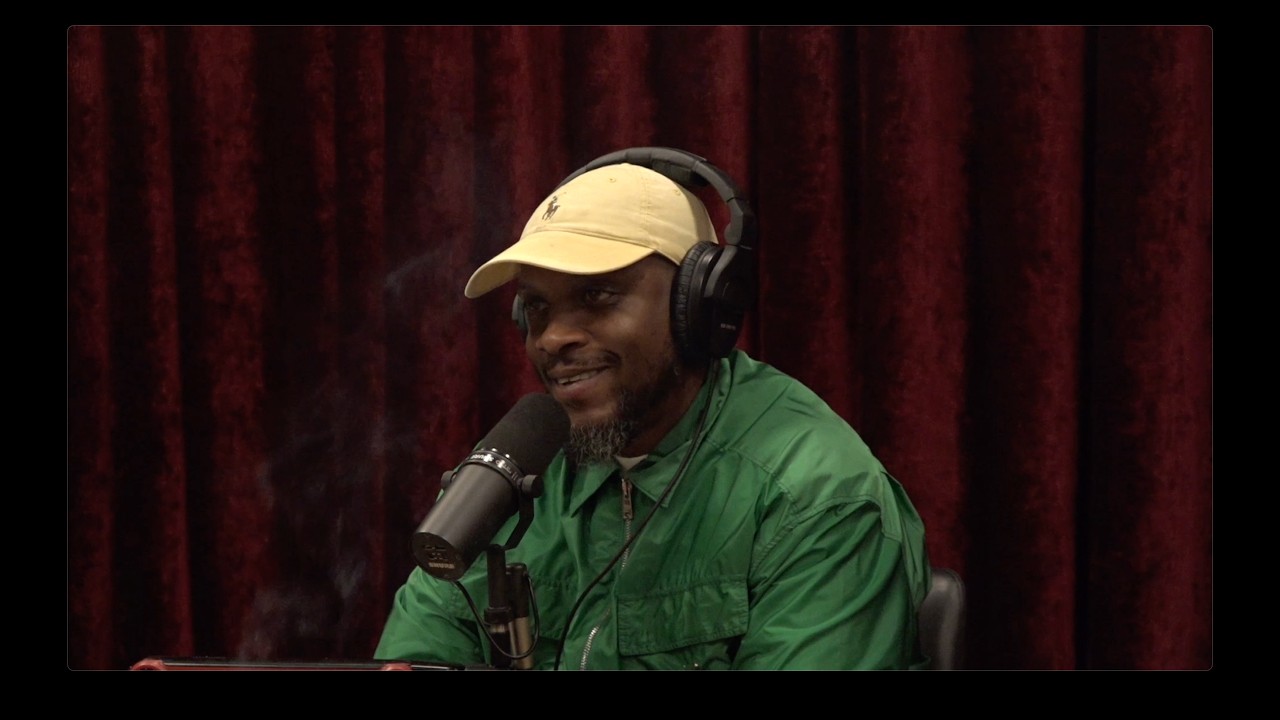
Comedian Ali Siddiq Details Systemic Corporate Push for Gangster Rap
PowerfulJRE
The corporate entertainment system deliberately prioritized violent gangster rap over positive hip-hop to actively fuel the private prison industrial complex.
## Background
Published on July 7, 2026, by the PowerfulJRE channel on YouTube, this episode of the Joe Rogan Experience features comedian, author, and public speaker Ali Siddiq. The description highlights Siddiq's new YouTube stand-up special "My Father" and his ongoing "Custom Fit" live tour.
## TL;DR
In this wide-ranging conversation, Joe Rogan and Ali Siddiq discuss the mechanics of building a sustainable, merit-based career in stand-up comedy away from the pressures of social media metrics. They share behind-the-scenes stories about industry legends like Paul Mooney, Gallagher, and Ron White, alongside local developments in the Texas comedy scene. The dialogue also touches on sports scandals, personal encounters with the supernatural, wild psychedelic drug experiences involving Ari Shaffir and Joey Diaz, and the ecological consequences of human intervention in nature.
## Atmosphere & style
The episode has a relaxed, deeply authentic, and conversational vibe, balancing lighthearted comedic storytelling with grounded, philosophical reflections on life and career longevity. Rogan and Siddiq share an easy, mutual respect, shifting effortlessly from hilarious, hyper-detailed industry lore to eerie ghost stories and intense survival mentalities. Listening feels like sitting in on a late-night green room session where seasoned veterans trade raw truths, personal failures, and sharp cultural critiques with a mix of wit and wisdom.
## Key takeaways
- [00:15](https://www.youtube.com/watch?v=uk2h9oBZctc&t=15s) The long-standing drug testing rules in professional sports like the NBA and NFL historically targeted marijuana, though the NBA has recently removed it from standard testing while continuing to police point-shaving and betting scandals.
- [08:41](https://www.youtube.com/watch?v=uk2h9oBZctc&t=521s) Ali Siddiq deliberately avoids current affairs and political topics in his stand-up routines, arguing that a comedian's true, righteous purpose is to bring a divided room together.
- [13:55](https://www.youtube.com/watch?v=uk2h9oBZctc&t=835s) The comedy industry's hyper-fixation on social media follower metrics and digital audience inflation has caused widespread frustration and mental strain among performing comics.
- [24:18](https://www.youtube.com/watch?v=uk2h9oBZctc&t=1458s) True professional growth comes from a process-oriented dedication to the daily craft of writing and performing rather than obsessing over results, ticket goals, or fame.
- [01:23:32](https://www.youtube.com/watch?v=uk2h9oBZctc&t=5012s) The romanticization of real-world criminals and fictional anti-heroes in media demonstrates how audiences naturally look for emotional justifications to validate bad behavior.
- [01:25:34](https://www.youtube.com/watch?v=uk2h9oBZctc&t=5134s) Modern institutional education heavily prioritizes direct memorization for career placement over fostering deep wisdom, leading many adults to feel unfulfilled by their late 30s.
- [01:27:16](https://www.youtube.com/watch?v=uk2h9oBZctc&t=5236s) Ali Siddiq operates his production company using a strict democratic model, requiring a unanimous vote from all five core members before any special or creative project is approved.
- [01:31:53](https://www.youtube.com/watch?v=uk2h9oBZctc&t=5513s) Managing administrative, scheduling, and operational duties at a self-owned comedy club can significantly drains a performer's energy and compromise their onstage creativity.
- [01:36:58](https://www.youtube.com/watch?v=uk2h9oBZctc&t=5818s) Small, tightly-packed comedy rooms with exceptionally low ceilings function as an ultimate truth serum, exposing overconfident performers who rely on artificial stage antics.
- [01:57:39](https://www.youtube.com/watch?v=uk2h9oBZctc&t=7059s) Ari Shaffir originally developed the concept for 'This Is Not Happening' to create a raw, natural space for comedians to discover organic comedic beats completely free of rigid joke structures.
- [02:24:39](https://www.youtube.com/watch?v=uk2h9oBZctc&t=8679s) Joe Rogan challenges modern institutional critiques against meat consumption, arguing that sustainably sourced meat operates as a healthy superfood vital to human longevity.
- [02:32:53](https://www.youtube.com/watch?v=uk2h9oBZctc&t=9173s) Ill-conceived historical human interventions, such as Chairman Mao's 'Four Pests' campaign or snake eradication in Guam, illustrate the devastating unintended consequences of trying to outsmart natural ecosystems.
## Detailed walkthrough
### [00:15](https://www.youtube.com/watch?v=uk2h9oBZctc&t=15s) Elite Athletes and the Science of Longevity
Joe Rogan and Ali Siddiq kick off the conversation discussing LeBron James and whether he will return to the Lakers, noting that he is currently 41 years old. This prompts a discussion on the oldest elite athletes to compete at a high level. Rogan mentions Tom Brady playing NFL quarterback at 44 and wonders about Kareem Abdul-Jabbar, while Siddiq highlights Bernard Hopkins, who famously defeated Kelly Pavlik at age 42. Siddiq jokes that Hopkins had a couple of years to "incubate a little bit," which Rogan laughs at, explaining that Hopkins had intense, unvarying discipline regarding his running, nutrition, and gym work, meaning he never had to spend six months trying to get back into shape.
They reflect on how Kareem Abdul-Jabbar played until he was about 42, which was incredibly impressive given that it was before modern athletic science. Rogan and his producer, Jamie Vernon, discuss how the science has completely changed the landscape of longevity in sports. Jamie contrasts past drug testing policies with current ones, noting that the NBA used to test for marijuana just once around October 1st at the start of the preseason, allowing players to be clear for the rest of the year. In contrast, NFL players face immediate drug tests the day after having an exceptionally high-performance game.
* Tom Brady played as an NFL quarterback until age 44.
* Bernard Hopkins defeated Kelly Pavlik at age 42.
* Kareem Abdul-Jabbar retired from the NBA at approximately age 42.
---
[02:18](https://www.youtube.com/watch?v=uk2h9oBZctc&t=138s) Marijuana and Scandals in Sports
Rogan asks about the current NBA regulations regarding marijuana, recalling that players negotiated it into their contracts because many prefer to be high when they play. Siddiq admits he is friends with several players who confess they cannot play unless they are high, drawing a parallel to pool players who like to get "lit" before hitting the table to feel the game better. Jamie pulls up the official rule, which states that while the NBA can randomly drug test a player up to four times during the season and twice in the offseason, marijuana is no longer part of the standard testing panel. Rogan champions this change, stating, "It’s not hurting anybody and they play better with it. I think leave them alone."
The conversation shifts as Jamie brings up a major betting scandal that broke within the last 24 hours involving an NBA player accused of throwing at least four games. Rogan warns that throwing games leads to extreme real-world danger, remarking, "If people find out, it goes to bullets," because of the massive amount of money people wager. Jamie clarifies that the specific cases involved player props and point spreads—such as a player trying excessively hard just to hit an over on a 4.5 rebound prop, or sprinting down the court to score an extra basket with three seconds left in a game they were losing by 10 points just to beat an 8.5-point spread. Siddiq points out that watching basketball enough makes these anomalies obvious, as starters usually are not even on the floor trying to score when down by 10 with five seconds remaining.
---
[05:14](https://www.youtube.com/watch?v=uk2h9oBZctc&t=314s) Collusion, Hierarchy, and Political Ideology
Jamie shares a similar controversial incident from a World Cup soccer tournament that occurred a few nights prior during the knockout qualification round. Under a system where third-place teams could advance, Algeria and another team realized that a tie would allow both to move through. With four minutes left, the score was tied and players were just passing the ball around until one team unexpectedly scored, sparking an on-field fight. Then, with two minutes left, the other team stopped playing defense entirely to let them score. Rogan and Siddiq express disgust at the potential collusion, marveling at how modern field microphones and lip-readers catch players saying things like, "you're supposed to leave this a tie."
Rogan emphasizes that this kind of behavior is exactly what makes him hate sports betting, as it ruins the integrity of the game when fans have to wonder if a player is altering their play, fouling, or refusing to score because of a point spread. He asserts that outside of the legal system, sports betting has historically been the most crooked aspect of human nature because of the massive influence of money. Siddiq agrees, noting that sports and politics are practically the same because anywhere there is money and a desire for hierarchy, people will manipulate decisions. He brings up how awards and voting systems are easily swayed by whoever can promote the best or take voters out to expensive dinners to smooze them.
* A recent World Cup match involved a controversial finish where teams seemingly stopped playing defense to secure a mutually beneficial advancement.
* The NBA drug panel no longer includes standard testing for marijuana, though players can still be tested four times a season for other substances.
---
[08:41](https://www.youtube.com/watch?v=uk2h9oBZctc&t=521s) Ideological Captivity and the Purpose of Comedy
Siddiq observes that while the corrupt pursuit of hierarchy exists everywhere, it is far more detrimental in politics than in sports. In politics, unqualified people end up making decisions that impact the masses, including appointing ideologically captured judges. Rogan agrees, pointing out how certain right-wing and left-wing judges vote entirely based on ideology rather than the case, citing a recent Supreme Court order where three judges voted to allow trans women to compete in women's sports. Rogan and Siddiq argue that ignoring biological differences in strength is dangerous, with Siddiq noting that people only realize the reality "until your daughter get knocked out the ring" with a broken face. Rogan emphasizes that Title IX was created specifically to give women an equal, protected space to compete against other women, and that protecting women's sports is not about casting people out of society.
Because the political landscape is so divisive, Siddiq explains that he actively chooses to avoid current affairs and politics in his stand-up comedy. He states:
> "I don't have time to separate the room. I'm too busy trying to do things to bring the room together and that's more of a righteous aim for me."
Rogan commends Siddiq, calling his career extraordinary because he built a massive, organic online following purely through his talent rather than relying on production companies to push his popularity. Siddiq accepts the praise but notes that this success comes with a responsibility to stay grounded, especially when discussing how the comedy industry's obsession with inflating metrics has caused widespread depression among comedians.
---
[13:55](https://www.youtube.com/watch?v=uk2h9oBZctc&t=835s) The Anxiety of Social Media Numbers in Comedy
Siddiq explains that many modern comics suffer from mental health struggles because they are constantly sad about their social media numbers. He uses a basketball analogy, explaining that if he played in the G-League, he wouldn't tell people he "played in the league" because everyone assumes that means the NBA. While the G-League and the Washington Generals have great players, it is fundamentally a different tier, yet people today constantly try to inflate their status. Rogan agrees that the fixation on metrics is a real problem because it gives a quantifiable, clinical measure of success to comedians who are already inherently anxious, socially awkward, or feeling unaccepted. A comedian can work for seven years and have 2,400 followers, only to look at an unknown person's page and see 1.2 million followers, causing intense frustration.
Siddiq reflects on being pressured to get on social media years ago. He recalls that around 2017 and 2018, he did a half-hour and a subsequent full-hour special with Comedy Central while only having 500 followers on Instagram and 300 subscribers on a YouTube page he didn't even own yet. He was highly efficient and successful because Comedy Central picked him based on the quality of his work, not his digital footprint. Rogan points out that 2017 and 2018 marked the exact period when the industry was just beginning to realize the true power of social media and shifting its focus toward comics who commanded large online audiences.
* Ali Siddiq filmed a Comedy Central half-hour special and a 2018 one-hour special while having only 500 Instagram followers and 300 YouTube subscribers.
* The standard NBA testing rules allow random drug testing up to 4 times during the season and 2 times in the offseason.
[16:04](https://www.youtube.com/watch?v=uk2h9oBZctc&t=964s) Social Media vs. Meritocracy in Comedy
Joe Rogan and Ali Siddiq trace the evolution of internet-driven comedy, noting how Dane Cook originally blew up into an arena-selling act via MySpace. While social media popularity has become an absolute necessity for many today, Ali notes that he has a strong argument against letting it dictate one's self-worth. Despite having millions of followers across different platforms and multiple highly viewed specials, Ali points out that he still gets routinely overlooked, failing to get invitations to major events like the BET Awards. He notes that there are guys who have "less everything"—no specials and no proven track record—who somehow find themselves invited to every high-profile event. However, Ali refuses to judge his success against anyone else's social metrics. Joe points out that ignoring the noise is definitely easier once you are already successful and pulling in millions of views, affirming that comedy is, at its core, a meritocracy: "If you're good, people will come. Yeah, it's that simple."
[19:10](https://www.youtube.com/watch?v=uk2h9oBZctc&t=1150s) The Reality of the Build and the "Trading Places" Rule
Ali explains that he has zero desire to inflate his numbers or fake his status. He mocks the tendency of some comics to brag about selling 50 tickets in a 300-seat room, reminding them that they should just be happy they drew 50 more people than if they hadn't played the room at all. Building an audience takes time, and Ali stays grounded by recognizing that a massive turnout in one city doesn't guarantee a crowd elsewhere. "But if I go to Utah, I'm in a comedy club," he laughs, noting that your past success doesn't matter to a new audience. He compares this reality check to a classic scene in the movie *Trading Places*, where a character gives an elaborate description of a luxury watch, only for a pawnbroker to bluntly counter with what the watch is actually worth in St. Louis.
Ali applies this same transparency to performing in theaters. If a venue holds 4,600 people but he decides to scale it down and put only 2,000 tickets on sale, he won't boast that he "sold out the theater." He will accurately state that he sold what he put on sale, choosing to relish real, tangible progress rather than inflating lesser accomplishments to satisfy an ego.
[21:24](https://www.youtube.com/watch?v=uk2h9oBZctc&t=1284s) The Kevin Garnett Trade and Dealing with Haters
Ali explains how easy it is for external opinions to make someone feel bad about their career if they let themselves be vulnerable to it. To illustrate this, he points to NBA history when the Boston Celtics traded seven players and a lottery pick to the Minnesota Timberwolves just to acquire one man: Kevin Garnett. Ali jokes that if he were one of those seven multi-millionaire athletes, he would feel absolutely horrible knowing a team traded an entire group of human beings just to get one guy.
Bringing this concept back to comedy, Ali shares a hilarious interaction he had at a sold-out theater show in San Antonio. The line was wrapped around the block, yet a woman working at the venue said right to his face, "You should have saw it when Matt Rife came." Ali asked if Rife had played a different, larger theater, but the woman confirmed it was the exact same venue. Even though Ali had sold out two shows in a single night, her comment was clearly designed to make him feel small. While Ali shrugged it off and laughed, both he and Joe agree that many people succumb to that exact toxic strain of comparison. Joe argues that instead of turning someone else's massive success into bitterness, comedians should use it as fuel to get work done. Joe stresses that getting angry or bitter at someone else's triumph is a trap for dummies.
[24:18](https://www.youtube.com/watch?v=uk2h9oBZctc&t=1458s) The Papered Room and Being Process-Oriented
Reflecting on his early days in comedy clubs, Ali recalls performing to "papered" rooms where 240 out of the 300 people in attendance were only there because the club blasted out free tickets via email. Rather than being discouraged, Ali viewed it as a room full of comedy fans who genuinely wanted to be there. By delivering an incredible show to those free guests, he ensured they would actually pay for tickets the next time he returned to town. Joe notes that this was the classic, organic way to build a market across the country before the era of social media, where a comic would show up in a city like Philadelphia once a year, do their homework, deliver a tight set, and leave the audience eager for their return.
Joe explains that a massive shift occurs when you move from performing for a random club crowd to performing for your own dedicated fans. He emphasizes the importance of being "process-oriented" rather than "results-oriented."
* **The Results-Oriented Trap:** Obsessing entirely over the end goal, numbers, and comparing oneself to others on social media.
* **The Process-Oriented Approach:** Focusing completely on the daily craft—writing bits, performing, tweaking material, reviewing tapes, talking with friends, and sharpening the knife a little bit more every single day.
[27:14](https://www.youtube.com/watch?v=uk2h9oBZctc&t=1634s) Strategic Hosting and Building an Audience
Ali shares a story about a conversation he had with comedian Bobby Lee regarding their early days at the Houston Improv. Years ago, the club asked Ali to host a weekend for Bobby Lee. Even though Ali was already capable of selling out rooms on his own, he accepted the hosting gig. Other people couldn't understand why a headliner-level comic would willingly step down to host, but Ali saw a brilliant strategic angle. He knew that Houston was full of comedy fans who loved Bobby Lee, Anjelah Johnson, or Mo'Nique, but had absolutely no clue who Ali Siddiq was. By hosting consecutive weeks for totally different headliners, Ali exposed his material to four completely distinct audiences in a single month, converting thousands of their fans into his own.
Ali recalls using this same relentless approach when he opened for Bill Burr at the Paramount Theatre in Austin. At the time, Ali was wearing all black on stage and hilariously began his set by telling the crowd, "Hey, I do not work here," because eight different people had already mistaken him for an usher and asked him where the bathroom was. Joe praises this as an incredibly smart way to build a career. He notes that comparing oneself to others on social media is a massive waste of mental energy. Joe references his friend John Dudley, a professional archer who travels the world competing, who similarly teaches that mastering the physical process is the only true path to excellence. Joe warns that slipping into "hater tendencies" robs a person of self-esteem and self-respect, ensuring they never truly excel because they waste all their energy thinking about someone else. Ali agrees, preparing to share a story about his eccentric father who, despite being a bit crazy, handed down profound wisdom on this exact topic when Ali was just 11 years old.
[33:05](https://www.youtube.com/watch?v=uk2h9oBZctc&t=1985s) The Value of Being Real vs. Faking It
Ali Siddiq reflects on advice he received when he was younger but didn’t fully appreciate until he grew older: the idea that people spend the exact same amount of time and money trying to appear fake when they could simply invest that same energy into being real. He questions why anyone would buy a fake necklace to pretend they are wealthy when they could just work to actually become rich. As he matured, it became clear to him that putting effort into pretending makes no sense when that same focus could make a person genuinely skilled or successful at what they do.
Joe Rogan connects with this sentiment by sharing a childhood anecdote about his Uncle Vinnie from when he was six or seven years old. Staying at his uncle's house with his cousins, Rogan disliked following rules and refused to brush his teeth. Instead, he would sneakily smear toothpaste around his mouth so his breath would smell clean if his parents or aunt and uncle checked. His Uncle Vinnie—who Rogan describes as an incredibly patient, calm, and soft-spoken artist who stood out among his "wild crazy Italian" family members—caught on but didn't yell. Instead, he rationally laid it out, telling young Joe that the amount of time he spent pretending to brush his teeth was the exact same amount of time it would have taken to just brush them.
> "But the amount of time that you're spending pretending to brush your teeth. You could have just brushed your teeth."
The lesson stuck with Rogan for the rest of his life, making him realize that faking things is ultimately counterproductive. Siddiq agrees, noting that while the truth can hurt, giving someone a falsehood or creating a fake backstory for yourself is the "ultimate hate."
[36:34](https://www.youtube.com/watch?v=uk2h9oBZctc&t=2194s) "Fake It Till You Make It" and Tax Fraud
The conversation shifts to the popular modern phrase "fake it till you make it." Rogan points out that while people love to celebrate the rare outlier story of an entrepreneur who lied about a loan to secure a business deal and became a millionaire, they rarely talk about the far more common outcome: those people eventually going to prison for fraud. Siddiq laughs in agreement, joking about the feds busting into a house three years later to take everything back.
Rogan brings up a recent real-world example, pointing to the arrest of Carlos Esparza for multiple counts of tax fraud. While Rogan clarifies that it brought him no joy to see someone arrested, he launches into a critique of the taxation system itself. He argues that the government has no right to lock citizens up for tax evasion when they cannot provide an accurate account of where the money goes, nor have they eliminated internal government fraud and waste. "You guys should get locked up for not doing a good job with our money," Rogan states.
* **Carlos Esparza:** Recently arrested on multiple counts of tax fraud.
* **Rogan's stance on taxes:** The government should not imprison citizens for tax evasion until it completely eliminates its own internal fraud, waste, and lack of transparency.
[38:10](https://www.youtube.com/watch?v=uk2h9oBZctc&t=2290s) White House Spending and fixing America
Siddiq shifts the political discussion to government spending, asking Rogan what he thinks about tax dollars being used for major renovations, such as updates to the White House. Rogan brings up recent reports regarding the new White House East Wing Ballroom, which is projected to cost around $600 million—with over $300 million coming directly from taxpayer-funded accounts, despite initial promises that it would be entirely taxpayer-free. While $300 million is an astronomical number, Rogan notes it is small compared to the rampant fraud occurring daily within NGOs, nonprofits, and insider trading. Siddiq strongly believes that taxpayers should be allowed to vote directly on where their money is spent, specifically advocating for funding to go toward education and nurturing intelligent children.
Rogan builds on this by looking at the country through the lens of a community, recalling how the aftermath of September 11th was the one time he saw the United States truly operating as a unified team. He questions why, if the nation is capable of that unity, it has allowed deeply impoverished, crime-ridden neighborhoods to exist for decades without a real, concerted effort to fix them.
> "You want to make America great. Here's the best way. Less losers. And how do you get less losers? More opportunities for people. More opportunities, more support, more education..."
[41:00](https://www.youtube.com/watch?v=uk2h9oBZctc&t=2460s) Promotional Personas in Sports and the UFC
Siddiq questions the "Make America Great Again" rhetoric by arguing that true greatness requires intelligent leadership, whereas current political and cultural spaces are dominated by divisive people operating on a "lower vibration." He references a bizarre trend of people fixation on conspiracy theories, such as claims that Michelle Obama is a man, wondering how that helps the country. Rogan explains that a lot of this divisiveness is driven by individuals acting like professional wrestlers to manipulate the media landscape for attention.
As an example, Rogan points to UFC fighter Josh Hokit. Rogan explains that while Hokit plays an incredibly divisive, flag-waving, sunglasses-wearing, "Incredible Hulk" style character in public, he is actually a very reasonable, normal person in real life who holds a background in competitive wrestling and the NFL. Hokit adopted the outrageous persona because fighting ability alone isn't enough to secure massive financial opportunities in modern combat sports—a lesson proved by characters like Conor McGregor, Sean O'Malley, and the original master of promotional hype, Muhammad Ali. Rogan stresses that Hokit's act works because he can genuinely fight, pointing out his recent knockout of heavyweight record-holder Derrick Lewis at the special UFC event hosted at the White House, as well as his previous three-round war against top-10 heavyweight Curtis Blades.
Siddiq humorously cuts in, telling Rogan not to get too excited about Derrick Lewis losing, explaining that Lewis trains at the Main Street Boxing Gym in Houston, a place Siddiq is very close to. Rogan defends Lewis, calling him a legend, but notes that Hokit beat a 40-year-old version of Lewis. Rogan recalls how prime Derrick Lewis possessed an unbelievable, almost superhuman grip strength. In official UFC metrics where exceptionally strong fighters score around 160 to 190, Lewis casually registered a 218 grip score, allowing him to simply stand up out of any grapple.
* **Josh Hokit's recent fight history:** Knocked out Derrick Lewis at the White House event; previously won a grueling three-round decision against Curtis Blades.
* **Derrick Lewis's grip strength metric:** Scored a casual 218 on the UFC grip test, well above the standard 140–160 range.
[45:46](https://www.youtube.com/watch?v=uk2h9oBZctc&t=2746s) Muhammad Ali's Tactics and Italian Hippies
Siddiq contrasts modern trash-talkers with Muhammad Ali, suggesting Ali was more respectful in his promotional antics. Rogan firmly disagrees, reminding Siddiq that Ali used to show up at Sonny Liston’s house at 4:00 AM to scream at him from the front lawn. Ali's genius was psychological warfare; he knew how to drive his opponents into a sleep-deprived frenzy where their fear of losing would physically weaken them. Siddiq laughs and points out what happened when Ernie Terrell refused to call him Muhammad Ali and insisted on calling him Cassius Clay—Ali mercilessly beat and taunted him throughout the entire fight, demanding, "What's my name?"
Rogan shares that his mother and stepfather were hippies who never watched fighting, yet the cultural gravity of Ali was so massive that they were glued to the television cheering for him during his rematch against Leon Spinks. Siddiq cracks up at the concept of "Italian hippies," joking that he always assumed Rogan's family was strictly traditional Italian. Rogan acknowledges the wild dichotomy of his upbringing: while his parents lived the hippie lifestyle, his grandmother actually went to prison for a period because she refused to rat out the mob after getting caught running numbers for them.
Siddiq shares a stand-up comedy anecdote where he asked an audience, "Where all the Africans at in here?" and a Sicilian man proudly raised his hand. While the audience was confused, Siddiq simply said, "He knows," joking about the historical and genetic crossover that gives many Sicilians darker skin and curly hair.
The segment wraps up as Rogan steers the conversation back to the history of the hippie era, mentioning a video he watched detailing the CIA's historical involvement with testing LSD on the public. This prompts his producer, Jamie, to point out that there is currently an ongoing congressional hearing regarding MKUltra, which Rogan notes is incredibly convenient, asserting his firm belief that the government never stopped running those types of psychological experiments.
[04:39:20](https://www.youtube.com/watch?v=uk2h9oBZctc&t=16760s) The CIA, LSD, and the Hippie Movement
Joe Rogan and Ali Siddiq dive into a discussion about online polarization, attributing much of the constant public friction to deliberate government intervention and psychological manipulation, potentially orchestrated by domestic agencies or foreign entities like Russia and China. This pivots into an exploration of the historical theory that the CIA manufactured the 1960s hippie movement. Joe details how the CIA allegedly monopolized the global supply of LSD in the 1950s by routing it through the pharmaceutical company Eli Lilly to reverse-engineer it. Early test volunteers like Ken Kesey later popularized the drug through free, non-commercial "acid tests" featuring an unknown house band that would become the Grateful Dead. Kesey followed the band around in a bus, distributing LSD-laced Kool-Aid across the country while the CIA flooded college campuses with the drug under the guise of research.
The conversation highlights the unusual concentration of prominent 1960s counterculture musicians emerging from Laurel Canyon who were the children of high-ranking military and intelligence officials. The theory posits that the CIA orchestrated this cultural shift to neutralize a politically potent, aggressive anti-war movement by steering youth toward a passive, non-threatening ethos of "turn on, tune in, and drop out"—effectively encouraging dissenters to isolate themselves in rural communes rather than directly challenging the system.
- **Key Figure:** Ken Kesey, author and host of the "acid tests" who drove a bus distributing LSD-laced Kool-Aid.
- **Featured Band:** The Grateful Dead, hired as the house band for Kesey's early events.
- **Laurel Canyon Connections:** Jim Morrison (son of an admiral), Frank Zappa (son of a chemical warfare specialist), and members of Crosby, Stills, & Nash all had high-ranking military fathers.
- **The Strategy:** Replacing actionable, targeted political dissent with "Dissent without Teeth."
[04:51:43](https://www.youtube.com/watch?v=uk2h9oBZctc&t=17503s) The Evolution and Division of Hip-Hop
The speakers trace a similar trajectory of systemic manipulation from the 1960s peace movement to the evolution of hip-hop in the early 1990s. Ali asserts with absolute certainty that there was a deliberate, provable effort by the system to promote gangster rap over positive, socially conscious music to fuel private prison populations and break up community cohesion. He contrasts the early rebellious, anti-system message of N.W.A's *Straight Outta Compton* with the sudden industry shift around 1992, when record labels began rejecting positive acts like De La Soul and A Tribe Called Quest in favor of more divisive, violent content.
This corporate pivot effectively killed unifying movements like the West Coast All-Stars and the "Self Destruction" collaborations. Ali notes that the sudden manufactured shift destroyed any momentum toward unity, reflecting on how rare true cultural unity is in America. He identifies only three moments in his lifetime where the country felt genuinely collective: the 1992 Olympic "Dream Team," the aftermath of September 11, and the initial onset of COVID-19.
- **Timeline Change:** The pivotal shift away from conscious rap occurred distinctly after 1992.
- **Suppressed Groups:** De La Soul and A Tribe Called Quest were pushed aside as the industry moved away from Afrocentric leather medallions and toward street violence.
- **Three Eras of National Unity:** The 1992 Olympic Dream Team, 9/11, and COVID-19.
[04:54:57](https://www.youtube.com/watch?v=uk2h9oBZctc&t=17697s) Parenting From Comfort vs. Survival
The dialogue shifts to interpersonal dynamics and family, comparing a fractured society to a sports team where the management actively sabotages its own players through poor nutrition, inadequate gear, and sleep deprivation. Ali connects this theme of structural exhaustion to the realities of parenting, noting that "nervous chickens really don't lay eggs." He details the stark differences between raising children from a place of economic stability versus the pure survival mindset his mother had while working two jobs and going to school.
While Ali appreciates being able to take his children on vacations—a luxury he never experienced growing up—he admits it creates a challenging balancing act. Wealth and convenience make it difficult to instill discipline or teach consequences. He jokes about the absurdity of punishing a child in a high-end environment, where a grounding occurs in a Cabo resort overlooking the ocean while ordering room service lamb chops and oysters.
- **Parenting Philosophy:** True parenting requires a comfortable space; a survival-driven mindset forces a focus on immediate needs over long-term development.
- **Household Dynamics:** Ali jokes about his children being lazy because they have a housekeeper four days a week, a sharp contrast to his own childhood where failing to do dishes brought severe consequences.
- **The Paradox of Success:** The difficulty of administering meaningful punishments when family vacations and luxury environments cannot be easily stripped away.
[05:59:01](https://www.youtube.com/watch?v=uk2h9oBZctc&t=21541s) Media Consumption, Comedy Genres, and Maturation
Ali recalls his own childhood punishments, which often consisted of being forced to sit in his mother’s room to watch older television dramas because the household only had a single television. This forced exposure led to a genuine love for classic programming like *Knots Landing*, *Dynasty*, *Falcon Crest*, *Bonanza*, and *M*A*S*H*. Joe shares an aside that actor Jamie Farr, who famously played Corporal Klinger on *M*A*S*H*, was actually his next-door neighbor in California. Ali laments that modern media lacks wholesome, multigenerational content, noting that he can no longer listen to modern morning radio shows with his daughters due to explicit content, forcing him to switch to commercial-free music, NPR, or classic television shows like *Perry Mason*, *Family Matters*, *The Cosby Show*, and *A Different World*.
The conversation shifts to the current landscape of stand-up comedy. Ali describes taking his 14-year-old son Hassan to a fitness event hosted by Next Level gym, only to walk out after two minutes because the comedian relied heavily on raw, adult shock value that wasn't conducive to a young audience. Ali clarifies that while he does not knock comedians who build their acts around hyper-sexual themes or shock tactics, his own extensive catalog of comedy specials is sustained by talking about evolving life experiences rather than getting stuck on juvenile topics. Joe wraps up by noting a structural flaw in how comedy is viewed: unlike music, which is divided cleanly into distinct genres like blues, rock, or EDM, comedy is all grouped under a single label, forcing vastly different styles, perspectives, and maturity levels to compete for the same title.
- **Joe's Neighbor:** Jamie Farr (Corporal Klinger from *M*A*S*H*) lived two houses down from Joe in California.
- **Media Backlog:** Ali utilizes older shows like *Good Times* and *Perry Mason* to provide clean content for his kids.
- **The Comedy Problem:** Stand-up lacks formal genres, grouping widely different acts like Richard Pryor, Sam Kinison, and Jerry Seinfeld under one ambiguous umbrella term.
[01:06:01](https://www.youtube.com/watch?v=uk2h9oBZctc&t=3961s) The Wild World of Gallagher and Prop Comedy
Joe emphasizes that his absolute priority for any comedian is that they genuinely enjoy what they are doing on stage. Whether an artist relies on props, holds up written signs for the crowd, performs impressions, or does standard stand-up, Joe respects the hustle as long as the passion is there. Reflecting on the vast history and scope of the medium, Ali notes that while he grew up watching classic television like *The Carol Burnett Show*, the acts he witnessed on HBO specials represented an entirely different world of comedy. Specifically, he and Joe marvel at the sheer craziness of Gallagher's legendary performances.
The duo vividly recalls the ridiculous spectacle of Gallagher's front rows, where audience members routinely wore plastic garbage bags around their necks to avoid getting drenched. Joe laughs as he remembers the crowd "getting splattered with watermelons and pineapples and coconuts and whatever the fuck he was cabbage." Despite the mess, Joe gives the prop icon credit, noting that Gallagher actually had solid, legitimate jokes woven in between the visual stunts and managed to pump out a massive number of comedy specials throughout his career.
[01:07:03](https://www.youtube.com/watch?v=uk2h9oBZctc&t=4023s) The Legal Battle of Gallagher 2
Ali shares a bizarre piece of comedy lore regarding Gallagher's retirement, explaining that the comedian's younger brother, Ron Gallagher, heavily resembled him and took over the act under the moniker "Gallagher 2." The arrangement worked well until the original Gallagher decided he wanted to return to the stage and told his brother that the gig was up. Ron, pocketing good money from the routine, refused to step down, sparking a fierce family and legal feud. Reading through the historical details of the case, Joe confirms that Leo Gallagher had originally granted Ron permission to use his trademark Sledge-O-Matic routine on the condition that promotional materials clearly designated him as Ron Gallagher.
Instead, Ron began explicitly promoting his act as Gallagher 2, often leaving small-club audiences entirely confused about which brother they were seeing. When Ron ignored initial requests to drop the sledgehammer gimmick, Leo officially filed a lawsuit in August 2000 for trademark violations and false advertising. The court ultimately sided with Leo, granting an injunction that barred Ron from impersonating his brother in small venues or intentionally bearing a physical likeness to him. Joe and Ali find the concept hilarious, joking about the absurdity of a court order forcing someone to change their natural appearance. "Imagine you can't look like your brother," Joe laughs. "You got to change your mustache. You got to get rid of the beard. That's crazy."
- **The Lawsuit Date:** August 2000
- **The Core Violation:** Trademark violations and false advertising by Ron Gallagher
- **The Visual Trademark:** The Sledge-O-Matic routine utilizing a large mallet/sledgehammer to smash produce
[01:09:15](https://www.youtube.com/watch?v=uk2h9oBZctc&t=4155s) Returning to the Stage and Comedy Lineups
Joe tracks down the timeline of Gallagher’s post-lawsuit career, noting that the comedian did return to touring and released subsequent specials in 2007 and 2014, though he suffered a medical scare when he was rushed to the hospital after a performance in 2011. Joe jokes about the financial threat Ron posed, pointing out that couples would easily choose a cheaper $20 ticket to see Ron smash cabbage over a $50 ticket for Leo when it was "basically the same shit." The conversation briefly touches upon Carrot Top before pivoting to the importance of comedic etiquette and protecting young ears from explicit content.
Ali brings up a past incident where a comedian performed highly graphic material at an event while looking directly at Ali's young children in the green room. Ali argues that out of respect for a fellow comic, a performer should adjust their act or give a warning, noting that comedian Juan Villarreal used to hilariously call out people bringing inappropriate topics like "dick sucking" around kids. Joe and Ali agree that while a raunchy performance is perfectly fine if that is what the client hired, children should never be invited to those environments. Ali recalls simply taking his son Hassan and exiting the venue quietly rather than making a scene, despite later getting puzzled phone calls asking why he left.
[01:12:16](https://www.youtube.com/watch?v=uk2h9oBZctc&t=4336s) Traumatizing Kids with Scary Movies
The discussion turns to parental missteps involving terrifying media, with Joe admitting to a major blunder when his daughters were just six and eight years old. He decided to show them the original movie *Alien*, a cinematic masterpiece that turned out to be far too intense for their ages. "Fucking terrifying," Joe says. "And I was like, 'This is too young. This is too young. I fucked up.'" Ali counters with his own story about his son Hassan, who watched the horror film *Annabelle* at a friend's house as a child and was so profoundly traumatized that it created an extended household crisis. Hassan insisted on keeping every single light on in the house and sleeping directly in his parents' bed.
Joe asks Ali if he has ever visited Zak Bagans' Haunted Museum in Las Vegas, revealing that the real-life Annabelle doll is kept on display there. Looking at a side-by-side comparison of the real doll next to the Hollywood movie prop, they observe the distinct differences between the two. While the movie version features a menacing, sculpted porcelain face, they find an extra layer of chilling, surreal energy in the real-life version's deceptively simple, human-like eyes.
[01:13:37](https://www.youtube.com/watch?v=uk2h9oBZctc&t=4417s) Ghost Stories and the Memory of Spaces
When Joe asks Ali if he believes in ghosts, Ali answers with an emphatic yes, attributing his belief to personal experiences in his old house where his mother currently lives. He claims the spirit of a girl inhabits the home, specifically moving along a set path from the hallway bathroom to the kitchen. Ali recalls a distinct moment during the pandemic where he felt her presence so strongly while working in the den that he casually turned around and said aloud, "So you up, huh?" He notes that paranormal sensitivity runs deep in his family; his mom reported seeing his late grandfather in their old home in Mississippi, and his uncle once witnessed the spirit of his grandfather standing in his shoes.
Joe shares a parallel story about his grandmother, who swore that the spirit of a former tenant lingered in her house after he passed away in a converted attic apartment. Joe theorizes that humanity does not fully comprehend the nature of memory, suggesting that intense emotional trauma might imprint itself onto a physical environment. He points out that this residual energy explains why real estate laws in many regions mandate the disclosure of past murders to potential homebuyers. "I think things keep energy," Joe explains, proposing that an objective type of memory can exist within inanimate spaces and objects.
[01:16:35](https://www.youtube.com/watch?v=uk2h9oBZctc&t=4595s) The Unseen World, DMT, and the Weed Contamination Problem
Ali expands on his spiritual worldview, stating his firm belief in an unseen realm populated by angels and jinn that existed long before humans. Joe jokes that anyone who doubts the existence of co-existing entities simply hasn't smoked DMT, explaining that psychedelics peel back human protective instincts to reveal a surrounding consciousness we normally lack the senses to perceive. He compares the human limitation to waving a hand over an earthworm that has absolutely no concept of your existence. Joe recalls an insightful trip where his own negative thoughts manifested as terrifying, dark geometric fractals; once he consciously released those thoughts, the visions transformed into gorgeous patterns, proving to him that "the way you think changes the world around you."
The conversation shifts from the mind-expanding potential of substances like LSD and mushrooms to the dangerous reality of modern street drugs. Ali expresses deep concern for today's youth, who frequently mix dangerous cocktails of prescription pills, cocaine, lean, and alcohol in a desperate search for an ultimate high. This widespread toxicity has led many older marijuana enthusiasts to grow their own bud rather than trust street dealers. Joe validates this caution by revealing a disturbing reality about illegal marijuana markets: a massive percentage of black-market cannabis sold in non-legal states is grown by cartels hidden deep within California's national forests. To protect their crops, these cartels routinely saturate the plants with highly toxic, illegal pesticides and herbicides, creating a severe health hazard for unsuspecting consumers.
[01:21:19](https://www.youtube.com/watch?v=uk2h9oBZctc&t=4879s) Cartel Grow Ops and the History of Crime
Because marijuana is legal in the state of California, growing it illegally on public land or out in the forest is classified as just a misdemeanor. This loophole has allowed full-scale, illicit grow operations to pop up all over public lands. Joe notes that a friend of his discovered one of these operations on Tejon Ranch, a massive property outside of Bakersfield, after following a series of PVC pipes that someone had laid out to divert water. Joe recalls a past podcast guest, John Nores, a former game warden who wrote a book about his experiences leading a tactical unit to police these remote areas. The situation became so dangerous that the unit had to utilize specialized dogs like Belgian Malinois equipped with bulletproof vests because they were frequently getting into active shootouts with cartel members who had set up camp in the woods.
Ali compares these modern marijuana operations to historical moonshining, pointing out that "Moonshining developed into NASCAR" because the drivers originally needed fast cars to outrun the police. Joe agrees, expanding the historical parallel to Al Capone, the mob, and the widespread running of illegal alcohol during Prohibition. While it remains a point of dispute whether John F. Kennedy's father was involved in bootlegging, Joe emphasizes that the ultimate effect of prohibition is never to stop people from getting a substance. Instead, it merely empowers a criminal empire, giving them immense wealth and inevitably leading to violence and robberies as competitors clash.
[01:23:12](https://www.youtube.com/watch?v=uk2h9oBZctc&t=4992s) The Romanticization of the Bad Guy
The conversation shifts to how modern society views criminals, with Ali pointing out that "the bad guy is definitely romanticized" in culture. Joe illustrates this by bringing up the movie character John Wick. Despite being an elite contract killer for the Russian mob who has assassinated countless fathers and left behind families who will never see them again, audiences view him as an unequivocal hero. Ali laughs and contrasts the fictional assassin with the real-life contract killer Richard "The Iceman" Kuklinski. Society condemns the Iceman for using poison, but as Joe jokes, "John Wick at least look sexy in that suit," and fans eagerly anticipate the next installment of the franchise. Joe notes that audiences easily root for Wick because the writers give him a clear, relatable emotional justification: "They killed his dog and they stole his car. They messed up."
Reflecting on why humans compartmentalize violence this way, Joe remarks that humans are simply weird animals trapped in a constant flux of thoughts, always trying to find a framework that makes them feel better. This innate desire leads people to join religions, cults, and political movements just to seek a structured way of thinking. Ali notes that an individualistic drive to feel better at the expense of the surrounding community is inherently detrimental to society. He believes that true harmony only happens when everyone in a community is uplifted together, rather than a single person thriving in isolation.
[01:25:34](https://www.youtube.com/watch?v=uk2h9oBZctc&t=5134s) Purpose, Adderall, and the Corporate Ladder
Joe attributes this societal disconnect to an extreme lack of a solid "direction book" on how to lead a fulfilling life. He argues that modern school systems fail to teach wisdom, instead instructing children to sit down, memorize information they do not care about, and pass tests just to secure a job. This system defines a career as sitting around doing tasks you dislike in exchange for money, leaving people desperate to escape the daily grind during their free time. To cope with the monotony, people turn to substances like cough syrup, weed, or Adderall.
Joe points out that Adderall essentially acts as a "well-designed slow drip amphetamine" that makes people suddenly enjoy a miserable corporate job. Users find themselves sleeping only four hours a night, climbing the corporate ladder like absolute animals, and driving Jaguars, completely unaware that they are essentially functioning on a medicalized version of methamphetamine. The core crisis of modern society is that vast numbers of people have no true sense of purpose. Joe considers Ali and himself incredibly fortunate because they discovered a passion they love and can make a great living doing it, whereas many people hit their 30s and 40s feeling miserable because they were never taught to pursue a genuine calling.
- **The Corporate Escape Cycle:** People use substances like weed and Adderall to cope with unfulfilling jobs.
- **The Adderall Illusion:** Joe equates the misuse of prescription focus medications in corporate culture to being "basically on meth."
- **The Midlife Crisis:** A lack of early guidance leads many to hit their 30s and 40s trapped in marriages and careers where they feel unfulfilled.
[01:27:16](https://www.youtube.com/watch?v=uk2h9oBZctc&t=5236s) Team Democracy and Producing Comedy Specials
Ali asks Joe about his team, asserting that a leader should never want to be the only happy person on a project. Ali applies this philosophy directly to his own production company, where he produces and distributes stand-up specials for other comedians. As a small company, Ali maintains a strict democratic policy where any potential project must receive a unanimous "yes" from all five core team members, who each handle a different facet of production, from marketing to directing. Ali explains that he refuses to put other comics through a process he wouldn't endure himself, and he wants his team working on projects out of genuine passion rather than corporate obligation.
To test the integrity of this democratic system, Ali recalls an anecdote where he intentionally brought a subpar comedy special to the table. Even though he was the head of the company, the room fell silent until team members cautiously admitted they didn't understand the direction and thought it would require too much fixing. When the final vote was cast, it was a unanimous five "nos." Ali was thrilled, telling his team, "I knew it was a no from the beginning. I just wanted to make sure that y'all wasn't going to try to fluff me" because of his status as the boss. Ali values collaborative input so highly that he frequently changes his own projects based on his team's notes. For instance, his hit special *Domino Effect* was originally going to be titled *1983*, and his Webby Award-winning special *Rugged* was originally titled *I'm Not Handy* until his director, Eric, convinced him to change it.
[01:31:53](https://www.youtube.com/watch?v=uk2h9oBZctc&t=5513s) The Custom Fit Tour and Club Management
Ali mentions that he is currently on his *Custom Fit* tour, though he is taking a six-week vacation until August. He clarifies that *Custom Fit* is unique because it won't be recorded as a comedy special; he wanted a tour where he could simply perform material without the pressure of filming. The underlying theme of the tour is not about clothing, but rather about "tailor making the people around you" so that relationships are mutually beneficial, eliminating hidden "haters" who secretly despise your success. Joe heavily relates to the stress of dealing with people and explains that he bypasses the headaches of running his comedy club, the Comedy Mothership, by delegating all administrative power to Adam Eget. Adam handles the scheduling, bookings, and passing of comics completely, allowing Joe to focus solely on performing without getting bogged down in corporate logistics.
Ali recalls that when he ran his own comedy club in Houston, the stress completely ruined his ability to be funny on stage. He would find himself performing stand-up while simultaneously worrying about administrative tasks or getting distracted by the sound of a waiter dropping a glass on the floor. Joe attributes his own club's success to hiring the right help, explaining how he brought a crew of out-of-work staff members from the Los Angeles Comedy Store down to Austin during the pandemic. Because the LA government strictly banned outdoor shows and forced the Comedy Store to close for a year and a half, the staff was left entirely without income. Joe paid for their relocation to Texas and provided them with full salaries for nearly two years before the Comedy Mothership even opened, allowing them to settle into Austin comfortably.
[01:35:31](https://www.youtube.com/watch?v=uk2h9oBZctc&t=5731s) Comedy Store Politics and Environments
Ali expresses deep admiration for how Joe took care of the Comedy Store staff. He notes that he recently popped into the Main Room of the Hollywood Comedy Store for a Top Dawg Entertainment (TDE) event ahead of the BET Awards. However, Ali admits that he prefers the atmosphere of the La Jolla Comedy Store location over the main Los Angeles venue. Even though the La Jolla location only serves popcorn and drinks rather than full meals, Ali finds the environment beautiful and much more pleasant to perform in. Joe passionately agrees, stating, "I don't believe in food in comedy clubs either," preferring a pure focus on the performance.
Ali explains that his issue with the Los Angeles Comedy Store is that the venue's layout makes it feel heavily segregated. He describes how the Main Room, the Original Room around the corner, and the Belly Room upstairs all feel like entirely different, isolated spaces rather than a cohesive community. Joe is saddened to hear that perspective, noting that the venue did not have that fractured, segregated energy in the past.
[01:36:58](https://www.youtube.com/watch?v=uk2h9oBZctc&t=5818s) The Ultimate Truth Serum of Tight Comedy Rooms
Joe Rogan and Ali Siddiq dive into the distinct vibe and design differences between comedy club showrooms. Rogan breaks down how a venue's layout dramatically shapes the atmosphere, comparing a wide, high-ceilinged main room to the "original room" at the Comedy Store, which he describes as tight, perfect, and a total "truth serum" for overconfident comics. Joe considers the legendary Belly Room, seating just 70 people, to be the absolute pinnacle of this phenomenon, noting that a performer simply cannot fool an audience that close. Siddiq agrees wholeheartedly, expressing his deep love for small, intimate spaces and low ceilings, which are the absolute best for testing whether a joke genuinely works.
Rogan shares that at his own club, Comedy Mothership, the rooms are named after the atomic bombs dropped on Japan. Their smaller room, named "Little Boy," seats only 110 people and features a super low ceiling specifically designed to capture that raw, high-density comedy energy.
[01:38:18](https://www.youtube.com/watch?v=uk2h9oBZctc&t=5898s) Performing for Three People in San Antonio
Siddiq shares a hilarious, defining story from early in his career when he was performing in San Antonio, Texas, at a venue owned by a local entrepreneur named Santa, who owned the entire strip—including the club, a laundromat, and a corner store. A severe rainstorm completely washed out the evening, leaving an audience of literally three people: two women and Santa himself. The promoter refused to pay anyone who didn't take the stage, offering a $100 payout. While other comedians flatly refused to go up under those conditions, Siddiq didn't hesitate, declaring he was going first because he absolutely needed that $100.
Siddiq went out and remarkably performed a full hour and 30 minutes for those three individuals. Impressed by his fearlessness and work ethic, Santa took him to the back afterward and handed him $700, telling him how much they enjoyed the show. To this day, a promoter named Vance still tells the story of that night as the moment he knew Ali was cut from a different cloth.
[01:40:14](https://www.youtube.com/watch?v=uk2h9oBZctc&t=6014s) Power Outages and Projecting Without a Mic
The conversation shifts to other chaotic live show environments where natural grit overrides technical failures. Siddiq recalls a gig at Wiley College—in the exact auditorium where Denzel Washington filmed *The Great Debaters*—when the sound system abruptly failed while a comedian named Marcus was performing. As the crowd began heckling, Siddiq walked out, calmed the audience down, and told them that since there was no sound system, they had to establish a back-and-forth pacing so his natural voice could carry. Siddiq pushed through a 45-minute set entirely unamplified before asking Marcus if he wanted to come back up. Marcus flatly declined, calling Ali completely "nuts."
Rogan shares a similar badge-of-honor experience from a show at the Hollywood Improv. When the power went out completely, management prepared to cancel the event. Instead, Rogan suggested rigging an emergency light to a backup generator, running cords directly through the audience, and performing without a microphone.
* Rogan did a full one-hour set completely unamplified, projecting all the way to the back of the room.
* The unusual circumstance forced a completely different, refreshing pacing that made the night feel incredibly special and historic for the crowd.
* In over 30 years of doing stand-up comedy, that night stands out to Rogan as the only time he ever performed a full club show entirely without a microphone.
[01:42:40](https://www.youtube.com/watch?v=uk2h9oBZctc&t=6160s) Clashing with the Eccentric Legend Paul Mooney
Siddiq emphasizes that coming up through the trenches gives a comedian a completely different set of "chops" compared to those who have easier paths. He references learning the absolute rule that "the show must go on" from comedy legend Paul Mooney. Rogan warmly recalls the first time Mooney ever complimented him at The Comedy Store after a late-night set in front of only 15 people. Mooney, who was notoriously terrifying and highly critical, praised Joe for doing his actual written act rather than lazy crowd work, telling him, "That's what a real comic does."
Siddiq bursts out laughing and admits that his own relationship with Mooney was much more volatile, joking, "I love Paul until I met him." Siddiq was featuring for Mooney at the Houston Improv, excited to meet one of his comedic idols. However, Mooney's eccentric and demanding behavior quickly turned the experience sour.
* Mooney walked into the green room and bluntly ordered Siddiq to go "count the room" for him.
* When Siddiq refused, explaining that he was a performing act and not club staff, Mooney grew hostile, later making passive-aggressive remarks about Siddiq and the club manager, Raymond Cook.
* The tension escalated to the point where Siddiq threatened to physically beat Mooney up, prompting an amused DL Hughley to call Siddiq and warn him, "Even if you beat him up, you're still not going to win. It's going to be a loss."
Rogan points out that during those final years of his life, Mooney was heavily struggling with health issues, meaning Siddiq likely didn't experience the legendary writer and comic at his best. Siddiq notes they later cross-paths at adjacent theaters connected to the Paramount Theatre in Austin, where Mooney offered a subtle, silent "Purple Rain"-style head tilt into the green room as his version of a peace offering.
[01:45:07](https://www.youtube.com/watch?v=uk2h9oBZctc&t=6307s) The Power of the Microphone Stand
Siddiq explains how watching a comedian named Dez White completely transformed his performance style. Early on, Siddiq believed stand-up required high physical energy and pacing all over the stage. White, by contrast, would walk up, leave the microphone firmly in its stand, place his drink on the stool, and absolutely destroy the room without moving an inch. When asked why he never pulled the mic out, White simply responded, "Because there's a stand. Let it hold the mic."
Rogan points out that some of his absolute favorite comedians utilize this exact anchored, powerful delivery. He points to Ron White, who commands rooms effortlessly with a drink, a cigar, and a fixed microphone, as well as Joey Diaz, who leaves the microphone in the stand while delivering some of the hardest-hitting, funniest comedy imaginable.
[01:49:52](https://www.youtube.com/watch?v=uk2h9oBZctc&t=6592s) When Ron White Offered to Open for Ali Siddiq
Siddiq shares an unbelievable story from around 2022 when he was headlining in Orlando. The club manager called to ask if a comic named "Ron White" could feature and open the show for him. Siddiq initially assumed it must be a local amateur who happened to share the same name. To his shock, a massive, branded tequila tour bus pulled up to the venue. Ron White’s manager politely knocked on the green room door to ask if Ron could come inside. White humbly told Siddiq, "I love what you do. I just want to do some time."
* Ron White took the stage as the opener and completely destroyed the room.
* Siddiq was energized by the challenge, following White's set by also tearing the house down, later feeling deep humility that an icon of White's stature wanted to work with him.
Rogan explains that this is typical of White's tireless work ethic when developing new material. White remains incredibly active and was even scheduled to perform at Rogan's club that very evening. Rogan credits White as the primary catalyst for his own move to Texas. White had relocated to Austin prior to the pandemic around 2018 to escape California's grueling traffic and long flights, praising Austin's central geographic location, incredible food, and hospitality. When the COVID-19 pandemic hit and California implemented severe lockdowns and mask mandates, Rogan remembered White's advice, decided he had had enough of the restrictions, and officially made the move to Texas.
[01:52:52](https://www.youtube.com/watch?v=uk2h9oBZctc&t=6772s) Moving to Texas and the Reality of the Pandemic Era
Joe Rogan reflects on his move to Austin, revealing that his close friendship with comedian Ron White was one of the single biggest catalysts for the decision. Rogan remembers thinking at the time that even if live comedy never returned, he would be completely happy just getting to hang out with White. While Rogan is often credited with sparking the massive influx of comedians to the area, he clarifies that "Ron got me to move here" first. Upon settling in, Rogan found it incredibly refreshing how disconnected the local population was from the typical entertainment industry culture. Neighbors and residents were just normal, regular people enjoying their lives, and as an avid bow hunter, he appreciated that hunting is viewed as a standard pastime rather than a bizarre anomaly, as it was back in California.
Ali Siddiq observes that Texas has quietly been a "gem for a long time," allowing other regions to falsely believe they represent the upper echelon of the culture. Rogan agrees, pointing out that Texas has "ruled forever" in stand-up history, giving rise to two of the absolute greatest of all time, Sam Kinison and Bill Hicks, who both emerged from the Houston scene. Rogan explains that unlike many people who fled California blindly during the COVID-19 pandemic without knowing what places like Nashville or Austin were actually like, he had already visited Austin a couple dozen times and knew he loved it. He recalls the sheer absurdity of the pandemic restrictions in major blue cities, describing the requirement of a vaccination card just to eat at a restaurant in New York City as "bananas."
---
[01:54:36](https://www.youtube.com/watch?v=uk2h9oBZctc&t=6876s) The Texas Comedy Scene and the Cap City Legacy
Siddiq and Rogan chart the rapid expansion of the Austin comedy landscape during that era. Siddiq remembers hearing about the arrival of the legendary New York venue The Creek and the Cave, followed quickly by Rogan's own club, The Comedy Mothership. Rogan notes that The Creek and the Cave actually established its physical presence first, though both men remember the local comedy scene long before the pandemic boom. Siddiq asks about the specific Austin venue that used to be incredibly difficult for outside comics to book early on, which Rogan correctly identifies as Cap City Comedy Club.
Rogan shares a piece of industry history, revealing that he almost bought the original Cap City location, alongside the entire mall complex it resided in. The deal fell through because the owner was asking significantly more money than the property was worth. Shortly after, the owner got caught up in an FBI investigation and was ultimately arrested. Rogan notes how surreal it felt walking through that building, realizing he could have owned a venue where he had watched and performed countless shows over the decades. Siddiq fondly remembers Cap City as the very first club he ever played on the road when he toured with D.L. Hughley, a sentiment Rogan echoes by calling it a "perfect club" and an amazing place to work.
* **Key Historic Texas Comedy Clubs Discussed:**
* Cap City Comedy Club (Austin)
* The Secret Group (Houston)
* The Laugh Stop in River Oaks (Houston)
* The Laugh Spot (Houston)
---
[01:57:39](https://www.youtube.com/watch?v=uk2h9oBZctc&t=7059s) Ari Shaffir's Wild Antics and the Storyteller Format
The conversation shifts to the legendary eccentricities of comedian Ari Shaffir. Rogan laughs about a time Shaffir performed at a short-lived upstairs venue of the Laugh Stop while sporting a deliberately trimmed Adolf Hitler mustache. Siddiq confesses that he used to think his Uncle M was the craziest person he knew until he met Shaffir, whom he crowns as "by far the craziest person" alive. Hearing that Shaffir recently moved to England, Siddiq jokes that he warned him, "Brother, they're going to fucking stab you." Siddiq recalls visiting Shaffir at The Creek and the Cave when he was prepping a special, marveling at Shaffir's bizarre internet-documented visual phases—including a time he shaved exactly half his head, looking like the Batman villain Two-Face. Rogan points out that Shaffir isn't putting on an act for attention; he is genuinely a complete maniac.
Siddiq brings up the famous story of Shaffir tearing up a $25,000 check right in front of Bert Kreischer just to prove a point, casually telling a stunned Kreischer, "They'll write you another one." Despite the madness, both hosts respect his intellect. Siddiq notes Shaffir is a "very fucking smart dude" and felt highly honored when Shaffir invited him onto his landmark Comedy Central storytelling show, *This Is Not Happening*. Rogan recalls Shaffir developing the concept at the "Lab" room inside the Hollywood Improv. Rogan initially questioned the format, asking Shaffir why he wanted to do a storyteller show. Shaffir explained that stripping away the rigid requirement of traditional setups and punchlines allowed comics to loosely explore and find the natural comedic beats within an authentic narrative, an approach Rogan realized was brilliant.
---
[02:01:23](https://www.youtube.com/watch?v=uk2h9oBZctc&t=7283s) *This Is Not Happening* and the Mushroom Trip Airport Incident
Siddiq explains how *This Is Not Happening* marked a major turning point in his career. In 2013, Siddiq won Comedy Central's "Comic to Watch," which came with a development package including an album, a half-hour special, and a guest spot on an existing network show. He repeatedly turned down their pitches, including *The Adam Devine House Party*, because the formats didn't fit his style. Eventually, a young comedian named Chase DuRousseau called Siddiq and urged him to look at Shaffir's internet show. Siddiq binge-watched two seasons online, realized it perfectly suited his raw storytelling style, and reached out to Comedy Central executive Anne Harris to lock it in. Though Shaffir didn't know Siddiq at the time, co-creator Eric Abrams vouched for him. When Siddiq arrived to tape, he decided to pivot away from a darker story about planning to kill a corrections officer, opting instead for a lighter tale about a prison riot. This bit became affectionately known as "Mexican Got on Boots," and Shaffir declared it the best story he had ever heard. Siddiq notes that his 16-minute televised set only captured the very beginning of a grueling nine-hour prison ordeal.
Rogan and Siddiq detail the corporate drama that led to Shaffir losing the show. Shaffir received an offer to tape a special for Netflix, but Comedy Central demanded he give the special to them instead, threatening to cancel *This Is Not Happening* if he refused. Shaffir stood his ground. In an effort to save the jobs of the crew members, grips, and camera operators who budgeted their entire lives around the production schedule, Shaffir offered to take out a personal loan to pay them himself. Rogan even offered Comedy Central to host the show completely for free to keep it alive for Shaffir's sake, but the network refused to work with anyone closely affiliated with Shaffir, including Rogan, Joey Diaz, Siddiq, or Bert Kreischer. The network ultimately brought the show back with Roy Wood Jr. as host. Out of loyalty, Siddiq refused to do the revived show until Shaffir personally called him and gave his blessing. As a subversion and a protest against the network's treatment of his friend, Siddiq went on the new season and told a story entirely about Shaffir giving him psychedelic mushrooms.
Siddiq details the aftermath of eating Shaffir's mushrooms without realizing what they were, describing a harrowing trip that bled into the following day. Still completely out of his mind at the airport, Siddiq frantically called his assistant, Janice, because he was watching travelers walk through the TSA security scanner and seemingly vanish out of existence. When Janice calmly suggested they were probably just going to "various places," Siddiq replied, "But I don't want to go to various places, I want to go to Houston!" Driven by paranoia, Siddiq actually stepped up to the TSA officer and asked him point-blank where all the disappearing people were going. When the officer gave the exact same answer—"man, various places"—Siddiq panicked, pulled himself completely out of the security line, and walked away.
[02:07:54](https://www.youtube.com/watch?v=uk2h9oBZctc&t=7674s) Joey Diaz's Infamous Black Stars
Ali recalls the chaos of getting onto a flight while still completely "toasted" and full of mushrooms, desperately trying to close his eyes but finding his mind racing out of control. "Mushrooms is a crazy thing," he reflects, looking back at the intense trip. During that same week, comedian Joey Diaz gave him a legendary "Black Star" weed edible. Ali remembers calling someone who immediately warned him, "Yo, don't you eat that shit," laughing at the memory of how terrifyingly potent those specific edibles were known to be.
Ali describes appearing on Joey's podcast back when he still smoked. He took an edible alongside Lee Syatt, affectionately known as "The Flying Jew". The two of them started off perfectly fine, but as the episode progressed, Joey remained completely anchored while Ali and Lee began visibly "melting" into their chairs. Ali chuckles at how his spoken English steadily deteriorated into incoherent mumbling, while Joey just nodded along, hilariously claiming he understood exactly what Ali was trying to say.
[02:09:14](https://www.youtube.com/watch?v=uk2h9oBZctc&t=7754s) The Church of What's Happening Now and 500 mg Meltdowns
Joe Rogan joins in on the laughter, noting that *The Church of What's Happening Now* produced some of the absolute greatest "overdose on weed moments ever in the history of the internet." He vividly recalls watching Lee Syatt entirely lose the ability to keep his eyes open, slumping and melting away in his studio chair. Ali admits that at first, he was just amused watching Lee trip out, only to suddenly realize with a wave of panic, "This is not happening to me either," as the massive dose hit his own system. Rogan points out with a grin that Joey Diaz simply does not care because his ultimate goal is to "see the devil."
Ali shares an untold side of that story involving another comic who was with them that day, Billy Shakes. While Billy wasn't an official guest on the podcast, he had taken the edibles as well and ended up completely "melted out" on the pavement outside. He was found simply sitting flat on the ground outside the studio, totally incapacitated. The raw power of those Black Stars is put into perspective when Ali mentions they were a staggering 500 mg each. Rogan shakes his head in disbelief, remembering a time he saw a guy eat two of them at once. Meanwhile, Rogan notes that Young Jamie is completely immune to edibles due to some "weird biological condition" that prevents him from feeling their effects at all.
[02:11:13](https://www.youtube.com/watch?v=uk2h9oBZctc&t=7873s) Talkative Mushrooms and Late-Night Philosophy
Shifting the conversation back to psychedelics, Ali explains that he has experienced two completely distinct types of mushrooms. One type, which Ari Shaffir gave him, put him in a deep, heavy trip. The other variety had a bizarrely different effect, making him incredibly talkative and social rather than zoning him out. As the guys laugh at the old clips of a tripped-out guest drooling on their shirt in another dimension, Rogan expresses his excitement that Joey Diaz and Lee Syatt are back together making content again out of New Jersey, calling Joey "the best." Ali shares a funny memory of calling the legendary NBA player Moses Malone on Joey's behalf because Joey was a massive fan, recalling how Joey couldn't believe Ali actually knew Malone.
Ali describes the strange nature of these talkative mushrooms, noting that he ended up calling numerous people in his phone book in the dead of night. His friends later reported that he called them at 3:00 AM demanding to deeply discuss their lives. Joe is fascinated, questioning what kind of compound this could be since standard psilocybin usually renders people entirely unable to speak. Ali mentions he introduced a fellow comic named DeLay to these same mushrooms. DeLay called Ali and talked uninterrupted for hours; Ali eventually just set the phone down and went to sleep, only to wake up hours later to find DeLay still actively talking into the line.
[02:13:28](https://www.youtube.com/watch?v=uk2h9oBZctc&t=8008s) Querying Perplexity for the "Little People" Mushroom
Curious about these anomalous psychedelic experiences, Rogan tasks Young Jamie with looking it up on their AI sponsor, Perplexity, to see what kinds of mushrooms trigger hyper-communicative states. Perplexity notes that while some individuals have social or talkative reactions to magic mushrooms in general, there is no single strain reliably proven to induce that specific effect. Rogan then shifts gears, asking Jamie to look up a different mythic strain: a mushroom that reportedly causes users to see tiny, little people.
The AI search yields a fascinating result, identifying a specific mushroom native to China called *Lanmaoa asiatica*. When undercooked, this mushroom induces incredibly vivid "Lilliputian hallucinations," where the user sees tiny humanoids. Rogan leans into the philosophical implications of this, questioning the very definition of a hallucination. He wonders if these substances are actually opening up a doorway to things that are genuinely there, pointing out that humanity has written stories about gremlins, gnomes, fairies, and magic forest people for eons. "How ignorant are people and how arrogant are we that we know everything that's going on all around us all the time?" Rogan asks.
* **Lanmaoa asiatica**: An edible mushroom found in China that causes vivid Lilliputian hallucinations (seeing tiny people) if it is consumed undercooked.
* **Lilliputian Hallucinations**: A recognized medical and psychological phenomenon where a person perceives people, animals, or objects as being significantly smaller than they are in reality.
[02:16:46](https://www.youtube.com/watch?v=uk2h9oBZctc&t=8206s) Safe Spaces and the Unpredictable Chaos of "From"
Ali emphasizes that while he loves the mushroom experience, he requires a safe environment to do so. He jokes that being high on mushrooms while dealing with the low points of daily life or trying to actively fight the trip is a recipe for disaster because "it's going to get dark on you." Rogan brings up a hilarious story from comedian Brian Simpson, who put a highly potent psychedelic chocolate bar in his freezer, completely forgot it was laced, and later ate the entire thing, sending himself straight "to Pluto" like Dr. Manhattan sitting on Mars in a lotus position.
The conversation organically transitions from mind-bending trips to mind-bending television when Ali brings up a mystery-horror television series he has been binging called *From*. Even though he is already deep into the fourth season, Ali admits with a laugh that he still has absolutely no idea what the show is actually about because it defies all conventional logic. Rogan is an enthusiastic fan of the show as well, confirming that he and his wife are currently midway through season four after completely burning through the first three seasons in a single month.
[02:18:35](https://www.youtube.com/watch?v=uk2h9oBZctc&t=8315s) Navigating the Lore of the Golden Age of TV
Ali breaks down the premise of *From* for those who haven't seen it: a group of unsuspecting travelers find themselves trapped in a terrifying, inescapable town. Every resident arrived the exact same way—by encountering a downed tree blocking the road, turning around, and getting stuck in an infinite geographical loop. To make matters worse, terrifying monsters that look like normal townspeople—including a deeply unsettling milkman and a creepy old lady knocking on windows—emerge at night to hunt them. Rogan and Ali agree that the show delivers pure, unadulterated anxiety despite being fictional. Rogan points out that the series was created by the same minds behind *Lost*, which explains its highly unpredictable narrative structure where "nothing makes sense" but everything remains wildly entertaining.
Reflecting on how easy it is to get sucked into these narratives, Rogan marvels at the current landscape of media, noting that "you never picked a better time to be alive" if your goal is to sit at home and watch incredible content, even if it means you could easily waste your entire life staring at a screen. Ali notes that he loves recommending high-quality media to his inner circle, reminiscing about the time he hooked his friend on *Peaky Blinders*, as well as introducing his buddy DeLay to *Sons of Anarchy*. DeLay became so deeply and emotionally invested in the motorcycle club drama that he would call Ali out of nowhere to frantically stress out over the fates of the fictional characters.
* **From**: A mystery/horror series originally debuting on Epix (later MGM+) and streaming on platforms like Paramount+ and Netflix, executive produced by the creative team behind *Lost*.
* **The Premise of From**: Travelers are trapped in a mysterious nightmare town in middle America that traps everyone who enters; at night, flesh-eating monsters disguised as smiling, ordinary humans hunt the residents.
* **Series Status**: The show is currently in its fourth season, with announcements indicating that the upcoming fifth season planned for 2027 will likely serve as the series finale.
[02:22:47](https://www.youtube.com/watch?v=uk2h9oBZctc&t=8567s) Cult TV Shows, Texas Ranching, and *Landman*
Ali Siddiq and Joe Rogan share their mutual love for compelling, high-stakes television dramas. Siddiq describes a friend who gets so wildly invested in television that he screams at the screen, reacting to the characters' choices with genuine passion. Siddiq lists *Sons of Anarchy* and *Peaky Blinders* as past favorites, before admitting his current obsession with *Yellowstone* and its spin-offs, *1923* and *1883* (which he refers to as the Marshals and the Dutton Ranch). As a Texan, Siddiq finds the depiction of ranching, land disputes, and cattle battles incredibly engaging and reflective of real-world history.
Rogan chimes in to note that *Yellowstone* creator Taylor Sheridan is a friend of his who recently appeared on the podcast. Rogan strongly recommends another Sheridan creation, *Landman*, which dives deep into the oil industry. Siddiq and Rogan agree that the real-world crude oil business is filled with far more notorious, devious, and ruthless characters than any standard drug-dealing crime show.
* **Television Shows Discussed:** *Sons of Anarchy*, *Peaky Blinders*, *Yellowstone*, *Landman*.
* **The Nature of Oil:** Rogan and Siddiq agree that the massive scale of the oil industry inherently breeds deviousness, with Rogan noting, "that's why we're in war right now."
[02:24:39](https://www.youtube.com/watch?v=uk2h9oBZctc&t=8679s) The Fake Meat Agenda and American Chicken Consumption
The conversation shifts from the oil industry to the food industry when Siddiq expresses his utter confusion over the existence of fake meat. Rogan explains that a massive narrative is being pushed by people who stand to profit from the public shifting away from real meat. He aggressively debunks the claim that meat is bad for humans or the planet, calling it "horseshit" and emphasizing that meat is an incredibly healthy, protein-dense superfood. While Rogan acknowledges that factory farming is a problematic system, he points out that regenerative farms do not pollute.
Rogan notes that critics of meat consumption ignore the sheer logistical reality of feeding the population, pointing out the staggering number of chickens consumed daily in America. Rogan and Siddiq try to guess the exact number, with Siddiq guessing 20 million and Rogan guessing 50 million. A quick lookup reveals that between 22 million and 26 million chickens are killed and eaten every single day in the United States. Siddiq laughs, calculating that he easily accounts for three of those chickens in his own household whenever he visits a local Muslim grocery store that sells roasted chicken with irresistible garlic sauce.
* **Daily US Chicken Consumption:** Approximately 24 to 26 million chickens are killed daily for meat in the United States.
* **Siddiq's Roast Chicken Routine:** He buys three chickens at a time from a Muslim grocery store because the garlic sauce is so good that one chicken won't even survive the car ride home.
[02:27:39](https://www.youtube.com/watch?v=uk2h9oBZctc&t=8859s) The Carnivore Diet and Nature's Balance
Siddiq points out that meat-heavy eating is deeply rooted in human culture and history, citing how massive spreads of meat are always featured in historical fantasy shows like *Game of Thrones* and *House of the Dragon*. He shares that during Eid celebrations after fasting, a single lamb on a spit is never enough to satisfy the visiting Muslim families—you always need at least two whole lambs. When people try to pitch vegan diets to him, Siddiq hilariously admits that he completely tunes them out: "I'll listen to you, but none of it is going in... I'm eating the lamb, goat. I'm eating it."
Rogan summarizes the reality of the food chain with a simple truth: "Life eats life." He explains that while factory farming is uncomfortable and gross, hunting or harvesting animals naturally on a ranch is entirely organic. Siddiq agrees, joking that human intervention is the only thing preventing animal populations from completely overrunning the planet, a lesson he playfully claims he learned from the movie *I Am Legend*. He points to the ocean's ecosystem, noting how massive schools of sardines feed whales and sharks, yet plenty of sardines still remain because the natural ecosystem balances itself perfectly when left alone.
[02:29:59](https://www.youtube.com/watch?v=uk2h9oBZctc&t=8999s) Overpopulation of Alligators and the Disruption of Ecosystems
The duo brainstorms about unchecked animal populations, leading Siddiq to wonder why people don't start eating jellyfish, given how massively they "mob out" in the ocean. Rogan notes that jellyfish is commonly served at Chinese restaurants, though he recalls it having a forgettable texture. Siddiq transitions to the insane volume of crawfish consumed in Texas and Louisiana over a mere two-month season, estimating that he personally eats at least 50 pounds of it a year.
Rogan recalls living in Gainesville, Florida, as a child, back when American alligators were legally protected. Visitors used to feed them marshmallows at the lake, but decades of protection have caused the alligator population to explode across the state. They are now found in golf courses, residential areas, and every body of water. Siddiq brings up the tragic incident where a toddler was killed by an alligator at Disney World, noting that he doesn't trust a single puddle in Florida. Rogan's team pulls up a statistic confirming that Disney World has removed 414 alligators from its property in the ten years following that tragedy.
* **Alligators at Disney World:** 414 alligators have been removed from the theme park's property over a 10-year period following the toddler's death.
* **Siddiq's Crawfish Consumption:** Personally accounts for at least 50 pounds of crawfish during the two-month season.
* **Edible Jellyfish:** Rogan references the *Rhopilema esculentum* (Japanese edible jellyfish) used in Asian cuisine.
[02:32:53](https://www.youtube.com/watch?v=uk2h9oBZctc&t=9173s) Humans Meddling with Nature: From Guam to Mao's Four Pests Campaign
Siddiq shares a story from a comedy tour in Guam, illustrating what happens when humans aggressively alter an ecosystem. The military tried to protect a native bird species by systematically eradicating local snakes. However, because those snakes also kept the toad population in check, their removal triggered an absolute nightmare. Siddiq recalls driving home from his comedy show to find hundreds of thousands of frogs blanketing the streets at night, making them impossible to avoid driving over.
Rogan agrees that humans constantly mess up environments by introducing species to kill other species, pointing to Australia's massive feral cat problem. Siddiq admits his own neighborhood has a stray cat problem because his family couldn't resist being nice and feeding them. Rogan points out that while he loves cats, outdoor house cats are devastating predators that kill billions of birds and small mammals in the United States every year.
To highlight the ultimate danger of environmental meddling, Rogan brings up Chairman Mao Zedong's infamous "Four Pests" campaign in 1960s China. As part of the Great Leap Forward, the government mobilized the citizens to eradicate rats, flies, mosquitoes, and sparrows to protect crops and public hygiene. Because the citizens successfully pushed sparrows to near-extinction, they accidentally triggered a massive ecological imbalance. Without sparrows to eat the bugs, crop-eating insect populations boomed, destroying the harvest and directly contributing to the Great Chinese Famine, which killed tens of millions of people. As Rogan bluntly puts it: "You don't think you're smarter than nature, you dumb [__]."
* **Guam's Toad Explosion:** Eradicating snakes to protect a bird species caused an unchecked population boom of hundreds of thousands of nocturnal frogs.
* **The Four Pests Campaign:** Mao's war on sparrows inadvertently triggered the Great Chinese Famine by allowing crop-eating insects to multiply unchecked, killing tens of millions of people.
[02:36:21](https://www.youtube.com/watch?v=uk2h9oBZctc&t=9381s) The Asian Carp Invasion
The conversation wraps up with a look at modern invasive aquatic species, specifically the Asian carp and snakehead fish plaguing American waterways. Rogan describes how Asian carp completely infest lakes and rivers, lacking a natural predator. Famously, the vibrations of boat motors cause them to torpedo frantically out of the water, physically launching themselves into boats.
Rogan shares video footage of the Illinois River, showing hundreds of fish violently leaping into the air simultaneously. He notes that "bowfishing"—waiting for the carp to jump and shooting them out of the air with tethered arrows—has become a highly popular sport. When Siddiq asks if the fish are actually edible, Rogan reads an online excerpt confirming that Asian carp are actually lean, nutritious, and possess a clean, mild flavor. Siddiq laughs, suggesting that commercial fishermen should just drag a net behind their boats to collect the jumping fish for immediate profit. The segment concludes with Siddiq wondering exactly how many millions of pounds of crawfish are harvested during a standard Texas and Louisiana season.
[02:38:00](https://www.youtube.com/watch?v=uk2h9oBZctc&t=9480s) The Massive Scale of Crawfish Consumption
Joe Rogan and Ali Siddiq get into a playful debate over just how much crawfish the Gulf Coast consumes annually. Wondering whether the count is kept in individual numbers or by weight, Joe points out that they have to be measured in pounds. When Ali throws out a guess of 50 million pounds for Texas and Louisiana combined, Jamie pulls up the actual data. The numbers are staggering: Louisiana alone produces 90% of the country's farmed crawfish.
As they dig deeper into the stats, Joe laughs at Ali’s sudden, hesitant downgrade to a guess of "two million pounds," telling him it is way more than that. The final data reveals that a massive 120 to 150 million pounds of crawfish are consumed annually in the United States, with Louisiana eating up 70% of that total—amounting to nearly 100 million pounds in a single state. The hosts marvel at the sheer volume of crawfish boils and "crawfish étouffée" keeping the region fed, prompting an appreciative "Amen" from Joe. Texas doesn't even have a precise breakdown in the search results, listed simply as consuming "tens of millions" of pounds.
* Louisiana accounts for 90% of the farmed crawfish in the United States.
* Total annual crawfish consumption in the U.S. ranges between 120 and 150 million pounds.
* Louisiana alone consumes 70% of that total, nearing 100 million pounds annually.
[02:39:30](https://www.youtube.com/watch?v=uk2h9oBZctc&t=9570s) Regional Seafood Pride and Rebranding the Gulf
Ali shifts the conversation to poke some fun at regional seafood rivalries, pointing out how places like Maryland take massive pride in their crab culture. He jokes that those down south just shake their heads, because the reality is that they actually ship crab *to* Maryland since "the Chesapeake Bay cannot outdo the Gulf of Mexico."
This sparks a humorous aside from Joe, who jokingly rebrands it the "Gulf of America now, by the way." Ali cracks up, noting that he doesn't think Mexico ever officially agreed to that name change. "They like, 'No, you know, this is not the Gulf of America. We still like—we not saying that,'" Ali mimics, bringing a funny, lighthearted end to the food debate.
[02:40:10](https://www.youtube.com/watch?v=uk2h9oBZctc&t=9610s) Wrapping Up and "My Father" Special
Joe wraps up the episode by expressing how much he genuinely loves talking with Ali, emphasizing that they need to do it more often. He gives Ali the floor to plug his work, and Ali directs listeners to his website, `alisiddiq.com`, noting that all of his material is readily available on YouTube. He highlights his brand-new stand-up special, *My Father*, which is currently out and gaining serious traction.
When Joe asks where it was filmed, Ali shares that he recorded the special in Detroit. Joe closes out the show with some high praise for Ali's relentless work ethic and artistic output. "I love the fact that you're so prolific and you know that you've built this whole thing just on hard work," Joe tells him, offering his sincere congratulations as the outro music kicks in and the two say their final goodbyes.
## Notable quotes
> [08:41](https://www.youtube.com/watch?v=uk2h9oBZctc&t=521s) I don't have time to separate the room. I'm too busy trying to do things to bring the room together and that's more of a righteous aim for me. — Ali Siddiq
> [33:05](https://www.youtube.com/watch?v=uk2h9oBZctc&t=1985s) But the amount of time that you're spending pretending to brush your teeth. You could have just brushed your teeth.
> [38:10](https://www.youtube.com/watch?v=uk2h9oBZctc&t=2290s) You want to make America great. Here's the best way. Less losers. And how do you get less losers? More opportunities for people. More opportunities, more support, more education... — Joe Rogan
> [01:06:01](https://www.youtube.com/watch?v=uk2h9oBZctc&t=3961s) getting splattered with watermelons and pineapples and coconuts and whatever the fuck he was cabbage. — Joe Rogan
> [01:07:03](https://www.youtube.com/watch?v=uk2h9oBZctc&t=4023s) Imagine you can't look like your brother. You got to change your mustache. You got to get rid of the beard. That's crazy. — Joe Rogan
> [01:12:16](https://www.youtube.com/watch?v=uk2h9oBZctc&t=4336s) Fucking terrifying. And I was like, 'This is too young. This is too young. I fucked up.' — Joe Rogan
> [01:35:31](https://www.youtube.com/watch?v=uk2h9oBZctc&t=5731s) I don't believe in food in comedy clubs either — Joe Rogan
> [01:42:40](https://www.youtube.com/watch?v=uk2h9oBZctc&t=6160s) Even if you beat him up, you're still not going to win. It's going to be a loss. — DL Hughley
> [02:01:23](https://www.youtube.com/watch?v=uk2h9oBZctc&t=7283s) But I don't want to go to various places, I want to go to Houston! — Ali Siddiq
> [02:13:53](https://www.youtube.com/watch?v=uk2h9oBZctc&t=8033s) How ignorant are people and how arrogant are we that we know everything that's going on all around us all the time? — Joe Rogan
> [02:27:39](https://www.youtube.com/watch?v=uk2h9oBZctc&t=8859s) I'll listen to you, but none of it is going in... I'm eating the lamb, goat. I'm eating it. — Ali Siddiq
> [02:27:39](https://www.youtube.com/watch?v=uk2h9oBZctc&t=8859s) Life eats life — Joe Rogan
> [02:32:53](https://www.youtube.com/watch?v=uk2h9oBZctc&t=9173s) You don't think you're smarter than nature, you dumb [__]. — Joe Rogan
## Mentioned
Joe Rogan, Ali Siddiq, LeBron James, Lakers, Tom Brady, Kareem Abdul-Jabbar, Bernard Hopkins, Kelly Pavlik, Jamie Vernon, NBA, NFL, Algeria, Supreme Court, Title IX, Comedy Central, Instagram, YouTube, Dane Cook, MySpace, BET Awards, Trading Places, Boston Celtics, Minnesota Timberwolves, Kevin Garnett, Matt Rife, Bobby Lee, Houston Improv, Anjelah Johnson, Mo'Nique, Bill Burr, Paramount Theatre, John Dudley, Carlos Esparza, White House, White House East Wing Ballroom, Michelle Obama, UFC, Josh Hokit, Conor McGregor, Sean O'Malley, Muhammad Ali, Derrick Lewis, Curtis Blades, Main Street Boxing Gym, Sonny Liston, Ernie Terrell, Leon Spinks, CIA, LSD, MKUltra, Eli Lilly, Ken Kesey, Grateful Dead, Laurel Canyon, Jim Morrison, Frank Zappa, Crosby, Stills, & Nash, N.W.A, De La Soul, A Tribe Called Quest, West Coast All-Stars, Gallagher, The Carol Burnett Show, HBO, Ron Gallagher, Gallagher 2, Leo Gallagher, Sledge-O-Matic, Carrot Top, Juan Villarreal, Hassan, Alien, Annabelle, Zak Bagans' Haunted Museum, John Nores, Tejon Ranch, Al Capone, John F. Kennedy, John Wick, Richard "The Iceman" Kuklinski, Adderall, Jaguar, Domino Effect, Rugged, Eric, Custom Fit, Comedy Mothership, Adam Eget, The Comedy Store, Top Dawg Entertainment, La Jolla Comedy Store, Little Boy, Santa, Vance, Wiley College, Denzel Washington, The Great Debaters, Marcus, Hollywood Improv, Paul Mooney, Raymond Cook, DL Hughley, Dez White, Ron White, Joey Diaz, Sam Kinison, Bill Hicks, The Creek and the Cave, Cap City Comedy Club, D.L. Hughley, The Secret Group, The Laugh Stop in River Oaks, The Laugh Spot, Ari Shaffir, Uncle M, Bert Kreischer, This Is Not Happening, The Adam Devine House Party, Chase DuRousseau, Anne Harris, Eric Abrams, Netflix, Roy Wood Jr., Janice, Lee Syatt, Billy Shakes, Young Jamie, Moses Malone, DeLay, Perplexity, Lanmaoa asiatica, Brian Simpson, From, Lost, Peaky Blinders, Sons of Anarchy, Yellowstone, 1923, 1883, Taylor Sheridan, Landman, Game of Thrones, House of the Dragon, I Am Legend, Disney World, Rhopilema esculentum, Mao Zedong, My Father
喜剧演员 Ali Siddiq 详述企业对匪帮说唱的系统性推动
商业娱乐体系蓄意偏向暴力匪帮说唱而非积极正向的嘻哈音乐,以积极助长私营监狱工业复合体。
在这场内容广泛的对话中,Joe Rogan 与 Ali Siddiq 探讨了如何摆脱社交媒体数据指标的压力,在单口喜剧界建立基于实力且可持续发展的职业生涯。他们分享了有关 Paul Mooney、Gallagher 和 Ron White 等业内传奇人物的幕后故事,以及德克萨斯州喜剧圈的本土发展动态。对话还涉及体育丑闻、个人亲历的超自然现象、涉及 Ari Shaffir 和 Joey Diaz 的疯狂致幻剂体验,以及人类干预自然所造成的生态后果。
Joe Rogan 与 Ali Siddiq 讨论了职业体育界的药检与博彩丑闻,指出 NBA 虽已将大麻移出常规检测,但球员涉足控分与盘口的丑闻正严重威胁比赛的公正性。 (2:18)
Ali Siddiq 阐述了自己在脱口秀中刻意避开时事和政治争议的原因,认为喜剧演员更崇高的使命在于弥合分歧,将四分五裂的观众席团结起来。 (8:41)
针对喜剧行业对社交媒体粉丝与流量数据的过度焦虑,Rogan 与 Siddiq 强调脱口秀演员应坚持“过程导向”,专注于每天打磨段子与演出技艺,而非沉迷于结果和虚荣指标。 (24:18)
Siddiq 回顾了20世纪90年代嘻哈音乐的产业转向,认为唱片行业在1992年后刻意压制了富有社会意识的说唱,转而推广更具破坏性与分化力量的匪帮说唱。 (291:43)
Reading summary
Comedian Ali Siddiq and host Joe Rogan argue that enduring professional and personal fulfillment requires authentic commitment to craft and an acceptance of natural processes, in contrast to superficial digital metrics, manufactured political polarization, and disruptive systemic interventions.
Authentic Craftsmanship Versus Social Media Metrics (13:55)
Siddiq and Rogan critique the modern fixation on digital vanity metrics, which they argue exacerbates anxiety and distorts self-worth among creative professionals. Siddiq advocates for a process-driven approach over digital validation, citing his own early milestones—such as securing Comedy Central specials in 2017 and 2018 with only a few hundred social media followers—as evidence that quality work builds an organic following. He rejects artificial status inflation, asserting that performers should acknowledge real attendance numbers honestly, such as selling out a capped 2,000-seat allocation in a larger venue, rather than misleadingly claiming to have sold out the entire building.
Rogan contrasts a results-oriented trap—fixating on peer comparisons and digital counts—with a process-oriented discipline centered on daily writing, reviewing performance footage, and gradual refinement. Both comedians agree that navigating unvarnished, high-friction environments, such as Siddiq performing 90 minutes for an audience of only three people during a San Antonio storm or delivering high-energy sets to 'papered' club rooms, creates an authentic resilience that algorithmic visibility cannot replicate.
Ideological Capture and Promotional Polarization (8:41)
Siddiq consciously excludes partisan politics from his stand-up routines, stating that unifying diverse audiences serves a far more constructive purpose than dividing rooms for easy applause. Both speakers express concern over institutional and judicial capture, arguing that rigid dogma increasingly overrides practical facts. Rogan points to legal debates surrounding Title IX and sex classifications in athletics, asserting that denying biological physical disparities compromises protected female athletic spaces.
Simultaneously, Rogan notes that public discord is often performative, comparing political maneuvering to combat sports promotion. While figures like UFC fighter Josh Hokit or boxing icon Muhammad Ali adopted confrontational, oversized personas to build financial demand, Rogan stresses that promotional theater only functions sustainably when backed by undeniable technical ability. Broadening the critique to historical culture, Siddiq claims that corporate music executives intentionally pivoted away from socially conscious hip-hop acts like De La Soul after 1992, promoting divisive street violence to fuel institutional incarceration and suppress community cohesion.
Purpose, Escapism, and Substance Consumption (85:34)
The hosts argue that modern educational and economic models prioritize standardized obedience over genuine wisdom, leaving individuals unfulfilled and prone to chemical escapism. Rogan describes prescription stimulants such as Adderall as medicalized amphetamines that enable workers to tolerate monotonous corporate routines they inherently dislike, driving an artificial climb up professional ladders at the expense of authentic purpose.
Examining athletic and recreational substances, the conversation highlights changing institutional boundaries. Rogan commends the NBA for eliminating marijuana from its standard drug-testing panel, observing that cannabis use does not harm competitive integrity, unlike the severe real-world dangers associated with sports betting and thrown games. While exploring the expanded perceptual states associated with psychedelics—such as the documented 'Lilliputian' micro-hallucinations induced by *Lanmaoa asiatica* mushrooms—both speakers caution against contaminated illicit markets and the militarized violence surrounding black-market cultivation on public lands.
Ecological Meddling and Food Production Realities (152:53)
Rogan and Siddiq challenge contemporary narratives against meat consumption, defending animal protein as fundamental to human development and contrasting sustainable, regenerative farming with the genuine drawbacks of factory systems. Pointing to logistics, Rogan highlights that American consumers eat between 24 and 26 million chickens daily, emphasizing that the physical realities of feeding populations make anti-meat agendas impractical.
They caution that artificial human meddling in nature routinely sparks severe ecological disasters. Siddiq recalls an incident in Guam where eradicating predatory snakes led directly to massive toad infestations, while Rogan details Chairman Mao Zedong's 'Four Pests' campaign, in which the near-eradication of sparrows caused catastrophic insect explosions and agricultural devastation. The discussion frames modern environmental issues, such as the unchecked spread of invasive Asian carp in American rivers, as persistent reminders of the unintended consequences that emerge when human intervention disrupts natural self-balancing ecosystems.
The dialogue underscores transparency, consistent craftsmanship, and respect for ecological and physical realities as key counters to modern alienation. However, while Siddiq and Rogan locate purpose through creative autonomy and passion, the discussion leaves unresolved how individuals embedded in conventional corporate institutions can attain similar fulfillment without relying on escapism.
精炼阅读摘要
脱口秀演员 Ali Siddiq 与主持人 Joe Rogan 探讨了职业立足的本质、现代社会的异化以及人与自然法则的冲突。他们认为,无论是喜剧创作还是竞技体育,专注于真实技艺与过程远比追逐虚浮数据或人设更有价值,而人类盲目干预文化与生态环境往往会引发反噬与危机。
喜剧立足点:专注技艺打磨而非数据指标 (24:18)
Siddiq 与 Rogan 深入讨论了喜剧行业内的指标焦虑。随着社交媒体兴起,许多新人演员陷入“结果导向”的泥潭,过分纠结于关注者数量并夸大自身地位,这加剧了敏感内向群体的心理负担。Siddiq 指出,他在 2017 至 2018 年与 Comedy Central 合作录制半小时及一小时专场时,Instagram 仅有 500 名粉丝,且个人 YouTube 频道尚未建立,作品能够立足完全凭借内容质量而非网络声量。两人强调,构建忠实受众是一个缓慢且有机的过程,从早年为俱乐部免费赠票的观众演出,到在暴雨天仅有 3 名观众的圣安东尼奥小场表演 90 分钟,扎实的舞台功底来自持续的现场淬炼。
Rogan 提出应坚持“过程导向”,聚焦每日写段子、复盘录像和微调表演,而非盲目攀比同行的票房。低矮天花板、空间紧凑的小剧场(如 The Comedy Store 的 Belly Room 或 Comedy Mothership 的 Little Boy 厅)才是检验幽默真实度的“测谎仪”,缺乏扎实内容的演员在近距离接触下无所遁形。Siddiq 在脱口秀中刻意避开政治与时事争议,主张用喜剧凝聚观众而非制造分裂;在作品制作上,他的小型团队严格执行“全员一致同意”的民主决策,拒绝为了迎合老板或追求虚假虚荣而妥协内容水准。
竞技体育:长青科学、大麻争议与博彩隐患 (0:15)
对话从高龄精英运动员的表现切入,探讨了现代运动科学对职业寿命的重塑。Rogan 与 Siddiq 列举了 44 岁仍征战 NFL 的 Tom Brady、42 岁击败 Kelly Pavlik 的 Bernard Hopkins,以及缺乏现代科技辅助却同样打到约 42 岁的 Kareem Abdul-Jabbar。Rogan 指出,Hopkins 等选手的长青源于严苛且不间断的自律训练和营养管理,免去了花费数月重新恢复体态的消耗。
在谈及职业联盟药物监管演变时,制作人 Jamie 提到 NBA 虽保留赛季内外的随机抽检,但标准药检中已不再包含大麻。Siddiq 透露许多球员私下承认需要吸食大麻来进入专注竞技状态,Rogan 对此政策表示认可,认为其并未伤害他人且有助于球员发挥。然而,随着体育博彩合法化与普及,比赛操控成为极其危险的新隐患。针对近期涉及 NBA 球员因个别篮板盘口(如 4.5 个篮板大小分)或让分盘而涉嫌打假球的丑闻,Rogan 警告称,博彩牵扯巨额资金利益,故意放水操控比赛往往会招致现实中的致命暴力报复。
现代生活异化:目的缺失、药物依赖与操控 (85:34)
Rogan 与 Siddiq 批判了现代社会缺乏引导个体追求有意义人生的制度缺陷。现行教育体系倾向于强迫学生死记硬背以应对考试,将职业异化为“用痛苦的日常劳作换取金钱”,导致许多人在三四十岁时陷入严重的意义虚无。为了在不喜欢的企业机制中生存,大量职场人士借助止咳糖浆、大麻甚至 Adderall 来麻痹或强撑神经。Rogan 将 Adderall 描述为一种精心设计的医用缓释安非他命,它虽能让人在每天仅睡 4 小时的状态下疯狂爬升企业阶梯,但本质上是通过药物依赖掩盖内在目的感的丧失。
这种系统性的扭曲同样投射在文化演进中。Siddiq 主张,1992 年后唱片工业曾蓄意压制 De La Soul 和 A Tribe Called Quest 等倡导社会意识与团结的嘻哈音乐,转而大规模推广宣扬街头暴力的匪帮说唱,以此瓦解社区凝聚力并为私营监狱输送生源。此外,社会中盛行的“弄假直到成真”风气往往演变成严重犯罪,例如近期涉嫌多起税务欺诈被捕的 Carlos Esparza,但 Rogan 同时指出,在政府未能彻底消除内部资金浪费与缺乏透明度之前,严酷惩罚民间偷税缺乏道德说服力。
生态规律与反思:人为干预恶果与肉食真相 (144:39)
在探讨人与自然环境的关系时,两人审视了盲目干预生态导致的灾难性后果。Siddiq 分享了在关岛的经历:军方曾试图通过消灭当地蛇类来保护原生鸟类,结果导致失去天敌的蟾蜍过度泛滥,夜间街道被成千上万只青蛙覆盖。Rogan 则进一步列举了澳大利亚的野猫危机,以及 1960 年代中国在“除四害”运动中过度捕杀麻雀引发的严重生态失衡。不仅如此,缺少天敌的亚洲鲤鱼目前在美国伊利诺伊河等水系泛滥成灾,甚至因船只马达震动跳入空中撞击游船,讽刺的是,这种常被视为水体害虫的鱼类实际上肉质优良且极具营养。
谈及现代食品工业与饮食风潮时,Rogan 驳斥了“吃肉破坏地球且有害健康”的言论,指出人造肉热潮背后存在巨大的资本利益推动,而高质量肉类实为高蛋白营养来源,且再生农业并不会破坏生态。以美国日常惊人的家禽消费为例,全美每天消耗约 2200 万至 2600 万只鸡,脱离庞大的人口供养现实空谈素食是不切实际的。Siddiq 与 Rogan 共同强调“生命以生命为食”是自然界永恒的客观法则,适度的狩猎或放牧是自然的循环,而自以为是的人为重塑往往只会适得其反。
整场对话展现了从喜剧创作、职业操守到社会生态的多维观察。Siddiq 与 Rogan 达成共识:无论面对算法洪流、职场机器还是自然法则,立足现实、专注打磨内在实力并尊重客观规律,是抵御浮躁社会异化的唯一路径;而在文化与生态领域,傲慢的人为干预往往比顺应规律带来更深远的破坏。
Detailed notes — zh
## Background
该内容由 YouTube 频道 PowerfulJRE 于 2026 年 7 月 7 日发布,为著名长音频播客《Joe Rogan Experience》第 2523 期。本期嘉宾为单口喜剧演员、作家兼演说家阿里·西迪克(Ali Siddiq),简介重点介绍了他在 YouTube 上线热播的全新喜剧专场《My Father》以及正在进行的“Custom Fit”巡回演出。
## TL;DR
乔·罗根与阿里·西迪克从高龄运动员的长青秘诀、NBA 涉赌丑闻与体育博彩的腐败本质切入,深入剖析了权力体制对社会的异化。随后,两人聚焦于脱口秀行业的浮躁现状,批判虚报票房与追逐虚荣流量的风气,强调坚持“过程导向”与脚踏实地打磨手艺的匠人精神,并生动回顾了与保罗·穆尼、罗恩·怀特等圈内传奇的恩怨交集与底层救场历程。对话还延伸至富裕环境下的育儿困境、老宅灵异感应与致幻真菌引发的意识维度探索,最后围绕硬核剧集嗜好、人类擅自干预大自然引发的生态失衡灾难以及美国南方海鲜狂欢等多元议题展开了妙趣横生的漫谈。
## Atmosphere & style
整期节目散发着两位资深喜剧人促膝长谈的从容与松弛感,笑点密集且充满心领神会的默契火花。西迪克凭借其极具画面感的老派讲故事功力,将早年服刑暴动、极端剧场演出与怪诞同行轶事化作荒诞幽默的包袱,而罗根则以充沛的好奇心与敏锐的哲学发问不断推进叙事深度。听感上既有对名利场虚荣与政治分裂的犀利讽刺,又有探讨超自然感应与生态灾难时的脑洞大开,情绪弧线跌宕起伏却始终保持着真诚、硬朗且极度解压的谈话温度。
## Bulletin
- [02:40:10](https://www.youtube.com/watch?v=uk2h9oBZctc&t=9610s) 脱口秀演员 Ali Siddiq 做客播客,结合全新单口喜剧专场《My Father》的发布,探讨凭借扎实线下演出而非社交媒体虚高数据进行长期积累的职业路径。
- [03:20](https://www.youtube.com/watch?v=uk2h9oBZctc&t=200s) 体育与演艺生态中的眼球经济受到质疑:从 NBA 球员涉嫌围绕个人数据盘口打假球的博彩腐败,到格斗擂台选手依靠争议人设攫取商业利益,利益驱动正持续侵蚀竞技的纯粹性。
- [02:32:13](https://www.youtube.com/watch?v=uk2h9oBZctc&t=9133s) 讨论揭示了人为草率干预自然食物链所引发的灾难性后果,包括关岛灭蛇后导致的严重蛙患、历史上的扑灭麻雀引发大饥荒,以及北美水域亚洲鲤鱼失控蔓延等生态反噬案例。
- [02:24:42](https://www.youtube.com/watch?v=uk2h9oBZctc&t=8682s) 数据显示美国每日肉鸡消费量高达 2200 万至 2600 万只,庞大的肉食消费规模与人造肉产业借环保名义推销替代蛋白的商业博弈形成鲜明对比。
## Key takeaways
- [00:01](https://www.youtube.com/watch?v=uk2h9oBZctc&t=1s) 顶级运动员长青的核心在于极致自律:伯纳德·霍普金斯等传奇在 40 岁以上仍能保持统治力,依靠的是终年无休的严苛饮食与训练,从而避免了休赛期发福与痛苦复原期的消耗。
- [03:20](https://www.youtube.com/watch?v=uk2h9oBZctc&t=200s) 细分博彩盘口诱发系统性腐败:针对个人数据(Player Props)的小盘口刺激球员在垃圾时间刷分或反常拼搏,庞大的赌资正对职业体育赛事的竞技纯粹性构成严重破坏。
- [12:18](https://www.youtube.com/watch?v=uk2h9oBZctc&t=738s) 社交平台的数据泡沫引发创作者群体性内耗:将粉丝数与点赞量作为单一衡量标准的行业风气,诱使演员虚标成就并产生病态攀比,进而深陷焦虑与抑郁之中。
- [26:00](https://www.youtube.com/watch?v=uk2h9oBZctc&t=1560s) 过程导向(Process-oriented)是打磨手艺的根本准则:不被终极目标分神,专注于每天写新段子、登台测试、微调节奏并反复推敲,才能像磨刀一样让技艺真正锐利化。
- [32:41](https://www.youtube.com/watch?v=uk2h9oBZctc&t=1961s) 伪装外表的内耗远高于踏实做事的成本:将时间与金钱耗费在“装样子”或盲信“假装成功直到真正成功”的幻象中,终将面临法律与信誉的反噬,把精力投入自身实力的提升才是唯一正道。
- [44:38](https://www.youtube.com/watch?v=uk2h9oBZctc&t=2678s) 争议人设成为注意力经济下的商业杠杆:公众人物通过在赛场或政坛扮演极端反派、抛出挑衅言论来榨取海量关注度,单纯依靠硬实力已难以在现代眼球竞争中获取顶级商业回报。
- [49:15](https://www.youtube.com/watch?v=uk2h9oBZctc&t=2955s) 文化产品与社会意识形态的隐秘塑造:从 60 年代中情局借助 LSD 将尖锐反战运动消解为避世反文化,到唱片工业转向推广匪帮说唱,文化载体常被体制与资本用作瓦解群体团结的工具。
- [54:57](https://www.youtube.com/watch?v=uk2h9oBZctc&t=3297s) 优渥物质生活中的家庭管教悖论:从老一辈朝不保夕的“生存模式”跨入舒适圈后,现代父母在保护子女免受挫折与防止其沦为软弱懒散的巨婴之间面临严峻的平衡难题。
- [01:36:53](https://www.youtube.com/watch?v=uk2h9oBZctc&t=5813s) 狭小密闭空间是检验脱口秀文本的终极试金石:低天花板与极少座位的密闭剧场无法容纳虚浮表演,笑声的即时物理回弹能逼迫演员剥离多余动作,完全依靠语言硬核发力。
- [01:38:18](https://www.youtube.com/watch?v=uk2h9oBZctc&t=5898s) 极端剧场意外锤炼老派演员的抗击打韧性:在遭遇暴雨离场、大停电或音响全损的极端环境下坚持靠纯肉嗓控场,是老派脱口秀演员打磨出来的不可替代的生存硬功夫。
- [01:51:51](https://www.youtube.com/watch?v=uk2h9oBZctc&t=6711s) 政策与生活成本压力促成得克萨斯喜剧版图的崛起:疫情期间加州严苛的封控政策加速了从业人员的外迁,罗根等人迁居奥斯汀最终重塑了全美单口喜剧的行业中心。
- [01:59:42](https://www.youtube.com/watch?v=uk2h9oBZctc&t=7182s) 《This Is Not Happening》打破了传统脱口秀的结构桎梏:节目摆脱了每隔几秒必须爆发笑点的机械“铺垫-包袱”公式,解放创作者在真实叙事中自由寻找长线的情绪节奏。
- [02:24:42](https://www.youtube.com/watch?v=uk2h9oBZctc&t=8682s) 反肉食与假肉营销背后存在巨大的商业利益驱动:天然肉类本身富含营养且可通过再生农业维持平衡,盲目打压肉类并推广人造替代品本质上是一场被道德叙事包装的巨额利润生意。
- [02:32:13](https://www.youtube.com/watch?v=uk2h9oBZctc&t=9133s) 人为破坏自然食物链必然招致生态失衡的反噬:无论是为保护鸟类灭蛇引发关岛蟾蜍灾难,还是消灭麻雀诱发粮食危机,人类打破物种自然捕食平衡的举措往往以惨重后果收场。
## Detailed walkthrough
### [00:01](https://www.youtube.com/watch?v=uk2h9oBZctc&t=1s) 顶级运动员的年龄极限与长青秘诀
节目刚开场,Joe Rogan 和 Ali Siddiq 便延续了录制前聊到的话题——勒布朗·詹姆斯(LeBron James)是否还会回到湖人队,以及他当时 41 岁的年纪引发了两人对顶级运动员寿命极限的探讨。Joe Rogan 提问历史上处于巅峰期最年长的顶尖运动员是谁,制作人 Jamie 提到在 NFL 打到 44 岁的传奇四分卫汤姆·布雷迪(Tom Brady),Ali Siddiq 则想到了贾巴尔(Kareem Abdul-Jabbar,退役时大约 42 岁)。
```mermaid
flowchart TD
accTitle: 职业运动员寿命极限的关键因素
accDescr: 展示了自律作息、医学科技进步以及身心休养如何共同促成顶尖运动员在 40 岁以上仍保持统治力
subgraph Discipline["极致自律典范"]
A["伯纳德·霍普金斯 (42岁+击败顶尖拳手)"]
B["终年无休:跑步、严苛饮食、永不发福"]
A --> B
end
subgraph ModernEdge["现代科学与环境优势"]
C["现代运动科学 & 营养学"]
D["职业拳赛间隙的身体休养与心智锤炼"]
C --> E["职业寿命大幅延长"]
D --> E
end
Discipline --> E
```
两人随后一致推崇拳击传奇伯纳德·霍普金斯(Bernard Hopkins),认为他是这项纪录的标杆人物,尤其提到了他在 42 岁时击败小凯利·帕夫利克(Kelly Pavlik)的壮举。Ali 调侃说霍普金斯在早年服刑时相当于“闭关孵化”了几年,避免了职业擂台上的肉体损耗,同时锤炼了心智;Joe Rogan 则指出霍普金斯拥有令人惊叹的极度自律——他从不让自己身材走样,不需要在休赛半年后经历痛苦的复原期,长年累月饮食和跑步雷打不动,这是他长青的核心原因。
- 汤姆·布雷迪在 NFL 征战至 44 岁。
- 贾巴尔在现代运动医学兴起前便打到了 42 岁。
- 伯纳德·霍普金斯在 42 岁高龄依然战胜年轻拳手,依靠的是全年无休的严格自律。
---
### [01:40](https://www.youtube.com/watch?v=uk2h9oBZctc&t=100s) 职业联赛的药检机制与大麻政策演变
两人顺着“现代运动科学”延伸探讨现代联盟允许选手使用哪些补剂与物质。Jamie 解释道,过去 NBA 的药检模式非常滑稽,例如针对大麻通常是在 10 月 1 日季前赛开始时统一检测一次,只要那天球员体内的指标达标,接下来的整个赛季基本就安全了;相比之下,NFL 则极为严苛且随机,如果一名球员在某场比赛发挥异常神勇,次日清晨大概率就会被安排尿检。
查阅最新规定后,Jamie 指出 NBA 现在每个赛季会随机对球员进行最多 4 次药检,休赛期 2 次,若有合理怀疑还可追加,但大麻已被正式移出了标准违禁检测名单。Joe 和 Ali 都对此表示强烈支持,Ali 坦承自己认识的许多球员如果不抽大麻就完全无法进入状态,这与台球手赛前抽大麻放松找感觉完全相同。Joe 认为大麻既不伤人又能帮球员放松、发挥更好,联盟放开完全是明智之举,“只要别去碰冰毒那些害人的东西就行”。
---
### [03:20](https://www.youtube.com/watch?v=uk2h9oBZctc&t=200s) NBA 涉赌风波与“投机/垃圾时间”得分争议
Jamie 随后引出了过去 24 小时内刚被曝光的重大体育博彩丑闻:有 NBA 球员被指控在至少四场比赛中打假球、涉嫌操纵盘口。Joe 警示假球往往会引来杀身之祸,因为背后压注了巨额金钱,“一旦被发现,后果往往是子弹解决”。不过随着 Jamie 详细解释,大家发现曝光的很多案子属于球员个人数据竞猜(Player Props):比如某个球员的篮板盘口是 4.5 个,当他拿到 4 个时,会在比赛末段极其拼命地抢下第 5 个;或者在球队已经落后 10 分、比赛仅剩几秒的垃圾时间里,替补球员突然全速冲到底线刷进一个上篮,把分差追到 8 分,刚好打破了 8.5 分的让分盘。
针对这种行为是否算“假球”,Joe 和 Ali 展开了激烈争论:
> **Joe Rogan**: “如果是为了输球故意投丢,那绝对该罚;但他是在拼尽全力得分啊!既然还能得分,凭什么不让他上?不能因为他为了赢盘拼命冲刺就怪他。”
>
> **Ali Siddiq**: “落后 10 分只剩 5 秒,场上全是替补,正常情况下谁还会拼命冲到底线?大家都是把球扔过去混完时间。他这种反常拼搏显然就是为了赌盘!”
Ali 强调职业比赛有默契和常理,当分差无可挽回时主力早已下场,突然拼命反常得分显然有猫腻;而 Joe 则坚称只要球员的目的是得分和争胜,就不能苛责他们的竞技态度。
---
### [05:14](https://www.youtube.com/watch?v=uk2h9oBZctc&t=314s) 足球默契球与体育博彩的系统性腐败
Jamie 随之举了近期国际足球赛事中的另一个极端例子:在小组出线关键战中,只要一场平局两队便能双双晋级淘汰赛,若是分出胜负则有一队必定出局。比赛进行到最后几分钟时比分打平,两队原本心照不宣地倒脚耗时间,不料其中一方突然打破默契攻入一球,导致对方球员当场暴怒抗议;更有戏剧性的是,两分钟后落后的一方放弃防守,看似直接“送给”对方一次进球机会扳平比分。
Joe Rogan 质问赛场上为何没有麦克风或专业读唇人员去调查这种公然的串通作弊,并直言这种情况最让他厌恶。他痛批体育博彩彻底污染了纯粹的体育运动:现在的盘口无所不包,防守犯规、个人得分、微小盘口都可以下注,只要牵扯到暴利,就会有人铤而走险买通球员打假球。Joe 评价道,在人类过去一百年的历史上,除了司法体制的某些黑暗面之外,“体育博彩绝对是整个人类社会中最肮脏腐败的行当之一”。
---
### [07:27](https://www.youtube.com/watch?v=uk2h9oBZctc&t=447s) 等级体制下的权力寻租:从颁奖季到政治竞选
Ali Siddiq 与 Joe Rogan 将假球现象提炼到了更深层的社会本质:权力与阶级(Hierarchy)。Ali 总结说,体育和政治归根结底是一回事,只要涉及巨额金钱与权力等级,就会出现暗箱操作与利益输送。在娱乐圈各种颁奖礼中也是如此,谁能把所有掌握投票权的大佬请去吃奢华大餐、百般奉承讨好,谁就能拿下大奖;甚至某些大公司内部就有几十名拥有投票权的员工,自己公司的项目天然就锁定了这批铁票。
两人一致认为,这种“等级架构”存在于世界的每一个角落,它让人性迷失,而政治则是这一现象的终极极端缩影。然而 Ali 与 Joe 特别指出两者的严重性不可同日而语:
- **体育博彩造假**:影响的是输赢盘口与赌徒的钱包,输掉的只是金钱与荣誉。
- **政治权力腐败**:完全不合格的政客通过资本和人脉攀上高位,却直接掌控着数以亿计普通民众的生存决策,甚至能够决定终身制法官的任命,对社会体制造成根本性的破坏。
### [09:19](https://www.youtube.com/watch?v=uk2h9oBZctc&t=559s) 司法意识形态绑架与跨性别参与女子体育的争议
对话从司法语境下的政治极化展开。乔·罗根(Joe Rogan)指出,如今法官往往被两极的意识形态彻底绑架,在诸如堕胎权或移民等右翼关注的核心议题上,人们闭着眼睛都能预判保守派法官会如何投票;而在极左翼阵营也是如出一辙。罗根提及当时最高法院的一项诉求裁决:有三位法官支持跨性别女性(生理男性)进入女子体育比赛,幸好其余六位法官予以否决。两人对这种脱离常识的政治诉求表达了强烈的不解与担忧。
阿里·西迪克(Ali Siddiq)直言,许多高高在上的支持者根本没有将体育运动的本质和生理差异纳入考量。原生的生理机能与后天的性别认同在竞技力量上存在不可逾越的鸿沟,“除非你的亲生女儿在拳击擂台上本该和同性对抗,却被对手一拳把半边脸骨打碎甚至打飞出擂台,你才会切身体会到这种痛楚”。罗根对此高度共鸣,认为保障女子赛事的纯粹性绝非残酷,这恰恰是美国《教育法修正案第九条》(Title IX)最初确立的根本目的——为女性提供与男性同等公平的竞技平台。社会可以倡导“包容与共存”,但绝不应演变成让一名15岁、具备男性生理机能的运动员以奥运女子水准在女子田径场上降维打击。
- 司法两极化:极左与极右法官在争议案件(如堕胎、移民、跨性别权益)中的裁决已被意识形态深度绑定。
- 最高法院裁决格局:九位大法官中曾有三人支持跨性别女性加入女子组赛事,最终被六票否决。
- 竞技公平与人身安全:生理男性的骨骼与力量优势会对女性选手构成不可逆的竞技破坏与物理伤害。
---
### [11:03](https://www.youtube.com/watch?v=uk2h9oBZctc&t=663s) 远离政治撕裂:用纯粹的喜剧凝聚全场
面对外部世界不断被灌输的对立话语,阿里·西迪克解释了自己在脱口秀创作中刻意避开时事和政治议题的深层原因。在舞台上,他拒绝为了站队而将现场观众撕裂成互相对立的阵营。西迪克坚信,喜剧演员更崇高、更具正义感的目标在于化解隔阂,通过故事把全场所有人凝聚在一起,而不是在演出现场划分政治楚河汉界:“我没有时间去分裂观众,我正忙着把大家聚拢在一起。”
罗根随后对西迪克的职业路径表达了高度赞赏。西迪克在互联网上建立起的庞大受众完全是纯有机生长的,没有任何幕后影视制作公司或资本推手在背后为其造势包装。他所取得的每一点声量,都纯粹建立在个人硬核的内容打磨和日积月累的作品沉淀之上,这种凭借作品说话的模式在当下的行业环境中尤为罕见且振奋人心。
---
### [12:18](https://www.youtube.com/watch?v=uk2h9oBZctc&t=738s) 数据泡沫、G联赛虚荣与脱口秀演员的焦虑症
谈及行业现状,西迪克提到了自己近期引发争议的一个观点:喜剧圈内疯狂的数据造假和自我膨胀,正在给演员群体带来严重的心理健康危机。脱口秀本应是一门带来快乐的艺术,如今却被社交媒体全面绑架,导致大批喜剧人因数据指标而深陷抑郁。为了形象好看,许多人热衷于夸大自己的成就。西迪克对此打了一个形象的比喻:打过NBA发展联盟(G League)绝不等于打过NBA正赛,如果有人对外声称“我在联盟打球”,公众默认联想到的一定是NBA,这种故意模糊边界的吹嘘只是虚妄的自欺欺人。罗根随之戏谑补充,这就像为华盛顿将军队(Washington Generals)效力对抗哈林环球旅行者(Harlem Globetrotters),即便对手再伟大,你也不能声称自己在打NBA。
```mermaid
flowchart TD
accTitle: 社交媒体数据与演员心理健康恶性循环
accDescr: 展示从数字量化衡量标准到引发演员焦虑抑郁的传导过程
subgraph IndustryPressure["行业评价扭曲"]
A["社交平台数字作为量化成功指标"] --> B["部分演员刻意虚标/膨胀自身成就"]
end
subgraph PsychologicalImpact["演员心理危机"]
C["同行产生病态比较心理"]
D["遭遇创作焦虑与抑郁症"]
end
B --> C
A --> C
C --> D
```
罗根深入剖析了数据量化对艺术家的心理摧残。很多脱口秀演员本身就带有社交障碍或未被外界接纳的自卑创伤,而社交媒体将影响力赤裸裸地数字化,变成了一把冰冷的标尺。一个苦熬了七年、演出经验丰富的资深演员,打开个人主页发现自己只有2400个关注者,而点开某个名不见经传的新人账号却显示着120万粉丝,这种巨大的数字落差会瞬间将创作者吞噬在极度的怀疑与自我否定之中。
---
### [14:37](https://www.youtube.com/watch?v=uk2h9oBZctc&t=877s) 凭本事硬碰硬:2017年的低粉丝破局与名利场的反思
西迪克回顾了自己职业生涯的关键转折期。当年周围所有人都在催促他必须拥抱互联网和社交媒体,但他反其道而行之,专注于夯实舞台实力:
- 2017年与2018年,他先后在喜剧中心(Comedy Central)录制了半小时特辑与个人一小时全长特辑。
- 拿下这些顶尖资源时,他在Instagram上仅有区区500名粉丝,YouTube订阅者只有300人(甚至还是一个他当时未拿回自主权的账号),Facebook上的关注度同样寥寥无几。
- 喜剧中心选择他,完全是因为他在现场展现出的无可替代的硬实力,而不是基于任何网络数据。
罗根分析称,2017至2018年正是传统演艺行业全面转向追逐社交平台大V的拐点时期。尽管早期戴恩·库克(Dane Cook)曾借助MySpace的红利一路爆火至填满体育馆,但当下的环境则演变为流量数据主导一切。
即使如今西迪克在全网拥有数百万粉丝且演出场场爆满,他依然经常被好莱坞的主流名利场忽视,例如从未受邀参加黑人娱乐电视大奖(BET Awards)。但他对此完全坦然,既不眼红那些毫无个人特辑与硬作品却能四处蹭红毯的社交名流,也绝不借由虚标身价来抬高自己。罗根最后总结道,喜剧行业在核心层面终究是一场硬核的能者多劳与优胜劣汰:“只要你足够优秀,观众自然会买票入场。”
### [19:26](https://www.youtube.com/watch?v=uk2h9oBZctc&t=1166s) 票房虚标与脚踏实地的积累
阿里·西迪克(Ali Siddiq)分享了自己对待票房与场馆规模的心态。他提到,如果自己去犹他州演出,即便是在一个能容纳 300 人的剧场里只卖出 50 张票,那也是实打实的进展——因为这 50 个人是全新的受众,如果不去演就一个也没有。他幽默地引用了经典喜剧电影《颠倒乾坤》(*Trading Places*)里的典故:一个人费尽口舌吹嘘自己的名贵手表有多值钱,而当铺伙计冷冷地回了一句“在圣路易斯这玩意儿就值这点钱”。阿里借此说明,不管前一晚自己在别的地方能撑满多大的体育馆,到了不认识自己的地方,他就只是俱乐部里的普通演员,必须认清现实。
阿里进一步剖析了行业内普遍存在的“虚报战绩”现象。许多演员在面对一个可容纳 4,600 人的大剧院时,会拉上幕布将场地缩减(scale down)到 2,000 座,随后将这 2,000 张票售罄,便大肆宣称自己“剧院全场售罄(Sold Out)”。阿里表示自己绝不会这么说,他只会坦诚承认自己卖完了对外开售的份额,因为没到能填满 4,600 人的水平就是没到。在他看来,喜剧人应当享受自己真正的成就,而不是靠通货膨胀式的数据来营造虚幻的虚荣感,更不需要被同行的成就裹挟去盲目竞争。
### [21:24](https://www.youtube.com/watch?v=uk2h9oBZctc&t=1284s) 加内特大交易与圣安东尼奥的“马特·莱夫”对比
在谈及心态容易失衡的人时,阿里打了一个生动的 NBA 交易比喻:当年波士顿凯尔特人为了得到凯文·加内特(Kevin Garnett),一口气打包送走了七名球员加上选秀权。阿里调侃道,那七个人本身也都是打进 NBA 的百万富翁,如果换作一个心态脆弱、容易自怨自艾的人,心里肯定会崩溃:“你们为了换他一个人,竟然把我们整整七个大活人都扔掉了,合着我们根本没人要!”现实中总有人能挑出毛病让你难堪,关键在于你自己如何看待。
阿里随即分享了一个亲身经历:他在得克萨斯州圣安东尼奥演出,剧院门外排队的人群绕了整个街区,一连两晚全部售罄。然而,现场一位女士却当着他的面冷嘲热讽:“你应该看看马特·莱夫(Matt Rife)来的时候是什么场面。”阿里当场反问:“他是换了个更大的剧场吗?”对方回答:“不,同一个剧场。”阿里表示,自己不仅两场全满,而且演得很成功,面对这种刻意让人不爽的话,他完全不在意。乔·罗根(Joe Rogan)非常赞同并指出,健康的竞争心是前进的“燃料”,看到别人表现出色会激发自己创作更多优质段子;但如果是蠢人,就会陷入嫉妒与怨恨,将负面情绪倾泻在比自己成功的人身上。
- **凯尔特人加内特交易案例**:凯尔特人送出 7 名球员加选秀权换取加内特 1 人,常人若陷入比较心容易心态失衡。
- **圣安东尼奥剧院对决**:阿里两场演出全部爆满,但依旧被路人拿去与人气极高的马特·莱夫(Matt Rife)对比。
- **竞争的两种走向**:智者将其转化为创作燃料(fuel),愚者将其变成嫉妒与内耗。
### [23:46](https://www.youtube.com/watch?v=uk2h9oBZctc&t=1426s) 送票观众与老派喜剧人巡演的积累模式
阿里回忆起早年在喜剧俱乐部打拼时的经历。有时俱乐部为了撑场面会“送票注水”(papering the room),300 个座位的场地里,有 240 人是通过俱乐部的群发促销邮件拿免费票进来的。但阿里从不觉得自己被轻慢,反而认为这些观众至少愿意走出家门走进剧场,说明他们本身就是喜剧爱好者。演员的职责就是奉献一场顶级的演出,只要把他们逗笑,下次再来巡演时,这些人就会掏钱买票。
乔·罗根深有感触地指出,在社交媒体兴起之前,喜剧人建立全国声誉完全依靠这种纯粹有机的积累。演员每年去一次费城这样的城市,上台前做足功课、打磨好精炼炸裂的段子(tight set),在台上把全场观众彻底征服,然后潇洒离开。台下观众意犹未尽,整整一年都在期盼演员下次回归。这种老派模式不靠算法包装,全凭实打实的台风与段子建立起牢不可破的粉丝基本盘。
### [26:00](https://www.youtube.com/watch?v=uk2h9oBZctc&t=1560s) 过程导向 vs 结果导向:打磨手艺的钝刀成锋
谈到剧场送票与自身拥趸的差异时,罗根强调,面对专程为自己买票的死忠粉与面对完全不认识自己的路人观众,性质完全不同。前者已经被你征服,而后者则是将陌生人转化为终身信徒的绝佳机会。罗根特别提到,很多人在事业上都是“结果导向”的,但他自己始终坚持“过程导向”(process-oriented)。
```mermaid
flowchart TD
accTitle: 过程导向的脱口秀打磨机制
accDescr: 展示从段子创作到最终成为成熟喜剧大师的循环打磨过程
subgraph Writing["创作与推敲"]
A["构思与编写新段子"] --> B["剧场登台实战检验"]
end
subgraph Refining["复盘与迭代"]
B --> C["回看录像与分析录音"]
C --> D["与喜剧同行交流探讨"]
D --> E["微调节奏与精炼文本"]
end
subgraph Outcome["长效复利"]
E -->|每日递进| A
E --> F["刀锋日益锐利:手艺与观众群双重沉淀"]
end
```
罗根解释说,通往目标的唯一途径恰恰是“别老盯着目标”,而是专注于手头正在做的事。喜剧的过程就是不断写新段子、登台测试、微调笑点、回看录像、反复推敲打磨、与同行交流,就像磨刀一样让刀刃每天锋利一点点。正是这个枯燥却扎实的过程,最终塑造出真正的喜剧大家。
### [27:16](https://www.youtube.com/watch?v=uk2h9oBZctc&t=1636s) 休斯敦即兴喜剧俱乐部的“蹭圈”策略:为鲍比·李等人主持
阿里十分认同过程的重要性,并向罗根透露了自己早年一个极其聪明且反常规的策略。他曾对喜剧演员鲍比·李(Bobby Lee)提到两人初识的情景,鲍比一开始还忐忑地问这会不会是个糟糕的黑料故事。阿里透露,两人是在休斯敦即兴喜剧俱乐部(Houston Improv)认识的,当时俱乐部打电话邀请阿里担任开场主持(Host)。当时阿里其实早就具备了在该场地独立压轴售罄的能力,按常理头牌演员不可能回过头去给人暖场,甚至同场嘉宾都觉得不可思议。
然而阿里的眼光完全放在了拓展圈层上:休斯敦当地有大量喜剧迷,但各自主力受众完全不同。阿里在那一个月里,主动为四位风格迥异的演员连番担任主持——其中包括鲍比·李(Bobby Lee)、马兹·乔布拉尼(Maz Jobrani,中东裔受众)、安杰拉·约翰逊(Anjelah Johnson,拉丁裔受众)以及另一位白人喜剧演员。通过这番操作,阿里在一个月内接连打穿了四个完全不重叠的受众群体,许多原本绝不会买票看他的人因此成了他的铁杆粉丝。阿里回忆,甚至在后来为比尔·伯尔(Bill Burr)做主持时,伯尔也对他的炸场水准感到震惊。阿里正是将每一次上台主持都视作吸收新观众的精妙过程。
### [29:49](https://www.youtube.com/watch?v=uk2h9oBZctc&t=1789s) 派拉蒙剧院的“引座员”误会与专注过程的力量
阿里·西迪克(Ali Siddiq)回忆起自己在奥斯汀派拉蒙剧院(Paramount Theatre)演出时的一件糗事。当时他全身穿着一袭黑衣来到演出现场,结果还没登台,台下就接连有大约八个人跑过来问他:“请问洗手间在哪里?”阿里哭笑不得,一走上舞台开口第一句话就是:“嘿,我可不是这里的员工!”他吐槽自己那身全黑行头活脱脱像个剧场引座员。乔·罗根(Joe Rogan)听后大笑,称赞这种从容化解尴尬的方式非常高明,尤其是对已经开始领衔巡演(headlining)的脱口秀演员来说,这是积累观众与控场的好方法。
随后两人将话题延伸到做事的专注度上。罗根谈到自己的好友、也是教他射箭的约翰·达德利(John Dudley)。达德利曾在全球各地参加射箭锦标赛,他始终信奉一个核心理念——“注重过程本身”(process-oriented)。罗根认为这一法则适用于射箭、音乐乃至生活中的一切。而当下很多人(尤其是年轻一代)被社交媒体搞得心浮气躁,核心问题就是他们总在盯着别人、盲目攀比数据。罗根打了个比方:如果一个人每天拥有一百个单位的精力,许多人却把绝大部分精力浪费在那些不仅无法赋能自己、反而把心态搞崩的事情上。
罗根强调,成为一名职业脱口秀演员本身就是在追逐梦想,只要肯投入时间、心血并真正热爱,有朝一日卖光整个剧场的门票是完全可能实现的。这就像攻读化学博士一样,应该是一个明确的目标,但最关键的永远是过程——去理解并享受自己在做的事情,然后拼尽全力。看到别人取得优异成绩时,理应将其视作激励,而不是变成一个心怀嫉妒的“黑子”(hater)。罗根直言,那些习惯性贬低他人、用最刻薄恶意揣度别人的人,永远无法脱颖而出;他们试图通过贬损他人让自己好受一点,但结果往往适得其反。
- 阿里在奥斯汀派拉蒙剧院演出时因一身黑衣被八名观众误认成引座员并问路。
- 约翰·达德利(John Dudley):前世界级职业射箭选手,乔·罗根的射箭教练,倡导以“过程导向”打磨技艺。
- 社交媒体时代的精力分配误区:过度关注他人数据与生活,耗尽每日有限的心理能量。
---
### [32:41](https://www.youtube.com/watch?v=uk2h9oBZctc&t=1961s) 父亲与文尼叔叔的教诲:别把精力浪费在“装样子”上
阿里·西迪克顺着话题分享了一个原本应该收录在他全新单口喜剧特辑《我的父亲》(My Father)里、但最终遗漏的故事。阿里回忆道,虽然自己的父亲在很多事情上显得有些“疯狂”,但在他十一岁左右时,父亲冷不防对他说了一句让他受用一生的道理:“人们总是花费同样的时间和金钱去装假,而这些时间和金钱明明可以用在让自己变真上。”少年的阿里当时并不懂这句话的深意,随着年龄渐长他才彻底明白:为什么要去买一条假项链来假装自己很有钱?如果你把那份精力和金钱花在正道上,假以时日你完全可以买得起真正的项链,并成为真正的富人。花心思去伪装和糊弄,本质上毫无意义。
```mermaid
flowchart TD
accTitle: 假装与真实的精力分配对比
accDescr: 对比将时间精力用于伪装外表与投入自身技能提升的两种截然不同的闭环
subgraph FakeLoop ["虚假陷阱 (Fake It)"]
F1["投入时间金钱伪装身份/财富"] --> F2["时刻提防被拆穿、产生内耗"]
F2 --> F3["本质能力毫无长进"]
F3 --> F4["最终崩塌或遭遇欺诈反噬"]
end
subgraph RealLoop ["真实积累 (Be Real)"]
R1["专注于核心技艺与过程"] --> R2["投入真实的时间与精力"]
R2 --> R3["能力逐步变强并建立自信"]
R3 --> R4["获得货真价实的成就与财富"]
end
```
这段感悟唤起了罗根童年的一段类似记忆。罗根六七岁时住在文尼叔叔(Uncle Vinnie)家和表兄弟们一起玩耍。童年的罗根很讨厌遵守规矩,到了该刷牙的时候,他不想好好刷,就用手指沾着牙膏胡乱抹在牙齿上,企图让大人闻到嘴里的牙膏味以此蒙混过关。文尼叔叔发现后并没有像家里其他暴躁的意大利长辈那样大吼大叫,而是展现出了极大的耐心与平静。身为艺术家的文尼叔叔轻声对他说:“我明白你为什么要这么做。但是,你用来假装刷牙所花的时间,本来就已经足够你把牙齿认真刷完了。”
这句话如同一记警钟,让年仅六岁的罗根彻底愣住了。叔叔平静理性的点拨让他意识到耍小聪明伪装有多愚蠢。罗根感慨,很多时候成年人一句真正有分量的话能影响孩子一生,从此他深刻明白:“别再装模作样了,去把该做的事情做完,糊弄只会起到反效果。”
---
### [35:50](https://www.youtube.com/watch?v=uk2h9oBZctc&t=2150s) “假装成功直到真正成功”的谎言与欺诈下场
谈到伪装与真诚,阿里指出,真相有时虽然残酷刺耳,但给予别人虚假的谎言才是“终极的恶意”(the ultimate hate)。尤其是那些刻意编造虚假身世、夸大生活现状的人,本质上是在用欺骗麻痹自己和他人。阿里的态度非常直接:“老兄,直接去动手做那件事(Just do the thing),别整虚的。”
然而罗根指出,社会上流行着所谓“假装成功直到真正成功”(fake it until you make it)的鸡汤神话。很多人喜欢听信某种幸存者偏差的故事,比如有人吹嘘自己银行账户里只有五百美元,靠着四处吹嘘拿到各种贷款,最后公司神奇地赚了大钱。很多人误以为只要胆子大、敢硬吹就能复制这种奇迹,但事实并非如此。
两人戏谑地补充道,这类吹捧故事永远不会交代后半截——几年后这个人往往会因为涉嫌金融诈骗被联邦调查局(FBI)抄家逮捕。罗根顺势提到了卡洛斯(Carlos)近期因多项税务欺诈罪名被起诉逮捕的事件。尽管罗根表示看到同行被捕并不觉得好笑,也绝不乐见任何人遭殃,但事实就是如此:那些依靠虚假包装堆砌起来的名利蜃楼,最终大概率难逃法律制裁的下场。
---
### [37:26](https://www.youtube.com/watch?v=uk2h9oBZctc&t=2246s) 纳税质疑与白宫六亿美元宴会厅争议
借由税务欺诈的话题,罗根顺势宣泄了对政府税收体制的强烈不满。罗根直言,在政府能够清清楚楚列出纳税人的血汗钱究竟花在何处、并彻底消除所有贪腐和浪费之前,凭借欠税把人关进监狱本身就很荒谬。“如果非要抓人,那些没把纳税人的钱管好、大肆挥霍的官僚才应该被关进监狱!”
阿里随即提及联邦政府近期动用纳税人资金的诸多大手笔工程,比如翻修白宫的相关开支。他问道:“白宫翻修宴会厅到底花了纳税人多少钱?”罗根也回忆起白宫之所以急于自建宴会厅,是因为此前白宫记者晚宴借用外部酒店举办时,曾发生过持枪人员混入被捕的严重安保疏漏;此外还有关于华盛顿国家广场反光池(Reflecting Pool)藻类泛滥维护等一连串杂费问题。
制作人调出报告数据指出:拟建的全新白宫东翼宴会厅预计耗资约六亿美元(600 million),尽管此前官方承诺绝不耗费公款,但实际上有超过三亿美元(300 million)直接来自纳税人资助的政府预算。
阿里与罗根对这种现象展开了深刻的探讨:
- **资金浪费的泛滥性**:三亿美元听起来很多,但放到庞大的非营利组织(NGO)虚假申报、内幕交易、利益集团输送等黑洞里,只是冰山一角。整个系统充斥着挥霍与欺诈。
- **税款用途的民主投票权**:罗根与阿里一致认为,公民应当拥有直接投票权,来决定自己上缴的税款究竟该流向何处。如果政府要把百姓的钱花在百姓不需要或不知情的地方,那就是一种掠夺。
- **教育投入的缺失**:阿里提出灵魂拷问:到底有多少税金真正用在培养顶尖人才、让下一代孩子变得更聪明上?罗根对此深表赞同,认为教育与下一代的成长才是国家最根本的命脉,却在无休止的面子工程与利益分配中被边缘化。
### [39:48](https://www.youtube.com/watch?v=uk2h9oBZctc&t=2388s) 团结与社会问题:如何让美国真正强大
乔·罗根(Joe Rogan)与阿里·西迪克(Ali Siddiq)探讨了美国的社会凝聚力与长期存在的系统性贫困问题。罗根指出,美利坚合众国本应是一个真正的共同体,但现实中却四分五裂。他回忆起“9·11”恐怖袭击发生后的唯一积极一面——全美上下展现出了空前的团结,所有人真切地意识到彼此属于同一个团队。罗根质问:既然大家身在同一艘船上,为什么几十年来许多社区依然深陷极度贫困、充斥着犯罪与毒品泛滥?这种局面绝非不可改变,而是从未有人真正下定决心投入资源去解决。
在罗根看来,要践行“让美国再次伟大”,最核心的路径就是“减少失败者(less losers)”,而减少失败者的方法是提供更多的机遇、支持、教育和公共资源,像对待自己的家园一样去建设每一个破败的街区。阿里赞同改变运行机制的必要性,并犀利地指出,要想让任何事物变好,首先需要高智商、有能力的人来掌舵;而当今政坛充斥着低层次、制造分裂的角色,许多身居要职的人既无相关经验也无专业素养,整天靠煽动对立吸引眼球,这根本无助于国家发展。
- **9·11 后的国家凝聚力**:灾难发生后,美国曾短暂展现出跨越党派与阶层的同舟共济精神。
- **贫困社区的系统性忽视**:几十年来犯罪与药物滥用猖獗,根源在于社会从未进行针对性的系统改造与实质投入。
- **治理人才的缺失**:阿里强调,缺乏经验、专业素养并依靠制造对立博取关注的政客,直接阻碍了国家的良性运转。
---
### [41:26](https://www.youtube.com/watch?v=uk2h9oBZctc&t=2486s) 争议言论、摔角人设与德里克·刘易斯的失利
话题随即转到公众人物为了博取流量而进行的荒谬表演。阿里提到白宫的一场活动上有人叫嚣“米歇尔·奥巴马是男人”,他对此深感荒谬与反感,认为这种毫无底线的攻击既分裂社会又毫无建设性,暴露出不少人不仅对前总统怀有病态的执念,对国家正面临的真正危机也视若无睹。罗根解释道,世界上虽然确实存在相信“地平说”的蠢人,但这类出格言论更像是一种职业摔角式的戏剧人设(Gimmick)。某些格斗选手就像当年的“绿巨人”霍克·霍肯(Hulk Hogan)或“猛男”兰迪·萨维奇("Macho Man" Randy Savage),头戴星条旗头巾、伴随着霍肯的入场曲出场、戴着墨镜接受采访、满嘴押韵怪话,通过故意扮演争议角色来最大限度榨取关注度。
罗根透露,这名选手在私底下其实是个极具理智、非常好相处的正常人,但为了在职业生涯黄金期捞取更多利益,他必须将自己包装成博人眼球的极端反派。令公众困惑的是,这人并非花拳绣腿,而是实打实的顶尖狠角色——他甚至刚在一场焦点战中击倒了保持着 UFC 历史最多 KO 纪录的“黑色野兽”德里克·刘易斯(Derrick Lewis)。听到这里,阿里立刻出言制止:“别那么兴奋,乔!德里克是我的哥们,他在休斯敦的主街拳击馆(Main Street Boxing Gym)训练,我就在旁边看着。”阿里对好友被 KO 感到十分心痛。
罗根感慨道,如果是十年前巅峰期的德里克·刘易斯,根本没有人能压制住他,当年无论谁把他摔倒,他都能凭蛮力硬生生站起来。在 UFC 的握力测试中,普通选手的握力大约是 140 磅,强壮的在 160 至 190 磅之间,而德里克·刘易斯随手一捏就达到了惊人的 218 磅。阿里幽默地吐槽道,眼看着自己 40 岁的老朋友挨揍,对方转头又去大肆宣扬“米歇尔·奥巴马是男人”,这让他既愤怒又哭笑不得。
```mermaid
flowchart TD
accTitle: 格斗选手眼球经济运作机制
accDescr: 展示顶尖格斗选手的硬实力与争议人设相结合从而获取最大商业利益的流程图
subgraph Ability ["核心硬实力"]
A["顶尖格斗战力与摔跤底子"] --> B["战胜顶尖对手(如击倒德里克·刘易斯)"]
end
subgraph Persona ["眼球人设包装"]
C["职业摔角式浮夸形象"] --> D["争议性/分裂性极端言论"]
end
B --> E["巨大舆论关注度与流量"]
D --> E
E --> F["巨额比赛奖酬与主流曝光机会"]
```
---
### [44:38](https://www.youtube.com/watch?v=uk2h9oBZctc&t=2678s) 搏击界的注意力经济:从穆罕默德·阿里到现代格斗
罗根进一步剖析了职业格斗中“眼球经济”的残酷现实:仅凭实力是远远不够的。像康纳·麦格雷戈(Conor McGregor)、“蜜糖”肖恩·奥马利(Sean O'Malley)等极具个人魅力的格斗明星,正是凭借张扬的个性获取了海量关注,进而换取了数倍于普通选手的出场费与优质商业机会。那名挑衅的选手如果不是此前与前十名重量级摔跤手柯蒂斯·布莱兹(Curtis Blaydes)血战三回合证明了自己的硬实力,也绝不可能获得这样高规格的对决机会。罗根坦言自己并不喜欢这种充满争议的行径,但不得不承认从商业逻辑来看这极其精明。
阿里·西迪克提出异议,认为昔日的拳王穆罕默德·阿里(Muhammad Ali,原名卡修斯·克莱 / Cassius Clay)虽然也擅长宣传,但在言行举止上更加得体尊严。罗根随即反驳称拳王阿里当年同样狂妄至极,甚至在凌晨四点跑到桑尼·利斯顿(Sonny Liston)家门前的草坪上大喊大叫、疯狂叫阵。罗根赞叹阿里拥有超前的心理战智商,他深知如何用言语将对手激入狂怒,令对方辗转反侧、茶饭不思,最终在心理重压与失控中消耗体力。
阿里·西迪克接着回忆起厄尼·泰瑞尔(Ernie Terrell)因为坚持称呼拳王为“卡修斯·克莱”而遭到的惨痛教训。在那场比赛中,阿里没有立刻终结对手,而是故意拖长比赛节奏,一边残酷殴打泰瑞尔,一边不断逼问:“我叫什么名字?(What's my name?)”。罗根感慨阿里的文化影响力无与伦比:即便自己的母亲和继父是完全不看搏击比赛的嬉皮士,在 20 世纪 70 年代阿里面对莱昂·斯平克斯(Leon Spinks)的二番战时,他们也全神贯注地守在电视机前,为阿里拼命祈祷加油。
- **注意力转化为商业价值**:单纯依靠战绩无法达到商业顶峰,麦格雷戈与奥马利证明了鲜明人设对票房号召力的决定性作用。
- **穆罕默德·阿里的心理战**:通过赛前的极限挑衅瓦解对手的心理防线,让对手未战先怯、寝食难安。
- **跨圈层的文化图腾**:阿里的号召力超越了体育界,甚至让反暴力的嬉皮士群体成为其铁杆拥趸。
---
### [47:20](https://www.youtube.com/watch?v=uk2h9oBZctc&t=2840s) 意大利嬉皮士、黑手党祖母与西西里历史
听到罗根提到父母是嬉皮士,阿里敏锐地调侃道:“意大利裔的嬉皮士?我一直以为你们全家是纯正的传统意大利人!”现场气氛顿时轻松起来。罗根大笑着坦承,家里确实带着浓厚的纯正意大利背景:他的外祖母当年因为帮黑手党经营地下非法彩票(running numbers for the mob)而被捕入狱;因为老太太嘴巴极严、坚决不向警方出卖组织,最终在牢里服了刑。
阿里随后分享了自己巡演时的一段脱口秀经历。在一次演出现场,阿里对台下喊话:“现场的非洲裔同胞都在哪呢?”这时,前排一名来自意大利西西里的观众自豪地举起了手。全场观众都对这名白人面孔的意大利人举手感到莫名其妙,阿里却当场接话说:“他心里有数(He knows)!”阿里借此调侃了西西里与北非摩尔人历史上深厚的基因与血缘交融,正是这段历史让许多西西里人拥有较深的肤色和微卷的黑发。阿里感叹,在舞台上抛出这种需要一定历史文化知识才能心领神会的包袱时,能与懂得内涵的观众产生强烈的默契。
---
### [48:45](https://www.youtube.com/watch?v=uk2h9oBZctc&t=2925s) 嬉皮士思潮、LSD 与中央情报局的秘密实验
从嬉皮士的历史话题延展,罗根谈到了 20 世纪 60 年代嬉皮士运动最初的纯粹理想,并随之将焦点转向了中央情报局(CIA)围绕致幻剂(LSD)展开的神秘过往。他提到自己当天刚刚看了一个关于 CIA 与 LSD 实验的视频,内容既荒诞又引人深思,便招呼制作人杰米(Jamie)在演播室大屏幕上调出那段影像。
阿里提到,华盛顿此时恰好正在举行关于 MK-Ultra(中央情报局精神控制计划)的官方听证会,时间巧合得耐人寻味。罗根毫不掩饰对政府深层运作的怀疑,直言这种精神控制与心理操纵项目百分之百仍在秘密进行中,当年的实验从未真正终止,只是改头换面隐藏在公众视野之外。
### [49:15](https://www.youtube.com/watch?v=uk2h9oBZctc&t=2955s) 嬉皮士运动背后的中情局阴影与劳雷尔峡谷阴谋论
乔·罗根与阿里·西迪克探讨了政府操纵公众心智的历史与假说。罗根指出,20世纪60年代中央情报局(CIA)进行精神控制与舆论干预是无可争辩的事实,如今网络上人们全天候对立撕裂,背后很可能同样充斥着本国或外国(如俄罗斯、中国)政府的干预。随后,两人谈及一段广为流传的理论:嬉皮士运动在很大程度上是由中情局一手扶植的,目的正是瓦解当时如火如荼的反战浪潮。
该理论梳理了一条清晰的脉络:20世纪50年代,中情局买断了全球所有的LSD(麦角酸二乙酰胺)库存,并交由礼来制药公司(Eli Lilly)进行逆向工程,从而获得了无限量且完全垄断的货源。随后,代号为MK-Ultra的一系列人体实验悄然展开,作家肯·克西(Ken Kesey)正是早期的测试志愿者之一。克西受此经历启发写出了畅销小说《飞越疯人院》(One Flew Over the Cuckoo's Nest),随后开始在各地举办免费的“迷幻测试”(Acid Tests)派对。为了烘托气氛,克西雇佣了当时默默无闻的感恩至死乐队(Grateful Dead)作为驻场乐队,并开着大巴巡回各州,车上载满掺有LSD的酷爱饮料(Kool-Aid),将这种迷幻反文化推广至全美。
与此相呼应的是,洛杉矶劳雷尔峡谷(Laurel Canyon)在同一时期涌现出一大批引领时代的顶尖摇滚音乐人,而他们几乎都有着极为特殊的家庭背景——军方高层子女。大门乐队(The Doors)的主唱吉姆·莫里森(Jim Morrison)是海军上将之子;弗兰克·扎帕(Frank Zappa)的父亲是化学战专家;民谣组合克罗斯比、斯蒂尔斯与纳什(Crosby, Stills & Nash)的全员也都来自军旅家庭。阴谋论认为,中情局通过普及迷幻药和推广“审视内心、脱离体制”(Turn on, tune in, drop out)的口号,成功将尖锐激进的政治反战运动驯化为“拔掉獠牙的反叛”,诱导年轻人远离社会、隐居山林公社,从而消解了对建制派的实际威胁。
```mermaid
flowchart TD
accTitle: 嬉皮士运动与中情局关联理论示意图
accDescr: 展示从LSD垄断采购到反战运动被消解的推导路径
subgraph GovControl["中情局与药物掌控"]
A["买断全球LSD并由礼来公司仿制"] --> B["MK-Ultra实验与高校渗透"]
end
subgraph CounterCulture["反文化扩散节点"]
B --> C["肯·克西参与实验并举办'迷幻测试'"]
C --> D["扶持感恩至死乐队巡演及分发迷幻剂"]
E["劳雷尔峡谷军方高官子弟音乐人圈子"]
end
subgraph Pacification["政治诉求消解"]
D --> F["推广'Turn on, tune in, drop out'"]
E --> F
F --> G["尖锐反战抗议转化为避世与公社生活"]
end
```
---
### [51:43](https://www.youtube.com/watch?v=uk2h9oBZctc&t=3103s) 匪帮说唱的崛起与意识说唱的消亡:社会分化的推手
顺着文化操纵的话题,阿里与罗根将焦点转向了90年代初嘻哈音乐的剧烈转向。阿里笃定地指出,资本与体制同样深度介入了匪帮说唱(Gangsta Rap)的推广,其核心动机之一是配合私营监狱产业填满牢房。
阿里回忆道,大约在1992年前后,整个说唱行业发生了断崖式的突变。在此之前,以盲音合唱团(De La Soul)、探索一族(A Tribe Called Quest)为代表的“意识说唱”(Conscious Rap)风靡一时,艺人们戴着皮质非洲地图奖牌,倡导非洲中心主义、团结与自省,甚至东西两岸的歌手还曾联合发起反暴力的“自我毁灭”(Self-Destruction)以及“西海岸全明星”(West Coast All-Stars)运动。然而到了1992年,唱片工业高层仿佛在一夜之间做出决断,将这些积极正面的声音彻底雪藏,转而全力倾斜资源推广宣扬暴力、毒品与街头对立的匪帮说唱。罗根虽然提及N.W.A的经典专辑《Straight Outta Compton》发行更早(1988年),但阿里澄清那张专辑本质上是对警察暴力和体制压迫的愤怒反抗(如《Fuck tha Police》),而非单纯为了毒品金钱自相残杀。资本和幕后黑手最忌惮的是少数族裔的团结,因此必须借助文化产品挑起内部仇恨与分裂。
阿里感慨道,在自己有生之年的记忆中,全美真正跨越隔阂、团结一心的时刻屈指可数,仅有的三次分别是:
- 1992年巴塞罗那奥运会美国男篮“梦之队”(Dream Team)横扫夺金;
- 2001年“9·11”恐怖袭击事件发生之后;
- 2020年新冠疫情初期。
---
### [53:26](https://www.youtube.com/watch?v=uk2h9oBZctc&t=3206s) 团队隐喻与系统性削弱:身心俱疲的现代困境
罗根回应阿里关于国家团结的观察,指出人类天生需要某种真实的冲击来认清生命的脆弱,唯有面临共同的危机时,大家才会意识到彼此本该是同一支团队里的队友。然而,当前社会的运作模式却完全背离了团队精神。
西迪克强调:“如果你的队友根本不觉得你是有价值的,你根本没法跟他们组成团队。”罗根顺着这个比喻进一步延伸,生动地揭示了现代底层民众遭遇的隐性系统困境:这就像你的队友不仅无视你,还在暗地里给你下毒、逼你吃变质腐烂的垃圾食品、故意发给你劣质破损的装备,甚至整夜制造噪音让你无法入睡。当一个人长期处于这种疲惫不堪、睡眠剥夺、充斥着廉价毒品与劣质营养的环境中时,他就会永远陷入精疲力竭的状态,根本无从进化,也失去了在生活中向上突破的可能,只能深陷贫困与麻木的泥潭。
---
### [54:57](https://www.youtube.com/watch?v=uk2h9oBZctc&t=3297s) 两代人的育儿差距:从“生存模式”到“舒适区”的转变
从恶劣环境对人的损耗,阿里自然地将话题引申到了两代人育儿观念的巨大断层。阿里打了个生动的比方:“精神紧张的母鸡是生不出蛋的。”如果父母整天处于朝不保夕的“生存模式”,根本谈不上什么从容的家庭教育。
阿里对比了母亲抚养自己与自己抚养下一代的差异:
- **上一代的生存模式**:阿里的母亲当年一人打两份工,同时还要去学校上课提升学历,生活的主题完全是拼命活下去。在阿里的童年记忆里,全家根本不存在“度假”这个概念。家务劳动有着严苛的生存纪律,如果不去洗碗,母亲会毫不留情地狠狠收拾他,因为在贫困家庭里,每个成员都必须承担维持生计的责任。
- **当下的优渥生活**:凭借喜剧事业的成功,阿里的孩子从小就能频繁去度假。家里每周有四天请了家政保姆打扫。但这种富足也带来了新的苦恼,孩子们会理所当然地把衣服、杂物乱扔在地上,把保姆的付出当作理所当然。阿里常常忍不住训斥孩子,认为这种懒惰不仅是对生活的不尊重,更是给保姆增加负担。
罗根对此深表共鸣,指出富足环境下的父母普遍面临平衡的难题:既想保护孩子免受自己当年吃过的苦,又害怕剥夺了逆境后将孩子培养成软弱无能的巨婴。罗根认为,无论父母口头讲多少大道理、解释过去有多艰难,孩子最终模仿的永远是父母的实际行动。如果父母自身懒散、满嘴借口,孩子很小就会看穿并丧失对父母的尊重。
---
### [57:56](https://www.youtube.com/watch?v=uk2h9oBZctc&t=3476s) 优渥生活中的管教悖论:在海景套房里“受罚反省”
对话在阿里对当代富裕家庭“惩罚孩子”的幽默吐槽中达到高潮。阿里生动描绘了一种让成功人士啼笑皆非的现实窘境——当全家计划去墨西哥度假胜地卡博圣卢卡斯(Cabo San Lucas)时,孩子恰好犯了错需要受罚。
阿里绘声绘色地模仿当时的场景:父亲前一秒还在严厉宣布“你被禁足受罚了”,后一秒就不得不吩咐孩子“快收拾行李,我们要飞去卡博了”。所谓的惩罚随即演变成荒诞的滑稽戏:
- 孩子在长达16个小时的飞机和行程中抱着iPad玩个不停;
- 到了卡博的超奢华海景度假村,父亲勒令孩子:“你不准出门,给我留在房间里看着大海好好反省!”
- 与此同时,受罚的孩子一边听着窗外的海浪与鸟鸣,一边拨打客房服务大快朵颐,喝着可乐、吃着炸薯条、甚至点昂贵的小羊排和生蚝送进房间。
阿里大笑着感叹,成功带来的一种无奈副产品,就是你几乎无法真正惩罚孩子,因为做父母的绝不可能因为孩子受罚而取消自己的奢华度假。随后,阿里对比了自己小时候受罚的情形:当年家里只有一台电视,母亲会把自己关在房里看肥皂剧《Knots Landing》或《朝代》(Dynasty),而阿里只能呆在连电视都没有的小房间里。偶尔最严厉的惩罚,竟是母亲强迫阿里坐在她旁边一起看豪门恩怨剧《鹰冠庄园》(Falcon Crest)。起初阿里百般抗拒,结果看着看着竟然深陷其中欲罢不能,到最后甚至眼巴巴地追问母亲:“这剧下一集什么时候播?”引得两人在演播室里开怀大笑。
### [59:27](https://www.youtube.com/watch?v=uk2h9oBZctc&t=3567s) 经典情景剧回忆与乔·罗根的昔日明星邻居
阿里·西迪克(Ali Siddiq)与乔·罗根(Joe Rogan)聊起了让人欲罢不能的老派经典电视节目。阿里回忆起自己当年只要惹上麻烦被关禁闭,就会看《陆军野战医院》(*M*A*S*H*)和《大淘金》(*Bonanza*),看着看着就彻底深陷其中,甚至在《陆军野战医院》完结播映时忍不住感动落泪。罗根深有同感,并问阿里是否还记得剧中经常男扮女装的标志性角色——由杰米·法尔(Jamie Farr)饰演的克林格下士(Corporal Klinger)。罗根透露,杰米·法尔当年在加利福尼亚正是自己的邻居,两家原本只隔了两栋房子,后来中间才有新邻居盖房入住。在罗根的印象中,杰米·法尔戏里戏外都极具魅力,私下里是个极其友善随和的老人。
- 阿里·西迪克坦言小时候因受惩罚而被迫看老剧,结果成了《陆军野战医院》的铁杆粉丝,大结局时还哭了。
- 乔·罗根回忆在加利福尼亚时与杰米·法尔(饰演克林格下士)做邻居的经历,称赞对方既友好又将角色演绎得极其生动。
---
### [01:00:04](https://www.youtube.com/watch?v=uk2h9oBZctc&t=3604s) 广播与电视的变质:当代家庭育儿的内容困境
阿里谈到了现代媒体环境的恶化以及家庭陪伴内容的缺失。他回忆过去开车送孩子们上学时,常常一起听汤姆·乔伊纳(Tom Joyner)的早间电台节目,那是一家人都能安心共享的内容;而如今的早间广播动辄充斥着各种少儿不宜的低俗词汇与擦边脏话,哪怕法规名义上限制脏话,但电台主持人脱口而出的粗俗言论依然让后座坐着女儿的父亲感到坐立难安。为了避开这些不良影响,阿里只能调到纯音乐台,或者改听全国公共广播电台(NPR)与 Urban Network。然而严肃的新闻广播又带来了另一个烦恼——车上五岁的孩子听完政治辩论后会童言无忌地追问:“爸爸,我们为什么不投票?”
阿里感叹,现在的家长很难找到能和孩子坐在一起看的当代合家欢节目。为了给孩子们树立健康的视听环境,他只能带着他们翻看自己成长年代的老剧,比如《梅森探案集》(*Perry Mason*)、《凡人琐事》(*Family Matters*)、《考斯比一家》(*The Cosby Show*)、《不同世界》(*A Different World*)以及《好时光》(*Good Times*)。在当下的娱乐浪潮里,经典老剧成了坚守家庭纯粹体验的唯一避风港。
---
### [01:02:13](https://www.youtube.com/watch?v=uk2h9oBZctc&t=3733s) 脱口秀的尺度与人生成熟:从下流噱头到真实生活
阿里分享了一次尴尬的经历:他曾带14岁的儿子哈桑(Hassan)去看一场同行朋友的演出。那场演出是在一家名为 Next Level 的健身房年终聚会上,台下坐满了健美运动员和教练,原本以为在宴会厅举办会相对得体,没想到开场仅两分钟演员便开始大开尺度,充斥着刺耳低俗的段子。阿里立刻意识到不对劲,果断带着儿子退场——这一幕让他想起比尔·考斯比(Bill Cosby)当年讲过带儿子看埃迪·墨菲(Eddie Murphy)演出时的段子。哈桑当时对比两者的风格,坦言父亲的专场截然不同;阿里也借机教导儿子,自己从不靠低俗博出位或“震惊效应”(shock value)来换取廉价的笑声。
谈及自己为何能持续高产、推出如此多部脱口秀专场,阿里表示关键在于自己拥有“真正的人生阅历”。年轻演员往往困在以性为唯一主题的段子里,而随着年龄增长与生活历练加深,人会发现生活中还有远比这更广阔、更深刻的母题。阿里幽默地拿“Netflix and chill”(网飞与约会放纵)打趣道,当年纪渐长,自己某天突然发现所谓的成熟标志就是:“对方把手搭在我腿上,我心里却在想:‘把手拿开,我真想把这部电影看完呢!’”
```mermaid
flowchart TD
accTitle: 脱口秀创作演进模式
accDescr: 对比低级噱头型喜剧与基于生活体验的成熟喜剧之间的区别
subgraph YoungStage["初级/年轻阶段"]
A["依赖震惊效应 (Shock Value)"]
B["过度聚焦于性与粗俗笑话"]
end
subgraph MatureStage["成熟/生活积累阶段"]
C["丰富的人生阅历与生活体验"]
D["家庭、婚姻与真实社会观察"]
E["高产且可持续的专场内容输出"]
end
YoungStage -->|"成长与心理成熟"| MatureStage
```
---
### [01:05:24](https://www.youtube.com/watch?v=uk2h9oBZctc&t=3924s) 喜剧没有门类标签:从道具派到加拉格尔的西瓜风暴
乔·罗根指出,脱口秀这门艺术最特殊的地方在于它缺乏像音乐那样的明确流派分类。音乐可以清晰地分为蓝调、摇滚、嘻哈或电子舞曲(EDM),而喜剧永远只有一个大标签——“喜剧”(Comedy)。观众的喜好因此千差万别,有人崇拜理查德·普赖尔(Richard Pryor),有人热爱萨姆·基尼森(Sam Kinison),也有人只看杰瑞·宋飞(Jerry Seinfeld)。在罗根看来,无论演员是使用道具、举牌示意还是擅长模仿,只要是出于对这门手艺的热爱,任何风格都无可厚非。
阿里随之提起了开创道具喜剧巅峰的传奇演员加拉格尔(Gallagher)。罗根和阿里对当年加拉格尔在 HBO 专场上的疯狂举动忍俊不禁:剧场前六排的观众必须套上透明塑料垃圾袋,以防被他招牌式的巨型木槌砸飞的西瓜、菠萝、椰子和卷心菜浆液溅满全身。尽管场面滑稽荒诞,但罗根强调加拉格尔在漫天飞溅的果肉间隙,穿插的文本段子其实极其扎实硬核。
---
### [01:07:03](https://www.youtube.com/watch?v=uk2h9oBZctc&t=4023s) 奇葩法律诉讼:兄弟反目与“禁止长得像哥哥”的判决
罗根与阿里聊起了加拉格尔家族最具戏剧性的恩怨往事。早年加拉格尔(Leo Gallagher)一度萌生退意,他的亲弟弟罗恩·加拉格尔(Ron Gallagher)因为容貌与哥哥酷似,便请求使用哥哥标志性的“砸西瓜大锤”(Sledge-O-Matic)套路在小型场馆演出。利奥起初同意了请求,前提是弟弟必须在宣传中注明是罗恩而非利奥本人。然而随着时间推移,罗恩尝到甜头后越发越界,不仅在宣传海报中模糊两人的身份,甚至直接以“Gallagher 2”(加拉格尔二世)的名号大举巡演敛财。
当加拉格尔本人打算重返舞台时,弟弟却拒绝放弃这颗摇钱树。制作人杰米(Jamie)迅速检索出案件记录:2000年8月,加拉格尔正式将亲弟弟告上法庭,指控其侵犯商标权及虚假宣传。最终法院判决加拉格尔胜诉,不仅发布禁令禁止罗恩在演出中抄袭大锤碎西瓜的桥段,更下达了一道令人匪夷所思的法令——“禁止罗恩在外观上故意模仿哥哥的样貌”。两人听完哈哈大笑,罗根调侃道:“世上居然有法庭裁定你不能长得像自己的亲哥哥,那他是不是得把胡子给刮了?”
- 罗恩·加拉格尔最初仅获准在小型场地以真实姓名表演,后擅自打着“Gallagher 2”的名号鱼目混珠。
- 加拉格尔曾提出底线是“只要别动用那把砸西瓜的重锤”,但弟弟置若罔闻。
- 2000年8月诉讼终结,法院判决禁止罗恩在俱乐部模仿兄长的演艺行为,并禁止其在外貌特征上故意贴近哥哥。
### [01:08:52](https://www.youtube.com/watch?v=uk2h9oBZctc&t=4132s) 加拉格兄弟的版权恩怨与道具闹剧
乔·罗根与阿里·西迪克顺着上一段的话题,继续深挖传奇道具脱口秀演员加拉格(Leo Gallagher)与他亲弟弟罗恩·加拉格(Ron Gallagher)反目成仇的荒诞历史。两人在网上检索时间线,确认加拉格在 2000 年将打着“加拉格二代”(Gallagher Too)旗号巡演的弟弟告上法庭后,自己并未彻底退出演艺界。资料显示,加拉格在 2007 年和 2014 年依然推出过专场,甚至在 2011 年的一场演出后突发疾病被紧急送医抢救。罗根笑着调侃说,正版加拉格显然不能容忍弟弟在外面截流自己的粉丝群——观众总会在售票窗口纠结是花五十美元去看正版的加拉格,还是只花二十美元看低配版的弟弟罗恩在台上抡起锤子狂砸卷心菜。
这段官司演变出令人捧腹的滑稽画面:法院虽然允许弟弟继续登台,却严格禁止他使用标志性的大铁锤(Sledgehammer)。西迪克和罗根随之脑洞大开地模仿起法律漏洞的荒唐拉扯:“那我换成木槌行不行?棒球棍算不算违规?如果我让助手往台上投掷,我像打棒球一样把卷心菜砸进观众席呢?”罗根笑着感叹,任何人都不可能垄断把蔬菜水果砸向人群的表演形式,但这套疯狂的套路催生了胡萝卜顶(Carrot Top)等一代又一代依赖怪异道具的喜剧演员。
- 加拉格于 2000 年正式起诉其胞弟罗恩,阻止其借“Gallagher Too”之名模仿自己的标志性砸瓜表演。
- 正版加拉格在诉讼后依然活跃,分别在 2007 年和 2014 年发布了喜剧专场,并在 2011 年的一次巡演中因心脏问题紧急送医。
- 两人笑谈观众的消费心理:“亲爱的,你是想花 50 块去看正版,还是花 20 块看差不多的玩意儿,看罗恩在那儿砸卷心菜?”
---
### [01:10:27](https://www.youtube.com/watch?v=uk2h9oBZctc&t=4227s) 脱口秀分寸与少儿不宜的童年心理阴影
罗根坦言自己对各种风格的艺术都很宽容,无论是音乐还是喜剧,都不应该画地为牢;但他唯一的底线是绝不会带年幼的孩子去看尺度极大、充斥暴力或过度露骨的表演。西迪克随即分享了一段亲身经历的尴尬场面:在一次活动后台的休息室里,一位脱口秀同行明明亲眼看见西迪克带着年幼的儿子哈桑(Hassan),甚至两人还打了照面,结果那位演员一上台就大肆开讲极其露骨、毫不避讳的性爱技巧段子。罗根惊讶地表示,如果换作自己,看到同行带小孩到场,一定会提前打招呼或者在台上有所收敛,毕竟小孩子根本不需要过早接收这些成人信息。
西迪克当时没有当场发飙,而是默默拉着儿子转身离场:“走吧哈桑,咱们回家。”事后那位演员还打电话追问他为什么中途离开,西迪克直接在心里吐槽:“你难道真想知道原因吗?因为你在台上肆无忌惮的荤段子正在给我的孩子造成精神创伤!”罗根对此深有同感,并坦承自己也犯过类似的糊涂:他的两个女儿分别只有六岁和八岁时,他居然让她们看经典科幻恐怖片《异形》(*Alien*)。看着电影里破胸而出的外星怪物,罗根当场意识到自己搞砸了:“这太吓人了,她们年纪太小了,我完全搞砸了。”西迪克也回忆说,儿子哈桑小时候在别人家里看了恐怖片《安娜贝尔》(*Annabelle*),结果留下了巨大的心理阴影,回家后要求全屋所有的灯必须全部打开,而且吓得非要挤进大人的床上才敢睡觉。
---
### [01:13:04](https://www.youtube.com/watch?v=uk2h9oBZctc&t=4384s) 安娜贝尔娃娃与老宅中的未解幽灵
谈到《安娜贝尔》,罗根提到了拉斯维加斯的著名打卡地——扎克·巴甘斯(Zak Bagans)的闹鬼博物馆(The Haunted Museum),那里就陈列着真实的安娜贝尔玩偶。现场屏幕上放出了真实玩偶与电影道具的对比照片:真实的安娜贝尔不过是一个看似普通、圆圆脸盘的布娃娃(Raggedy Ann 风格),而电影版则被改造成了面目狰狞、眼睛栩栩如生的瓷娃娃。两人看着屏幕感叹,无论哪一个都透着一股令人脊背发凉的阴森感,尤其是长着真人般眼睛的道具娃娃更具压迫感。
```mermaid
flowchart TD
accTitle: 超自然体验与灵异信念对比
accDescr: 阿里·西迪克家族的灵异体验与乔·罗根对空间创伤记忆假说的对比图。
subgraph S1["阿里·西迪克的灵异经历"]
A["老宅走廊至厨房的女幽灵"] --> B["疫情期间在书房工作时的真实感应"]
B --> C["家族传承:母亲与舅舅目击过世祖父的显现"]
end
subgraph S2["乔·罗根的空间记忆假说"]
D["祖母家阁楼租客去世后的残留感"] --> E["人类认知之外的物理残留"]
E --> F["极端创伤/凶案房屋中留存的情感印记与法律公示"]
end
```
话题顺理成章转到了超自然现象上。罗根询问西迪克是否相信幽灵的存在,西迪克毫不犹豫地给出了肯定回答。他坦白自己在老宅(目前母亲居住的那套房子)中确实有过灵异体验。西迪克说,那间屋子里显然住着一个年轻女子的幽灵,平日里她常常徘徊在走廊浴室到厨房之间的区域。西迪克回忆道,疫情期间的一天夜里,自己独自在书房赶工,突然强烈地感应到了那个存在,他甚至停下手中的活,转过头平淡地对着空气打招呼:“所以你醒了,是吧?”
西迪克解释说,自己整个家族似乎都有一种与逝去亲人产生联结的特殊体质:他的舅舅曾发誓在家里看到过已故外祖父站在自己的鞋子里;而他的母亲早年在密西西比的老宅中,也亲眼见过在这栋房子里离世的外祖父。西迪克由衷相信,这世界上确实存在着尚未安息的游魂。
- 拉斯维加斯扎克·巴甘斯闹鬼博物馆收藏有真实的沃伦夫妇(Ed and Lorraine Warren)安娜贝尔玩偶。
- 西迪克在疫情期间于自家老屋中真切感受到女幽灵的存在,并曾直接对虚空说话。
- 西迪克家族多人体会过与逝者相关的超自然显现,认为世上存在未能释怀的游荡灵魂(unsettled spirits)。
---
### [01:15:32](https://www.youtube.com/watch?v=uk2h9oBZctc&t=4532s) 空间中的创伤残留、未见之界与致幻体验
罗根表示自己完全能理解这种体验。他提到自己那位性格刚烈的祖母曾经在孩子们搬走后,将阁楼改造成一间多余的客房出租。后来那位租客意外在房内去世,祖母一直坚信那个男人的灵魂从未真正离开。罗根由此提出了一套关于“记忆与能量”的假说:人类对记忆的理解极其狭隘,普遍以为记忆仅仅是大脑或生物体拥有的神经电信号;但也许在经历极其剧烈的创伤或死亡瞬间时,那种剧烈的情绪能量会以某种未知的形式被物理空间本身“吸收”并长期封存。罗根指出,这也是为什么很多地区的房产交易法律强制要求房东向买家披露屋内是否曾在特定年份内发生过凶杀案——这绝不仅仅是心理迷信,而是人们本能地排斥生活在充满创伤残留能量的物理空间中。
西迪克赞同罗根的说法,并从自身信仰的角度阐述了“未见之界”(Unseen World)的概念。他表示,在人类诞生之前,这片天地间就已经存在着镇尼(Jinn)和天使等超凡存在,人类的肉眼无法感知并不代表它们不与我们共存。罗根对此笑着附和,声称那些坚信唯物世界别无他物的人往往只是没有体验过二甲基色胺(DMT)这类强力致幻剂。
罗根深情地回忆起一次致幻体验:在意识脱离肉身的恍惚中,只要自己心中泛起负面、阴暗的念头,眼前就会立即被无数扭曲、可怖且充满敌意的黑色分形图案(dark fractals)所吞噬。直到他在致幻体验中领悟到,这些令人畏惧的恐怖镜像其实纯粹是自己内在恶念的外化显现。当他彻底放下负面执念、选择释怀的一瞬间,那些黑暗图案瞬间蜕变为璀璨瑰丽、无与伦比的神圣几何图案,层层叠叠向他展示宇宙的造物之美。罗根由此深刻领悟到,人的思维方式绝非孤立的内心独白,你的每一个念头都在以某种真实的方式激荡、重塑着你周遭世界的能量场。
### [01:18:03](https://www.youtube.com/watch?v=uk2h9oBZctc&t=4683s) 意识维度与打破心智壁垒的“传送门”
讨论从人类对周围未知维度的感知局限展开。乔·罗根(Joe Rogan)指出,周遭存在着许多我们无法测量的意识或存在形式,就像人在蚯蚓上方挥手时,蚯蚓根本无从感知一样,人类同样欠缺捕捉这些维度的感官。自古以来无数人记录过这类超感官体验,但在现代社会,大众往往习惯性地把他们斥为说谎者、疯子或妄想症,认为这些人只是“药嗑多了”。阿里·西迪克(Ali Siddiq)对此表示赞同并打趣道,即便真嗑药或喝醉了,也不代表他们说的是假的——毕竟“醉汉其实很少撒谎”,因为醉了根本记不住那么多谎话,只能想到什么就说什么。
阿里进一步探讨了致幻剂如 LSD 和迷幻蘑菇的本质。当人们看到幻象时,外界总会轻描淡写地归咎于药物作用,但这完全可能是打开了通往特定视角的“传送门”(portal)。罗根分析认为,人类出于自我保护本能,筑起了层层心理防线来隔绝危机感;而大麻等植物能够溶解这些人为构建的防御屏障,迫使人直面自身深层的脆弱与真实的自我,这也是部分人在吸食大麻后会产生偏执与焦虑(paranoia)的原因。
### [01:19:39](https://www.youtube.com/watch?v=uk2h9oBZctc&t=4779s) 复合滥用、黑市大麻与国家森林里的卡特尔种植园
阿里回忆起过去社会对大麻的严苛污名化,当年官方宣传常把大麻定性为通向可卡因或快克(crack)的“入门毒品”(gateway drug),但他始终不以为然。然而反观当下年轻一代的用药风气,他深感震惊与困惑:现在的年轻人往往将各种成分混在一起滥用,一边吞处方药丸、吸食可卡因,一边喝紫水(lean,含有可待因的止咳糖浆)和饮酒,这种疯狂探寻“极致快感”的行径背后,折射出深不见底的精神空虚与逃避心理。
与此同时,如今的黑市供应变得极度危险,大麻中频频被检出致命的芬太尼(fentanyl)和剧毒农药。罗根详细解释了其背后的黑幕:在很多大麻未合法的地区,市场上流通的相当一部分大麻来自墨西哥卡特尔在加利福尼亚州国家森林深处设立的非法种植园(grow ops)。卡特尔肆无忌惮地使用在美国严禁使用的烈性杀虫剂和除草剂。由于加州法律已将种植大麻降格为轻罪(misdemeanor),这些跨国犯罪组织直接在公有土地上大规模设厂。罗根提到:
- 他的朋友在贝克斯菲尔德(Bakersfield)郊外的特洪牧场(Tejon Ranch)工作时,曾顺着可疑的 PVC 水管追踪,发现有人在私自引水灌溉隐秘的大麻田。
- 曾做客播客的加州渔业与野生动物局巡护员约翰·诺雷斯(John Nores,书中常作 John Nores Jr.)曾撰书揭露,为了清剿这些非法种植点,执法部门不得不组建配备防弹衣和比利时玛利诺犬(Belgian Malinois)的战术特警队,在密林中与卡特尔枪手爆发激烈交火。
```mermaid
flowchart TD
accTitle: 加州森林非法大麻种植链条
accDescr: 展示卡特尔在公共林地非法种植大麻到流向黑市的整个过程
subgraph S1["林地侵占与种植"]
A["卡特尔深入加州国家森林"] --> B["私拉PVC管引水与喷洒剧毒农药"]
B --> C["公有土地上的大规模非法种植点"]
end
subgraph S2["执法与法律漏洞"]
C --> D["轻罪化导致违法成本极低"]
C --> E["武装巡护员与战术警犬搜山枪战"]
end
subgraph S3["黑市流向与危害"]
C --> F["流入未合法化地区黑市"]
F --> G["消费者吸入残留农药与芬太尼风险"]
end
```
### [01:22:13](https://www.youtube.com/watch?v=uk2h9oBZctc&t=4933s) 禁酒令的历史遗产与影视中对“恶人”的浪漫化
谈到非法毒品网络的扩张,阿里与罗根将其与美国当年的私酿酒(moonshine)历史相提并论。私酒贩子为了甩掉警察的追捕,不断改装汽车引擎和操控性能,这项地下逃亡技能最终孕育成了美国的全国运动汽车竞赛(NASCAR)。而禁酒令催生了阿尔·卡彭(Al Capone)和庞大的黑手党网络,甚至坊间一直传闻约翰·F·肯尼迪的父亲也曾染指私酒生意。罗根指出,盲目的禁令从来无法真正阻止需求,反而赋予了黑帮帝国无尽的资金,伴随而来的则是为了争夺地盘而发生的抢劫、火拼与谋杀。
话题随后转向现代大众文化对犯罪分子的病态推崇。阿里发问:当整个社会都在全方位浪漫化反派角色时,年轻人又怎能抵挡成为“坏人”的诱惑?罗根以大热电影《疾速追杀》(John Wick)为例:
- 约翰·威克原本是个冷血的俄罗斯黑帮职业杀手,手上背负着无数父亲与家庭的血债。
- 但仅仅因为反派偷了他的爱车、杀死了他的小狗,观众就立刻倒戈为他摇旗呐喊,视他为正义化身。
- 阿里幽默地吐槽道,大家对现实中用毒药杀人的连环杀手“冰人”理查德·库克林斯基(Richard Kuklinski, "The Iceman")深恶痛绝,却迫不及待地想要看《疾速追杀6》,只因基努·里维斯“穿着定制西装的样子实在太帅了”。
### [01:24:27](https://www.youtube.com/watch?v=uk2h9oBZctc&t=5067s) 现代牢笼、阿得拉文化与对生命意义的追寻
阿里提出,很多人只追求自我感觉良好,却完全忽视家庭与社区的福祉;事实上,唯有周围环境与社区和谐健康,个人才能获得长久的幸福。罗根对此深表认同,但他指出绝大多数普通人缺乏明智的引导,学校教育也从未教授如何过上有意义的生活。
在罗根看来,现代社会的流水线运转模式本身就是一种对人性的压榨与异化:
- 学校从小训练人端坐着死记硬背毫无意义的考题,目的只是为了让人在长大后找一份坐在格子间里机械重复的无聊工作。
- 人们每天打卡上班忍受煎熬,为了逃避这种日复一日的痛苦,只能求助于各种药物来麻痹神经——下班后喝止咳糖浆、抽大麻,上班时则依赖阿得拉(Adderall)。
- 罗根讽刺道,阿得拉本质上就是一种经过精细包装的慢释安非他命(amphetamine),“基本上等于合法吸冰毒”。员工吃药后每天只睡四个小时,像不知疲倦的野兽一样在职场上拼命往上爬,最终开上了捷豹(Jaguar),但内心依然一片荒芜。
罗根感慨道,现代社会最大的悲剧在于海量人群感受不到生命的真正目标(purpose)。像阿里这样能找到一生挚爱并赖以生存的喜剧事业是极其罕见的幸运,大部分普通人不仅没有属于自己的热爱,也从未被鼓励去探索属于自己的道路。
### [01:27:09](https://www.youtube.com/watch?v=uk2h9oBZctc&t=5229s) 团队管理与专场审批的“全票通过”准则
阿里·西迪克(Ali Siddiq)向乔·罗根(Joe Rogan)抛出一个关于团队管理的核心问题:作为领导者,你的团队成员在做自己的工作时是否真正感到快乐?罗根直言,如果团队成员不开心,他们根本就不应该继续留在这里;团队里最忌讳的就是只有老板一个人开心,或者团队中混入了一个永远无法被取悦、本性消极的人。西迪克对此深有感触,他谈到自己如今创办了一家小型制作公司,开始为其他喜剧演员制作和发行喜剧专场(comedy specials)。许多脱口秀同行纷纷找上门来,希望他能接手制作或代理发行,但对他来说最艰难的一环,就是如何向同行解释“为什么我们不能接你的专场”。
为了避免独断专行并保证出品质量,西迪克在公司内部建立了一套严格的民主决策机制:任何一部专场的立项,必须获得团队全部五名成员的一致同意。这五个人各司其职,涵盖了资金提供者(西迪克本人)、市场营销负责人、导演以及经纪人等不同角色。西迪克强调,他绝不希望任何人在不情愿的情况下仅仅因为“这是公司任务”而硬着头皮推项目;每个人都必须真心喜欢、真正想做,才会全力以赴。
```mermaid
flowchart TD
accTitle: 专场立项全票决机制
accDescr: 展示西迪克团队评估专场的全票通过流程与职责分工
subgraph Evaluation["五人团队一致表决"]
M1["西迪克 (投资/出品)"]
M2["导演 (视听把控)"]
M3["营销负责人 (市场推广)"]
M4["经纪团队 (统筹推进)"]
M5["业务核心成员 (制作协调)"]
end
Project["待评估专场提案"] --> Evaluation
Evaluation -->|"5票全票通过"| Approved["正式立项签约与制作"]
Evaluation -->|"哪怕出现1票反对"| Rejected["婉拒项目并说明原因"]
```
西迪克甚至用自己来测试过这个团队的独立性与诚实度。有一次,他故意将一部自己明知质量不过关的个人专场初剪版交给团队审阅。开会讨论时,起初全场一片死寂,西迪克主动打破沉默问大家的想法,大家面面相觑后直言不讳:“这太糟糕了,完全看不懂方向,根本不知道你想表达什么,大半内容都得推倒重改。”最终匿名表决结果是五票全票否决。团队成员事后问西迪克的真实想法,他坦言自己从一开始就知道不行,这么做就是为了测试大家敢不敢对老板说真话,而不是为了迎合他是公司老大就盲目捧场。
---
### [01:30:30](https://www.youtube.com/watch?v=uk2h9oBZctc&t=5430s) 团队信任、专场命名与“量身定制”巡演
西迪克强调,一旦这五个人全部点头,整个团队在核算成本与推进预算时就会充满互信与干劲,大家都是出于热爱在解决问题。在创作内容的过程中,优秀的团队往往能给出扭转乾坤的逆耳忠言。西迪克透露,许多最终成就经典的决定最初其实都来自团队成员的建议:
- 现象级专场《多米诺效应》(*The Domino Effect*)最初险些被他命名为枯燥的《1983》;如果沿用原名,后续根本不可能自然演化出第二部、第三部或第四部的系列企划。
- 斩获三项韦比奖(Webby Awards)的专场《粗粝》(*Rugged*),西迪克最初起的标题其实是平平无奇的《我动手能力不行》(*I'm Not Handy*)。导演埃里克(Eric)在反复观摩剪辑后,主动致电西迪克坚决建议改名为《Rugged》。西迪克琢磨了一整天,最终欣然接受了这个极具张力的标题。
谈到当前正在进行的“量身定制”(Custom Fit)巡演(西迪克计划在此期间给自己放六周长假直到八月),他澄清这一轮巡演并不会录制成特别专场,纯粹是他用来磨练纯脱口秀段子的阶段。关于巡演主题“Custom Fit”,外界常误以为是指高级定制服装,但其实质是一套人生哲学——为你的人生与事业“量身定制”身边的社交圈。西迪克解释说,你必须筛选出那些彼此能带来积极价值与滋养的人,果断剔除那些表面亲近、实则暗地里嫉妒并鄙视你成功的“假朋友”(haters)。
---
### [01:33:02](https://www.youtube.com/watch?v=uk2h9oBZctc&t=5582s) 权力下放与主理喜剧俱乐部的苦乐
罗根非常赞同西迪克的团队哲学。他指出,当你身处高位或成为资深制作人时,无数人会带着烂项目找上门,经营喜剧俱乐部也是完全一样的处境。为了彻底摆脱人情绑架与拒绝朋友的尴尬,罗根在自己开设的俱乐部 Comedy Mothership 中,把所有排期与挑人的生杀大权全都移交给了亚当·埃格特(Adam Eget)。无论是谁上台表演、谁能通过考核晋升、档期怎么排,完全由亚当一人决断。罗根表示自己百分之百信任亚当,当同行找罗根要演出机会时,他就能心安理得地回复:“这事你得找亚当谈,我虽然是老板,但我只负责在那儿表演,连今晚有谁演出我都得自己查官网。”
西迪克非常理解这种权力下放的必要性。他回忆起自己当年在休斯敦开脱口秀俱乐部的经历,直言自己当时在台上根本无法安心搞笑。因为缺乏帮手,他站在台上表演时脑子里全在操心店里的琐事,台下一有酒杯摔碎的声音他就瞬间出戏,根本没办法沉浸在喜剧表演本身。
- **罗根疫情期间对老员工的义气之举**:
- 洛杉矶政府在疫情期间执行了严苛愚蠢的禁令,连好莱坞喜剧工坊(The Comedy Store)利用室外停车场办露天演出都不被批准,导致该俱乐部被迫关门长达一年半之久,无力继续供养大量老员工。
- 恰逢罗根当时决定迁居得克萨斯州奥斯汀,眼见昔日 Comedy Store 的老班底全员失业,罗根决定“重组乐队”,自掏腰包出资把他们全接到奥斯汀。
- 在奥斯汀新俱乐部尚未建好开业前的一年半到两年时间里,罗根全额发放全额薪水并承担一切福利,让他们在不用上班的情况下安心在奥斯汀定居适应。
---
### [01:35:31](https://www.youtube.com/watch?v=uk2h9oBZctc&t=5731s) 喜剧工坊的氛围变迁:洛杉矶与拉荷亚
西迪克提到,自己上周三刚刚受邀在洛杉矶喜剧工坊(The Comedy Store)的主厅(Main Room)为唱片厂牌 Top Dawg Entertainment(TDE)在 BET 颁奖典礼前的活动登台助兴。然而,这次体验让他对洛杉矶 Comedy Store 的内部氛围产生了微妙的异样感,觉得那里的行业政治与人际氛围显得十分割裂。
相比之下,西迪克与罗根都极其推崇位于拉荷亚(La Jolla)的分店。西迪克笑称,拉荷亚的俱乐部虽然甚至不提供正餐、全场只卖爆米花和酒水,但那里的纯粹感和现场氛围令人叹为观止。罗根连连赞同,直言自己坚决反对喜剧俱乐部供应正餐,喜剧现场就该专注于演出与饮品。谈到洛杉矶本店现状时,西迪克感到主厅(Main Room)、原创厅(Original Room)以及贝利厅(Belly Room)之间仿佛被无形的壁垒所分隔,罗根听到后感到十分唏嘘,感叹洛杉矶工坊以往从来不是这种派系割裂的状态。
### [01:36:53](https://www.youtube.com/watch?v=uk2h9oBZctc&t=5813s) 剧场空间的真相测试:从 Comedy Store 到“小男孩”
乔·罗根与阿里·西迪克(Ali Siddiq)探讨了不同喜剧剧场空间对演出的直接影响。罗根解释道,加州笑声工场(The Comedy Store)的主厅(Main Room)属于开阔、明亮且挑高极高的陈列大厅,而经典的“原创厅”(Original Room)则紧凑逼仄到了极致。阿里指出,原创厅是喜剧演员的“自白剂”(truth serum)——许多自视甚高的脱口秀演员满怀自信走上台,往往在这里被现实无情敲醒。罗根对此深表赞同,但他进一步提到,仅能容纳约 70 人的“腹室”(Belly Room)才是检验段子的终极试金石;在那样拥挤狭小的空间里,观众近在咫尺,演员“根本骗不了任何人”,任何虚浮的段子都会原形毕露。
阿里回忆自己正是从小剧场磨练起步的,这种小观众群是锻造表演功夫的最佳熔炉。罗根以自己在奥斯汀开设的俱乐部 Comedy Mothership 为例,提到店内的演出厅是用投掷在广岛和长崎的原子弹代号命名的;其中“小男孩”(Little Boy)厅仅设 110 个座位,天花板极低。两人一致认为,狭小的密闭空间能给笑声带来即时回弹的绝佳物理效果,只有在那种场子里,你才能真正确定一个笑话是否扎实过硬。
---
### [01:38:18](https://www.youtube.com/watch?v=uk2h9oBZctc&t=5898s) 狂风暴雨与设备熄火:三名观众的专场与威利学院救场
阿里分享了他在喜剧底层摸爬滚打时确立职业信念的经历。早年在德克萨斯州圣安东尼奥,他在一家名为“Santa's”的场地表演,老板桑塔(Santa)买下了整条商业街的店铺。当天突降暴雨导致观众退散,台下孤零零只坐了三个人——两位女士和桑塔本人。主办方放话“不上台就不给结账”,为了挣到那 100 美元的出场费,其他演员退避三舍,阿里却毫不犹豫第一个登台,硬是为台下三个人讲了整整一个半小时。桑塔随后将阿里带到后台,直接掏出 700 美元现金塞给他,直夸阿里有胆识、演出效果极佳。
```mermaid
flowchart TD
accTitle: 阿里·西迪克的草根舞台应变历程
accDescr: 展示阿里在面对极端剧场意外时如何坚持登台并完成超长演出的决策过程。
subgraph SA["圣安东尼奥 Santa's 暴雨夜"]
A1["现场仅剩 3 名观众"] --> A2["为拿 100 美元出场费毅然首个登台"]
A2 --> A3["面对 3 人连讲 1.5 小时<br/>老板桑塔后台嘉奖 700 美元现金"]
end
subgraph WC["威利学院 Wiley College 礼堂事故"]
B1["大礼堂音响与麦克风全面瘫痪"] --> B2["同行马库斯受嘘退场<br/>阿里接管舞台并与观众立规矩"]
B2 --> B3["全程肉嗓高强度控场 1 小时 20 分钟<br/>确立专业声誉"]
end
```
另一次在威利学院(Wiley College,电影《伟大的辩手》取景地)的大礼堂演出时,舞台音响在同行演员马库斯(Marcus)表演途中突然彻底断电。台下嘘声四起,马库斯下台后,阿里直接走上舞台,靠肉嗓向观众立下规矩:“我说话,你们笑,笑完我接着讲;但你们不能一直哄笑,因为这里没扩音,我不能一直扯着嗓子喊。”阿里在没有任何扩音设备的情况下,凭纯肉嗓在诺大礼堂里控场讲了 1 小时 20 分钟,同行彻底被他的疯劲与毅力折服。阿里坦言:“这就是我的工作,无论发生什么,我都得搞定它。”
---
### [01:41:35](https://www.youtube.com/watch?v=uk2h9oBZctc&t=6095s) 好莱坞 Improv 停电夜与战壕里练出的硬功夫
乔·罗根随之分享了一段类似的名场面:多年前在好莱坞 Improv 演出时,场馆遭遇大停电,管理层原本计划取消演出。罗根主动提议利用小型发电机连接应急灯,把电线穿过观众席投射到舞台上,全员不用麦克风继续表演。开场、中场演员以及罗根依次登台,罗根在完全没有麦克风的情况下,全靠肉嗓投射完成了整整一小时的高强度个人专场。
罗根表示,在没有扩音设备、必须将声音全力投射到后排墙壁的情况下,演员的说话节奏和控场方式会被彻底重塑。这种极其反常且原始的体验让全场观众感到前所未有的亲近与刺激,也成了他三十多年喜剧生涯中绝无仅有的一夜。阿里指出,这些在底层“战壕”中遭遇极端状况并活下来的经历,是许多按部就班成名的喜剧演员从未涉足过的;正是这种“无论如何演出必须继续”的泥泞打磨,才赋予了老派脱口秀演员与众不同的舞台抗击打能力与控场底气。
---
### [01:43:28](https://www.youtube.com/watch?v=uk2h9oBZctc&t=6208s) 保罗·穆尼的认可、麦克风支架的哲学与静止的表演
罗根回忆起 27 岁时在 Comedy Store 获得喜剧传奇保罗·穆尼(Paul Mooney)认可的往事。穆尼曾是理查德·普赖尔(Richard Pryor)的核心编剧,气场威严得让人害怕。当晚台下仅有 15 名观众,罗根被排在深夜最后登台;他顶住压力完整演绎了自己的段子,穆尼在后排看得开怀大笑,并在演出后拉住他赞许道:“你是个真正的脱口秀演员……其他人上去就问‘你打哪儿来?’,去他的,我知道我自己从哪来,给我讲真段子,把你的表演做出来。而你做到了。”
阿里谈到自己与保罗·穆尼之间截然不同且充满微妙冲突的关系,打趣称自己“在真正认识保罗之前一直很崇拜他”。接着,阿里讲述了自己喜剧风格的演变:
- **早期风格的激进与狂躁**:初入行时阿里误以为舞台需要大量肢体动作与宣泄式的亢奋能量,整个人在台上飞奔游走。
- **德斯·怀特(Dez White)的启发**:在俱乐部看到资深演员德斯·怀特全程将饮料放在高脚凳上,双手完全不碰麦克风,从不拔出麦克风支架,仅站在原地纹丝不动便引爆全场。有人问德斯为何不拿麦克风,德斯答道:“因为这里有个支架,让支架去拿着它。”
- **静止的力量**:这一顿悟深刻影响了阿里后期的松弛坐姿与叙事节奏。罗根补充道,许多顶尖高手如罗恩·怀特(Ron White,手持威士忌和雪茄、麦克风插在架上)以及乔伊·迪亚兹(Joey Diaz),都擅长把麦克风留在支架上、凭借纯粹的语言掌控力让人笑得喘不过气。
阿里随后开始回忆他被安排为保罗·穆尼担任暖场嘉宾时,在后台休息室所经历的荒唐内幕。
### [01:46:21](https://www.youtube.com/watch?v=uk2h9oBZctc&t=6381s) 保罗·穆尼在后台的刁难与冲突
阿里·西迪克(Ali Siddiq)回忆起多年前与传奇喜剧演员保罗·穆尼(Paul Mooney)在老牌 Improv 俱乐部后台的一段荒诞遭遇。当时阿里坐在休息室里,保罗·穆尼走进偏厅,语气强硬地命令阿里:“喂,去前台数数场子里来了多少人。”阿里当场愣住,回应称自己根本不是这里的打杂人员,不负责数人头。保罗转身离开,大约25分钟后又折返回来,气势汹汹地嚷道:“告诉你和你那个白人小兄弟,外面全坐满了,我要我的票房提成!”
阿里一头雾水,后来才反应过来对方口中的“白人小兄弟”指的是当时的俱乐部经理雷蒙德·库克(Raymond Cook)。阿里耐着性子解释自己是今晚的联合主演(feature act),根本不可能去替他清点观众人数。然而保罗紧接着又说了极其难听的话,彻底激怒了阿里。阿里当场放话:“哥们儿,你要是再敢多说一句废话,老子就揍烂你。”事后,阿里甚至打电话给 D.L.休利(D.L. Hughley),气愤地表示自己差点对保罗动手。D.L.在电话那头劝他冷静:“你绝对不能揍保罗·穆尼,他是个传奇;而且不管你揍没揍赢,外界看来输的都会是你。”
- 那个周末晚些时候,保罗同行的一位女士将手提包落在了剧场上座区,阿里好心拎着包带送回休息室归还,保罗一转头反倒厉声质问:“你拿她的包干什么?!”阿里脑海中反复回响着 D.L. 的警告,只能强忍怒火转身离开。
- 乔·罗根(Joe Rogan)指出,这起事件发生在保罗·穆尼去世前大约三年,当时保罗晚年的身心状态已经相当挣扎,阿里遇到的可能并非状态最好的保罗·穆尼。
---
### [01:48:41](https://www.youtube.com/watch?v=uk2h9oBZctc&t=6521s) 奥斯汀剧场的再度相遇与保罗独特的“道歉”
不久后,阿里和保罗·穆尼被德克萨斯州奥斯汀的一家黑人艺术文化机构同时邀请演出,地点就在派拉蒙剧院(Paramount Theatre)旁边的附属剧场。主办方完全不知道两人之间曾有过节。候场时,后台一位态度友善的工作人员分别询问两人是否愿意见面打个招呼,结果双方不约而同地冷淡拒绝:“不用了,我挺好的。”
然而就在主持人已经登台开场、保罗准备上台演出之前,走廊里上演了极具戏剧性的一幕。保罗从阿里的休息室门前走过,随即又倒退回来,像电影《紫雨》(*Purple Rain*)里的标志性动作一样倚在门框上探进头,语气轻柔地打了声招呼:“嗨,阿里。”随后便若无其事地走开了。阿里和罗根谈到这段时大笑,阿里感叹保罗的脾气简直疯疯癫癫,但罗根指出,像保罗这种极度古怪但才华横溢的天才就是如此,这种独一无二的怪诞行径也算是一种专属的“道歉”形式。
---
### [01:49:52](https://www.youtube.com/watch?v=uk2h9oBZctc&t=6592s) 罗恩·怀特主动给阿里当暖场嘉宾
阿里随后分享了一段与另一位喜剧大咖罗恩·怀特(Ron White)完全相反的暖心故事。大约四年前,阿里在奥兰多演出,当地俱乐部的经理突然打电话告诉阿里,知名脱口秀演员罗恩·怀特希望能在当晚为阿里做开场演出(feature)。阿里起初难以置信,甚至怀疑是不是哪个恰好同名同姓的新人借名搞噱头。经反复确认确实是那个殿堂级的“Tater Salad”罗恩·怀特本人后,阿里震惊之余爽快答应,立刻通知自己的开场搭档马库斯(Marcus),让马库斯先演,随后直接引出重磅嘉宾罗恩·怀特。
演出当晚,罗恩·怀特乘着一辆巨大的个人巡演大巴抵达现场,车身印着他的龙舌兰酒品牌赞助。即使大牌如罗恩,也并没有擅自闯入,而是让经理礼貌敲门询问能否进入阿里的休息室。走进休息室后,罗恩非常真诚地对阿里表达了敬意:“哥们儿,我特别喜欢你的作品,我只是想借你的场子练练新段子。”罗恩登台后全场轰动、彻底炸场;而轮到阿里压轴出场时,阿里更是借着“罗恩·怀特居然给我暖场”的兴奋劲火力全开,演得酣畅淋漓。罗恩始终留在台下看完全场,并对阿里赞不绝口,这让阿里至今仍对罗恩的谦逊与器重深感触动。
---
### [01:51:51](https://www.youtube.com/watch?v=uk2h9oBZctc&t=6711s) 罗根受罗恩影响搬迁德州与加州的落幕
乔·罗根透露,罗恩·怀特之所以经常到处蹭小场子,是因为他打磨新素材时极其勤奋,永远处于创作状态。事实上,罗恩正是促成罗根决定搬到奥斯汀的最关键人物。罗恩早在疫情前(大约2018年左右)就受够了比弗利山庄的生活以及洛杉矶漫长的航班中转与恶劣交通,毅然搬迁至德州。罗根曾问他为何去奥斯汀,罗恩盛赞这里美食绝顶、民风淳朴,而且地处全美中心,飞往东西两岸都极其便捷。
后来新冠疫情爆发,加州严苛的防疫禁令与干预政策让罗根无法忍受,罗根决定彻底逃离加州。罗根直言,当时很多人都以为脱口秀行业可能永远完蛋了,但罗根心想即便再也无法登台说脱口秀,搬到奥斯汀至少还能天天和罗恩钓鱼聚会。
```mermaid
flowchart TD
accTitle: Rogan migration to Austin influence
accDescr: Flowchart illustrating how Ron White influenced Joe Rogan's move to Austin, followed by other comedians and venues.
subgraph Pioneer["先驱奠基"]
A["Ron White 厌倦加州拥堵<br/>2018年前后迁居奥斯汀"]
end
subgraph Catalyst["疫情催化"]
B["加州严厉防疫政策与管制<br/>生活与演出受限"]
A --> C["Joe Rogan 决定撤离加州<br/>2020年定居奥斯汀"]
B --> C
end
subgraph Wave["连锁效应"]
C --> D["大批脱口秀演员跟进迁移"]
C --> E["喜剧俱乐部相继落户<br/>The Creek and the Cave & Comedy Mothership"]
end
```
- 罗根强调外界常说是他带动了全美喜剧演员搬到奥斯汀,但实际上最先为他引路的是罗恩·怀特。
- 德州不仅免除了加州演艺圈那种虚伪做作的名利场风气,周遭邻居也都是过着踏实日子的普通人,更让热爱弓猎(bowhunting)的罗根如鱼得水,因为在德州打猎是一项极其普遍且被大众尊重的休闲活动。
---
### [01:53:50](https://www.youtube.com/watch?v=uk2h9oBZctc&t=6830s) 奥斯汀喜剧版图的演变:从 Cap City 到 Mothership
阿里和罗根一同回顾了德州脱口秀的辉煌历史。德州自古以来就是喜剧圣地,休斯敦曾孕育了山姆·基尼森(Sam Kinison)和比尔·希克斯(Bill Hicks)这两位脱口秀史上划时代的传奇大师。因此在疫情期间,当大批从未涉足过奥斯汀或纳什维尔的加州人盲目逃难时,曾在此演出过数十次的罗根早已深知德州文化的强大包容力。
两人聊起奥斯汀喜剧舞台近年来的变迁:纽约老牌俱乐部 The Creek and the Cave 最早迁徙至此扎根,随后罗根创办了著名的 Comedy Mothership;但在这一切发生之前,奥斯汀本地最难订座、门槛最高的老牌俱乐部当属 Cap City(Cap City Comedy Club)。罗根透露,自己当年甚至曾动过买下整座购物中心从而收购 Cap City 的念头,但最终因原业主开出的要价过高而作罢,随后那名卖家自身也陷入了其他麻烦之中。
### [01:55:27](https://www.youtube.com/watch?v=uk2h9oBZctc&t=6927s) 德州传奇喜剧俱乐部与开设“休斯顿母舰”的构想
乔·罗根与阿里·西迪克回忆起德克萨斯州曾经辉煌的喜剧俱乐部历史。当年奥斯汀著名的 Cap City Comedy Club 旧址,因业主卷入联邦调查局(FBI)的案件并最终被捕,整栋建筑被挂牌出售。罗根当时走进那栋空楼,感慨万千,回想起自己曾在那里看过、演过无数场演出,心中甚至萌生过买下它的念头。对西迪克而言,Cap City 同样意义非凡,那是他早期跟随 D.L. 休利(D.L. Hughley)巡演时登台的第一家俱乐部。罗根盛赞那里曾经是不可思议、极其完美的表演圣地,两人感叹许多人根本不了解休斯敦、达拉斯、奥斯汀和圣安东尼奥在喜剧史上拥有多么深厚的底蕴。
话题随后转向休斯敦河橡区(River Oaks)传奇的 Laff Stop 俱乐部。罗根提到有人告诉他那栋建筑的内部格局依然保持着当年的模样,空置至今,这让他突发奇想,提议或许可以在休斯敦开一家“喜剧母舰”(Comedy Mothership Houston)。西迪克赞同休斯敦完全有深厚的土壤和人才储备来支撑这样的顶级场地,并提及了当地目前活跃的 The Secret Group 等场地。两人还厘清了休斯敦喜剧地标的演变,从搬到楼上但仅维持几年的新场地,到竞争对手 Laugh Spot,罗根回忆当年他在 Laff Stop 演出时,已故喜剧演员拉尔菲·梅(Ralphie May)就在 Laugh Spot 演出,两人收工后经常聚在一起吃宵夜。
- **Cap City Comedy Club**:原址因老板遭 FBI 调查并被捕而出售,曾是西迪克随 D.L. 休利巡演的首秀之地。
- **River Oaks Laff Stop**:休斯敦历史上最伟大的喜剧俱乐部之一,原有建筑内部结构至今仍保持原样空置。
- **Mothership Houston 构想**:罗根认为休斯敦是少数能够凭借丰富的新秀与人才储备支撑起大型专业喜剧俱乐部的城市。
---
### [01:57:39](https://www.youtube.com/watch?v=uk2h9oBZctc&t=7059s) 特立独行的阿里·沙菲尔与疯狂举止
提到喜剧圈的怪杰,两人不约而同地聊到了阿里·沙菲尔(Ari Shaffir)。西迪克笑称沙菲尔是他这辈子见过最疯狂的人,程度甚至超过了他那个以离谱著称的 M 叔叔(Uncle M)。从沙菲尔为了搞笑把自己修剪成阿道夫·希特勒式的标志性小胡子,到最近他搬到英国生活,西迪克忍不住调侃劝阻:“兄弟,英国人可是会动刀子的,可别在那里被人捅了。”西迪克还提到沙菲尔在 The Creek and the Cave 准备录制个人特辑时,互联网上记录了他各种令人瞠目结舌的奇葩造型,最绝的一次是剃掉半边头发、留着另一半长发,活脱脱像蝙蝠侠里的反派“双面人”(Two-Face)。
罗根指出,沙菲尔的疯狂并非刻意博眼球的人设,而是他骨子里就是个不折不扣的“疯子”与怪杰,但与此同时他又极其聪明、极具魅力。西迪克分享了一则圈内闻名的轶事:喜剧演员伯特·克赖舍(Bert Kreischer)刚拿到一张两万五千美元的演出支票,兴奋地向沙菲尔炫耀自己赚了大钱,结果沙菲尔二话不说直接把支票当场撕得粉碎,淡定地表示“他们会再给你开一张的”。尽管行为乖张,沙菲尔在专业层面上深受同行敬重,两人都认为他私底下其实是非常有深度且极具洞察力的创作者。
- **百变怪异造型**:沙菲尔曾在演出中留希特勒胡须,甚至剃过半光头半长发的“双面人”造型。
- **手撕支票事件**:当面撕毁伯特·克赖舍价值 $25,000 的支票,只因觉得对方显摆而随手捉弄。
- **英格兰之行**:沙菲尔搬迁至英国,西迪克拿当地治安笑称他行事高调要小心被街头刺伤。
---
### [01:59:42](https://www.youtube.com/watch?v=uk2h9oBZctc&t=7182s) 《This Is Not Happening》的诞生与讲故事喜剧
沙菲尔在喜剧界的一大创举,是创办了日后风靡全美的真实故事脱口秀《This Is Not Happening》。罗根回忆该节目最初诞生于好莱坞即兴喜剧俱乐部(The Improv)后方的“实验剧场”(The Lab)。那间小剧场原本非常隐秘舒适,但后来俱乐部重新装修把正门改到了停车场,导致观众买票的喧闹声和街头噪音直接涌入舞台,毁掉了原有的私密氛围。沙菲尔当年在那间小房间里开始尝试专场讲故事演出时,罗根起初感到十分不解,质问他为什么要搞这种形式。
沙菲尔当时向罗根解释了自己的理念:讲故事的演出能彻底解放脱口秀演员,演员不必强求每隔几秒就塞入精密紧凑的“铺垫与笑点包袱”(setups and punchlines),而是可以在一个漫长的叙事中自由寻找故事的情绪节奏(beats)。罗根听后顿时豁然开朗,盛赞这是一种极其天才的打磨段子与塑造幽默感的新途径。这种脱离传统结构、更加松弛的生活化叙事,日后成为推动许多叙事型喜剧演员职业生涯腾飞的摇篮。
```mermaid
flowchart TD
accTitle: 《This Is Not Happening》发展历程
accDescr: 展现从 The Lab 小剧场实验到网络节目再到 Comedy Central 电视版的发展过程
subgraph 概念发源
A["The Improv 的 'The Lab' 小房间"] --> B["摆脱传统'铺垫-包袱'架构"]
B --> C["专注于在真实叙事中寻找节奏"]
end
subgraph 节目蜕变
C --> D["《This Is Not Happening》网络自制版"]
D --> E["Comedy Central 收购并制作电视专栏"]
end
```
---
### [02:01:23](https://www.youtube.com/watch?v=uk2h9oBZctc&t=7283s) “墨西哥人穿上了靴子”:西迪克的成名之战
《This Is Not Happening》成为了西迪克职业生涯中最重要的转折点。2013 年,西迪克被喜剧中心评选为“年度值得关注的新人”(Comic to Watch),获得了发行专辑、录制半小时特辑以及登上既有电视节目的机会。然而,喜剧中心最初向他推荐的《亚当·德凡的家庭派对》(Adam DeVine's House Party)等节目,西迪克都觉得风格不符而果断拒绝。随后,年轻喜剧演员切斯·杜鲁索(Chase Durousseau)向他极力推荐了当时仍在网络播出的《This Is Not Happening》。西迪克看完两季网络版后立刻拍板,并通过喜剧中心的高管安妮·哈里斯(Anne Harris)表达了参与意向。
当时沙菲尔并不认识西迪克,但联合主创埃里克·亚伯拉罕斯(Eric Abrams)力保并引荐了他。录制当晚,西迪克在后台听完其他演员的段子后,决定放弃原本准备讲述的“计划刺杀狱警”的沉重话题,临时换上了一个相对“轻松”的监狱暴动亲历记——也就是后来轰动全网的《墨西哥人穿上了靴子》(Mexicans Got on Boots)。真实暴动长达九个小时,西迪克在台上仅用了十六分钟浓缩了事件开端,沙菲尔听完后赞叹这是他听过“最牛逼的故事”。后来沙菲尔因故失去节目主持职位、节目改由罗伊·伍德二世(Roy Wood Jr.)接手重启时,忠诚的西迪克第一时间致电沙菲尔征求同意,沙菲尔不仅大度鼓励他去演,还透露自己原本曾力推西迪克接替自己成为新一任主持人。
- **新人合约**:西迪克在 2013 年获得 Comedy Central 的 Comic to Watch,附带专辑制作、半小时特辑以及既有节目演出机会。
- **代表作《Mexicans Got on Boots》**:讲述在监狱服刑时遭遇的一场长达 9 小时的种族暴动,西迪克在节目中截取了前 16 分钟的经历,成为该节目历史上点击率与口碑最高的表演之一。
- **对沙菲尔的忠义之举**:当节目由罗伊·伍德二世接手后再度向西迪克发出邀请时,西迪克本打算拒绝以支持沙菲尔,沙菲尔则大方劝他把握曝光机会,并透露创作团队原属意让西迪克担当主持大任。
### [02:04:36](https://www.youtube.com/watch?v=uk2h9oBZctc&t=7476s) 喜剧中心与阿里·沙菲尔的节目风波
乔·罗根与阿里·西迪克谈及喜剧中心(Comedy Central)节目《This Is Not Happening》的主持人更迭风波。当时由于阿里·沙菲尔(Ari Shaffir)收到了 Netflix 的专场邀约,便决定接下该工作,但喜剧中心希望他留在自己的频道制作专场,甚至以“若不履约就取消节目”相要挟。沙菲尔态度坚决,反抗了这种要挟,导致电视台决定将其撤换并寻找新主持人。罗根透露,为了不让幕后团队失去生计,沙菲尔当时甚至打算自掏腰包贷款垫付摄影师和场工等剧组人员的报酬,因为这些工种通常按数周的项目排期来规划整年预算。罗根曾主动提出愿意免费替沙菲尔代班主持,但喜剧中心对任何与沙菲尔关系密切的脱口秀演员一概予以排斥,包括罗根、乔伊·迪亚兹(Joey Diaz)、阿里·西迪克和伯特·克赖舍(Bert Kreischer)等人都未被接纳,最终电视台选择了罗伊·伍德(Roy Wood Jr.)担任主持。
阿里·西迪克表示,沙菲尔本人心胸开阔,得知西迪克有机会登台时鼓励他“放手去干”,绝不会阻碍朋友的工作。为了表达对沙菲尔的声援与对电视台的抗议,西迪克决定在录制现场专门讲一个关于沙菲尔的故事——也就是他在第二季录制期间误食沙菲尔给的致幻蘑菇的离奇经历。当时他根本不知道那是蘑菇,一口气吃光后陷入了漫长而混乱的精神致幻状态。
- 阿里·沙菲尔因拒绝将专场留给喜剧中心,遭到电视台撤销节目主持职务。
- 乔·罗根曾提议零片酬主持节目以保全剧组人员生计,但因与沙菲尔关系密切遭台方拒绝。
- 阿里·西迪克上台录制时特意以“沙菲尔的蘑菇”为主题讲故事,以此表达对抗议者的支持。
---
### [02:07:00](https://www.youtube.com/watch?v=uk2h9oBZctc&t=7620s) 机场安检迷思与乔伊·迪亚兹的“黑星”大麻软糖
阿里·西迪克回忆了吃下蘑菇次日的恐怖体验:次日他必须搭乘航班离开,但药效完全未退。在机场安检排队时,他看着周围的人一个接一个穿过安检机后消失不见,惊慌之下打电话给助理珍妮丝(Janice),喊道:“人们穿过这台机器后我就再也看不见他们了!”助理安抚他这些人可能是去了“各个地方”(various places)。走上前去时,西迪克甚至直接问安检人员:“为什么大家穿过机器就消失了?他们去哪了?”安检人员随口回答:“老兄,去了各个地方。”西迪克退出来又给助理回电证实:“你说得太对了,他们真的去了各个地方!”在整个飞行途中,他神智恍惚,闭上眼睛也无法缓解。
西迪克提到,在洛杉矶的那周他还上了乔伊·迪亚兹的播客《The Church of What's Happening Now》。迪亚兹给了他一颗高达 500 毫克 THC 的“黑星”(Black Star)大麻软糖,西迪克与联合主持人李·塞(Lee Syatt,人称“The Flying Jew”)一同服下。播客录制中途药效猛烈发作,西迪克与李·塞在镜头前逐渐神志模糊、“当场融化”,甚至口齿不清连话都说不明白,只有迪亚兹一人面不改色稳坐全场。另一位同行的喜剧演员比利·瑟尔(Billy Surr)因在录影棚外服用了软糖,甚至直接瘫倒在棚外的地面上无法动弹。
- 阿里·西迪克在机场安检时因蘑菇致幻,将安检机看作让乘客凭空消失的装置,引发与安检人员的搞笑对话。
- 乔伊·迪亚兹提供的“黑星”软糖剂量高达 500 毫克 THC,曾让录制现场的多位嘉宾彻底瘫倒失语。
- 罗根指出制作人杰米(Jamie Vernon)对大麻食品(edibles)有特殊的生物耐受性,吃多少都不会有反应。
- 乔伊·迪亚兹与李·塞的播客近期在新泽西重新恢复合作录制。
---
### [02:11:32](https://www.youtube.com/watch?v=uk2h9oBZctc&t=7892s) 话痨蘑菇与 Perplexity 实时求证“小人真菌”
聊到迷幻真菌体验时,西迪克透露自己尝试过一种奇异的蘑菇,与致幻发蒙的传统蘑菇不同,这种真菌会让人变得极其亢奋多话。他当时在凌晨三四点挨个给通讯录里的朋友打电话倾诉人生。后来他把这事告诉了喜剧演员德雷(DeRay Davis),德雷服下后同样兴奋不已地给西迪克打电话滔滔不绝。西迪克甚至把手机放在一旁睡了一觉,醒来发现对方依然在电话那头自顾自地讲个不停。
罗根听后大感好奇,表示传统裸盖菇素(Psilocybin)通常让人语塞无法组织语言,于是让制作人杰米现场使用 AI 搜索引擎 Perplexity 进行检索,探寻哪类真菌会让人变得话多。Perplexity 显示目前尚无经过科学证实的特定蘑菇能稳定诱发多话反应,这大多属于个体差异。随后罗根让 Perplexity 查询“会让人看到微型小人的蘑菇”,测试该 AI 在迷幻生物学方面的表现,屏幕随后给出了包含见手青(如兰茂牛肝菌 *Lanmaoa asiatica*)引起小人国幻视症(Lilliputian hallucinations)的相关科学记载。
```mermaid
flowchart TD
accTitle: 真菌效应探讨流程
accDescr: 展现西迪克对奇特真菌的描述及罗根通过Perplexity搜索验证的过程
subgraph Anecdote["西迪克体验的奇特蘑菇"]
A["服下不明蘑菇"] --> B["引发极端表达欲 / 话痨状态"]
B --> C["凌晨电话轰炸朋友"]
B --> D["德雷整夜不停倾诉"]
end
subgraph Investigation["AI 实时检索与验证"]
E["罗根指示杰米使用 Perplexity 查询"]
E --> F["测试 1: 让人多话的真菌类别"]
F --> G["结果: 缺乏特定品种证据,多属个体反应差异"]
E --> H["测试 2: 让人看到微缩人类的蘑菇"]
H --> I["检索结果: 兰茂牛肝菌等可诱发'小人国幻视'"]
end
Anecdote --> Investigation
```
- 西迪克分享了一种让人极具倾诉欲的神秘蘑菇,让德雷整晚说话不停。
- 传统裸盖菇素多让人丧失语言组织能力,西迪克体验的药效反应相对反常。
- 罗根现场利用 Perplexity 检索并核实了导致“小人国幻视”的亚洲真菌(兰茂牛肝菌 *Lanmaoa asiatica*)。
### [02:14:01](https://www.youtube.com/watch?v=uk2h9oBZctc&t=8041s) 见手青、小人国幻视与布莱恩·辛普森的“冥王星之旅”
乔·罗根与阿里·西迪克(Ali Siddiq)围绕一种特殊的致幻真菌展开了热烈探讨。罗根提到在中国发现的一种奇特食用菌(即云南著名的见手青等牛肝菌类),若烹饪不彻底,食用后会引发医学上所谓的“小人国幻视症”(Lilliputian hallucinations),让人眼前出现无数微缩的小人。罗根对此提出了耐人寻味的哲学质疑:人们为何能如此笃定那仅仅是“幻觉”?人类凭什么自大到认为自己掌握了周遭世界的所有真相?或许这类特定的分子化合物正是打开感官维度的钥匙,让人得以窥见千百年来世界各地民俗与神话中记载的小精灵(elves)、侏儒(gnomes)或仙子(fairies)。
西迪克被这一设想逗乐,开玩笑称如果餐厅里真有这种蘑菇,他会特意嘱咐后厨:“嘿,把我的那份少煮一会儿,直接淋点沙拉酱端上来就行!”西迪克表示,只要处于安全舒适的环境中,他并不排斥食用致幻蘑菇;但若是在情绪低落或试图对抗药力时,体验就会急转直下,“一旦你开始在心里抗拒‘不,我不喜欢这种感觉’,局面就会彻底失控变暗”。罗根随后分享了喜剧演员布莱恩·辛普森(Brian Simpson)的爆笑惨痛经历:辛普森把别人送的致幻蘑菇巧克力板扔进冰箱冷冻室,后来完全忘了这回事,当普通巧克力直接整块吞下,结果药效爆发后整个人直接“飞到了冥王星”,罗根形象地将其比作《守望者》中赤身坐在火星上打坐的曼哈顿博士(Dr. Manhattan)。
- **小人国幻视的普遍性**:该真菌引起的体验具有高度一致性,无论何人摄入,都会看到极其相似的微缩世界和小人形象,引发了对客观现实与致幻分子之间联系的深度思考。
- **致幻巧克力的心理风险**:对抗致幻体验往往会导致糟糕的心理反噬(bad trip),安全的环境(set and setting)与顺其自然的心理状态至关重要。
---
### [02:17:41](https://www.youtube.com/watch?v=uk2h9oBZctc&t=8261s) 毫无规律的科幻惊悚神作:热议美剧《梦魇绝镇》(From)
话题自然过渡到了影视剧带来的感官震撼。西迪克提到自己正在追一部让他完全摸不着头脑却欲罢不能的美剧《梦魇绝镇》(*From*)。西迪克笑称自己已经一路看到了第四季,甚至跟导演朋友打电话提议拍一部“完全不需要遵循常规逻辑”的剧集,当对方要他举例时,他的回答正是《梦魇绝镇》——“我看了整整几季,至今完全不知道这部剧到底在讲什么!”
罗根听到后立刻兴奋地表示自己和妻子也是该剧的忠实粉丝,两人花了一个月时间一口气刷完了前三季。他们共同梳理了剧集的核心设定:无辜的人们在公路上被一棵倒下的大树拦住去路,掉头后便陷入时间与空间的无限循环,永远被困在一座诡异的小镇中;每当夜幕降临,伪装成普通人类(如邮差、老妇人或令人毛骨悚然的送奶工)的怪物便会在窗外敲门诱杀镇民。罗根指出,该剧由经典悬疑剧《迷失》(*Lost*)的原班创作团队打造,继承了那种无法预测下一步、没有任何常规物理法则限制的叙事张力。西迪克则对剧中的主角(警长鲍伊德)经常处于“对所有破事暴跳如雷”的状态感到忍俊不禁。
- **剧集传播与平台变迁**:两人讨论了《梦魇绝镇》从 Epix/MGM+ 播出到部分地区上线流媒体平台的历程,认为其充满悬念与惊悚感的设计让人极度上头。
- **打破常规的剧作结构**:该剧完全不受现实逻辑或传统剧本规则的束缚,包含时空交错、不可名状的怪物与神秘循环,带来持续不断的心理压迫感与紧张感。
---
### [02:21:36](https://www.youtube.com/watch?v=uk2h9oBZctc&t=8496s) 屏幕时代的沉浸追剧:《浴血黑帮》与《混乱之子》
罗根感慨道,对于喜欢待在家里追剧看片的人来说,现在的时代是人类历史上最棒的黄金期,“你完全可以把一辈子都花在盯着屏幕看各种精彩内容上”。现代影视工业制作出的高概念剧集不仅制作精良,而且具有极强的沉浸感,能让人彻底脱离现实生活。
西迪克深有同感,并聊到了自己向朋友“安利”硬核剧集的经历。他提到自己的观影口味与大众有些不同,曾强烈向朋友推荐英剧《浴血黑帮》(*Peaky Blinders*),朋友看完后大呼震撼。此外,他还向好友迪莱(Delay)推荐了经典机车帮派剧《混乱之子》(*Sons of Anarchy*)。剧中的角色塑造极其立体生动,以至于迪莱深陷其中、投入了巨大的个人情感,甚至专门打电话向西迪克焦急地讨论角色命运,宛如那些帮派成员就是现实生活中的真人一般。
### [02:22:41](https://www.youtube.com/watch?v=uk2h9oBZctc&t=8561s) 影视剧嗜好与硬核产业剧:《黄石》与《石油大亨》
Ali Siddiq 和 Joe Rogan 聊起了各自沉迷的电视节目。Ali 提到朋友之前为某部剧周日播出的情节义愤填膺,他虽然觉得对方入戏太深有些疯狂,但自己也同样是重度剧迷。他狂热追捧像《混乱之子》(Sons of Anarchy)、《浴血黑帮》(Peaky Blinders)以及《黄石》(Yellowstone)及其衍生剧(如《1883》、《1923》或相关牧场故事)这类作品。作为得克萨斯人,Ali 坦言自己看腻了千篇一律的普通肥皂剧,更偏爱贴近现实、展现普通人硬朗生活风貌的题材。得州人对牧场、牛群以及争夺土地所有权的血腥冲突有着深切体会,剧集对土地争端的生动描绘让他深深入迷。
Joe 随即指出,《黄石》的创作者泰勒·谢里丹(Taylor Sheridan)是他的好友,前几天刚上过播客。Joe 还极力推荐了谢里丹的另一部聚焦得州油气行业的新剧《石油大亨》(Landman)。两人感慨,比起普通的街头毒品贩卖题材,原油产业不仅规模庞大,背后的阴谋手段与狠辣角力更远超普通人想象。在巨大的经济利益诱惑下,石油行业充斥着各种冷酷无情的算计,甚至许多全球地缘政治冲突与战争归根结底都是由石油利益驱动的。
- Ali 热衷的经典剧集包括《混乱之子》(Sons of Anarchy)、《浴血黑帮》(Peaky Blinders)以及泰勒·谢里丹主导的《黄石》(Yellowstone)宇宙系列。
- Joe 重点安利了聚焦得州原油钻探与能源资本博弈的新剧《石油大亨》(Landman)。
- 两人一致认为,比起虚构的犯罪剧,原油这种万亿级实体产业背后的现实残酷性更令人震撼。
---
### [02:24:42](https://www.youtube.com/watch?v=uk2h9oBZctc&t=8682s) 人造肉争议与美国惊人的鸡肉消费量
话题从石油工业自然过渡到了人造肉和食品工业的营销争议。Ali 表达了对“假肉”的大惑不解,不明白为什么总有人试图用人造替代品来取代真实肉类。Joe 犀利指出,这背后完全是一门巨大的利润生意:许多人借着“保护环境、减少牛胃甲烷排放”的道德大旗打压天然肉类,极力灌输“吃肉有害”的偏见,其实本质是为了靠兜售人造肉和替代蛋白大发横财。在 Joe 看来,天然肉类富含优质蛋白质,是世界上最健康的食物之一;虽然大型集约化工厂化养殖(factory farming)确实存在弊端,但发展再生农业(regenerative farms)并不会污染环境,真正的问题在于现有社会体系该如何养活庞大的人口。
谈到工业化肉类供应的体量,Joe 抛出了一个猜想:美国人每天究竟要吃掉多少只鸡?Ali 猜至少 2000 万只,Joe 则估算高达 5000 万只。经过现场检索数据核实,美国每天大约要屠宰消费 2200 万至 2600 万只鸡。这个惊人的数字甚至远超整个洛杉矶地区的总人口数。Ali 笑着分享了自己家里的吃鸡日常:每次去清真杂货店买烤鸡,他必须一口气买三只,因为那里的烤鸡配上两盒特制蒜蓉酱和皮塔饼(pita bread)实在太香,他往往在开车回家的路上就能独自消灭整整一只,剩下两只才能带进家门给家人享用。
- 争议观点:反肉食主义和推广假肉并非完全出于环保,背后往往绑架了庞大的商业利益诉求。
- 官方与权威预估数据:美国每天大约屠宰并消费 2400 万至 2600 万只肉鸡(平均每日约 2200 万只以上)。
- Ali 趣味自曝:自己一个人能毫无压力地就着蒜蓉酱和皮塔饼干掉一整只清真烤鸡。
---
### [02:27:39](https://www.youtube.com/watch?v=uk2h9oBZctc&t=8859s) 饕餮肉食文化与大自然的捕食平衡
面对纯素食主义者的劝导,Ali 幽默地表示自己完全是“左耳进右耳出”,表面在听但心里早就认定了吃肉的快乐,尤其是羊肉和山羊肉。他联想到史诗奇幻剧《权力的游戏》(Game of Thrones)和《龙之家族》(House of the Dragon),剧中君王贵族聚宴时桌上永远少不了整只的烤猪或各色肉食。在现实中,比如伊斯兰开斋节(Eid)结束全天禁食后,亲友齐聚吃烤全羊,一只烤全羊甚至都不够招待,必须准备两只整羊才够吃。
```mermaid
flowchart TD
accTitle: 自然界捕食与生态平衡机制
accDescr: 展现大自然中海洋生物链的捕食循环以及捕食者维持种群平衡的机制
subgraph Ocean["海洋食物链示例"]
Sardines["沙丁鱼群集聚"] --> Whale["鲸鱼吞食"]
Whale --> Shark["鲨鱼捕食"]
Shark --> Human["人类捕获食用"]
end
subgraph EcoBalance["生态自我平衡"]
Predator["顶级掠食者/人类捕食消耗"] --> Balance["种群数量受控稳定"]
NatureWithoutPredator["缺乏捕食/过度保护"] --> Overpopulation["局部物种泛滥失衡"]
end
```
Joe 总结道:“生命依靠吞噬生命而延续(Life eats life)。”除了集约化养殖场让人心理不适外,在天然牧场中遵循自然规律本是天经地义。Ali 赞同地指出,如果人类不进行捕猎和食用,大自然的物种极易泛滥失控,电影《我是传奇》(I Am Legend)里野生鹿群在废弃都市狂奔的场景就是生动缩影。海洋里同样如此,尽管鲸鱼和鲨鱼疯狂捕食成群的沙丁鱼,人类也大量捕捞,沙丁鱼依然繁衍不绝。他甚至打趣道,水母数量极其庞大而且有毒刺人,真应该有更多物种或者人类去把它们吃掉。
- 宴席文化:在大型节日聚会(如开斋节宴客)中,整羊、整猪这类纯粹的大盘肉食自古以来就是聚餐的核心。
- 自然捕食哲学:大自然本身就是一个层层捕食的闭环系统,物种如果缺少天敌捕食很快就会导致生态位泛滥。
- 水母食用趣闻:Joe 回忆自己在中餐厅吃过凉拌海蜇(水母),虽然味道不算惊艳;随后查证东亚料理中常用的食用海蜇学名为 *Rhopilema esculentum*(海蜇 / 可食用海蜇)。
---
### [02:30:27](https://www.youtube.com/watch?v=uk2h9oBZctc&t=9027s) 小龙虾盛宴与佛罗里达的短吻鳄泛滥
提到大量消耗动物,Ali 聊到了得州与路易斯安那州狂热的小龙虾(crawfish)饮食季:在短短两三个月的产季里,当地人消费的小龙虾数量堪称天文数字,他自己一个人在这个季节就能吃掉至少 50 磅小龙虾。大家难以想象,要是没有人去疯狂捕食,水域会被多少小龙虾彻底淹没。
随后 Joe 谈起物种缺乏捕捞导致泛滥的现实案例。他回忆自己小时候在佛罗里达州盖恩斯维尔(Gainesville)生活,当时那里的美洲短吻鳄(Alligator)属于受保护动物,人们甚至会在湖边扔棉花糖喂鳄鱼。然而随着保护力度加大和天敌缺乏,佛罗里达现在的短吻鳄彻底泛滥成灾,不仅占领了整个大沼泽地(Everglades),在任何水体、高尔夫球场的水塘甚至是民居周围都随处可见。Ali 感慨万千,提到之前迪士尼乐园湖边幼童被短吻鳄拖走的惨剧,并心有余悸地表示自己在佛州连哪怕一个浅小水坑都不敢信任,生怕里面潜伏着凶猛的鳄鱼。
- 区域美食规模:在得州和路易斯安那州,每年小龙虾季居民消费量极大,单人吃掉几十磅是常态。
- 佛州鳄鱼危机:从早期的受保护物种演变成全州泛滥,高尔夫球场和社区水域常有鳄鱼出没。
- 安全阴影:包括迪士尼度假区曾发生的幼童遭袭事件在内,野生鳄鱼的泛滥让佛州水域充满了潜在危险。
### [02:32:13](https://www.youtube.com/watch?v=uk2h9oBZctc&t=9133s) 迪士尼世界的鳄鱼清理与关岛的生态失衡
两人由佛罗里达州迪士尼乐园(Disney World)的野生动物管理展开了话题。自十年前发生幼童遇袭身亡的悲剧以来,迪士尼园区已累计清理移除了 414 条短吻鳄。乔·罗根(Joe Rogan)提到,迪士尼乐园甚至设有一个专门供游客体验的鲈鱼钓鱼湖,而园区每天都必须派专人严密排查水域,将这些体型庞大的“真正猛兽”转移出游乐区,仅这一年内就移除了数十条,总数更是惊人。
阿里·西迪克(Ali Siddiq)由此联想到人类插手自然生态引发的荒诞后果。他回忆起自己去关岛演出时的见闻:当地驻军为了保护一种珍稀鸟类,曾大举消灭岛上的蛇类。然而自然食物链环环相扣,蛇不仅捕食鸟类,同时也是当地蟾蜍的主要天敌。当蛇被赶尽杀绝后,生态平衡瞬间崩塌。西迪克笑称,演出结束深夜返程时,路上铺天盖地全是成千上万只爬出来的青蛙和蟾蜍,密度大到根本无法避开,整条马路上全是被车轮压扁的蛙类,令人哭笑不得。
- 迪士尼乐园自幼童惨剧以来的十年间,累计移除了 414 条短吻鳄。
- 人类为单一目的消灭捕食者往往打破原有生态链,关岛消灭蛇类后引发了极其严重的蛙患。
### [02:33:55](https://www.youtube.com/watch?v=uk2h9oBZctc&t=9235s) 人为干涉生态的恶果:从泛滥野猫到“除四害”运动
谈到人类擅自干预大自然的毛病,罗根直言人类“总是把事情搞砸”。澳大利亚为了消灭某种入侵物种(如蟾蜍)引进了野猫,结果反倒酿成了毁灭性的野猫泛滥危机。西迪克附和道,自己的社区也有野猫泛滥的问题,部分原因正是自己的家人出于善心不停投喂流浪猫,导致它们肆意繁殖。罗根指出,尽管大家都喜欢猫,但家猫和野猫在美国每年捕杀数十亿只鸟类和小型哺乳动物,对本土生态系统构成了巨大杀伤;不过西迪克也幽默地承认,养猫确实能防虫,他曾亲眼目睹家里的猫在门外像玩玩具一样活活拍死好几只大蟑螂(水蟑螂),一只都没能爬进屋里。
随后,两人查阅了 20 世纪 50 年代末至 60 年代中国在“大跃进”期间发起的“除四害”运动。当时为了讲究公共卫生并保护粮食作物,号召全民消灭老鼠、苍蝇、蚊子和麻雀。然而决策者忽略了麻雀虽然吃谷物,但同时也大量捕食农田害虫。随着麻雀被大规模驱赶扑杀至濒临灭绝,农田失去了天然屏障,引发了灾难性的害虫大暴发与严重减产,最终演变成导致数千万人丧生的大饥荒。罗根感叹,大自然自有其精妙而脆弱的平衡,自作聪明的人类永远不要妄想自己能凌驾于自然法则之上。
```mermaid
flowchart TD
accTitle: 除四害运动引发的生态失衡链条
accDescr: 展示扑杀麻雀如何打破生态平衡并最终导致严重粮食危机与大饥荒的因果关系
subgraph 人为干预
A["发动除四害运动"] --> B["大规模扑杀麻雀以保护谷物"]
end
subgraph 生态崩溃
B --> C["麻雀近乎绝迹"]
C --> D["农田害虫失去天敌并呈爆发式激增"]
end
subgraph 灾难后果
D --> E["农作物严重歉收遭啃食殆尽"]
E --> F["加剧大规模粮食短缺与灾难性饥荒"]
end
```
- 猫在美国每年捕杀数十亿只鸟类与小型哺乳动物。
- “除四害”运动消灭麻雀打破了食物链平衡,导致害虫泛滥,成为引发严重粮食短缺的关键生态诱因之一。
### [02:36:21](https://www.youtube.com/watch?v=uk2h9oBZctc&t=9381s) 入侵物种亚洲鲤鱼与弓箭捕鱼热潮
生态失衡的另一个典型案例是入侵美国的亚洲鲤鱼(Asian Carp)与黑鱼(Snakehead)。亚洲鲤鱼最初被引入部分水域是为了清理水藻、改善水质,然而它们在缺乏天敌的水域中呈爆炸式繁殖,不仅将藻类啃食殆尽,让原本的水域生态变得像空无一物的“游泳池”,还严重挤占了本土鱼类的生存空间。更戏剧性的是,亚洲鲤鱼受船只马达惊扰时会成群跃出水面,像鱼雷一样横飞乱撞,甚至直接砸进飞驰的游艇里,西迪克戏称它们简直是“拼了命想从这片水里跳出来”。
面对伊利诺伊河(Illinois River)上成千上万条飞跃空中的鱼群,当地衍生出了一种极为火爆的户外运动——弓箭射鱼(Bowfishing)。射手们在船上等待鲤鱼跳跃至半空中,用连着绳索的特制弓箭将其凌空射中并拖回船上。两人查阅资料发现,亚洲鲤鱼实际上肉质精瘦、营养丰富且味道清淡,完全适合食用。西迪克打趣道,与其费劲射鱼,不如直接在船尾拉一张大网拖着走,顺手捞上来就能做成“麦香鱼”鱼排供应市场。
- 亚洲鲤鱼受惊时具有强烈的跃水习性,对内陆水域及航运人员构成安全困扰。
- 弓箭凌空射鱼已成为美国针对亚洲鲤鱼泛滥的一项流行特色户外运动。
### [02:37:52](https://www.youtube.com/watch?v=uk2h9oBZctc&t=9472s) 南方的小龙虾盛宴与海产地域之争
话题随后转向美国南方的饮食文化。西迪克抛出一个问题:“德克萨斯州和路易斯安那州在小龙虾季节究竟能吃掉多少小龙虾?”两人讨论起小龙虾通常按重量而非单只计数。罗根一开始保守猜测是一年 200 万磅,但西迪克坚信数量远不止于此,甚至先估算了一个 5000 万磅的天文数字。
查证数据后发现,全美养殖小龙虾的 90% 都产自路易斯安那州,而这两州的年均消费总量高达 1.2 亿至 1.5 亿磅。其中仅路易斯安那州一地,就消耗了总量的 70%(接近 1 亿磅),主要通过经典的水煮小龙虾(Crawfish Boil)和法式浓汤浇饭(Crawfish Étouffée)被吃进肚子里;德州每年的消耗量也高达数千万磅。两人不禁调侃起马里兰州对当地蓝蟹的狂热自豪感——西迪克笑道,切萨皮克湾(Chesapeake Bay)的产量根本无法与墨西哥湾相提并论,马里兰人自以为很能吃螃蟹,实际上墨西哥湾沿岸甚至得反向给他们运海鲜。罗根还就近期的时事热梗补了一刀:“顺便说一句,现在应该叫‘美洲湾’(Gulf of America)了”,西迪克随之打趣回应:“墨西哥方面大概死都不会同意改名。”
- 全美 90% 的养殖小龙虾产自路易斯安那州。
- 两州年消费小龙虾总量达 1.2 亿至 1.5 亿磅,路易斯安那单州即吃掉全美近 70%(近 1 亿磅)。
### [02:40:10](https://www.youtube.com/watch?v=uk2h9oBZctc&t=9610s) 结语与 Ali Siddiq 的全新喜剧专场《My Father》
节目接近尾声,罗根对西迪克再次做客播客表达了真挚的感谢,两人相约未来一定要更频繁地聚在一起录制。罗根请西迪克向广大听众介绍他的最新作品与获取渠道。
西迪克介绍,他的所有喜剧作品均可在其个人官方网站 alisiddiq.com 以及 YouTube 上完整观看。他正在火热宣发的全新单口喜剧专场《My Father》已在 YouTube 上线,该专场是在底特律现场录制的,内容倾注了极大的心血。罗根盛赞西迪克是一位极具创造力且高产的喜剧演员,称赞他完全凭借脚踏实地的硬实力和辛勤付出建立起了如今的喜剧事业,并为他的成就送上了诚挚的祝贺与告别。
- 阿里·西迪克的全新喜剧单口专场《My Father》于底特律录制完成,已在 YouTube 全平台上线播出。
- 更多专场与巡演动态可通过其官网 alisiddiq.com 查询。
## Notable quotes
> [03:20](https://www.youtube.com/watch?v=uk2h9oBZctc&t=200s) 如果是为了输球故意投丢,那绝对该罚;但他是在拼尽全力得分啊!既然还能得分,凭什么不让他上?不能因为他为了赢盘拼命冲刺就怪他。 — Joe Rogan
> [03:20](https://www.youtube.com/watch?v=uk2h9oBZctc&t=200s) 落后 10 分只剩 5 秒,场上全是替补,正常情况下谁还会拼命冲到底线?大家都是把球扔过去混完时间。他这种反常拼搏显然就是为了赌盘! — Ali Siddiq
> [05:14](https://www.youtube.com/watch?v=uk2h9oBZctc&t=314s) 体育博彩绝对是整个人类社会中最肮脏腐败的行当之一。 — Joe Rogan
> [11:03](https://www.youtube.com/watch?v=uk2h9oBZctc&t=663s) 我没有时间去分裂观众,我正忙着把大家聚拢在一起。 — Ali Siddiq
> [14:37](https://www.youtube.com/watch?v=uk2h9oBZctc&t=877s) 只要你足够优秀,观众自然会买票入场。 — Joe Rogan
> [19:26](https://www.youtube.com/watch?v=uk2h9oBZctc&t=1166s) 在圣路易斯这玩意儿就值这点钱。 — Ali Siddiq
> [32:41](https://www.youtube.com/watch?v=uk2h9oBZctc&t=1961s) 人们总是花费同样的时间和金钱去装假,而这些时间和金钱明明可以用在让自己变真上。 — Ali Siddiq
> [32:41](https://www.youtube.com/watch?v=uk2h9oBZctc&t=1961s) 我明白你为什么要这么做。但是,你用来假装刷牙所花的时间,本来就已经足够你把牙齿认真刷完了。 — 文尼叔叔 (Uncle Vinnie)
> [54:57](https://www.youtube.com/watch?v=uk2h9oBZctc&t=3297s) 精神紧张的母鸡是生不出蛋的。 — Ali Siddiq
> [57:56](https://www.youtube.com/watch?v=uk2h9oBZctc&t=3476s) 你不准出门,给我留在房间里看着大海好好反省! — Ali Siddiq
> [53:26](https://www.youtube.com/watch?v=uk2h9oBZctc&t=3206s) 如果你的队友根本不觉得你是有价值的,你根本没法跟他们组成团队。 — Ali Siddiq
> [01:43:28](https://www.youtube.com/watch?v=uk2h9oBZctc&t=6208s) 你是个真正的脱口秀演员……其他人上去就问‘你打哪儿来?’,去他的,我知道我自己从哪来,给我讲真段子,把你的表演做出来。而你做到了。 — Paul Mooney
> [01:46:21](https://www.youtube.com/watch?v=uk2h9oBZctc&t=6381s) 哥们儿,你要是再敢多说一句废话,老子就揍烂你。 — Ali Siddiq
> [02:27:39](https://www.youtube.com/watch?v=uk2h9oBZctc&t=8859s) 生命依靠吞噬生命而延续。 — Joe Rogan
## Mentioned
Ali Siddiq, Joe Rogan, Young Jamie, LeBron James, Tom Brady, Kareem Abdul-Jabbar, Bernard Hopkins, Kelly Pavlik, NBA, NFL, Title IX, G League, Washington Generals, Harlem Globetrotters, Dane Cook, Comedy Central, BET Awards, Matt Rife, Kevin Garnett, Boston Celtics, John Dudley, Uncle Vinnie, FBI, Derrick Lewis, Hulk Hogan, Macho Man Randy Savage, Curtis Blaydes, Conor McGregor, Sean O'Malley, Muhammad Ali, Sonny Liston, Ernie Terrell, Leon Spinks, CIA, MK-Ultra, Eli Lilly, Ken Kesey, Grateful Dead, Jim Morrison, Frank Zappa, Crosby, Stills & Nash, De La Soul, A Tribe Called Quest, N.W.A, Jamie Farr, Hassan Siddiq, Bill Cosby, Eddie Murphy, Gallagher, Ron Gallagher, Carrot Top, Zak Bagans, John Nores, Al Capone, Richard Kuklinski, John Wick, Adam Eget, Comedy Mothership, The Comedy Store, Dez White, Ron White, Joey Diaz, Paul Mooney, D.L. Hughley, Ari Shaffir, Bert Kreischer, Roy Wood Jr., Lee Syatt, Billy Surr, DeRay Davis, Perplexity, Brian Simpson, Taylor Sheridan, Yellowstone, Landman, From, Peaky Blinders, Sons of Anarchy, My Father
## Video description
Ali Siddiq is a comedian, author, and public speaker. His new special, "My Father," is now streaming on YouTube. See him live on the "Custom Fit" Tour.
https://youtu.be/XiSewRUOVyg
https://www.youtube.com/@AliSiddiqComedy
https://www.alisiddiq.com
Perplexity: Download the app or ask Perplexity anything at https://pplx.ai/rogan.
Don’t miss out on all the action this week at DraftKings! Download the DraftKings app today! Sign-up using https://dkng.co/rogan or through my promo code ROGAN.
Get 30% off + 2 free gifts at https://ARMRA.com/rogan
[Source](https://www.youtube.com/watch?v=uk2h9oBZctc)
Source quotes
[3:20] Joe Rogan: 如果是为了输球故意投丢,那绝对该罚;但他是在拼尽全力得分啊!既然还能得分,凭什么不让他上?不能因为他为了赢盘拼命冲刺就怪他。
[3:20] Ali Siddiq: 落后 10 分只剩 5 秒,场上全是替补,正常情况下谁还会拼命冲到底线?大家都是把球扔过去混完时间。他这种反常拼搏显然就是为了赌盘!
[5:14] Joe Rogan: 体育博彩绝对是整个人类社会中最肮脏腐败的行当之一。
[11:03] Ali Siddiq: 我没有时间去分裂观众,我正忙着把大家聚拢在一起。
[14:37] Joe Rogan: 只要你足够优秀,观众自然会买票入场。
[19:26] Ali Siddiq: 在圣路易斯这玩意儿就值这点钱。
[32:41] Ali Siddiq: 人们总是花费同样的时间和金钱去装假,而这些时间和金钱明明可以用在让自己变真上。
[32:41] 文尼叔叔 (Uncle Vinnie): 我明白你为什么要这么做。但是,你用来假装刷牙所花的时间,本来就已经足够你把牙齿认真刷完了。
[54:57] Ali Siddiq: 精神紧张的母鸡是生不出蛋的。
[57:56] Ali Siddiq: 你不准出门,给我留在房间里看着大海好好反省!
[53:26] Ali Siddiq: 如果你的队友根本不觉得你是有价值的,你根本没法跟他们组成团队。
[103:28] Paul Mooney: 你是个真正的脱口秀演员……其他人上去就问‘你打哪儿来?’,去他的,我知道我自己从哪来,给我讲真段子,把你的表演做出来。而你做到了。
[106:21] Ali Siddiq: 哥们儿,你要是再敢多说一句废话,老子就揍烂你。
[147:39] Joe Rogan: 生命依靠吞噬生命而延续。
Source quotes
[8:41] Ali Siddiq: I don't have time to separate the room. I'm too busy trying to do things to bring the room together and that's more of a righteous aim for me.
[33:05] But the amount of time that you're spending pretending to brush your teeth. You could have just brushed your teeth.
[38:10] Joe Rogan: You want to make America great. Here's the best way. Less losers. And how do you get less losers? More opportunities for people. More opportunities, more support, more education...
[66:01] Joe Rogan: getting splattered with watermelons and pineapples and coconuts and whatever the fuck he was cabbage.
[67:03] Joe Rogan: Imagine you can't look like your brother. You got to change your mustache. You got to get rid of the beard. That's crazy.
[72:16] Joe Rogan: Fucking terrifying. And I was like, 'This is too young. This is too young. I fucked up.'
[95:31] Joe Rogan: I don't believe in food in comedy clubs either
[102:40] DL Hughley: Even if you beat him up, you're still not going to win. It's going to be a loss.
[121:23] Ali Siddiq: But I don't want to go to various places, I want to go to Houston!
[133:53] Joe Rogan: How ignorant are people and how arrogant are we that we know everything that's going on all around us all the time?
[147:39] Ali Siddiq: I'll listen to you, but none of it is going in... I'm eating the lamb, goat. I'm eating it.
[147:39] Joe Rogan: Life eats life
[152:53] Joe Rogan: You don't think you're smarter than nature, you dumb [__].
Original transcript
[0:01] Joe Rogan podcast. Check it out.
[0:03] >> The Joe Rogan Experience.
[0:06] >> TRAIN BY DAY. JOE ROGAN PODCAST BY
[0:08] NIGHT. All day.
[0:13] What's happening? What's happening?
[0:15] >> Good to see you. Same. We were just
[0:17] talking. So I had pause Jamie before the
[0:20] podcast. So you were telling me that
[0:22] LeBron James is not going to go back to
[0:24] the Lakers. How How old is he now? 41.
[0:30] >> 41. Yeah.
[0:31] >> What is like the the oldest that a elite
[0:33] athlete has been?
[0:35] >> Tom Brady's 44, I think, NFL QB. That'd
[0:38] be pretty high up there.
[0:40] >> How was K? How was was Kareem?
[0:43] >> That's a good question. How old was
[0:45] Kareem when he retired?
[0:46] >> Bernard Hopkins, I think, would be the
[0:47] next.
[0:47] >> Bernard Hopkins is number one.
[0:49] >> Yeah, Bernard definitely. We were
[0:50] talking about how he beat Kelly Pavich
[0:52] at 42,
[0:54] >> but Bernard had a couple of years to to
[0:57] incubate a little bit.
[0:59] >> Oh, yeah. [laughter]
[1:00] >> Well, you know about that. Yeah. Not
[1:03] take damage and steal up the mind.
[1:07] >> He uh he had the most intense
[1:08] discipline. That guy never got out of
[1:10] shape, which is also a giant contributor
[1:13] to longevity. Never never was building
[1:15] back, you know. He wasn't like a 42 year
[1:18] old who was like, you know, he took six
[1:20] months off. I haven't been in the gym.
[1:23] No, but no, no, no. Every day it was
[1:26] running, nutrition, everything was
[1:28] always on point. Never varied.
[1:29] >> Kareem was like 42, I think.
[1:31] >> So, he might be the oldest of the past,
[1:34] guys. But this was before all the
[1:36] science, right?
[1:38] >> Yeah. The science changes things.
[1:40] >> The science. So, we were just talking
[1:41] about the science. So, Jamie, what are
[1:43] they allowed to take and not allowed to
[1:44] take?
[1:45] >> Uh, I don't know. Uh it's like the NBA
[1:48] used to like I think for like weed stuff
[1:50] they used to say that like uh they'd get
[1:52] tested I think like October 1st which is
[1:54] like right when preseason starts
[1:55] >> for weed.
[1:56] >> Yeah. And so like if as long as you were
[1:57] clean on October 1st then you're good
[2:00] cuz they wouldn't test [laughter] the
[2:01] rest of the year.
[2:02] >> That's ridiculous.
[2:03] >> Uh but now I' like I know in the NFL if
[2:06] you have a crazy game you're going to
[2:08] get tested the next day. They're just
[2:09] going to check you for what was going on
[2:12] with you yesterday.
[2:12] >> Yeah. Why would you play good?
[2:14] Ridiculous. I don't think the NBA does
[2:16] that specifically, but I don't know
[2:18] honestly.
[2:18] >> So, what are the rules in the NBA in
[2:20] terms of uh marijuana now? I thought
[2:22] that was part of the thing that they
[2:23] negotiated in the contract to make sure
[2:25] because a lot of players like to be high
[2:27] when they play.
[2:29] >> I think they might they might just have
[2:31] just stopped testing for it as all
[2:33] >> I wanted to mention names, but I'm
[2:35] friends with some guys and they tell me
[2:36] they can't play unless they're high.
[2:38] [laughter]
[2:39] They just That's the same thing with
[2:41] pool players. I know a lot of pool
[2:42] players. They like to get lit before
[2:45] they get on the table.
[2:46] >> Yeah, pool. Pool should you should be
[2:48] lit playing pool.
[2:49] >> Yeah, you feel things better.
[2:51] >> Here we go. NBA can randomly drug test
[2:53] each player up to four times during the
[2:54] season and two times in the offseason
[2:56] with additional tests allowed anytime
[2:58] there is reasonable cause, but marijuana
[3:01] is no longer part of the standard
[3:02] testing panel. Yes, sir. Yeah. So, they
[3:05] can smoke weed, which makes sense. Let
[3:07] them It's not What are you doing? It's
[3:10] not hurting anybody and they play better
[3:12] with it. I think leave them alone.
[3:15] That's what I think. Unless they're
[3:16] doing unless they're [snorts] doing
[3:18] meth. Unless they're doing you know what
[3:20] I mean?
[3:20] >> They also had [laughter] another big uh
[3:22] betting scandal is kind of broken
[3:24] recently in the last 24 hours there.
[3:27] >> Oh no.
[3:27] >> Where a player has been called out for
[3:29] throwing at least four games.
[3:32] [sighs]
[3:33] >> And then where that's going to go from
[3:35] here is kind of being speculated online.
[3:37] >> I'll tell you where that goes. If people
[3:38] find out, it goes to bullets. That's the
[3:41] problem. The problem with someone
[3:42] throwing a game is somebody bet on that
[3:44] [ __ ] game. A lot of people bet on
[3:47] that game.
[3:47] >> Cases I've seen though are like the
[3:49] overs. Like they had player props and
[3:51] like he needed 4.5 rebounds and he has
[3:54] four and he's just trying extremely
[3:55] extremely extremely hard to get that
[3:57] extra rebound, which is like wrong. Wait
[4:00] a minute. It's not that bad.
[4:01] >> That means he's playing well. And the
[4:02] other one which was uh he was fixing a
[4:05] spread at like in the last second like
[4:06] he sprinted down the court to get an
[4:08] extra basket with like 3 seconds on the
[4:09] clock when they were down by 10 or seven
[4:12] technically to beat the eight and a half
[4:14] point spread.
[4:15] >> Yeah, but so what he's just scoring you
[4:18] >> how can you ever
[4:19] >> it's just a it's when you watch
[4:21] basketball enough you go like that
[4:22] doesn't happen that often. Why would you
[4:24] do that? You like look into it.
[4:25] >> Yeah. Especially Yeah. You're used to
[4:27] people throwing the ball and just
[4:29] throwing it down there. Not you running
[4:31] down.
[4:32] >> I know, but if you can do it and score,
[4:34] why wouldn't you do it? I don't even
[4:36] understand why anybody would question
[4:37] that.
[4:38] >> You down by 10. It's 5 seconds to go.
[4:40] The game you want that ball in the net.
[4:42] [ __ ] you,
[4:43] >> man.
[4:44] >> No.
[4:46] But why? Cuz that's not going to change.
[4:49] Oh. Oh, we lost by eight. [laughter]
[4:52] >> Well, it just means you're competitive
[4:53] to the end. You never give up even
[4:56] though you know you're losing. And no
[4:58] starters on the floor at this time. You
[5:00] down by 10, it's 5 seconds to go. No. No
[5:03] starters on the floor.
[5:04] >> Yeah, but how? But it's not like he's
[5:06] missing on purpose. So, it's one thing
[5:08] if the guy's like missing on purpose,
[5:10] but if he's scoring on purpose, leave
[5:12] him the [ __ ] alone.
[5:14] >> All right. So, similar thing. World Cup
[5:15] just happened like two, three nights ago
[5:17] where uh they just got into the knockout
[5:19] round, you know? So, the the big
[5:21] tournament was every team plays three
[5:22] games to figure out where you figure
[5:24] where you end up to play the next part
[5:26] of the tournament. 10 teams get
[5:27] eliminated.
[5:28] >> Uhhuh.
[5:28] >> Uh third place teams for the first time
[5:31] ever can make it through. And so there
[5:32] was a I think it was Algeria and I
[5:34] forget the other team, sorry. But if
[5:37] they both tied, they both move through.
[5:40] If one team wins and one team loses, one
[5:42] team goes through and then the like with
[5:45] four minutes to go in the game, they're
[5:47] kind of just passing the ball around.
[5:48] The score is tied and one team goes
[5:50] ahead and scores. And it kind of starts
[5:52] a fight on the field where you see the
[5:54] other team yelling at the other team
[5:55] like
[5:56] >> [ __ ] you. Like I don't know exactly what
[5:57] they're saying but like what like
[5:59] >> and then with like two minutes to go the
[6:02] other team sort of just stops playing
[6:03] defense and kind of seems to like LET
[6:05] THEM SCORE.
[6:06] >> OH GOD.
[6:08] >> It's like I don't Is that I don't know
[6:09] if it's a big collusion or if they just
[6:11] sort of like made a
[6:13] >> How do they have mics on those guys?
[6:17] [sighs]
[6:17] >> It's such a great
[6:18] >> They have to have mics on somebody. They
[6:20] have strong mics now and they have
[6:21] people that can lipre. They can pick up,
[6:24] hey [ __ ] you're supposed
[6:25] [laughter] to leave this a tie. If that
[6:27] happens, like you can't play anymore,
[6:29] right? Like what happens to those guys?
[6:31] They have to get suspended for
[6:32] >> that'd be the entire that'd be both
[6:34] teams, the coaches. It'd be everybody. I
[6:36] don't know.
[6:37] >> I don't really know how it's going to
[6:38] pan out, but it was very
[6:39] >> What a conundrum.
[6:41] >> Yeah.
[6:42] >> How could you do that? Like I hate that.
[6:45] [laughter]
[6:46] This is what this is what I don't like
[6:48] about sports betting. Not that because
[6:50] that's about advancing, but about sports
[6:52] betting is the even the consideration
[6:54] that a person is playing a certain way
[6:57] because they're worried about a spread
[6:59] or because they've been paid off to not
[7:02] score or they've been paid off to foul,
[7:04] you know, like there's the problem with
[7:06] these things is you could bet on
[7:08] anything.
[7:09] >> You can bet on anything now.
[7:10] >> Anything.
[7:12] Anything. So if you're crooked and what
[7:15] has been like the most crooked aspect of
[7:17] the [ __ ] human race over the past
[7:20] like 100 years other than the legal
[7:22] system, the most crooked aspect has been
[7:24] sports betting. It's always crooked.
[7:27] >> Sports and politics they damn near
[7:30] >> they're all the same.
[7:31] >> Yeah, they the same.
[7:32] >> It's the same. It's money. It's anyone
[7:33] anytime there's money involved and
[7:35] decisions can be shifted, influence can
[7:37] be used to make something happen. But it
[7:39] seems like that with with most things
[7:42] that people, you know, have some type
[7:45] of, you know, hierarchy desire for, they
[7:49] they
[7:50] >> 100%
[7:50] >> they going to put something in, you
[7:53] know, like even with like awards and
[7:56] gang, this is a who can promote the best
[7:59] and who can
[8:01] >> if you can take all the
[8:03] >> people that vote to dinner and, you
[8:08] know,
[8:10] smoo them at dinner. It It's going to be
[8:13] um a thing where who's going to beat you
[8:16] when you got all the voters, right?
[8:18] >> Or you have a situation where you have
[8:20] people that work for your company that
[8:22] can vote.
[8:23] >> You saying who how how are you not going
[8:25] to vote for the project that the company
[8:28] put out,
[8:29] >> right? [laughter]
[8:30] >> Yeah. You know, we got 60 voters, you
[8:32] know, so we at least got 60 votes.
[8:35] >> I think you said it best when you said
[8:36] the hierarchy. That's really what it is.
[8:38] It's in anything that has any kind of a
[8:39] hierarchy. Politics is the ultimate
[8:41] example.
[8:42] >> Politics is the ultimate ultimate
[8:44] example.
[8:45] >> But there's there's that hierarchy [ __ ]
[8:47] in everything in the world. Everything.
[8:50] It trips people up.
[8:51] >> But with politics, it is a little more
[8:55] detrimental than with sports. You know,
[8:57] sports sports is, you know, you
[8:58] gambling, people trying to win things.
[9:00] But with politics, it's like
[9:04] >> if you're not
[9:06] somebody that's not qualified can be in
[9:10] a position where, you know, they they
[9:13] making decisions on on the masses of
[9:15] people's lives.
[9:16] >> Not just that, they can appoint judges,
[9:19] >> which is
[9:19] >> they can appoint crazy judges. Like
[9:21] there's obviously judges like they have
[9:23] disputes. Well, why do they have
[9:25] disputes? because they're ideologically
[9:27] captured on both sides. There's people
[9:29] that are like, you know, like certain
[9:31] right-wing judges, you throw some case
[9:33] out there that's a right-wing case, what
[9:36] abortion rights, whatever it is,
[9:37] immigration, you know how they're going
[9:39] to vote.
[9:39] >> Yeah.
[9:40] >> Same thing with leftwing people, like
[9:41] hardcore left-wing people. You guarantee
[9:44] trans women in sports, trans women or
[9:46] women, let them play in sports. That
[9:48] that was a recent Supreme Court order.
[9:49] Three judges said that trans women
[9:52] should be able to play in women's sport.
[9:54] The rest of them said [ __ ] no. The other
[9:56] six canceled it out luckily.
[9:58] >> And you know those people are not taking
[10:00] into account
[10:02] >> the sport like it's a it's a difference.
[10:04] If you uh was originally something and
[10:07] now you playing in something else.
[10:09] >> Your strength is different and and you
[10:12] know you don't feel that until your
[10:14] daughter get knocked out the ring where
[10:16] she's supposed to be boxing somebody
[10:18] that that's the same gender. Then now
[10:20] she's her whole side of face broke from,
[10:23] you know,
[10:23] >> it's insane. It's insane. It's and it's
[10:25] not cruel to not let that happen in
[10:27] sports. That's what Title N is about in
[10:28] the first place. Give women the
[10:30] opportunity to play in in in an equal
[10:33] time as men. That's that's a good thing.
[10:36] Having men that think they're women play
[10:38] with women is [ __ ] crazy.
[10:40] >> Like what do we It doesn't mean you you
[10:42] know you need to castles people out of
[10:44] society. It doesn't mean ain't that you
[10:46] live and let live. I agree. But get the
[10:48] [ __ ] out of the women's room.
[10:50] >> Yeah, you're not you're not
[10:51] >> you have a dick.
[10:51] >> If you uh
[10:52] >> get the [ __ ] off the team, you're you're
[10:54] running track at a literal a women's
[10:56] Olympic level and you're 15. Why?
[10:59] Because you have a dick. This is crazy.
[11:01] You're not really a girl. This is nuts.
[11:03] >> You know, that's the that's the world we
[11:05] live in. And oh well, that's I'm not
[11:08] even going to say that's the world we
[11:09] live in. That's the world that's being
[11:10] presented to us at this point. That
[11:12] >> That's right.
[11:13] >> You know, and it's you know, it's a lot
[11:15] of things is like this, man. you. This
[11:18] is why in comedy
[11:20] I choose not to go the current the
[11:24] current affair or the political route
[11:27] >> cuz I don't have time to separate the
[11:29] room. I'm too busy trying to do things
[11:31] to bring the room together and that's
[11:34] more of a righteous aim for me.
[11:38] >> Well, you I said this before, so I'll
[11:40] say it uh live publicly. what you've
[11:42] done is very extraordinary because
[11:43] you've made a giant following online
[11:46] completely organically. It's very
[11:48] inspiring because all you do is just do
[11:51] your thing the best that you can and put
[11:53] it out there and it just keeps growing.
[11:55] It's amazing. It's very it's very cool.
[11:57] It's very inspirational and uh it's you
[12:01] should be proud of it because
[12:02] >> what you've done, like I said, it's
[12:04] totally organic. Like you don't have a
[12:06] bunch of production companies pushing
[12:09] you and trying to make you more popular
[12:11] than you are. No, it's all just putting
[12:13] it out there and getting this gigantic
[12:16] following just from your work.
[12:18] >> Just the work.
[12:19] >> Appreciate it. And then, you know, even
[12:21] with that, you still have
[12:23] um some type of responsibility to not
[12:28] see things the same as other people.
[12:30] Like what? I just got all this flak
[12:32] about
[12:34] me talking about the how this business
[12:37] of people inflating things has caused
[12:41] depression in comics. You know that we
[12:44] supposed to be a a happy craft, but now
[12:47] it's this big push about if you're not
[12:50] on social media, you're not on this,
[12:51] you're not on that. A lot of these
[12:52] comics are, you know, going through this
[12:54] mental health thing where they always
[12:57] sad about their numbers or, you know, or
[13:00] this that [snorts] and the third. Like,
[13:01] yo, man, it it is a it's a thing and
[13:04] some people inflate things and everybody
[13:06] wants to be on the same level. So
[13:11] sometimes you you can't be or you can
[13:15] but people look at it as a certain way
[13:18] where when you proud of the steps that
[13:20] you've taken and if I played in the
[13:23] GLeague that's not the NBA.
[13:26] >> So I wouldn't say that I was playing I
[13:28] played in the league cuz I know what the
[13:30] league means. I know you know I know
[13:32] this says this the G-League but when I
[13:35] present myself yo you know I play in the
[13:37] league. people automatically think the
[13:39] NBA, you know, it's not it's not no the
[13:42] G-League is not and not knocking the
[13:44] G-League, but that's not the first thing
[13:46] that comes to my mind,
[13:47] >> right?
[13:47] >> You know, you know, it's just a
[13:51] >> playing for the Washington Generals is
[13:54] not the NBA.
[13:55] >> Even though you played against the Globe
[13:57] Trotters, they were great players,
[13:59] [laughter] right?
[13:59] >> But we we know how this game goes, but
[14:02] people that's how people see things now.
[14:04] >> Well, the numbers things is real. The
[14:06] numbers thing is is a real problem with
[14:08] people because it gives you like a
[14:10] quantifiable measure of whether or not
[14:13] you're doing well. And if you already
[14:15] have anxiety, which a lot of comedians
[14:17] have, you're already like socially
[14:19] awkward, which a lot of comedians are,
[14:21] you don't feel accepted, which how a lot
[14:23] of comedians feel. And then you look at
[14:24] those numbers, you're like 2400. I only
[14:28] have 2400 followers. I've been doing
[14:30] comedy for seven years. Why do I only
[14:31] have 2400 follow? And then you go to
[14:33] someone's page that you never even heard
[14:34] of. They have 1.2 million. You're like,
[14:36] "What the fuck?"
[14:37] >> And and so this is about being grateful
[14:42] in the position that you you're in. I
[14:45] remember when they would people was
[14:47] pushing me, oh, you need to get on the
[14:49] internet. You need to be on social media
[14:50] to be okay.
[14:52] But I would see those people that had
[14:54] all those followers. And that same year,
[14:57] the year before that, I did a half hour
[15:00] special with Comedy Central. Then year
[15:02] um 2018 I did a full hour special with
[15:04] Comedy Central. I had um 500 followers
[15:10] on Instagram. [laughter]
[15:12] I had 300 followers 300 subscribers on
[15:16] YouTube on a page that I didn't own. I
[15:18] had to fight to get this page. I had
[15:21] less people on Facebook,
[15:24] but I was efficient in what I was doing.
[15:27] So the numbers didn't they didn't pick
[15:30] me because I had these numbers. They
[15:32] they picked me because I came and I did
[15:35] what I did. And then they Oh, he's he's
[15:38] great. So then we we started going, you
[15:41] know, a route to to build it up, but we
[15:44] were already getting things prior to the
[15:46] numbers,
[15:46] >> right? What what year is this again?
[15:48] >> This is 17 and 18.
[15:50] >> Okay. So the difference is that in 17
[15:53] and 18 people were just starting to be
[15:56] aware of the power of social media and
[15:59] then they were really concentrating on
[16:03] different comics that had a large social
[16:04] media following. You know I think that
[16:07] was like right when it first started
[16:08] happening.
[16:09] >> Dane Cook had blew up before that.
[16:11] >> That was a Yeah, that was a MySpace
[16:12] thing.
[16:12] >> That was a MySpace thing. Internet
[16:14] another internet thing.
[16:15] >> That's true. That's true. That was
[16:16] different. But the the difference is
[16:18] like he had gotten so huge just from
[16:21] that that he was already doing like
[16:22] arenas.
[16:23] >> Yeah.
[16:24] >> And when they So he was already huge and
[16:27] then they just went with him like but
[16:28] but he was like super popular. Now it's
[16:31] like super popular on social media is
[16:33] one of the most important things.
[16:35] >> So now now moving up to this cuz I I
[16:38] have a strong ar with this. So I have um
[16:42] million followers here, million
[16:43] followers there, all these specials. I
[16:45] still didn't get invited to the BET
[16:46] Awards. I still didn't get I still don't
[16:49] get invited to a bunch of things. I
[16:51] still get looked over for things even
[16:53] though I have numbers and success, but I
[16:55] don't worry about it. I'm just in my I'm
[16:57] not watching to judge myself against
[17:00] what somebody else is doing. It's guys
[17:02] who have less everything, but they're in
[17:06] this they're in this realm where they
[17:08] they had every they at everything. I I
[17:10] see guys is at everything with no um
[17:13] with no specials and no proven thing.
[17:16] They just around and I'm like, okay. But
[17:19] it's I'm not j I think the point that
[17:22] I'm not judging myself up against what
[17:25] somebody is doing socially,
[17:26] >> but that's also easier when you're
[17:29] successful and you're successful. You're
[17:31] very successful. So the difference is
[17:33] like when you sell out these shows and
[17:35] you put out these specials, like I've
[17:37] seen your specials have millions of
[17:38] views. So it's like obviously you have a
[17:40] following. If you didn't and you were
[17:42] doing the same thing, then it would be a
[17:44] problem. But then also that would it's
[17:46] like comedy in a lot of ways, not
[17:49] always, but in a lot of ways is a
[17:50] meritocracy. If you're good, people will
[17:54] come. Yeah, it's that simple. Fight
[17:56] night is here. Title shots, debut
[17:59] killers, and the rising contender
[18:01] nobody's talking about yet. And only
[18:03] DraftKings has you covered every step of
[18:06] the way. The DraftKings app is now
[18:09] available in all 50 states and includes
[18:12] all markets, bringing the game straight
[18:15] to your fingertips wherever you are. No
[18:18] matter where you're watching, you're
[18:20] always connected and in the game with
[18:22] one app. New DraftKings customers, sign
[18:25] up with Code Rogan. Spend five bucks to
[18:28] get 200 in rewards within 21 days.
[18:31] That's code Rogan in partnership with
[18:34] DraftKings. Crown is yours.
[18:36] >> Bet with DK Sportsbook gambling problem,
[18:38] call 1800 gambler 1800 my reset.
[18:41] Connecticut call 888-789-7777
[18:44] or visit ccpg.org. On behalf of boothill
[18:47] casino in Kansas, bet tax pass through
[18:48] may apply in Illinois. 21 and over. Void
[18:50] in Canada. Event contract trading with
[18:52] DraftKings predictions involves risk of
[18:53] loss. Availability varies. Bet to get
[18:55] bonus bets that expire in 7 days. Trade
[18:57] to get $50 in predictions dollars that
[18:59] expire in one year. Issued every seven
[19:01] days via click to claim for 21 days. One
[19:03] non-withdrawable reward redeemable.
[19:04] Predictions offer void in New York. Ends
[19:06] July 19th. Terms at dk&ng.co/audio.
[19:10] >> But I also have no desire
[19:13] to inflate things and compare myself to
[19:20] somebody or make myself seem like I'm
[19:23] more than what it is. Like guys, hey
[19:26] man, I got I'm at this room. I got 50
[19:29] tickets sold. Okay. How much the room
[19:33] seat? Oh, the room seat 300. Okay, cool.
[19:36] You had 50 people more than you had than
[19:40] if you didn't play the room. You know
[19:41] what I'm saying? Because who knows you
[19:43] in Utah? You're bu it's it's a it's a
[19:46] building thing. Like I got all of this
[19:49] all of this going on.
[19:51] >> But if I go to Utah,
[19:53] >> I'm in a comedy club. [laughter]
[19:56] >> It doesn't matter what happened the
[19:57] night before. I was just in an arena.
[19:59] But in Utah, it's like it takes me back
[20:01] to um on trading places. You know what
[20:04] I'm saying? He said, "Hey man, this is"
[20:06] He gave he gives all this elaborate what
[20:08] this watch is. And that man said, "This
[20:10] is what this causes St. Louis."
[20:12] [laughter]
[20:12] Like I don't care about you ping the
[20:14] watch and saying, "So I don't have
[20:18] >> that. And I'm not if I'm It's like you
[20:21] you you own the club." Okay. It's guys
[20:24] that can come to your club and sell your
[20:26] club out. And then it's guys that come
[20:29] to the club and you pay for the room.
[20:32] Okay? Then there's guys like when you in
[20:34] the theater, some you can scale a
[20:36] theater down. Some theaters hold 4,600
[20:40] people, but you can scale it down to
[20:42] 2,000, but then the I'm not going to say
[20:46] if the room holds 4,600,
[20:50] I put 2,000 tickets on sale. I didn't
[20:53] sell out the the um the theater. I sold
[20:58] what I put on sale. You know what I'm
[21:00] saying? Because I'm not to the point
[21:01] where I can get the 4600 yet. If I could
[21:04] sell the room out, then I I I need to
[21:06] relish the real accomplishment versus
[21:09] the the lesser accomplishment
[21:11] >> inflating. Yeah.
[21:12] >> Yeah. And that's and because I don't
[21:16] have this thing where I'm in competition
[21:20] with what happened before me, you know,
[21:23] so
[21:23] >> with other people
[21:24] >> if so I'm in San Antonio, we at um we at
[21:27] the the theater
[21:29] >> and cuz people can make you feel bad
[21:31] about anything if you if you a person
[21:33] that feels bad. just think
[21:36] um Minnesota
[21:39] it's it's all these people that's on the
[21:41] team that that play for the Boston
[21:44] Celtics that are millionaires. They
[21:46] already millionaire. They play in the
[21:47] league. Boston traded
[21:51] seven people to Minnesota for one
[21:54] person.
[21:56] Kevin Garnett,
[21:58] they got rid of seven human beings for
[22:00] one person. [laughter]
[22:03] So it's like if I was a person that felt
[22:06] bad about my career, this was would make
[22:08] me feel bad like they they like the
[22:10] first person that they they okay I'm
[22:12] going to trade this person for that
[22:13] person. They're like no. Well, I'm going
[22:14] to give you two more people. They're
[22:15] like no. And then I'm going to give you
[22:18] four more people. Okay. And and a and a
[22:22] lottery pick. Okay. I I'mma feel
[22:25] horrible. They traded me for seven
[22:27] people. Y'all didn't even want me
[22:29] [laughter]
[22:30] realistically. So Boston went they got
[22:33] Kevin Garnett I mean um what's it yeah
[22:36] Kevin Garnett and seven other
[22:38] millionaires they got all this money
[22:40] that's got all this they went to
[22:42] Minnesota you know what I'm saying? So
[22:45] if somebody wanted to make you feel bad
[22:47] about something you know they they could
[22:50] if that's how you are. So I'm at I'm in
[22:52] San Antonio. The line is around the
[22:55] block. The place is sold out. It's the
[22:57] same sellout no matter who comes as that
[23:01] lady said to my face tomorrow. You
[23:03] should have saw it when Matt Refe came.
[23:05] [laughter]
[23:08] I WAS LIKE IN MY MIND I WAS LIKE AND I
[23:11] ASKED I SAID was it a different theater?
[23:12] She said no same theater. So when Matt
[23:16] Refe came he sold it out. I sold out two
[23:19] nights I mean two days in the same night
[23:21] but her thing was you should have saw
[23:23] when Matt Refe came. I was like okay.
[23:26] She probably wanted you to feel bad.
[23:28] [laughter] I
[23:29] >> like, but I'm not. Good for you.
[23:30] >> Good for you. But good for you. But the
[23:32] thing is, a lot of people would. That's
[23:33] that's what it is. A lot of people are
[23:35] in competition with other people. I
[23:37] think you should be inspired by other
[23:38] people.
[23:39] >> You know, if you want to compete in that
[23:41] way, be inspired. But the the moment you
[23:43] turn it into a negative. It's like, are
[23:44] you you're you're a fool. You're being a
[23:46] fool.
[23:46] >> Competition
[23:49] is power. It's fuel. If you see someone
[23:52] doing well, so you see someone set and
[23:54] you like it,
[23:55] >> that's fuel that makes you want to go
[23:57] work, makes you want to get some [ __ ]
[23:58] done. It makes you it gives you energy.
[24:01] >> It may
[24:02] >> or it could [ __ ] you if you're a
[24:03] dummy. If you're a dummy and you get
[24:06] angry and you get bitter and then you
[24:08] just put all this negativity on the
[24:10] person who's doing better than you,
[24:11] which a lot of people do, [snorts]
[24:13] >> that's that's that's a weird that's a
[24:15] weird dynamics in this business when you
[24:18] know that it's going to be people do no
[24:21] matter what you're doing, it's going to
[24:23] be somebody doing better than you. When
[24:26] I was in comedy clubs,
[24:29] I remember being there and they were
[24:31] papering the room.
[24:34] Okay, I wasn't saying I was selling out.
[24:36] They was papering the room. I know out
[24:38] of all the is 300 people in there. 240
[24:42] of these people came because it was it
[24:45] was free. They sent out their email
[24:46] blast. [laughter]
[24:49] But then what I looked at was they
[24:51] wanted to come.
[24:53] >> Yeah, they wanted to come. They're
[24:54] probably comedy fans, which is why they
[24:55] were on the email list in the first
[24:57] place.
[24:58] >> And then those people, you give them a
[24:59] great show, they'll come back.
[25:01] >> Then the next time I came, they didn't
[25:04] pay for the room. They sold it. They
[25:05] sold the tickets.
[25:06] >> That's That's how it used to be, man.
[25:07] That was the old days before social
[25:09] media. You would build a market. So you
[25:11] would just show up at Philadelphia once
[25:13] a year. Show up, do your homework, like
[25:16] make sure you got a tight set, you've
[25:18] been practicing, you're ready to rock,
[25:20] [ __ ] these people up, and then leave.
[25:22] And then they're like, "Can't wait till
[25:24] you guys are back again." And then next
[25:25] time you come back, you you know, all
[25:27] right, I I built an audience now. I got
[25:29] I can't disappoint these people. I got
[25:31] to get fired up. And that's what it used
[25:33] to be. It used to be a totally organic
[25:35] thing across the whole country.
[25:37] >> Is it a Is it a thing? Is it a
[25:38] difference in your opinion between me
[25:42] bringing my audience
[25:45] to a venue from whatever other thing
[25:49] that I do versus people coming that
[25:54] don't know anything about me and me
[25:56] winning that person over versus the
[25:59] person.
[26:01] >> Yeah, it's a different thing. You know,
[26:02] people are coming to see you
[26:03] specifically, you've already won them
[26:05] over. That's a different thing. or they
[26:07] want to take a chance on you. That's a
[26:08] different thing because they've heard
[26:09] about you. But when you know that that's
[26:12] a completely different thing cuz that's
[26:14] your you have an audience now. You have
[26:16] fans. When you are just performing at a
[26:19] club and it's a papered room, you have
[26:22] an opportunity. You have an opportunity
[26:23] to turn these people into fans. You have
[26:26] an opportunity to give these people a
[26:27] great night and have a good time. And
[26:28] also, you're doing your [ __ ] thing,
[26:30] which is the most important thing of
[26:31] all. Everybody is resultsoriented. I try
[26:34] to be processoriented when I with with
[26:37] everything I do, I'm processoriented. I
[26:39] think about there's there's a goal that
[26:42] you got to reach, but how do you get to
[26:43] that goal? The way the way you get there
[26:46] is not thinking about the goal. The way
[26:47] you get there is thinking about what
[26:49] you're doing. What's the process? The
[26:51] process is writing bits, performing
[26:54] them, tweaking them, getting them tight,
[26:57] knowing, reviewing tapes, going over
[26:59] your material, going over your writing,
[27:01] talking with friends, and then every day
[27:03] it gets a little bigger. Every day it
[27:05] gets a little better. Every day that
[27:07] knife gets a little sharper. That's the
[27:09] process. That that's the process that
[27:11] leads you to become whoever whoever you
[27:14] are.
[27:14] >> And then you add other little pieces in
[27:16] that process. I remember I um I was
[27:19] talking to Bobby Lee and me and Bobby
[27:21] Lee talking. I said, "Bobby, you don't
[27:24] realize where you met me at." And he's
[27:26] like, "Well, is this a good this going
[27:28] to be a good story or is this a bad
[27:29] story?" [laughter]
[27:30] >> Bob's got a lot of bad stories.
[27:32] >> I said, "You you you met me at um at the
[27:36] Houston Improv and they called me and
[27:39] asked me did I want to host a room that
[27:42] I already sell out." You know what I'm
[27:44] saying? They asked me did I want to
[27:45] host. I said, "Cool." So, I came and I
[27:49] hosted and I was un not trying to, but I
[27:53] was destroying his feature. I'm just
[27:56] hosting. And
[27:57] >> we should not be hosting, especially at
[28:00] the Houston Improv.
[28:01] >> But my thing was, this was years. This
[28:03] was years ago. But I say, "Bobby, you
[28:05] didn't understand when the when I was
[28:08] hosting at the Houston Improv, I was
[28:11] doing something that most people didn't
[28:13] understand what I why I was even doing
[28:14] it." Well, like why? And they would see
[28:16] like why would you be hosting?
[28:18] >> I said because I'm not going to be in
[28:19] front of Bobby Lee's audience,
[28:21] >> but it's people that live in Houston
[28:23] that his audience that I have no I that
[28:26] have no idea who I am.
[28:27] >> I said, Bobby, but before you,
[28:29] >> I say I was coming to the Houston Improv
[28:32] hosting for multiple people and I was
[28:36] just winning over fans that would never
[28:40] had seen me if they wasn't coming to see
[28:42] you. They wouldn't be coming to my show.
[28:43] I said, "So before that it was you were
[28:46] last, Bobby. It was you and the week
[28:48] prior to that it was Monster Jabbr and
[28:51] the week prior to that was um what's my
[28:55] girl? Um
[28:58] um Angela Johnson." Angela Johnson. And
[29:01] before that it was um some random white
[29:05] guy. I said, [laughter]
[29:07] "I just came and I want to do I'm a
[29:11] comic." So me hosting was no big deal. I
[29:14] wasn't working. So I said, "Well, let me
[29:15] just come host it. That's what they want
[29:17] me to do." So I gained fans from four
[29:20] different audiences in a month. So when
[29:24] I came back, they was like, "Yo, I saw
[29:26] you with Ma Jabbr." And so I came back I
[29:29] came back to see you when you when you
[29:31] put your show up. I'm like, "Cool." So
[29:33] my process that was a part of my
[29:35] process. I it didn't matter who I hosted
[29:38] for. And then I was like, "Okay, cool."
[29:41] you know, let let me let me go like with
[29:43] when I hosted for um Bill Burr, Bill
[29:46] Burr was like, "This is crazy." We had
[29:49] we in Austin at the Paramount is and
[29:52] like and I said I said the worst thing
[29:54] about this was that at the time I was
[29:56] wearing all black and I went to the show
[30:00] and I when I walked on stage the first
[30:02] thing I said is, "Hey, I do not work
[30:05] here. [laughter]
[30:08] said, "Don't like eight people asked me
[30:10] where's the bathroom?" I DON'T KNOW. I
[30:11] DON'T WANT BUT IT WAS LIKE I look like a
[30:13] usher like [laughter]
[30:16] like yo I was like yo this sucks, you
[30:18] know? But but it was a cool
[30:20] >> That's hilarious.
[30:21] >> That's a smart approach. I mean that's a
[30:23] great way to build especially if you're
[30:25] already headlining.
[30:26] >> Yeah. I think I think that that thing
[30:29] about concentrating on the process
[30:31] people should try to apply that to
[30:32] everything you know. Um my friend John
[30:36] Dudley who taught me uh archery, he's a
[30:39] big believer in that being process
[30:41] oriented like that's how you get better
[30:43] at archery and he used to compete all
[30:45] over the world, travel, compete in
[30:47] archery tournaments. I think that's the
[30:49] I think that applies to everything. I
[30:50] think that applies to music. I think
[30:52] that applies to everything. The mo I
[30:54] think was one of the things that trips
[30:55] people up about social media. A lot of
[30:57] these young guys in particular, young
[30:59] people in particular, is that they are
[31:02] thinking about other people and they are
[31:03] comparing themselves to other people and
[31:04] they are looking at those numbers and
[31:06] you're you're looking you're spending
[31:08] all of your energy if you have an
[31:10] allotted 100 units of energy in a day.
[31:13] You're spending a a disproportionate
[31:15] amount on things that don't empower you
[31:18] and actually kind of [ __ ] your head up.
[31:20] Not good for you at all. instead of
[31:22] saying, "Wow, I am chasing the [ __ ]
[31:25] dream, right? I am out here being a
[31:29] professional comedian and I have a real
[31:31] chance to develop a real following. If I
[31:33] put my time in, I put my effort, I
[31:35] really care, and I really work hard, I
[31:37] could sell out of theater one day.
[31:39] That's possible." Like, that's a goal.
[31:42] It should be a goal, just like getting
[31:43] your PhD in chemistry or whatever the
[31:45] [ __ ] it is your goal is. But the process
[31:48] is what's important. The process is like
[31:51] appreciating what you're doing, why
[31:52] you're doing it, and just bearing down
[31:55] and doing your best. That's it. That's
[31:57] it. And and other people, look at them
[32:00] as inspiration. Other people that are
[32:01] kicking ass, you know, don't go don't
[32:03] get become a hater. That [ __ ] is so bad
[32:06] for you. I know so many dudes who have
[32:08] like hater tendencies and they never
[32:11] excel. Never. It's the the counter
[32:15] thinking of a an an excellent person is
[32:18] a hater. someone who's always trying to
[32:20] diminish people and downplay people and
[32:22] look at someone in the least charitable
[32:24] way, in the worst possible way, does
[32:26] somehow or another trying to make
[32:27] themselves feel better, but it doesn't
[32:28] work.
[32:29] >> It does the opposite of work. It robs
[32:31] you. It robs you of your self-esteem. It
[32:34] robs you of your self-respect. You're
[32:35] spending so much time thinking about
[32:37] this other dude. Like, why?
[32:39] >> It's a lot of It's a lot of energy. And
[32:41] my dad, this one, this is one story that
[32:43] I did not put in the special that I
[32:45] should have. And my dad had all these
[32:49] these thoughts and he was I I literally
[32:52] say he was a crazy man. But when you
[32:54] think about the things that he would say
[32:56] made sense my dad and why would you be
[32:58] telling me this at the age that but he
[33:01] just gave them I I think I was like 11
[33:04] and my dad out of nowhere is you know
[33:05] something
[33:07] people spend the same time and money on
[33:11] being fake when they can put put that
[33:13] same time and money into being real.
[33:15] >> Yeah. I and I'm like I didn't know I
[33:18] didn't understand what that meant. But
[33:21] as I got older,
[33:23] if you spend any money or time faking
[33:28] something,
[33:29] >> you could probably spend that money and
[33:31] time being real about something.
[33:34] >> Yeah. You know, why go buy a fake
[33:37] necklace
[33:39] to pret like you rich when you can go
[33:42] buy a real necklace, you know what I'm
[33:44] saying? At some point, you know what I'm
[33:46] saying? And you know, be actually be
[33:49] rich, you know, if that's what if you
[33:51] keep comparing it to necklaces. But I
[33:53] just didn't understand it at the time.
[33:55] But then as I got older, I understood
[33:57] like why put this why put this time in
[34:00] to pretending when you can put that same
[34:04] energy and then become real at what you
[34:07] do. It makes no sense.
[34:08] >> My uncle Vinnie when I was six or seven
[34:12] years old, I was staying at his at his
[34:14] house with my cousins and uh we were um
[34:18] we were supposed to brush our teeth and
[34:20] I didn't like following rules period and
[34:22] so I wouldn't brush my teeth. Instead, I
[34:24] would take toothpaste and smoosh it
[34:26] around on my teeth and so that when they
[34:28] smell my breath, they would smell
[34:29] toothpaste. And my uncle explained to
[34:31] me, he goes, he goes, "Uh, I understand
[34:35] why you're doing it." I go, he goes,
[34:36] "But the amount of time that you're
[34:38] spending pretending to brush your teeth.
[34:40] You could have just brushed your teeth."
[34:42] And I thought about that when I was six.
[34:43] I was like, damn. I was just a little
[34:46] kid. So, but I was like, ah, he's right.
[34:49] >> Why am I faking brushing my [laughter]
[34:51] teeth?
[34:53] I feel like 6 years old. I was like, I
[34:55] feel like such my uncle Vinnie was like
[34:57] super patient, super calm out of all my
[35:00] family members. He was the the strangest
[35:02] out of all these wild crazy Italian
[35:04] people. Like he was he was an artist and
[35:08] he was like ve very softspoken and never
[35:11] got angry about anything. He would
[35:12] always speak really rationally. I was
[35:14] like, God, he's so smart. He's just so
[35:17] peaceful. He just but he the way he laid
[35:19] it out when I he didn't say hey I know
[35:21] you're not brushing your teeth you
[35:22] little [ __ ] was wasn't that it was the
[35:24] time you're spending pretending to brush
[35:26] your teeth you could have just brushed
[35:27] your teeth
[35:28] >> just brush
[35:29] >> but it was like sometimes adults will
[35:31] say something to you like that when
[35:32] you're six and it just gets in your head
[35:34] you're like whoa okay that just saved me
[35:38] a whole lot of time [laughter]
[35:40] like I just brush them
[35:42] >> just brush your [ __ ] teeth
[35:44] >> stop pretending stop faking it doesn't
[35:47] help anything. It's does the opposite.
[35:50] >> Does the opposite. And you know, people
[35:53] the truth sometimes is is hurtful to
[35:57] people.
[35:58] >> The truth doesn't feel good. You know,
[36:01] to a lot of people, unfortunately. But,
[36:04] you know, you have to look at it. You
[36:06] have to have perspective.
[36:08] >> But that's the ultimate hate right
[36:10] there. That's the ultimate hate is for
[36:13] me to give you a falsehood instead of
[36:15] tell you the truth. Right.
[36:17] >> That's the ultimate It's the ultimate
[36:19] hate. Like
[36:19] >> especially if like you're making up a
[36:21] background for yourself. [snorts] You're
[36:23] making up a story about your life that's
[36:25] not true. You're you're pretending
[36:28] you're somewhere in life that you're
[36:29] not, you know?
[36:30] >> Yo, man. Just do the thing. Just do the
[36:34] thing.
[36:34] >> Yeah. But it's hard for people. It's
[36:36] hard for people. And then there's a lot
[36:37] of people that think you just fake it
[36:39] until you make it. And then you hear
[36:41] stories of this guy. I had $500 in my
[36:43] bank account and but I told them I got
[36:46] this I got that loan and next thing you
[36:48] know my business is making all this
[36:49] money and you go wow he faked it until
[36:52] he and it worked and you think it's
[36:54] going to work but it doesn't work most
[36:56] of the time
[36:56] >> so few and far between then then they
[36:58] never tell you that that guy goes to
[37:00] jail later for fraud
[37:01] >> yes 100% [laughter]
[37:03] 100%
[37:05] the feds busted my house three years
[37:07] later and took everything like okay
[37:09] >> exactly like when they arrested Carl
[37:11] Spencia recently
[37:12] for like all his counts of tax fraud. I
[37:14] was like, "Okay,
[37:17] I don't want that to happen to him." But
[37:21] there it is,
[37:24] right? I mean, that's what it is.
[37:26] >> I'm not laughing at Carlos. I'm just
[37:28] laughing at the [laughter] fact that you
[37:29] like, "Yeah." Yeah. When they busted
[37:33] >> I mean, I didn't I wasn't It didn't
[37:34] bring me any joy to see that. I don't
[37:36] like anybody getting arrested for taxes.
[37:38] I think I think taxes until they have an
[37:43] accurate account of where the [ __ ]
[37:45] money goes and until you completely
[37:49] eliminate all fraud and waste. What the
[37:53] [ __ ] are you doing locking people up for
[37:56] not paying taxes? Like you guys should
[37:58] get locked up for not doing a good job
[38:01] with our money. So, what you think about
[38:04] all the new purchases and redoing the
[38:07] White House and all this with tax
[38:09] dollars?
[38:10] >> Did they do it with tax dollars? Like,
[38:11] how much money did they spend in tax
[38:13] dollars to do the ballroom?
[38:15] >> What's that?
[38:16] >> Let's find out.
[38:16] >> What's that? Um,
[38:18] >> they need a ballroom, though. That's how
[38:19] that guy snuck in with a gun cuz they
[38:21] tried to do that White House
[38:22] correspondence dinner at a hotel. That
[38:24] dude who uh got arrested a few months
[38:27] back.
[38:27] >> What What's this this this resolution?
[38:30] the pool something full of algae right
[38:33] now that we spit all
[38:34] >> Yeah, I don't know about that. That's
[38:36] something about making the pool look
[38:37] nice. That that whatever that is
[38:40] reflecting pool.
[38:40] >> Yeah, the reflect.
[38:41] >> Reports indicate the new White House
[38:43] East Wing Ballroom is projected to cost
[38:45] about 600 million with roughly half just
[38:48] over 300 million coming from taxpayer
[38:50] funded government accounts despite
[38:51] earlier promises that it would be
[38:54] taxpayer free. 300 million sounds like a
[38:57] lot until you find out how much money
[38:59] they spend on other things. When you
[39:01] find out how just how much fraud it is
[39:05] in NOS's, how much fraud is in
[39:07] nonprofits, how much fraud is in insider
[39:11] trading and propping up companies so
[39:14] that they can get better deals. Well,
[39:16] the the whole thing is fraud. The the
[39:19] thing is if you spending I understand
[39:23] how much money goes and other things but
[39:24] you if you spending any money that that
[39:28] that's my money that I don't know that
[39:30] that I need it or that's not really the
[39:33] aim the goal
[39:34] >> you should be able to vote on it.
[39:36] >> You should be able to vote on it. But
[39:36] >> you should be able to vote on where all
[39:38] your tax money goes.
[39:39] >> How much money is how much tax money is
[39:41] being spilled on getting smart people in
[39:43] places? Getting smart making smart
[39:45] children.
[39:45] >> That's the big one. That's the That's
[39:47] the thing.
[39:48] >> The big one is if you look at our
[39:51] country as a community, and that's what
[39:53] we're supposed to be doing. We're
[39:54] supposed to be the United States of
[39:55] America. All that [ __ ] aside, that
[39:57] was the one good thing that happened
[39:59] about 9/11. When 9/11 happened, after
[40:01] that, we were all united. It was crazy.
[40:04] >> It was crazy. We realized like we are
[40:06] actually on a team. So, if we're on a
[40:08] team, why do we have these deeply
[40:11] impoverished neighborhoods for decades
[40:13] and decades that are riddled with crime
[40:14] and drug abuse? Why you is it impossible
[40:17] to fix? That's crazy. That's not true.
[40:20] It's just no one's tried to fix it. No
[40:22] one's done any effort to fix it. And if
[40:24] you did fix it, you want to make America
[40:27] great. Here's the best way. Less losers.
[40:30] And how do you get less losers? More
[40:32] opportunities for people. More
[40:33] opportunities, more support, more
[40:35] education, more everything that you need
[40:38] if it was your neighborhood.
[40:40] >> And if we did that, we we'd have to
[40:43] switch the way our system runs. But that
[40:45] could be done, man.
[40:46] >> That's the thing.
[40:47] >> You don't have to have losers. Not that
[40:48] many losers.
[40:49] >> That's the thing about make America
[40:51] great, right?
[40:53] >> If you trying to make anything great,
[40:55] don't you need intelligent people to do
[40:57] that?
[40:58] >> Of course, that's the number one thing.
[41:00] So when we have all these divisive
[41:03] people that that's on a lower vibration,
[41:08] how is that making the the the country
[41:11] the country great if we're putting
[41:15] people in position that don't have the
[41:19] experience or the education in those in
[41:21] those things and then we just saying a
[41:23] bunch of divisive things, you know.
[41:26] Yeah. You know, it it's it was if if I'm
[41:29] watching the the extravaganza that
[41:32] happened at the White House, what was
[41:34] the thing? Michelle Obama is a man.
[41:37] Like, how did that help? How did that
[41:39] help?
[41:39] >> That guy says that every time he
[41:42] >> But what is the what is the the thing?
[41:44] First of all, it's it's really divisive
[41:47] because you know that a large portion of
[41:50] the country is going to take this has
[41:52] going to have a problem with this. You
[41:53] know, clearly she's not a man. You know
[41:55] what I'm saying? But it makes no sense
[41:58] like to I've never seen this many people
[42:01] say so many damaging things about a past
[42:05] president. It's like he's still on the
[42:07] forefront. And it's not like we have a
[42:10] president that's doing the greatest job
[42:12] for this this country, you know, which
[42:14] is which is weird a weird thing to me.
[42:16] And people going to ask is that what's
[42:19] the belief? That's the that's the real
[42:21] belief of people. That's the real thing.
[42:23] >> Yeah. Well, listen. There's some crazy
[42:25] people that believe the world is flat.
[42:26] There's a lot of dumb beliefs. There's
[42:28] probably people that do believe Michelle
[42:30] Obama is a man. What that guy does, he's
[42:32] like a pro wrestler. Like, he's got a
[42:34] character called The Incredible Hulk.
[42:37] It's very corny in a lot of ways.
[42:39] Sometimes it's, you know, cringy. But
[42:42] the point is he gets a lot of attention.
[42:45] A lot of attention because of all this.
[42:47] That's what he's doing. So what he's
[42:48] trying to do is maximize the amount of
[42:51] attention that he can get for a very
[42:53] short window of career. This is not how
[42:55] he really feels, how he really thinks.
[42:57] When you talk to him in real life, he's
[42:58] very reasonable. This is an act that he
[43:00] does, like a pro wrestling act. But what
[43:03] he can do is fight. He's really good.
[43:06] And that's what's so confusing about it
[43:08] all. So, you got this guy who's created
[43:10] like this fake persona where he puts on
[43:12] an American flag bandana, comes out the
[43:14] Hulk Hogan music, does all his
[43:15] interviews with sunglasses on, has a
[43:17] bunch of crazy silly rhymes, and says
[43:20] ridiculous [ __ ] just trying to get
[43:22] attention. The most amount of attention.
[43:23] It's It is very divisive, don't get me
[43:26] wrong, but that's by design.
[43:27] >> So, he's Hulk Hogan and Randy Savage in
[43:30] the same in the same
[43:31] >> an actual fighter and a really [ __ ]
[43:33] good one, man. He just knocked out
[43:35] Derrick Lewis at the White House.
[43:36] Derrick Lewis has the most knockouts in
[43:38] the history of the sport.
[43:39] >> Don't don't don't do that. Don't do
[43:40] that, Joe. Don't do what? Let's just
[43:42] let's don't don't don't say that so
[43:44] excited cuz Dererick Lewis go to the
[43:46] same gym um Main Street Boxing Gym in
[43:49] Houston. I'm very close to that.
[43:50] >> Dude, I love Derrick.
[43:51] >> I don't like the fact that Derrick Lewis
[43:53] lost that fight.
[43:55] >> I think Derek Derek [laughter]
[43:56] of 10 years ago would have been a real
[43:59] [ __ ] problem for that dude cuz
[44:00] Dererick of 10 years ago, you couldn't
[44:02] hold him down. He would just get up. He
[44:04] there's a whole compilation of people
[44:06] trying to hold Derrick Lewis down. He
[44:08] just gets a hand on you and just whoop
[44:10] you. His grip. They did that UFC grip
[44:13] thing where they test the grip.
[44:15] Everybody's like 140. The strong ones
[44:17] are like 160 19. Derek just squeezed it
[44:20] casual 218.
[44:22] >> And they were like, "What the fuck?"
[44:24] >> So you see how problematic this was for
[44:26] me. You already beat
[44:28] >> my friend. Then you turn around and say
[44:30] >> he beat a 40year-old Derrick Lewis.
[44:31] >> A 40-y old Der Lewis. then turn around
[44:33] and say Michelle Obama's a man. I was
[44:35] like, "Okay, you know something.
[44:36] >> I know what you're saying.
[44:37] >> I'm pissed."
[44:38] >> Listen, you're [laughter] right. Listen,
[44:40] you're right. But I'm telling you, if
[44:42] you met that dude in real life, you
[44:44] would get it. He's just a dude. He's
[44:46] just a guy who is a competitive
[44:48] wrestler, played in the NFL, and he's
[44:51] like, I got to do something to figure
[44:53] out how to get people to pay attention
[44:55] to me because it can't just be fighting.
[44:57] It's not enough. If you look at Conor
[44:58] McGregor, you look at Sugashan Ali, you
[45:02] look at these guys that have these
[45:03] flamboyant personalities, these big
[45:05] personalities, they get Cashes Clay is
[45:07] the original example. They get an
[45:09] immense amount of attention and that
[45:11] translates into much more money and much
[45:13] more opportunities. There's no [ __ ]
[45:15] way that guy would have gotten that
[45:18] fight at the White House if he couldn't
[45:20] fight because the fight that he had
[45:22] before that he fought Curtis Blades who
[45:23] was a top 10 UFC heavyweight huge
[45:26] wrestler and they went to war, dude. I
[45:28] mean, he put it on him for three [ __ ]
[45:30] rounds. Like Curtis just has an insane
[45:33] heart and survived it. But that guy can
[45:35] [ __ ] fight. But just that alone is
[45:37] not enough.
[45:38] >> You got to get attention. I don't agree
[45:40] with it. I don't I wouldn't do it. It's
[45:42] not my thing. I don't like it.
[45:44] But I get it and it's smart.
[45:46] >> With Muhammad Ali though,
[45:48] >> he was very respectful in his in his in
[45:51] his act, you know, to get attention, you
[45:54] know, just like
[45:54] >> No, he wasn't.
[45:55] >> I mean, he wasn't with other people, but
[45:57] he would show up at [ __ ] Sunny
[45:59] Liston's house and scream about him on
[46:02] his [ __ ] front lawn at 4 in the
[46:04] morning. He did wild crazy [ __ ] He he
[46:07] did he did a lot of W. He was just all
[46:10] about getting your heart rate up,
[46:12] getting your emotions in there. He was
[46:14] so [ __ ] smart. He knew before
[46:16] everybody that you could just get
[46:17] somebody into a frenzy and they wouldn't
[46:19] be able to sleep. Their whole life
[46:22] revolved around fighting you and I can't
[46:24] let this guy beat me. And the fear of
[46:26] losing, it's going to keep you weak.
[46:28] It's going to keep you. You're not going
[46:30] to be able to eat as much food. You're
[46:31] going to feel nervous.
[46:32] >> But you see what happened when somebody
[46:34] called him Cashes Clay.
[46:35] >> Oh yeah. Oh yeah. [laughter]
[46:37] >> See
[46:38] >> who was that? Who what fighter was that?
[46:40] He kept punishing him saying my name.
[46:42] Your mama named Clay. I'm call. But that
[46:44] that didn't work out for him. Well, he
[46:46] beat the
[46:46] >> he beat the piss out of him and he
[46:48] carried him. He carried him while he was
[46:49] beating his ass.
[46:51] >> Dude, he was uh a special special guy.
[46:54] It's, you know, I'm not comparing him in
[46:56] terms of his cultural significance to
[46:58] Josh Hokit because, you know, he was uh
[47:01] my parents, my mother and my stepfather
[47:02] were hippies. They never watched
[47:04] fighting. But when he had a rematch with
[47:07] Leon Spanx, that's how much of a
[47:08] cultural figure he was. They wanted him
[47:11] to beat Leon Sp.
[47:13] >> Oh my god, he's got to win. He's got to
[47:14] win. Hippies sitting in front of the
[47:16] [ __ ] TV in like 1970, whatever it
[47:18] was. You know how crazy it is. They have
[47:20] Italian hippies. [laughter]
[47:24] >> Like cuz I heard it was like my family.
[47:26] He was like, I thought they was Italian.
[47:28] Italian. [laughter]
[47:30] Well, they were hippies, but you know,
[47:31] my grandmother went to jail for running
[47:33] numbers for the mob.
[47:35] >> So, it's like there was a lot of uh
[47:38] >> Okay.
[47:38] >> There was a lot of [laughter]
[47:40] >> real Italian.
[47:43] Yeah. Grandma went away for a little
[47:44] bit. [laughter]
[47:46] >> She wouldn't rat them out, so she did
[47:48] some time.
[47:48] >> I was at a I was at a show one time and
[47:50] I said, "Um,
[47:52] where all the Africans at in in here?"
[47:57] And
[47:59] this Italian dude, he's from Sicily. He
[48:01] raised his hand.
[48:03] And I said, and the people like, "Why is
[48:06] he raising him?" I'm like, "He knows."
[48:09] [laughter]
[48:11] Like, "He knows.
[48:12] >> He knows."
[48:14] >> So, he was like,
[48:15] >> "Yeah, there really good reason why
[48:17] Sicilians have darker hair, curly hair,
[48:19] darker skin."
[48:20] >> He was like, "Yeah, you know what I'm
[48:21] saying?" And that's all I said was he
[48:23] knows. and and and [laughter]
[48:25] people who got it, they was like
[48:27] >> okay like and at that point it's like
[48:30] when people don't know that that you
[48:32] have some sort of level of intelligence
[48:34] like some information
[48:36] >> they like oh okay like yeah it's a it's
[48:40] a big but that's that's funny though um
[48:42] Italian hippies but then my my
[48:44] grandmother also
[48:45] >> well you there was a lot of hippies back
[48:46] then man and I think u the original idea
[48:49] behind it was great and I was just
[48:51] watching this thing today about the CIA
[48:53] A and LSD and what they did. It was
[48:56] really funny, man. It was a um
[48:57] >> that video.
[48:58] >> Yeah. Animal. Isn't it dope?
[49:00] [clears throat] See if you can find it.
[49:01] Put it up cuz it's kind of cool.
[49:03] >> There's conveniently an MK Ultra hearing
[49:04] going on right now in the
[49:06] >> Oh,
[49:07] >> how convenient.
[49:08] >> Listen, bro. That they I got it right
[49:10] here, Jamie. I'll send it to you. Um
[49:12] they 100% are still doing that. No
[49:15] ifands or buts. If you think they did
[49:17] that in the 60s, and they 100% did. if
[49:20] they're doing mind control experiments
[49:21] on people and they're influencing
[49:23] people's opinions and half of the reason
[49:26] why people are at odds with each other
[49:27] all day long on online is probably
[49:30] government intervention at one point or
[49:32] some government's intervention
[49:34] >> this is
[49:34] >> if not ours Russia and China and
[49:37] >> this is wild that
[49:38] >> the CIA created the hippie movement and
[49:40] your mom's favorite band probably helped
[49:42] them in the 1950s the CIA bought up the
[49:45] world's supply of LSD they brought it to
[49:47] the pharmaceutical company Eli Liy who
[49:50] reverse engineered it, giving them an
[49:51] unlimited supply and a complete [music]
[49:53] monopoly. Then the testing started. One
[49:55] early volunteer for these tests was Ken
[49:58] Kei. Kei wrote a book inspired by this
[50:00] experience which became a bestseller.
[50:02] Then Kissi went on to host events which
[50:04] he called acid tests. And he wasn't
[50:07] charging anyone. He just wanted people
[50:09] to show up and do acid. For these
[50:11] events, he hired an unknown house band
[50:13] called the Grateful Dead. These events
[50:15] became wildly popular and with them rose
[50:17] the popularity of the band. So, the
[50:19] Grateful Dead begins touring, and Casey
[50:21] follows them around in a bus from show
[50:23] to show. And everywhere he went, he
[50:24] brought a vat full of Kool-Aid laced
[50:26] with LSD. This guy had a seemingly
[50:28] endless supply, exporting the hippie
[50:30] culture all around the US. Meanwhile,
[50:32] the CIA is flooding college campuses
[50:34] with LSD under the guise of research,
[50:36] and the Grateful Dead was just one of
[50:38] many bands in [music] this movement. At
[50:40] the same time, in Laurel Canyon came a
[50:42] wave of musicians with something in
[50:44] common. [music] They were all children
[50:45] of high-ranking military officials. the
[50:47] biggest names in music. Jim Morrison of
[50:50] the Doors was the son of an admiral.
[50:51] Frank Zappa's father was a chemical
[50:53] warfare specialist. Even Crosby, Stills,
[50:55] and Nash. Yeah, all three of them. And
[50:58] all of these bands as well. The theory
[50:59] is the CIA orchestrated the hippie
[51:02] movement to steer a very real anti-war
[51:04] movement into something a little easier
[51:06] to combat. Descent without Teeth. The
[51:08] hippie slogan was literally
[51:10] >> turn on,
[51:11] tune in, and drop out. In other words,
[51:16] do acid and remove yourself from
[51:18] society. And a lot of them did drop out
[51:20] of society to go live in communes in the
[51:22] woods. This intersection between hippie
[51:24] culture and the CIA could all be a great
[51:26] big coincidence. Maybe military brats
[51:29] naturally want to rebel. And maybe the
[51:31] CIA was giving away acid because they're
[51:33] chill like that. Maybe the CIA created
[51:36] the hippie movement and your mom's
[51:37] favorite band probably helped them.
[51:40] >> Yeah.
[51:41] >> Ain't that wild?
[51:42] >> That's crazy.
[51:43] >> That's wild. They also had a big
[51:45] influence on gangster rap. Big influence
[51:48] on promoting gangster rap for sure. 100%
[51:51] proven.
[51:51] >> 100%
[51:52] >> 100%. Yeah.
[51:53] >> You rather push
[51:54] >> they wanted to fill prisons.
[51:55] >> You want you want to push that over
[51:57] anything else, you know, cuz we can look
[51:59] at how rap music changed and when it
[52:02] changed,
[52:02] >> you know, 1992.
[52:04] >> Yeah.
[52:05] >> After 1992, they was like, "No more
[52:07] positive rap."
[52:09] >> Well, it was whenever Straight Out of
[52:10] Compton came out cuz I was in Boston at
[52:13] the time. I would remember to the day it
[52:15] happened.
[52:16] >> But Straight Out of Compton wasn't a
[52:20] drug field induced. It was, if you look
[52:23] at some of the song, you look at a lot
[52:24] of the songs that was on that album, it
[52:26] was rebellious songs against the system,
[52:31] you know,
[52:31] >> [ __ ] the police.
[52:32] >> And then 1992, man, when they decided,
[52:36] yo, we don't want no more day soul. We
[52:39] don't want no more tribe conquest. We
[52:41] don't want no you get them leather
[52:43] medallions off your [laughter]
[52:46] it's like yo we we need we need like yo
[52:50] babe what like self-destruction and um
[52:54] west coast west coast all star they was
[52:56] like what they coming together hell no
[53:00] you know we need this to be divisive we
[53:03] need them to separate and that's crazy
[53:06] that that the the biggest times that
[53:09] that I've experienced this country being
[53:11] together was the Olympics when the dream
[53:15] team came, 911 and co.
[53:20] That's the biggest time that we the
[53:23] three biggest times I've ever even seen
[53:24] us together.
[53:26] >> Yeah. Because we need something. We need
[53:28] something that's real and we need some
[53:30] sort of an event that makes us realize
[53:33] first of all the fragility of life.
[53:35] That's important. And we have to realize
[53:37] that we're all supposed to be a part of
[53:38] a team.
[53:41] >> And and and we you can't play on a team
[53:44] if your teammates don't think that you
[53:46] that you valuable.
[53:48] >> Not only that, you can't play on a team
[53:49] if your teammates are poisoning you. If
[53:51] your teammates are allowing you to eat
[53:53] rotten food so that you can't play and
[53:55] maybe giving you inferior gear on
[53:58] purpose and maybe keeping you in a place
[54:01] where you can't get sleep so that you're
[54:03] not going to evolve, you're not going to
[54:05] like you're always going to be tired.
[54:06] You're going to be fatigued. So, you're
[54:07] never going to get better at whatever
[54:09] the [ __ ] it is you're doing. You're
[54:10] never going to advance in life. You're
[54:12] going to be tired. You're going to be on
[54:14] drugs. You're going to be poor. This
[54:16] episode is brought to you by Armra.
[54:17] Every week there's some new wellness
[54:19] hack that people swear by and after a
[54:21] while you start thinking why do we think
[54:24] we can just outsmart our bodies. That's
[54:27] why Armra colostrum caught my attention.
[54:30] It's something the body already
[54:31] recognizes and has hundreds of these
[54:34] specialized nutrients for gut stuff,
[54:36] immunity, metabolism, etc. I first
[54:39] noticed it working around training,
[54:41] especially workout recovery. Most stuff
[54:44] falls off but I am still taking this. If
[54:46] you want to try, Armra is offering my
[54:48] listeners 30% off plus two free gifts.
[54:51] Go to armorra.com/rogan.
[54:54] This is how I see
[54:56] >> that's not a good team.
[54:57] >> This is how I see with parenting.
[54:59] It's hard to parent if your your number
[55:02] one goal is survival,
[55:04] >> right?
[55:05] >> You know what I'm saying? It's it's hard
[55:06] to parent, right?
[55:07] >> You know, you you got to parent from a
[55:10] comfortable space. You can't parent from
[55:13] nervous chickens really don't lay eggs.
[55:16] That's true. So the thing is
[55:19] you if like the way I parent now versus
[55:23] how my mom my mom was strictly survival.
[55:25] So my thing is survival first.
[55:28] >> You know what I'm saying? Then the rest
[55:30] of it, you know, I don't remember going
[55:33] to um on vacation with my parents, you
[55:38] know? Like vacation?
[55:40] what [laughter]
[55:42] your mom working two jobs and going to
[55:45] school trying to better she's just
[55:46] taking care of you right
[55:47] >> so I'm not in the position my kids go on
[55:50] vacation you know it's different you
[55:53] know so I I see things from both sides
[55:59] all the time because I'm and which makes
[56:01] me grateful I'm grateful that I can do
[56:03] the things I can do with my family you
[56:05] know what I'm saying versus parenting
[56:08] from a place of frustration
[56:10] >> you know, but I understand
[56:13] this this this
[56:15] frustration thing, you know, I'm trying
[56:17] to take care of you and you know, and
[56:19] then sometime I look at my kids like,
[56:21] you know, something, you have it really
[56:22] easy because if I wouldn't have washed
[56:24] them dishes, my mom would have destroyed
[56:27] me
[56:29] [laughter]
[56:29] saying because her mindset is, "Hey, I'm
[56:32] trying to take care of y'all. Y'all got
[56:33] to help in this." You know, with me like
[56:36] we have a housekeeper, you know what I'm
[56:38] saying? [laughter]
[56:40] Like the housekeeper come in four days
[56:42] out the week, you know, and now I'm
[56:43] like, so you just going to throw that
[56:46] stuff on the floor and you making it
[56:48] hard for the housekeeper? You know, the
[56:50] reason why she's here four days a week
[56:51] is so to make your life easier, but you
[56:54] you're adding on to
[56:56] >> by being lazy.
[56:57] >> By being lazy like like I don't
[56:59] >> there's a balancing act, right? You want
[57:01] to protect your children, but you don't
[57:04] want them to develop
[57:07] soft. You want them to be able to take
[57:09] care of their own problems, and you want
[57:11] them to be able to understand the
[57:13] consequences of their actions. So,
[57:15] there's this like fine line of like
[57:19] encouragement
[57:20] and punishment and like explaining to
[57:24] them how your life was different and you
[57:28] have to appreciate this life. This is
[57:29] very unusual. you're super fortunate.
[57:31] But I think ultimately what they learn
[57:33] from is how you behave. That's a giant
[57:36] part of being a parent that people I
[57:39] don't think are totally aware of until
[57:41] you start doing it. That they understand
[57:43] you. Whatever the [ __ ] you say is one
[57:44] thing. That's great.
[57:46] >> What you do is what they really see. If
[57:48] you're a lazy [ __ ] who's always making
[57:50] excuses, your kids are going to not have
[57:52] respect for you. They're going to know
[57:53] like real early on you're kind of full
[57:55] of [ __ ]
[57:56] >> This is the craziest thing though. You
[57:57] know how hard it is to put somebody on
[57:59] punishment and then say, "Hey
[58:02] Pat, we going to Cabo." [laughter]
[58:05] HE'S LIKE, "AM I ON PUNISHMENT OR WE
[58:07] GOING TO CABO?"
[58:08] >> GET YOUR iPad for 16 hours. [laughter]
[58:10] >> Yo, when we get to Cabo, you stay in
[58:13] your room and overlook the ocean.
[58:15] [laughter]
[58:17] >> Think and think about your consequences
[58:19] as you order room service.
[58:22] You know, [laughter] they're drinking
[58:23] Coca-Cola, eating French fries,
[58:26] >> lamb chops coming to the room. He's
[58:27] like, "Yo, you on punishment, dude.
[58:31] So I can't so I can't have oysters."
[58:33] Like [laughter]
[58:34] >> hear the birds chirping.
[58:38] >> You look looking at the waves, you know,
[58:40] like it's it's it's rough. And it's a
[58:43] being it's a it's a certain part of
[58:45] success that you almost can't
[58:50] punish because it's like I'm not staying
[58:54] at home [laughter] because you on
[58:56] punishment. See my mom would she ah it's
[59:00] just different you know
[59:01] >> it's different.
[59:02] >> My mom would go in her room and turn on
[59:04] Knand in a dynasty and I'm in my room
[59:07] with no TV cuz it was only one TV.
[59:09] There's a TV in every room. You know
[59:11] what I'm saying? I mean, oh, the
[59:12] punishment was come in here and watch
[59:14] Falcon Crest with me. [laughter]
[59:17] Why? I don't want to watch no Falcon
[59:19] Crest. And then you start watching
[59:21] Falcon Crest and now you love it. You
[59:23] like, so when when is it coming on
[59:26] again? [laughter] You know,
[59:27] >> you get addicted.
[59:28] >> That's why I like MASH. You know what
[59:30] I'm saying? I would be in I'll be in
[59:32] trouble and you watching Mash and
[59:35] Bonanza, then all of a sudden you love
[59:38] Mash. I cried when Mash went off.
[59:40] >> [laughter]
[59:41] >> It's like that. Do
[59:41] >> you remember the dude who dressed up
[59:42] like a girl in MASH? Jamie Far.
[59:45] >> Yeah.
[59:45] >> He was my neighbor.
[59:46] >> I was your neighbor?
[59:47] >> Yeah.
[59:47] >> Wow.
[59:48] >> Back in California. He lived right next
[59:50] door, two houses down.
[59:52] >> Wow. Clinger.
[59:54] >> It used to be just me and him and then
[59:56] another guy built a house in between us.
[59:58] >> Uh he was cool. Very friendly guy.
[60:01] >> Played a played a charact played a good
[60:03] character.
[60:03] >> That was a good show.
[60:04] >> Yeah, Mash was a very good show, you
[60:07] know. And I I I said this the other day
[60:09] to a friend of mine. I said like I
[60:11] listen I used to ride and take my kids
[60:14] to school and listen to morning shows,
[60:17] you know, really Tom Joiner, you know,
[60:19] um listen to Tom Joiner. And this is
[60:22] something I can listen to with my kids.
[60:24] Now there's there's no morning shows
[60:27] that I can listen to with my children
[60:30] without them putting in a different
[60:32] element that I'm I don't want my kids to
[60:35] be a part of. You know that's a weird
[60:38] thing that they cursing on radio and
[60:43] doing all this other stuff.
[60:43] >> But they can't curse on radio still.
[60:45] >> Oh
[60:46] >> yes they can.
[60:47] >> Can they? They changed it.
[60:48] >> They they'll drop a b word in a minute.
[60:50] >> Oh a b word.
[60:52] >> Yeah.
[60:52] >> But that's it. You can't you can't use
[60:55] you can't say [ __ ]
[60:56] >> No. But but the rest of it you know my
[60:59] you know you got daughters. You in the
[61:01] car.
[61:01] >> Right. Right. Right. And you're hearing
[61:02] some [ __ ] you don't want them to hear.
[61:04] Like that's that's a weird thing. You
[61:06] like so they go to school and you know
[61:08] at the and they say
[61:11] >> you you watching the
[61:13] >> be you like damn that was the ending of
[61:16] the show
[61:16] >> right? [laughter]
[61:18] >> So like so so now you just we riding and
[61:21] listening to Ko you know what I'm saying
[61:23] with no talk. Oh I I listen to NPR. I
[61:26] listen to um Urban Urban Network, you
[61:30] know, for them to listen. Now they got
[61:32] all these political questions and and
[61:35] you know when your 5-year-old like so
[61:37] why aren't we voting like oh it's cuz
[61:41] you've been listening to Karen Hana
[61:43] saying the whole the [laughter] whole
[61:44] time on the way to school or from
[61:45] school. So it's um it's weird how you
[61:50] what shows would you sit down and watch
[61:52] with your kids now? You know, I they had
[61:54] to watch the the shows that I grew up
[61:56] watching. You know, you got to go back.
[61:58] You got to watch Perry Mason and Family
[62:01] Matters and, you know, the Cosby Show,
[62:03] you know, Different World. We have to go
[62:05] back and watch good times, you know. We
[62:07] can't
[62:08] >> watch the current things, you know. So,
[62:13] you know, even with with comedy, I took
[62:17] I took Hassan to a comedy show with me
[62:20] to see some friends and he was 14 at the
[62:24] time
[62:26] and we left because it was no, it was
[62:30] nothing.
[62:32] the things that were being said. It it
[62:35] kind of made me go back to when um Cosby
[62:39] did the the story about his son going to
[62:42] see Eddie Murphy and [snorts] he daddy
[62:44] said these things and [laughter] said I
[62:46] was sitting there like the after the
[62:48] first two minutes I'm like yo we got to
[62:51] get out of here.
[62:51] >> How old was he at the time?
[62:52] >> 14.
[62:53] >> 14. That's too young.
[62:54] >> And I'm like yo man. [clears throat]
[62:56] >> But
[62:56] >> but I mean the guy who's doing comedy is
[62:58] doing comedy for adults that are
[62:59] drinking in a nightclub right? No, we
[63:01] was at a we was at a a event where it
[63:04] was all these bodybuilders. The gym um
[63:06] Next Level had did a um a show for all
[63:10] the the the people that work out there
[63:13] and the trainers.
[63:14] >> And I'm thinking, okay, this is at a
[63:16] ballroom, you know, it's probably going
[63:17] to be pretty cool.
[63:19] >> And I I stopped in, you know, we sat in
[63:22] the back and then it went left and I was
[63:26] like, "Hey, man, let's get out of here."
[63:28] and he's seen me and so he's like, "Nah,
[63:33] this ain't that this ain't the same."
[63:35] I'm like, "Yeah, I'm not I'm not going
[63:37] for a certain type of laugh. I'm not
[63:39] doing shock value, you know." So, he's
[63:42] watched almost all the specials, you
[63:45] know, so it's not the it's not the the
[63:49] same for for him, you know, and he look
[63:52] he knows a lot of comics, so it's it's
[63:55] not this wasn't conducive. I was like,
[63:57] "Hassan, we out. [laughter]
[64:00] We out of here." He's like, "But it's
[64:02] sometimes you can go and you can watch
[64:04] they they whole show like a Marcus D.
[64:06] Wally, he can get an understanding of at
[64:08] least marriage, you know, how how
[64:11] marriage go to give you some some fuel.
[64:14] But I think the the landscape of of
[64:16] comedy is different for different
[64:18] people. Not knocking the people who do
[64:20] shock value or or or a lot of sexual
[64:23] content. That's their that's their stick
[64:26] and and they probably young and at some
[64:28] point they'll grow. Hopefully they'll
[64:31] grow and it'll be more things in life to
[64:34] talk about. People like, "Well, how do
[64:36] you have this many specials?"
[64:38] Um because I have a life, you know, I
[64:42] had a life before that I talked about
[64:44] and then I have a life, a current life
[64:46] that, you know, I'm still experiencing
[64:49] things. So, I'm going to talk about
[64:51] things that that's that's a little
[64:54] different because I'm I'm living and I'm
[64:56] not stuck in sex is not the the number
[64:59] one thing. I I remember when I used when
[65:01] I when I figured that I was sex wasn't
[65:03] that big when I went to, you know, they
[65:06] had the thing Netflix and chill
[65:08] >> and I actually wanted to watch the
[65:11] movie. [laughter]
[65:13] >> Like, yo, get your hand off my leg. I
[65:15] I'm trying to watch this movie. You know
[65:16] what I'm saying? So, [laughter]
[65:17] >> that's funny. So, it's a it's a thing
[65:20] about the development in this game of
[65:22] how you grow and what you think about.
[65:24] >> Well, I think comedy is just the one of
[65:27] the problems with the label is that
[65:29] there's no genres. It's not like blues
[65:32] comedy, rock and roll comedy, hip-hop
[65:34] comedy, EDM comedy. It's just comedy.
[65:37] You don't know what it is. It's just
[65:39] different people's perspective on
[65:41] things. And there's different kinds of
[65:43] comedy that people like. You know, some
[65:44] people are giant Richard Prior fans,
[65:46] some people are Sam Kenisonson fans,
[65:48] some people are Jerry Seinfeld fans,
[65:50] >> and some people love Bonnie Rate, and
[65:52] some people love, you know, whatever,
[65:55] James Brown, fill in the blank. There's
[65:57] a lot of different styles of music. And
[66:00] there's a lot of different styles of
[66:01] comedy. And all that I care is that you
[66:04] enjoy what you're doing. And you're
[66:06] doing it because you enjoy it. And if
[66:08] you're doing that, I don't give a [ __ ]
[66:10] I don't give a [ __ ] what you're doing. I
[66:12] don't care if you have props. I don't
[66:13] care if you write signs and hold them up
[66:15] for the crowd. I don't give a [ __ ] what
[66:16] you're doing. I don't care if you do
[66:17] impressions. I don't give a [ __ ] what
[66:19] you're doing.
[66:19] >> That that was a a huge [clears throat]
[66:24] So, when talk about the scope of comedy,
[66:26] you know, I'm I can start with Carol
[66:29] Bernette and I I watched that, but the
[66:31] the guy who I watched on HBO a lot, I
[66:35] knew I wasn't going to do that type of
[66:37] stand up. It was that was just a whole
[66:39] different thing. But Gallagher
[66:41] >> was crazy to me.
[66:43] >> Crazy.
[66:44] >> That was the craziest. [snorts]
[66:45] >> Everybody wore plastic. They have
[66:46] garbage bags around their neck.
[66:48] >> Front what? Six rows.
[66:49] >> Yeah. Just getting splattered with
[66:51] watermelons and pineapples and coconuts
[66:53] and whatever the [ __ ] he was cabbage.
[66:55] [laughter] Ridiculous. Ridiculous. But
[66:57] he also had some good jokes. Some solid
[67:00] jokes in between then. Dude did a ton of
[67:02] specials.
[67:03] >> Yeah. You know the craziest story, the
[67:04] Gallagher story is Gallagher retired and
[67:08] his brother took over. His brother was
[67:11] Gallagher 2. So he had a brother that
[67:13] kind of looked like Gallagher.
[67:14] >> I remember that. I remember Gallagher 2.
[67:17] >> And then somewhere down the line,
[67:19] Gallagher decided he wants to start
[67:20] doing comedy again. And he's like, "Hey,
[67:23] Gallagher 2, the gig is up." [laughter]
[67:26] And he's like, "No, no, no, no, no. I'm
[67:28] making money. I'm Gallagher 2."
[67:31] >> [laughter]
[67:32] >> I think there was some sort of a legal
[67:34] dispute. Find out if that's correct.
[67:36] There was a legal dispute between them.
[67:39] Galler's younger brother, Ron, who
[67:40] shared a strong likeness to Leo, asked
[67:42] him for permission to perform shows
[67:44] using Gala's trademark sledgeomatic
[67:46] routine. Leo granted his permission on
[67:48] the contingent on the condition that Ron
[67:50] and his manager clarified in promotional
[67:52] materials that this was Ron Gallagher,
[67:54] not Leo Gallagher, who was performing.
[67:57] Ron typically performed in venues
[67:59] smaller than those of which Leo
[68:00] Gallagher performed. After several
[68:02] years, Ron began promoting his act as
[68:04] Gallagher 2 or Gallagher TO or TWWO. In
[68:08] some instances, Ron's act was promoted
[68:10] in a way that left unclear the fact that
[68:12] he was not the original Gallagher. Leo
[68:15] initially responded by requesting only
[68:16] that his brother not use the
[68:18] sledgeomatic routine. [laughter] You
[68:19] can't use the [ __ ] You can't use the
[68:22] sledgehammer. Rod nonetheless continued
[68:25] to tour as Galler 2 using the routine.
[68:28] In August 2000, Leo sued his brother for
[68:31] a trademark violations and false
[68:33] advertising. The court ultimately sided
[68:35] with Leo and granted an injunction
[68:37] prohibiting Ron from performing any act
[68:39] that impersonated his brother in small
[68:41] clubs and venues. This injunction also
[68:44] prohibited Ron from intentionally
[68:46] bearing likeness to Leo. What? Imagine
[68:49] you can't look like your brother.
[68:51] >> [laughter]
[68:51] >> Cut your mustache.
[68:52] >> Yeah, you got to change your mustache.
[68:53] You got to get rid of the beard. That's
[68:55] crazy.
[68:57] >> So, did um did Gallagher continue with
[69:00] his career after he kicked his brother
[69:02] out? Did he come back?
[69:05] >> Probably.
[69:06] >> Was that part of it?
[69:07] >> I think it was.
[69:09] >> Yeah, I think. I don't know.
[69:10] >> No, but you mean does it say it there?
[69:12] >> Didn't say it here or not.
[69:12] >> It doesn't say
[69:13] >> not specifically in this paragraph. No.
[69:15] >> Does Did when did Gallagher uh start
[69:17] performing again? Put that in a search.
[69:20] see what it says because I think he did
[69:22] start performing again.
[69:23] >> Yeah, he says it's uh he was rushed to
[69:26] the hospital after performance in 2011.
[69:29] >> Oh,
[69:29] >> so
[69:30] >> okay. And what year did he sue his
[69:32] brother?
[69:33] >> 2000.
[69:34] >> Oh, so he did start doing comedy again.
[69:36] So that's it. Yeah.
[69:38] >> So he's like, "Hey, motherfucker."
[69:40] >> Yeah. He had a special in 2007 and 2014.
[69:43] >> Yeah. You can't be doing that with
[69:44] Gallagher 2 running around siphoning off
[69:47] of your crowd. [laughter] You know,
[69:49] people like, "Honey, you want to spend
[69:50] 50 bucks and see Leo
[69:54] [laughter] or do you want to spend 20
[69:55] bucks? See basically the same [ __ ]
[69:57] >> and see Ron
[69:59] >> see [laughter] Ron smashing [ __ ]
[70:01] cabbage."
[70:02] >> You know, then you had u carrot top.
[70:06] >> And imagine saying, "Yeah, you could
[70:07] perform, but you can't use a
[70:08] sledgehammer." [laughter]
[70:11] >> I would use a mallet. What about a
[70:13] mallet? Can I use a mallet?
[70:14] >> Can I use a baseball bat?
[70:16] >> Can I just have someone pitch me things?
[70:18] and I smash them into the crowd.
[70:20] >> Yeah,
[70:21] >> you can't own that.
[70:22] >> That's that's a different thing. I'm
[70:24] handing out oranges and tomatoes
[70:26] [snorts] in the audience.
[70:27] >> Yeah. I honestly I don't give a [ __ ]
[70:28] what you do as long as you like what
[70:30] you're doing. It's like I love certain
[70:33] kinds of music that's completely
[70:36] opposite to other [ __ ] that I love. I
[70:37] mean, I I like all kinds of stuff. I
[70:40] don't think you should pigeon hole
[70:41] yourself with with anything. But I would
[70:43] not take my kids, especially when they
[70:46] were really young, to see someone who's
[70:48] like very sexual or really rowdy or
[70:50] really runchy. Like I don't want to say,
[70:52] >> you know, the the caveat to this is he
[70:55] was in the green room and they were
[70:56] looking right at him. Like they introd
[71:04] >> Oh, so he didn't say, "Hey, bro, you got
[71:07] young kids."
[71:08] >> Yeah. Hey, cuz I would say, "Hey, man,
[71:10] tonight you know." Yeah, it's at an
[71:13] event, bro.
[71:14] >> Oh, I would definitely do that if
[71:16] especially if you were another comic and
[71:18] you brought your kids out, bro.
[71:21] >> Yeah, cuz Juan Verel used to bring on
[71:24] dick sucking. We got to [laughter]
[71:27] >> like, yo, yo, you got to you have to get
[71:29] him out of here.
[71:30] >> They don't need to know about all these
[71:31] techniques.
[71:32] >> Yeah. So, that that's weird, you know,
[71:34] but
[71:34] >> Yeah, that is weird. But, you know what
[71:35] I mean? It's like time and a place like
[71:37] who was he doing it for? I mean, they
[71:39] probably knew what he did before they
[71:40] hired him. They probably wanted that.
[71:42] Someone's a fan,
[71:44] >> which is fine, but just don't invite
[71:45] kids.
[71:46] >> And like like I said, I didn't all I did
[71:48] was, "Hey, Hassan, let's go." And that's
[71:51] it. I didn't Hey, y'all should have been
[71:53] I'm like, "Hey, man, do what you do, but
[71:55] I'm getting my kid out of here, man."
[71:57] And then you get the phone call. Hey,
[71:58] man. Why you leave? You don't really
[72:01] want to know why [laughter]
[72:03] I'm leaving cuz you are terrorizing my
[72:06] child's [laughter]
[72:07] saying. So, yeah. It know. But I
[72:10] definitely wouldn't take my girls to to
[72:12] like none. I'm like nothing.
[72:14] >> They don't need to see that early.
[72:16] >> Not not at all.
[72:17] >> My wife got mad at me when I think my
[72:19] one of my daughters was six, the other
[72:21] one was eight. Uh I had him watch the
[72:23] movie Alien.
[72:25] >> You ever see that movie Alien? The
[72:26] original movie? Yeah.
[72:27] >> [ __ ] terrifying. And I was like,
[72:29] "This is too young. This is too young. I
[72:32] [ __ ] up."
[72:35] You know, uh I think Hassan
[72:38] watched Annabelle
[72:40] when he was young and it was
[72:42] >> Oh, Annabelle's creepy.
[72:44] >> It was he was traumatized. He watched at
[72:47] somebody else's house.
[72:48] >> Oh.
[72:48] >> And you know, with some other kids and
[72:50] they and they were like I guess they
[72:52] they understood. But Hassan was it was a
[72:56] whole problem. Like you talking about
[72:57] sleeping with all the lights on in the
[72:59] house. Like I want all the lights on and
[73:01] I'm sleeping in your bed. Right.
[73:04] >> Do you ever go to that place in Vegas?
[73:06] The It's uh Haunted M Zach Baggins
[73:10] Haunted Museum. He has the Annabelle
[73:12] doll there.
[73:13] >> Wow.
[73:14] >> Yeah. There it is.
[73:17] >> Which one is the one on the right?
[73:18] >> Oh, hell no.
[73:20] >> That's the real one.
[73:21] >> Is the one on the left the movie one?
[73:22] >> Yeah.
[73:23] >> Oh, really?
[73:24] >> Interesting.
[73:25] >> Wow. So that Annabelle is both on creepy
[73:29] as hell to me. But
[73:30] >> well, there's something kind of extra
[73:32] creepy about the one with eyes like a
[73:33] person, the left one.
[73:35] >> That's insane.
[73:37] >> You believe in ghosts?
[73:39] >> Yes.
[73:40] >> Really?
[73:42] Have you had experience?
[73:44] >> Um, no. Oh, no, no, no, no, no. I it I
[73:49] have. Let me go back. Let me let me say
[73:51] that. I do believe in ghosts. So, my old
[73:54] house where my mom stays at now, it's a
[73:57] girl that lives there. You know, I don't
[73:59] know what happened at this house, but
[74:00] it's definitely a girl that lives in his
[74:03] house. But she would only come from like
[74:06] the hallway bathroom to the kitchen. And
[74:10] I remember during the pandmic
[74:11] >> Wait a minute. You say a girl, you mean
[74:12] a ghost?
[74:13] >> Yeah, that's that's a girl.
[74:15] >> Okay.
[74:16] >> She's definitely a girl. And I remember
[74:19] being during the pandemic, I was in the
[74:22] den and I was working on I was working
[74:25] on something and literally I just turned
[74:29] and said, "So you up, huh?" And cuz I
[74:33] could feel them. I was like, "Yo, cuz
[74:35] and I had to go back through my family.
[74:37] A lot of people in my family have
[74:38] experiences with past relatives that
[74:41] that passed on. My uncle said he saw his
[74:44] his dad was my grandfather um in his
[74:47] shoes. And my mom said she saw my
[74:50] grandfather before and that lived in
[74:53] that died in the house that they had in
[74:56] Mississippi. But yeah, I believe in
[74:57] ghosts. I believe in unsettled spirits.
[75:00] [sighs]
[75:02] >> Definitely had a girl that lived in that
[75:03] house.
[75:04] >> My grandmother, the one I was telling
[75:05] you about before, she was very
[75:06] interesting and she uh she really
[75:08] strongly believed in ghosts. And there
[75:10] was a guy that stayed with them for a
[75:12] while. They had a um um like an upstairs
[75:15] area that they weren't using once the
[75:16] kids left. And so they rented out like
[75:19] it was like an attic space that they had
[75:20] converted or I forget exactly what it
[75:23] was. Anyway, they rented out a room to
[75:25] this guy where whatever the
[75:26] circumstances were and he died and my
[75:29] grandmother swore that that dude stayed
[75:31] in the house.
[75:32] >> Yeah. I I believe it. I think it's
[75:35] possible that what if something happens
[75:38] to you that if you're dying, it's a very
[75:42] traumatic experience. And I have a
[75:44] feeling that we don't totally understand
[75:46] memory.
[75:48] And we assume that memory is something
[75:50] that only human beings have or that only
[75:53] animals have or that only creatures
[75:55] have, living creatures have. I don't
[75:56] think that's real. I have a feeling
[75:59] there may be a type of memory from
[76:01] particularly traumatic experiences that
[76:03] stays in a space.
[76:05] And I think this is one of the reasons
[76:07] why they have to disclose within a
[76:09] certain amount of time someone's been
[76:10] murdered in a house in a lot of places
[76:12] before you buy it because people don't
[76:14] want to live in a house that's got that
[76:16] energy in it. Because I think I think
[76:18] things keep energy. I think they do.
[76:21] They they I think there's something more
[76:23] to memory than just as simple as oh
[76:26] remember when we were five. I think
[76:28] there's something else there. I think I
[76:30] think that's our memory. But I think
[76:32] there's a type of memory in things.
[76:34] That's what I think.
[76:35] >> I I believe in the unseen world. So I
[76:38] believe in gens, you know, I believe in
[76:40] angels. You know what I'm saying? So
[76:42] it's an unseen world. That's not, you
[76:45] know, our thing. But it was things that
[76:49] was things here before us, you know. So
[76:51] >> I think there's things here with us.
[76:52] >> Yeah, definitely with us.
[76:54] >> People who don't think that haven't
[76:55] smoked DMD, [laughter]
[76:58] >> but I definitely get a hold of some DMD
[77:01] and you're like, "Okay, I don't know
[77:04] [ __ ] There's there's [laughter] things
[77:06] around me all the time. There's things
[77:07] that are influencing you all the time."
[77:10] And this is like when we talk about like
[77:12] good energy and bad energy. One of the
[77:14] things you experience in psychedelic
[77:16] states is a clear recognition of like
[77:18] good things that you've done and bad
[77:19] things you've done. Good. The good way
[77:21] of thinking, the good way you think
[77:23] about things, a positive way and bad.
[77:25] Like I remember having negative thoughts
[77:27] in an experience once and it was all
[77:29] these like dark fractals. And then I
[77:32] realized it was trying to show me that
[77:34] these dark fractals, these crazy
[77:36] geometric, these like scary patterns
[77:38] that I was seeing was because of my own
[77:39] thoughts. And then I released them and
[77:41] it turned into beautiful geometric
[77:43] patterns over and over and it kept
[77:46] saying like look at this and look at
[77:48] this and I was like oh
[77:51] it's actually the way you think changes
[77:54] the world around you. It has an effect.
[77:56] It might not have the ultimate effect.
[77:58] It might not be 100% of what happens to
[78:01] you and in your life but it has a
[78:03] meaningful effect. We just can't measure
[78:05] it. And there's things that are out
[78:07] there, whatever they are, they have some
[78:10] kind of consciousness that are around us
[78:12] all the time. We just don't have the
[78:14] senses to take them in. Just like when
[78:17] you wave your hand over an earthworm, it
[78:18] has no [ __ ] idea you're doing that.
[78:20] We don't have the senses to understand
[78:22] that there's things around us. And
[78:23] people have been writing about these
[78:25] things for so long to discount them all.
[78:29] They're all liars. They're all
[78:30] delusional. They're all crazy. I think
[78:33] that people discount on dudes of
[78:35] thinking that they were on drugs.
[78:38] >> Well, they probably were,
[78:40] >> but it doesn't mean they're wrong. It
[78:41] >> It doesn't mean It doesn't mean they're
[78:42] wrong. You know, like
[78:44] >> like a um a drunk a drunk really don't
[78:47] tell a lot of lies.
[78:50] [laughter]
[78:51] >> A drunk
[78:52] >> a drunk don't tell a lot of lies. It go
[78:53] I can't I'm drunk. I can't remember all
[78:55] that. I'm just saying what it is, right?
[78:57] >> You know what I'm saying? But when you
[79:01] when people like LSD, you know, you you
[79:04] hallucinate, you know, or mushrooms or
[79:08] these things, people like, well, you
[79:09] only saw that because you was on this,
[79:11] but maybe that's the portal on how you
[79:14] see certain things.
[79:15] >> I think there's certain things that we
[79:17] block ourselves from being able to see
[79:20] by our own protective instincts. We
[79:23] protect our thoughts. I mean, this is
[79:25] why people, I think, get paranoid when
[79:26] they smoke weed. One of the things that
[79:28] weed does is it dissolves all these
[79:30] artificial barriers that you've put
[79:31] between you and and the thoughts of real
[79:33] danger. They all they're all there. You
[79:35] realize your vulnerability. You realize
[79:38] who you are.
[79:39] >> So just think of how years ago how weed
[79:42] was viewed, how marijuana was viewed. Um
[79:46] it was taught that marijuana is the
[79:49] gateway drug to crack. Like right
[79:52] >> I didn't believe that. Like how does
[79:54] that even correlate? But it's for those
[79:58] who are trying to find an ultimate high.
[80:01] Maybe you just smoke weed and that's all
[80:03] you ever did, you know, and you wasn't
[80:06] trying to find another high. I think
[80:08] some people try to find another high.
[80:11] Like now,
[80:14] man, a lot of these young people are on
[80:16] so many different things at the same
[80:19] time. Like what are you searching for?
[80:22] You know, they popping pills, doing
[80:23] coke, drinking lean, doing everything
[80:27] all at the same time. Like, what is and
[80:29] drinking like what what what are you
[80:32] trying to escape, but what are you
[80:34] searching for? You know, and I just know
[80:35] people who just smoke weed and still
[80:37] smoke joints. Like, they don't smoke the
[80:40] I know people who grow their own blood.
[80:42] They not even trusting what's going on
[80:44] now. Now, they finding fitnol and all
[80:46] this marijuana, you know,
[80:49] >> and pesticides. pesticides,
[80:51] >> horrible pesticides. Because what people
[80:53] don't know is that a giant percentage of
[80:56] all the drugs or marijuana rather that
[80:58] people are buying in places where it's
[81:00] illegal, they're growing them in
[81:03] national forests in California. And the
[81:06] cartel is doing it. And the cartel uses
[81:08] a bunch of pesticides and herbicides
[81:10] that are illegal, like real toxic [ __ ]
[81:13] And they find them doing it all the
[81:15] time. They find these growops in the
[81:17] forest all the time because it's a
[81:19] misdemeanor. So because marijuana is
[81:21] legal in the state of California,
[81:23] growing it is just a misdemeanor. So you
[81:24] could have a full-scale grow op, you
[81:27] know, public land out in the forest and
[81:30] these guys find them there all the time.
[81:32] A friend of mine found one in a ranch
[81:35] that he works at. He followed these PVC
[81:38] pipes and he realized some guy was
[81:40] diverting water into this little area
[81:43] that was on Tahone Ranch, which is a big
[81:46] ranch outside of Bakersfield. But um
[81:48] this dude that was on my podcast before,
[81:50] his name is John Norris. He wrote a book
[81:52] about it. He was a game warden and he
[81:54] had a it turned into a tactical unit.
[81:56] They had to get like dogs like Belgian
[81:58] Malmois and [ __ ] with bulletproof vests
[82:00] and they're going in there having
[82:01] shootouts with the cartel cuz the cartel
[82:03] had set up these marijuana grow ops in
[82:05] the woods and it was his job to police
[82:08] that area. It's like, okay, I guess
[82:10] that's what we're doing now. And then
[82:11] they It's a crazy story, man.
[82:13] >> Sound like moonshine. That's why you
[82:15] doing moonshine. Exactly.
[82:17] >> And just think Moonshine Moonshining
[82:20] developed into NASCAR.
[82:22] >> Exactly.
[82:25] >> Exactly. They had to outrun the cops.
[82:28] >> Yeah.
[82:28] >> Yeah. That's what NASCAR came about
[82:30] from. It's fun. It's I mean, listen,
[82:32] also it's Al Capone, you know. It's uh
[82:35] all the the mob. They were all running
[82:37] alcohol and there's a lot of people that
[82:39] were connected to them. You know, some
[82:41] people believe that JFK's dad was
[82:43] involved in alcohol, but that's
[82:46] disputed. But the point is like a lot of
[82:48] people were making money selling alcohol
[82:50] and they were all criminals, all of
[82:51] them. And so what are you doing? Are you
[82:53] stopping people from getting marijuana?
[82:55] Nope. What you're doing is you are
[82:57] empowering a criminal empire and you're
[83:00] giving them an an immense amount of
[83:01] money and they're probably going to have
[83:03] to kill a few people because people get
[83:05] in the way. They're probably going to
[83:06] have to rob a few people because people
[83:08] are competition. There's a little bit of
[83:09] a problem over here. We got another guy
[83:11] growing.
[83:12] >> When we live in we live in a a society
[83:15] where the bad guy is definitely
[83:18] romanticized,
[83:20] >> right?
[83:20] >> So, how do you stop people from wanting
[83:23] to be the bad guy when it's so
[83:26] romanticized in in everything? You know,
[83:29] >> it's romanticized to the point where
[83:31] John Wick is a good guy.
[83:34] >> Yeah.
[83:34] >> John Wick is a contract killer for the
[83:37] Russian mob. He kills who knows how many
[83:39] [ __ ] people and he's the good guy.
[83:42] >> But but you got a problem with the
[83:43] Iceman.
[83:45] >> Right. Right. [laughter] Right.
[83:47] >> Iceman was a terrible person, right?
[83:49] >> You know,
[83:50] >> he did it with poison. John Wick at
[83:51] least look sexy in that suit.
[83:53] >> But you cannot wait for John Wick six to
[83:56] come out. Wait. [laughter]
[83:57] I love those. Well, the John Wick movie
[83:59] though like he had a reason. They killed
[84:02] his dog and they stole his car. They
[84:04] [ __ ] up. They [ __ ] up. They stole
[84:06] the wrong guy's car and they killed the
[84:07] wrong guy's puppy. And so you're rooting
[84:09] for him. You're rooting for him to kill
[84:10] all these bad Russian guys. But you
[84:12] don't realize like that guy's been a
[84:13] contract killer for the Russian mob for
[84:14] who knows how how many dads is he
[84:16] assassinated. How many [ __ ] people
[84:18] that have families that will never come
[84:19] home to them because of John Wick
[84:21] >> and Yep. And sometimes a lot of times,
[84:24] you know, people don't care. You know,
[84:26] that's weird.
[84:27] >> Well, we're weird. We're a weird animal.
[84:29] We're a weird animal in a constant flux
[84:31] of thoughts and, you know, trying to
[84:34] figure out what's the right way to think
[84:35] and the wrong way to think. And people
[84:37] join religions for it. They'll join
[84:39] cults for it. They'll join political
[84:41] movements for it. They just want to find
[84:42] a way to think that makes them feel
[84:44] better than the way they think right
[84:46] now. You know, with
[84:49] with
[84:51] the need to feel better outside of
[84:54] yourself,
[84:56] you know, or
[84:59] your family,
[85:01] you know, or being,
[85:05] you know, great to society. I think
[85:07] that's
[85:09] detrimental to to to this society where
[85:12] I just need I personally need to feel
[85:15] better, but I don't want
[85:17] the community around me to feel better.
[85:20] And in my mind, if everybody around you
[85:23] in the community feels better, I think
[85:26] it makes for a more harmonious,
[85:29] you know, environment than me just being
[85:33] the only one.
[85:34] >> Yeah. Because you're a wise person. The
[85:36] problem is there's a lot of people that
[85:37] aren't wise and there's no one wise
[85:39] around them. And that's that's the real
[85:42] issue is that there's a extreme lack of
[85:46] like a a a good direction book of how to
[85:49] lead a solid life. You're not taught at
[85:52] school. In school, you're taught to sit
[85:53] down and learn some [ __ ] that you don't
[85:55] give a [ __ ] about learning. Memorize
[85:56] this. Be do good on the test. You got to
[85:58] get a job. What's a job? Well, you got
[86:00] to sit there and do some [ __ ] you don't
[86:01] want to do to get some money. And with
[86:03] the rest of your time, you could do
[86:04] whatever you want as long as you keep
[86:05] showing up every morning at the same
[86:07] spot. Okay. And then that sucks. And so
[86:10] what do you want to do? I want to escape
[86:11] this suck. So what do I need? Cold
[86:14] syrup. Okay. Give me some of that. What
[86:15] do I need? Weed. Give me some of that.
[86:17] Add aderall. Oo. Add aderall makes me
[86:18] like the job. Okay. I'll take this [ __ ]
[86:21] every day. Now I don't give a [ __ ] Now
[86:22] I'm trying to get ahead. Next thing you
[86:24] know, I'm moving up the corporate ladder
[86:25] and I'm on a [ __ ] animal, bro. Cuz
[86:26] I'm on aderall. You're basically
[86:28] [laughter] on meth.
[86:31] You're on a welldesigned slow drip
[86:33] amphetamine and you're out there [ __ ]
[86:36] sleeping four hours a day getting [ __ ]
[86:39] done, you know, driving a Jaguar.
[86:42] [laughter]
[86:44] And this is the problem with our society
[86:46] is that like people don't have a real
[86:49] there's a lot of people out there that
[86:50] don't really have a purpose. They don't
[86:52] have a real feeling of purpose in their
[86:53] life. You are very fortunate because you
[86:55] found a thing that you're really good at
[86:57] that you love to do and you make a great
[87:00] living doing it. A lot of people don't
[87:02] have a thing and they don't never they
[87:04] never never were taught to pursue a
[87:06] thing or they never saw anybody else do
[87:08] it and they realized they could do it
[87:09] too and then next thing you know they're
[87:11] married and they have kids and they're
[87:12] in their 30s and then they're in their
[87:14] 40s and they feel like [ __ ]
[87:16] >> I ask you a question.
[87:18] You have a team, correct?
[87:20] >> Team of people.
[87:21] >> In terms of what?
[87:22] >> Team of people that
[87:23] >> Sure. Okay.
[87:26] Would do you think your team is happy
[87:30] doing whatever they do for the team?
[87:34] >> If I didn't think that, they wouldn't be
[87:36] working.
[87:37] >> Okay. So, you don't want to be the only
[87:39] one happy on the team.
[87:41] >> That's terrible.
[87:42] >> So,
[87:43] >> and you don't want to also have someone
[87:44] on the team that is one of those people
[87:46] that just was never happy.
[87:48] >> That's a problem, too.
[87:49] >> Yes,
[87:50] >> that's a problem, too. So
[87:51] >> there's there's people out there you
[87:52] can't fix.
[87:53] >> So with like I I produce other people's
[87:57] specials now and comics are hit me. Hey
[88:01] man, I want you to distribute my
[88:02] special. I want you to do this for my
[88:04] special and the hardest thing cuz I'm a
[88:08] small company. the the the the hardest
[88:11] thing is when I have to explain to
[88:14] somebody why it's a no, you know, on
[88:18] this particular special. And it's not
[88:22] just my no, it is for other people's no.
[88:27] Because I tell people and I explain
[88:29] this, if we doing a special with you,
[88:33] you have to get the approval of all five
[88:37] of us cuz we all five do different
[88:40] things. And I want everybody who's
[88:44] involved in your special to want to do
[88:47] it. Not they have to do it because it's
[88:50] a part of the company. No, I want them
[88:52] to want to do it. And I say I'm not
[88:54] putting you through a process that I'm
[88:56] not putting myself through. You know
[88:57] what I'm saying? And I've test and I've
[88:59] tested this team with me
[89:02] >> um giving them a special that I knew
[89:06] that wasn't special.
[89:09] And I'm the the head. I'm like, I sent
[89:12] it out and they
[89:14] [laughter] we brought it back to the
[89:16] table and it was a lot of silence at
[89:18] first. I'm like, "So, what we think?
[89:19] What we thinking?" And they was like,
[89:22] "I don't know." Like, I like, "This is
[89:25] horrible." I'm like, "I'm just listening
[89:27] to everybody's, you know, opinion on
[89:29] it." And they like, "I don't understand
[89:31] the direction. I don't understand where
[89:33] you're going with this. I just, you
[89:34] know, we gonna have to fix a lot of it."
[89:35] I'm like, and I'm just sitting there
[89:37] listening. And we took the vote.
[89:41] And when we turned the vote in, it was
[89:43] five nos. And they was like, "So did
[89:47] what what was your take on?" I said, "I
[89:48] knew it was a no from the beginning. I
[89:50] just wanted to make sure that y'all
[89:52] wasn't going to try to fluff me with the
[89:55] cuz he's the head. I'm we're going to
[89:57] say yes." And I'm like, "Good." So
[89:59] anytime we do a project, you saying I
[90:02] put it on the table just like I put
[90:05] anybody else's project on the table. And
[90:07] you got to get all five people. If you
[90:09] want me to finance, you got to get me.
[90:11] Then you got to get the marketing person
[90:13] that's going to market it. Then you got
[90:14] to get the director. You got to get the
[90:17] um the manager. You got to get everybody
[90:20] so they can feel good about pushing your
[90:22] project. I don't want anybody pushing a
[90:24] project that they don't like.
[90:26] >> That's very smart. Yeah. So you make it
[90:28] a democracy.
[90:30] >> Smart.
[90:30] >> So if you got all five of us, then now
[90:32] we ready. You know what I'm saying? And
[90:34] and now I'mma feel good about somebody
[90:37] coming to me and say, "This is going to
[90:38] cost this,"
[90:39] >> right?
[90:40] >> Because I know they're doing it out of,
[90:42] "Hey man, this is what's going to cost.
[90:43] We gonna figure it out. We" And I'm
[90:45] like, "Cool." But when even when I do a
[90:48] special, man, they it is a lot of
[90:53] you don't want to talk about this part.
[90:54] Like
[90:56] no, like we should talk about this part.
[90:59] and and it's been some decisions that
[91:01] have been made that was
[91:03] it was my call at the end but it was
[91:06] somebody else's idea like with domino
[91:08] effect it would have never been a domino
[91:11] effect two three or four if I would have
[91:14] stuck with the name that I started with
[91:16] the name was 1983
[91:19] >> so how what it was going to be 83 86
[91:23] [laughter]
[91:24] >> like it's like and I've rug it um which
[91:29] won uh what three Rebby awards. Rugged
[91:32] was was the original name was I'm not
[91:36] Handy. And Eric called me was like, "No,
[91:40] we're we're I I've listened to it. I
[91:43] watched it so many times. I think that
[91:44] we should go with this name." And he he
[91:47] gave me the name and I sat on it for a
[91:49] day and then I called him back. I'm
[91:50] like, "Yeah, you about right. I'm
[91:53] >> That's good. That means you got good
[91:54] people. you. And I think that you people
[91:57] should put like right now I'm on the
[91:59] custom fit tour. Um well I'm I'm off
[92:02] into August cuz I'm going to take six
[92:04] weeks of vacation.
[92:06] But custom fit
[92:09] is not going to be a special. It's just
[92:13] the tour that I'm doing now because the
[92:16] specials that I'm writing
[92:18] are different than what I I just wanted
[92:21] to take this time to just do some
[92:23] material. I didn't want to be working on
[92:26] the special, but the theme is about
[92:29] people think custom fit is about
[92:31] clothes. It's not about clothes. It's
[92:32] about tailor making the people around
[92:34] you. You know what I'm saying? That can
[92:36] you can be a benefit to and can be a
[92:38] benefit to you. You know what I'm
[92:40] saying? Not just having these people
[92:42] around cuz you know sometime people have
[92:44] a bunch of people around that secretly
[92:47] despise them,
[92:49] you know, and secretly despise their
[92:51] success. And that's uh that's
[92:54] detrimental to anything.
[92:57] >> Haters. Yeah.
[92:58] >> Yeah. Sometimes haters will get real
[93:00] close to you, stay stay next to you.
[93:02] >> It's a problem. I mean, when you're in a
[93:04] position like you're in too, when you're
[93:06] producing other people's specials,
[93:07] you're going to get a bunch of people to
[93:08] come to you that you don't want to do
[93:09] their [ __ ] It's just like owning the
[93:12] club. The same issue. The way I bypass
[93:14] that, I put all the power into Adam.
[93:17] Adam Eaggan decides who's there and
[93:19] who's not there and how how the the club
[93:22] gets scheduled and you know who passes
[93:24] and who doesn't and he's really good at
[93:27] it. You know, he's really good at it.
[93:29] He's I trust him implicitly so I don't
[93:31] have to think about it and I like it so
[93:32] that when people say I want to work your
[93:34] club, I'm like, "Well, you got to talk
[93:35] to Adam." I just perform. I might be the
[93:38] owner, but I just perform there. I don't
[93:40] I don't think about it in terms of like
[93:42] how the scheduling is. I often have to
[93:44] check the website to see who's there. I
[93:46] don't know who's there, you know. It's
[93:48] uh it might be mine, but I got a guy who
[93:50] does it and he does it really well. So,
[93:52] why would I get involved in that?
[93:53] >> When I
[93:54] >> It's easier to not
[93:55] >> When I had um when I had the club in
[93:59] Houston, I couldn't be funny in the club
[94:03] at all.
[94:03] >> Why not?
[94:04] >> Cuz I was actively working the club.
[94:08] >> So, I'm on stage and I'm worried about
[94:11] >> Oh, I see.
[94:12] >> So many other things, right? you know,
[94:14] going on like, "Yo, did you just drop a
[94:16] glass on the ground?" [laughter]
[94:19] >> Like, I'm I'm it it I didn't have enough
[94:22] help. So,
[94:23] >> you got to get the right help. I got
[94:25] very fortunate in that a lot of the
[94:27] people that I took to Austin, they were
[94:29] from the Comedy Store and they were out
[94:31] of work. So, the comedy store closed
[94:33] because the [ __ ] stupid government of
[94:35] LA, they wouldn't even allow them to do
[94:37] outside shows. Wouldn't you couldn't do
[94:39] an outside show in the parking lot of
[94:41] the comedy store. They wouldn't allow
[94:42] it. It's so stupid. They were closed for
[94:44] like a good solid year and a half. They
[94:46] couldn't support paying all these
[94:47] people. So, they had to get rid of them.
[94:50] And I moved here and at it's the same
[94:52] time. It just by chance. It happened at
[94:54] the same time. And so, they were all out
[94:56] of work. And I said, "Hey, let's get the
[94:59] band back together again. Let's let's do
[95:00] you guys want to move to Austin?" So, I
[95:03] paid for everybody to come out here and
[95:04] I paid for them. I gave them a full
[95:06] salary with everything for like a year
[95:08] and a half or so, maybe even more, maybe
[95:11] two years before anybody had to go to
[95:14] work because the club wasn't open. So, I
[95:17] was like, I want to give you a job like
[95:19] so you could settle in, get used to
[95:21] Austin. You're going to get paid like
[95:23] you get paid like you're working, but
[95:25] you don't have to work.
[95:26] >> But I love you. I know you and you know,
[95:30] come here.
[95:31] >> Very admirable with with the store. I
[95:34] just performed at the store um main room
[95:37] for um TDE. They had a a thing before
[95:41] BET Award, so I popped in. And the the
[95:45] comedy store has a certain politics to
[95:49] it that you know, I like the other one a
[95:53] little more even though all they serve
[95:54] is pop
[95:54] >> improv.
[95:55] >> No, the the other comedy store.
[95:57] >> Oh, La Hoya.
[95:58] >> Yeah. Laoya is the [ __ ]
[96:00] >> which is
[96:00] >> that place is the [ __ ] What a club.
[96:03] They just don't have food.
[96:05] >> No,
[96:05] >> you pop popcorn drinks.
[96:07] >> I don't believe in food in comedy clubs
[96:09] either.
[96:09] >> Yeah. So,
[96:10] >> but it's just a different environment.
[96:13] La Hoya is like very nice, beautiful
[96:15] place. That club is awesome.
[96:17] >> I I love performing there. And with the
[96:21] store in LA, it's like you get there and
[96:24] it's very it seems very, you know,
[96:27] segregated.
[96:28] >> This is now
[96:29] >> to to me that's when I
[96:31] >> How long ago was this? I just performed
[96:33] um what last week, last Wednesday.
[96:36] >> That's um
[96:37] >> that's sad to hear because it wasn't
[96:38] like that before.
[96:40] >> It seemed like the main room and the the
[96:42] room around the corner and the belly all
[96:44] these rooms are different spaces and
[96:49] that's to me and I may just it may just
[96:51] be that feel because I'm not there a
[96:53] lot, you know, but when I come when
[96:56] before I came that time but the
[96:58] management walked up was very pleasant.
[97:00] >> What do you mean by different
[97:01] [clears throat] spaces? But obviously
[97:02] the different rooms, but I mean they
[97:04] >> What do you mean?
[97:05] >> It seemed like the main room is
[97:07] different from the room around the
[97:08] corner.
[97:09] >> Well, it is different. But what do you
[97:10] mean by feels different?
[97:13] >> It feel It feels a little different.
[97:14] >> Well, I mean just by its design, it's a
[97:16] big showroom. It's It's brighter. The
[97:19] ceilings are taller. And then you get
[97:21] into the original room, which is just
[97:22] tight and perfect.
[97:24] >> The original room is like that's where
[97:26] you find out what's real. You know, I've
[97:28] seen a lot of people have rough sets.
[97:30] They were real real confident going into
[97:32] that room. That room is a truth serum.
[97:34] >> I like a tight room like that.
[97:36] >> Well, then then there's the belly room.
[97:38] The belly room is the ultimate truth
[97:40] serum. The trying out new jokes in the
[97:42] belly room is the place cuz you know it
[97:44] only seats 70 people.
[97:46] >> You can't you can't [ __ ] those
[97:48] people. They're
[97:48] >> that's the that's the the creme de creme
[97:52] to me is a tight small room.
[97:53] >> The belly room is I came from such a
[97:56] good room.
[97:56] >> I came from small audiences.
[97:59] >> They're the best. It's the best for
[98:01] finding out if jokes are real. There's
[98:03] nothing like a small crowd. Like in our
[98:04] club, we have the little boy. The little
[98:06] We have our our rooms are named after
[98:09] the bombs they dropped on to on
[98:11] Hiroshima and Nagasaki.
[98:12] >> And uh Little Boy is only 110 seats.
[98:15] It's a super low ceiling.
[98:18] >> This is when you know it's it's those
[98:20] times in in comedy when you knew that
[98:23] that's what you actually love to do. And
[98:25] I remember I was in San Antonio at this
[98:28] this place called Santa's. Um he he
[98:32] literally owned the whole strip, the
[98:35] club, the washer, the corner store,
[98:36] everything. The guy named Santa. I
[98:39] didn't know that he owned it, but it was
[98:41] like a rainstorm or something. It got
[98:44] the show got rained out. And it is
[98:47] literally three people in this room.
[98:51] It's two ladies and it's Santa. And I
[98:54] don't I don't know that this is him at
[98:55] the time. And we had to go on to get
[98:59] paid. The promoter was like, "I'm not
[99:01] paying nobody who don't go on. We still
[99:02] doing the show." I'm like, "Okay." So,
[99:05] and this is a $100. He's getting paid
[99:08] $100. And he was like, "Who who going
[99:11] up?" I'm like, "I'm definitely going
[99:13] up." And I'm going up first. Like, I
[99:17] don't I don't care. I did like an hour
[99:19] and 30 minutes [laughter]
[99:21] for three people. And I was like because
[99:24] I kept looking like anybody else going
[99:26] over there. He was like no we good. I'm
[99:28] like I and Santa I remember he he
[99:32] finally revealed that he was the owner
[99:34] of the club and he was like well let me
[99:36] take you to the back. He took me to the
[99:37] back and he gave me like $700. He was
[99:40] saying for performing he say yeah man
[99:44] you you wasn't scared and me and my
[99:46] friends had a good time and it was like
[99:48] three people. It was literally this dude
[99:50] named Vance put the show on. It was like
[99:52] three advance tell anybody the story so
[99:53] he was like this is when I knew Ali was
[99:55] different when he went out three people
[99:58] he went first and he's like an hour and
[100:01] 30 and he was like and it didn't look
[100:03] like he was coming down I'm like yo bro
[100:05] I'm I'm I'm here this is what I do I
[100:08] don't and I need that $100 so [laughter]
[100:11] so that's definitely some extra
[100:12] motivation
[100:13] >> crazy that no one else wanted to go up
[100:14] >> they was like no and another time I was
[100:17] at WY um it was a WY college and Marcus
[100:23] was performing and the mic went out and
[100:26] it's like all these people in this in
[100:27] this auditorium, the same place they
[100:29] shot um Denzel shot the movie The Great
[100:31] Debate. So we in we in this auditorium
[100:34] and the sound goes out and they start
[100:39] ribbing Marcus and I and I was in the
[100:41] back. I was like what's going on? And
[100:43] he's like the sound went out and I
[100:45] walked out. I was like what what's
[100:47] happening? And I said, "Hold on, Marcus.
[100:50] Let me let me let me ask him something.
[100:52] Wait a minute. I know damn well y'all
[100:54] not in there trying to get somebody a
[100:55] problem because y'all got us in. We
[100:56] didn't bring this sound system. Got us
[100:58] in fair east side high performance
[101:00] broken clock and and so I said, "Listen,
[101:03] Marcus sat down in the back." I said,
[101:05] "Yo, this is what we going to do. I'mma
[101:08] talk. Y'all going to laugh. Then I'mma
[101:10] talk some more. But y'all can't be
[101:12] laughing all along because we don't have
[101:13] no sound. I'm not supposed to use my
[101:14] real voice in this." So I'm at like 45
[101:19] and then I look back at Mark. I say,
[101:21] "Hey man, you want to come back up?"
[101:22] Mark was like, "No." Like you you got it
[101:25] [laughter]
[101:26] like a like an hour and 20. He's like,
[101:29] "Yo, Ali's nuts." I'm like, "No, this is
[101:32] what I do and I'mma figure it out." We
[101:36] did a show at the improv once in
[101:38] Hollywood and um the power went out and
[101:41] they were going to cancel the show and
[101:42] we were sitting there talking and I said
[101:44] why don't can we light the stage somehow
[101:47] and they said yeah we can get a um
[101:50] emergency light attached to like a
[101:52] generator and we could put a you know
[101:54] put the run the wires through the crowd
[101:56] and put a emergency light on the stage.
[101:58] I go that's that. We'll do that and then
[102:00] we'll just do stand up with no mic. And
[102:02] we did the whole show with no mic. It
[102:04] was the opening, middle, and then me. I
[102:06] did a full hour. It was amazing.
[102:09] Everybody had a great [ __ ] time. It
[102:10] felt special. It felt very unusual.
[102:13] >> Yeah.
[102:13] >> You got to see what it's like like when
[102:15] you don't have a microphone and you're
[102:16] you're projecting to the back of the
[102:18] room. Changed my pacing on things,
[102:21] >> but it was great. It was It felt cool.
[102:24] It felt like you were doing something
[102:25] and the audience was into it. I go,
[102:27] "Look, we're going to have fun, right?
[102:29] Like, [ __ ] it. Who cares? This is gonna
[102:31] be this is never gonna happen again
[102:32] probably ever.
[102:34] >> I've never I've been doing comedy 30
[102:36] something years. I've never had that
[102:37] happen where I did a show with no
[102:38] microphone except that one.
[102:40] >> So this is the thing. These are the
[102:42] experiences that
[102:45] as a comic going through the trenches
[102:49] that some comics never have,
[102:51] >> right?
[102:52] >> Because they didn't come up that way.
[102:54] And you have a different set of chops
[102:56] when you come up a certain type of way.
[102:59] I've come up and just joking had to be
[103:03] the craziest
[103:05] place cuz some some nights you'll come
[103:08] in there it's like nine people but these
[103:11] nine people are into comedy and Alice
[103:14] would be like we got to do the show like
[103:16] it's not a
[103:17] >> it's we we don't have a limit. We got to
[103:19] do these people that's here cuz what the
[103:21] thing is that whole idea that the show
[103:24] must go on regardless regardless too.
[103:28] Well, I learned that from Paul Mooney,
[103:29] too. And one of the things that I
[103:32] [laughter] I did a show at the comedy
[103:34] store. It's like the first time that
[103:36] Mooney ever complimented me and that I I
[103:38] was always scared of him cuz like Mooney
[103:41] didn't like you was terrifying because
[103:43] he was a legend. He was a legend. Wrote
[103:44] for Richard Prior and it was like the
[103:46] way he carried himself like he didn't
[103:47] like you like and I was 27, you know, I
[103:50] was young and stupid and uh I I went up
[103:53] because I would always go up last or
[103:55] late. I had late spots and uh there was
[103:57] like 15 people in the room, but I did my
[104:00] act and I heard in the back of the room,
[104:05] he was laughing, having fun, and then he
[104:07] grabbed me afterwards. He goes, "You're
[104:08] a real [ __ ] comic." He goes,
[104:10] "That's what a real comic does." He
[104:12] goes, "All these other [ __ ]
[104:13] they went up there and they did, oh,
[104:15] where you from, [ __ ] I know where I'm
[104:17] from. Tell me some [ __ ] jokes. Do
[104:19] your [ __ ] act. And that's what you
[104:21] did." And I was like, "Wow, Paul Mooney
[104:23] likes me."
[104:25] Me and Paul had a different type of
[104:28] relationship. [laughter]
[104:31] >> Did you and Paul not get along?
[104:33] >> Um, it one I have to always say I love I
[104:37] love Paul until I met him. [laughter]
[104:43] >> It's like Paul was on some [ __ ] when
[104:45] he when I met Paul, man. I was at the
[104:48] improv and I was featuring for him and
[104:51] the improv had got me to feature for him
[104:53] and I was like cool I'm excited I get to
[104:55] meet one of my idols in this game one of
[104:59] the people who changed the course of my
[105:02] pacing cuz it my my lineage just sitting
[105:05] down
[105:07] I passed through Paul so it's when I
[105:10] first started I was a crazy man I was
[105:12] all over the place thought that you had
[105:15] to have this all this energy and Then
[105:17] this guy named Dez White walked into the
[105:20] club one night. I was there and Dez
[105:24] stood in the same exact place all day.
[105:26] He never took the mic out the stand, put
[105:28] his drink down the stool and Dez just
[105:30] stood there and he was destroying this
[105:33] room. Never took the mic out the stand.
[105:37] And people and he always people say,
[105:39] "Dez, Dez, why you don't take the mic
[105:42] out the stand?" And he's like, "Because
[105:45] there's a stand. [laughter]
[105:47] Let it let it hold the mic." So,
[105:49] >> uh, some of my favorite comics don't
[105:50] take the mic out of stand. Ron White.
[105:52] Yeah.
[105:52] >> Ron White just stands there with a drink
[105:54] on a stool, sometimes with cigar, just
[105:57] killing with the microphone in the
[105:59] stand.
[106:00] >> Oh, man.
[106:00] >> Joey Diaz.
[106:01] >> Joey Diaz keeps the [ __ ] mic in the
[106:03] stand and he makes me laugh harder than
[106:06] any [ __ ] human being that's ever
[106:07] lived.
[106:08] >> That So, I'm going to go to I'm finish
[106:11] Paul and I'm going to go to Ron. So what
[106:13] did he do though?
[106:14] >> So I'm in um the green room and at the
[106:17] old Improv where they had a downstairs
[106:19] you would come through the it used to be
[106:21] a rainforest cafe. Yeah. So it was
[106:24] spellbinding at first and then it
[106:26] changed. So
[106:27] >> I'm sitting in the green room and like
[106:30] it's a main part then it's a smaller
[106:32] part.
[106:33] >> He walked into the small part and said,
[106:34] "Hey,
[106:36] go count the room."
[106:39] And I'm like, "What?" Yeah, come count
[106:42] the room.
[106:44] I was like, I don't I don't work here
[106:46] like that. I don't count the room. And
[106:49] he was like, yeah, all right. Then he
[106:52] walked out
[106:54] and then he came back like maybe 25
[106:57] minutes later. Yeah. Tell you and your
[107:00] little white friend that it's packed out
[107:01] there and I want my bonus.
[107:05] What? Like what white friend? What are
[107:06] you What are you talking about? Raymond
[107:08] Cook is the manager of the club at the
[107:10] time. He was talking about Raymond and I
[107:12] was like, "Yo, Paul, I don't count the
[107:14] room. I'm I'm the feature. Why would I
[107:17] be counting the [ __ ] room?" Like, and
[107:20] then he says something else negative to
[107:21] me and I'm like, "Yo, pal,
[107:24] if you say something else to me, I'mma
[107:27] kick your ass, pal." [laughter]
[107:31] Like, what the what is wrong with you?
[107:33] So, I called DL. I'm like, "Yo, I'm
[107:35] about to [ __ ] beat up Paul Mooney."
[107:37] He's like, "You can't beat up Paul
[107:39] Mooney. He's a legend." And I'm like,
[107:40] [laughter]
[107:42] even if you beat him up, you're still
[107:44] not going to win. It's like it's going
[107:45] to be a loss.
[107:46] >> So I'm like, yo. So then another time.
[107:50] Oh. And then later on that that same
[107:52] weekend, he had this lady with him and
[107:55] she was sitting at the top and I was
[107:57] sitting up there and she got up and she
[107:59] left her purse. So I didn't want to
[108:02] leave and leave the lady's purse there.
[108:03] So I grabbed the strap and I got the
[108:05] purse like this. I came in. I'm like,
[108:07] "Hey ma'am, you love your purse." And
[108:08] Paul turned on like, "What are you doing
[108:10] with her purse?"
[108:13] I said, "She left it."
[108:15] And I then only thing in my head is DL.
[108:19] You cannot beat up Paul Moon. So I just
[108:21] walked out. I'm like, I'mma [ __ ] Paul
[108:23] up. What year was this?
[108:24] >> This is like three years before he died.
[108:27] And And this was the this is this is the
[108:30] old improv.
[108:31] >> This is what I had heard. Um, just for
[108:33] clarity, he was struggling in the last
[108:36] years of his life. So you probably
[108:38] didn't get the best version of Paul
[108:40] Mooney.
[108:41] >> So then we we here in Austin, we
[108:43] performing at the the um the theater
[108:46] that's right next to the Paramount.
[108:48] It's another theater that's connected to
[108:50] the Paramount. The Black Heritage, the
[108:53] Black Art something have booked both of
[108:55] us not knowing that we we at odds.
[108:58] >> So I'm in my green room and the lady
[109:01] comes, hey um she very nice. Hey Ali,
[109:05] Paul Mooney's next door. you know what
[109:07] I'm saying? And you like to meet him
[109:08] next. And I was like, "No, I'm cool."
[109:10] And then she goes, "Paul Ali's next
[109:13] door. You know, I don't know if y'all
[109:15] want to meet each other." And Paul was
[109:16] like, "No, I'm cool." And I went up. I'm
[109:20] in my green room and the host is on
[109:23] stage and Paul was getting ready to go
[109:25] up and this was his apology. He walked
[109:27] by the room and came back like on um
[109:31] Purple Rain came back and leaned in the
[109:33] room, hi Ali. And then [laughter]
[109:38] I mean Paul's [ __ ] nuts, man. And
[109:41] >> yeah, but he that's you gotta take that.
[109:43] He you know there's certain people just
[109:46] eccentric. That's Paul. I mean I
[109:48] wouldn't have counted the [ __ ] room
[109:49] either. I would have been like that's
[109:50] not my job.
[109:52] >> But Ron White, I was in Orlando.
[109:56] manager Orlando called me say, "Hey,
[109:58] Ali, um I know you have a I know you
[110:00] have a um a feature, but um Ron White
[110:05] would like to um
[110:07] you know, feature for you." And I was
[110:09] like, "I don't I don't know um no person
[110:12] named Ron White." And she was like, "You
[110:15] don't know Ron White?" I'm like, "Wait a
[110:18] minute." Like Ron White, Ron White. I
[110:20] thought it was like some other guy who's
[110:22] using his name or something like his
[110:23] name happens to be Ron White, too. like
[110:25] Ron White. Ron White. He's like, "Yeah."
[110:29] I said, "He want he want a feature for
[110:30] who?" He said, "You." He called and
[110:32] asked. I was like, "The fuck." I said,
[110:36] "Hell yeah." So, I called Marcus. I'm
[110:37] like, "Yo, Marcus, you going to go up
[110:40] and then you going to bring up Ron
[110:41] White." When was this? This was like
[110:43] maybe four years ago.
[110:45] >> That's crazy. And Ron shows up
[110:50] in this huge tour bus. [laughter]
[110:55] Like I'm I'm walking to the club and I'm
[110:58] like, "Who bus is this?" Then I'm like,
[111:00] "Oh [ __ ] this Ron's bus got tequila
[111:02] brand on it and all that." And he's in
[111:05] his bus. He's not even in the green
[111:06] room. Then he then I get knock on the
[111:08] door and his his his manager. He's like,
[111:11] "Hey, Ron would like to know. Can he
[111:13] come in the green room?"
[111:14] I was like, "Ron, why? Yeah, you can
[111:16] come in the crank room." So, he comes
[111:18] in. He's like, "Yo, man. I just want to
[111:20] I love what you do. I just want to do
[111:21] some time." And Ron went up there and
[111:25] was destroying this room. And I couldn't
[111:29] wait to get up cuz I wanted to just talk
[111:31] about [ __ ] Ron White just pizza for
[111:33] me. And [laughter]
[111:36] I'm I destroy this room. And Ron, he sat
[111:38] out and watched. He was like, "You're
[111:40] [ __ ] amazing." I'm like in my mind is
[111:43] I'm still in awe that Ron White
[111:46] >> wanted to [ __ ]
[111:48] >> wanted to work with you.
[111:49] >> Like I was like that [ __ ] was crazy to
[111:51] me.
[111:51] >> That's so cool. Well, he you know when
[111:53] he's working on new stuff that's what he
[111:54] likes to do. He likes to go around and
[111:56] does a lot of sets. He's constantly
[111:59] active. He's at the club tonight. We're
[112:00] working tonight. He's one of the main
[112:03] reasons I moved here. Ron moved here
[112:05] before the pandemic. So I called him up
[112:08] in like 2018. loved having him at the
[112:10] store. So, he started coming to the
[112:11] store around 2014ish,
[112:14] something like that. And oh my god, we
[112:16] had so much fun for years and years. And
[112:18] he had a beautiful place up in Beverly
[112:20] Hills. And then he just got sick because
[112:23] he's always traveling. He just got sick
[112:24] of the long flights and the traffic. And
[112:27] I called him up. I go, "Why'd you move
[112:29] to Texas?" He goes, "Austin's amazing.
[112:31] The food's [ __ ] great. Everyone's
[112:33] nice. It's in the middle of the country.
[112:35] If I want to fly to Florida, it's quick.
[112:37] if I want to fly to I'm like, "God damn
[112:39] it. Can I live in Texas?" And then the
[112:40] [ __ ] hit the fan with COVID and I was
[112:42] like, "I got to get the [ __ ] out of
[112:43] California. This place sucks. They're
[112:44] telling me what to do. I This is not
[112:46] what I signed up for. You tell me I can
[112:48] work. You tell me I have to wear a mask.
[112:49] [ __ ] you. I'm getting out of here." And
[112:52] when I came to Austin, it was like one
[112:53] of the main reasons why I was willing to
[112:54] move here. I'm like, "If we never do
[112:56] comedy again, at least I can hang out
[112:58] with Ron."
[112:59] >> That's that's amazing.
[113:01] >> Yeah. And then everybody else came. And
[113:02] then once I mean, so everybody says that
[113:04] I got everybody to move here. Sort of. I
[113:06] got a lot of people to move here, but
[113:07] Ron got me to move here. That's the most
[113:09] important thing. Like, Ron got me to
[113:11] move here. And then I realized how nice
[113:13] people are here and how disconnected
[113:14] they are from show business. And I was
[113:16] like, "Oh, this is so refreshing.
[113:18] Everyone's just normal. My neighbors a
[113:20] normal guy. Everyone's normal. They're
[113:22] regular people. Just people living their
[113:24] lives, having a good time, you know?
[113:27] It's like,
[113:28] >> and for me, you know, cuz I love
[113:29] hunting. There's Everyone hunts out
[113:31] here." Yeah.
[113:32] >> It's it's it's like a normal pastime. I
[113:35] tell people I bow hunt in California.
[113:37] Like
[113:38] >> Texas is Texas we have been a gym for a
[113:43] long time and we just let we let other
[113:45] people feel like they the upper echelon.
[113:49] We like okay
[113:50] >> Texas ruled forever. I mean [laughter]
[113:51] you got to think Kenisonson and Hicks,
[113:53] two of the greatest of all time came out
[113:55] of Houston.
[113:55] >> Yep.
[113:56] >> And when I was coming here all the time
[113:58] I knew it, right? So, one of the things
[114:00] that was good about doing comedy is a
[114:03] lot of people that moved during the
[114:04] pandemic just wanted to get out of
[114:05] California, but they had no idea what
[114:06] the rest of the world was going to be
[114:08] like. They had never been to Nashville.
[114:09] They never never been to Austin. I had
[114:11] been here a couple dozen times. I knew I
[114:14] loved it.
[114:15] >> So, I was like, "Look, I this will be
[114:16] all right. Like, I'll be fine." Like, it
[114:18] looks like I'm never doing comedy again.
[114:20] I was I was like, "It looks like
[114:21] comedyy's done. It looks like the
[114:23] they're going to [ __ ] make us just
[114:24] stay indoors, especially in like blue
[114:26] cities." Like, this is crazy. You have
[114:28] to have a vax card to eat at a
[114:30] restaurant in New York City. I'm like,
[114:31] this is [ __ ] bananas. None of this
[114:33] [ __ ] makes any sense.
[114:34] >> I remember
[114:36] you guys came, mothership was coming,
[114:39] >> then next thing I know, Creek in the
[114:41] Cave was here.
[114:41] >> Creek in the Cave was here first.
[114:42] >> Yeah, you saying I'm saying how I heard
[114:44] about it. I'm like, "Oh, they like Creek
[114:46] in the Cave." I'm like, "Damn, okay,
[114:48] Creek in the Cave is coming from New
[114:49] York and then Mothership is here." And
[114:53] then, but they had brooms, you know. The
[114:55] main thing was um what was the room that
[114:59] that was um so hard to get in at first?
[115:02] Um it was the Austin Comedy Club. Damn,
[115:05] I forget the name of it.
[115:07] >> Vita room.
[115:08] >> No, no, it was the actual comedy club.
[115:10] >> Cap City.
[115:10] >> Cap City.
[115:11] >> Yes.
[115:12] >> Um Cap City.
[115:13] >> That place was always packed.
[115:15] >> Yeah. You know,
[115:16] >> I almost bought that place.
[115:17] >> Yeah, I heard that.
[115:18] >> Yeah. I almost bought that whole mall,
[115:20] but the guy the guy who was trying to
[115:22] sell it to me wanted way more than it
[115:24] was worth. And then he got roped up in
[115:27] some FBI investigation. I I was told
[115:31] >> while it was going on that he was being
[115:32] investigated and I was like, "Oh, okay."
[115:35] And then he wound up getting arrested.
[115:36] And but that building was for sale. The
[115:39] whole thing was for sale. And I went in
[115:40] there. I thought about how many shows
[115:42] I'd been there, how many shows I'd seen
[115:44] there, how many shows I'd performed
[115:45] there over the I'm like, I could own
[115:47] this place? Oh my god. Cap City was the
[115:50] first place um that I did on the road
[115:53] with um DL.
[115:55] >> That was a great club,
[115:56] >> you know.
[115:57] >> [ __ ] great club. Perfect club. That
[116:00] place was amazing. Such a fun place to
[116:02] work.
[116:02] >> I think that people don't didn't realize
[116:04] how the rich history of Houston, Dallas,
[116:08] Austin,
[116:09] >> Laugh,
[116:10] >> San Antonio.
[116:10] >> LA, bro. Lavtop in Houston in River
[116:13] Oaks. One of the greatest clubs of all
[116:15] time. Somebody told me that that
[116:17] building still exists like that. That
[116:19] it's still set up like that. That
[116:21] there's nothing in it. Is that true?
[116:22] >> There's nothing in it, though.
[116:23] >> But it's still the same room.
[116:24] >> Yep.
[116:26] >> Man, we might have to do a Mothership
[116:27] Houston.
[116:29] >> Yeah, that's uh Yeah.
[116:32] >> See, if there's another city that could
[116:33] support like a large group of talented
[116:37] upandcomers, Houston's one of them.
[116:39] >> Yeah. So, you know, we have um Secret
[116:41] Group there. We have um
[116:44] >> they had the other cap city that was
[116:45] upstairs. Remember they opened up the
[116:46] second one.
[116:48] They closed that one and they opened up
[116:50] another.
[116:50] >> You're talking about laugh the cap city.
[116:53] Cap City had another
[116:54] >> Oh, no. I'm sorry. Laugh stop. Laugh.
[116:56] That was the laugh spot.
[116:57] >> Oh, they No, no, no. They had that
[116:59] already. That already existed.
[117:00] >> No, the the laugh spot had went upstairs
[117:02] at on. They had moved.
[117:04] >> I thought that was a the laugh stop.
[117:07] Yeah.
[117:07] >> I thought it was the same group that No,
[117:09] it was the same group that owned the
[117:10] Laugh Stop in River Oaks.
[117:12] >> The Laugh Spot was another place. I knew
[117:15] that because when I was working at the
[117:18] Laugh Stop, Ralphie May was working at
[117:20] the Laugh Spot and we we got together
[117:22] and we're hanging out and eat dinner.
[117:24] >> But that was that was that was the old
[117:27] spot. Then there was the other laugh
[117:29] stop that they put upstairs. It was a
[117:31] new but it didn't last. It was only for
[117:33] a couple years.
[117:34] >> Yeah. I didn't go to I didn't go to
[117:35] that. It was a good spot and then it
[117:37] went under.
[117:39] [laughter]
[117:39] >> Yeah. Ari Shafir did it with a Hitler
[117:41] mustache once.
[117:43] >> He [clears throat] uh trimmed his
[117:44] mustache to look like Adolf Hitler.
[117:46] [laughter]
[117:46] >> Ari is Ari is is by far the craziest
[117:50] person that I know. Like I thought my
[117:52] uncle M was the craziest person
[117:54] [clears throat] and then I met and then
[117:55] I met Ari. I'm like
[117:57] >> this is the craziest person that I know.
[117:59] >> Yeah. He's awesome.
[118:01] >> Yeah. And and [laughter]
[118:02] >> he just moved to England. I'm like,
[118:04] "Brother, going to stab you." He moved
[118:06] to England. They will [ __ ] stab you.
[118:07] They stab people there. Don't Don't get
[118:09] stabbed.
[118:10] >> Ari is nuts, but he's such a cool dude.
[118:13] But he's [ __ ] nuts. I I I said I went
[118:15] to go see him um at the Creek in the
[118:18] Cave when he um was getting ready to
[118:20] film his special. And
[118:23] I I like, yo, Ari is so Ari is so crazy.
[118:27] If you just if people took time just
[118:29] just go through the diff the many looks
[118:32] of Ari Shafir on internet. The one that
[118:35] killed me was the half. [laughter]
[118:38] He was just bald on one side then on
[118:41] other I was like yo is he doing two face
[118:43] like [laughter]
[118:44] >> he is insane.
[118:46] >> He did two face for Batman.
[118:48] >> Yeah. [snorts] He's out of his mind. But
[118:50] but that's really who he is you know.
[118:52] He's not trying.
[118:53] >> Yeah. He's not trying. He's not trying.
[118:54] >> That's what he is. He's out of his mind.
[118:56] He's [ __ ] a maniac. [laughter]
[118:57] Complete maniac.
[118:59] >> When he tore up Bert, when I heard about
[119:00] him tearing up Bert's check with like
[119:03] $25,000, he's like, "Yo, I just made
[119:06] $25,000." He just tore the check up like
[119:08] they'll write you another one. I'm
[119:09] [laughter] like, like, are you insane?
[119:12] Like
[119:15] like he is he's the craziest person. But
[119:18] >> he's fun.
[119:18] >> I've had some great conversations on the
[119:20] phone with him and he's just
[119:22] >> and I I was
[119:23] >> very [ __ ] smart dude. I was very
[119:25] honored when he called me to do the um
[119:28] his last the endless
[119:30] >> and know I was like
[119:32] >> that's cool to say because that that's
[119:34] where I that's a pivoting point a major
[119:38] point in my career when I did um
[119:40] >> it's not happening.
[119:41] >> Yeah.
[119:42] >> Yeah.
[119:42] >> Yeah. That was a great show, man. It was
[119:44] a great idea. I remember when he started
[119:45] doing it. He started doing it at the lab
[119:47] at the improv. So you remember the lab?
[119:49] >> Yeah.
[119:50] >> Another little room. Cool little room.
[119:53] Um, they should have never got rid of
[119:54] that room. They they changed that place
[119:56] and they [ __ ] it up in my opinion.
[119:59] That's the room the the main room's
[120:01] still awesome, but the lab used to be in
[120:04] the back and it was like there wasn't a
[120:06] big bar there.
[120:07] >> I think it's still there.
[120:09] Yeah, Dion Cole when last time I was
[120:11] there, Dion Cole was there,
[120:13] >> but it's different. It's not It's not
[120:14] the same setup. It used to be you went
[120:16] through a door and it was like another
[120:17] small room and in that small room it was
[120:20] separated from the front door. They
[120:22] moved the front door and now everybody
[120:24] went in through the parking lot, right?
[120:26] And so they went into the lab through
[120:27] the parking lot. So the the front door
[120:29] was back there that now and when you
[120:31] would open it, it was all this noise
[120:33] from the street and they had a curtain
[120:34] to block off the noise and you'd hear
[120:36] people talk. They were like right next
[120:38] to your stage where they were buying
[120:39] tickets. It was annoying. And then there
[120:41] was the bar which was right there. It's
[120:43] still a cool little small room once
[120:45] everybody settles in,
[120:46] >> but the original setup was way better.
[120:48] And Ari started doing it there. I was
[120:50] like, "What are you doing?" And he's
[120:52] like, "I'm going to do a storyteller
[120:53] show." I was like, "What the [ __ ] is
[120:55] that?" [laughter]
[120:58] That's what I thought. I was like, "Why?
[121:00] Why are you doing that?" And then he
[121:01] said, "Well, it really helps you without
[121:03] like having to have like punchlines and
[121:05] setups and have everything really tight.
[121:07] You could find the beats in a story."
[121:09] And I was like, "Oh, well, actually,
[121:10] that's brilliant. That's pretty [ __ ]
[121:12] smart. It's a a good alternative sort of
[121:15] way to to develop bits. you know, you
[121:18] you develop bits by working it out, but
[121:21] into a more loose format of telling a
[121:23] story.
[121:23] >> And and I didn't even know that that's
[121:25] that was the the premise behind it.
[121:27] Because when I got it, um it was like
[121:30] you go on and you tell a true story. And
[121:33] I was like, "Okay, cool. That's my
[121:35] that's my thing,
[121:36] >> right?"
[121:37] >> You know, and I had um just won Comedy
[121:41] Central's Comic to Watch in like 2013.
[121:45] So, you get a package, you get a album,
[121:47] you get a half hour, and you get a
[121:50] chance to go on one of the shows that's
[121:52] already on um Comedy Central. So, they
[121:55] was pitching me the Adam Divine show and
[121:59] I was like, I don't like it. And it was
[122:03] another show. I was like, no, I'm cool.
[122:04] So, every show that they would say that
[122:06] they wanted me to go on, I was like, no,
[122:08] that really ain't my thing. So then
[122:10] Chase Duso,
[122:12] young comic, called me and said, "Hey,
[122:14] listen. You might want to go on
[122:18] this is not happening." I was like,
[122:20] "What's that?" He say, "Is a show start
[122:22] on the internet? You know, you I went on
[122:25] I I watched both I think both seasons of
[122:30] it on the internet and I was like, "Yo,
[122:32] this is the this is the one." So I
[122:34] called Annne Harris that that come I say
[122:36] this is a show that I want to do and Ari
[122:40] didn't know me. Ari is like I don't know
[122:43] him but Eric Abrams is one of the
[122:46] co-creators of the show. He's like I
[122:49] know him so he's pretty good. You should
[122:52] bring him on. And Ari was already
[122:54] telling anybody he's like I didn't know
[122:55] what he was gonna do but all I know it
[122:57] was a true all you had to do is tell a
[122:59] true story and I was like perfect. Eric
[123:02] thought that I was gonna do the story
[123:04] that I did on the second time that I was
[123:06] on. But I and I was like when I got
[123:09] there I was listening to people's
[123:11] stories and I was like no I'mma do a
[123:14] lighter story cuz this second story is
[123:17] Mitchell. It's like when I was going to
[123:19] kill this co and I was like no I should
[123:22] do a lighter one. And then I did the
[123:24] prison ride which is affectionately
[123:26] known as Mexican Got on Boots and R is
[123:29] like the best [ __ ] story I ever
[123:30] heard. I'm like me telling the story
[123:32] about a riot, a prison riot [laughter]
[123:36] like you know and I telling what
[123:39] happened and I only did like 16 minutes
[123:42] of what happened. That that was a whole
[123:45] that was a whole ordeal. Like it wasn't
[123:47] a 16minute riot. It was like nine hours.
[123:50] Like the whole thing is like nine. I
[123:53] only told the beginning part of it which
[123:55] was you know pretty cool.
[123:57] >> You know what happened Ari lost the show
[123:59] right? Yeah.
[124:00] >> Yeah.
[124:01] >> And so that so when the show came back,
[124:04] it was with Roy Woods,
[124:06] they called me to do it
[124:08] and the loyal spirit in me. I called
[124:15] Ari. I was like, "Hey, they want me to
[124:18] do this show. I'm really not [ __ ]
[124:20] with it." And he's like, "No, no, do
[124:23] it." I was like, "What?" He's like, "I
[124:26] heard about all the stuff." He's like,
[124:28] "Man, do it. Eric Eric is still shooting
[124:30] it." You know what I'm saying? So, you
[124:32] should do it. He goes, "We wanted you to
[124:34] be the host, but they didn't they didn't
[124:36] want you to do it." You know, they got
[124:39] Roy, which is cool.
[124:40] >> I don't think they wanted anybody
[124:41] affiliated with Ari to do it.
[124:43] >> Yeah. So,
[124:43] >> they were punishing Ari.
[124:45] >> So, when they
[124:46] >> We should tell people why. So, for
[124:48] people that don't know, um they Ari got
[124:50] a deal. he got an offer to do a Netflix
[124:52] special and he wanted to do it and um
[124:56] they wanted him to do the special on
[124:57] Comedy Central and he said, "Well, I
[124:59] don't have to. It's not in my contract."
[125:01] They said, "Well, if you don't do it,
[125:02] we're going to cancel your show." And he
[125:04] was like, "Wow."
[125:06] >> I can't believe you would do that.
[125:08] >> And that ain't what you tell Ari.
[125:09] >> Nope. No. So, we were trying to figure
[125:12] it out. I offered to host it for free. I
[125:15] said, "I will come in and host it." I'd
[125:17] already done it. So, I'll come in. I'll
[125:19] host it for no money. I go because he
[125:21] wanted to make sure that everybody was
[125:22] paid. He was going to take out a loan
[125:24] and Ari was going to pay all the grips,
[125:26] all the camera people because they, you
[125:28] know, these people, they chart out their
[125:30] year. They're like, "Oh, I'm doing this
[125:32] is not happening for the next six weeks
[125:33] and then I'm doing this for five weeks
[125:35] and I'm that's their year and that's how
[125:37] they budget their life." And Ari decided
[125:39] that he was going to take out a loan to
[125:41] pay everybody. So, and I'm like, "Wow."
[125:44] I go, "Listen, man. You go tell Comedy
[125:46] Central that I'll host it for free."
[125:47] They weren't interested. They weren't
[125:49] interested in anybody affiliated with
[125:50] him. He tried to He offered up a bunch
[125:52] of other comics. Yep.
[125:53] >> They weren't interested.
[125:54] >> So, I was in that group of the the bunch
[125:57] cuz I know it was you, it was Joey, it
[126:00] was me, Bert,
[126:03] >> and they just got me to do it. Once Ari
[126:07] told me he was cool, he's like, "Man, do
[126:09] it."
[126:09] >> Yeah. Ari would never try to stop
[126:10] anybody from working. So what I what I
[126:13] went on and and did in my protest of you
[126:19] know you didn't want Ari. So what I did
[126:21] was told a story about Ari. [laughter]
[126:27] I just told her like okay cool like my
[126:30] story is mushroom story which is an Ari.
[126:35] I was like second and I thought I was yo
[126:36] second season I did this show Ari gave
[126:38] me uh mushrooms [laughter]
[126:42] and and I went through the whole thing
[126:44] of what happened when AR gave me the
[126:46] mushroom. I ate the mushrooms. I didn't
[126:47] know that they were mushrooms.
[126:49] Mushrooms. I thought they were something
[126:50] else and it was like a I ate a mushrooms
[126:54] and it was a long
[126:57] day. [laughter]
[127:00] >> Rude thing to not tell you to not eat
[127:01] all of them. And and I remember Janice
[127:06] Janice was my assistant and I remember I
[127:09] had to fly the next day and I'm still
[127:11] I'm still gone. I'm out of my [ __ ] So I
[127:14] get to the airport and I call Janice. I
[127:17] said, "Janice,
[127:19] people are going through this machine
[127:23] and then I'm not seeing them anymore
[127:25] [laughter]
[127:28] and it's like he's nuts. He's going like
[127:31] and Janice said they they probably going
[127:33] to various places. I was like but I
[127:35] don't want to go to various I want to go
[127:36] to Houston. [laughter] So then when I
[127:39] get up to the TSA I said hey
[127:43] I'm seeing a lot of people go through
[127:45] this machine and then I'm not seeing
[127:47] them anymore.
[127:49] Where are they going? The man said man
[127:51] various places. And I got out the line.
[127:54] I called Jan. I said you are right. They
[127:56] are going to various [laughter]
[127:59] Dan's like, he's nuts. Like he's losing
[128:02] it. I'm like, yo, I was so toasted and
[128:04] just getting on the plane with still
[128:06] full of mushrooms. It was I just I
[128:09] wanted to just close my eyes, but the
[128:11] [ __ ] just wasn't working. It was like I
[128:13] was out of it. I never It's mushrooms is
[128:16] a crazy thing. It's a crazy thing. And
[128:19] that same week, um, cuz I was there for
[128:22] a couple day, Joy Diaz gave me a black
[128:25] star. [laughter]
[128:30] And I remember calling somebody, they
[128:32] was like, "Yo, don't you eat that shit."
[128:35] [laughter]
[128:35] He say, "If you want to lose it, don't
[128:37] you?" So, this episode of I'm on Joy
[128:39] Diaz. This is back when I was smoking. I
[128:42] had took a edible with the um the Flying
[128:45] Jew. And me and him, [laughter]
[128:47] it's like you literally see us. I was
[128:50] fine at first and then you Joy is the
[128:54] only person that's in this studio that's
[128:56] that's still together and you just
[128:58] slowly see us just melting. We both and
[129:02] then I know I I was speaking very good
[129:04] English at one point then I was and it
[129:06] was like yeah
[129:09] Joy was like no I understand [laughter]
[129:12] like I don't understand
[129:14] >> the church of what's happening now had
[129:16] some of the greatest overdose on weed
[129:18] moments ever in the history of the
[129:20] internet just Lee just seeing Lee Sai
[129:24] just melting he can't keep his eyes open
[129:26] he's he's just melting in his chair
[129:28] >> then yo it's Like at first I was like,
[129:31] "Yo, he's tripping." Then all of a
[129:32] sudden I'm like, "This is not happening
[129:35] to me either." Like it was crazy.
[129:36] >> Joey Diaz doesn't give a [ __ ]
[129:38] >> And then
[129:39] >> because I want to see the devil.
[129:41] [laughter]
[129:42] >> The other side of that story, it was
[129:43] another comic with me named Billy Sur.
[129:46] He had taken some edibles, but he ain't
[129:48] on the show. So he's outside. And he
[129:50] didn't just melt it out [laughter]
[129:54] like he just sitting on the ground
[129:56] outside the studio like yo those black
[129:58] stars are 500 mg.
[130:00] >> Yo I that was Yeah.
[130:04] >> I saw Joe eat two of those once.
[130:07] [laughter]
[130:07] >> He just chucked down two of them. I'm
[130:09] like that is so crazy. That's so much it
[130:13] >> you know Jamie doesn't feel it. Edibles
[130:16] don't work on him.
[130:18] >> What? Jamie's got some weird [ __ ]
[130:19] biological condition. [laughter]
[130:21] >> Throw it at me. I'll try it.
[130:23] >> Yeah,
[130:24] >> I'm not afraid.
[130:24] >> He doesn't doesn't give a [ __ ] He's not
[130:26] scared of edibles at all.
[130:27] >> I've I've done two different types of
[130:30] mushrooms. I didn't know that they they
[130:31] were is like the ones where I was really
[130:34] on one. That's the one that R gave me.
[130:35] And then there's some other ones that
[130:37] made me very talkative like
[130:40] >> look at me. [laughter]
[130:47] >> [laughter]
[130:52] >> drool on his shirt,
[130:53] >> bro. He's in another dimension right
[130:55] now.
[130:57] [laughter] He can't keep the headphones
[130:59] on. He doesn't know what to do.
[131:01] [screaming]
[131:02] Joey's the best. [laughter] They're
[131:04] back. They're doing it again.
[131:05] >> They back.
[131:05] >> They're back together again. Yeah.
[131:07] >> Oh, man.
[131:07] >> They're doing it. Are they doing it out
[131:08] of New Jersey? Is that what they're
[131:10] doing?
[131:10] >> It has to be.
[131:11] >> Yeah. He's the best.
[131:13] >> Yeah. I remember I called Moses Malone
[131:15] for um Joey because he's a big Moses
[131:17] Malone fan before Moses died. I called
[131:21] [laughter]
[131:21] like you know Moses Malone. There's no
[131:23] [ __ ] way you know Moses. I'm like
[131:25] yeah no [ __ ] Moses. And then Moses
[131:27] was Moses was nuts too. Like Moses
[131:31] Malone was a [ __ ] nut.
[131:32] >> Have you heard about these new mushrooms
[131:34] that make you see little tiny people?
[131:36] >> Oh no. No I haven't. the talkative ones
[131:39] were like I I called a lot of people on
[131:42] my phone and and everybody's same report
[131:44] was you know you call me like three in
[131:47] the morning talking about you want to
[131:48] talk to me about my life I'm like
[131:49] [laughter]
[131:51] >> and
[131:51] >> which ones are those what what did you
[131:53] take it's not psilocybin it's something
[131:56] different
[131:56] >> yeah it's something different it made me
[131:58] very tough cuz delay I told delay about
[132:01] them
[132:02] >> what that would be
[132:03] >> comic name delay I told him about him
[132:05] because he I called him and I talked to
[132:06] him for like hours just about. So then
[132:11] he end up taking the same mushrooms. He
[132:14] called me and I knew what it was. I was
[132:16] like, "Go ahead, just talk." [laughter]
[132:20] He was talking his ass off. I had put
[132:22] the phone down and went to sleep. I woke
[132:23] up. [laughter] He was still talking. I
[132:25] was like, "Yo, this [ __ ] is crazy."
[132:28] >> What is it?
[132:28] >> I don't Man, I got to
[132:29] >> Jamie, put that into perplexity.
[132:31] >> I got to call
[132:32] >> Put that into our AI sponsor and find
[132:34] out what mushrooms make you talkative.
[132:35] Yeah, I know who gave them to me. So, I
[132:38] called her and asked, "Hey, what is them
[132:40] shrooms that you gave me?" Cuz she went
[132:42] and bought them and like I was a [ __ ]
[132:44] talk of this mess.
[132:45] >> I don't know what that is. I've never
[132:46] heard of that before. Most of the time
[132:48] when people take shrooms, they can't
[132:49] talk. It's like,
[132:51] >> "No, I was I was on one."
[132:54] >> That's crazy. I wonder what that is.
[132:55] >> Cuz the ones that Ari gave me,
[132:57] >> it just says it's your mushrooms just in
[132:58] general.
[132:59] >> Huh.
[132:59] >> Some people's response to it.
[133:01] >> Yeah, but he he it seems that there's
[133:03] different responses to different ones.
[133:04] >> I know. you're saying on the screen says
[133:06] what I just said.
[133:06] >> Huh. I don't think there's enough
[133:08] research for perplexity to have a
[133:09] educated answer. [laughter]
[133:11] Right. How much research are they doing
[133:13] out there? [clears throat] Uh talkative
[133:14] social on magic mushrooms, but there's
[133:16] no specific mushroom reliably proven to
[133:19] make you talkative. All right. Ask if
[133:21] there's a a mushroom that makes you see
[133:24] little people.
[133:24] >> Yeah, that's different.
[133:25] >> I know this.
[133:26] >> I know, but I want to see what Plexity
[133:28] has to say about it.
[133:30] >> What does perplexity say? Ask it about
[133:32] is there a mushroom that makes you see
[133:33] little people?
[133:36] Let's see if it really is up on its
[133:39] psychedelic science. [laughter]
[133:40] >> It's just going to repeat the articles I
[133:42] just pulled.
[133:42] >> I I want to see what it says though.
[133:45] That's it's just a question to see how
[133:47] it handles this.
[133:50] Yes. A specific edible mushroom called
[133:54] Lan Moa
[133:56] uh aciatica
[133:59] has been reported to cause very vivid
[134:01] hallucinations. You say hallucinations.
[134:03] Maybe they're really little people right
[134:04] there of little people when it's
[134:06] undercooked. A phenomena known as
[134:08] lilipian hallucinations. See, but the
[134:11] thing is how do you know it's a
[134:12] hallucination?
[134:14] Maybe you just now can see these things
[134:17] that people have been writing about for
[134:18] eons. How how ignorant are people and
[134:22] how arrogant are we that we know
[134:24] everything that's going on all around us
[134:25] all the time?
[134:26] >> We don't.
[134:27] >> People have always thought gremlins are
[134:28] real and gnomes were real
[134:31] >> and fairies
[134:32] >> studying that since the 60s.
[134:34] >> Of course they have been. I'm studying
[134:35] it right now. [laughter] Let's study
[134:38] [snorts] Let's go study mushrooms,
[134:40] >> man.
[134:41] >> Yeah, they've been studying it. But like
[134:43] the the the real problem is there's got
[134:45] to be a bunch of I know for sure there's
[134:48] other strains that are much more potent
[134:50] because I know a guy who is a mushroom
[134:52] guy. He's like deep in the world of
[134:54] mushrooms. And he was explaining to me
[134:56] there's one that's like 10x stronger.
[134:58] And there's one there's new ones that
[135:00] they found. I think they found a new
[135:01] one. I want to say in China they found a
[135:03] new hallucinogenic mushroom. But this
[135:06] one this liapuchian one is weird cuz
[135:08] it's not psilocybin.
[135:09] >> This when it's cooked this has something
[135:10] to do with cooking it. Yeah. Yeah. Yeah.
[135:12] >> Normally you're supposed to eat them
[135:13] raw.
[135:14] >> No, it's um that I think this might be
[135:16] the Chinese one because I I think it's a
[135:18] Is it?
[135:19] >> Yeah. Okay. So, this is I I I conflated
[135:21] the two. So, they eat it. If you cook it
[135:24] and you do a real good job cooking it,
[135:26] you don't trip.
[135:27] >> But apparently some people have not
[135:29] cooked it and eaten it and go, "Oh, wait
[135:31] a minute. What are we cooking out of
[135:32] this?" when you're you might be cooking
[135:35] out whatever the mushroom is giving you
[135:37] to let you see the spirit world or see
[135:39] the fairy world or the gnome world or
[135:41] whatever it is restaurant you can get it
[135:43] in restaurants
[135:44] >> let's go I'd be like hey hey
[135:46] >> undercook my [laughter]
[135:49] >> just just put it on some salad dressing
[135:51] that [ __ ] out let's go
[135:53] >> I I don't have a I unfortunately I don't
[135:55] have a problem with mushrooms I I think
[135:57] that and I just like being
[135:59] >> unfortunately what do you mean
[136:00] >> cuz you know some people like you
[136:02] shouldn't be on them
[136:03] But I I don't have a problem with
[136:05] mushrooms and especially if I'm in a in
[136:08] a safe environment.
[136:10] >> But being at the lows on mushrooms,
[136:15] >> that's [laughter] not
[136:15] >> that's not that's not the best place to
[136:17] be. Like
[136:18] >> also trying to fight it. If you fight
[136:20] it, you're [ __ ] If you if you if you
[136:22] start going and you start, no, I don't
[136:24] like this. Like uhoh,
[136:27] >> it's going to get dark on you.
[136:28] >> It's going like I've had wrestle with
[136:30] it. I've had them in chocolate, like a
[136:32] little chocolate squares, and it's been
[136:34] it's been a time. I I don't It's been a
[136:37] time, but
[136:38] >> sometimes it can get rough
[136:39] >> to see little people. I definitely want
[136:42] to be somewhere who I don't I just need
[136:46] to be somewhere safe. Brian Simpson has
[136:49] a hilarious story about he someone gave
[136:50] him a mushroom chocolate bar and he put
[136:52] it in his freezer and forgot forgot that
[136:55] it was a mushroom bar and then just ate
[136:56] the whole thing
[136:58] >> and just went to Pluto. [laughter]
[137:04] >> He's like Dr. Manhattan sitting on Mars
[137:06] in a [ __ ] lotus position.
[137:09] >> This one's kind of strange. It says,
[137:10] "Doesn't matter who you are or what you
[137:13] do, you're going to have the same
[137:14] experience as everybody else who's done
[137:16] it."
[137:16] >> Okay. At that point in time, when do we
[137:19] start to say maybe there's something in
[137:22] this substance, this compound, this
[137:24] molecule that lets you interact with
[137:26] something that's real that's around you?
[137:28] If it's repeatable over and over and
[137:29] over again, if all these people see the
[137:31] same thing over and over and over again,
[137:33] and people have been writing about it
[137:35] since the beginning of time, they've
[137:36] been writing about elves and fairies and
[137:38] gnomes and magic people in the woods.
[137:41] >> What do you think they were doing? They
[137:42] were probably eating these [ __ ]
[137:43] mushrooms. So, this is show that I watch
[137:46] that I still don't know
[137:50] what this show is about, but I've
[137:52] watched I'm on season number four, and I
[137:55] have no idea what show is it. It's
[137:57] called From.
[137:58] >> Ah, I've been watching it. I love that
[138:00] show. I'm in the middle of season 4
[138:02] right now.
[138:03] >> And so, you know, he's taking mushroom.
[138:05] >> The one guy did. Yeah. Well, you spoiler
[138:06] alert. No, but you know, you know
[138:08] already.
[138:09] >> Big spoiler. I know, but the people that
[138:11] are listening don't know. Yeah. Don't.
[138:12] It's still going to be fantastic.
[138:13] >> Don't [ __ ] this up. It's good.
[138:15] >> No, it's on MG.
[138:16] >> No, they're moving on. They move it. One
[138:18] of these new shows that's been talked
[138:19] about is getting moved.
[138:20] >> No, no, no. That's still on Paramount.
[138:23] >> Yeah. [ __ ]
[138:24] >> I think it's MGM. I think it's MGM.
[138:28] >> Yo,
[138:29] >> great [ __ ] show.
[138:29] >> Yeah.
[138:30] >> Very original.
[138:31] >> I still people
[138:32] >> drama is officially on Netflix. There it
[138:34] is.
[138:35] >> And I'm saying
[138:37] >> Oh, wait a minute. Hold on. Maybe it's
[138:38] on Netflix as well. Yeah, that's that's
[138:41] [clears throat] all I was saying.
[138:41] >> Oh, that's what it is.
[138:42] >> It came on It debuted on Epics and then
[138:45] >> But you watched all these season Good
[138:48] show, but you have no idea what
[138:51] >> there's no rules.
[138:53] >> It's and and so I I I I called my um
[138:56] director. I said, "Hey, I want to make a
[138:58] show that
[139:01] is about
[139:03] whatever we doing." And he was like,
[139:05] "Well, give me an example." I say watch
[139:07] from like I've watched all I I cannot
[139:11] tell you what this show is about.
[139:15] [laughter] It's like like I just noticed
[139:16] people for people that don't know that
[139:19] want to watch it. It's the people are
[139:20] trapped in this town. They all the same
[139:22] circumstance. There's a down tree in the
[139:25] road. They can't go further. So they
[139:27] back they turn around and they find
[139:29] themselves in a loop that keeps leading
[139:30] them through this town over and over and
[139:32] over and over again. And no one in the
[139:34] town can escape. And at night time,
[139:36] monsters come out and they look like
[139:38] people. They look like a mailman. They
[139:40] look very normal.
[139:41] >> Scary ass milkman.
[139:42] >> Oh, the whole [laughter] scary.
[139:44] >> That milkman is insane.
[139:46] >> Yeah, that that old lady the old lady
[139:48] that knocks in the window.
[139:49] >> Oh, man.
[139:49] >> Terrifying.
[139:50] >> Terrifying.
[139:50] >> It's a terrifying show. It's It gives me
[139:52] anxiety and I know it's all fake.
[139:54] >> It's It's like It's a crazy [snorts]
[139:58] show.
[139:59] >> Yeah.
[139:59] >> And season 4 is even more bizarre.
[140:03] >> Yeah. like everything that I be thinking
[140:07] I was like yo I think this is what it is
[140:09] and then it don't it doesn't be that but
[140:11] then it come and like see and like but
[140:14] I'm like see what like what what am I
[140:16] like I don't know the freak this show is
[140:18] going [laughter]
[140:19] >> they don't know no one knows where it's
[140:21] going but it's like lost the same people
[140:22] that made Lost made that show
[140:25] >> word that's why it has that same sort of
[140:27] feel like crazy doesn't make no you
[140:30] can't predict what's going to happen
[140:32] nothing makes sense
[140:33] and very entertaining.
[140:35] >> Lloyd tickles the [ __ ] out of me. Lloyd
[140:37] is mad about every goddamn thing
[140:39] [laughter]
[140:40] like but it's so it's a crazy it's crazy
[140:44] but it's very interesting. Like I I
[140:46] don't miss it.
[140:47] >> I love it. Yeah. I've been um binging
[140:50] it. So I started I guess me and my wife
[140:52] started about
[140:55] [sighs]
[140:55] >> a month ago or so and we burned through
[140:58] the first three seasons and now we're
[141:00] into the fourth.
[141:02] >> Yeah. It's good. And I think the next
[141:03] season's coming out in 2027, but I don't
[141:05] really how they I think the next
[141:07] season's the last season unless they
[141:09] decide to keep it going.
[141:10] >> Finale.
[141:11] >> It's the finale.
[141:12] >> They just announced that it's going to
[141:13] be the last season.
[141:14] >> And
[141:15] >> maybe maybe when that money comes
[141:17] rolling. But the thing about this kind
[141:18] of show is you could do whatever you
[141:20] want. Like you go back in time, you
[141:22] could do wild [ __ ] Like I don't want to
[141:24] give anything away, but there's no
[141:25] rules.
[141:27] >> There's you can make anything happen.
[141:29] >> You can make anything happen. It's a
[141:30] very strange show, but it's very
[141:32] entertaining.
[141:33] >> It's Oh, man. It's a very entertaining
[141:35] show.
[141:36] >> Yeah. But if you want to just sit at
[141:38] home and watch [ __ ] and not do anything,
[141:41] man, you never picked a better time to
[141:42] be alive.
[141:45] You could waste your whole life just
[141:46] staring at a screen.
[141:48] >> Yeah. Like when when I ask people
[141:50] because I my my pallet for what I take
[141:52] in is different than a lot of people.
[141:56] you and I turn people on to a show like
[141:58] when I turned my boy on the Pinky
[142:00] Blinders. I was like, "Yo,
[142:01] >> Pinky Blinders is a great show."
[142:03] >> I was like, "Yo, you got to watch
[142:04] Pinky." He called me and was like, "Yo,
[142:06] this is a crazy show." And and I
[142:08] remember my boy Delay got so invested in
[142:11] um what was the first show, the
[142:13] motorcycle show that I turned him on to.
[142:15] Um
[142:16] >> I know what you're talking about. I
[142:18] never watched it. What is that show?
[142:21] That motorcycle show that everybody
[142:22] liked.
[142:23] >> You know what I'm talking about, Jamie.
[142:24] >> That's it. Sons of Anarchy. I turned him
[142:26] on to Sons of Anarchy and it's a person
[142:29] on there that you kind of get invested
[142:31] in. And I remember he called me and said
[142:34] something about him and I was like, "Yo,
[142:37] who? Like who? What? What' you say?" And
[142:39] I'm I'm putting on my shoes. And then I
[142:41] noticed are you talking about the person
[142:44] on the on Sunday? He said, "Yeah, that's
[142:47] [ __ ] up what they did." [laughter]
[142:50] I was like, "Yo, you you're a crazy
[142:52] man." He's like, "No, I'm so invested."
[142:54] And like [laughter]
[142:55] I was like, "Yo, man, you a wild
[142:58] person." But you know, Sons of Anarchy,
[143:01] Pinky Blinders, like I was big on
[143:04] Yellowstone and now the two spin-offs of
[143:07] Yellowstone, Marshalls and the Dutton
[143:10] Ranch. I I can't not watch it. Like [ __ ]
[143:14] is it it's it's some good shows out
[143:16] there. And I I just can't watch the
[143:20] typical stuff. If I got to watch
[143:22] something that has a little more to it
[143:24] than what
[143:28] normal people would watch cuz I like to
[143:30] see normal people in shows like
[143:33] something I can relate to that doesn't
[143:35] ranch you know being Texas this I don't
[143:40] how ranching is this is how I always
[143:42] experienced how ranching goes with cows
[143:46] and and how you keep your land and all
[143:49] these different fights that people have
[143:51] over land. I'm like, [ __ ] is [ __ ] is
[143:53] pretty interesting.
[143:54] >> It's very interesting. That Taylor
[143:57] Sheridan's a friend of mine. The guy
[143:58] [clears throat] made that. He was on
[144:00] here the other day. Um uh talking about
[144:03] it. But the other show that I love is
[144:04] Land Man. Same kind of deal.
[144:06] >> It's all about the oil industry. Yeah.
[144:08] You just realize like, oh Jesus, is this
[144:10] how all this works?
[144:11] >> Yeah. It's other things happening in
[144:14] life and it's way more notorious people
[144:16] than a drug dealing show. This is man,
[144:21] crude oil is a business.
[144:24] >> So it's such a big business. Of course
[144:26] you're going to get devious [ __ ] going
[144:28] >> you going to get [ __ ] happening. It
[144:29] >> has to.
[144:30] >> Yeah.
[144:31] >> The real world of oil must be nuts.
[144:33] >> It must be nuts. I mean that's why we're
[144:35] in war right now.
[144:36] >> And you you have to be ruthless.
[144:39] >> Yeah.
[144:39] >> You know with oil. Like that's a big
[144:42] thing. And I don't understand fake meat.
[144:44] Like why would people be giving somebody
[144:47] fake meat? Well, because they make money
[144:49] selling fake meat as far as
[144:52] >> I [clears throat] mean that's that's uh
[144:53] what a lot of people were trying to push
[144:55] while they're saying that cows are bad.
[144:57] Cows the methane the environment man
[145:00] it's [ __ ] All all they're doing is
[145:02] trying to someone is pushing this idea
[145:05] that we need to stop eating meat because
[145:06] they're profiting off of us not not
[145:08] eating meat. That's what it is. It's all
[145:10] it is. It's not bad for you. It's good
[145:12] for you. You need it. It's protein. It's
[145:14] super healthy. One of the best foods in
[145:16] the world for you. There's just a bunch
[145:17] of horseshit out there saying that we
[145:19] need to eat less meat for the
[145:20] environment. No, we need to figure out
[145:23] how to not pollute. That's for sure. But
[145:26] regenerative farms aren't polluting.
[145:27] You're full of [ __ ] It's not true. You
[145:29] know, if you want to say we need to stop
[145:31] doing factory farming, okay, maybe.
[145:34] Yeah, that's [clears throat] probably a
[145:35] good thing to do. But you need to figure
[145:37] out how to feed all these [ __ ]
[145:38] people. You've you've developed a system
[145:40] that's entirely reliant on massive
[145:43] amounts of animals moving through. The
[145:44] amount of chickens that people eat in
[145:46] America every day is crazy.
[145:50] >> Yeah,
[145:50] >> it's What is the amount of chickens that
[145:52] get consumed in America every day? Let's
[145:55] guess.
[145:57] >> 20 million
[145:58] >> at least. At least I'm going to say 50
[146:02] million. 50 million chickens a day. How
[146:04] many million chickens a day get killed?
[146:06] >> Well, that's a different question. Oh,
[146:08] okay. How many do we eat? How many
[146:10] millions of chickens do we eat every day
[146:12] in America?
[146:13] >> Cuz I know I can account for three in my
[146:15] house. [laughter]
[146:17] >> 22 million.
[146:18] >> 22 million chickens every day, son.
[146:21] That's nuts. That is a crazy amount.
[146:24] That's way bigger than the entire
[146:27] residents of Los Angeles if every person
[146:29] was a chicken.
[146:31] >> Yeah.
[146:32] >> Every We eat that amount in this country
[146:34] every day. That's crazy. In my home
[146:36] alone, if we roasting chicken, if we
[146:40] going to get a roasted chicken, we gonna
[146:41] get three of them cuz it's it's going to
[146:43] I didn't even know that I could eat a
[146:45] whole chicken by myself until I did it.
[146:47] [laughter]
[146:50] It's like, yo, man, this is this um
[146:53] Muslim um grocery store, they sell them
[146:57] in there. It's already roasted and you
[146:59] get two garlic sauces with each chicken.
[147:02] And once you dip a piece of that chicken
[147:04] in that garlic sauce, it's not gonna
[147:05] survive. Like [laughter] it's like I've
[147:08] bought three of them because I know if
[147:10] two are going to make it home, I have to
[147:11] eat this one by myself. And they and
[147:13] they put on a piece of pita bread. It's
[147:15] already roasted. And it's insane that I
[147:20] would eat a whole chicken by myself.
[147:21] >> Estimates suggest 24 to 26 million
[147:23] chickens are killed every day in the
[147:25] United States for meat. census.
[147:27] >> So, if you uh don't want factory
[147:30] farming, you got to figure out a
[147:32] solution where you can get 26 million
[147:34] chickens a day or you convince people
[147:37] they need to stop eating meat.
[147:39] >> But if if we look at like say if I'm
[147:42] looking at a show um Game of Thrones or
[147:46] House of Dragons, when I would see them
[147:49] sit down to eat, it was a lot of meat on
[147:52] that table.
[147:53] >> Yeah.
[147:53] >> Very variations of meat. It's a whole
[147:56] they I've never seen the king sit down.
[147:58] It wasn't a whole entire pig on the
[148:01] table,
[148:02] >> right? [laughter]
[148:03] And then if you
[148:05] most people haven't bought a lamb and
[148:08] you think that a lamb is enough, it
[148:12] depends on what you on who's there. If
[148:15] you if we if it's id and it's after the
[148:18] fast and you put a lamb on a spew and
[148:22] all these Muslim families come your
[148:23] house that's that's not enough. You need
[148:25] another lamb. You need [laughter] you
[148:27] need two lambs like whole lambs. Like it
[148:30] man it's meat is delicious.
[148:34] >> It's great for you too. Don't let
[148:35] anybody tell you any different.
[148:36] >> Oh and I'm and they they can but I'm not
[148:38] really listening. Like when somebody
[148:39] tell when somebody tell me about a a
[148:41] vegan situation, I I'll listen to you,
[148:45] >> but none of it is going in. It's like,
[148:49] you know, I say something comes in one
[148:51] ear go out the other. It's not even
[148:52] going in here. It's [laughter] like it's
[148:54] like I've already made my decision like,
[148:56] okay, I I feel you, but I'm not really
[148:58] listening to you. I'm eating the lamb
[149:01] goat. I'm eating it.
[149:02] >> Life eats life. It's just the factory
[149:06] farming thing is the uncomfortable part.
[149:08] That's the gross part. And if you just
[149:10] were on a ranch, it's natural. It's
[149:12] natural.
[149:13] >> You want to get overtaken,
[149:15] just let the animals just do they thing.
[149:17] >> Exactly.
[149:18] >> And see how many see. Don't you see a I
[149:22] am legend taught you that. [laughter]
[149:25] It's like, yo, how many antlers ran
[149:27] through a a a place? It was a stampede.
[149:30] Like it's a So even like with with the
[149:33] thing that happens in the ocean,
[149:35] sardines, right? So the mass all these
[149:38] mass sardines come one spot then the
[149:42] whales come first then the sharks come
[149:45] and then then we still get sardines
[149:49] after all these this ecosystem is eaten
[149:51] we still get sardines. It's you're not
[149:54] running out of natural for if you let
[149:57] everything do it do its thing. You know
[149:59] do you know how many jellyfish it is?
[150:01] Somebody should start eating them. You
[150:02] know what I'm saying? Because that is a
[150:04] crazy jellyfish can mob out [laughter]
[150:08] like mob out
[150:09] >> and they can kill you.
[150:10] >> And they can kill you.
[150:11] >> Yeah.
[150:11] >> Somebody eat them. Something eats them.
[150:14] >> You can eat them at Chinese restaurants.
[150:15] I've had jellyfish before.
[150:17] >> Was it good?
[150:17] >> I don't remember it being good.
[150:20] >> I don't remember where I ate it, but I
[150:21] remember someone cooked a specific type
[150:23] of jellyfish and I was like, "Okay." I
[150:25] didn't even know you could cook that.
[150:27] >> In Texas and Louis,
[150:28] >> what kind of jellyfish are edible?
[150:30] >> Find that out. in Texas and Louisiana.
[150:33] The amount of crawfish that we eat in 2
[150:36] months is literally insane.
[150:39] >> Imagine if they didn't imagine how many
[150:40] crawfish would be cuz
[150:42] >> imagine
[150:44] >> I know I can account for at least 50
[150:47] pounds by myself.
[150:49] [laughter] I know I
[150:50] >> think how many crawfish there would be
[150:51] if people weren't eating them.
[150:53] >> Like when I was a kid, uh I grew up in
[150:55] Florida for a while. We lived in Florida
[150:56] in Gainesville and there was alligators
[150:58] there, Florida. But they were protected.
[151:01] >> Wow.
[151:01] >> Back then the alligators were protected
[151:03] >> like the Everglades.
[151:04] >> Well, it wasn't the Everglades quite
[151:06] here. Okay, hold on. Edible jellyfish.
[151:09] Best known edible species in used in
[151:11] Asian cuisine. Oh boy. Try to say that
[151:13] word. Roilma
[151:17] escalentum. Often referred to as the
[151:19] Japanese edible jellyfish. That's a lot
[151:21] easier.
[151:21] >> Salted in
[151:22] >> or flame jellyfish. Yeah. So, there's a
[151:25] few different species of jellyfish.
[151:28] Anyway, my point was uh when I was a
[151:30] kid, uh alligators were protected and
[151:32] they were at this lake and you could see
[151:33] them and people would throw marshmallows
[151:35] in the water and the alligators would
[151:36] eat them. And then uh now there's
[151:41] too many. Like there's so many
[151:43] alligators there now. Like they they
[151:44] can't get rid of them. They're they're
[151:46] in every body of water. Everywhere you
[151:47] go, there's alligators.
[151:49] >> Yeah. I I
[151:50] >> the entire Everglades is filled with
[151:52] alligators. Golf courses filled with
[151:54] alligators. I remember when that when
[151:56] that um the kid got eaten
[151:58] >> at Oh, Disney World.
[152:00] >> Yeah. And I was like, "Yo, that's
[152:02] insanity." Cuz I don't trust a puddle of
[152:06] water in Florida.
[152:07] >> No.
[152:07] >> I a puddle. It could be a puddle. I'm
[152:09] like, "It's alligator in there." It's
[152:11] like, but now what they what they remove
[152:13] 400 some odd alligators from Disney
[152:16] World.
[152:16] >> Oh, they remove them all the time. They
[152:18] have to check every day.
[152:20] >> They have to go back there and make sure
[152:21] that there's no alligators. It's like a
[152:23] huge number that they
[152:24] >> It's a huge number.
[152:25] >> Like that's like maybe 24 this year, 20
[152:28] 40 or something this year, but it's 400
[152:30] and something overall. Like that's
[152:32] insane.
[152:32] >> You know, Disney World has a bass
[152:34] fishing lake. You can go bass fishing at
[152:36] Disney World. There's like a little trip
[152:39] that you take. You go there. 414
[152:41] alligators removed from Disney World
[152:43] since toddler's death 10 years ago.
[152:46] [sighs]
[152:47] That's a lot of monsters. It's a lot of
[152:50] monsters, man. They're legit monsters.
[152:53] >> I remember when I was in Guam. I was in
[152:55] Guam doing a show and I think the
[152:57] military moved there and it was a bird
[153:00] that they was trying to protect and so
[153:03] they killed all these snakes and this is
[153:05] how when you change the ecosystem to
[153:07] something something happens. So the
[153:10] snakes not only were they eating that
[153:12] bird but they were eating and
[153:15] controlling the toad population. So when
[153:18] they got rid of the snake,
[153:21] we were coming back from the show and
[153:24] it's like it's literally
[153:27] hundreds of thousands of frogs that come
[153:30] out at night. [laughter]
[153:33] They everywhere. It's like you they you
[153:35] just see them flat in the street where
[153:36] you cuz you can't not you can't miss
[153:38] them. They It was hundreds of thousands
[153:41] of frogs on Guam and I was like, "Yo,
[153:44] man.
[153:45] >> People [ __ ] up everything. They got to
[153:46] do something, man.
[153:47] >> People meddle. Yeah. They got to bring
[153:48] the snake back.
[153:49] >> Yeah. Got to bring the snake back.
[153:50] >> Stop. Stop. Stop your [ __ ]
[153:54] [laughter]
[153:55] People just meddle. I mean, there's so
[153:57] many countries that are infested with
[153:59] animals that people brought in to kill
[154:01] other animals. You know, like Australia
[154:03] has a giant feral cat problem. They
[154:06] brought in feral cats, I think, to kill
[154:07] a I forget what species. I think it was
[154:10] a toad they were trying to kill off.
[154:11] >> My neighborhood has a goddamn cat
[154:13] problem. Like [laughter] in my
[154:15] neighborhood is like one cat has some
[154:18] babies
[154:19] and
[154:21] my family has something to do with it.
[154:22] We fed we fed the cats and then of
[154:25] course [ __ ] in
[154:26] >> course you want to be nice. Meanwhile
[154:28] they're killing billions of birds every
[154:30] year in this country.
[154:32] >> Cats are I love cats. I love cats too
[154:35] but they kill billions. House cats kill
[154:37] billions of birds and mammals in this
[154:39] country every year. If you you don't
[154:41] have a bug problem if you have a cat in
[154:43] your house because we you know we had
[154:44] these water bugs they call them
[154:46] cockroaches but I've watched it before I
[154:49] left the cat that just outside he was
[154:51] just slapping one around. It's like five
[154:53] of them dead out there. He's just
[154:54] slapping one around like just toying
[154:56] with him. I'm like but I don't mind cuz
[154:59] then they never make it into my house.
[155:02] [laughter]
[155:02] >> It's like cats are
[155:04] >> know about the four pest campaign that
[155:06] happened in China in the '60s.
[155:08] >> What they do? explains it to you in just
[155:10] these little four
[155:10] >> under MAU aimed at exterminating rats,
[155:13] flies, mosquitoes, and sparrows as a
[155:14] part of the Great Leap Forward. It was
[155:17] framed as a public hygiene and
[155:18] agricultural protection drive meant to
[155:20] reduce disease and protect grain from
[155:22] being eaten or contaminated, mass
[155:24] mobilization methods included trapping
[155:26] and poisoning rats, swatting flies,
[155:28] mosquitoes, and organized efforts to
[155:31] scare and kill sparrows. Because like
[155:33] that it's before you get to the end
[155:35] here, they had one little problem, so
[155:36] they introduced something else to fix
[155:38] that problem. That created a new
[155:39] problem, so they introduced something
[155:40] else to fix that problem.
[155:42] >> Yeah. It ended here with tens of
[155:44] millions of people dying from a famine
[155:46] because they didn't have
[155:48] >> the natural ecosystem to
[155:50] >> This is crazy. So
[155:51] >> wow.
[155:52] >> Sparrows were targeted because they ate
[155:53] grain seeds, but they also consumed
[155:55] large numbers of crop eating insects.
[155:57] Their near extinction caused an
[155:59] ecological imbalance leading to insect
[156:01] population booms, lower crop yields, and
[156:04] contributing to Chinese famine. The
[156:05] great Chinese famine, which tens of
[156:07] millions died. Wow.
[156:09] >> You got to give something to get
[156:10] something.
[156:10] >> Yeah, man. You don't think you're
[156:13] smarter than nature, you dumb [ __ ]
[156:16] >> You got to give something to get cuz
[156:18] >> there's a balance out there and we don't
[156:19] totally understand that balance.
[156:21] >> What's this fish that that we have now?
[156:24] Asian carp, the one that's infested all
[156:26] the different lakes. And then there's
[156:27] snake head. That's another one.
[156:29] >> Then that the joint that torpedoes up.
[156:32] >> Oh, that's the Asian carp. Yeah. They
[156:33] fly through the air when you're in a
[156:34] boat.
[156:35] >> They just for whatever reason when
[156:36] you're in a boat, they just try to throw
[156:38] themselves onto the boat. [laughter]
[156:42] Like, get me the [ __ ] out of this lake.
[156:44] There's so many of them. And they don't
[156:46] have a natural predator. And they bring
[156:48] them into places sometimes to clean up
[156:50] the algae. And then also you have now
[156:52] now you have a carp problem. Now the
[156:54] carp eat all the algae. They eat
[156:56] everything where this like your whole
[156:57] lake looks like a swimming pool. There's
[156:59] no algae left. Look at these [ __ ]
[157:01] things. That is crazy. That's the
[157:04] Illinois River. I mean this is just
[157:06] hundreds of fish just flying through the
[157:08] air everywhere they go.
[157:11] How nuts is that? You ever see people uh
[157:13] they shoot them with bows and arrows? So
[157:15] they wait for them to hop up in the air.
[157:16] They try to catch them in the air with a
[157:17] bow and arrow
[157:18] >> with the string on it. Bring
[157:19] >> Oh yeah. Yeah. There's a bunch of people
[157:20] do that.
[157:21] >> It's a very uh popular sport. [laughter]
[157:26] >> Is this fish edible?
[157:27] >> I don't know.
[157:29] >> I've never heard of anybody eat I know
[157:30] people eat regular carp. I don't know if
[157:32] Asian is Asian carp edible.
[157:36] >> Yep. There you go.
[157:37] >> Nutritious lean.
[157:38] >> It's lean and nutritious.
[157:39] >> Has a clean, mild flavor.
[157:42] >> So I would just have a net rolling
[157:44] behind me and
[157:45] >> fillet of fish. There you go. Don't you
[157:47] guys need product? There you go. get
[157:49] [laughter] out there with bows and
[157:50] arrows and get [snorts] it done.
[157:52] >> How how many crawfish does Texas and
[157:55] Louisiana consume in crawfish season?
[157:57] [laughter]
[157:58] >> That's a good question. I guess you
[157:59] would have to do it in pounds, right?
[158:00] Would you do it in pounds or millions of
[158:02] actual crawfish? Cuz do they they don't
[158:05] measure them in individuals? They weigh
[158:07] them by weight, right? Because they're
[158:09] kind of they they go by weight.
[158:11] >> How many pounds of crawfish do you think
[158:13] Texas just say Texas and Louisiana in a
[158:16] year?
[158:17] >> Oh man. 50 million.
[158:20] >> I have to ask again, but it did give me
[158:22] uh 90% of the farm crawfish comes from
[158:25] Louisiana.
[158:25] >> Yeah.
[158:26] >> Wow.
[158:27] >> 90%.
[158:28] >> How many pounds?
[158:29] >> I didn't give me the answer. How many
[158:31] pounds?
[158:31] >> How many pounds does te I know I went
[158:33] way too high. How many pounds does Texas
[158:35] and Louisiana consume in a year?
[158:38] >> I'm going to say two million pounds.
[158:41] >> No, it's got to be more than that.
[158:43] >> Really? Two million pounds is a lot.
[158:45] [laughter]
[158:46] >> It's [ __ ] way more than that. What is
[158:47] it? What is it? 70% of the consumed
[158:51] amount is eaten in Louisiana and the
[158:54] total is upwards of 150 million pounds.
[158:58] >> Yeah. I'm trying to tell you
[159:00] >> 120 to 150 million annually.
[159:02] >> Whoa.
[159:03] >> Yeah.
[159:04] >> Just in Louisiana.
[159:05] >> 70% which is almost 100 million pounds
[159:07] of that is just in Louisiana.
[159:10] >> That's crazy.
[159:12] >> Between crawfish boils and crawfish egg
[159:14] dufet. That is [laughter] [ __ ]
[159:17] delicious. Amen.
[159:18] >> Delicious.
[159:19] >> That is a crazy thing.
[159:20] >> Texas doesn't have a number. It just
[159:22] says tens of millions.
[159:23] >> Well, all we needed we got the Louisiana
[159:25] [laughter]
[159:27] thought that would be to double what the
[159:29] whole country ate. That's crazy.
[159:30] >> Like Maryland actually thinks that they
[159:34] are big on crab and we and we just be
[159:36] shaking our head like okay.
[159:39] >> [laughter]
[159:41] >> Like it's No, I think we shipped crab to
[159:44] them. Like we the Chesapeake Bay cannot
[159:47] outdo the Gulf of Mexico.
[159:49] >> No,
[159:50] >> we
[159:50] >> Gulf of America now, by the way.
[159:52] >> It is. We We still We still G of
[159:55] [laughter]
[159:56] you. I don't think Mexico agreed.
[159:59] It's like, no. Like
[160:00] >> I don't think they did either.
[160:02] >> They like, "No, you know, this is not
[160:03] the the Guff of America. We still like
[160:06] We not saying that."
[160:07] >> That's hilarious. [laughter]
[160:10] Well, hey brother, it's great to talk to
[160:11] you again as always. It's always fun,
[160:14] >> man.
[160:14] >> Very good to do.
[160:15] >> Thank you.
[160:15] >> Do it more often,
[160:16] >> man. I'm here.
[160:18] >> Okay, let's do it. It's always fun.
[160:20] >> Yeah.
[160:21] >> Uh, tell everybody where they want if
[160:22] they want to consume all your specials.
[160:24] All of it's on YouTube. Is it
[160:25] >> All of it's on YouTube, but you can go
[160:27] to aliadique.com.
[160:29] Um, the new special out. My father is
[160:32] getting busy right now. Um, it is a it's
[160:36] a great this is a great special. It
[160:39] really is.
[160:39] >> Where did you record this?
[160:41] >> Um, that was in Detroit.
[160:44] >> Beautiful. Like I said, um, I love what
[160:46] you do. I love the fact that you're
[160:47] you're so prolific and you know that
[160:49] you've built this whole thing just just
[160:51] on hard work. [music] So,
[160:52] congratulations.
[160:53] >> Appreciate you. Thank you very much.
[160:54] Always good to see you. Bye. Bye.
[161:04] >> [music]