Adam Khoo Buys Insurance, Retail Stocks to Shield Portfolio From AI Crash
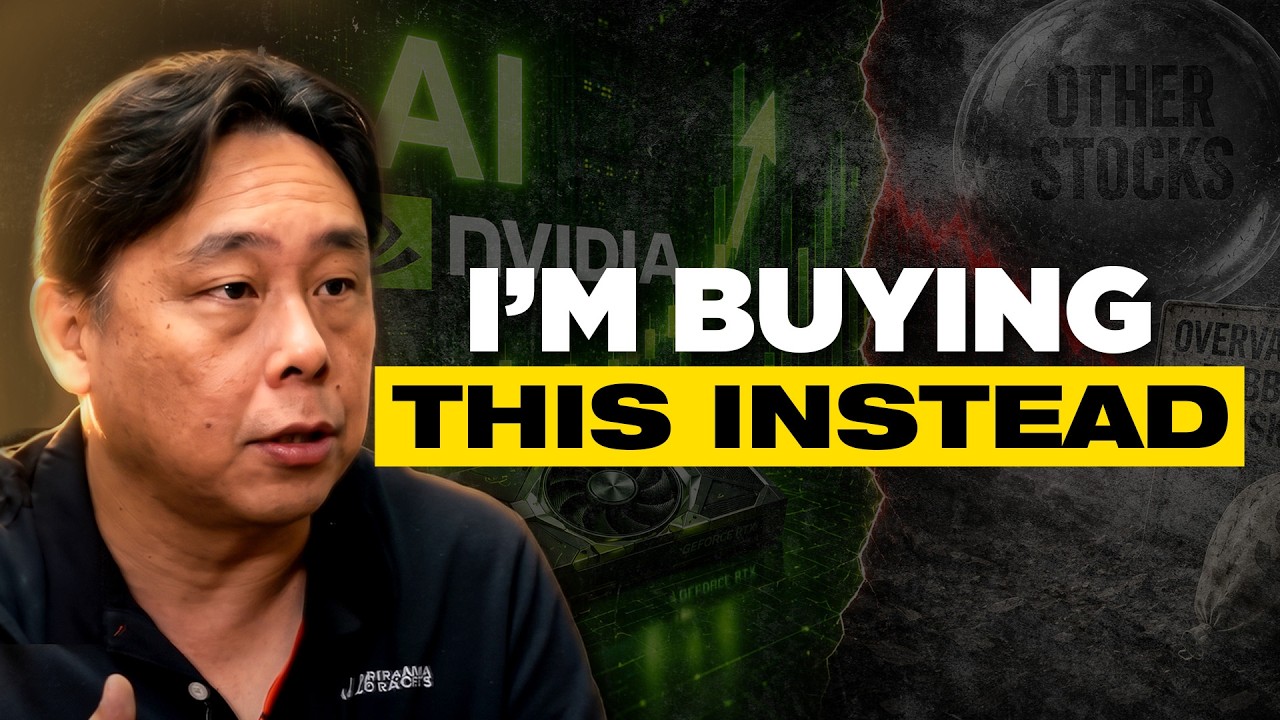
Highlight: I’m Not Selling Nvidia, But I’m Buying These Stocks Instead — Adam Khoo

Adam Khoo

The investor is rotating 60% of his capital into defensive, cash-generating 'anti-bubble' assets to protect against an inevitable 50% correction in overvalued tech infrastructure.

AI-assisted summary of Highlight: I’m Not Selling Nvidia, But I’m Buying These Stocks Instead — original source. Check the original for full context.

Source published:

Detailed notes

## Background Published on YouTube by investor and author Adam Khoo on July 9, 2026, this video serves as an invitation to his 'Anti-Bubble Mania' event. The accompanying page description highlights Khoo's framework for assessing AI stocks, evaluating company moats and intrinsic value, and managing an investment portfolio balanced between AI exposure and defensive, non-AI assets.

## TL;DR In this video, Adam Khoo explains how he manages his portfolio amidst the ongoing AI market boom by using a conservative 20-year discounted free cash flow model to sell stocks that exceed their intrinsic value by over 100%. To prepare for an inevitable market correction where overvalued pure AI infrastructure stocks could drop 50% or more, he maintains a strict allocation of 20% pure AI infrastructure, 20% AI-related diversified giants like Meta and Amazon, and 60% non-AI 'anti-bubble' stocks such as Arch Capital Group. Drawing parallels to the 2000 dot-com crash, Khoo details his daily accumulation of non-tech stocks, predicting a major capital rotation back into these unloved assets when the tech bubble bursts. However, he clarifies that he is not selling Nvidia, as he believes its stock remains reasonably priced relative to its massive forward growth potential.

## Atmosphere & style The video carries an educational yet blunt and grounded tone, with Khoo adopting the persona of a seasoned financial mentor who cuts through retail market hype. There is a sense of pragmatic confidence and foresight as he jokes about market history, juxtaposing the irrational mania of the retail crowd against the calculated, defensive positioning of institutional 'smart money.' Watching the video feels like receiving a realistic, historical reality check from an experienced strategist who remains calm and analytical while others panic or chase trends.

## Key takeaways - [00:00](https://www.youtube.com/watch?v=Bs25DN_1ZUs&t=0s) The current AI-driven boom market will inevitably end, making it vital for investors to evaluate whether their AI stocks possess a wide, narrow, or sustainable economic moat. - [00:00](https://www.youtube.com/watch?v=Bs25DN_1ZUs&t=0s) Investors holding stocks with no competitive moat that have experienced significant price run-ups are advised to aggressively sell out of those positions. - [00:00](https://www.youtube.com/watch?v=Bs25DN_1ZUs&t=0s) A conservative 20-year discounted free cash flow model is used to calculate a stock's intrinsic value, treating a business fundamentally as a money-making machine. - [00:00](https://www.youtube.com/watch?v=Bs25DN_1ZUs&t=0s) An aggressive selling trigger is established when a stock's market price exceeds its calculated intrinsic value by more than 100%. - [01:54](https://www.youtube.com/watch?v=Bs25DN_1ZUs&t=114s) Great investing relies on building a resilient, diversified portfolio that survives any economic climate rather than attempting to forecast the exact top of a market cycle. - [01:54](https://www.youtube.com/watch?v=Bs25DN_1ZUs&t=114s) A balanced portfolio framework includes 20% pure AI infrastructure exposure, 20% AI-related diversified giants like Meta and Amazon, and 60% non-AI protective assets. - [01:54](https://www.youtube.com/watch?v=Bs25DN_1ZUs&t=114s) Arch Capital Group (ACGL) is utilized as a prime example of a high-quality, cash-generating defensive asset with almost zero AI exposure. - [04:37](https://www.youtube.com/watch?v=Bs25DN_1ZUs&t=277s) Overvalued, pure AI infrastructure holdings are currently being trimmed to fund the daily accumulation of neglected, non-AI 'anti-bubble' stocks. - [04:37](https://www.youtube.com/watch?v=Bs25DN_1ZUs&t=277s) A severe correction of 50% or more is expected in overextended infrastructure stocks when the AI bubble eventually bursts, triggering a massive capital rotation into non-tech assets. - [04:37](https://www.youtube.com/watch?v=Bs25DN_1ZUs&t=277s) Historical precedent from the 2000 dot-com crash demonstrates that capital rapidly capitalizes unloved, cash-producing stalwarts like McDonald's, Boeing, and Walmart when tech mania subsides. - [07:10](https://www.youtube.com/watch?v=Bs25DN_1ZUs&t=430s) Smart institutional investors and elite money managers are already quietly positioning themselves ahead of retail crowds by mirroring this defensive rotation strategy. - [07:10](https://www.youtube.com/watch?v=Bs25DN_1ZUs&t=430s) AI remains a real, transformative force that expands profit margins, meaning the structural danger resides purely in the psychological mania of retail crowds pushing valuations too high. - [07:10](https://www.youtube.com/watch?v=Bs25DN_1ZUs&t=430s) Nvidia is maintained as a core holding and will not be sold, as its current price is viewed as reasonable relative to its massive forward growth potential.

## Detailed walkthrough ### [00:00](https://www.youtube.com/watch?v=Bs25DN_1ZUs&t=0s) Moats and Calculating Intrinsic Value

Adam Khoo starts by addressing a fundamental truth: the current AI-driven boom market will inevitably end, though nobody knows exactly when. To navigate this reality, he urges investors to evaluate their AI stock holdings by asking two vital questions. First, does the company have a sustainable competitive advantage or a "wide economic moat" that can last for the next 5, 10, 15, or 20 years? Companies with a narrow moat or no moat might experience skyrocketing profits and stock prices right now, but they remain highly vulnerable to sudden competitive disruption. For those holding no-moat stocks that have run up significantly, Khoo's advice is blunt: "You better start getting out. You better start selling out".

The second step requires calculating the stock's intrinsic value. Khoo reveals his preferred approach is a conservative discounted free cash flow model, projecting a company's free cash flow over a 20-year timeline and discounting it back to present value. He explains a business simply as a "money-making machine"—its worth is directly tied to the future cash it generates. Guided by this "secret sauce" metric, if a stock he owns climbs more than 100% above its calculated intrinsic value, he aggressively sells it off. Conversely, if a stock is fairly priced or underpriced, he holds on and continues adding to his position.

* Key questions for AI stock owners: evaluating competitive advantage (wide, narrow, or no moat) and calculating true intrinsic value. * Valuation methodology: 20-year discounted free cash flow model based on the time value of money. * Trigger for selling: When a stock's market price exceeds its calculated intrinsic value by more than 100%.

[01:54](https://www.youtube.com/watch?v=Bs25DN_1ZUs&t=114s) Designing a Resilient Portfolio Allocation

When asked about his specific portfolio positioning, Khoo dispels the myth of market forecasting. He asserts that great investing isn't about predicting where the market will move next week, month, or year, frankly calling anyone who claims they can do so "a liar or an idiot." Even legendary investors like Warren Buffett or Peter Lynch cannot predict the exact top of the AI growth cycle. Instead, the goal must be building a resilient, diversified portfolio that thrives under any economic climate—whether facing high or low interest rates, or a severe economic recession.

Khoo outlines his exact asset allocation to show how he balances AI exposure with safety net assets. Currently, about 20% of his portfolio rests in pure AI infrastructure companies, such as semiconductor manufacturing stocks. Another 20% is allocated to businesses that are heavily involved in AI but maintain highly diversified secondary operations. He points to Meta Platforms—which leverages AI but relies on its massive social media advertising engine—and Amazon, which participates in the massive AI capex buildup but is anchored by dominant logistics, e-commerce, and advertising businesses.

The remaining 60% of his portfolio consists of excellent businesses with almost zero AI exposure. As a prime example of this defensive allocation, Khoo points to Arch Capital Group (ACGL), a specialty insurance company that consistently generates massive profits purely from underwriting insurance rather than chasing technology trends. This structural balance ensures that even if the AI mania collapses tomorrow, the overall portfolio remains heavily protected.

* Portfolio breakdown: 20% pure AI infrastructure (semiconductors), 20% AI-related diversified giants (Meta Platforms, Amazon), and 60% non-AI exposures. * Amazon’s advertising business has notably expanded, even overtaking YouTube. * Non-AI portfolio example: Specialty insurance provider Arch Capital Group (ACGL).

[04:37](https://www.youtube.com/watch?v=Bs25DN_1ZUs&t=277s) The "Anti-Bubble" Strategy and Dot-Com Lessons

Discussing his recent trades, Khoo shares that he has been trimming his overvalued, unsustainable pure AI infrastructure holdings while buying non-AI stocks almost every single day. He coordinates these moves transparently inside his Ultimate Investors Playbook, emphasizing that he does not offer financial advice but merely showcases his real-time transactions so members can make their own decisions. The rationale driving his daily non-AI accumulation is simple: when the AI bubble eventually bursts, overextended infrastructure stocks will suffer deep corrections, easily dropping by 50%. When that crash happens, capital will rapidly rotate out of tech and flood into the discarded, ignored non-AI assets he is currently buying up.

To contextualize this strategy, Khoo shares a vivid history lesson from the dot-com bubble of 1998, 1999, and 2000. He jokes with the interviewer about whether they were even born yet before recalling how any stock with a ".com" suffix soared daily, making investors feel like overnight geniuses. However, unlike today's profitable AI businesses, those dot-com companies made absolutely no money. Meanwhile, fundamentally sound, cash-generating companies like McDonald's, Boeing, and Walmart were thoroughly hated, unloved, and discarded by the market. These were the true "anti-bubble stocks."

When the tech bubble famously burst in 2000, half of those profitless dot-com companies went completely bankrupt, and their stocks crashed 80% to 90%. In a massive flight to safety, capital surged right back into high-yielding, non-tech staples like Coca-Cola, Walmart, and Boeing, driving them up by double digits. Khoo is absolutely certain that "the same thing is going to happen now," and he is aggressively preparing his portfolio for that exact day.

* Expected correction magnitude: Overvalued pure AI infrastructure stocks could easily drop 50% or more when the boom ends. * Historical dot-com comparison: The 1999 tech mania left cash-producing giants like McDonald's, Boeing, and Walmart deeply discounted as "anti-bubble stocks." * The 2000 crash aftermath: Capital flight sent non-tech stocks up by double digits while profitless dot-coms lost 80% to 90% of their value or went bankrupt.

[07:10](https://www.youtube.com/watch?v=Bs25DN_1ZUs&t=430s) Smart Money and Why Nvidia Stays in the Portfolio

When the interviewer asks if professional hedge funds and institutional investors are quietly positioning themselves ahead of retail traders, Khoo nods knowingly, clarifying that "the smart ones" absolutely are. While the industry has its share of lousy managers, the elite professionals are already mirroring this defensive rotation strategy. Khoo re-emphasizes that AI is a fundamentally real transformative force—not just temporary hype—noting that he uses AI tools personally every single day to noticeably expand corporate profit margins.

The danger stems purely from the psychological mania of retail crowds chasing asset prices far beyond their logical valuations. However, Khoo notes that not all AI companies are overly expensive. He directly highlights Nvidia as a core holding that he refuses to sell. Despite the massive market run-up, Khoo firmly states, "I don't think Nvidia is expensive at all." Because it remains reasonably priced relative to its massive forward growth potential, he continues to confidently hold his Nvidia shares rather than cash out.

## Notable quotes > [00:00](https://www.youtube.com/watch?v=Bs25DN_1ZUs&t=0s) You better start getting out. You better start selling out — Adam Khoo

> [00:00](https://www.youtube.com/watch?v=Bs25DN_1ZUs&t=0s) money-making machine — Adam Khoo

> [00:00](https://www.youtube.com/watch?v=Bs25DN_1ZUs&t=0s) secret sauce — Adam Khoo

> [01:54](https://www.youtube.com/watch?v=Bs25DN_1ZUs&t=114s) a liar or an idiot. — Adam Khoo

> [04:37](https://www.youtube.com/watch?v=Bs25DN_1ZUs&t=277s) anti-bubble stocks. — Adam Khoo

> [04:37](https://www.youtube.com/watch?v=Bs25DN_1ZUs&t=277s) the same thing is going to happen now, — Adam Khoo

> [07:10](https://www.youtube.com/watch?v=Bs25DN_1ZUs&t=430s) the smart ones — Adam Khoo

> [07:10](https://www.youtube.com/watch?v=Bs25DN_1ZUs&t=430s) I don't think Nvidia is expensive at all. — Adam Khoo

## Mentioned Nvidia, Adam Khoo, Meta Platforms, Amazon, YouTube, Arch Capital Group, ACGL, Ultimate Investors Playbook, McDonald's, Boeing, Walmart, Coca-Cola, Warren Buffett, Peter Lynch

[Source](https://www.youtube.com/watch?v=Bs25DN_1ZUs)

中文简报

Adam Khoo买入保险与零售股防范AI崩盘 这位投资者正将60%的资金轮动至具有防御性、能产生现金流的“反泡沫”资产,以抵御估值过高的科技基础设施股票必然面临的50%回调风险。 在本视频中,Adam Khoo阐述了自己在当前的AI市场繁荣中如何管理投资组合:他运用保守的20年自由现金流折现模型,果断卖出股价超出内在价值100%以上的股票。为了应对估值过高的纯AI基础设施股票可能下跌50%或以上的必然回调,他严格执行配置比例:20%的纯AI基础设施股、20%的Meta和Amazon等与AI相关的多元化巨头,以及60%的Arch Capital Group等非AI“反泡沫”股票。Khoo将其与2000年互联网泡沫破裂进行了类比,详细说明了他每日持续建仓非科技股的操作,并预测当科技泡沫破裂时,大量资金将轮动回流至这些不受青睐的资产。不过他明确表示自己并未抛售Nvidia,因为他认为相对于其巨大的远期增长潜力,该股估值仍处于合理区间。 Adam Khoo 警告称当前的 AI 热潮终将结束,建议投资者通过 20 年自由现金流折现模型评估公司内在价值,并果断清仓股价高出内在价值 100% 以上且缺乏护城河的标的。 (0:00) 他主张通过多元化配置抵御市场周期,其组合构成为 20% 纯 AI 基础设施、20% 业务多元化的 AI 巨头(如 Meta 和 Amazon),以及 60% 几乎没有 AI 敞口的防御型现金流资产(如 Arch Capital Group)。 (1:54) 借鉴 2000 年互联网泡沫破裂的教训,Khoo 正在减持可能面临 50% 回调的高估值纯 AI 股,并每日持续买入被市场冷落的非 AI“反泡沫”资产,以等待资金重回价值股。 (4:37) 尽管机构资金正在展开防守型轮动,Khoo 强调 AI 具有真实的生产力推动价值,并明确表示不会卖出核心持仓 Nvidia,认为其相对于未来增长潜力估值依然合理。 (7:10)

Reading summary

Adam Khoo argues that while artificial intelligence is a genuine productivity driver, investors must prepare for an inevitable market correction by trimming overvalued tech and accumulating unloved non-AI assets. Rather than attempting to predict market tops, he recommends anchoring portfolios in cash-generative businesses with wide economic moats. Valuation Disciplines and Retaining Nvidia (0:00) Khoo asserts that navigating the AI market requires evaluating whether a business holds a durable economic moat and calculating its intrinsic value through a conservative 20-year discounted free cash flow model. Under his strategy, holdings with narrow or nonexistent moats should be sold down, and any stock exceeding its estimated intrinsic value by more than 100% triggers an aggressive sell-off. Despite this strict selling discipline, Khoo distinguishes between speculative hype and sustainable market leaders. He explicitly refuses to sell his position in Nvidia, maintaining that the company remains reasonably valued relative to its forward growth prospects rather than dangerously overpriced. A 60-20-20 Portfolio Allocation Framework (1:54) Contending that exact market timing is impossible even for legendary investors, Khoo constructs an asset allocation designed to endure recessions and shifting interest rates. His portfolio commits 20% to pure AI infrastructure holdings, primarily semiconductor manufacturers, and another 20% to diversified giants leveraging AI, such as Meta Platforms and Amazon, which draw stability from massive advertising and e-commerce cash flows. The dominant 60% of his portfolio is placed entirely outside the tech sector in fundamentally solid, non-AI businesses. As an illustration of this protective cushion, Khoo highlights specialty insurer Arch Capital Group (ACGL), which produces consistent earnings from core insurance underwriting irrespective of technology sector trends. Capital Rotation and Dot-Com Crash Parallels (4:37) Anticipating that overextended pure AI infrastructure assets could experience steep 50% drawdowns when current market exuberance cools, Khoo actively buys non-AI equities on a daily basis. He draws an explicit parallel to the 1998–2000 dot-com bubble, noting that while profitless internet stocks eventually collapsed by 80% to 90%, capital rapidly rotated into neglected, cash-generative stalwarts like McDonald's, Boeing, Walmart, and Coca-Cola, sending their shares upward by double digits. Khoo contends that elite institutional managers are already positioning ahead of retail investors by orchestrating a similar rotation. By accumulating these out-of-favor assets before widespread sentiment shifts, he seeks to insulate his capital while preserving upside from established compounders. Khoo affirms that AI will continue delivering real economic value, but warns that retail speculation creates severe downside risk for narrow-moat companies. His strategy balances durable exposure to essential AI leaders with an aggressive defensive tilt toward cash-flow-rich, non-tech equities.

精炼阅读摘要

Adam Khoo 认为,当前由人工智能驱动的繁荣市场终将走向周期终结,投资者无法精准预测市场顶部,而应构建具备抗风险能力的资产配置架构。其核心策略主张规避或卖出缺乏护城河及严重高估的纯 AI 概念股,将组合重心转向不受科技泡沫波及的非 AI 现金流资产,同时基于合理估值与远期增长潜力坚定持有 Nvidia(英伟达)。 护城河评估与折现现金流估值准则 (0:00) Khoo 强调,应对 AI 繁荣终结风险的基石在于对持仓企业进行两项审视:其一,企业是否具备能维持 5 至 20 年的“宽经济护城河”。对于缺乏护城河或护城河狭窄的企业,即便短期利润和股价飙升,在剧烈竞争中也极易受到颠覆,投资者应对大幅上涨的无护城河股票果断清仓。 其二,必须计算股票的真实内在价值。Khoo 采用基于货币时间价值的 20 年保守型自由现金流折现(DCF)模型,将企业视为未来现金生成机器。他设定了清晰的纪律触发机制:若某只持仓标的的市场价格超出计算内在价值的 100% 以上,便会进行激进减持;而对估值合理或偏低的高质量资产,则维持持有甚至持续买入。 抵御周期波动的“20-20-60”配置架构 (1:54) 针对投资组合的构建,Khoo 驳斥了择时预测的有效性,认为包括沃伦·巴菲特或彼得·林奇在内的顶级投资者都无法预测 AI 周期的精确顶点,投资目标必须是打造无论面对高低利率还是经济衰退皆具韧性的组合。 在资产配置上,Khoo 将其组合划分为三部分:20% 投资于纯 AI 基础设施(如半导体制造板块);20% 配置于业务高度多元化的 AI 巨头,例如依托社交广告基本盘的 Meta Platforms,以及拥有庞大物流、电商和广告业务(其广告规模已超越 YouTube)的 Amazon;其余 60% 则坚决配置在几乎不涉足 AI 的优质现金流企业中,例如依靠稳健承保利润盈利的特种保险公司 Arch Capital Group(ACGL),以确保科技狂热退潮时整体组合受到严密保护。 借鉴互联网泡沫历史的“反泡沫”轮动 (4:37) Khoo 披露,他正在持续减持估值过高的纯 AI 基础设施股票,并几乎每日买入非 AI 股票。他强调其在 Ultimate Investors Playbook 中展示交易仅作透明记录,不构成投资建议。其操作逻辑在于,一旦 AI 繁荣终结,估值透支的基础设施股极易面临 50% 或更高的深度回调,促使资金迅速回流至当前被市场漠视的非科技领域。 这一策略直接借鉴自 1998 至 2000 年的互联网泡沫时期。Khoo 指出,当年无盈利的“.com”投机股暴涨,而麦当劳(McDonald's)、波音(Boeing)和沃尔玛(Walmart)等盈利丰沛的实体企业则遭严重抛弃,形成典型的“反泡沫资产”。当 2000 年泡沫破裂导致投机科技股下跌 80% 至 90% 甚至破产时,出逃资金推动传统蓝筹股录得两位数涨幅。Khoo 坚信该资本轮动历史必然在当今重演。 机构调仓动向与维持英伟达核心持仓 (7:10) 对于市场机构行为,Khoo 认为精英对冲基金与专业投资机构已经在提前采取类似的防御性轮动。他区分了技术基本面与散户狂热情绪,指出 AI 是能够显著提升企业利润率的真实变革力量,当下的主要风险源于散户追高所致的估值脱节。 在具体的标的甄别上,Khoo 强调并非所有 AI 资产都处于过度昂贵状态。他公开明确拒绝减持其核心持仓 Nvidia(英伟达),直言相对于其巨大的远期增长潜力,英伟达当前的估值水准“一点也不昂贵”,因此选择在获利了结投机标的同时继续稳固持有该核心标的。 Adam Khoo 的主张兼顾了对 AI 长期生产力变革的认可与对市场估值过热的防范。然而,该框架高度依赖于其 20 年自由现金流折现模型对企业远期现金流预测的精确度,且非 AI 资产能否如其预期的互联网泡沫历史那样承接科技股抛压资金,仍取决于未来的宏观流动性与经济周期演变。

Source quotes

[0:00] Adam Khoo: You better start getting out. You better start selling out [0:00] Adam Khoo: money-making machine [0:00] Adam Khoo: secret sauce [1:54] Adam Khoo: a liar or an idiot. [4:37] Adam Khoo: anti-bubble stocks. [4:37] Adam Khoo: the same thing is going to happen now, [7:10] Adam Khoo: the smart ones [7:10] Adam Khoo: I don't think Nvidia is expensive at all.

Original transcript

[0:00] I know that this AI driven boom market [0:03] will end when I don't know. So the first [0:06] question you can ask yourself is is that [0:08] AI stock you own does it have again a [0:11] sustainable competitive advantage? Does [0:13] it have a wide economic mode that can [0:16] continue to sustain for the next 5 10 15 [0:18] 20 years? Does it have a narrow mode or [0:20] does it have no mode? So again no mode [0:22] means that yes it can make a lot of [0:24] money now. Profits can go up a lot now [0:26] but because it's got no mode it may not [0:28] be sustainable. they can easily be [0:30] disrupted by competition the next year. [0:32] So if you have a company that has got no [0:34] mode and you went up a lot, good for [0:36] you. You better start getting out. You [0:38] better start selling out, right? Because [0:40] it may not be that sustainable. Then the [0:42] second question is you have to calculate [0:44] the intrinsic value. And there are many [0:46] ways to value a company of course. So [0:48] one of the main ways I like to value a [0:50] business is the discounted free cash [0:53] flow model. So what does that mean? That [0:55] means you need to project how much free [0:58] cash flow the company would earn in the [1:00] next 20 years and then discount it to [1:03] present value. Right? A business is a [1:06] money-making machine. The more money it [1:08] makes, the more it is worth. Very [1:10] simple. So what is the business worth? [1:12] Is worth how much money it can generate [1:14] in the future. [1:16] >> So for me, I'm quite conservative. I [1:17] always take a 20 year timeline. How much [1:20] can it generate in 20 years? discounted [1:22] to present value because of the time [1:24] value of money that gives me a rough [1:26] idea what the business is worth. So, if [1:28] the stock I own right now is selling, [1:31] let's say, more than 100% above that [1:33] value, I'll start to sell out, which [1:36] I've been doing actually for some of my [1:37] stocks. I've been starting to sell out [1:38] some of them, right? Because they are [1:40] way overpriced. But some of my stocks [1:42] that are not way overpriced, they are [1:44] fairly priced or underpriced, I'm [1:46] holding and I keep adding to that. [1:48] That's why intrinsic value is so [1:50] important. It's one of the most [1:51] important ingredients in the secret [1:54] sauce. [1:54] >> Okay. So Adam, you mentioned in the [1:56] community that you're not selling all [1:58] your AI stocks, but you're also not [2:00] going allin. So what does your portfolio [2:03] look like right now? [2:04] >> Okay. So see, I believe, and this has [2:08] helped me for many, many years, right? [2:09] That to be a great investor, it's not [2:12] about predicting where the market will [2:13] go next week, next month or next year [2:16] because no one can predict for sure. [2:18] Whoever tells you that they know exactly [2:19] where the market is going is a liar or [2:22] an idiot. Okay? Because no one can do [2:24] it. Not Warren Buffett, not Peter, no [2:26] one can do it, right? No one can [2:27] predict. So the key to successful [2:29] investing again is not to predict when [2:31] the AI growth will end because no one [2:34] knows, right? But it's to build a [2:36] resilient portfolio that will do well [2:38] under all situations. So even if the AI [2:42] mania ends tomorrow, my portfolio will [2:45] still do well. So whether high interest [2:46] rates, low interest rates, whether [2:49] economic recession or no recession, your [2:52] portfolio should still do well because [2:53] it is well diversified across different [2:56] types of sectors and industries and [2:58] investment themes. Now if you look at my [3:01] portfolio right now, about 20% are in [3:03] what I call the pure AI infrastructure [3:08] companies. So these are companies that [3:09] purely focus on building the AI [3:11] infrastructure. For example, [3:13] semiconductor stocks. So that's about [3:15] 20% of my portfolio. Okay. Now another [3:18] 20% of my portfolio are stocks that are [3:21] related to AI but it's not purely AI. [3:23] They do other stuff as well. [3:24] >> So a good example is Meta Platforms, [3:26] right? Meta owns Facebook, Instagram and [3:28] all that. Right? So we know that Meta is [3:30] involved in building AI but that's not [3:32] their only business. Their other [3:35] business is social media where they make [3:36] a lot through advertising. So even if [3:39] the AI thing slows down, they will still [3:42] make a lot from their ads, from all [3:44] their stuff, right? Another example [3:46] again is Amazon. So Amazon is involved [3:49] in the AI capex buildup. Is that their [3:51] only business? No. Amazon is in um they [3:54] the ad business as well, right? In fact, [3:56] Amazon's advertising business has [3:59] overtaken YouTube. Amazon is in [4:01] logistics. Amazon is in e-commerce, [4:03] right? They a lot of other stuff. So [4:04] these are what I call related to AI but [4:07] it's not just AI other stuff right so [4:09] that is another 20% of my portfolio so [4:12] 40% of my portfolio has soal AI exposure [4:16] the other 60% of my portfolio has almost [4:19] no AI exposure at all but they are great [4:23] businesses I give an example one example [4:26] is an insurance company called Arch [4:28] Capital ACGL right so nothing to do with [4:30] AI but they make a lot of money by [4:32] selling insurance speciality insurance. [4:35] So that's how my portfolio is positioned [4:37] right now. Recently, those stocks that I [4:40] have that are pure AI capex buildout, [4:44] I've been selling some of them. Not a [4:46] lot. I've been selling the ones that are [4:48] not that sustainable, that are way [4:50] overpriced. I've been selling them. In [4:52] fact, I've been buying stocks almost [4:53] every day. For those of you in the [4:55] Ultimate Investors Playbook, you get my [4:57] notifications what I'm buying and [4:58] selling every day. I don't give [5:00] financial advice. I just show people [5:01] what I'm buying and selling. But you [5:02] have to make your own decisions. What [5:04] I'm buying almost every day are stocks [5:06] that have got nothing to do with AI. And [5:08] the reason is very simple because I know [5:10] that this AI driven boom market will [5:13] end. When? I don't know. Could be today, [5:16] could be next year, could be 3 years [5:18] from now. I don't know. But it will end. [5:19] And once the AI boom market ends, what's [5:22] going to happen? The pure AI [5:24] infrastructure stocks, especially the [5:26] ones that are overvalued, would have the [5:28] deepest corrections. It will easily drop [5:30] 50% easily. But when it drops, where [5:33] does the money go? The money will all [5:35] flow into all the nonAI stocks that have [5:38] been discarded, ignored, and left [5:40] behind. And these are the ones I'm [5:42] accumulating. And this playbook is not [5:44] new. It has happened many times. The.com [5:48] bubble, [5:49] >> right? So I don't know if you were born [5:51] yet. So for those of you who remember [5:52] during the com bubble, this was 1998, [5:55] 1999, 2000, right? So at the time all [5:58] the stocks that had a.com went up every [6:01] day right and if you bought it you felt [6:03] like a genius right but the main [6:06] difference was all these com companies [6:07] none of them made money at least now the [6:09] AI companies many of them do make money [6:11] but that time the do none of them made [6:13] money right so they were going up every [6:15] single day and all the money were [6:17] chasing these stocks and all the [6:20] companies back then in 1999 that were [6:23] not dot they were dropping every day [6:25] almost every day were just dropping [6:27] dropping They were unloved, [6:28] >> unloved, hated, disregarded. These were [6:30] called the anti-bubble stocks or the [6:32] anti-bubble stocks. But these were the [6:34] companies making money. They were making [6:36] a lot of money. These were like the [6:37] McDonald's. These were like the Boeing. [6:40] These were like the Walmart. No one [6:42] wanted them. They were being thrown away [6:45] because no, right? And then in 2000 when [6:48] the dotcom bubble burst, then all the [6:50] dot stocks dropped 80 90%. Again, none [6:54] of them made really money. So yeah, half [6:56] of the companies all went bankrupt and [6:58] all the money flowed to your Coca-Cola, [7:01] your Walmart, your Boeing, the nonAI [7:03] stocks, those then went up double [7:04] digits. The same thing is going to [7:06] happen now. [7:06] >> Yeah. [7:07] >> Exactly when, I don't know. I'm [7:09] preparing for the day. [7:10] >> So would you say that uh a lot of the [7:12] professional investors and hedge funds, [7:15] they are also positioning themselves [7:17] ahead of the retail, [7:20] >> the smart ones? Of course. Obviously the [7:21] smart ones, right? Of course, you got [7:24] great hedge fund managers and you got [7:25] lousy ones. Yeah. The smart ones are [7:28] doing it really. Yeah. [7:29] >> Would you say your goal is to profit [7:31] from the AI mania but not entirely rely [7:34] on it [7:35] >> as always? So AI is a real thing. AI is [7:38] not hype. It's a real thing, right? I [7:41] use AI every single day and it's really [7:44] increasing the profit margins of [7:46] companies. So it's real. I'm not saying [7:47] it's not real, but it comes to a point [7:49] of time when everyone is buying that [7:52] that chases up the price beyond the [7:54] valuation. Again, not all AI companies, [7:57] but some of them. There are a lot of AI [7:59] companies that I don't think are [8:01] expensive that are still reasonably [8:03] priced and have a lot of growth ahead. [8:06] Nvidia is one of them. I don't think [8:07] Nvidia is expensive at all. All right. [8:09] So, I continue to hold Nvidia. I'm not [8:10] selling it.