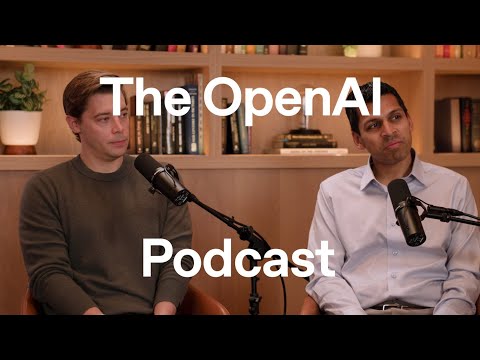
OpenAI Executives Predict AGI Influx Will Drive Headcount Growth
OpenAI
Slashing the cost of intelligence by a factor of 100 will trigger a thousand-fold demand shock across law, medicine, and education, forcing OpenAI to scale up its own workforce post-AGI to support a massive wave of economic dynamism.
## Background
Published on July 15, 2025, on YouTube by the official OpenAI channel, this episode features OpenAI COO Brad Lightcap and Chief Economist Ronnie Chatterji joining host Andrew Mayne on the OpenAI Podcast Ep. 3. According to the show notes, the discussion explores the rapidly arriving future of work and the deep economic and societal impacts of AI on software, science, education, small businesses, and global jobs.
## TL;DR
The conversation explores how AI is transitioning from a novel interface to a transformative economic engine that serves as a powerful complement to human potential. The guests outline how AI agents and automated workflows are dramatically increasing productivity in software engineering, professional services, and scientific discovery while lowering barriers for small businesses and emerging markets. Rather than causing widespread net job displacement, they argue that the compounding deflationary cost of intelligence will trigger a massive, non-linear surge in global demand and economic participation. Ultimately, they emphasize that as technical skills become democratized, foundational human qualities like emotional intelligence, critical thinking, adaptability, and high-level judgment will become the premium differentiators in the future workforce.
## Atmosphere & style
The atmosphere of the podcast is intellectually stimulating, collaborative, and deeply forward-looking, blending high-level economic theory with real-world operational insights. The dynamic between host Andrew Mayne and his guests is conversational and balanced, punctuated by lighthearted moments, laugher, and personal anecdotes that ground complex topics like AGI and macroeconomic scaling. Listeners experience a narrative arc that moves from addressing initial labor anxieties to fostering a sense of optimistic agency, leaving a final impression that feels less like a rigid tech lecture and more like an inspiring, evidence-based strategy session among insightful peers.
## Key takeaways
- [00:00](https://www.youtube.com/watch?v=XHqC70la8Xc&t=0s) OpenAI COO Brad Lightcap views deployment as ensuring AI is used safely and beneficially across countries and industries, while Chief Economist Ronnie Chatterji focuses on analyzing AI's impact on business, jobs, policy, and economic transformation.
- [01:33](https://www.youtube.com/watch?v=XHqC70la8Xc&t=93s) ChatGPT was launched on top of GPT-3.5 after OpenAI noticed playground users trying to 'hack' the API to force conversational dialogue, proving that an intuitive interface was the critical unlock rather than a more advanced model like GPT-4.
- [06:13](https://www.youtube.com/watch?v=XHqC70la8Xc&t=373s) AI coding tools like Cursor and Windsurf are massively expanding engineering leverage, helping both non-technical people build software and level 10 engineers double or tenfold their productivity to fill a global talent shortage.
- [11:43](https://www.youtube.com/watch?v=XHqC70la8Xc&t=703s) Platform shifts occur when individuals are no longer gated by having to wait for others to build workflows, allowing them to use AI to achieve tasks they previously had no baseline ability to complete.
- [12:43](https://www.youtube.com/watch?v=XHqC70la8Xc&t=763s) In scientific research and drug discovery, AI acts as an accelerator that allows scientists to peek behind all workflow doors simultaneously and optimize clinical trials, making human leadership and judgment premium assets.
- [17:04](https://www.youtube.com/watch?v=XHqC70la8Xc&t=1024s) An AI agent is defined as an autonomous teammate capable of reliably executing complex, novel work through reasoning rather than pattern copying, utilizing tailored interfaces like IDEs or email inboxes.
- [20:11](https://www.youtube.com/watch?v=XHqC70la8Xc&t=1211s) AI agents help solve the economic 'missing middle' by democratizing access to business coaching for small enterprises and delivering scalability to sectors like agricultural extension services in emerging markets.
- [24:11](https://www.youtube.com/watch?v=XHqC70la8Xc&t=1451s) The rapid deployment of AI enables a technological leapfrog effect, allowing individuals to bypass traditional infrastructure and facilitating the rise of small, highly efficient 1- to 10-person billion-dollar micro-companies.
- [28:09](https://www.youtube.com/watch?v=XHqC70la8Xc&t=1689s) As technical capabilities become democratized by AI, soft skills, emotional intelligence (EQ), empathy, and communication will become the premium differentiators and crucial human complements to technology.
- [36:04](https://www.youtube.com/watch?v=XHqC70la8Xc&t=2164s) While initial institutional responses to ChatGPT in late 2022 and early 2023 involved panic and bans, schools experienced a massive shift toward adoption by summer 2023 as educators used AI to streamline curriculum design.
- [36:04](https://www.youtube.com/watch?v=XHqC70la8Xc&t=2164s) OpenAI's partnership with California State University (CSU) aims to maximize student outcomes and track career trajectories, utilizing AI as a non-judgmental, personalized tutor that removes learning anxieties.
- [41:00](https://www.youtube.com/watch?v=XHqC70la8Xc&t=2460s) Economic research at OpenAI focuses on three core areas to mitigate regional economic distress and guide policy: sectoral impact, geographical concentration, and the clear translation of academic findings for the public.
- [47:16](https://www.youtube.com/watch?v=XHqC70la8Xc&t=2836s) Historically, technological shifts like the decline of US agricultural employment from 40% in 1900 to 2% today demonstrate that automation drives higher economic output and individual empowerment rather than net job displacement.
- [50:28](https://www.youtube.com/watch?v=XHqC70la8Xc&t=3028s) AI can unlock latent economic participation for sidelined individuals by providing affordable, scalable coaching, healthcare self-management support, and mentoring to neurodiverse populations.
- [53:39](https://www.youtube.com/watch?v=XHqC70la8Xc&t=3219s) The translation paradox demonstrates that automated translation tools actually expand the addressable global market, increasing the overall demand for human localization and relationship management skills.
- [55:35](https://www.youtube.com/watch?v=XHqC70la8Xc&t=3335s) OpenAI internal data shows that cutting model prices leads to a non-linear, disproportionate spike in consumption, suggesting there is no current upper bound for the demand for intelligence.
- [55:35](https://www.youtube.com/watch?v=XHqC70la8Xc&t=3335s) When the cost of intelligence drops by 100x, it triggers a 1,000x demand shock that creates entirely new market tiers, ultimately onboarding users who will scale up to require sophisticated human professional services.
- [58:38](https://www.youtube.com/watch?v=XHqC70la8Xc&t=3518s) OpenAI is predicted to increase its headcount after achieving AGI because the massive deflationary demand spiral and widespread organizational leverage will require scaling up to support an explosion of new use cases.
- [01:02:00](https://www.youtube.com/watch?v=XHqC70la8Xc&t=3720s) Advanced reasoning models like OpenAI's o3 represent a fundamental shift from information retrieval to active thinking, allowing users to leverage AI as a devil's advocate to challenge strategic business hypotheses.
## Detailed walkthrough
### [00:00](https://www.youtube.com/watch?v=XHqC70la8Xc&t=0s) The Roles of Deployment and Economic Forecasting at OpenAI
Andrew Mayne introduces his guests, Brad Lightcap (Chief Operating Officer of OpenAI) and Ronnie Chatterjee (Chief Economist), to discuss the future of AI in relation to labor and work. Lightcap describes OpenAI as a "research and deployment company," explaining that his role focuses on deployment—taking AI out into the world to ensure it is used beneficially and safely across different countries and industries. He spends his time studying what users want and how patterns of use change alongside the technology.
Chatterjee explains that he joined OpenAI at a time when intelligence was being deployed at scale. His job is to help people understand the impacts of AI on businesses, jobs, relationships, and government policy, as well as to develop forecasts and indicators to help people make investments with their time and resources. He views this as a period of "real transformation" in the global economy.
- OpenAI was founded primarily as a research organization and was initially unsure about releasing public-facing products.
- Chatterjee's role is highly external, involving travel to international hubs like London, Brussels, Delhi, Washington, Sacramento, and Sydney to study regional use cases and market "vibes."
[01:33](https://www.youtube.com/watch?v=XHqC70la8Xc&t=93s) The Accidental Genesis of ChatGPT
Lightcap recounts how the launch of ChatGPT in November 2022 was a pivotal moment that marked the first time AI was used at scale. He shares the backstory of how the product came to be: OpenAI had previously built an API for developers that included a "playground" feature. In the playground, users would input prompts to see how the completion-based models would predict the next token in a sequence.
The team noticed that users were actively trying to "hack the playground" to force the model into a conversational dialogue. Recognizing this latent demand, OpenAI built ChatGPT as a conversational interface, teaching the model to follow instructions and be more responsive. Mayne notes that while the team originally thought they needed a smarter model like GPT-4 to make a real impact, the simple interface change of ChatGPT (built on GPT-3.5) was the actual "unlock" that transformed a blank canvas into an intuitive tool.
- ChatGPT was built on top of GPT-3.5, defying internal expectations that a much more advanced model was required for widespread utility.
- The conversational interface solved the "blank canvas" problem where users previously did not know what to prompt.
[06:13](https://www.youtube.com/watch?v=XHqC70la8Xc&t=373s) Addressing Labor Anxiety and the Software Engineering Revolution
Addressing the widespread anxiety surrounding AI and job displacement, Lightcap explains that OpenAI approaches the issue through a product-led lens, focusing on building tools that people actually want to use to accelerate economic outcomes. He highlights software engineering as an area experiencing "insane" progress, pointing to the rise of tools like Cursor and Windsurf. Rather than making engineers 10% more productive, these tools have the potential to make them 10 times more productive.
Chatterjee picks up this thread, noting that if the world writes a few billion lines of code a day, multiplying that output by 10x represents a massive economic opportunity. Mayne counters with the common concern that companies might lay off developers because they need fewer of them. However, Mayne argues that "we're never going to be done writing software" and that the real shift will be smaller, more agile teams achieving much more. Lightcap agrees, stating that the world is fundamentally "rate limited by talent" and that economic growth rounds to zero in most places because companies struggle to find people who can build better systems.
- AI tools are simultaneously enabling non-technical people to build software without writing code, while helping "level 10" engineers double their productivity.
- The Mecca of software engineering, Silicon Valley, still faces a shortage of engineering talent, highlighting the massive global demand gap that AI can help fill.
[11:43](https://www.youtube.com/watch?v=XHqC70la8Xc&t=703s) Internal Innovation and the Next Frontiers of AI
Mayne brings up the case of Moderna, which deployed ChatGPT Enterprise and saw employees independently building their own custom GPTs to automate complex workflows. Lightcap notes that this is the core essence of AI: it is "a tool that lets people do things that they had no business or ability to do otherwise." He explains that platform shifts occur when individuals are no longer gated by having to wait for someone else to build a tool or workflow for them.
When asked which sectors will be impacted next, Chatterjee points to scientific research, specifically drug discovery and material sciences. He uses the analogy of an endless corridor with doors on either side; historically, researchers had to make slow, rate-limited decisions about which doors to open. AI acts as a tool that allows scientists to peek behind all the doors simultaneously, helping them decide where to focus their energy. He expects this to accelerate discoveries across private labs, national laboratories, and the public sector, followed closely by transformations in professional services.
> "AI is a tool that lets people do things that they had no ability to do otherwise." — Brad Lightcap
[14:06](https://www.youtube.com/watch?v=XHqC70la8Xc&t=846s) Augmenting Professional Services and Science
Ronnie Chatterjee and Brad Lightcap discuss how AI is poised to revolutionize professional services, particularly in high-intensity fields like private equity, investment banking, and consulting. Chatterjee notes that professionals in these industries can use AI tools to handle time-consuming tasks like creating slide decks and preparing presentations, allowing them to focus on "higher value and higher margin things." Lightcap adds that in scientific fields like drug development, the impact of AI is not just about deepening individual steps, but about bridging the complex handoffs across the entire workflow.
- **Workflow Acceleration:** Drug development involves highly complex discrete steps requiring handoffs between different teams; weaving AI models across this entire workflow accelerates the end product.
- **Key Sectors:** Finance, professional services, and science-driven discovery are identified as the primary areas undergoing immediate revolution.
[15:40](https://www.youtube.com/watch?v=XHqC70la8Xc&t=940s) Overcoming Bottlenecks and the Premium on Human Judgment
Andrew Mayne points out a major bottleneck in drug discovery: while models are excellent at suggesting new compounds, the process still ultimately relies on physical lab benches and clinical trials. Chatterjee agrees but argues that this reality makes human judgment and leadership even more critical. Citing research by his Harvard colleague David Deming, Chatterjee explains that the skills required to lead human teams are the exact same skills needed to lead AI agents. Furthermore, AI can modernize old-world institutional processes, such as optimizing sample sizes and enrollment for clinical trials, thereby accelerating the entire commercialization value chain.
- **David Deming's Research:** Shows a direct correlation between being great at leading human teams and being great at leading AI agents.
- **Clinical Trial Optimization:** AI can assist with modernizing trial enrollment and sample size determination to speed up drug commercialization.
[17:04](https://www.youtube.com/watch?v=XHqC70la8Xc&t=1024s) Defining AI "Agents" and Their Use Cases
When asked to define the highly popular buzzword "agent," Lightcap sets a very high bar. For him, an agent is a system that can be reliably handed complex, novel work to execute autonomously and proficiently, leveraging its reasoning abilities rather than just copying past patterns. He views an agent as a teammate—whether a scientist, software engineer, or data scientist—working in tandem with humans.
- **Software Engineering Example:** An agent that can write code, perform quality assurance (QA), run unit testing, and automate the code-writing process.
- **Sales Funnel Example:** An agent that can ingest, process, qualify, and recommend follow-up steps for 100,000 inbound leads when a company only has five human staff members to handle the volume.
- **Extensible Interfaces:** Depending on the user, agents will need to live in different surfaces, such as an IDE for software engineers, experiment design software for scientists, or email inboxes for customer support.
[20:11](https://www.youtube.com/watch?v=XHqC70la8Xc&t=1211s) Democratizing Advice for Small Businesses and Emerging Markets
Chatterjee highlights the massive potential of AI agents to solve the "missing middle" problem in economics, where small businesses in many countries struggle to scale due to a lack of mentorship and strategic advice. By democratizing access to evidence-based business coaching, an AI agent can help a local restaurant or e-commerce business make strategic decisions. This potential is even more pronounced in emerging markets, such as in African agricultural extension services, where there is a severe shortage of human experts to advise farmers on seeds, fertilizers, and techniques.
- **The "Missing Middle":** An economic phenomenon where small businesses fail to grow into medium or large enterprises due to a lack of support and expertise.
- **Agricultural Extension Support:** Providing AI-driven farming advice to the "10 people who never got that service to begin with" for every one who did, potentially increasing crop yields by 10% to 30%.
- **Anecdote:** Mayne shares that his mother-in-law in India uses ChatGPT to plan menus and write recipes for her candy company, allowing her to focus her time on other areas of the business.
[24:11](https://www.youtube.com/watch?v=XHqC70la8Xc&t=1451s) The Leapfrog Effect and the "Return of the Idea Guy"
Chatterjee compares the current AI transition to the mobile revolution in Kenya, where the population leapfrogged traditional landline infrastructure straight to cellular technology. Putting "the world's smartest brain" directly into individuals' hands without government or corporate intermediation allows people to solve the specific problems most relevant to them. Lightcap notes that this shift requires a high level of personal agency, rewarding those who can effectively direct these systems. "Sam [Altman] said it the other day, it's like the return of the idea guy in some sense," Lightcap remarks, pointing to a future where very small teams can build massive enterprises.
- **The Kenyan Experiment:** A historical precedent where leapfrogging generations of technology radically transformed local commerce.
- **The Billion-Dollar Micro-Company:** Lightcap's personal metric for AI impact is the rise of 1- to 10-person companies generating a billion dollars in revenue by leveraging AI for sales, marketing, and engineering.
- **Marc Benioff's Strategy:** Mayne notes Salesforce's shift toward freezing software engineering hires in favor of expanding networked sales teams.
[28:09](https://www.youtube.com/watch?v=XHqC70la8Xc&t=1689s) The Premium on EQ and Human Connection
Andrew Mayne and Ronnie Chatterjee discuss how the growth of the AI economy is shifting the value of human skills. While many assume that a highly technological world would devalue soft skills, Chatterjee points out that research shows the exact opposite: "EQ matters a lot." Once technical capabilities like writing code are democratized and made accessible to everyone through AI, the human ability to connect, empathize, and communicate becomes the premium differentiator in the market.
Chatterjee highlights that salespeople who possess both deep technical knowledge and high emotional intelligence are highly sought after because they can "connect the dots" and use their EQ to solve complex problems. Mayne agrees, noting that the tech industry has historically over-indexed on "IQ and horsepower." He shares an anecdote about small companies that scaled rapidly and built great products but became impossible to reach or communicate with because they focused purely on the technical components while ignoring the human network. Chatterjee emphasizes that the key to navigating this future is for humans to become "complements" to AI rather than seeing it as a substitute.
* **Key Skills for the Future:** Emotional intelligence (EQ), critical thinking, decision-making, agency, resilience, and grit.
* **Economic Concepts:** Substitution (which drives anxiety) versus Complements (which drives the "unlock" of human potential when paired with AI).
---
[30:00](https://www.youtube.com/watch?v=XHqC70la8Xc&t=1800s) Reimagining Education and the "Human" Skillset
When asked how individuals and organizations can foster these future-ready skills, Chatterjee points directly to early education. He notes that in Pre-K and Kindergarten, children are essentially taught "how to be a human." This foundational training in social interaction and emotional regulation will be the ultimate complement to artificial intelligence. Even as technology advances, Chatterjee still believes in teaching core cognitive skills and baseline competencies, comparing it to how we still teach multiplication tables despite having calculators, or writing despite having dictation software.
Mayne shares a surprising anecdote about advising computer science students at a highly regarded university in the Bay Area. When he asked how much time they spent learning to use modern AI coding agents like Windsurf or Cursor, the answer was "zero." None of their professors had integrated these tools into the curriculum. Brad Lightcap chimes in, laughing that the students "are probably all using it in the background," which Mayne confirms. Mayne expresses concern that students are being sent into the workforce without formal training on the very tools they will need to use on the job.
---
[32:19](https://www.youtube.com/watch?v=XHqC70la8Xc&t=1939s) OpenAI's Vision for Education and Policy
Brad Lightcap addresses OpenAI's role in advising policymakers and educational institutions, predicting a massive, positive overhaul of the education system. He describes AI as a "personal tutor of every person on Earth" that adapts to individual learning rates, preferences, and needs—whether a student is highly visual, quantitative, or requires specific explanations. Lightcap shares that OpenAI has received consistent feedback about how AI is unblocking learning for dyslexic children by bypassing traditional learning impediments.
While institutions adapt slower than individuals, Lightcap is optimistic that schools embracing these tools will experience an incredible acceleration in student outcomes. By automating routine tasks, AI will free up teachers and students to focus on high-leverage skills like tool-based problem solving, conviction, and agency, rather than a curriculum that "reinforces things like memorization, regurgitation, and so on." Chatterjee draws a historical parallel to the 1960s Space Race, noting that when President Kennedy set the goal to put a man on the moon, the nation responded by dramatically increasing science and engineering PhDs. He believes OpenAI's role is to sound a similar "clarion call" by sharing where the technology is going so leaders can adapt.
* **Fastest Growing Segment:** Education is currently the fastest-growing segment using ChatGPT and OpenAI tools.
* **Institutional Adaptation:** While initial reactions in late 2022 and early 2023 involved panic and bans, a massive shift in perspective occurred over the summer of 2023.
---
[36:04](https://www.youtube.com/watch?v=XHqC70la8Xc&t=2164s) Real-World Partnerships and the Classroom Reversal
Chatterjee highlights OpenAI's partnership with California State University (CSU) as a prime example of their educational engagement. CSU historically serves first-generation students and those from underrepresented backgrounds. OpenAI is working with CSU administrators and researchers to use AI to maximize student outcomes, prepare them for job interviews, and track their career trajectories to measure the impact of having access to this intelligence.
Lightcap and Mayne discuss the rapid shift in attitude toward AI in schools. Mayne recalls how school systems initially rushed to ban ChatGPT, only for teachers to quietly use it to achieve highly positive outcomes. A key piece of feedback from students was that "ChatGPT doesn't judge you," making it a safe, anxiety-free space to ask "dumb" questions and catch up. This grassroots success eventually forced a famous reversal of the bans. Chatterjee adds that AI has also dramatically lowered the barrier to entry for educators themselves. Instead of spending weeks of unpaid labor designing a new syllabus or curriculum from scratch, professors can now use ChatGPT to quickly generate syllabi, lecture slides, readings, and discussion questions, allowing them to experiment and innovate much more freely.
[41:00](https://www.youtube.com/watch?v=XHqC70la8Xc&t=2460s) Evidence-Based Research vs. "Fanfic" Scenarios
The conversation shifts to how society has spent over a century speculating about what happens when intelligent systems finally arrive. Andrew Mayne points out that much of this historical speculation turned out to be "fanfic" and "scenarios" that are playing out very differently in reality. He praises Ronnie Chatterjee's highly evidence-based approach, noting that Chatterjee prefers empirical research over abstract theory. Mayne asks where Chatterjee is currently directing his research to guide policy and maximize real-world impact.
Chatterjee explains that his economic research team at OpenAI focuses on three primary areas:
* **Sectoral Impact:** Identifying which sectors will be transformed first. If research can show that healthcare and education will be transformed more quickly than retail and finance, it helps enterprises unlock opportunities and allows individuals to plan their careers and investments.
* **Geographical Concentration:** Pinpointing which countries and regions will be most affected. Chatterjee notes that in previous technological transitions, communities were often left behind in geographically concentrated areas—such as the manufacturing hubs of the Upper Midwest in the United States. Identifying these potential "scarring" effects early can help mitigate decades of regional economic distress.
* **Translation and Communication:** Translating complex academic findings for "real people." Chatterjee jokes that in academia, writing a paper with "33 appendices" that nobody besides his mother will read is often the final step. In his current role, he views translating these insights as a core responsibility.
[43:34](https://www.youtube.com/watch?v=XHqC70la8Xc&t=2614s) Regulation, Compliance, and the Speed of AI Adoption
Mayne highlights a major "unlock" in AI accessibility: OpenAI's transition from requiring a credit card and login to allowing anyone to simply visit the website and use ChatGPT, followed by its integration into iPhones. He calls this a massive "democratization" of the technology. He then asks Chatterjee what his research has revealed so far about which sectors are being affected.
Chatterjee explains that less-regulated sectors with less "red tape" and fewer compliance rules are changing the fastest. In contrast, highly regulated sectors like healthcare—which has strict HIPAA laws protecting patient privacy—and education are historically slower to adopt new technology. This pattern is not unique to AI; information technology also moved much slower into healthcare and education than other sectors.
However, Chatterjee notes that rapid transformation also depends on where the workforce actively embraces the tools. He draws a parallel to the early days of enterprise software, when employees would bring their own storage solutions to work, prompting CTOs to ask, "Hey, what are you doing there?" before eventually adopting the tool company-wide. He expects highly skilled, problem-solving workforces in fields like finance and pharmaceutical drug discovery to transform very quickly because employees are already bringing ChatGPT and APIs into their daily workflows.
[45:44](https://www.youtube.com/watch?v=XHqC70la8Xc&t=2744s) Career Advice for the Next Generation
When Mayne asks what career advice Chatterjee gives his own children, Chatterjee laughs, calling it "the hardest question." As the son of immigrants, Chatterjee recalls that the traditional advice was incredibly narrow: "be a doctor or be an engineer," or perhaps a "biomedical engineer" if you wanted to be creative. Parents gave this advice because they predicted these would be stable, predictable professions. Yet, during that very generation, healthcare changed dramatically with managed care and physicians working for hospitals, and engineering changed completely.
Chatterjee emphasizes the need for humility, noting that we have never had "full precision and full predictability" to guarantee what our kids should do. He points out that many of today's jobs did not even have names in 1940. Instead of predicting job titles, he advises his children to focus on foundational human skills:
* **Critical Thinking and Agency:** Learning how to identify problems and develop a strong, independent point of view.
* **Neuroplasticity and Resilience:** Cultivating the flexibility to adapt to massive shifts in AI, climate change, and geopolitics.
* **EQ and Financial Numeracy:** Developing emotional intelligence and financial literacy to navigate an ever-changing career landscape.
[47:16](https://www.youtube.com/watch?v=XHqC70la8Xc&t=2836s) The Evolution of Work and Individual Empowerment
Mayne shares an anecdote about Dan Bricklin, the creator of VisiCalc (the first electronic spreadsheet). In the 1970s, Bricklin was a highly capable programmer who believed programming jobs were becoming scarce due to the rise of object-oriented programming and libraries. He left to get an MBA, and while staring at a blackboard full of financial figures, he conceived the electronic spreadsheet. Mayne uses this to illustrate that while the nature of technical work changes, the demand for skills does not disappear. He compares it to aviation: "Do I want an airline pilot that doesn't know aerodynamics?"
Brad Lightcap joins the discussion, arguing that the long-term "direction of travel of technology" is always toward individual empowerment. He shares a striking historical comparison:
* In 1900, **40%** of the US economy worked in agriculture.
* Today, only **2%** of the workforce is in agriculture, yet they produce a massive multiple of the output, allowing a large farm to be run by a tiny fraction of the people it once required.
Lightcap explains that this shift does not mean net job displacement; rather, it drives higher economic output per unit of input, which fundamentally fuels economic growth. People are resilient and find new places to work. He notes that it would have been unimaginable to tell someone in 1900 that in the future, people would make a viable living creating "content for a small little device that people consume... many hours a day."
[50:28](https://www.youtube.com/watch?v=XHqC70la8Xc&t=3028s) Unlocking Human Potential and Hidden Economic Impacts
Mayne adds his own historical analogy, noting that in ancient Mesopotamia, 98% of the population worked in agriculture. When the plow was invented, people might have feared they were doomed, but that shift ultimately allowed humanity to invent education, healthcare, and government. He laments that people often struggle to predict the future because they simply imagine the present "with like shinier clothes and robots... and flying cars."
Chatterjee agrees, stating that his responsibility at OpenAI is to provide high-quality, research-backed information so people have the agency to make the best decisions and flourish. Lightcap points out that there are millions of people who currently cannot participate in the economy the way they want to due to systemic barriers like a lack of healthcare or education. He challenges Chatterjee to measure the "second and third-order almost hidden impacts" of AI, such as:
* Enabling individuals to better manage their own healthcare or the care of dependent family members.
* Raising global educational outcomes by even 2%, and seeing the downstream economic benefits of a more educated populace.
* Providing affordable, scalable coaching, mentoring, and behavioral health counseling to neurodiverse individuals and others who need support to reach the next level of their careers.
[53:39](https://www.youtube.com/watch?v=XHqC70la8Xc&t=3219s) Unlocking Human Potential and the Global Access Gap
The conversation shifts to the profound impact of AI on individuals who have historically been "sidelined" from the economy due to geographic or socioeconomic barriers. Ronnie Chatterjee points out that while economists use the technical term "labor force participation," the reality is that many people simply lack the access required to participate fully. By providing even basic AI-driven assistance to those who currently have none, society can unlock an immense amount of latent human potential. Chatterjee argues that any serious cost-benefit analysis or economic forecasting regarding AI must account for this massive influx of newly enabled participants.
Andrew Mayne agrees, noting that those in developed economies often forget the privileges they take for granted. For someone living in a subsistence-level economy, hiring a lawyer or accessing professional financial planning is virtually impossible, even though they are the very people who would benefit most from financial education. Mayne highlights how ChatGPT is already acting as an educational tutor, translation assistant, and small business aid worldwide. He challenges the common fear that tools like automated translation will destroy jobs, explaining that it often does the opposite: a company that previously only operated locally can now communicate globally, which ultimately "increased the demand for a human skill" to manage those new international relationships.
- **Labor Force Participation:** Described by Chatterjee as moving people from being "sidelined" to being active economic contributors.
- **The Translation Paradox:** Rather than decreasing the need for translators, automated translation tools can expand the market so much that overall demand for human translation and localization services actually rises.
---
[55:35](https://www.youtube.com/watch?v=XHqC70la8Xc&t=3335s) The Deflationary Cost of Intelligence and the "Too Cheap to Meter" Future
Brad Lightcap shares a striking trend observed in OpenAI's internal data: whenever they cut the price of their models—effectively lowering the cost of intelligence—they see a disproportionate, non-linear increase in demand. "We don't see the upper bound yet on kind of how intelligence and demand correlate," Lightcap explains. He poses a provocative economic question: if the cost of good legal advice, healthcare, education, or software engineering is slashed by a factor of 100, will we see a corresponding 1,000x increase in demand?
This potential thousand-fold demand shock across every sector represents a massive, underappreciated wave of economic dynamism. Lightcap references a favorite phrase of Sam Altman's, suggesting that intelligence will eventually become "too cheap to meter." Rather than causing stagnation, this deflationary effect will force people to organize, take initiative, and build new enterprises to service this massive surge in demand, ultimately exerting an "incredibly enhancing effect" on jobs and productivity.
Chatterjee, looking at this through an economist's lens, explains how this opens up entirely new market tiers. When basic legal or financial advice becomes virtually free, a massive wave of new users will enter the market. As these individuals start businesses or buy properties, their needs will naturally scale and become more complex. They will eventually seek out human professionals—like real estate agents, insurance brokers, and financial advisors—for high-level, complex problem-solving.
- **OpenAI Data Trend:** Price cuts on models lead to a disproportionate spike in consumption, showing no current upper bound for the demand for intelligence.
- **The 1,000x Demand Shock:** Lowering costs by 100x could trigger a 1,000x increase in demand across sectors like law, medicine, and education.
- **Market Onboarding:** Cheap intelligence acts as an entry point, eventually funneling more sophisticated, high-value clients to human professionals.
---
[58:38](https://www.youtube.com/watch?v=XHqC70la8Xc&t=3518s) Will OpenAI Hire More People After AGI?
Mayne brings up a common critique from tech pundits who wonder why OpenAI continues to hire so aggressively if their AI models are supposedly so capable. Mayne shares his own bold prediction: "More people are going to work for OpenAI after AGI than work before it." He asks Lightcap for a sanity check on this growth-oriented outlook.
Lightcap agrees with Mayne's assessment, predicting that OpenAI will indeed have a larger headcount post-AGI. He explains that while AI allows a much smaller group of people to run a massive enterprise—potentially scaling down a 100,000-person firm to 50,000, 5,000, or even 100 people—the deflationary demand spiral means OpenAI itself will have to scale up to support a massive explosion of new users, use cases, and complex societal challenges. Lightcap jokes that three years ago, he never would have imagined OpenAI needing a Chief Economist until perhaps 2030, yet Chatterjee is already in the role today.
Mayne shares an anecdote about discovering that OpenAI has a dedicated health team while he was helping a friend build cancer nutrition models. Lightcap points out that when you can get "10x, 100x leverage" on every single employee, it makes absolute sense to hire more talent. For instance, with these tools, Chatterjee's economics team of ten people can suddenly execute deep analyses across ten different sectors simultaneously instead of just two.
- **Post-AGI Headcount:** Lightcap agrees that OpenAI will likely employ more people after achieving AGI due to massive demand scaling.
- **Organizational Leverage:** AI allows small teams to achieve massive output, shifting the timeline of what companies can accomplish from years down to the present day.
---
[01:02:00](https://www.youtube.com/watch?v=XHqC70la8Xc&t=3720s) Personal AI Use Cases: From Basketball Camp to Puppy Training
To wrap up the conversation, Mayne asks the guests to share their favorite personal ChatGPT tips and daily use cases. Chatterjee reveals that he is currently using ChatGPT as a highly personalized fitness and diet coach. He is preparing for an intense athletic endeavor—playing basketball at Duke University's Coach K camp—and needs to get into the best shape of his middle-aged life to avoid tearing an ACL. ChatGPT tracks his daily food intake, calculates calorie breakdowns, reduces his decision fatigue, and maps out a strict four-week training regimen around his hectic travel schedule.
Lightcap shares that OpenAI's o3 model has completely "crossed the chasm" for him. Instead of just asking ChatGPT questions, Lightcap uses o3 to actively challenge his assumptions and argue against his business hypotheses. He also uses it for more down-to-earth challenges, such as puppy training. Having recently brought home a stubborn new puppy that refused to calm down and sleep, Lightcap and his wife used ChatGPT to challenge their long-held assumptions about dog training, which successfully helped them resolve the issue. Mayne agrees that o3 feels fundamentally different, noting that it is the first model that feels like it is genuinely "thinking" rather than just retrieving looked-up information.
- **Chatterjee's Fitness Coach:** Uses ChatGPT to manage nutrition, calories, and physical prep for an upcoming Coach K basketball camp.
- **Lightcap's Thought Partner:** Uses the o3 model to play devil's advocate against his strategic business assumptions.
- **Puppy Training:** ChatGPT served as a troubleshooting partner for Lightcap's stubborn new puppy.
## Notable quotes
> [11:43](https://www.youtube.com/watch?v=XHqC70la8Xc&t=703s) AI is a tool that lets people do things that they had no business or ability to do otherwise. — Brad Lightcap
> [24:11](https://www.youtube.com/watch?v=XHqC70la8Xc&t=1451s) Sam [Altman] said it the other day, it's like the return of the idea guy in some sense — Brad Lightcap
> [28:09](https://www.youtube.com/watch?v=XHqC70la8Xc&t=1689s) EQ matters a lot. — Ronnie Chatterji
> [36:04](https://www.youtube.com/watch?v=XHqC70la8Xc&t=2164s) ChatGPT doesn't judge you — Andrew Mayne
> [45:44](https://www.youtube.com/watch?v=XHqC70la8Xc&t=2744s) be a doctor or be an engineer — Ronnie Chatterji
> [47:16](https://www.youtube.com/watch?v=XHqC70la8Xc&t=2836s) Do I want an airline pilot that doesn't know aerodynamics? — Andrew Mayne
> [50:28](https://www.youtube.com/watch?v=XHqC70la8Xc&t=3028s) with like shinier clothes and robots... and flying cars. — Andrew Mayne
> [55:35](https://www.youtube.com/watch?v=XHqC70la8Xc&t=3335s) We don't see the upper bound yet on kind of how intelligence and demand correlate — Brad Lightcap
> [55:35](https://www.youtube.com/watch?v=XHqC70la8Xc&t=3335s) too cheap to meter — Sam Altman
> [58:38](https://www.youtube.com/watch?v=XHqC70la8Xc&t=3518s) More people are going to work for OpenAI after AGI than work before it. — Andrew Mayne
## Mentioned
Brad Lightcap, Ronnie Chatterji, Andrew Mayne, OpenAI, ChatGPT, GPT-3.5, GPT-4, Cursor, Windsurf, Moderna, David Deming, Salesforce, Marc Benioff, Sam Altman, California State University, John F. Kennedy, Dan Bricklin, VisiCalc, Duke University, Coach K, o3
OpenAI高管预测AGI将推动员工规模增长
将智能成本降低100倍将在法律、医疗和教育领域引发千倍的需求冲击,迫使OpenAI在实现AGI后扩大自身员工规模,以支撑巨大的经济活力浪潮。
本场对话探讨了AI如何从一种新颖的交互界面转变为变革性的经济引擎,成为人类潜能的强大补充。嘉宾们概述了AI智能体与自动化工作流如何在大幅提升软件工程、专业服务及科学探索生产力的同时,降低小型企业和新兴市场的准入门槛。他们认为,智能成本的持续通缩不仅不会导致大范围的净岗位流失,反而将引发全球需求和经济参与度的巨大非线性激增。最终他们强调,随着技术技能走向大众化,情商、批判性思维、适应力以及高层级判断力等人类基本素质,将成为未来劳动力中最具价值的核心优势。
ChatGPT 最初基于 GPT-3.5 打造,源于团队观察到用户在 Playground 中尝试通过提示词进行对话,证明直观的对话交互界面才是引爆需求的核心关键,而非等待更先进的模型。 (1:33)
像 Cursor 和 Windsurf 这类 AI 编程工具正在大幅提升工程杠杆,不仅让非技术人员能够构建软件,还能将顶尖工程师的生产力提升数倍乃至十倍,以填补全球技术人才短缺。 (6:13)
Brad Lightcap 将 AI Agent 定义为能基于推理而非简单模仿、自主且可靠地处理复杂新任务的“队友”,这种能力将催生仅需 1 到 10 人即可创造巨额营收的微型公司。 (17:04)
Ronnie Chatterji 指出,随着写代码等硬技能被 AI 普及化,高情商(EQ)、同理心与判断力成为关键差异化优势,人类应当作为 AI 的“互补者”而非被其替代。 (28:09)
内部数据显示降低模型价格会引发非线性的爆发式使用增长,低成本智能将催生千倍级的跨行业需求激增,Lightcap 预测 OpenAI 在实现 AGI 后的员工人数将不降反增。 (55:35)
Reading summary
OpenAI executives Brad Lightcap and Ronnie Chatterji argue that AI will not create widespread structural unemployment, but will instead spark a major economic expansion as plummeting costs of intelligence trigger massive new demand. They contend that sustainable economic value will increasingly depend on personal agency, emotional intelligence, and complementary institutional adaptation.
Deflationary Intelligence and Elastic Labor Demand (55:35)
Lightcap reports that internal OpenAI usage data consistently shows price reductions on models lead to disproportionate, non-linear surges in consumption, indicating that market demand for intelligence does not yet have an observable ceiling. Both speakers hypothesize that reducing the cost of professional expertise in software, medicine, or law by 100-fold could induce a 1,000-fold increase in global demand. Lightcap compares this shift to the structural evolution of agriculture, where employment fell from 40% of the US workforce in 1900 to 2% today while dramatically multiplying output and enabling entirely new industries.
The Premium on Human Connection and Agency (28:09)
As technical tasks such as writing code are automated, Chatterji argues that emotional intelligence (EQ), critical thinking, and communication become paramount differentiators. Citing research by Harvard economist David Deming, Chatterji emphasizes that the interpersonal skills required to lead human organizations mirror the skills needed to direct AI agents. This positions humans to act as high-leverage complements to automated systems rather than interchangeable substitutes.
Lightcap identifies this paradigm as the return of personal agency, where small teams of one to ten individuals can leverage autonomous agents across sales, software engineering, and operations to build billion-dollar enterprises. In response to shifting workforce demands, Chatterji recommends preparing future generations with cognitive flexibility, resilience, and problem formulation abilities rather than training them for static job titles.
Expanding Economic Inclusion and the Missing Middle (20:11)
Chatterji highlights AI's potential to solve the economic 'missing middle' in emerging markets, where small enterprises struggle to expand due to a lack of affordable strategic mentorship. Drawing a parallel to Kenya leapfrogging landline infrastructure directly to mobile telecommunications, he argues that direct access to advanced models allows local actors to address regional problems autonomously. In agriculture, automated extension services advising on seeds and fertilizer could potentially improve crop yields by 10% to 30% for farmers who previously lacked access to agronomists.
Furthermore, providing low-cost baseline services acts as a broad economic onboarding mechanism. Rather than displacing high-end professionals, initial access to entry-level legal, translation, or financial guidance brings previously excluded populations into the formal market, eventually driving complex cases upstream to human experts.
Workflow Acceleration and Uneven Institutional Adoption (14:06)
In scientific research and corporate workflows, Lightcap and Chatterji observe that AI accelerates complex multi-step processes by bridging handoffs between teams and testing hypotheses concurrently. In biopharma, models streamline trial sample sizing and exploratory chemistry, though physical wet labs remain an essential operational constraint. Chatterji notes that adoption rates vary by governance: lightly regulated sectors evolve quickly, whereas highly regulated domains such as healthcare and education face structural delays from privacy frameworks like HIPAA and institutional bureaucracy.
In education, Lightcap describes AI functioning as an adaptive individual tutor that unblocks students facing specific learning barriers like dyslexia. While school districts initially reacted with bans in late 2022, widespread bottom-up adoption by teachers and students prompted an administrative reversal by mid-2023. Partnerships, including OpenAI's work with California State University, demonstrate how institutions are integrating the technology for curriculum generation and student career coaching.
While Lightcap and Chatterji outline an optimistic, growth-oriented outlook driven by organizational leverage and elastic demand, their thesis assumes rapid workforce reskilling and smooth institutional absorption. The ultimate timeline of this economic transition remains contingent on how effectively legacy institutions, regulatory bodies, and geographically concentrated labor markets adapt to sudden structural shifts.
[11:43] Brad Lightcap: AI is a tool that lets people do things that they had no business or ability to do otherwise.
[24:11] Brad Lightcap: Sam [Altman] said it the other day, it's like the return of the idea guy in some sense
[28:09] Ronnie Chatterji: EQ matters a lot.
[36:04] Andrew Mayne: ChatGPT doesn't judge you
[45:44] Ronnie Chatterji: be a doctor or be an engineer
[47:16] Andrew Mayne: Do I want an airline pilot that doesn't know aerodynamics?
[50:28] Andrew Mayne: with like shinier clothes and robots... and flying cars.
[55:35] Brad Lightcap: We don't see the upper bound yet on kind of how intelligence and demand correlate
[55:35] Sam Altman: too cheap to meter
[58:38] Andrew Mayne: More people are going to work for OpenAI after AGI than work before it.
Original transcript
[0:00] Andrew Mayne: I'm Andrew Mayne, and this is the OpenAI Podcast.
[0:04] Andrew Mayne: There's a lot of conversation and debate about the future of AI when it comes to labor and work.
[0:10] Andrew Mayne: To talk about this, my guests are Brad Lightcap, who's the Chief Operating Officer of OpenAI, and Ronnie Chatterjee, who is the Chief Economist.
[0:19] Andrew Mayne: We're going to find out the kind of research OpenAI is doing, the conversations they've been having, and hopefully get a glimpse of where they think the future is headed.
[0:27] Brad Lightcap: We had a lot of people coming back to us and saying, you know, actually this is I think one of the best things that has maybe ever happened to this industry.
[0:34] Brad Lightcap: AI is a tool that lets people do things that they had no ability to do otherwise.
[0:39] Ronnie Chatterjee: They have the world's smartest brain at their fingertips to solve hard problems.
[0:44] Andrew Mayne: So Brad, you're the chief operating officer, you're the chief economist.
[0:47] Andrew Mayne: Explain what your roles are.
[0:49] Brad Lightcap: My role probably boils down mostly to what we call deployment.
[0:52] Brad Lightcap: So zooming out OpenAI is a research and deployment company.
[0:56] Brad Lightcap: And when we think about our mission, what we really think about is not only building AI and doing the research that underpins the building of AI, but how do you actually take it out into the world and have people use it and have it be beneficial for people, have it be safe for people.
[1:10] Brad Lightcap: How is it used in one country versus another country, one industry versus another industry?
[1:15] Brad Lightcap: So I spent a lot of time trying to figure that out, which means working with customers, working with partners, spending a lot of time with our users and just kind of studying kind of how people, what people want from OpenAI and our products, how people actually use the technology, and then as the technology changes, how that pattern of use changes.
[1:33] Andrew Mayne: It it seems like because OpenAI started primarily as a research org and wasn't even sure if they were going do product or even put things that were sort of public facing.
[1:40] Andrew Mayne: And so how much has this changed rapidly for you?
[1:44] Brad Lightcap: It's changed really quickly.
[1:45] Brad Lightcap: I think ChatGPT, in November 22 was kind of the pivotal moment and it was the first time that we really saw AI used at scale.
[1:55] Brad Lightcap: And I think, you know, what we kind of, and it's interesting almost the story of how we actually learned that and how we made the decision to do ChatGPT, which was we had previously built an API for developers.
[2:08] Brad Lightcap: And we had a thing, you'll remember, Andrew, in our API, that was, the playground.
[2:14] Brad Lightcap: Where you could basically try prompts out and see how the model would complete the prompt.
[2:19] Brad Lightcap: And this was back in the days of, like, the models just being purely completions based, where they take an input and they kinda continue the text on, predicting the next word, and the next token in the sequence.
[2:28] Brad Lightcap: And people were trying to, like, hack the playground, to figure out how to get it to talk to them.
[2:33] Brad Lightcap: And they almost you could tell people kinda wanted this conversational interface.
[2:37] Brad Lightcap: And so we kind of learned from that, and we built ChatGPT as the first version of a conversational interface where we taught the model how to instruction follow to be more responsive to what people wanted to talk about.
[2:49] Brad Lightcap: And that, very much surprised us and became, I think, the kind of dominant paradigm of what we call the first era of AI, which was these kind of chatbots, that, you know, really were good enough to be engaging for people and be helpful for people.
[3:04] Andrew Mayne: Yeah, it seems like because at the time we kept thinking that like GPT-4 would be finally when it was really useful and ChatGPT was built on top of GPT-3.5.
[3:14] Andrew Mayne: And it seemed like certainly changing the interface was helpful, but we thought we needed a faster, more smarter model.
[3:21] Andrew Mayne: But it was actually the interface was such a big unlock.
[3:23] Andrew Mayne: And that was I had the problem whenever I would do demos at GPT-3, it would be this blank canvas.
[3:28] Andrew Mayne: I go, now you do something and people be like, I don't know what to do.
[3:32] Andrew Mayne: But once you put it into the chat interface, they go, oh, ask it a question.
[3:35] Andrew Mayne: I'll ask it if we do this.
[3:37] Andrew Mayne: And that was such a big unlock.
[3:39] Andrew Mayne: But then the pace after that, like you said, was it was insane because ChatGPT exceeded beyond any expectation here.
[3:47] Andrew Mayne: I think there was an expectation it would kind of level off, but it didn't.
[3:50] Andrew Mayne: And then pretty soon, there was this awareness.
[3:53] Andrew Mayne: I think people thought AI was something in the future and now it came into the present and now bringing in an economist to come help map this out and figure this out.
[4:02] Andrew Mayne: So what is your role?
[4:03] Ronnie Chatterjee: As you say, I mean, the future has arrived more quickly than any of us could have imagined.
[4:08] Ronnie Chatterjee: And so I joined at a time when we were deploying intelligence at scale into the economy and the society.
[4:15] Ronnie Chatterjee: And my job is to help people understand what the impacts of that are gonna be on businesses, their jobs, their relationships, the way government does policy, and develop forecasts to help people understand, how to make investments investments with their time, and overall with their resources.
[4:30] Ronnie Chatterjee: And so as an economist, it's an amazing time to join because I think we're at a beginning of a real transformation, in the economy, and it's something that I think people need to be prepared for.
[4:40] Ronnie Chatterjee: So the biggest job I have at at OpenAI is developing indicators to kinda tell us where the economy is going and communicating that to people all over the world.
[4:48] Ronnie Chatterjee: Because this is gonna be bigger than just The United States and what we do here, but something that's actually gonna transform people's lives around the world.
[4:55] Andrew Mayne: Okay.
[4:55] Andrew Mayne: So in my experience and limited experience of understanding, like, when corporations employ economists often to figure out, let's say, the prices of products or things like that to make kind of predictions.
[5:05] Andrew Mayne: But here, your job isn't just internal, external.
[5:08] Andrew Mayne: So are you how are you sharing this?
[5:10] Andrew Mayne: What is OpenAI doing to help people understand where things are headed or what we think they are?
[5:13] Ronnie Chatterjee: You're right.
[5:14] Ronnie Chatterjee: I mean, there's a tradition of, you know, economists joining companies and in tech specifically.
[5:19] Ronnie Chatterjee: This job was was designed a little bit differently, and I think it reflects that this company really has research roots.
[5:25] Ronnie Chatterjee: And I think people really want it to be a job that, yes, thought about pricing and AB tests and analyzing data from the platform.
[5:33] Ronnie Chatterjee: But maybe more importantly, also thought about how is this gonna change the world and doing research, rigorous research, just as rigorous, but in a different way as our AI researchers do in terms of what's gonna happen and how can we tell people about it?
[5:45] Ronnie Chatterjee: How do we get people ready for this?
[5:46] Ronnie Chatterjee: And so a big part of my job is external.
[5:48] Ronnie Chatterjee: You know, since I started, I've been in London and Brussels and Delhi and Washington.
[5:53] Ronnie Chatterjee: We'll eventually go to Sacramento and Sydney and every place in between.
[5:57] Ronnie Chatterjee: But it's so interesting to see the conversation and the vibes across those different markets and how people are thinking about this and the different use cases.
[6:02] Ronnie Chatterjee: So I have to say as much as we go out and do that work, I learn as much in those interactions as I probably teach.
[6:08] Ronnie Chatterjee: But a big part of my job is external and getting sort of people ready for what's happening right now.
[6:13] Andrew Mayne: Well, there's a lot of anxiety because I think, oh, but I was caught off guard by the success of ChatGPT and the rate of adoption in the place it's being used.
[6:22] Andrew Mayne: And I think every disruptive technology people, there's a fear of change and change is inevitable.
[6:29] Andrew Mayne: But there is the fear of how it's going to change work, how much it's going to change labor and employment.
[6:34] Andrew Mayne: And how much does open, I think about that and how much of what you do is sort of like thinking about helping people adapt to that, etc.
[6:43] Brad Lightcap: Yeah, I mean, I would say, it's something that we look at a lot.
[6:47] Brad Lightcap: I think Ronnie probably looks at it through one lens.
[6:49] Brad Lightcap: I kind of somewhat look at it through the lens of what are the things that we need to build to accelerate the opportunity that AI has to be impactful in a kind of an economic and outcome oriented context.
[7:00] Brad Lightcap: And that could be at a micro level, it could be an individual person, for example, trying to better understand, their medical care.
[7:08] Brad Lightcap: could be at a macro level, at a firm level, it could be a company that's trying to think about how to accelerate software engineering and pull forward projects from next year into this year.
[7:17] Brad Lightcap: So all of these things actually, I mean, you know, Ronnie probably does the interesting kind of studies on these things and takes a much more scientific vantage point.
[7:24] Brad Lightcap: We take a very product led vantage point though on it, which is how do we actually go build the tools that are representative of the things that people actually want from the systems?
[7:32] Brad Lightcap: And so, you know, software engineering is the thing that I think right now is super interesting is the systems we're building are progressing at just an insane rate in terms of their capabilities in software engineering.
[7:43] Brad Lightcap: You've seen rise of tools like Cursor and Windsurf and others.
[7:47] Brad Lightcap: And we think there's a huge opportunity there to help software engineers and kind of entirely change the tool set of software engineers to make them, you know, not 10 times 10% more productive, but maybe or 10 times more productive.
[8:00] Brad Lightcap: And then Ronnie gets to study the impact of that, you know, on an economic level.
[8:04] Ronnie Chatterjee: It's it's amazing.
[8:05] Ronnie Chatterjee: I think about it exactly this way.
[8:06] Ronnie Chatterjee: It's almost a handoff from what Brad is leading on the product side.
[8:10] Ronnie Chatterjee: Okay.
[8:10] Ronnie Chatterjee: Now our software engineers have these amazing tools, intelligence at their fingertips to be more productive.
[8:16] Ronnie Chatterjee: You know, we might, across the world, write, like, a few billion lines of code in a day.
[8:20] Ronnie Chatterjee: And now you could multiply that by 10 x.
[8:23] Ronnie Chatterjee: What could we build?
[8:24] Ronnie Chatterjee: What could they build if you can write that much more code and that much sort of even better code potentially than you could on your own?
[8:31] Ronnie Chatterjee: That to me is a huge economic opportunity.
[8:33] Ronnie Chatterjee: And so, yeah, my job is to pick it up from that angle, understand how a software engineer's job is changing, how she might be using these tools to do things she couldn't do before, and how the organization that she works in is also gonna benefit from that, creating more productivity and ultimately value for the economy.
[8:47] Ronnie Chatterjee: So I see it as super interesting challenge.
[8:50] Ronnie Chatterjee: The other thing I'd say is, like, scientific research is one I get really excited about.
[8:53] Ronnie Chatterjee: So I think taking Brad's analogy, it's like we wanna put amazing intelligence in the hands of scientific researchers.
[8:58] Ronnie Chatterjee: Why does that matter?
[8:59] Ronnie Chatterjee: Because, you know, science drives growth.
[9:01] Ronnie Chatterjee: It drives economic growth.
[9:02] Ronnie Chatterjee: And so we can accelerate science, accelerate discovery.
[9:05] Ronnie Chatterjee: We're gonna have more economic growth and more good things for everybody.
[9:07] Ronnie Chatterjee: So I always think about if I can study how science is changing with our with the use of our products, and that'll be a useful contribution, in terms of economics, but also just the world.
[9:15] Andrew Mayne: Yeah.
[9:16] Andrew Mayne: I wanna I wanna touch on that a second.
[9:17] Andrew Mayne: But what in the software space, I think you've seen there's been a I've seen a lot of people have a concern because all of a sudden companies are saying, oh, we don't need as many developers now.
[9:27] Andrew Mayne: But I would say the broader picture is we're never going be done writing software.
[9:31] Andrew Mayne: There is always going to be more need software than there is right now.
[9:35] Andrew Mayne: And I think the challenge is that some of the bigger companies are getting a bit disrupted or internally, but we need to think about where the smaller companies, the more agile ones are going to come in and where they're going to come from, because I think small teams can do a lot more.
[9:49] Andrew Mayne: And has that been something you've observed where, you know, let's say some companies are saying, okay, we can do more with this tool and but we're seeing smaller companies come forth with new solutions.
[9:59] Brad Lightcap: Yeah, for sure.
[9:59] Brad Lightcap: And I think that is the trend line of AI fundamentally is the world is rate limited by talent, by people.
[10:08] Brad Lightcap: Real, you know, economic growth in in the world rounds to zero in most places.
[10:13] Brad Lightcap: And why is that?
[10:15] Brad Lightcap: Right?
[10:15] Brad Lightcap: It's because it's really hard for the average company, whether it's a small business, large business, you know, financial services company, an insurance broker, a hospital to find people that can actually produce better tools, better systems, and ultimately better outcomes for customers.
[10:31] Brad Lightcap: And if you go ask kind of any company, you ask any company in Silicon Valley, you know, where, if they need to hire more engineers, the answer is almost always yes.
[10:40] Brad Lightcap: And this is this is the Mecca of engine know, software engineering.
[10:43] Brad Lightcap: Now imagine what the rest of the world looks like.
[10:45] Brad Lightcap: And so just taking software engineering as an example, we see it as not only incredibly, you know, there being an incredible opportunity to inflect outcomes for those companies, know, for companies large and small, but we see it really as incumbent on OpenAI to be able to build the tool sets, the models, all the, you know, the safeguards, all of the the compliance schemas and all that to be able to actually serve these these tools in the places that they need to be.
[11:11] Brad Lightcap: And it's it's interesting kind of the the polarity of it.
[11:13] Brad Lightcap: Think, you know, on on the one hand, you've got this tool set that is going to be incredibly enabling of people who have no sophistication on the subject matter.
[11:23] Brad Lightcap: So you've got companies now building tools that are enabling people to build software who've never written a code line of code in their life.
[11:30] Brad Lightcap: And on the other hand, you've got these tools that are incredibly sophisticated and taking, you know, level 10 engineers and making them 50% 2x more productive.
[11:40] Brad Lightcap: And it's a remarkable thing that you can get both of those effects.
[11:43] Andrew Mayne: Something I thought was interesting was using the the Moderna case example where they deployed ChatGPT Enterprise.
[11:50] Andrew Mayne: And one of things that happened internally was you had people developing their own GPTs.
[11:54] Andrew Mayne: And sometimes people go, what's happened to GPTs externally?
[11:57] Andrew Mayne: But I think that's been an interesting thing is internally, somebody who may not have thought about how to build an agent or something like that, who may not be technically inclined, is able to do that.
[12:04] Andrew Mayne: And has that been a common trend with other companies that are now just building on top of the platform?
[12:10] Brad Lightcap: Yeah, I mean, I think that is fundamentally kind of how this is going to work.
[12:14] Brad Lightcap: I think AI at its core and its essence is a tool that kind of lets people do things that they had no business or ability to do otherwise.
[12:22] Brad Lightcap: And there's gonna be kind of crazy outcomes that come from that.
[12:25] Brad Lightcap: I think it's kind of somewhat unpredictable.
[12:27] Brad Lightcap: And if you kind of look in the long arc of history of what makes for these kind of disruptive platform shifts, to me, the thing that is kind of demarcating of that is when you now have people who actually have the capability to go off and do some something at either a much higher level of productivity or something that's parallel to the core thing they're doing that they couldn't do before, where they were kind of rate limited or gated on someone else being able to having to do that thing for them.
[12:50] Brad Lightcap: And so that's GPTs are a good example of how you now have someone who can configure what could be a fairly complex workflow.
[12:58] Brad Lightcap: Right?
[12:58] Brad Lightcap: And it's on us to continue to build a product that enables even more complex workflows over time as the models get really good.
[13:04] Brad Lightcap: And that's that's a remarkable thing.
[13:06] Andrew Mayne: What sectors do you see being impacted next?
[13:09] Ronnie Chatterjee: I, you know, I think that we're just scratching the surface when it comes to scientific research areas like drug discovery, material sciences.
[13:17] Andrew Mayne: Mhmm.
[13:17] Ronnie Chatterjee: I think the next couple years, you're gonna see massive discoveries in those spaces for the reasons that Brad is talking about.
[13:23] Ronnie Chatterjee: When I think about science, I think about a a endless corridor, with doors on either side.
[13:28] Ronnie Chatterjee: And scientists, researchers in companies have to make decisions about where they're gonna explore.
[13:32] Ronnie Chatterjee: And that that's a rate limiting sort of situation to to Brad's point.
[13:35] Ronnie Chatterjee: You can't explore every door.
[13:37] Ronnie Chatterjee: But what our tools can help you do is actually look behind all those doors and take a peek and figure out where you wanna spend the time working on the hardest problems.
[13:44] Ronnie Chatterjee: And I think if we can accelerate science, in that way, you're gonna see massive discoveries coming out of private sector labs, national laboratories, like many of the ones we're already working with, in the public sector.
[13:55] Ronnie Chatterjee: And so I expect those areas in research to really be transformed over the next several years.
[13:59] Ronnie Chatterjee: I think you'll see a lot of different discoveries that we wouldn't have thought possible happening more quickly.
[14:03] Ronnie Chatterjee: I think another area is gonna be on sort of professional services.
[14:06] Ronnie Chatterjee: Like, we both, work a lot.
[14:08] Ronnie Chatterjee: I know a lot, of folks who are in this industries, either whether it's private equity, investment banking, consulting.
[14:14] Ronnie Chatterjee: So much of the work there that people are doing, we can augment that work by you know, I think about the way I use, our tools to create slide decks or prepare for a presentation.
[14:25] Ronnie Chatterjee: I can now focus on the higher value and higher margin things that are important for my job now that I can use our tools to do some of these things that I was gonna have to do myself.
[14:33] Ronnie Chatterjee: As I see professional services as a key area where a lot of consultants, bankers, and private equity executives are gonna be able to use this in a big way.
[14:40] Ronnie Chatterjee: So those are two areas I see finance, and science driven discovery companies being really revolutionized by our tools.
[14:46] Brad Lightcap: And I would say it's not just the on the science side, at least, it's not just the depth of any individual step of the work.
[14:52] Brad Lightcap: So certainly, like, you can now do this, you know, more multifaceted exploration for any given thing.
[14:57] Brad Lightcap: But it's the breadth across the the span of the work that these models can reason over.
[15:02] Brad Lightcap: So having these systems able to understand if, you know, if you look at kind of how a drug gets developed, for example, there's like, you know, some number of insanely complex discrete steps in that process that all require kind of handoff at various points to a lot of different people, who all have to kind of gather context from the person before them and kind of prepare context for the person that comes after them.
[15:22] Brad Lightcap: And you can actually schematically break it down, and to have models basically woven across that entire workflow, not only are you enabling the scientists to go deeper, but you're actually enabling the people who work with and around the scientists to actually kind of accelerate the end product, you know, ultimately to a better outcome and ultimately faster.
[15:40] Andrew Mayne: One of limitations the I've seen, so one of the companies I've worked with, they're doing drug discovery and the models are great at suggesting things, but it still comes down to the clinical trial and the lab bench and things like that.
[15:52] Andrew Mayne: And hopefully we'll find ways to accelerate that.
[15:55] Andrew Mayne: But what are some of the other limitations either to what these things can do or bottlenecks for us seeing sort of the benefits?
[16:02] Ronnie Chatterjee: I think human judgment decision making is going to be really important.
[16:05] Ronnie Chatterjee: I actually think it might be more important.
[16:07] Ronnie Chatterjee: You know, what we're finding in a lot of research, and I'll I'll one of my colleagues in this is David Deming at Harvard.
[16:13] Ronnie Chatterjee: He has this research that shows that people who are great at leading teams, let's say someone like Brad, the top of the company, they're also the same people who are great leading agents.
[16:21] Ronnie Chatterjee: And I think that a lot of the skills that let people be make great judgments, lead teams, they're gonna be even more important and at a higher premium in this economy.
[16:28] Ronnie Chatterjee: And so I feel a situation like this where, firms are using in drug discovery, you're still gonna need the judgment of experts.
[16:34] Ronnie Chatterjee: You can do refinements on the experiments, and you're gonna need help in terms of scaling.
[16:37] Ronnie Chatterjee: I also think there's other institutional changes, that might accelerate science.
[16:41] Ronnie Chatterjee: Clinical trials come from an old world of how we used to test, drugs for safety and efficacy.
[16:46] Ronnie Chatterjee: Those are really important.
[16:47] Ronnie Chatterjee: But everything from the sample sizes to how you enroll people, I mean, our tools could be hugely helpful in those areas.
[16:53] Ronnie Chatterjee: So I feel like you're gonna see it in drug discovery, but you're also gonna see it in every part of the value chain for, let's say, a pharma biotech company that might ultimately not just increase the rate of discovery, but the rate of commercialization and scale.
[17:03] Ronnie Chatterjee: That's my hope.
[17:04] Andrew Mayne: You just mentioned agents, and I think it's a word that's kind of like the word of the year.
[17:08] Andrew Mayne: People hear it and sort of there's all sorts of definitions of it.
[17:10] Andrew Mayne: Do you wanna take a stab at that and kinda see how you guys see that playing out?
[17:14] Brad Lightcap: I mean, I'll I'll probably get, you know, yelled at by someone.
[17:22] Brad Lightcap: Mean, for me, agents have a very high bar.
[17:25] Brad Lightcap: It has to be a it has to be a system that can be reliably handed complex work that it can take on autonomously, you know, and and and execute at a high level of proficiency, where it hasn't seen that work before.
[17:39] Brad Lightcap: And that last part is a critical piece is these aren't just things that are trained to copy.
[17:44] Brad Lightcap: They have to be things that kind of implicitly leverage the reasoning ability of the model to solve new problems.
[17:51] Brad Lightcap: And this is going to be important in a lot of domains.
[17:53] Brad Lightcap: And so people use the word agent.
[17:55] Brad Lightcap: I think there's maybe an enterprise productivity context of it.
[17:58] Brad Lightcap: There's maybe a science, you know, kind of context of it, there's a software engineering context of it, but the kind of common thread for me is, it has to be something that you can actually hand something to, you almost work in tandem with kind of like a teammate and, you know, that teammate could be a scientist, it could be a software engineer, it could be a data scientist.
[18:16] Andrew Mayne: Do you have a hypothetical example of like a kind of task?
[18:19] Brad Lightcap: Yeah.
[18:19] Brad Lightcap: Mean, I think software engineering is is has has an obvious set, which is, you know, you you could ask ask it to basically go off and and actually write code for you, and, you know, and then kind of similarly go do the QA, go do, all the unit testing, go, you know, automate kind of meaningful parts of this process of the, you know, of code writing.
[18:40] Brad Lightcap: And you know, in different context, I would say it's, you know, it's working with, agents that can make your, your sales teams more efficient.
[18:49] Brad Lightcap: So slotting into parts of your sales funnel where you have a volume problem, where it's like, okay, I've got a 100,000 inbound leads for a thing, but I've got five people to look at them.
[18:58] Brad Lightcap: Can you actually have an agent that can ingest those leads and understand those leads, process them, qualify them, move them through your funnel, recommend who should talk to who, recommend all the follow-up steps, and ultimately kind of drive a lead toward a conversion.
[19:13] Brad Lightcap: So it's generalizable concept that kind of maps in any number of areas.
[19:17] Andrew Mayne: Do you see this like like where I might email an agent or something and say, okay, I need to and just treat it like I would another employee?
[19:25] Brad Lightcap: Yeah, I think that's kind of the interesting part of it is that, you know, in some sense, there's the kind of the input mechanisms, will be specific, I think, to the user, right?
[19:37] Brad Lightcap: It's if you are a software engineer, you may want that agent living in your IDE.
[19:41] Brad Lightcap: If you're a scientist, you may want it living in the software you use that you do experiment design and execution with.
[19:48] Brad Lightcap: If you're, you know, doing, you know, user operations or customer support, you may want it sitting in your inbox because that's where your work happens.
[19:56] Brad Lightcap: So how do you build product that, is intelligence underneath, but is extensible into kind of any number of surfaces and can be, you know, without the without without compromising the, the reliability and the, the power of the system is actually a hard product problem.
[20:11] Andrew Mayne: I have friends that are, pretty ChatGPT focused, you know, power users and have heard comments from before of like wanting to sort of do more with it and even small business owners too, the idea that if they could have like a virtual ChatGPT agent or something like that, is that something that you see in a near term horizon that, you know, I'd be able to like get to take care of a lot of the little work that there's just not enough hands to do?
[20:38] Ronnie Chatterjee: I think it's, I mean, it's a really amazing near term application in my view.
[20:43] Ronnie Chatterjee: You know, when you think about the limits around the world to growing the economy, one of the biggest ones is small business.
[20:48] Ronnie Chatterjee: There's what they call in economics a missing middle in so many countries where you had a bunch of small businesses and you have a few large businesses, but the small businesses don't grow large.
[20:56] Ronnie Chatterjee: And that was a big benefit of The US economy that our small businesses and entrepreneurs can actually grow and scale.
[21:01] Ronnie Chatterjee: In most places around the world, that's not true.
[21:03] Ronnie Chatterjee: Why is that not true?
[21:04] Ronnie Chatterjee: Because they often don't have the the mentorship, the coaching, the support, the advice to actually know what to do to grow their business.
[21:10] Ronnie Chatterjee: Now imagine you democratize, an AI agent that understands the basics of how to grow a restaurant business or an ecommerce business, and that's relatively easy to do in terms of instantiating that kind of intelligence into an agent.
[21:23] Ronnie Chatterjee: And then a small business owner could leverage that advice and decide, oh, maybe I should change a menu item or hire a sales rep or do something different with my strategy that could help them grow.
[21:33] Ronnie Chatterjee: And I think for small business owners around the world, including The United States, tremendous opportunity to get sort of small business advice, evidence based advice from agents.
[21:41] Ronnie Chatterjee: That's something I'm very interested in.
[21:42] Ronnie Chatterjee: I know a bunch of folks around the world are working on.
[21:44] Andrew Mayne: So I wanna I wanna address that when the evidence based approach in a second.
[21:49] Andrew Mayne: But tell us more about what you're seeing from developing economies, because I know that's a big area of concern is one of the fears is that there's a lot of of lower level of knowledge work that's done in developing economies.
[22:01] Andrew Mayne: And the fear is that AI is going to take that away.
[22:04] Andrew Mayne: But you just brought up the fact that there are these limiters there that all of a sudden get unlocked.
[22:08] Ronnie Chatterjee: I think there's a lot of opportunities we should be talking about as well.
[22:11] Ronnie Chatterjee: I know that when I work in emerging markets, there's a lot of human scaling problems.
[22:17] Ronnie Chatterjee: It's related to what the rate limiting factors that Brad talked about with Silicon Valley hiring engineers.
[22:22] Ronnie Chatterjee: One of the biggest returns on investment in Africa is agricultural extension support.
[22:27] Ronnie Chatterjee: What that means is helping a farmer figure out what kinds of seeds he should be using, what
[22:31] Ronnie Chatterjee: kind of fertilizer he should be using, what kind of farming techniques he should do to get the most out of his land.
[22:35] Ronnie Chatterjee: Because a lot of people are small scale, so systems farmers, If we could increase productivity for that farmer 10, 20, 30%, it is life changing.
[22:43] Ronnie Chatterjee: And we have people who are trained up to do that, but there's not enough of them.
[22:46] Ronnie Chatterjee: And when these extension support services are offered, there's always someone, probably 10, who don't get the service for every one person who does.
[22:53] Ronnie Chatterjee: Now imagine that we could have intelligence provided to those 10 who never got that service to begin with.
[22:58] Ronnie Chatterjee: And I think when you think about agricultural extension support scaling with our tools, it's a huge opportunity to improve lives of people, in sort of lower income countries and emerging markets, particularly in agriculture.
[23:09] Ronnie Chatterjee: I'd say the small business one is another example.
[23:11] Ronnie Chatterjee: You know, we know from The United States, one of the best ways to move up the income and wealth ladder is start a business.
[23:16] Ronnie Chatterjee: That should be true in other places too.
[23:18] Ronnie Chatterjee: But there's so many limits to scaling, and often it is hiring the right person or getting the right advice.
[23:23] Ronnie Chatterjee: And so those are two opportunities, I think, if we can do this right, are gonna make a huge impact, for the positive in those parts of the world.
[23:29] Andrew Mayne: My mother-in-law is in India and she has a candy company.
[23:32] Andrew Mayne: And she uses ChatGPT a lot to help her plan menus and recipes and write stuff.
[23:37] Andrew Mayne: And it's been an interesting sort of unlock because now I've seen I think she did have quality before, but now it let her basically spend more time on other things.
[23:47] Andrew Mayne: And so it's interesting because like you've seen like an African development where cellular was a bigger change than anybody predicted.
[23:54] Andrew Mayne: It was you took a country like Kenya, which maybe like 5% of the population had phones and it was all controlled by the government or something.
[24:01] Andrew Mayne: Then when cellular came through, then you had people were able to like figure out how to go to market, you had all sorts of commerce stuff things.
[24:07] Andrew Mayne: And what changes are you seeing right now with ChatGPT or like technologies?
[24:11] Ronnie Chatterjee: I mean, to your point, first, if if your mother-in-law is running an Indian sweet company, I got three little interns in my household who'd love to point.
[24:18] Ronnie Chatterjee: So just let us know if there's a job opening.
[24:19] Ronnie Chatterjee: But, this is where the disruption is, like, both exciting, and I also understand it induces anxiety.
[24:26] Ronnie Chatterjee: But you're exactly right.
[24:27] Ronnie Chatterjee: When you look at the Kenyan experiment, when they leapfrog the generation of technology, when new innovations came out, we're now doing something fairly radical, which is putting intelligence in individual's hands.
[24:37] Ronnie Chatterjee: Right?
[24:37] Ronnie Chatterjee: When they have a ChatGPT account or subscription, they have the world's smartest brain at their fingertips to solve hard problems.
[24:44] Ronnie Chatterjee: It's not intermediated by a government or a big business.
[24:47] Ronnie Chatterjee: It's it's something they can use to solve problems, and I'm really optimistic about the problems people are gonna choose to solve.
[24:52] Ronnie Chatterjee: One of the coolest things about this organization is we don't really tell you what problems to solve.
[24:56] Ronnie Chatterjee: Like, that was one of the most interesting things I think here is, like, when you think about how people are using ChatGPT, it's a wide diverse set of uses, much less how they're building on the API, right, with our developers.
[25:05] Ronnie Chatterjee: And so people will choose to solve the problems that are most relevant to them, and that's gonna be incredibly, sort of transform for their lives, but also disruptive because, right, they're gonna be able to have that power that they didn't have before.
[25:17] Ronnie Chatterjee: And I think when I think about it as an economist, those are the kinds of transitions I wanna study.
[25:21] Ronnie Chatterjee: I wanna understand.
[25:22] Ronnie Chatterjee: I wanna make easier for individuals, organizations, and society.
[25:26] Ronnie Chatterjee: And I think the level that you're talking about happened in Kenya and other parts of the world.
[25:30] Ronnie Chatterjee: This is a much bigger transition that we're on the verge of.
[25:33] Ronnie Chatterjee: So it's something that my team spends a lot of time thinking about when we look at data, not just looking at The US and Europe, but looking at other parts of the world.
[25:39] Andrew Mayne: You mentioned before in working with agents how having sort of, I guess, managerial skills or the ability to delegate is important.
[25:47] Andrew Mayne: Could you expand on that and also maybe like what other skills might be important that people need to be thinking about that they want to develop?
[25:53] Brad Lightcap: AI is interesting because it really is kind of a reflection of your will, right, and your desire.
[25:58] Brad Lightcap: And I think you it it sky's the limit kind of in terms of what it can do for you, right?
[26:03] Brad Lightcap: If you wake up one day and you decide you want to start a business, that just got meaningfully easier.
[26:09] Brad Lightcap: If you wake up one day and you decide you want to build a piece of software, right, that got meaningfully easier.
[26:15] Brad Lightcap: And so there's an incredible level of agency, I think that's required to extract the most out of AI.
[26:21] Brad Lightcap: I think as we think about kind of where the product moves, our job is to try and lower the bar so that there's you don't you can basically simplify the kind of the path from idea in your brain to, to outcome.
[26:35] Brad Lightcap: And, you know, there's interesting ways in a meta sense the models can actually help help do that.
[26:40] Brad Lightcap: But I think that, you know, the the that's probably to me the kind of really important important thing is, that the agency is going to matter a lot.
[26:48] Brad Lightcap: There's gonna there's gonna be, you're gonna see the the rewards accrue to people who, are, you know, Sam said it the other day, it's like the the return of the idea guy in some sense.
[27:00] Brad Lightcap: It's it's the people that I think can, you know, not only figure out what it is that they want, and, you know, what the what good looks like, but then can kind of figure out how to activate the systems to be able to work on their behalf.
[27:12] Brad Lightcap: And there's going be people that do that incredibly well.
[27:14] Brad Lightcap: And I, you know, one of my kind of personal bars for, for how impactful our work ends up being, is will you see the rise of companies that are one, two, five, ten people that are doing a billion dollars in revenue?
[27:28] Brad Lightcap: Right?
[27:29] Brad Lightcap: That's kind of the ultimate agency outcome.
[27:30] Brad Lightcap: If you think about it, it's like you have a a very small set of people capable of commanding, you know, what could be this very large scale enterprise, you know, mostly because they are opinionated about things like sales, marketing, products, software engineering, and so on.
[27:45] Brad Lightcap: And I think that's going to be a really cool cool thing to see.
[27:49] Andrew Mayne: Marc Benioff said something along the lines that they weren't going to be hiring any more software engineers, which maybe they over hired too, I don't know.
[27:56] Andrew Mayne: But then that they're going to be increasing the number of salespeople.
[27:59] Andrew Mayne: And I think that often people hear the word sales and they think somebody calls you up randomly or cold calls, but sales is actually a big part of it as people who are networked, who know a lot of other people.
[28:09] Andrew Mayne: I think that's what he was talking about was what was going to be really valuable to the growth were humans with human connections.
[28:15] Andrew Mayne: And is this something you've seen data to back this up or to see this as a high growth area?
[28:20] Ronnie Chatterjee: Yeah.
[28:20] Ronnie Chatterjee: A lot of the research, coming out of this is showing that EQ matters a lot.
[28:24] Ronnie Chatterjee: You know, lot of people think in this world is getting more and more technologically sophisticated.
[28:28] Ronnie Chatterjee: All of a sudden, the soft skills, the social skills, being to connect with people would be less valuable.
[28:32] Ronnie Chatterjee: It's actually the opposite.
[28:33] Ronnie Chatterjee: Yeah.
[28:33] Ronnie Chatterjee: Once you make these, abilities and these capabilities democratized to be able to write code, for example, then some of the other things actually start to matter more in the market.
[28:42] Ronnie Chatterjee: And so I'm not surprised at all that salespeople who have, you know, deep technical knowledge, and we have many here in in Brad's org and across the organization, are gonna be at a premium or around around, around the world because those are people gonna be able to connect the dots, use their EQ plus their technical expertise to solve problems.
[28:57] Ronnie Chatterjee: And I feel like, when you're thinking about what skills, we want in the economy, that's gonna be a key part of it as well as critical thinking and decision making.
[29:04] Ronnie Chatterjee: We're still gonna need people to identify those problems to chase after.
[29:08] Ronnie Chatterjee: Right?
[29:08] Ronnie Chatterjee: And that's where Brad talked about the agency combined with ability to target the right problem is going to be at such a premium.
[29:14] Ronnie Chatterjee: I expect that to be really important.
[29:16] Andrew Mayne: I've seen in tech, I think there's this over indexing on IQ and horsepower.
[29:21] Andrew Mayne: And I'm a big believer that I think these systems are going to be able to do just about any cognitive task we can think about.
[29:27] Andrew Mayne: But you brought up EQ, we think is a really important one.
[29:29] Andrew Mayne: I don't think that enough attention gets paid to that because I know some small companies that scaled really big and they build great products.
[29:36] Andrew Mayne: I can't get anybody on the phone.
[29:37] Andrew Mayne: I can't talk to anybody because they're just focusing purely on the technical component and not where they exist in the network of people and everything else like that.
[29:47] Andrew Mayne: And what are ways that somebody right now who wants to be, you know, find themselves in a very aligned position with the future, how do they build these skills?
[29:56] Andrew Mayne: How do they work towards that?
[29:57] Andrew Mayne: And how do organizations find people or foster that?
[30:00] Ronnie Chatterjee: I think it starts in schools like, you know, one of the really exciting things about the moment we're at is education is going to change.
[30:07] Ronnie Chatterjee: And I know that also creates a lot of excitement and anxiety, but I think so many things that we're learning in school, I have younger kids, and so in elementary school grades, they're gonna be even more relevant.
[30:16] Ronnie Chatterjee: You know, what are you teaching people when they come into Pre-K or Kindergarten?
[30:19] Ronnie Chatterjee: You're teaching them how to be a human.
[30:21] Ronnie Chatterjee: And I can't think of a better set of skills to learn now than how to be a human because that's gonna be sort of how you become a better complement for this amazing intelligence.
[30:29] Ronnie Chatterjee: You know, as an economist, you think about two constructs, substitution, which creates a lot of the anxiety, but also complements.
[30:35] Ronnie Chatterjee: If humans could become compliments to intelligence and leverage it with agency, that is gonna be the unlock.
[30:40] Ronnie Chatterjee: And I feel like a lot of schooling in the early stages even now, and it'll be more so as we go forward, is teaching those kind of soft skills and how to be a human.
[30:47] Ronnie Chatterjee: Later on, critical thinking, financial numeracy with numbers, still gonna be really important.
[30:52] Ronnie Chatterjee: I mean, my kids have calculators, but I still wanna teach them how to do multiplication tables.
[30:55] Ronnie Chatterjee: Dictation software works really well.
[30:57] Ronnie Chatterjee: I still teach them how to write.
[30:59] Ronnie Chatterjee: You'll need those skills, and you'll need a sense of some other kinda higher order cognitive skills, resilience, grit, things that they're gonna need to adjust to these changes in the market.
[31:08] Ronnie Chatterjee: So when a CEO says, look.
[31:09] Ronnie Chatterjee: We're looking for more something like this instead of that, students in the future are gonna be able to prepare to pivot in the right way and have that baseline skill.
[31:15] Ronnie Chatterjee: That's kinda how I think about people preparing.
[31:17] Ronnie Chatterjee: I think education will play a big role.
[31:18] Ronnie Chatterjee: I think work experience and great organizations can play a role too.
[31:21] Ronnie Chatterjee: Those are the two areas.
[31:22] Andrew Mayne: I've been advising some students, and I don't want to name the college, but it's in the Bay Area.
[31:27] Andrew Mayne: It's a pretty good college.
[31:29] Andrew Mayne: They have a pretty good CS, computer science program.
[31:32] Andrew Mayne: Do you know how many days they spent in the last semester learning how to use tools like Windsurf or Cursor?
[31:41] Ronnie Chatterjee: No, tell us...
[31:42] Andrew Mayne: Zero. None.
[31:43] Andrew Mayne: None of their professors professors have taught them anything about how to use AI coding agents yet.
[31:47] Brad Lightcap: They're probably all using in the background.
[31:48] Andrew Mayne: Yeah, they are.
[31:49] Andrew Mayne: And I'm also the ones that aren't, I'm strongly encouraged them to that.
[31:53] Andrew Mayne: And I think that was sort of for surprising thing to find out that at that level, they're about to be put out in the workforce and they're not even getting a day.
[32:02] Andrew Mayne: And I understand you want them understand the fundamentals and understand that.
[32:05] Andrew Mayne: But, you know, they're going to be applying for jobs.
[32:07] Andrew Mayne: I help them put together projects and stuff so they can get jobs in places.
[32:10] Andrew Mayne: But where does OpenAI see its role in policy, both from education and policymakers and stuff and trying to advise or influence?
[32:19] Brad Lightcap: It's a good question.
[32:20] Brad Lightcap: I think, you know, there's no question that we're headed toward an overhaul, think, of kind of how the education system works.
[32:27] Brad Lightcap: I think that will be a positive overhaul.
[32:29] Brad Lightcap: I mean, you know, at the most kind of reduced level, right?
[32:32] Brad Lightcap: What what is it that we're building?
[32:33] Brad Lightcap: You've got this thing now that is this kind of personal tutor of every person on Earth, right?
[32:39] Brad Lightcap: And as it gets better, it will start to understand you better.
[32:41] Brad Lightcap: It'll understand your rate of learning better.
[32:43] Brad Lightcap: It'll understand how you like consuming information, right?
[32:46] Brad Lightcap: Are you more visual?
[32:47] Brad Lightcap: Are you more quantitative?
[32:49] Brad Lightcap: Do you need things explained certain ways?
[32:52] Brad Lightcap: We've had with the amount of feedback we get from people, for example, even with children who are dyslexic, trying to learn and the impediment that that creates in the learning process and ways that AI can unblock, you know, learning for those for that population, it's consistent.
[33:07] Brad Lightcap: And so, I think that, you know, the the entire kind of way that we think about education and what education is in the country will will have to adapt.
[33:15] Brad Lightcap: I think it'll be good though.
[33:16] Brad Lightcap: I think it will force in some ways our systems to think about, you know, what are the ways that people will use these tools in the future.
[33:23] Brad Lightcap: I think, we, you know, the the example you gave is in some ways surprising, but in some ways not.
[33:29] Brad Lightcap: I think the the people adapt faster than the institutions.
[33:33] Brad Lightcap: But the question here will be, you know, how do we work with policymakers and with the institutions themselves to try and help the institutions adapt?
[33:39] Brad Lightcap: I think the ones that do though will have this incredible accelerant.
[33:43] Brad Lightcap: I think that you will see the outcomes among students and the the ways that they think about, you know, what this tool can do in the classroom will will just fundamentally change for the better.
[33:57] Brad Lightcap: And it will also then free up teachers, free up students to spend more time on things that are going to be the kind of high leverage skills of the future that Ronnie mentioned.
[34:07] Brad Lightcap: So, things like decision making, things like critical thinking, you know, tool based problem solving, how do you, know, how do you kind of develop agency, and conviction early in children?
[34:18] Brad Lightcap: I think that that type of thing is going to be, you know, super important as opposed to a curriculum that today is, you know, reinforces things like memorization, regurgitation, and so on.
[34:30] Ronnie Chatterjee: Yeah and I also say, I mean, I'm pretty optimistic that we can make these changes in the education system.
[34:35] Ronnie Chatterjee: I think it's gonna come from teachers and students the way Brad's talking about.
[34:37] Ronnie Chatterjee: Like, in the early sixties, president Kennedy said we were gonna put a man on the moon.
[34:42] Ronnie Chatterjee: And if you look at what we actually had in terms of national assets at that time and, like, the scientific capabilities, that was pretty far off goal.
[34:48] Ronnie Chatterjee: But during that decade, we dramatically increased the number of people doing PhDs in sciences and engineering as people geared up for this challenge.
[34:55] Ronnie Chatterjee: And so I do think there's a really strong role for leadership across sectors to kinda sound the clarion call and say, look.
[35:02] Ronnie Chatterjee: This is where we're gonna go.
[35:03] Ronnie Chatterjee: And I when I think about OpenAI, think about we have a we have the best information about where the technology is going.
[35:08] Ronnie Chatterjee: That's an important role to play to let people understand here's what we're building.
[35:11] Ronnie Chatterjee: And other people in society, education leaders, government leaders, business leaders, and other sectors will be able to see it from their perspective.
[35:17] Ronnie Chatterjee: But if we put that that call out there, I think you're gonna see a lot of dynamic dynamic changes across.
[35:21] Ronnie Chatterjee: And, you know, Brad and I are both, loyal Dukies of course.
[35:24] Ronnie Chatterjee: And at Duke, I expect the curriculum in computer science, and in economics to be really different five years from now in a lot of positive ways.
[35:31] Ronnie Chatterjee: And I expect a lot of experimentation, you know, beyond whether you can use ChatGPT to study or, how you regulate in the classroom as a professor, really important points.
[35:39] Ronnie Chatterjee: I don't wanna downplay that.
[35:40] Ronnie Chatterjee: But more important is how are you gonna use this stuff to do do stuff topics in your curriculum, help students who maybe can't learn from a graph but could learn from a oral presentation or, you know, teach students the same thing, though in three different ways so everyone in the class gets it.
[35:53] Ronnie Chatterjee: There's so much amazing stuff that happened.
[35:55] Ronnie Chatterjee: I do think it'll happen.
[35:56] Ronnie Chatterjee: I think we have a history here in The United States, and you'll see this around the world as well.
[36:00] Ronnie Chatterjee: But I know The US the best where we've actually responded pretty dynamically to some of these big challenges.
[36:04] Andrew Mayne: Can you talk a bit about OpenAI's engagement with educators and policymakers specifically about what you are doing to facilitate?
[36:12] Ronnie Chatterjee: I can start with the example of Cal State University.
[36:14] Ronnie Chatterjee: So, you know, for those of you from California, spend a lot time here, Cal State is like, you know, just the ultimate unlock for students who are first generation whose parents, maybe they've come from another country or they haven't attended higher education.
[36:26] Ronnie Chatterjee: Those are the kids that Cal State, specializes in.
[36:29] Ronnie Chatterjee: And those are those are the students that Cal State has traditionally, for its long illustrious history, taken to the next level.
[36:34] Ronnie Chatterjee: And so we are proud to, you know, to work with them.
[36:37] Ronnie Chatterjee: And, you know, this is something that comes from from what Brad is talking about the the research and the deployment.
[36:41] Ronnie Chatterjee: Someone like me picks it up and says, okay.
[36:43] Ronnie Chatterjee: Now that we're working with this great institution, how are we gonna maximize the outcomes for students when they go for that first interview?
[36:49] Ronnie Chatterjee: Can we prepare them with the skills they need to to do well?
[36:52] Ronnie Chatterjee: Can we track their career outcomes over time and say, you know what?
[36:55] Ronnie Chatterjee: Having access to this intelligence made a huge difference.
[36:58] Ronnie Chatterjee: And so that engagement has led me to work with administrators at CSU, researchers.
[37:03] Ronnie Chatterjee: And once we get everything in order, students, ultimately, to make sure we're gonna make a big difference.
[37:08] Ronnie Chatterjee: And so for me, it's been a great interaction, and it's been facilitated by the deployment we've done with CSU.
[37:13] Ronnie Chatterjee: So that's an education example.
[37:15] Brad Lightcap: Maybe education has been for us the fastest growing segment that uses ChatGPT and other OpenAI tools.
[37:21] Brad Lightcap: So, it surprised us a little bit I think in some ways.
[37:25] Brad Lightcap: You know, we knew early on when we launched ChatGPT that it had a resonance with students and that was, it was clearly applicable to the way that people wanted to learn, engage with information, engage with knowledge, test their own learning abilities and skill set.
[37:40] Brad Lightcap: And what funny side story is we when we right after we launched ChatGPT, we launched it in November of '22.
[37:46] Brad Lightcap: We had basically the kind of remainder of that school year, where I think there was a lot of upheaval, I would say, in that sector, and you probably remember this.
[37:55] Brad Lightcap: And for a while, we all looked at each other here and we're like, man, we you know, I don't know what this is going to ultimately lead to for us, but you know, and and is all this stuff ultimately going to get banned?
[38:03] Brad Lightcap: Something over the summer of '23, as the school year changed over, I don't know what it was that went around, but when when everyone came back in the fall, the level of enthusiasm and I think the level of forward lookingness of the of the leadership in kind of the broader American educational system, had changed.
[38:22] Brad Lightcap: And it was, they we had a lot of people coming back to us and saying, yeah, you know, actually this is I think one of the best things that has maybe ever happened to this this industry.
[38:31] Brad Lightcap: It's meaningfully changed how my students are learning.
[38:34] Brad Lightcap: We're starting to develop perspective on how people are really using this.
[38:37] Brad Lightcap: And not only do we have that perspective, I actually wanna extend and develop that perspective so that I can figure out how to better use this in my classroom, work it into my curriculum, challenge students in new ways.
[38:46] Brad Lightcap: Right?
[38:47] Brad Lightcap: Figure out ways that, we can actually have it surface gaps and vulnerabilities in certain student populations that maybe aren't getting the attention they need.
[38:54] Brad Lightcap: So all that work now kind of is culminated in work that we're doing internally with an EDU team here at OpenAI to try and work more with the sector.
[39:02] Brad Lightcap: You know, Ronnie mentioned the Cal State example is just one of many examples of of ways that we're we're trying to to to engage.
[39:08] Brad Lightcap: And so part of it is product building, part of it is is engagement, part of it is policy, but we are going to take kind of a whole of company approach to it.
[39:14] Andrew Mayne: I remember one in the school system, but they famously had banned it.
[39:18] Andrew Mayne: They're like, oh, we're banning this to use the school system.
[39:21] Andrew Mayne: And then I'd heard anecdotally that a number of teachers within had been using it and having really positive outcomes for many reasons you pointed out.
[39:29] Andrew Mayne: You know, I helped do a study when I was here and one of the number one feedback we got was from students was: it doesn't judge you.
[39:36] Andrew Mayne: ChatGPT doesn't judge you.
[39:37] Andrew Mayne: And it was a great way if you're feeling you're going behind or whatever to go questions and get up to speed.
[39:42] Andrew Mayne: And then we saw that some of the teachers were getting really good results in the classroom and didn't went to the school system and said, listen, no, we need this.
[39:50] Andrew Mayne: This is something we've been sorely lacking.
[39:51] Andrew Mayne: And there was a kind of a famous reversal on that.
[39:54] Andrew Mayne: And that was, I think like that happened faster than I expected.
[39:57] Andrew Mayne: And would you say that you're seeing probably a faster adoption than you'd been expecting or was I just not with it?
[40:03] Ronnie Chatterjee: I've been seeing it.
[40:04] Ronnie Chatterjee: I mean, I think you're right.
[40:05] Ronnie Chatterjee: There was that transformation sometime in 2023 where people realized, wow, we can unlock a lot of value here for students and for professors.
[40:12] Ronnie Chatterjee: And maybe what happened over that summer, I don't know, maybe happened for me.
[40:15] Ronnie Chatterjee: One of the biggest barriers to innovation for new faculty members, let's say, a university is developing a new curriculum.
[40:21] Ronnie Chatterjee: So someone says, look.
[40:22] Ronnie Chatterjee: Hey.
[40:22] Ronnie Chatterjee: This topic's hot.
[40:23] Ronnie Chatterjee: Why don't you develop a whole class on it?
[40:25] Ronnie Chatterjee: Professors wanna help their students.
[40:26] Ronnie Chatterjee: They wanna introduce some new material, but there's a huge cost as it puts together against your research, your other teacher responsibilities.
[40:31] Ronnie Chatterjee: But all of a sudden, I can use the tools in ChatGPT to develop that syllabus.
[40:35] Ronnie Chatterjee: I can make a great entrepreneurship and AI syllabus now much more quickly than I could before.
[40:39] Ronnie Chatterjee: It can help me decide how to decide what classes I'm gonna teach, the slides I might use, the readings I might assign, even discussion questions for my students.
[40:47] Ronnie Chatterjee: When you lower the barriers to creating new content, it becomes even more exciting for a professor to try something new or a teacher in the K-12 context.
[40:54] Ronnie Chatterjee: So I feel actually that now as faculty and teachers are unlocking that, you're seeing a lot more adoption.
[41:00] Ronnie Chatterjee: I think the other thing is that, at the end of the day, introducing students new ideas they wouldn't have had anyway or otherwise is such an amazing thing.
[41:07] Ronnie Chatterjee: Any teacher, right, sees that, and there's a spark.
[41:10] Ronnie Chatterjee: And that's gonna make them wanna find a way to use those tools.
[41:12] Ronnie Chatterjee: We definitely need, you know, rules and policies they'll set up at the school level.
[41:15] Ronnie Chatterjee: That's really important when and how students use these tools.
[41:18] Ronnie Chatterjee: That's that's gonna be key.
[41:19] Ronnie Chatterjee: And I imagine those will be worked out, and there'll be variation across different educational institutions.
[41:23] Ronnie Chatterjee: But, but I have no doubt that it's gonna be a huge part of education, given how valuable it is.
[41:28] Andrew Mayne: We talked about this a little bit, before we started recording, which is there has been years and years, you know, century of speculation of what happens when you have intelligent systems.
[41:36] Andrew Mayne: Well, how is that gonna disrupt the world, whatever.
[41:38] Andrew Mayne: And now we're in the place where we're actually starting to see this happen.
[41:41] Andrew Mayne: And we realize that I think a lot of it was fanfic and it was just so scenarios and the scenario is playing out and it's very different.
[41:47] Andrew Mayne: And I think your approach has been you're very evidence based.
[41:49] Andrew Mayne: It's the idea that you prefer research over theory.
[41:53] Andrew Mayne: And where are you directing your research right now for impact and guidance for policy?
[42:00] Ronnie Chatterjee: For my work, least on the economic research part, that narrow piece of it, I've been thinking about a couple of things.
[42:05] Ronnie Chatterjee: One is which sectors are gonna be affected first?
[42:07] Ronnie Chatterjee: I think what I can do to help the organization, but also the world, is if I can identify that sectors like health care and education might, be transformed more quickly, let's say, than retail and finance, that's a really important insight to provide to the world.
[42:21] Ronnie Chatterjee: Because if people are in those sectors and thinking about their jobs and what they can do, it both unlocks opportunity on the enterprise side, but also helps people plan their careers and make their investments.
[42:29] Ronnie Chatterjee: So one of my big goals is to figure out which sectors are gonna be influenced first and by how much.
[42:35] Ronnie Chatterjee: The next thing I've been thinking a lot about is which countries, which geographies are gonna be most affected.
[42:39] Ronnie Chatterjee: I also think that's really helpful.
[42:40] Ronnie Chatterjee: When I look at previous technological transformations where people were left behind, a lot of the impacts were geographically concentrated, let's say, in big manufacturing hubs in the Upper Midwest in The United States during the last transition.
[42:52] Ronnie Chatterjee: And when you look at that disruption and the scarring that happened over many decades afterwards, I realized that if we can develop good indicators of where in terms of geography these effects are gonna be most pronounced, that's gonna be really, really helpful.
[43:03] Ronnie Chatterjee: So my team spends a lot of time on that as well.
[43:05] Ronnie Chatterjee: And the last piece is communicating it.
[43:07] Ronnie Chatterjee: You know?
[43:07] Ronnie Chatterjee: A lot of economists or if I was in academia, that's sort of the last piece, the piece you tack on there and say, okay.
[43:12] Ronnie Chatterjee: Well, you know, somebody besides my mother is gonna read my paper with its, you know, 33 appendices.
[43:17] Ronnie Chatterjee: In this job, especially given the privilege that I have to be close to the researchers who are changing the world, I gotta be able to translate that for for real people.
[43:25] Ronnie Chatterjee: So those are the three aspects, think, sort of where, geographically, which industries, and explain to the world how that's coming.
[43:31] Ronnie Chatterjee: And that's kind of where the evidence base that I at least want to develop is coming from.
[43:34] Andrew Mayne: It seems like a big unlock that kind of what I noticed was when ChatGPT went to from you had to have a credit card, you had to have, you know, your login and all that to now you just go to openai.com and you can just use it, which just increased accessibility around the world.
[43:52] Andrew Mayne: And I think it's been iPhones now and seeing that kind of rule out there, which I think was a really good democratization of it, was the idea that it went from only a certain part of the world was going have access to it to now anybody in unrestricted countries, you're able to use that, which I think is great.
[44:08] Andrew Mayne: I think that's very cool.
[44:10] Andrew Mayne: You mentioned though, research into sectors are going to be effective.
[44:13] Andrew Mayne: What have you found out so far?
[44:14] Ronnie Chatterjee: So far, think the sectors that are less regulated, where there's rest, let's say, sort of red tape, rules of the road that need to be followed, those are the sectors that going to change the quickest, right?
[44:25] Ronnie Chatterjee: And so sometimes it's like healthcare for very good reasons.
[44:27] Ronnie Chatterjee: We have sort of HIPAA protecting patient privacy.
[44:30] Ronnie Chatterjee: We have rules in how care is delivered.
[44:32] Ronnie Chatterjee: These are really important parts of The US healthcare system and they are similar around the world.
[44:35] Ronnie Chatterjee: Those are sectors that are going to be harder to change, right?
[44:37] Ronnie Chatterjee: And they're going to be slower to adopt new technological tools.
[44:40] Ronnie Chatterjee: And that's not just true for AI.
[44:41] Ronnie Chatterjee: It's true for previous, incarnations of technology.
[44:44] Ronnie Chatterjee: IT moves slower into health care and education than it did to other sectors.
[44:48] Ronnie Chatterjee: So I think where you have sort of high levels of regulation and compliance requirements, you'll see slower adoptions and those jobs changing slower as a result.
[44:56] Ronnie Chatterjee: Doesn't mean we can't unlock a lot of productivity in health care delivery and education.
[44:59] Ronnie Chatterjee: In education, we're seeing this on the student side and teachers, but overall, like implementation, I think, you'll see it move faster in sectors where the regulations aren't as sort of significant as you are in those two sectors.
[45:10] Ronnie Chatterjee: That's that's key.
[45:11] Ronnie Chatterjee: I think the other thing you'll see is where the workforce is gonna embrace it.
[45:14] Ronnie Chatterjee: Brad made a good point earlier.
[45:15] Ronnie Chatterjee: It's like this happened with enterprise software.
[45:16] Ronnie Chatterjee: People brought tools to work like new storage solutions, and then their CTO was like, hey.
[45:20] Ronnie Chatterjee: What are you doing there?
[45:21] Ronnie Chatterjee: Right?
[45:21] Ronnie Chatterjee: And then eventually, they're like, wait.
[45:23] Ronnie Chatterjee: This thing you're bringing is actually the whole company should adopt it.
[45:25] Ronnie Chatterjee: In sectors where you have highly skilled workers who are bringing these tools to work using things like ChatGPT, building on our API, those sectors are gonna transform more quickly.
[45:34] Ronnie Chatterjee: And that's why I think places like finance, right, sort of research drug discovery type organizations, that's places where I think you're gonna have those people bringing it to work to solve problems.
[45:42] Ronnie Chatterjee: I expect those sectors to move pretty fast.
[45:44] Andrew Mayne: What career advice are you giving your children?
[45:46] Ronnie Chatterjee: That's the hardest question.
[45:48] Ronnie Chatterjee: And what I tell my kids is when I was growing up, I was the son of immigrants.
[45:52] Ronnie Chatterjee: Right?
[45:53] Ronnie Chatterjee: So, like, if your parents are from a certain part of the world, the advice you might get would be, there's only two choices.
[45:58] Ronnie Chatterjee: Right?
[45:58] Ronnie Chatterjee: There's like, be a doctor or be an engineer.
[46:00] Ronnie Chatterjee: And if you're really creative, you could be a biomedical engineer.
[46:02] Ronnie Chatterjee: Okay.
[46:03] Ronnie Chatterjee: So there's like a narrow set of choices.
[46:05] Ronnie Chatterjee: Why would parents give those advice to kids?
[46:07] Ronnie Chatterjee: It's because it's like they would predict.
[46:09] Ronnie Chatterjee: These are gonna be the stable professions.
[46:10] Ronnie Chatterjee: But during the course of that generation, health care changed a ton.
[46:14] Ronnie Chatterjee: Right?
[46:14] Ronnie Chatterjee: We had managed care.
[46:16] Ronnie Chatterjee: A lot of physicians work for hospitals.
[46:17] Ronnie Chatterjee: The job is so different than the generation that was giving that advice thought it would be.
[46:21] Ronnie Chatterjee: Engineering, I mean, Brad talked about this earlier, has changed dramatically.
[46:24] Ronnie Chatterjee: We never had full precision and full predictability to say, your kid should do this.
[46:29] Ronnie Chatterjee: In fact, many of the jobs we have today, we didn't have names for them in 1940.
[46:33] Ronnie Chatterjee: So first, I have a dose of humility, which is like, it was never easy to tell our kids what to do or guarantee they would listen.
[46:38] Ronnie Chatterjee: For my kids, though, I reflect back on what we talked about, which is you've gotta learn how to be a critical thinker and identify problems, develop a point of view to have the agency Brad's talking about.
[46:46] Ronnie Chatterjee: You have to have the neuroplasticity, resilience, flexibility to be able to adapt because the world is gonna change a lot.
[46:51] Ronnie Chatterjee: If you think about what's happening in AI, changes to our climate, changes to geopolitics, you're gonna have to adapt a lot.
[46:57] Ronnie Chatterjee: And last piece, I do think that the EQ and the financial numeracy will be really, really important as they navigate their careers.
[47:03] Ronnie Chatterjee: In terms of predicting what their job title is gonna be, I don't think I have any more information than my parents did and and I think they're gonna be okay.
[47:09] Andrew Mayne: It's an interesting note that like the title may change, or excuse the title may stay the same, but the work may change.
[47:16] Andrew Mayne: One of my favorite anecdotes was Dan Bricklin, the guy who created PhysiCalc.
[47:20] Andrew Mayne: He had, in the 1970s, was a high level programmer, extremely capable, then programming was changing a lot then and you're moving into object oriented programming and libraries and stuff.
[47:29] Andrew Mayne: And he thought that programming jobs were going to become more scarce.
[47:33] Andrew Mayne: And so he actually left to go get his MBA and it was while staring at the back the blackboards with all the figures, he's like, why doesn't somebody make like an electronic spreadsheet?
[47:42] Andrew Mayne: And then he invented PhysiCalc.
[47:43] Andrew Mayne: And it was just funny though to read how he thought that programming job was ending in the 1970s.
[47:48] Andrew Mayne: And I kind of think that it is changing a lot now.
[47:51] Andrew Mayne: But you mentioned about how if you're somebody who's running, you know, an AI software tool, you're kind of managing a project, it's project management and having the technical skills is certainly critical.
[48:01] Andrew Mayne: And I've heard this a lot, like why bother learning to code?
[48:04] Andrew Mayne: And I'm like, you know, do I want an airline pilot that doesn't know aerodynamics?
[48:09] Andrew Mayne: You know, what are other skills you think are still going to be mattering, you know, in the future?
[48:14] Brad Lightcap: Well, I think the direction of travel of technology is toward always toward individual empowerment.
[48:19] Brad Lightcap: I think if you look at trend like trend wise, every kind of past technological revolution and every, every past phase change, it it always, drives toward the individual and what the individual is capable of.
[48:32] Brad Lightcap: So, you know, 1900 you had 40% of The US economy working in agriculture, Today, it's 2%.
[48:38] Brad Lightcap: Right?
[48:38] Brad Lightcap: And we produce some multiple, more, you know, agriculture output than we did in 1900.
[48:45] Brad Lightcap: And you can run a large farm with a small fraction of the number of people it would have taken to run a large farm in 1900.
[48:51] Brad Lightcap: And so now what happens when that, you know, you get that same phenomenon kind of applied widely across the economy and in sectors where historically we haven't had that phenomenon.
[49:01] Brad Lightcap: Right?
[49:01] Brad Lightcap: But, and I think that there are a lot of places that would benefit from a phenomenon like that.
[49:06] Brad Lightcap: And that's not to say that there's a, you know, it's an argument for job displacement, for example, but, I think that the argument here is toward, you know, higher economic output kind of per unit of input.
[49:17] Brad Lightcap: And that fundamentally is what drives economic growth.
[49:19] Brad Lightcap: But people are resilient.
[49:21] Brad Lightcap: They find other places to go work.
[49:24] Brad Lightcap: And when you create the kind of local level, the micro level empowerment, you tend to create, you know, have the second and third effects of of other jobs that get created that that we couldn't have foreseen, you know, in in retrospect.
[49:36] Brad Lightcap: And so, you know, it would be weird to tell someone in 1900, for example, that there are people today whose entire job, is to make content for a small little device, that people consume, you know, many many hours a day, and that those people can make a perfectly kind of viable economic living.
[49:53] Brad Lightcap: It would seem like a it would seem like something that was almost kind of unimaginable that, you know, would exist, but it does.
[49:58] Brad Lightcap: And so there will be that set kind of second set of changes and second and third quarter impacts.
[50:04] Brad Lightcap: But I think that, know, I always kind of come back to, the the the the kind of individual empowerment point of, the the direction of travel being toward, more people being able to do a lot more with a lot less, and then you know, their labor, and their ideas and their creativity creating kind of the downstream opportunity for people that, you know, twenty years ago would have been doing a different job.
[50:28] Andrew Mayne: The example I use is in ancient Mesopotamia, 98% of people were in agriculture and all of a sudden somebody invents the plow.
[50:37] Andrew Mayne: And if you're thinking, well, we're all farmers, we're doomed.
[50:41] Andrew Mayne: That may have been a mindset, but the reality was that led us to inventing education and healthcare and actually governments and all these things.
[50:48] Andrew Mayne: And I think that that's to your point, like that's the thing I think we sort of forget is that we've had huge, huge upheavals, like literally taking going from 98% and, you know, agriculture to all of a sudden where they go.
[51:00] Andrew Mayne: And, you know, if we thought back in the year 1800 and said, hey, we're going to get rid of almost all farm jobs, people would be thinking, well, what are we going to do?
[51:10] Andrew Mayne: There's going to be massive problems.
[51:11] Andrew Mayne: And we realized that, like you said, we created all these new kinds of rules, entire sectors, the economy and stuff.
[51:17] Andrew Mayne: And it's always hard to predict, though.
[51:18] Andrew Mayne: It's always hard to predict where that's going to be because we just imagine the future is sort of the present, but with like shinier clothes and robots.
[51:25] Brad Lightcap: Right.
[51:25] Andrew Mayne: And flying cars.
[51:28] Ronnie Chatterjee: And part of, I think this is part of the job of research and organizations that are close to technology, produce the information to help people make the best decisions.
[51:34] Ronnie Chatterjee: You know, Brad talked talked about agency.
[51:36] Ronnie Chatterjee: Agency requires sort of an individual characteristic.
[51:39] Ronnie Chatterjee: Right?
[51:40] Ronnie Chatterjee: But it also will require information about what the market looks like, where technology is going.
[51:43] Ronnie Chatterjee: And so I feel that as a big responsibility in what I'm doing here.
[51:47] Ronnie Chatterjee: You know, our mission is to benefit all humanity.
[51:49] Ronnie Chatterjee: And to do that, I wanna make sure people have the information they need to the best of my ability.
[51:52] Ronnie Chatterjee: Right?
[51:53] Ronnie Chatterjee: We can't predict with perfect fidelity whether it was gonna be.
[51:55] Ronnie Chatterjee: And I can't tell my own kids much less than anyone else's kids.
[51:58] Ronnie Chatterjee: But if I can give good information based on research, that'll help people make better decisions.
[52:01] Ronnie Chatterjee: And I and I do think ultimately find a place where they can flourish.
[52:04] Brad Lightcap: We should also keep in mind there's a lot of people who can't participate in the economy the way that they would like because of extenuating circumstances in their life.
[52:11] Brad Lightcap: That are, you know, born in part of things like lack of access to health care, lack of access to education.
[52:17] Brad Lightcap: I mean, we talked a little bit earlier about what are the impacts that we might see in parts of the developing world where access to those resources is scarce.
[52:25] Brad Lightcap: You know, there's the direct impact that we have of how do you make make it easier for someone to scale a small business.
[52:31] Brad Lightcap: That's gonna be a clear present and I think very positive set of things that, you know, that happen.
[52:36] Brad Lightcap: There's a kind of second and third order almost hidden impact that we also, I think, you know, Ronnie has the challenge of having to figure out how to measure this.
[52:42] Brad Lightcap: But what happens when you enable people to better manage health care, right, or better manage the health care of someone who is dependent on them, you know, a a sibling or, you know, a parent or something like that?
[52:53] Brad Lightcap: What happens when you raise the education level, you know, and and the educational outcome levels by 2%?
[52:57] Brad Lightcap: Right?
[52:57] Brad Lightcap: And what is the kind of second and third order effect of that as a downstream impact on on the economy and on, you know, on on on, people's ability to participate in the economy?
[53:06] Brad Lightcap: So, you you know, there's there's kind of the direct way to look at this.
[53:09] Brad Lightcap: I think there's also the indirect way to look at this, and that's right.
[53:12] Brad Lightcap: You know, I just deferred it to to Ronnie on on whatever he can measure.
[53:15] Ronnie Chatterjee: I think it I think this is a really good point, though, Brad.
[53:17] Ronnie Chatterjee: That's something I've been thinking it's hard to measure, but important here is coaching, mentoring, counseling.
[53:23] Ronnie Chatterjee: When he talked about people who can't fully participate in the economy, my mind immediately went to there's so many people who have so much to offer, but maybe, they're neurodiverse or maybe they need a coach or someone to help them get to the next level or a level of counseling and behavioral health, which we don't have broad access to in many cases, is expensive.
[53:39] Ronnie Chatterjee: And depending if you live in a part of the country or the world where you don't have access to that, you're sort of sidelined.
[53:44] Ronnie Chatterjee: And, you know, economists will use the technical term of labor force participation.
[53:47] Ronnie Chatterjee: What it really means is you're sidelined.
[53:49] Ronnie Chatterjee: You you can't participate.
[53:50] Ronnie Chatterjee: But if we can help people, compared to having no help now, some help, we could help them participate in the economy more fully, and that can unlock a lot of potential.
[53:59] Ronnie Chatterjee: I do think any equation, any cost benefit analysis, any sort of sort of reckoning about what's gonna happen to the economy needs to also consider people who aren't participating the way they could now getting enabled.
[54:10] Ronnie Chatterjee: I think I think that's a really important point.
[54:11] Ronnie Chatterjee: And we'll try to measure it, but even now, I think it should be thought about, in that way.
[54:15] Andrew Mayne: I think we, in developed economies, sometimes have a habit of forgetting the things we have that other people don't have.
[54:23] Andrew Mayne: Like if you want legal help, you hire a lawyer, but if you're living in a subsistence level economy, like that's hard.
[54:31] Andrew Mayne: You can't do that.
[54:32] Andrew Mayne: You know, financial planning, everybody would benefit.
[54:34] Andrew Mayne: I mean, the people who benefit most from financial planning are people who had access to financial education.
[54:38] Andrew Mayne: I think that's an exciting area.
[54:40] Andrew Mayne: I think that certainly we're going to start seeing those effects eventually when you start to see what happens when you unlock so many of the people around the world by just the circumstances of where they were born and had access to didn't have access to that information or expertise.
[54:53] Andrew Mayne: And I think that's going to be very cool to see how AI makes that possible.
[54:56] Andrew Mayne: We've seen just through ChatGPT alone, how people are able to use it as educational tutors, helping translations and helping small businesses, helping people who have to work in communication, etcetera.
[55:05] Andrew Mayne: And that's been a benefit.
[55:07] Andrew Mayne: And I think that we've seen in some situations where you have a tool, let's say translation, people often think like, oh, that's going to decrease the need for translators, but actually can increase it because all of a sudden a company that never did business overseas now can once send out query letters, etcetera, now find themselves dealing with an entirely different country in the economy and that's increased the demand for a human skill.
[55:28] Andrew Mayne: Do you think this is going to be happening in other places?
[55:31] Andrew Mayne: Do you think this is going to be just a big area of opportunity or is it just going to be minimal?
[55:35] Brad Lightcap: Look, what we actually see in our data at OpenAI is when we cut the price of our models, which is really cutting the price of intelligence, we see a disproportionate increase in demand for that model.
[55:46] Brad Lightcap: And and we see that with ChatGPT too, when we make better intelligence available and more of it available, people use it more.
[55:54] Brad Lightcap: Right?
[55:54] Brad Lightcap: And we don't see the upper bound yet on kind of how intelligence and demand correlate.
[55:59] Brad Lightcap: It seems like there's just this relationship that the more we can make really great intelligence available more cheaply, the more consumption there will be around that that thing.
[56:08] Brad Lightcap: And so if you think about kind of how that plays out in an economic context, you know, what happens when you've got, you know, if you can cut the price of good legal advice, for example, by a factor of a 100, you know, do you see a corresponding thousand x increase in the demand for legal services?
[56:24] Brad Lightcap: Same in health care, same in education, same in software engineering, same in any other thing.
[56:28] Brad Lightcap: And I don't think we've we've quite come to terms with what that means.
[56:32] Brad Lightcap: And if you think about, you know, thousand x demand increases kind of across every segment, that's a lot of strain.
[56:39] Brad Lightcap: Right?
[56:39] Brad Lightcap: That's a lot of demand in the economy, which is a good thing.
[56:42] Brad Lightcap: But, you know, I think there's and ultimately, people are gonna have to kind of, like, organize themselves to figure out how to serve all of that need and and and and be there to serve those, you know, that demand and and those and those needs, which means that you need people who are gonna come up with ideas, take initiative, go start things, go create things.
[56:59] Brad Lightcap: Right?
[57:00] Brad Lightcap: And so that's the dynamism, I think, of the economy that's underappreciated when we talk about what the impact of AI will be.
[57:07] Brad Lightcap: And it's the thing that we see at a very, you know, at a micro level now at OpenAI.
[57:10] Brad Lightcap: But, I think, you know, we should look at as as we make intelligence, you know, Sam has a phrase I love, too cheap to meter.
[57:18] Brad Lightcap: What does it really mean for, the world's ability to, to create output?
[57:24] Brad Lightcap: And then, you know, ultimately, I think that the downstream impact of that we'll find is that it actually had an incredibly enhancing effect, on on on jobs, on productivity.
[57:33] Brad Lightcap: And, you know, that's that's the positive future I think we're we're excited about.
[57:37] Ronnie Chatterjee: And as an economist, I'll just say this could be really exciting for people in those professions in the following way.
[57:42] Ronnie Chatterjee: When you sort of make intelligence too cheap to meter and that intelligence of providing, let's say, legal advice or financial management advice or advice on real estate, all of sudden, get a bunch of new people accessing that never could access it before.
[57:54] Ronnie Chatterjee: Right?
[57:54] Ronnie Chatterjee: So it's opening up the market, number one.
[57:56] Ronnie Chatterjee: And then once those people sort sort of start making decisions, right, buying a property, right, making a transaction, engaging with legal services, they're gonna have higher and higher level needs.
[58:06] Ronnie Chatterjee: Right?
[58:06] Ronnie Chatterjee: And all of a sudden, the business that they're running is more complex, or they have two properties to manage.
[58:10] Ronnie Chatterjee: And then there's a bunch of people who are trained in those fields who never served this market before, but now they're gonna come to them with more complex questions.
[58:16] Ronnie Chatterjee: And if that accelerates, that could create tremendous opportunities in those fields.
[58:19] Ronnie Chatterjee: It will be about deciding which part of the market to focus on, what kinds of skills you wanna leverage.
[58:24] Ronnie Chatterjee: But I think for real estate agents and insurance brokers and financial advisors, there's a potential for this to actually onboard a tremendous number of people who never would access their services to begin with.
[58:33] Ronnie Chatterjee: That's the excitement of reducing the cost of intelligence dramatically, which is what's happening.
[58:37] Andrew Mayne: Yeah.
[58:38] Andrew Mayne: I would say an example that's, think, kind of very close to home here is that every time there's a new model or in some new technology from OpenAI, you'll get some pundit will go, well, how come they're still hiring?
[58:49] Andrew Mayne: And I think I'm a growth mentality person.
[58:52] Andrew Mayne: I'm like, well, of course they're hiring because and I want to get a sanity check on this.
[58:58] Andrew Mayne: My prediction I've told people is more people are going to work for OpenAI after AGI than work before it.
[59:04] Andrew Mayne: That it's not like all of a sudden, great, we've got a new tool.
[59:07] Andrew Mayne: You don't need people doing these roles before.
[59:10] Andrew Mayne: The roles change, but you're going to want more people.
[59:13] Andrew Mayne: Do you think, would you agree about my assessment of the trajectory of OpenAI?
[59:17] Andrew Mayne: More people here after AGI?
[59:19] Brad Lightcap: I think it will be more people after AGI.
[59:21] Brad Lightcap: I think I kind of go back to what I said earlier of how do you, you know, the the kind of demarcator of, of the impact of AI being about kind of more output per person.
[59:30] Brad Lightcap: Right?
[59:30] Brad Lightcap: And so you now have, you know, you get this kind of scale down basically in kind of how large of a firm or company can be run by some number of people.
[59:38] Brad Lightcap: So, you know, a large enterprise had to be run by a 100,000 people before maybe that number comes down to 50,000, eventually 20,000, you know, 5,000, a thousand, you know, a 100 and so on and so forth.
[59:50] Brad Lightcap: And maybe it's, you know, it's an even steeper fall off than that.
[59:53] Brad Lightcap: And so I suspect and hope OpenAI will be kind of no different than that, you know, especially given what we do.
[60:00] Brad Lightcap: And so, you know, I think but I think going back to also the point I made around what do we see as the second and third order impacts of the deflationary aspect of intelligence.
[60:09] Brad Lightcap: Right?
[60:09] Brad Lightcap: Is it it creates significant and disproportionate demand for the service.
[60:14] Brad Lightcap: And so what does that mean for us?
[60:15] Brad Lightcap: It means we need more people that can help work with more users across more use cases.
[60:21] Brad Lightcap: It means we need more people helping policymakers think about the problem.
[60:25] Brad Lightcap: It means we need a chief economist.
[60:26] Brad Lightcap: You know, if you'd asked me three years ago, if we would have needed a chief economist, I would have I would have said, I don't maybe in 2030.
[60:32] Brad Lightcap: But here we are.
[60:33] Brad Lightcap: And so, you know, I think that that's, I think it will be more people, but I think it is kind of somewhat consequence of both of the trends I just mentioned.
[60:42] Andrew Mayne: I am helping out a friend who's working on training models and stuff to help with cancer nutrition.
[60:49] Andrew Mayne: And we were talking to somebody from OpenAI yesterday and they said, would it be helpful to talk to the health team?
[60:53] Andrew Mayne: And I'm like, you have a health team?
[60:55] Andrew Mayne: I said, yeah, we do.
[60:56] Andrew Mayne: I'm like, well, great.
[60:57] Andrew Mayne: And then, you know, having a conversation with them and that was the thing like, wow, this is what a great area of expansion.
[61:02] Andrew Mayne: And I think that I hope that other companies are sort of thinking about how these tools really are augment and amplify and create opportunities for growth because I think that if you have good talent, you want to keep that talent and find more talent, not find a way to not need talent.
[61:16] Andrew Mayne: I think that'll put them at a disadvantage if they're you know, not being forward thinking about that.
[61:21] Brad Lightcap: Yeah, mean, you can get incredible leverage on every marginal person, you know, 10x, 100x leverage that you could get, you know, 10 from 10 ago or something like that, like in some sense why why wouldn't you want more people?
[61:32] Brad Lightcap: Yeah.
[61:32] Brad Lightcap: You know, if Ronnie's team can now, you know, with a team of 10 people, do economic analysis across, you know, 10 different subjects or 10 different sectors versus, you know, two, because every person now is doing three or four times more.
[61:49] Brad Lightcap: That's, I mean, that's an amazing thing, right?
[61:51] Brad Lightcap: And so it just means that we as a company are capable of doing more.
[61:55] Brad Lightcap: And the thing that we kind of set out, we'll handle that in 2026 or 2027.
[61:58] Brad Lightcap: It's like, no, we can do it right now.
[62:00] Andrew Mayne: Do you have favorite ChatGPT tips or advice you give people on using AI?
[62:05] Ronnie Chatterjee: I have a few.
[62:06] Ronnie Chatterjee: I think the coaching is so valuable.
[62:08] Ronnie Chatterjee: You know, you meet so many people who they say, hi.
[62:10] Ronnie Chatterjee: I'm a religious ChatGPT user, and you find out, like, they're not even logged in or they don't know about Deep Research, and you're like, oh my gosh.
[62:16] Ronnie Chatterjee: There's so much more you can do.
[62:17] Ronnie Chatterjee: For me, the coaching has been so valuable on diet and fitness.
[62:20] Ronnie Chatterjee: Brad doesn't know this, but I'm training for a, a big, athletic adventure to play basketball at Duke, at a Coach K camp.
[62:27] Ronnie Chatterjee: Okay.
[62:27] Ronnie Chatterjee: I've I've requested time offer.
[62:29] Ronnie Chatterjee: He's gotta approve it.
[62:30] Ronnie Chatterjee: But I gotta be in good shape because otherwise, I'm gonna get like, I'm gonna, like, tear my ACL the first second I get out there.
[62:35] Ronnie Chatterjee: So ChatGPT is helping me over the next four weeks, like, really get in the best shape of, like, I guess, middle age.
[62:41] Ronnie Chatterjee: And how is it doing that?
[62:43] Ronnie Chatterjee: Well, it's looking at the food I'm eating and giving me advice and giving me calorie breakdowns.
[62:46] Ronnie Chatterjee: It's reducing the decisions I need to make by analyzing what I've had that day, and it's helping me track, weight and and other kind of fitness indicators.
[62:54] Ronnie Chatterjee: So in doing that, I have this, like, map out to four weeks, which we're doing really, really hard with the jobs we have and the travel that we're all doing to manage.
[63:01] Ronnie Chatterjee: And so I feel like that's a pretty simple one that you don't need super advanced tools to do, but it's really changed my outlook and made this possible.
[63:07] Ronnie Chatterjee: So that's my favorite one of this month.
[63:09] Brad Lightcap: The, the thing I do, especially now with o3, and I think o3 as a model kind of broke through the the barrier for me.
[63:16] Brad Lightcap: It kind of crossed the chasm, and I look, all of our earlier models were great.
[63:20] Brad Lightcap: o3, there's something deeply great, and the thing I use it for is to actually like challenge me.
[63:27] Brad Lightcap: So, a lot of my job is is I'm trying to make assumptions about how things work just based on kind of empirical observation of what companies are using us in certain ways, what users tell me they like or don't like.
[63:39] Brad Lightcap: And, in some ways, you know, like I said early on, our job is to predict the future.
[63:44] Brad Lightcap: o3 has an incredible ability to actually be a question asker.
[63:48] Brad Lightcap: So I think people think of ChatGPT as something that you can only ask questions to.
[63:53] Brad Lightcap: But a lot of times what I really wanted to do is actually ask me questions and challenge my assumptions and make an arg counterargument to me of why something works or doesn't work the way I think it might work.
[64:03] Brad Lightcap: And it's an incredibly effective thought partner in that regard, and it can be at really big things, you know, or it can be at really, you know, low level dumb things.
[64:10] Brad Lightcap: I just got a puppy,
[64:11] Brad Lightcap: and I've, you know, I've had a dog my whole life and, you know, we've we've had a puppy that now is has been, I would say not the easiest when it comes to getting her to calm down and go to sleep.
[64:23] Brad Lightcap: And, know, my wife and I could not figure out how to how to get her to do this.
[64:27] Brad Lightcap: And so ChatGPT kind of being a resource for challenging our assumptions about what we thought we knew about puppy training, for example, has been an interesting experience.
[64:35] Andrew Mayne: o3 is something special.
[64:37] Andrew Mayne: And we talked a lot about, yeah, what happens when the models can can push as well to pull in, when they can kind of, you know, get you to think about a thing, and that has been just just been amazing.
[64:49] Andrew Mayne: O3 has really been a fun experience talking to.
[64:51] Andrew Mayne: It's the first time I felt like it's not just something that's kind of telling me a thing that it looked up and versus something that thought about.
[64:59] Andrew Mayne: Brad, Ronnie, thank you very much.
[65:00] Andrew Mayne: This has been great, and I hope we can speak again in the future about this and maybe check on the progress of all of this.
[65:06] Brad Lightcap: Looking forward to it.
[65:07] Ronnie Chatterjee: Thanks for having us.