Google DeepMind Deploys Gemini Robotics AI for Direct Motor Control
Google for Developers
Deploying multimodal foundation models with physical common sense eliminates custom computer-vision pipelines by allowing robots to autonomously translate ambiguous human instructions into collision-free motor trajectories.
AI-assisted summary of Power the future of robotics with Gemini — original source. Check the original for full context.
Source published:
Key ideas
- Google DeepMind introduced Gemini Robotics Embodied Reasoning (ER 1.6), a model fine-tuned on robotics data that provides open-vocabulary perception and spatial reasoning for physical agents. (1:33)
- Gemini Vision-Language-Action (VLA) models enable direct mapping from streaming camera frames and language prompts to low-level motor joint values without requiring intermediate symbolic code. (11:30)
- The Gemini Live API enables bidirectional, low-latency conversational audio and video streaming, using function calling to turn natural speech into robotic actuation. (13:30)
- To ensure physical hardware safety, DeepMind applies a multi-layer 'Swiss cheese' model benchmarked against the Asimov framework, incorporating hospital injury data from the NEISS database and industrial ISO standards. (15:57)
Detailed notes
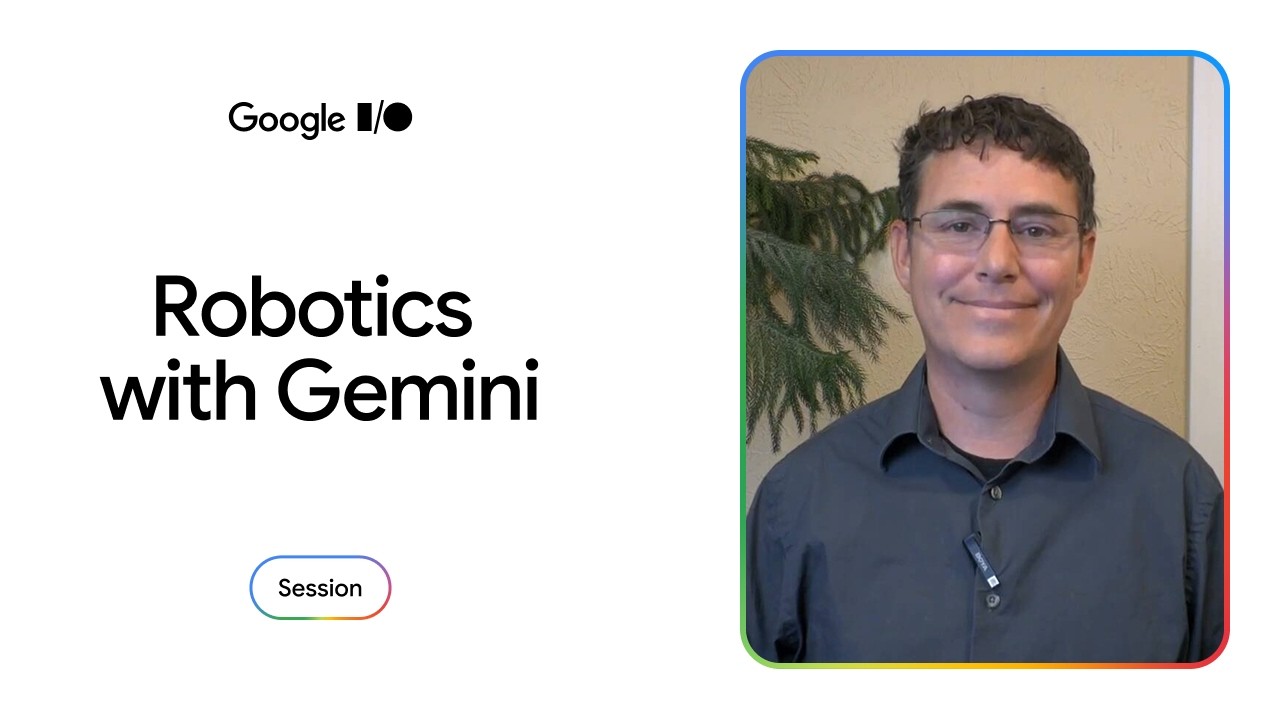
## Background Published by Google for Developers on YouTube on May 21, 2026, as part of Google I/O 2026, this presentation features Paul Ruiz exploring how Google's multimodal AI bridges digital models and the physical world. The session details how Gemini models leverage advanced spatial awareness for complex robotic perception, how the Live API powers low-latency human-robot interaction, and how developers can utilize simulations, safety benchmarks, and action models.
## TL;DR Paul Ruiz outlines Google DeepMind's strategy for shifting artificial intelligence from on-screen chatbots to embodied physical agents capable of navigating messy, real-world environments. He breaks down the perceive-plan-actuate pipeline, highlighting Gemini Robotics Embodied Reasoning (ER 1.6) for open-vocabulary spatial grounding, physical common sense, temporal video verification, and agentic vision. The presentation further examines how Vision-Language-Action (VLA) models translate high-level task plans directly into low-level motor actuation across diverse robot embodiments. Finally, Ruiz demonstrates interactive natural dialogue via the Gemini Live API, browser-based physical simulation using MuJoCo in Google AI Studio, and multi-layered safety validation informed by the Asimov benchmarks.
## Atmosphere & style Grounded, pragmatic, and maker-centric, the talk carries the earnest enthusiasm of an engineer who loves tinkering with tangible machinery as much as cutting-edge code. Ruiz maintains a steady, instructional cadence, eschewing excessive marketing hyperbole to candidly acknowledge where traditional factory control theory still suffices and where real-world unpredictability demands multimodal intelligence. The pacing moves smoothly from architectural diagrams to concrete developer workflows, giving the session the engaging, reliable feel of a practical engineering workshop.
## Bulletin - [01:33](https://www.youtube.com/watch?v=kCXQce1dtNE&t=93s) Google DeepMind introduced Gemini Robotics Embodied Reasoning (ER 1.6), a model fine-tuned on robotics data that provides open-vocabulary perception and spatial reasoning for physical agents. - [11:30](https://www.youtube.com/watch?v=kCXQce1dtNE&t=690s) Gemini Vision-Language-Action (VLA) models enable direct mapping from streaming camera frames and language prompts to low-level motor joint values without requiring intermediate symbolic code. - [13:30](https://www.youtube.com/watch?v=kCXQce1dtNE&t=810s) The Gemini Live API enables bidirectional, low-latency conversational audio and video streaming, using function calling to turn natural speech into robotic actuation. - [15:57](https://www.youtube.com/watch?v=kCXQce1dtNE&t=957s) To ensure physical hardware safety, DeepMind applies a multi-layer 'Swiss cheese' model benchmarked against the Asimov framework, incorporating hospital injury data from the NEISS database and industrial ISO standards.
## Key takeaways - [00:01](https://www.youtube.com/watch?v=kCXQce1dtNE&t=1s) Transitioning AI from digital software to physical robotics requires embodied reasoning capable of interpreting unstructured, unpredictable environments rather than clean digital data. - [01:33](https://www.youtube.com/watch?v=kCXQce1dtNE&t=93s) Robotics systems follow a perceive, plan, and actuate loop, where Gemini Robotics ER 1.6 acts as the spatial reasoning engine for the perception and planning layers. - [01:33](https://www.youtube.com/watch?v=kCXQce1dtNE&t=93s) ER 1.6's open-vocabulary object detection eliminates the need to build, label, and train custom closed-vocabulary vision models for every unique operational setting. - [04:12](https://www.youtube.com/watch?v=kCXQce1dtNE&t=252s) Embodied reasoning incorporates physical common sense regarding mass, material fragility, and spatial context to prevent mechanical damage and resolve underspecified instructions. - [06:06](https://www.youtube.com/watch?v=kCXQce1dtNE&t=366s) Built on the Gemini 3 Flash backbone, ER 1.6 natively processes multi-image and continuous video streams to serve as a temporal supervisor for task verification and success detection. - [07:23](https://www.youtube.com/watch?v=kCXQce1dtNE&t=443s) Agentic vision enables the model to generate and execute Python code to crop, rotate, and refine degraded or skewed images before making perceptual decisions. - [09:52](https://www.youtube.com/watch?v=kCXQce1dtNE&t=592s) Task orchestration decomposes broad natural language commands into structured function calls, intermediate waypoints, and collision-free trajectories for actuation. - [11:30](https://www.youtube.com/watch?v=kCXQce1dtNE&t=690s) Vision-Language-Action (VLA) models directly predict continuous actuator and motor outputs from visual streams, complementing ER 1.6 in a dual-system high-level and low-level architecture. - [11:30](https://www.youtube.com/watch?v=kCXQce1dtNE&t=690s) Gemini VLA models are designed to be embodiment-agnostic, providing a general-purpose control architecture adaptable across humanoids, quadrupeds, and bipedal rigs. - [13:30](https://www.youtube.com/watch?v=kCXQce1dtNE&t=810s) The Gemini Live API combines low-latency bidirectional voice dialogue with simultaneous video streams, bridging natural human communication and mechanical action via function calling. - [15:06](https://www.youtube.com/watch?v=kCXQce1dtNE&t=906s) Google AI Studio bundles web-based MuJoCo physics simulation templates, enabling rapid, hardware-free prototyping and fail-safe testing of robotic grasping and trajectory plans directly in the browser. - [15:57](https://www.youtube.com/watch?v=kCXQce1dtNE&t=957s) Because physical AI hallucinations can cause tangible damage or injury, DeepMind enforces a multi-layered safety defense spanning semantic intent comprehension, physical force limits, and operational geofencing. - [15:57](https://www.youtube.com/watch?v=kCXQce1dtNE&t=957s) The Asimov safety benchmarks validate autonomous agent behavior against real-world hospital injury data from the NEISS database alongside standardized industrial ISO manufacturing thresholds.
## Detailed walkthrough ### [00:01](https://www.youtube.com/watch?v=kCXQce1dtNE&t=1s) Bridging Digital AI and the Physical World
Paul Ruiz introduces himself as the developer relations lead for robotics at Google DeepMind. Setting a personal tone, he describes himself at heart as a maker, someone who has always gravitated toward creating tangible things in the physical realm—ranging from low-tech crafts like woodworking and gardening to hands-on tinkering with Internet of Things devices and intricate machinery. This background drives his excitement for DeepMind’s robotics initiative: moving artificial intelligence beyond screen-bound digital utility into physical reality.
While traditional AI models have demonstrated extraordinary power in text editing, code generation, and processing massive datasets, Ruiz explains that stepping into the physical world presents a fundamentally different challenge. In a real-world setting, a robot cannot rely on clean digital inputs; it must deduce that an unexpected discoloration or reflection on a floor might be a liquid spill, or map out collision-free navigational trajectories through an unpredictable, active factory. DeepMind’s goal with Gemini is to transition from static chatbots to embodied physical agents equipped with genuine spatial awareness, allowing them to navigate messy, unstructured human environments rather than sterile, scripted layouts.
As Paul Ruiz emphasizes when outlining DeepMind's broader ambition: “We aren't just teaching machines to see the world, but we're enabling them to perceive it with advanced spatial awareness and understanding.”
[01:33](https://www.youtube.com/watch?v=kCXQce1dtNE&t=93s) Perceive, Plan, Actuate and Gemini Robotics ER 1.6
In robotics architecture, system operations typically follow a three-stage pipeline: perceive, plan, and actuate. Google’s vision-language models (VLMs) directly power the perception and planning layers. DeepMind's specialized model for this domain is Gemini Robotics Embodied Reasoning (ER 1.6). Rather than functioning as a generic large language model, ER 1.6 is fine-tuned specifically on robotics data to serve as the spatial reasoning logic unit for physical machines. In practical deployments, the model handles tasks such as 2D pointing, object localization, grasping point identification, and detecting object states (such as verifying whether a container is closed or sitting on a desk).
```mermaid flowchart TD accTitle: Robotics Perception and Planning Loop with Gemini ER 1.6 accDescr: Diagram illustrating the perceive, plan, actuate flow powered by Gemini Robotics ER 1.6.
subgraph Perception["1. Perception (Gemini ER 1.6)"] A["Sensory Input (Images/Video)"] --> B["Open Vocabulary Grounding"] B --> C["Spatial & State Reasoning"] end
subgraph Planning["2. Planning (Task Orchestration)"] C --> D["High-Level Goal Decomposition"] D --> E["Function Tool Calling"] end
subgraph Actuation["3. Actuation (Hardware Execution)"] E --> F["Low-Level Motor Actions"] end ```
Developers can interact with ER 1.6 directly through Google's Python SDK by initializing the client, specifying the Gemini Robotics ER model ID, passing a prompt, and tuning runtime configurations such as temperature or thinking level. Ruiz contrasts this vision-language approach with traditional computer vision detectors like YOLO, which rely on closed-vocabulary datasets like COCO or ImageNet. With YOLO, an object cannot be detected if it was not explicitly pre-labeled in the training dataset; if a robot needs a specific woodworking tool to cut a dovetail joint, a closed-vocabulary system fails. Gemini Robotics ER 1.6 operates via open-vocabulary object detection, mapping visual representations and natural language into a shared semantic space. Consequently, developers can issue abstract, context-dependent queries—such as asking for the screwdriver needed for a specialty screw, the tool that appears most heavily used, or a machine component that is overheating—without retraining or labeling custom vision pipelines.
Highlighting the engineering payoff of this architectural shift, Paul Ruiz states: “For developers, this is a massive win, as it eliminates the need to build, label, and maintain custom vision models for every unique environment.”
[04:12](https://www.youtube.com/watch?v=kCXQce1dtNE&t=252s) Physical Common Sense and Semantic Reasoning
DeepMind explicitly labels this model "embodied reasoning" rather than a standard vision model because it understands scene physics rather than simply parsing pixel patterns. Ruiz illustrates the limitation of traditional robotics through a common domestic chore: clearing a dining table. A conventional scripted robot tasked with clearing a table might attempt to hoist a heavy serving platter beyond its motor payload limits, inadvertently stripping its mechanical gears or shattering dinnerware. Gemini Robotics ER 1.6 incorporates what Ruiz terms "physical common sense." It evaluates structural mass, material fragility, and spatial relationships, recognizing that it must first transfer food into smaller, manageable containers before lifting, request human assistance, or avoid attempting to lift furniture bolted directly to the floor.
Ruiz notes that this foundational physical comprehension solves an ongoing engineering bottleneck: “It's this kind of practical intuition that has historically been a nightmare to script manually.”
In addition to physical intuition, ER 1.6 brings semantic reasoning to bear on vague or underspecified human requests. When a human offhandedly instructs a robot, "Hey, put this away," traditional systems stall because both "this" and "away" lack concrete definitions. ER 1.6 resolves this ambiguity using ambient visual context and internal thinking steps. If the model sees an operator holding a screwdriver alongside an open toolbox with an empty slot, it reasons that "away" refers to that specific tray. This contextual inference frees developers from authoring fragile, brittle conditional if-else statements for every conceivable edge case, shifting their focus toward establishing high-level operational objectives.
[06:06](https://www.youtube.com/watch?v=kCXQce1dtNE&t=366s) Long-Horizon Temporal Reasoning and Video Understanding
Traditional model workflows evaluate static snapshots—sending a single image to an API endpoint and awaiting a single prediction. However, robotics is fundamentally a temporal discipline where present decisions depend heavily on actions taken seconds prior. Built upon the Gemini 3 Flash backbone, Gemini Robotics ER 1.6 natively ingests multi-image and continuous video streams, enabling long-horizon temporal reasoning. Because visual frames are tokenized chronologically, the model tracks motion dynamics and state changes over time instead of merely assessing static endpoints.
This capability transforms how roboticists implement task verification and success detection. Previously, verifying whether an action succeeded required engineering complex, ad-hoc heuristic checks. With ER 1.6, a developer can supply a 30-second clip of a manipulation attempt and ask whether a mechanical gripper firmly secured an object or let it slip out of grasp. By comparing motion deltas across sequential frames, the model assesses whether physical changes aligned with the intended goal.
Regarding this operational supervisory role, Paul Ruiz notes: “Now, you can simply use the model as a temporal supervisor that watches the robot's work and confirms that the physical state of the world has actually changed in the way that you intended.”
[07:23](https://www.youtube.com/watch?v=kCXQce1dtNE&t=443s) Agentic Vision and Task Orchestration
Even advanced visual reasoning can stumble when encountering poor-quality inputs caused by extreme scale, odd camera angles, rotational skew, or cluttered factory environments. To overcome these sensory obstacles, Gemini Robotics ER 1.6 introduces support for agentic vision. By toggling the SDK's code execution tool, the model is empowered to write and execute programmatic routines that actively transform and refine incoming imagery before making its final deduction.
Ruiz demonstrates this using a circuit board manufacturing line where a robot must inspect and record the serial ID printed on a specific component, such as an ESMT chip: - Standard models frequently struggle to decipher tiny, crowded, or inverted text on densely populated boards. - With agentic vision enabled, ER 1.6 generates Python code to identify the bounding area of the target chip and crops the image to isolate it. - Recognizing that the cropped text remains upside down, the model executes a secondary programmatic transformation to rotate the crop right-side up, ensuring clean character recognition.
Beyond reading micro-text on electronics, this agentic tooling allows roving facility robots to inspect analog dial gauges, detect environmental anomalies, check for floor spills or snow accumulation, and confirm fire doors are latched.
Once perception is established, the system transitions into planning via task orchestration. Developers provide the model with a functional toolbox of available robotic actions—such as opening a gripper, moving to spatial coordinates, detecting objects, or returning to home position. When given a high-level command like "put the blue block in the orange bowl," Gemini ER breaks down the overarching objective into an ordered series of sub-operations, coordinating the entire end-to-end plan.
Explaining how intermediate image transformations work under the hood, Paul Ruiz states: “By enabling the code execution tool with the SDK, the ER model can now generate code for intermediate steps, allowing the models to manipulate those images itself to get a better understanding of content.”
[09:52](https://www.youtube.com/watch?v=kCXQce1dtNE&t=592s) Micro-Planning and the Transition to Actuation
Paul Ruiz explains how the Gemini Robotics ER (Embodied Reasoning) model orchestrates multi-step physical routines. Rather than merely detecting items in isolation, the model evaluates visual scenes—identifying objects like a blue block and an orange bowl—and determines the precise sequence of functional calls required to complete a task: opening the gripper, translating toward the target block, closing the gripper, moving to the designated drop-off zone, opening the gripper to release, and returning to a neutral pose. Beyond this high-level task choreography, the ER model conducts micro-planning by generating intermediate waypoints and collision-free trajectories, calculating exact paths around obstacles rather than simple point-to-point lines.
This planning culminates in actuation—the physical phase where the gripper meets the object. In robotics, actuation involves translating computed plans into motor joint values and torque commands that drive physical hardware. Ruiz acknowledges that traditional industrial manufacturing has little need for generative AI in fixed, repetitive setups:
> “Now, I know the tendency is to say, 'Look at this amazing AI feature that should change everything.' But, in traditional robotics, if you have a machine in a factory repeating the exact same motion 10,000 times a day, standard control theory works just fine.”
The necessity for multimodal AI arises when robots step outside controlled factory floors into unstructured, unpredictable real-world environments. An autonomous sidewalk delivery robot, for instance, cannot rely on static programming when it runs into scenarios absent from its baseline training data, such as a discarded couch obstructing an entire walkway or an unyielding flock of territorial Canadian geese.
- **High-level orchestration:** Decomposes natural language commands into structured function-call sequences (e.g., open gripper, move, close gripper, transport, release, reset). - **Micro-planning:** Generates multi-point waypoint trajectories that dynamically route around physical obstacles. - **Actuation definition:** Transmitting precise numerical values to motors, joints, and actuators to execute physical work.
---
[11:30](https://www.youtube.com/watch?v=kCXQce1dtNE&t=690s) Vision-Language-Action (VLA) Models and Embodiment Agnosticism
To bridge semantic understanding and physical movement in open environments, Google introduced Vision-Language-Action (VLA) models, spearheaded by their flagship Gemini robotics model (available through a trusted tester program). VLAs bypass intermediate symbolic code by directly mapping raw visual camera frames and natural language prompts into low-level motor values. When given a high-level instruction such as “Clean up the desk,” the VLA continuously streams camera inputs to compute and output the exact joint and actuator trajectories needed to manipulate items in real time. For complex, multi-stage assignments, developers can chain models: the Gemini Robotics ER model ingests video to segment a broad goal into discrete visual milestones, which the VLA model then physically executes step by step.
```mermaid flowchart TD accTitle: Dual-System Architecture for Gemini Robotics accDescr: Diagram showing how Gemini Robotics ER provides high-level reasoning and feeds sub-tasks to VLA models for physical actuation.
subgraph HighLevel["High-Level Planning (Gemini Robotics ER)"] A["Visual Feed & Language Prompt"] --> B["Scene Understanding & Task Decomposition"] B --> C["Micro-Planning & Intermediate Waypoints"] end
subgraph LowLevel["Low-Level Execution (Gemini VLA)"] C --> D["Streaming Camera Frames"] D --> E["VLA Joint & Motor Prediction"] E --> F["Hardware Actuation (Motors / Grippers)"] end
F -.->|"Visual Runtime Feedback"| D ```
Because these VLAs are trained on the foundational Gemini backbone, they possess expansive world knowledge and zero-shot reasoning capabilities. Ruiz highlights an experiment where researchers gave their robot a miniature basketball and hoop setup and instructed it to perform a "slam dunk." Despite never receiving training for basketball mechanics, the model recognized the objects' affordances, grasped the ball, and placed it through the rim. DeepMind is leveraging this foundation to achieve fine motor dexterity—such as inserting cords into sockets or performing delicate benchtop assembly—while maintaining an embodiment-agnostic philosophy that spans humanoids, quadrupeds, and bipedal rigs:
> “These models are designed to be embodiment-agnostic, providing a powerful, general-purpose brain that can be adapted to whatever hardware you're working with.”
---
[13:30](https://www.youtube.com/watch?v=kCXQce1dtNE&t=810s) Natural Human-Robot Interaction with the Gemini Live API
Completing the perceive, plan, and actuate loop solves mechanical execution, but it leaves open the challenge of natural interaction between humans and machines. Pre-programmed voice trees struggle in human environments because everyday language is filled with phrasing variations; a robot that only recognizes rigid scripts will freeze or behave awkwardly when greeted or thanked in unexpected ways.
Ruiz highlights the Gemini Live API as the solution that shifts robots from rigid appliances into intuitive interactive partners. The API delivers low-latency, bidirectional audio dialogue, allowing operators to issue casual, context-dependent requests such as, “That screw looks a little loose. Can you tighten it?” Furthermore, the Live API simultaneously ingests a live visual stream from the robot's onboard cameras, allowing users to converse while the model monitors physical progress and updates operational plans on the fly.
Ruiz identifies function calling as the critical link between conversation and physical motion:
> “This is the bridge that allows a natural conversation to turn into precise physical action, opening the door to incredibly fluid human robot interactions.”
- **Bidirectional low-latency audio:** Enables real-time conversational steering without unnatural pauses or rigid phrase matching. - **Multimodal streaming:** Combines audio feeds with continuous camera video to adjust robotic tasks mid-execution. - **Function calling integration:** Translates conversational conclusions and visual observations directly into developer-defined programmatic triggers for hardware control.
---
[15:06](https://www.youtube.com/watch?v=kCXQce1dtNE&t=906s) Rapid Prototyping with AI Studio and Browser-Based MuJoCo Simulation
Testing and refining robotic control code directly on physical hardware can be slow and risky. Ruiz highlights Google AI Studio as an essential developer sandbox, allowing builders to test prompts, refine system instructions, and examine how Gemini models interpret camera imagery from custom hardware without having to repeatedly flash firmware or run new scripts on physical devices.
Within AI Studio's Build section, DeepMind provides ready-to-run web templates that embed the open-source MuJoCo physics engine directly into browser environments. Ruiz demonstrates a virtual robotic arm executing autonomous pick-and-place sequences inside the browser: the arm relies on the Gemini Robotics ER model to visually locate blocks in the 3D simulation and compute grasp targets entirely within software.
> “Like you can see here, where we're running a virtual robotic arm that uses the Gemini Robotics ER model to detect block locations, then performs a pick and place task based on that information without the risk of testing on real hardware, really lending itself to a fail-fast, fail-safe strategy.”
- **Hardware-free iteration:** Test prompting logic, spatial awareness, and perception pipelines without reloading hardware drivers. - **In-browser MuJoCo engine:** Validates physical interactions, grasping dynamics, and kinematics safely inside web-based simulation templates. - **Fail-fast development:** Detects logical failures and trajectory mistakes in virtual environments before deploying code to physical joints and motors.
---
[15:57](https://www.youtube.com/watch?v=kCXQce1dtNE&t=957s) Safety Grounding: The Asimov Benchmarks and Multi-Layer Defense
In pure software applications, an artificial intelligence hallucination results in mild inconveniences like a nonsensical cooking recipe or a syntax error in code. In physical robotics, however, models govern heavy hardware, sharp manipulators, and high-torque motors moving in close proximity to human beings. Ruiz draws a comparison to workshop equipment like a table saw, noting that adding an autonomous agent requires engineering safety from the start:
> “When you add an autonomous brain to a machine, that respect for safety has to be built in from the ground up.”
To address this, Google DeepMind employs the classic "Swiss cheese" safety model. Because no individual algorithmic or mechanical guardrail is completely foolproof, developers stack overlapping layers across three key tiers: semantic comprehension (evaluating the intent and context of instructions), physical constraints (force limits, speed caps, and obstacle avoidance), and operational boundaries (emergency stops and workspace geofencing).
To empirically validate these defensive layers, DeepMind established the Asimov safety benchmarks. These tests move beyond theoretical safety by incorporating real-world accident data from the National Electronic Injury Surveillance System (NEISS) database, which aggregates hospital injury records to provide the model with grounding in physical common sense. Furthermore, the benchmarks incorporate established industrial ISO standards to ensure autonomous agents respect the identical operational and protective thresholds enforced on modern factory floors. Ruiz concludes by inviting developers to explore Google DeepMind's documentation, experiment with GitHub cookbooks, and apply for the Gemini robotics trusted tester program.
- **Swiss cheese defense model:** Layering semantic, physical, and operational barriers so vulnerabilities in one safety layer are caught by the next. - **NEISS database grounding:** Hospital injury surveillance data used to teach models common-sense awareness of physical human hazards. - **Industrial ISO compliance:** Benchmarks engineered to reflect standardized manufacturing and collaborative robot safety requirements. - **Developer onboarding:** Accessible documentation, code samples, and trusted tester signups available via the Gemini robotics portal.
## Notable quotes > [00:01](https://www.youtube.com/watch?v=kCXQce1dtNE&t=1s) We aren't just teaching machines to see the world, but we're enabling them to perceive it with advanced spatial awareness and understanding. — Paul Ruiz
> [09:52](https://www.youtube.com/watch?v=kCXQce1dtNE&t=592s) In traditional robotics, if you have a machine in a factory repeating the exact same motion 10,000 times a day, standard control theory works just fine. — Paul Ruiz
> [15:57](https://www.youtube.com/watch?v=kCXQce1dtNE&t=957s) When you add an autonomous brain to a machine, that respect for safety has to be built in from the ground up. — Paul Ruiz
## Mentioned Paul Ruiz, Google, Google DeepMind, Google for Developers, Google I/O 2026, Gemini, Gemini 3 Flash, Gemini Robotics Embodied Reasoning (ER 1.6), Gemini Live API, Google AI Studio, MuJoCo, Python SDK, YOLO, COCO, ImageNet, Asimov safety benchmarks, National Electronic Injury Surveillance System (NEISS), ISO
## Video description Discover how Google’s multimodal AI bridges the cloud and physical worlds. Explore how the latest Gemini models utilize advanced spatial awareness to help robots perceive complex environments. Learn about the Live API's capabilities for natural, low-latency human-robot interaction, and explore the essential ecosystem for simulation, safety, and action models.
Resources: Gemini Robotics code samples → https://goo.gle/3PnFTOX Gemini Robotics overview docs → https://goo.gle/4tmD52H Gemini Live API overview → https://goo.gle/4tjVLjz MuJoCo website → https://goo.gle/42ghv4U AI Studio Bundled Robotics → https://goo.gle/4tfdR68
Speakers: Paul Ruiz
Watch the AI sessions from Google I/O 2026 → https://goo.gle/AI-at-IO26
Subscribe to Google for Developers → https://goo.gle/developers
#GoogleIO
Event: Google I/O 2026
Products Mentioned: AI/Machine Learning
[Source](https://www.youtube.com/watch?v=kCXQce1dtNE)