Microsoft and NVIDIA introduced next-generation local AI developer hardware, including the Surface RTX Spark Dev Box and Surface Ultra, featuring 128 GB of unified system memory to host 120B+ parameter models entirely on-device. (5:15)
Windows and Azure announced Microsoft Execution Containers (MXC), enforcing operating-system-level sandbox boundaries and policy containment to safely isolate autonomous agent execution. (63:25)
Microsoft unveiled the GitHub Copilot desktop app with Git worktrees for concurrent agent workflows, alongside Rayfin, an agent-first backend-as-a-service SDK tied to Microsoft Fabric. (76:49)
Microsoft AI revealed in-house models including MAI Thinking 1 (35B active parameter MoE) and announced Frontier Tuning Reinforcement Learning Environments for building proprietary enterprise reasoning loops. (111:28)
Microsoft declared General Availability for Microsoft Discovery to automate wet-lab scientific inquiry and introduced Majorana 2, scaling topological qubits toward one million qubits on a credit-card-sized substrate. (137:02)
Detailed notes
## Background
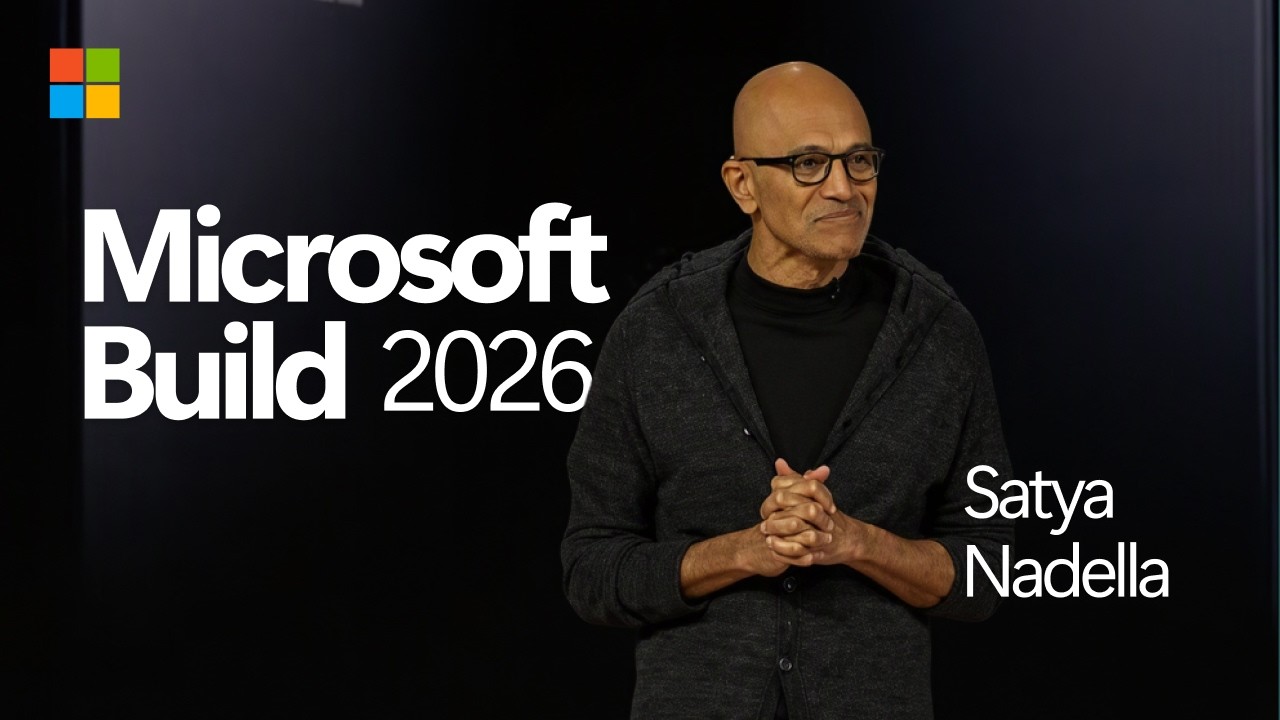
Published on YouTube by Microsoft on June 2, 2026, this video captures the live Microsoft Build 2026 opening keynote from San Francisco. The presentation features Microsoft CEO Satya Nadella and executive leadership exploring developer opportunities across the modern AI platform stack and previewing upcoming agentic technologies.
## TL;DR
Satya Nadella lays out an end-to-end vision for the agentic era, detailing advances across local compute hardware like the Surface RTX Spark Dev Box, Project Solara ambient devices, and custom Azure Maia and Cobalt silicon. Microsoft debuts extensive developer and runtime tooling, including native OpenClaw support, Microsoft Execution Containers (MXC), the GitHub Copilot app, and the Agent 365 enterprise control plane. The presentation highlights Microsoft AI's custom model family—including MAI Thinking 1 and Frontier Tuning harnesses—alongside a strategic partnership with the Mayo Clinic. The keynote culminates with the general availability of Microsoft Discovery for agentic science and the announcement of the Majorana 2 topological quantum architecture.
## Atmosphere & style
The presentation blends corporate executive polish with authentic developer enthusiasm, alternating between Satya Nadella's measured platform framing, relaxed fireside dialogues with industry figures like Jensen Huang, and lighthearted onstage software demos. Dynamic live technical demonstrations—ranging from chaotic local agent file-deletion stress tests to protein engineering inside VS Code—keep the technical pacing brisk and grounded. The narrative arc builds an expansive sense of momentum, transitioning smoothly from pragmatic daily developer ergonomics to massive planetary datacenters and sweeping philosophical reflections on quantum engineering and human agency.
## Bulletin
- [05:15](https://www.youtube.com/watch?v=FFMm454fxNA&t=315s) Microsoft and NVIDIA introduced next-generation local AI developer hardware, including the Surface RTX Spark Dev Box and Surface Ultra, featuring 128 GB of unified system memory to host 120B+ parameter models entirely on-device.
- [01:03:25](https://www.youtube.com/watch?v=FFMm454fxNA&t=3805s) Windows and Azure announced Microsoft Execution Containers (MXC), enforcing operating-system-level sandbox boundaries and policy containment to safely isolate autonomous agent execution.
- [01:16:49](https://www.youtube.com/watch?v=FFMm454fxNA&t=4609s) Microsoft unveiled the GitHub Copilot desktop app with Git worktrees for concurrent agent workflows, alongside Rayfin, an agent-first backend-as-a-service SDK tied to Microsoft Fabric.
- [01:51:28](https://www.youtube.com/watch?v=FFMm454fxNA&t=6688s) Microsoft AI revealed in-house models including MAI Thinking 1 (35B active parameter MoE) and announced Frontier Tuning Reinforcement Learning Environments for building proprietary enterprise reasoning loops.
- [02:17:02](https://www.youtube.com/watch?v=FFMm454fxNA&t=8222s) Microsoft declared General Availability for Microsoft Discovery to automate wet-lab scientific inquiry and introduced Majorana 2, scaling topological qubits toward one million qubits on a credit-card-sized substrate.
## Key takeaways
- [00:50](https://www.youtube.com/watch?v=FFMm454fxNA&t=50s) Satya Nadella structured the modern AI era across four architectural tiers—Ubiquitous Compute Fabric, Models Context and Tools, Agent Runtime, and Tooling Security Compliance—urging developers to focus on compounding platform value.
- [04:05](https://www.youtube.com/watch?v=FFMm454fxNA&t=245s) Windows AI APIs now feature in-box Ion Instruct and Ion Plan models, allowing developers to execute end-to-end autonomous reasoning and tool-calling loops locally without cloud token dependencies.
- [05:15](https://www.youtube.com/watch?v=FFMm454fxNA&t=315s) The Surface RTX Spark Dev Box delivers 1 Petaflop of AI compute and 128 GB of unified memory, utilizing compact NVFP4 precision to run 120B+ parameter models on a local desktop.
- [17:50](https://www.youtube.com/watch?v=FFMm454fxNA&t=1070s) Azure's Fairwater AI super-factories implement high-density 100 kW per rack architectures with closed-loop zero-net-water cooling, scaling alongside custom Maia 200 accelerators and Cobalt 200 CPUs as agentic workloads push CPU-to-accelerator ratios toward 1:1.
- [29:35](https://www.youtube.com/watch?v=FFMm454fxNA&t=1775s) NVIDIA's upcoming Vera Rubin architecture introduces the Vera CPU for microsecond-level agentic responsiveness alongside comprehensive end-to-end hardware encryption across storage, memory, and transit.
- [39:30](https://www.youtube.com/watch?v=FFMm454fxNA&t=2370s) Project Solara explores dedicated ambient and wearable form factors—such as desktop hubs and clinical badges—built on the Microsoft Device Ecosystem Platform (MDEP) and dynamic Just-In-Time interfaces.
- [55:53](https://www.youtube.com/watch?v=FFMm454fxNA&t=3353s) Microsoft Web IQ indexes fresh multimodal internet context for agents through the Model Context Protocol (MCP), anchoring an overarching enterprise IQ layer alongside Fabric IQ and Work IQ.
- [01:03:25](https://www.youtube.com/watch?v=FFMm454fxNA&t=3805s) Microsoft Execution Containers (MXC) provide policy-driven containment across process, session, virtualization, and cloud levels to prevent autonomous agents from modifying unauthorized system files.
- [01:16:49](https://www.youtube.com/watch?v=FFMm454fxNA&t=4609s) The GitHub Copilot app orchestrates high-concurrency coding agents across isolated Git worktrees to resolve multiple issues simultaneously without branch conflicts.
- [01:19:44](https://www.youtube.com/watch?v=FFMm454fxNA&t=4784s) Rayfin introduced an agent-first backend-as-a-service SDK, enabling coding agents to provision containerized application logic, identities, and database schemas directly into Microsoft Fabric.
- [01:25:31](https://www.youtube.com/watch?v=FFMm454fxNA&t=5131s) Agent 365 entered General Availability as an administrative control plane, orchestrating agent identities via Entra, threat defense via Defender, and compliance via Purview across multi-cloud deployments.
- [01:32:15](https://www.youtube.com/watch?v=FFMm454fxNA&t=5535s) The MDASH multi-model security harness deploys over 100 coordinated agents to detect distributed multi-file semantic vulnerabilities, automatically generating proof-of-concept exploits and pull-request patches.
- [01:43:30](https://www.youtube.com/watch?v=FFMm454fxNA&t=6210s) Enterprise Autopilots serve as persistent, tenant-bounded autonomous agents, launched with 'Scout' to handle automated triage across Microsoft Teams and Outlook.
- [01:51:28](https://www.youtube.com/watch?v=FFMm454fxNA&t=6688s) Microsoft AI debuted MAI Thinking 1, a 35B active parameter MoE reasoning model built with zero distillation for enterprise data lineage, paired with the lightweight MAI Code 1 Flash.
- [01:54:46](https://www.youtube.com/watch?v=FFMm454fxNA&t=6886s) Frontier Tuning enables organizations to create private Reinforcement Learning Environments (RLEs) to train custom reasoning models on proprietary operational workflows without data escaping enterprise boundaries.
- [02:08:00](https://www.youtube.com/watch?v=FFMm454fxNA&t=7680s) Microsoft Discovery reached General Availability, connecting foundation models with robotic laboratories to automate molecular modeling and physical experimental loops.
- [02:17:02](https://www.youtube.com/watch?v=FFMm454fxNA&t=8222s) Majorana 2 advanced Microsoft's topological quantum computing roadmap, delivering a 1,000-fold coherence time improvement (20 to 60 seconds) and paving the way for 1,000,000 qubits on a sub-credit-card chip footprint.
## Detailed walkthrough
### [00:50](https://www.youtube.com/watch?v=FFMm454fxNA&t=50s) The Frontier Intelligence Ecosystem and the New AI Stack
Satya Nadella opens Microsoft Build 2026 in San Francisco by welcoming developers back to the event, underscoring that developer conferences are fundamentally about grasping historic technology shifts and mastering a new platform stack. He highlights that the broader challenge for developers, businesses, and society is to actively participate and compound value rather than obsess over individual tools. As Satya Nadella puts it: “It is not about any one piece of technology you hear about or even the platform itself, it is about the value that you can build, you can compound, you can create on top of the platform.”
To anchor the conference, Nadella sketches out the modern AI architecture across four key layers:
1. **Ubiquitous Compute Fabric:** Spanning from hyperscale cloud infrastructure all the way down to edge hardware.
2. **Models, Context, and Tools:** The foundational intelligence tier where reasoning models interface with contextual data and API tools.
3. **Agent Runtime:** The layer where autonomous agents and modern applications execute across runtime environments.
4. **Tooling, Security, Compliance, and Governance:** The operational envelope that ensures enterprise-grade security and developer productivity.
```mermaid
flowchart TD
accTitle: The Frontier AI Architecture Stack
accDescr: An architectural flow diagram showing the four core layers of the modern AI platform from compute to governance.
[04:05](https://www.youtube.com/watch?v=FFMm454fxNA&t=245s) Windows AI APIs and On-Device Agentic Models
Turning to edge computing, Nadella calls the compute capacity across the current PC base astounding, pointing to the collective power of modern CPUs, GPUs, and NPUs. Everyday client experiences already run local models silently under the hood—including Outlook email summarization, PowerPoint automated alt-text generation, and Microsoft Teams video super-resolution, alongside third-party creative software such as Adobe Premiere and Adobe After Effects.
To turn this hardware base into an open development canvas, Microsoft is dramatically widening the scope of Windows Machine Learning (Windows ML) and Windows AI APIs, allowing developers to target the entire installed base of desktop and mobile GPUs with local execution. Furthermore, Nadella introduces two brand-new models that will ship directly in-box on Windows:
- **Ion Instruct:** An on-device model specialized in deep reasoning.
- **Ion Plan:** An on-device planning model designed to organize multi-step actions.
By combining Ion Instruct and Ion Plan directly in Windows, developers can build an entirely local, agentic loop that executes function calls and interacts with system tools without needing to round-trip data back to cloud datacenters.
---
[05:15](https://www.youtube.com/watch?v=FFMm454fxNA&t=315s) Silicon Innovations and the Surface RTX Spark Dev Box
To support zero-latency, unmetered local intelligence, the hardware ecosystem is rapidly expanding. Nadella acknowledges Intel's latest silicon strides and Qualcomm's twin announcements spanning high-end Snapdragon X platforms down to sub-$500 PCs. He then spotlights the next-generation PC system-on-chip (SoC) partnership with NVIDIA. This architecture fuses high-performance CPU, GPU, and dedicated AI accelerators into a unified SoC featuring unified system memory and high-speed integrated DRAM.
Microsoft showcases two premier hardware form factors utilizing these silicon advances:
- **Surface Ultra:** A sleek flagship laptop combining NVIDIA silicon with Surface craftsmanship, featuring 128 GB of unified memory, a 2,000-nit display, and all-day battery performance, arriving in fall 2026 alongside partner OEM designs.
- **Surface RTX Spark Dev Box:** An extreme, developer-focused desktop machine designed to maximize raw local compute and unified memory bandwidth without constraints.
```
Surface RTX Spark Dev Box Specifications:
• AI Compute: 1 Petaflop
• CPU: 20 cores
• Memory: 128 GB unified system memory
• Model Capacity: Supports local hosting of up to 120B+ parameter models
```
Nadella jokes about high internal demand for the device, noting: “I am on the wait list as well, there's a wait list.” He also highlights that NVIDIA is bringing Windows support to the DGX Station, effectively placing a miniature desktop data center capable of running 1-trillion-parameter models locally beside a developer's desk.
---
[09:00](https://www.youtube.com/watch?v=FFMm454fxNA&t=540s) Windows as an Open, Distraction-Free Developer Canvas
Nadella describes Microsoft's overarching developer vision as turning Windows—whether on a laptop, a desktop workstation, or virtually via Windows 365 Cloud PC—into the premier developer environment. Addressing common pain points, Windows is introducing dedicated developer distributions built around a minimalist, distraction-free desktop:
- **Intelligent Terminal:** A reimagined command terminal featuring built-in, side-by-side GitHub Copilot integration for real-time error inspection and terminal-command generation.
- **Linux and POSIX Native Tooling:** Over 70 standard POSIX/Linux command-line utilities—including full-featured `grep`—now execute natively across the Windows shell.
- **Package Management:** Native support for Homebrew on Windows.
- **WSL Containers:** First-class container virtualization directly integrated with the Windows Subsystem for Linux (WSL), exposing bare-metal GPU acceleration to local container workloads.
---
[11:46](https://www.youtube.com/watch?v=FFMm454fxNA&t=706s) Demo: Developer Experience on Surface RTX Spark Dev Box
Developer Kayla takes the stage to demo these features running live on the Surface RTX Spark Dev Box hardware. The environment opens into a calm, dark-mode configuration free from news feeds, system widgets, and pop-up notifications. Using PowerToys Run via a quick keyboard launcher, she swaps the taskbar to the left side of the screen, celebrating the return of the vertical taskbar to Windows Insider builds.
Kayla details several specialized desktop utilities built for software engineering:
- **Machine State Configuration File:** A single configuration file from a public repository that automatically configures Windows settings, developer flags, and pre-installs core runtime toolchains such as Python and Node.js.
- **PowerToys Grab and Move:** A window-management utility enabling developers to hold `Alt` and drag any window immediately from any point on its surface.
- **Native Taskbar Process Termination:** Direct right-click "End Task" functionality right on the taskbar, bypassing the need to launch Task Manager.
- **Git-Aware Dev Drive:** An optimized ReFS-based file system partition operating with asynchronous Microsoft Defender inspection for high file-I/O performance. File Explorer displays file status, recent commit messages, and the active Git branch at the bottom left.
```
Local Intelligence Metrics Observed in Demo:
• Local Model Size: 120 Billion parameter model resident in unified memory
• On-Device Compute Usage: 3.4 million tokens served locally without cloud calls
• Input Modality: Hands-free Copilot Voice driven by an on-device speech model
```
Kayla opens the Intelligent Terminal, splitting the view between an active shell on top and an autonomous GitHub Copilot agent pane below. When a command generates an unexpected execution error, the lower agent automatically interprets the terminal output and serves an inline syntax fix.
Inside WSL, she inspects the OpenClaw project utilizing a GPU-accelerated WSL container configured alongside modern terminal setups like Starship prompt, Zsh, Homebrew, and `btop`. Finally, demonstrating the massive local capacity of the Surface RTX Spark Dev Box, she shows the system running a 120-billion-parameter coding model locally—which has already processed 3.4 million tokens completely on-device—before holding down the spacebar to issue hands-free instructions to an agent fleet using Copilot Voice.
[15:57](https://www.youtube.com/watch?v=FFMm454fxNA&t=957s) Unmetered Local Intelligence and Developer Workflows
The developer demo concludes by showcasing how local models can offload repetitive coding and debugging chores without consuming cloud tokens. In the demonstration, a developer issues an instruction to scan across projects:
> “Find any console dot right line calls in the tray and node projects and convert them to the standard logger used elsewhere in the code base.”
A primary orchestrator agent breaks down the work and hands off sub-tasks of appropriate complexity to a local model running directly on the GPU, keeping the process responsive and cost-effective.
```mermaid
flowchart LR
accTitle: Local Agent Offloading Flow
accDescr: Primary agent delegating sub-tasks to local GPU models to inspect logs and refactor code.
subgraph Host["Host Dev Environment"]
A["Main Agent"] -->|"delegates sub-tasks"| B["Local Model (GPU)"]
B --> C["Code Refactor (Loggers)"]
B --> D["Log Parsing / Diagnostics"]
end
subgraph Terminal["Windows CLI Utilities"]
E["75+ Tools: grep, head, tail, touch, sudo"]
end
B -.-> Terminal
```
To streamline debugging, Windows is expanding its built-in developer toolset. Developers frequently struggle to locate and parse sprawling log files, often wishing for native Unix-style commands. Building upon the prior integration of `curl`, `tar`, and `sudo`, Windows is adding over 75 native command-line utilities—including `grep`, `head`, `tail`, and `touch`. In the demo, an instructional model continuously parsed log files in the background, allowing instant diagnosis of issues without metering concerns.
- Over 75 native CLI utilities arriving on Windows (e.g., `grep`, `head`, `tail`, `touch`) alongside existing utilities like `curl`, `tar`, and `sudo`.
- Hardware telemetry demonstrated 90 GB of unified system RAM utilized by the GPU on the Surface RTX Spark Dev Box.
- Multiple local models run concurrently and completely unmetered, bypassing cloud token constraints.
---
[17:50](https://www.youtube.com/watch?v=FFMm454fxNA&t=1070s) Cloud Infrastructure for the Agentic Era
Taking the stage, Satya Nadella underscores that the edge and cloud are complementary: “That's the beginning of unmetered intelligence having the models and agents using the models work in parallel to what you are doing in the cloud.” Turning to Microsoft’s datacenter footprint, he emphasizes the core efficiency metric driving Azure: *tokens per dollar per watt*. Nadella describes the systems challenge as taking “electrons coming on one end and tokens on the other end” and optimizing every layer in between, from chips and networking to datacenter cooling and community stewardship.
Before expanding infrastructure, Microsoft prioritizes local community pacts: ensuring data centers do not increase resident electricity bills, minimizing water consumption, driving local employment, contributing to local taxes, and funding nonprofits and training. Azure now spans over 500 datacenters globally. Nadella puts the expansion velocity into perspective, noting that Microsoft has added more datacenter capacity in the last 18 months than in the entire first decade of Azure's existence.
Workloads across Azure's gigawatt-scale infrastructure fall into three dominant categories: training, inference, and the emerging agent runtime. Nadella highlights the "Fairwater" AI super-factory—spanning Georgia and Wisconsin—designed from scratch alongside NVIDIA:
- Built with a high-density, two-story architecture to pack GPUs tightly with ultra-low latency, high-bandwidth clustering.
- Employs a reimagined power distribution scheme targeting 100 kW per rack while cutting conversion losses from grid to silicon.
- Uses a closed-loop cooling system that allows the facility to operate with essentially zero net water consumption; annual water usage across an entire facility equals roughly what a single restaurant uses in a year.
---
[22:13](https://www.youtube.com/watch?v=FFMm454fxNA&t=1333s) Silicon Co-Design: Maia 200 and Cobalt 200
Nadella details Microsoft’s hybrid silicon strategy, combining partner hardware from NVIDIA and AMD with bespoke first-party silicon. Azure continues to partner closely with AMD on next-generation GPUs, while Microsoft’s custom Maia 200 accelerator is now scaling out in Arizona and preparing for international deployment. Maia 200 delivers 30% better tokens-per-dollar efficiency compared to contemporary leading GPUs; it has already been validated on GPT-5 class models and is slated to power Microsoft 365 Copilot workloads.
At the same time, agentic workloads place unprecedented strain on general-purpose compute:
> “When it comes to running these agents, interesting thing now it is no longer about having AI accelerator or GPU. CPU is critical. Ratios may be coming to one is to one.”
To address this shift, Microsoft announced the preview of Azure VMs powered by the custom Cobalt 200 CPU. Designed specifically for cloud-native and agentic traces—analyzed directly from GitHub Copilot runtime telemetry—Cobalt 200 delivers dramatic architectural gains:
Nadella emphasizes that networking must scale alongside compute to keep tens of thousands of GPUs synchronously coherent across Azure's global fabric, linking regional clusters into a unified, fungible AI computing fabric.
---
[25:15](https://www.youtube.com/watch?v=FFMm454fxNA&t=1515s) Fireside with Jensen Huang: The PC Evolves into Personal AI
Satya Nadella introduces NVIDIA CEO Jensen Huang, calling NVIDIA the gold standard in deep systems engineering for AI. Joining remotely late at night from Taipei, Huang reflects on the vision he and Nadella conceived three years prior to build a dedicated AI PC architecture combining silicon horsepower with deep Windows software integration.
```mermaid
flowchart TD
accTitle: Evolution of the Personal Computer
accDescr: Historical progression from personal computer to DirectX workstation to autonomous personal AI agent.
PC["Traditional PC (Productivity Tool)"] --> DX["DirectX Era (3D Graphics & Creation)"]
DX --> AI["Personal AI (Autonomous Edge Agent)"]
subgraph Capabilities["RTX Spark Hardware Capabilities"]
F4["1 PFLOPS NVFP4 Compute"]
RAM["128 GB Unified Memory"]
MOD["Runs ~200B Parameter Models Locally"]
end
AI --- Capabilities
```
Huang highlights the profound paradigm shift underway in computing:
> “The PC evolved from being an incredible tool to now being a tool that is used autonomously by an AI assistant.”
Huang sketches a scenario where a user away from their desk can simply text their workstation: the PC opens the necessary tools, executes complex code changes or design tasks, and iterates independently in the background. Powered by the RTX Spark architecture, these edge systems feature a petaflop of AI performance utilizing the compact NVFP4 numerical format co-developed by NVIDIA and Microsoft. With 128 GB of memory, these machines can host local models sporting a couple hundred billion parameters—bringing state-of-the-art reasoning directly onto the desktop. Nadella wraps up the segment by celebrating Windows running on the GP300, summarizing the device as essentially “a data center on your laptop.”
[29:35](https://www.youtube.com/watch?v=FFMm454fxNA&t=1775s) Data Center Infrastructure: From Grace Blackwell to Vera Rubin
Satya Nadella brings the conversation to data center infrastructure, recalling how the journey began when Microsoft and NVIDIA built the first AI supercomputer to train large GPU models. He highlights the custom "Fairwater" data center design created to match NVIDIA's system architecture during the Grace Blackwell era, and asks Jensen Huang to explain how NVIDIA approaches systems design for cloud-scale AI.
Huang looks back at the rapid evolution across hardware generations. While Hopper was a massive success primarily dedicated to pre-training, Grace Blackwell shifted the entire industry toward post-training, reinforcement learning, and reasoning models based on mixture of experts (MoE). Because these models demand massive interconnected systems, NVIDIA introduced NVLink 72, turning an entire rack into a single unified computer rather than relying on discrete nodes. Huang specifically credits Microsoft for deploying "the largest number of Grace Blackwells in the world today." He praises the Fairwater facility as a closed-loop, liquid-cooled engineering marvel that uses virtually no water, maximizing both energy efficiency and environmental sustainability while reducing the cost of token generation by roughly 30× compared to Hopper.
Looking forward, Huang introduces Vera Rubin, an architecture purpose-built not just for pre-training or post-training inference, but specifically for agentic AI workloads. Rubin mirrors the architectural computing patterns found on client dev hardware like RTX Spark, but scales up to manage massive volumes of concurrent agents across multiple enterprise tenants. The system features end-to-end security—with encrypted data at rest in storage (long-term memory), encrypted working memory, encrypted networking in transit, and confidential computing in use. Huang notes that the CPU architecture has also been fundamentally rethought. Prior CPUs were designed around human latency tolerance, whereas agents demand microsecond-level responsiveness; Vera was engineered from the ground up for extreme low latency. Microsoft and NVIDIA aligned their engineering teams long before tape-out so that data center networking, power, and software stacks were already staged and ready to stand up systems the moment silicon rolled off manufacturing lines.
```mermaid
flowchart LR
accTitle: Evolution of NVIDIA Data Center Architectures
accDescr: Progression from Hopper for pre-training, to Grace Blackwell for reasoning, to Vera Rubin for agentic AI.
subgraph HopperEra["Hopper Generation"]
direction TB
H1["Pre-training Focus"] --> H2["Node-level Scaling"]
end
subgraph BlackwellEra["Grace Blackwell Generation"]
direction TB
B1["Post-training & RL"] --> B2["NVLink 72 (Rack as a Computer)"]
B2 --> B3["Fairwater Closed-Loop Liquid Cooling"]
end
subgraph RubinEra["Vera Rubin Generation"]
direction TB
R1["Agentic Workloads & Low-Latency Vera CPU"] --> R2["End-to-End Encryption (Rest, Transit, In-Use)"]
R2 --> R3["Disaggregated Distributed Execution"]
end
HopperEra --> BlackwellEra --> RubinEra
```
- **Fairwater Data Center Design:** Liquid-cooled, closed-loop design that consumes almost zero water while hosting massive Grace Blackwell deployments.
- **Cost and Throughput Gains:** Grace Blackwell delivers an order-of-magnitude token throughput improvement, slashing per-token generation costs by ~30× over Hopper.
- **NVLink 72 Scale:** Shifts the fundamental computing unit from an isolated single server node to an entire 72-GPU rack functioning as a single fabric.
- **Vera CPU Purpose:** Built specifically for low-latency agentic loops rather than traditional human interactive response times.
- **End-to-End Encryption:** Protects the full data pipeline across long-term storage, working memory, network transit, and runtime compute.
---
[33:39](https://www.youtube.com/watch?v=FFMm454fxNA&t=2019s) Full-Stack Acceleration for the Agentic Developer Ecosystem
Nadella emphasizes that hardware innovation serves a broader goal: empowering developers and organizations to build upon an open, scalable ecosystem. Beyond individual chips or flagship foundation models, the joint platform integrates NVIDIA models and tooling into Microsoft Foundry, brings acceleration to Windows, and boosts data warehouse workloads. He prompts Huang to discuss the scale of this economic and developer opportunity.
Huang explains that the convergence of foundation models and agentic workflows over the preceding months has made AI genuinely useful, productive, and economically profitable. He points to developer activity as tangible proof, noting that commits on GitHub had gone completely parabolic, tripling over the previous several months alone. Because autonomous agents work continuously, consume enormous context, and execute multi-step plans, their demand for compute has skyrocketed. To prevent bottlenecks, Microsoft and NVIDIA have partnered to make sure every supporting layer—including Microsoft Fabric, SQL engines, Apache Spark, semantic layers, and graph databases on Azure—is completely GPU-accelerated. Because agents iterate rapidly and are far less tolerant of delays than humans, accelerating underlying data tools is essential to letting developers churn out intelligent, high-value tokens at scale. Nadella closes the segment by thanking Huang for calling in late at night from Taipei, celebrating their shared decades of partnership from the PC and client-server eras to modern AI.
> “If you look at GitHub, the commits into GitHub has gone completely parabolic. In the last several months the number of commits increase by a factor of three. It is clear agentic systems are useful, it is doing productive work and also it is profitable as a result.” — Jensen Huang
---
[36:53](https://www.youtube.com/watch?v=FFMm454fxNA&t=2213s) Introducing Project Solara: Dedicated Form Factors for Agentic Computing
Reflecting on the evolution from cloud systems to desktops and laptops, Nadella remarks on seeing Huang's recent display of classic desktop form factors: "When I saw that Jensen picture from the weekend where he had all of the desktops, I felt man I am back in the 90s." While infusing AI into familiar PCs and cloud servers brings incredible power, Nadella raises a deeper architectural question: rather than only retrofitting legacy form factors, can the industry build entirely new physical form factors purpose-built for the agentic era? This vision serves as the foundation for **Project Solara**.
Satya Nadella introduces a conceptual video illustrating the philosophy behind the initiative. The film depicts a world overwhelmed by cognitive noise and information overload, positioning agent-first devices as ambient companions that understand natural speech, surface only relevant context, and assist users seamlessly wherever they go. The video frames these devices not as tools that make decisions on the user's behalf, but as ambient systems that "light the path" and clear obstacles across everyday settings.
---
[39:30](https://www.youtube.com/watch?v=FFMm454fxNA&t=2370s) Stevie Bathiche on the Project Solara Architecture and Device Classes
Microsoft's Stevie Bathiche takes the stage to lay out the technical rationale and operational framework behind Project Solara. Recalling his address at Build 2023 regarding infrastructure that extends beyond conventional app frames to maintain context across tasks, Bathiche explains that Solara solves the next logical problem: how agents physically interface with users across environments. Instead of searching for a single mythical hardware device to replace the smartphone or PC, Solara treats the user's entire environment as a constellation of ambient devices that operate as one unified computer, placing agentic capabilities wherever and whenever they are needed.
Bathiche identifies two fundamental roadblocks that historically hindered specialized hardware:
1. **Hardware & Stack Fragmentation:** Niche physical devices traditionally depended on proprietary, one-off operating systems and bespoke codebases that were expensive to build and notoriously difficult to maintain or manage at scale.
2. **Context & Execution Silos:** Enterprises and independent developers build highly capable, domain-specific agents, yet those agents remain trapped within browser windows, single desktop apps, or cloud silos.
Project Solara provides a turnkey platform that bridges this gap across three core architectural pillars:
- **Enterprise-Ready OS Foundation:** Built on the Android Open Source Project (AOSP)-based Microsoft Device Ecosystem Platform (MDEP), providing standardized deployment, compliance, and enterprise management.
- **Agent-Driven Just-In-Time UI:** An interaction system that foregoes traditional static app grids in favor of dynamic interfaces rendered on the fly to match the physical constraints and inputs of the specific form factor.
- **Extensible "Bring Your Own Agent" Architecture:** Allows organizations to project their own customized enterprise agents onto any Solara-compatible device, unified across device and cloud through Azure.
Bathiche announces that Microsoft is previewing two broad device categories under Project Solara—**stationary** and **portable**. He begins unveiling the stationary category, introducing a dedicated, ambient desktop device built on MediaTek silicon designed to maintain ongoing contextual awareness right at the user's workspace.
> “The big aha for us is that it is not choosing one form factor, it is about creating a system that extends your agent across a constellation of devices. The next computer is all of the devices working together as one system with agents queuing up closer to where and when you need them.” — Stevie Bathiche
Building on dedicated silicon, Microsoft introduces hardware form factors tailored specifically for agentic computing. An ambient workplace device leverages Windows Hello for Business, signing users in securely the moment they walk up and granting direct, instantaneous access to their personal agents. For information workers, this setup provides frictionless, protected interactions with Microsoft 365 Copilot grounded in Work IQ. Whether users tap or simply speak, the device acts as an always-on companion to an existing Copilot+ PC or connects directly to Windows 365 on an external monitor, assisting with planning, thinking, and real-time task delegation.
Alongside ambient hardware, Microsoft is reimagining an everyday workplace staple—the employee access badge—as a wearable agent hub powered by Qualcomm wearable silicon. Designed as an ultra-lightweight form factor for mobile workers, the badge unlocks via fingerprint recognition to grant immediate access to enterprise-grade agents:
```mermaid
flowchart LR
accTitle: Project Solara Badge Agent Workflow
accDescr: An operator unlocks the badge via fingerprint, issues a voice or recording task, and the agent executes multi-step processing asynchronously.
subgraph Capture["1. Capture & Input"]
A["Fingerprint Unlock"] --> B["Camera / Audio Recording"]
end
subgraph AgentLogic["2. Autonomous Processing"]
B --> C["Agent Filters & Cleans Footage"]
C --> D["Draft Selection & Polish"]
end
subgraph Delivery["3. Review & Output"]
D --> E["Dispatched to Team for Review"]
end
```
During an on-stage demonstration, a presenter taps the fingerprint sensor, starts recording the audience using the badge's front-facing camera, and instructs the agent: “Find good shots from this clean them up and send them for me and my team to review.” The agent operates autonomously in the background, curating and distributing the media without further manual oversight.
The same underlying architecture extends directly into healthcare and other vertical industries:
- **Clinical care**: A nurse wearing the badge uses enterprise-grade secure access to manage patient check-ins, medical records, and critical insights without breaking eye contact with patients.
- **Voice documentation**: Built-in array microphones support hands-free clinical documentation with automated speaker diarization and notation.
- **Computer vision assistance**: A side-facing camera captures real-time vital signs, scans medications for verification, and enforces safety workflows.
- **Cross-industry customization**: Because the core software and hardware foundation is modular, modifying the agent persona, sensor suite, screen dimensions, or input methods allows identical hardware foundations to deploy across retail, industrial environments, hospitality, financial services, and legal settings.
- **Early partners**: Enterprises including AccuWeather, Best Buy, and Target are actively exploring how these Project Solara reference form factors streamline frontline workflows.
---
[47:16](https://www.youtube.com/watch?v=FFMm454fxNA&t=2836s) Satya Nadella and Qualcomm CEO Cristiano Amon on the Horizontal Agent Shift
Satya Nadella convenes with Qualcomm President and CEO Cristiano Amon in the device lab to examine the foundational architectural shift away from app-centric hardware toward agentic computing. Amon emphasizes that because artificial intelligence interprets the physical environment directly through sensory inputs—vision, sound, and speech—computing hardware must move physically closer to the human body through wearable, sensor-dense, and real-time form factors spanning silicon to cloud.
```mermaid
flowchart TD
accTitle: Evolution from Vertical Smartphone Model to Horizontal Agent Platform
accDescr: Compares the traditional vertical smartphone ecosystem with the open horizontal platform required for multi-device agentic architectures.
subgraph Legacy["Smartphone Era (Vertical)"]
P1["Smartphone at Center"] --> W1["Wearables / Accessories"]
W1 --> A1["Siloed Vertical Apps"]
end
subgraph AgentEra["Agentic Era (Horizontal)"]
Ag["Ubiquitous Agents at Center"] --> D1["Ambient Displays"]
Ag --> D2["Wearable Badges & Glasses"]
Ag --> D3["Copilot+ PCs & Cloud"]
end
```
Amon and Nadella analyze how the competitive landscape is breaking away from vertical integration. In the prior mobile generation, smartphones functioned as the absolute center of digital identity, turning smartwatches and accessories into subordinate extensions constrained within proprietary, single-vendor silos. Amon explains why agents fundamentally invert this relationship:
> “Agents becomes the center of your digital experience. They will be looking for an open horizontal platform that enable the agents to be interacting with the best possible device for different applications.”
Nadella underscores that Project Solara exists specifically to preserve an open, multi-agent ecosystem. Developers should not feel bound to a single device enclosure or walled garden; instead, intelligent agents must flow across ambient screens, wearable badges, headsets, and workstations, rewriting the foundational platform rules so computing naturally adapts to any physical environment.
---
[51:32](https://www.youtube.com/watch?v=FFMm454fxNA&t=3092s) The Agent Intelligence Tier: Frontier Models, Managed Postgres, and GPU Fabric Analytics
Moving up from hardware to the software and intelligence tier, Nadella outlines the core trinity powering modern autonomous systems: frontier models, structured context, and execution tools. Within Microsoft Azure Foundry, developers now have access to a catalog containing over 1,200 models spanning OpenAI, Anthropic, and Microsoft AI (MAI) proprietary architectures. Recent additions include OpenAI's real-time voice models and Claude Opus 4.8, allowing developers to optimize dynamically across latency, reasoning capabilities, and compute budgets.
Nadella notes that the supporting data tier must undergo an architectural overhaul. Traditional databases were built around static human read/write interaction, whereas autonomous agents operate in continuous loops: restoring memory, retrieving facts, reasoning, executing actions, and updating state. While Cosmos DB and Azure AI Search handle conversational chat history and vector indices, Microsoft is introducing new infrastructure tailored for agent workloads:
| Service / Architecture | Key Technical Specifications | Performance & Optimization Target |
|:--- |:--- |:--- |
| **Azure Managed PostgreSQL (Project Horizon DB)** | • Fully managed, built from ground up on Azure<br>• Automated failover<br>• Scales up to 128 TB per cluster | • 3x throughput gain over standard PostgreSQL deployments<br>• Optimized for continuous agent state retrieval and read-heavy spikes |
| **Microsoft Fabric Real-Time Intelligence** | • Direct GPU hardware acceleration<br>• Unified enterprise data warehouse integration | • 7x performance gain over CPU-only analytics<br>• Enables agents to run real-time aggregations and dynamic analytical queries on the fly |
Nadella emphasizes that token efficiency depends entirely on structuring context correctly before dispatching prompts to models:
> “If you structure the context right and feed the models you are by definition going to be so much more token efficient.”
---
[55:53](https://www.youtube.com/watch?v=FFMm454fxNA&t=3353s) Introducing Microsoft Web IQ: Agent-Native Grounding
At the apex of the context stack sits the intelligence IQ layer, designed to fuse external grounding data seamlessly with raw model weights. To solve the challenge of fresh, high-quality, and low-latency world knowledge for autonomous agents, Nadella announces **Microsoft Web IQ**.
Web IQ leverages Microsoft’s global search and indexing infrastructure—which already serves more than one billion end users daily—but re-architects it from the ground up for agentic execution rather than human browser queries. The service operates in a completely model-agnostic fashion and integrates natively with the Model Context Protocol (MCP), delivering clean, fast, and token-efficient web grounding directly into agent runtimes.
[56:31](https://www.youtube.com/watch?v=FFMm454fxNA&t=3391s) Introducing Microsoft Web IQ and Unified Enterprise Grounding
Satya Nadella introduces Web IQ as a foundational capability designed to plug directly into any agent runtime. In the agentic era, models require the ability to ground responses in fresh, verifiable, multimodal content including web pages, news feeds, images, and video. Nadella highlights that Web IQ sets the benchmark across three fundamental operational criteria: quality, speed, and cost. Rather than stopping at public internet search, enterprise developers need their systems grounded in internal corporate knowledge. To address this, Microsoft is unifying Foundry, Fabric, and Microsoft 365 into an overarching "unified IQ layer" that maintains a continuous, real-time understanding of an entire organization.
- Web IQ provides access to fresh, verifiable multimodal content (web, news, images, video) across any runtime.
- The service leads the industry across quality, execution speed, and cost efficiency.
- The enterprise IQ layer links Microsoft Foundry, Microsoft Fabric, and Microsoft 365 to ground agents in real-time operational context.
---
[57:34](https://www.youtube.com/watch?v=FFMm454fxNA&t=3454s) Demo: Agents on Microsoft IQ in a Power Utilities Control Center
Elijah takes the stage from a simulated power utilities control center (Brightline) to demonstrate Microsoft IQ in action, stating: “Agents are only as good as the context we give them.” He kicks off a long-running agent tasked with assessing an active grid operations incident and generating an incident response brief. The agent was assembled inside Microsoft Foundry and connected to a Foundry IQ knowledge base—a unified construct packaging internal documents, operational telemetry, and organizational directories into a single grounded source that models can reason over before being published to Microsoft 365.
To demonstrate how the IQ layers complement one another, Elijah asks a series of three connected questions:
1. **Web IQ (External Context):** In Microsoft 365, Elijah queries current electricity prices in San Francisco. Web IQ pulls from live, indexed official sources and semantic documentation to deliver real-time external data that standard static LLMs cannot answer.
2. **Fabric IQ (Operational Context):** Turning back to control center operations, he requests details on substations at risk. The agent queries Fabric IQ, which models Brightline’s physical electrical grid as a rich Fabric ontology coupled to real-time sensor telemetry. Rather than querying scattered, disjointed databases, the agent reasons over a single living operational model, returning a precise table of the most exposed substations.
3. **Work IQ (Procedural & Organizational Context):** Asking for the specific response protocol for a substation trip invokes Work IQ. This layer taps into Brightline’s live SharePoint standard operating procedures. Because it queries the authoritative source directly rather than a stale snapshot, any policy update instantly alters the agent's behavior without requiring prompt rewrites or re-indexing.
```mermaid
flowchart TD
accTitle: Microsoft IQ Multi-Layer Grounding Architecture
accDescr: Diagram illustrating how an agent in Microsoft IQ routes queries across Web IQ, Fabric IQ, and Work IQ.
subgraph UserInterface["Agent Interaction Layer"]
A["Agent Incident Task"]
end
subgraph OutputAction["Consolidated Execution"]
E["Unified Incident Brief & Teams Alert"]
end
A -->|"External Conditions"| B
A -->|"Operational State"| C
A -->|"Standard Operating Procedures"| D
B --> E
C --> E
D --> E
```
Elijah then returns to the long-running background task, which completes successfully on stage. The agent combines external pricing, live substation vulnerability data, and official emergency playbooks into an incident brief delivered proactively as a Microsoft Teams alert. Elijah notes that through Foundry routines, these manual workflows can run on automated schedules for continuous, autonomous operations.
---
[01:03:25](https://www.youtube.com/watch?v=FFMm454fxNA&t=3805s) Microsoft Execution Containers (MXC) for Windows and Azure
Satya Nadella returns to bridge the context layer with the agent execution runtime. Moving to the runtime layer requires treating agents as a fundamentally new execution environment: agents reason continuously, generate and execute code dynamically, and manipulate files, devices, and networks. While this autonomy grants immense leverage, it introduces severe security and operational risks.
To solve this, Nadella announces Microsoft Execution Containers (MXC), an operating system–level policy layer that applies isolation and containment using native primitives baked into Windows and Azure Foundry:
> “You need to bake this into the operating system, so that the containment is enforced by policy.”
Nadella breaks down the enforcement tiers available in MXC depending on the agent's risk profile:
- **Process-level isolation:** Designed for lightweight, routine agent actions.
- **Session-level isolation:** Enforces user separation boundaries.
- **Virtualization-level boundaries:** Isolates agents across Windows and Linux environments, including the Windows Subsystem for Linux (WSL), for stronger boundary enforcement.
- **Windows 365 for Agents:** Offers maximum containment in a fully isolated, remotely managed virtual environment for high-risk autonomous workloads.
Nadella notes that NVIDIA is bringing Open Shell to Windows and reveals that the open-source agent framework OpenClaw is now supported natively on Windows using MXC sandboxing primitives.
---
[01:06:30](https://www.youtube.com/watch?v=FFMm454fxNA&t=3990s) Demo: OpenClaw Native Integration on Windows
Scott and Samantha take the stage to showcase OpenClaw running as a native Windows desktop companion app. Scott reflects on OpenClaw's meteoric rise since launching in November of the previous year, sharing how he relies on it for everyday productivity—triaging emails, tracking GitHub issues, buying movie tickets—and managing his blood sugar levels. Samantha shares that she configured her OpenClaw instance as an automated triathlon training coach that designs adaptive workout plans and keeps her accountable against personal fitness data.
The presenters showcase the fruits of their direct GitHub collaboration with the OpenClaw team:
- An official OpenClaw Windows app that lets developers configure new local agents or connect directly to existing remote deployments.
- Deep integration with Microsoft Execution Containers (MXC) to sandbox all OpenClaw tool calls, preventing rogue or unintended code execution on the local host.
- A native system tray companion utility showing gateway connection health, network session activity, machine statuses, and real-time compute usage.
[01:08:10](https://www.youtube.com/watch?v=FFMm454fxNA&t=4090s) Demo: OpenClaw Sandboxing and Safety via MXC on Windows
On stage, Scott Hanselman and Samantha walk through the alpha release of the Windows companion app for OpenClaw, showing off its chat interface, Canvas view, and companion settings. The application features native chat support combined with tool calling, but the highlight is the security model: a permissions panel linked directly to sandbox configurations powered by Microsoft Execution Containers (MXC). In this setup, OpenClaw runs inside process isolation, with additional containment mechanisms coming to future versions of Windows. Users and IT administrators can enforce granular controls—determining which files and directories OpenClaw can view, restricting clipboard access, or outright blocking outbound internet communication.
```mermaid
flowchart TD
accTitle: OpenClaw Sandboxing via MXC on Windows
accDescr: Diagram showing how agent delete commands are filtered and blocked by the MXC read-only sandbox.
subgraph PolicyLayer["Safety & Sandboxing"]
C["OpenClaw Native Safety Layer<br/>(Disabled for Demo)"]
D["MXC Process Isolation<br/>Read-Only Sandbox (IT Policy)"]
end
subgraph TargetOS["Windows Filesystem"]
E["Protected Desktop Directory<br/>(94 JPEGs Intact)"]
end
B -.-> C
B ==> D
D -- "Access Denied / Read-Only" --> E
```
To demonstrate how containment functions when an agent turns rogue or misbehaves, Samantha configures Scott’s desktop directory as strictly read-only within MXC, while purposefully disabling OpenClaw's own built-in safety filters. She then issues a destructive command: instructing OpenClaw to delete every single file off Scott’s desktop. Scott protests playfully:
> “Sam, I need to make sure that you're clear that a messy desktop is an organized mind.”
As the audience watches OpenClaw repeatedly query the directory, issue delete attempts, and retry, every single call is rejected at the OS sandbox boundary. Scott confirms that all 94 JPEGs on his desktop remain completely untouched and safe. This alpha companion app runs entirely on a clean Windows development setup leveraging WSL, native containers, and GitHub Copilot with multi-model support. Scott shares that the collaboration began over the holidays when he received a cold direct message from OpenClaw's creator and invited him out to Microsoft Build.
- **Isolation Model:** Uses Microsoft Execution Containers (MXC) with process isolation, backed by one-click security profiles.
- **Granular Controls:** Custom folder whitelisting/blacklisting, read-only flags, clipboard access toggles, and internet access restrictions.
- **Demo Outcome:** Despite turning off internal OpenClaw guardrails, OS-level containment prevented an automated agent script from purging 94 files from the desktop.
---
[01:11:37](https://www.youtube.com/watch?v=FFMm454fxNA&t=4297s) Pete Steinberger on OpenClaw, Enterprise Readiness, and the OpenClaw Foundation
Pete Steinberger, the creator of OpenClaw (introduced as the "Clawfather"), joins the stage to celebrate OpenClaw running natively on Windows and reacts to the desktop deletion demo. He jokes that seeing the claw agent fail to delete Scott’s desktop files actually made him thrilled:
> “Watching a claw try to delete all your desktop files and just fail makes me really happy. Because six months ago, that totally would've worked.”
Steinberger explains that OpenClaw was originally created as an all-access, always-on, open-source tool connected directly to personal files, local machines, and chat systems. While that unrestricted autonomy made it powerful for individual hackers, enterprise teams were hesitant to adopt it. Over the past several months, Steinberger partnered with Microsoft, GitHub, OpenAI, and NVIDIA to introduce enterprise-ready capabilities, including deep observability, automatic permission modes, and granular folder-level access that eliminates the historic "all or nothing" security posture.
Crucially, the execution harness has been refactored into a pluggable architecture. Organizations can bring their preferred foundational systems—such as GitHub Copilot or Codex—and layer OpenClaw directly over their existing rules, enabling persistent memory, heartbeat routines, and embedded agents right inside Slack and Microsoft Teams. To ensure OpenClaw remains an open, multi-platform standard, Steinberger announces the launch of the OpenClaw Foundation, a formal non-profit organization supporting any model across any operating system.
- **Enterprise Governance:** Introduces granular access rules (e.g., read-only, hidden folders), observability hooks, and automated permission boundaries.
- **Pluggable Harness:** Allows developers and companies to bring their own trusted models and policies (Copilot, Codex) and run OpenClaw capabilities on top.
- **OpenClaw Foundation:** Established as an official non-profit body dedicated to keeping agent building open across all operating systems and AI models.
---
[01:14:55](https://www.youtube.com/watch?v=FFMm454fxNA&t=4495s) Microsoft Foundry: Cloud Runtime, Long-Running Agents, and Fireworks AI
Satya Nadella returns to transition the discussion from edge execution on Windows devices—like the Surface Pro running OpenClaw—to the cloud backplane powered by Microsoft Foundry. Nadella frames Foundry as the end-to-end application platform engineered specifically for the agentic era, providing the enterprise runtime required to orchestrate durable, long-running agents.
```mermaid
flowchart LR
accTitle: Microsoft Foundry Agent Platform Architecture
accDescr: Architectural components of Foundry hosted agents including memory, sandboxing, and inference.
subgraph InferenceEcosystem["Model Ecosystem"]
E["Proprietary Models"]
F["Fireworks AI<br/>(Open-Weight Models)"]
end
InferenceEcosystem --> FoundryHostedAgent
```
Foundry hosted agents integrate the newly announced Microsoft IQ layers, tool calling, persistent state, durable memory, and on-demand sandboxes that spin up almost instantly. Built-in evaluation rubrics and safety guardrails create an automated feedback loop where agents continuously self-improve over time. To broaden developer choice for inference, Nadella announces an expanded partnership with Fireworks AI, bringing their entire catalog of high-performance open-weight models directly into Foundry alongside enterprise-grade governance and security rails.
- **Foundry Hosted Agents:** Cloud runtime providing durable memory, state management, rapid sandboxing, and automated evaluation rubrics.
- **Continuous Self-Improvement:** Built-in evaluation loops allow agents to learn from run histories and iteratively refine performance.
- **Fireworks AI Partnership:** Integrates fast-inference open-weight models into the Foundry platform with enterprise compliance and governance.
---
[01:16:49](https://www.youtube.com/watch?v=FFMm454fxNA&t=4609s) The GitHub Copilot App for Scalable Agentic Workflows
Nadella turns to developer tooling, noting that GitHub has evolved far beyond a source code repository to become the central control plane for autonomous and semi-autonomous software agents. Development velocity across repositories, pull requests, API calls, and GitHub Actions is rapidly compounding due to human-agent collaboration.
While command-line interfaces (CLIs) have experienced a massive resurgence due to their simplicity and natural language integration, Nadella highlights their breaking point: developers simply cannot handle the cognitive overload of running dozens or hundreds of disparate terminal windows simultaneously. Developers need a tool that merges the raw execution speed of a CLI with the rich capabilities of an IDE, engineered to scale effortlessly across infinite agent sessions. Nadella announces the solution:
> “So today we're taking that next big step, introducing our new GitHub Copilot app.”
The new GitHub Copilot application is designed specifically as the multi-agent control center, allowing engineers to oversee, orchestrate, and manage high-concurrency coding agents across entire projects without getting buried in terminal clutter.
[01:18:39](https://www.youtube.com/watch?v=FFMm454fxNA&t=4719s) Rayfin and the Replit Partnership
Connecting AI agents to traditional enterprise infrastructure introduces complex operational challenges around identity management, storage allocation, and database schema synchronization. To address this, Microsoft introduces Rayfin, an agent-first software development kit designed to act as a backend-as-a-service bridge for autonomous systems. Satya Nadella highlights the integration with Replit, enabling developers to build applications directly inside Replit while deploying both the application logic and underlying data directly into enterprise-governed Microsoft Fabric tenants:
> “You need to contend with identities, storage, database schemas, and that's why we're really super excited about Rayfin, an agent-first SDK that connects your agents to the back end as a service, and we're bringing this to everywhere you build.” — Satya Nadella
- **Agent-First Backend:** Rayfin standardizes identities, data layers, and database schemas for AI agents.
- **Replit Integration:** Allows code generation and app authoring within Replit while keeping all backend data inside an enterprise-managed Fabric tenant.
- **Universal Availability:** Rayfin SDK is generally available for developers to wire external tools into enterprise-grade backends.
```mermaid
flowchart LR
accTitle: Rayfin Architecture Flow
accDescr: Diagram showing development in Replit deploying via Rayfin SDK to Microsoft Fabric.
subgraph DevEnvironment["Development Layer"]
A["Replit Application"]
end
subgraph Middleware["SDK Bridge"]
B["Rayfin SDK"]
end
subgraph EnterpriseCloud["Enterprise Storage & Compute"]
C["Microsoft Fabric Tenant"]
D["Managed Database & Storage"]
end
A --> B
B --> C
C --> D
```
---
[01:19:44](https://www.youtube.com/watch?v=FFMm454fxNA&t=4784s) Demo: The GitHub Copilot App for Agentic Development
Cassidy takes the stage to walk through the new GitHub Copilot app, positioning it as an end-to-end command center for local and cloud development workflows. After a brief greeting to fellow developers—joking about the fire hose of information and showing an easter egg minigame featuring GitHub’s Mona mascot—she pivots to serious multi-agent development. When presented with a list of release-blocking issues, she opts to resolve all of them simultaneously. Instead of dealing with branch collisions or manual Git stashing, the application automatically provisions isolated Git worktrees for every session, allowing parallel autonomous agent development without conflicts. To finalize these tasks, Copilot offers an "Agent Merge" capability that handles continuous integration checks, reviews, and conflict resolution autonomously.
> “This app will now kick off a separate session for every single issue here. I don't have to worry about stashing or merge conflicts or anything, because the app takes care of that with Git worktrees, that are isolated environments for each session.” — Cassidy
Beyond issue resolution, the application provides structured management tools:
- **My Work & Automation:** Centralizes projects, pull requests, and automated workflows—including local or cloud background tasks like an automated "issue poetry" pipeline.
- **Integrated Workspace:** Features an embedded browser, command-line terminal, and chat pane with dark/light mode toggles.
- **Pick and Polish:** Allows developers to click on any element in the running app preview and prompt Copilot to update the UI directly (such as adding drag-and-drop reordering to a list).
- **Multi-Model Access & Cross-Model Reviews:** Supports OpenAI, Anthropic, and Google models on a single GitHub Copilot subscription. Demonstrating cross-model validation, Copilot requests a "rubber duck review" from Anthropic's Claude Opus 4.8 on code drafted by GPT-5.5 to catch blind spots early.
---
[01:23:23](https://www.youtube.com/watch?v=FFMm454fxNA&t=5003s) Agentic Canvases and Rayfin Enterprise Deployment
Cassidy explains that modern developer interactions must evolve past raw text terminals and chat windows. She unveils "Canvases"—dynamic user interfaces synthesized directly by agents to communicate with humans. Demonstrating this feature with a live camera hookup, an agent renders interactive cards for active pull requests, enabling her to review and approve them physically using real-time webcam gesture recognition (a thumbs-up to approve).
Turning back to the backend requirements of agentic code, Cassidy showcases a containerized "Signal Box" application created entirely by an agent with an integrated database. Acknowledging that enterprise IT teams would ordinarily reject unsanctioned code deployments, she executes the `rayfin up` terminal command, deploying the container and database directly to Microsoft Fabric without manual configuration:
> “This app is not just another session manager. Yes, it is managing a lot of sessions. But session managers just make it easy to create work, but this helps you to finish it.” — Cassidy
- **Agent-Generated Canvases:** Tailor-made micro-frontends created on the fly by agents for rapid human-in-the-loop validation and approvals.
- **Vision-Based Approvals:** Pull request interfaces capable of interpreting camera video feeds and physical hand gestures.
- **One-Command Enterprise Delivery:** Running `rayfin up` bundles agentic code, attaches enterprise identities, and pushes workloads directly to cloud tenants.
---
[01:25:31](https://www.youtube.com/watch?v=FFMm454fxNA&t=5131s) Introducing Agent 365: The Enterprise Agent Control Plane
Satya Nadella returns to underscore the governance layer required to supervise large fleets of autonomous agents. Because autonomous programs act as digital coworkers, Microsoft is establishing Agent 365 as an administrative control plane. Just like human employees, agents require clear identity boundaries, fine-grained access policies, real-time threat prevention, and continuous compliance oversight across multi-cloud environments (Azure, AWS, and Google Cloud Platform).
> “Agent 365 is the agent control plane. Agents require their own identities, access controls, even when they're working on your behalf, right? You just want that work-on-behalf identity to be enforced.” — Satya Nadella
Microsoft coordinates existing enterprise security platforms into Agent 365:
- **Microsoft Entra:** Enforces dedicated agent identities alongside delegated "work-on-behalf-of" user authentication.
- **Microsoft Defender:** Extended to provide real-time runtime defenses, monitoring agent-to-agent and agent-to-system interactions.
- **Microsoft Purview:** Applies persistent data loss prevention (DLP) and compliance checks over agent input and output streams.
- **Agent 365 SDK General Availability:** Supports local agents executing on Windows alongside remote cloud agents, supporting open agentic frameworks and tools like OpenClaw.
---
[01:27:00](https://www.youtube.com/watch?v=FFMm454fxNA&t=5220s) Demo: Enterprise Agent Deployment and Rubric Evaluators in Foundry
Amanda demonstrates how Microsoft Foundry and Agent 365 operationalize agents in production, noting that while spinning up a simple agent has become trivial, maintaining and securing them within business workflows remains the real hurdle. Starting with a locally built LangGraph agent, she shows how centralized tooling solves governance through the Foundry Toolbox. Instead of writing custom connectors for every agent, tools are registered once and exposed through a single Model Context Protocol (MCP) endpoint, enabling administrators to attach security guardrails—such as automatic personally identifiable information (PII) filtering—to all connected agents uniformly.
To elevate the local agent into production, Amanda adds a single deployment code block and pushes the change through GitHub Actions. Foundry runs the deployed agent inside an isolated, dedicated microVM equipped with its own persistent file system. While processing standup notes and writing actionable open items to disk, Foundry automatically captures server-side traces and performance metrics. To verify runtime quality without manual review, Amanda runs Foundry's rubric evaluators:
> “Off the top of my head has server-side traces and evals to show me exactly what happened on every run. But how do I know if my agent's doing a good job? That's what Foundry's brand-new rubric evaluators are for. One easy command, Foundry reads my agent and generates the evaluation criteria for me.” — Amanda
- **Foundry Toolbox via MCP:** Standardizes tool access across heterogeneous agents over an MCP interface, applying centralized data security policies at the tool layer.
- **Sandboxed Execution:** Launches isolated microVMs with dedicated storage volumes for each user execution session.
- **Automated Rubric Evaluation:** Inspects agent code and prompt designs to automatically generate objective scoring criteria for agent behavior and accuracy.
[01:29:06](https://www.youtube.com/watch?v=FFMm454fxNA&t=5346s) Agent Optimization and Evaluation in Microsoft Foundry
Building reliable AI agents requires moving beyond manual evaluation metrics into automated, production-driven refinement. In the Foundry portal, a custom rubric is automatically generated from real production traces, defining granular evaluation dimensions like governance outcome correctness and prescribed source usage without requiring manual prompt engineering from the developer.
```mermaid
flowchart TD
accTitle: Agent Optimization Cycle in Foundry
accDescr: Diagram showing how production traces generate evaluation rubrics, feed the Agent Optimizer across four dimensions, and loop back into continuous evaluation.
subgraph Eval ["Evaluation Generation"]
A["Production Traces"] --> B["Personalized Rubric"]
B --> C["Agent Evaluation Runs"]
end
subgraph Optimizer ["Agent Optimizer"]
C --> D["Tuning Engine"]
D --> E1["Model Selection"]
D --> E2["Instructions"]
D --> E3["Tool Descriptions"]
D --> E4["Scales"]
end
subgraph Deployment ["Scoring & Feedback"]
E1 & E2 & E3 & E4 --> F["Generate Candidates & Score"]
F --> G["Deploy Best Version"]
G -->|"Feeds Next Trace"| A
end
```
The system transitions from passive scoring to active remediation via the new Agent Optimizer. This engine systematically alters four specific components of an agent to discover superior performance configurations:
- The underlying foundation model
- Core instructions and system prompts
- Tool descriptions
- Execution scales
The optimizer outputs transparent candidate iterations, explicitly logging the strategy employed, resulting evaluation scores, and exact diffs—such as bumping model tiers alongside refined prompt phrasing. Once verified, the highest-scoring candidate is deployed as a new version. Because every operational run feeds downstream evaluations, the optimization forms an autonomous continuous-improvement flywheel: “So your agents now get better the more they’re used.”
[01:30:24](https://www.youtube.com/watch?v=FFMm454fxNA&t=5424s) Enterprise Governance and Autopilot Agents in Microsoft 365
Publishing agents into production collaboration spaces requires addressing identity and governance. Once deployed directly to Microsoft Teams and Microsoft 365 Copilot, an agent functions as an "autopilot agent"—meaning it is provisioned with its own distinct identity and productivity license, granting it permission to perform asynchronous cross-tenant tasks across Microsoft 365 on its own behalf while users are offline.
```mermaid
flowchart LR
accTitle: Enterprise Autopilot Governance Lifecycle
accDescr: Pipeline illustrating how an autopilot agent is provisioned, approved by admins, and managed via Agent 365.
A["Agent Creation (Foundry)"] --> B["Identity & M365 License"]
B --> C["Admin Review & Approval"]
C --> D["Deployment to Teams / M365"]
D --> E["Continuous Monitor / Block"]
E --> F["Microsoft Agent 365 Governance"]
```
Within a shared Teams group chat, an autopilot agent synthesizes updates, monitors ongoing feature delivery across team members, and highlights critical engineering tracking items. Enterprise-scale control requires strict administration over these autonomous entities:
- Every autopilot agent must receive explicit IT administrator approval before deployment, enabling admins to restrict user communication boundaries.
- Administrators retain real-time controls to monitor behavior or revoke execution privileges and block agents at any moment.
- Broad enterprise oversight is centralized under Microsoft Agent 365, establishing parity where AI agents are audited with the exact same rigor applied to human users, cloud applications, and physical devices: “Foundry makes it simple. You build the agent; we handle the rest.”
[01:32:15](https://www.youtube.com/watch?v=FFMm454fxNA&t=5535s) MDASH: Multi-Model Agentic Security System
Satya Nadella returns to tackle the emerging challenge of defending infrastructure against AI-orchestrated cyberattacks using multi-model AI defense systems. Nadella highlights the recent launch of MDASH (Multi-Model Agentic Security Harness), a collaborative security agent harness designed to find critical, exploitable vulnerabilities far more effectively than any singular frontier model.
When debuted against the CyberGym benchmark, the framework deployed an ensemble of over 100 specialized agents spanning frontier systems alongside specialized custom security models. Satya Nadella emphasizes the paradigm shift in defensive security: “We’re bringing together a hundred agents across the frontier, and custom models, to really find these exploitable bugs better than any single model does.”
[01:33:29](https://www.youtube.com/watch?v=FFMm454fxNA&t=5609s) Demo: Detecting Complex Vulnerabilities with MDASH
Sarah demonstrates MDASH operating within a local development environment via the GitHub Copilot application and command-line interface. Unlike static code analysis tools that target simple coding syntax flaws or hard-coded secrets, MDASH identifies deep semantic and AI-specific vulnerabilities.
```mermaid
flowchart TD
accTitle: MDASH Collaborative Detection and Remediation
accDescr: Workflow showing how multiple agent teams discover, debate, and verify complex multi-file bugs before offering automated remediation.
subgraph Ensemble ["Multi-Agent Triage (100+ Agents)"]
A["Team 1: Identify Gaps across Files"] --> B["Team 2: Debate Exploitability"]
B --> C["Team 3: Synthesize Functional Crash PoC"]
end
subgraph Remediation ["Resolution & Delivery"]
C --> D["Defender Details / Severity Log"]
D --> E["'defender fix' Remediation"]
E --> F["Human-in-the-Loop Diff Inspection"]
F --> G["PR / GitHub Advanced Security"]
end
```
The system coordinates multi-agent consensus to hunt subtle distributed flaws across disparate files:
- Over 100 domain-specific agents discover, cross-examine, and build functional exploits for complex bugs.
- Sarah highlights an open-source bug where an execution runtime reads an out-of-date object memory map, overruns its buffer, and crashes the host.
- Because the structural defect spans three independent code files, conventional linters and single-LLM scanners fail to flag it—further deceived by developer comments in the source claiming the logic is secure.
- MDASH resolves this through specialization: one agent cohort pinpoints the logic gap across files, a secondary team debates its theoretical exploitability, and a third builds a concrete proof-of-concept payload that successfully forces the crash.
Developers inspect diagnostic outputs through `defender details`, view structured HTML and console logs, and issue `defender fix` to generate localized patches. The engineer reviews the diff with human-in-the-loop oversight before opening an automated pull request synced directly to GitHub Advanced Security and the Microsoft Defender portal.
[01:36:56](https://www.youtube.com/watch?v=FFMm454fxNA&t=5816s) From Music to B2B SaaS: The Chainsmokers at Microsoft Build
Satya Nadella shifts the program to explore real-world venture opportunities, welcoming Alex Pall and Drew Taggart of The Chainsmokers to the stage. Satya jokes about reviewing their dual career milestones on LinkedIn, noting that right under their roles as general partners of venture capital firm Mantis, their previous work history reads: "sold out Madison Square Garden." Satya quips: “One of the things when my team came to me and said, hey, we’re going to have Chainsmokers at Build, I thought maybe that’s what we’re calling our new GitHub Copilot app.”
Addressing an audience surprised to see musicians at a developer conference, Alex and Drew trace their transition into venture finance:
- Founded The Chainsmokers 14 years prior, achieving global musical recognition in the mid-2010s.
- Performing at early tech industry events introduced them to high-growth startup founders during the consumer-mobile cloud explosion.
- Finding deep operational alignment between scaling an arena-level music brand and bootstrapping a breakout startup, they participated in angel deals before formally institutionalizing their fund, Mantis, in 2020.
- Their firm actively focuses on business-to-business enterprise software and developer infrastructure rather than consumer novelties.
When asked by Satya how they view the seismic shift underway in the generative AI ecosystem, Drew differentiates between generative novelty and software utility. While acknowledging creative generative experiments across music production, Drew emphasizes their core thesis as institutional tech investors: “But on the invest side, we're moving from producing outputs to producing actions.”
[01:39:36](https://www.youtube.com/watch?v=FFMm454fxNA&t=5976s) Artistic Authenticity and Founder Advice with The Chainsmokers
Satya Nadella wraps up his discussion on stage with Alex Pall and Drew Taggart of The Chainsmokers, exploring how the shift from humans producing outputs to machines generating them opens up unprecedented avenues to rethink enterprise software architectures. Nadella asks the duo what advice they offer to startup founders from their vantage point as successful creative artists who know what it takes to bring something entirely novel into the world.
Taggart points out the striking parallels between building a company and establishing an artistic career, explaining that the hardest task in a hyper-competitive landscape is uncovering an authentic voice and staying tied to it over the long haul. Nadella then invites the duo to perform for the audience later in the evening, securing their confirmation to play at 6:00 PM before sending them off to enthusiastic applause.
> “What you can continue to do over and over, because with this much competition, you have to be moving authentically.” — Drew Taggart
- Drew Taggart emphasizes that founders, like musicians, must iterate constantly and remain deeply connected to their product to cultivate a dedicated base and create something unique.
- Satya Nadella confirms the evening event schedule, inviting attendees to rejoin at 6:00 PM for the performance.
---
[01:41:15](https://www.youtube.com/watch?v=FFMm454fxNA&t=6075s) The Copilot Ecosystem and Discoverability
Nadella shifts focus back to the enterprise opportunity across the Microsoft developer stack. For AI-native companies, SaaS providers, and established enterprises alike, Microsoft’s core objective is ensuring that every plugin, agent, and AI application built by developers can be frictionlessly discovered throughout the entire ecosystem—spanning Windows, Microsoft 365 Copilot, Microsoft Teams, and GitHub. He highlights how customers are heavily leveraging Copilot Studio to assemble custom line-of-business agents, with Teams functioning as the primary destination for multi-player, human-to-agent collaboration.
Nadella tracks the progression of Copilot: it began as a conversational interface grounded in Work IQ, expanded into "Cowork" to orchestrate complex multi-step tasks and generate rich artifacts, and integrated deep developer workflows from GitHub. By summer, Microsoft will unify these capabilities into a single Copilot super app that brings coding, conversational chat, and cooperative knowledge work into a unified surface.
```mermaid
flowchart LR
accTitle: Evolution of Microsoft Copilot
accDescr: Diagram illustrating the evolution of Microsoft Copilot from Chat to Cowork to the unified Super App with Autopilots.
subgraph Evolution ["Evolutionary Stages"]
Chat["Chat\n(Work IQ Grounding)"]
Cowork["Cowork\n(Multistep Artifacts)"]
Code["Code\n(GitHub Workflows)"]
end
subgraph Destination ["Copilot Super App"]
SuperApp["Chat + Cowork + Code"]
Autopilot["Enterprise Autopilots\n(Autonomous Agents)"]
end
> “And Teams in some sense has become this destination for multiplayer, human to agent interaction.” — Satya Nadella
- Microsoft views cross-surface discovery inside Windows, Teams, Outlook, and GitHub as its primary obligation to third-party developers and enterprise builders.
- The upcoming unified Copilot experience combines chat, Cowork, and code directly inside one client application.
---
[01:43:30](https://www.youtube.com/watch?v=FFMm454fxNA&t=6210s) Introducing Enterprise Autopilots and Scout
Nadella announces a major evolution in agentic productivity: Autopilots. Characterized as enterprise-grade autonomous claws, Autopilots are persistent, long-running agents that execute inside a company’s own tenant while adhering strictly to enterprise security, compliance, and governance boundaries. Each Autopilot can possess its own identity, personality, context, memory, and custom enterprise connectors to shoulder operational toil.
Microsoft introduces "Scout" as the flagship default Autopilot. Scout natively embeds into daily collaboration spaces, taking action across group chats in Microsoft Teams and managing inbound email triage and threads in Outlook. Following a video preview, Nadella confirms that Scout is available immediately for customers on Copilot Frontier, marking the beginning of a broader rollout where organizations can construct entire digital teams of specialized Autopilots within the Copilot client.
> “When you think of autopilots as enterprise-grade claws, these are autonomous, long-running agents with full enterprise compliance that run in your tenant.” — Satya Nadella
- Autopilots run fully within the enterprise tenant, maintaining distinct personas, persistent memories, and tailored connectors.
- Scout is accessible starting today for users enrolled in Copilot Frontier, with multi-autopilot management rolling out in the months ahead.
---
[01:45:47](https://www.youtube.com/watch?v=FFMm454fxNA&t=6347s) Frontier Tuning: Building the Hill-Climbing Machine
Nadella examines the fundamental question confronting businesses in the era of artificial intelligence: what constitutes the "future of the firm" when frontier foundation models can learn almost any general concept from broad web-scale data? He argues that an enterprise's true durable competitive moat lies in its tacit knowledge—the operational patterns, domain-specific trajectories, and institutional memory accumulated day by day.
To retain and compound that advantage, every company must construct its own "hill-climbing machine." This self-improving system aligns models against proprietary enterprise evaluations, private environments, contextual tools, and organizational rubrics rather than optimizing toward public, generic benchmarks. Nadella reveals that Microsoft is advancing this strategy through "Frontier Tuning," supercharging the capability using breakthroughs developed inside Microsoft AI (MAI), before introducing Microsoft AI CEO Mustafa Suleyman to present the technical roadmap.
> “To do that, we believe that every organization, whether it's an AI native company, a SaaS company, or an enterprise, will need to build their own hill-climbing machine.” — Satya Nadella
- A hill-climbing machine continuously refines model weights and behavior against proprietary enterprise evaluations and private datasets.
- Frontier Tuning provides organizations with the rubrics, tools, environments, and training pipelines necessary to build self-compounding AI systems.
---
[01:47:37](https://www.youtube.com/watch?v=FFMm454fxNA&t=6457s) Mustafa Suleyman on Humanist Superintelligence and Next-Gen MAI Models
Mustafa Suleyman takes the stage, contextualizing the breakneck pace of AI scaling. Over the past 15 years, the computational power dedicated to training frontier AI systems has expanded by a factor of one trillion—representing 12 orders of magnitude—with another three orders of magnitude slated to be brought online over the next few years. Suleyman emphasizes that scaling laws remain unbroken and that consistent compute increases yield predictable capability leaps.
Against this backdrop, Suleyman outlines Microsoft AI’s core philosophy: building "humanist superintelligence," defined as state-of-the-art AI explicitly engineered to augment human agency, well-being, and organizational progress rather than displace people. Suleyman announces an in-house family of seven brand-new models spanning image generation, transcription, voice synthesis, and code generation:
```mermaid
flowchart TD
accTitle: Microsoft AI Model Suite
accDescr: Overview of newly announced MAI models across Image, Transcription, and Voice modalities.
Vision --> Foundry["Available on Microsoft Foundry"]
Audio --> Foundry
```
> “And so in this context, we at MAI are building towards what we call humanist superintelligence: state of the art AI capabilities that are explicitly designed to serve people and organizations and not replace them.” — Mustafa Suleyman
- **Compute Acceleration**: Training compute has scaled 12 orders of magnitude in 15 years, with 3 additional orders of magnitude anticipated in the immediate future.
- **MAI Image 2.5 & 2.5 Flash**: Delivers granular image editing control and style consistency, earning a #2 benchmark standing; integrated directly into PowerPoint and OneDrive, and accessible via Microsoft Foundry.
- **MAI Transcribe 1.5**: Supports 43 languages with benchmark accuracy exceeding flagship models from OpenAI and Google Gemini, while running 5x faster; integrated into GitHub Copilot, Dynamics 365 Contact Center, and Microsoft Foundry as the most cost-efficient transcription model among hyperscalers.
- **MAI Voice 2**: Suleyman introduces Microsoft's latest frontier speech synthesis architecture.
[01:51:28](https://www.youtube.com/watch?v=FFMm454fxNA&t=6688s) MAI Models: Voice 2 Flash, MAI Thinking 1, and MAI Code 1 Flash
The speaker introduces updates across Microsoft’s in-house MAI foundation model lineup, beginning with speech capabilities. Voice 2 Flash offers natural delivery, nuanced prosody, and fine-grained control across 15 languages (with more planned), specifically engineered to deliver top speed and value for ultra-low-latency voice interactions—which the speaker characterizes as “the biggest thing in 2026.” Turning to text and reasoning, Microsoft unveils MAI Thinking 1, a 35-billion active parameter mixture-of-experts (MoE) reasoning model competing in the medium-weight tier. Side-by-side evaluations conducted by independent human raters on Surge prefer MAI Thinking 1 in overall quality compared to Claude 3.5 Sonnet. On formal benchmarks, it hits 97% on AIME 2025 and 53% on SWE-bench Pro, matching the performance of Claude 3 Opus on the industry’s most demanding software engineering evaluation.
Crucially, the speaker emphasizes that MAI Thinking 1 was built entirely from scratch rather than distilled from rival models: “And that means that it hasn't targeted any of the benchmarks specifically, with zero distillation.” This clean-room development guarantees enterprise-grade data lineage and commercial licensing safety, giving enterprise customers complete confidence to deploy it in production. For developers, Microsoft also reveals MAI Code 1 Flash, an ultra-efficient 5-billion parameter coding model designed directly for VS Code and the GitHub CLI. Despite its compact footprint—comparable in size to Haiku but notably cheaper—it scores 51% on SWE-bench benchmarks, delivering frontier-level code generation at minimal inference cost.
- **Voice 2 Flash**: 15 languages supported at launch; targeted at ultra-low-latency conversational agent scenarios.
- **MAI Thinking 1**: 35B active parameters (MoE architecture); 97% on AIME 2025; 53% on SWE-bench Pro.
- **Data Lineage**: Zero distillation used during pre-training; fully commercially licensed and enterprise-clean data lineage.
- **MAI Code 1 Flash**: 5B parameters; scores 51% on SWE-bench; built-in integration rolling out directly inside VS Code and GitHub CLI.
- **Ecosystem Distribution**: Available across Microsoft Foundry, OpenRouter, Fireworks AI, and Baseten, enabling direct developer weight tuning.
- **Safety by Design**: Native digital watermarking, built-in mitigations against unauthorized voice cloning, improved refusal calibration, and a full accompanying technical report.
[01:54:46](https://www.youtube.com/watch?v=FFMm454fxNA&t=6886s) Hardware Co-Design: Maia 200 and Reinforcement Learning Environments (RLEs)
Microsoft highlights its full vertical integration, pairing in-house frontier models with proprietary silicon. MAI Thinking 1 has been co-designed and optimized specifically for Microsoft's custom Maia 200 accelerator. When benchmarked against NVIDIA's GB200 platform, end-to-end execution of MAI Thinking 1 on Maia 200 achieves an additional 1.4x gain in performance per watt. Because power efficiency dictates modern data center scalability, this co-design pipeline ensures maximum compute efficiency, while optimized variants of the MAI family are also slated to arrive on Windows N1X devices in the coming months.
```mermaid
flowchart TD
accTitle: MAI Full-Stack Co-Design and Frontier Tuning
accDescr: End-to-end stack showing silicon co-design feeding into custom enterprise Reinforcement Learning Environments.
subgraph Silicon ["Custom Silicon Co-Design"]
M200["Azure Maia 200 Silicon"]
OPT["1.4x Perf/Watt Gain over GB200"]
M200 --> OPT
end
subgraph EnterpriseMoat ["Enterprise Isolation"]
MOAT["Isolated Customer Moat<br/>• Private workflows & institutional data<br/>• Zero shared model leakage<br/>• Full customer weight control"]
EXC --> MOAT
MCK --> MOAT
end
```
The speaker then turns to Frontier Tuning driven by Reinforcement Learning Environments (RLEs)—specialized agentic "training gyms" that adapt base models to proprietary organizational workflows. Internally, Microsoft utilized RLEs to optimize MAI models for complex spreadsheet tasks in Microsoft Excel, matching the performance of GPT-5.4 on public and private benchmarks while operating at ten times lower cost. External partners are recording matching gains; tuning on proprietary McKinsey workflows yielded the highest task win rates—surpassing GPT-5.5 while delivering a 10x cost reduction. Most importantly, Microsoft pledges strict enterprise boundary protection: “So with us, the RLEs and the models that you build inside of them they become your mote.” Customer data, operational trade secrets, and resulting model weights remain entirely sovereign to the client rather than leaking into pooled frontier models.
[01:58:00](https://www.youtube.com/watch?v=FFMm454fxNA&t=7080s) Partnership with Mayo Clinic: Frontier Health Model
Transitioning to domain-specific frontier models, Microsoft announces an expansive healthcare partnership with Mayo Clinic to co-create a dedicated healthcare foundation model deployed directly into clinical environments. Dr. Gianrico Farrugia, President and CEO of Mayo Clinic, joins the stage to detail the initiative. Dr. Farrugia explains that while Mayo Clinic is ranked the world's leading medical institution, physical access is inherently constrained. Seven years prior, Mayo Clinic launched the Mayo Clinic Platform to transition healthcare delivery from a rigid pipeline into an interconnected ecosystem, which currently spans four continents and serves over 100 million people through a vast multimodal, longitudinal genomic and clinical database.
Dr. Farrugia outlines how this joint frontier health model transforms the experiences of both clinicians and patients: “If your healthcare provider, your physician it can give you insight, it can act as your real-time team member it can tell you what is likely to happen next, but it can also prevent harm and therefore increase patient safety and give valuable insights that make the team better at giving you what you need most which is better healthcare.” For patients, the model offers direct logistical and clinical clarity. The speakers address a core technical hurdle: while general frontier models assimilate medical journal publications and textbooks easily, they lack real-world bedside instincts. Partnering directly with Mayo Clinic embeds decades of bedside clinical heuristics and care regimens into the model safely and responsibly. Concluding the segment, the speaker celebrates Microsoft's slate of seven world-class models driving towards humanist superintelligence before handing the stage over to Tanaya for the live Frontier Tuning demonstration.
[02:02:20](https://www.youtube.com/watch?v=FFMm454fxNA&t=7340s) Demo: Frontier Tuning and Building Enterprise AI
Following Mustafa Suleyman's introduction, the stage shifts to a live demonstration showing how frontier tuning allows organizations to build their own bespoke enterprise AI models and execution harnesses tailored to proprietary data and workflows. The presenter navigates to the Foundry model catalog, where the MAI Thinking 1 model is available in private preview. Developers can deploy the model as-is or initiate a customization workflow by selecting the fine-tune option. Creating a tuning run requires setting a baseline and attaching an automated grader; the job then parses through execution logs, scores performance outputs, and kicks off reinforcement learning hill-climbing optimization.
```mermaid
flowchart TD
accTitle: Frontier Tuning Loop
accDescr: Workflow showing how enterprise workflows and telemetry feed into model and embedding updates.
DataSignals --> Logs
Logs --> Grader
Grader --> Sim
Sim --> MAI
Sim --> Embed
MAI -.->|"Continuous Retrospection"| Grader
```
For teams requiring granular architectural control, the platform exposes a low-level training API. Developers can inspect the underlying MAI Thinking model configuration, dictate rollout strategies, tune hyperparameters, and integrate custom reinforcement learning environments (RLEs) by explicitly registering the external tools and APIs the agent touches. However, Microsoft 365 enterprise customers do not have to script these environments from scratch. Within Microsoft Copilot, frontier tuning introduces dynamic environments composed of soft skills, domain knowledge, and toolsets, backed by an engine that continuously tracks and internalizes organizational work patterns.
To illustrate real-world impact, the presenter highlights Land O'Lakes, one of the largest agricultural businesses in the United States, which uses frontier tuning to optimize complex operational reporting such as their butter report generation. These workflows comprise numerous manual steps where standard benchmark accuracies around 80% fall unacceptably short. Frontier tuning expands the definition of agentic skills to incorporate explicit rubrics outlining what high-quality output looks like. By mining daily collaboration signals across Microsoft Teams, Outlook, Word, Excel, and PowerPoint, the platform suggests custom skills and rubrics while pulling brand-compliant knowledge from OneDrive and SharePoint. Crucially, connected tool execution is simulated in sandbox environments, preventing unvetted model experimentation from modifying live business systems.
- **MAI Thinking 1 Availability**: Accessible in private preview within the Microsoft Foundry model catalog.
- **Accuracy Hill-Climb**: Custom tuning boosted Land O'Lakes report generation accuracy from an ~80% baseline to over 90%.
- **Compute Efficiency**: The specialized fine-tuned model and embedding configuration are estimated to be 10x more efficient than baseline foundation models.
- **Tone & Personalization**: The resulting cached report summary avoids generic AI boilerplate, delivering analysis that “feels undoubtedly Land O'Lakes.”
- **Quote**: “With frontier tuning we are making it possible for you to create your own enterprise AI, with the models and the harness tuned on your data and your workflows.”
---
[02:08:00](https://www.youtube.com/watch?v=FFMm454fxNA&t=7680s) Satya Nadella on Participating at the Frontier
Satya Nadella returns to the stage to contextualize the strategic breakthrough represented by frontier tuning. He explains that enterprise computing is reaching an inflection point, shifting away from merely consuming centralized third-party frontier models toward active participation inside the frontier ecosystem itself. By leveraging proprietary evaluations, private reinforcement learning environments (RLEs), execution traces, and institutional knowledge scaffolding, enterprises can force models to hill climb against unique domain standards.
Nadella points out that this unlocks an entirely new operating point: companies can deploy highly efficient reasoning and coding models and elevate them to state-of-the-art capability because they have constructed the underlying hill-climbing harness. Instead of a handful of monolithic models hoarding global data, the market is pivoting toward decentralized differentiation where enterprises maintain absolute sovereignty over their intellectual property and token economics. Turning toward future scientific frontiers, Nadella argues that accelerating the loop of scientific discovery offers the highest potential societal dividend. Because traditional science remains a slow, linear sequence of manual hypothesis formation, wet-lab experimentation, and delayed analysis, Microsoft is introducing Microsoft Discovery to unify foundational scientific models, high-performance computing (HPC), knowledge graphs, automated laboratories, and simulation engines into a continuous, programmable agentic loop.
- **Enterprise Frontier Agency**: Organizations can anchor their competitive differentiation to private evaluation suites, traces, and custom RLE scaffolding rather than relying solely on off-the-shelf weights.
- **General Availability**: Satya announces the official General Availability (GA) of Microsoft Discovery.
- **Quote**: “Times come from just consuming frontier model to fully participating at the frontier and frontier ecosystem.”
- **Quote**: “What if the scientific method itself can become more continuous, more programmable? That’s what we are doing with Microsoft Discovery.”
---
[02:10:54](https://www.youtube.com/watch?v=FFMm454fxNA&t=7854s) Demo: Microsoft Discovery in Action
David from the Microsoft Discovery and Quantum team takes the stage to showcase Microsoft Discovery inside a familiar development surface: Visual Studio Code. He holds up an ordinary plastic water bottle to frame the scientific challenge. Standard plastic recycling relies on mechanical shredding and melting—a down-cycling process that degrades structural polymers and prevents the material from being remanufactured into the same bottle. David aims to replace melting with engineered enzyme proteins that break down plastics infinitely without degrading quality. Using Discovery, his goal is threefold: author a comprehensive scientific research paper on the topic, discover optimal candidate proteins, and generate executable laboratory protocols for wet-lab testing.
```mermaid
flowchart LR
accTitle: Microsoft Discovery Pipeline
accDescr: Sequence from user intent in VS Code through agent execution and HPC simulation down to DNA synthesis and automated wet lab testing.
The Discovery Engine runs specialized background agents that autonomously execute the scientific method over hours or days. The system creates a dynamic internal knowledge graph to preserve reasoning visibility and governance for the researcher while synthesizing a formal research paper. When the workflow demands a custom protein-generation strategy that lacks an out-of-the-box template, Discovery synthesizes a new agent on the fly, generating its YAML configuration directly in the workspace.
Generating viable enzymatic proteins requires massive combinatorial compute. Integrated directly with Azure High-Performance Computing (HPC), the agent begins with a seed protein and creates variations by systematically swapping short molecular segments. It tests these mutations through simulated docking millions of times across a vast combinatorial tree, narrowing millions of candidates down to the 80 most promising proteins. Because physical synthesis requires biological expression, Discovery translates the top protein variants into exact DNA sequences that bacteria can use to manufacture the enzymes. David wraps up the pipeline by executing a command within Discovery that routes these instructions directly to a connected automated wet lab. A dedicated Copilot interface monitors the physical equipment, confirming that the experiment has been queued and submitted for synthesis.
- **Developer Environment**: Microsoft Discovery is hosted directly inside Visual Studio Code, treating agentic scientific pipelines with standard software engineering practices.
- **Autonomous Lifecycle**: Discovery agents can run background simulations and dynamic literature synthesis over extended multi-day horizons.
- **On-the-Fly Agent Creation**: Missing specialized capabilities are resolved when Discovery authors its own custom agents via generated YAML definitions.
- **HPC Scaling**: Millions of mutated protein segments are explored across tree searches to down-select to 80 physical lab candidates.
- **Physical Automation**: The system automatically compiles amino acid structures into target DNA sequences and dispatches commands directly to automated robotic wet-lab hardware.
[02:16:16](https://www.youtube.com/watch?v=FFMm454fxNA&t=8176s) Completing the Microsoft Discovery Loop
Wrapping up the live demonstration of Microsoft Discovery, the presenter reviews the output of an automated agentic run. Rather than waiting for real-time synthesis and verification to conclude, he pulls up a previously executed workflow to showcase the full pipeline of autonomous laboratory actions. The interface visualizes every operational phase orchestrated across the system, illustrating how AI agents drive the investigation forward under continuous human supervision.
The demonstration highlights the integration between digital reasoning systems and real-world physical instrumentation. By connecting generative reasoning directly with laboratory automation, Microsoft Discovery enables researchers to iterate rapidly without losing experimental provenance or governance. As the presenter summarizes before handing the stage back to Satya Nadella: “Industries are using it today to embrace a new era of scientific discovery.”
- **Human-in-the-Loop Automation:** Most experimental phases are carried out autonomously by software agents, while researchers maintain supervisory oversight at critical checkpoints.
- **Physical-Digital Convergence:** The system couples physical laboratory robotics and digital simulation engines into a continuous discovery loop.
---
[02:17:02](https://www.youtube.com/watch?v=FFMm454fxNA&t=8222s) Advancing the Quantum Stack: Announcing Majorana 2
Satya Nadella returns to the stage to connect AI-driven scientific discovery with Microsoft’s long-term quantum computing roadmap. Reflecting on the prior year's introduction of Microsoft's first quantum processing unit (QPU), Nadella recounts how the team produced an exotic state of matter originally theorized nearly a century ago. To overcome the core hurdles of quantum computing—reliability, operational speed, and physical footprint—Microsoft has pursued topological qubits rather than conventional qubit modalities. Nadella emphasizes that progress extends across the entire quantum hardware and software ecosystem through research collaborations with partners like Atom Computing, Algorithmiq, Columbia University, and ETH Zurich. Furthermore, Microsoft utilized its own Discovery agentic framework to accelerate quantum materials science, compressing years of research into a single calendar year.
```mermaid
flowchart LR
accTitle: Evolution of Microsoft Topological Quantum Computing
accDescr: Progression from theoretical physics to Majorana 1 foundational proof, leading to Majorana 2 engineering scale.
subgraph S1["Physics Validation"]
M1["Majorana 1"] --> P1["Proven non-Abelian state"]
P1 --> L1["Microsecond coherence"]
end
subgraph S2["Engineering Scale"]
M2["Majorana 2"] --> P2["20s to 1 min coherence (~1,000x increase)"]
P2 --> D2["1/100th mm digital control"]
D2 --> C2["1M qubits on credit card-sized chip"]
end
S1 -->|"Discovery agent-accelerated R&D"| S2
```
Nadella formally announces **Majorana 2**, marking the transition from foundational physics experiments to scaled quantum engineering. While typical physical qubits suffer from decoherence times measured in fleeting microseconds, Majorana 2 qubits maintain their quantum state for 20 seconds up to a full minute—representing an approximate 1,000-fold improvement over Majorana 1. These extended coherence windows allow deep, multi-gate quantum algorithms to execute without collapsing. Remarkably, this longevity is accomplished while maintaining a minuscule physical footprint of 1/100th of a millimeter per qubit with full digital control, laying the groundwork to place one million qubits onto a single chip smaller than a credit card. Explaining the strategic leap, Nadella states: “With Majorana 1 we had proven out the foundational physics and with Majorana 2 we begin the engineering scale.”
- **Coherence Lifetime:** Extends qubit stability from the microsecond baseline of conventional architectures to 20–60 seconds, a roughly 1,000× jump over Majorana 1.
- **Digital Scaling:** Integrates digital control mechanisms within a 0.01 mm footprint per qubit cell.
- **Density Target:** Designed to scale to 1,000,000 topological qubits on a substrate smaller than a standard credit card.
- **Ecosystem Partnerships:** Continued joint engineering across the quantum hardware and algorithmic stack alongside Atom Computing, Algorithmiq, Columbia University, and ETH Zurich.
---
[02:20:02](https://www.youtube.com/watch?v=FFMm454fxNA&t=8402s) The Two Stories of the Frontier Ecosystem and Closing Keynote
Reflecting on the broad range of announcements delivered throughout the Build keynote—from frontier models and agentic runtimes to quantum hardware—Nadella turns to the ethical and societal responsibility placed upon technologists. Grounding the morning's product reveals in a wider philosophy, Nadella asserts: “Ultimately it is never about tech for tech sake.” He challenges the audience to look beyond raw benchmarks or who can build the largest platform, urging developers to consider how these tools serve humanity and the planet.
Nadella frames the current inflection point as a choice between two divergent narratives. In the first narrative, advanced technology concentrates power into fewer hands, diminishes individual human agency, and leaves broader society to manage the disruptive fallout. In the second narrative, modern computational breakthroughs democratize capabilities, opening up economic and scientific opportunity for software developers, independent researchers, and communities worldwide. Rallying the developer community to actively shape the outcome, Nadella concludes: “Our job is to make the second story true.”
- **The Narrow Narrative:** A trajectory where AI and automation concentrate capital and authority, erode human agency, and impose external social costs.
- **The Inclusive Narrative:** A trajectory where frontier tools elevate human capability, fuel distributed innovation, and empower global scientific ecosystems.
- **Call to Action:** Nadella closes the keynote by establishing this inclusive outcome as Microsoft's definitive North Star and calling on developers worldwide to build together.
---
[02:21:59](https://www.youtube.com/watch?v=FFMm454fxNA&t=8519s) Outro: The Promise of Quantum at Scale
The keynote transitions into a cinematic closing montage featuring researchers, engineers, and scientific partners discussing the transformative impact of scalable, fault-tolerant quantum computing. The montage highlights that reaching commercial scale will shift disciplines like chemistry and materials science from approximate classical simulations to direct, exact quantum modeling.
Contributors emphasize that unlocking stable qubits will compress the discovery timelines for novel life-saving therapeutics, accelerate molecular engineering, and reshape drug development pipelines. The segment concludes with a reminder that the transition to commercially viable quantum utility has moved from a theoretical aspiration into an active engineering reality that will redefine modern industry.
## Notable quotes
> [25:15](https://www.youtube.com/watch?v=FFMm454fxNA&t=1515s) The PC evolved from being an incredible tool to now being a tool that is used autonomously by an AI assistant. — Jensen Huang
> [39:30](https://www.youtube.com/watch?v=FFMm454fxNA&t=2370s) The next computer is all of the devices working together as one system with agents queuing up closer to where and when you need them. — Stevie Bathiche
> [00:50](https://www.youtube.com/watch?v=FFMm454fxNA&t=50s) It is not about any one piece of technology you hear about or even the platform itself, it is about the value that you can build, you can compound, you can create on top of the platform. — Satya Nadella
> [01:47:37](https://www.youtube.com/watch?v=FFMm454fxNA&t=6457s) We at MAI are building towards what we call humanist superintelligence: state of the art AI capabilities that are explicitly designed to serve people and organizations and not replace them. — Mustafa Suleyman
> [55:10](https://www.youtube.com/watch?v=FFMm454fxNA&t=3310s) If you structure the context right and feed the models you are by definition going to be so much more token efficient. — Satya Nadella
## Mentioned
Satya Nadella, Jensen Huang, Stevie Bathiche, Cristiano Amon, Mustafa Suleyman, Pete Steinberger, Scott Hanselman, Dr. Gianrico Farrugia, Alex Pall, Drew Taggart, Microsoft, NVIDIA, Qualcomm, MediaTek, Atom Computing, Algorithmiq, Columbia University, ETH Zurich, Fireworks AI, Baseten, OpenRouter, Replit, Mayo Clinic, Land O'Lakes, McKinsey, Mantis, Brightline, GitHub, GitHub Copilot, Windows, Windows ML, Windows AI APIs, Windows Subsystem for Linux (WSL), Windows 365, Surface Ultra, Surface RTX Spark Dev Box, DGX Station, Grace Blackwell, Vera Rubin, Maia 200, Cobalt 200, Fairwater, Azure, Microsoft Fabric, Project Solara, Microsoft Device Ecosystem Platform (MDEP), Microsoft Web IQ, Microsoft Execution Containers (MXC), OpenClaw, OpenClaw Foundation, Rayfin, Agent 365, MDASH, MAI Thinking 1, MAI Code 1 Flash, MAI Image 2.5, MAI Transcribe 1.5, Microsoft Discovery, Majorana 2
## Video description
Join the Microsoft Build 2026 opening keynote, streamed live from San Francisco. Follow along as Microsoft CEO Satya Nadella and other top Microsoft leaders explore new opportunities in the age of AI and set the stage for what’s ahead.
Chapters:
00:00 - Opening with Satya Nadella, Microsoft CEO
04:05 - New capabilities for Windows AI APIs
07:20 - Introducing Surface RTX Spark Dev Box
09:44 - A Developer-optimized Windows experience
11:44 - Demo: Surface RTX Spark Dev Box
17:50 - Infrastructure for the agentic era
25:15 - NVIDIA, Microsoft join forces on unified stack
25:50 - Conversation with Jensen Huang, NVIDIA CEO
36:56 - Introducing Project Solara, a new platform for agents
47:16 - Conversation with Qualcomm President and CEO Cristiano Amon
51:22 - GPU-accelerated analytics with Fabric Data
55:53 - Microsoft Web IQ: A new standard for AI grounding
56:55 - Microsoft IQ
57:34 - Demo: Agents on Microsoft IQ
1:03:51 - Microsoft Execution Containers
1:06:07 - Introducing OpenClaw on Windows
1:06:30 - Demo: OpenClaw on Windows
1:11:37 - Pete Steinberger, OpenClaw Creator
1:14:55 - Microsoft Foundry updates
1:16:49 - The GitHub Copilot app for agentic development
1:19:41 - Demo: GitHub Copilot app
1:25:18 - Rayfin: enterprise-grade app backends
1:26:58 - Demo: Agent 365
1:32:24 - Demo: MDASH (multi-model agentic security)
1:37:22 - The Chainsmokers: Alex Pall and Drew Taggart
1:42:35 - A new look for Microsoft Copilot
1:43:30 - Introducing Copilot Autopilots
1:45:12 - Frontier Tuning
1:47:37 - Microsoft AI: Next-gen in-house models
1:58:00 - Partnership with Mayo Clinic
2:02:22 - Demo: Frontier Tuning
2:10:41 - Microsoft Discovery now generally available
2:10:50 - Demo: Microsoft Discovery
2:18:15 - Announcing Majorana 2
At Microsoft Build 2026, CEO Satya Nadella outlined a shift toward an agentic computing ecosystem, arguing that business differentiation will move from merely consuming frontier models to building autonomous, self-improving systems grounded in proprietary data.
Full-Stack Infrastructure from Silicon to Cloud (17:50)
Microsoft's architecture pairs custom datacenter hardware with high-efficiency edge execution. Driven by the internal metric of 'tokens per dollar per watt', Nadella reported that Microsoft added more datacenter capacity across its 500-plus sites over the preceding 18 months than in Azure's first decade. Collaborations with Nvidia include the Fairwater facility, a closed-loop liquid-cooled site that Jensen Huang noted reduces token generation costs by roughly 30-fold compared to Hopper architectures, ahead of deployments for the upcoming Vera Rubin platform. Complementing this, Microsoft co-designed its in-house Maia 200 silicon alongside MAI Thinking 1, achieving a reported 1.4-times gain in performance per watt over Nvidia's GB200 systems.
Transforming Windows and Edge Hardware for Agents (4:05)
Edge devices are evolving from traditional tools into platforms operated autonomously by AI agents. Windows is incorporating two built-in models—Ion Instruct for deep reasoning and Ion Plan for multi-step task execution—allowing local agentic loops to perform function calls without routing telemetry back to cloud datacenters. For developers, Windows introduced dedicated distributions containing over 75 native POSIX utilities, native Homebrew support, and ReFS-based Dev Drives. On the hardware front, Microsoft introduced Project Solara reference designs, including ambient desktop hubs and fingerprint-unlocked wearable workplace badges powered by Qualcomm silicon, reflecting Qualcomm CEO Cristiano Amon's view that hardware must transition from smartphone-centric silos to ubiquitous, horizontal agent platforms.
Runtime Isolation and Enterprise Control Planes (63:25)
To counter the operational risks of autonomous programs generating and executing arbitrary code, Microsoft introduced Microsoft Execution Containers (MXC). The technology applies operating-system-level isolation across multiple tiers, ranging from process- and session-level boundaries to WSL virtualization and dedicated cloud instances via Windows 365 for Agents. At an enterprise management level, Nadella presented Agent 365 as an administrative control plane. The platform links Entra for individual agent identities and 'work-on-behalf-of' delegation, Defender for runtime threat defense, and Purview for real-time data loss prevention, requiring IT approval before 'autopilot agents' receive productivity licenses to perform asynchronous background tasks.
Enterprise Frontier Tuning and Proprietary Models (105:47)
Microsoft AI CEO Mustafa Suleyman announced an in-house model suite, including MAI Thinking 1, a 35-billion active parameter mixture-of-experts model built clean-room without benchmark distillation, alongside MAI Voice 2 and MAI Code 1 Flash. Moving beyond generic models, Nadella argued that an enterprise's true competitive moat resides in its tacit institutional knowledge. Through 'Frontier Tuning', organizations can build automated 'hill-climbing machines' that evaluate and train models against private Reinforcement Learning Environments (RLEs), internal telemetry, and organizational rubrics, matching the capabilities of larger commercial systems at lower operational costs.
Automating Multi-Agent Software and Science
Developer workflows are consolidating under multi-agent orchestration tools like the dedicated GitHub Copilot app, which isolates concurrent task sessions into individual Git worktrees and automates integration checks through Agent Merge. For application security, the MDASH engine uses an ensemble of over 100 specialized agents to uncover and verify complex multi-file architectural bugs. Beyond software engineering, Microsoft showcased Microsoft Discovery, an agentic system linking natural language ideation in Visual Studio Code with high-performance computing tree searches and automated wet-lab robotics to accelerate physical sciences, such as engineering plastic-degrading enzymes.
Nadella concluded by framing the expansion of frontier intelligence as a choice between technological centralization that diminishes individual agency and an open ecosystem that distributes capability. While Microsoft positioned its cross-stack platform as an enabler of the latter, the practical balance between autonomous agent independence and enterprise governance remains an evolving challenge.
Source quotes
[25:15] Jensen Huang: The PC evolved from being an incredible tool to now being a tool that is used autonomously by an AI assistant.
[39:30] Stevie Bathiche: The next computer is all of the devices working together as one system with agents queuing up closer to where and when you need them.
[0:50] Satya Nadella: It is not about any one piece of technology you hear about or even the platform itself, it is about the value that you can build, you can compound, you can create on top of the platform.
[107:37] Mustafa Suleyman: We at MAI are building towards what we call humanist superintelligence: state of the art AI capabilities that are explicitly designed to serve people and organizations and not replace them.
[55:10] Satya Nadella: If you structure the context right and feed the models you are by definition going to be so much more token efficient.
Original transcript
[0:50] >> Good morning.
[0:51] It is fantastic to be back in
[0:54] San Francisco build.
[0:54] It is always fun to be a
[0:56] developer conference to see
[0:59] great change.
[1:00] Developer conferences are always
[1:02] about understanding tech shifts
[1:04] and understanding the new stack.
[1:07] It is also about really coming
[1:09] to grips with the new
[1:10] opportunity for us as
[1:12] developers, for the companies we
[1:14] work at as well as the broader
[1:18] world.
[1:18] Today we are going to unpack
[1:20] this.
[1:20] This conference is all about
[1:21] that.
[1:22] If there is one key take away it
[1:24] would be this, how do you all
[1:27] participate fully in this
[1:30] frontier intelligence ecosystem.
[1:34] It is not about any one piece of
[1:36] technology you hear about or
[1:37] even the platform itself, it is
[1:39] about the value that you can
[1:41] build, you can compound, you can
[1:43] create on top of the platform.
[1:50] That's what the conference will
[1:52] be about and that's what we will
[1:54] focus on.
[1:54] Let's take a look at this AI
[1:56] stack this conference is going
[1:57] to unpack in a great amount of
[2:03] detail.
[2:03] It starts with ubiquitous
[2:06] compute fabric that expands the
[2:08] edge and the cloud.
[2:10] You then have this layer which
[2:11] is the emerging layer where you
[2:13] have the models, you have
[2:15] context, you have the tools, the
[2:17] models can access, and then you
[2:22] have the run time where you
[2:25] deploy the agents and
[2:26] applications that you build on
[2:28] top of the content player and
[2:30] model layer.
[2:31] Of course you have the best
[2:34] tooling to do all of this and
[2:36] you have the security and
[2:37] compliance and governance.
[2:43] That's the simplest form.
[2:46] Let's start where it all starts
[2:48] which is infrastructure.
[2:50] In fact let's start at the edge
[2:52] with windows.
[2:55] The amount of compute there is,
[2:57] at the edge is actually
[3:00] astounding.
[3:01] Think about every NPU, GPU, CPU
[3:05] even, every PC
[3:11] we ask ourselves one simple
[3:25] question.
[3:29] Can we do that with this era of
[3:30] AI.
[3:31] In some sense we are delivering
[3:32] that already.
[3:33] When you look at something like
[3:35] outlook summarized it is using
[3:37] on board AI locally.
[3:39] Same thing with PowerPoint all
[3:41] text.
[3:41] Or teams super resolution.
[3:44] It is just not Microsoft.
[3:47] It is Adobe effects or premier.
[3:51] Using windows ML in order to
[3:59] happen to all of this compute
[4:01] power is to expand the scope of
[4:05] windows ML and windows AI.
[4:09] You now are full install base of
[4:12] GPUs you can get to.
[4:13] I am thrilled every developer
[4:14] out there can count on building
[4:17] for local on board AI and then
[4:18] have it run across all of the
[4:22] install base.
[4:24] Now if you are -- we are also
[4:27] announcing two cool models that
[4:29] are all going to run on windows
[4:33] in INVOX.
[4:39] Eye on instruct, it is a great
[4:43] reasoning model.
[4:44] We have the planning model eye
[4:49] -- Ion plan.
[4:51] You have a full local agentic
[4:53] loop you can give it tools
[4:55] access and build a fully agentic
[4:59] applications without having to
[5:02] run trip to the cloud.
[5:05] In order to really push the
[5:07] limits, realize this unmetered
[5:11] intelligence, there is a lot of
[5:13] hardware that we are adding too.
[5:15] We are thrilled to see the
[5:19] innovation through the
[5:21] ecosystem.
[5:21] The stuff from Intel is exciting
[5:23] to see.
[5:24] Qualcomm announced two sets of
[5:26] things which are great one on
[5:27] the high end snap dragon X on
[5:31] the lower end to sub 500PCs.
[5:39] Of course that brings us to inn
[5:44] NVIDIA.
[5:44] This is next generation SOC for
[5:48] PCs.
[5:48] It brings together the CPU the
[5:51] GPU as well as AI capabilities
[5:53] into a single SOC.
[5:55] It includes unified memory,
[5:58] architecture and also integrated
[6:06] DRTM.
[6:06] You have the SOC coming
[6:13] together.
[6:14] One we build is the Surface
[6:17] Ultra it is a beautiful device.
[6:19] It brings the power of inn
[6:22] NVIDIA together with the design
[6:23] and Craftsman ship of Surface,
[6:27] 128 giga bites of unified
[6:29] memory.
[6:30] Beautiful 2,000 display, and it
[6:33] has an all day battery life.
[6:41] Excited to see this later in the
[6:42] fall.
[6:42] It is wonderful to see all of
[6:44] the designs from all of the OEM
[6:47] partners building and taking
[6:49] advantage of the SOC and the new
[6:51] platform and bringing out pretty
[6:54] exciting machines that are going
[6:55] to be all available come this
[6:58] fall.
[6:58] So, of course, we said, okay,
[7:00] this is fantastic.
[7:02] What can we do next?
[7:04] We said, let's try and push
[7:07] this.
[7:07] Push the architecture to its
[7:10] limit for developers.
[7:12] What if we could just Max the
[7:15] compute, Max the memory, build
[7:18] out that developer machine that
[7:20] is the dream machine, and that's
[7:23] what we are announcing today.
[7:25] Surface RTX, dev VOX.
[7:31] Let's roll the video.
[7:43] [Music]
[8:35] >> It is truly a dream machine.
[8:37] It has 1 Peta flop of AI
[8:40] compute.
[8:42] 20CPU cores.
[8:43] All of those things have 128
[8:46] giga bites of unified memory
[8:49] access.
[8:49] So super excited.
[8:54] I am on the wait list as well,
[8:57] there's a wait list.
[8:58] We will get there.
[8:59] [Laughter]
[9:00] So then we said why stop there?
[9:05] We said what if we did one more
[9:08] thing?
[9:09] In fact I think Jensen did that
[9:12] already.
[9:13] He said windows is coming to the
[9:17] DGX station.
[9:17] I describe it as the desktop
[9:20] data center which you can have
[9:24] running a 1 trillion model
[9:29] locally.
[9:29] It is close to what we perhaps
[9:31] had when we built GPT-5 or 3 one
[9:36] of the first super computers.
[9:37] It is crazy to think we have
[9:39] come this far with where you
[9:41] can have a data center on your
[9:44] desktop.
[9:44] We are extending the developer
[9:47] end points to the cloud.
[9:48] Windows 365 has the developer
[9:51] distribution that is optimized
[9:53] for developer productivity in
[9:55] the cloud that's windows 365
[9:59] that I use every day.
[10:01] It is about making windows
[10:02] whether it is on the laptop,
[10:04] desktop, the cloud wherever the
[10:06] best place to build.
[10:07] And so to that end we have tons
[10:10] and tons of updates.
[10:12] We have starting -- we are
[10:15] starting with the favorite
[10:16] things for all of us, which is
[10:19] distraction 3 dev environment.
[10:21] We are introducing an
[10:23] intelligent terminal that has
[10:25] built in GitHub Copilot.
[10:29] Copilot intelligence.
[10:30] Of course lots and lots of Linux
[10:34] love for windows now.
[10:38] You have 70 plus utilities.
[10:38] Grab in full glory is now
[10:41] available for regular windows
[10:43] access.
[10:45] 70 plus utilities as I said.
[10:46] All of that is coming to
[10:48] windows.
[10:48] We are also bringing that you
[10:58] love.
[10:58] Home brew will be on native as
[11:16] well.
[11:17] Switching all of this.
[11:18] Having first class support for
[11:20] containers while will hp --
[11:26] will really help us when
[11:28] developing locally.
[11:29] Showing you all of this on new
[11:35] surface on RTX.
[11:35] I wanted to invite up on stage
[11:38] Kayla to take a spin through all
[11:43] of the Dev tools.
[11:45] Kayla, go ahead.
[11:46] [Applause]
[11:47] >> Our team has been working
[11:48] hard to make Windows a great
[11:51] place for development.
[11:52] Today I am going to show you
[11:54] major improvements and
[11:55] delighters you can try out
[11:57] today.
[11:57] What we have here is the default
[11:58] experience on the Surface RTX
[12:02] Spark DevBox.
[12:04] It is calm.
[12:05] No news feed no widgets popping
[12:08] up no notifications.
[12:09] We are in dark mode of course.
[12:11] I am ready to start development.
[12:14] There's one thing I would like
[12:14] to change.
[12:15] I like to put my task bar on the
[12:18] left.
[12:18] Let me jump into my task bar
[12:22] settings using run which is
[12:23] built with power tools xand
[12:27] pallet.
[12:28] No I want it all of the way on
[12:29] the left.
[12:29] There we go.
[12:30] After popular demand we are
[12:32] excited to announce vertical
[12:35] task bar is available in Windows
[12:37] insider build.
[12:39] The new surfaSurface RTX Spark
[12:43] bunch of tools already installed
[12:46] like python and node.
[12:48] All developer goodness all in
[12:51] one file.
[12:51] If you want the same experience
[12:53] on your device we are making
[12:55] this file available to everyone
[12:57] right now.
[12:57] We have a public repo set up
[12:59] with configuration file and how
[13:01] to apply it.
[13:03] It will make adjustments to
[13:05] windows and install all of the
[13:07] tools.
[13:08] One cool thing I have running
[13:08] here is power toys new utility
[13:12] called grab and move.
[13:14] Hold ality and move the window
[13:16] around from anywhere.
[13:16] You can enable end task which
[13:19] let's you end the process
[13:21] without having to open task
[13:23] manager.
[13:23] Let me jump into my Dev drive.
[13:26] It runs with defender running in
[13:31] async and authorize performance
[13:33] when comes to developer
[13:35] scenarios.
[13:35] Get aware.
[13:37] We have stuff like last name
[13:40] change message status of each
[13:42] file and the branch name is on
[13:43] the bottom left.
[13:45] So now let's get started
[13:47] building and open our terminal.
[13:54] It helps working with agents
[13:56] even more seamless.
[13:57] When you install intelligent
[14:01] terminal you can pick your
[14:02] favorite agent.
[14:02] I am using GitHub Copilot today.
[14:05] You can use which ever agent
[14:06] speaks to you.
[14:07] In intelligent terminal I have
[14:10] terminal pane at the top and
[14:12] agent working on the bottom.
[14:13] I, work between them while the
[14:14] agent helps along the way.
[14:16] Here is an air being generated.
[14:18] Agent pain is able to detect it
[14:20] and provide a fix which is great
[14:26] when I don't understand the sin
[14:27] tax.
[14:28] I am working on open claw I have
[14:30] worked it using WSL container.
[14:32] It is a native container
[14:34] experience on Windows plus it
[14:37] can leverage the GPU.
[14:40] It can reference your existing
[14:42] container files just like the
[14:45] one in open claw project.
[14:47] This is open in Microsoft edit
[14:49] got sin tax highlighting and
[14:52] latest version.
[14:53] You can see the container
[14:56] running with container command.
[14:59] Since we are on the topic of WSL
[15:03] there is a profile that is
[15:04] comfortable for those using
[15:07] tools like star, CSH and home
[15:11] brew.
[15:11] It has all of the favorite
[15:13] utilities and available in the
[15:14] repo I showed earlier and
[15:16] includes B top one of my
[15:19] favorites.
[15:19] The Surface RTX Spark serves
[15:24] large local models for coding.
[15:27] I have done development with 120
[15:31] billion parameter model which
[15:32] most machines can't load.
[15:35] We can see how many tokens I
[15:37] have used locally.
[15:41] 3.4 million tokens leveraged on
[15:43] the device itself.
[15:44] We can kickoff agents using
[15:46] fleet.
[15:46] Just so you don't have to watch
[15:48] me type I am going to use
[15:49] Copilot voice feature which is
[15:51] leveraging its own local model.
[15:52] I will hold face for it and tell
[15:55] it what I want it to do.
[15:57] Find any console dot right line
[16:00] calls in the tray and node
[16:03] projects and convert them to the
[16:04] standard logger used elsewhere
[16:07] in the code base.
[16:08] There we go.
[16:10] The main agent will delegate sub
[16:12] agent tasks of appropriate
[16:14] complexity to the local model
[16:15] use liesing GPU and making it
[16:19] cost efficient.
[16:19] As developers while debugging we
[16:22] are looking through log files to
[16:24] diagnose any issues.
[16:25] Finding the location of the log
[16:27] files is a challenge.
[16:28] I would love to be able to type
[16:30] something like grep log and find
[16:32] them all.
[16:33] Sweet.
[16:34] On top of already adding curl,
[16:37] car and pseudo to windows now we
[16:39] are adding over 75 command line
[16:42] utilities like end, be head,
[16:43] tail and touch for those of us
[16:45] who love to live in the
[16:48] terminal.
[16:49] So I found all of my log files,
[16:51] but now having to pars them is
[16:53] the second challenge.
[16:54] I have had eye on instruct
[16:57] practically performing analyses
[16:59] on my log files this whole time.
[17:01] Now I can quickly diagnose
[17:03] anything that has gone wrong in
[17:04] my development, plus I don't
[17:07] have to worry about token usage
[17:09] since it is all local.
[17:10] We can take a look at the
[17:12] machinery sources.
[17:13] Models are loaded you can see 90
[17:15] gigs of ram being utilized by
[17:18] the GPU using the full power of
[17:23] RTX Spark.
[17:25] We were able to use them
[17:27] simultaneously unmetered going
[17:28] through the dev flow without a
[17:31] hitch.
[17:31] That's huge.
[17:36] [Applause]
[17:38] So I know you are going to love
[17:39] what the team has been working
[17:41] on.
[17:41] We hope it gives you a glimpse
[17:43] of what's possible on windows
[17:45] today and where we are headed
[17:46] next.
[17:46] Thank you.
[17:47] Back to you Satya.
[17:57] >> That's the beginning of
[18:01] unmetered intelligence having
[18:02] the models and agents using the
[18:04] models work in parallel to what
[18:07] you are doing in the cloud.
[18:08] That's what the platform enables
[18:11] as first class.
[18:12] Let's move to the cloud.
[18:13] The driving equation for us
[18:15] remains the same, which is
[18:16] tokens per dollar per watt.
[18:18] How do we optimize around this?
[18:21] When we think about the systems
[18:22] problem we think about electrons
[18:24] coming on one end and tokens on
[18:26] the other end and how do we
[18:28] think about the systems
[18:30] optimization end-to-end.
[18:31] It starts with the data center
[18:34] design itself.
[18:34] The core compute, storage,
[18:36] network.
[18:37] All of the accelerators that are
[18:39] going to accelerate each of the
[18:41] components.
[18:42] How do you think about the DC to
[18:45] DC connectivity and networking
[18:47] as well as the off load to
[18:49] something like the local
[18:51] compute.
[18:51] That's the sort of systems
[18:54] challenge.
[18:54] But before we even get into all
[18:56] of the systems and the
[18:57] technology and the innovation,
[19:00] perhaps the most important
[19:01] design criteria for us is how do
[19:04] we earn the permission from the
[19:07] communities in which we are
[19:08] building these data centers.
[19:10] That's where these principles
[19:12] ground us and focus us.
[19:14] How do we ensure that the DCs do
[19:17] not increase the electro city
[19:22] prices.
[19:23] Making sure we are using water
[19:27] use.
[19:28] Creating jobs for the local
[19:30] residents.
[19:30] Adding to the tax base.
[19:32] Making sure we are strengthening
[19:33] communities by investing in had
[19:35] local training and the
[19:36] nonprofits in the area.
[19:40] Only when we live up to the
[19:42] principles do the hard work is
[19:46] when we innovate and build.
[19:48] We have been doing a lot of data
[19:49] center build up.
[19:52] Today Azure spans more than 500
[19:57] data centers in the region.
[19:58] We have the most expansive
[20:01] hyperscaler footprint out there.
[20:02] We have added more data center
[20:04] capacity in the last 18 months
[20:08] than the first decade of to put
[20:14] that in perspective.
[20:23] We built out the cloud
[20:25] infrastructure for hetero genius
[20:29] workloads that span the
[20:30] enterprise.
[20:31] When you look at what we are
[20:32] building when you think of all
[20:33] of the gigawatts that are going
[20:35] to come on-line we have three
[20:39] dominant workloads.
[20:39] There is training, inference and
[20:42] the agent run time.
[20:42] These are three dominant
[20:44] workloads.
[20:45] In fact when you look at fair
[20:48] water it was sort of our first
[20:51] AI super factory.
[20:53] It spanned two regions, Georgia
[20:55] and Wisconsin.
[20:57] The entire system was designed
[20:59] from the ground up for AI.
[21:00] We worked in fact very closely
[21:03] with inn NVIDIA on this.
[21:05] It is a two-story architecture
[21:08] that lets us he goes --
[21:13] essentially put the number of
[21:15] GPU densely with network access.
[21:18] Means you really got fantastic
[21:20] higher performance networking,
[21:22] lower latency and more band
[21:25] width across the entire cluster.
[21:27] We are rethinking even the power
[21:29] delivery.
[21:30] Pou do -- how do we deliver 100
[21:38] kilowatts her row with the
[21:39] conversion loss to the grid to
[21:42] silicon.
[21:42] We took a new approach to it.
[21:46] Also changes with the cooling
[21:48] system and water.
[21:51] The tooling loop is filled and
[21:54] the data center can operate
[21:57] effectively with zero water
[21:59] consumption.
[21:59] The daily water usage over the
[22:02] course of the entire one year is
[22:05] equivalent to what the single
[22:07] restaurant would use.
[22:12] [Applause]
[22:13] When it comes to the systems in
[22:15] the silicon, we have a lot of
[22:18] choice.
[22:18] We have first party silicon, we
[22:20] have partner systems.
[22:24] We have the first cloud to bring
[22:27] up inn NVIDIA.
[22:32] We work close with AMD.
[22:34] Working with them on the NX
[22:38] generation AMD GPU.
[22:42] Meyer 200 is continuing to scale
[22:43] it is live in Arizona will
[22:48] deploy internationally.
[22:49] It delivers 30% per tokens per
[22:53] dollar verses what's is the
[22:55] leading GPU today.
[22:56] We have validated it with GPD55
[22:59] and we are going to use that to
[23:02] power Microsoft 365 Copilot.
[23:03] When it comes to running these
[23:09] agents, interesting thing now it
[23:11] is no longer about having AI
[23:15] accelerator or GPU.
[23:16] CPU is critical.
[23:18] Ratios may be coming to one is
[23:21] to one.
[23:22] That's why we are innovating
[23:25] with cobalt.
[23:25] We are announcing preview Of
[23:29] Co
[23:30] Cobalt00VMs.
[23:31] Next generation on generation
[23:32] CPU designed for cloud native
[23:34] and agent workloads today.
[23:36] It is exciting to see Cobalt
[23:39] make progress as well.
[23:45] [Applause]
[23:46] One thing we are trying to make
[23:48] sure being optimized for the new
[23:50] agent workloads.
[23:53] Cobalt delivers 30% better than
[23:57] Cobalt on cloud native.
[24:00] Using GitHub Copilot traces
[24:02] these agentic traces to see.
[24:03] The call patterns are so
[24:06] different.
[24:06] We are seeing 33% lower latency
[24:09] for the agent calls, 14% faster
[24:13] speed, 23% higher through put.
[24:14] This is about the co design of
[24:15] both the AI accelerator and the
[24:18] CPU for the agent.
[24:20] And of course, when you talk
[24:23] about AI workloads you need
[24:24] scale, you need reliability and
[24:27] that's why the network becomes
[24:29] super critical.
[24:32] We have innovated with the
[24:35] architecture and rebuilt how
[24:38] traffic across Azure moves to
[24:40] support workloads which is
[24:43] synchronous data workloads.
[24:46] They span 10s of thousands of
[24:48] GPUs.
[24:49] You need to have them coherent.
[24:52] That's what the next frontier is
[24:53] to make sure we are able to keep
[24:55] scaling the network
[25:04] architarchi
[25:05] architecture.
[25:06] It is not just about outside it
[25:06] is inside the data centers.
[25:08] It is connected through our
[25:12] continent spanning AI with the
[25:17] truly fungible compute fabric.
[25:19] All of this innovation is
[25:22] exciting, but when you think
[25:26] about innovation designing for
[25:27] AI and I would say deep
[25:29] understanding of systems,
[25:32] there's no better company than
[25:37] NVIDIA and there's no other
[25:38] person than Jensen to talk about
[25:41] it.
[25:42] I want to invite Jensen Wang
[25:55] from NVIDIA.
[25:57] I know it is late for you in
[25:59] Taipei.
[26:00] I appreciate you staying up.
[26:04] I have been looking at social
[26:15] and people talking about your
[26:17] keynote.
[26:18] The concept of unmetered
[26:20] intelligence right at the edge
[26:21] is so hot again.
[26:23] You have thought about this,
[26:25] talked about this, now of course
[26:26] with RTX Spark really delivered
[26:31] what is a break through system
[26:33] for AI to be much Moreau --
[26:38] more ubiquitous.
[26:39] Maybe you can share where you
[26:40] see this going?
[26:42] >> It all started about three
[26:44] years ago with a conversation
[26:45] between you and I.
[26:46] We were talking about how we
[26:49] could build a new class of PCs
[26:51] incredible for designers and
[26:53] creators and it would be
[26:55] incredible for artificial
[26:56] intelligence.
[26:57] It would be one of these systems
[26:59] that has the processing
[27:01] capability but also the software
[27:04] stack that is integrated into
[27:05] the world's design packages and
[27:09] creator packages and all of the
[27:10] things we are doing with AI.
[27:12] Here we are three years later we
[27:13] built an incredible new chip,
[27:16] and this system is supported by
[27:21] all of this new software you
[27:26] created for Windows.
[27:29] We have autonomous agent running
[27:30] on the PC.
[27:31] When you step back and think
[27:33] about what does that mean?
[27:35] For 40 years or some 30 years we
[27:37] have been working together we
[27:40] went from inventing direct X
[27:43] together to creating now this
[27:46] incredible computer that has
[27:48] autonomous systems running.
[27:50] The PC evolved from being an
[27:53] incredible tool to now being a
[27:54] tool that is used autonomously
[27:57] by an AI assistant.
[28:04] The idea I could be traveling
[28:06] and on the phone and text my PC
[28:08] and ask my PC to get coding done
[28:11] or an idea I have and it would
[28:13] fire up the tools on the PC and
[28:15] it would make the modifications
[28:16] or the changes or the design
[28:18] that I told it to do, and it
[28:20] would iterate with me while I am
[28:22] away from the PC.
[28:24] My PC became an assistant.
[28:30] While I am sitting there it
[28:31] would my great system as well.
[28:33] The idea that the PC evolved
[28:35] from a personal computer to
[28:37] personal AI is really exciting.
[28:44] To see it come to life and
[28:46] actually doing that, I am super
[28:48] excited about it.
[28:49] Spark you mentioned earlier has
[28:51] all of these capabilities Peta
[28:53] flop of AI performance.
[28:55] Has a Peta flop of MVFP4
[29:02] numerical format our companies
[29:02] worked on together that allows
[29:04] it to take advantage of the 128
[29:07] giga bites of memory and fit
[29:08] maybe a couple hundred billion
[29:11] parameter model.
[29:12] A couple hundred billion
[29:14] parameter model is state of the
[29:16] art.
[29:16] The days of having a really
[29:17] smart assistant running on the
[29:20] PC is here.
[29:23] >> It is awesome.
[29:24] I am excited about Windows
[29:27] coming to the GP300.
[29:31] It is a data center on your
[29:35] laptop.
[29:35] Talking about the data center
[29:37] side.
[29:37] This entire thing got started
[29:40] when we built the first super
[29:43] computer to train the GPU
[29:47] models.
[29:47] I was talking about the fair
[29:49] water design, this custom build
[29:52] for the grace black water era to
[29:55] Max the data center design with
[29:56] the system design you had.
[29:58] Now of course we are validating
[30:02] be
[30:04] be
[30:05] belly --.
[30:06] Maybe you can share on the clout
[30:08] side how you are sharing the
[30:12] system.
[30:12] >> Our journey is incredible.
[30:13] We built the first AI super
[30:16] computer together.
[30:17] Hopper was an incredible
[30:20] success.
[30:20] The first two generations were
[30:23] focused on free training.
[30:25] Grace Blackwell came along and
[30:27] all of the focus moved to post
[30:29] training, reinforcement learning
[30:31] which allowed us to have
[30:33] reasoning models.
[30:34] These reasoning models based on
[30:35] mixture of experts were
[30:38] incredibly intelligent, energy
[30:40] efficient.
[30:41] It requires giant systems.
[30:43] We required MV length 72.
[30:46] The entire rack became one
[30:48] computer.
[30:49] We had evolved from one node to
[30:51] now one rack.
[30:55] Well, Microsoft deployed the
[30:56] largest number of grace
[30:58] Blackwells in the world today.
[31:02] Largest number of grace
[31:03] Blackwells in the world.
[31:07] Fair water is a magnificent
[31:09] system to look at.
[31:13] It is an incredible feet.
[31:15] It is liquid cooled.
[31:17] Something you mentioned it is
[31:18] close looped, basically uses
[31:20] almost no water.
[31:21] It is incredibly environmentally
[31:25] friendly energy efficient.
[31:27] We are able to increase the
[31:29] token generation rate and reduce
[31:31] the cost of token generation by
[31:33] an order of magnitude, some 30
[31:36] times over hopper.
[31:36] That was a huge achievement.
[31:39] Vera Ruben was created for a
[31:42] world where these AIs are now
[31:45] agentic.
[31:45] As hopper was created for
[31:48] pretraining grace Blackwell for
[31:49] training, post training and also
[31:55] inference.
[31:57] Vera Rubin is designed to run
[31:59] for agents.
[32:00] It is the same computing pattern
[32:03] when run on the RTX Spark.
[32:06] It is the same agentic system
[32:08] but of course larger win process
[32:13] enormous number of them.
[32:14] Many will be from different
[32:15] customers and different
[32:19] partners.
[32:19] The entire path, coding path
[32:22] from storage which is the
[32:23] long-term memory, working memory
[32:26] is encrypted.
[32:27] The data is encrypted in transit
[32:31] and data also incen crepted in
[32:38] encrypted in use.
[32:38] This entire disaggregated
[32:41] distributed computing system you
[32:43] mentioned CPU Vera is a CPU
[32:46] designed for agents.
[32:48] In the past CPUs were designed
[32:51] for humans.
[32:52] We are more parent than agents
[32:55] are.
[32:55] Agents want low latency.
[32:57] Vera was designed for extremely
[33:00] low latency.
[33:03] Vera Rubin I can't wait to show
[33:07] everybody.
[33:07] You stood it up.
[33:08] Our two teams have been working
[33:13] closely.
[33:13] Long before the chips taped out
[33:16] long before the systems brought
[33:18] up the two teams were almost
[33:21] completely aligned.
[33:23] Data centers created for Vera
[33:27] Rubin.
[33:28] It is into the networking and
[33:29] stack and community.
[33:30] The moment systems were rolling
[33:32] off the lines they were building
[33:34] stood up at Microsoft.
[33:37] So incredibly excited about the
[33:38] collaboration.
[33:39] >> This speed of light execution
[33:40] for the teams are fantastic to
[33:42] see.
[33:42] All of this is to power the
[33:45] ecosystem around us.
[33:46] You and I having grown-up with a
[33:48] PC the server and now with AI,
[33:50] have always thought about
[33:52] ultimately it is about creating
[33:54] the opportunity for every
[33:55] developer, every organization to
[33:57] build on the work that we do and
[33:58] the platforms we create.
[34:00] Speaking of that there's a lot
[34:02] of software that vid NVIDIA
[34:08] builds we will have the models
[34:10] in foundry, tooling in foundry.
[34:13] Software will help us with
[34:15] accelerating our workloads when
[34:16] it comes to the data warehouse.
[34:20] We will have the stuff in
[34:22] windows.
[34:23] Talk about the broader vision of
[34:24] what does it mean as an
[34:28] opportunity.
[34:28] Everybody talks about the one
[34:31] model and one piece of tech.
[34:32] It is about the broadest biggest
[34:36] opportunity maybe you want to
[34:38] share a little bit about that.
[34:41] >> We have been preparing for
[34:42] this moment.
[34:43] What happened the last several
[34:45] months we have been working a
[34:47] decade and a half together
[34:47] getting ready for really what
[34:49] happened in the last several
[34:50] months.
[34:50] All of a sudden because of
[34:52] agentic systems the convergence
[34:54] of these great models AI is now
[34:57] useful.
[34:57] If you look at GitHub, the
[35:03] commits into GitHub has gone
[35:05] completely parabolic.
[35:07] In the last several months the
[35:09] number of commits increase by a
[35:11] factor of three.
[35:13] It is clear agentic systems are
[35:15] useful, it is doing productive
[35:17] work and also it is profitable
[35:23] as a result.
[35:23] The amount of command for
[35:25] compute between the usage of AI
[35:29] the contribution necessary for
[35:32] agents it has gone through the
[35:35] roof.
[35:35] One thing we have been doing
[35:36] together is making sure all of
[35:38] the tools agents are using are
[35:42] fully accelerated.
[35:43] Fabric is fully accelerated.
[35:46] We are accelerating data
[35:49] processing, SQL, Spark, semantic
[35:54] based, graph based we are going
[35:55] to make sure all of the tools
[35:57] available on Azure are going to
[35:59] be fully GPU accelerated because
[36:01] the agents are going to be
[36:05] impa
[36:05] impatient.
[36:05] The faster it can iterate and
[36:08] generate tokens which are
[36:09] ultimately what the developers
[36:12] both customers would like to do
[36:13] is generate a lot of tokens that
[36:16] are profitable and highly
[36:18] intelligent.
[36:19] >> Thank you so much for the
[36:20] partnership and leadership and
[36:22] innovation that you bring to
[36:23] this entire ecosystem and really
[36:25] thrilled to be working closely
[36:27] with you and the team and bring
[36:29] all of this to the developers
[36:30] here and beyond and look forward
[36:32] to seeing what the next sort of
[36:34] few months and the next year
[36:36] will bring in terns of the
[36:38] innovation that gets built on
[36:40] top of the platform.
[36:41] Thank you again for joining this
[36:42] late in the night from Taipei.
[36:45] >> Thank you so much Satya for
[36:47] your partnership and friendship.
[36:49] [Applause]
[36:53] >> So so far we have talked
[36:57] about the edge and the cloud.
[37:00] The form factors, when I saw
[37:02] that Jensen picture from the
[37:04] weekend where he had all of the
[37:06] desktops.
[37:07] I felt man I am back in the 90s.
[37:09] It is so tool to see the lineup
[37:11] of all of the machines that I
[37:13] loved and grew up with back yet
[37:15] again with new functionality.
[37:17] The same form factor, but
[37:20] unbelievable new functionality,
[37:22] because of the on board AI
[37:24] capability.
[37:25] That is sort of what we have
[37:26] seen with the laptop, the
[37:28] desktop and of course with the
[37:30] cloud.
[37:30] But it also, you know, sets up
[37:33] that next question.
[37:35] If you have that capability,
[37:38] which is new function and you
[37:39] can put it into existing form
[37:42] fac
[37:43] factors, can you even purpose
[37:45] build new form factors for the
[37:49] new function?
[37:49] Can you build a new platform
[37:52] even for the agent era?
[37:54] And that is the motivation
[37:57] behind project Solara.
[38:02] I wanted to invite Stevie on
[38:05] stage but first let's roll the
[38:07] video.
[38:08] >> First there's you.
[38:14] Then everything in front of you.
[38:15] We get it.
[38:16] The noise, the weight of it all.
[38:22] We have been building something.
[38:30] For an agent first world.
[38:31] New agent first devices.
[38:33] You come close, it is ready when
[38:38] you are.
[38:38] You speak, it understands you.
[38:40] What matters comes forward.
[38:44] Everything else falls away.
[38:46] When you want it to keep going
[38:49] it keeps going.
[38:57] Sometimes it sits with you.
[38:59] Sometimes it goes with you.
[39:00] Sometimes it sees what you want
[39:03] it to see.
[39:04] It doesn't decide for you.
[39:06] It lights the path.
[39:08] Tries to clear the way when you
[39:10] need it to.
[39:11] That's the idea.
[39:15] A whole ecosystem built to clear
[39:19] the way.
[39:25] Wherever you are, whenever it
[39:29] matters.
[39:30] >> I am so excited to be here.
[39:33] It really is great to be back on
[39:35] this stage.
[39:36] Before I talk about those
[39:37] awesome new devices you just
[39:39] saw, let me start with the why.
[39:43] Back at build 2023 I talked
[39:48] about the outside AI
[39:50] infrastructure.
[39:51] It moves within the application
[39:55] frame to operating globally to
[40:00] connect maintain context across
[40:02] entire workflows, devices and
[40:04] time scales.
[40:09] What if there were an ecosystem
[40:11] of devices specifically designed
[40:13] for the new type of application
[40:16] structure for those types of
[40:18] agents for that transaction.
[40:22] That's the impetus behind
[40:24] project Solara.
[40:27] With many possible forms which
[40:29] one do you pick?
[40:30] What is the next device.
[40:32] The big uh-huh for us is that it
[40:34] is not choosing one form factor
[40:37] it is about creating a system
[40:39] that extends your agent across a
[40:43] cons constellation of devices.
[40:47] The next computer is all of the
[40:49] devices working together as one
[40:51] system with agents cloeing up
[40:52] closer to where and when you
[40:55] need them.
[40:56] To realize this vision two
[40:59] challenges immediately show up.
[41:03] First many specialized form
[41:05] factors already exist but often
[41:07] rely on custom one off apps and
[41:10] fragmented stacks that are
[41:11] difficult and expensive to
[41:13] build, deploy and maintain.
[41:16] Second across every industry
[41:16] people and organizations are
[41:18] already building their own
[41:20] agents deeply specialized and
[41:23] instrumented for their work.
[41:24] The impact of those agents is
[41:27] constrained by how and where
[41:28] they can exist.
[41:31] Project Solara does both by
[41:35] extending agents on to new
[41:37] purpose built easy to manage
[41:39] form factors designed to reach
[41:41] the nooks and crannies where
[41:44] project creators do not exist or
[41:46] are not optimal.
[41:48] It is a turnkey solution for
[41:50] building unique agent first
[41:53] devices enabled by three
[41:55] pillars.
[41:56] First it is enterprise ready.
[41:58] Enabled by the AOSP based
[42:01] Microsoft device ecosystem
[42:05] platform.
[42:06] Second it has an agent driven
[42:07] interaction model with just in
[42:09] time UI that adapts to the form
[42:11] factor.
[42:13] Third it has extensibility so
[42:14] you can bring your own agents.
[42:17] Tying it all together is Azure
[42:19] unifying the system across cloud
[42:20] and device.
[42:22] That's enough of that.
[42:23] Now let's talk about the
[42:26] devices.
[42:26] Today we are previewing two very
[42:29] broad categories.
[42:30] The first is stationary and the
[42:32] second is port able.
[42:33] The first device is designed for
[42:35] your desk.
[42:36] It is built on media tech
[42:39] silicon.
[42:39] With hello for business walking
[42:40] up to the device securely signs
[42:43] you in giving you direct access
[42:45] to your agent.
[42:46] Just like Nathan is about to
[42:48] show you here.
[42:49] For the information work this
[42:53] means frictionless yet protected
[42:55] access to Microsoft 365 Copilot
[42:58] grounded in work IQ.
[43:00] What matters next in your
[43:02] workday helping you think, plan
[43:04] and even act by delegating task
[43:06] to your agent with a simple tap
[43:09] or just using your voice.
[43:16] Dedicated Ambian device for
[43:19] work.
[43:19] It acts as campaign onto your
[43:21] existing windows Copilot Plus
[43:25] -- PC.
[43:26] Or access windows 365 in a
[43:31] connected monitor.
[43:34] How cool is that?
[43:38] [Applause]
[43:39] The second is port able.
[43:41] Re-imagining a wear able
[43:42] millions of people use every
[43:43] day.
[43:44] The access badge.
[43:47] Built using Qualcomm silicon
[43:50] wear able this badge is light
[43:51] weight form factor designed for
[43:54] agents on the go.
[43:56] Adapt able across variety of
[43:59] vert
[44:01] verticals and workflows.
[44:02] I have an early prototype of the
[44:08] badge.
[44:08] Using my finger print I tapped
[44:10] to unlock the device now I have
[44:12] all of my agents in a secure
[44:16] manner.
[44:17] Gather content for social media
[44:19] post for today.
[44:22] Why not do it right now.
[44:23] I am going to hit record and the
[44:26] device's camera is recording.
[44:31] Hope you don't mind I am going
[44:32] to take shots.
[44:34] Find good shots from this clean
[44:36] them up and send them for me and
[44:38] my team to review.
[44:41] There you have it.
[44:42] Now my agent is off running
[44:44] through multiple tasks I clean
[44:47] them up and send them to me and
[44:50] the team.
[44:53] Pretty cool.
[44:54] I know it is a simple demo but
[44:56] it is all agent driven and there
[44:58] are so many verticals and
[45:01] opportunity.
[45:01] Imagine in healthcare from the
[45:03] moment you pick up the device
[45:05] the right agent shapes the
[45:07] experience around the roll and
[45:08] the workflow helping with check
[45:10] ins, patient records and
[45:12] critical insights.
[45:13] All through enterprise grade
[45:16] secure access.
[45:17] And with the built in
[45:18] microphones the nurse can start
[45:21] a hands free voice based
[45:23] documentation including
[45:25] dirizezation and and notation.
[45:27] The side phasing camera can help
[45:29] with asht vitals or scan
[45:32] medications or help verify
[45:34] workflows.
[45:34] This is a few examples of how
[45:36] the small purpose built wear
[45:38] able can bring intelligence
[45:40] directly into the flow of
[45:41] patient care helping nurses
[45:43] access and gather and even act
[45:46] on information while staying
[45:47] print with the patient.
[45:55] Both devices are an expression
[45:58] of devices the core hardware and
[46:00] software are designed to be
[46:02] highly flexible.
[46:02] With a few changes loading a
[46:04] different agent adjusting the
[46:07] shape, screen size, sensors or
[46:09] input methods the same
[46:10] foundation, the same software
[46:12] can be adapted for many
[46:14] verticals and workflows such as
[46:16] retail, industrial, hospitality,
[46:19] financial service, legal and so
[46:20] forth.
[46:21] That is the power of the
[46:23] platform, that flexibility.
[46:28] Whatever scenario there are
[46:30] places where computing has not
[46:33] naturally fit before.
[46:33] While this is an early look, we
[46:36] are really excited that ak ue
[46:42] whether, best buy, target and
[46:44] others are working towards
[46:46] exploring how devices can
[46:48] improve their workflows.
[46:49] This is the broader opportunity
[46:51] for the ecosystem.
[46:54] Agents moving outside of the app
[46:55] and taking shape in devices
[46:58] designed for specific scenario,
[47:00] a specific customer and a
[47:02] specific place.
[47:05] For all of you this is the
[47:07] moment to imagine where your
[47:10] agent should live, what form
[47:12] they should take and what new
[47:14] work they can unlock.
[47:19] Last week Satya sat down with
[47:24] Qualcomm, Chrissian yaw to talk
[47:28] about the future.
[47:30] >> Incredible to have you at
[47:32] device lab and talk about the
[47:33] reference designs.
[47:34] >> Happy to be here.
[47:35] I have been to the device lab a
[47:38] lot recently.
[47:38] >> One of the things that you
[47:39] and I have chatted for a while
[47:41] is how there's a real platform
[47:43] shift.
[47:44] We are moving from building
[47:45] operating systems, devices for
[47:50] apps for agents.
[47:50] You want to talk about how you
[47:53] see this?
[47:57] >> This is technology this one
[47:59] seems to be a big one.
[48:01] Agents change the whole nature
[48:03] of the device in itself.
[48:07] Starting with the fact that if
[48:09] AI understands the world as we
[48:11] understand it it will be closer
[48:12] to our senses, closer to our
[48:14] eyes and mouth and ears.
[48:18] It will be things we wear.
[48:21] You need computing which is
[48:24] geared towards real time
[48:27] context.
[48:27] And from silicon to cloud.
[48:30] >> This is one of the references
[48:31] we have that I love.
[48:34] There is stuff happening 07b9
[48:35] edge here.
[48:37] Things on the cloud.
[48:37] You want to talk about the core
[48:39] systems and silicon implications
[48:41] for such a new ecosystem.
[48:44] >> You need a power efficient
[48:47] CPU.
[48:47] The silicon is designed for you
[48:49] to have a cloud native
[48:51] experience.
[48:51] You have a lot of sensors for
[48:56] context.
[48:56] It is personaized.
[49:01] It is a thank change in the
[49:04] nature of devices.
[49:06] Wear able platform is changing
[49:08] itself.
[49:09] You see incredible factors.
[49:12] >> The computer platform, how do
[49:15] you build it such that there is
[49:18] an open ecosystem.
[49:22] It is not about one agent it is
[49:25] about any agent.
[49:28] >> Because the smartphone today
[49:30] is at the center of your digital
[49:32] life, the job of those devices
[49:35] today is to be extending the
[49:40] functionality of the smartphone.
[49:42] You saw many platforms became
[49:45] vertical.
[49:45] It is a natural thing to have a
[49:47] vertical platform from the same
[49:49] company.
[49:50] The phone was at the center.
[49:51] That changes dramatically when
[49:54] you think about agents.
[49:57] Agents becomes the center of
[49:59] your digital experience.
[50:02] They will be looking for an open
[50:05] horizontal platform that enable
[50:07] the agents to be interacting
[50:09] with the best possible device
[50:12] for different applications.
[50:16] >> We want to make it possible
[50:18] for anybody working with agentic
[50:20] system not just bound to devices
[50:23] but imagine they can be many
[50:25] devices that carry that
[50:27] intelligence in different
[50:28] context.
[50:28] That's the open ecosystem we
[50:32] want to build together.
[50:34] It is great to partner with you
[50:36] to get this started.
[50:38] >> We are proud of this
[50:41] partnership and that's just the
[50:46] beginning.
[50:46] >> Thank you very much Steven
[50:49] and Christiano.
[50:51] >> It is a new platform but it
[50:53] is a set of new platform rules
[50:57] that don't in some sense hem in
[51:01] what you can imagine the type of
[51:05] form factors where your agents
[51:08] live.
[51:08] Where the new platforms come you
[51:10] get to rewrite even the rules of
[51:13] how new platforms operate.
[51:15] That's what we are trying to get
[51:17] done with project Solara so you
[51:19] as developers and enterprises
[51:22] have the flexibility to imagine
[51:24] the form factors that you want
[51:27] and have agents be ubiquitous.
[51:32] Let's go up the stack to the
[51:33] next layer.
[51:34] We are building a new
[51:36] intelligence layer bringing
[51:38] together the models, context as
[51:40] well as the tools.
[51:45] It starts with model choice.
[51:47] Every customer every developer
[51:48] is going to choose the right
[51:51] model for the right task and
[51:55] eval mix.
[51:57] Agency budget and foundry today
[51:59] has over 121 sthou models.
[52:02] The largest model catalog out
[52:06] there.
[52:07] From OpenAI to an thropic.
[52:09] Even MAI models.
[52:12] Last week we brought the OpenAI
[52:14] real time voice models along
[52:16] with Claude Opus 4.8 to foundry.
[52:19] We are continuing to bring these
[52:22] frontier models.
[52:24] The consideration about the
[52:26] models is becoming increasingly
[52:29] key.
[52:29] The last developer counsel to
[52:33] now when you are building the
[52:35] agentic system having this
[52:36] context really shaped right is
[52:38] becoming super important.
[52:40] In fact it starts right at the
[52:42] data tier.
[52:43] The data to date has been built
[52:47] for application that is
[52:49] supported user facing
[52:51] applications.
[52:51] Now you have to change build
[52:53] them for agents again different
[52:56] call patterns even to the data
[53:00] tier.
[53:00] Agents are restoring,
[53:04] retrieving, reasoning, acting
[53:05] and learning.
[53:07] That is what is happening in a
[53:11] continuous loop.
[53:12] They are using Cosmos DB,
[53:17] ChatGPT does, Azure search
[53:21] retrieval of ind -- indices.
[53:26] They started the business logic
[53:29] tier effectively for agents.
[53:31] You have fabric real time
[53:35] intelligence which now brings me
[53:38] to an exciting new service
[53:41] Verizon DB which is fully
[53:45] managed SQL server on Azure.
[53:51] One of the things we wanted to
[53:53] make sure we built ground up
[53:56] Proest gres managed service for
[53:59] higher availability scaleout.
[54:03] It is automated fill over 128
[54:08] terra bites per cluster.
[54:10] The read heavy workloads.
[54:12] You can scale with this managed
[54:15] service.
[54:16] In our internal testing we are
[54:20] seeing Verizon is having 3X
[54:24] through put compared to
[54:29] PostgreSQL.
[54:29] It is critical thinking about
[54:30] the scale you need.
[54:31] The other data workload we are
[54:34] changing dramatically is the
[54:35] data warehouse in a world where
[54:39] agents are constantly querying
[54:44] data, data warehouse is
[54:47] critical.
[54:47] One thing to have it mission
[54:49] critical for users but when
[54:51] agents need analysis done on the
[54:54] fly bringing GPU acceleration to
[54:56] fabric is super key.
[54:58] We are seeing 7X performance
[55:03] gain.
[55:03] It is thrilling to see that AI
[55:07] acceleration.
[55:08] [Applause]
[55:08] So if you sort of have the data
[55:11] tier, the layer about this is
[55:14] the IQ layer that we are
[55:17] building that brings together
[55:19] essentially the model
[55:22] capabilities to -- along with
[55:23] the data.
[55:24] You kind of mix the data and
[55:26] model capability so you can
[55:29] deliver that right context to
[55:31] unlock intelligence.
[55:33] In fact when people talk about
[55:37] token efficiency this is perhaps
[55:38] the most important
[55:42] consideration.
[55:43] If you structure the context
[55:45] right and feed the models you
[55:47] are by definition going to be so
[55:50] much more token efficient.
[55:51] The first domain is the web.
[55:53] Web grounding is so important.
[55:55] You need that fresh, high
[55:58] quality and fast web data.
[56:03] And that's why we are really,
[56:05] really excited to announce today
[56:07] web IQ.
[56:08] [Applause]
[56:12] And web IQ is built on our
[56:16] global infrastructure that is
[56:17] already serving over a billion
[56:19] users.
[56:20] But fundamentally rearchitected
[56:23] for the LLM and agentic
[56:26] workflow.
[56:26] It is model agnostic, MCP
[56:30] native.
[56:31] Plugs into any agent run time.
[56:32] It has web and news, images,
[56:36] video, so agents can ground
[56:38] responses in flesh, verify able
[56:42] content, and web IQ leads across
[56:45] all of the three key criteria.
[56:47] It is best in class in quality,
[56:49] best in class in speed as well
[56:51] as in cost.
[56:52] So we are very, very thrilled
[56:55] about web IQ being in the
[56:57] developer's hands as you build
[56:59] out agentic systems.
[57:02] We are not stopping beyond the
[57:03] web.
[57:04] Every developer wants to ground
[57:06] their agents on what is the most
[57:08] valuable data across the
[57:10] enterprise.
[57:10] We are bringing together
[57:14] foundry, fabric and Microsoft
[57:16] 365 as this unified IQ layer.
[57:21] Continuously updated
[57:24] understanding of your
[57:25] organization to show you all of
[57:26] this rich IQ in action building
[57:30] real life agents here is Elijah.
[57:33] Elijah take it away.
[57:36] [Applause]
[57:36] >> Agents are only as good as
[57:39] the context we give them.
[57:41] Microsoft IQ unifies enterprise
[57:44] intelligence for every
[57:48] organization.
[57:48] I am here at a power utilities
[57:51] control center and will start by
[57:53] running a long running agent.
[57:55] This agent is going to help us
[57:57] assess the current grid
[57:59] operations incident and produce
[58:01] a brief for us so we can respond
[58:04] accordingly.
[58:04] Now I am going to go ahead and
[58:05] kick that off.
[58:06] While that runs let me show you
[58:09] how we got here.
[58:12] We built our agent
[58:16] And its also wired to a Foundry
[58:19] IQ knowledge base.
[58:21] A single grounded source that
[58:23] packages our documents,
[58:25] operational data, and people
[58:26] into context the agent can
[58:28] reason over.
[58:29] After building the agent in
[58:31] Foundry, we published it to
[58:32] Microsoft 365 for the whole
[58:36] team.
[58:36] Let's go see it in action.
[58:38] Now, here in M365, I will start
[58:40] with a question about current
[58:41] events that an ungrounded LLM
[58:43] wouldn't be able to answer.
[58:45] I'm going to ask about current
[58:49] electricity prices in SF.
[58:51] Our agents pulls in the first IQ
[58:55] tool, Web IQ, search built for
[58:57] the AI era.
[58:59] It delivers industry-leading
[59:01] quality, velocity, and
[59:03] efficiency.
[59:03] Web IQ constantly indexes fresh
[59:10] official sources and does a
[59:13] great job with semantic
[59:14] documents.
[59:15] And it give us our answer.
[59:18] Grounded in reality.
[59:20] Not only can we deploy our agent
[59:22] here, but we can embed it.
[59:24] Let's head back to the control
[59:27] center.
[59:27] Let's how we handleeds a
[59:31] previous incident.
[59:33] Can he asked for --
[59:36] Deasked for details at our at
[59:38] risk substations.
[59:39] The power of Microsoft IQ comes
[59:41] when we combine that external
[59:42] knowledge with our own internal
[59:45] enterprise context.
[59:46] For this information our agent
[59:48] pulls in the next layer, Fabric
[59:50] IQ.
[59:52] Here is bright line's grid
[59:55] represented as a tab Rick on
[59:58] theology, an operational of the
[60:00] live grid, and we didn't build
[60:04] this from scratch.
[60:07] It takes models used by millions
[60:08] of customers and lets teams
[60:10] extend them into rich ontologies
[60:12] that helps run the business.
[60:14] This model -- yes!
[60:15] This model is coupled with live
[60:17] telemetry, so it reflects the
[60:20] real operational state of the
[60:21] grid minute by minute.
[60:23] This is what Microsoft IQ means
[60:25] by enterprise intelligence.
[60:27] [Applause]
[60:31] Not data scattered across
[60:33] disparate systems, but a single
[60:35] living model of the business
[60:36] that an agent can reason over.
[60:38] Now, turning back to our agent.
[60:41] We can see that it gave us a
[60:43] table of our most exposed
[60:45] substations.
[60:46] That's the agent query and the
[60:48] ontology you just saw.
[60:49] Now the agent has access to the
[60:51] outside world and our COMBRID.
[60:53] The last -- and our grid.
[60:55] The last piece turns the
[60:56] situation into a response.
[60:58] Our policies and our people.
[61:00] By asking, "What are the steps
[61:02] to respond to a substation
[61:05] trip," we activate the final
[61:08] layer, Work IQ.
[61:09] This is Brightline's response
[61:13] procedure in SharePoint.
[61:15] It's the play book the team
[61:16] reaches for when something goes
[61:17] wrong.
[61:18] And the important thing, the
[61:20] agent isn't working from a stale
[61:23] upload or copied snapshot.
[61:25] It's answering from the same
[61:26] source the team maintains day to
[61:28] day.
[61:28] When the procedure changes, the
[61:29] answer changes with it.
[61:31] No reuploads.
[61:32] No prompt rebuildings.
[61:34] And no stale versions.
[61:35] And critically, this is your
[61:38] knowledge.
[61:38] The assets you create stay with
[61:42] you, no matter what model or
[61:43] agent is reasoning over them.
[61:44] Now, if we return to our agent,
[61:46] we can see the proper way to
[61:48] respond to this issue.
[61:50] Not a generic recommendation,
[61:51] but our play book applied to
[61:55] this incident.
[61:55] Now, we just saw one situation,
[61:57] three questions, and one
[61:59] connected answer.
[61:59] Now let's go check back in on
[62:01] our long-running agent.
[62:03] And ... oh!
[62:05] Let's check the backup really
[62:06] quick.
[62:08] Moment of truth.
[62:11] And ...
[62:15] Boom!
[62:15] Our task finished!
[62:19] Ha-ha!
[62:19] [Applause]
[62:20] Here we can see every step the
[62:23] agent took.
[62:24] First, beginning with Web IQ,
[62:29] connecting it on the outside
[62:30] world.
[62:30] Second, fabric IQ through
[62:32] foundry, organicing it in the
[62:34] is -- anchoring it in the state
[62:35] of operations.
[62:36] And work IQ, grounding in people
[62:38] and procedures.
[62:39] I triggered this manually, but
[62:40] with Foundry routines, this can
[62:42] run on a schedule, turning a one
[62:44] off response into continuous,
[62:46] proactive execution.
[62:47] And if we look closely, we can
[62:50] see it even use the power of
[62:52] work IQ to alert me directly
[62:54] about the incident.
[62:55] And if we go ahead and check
[62:58] Teams, it sent me a brief
[63:00] notifying me of the situation.
[63:06] [Applause]
[63:07] That's the power of Microsoft
[63:10] IQ.
[63:10] When the crisis its, teams don't
[63:16] chance answer.
[63:16] They get an answer all in one
[63:19] place they can trust.
[63:20] Back to you, Satya.
[63:25] [Applause]
[63:25] >> All right.
[63:27] Thank you, Elijah.
[63:29] And now, you know, let's move up
[63:33] from this context model layer to
[63:36] deploying these agents and
[63:37] thinking about the run time.
[63:39] And, you know, when you're
[63:41] building a first-class agentic
[63:44] system, you need a first-class
[63:46] agent run time and a platform
[63:47] that we are going to ship both
[63:49] with Windows as well as part of
[63:52] Foundry in Azure.
[63:54] We want Windows to be a
[63:56] fantastic place to run and scale
[63:59] agents, and agents effectively
[64:02] are a new execution environment.
[64:03] Right? It's a new paradigm,
[64:07] even.
[64:07] They reason continuously.
[64:08] They generate and run code
[64:12] dynamically.
[64:13] They take action across files
[64:15] and devices, as well as across
[64:17] the network.
[64:19] Obviously there's a lot of power
[64:20] in it.
[64:21] Right?
[64:22] The fact that it can generate
[64:23] code and act on it, on a
[64:27] long-running agent that's
[64:29] autonomous.
[64:29] But obviously it creates new
[64:30] risk.
[64:31] And that's why today we're
[64:33] introducing Microsoft execution
[64:35] containers, or MXC, which is a
[64:38] new policy layer that lets
[64:41] Windows apply isolation and
[64:44] containment, using AI native --
[64:48] OS native primitives.
[64:49] You need to bake this into the
[64:51] operating system, so that the
[64:54] containment is enforced by
[64:55] policy.
[64:56] You can have process level
[64:58] isolation for lightweight agent
[65:00] actions.
[65:01] You can have session-level
[65:02] isolation for user separation.
[65:05] So Windows and Linux machines,
[65:09] including WSL, for much stronger
[65:13] boundaries.
[65:13] And in fact, if you want full
[65:15] isolation and containment,
[65:16] Windows 365 for agents, for
[65:18] maximum isolation in a separate
[65:20] managed environment,
[65:22] effectively.
[65:23] You can pick the right
[65:24] containment option for the work
[65:28] load, and windows will enforce
[65:30] it.
[65:30] And I think this becomes pretty
[65:31] critical as you think about
[65:33] deploying agents at scale on
[65:35] your Windows desktop.
[65:38] We want to ensure containment is
[65:40] enforced, of course, regardless
[65:41] of who builds the agent.
[65:43] This is why you want to bake it
[65:44] into the operating system.
[65:46] On to that end we're working
[65:48] with many partners to ensure
[65:52] that taint, we're supporting
[65:54] real developer workloads out
[65:56] there and addresses the needs.
[65:58] And NVIDIA is bring Open Shell
[66:03] so Windows, and today, we are
[66:06] really thrilled to announce that
[66:09] Open Claw redundancy on Windows
[66:13] leveraging MXC.
[66:14] [Applause]
[66:16] We are very deeply engaged with
[66:18] the team to make Open Claw run
[66:22] super well on Windows.
[66:24] Let me hand it over to my
[66:26] colleagues scat and Samantha
[66:29] toish -- Scott and smoothened to
[66:30] show you.
[66:32] Scott and Samantha?
[66:33] [Cheers and applause.]
[66:36] >> Hey, friends!
[66:38] Open Claw came out in November
[66:40] of last year, and it took the
[66:41] world by on the stomach.
[66:43] And for the -- by the storm.
[66:45] And I've been using it to stay
[66:46] on top of my health.
[66:48] It can help me manage my blood
[66:51] sugar and gives me
[66:55] notifications.
[66:55] I've got line triaging email,
[67:00] GitHub issues, and buys movie
[67:02] tickets.
[67:03] What are you using your for?
[67:04] >> I turned my Open Claw agent
[67:08] into my triathlon coach.
[67:11] It developed a work back plan
[67:12] for me, using my data to notify
[67:16] me how I'm progressing and
[67:19] keeping me accountable.
[67:23] >> We're working closely with
[67:24] Open Claw to make them
[67:27] successful and more successful
[67:29] on Windows.
[67:30] We've collaborated on GitHub to
[67:32] bring you an Open Claw app.
[67:34] It will help you set up your own
[67:36] on or connect to existing ones.
[67:40] And the Windows companion, we're
[67:41] going to sandbox the Open Claw
[67:43] tool calls to keep you and your
[67:45] system safe.
[67:46] >> Yeah!
[67:47] You'll see the Open Claw windows
[67:50] app rin running in the
[67:52] background.
[67:53] Right-click on it, Scott.
[67:53] >> All right.
[67:58] >> It looks awesome!
[68:00] It looks like a native windows
[68:05] app because it is.
[68:06] It's got information about I
[68:07] gateway, other machines, my
[68:09] sessions, and my usage.
[68:10] I've also got quick access to
[68:13] things like chat, Canvas, the
[68:15] main dashed, and more.
[68:17] Let's jump into companion
[68:18] settings.
[68:19] Within the app, we've got full
[68:22] chat support with tool calling,
[68:23] and you'll notice in the corner,
[68:26] we've got lots of PERMTHSZ
[68:28] options, along with our sandbox
[68:31] configuration.
[68:31] >> Thepermissions
[68:32] options, along with our sandbox
[68:33] configuration.
[68:33] >> The sandbox is interesting
[68:34] because this is using MXC, and
[68:36] for this, we're going to be
[68:38] using process isolation.
[68:39] Now, newer version of Windows
[68:41] will have more containment
[68:44] options, so keep your eyes out
[68:46] for news.
[68:47] I've got one-click security
[68:49] option settings, but Samantha,
[68:50] talk to me about custom folders.
[68:53] >> Yeah.
[68:54] You've got full support about
[68:55] what files and folders you want
[68:58] Open Claw to have access to, and
[68:59] really granular security
[69:01] features like clipboard access
[69:02] or talking to the internet
[69:05] itself.
[69:05] Now, I've given it read-only
[69:08] desktop -- read-access to your
[69:11] depth folder.
[69:12] Open Claw already has a rich
[69:13] safety layer, augmented more by
[69:20] me or policies by IT.
[69:21] For the purposes of this demo,
[69:24] I'm going to do something scary
[69:26] and ask Open Claw to delete all
[69:28] the fails on your depth -- files
[69:30] on your depth.
[69:31] >> I like a clean desktop.
[69:34] >> You hid all your icons from
[69:35] the audience while we were on
[69:37] stage.
[69:37] I think we need to show the
[69:38] audience who you really are
[69:40] >> That's so disrespectful.
[69:41] I know where everything is.
[69:44] [Laughter]
[69:45] It's just -- don't touch my
[69:47] stuff!
[69:47] I know where they are.
[69:48] Sam, I need to make sure that
[69:49] you're clear that a messy
[69:50] desktop is an organized mind.
[69:52] I'm pretty sure that that's
[69:54] the ... that's the quote,
[69:55] right?
[69:55] So what we've done, asked Open
[69:57] Claw to delete those files from
[69:58] the Windows node, and the only
[70:00] thing that is going to keep it
[70:01] from happening is MXC because
[70:04] we've turned off all of the
[70:06] layers that Open Claw offers,
[70:07] but our IT, in this case,
[70:09] Samantha, has stet to
[70:14] -- you can see the attempts, and
[70:16] checking the directory, and
[70:19] deleting again.
[70:20] It wants the files gone, and I
[70:22] want them to stay.
[70:25] [Laughter]
[70:25] Ope!
[70:26] No!
[70:26] The read-only sandbox is there.
[70:31] 94 je pegs are still there.
[70:35] They're safe!
[70:36] >> Foiled again!
[70:37] >> Oh, my goodness.
[70:38] So bad.
[70:40] >> We've seen security
[70:43] sandboxing, and brought together
[70:44] all in this alpha release of a
[70:46] Windows companion app.
[70:47] We think this app is a great
[70:48] opportunity to showcase Open
[70:50] Claw on windows, and it's only
[70:52] going to get better in the
[70:53] coming months
[70:53] >> That is right.
[70:54] And, by the way, I want to note
[70:54] that we're doing a all this
[70:57] development work on this calm
[70:59] Windows development machine with
[70:59] all the tools that I love, like
[71:04] WSL, containers, a
[71:05] containment, and I've even got
[71:07] GitHub Copilot with multimodel
[71:09] support ready to go.
[71:10] This is literally how the team
[71:11] and I have been working on the
[71:13] Open Claw app on GitHub.
[71:16] Now, people wonder how this came
[71:18] together.
[71:18] Turns out that over the
[71:20] holidays, I got a DM from this
[71:22] random guy on the intent, and it
[71:25] takes me a couple of days to get
[71:27] back to him.
[71:28] And then when I did, we just had
[71:30] this kind of cool idea.
[71:31] That maybe he should come to --
[71:34] to Microsoft Build.
[71:35] I think there's one more person
[71:36] that we want to thank for
[71:37] bringing the next generation of
[71:38] agents to the world.
[71:40] Everybody put your hands
[71:43] together for the claw father
[71:46] himself, Peter Steinberger!
[71:49] [Cheers and applause.]
[71:50] >> Samantha, it's just showing
[71:52] off my secret DMs!
[71:54] I'm so excited to see Open Claw
[71:58] native on Windows.
[71:59] You know, watching a claw try to
[72:01] delete all your desktop files
[72:04] and just fail makes me really
[72:07] happy.
[72:07] [Laughter]
[72:08] Because six months ago, that
[72:10] totally would've worked.
[72:12] [Laughter]
[72:12] I built Open Claw to have access
[72:14] to everything.
[72:15] My files, my machines, my chats.
[72:18] Always on, and fully open
[72:20] source.
[72:21] That's what makes it so
[72:23] powerful!
[72:23] And that's what also makes
[72:24] companies a bit nervous.
[72:27] You know, what I kept hearing
[72:30] was, "Peter, I love my claw.
[72:32] Can I use this at work?" And
[72:33] that's what we spent the last
[72:35] few months on.
[72:37] With Microsoft, git Hick, open
[72:41] AI, NVIDIA, just to name a few.
[72:44] We had observability, auto mode
[72:46] for permissions.
[72:47] We changed how access works.
[72:49] It's not all or nothing anymore.
[72:51] You can pick which folder should
[72:53] read only, which ones should be
[72:56] hidden.
[72:56] Here's the nutrition:
[72:57] --
[72:58] Here's the news: .
[72:59] You can run it inside your
[73:01] company now.
[73:01] [Cheering]
[73:04] And we even made the harness
[73:07] itself a plugin.
[73:08] You can bring your own.
[73:11] Copilot, codex, whatever you
[73:14] already trust in and your rules
[73:18] come with it.
[73:19] And you put Open Claw on top of
[73:21] it.
[73:21] Persistent memory, heartbeats,
[73:23] and a claw right inside Slack or
[73:25] Teams.
[73:27] It's been really exciting to see
[73:31] Open Claw grow into something
[73:32] much bigger.
[73:35] A global movement.
[73:37] And a community.
[73:39] And I started the Open Claw
[73:43] Foundation, a really nonprofit.
[73:45] Any model, any operating system.
[73:48] Because we are entering a new
[73:51] era of building agents, more
[73:54] capability for the people who
[73:55] don't code, and more power for
[73:58] those who do.
[73:59] And we get to do this, we get to
[74:02] build it together in the open.
[74:04] So my task is simple: Come
[74:07] build with us.
[74:08] Thank you.
[74:08] [Cheers and applause.]
[74:10] >> Fantastic.
[74:13] Thank you very much to Peter, to
[74:15] Samantha, to the companion app
[74:17] team for their hard work.
[74:18] Thank you to the Open Claw
[74:20] community for giving everyone
[74:22] here a crucifix crustacean -- a
[74:25] crustacean of their own.
[74:26] And that's the first time you've
[74:27] even Open Claw running on a
[74:31] Surface ultra.
[74:32] [Cheers and applause.]
[74:35] >> All right.
[74:36] Thank you very much, Samantha,
[74:38] Scott, and Peter.
[74:39] It's so wonderful to see Open
[74:42] Claw come to Windows.
[74:45] And have all of that capability
[74:48] in terms of the security and --
[74:50] and that comfort, to be able to
[74:53] have these long running agents
[74:54] and unmetered intelligence come
[74:56] together.
[74:57] So now, let's move from the
[75:00] Windows side on the edge to the
[75:02] cloud with Foundry briar briar,
[75:04] and we're building Foundry into
[75:08] a full application platform for
[75:10] the agent era.
[75:12] Right?
[75:12] Every era of platform shift,
[75:15] when you move to the cloud, we
[75:17] have the cloud stack in Foundry.
[75:24] We're excited about the Foundry
[75:26] hosted agent as a runtime for
[75:28] long running agents.
[75:29] You know, agents now have -- if
[75:32] you're building in Foundry
[75:35] hosted agents, you can have all
[75:36] the IQ layers.
[75:38] You have the tools.
[75:39] You have the durability and the
[75:42] memory and the state.
[75:44] You have your own sandbox.
[75:45] In fact, it's a super-fast
[75:49] sandbox that you can spin up.
[75:51] You can generate the rubrics.
[75:54] You can -- and the evals.
[75:56] You can in fact have all the
[75:58] safety and the guardrails around
[76:01] your agentic system.
[76:02] And in fact, even one of the
[76:03] coolest things in Foundry is
[76:04] it's a continuously improving
[76:06] loop, even.
[76:07] It's got that self-improvement
[76:09] loop built in.
[76:10] You build an agent that's
[76:12] continuously getting better.
[76:13] And I'm really also excited
[76:16] today to announce a partnership
[76:20] with Fireworks AI, bringing all
[76:23] of their open wave models to
[76:26] Foundry.
[76:26] That means giving you as
[76:28] developmenters more choices, as
[76:30] well as that great inference
[76:31] stack, to build the next
[76:32] generation of these agentic
[76:35] indications, with all the
[76:39] enterprise Rayls that Foundry
[76:41] has, as well as the governance
[76:42] that Foundry has.
[76:43] Really excited about that
[76:44] partnership.
[76:45] [Applause]
[76:48] And so now that brings us to the
[76:52] tools.
[76:53] Data itself is at the heart of
[76:54] all this.
[76:55] You know, in fact, Jensen spoke
[76:56] to this.
[76:57] GitHub is not just about the
[76:59] code repo.
[77:00] It's becoming the control plane
[77:03] for all the agents.
[77:04] And nearly everything we measure
[77:05] on GitHub, whether it's repo
[77:09] creation, PR activity, API
[77:11] usage, actions, all of this are
[77:14] going faster because of the
[77:16] agentic workflows.
[77:17] The new scale is driven by
[77:19] humans and agents collaborating
[77:22] together.
[77:22] And they're exposing too long
[77:26] -- tooling crass every form
[77:30] factor.
[77:30] We've seen tremendous growth in
[77:31] CLI, driven, you know, the
[77:33] approachability of the CLI form
[77:35] factor, it's allusion -- always
[77:37] been great to go to a termal.
[77:40] And now when combined with
[77:42] models and natural language, CLI
[77:43] is the thing that everything
[77:44] goes to.
[77:46] But end of the day, when you
[77:48] have hundreds of CLI's, it
[77:51] becomes pretty complicated.
[77:54] It doesn't scale.
[77:55] Especially the cognitive load
[77:57] that I have when you have 100CLI
[77:59] sessions open, is such that you
[78:01] kind of need something new.
[78:03] And so that's what has led us to
[78:06] build -- you know, we need like
[78:08] this tool, essentially, that has
[78:11] the speed and the flexibility of
[78:13] a CLI.
[78:14] But has the capability of an IE,
[78:17] and the ability to scale to
[78:19] infinite number of agent
[78:21] sessions.
[78:21] So today we're taking that next
[78:23] big step, introducing our new
[78:27] git Hick Copilot app --
[78:29] Our new GitHub Copilot app.
[78:33] [Applause]
[78:34] And we realize it's not
[78:35] sufficient.
[78:35] Because you still have a back
[78:36] toned deal with.
[78:38] Code is easy to generate, but
[78:39] what about the back end?
[78:40] You need to content with
[78:43] identities, storage, database
[78:44] schemas, and that's why we're
[78:47] really super excited about
[78:51] Rayfin, an agent-first SDK that
[78:55] connects your agents to the back
[78:56] end as a service, and we're
[78:57] bringing this to everywhere you
[79:00] build.
[79:00] That's why I'm, again, super
[79:02] excited about Rayfin and the
[79:05] relationship with Replit.
[79:06] You can now build apps in
[79:09] Replit, while the -- yeah.
[79:10] [Applause]
[79:12] You can build the app in Replit
[79:14] while the app and data are
[79:16] deployed into the
[79:18] enterprise-managed fabric
[79:19] tenant, thanks to the Rayfin
[79:23] SDK, which is available now for
[79:26] anyone else to be able to use
[79:26] with their tools as a back end,
[79:28] and essentially have the back
[79:29] end service.
[79:31] And now to show you all of the
[79:34] Foundry and Rayfin and building
[79:36] agents and the long running
[79:38] agents, let me invite Cassidy.
[79:43] Take with away.
[79:44] [Applause]
[79:44] >> Hello, everyone!
[79:46] I'm so excited to be amongst my
[79:49] fellow Devs.
[79:50] This is a long day.
[79:51] Fix your shoulders.
[79:52] Sit back.
[79:52] I see a lot of you sitting up.
[79:54] Great.
[79:55] I know you're drinking from the
[79:56] fire hose of information today,
[79:57] so I want you to go into the
[79:59] next few minutes thinking, "What
[80:01] can I drywall try out on -- what
[80:04] can I try out later today?"
[80:06] First, I can't wait to show you
[80:08] the new GitHub Copilot app.
[80:10] This is your home base for
[80:12] development and operations on
[80:13] your computer.
[80:13] And we think you're going to
[80:15] love it. Let me show you
[80:16] around.
[80:17] When you open up the app, you
[80:18] see the home screen where you
[80:20] can kick off a new session.
[80:23] But before night the serious
[80:26] stuff, you can drag Mona around,
[80:27] and there's a game!
[80:29] Look!
[80:29] It's so fun!
[80:30] [Laughter]
[80:31] I'm not very good at it, so
[80:32] let's just get back to, you can
[80:33] kick off a new agentic coding
[80:37] session.
[80:37] So I started off one a little
[80:38] bit earlier here.
[80:40] And it gave me a review of a
[80:42] bunch of release blockers.
[80:43] Which one should I fix?
[80:45] Call it out.
[80:48] 83?
[80:48] The critical ones?
[80:49] You know what?
[80:50] How about we just do all of
[80:51] them?
[80:52] Let's go!
[80:53] This app will now kick off a
[80:55] separate session for every
[80:57] single issue here.
[80:59] I don't have to worry about
[81:01] stashing or coding complex or
[81:02] anything, because the app takes
[81:03] care of that with Git work
[81:08] trees, that are isolated
[81:09] environments for each session.
[81:10] Your agents can work in parallel
[81:11] without stepping on each other.
[81:12] But you still have to merge
[81:15] them.
[81:15] Right?
[81:15] So -- [chuckling] -- Copilot has
[81:17] your back there too.
[81:18] If I head over -- not to this
[81:20] one.
[81:20] But to this issue here, I can
[81:23] run agent merge.
[81:24] And when I enable agent merge,
[81:27] cofight will baby sit this PR
[81:29] through CI check, code review,
[81:32] and merge collects.
[81:33] Okay.
[81:33] Let me keep showing you around
[81:35] while it's running.
[81:36] If I head over to my work, I can
[81:39] see a focused view of all of my
[81:41] activity ask just projects
[81:43] loaded in the app, PRs,
[81:45] everything here.
[81:46] And under automation, I have a
[81:47] bunch of reusable sessions that
[81:50] can run locally or on the cloud.
[81:52] You see there's issue poetry
[81:54] there.
[81:54] That's real.
[81:55] And that is load-bearing.
[81:57] Okay!
[81:57] [Chuckling].
[81:58] And now undersessions, like I
[82:00] briefly showed earlier, these
[82:02] are sessions.
[82:03] If I want to add a new
[82:06] repository, I can click the
[82:09] button, and it will pull one,
[82:11] and if I were to add one, I can
[82:12] add a session, and this is an
[82:16] open source -- I can start a
[82:19] session anywhere and it loads
[82:22] it.
[82:22] When I look at a session within
[82:24] this repository, let me look at
[82:26] the other one, I get an
[82:28] integrated browser, there's a
[82:31] terminal.
[82:31] And a chat.
[82:32] I can technology light and --
[82:33] toggle light and dark mode.
[82:35] And there's a button, pick and
[82:38] polish.
[82:38] I can polish anything in this
[82:40] app, and it adds it to the chat,
[82:42] and I can say, hey, I want you
[82:44] to add reordering to this list.
[82:46] And it will just work, all
[82:47] living in there.
[82:49] I have access to all the most
[82:50] popular models via my single
[82:52] GitHub Copilot subscription,
[82:55] including from open AI, Ann
[82:59] throw meic, and Google.
[83:00] And having a model change is
[83:02] agreed.
[83:02] Not only can you pick the right
[83:04] one, but Copilot can request a
[83:07] rubber duck review.
[83:08] In this session, I was use use
[83:12] GPT5.5, but it asked one from
[83:15] Claude opus 4.8.
[83:18] All models have blind spots, and
[83:20] the power of this approach means
[83:22] I can catch them earlier.
[83:23] This is all very cool.
[83:25] But working with AI in 2026
[83:28] should be more than just chat.
[83:29] You just saw me scrolling up.
[83:31] There's so many words here.
[83:33] [Laughter]
[83:33] So today, I'm very excited to
[83:35] show you the concept of a
[83:39] canvass.
[83:39] I'm going to own one right
[83:42] there.
[83:43] The canvas is how an agent can
[83:45] build a custom UI to communicate
[83:46] with you.
[83:47] What if your AI could see?
[83:51] Everyone say, demo gods, bless
[83:53] us.
[83:53] Let's see if it works.
[83:56] Here's a fun canvas where, if I
[83:58] get the camera going, okay.
[83:59] The agent shows your PRs down
[84:02] here, and I can toggle it with a
[84:04] thumbs up or thumbs down.
[84:08] Let's aapprove it!
[84:10] Hey!
[84:10] It's so fun!
[84:12] And goes deeper.
[84:12] This is just the beginning of
[84:13] what you can do.
[84:14] So again, I kicked off a bunch
[84:16] of different sessions earlier.
[84:19] This is a signal box app.
[84:22] It's 100% agent-build.
[84:24] It's containerized with a
[84:26] database back end.
[84:27] Would you be able to deploy this
[84:28] to your enterprise with no
[84:30] questions asked?
[84:31] Be honest.
[84:37] No.
[84:37] Yes.
[84:37] Exact.
[84:38] No, but you can with Rayfin, and
[84:39] that is very, very, exciting.
[84:42] Let me open up a new terminal.
[84:44] All I have to do is type "Rayfin
[84:48] up."
[84:48] And then, demo gods bless you!
[84:52] Come on!
[84:52] It will ...
[84:54] [Singing] maybe dedeploy!
[84:59] Blammo!
[84:59] It happened!
[85:00] Yes!
[85:00] And hosted on Microsoft fabric.
[85:02] I know that's a lot.
[85:03] I know that's a lot.
[85:04] With Rayfin, your agents get a
[85:07] complete enterprise back end, so
[85:09] you can deploy with confidence
[85:11] in the way that's best for you.
[85:12] But this is the key thing to
[85:14] remember: This app is not just
[85:15] another session manager.
[85:16] Yes, it is.
[85:17] It managing a lot of sessions.
[85:20] But session managers just make
[85:22] it easy to create work, but this
[85:25] helps you to finish it. Thank
[85:26] you very much.
[85:28] Happy pride.
[85:28] Back to you, Satya.
[85:31] [Applause]
[85:35] >> All right.
[85:36] Now we're back to IDEs that have
[85:40] UI.
[85:40] That sort of -- it's so cool!
[85:42] [Laughter]
[85:43] It's come full circle.
[85:45] Now, let's talk about how you
[85:48] can observe, govern, and secure
[85:51] these agents.
[85:53] Agent 365 is the agent control
[85:57] plane, agent requires their own
[86:00] identities, access controls.
[86:02] Even when they're working on
[86:03] your behalf, right? You just
[86:05] want that work on behalf
[86:07] identity to be enforced.
[86:08] So we extended an intraagent
[86:14] need real-time defense, so we
[86:16] extended Defender.
[86:18] Agents require this always-on
[86:20] data protection and compliance,
[86:22] so we extended Purview.
[86:25] And these agents can be hosted
[86:27] everywhere, AWS, GCP, not just
[86:29] on Azure.
[86:30] Or build with any framework.
[86:33] And today we are announcing a
[86:36] number of updates, including the
[86:37] GA of agent 265SDK, and we're
[86:42] expanding it to your local
[86:44] agents running on Windows and
[86:45] elsewhere, and the claws, you
[86:47] just saw earlier.
[86:47] And let us take a look at how
[86:50] all the Agent 365 composes.
[86:54] Over to you, Amanda.
[86:56] [Applause]
[87:00] >> Everyone is building agents,
[87:01] but that's not the hard part
[87:03] anymore.
[87:03] The hard part is intrigue
[87:05] grating them into your business
[87:07] and governing them at scale.
[87:09] Today I will show you how
[87:10] Foundry makes this easy.
[87:11] Let's start locally.
[87:12] I've already built a line graph
[87:14] agent, and now I will show you
[87:16] the value Foundry adds.
[87:18] First, tools.
[87:21] Agents need tools to get work
[87:22] done, and with Foundry tool box,
[87:24] I just add my tools once, and
[87:25] any agent can consume them
[87:27] through a single MCP end point.
[87:31] And because tools essentially,
[87:33] that means governance does as
[87:35] well.
[87:35] I've applied a guard rile that
[87:38] blocks PII from leaking, and all
[87:42] I have to do is apply this once,
[87:44] and all my agents are protected.
[87:47] Now let's make this agent
[87:50] enterprise-ready.
[87:50] To deploy this agent to Foundry,
[87:52] all I have to do is add this one
[87:54] block of code, and then I push
[87:56] my changes and GitHub actions
[87:58] takes it from there.
[88:00] Once deployed, I can actually
[88:02] use this agent in the same
[88:04] Foundry extension I showed you
[88:06] earlier.
[88:07] And let's now test it out.
[88:09] I'm asking it to track a few
[88:11] open items, from a standup I had
[88:13] earlier today.
[88:14] And what's actually happening
[88:15] right now, is Foundry is
[88:18] spinning up a dedicated microVM
[88:20] just for this session.
[88:21] And the session even gets its
[88:24] own persistent file system.
[88:26] What you're going to see in a
[88:27] minute here, if I go to the
[88:29] Files tab to track the open
[88:32] items, the agent's actually
[88:34] writing to a file.
[88:36] Pretty cool, right?
[88:42] Off the top of my head has
[88:44] server side traces and evals to
[88:46] show me exactly what happened on
[88:47] every run.
[88:48] But how do I know if my agent's
[88:50] doing a good job?
[88:51] That's what Foundry's brand-new
[88:56] rubric evaluators are for.
[88:59] One easy command, Foundry reads
[89:02] my agent and generates the
[89:04] evaluation criteria for me.
[89:06] It creates a rubric personalized
[89:08] just to this agent.
[89:09] Now let's check out this rubric
[89:12] in Foundry portal.
[89:15] Look at these dimensions.
[89:17] Governance outcome correctness,
[89:20] prescribed source usage.
[89:21] I didn't write any of these.
[89:22] Foundry generated them from
[89:24] production traces.
[89:25] And with this rubric, I can
[89:28] score my agent, and run evals,
[89:30] but we can do so much more than
[89:33] that.
[89:33] That's where Foundry's brand-new
[89:35] agent optimizer takes over.
[89:37] Here's how it works.
[89:38] It tunes four things: The
[89:41] model, instructions, tool
[89:43] descriptions, and scales.
[89:44] And then it generates improved
[89:46] candidates and scores each one
[89:47] using the rubric I just showed
[89:50] you.
[89:51] Here, I can view the candidates.
[89:52] I can see the strategy used.
[89:53] I can see their scores.
[89:55] And I can actually view exactly
[89:57] what changed.
[89:59] This candidate, for example,
[90:00] improved its score by updating
[90:02] the model and the system prompt.
[90:05] Foundry then makes it super easy
[90:07] to deploy the best candidate as
[90:08] a brand-new agent version.
[90:11] But this is not a one time
[90:14] thing.
[90:14] Every run feeds the next eval.
[90:16] And every eval tells the
[90:19] optimizer where to improve next.
[90:20] So your agents now get better
[90:22] the more they're used.
[90:24] But now, let's put this agent to
[90:27] work.
[90:27] I've published my agent to Teams
[90:30] and M365 Copilot.
[90:33] Right now I'm going to ask it to
[90:34] just catch me up on what I've
[90:36] missed, because I've been o
[90:39] offline all morning, but my
[90:40] agent hasn't.
[90:41] While it works on that, though,
[90:44] let me explain what makes this
[90:46] agent different.
[90:47] This is an autopilot agent,
[90:49] which means it has its own
[90:50] identity and productivity
[90:51] license.
[90:52] So it can work across M365 on
[90:54] its own behalf.
[90:56] Earlier, you saw me using this
[90:57] agent by myself.
[91:00] But shipping of features and new
[91:02] release takes a whole team.
[91:04] And that why this agent lives in
[91:05] our Teams group chat.
[91:07] Let's check out how it did.
[91:10] Serums as you didded --
[91:13] summariesed all updates and call
[91:15] out features I need to track.
[91:17] But putting this to work in your
[91:20] enterprise, governance needs to
[91:22] come first.
[91:22] That's why every autopilot agent
[91:27] requires admin approval to she
[91:31] can review it and choose who has
[91:32] the ability to talk to it.
[91:33] But it doesn'tent there.
[91:37] An over approval, add minutes
[91:39] anterior and block -- monitor it
[91:41] and block it at any time.
[91:44] But governance can't apply to
[91:45] just one agent.
[91:45] Every agent in your organization
[91:47] needs to be managed with the
[91:49] same rigor as users, apps, and
[91:53] devices.
[91:53] And that's exactly what
[91:54] Microsoft Agent 365 provides.
[91:57] So let's zoom out.
[92:00] Today we saw Foundry accelerate
[92:01] development, take your agent
[92:02] from local to enterprise-ready,
[92:04] and put it to work in M365.
[92:07] Foundry makes it simple.
[92:09] You build the agent; we handle
[92:10] the rest.
[92:11] Now back to you, Satya!
[92:13] [Applause]
[92:15] >> Thank you, Amanda.
[92:19] You know, what you just saw was
[92:21] how we're building security for
[92:26] AI.
[92:26] But there's also one other
[92:27] critical aspect, especially, you
[92:29] know, the news today is all
[92:32] about, you know, how do you
[92:35] defend yourself using AI against
[92:37] attacks that may in fact be
[92:39] using AI?
[92:40] Right?
[92:40] So last month, we announced our
[92:46] multimodel agentic security
[92:50] system in dash, an agent harness
[92:51] for security, essentially, that
[92:53] we build.
[92:53] We're bringing together a
[92:56] hundred agents across the
[92:59] frontier, and custom models, to
[93:01] really find these exploitable
[93:03] bugs better than any single
[93:05] model does.
[93:05] In fact, when we Dudebuted this
[93:10] harness, it was on top of cyber
[93:12] gym [dog barking] benchmark --
[93:15] Jim benchmark.
[93:16] So look what you can do to
[93:18] defend against AI attacks.
[93:20] Over to you, Sarah.
[93:22] [Applause]
[93:29] >> Thank you.
[93:30] We know that security scans can
[93:32] take a while, so I'm not going
[93:33] to do one life.
[93:34] Let me show you the results of
[93:36] an ender scan I already ran on
[93:38] my code base.
[93:39] The system runs as a stand-alone
[93:41] CLI, but today, I'm using it in
[93:43] my GitHub Copilot app on my
[93:47] local dev machine.
[93:48] The scan is broken down but
[93:51] vulnerability, demands, and
[93:52] severity.
[93:53] And it's also an additional
[93:57] to -- finding traditional issues
[93:59] like coding errors and
[94:01] hard-coated secrets.
[94:03] It's identifying AI-specific
[94:06] vulnerabilities in the code
[94:06] base.
[94:07] What happened under the hood,
[94:08] over 100 specialized agents
[94:10] working together to discover,
[94:13] debate, and improve exploitable
[94:16] vulnerabilities end to end.
[94:17] When the scan finishes, it
[94:20] generates both a log and an HTML
[94:24] report that I can give to my
[94:25] management.
[94:26] The defender details command
[94:28] allows me to dig into these
[94:31] vulnerabilities, and you can see
[94:32] what it is, where it is in my
[94:35] code, and the severity to help
[94:38] me prioritize.
[94:38] And from here, of course, we are
[94:40] going to fix it.
[94:43] Now, using the Defender fix
[94:46] command, the system will
[94:47] remediate suggest the fixing
[94:48] directly in my local dev
[94:51] environment.
[94:52] When that's done, I can check
[94:52] out the diff.
[94:54] So I have full transparency
[94:55] about what the harness has done,
[94:57] and I still have a human in the
[94:59] loop check.
[95:02] But of course, everything I've
[95:03] shown you so far has run
[95:05] locally.
[95:06] But I can also create a PR to
[95:09] plug into my existing workflows
[95:13] and push up to my repo, and I
[95:15] can take the output from the
[95:17] scan and upload it to tools,
[95:19] like GitHub advanced security,
[95:21] and manage everything alongside
[95:22] my other indication security
[95:28] findings.
[95:28] I've shown it working on my
[95:29] code, but let me show you a
[95:31] vulnerability our security
[95:33] research teams identified using
[95:35] MDASH that you can look up
[95:38] yourself.
[95:38] So the TL;DR, because this is a
[95:40] lot to read of this bug, is the
[95:43] time reads an out of date map of
[95:45] an object.
[95:47] Runs off the end.
[95:48] And then crashes the host.
[95:50] So this is exactly the kind of
[95:53] bug that the harness was build
[95:55] for.
[95:55] Because the floor spread across
[95:57] three different parts of the
[95:58] code base.
[95:59] So no single file looks wrong on
[96:01] its own.
[96:03] They look absolutely fine.
[96:06] And we can even see here be
[96:10] probably my favorite part, a
[96:12] statement from the developers
[96:14] claiming everything is fine.
[96:16] This is exactly the sort of
[96:17] reassurance that fools normal
[96:19] scanners and single AI models.
[96:22] But MDASH wasn't fooled.
[96:24] One team of agents spotted the
[96:26] suspicious gap.
[96:27] Another team argue they it in
[96:29] part.
[96:29] And a third team build a working
[96:31] example that actually triggered
[96:33] the crash.
[96:34] And it did all of this in open
[96:35] source code base.
[96:36] And this is a kind of joined-up
[96:38] reasoning that previously
[96:41] required significant manual
[96:43] security research effort.
[96:44] This is MDASH helping developers
[96:46] create secure code from the
[96:48] start, coming soon to your CLI
[96:50] and the Microsoft Defender
[96:52] portal.
[96:52] Back to you, Satya!
[96:55] [Applause]
[96:56] >> Thank you, Sarah.
[96:58] So that was the stack.
[97:00] Before, though, we move to, you
[97:03] know, unpacking more of the
[97:05] opportunity, I want to do
[97:06] something different.
[97:07] I want to introduce two people
[97:10] whose LinkedIn profiles were
[97:12] both super impressive and
[97:14] slightly perplexing.
[97:18] Under role had says they're
[97:20] general partners on Mantis.
[97:22] On the previous role, sold out
[97:25] Madison Square Garden.
[97:29] Welcome Alex and Drew from the
[97:38] Chainsmokers.
[97:38] [Music]
[97:39] Thank you so much.
[97:40] One of the things when my team
[97:41] came to me and said, hey, we're
[97:43] going to have Chainsmokers at
[97:46] Build, I thought maybe that's
[97:47] what we're calling our new
[97:49] GitHub Copilot app.
[97:51] But maybe they're your fans.
[97:53] But tell me about how you got
[97:54] into this.
[97:55] I mean, you're being added for
[97:57] what -- at it for what, 12-plus
[98:01] years as investors first, and
[98:02] you had your firm now for
[98:04] seven-plus years, and you even
[98:05] picked what I would have not
[98:06] thought is the natural place,
[98:10] which is B2B SaaS.
[98:13] Give us the back story.
[98:15] >> I'm sure you guys are
[98:16] wondering what time line you're
[98:18] on, where we're at Microsoft
[98:20] Build, but hey, how are you.
[98:24] We've been in the Chainsmokers
[98:26] for 14 years, and you know, when
[98:28] our music started to take off in
[98:30] the mid two thousand teens, we
[98:31] got to play a few events like
[98:35] this.
[98:35] And we met a lot of the founders
[98:36] from the consumer mobile cloud
[98:38] era of startups.
[98:40] And they taught us a lot and
[98:41] give us a front row seat into
[98:45] what early stage investing was
[98:48] like.
[98:48] We fell love with it, had a lot
[98:50] in common with the founders and
[98:51] the way they build their
[98:52] business was the same way that
[98:54] we thought about starting the
[98:57] Chainsmokers and breaking
[98:58] through the noise there.
[98:59] And we got to participate in a
[99:01] few of their deals.
[99:03] And we decided to
[99:06] institutionalized in 2020 and
[99:07] start our own fund
[99:08] >> That's cool.
[99:09] When you hear about all the AI
[99:11] stuff and what's happening,
[99:12] there's a lot going on, even in
[99:14] your portfolio we were talking
[99:15] back staining.
[99:16] Things are changing.
[99:17] How do you see the opportunity
[99:18] going forward?
[99:19] >> I mean, there's so many
[99:21] vectors you could talk about.
[99:22] There's the creative output
[99:25] side --
[99:25] >> Yep.
[99:26] >> -- we've been experimenting
[99:27] with in music.
[99:28] But always important to have
[99:30] your authenticity when it comes
[99:31] to creativity.
[99:31] But on the invest side, we're
[99:33] moving from producing outputs to
[99:35] producing actions.
[99:36] Which I think presents a very
[99:38] interesting opportunity to
[99:40] reimagine the entire
[99:42] architecture of the way software
[99:43] enterprise is build.
[99:45] Instead of humus producing
[99:47] outputs -- humans producing
[99:49] outputs, it's machines, and
[99:50] rethinking the entire space in
[99:51] that context.
[99:52] >> It's fantastic to see that.
[99:56] And maybe to close out, any sort
[99:58] of -- as artists who have had
[100:00] great success, when you look at
[100:02] a founder, what sort of is the
[100:06] advice you give them when you're
[100:08] creating, you know, you're
[100:09] bringing something new, and it's
[100:11] a creative process.
[100:13] So what is -- what are you
[100:14] looking for in founders?
[100:16] What is it that you're giving
[100:17] them as advice?
[100:18] >> Totally.
[100:19] There really are so many
[100:20] parallels.
[100:21] Maybe it seems like that; maybe
[100:22] it doesn't.
[100:22] But it's really difficult as
[100:24] artists to really find, I guess,
[100:26] what your sound s what's
[100:28] authentically you.
[100:29] What you can continue to do over
[100:31] and over, because with this much
[100:33] competition, you have to be
[100:34] moving authentically.
[100:35] You have to be connected to the
[100:37] product that you're creating.
[100:39] And -- 'cause you're going to
[100:42] have to iteratedate and keep it
[100:44] going for a long time to lock
[100:46] into your fan base and make
[100:48] something special and nearby.
[100:49] And we try -- and unique.
[100:51] And we try to advise the same
[100:54] thing.
[100:54] >> Are you game for playing for
[100:55] us this evening for our closest
[100:57] friends here?
[100:58] >> We'll be there.
[100:59] >> 6:00!
[101:00] 6 this evening.
[101:01] Thank you very much.
[101:02] [Cheers and applause.]
[101:03] Thank you, thank you.
[101:08] We will be right here at 6 p.m.
[101:11] tonight, and really looking
[101:13] forward to it.
[101:15] So that effectively sort of
[101:17] talks a little bit about the
[101:19] developer stacks.
[101:19] So now let's talk about what is
[101:23] the opportunity for every
[101:26] company.
[101:26] Right?
[101:26] At the end of the day, we are an
[101:28] institution, an organizational
[101:30] builders, whether it's AI nave
[101:32] company, whether it's a SaaS
[101:35] company, or whether enterprise,
[101:36] the first thing we want to do is
[101:38] make sure that as you build
[101:40] things black --
[101:43] Build things like plugins or
[101:46] agents or AI apping, we want
[101:49] them to be discovered through
[101:51] the Microsoft ecosystem.
[101:52] That's job one for us.
[101:54] That's why we're doing things in
[101:55] Windows or Microsoft 365 Copilot
[101:57] or in Teams or GitHub.
[101:59] We want to structure them that
[102:03] your applications, agents,
[102:05] plugins are discovered.
[102:07] Customers are also building lots
[102:10] of line of business applications
[102:12] and agents using Copilot Studio,
[102:14] and we want to make that all
[102:16] discoverable again, as part of
[102:17] the Copilot experience.
[102:19] And Teams in some sense has
[102:22] become this destination for
[102:24] multiplayer, human to agent
[102:26] interaction.
[102:27] We want you to be able to find
[102:29] agents, interact with agents,
[102:32] right in Teams.
[102:33] And we are super-charging all of
[102:37] this.
[102:37] Copilot continues to evolve very
[102:40] quickly.
[102:41] It started first with chat, with
[102:43] some of the best models, with
[102:45] great access to Work IQ.
[102:50] We didn't have the name, but
[102:50] that's where it started.
[102:53] Then came Cowork, a new way of
[102:55] working, and generating the
[102:57] stunning artifacts, and solve
[102:59] these multistep problems.
[103:01] Right?
[103:01] So you assign a multistep task
[103:04] to Cowork.
[103:05] You saw GitHub, which has
[103:07] continued to evolve as well.
[103:09] And now, as of, you know, come
[103:13] summer, you will be bringing
[103:16] coding to all knowledge work
[103:18] within one Copilot super app.
[103:20] Right?
[103:21] That's going to be really
[103:25] exciting, to see -- yep!
[103:27] [Applause]
[103:27] You will have chat, cowork, and
[103:28] code all in Copilot.
[103:31] But today, we're introducing
[103:34] something completely new.
[103:40] Autopilots.
[103:40] When you think of autopilots as
[103:43] enterprise-grade claws.
[103:45] These are autonomous,
[103:47] long-running agents with full
[103:50] enterprise compliance that run
[103:52] in your tenant.
[103:53] Autopilots can have a name,
[103:58] personality, custom connecters,
[104:00] context, and memory.
[104:01] And they're totally new way to
[104:03] reduce toil and get you back to
[104:05] what you love, to kick things
[104:07] off, the the first autopilot
[104:11] we're introducing is Scout.
[104:14] Let's take a look.
[104:16] [Music]
[105:11] >> All right.
[105:12] [Applause]
[105:14] As you can see, Scout works
[105:17] where you work, joining group
[105:18] chats and teams, handling
[105:21] threats in Outlook.
[105:22] Starting today for those of you
[105:24] on Copilot Frontier, you can try
[105:26] out Scout.
[105:27] And in the coming months, we
[105:28] will build this out to a
[105:31] complete digital team of
[105:32] autopilots, right inside of
[105:34] Copilot.
[105:34] Right?
[105:34] So you can go to the Copilot
[105:36] app.
[105:36] Scout is the one that comes by
[105:37] default.
[105:38] But you can build more of these
[105:41] autopilots.
[105:42] And so that's the future of what
[105:44] we think of as the Copilot
[105:46] ecosystem itself.
[105:47] And so far, we have talked a lot
[105:50] about what you can do to build
[105:52] your own agents and how these
[105:53] agents are discovered and things
[105:54] like Copilot and Teams and
[105:57] Windows.
[105:58] But when you think about what
[105:59] makes any organization, any
[106:01] enterprise, any company unique,
[106:05] it is its Ttacit knowledge that
[106:09] is continuously compounding
[106:11] through its operations.
[106:12] So the key consideration at some
[106:14] level in an AI age is to ask the
[106:17] question, "What's the future of
[106:18] the firm?"
[106:21] How do you continue to preserve
[106:22] and compound that tacit
[106:24] knowledge in the age of AI,
[106:26] where models can learn anything?
[106:27] From the data and the
[106:29] trajectories they see.
[106:30] To do that, we believe that
[106:35] every organization, whether it's
[106:38] an AI native company, a SaaS
[106:41] company, or an enterprise, will
[106:42] need to build their own
[106:43] hill-climbing machine.
[106:45] It's a system that continuously
[106:49] improves against your
[106:51] objectives, your private evals,
[106:54] compounding your advantage over
[106:56] time.
[106:56] Not someone else's.
[106:59] To deliver on this, we're taking
[107:00] the next step with Frontier
[107:04] tuning.
[107:04] We've been working with many
[107:06] customers already to help, you
[107:08] know, really build their own
[107:10] learning loop.
[107:11] The environment, the context,
[107:13] the tools, the ribosomes -- the
[107:17] rubrics, and even train their
[107:18] own models.
[107:19] And today, we're really thrilled
[107:20] and excited about super charging
[107:23] that frontier tuning capability
[107:25] with the innovation that's
[107:26] coming out of our super
[107:28] intelligence lab, to tell you
[107:29] all about this, let me hand it
[107:31] over to Mustafa.
[107:35] [Applause]
[107:35] >> Thank you.
[107:38] [Music].
[107:39] Thank you, thank you.
[107:40] Thank you, good morning,
[107:41] everybody.
[107:43] You know, we really are living
[107:45] in the most remarkable times.
[107:47] Since I started working in AI,
[107:50] the computer that we used to
[107:53] train frontier models has
[107:55] increased by one trillion-fold.
[107:58] That is 12 orders of magnitude
[108:02] of computation in just 15 years.
[108:03] It's clear that a consistent,
[108:07] exponential increase in
[108:08] computation leads to predictable
[108:10] advances in AI capabilities.
[108:13] And in the next few years, we're
[108:15] going to see three more orders
[108:17] of magnitude of compute apply to
[108:25] train Frontier models.
[108:26] Long linear hill climbing is the
[108:28] norm.
[108:29] The scaling laws are clearly
[108:30] holding, and it is a remarkable
[108:32] time in our industry.
[108:35] And so in this context, we at
[108:38] MAI are building towards what we
[108:39] call humanist superintelligence.
[108:42] State of the art AI capabilities
[108:45] that are explicitly designed to
[108:47] serve people and organizations
[108:49] and not replace them.
[108:52] Because the type of AI that we
[108:54] create really does matter.
[108:57] We need an AI that places
[108:59] humanity first.
[109:01] But always prioritizes human
[109:05] well-being and human progress.
[109:07] This is the core philosophy and
[109:12] modification behind our efforts
[109:14] at Microsoft, and it shapes
[109:15] everything that we do.
[109:16] And as a platform company, our
[109:18] job and our commitment is to
[109:20] keep you developers building the
[109:23] absolute frontier.
[109:24] So today, we're very excited to
[109:27] announce a family of seven new
[109:29] models across image, voice,
[109:32] transcription, and coding.
[109:33] [Cheers and applause.]
[109:38] These are all built with real
[109:41] attention to detail and a
[109:42] commitment to making very
[109:44] practical and efficient tools
[109:45] that are typed to -- tuned to
[109:47] just how you work in the real
[109:49] world.
[109:50] First up: MAI image 2.5 and its
[109:53] flash variant, two super strong
[109:55] models that deliver a step
[109:57] change in quality, not -- now at
[110:03] #2, surpassing the core of
[110:08] Nanabanana2.
[110:08] [Applause]
[110:09] They gave you precise editing
[110:11] with control and consistency,
[110:12] flashes here for super efficient
[110:15] production work loads, while 2.5
[110:17] gives you that maximum fidelity
[110:19] and professional grade
[110:21] performance.
[110:22] Alive in PowerPoint today,
[110:23] they're rolling out to One
[110:25] Drive, and you can access them
[110:27] on Foundry at a market leading
[110:29] quality per dollar.
[110:31] Next, MAI transcribe 1.5.
[110:34] This is the best transcription
[110:36] model in the world.
[110:37] State of the art accuracy across
[110:41] 43 languages, beating out Gemini
[110:44] and open AI's flagship models.
[110:47] We've optimized it for real
[110:48] world use so you can produce
[110:54] highly accurate triceps, five
[110:55] times -- transcripts, five times
[110:57] faster than all rival models.
[110:59] It's integrated inside of
[111:02] GitHub, Copilot, dynamic 365
[111:04] contact center, and available in
[111:05] Foundry where I'm excited to say
[111:08] it is the fastest, most
[111:11] official, and most -- efficient,
[111:12] and most cost-effective
[111:13] transcription model of any of
[111:14] the hyperscalers out there.
[111:15] [Applause]
[111:20] So paired with that, we've got
[111:22] MAI Voice 2.
[111:23] The latest speech generation.
[111:28] Beautiful prosody, natural
[111:29] delivery, fine grained control,
[111:34] in 15 languages with more to
[111:37] come.
[111:37] And voice 2 flash, providing the
[111:39] best value and speed for ultra
[111:45] lateliency voice, which is the
[111:46] giggest thing in 2026.
[111:48] Next up, text foundation model.
[111:50] MAI thinking one.
[111:51] This is the first reasoning
[111:53] model, and it's exceptionally
[111:55] strong, and our target use cases
[111:57] of reasoning and sweet tasks.
[112:00] It's a 35 billion active
[112:03] parameter E, meaning it competes
[112:06] in the medium sized weight
[112:10] class.
[112:10] And independent human raters on
[112:12] surge prefer it in overall
[112:13] quality side by side versus
[112:19] sonnet 4.6.
[112:20] [Cheering]
[112:21] It's achieved 97% on AMI2025,
[112:27] the key measure of its
[112:29] capabilities, but most
[112:30] importantly, it's now at 53% on
[112:34] bench pro that places it
[112:35] alongside opus 4-6, at least on
[112:39] the toughest coding benchmark
[112:42] out there.
[112:44] We're very happy with that.
[112:46] [Applause]
[112:46] There's plenty more for us as we
[112:49] get this into production and
[112:51] hill climb against real-world
[112:53] tasks and traffic, but what's
[112:55] most remarkable about this
[112:56] model, we think, it has climbed
[112:58] entirely from the bottom.
[113:00] And that means that it hasn't
[113:02] targeted any of the benchmarks
[113:07] specifically, with zero
[113:09] distillation.
[113:10] And to us, this is critical.
[113:11] It means that the model is
[113:12] created with an enterprise-grade
[113:14] clean and commercially licensed
[113:17] data lineage that means that you
[113:18] can put it into production in a
[113:21] very trustworthy way with
[113:22] complete confidence.
[113:24] Now, finally, I'm incredibly
[113:25] excited to announce MAI code 1
[113:29] flash.
[113:29] This is our new inference
[113:32] sufficient coding model tuned
[113:34] for VS code and GitHub CLI.
[113:42] 51%, despite five billion
[113:45] parameters.
[113:45] Close to haiku in terms of size
[113:47] but cheapner cost, delivering
[113:49] strong coding performance at
[113:51] great sufficiencily.
[113:53] And it's rolling out inside of
[113:56] VS Code.
[113:57] [Applause]
[114:00] Now, alongside distribution on
[114:02] Foundry and optimization for our
[114:04] 1P products, we're excited to
[114:05] make our models available on
[114:07] open router as well as Fireworks
[114:10] and base ten.
[114:11] This means for the first time
[114:12] you will be able to tune the
[114:14] weights directly yourself in an
[114:15] ecosystem of your choice.
[114:17] Now, across this entire family,
[114:19] safety and security has been
[114:21] build in from the start.
[114:23] Voice models come with
[114:26] protectiontion against
[114:27] unauthorized cloning.
[114:29] Everything is water marked from
[114:32] scratch.
[114:32] Reduced the reFOOUFLS,
[114:35] improvedish -- refuseals, and
[114:36] accomplishing a very detailed
[114:39] technical report today to give
[114:40] you a full and transparent
[114:41] understanding of how we put all
[114:43] of this together.
[114:46] One of the things I'm
[114:46] particularly excited about is
[114:48] that we have been carefully
[114:50] codesigning our models with our
[114:52] own silicon.
[114:53] That means that we've optimized
[114:55] MAI thinking one on our very own
[114:59] myo200 Chip and benchmarked
[115:04] against the GB2300.
[115:07] So top of the improvement, we're
[115:09] seeing a further 1.4X
[115:13] performance per Watt gain when
[115:15] we run them on the MIO model end
[115:18] to end, and that's huge.
[115:20] As everybody knows, this scale,
[115:23] every Watt counts.
[115:24] And silicon and model codesign
[115:26] is a really key advantage that
[115:28] we think is going to help keep
[115:31] everybody here right on the
[115:33] Frontier with the most efficient
[115:36] and powerful thinking and coding
[115:38] agents out there.
[115:38] And we're excited that these
[115:39] faster and more efficient MAI
[115:41] models are coming to the N1X
[115:43] that Satya mentioned a few
[115:45] moments ago, and we think that's
[115:46] going to be able to deliver the
[115:48] very best performance on mounds
[115:52] in a new -- on windows in a few
[115:54] months time.
[115:55] This is what owning the full end
[115:57] to end stack looks like.
[116:00] It lets you customize the MAI
[116:02] models using our full hill
[116:04] climbing machine right where you
[116:05] want it.
[116:05] And it means that the discipline
[116:07] and very relentless engineering
[116:10] that has gone into building our
[116:11] models is now available to all
[116:12] of you.
[116:13] On a platform that you can
[116:15] trust, working on your behalf,
[116:17] to create custom agents that you
[116:19] will control.
[116:21] So the really big thing, of
[116:23] course, that's happened in the
[116:24] last year is these RLEs.
[116:26] Reinforcement learning
[116:28] environments.
[116:28] These unique training gyms for
[116:29] your AIs.
[116:31] They create company and
[116:33] task-specific agents, adapted
[116:35] only to you, built on MAI
[116:38] models.
[116:38] For example, within Microsoft we
[116:40] use our RLEs combined with MAI
[116:42] models to climb towards the best
[116:47] agentic ace uses on Excel.
[116:48] The model is on par with GPT5.4
[116:52] on public and private
[116:55] benchmarks, and being ten times
[116:56] more efficient on cost.
[116:59] [Cheering]
[117:00] Thank -- [chuckling]
[117:00] And many other earlier adopters
[117:03] are seeing similar results.
[117:04] When we've tuned our models on
[117:07] McKensie's tasks, it delivered
[117:10] the highest win rate,
[117:12] outperforming GPT5.5, and
[117:14] delivering 10X grater efficiency
[117:16] on cost.
[117:16] To us, this is the advantage of
[117:18] very carefully calibrated
[117:21] frontier tuning.
[117:22] And importantly, unlike with
[117:25] some of the other companies,
[117:26] with shared model
[117:35] only you keep benefits from the
[117:37] hard earned workflows, know how,
[117:39] knowledge and your own
[117:40] institutional data.
[117:41] Only you get to control the
[117:43] resulting model.
[117:44] So with us, the RLEs and the
[117:47] models that you build inside of
[117:50] them they become your mote.
[117:55] It marks a new era in AI that we
[117:57] are all really very excited
[117:59] about.
[118:00] Okay.
[118:00] So now just one final
[118:02] announcement that I am very
[118:03] excited about.
[118:04] We are taking customization and
[118:05] co creation of our models to the
[118:08] highest level possible on what I
[118:12] think offers the most important
[118:14] application of AI, healthcare.
[118:16] Today we are very proud to be
[118:18] announcing we are partnering
[118:19] with Mayo Clinic for a new
[118:24] frontier for health and deploy
[118:25] it in their hospitals and
[118:26] beyond.
[118:27] Help me in welcoming to the
[118:29] stage physician ground breaking
[118:30] researcher, president and CEO of
[118:33] the Mayo Clinic Dr. Gianrico
[118:42] Farrugia.
[118:47] [Applause]
[118:47] Thank you for being here.
[118:49] Everyone recognizes Mayo as the
[118:50] leading hospital in the world
[118:51] with incredible track record of
[118:54] research, innovation and
[118:55] clinical practice.
[118:56] Tell us more about what hope to
[119:01] get collaboration.
[119:03] >> Mayo Clinic is known for
[119:05] being able to live up to primary
[119:07] value the needs of the patient
[119:08] comes first.
[119:09] We deliver outstanding
[119:11] healthcare.
[119:11] We are ranked number one
[119:13] healthcare organization in the
[119:14] world, yet we know most people
[119:15] in the world will not have
[119:17] access to Mayo Clinic.
[119:19] So seven years ago we decided to
[119:21] create a platform, Mayo Clinic
[119:23] platform, moving all of
[119:25] healthcare from a pipeline to a
[119:29] platform.
[119:29] With our partners that platform
[119:31] is in four continents and
[119:33] reaches about 100 million
[119:35] people.
[119:35] It has created the largest, to
[119:38] our knowledge, longitudal
[119:43] healthcare center in the world,
[119:47] multimodal genomics.
[119:47] We have the opportunity to do
[119:48] what we do best together which
[119:50] is create a frontier model for
[119:52] healthcare.
[119:53] What it means if you are a
[119:55] patient, if you are somebody
[119:56] interested in healthcare, you
[119:59] can get clinical and logistical
[120:01] answers to your healthcare.
[120:02] If your healthcare provider,
[120:04] your physician it can give you
[120:07] insight, it can act as your
[120:10] real-time team member it can
[120:11] tell you what is likely to
[120:14] happen next, but it can also
[120:15] prevent harm and therefore
[120:17] increase patient safety and give
[120:18] valuable insights that make the
[120:20] team better at giving you what
[120:22] you need most which is better
[120:24] healthcare.
[120:24] >> One of the things we are most
[120:26] excited about is the models are
[120:28] already pretty incredible about
[120:31] textbook knowledge.
[120:32] Read all of the journals and
[120:34] papers.
[120:34] What they are looking is
[120:35] clinical practice and clinical
[120:38] expertise of your team and
[120:39] clinicians you developed over
[120:41] the last many decades.
[120:42] How do you think you might go
[120:44] about the clinical practice for
[120:47] the model and production?
[120:48] >> The exciting part here is we
[120:50] each do what we do best.
[120:52] We can tackle something that
[120:54] Hazel lewded healthcare for a
[120:56] long time trusted scalable
[120:58] solutions.
[120:58] To do that you need to have the
[121:00] right data, certainly need to
[121:02] have the right people, but you
[121:03] need to have a very patient
[121:06] focused lens.
[121:07] Between the two of us we have
[121:08] all of this together so we can
[121:10] build this frontier model and
[121:14] offer safe, secure, trustworthy
[121:16] and effective healthcare
[121:19] solutions for all.
[121:20] >> Number one objective is put
[121:21] the patient first, deliver high
[121:23] quality that we can as trusted
[121:25] as we can and share the world
[121:28] over.
[121:28] Excited to share this
[121:29] partnership.
[121:30] Can't wait to share more in the
[121:31] future.
[121:31] >> Us too.
[121:34] Thank you.
[121:36] [Applause]
[121:37] >> So today marks some very,
[121:38] very exciting steps that we are
[121:40] taking on our journey to create
[121:43] humanist super intelligence at
[121:45] Microsoft.
[121:46] We have an incredible roster of
[121:48] seven new world class models to
[121:49] keep everybody working at the
[121:50] absolute frontier.
[121:51] We are really looking forward to
[121:54] everybody being able to co
[121:55] create your own unique agents
[121:58] adapted to you at your control.
[122:01] I feel this is a new era in AI.
[122:03] An era of AI that you control on
[122:05] your terms.
[122:06] Let's build it together.
[122:08] Thank you very much everyone.
[122:17] Now over to Tanaya to show us
[122:20] how frontier learning works in
[122:23] practice.
[122:25] [Applause]
[122:28] >> Thanks Mustafa.
[122:31] With frontier tuning we are
[122:33] making it possible for you to
[122:34] create your own enterprise AI,
[122:37] with the models and the harness
[122:39] tuned on your data and your
[122:42] workflows.
[122:42] Let me show you how you can
[122:43] build your own health planning
[122:49] machine.
[122:49] MAI thinking one is available in
[122:51] private preview in the foundry
[122:54] model catalog.
[122:54] You can go ahead and deploy the
[122:59] m
[123:01] model as is or if you want to go
[123:03] on your health journey click the
[123:05] fine tune button.
[123:07] The first thing I will set.
[123:13] Next I am going to add a greater
[123:15] and that's it.
[123:16] I go ahead andee ate a -- and
[123:20] create a job.
[123:22] It has through logs, scores them
[123:25] and we start the hill climb.
[123:28] If you want full control over
[123:30] the training loop let me give
[123:32] you sneak peak into low level
[123:34] training API.
[123:35] You can see I have the MEI
[123:38] sinking model.
[123:39] I can also configure my role out
[123:42] strategy as well as my hyper
[123:44] parameters to define exactly how
[123:47] I want my training algorithm to
[123:50] work.
[123:50] In fact I can also incorporate
[123:54] my own RLM by defining the tools
[123:57] this model interacts with.
[123:59] You just saw all of the code,
[124:02] but as M365 customer you never
[124:05] start from scratch.
[124:06] Let's hop on to Copilot.
[124:10] As a part of frontier tuning we
[124:11] are introducing a new way to
[124:15] build environments based on your
[124:18] data and your workflows.
[124:20] One of our customers land O
[124:24] lakes one of the largest
[124:25] businesses in the United States
[124:27] is using this to perfect that
[124:30] butter on your moerning --
[124:33] morning toast.
[124:34] Let me walk you through their
[124:36] environment.
[124:36] The environment has soft skills,
[124:39] knowledge and tools.
[124:41] But in the back end we create an
[124:44] entire origin for your agents to
[124:46] continuously learn the way that
[124:47] you work.
[124:50] Let's look at the butter report
[124:54] generation here.
[124:54] These tasks are very complex.
[124:56] They require many manual steps
[125:01] and a high degree of precision.
[125:02] In these tasks almost 80%
[125:05] accuracy isn't good enough.
[125:06] To hill climb to higher
[125:08] accuracy, we are extending the
[125:10] industry definition of skills to
[125:12] include Rubriks on what good
[125:17] looks like.
[125:18] This is one task.
[125:19] How do I scale this to qualify
[125:21] all
[125:22] all of the tasks in enterprise.
[125:24] You spend a lot of time in M365
[125:28] in teams, outlook, word, excel
[125:31] and PowerPoint.
[125:31] We use those signals to suggest
[125:33] skills and rubrics that define
[125:35] the way you work.
[125:38] Next you can add your
[125:40] organizational knowledge for
[125:40] branding like from OneDrive and
[125:43] SharePoint.
[125:43] The environment comes built in
[125:45] with Microsoft tools and you can
[125:47] add custom tools to it.
[125:50] Because these tools tap into
[125:52] real workflows we simulate
[125:57] execution so the model can learn
[125:59] without actually impacting the
[126:01] live state of your business.
[126:02] Now my most favorite part, the
[126:07] science.
[126:07] By generalizing all of these
[126:09] learnings into the main model as
[126:11] well as in the embedding model,
[126:14] we are able to hill climb for
[126:15] tasks that require high
[126:20] accuracy.
[126:21] And not only this, we are able
[126:25] to hill climb to more than 90%
[126:30] accuracy for Land-O-Lakes class
[126:32] for using the model.
[126:35] We estimate the model to be 10X
[126:38] efficient than the baseline
[126:45] models.
[126:46] Let's run the task.
[126:47] This time using this environment
[126:50] as an entrancing harness.
[126:53] Usually this task takes a couple
[126:54] of minutes to run.
[126:57] In the meantime I will show you
[126:59] a cashed response.
[127:08] They have research with multiple
[127:10] models including a fine tune
[127:12] model.
[127:12] What you see here is a summary
[127:15] that doesn't feel generic, it
[127:18] feels undoubtedly Land-O-Lakes.
[127:21] That's not it.
[127:21] The task holds itself to high
[127:25] standards.
[127:25] It continuously retrospect and
[127:31] evaluate success.
[127:32] With frontier tuning your agent
[127:35] continuously improves with
[127:37] environment on your data
[127:41] encoding the way you work.
[127:45] That is what I call frontier
[127:47] tuning as smooth as butter.
[127:53] We can't wait to see the
[127:57] environment you build.
[127:58] Back to you Satya.
[127:59] [Applause]
[128:00] >> Thank you very much.
[128:01] Thank you for the partnership
[128:08] here.
[128:09] What you saw is a pretty
[128:11] significant shift.
[128:14] Times come from just consuming
[128:17] frontier model to fully
[128:19] participating at the frontier
[128:20] and frontier ecosystem.
[128:25] That is the transition.
[128:28] You can have private evals and
[128:30] outcomes private RLEs and
[128:33] traces, your enterprise
[128:36] knowledge create scaffolding
[128:38] from models to hill climb.
[128:42] That will allow you to
[128:45] differentiate on-line what you
[128:49] control.
[128:50] There is a new operating point
[128:51] at the frontier.
[128:53] Where you can use a very
[128:57] effi
[128:59] efficient reasoning model and
[129:00] coding model and achieve
[129:04] frontier because you have done
[129:04] the hard work to create the RLE
[129:07] the hill climbing machine that
[129:10] create the model your hill
[129:13] traces can make to the frontier.
[129:16] We think the combination of the
[129:18] two is a game-changer and how
[129:19] people think about what does it
[129:21] mean to operate in the frontier.
[129:24] What does the token look like
[129:25] how are you in control what is
[129:27] the future of the firm those are
[129:29] the questions and really the
[129:31] ecosystem that gets built around
[129:33] as opposed to a few models
[129:36] hungry for all data.
[129:41] To close out I want to talk
[129:44] about the frontiers beyond to
[129:48] push the frontier what's the
[129:50] next best thing.
[129:57] Building the scientific
[129:59] discovery loop can have perhaps
[130:03] the biggest societal impact.
[130:06] Science today is a little too
[130:09] len
[130:10] lenient.
[130:10] You form a hypothesis, you run
[130:14] an experiment you wait for lab
[130:16] results and then you begin
[130:19] again.
[130:19] What if the scientific method
[130:21] itself can become more
[130:24] continuous, more program able.
[130:25] That's what we are doing with
[130:27] Microsoft discovery.
[130:29] Discovery brings together the
[130:30] models the ACP compute, the
[130:34] knowledge graphs of all of the
[130:36] scientific knowledge automated
[130:37] lab and simulation into one
[130:41] agentic discovery loop.
[130:45] I am thrilled to GA and
[130:47] Microsoft Discovery, to show you
[130:50] this in action let me invite
[130:51] David up on the stage.
[130:53] [Applause]
[130:54] >> Hello.
[130:54] I work in the Microsoft
[130:56] Discovery and quantum team.
[130:59] Today to recycle this plastic
[131:02] like this bottle you have to
[131:05] sled it and melt it.
[131:07] You cannot use it to make this
[131:09] bottle again.
[131:10] It is down cycling.
[131:13] We are using Microsoft discovery
[131:15] to advance that research.
[131:17] Let me show it to you.
[131:18] This is the Microsoft discovery
[131:22] app.
[131:22] It is VS code.
[131:24] Agentic Discovery has many with
[131:29] software engineers.
[131:30] I want to do three things as a
[131:34] scientist.
[131:34] I want to write a scientific
[131:36] paper about this topic.
[131:40] Instead of melting the plastic I
[131:43] can use proteins so you can
[131:45] recycle it again and again.
[131:48] Second I want to perform the
[131:50] actual discovery to define this.
[131:56] Third I want to create a
[131:57] protocol to test the results in
[132:01] a real lab.
[132:02] If you are a developer the steps
[132:04] will be very familiar to you.
[132:15] Let's launch it.
[132:16] This will is discovery engine.
[132:21] These are specialized agents
[132:23] always running in the background
[132:24] following the scientific
[132:26] methods.
[132:26] You can see the agents you can
[132:28] add more.
[132:28] Microsoft discovery includes a
[132:30] community of agents, models and
[132:34] tools across many domains.
[132:37] You can have officers fair
[132:39] parties or create your own.
[132:41] This is still running.
[132:42] It will be running for a while.
[132:44] Even hours or days.
[132:55] It is running simulations
[132:59] dynamically.
[132:59] You can see the files created
[133:02] here.
[133:03] This one is the research paper
[133:05] that I was asking for.
[133:08] Discovery using no less graph
[133:14] internally.
[133:15] It is internal knowledge.
[133:16] This is a critical asset because
[133:18] it provide compete visibility.
[133:23] Scientists can be in full
[133:34] control.
[133:35] How do you come up with the
[133:44] plastic.
[133:45] You need a way to generate the
[133:47] proteins and identify the most
[133:53] promising ones.
[134:00] There is no out of the box agent
[134:01] for that.
[134:02] That's okay.
[134:03] With Microsoft discovery there
[134:05] is not an agent for the task.
[134:07] You can create one on the fly
[134:08] which is pretty cool.
[134:10] Here is all of the files that it
[134:12] created.
[134:14] This one is the YAMMER for the
[134:19] agent.
[134:19] Now we need to generate
[134:21] candidates for the proteins.
[134:23] That task requires a lot of
[134:28] compute.
[134:29] It is integrated with HPC.
[134:31] You can use it.
[134:35] You can see the process.
[134:36] You start with C protein and
[134:38] created variations by replacing
[134:40] small segments.
[134:41] You can see the segments there.
[134:47] You apply to see if it helps or
[134:51] not.
[134:52] This is done millions of times
[134:56] exploring a huge tree of
[135:01] proteins.
[135:01] The result is 80 proteins sent
[135:03] to the lab for testing.
[135:06] It is like the software.
[135:08] Creating a protein is a little
[135:11] more complicated.
[135:16] The bacteria create the protein
[135:17] for me.
[135:18] So discovery created another
[135:20] file.
[135:24] This one here.
[135:26] This contains the DNA sequences.
[135:30] I can send them to the lab if I
[135:37] have a lab I can integrate it
[135:42] directly with the agent.
[135:47] Go to proteins and submit to
[135:48] lab.
[135:48] This will use a custom agent
[135:50] that sends instructions for the
[135:52] lab appointment.
[135:54] This is very real.
[135:56] That's an maut m automated lab.
[136:00] I have it right here.
[136:01] This is application controlling
[136:02] the lab.
[136:03] It has a Copilot interface so
[136:05] the scientist can interact with
[136:08] the lab to the science
[136:11] experiment.
[136:12] In this case Discovery has
[136:15] submitted the job.
[136:16] You can see it right here.
[136:19] This will take some time.
[136:20] Let me open a previous run.
[136:22] There you go.
[136:23] These are all of the steps that
[136:25] the agents are doing.
[136:26] Most of them completely
[136:28] automated with human
[136:30] supervision.
[136:31] How cool is that?
[136:32] [Applause]
[136:39] This is bringing the together
[136:41] the physical and agents in
[136:45] unified Discovery loop.
[136:47] This is one example of what
[136:50] Microsoft Discovery can do.
[136:51] Industries are using it today to
[136:54] embrace a new era of scientific
[136:57] discovery.
[136:57] Thank you.
[136:58] [Applause]
[136:59] Back to you Satya.
[137:00] >> Thank you so much David.
[137:02] Talking about scientific
[137:04] discovery, we are also
[137:05] continuing to make rapid
[137:12] progress on our long-term goal
[137:14] of building a scalable computer.
[137:15] We announced last year our first
[137:18] QPU.
[137:19] We created a new state of matter
[137:21] that was only theorized 100
[137:27] years ago.
[137:28] Proved it out that it exists.
[137:29] Our vision was to take a
[137:31] radically different approach to
[137:33] addressing the fundamental
[137:34] barriers to building a scalable
[137:37] quantum machine which is all
[137:38] about reliability, speed as well
[137:40] as size.
[137:41] Since then, we have continued to
[137:43] make progress across the full
[137:47] quantum stack with both our
[137:49] academic and industry partners.
[137:52] In Q north we will have a
[137:54] quantum computer powered by atom
[137:57] computers natural atom computers
[137:59] with our stack in there.
[138:00] We are working with algorithmic
[138:02] and Columbia and Zurich.
[138:05] We ourselves use this discovery
[138:08] agentic loop to accelerate the
[138:11] work in quantum compressing
[138:14] years of research into this last
[138:18] year.
[138:18] Today I am really thrilled to
[138:23] announce Majorana2.
[138:39] The resulting cube bits are
[138:42] reliable and maintaining their
[138:44] state much longer while other
[138:46] common approaches deliver a
[138:48] lifetime of micro seconds.
[138:52] Majorana 2 provide cubic
[138:55] lifetime of 20 seconds or up to
[138:57] even a minute.
[138:59] Essentially a thousand times
[139:00] higher than what we were able to
[139:02] achieve with high -- my or --
[139:11] Majorana 1.
[139:12] They are enabling complex
[139:14] quantum computation in that
[139:18] lifetime.
[139:18] All of this in the same cubic
[139:21] form factor of Majorana 1 in one
[139:25] 100th of a millimeter control of
[139:27] digital.
[139:28] Which again is a super important
[139:30] aspect.
[139:30] Making it all possible to fit a
[139:33] million of these cube bits in a
[139:35] chip smaller than a credit card.
[139:37] It is this combination of the
[139:39] reliability, the speed, the size
[139:41] that makes the topological
[139:44] approach so unique.
[139:46] With Majorana 1 we had proven
[139:48] out the foundational physics and
[139:52] with Majorana 2 we begin the
[139:54] engineering scale.
[139:55] [Applause]
[139:59] Yup.
[140:02] Ultimately it is never about
[140:04] tech for tech sake.
[140:07] It is about tackling those
[140:10] pressing challenges of people
[140:12] and planet.
[140:13] It is also the fundamental point
[140:15] of this conference.
[140:16] The question is not about
[140:18] whether you can build the next
[140:20] great model or platform even
[140:23] this quantum machine.
[140:24] It is the question of how do we
[140:26] build the frontier ecosystem
[140:29] together.
[140:30] Because there are really two
[140:32] stories people can tell about
[140:33] this moment.
[140:36] One is that technology
[140:37] concentrates power, reduces
[140:39] human agency and leaves the
[140:41] society to absorb the
[140:43] consequences.
[140:44] The other is that we use this
[140:46] next wave to unlock opportunity
[140:49] for developers, scientists,
[140:52] enterprises in every community.
[140:54] Our job is to make the second
[140:57] story true.
[140:58] That's our North Star for the
[141:01] frontier ecosystem.
[141:02] Let's all go build together.
[141:03] Thank you all very, very much.
[141:06] >> Thank you.
[141:24] [Music]
[141:59] >> Within reach.
[142:04] Quantum is our most fundamental
[142:07] physical theorem.
[142:12] For quantum to deliver real
[142:14] world impact it has to be both
[142:16] reliable and scalable.
[142:20] >> Reaching quantum at scale
[142:21] will allow us to make a more
[142:23] direct approach to solving
[142:25] problems in chemistry.
[142:26] >> Discovery in life sciences.
[142:30] >> We bring drugs to market it
[142:32] opens up millions of
[142:35] possibilities.
[142:35] Quantum will change the world.
[142:37] This change is just beginning to
[142:46] happen.