Nvidia Unveils AI Grid as Telcos Shift From Raw Bandwidth to Tokens
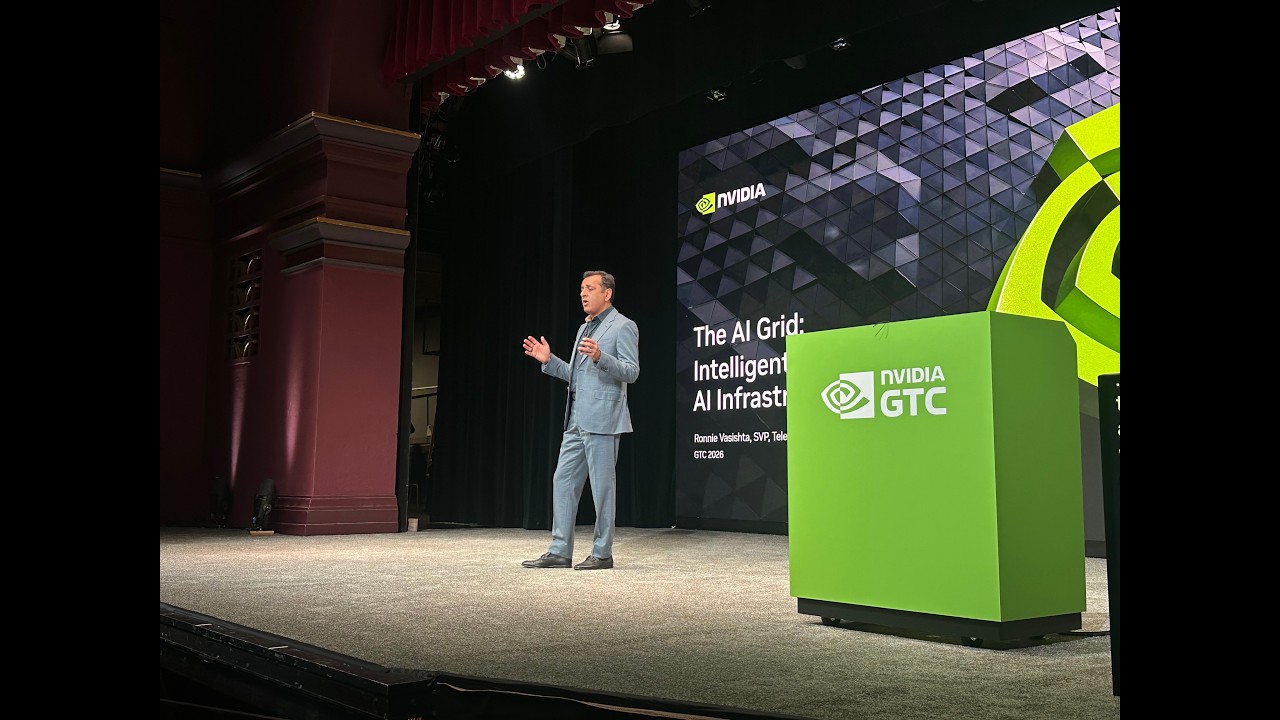
NVIDIA GTC Telecom Special Address: The AI Grid—Intelligently Connecting AI Infrastructure — NVIDIA

NVIDIA

Telecom operators must repurpose overprovisioned real estate and radio networks into distributed accelerated compute nodes because network monetization is pivoting away from transmitting data bits toward delivering low-latency AI tokens.

AI-assisted summary of NVIDIA GTC Telecom Special Address: The AI Grid—Intelligently Connecting AI Infrastructure — original source. Check the original for full context.

Source published:

Key ideas

  • NVIDIA positions the "AI Grid" as a massive physical infrastructure buildout led by telcos, cable MSOs, and CDN providers to connect physical-world endpoints and deploy intelligence at the edge. (0:06)
  • Telco monetization is shifting from raw bandwidth to tokenomics, where infrastructure value is defined by time-to-first-token (TTFT), uplink token processing, and tokens per second (TPS). (12:20)
  • Major operators and partners including AT&T, Cisco, Comcast, Spectrum, and Akamai are already deploying production AI Grid solutions utilizing NVIDIA RTX 6000 Ada Server Edition GPUs. (19:13)
  • The AI-RAN Alliance has expanded to approximately 150 members, unifying cellular baseband and third-party AI inference workloads onto shared accelerated compute architectures. (23:27)
  • 6G is being engineered natively in simulation using tools like the NVIDIA Aerial Omniverse digital twin, supported by over 7,000 members in NVIDIA's 6G developer program. (35:55)

Detailed notes

## Background Published on YouTube by NVIDIA on March 24, 2026, this video captures the NVIDIA GTC 2026 Telecom Special Address delivered by NVIDIA Telecom SVP Ronnie Vasishta. According to the page description, the talk examines how telecommunications carriers can construct a distributed AI grid to enable new AI services, offering a first look at NVIDIA's reference architecture, optimal edge AI applications, and early industry partners.

## TL;DR Ronnie Vasishta presents the AI Grid as the critical physical infrastructure layer connecting centralized cloud compute with real-world edge devices, calling on telecommunications carriers, cable operators, and CDNs to seize a generational commercial reset. The address outlines the industry's economic shift from routing raw data bytes to tokenomics, demonstrating how edge small language models and vision AI outperform centralized clouds in latency, cost, and concurrency. Vasishta showcases active deployments with partners including AT&T, Cisco, Comcast, Spectrum, and T-Mobile, detailing the integration of AI workloads directly onto cellular base stations via AI-RAN. Looking toward the future, he presents design commitments for an open and secure 6G standard, supported by the NVIDIA Aerial Omniverse digital twin platform for simulating AI-native wireless networks before physical deployment.

## Atmosphere & style The address carries an urgent, evangelizing keynote atmosphere, framing edge AI infrastructure as a critical inflection point that a historically cautious telecom industry must aggressively capture. Vasishta speaks with authoritative directness and strategic optimism, challenging network operators while systematically demonstrating how their existing real estate and power can be monetized. Polished architectural diagrams, split-screen latency demonstrations, and city-scale Omniverse simulations provide a sleek, high-tech showcase aesthetic that blends executive-level corporate strategy with concrete engineering progress.

## Bulletin - [00:06](https://www.youtube.com/watch?v=cxiOhp9BJTs&t=6s) NVIDIA positions the "AI Grid" as a massive physical infrastructure buildout led by telcos, cable MSOs, and CDN providers to connect physical-world endpoints and deploy intelligence at the edge. - [12:20](https://www.youtube.com/watch?v=cxiOhp9BJTs&t=740s) Telco monetization is shifting from raw bandwidth to tokenomics, where infrastructure value is defined by time-to-first-token (TTFT), uplink token processing, and tokens per second (TPS). - [19:13](https://www.youtube.com/watch?v=cxiOhp9BJTs&t=1153s) Major operators and partners including AT&T, Cisco, Comcast, Spectrum, and Akamai are already deploying production AI Grid solutions utilizing NVIDIA RTX 6000 Ada Server Edition GPUs. - [23:27](https://www.youtube.com/watch?v=cxiOhp9BJTs&t=1407s) The AI-RAN Alliance has expanded to approximately 150 members, unifying cellular baseband and third-party AI inference workloads onto shared accelerated compute architectures. - [35:55](https://www.youtube.com/watch?v=cxiOhp9BJTs&t=2155s) 6G is being engineered natively in simulation using tools like the NVIDIA Aerial Omniverse digital twin, supported by over 7,000 members in NVIDIA's 6G developer program.

## Key takeaways - [00:06](https://www.youtube.com/watch?v=cxiOhp9BJTs&t=6s) The generative AI revolution requires a new physical deployment layer—the AI Grid—to deliver low-latency intelligence from centralized cloud centers out to edge users. - [03:23](https://www.youtube.com/watch?v=cxiOhp9BJTs&t=203s) The convergence of accelerated computing, physical AI, and AI-native 6G enables the merger of proprietary telecom stacks into standard accelerated compute architectures. - [08:10](https://www.youtube.com/watch?v=cxiOhp9BJTs&t=490s) Telecom carriers possess unique real estate and power assets across central offices, PoPs, and base stations that provide an unreplicable foundation for regional AI factories. - [12:20](https://www.youtube.com/watch?v=cxiOhp9BJTs&t=740s) Network economics are fundamentally evolving from delivering raw data bits to monetizing token delivery performance and compute-aware latency management. - [15:16](https://www.youtube.com/watch?v=cxiOhp9BJTs&t=916s) Vision-language models running on local edge grids eliminate cloud network jitter and conversational latency for real-time video personalization and voice bots. - [19:13](https://www.youtube.com/watch?v=cxiOhp9BJTs&t=1153s) Cisco announced the Cisco AI Grid with NVIDIA RTX 6000 GPUs, collaborating with AT&T to upgrade municipal IoT networks into an Internet of Intelligent Things. - [19:13](https://www.youtube.com/watch?v=cxiOhp9BJTs&t=1153s) Comcast, Spectrum, and Akamai are deploying distributed edge compute to power local SMB assistants, 3D media rendering hubs, and global generative AI workloads. - [23:27](https://www.youtube.com/watch?v=cxiOhp9BJTs&t=1407s) AI-RAN consolidates cellular protocol processing and enterprise AI inference onto a single platform managed through an SLA-aware orchestrator. - [25:31](https://www.youtube.com/watch?v=cxiOhp9BJTs&t=1531s) T-Mobile is applying NVIDIA Metropolis and Video Search and Summarization blueprints over AI-RAN to accelerate municipal traffic incident response by 5x in San Jose. - [25:31](https://www.youtube.com/watch?v=cxiOhp9BJTs&t=1531s) Indosat Ooredoo Hutchison operates as an NVIDIA Cloud Partner in Indonesia to build sovereign AI models and distribute applications across rural populations. - [30:29](https://www.youtube.com/watch?v=cxiOhp9BJTs&t=1829s) The AI Grid reference architecture relies on an intent-based control plane that dynamically balances workloads across edge sites according to cost, latency, and availability. - [33:32](https://www.youtube.com/watch?v=cxiOhp9BJTs&t=2012s) 6G development must be governed by open, secure, and software-defined standards to support integrated environmental sensing across hundreds of billions of devices. - [37:55](https://www.youtube.com/watch?v=cxiOhp9BJTs&t=2275s) NVIDIA's Aerial Omniverse digital twin enables developers to simulate and calibrate AI-native wireless networks from antenna physics to city-scale environments prior to physical deployment.

## Detailed walkthrough ### [00:06](https://www.youtube.com/watch?v=cxiOhp9BJTs&t=6s) The AI Revolution and the Birth of the AI Grid

Kicking off the second day of NVIDIA GTC with a dedicated telecom address, Ronnie Vasishta frames the moment as critical for the telecommunications sector. Three years into the generative AI revolution, colossal investments have poured into hyperscale IT and cloud data centers. However, Vasishta asserts that the industry has arrived at a pivotal turning point requiring an entirely new layer of physical buildout: an infrastructure designed to connect the physical world and deploy artificial intelligence directly into the hands of end users at scale.

This emerging architecture—termed the **AI Grid**—falls squarely on the shoulders of telecommunications carriers, cable MSOs (multiple-system operators), and CDN (content delivery network) providers. Acknowledging that the ubiquitous rush of AI can feel “everything, everywhere, all at once” and even slightly overwhelming, Vasishta challenges the audience directly. The telecom sector, historically known for deliberateness and burdened by heavy regulatory frameworks, cannot afford to hesitate while tech newcomers achieve multibillion-dollar market caps overnight and established firms experience unprecedented growth.

> “The telecom industry cannot let this opportunity pass. This represents the greatest generational opportunity for telecoms, and we cannot let this moment pass.” — Ronnie Vasishta

- Three years into the AI boom, infrastructure buildout must shift toward edge deployment and physical-world connectivity. - Responsibility for constructing the AI Grid lies with telcos, cable MSOs, and CDN providers. - The opportunity presents a generational commercial reset for an industry traditionally bound by slow deployment cycles and regulation.

---

[03:23](https://www.youtube.com/watch?v=cxiOhp9BJTs&t=203s) Three Tectonic Forces and the Convergence of Compute Stacks

The emergence of the AI Grid is accelerated by three distinct, converging macro forces. The first is the structural shift from 60 years of general-purpose CPU computing to GPU-accelerated computing, yielding a million-fold performance increase across the past decade. The second is the evolutionary trajectory of AI itself—advancing rapidly from perception AI to generative AI, and now bridging into physical AI deployed into real-world operational environments. The third force, often underappreciated, is the transition from 5G to 6G wireless standards. Unlike prior mobile generations, 6G is being architected natively from its inception to serve as the ubiquitous connectivity fabric for distributed AI.

Historically, telecommunications relied on an inflexible compute stack: custom silicon coupled to bespoke, proprietary software stacks. Meanwhile, general-purpose enterprise and cloud compute stacks lacked the deterministic performance to virtualize complex telecom workloads successfully. Accelerated computing finally breaks this barrier, allowing the telco stack to merge directly into the standard accelerated AI stack. This convergence introduces new operating paradigms such as AI RAN (running radio access network functions and AI workloads on the same physical infrastructure), software-defined agentic operational workflows, and real-time deterministic application execution.

> “6G is being born in the era of AI. This is the first time we are able to build an AI native 6G and deploy 6G to be the fabric of AI.” — Ronnie Vasishta

```mermaid flowchart TD accTitle: Convergence of Telco and AI Compute Stacks accDescr: Diagram showing legacy isolated stacks merging via accelerated compute into a unified AI Grid architecture.

subgraph Legacy["Historical Compute Stacks"] direction TB L1["Custom Telco Silicon + Bespoke Software"] L2["General-Purpose CPU / Enterprise Cloud"] end

subgraph Converged["Unified AI & Telco Stack (Accelerated Compute)"] direction TB C1["Software-Defined AI-RAN Workloads"] C2["Agentic AI Network Operations"] C3["Real-Time Deterministic Edge Applications"] end

Legacy -->|"Accelerated Compute Convergence"| Converged ```

- **Force 1:** Accelerated computing delivering a 1,000,000× performance leap over 10 years. - **Force 2:** The evolution of AI models: Perception AI $\rightarrow$ Generative AI $\rightarrow$ Physical AI in the real world. - **Force 3:** AI-native 6G engineered to be the physical interconnect fabric for distributed intelligence. - NVIDIA CEO Jensen Huang recognized this trajectory early, noting that AI represents the largest infrastructure buildout in human history, with telecommunications standing directly next in line.

---

[08:10](https://www.youtube.com/watch?v=cxiOhp9BJTs&t=490s) Repurposing Real Estate, Power, and the Rise of Telco AI Factories

Telcos and cable operators hold a foundational real estate and infrastructure advantage that hyperscalers cannot easily replicate: existing land, power, shell facilities, and fiber backhaul. This vast footprint spans central offices, points of presence (PoPs), regional edge centers, and thousands of cell tower base stations. Much of this footprint was engineered for voice, video, and best-effort data traffic, leaving substantial overprovisioned headroom in power and physical capacity—resources that are now at an extreme premium for power-constrained AI workloads.

This base layer serves as the foundation for the AI Grid, with forward-leaning network operators already executing on sovereign and regional AI deployments. Across the globe, 24 telecommunications providers have already stood up dedicated AI factories as official NVIDIA Cloud Partners (NCPs). Because telcos maintain long-standing regulatory trust, direct connectivity into enterprise premises, and consumer reach, they are uniquely positioned to host localized, sovereign AI models tailored to national languages, cultural nuances, academic research, and sensitive public-sector services.

> “When you have a distributed infrastructure, the orchestration of that infrastructure is essential. And again, new opportunities are being created by companies that are able to now look at SLA aware orchestration.” — Ronnie Vasishta

- Telco physical infrastructure (land, power, shell, PoPs, and central offices) provides the deployment baseline for edge AI. - Existing central offices and base stations carry latent, overprovisioned power suitable for distributed accelerated hardware. - 24 global telcos have operational deployments as NVIDIA Cloud Partners (NCPs), delivering sovereign AI infrastructure for enterprise, civic, and academic institutions. - Multi-tier edge architectures necessitate SLA-aware orchestration layers to automate workloads across distributed nodes.

---

[12:20](https://www.youtube.com/watch?v=cxiOhp9BJTs&t=740s) Tokenomics: The New Monetization Currency of Distributed Networks

Moving to the economic core of the thesis—what Vasishta labels “the money slide”—the talk addresses the perennial industry question: *“What is the killer app?”* In the AI era, network monetization shifts away from raw bandwidth and byte transmission toward **tokenomics** and edge token generation. The commercial value of a distributed network stems from serving workloads whose economic utility depends on specific token metrics: time-to-first-token (TTFT), uplink token processing, and tokens per second (TPS).

Where telecommunications networks once routed and sliced raw data bits over the air and through switches, the AI Grid must now perform token-aware routing and compute-aware latency management. Achieving deterministic low latency is no longer just a networking task; it requires co-design with accelerated compute. For example, keeping environmental models pre-warmed within GPU KV (Key-Value) cache allows immediate anomaly detection on incoming edge sensor streams without cold-start compute penalties. This architectural cohesion between compute, cache, and wireless transport unlocks the concurrency needed to serve millions of simultaneous subscribers with guaranteed quality of experience (QoE).

> “Bits over-the-air convert to tokens over-the-air. Bits through the infrastructure through the switches, through the routers, through the overall infrastructure convert to tokens.” — Ronnie Vasishta

- **The Shift to Tokenomics:** Monetization pivots from selling raw megabytes to guaranteeing token delivery performance (time-to-first-token, uplink tokens, tokens per second). - **Token-Aware Routing:** Switches, routers, and radio fabrics evolve from standard packet forwarding to token-aware traffic management. - **Compute-Assisted Latency:** Utilizing distributed GPU memory and KV caching to instantly process physical-world anomaly detection and vision AI pipelines. - **Mass Concurrency:** Edge AI deployments must handle concurrent inference streams across hundreds of thousands or millions of users while enforcing strict service level agreements.

[15:16](https://www.youtube.com/watch?v=cxiOhp9BJTs&t=916s) Vision AI, Low Latency, and the Power of Proximity

Ronnie Vasishta identifies Vision AI as one of the fastest-growing application spaces across edge computing. Deploying vision-language models (VLMs) directly into the network gives systems the ability to handle massive concurrency while triggering real-time actions straight from live camera feeds. Because the VLMs interpret the video autonomously, human monitoring becomes unnecessary: “Again, nobody needs to watch these applications. The vision language models take care of that.” This architecture unlocks substantial commercial opportunities, spanning hyper-personalized content streams and new digital advertising revenue models.

To demonstrate the concrete benefits of moving compute from the centralized cloud to a distributed grid, Vasishta presents a side-by-side comparison of an SMB auto-repair customer service voice bot created by partner Personal AI. When running against a large language model (LLM) hosted in the cloud, interactions suffer from noticeable delays between the user asking a question and receiving an answer. When the identical application is optimized into a small language model (SLM) and executed on the local AI grid, latency drops dramatically, delivering instantaneous, natural-sounding voice dialogue alongside a significant reduction in serving cost.

```mermaid flowchart LR accTitle: Cloud LLM vs Grid SLM Architecture accDescr: Diagram comparing high-latency cloud LLMs against low-latency small language models running on the distributed AI grid. subgraph Cloud["Centralized Cloud"] A["SMB Audio Query"] --> B["Cloud-based LLM"] B --> C["High Latency & High Serving Cost"] end subgraph Grid["Distributed AI Grid"] D["SMB Audio Query"] --> E["Local Edge SLM"] E --> F["Sub-millisecond Latency & Lower Cost"] end ```

A second demonstration highlights real-time video personalization and product ad insertion under heavy concurrent user loads. In the public cloud, network jitter causes severe frame rate drops once the stream hits concurrency thresholds where software mitigation can no longer compensate. Conversely, running that same personalization workload on the edge grid maintains rock-solid frame rates and smooth ad insertion, proving that physical proximity to the end user completely eliminates edge jitter bottlenecks.

- Vision AI enables real-time camera inference without requiring human supervisors. - Running optimized SLMs on the edge grid provides near-zero conversational latency compared to cloud-hosted LLMs. - Edge video personalization maintains high frame rates under massive concurrency, avoiding the frame drops seen in cloud delivery.

---

[19:13](https://www.youtube.com/watch?v=cxiOhp9BJTs&t=1153s) Industry Implementations: AT&T, Cisco, Comcast, Spectrum, and Akamai

Vasishta emphasizes that the AI grid has progressed far beyond lab experimentation, with Tier-1 carriers and infrastructure providers deploying it commercially. AT&T is collaborating with Cisco and NVIDIA to upgrade its nationwide IoT footprint—which encompasses hundreds of millions of connected devices and connected vehicles—into an "IoIT," or Internet of Intelligent Things. Cisco is supporting this rollout by announcing the Cisco AI Grid, a zero-trust, on-demand full-stack solution integrating NVIDIA RTX 6000 Ada Generation Server Edition GPUs inside Cisco UCS servers. The initial production deployment is active in Dallas, leveraging vision-language models for edge-based municipal public safety operations.

Other major broadband and edge operators are actively operationalizing their edge real estate:

* **Comcast:** Leveraging its edge footprint spanning 65 million customer locations, Comcast works alongside Personal AI and Descartes to place compute within single-digit milliseconds of households. This setup delivers hyper-personalized ad streams directly to consumer video feeds and equips small and medium businesses with responsive local AI assistants. * **Spectrum (Charter Communications):** Targeting high-end media creation, Spectrum is converting thousands of local hubs and headends located within 10 milliseconds of film and creative studios. Powered by NVIDIA RTX 6000 Server Edition GPUs, the edge network offers a cost-effective alternative for complex 3D graphic rendering and ultra-low-latency studio collaboration. * **Akamai:** With 4,400 distributed edge inference points around the world, Akamai is unifying its footprint under a global AI orchestration platform. This orchestration layer enforces SLA-aware and QoS-aware distribution of generative AI applications and live streaming workloads globally.

---

[23:27](https://www.youtube.com/watch?v=cxiOhp9BJTs&t=1407s) The Convergence of AI and the Radio Access Network (AI-RAN)

Transitioning back to wireless infrastructure, Vasishta details how accelerated compute has fundamentally transformed the Radio Access Network. Whereas legacy general-purpose x86 hardware struggled to virtualize intensive cellular baseband workloads, accelerated computing spurred the creation of AI-RAN. Backed by the 150-member AI-RAN Alliance, this paradigm integrates three core pillars: AI for RAN (optimizing radio parameters with neural networks), AI and RAN (sharing compute resources on identical nodes), and AI on RAN (hosting third-party enterprise AI inference workloads directly over network edges).

```mermaid flowchart TD accTitle: Unified AI-RAN Workload Orchestration accDescr: Orchestration layer managing both cellular radio workloads and edge AI inferencing over common accelerated nodes. A["Single Pane of Glass: SLA & KPI-Aware Orchestrator"] --> B["Accelerated Edge Infrastructure"] subgraph Compute["NVIDIA Accelerated Computing Node"] B --> C["RAN Software Workload (Nokia / Ericsson)"] B --> D["Physical AI & Vision Inference (NVIDIA Metropolis)"] end Compute --> E["Optimized Quality of Service (QoS) & Experience (QoE)"] ```

By consolidating these functions into an orchestration architecture managed through a single pane of glass, operators can dynamically allocate compute cycles between real-time radio protocol stacks and containerized AI tasks, resulting in high infrastructure utilization and guaranteed quality of service: “So, now when you bring service level agreement and KPI aware orchestration into a single pane of glass, and you add radio access network in top of that, you get a very highly utilized network that can deliver quality of experience and quality of service on demand.”

- The AI-RAN Alliance now counts around 150 ecosystem participants advancing accelerated telco compute. - Centralized GPU infrastructure processes telecommunications workloads alongside commercial AI inference on a single platform. - Service-level agreement (SLA) awareness balances real-time cellular scheduling and enterprise processing demands dynamically.

---

[25:31](https://www.youtube.com/watch?v=cxiOhp9BJTs&t=1531s) T-Mobile’s Physical AI Grid and Indosat’s Sovereign AI Grid

Building on the AI-RAN model, Vasishta announces that T-Mobile is officially integrating physical AI applications across its AI-RAN-ready network footprint. Stemming from validation work with Nokia and Ericsson inside the T-Mobile AI-RAN Innovation Center, T-Mobile has broadened its ecosystem to integrate external application developers via the NVIDIA Metropolis framework. In a deployment across traffic intersections in the city of San Jose, T-Mobile utilizes the NVIDIA Video Search and Summarization (VSS) Blueprint to identify traffic incidents and trigger agentic response workflows with a 5x improvement in reaction speed. Independent software vendors integrating into this ecosystem include: - FogSphere - Levatas - Linker Vision - Vaido

Turning to emerging markets, Vasishta showcases Indosat Ooredoo Hutchison (IOH) in Indonesia as a premier example of building an inclusive sovereign AI grid. Indonesia’s geography—an archipelago characterized by lower average revenue per user (ARPU)—presents a unique connectivity and computing challenge. To bridge the digital divide, IOH operates as an NVIDIA Cloud Partner (NCP) and runs local NVIDIA AI Technology Centers to train foundational models across regional dialects. These models power the public-facing Sahabat-AI platform, distributing critical applications in education, healthcare, and agriculture to rural populations. Linking large-scale AI factories to distributed regional AI edge sites delivers sovereign capabilities at an accessible unit cost.

Looking forward to the broader system components, Vasishta summarizes that the vision relies on a cohesive integration of server-grade GPUs, end-to-end orchestration, and specialized software runtimes that bridge central factories directly to the physical network edge.

[30:29](https://www.youtube.com/watch?v=cxiOhp9BJTs&t=1829s) Reference Architecture and the Living AI Grid

NVIDIA’s reference architecture is designed to provide original equipment manufacturers (OEMs) and telecom customers with an immediate pathway to deploy distributed AI infrastructure. Addressing the software layer, Ronnie Vasishta points out that open-source models released by NVIDIA are enabling developers to rapidly create and operationalize new applications across telecom footprints. This standardized framework has catalyzed an expanding partner ecosystem, uniting established industry incumbents and new software innovators who are integrating their full application and orchestration layers directly into the reference design. As Vasishta explains: “This is our reference architecture to give those app to give those OEMs, to give the customers a rapid on-ramp into the deployment of the AI grid.”

```mermaid flowchart TD accTitle: AI Grid Workload Orchestration accDescr: Diagram showing how the AI Grid control plane routes workloads across distributed edge sites based on intent priorities. subgraph Inputs["Inbound Workloads"] V["Real-time Video Feeds"] R["Physical AI & Robotics"] end

subgraph ControlPlane["AI Grid Control Plane"] CP["Intent Evaluation Engine<br/>Latency, Cost, Availability"] end

subgraph DistributedSites["Distributed Edge Sites"] Edge1["Site A: Low-Latency Inference<br/>Traffic & Safety Insights"] Edge2["Site B: Heavy Compute Offload<br/>Robot Planning & Speech"] Learn["Self-Learning Feedback Loop<br/>Bottleneck Anticipation"] end

V --> CP R --> CP CP --> Edge1 CP --> Edge2 Edge1 -.-> Learn Edge2 -.-> Learn Learn -.->|"Shift Capacity"| CP ```

A video presentation illustrates how this infrastructure operates as a unified, orchestrated computing platform. As inference demands escalate, maintaining responsiveness and cost efficiency requires moving compute directly to where data originates. Within the AI grid, an intelligent control plane continuously evaluates workload intent—balancing constraints such as latency, cost, and availability across neighboring edge facilities. Municipal cameras processing live feeds for public safety and traffic management are transformed into immediate local insights, while physical AI endpoints such as autonomous robots offload computationally intensive speech recognition and motion-planning algorithms to the nearby grid. This dynamic load balancing prevents GPUs from sitting idle and continuously optimizes cluster utilization, allowing the grid to learn traffic patterns over time, predict localized bottlenecks, and autonomously recommend capacity adjustments. As the presentation concludes, “With NVIDIA platforms, the network becomes a living AI grid, putting Telcos and distributed cloud providers at the heart of how AI is experienced everywhere.”

- The AI grid control plane dynamically balances workload priorities across nearby distributed sites based on latency, operating costs, and compute availability. - Physical AI systems offload heavy processing to edge sites, allowing robots to remain lighter, more agile, and less hardware-constrained. - Feedback loops enable the grid to learn from ongoing traffic profiles, actively predicting network bottlenecks and reallocating capacity.

---

[33:32](https://www.youtube.com/watch?v=cxiOhp9BJTs&t=2012s) Defining 6G: Open, Secure, and Trusted Principles

Looking ahead two to three years and beyond, Vasishta highlights 6G as a critical inflection point for wireless infrastructure. Connecting hundreds of billions of diverse endpoints—spanning IoT sensors, autonomous machines, and human interfaces—will require an integrated connectivity fabric that makes the network fully aware of environmental demands. While foundational steps can be taken using 5G and 5G-Advanced, Vasishta argues that fundamental shifts such as integrated sensing, superior spectral efficiency, and elevated performance key performance indicators (KPIs) cannot be achieved on legacy frameworks alone, noting: “That cannot happen on 5G and 5G Advanced.”

To prevent the next generation of mobile architecture from repeating historical missteps, Vasishta emphasizes that 6G must be governed by foundational design principles rather than proprietary, vertically integrated stacks. Innovation requires open, software-defined architectures where hardware and software layers can be iterated independently. Furthermore, end-to-end security and transparent, trustworthy software supply chains are paramount given the sheer volume of critical devices dependent on the network. To anchor these standards, NVIDIA collaborated with operators, equipment manufacturers, and governmental bodies to establish a formal industry alliance, which Vasishta announced at Mobile World Congress (MWC): “So, what we did, together with a group of other very very um names that you'll recognize, operators as well as the equipment providers, as well as some um uh government entities, we decided that we needed to come together to create this commitment that 6G will be built open, secure, and trusted.”

- 6G functions not merely as a communication link, but as an environmental sensor capable of delivering contextual network intelligence. - Open, software-defined stacks replace rigid, vertically integrated legacy telecom models to accelerate third-party software development. - The open, secure, and trusted 6G industry commitment was ratified by telecom operators, equipment providers, and government entities ahead of MWC.

---

[35:55](https://www.youtube.com/watch?v=cxiOhp9BJTs&t=2155s) The AI-RAN Ecosystem and Democratizing Wireless Research

Demonstrating the transformation in telecom compute, Vasishta displays the expanding lineup of NVIDIA AI-RAN computing platforms, noting that an unprecedented cohort of radio access network vendors are now actively writing and deploying software across these systems. Whether scaling from compact edge nodes to large-scale carrier configurations, all AI-RAN machines execute the identical software stack, libraries, and generative models, reflecting the structural shift toward accelerated computing across the industry. Gesturing to the breadth of vendor participation, Vasishta tells the audience: “Look at this slide and you will never have seen a slide before like this in decades.”

NVIDIA frames this development methodology around the concept of "three computers": one system for software development and model training, one for physics-based simulation, and one for operational real-world deployment. Two years prior, NVIDIA launched its 6G developer initiative to dismantle traditional research barriers through open, software-driven tools. That democratization effort has expanded into a worldwide community, demonstrating substantial momentum across global telecom labs and industry forums. As Vasishta highlights: “Two years from today, from when we announced the 6G developer program, we are at over 7,000 members in the 6G developer program.”

- The NVIDIA AI-RAN hardware family maintains binary software and model compatibility across small and large deployments. - The 6G developer program has amassed over 7,000 active members within two years of its inception. - Over 50 live demonstrations powered by NVIDIA's wireless platforms were showcased at the previous Mobile World Congress. - NVIDIA Sionna, the open-source link-level simulator featuring GPU-accelerated ray tracing extensions, has surpassed 375,000 downloads.

---

[37:55](https://www.youtube.com/watch?v=cxiOhp9BJTs&t=2275s) NVIDIA Aerial Omniverse Digital Twin and the Generational Telco Opportunity

As the industry enters the physical AI era, 6G must scale to coordinate interactions between billions of people, autonomous robots, and software agents. Because AI-native wireless networks cannot be adequately validated using conventional laboratory testbenches, NVIDIA developed the Aerial Omniverse digital twin platform. This modular, ecosystem-ready environment allows engineers to simulate, calibrate, and optimize wireless stacks inside a physics-accurate virtual replica of the world before modifying live operational networks. High-fidelity digital twins test massive MIMO beamforming schemes and cell site layouts early in the engineering pipeline, while site-specific ray-tracing models ingest real-world field telemetry to assess novel radio waveforms and machine-learning algorithms.

```mermaid flowchart LR accTitle: NVIDIA Aerial Omniverse Digital Twin Pipeline accDescr: Pipeline showing wireless simulation scaling from antenna physics to city-scale digital twins and closed-loop field deployment. subgraph Physics["Physics Simulation"] A["Antenna & EM Physics"] B["Site-Specific Ray Tracing"] end

subgraph ScaleSim["Scale & Autonomous Agents"] C["Single Base Station"] D["City-Scale Digital Twin"] E["Autonomous AI Agents"] end

subgraph Deployment["Live Network"] F["Continuous Cloud Deployment"] end

A --> B B --> C C --> D D <--> E D --> F F -.->|"Field Data Calibration"| B ```

The simulation pipeline extends from microscopic antenna electrodynamics up to cloud-rendered digital twins of entire metropolitan areas. Autonomous AI agents within the platform diagnose and mitigate simulated cellular anomalies in real time, validating self-healing network behavior under severe load. A showcase video outlines this paradigm shift: “With NVIDIA Aerial Omniverse digital twin, developers design, validate, and iterate AI native networks in simulation before they enter the real world.”

Reflecting on the pace of innovation achieved over just twenty-four months, Vasishta observes that while current 5G and 5G-Advanced systems can readily run inside these digital twins, the next generation will be fundamentally conceived in software: “Of course, you can run 5G, 5G advanced in these simulations as well, but 6G will be born in simulation.” In his closing remarks, Vasishta encourages telecom operators not to be intimidated by the scale of architectural change required to become AI-native enterprises, but rather to take immediate first steps to capture this rare window of industry transformation, concluding: “There has never been a better time to be in Telcos.”

- Full-scale electromagnetic workflows connect detailed antenna physics directly into site-specific ray tracing to validate AI-RAN signal integrity. - Aerial Omniverse simulations scale elastically in the cloud, expanding on demand from an isolated base station to an entire connected city. - Autonomous network operations are tested by deploying AI agents that diagnose and repair synthetic connectivity faults within the digital twin. - Real-world drive-test and field data are integrated back into the digital twin for scenario generation and continuous simulation calibration.

## Notable quotes > [03:23](https://www.youtube.com/watch?v=cxiOhp9BJTs&t=203s) 6G is being born in the era of AI. This is the first time we are able to build an AI native 6G and deploy 6G to be the fabric of AI. — Ronnie Vasishta

> [12:20](https://www.youtube.com/watch?v=cxiOhp9BJTs&t=740s) Bits over-the-air convert to tokens over-the-air. Bits through the infrastructure through the switches, through the routers, through the overall infrastructure convert to tokens. — Ronnie Vasishta

> [37:55](https://www.youtube.com/watch?v=cxiOhp9BJTs&t=2275s) 6G will be born in simulation. — Ronnie Vasishta

## Mentioned NVIDIA, Ronnie Vasishta, Jensen Huang, AT&T, Cisco, Comcast, Charter Communications, Spectrum, Akamai, T-Mobile, Indosat Ooredoo Hutchison, Nokia, Ericsson, Personal AI, Descartes, FogSphere, Levatas, Linker Vision, Vaido, AI-RAN Alliance, NVIDIA Cloud Partner, Cisco AI Grid, NVIDIA RTX 6000 Ada Generation Server Edition, Cisco UCS, NVIDIA Metropolis, NVIDIA Video Search and Summarization Blueprint, Sahabat-AI, NVIDIA Sionna, NVIDIA Aerial Omniverse, Mobile World Congress

## Video description At NVIDIA GTC 2026, NVIDIA Telecom SVP Ronnie Vasishta delivered the Telecom Special address, exploring how telcos can build a distributed AI grid to power new AI services and applications.

In this talk, he shares a first look at NVIDIA’s reference architecture, highlights edge AI applications that run best on this grid, and announces partners already on this journey.

Learn more about AI Grids: https://www.nvidia.com/en-us/industries/telecommunications/ai-grid/

[Source](https://www.youtube.com/watch?v=cxiOhp9BJTs)

Reading summary

NVIDIA telecom executive Ronnie Vasishta argues that artificial intelligence infrastructure must expand beyond hyperscale data centers into a distributed 'AI Grid' operated by telecommunications carriers and edge providers. Under this model, operators repurpose physical network real estate and overprovisioned power to run converged cellular and AI workloads, shifting industry monetization from raw data transit to edge token generation. Repurposing Telco Footprints for Edge Compute (8:10) According to Vasishta, the telecom sector possesses a physical real estate and power footprint that cloud hyperscalers cannot easily duplicate, encompassing central offices, points of presence, and cell base stations with latent electrical capacity. Rather than maintaining custom silicon and proprietary stacks separate from enterprise IT, accelerated computing allows operators to converge network functions and AI workloads onto shared GPU infrastructure. To date, 24 telecommunications providers operate as NVIDIA Cloud Partners, deploying sovereign and regional AI factories tailored to local enterprise data, regional languages, and public sector services. Monetizing Networks Through Distributed Tokenomics (12:20) Vasishta states that network monetization is transitioning from selling megabytes to serving 'tokenomics,' with revenue tied to performance guarantees such as time-to-first-token, uplink processing, and tokens per second. Implementing token-aware routing and GPU key-value caching at the edge enables immediate anomaly detection and processing without round-trip cloud latency. NVIDIA demonstrated this architectural shift through comparative benchmarks: running a small language model (SLM) for customer service directly on an edge grid achieved near-zero voice latency compared to cloud-hosted models. Similarly, edge-hosted vision-language models executing video personalization sustained high frame rates and ad insertion under heavy concurrency, whereas centralized cloud delivery experienced significant jitter and dropped frames. Commercial Edge Deployments and Sovereign AI (19:13) Major infrastructure providers are currently operationalizing edge grids for commercial workloads. AT&T is collaborating with Cisco to run vision-language models for municipal public safety in Dallas using RTX 6000 Ada Generation GPUs inside Cisco UCS servers. Comcast is deploying compute within single-digit milliseconds across a footprint of 65 million locations for personalized video and local business AI tools, while Charter's Spectrum is equipping hub sites within 10 milliseconds of film studios for low-latency 3D graphics rendering. Akamai is applying an SLA-aware orchestration layer across 4,400 edge locations worldwide. In emerging markets, Indosat Ooredoo Hutchison established local AI centers in Indonesia to train foundational models across regional dialects. These models support the public Sahabat-AI platform, delivering agricultural, educational, and healthcare services across an archipelagic geography with lower average revenue per user. AI-RAN Integration and Simulation-Driven 6G (23:27) Accelerated computing has enabled the AI-RAN Alliance—now comprising around 150 members—to unify cellular baseband processing with enterprise inferencing on single nodes. In San Jose, T-Mobile validated this architecture using Nokia and Ericsson software alongside NVIDIA Metropolis, achieving a fivefold improvement in traffic incident response times via automated agentic workflows. Looking toward future standards, Vasishta stated that 6G must be architected as an open, secure, and software-defined sensor fabric rather than a closed legacy stack. To support this transition, NVIDIA established an open 6G developer program that has grown to over 7,000 members, alongside the Sionna link-level simulator, which has exceeded 375,000 downloads. Additionally, NVIDIA introduced the Aerial Omniverse digital twin platform, which enables operators to simulate antenna physics, propagation ray tracing, and autonomous network-repair agents in virtual metropolitan environments before deploying updates to physical cell sites. NVIDIA contends that embracing AI-RAN, token-aware edge routing, and simulation platforms provides telecommunications providers an avenue to avoid commoditization. However, realizing this architecture requires the traditionally conservative telecom sector to overcome historical deployment inertia, adopt unified software-defined stacks, and coordinate complex multi-tenant orchestration across distributed physical footprints.

Source quotes

[3:23] Ronnie Vasishta: 6G is being born in the era of AI. This is the first time we are able to build an AI native 6G and deploy 6G to be the fabric of AI. [12:20] Ronnie Vasishta: Bits over-the-air convert to tokens over-the-air. Bits through the infrastructure through the switches, through the routers, through the overall infrastructure convert to tokens. [37:55] Ronnie Vasishta: 6G will be born in simulation.

Original transcript

[0:06] Hello everybody and welcome as Kanika [0:09] said to GTC, the second day of GTC. [0:13] We're going to be kicking off an amazing [0:16] schedule of telecom announcements. And [0:20] what I thought I would do today is take [0:24] a moment to really look at in context [0:29] some of the very exciting areas of [0:32] infrastructure build outs. Yesterday we [0:36] saw perhaps the most exciting but also [0:41] technologically advanced infrastructure [0:44] that's leading the industry. [0:46] The telecom industry cannot get left [0:48] behind this. [0:50] We are what, 3 years into the AI [0:53] revolution. [0:55] And 3 years into this AI revolution we [0:59] are now seeing some of the biggest build [1:02] outs of infrastructure, IT [1:05] infrastructure. [1:06] But I'm here to tell you [1:09] that there is now another [1:12] additional infrastructure build out that [1:14] needs to happen. [1:16] The infrastructure that connects the [1:19] real physical world [1:22] and deploys [1:25] AI infrastructure [1:27] into the hands in a large scale into the [1:30] hands of everyone. [1:34] That infrastructure [1:37] is the responsibility [1:39] of the telecoms, the co- [1:42] cable MSOs and the CDM providers to put [1:46] that infrastructure in place to take [1:49] this to the next [1:51] level. And we call this infrastructure [1:55] the AI grid. [1:58] So, it does seem, I must admit, AI is [2:03] everything, everywhere, all at once. [2:07] And I think we would be honest if we [2:10] said some of it is a little bit [2:12] overwhelming. [2:15] But, also, we know [2:19] there's tremendous opportunity. [2:23] How can an industry [2:27] that's traditionally, I would say, [2:29] hasn't been known for moving fast, [2:34] there's murmurings, maybe some of you [2:36] agree, [2:38] hasn't been known for moving fast, [2:41] not get overwhelmed by this rapid pace [2:45] of innovation and opportunity in a [2:48] highly regulated industry? We're seeing, [2:51] though, new companies being built [2:55] overnight. [2:56] Multi-billion-dollar valuations. [2:59] We're seeing older companies that have [3:01] existed for a long time experiencing [3:05] never-seen-before [3:07] growth. The telecom industry cannot [3:10] let this opportunity pass. This [3:13] represents the greatest generational [3:16] opportunity for telecoms, and we cannot [3:20] let this moment pass. [3:23] So, think about this in context. [3:29] There are three tectonic forces at play. [3:34] We've heard a lot already about [3:38] the transition from general-purpose [3:41] compute to accelerated compute. [3:44] This [3:45] computer architecture that existed for [3:47] 60 years is rapidly being transformed, [3:51] and a million-x performance increase [3:53] over the last 10 years. [3:56] We've also now witnessed the rapid pace [4:00] of [4:01] AI [4:03] moving through [4:05] perception AI, generative AI, physical [4:09] AI. [4:10] And now into the region of [4:14] the next phase of physical AI, which is [4:17] taking physical AI AI out to the real [4:20] world. [4:22] What we haven't perhaps been so obvious, [4:26] or what hasn't been so obvious, is the [4:28] third tectonic force that's happening. [4:31] And why isn't it obvious? Because it [4:33] doesn't really seem like a tectonic [4:36] change that's happening. We're moving [4:39] from 5G to 6G. [4:42] Does that really seem like a massive [4:44] change? [4:47] If your answer is no, [4:49] you haven't been listening and aware of [4:51] what's going on. [4:53] 6G is being born in the era of AI. [4:59] This is the first time [5:02] we are able to build an AI native 6G [5:06] and deploy 6G to be the fabric of AI. [5:13] Now you understand why these three [5:15] forces create a new trajectory [5:20] for telecommunications. [5:22] An unprecedented trajectory. And as I [5:25] said, a generational opportunity. [5:30] Jensen recognized this a while ago [5:33] when he said [5:35] AI is redefining computing [5:38] and driving the largest infrastructure [5:40] build out in human history. [5:43] And [5:45] added [5:46] and telecommunications is next. [5:50] That was very, very perceptive about the [5:52] how these three forces are coming [5:54] together. [5:57] But, let's take a step back. [5:58] Traditionally, over the last few [6:00] decades, [6:02] the compute stack [6:05] for telecommunications [6:07] has essentially remained the same. [6:11] Purpose-built [6:13] on custom silicon [6:15] with custom software. [6:19] The alternative compute stack that's [6:22] formed the basis of the cloud industry, [6:26] which is the general-purpose compute [6:28] stack, hasn't really had the capability [6:33] to support the telecommunications [6:34] compute stack. There have been attempts, [6:37] of course. [6:38] We know [6:40] there have been many attempts to [6:41] virtualize that telecommunication stack. [6:44] But, now, [6:46] with accelerated compute [6:49] and the benefits of accelerated compute, [6:53] we are able to, for the first time, [6:56] merge the telecommunication stack [7:00] into [7:02] the AI stack. [7:05] This is now creating not just [7:09] opportunities, [7:11] but also completely new KPIs for the [7:14] industry. [7:16] We are now talking about, in the concept [7:19] of AI RAN, running RAN and AI on the [7:23] same infrastructure. [7:25] Having the ability to have agentic flows [7:28] within the AI operations, because now [7:31] the RAN is all software-defined. [7:34] And you're able to operate in a [7:37] deterministic way, real-time, at scale, [7:40] app- application deployment. [7:44] This convergence of the compute stack [7:47] has never been never happened before and [7:50] there will be unicorns built overnight [7:52] because of this capability. [7:57] Should I say that again? [7:59] For the telecommunications people in the [8:00] audience, it's really important to [8:03] understand how important this change and [8:07] how to take advantage of this change. [8:10] Let me take a moment to just look at [8:13] this bottom layer of the [8:15] telecommunications stack. The [8:19] land power shell infrastructure layer. [8:22] And as it moves into the AI stack. [8:28] Telcos, MSOs, CDNs have a unique [8:33] advantage on that bottom layer. [8:35] That bottom layer already in many cases [8:38] exists. [8:40] Land power shell is something that this [8:43] industry has a tremendous capability and [8:47] know-how on how to build and add [8:50] connectivity to land power shell. [8:54] That's the basis of the deployment of [8:57] communications. [8:59] This footprint spans MSOs, central [9:03] offices, point of presence and even out [9:06] to the radio base stations. [9:08] Built and [9:10] reliably today predominantly for voice, [9:14] video and data. [9:16] This infrastructure, this base layer [9:20] infrastructure is what evolves into the [9:23] into the foundational layer of the AI [9:26] grid. [9:27] And some [9:29] telcos around the world are already [9:32] starting to deploy this AI grid. [9:37] As we're going through this learning, [9:39] we're learning a lot about how that [9:41] application layer needs to connect to [9:43] the rest of the stack. [9:46] But we're also learning about the [9:48] importance of orchestration. [9:52] One of those layers, remember, is the [9:54] infrastructure layer. [9:57] When you have a distributed [9:58] infrastructure, the orchestration of [10:00] that infrastructure is essential. [10:03] And again, new opportunities are being [10:06] created by companies that are able to [10:08] now look at SLA aware orchestration. [10:15] Let's take a look. [10:17] Don't believe me. Let's look at firstly, [10:20] 24 telcos around the world are already [10:25] building AI factories. [10:30] Telcos have a very important role [10:33] because they're trusted [10:35] in their regions. [10:37] They also have connectivity to the [10:39] population. [10:41] They also have connectivity to the [10:43] enterprises. [10:45] And what we are now starting to see, all [10:48] of those value propositions play in the [10:51] important role on the telco, as we call [10:54] telco NCP. [10:56] The telco NVIDIA cloud partners. As I [10:59] said, 24 telcos around the world are [11:01] doing this and many of them are moving [11:03] into the next phases of deployment, [11:05] having already built a successful [11:07] business line on their first phases. [11:11] These platforms are supporting local [11:13] languages, local cultures, um [11:16] higher education, research, government [11:18] services, many of those applications [11:21] that are trusted on the infrastructure. [11:24] Now, as I said earlier, [11:28] what's also [11:29] very clear [11:32] is that there is a large distributed [11:34] infrastructure that exists today. [11:38] What many of you may know also [11:41] is much of that infrastructure is over [11:43] provisioned for voice, video, and data. [11:47] Meaning it has excess power. [11:51] But just the power that goes out to [11:54] those locations. [11:56] If you think about the the need for [11:58] power to drive the AI infrastructure [12:00] deployment, what a golden opportunity [12:03] this is. [12:05] For the providers of this [12:07] infrastructure. [12:08] So again, a a large massive untapped AI [12:13] opportunity [12:16] that hasn't existed before. [12:20] Now this [12:23] This is the money slide. [12:26] Literally [12:28] the money slide. [12:31] We get asked all the time [12:34] Wow, what's the killer app? [12:37] Have you heard that question? [12:40] Have you asked that question? [12:43] The ability to provide tokenomics, [12:47] tokenization [12:50] in that distributed network [12:53] of value [12:56] is very very unique to this [12:59] infrastructure. [13:01] Why? Because the value is created by the [13:05] ability to provide the [13:07] the applications that are token [13:09] dependent. [13:11] Time to first token. [13:14] Uplink tokens. [13:17] Tokens per second. [13:19] All of these have different value and I [13:22] will show you some examples [13:24] of why that value creation is so [13:27] dependent upon the network [13:30] and the ability to not just provide the [13:33] application but provide the application [13:36] with the quality of experience [13:39] and the monetization opportunity that's [13:41] important. Yes, over-the-air network [13:44] slicing has a role to play. [13:47] But, tokenomics [13:49] the basis of this new economy [13:52] that we're living in today that's [13:54] driving the infrastructure decisions [13:58] is really what you should focus on. [14:00] Bits over-the-air [14:03] convert to tokens over-the-air. [14:05] Bits through the infrastructure [14:08] through the switches, through the [14:09] routers, through the overall [14:11] infrastructure [14:12] convert to tokens. [14:15] Token-aware routing, for instance. [14:18] But, these applications [14:20] deterministic latency [14:23] when you need to understand what the [14:24] latency is of the application, it's not [14:27] just the network that plays a role. It's [14:30] the compute as well. [14:33] The compute infrastructure. Imagine [14:35] being able to load up an environment [14:38] into KV cache so that that that [14:40] environment anomaly any anomaly that [14:43] happens instantly can be detected. [14:46] That's a [14:48] compute infrastructure implementation of [14:51] network latency. [14:53] These applications [14:55] concurrency [14:57] servicing a population [15:00] hundreds of thousands, millions with an [15:02] application so the quality of experience [15:05] is [15:07] correct so you can charge the money [15:09] monetization of that application. [15:12] Vision AI, I'm going to show you a [15:14] little bit of some of these examples, [15:16] but Vision AI is one of the fastest [15:19] growing [15:21] applications. [15:22] The ability to have concurrency, but [15:25] also have vision language models [15:28] deployed in the network, so that [15:31] real-time actions can be taken based [15:34] upon [15:35] what the camera [15:36] uh camera feeds are showing. Again, [15:40] nobody needs to watch these [15:42] applications. The vision language models [15:44] take care of that. [15:48] And we'll see some examples of [15:50] hyper-personalization, [15:51] and of course tapping into the ad [15:53] revenue opportunities that that that [15:56] means. [15:58] So, let me give you an example first. [16:00] What you're going to see here [16:03] is a partner that we work with, Personal [16:06] AI, [16:07] has developed an application for small [16:10] medium businesses. [16:12] This application you'll see first [16:15] running on an LLM [16:17] in the cloud. [16:19] And then you'll see the same application [16:22] that's been optimized for an SLM that's [16:26] running on the grid. [16:28] Listen to the difference in the latency [16:31] of this application. [16:33] Okay. [16:37] Hello, welcome back to Speedy Auto [16:38] Repair. How can I assist you today? [16:41] Do you service vintage cars? [16:45] We service most domestic and import [16:47] vehicles. Okay, thank you. [16:49] >> cars? Do you also offer brake services? [16:54] Yes, we have brake services. [16:57] Hello, welcome back to Speedy Auto [16:58] Repair. How can I assist you today? Do [17:01] you service vintage cars? We service [17:03] most domestic and import vehicles. Okay, [17:05] thank you. [17:06] >> cars? Do you also offer brake services? [17:09] Yes, we have brake services. [17:13] Hello, welcome back to Speedy Auto [17:15] Repair. How can I assist you today. [17:17] >> You could also see the cost [17:20] of that application based in the cloud [17:23] and based on the local infrastructure, [17:26] on the grid. [17:28] What you're going to see on the next [17:30] video [17:32] is [17:33] a personalization video. [17:36] The original [17:37] video is below. [17:39] The application is now personalizing [17:43] and you can imagine the the revenue [17:45] opportunity by personalization. [17:48] It's personalizing the video. [17:50] But what you can also see in this as I [17:54] play it, you'll see it's servicing a [17:56] large number of concurrent users. [17:59] And jitter [18:01] in the cloud is being mitigated by [18:04] software mitigation. [18:06] There's a threshold at which that jitter [18:09] as as shown by the variation of frames [18:12] per second, there's a threshold at which [18:15] the software can no longer deal with [18:17] that [18:18] mitigation. And so now you will see also [18:22] you will see that same personalization [18:26] happening on the grid. [18:29] And the proximity [18:31] just the proximity of this application [18:34] to the end user, you'll see the [18:36] difference. [18:38] Okay, let's see how it plays. [18:45] So you can see [18:47] the frames per second [18:49] you can see [18:50] the difference in jitter [18:53] on that personalization app [18:56] and on the insert of the [18:59] the product app as well and the insert [19:01] of the product into the app. [19:03] Quite remarkable just based on [19:05] proximity. [19:11] Okay. [19:13] This isn't just yet experimentation. We [19:16] have now large partners, large companies [19:20] that have recognized [19:22] this opportunity and are building this [19:26] opportunity into their businesses. [19:29] AT&T, one of the largest already has a [19:31] large connected IoT network with [19:34] hundreds of millions of connections [19:36] including [19:37] um [19:38] connected cars. [19:40] Now, AT&T, Cisco, and Nvidia are teaming [19:45] up to turn this IoT network into an IoIT [19:50] network and an internet of intelligent [19:53] things. [19:55] What we're able What What Cisco and AT&T [19:58] are able to do on the Nvidia RTX 6000 [20:03] server edition GPUs is able to [20:06] demonstrate [20:08] an end-to-end performance and security. [20:11] And in fact, Cisco are announcing their [20:14] Cisco AI grid, which is a full stack [20:18] solution that's zero trust, on-demand, [20:22] and adding those GPU RTX 6000 [20:26] server-class GPUs into their UCS [20:28] servers. The first example and use case [20:31] of this is in Dallas for public safety, [20:34] and it shows how that edge AI [20:37] action-oriented [20:39] vision language models can really [20:42] improve operational safety at scale. [20:47] Thank you. [20:52] Comcast perhaps has the largest edge [20:55] compute network reaching 65 million [20:59] locations. [21:00] Now, Comcast, through their work also [21:04] with personal AI and Descartes, have [21:06] recognized [21:08] how that proximity, just milliseconds [21:11] from their end customers, is able to now [21:15] bring in hyper-personalization [21:18] ads [21:19] into the stream out to their customers. [21:23] The same time, [21:25] SMBs, small medium businesses, can take [21:27] advantage of those personal AI [21:29] assistants. [21:30] A tremendous opportunity that Comcast is [21:33] already starting to grasp. Thank you, [21:36] Comcast. [21:42] Spectrum. [21:44] Spectrum [21:45] is working with movie makers. [21:48] Movie makers need low latency, [21:52] collaboration, [21:54] the ability to create and collaborate on [21:57] 3D, very complex rendering. [22:00] Spectrum is looking to transform [22:02] thousands of its [22:03] designs data centers and hubs, which are [22:06] all within [22:08] less than 10 milliseconds of those [22:11] studios, [22:13] and deliver a low-latency GPU-based [22:16] network, again working with NVIDIA RTX [22:19] 6000 [22:21] Pro server edition GPUs. [22:25] This is a more economical way for many [22:29] studios to have access access to [22:31] low-latency capability for rendering. [22:35] Thank you, Spectrum. [22:41] Akamai [22:42] has already [22:44] announced how they have 4400 locations [22:48] around the world on their distributed AI [22:52] inference at the edge. [22:54] And many of those locations now, they [22:57] are bringing into their global AI [23:00] orchestration capability. [23:04] Global AI orchestration is required to [23:07] enable SLA aware distribution of content [23:11] and SLA aware [23:13] application distribution. [23:16] This is a blueprint [23:18] that Akamai want to deploy around the [23:21] world. Thank you, Akamai. [23:27] And now, let's turn our attention a [23:30] little bit to something I said earlier. [23:33] The radio access network. [23:37] Many telecom operators around the world [23:40] have recognized [23:42] the disrupt the the changes that are [23:45] happening in this infrastructure. [23:48] As I said before, [23:51] general purpose compute [23:53] wasn't really capable of virtualization. [23:57] With accelerated compute, AI RAN was [24:00] born. [24:02] AI RAN, many about 150 [24:06] companies around the world as part of [24:08] the AI RAN Alliance, I encourage you to [24:10] go see the booth of AI RAN Alliance in [24:12] the on the expo floor, have already [24:14] started to demonstrate significant [24:17] advantages and benefits that they're [24:19] seeing in AI for RAN, AI and RAN, and AI [24:25] on RAN. [24:26] Of course, as you saw earlier, not all [24:28] the distributed sites will be RAN [24:32] capable, [24:33] but many many and an increasingly number [24:36] of more are as operators move to an AI [24:40] RAN infrastructure. [24:43] AI RAN, of course, enables RAN to run [24:46] alongside [24:48] the AI application. And there tremendous [24:51] benefits to enable them to do that. [24:53] Here, what you're seeing is actually a [24:57] grid of AI of distributed sites that can [25:00] be orchestrated. [25:02] And one of the workloads, just one of [25:04] the workloads, is a RAN workload. [25:07] So, now when you bring service level [25:09] agreement and KPI aware orchestration [25:12] into a single pane of glass, [25:16] and you add radio access network in top [25:19] of that, you get a very highly utilized [25:22] network [25:23] that can deliver quality of experience [25:26] and quality of service on demand. [25:31] We are very pleased to announce [25:34] that T-Mobile [25:36] is integrating [25:38] physical AI apps onto the AI AI RAN [25:43] ready infrastructure. [25:45] Up until now, thank you. [25:51] We have been working with T-Mobile and [25:53] Nokia in the AI RAN Innovation Center [25:58] together with Ericsson who port their [26:00] software onto the the RAN software onto [26:04] the AI RAN infrastructure in the AI RAN [26:07] Innovation Center in T-Mobile. [26:09] Already in a very short space of time, [26:13] T-Mobile's now working with a very large [26:17] ecosystem [26:18] of application developers [26:21] to also bring applications onto that [26:25] very same infrastructure. [26:27] And they have been [26:29] already deploying this into the city of [26:33] San Jose [26:35] on vision analytics. [26:38] What we are able to do at Nvidia is [26:41] bring this ecosystem of application [26:44] developers [26:46] into this same AI infrastructure [26:51] with with applications that are built on [26:55] Nvidia Metropolis. [26:57] The most recent VSS video search [27:00] summarization version 3 blueprint, for [27:03] instance, can bring agentic actions [27:06] created by [27:08] what those video language models are [27:11] seeing real time. [27:13] In the city of San Jose, it's being used [27:16] to over the T-Mobile network to look at [27:19] cameras or see cameras with a 5x [27:23] improvement in performance of speed of [27:27] performance of seeing actions at a [27:29] traffic intersection. [27:32] Just think what's happening there. [27:34] Cameras seeing the traffic intersection [27:38] and anomaly happens, 5x they can act [27:41] faster over the T-Mobile network on the [27:44] AI RAN infrastructure. So, new app new [27:48] partners you're seeing, FogSphere, [27:51] Levatas, Linker Vision, Vaido, new [27:55] applications in buildings [27:58] to [27:59] to [28:00] inspect and validate AI to [28:03] telecommunications infrastructure. [28:06] City intersections, the world is [28:08] connecting now. [28:11] Billions of the applications and things [28:13] in the world are connecting now into the [28:17] AI infrastructure over the radio access [28:19] network. [28:21] Thank you. [28:26] And now let me take a slightly different [28:28] view on AI RAN and the AI grid. [28:33] In Indonesia, [28:36] IOH, Indosat Ooredoo Hutchison, [28:40] announced a while ago that they're an [28:43] NCP. They're building AI infrastructure. [28:46] They're training [28:48] in local languages, local dialects. They [28:51] now want to deploy [28:54] these AI applications [28:57] to the global to their population within [28:59] Indonesia, spread over an archipelago [29:03] where ARPU is relatively low. [29:07] This can help close the digital divide. [29:10] They're bringing education, [29:13] agriculture information to farmers, [29:17] health care applications. [29:19] They're building this within a center of [29:21] excellence that we are working with them [29:24] on in what we call NVIDIA AI technology [29:27] centers [29:29] to train the population on how to [29:31] develop these applications. They're [29:33] deploying it now on their Sahabat AI app [29:38] to the population. [29:40] This is being enabled by the real AI [29:43] grid, the AI factory, [29:46] connected to distributed AI sites, so it [29:51] can be delivered at the cost structure [29:55] for the country and meaningfully for the [29:58] country to close that digital divide. [30:02] Thank you. [30:08] So, all of this that I talked about, [30:11] I mentioned somewhere RTX Pro 6000 [30:15] server edition GPUs. I mentioned [30:18] somewhere an infrastructure of [30:22] or orchestration. [30:24] I also mentioned applications. [30:29] What I didn't mention was models. You [30:31] heard yesterday and you'll hear a lot [30:33] more this [30:34] um [30:35] over the course of this week about the [30:36] open source models that NVIDIA is [30:39] bringing to enable this rapid [30:41] development of applications and [30:43] deployment of applications. This is our [30:47] reference architecture to give those [30:52] app to give those OEMs, to give the [30:55] customers a rapid on-ramp into the [30:58] deployment of the AI grid. This [31:01] reference architecture has brought in a [31:03] new ecosystem of partners. Some of these [31:07] names you'll recognize, but there will [31:08] be names that you don't. [31:11] Each one of those partners has rapidly [31:14] embraced this concept of AI grid of [31:17] opportunity for their business and has [31:20] created now an an opportunity not just [31:23] for themselves, but also for the [31:26] partners they work with as they [31:28] integrate their full application or [31:31] their orchestration layer through this [31:34] through this reference architecture. [31:37] So, let's take a look at how this works. [31:43] AI is reshaping how we get answers, [31:47] consume content, [31:49] and run the systems we rely on. [31:52] For AI to stay responsive and economical [31:55] at scale, it has to move closer to where [31:57] data is created and intelligence is [32:00] used. That requires a new kind of [32:03] infrastructure that weaves intelligence [32:06] into the telecom networks that connect [32:08] us all. This is the AI grid, connected [32:12] distributed sites operating as a unified [32:15] orchestrated computing platform. [32:19] As applications come in, the AI grid [32:21] control plane evaluates workloads intent [32:24] where priorities like latency, [32:29] cost, and availability are processed [32:31] across nearby distributed sites, turning [32:34] video into real-time insight for [32:37] traffic, safety, and public spaces. [32:40] For physical AI, robots need more [32:43] compute than they can carry. So, they [32:45] offload heavy tasks like speech and [32:47] planning to the AI grid, staying [32:50] lighter, smarter, and ready to interact [32:52] with the real world. As these workloads [32:55] scale across the grid, utilization stays [32:58] high and GPU capacity doesn't sit idle. [33:01] Over time, the AI grid doesn't just run [33:04] workloads, it learns from them, [33:06] anticipating bottlenecks and [33:08] recommending where to add or shift [33:10] capacity. [33:13] With NVIDIA platforms, the network [33:15] becomes a living AI grid, putting Telcos [33:18] and distributed cloud providers at the [33:20] heart of how AI is experienced [33:23] everywhere. [33:32] Thank you. So, as I said earlier, [33:36] 6G gives us the opportunity to really [33:39] think differently about the world that [33:42] we live in 2 to 3 years plus from now. [33:46] There will be a connectivity fabric [33:49] that's absolutely required to connect [33:51] these hundreds of billions of things, to [33:53] bring in these things into the network, [33:56] to make the network aware of the [33:59] requirements and the needs. That cannot [34:01] happen on 5G and 5G Advanced. We can [34:03] start that journey in 5G and 5G [34:06] Advanced, but the new capabilities of [34:09] 6G, creating the the network as a [34:12] sensor, improving the spectral [34:14] efficiency, improving the performance [34:17] KPIs, all of this is required. But, we [34:20] must also do this in a very, very [34:23] principled way. [34:25] As we bring in new end points into 6G, [34:30] it's important that 6G is defined around [34:34] key principles. Key key principles being [34:37] open, allow that innovation to succeed. [34:41] Don't have the vertically integrated [34:43] stacks that don't allow innovation to [34:46] come in. It's really important that open [34:49] up the stacks, make them software [34:51] defined. [34:53] Secure, of course, goes without saying. [34:56] End-to-end security built into not just [34:58] the hardware, but the software. And [35:00] opening up for transparency and being [35:02] trustworthy. That when you have that [35:05] number of endpoints, when the network is [35:08] the endpoints are so reliant and the [35:10] capabilities of the network are so [35:12] reliant upon what the software, how do [35:15] you ensure that it's built trust in a [35:17] trustworthy manner? So, what we did, [35:21] together with a group of other very very [35:23] um names that you'll recognize, [35:24] operators as well as the equipment [35:27] providers, as well as some um [35:29] uh government entities, we decided that [35:32] we needed to come together to create [35:34] this commitment that 6G will be built [35:38] open, secure, and trusted. [35:42] So, I'm very pleased that we announced [35:44] this about a week ago at MWC, and we're [35:47] already starting to capture the [35:48] mindshare of many, not just these. [35:55] So, don't just believe what I say. Look [35:58] at this slide and you will never have [35:59] seen a slide before like this in [36:01] decades. This is the NVIDIA AI RAN [36:06] computers, [36:08] all running, again, you saw yesterday, [36:11] from small to large, the computers run [36:14] all the same software, the models, the [36:16] libraries. [36:17] And look at the number of radio access [36:20] network partners that are developing [36:22] software on these computers. Never seen [36:26] before. [36:32] This is [36:34] the way the world is going. This is [36:37] accelerated compute and what the [36:40] benefits of accelerated compute can [36:42] bring. [36:44] We work in a world that can be thought [36:48] of as three computers. [36:51] A world of developing, [36:53] a world of training, of training and [36:57] simulating and deploying. [36:59] Two years ago, [37:01] we set out with a vision [37:03] to democratize wireless research. [37:06] We knew that knew that innovation in a [37:09] software-defined platform had to come [37:11] in. [37:13] Two years from today, from when we [37:15] announced [37:16] the 6G developer program, we are at over [37:20] 7,000 members [37:23] in the 6G developer program. [37:28] At Mobile World Congress last year, over [37:30] 50 demos were built in this on these [37:34] platforms. [37:36] We have 375,000 [37:40] downloads of Sionna link level simulator [37:43] with ray tracing extensions. [37:46] But let's take a look at this new world [37:48] of democratization of 6G research. [37:55] The physical AI era is here [37:58] and 6G will scale it, connecting [38:00] hundreds of billions of humans, [38:02] machines, and AI agents. [38:06] But scale alone is not enough. [38:08] AI native wireless systems cannot be [38:10] built with traditional test methods. [38:14] With an NVIDIA Aerial Omniverse digital [38:16] twin, developers can train, simulate, [38:20] and optimize wireless systems in physics [38:22] accurate environments [38:24] before a single change touches the live [38:26] network. [38:28] Developers can begin with built-in [38:30] models or integrate their own. [38:33] The platform is modular, designed for an [38:36] ecosystem, and is already delivering. [38:40] High-fidelity RAN digital twins evaluate [38:43] beamforming strategies and site design [38:45] early in development. [38:49] Site-specific ray tracing channel [38:51] simulation evaluates new waveforms and [38:54] AI algorithms. [38:57] Scenario generation and calibration use [39:00] field data to raise fidelity in ray [39:02] tracing simulations. [39:06] Workflows connect antenna physics to [39:09] full-scale electromagnetic simulation to [39:12] validate AI RAN systems. [39:15] AI agents resolve network issues in [39:18] autonomous networks in real time, [39:21] validated in digital twins. [39:24] And in the cloud, simulations scale from [39:27] a single base station to an entire city [39:30] on demand. [39:32] Linking simulation with training and [39:34] deployment for continuous iteration. [39:37] This is how future networks are built. [39:41] With NVIDIA Aerial Omniverse digital [39:43] twin, developers design, validate, and [39:47] iterate AI native networks in simulation [39:50] before they enter the real world. [40:02] So, what you can see of course from that [40:05] in two short years the amount of [40:08] technology and platforms that we're [40:10] bringing to this industry. [40:14] Of course, you can run 5G, 5G advanced [40:16] in these simulations as well, but 6G [40:19] will be born in simulation. [40:23] That's what we're seeing with this [40:24] research that's happening now. [40:27] So, [40:28] the AI native Telco journey is a [40:30] journey. It may be overwhelming, [40:33] but it's a once it's a generational [40:38] opportunity. [40:40] Do not Do not let that opportunity pass. [40:43] So, wherever you start the journey, it [40:45] doesn't matter, [40:47] but just start the journey. There has [40:49] never been a better time to be in [40:51] Telcos. Thank you.