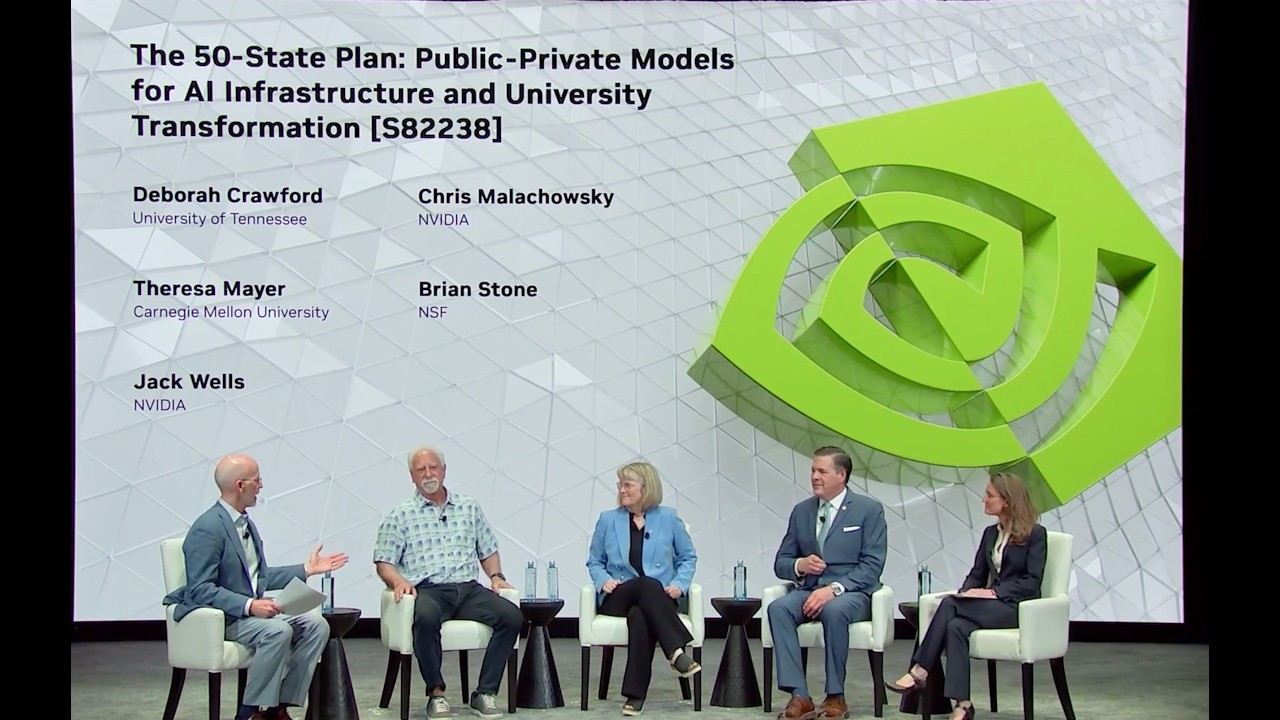
Nvidia Matches Donor Gifts to Build 50-State Campus AI Network
NVIDIA
Because universities cannot monetize basic research for immediate commercial revenue, public institutions must blend private philanthropy with corporate hardware subsidies to treat advanced compute as a shared public utility before academic discovery falls behind industry.
NVIDIA committed to matching private donor contributions to state academic computing projects via hardware purchase discounts, while providing its complete software stack for free and prioritizing technology delivery. (26:11)
The National AI Research Resource (NAIRR) pilot has mobilized over $300 million in industry contributions across 600 active projects, with 60 percent dedicated to domain science ('AI for Science') rather than foundational computer science. (27:36)
Pennsylvania's seven R1 research universities signed an unprecedented joint Memorandum of Understanding to pool capital and build the shared Keystone AI and Quantum Initiative. (31:36)
The University of Florida's university-wide deployment of the HiPerGator AI supercomputer helped produce roughly 10,000 AI-literate graduates annually across all disciplines, doubled or tripled graduate placement and research awards, and secured several hundred million dollars in state legislative funding for 100 new AI faculty. (19:30)
Detailed notes
## Background
This session, titled 'The 50-State Plan: Public-Private Models for AI Infrastructure and University Transformation,' was published on NVIDIA’s YouTube channel on April 9, 2026. According to the description, the panel explores a strategic roadmap for democratizing high-performance computing across the U.S. through public-private partnerships, moving universities from isolated innovation to unified, mission-focused strategies in the AI era.
## TL;DR
The panel discusses a scalable blueprint for integrating AI across U.S. higher education, moving beyond isolated research silos to create statewide, democratized computing ecosystems. Experts from NVIDIA, the NSF, and major universities explain how a combination of philanthropic donations, state legislative support, and federal guidance can provide smaller institutions—including community colleges—with the hardware and curricula needed for the modern workforce. By treating compute as a foundational public utility, institutions are shifting from theoretical research toward solving regional economic and scientific challenges. The session highlights successful models, such as the University of Florida’s statewide AI deployment and Pittsburgh’s manufacturing-to-tech transition, as templates for future national development.
## Atmosphere & style
The tone is urgent yet optimistic, characterized by a professional, forward-thinking energy that feels like a call to action for academic and policy leaders. The speakers maintain a collaborative and pragmatic rapport, balancing high-level visionary goals with the gritty, real-world obstacles faced by educators in under-resourced institutions. The narrative arc builds from identifying a crisis of access to providing concrete, replicable solutions, leaving the listener with a sense of purposeful momentum regarding the future of the American workforce.
## Bulletin
- [26:11](https://www.youtube.com/watch?v=uv8va8bIqus&t=1571s) NVIDIA committed to matching private donor contributions to state academic computing projects via hardware purchase discounts, while providing its complete software stack for free and prioritizing technology delivery.
- [27:36](https://www.youtube.com/watch?v=uv8va8bIqus&t=1656s) The National AI Research Resource (NAIRR) pilot has mobilized over $300 million in industry contributions across 600 active projects, with 60 percent dedicated to domain science ('AI for Science') rather than foundational computer science.
- [31:36](https://www.youtube.com/watch?v=uv8va8bIqus&t=1896s) Pennsylvania's seven R1 research universities signed an unprecedented joint Memorandum of Understanding to pool capital and build the shared Keystone AI and Quantum Initiative.
- [19:30](https://www.youtube.com/watch?v=uv8va8bIqus&t=1170s) The University of Florida's university-wide deployment of the HiPerGator AI supercomputer helped produce roughly 10,000 AI-literate graduates annually across all disciplines, doubled or tripled graduate placement and research awards, and secured several hundred million dollars in state legislative funding for 100 new AI faculty.
## Key takeaways
- [03:02](https://www.youtube.com/watch?v=uv8va8bIqus&t=182s) Unlike prior technological waves that dispersed incrementally over decades, modern accelerated AI represents an immediate, universal transformation of societal workflows and the labor market.
- [03:02](https://www.youtube.com/watch?v=uv8va8bIqus&t=182s) Because routine procedural tasks are rapidly automating, higher education must shift from teaching baseline procedural skills to developing human judgment and the management of autonomous agents.
- [05:25](https://www.youtube.com/watch?v=uv8va8bIqus&t=325s) Modern artificial intelligence is expanding well beyond large language models into physical AI, embodied robotics, and sim-to-real workflows that bridge sparse empirical data with high-fidelity physical simulations.
- [11:32](https://www.youtube.com/watch?v=uv8va8bIqus&t=692s) The NSF Directorate for Technology, Innovation and Partnerships (TIP) focuses on leveraging universities as regional innovation anchors tailored to local industry needs, actively involving community colleges to expand regional employment.
- [13:55](https://www.youtube.com/watch?v=uv8va8bIqus&t=835s) Statewide consortia like AI Tennessee deploy university researchers and graduate students directly into resource-constrained community and technical colleges to democratize foundational AI literacy.
- [16:16](https://www.youtube.com/watch?v=uv8va8bIqus&t=976s) Pittsburgh rebuilt its post-industrial economy around an 'Eds and Meds' strategy, modernizing manufacturing through public-private partnerships like the world's first NVIDIA Tech Community in AI and robotics.
- [24:36](https://www.youtube.com/watch?v=uv8va8bIqus&t=1476s) The enterprise 'AI factory' model breaks down in academia because universities execute long-horizon, public-interest basic research rather than harvesting immediate commercial revenues, necessitating blended public-private funding models.
- [22:50](https://www.youtube.com/watch?v=uv8va8bIqus&t=1370s) Chris Malachowsky's 50-State Plan seeks to pair wealthy private benefactors in every state with matching industry support and state legislative backing to treat computing infrastructure as a public utility.
- [36:08](https://www.youtube.com/watch?v=uv8va8bIqus&t=2168s) Modern scientific instruments, such as the Vera C. Rubin telescope generating 800,000 alerts nightly, produce data volumes that make AI integration an operational requirement rather than an optional enhancement.
- [43:02](https://www.youtube.com/watch?v=uv8va8bIqus&t=2582s) A severe computational digital divide persists at community colleges and smaller institutions, forcing leading programs to rely on free-tier cloud resources without dedicated hardware access.
- [49:50](https://www.youtube.com/watch?v=uv8va8bIqus&t=2990s) Faculty adoption and engagement with generative AI is often highest among non-STEM disciplines, including arts, law, and the humanities, driving demand for interdisciplinary problem-solving frameworks.
## Detailed walkthrough
### [00:00](https://www.youtube.com/watch?v=uv8va8bIqus&t=0s) Welcome and Panel Introductions
The session at GTC opens with a discussion on how artificial intelligence is moving far beyond its traditional boundaries in enterprise, engineering, and pure research to deeply reshape higher education. The moderator welcomes the audience and sets the stage: higher education institutions face an urgent requirement to build robust computing and educational infrastructures that support both advanced research and core institutional missions.
The panel brings together key leaders across industry, government, and academia:
* **Chris Malachowsky**, NVIDIA co-founder and long-time technology leader, recognized for his deep passion for high-performance computing (HPC) and its transformative role in universities.
* **Brian Stone**, Chief of Staff of the National Science Foundation (NSF), currently acting in the role of the director.
* **Deborah Crawford**, Vice Chancellor for Research at the University of Tennessee, Knoxville, who spearheads regional innovation and campus AI strategies.
* **Teresa Mayer**, Vice President for Research at Carnegie Mellon University (CMU), leading campus-wide AI and advanced research initiatives.
Higher education sits directly adjacent to industry and enterprise as the fundamental engine of innovation and workforce preparation. The session aims to address candid questions: what does accelerated computing demand from researchers, institutions, and policymakers; how can campuses put vital computing infrastructure directly into the hands of faculty and students; and what public-private partnerships must be invented to close persistent resource gaps.
[03:02](https://www.youtube.com/watch?v=uv8va8bIqus&t=182s) The Scale, Speed, and Reality of the Current AI Revolution
Addressing Chris Malachowsky, the moderator asks what makes today's computing and AI wave fundamentally different from past technology cycles over his four-decade career. Malachowsky observes that this revolution stands out across two primary axes: massive scale and unprecedented speed of adoption. Unlike previous technological evolutions—such as personal computers, smartphones, mobile apps, or social media—which arrived incrementally and took years to penetrate society segment by segment, modern AI has made an immediate, universal impact across society, public discourse, and the workforce.
```mermaid
flowchart TD
accTitle: Previous Tech Waves vs Current AI Wave
accDescr: Contrasts the gradual segmental adoption of past tech cycles with the immediate widespread impact of modern AI.
subgraph Past["Historical Tech Shifts"]
direction LR
P1["PC & Mobile Eras"] --> P2["Gradual Segment Adoption"] --> P3["Slow Cultural Dispersion"]
end
subgraph Present["Modern AI Revolution"]
direction LR
A1["Accelerated Compute Scale"] --> A2["Instant Universal Impact"] --> A3["Everyday Decision Support"]
end
```
Malachowsky points out a widespread public misconception about AI's ultimate utility:
* **Chatbots vs. Decision Systems:** Most people view AI merely as a chatbot or a text prompt, which drastically underestimates its true power as an omnipresent decision-support system aggregating vast, distributed expertise.
* **Education and Judgment:** Routine technical tasks are rapidly automating, meaning educational institutions can no longer focus solely on baseline facts or procedural skills. Instead, they must cultivate human judgment and teach students to manage autonomous agents.
As Chris Malachowsky summarizes the challenge:
> “This just seems to be a splat. It's everywhere.”
He notes the new imperative for universities:
> “Tasks are likely to get automated but not judgment and not you know, the human human element. And now you got to teach everything you used to have to teach and now you got to teach judgment and and how to manage agents and uh um and and you know, how to use these new tools uh to your advantage and not be used by them, I guess.”
[05:25](https://www.youtube.com/watch?v=uv8va8bIqus&t=325s) Beyond LLMs: Physical AI, Sim-to-Real, and University Curricular Transformation
Teresa Mayer and Deborah Crawford expand on how universities are adapting to the modern AI paradigm, emphasizing that artificial intelligence extends far beyond large language models (LLMs). Mayer highlights the explosive emergence of "physical AI"—systems equipped with generalized computational brains that directly interact with complex physical environments. Accelerated computing provides the scale needed to train foundation models for robotics and scientific discovery, bridging sparse real-world empirical data with high-fidelity physics-based simulations ("sim-to-real").
Deborah Crawford details how the University of Tennessee moved quickly to embed AI across disciplines:
* **Campus-Wide Faculty Governance:** Established in 2022 to engage faculty beyond traditional engineering and computer science departments, bringing arts, humanities, and professional schools into AI adoption.
* **GenAI Faculty Fellows Program:** Pairs enthusiastic "trailblazer" faculty with "healthy skeptics" to co-design and team-teach courses that meaningfully integrate generative AI tools into diverse curricula.
* **Workforce-Ready Competencies:** Emphasizes employer demand; companies hiring university graduates prioritize practical AI literacy and demonstrated competencies in their fields over theoretical discovery alone.
Notable spin-outs and programs mentioned include:
- **CMU Physical AI Startups:** Skilled AI, Genesis AI, and Field AI—companies born out of CMU over the last two years focused on generalized brains for embodied, physical agents.
- **University of Tennessee:** Comprehensive curriculum modernization to ensure every graduate enters the workforce prepared to leverage AI tools within their specific discipline.
As Deborah Crawford observes regarding employer expectations:
> “The employers we work with tend to be more interested in sort of the workforce implications than discovery to begin with. So that's been really really critical to us is uh making sure that we are we are integrating AI throughout the academic enterprise.”
[08:55](https://www.youtube.com/watch?v=uv8va8bIqus&t=535s) Federal Priorities: NSF Investments, Regional Innovation, and Public-Private Models
Turning to the federal perspective, the moderator asks Brian Stone how the National Science Foundation identifies priorities for advanced computing infrastructure and how universities and industry can align with federal bets. Stone emphasizes that NSF’s 75-year history centers on placing patient, long-term bets on fundamental technology and science. The current inflection point—where AI is present on everyday consumer devices and embedded in daily workflows—is the direct cumulative result of decades of persistent public investment.
Looking forward, NSF aims to support widespread AI integration across scientific fields while fostering economic growth through regional innovation:
* **The National AI Research Institutes:** Launched in 2019, the program has scaled to 29 institutes nationwide.
* **Co-Investment and Matching:** The AI Institutes represent more than $300 million in leveraged private and philanthropic contributions alongside federal funding, establishing a repeatable template for regional innovation ecosystems.
* **Cross-Sector Alignment:** Maximizing the impact of public dollars requires tight partnerships between federal agencies, major technology vendors like NVIDIA, and higher education consortia to democratize computational access.
As Brian Stone puts it:
> “We got to this point by years and years, decades of thoughtful investment and moving the ball forward. And it's great when you see these technologies get to the point where people are saying, 'Wow, it's in my phone or I'm using it every day.' You know, that's success for us.”
[11:32](https://www.youtube.com/watch?v=uv8va8bIqus&t=692s) Regional Innovation Engines, Workforce Activation, and Industry Alignment
At the National Science Foundation (NSF), the Directorate for Technology, Innovation and Partnerships (TIP)—now about four years old—is driving a major shift toward regional economic impact. While national initiatives often discuss high-level 50-state frameworks, local priorities vary dramatically: someone in Iowa, for instance, cares far more about agricultural innovation than other generic tech agendas. Universities already serve as local economic anchor points and powerhouses, and TIP's mission is to help them apply AI directly to the needs of the populations they serve. Crucially, this initiative activates educational pathways well beyond elite research institutions. During a recent NSF Regional Innovation Engines site visit to Charlotte, representatives from community colleges across North Carolina and South Carolina gathered to discuss how federal programs can bolster energy grids and generate employment. An NSF representative highlighted this cultural evolution: “We don't typically focus on, you know, we don't wake up and say, 'How many jobs are we going to create today at NSF?' But that's that's the kind of impact that we're starting to have and that's what's really exciting for us.”
From an industry perspective, focusing on regional economic development provides a much-needed strategic filter. Because comprehensive universities touch virtually every domain of science, technology, and education, industry partners often struggle to find clear points of entry. When regional hubs establish explicit local priorities, private companies can align their technical engagements, concentrate resources, and demonstrate measurable returns on mutual investments within a reasonable timeframe.
- The NSF TIP directorate focuses on empowering universities as regional anchor points tailored to local industries (such as agriculture in the Midwest).
- Workforce initiatives explicitly span four-year universities and community colleges to build vocational capacity and regional job growth.
- Private industry relies on regional prioritization to cut through broad university operations and target specific collaborative investments.
---
[13:55](https://www.youtube.com/watch?v=uv8va8bIqus&t=835s) Statewide Coalitions: AI Tennessee and Democratizing Competency
Building on the NSF's regional framework, statewide initiatives are operationalizing broad access to AI infrastructure and training. In Tennessee, institutions established a coalition known as AI Tennessee, uniting research powerhouses, four-year colleges, community colleges, and technical schools. The goal is to ensure that every resident of the state has the opportunity to build foundational AI competencies and gain confidence using modern digital tools. This framework relies on a sturdy backbone of public-private partnerships, an approach that has gained significant momentum across the United States compared to a decade ago by holding private industry accountable for national competitiveness, workforce development, and scientific discovery.
As the state's land-grant institution, the University of Tennessee, Knoxville possesses deep technical expertise in artificial intelligence, whereas local community and technical colleges often face acute resource constraints. Through AI Tennessee, university faculty, graduate students, and postdoctoral researchers deploy directly into technical and community colleges across the state. This deliberate cross-pollination shares advanced knowledge, bolsters institutional capacity, and prevents smaller vocational campuses from being left behind in the AI economy.
```mermaid
flowchart TD
accTitle: AI Tennessee Cross-Institutional Model
accDescr: Flow showing how research universities disseminate AI expertise and resources to regional schools and the broader workforce.
subgraph CoreHub["Land-Grant Anchor"]
UTK["University of Tennessee, Knoxville"]
Experts["Faculty, Postdocs & Grad Students"]
UTK --- Experts
end
[16:16](https://www.youtube.com/watch?v=uv8va8bIqus&t=976s) Pittsburgh’s Transformation: The "Eds and Meds" Playbook and Factory Floor AI
Reflecting on regional resilience, panelist Deborah shared the trajectory of Pittsburgh, Pennsylvania—a city that literally built the nation with its steel industry before suffering a catastrophic industrial collapse in the 1980s. Facing economic ruin but retaining an ingrained manufacturing base, regional, state, and local leaders united around an "Eds and Meds" revitalization strategy anchored by the University of Pittsburgh, Carnegie Mellon University, and a robust community college system. That deliberate strategy catalyzed a modern renaissance, making Pittsburgh one of the few inland, non-coastal cities to sustain significant, long-term growth in the modern innovation economy. Today, that legacy has matured into a powerful fusion of heavy manufacturing and frontier high-tech fields like robotics and artificial intelligence.
To capture the next industrial wave, Pittsburgh is establishing cross-sector partnerships designed to scale physical and computational infrastructure rapidly. Key efforts include the NVIDIA Tech Community in AI and robotics—the first of its kind globally—alongside joint initiatives linking Hewlett Packard Enterprise (HPE), ANSYS, Synopsys, and NVIDIA. At the same time, regional leaders stress that technological acceleration must be accompanied by deep community engagement. In an era when public anxiety regarding automation and job displacement is acute, partners in Pittsburgh have revitalized an abandoned steel mill through substantial philanthropic backing. This transformed site now serves as an active research, education, and community hub, extending advanced AI and robotics literacy directly into K-12 classrooms and local neighborhoods to ensure legacy industrial workers share in future prosperity.
- Pittsburgh transitioned from the 1980s steel collapse into an innovation hub by anchoring municipal redevelopment to higher education and medical research centers.
- The region established the world's first NVIDIA Tech Community focused specifically on the convergence of robotics and artificial intelligence.
- Multi-company collaborations (HPE, ANSYS, Synopsys, and NVIDIA) are deploying high-scale infrastructure to modernize domestic manufacturing.
- A historically abandoned steel mill was retrofitted into a community-centric innovation facility supported by philanthropic foundations and public K-12 outreach.
---
[19:30](https://www.youtube.com/watch?v=uv8va8bIqus&t=1170s) The Florida Model: University-Wide AI Literacy and the HiPerGator Gift
Panelist Chris recounted his personal efforts to spur statewide AI transformation through his alma mater, the University of Florida. In the late 2010s (around 2018–2019), he arranged a major philanthropic contribution to donate a world-class AI supercomputer (HiPerGator AI) to the school. Fortuitously, he bypassed the engineering department and gave the supercomputer directly to the broader university. Because the gift belonged to the university as an institutional whole, leadership made a sweeping institutional commitment in late 2019 and early 2020: to integrate baseline AI literacy into every academic department across the entire comprehensive R1 campus. As a result, the institution now graduates roughly 10,000 AI-literate students annually spanning humanities, business, agriculture, and the sciences.
Honoring its public land-grant mission, the University of Florida opened the supercomputing resource to all researchers across the state under the exact same terms as on-campus faculty, and made compute access entirely free for educational purposes, permitting even local high school students to run class assignments on cutting-edge hardware. To support this infrastructure, the state legislature committed several hundred million dollars over a decade to recruit 100 new AI-focused faculty across various disciplines. Access has since expanded to institutions throughout the Southeastern Conference (SEC), as well as regional Historically Black Colleges and Universities (HBCUs) and minority-serving institutions. The university openly shares its curriculum, technical architecture, and administrative playbooks with any institution nationwide seeking to replicate the blueprint and prepare workers before widespread automation disrupts local labor markets.
- The gift of an AI supercomputer in 2019–2020 was granted to the university as a whole rather than sequestered within the engineering college.
- The University of Florida mandated AI literacy across all academic majors, producing approximately 10,000 AI-literate graduates every year.
- State lawmakers supported the initiative by allocating several hundred million dollars over a 10-year horizon to hire 100 specialized AI faculty members.
- Free access and open-source curricula were extended beyond the flagship campus to high schools, statewide public universities, the SEC athletic conference, HBCUs, and minority-serving institutions.
[22:50](https://www.youtube.com/watch?v=uv8va8bIqus&t=1370s) The 50-State Plan and the Catalyst of Supercomputing
Using his standing as an NVIDIA co-founder to gain access to decision-makers, Chris Malachowsky has embarked on a self-directed grassroots mission across more than thirty states. His objective is to recruit benefactors in every state to donate advanced computing clusters to their leading academic institutions, while simultaneously lobbying governors and state legislators to form statewide public-private consortia. Pointing to the transformation at the University of Florida (UF) following its supercomputing deployment, Malachowsky highlights that the university doubled or tripled student placement statistics and incoming research awards, driving a massive economic return for the state.
Malachowsky argues that this blueprint can be replicated across the entire country, noting that every state possesses wealthy donors accustomed to endowing sports programs or campus buildings who could instead fund strategic computing assets. The physical cluster itself is merely the starting point; the real transformation occurs when researchers and students harness that compute to tackle pressing regional challenges. Reflecting on the true value of the technology, Chris Malachowsky remarked: “It’s a piece of iron. It’s what you do with it that’s kind of magical and I think that’s what NSF’s, you know, magic over the years has been motivating thoughtful, you know, inquiry and and progress.” His ultimate ambition is to see this model realized across all fifty states and U.S. territories.
- Over 30 states already visited to pitch private benefactors and state government leaders.
- University of Florida demonstrated a doubling or tripling of incoming research funding and graduate employment placement after implementing its supercomputing infrastructure.
- Strategic intent to expand the public-private computing model across all 50 states and U.S. territories.
---
[24:36](https://www.youtube.com/watch?v=uv8va8bIqus&t=1476s) The AI Factory vs. Higher Education's Non-Commercial Mission
The panel's moderator bridges Malachowsky's initiative to Jensen Huang's keynote description of enterprise "AI factories," where raw inputs like electrical power and datacenter shells directly yield sellable software products and commercial revenues. While this industrial framing accurately describes commercial enterprise computing, it breaks down within higher education. Universities do not operate on a commercial product-and-sales model; their mandate is educating students and executing basic, public-interest research that sits years or decades ahead of market commercialization.
Because academic institutions cannot directly harvest and monetize this intellectual property for immediate cash flow, advanced AI infrastructure manifests primarily as an extraordinarily steep capital expenditure. The panel poses a central challenge to leadership: what public-private and inter-agency funding mechanisms must be invented to ensure cutting-edge AI clusters are placed into the hands of university faculty, researchers, and students without bankrupting academic budgets?
```mermaid
flowchart TD
accTitle: Enterprise AI Factory vs Academic Computing Model
accDescr: Diagram contrasting how enterprise AI factories convert power into revenue with how university computing yields non-monetary public discovery.
subgraph Enterprise ["Enterprise AI Factory Model"]
E1["Power & Datacenter Shell"] --> E2["Compute Infrastructure"]
E2 --> E3["Commercial AI Products"]
E3 --> E4["Direct Market Revenues"]
end
subgraph Academic ["Academic & Public Research Model"]
A1["Capital Grants & Philanthropy"] --> A2["Research AI Infrastructure"]
A2 --> A3["Fundamental Science & Inquiry"]
A3 --> A4["Workforce Talent & Public IP"]
end
```
---
[26:11](https://www.youtube.com/watch?v=uv8va8bIqus&t=1571s) NVIDIA's Matching Commitment and Private Philanthropic Momentum
Malachowsky explains that providing academic leadership with the autonomy to aim supercomputing resources at their state’s specific strategic priorities yields immediate, transformative returns. Although modern accelerated infrastructure is costly, pitching high-net-worth individual donors has proven to be an easy sell because the tangible downstream impact on regional education and industry is immediately apparent.
To multiply this donor momentum, Malachowsky announces a brand-new corporate initiative finalized the previous evening: NVIDIA will formally back these statewide academic projects by matching private donor contributions through hardware discounts. Furthermore, NVIDIA will supply its complete enterprise software stack to participating universities free of charge and grant prioritized delivery access to accelerated computing hardware to strengthen domestic U.S. infrastructure and economic competitiveness. Challenging institutions and state officials to embrace this blended funding approach, Chris Malachowsky asserted: “I don’t know what the other models, I believe this is an effective model and then, you know, I’d like everybody to to at least consider it.”
- NVIDIA committed to matching private donor funding through hardware purchase discounts for participating universities.
- Full access to NVIDIA’s software stack provided at zero cost to academic partners.
- Priority technology access granted to support U.S. regional and national infrastructure projects.
---
[27:36](https://www.youtube.com/watch?v=uv8va8bIqus&t=1656s) Scaling NAIRR and Expanding Beyond Dedicated AI Research
A representative from the National Science Foundation (NSF) links Malachowsky's state-by-state campaign to federal efforts, specifically the National Artificial Intelligence Research Resource (NAIRR) pilot operating under the White House AI Action Plan. Established as a coalition spanning government agencies and more than two dozen private companies—including NVIDIA—NAIRR has secured over $300 million in industry contributions to democratize access to high-performance computing for researchers nationwide, regardless of geographic location.
Crucially, the demand for this infrastructure extends far beyond computer science departments studying AI models in isolation. Of the more than 600 active research projects currently supported by NAIRR, only approximately 40 percent are performing core AI research; the remaining 60 percent leverage accelerated compute for "AI for Science," spanning domains such as materials science, geophysics, and atmospheric modeling. Emphasizing how localized state investments dovetail with the federal vision, the NSF representative stated: “From our standpoint, the 50-state solution is great because that is just going to put more compute cycles in the hands of people that will figure out for us what we should be doing with this.”
- NAIRR incorporates over 24 industry partners contributing more than $300 million in computing and software resources.
- Over 600 research projects currently provisioned through the national resource.
- Approximately 40% of NAIRR projects focus on fundamental AI research, while 60% apply machine learning to domain sciences like geophysics and materials research.
---
[30:01](https://www.youtube.com/watch?v=uv8va8bIqus&t=1801s) Democratizing Regional Access: K–12, Startups, and Local Economies
A university panelist observes that for most states, the primary barrier to technological leadership is strictly constrained access to AI compute and modern software stacks. Eliminating this bottleneck promises to be transformative, but hardware alone is insufficient. Higher education institutions face the parallel operational challenge of building out support services, user training, and consulting teams so that faculty, students, and educators can translate raw cycles into real-world impact.
Furthermore, these computing capabilities must not remain locked inside elite research labs. The panelist advocates for broadening access downstream to K–12 schools, community colleges, and regional entrepreneurial ecosystems. Referencing the high volume of university startups spun out of hubs like Carnegie Mellon University (CMU), the speaker emphasizes that local early-stage companies frequently stall because they lack access to high-end compute. Opening statewide infrastructure to regional startups directly fuels economic development, keeping home-grown intellectual property and venture formation within the state.
---
[31:36](https://www.youtube.com/watch?v=uv8va8bIqus&t=1896s) Pennsylvania’s Historic Keystone AI and Quantum Initiative
Teresa Mayer underscores that while private philanthropy and corporate matching programs are vital, sustained federal funding from Congress for basic science through the NSF and allied agencies remains the bedrock of American innovation. She recounts that forty years ago, NSF support enabled Carnegie Mellon University and the University of Pittsburgh to co-found the Pittsburgh Supercomputing Center (PSC). Unlike proprietary corporate facilities, regional centers like PSC have trained tens of thousands of students across all educational tiers, including community college cohorts, cementing the foundation of regional tech ecosystems.
However, existing federal facilities cannot keep pace with the exponential compute scale demanded by modern AI. While national pilots like NAIRR provide critical baseline access, states must move faster by co-investing institutional and state funds. As an example of this collective model inspired by Florida's success, Mayer reveals that the Commonwealth of Pennsylvania launched the Keystone AI and Quantum Initiative. For the first time in the state's history, the executive leadership of all seven Pennsylvania R1 research universities signed a formal Memorandum of Understanding (MOU) to pool their resources, co-invest capital, and build a shared computing ecosystem for the commonwealth.
- Pittsburgh Supercomputing Center established 40 years ago through NSF backing, serving tens of thousands of students across Western Pennsylvania.
- Seven R1 research universities across Pennsylvania signed an unprecedented joint MOU to establish the Keystone AI and Quantum Initiative.
- Participating universities are contributing direct financial capital to co-invest alongside state and federal partners.
### [34:02](https://www.youtube.com/watch?v=uv8va8bIqus&t=2042s) The Shift from Local Servers to Scalable Infrastructure
The panelists discuss the transition from traditional, isolated research models—where faculty relied on "bespoke" servers tucked away under desks—to a modernized approach where institutions are actively seeking broader access. There is a consensus that this evolution is no longer optional. To remain competitive and foster innovation, universities must move toward a unified strategy that leverages federal, industrial, and philanthropic support.
Nvidia shares that their pilot engagements over the past two years, supported enthusiastically by CEO Jensen Huang, have revealed a clear gap in the U.S. ecosystem regarding how universities support startups emerging from academic research. Unlike other nations that have formal plans to ensure their university-affiliated startups have immediate access to compute, the U.S. often lacks a cohesive strategy. This lack of planning creates a competitive disadvantage for domestic innovation.
- **The Problem:** Faculty work is bottlenecked by inadequate local hardware ("I can't get my work done with a server under my desk.").
- **The Gap:** Many universities incubate startups but fail to provide them with the computational resources necessary to scale.
- **The Competitive Landscape:** International peers are prioritizing compute access as a core component of their national knowledge economies.
### [36:08](https://www.youtube.com/watch?v=uv8va8bIqus&t=2168s) Connecting the Edge to the Experimental Loop
The conversation shifts to the necessity of seamless connectivity between edge computing, mid-scale on-premise infrastructure, and the cloud. The speakers emphasize that AI is fundamentally transforming scientific discovery by enabling "autonomous labs" and closing experimental loops. This requires a sophisticated, interconnected environment that spans local research facilities and national networks.
The National Science Foundation (NSF) highlights the urgency of this transition by pointing to the Vera C. Rubin telescope. The telescope produces 800,000 alerts per night, a volume of data that humans cannot manually parse. The integration of AI is no longer a luxury but a fundamental tool for processing modern scientific data and managing complex physical infrastructure, such as the lasers used in plasma physics research.
- **"Within a few short years or now, everybody's going to be an AI researcher in some way because we will all use it."** — Speaker from the NSF.
- **"We’re building scientific tools now that you can't actually like that require AI."** — Speaker from the NSF, referring to the Vera C. Rubin telescope project.
### [39:12](https://www.youtube.com/watch?v=uv8va8bIqus&t=2352s) Defining Success and Democratizing Infrastructure
The panel defines success over the next 5 to 10 years as the widespread adoption of AI literacy, the strengthening of regional economies, and the recognition of computational resources as public infrastructure. They argue that compute should be treated with the same necessity as water or power, moving beyond the exclusive purview of elite researchers into a tool that benefits society at large.
A key theme is the "democratization of science," where the goal is to ensure that researchers and students, regardless of their institution’s size or location, have access to sophisticated AI tools. The speakers emphasize that this shift is essential for enabling broader participation in discovery, particularly in fields like drug discovery and environmental science.
- **Vision for Success:**
- AI-literate students entering the workforce.
- Standardized technological footing for all state institutions.
- Shared data protocols for health and environmental research.
- The categorization of "compute" as essential public infrastructure.
- **The Workforce Angle:** Training must extend beyond four-year universities to reach community colleges, creating a pipeline for the next generation of researchers.
### [43:02](https://www.youtube.com/watch?v=uv8va8bIqus&t=2582s) Addressing Resource Disparities at Community Colleges
During the Q&A session, a professor from Houston Community College (HCC) highlights the stark reality of the "digital divide" for community colleges. Despite leading AI robotics programs and co-founding a national AI consortium with Maricopa and Miami Dade colleges, they are currently forced to rely on the "free tier" of Google Colab because the institution lacks dedicated AI compute resources.
The panelists respond with support, acknowledging that the current lack of resources is a significant failure in the national strategy. They point to the White House’s "AI for Education" task force as a potential pathway for improvement, expressing hope that a new era of technology availability will soon assist institutions like HCC in closing the resource gap.
- **The Real-World Constraint:** Many community college students are restricted to using free-tier cloud services, which limits the complexity and scale of the work they can perform.
- **The Need:** "We need to create more of these partnerships between community colleges, all colleges." — Panelist.
```mermaid
flowchart LR
subgraph Drivers
A["Scientific Tools (e.g. Rubin Telescope)"] --> B["Massive Data Ingestion"]
B --> C["AI/Compute Bottleneck"]
end
subgraph Vision
D["Infrastructure as a Utility"] --> E["Democratization of Science"]
E --> F["AI-Literate Workforce"]
end
C --> D
accTitle: The path from scientific necessity to infrastructure utility.
accDescr: This chart shows the progression from modern scientific tools needing AI, to the need for infrastructure as a utility, and finally the goal of a democratized, AI-literate workforce.
```
### [45:30](https://www.youtube.com/watch?v=uv8va8bIqus&t=2730s) Models for Scaling Educational Access
The discussion begins by examining how co-investment models can bridge the gap in educational resources, specifically regarding AI-enabled cognitive tutoring. A prime example is the Bill & Melinda Gates Foundation’s $55 million gift to establish "Learn Via," an initiative launched with over 20 partner colleges and community colleges. The panelists emphasize that this project represents the broader necessity for scaling AI infrastructure through a blend of state, federal, philanthropic, and industry capital.
The core mission, as reiterated by the speakers, is to ensure that these advanced resources are not siloed but are made broadly available across the entire educational spectrum, from K-12 to post-doctoral research. The speakers highlight that the energy behind these investments is driven by the goal of universal access rather than localized innovation.
* **Key Funding Sources:** State government, federal agencies, private philanthropy, and industry partnerships.
* **Target Demographic:** The entire educational "pipeline," including high schools, vocational schools, community colleges, and universities.
### [47:03](https://www.youtube.com/watch?v=uv8va8bIqus&t=2823s) Public-Private Partnerships and the Economic Pipeline
The conversation shifts to the practicalities of making AI infrastructure "open" and accessible. A representative from the University of Tennessee asks how to make high-performance computing available to more domains and institutions that lack the internal IT resources to manage such complex technology. The panel agrees that the "Florida experience" serves as a useful template for how universities and states can organize these efforts.
The discussion turns to the philosophy of the "pipeline": if the ultimate goal is a strong economy and high employment, support must begin at the K-12 level and continue through higher education. There is a strong consensus that the barrier to entry—such as the prohibitive cost of hardware or the burden of managing supercomputers—must be removed for smaller institutions and businesses.
* **Sustainability Metric:** The panel asserts that funding models are sustainable only if they ultimately lead to an "employed population."
* **The "IT Barrier":** Small businesses and smaller colleges often lack the specialized IT departments necessary to maintain modern AI hardware, necessitating a centralized or shared infrastructure model.
### [49:50](https://www.youtube.com/watch?v=uv8va8bIqus&t=2990s) Interdisciplinary Engagement and the "Non-STEM" Buy-in
The final topic addresses the challenge of moving beyond STEM to integrate the humanities, arts, and social sciences into AI research. A questioner from the University of Florida’s Digital Worlds Institute notes that while engineers easily understand AI's technical output, articulating the value of AI to the arts and humanities remains a challenge.
Surprisingly, the panelists report that faculty outside of computer science—including those in law, the arts, and social sciences—have shown the greatest "buy-in" and interest in how AI will transform their respective fields. The panel highlights a growing demand signal from industry for these interdisciplinary perspectives.
* **NSF "Tech Labs":** The National Science Foundation is launching a new program called "Tech Labs," which moves away from top-down directives. Instead of picking winners, the program challenges interdisciplinary groups to build their own teams to solve specific, explainable societal problems.
* **Strategic Shift:** The panel notes that the most impactful research often stems from bringing together decision scientists with social and behavioral scientists to ensure AI implementation makes sense in a human context.
> “Rather than us picking winners and say, ‘Okay, you need to get this number of social scientists,’ and like, ‘Answer this problem here, and you build the team to do that.’ And that’s a bit of a—it’s a bit of a different approach for NSF, but you know, we’ve got a lot of excitement around it.” —*NSF Representative*
> “By far the largest buy-in is from the non-STEM faculty.” —*Panelist (discussing internal university faculty fellow programs)*
## Notable quotes
> [36:08](https://www.youtube.com/watch?v=uv8va8bIqus&t=2168s) Within a few short years or now, everybody's going to be an AI researcher in some way because we will all use it. — Speaker from the NSF
> [03:02](https://www.youtube.com/watch?v=uv8va8bIqus&t=182s) Tasks are likely to get automated but not judgment and not you know, the human human element. — Chris Malachowsky
## Mentioned
Chris Malachowsky, Brian Stone, Deborah Crawford, Teresa Mayer, Jensen Huang, NVIDIA, National Science Foundation (NSF), NSF Directorate for Technology, Innovation and Partnerships (TIP), University of Tennessee, Knoxville, Carnegie Mellon University, University of Florida, University of Pittsburgh, Houston Community College, Maricopa Community Colleges, Miami Dade College, Hewlett Packard Enterprise (HPE), ANSYS, Synopsys, Bill & Melinda Gates Foundation, National AI Research Institutes, Regional Innovation Engines, AI Tennessee, HiPerGator AI, National Artificial Intelligence Research Resource (NAIRR), Keystone AI and Quantum Initiative, Pittsburgh Supercomputing Center, Vera C. Rubin Observatory, Learn Via, Google Colab, Skilled AI, Genesis AI, Field AI
## Video description
As AI becomes the definitive engine of economic and academic growth, the race is on to democratize access to high performance computing across the United States. This panel explores "The 50-State Plan," a strategic roadmap for building robust, statewide AI infrastructure through innovative public-private partnerships. The session brings together visionary tech-industry pioneers, leaders from the National Science Foundation (NSF), and executives from top-tier research universities to discuss the shift from isolated pockets of innovation to unified strategies for university transformation and mission success in the age of AI.
Learn how your organization can participate in this nationwide effort to bridge the digital divide and accelerate the next era of discovery.
Academic, federal, and technology leaders argue that national competitiveness requires transitioning university artificial intelligence infrastructure from isolated, departmental servers into shared, utility-like public resources. Driven by public-private co-investment and cross-institution consortia, their proposed model seeks to broaden computational access across regional colleges, basic scientific discovery, and non-STEM disciplines.
The 50-State Philanthropic and Matching Strategy (22:50)
NVIDIA co-founder Chris Malachowsky detailed a nationwide campaign spanning more than 30 states to encourage private benefactors to fund centralized university supercomputing clusters instead of conventional campus buildings or athletic endowments. This strategy is patterned after the University of Florida’s installation of the HiPerGator AI supercomputer in 2019–2020. Because the hardware was donated directly to the university rather than sequestered inside the engineering school, the institution integrated AI literacy across all academic majors, graduating roughly 10,000 AI-literate students annually. Malachowsky noted that the initiative subsequently doubled or tripled graduate placement rates and incoming research funding while attracting multi-hundred-million-dollar state legislative investments for 100 new AI faculty.
To accelerate this state-level model, Malachowsky announced an initiative whereby NVIDIA will match private donor contributions through hardware purchase discounts, provide its enterprise software stack at zero cost, and grant priority equipment delivery. Panelists noted that this blended financing model addresses the economic mismatch of higher education: unlike commercial "AI factories" that monetize computing cycles directly into revenue-generating software, universities execute long-term, non-commercial education and research that require persistent capital subsidies.
Regional Consortia and Public Innovation Engines (13:55)
Representatives from the National Science Foundation (NSF) and partner universities emphasized that computing assets should be organized through regional hubs rather than top-down federal programs. The NSF’s Directorate for Technology, Innovation and Partnerships (TIP) uses regional innovation engines to align research directly with local priorities, such as agricultural technology in the Midwest or electrical grid resilience in the Carolinas. To prevent vocational institutions from falling behind, state-level initiatives are sharing technical capacity across institutional tiers. In Tennessee, the AI Tennessee coalition pairs University of Tennessee faculty, postdocs, and graduate students directly with local community and technical colleges to develop workforce-ready digital skills.
A complementary model emerged in Pennsylvania, where executive leadership from all seven R1 research universities signed a joint Memorandum of Understanding to co-invest institutional capital and establish the Keystone AI and Quantum Initiative. Teresa Mayer linked this initiative to the 40-year foundation of the NSF-funded Pittsburgh Supercomputing Center and Pittsburgh's historical "Eds and Meds" transition, which shifted the former steel capital toward an AI and robotics hub through cross-sector coalitions involving regional universities, philanthropic foundations, and technology firms.
Expanding Beyond Language Models to Physical Science (5:25)
Panelists cautioned against viewing AI solely through the lens of chatbots and text-generation tools, pointing to the rapid growth of "physical AI" and automated discovery. Mayer noted that modern foundation models combined with high-fidelity physics simulations ("sim-to-real") are training generalized brains for robotics, referencing CMU spin-outs including Skilled AI, Genesis AI, and Field AI. Simultaneously, massive empirical datasets make accelerated computing mandatory across basic science; an NSF representative highlighted that the Vera C. Rubin telescope produces 800,000 alerts nightly, generating data volumes impossible for humans to process without autonomous systems.
This trend is reflected across federal pilot programs. In the National Artificial Intelligence Research Resource (NAIRR), which combines federal funding with over $300 million in private contributions across more than two dozen corporate partners, roughly 60 percent of the 600 supported research projects apply machine learning to domain sciences like materials discovery and geophysics, while only 40 percent concentrate on pure AI algorithmic development.
Addressing Campus Disparities and Non-STEM Integration (43:02)
Despite national expansion efforts, participants highlighted severe computational divides between elite research institutions and two-year colleges. A faculty member from Houston Community College observed that students in their AI robotics program are restricted to Google Colab's free tier because the campus lacks dedicated computing infrastructure. Panelists acknowledged this gap as a key structural vulnerability, pointing to targeted programs like the Bill & Melinda Gates Foundation's $55 million "Learn Via" tutoring initiative as practical frameworks for routing advanced digital tools into community colleges and K–12 pipelines.
At the same time, institutional leaders reported that faculty outside traditional STEM fields—such as arts, humanities, and law—frequently exhibit the greatest demand for generative AI training. In response, universities are establishing faculty fellow programs that pair AI advocates with skeptics to redesign courses around human judgment, while the NSF is introducing flexible "Tech Labs" that support interdisciplinary teams solving societal challenges without rigid disciplinary composition rules.
While the proposed 50-state framework offers a scalable blueprint for matching private philanthropy with corporate and federal resources, its ultimate success depends on whether public stakeholders can treat compute as public infrastructure and fund the ongoing IT administration, consulting staff, and operational support necessary to sustain non-flagship campuses.
Source quotes
[36:08] Speaker from the NSF: Within a few short years or now, everybody's going to be an AI researcher in some way because we will all use it.
[3:02] Chris Malachowsky: Tasks are likely to get automated but not judgment and not you know, the human human element.
Original transcript
[0:00] Welcome to GTC.
[0:02] I'm so good to see you here. Um you
[0:04] know, AI is reshaping not only research
[0:07] and engineering and enterprise. AI is
[0:10] having a huge impact on higher
[0:13] education. And that's what we're here to
[0:15] talk about today. The role of AI in
[0:18] higher education infrastructures
[0:21] um for education and also for research
[0:23] and other uh mission-related activities
[0:26] um that the universe have to pursue.
[0:28] We're very fortunate to have a stellar
[0:30] panel and I want to bring the panel out
[0:32] and then I'll um introduce them. Please
[0:35] come out, panel.
[0:38] >> [applause]
[0:45] [applause and music]
[0:49] >> Let me sit down.
[0:51] So first I'm very happy to uh introduce
[0:54] Chris Malachowsky, Nvidia co-founder and
[0:57] technology leader from the very
[0:58] beginning of Nvidia. Chris has a passion
[1:01] for higher education and AI and what uh
[1:04] high-performance computing can bring.
[1:06] Also um we have available uh
[1:09] um uh Brian Stone, who is the uh chief
[1:12] of staff of the National Science
[1:14] Foundation acting in the role of the
[1:16] director.
[1:17] We have Deborah Caldwell, who is the
[1:20] vice chancellor for research at the
[1:22] University of Tennessee and a leader in
[1:24] the uh regional activities there. And
[1:27] Teresa Mayer, who is the vice president
[1:30] for research at Carnegie Mellon, who is
[1:32] a very much a leader in activities at
[1:34] Carnegie Mellon.
[1:36] So um
[1:37] there's a tremendous urgency around this
[1:39] topic today. Uh what we're talking about
[1:42] has critical importance. Um there are uh
[1:45] there's a need to get a curriculum in
[1:47] place. Um also important that we are
[1:50] able to get um
[1:52] uh infrastructure on the campuses so
[1:55] that educators and researchers can
[1:58] participate fully in the innovation
[2:01] ecosystem that's going on in um in the
[2:04] world today and continue to drive things
[2:06] forward in a very very very um important
[2:10] area. It's so much innovation comes from
[2:12] higher education and research and of
[2:14] course uh higher education research is
[2:16] adjacent to all of our uh
[2:19] uh
[2:20] enterprises and um industry. And so it's
[2:23] just critically important that they're
[2:25] able to fully participate. So our goal
[2:27] today is to have a candid,
[2:29] forward-looking conversation. What does
[2:32] this new era of AI and accelerated
[2:34] computing demand from us as researchers,
[2:37] institutions, and policy makers? How do
[2:40] we get the necessary infrastructure into
[2:42] the hands of students and professors at
[2:45] our universities? And what new
[2:46] partnerships are emerging and what still
[2:49] needs to be done uh so that we can um
[2:52] that still needs to be invented that we
[2:53] haven't created yet to fill the gaps. So
[2:56] with that,
[2:57] let's get started.
[2:59] So um my first question is uh for Chris.
[3:02] Chris, you've seen Nvidia and
[3:03] accelerated computing from the very
[3:06] beginning. Uh when you look at today's
[3:08] AI and computing landscape, what feels
[3:11] fundamentally different um than say in
[3:13] the past? Uh what feels fundamentally
[3:16] different about this moment? Um and what
[3:18] does it mean for universities and
[3:20] national research agencies over uh the
[3:23] next 5 or 10 years? Okay, well, let's
[3:25] take those in order. Um
[3:28] as a technological revolution, this is
[3:31] broader, it's deeper, it's it's more
[3:34] impactful to to to more people
[3:37] um than anything I you know, I've been
[3:39] in this 40-something years. Um
[3:42] so
[3:43] ju- just in scale
[3:45] a- and uh is one element. The other one
[3:48] is in the speed of it of adoption or
[3:50] disruption.
[3:51] It it is infiltrated so much so quickly,
[3:55] taken over the you know, the public
[3:56] dialogue of of technology and jobs and
[3:59] workforce and um a- and that's unique.
[4:02] Most other things at least you know, PC
[4:04] and iPhones and apps and social media
[4:08] came on slowly and affected a segment
[4:10] and then then grew. This just seems to
[4:12] be a splat.
[4:14] It's everywhere.
[4:15] Um so I I think that you know, that that
[4:17] that the
[4:18] to the first point. Um
[4:21] w- what's different is also that
[4:25] the the perception of what AI is I think
[4:27] is is a little bit distorted in the in
[4:30] the public's mind.
[4:31] Um it's it's a chatbot. It's it's a it's
[4:34] a place you type.
[4:35] And I think that really under
[4:38] under represents the potential
[4:40] um of AI, which is going to be the
[4:43] decision support system for just about
[4:45] everything we do and should be because
[4:48] it you know, brings expertise where we
[4:50] may not have and
[4:51] it can gather uh
[4:54] intelligence that's hard to to to keep
[4:56] in one person's head. Um
[4:58] so I think it's a challenge for you
[5:00] know, the educators.
[5:01] You know, I think you know, tasks are
[5:03] likely to get automated but not judgment
[5:05] and not you know, the human uh human
[5:08] element. And now you got to teach
[5:09] everything you used to have to teach
[5:11] and now you got to teach judgment and
[5:13] and how to manage agents and uh um and
[5:16] and you know, how to
[5:18] use these new tools uh to your advantage
[5:21] and not be used by them, I guess.
[5:24] Mm.
[5:25] Maybe one of our uh university leaders
[5:27] would like to contribute to that
[5:28] question. Yeah, I'd I'd be happy to jump
[5:30] in and just to just to add um to to what
[5:33] Chris shared. I I think so many
[5:36] you know, people think that AI is about
[5:38] large language models and it's so much
[5:41] more than that, right? Accelerated
[5:43] compute um has provided the scale that
[5:46] now allows us to train uh foundation
[5:49] models for science, foundation models
[5:51] for robotics. And
[5:54] just how quickly we're seeing
[5:57] um the ability to now uh leverage AI in
[6:01] the context of physical AI. Um where we
[6:05] have systems that are interacting with
[6:08] the real world in very complex
[6:11] environments.
[6:12] Um and the power now of being able to
[6:16] bring physics-based
[6:18] models to problems where data is very
[6:21] sparse, right? We don't have the
[6:23] training data. And this concept of um
[6:26] sim to real just
[6:29] just taking off like like crazy. So um
[6:32] it's been exciting. Carnegie Mellon's
[6:33] had three uh startup companies just
[6:35] within the last couple of years, Skilled
[6:37] AI, um Genesis AI, and Field AI that are
[6:41] all really kind of targeting uh this new
[6:45] generalized brain for for physical AI.
[6:48] So there's so many different areas where
[6:50] we need the scale.
[6:52] Yeah.
[6:53] I'd add a little bit to that, Jack. Um
[6:56] you know, I think I think the pace of
[6:59] discovery and innovation definitely
[7:01] really accelerating now.
[7:04] Um I think we're also thinking about how
[7:07] AI has to be incorporated both into
[7:10] learning and be the subject of learning
[7:13] um across all domains in the university
[7:16] environment. I know at UT we established
[7:19] our first sort of faculty governance
[7:22] committee around AI in 2022 really to
[7:25] get faculty not just from our
[7:28] engineering and computer science
[7:30] programs but from programs throughout
[7:32] the university thinking about how AI was
[7:35] relevant to their students, to their
[7:37] programs. Um we've we've um created a
[7:42] GenAI faculty fellow program that
[7:45] actually um encourages faculty to
[7:48] incorporate AI into the curriculum.
[7:51] Um encourages them to team teach. Um we
[7:55] put together teams um the sort of uh
[7:58] trailblazer faculty who are very excited
[8:00] about what AI is going to do for their
[8:02] discipline as well as perhaps some um
[8:06] uh healthy skeptics who might be worried
[8:09] about doing this uh team teaching,
[8:11] exploring the the sort of impact on
[8:14] learning in our student populations, and
[8:16] making sure that every one of our
[8:19] students when they graduate has AI
[8:22] competencies, understands why AI is
[8:25] relevant to their field of study, and is
[8:27] ready to go out into the workforce
[8:30] prepared to use AI. We hear that from um
[8:33] employers who hire our students very
[8:36] very often. The employers we work with
[8:38] tend to be more interested in sort of
[8:40] the workforce implications than
[8:42] discovery to begin with. So that's been
[8:45] really really critical to us is uh
[8:47] making sure that we are we are
[8:50] integrating AI AI throughout the
[8:51] academic enterprise. Thank you. Brian,
[8:55] I'd like to come to you next. Um the
[8:57] National Science Foundation is a premier
[8:59] federal funder of science and technology
[9:02] in general and AI research and AI
[9:05] research infrastructure in general in in
[9:07] particular. From your vantage point in
[9:09] the federal government, what are the top
[9:11] priorities and bets that the nation
[9:13] needs to make um in AI and advanced
[9:16] computing infrastructure? And how should
[9:18] universities and industry align with
[9:20] those priorities? Great. Well, thanks.
[9:23] First of all, thanks for having us here.
[9:25] Um
[9:26] let me just say
[9:27] cuz I'll say it up front. And
[9:29] NSF is very grateful for the
[9:30] partnerships that we have with Nvidia.
[9:32] You all are just phenomenal partners uh
[9:35] at every level and it's great to be here
[9:37] at the GTC.
[9:38] Um let me just say NSF has been um
[9:42] NSF's been around for
[9:44] over 75 years.
[9:46] Uh and we make long-term bets on
[9:51] technology and innovation space. Uh and
[9:55] in the case of things like AI,
[9:57] you know, people say, "Well, how do we
[9:59] get to this point?" We got to this point
[10:01] by years and years, decades of
[10:03] thoughtful investment and moving the
[10:05] ball forward. And it's great when you
[10:07] see these technologies get to the point
[10:09] where people are saying, "Wow, it's in
[10:10] my phone or I'm using it every day." You
[10:12] know, that's success for us. I'm going
[10:15] to
[10:15] I'm going to add to what Chris said. I
[10:17] think this inflection point is is
[10:19] because we've reached the point we've
[10:21] reached that point where where we're all
[10:23] using
[10:24] AI on a daily basis.
[10:27] And I think that, you know, when we talk
[10:30] about the kind of bets going forward in
[10:32] the future
[10:34] like what both Teresa and Deborah are
[10:36] saying is 100% correct. We have to
[10:39] do everything that we can to integrate
[10:42] AI into
[10:44] into the disciplines that we support. We
[10:46] need to make sure that people have the
[10:48] skill sets and the competence
[10:49] competencies to do it.
[10:52] NSF has been making some
[10:54] pretty major investments over the last,
[10:56] you know, six or seven years. I know in
[10:58] 2019, for example, we launched our AI
[11:01] Institutes program and we have 29 of
[11:04] them today. We have 29 institutes. We've
[11:07] got over 300 million dollars in
[11:10] private contributions to that, which is
[11:12] one of the other things that we like to
[11:14] see. NSF likes to put in money and we
[11:16] like to see that matched by by
[11:18] contributions either from private or
[11:19] philanthropy
[11:21] to make it a bigger enterprise.
[11:23] In the case of the AI Institutes it's
[11:25] really hitting a sweet spot for us in
[11:28] this concept of regional innovation. So,
[11:31] you know, we have our new technology
[11:32] innovation partnerships directorate. I
[11:34] say it's new, but it's like four years
[11:36] old now. So, that's still new for us.
[11:38] But
[11:41] TIP and and also even our
[11:45] the rest of NSF is is very much
[11:47] unlocking these regional area focus. So,
[11:50] for example, if if if you're someone,
[11:53] you know, we're going to talk about the
[11:54] 50 state solution, but if you're
[11:56] somebody that lives in Iowa, you may
[11:58] care about agriculture a lot more than
[11:59] you care about other things. And I think
[12:02] what we're finding is
[12:04] universities in these areas which
[12:06] already serve as kind of the anchor
[12:08] points and the powerhouses to drive the
[12:10] the economy.
[12:12] They're able to tap into AI and make it
[12:15] relevant for for the things that for the
[12:18] people in the areas that they serve. And
[12:19] I think that's one of the things that's
[12:21] the most exciting for us.
[12:23] The other piece that's very critical, I
[12:25] mentioned the workforce piece.
[12:27] This
[12:29] all the things that we're doing,
[12:31] it's activating education at all levels.
[12:33] It's at the four-year university levels.
[12:35] We've had tremendous interest from
[12:36] community colleges. I mean, we were, you
[12:38] know,
[12:39] we were just down in Charlotte a couple
[12:41] of weeks ago with one of our regional
[12:42] innovation engine site visits.
[12:45] We had all of the community colleges
[12:47] from South Carolina and North Carolina
[12:48] there, you know, talking about what NSF
[12:50] is going to do to make their lives
[12:52] better and help them, you know, do
[12:54] better focus on power, but how how
[12:56] they're going to create more jobs. We
[12:59] don't typically focus on you know, we
[13:01] don't wake up and say, "How many jobs
[13:02] are we going to create today at NSF?"
[13:04] But that's that's the kind of impact
[13:07] that we're starting to have and that's
[13:08] what's really exciting for us. So,
[13:11] investments in regional technology hubs,
[13:15] investments in personnel, I we think are
[13:17] are the most critical.
[13:19] I'll just comment there from
[13:22] partnerships from industry having a
[13:24] focus on regional economic development
[13:27] provides a focus point for us to engage
[13:30] because it brings a set of priorities to
[13:32] a university that otherwise is doing in
[13:34] some sense everything. Right? In science
[13:37] and education technology. And we very
[13:40] much appreciate the opportunity to focus
[13:42] on what your priorities are cuz then we
[13:44] can we can focus that interaction and
[13:47] hopefully demonstrate, you know, in some
[13:49] reasonable time period a return on our
[13:51] mutual investment. Super. So,
[13:55] um
[13:56] um back to Deborah and Teresa. What's
[13:58] your comment about this idea of regional
[14:02] focus for
[14:04] AI investment and a way of moving it
[14:06] forward in our universities and then the
[14:09] ecosystem around them?
[14:11] So, I think I think NSF has done a
[14:13] really fabulous job in helping
[14:16] universities think more strategically
[14:19] about regional partnerships. I think TIP
[14:21] has really had huge impact in that realm
[14:25] here in the United States.
[14:27] In In Tennessee, we formed
[14:31] a consortium. It's called AI Tennessee.
[14:34] And to Brian's point,
[14:36] it's a consortium that includes all of
[14:39] the colleges and universities in the
[14:41] state of Tennessee, our technical
[14:42] colleges, our community colleges, and
[14:45] our four-year institutions. So, working
[14:47] together to figure out how we make sure
[14:50] that every Tennessean has the ability to
[14:52] to develop AI competencies and is
[14:55] confident in their use.
[14:58] It also has a research and innovation
[15:00] component and it's very much built on a
[15:04] backbone of public-private partnerships.
[15:06] I think here in the US for sure, there's
[15:09] much more focus on public-private
[15:11] partnerships today than there was 10
[15:13] years ago and I think that's very very
[15:15] healthy. It brings into the ecosystem
[15:18] discussions
[15:20] the private sector helping them
[15:22] understand their responsibilities to
[15:25] discovery and innovation, US
[15:26] competitiveness, the development of a of
[15:29] a competitive workforce.
[15:31] I think really really important. So,
[15:34] we're really excited in Tennessee about
[15:36] this focus on regional innovation
[15:38] partnerships. It has enabled
[15:41] activities that quite frankly wouldn't
[15:43] have happened without it. Much stronger
[15:45] connections with our community and
[15:48] technical colleges and the sharing of
[15:49] expertise. Like the University of
[15:52] Tennessee, Knoxville, we're the land
[15:53] grant university in the state of
[15:55] Tennessee. We have lots of expertise in
[15:58] AI.
[15:59] Our colleagues in the community and
[16:01] technical colleges maybe don't have so
[16:03] much. So, our faculty, our graduate
[16:05] students, our postdocs with AI
[16:07] competencies going out into those
[16:09] colleges really really important for
[16:12] building our innovation base, our
[16:13] innovation capacity in AI. Deborah,
[16:16] would you like to comment? Yeah. Well,
[16:19] you know, I'm going to I'm just going to
[16:20] start by telling a little story.
[16:23] You know, Pittsburgh
[16:25] with the steel industry, Pittsburgh
[16:27] built the nation.
[16:29] And then Pittsburgh collapsed
[16:31] in the '80s,
[16:33] but left behind a very strong
[16:34] manufacturing base.
[16:36] But at that point, the collapse was so
[16:38] severe that all the nation, the region
[16:44] the state and the local government came
[16:47] together and said, "We're going to take
[16:49] an Eds and Meds strategy you know, given
[16:52] the presence of University of
[16:54] Pittsburgh, Carnegie Mellon, many other
[16:57] universities, a very robust community
[17:00] college." And that drove a renaissance.
[17:04] That that that vision to pull together.
[17:07] And it's one of the few cities outside
[17:09] of the coasts that now has a growth
[17:13] about, you know, starting about a decade
[17:15] ago
[17:16] in the innovation economy. So, it is
[17:20] you know, truly an example of what so
[17:23] many of the initiatives that are
[17:27] really at the forefront right now
[17:30] kind of got off to an early start.
[17:32] Robotics, AI. Now, we have this very
[17:35] very interesting mix of the fusion of a
[17:39] deep manufacturing base together with a
[17:41] high-tech
[17:42] industries
[17:44] industries of the future. And so, that
[17:46] that leads to a very bright future as we
[17:49] think about now the urgency to build out
[17:53] manufacturing or rebuild out
[17:55] manufacturing capacity, but through a
[17:57] very new lens. And just to give you a
[17:59] couple of examples of a partnerships
[18:02] that are really making a difference. I'm
[18:04] going to highlight the NVIDIA tech
[18:06] community
[18:07] in AI and robotics. It was the first
[18:10] tech community in the world recognizing
[18:13] this very, I think, interesting and
[18:15] important fusion.
[18:17] We have launched a joint partnership
[18:20] between HPE, ANSYS, and Synopsys and
[18:23] NVIDIA to really think about how do we
[18:26] blend all of the things that we've been
[18:29] talking about.
[18:30] That is also built on now the importance
[18:34] of what we're talking about
[18:35] infrastructure at scale.
[18:38] The urgency in the US right now, we need
[18:42] to move we need to move swiftly
[18:45] and with urgency. And then finally,
[18:49] the importance of
[18:50] as Deb and others have said of being
[18:53] deeply community engaged.
[18:56] It is even more important now as
[19:00] the public is fearing the loss of jobs
[19:02] due to the explosion of AI
[19:05] that we really double down K-12
[19:09] and into the community. And you know,
[19:11] that's just been so key. We've taken a
[19:15] abandoned steel mill with very
[19:17] significant support from our
[19:19] philanthropic organizations
[19:22] and we are driving the future, but we're
[19:25] doing it in a way that's deeply
[19:27] community engaged. Thank you.
[19:30] Chris, I'm going to come to you with a
[19:31] question next, but I want to I want to
[19:35] say to the audience we are going to have
[19:37] some time for a Q&A at the end. So,
[19:40] please have your thinking caps on and
[19:42] think of one or two questions that we
[19:44] can we'll save time at the end for you
[19:47] to you to ask from the floor. So, Chris,
[19:49] I know you've taken
[19:51] um a real interest and some strong
[19:54] action and um engaging regionally um in
[19:58] your personal life. Would you
[20:00] comment on um
[20:02] your thoughts and experiences in
[20:04] encouraging um universities and regional
[20:07] economic development from AI
[20:09] investments? Yeah, the um
[20:12] uh I'll tell a story.
[20:14] Um
[20:15] went to the University of Florida,
[20:17] married a a gal from there.
[20:19] Uh
[20:20] Um
[20:21] certainly have ties to the region. Um
[20:23] after a long courtship,
[20:25] uh finally you got around to uh giving
[20:28] back and paying paying my good fortune
[20:30] forward. Um and this is late 2010s
[20:35] 2018 2019. Um ultimately we gifted a
[20:40] supercomputer big AI supercomputer
[20:43] uh to the University of Florida and a
[20:45] little fortuitously um I didn't give it
[20:48] to the engineering department. I gave it
[20:50] to the university,
[20:51] which had had the the nice ramification
[20:55] of the university deciding, this is 2019
[20:58] early 2020. Um this is COVID.
[21:02] This you know it it's it's it's AI was
[21:04] not that big a deal yet at least the
[21:06] impact wasn't being felt. I'd been
[21:08] lecturing them to get you know get in
[21:11] front of it before it got on them.
[21:13] Um
[21:14] and because I gave the gift to the
[21:16] university, they turned around and
[21:18] committed just like we're just hearing
[21:20] to teach AI literacy in every every
[21:23] department of big R1 you know a
[21:24] comprehensive university.
[21:26] Uh they're outputting something like
[21:28] 10,000 you know AI literate kids in
[21:30] every discipline uh since then.
[21:32] Um they're a land grant like we heard.
[21:35] Land grants have this obligation and
[21:37] incentive I guess to to be part of the
[21:40] economics of their state. They offered
[21:43] it for use by every researcher in the
[21:45] state same terms as if you were on
[21:47] campus researcher. They offered it free
[21:49] for educational use. You're a high
[21:51] schooler and you want to run on the
[21:52] supercomputer great. You know your your
[21:54] professor gives you assignments.
[21:56] Um they developed all this curriculum
[21:59] the the state you know what at 2020 you
[22:01] can imagine there wasn't a whole lot of
[22:04] uh AI uh faculty or AI literate faculty.
[22:08] The state ended up putting in a couple
[22:09] hundred million dollars over 10 years to
[22:11] fund 100 faculty across the university
[22:14] complex.
[22:15] Um and then you get to [clears throat]
[22:16] the end they're willing and they
[22:18] extended the use of the machine to the
[22:20] entire SEC by the way and all the
[22:22] historically black schools and
[22:24] minority schools. Um
[22:26] and then you know
[22:28] turns out they're willing to give all
[22:30] that away
[22:31] and uh to anybody who wants it.
[22:33] Um and you know I I I I feel fortunate
[22:36] that I I was observant enough to
[22:38] recognize this
[22:40] as what was potentially a model
[22:42] because I was worried just like we heard
[22:44] that you know if we don't get in front
[22:46] of AI, yes it could displace jobs. Yes
[22:49] it could you know you know the rhetoric
[22:50] would get ahead of the reality and and
[22:52] it would stymie progress.
[22:55] So um I've taken it upon myself I use
[22:57] using my platform as video co-founder
[23:00] where I can get myself into places maybe
[23:02] others can't and I've been offering to
[23:05] I've gone to I'm 30-something states
[23:08] and
[23:09] I'm willing to pitch a benefactor in
[23:11] each state or benefactors to gift a
[23:13] machine like we did to to their whatever
[23:16] the the school that's you know most
[23:18] appropriate or set of schools uh lobby
[23:20] their governors and legislators to get
[23:23] behind it to make a you know public
[23:25] private uh um
[23:28] consortia to help them help themselves.
[23:31] Um it's been very well received and um
[23:35] you know it's addressing all the things
[23:37] we just heard it you know it's good for
[23:38] it's good for certainly great for
[23:40] research but it's good for the
[23:42] communities it's good for the students
[23:44] it's good for employment. I think UF
[23:45] doubled or tripled their placement
[23:47] statistics doubled or tripled their
[23:49] their research dollars coming in um
[23:52] impacting the state economy.
[23:55] Um and I figure every state can do this.
[23:57] Every state has you know somebody
[23:59] willing to give some number of dollars
[24:01] to to promote a you know the football
[24:03] team or endow a building or a program.
[24:06] Um every state has issues and and needs
[24:09] that they could focus these machines on
[24:11] and it turns out the machine is really
[24:13] just a catalyst.
[24:15] I mean it's it's a piece of iron. It's
[24:16] what you do with it that's kind of
[24:18] magical and I think that's what NSF's
[24:20] you know magic over the years has been
[24:22] motivating
[24:23] think you know
[24:25] thoughtful you know inquiry and and and
[24:27] progress. Um and so
[24:31] you know 50 I'm hoping to get all 50
[24:33] states maybe some territories too.
[24:36] Great. You know you know Jensen
[24:38] [clears throat]
[24:38] Jensen um painted a verbal picture in
[24:41] his keynote on Monday of an AI factory
[24:45] where um you you plug um
[24:48] the AI infrastructure into power and
[24:50] shell and and revenues come out the
[24:53] other end, right? So money comes out the
[24:55] other end. That's very compelling and
[24:57] and that's a simple way of describing
[24:59] what's going on um in the enterprise,
[25:01] right? It's going on with the business.
[25:03] But universities don't participate in
[25:05] the
[25:06] of business model, right? Where they
[25:09] have a product um that is sellable in
[25:11] dollars, right? They're enriching people
[25:14] in by education. They're doing research
[25:17] in the public interest that's well
[25:19] sometimes well in advance of um of uh
[25:23] any business model that would be able to
[25:25] harvest the the intellectual property in
[25:28] that way. So uh to be sure this
[25:31] infrastructure shows up as an expensive
[25:34] investment. I mean it's been a challenge
[25:37] for many of us. So um
[25:39] let's try to take that topic on. What
[25:42] what kinds of models uh do we need in
[25:45] order to have a
[25:47] greater availability of research of of
[25:50] research infrastructure AI
[25:51] infrastructure available to our
[25:53] university um
[25:55] uh professors and therefore to their
[25:58] students and and and research staff.
[26:01] What what do we have today and then what
[26:03] can we what can we do in the future
[26:05] that's maybe increasing our
[26:08] effectiveness of that getting that
[26:09] infrastructure in their hands?
[26:11] Well, let me just take it on. I'm not
[26:14] that conversant in what's happened
[26:15] before.
[26:16] But I will tell you that putting these
[26:19] capabilities in the hands of the the
[26:22] leadership with the freedom to do with
[26:24] it as strategic and and
[26:27] uh important things for you know their
[26:29] institutions and their states seems to
[26:31] be transformative.
[26:33] Um
[26:34] you know these are expensive things and
[26:37] you know I'm
[26:38] now I'm not
[26:39] getting kind of good at it I think but
[26:41] talking you know
[26:43] private money private donors into
[26:46] supporting these efforts um
[26:49] you know it's really high impact. It's
[26:51] actually been a remarkably easy sell.
[26:54] Um
[26:55] though I I'd like to use the occasion uh
[26:58] um last night basically I got a
[27:00] the word that Nvidia is going to back
[27:02] these initiatives
[27:03] um to match the donors uh basically
[27:06] match the donors' contribution uh with
[27:09] discounts um
[27:11] to and provide our entire world-class
[27:14] software stack to universities
[27:17] uh free to use to promote this stuff.
[27:19] We'll also you know prioritize access to
[27:21] our technology uh
[27:24] to to promote the US economy and and the
[27:26] US infrastructure. Um so I don't know
[27:28] what the other models I believe this is
[27:30] an effective model
[27:32] and then you know I'd like everybody to
[27:34] to at least consider it.
[27:36] Jack, if I could just if you don't mind
[27:38] I'll I'll I'll add um one of the things
[27:40] that NSF is doing is uh
[27:43] we are operating what's called the
[27:45] National AI Research Resource or NAIR.
[27:49] Um it's in the White House AI Action
[27:52] Plan. It's one of the things that we're
[27:54] uh we're doing as part of our
[27:55] contribution there.
[27:57] Um the kinds of things that we're
[27:58] talking about, this is our response to
[28:01] that. It's been a you know I think you
[28:03] and I were both at the at the NAIR
[28:04] meeting last week in DC. Um it's a
[28:08] partnership between you know we've got
[28:10] over two dozen companies that are
[28:12] contributing resources Nvidia being one.
[28:14] Thank you very much. Um and also thank
[28:17] you for upping the contribution. So
[28:19] sounds like a great opportunity going
[28:21] forward. Uh
[28:22] the
[28:23] it it's really a a tremendous uh
[28:26] opportunity for the research community
[28:29] to kind of unlock some of the things
[28:32] that they're doing. We've got over 300
[28:34] million dollars in contributions from
[28:35] industry. Um
[28:38] and I guess the piece that's the most
[28:40] exciting is
[28:42] you know there's a there's a when Chris
[28:44] was talking about like when when we
[28:45] talked back in 2020 about you know
[28:47] putting a
[28:49] you know we we were going to put a put a
[28:50] supercomputer in in a Florida. And like
[28:52] he said we were not thinking about it in
[28:54] the context of AI.
[28:56] Um now everything you know we we are
[28:58] thinking about everything in the context
[28:59] of AI and it's it's things like we have
[29:03] to make these resources available to the
[29:05] researchers to figure out what they can
[29:07] do with them. I mean there are over 600
[29:09] projects currently in the NAIR.
[29:11] Vast majority of them are not doing AI
[29:14] research. I think what 40% of them
[29:15] something like that are doing actually
[29:17] AI research. The other 60% are doing
[29:19] things like material science research
[29:22] uh you know geophysics atmospheric
[29:25] stuff. I mean it's just it's it's the
[29:27] whole thing that we would expect. So
[29:29] when we start talking about AI for
[29:31] science, that's that's where we're
[29:33] starting to do this. So we have to make
[29:35] these available. The best part about the
[29:37] NAIR is it doesn't matter where you are.
[29:39] You can get access to this um and uh
[29:43] adding more you know adding more
[29:44] capability in each state is just going
[29:46] to increase that. So, from our
[29:48] standpoint, the 50-state solution is
[29:50] great because that is just going to put
[29:52] more compute cycles in the hands of
[29:54] people that will figure out for us what
[29:57] we should be doing with this. That's
[29:59] unlocking discovery. Yeah.
[30:01] And I just add to that
[30:03] >> Yes.
[30:04] the
[30:05] I think that in many states at the
[30:07] moment, the constraint is access to the
[30:10] AI compute capabilities and the software
[30:13] stack, right? So, that ability to have
[30:16] access to those types of resources
[30:19] um will be transformative in some
[30:21] states. There is no doubt about it. It
[30:24] will be transformative in my state.
[30:26] Um and so, I think that to start with,
[30:30] the the biggest challenge for the
[30:32] universities and colleges and K through
[30:34] 12 institutions, who we should extend
[30:36] these types of capabilities to as well,
[30:39] and will will be how to provide the the
[30:42] services that help the individuals in
[30:45] those institutions use use these
[30:49] capabilities well to their to their
[30:51] optimal impact and to build a sort of um
[30:55] desire to push AI forward in the state
[30:58] and to help our companies understand the
[31:01] impact that these tools can have on
[31:03] their competitive advantage. Jack, you
[31:05] and I have talked before about the and
[31:08] Teresa mentioned some of the startups
[31:10] that CMU has birthed, right? We have a
[31:12] number of startups who would really love
[31:14] to have access to these types of
[31:16] capabilities, but but don't have that
[31:19] access. How do we make sure that in our
[31:22] regional innovation ecosystems that any
[31:25] state resource is accessible to those
[31:28] types of organizations, too? I think
[31:31] really huge impact on our state's
[31:33] economic development opportunities.
[31:35] >> Mhm.
[31:36] Teresa? Um
[31:38] this this question is so important right
[31:42] now. And um
[31:44] I just want to
[31:46] uh again acknowledge uh the critical
[31:48] importance that federal investment is
[31:50] going to continue to play.
[31:52] Um in both uh the infrastructure needs
[31:56] that we're talking about, but also basic
[31:58] science. And so, um again, we're
[32:01] uh so grateful uh to Congress for um
[32:05] providing bipartisan support um you
[32:08] know, for NSF and many of the other
[32:09] federal agencies. Um 40 years ago uh
[32:13] with support from NSF, uh University of
[32:16] Pittsburgh and Carnegie Mellon um became
[32:19] home to one of the first um national
[32:21] supercomputing centers and uh still uh
[32:24] going strong today. And I think one of
[32:26] the most important things again that
[32:28] that we've talked about is the um
[32:31] you know, unlike other uh supercomputing
[32:34] facilities uh that may be available to a
[32:37] small number of researchers, these have
[32:40] supported tens of thousands
[32:43] of students at all levels um from all uh
[32:47] you know, different uh colleges,
[32:50] community colleges, and others. And that
[32:52] has been so critically important to uh
[32:55] the innovation ecosystem. Now, what
[32:58] we're finding is that even that alone
[33:01] does not bring the scale. Um near is a
[33:04] critical component to that, but we need
[33:06] to go further, faster, with urgency. And
[33:10] so, the innovative models and um
[33:13] thinking about uh the ability to
[33:15] co-invest, you know, Bran brought
[33:17] brought it up, uh Chris brought it up,
[33:20] um is really uh the trajectory uh that
[33:23] we need to go. And as many states again,
[33:26] really supercharged by the work in
[33:28] Florida, um the Commonwealth of
[33:30] Pennsylvania has come together
[33:32] uh to uh start a Keystone AI and quantum
[33:37] initiative. And for the first time in
[33:41] history,
[33:42] I think we've confirmed this, all seven
[33:45] R1 institutions
[33:47] came together, the leadership um came
[33:51] together to make a commitment with a
[33:53] signed MOU that we would work together.
[33:56] And so, the universities also can make
[33:59] financial contributions because we
[34:02] already make contributions. They've just
[34:04] been bespoke, you know, servers sitting
[34:07] under desks.
[34:09] And now faculty are coming and saying,
[34:12] "I can't get my work done with a server
[34:14] under my desk." And they're really
[34:17] willing to buy in. Um so, the ability to
[34:20] bring federal resources, industry
[34:22] resources, philanthropic resources,
[34:26] um to get the scale and then also enable
[34:29] our startup companies is really very
[34:31] very critically important to the future
[34:34] of our of our nation. Mhm. Thank you.
[34:37] Um just I'd like to respond. Nvidia has
[34:40] very much appreciated the invitation to
[34:42] participate in their pilot um engages
[34:44] very effectively uh just over 2 years
[34:47] ago um with a broad spectrum of
[34:50] opportunities for how we could engage.
[34:52] Um and and um Jensen supported this idea
[34:56] um with a tremendous amount of
[34:58] enthusiasm. And we've learned a lot in
[35:00] the process. And I think it's been a
[35:02] mutual benefit along the ways.
[35:05] On the topic of support for startups
[35:08] emerging out of universities, I think
[35:10] this is something that um
[35:13] we need to have a um a big conversation
[35:15] about. I think there's a lot of um
[35:18] universities that are very proud of what
[35:20] they're doing in terms of incubating um
[35:22] these startups from their companies, but
[35:24] not always is there a plan for how
[35:27] they're going to get access to compute.
[35:29] And I can tell you because of the global
[35:31] scope that Nvidia has, other countries
[35:34] that are focused on uh knowledge economy
[35:37] um are having plans so that their
[35:41] startups associated with their premier
[35:43] universities have a in the near term
[35:46] have access to compute. And I view it as
[35:49] a gap um often in the in the US um
[35:53] innovation ecosystem. Um
[35:56] Um what what else uh do we need to talk
[35:58] about from a from a national
[35:59] perspective? What's going on that can
[36:02] contribute to new ideas to get
[36:05] infrastructure in the hands of
[36:06] researchers?
[36:08] I'll jump in. There is one topic um that
[36:12] we haven't touched on um
[36:14] as we think about the growing importance
[36:17] of compute at the edge
[36:19] and making sure that we can connect
[36:21] compute at the edge
[36:23] to maybe mid-scale on prem all the way
[36:26] to cloud and to do that seamlessly.
[36:30] And very importantly, as we again think
[36:32] about that connection to the physical
[36:34] world, there's uh again a you know, a
[36:38] large initiatives emerging as we think
[36:41] about the important role that AI plays
[36:43] in um accelerating
[36:46] uh
[36:47] science.
[36:48] And that will bring together in
[36:52] different ways the experimental physical
[36:54] world um through closing the
[36:57] experimental loop and driving uh the
[36:59] future of autonomous labs. And all of
[37:02] these are requiring very sophisticated
[37:06] the sophisticated ability to
[37:08] interconnect all of these different
[37:11] environments together and across the
[37:13] country and across the world. That was a
[37:16] good plug for Cloud Labs. It is a good
[37:19] plug for Cloud Labs.
[37:20] >> you had one.
[37:22] >> [laughter]
[37:22] >> Yeah. Let let me let me just say one of
[37:24] one of one of the things um uh there's
[37:27] no shortage of uh scientific opportunity
[37:31] um going forward. I mean, NSF is we're
[37:33] we're we're building we're building
[37:36] scientific tools now that you can't
[37:39] actually like that require AI. For
[37:41] example, the the Vera C. Rubin telescope
[37:44] that we just brought online. It's a
[37:45] partnership between NSF and DOE. We
[37:47] built the telescope, DOE built the
[37:49] camera. It's an amazing camera. It's a I
[37:51] mean, this thing's a time machine cuz it
[37:53] looks looks back at light that, you
[37:55] know, from billions of years ago. But we
[37:57] get 800,000 alerts a night. If you were
[38:00] if you were an astronomer,
[38:02] your pager would go off eight if you had
[38:04] a pager, sorry. Uh
[38:05] >> [laughter]
[38:06] >> it would go off 800,000 times a night
[38:09] and you can't you can't analyze that
[38:11] data anymore. Um so,
[38:15] that's you know, and this thing has been
[38:16] in progress for five or six years. We're
[38:18] only going to build more things like
[38:20] that. We were getting a briefing on uh
[38:22] plasma physics. And and people were
[38:24] saying, "Look, we're going to need AI to
[38:26] control these lasers that we're going to
[38:28] be building uh to do all this research."
[38:30] So, like
[38:31] you know, within a few short years or
[38:34] now, uh everybody's going to be an AI
[38:37] researcher in some way because we will
[38:39] all use it. And uh and I think that's I
[38:42] think that's exciting. We you know, we
[38:44] we
[38:45] we have to embrace it. Uh and and we
[38:48] need to uh and and we really need to
[38:50] lean into it.
[38:52] So, that really anticipated my next
[38:54] question is what does success look like
[38:56] um in this enterprise at universities
[38:59] with artificial intelligence over the
[39:01] next five or 10 years? What how should
[39:03] we how should we measure ourselves as a
[39:06] community uh going forward? And um and
[39:09] again, what does success look like?
[39:11] Well, I I can tell you what the vision I
[39:14] have. Um
[39:16] one that, you know, all the states are
[39:19] are producing AI AI literate, you know,
[39:22] students. Their economies are are are
[39:25] bolstered on, you know, the same
[39:27] technological footing as the best in the
[39:29] world.
[39:30] Um you know, their their their
[39:32] institutions are on the same footing.
[39:34] Um that, you know, the AI age is is fed
[39:37] on data.
[39:38] And no one really should have a
[39:40] proprietary lock on on, you know, a lot
[39:43] of the data yes, personal data yes, but
[39:45] health data, you know, what what affects
[39:47] people's health or
[39:49] the environment, that that stuff is
[39:51] being shared.
[39:53] That that you know, the the the
[39:55] higher ed community
[39:57] feeds itself, so they all they all all
[39:59] boats rise, I guess.
[40:01] Um
[40:03] I also
[40:04] this is a little orthogonal, but maybe
[40:06] not.
[40:07] I actually think it's high time we start
[40:08] thinking of computational resources as
[40:11] infrastructure.
[40:12] Just like we think, you know, the
[40:13] community provides water and power
[40:16] that what what what part of society
[40:18] doesn't need computational resources, AI
[40:21] or otherwise.
[40:22] And that, you know, communities and
[40:23] legislators and and governors and and
[40:26] the like start actually it's not just
[40:28] the the domain in the purview of
[40:30] researchers and academics and, you know,
[40:32] big business that it's it's really for
[40:34] everybody. So, I I
[40:35] you know, success would also be a
[40:37] recognition that this is now
[40:39] integral part of of society and modern
[40:42] life.
[40:44] I think I think there's also
[40:47] there's the rate of innovation, right?
[40:50] Drug discovery, all the things that that
[40:53] the the ordinary person on the street
[40:56] really cares about improve the quality
[40:58] of of their lives.
[41:01] The other thing I would say is
[41:03] democratization of science and
[41:05] engineering, right? So, that no matter
[41:07] where you are,
[41:09] you have access to the type type of
[41:11] sophisticated tools that allow you to
[41:13] contribute to discovery and innovation,
[41:16] right? I I think there's a tremendous
[41:18] power in that.
[41:20] There are a lot of colleges and
[41:21] universities who are not so able to
[41:24] participate in the discovery enterprise
[41:27] because we don't have access to the
[41:28] tools to do that.
[41:30] I think this agentic AI revolution has
[41:34] the opportunity to really change that
[41:37] and I'm really excited about the
[41:38] possibilities.
[41:41] Yeah, I think I think success is us at
[41:44] least in the near term is us
[41:47] shifting our thinking in terms of it's
[41:50] either this or AI is a is a cross cut.
[41:54] And I think, you know, like I said
[41:55] before,
[41:58] the more we can lean into
[42:00] unlocking the power of discovery
[42:03] in the short term the better we can do.
[42:04] The second piece is is continuing to
[42:07] energize the
[42:10] the workforce aspects of the things that
[42:11] we're doing. Again, always having in
[42:13] mind how are we helping to train the
[42:16] next generation of researchers? How are
[42:18] we making those opportunities available
[42:20] not just at the four-year level or the
[42:22] graduate level, but, you know, at the
[42:24] community college level and pushing it
[42:26] all the way down. I think that's you
[42:28] know, it's that that's
[42:30] in fact that's one of the things when we
[42:31] met with Jensen, he you know, he he said
[42:33] we really need to lean into the
[42:34] education. I think he said he said we
[42:36] need to make sure kids understand AI
[42:38] because they're going to be the ones
[42:39] that teach their grandparents how to use
[42:41] it, you know.
[42:43] And then he told me to keep my
[42:44] subscription to AI.
[42:46] >> [laughter]
[42:47] >> He said it was well worth the $20 a
[42:48] month.
[42:50] So, we have time for one or two
[42:52] questions. Max, can you help out?
[42:55] There's an eager hand right here.
[42:58] I can see that through the bright
[42:59] lights.
[43:02] I can't see anything.
[43:05] And please introduce yourselves.
[43:08] Hello. Yep. Hi, my name is Patricia
[43:11] McManus. I am the program coordinator
[43:15] and professor for HCC, Houston City
[43:19] College
[43:21] AI robotics program.
[43:24] First of all, thank you for mentioning
[43:27] colleges
[43:28] because we we feel
[43:31] that we are suffering a lot. Like we're
[43:34] talking about resources. This is
[43:36] something that we don't have.
[43:38] I think
[43:40] my students do all their labs using free
[43:44] tier of collab.
[43:47] Because we can't get compute
[43:50] and uh
[43:52] HCC, you know, IT department is this,
[43:56] let alone in you know, AI and the IT.
[43:59] So, the whole of the college don't
[44:02] understand the needs.
[44:04] Is there
[44:06] anything like NSF now that we are on the
[44:10] national light
[44:12] AI consortium co-founders with Maricopa
[44:15] and Miami Dade.
[44:17] So,
[44:18] we've been doing a lot in educating
[44:20] other colleges. So,
[44:23] we need help.
[44:25] Yeah, I I'll just take that since you
[44:27] you
[44:29] Look, we agree with you.
[44:31] We need um
[44:33] we need to create more of these
[44:35] partnerships between
[44:37] between community colleges, all
[44:38] colleges. Um
[44:41] And as I mentioned before, that's one of
[44:43] the things that we're trying to do with
[44:44] these, you know, specific with some of
[44:46] our regional innovation engines.
[44:49] The other thing I'll I'll just I'll say
[44:51] the other thing that is a little bit
[44:53] exciting is we're focusing very focusing
[44:55] very much on
[44:56] AI for education. We're part of the the
[44:59] White House's AI for education task
[45:00] force. It's largely focused at at least
[45:04] at the K through 12 level, but some of
[45:06] the things that are coming in, I think
[45:08] we're we're about to hit a new era for
[45:11] availability of technologies to to to
[45:16] use AI to actually improve the quality
[45:18] of education. I know Teresa and and her
[45:20] Sorry, this is not a plug for you. Yeah,
[45:22] no. But
[45:23] yeah, I mean, there are there are a lot
[45:25] of things that are coming that
[45:29] I think are really going to have an
[45:30] opportunity like it's going to improve
[45:32] things for for for colleges like yours
[45:35] in terms of access to to teaching
[45:37] resources. Yeah, I think again going
[45:39] back to the co-investment
[45:41] model we see
[45:43] incredible
[45:45] um
[45:46] energy from philanthropists.
[45:50] So,
[45:51] I believe what you were probably
[45:52] referring to is the Gates Foundation
[45:55] made a the largest gift of 55 million to
[46:00] establish a affiliate
[46:03] called Learn Via and these are
[46:06] AI-enabled cognitive tutors. And
[46:10] as that launched,
[46:12] um that launched with
[46:14] over 20 partners with major colleges and
[46:18] community colleges across the country
[46:21] that are deeply engaged on the
[46:24] infrastructure side.
[46:27] Again,
[46:28] the the ability to scale with state
[46:32] investment, federal investment,
[46:34] philanthropic investment, and industry
[46:36] investment.
[46:37] That energy is
[46:40] aimed at ensuring that there's access,
[46:43] as Chris pointed out,
[46:45] to the broad community, K through 12,
[46:49] colleges, universities. And so, I I
[46:52] think that the investment
[46:54] is
[46:56] really driven to make these resources
[46:59] broadly available.
[47:01] Okay, let's have another question.
[47:02] Please.
[47:03] Yeah,
[47:04] Goobet the Vincula here. I'm with the
[47:06] University of Tennessee, so a little
[47:08] not a plant, but
[47:10] >> [laughter]
[47:12] >> Chris, thank you. Fellow Gator here.
[47:14] Really love that story with the
[47:16] University of Florida. So, my question
[47:18] really resonates with the last question
[47:20] and the points made by Teresa and
[47:24] that of democratization.
[47:27] And really what I realize is that we we
[47:30] talk about the capital, you have the
[47:33] infrastructure computer, but at this
[47:35] level what we really need is make it
[47:37] more and more available for more and
[47:39] more domains to use it to come in.
[47:43] And so, you know, with that in mind and
[47:45] bringing all the databases and creation
[47:47] of databases from each domain, you know,
[47:50] my question really is what can
[47:52] public-private partnerships look like in
[47:55] that level of making it more open? Yeah,
[47:58] I'll just you know, the the initial
[48:00] interpreting a white paper that's sort
[48:02] of
[48:02] you know, in large respects captured the
[48:05] Florida experience as as a prescription
[48:08] for how to do this.
[48:09] Um
[48:10] but
[48:11] you know, participating in in the
[48:13] initiative would would say that
[48:16] community college has the exact, you
[48:18] know, probably you know, if it's a
[48:19] homework assignment, it's free.
[48:21] And and it you know, who's paying for
[48:23] that exactly? Well, some of the
[48:25] philanthropists, you know, maybe have
[48:26] dictated terms.
[48:28] You get this money if you will do this,
[48:30] but it doesn't seem to you it doesn't
[48:31] seem to be a lot of arm twisting needed.
[48:33] Maybe it's state funding, maybe it's
[48:35] university or university consortia
[48:37] funding. Um
[48:39] the recognition that this is a pipeline.
[48:43] You know, if you if you if your end goal
[48:45] is employment
[48:47] and a strong economy
[48:48] that it starts in kindergarten and goes
[48:51] all the way through every level of
[48:53] education, whether it's high schools,
[48:55] vocational schools, community colleges,
[48:57] colleges, universities, post doc, you
[48:59] know,
[49:00] it it runs the gamut and you got to
[49:02] support all the you know, who you just
[49:03] brought up you know, the somebody the
[49:05] size of an IT department. What small
[49:07] business has an IT department that can
[49:09] run a supercomputer or or manage, you
[49:12] know, technology that's changing at the
[49:14] pace that we're we're seeing today. So,
[49:16] I I think there's just great recognition
[49:19] and you know, whatever the funding
[49:20] model, whatever the the acquisition
[49:24] you know, the
[49:25] model that's used to
[49:28] access these technologies, there's just
[49:30] great recognition that it's got to be
[49:31] broad, it's got to be, you know, kind of
[49:34] universal, it's got to be affordable
[49:36] and it's got to lead to, you know,
[49:39] a employed population
[49:41] you know, for to make this sustainable.
[49:44] So, with I think we're out of time with
[49:46] that. Is is it one more? Okay. Max says
[49:48] there's another question, please. Last
[49:50] question. Uh Tim McFadden, University of
[49:52] Florida at the Digital Worlds Institute.
[49:54] So, another plug.
[49:55] >> not go Gators.
[49:57] >> [laughter]
[49:58] >> Thanks again, Chris. Uh for for everyone
[50:00] else, what does it look like for the
[50:02] importance of interdisciplinary
[50:03] engagement? I know STEM it's very
[50:05] important, right? But engaging our
[50:07] friends in the humanities, we bring
[50:09] together arts, engineering, business,
[50:11] journalism, communication. The hard part
[50:13] for them is translating output. So,
[50:14] Chris, you're going and talking about
[50:15] getting partnerships and and investment.
[50:18] Uh what's the actual output pitched to
[50:20] them long-term? It's easier when I work
[50:22] with my friends in engineering, more
[50:24] challenging when I think of the applied
[50:26] humanities and the output. So, I I would
[50:29] say um our AI Jenny I faculty fellow
[50:32] program, much more engagement from
[50:35] disciplines outside computer science and
[50:37] engineering. So, the faculty in in the
[50:41] in the humanities, the social sciences,
[50:44] the arts, law, some of the professional
[50:47] um
[50:48] disciplines,
[50:50] uh really interested in knowing what AI
[50:54] is, how they can use it, how it's going
[50:56] to change their industry, how it's going
[50:58] to change their discipline. So, that
[50:59] actually was surprising to me. By far
[51:02] the largest buy-in is from the non-STEM
[51:06] faculty.
[51:07] Yeah, it's been really interesting um
[51:09] when we've uh talked to many of the
[51:11] high-tech companies,
[51:13] um they are elevating the importance of
[51:17] the social behavioral sciences, the
[51:19] arts, and the humanities. So, there's a
[51:21] tremendous demand signal from industry
[51:24] um across the board. I'll also put a
[51:27] plug in for an AI institute on societal
[51:29] decision-making that brings together uh
[51:32] decision scientists with social and
[51:35] behavioral scientists be- because at the
[51:36] end of the day,
[51:38] um we need those teams to come together
[51:40] so that we are making uh the best
[51:42] decisions that are really going to drive
[51:45] an impact um in in in the world.
[51:49] And I'll I'll just say we've got we've
[51:50] got a program that we've uh that we're
[51:53] we're going to be launching before too
[51:54] long. It's called Tech Labs.
[51:56] Um we realize that we need to
[51:59] we need to put together teams that can
[52:01] solve challenges, and they're going to
[52:03] have to pull together these
[52:04] interdisciplinary groups. Like, rather
[52:06] than us picking winners and say, "Okay,
[52:08] you need to get this number of social
[52:09] scientists." And like, "Answer this
[52:12] problem here, and you build the team to
[52:14] do that." And that's a a bit of a it's a
[52:17] bit of a different approach for NSF, but
[52:20] um you know, we we we've got a lot of
[52:22] excitement around it. The administration
[52:24] likes it very much because it's uh
[52:28] uh it's going to allow us to build these
[52:30] interdisciplinary groups around like
[52:33] answering a question that's explainable
[52:35] to people. You say, "Why did you do
[52:36] this?" Well, we're trying to solve this
[52:37] problem over here.
[52:39] Yeah.
[52:41] Okay. Okay, so let's thank our fabulous
[52:44] panelists again.
[52:45] >> [applause]
[52:48] >> So, I think it's clear this is a really
[52:50] important issue, and it's an urgent
[52:53] topic that we're able to move forward.
[52:55] So, let's keep the conversation going.