Matt Pocock Warns AI Spec-to-Code Push Fuels Costly System Entropy
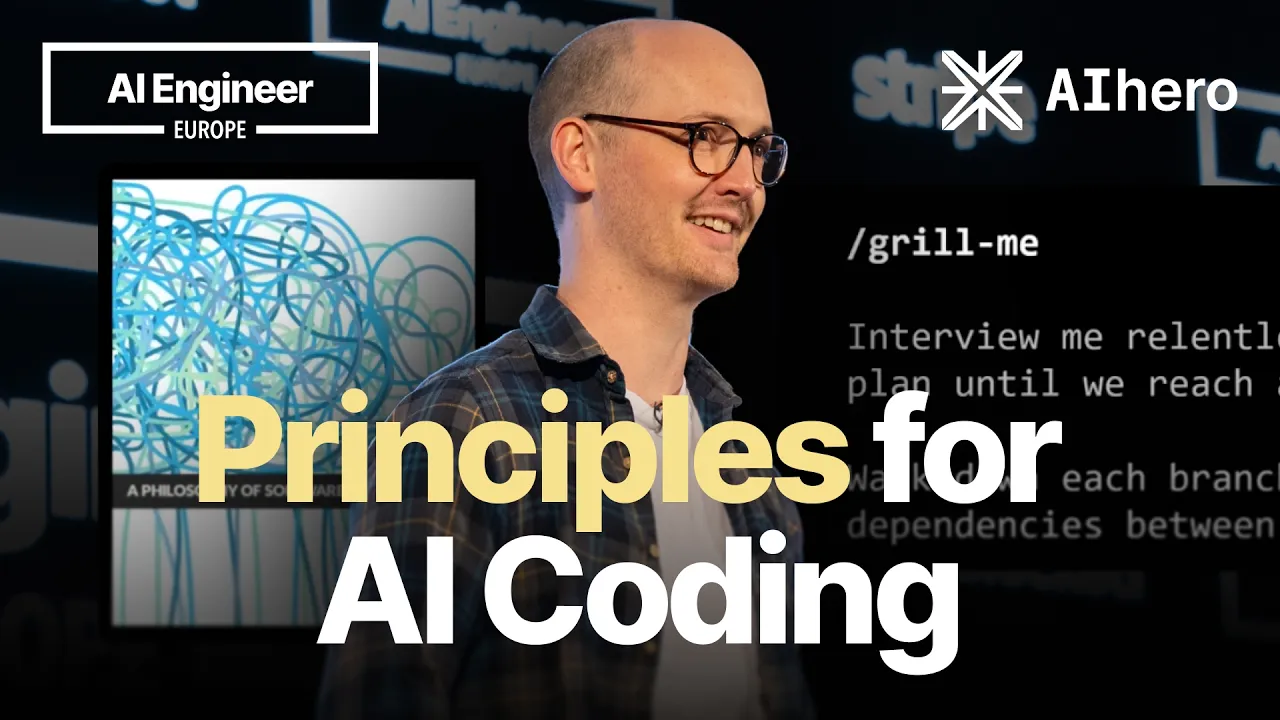
AI Engineer
Treating AI as a black-box compiler accelerates codebase degradation, making disciplined system architecture and interface boundaries essential to keep automated development viable.
AI-assisted summary of "Software Fundamentals Matter More Than Ever" — Matt Pocock — original source. Check the original for full context.
Source published:
Key ideas
- The popular 'specs-to-code' approach, where developers generate code without inspecting it and rely on black-box model iteration, accelerates codebase entropy and turns into unmaintainable 'vibe coding by another name.' (0:00)
- Matt Pocock's open-source 'Grill Me' skill turns AI models into adversarial interviewers asking 40 to 100 targeted architectural questions, establishing a shared design concept before writing PRDs or code. (5:00)
- Adopting Domain-Driven Design's Ubiquitous Language by extracting codebase terminology into structured Markdown tables constrains the LLM's reasoning traces, dramatically reducing verbosity and semantic drift. (7:22)
- Refactoring tangled codebases into John Ousterhout's 'deep modules' allows engineers to specify interfaces while delegating internal gray-box implementation to AI agents, curbing severe developer cognitive burnout. (12:30)
Detailed notes
## Background Published on YouTube by AI Engineer on April 23, 2026, this presentation features educator Matt Pocock addressing the realities of AI-assisted software development. Drawing from 18 months of teaching engineers to build with AI agents, Pocock examines why relying on AI coding tools without strict software fundamentals produces unmaintainable spaghetti code, and presents an iterative framework grounded in classic engineering principles.
## TL;DR Pocock rejects the popular 'specs to code' paradigm, labeling hands-off compilation as a dangerous form of vibe coding that compounds architectural entropy. To overcome common AI failure modes, he introduces tactical techniques such as the adversarial 'Grill Me' interview prompt to establish a shared design concept, and domain dictionaries to enforce a ubiquitous language. He stresses that developers must enforce tight feedback loops through TypeScript and Test-Driven Development (TDD) while refactoring codebases into deep modules with simple boundaries. Ultimately, Pocock argues that while AI excels as a tactical sergeant writing code changes on the ground, human engineers must remain strategic architects who design system interfaces and control module topology.
## Atmosphere & style The presentation is pragmatic, empathetic, and reassuring, striking an immediate chord with developers struggling under the cognitive overload of the AI transition. Pocock blends sharp industry critique with warm, self-deprecating humor, openly commiserating with audience fatigue before systematically dismantling Silicon Valley hype. The talk carries an empowering emotional arc, transforming developer anxiety about obsolescence into renewed confidence in hard-won, foundational engineering discipline.
## Bulletin - [00:00](https://www.youtube.com/watch?v=v4F1gFy-hqg&t=0s) The popular 'specs-to-code' approach, where developers generate code without inspecting it and rely on black-box model iteration, accelerates codebase entropy and turns into unmaintainable 'vibe coding by another name.' - [05:00](https://www.youtube.com/watch?v=v4F1gFy-hqg&t=300s) Matt Pocock's open-source 'Grill Me' skill turns AI models into adversarial interviewers asking 40 to 100 targeted architectural questions, establishing a shared design concept before writing PRDs or code. - [07:22](https://www.youtube.com/watch?v=v4F1gFy-hqg&t=442s) Adopting Domain-Driven Design's Ubiquitous Language by extracting codebase terminology into structured Markdown tables constrains the LLM's reasoning traces, dramatically reducing verbosity and semantic drift. - [12:30](https://www.youtube.com/watch?v=v4F1gFy-hqg&t=750s) Refactoring tangled codebases into John Ousterhout's 'deep modules' allows engineers to specify interfaces while delegating internal gray-box implementation to AI agents, curbing severe developer cognitive burnout.
## Key takeaways - [00:00](https://www.youtube.com/watch?v=v4F1gFy-hqg&t=0s) Software engineering fundamentals have become more critical than ever in the AI era rather than obsolete. - [00:00](https://www.youtube.com/watch?v=v4F1gFy-hqg&t=0s) Treating AI code generation as a black-box compiler degrades codebase maintainability because LLMs lack awareness of global architectural entropy. - [00:00](https://www.youtube.com/watch?v=v4F1gFy-hqg&t=0s) The industry aphorism that 'code is cheap' is false; unmaintainable code is more expensive than ever because it prevents developers from leveraging AI effectively. - [05:00](https://www.youtube.com/watch?v=v4F1gFy-hqg&t=300s) Human developers rarely understand their exact requirements upfront, making alignment a collaborative requirements-gathering exercise rather than simple task delegation. - [05:00](https://www.youtube.com/watch?v=v4F1gFy-hqg&t=300s) The 'Grill Me' prompt pattern forces models to aggressively interrogate the developer's design decisions across branches of the design tree prior to generating code. - [05:00](https://www.youtube.com/watch?v=v4F1gFy-hqg&t=300s) Default AI planning modes, such as Claude Code's plan mode, often rush into code generation prematurely before reaching true conceptual consensus. - [07:22](https://www.youtube.com/watch?v=v4F1gFy-hqg&t=442s) Semantic misalignment between developers and AI mirrors communication breakdowns with domain experts, requiring a shared Ubiquitous Language from Domain-Driven Design. - [07:22](https://www.youtube.com/watch?v=v4F1gFy-hqg&t=442s) Grounding AI planning and code generation sessions with an explicit dictionary of codebase terms sharpens the model's internal reasoning traces and prevents verbose outputs. - [10:00](https://www.youtube.com/watch?v=v4F1gFy-hqg&t=600s) AI models tend to 'outrun their headlights' by writing sprawling amounts of code without checking intermediate feedback loops like static types, browser rendering, or tests. - [10:00](https://www.youtube.com/watch?v=v4F1gFy-hqg&t=600s) Enforcing Test-Driven Development (TDD) constrains LLMs into small, disciplined steps: writing failing tests, writing minimal passing code, and refactoring cleanly. - [10:00](https://www.youtube.com/watch?v=v4F1gFy-hqg&t=600s) A well-architected codebase directly improves LLM output quality because modular, easily testable architectures yield cleaner automated feedback loops. - [12:30](https://www.youtube.com/watch?v=v4F1gFy-hqg&t=750s) Shallow modules with sprawling interfaces confuse AI agents' context windows and obscure dependency chains across the codebase. - [12:30](https://www.youtube.com/watch?v=v4F1gFy-hqg&t=750s) Deep modules encapsulate extensive internal complexity behind narrow, well-designed public interfaces, making boundaries clearer for both AI agents and automated tests. - [15:00](https://www.youtube.com/watch?v=v4F1gFy-hqg&t=900s) Deep module boundaries alleviate developer cognitive exhaustion by enabling 'gray-box' delegation, where engineers review the external interface and tests without inspecting every internal line. - [15:00](https://www.youtube.com/watch?v=v4F1gFy-hqg&t=900s) The recommended operational dynamic is 'design the interface, delegate the implementation,' positioning human engineers at the strategic level while the AI serves as a tactical on-the-ground sergeant.
## Detailed walkthrough ### [00:00](https://www.youtube.com/watch?v=v4F1gFy-hqg&t=0s) The "Specs to Code" Trap and Why Software Fundamentals Matter More Than Ever
Matt Pocock opens with an encouraging message for developers who fear their hard-earned skill sets have been rendered obsolete in the era of artificial intelligence. Having recently designed and taught a course titled *Claude Code for Real Engineers*, he found constructing an AI-centric curriculum a daunting task because the paradigm shifts daily. The prevailing trend in the community is the "specs to code" movement: the premise that engineers only need to author an abstract specification detailing application behavior, delegate the implementation entirely to an AI compiler, and avoid inspecting the resulting code. Whenever a bug or architectural flaw surfaces, developers are told to modify the spec, rerun the generation pass, and let the model fix itself.
```mermaid flowchart TD accTitle: The Specs to Code Anti-Pattern Cycle accDescr: A vicious loop where treating code generation like a compiler worsens codebase entropy over time.
subgraph Cycle["The Compounding Entropy Loop"] A["Write/Update High-Level Spec"] --> B["Run AI Generation Pass"] B --> C["Generate Source Code"] C --> D["Observe Application Failure"] D -->|"Ignore the code & edit spec"| A end C -.->|"Accumulates hidden complexity"| E["Unmaintainable Spaghetti Code"] ```
Pocock recounts his own experimentation with this workflow and reveals the breakdown that occurs in practice. Each time he reran the compiler without inspecting the code, the structural integrity degraded, cascading from slightly flawed code to outright garbage. Rather than a revolutionary approach, Pocock argues that treating code generation like a black-box compiler is merely "vibe coding by another name." To diagnose why LLMs systematically degrade projects, he revisited classical software literature, starting with John Ousterhout’s *A Philosophy of Software Design*. Ousterhout defines complexity as anything about a system's structure that makes it difficult to understand and modify; a codebase is fundamentally bad if changes cannot be made safely and cleanly. This directly mirrors the chapter on "software entropy" in *The Pragmatic Programmer*, which outlines how systems naturally drift toward disorder when individual changes are introduced without evaluating global architecture. Pocock firmly rejects the common industry aphorism that "code is cheap," asserting instead that bad code is more expensive than it has ever been because an unmaintainable system prevents teams from harvesting the immense upside AI models can provide inside clean architectures.
- **Central Thesis:** “I believe, that software fundamentals matter now more than they actually ever have.” — Matt Pocock - **On System Degeneration:** “If you're only thinking about that change, not thinking about the design of the whole system, your code base is gonna get worse and worse and worse.” — Matt Pocock - **On Code Value:** “I think code is not cheap. In fact, bad code is the most expensive it's ever been.” — Matt Pocock - **Recommended Reading:** *A Philosophy of Software Design* by John Ousterhout, and *The Pragmatic Programmer*.
---
[05:00](https://www.youtube.com/watch?v=v4F1gFy-hqg&t=300s) Failure Mode 1: Aligning on the "Design Concept" with the "Grill Me" Skill
The first common breakdown Pocock tackles is misalignment: when the developer believes they hold a crystal-clear objective, yet the AI implements an entirely different, unusable solution. Drawing on *The Pragmatic Programmer*, Pocock reminds the audience that humans rarely know precisely what they want at the outset. Prompting an AI is not just issuing orders; it is a collaborative requirements-gathering exercise. Pocock connects this challenge to Frederick P. Brooks' book *The Design of Design*, specifically the notion of the *design concept*—an invisible, ephemeral mental model of the system that exists between multiple collaborating designers, rather than an explicit artifact that can simply be pasted into a Markdown document.
```mermaid flowchart LR accTitle: The Grill Me Iterative Interview Flow accDescr: How the Grill Me skill resolves architectural dependencies before writing PRDs or code.
subgraph Alignment["Pre-Code Alignment Phase"] U["Developer Initial Plan"] --> G["Grill Me Prompt"] G --> Q["Adversarial AI Interrogation (40-100 Questions)"] Q -->|"Resolve Design Tree Branches"| S["Shared Design Concept"] end S --> P["Structured PRD or GitHub Issues"] P --> A["AFK Agent Implementation"] ```
To bridge this conceptual divide, Pocock created a prompt skill titled `Grill Me`. It instructs the LLM: *"Interview me relentlessly about every aspect of this plan until we reach a shared understanding. Walk down each branch of the design tree, resolving dependencies between decisions one by one."* The prompt repositions the AI from an eager, compliant assistant into an adversarial inquisitor that routinely fires 40, 60, or up to 100 targeted questions at the developer. The resulting dialog can then be summarized cleanly into a Product Requirements Document (PRD) or discrete GitHub issues for asynchronous ("AFK") agents to execute. Pocock critiques the default "plan mode" in Anthropic's Claude Code, arguing that it is overeager to output static planning assets and start generating source code before true conceptual consensus is attained.
- **On Shared Understanding:** “Interview me relentlessly about every aspect of this plan until we reach a shared understanding.” — Matt Pocock - **Adoption:** The repository hosting the `Grill Me` skill went viral, accumulating approximately 13,000 GitHub stars. - **Architectural Reference:** Frederick P. Brooks’ concept of navigating branches of the "design tree" to resolve interdependent system trade-offs.
---
[07:22](https://www.youtube.com/watch?v=v4F1gFy-hqg&t=442s) Failure Mode 2: Solving Verbosity and Miscommunication via Ubiquitous Language
The second failure mode occurs when communication breaks down through verbosity or semantic misalignment, with the AI and developer speaking at cross-purposes. Pocock compares this dynamic to a software engineer collaborating with a specialized domain expert (such as someone building tools for microchips): if both sides lack a shared vocabulary, domain terms get mangled in translation, resulting in incomprehensible code and faulty logic. To resolve this, Pocock applies principles from Eric Evans' *Domain-Driven Design* (DDD), specifically the foundational pattern of a **Ubiquitous Language**—a single, rigorous conceptual lexicon used identically across code identifiers, planning documents, and verbal conversations.
```mermaid flowchart TD accTitle: Ubiquitous Language Workflow with AI accDescr: Extraction of codebase terminology into a structured Markdown dictionary that guides planning and code generation.
C["Existing Codebase"] --> S["Ubiquitous Language Skill"] S --> M["Ubiquitous Language File (Markdown Tables)"] M -->|"Context Injection"| P["Planning / Grill Me Sessions"] M -->|"Constrains Thinking Trace"| A["AI Implementation & Reasoning"] A --> O["Concise, Domain-Aligned Code"] ```
Pocock packaged this concept into a dedicated tool that scans a codebase, extracts recurring business entities and technical jargon, and generates an organized Markdown document of terminology tables. Keeping this file open and injecting it into the context during both `Grill Me` interrogations and code-generation tasks creates immediate benefits. By reviewing the model's intermediate thinking traces, Pocock discovered that grounding the LLM in an explicit dictionary prevents excessive verbosity, sharpens its internal reasoning paths, and yields an implementation tightly mapped to the original architectural intent.
- **Definition of Ubiquitous Language:** “With the ubiquitous language, conversations among developers and expressions of the code, and conversations with domain experts are all derived from the same domain model.” — Matt Pocock - **Operational Payoff:** Grounding the LLM's context with a domain dictionary reduces verbosity in reasoning traces and keeps programmatic outputs strictly aligned with specs. - **Next Dilemma Preview:** Pocock transitions to the subsequent hurdle in the engineering lifecycle: even after reaching complete mutual alignment on what to build, the generated code simply fails to work at runtime.
[10:00](https://www.youtube.com/watch?v=v4F1gFy-hqg&t=600s) Feedback Loops, Outrunning Your Headlights, and TDD
Feedback loops are the most obvious lever for improving an LLM's output. Developers building applications must lean on static types—Matt Pocock bluntly states that if you are not using TypeScript, "that's crazy." Similarly, frontend applications require giving the model access to a headless browser so it can inspect its work, coupled with robust automated test suites. Yet even when equipped with these tools, LLMs fail to exploit them the way a veteran engineer would. By default, an LLM attempts far too much at once, generating vast swaths of code before belatedly checking whether it type-checks or passes tests. Pocock references *The Pragmatic Programmer*, which terms this pitfall "outrunning your headlights": moving faster than your rate of feedback allows.
```mermaid flowchart TD accTitle: TDD Feedback Loop for AI Coding accDescr: An iterative cycle of test-driven development showing small steps from writing tests to refactoring. subgraph Cycle["TDD Cycle"] A["1. Write Test First"] --> B["2. Make Test Pass"] B --> C["3. Refactor & Refine Design"] C --> A end ```
To counter this tendency, developers must enforce Test-Driven Development (TDD) as an explicit skill for the AI. TDD constrains the model to small, disciplined steps: write a failing test first, write minimal code to make it pass, and only then refactor for design. However, testing is notoriously difficult because every testing choice is tightly coupled: determining unit size, deciding what dependencies to mock, and selecting specific behaviors to verify all affect one another. Testing a massive chunk of an application leads to flakiness, while testing small units demands extensive mocking. Pocock observes that throughout his career, the fundamental truth remains unchanged: good codebases are naturally easy to test, and because a well-architected codebase produces cleaner feedback loops, the LLM in turn generates significantly higher quality code.
- “The rate of feedback is your speed limit, which means that you should be testing as you go, taking small deliberate steps.” — Matt Pocock - Core feedback mechanisms that must be supplied to the AI: static type-checking (TypeScript), browser access for frontend inspection, and automated test runners.
---
[12:30](https://www.youtube.com/watch?v=v4F1gFy-hqg&t=750s) Deep vs. Shallow Modules and Codebase Architecture
To make a codebase testable and navigable for AI agents, Pocock turns to John Ousterhout’s philosophy of software design, specifically the concept of "deep modules" versus "shallow modules." A shallow module provides little functionality behind an unnecessarily complex, sprawling interface. Codebases dominated by shallow modules resemble a scattered field of tiny blobs; AI agents struggle to explore these topologies, frequently losing context, missing critical files, and failing to comprehend dependency chains. In contrast, deep modules hide extensive internal complexity behind a clean, minimal interface, allowing callers to use the interface without needing to understand the inner workings.
```mermaid flowchart LR accTitle: Shallow versus Deep Modules accDescr: Structural contrast between shallow modules with sprawling interfaces and deep modules with simple boundaries. subgraph Shallow["Shallow Modules (Sprawling Complexity)"] direction TB S1["Tiny Blob A"] <--> S2["Tiny Blob B"] S2 <--> S3["Tiny Blob C"] S1 <--> S3 end
subgraph Deep["Deep Module (Clean Boundary)"] direction TB I["Simple, Well-Designed Interface"] subgraph Impl["Implementation (Internal Complexity)"] D1["Functionality"] --- D2["Logic"] --- D3["State"] end I --> Impl end ```
Pocock outlines a reusable architectural refactoring pattern to transition from fragile, shallow code to deep modules. Developers systematically explore the codebase, identify clusters of related logic, and encase them inside well-defined module boundaries topped with strict interfaces. Human engineers should retain tight control over interface design, as models easily misjudge system design, while delegating the internal implementation details to the AI. Because deep modules establish clear perimeter boundaries, testing shifts to the interface level, creating an architecture that directly rewards TDD and clarifies the system for LLM exploration.
- Shallow modules: low functionality, high interface complexity, difficult for AI context windows to traverse accurately. - Deep modules: high internal functionality, narrow and simple interfaces, ideal for automated test assertions. - Architectural workflow: inspect sprawling related code, encapsulate it inside a deep module, expose a simple interface, and verify solely through that boundary.
---
[15:00](https://www.youtube.com/watch?v=v4F1gFy-hqg&t=900s) Cognitive Burnout, Gray-Box Delegation, and Strategic Engineering
Pocock addresses failure mode number six: shipping code faster than ever before, only for the developer's brain to collapse under the cognitive load. Asking the audience to raise their hands if they feel more exhausted than ever in their careers, Pocock commiserates, noting that navigating messy, shallow architectures forces human engineers to maintain the entire tangled system in their heads alongside the AI. Deep modules resolve this cognitive strain by enabling developers to treat large parts of the application as "gray boxes." For non-critical domains outside of high-stakes areas like finance, developers can design the interface, verify behavior from the outside with tests, and entirely skip reviewing every line of internal implementation.
```mermaid flowchart TD accTitle: Strategic Developer vs Tactical AI accDescr: Hierarchy of strategic human system design versus tactical AI implementation. subgraph Strategy["Human: Strategic Level"] M["System Map & Ubiquitous Language"] --> P["PRD (Module Changes & Interfaces)"] P --> I["Design Public Interfaces"] end subgraph Tactical["AI: Tactical Level (On-the-Ground Sergeant)"] I --> G["Implement Gray-Box Internals"] G --> T["Pass Automated Boundary Tests"] end ```
This dynamic leads to Pocock's fifth tip: "Design the interface, delegate the implementation." Achieving this requires software engineers to keep a rigorous mental map of system boundaries, incorporating these interfaces into their project's ubiquitous language and planning artifacts. In his own PRDs (Product Requirement Documents), Pocock explicitly specifies intended module boundaries and interface modifications before code generation begins. Echoing Kent Beck’s maxim to invest in system design every day, he warns that treating code as disposable "spec-to-code" divests from architecture. Software fundamentals honed over decades remain essential because while the AI operates as an exceptional tactical sergeant writing changes on the ground, the human engineer must command the system strategically.
- “Raise your hand if you felt more tired than you have ever before in your development career. Yeah, me too. It's knackering.” — Matt Pocock - “Design the interface, delegate the implementation.” — Matt Pocock - “Invest in the design of the system every day.” — Kent Beck (cited by Matt Pocock) - “Code is not cheap. That's the message I want you to take away. Code is important.” — Matt Pocock - “If we think about AI as a really great on-the-ground programmer, a kind of tactical programmer, a sergeant on the ground making the code changes—you need someone above that. You need someone thinking on the strategic level, and that's you.” — Matt Pocock - Speaker resources mentioned: GitHub repository `mattpocock/skills`, educational materials at AIHero.dev, along with Matt Pocock's YouTube channel, Twitter/X account, and newsletter.
## Notable quotes > [00:00](https://www.youtube.com/watch?v=v4F1gFy-hqg&t=0s) I think code is not cheap. In fact, bad code is the most expensive it's ever been. — Matt Pocock
> [15:00](https://www.youtube.com/watch?v=v4F1gFy-hqg&t=900s) If we think about AI as a really great on-the-ground programmer, a kind of tactical programmer, a sergeant on the ground making the code changes—you need someone above that. You need someone thinking on the strategic level, and that's you. — Matt Pocock
> [10:00](https://www.youtube.com/watch?v=v4F1gFy-hqg&t=600s) The rate of feedback is your speed limit, which means that you should be testing as you go, taking small deliberate steps. — Matt Pocock
> [00:00](https://www.youtube.com/watch?v=v4F1gFy-hqg&t=0s) I believe, that software fundamentals matter now more than they actually ever have. — Matt Pocock
## Mentioned Matt Pocock, Claude Code, Anthropic, John Ousterhout, A Philosophy of Software Design, The Pragmatic Programmer, Frederick P. Brooks, The Design of Design, Eric Evans, Domain-Driven Design, Kent Beck, TypeScript, Grill Me, AIHero.dev
## Video description AI coding tools are overhyped and powerful at the same time. Used well, they're extraordinary. Used badly, they'll bury you in spaghetti code faster than any human team could. The difference isn't the tool. It's the process. After 18 months of teaching developers to build with AI agents, Matt Pocock has watched the same patterns emerge: the devs who succeed aren't the ones who delegate everything or nothing. They're the ones who fall back on engineering fundamentals. In this talk, he shares the iterative process his students use to ship high-quality applications with AI agent swarms, and why the principles that make it work (ubiquitous language, vertical slices, TDD, deep modules) are decades-old ideas that didn't break. They got more important.
Speaker info: - https://x.com/mattpocockuk - https://www.linkedin.com/in/mapocock/
---
Explore this talk's slides, transcript, key takeaways and resources on its official AI Engineer page: https://ai.engineer/talks/v4F1gFy-hqg-software-fundamentals-for-ai-coding
---
[Source](https://www.youtube.com/watch?v=v4F1gFy-hqg)