HumanLayer's Horthy Curbs AI Code Churn with Context Compaction
AI Engineer
Coding agents degrade into generating unmaintainable software once context windows exceed 40% capacity, requiring developers to isolate research into compacted plans rather than outsourcing architectural reasoning to models.
AI-assisted summary of No Vibes Allowed: Solving Hard Problems in Complex Codebases – Dex Horthy, HumanLayer — original source. Check the original for full context.
Source published:
Key ideas
- A survey of over 100,000 developers reveals that unconstrained AI coding tools often act as a 'tech debt factory' in brownfield codebases, generating churn where developers spend significant time reworking AI slop shipped the previous week. (0:20)
- LLM reasoning degrades significantly in the 'Dumb Zone,' with performance dropping off once context windows exceed roughly 40% capacity due to accumulated token noise from tools, build logs, and conversational back-and-forth. (4:38)
- The Research, Plan, Implement (RPI) pipeline relies on frequent intentional compaction to compress ground truth into markdown artifacts, enabling agents to tackle complex brownfield repositories like a 300,000-line Rust codebase. (6:35)
- Errors compound exponentially upstream: a flawed line of code causes isolated bugs, a bad plan creates hundreds of bad lines, and an incorrect research phase completely derails an entire project. (17:02)
- A growing organizational rift is emerging between senior engineers cleaning up AI-generated regressions and junior engineers shipping unchecked volume, requiring leadership to modernize SDLC workflows. (18:45)
Detailed notes
## Background This talk was delivered by Dex Horthy of HumanLayer, published by the AI Engineer channel on YouTube on December 2, 2025. In the presentation, Horthy addresses the reality that AI coding tools frequently degrade into 'tech debt factories' within complex legacy codebases, outlining core context engineering principles and 'frequent intentional compaction' workflows to solve hard brownfield engineering problems.
## TL;DR Horthy argues that raw model intelligence is rarely the bottleneck in AI-assisted programming; rather, failure stems from token pollution pushing models into the degraded reasoning of the 'Dumb Zone.' To reliably tackle massive brownfield codebases, developers must replace endless conversational re-steering with intentional compaction, formalizing workflows into distinct Research, Plan, and Implement stages. Upstream errors compound exponentially—a flaw in architectural research derails entire systems, whereas a bug in raw code is easily patched—meaning developers cannot outsource core thinking to LLMs. Ultimately, as agents handle higher volumes of code generation, organizations face an urgent cultural challenge to align junior speedups with senior review standards to prevent endless cycles of reworking AI-generated slop.
## Atmosphere & style The presentation carries a pragmatic, no-nonsense developer vibe that deliberately strips away AI industry hype in favor of grounded terminal-and-repo realities. Horthy speaks with candid, measured urgency, weaving relatable war stories—from 300k-line Rust codebases to the horrors of legacy Parquet Java—with sharp architectural diagnostics. It feels like an authentic engineering post-mortem turned tactical masterclass, shifting from cautionary wariness about compounding errors into hard-won, tactical optimism about what disciplined context discipline can achieve.
## Bulletin - [00:20](https://www.youtube.com/watch?v=rmvDxxNubIg&t=20s) A survey of over 100,000 developers reveals that unconstrained AI coding tools often act as a 'tech debt factory' in brownfield codebases, generating churn where developers spend significant time reworking AI slop shipped the previous week. - [04:38](https://www.youtube.com/watch?v=rmvDxxNubIg&t=278s) LLM reasoning degrades significantly in the 'Dumb Zone,' with performance dropping off once context windows exceed roughly 40% capacity due to accumulated token noise from tools, build logs, and conversational back-and-forth. - [06:35](https://www.youtube.com/watch?v=rmvDxxNubIg&t=395s) The Research, Plan, Implement (RPI) pipeline relies on frequent intentional compaction to compress ground truth into markdown artifacts, enabling agents to tackle complex brownfield repositories like a 300,000-line Rust codebase. - [17:02](https://www.youtube.com/watch?v=rmvDxxNubIg&t=1022s) Errors compound exponentially upstream: a flawed line of code causes isolated bugs, a bad plan creates hundreds of bad lines, and an incorrect research phase completely derails an entire project. - [18:45](https://www.youtube.com/watch?v=rmvDxxNubIg&t=1125s) A growing organizational rift is emerging between senior engineers cleaning up AI-generated regressions and junior engineers shipping unchecked volume, requiring leadership to modernize SDLC workflows.
## Key takeaways - [00:20](https://www.youtube.com/watch?v=rmvDxxNubIg&t=20s) AI coding tools excel in greenfield environments but frequently fail in legacy brownfield enterprise codebases without disciplined context management. - [01:40](https://www.youtube.com/watch?v=rmvDxxNubIg&t=100s) A 2x to 3x productivity boost with AI agents requires treating context engineering as a systematic discipline rather than waiting for next-generation frontier models. - [02:53](https://www.youtube.com/watch?v=rmvDxxNubIg&t=173s) Conversational trajectory biases autoregressive models: scolding or repeatedly correcting an agent alters its token history and induces an error spiral. - [02:53](https://www.youtube.com/watch?v=rmvDxxNubIg&t=173s) Intentional compaction strips away raw tool dumps, noisy build logs, and verbose JSON payloads into concise markdown specifications with exact file paths and line offsets. - [04:38](https://www.youtube.com/watch?v=rmvDxxNubIg&t=278s) The 'Dumb Zone' begins around 40% context window utilization; excessive MCP tool descriptions and large data dumps cause models to forget constraints and hallucinate. - [06:35](https://www.youtube.com/watch?v=rmvDxxNubIg&t=395s) Sub-agents should not be used to anthropomorphize human roles, but strictly to isolate token bloat and protect the parent agent's context window. - [06:35](https://www.youtube.com/watch?v=rmvDxxNubIg&t=395s) The RPI workflow structures development into three phases: exploratory research, detailed planning with verification steps, and clean execution by fresh agents. - [08:38](https://www.youtube.com/watch?v=rmvDxxNubIg&t=518s) Context engineering can successfully deliver pull requests in complex environments, such as a 300k LOC Rust codebase or shipping 35k LOC into BAML during a weekend sprint. - [08:38](https://www.youtube.com/watch?v=rmvDxxNubIg&t=518s) AI cannot replace fundamental human thinking: highly tangled legacy dependencies, like decoupling Parquet Java from Hadoop, still require manual architectural whiteboard design. - [10:20](https://www.youtube.com/watch?v=rmvDxxNubIg&t=620s) The term 'spec-driven development' has suffered from semantic diffusion, diluted from a precise engineering concept into a vague buzzword for writing prompts. - [11:52](https://www.youtube.com/watch?v=rmvDxxNubIg&t=712s) Static repository documentation contains high rates of inaccuracy; reliable workflows use lightweight agent research to extract ground truth directly from current source code. - [14:42](https://www.youtube.com/watch?v=rmvDxxNubIg&t=882s) The primary objective of code review is mental alignment across the engineering team, which is achieved much faster by reviewing compact plan artifacts than massive pull request diffs. - [16:12](https://www.youtube.com/watch?v=rmvDxxNubIg&t=972s) Incorporating concrete code snippets directly into planning documents strikes an optimal balance between execution reliability for agents and readability for human reviewers. - [17:02](https://www.youtube.com/watch?v=rmvDxxNubIg&t=1022s) Human leverage increases upstream: scrutinizing initial research and architectural plans delivers vastly higher ROI than debugging downstream generated code. - [17:48](https://www.youtube.com/watch?v=rmvDxxNubIg&t=1068s) Calibrating the right amount of context compaction requires accumulated practical reps rather than constantly min-maxing across different agent harnesses. - [18:45](https://www.youtube.com/watch?v=rmvDxxNubIg&t=1125s) The most significant challenge over the coming year is organizational change: adapting the software development lifecycle to prevent friction as 99% of code becomes AI-generated.
## Detailed walkthrough ### [00:20](https://www.youtube.com/watch?v=rmvDxxNubIg&t=20s) The Reality of Brownfield Codebases and the "Tech Debt Factory"
Dex Horthy opens by greeting the audience and looking back to the AI Engineer conference in June, where his "12 Factor Agents" presentation was ranked among the top talks of all time and introduced the concept of context engineering. He reflects on another favorite session from that same conference—Igor's report on a massive survey of 100,000 developers across organizations of every scale. That survey uncovered an uncomfortable truth about how AI tools are actually used in industry: far from delivering effortless speedups, AI software engineering frequently creates massive amounts of codebase churn and endless rework. As Dex notes, the data demonstrates that developers might feel like they are shipping much more volume, but “a lot of it is just reworking the slop that you shipped last week.”
While AI assistants excel at greenfield scenarios—such as spinning up a small Vercel dashboard from scratch—they struggle immensely when deployed against complex tasks inside legacy, brownfield software. Pointing an off-the-shelf coding assistant at a decade-old Java enterprise repository consistently yields failure, creating what Dex and other engineering leaders refer to as a "tech debt factory." The standard industry consensus has resigned itself to waiting for raw model intelligence to improve, operating under the assumption that these workflows will remain fundamentally broken until next-generation frontier models arrive. Context engineering challenges that pessimism directly by answering how developers can maximize the reliability of current models through deliberate management of their context windows.
- Igor's developer productivity study surveyed over 100,000 developers across teams of all sizes. - AI-assisted development often accelerates short-term code volume at the cost of high codebase churn and repetitive cleanup cycles. - While greenfield prototypes work smoothly, brownfield enterprise codebases (such as 10-year-old Java architectures) frequently degrade into unmaintainable slop.
---
[01:40](https://www.youtube.com/watch?v=rmvDxxNubIg&t=100s) Rewiring Collaboration: Breakthroughs with Claude Code
Dex admits that his initial encounters with Claude Code left him largely underwhelmed. Although the user experience was polished and provided a marginal improvement over existing interfaces, it did not immediately unlock transformative productivity. However, over the course of eight intense weeks, his three-person team cracked open an entirely new way of operating. By systematically re-architecting how they fed context to the model, they achieved a sustained 2x to 3x increase in development throughput. Shipping at that velocity forced them to completely overhaul their team collaboration habits, leading to a permanent operational shift away from low-quality AI outputs.
The workflow they formalized centered on eliminating slop, handling hard tasks in brownfield repositories, and preserving developer mental alignment with the codebase. When they published their prompt architecture—structured around a "Research, Plan, Implement" (RPI) pipeline—the post went viral on Hacker News, leading thousands of software engineers to adopt their open-source system on GitHub. Dex emphasizes that the goal is not to hoard tokens, but to offload maximal cognitive work to the agent without sacrificing human comprehension: “what we can offload meaningfully to the AI is really really important.”
```mermaid flowchart TD accTitle: Evolution of Coding Agent Context Strategies accDescr: Diagram showing naive agent steering, context resets, and intentional markdown compaction.
subgraph Naive["Naive Steer-and-Yell Loop"] N1["Initial Prompt"] --> N2["Wrong Code / Tool Use"] N2 --> N3["Human Correction / Yelling"] N3 --> N4["Context Exhaustion & Collapse"] end
subgraph Intermediate["Hard Reset Pattern"] R1["Identify Off-Track Loop"] --> R2["Discard Context Window"] R2 --> R3["Fresh Agent with Steered Constraints"] end
subgraph Compaction["Intentional Compaction"] C1["Research & Trace Codebase"] --> C2["Compress into Markdown Spec"] C2 --> C3["Human Review & Tagging"] C3 --> C4["Clean Agent Implements Directly"] end ```
---
[02:53](https://www.youtube.com/watch?v=rmvDxxNubIg&t=173s) Context Engineering and the Error Trajectory Spiral
Most developers interact with coding agents in the most naive way possible: they issue a prompt, receive an incorrect answer, complain to the model, and repeatedly re-steer the conversation until the context window overflows or they give up in frustration. As users gain experience, they realize that throwing away a corrupted conversation and starting fresh is far more effective than trying to rescue a failed run. When Claude responds with classic apologetic backtracking, it is almost always a signal that the session has degenerated and must be abandoned immediately.
Dex explains that context engineering takes this realization a step further through "intentional compaction." Instead of dragging thousands of lines of intermediate file searches, build outputs, and verbose model tool calls across a marathon session, the human asks the agent to compress its hard-won codebase knowledge into a concise Markdown document. This document captures exact file paths, critical line numbers, and architectural trade-offs, stripping out noisy baggage such as test dumps or raw JSON payload blobs from Model Context Protocol (MCP) servers.
The technical justification for this discipline lies in the stateless nature of autoregressive transformers. Because models compute probability distributions over the tokens already present in the history, every single correction alters the trajectory of what comes next. Dex outlines how arguing with a model creates a self-fulfilling failure loop: “So, the next most likely conver token in this conversation is I better do something wrong so the human can yell at me again.” Optimizing the prompt space for correctness, completeness, and compactness while purging negative trajectory is essential to preventing hallucinations.
- Naive agent steering results in compounding errors, context bloat, and developer fatigue. - Intentional compaction extracts the core findings of an exploration session into a compact Markdown file, bypassing repetitive file discovery. - Dangerous context pollutants include verbose build errors, raw file diffs, and MCP servers dumping large JSON payloads or UUIDs into the buffer. - Conversational trajectory directly biases the model: histories dominated by human scolding prime the model to repeat failure states.
---
[04:38](https://www.youtube.com/watch?v=rmvDxxNubIg&t=278s) The "Dumb Zone" and the Limits of Long Context
Borrowing from insights shared by agent researcher Jeff Huntley, Dex introduces the concept of the "Dumb Zone." While modern LLM interfaces advertise context windows of roughly 168,000 tokens (reserving buffer room for system overhead, output generation, and compaction passes), effective reasoning performance declines long before the ceiling is reached. Across realistic programming benchmarks, complex reasoning starts showing severe diminishing returns once the context reaches roughly 40% of its total capacity.
Engineers who load dozens of MCP extensions into their coding environment inadvertently flood the prompt with thousands of tokens of tool descriptions and data dumps before writing a single line of application code. Consequently, the agent spends its entire operational life deep inside the Dumb Zone, guaranteeing fragile, low-grade outputs. Dex argues that the root cause of AI coding failures is rarely baseline model intelligence, but rather reckless token pollution that drowns out core logic: “Just the more you use the context window, the worse outcomes you'll get.” Staying in the "smart zone" requires treating the context window as a scarce, perishable resource rather than a bottomless cache.
| Context Utilization | Approximate Token Range | Operational State | Behavioral Profile | |:--- |:--- |:--- |:--- | | **0% – 40%** | 0 – ~67,000 tokens | **The Smart Zone** | High instruction fidelity, sharp tool usage, minimal hallucination, and accurate codebase navigation. | | **40% – 85%** | ~67,000 – ~142,000 tokens | **The Dumb Zone** | Diminishing returns, forgotten constraints, repetitive apologies, and syntax regressions. | | **85% – 100%** | ~142,000 – 168,000+ tokens | **Context Exhaustion** | Model compaction failures, truncated responses, and complete task derailment. |
---
[06:35](https://www.youtube.com/watch?v=rmvDxxNubIg&t=395s) Sub-Agents and the Research-Plan-Implement (RPI) Framework
To avoid the Dumb Zone, Dex advises developers to be disciplined about using sub-agents. He pushes back sharply against the popular trend of creating anthropomorphized personas—such as separate "frontend," "backend," and "QA" agents: “Sub aents are not for anthropomorphizing roles. They are for controlling context.” Rather than mimicking corporate organizational charts, sub-agents exist to isolate token bloat. An orchestrator can spin up a temporary child agent to explore directories, read dozens of candidate source files, and absorb massive discovery tokens, only to report back a one-line summary to the parent containing the exact file and line offset required.
Layered directly on top of sub-agent isolation is the "Research, Plan, Implement" (RPI) methodology, an open-source workflow built around frequent intentional compaction:
```mermaid flowchart LR accTitle: Research, Plan, Implement (RPI) Architecture accDescr: A linear flow from Research to Planning to Implementation with context compactions.
R["Phase 1: Research<br/>Find files & understand architecture"] -->|"Compact to findings.md"| P["Phase 2: Plan<br/>Explicit steps, line numbers & tests"] P -->|"Compact to plan.md"| I["Phase 3: Implement<br/>Execute step-by-step changes cleanly"] ```
1. **Research:** The agent navigates the repository solely to understand the problem space, remaining completely objective while identifying relevant modules without modifying any code. 2. **Plan:** The agent synthesizes the research into a rigorous implementation plan containing exact file names, code snippets, and explicit verification steps to run after each edit. 3. **Implement:** A fresh, low-context agent executes the structured plan sequentially, validating every change through targeted test executions while keeping conversational overhead near zero.
By transforming software engineering into a pipeline of verified, compacted artifacts, even basic models can execute complex refactorings without making catastrophic assumptions. Dex notes that while writing explicit planning prompts is often the least glamorous part of development, it is the only reliable way to guarantee that agents produce production-grade changes in massive codebases.
[08:38](https://www.youtube.com/watch?v=rmvDxxNubIg&t=518s) Stress-Testing Agents on Brownfield Code and Real-World Limits
Dex Horthy recounts taking on a challenge to prove that context-engineered agents can handle complex legacy environments: attempting to one-shot a fix on an actual 300,000-line Rust codebase for a programming language. In a podcast episode spanning an hour and a half, his team generated research passes, discarded the initial bad findings, and benchmarked planning with and without research against each other. By the very next morning, the project's CTO had stumbled upon the pull request without even knowing it was created as a live podcast stunt, approving it with: "Yeah, this looks good. We'll get in the next release."
To test the absolute ceiling on complex brownfield code, Dex teamed up with Vaibhav (co-founder of BAML) for a grueling seven-hour Saturday sprint. Together, they shipped 35,000 lines of code into BAML. While a portion consisted of generated files—such as updated golden test files triggered by modified runtime behaviors—the pair compressed an estimated one to two weeks of human engineering into just seven hours, resulting in a PR merged the following week.
```mermaid flowchart TD accTitle: Limits of AI Coding Workflows accDescr: Progression from brownfield success to complex legacy architectural failure forcing a return to whiteboard design. subgraph S1["Success: High Structure"] A["300k LOC Rust Codebase"] --> B["Rigorous Research + Planning"] B --> C["Approved PR / Merged Code"] end subgraph S2["Failure: Untangled Dependencies"] D["Parquet Java Dependency Removal"] --> E["Plan & Research Artifacts Discarded"] E --> F["Return to Whiteboard Architecture"] end ```
However, these techniques still hit hard walls when structural complexity outstrips automated reasoning. Dex notes an attempt with his friend Blake to untangle and strip Hadoop dependencies out of Parquet Java: > “If you know what Parquet Java is, I'm sorry for whatever happened to you to get you to this point in your career.”
After watching automated planning collapse under conflicting constraints and unexpected footguns, they had to throw all the generated research away and physically return to the whiteboard to map out how the components should fit together. The crucial takeaway is an engineering rule: > “AI cannot replace thinking. It can only amplify the thinking you have done or the lack of thinking you have done.”
- **Rust Language PR**: Fixed issues across a 300k LOC brownfield repository in an hour-and-a-half recorded live run. - **BAML Weekend Hack**: Shipped 35,000 LOC within 7 hours, completing roughly 1–2 weeks of roadmap items. - **Parquet Java Attempt**: Complete failure of one-shot and agent planning due to deep legacy Hadoop coupling, forcing manual human systems design.
---
[10:20](https://www.youtube.com/watch?v=rmvDxxNubIg&t=620s) The Fallacy of Spec-Driven Development and Semantic Diffusion
When engineers see structured agent workflows, they often label it "spec-driven development." Dex firmly rejects the label, arguing that while the underlying intent is sound, the phrase itself has become completely broken and stripped of shared meaning. Citing Birgitta Böckeler from Thoughtworks, he points out that people casually use the word "spec" when all they actually mean is writing a slightly more detailed prompt.
Dex draws a parallel to Martin Fowler’s 2006 concept of *semantic diffusion*: the predictable lifecycle where an industry invents a useful, precise technical term, only for collective hype to dilute it until it means a hundred contradictory things to a hundred different people. The term "agent" suffered this fate—it was redefined as a person, a microservice, a chatbot, or a workflow, until Simon Willison dragged it back to sanity by defining an agent simply as "tools in a loop." Spec-driven development has decayed into the same meaningless state:
> “So it's gone. As spec-driven dev is overhyped. It's useless now. It's semantically diffused.”
```mermaid flowchart LR accTitle: Semantic Diffusion Lifecycle accDescr: The degradation of clear engineering terms through industry hype cycles into generic buzzwords. A["Precise Term Coined"] --> B["Industry Excitement"] B --> C["Conflicting Definitions Emerge"] C --> D["Semantic Diffusion: Term Becomes Useless"] ```
Depending on who you ask, spec-driven development now refers to: - Writing a standard Product Requirements Document (PRD) or an expanded text prompt. - Creating verifiable feedback loops backed by compiler and test backpressure. - Treating application code like raw assembly while only editing Markdown files (a concept popularized by Swyx). - Relying on a sprawling collection of local Markdown notes while hacking. - Merely authoring public API documentation for an open-source library.
---
[11:52](https://www.youtube.com/watch?v=rmvDxxNubIg&t=712s) Onboarding Agents and the Architecture of Compressed Context
Because vague specs fail, Dex lays out the tactical mechanics that reliably solve complex problems: structured research, system mapping, and explicit context ingestion. He compares an unguided LLM to the protagonist of Christopher Nolan's film *Memento*, who wakes up with zero memory and survives only by reading tattoos inked across his own skin. Without upfront onboarding, agents inevitably hallucinate and fabricate facts about the system.
```mermaid flowchart TD accTitle: Progressive Context Disclosure Hierarchy accDescr: Splitting repository context between root architectures and localized subcontexts to preserve the smart zone. Root["Root Repo Guide (Global Architecture)"] subgraph Submodules["Subsystem Context Files"] DirA["Subsystem A Guide"] DirB["Subsystem B Guide"] end subgraph Execution["Agent Working Memory"] SZ["Smart Zone Available for Tool Calls"] Code["Target Code Files (Source of Truth)"] end Root --> DirA Root --> DirB DirA --> SZ DirB --> SZ SZ --> Code ```
Teams often try adding an exhaustive onboarding guide to the repository root. But in modern codebases or massive five-million-line monorepos, those files balloon. Ingesting a massive document burns the model's entire "smart zone" just parsing internal lore, leaving zero working memory for complex reasoning or accurate tool execution in the "dumb zone." While progressive disclosure—sharding instructions hierarchically across directories so an agent pulls only the sub-context it needs—saves token space, it introduces a severe cache-invalidation nightmare: every shipped PR leaves static documentation stale.
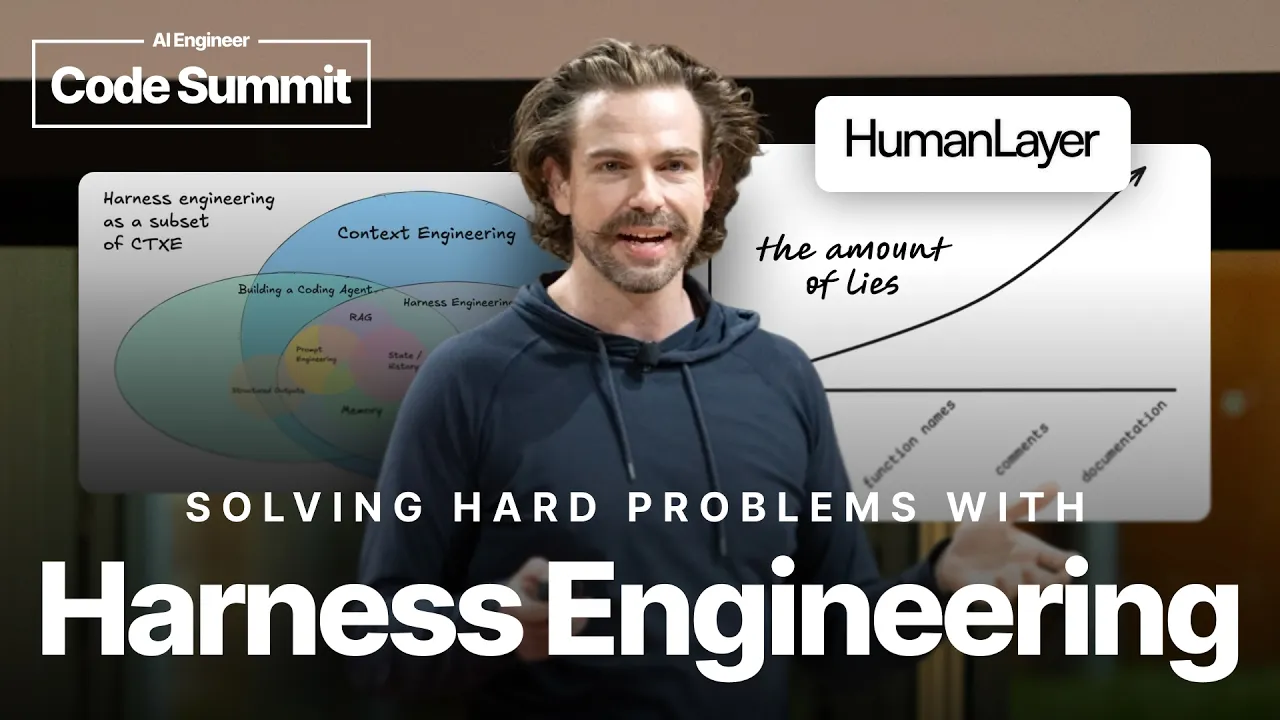
Dex points out that across actual code, function signatures, inline comments, and repository documentation, the metric plotting upward on the Y-axis is pure "lies": > “It's actually the amount of lies you can find in any one part of your codebase.”
Instead of maintaining brittle static documentation, the preferred pattern is **on-demand compressed context**: - Provide lightweight conversational steering (e.g., directing the agent specifically to SCM providers, Jira, or Linear integrations). - Deploy specialized sub-agents or research skills to execute vertical slices directly through the relevant source files. - Aggregate those findings into a single, disposable snapshot research document reflecting ground truth derived straight from the code itself.
---
[14:42](https://www.youtube.com/watch?v=rmvDxxNubIg&t=882s) Mental Alignment and High-Leverage Planning
Planning is fundamentally an exercise in compressing human intent. Once research establishes ground truth, the agent and developer combine that research with PRDs or issue tickets to draft a structured plan file detailing every downstream modification. Dex emphasizes that this step exists primarily for human collaboration rather than raw machine parsing. Asking the audience why code review exists, he notes that while verifying logic is useful, its primary objective is **mental alignment**: ensuring the engineering team understands precisely how and why the architecture is shifting.
Reading thousands of lines of Go or Rust PR diffs every week is mentally exhausting and unsustainable for engineering leaders. However, a lead can easily review a compressed planning document to intercept fatal architectural bugs early:
> “This takes the reviewer on a journey in a way that a GitHub PR just can't.”
Dex highlights Mitchell Hashimoto’s practice of attaching full agent session logs directly to pull requests, allowing reviewers to audit the initial prompts, individual tool executions, and final build validation steps instead of staring blindly at a massive wall of green GitHub diffs.
```mermaid flowchart LR accTitle: Plan Fidelity Tradeoff Curve accDescr: Tradeoff showing that as plan length and code snippet detail increase, execution reliability rises while readability declines. A["Short, Abstract Plan"] -->|"High Readability / Low Reliability"| B["Sweet Spot: Plans with Inline Code Snippets"] B -->|"High Reliability / Low Readability"| C["Exhaustive Pseudocode Spec"] ```
To maximize execution reliability, HumanLayer moved away from high-level prose plans toward plans containing concrete code snippets of the intended changes. Grounding plans in code bridges the gap between readability and execution fidelity: - As planning documents get longer and more explicit, agent execution reliability climbs while human readability degrades; engineering teams must calibrate their specific balance point. - The developer remains in continuous active dialogue with the agent during plan construction rather than passively waiting for code output. - Finalized plans can be peer-reviewed by fellow engineers before generating any actual code modifications.
[17:02](https://www.youtube.com/watch?v=rmvDxxNubIg&t=1022s) The Leverage Hierarchy: Why You Cannot Outsource the Thinking
The real value of structured workflows like research, planning, and implementation does not come from automated magic—it comes entirely from the human in the loop verifying correctness at critical checkpoints. When errors occur upstream, their consequences compound exponentially down the line. A bug in raw code is just an isolated bad line of code, but an error in a plan can easily spawn a hundred bad lines of code. Even worse, a fundamental misunderstanding during the research phase regarding how the system functions or where files live will completely derail the entire task, sending the agent down a hallucinated rabbit hole.
For that reason, engineering teams must deliberately redirect their energy and scrutiny to the highest-leverage phases of the pipeline. Dex cautions developers to be deeply skeptical of tools that boast about automatically spitting out dozens of markdown artifacts simply to give users a false sense of productivity. Offloading the actual architectural reasoning to an LLM undermines the entire process; the human developer must retain ownership of the thinking.
```mermaid flowchart TD accTitle: Compounding Impact of Upstream Errors accDescr: Diagram showing how errors compound from research to planning to implementation. subgraph Pipeline["Context Engineering Pipeline"] R["Research Error<br/>(Architectural misunderstanding)"] P["Planning Error<br/>(Flawed design & steps)"] I["Implementation Error<br/>(Single syntax/logic bug)"] end
R -->|"Derails entire project"| P P -->|"Spawns 100+ bad lines"| I ```
- “So if you take one thing away from this talk it should be that a bad line of code is a bad line of code and a bad part of a plan is could be a hundred bad lines of code and a bad line of research like a misunderstanding of how the system works and where things are your whole thing is going to be hosed.” — Dex Horthy - Internal workflows and customer practices at HumanLayer focus on shifting developer attention upstream to where verification yields the highest return on investment. - Tools that churn out piles of intermediate markdown files without facilitating rigorous human review create vanity progress rather than real software reliability.
---
[17:48](https://www.youtube.com/watch?v=rmvDxxNubIg&t=1068s) Calibrating Context Engineering: Building Reps Over Tool Min-Maxing
Context engineering is not a rigid dogma where every single code edit demands an exhaustive, multi-step pipeline. Sizing the workflow appropriately requires calibration against the task's complexity: altering a button color requires nothing more than a quick, direct prompt to the agent. A minor feature might only need a lightweight scratchpad plan, whereas landing medium-sized functionality spanning several separate repositories justifies a dedicated research phase followed by a formal implementation plan. The ceiling of problem difficulty that an agent can conquer scales directly with the amount of intentional context compaction the developer is willing to invest.
When developers ask how to determine the exact amount of context compaction needed for a given scenario, Dex emphasizes that there is no shortcut or formula—it simply takes operational reps. Engineers have to get it wrong repeatedly, sometimes building plans that are unnecessarily bloated and other times attempting tasks with too little structure. Rather than constantly min-maxing across Claude Code, Cursor, Codex, and other emerging harnesses, teams should pick a single platform, settle in, and build muscle memory through practical trial and error.
- “A lot of people ask me, 'How do I know how much context engineering to use?' It takes reps. You will get it wrong.” — Dex Horthy - “The hardest problem you can solve, the ceiling goes up the more of this context engineering compaction you're willing to do.” — Dex Horthy - “Pick one tool and get some reps. I recommend against minmaxing across Claude and Codex and all these different tools.” — Dex Horthy
---
[18:45](https://www.youtube.com/watch?v=rmvDxxNubIg&t=1125s) Beyond "RPI" and the Emerging Cultural Rift in Software Engineering
Although the broader community has codified this methodology under the acronym "RPI" (Research, Plan, Implement), Dex confesses that he is not a fan of rigid acronyms and doubts these specific three steps will remain permanent fixtures. What actually matters is the underlying mechanism: active context engineering, frequent compaction, and keeping the model inside its performance "smart zone." For those seeking an industry buzzword, he suggests "harness engineering"—the discipline of building the integrations, environment tooling, and codebase customizations that wire an agent effectively into a project. In his view, agent mechanics themselves will soon become commoditized; the truly daunting hurdle over the next 6 to 12 months will be organizational and cultural adaptation as teams adjust their software development lifecycles (SDLC) for an environment where AI writes 99% of the code.
```mermaid flowchart LR accTitle: The SDLC Cultural Rift accDescr: Diagram illustrating the opposing reactions of senior versus junior engineers to AI coding tools. subgraph SeniorStaff["Staff & Senior Engineers"] A["Avoid AI tooling"] -->|"See minimal speedup"| B["Forced to clean up regressions"] end subgraph JuniorMid["Junior & Mid-Level Engineers"] C["Heavily adopt AI"] -->|"Bridges skill gaps"| D["Accidentally ships slop code"] end D -.->|"Generates frustration"| B ```
This transition is already creating a dangerous internal rift within software organizations. Staff engineers frequently resist adopting AI tools because the models offer minimal acceleration on high-level architecture, while junior and mid-level engineers embrace them aggressively to bridge technical skill gaps. Because uncompacted workflows allow junior developers to unwittingly ship unvetted "slop," senior engineers grow increasingly resentful as their weeks are spent reviewing and repairing broken code generated by AI the week prior. Dex insists that solving this tension requires strong top-down leadership rather than placing blame on junior developers or the models. He concludes by sharing that HumanLayer is actively hiring as they build an agentic IDE designed to guide teams safely through the cultural and technical transition toward 99% AI-authored codebases.
- “The hard part is going to be how do you adapt your team and your workflow and the SDLC to work in a world where 99% of your code is shipped by AI.” — Dex Horthy - “And then the senior engineers hate it more and more every week because they're cleaning up slop that was shipped by Cursor the week before.” — Dex Horthy - “Cultural change is really hard and it needs to come from the top if it's going to work.” — Dex Horthy - HumanLayer is expanding its team to develop an agentic IDE aimed at accelerating engineering organizations through the shift toward reliable, high-volume AI code generation.
## Notable quotes > [08:38](https://www.youtube.com/watch?v=rmvDxxNubIg&t=518s) AI cannot replace thinking. It can only amplify the thinking you have done or the lack of thinking you have done. — Dex Horthy
> [18:45](https://www.youtube.com/watch?v=rmvDxxNubIg&t=1125s) The hard part is going to be how do you adapt your team and your workflow and the SDLC to work in a world where 99% of your code is shipped by AI. — Dex Horthy
> [04:38](https://www.youtube.com/watch?v=rmvDxxNubIg&t=278s) Just the more you use the context window, the worse outcomes you'll get. — Dex Horthy
> [17:48](https://www.youtube.com/watch?v=rmvDxxNubIg&t=1068s) Pick one tool and get some reps. I recommend against minmaxing across Claude and Codex and all these different tools. — Dex Horthy
## Mentioned Dex Horthy, HumanLayer, Claude Code, Claude, Cursor, Codex, Jeff Huntley, Igor, Vaibhav, BAML, Blake, Parquet Java, Hadoop, Birgitta Böckeler, Thoughtworks, Martin Fowler, Simon Willison, Swyx, Mitchell Hashimoto, Christopher Nolan, Memento, Linear, Jira, GitHub, Hacker News
## Video description It seems pretty well-accepted that AI coding tools struggle with real production codebases. At AI Engineer 2025 in June, The Stanford study on AI's impact on developer productivity found:
A lot of the ""extra code"" shipped by AI tools ends up just reworking the slop that was shipped last week.
Coding agents are great for new projects or small changes, but in large established codebases, they can often make developers less productive.
The common response is somewhere between the pessimist ""this will never work"" and the more measured ""maybe someday when there are smarter models.""
After several months of tinkering, we've found that you can get really far with today's models if you embrace core context engineering principles.
This isn't another ""10x your productivity"" pitch. I tend to be pretty measured when it comes to interfacing with the ai hype machine. But we've stumbled into workflows that leave me with considerable optimism for what's possible. We've gotten claude code to handle 300k LOC Rust codebases, ship a week's worth of work in a day, and maintain code quality that passes expert review. We use a family of techniques I call ""frequent intentional compaction"" - deliberately structuring how you feed context to the AI throughout the development process.
In this talk, I'll share what we've learned since first sharing these techniques back in August, and some educated predictions on what's coming in the next 6-12 months for software engineers.
Speaker: twitter.com/dexhorthy
Timestamps: 00:00 intro: complex code 01:40 context engineering 02:53 advanced context 04:38 context obsession 05:55 dumb zone concept 07:26 context management 09:37 complex problem solved 10:45 semantic diffusion 12:14 onboarding agents 13:57 internal docs lies 15:03 mental alignment key 16:12 code snippet plans 17:38 don't outsource think 18:45 rpi: smart zone 19:46 cultural change hard
Hey - I'm Dex, and I'm hacking on getting AI coding agents to solve hard problems in complex codebases at HumanLayer. Before this I was working on APIs for agent orchestration and Human-in-the-Loop, and wrote the April 2025 essay "12 factor agents" that first coined the term Context Engineering. I've been coding since high school, when I built tools for NASA researchers to navigate the south pole of the moon. Enjoyer of tacos and burpees (not necessarily in that order).
---
Watch along with the corrected transcript, summary, timestamps and resources on this talk's official AIE page: https://ai.engineer/talks/rmvDxxNubIg-context-engineering-for-complex-codebases
Join our upcoming AI Engineer conferences (see https://ai.engineer landing page):
- AIEi Shanghai, November 5–6 — the first for meeting top Chinese labs and engineers - AIE CODE in SF, November 10–12 — the top AI Coding conference returns - AIEi Sydney, December 7–8 — the first AIEi run alongside NeurIPS 2026 in Sydney
---
[Source](https://www.youtube.com/watch?v=rmvDxxNubIg)