How Bridgewater Built an AI Analyst That Does Hours of Expert Research in Minutes
LangChain
AI-assisted summary of How Bridgewater Built an AI Analyst That Does Hours of Expert Research in Minutes — original source. Check the original for full context.
Source published:
Key ideas
- Bridgewater built the Pocket Analyst Tool (PAT) on top of 50 years of codified, machine-readable economic logic, giving their models immediate access to deep domain frameworks without retroactively writing context. (0:06)
- Embedding human-like inspection heuristics (frequency, currency, economic priors) into time series search increased retrieval accuracy from roughly 50% to 90% across tens of millions of series. (10:24)
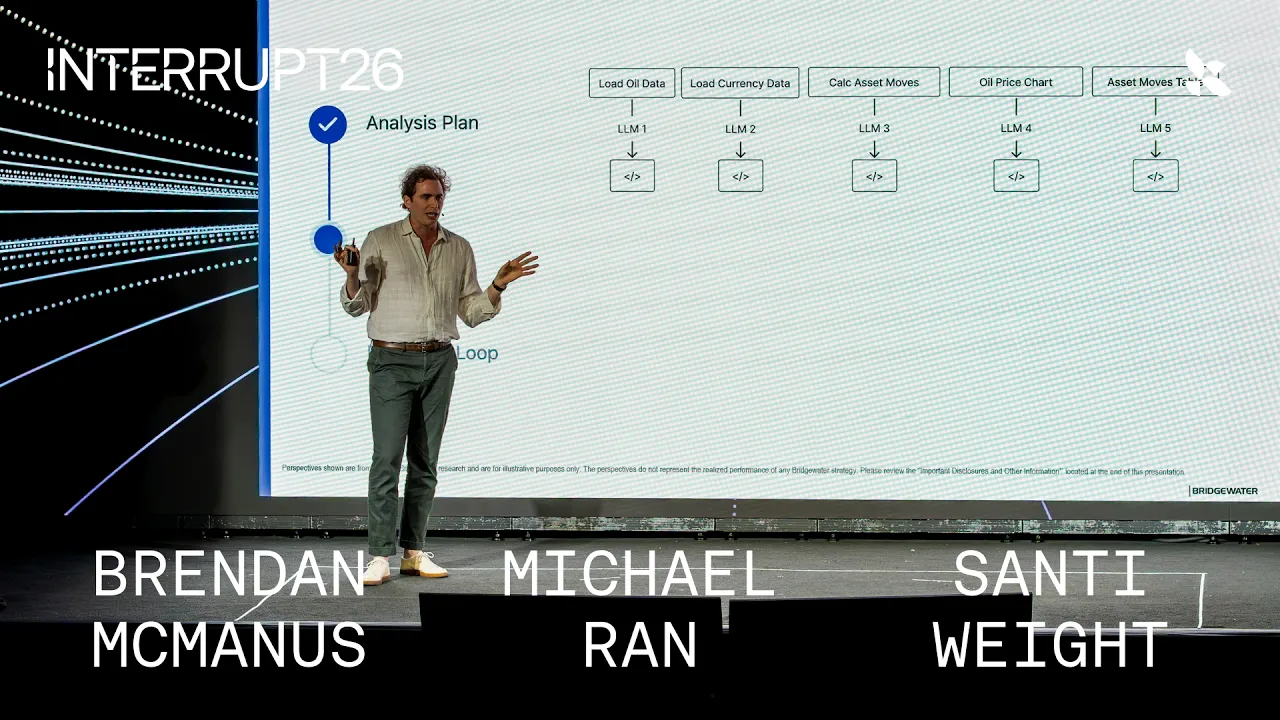
- By treating natural language research plans as strict schema contracts, PAT generates code for discrete DataFrame tasks in parallel, decoupling generation time so 20-task plans complete in the same wall-clock time as 3-task plans. (13:15)
- An automated 'Teach' button allows investors to flag omissions or steering issues, autonomously creating failing benchmark tests, iterating on internal context, verifying against a global regression suite, and submitting automated pull requests. (15:24)
- Engineering agentic code generation like an optimizing compiler—using DAG validation layers and static analysis caching—prevents redundant queries and makes iterative downstream revisions nearly instantaneous. (18:08)
Detailed notes
## Background Published by LangChain on YouTube on July 24, 2026, this presentation features Brendan McManus, Michael Ran, and Santi Weight from Bridgewater Associates' applied AI team. The video details how the firm developed the Pocket Analyst Tool (PAT), an internal AI analyst deployed to hundreds of investors that leverages 50 years of codified investment logic to compress hours of deep exploratory research into minutes.
## TL;DR Bridgewater Associates showcases PAT (Pocket Analyst Tool), an internal agentic AI system engineered to automate complex macroeconomic exploratory research. Grounded in five decades of systematically written-down investment principles and proprietary time-series data, PAT operates through a strict separation between a LangGraph-powered chat interface and a deterministic Python coding engine. Rather than relying on open-ended code generation, PAT treats research plans as compiler source code, executing parallel LLM code generation, DAG-enforced validation layers, and static analysis caching that decouples wall-clock latency from analysis complexity. The platform also integrates an autonomous self-healing flywheel, known as the 'Teach' button, which transforms investor feedback into failing regression benchmarks and automated GitHub pull requests.
## Atmosphere & style The presentation carries the polished, analytical rigor of systematic finance merged with modern compiler theory and software engineering. Moving seamlessly between strategic rationale, live product demonstrations, and deep architectural diagrams, the speakers project measured authority rather than Silicon Valley hype. It feels like an inside look into a high-stakes institutional engineering laboratory where every design decision—from hard-coded validation guardrails to per-user security harnesses—is deliberately calibrated to eliminate 'vibe-coded' hallucinations when billions of dollars are on the line.
## Bulletin - [00:06](https://www.youtube.com/watch?v=lXZb21CfeIY&t=6s) Bridgewater built the Pocket Analyst Tool (PAT) on top of 50 years of codified, machine-readable economic logic, giving their models immediate access to deep domain frameworks without retroactively writing context. - [10:24](https://www.youtube.com/watch?v=lXZb21CfeIY&t=624s) Embedding human-like inspection heuristics (frequency, currency, economic priors) into time series search increased retrieval accuracy from roughly 50% to 90% across tens of millions of series. - [13:15](https://www.youtube.com/watch?v=lXZb21CfeIY&t=795s) By treating natural language research plans as strict schema contracts, PAT generates code for discrete DataFrame tasks in parallel, decoupling generation time so 20-task plans complete in the same wall-clock time as 3-task plans. - [15:24](https://www.youtube.com/watch?v=lXZb21CfeIY&t=924s) An automated 'Teach' button allows investors to flag omissions or steering issues, autonomously creating failing benchmark tests, iterating on internal context, verifying against a global regression suite, and submitting automated pull requests. - [18:08](https://www.youtube.com/watch?v=lXZb21CfeIY&t=1088s) Engineering agentic code generation like an optimizing compiler—using DAG validation layers and static analysis caching—prevents redundant queries and makes iterative downstream revisions nearly instantaneous.
## Key takeaways - [00:06](https://www.youtube.com/watch?v=lXZb21CfeIY&t=6s) Bridgewater's half-century discipline of recording causal investment rules on paper created a human- and machine-readable expert system that eliminated the need to retroactively author foundational domain context for AI agents. - [02:22](https://www.youtube.com/watch?v=lXZb21CfeIY&t=142s) PAT focuses strictly on deep exploratory research and analytical investigation within the firm's broader 'research circle' roadmap, deliberately avoiding automated trade execution or order routing. - [06:56](https://www.youtube.com/watch?v=lXZb21CfeIY&t=416s) Development pods were structured as internal high-velocity startups combining a multi-archetype triad of domain investors, systems technologists, and quantitative scientists. - [09:21](https://www.youtube.com/watch?v=lXZb21CfeIY&t=561s) To prevent proprietary investment IP from leaking across roles, Bridgewater rejected generic single-harness designs in favor of dynamically instantiating a custom PAT harness mirroring each user's exact permissions and data access. - [10:24](https://www.youtube.com/watch?v=lXZb21CfeIY&t=624s) Searching massive financial time series databases requires human-like inspection heuristics—such as currency denomination, frequency, and alignment with economic priors—raising accuracy from 50% to 90% over standard semantic search. - [12:01](https://www.youtube.com/watch?v=lXZb21CfeIY&t=721s) In PAT's architecture, 'the plan is the analysis': interactive clarifying questions establish exhaustive DataFrame schemas and dependency graphs before any code is generated. - [13:15](https://www.youtube.com/watch?v=lXZb21CfeIY&t=795s) Schema-driven planning allows parallel sub-agents to generate code concurrently, matching generation wall-clock time between 3-task and 30-task analyses and running roughly 4x faster than sequential agents like Claude Code. - [13:47](https://www.youtube.com/watch?v=lXZb21CfeIY&t=827s) Successful analytical outputs write directly back into Bridgewater's central time series database, enabling compounding reuse across future human and agent research workflows. - [14:27](https://www.youtube.com/watch?v=lXZb21CfeIY&t=867s) Before presenting findings, PAT runs an automated self-correction loop that validates charts and tables against internal visual and economic standards. - [15:24](https://www.youtube.com/watch?v=lXZb21CfeIY&t=924s) The in-app 'Teach' button triggers an autonomous background CI/CD workflow that synthesizes failing benchmarks, iterates on prompts or context, runs regression suites, and opens pull requests via Slack. - [16:48](https://www.youtube.com/watch?v=lXZb21CfeIY&t=1008s) Financial code generation requires abandoning unpredictable 'vibe-coding' in favor of treating prompts and plans as source code to be deterministically translated through compiler-like stages. - [17:59](https://www.youtube.com/watch?v=lXZb21CfeIY&t=1079s) LangGraph powers the conversational front-end to provide persistent state, cancellations, and continuations, while deliberately abstracting code generation away from macro investors as a pure implementation detail. - [20:04](https://www.youtube.com/watch?v=lXZb21CfeIY&t=1204s) Deterministic task contracts allow down-funnel tasks like visualization to know exact DataFrame shapes and types before upstream data-fetching code is written or executed. - [21:13](https://www.youtube.com/watch?v=lXZb21CfeIY&t=1273s) Correctness is enforced through deterministic architecture rather than agentic orchestration loops, using static analysis to build task DAGs and running parallel validation layers. - [23:10](https://www.youtube.com/watch?v=lXZb21CfeIY&t=1390s) A custom execution engine injects caching annotations across functions via static analysis, enabling near-instantaneous execution during iterative downstream edits. - [24:25](https://www.youtube.com/watch?v=lXZb21CfeIY&t=1465s) Enterprise AI success relies on building highly specialized agents benchmarked on narrow workflows and designed using traditional compiler principles rather than relying on generic, open-ended autonomous agents.
## Detailed walkthrough ### [00:06](https://www.youtube.com/watch?v=lXZb21CfeIY&t=6s) The 1980 Legal Pad and Bridgewater's 50-Year Foundation for AI
Brendan McManus, team lead of the applied AI team at systematic macro hedge fund Bridgewater Associates, opens by introducing the Pocket Analyst Tool (PAT) alongside his colleagues Michael Ran (investor lead) and Santi Weight (technical lead). McManus has spent nearly a decade at Bridgewater, evolving from a software engineer into a systematic investor and researcher before focusing on bridging the divide between investing and technology. PAT was engineered to act as an internal AI analyst capable of compressing hours of rigorous research into minutes for hundreds of active internal investors while continuously learning from every interaction. Rather than presenting a speculative prototype, McManus emphasizes that PAT's technical viability rests directly on Bridgewater's half-century history of methodically encoding economic principles into compounding, systematic architectures.
This tradition dates back to Bridgewater's original 1980 bond system, originally drafted by hand on a yellow legal pad. The operating principle was straightforward: whenever an investor wanted to execute a trade, they had to record the precise causal logic and decision rules justifying it. Putting those rules on paper allowed other investors to critique the reasoning, identify flaws, and suggest structural improvements. Over five decades, this routine of crossing out invalidated hypotheses and inscribing updated rules created an expansive, human- and machine-readable expert system. As McManus observes, this deliberate discipline positioned the firm uniquely for modern generative AI: “We didn't have to go back and write down everything for agents.” Decades of institutional investment intuition were already formalized and structured for retrieval.
- **Bridgewater's Institutional Lineage**: 50 years of capturing market and economic rules within compounding, machine-readable expert systems. - **The Core Practice**: Forcing investors to document their precise causal hypotheses before trading so their logic could be systematically audited and iterated. - **AI Readiness**: Decades of structured data, methodology documentation, and formalized investment rules eliminated the need to retroactively author foundational domain context for agents.
---
[02:22](https://www.youtube.com/watch?v=lXZb21CfeIY&t=142s) The Artificial Investor Roadmap and the Research Circle
Bridgewater approaches modern AI from two distinct vantage points: as macro investors and as technology practitioners. As macro investors, understanding AI dynamics is table stakes—the firm analyzes the capital expenditure buildout, hardware supply-and-demand imbalances, and their second-order ramifications on global markets in the same way it navigated the COVID-19 pandemic or historical oil shocks. As practitioners, however, the firm applies agentic AI across every phase of its investment workflows. The explicit endgame is ambitious: creating a comprehensive "artificial investor" capable of replicating the full operational scope of human analysts.
To build an artificial investor, Bridgewater deconstructs its analytical routine into an iterative "research circle." Human investors continuously observe real-world market signals, formulate hypotheses about what is true or overlooked, conduct rigorous analytical investigations, synthesize findings, and store newly derived insights back into the firm's shared memory. Bridgewater mirrors this loop through specialized sub-agents tailored to each stage, but McManus clarifies that PAT addresses one specific, labor-intensive bottleneck: the deep analytical investigation phase that historically consumed days or weeks of analyst time. Crucially, PAT is not an automated execution bot. As McManus clarifies: “PAT is not about how we trade.” Instead, it acts as an exploratory research partner, unlocking analytical pathways that investors previously lacked the bandwidth to investigate.
```mermaid flowchart TD accTitle: The Bridgewater Research Circle accDescr: An iterative research loop showing perception, hypothesis formulation, deep investigation with PAT, synthesis, and shared memory updating. subgraph Circle["The Research Circle"] P["Perception of World"] --> Q["Formulate Questions"] Q --> I["Analytical Investigation (PAT)"] I --> S["Synthesize Findings"] S --> M["Shared Memory & Expert Systems"] M --> P end ```
- **Two Roles for AI**: Macro assessment of market-wide AI capital expenditure impacts versus operational practitioner deployment across research workflows. - **The Research Circle Loop**: Continuous progression from perception to question formulation, analytical investigation, synthesis, and shared memory feedback. - **Scope Boundary**: PAT handles deep analytical exploratory research rather than automated trade execution or order routing.
---
[04:44](https://www.youtube.com/watch?v=lXZb21CfeIY&t=284s) The Product Spec for PAT and the Continuous Improvement Flywheel
The engineering specification for PAT required matching every core workflow executed by human analysts. First, PAT requires comprehensive data access: it must query and interpret structured time-series data (such as multi-decade equity prices) alongside unstructured qualitative material, including external broker-dealer research notes and internal investment memos. Second, PAT must interface with Bridgewater’s proprietary internal toolsets for visualization, data diagnostics, and indicator validation. Third, because human-grade analyses are deeply layered, PAT’s execution must be fully transparent and diagnosable—structured so that both human investors and background auditor agents can inspect execution traces to verify calculations and intermediate steps.
Beyond data and tools, PAT leverages Bridgewater's 50 years of codified investment logic, giving the model deep contextual familiarity with internal frameworks and standards of proof. Most critically, PAT is architected to learn systematically across the entire organization rather than operating in an isolated per-user vacuum. Having been deployed internally several months prior, hundreds of Bridgewater investors now run real-world research queries through PAT daily. An autonomous background evaluation harness continuously parses these operational traces, flags computational or reasoning errors, produces human-audited evaluation benchmarks, and feeds revisions back into prompt context and tool harnesses. This dynamic creates a firm-wide flywheel where a failure encountered by a single analyst drives automated architectural fixes that enhance performance for every user.
- **Data Modalities Handled**: Long-horizon structured market time series, subscription-based broker-dealer reports, and internal qualitative memos. - **Tooling Integrations**: Direct access to internal Bridgewater diagnostic engines, charting modules, and quantitative indicator testing environments. - **Diagnosability Mandate**: Execution traces are structured for automated background agents and human investors to inspect intermediate mathematical operations. - **Scale and Adoption**: Deployed internally to hundreds of investment professionals who generate real-world operational feedback loops daily.
---
[06:56](https://www.youtube.com/watch?v=lXZb21CfeIY&t=416s) Multi-Archetype Teams and Launching the Live Research Demo
Addressing the common question of how a 50-year-old traditional hedge fund built a high-velocity AI system, McManus explains that the initiative required disrupting internal norms. Bridgewater incubated the applied AI unit as an internal startup, affording it the operational speed and agility of an early-stage company while retaining access to institutional data and infrastructure. Central to this model was assembling cross-functional, "multi-archetype" pods where investors, software engineers, and research scientists work side by side. As McManus puts it: “Investors bring the context and the domain-specific expertise. Technologists bring the architectural capability. And scientists bring the rigor.” This triad ensures the resulting tools satisfy expert users who immediately detect superficial hallucinations.
McManus hands off the presentation to investor lead Michael Ran, who spent five years at Bridgewater moving between engineering and macro research. Ran opens the live demo directly on PAT's internal landing interface. To demonstrate PAT’s depth on a complex macro question, Ran submits an unconstrained research prompt: investigating how global financial markets responded to recent Middle Eastern conflicts, comparing those reactions to historical oil supply shocks, and producing comparative data visualizations illustrating the similarities and divergences across historical macroeconomic regimes.
- **Incubation Structure**: An autonomous internal applied AI startup operating with high velocity inside Bridgewater’s broader corporate umbrella. - **Multi-Archetype Triad**: Direct pairing of domain-expert investors, systems technologists, and quantitative scientists within the same development pod. - **Michael Ran's Background**: Five years at Bridgewater, beginning in engineering before transitioning into macro research and AI process infusion. - **Demo Prompt Objective**: Analyze market impacts of recent Middle East conflicts, map them against historical oil supply shocks, and render comparative charts.
[09:21](https://www.youtube.com/watch?v=lXZb21CfeIY&t=561s) The Per-User Security Problem: Custom Harnesses for Every Investor
Before submitting a live research prompt addressing oil supply shocks and Middle Eastern conflict dynamics that Bridgewater has been studying, Michael Ran pauses to unpack a fundamental architectural and security challenge the team encountered when designing PAT's harness. To provide meaningful leverage, an AI research assistant must have access to all the information an investor uses. However, at a major hedge fund, information access is strictly compartmentalized across different roles and seniority levels. A senior portfolio manager might have full visibility into the firm’s live positioning across global markets, whereas an analyst working on a specific asset class must not be exposed to that proprietary portfolio intellectual property.
To solve this, Bridgewater rejected the generic single-harness model popularized by tools like Claude Code, where all users interact with identical system prompts, permissions, and tool suites. Instead, Bridgewater designed PAT so that every individual investor receives a uniquely instantiated harness. In practice, each user’s PAT is restricted to the exact context, datasets, and execution tools that the specific human researcher is permitted to see, ensuring that secure internal IP cannot leak across organizational boundaries.
As Michael Ran puts it: “So unlike a harness like Claude Code, where everyone is interfacing with the same system prompt and the same tools, each person at Bridgewater has a unique version of PAT tailored to what they can and cannot see.”
- **Information access principle:** PAT mirrors human entitlements exactly so that it can emulate human research without creating information leakage risks. - **Dynamic harness instantiation:** Uniqueness across user sessions is governed dynamically by filtering available prompt context, proprietary databases, and tool configurations.
---
[10:24](https://www.youtube.com/watch?v=lXZb21CfeIY&t=624s) Unstructured Context and Time Series Search: Human-Like Inspection
Once the user prompt is submitted, PAT initiates research by scouring external web sources and Bridgewater's internal vault of unstructured data to contextualize current real-world events against history. While web browsing is standard for modern LLMs, Bridgewater's edge lies in its proprietary, near-real-time unstructured data repository. This system ingests thousands of incoming items daily—including global broker research, earnings call transcripts, and internal email discussions—encompassing millions of historical documents.
Next, PAT queries Bridgewater's proprietary time series database, an asset developed over fifty years containing tens of millions of distinct series. These include standard external market feeds like crude oil spot prices as well as internally computed signals, such as proprietary 12-month forward inflation expectations. Rather than relying solely on traditional retrieval-augmented generation (RAG) and semantic re-ranking, Bridgewater discovered that search accuracy jumped dramatically when they equipped the agent with human-like inspection heuristics. Human researchers evaluate frequency, currency, and whether incoming data matches fundamental economic priors rather than simply matching keyword names.
Michael Ran highlights the dramatic impact of this design choice: “So embedding this sort of reasoning into our search agent is something that got us up from roughly 50% accuracy all the way to 90%.”
- **Unstructured repository:** Ingests thousands of real-time sources daily, spanning global broker research, corporate earnings transcripts, and internal communications. - **Time series scale:** Tens of millions of historical series combining exogenous market quotes with internally modeled macroeconomic metrics. - **Human-like evaluation criteria:** Agents inspect series frequency, currency denomination, and numerical alignment with economic priors.
---
[12:01](https://www.youtube.com/watch?v=lXZb21CfeIY&t=721s) "The Plan Is the Analysis": Clarifying Questions and Schema Design
After compiling the relevant historical context and time series datasets, PAT initiates an interactive dialogue with the researcher, asking targeted clarifying questions and offering alternative analytical angles. Rather than treating clarifying questions as a polite chatbot gimmick, the Bridgewater team devoted substantial prompt engineering and internal benchmarking to teach PAT the substantive difference between strong and weak research questions. The goal is to force human investors—who frequently rush into computation without sufficient forethought—to establish an exhaustive plan before writing a single line of code.
This interactive clarification sets up the formal planning phase. During planning, PAT specifies the entire analysis: every intermediate dataframe that must be constructed, the precise schema of each dataframe, and the exact dependency graph connecting them. While this planning stage demands significant upfront time and computational overhead, the team willingly pays the cost because a mathematically rigid plan unlocks massive downstream efficiencies during the execution phase.
Describing this structural philosophy, Michael Ran explains: “During PAT's development, we came to the view that the plan really is the analysis.”
```mermaid flowchart TD accTitle: PAT Research Planning and Parallel Execution Pipeline accDescr: An end-to-end flow showing how a user prompt moves from context retrieval to clarifying questions, schema planning, parallel code generation, and execution.
subgraph Preparation ["Context & Data Preparation"] A["User Prompt Submitted"] --> B["Search Unstructured Data & Web"] B --> C["Query Time Series Database"] C --> D["Human-Like Inspection (50% to 90% Accuracy)"] end
subgraph Planning ["Interactive Planning Phase"] D --> E["PAT Asks Clarifying Questions"] E --> F["Define Dataframes & Schemas"] F --> G["Map Complete Dependency DAG"] end
subgraph Execution ["Parallel Generation & Storage"] G --> H1["Sub-Agent: Dataframe 1 Code"] G --> H2["Sub-Agent: Dataframe 2 Code"] G --> H3["Sub-Agent: Dataframe N Code"] H1 --> I["Supervised Python Execution Engine"] H2 --> I H3 --> I I --> J["Self-Correction & Diagnostic Inspection"] J --> K["Internal Time Series DB & Interactive Report"] end ```
- **Planning philosophy:** If a plan's input and output schemas are perfectly specified, execution becomes a deterministic compilation step. - **Collaborative scoping:** PAT challenges human biases by proactively suggesting missing analytical dimensions and interrogating ambiguous constraints.
---
[13:15](https://www.youtube.com/watch?v=lXZb21CfeIY&t=795s) Parallel Code Generation and Compounding Time Series Data
Because PAT generates an explicit structural plan containing data dependencies and schemas for every node in the analysis graph, code generation does not need to happen sequentially. Instead, PAT delegates the coding of each dataframe to specialized sub-agents running in parallel. Each sub-agent is supplied with its upstream inputs, input schemas, and the required output schema, isolating it from the rest of the project. Consequently, generating code for an intricate analysis involving 30 dataframes requires virtually the same elapsed clock time as an analysis involving only three.
Once the Python code is assembled, it runs under the supervision of an execution monitor agent programmed to intercept runtime tracebacks or nonsensical numeric outputs. Crucially, when computation succeeds, the resulting time series do not disappear into an isolated reporting UI; they are written directly back into Bridgewater’s central time series database. This means AI-generated time series are formatted identically to human-curated datasets, allowing future analyses run by humans or other agents to consume them immediately as inputs.
Michael Ran underlines the speed advantage of schema-driven parallelization: “So this lets an analysis with three data frames or a medium-sized one with something like 30 data frames take roughly the same amount of time to generate code in both scenarios.”
- **Sub-agent parallelization:** Code generation latency is decoupled from analytical complexity by distributing discrete schema implementations concurrently. - **Autonomous supervision:** A monitor agent catches runtime exceptions and flagrant mathematical anomalies during Python execution. - **Compounding knowledge loop:** Analysis outputs are written back into the corporate time series database, making them indistinguishable from human-uploaded series and immediately reusable.
---
[14:27](https://www.youtube.com/watch?v=lXZb21CfeIY&t=867s) Automated Self-Correction and In-House Interactive Reporting
Before presenting analytical findings to a researcher, PAT performs an automated quality-control check. Mirroring the dynamic between a senior portfolio manager and a junior analyst, PAT inspects its own generated tables and charts, validating that computed quantities adhere to economic sense and that chart layouts are clean and readable. If an anomaly or visual artifact is detected, PAT halts, diagnoses the underlying cause, refines the implementation, and re-executes the pipeline until it satisfies its own internal criteria.
The final output is an interactive research dossier rendered with Bridgewater’s proprietary in-house charting libraries and software stack, developed internally across several decades. Researchers can pan and zoom across historical intervals or push the underlying data slices directly into Bridgewater’s internal visualization software for live manual adjustments.
Reflecting on the need for rigorous self-evaluation, Michael Ran notes: “Now, after execution completes, just like you'd want your junior analyst to double-check their work before coming back to you, we want PAT to do the same.”
- **Self-critique workflow:** The model evaluates its own charts and numeric outputs against internal standards prior to delivering results to the user. - **Native tooling integration:** Visualizations run on Bridgewater’s proprietary financial charting engine, providing immediate operational compatibility for institutional investors.
---
[15:24](https://www.youtube.com/watch?v=lXZb21CfeIY&t=924s) The "Teach" Button: Self-Healing Repositories and Automated PRs
PAT incorporates two distinct mechanisms for continuous operational improvement. The first is passive: background agents systematically scan completed investor sessions to identify systemic analytical blind spots. The second mechanism is explicit: if an investor observes that an analysis yielded the correct numbers but omitted an important analytical perspective or preferred visualization, they can hit an in-app "Teach" button to capture the insight immediately.
Clicking "Teach" triggers a background agent that parses the conversation history to detect context gaps, behavioral discrepancies, or steering patterns that should have been anticipated. The agent formulates a failing benchmark test that reproduces the suboptimal behavior. It then iteratively modifies Bridgewater’s internal context repositories or the agent harness until the benchmark passes, runs regression checks across the entire corporate test suite to ensure existing capabilities remain intact, and dispatches a Slack notification linking directly to an automated GitHub pull request.
Michael Ran emphasizes the compounding advantage of this autonomous self-correction loop: “And the thing this does is that the next time a human comes to PAT with a similar question, we expect them to get the better version of PAT right out of the box.”
```mermaid flowchart LR accTitle: The Teach Button Autonomous CI/CD Loop accDescr: Flowchart illustrating how user feedback via the Teach button generates failing benchmarks, iterates on code, verifies regressions, and opens a pull request.
A["User Clicks 'Teach' Button"] --> B["Agent Identifies Context Gap / Mistake"] B --> C["Generate Failing Benchmark Test"] C --> D["Iterate on Context or Harness"] D --> E{"Benchmark Passes?"} E -- No --> D E -- Yes --> F["Run Full Regression Suite"] F --> G["Send Slack Alert with Automated PR"] ```
- **Dual-track learning:** Combines autonomous post-conversation mining with real-time, user-directed feedback triggers. - **Test-driven evolution:** Automatically synthesizes a reproducible failing benchmark before modifying code or system prompts. - **Continuous deployment safety:** Validates fixes against the global regression suite before submitting automated pull requests via Slack.
---
[16:48](https://www.youtube.com/watch?v=lXZb21CfeIY&t=1008s) Santi Weight: Reframing Coding Agents as a Compiler Problem
Following Michael Ran’s demonstration, Santi Weight, Technical Lead for the Pocket Analyst Tool, takes the stage to unpack PAT's underlying architecture. Acknowledging that many software engineers find building agentic coding tools frustrating, Weight points out that general-purpose coding agents are notoriously fickle, unpredictable, and prone to catastrophic errors—such as inadvertently corrupting underlying databases. While such unreliability might be tolerated in consumer prototypes, it is unacceptable in an institutional investment firm responsible for deploying billions of dollars in global capital.
Drawing upon his personal background in compiler theory and programming language design, Weight argues that high-performance coding agents should not be treated as freewheeling generative chatbots. Instead, they must be engineered like traditional optimizing compilers. A software compiler accepts user code and deterministically translates it into low-level execution targets without introducing off-by-one errors or structural defects. Similarly, an agentic system in finance must treat a natural language prompt and its research plan as source code, compiling it deterministically and reliably down to verifiable, executable Python.
Santi Weight states the high-stakes engineering reality plainly: “At a hedge fund, we're trying to trade billions of dollars, and so we can't have just vibe-coded analysis be the underpinning of how these analyses go.”
- **The fragility of coding agents:** Unconstrained agents frequently hallucinate logic, fail unpredictably, or damage production runtime environments. - **The compiler paradigm:** Treats the human request and structured plan as high-level source code that must be compiled into lower-level Python through rigid, verifiable, and deterministic phases.
[17:59](https://www.youtube.com/watch?v=lXZb21CfeIY&t=1079s) The LangGraph Chat Agent and Coding as an Implementation Detail
Santi Weight shifts focus to PAT's chat agent architecture. The explicit purpose of the chat agent is for the model and the investor to reach a shared understanding of what the research is trying to achieve. Under the hood, it is built in LangGraph, chosen primarily for out-of-the-box persistent state, continuations, and cancellations—mechanisms the team previously tried to build manually “with a much worse effect.” The chat agent has access to tool calls such as time series search and unstructured search. Once it discovers and assembles all the necessary data series, it creates an explicit analysis plan and calls a sub-agent: the coding agent, which generates a complete Python and Pandas analysis.
```mermaid flowchart TD accTitle: Two-tier agent interaction in Pocket Analyst accDescr: The investor talks to a LangGraph chat agent which gathers data via tool calls and passes a structured plan to a Python coding sub-agent.
subgraph ChatStage["Chat Agent (LangGraph)"] User["Investor"] --> Agent["Chat Agent"] Agent <--> Tools["Search Tools<br/>(Time series, unstructured)"] end
subgraph CodeStage["Coding Sub-Agent"] Agent -->|"Analysis plan"| Coding["Coding Agent"] Coding --> Out["Python / Pandas Analysis"] end ```
The strict boundary between the chat layer and the coding layer was an intentional product choice. Bridgewater's investors are not professional software engineers; their focus is macroeconomic logic. The chat interface is therefore kept exclusively focused on investment ideas, deliberately hiding the code so that programming becomes a pure implementation detail. This separation also provides clean prompt context, allowing each agent to specialize and improve at its designated role. To ensure seamless collaboration, the chat agent is trained to communicate using Bridgewater's specific internal vocabulary and investor shorthand:
> “Your user is better at writing context than you are, most likely. And so having low ego about it and letting them contribute directly is a good way to win.”
- **LangGraph Infrastructure:** Provides native state persistence, workflow cancellations, and continuations out of the box. - **Investor Co-Development:** Investors contribute domain context directly into the repository via PRs rather than having software engineers translate their investment logic. - **Workflow Guides:** The chat agent relies on explicit, step-by-step procedural guides for specific analysis types rather than nebulous general context blocks.
---
[20:04](https://www.youtube.com/watch?v=lXZb21CfeIY&t=1204s) Analysis Plans as Natural Language Python Projects
Weight moves to his favorite component: the coding agent. While its architecture is conceptually influenced by LangGraph, it relies on standard Python code rather than autonomous agentic orchestration loops. When the chat agent finishes gathering requirements, it outputs an analysis plan split into discrete tasks. Rather than serving as an open-ended scratchpad or to-do list, each task maps directly to an individual Python function intended to compute a Pandas DataFrame.
```mermaid flowchart LR accTitle: Natural language task schema to deterministic Python code accDescr: An analysis task contains a name, description, and structural and semantic metadata which deterministically compiles into a Python function.
subgraph PlanTask["Plan Task Schema"] Name["Task Name"] Desc["Calculation Description"] Meta["DataFrame Shape & Semantics"] end
PlanTask -->|"LLM Compilation"| Func["Python Function<br/>(Calculates DataFrame)"] ```
The plan functions as a full-fledged natural language software project. Every task schema contains an operational name, calculation instructions, and explicit structural and semantic expectations for the output DataFrame. The objective is strict reproducibility: two different LLMs handed the exact same task specification must generate code that produces identical semantic outputs. Because these task contracts are locked down in advance, down-funnel tasks—such as final data visualizations—already know the exact shape and types of the DataFrames they will consume before earlier tasks (like raw data retrieval) have even written or executed their code.
- **Deterministic Task Compilation:** Two independent LLM runs on the same specification should produce semantically equivalent code. - **Decoupled Task Schemas:** Downstream chart-generation tasks hold complete interface contracts for upstream DataFrames before upstream generation runs. - **Architecture over Autonomy:** Hard-coded Python contracts replace unconstrained agent autonomy for code generation.
---
[21:13](https://www.youtube.com/watch?v=lXZb21CfeIY&t=1273s) Parallel Code Generation and DAG-Enforced Validation
Because the natural language Python plan defines clear data contracts, the coding agent can generate all functions concurrently via parallel LLM calls. A visualization task does not need to wait for upstream ingestion code to finish writing before it starts compiling its own function. In comparative benchmarks against Claude Code on identical plans and context, PAT generates code approximately four times faster. More critically, execution time decouples from plan size: a 20-task plan takes the same wall-clock time to generate as a three-task plan.
```mermaid flowchart TD accTitle: Parallel generation and DAG-based validation architecture accDescr: Tasks generate in parallel, are parsed into a DAG via static analysis, and execute through parallel validation layers until outputs match task requirements.
subgraph Gen["1. Parallel Generation"] T1["Task 1 LLM"] T2["Task 2 LLM"] T3["Task 3 LLM"] end
subgraph Val["2. DAG Validation Layers"] DAG["Static Analysis & DAG Builder"] L1["Validation Layer 1<br/>(Parallel Workers)"] L2["Validation Layer 2<br/>(Parallel Workers)"] end
T1 & T2 & T3 --> DAG DAG --> L1 --> L2 L1 -.->|"Mismatch: Edit & Retry"| L1 ```
Because models rarely produce perfect output on the first attempt, the system runs a structured validation loop. PAT extracts the generated code, runs a static analysis pass to construct a Directed Acyclic Graph (DAG) of task dependencies, and executes validation agents in parallel along topological layers. A five-task plan collapses into three validation layers, while a 20-task plan typically resolves in four or five layers. Each task's output DataFrame is inspected against its original contract. If a discrepancy arises, the validation agent revises the code in place and re-runs it until it conforms.
> “The main point I want you to take away from this part of the slides is that we enforce correctness in the architecture. Again, no agentic orchestration. This is regular Python code, so the guardrails are really hard, and the agents cannot forget to validate.”
- **Hyper-Scaling Speed:** Concurrency allows 20-task analytical plans to complete in the same wall-clock time as small 3-task jobs. - **Deterministic Coding Rate:** Across test suites, identical plans yield matching final code 95% of the time across independent agents. - **Moving Beyond Vibes:** Strict deterministic reproducibility provides dependable evaluation baselines instead of relying on subjective "LLM-as-a-judge" heuristics.
---
[23:10](https://www.youtube.com/watch?v=lXZb21CfeIY&t=1390s) The Execution Engine: Static Analysis and Instant Re-Runs
Traditional coding agents invoke commands directly through terminal tool calls, which introduces network latency and risks the agent getting sidetracked during long execution chains. PAT circumvents this by managing code execution directly through a custom Python engine. The engine runs a classical static analysis pipeline that inspects the code and injects caching annotations across functions to prevent redundant evaluations and double-fetching of heavy macroeconomic time series.
| Execution Dimension | Traditional Coding Agent (e.g., Claude Code) | Pocket Analyst Tool (PAT) | |:--- |:--- |:--- | | **Execution Method** | LLM orchestrates self-directed terminal tool calls | Static analysis pipeline with deterministic harness | | **First-Run Behavior** | Often re-queries and double-executes intermediate steps | Caching annotations prevent duplicate data retrieval | | **Iterative Re-Run** | Re-executes the entire script from top to bottom | Re-executes only modified nodes; upstream is cached | | **Downstream Edit Speed** | Incurs latency overhead of full re-computation | Near-instantaneous updates when changing downstream code |
While PAT is faster on clean first-time runs because it never fetches identical data twice, its primary advantage appears during iterative revisions. Weight demonstrates a benchmark where an investor edits only the title of the final chart in an analysis. A standard terminal-driven agent re-runs the entire Python script from scratch, taking almost as long as the initial run. Because PAT's static analysis isolates dependencies and leverages its cached data frames, it updates only the downstream chart function, resulting in near-instantaneous execution. This enables investors to experiment with analytical iterations without waiting through repeated data-loading pipelines.
---
[24:25](https://www.youtube.com/watch?v=lXZb21CfeIY&t=1465s) Three Takeaways: Specialize, Benchmark, and Think Like a Compiler
Weight concludes the presentation with three core lessons learned while developing PAT for Bridgewater's investment floor:
> “The first takeaway: we really believe in specializing our agents. We don't really believe in generic, powerful agents. They make really cool demos. I'm sure many of us have given them. But it's really hard to make that a daily workflow that you can depend on.”
Rather than deploying open-ended autonomous agents, the team isolates narrow, well-defined workflows, subjects them to rigorous quantitative benchmarks, and methodically hill-climbs those metrics. Highly specialized agents can later be combined into compound workflows, whereas untangling an over-generalized agent after the fact is exceedingly difficult.
Finally, Weight encourages the audience to treat agentic code generation as an applied compiler engineering problem rather than an open-ended autonomy problem:
> “Compilers have been around for decades and they have a ton of techniques for how to generate code more reliably, correctly, and deterministically.”
Borrowing proven compiler strategies—such as intermediate structural representations, DAG-based scheduling, static analysis, and deterministic caching—transforms brittle LLM programming loops into dependable, enterprise-ready systems. Weight wraps up by acknowledging the direct team responsible for the product and inviting attendees to continue the discussion outside for the post-talk AMA.
## Notable quotes > [16:48](https://www.youtube.com/watch?v=lXZb21CfeIY&t=1008s) At a hedge fund, we're trying to trade billions of dollars, and so we can't have just vibe-coded analysis be the underpinning of how these analyses go. — Santi Weight
> [24:25](https://www.youtube.com/watch?v=lXZb21CfeIY&t=1465s) We don't really believe in generic, powerful agents. They make really cool demos. I'm sure many of us have given them. But it's really hard to make that a daily workflow that you can depend on. — Santi Weight
> [24:25](https://www.youtube.com/watch?v=lXZb21CfeIY&t=1465s) Compilers have been around for decades and they have a ton of techniques for how to generate code more reliably, correctly, and deterministically. — Santi Weight
> [06:56](https://www.youtube.com/watch?v=lXZb21CfeIY&t=416s) Investors bring the context and the domain-specific expertise. Technologists bring the architectural capability. And scientists bring the rigor. — Brendan McManus
> [17:59](https://www.youtube.com/watch?v=lXZb21CfeIY&t=1079s) Your user is better at writing context than you are, most likely. And so having low ego about it and letting them contribute directly is a good way to win. — Santi Weight
## Mentioned Bridgewater Associates, Pocket Analyst Tool (PAT), Brendan McManus, Michael Ran, Santi Weight, LangChain, LangGraph, LangSmith, Claude Code, Python, Pandas, GitHub, Slack
## Video description Brendan McManus, Michael Ran, and Santi Weight from Bridgewater Associates' applied AI team walk through PAT, the Pocket Analyst Tool — an internal AI analyst deployed to hundreds of investors that performs hours of deep exploratory research in minutes. Brendan explains how 50 years of written-down investment logic gave Bridgewater a unique advantage entering the AI era. Michael demos PAT live — covering time series search with human-like inspection (jumping from 50% to 90% accuracy), per-user security harnesses, and a Teach button that autonomously generates benchmarks and PRs to fix its own mistakes. Santi then goes deep on the architecture: treating agentic code generation as a compiler problem, parallel LLM code gen from a structured plan, DAG-based validation agents, and a static analysis caching layer that makes iterative re-runs nearly instantaneous.
Chapters: 0:00 Introduction: 50 years of written-down investment logic as an AI advantage 1:52 Bridgewater's approach to AI: as investors and as practitioners 3:11 The research circle and the artificial investor roadmap 4:30 PAT: what it is and what it's not 5:01 What PAT had to do: data, tools, diagnosable analyses, context, and learning 6:24 How a 50-year-old hedge fund actually builds this 7:09 Multi-archetype teams: investors, technologists, and scientists side by side 8:32 Demo: PAT live — oil supply shocks and the Middle East conflict 9:33 The per-user security problem: every investor gets their own PAT 10:24 Time series search with human-like inspection: 50% to 90% accuracy 11:14 The plan is the analysis: clarifying questions and high-quality research plans 12:49 Parallel code generation: 3-task and 20-task plans take the same time 14:27 Self-correction: PAT checks its own work before returning results 15:24 The Teach button: autonomous benchmark creation and PR generation 18:08 Santi Weight: treating coding agents as a compiler problem 19:44 Chat agent architecture in LangGraph and why coding is a pure implementation detail 21:13 The natural language Python project: deterministic tasks and parallel LLM gen 22:37 Validation agents in parallel: enforcing correctness in the architecture 24:00 Execution layer: static analysis, caching annotations, and near-instant re-runs 25:29 Three takeaways: specialize agents, benchmark narrow workflows, think compiler
Resources: → LangGraph: https://www.langchain.com/langgraph → LangSmith: https://www.langchain.com/langsmith → LangChain Academy: https://academy.langchain.com
Bridgewater Disclaimer: The AI tools and capabilities discussed herein are for informational purposes only. There is no guarantee that any discussed capabilities or anticipated benefits will be achieved. See Important Disclosures and Other Information: https://www.bridgewater.com/important-disclosures-and-other-information Risks Associated with the Use of AI Tools: https://www.bridgewater.com/risks-associated-with-use-of-ai-tools
[Source](https://www.youtube.com/watch?v=lXZb21CfeIY)