The Future of AI Agents with Andrew Ng | Interrupt 26
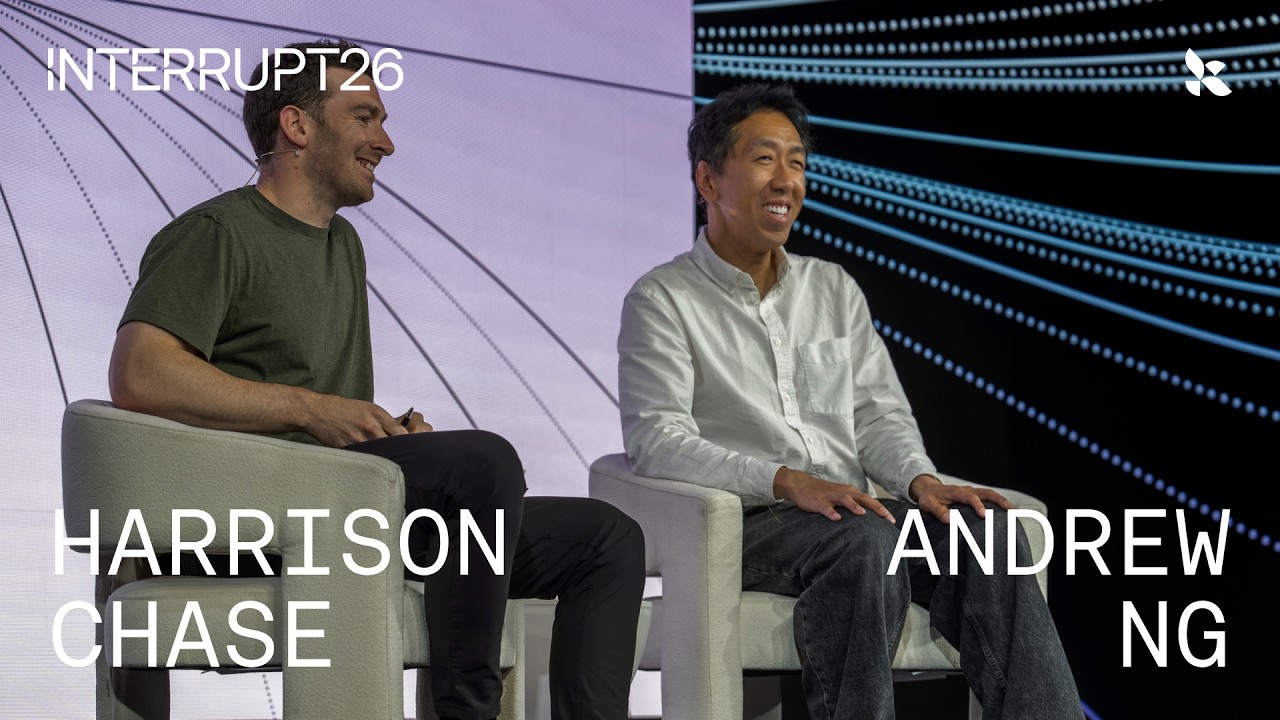
The Future of AI Agents with Andrew Ng | Interrupt 26 — LangChain

LangChain

AI-assisted summary of The Future of AI Agents with Andrew Ng | Interrupt 26 — original source. Check the original for full context.

Source published:

Key ideas

  • Coding agents are accelerating software engineering by 10x to 100x, shifting organizational bottlenecks downstream to product scoping, marketing communication, and legal compliance. (2:01)
  • Enterprise bottom-up AI adoption has created point solutions with minor efficiency gains; meaningful transformation requires top-down workflow redesigns focused on uncapped revenue growth rather than cost savings. (13:29)
  • Forward deployed engineers and proprietary platforms risk severe vendor lock-in, prompting Andrew Ng to advise limiting software commitments to one-year contracts to preserve technical optionality. (23:33)
  • Enterprises face impending multi-million-dollar data overhauls as historical data warehouses built for structured tables fail to deliver fragmented unstructured documents to autonomous agents. (26:38)

Detailed notes

## Background Published by LangChain on YouTube on June 17, 2026, this video features a fireside chat between Andrew Ng and LangChain founder Harrison Chase at the Interrupt 26 conference. According to the page description, the session covers how rapidly coding agents are reshaping engineering teams, the emergence of the product management bottleneck, the contrast between incremental wins and genuine enterprise transformation, and the looming overhaul required for enterprise data architectures.

## TL;DR Andrew Ng explains how coding agents have accelerated raw software development by 10x to 100x, pushing organizational bottlenecks downstream into product scoping, marketing, and legal compliance. He argues that enterprises must move beyond bottom-up point solutions focused on minor labor cost savings and instead make strategic, top-down bets designed to fuel business growth. Ng also emphasizes the importance of preserving optionality by avoiding multi-year vendor lock-in, defending open-weight models, and investing in vendor-neutral infrastructure. Finally, he outlines a massive upcoming wave of enterprise data re-architecture needed to transition legacy relational data systems into agent-ready unstructured data pipelines.

## Atmosphere & style The session carries a warm, collegial, and highly pragmatic tone, shaped by the established partnership and easy banter between Harrison Chase and Andrew Ng. Ng's delivery is measured and grounded, balancing genuine enthusiasm for agentic tooling with clear-eyed skepticism toward AI doomsaying narratives and vendor hype. It feels like an intimate, battle-tested masterclass for practitioners, blending practical developer insights—like using smartphone IDEs and schema-on-read databases—with high-level executive strategy.

## Bulletin - [02:01](https://www.youtube.com/watch?v=OaRhpwz_TGM&t=121s) Coding agents are accelerating software engineering by 10x to 100x, shifting organizational bottlenecks downstream to product scoping, marketing communication, and legal compliance. - [13:29](https://www.youtube.com/watch?v=OaRhpwz_TGM&t=809s) Enterprise bottom-up AI adoption has created point solutions with minor efficiency gains; meaningful transformation requires top-down workflow redesigns focused on uncapped revenue growth rather than cost savings. - [23:33](https://www.youtube.com/watch?v=OaRhpwz_TGM&t=1413s) Forward deployed engineers and proprietary platforms risk severe vendor lock-in, prompting Andrew Ng to advise limiting software commitments to one-year contracts to preserve technical optionality. - [26:38](https://www.youtube.com/watch?v=OaRhpwz_TGM&t=1598s) Enterprises face impending multi-million-dollar data overhauls as historical data warehouses built for structured tables fail to deliver fragmented unstructured documents to autonomous agents.

## Key takeaways - [00:39](https://www.youtube.com/watch?v=OaRhpwz_TGM&t=39s) AI doom narratives and warnings of an imminent job apocalypse have gained excessive traction and remain largely unfounded. - [01:06](https://www.youtube.com/watch?v=OaRhpwz_TGM&t=66s) The rapid evolution of coding agents like Claude Code, OpenAI Codex, and Gemini CLI has transformed daily workflows, enabling engineers to direct code generation from mobile phones and dedicated local hardware. - [02:01](https://www.youtube.com/watch?v=OaRhpwz_TGM&t=121s) Exponential gains in coding velocity have exposed severe bottlenecks in upstream product management and downstream marketing and legal sign-offs. - [02:01](https://www.youtube.com/watch?v=OaRhpwz_TGM&t=121s) Engineering teams are reorganizing into lean pods of 1 to 10 empowered generalists who handle cross-functional tasks like drafting marketing copy and legal terms using frontier models. - [06:02](https://www.youtube.com/watch?v=OaRhpwz_TGM&t=362s) Software developers gain exponential leverage through a LEGO brick approach—combining traditional and AI-native building blocks rather than hand-crafting low-level code. - [08:34](https://www.youtube.com/watch?v=OaRhpwz_TGM&t=514s) Tools like Context Hub overcome model training cutoffs by injecting up-to-date documentation and SDK specifications directly into coding agent prompts. - [10:24](https://www.youtube.com/watch?v=OaRhpwz_TGM&t=624s) Educational platforms like LearnDream.ai are pioneering interactive learning experiences that replace canned lecture videos with interruptible conversational avatars and live JavaScript demos. - [13:29](https://www.youtube.com/watch?v=OaRhpwz_TGM&t=809s) Automating isolated steps in existing workflows yields only marginal labor savings; true enterprise ROI requires top-down workflow redesigns, such as transforming multi-week loan underwriting into a 10-minute automated approval. - [16:44](https://www.youtube.com/watch?v=OaRhpwz_TGM&t=1004s) Enterprises should target top-line business growth rather than cost cutting because headcount savings have a hard ceiling while revenue expansion is virtually unlimited. - [18:27](https://www.youtube.com/watch?v=OaRhpwz_TGM&t=1107s) Pursuing 20% to 50% transformative growth targets is often more effective than chasing 2% marginal gains, as ambitious goals force organizations to invent creative new business models. - [21:07](https://www.youtube.com/watch?v=OaRhpwz_TGM&t=1267s) Plummeting agentic prototyping costs enable teams to explore dozens of low-cost ideas before executive leadership commits capital to a focused portfolio of strategic bets. - [22:00](https://www.youtube.com/watch?v=OaRhpwz_TGM&t=1320s) Forward deployed engineers accelerate enterprise deployments, but long-term enterprise staffing will tilt predominantly toward internal AI talent rather than external vendor personnel. - [23:33](https://www.youtube.com/watch?v=OaRhpwz_TGM&t=1413s) Enterprises should refuse multi-year vendor contracts and 20% to 30% discounts to avoid locking their infrastructure into foundation models that could be eclipsed within a year. - [25:27](https://www.youtube.com/watch?v=OaRhpwz_TGM&t=1527s) Open-weight models consistently trail frontier proprietary releases by only six to nine months, serving as vital infrastructure for production workloads and counteracting vendor lock-in. - [26:38](https://www.youtube.com/watch?v=OaRhpwz_TGM&t=1598s) Corporate data architectures require massive re-engineering because existing data warehouses were designed for structured tables rather than retrieving unstructured PDFs, audio, and video for agents. - [29:27](https://www.youtube.com/watch?v=OaRhpwz_TGM&t=1767s) Using schema-on-read NoSQL databases like MongoDB significantly accelerates agentic prototyping by eliminating the risk of catastrophic schema migration failures caused by LLMs.

## Detailed walkthrough ### [00:14](https://www.youtube.com/watch?v=OaRhpwz_TGM&t=14s) Welcome Back to Interrupt and Reflections on AI Hype

Harrison Chase opens the fireside chat by welcoming Andrew Ng back for year two of Interrupt, LangChain’s agent conference. Harrison notes that Andrew’s session from the inaugural year was the most viewed and most liked talk on YouTube from the event, eliciting applause from the audience. Setting the stage for the discussion, Harrison asks Andrew what over the past year has moved faster than expected in the AI landscape, and what has moved slower.

Andrew responds that on the slower or less rational side, the hype has exceeded his expectations, and doomsaying narratives have gained far more traction than he would have guessed. In particular, he explicitly pushes back against the fear of an imminent labor collapse: “And then also the doomsaying narratives also got more traction, unfortunately, that would have guessed, including the job apocalypse, which I don't think is going to be a thing.”

[01:06](https://www.youtube.com/watch?v=OaRhpwz_TGM&t=66s) The Rapid Evolution of Coding Agents

On the positive side, Andrew observes that coding agents have advanced at a pace that surprised even him. While he acknowledges that the broader industry trope—that everything in AI fundamentally changes every three months—is mostly hype, that rapid pace actually rings true for agentic code generation. The frontier of capabilities and competition is moving so quickly that Andrew’s own daily toolchain shifts continuously. Half a year ago, his workflow was dominated almost exclusively by Anthropic’s Claude Code. Today, while he still relies heavily on Claude Code, he increasingly incorporates OpenAI Codex, Google's Gemini CLI, and open-source alternatives like OpenCode.

These emerging workflows have also altered the physical context of programming. Andrew shares that he never anticipated spending so much time coding directly from his smartphone, often driving tasks on dedicated hardware: “I wouldn't have guessed a year ago that I'd be coding so much on my phone as well. So these workflows, like many of you have a Mac Mini in my office. So all these workflows changing really rapidly.” Beyond software engineering, agentic patterns and workflows are steadily penetrating enterprise environments.

[02:01](https://www.youtube.com/watch?v=OaRhpwz_TGM&t=121s) The Product Management Bottleneck and Shifting Organizational Constraints

When Harrison asks what the future of software engineering looks like, Andrew revisits a concept he introduced a year prior: the product management bottleneck. The core premise is that when implementation speed increases exponentially, the constraint immediately migrates to scoping the problem, gathering user feedback, and deciding what to build. Over the past year, this bottleneck has intensified—in a healthy way—because writing software has accelerated by 10x to 100x. However, engineering speed has now accelerated so much that virtually every other organizational function is struggling to keep pace.

```mermaid flowchart LR accTitle: The Shifting Organizational Bottleneck accDescr: Acceleration in software development pushes constraints downstream to PM, marketing, and legal.

subgraph Dev["Core Development"] A["Coding Agents & Tooling"] -->|"10x–100x speedup"| B["Software Shipped in 1 Day"] end

subgraph Bottlenecks["Downstream Bottlenecks"] B --> C["Product Management<br>(Scoping & Customer Needs)"] B --> D["Marketing<br>(Communicating Rapid Features)"] B --> E["Legal & Compliance<br>(Sign-offs & Terms of Service)"] end ```

Andrew explains that his teams are now actively bumping into marketing bottlenecks, where product features ship faster than marketers can digest and articulate them to users. Similarly, legal compliance has become an acute friction point: waiting a week for legal sign-off was acceptable when a feature took three months to write, but when code is drafted in an afternoon, a week-long legal review stalls the entire pipeline. Because of this, Andrew sees engineering teams restructuring into small pods of one to ten people made up of empowered generalists:

> “So I think a lot about how software engineering teams in the future will be organized, and I don't think I know the answer. But increasingly, I find myself setting up very small parts, you know, anywhere from one to 10 engineers in a team, of often generalist, high context, highly empowered generalists, that are given a set of very wide guardrails within which they can just run like crazy and build in ship code, and even drive decisions like writing, marketing, copy that are traditionally outside the purview of engineering.”

By the pigeonhole principle, if a cross-functional initiative requires engineering, scoping, terms of service, design, and marketing copy, a lean two-person squad must wear multiple hats. Andrew jokes about his own marketing skills, noting that while AI does not make him a great marketer, it makes him “slightly less bad.” In practice, engineers are now using frontier models to draft initial terms of service before handing them off to lawyers for final polish, cutting development cycles dramatically.

[04:50](https://www.youtube.com/watch?v=OaRhpwz_TGM&t=290s) The Backgrounds of Frontier Generalist Engineers

Harrison asks about the typical pedigree of these high-velocity generalists—specifically whether they are seasoned software engineers expanding their scope or professionals from product, marketing, and operations who are picking up coding for the first time.

Andrew explains that while successful contributors can emerge from any background, the vast majority of people thriving in these hybrid roles began with deep technical and software engineering foundations:

> “I think it's actually possible for people of any background to learn to do a lot of this. But the largest number of bodies doing this well right now seems to be people that came from an engineering background.”

Engineers possess a natural advantage in understanding the mechanics and edge cases of frontier AI tools. However, Andrew highlights that he has also watched product managers learn to code effectively, marketers build working software prototypes, and operations personnel assemble end-to-end internal tools. The overarching requirement is not just deep domain training, but the willingness to step into unfamiliar disciplines with an AI assistant at one's side.

[06:02](https://www.youtube.com/watch?v=OaRhpwz_TGM&t=362s) Combinatorial Software Development and the LEGO Brick Mental Model

Andrew offers a framework for how developers should think about modern software engineering: mastering modular building blocks. The ecosystem is inundated with both AI-native components (retrieval-augmented generation, agent frameworks, evaluation frameworks, guardrails) and traditional infrastructure building blocks (UI kits, authentication systems, frontend and backend persistence layers, databases).

Because the open-source community and proprietary API providers are producing new blocks at an unprecedented rate, developers who understand what each block does can achieve exponential leverage:

> “So I find that developers that have a good mastery of enough building blocks can often put them together in combinatorially many ways to very rapidly build software.”

To illustrate this, Andrew uses the analogy of building with LEGOs: - With only a single white brick, what one can construct is severely constrained and uninteresting. - Introducing black, yellow, brown, and green bricks alongside specialized squiggly elements causes the space of possible creations to expand combinatorially and exponentially. - In software, the engineer's primary job is recognizing the functional properties of these disparate blocks, while directing coding agents to handle the tedious assembly work.

[08:34](https://www.youtube.com/watch?v=OaRhpwz_TGM&t=514s) Context Hub: Overcoming Model Knowledge Cutoffs for Tool Use

A central roadblock coding agents encounter when working with newly released building blocks is the model training cutoff. If an API or SDK was published after a model's knowledge cutoff date, the agent has no intrinsic awareness of its existence, parameters, or calling syntax.

To solve this problem, Andrew teamed up with his friend Rohit Prasad to build Context Hub, which functions as a specialized knowledge repository or “Stack Overflow for AI agents.” Context Hub ingests and serves up-to-date documentation and SDK specs directly into coding agent prompts, while also providing a mechanism for agents to submit feedback on doc clarity. Andrew notes that whenever an API has clunky or hard-to-remember syntax, he points his agent at Context Hub to ingest the latest docs and execute the calls autonomously, significantly accelerating his personal coding speed.

Harrison chimes in with an amusing logistical clarification: LangChain also recently shipped an internal project named Context Hub. While the names collide, Harrison points out that Andrew's project is specifically designed to feed up-to-date documentation into coding agents, encouraging the audience to try it out. Harrison also highlights the enduring partnership between LangChain and DeepLearning.AI, noting that LangChain was the second partner (immediately following OpenAI) to launch a short course on the platform, which became a primary discovery channel for early LangChain users.

[09:50](https://www.youtube.com/watch?v=OaRhpwz_TGM&t=590s) The Evolution of AI Education

Harrison turns the conversation toward education, asking how pedagogical practices must adapt to an AI-accelerated world and how those insights are being woven into DeepLearning.AI’s curricula. Andrew emphasizes that the baseline curriculum for technical workers has fundamentally shifted. Software engineers can no longer focus solely on static syntax and traditional algorithms; they must deliberately learn coding agent workflows, stay abreast of proliferating architectural building blocks, and cross-train in adjacent disciplines like product management to operate effectively inside lean, autonomous teams.

[10:24](https://www.youtube.com/watch?v=OaRhpwz_TGM&t=624s) Transforming AI Education: From Static Videos to Interactive Conversations

Andrew Ng shifts the discussion to how education itself is evolving. Beyond simply changing *what* people learn—a need addressed through organizations like DeepLearning.AI and Coursera—the delivery mechanism of training has been ripe for rethinking for a very long time, though Andrew notes it is "actually not quite here yet."

To explore new learning paradigms, his team launched a preview site called LearnDream.ai (referred to in the session as CodeDream.ai). The core thesis is that users should not be forced into a conventional online course format:

> “This is not a course, it's a conversation where the experience you tried to build was for you to come and get on a simulated video call with me...”

In this environment, if a user wants to sit back and passively absorb a presentation on Context Hub and coding agents, the AI avatar will present. However, the learner can interrupt the AI at any moment to ask questions. Andrew also highlights an experiment where standard videos and slides are replaced entirely with live JavaScript. When presenting a demo in this format, learners can click directly into the video window and enter their own prompts or queries in real time. When Harrison Chase clarifies whether this in-video interaction is live today, Andrew confirms it is:

> “That's live. So imagine if instead of me screen sharing in a video, I am, you know, JavaScript sharing in a video and so you can interact with whatever I'm called screen sharing because it's running JavaScript code, not a canned video.”

Despite these experiments, Andrew argues that the grand transformation of education has been somewhat over-hyped. While current online materials are vastly better than a decade ago—pointing to a newly launched course on Transformers by Sharon Zhou featuring rich, interactive visualizations rather than simple lecture recordings—he emphasizes that the truly radical shift in educational formats is still an ongoing effort that he spends significant time thinking about.

---

[13:29](https://www.youtube.com/watch?v=OaRhpwz_TGM&t=809s) Enterprise AI Adoption and the Loan Underwriting Paradigm

Harrison Chase asks how enterprises are currently adopting AI across broader industries, whether it is happening faster or slower than expected, and what models work best. Andrew explains that through AI Aspire, an AI advisory firm he co-founded with his partner Chris Tan, they advise Fortune 50, Fortune 500, and Global 2000 companies on their overall AI strategies. Across these large enterprises, a consistent theme emerges: nearly everyone tried a bottom-up, “let a thousand flowers bloom” strategy, and boards and CEOs are now questioning where the return on investment actually is.

Andrew argues that bottom-up innovation remains valuable for idea generation, but it naturally leads to isolated point solutions that yield minor efficiency improvements rather than end-to-end business transformations. To illustrate, he examines how banks approach loan underwriting, which typically follows five distinct stages:

```mermaid flowchart LR accTitle: Loan Underwriting Workflow Transformation accDescr: A comparison showing point-solution automation of a single step versus end-to-end redesign for a 10-minute loan product.

subgraph PointSolution ["Incremental Point Solution"] direction TB M1["1. Market loan"] --> A1["2. Receive application"] A1 --> R1["3. AI review & approval<br/><i>(Saves ~1 hour human labor)</i>"] R1 --> D1["4. Final diligence"] D1 --> E1["5. Execute loan"] end

subgraph RedesignedFlow ["Top-Down Redesigned Workflow"] direction TB M2["1. Market 'Get approved in 10 minutes'"] --> A2["2. Immediate data routing infra"] A2 --> R2["3. Instant AI credit decision"] R2 --> D2["4. Scaled diligence & execution"] end ```

If an enterprise keeps the traditional weekly turnaround time intact and merely substitutes an AI agent to handle the one hour of human review time, they have captured only an incremental operational saving. A genuinely transformative approach rethinks the entire pipeline to launch a product marketed as "get approved in 10 minutes." Doing so, however, requires executive-level buy-in because marketing, data infrastructure, and diligence operations must all be completely re-architected.

> “Bottom-up innovation often results in point solutions that drive incremental efficiency gains, which are actually a good thing, but not the transmission, not the broader transformation that AI has been promising us and that I think we should work to deliver.”

---

[16:44](https://www.youtube.com/watch?v=OaRhpwz_TGM&t=1004s) Cost Savings vs. Driving Business Growth

Andrew encourages companies to steer AI initiatives toward top-line growth rather than limiting themselves to headcount reductions or cost savings. His fundamental rule of thumb is simple:

> “Because we can only save so much money, but growth has almost no practical ceiling. So the more exciting ideas I find usually relate to driving business growth rather than savings.”

When Harrison asks for concrete examples of AI driving business growth, Andrew points out several practical workflows: - **Instant Financial Products:** The aforementioned 10-minute loan approval process that captures market share by out-servicing competitors. - **Customer Support and Contact Centers:** While routinely viewed through the narrow lens of labor cost reduction, augmenting support operations allows an organization to resolve customer issues far faster and at greater volume, turning a support interaction into a brand-differentiating, growth-driving experience. - **Drive-Thru Voice Automation:** Automating restaurant drive-thru ordering pipelines creates a smoother, faster, and more delightful experience that directly drives order throughput and customer retention.

---

[18:27](https://www.youtube.com/watch?v=OaRhpwz_TGM&t=1107s) Measuring ROI: Why Big Bets Beat 2% Incremental Targets

Addressing Harrison's question on how leadership should quantify AI ROI, Andrew acknowledges that because enterprises are so diverse, there is no generic, one-size-fits-all formula. However, he cautions against getting bogged down in marginal accounting exercises over whether an agent provided a 2% lift offset by a 1% implementation cost.

He shares an unintuitive operational insight: chasing transformative gains can often be easier and more motivating than pursuing tiny, incremental targets:

> “Sometimes driving incremental gains is harder than driving transformative gains. Because if you tell someone to improve their business results by 2% next year, then they're like, all right, my boss is telling me to work 2% harder or 5% harder or whatever. But if you try to search your ways to drive 20% business growth or 50% business growth, then you can't just get everyone to work 50% harder in the company and you have to come up with more creative solutions.”

He closes this section by recounting how client companies frequently overwhelm advisors with uncurated backlogs. One major financial institution handed AI Aspire a spreadsheet containing over 300 distinct AI ideas, asking them to pinpoint which ones merited genuine capital expenditure. Andrew notes that identifying the winners is rigorous work: it demands deep technical feasibility analysis paired with exhaustive business evaluation to prune hundreds of surface-level ideas down to a tightly focused handful of high-impact strategic bets.

[21:07](https://www.youtube.com/watch?v=OaRhpwz_TGM&t=1267s) Strategic AI Bets and Top-Down Resource Allocation

Harrison Chase brings up high-impact enterprise AI initiatives, noting that the "swing for the fences" projects tend to originate as top-down mandates from leadership. Andrew Ng agrees, explaining that companies should not gamble their entire future on a single reckless bet, but rather construct a carefully considered portfolio of several high-upside initiatives.

```mermaid flowchart TD accTitle: Resource Allocation for AI Projects accDescr: Progression from cheap low-budget agentic prototyping to top-down capital allocation for a portfolio of strategic bets.

subgraph Prototyping ["Bottom-Up Prototyping"] A["Agentic Code Experiments"] --> B["Plummeting Prototyping Costs"] B --> C["High Volume of Small POCs"] end

subgraph Selection ["Portfolio Strategy"] C --> D{"$100K Budget Ceiling"} D -->|"Resource Limits"| E["Select Portfolio of Thoughtful Bets"] end

subgraph Execution ["Top-Down Execution"] E --> F["Executive Resource Allocation"] F --> G["Meaningful Business Impact"] end ```

Ng highlights that agentic coding has dramatically altered early-stage exploration because the cost of prototyping has plummeted, allowing teams to churn through dozens of experimental prototypes with minimal friction. However, prototyping is only the beginning. Teams inevitably run into resource limits on modest budgets, and backing projects with meaningful capital requires executive sponsorship. As Ng puts it: “I find that businesses, hopefully not take one wild swing for the fences, is more a portfolio of a handful of thoughtful bets where if anyone pays off, it will be meaningful for the business.”

[22:00](https://www.youtube.com/watch?v=OaRhpwz_TGM&t=1320s) Forward Deployed Engineers: Hype Versus Reality

Harrison turns the conversation to forward deployed engineers (FDEs), a model gaining massive traction across enterprise AI adoption, asking whether every company will eventually employ them and why they carry such outsized influence. Ng acknowledges that Silicon Valley is “definitely having a moment of FDEs” and gives a nod to Aaron Levie’s thoughtful stage remarks on the subject earlier at the conference. While Ng sees the embedded engineering model as an effective mechanism to accelerate deployment, he cautions that public excitement has run slightly ahead of practical operational ratios.

Inside typical enterprises, Ng predicts that the long-term ratio of internal staff to embedded vendor engineers will lean heavily toward in-house AI talent, with only small, focused squads of external FDEs operating on site. Building reliable agentic workflows demands far more than raw coding chops; it requires business acumen, stakeholder management, change management, deep technical judgment, and the courage to push back on technically infeasible customer demands. As Ng observes: “So that's why I like FDEs. I'm excited about the growth. Let's help more people get jobs as FDEs. But I think the hype is also, as is often the case, a bit greater than the actual reality.”

[23:33](https://www.youtube.com/watch?v=OaRhpwz_TGM&t=1413s) Vendor Neutrality, Optionality, and Avoiding Multi-Year Lock-In

The core operational tension with embedded FDEs, Ng argues, is the near-impossibility of finding vendor-neutral engineers. When an enterprise brings in FDEs from an external provider, those engineers invariably configure the entire infrastructure around their employer's proprietary model or platform. This creates massive lock-in risks in a market where leadership shifts every few quarters.

Ng emphasizes that because nobody can reliably predict what will be the frontier foundation model or the top coding agent a single year from now, maintaining technical optionality is paramount. Enterprise software vendors frequently attempt to lock clients into multi-year commitments by offering 20% to 30% price breaks, but Ng strongly advises against surrendering agility for small discounts. To retain independence, organizations need vendor-agnostic infrastructure layers like LangSmith for tracing, evals, and observability across any underlying model provider.

> “I personally almost never sign longer than a one-year contract, regardless of the discounts offered, because I value that optionality to work with whatever vendor would be the best in a year's time that I don't know about.” — Andrew Ng

- Frontier model leadership turns over so quickly that predicting next year's best coding agent or LLM is impossible. - Vendors use 20% to 30% contract discounts to lock enterprises into three-year terms. - Vendor-neutral platforms like LangSmith give teams observational visibility without binding their data pipelines to one model ecosystem.

[25:27](https://www.youtube.com/watch?v=OaRhpwz_TGM&t=1527s) The Strategic Imperative of Open-Weight Models

Turning to foundation model ecosystems, Harrison asks about the trajectory of open-source and open-weight models compared to closed frontier APIs. Ng notes that open weights have maintained a remarkably steady performance gap, trailing frontier proprietary releases by approximately six to nine months. Because frontier models carry steep token costs for production volume, Ng's teams rely extensively on open-weight alternatives, deploying them both off-the-shelf and fine-tuned for specialized workflows.

However, Ng voices serious concern about political headwinds threatening open-source AI, citing recent discussions emerging from the White House regarding mandatory pre-release inspections for open models. He notes that he has been in direct contact with administration contacts to push back against policies that could dismantle community-driven AI under the guise of national security or geopolitical rivalries with China. In his assessment: “I feel like if we can all protect open source, open weight, it will make the world much richer, and also help all of us preserve optionality.”

[26:38](https://www.youtube.com/watch?v=OaRhpwz_TGM&t=1598s) Rearchitecting the Enterprise for Unstructured Data

Harrison shifts to data strategy, asking what companies must fix before deploying operational agents over enterprise knowledge bases. Ng reveals that through his work at AI Fund and AI Aspire, data architecture is the single most pervasive pain point voiced by corporate leadership. For two decades, enterprises poured hundreds of millions of dollars into relational databases, data warehouses, and structured tables. While structured data remains crucial, modern AI's breakthrough capability is understanding unstructured formats: PDFs, raw text, slide decks, images, audio, and video.

```mermaid flowchart LR accTitle: Structured Versus Unstructured Enterprise Data Evolution accDescr: Historical focus on relational structured data transitioning to agent-ready unstructured data pipelines.

subgraph LegacyEra ["Past 10-20 Years"] direction TB S1["Relational Databases"] S2["Spreadsheets & Tables"] S3["Rigid Human Permissions"] end

subgraph AgenticEra ["Next Multi-Million Dollar Wave"] direction TB U1["PDFs, Text, Images & Audio"] U2["Agent-Centric Governance"] U3["Dynamic Context Delivery"] end

LegacyEra -->|"Exposes Gaps In"| AgenticEra ```

Companies simply do not possess modern architectures capable of delivering the right unstructured context to the right agent at the exact moment it is needed. Ng has audited the vendor landscape and found zero off-the-shelf software solutions that adequately resolve this challenge. Consequently, his teams have resorted to building custom experimental data architectures from scratch. He forecasts that upgrading legacy repositories into "agent-ready" unstructured pipelines will trigger massive corporate spending over the coming years: “I actually foresee that just as many businesses had very large data architecture problems, data architecture kind of work to reorganize the structured data, over the next few years there will be very large, I'm going to say tens of millions, maybe hundreds of millions of dollars types of projects in many businesses to rethink the data architecture to make the data more AI ready or more agent ready.”

When Harrison presses on why current systems fail so miserably, Ng rattles off a catalog of structural roadblocks: - Severe data fragmentation across disconnected local drives, cloud buckets, and legacy storage silos. - Incompatible permission schemes that were authored exclusively for human employees rather than autonomous software agents inheriting user scopes. - Lack of centralized governance, monitoring, and standardized schema definitions for unstructured assets. - Vast graveyards of compliance documents—such as regulatory PDF filings in banking—that were hoarded for 20 years without ever being read or indexed.

[29:27](https://www.youtube.com/watch?v=OaRhpwz_TGM&t=1767s) Prototyping Velocity: Why Schema-on-Read and NoSQL Beat Migrations

Before concluding, Ng shares a practical engineering lesson tailored for the builders in the audience, noting that MongoDB’s leadership was slated to speak next. Although relational databases remain the gold standard for massive, stable production workloads, Ng admits that he heavily favors MongoDB and NoSQL engines whenever he builds and prototypes with AI coding agents.

Relational database migrations introduce immense drag during fast-paced development cycles. While an LLM successfully handles schema alterations most of the time, the rare failure mode can be disastrous: “And we've all had that, one in a hundred times that we asked AI to do a database migration and did something clever like, erase my whole database instead, right?” Schema-on-read architectures completely bypass this danger. By writing unstructured JSON documents directly into a flexible database, engineers avoid tearing down and rebuilding schemas every time an agent generates a new data field. Harrison agrees that autonomous coding agents are fundamentally altering developer tool selection, accelerating iteration speed and rewarding tools that eliminate structural bottlenecks. Harrison thanks Ng for his contributions to the AI community, bringing the fireside chat to a close amidst enthusiastic audience applause.

## Notable quotes > [23:33](https://www.youtube.com/watch?v=OaRhpwz_TGM&t=1413s) I personally almost never sign longer than a one-year contract, regardless of the discounts offered, because I value that optionality to work with whatever vendor would be the best in a year's time that I don't know about. — Andrew Ng

> [16:44](https://www.youtube.com/watch?v=OaRhpwz_TGM&t=1004s) Because we can only save so much money, but growth has almost no practical ceiling. So the more exciting ideas I find usually relate to driving business growth rather than savings. — Andrew Ng

> [25:27](https://www.youtube.com/watch?v=OaRhpwz_TGM&t=1527s) I feel like if we can all protect open source, open weight, it will make the world much richer, and also help all of us preserve optionality. — Andrew Ng

> [06:02](https://www.youtube.com/watch?v=OaRhpwz_TGM&t=362s) So I find that developers that have a good mastery of enough building blocks can often put them together in combinatorially many ways to very rapidly build software. — Andrew Ng

## Mentioned Andrew Ng, Harrison Chase, LangChain, Interrupt, Claude Code, Anthropic, OpenAI Codex, OpenAI, Gemini CLI, Google, OpenCode, Context Hub, Rohit Prasad, DeepLearning.AI, LearnDream.ai, Coursera, Sharon Zhou, AI Aspire, Chris Tan, Aaron Levie, LangSmith, AI Fund, MongoDB

## Video description Andrew Ng sat down with Harrison Chase for a wide-ranging fireside chat at Interrupt, the agent conference by LangChain.

Watch the full session and get insights on: - How fast coding agents have evolved and how the way small teams ship is being reshaped - The "product management bottleneck" and why accelerating software development just moves the constraint somewhere else - How enterprises are getting incremental AI wins but missing the bigger transformation - The data architecture rework most companies haven't started yet ...and so much more

The Future of AI Agents with Andrew NG | Interrupt 26 0:00 Welcome and intro 0:39 What surprised Andrew most in the past year 1:06 The rise of coding agents 2:01 The product management bottleneck 4:50 What background do these new generalist engineers come from 6:02 How to get into AI software engineering 7:50 Building blocks, LEGO bricks, and combinatorial development 8:34 Context Hub and keeping agents up to date 9:50 DeepLearning.AI, LangChain, and short courses 10:05 How education is changing with AI 11:46 LearnDream.ai and interactive learning 13:29 Enterprise AI adoption: what's working and what isn't 14:46 The loan underwriting example 16:44 Cost savings vs. driving growth 17:11 Good examples of AI driving business growth 18:27 Measuring ROI 19:07 Swinging for the fences vs. incremental gains 22:00 Forward deployed engineers: hype vs. reality 23:01 Vendor lock-in and preserving optionality 25:04 LangSmith as a vendor-neutral layer 25:27 Open source and open-weight models 26:38 Data strategy before building agents 28:17 Unstructured data and the coming rearchitecture 31:22 Closing thoughts

Extra resources: • Everything we shipped at Interrupt: https://www.langchain.com/blog/interrupt-2026-overview • Meet LangSmith Engine: https://www.langchain.com/blog/introducing-langsmith-engine • About LangChain: https://www.langchain.com/

[Source](https://www.youtube.com/watch?v=OaRhpwz_TGM)

Reading summary

Andrew Ng argues that rapid advances in coding agents have accelerated software development by 10x to 100x, shifting operational bottlenecks to product scoping, legal review, and marketing. To realize substantial value, he contends enterprises must pivot away from incremental cost-saving point solutions and instead pursue top-down strategic bets backed by modernized unstructured data architectures and modular, vendor-agnostic infrastructure. Coding Acceleration and Downstream Organizational Bottlenecks (2:01) Andrew Ng observes that agentic coding tools—including Anthropic's Claude Code, OpenAI Codex, and Google's Gemini CLI—have driven a 10x to 100x speedup in software development, enabling developers to prototype and ship code rapidly even from mobile devices. However, this implementation velocity exposes acute downstream constraints. Product management struggles to scope features at the pace of generation, marketing cannot digest and articulate rapidly released capabilities to users, and multi-day legal compliance reviews halt code drafted in an afternoon. To navigate these bottlenecks, Ng sees software organizations reorganizing into lean pods of one to ten empowered generalists who cross traditional departmental boundaries to handle scoping, initial legal drafts, and marketing copy. The engineering paradigm itself is shifting toward assembling modular AI and infrastructure components—likened to combinatorial LEGO bricks. To overcome model knowledge cutoff dates when integrating newly released APIs, Ng and Rohit Prasad developed Context Hub, an external documentation repository designed to feed up-to-date SDK specs directly into coding agent prompts. Enterprise AI: Growth Workflows Versus Point Solutions (13:29) Advising Fortune 500 leadership through his advisory firm AI Aspire, Ng notes that bottom-up, experimental strategies frequently stall by producing isolated point solutions. In banking, for instance, using an AI agent to automate one hour of human review within a standard week-long loan underwriting process delivers only minor operational savings. A transformative approach requires executive-level re-architecture: redesigning the entire pipeline across marketing, credit diligence, and data infrastructure to deliver a 10-minute automated loan approval that wins market share. Ng urges executives to focus resources on top-line business growth rather than narrow headcount reductions, pointing out that operational savings face a strict ceiling while commercial expansion does not. Concrete applications include higher-throughput customer support and automated drive-thru ordering pipelines. Because chasing small 2% marginal gains often breeds operational stagnation, Ng recommends curating unmanageable idea backlogs down into a balanced portfolio of top-down strategic bets capable of delivering 20% to 50% business gains. Retaining Technical Optionality Across Infrastructure and Models (23:33) Addressing enterprise deployment models, Ng cautions that while forward deployed engineers (FDEs) accelerate integration, the ratio of embedded vendor talent to internal enterprise staff will remain modest. Furthermore, external FDEs typically steer clients into proprietary stacks, introducing substantial vendor lock-in risks. Because foundation model leadership shifts rapidly, Ng advises enterprise leaders never to sign contracts longer than one year—even when offered 20% to 30% price discounts—and to rely on vendor-agnostic platforms like LangSmith for independent tracing and evaluation. Ng emphasizes the strategic role of open-weight models, which he notes have consistently trailed proprietary frontier releases by roughly six to nine months. Because frontier API tokens present significant operational costs at production scale, his teams regularly deploy fine-tuned open models. However, he warns against proposed regulatory interventions, such as mandatory pre-release inspections discussed in the White House, arguing that protecting open-source ecosystems is essential for maintaining industry-wide optionality. Rearchitecting Unstructured Data and Prototyping Workflows (26:38) Corporate data architecture remains the single most pervasive hurdle to operationalizing agents. Ng points out that while organizations spent decades and hundreds of millions of dollars organizing structured tables, enterprise agents fundamentally require unstructured data—including PDFs, presentations, audio, and compliance filings. Current repositories suffer from severe fragmentation, legacy permission models that cannot handle autonomous software identities, and an absence of standard schemas. Ng forecasts that companies will invest tens to hundreds of millions of dollars over the coming years rebuilding data pipelines to be agent-ready, as no turnkey commercial solutions currently solve this problem. At the developer level, agentic workflows are also altering database selection. Ng highlights that while relational databases remain the industry standard for stable production systems, schema migrations during rapid agent prototyping carry significant failure risks, including accidental data loss. Utilizing schema-on-read NoSQL architectures, such as MongoDB, bypasses migration overhead by allowing agents to append JSON fields dynamically without structural friction. Ng underscores that while coding agents have permanently compressed software implementation timelines, realizing their broader economic promise hinges on unresolved enterprise challenges: rearchitecting legacy data systems for unstructured context, transitioning educational formats from static video to interactive dialogue, and resisting regulatory or contractual lock-in that restricts model optionality.

Source quotes

[23:33] Andrew Ng: I personally almost never sign longer than a one-year contract, regardless of the discounts offered, because I value that optionality to work with whatever vendor would be the best in a year's time that I don't know about. [16:44] Andrew Ng: Because we can only save so much money, but growth has almost no practical ceiling. So the more exciting ideas I find usually relate to driving business growth rather than savings. [25:27] Andrew Ng: I feel like if we can all protect open source, open weight, it will make the world much richer, and also help all of us preserve optionality. [6:02] Andrew Ng: So I find that developers that have a good mastery of enough building blocks can often put them together in combinatorially many ways to very rapidly build software.

Original transcript

[0:14] Thank you for being here, Andrew. [0:17] It's great to have you back for year two. [0:19] It's good to be back. [0:20] It's always been such a cool gathering that you put together. [0:23] I was telling you this earlier, but Andrew's fireside chat last year was the most liked [0:28] and the most watched on YouTube afterwards. [0:30] So we're thrilled to have him back for year two. [0:33] Yeah. [0:34] [APPLAUSE] [0:39] Maybe jumping off of that, in the year [0:41] since we've been here, I feel like there's [0:43] been a ton that's happened in the AI space. [0:45] What has happened faster than you would have expected, [0:48] and what's been slower? [0:50] So I think the hype has exceeded my expectations. [0:56] And then also the doomsaying narratives also got more traction, unfortunately, [1:01] that would have guessed, including the job apocalypse, which I don't think is going to be a thing. [1:06] And on the more positive side, coding agents probably took off faster than I would have guessed. [1:13] And the frontier coding agents, I know the hype is that everything AI changes every three months [1:19] or whatever, and that hype isn't entirely true, but that does feel true for coding agents [1:24] where it feels like the frontier of what we can do [1:27] with coding agents and it's so competitive. [1:30] I think six months ago, I was almost all Claude Code. [1:34] These days, I'm still a lot of Claude Code, [1:35] but also increasingly open AI codex, [1:38] with a mix of Gemini CLI and one [1:41] of the supports of open code as well, because it's open code. [1:44] So the mix of coding agents we use [1:46] has been changing rapidly. [1:48] I wouldn't have guessed a year ago [1:49] that I'd be coding so much on my phone as well. [1:51] So these workflows, like many of you [1:54] have a Mac Mini in my office. [1:56] So all these workflows changing really rapidly. [2:01] And then agentic workflows are really [2:03] starting to make their way into enterprises. [2:04] That feels pretty good as well. [2:07] So on that note on the software engineering note, [2:09] what does the future of software engineering [2:12] look like in your mind? [2:14] So about a year ago, I was writing about the product [2:17] management bottleneck, which is this observation [2:20] that if building becomes much faster, [2:23] then deciding what to build or the product management work [2:26] of scoping the project, we're getting customer feedback, [2:28] deciding what to build, becomes the bottleneck. [2:31] It feels like over the last year, [2:33] the product management bottleneck has become much worse [2:36] in a good way because software building [2:38] has become much faster. [2:40] But it turns out when writing software becomes 10 [2:43] or 100 times faster, not only is there [2:46] product management bottleneck, pretty much everything else [2:49] becomes a bottleneck. [2:50] So some of my teams have seen the marketing bottleneck, [2:53] because we can build so many features, [2:55] our marketers are struggling to figure out [2:57] what a new feature did in order [2:59] to figure out how to communicate it. [3:01] Previously, if you had a product that needed legal compliance, [3:05] if you took three months to build it, [3:07] waiting a week for legal to sign off is maybe OK. [3:10] But now, if you're building a day, [3:11] then wait a week for legal to sign off, [3:13] that's a legal compliance bottleneck. [3:14] And there's design bottleneck and so on. [3:17] So I think a lot about how software engineering teams [3:22] in the future will be organized, [3:24] and I don't think I know the answer. [3:27] But increasingly, I find myself setting up [3:29] very small parts, you know, [3:31] anywhere from one to 10 engineers in a team, [3:35] I've often generalist, high context, [3:38] highly empowered generalists, [3:40] that are given a set of very wide guardrails [3:43] within which they can just run like crazy [3:45] and build in ship code, and even drive decisions [3:49] like writing, marketing, copy that are traditionally [3:52] outside the purview of engineering. [3:54] Maybe by definition, let's say you [3:56] have a team that needs software engineering, product [3:59] management, a little bit of you need [4:01] to need terms of service, needs some marketing copy, [4:04] you need some design. [4:04] So you need five functions represented [4:07] in a team of two humans. [4:08] Then by definition, or by the pigeonhole principle, [4:12] these two humans have to play more than a single role [4:14] for human. [4:16] But the good news is it turns out, [4:18] I don't think I'm a very good marketer. [4:20] But when I use AI, I'm still not a good marketer. [4:24] But I'm slightly less bad compared [4:26] to what I had to do with my AI assistant. [4:27] So I find these small teams of high context [4:31] generalists that are deeply technical [4:33] but able to use frontier technology [4:34] to do a little bit of other roles as well. [4:36] Like, everyone had engineers, frankly, [4:39] use AI to take the first draft of a terms of service, [4:42] to then take to a lawyer for the lawyer [4:43] to finally polish it before it goes out. [4:45] But I find that these processes allow [4:47] teams to move much faster. [4:48] So that's been really exciting. [4:50] - And what's the right background for these folks? [4:52] Are these engineers by background? [4:54] Are they coming in from different disciplines [4:56] and learning to code for the first time? [4:58] What are you seeing here? [4:59] - Yeah, so a lot of the people I work with most closely [5:02] have deep engineering and technical expertise. [5:06] And then also are highly empowered, slight generalists [5:10] that step into other roles and acquire [5:12] this mix of skills, often with AI supporting, [5:15] where they didn't have that training. [5:17] I think people can succeed from any direction. [5:19] I've seen your product managers become much stronger [5:22] at coding and then participate in these teams. [5:25] I think just because so much of AI coding and engineers [5:29] maybe had a natural advantage, understanding [5:32] the frontier tech. [5:33] So I see engineers play this role successfully the most [5:36] often. [5:37] But there's definitely a smaller number of product managers. [5:40] I've seen marketers learn to code in pretty effective ways. [5:43] I've seen operations people start to build more and more [5:46] products. [5:46] I think it's actually possible for people of any background [5:49] to learn to do a lot of this. [5:51] But the largest number of bodies doing this well right now [5:55] seems to be people that came from an engineering background. [5:57] But we encourage everyone from whatever background [6:00] to see if we can play these roles. [6:02] What advice would you have for folks [6:04] who are trying to get more into this new software engineering [6:08] space, whether it's particular tools to try or mindsets to have [6:14] or skills to pick up? [6:16] Yeah, so this one way I've been thinking about the future [6:19] of software engineering, this is a mental model I have in my head, [6:23] which is that because of a lot of providers of many tools [6:30] like RAG, agent framework, things like evals, God rails, [6:38] It turns out that the-- [6:39] oh, as well as-- so these are AI building blocks. [6:42] They're also non-AI building blocks, [6:44] things like user interface components or identity [6:47] of mechanisms and front and back end persistence databases [6:50] and so on. [6:51] So I think that in computer science, [6:54] we've always had a wonderful set of building blocks. [6:57] And with agentic coding, building blocks [7:00] are proliferating because more and more people [7:02] are building open source or proprietary API base [7:06] or whatever types of building blocks. [7:07] So there's just wonderful building blocks all around us. [7:11] And so I find that developers that [7:14] have a good mastery of enough building blocks [7:17] can often put them together in combinatorially many ways [7:21] to very rapidly build software. [7:23] Maybe you have a picture of building with LEGO bricks. [7:26] If all I have is like a white colored LEGO brick, [7:29] I can build some stuff that's not that interesting. [7:31] But I'm mixing a black LEGO brick, a yellow one, [7:33] and a brown one, and a green one, and throwing [7:36] some squiggly pieces of Lego, then what I can build [7:39] grows combinatorially or grows exponentially [7:42] as a function of the number of Lego bricks I have. [7:44] And I think of a lot of the building blocks [7:46] we now have access to as being akin to that too. [7:50] So I find that the developers, they're able to have [7:52] a good sense of what these building blocks do. [7:56] And DeepLearning.AI offers a lot of long form short courses [7:59] to help people master these wonderful building blocks [8:02] provided by tons of people. [8:04] And then the other challenge is to use coding agents [8:08] to rapidly assemble these building blocks [8:10] into the software that you want. [8:12] One challenge that coding agents have [8:15] is a lot of building blocks are so new that the coding agents [8:19] do not know how to use them. [8:20] I think until recently, the leading coding agents [8:23] where nano-banana was released after the knowledge cut-off [8:26] date of a lot of leading models. [8:28] So it's just a new idea of how to call the nano-banana API. [8:31] even knew that nano-banana existed. [8:34] So one project that one of my friends, Rohit Prasad, [8:37] and I have been passionate about is Context Hub, [8:40] which is kind of a stack overflow for AI agents, [8:44] for AI agents to get the latest documentation [8:46] on what are the latest APIs, SDKs, building blocks [8:50] they can use, as well as a way for agents [8:53] to give feedback to the documentation [8:55] to try to improve it for everyone. [8:57] And so it turns out there are a number of APIs [8:59] that I personally use that I find the syntax slightly annoying [9:03] to remember. [9:04] But I find that by using Context Hub to load the latest [9:08] docs, I let the coding agent actually make all of these API [9:12] calls for me. [9:14] And so it actually has helped my own coding work [9:17] accelerate quite a bit. [9:19] Maybe two notes there. [9:21] We also launched something called Context Hub. [9:23] So we're colliding on names, but it's a very different type [9:25] of Context Hub. [9:27] And so, yeah, his is much more useful [9:30] for working with coding agents, so you should go to use that. [9:32] And then deep learning. [9:33] So I think we at LangChain were the second people [9:38] behind OpenAI, I wanna say, to DeepLearning.AI class. [9:40] And I know, I've talked to so many people [9:42] who have heard of LangChain through deep learning, [9:44] and I'm sure a lot of the audience members here as well. [9:46] So if you haven't tried out deep learning, [9:47] you should absolutely go take some courses. [9:50] Maybe on that note, how do you think about education [9:55] changing in this new world of AI, [9:58] and have you started to bake any of those practices [10:00] into how the deep learning courses are run [10:02] or how you think about that? [10:05] - Yeah, so we're trying a lot of ways [10:08] to improve the education experience. [10:09] So in terms of training, the thing that's clear [10:12] is that what people have to learn [10:14] has changed significantly. [10:16] I think for developers, with the learning coding agents, [10:19] learn these building blocks, [10:20] maybe learn some product management [10:21] or these types of general skills [10:23] to make us more effective. [10:24] So what we learned is changing. [10:27] And DeepLearning.AI, Coursera, and we've tried [10:29] to provide a lot of that training. [10:32] But separately from what to learn, [10:35] there is the delivery of training. [10:37] And it feels like we've been thinking [10:40] about how we'll learn and transform for a long time. [10:43] And it feels like it's actually not quite here yet. [10:46] One thing we launched just several weeks ago [10:48] is a new website in our preview called CodeDream.ai, [10:54] in which the vision was rather than taking an online course, [11:00] come and have a conversation. [11:02] This is not a course, it's a conversation [11:04] where the experience you tried to build was for you to come [11:08] and get on a simulated video call with me, [11:12] say, where if you feel like leaning back and listening [11:16] to me talk and present to you in a one-on-one video, similar to video call, about context [11:21] health and coding agents, you can lean back and I'll just show you some ideas. Or if you [11:24] want to interrupt, you know, me, you interrupt my AI and ask a question, you could do so [11:29] at any time. And one thing I actually personally play around a lot with is replacing videos [11:36] and slides with JavaScript. And what that means is instead of a video, when I present, [11:42] I demo something in a video, if you could click into the video and type your own prompts [11:49] or type your own queries into the video window. [11:51] So instead of a static video that just plays, the video area is interactive and this creates [11:57] more ways for people to interact. [11:59] So check out code dream.ai if you want and have a kind of a conversation with me or with [12:04] my AI where I'll present to you in AI form how to use Context Hub's coding agents. [12:10] I think we're still, we're actually frankly still iterating and improving these experiences every day. [12:14] Is that clicking into the video and typing, is that live today or is that more of a future direction? [12:20] That's live. So imagine if instead of me screen sharing in a video, I am, you know, [12:26] JavaScript sharing in a video and so you can interact with whatever I'm called screen sharing [12:31] because it's running JavaScript code, not a canned video. So yeah, we're still, actually, [12:37] If you have a favorite, we'll love your feedback. [12:41] But it feels like I think the transformation of education [12:45] has been over-hyped. [12:46] I think something is coming. [12:48] But today, taking online courses, [12:51] I wish we had something way better than online courses. [12:54] And I will say we have something better than the courses [12:57] we had 10 years ago. [12:58] They're much more interactive. [13:00] It turns out for a lot of our courses, this morning, [13:04] we just launched a new course on Transformers, [13:07] by AMD Sharon Jo. [13:09] And I find that rather than just having videos, which [13:13] is mostly what we had a decade ago, [13:16] we now built much more interactive visualizations. [13:19] There's a lot more fun stuff to play with than courses [13:21] had a decade ago. [13:23] But that bigger transformation, I actually [13:25] spent a lot of time thinking about that. [13:29] Maybe going from software engineering to everywhere else, [13:33] How do you see enterprises adopting AI [13:37] and is it faster than you expected, slower? [13:39] What's the right way to do it? [13:40] What lessons can people learn? [13:43] - So I think every enterprise, I'm guessing all of yours, [13:47] are excited about AI adoption. [13:50] One thing we've seen is over the many businesses, [13:53] one of my teams, AI Aspire, [13:56] which is an AI advisory firm [13:57] that my business partner, Chris Tann, and I co-founded, [14:02] We talk to large businesses all the time, [14:04] sort of largest kind of Fortune 50, Fortune 500, [14:08] G2000 businesses about the AI strategies and transformation. [14:11] So some consistent themes, right? [14:13] All of us have invested in the bottom-up innovation, [14:17] that a thousand flowers bloom strategy, [14:19] and for the most part is not paying off. [14:21] So CEOs and boards are asking, where is the ROI for AI? [14:26] I think we should keep on investing in bottom-up innovation. [14:29] Let's keep on doing that. [14:30] But it turns out that bottom-up innovation often results in point solutions that drive [14:36] incremental efficiency gains, which are actually a good thing, but not the transmission, not [14:40] the broader transformation that AI has been promising us and that I think we should work [14:45] to deliver. [14:46] So just to illustrate this as an example, my team is working with a number of banks. [14:50] We actually do a lot of work on financial services, but we work with a number of banks, [14:53] and if you think about the process of underwriting a loan, there may be five steps. [14:58] You got to market the loan product, get the application, [15:02] review and approve the loan, do the final diligence, [15:04] and execute the loan. [15:06] So there's the five steps of that. [15:07] Number of teams have noticed that the step [15:10] in the middle of loan approval, we could use AI to do that. [15:14] And if we could automate that, then instead of a human [15:17] spending an hour reviewing the loan application, [15:19] we could have AI do it with-- [15:22] and that's great. [15:23] We should absolutely do that. [15:24] But it turns out that if your entire process [15:27] underwriting the loan stays the same except for automating [15:30] what was previously one hour of human time. [15:33] That's a small incremental efficiency gain. [15:36] So what a number of banks have said is, you know what, [15:40] instead of doing this efficiency gain, which is worthwhile, [15:43] let's rethink the entire workflow and market a get approved [15:48] in 10-minute loan product. [15:50] Because rather than waiting around for a week for a human [15:53] to be free for an hour, we can send the loan application, [15:56] the AI right away for a decision. [15:58] But the challenge with implementing this [16:00] in a lot of businesses is, this takes someone [16:02] with a broader scope to rethink and redesign [16:05] the entire workflow. [16:06] Because now you have to market a get approved [16:09] in 10 minutes product. [16:11] You have to route the application to approval, [16:14] not in a day, but right away. [16:17] So marketing data infra needs to be involved. [16:20] Then yes, AI can make the initial decision. [16:23] And then final diligence execution [16:24] probably needs to scale up as well. [16:26] And so I find that bottom-up innovation is really valuable. [16:30] It generates lots of ideas. [16:32] But often it takes-- [16:33] and that has to be complemented with a top-down motion [16:37] of having someone with the broader scope [16:39] to change how all of these steps operate to then [16:42] create growth. [16:44] And I find that many businesses talk about cost savings. [16:48] That's fine. [16:49] It's worth doing. [16:50] But I try to push for more imaginative things [16:56] we could do with AI, which is drive growth. [16:59] Because we can only save so much money, [17:01] but growth has almost no practical ceiling. [17:04] So the more exciting ideas I find [17:06] usually relate to driving business growth rather than [17:09] savings. [17:11] Are there any good examples of driving that business growth [17:14] that you've seen that you're particularly excited about [17:16] or think other people should look at and learn from? [17:20] - Yeah, so let's see, the bank example is a real one, right? [17:24] We're working on our banks on that [17:26] and financial institutions on that [17:27] and other businesses have also done that. [17:30] I don't know, I find that, [17:33] let's see, maybe one other pattern, [17:36] customer service, contact centers. [17:39] Often viewed as a cost savings thing [17:41] and you know, that's fine, cost savings are nice, [17:43] but when you can automate customer service [17:47] or automate or augment part of it, [17:49] then the ability to serve customers many more much faster [17:53] that delivers a more delightful customer experience [17:55] and drive growth. [17:57] I think that actually speaking with a number of businesses [18:00] that have been working on automating the drive through [18:04] voice application, drive through order process, [18:08] I think that also results in the more delightful [18:10] customer experience and drive growth. [18:12] So I'm seeing that there are more and more of these examples [18:15] popping up in different places of the economy. [18:18] There's some I know about that I don't know [18:19] that permission to talk about, [18:21] but I'm actually pretty confident [18:22] with the number of things business are working on [18:24] that there'll be more and more examples of these things. [18:27] - You mentioned ROI earlier, [18:29] and from a lot of conversations [18:31] that I've been having yesterday and today, [18:32] I know a lot of people are thinking about that [18:34] and thinking about how to measure that. [18:36] And I don't actually know if, in some scenarios, [18:40] maybe in the cost or in the call center, [18:43] it's maybe easy to think about measuring that, [18:45] but how would you advise people [18:47] to think about measuring ROI and any advice for them there? [18:53] - Yeah, I wish I knew. [18:55] I find that, I think probably challenges, [18:57] businesses are so diverse. [18:59] So measuring ROI is like measuring business, [19:02] which is very hard for a one-size-fizzle answer for. [19:06] But there's one thing, I feel like the projects [19:10] that excite me most are measurable, [19:13] should be measured, deserve measurement, [19:15] But there are some things where we swing for the fences [19:19] and create so much value. [19:21] We're not debating the disk drive 2% growth [19:24] and then minus the 1% cost of implementation. [19:27] It's just glaringly obvious this is transforming the business. [19:31] And of course, we still need to measure it, especially [19:33] when we're publicly traded, company, blah, blah, blah. [19:35] But I find that those things are to really-- [19:41] there's actually one thing I've learned. [19:43] Sometimes driving incremental gains is harder than driving transformative gains. [19:49] Because if you tell someone to improve their business results by 2% next year, [19:54] then they're like, all right, my boss is telling me to work 2% harder or 5% harder or [19:59] whatever. [19:59] But if you try to search your ways to drive 20% business growth or [20:04] 50% business growth, then you can't just get everyone to work 50% harder in the [20:09] company and you have to come up with more creative solutions. [20:11] that often leads to, oh, just one lesson I learned. [20:15] At AI Aspire, we've had many businesses [20:18] literally send us spreadsheets with hundreds of ideas. [20:22] Like, so I'm solving one financial institution [20:24] that sends us a spreadsheet with over 300 ideas [20:27] and asks us to help them sort out of these 300 ideas, [20:31] which ones to put real capital to invest behind. [20:35] And it turns out that the analysis is really difficult. [20:37] I wish I was smart enough to glance through it and say, [20:40] Oh, this idea and this idea. [20:42] But I find that when faced with that many ideas, [20:45] often brainstorming the top, down, and bottom of motion, [20:48] is actually a lot of work to do the technical analysis [20:50] to figure out what is possible. [20:52] And then also the business analysis [20:54] to figure out which ones could drive meaningful change. [20:57] And then it's actually a lot of work [20:59] on the technical and the business analysis [21:01] to narrow it down. [21:02] There was a small handful of bets [21:04] to put very meaningful resources behind. [21:07] - And these swing for the fences type things, [21:09] you're often seeing these being the top down ones. [21:11] That's correct. [21:13] - Yeah, I find that businesses, hopefully not take one [21:17] wild swing for the fences, is more a portfolio [21:20] of a handful of thoughtful beds where if anyone pays off, [21:23] it will be meaningful for the business. [21:26] But it turns out, one of the things I love about [21:29] agentic code is we run tons of experiments, [21:31] we're a prototype all the time. [21:33] So the cost of prototype is plummeted. [21:35] But sadly, you can't do everything, right? [21:38] on a $100,000 budget, and at some point, [21:41] putting meaningful resources behind every one [21:45] of a small portfolio of a handful of projects [21:48] does make sense, but so because of the resource allocation [21:52] needed at that level, it often takes a little bit more [21:56] of a top-down motion to allocate the amount of resources needed. [22:00] - One of the things that I feel like has been talked a lot [22:02] recently about enterprise adoption of AI [22:05] is for deployed engineers. [22:07] Will every company have forward deployed engineers? [22:09] How do you see, why do you think they're so impactful [22:12] and how do you see this playing out in the future? [22:15] - So I think the Silicon Valley buzz, you know, things, [22:18] definitely having a moment of FDEs. [22:21] I think, and I know Aaron was on stage, [22:24] he really very thoughtful to hear about it [22:25] like one or two days ago as well. [22:27] So I think FDEs are a great idea. [22:30] And many businesses, but I think looking at the future, [22:34] what do you think is a ratio of FDEs in the company, [22:37] versus the number of just AI engineers employed by the company. [22:40] I think that most businesses will have a lot more in-house engineers [22:44] and a smaller team of FDEs maybe embedded. [22:48] So that's why I like FDEs. [22:50] I'm excited about the growth. [22:52] Let's help more people get jobs as FDEs. [22:54] But I think the hype is also, as is often the case, a bit greater [22:57] than the actual reality. [22:59] But it is a good thing. [23:01] But building agent work flows is hard. [23:05] It requires understanding of business. [23:07] It requires customer-facing skills, often to make it reliable, [23:10] get to drive observability, evals, [23:16] work with the customer to push back, [23:18] or something that's not actually technically feasible, [23:21] work with the stakeholders to figure out what workflow [23:23] to automate, help with the change management. [23:25] So this is a very valuable role that [23:27] takes deep technical judgment. [23:29] Having FBEs embedded can really accelerate projects. [23:33] There's one other thing I see as challenging [23:36] for a lot of businesses, which is, [23:37] is there any way to get a vendor neutral FDE, right? [23:42] That turns out to be challenging, [23:44] and depending on what vendors you want to be [23:46] really embedded with, because what we see in AI [23:49] is that the leading AI model rapidly changes. [23:54] So I have no idea what would be the leading AI model [23:58] a year from now. [24:00] I'm actually not at all sure what would be [24:02] the leading coding agent a year from now. [24:06] And so in moments of uncertainty like this, [24:08] optionality is very valuable. [24:10] So candidly, many vendors are coming to all of our businesses [24:14] and offering 20%, 30% discounts, but signing a three-year contract, [24:17] right, whatever. [24:20] Not giving any advice, just saying what I do. [24:22] I personally almost never signed longer than a one-year contract, [24:27] regardless of the discounts offered, [24:29] because I value that optionality to work with whatever vendor [24:33] would be the best in the year's time that I don't know about. [24:36] And then when we work with FDEs, one question [24:39] that I think businesses are asking [24:40] is when you have a handful of FDEs [24:44] from one company in your company, [24:46] how much does letting them embed everything [24:50] with one AI model or whatever, reduce your optionality [24:54] one or two years from now? [24:55] So I think these are some of the businesses [24:57] that companies are wrestling with. [25:00] And this is why I-- [25:04] I think I personally have used Lang Smith a bunch of times. [25:08] I think Harrison did a great job making it so easy to use. [25:11] I think those types of more vendor neutral tools [25:15] are very valuable for observing, maintaining [25:19] optionality for the long term. [25:20] And the vendors are great. [25:21] Work with the vendors. [25:23] But preserving optionality for yourself in the long term [25:25] also seems important. [25:27] - On the topic of kind of like vendor neutral, [25:29] especially in the model space, [25:31] one of the things we've talked about a little bit [25:33] throughout the past few days is kind of like [25:35] open source models. [25:37] How do you see those progressing and do you see them, [25:40] how do you see them relative to the frontier models? [25:43] - Yeah, yeah, it's been fascinating [25:45] how it's remained persistently. [25:47] I'm gonna say like maybe six to nine months [25:49] behind the frontier models, [25:51] but the frontier models are expensive enough [25:53] that for many use cases, [25:54] My teams use a lot of the open-weight models, sometimes fine-tuned, sometimes without fine-tuning. [25:59] So I hope we can all keep on supporting the open-weight model. [26:02] Over the last two weeks, I've been concerning noises out of the White House about inspecting models before their release. [26:09] I'm actually quite concerned about that in touch with a few friends in the administration about this. [26:14] And I feel like a lot of war on open-source open-weight models is still being waged, [26:20] sometimes in the name of US China, [26:22] or sometimes in the name of whatever arguments [26:24] people are coming up with. [26:25] But I feel like if we can all protect open source, open weight, [26:31] it will make the world much richer, [26:34] and also help all of us preserve optionality. [26:38] One thing I've discussed with a few folks [26:41] is basically the importance of getting the data strategy [26:44] right before building agents around them. [26:47] And so as you work with companies [26:49] who are building agents and presumably want those agents to connect to data in some form. [26:55] What have you seen work well there? [26:57] What does those requirements boil down to? [27:00] Yeah, this is a great question. [27:02] So when AI Aspire, we meet with large businesses, one very common pain point is rethinking the [27:09] data architecture. [27:11] Because over the last 10, 20 years, we've put so much effort into organizing our structured [27:16] the data, the tables, relational data, the spreadsheets. [27:19] And that's great. [27:20] That's currently important. [27:21] But now the AI can process unstructured data-- [27:24] so text, images, PDF files, audio, maybe video-- [27:28] organizing that to get it to AI or agents in the right time, [27:32] in the right place, for it to create value, [27:34] is suddenly much more valuable than it used to before. [27:37] And I've done a lot of work looking at the market. [27:42] There are many vendors starting to talk [27:45] about dealing with unstructured data, [27:47] but I've not been able to find a single good solution [27:50] that I'm actually politically satisfied with. [27:53] So within my teams, AI Fund, AI Aspire, [27:57] we've been running a bunch of crazy experiments [27:59] in building rearchitects of our own data. [28:04] If it ever works, I'll probably talk more about it. [28:06] But I should spend a lot of time thinking [28:08] about how to rearchitect our own internal unstructured data [28:12] to get it to the agents, for the agents to use at the right time. [28:16] I actually foresee that just as many businesses had very large data architecture problems, [28:23] data architecture kind of a work to reorganize the structured data, over the next few years [28:29] there will be very large, I'm going to say tens of millions, maybe hundreds of millions [28:33] of dollars types of projects in many businesses to rethink the data architecture to make the [28:38] data more AI ready or more agent ready. [28:41] What's the issue with their existing data architecture that doesn't make it AI ready [28:46] or agent ready? [28:47] Boy. [28:50] Now, fragmentation, governance, data's over the place, no consensus scheme, some of this [28:56] sitting on someone's laptop, the permissions were designed for humans, not for agents, [29:00] so did agent inherit my permissions, how do we manage governance and observability? [29:06] I feel like, we've all seen, right? [29:09] So many businesses have massive, you know, [29:12] buckets of tons of PDF files that no one's looked at [29:15] for the last 20 years. [29:15] You see in financial services, [29:17] a lot of documents are retained for compliance reasons. [29:20] So previously, there was no point looking at it [29:22] 'cause no one had the time, [29:23] but sorting that out of AI to look at [29:25] turns out to be really valuable. [29:27] Oh, by the way, one small thing. [29:29] This doesn't actually the whole data architecture thing, [29:31] but I think CJ is speaking links. [29:33] - Yeah. [29:33] - I just wanna say one little lesson I've learned [29:36] for AI coding, hopefully CJ will be happy, [29:39] I'm saying this, I personally use MongoDB a lot. [29:42] Because, let's see, MongoDB, because, [29:46] we all love relational databases, right? [29:49] But I find that when I'm iterating and prototyping rapidly, [29:55] the need to redesign the database schema is so annoying. [29:59] And we've all had that, one in a hundred times [30:02] that we asked AI to do a database migration [30:05] and did something clever like, [30:07] erase my whole database instead, right? [30:09] Almost never happens. [30:10] But the fact that it almost never happens but doesn't never [30:13] happens is a little bit annoying. [30:16] So I find that having a NoSQL where I can dump whatever [30:21] data I want into a database and then figure out the scheme [30:24] when I'm reading it rather than when I'm writing the database, [30:27] it lets me iterate much faster. [30:30] NoSQL doesn't always scale to the largest production [30:33] workloads, so the very large production [30:34] of those enterprise rate, eventually, you know, [30:37] I use more relational databases, [30:39] more very scalable solutions. [30:41] But I think NoSQL is more scalable [30:46] than most people realize these days, [30:48] and it drives that pace of iteration. [30:50] Maybe I just get so frustrated if I've designed, you know, [30:55] some database scheme, right, go, oh, shoot, [30:57] I want to add a field. [30:58] It's just so annoying to have to refactor the entire database. [31:01] So I find that these are examples of the workflow [31:04] that we're all making to drive faster iteration, [31:07] to take advantage of the fact that AI agents [31:10] can code really fast. [31:11] So let's not get slowed down by these other things either. [31:13] - Yeah, it's interesting how coding agents change [31:15] not only what we do, but also the technology choices [31:18] that are good for what to build on top of. [31:22] I think I speak for everyone when I say, [31:24] thank you so much for being here, [31:25] thank you for sharing all your thoughts, [31:26] and thank you for all you do for the ecosystem. [31:28] - Thank you, thank you all so much. [31:31] (audience applauding) [31:58] [BLANK_AUDIO]