Databricks Unveils CustomerLake to Replace Legacy CDPs With AI Agents
Databricks
As autonomous consumer agents compress purchase decisions into seconds, enterprises must abandon batch campaign waterfalls for lakehouse-native AI agents executing continuous one-to-one personalization.
AI-assisted summary of Introducing CustomerLake – the agentic CDP built in Databricks — original source. Check the original for full context.
Source published:
Key ideas
- Databricks introduced CustomerLake, an agentic Customer Data Platform (CDP) built directly within the Databricks Lakehouse and governed under Unity Catalog without extracting data into third-party silos. (8:55)
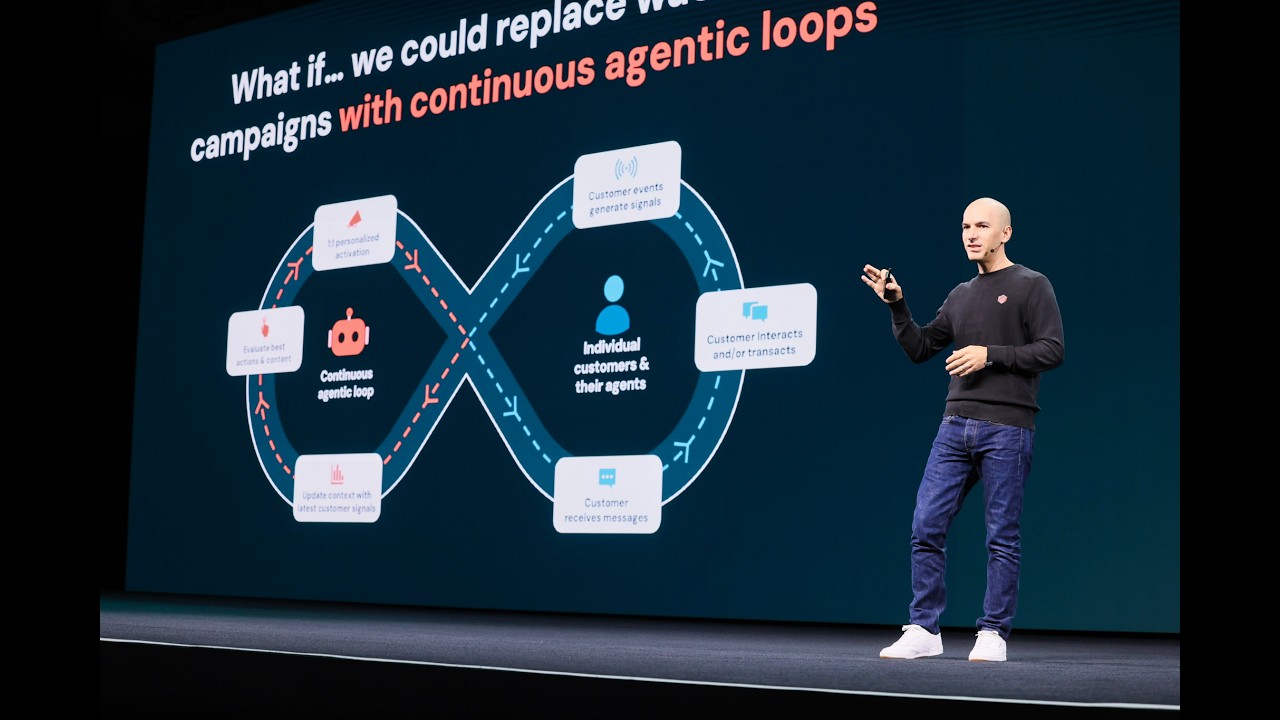
- CustomerLake replaces traditional multi-week marketing waterfall campaigns with "Infinity Campaigns," deploying autonomous agents to deliver continuous, real-time 1:1 personalized decisioning for an audience of one. (3:51)
- Profile Agents automate Customer 360 data preparation and feature an agentic identity resolution loop combining automated rule generation, LLM reasoning for ambiguous matches, and human-in-the-loop review. (11:43)
- Campaign Agents leverage Databricks Genie for natural language audience segmentation and launch with native, fully managed Reverse ETL connectors supporting roughly 20 major marketing and advertising endpoints. (13:54)
- CustomerLake is officially available in private preview, supported by an ecosystem of data, activation, and systems integration partners. (21:06)
Detailed notes
## Background Published by Databricks on YouTube on June 24, 2026, this keynote presentation introduces CustomerLake, an agentic customer data platform built directly inside Databricks. According to the video description, CustomerLake combines Customer 360, identity resolution, audience building, campaign automation, activation, and personalization into a single governed lakehouse environment, enabling marketing teams to deploy autonomous AI agents that run continuous 1:1 campaigns.
## TL;DR Tasso Argyros and Justin announce CustomerLake, an agentic CDP natively embedded within the Databricks Lakehouse and governed by Unity Catalog to overcome the latency and silo limitations of legacy waterfall marketing. The platform introduces 'Infinity Campaigns,' which replace static multi-million-person cohorts with autonomous agents delivering real-time, evergreen 1:1 personalization. CustomerLake splits operational workloads between Profile Agents—which automate data ingestion, hygiene, and agentic identity resolution—and Campaign Agents, which empower marketers to generate briefs, build natural-language audiences via Databricks Genie, and activate data using managed Reverse ETL connectors. A live demonstration models in-venue fan engagement for Brooks Sports, showing transparent agent decisioning across deferrals, match day guides, and personalized upgrade offers.
## Atmosphere & style The presentation carries the polished, high-energy cadence of a flagship enterprise tech keynote, balancing strategic industry critique with tangible product demonstrations. Argyros speaks with personal conviction and seasoned authority, framing the transition to agentic commerce not merely as an incremental software upgrade, but as the culmination of his twenty-year career bridging database engines and martech applications. The tone shifts seamlessly from visionary declarations about autonomous buyer agents to live, tactical software demos, creating an engaging blend of forward-looking ambition and practical enterprise execution.
## Bulletin - [08:55](https://www.youtube.com/watch?v=Po1gXA67wdc&t=535s) Databricks introduced CustomerLake, an agentic Customer Data Platform (CDP) built directly within the Databricks Lakehouse and governed under Unity Catalog without extracting data into third-party silos. - [03:51](https://www.youtube.com/watch?v=Po1gXA67wdc&t=231s) CustomerLake replaces traditional multi-week marketing waterfall campaigns with "Infinity Campaigns," deploying autonomous agents to deliver continuous, real-time 1:1 personalized decisioning for an audience of one. - [11:43](https://www.youtube.com/watch?v=Po1gXA67wdc&t=703s) Profile Agents automate Customer 360 data preparation and feature an agentic identity resolution loop combining automated rule generation, LLM reasoning for ambiguous matches, and human-in-the-loop review. - [13:54](https://www.youtube.com/watch?v=Po1gXA67wdc&t=834s) Campaign Agents leverage Databricks Genie for natural language audience segmentation and launch with native, fully managed Reverse ETL connectors supporting roughly 20 major marketing and advertising endpoints. - [21:06](https://www.youtube.com/watch?v=Po1gXA67wdc&t=1266s) CustomerLake is officially available in private preview, supported by an ecosystem of data, activation, and systems integration partners.
## Key takeaways - [00:01](https://www.youtube.com/watch?v=Po1gXA67wdc&t=1s) Artificial intelligence is shifting consumer commerce from conversational search queries to autonomous agent delegation, accelerating purchase decisions from weeks to minutes across headless channels. - [02:28](https://www.youtube.com/watch?v=Po1gXA67wdc&t=148s) Legacy enterprise marketing workflows structured around slow waterfall dependencies—from data engineering to creative production—are structurally unable to keep pace with machine-speed autonomous buyers. - [03:51](https://www.youtube.com/watch?v=Po1gXA67wdc&t=231s) Infinity Campaigns transition marketing from multi-million-person cohorts to dedicated autonomous agents serving an audience of one through persistent feedback loops. - [03:51](https://www.youtube.com/watch?v=Po1gXA67wdc&t=231s) In an agentic marketing framework, human practitioners are elevated rather than replaced, acting as chief strategists, orchestrators, and approvers of autonomous agent actions. - [06:41](https://www.youtube.com/watch?v=Po1gXA67wdc&t=401s) Legacy CDPs suffer from a structural disconnect as middleware detached from the core enterprise data lake, leading to high latency, security sprawl, and context deficits. - [06:41](https://www.youtube.com/watch?v=Po1gXA67wdc&t=401s) An Agentic CDP requires three architectural imperatives: native embedding within the data lakehouse, foundation models at the architectural core, and native design for continuous Infinity Campaigns. - [08:55](https://www.youtube.com/watch?v=Po1gXA67wdc&t=535s) CustomerLake is divided into two primary modules: Profile Agents to clean and assemble raw data into Customer 360 profiles, and Campaign Agents to orchestrate 1:1 marketing campaigns. - [08:55](https://www.youtube.com/watch?v=Po1gXA67wdc&t=535s) Because CustomerLake resides natively inside Databricks, customer data inherits all access control, lineage, and compliance policies defined in Unity Catalog without data movement. - [10:18](https://www.youtube.com/watch?v=Po1gXA67wdc&t=618s) Profile Agents generate end-to-end data engineering pipelines from natural language prompts, using Lakeflow Connect for SaaS ingestion and Databricks Marketplace for data hydration. - [11:43](https://www.youtube.com/watch?v=Po1gXA67wdc&t=703s) Agentic identity resolution overcomes the brittleness of static SQL rules and standard ML by using LLMs to evaluate ambiguous matches and continuously refining its rules via human feedback. - [11:43](https://www.youtube.com/watch?v=Po1gXA67wdc&t=703s) CustomerLake integrates with Databricks Clean Rooms, enabling brands to enrich and match first-party records with external partner networks without exposing raw customer data. - [13:54](https://www.youtube.com/watch?v=Po1gXA67wdc&t=834s) By building Infinity Campaigns directly on large language models, enterprises can execute 1:1 personalization immediately out of the box without spending months training bespoke ML models. - [13:54](https://www.youtube.com/watch?v=Po1gXA67wdc&t=834s) Native managed Reverse ETL connectors allow marketers to activate audiences and customer attributes across approximately 20 major marketing and ad platforms with a single click. - [16:09](https://www.youtube.com/watch?v=Po1gXA67wdc&t=969s) Natural language prompts entered into Databricks Genie automatically generate auditable, production-grade SQL queries to segment hundreds of thousands of users instantaneously. - [18:42](https://www.youtube.com/watch?v=Po1gXA67wdc&t=1122s) Infinity Campaigns provide full transparency into agentic reasoning, demonstrating explainable decisions such as intentionally deferring outreach when frequency caps or customer signals dictate inaction.
## Detailed walkthrough ### [00:01](https://www.youtube.com/watch?v=Po1gXA67wdc&t=1s) Background and the AI-Driven Shift in Customer Experience
Tasso Argyros opens the presentation by reflecting on his career trajectory, explaining why introducing this new platform feels like a return to his roots. He spent the last twenty years launching and scaling two distinct enterprises: first dedicating a decade to building a database infrastructure company, and then spending the subsequent ten years establishing a marketing technology company aimed at uniting data with an accessible business user interface. His core passion has consistently centered on placing data directly into the hands of business operators. The transition to generative AI now makes it possible to combine foundational data platforms with intelligent business agents.
Turning to the state of modern enterprise competition, Argyros notes that superior customer experience has become the decisive battleground for brands. However, customer interactions are currently undergoing a fundamental transformation because artificial intelligence is completely altering how consumers evaluate and purchase products. He polls the audience on how many people already consult a large language model before making a purchase, estimating from the show of hands that roughly 80 percent of attendees do so. Looking forward, he explains that buying will rapidly progress past simple chatbot consultations into full delegation, where autonomous consumer agents handle deep research, price comparisons, shipping logistics, and transaction execution. Because autonomous software operates via application programming interfaces across headless commerce platforms, decisions that previously took days or weeks during traditional buyer journeys will soon execute across multiple channels simultaneously in seconds or minutes. As Tasso Argyros puts it: “This means that buying decisions are now happening in seconds or minutes, not days or weeks which was a buyer journey until now.”
- **Career Background**: Ten years developing database engines followed by ten years developing marketing technology and business-facing UIs. - **Enterprise Competition**: 80 percent of leading companies report competing primarily on the quality of customer experiences. - **Agentic Buying**: Autonomous buyer agents will soon research products, negotiate pricing, verify shipping, and complete transactions simultaneously across headless commerce channels.
[02:28](https://www.youtube.com/watch?v=Po1gXA67wdc&t=148s) The Limits of Waterfall Marketing in the Age of Agentic Buying
Argyros contrasts the emerging environment of near-instantaneous agentic commerce with the slow, linear workflows that have governed enterprise marketing for decades. Under the traditional paradigm, marketing teams identify a broad universe of customers and partition them into massive demographic or behavioral cohorts containing millions of individuals. These broad audiences are subsequently targeted through rigid, sequential marketing campaigns engineered around a slow enterprise waterfall.
In this conventional waterfall structure, marketing leadership first outlines the campaign strategy. Next, data engineering teams spend weeks pulling together the necessary Customer 360 tables and unified data models. Marketing operations then steps in to define and construct the target audiences, followed by creative teams producing assets and copy. Marketers finally activate the collateral across external communication channels, monitor delivery, and calculate retrospective measurement metrics. While this operational model was functional when customer purchase cycles took weeks, Argyros stresses that its rigidity and multi-week turnaround times make it completely incompatible with machine-speed consumer agents. Emphasizing the breakdown of this legacy cadence, Tasso Argyros argues: “When agents buy on multiple channels at the same time, in seconds, you can't spend weeks designing a single campaign.”
- **Traditional Cohorts**: Built around broad segments containing millions of individuals rather than individual buyers. - **Waterfall Dependency Chain**: Strategy $\rightarrow$ Customer 360 data engineering $\rightarrow$ marketing operations audience generation $\rightarrow$ creative design $\rightarrow$ activation $\rightarrow$ reporting and measurement. - **Latency Mismatch**: Legacy waterfall campaign cycles require weeks or months to adjust, failing to match buyer decisions occurring in fractions of a minute.
[03:51](https://www.youtube.com/watch?v=Po1gXA67wdc&t=231s) Inventing Infinity Campaigns: One-to-One Agentic Marketing
To match the operational velocity of autonomous buyers, Argyros introduces an entirely new conceptual framework: shifting from batch-and-blast cohort marketing to an "audience of one" personalized continuously in real time. Rather than relying on human staff to handcraft campaigns for millions of people, companies can deploy autonomous software agents for every individual customer. In this operational model, an assigned enterprise agent ingests the customer's latest behavioral signals, evaluates the optimal next best action, and generates tailored content specifically for that single individual. As the customer reacts and transacts, those interactions emit fresh telemetry that loops directly back to the agent in a continuous feedback cycle.
```mermaid flowchart LR accTitle: The Infinity Campaign Loop accDescr: An continuous feedback loop where an individual agent evaluates customer telemetry, personalizes content, delivers it, and processes subsequent customer actions.
subgraph AgenticCore["Agent Processing"] direction TB A["Customer Signals & Telemetry"] --> B["Personalization Agent"] B --> C["Next Best Action & Dynamic Content"] end
subgraph CustomerTouchpoint["Customer Engagement"] direction TB D["Individual Customer (Audience of One)"] --> E["Transaction & Feedback"] end
C --> D E --> A ```
Databricks terms this operational model "Infinity Campaigns." Argyros explains that the name refers both to the continuous loop visual and to the evergreen, persistent nature of the campaigns. Because autonomous agents continuously adapt to evolving consumer behaviors and shifting corporate objectives, an Infinity campaign never has to shut down or start from scratch. The system dynamically generates an infinite variety of tailored content variants, delivering immediate responses without manual lag. Crucially, Argyros clarifies that human marketers are not replaced; rather, their roles are elevated to executive oversight. As Tasso Argyros emphasizes: “The marketer is the chief strategist, the chief orchestrator, and the chief approver of what the agents are doing.”
- **Audience of One**: Replacing multi-million-person cohorts with a dedicated autonomous agent serving every individual customer. - **Evergreen Execution**: Campaigns run perpetually without fixed start and end dates, constantly self-tuning as business objectives and customer data evolve. - **Infinite Variation**: Dynamic asset and copy generation tailored specifically to the individual recipient's immediate context. - **Human Governance**: Marketers set strategic boundaries, orchestrate workflows, and approve autonomous agent actions rather than manually executing tasks.
[06:41](https://www.youtube.com/watch?v=Po1gXA67wdc&t=401s) From Legacy CDPs to the Agentic CDP
Argyros explains how historical attempts to solve customer data integration led to the creation of Customer Data Platforms (CDPs). Positioned as middleware between enterprise data stores and frontline marketing execution tools, standard CDPs ingest raw records, structure them into a Customer 360 view, provide a non-technical user interface where marketers can construct cohorts and journeys, and dispatch audience segments to activation endpoints such as email platforms and digital ad networks via reverse ETL.
However, Argyros argues that legacy CDPs suffer from a fatal structural flaw: they exist as disconnected middleware detached from the primary enterprise data store. Orchestrating intelligent agents requires direct access to high-fidelity data along with rich contextual knowledge located precisely where the agents operate. To support Infinity Campaigns, businesses need an "Agentic CDP." Argyros defines three non-negotiable requirements for this emerging software category: 1. **Embedded in the Lakehouse**: It must reside natively within the enterprise data lakehouse where the underlying data, historical context, and governance policies already exist. 2. **LLMs at the Core Architecture**: Large language models cannot be treated as superficial helper copilots; they must form the foundational architectural engine driving profile assembly and campaign logic. 3. **Engineered for Infinity Campaigns**: It must natively support evergreen, real-time, self-adapting campaigns executing one-to-one personalization at machine speed.
Underscoring the distinction between superficial generative add-ons and core platform re-architecture, Tasso Argyros asserts: “This is not just about having some co-pilot to help you do some operations better.”
- **Legacy CDP Role**: Acted as middleware extracting data out of enterprise warehouses to build static segments and pushing them to endpoints via reverse ETL. - **Middleware Disconnect**: Traditional platforms decouple business logic from the source data lake, creating latency, security sprawl, and context deficits. - **Agentic CDP Standard**: Natively embedded within lakehouse storage, built ground-up on generative models, and purpose-built for continuous 1:1 campaigns.
[08:55](https://www.youtube.com/watch?v=Po1gXA67wdc&t=535s) Introducing CustomerLake: Architecture and Core Modules
Databricks is entering the newly defined agentic CDP category with CustomerLake, an agentic customer data platform engineered natively for the Databricks platform. By building CustomerLake directly on Databricks, the platform eliminates the requirement to extract customer records into third-party silos. Data remains within the lakehouse, instantly inheriting all access controls, data lineage, and audit governance rules already defined in Unity Catalog. CustomerLake is designed with a business-first user interface so non-technical marketing practitioners can configure sophisticated workflows without writing code, while the underlying architecture scales to manage billions of autonomous personalization interactions every single day. As Tasso Argyros declares: “It can power one-to-one personalization agents to provide the perfect customer experience a billion times a day.”
CustomerLake is structured around two specialized modules: - **Profile Agents**: Autonomous backend agents that transform disparate, unformatted enterprise tables into business-ready Customer 360 profiles. - **Campaign Agents**: A marketer-facing application environment where business teams define, guide, and orchestrate automated Infinity Campaigns powered by autonomous agents.
```mermaid flowchart TD accTitle: CustomerLake Architectural Overview accDescr: The high-level architecture of CustomerLake showing the underlying Databricks Lakehouse, Unity Catalog governance, and the two operational modules: Profile Agents and Campaign Agents.
subgraph DatabricksFoundation["Databricks Lakehouse Foundation"] UC["Unity Catalog Governance & Security"] LakeData["Lakehouse Native Storage (No Data Movement)"] end
subgraph CustomerLakePlatform["CustomerLake (Agentic CDP)"] direction TB PA["Profile Agents (Raw Data to Customer 360)"] CA["Campaign Agents (Infinity Campaigns UI & Execution)"] end
subgraph BusinessOutcomes["Downstream Execution"] PersAgents["1:1 Personalization Agents (1B+ Interactions/Day)"] end
DatabricksFoundation --> CustomerLakePlatform PA --> CA CA --> PersAgents ```
- **Native Lakehouse Residency**: Customer data never leaves the secure lakehouse environment, avoiding third-party data copies. - **Unified Governance**: Inherits permissions, row-level access filters, and compliance policies established inside Databricks Unity Catalog. - **Modular Division**: Profile Agents handle data ingestion, semantic modeling, and hygiene, while Campaign Agents manage marketing strategy, content generation, and execution.
[10:18](https://www.youtube.com/watch?v=Po1gXA67wdc&t=618s) Profile Agents: Automating Customer 360 and Identity Resolution
Argyros details the mechanics of the Profile Agents module, which automates the arduous data engineering work required to turn raw, dirty records into clean Customer 360 profiles. Rather than demanding manual pipeline development from data engineering teams, Profile Agents initiate data prep workflows directly from natural language prompts specifying the target marketing use case. Once instructed, the agents ingest tables, execute transformations, append enrichment data, perform identity resolution, and continuously evaluate data quality across the profile graph in an autonomous improvement loop.
To source customer information, the platform uses Lakeflow Connect to ingest third-party application feeds or natively references tables already resident within the lakehouse. Once ingested, the agents analyze schema metadata, apply semantic tags, and perform automated hygiene routines—such as standardizing telephone numbers, normalizing postal addresses, and repairing malformed email strings. Organizations can further augment internal data via "data hydration," enriching internal profiles with third-party datasets procured directly through the Databricks Marketplace.
The central capability of Profile Agents is identity resolution across first-party customer datasets that lack a unified identifier. Argyros clarifies that modern enterprises maintain customer interactions across numerous distinct platforms—point-of-sale systems, e-commerce portals, mobile apps, and customer service desks—where user names, physical locations, and email handles often contain subtle discrepancies or formatting differences. Providing a formal operational definition, Tasso Argyros explains: “Identity resolution for first-party data, meaning data you already own, this is data you have collected from your own customers, is a process of identifying the same customer across different data sets that do not share the same customer key.”
- **Prompt-Driven Pipeline Assembly**: Profile Agents generate end-to-end data pipelines from natural language prompts describing business objectives. - **Lakeflow Connect Integration**: Ingests disparate enterprise SaaS application data alongside native Databricks Lakehouse tables. - **Automated Data Hygiene**: Semantically classifies data attributes while resolving syntax errors across emails, phone numbers, and physical addresses. - **Data Hydration**: Enriches existing internal profiles using external data assets via Databricks Marketplace. - **First-Party Identity Resolution**: Accurately maps disparate customer fragments into a single golden record without requiring consistent pre-existing primary keys.
[11:43](https://www.youtube.com/watch?v=Po1gXA67wdc&t=703s) Agentic Identity Resolution and Profile Agents
Tasso Argyros explains the critical necessity of identity resolution, emphasizing that without probabilistic matching, organizations fail to recognize repeat visitors across channels: “This is very important because if you don't do this, you may end up thinking the same customer is different people, and that leads to massive problems for marketing and customer experience.” To solve this fundamental breakdown, Databricks is introducing agentic identity resolution. Rather than relying solely on brittle rules or heavy manual coding, specialized agents generate initial identity resolution rules. When edge cases arise where rules prove inconclusive, large language models intervene to evaluate the ambiguous matches. If uncertainty remains, the system smoothly falls back to human reviewers for feedback. Crucially, this creates an active agentic feedback loop: as more identities are confirmed and resolved, the underlying agents learn, sharpening the automated rules and fine-tuning the LLM's predictive capability over time.
Argyros contrasts this adaptive framework with legacy mechanisms, noting, “Historically, this has happened through static SQL rules or machine learning. Both approaches have significant limitations, and we think the agentic identity resolution wins on all fronts over these traditional approaches.” Moving beyond internal datasets, Argyros details how CustomerLake handles third-party partner records through Databricks Clean Rooms. This enables brands to reconcile customer profiles against partner enrichment networks without their raw enterprise data ever leaving the lakehouse, delivering a privacy-first integration architecture. The final phase of Profile Agents takes these ingested, standardized, cleansed, and unified identities and transforms them into domain-specific data products through schema mapping, survivorship policies, and automated validation.
```mermaid flowchart TD accTitle: Agentic Identity Resolution Loop accDescr: A decision flow showing rule evaluation falling back to LLMs, human feedback, and a continuous learning loop. subgraph Resolution["Resolution Engine"] A["Incoming Customer Records"] --> B{"Agentic Rules"} B -->|"Matched"| C["Unified Profile"] B -->|"Inconclusive"| D{"LLM Evaluation"} D -->|"Resolved"| C D -->|"Ambiguous"| E["Human Feedback"] E --> C end subgraph Feedback["Learning Engine"] E -.->|"Train & Refine"| F["Agentic Learning Loop"] D -.->|"Fine-tune Patterns"| F F -.->|"Update"| B end ```
[13:54](https://www.youtube.com/watch?v=Po1gXA67wdc&t=834s) Campaign Agents, Infinity Campaigns, and Managed Reverse ETL
Transitioning to activation, Argyros introduces Campaign Agents, which automate end-to-end campaign operations. Given a simple natural language prompt, these agents ingest business goals and broader context to generate a comprehensive campaign brief. Once human marketers review and sign off, the platform deploys agents to execute personalization at scale. Beyond cutting-edge automation, Campaign Agents still handle standard customer data platform duties like segmentation and audiencing, but modernize them through Databricks Genie. Marketers can build audiences strictly via natural language prompts or refine them inside a business UI, turning audience segments into active multi-channel journeys with a single click.
At the core of Campaign Agents lies Infinity Campaigns. Argyros underscores how leveraging foundation models removes the traditional roadblocks that have plagued enterprise personalization: “The beauty of Infinity campaigns, because it's built around the LLMs, is that you can start personalizing immediately. You don't have to spend months building ML models.” Teams no longer have to wait for bespoke machine learning decisioning engines to slowly train on historical data. Infinity Campaigns functions out of the box with built-in simulation runs, automated governance guardrails, and granular performance measurement. Furthermore, addressing a long-standing user request, Databricks announced native, fully managed Reverse ETL connectors. Launching with approximately 20 turnkey integrations across major advertising, marketing, and customer experience platforms, CustomerLake allows single-click data syncing, with dozens more connectors slated by the end of the year.
[16:09](https://www.youtube.com/watch?v=Po1gXA67wdc&t=969s) Live Demo: Audience Generation with Databricks Genie
Justin takes the stage to demo Campaign Agents and Infinity Campaigns in action, stepping into the shoes of a marketing manager for Brooks Sports. Starting from the central campaign dashboard—which tracks active campaigns, audience trends, and operational Reverse ETL syncs—Justin navigates to the audiences tab to construct a brand-new segment without touching traditional filter builder tools. Instead of assembling manual boolean conditions, he pastes a natural language query directly into the Genie interface: `"Include our most valuable Team USA fans who have spent more than $500 on merch this season, and exclude anyone who already bought the USA fan kit."`
Genie evaluates existing schema attributes and segments to dynamically generate an audience of 800,000 qualifying customers. While marketers can accept or edit the qualification criteria in the UI, Justin inspects the underlying technical execution: “You can view the SQL that is backing this audience. So, this is starting to look probably more familiar uh to many of you in the audience. Uh if you've ever supported marketing by pulling lists and writing custom campaigns, um you can get really complex SQL um to power some of these campaigns, and we got this from one prompt with Genie.” Saving the segment automatically spins up an interactive audience dashboard with Genie-generated insights, ready to immediately trigger a new Reverse ETL sync or anchor a multi-channel campaign.
[18:42](https://www.youtube.com/watch?v=Po1gXA67wdc&t=1122s) Live Demo: 1:1 Decisioning in Infinity Campaigns
Justin transitions to inspecting a live Infinity Campaign configured for an in-venue fan experience. In the campaign management console, marketers establish the high-level guardrails: audience inclusions, conversion metrics, pacing rules, and the asset library—such as a match day guide and a match day ticket upgrade offer. Justin pivots to the agents tab, which exposes how the agent evaluates individual customer profiles on a true 1:1 basis in real time.
Demonstrating the transparent reasoning behind agent decisions, Justin walks through several distinct user profiles:
- **Marcus (Deferred Delivery):** Rather than blindly sending a blast, the agent elects to defer outreach. The UI lays out the agent's explicit rationale, showing how it weighed signal timing, historical engagement data, and frequency cap guardrails to conclude Marcus should not receive a message right now. - **Customer with Match Day Offer:** Evaluating a different profile, Genie detects an opportunity to drive incremental revenue and delivers a targeted match day offer, granting a 15% discount on an in-stadium seat upgrade. - **Customer with Match Day Guide:** For another fan profile, the agent determines a commercial upsell is inappropriate and instead delivers a practical match day guide highlighting kickoff timing, parking directions, and entry protocols.
Justin emphasizes that Campaign Agents continuously evaluate and tailor these decisions for every single individual. Marketers retain full oversight through top-level analytics dashboards that track message-level open rates, click-through rates, and conversion counts across the campaign. Concluding the walkthrough, Justin remarks, “That's a quick run through of Customer Lake Campaign Agents, the world's first agentic CDP.”
[21:06](https://www.youtube.com/watch?v=Po1gXA67wdc&t=1266s) Partner Ecosystem and Private Preview Availability
Tasso Argyros returns to close the session, declaring, “The era of true one-to-one personalization is here. It's very, very, very, very exciting.” He extends gratitude to early enterprise design partners and global innovators whose data and marketing teams battle-tested the platform's agentic workflows. Argyros also recognizes the broader ecosystem of data, content, advertising, activation, and systems integration partners who are co-launching with CustomerLake to deliver end-to-end customer experience capabilities.
CustomerLake is officially open in private preview. Argyros directs interested organizations to contact their Databricks account teams to request access and encourages attendees to explore the conference's dedicated CDP breakout tracks as well as the afternoon marketing forum.
[22:36](https://www.youtube.com/watch?v=Po1gXA67wdc&t=1356s) Learning More at Data + AI Summit and Closing Thoughts
To explore the platform further, attendees are encouraged to search for CustomerLake within the official Data + AI Summit mobile app, where they can find both the dedicated marketing forum and specialized breakout sessions. Tasso Argyros explains that these sessions offer a behind-the-scenes look directly from the engineers and product leaders who built CustomerLake from the ground up, alongside presentations from early enterprise adopters sharing their first-hand experiences and initial outcomes using the agentic CDP.
Reflecting on the launch, Argyros closes the presentation on a personal note, emphasizing how meaningful it is to unite domains that have historically operated in silos. As Tasso Argyros reflects: “It's a very special moment for me to be able to bring together the worlds of business, customer experience, and data all in one place uh to build something that provides the perfect customer experience a billion times a day.”
- **Summit App Discovery:** Attendees can search "CustomerLake" in the Data + AI Summit app to register for the marketing forum and technical breakout tracks. - **Behind the Product:** Sessions feature the core engineering and product teams responsible for building CustomerLake, detailing the architecture and underlying unified data foundation. - **Early Customer Insights:** Initial enterprise design partners and early customers present real-world deployments and their early results with the platform.
## Notable quotes > [02:28](https://www.youtube.com/watch?v=Po1gXA67wdc&t=148s) When agents buy on multiple channels at the same time, in seconds, you can't spend weeks designing a single campaign. — Tasso Argyros
> [03:51](https://www.youtube.com/watch?v=Po1gXA67wdc&t=231s) The marketer is the chief strategist, the chief orchestrator, and the chief approver of what the agents are doing. — Tasso Argyros
> [13:54](https://www.youtube.com/watch?v=Po1gXA67wdc&t=834s) The beauty of Infinity campaigns, because it's built around the LLMs, is that you can start personalizing immediately. You don't have to spend months building ML models. — Tasso Argyros
## Mentioned Tasso Argyros, Justin, Databricks, CustomerLake, Unity Catalog, Databricks Genie, Lakeflow Connect, Databricks Marketplace, Databricks Clean Rooms, Data + AI Summit, Brooks Sports
## Video description Introducing CustomerLake: The agentic CDP
CustomerLake brings core CDP capablities together to help marketing and data teams turn customer data into always-on, 1:1 experiences. With CustomerLake, Customer 360, identity resolution, audience building, campaign automation, activation, and personalization are all available in one platform. And with a shared, governed data foundation, marketers can deploy AI agents that help eliminate manual campaign and keep their focus on customers. Learn more about CustomerLake: https://www.databricks.com/blog/introducing-customerlake-agentic-cdp
00:00 — The impact of AI on the customer experience 02:28 — Why legacy marketing campaigns fall short 03:51 — The shift to Infitity Campaigns 06:41 — What's a CDP? 07:35 — The need for an Agentic CDP 08:55 — Introducing CustomerLake 15:53 — Demo: CustomerLake 21:07 — CustomerLake partners
Presenters: Tasso Argyros, VP Engineering, Databricks
[Source](https://www.youtube.com/watch?v=Po1gXA67wdc)