Databricks Launches Genie One Agent to Solve Enterprise Data Errors
Databricks
Leading AI agents fail half the time on enterprise queries because stochastic reasoning loops cannot navigate unmodeled business metrics, requiring an automated context layer that mines operational logic directly from corporate pipelines and dashboards.
AI-assisted summary of Introducing Genie One: the AI coworker that understands your data (with demo) — original source. Check the original for full context.
Source published:
Key ideas
- Databricks introduced Genie One, an agentic AI coworker that connects across corporate systems and live databases to compute answers, automate workflows, and generate artifacts rather than merely summarizing static documents. (0:00)
- The platform is powered by Genie Ontology, a context layer that harvests knowledge from SQL pipelines, dashboards, and author expertise using the OntoRank algorithm, driving a 30+ percentage point accuracy gain over generic coding agents. (7:10)
- Genie One is Generally Available immediately across Slack, Microsoft Teams, iOS, Android, and external tools via a Model Context Protocol (MCP) app. (20:18)
- To drive broad enterprise adoption, Databricks is subsidizing usage by providing $10 worth of free monthly tokens for every user in an organization. (21:23)
Detailed notes
## Background Published on YouTube by Databricks on June 23, 2026, this presentation introduces Genie One, an agentic AI coworker designed to understand enterprise data and generate documents, reports, and autonomous workflows. The accompanying description highlights its foundation on Genie Ontology, a self-improving context layer that extracts organizational knowledge across internal and external data to deliver accurate, governed results for business teams.
## TL;DR Databricks product leaders Ken Wong and Elise Georis introduce Genie One, demonstrating how standard AI agents routinely fail at enterprise data tasks due to hallucinations, token-heavy loops, and fragile semantic models. To solve this context bottleneck, Databricks developed Genie Ontology and its OntoRank algorithm, which automatically extracts business logic from existing dashboards, pipelines, and expert activity to boost accuracy and cut execution time in half. Georis delivers a live demonstration building an executive OKR deck, running federated queries across Databricks and BigQuery, updating Jira tickets via Model Context Protocol, and triggering proactive mobile notifications based on live data anomalies. The presentation concludes by announcing Genie One's general availability across Slack, Teams, iOS, and Android, supported by an MCP integration app and a $10 monthly token subsidy per enterprise user.
## Atmosphere & style The presentation carries the polished, confident energy of a major tech launch while maintaining a candid, pragmatic skepticism toward current AI agent hype. Ken Wong establishes an engaging, relatable tone by openly mocking competitor hallucinations and internal engineering naming conventions, which contrasts nicely with Elise Georis's calm, deliberate live demo. The session feels refreshingly grounded and transparent, pulling back the curtain on reasoning traces, governance audits, and citation inspectors rather than relying on rehearsed conversational AI parlor tricks.
## Bulletin - [00:00](https://www.youtube.com/watch?v=6W3BnCgoYVA&t=0s) Databricks introduced Genie One, an agentic AI coworker that connects across corporate systems and live databases to compute answers, automate workflows, and generate artifacts rather than merely summarizing static documents. - [07:10](https://www.youtube.com/watch?v=6W3BnCgoYVA&t=430s) The platform is powered by Genie Ontology, a context layer that harvests knowledge from SQL pipelines, dashboards, and author expertise using the OntoRank algorithm, driving a 30+ percentage point accuracy gain over generic coding agents. - [20:18](https://www.youtube.com/watch?v=6W3BnCgoYVA&t=1218s) Genie One is Generally Available immediately across Slack, Microsoft Teams, iOS, Android, and external tools via a Model Context Protocol (MCP) app. - [21:23](https://www.youtube.com/watch?v=6W3BnCgoYVA&t=1283s) To drive broad enterprise adoption, Databricks is subsidizing usage by providing $10 worth of free monthly tokens for every user in an organization.
## Key takeaways - [00:42](https://www.youtube.com/watch?v=6W3BnCgoYVA&t=42s) Existing enterprise AI agents and assistants struggle with live corporate data, frequently hallucinating numbers or stalling in runtime loops when attempting complex analytics. - [02:22](https://www.youtube.com/watch?v=6W3BnCgoYVA&t=142s) Databricks internal benchmarks revealed that leading coding agents answer real, nuanced enterprise questions accurately only about 50% of the time. - [05:16](https://www.youtube.com/watch?v=6W3BnCgoYVA&t=316s) Standard agentic loops rely on stochastic walks that force a punishing trade-off between computational cost, token burn, and ultimate accuracy. - [06:12](https://www.youtube.com/watch?v=6W3BnCgoYVA&t=372s) Manual semantic modeling and prompt-engineered skills fail to scale across the long tail of edge cases and bespoke departmental metrics. - [07:10](https://www.youtube.com/watch?v=6W3BnCgoYVA&t=430s) Genie Ontology bypasses manual data curation by automatically extracting logic, queries, and subject-matter relationships directly from operational assets. - [08:02](https://www.youtube.com/watch?v=6W3BnCgoYVA&t=482s) The OntoRank algorithm models PageRank to determine ground truth by evaluating asset reuse frequency, data lineage, and author expertise. - [08:30](https://www.youtube.com/watch?v=6W3BnCgoYVA&t=510s) Genie One operates under strict permission parity, inheriting existing governance rules directly from Unity Catalog without exposing sensitive context. - [10:38](https://www.youtube.com/watch?v=6W3BnCgoYVA&t=638s) In addition to reading context, Genie One uses Model Context Protocol (MCP) actions to execute write tasks, such as posting update requests on open Jira tickets. - [11:43](https://www.youtube.com/watch?v=6W3BnCgoYVA&t=703s) The platform supports federated query execution, retrieving and computing ground truth figures across heterogeneous sources including Databricks and Google BigQuery. - [13:07](https://www.youtube.com/watch?v=6W3BnCgoYVA&t=787s) Every generated response provides a transparent citation drawer displaying underlying foreign catalog tables, verified glossary badges, and ontology snippets. - [15:20](https://www.youtube.com/watch?v=6W3BnCgoYVA&t=920s) Users can package completed conversational context into certified, specialized domain agents that remain persistent and dynamically compute answers against warehouse updates. - [16:51](https://www.youtube.com/watch?v=6W3BnCgoYVA&t=1011s) Genie One shifts from reactive querying to proactive alerts by inferring employee interest areas and sending mobile push notifications when statistical anomalies occur. - [19:11](https://www.youtube.com/watch?v=6W3BnCgoYVA&t=1151s) Enterprise organizations like General Motors and Warner Music Group have deployed hundreds of production Genie agents across federated data estates. - [20:38](https://www.youtube.com/watch?v=6W3BnCgoYVA&t=1238s) A dedicated Genie MCP app allows third-party and custom-built enterprise agents to tap into Genie's underlying calculation and ontology engine. - [21:23](https://www.youtube.com/watch?v=6W3BnCgoYVA&t=1283s) Genie One is Generally Available with an allocation of $10 in monthly token credits per employee to remove initial organizational experimentation barriers.
## Detailed walkthrough ### [00:00](https://www.youtube.com/watch?v=6W3BnCgoYVA&t=0s) Introducing Genie One and the Pitfalls of Current AI Agents
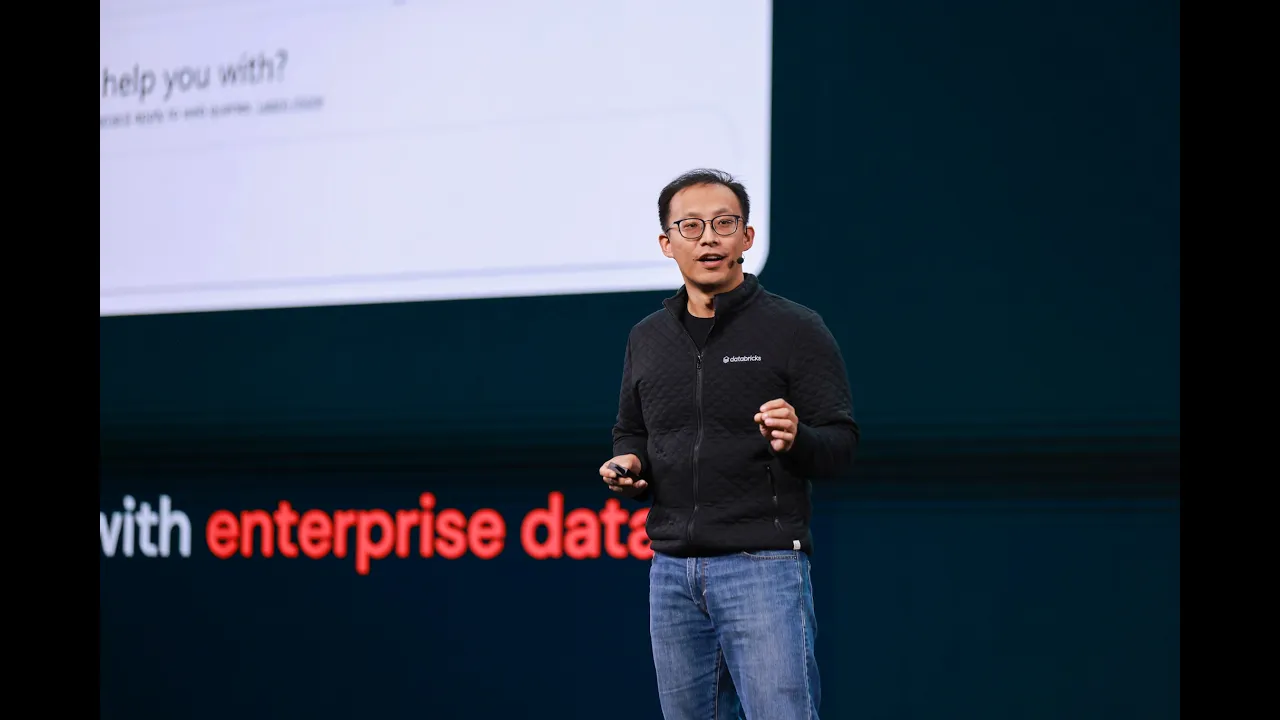
Ken Wong, Senior Director of Product Management at Databricks, introduces Genie One as an AI coworker capable of connecting across all enterprise data and applications. Rather than functioning simply as a conversational tool, Genie One allows anyone in an organization to uncover insights, automate workflows, and even generate autonomous agents simply by speaking with it. Anticipating skepticism about launching yet another agent in 2026, Ken addresses the elephant in the room: existing solutions fall flat when dealing with enterprise data. As Ken puts it, “The ones that you have today aren't very good with enterprise data.” They either fail entirely to reason over complex data structures or lack the accuracy required for high-stakes decision-making and operational automation.
To demonstrate the issue, Ken recounts preparing for a Databricks Product Advisory Board (PAB) meeting. He tasked Genie One with assembling a comprehensive customer profile detailing account activity, which required coordinating across fragmented personal and corporate systems: - Connecting to Ken’s personal email, Slack, and calendar to identify PAB attendees and parse recent discussion topics. - Pulling customer use-case details from Salesforce. - Interrogating Databricks consumption data to resolve nuanced questions regarding how these customers utilize Genie.
Genie One successfully returned a detailed, visual customer profile. Intrigued by how competing tools would handle the identical workflow, Ken ran the exact same prompt through five leading alternatives: two software-bundled assistants and three premier coding and coworker agents.
---
[02:22](https://www.youtube.com/watch?v=6W3BnCgoYVA&t=142s) Benchmarking Competitors Against Real Enterprise Tasks
The benchmark against leading market alternatives revealed severe functional flaws across both bundled tools and dedicated coding agents:
1. **First bundled assistant:** Returned an answer suspiciously fast, claiming there were 24 customers in the PAB. When Ken questioned where the figure originated, the tool bluntly confessed that it had completely fabricated the number. Ken reflects on the shock of seeing a tool he frequently uses for drafting documents fail so dramatically: “It confessed that it just completely made it up.” 2. **Second bundled assistant:** Avoided outright hallucination by retrieving existing account brief documents, but the data was a quarter old, completely stale, and useless for current strategic discussions. 3. **Leading coding and coworker agents:** Attempted to query live structured data sources, but quickly became trapped in execution loops. The agent hit its execution time limit, prompted the user for permission to continue burning tokens, and resumed spinning. After 30 minutes of runtime, it produced little more than decorative ASCII art and admitted it was still far from finishing, yielding only a partial report.
Ken explains that this failure is far from an isolated edge case. Databricks Research created a benchmark from real, complex questions asked by employees (e.g., querying what percentage of Genie customers also leverage a third-party agent) rather than simple queries resolvable by basic semantic layers. Evaluated against this benchmark, the best coding agents answered accurately only about 50% of the time, taking minutes to complete. Emphasizing the inadequacy of these results, Ken states, “50% of the time for a real data question is basically unusable, right? You literally can flip a coin.”
---
[05:16](https://www.youtube.com/watch?v=6W3BnCgoYVA&t=316s) The Flaws of the Agentic Loop and Brittle Semantic Layers
The root cause of these agent failures lies in the mechanics of the "agentic loop." Standard agents navigate an exploratory walk, relying on chance to stumble across the correct sequence of reasoning steps and context needed to resolve the question. This design forces a punishing trade-off between runtime, computational cost, and ultimate accuracy.
Historically, organizations have combated this through prompt engineering context, whether packaged as "skills" in AI tools or "semantic layers" in traditional BI. While modeling canonical, stable business concepts is a recognized best practice, Ken emphasizes that manual modeling cannot scale across the long tail of everyday work. Every marketing campaign defines "leads" differently, and individual engineering teams configure Jira fields according to unique internal norms. Manually documenting every variation is impossible. Furthermore, attempting to automate model generation with LLMs fails; citing published research from Anthropic, Ken notes that synthetic context generation tends to over-index on single narrow use cases, ultimately degrading overall model accuracy.
```mermaid flowchart TD accTitle: The Brittle Agentic Loop accDescr: Diagram contrasting how traditional agentic loops lead to high token burn and hallucination versus the scalability limits of manual semantic modeling.
subgraph Loop ["Traditional Agentic Loop"] A["User Question"] --> B["Stochastic Walk / Reasoning Steps"] B --> C{"Hits Context?"} C -- No --> D["Token Burn & Timeout Loop"] D --> B C -- Yes --> E["Coin-Flip Accuracy ~50%"] end
subgraph ContextFail ["Manual Context Limits"] F["Skills / Semantic Modeling"] --> G["Works for Stable Business Concepts"] F --> H["Fails on Long-Tail Edge Cases"] H --> I["Marketing Lead Definitions"] H --> J["Team-Specific Jira Custom Fields"] end ```
---
[07:10](https://www.youtube.com/watch?v=6W3BnCgoYVA&t=430s) Genie Ontology and OntoRank
Databricks addresses context scalability through the Genie Ontology (referred to colloquially on stage as the Genie Anthology). Genie Ontology operates as an automated, learned context layer that sits above existing modeled frameworks in Unity Catalog or external semantic platforms. Rather than demanding exhaustive manual curation, it harvests tacit organizational knowledge directly from operational assets: - **Knowledge Harvesting:** Ingests SQL pipelines, historical queries, dashboards, and reports to detect underlying metric expressions and table relationships. - **Expertise Mapping:** Detects organizational subject-matter expertise by identifying which individuals author and maintain authoritative resources on specific domains. - **OntoRank Algorithm:** Evaluates harvested context snippets using an internal ranking mechanism modeled after PageRank. Ken jokes, “This is how you know the engineers still run the show at Databricks, we call OntoRank.” OntoRank identifies which data transformations and business formulas represent authoritative ground truth. - **Permission Enforcement:** Inherits governance policies and user permissions from the underlying data assets, guaranteeing that sensitive context does not leak across organizational boundaries during retrieval.
```mermaid flowchart LR accTitle: Genie Ontology Architecture accDescr: Flow diagram showing how internal company assets are extracted, ranked by OntoRank, and injected into the agent context loop.
subgraph Extraction ["Knowledge Ingestion"] P["Pipelines & Queries"] D["Dashboards"] E["Subject Expertise"] end
subgraph Processing ["Genie Ontology Layer"] KS[("Internal Knowledge Store")] OR["OntoRank Algorithm"] AC["Access Control & Permissions"] end
subgraph Execution ["Agent Execution"] Q["User Query"] AL["Agent Reasoning Loop"] Ans["Authoritative Grounded Answer"] end
P --> KS D --> KS E --> KS KS --> OR OR --> AC Q --> AL AC -->|"Injected Context"| AL AL --> Ans ```
By injecting this learned context directly into the agent loop, Genie One resolves nuanced questions effortlessly. For example, when asked "how many people are registered," Genie One automatically discovers the precise business logic embedded within production marketing dashboards without requiring anyone to pre-define the metric. Users can inspect the exact source assets used to generate the metric calculation. Ken jokes that the registration numbers in his recorded demo clip were already out of date because marketing had grown the figures significantly over the preceding two weeks. Across internal Databricks benchmarks, adding the Genie Ontology yielded a consistent accuracy increase of more than 30 percentage points over generic coding agents.
[09:45](https://www.youtube.com/watch?v=6W3BnCgoYVA&t=585s) The Foundation of a Data-Smart Coworker
Building on performance benchmarks, the Genie architecture achieves half the runtime of leading agents while maintaining higher precision. Ken Wong emphasizes that as the team tunes the OntoRank algorithm and expands the overall breadth of the ontology, accuracy will be pushed even higher. The goal is moving beyond brittle prompt loops and grounding agents directly in verified organizational knowledge.
With this foundation established, organizations can deploy an AI coworker directly across the enterprise to inform, support, and even automate day-to-day business decisions. Rather than treating AI as a conversational parlor trick, Databricks positions Genie One as an active colleague capable of doing analytical heavy lifting. Ken welcomes Elise Georis, Senior Manager of Product Management for Genie, to the stage to demonstrate Genie One in action.
As Ken summarizes the broader shift:
> “So, with this level of accuracy enabled by the Genie ontology, now we can truly create a data smart co-worker.”
---
[10:38](https://www.youtube.com/watch?v=6W3BnCgoYVA&t=638s) Live Demo: Preparing an Executive OKR Review in Genie One
Elise walks through an everyday workflow: preparing for an upcoming executive review of Genie's quarterly OKRs. The Genie One interface is intentionally straightforward, featuring a central chat area with quick actions to draft documents or create reusable skills, while a left-hand sidebar houses past chats, available agents, and enterprise data assets. To kick off the workflow, Elise pastes in a link to Databricks’ standard review template—which mandates metrics, highlights, and lowlights—and instructs Genie to draft the deck while proactively pinging colleagues who own blocking Jira tickets.
```mermaid flowchart TD accTitle: Genie One Query Execution and Verification Flow accDescr: Diagram illustrating how Genie One processes a prompt by resolving ontology snippets and governance policies before generating live data artifacts.
subgraph Input ["User Request"] REQ["Elise's Prompt & OKR Template"] end
subgraph Governance ["Governance & Context"] UC["Unity Catalog Governance"] GLOS["Glossary & Definitions"] ONTO["Genie Ontology & Snippets"] end
subgraph Action ["Live Execution"] MCP["MCP Actions<br/>(Jira Comments)"] SQL["Federated SQL<br/>(Databricks & BigQuery)"] end
subgraph Output ["Deliverables"] DOC["Populated Review Document"] CIT["Verified Citations & Lineage"] end
REQ --> UC UC --> GLOS UC --> ONTO ONTO --> MCP ONTO --> SQL MCP --> DOC SQL --> DOC DOC --> CIT ```
As the task executes, Elise opens the reasoning trace to inspect Genie's decision-making steps. Genie inspects the Unity Catalog glossary to retrieve relevant semantic definitions and ontology snippets. Crucially, the platform does not demand an isolated permission layer; it strictly inherits the data governance and access control policies already configured in Unity Catalog. From there, Genie pulls relevant Google Docs files, discovers open Jira tickets, uses Model Context Protocol (MCP) to post update requests on those tickets, and issues SQL queries across both Databricks and Google BigQuery to calculate live ground truth numbers.
Elise emphasizes that while conventional generic agents merely parrot static text, real operational workflows require computing numbers that do not yet exist in any document:
> “A lot of generic agents are just reciting what already exists in a document, but there's no document for this week's metrics. That's why I'm doing this.”
- **Speed and Efficiency:** Bypasses costly, token-heavy trial-and-error loops by navigating directly to ground-truth data using the Genie Ontology. - **Automated Document Assembly:** Yields a fully populated document arranged by region, complete with embedded visualizations, anomalies, highlights, and lowlights. - **Permission Parity:** Enforces existing Unity Catalog access controls without requiring custom administrative overhead.
---
[13:07](https://www.youtube.com/watch?v=6W3BnCgoYVA&t=787s) Inspecting Citations, the OntoRank Algorithm, and Adding Skills
To verify the generated findings, Elise inspects the citation drawer, which displays every underlying artifact used: foreign catalog tables, enterprise documentation, tracking tickets, and glossary entries marked with verified badges. Expanding the ontology inspector reveals specific business snippets inferred and evaluated automatically by the platform—such as how the organization defines user engagement, what thresholds constitute a blocker in Jira, and the exact SQL logic required to aggregate engagement metrics across geographic regions.
Drilling into the engagement snippet reveals the strict operational metric: user sessions lasting longer than 30 seconds. The inspector indicates this rule was mined directly from an internal mobile KPIs dashboard created by a colleague named Chung. The snippet carries a high authority score determined by OntoRank, which calculates rank based on historical reuse, asset lineage, and author expertise. Checking Chung’s profile confirms his track record as a trusted authority across several relevant company domains.
```mermaid flowchart LR accTitle: OntoRank Authority Score Flow accDescr: Visual mapping of how individual employee assets contribute to snippet authority scores via OntoRank.
A["Chung's Mobile Dashboard"] --> B["Ontology Snippet:<br/>Engagement > 30s"] C["Asset Usage Frequency"] --> D["OntoRank Algorithm"] B --> D E["Author Domain Expertise"] --> D D --> F["High Authority Snippet<br/>(Trusted for SQL Generation)"] ```
Satisfied with the logic, Elise schedules the entire workflow to run autonomously each week, handling Jira reminders without manual intervention. Next, she enhances the report by instructing Genie to append a predictive forecast. Rather than building models from scratch, she invokes an existing forecasting skill authored by another teammate. The coworker constructed the skill simply by wrapping the built-in forecast function with custom instructions outlining the team's review preferences, allowing Genie to execute the computation over live operational data and present a cleanly rendered forecast visual. Once finalized, the completed document is distributed directly through Slack and email.
- **Engagement Definition:** Standardized as active user sessions exceeding 30 seconds. - **Authority Scoring:** Factored through asset usage frequency, lineage, and author relevance via the OntoRank algorithm. - **No-Code Automation:** Weekly background execution of Jira follow-ups and metrics extraction configured in a single click. - **Skill Reuse:** Composable forecasting skill applied to live warehouse data with zero custom ML infrastructure setup.
---
[15:20](https://www.youtube.com/watch?v=6W3BnCgoYVA&t=920s) Creating Specialized Agents and Proactive Mobile Insights
Because executive metrics reviews spark continuous operational inquiries from stakeholders, Elise packages the context from the conversation into a permanent, domain-specific coworker. Within seconds, Genie auto-generates the configuration details and instructions for a specialized mobile app agent. This agent computes answers dynamically rather than letting answers grow stale in static reporting docs, allowing product managers, HR, IT, and finance teams to stand up persistent, shareable internal experts. Agents can be scoped, refined, and officially certified, which highlights them on the enterprise catalog directory and prioritizes their context inside the Genie Ontology.
```mermaid flowchart TD accTitle: Proactive Mobile Insight Pipeline accDescr: Process showing how background activity triggers proactive mobile push notifications without explicit manual queries.
subgraph Context ["Continuous Learning"] ACT["User Activity & Topics"] --> PREF["Inferred Interests"] end
subgraph Engine ["Genie Engine"] LIVE["Live Operational Data"] --> MON["Telemetry Monitor"] PREF --> MON MON --> DET["Engagement Spike Detected"] end
subgraph Delivery ["Mobile Notification"] DET --> PUSH["Proactive Push Notification"] PUSH --> APP["Genie Mobile App Chat<br/>(Drill Down & Follow-Ups)"] end ```
Transitioning from the desktop environment, Elise demonstrates how the experience translates to mobile. As she pulls up the Genie mobile app, a push alert appears notifying her of an unexpected spike in app engagement. The notification required no preconfigured threshold or monitoring dashboard; Genie inferred her interest in mobile adoption based on her past work and surface telemetry proactively.
Reflecting on the difference between passive bots and genuine autonomy, Elise highlights the paradigm shift:
> “Genie's no longer just a reactive Q&A tool. It's now a proactive AI co-worker that can bring me things that matter before I even know to ask.”
- **Self-Maintaining Intelligence:** Certified agents provide persistent domain knowledge that remains fresh against production databases. - **Proactive Interventions:** Telemetry tracking automatically alerts stakeholders to statistical anomalies without requiring manual alert rules. - **Omnichannel Access:** Workflows shift seamlessly from desktop browser interfaces to native mobile experiences.
---
[18:36](https://www.youtube.com/watch?v=6W3BnCgoYVA&t=1116s) Enterprise Ecosystem: Connectors, Governance, and Customer Impact
Ken Wong returns to summarize the core pillars that position Genie One as a data-smart enterprise coworker. Genie One pairs live analytics generation with a broad connector footprint spanning both federated queries and data ingestion pipelines. Because it natively leverages custom Model Context Protocol (MCP) tooling and the Unity AI Gateway, organizations can integrate internal systems and execute automated background schedules without needing to keep user laptops awake.
Ken emphasizes that governance and security remain paramount when deploying autonomous capabilities. All tooling, models, data connections, and access boundaries are monitored through the Unity AI Gateway, which will be covered in greater detail during a subsequent governance deep dive.
Ken illustrates the real-world impact across global enterprise customers:
> “And what this means is that customers like Warner Music Group is able to use Genie for both Databricks and non-Databricks data, and and customers like General Motors is able to deploy hundreds of Genie agents into production to improve the performance in every single one of their teams.”
- **Warner Music Group:** Leverages Genie across federated architectures encompassing Databricks and non-Databricks data stores. - **General Motors:** Deploys hundreds of domain-tailored Genie agents into production environments to accelerate team workflows. - **Foot Locker:** Equips business teams with autonomous access to live data so frontline staff can make data-driven operational decisions.
[20:18](https://www.youtube.com/watch?v=6W3BnCgoYVA&t=1218s) Ubiquitous Access Across Slack, Teams, Mobile, and Custom MCP Integrations
Databricks is expanding Genie's footprint so that every employee can harness enterprise data directly within their daily flow of work. Ken Wong announces that Genie is now natively integrated into both Microsoft Teams and Slack, launching immediately. Alongside desktop enterprise chat platforms, Genie is also rolling out as a mobile experience across both major mobile operating systems, iOS and Android. Wong notes that conversational chat has already become the primary way Databricks' internal staff interfaces with Genie, anticipating identical adoption patterns across enterprise customers: “So, as Ali mentioned, this has already become the most popular way for Databricks employees to experience Genie, and I'm pretty sure it's going to be that way for your for your custom for your employees as well.”
For companies that have already deployed other generative AI frameworks or engineered proprietary in-house agents, Databricks is introducing the Genie MCP (Model Context Protocol) app. Rather than forcing organizations into an all-or-nothing platform migration, the Genie MCP app allows existing third-party agents and workflows to query Genie directly as an underlying computational engine. Wong explains that this integration provides external agents with the data grounding needed to run accurate calculations over enterprise data: “And that gives your your existing agents or existing tools the ability to tap into Genie's ability to compute results accurately.”
```mermaid flowchart TD accTitle: Genie One Access Surfaces and Integrations accDescr: Diagram showing client chat apps, mobile devices, and external MCP agents connecting into Genie One and its underlying ontology.
subgraph Surfaces["Workplace Surfaces"] Slack["Slack Integration"] Teams["Microsoft Teams Integration"] Mobile["Mobile Apps (iOS & Android)"] end
subgraph External["External AI Stack"] Agents["Existing / Custom AI Agents"] MCPApp["Genie MCP App"] end
subgraph Platform["Databricks Genie Engine"] GenieOne["Genie One Agentic Worker"] Ontology["Genie Ontology & Compute Layer"] end
Slack --> GenieOne Teams --> GenieOne Mobile --> GenieOne Agents --> MCPApp --> GenieOne GenieOne --> Ontology ```
- **Collaborative Chat Integration**: Direct availability within Microsoft Teams and Slack channels. - **Native Mobile Support**: Immediate deployment on both Google Android and Apple iOS devices. - **Genie MCP App**: Standards-based connectivity enabling external and custom-built agents to leverage Genie's analytical accuracy.
---
[21:23](https://www.youtube.com/watch?v=6W3BnCgoYVA&t=1283s) General Availability and Monthly Token Credits for Every Employee
Wong underscores the core architectural distinction that separates Genie One from conventional enterprise assistants. While standard AI agents are limited to indexing and summarizing text from pre-existing documents, Genie One utilizes the Genie Ontology to execute computations and synthesize trusted, data-backed deliverables: “With the ontology else the only AI agent that allows everyone in your organization to actually consistently make results and not just summarize summarize information from existing documents.”
To encourage widespread enterprise adoption and remove initial experimentation friction, Databricks is subsidizing usage by providing $10 worth of free tokens every month for every single user in an organization. Wong officially announces that Genie One is Generally Available (GA) immediately, ending his address with an open invitation for organizations to connect their entire tech stack and distribute the AI coworker to all team members across the business.
- **General Availability**: Genie One enters GA status across Databricks workspaces. - **Monthly Token Subsidy**: $10 worth of monthly tokens allocated per individual user across the organization. - **Core Value Proposition**: Moves beyond static document summarization to verifiable computational execution against live enterprise data.
## Notable quotes > [10:38](https://www.youtube.com/watch?v=6W3BnCgoYVA&t=638s) A lot of generic agents are just reciting what already exists in a document, but there's no document for this week's metrics. — Elise Georis
> [15:20](https://www.youtube.com/watch?v=6W3BnCgoYVA&t=920s) Genie's no longer just a reactive Q&A tool. It's now a proactive AI co-worker that can bring me things that matter before I even know to ask. — Elise Georis
## Mentioned Genie One, Genie Ontology, OntoRank, Databricks, Unity Catalog, Unity AI Gateway, Model Context Protocol (MCP), Ken Wong, Elise Georis, Salesforce, Slack, Microsoft Teams, Jira, Google BigQuery, Google Docs, Anthropic, Warner Music Group, General Motors, Foot Locker
## Video description Introducing Genie One, the data-smart AI worker.
Genie One goes beyond just answering questions. The newest member of the Genie suite of products, Genie One is an actual agentic co-worker that can produce documents, reports, and artifacts.
It's powered by Genie Ontology, a new self-improving context layer that extracts information from across all a company's data — inside and outside of Databricks — for trusted answers and actions. Genie One helps marketing, finance, sales, and other teams automate and orchestrate work.
Learn more: https://www.databricks.com/blog/introducing-genie-one-genie-ontology-and-genie-agents
00:00 — Introducing Genie One 00:42— Why AI agents struggle today 05:16 — How the "agentic loop" impacts accuracy, cost, and runtime 07:10 — Introducing Genie Ontology 09:31 — Benchmarking Genie One against other leading AI cowork agents 10:21 — Demo of Genie One and Genie Ontology with Elise Georis, Senior Manager, Product Management, Databricks 17:32 — The shift to proactive AI coworker 19:08 — Genie One's custom MCP tools, skills, and connectors 19:51 — How Warner Music Group, General Motors and Foot Locker use Genie 20:24 — New Genie One availablity on Slack, Teams and mobile devices
Presenters: Ken Wong, Senior Director, Product Management, Databricks Elise Georis, Senior Manager, Product Management, Databricks
[Source](https://www.youtube.com/watch?v=6W3BnCgoYVA)