Databricks Unveils Zero-ETL Lake Engine and Open Agent Framework
Databricks
Enterprise automation demands operational context rather than raw model intelligence, driving Databricks to eliminate ETL pipelines and unify transactional and analytical data directly on the lake.
AI-assisted summary of Databricks Product Announcements in 5 Minutes | Data + AI Summit 2026 — original source. Check the original for full context.
Source published:
Key ideas
- Databricks introduced the Genie agent suite—including Genie One, Genie Ontology, App Builder, and ZeroOps—to build collaborative AI co-workers grounded in Lakehouse assets and external systems like Google Drive and SharePoint. (0:00)
- The company introduced LTAP (Lake Transactional/Analytical Processing), combining the Reyden-powered Lakehouse//RT warehouse and Lakebase serverless Postgres to query production data directly on the lake with single-digit millisecond latency. (1:51)
- Omnigent was launched as an open-source agent framework to prevent vendor lock-in, powering the Agent Bricks platform with native access to frontier models from OpenAI, Anthropic, Google, Alibaba, Moonshot AI, and Grok. (3:27)
- Specialized enterprise agentic platforms CustomerLake (an Agentic CDP for high-scale marketing) and Lakewatch (a unified security lakehouse for SOC workflows) were unveiled to target vertical applications. (4:09)
Detailed notes
## Background Published on YouTube by Databricks on July 2, 2026, this video provides a rapid recap of the major product announcements from the Data + AI Summit 2026. According to the video description, the presentation highlights new open-source solutions alongside marketing and cybersecurity tools built for the agentic era, emphasizing context, control, and choice across the Databricks platform.
## TL;DR The keynote introduces the Genie Suite—comprising Genie One, Genie Ontology, App Builder, and ZeroOps—to furnish autonomous AI co-workers with comprehensive organizational context and automated pipeline resilience. On the infrastructure front, Databricks unveils real-time engine Lakehouse//RT, cross-cloud disaster recovery database Lakebase, and LTAP architecture to unify operational and analytical workloads with zero ETL. For developers and ingestion, updates include no-code Lakeflow Designer, Unity AI Gateway, the open-source Omnigent framework, and expanded frontier model support inside Agent Bricks. The presentation concludes with specialized agentic applications, launching CustomerLake as an autonomous customer data platform and Lakewatch as an AI-powered security lakehouse for modern SOCs.
## Atmosphere & style The presentation moves at a rapid-fire, high-energy keynote tempo, condensing an immense volume of architectural updates into a sleek, five-minute sprint. The speaker projects confident authority, shifting the conversation from generalized model intelligence toward practical enterprise context with punchy, polished declarations. Driven by crisp feature reveals and quick milestone soundbites, watching the recap feels like an exhilarating, breathless tour of next-generation data and AI tooling.
## Bulletin - [00:00](https://www.youtube.com/watch?v=hDFNI7i6J60&t=0s) Databricks introduced the Genie agent suite—including Genie One, Genie Ontology, App Builder, and ZeroOps—to build collaborative AI co-workers grounded in Lakehouse assets and external systems like Google Drive and SharePoint. - [01:51](https://www.youtube.com/watch?v=hDFNI7i6J60&t=111s) The company introduced LTAP (Lake Transactional/Analytical Processing), combining the Reyden-powered Lakehouse//RT warehouse and Lakebase serverless Postgres to query production data directly on the lake with single-digit millisecond latency. - [03:27](https://www.youtube.com/watch?v=hDFNI7i6J60&t=207s) Omnigent was launched as an open-source agent framework to prevent vendor lock-in, powering the Agent Bricks platform with native access to frontier models from OpenAI, Anthropic, Google, Alibaba, Moonshot AI, and Grok. - [04:09](https://www.youtube.com/watch?v=hDFNI7i6J60&t=249s) Specialized enterprise agentic platforms CustomerLake (an Agentic CDP for high-scale marketing) and Lakewatch (a unified security lakehouse for SOC workflows) were unveiled to target vertical applications.
## Key takeaways - [00:00](https://www.youtube.com/watch?v=hDFNI7i6J60&t=0s) Genie One acts as an AI co-worker capable of performing net new computation, generating dynamic documents, and autonomously running background workflows. - [00:43](https://www.youtube.com/watch?v=hDFNI7i6J60&t=43s) Genie Ontology creates an enterprise-wide semantic layer across both Databricks Lakehouse data and external workplace suites like Google Drive, SharePoint, email, and calendar. - [01:18](https://www.youtube.com/watch?v=hDFNI7i6J60&t=78s) Genie App Builder enables fully managed, secure application generation grounded directly in enterprise business context. - [01:33](https://www.youtube.com/watch?v=hDFNI7i6J60&t=93s) Genie ZeroOps automates data pipeline operations by detecting failures, drafting and testing fixes in an isolated sandbox, and alerting engineers with ready remediations. - [01:51](https://www.youtube.com/watch?v=hDFNI7i6J60&t=111s) Lakehouse//RT, powered by Reyden, provides sub-second queries and massive concurrency directly on Delta Lake and Apache Iceberg tables governed by Unity Catalog. - [02:06](https://www.youtube.com/watch?v=hDFNI7i6J60&t=126s) Lakebase brings a serverless, lake-native Postgres database with automated cross-cloud disaster recovery and instant failover capabilities. - [02:27](https://www.youtube.com/watch?v=hDFNI7i6J60&t=147s) LTAP unifies OLTP operational databases with real-time analytical warehousing to eliminate ETL pipelines and replication delays. - [02:59](https://www.youtube.com/watch?v=hDFNI7i6J60&t=179s) Lakeflow Designer reaches general availability as a no-code data preparation tool guided by Genie, supported by over 100 enterprise Lakeflow Connect integrations. - [03:13](https://www.youtube.com/watch?v=hDFNI7i6J60&t=193s) Unity AI Gateway serves as a unified governance control plane within open-source Unity Catalog for enterprise AI models and agents. - [03:27](https://www.youtube.com/watch?v=hDFNI7i6J60&t=207s) Omnigent provides an open-source layer to decouple agent logic from proprietary harnesses, workflows, and developer tools. - [03:45](https://www.youtube.com/watch?v=hDFNI7i6J60&t=225s) Agent Bricks integrates native platform access across frontier model families, including Claude Opus, GPT, Gemini, Qwen, Kimi, and Grok. - [04:09](https://www.youtube.com/watch?v=hDFNI7i6J60&t=249s) CustomerLake functions as an Agentic CDP designed to power up to one billion hyper-personalized customer interactions daily. - [04:33](https://www.youtube.com/watch?v=hDFNI7i6J60&t=273s) Lakewatch consolidates structured, semi-structured, and unstructured telemetry into a unified security lakehouse equipped with autonomous triage and investigation agents.
## Detailed walkthrough ### [00:00](https://www.youtube.com/watch?v=hDFNI7i6J60&t=0s) Genie Suite: Genie One, Genie Ontology, App Builder, and ZeroOps
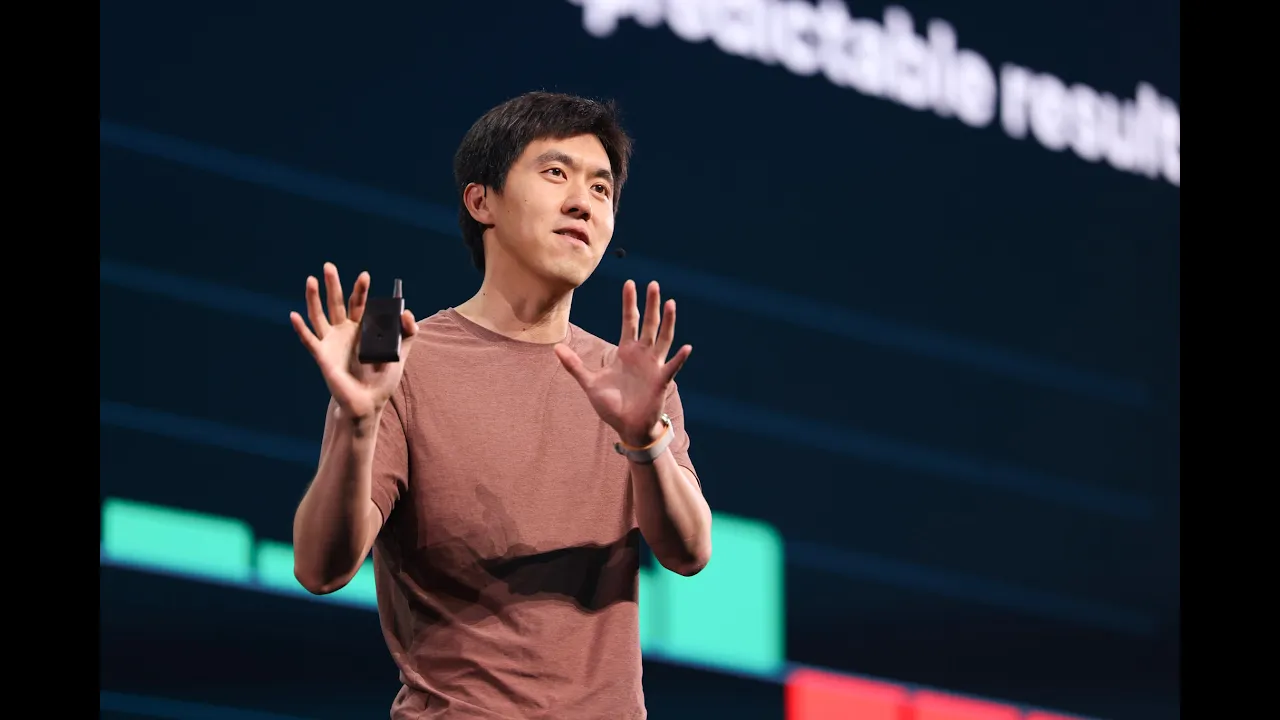
The keynote opens with high energy as the speaker frames the core challenge of modern enterprise intelligence, declaring: “We don’t need more intelligence for AI. We need more context.” To lead this shift, Databricks introduces Genie One, described as a data-smart AI co-worker equipped with full collaborative capabilities. Users can stand up autonomous agents simply by conversing with Genie. Rather than acting as a static search engine that merely recites or summarizes existing content, Genie One performs live computation and net new analysis to generate dynamic documents across any functional department. Users can connect Genie One directly into existing enterprise systems and schedule tasks to execute autonomously in the background.
```mermaid flowchart TD accTitle: Genie Agent Context and Operations Architecture accDescr: Diagram illustrating how Genie Ontology unifies enterprise sources to feed Genie One, App Builder, and ZeroOps.
subgraph DataSources["Enterprise Context Layer"] LH["Databricks Lakehouse"] EXT["Google Drive, SharePoint, Email, & Calendar"] end
subgraph OntologyLayer["Genie Ontology"] ONT["Metadata & Asset Registry"] end
subgraph GenieCapabilities["Genie Execution Engine"] G1["Genie One<br/>(AI Co-Worker & Agents)"] GAB["Genie App Builder<br/>('Vibe Coding')"] GZO["Genie ZeroOps<br/>(Self-Healing Pipelines)"] end
LH --> ONT EXT --> ONT ONT --> G1 ONT --> GAB ONT --> GZO ```
Powering this deep understanding is Genie Ontology, which provides a comprehensive metadata layer spanning all enterprise agentic assets. Instead of limiting visibility to Databricks Lakehouse data, the ontology integrates across productivity suites including Google Drive, SharePoint, corporate email, and Google Calendar. This broad foundation enables agents to retrieve and select the correct organizational context to accurately answer complex business questions. Building on this semantic layer, Genie App Builder introduces what the speaker calls “vibe coding that understands your business.” The app builder is fully embedded and 100% managed by Databricks, providing enterprise-grade security and production-level deployment by default. For data operations, Genie ZeroOps delivers automated pipeline resilience: if a pipeline fails in the middle of the night, ZeroOps detects the outage, investigates the root cause, writes and tests candidate fix code in an isolated sandbox environment, and prepares the remediation while alerting the engineering team.
- **Genie One**: Conversational interface to create autonomous agents, draft live-computed documents, run net new data analysis, and schedule recurring background workflows. - **Genie Ontology**: Cross-platform metadata catalog linking Lakehouse assets with Google Drive, SharePoint, email, and Google Calendar for precise agent retrieval. - **Genie App Builder**: Managed, secure application generation that translates business intent into production-ready software. - **Genie ZeroOps**: Autonomous pipeline monitoring that diagnoses failures at 2:00 a.m., drafts and tests repair code in a separate environment, and stages the fix for engineer sign-off.
---
[01:51](https://www.youtube.com/watch?v=hDFNI7i6J60&t=111s) Next-Gen Data Engine: Lakehouse//RT, Lakebase, and LTAP
Databricks shifts focus to low-latency infrastructure with the debut of Lakehouse//RT, a real-time warehouse engine powered by Reyden. The system is engineered to provide sub-second query performance and massive concurrency directly on the data lake without moving data, remaining fully governed by Unity Catalog across open formats like Delta Lake and Apache Iceberg. Alongside Lakehouse//RT, Databricks unveils Lakebase, a mission-critical serverless Postgres database running on the lake that delivers fully managed cross-cloud disaster recovery. Lakebase allows enterprises to configure topologies spanning multiple cloud providers and execute instant failovers should a primary cloud provider suffer an outage.
```mermaid flowchart LR accTitle: LTAP Unified Data Architecture accDescr: Architecture showing LTAP unifying OLTP applications and real-time analytical queries over shared lake storage.
subgraph StorageLayer["Unified Lake Storage (Delta / Iceberg)"] DL["Mission-Critical Lake Data<br/>Governed by Unity Catalog"] end
subgraph OperationalLayer["OLTP Applications"] APP["Transactional Applications<br/>(Lakebase Postgres)"] end
subgraph AnalyticalLayer["Real-Time Warehousing"] RTW["Lakehouse//RT Engine<br/>(Millisecond Concurrency)"] end
APP <-->|"Direct Read/Write (Zero ETL)"| DL DL -->|"Zero-Copy Queries"| RTW ```
Addressing the historic friction between operational databases and analytical warehouses, the presentation introduces LTAP (Lake Transactional/Analytical Processing). Explaining the breakthrough, the speaker states: “LTAP can truly unify your data infrastructure.” Rather than maintaining complex ETL pipelines that copy transactional records into separate analytical stores, organizations begin with an OLTP database for their core applications that writes directly to the lake. Analysts can query that exact operational data via the real-time warehouse with zero replication delay and zero performance compromise, as demonstrated on stage when a live query against production data executes in single-digit milliseconds.
- **Lakehouse//RT**: High-concurrency warehouse powered by Reyden, executing sub-second queries directly on Delta and Iceberg tables managed by Unity Catalog. - **Lakebase**: Serverless, lake-native Postgres delivering cross-cloud replication and instantaneous automated failover. - **LTAP Architecture**: Eradicates the boundary between operational (OLTP) and analytical (OLAP) systems with zero-copy, pipeline-free execution.
---
[02:59](https://www.youtube.com/watch?v=hDFNI7i6J60&t=179s) Data Ingestion and Developer Frameworks: Lakeflow, Unity AI Gateway, Omnigent, and Agent Bricks
The presentation transitions to data ingestion and developer tooling, beginning with the general availability of Lakeflow Designer, a no-code data preparation environment powered natively by Genie. Databricks pairs this release with an expansion of Lakeflow Connect, which now offers more than 100 managed enterprise connectors. For governing generative AI across the enterprise, the company highlights Unity AI Gateway, a component of the open-sourced Unity Catalog. Serving as a centralized control plane, Unity AI Gateway gives organizations a single pane of glass through which all enterprise AI models and autonomous agents enter the environment.
To prevent vendor lock-in above the raw model and runtime layer, Databricks introduces Omnigent, an open-source framework designed to decouple agent construction from proprietary harnesses. The speaker notes that “the layer should be open so anyone can plug in their own harness, their own workflows, their own tools.” Omnigent provides an open application foundation featuring an intuitive interface for developing custom agents. Building directly on top of this framework is Agent Bricks, Databricks' flagship agent development platform. Agent Bricks provides out-of-the-box, native integration with the industry's leading frontier models, including Anthropic's Claude Opus, OpenAI's GPT, Google's Gemini, Alibaba's Qwen, and Moonshot AI's Kimi. The speaker also announces an expanded collaboration providing native platform access to the Grok family of models.
- **Lakeflow Designer**: No-code visual data engineering interface guided by Genie's conversational AI assistance. - **Lakeflow Connect**: Pre-built integration suite expanded to over 100 connectors for enterprise sources. - **Unity AI Gateway**: Unified entry point and governance interface for enterprise-wide agents and AI workloads under open-source Unity Catalog. - **Omnigent**: Open-source agent development layer enabling teams to bring their own execution harnesses, tooling, and operational workflows. - **Agent Bricks**: Comprehensive agent builder providing integrated access to Claude Opus, GPT, Gemini, Qwen, Kimi, and the Grok model family.
---
[04:09](https://www.youtube.com/watch?v=hDFNI7i6J60&t=249s) Domain-Specific AI: CustomerLake and Lakewatch
In the final announcements, Databricks reveals purpose-built agentic solutions targeting specialized enterprise domains: marketing and cybersecurity. For customer experience, Databricks introduces CustomerLake, categorized as an "Agentic CDP" designed specifically to power infinite, continuous marketing campaigns. Built with a business-first user interface tailored for non-technical marketing teams, CustomerLake operates autonomously to execute hyper-personalized interactions at massive scale, designed to “empower one-to-one a billion times a day.”
The keynote concludes with Lakewatch, a dedicated security lakehouse solution engineered to modernize the Security Operations Center (SOC). Lakewatch ingests and consolidates all enterprise security telemetry—encompassing structured logs, unstructured documentation, and semi-structured event streams—into a unified, governed repository. Autonomous security agents are then deployed across every phase of threat triage, investigation, and incident response, providing SOC analysts with a massive operational speedup before the speaker closes the presentation.
- **CustomerLake**: An Agentic Customer Data Platform (CDP) featuring an intuitive business interface capable of automating up to one billion personalized one-to-one customer interactions daily. - **Lakewatch**: Unified security lakehouse centralizing structured, semi-structured, and unstructured telemetry. - **Autonomous SOC Agents**: Embedded agents within Lakewatch that assist analysts at every stage of threat detection, correlation, and incident resolution.
## Notable quotes > [00:00](https://www.youtube.com/watch?v=hDFNI7i6J60&t=0s) We don’t need more intelligence for AI. We need more context.
## Mentioned Agent Bricks, Alibaba Qwen, Anthropic Claude Opus, Apache Iceberg, CustomerLake, Data + AI Summit 2026, Databricks, Delta Lake, Genie App Builder, Genie One, Genie Ontology, Genie ZeroOps, Google Calendar, Google Drive, Google Gemini, Grok, Lakebase, Lakeflow Connect, Lakeflow Designer, Lakehouse//RT, Lakewatch, LTAP, Moonshot AI Kimi, Omnigent, OpenAI GPT, Postgres, Reyden, SharePoint, Unity AI Gateway, Unity Catalog
## Video description Get a quick look at every major product announcement from Data + AI Summit 2026 — from new open source solutions to marketing and security solutions built for the agentic era.
With the latest innovations across the Databricks Platform, now you have context, control and choice.
00:00 Genie One 00:43 Genie Ontology 1:18 Genie App Builder 1:33 Genie ZeroOps 1:51 Lakehouse//RT, powered by Reyden 2:06 Lakebase Disaster Recovery Vector Search 2:27 LTAP: Lake Transactional/Analytical Processing 2:59 Lakeflow Designer and Lakeflow Connect 3:13 Unity AI Gateway 3:27 Omnigent 3:45 Agent Bricks, now powered by Omnigent 4:09 CustomerLake 4:33 Lakewatch
Watch the full keynote on-demand: https://www.databricks.com/dataaisummit
[Source](https://www.youtube.com/watch?v=hDFNI7i6J60)