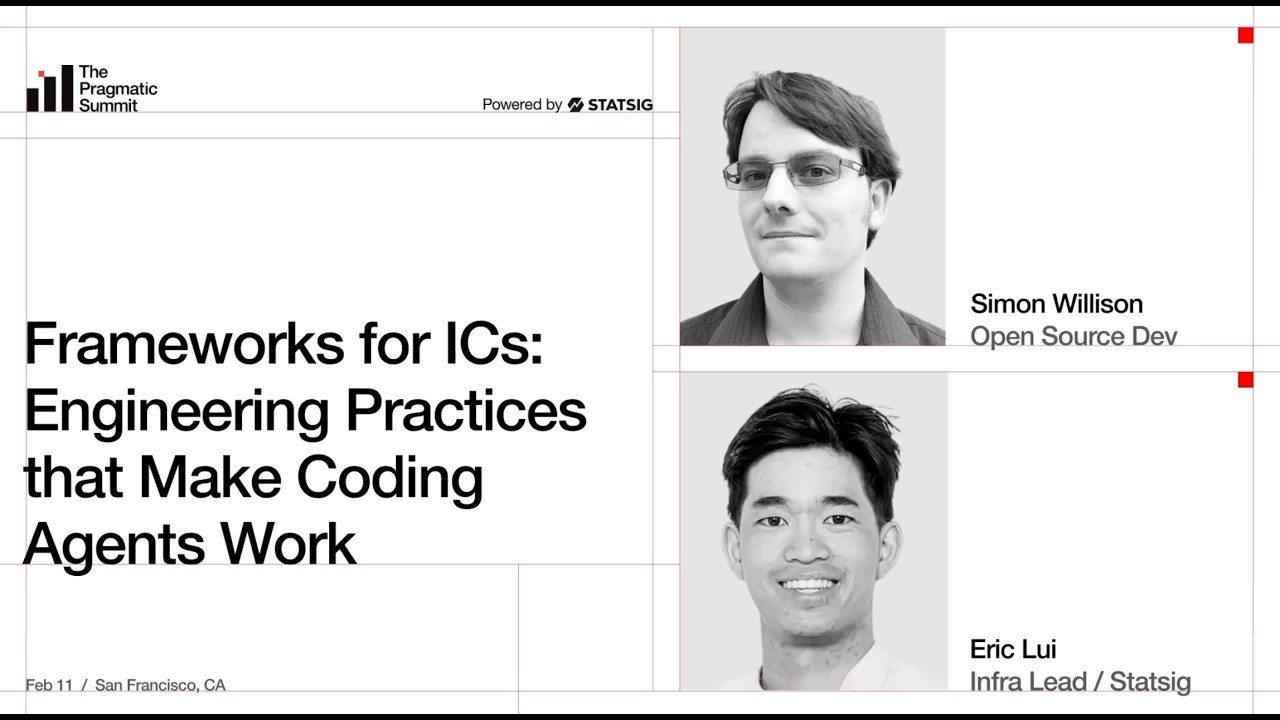
Simon Willison: Engineering practices that make coding agents work - The Pragmatic Summit
The Pragmatic Engineer
AI-assisted summary of Simon Willison: Engineering practices that make coding agents work - The Pragmatic Summit — original source. Check the original for full context.
Source published:
Key ideas
- Simon Willison now writes more code from his phone than on his laptop, routinely triggering autonomous coding agents to build, benchmark, and deploy production features into live environments. (0:04)
- Frontier models reached an inflection point with Claude Opus 4.5 and GPT-5.1, transitioning agents from assistants that require constant code correction to tools capable of one-shot implementations without human code review. (2:42)
- Red-Green Test-Driven Development (TDD) paired with live background server execution and curl requests acts as the primary safeguard preventing autonomous agents from generating architectural bloat or hallucinated code. (5:27)
- The security threat of prompt injection can be reliably neutralized by dismantling 'the lethal trifecta': access to private data, exposure to untrusted inputs, and an external exfiltration channel. (12:41)
- On-demand agent generation is collapsing commercial UI component markets such as pre-built date pickers, while open source faces an existential paradox of powering AI models while drowning in automated pull request spam. (26:21)
Detailed notes
## Background Published on YouTube by The Pragmatic Engineer on March 19, 2026, this session records Simon Willison's appearance at The Pragmatic Summit from February 11, 2026. According to the page description, the talk examines practical engineering practices for autonomous coding agents, covering topics such as shipping software from mobile devices, using test-driven development (TDD) as a reliability harness, and managing prompt injection vulnerabilities.
## TL;DR Simon Willison outlines his transition into directing autonomous AI coding agents, illustrating how modern models allow him to ship features and benchmark optimizations directly from his smartphone. He demonstrates that relying on agents requires disciplined engineering guardrails—specifically strict Red-Green TDD, automated 'manual' verification with live server requests, and clean project scaffolding. Willison also details critical security realities, introducing 'the lethal trifecta' of prompt injection to show why strict container sandboxing and synthetic test data are essential. Finally, he reflects on developer cognitive fatigue and the paradoxical impact of AI on open source, which powers modern models while struggling to survive an onslaught of automated junk contributions.
## Atmosphere & style The presentation has an energetic, authentic, and refreshingly candid tone, beginning with Willison casually checking his phone on stage to verify a production deployment shipped thirty seconds prior. The dynamic between Willison and host Eric is conversational and collegial, punctuated by self-deprecating admissions—such as Willison confessing he still runs risky permissions locally despite being a leading expert on prompt injection. It feels like a grounded dispatch from the bleeding edge of software development, balancing genuine enthusiasm for high-velocity tooling with sober warnings about human mental exhaustion and open-source sustainability.
## Bulletin - [00:04](https://www.youtube.com/watch?v=owmJyKVu5f8&t=4s) Simon Willison now writes more code from his phone than on his laptop, routinely triggering autonomous coding agents to build, benchmark, and deploy production features into live environments. - [02:42](https://www.youtube.com/watch?v=owmJyKVu5f8&t=162s) Frontier models reached an inflection point with Claude Opus 4.5 and GPT-5.1, transitioning agents from assistants that require constant code correction to tools capable of one-shot implementations without human code review. - [05:27](https://www.youtube.com/watch?v=owmJyKVu5f8&t=327s) Red-Green Test-Driven Development (TDD) paired with live background server execution and curl requests acts as the primary safeguard preventing autonomous agents from generating architectural bloat or hallucinated code. - [12:41](https://www.youtube.com/watch?v=owmJyKVu5f8&t=761s) The security threat of prompt injection can be reliably neutralized by dismantling 'the lethal trifecta': access to private data, exposure to untrusted inputs, and an external exfiltration channel. - [26:21](https://www.youtube.com/watch?v=owmJyKVu5f8&t=1581s) On-demand agent generation is collapsing commercial UI component markets such as pre-built date pickers, while open source faces an existential paradox of powering AI models while drowning in automated pull request spam.
## Key takeaways - [00:04](https://www.youtube.com/watch?v=owmJyKVu5f8&t=4s) Developers can now build and ship production features entirely from mobile devices using autonomous cloud-hosted coding agents. - [02:42](https://www.youtube.com/watch?v=owmJyKVu5f8&t=162s) Developer AI adoption has escalated from basic conversational Q&A to software factories where humans write no code and increasingly read no code. - [02:42](https://www.youtube.com/watch?v=owmJyKVu5f8&t=162s) Accepting code without manual line-by-line review mirrors enterprise microservice integration, relying on contracts and verifiable test guarantees rather than inspecting source code. - [05:27](https://www.youtube.com/watch?v=owmJyKVu5f8&t=327s) Classical Red-Green TDD functions as an effective guardrail for coding agents, constraining generation to minimal working implementations and eliminating code bloat. - [05:27](https://www.youtube.com/watch?v=owmJyKVu5f8&t=327s) Because agents eliminate the marginal labor cost of authoring tests, automated test suites are no longer optional in software engineering. - [07:04](https://www.youtube.com/watch?v=owmJyKVu5f8&t=424s) Unit tests alone are insufficient for agent verification; agents must perform black-box testing by booting background servers and validating live curl network requests. - [07:04](https://www.youtube.com/watch?v=owmJyKVu5f8&t=424s) Providing agents with language-agnostic conformance test suites allows them to implement complex technical specifications, such as WebAssembly interpreters, from scratch. - [08:56](https://www.youtube.com/watch?v=owmJyKVu5f8&t=536s) Code quality from AI agents is an active engineering choice: developers can overcome end-of-project fatigue by directing agents to refactor sloppy code into high-standard architectures. - [11:10](https://www.youtube.com/watch?v=owmJyKVu5f8&t=670s) Pre-configured repository templates with exemplar tests and CI configurations prime agents to consistently replicate established project conventions and directory structures. - [12:41](https://www.youtube.com/watch?v=owmJyKVu5f8&t=761s) Unlike SQL injection, prompt injection cannot be resolved by syntactic separation of instructions and data because large language models are inherently gullible context processors. - [12:41](https://www.youtube.com/watch?v=owmJyKVu5f8&t=761s) Mitigating prompt injection requires severing at least one leg of 'the lethal trifecta': access to sensitive data, exposure to untrusted inputs, or outbound exfiltration vectors. - [16:05](https://www.youtube.com/watch?v=owmJyKVu5f8&t=965s) Ephemeral cloud sandboxes and remote virtual machines contain agent blast radiuses, enabling safe usage of aggressive execution modes like dangerously-skip-permissions. - [17:22](https://www.youtube.com/watch?v=owmJyKVu5f8&t=1042s) Engineering teams should use agents to generate complex synthetic test datasets and extreme edge cases rather than copying production databases to local machines. - [19:00](https://www.youtube.com/watch?v=owmJyKVu5f8&t=1140s) AI companies disproportionately optimize frontier models for software engineering because developers readily pay premium monthly subscriptions for measurable productivity gains. - [21:18](https://www.youtube.com/watch?v=owmJyKVu5f8&t=1278s) Speculating on future AI milestones is counterproductive; the highest-leverage work involves empirically testing current frontier models against previously failed prompt boundaries. - [22:52](https://www.youtube.com/watch?v=owmJyKVu5f8&t=1372s) The cognitive fatigue of orchestrating multiple parallel autonomous agents creates a natural human limit against replacing entire engineering teams with single workers. - [26:21](https://www.youtube.com/watch?v=owmJyKVu5f8&t=1581s) On-demand component generation via prompts threatens traditional commercial component business models, as developers can generate bespoke, accessible UI widgets instantly. - [27:32](https://www.youtube.com/watch?v=owmJyKVu5f8&t=1652s) Open source faces a dual crisis: while agents depend entirely on open-source software to generate systems, maintainers are increasingly inundated with automated junk pull requests.
## Detailed walkthrough ### [00:04](https://www.youtube.com/watch?v=owmJyKVu5f8&t=4s) Shipping Production Features from a Phone
Eric, the head of infrastructure and security at Static, opens the session by introducing Simon Willison as a prolific open-source contributor. When Eric casually mentions that Simon maintains "thousands" of repositories, Simon quickly interjects with a laugh to clarify: while he may have created thousands of repos, only hundreds are actively maintained. Eric recaps Simon’s notable career milestones, including co-creating Django more than twenty years ago in Lawrence, Kansas, co-founding Lanyard (which was later acquired by Eventbrite), building Datasette for data journalism, and running an increasingly influential blog on artificial intelligence. Eric asks Simon what his day-to-day developer workflow looks like in the modern era of AI, prompting a startling response from Simon: “Right now, I write more code on my phone than I do on my laptop.”
Simon immediately demonstrates what he means by pulling out his phone to verify a live deployment. Just thirty seconds before walking onto the stage, he dispatched an AI agent from his mobile device to build and ship a brand-new feature for his personal blog. Refreshing the site in real time, he spots the newly added icon: his blog now has dedicated Atom feeds for different content types, designed, implemented, and deployed entirely on mobile.
Eric remarks that this was completely separate from another task Simon had run on his phone just thirty minutes earlier while they were backstage coordinating their talk. During that conversation, Simon had realized he had not yet asked Claude Opus 4.6 to optimize a Python-based WebAssembly interpreter he had been building. With a deadpan, minimalist prompt—“Run a benchmark and then figure out the best options for making it faster”—Simon set the model to work in the background. While the two continued chatting through their prep questions, the model benchmarked the interpreter, identified optimization targets, and returned a 45% to 49% execution speedup on Fibonacci calculations.
- **Django Origins**: Co-created by Simon Willison in Lawrence, Kansas, in 2003. - **Repository Scale**: Thousands of total repositories created, with hundreds under active maintenance. - **Backstage Benchmark**: A simple prompt given to Claude Opus 4.6 yielded a 45% to 49% speedup on a WebAssembly Fibonacci benchmark in Python. - **Mobile Deployment**: Shipped live Atom feeds for various content types to his production blog seconds before taking the stage.
---
[02:42](https://www.youtube.com/watch?v=owmJyKVu5f8&t=162s) The Evolution of AI Coding: From Writing Code to Not Even Reading It
Simon categorizes the developer adoption curve for artificial intelligence into several distinct, escalating phases. In the earliest phase, programmers treat ChatGPT as an occasional question-and-answer assistant to resolve specific programming hurdles. The next major leap occurs when developers integrate autonomous coding agents that write snippets of code, eventually reaching an inflection point where the agent begins generating more code than the human developer. For Simon, that transition took place roughly four to six months earlier. He points to November—marked by the releases of Claude Opus 4.5 and GPT-5.1—as the definitive turning point where models stopped producing "janky" code that required immediate human rescue and started delivering well-architected solutions on the first pass.
```mermaid flowchart TD accTitle: Evolution of Developer AI Adoption accDescr: Stages of programmer adoption from simple chatbot Q&A to not reading code. subgraph Assisted["Assisted Coding"] S1["1. Chatbot Q&A<br/>(Asking ChatGPT questions)"] S2["2. Assistant Snippets<br/>(AI writes isolated functions)"] end subgraph Agentic["Agentic Coding"] S3["3. Agent Outwrites Human<br/>(Opus 4.5 / GPT-5.1 milestone)"] S4["4. Zero-Code Writing<br/>(Engineers direct and review)"] S5["5. Zero-Code Reading<br/>(Proof-based verification / Software Factories)"] end S1 --> S2 S2 --> S3 S3 --> S4 S4 --> S5 ```
That capability shift prompted leading engineering teams to establish strict policies where developers no longer write raw code in text editors; instead, they act as directors and code reviewers. However, Simon highlights a much more radical paradigm that emerged only weeks prior: software development where humans do not even *read* the generated code. Citing an announcement by StrongDM detailing their automated "software factory," Simon describes their dual operating principles—nobody writes code, and nobody reads code. His immediate instinct as an observer was disbelief: “That is a wildly irresponsible to They were a security company building security software, which is why I was paying close I'm like how could this possibly working?”
Yet upon deeper reflection, Simon realized this mirrors existing enterprise dynamics. When platform teams in large corporations ship internal microservices, consuming teams read the API documentation and integrate the service without ever reading its underlying source code; they rely on contract guarantees and step into the codebase only when a critical failure occurs. Simon acknowledges that extending that same professional trust to an AI model feels fundamentally unnatural, but models starting with Claude Opus 4.5 began earning that trust for well-understood, bounded tasks, such as generating paginated JSON APIs backed by databases. Furthermore, the alternative of reviewing every single line written by high-velocity agents carries an unsustainable cost: “That tires you out, right? We become full-time code reviewers and that's an exhausting sort of state of the world.”
---
[05:27](https://www.youtube.com/watch?v=owmJyKVu5f8&t=327s) Red-Green TDD as the Agent's Guardrail
When Eric asks how an entire room of engineers can realistically move away from reading model output, Simon reveals his primary strategy: classical Red-Green Test-Driven Development (TDD). In conventional software engineering, TDD requires the developer to write a failing test, write the minimal implementation necessary to pass it, and then refactor. Simon admits that he personally despised TDD throughout his career because it felt tedious and impeded his momentum. However, applying it to autonomous coding agents fundamentally changes the calculus. Simon does not mind if an agent spends compute cycles burning through failing test iterations, because the framework enforces an invaluable boundary: it prevents the model from generating unnecessary, bloated code.
```mermaid flowchart LR accTitle: Red-Green TDD and Verification Pipeline accDescr: The step-by-step verification pipeline Simon Willison uses with coding agents. subgraph Setup["Prompt Setup"] direction TB A["Specify test runner:<br/>'uv run pytest'"] B["Instruction:<br/>'Use red green TDD'"] A --> B end subgraph TDD["Implementation Loop"] direction TB C["Agent writes failing test (Red)"] D["Agent implements minimal fix (Green)"] C --> D end subgraph Verification["Black-box Proof"] direction TB E["Boot server in background"] F["Execute curl commands"] G["Showboat records Markdown log"] E --> F --> G end Setup --> TDD TDD --> Verification ```
Simon establishes this constraint at the very beginning of every agent session. He specifies the exact command needed to execute the test suite—usually `uv run pytest` in his Python projects—and provides a five-token prompt: `"Use red green TDD."` Because modern frontier models understand the methodology, the agent locks into an iterative loop of proving failure before attempting implementation, radically raising the likelihood of producing working software. Simon strongly criticizes developers who use AI without writing automated tests, arguing that the historical objection to testing—that writing and maintaining test suites is burdensome extra labor—is completely obsolete when agents can generate them for free: “Tests are no longer even remotely optional.”
- **The TDD Prompt**: Using just five tokens—`"Use red green TDD"`—along with the explicit test execution command (e.g., `uv run pytest`) primes the model to constrain its output. - **Code Bloat Prevention**: By forcing the agent to aim exclusively for the passing condition of a pre-existing test, the model avoids hallucinating extraneous architecture. - **Cost Inversion**: Automated tests were traditionally skipped due to time constraints, but because agents write tests at zero marginal labor cost, skipping them has become reckless.
---
[07:04](https://www.youtube.com/watch?v=owmJyKVu5f8&t=424s) Agentic "Manual" Testing, Showboat, and Conformance Suites
Automated unit and integration tests alone are not enough to prove that an agent's code is production-ready. Simon points out an uncomfortable reality familiar to seasoned engineers: a test suite can pass with flying colors even when the underlying web server fails to boot in a real environment. To bridge this gap, Simon instructs his agents to perform what he describes as "manual" testing. He instructs the agent to boot the web application server as a background process and fire live `curl` requests against the newly minted API endpoints. This simple step routinely exposes configuration issues, runtime crashes, and edge-case bugs that the unit tests completely missed.
To formalize this workflow, Simon highlights a lightweight tool he authored called Showboat, which he had released just forty-eight hours prior to the conference. Showboat directs the agent to document its interactive terminal checks into a running Markdown file. As the agent tests an API, Showboat logs each command, captures the raw `curl` response payload, and formats it alongside the agent's commentary on whether the endpoint functioned as expected.
Eric asks whether this practice aligns with what Simon calls "conformance-driven development." Simon explains that conformance-driven development is a related but distinct strategy that leverages broad, language-agnostic test suites. Taking WebAssembly as an example, the official specification includes hundreds of language-independent conformance tests detailing exact input binaries and their expected outputs. By handing an entire formal specification suite to an agent and prompting it to write code until the suite passes, developers can build complete, functioning protocol implementations. Simon shares that he successfully generated a working, albeit unpolished, Python WebAssembly engine using this exact conformance-based technique.
> “So, I will tell my agents, 'Start the server running in the background, and then use curl to exercise the API that you just created.' And that works. And often that will find new bugs that the test didn't cover.” — *Simon Willison*
[08:56](https://www.youtube.com/watch?v=owmJyKVu5f8&t=536s) Cross-Framework Testing and Code Quality as a Choice
Simon Willison illustrates the power of test-driven development by describing how he added multipart file uploads to Datasette, his open-source web framework. Rather than asking an AI agent to write the feature from scratch, he instructed Claude to analyze six different mature web frameworks—including Go, Node.js, Django, and Starlette—and build a universal test suite for file uploads that successfully passed across all of them. Once that comprehensive test suite existed, he handed it back to Claude and told it to implement Datasette's upload functionality to pass those exact tests. Willison describes this approach as essentially reverse-engineering multiple existing implementations of an informal standard into an executable specification, which can then guide the new code. While he jokes that he initially did not know how good the resulting code was because he had not looked at it, he clarifies that Datasette is his flagship open-source project, so he eventually reviewed the pull request thoroughly.
This leads to a broader question from the host about whether code quality even matters anymore when an agent can spit out 2,000 lines of code and a senior engineer just skims it and declares that it “seems legit.” Willison emphasizes that the necessity of code quality depends entirely on context. For throwaway, single-page “vibe coded” HTML and JavaScript tools, code quality is irrelevant: 800 lines of unreadable spaghetti code is fine as long as the tool works. However, for software maintained over the long term, code quality matters tremendously. Simon Willison argues that accepting sloppy agent-generated code is ultimately an engineering decision: “And something I've realized is that it's actually having poor quality choice from code from an agent is a choice that you make.” If an agent generates 2,000 lines of bad code, an engineer can review it, identify better design patterns, and instruct the agent to refactor it. He notes that this iterative loop often produces code superior to what he would write manually: by hand, he might skip an hour-long refactoring at the end of a project out of fatigue or lack of time, whereas with an agent, he can trigger the refactoring prompt and simply go walk the dog while it finishes.
- Multi-framework reverse engineering: Instructing Claude to build tests against Go, Node.js, Django, and Starlette creates an authoritative test harness. - Context-dependent standards: Throwaway single-page utilities require zero architectural purity, whereas long-term codebases require rigorous oversight. - Overcoming developer fatigue: Agents make clean refactoring frictionless, eliminating the temptation to leave sub-optimal code in place when deadlines hit.
[11:10](https://www.youtube.com/watch?v=owmJyKVu5f8&t=670s) Consistency, Scaffolding, and Project Templates
When asked what context and constraints should be shared with an agent to keep it on the right track, Willison explains that modern language models are hyper-attuned to patterns within a repository. If a project already demonstrates specific stylistic and architectural choices, the model will replicate them with striking consistency. To exploit this behavior, Willison relies heavily on Cookiecutter, a command-line Python templating tool.
Willison maintains roughly half a dozen pre-configured Cookiecutter templates—such as a boilerplate repository for new Datasette plugins—that generate the proper directory layout, package configuration, continuous integration pipelines via GitHub Actions, a basic README, and one or two exemplar tests written in his preferred style. By starting every project from these structured templates, the agent immediately absorbs the conventions from the existing sample tests and mirrors that exact structure across all future tests. Willison draws an explicit parallel to human engineering organizations: “If you're the first person to use Redis at your company, you have to do it perfectly, because the next person will copy and paste what you did.” In the same way that junior engineers mimic the earliest committed patterns, coding agents faithfully propagate whatever conventions they encounter in the project scaffold.
[12:41](https://www.youtube.com/watch?v=owmJyKVu5f8&t=761s) Prompt Injection and the Lethal Trifecta
The conversation shifts to the severe security pitfalls that emerge when delegating execution to LLMs, particularly prompt injection—a term Willison coined over three years earlier. Willison explains the core vulnerability: “The problem with language models is they're incredibly gullible by design.” LLMs fundamentally execute instructions and believe virtually anything presented in their context window, even though modern models like Claude occasionally show skepticism about factual claims. In a coding agent setup, an attack occurs when an agent is told to read external documentation or inspect an issue, and that untrusted input contains an embedded instruction such as an obfuscated command piping base64 data into Bash to wipe the filesystem.
Willison reflects that naming the vulnerability "prompt injection" after SQL injection was an imperfect choice. Unlike SQL injection, which can be cleanly neutralized by separating SQL code from parameters via parameterized queries, LLMs have no architectural mechanism to strictly separate untrusted data from trusted instructions. Furthermore, the term is routinely conflated with jailbreaking (such as users roleplaying or claiming their grandmother is dying to elicit illicit instructions). To provide a clearer mental model for system architects, Willison introduced "the lethal trifecta," which defines the three specific conditions required for an untrusted input attack to achieve real-world compromise:
```mermaid flowchart TD accTitle: The Lethal Trifecta of LLM Security accDescr: A diagram showing the three elements that enable a severe prompt injection attack, and how breaking one leg stops the compromise.
subgraph Trifecta["The Lethal Trifecta"] A["Access to Private Data\n(API keys, env vars, private repos, emails)"] B["Exposure to Untrusted Input\n(External documentation, web pages, incoming emails)"] C["Exfiltration Channel\n(External network access, outgoing webhooks, emails)"] end
A --> Impact["Critical Security Breach\n(Data theft, unauthorized actions)"] B --> Impact C --> Impact
Defense["Mitigation Strategy:\nSever at least one leg (e.g., disable external outbound network)"] Defense -.->|Neutralizes| Trifecta ```
Willison emphasizes that security relies on breaking the triangle: “I call it the lethal trifecta because the only guaranteed solution is to cut off one of the legs.” In a personal assistant scenario where an LLM reads inbound emails and has access to password reset links, a malicious email requesting password forwards will succeed if an outbound channel exists. By removing the agent's ability to communicate externally, an attacker’s malicious instructions are neutered—at worst, the agent might hallucinate or lie in its immediate output, but it cannot exfiltrate private assets.
- Architectural limitation: Unlike SQL queries, LLM context cannot be parameterized into immutable code versus inert data. - The three prongs of the lethal trifecta: 1. Access to private or privileged data (e.g., environment variables, source code, email inbox). 2. Exposure to untrusted, potentially malicious text (e.g., third-party documentation, pull requests, emails). 3. An exfiltration vector allowing the model to send data outside the trust boundary. - The fundamental defense: Severing any one of the three components guarantees that an injection cannot result in external data theft.
[16:05](https://www.youtube.com/watch?v=owmJyKVu5f8&t=965s) Sandboxing Coding Agents and Isolated Environments
When asked how software teams can safely run autonomous coding agents that touch risky systems, Willison points to isolation as the single most critical safeguard: “So, I think the most important thing is sandboxing.” Because code can always be rolled back via version control, the primary danger lies in unintended host access, secret exposure, or data leakage. Sandboxing ensures that even if an agent consumes a malicious prompt injection, the blast radius is strictly confined.
Willison notes ongoing innovations in sandboxing across the ecosystem, including mechanisms in OpenAI Codex and Anthropic's Claude Code for the Web. He highlights his own workflow of driving development tasks directly from his phone using Claude Code for the Web, which operates inside ephemeral Linux containers hosted entirely on Anthropic's cloud infrastructure. In this setup, Anthropic spins up a fresh virtual machine, checks out the specified Git repository, and executes the agent tasks inside that bubble. While an injection attack inside that container could theoretically expose private proprietary source code, Willison points out that for open-source repositories, that risk is effectively zero. Running within this isolated boundary allows developers to enable flags like `dangerously-skip-permissions` with confidence: if the agent runs amok and destroys the filesystem, it destroys a disposable virtual machine rather than the engineer's personal machine or corporate network.
[17:22](https://www.youtube.com/watch?v=owmJyKVu5f8&t=1042s) Sandboxing Habits and Synthesizing Test Data
When discussing local execution versus sandboxed environments, Simon Willison makes a candid and self-deprecating confession about his day-to-day workflow. Despite his public reputation as a vocal advocate for AI safety and sandboxing, convenience often tempts him into taking shortcuts on his personal hardware. To mitigate these hazards, he avoids pointing the tool at untrusted repositories or feeding it arbitrary external instructions, though he admits this remains inherently risky. While solutions like Docker containers and Apple containers provide secure isolation, desktop tools still carry just enough friction that developers easily fall back to running commands directly on their machines. By contrast, using mobile clients or web-based interfaces runs execution in isolated remote containers, rendering local device exploitation impossible.
```mermaid flowchart TD accTitle: Safe Agentic Testing with Synthetic Data accDescr: Diagram contrasting insecure production database cloning with agent-driven synthetic data generation. subgraph AntiPattern["Insecure Legacy Workflow"] A["Production Database"] -->|"Clone sensitive data"| B["Local Developer Laptop"] B -->|"Physical theft / leak"| C["Security Incident"] end subgraph AgenticPattern["Agent-Driven Mocking Workflow"] D["Mocking Button / Script"] -->|"Agent generates schema"| E["100 Synthetic Users"] D -->|"Agent simulates edge cases"| F["User with 1,000 Ticket Types"] E --> G["Isolated Test Container"] F --> G end ```
When asked whether developers should copy production user data into these environments for realistic testing, Simon reacts with an emphatic warning against the practice. He recalls how startups and growing companies historically allowed engineers to clone production databases directly onto laptops until an inevitable device theft exposed sensitive user information. Instead of risking private data, Simon strongly recommends using coding agents to generate robust mock datasets and targeted stress-test scenarios with a single click.
“So I'd actually for that I'd invest in good mocking,” Simon Willison explains. “I'd say, 'Okay, here's a button I click and it creates a hundred random users with made-up names.'”
- Simon acknowledges his own habit: “Like for local machines, I'm on it I I mostly run Claude with dangerously skip permissions on my Mac directly even though I'm like the world's foremost expert on why you shouldn't do that.” - The Claude desktop app allows users to interface directly with cloud-hosted execution containers through Claude Code for the web, eliminating the need to execute foreign agent scripts on local hardware. - Coding agents excel at generating hyper-specific edge cases that would otherwise be tedious to construct manually, such as simulating an event platform account loaded with over a thousand distinct ticket types to verify where the system breaks.
---
[19:00](https://www.youtube.com/watch?v=owmJyKVu5f8&t=1140s) The Evolutionary Inflections: From Copilot to Claude Code and One-Shot Models
Tracing the evolution of modern developer tooling, Simon outlines the distinct technical inflection points that transformed assisted coding from simple autocompletion into autonomous terminal execution. In 2022, GitHub Copilot offered helpful line-level completions, followed by the breakthrough of conversational interfaces through ChatGPT in 2023. The arrival of GPT-4 marked the first time large language models were genuinely useful for software engineering without hallucinating entire libraries, though the industry then endured roughly a nine-month plateau before competitors caught up. The true watershed moment occurred when coding agents emerged alongside models capable of reliably interacting with a Unix shell, beginning with Claude Code paired with Claude 3.5 Sonnet.
```mermaid flowchart LR accTitle: Milestones in AI Assisted Software Engineering accDescr: Timeline of major inflection points from 2022 code completion to 2026 one-shot coding models. subgraph S1["2022-2023: Chat & Autocomplete"] M1["GitHub Copilot<br/>Inline autocompletion"] --> M2["GPT-4<br/>First reliable reasoning"] end subgraph S2["2024-2025: Terminal Agents"] M2 --> M3["Claude Code + Sonnet 3.5<br/>Terminal interaction"] end subgraph S3["2026: One-Shot Reliability"] M3 --> M4["Opus 4.6 & Codex 5.3<br/>Deterministic one-shotting"] end ```
This structural shift was driven by economic incentives: AI labs realized software engineers represent one of the highest-value consumer segments willing to pay premium monthly subscription fees for tools that boost productivity. With the rapid progression through late-year updates and the release of models like Claude Opus 4.6 and Codex 5.3, Simon observes that agent workflows have transitioned from uncertain experiments into dependable, one-shot code generation engines.
“That reliability, that ability to predictably This is where we can start trusting them because we can predict what they're going to do,” Simon Willison observes. “That's incredible.”
- Frontier AI developers prioritize coding capabilities above other domains: “OpenAI and Anthropic have both realized that code is the most important thing to optimize the models for, cuz that's where the money is.” - Programmers readily justify high-tier software expenses: “Like coders will spend $200 a month on a plan if it's good enough, it turns out.” - Simon describes how newer frontier models eliminate trial-and-error cycles for standard features; for example, generating three new customized RSS feeds for his personal blog requires only a brief, two-sentence prompt that works immediately on the first attempt without debugging.
---
[21:18](https://www.youtube.com/watch?v=owmJyKVu5f8&t=1278s) Probing Model Boundaries and the Fallacy of Long-Term Predictions
When asked to project what software development workflows will look like a year into the future, Simon refuses to engage in long-range speculation. In his view, hyping distant theoretical milestones distracts from the far more practical and urgent task of determining what current frontier systems can already accomplish. Because complex emergent behaviors are rarely documented in release notes, discovering what a model can execute requires months of empirical exploration by active practitioners.
Simon uses a deliberate, long-term testing habit: whenever an AI model fails to perform a specific task, he archives the failed prompt and revisits it roughly six months later with newer checkpoints. While the prompt often fails again, an unexpected success reveals an expanded model capability before the broader industry notices it. He illustrates this dynamic with spell checking and copyediting: early models consistently struggled to identify subtle typos and missing punctuation, but later architectural improvements transformed them into dependable automated proofreaders for his daily writing.
“The problem is once you start talking about the future, you can get all excited about maybe the next model will do this and so forth,” Simon Willison argues. “I think the most interesting question is what can the models we have do right now?”
- Simon emphasizes the empirical lag in discovering capabilities: “And so the only thing I care about today is what can Claude Opus 4.6 do that we haven't figured out yet. And I think it will take us 6 months to even start exploring the boundaries of that.” - Frontier labs often lack granular insight into their own artifacts: “Like I get first every time a model comes out, what I want what I really want is for OpenAI to say, 'Here is a thing that Codex 5.3 does that 5.2 could not do.' And it's quite rare that they're that clear about it because they don't know.” - Simon maintains a dedicated proofreading agent workflow for every blog post he writes, relying on it to spot grammatical errors and omitted apostrophes that older model generations routinely overlooked.
---
[22:52](https://www.youtube.com/watch?v=owmJyKVu5f8&t=1372s) Cognitive Exhaustion, Ambition, and Vibe Coding Christmas Dinner
Addressing the existential concern that software developers must become hyper-productive "1,000x engineers" managing thousands of autonomous mobile workflows simultaneously, Simon counters with the reality of human cognitive fatigue. Rather than encouraging developer complacency or causing skill atrophy, orchestrating multiple concurrent coding agents demands intense, unbroken mental concentration. Juggling three parallel tasks while waiting on model inference cycles consumes tremendous cognitive bandwidth, frequently leaving an engineer completely drained after only two hours of continuous direction and review. This inherent human processing limit, Simon suggests, serves as a natural safeguard against replacing whole engineering teams with single workers.
Instead of dreading obsolescence, engineers should channel these tools into broadening their ambitions and lowering the friction of entering unfamiliar ecosystems. Rather than spending months studying syntax before building software, developers can immediately produce functioning programs in new languages by pairing agent generation with strict test-driven development harnesses. Simon highlights his own recent sprint of releasing three Go utilities despite lacking deep fluency in the language. Beyond professional utility, agents unlock whimsical, throwaway micro-applications that solve everyday problems—such as photographing recipe cards during the holidays to generate a synchronized cooking schedule.
“I think that might be what saves us,” Simon Willison reflects on human cognitive endurance. “I think the fact that no, you can't have one engineer and have him do a thousand projects because after three hours of that he's going to literally pass out in a corner.”
- Multitasking with autonomous agents introduces extreme cognitive strain: “I often have three projects that I'm working at once because then if something takes 10 minutes I can switch to another one and after two hours of that I'm done for the day. Like I'm mentally exhausted from the app from the cuz peop- a lot of people worry about skill atrophy and being lazy. I think this is the opposite of that.” - Simon urges developers to discard language hesitation: “Like if you've always stuck to two programming languages because of the overhead of learning a third, go and learn a third right now. And don't learn it, just start writing code in it.” - As a demonstration of playful utility, Simon describes his Christmas dinner workflow: he photographed two separate recipe cards and had Claude generate a custom web timer that tracked interleaved preparation steps across both dishes in real time.
---
[25:37](https://www.youtube.com/watch?v=owmJyKVu5f8&t=1537s) The Genesis of Django and Journalism Deadlines
The conversation shifts to the historical origins of Simon's earlier open-source contributions. The interviewer asks him to reflect on co-creating the Django web framework back in 2003 and how that design process would look if approached today using modern agentic technologies. Simon begins by revisiting the operational pressures that forged Django's core philosophy: building web applications inside the newsroom of a local newspaper in Lawrence, Kansas. Operating on aggressive editorial deadlines required an architecture that allowed engineers to design data models, generate interfaces, and deploy functional applications before the fast-moving news cycle passed them by.
“So, I was I co-created a local newspaper in Kansas and it was because we wanted to build web applications on journalism deadlines, right?” Simon Willison recalls. “We as stood the story, you want to knock out a thing related to that story. It can't take 2 weeks cuz the story's moved on.”
[26:21](https://www.youtube.com/watch?v=owmJyKVu5f8&t=1581s) The Shift in Rapid Development and the Threat to Component Libraries
Simon Willison reflects on the original philosophy behind creating Django: the entire goal from day one was to provide tools that allowed developers to build high-quality applications in just a couple of hours, particularly for rapid turnaround on newsroom deadlines. Today, that paradigm has shifted entirely. An engineer can spin up an application for a breaking news story in two hours without having to agonize over what the underlying code looks like, simply prompting Claude to fire something up. While that generated software quietly reaps the benefits of twenty years of Django development and web engineering history, it introduces deep, uncertain questions about the ongoing demand for traditional open-source software and components.
```mermaid flowchart TD accTitle: Impact of AI Agents on UI Component Markets accDescr: Flow diagram showing how AI prompt generation replaces commercial and open-source UI component libraries like date pickers. subgraph Traditional["Traditional Workflow"] A["Developer"] --> B["Open Source Framework (Django / Tailwind)"] B --> C["Paid / Off-the-shelf UI Library (Date Picker)"] C --> D["Time spent customizing code"] end subgraph Agentic["Agentic Workflow"] E["Developer Prompt"] --> F["Frontier LLM (Claude Opus)"] F --> G["Fully bespoke, accessible, mobile-ready component"] G --> H["Collapse of niche component markets"] end ```
The disruption is particularly visible at the level of specific user interface widgets. Developers traditionally relied on open-source packages or paid commercial libraries for fiddly components like date pickers, often spending hours wrestling with customization. Now, an engineer can instruct an LLM to generate the exact date picker required for the project. While date pickers historically sat right on the edge of acceptable AI capabilities, models like Claude Opus can now be trusted to generate bespoke, mobile-friendly, accessible widgets on demand. This shift directly threatens developer-tool business models, such as Tailwind's model of providing a free core styling framework while charging for premium access to polished component libraries. Because engineers can now "vibe code" custom components with a single prompt, the commercial market for pre-built components has begun to collapse.
- “And so the whole point of Django from the very start was, how do we help people build high-quality applications as quickly as possible?” — Simon Willison - “Why would I use a date picker library where I'd have to customize it when I could have Claude write me the exact date picker that I want.” — Simon Willison - “And the the market for that has collapsed because people can vibe code the date picker, the those kinds of custom components.” — Simon Willison
---
[27:32](https://www.youtube.com/watch?v=owmJyKVu5f8&t=1652s) The Paradoxical Future of Open Source: Agent Dependency vs. Junk PR Floods
When asked whether open source is entering an irreversible downward trend, Willison expresses ambivalence, describing a complex and contradictory ecosystem. On one hand, autonomous coding agents rely heavily on the open-source commons. They excel at recommending battle-tested open-source libraries and orchestrating them into functional architectures; virtually everything powerful that developers currently build with agents exists strictly on the shoulders of the open-source community.
At the same time, open-source maintainership is facing a crisis of spam and automated noise. Repositories are increasingly overwhelmed by low-quality, AI-generated contributions, pushing maintainers to a breaking point. The deluge of automated pull requests has become so severe that maintainers have actively lobbied GitHub to allow repository owners to disable incoming pull requests entirely. This marks a radical departure from GitHub's foundational ethos of open, friction-free collaboration. The dynamic leaves open source caught between two extremes: serving as the indispensable foundation that powers AI tooling, while being actively choked by the automated output those same tools generate.
- “Like I feel like the reason you can build such amazing things with agents is entirely built on the back of the open source community.” — Simon Willison - “Like that's been the whole sort of fundamental value of GitHub has been open collaboration and pull requests and now people are saying, 'Look, we're just flooded by them. This doesn't work anymore.'” — Simon Willison
## Notable quotes > [05:27](https://www.youtube.com/watch?v=owmJyKVu5f8&t=327s) Tests are no longer even remotely optional. — Simon Willison
> [11:10](https://www.youtube.com/watch?v=owmJyKVu5f8&t=670s) If you're the first person to use Redis at your company, you have to do it perfectly, because the next person will copy and paste what you did. — Simon Willison
> [22:52](https://www.youtube.com/watch?v=owmJyKVu5f8&t=1372s) Like if you've always stuck to two programming languages because of the overhead of learning a third, go and learn a third right now. And don't learn it, just start writing code in it. — Simon Willison
> [26:21](https://www.youtube.com/watch?v=owmJyKVu5f8&t=1581s) Why would I use a date picker library where I'd have to customize it when I could have Claude write me the exact date picker that I want. — Simon Willison
> [27:32](https://www.youtube.com/watch?v=owmJyKVu5f8&t=1652s) the reason you can build such amazing things with agents is entirely built on the back of the open source community. — Simon Willison
## Mentioned Anthropic, Apple, ChatGPT, Claude, Claude 3.5 Sonnet, Claude Code, Claude Code for the Web, Claude Opus, Claude Opus 4.5, Claude Opus 4.6, Codex 5.3, Cookiecutter, Datasette, Django, Docker, Eric, Eventbrite, GitHub, GitHub Actions, GitHub Copilot, Go, GPT-4, GPT-5.1, Lanyard, Node.js, OpenAI, OpenAI Codex, pytest, Redis, Showboat, Simon Willison, Starlette, Static, StrongDM, Tailwind, uv, WebAssembly
## Video description With Simon Willison. Recorded 11 February 2026, at The Pragmatic Summit: www.pragmaticsummit.com. See extended notes from Simon in his excellent writeup: https://simonwillison.net/2026/Mar/14/pragmatic-summit/
Watch the session with Q&A also included: https://newsletter.pragmaticengineer.com/p/the-pragmatic-summit-recordings
0:00 Intro: shipping from your phone 5:56 TDD as the core reliability framework 12:52 Prompt injection and security fundamentals 21:31 Using the current models better
[Source](https://www.youtube.com/watch?v=owmJyKVu5f8)