Fowler, Beck Say AI Tools Require TDD Rigor as Micro-Craft Era Ends
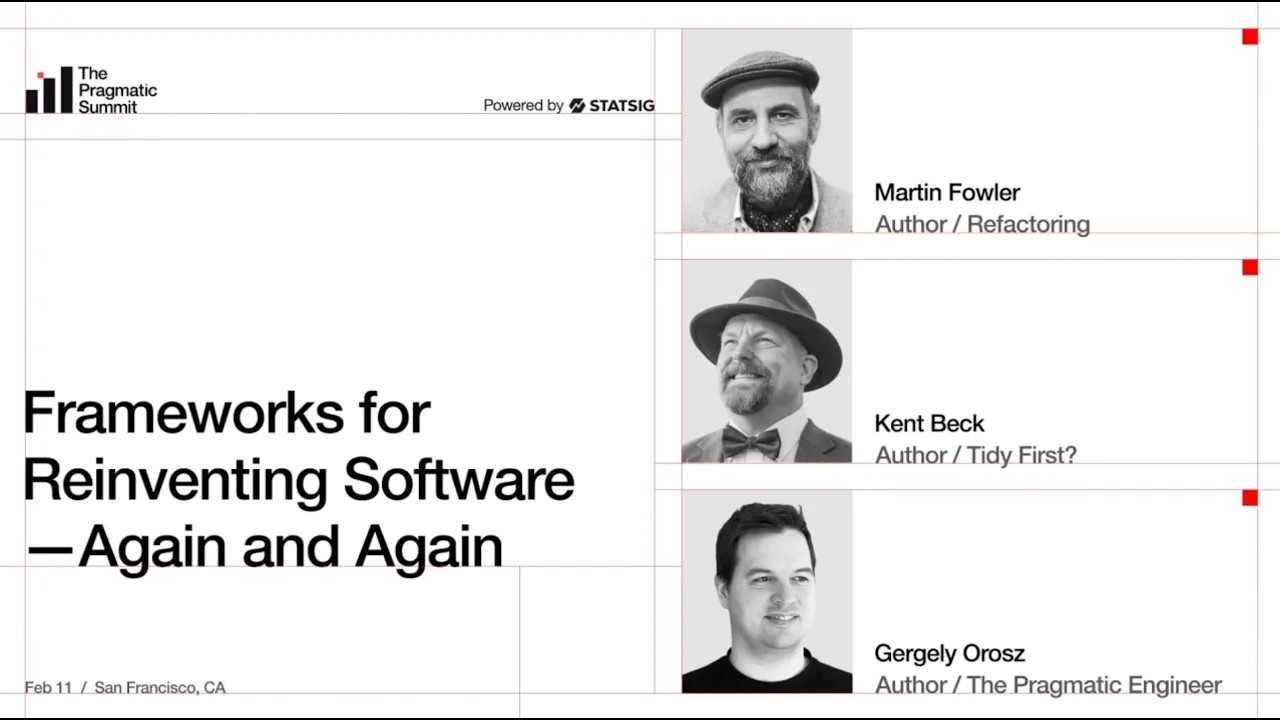
The Pragmatic Engineer
Automated test suites and modular architecture remain essential to verify unpredictable AI agents, but manual line-by-line code craft no longer provides engineering leverage.
AI-assisted summary of Martin Fowler & Kent Beck: Frameworks for reinventing software, again and again — original source. Check the original for full context.
Source published:
Key ideas
- Twenty-five years after the Agile Manifesto, Martin Fowler and Kent Beck argue that artificial intelligence represents an inflection point far larger and faster than object-oriented programming, the internet, or Agile, requiring no persuasion to convince enterprises of its significance. (7:25)
- Test-driven development and automated test suites have seen a renewed resurgence as the critical verification harness needed to keep unpredictable generative AI 'genies' aligned with human intent. (2:11)
- The Venn diagram of developer experience (DX) and agent experience (AX) is effectively a circle: modularity, strict test harnesses, and precise domain modeling benefit both human engineers and autonomous LLM agents. (29:07)
- Rather than downsizing software engineering groups into solo operations, Fowler and Beck predict two-pizza teams will persist with expanded leverage, warning against a dangerous managerial retreat into isolated, 're-soloed' programming. (25:10)
Detailed notes
## Background Published on YouTube by The Pragmatic Engineer on April 7, 2026, this session from The Pragmatic Summit features Martin Fowler and Kent Beck in conversation with host Gergely Orosz. The panel explores frameworks for reinventing software, drawing on twenty-five years of lessons since the Agile Manifesto to examine how past technology cycles inform the current generative AI shift.
## TL;DR Marking twenty-five years since drafting the Agile Manifesto, Martin Fowler and Kent Beck assess the unprecedented speed and scale of artificial intelligence across software engineering. They argue that while AI is often marketed as a way to eliminate programmers, foundational practices like Test-Driven Development, modular architectures, and domain modeling remain essential as verification harnesses for unpredictable autonomous agents. The pair caution against enterprise panic, security blind spots, and the antisocial 're-soloing' of development, advocating for resilient, collaborative two-pizza teams over isolated engineers juggling bots. Ultimately, while Beck candidly mourns the diminishing leverage of line-by-line code polishing, Fowler emphasizes that what benefits developer experience (DX) symmetrically benefits agent experience (AX).
## Atmosphere & style The session strikes a playful, collegial, and refreshingly unpretentious tone, driven by decades of rapport between Fowler and Beck as they trade dry self-deprecating quips about being the tech world's 'old furniture.' Rather than dispensing dogmatic advice from on high, both veterans speak with disarming vulnerability, openly sharing their initial frustrations with tools and admitting that no one currently holds definitive answers. The emotional arc transitions gracefully from sharp institutional critiques of corporate incentives and vendor snake oil to a poignant, bittersweet reflection on outgrowing the tactile craft of manual coding.
## Bulletin - [07:25](https://www.youtube.com/watch?v=CZs8J1ZD0CE&t=445s) Twenty-five years after the Agile Manifesto, Martin Fowler and Kent Beck argue that artificial intelligence represents an inflection point far larger and faster than object-oriented programming, the internet, or Agile, requiring no persuasion to convince enterprises of its significance. - [02:11](https://www.youtube.com/watch?v=CZs8J1ZD0CE&t=131s) Test-driven development and automated test suites have seen a renewed resurgence as the critical verification harness needed to keep unpredictable generative AI 'genies' aligned with human intent. - [29:07](https://www.youtube.com/watch?v=CZs8J1ZD0CE&t=1747s) The Venn diagram of developer experience (DX) and agent experience (AX) is effectively a circle: modularity, strict test harnesses, and precise domain modeling benefit both human engineers and autonomous LLM agents. - [25:10](https://www.youtube.com/watch?v=CZs8J1ZD0CE&t=1510s) Rather than downsizing software engineering groups into solo operations, Fowler and Beck predict two-pizza teams will persist with expanded leverage, warning against a dangerous managerial retreat into isolated, 're-soloed' programming.
## Key takeaways - [02:11](https://www.youtube.com/watch?v=CZs8J1ZD0CE&t=131s) The unpredictability of generative AI agents makes automated test suites and TDD principles more critical than ever to verify that candidate code matches developer intent. - [03:49](https://www.youtube.com/watch?v=CZs8J1ZD0CE&t=229s) Veteran engineering leaders no longer possess ready-made answers for software delivery, requiring senior practitioners to model rapid, low-cost experimentation rather than prescriptive authority. - [07:25](https://www.youtube.com/watch?v=CZs8J1ZD0CE&t=445s) The technological scale and adoption velocity of AI surpass earlier industry disruptions like object-oriented programming, the internet, or Agile. - [07:25](https://www.youtube.com/watch?v=CZs8J1ZD0CE&t=445s) Kent Beck compares the generative AI shift to the introduction of the Intel 4004 microprocessor, which shattered prevailing mental models of compute and vastly broadened developer imagination. - [10:56](https://www.youtube.com/watch?v=CZs8J1ZD0CE&t=656s) Navigating AI hype requires total skepticism paired with inward curiosity to design the smallest possible experiment that validates a tool's real substance. - [12:26](https://www.youtube.com/watch?v=CZs8J1ZD0CE&t=746s) Like early object-oriented programming and Agile, initial friction with AI often stems from improper tool usage rather than the underlying capability of the technology. - [15:41](https://www.youtube.com/watch?v=CZs8J1ZD0CE&t=941s) Corporate incentive structures and departmental politics routinely resist the 'faster, cheaper, better' efficiency promises of both Agile and AI. - [17:32](https://www.youtube.com/watch?v=CZs8J1ZD0CE&t=1052s) The rapid emergence of low-value consulting and marketing around AI mirrors the historic co-optation of Agile into the 'Agile industrial complex.' - [18:55](https://www.youtube.com/watch?v=CZs8J1ZD0CE&t=1135s) AI functions as a capability multiplier benefiting junior developers and high performers, but creates severe career vulnerability for the vast middle tier of vocational programmers. - [21:03](https://www.youtube.com/watch?v=CZs8J1ZD0CE&t=1263s) The recurring executive fantasy of eliminating programmers dates back to COBOL, yet writing prompts remains a formal specification of intent and code. - [22:41](https://www.youtube.com/watch?v=CZs8J1ZD0CE&t=1361s) Traditional enterprises face confusion, legacy scale hurdles, and severe security risks by granting autonomous agents unvetted access to corporate communications like email. - [25:10](https://www.youtube.com/watch?v=CZs8J1ZD0CE&t=1510s) Autonomous agents risk reviving the anti-social 're-soloing' of programming, undermining the collaborative dialogue that drove the success of Extreme Programming. - [27:03](https://www.youtube.com/watch?v=CZs8J1ZD0CE&t=1623s) Two-pizza teams augmented by AI are positioned to outperform solo-developer setups, with pair-programming sessions effectively guiding collections of autonomous tools. - [27:03](https://www.youtube.com/watch?v=CZs8J1ZD0CE&t=1623s) Longer model generation latencies offer a counterintuitive benefit by giving human pairs time to deliberate over design, architecture, and trade-offs. - [29:07](https://www.youtube.com/watch?v=CZs8J1ZD0CE&t=1747s) Engineering leverage is shifting away from micro-level code polishing and manual refactoring toward deep business domain comprehension and systemic architecture.
## Detailed walkthrough ### [00:05](https://www.youtube.com/watch?v=CZs8J1ZD0CE&t=5s) Old Furniture at an AI Gathering: 25 Years Since the Agile Manifesto
The session opens on an energetic and playful note as Gergely Orosz welcomes the audience to The Pragmatic Summit. Looking around at the crowd, Gergely admits he did not initially expect to see Martin Fowler and Kent Beck walking into a venue packed with the hottest modern artificial intelligence startups. Kent immediately feigns outrage, demanding, “What the hell is that supposed to mean?” Gergely confesses that he had already teased Kent earlier in the day by referring to him as "old furniture" and the elder statesman of the tech crowd. Kent dryly defends himself against the jab, pointing at Martin and retorting, “I'm at least a year younger than him.”
Transitioning into the substance of the talk, Gergely explains that just a week earlier, he, Martin, Kent, and several other prominent industry thinkers had gathered in Deer Valley, Utah, for the Future of Software Engineering conference, which Martin had organized. The gathering provided a timely moment of reflection: it has been twenty-five years since seventeen software practitioners met in Utah to draft the Agile Manifesto. As two of the original seventeen signatories, Martin and Kent have spent the ensuing quarter-century fundamentally shaping software engineering practices. Gergely asks them to reflect on the decades of feedback they have received from working engineers, probing which core ideas have truly stuck and what developers most frequently thank them for creating.
- Gergely Orosz, Martin Fowler, and Kent Beck had just convened at the Future of Software Engineering conference in Deer Valley, Utah, prior to the summit. - The Agile Manifesto was drafted twenty-five years ago by seventeen signatories, including both Martin Fowler and Kent Beck.
[02:11](https://www.youtube.com/watch?v=CZs8J1ZD0CE&t=131s) The Polarization of TDD and Verifying the AI "Genie"
Reflecting on Gergely's question, Martin notes that he has never systematically cataloged the feedback, though developers constantly bring up the broad philosophies of Agile as well as the specific disciplines laid out in his book *Refactoring*. Kent, however, points to an intensely bifurcated reaction to test-driven development. While many engineers express profound gratitude for TDD, others treat it like an apocalyptic curse. Kent humorously recites the complaints he receives: “I also get this test-driven development 'ruined my life. My dog left me. My house burned down and it's all your fault.'” Gergely agrees that TDD has always been inherently provocative, admitting that he himself was once a zealous convert before swinging toward frustration with the practice.
The conversation turns to modern relevance when Kent recounts a conversation from the previous day with an engineer pushing the cutting edge of AI development. The practitioner thanked Kent for championing TDD for over two decades, explaining that automated tests have suddenly become critical because software engineering now relies on autonomous AI agents. While Kent remains self-aware and cautious about confirmation bias—wondering if he is simply eager to hear praise that validates his life's work—he underscores that the core philosophy of TDD directly addresses the unpredictability of generative tools. When developers delegate work to an unpredictable assistant, having strict, programmatic verification is the only way to ensure the output matches human intent. As Kent Beck puts it: “It does make sense to me that, you know, when we've got a big powerful genie, you really have to learn how to verify that it's doing the right thing for you.” Martin adds that the industry has spent twenty-five years cultivating that exact verification reflex, to which Kent quips that although he is no genie himself, he has always relied on tests to keep his own code honest.
```mermaid flowchart LR accTitle: Verification loop for AI agents accDescr: Flowchart illustrating how human developer intent is turned into code by an AI agent and verified through automated test suites. subgraph Spec ["Specification"] A["Developer Intent & Prompts"] end subgraph Generation ["Autonomous Execution"] B["AI Agent ('The Genie')"] C["Candidate Code Output"] end subgraph Validation ["Safety & Verification Loop"] D["Automated Tests (TDD Harness)"] E["Verified Working Software"] end A --> B B --> C C --> D D -->|"Tests Pass"| E D -->|"Tests Fail / Regress"| B ```
[03:49](https://www.youtube.com/watch?v=CZs8J1ZD0CE&t=229s) Staying Grounded: Documenting Real Workflows and Helping Geeks Feel Safe
Addressing the audience's familiarity with their books and podcasts, Gergely brings up an abrasive LinkedIn comment he encountered before the summit. The commenter disparaged the conference lineup, complaining that the organizers had invited authors who were supposedly out of touch with real technology. Gergely brushes off the ignorance of the critique and asks Martin and Kent what their day-to-day work looks like now, and how they actively keep their fingers on the pulse of modern engineering. Martin explains that after publishing the second edition of *Refactoring* roughly five or six years ago, he deliberately chose not to write another book, despite having multiple half-finished manuscripts sitting on his desk. Instead, he decided to shift his full attention toward learning from practitioners in the field. Explaining his pivot, Martin Fowler states: “Instead, what I should do was work with people who are actually still doing real work on real projects, writing real code, as it were.”
Martin channels these insights directly into martinfowler.com, a platform he values because it remains entirely under his personal editorial control without corporate interference. In the era of AI, Martin is intensely focused on observing fine-grained developer workflows: how engineers converse with their AI assistants, what they look for during code reviews, and what critical decisions humans must still retain. Kent then articulates his overarching personal mission, stating plainly that his purpose in life is to help geeks feel safe in the world. Right now, he observes, technical workers feel profoundly unsafe due to industry upheaval. For twenty-five years, industry leaders had ready-made answers on tap—if a team suffered from bugs, coaches prescribed automated testing, and if code was untestable, they prescribed architectural refactoring. Kent observes that this era of reliable recipes has abruptly evaporated: “And the thing that's changed is at this moment nobody knows the answers to anything.”
Rather than offering obsolete prescriptions, Kent has retreated into "explore mode," tackling ambitious coding experiments to discover what works firsthand. He believes the duty of senior engineers is not to posture as authorities who have solved the AI transition, but to publicly model the experimentation required to navigate an unmapped technological landscape.
- Martin Fowler intentionally ceased writing standalone books after the second edition of *Refactoring* to focus on curating practitioner knowledge on martinfowler.com. - Martin’s primary research focus in AI centers on the exact mechanics of human-agent dialogue, review criteria, and how decision flows are shifting between humans and models. - Kent Beck argues that for twenty-five years experts could simply "press play on the recorder" to solve software problems, but that playbook has stopped functioning over the past year. - Kent views the role of veteran engineers as demonstrating how to discover new working methods rather than pretending to hold ready-made answers.
[07:25](https://www.youtube.com/watch?v=CZs8J1ZD0CE&t=445s) Historical Analogies: The Microprocessor, the Internet, and the Magnitude of AI
Gergely asks Martin and Kent to look back across their long careers and identify any prior technological inflection points that felt as daunting, unpredictable, and disorienting as artificial intelligence feels today. Martin immediately clarifies that nothing in their past matches the sheer scale of the current moment. While earlier waves triggered anxiety—the emergence of object-oriented programming scared many procedural programmers, the internet fundamentally transformed communication, and Agile met fierce institutional resistance—AI operates in an entirely different category of impact. During previous shifts, pioneers had to spend years evangelizing and persuading skeptical executives that these technologies mattered. In stark contrast, AI requires no persuasion; Martin Fowler notes: “People can't—I mean, you cannot put blinkers on to deny the importance of this thing.”
Kent offers another historical parallel from his childhood: the dawn of the microprocessor. Growing up in Silicon Valley with a programmer father, Kent remembers when computing power was confined to massive mainframe boxes that were so expensive an organization practically had to mortgage a building to acquire another one. When the Intel 4004 chip debuted, it shattered prevailing mental models of what a computer could be, instantly expanding the boundaries of human imagination. Kent sees that same imaginative explosion happening with AI today. In his own exploratory work, he has been using AI to pursue wildly ambitious projects that would previously have seemed impractical, such as building a persistent Smalltalk environment and writing library-quality Rust code. While many of these experiments fail, Kent emphasizes that failure is an intrinsic part of the process, reminding the audience that computing has faced moments before where sudden abundance unlocked unimaginable new horizons. As Kent Beck reflects on the creative surge: “And so, I think part of AI is this expansion of imagination.”
- Martin Fowler ranks previous disruptions—object-oriented programming, the internet, and Agile—as smaller in scale than AI, noting that pioneers previously had to fight just to convince people those technologies were important. - Kent Beck draws a direct comparison between generative AI and the release of the Intel 4004 microprocessor, which democratized compute away from room-sized mainframes. - To test the creative limits of AI, Kent is currently working on personal projects including a persistent Smalltalk system and production-grade Rust libraries.
[10:56](https://www.youtube.com/watch?v=CZs8J1ZD0CE&t=656s) Total Skepticism, Curiosity, and the Smallest Experiment
Navigating technological sea changes requires balancing raw curiosity with healthy doubt. Martin Fowler emphasizes that his own skepticism is hard-won, forged after decades of watching the tech industry peddle endless cycles of snake oil. While he was completely dismissive of earlier movements like blockchain, he stresses that true skepticism cannot be dogmatic—it must turn inward as well. As Martin Fowler explains: “My skepticism has to be absolute and total, which means I have to be skeptical about my skepticism.” That internal check forces an engineer to remain curious enough to look past their initial dismissals, continually probing emerging tools to detect whether genuine substance lies beneath the surface hype.
Kent Beck crystallizes this probing mindset down to an empirical, low-cost practice. The critical discipline in modern software engineering is determining how to run rapid micro-tests to see past vendor marketing without investing months of wasted effort. As Kent Beck puts it: “That's the skill that is suddenly in the last year become a thousand times more valuable is that skill of saying, 'What's the least I can do to validate for my to my own satisfaction whether this claim is true?'”
- The defining habit for navigating disruption is determining the smallest possible experiment to test whether a technology's claims are valid. - Skepticism must be paired with genuine curiosity so engineers do not discard breakthrough shifts prematurely out of sheer cynicism.
---
[12:26](https://www.youtube.com/watch?v=CZs8J1ZD0CE&t=746s) Early AI Impressions, Emacs, and Learning to Use the Tool
Early interactions with unpolished tools can easily send misleading signals. Martin recounts his own initial foray into AI copilots roughly a year to eighteen months earlier inside Emacs—jokingly acknowledged from the stage as "the one true editor." After configuring Emacs to prompt and auto-complete inline code, he found the experience deeply aggravating: while the model occasionally offered brilliant completions, it produced garbage so frequently that he spent half his time hitting `Ctrl-K` to kill lines of hallucinated text. Had he trusted that initial experience alone, he admits he would have flipped the "bozo switch" on AI just as he had done with blockchain.
Instead, Martin looked to practitioners who balanced grounded excitement with critical nuance. He credits Simon Willison's blog, alongside Thoughtworks colleagues Mike Mason and Birgitta Böckeler, with showing him that mastering AI requires learning how to wield it skillfully rather than blaming early friction on the concept itself. Martin draws a historical parallel to the early days of object-oriented programming, where developers claimed objects were ineffective while merely writing procedural code in C++ or Java without understanding true object design. Kent adds that the ground continues to shift underneath developers' feet weekly, noting how tools like Gemini or Claude Code will fail miserably one week and perform seamlessly the next on the exact same task. As Kent Beck reassures the audience with a grin: “So, you're just as smart as everybody else because you're just as ignorant as everybody else.”
```mermaid flowchart TD accTitle: Paths of Technological Adoption accDescr: Contrasting superficial trial and hype against empirical mastery and tool learning. subgraph Shift ["Technological Shift (OO / Agile / AI)"] Tech["New Paradigm or Tool"] end
subgraph Adoption ["Paths of Adoption"] Surface["Superficial Use & Hype<br/>(Early Copilot frustration, 'Agile Industrial Complex')"] Pragmatic["Disciplined Mastery<br/>(Simon Willison, small experiments, continuous probing)"] end
subgraph Outcomes ["Long-Term Reality"] Discard["Flipped 'Bozo Switch' / Snake Oil"] Amplified["Compounded Productivity & Amplification"] end
Tech --> Surface Tech --> Pragmatic Surface --> Discard Pragmatic --> Amplified ```
---
[15:41](https://www.youtube.com/watch?v=CZs8J1ZD0CE&t=941s) The Agile Illusion: Why Organizations Don't Want 'Faster, Cheaper, Better'
The conversation turns to the 25-year milestone of the Agile Manifesto, published in 2001. When asked why his name appeared at the very top of the original seventeen authors on the website, Kent dryly notes that the order was "strictly alphabetical," before admitting, "it is a source of unending joy." The moderator highlights how Agile entered the industry with four simple core values that promised to deliver better software faster and cheaper—the exact same value proposition executives now anticipate from generative AI.
Kent completely punctures this assumption, arguing that engineers routinely misunderstand corporate dynamics. While technical workers assume management shares the goal of hyper-efficiency, corporate political realities often reward friction, headcount, and predictability over radical efficiency. As Kent Beck observes: “Inside a company, the incentives are so misaligned with actually achieving that.” Engineers who arrive touting that a practice makes delivery 40% better, 12% cheaper, and "less fattening" are routinely punished because those metrics destabilize the internal incentives of other departments. Because the tech industry never solved that organizational dysfunction during the Agile era, Kent warns that AI adoption will run headfirst into the exact same political resistance.
- Kent Beck's name was placed first among the 17 Agile Manifesto signatories simply due to alphabetical ordering. - Corporate incentive structures routinely punish efficiency improvements that conflict with departmental budgets, staffing goals, or internal power structures.
---
[17:32](https://www.youtube.com/watch?v=CZs8J1ZD0CE&t=1052s) Speed, Snake Oil, and the Agile Industrial Complex
Comparing the two eras, Martin points out that while Agile took root across software engineering through a slow, decades-long burn, AI is slamming into the industry with unprecedented magnitude and velocity. Despite this difference in pace, the core human and institutional dynamics mirror each other closely. A stark divide will emerge between the minority of practitioners who invest the deep effort required to use the tools effectively and the majority who apply them carelessly.
Equally familiar is the immediate rise of grift and commodification. Just as the foundational ideas of Extreme Programming and Agile were engulfed by what Martin famously coined the "Agile industrial complex," AI is experiencing its own explosion of low-value consulting, tool peddling, and buzzword marketing. As Martin Fowler warns: “And that will happen. That is happening with AI right now, and it's often hard to see the difference between where is the snake oil and where is the real stuff.” Discerning between authentic productivity gains and predatory snake oil requires teams to remain vigilant and test tools empirically.
---
[18:55](https://www.youtube.com/watch?v=CZs8J1ZD0CE&t=1135s) Amplifiers, Junior Developers, and the Vulnerable Middle
Kent pushes back against the doom-and-gloom narrative surrounding software careers, arguing that AI functions primarily as a capability multiplier. For ambitious newcomers, he believes we have entered the "golden age of the junior programmer." He recounts speaking with anxious parents whose computer science students want to abandon programming for commercial alternatives like art history out of fear that AI will automate entry-level roles. Kent reframes the shift using a historical craft analogy:
> “And I'd say, well, this is like if you're a carpenter and they just introduced the circular saw and you think, oh well, carpentry is over. Anybody can build a house now. Well, no, you have more powerful tools. You have less time that you have to do, you know, kind of the crummy work.”
While top performers will become significantly more effective and hungry juniors will learn faster than ever, Kent expresses deep concern for "the middle"—the large cohort of developers who joined the industry purely as a reliable white-collar paycheck. During the dot-com crash 25 years ago, that group was flushed out and drifted into professions like real estate, but that middle cohort is vastly larger today. Martin adds that today's market dynamics are uniquely challenging compared to the late 1990s: the dot-com era was an unadulterated economic boom until its sudden pop, whereas the current AI revolution is colliding directly with brutal post-ZIRP (Zero Interest Rate Policy) tech retrenchments and corporate cost-cutting.
- High performers and juniors benefit most from AI because it acts as an amplifier, accelerating their learning and execution speed. - The vocational "middle" of software development faces acute disruption, with fewer obvious career escape hatches than existed after 2000. - Unlike the dot-com boom, the AI cycle is playing out against the backdrop of broad macroeconomic headwinds and tech sector layoffs.
---
[21:03](https://www.youtube.com/watch?v=CZs8J1ZD0CE&t=1263s) The Recurring Fantasy of Replacing Programmers
The discussion closes on the tech industry's cyclical obsession with engineering obsolescence. Kent reflects on the periodic corporate dream: "we get to get rid of all the programmers, woohoo." Martin interjects that this fantasy dates back at least to the creation of COBOL, which was pitched as a language so intuitive that non-technical business analysts could write all necessary instructions, eliminating the need for specialized programmers entirely.
While the Agile movement stood apart because it was created by programmers to empower programmers, modern AI rhetoric has reignited the executive dream of a developer-free enterprise. Kent cautions that rather than simply laughing off these recurring replacement narratives, engineers must confront why corporate leadership is so desperate to disintermediate them in the first place. As Kent Beck concludes: “Which it behooves us as programmers to think about why they keep wanting to get rid of us.”
[21:53](https://www.youtube.com/watch?v=CZs8J1ZD0CE&t=1313s) What Does "Getting Rid of Code" Really Mean?
Martin Fowler challenges the dramatic narrative currently circulating in industry panels and conference sessions that developers will completely stop writing code within six months. He points out that declaring code dead overlooks the reality of human-machine interaction: even when offloading work to an LLM, developers are still composing prompts and directing the system. That prompt interaction is itself a medium of formal intent, effectively functioning as an evolved form of programming.
While the nature, syntax, and abstraction level of code may change drastically, the fundamental requirement to articulate precise instructions and inspect the output remains intact. Fowler stresses that the underlying necessity to produce logic and maintain an interface with these automated "genies" will not simply vanish into thin air.
As Martin Fowler observes regarding the claim that nobody will write code in the near future: “What's that going to be if it's not some form of code in some way? I think the nature of what code is is going to be quite possibly for a very radically different. But I think there is still a need to produce it and be able to interact with it in some way.”
[22:41](https://www.youtube.com/watch?v=CZs8J1ZD0CE&t=1361s) Enterprise Confusion, Scale, and Security Blind Spots
When asked how traditional enterprises and skeptical clients are actually responding to generative AI on the ground—in contrast to the polished marketing narratives from leading research labs like OpenAI or tool vendors—Martin Fowler provides a blunt assessment of the landscape. Enterprise organizations operate under vastly different constraints than greenfield startups. Their systems are sprawling, fragile, and mission-critical; a codebase of one million lines of code is considered relatively small in enterprise environments, and risking downtime that could ground an airline for days is an unacceptable proposition.
Fowler expresses genuine alarm over reckless enterprise experiments that ignore fundamental security and access-control boundaries. He recounts discovering multiple groups, even within surprisingly large enterprises, proposing that LLMs be given complete, autonomous access to read and reply to employee email inboxes. Both speakers react with astonishment at the sheer operational and security risks involved in exposing private corporate communication channels to autonomous agents, warning of inevitable fallouts from the current blind rush to deploy flashy features.
As Martin Fowler characterizes the current state across enterprise engineering organizations: “Um at the moment large-scale confusion and panic is pretty much the order of the day right across the board.”
Highlighting the reckless rush toward adoption without adequate guardrails, Martin Fowler warns: “I am very much concerned we're going to have some really bad security incidents um over this year because people are just not paying attention.”
- Large enterprise systems face strict fault-tolerance limits where risking multi-day operational outages is out of the question. - Existing legacy systems view one million lines of code as an entry-level size, creating severe context-handling challenges for current tools. - Corporate initiatives to grant LLMs autonomous email reading and replying capabilities introduce critical security vulnerabilities.
[25:10](https://www.youtube.com/watch?v=CZs8J1ZD0CE&t=1510s) The "Re-Soloing" of Programming vs. Social Software Development
Kent Beck identifies what he sees as one of the most concerning behavioral regressions driven by the rise of AI tools: the "re-soloing" of software development. He reflects on how Extreme Programming (XP) was deliberately designed to construct a safe, highly collaborative social environment for engineers who might otherwise lean toward antisocial work habits. XP turned software creation into an intensely communicative human craft where teammates spent hours every day in continuous dialogue, testing assumptions against differing viewpoints and varying energy levels.
Today, however, Beck notices developers retreating into isolation while comforting themselves with the illusion that juggling automated tools makes them team leaders. Management, too, appears eager to revive the old Taylorist dream of isolated coders locked away in private offices where pizza was slid under the door. Many organizations view autonomous agents as a convenient excuse to replace vibrant, messy, high-performing human teams with isolated individuals managing silos of bots.
Kent Beck directly refutes the claim of individual engineers operating multiple bots: “No, you're not. You're using six tools at once, which is fine. But, it's that's very different than having a conversation with somebody who believes things that are a little different than what you believe.”
Recalling the uncomfortable managerial retreat away from human collaboration, Kent Beck observes: “And that was that was easy to manage and easy to control. And then along came this messy, social, complicated, chaotic process that just happened to produce really good results.”
[27:03](https://www.youtube.com/watch?v=CZs8J1ZD0CE&t=1623s) One-Pizza Teams, Effective Pairs, and the Joy of Slow Genies
The conversation turns to the future structure of engineering teams, specifically addressing the industry debate over whether classic "two-pizza teams" will shrink down to "one-pizza teams" simply because automated agents consume tokens rather than food. Fowler firmly places his bet on two-pizza teams remaining the gold standard, arguing that human teams augmented by agents will drastically expand their capabilities rather than simply shrinking headcount. Furthermore, pairing dynamics may evolve beyond one human using tools into pairs of humans driving agents together, or even mob programming sessions orchestrating collections of genies to maintain critical oversight.
Beck adds an unexpected, counterintuitive observation about working in a human-pair-plus-genie setup: he actually prefers models when they are slightly slower. When an agent takes several minutes to process a complex prompt, it creates natural breathing room for the two human engineers to discuss naming philosophies, architectural trade-offs, and conditional logic. Hyper-fast responses, while impressive benchmarks on paper, disrupt that reflective collaborative cadence by demanding immediate, relentless code review.
Stating his conviction on team sizing, Martin Fowler declares: “My bet is on the more effective two pizza teams.”
Reflecting on the loss of thinking time as model latency shrinks, Kent Beck notes: “And if it pops back in 15 seconds, you don't have time to have that conversation.”
- Two-pizza teams are likely to become significantly more capable rather than being downsized into solo operations. - Pair programming is evolving into two human engineers collaboratively supervising and steering AI agents. - Longer model generation latencies (e.g., three minutes) provide essential cognitive breaks for human partners to debate architecture and design.
[29:07](https://www.youtube.com/watch?v=CZs8J1ZD0CE&t=1747s) Developer Experience vs. Agent Experience, and Mourning the Craft
In the closing segment, the discussion turns to guidance for craft-focused software engineers and leaders wondering how to thrive amidst shifting abstraction layers. Fowler introduces an idea he heard that resonates deeply: the Venn diagram of developer experience (DX) and agent experience (AX) is essentially a circle. The exact same disciplines that make a codebase readable and maintainable for human developers—modular architecture, comprehensive and reliable automated test suites, and clear domain modeling—are precisely the structural affordances that allow LLM agents to operate effectively without hallucinating or breaking systems. Fowler cites his ThoughtWorks colleague Animesh Joshi, who discovered that building a precise, shared domain language to talk to agents is essentially Domain-Driven Design (DDD) repurposed for prompt-level precision.
```mermaid flowchart TD accTitle: Overlap of Developer and Agent Experience accDescr: Flowchart illustrating how foundational software craft practices equally benefit human developer experience and AI agent experience. subgraph Core["Foundational Engineering Craft"] M["Modular Codebases"] T["Rigorous Automated Tests"] L["Precise Domain Language (DDD)"] end subgraph Outcomes["Symmetrical Benefits"] DX["Developer Experience (DX)<br/>Clarity, maintainability, fast feedback"] AX["Agent Experience (AX)<br/>Bounded context, test verification, reduced hallucinations"] end M --> DX M --> AX T --> DX T --> AX L --> DX L --> AX ```
Kent Beck closes on a raw, vulnerable note of mourning for the micro-level craft of programming. He admits to taking an obsessive, therapeutic satisfaction in opening a messy file, taking tiny and disciplined refactoring steps, and watching the code snap into elegant focus. However, he acknowledges that spending hours perfecting individual functions no longer offers meaningful leverage. To stay relevant and effective, engineers must redirect their passion away from line-by-line code aesthetics and toward mastering the broader business domain and its structural connection to software systems.
Highlighting the deep alignment between traditional craft and AI tooling, Martin Fowler remarks: “The point here is that, you know, what we do that that's good for the agents is good for the humans and vice versa.”
Bidding farewell to the microscopic joys of manual refactoring, Kent Beck reflects with palpable grief: “Because that that satisfaction of getting this one function just right just doesn't make a difference anymore.”
- High modularity and decoupling make codebases substantially easier for both human teammates and autonomous agents to parse. - Test-Driven Development and solid automated test suites provide critical verification boundaries for agent-generated code. - ThoughtWorks consultant Animesh Joshi emphasizes establishing precise domain modeling vocabularies when prompting agents to maximize accuracy. - Engineering leverage has definitively migrated from micro-level code polishing to deep systemic domain comprehension.
## Notable quotes > [10:56](https://www.youtube.com/watch?v=CZs8J1ZD0CE&t=656s) My skepticism has to be absolute and total, which means I have to be skeptical about my skepticism. — Martin Fowler
> [02:11](https://www.youtube.com/watch?v=CZs8J1ZD0CE&t=131s) It does make sense to me that, you know, when we've got a big powerful genie, you really have to learn how to verify that it's doing the right thing for you. — Kent Beck
## Mentioned Martin Fowler, Kent Beck, Gergely Orosz, The Pragmatic Engineer, The Pragmatic Summit, Agile Manifesto, Refactoring, martinfowler.com, Simon Willison, Mike Mason, Birgitta Böckeler, Animesh Joshi, Thoughtworks, Intel 4004, Smalltalk, Rust, Emacs, Claude Code, Gemini, COBOL
## Video description With Martin Fowler and Kent Beck. At The Pragmatic Summit: www.pragmaticsummit.com. See a writeup of the talk: https://newsletter.pragmaticengineer.com/p/cycles-of-disruption-in-the-tech
Watch the session with Q&A also included: https://newsletter.pragmaticengineer.com/p/the-pragmatic-summit-recordings
0:00 Intro 2:11 Ideas from Agile/TDD/refactoring that stuck 9:04 Historical analogies: microprocessor, internet, OO, Agile 16:44 Why good practices still fail 21:21 How the AI shift is different 25:50 Engineers as managers of multiple agents 27:11 One-pizza vs two-pizza teams 29:07 Developer experience and agent experience
[Source](https://www.youtube.com/watch?v=CZs8J1ZD0CE)