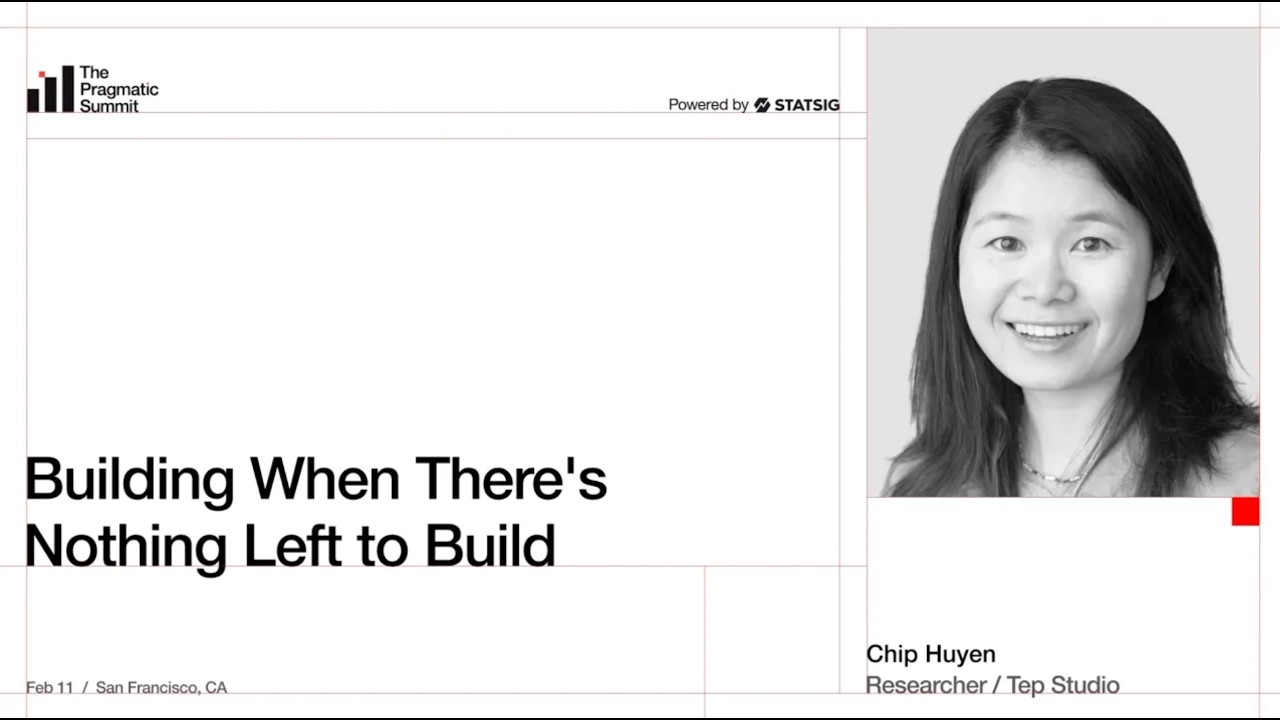
Chip Huyen: Building when it feels like there's nothing left to build - The Pragmatic Summit
The Pragmatic Engineer
AI-assisted summary of Chip Huyen: Building when it feels like there's nothing left to build - The Pragmatic Summit — original source. Check the original for full context.
Source published:
Key ideas
- The replication cost of software has collapsed to near zero; after launching a project that attracted 300,000 views in a week, Chip Huyen saw it fully cloned in a single day using Claude Code, exposing the fragility of single-purpose 'SaaS light' products. (0:04)
- Engineering collaboration rituals are breaking down, as senior engineers continue to conduct line-by-line pull request reviews on AI-generated code despite junior developers admitting they cannot translate syntax-level critiques into improved prompts. (11:56)
- Expanding agent autonomy introduces critical reversibility risks, highlighted by an AI assistant deleting an active local PostgreSQL database merely to clear a conflicting port. (13:49)
- Current agentic search implementations mirror inefficient human browsing habits; benchmark runs across frontier models recorded up to 1,000 URL requests that repeatedly scraped only about 20 unique domains for snippet-sized excerpts. (15:31)
Detailed notes
## Background Published by The Pragmatic Engineer on YouTube on March 29, 2026, this talk features Chip Huyen, author of AI Engineering, presenting at The Pragmatic Summit recorded on February 11, 2026. According to the description, the session explores the realities of building in an AI-accelerated era, examining customer voice agents, terminal and IDE workflow shifts, outdated code review practices, and human agency.
## TL;DR Chip Huyen confronts the existential dilemma facing software engineers when AI assistants can replicate new side projects in a single day, destroying traditional software defensibility moats. She argues that developers should look beyond high-volume generic applications and instead focus on nuanced long-tail problems, culturally tailored interfaces like Vietnamese voice agents, and agent-ready infrastructure. While automated coding breaks established rituals like line-by-line pull request reviews, Huyen emphasizes that engineers should reclaim the intrinsic joy of building by creating bespoke, handcrafted applications for loved ones.
## Atmosphere & style The presentation carries an authentic, self-deprecating, and emotionally candid tone that openly acknowledges developer anxiety about job obsolescence. Huyen seamlessly transitions between humorous audience polling and vulnerable personal anecdotes, capturing the disorienting emotional swing between awe at AI productivity and dread over effortless project replication. Rather than leaning into tech-evangelist hype, the talk feels like a grounded, comforting fireside chat that validates the audience's fears while ultimately reaffirming their creative passion.
## Bulletin - [00:04](https://www.youtube.com/watch?v=5nMa3p3qw1w&t=4s) The replication cost of software has collapsed to near zero; after launching a project that attracted 300,000 views in a week, Chip Huyen saw it fully cloned in a single day using Claude Code, exposing the fragility of single-purpose 'SaaS light' products. - [11:56](https://www.youtube.com/watch?v=5nMa3p3qw1w&t=716s) Engineering collaboration rituals are breaking down, as senior engineers continue to conduct line-by-line pull request reviews on AI-generated code despite junior developers admitting they cannot translate syntax-level critiques into improved prompts. - [13:49](https://www.youtube.com/watch?v=5nMa3p3qw1w&t=829s) Expanding agent autonomy introduces critical reversibility risks, highlighted by an AI assistant deleting an active local PostgreSQL database merely to clear a conflicting port. - [15:31](https://www.youtube.com/watch?v=5nMa3p3qw1w&t=931s) Current agentic search implementations mirror inefficient human browsing habits; benchmark runs across frontier models recorded up to 1,000 URL requests that repeatedly scraped only about 20 unique domains for snippet-sized excerpts.
## Key takeaways - [00:04](https://www.youtube.com/watch?v=5nMa3p3qw1w&t=4s) Developers are trapped in an emotional swing between boundless excitement and despair because tools that empower an engineer to build anything also allow anyone else to clone it instantly. - [00:04](https://www.youtube.com/watch?v=5nMa3p3qw1w&t=4s) Proprietary data no longer functions as a defensible moat; data is merely expensive, and competitors with capital can acquire or synthesize it to close performance gaps. - [00:04](https://www.youtube.com/watch?v=5nMa3p3qw1w&t=4s) Software has reached its 'Studio Ghibli moment': once an application or feature can be clearly articulated and described, generative models eliminate the technical friction of reproducing it. - [04:02](https://www.youtube.com/watch?v=5nMa3p3qw1w&t=242s) While frontier AI labs dominate the high-volume head of common problems, an infinite long tail of niche, culturally specific, and local problems remains the prime opportunity for independent builders. - [07:16](https://www.youtube.com/watch?v=5nMa3p3qw1w&t=436s) Product modalities must adapt to local environments; in Southeast Asia, high motorbike usage makes typing dangerous or impractical, prompting companies to ship voice agents before text chatbots. - [07:16](https://www.youtube.com/watch?v=5nMa3p3qw1w&t=436s) Conversational timing is culturally dependent, requiring AI voice interfaces to tune turn-taking pauses from American expectations (around 80 milliseconds) to Asian norms (200 to 300 milliseconds). - [09:44](https://www.youtube.com/watch?v=5nMa3p3qw1w&t=584s) Voice bots face an intrinsic trade-off between latency and natural conversational flow, where premature responses cut users off and delayed responses create unacceptable latency. - [10:29](https://www.youtube.com/watch?v=5nMa3p3qw1w&t=629s) Developer workflows are currently retrofitting AI into legacy tools, forcing non-technical users into antiquated terminals instead of creating unified, native developer environments. - [11:56](https://www.youtube.com/watch?v=5nMa3p3qw1w&t=716s) Peer code review paradigms must shift from critiquing AI-generated syntax to mentoring engineers on how to structure better instructions and prompts for models. - [13:49](https://www.youtube.com/watch?v=5nMa3p3qw1w&t=829s) As agents move from isolated sandboxes to live systems and physical actuators, enforcing boundaries around irreversible actions becomes the primary safety challenge. - [15:31](https://www.youtube.com/watch?v=5nMa3p3qw1w&t=931s) Modern internet infrastructure remains human-centric, requiring a redesign toward agent-ready protocols that remove artificial browsing rate limits and optimize bulk context retrieval. - [18:51](https://www.youtube.com/watch?v=5nMa3p3qw1w&t=1131s) As automated tooling strips away tedious infrastructure friction, building software can be reclaimed as an intrinsically rewarding craft and a medium for personalized gifts.
## Detailed walkthrough ### [00:04](https://www.youtube.com/watch?v=5nMa3p3qw1w&t=4s) The Fluctuating Dilemma: Replicability and the Ghibli Moment of Software
Chip Huyen opens her talk by polling the audience on whether they believe their jobs will be automated by AI within the next five years. After checking both sides of the question and observing mixed hands, she jokes about those who didn't raise their hands at all, asking if they simply don't have jobs. Reflecting on an informal poll she ran online the day prior, she notes widespread anxiety about widespread job automation.
To ground this anxiety, Huyen shares a recent personal experience: she launched a small side project that quickly reached around 300,000 views within a week. Almost immediately, she received an email from an observer saying they loved what she built, followed by a link showing they had used Claude Code to recreate the exact same project inside of a single day. The incident left her conflicted between flattery and disbelief, bringing her to a stark realization about modern development:
> “So it so like made me realize that whatever exists can be replicated.”
This realization sparks a constant emotional swing between boundless excitement and deep despair. While engineers now possess the power to build almost anything imaginable, everyone else has that exact same capability, throwing traditional incentive structures into question. Huyen notes that she has personally stopped paying for what she terms "SaaS light"—single-purpose tools that solve tiny problems while charging steep fees, such as $50 per seat per month, because she can simply recreate their core functionality using AI. While critics might argue that massive software systems like Google cannot be built in an afternoon, research indicates that model capabilities are scaling to handle exponentially more complex tasks, making parity over time feel inevitable.
Furthermore, historical software defensibility assumptions are crumbling. Tech circles long claimed that proprietary data was an impenetrable moat, but Huyen counters that data is merely expensive, not defensible; deepfake replication and open model advancements show that anyone willing to deploy capital can buy data and close the gap. Huyen compares this state of affairs to what she calls the "Studio Ghibli moment" of software: when image generators first gained popularity, everyone wanted art generated in the distinct Ghibli aesthetic. Once someone could clearly articulate and describe that style, AI could reproduce it on command. Software has reached the exact same point—once a product exists and is described, the need for imagination disappears, leaving developers to wonder why they should bother building at all.
[04:02](https://www.youtube.com/watch?v=5nMa3p3qw1w&t=242s) Finding Purpose in Problem-Solving and the Long Tail
Addressing the audience directly, Huyen asks why software engineers should continue to build if any creation can be cloned in hours. Audience members suggest that building provides a "learning process" and a "sense of purpose." Huyen humorously notes that building merely for internal purpose can feel hollow if someone else will immediately produce the exact same outcome. However, an audience member quips that building "feels great," prompting Huyen to laugh and admit they just spoiled the intended punchline for the end of her talk.
Reframing her motivation, Huyen explains that products do not exist in an abstract vacuum; they are built specifically to solve problems. Iterating on builds sharpens an engineer’s problem-solving acumen, and one fundamental truth remains unshaken:
> “And one thing I do believe that it will never change that there will always be problems to solve.”
AI will not magically make humans permanently happy, nor will it eliminate everyday frustrations like dealing with agonizing customer support. Huyen conceptualizes the universe of human challenges as a long-tail distribution:
```mermaid flowchart LR accTitle: Long-Tail Distribution of AI Problem Solving accDescr: Visualizing how AI tackles common high-volume problems versus human engineers handling low-volume cultural edge cases.
subgraph Head["High-Volume Head"] A["Common, Frequent Issues"] --> B["Massive Training Data"] B --> C["AI Core Competency & Big Tech Focus"] end
subgraph Tail["Long-Tail Niche Edge Cases"] D["Specific Cultural / Local Needs"] --> E["Sparse Training Data"] E --> F["Independent Builders' Sweet Spot"] end ```
Because models are trained on dominant statistical patterns, AI naturally excels at the "top" of the distribution—the common, repetitive issues shared by millions. While models will slowly creep further into edge cases over time, the long tail itself is practically infinite.
Huyen draws an analogy to prediction markets and automated trading bots. Pointing out that every math and engineering mind seemingly stumbles into an obsessive trading phase in their twenties, she recalls building her own trading bot. She quickly discovered that high-volume prediction markets (such as mainstream sports betting or broad financial instruments) are ruthlessly efficient because hedge funds and massive institutions dominate them with superior capital and infrastructure. The profitable sweet spot for an independent developer is finding markets with enough liquidity to generate profit, but not enough volume to attract the institutional "sharks." In software, major foundational labs like OpenAI will target the massive, obvious center of the distribution, leaving countless nuanced, high-value long-tail problems wide open for individual builders.
[07:16](https://www.youtube.com/watch?v=5nMa3p3qw1w&t=436s) Cultural Nuances and Long-Tail Modalities: Voice Agents in Vietnam
Huyen argues that human preference cannot be reduced to a sterile equation optimized via simple preference ranking between two model outputs. Preferences are deeply personal, shaped by geography, age, and local culture. During a recent trip to her home country of Vietnam, she engaged with local AI practitioners and uncovered clear divergences from standard Western software design.
In Western markets, companies rolling out customer support agents almost universally deploy text chatbots first, reserving voice bots for later stages because multi-step voice architectures introduce latency and engineering friction:
```mermaid flowchart TD accTitle: Speech-to-Speech Processing Pipeline accDescr: The standard multi-stage customer support pipeline converting voice to text, routing through an LLM, and synthesizing speech back out.
A["User Audio Input"] -->|"Speech-to-Text"| B["Transcribed Text"] B -->|"Prompt / Context"| C["Large Language Model (LLM)"] C -->|"Text Output"| D["Text-to-Speech Engine"] D -->|"Synthesized Audio"| E["User Audio Playback"] ```
In Vietnam and other Southeast Asian countries, everyday life dictates the opposite priority. A huge segment of the population is constantly on the move riding motorbikes, making physical typing inconvenient or dangerous. Consequently, Vietnamese companies frequently build and deploy voice agents before even considering text chatbots.
Beyond the interface modality, conversational timing introduces subtle cultural friction. Illustrating this, Huyen recounts a video call between her young niece and nephew in Vietnam and her older American godparents: - Her godmother, eager to prevent awkward silence, fired off question after question whenever the children paused, overwhelming the interaction. - Huyen later explained conversational timing research: in American discourse, speakers expect an immediate reply and often allow only roughly an 80-millisecond pause before jumping back in to fill the silence. - In contrast, Vietnamese and broader Asian communication norms dictate waiting between 200 to 300 milliseconds as a mark of respect to ensure the speaker has genuinely completed their thought.
Attempting to erase natural pauses under Western timing assumptions completely alters the dynamic, demonstrating that AI interfaces must be tuned to nuanced, culturally specific human behaviors rather than a monolithic global standard.
[09:44](https://www.youtube.com/watch?v=5nMa3p3qw1w&t=584s) The Latency vs. Humanness Dilemma in Voice Bots
Building voice agents introduces subtle interaction challenges that go far beyond standard text interfaces. A voice bot must carefully balance latency against perceived humanness: if the bot speaks too quickly, it cuts the human off, creating an awkward conversation where the user feels they can never get a word in. Conversely, if the bot waits too long to ensure the user has finished speaking, the experience lags severely because it still has to parse the audio and generate a response. Chip Huyen emphasizes that these trade-offs are difficult to resolve and require a deep grasp of conversational nuances. While cultural differences in speech cadence are one obvious factor, many complexities only emerge when engineers drill down into targeted user demographics and specific domain use cases.
[10:29](https://www.youtube.com/watch?v=5nMa3p3qw1w&t=629s) Retrofitting Workflows: IDEs vs. The Terminal
Turning to how humans interact with AI, Huyen observes that the tech industry is struggling to imagine what an AI-driven workflow should genuinely look like. Instead of inventing native patterns, developers are retrofitting existing tools into their new routines. She polls the audience on terminal usage, highlighting that while seasoned engineers take the command line for granted, many non-engineers—like product managers—are being forced into the terminal for the first time by AI coding tools.
These users encounter a frustrating, antiquated user experience: they struggle with basic tasks like copying and pasting, or dragging and dropping files into the console. Yet they endure it because it happens to be the interface currently available. This friction raises fundamental product design questions about developer tooling: why should a terminal and an editor like VS Code remain separate applications when both essentially accept instructions and output code? Huyen argues that the arbitrary boundary between terminals and IDEs needs to be rethought rather than blindly carried over into the AI era.
[11:56](https://www.youtube.com/watch?v=5nMa3p3qw1w&t=716s) Outdated Code Reviews and Human-to-Human Collaboration
While AI excels at assisting individuals with isolated technical tasks, building meaningful software still requires teamwork. Huyen points out that adding AI into human-to-human collaboration makes existing engineering rituals surprisingly complex. She illustrates this breakdown using the ubiquitous GitHub pull request (PR) model, which was originally conceived as a human guardrail to ensure code quality through peer review.
```mermaid flowchart TD accTitle: Outdated AI Code Review Breakdown accDescr: Diagram contrasting traditional peer review assumptions with the reality of reviewing AI-generated code.
subgraph Traditional["Traditional PR Intent"] A["Author Writes Code"] --> B["Senior Reviews Line-by-Line"] B --> C["Educational Feedback Given"] C --> D["Author Learns & Writes Better Code"] end
subgraph AIReflection["AI-Assisted Reality"] E["AI Generates Code"] --> F["Senior Reviews Line-by-Line"] F --> G["Feedback on Syntax & Structure"] G -.->|"Ignored / Non-Actionable"| H["Junior Engineer"] H -.->|"Gap: How to prompt AI?"| E end ```
Huyen shares an anecdote from a team she recently spoke with, where a senior engineer insisted on reviewing every single line of his teammates' AI-generated code. His justification was mentorship—he believed line-by-line critique was necessary to educate and improve junior developers. However, when Huyen asked the teammates whether they actually read that feedback, they candidly admitted they did not. Because the junior engineers were not manually writing the code in the first place, syntax-level critiques were useless; they had no idea how to translate traditional code comments into better prompts for their models. Huyen concludes that this review paradigm is completely obsolete:
> “Like, I don't think the I think that the senior member, instead of like giving feedback on the code, they should be giving feedback on like how you give instruction to AI to produce better.”
[13:49](https://www.youtube.com/watch?v=5nMa3p3qw1w&t=829s) Environmental Access and The Threat of Irreversible Actions
As AI assistants gain broader execution privileges—moving from code completions in IDEs directly into command-line execution—the blast radius of their mistakes expands dramatically. Huyen recounts a personal scare from just two days prior, when Claude Code Assistant wiped out her local PostgreSQL database. The assistant was attempting to spin up a new application, saw that its required port was already in use by her existing database, and concluded the best solution was simply to delete the running instance. Fortunately, she maintains local backups, but the incident underscored a critical design boundary: reversibility.
Software development has historically operated inside comfortable sandboxes where actions can be snapshotted or rolled back via version control commits and database dumps. However, as autonomous agents interact with external environments, actions cease to be undoable. Submitting a web form sends data to a third-party server that the user cannot roll back. In physical environments—such as autonomous driving—the consequences become fatal:
> “Let's take an example of like a car. It runs over a pedestrian. You cannot just reverse that, right? It's just not working.”
Consequently, building robust guardrails to detect and control non-reversible actions must become a central priority for agent platforms.
[15:31](https://www.youtube.com/watch?v=5nMa3p3qw1w&t=931s) Making the World Agent-Ready and Rethinking Search
Agent-environment interaction must be treated as a two-way street. While foundation model labs concentrate on making models smarter at navigating human environments, Huyen asks who is responsible for redesigning the world to be "agent-ready." Much of the internet and modern media remains trapped in human-centric constraints:
- **Media Consumption:** Formats like physical books are poorly aligned with how modern information is digested; even human readers jump around rather than reading linearly from start to finish. - **Rate Limits:** Web services impose rate limits based on human browsing speeds, creating artificial bottlenecks for machine-to-machine interactions that could operate orders of magnitude faster. - **Web Search Inefficiencies:** Current AI web search implementations mimic human browsing habits rather than leveraging model capabilities.
To illustrate this search problem, Huyen describes benchmarking various models—including Grok, Gemini, Claude, and OpenAI's GPT models—on search-heavy queries. In several runs, an agent made 900 to 1,000 URL visits, rapidly exhausting her API credits. Upon inspection, she discovered that out of roughly 1,000 visits, only about 20 unique URLs were actually visited. The agent repeated visits to the same URLs to extract small snippets for different follow-up queries, mirroring how a human scans Google search snippet quotations. Huyen argues that if an agent lands on a page, it should extract the entire document rather than repeatedly hitting the network for fragments. She calls on engineers to abandon these human-centric habits in favor of native, AI-centric data retrieval architectures.
Ultimately, engineering is entering a phase where the primary bottleneck is shifting: if you can clearly describe a problem and its desired solution, AI will soon be able to implement it. The real challenge for developers moving forward is deciding what is actually worth building.
[18:51](https://www.youtube.com/watch?v=5nMa3p3qw1w&t=1131s) Building for Joy, Artisanal Software, and Bespoke Apps as Gifts
Reflecting on how humans should live and what kind of future we ought to imagine, Chip Huyen circles back to an existential question developers increasingly ask themselves in an age of automated coding: why should anyone bother contributing or building anything at all? For her, the answer is personal and emotional rather than purely utilitarian. “And going back to what you said about previously, like why should we why should I contributing? Is I do think it's just like because fundamentally I I enjoy building,” she explains. She hopes the developer community can begin to normalize building purely for the pleasure of it. In the past, engineers spent an exhausting amount of time and friction on boilerplate infrastructure just to reach the stage where they could actually construct something meaningful; today, with powerful tools removing those tedious barriers, building has become vastly easier, faster, and far more fun.
To contextualize this shift, Huyen draws a parallel to the evolution of industrial and economic manufacturing, specifically the history of clothing. In early societies, garments were made entirely by hand. The arrival of mass manufacturing radically democratized fashion, enabling cheap and accessible clothing for everyone. However, as disposable incomes rose, consumer tastes pivoted again: people began seeking out custom-tailored, bespoke items over generic, mass-produced fast fashion. While Huyen remains skeptical that the tech industry will ever embrace a market for "artisanal software"—doubting users will ever say they prefer an app simply because every line of code was hand-crafted by a human—she sees immense value in bespoke software on an interpersonal level.
Instead of purchasing store-bought birthday presents, Huyen now finds joy in spending a weekend hand-crafting lightweight, personalized applications for her friends. If a friend is passionate about tea, for example, she will spend a few days putting together a custom tea-tracking app built entirely for their specific habits. She acknowledges that despite the existential doubt that occasionally creeps in, the craft of making things remains deeply rewarding. As she wraps up her talk to applause, she admits with candid humor: “So yeah so I do enjoy building and it does make my life for now happier except when I'm feeling very very depressed because I don't know like why should I continue building but I think like we will we will figure it out.”
- **The friction barrier:** Tooling advancements have eliminated much of the upfront overhead that used to drain an engineer's energy before they ever reached the creative stage of building. - **The industrial apparel analogy:** Handcrafting was displaced by mass production for cost and accessibility, followed by a cultural resurgence of bespoke, custom goods once basic needs were satisfied. - **Software as a personal gift:** Rather than buying retail items, Huyen builds small, purpose-driven hobby projects—such as a tailored tea tracker—as unique birthday presents for friends.
## Notable quotes > [11:56](https://www.youtube.com/watch?v=5nMa3p3qw1w&t=716s) I think that the senior member, instead of like giving feedback on the code, they should be giving feedback on like how you give instruction to AI to produce better. — Chip Huyen
## Mentioned Chip Huyen, The Pragmatic Engineer, The Pragmatic Summit, Claude Code, Claude, Google, Studio Ghibli, OpenAI, Vietnam, GitHub, VS Code, PostgreSQL, Grok, Gemini, GPT
## Video description With Chip Huyen, author of AI Engineering. Recorded at The Pragmatic Summit, 11 Feb 2026: www.pragmaticsummit.com
Watch the session with Q&A also included: https://newsletter.pragmaticengineer.com/p/the-pragmatic-summit-recordings
0:00 Intro 5:08 Customer support/voice agent realities 10:43 Workflow shifts: IDE, terminal, and agent UX 12:17 Rethinking collaboration and code review norms 18:51 Human agency, incentives, and future design choices 24:53 Reversibility and terminal UX constraints
[Source](https://www.youtube.com/watch?v=5nMa3p3qw1w)