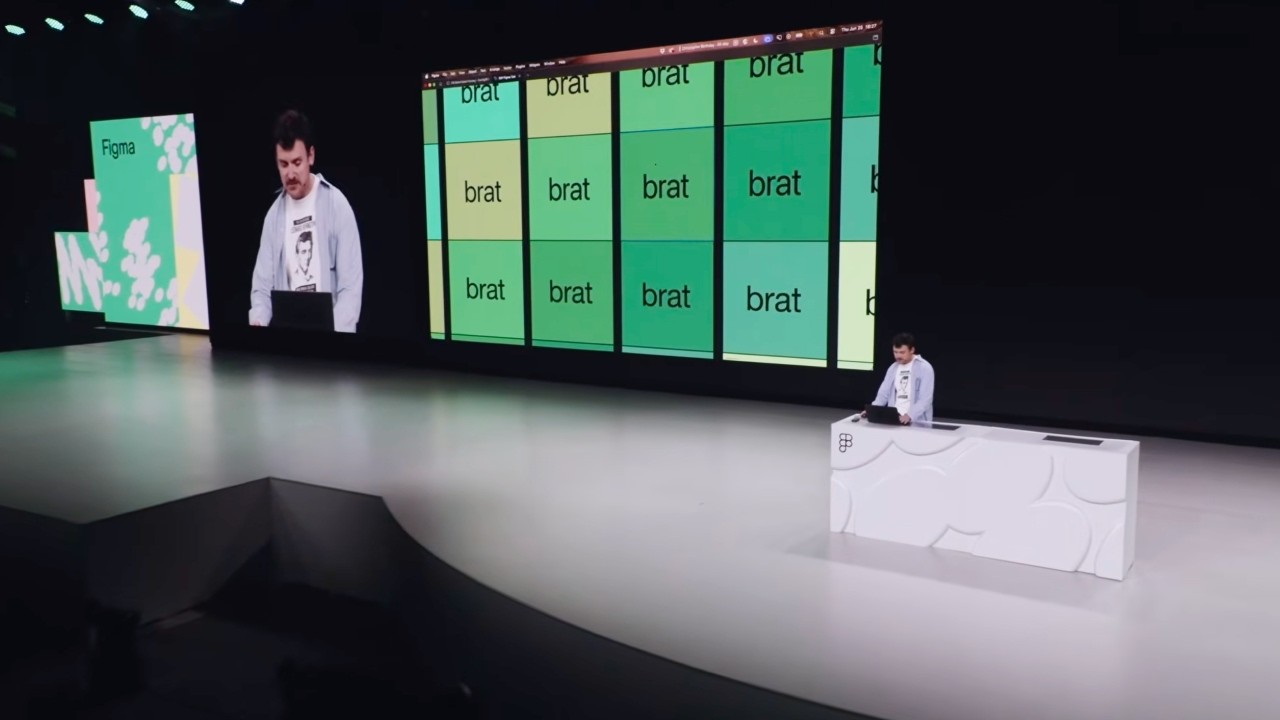
Brent David Freaney reveals that the iconic, minimalist album artwork for Charli XCX's Brat was designed entirely inside Figma, utilizing a raw 12,000-pixel screenshot export to preserve its digital degradation for physical vinyl printing. (26:41)
Freaney argues that the true work of a designer lies in continuous visual curation and cultural consumption rather than pixel-pushing, drawing from his personal archive of eclectic ephemera like Korean customs forms and street signage. (19:44)
Challenging standard agency practices, Freaney advocates for showing clients all design iterations—including failed directions—to build mutual trust and establish clear visual boundaries. (24:03)
The cultural phenomenon of Brat illustrates Freaney's philosophy that 'the audience is the medium,' where a graphic identity is only completed through public remixing, parody, and community adoption. (29:59)
Detailed notes
## Background
Published by Figma on YouTube on June 26, 2026, this Config 2026 keynote features Special Offer creative director and i-D global art director Brent David Freaney. According to the description, Freaney breaks down his creative process across albums, magazines, and live media, exploring everything from selecting the iconic green shade for Charli XCX's Brat to using systems thinking to design for massive cultural impact.
## TL;DR
Freaney traces his journey from an isolated, MTV-obsessed youth in coastal Mississippi to designing visual identities for major pop stars like Charli XCX, Miley Cyrus, and Madonna. He pulls back the curtain on the creation of Charli XCX's Brat cover inside Figma, revealing an eclectic archive of visual references, unorthodox production hacks like exporting a 12,000-pixel screenshot for vinyl, and the practical value of sticking to a limited set of core typefaces. Ultimately, he argues that creative work never truly reaches a final 'finished state,' asserting that the audience's participatory remixing is the ultimate medium of modern design.
## Atmosphere & style
The presentation strikes an endearing, deeply relatable balance between humble self-deprecation and sharp creative philosophy. Freaney speaks with refreshing candor, sharing nostalgic home videos of teenage fandom alongside deadpan admissions about avoiding Figma's Auto Layout or brute-forcing high-res print files. The room feels intimate and energized, erupting into laughter at absurd pop-culture artifacts and meme takeovers before settling into a warm, reflective appreciation for creative community and collaboration.
## Bulletin
- [26:41](https://www.youtube.com/watch?v=Yz03ERsfDDM&t=1601s) Brent David Freaney reveals that the iconic, minimalist album artwork for Charli XCX's Brat was designed entirely inside Figma, utilizing a raw 12,000-pixel screenshot export to preserve its digital degradation for physical vinyl printing.
- [19:44](https://www.youtube.com/watch?v=Yz03ERsfDDM&t=1184s) Freaney argues that the true work of a designer lies in continuous visual curation and cultural consumption rather than pixel-pushing, drawing from his personal archive of eclectic ephemera like Korean customs forms and street signage.
- [24:03](https://www.youtube.com/watch?v=Yz03ERsfDDM&t=1443s) Challenging standard agency practices, Freaney advocates for showing clients all design iterations—including failed directions—to build mutual trust and establish clear visual boundaries.
- [29:59](https://www.youtube.com/watch?v=Yz03ERsfDDM&t=1799s) The cultural phenomenon of Brat illustrates Freaney's philosophy that 'the audience is the medium,' where a graphic identity is only completed through public remixing, parody, and community adoption.
## Key takeaways
- [01:09](https://www.youtube.com/watch?v=Yz03ERsfDDM&t=69s) Brent David Freaney operates the creative studio Special Offer, which builds rigorous design systems for recording artists, and serves as the global art director of i-D magazine.
- [03:56](https://www.youtube.com/watch?v=Yz03ERsfDDM&t=236s) Early internet fandom, message boards, and television (specifically MTV's The Real World) served as crucial cultural lifelines and infrastructure for Freaney during his isolated youth in Mississippi.
- [13:58](https://www.youtube.com/watch?v=Yz03ERsfDDM&t=838s) A childhood pen-pal relationship with reality TV star Melissa Howard and her self-built website inspired Freaney's early self-taught web design experiments and eventual move to Los Angeles.
- [13:58](https://www.youtube.com/watch?v=Yz03ERsfDDM&t=838s) For Freaney, design was initially an informal, collaborative medium to help friends bring their ideas to life rather than a formal career ambition.
- [18:14](https://www.youtube.com/watch?v=Yz03ERsfDDM&t=1094s) The creative brief for Charli XCX's Brat demanded a strictly typographic, green cover that rejected the prevailing high-production aesthetic landscape of 2024.
- [19:44](https://www.youtube.com/watch?v=Yz03ERsfDDM&t=1184s) Visual curation, image hoarding, and lived experience constitute the true substance of design practice, far outweighing the time spent executing inside software.
- [22:03](https://www.youtube.com/watch?v=Yz03ERsfDDM&t=1323s) Freaney strongly advocates for designers using a physical mouse rather than a trackpad to maximize efficiency and precision.
- [22:03](https://www.youtube.com/watch?v=Yz03ERsfDDM&t=1323s) The visual universe for Brat was built by pulling in disparate, non-obvious references—such as a Korean customs form, Martine Rose pants, and system typography—to influence the project osmotically.
- [24:03](https://www.youtube.com/watch?v=Yz03ERsfDDM&t=1443s) Presenting a full spread of design experiments, including dead ends, builds deeper client trust than presenting a highly curated selection of three polished options.
- [24:03](https://www.youtube.com/watch?v=Yz03ERsfDDM&t=1443s) Design iteration is non-linear; intermediate rounds often serve to test extremes and establish what not to do rather than strictly outshining previous rounds.
- [26:41](https://www.youtube.com/watch?v=Yz03ERsfDDM&t=1601s) Special Offer enforces a rule of mastering a small palette of dependable workhorse fonts (around five) rather than constantly searching for new typefaces.
- [26:41](https://www.youtube.com/watch?v=Yz03ERsfDDM&t=1601s) To preserve the low-res, screen-born texture of the Brat cover for physical vinyl packaging, Freaney exported a raw screenshot from Figma at 12,000 pixels wide.
- [29:59](https://www.youtube.com/watch?v=Yz03ERsfDDM&t=1799s) A graphic identity is never truly complete at handoff; public remixing, brand parodies, and community adoption transform the artwork into a participatory interface.
- [32:18](https://www.youtube.com/watch?v=Yz03ERsfDDM&t=1938s) Creative work has no permanent 'finished state' and remains open to reinterpretation, remixing, and alteration years after its official release.
- [33:15](https://www.youtube.com/watch?v=Yz03ERsfDDM&t=1995s) Trusted, decisive collaborators are essential to break a designer's infinite iteration loop and establish the boundaries necessary to release work into the world.
Damian Correll opens the session by welcoming the Config audience and introducing himself as the lead of Figma's brand studio team. Expressing his excitement for the upcoming presentation, he brings art director Brent David Freaney to the stage, highlighting Freaney’s expansive creative footprint across album packaging, magazines, and live media. Correll emphasizes that Freaney's work bridges everything “from the process behind a single shade of green that defined a summer to the systems thinking that holds together large-scale creative campaigns.”
[01:09](https://www.youtube.com/watch?v=Yz03ERsfDDM&t=69s) Special Offer, *i-D* Magazine, and Big-Stage Album Campaigns
Taking the stage to applause, Brent David Freaney introduces himself and his creative studio, Special Offer. He outlines the studio’s primary discipline: helping recording artists craft comprehensive visual identities and album artwork so that album rollouts operate on rigorous, cohesive design systems. Freaney treats these music campaigns much like brand guidelines, setting rigorous standards for typography, color palettes, and visual architecture to cradle each record. Alongside Special Offer, Freaney serves as the global art director of *i-D* magazine, a publication founded in August 1980 by his creative hero, art director Terry Jones. Freaney defines the publication’s mission carefully:
> “ID is a, let me see if I get this right, a visual and anthropological survey of what is going on in culture at the moment in which the magazine is printed.”
Freaney reflects on his 24-year design journey, admitting that while he began in early web design and development by copying and pasting HTML snippets, large-scale album design came relatively late in his career. His recent and upcoming client roster includes Miley Cyrus, Tame Impala on their album *Deadbeat*, Rosalía on *Lux*, and Madonna on *Confessions on a Dance Floor Part Two*—a project that prompted an initial reaction of disbelief when her team called. Most visibly, Special Offer designed the album identity for Charli XCX’s *Brat*, which Freaney notes to cheers from the Config crowd was created inside Figma.
```mermaid
flowchart LR
accTitle: Brent David Freaney Creative Roles
accDescr: Visual mapping of Brent David Freaney's studio and editorial leadership roles.
subgraph StudioPractice["Special Offer (Design Studio)"]
A["Album Artworks & Identities"]
B["Typography & Color Systems"]
C["Album Launch Campaigns"]
A --- B --- C
end
subgraph EditorialRole["i-D Magazine"]
D["Global Art Director"]
E["Anthropological & Visual Survey"]
D --- E
end
StudioPractice -.->|"Led by Brent David Freaney"| EditorialRole
```
- Special Offer builds tight, succinct design systems and guidelines for musicians' album rollouts.
- *i-D* magazine was launched in August 1980 by graphic designer and art director Terry Jones.
- Freaney's career started over two decades ago doing front-end web development before transitioning to high-profile art direction.
- Key pop cultural collaborations mentioned include Charli XCX (*Brat*), Miley Cyrus, Tame Impala (*Deadbeat*), Rosalía (*Lux*), and Madonna (*Confessions on a Dance Floor Part Two*).
[03:56](https://www.youtube.com/watch?v=Yz03ERsfDDM&t=236s) Fandom as Infrastructure, Mississippi Isolation, and MTV
Before breaking down the specific design choices behind *Brat*, Freaney pivots to discuss the broader dynamics of culture, fandom, and media consumption. He argues that passionate fan communities fundamentally built the architecture of the modern internet through early message boards and forum culture, serving as the essential lifeblood for recording artists. Reflecting on his own youth, Freaney shares a photograph of himself in 1999 at age 14, joking about having had no friends—not out of tragedy, but because he was on an entirely different wavelength from his peers and simply did not want any.
Growing up in Long Beach, Mississippi, about an hour across Lake Pontchartrain from New Orleans, Freaney experienced a stark contrast between New Orleans' celebrated cultural melting pot and the sparse, mundane reality of small-town coastal Mississippi. To illustrate his environment, he contrasts the romantic image of tumbleweeds with the documentary aesthetic of a Martin Parr photograph. In that isolation, television became his lifeline to the outside world, specifically MTV, which he watched constantly through the night to absorb lessons in fashion, personal identity, pop culture, and music.
[06:45](https://www.youtube.com/watch?v=Yz03ERsfDDM&t=405s) Finding Parasocial Connection in *The Real World*
Freaney’s central obsession on television was MTV’s landmark series *The Real World*, the pioneering documentary-style reality show that threw seven young adults aged 18 to 24 into a shared residence to document their conflicts, conversations, and social dynamics. Freaney notes that through early installments set in cities like New York, Los Angeles, San Francisco, London, Miami, and Boston, the revolving casts functioned as an expansive window into perspectives he could never encounter at home. He formed deep parasocial attachments to the housemates:
> “And I found sort of through all the seasons of the real world myself in each and every one of the cast and I could sort of relate to all of these people.”
[08:26](https://www.youtube.com/watch?v=Yz03ERsfDDM&t=506s) Stalking the New Orleans House and the Rediscovered Letter
When *The Real World* announced it would film its ninth season in New Orleans while Freaney was in the ninth grade, his fandom reached an obsession point. He persuaded his mother to drive him across the lake into New Orleans every single day so he could camp on the sidewalk outside the production house. Freaney spent hours monitoring the stoop for production crew and cast members. Being intensely interested in men's accessories at the time, he would sit on the curb braiding hemp necklaces, affixing his mailing address to them, and tossing them up onto the porch steps in hopes of piercing the fourth wall of the production.
For weeks during filming, nothing came of the gesture, and production wrapped with Freaney feeling disappointed that he had never bridged the barrier between spectator and participant. However, after the crew had left and the season entered post-production, Freaney’s mother came into the living room with an envelope: one of the cast members had actually mailed him a response letter. Decades later, while digitizing family home tapes during the COVID-19 pandemic, his mother uncovered home video footage capturing the exact moment the teenage Freaney opened the letter, which he plays for the Config audience.
[10:42](https://www.youtube.com/watch?v=Yz03ERsfDDM&t=642s) The Letter from Melissa Howard and the Digitized Home Video
A digitized home video from Brent David Freaney’s childhood plays for the audience, capturing the chaotic, emotional excitement of opening a letter from Melissa Howard of MTV's *The Real World: New Orleans*. In the video, family members urge him to open the envelope as his sister Carla reacts with visible envy, culminating in screams when they realize Melissa sent a necklace she wore on television. Over the video playback, Brent laughs about spilling water on the letter in the heat of the moment. The letter asks Brent to email her and remind her where they met so she can tell her friends, as Melissa mistakenly assumed Brent was an adult she had encountered while out. His sister's indignant reaction prompts fond laughter from both Brent and the audience as she complains that he always gets everything.
Reflecting on the footage, Brent explains that his mother had these tapes digitized around 2020, preserving a core childhood memory from nearly thirty years earlier. Seeing the recorded proof of that pivotal moment proved deeply emotional for him:
> “I mean, truthfully, my sister is the star of that entire thing.”
- Melissa Howard’s letter included a shout-out to her personal website, `princessmelissa.com`.
- In the home video, family members notice Melissa is wearing the very same necklace featured in her on-air interview on *The Real World*.
---
[13:58](https://www.youtube.com/watch?v=Yz03ERsfDDM&t=838s) Pen Pals, `princessmelissa.com`, and Moving to Los Angeles
Following the letter, Brent struck up an ongoing pen-pal relationship with Melissa Howard, trading mix CDs, discussing fashion, and being introduced to new musical artists. More crucially, her personal website, `princessmelissa.com`, became an obsession. In an era before modern social media networks, Melissa had pieced together HTML snippets to build an independent blog chronicling her life post–*The Real World*. Brent checked it every day, mirroring his sense of humor after hers and finding profound validation in her friendship:
> “I felt that we were very akin and there was such a correlation, and I also felt that she knew that there was a semblance between us, and that she was able with that letter to sort of reach through the television and grab me and say, ‘Hey, you know, we're going to make sure that you get to where you need to go.’”
Melissa eventually moved to Los Angeles to build community, and at age 18, Brent followed suit. Though the two had fallen out of contact by then, Brent's self-taught web design experiments, blogging, and participation in online band message boards connected him to a community of like-minded creatives centered in Southern California. In reality, his move landed him in West Covina—attracted by the cheap rent—before he spent the next 15 years embedded in the LA creative scene. During this time, design was never a formal career ambition; it was an informal medium to help friends bring their ideas to life, whether creating t-shirt logos for clothing brands or whipping up scrappy tour posters for bands. He humorously shares old photos of bad haircuts and a short-lived, mediocre band where he wore a sailor hat every single day.
> “Design was an afterthought for me; it was something that I used to be able to help and communicate and collaborate with other people that were already making things.”
---
[18:14](https://www.youtube.com/watch?v=Yz03ERsfDDM&t=1094s) The Call for Charli XCX’s *Brat*
Fast-forwarding through 15 years of hanging out and collaborating in Los Angeles, Brent arrives at 2023. He received an unexpected outreach from Imogene Strauss, the creative director for Charli XCX. While Brent knew Charli's hits and appreciated her aesthetic, he was not an obsessive fan, which made the offer to design an album cover feel surreal.
```mermaid
flowchart LR
accTitle: Charli XCX Brat Album Creative Brief
accDescr: Visual flow showing Imogene Strauss and Charli XCX providing the brief to Brent Freaney, who imports it into Figma.
subgraph CreativeBrief["Creative Direction (2023)"]
direction TB
A["Imogene Strauss<br>(Creative Director)"]
B["Charli XCX's Vision"]
A --- B
end
subgraph Directives["Core Requirements"]
direction TB
C["Typographic & simple cover"]
D["Specific shade of green"]
E["Wordmark: 'brat'"]
end
subgraph Execution["Design Exploration"]
F["Figma Workspace"]
end
CreativeBrief --> Directives
Directives --> F
```
His initial reaction was shock that they would hire a web designer for an album campaign. Imogene and Charli explained they wanted a strictly typographic album package that felt grounded in graphic design rather than the prevailing aesthetic landscape of 2024. Armed with a personality framework defining what *Brat* was and was not, Brent brought the brief straight into Figma to explore how to translate that ethos visually.
---
[19:44](https://www.youtube.com/watch?v=Yz03ERsfDDM&t=1184s) Image Hoarding and the True Work of Design
Switching over to a live screen-share of his archives, Brent outlines his design process, beginning with his extensive personal image library. He continuously hoards visual references—saving graphics seen on Instagram, internet artifacts, and street photography of signage. When kicking off a project, he methodically reviews thousands of stored images from the year, evaluating each reference against the conceptual personality of the brief.
Brent argues that visual curation, cultural consumption, and lived experience constitute the real substance of design practice, far outweighing the time spent pushing pixels inside software:
> “The reason I bring this up specifically is to let you know that I think that, like, as a designer, our real work is not in the actual design itself, but in the collecting of ideas and design and being able to be inspired and see other things and to take it into your brain, and this is the work.”
Charli’s creative direction was unusually clear and prescriptive from day one: the cover had to be green, and it had to simply read "brat." Working within those tightly defined constraints, Brent’s challenge was to build an entire design system and packaging world from the ground up, establishing visual rules that could scale seamlessly across vinyl packaging, physical merchandise, and digital formats.
[22:03](https://www.youtube.com/watch?v=Yz03ERsfDDM&t=1323s) The Gathering Phase: Mice, Korea Customs Forms, and Green Pants
Brent David Freaney begins with an emphatic piece of practical advice that earns immediate applause from the audience: “If you're a designer that doesn't use a mouse, you need to start using a mouse.” Calling trackpad use his absolute biggest pet peeve, he insists that for genuine efficiency, a physical mouse is mandatory. From there, he opens up his digital archive to reveal how he assembled the initial visual universe for Charli XCX’s *Brat*. He began by aggressively scraping his personal library for anything and everything cast in green or possessing an intriguing graphic texture.
The reference board quickly turned into an eclectic, personal cabinet of curiosities. It included a flyer for an old holiday party featuring a photo of his dog, alongside a physical customs declaration form he had saved from a trip to Korea simply because he was stunned by its utilitarian beauty and wondered what he could ever use it for. He pulled in signage from his dog’s pet store, a pair of green trousers designed by Martine Rose, a Whitney Houston-themed water bottle graphic he had created years earlier, and disparate examples of text-only, typographic album packaging that held visual weight without needing photography. Beyond specific objects, Freaney absorbed system typography, airport digital wayfinding, industrial materials, styrofoam textures, and stills from Charli's "Von Dutch" music video. He pulled in artifacts indiscriminately, whether they seemed logically connected to his assigned design role or not, letting them influence the project osmotically.
- **Korean customs form:** A standout piece of ephemera saved purely for its graphic layout and texture.
- **Martine Rose pants & Whitney Houston bottle:** Real-world objects and personal past projects mined directly for color and attitude.
- **Typography-only precedents:** Exploring how purely typographic, text-driven album covers establish an iconic, heavyweight presence without imagery.
---
[24:03](https://www.youtube.com/watch?v=Yz03ERsfDDM&t=1443s) Trust, Showing Your Work, and the Myth of Linear Progress
Freaney turns to the micro-decisions of graphic design—debating capitalization, kerning, point size, color values, and composition—while challenging conventional client presentation doctrine. While many creative directors advise showing only three tightly polished, curated options, Freaney prefers laying out the entire spread of what was attempted during a round. By showing all the dead ends and less successful variations alongside his top choices, he can articulate why certain directions fail and build an authentic rationale for what works. For him, this radical transparency forms the bedrock of client collaboration. “And so I think that, you know, I always sort of say that design is a relationship of trust.” When working with artists or clients, he argues, absolute mutual trust is non-negotiable, and it can only be earned by showing your references, exposing the rough edges, and clearly communicating your perspective.
As the project moved into its next phase, official photo assets from Charli’s album shoot arrived, establishing the project's styling, attitude, and tone. Even with photography in hand, Freaney and his team continued generating bad options alongside promising ones, intentionally avoiding the urge to prematurely clean house. He criticizes the pervasive industry pressure that every round of design must linearly outshine the preceding one. Progress in creative exploration is rarely straight; often, the purpose of an intermediate round is simply to push into unproductive territory to establish clear boundaries.
```mermaid
flowchart TD
accTitle: Creative Iteration and Trust Process
accDescr: Diagram illustrating Freaney's process from raw reference gathering through transparent client reviews to establishing creative boundaries.
subgraph Inputs ["Input Gathering"]
A["Personal Archives & Green Objects"]
B["Text-Only References & Ephemera"]
C["Album Photoshoot & Styling Tone"]
end
subgraph Iteration ["Iterative Exploration"]
D["Unfiltered Design Rounds<br>(Good and Bad Options)"]
E["Transparent Client Review<br>(Showing All Work)"]
end
subgraph Outcome ["Alignment"]
F["Mutual Trust Built"]
G["Defining Negative Space & Boundaries"]
H["Selecting Winning Direction"]
end
A --> D
B --> D
C --> D
D --> E
E --> F
E --> G
G --> H
```
- **Open-book presentations:** Presenting the full spread of experiments rather than a rigid three-option deck so clients understand the elimination process.
- **The myth of linear iteration:** Recognizing that design rounds two and three do not need to be strictly better than round one; their role is often to test extremes and delineate what *not* to do.
---
[26:41](https://www.youtube.com/watch?v=Yz03ERsfDDM&t=1601s) Font Fatigue, Figma Quirks, and the 12,000-Pixel Print Export
Settling down into the core artwork required dialing in the exact weight, balance, and mood of the typography against the green field. Freaney touches on the endless existential dread of selecting typefaces. His standard advice to incoming designers at his studio, Special Offer, is to resist the belief that a magic font will solve their design problems: “You don't have to find the right font. You can stick with the five that you like and know how to control.” True polish comes from mastering a small palette of dependable workhorse fonts rather than obsessing over discovery.
Demonstrating the file on stage, Freaney confesses his personal discomfort with Figma’s layout automation tools. While his studio staff rely heavily on Auto Layout, hitting the shortcut accidentally causes him instant panic, prompting him to laugh that everyone should feel free to use Figma however it suits them. Once Charli decisively chose the low-res, unpretentious typographic treatment, an urgent production hurdle emerged: how to convert a digital Figma mock-up into high-resolution vinyl record packaging without losing its specific digital degradation. Rather than rebuilding the artwork in traditional print software, Freaney opted for an audacious brute-force hack: he took a small screenshot of the design and exported it out of Figma at an astonishing 12,000 pixels wide, reasoning that because vinyl records are 12 inches across, 12,000 pixels felt like roughly the right ballpark. To prove it, he pulls up his desktop screen and re-enacts the export live, generating wild applause from the audience.
- **Special Offer font rule:** Relying on roughly five mastered typefaces rather than chasing novel fonts under the illusion that type selection alone carries the work.
- **Auto Layout friction:** A lighthearted admission that he avoids Auto Layout and prefers manual canvas placement, despite his team’s embrace of it.
- **The vinyl export workaround:** Bypassing vector recreation by taking a raw screenshot and scaling the export to 12,000 pixels wide to preserve its screen-born, anti-aesthetic texture for physical pressing.
---
[29:59](https://www.youtube.com/watch?v=Yz03ERsfDDM&t=1799s) When an Album Cover Becomes an Interface: 'The Audience Is the Medium'
Reflecting on the album's rollout, Freaney admits that neither he nor Charli could have anticipated the cultural explosion that followed. His initial ambition had simply been to deliver a cover that Charli loved and that faithfully embodied her irreverent, club-rooted musical direction. Once *Brat* was released, however, its minimalist, low-contrast green square detached from the music and morphed into a viral visual mechanic. Freaney watched as the graphic framework was co-opted across the internet, transforming into a participatory visual interface for fans, brands, and public infrastructure.
Everyday life quickly filled with *Brat* parodies: New York City's Metropolitan Transportation Authority (MTA) mimicked the green typography for subway service announcements, Ritz Crackers marketed "Brat Ritz," and even NATO posted a green typographic graphic that read "peace." Freaney reacts dryly to the geopolitical appropriation, joking: “I'm like, sis, there is a war. Like, there is a an actual war. But thank you for the screenshot.” This surreal cultural takeover crystallized an essential design truth for him: a graphic identity is never complete when the designer hands off the files. Public reaction, remix culture, and community adoption are not post-launch afterthoughts; they constitute the ultimate, decisive phase of graphic design. As Freaney concludes: “I think that the audience is the medium.”
- **MTA subway parody:** New York transit officials repurposing the album cover format to announce line updates (humorously noted by Freaney as a distraction from broken service).
- **Brand and institutional memes:** From Ritz Crackers capitalizing on the trend to NATO creating a green "peace" graphic during wartime.
- **Audience as the final stage:** The realization that design is not complete at export; cultural adoption, remixing, and emotional interpretation represent the true medium of contemporary graphic design.
[32:18](https://www.youtube.com/watch?v=Yz03ERsfDDM&t=1938s) There Is No Finished State: Cultural Longing and Ongoing Work
Brent David Freaney reflects on the emotional core of creative work: evoking a visceral reaction from people over something you genuinely love. Drawing a line back to his childhood, he recalls sitting glued to the television watching MTV's *The Real World* from his bedroom in Long Beach, Mississippi, yearning to connect with something larger and decipher the cultural shifts unfolding around him. That isolation instilled an enduring need to seek out collaborators and find peers with whom he could build shared meaning.
This lifelong search informs his central philosophy that creative work is never truly completed. Even when a project is finalized, exported, sent to print, and commercially released, it does not permanently settle into stone. Freaney rejects the idea of a final destination, arguing that work remains alive and open to reinterpretation regardless of how much time has elapsed since release. As Brent David Freaney explains: “And even if you think something is done, you've shipped it, it's out, you've gone to print, it's done the thing, even two years, three years, four years later and you haven't thought about the thing, it is still a work in progress.”
- Creative output does not conclude at delivery; any piece of design can be revisited, remixed, and altered years later because there is no true ending.
- The impulse to design stems from wanting to participate in cultural conversations, bridging the gap between personal isolation and public resonance.
[33:15](https://www.youtube.com/watch?v=Yz03ERsfDDM&t=1995s) Breaking the Iteration Loop: The Role of the Decisive Collaborator
While design work can theoretically continue indefinitely, Freaney acknowledges the danger of becoming trapped in endless micro-decisions. During the creative process for projects like Charli XCX's *Brat*, he found that he could easily tweak typography, sample shades of green, and adjust scale for an eternity without ever stopping. The only force capable of pulling him out of that creative paralysis was having a trusted collaborator step in to establish a boundary and call the work finished.
Freaney views this creative tension as fundamental to the partnership between designers and artists. While his internal drive compels him to continuously push ideas forward and exhaust every visual permutation, great collaborators provide the definitive endpoint that allows the work to exist in the world. Expressing his gratitude for that relationship and the broader creative community, Brent David Freaney observes: “My job as a designer is to keep on going and to keep on pushing and pushing and pushing and pushing and just trying to kind of put everything I possibly can out so that I can get it all out.” He concludes his presentation by thanking the audience and celebrating community as the ultimate foundation of creative life.
```mermaid
flowchart LR
accTitle: The Creative Iteration Loop vs Collaborator Resolution
accDescr: A flowchart illustrating the designer's endless cycle of adjustments broken by a collaborator's decision.
subgraph DesignerDrive["Designer's Domain"]
direction TB
A["Iterate Typography"] --> B["Tune Palette & Scale"]
B --> C["Push Permutations"]
C --> A
end
subgraph Resolution["Release Domain"]
D["Collaborator: 'This is it'"] --> E["Cultural Release"]
E -.->|"Revisit in future"| A
end
C -->|"Tunnel vision broken"| D
```
- Tunnel vision is an inherent risk of design iteration, where selecting fonts, colors, and scales can loop infinitely without external intervention.
- Decisive collaborators serve as the essential counterweight to a designer's perfectionism by drawing the line and saying, "We're done. This is it."
- Community and collaboration are framed not just as professional tools, but as vital personal anchors that bring creative ideas out of isolation and into the real world.
## Notable quotes
> [32:18](https://www.youtube.com/watch?v=Yz03ERsfDDM&t=1938s) Even if you think something is done, you've shipped it, it's out, you've gone to print, it's done the thing, even two years, three years, four years later and you haven't thought about the thing, it is still a work in progress. — Brent David Freaney
> [29:59](https://www.youtube.com/watch?v=Yz03ERsfDDM&t=1799s) I think that the audience is the medium. — Brent David Freaney
> [26:41](https://www.youtube.com/watch?v=Yz03ERsfDDM&t=1601s) You don't have to find the right font. You can stick with the five that you like and know how to control. — Brent David Freaney
> [24:03](https://www.youtube.com/watch?v=Yz03ERsfDDM&t=1443s) I always sort of say that design is a relationship of trust. — Brent David Freaney
> [19:36](https://www.youtube.com/watch?v=Yz03ERsfDDM&t=1176s) As a designer, our real work is not in the actual design itself, but in the collecting of ideas and design and being able to be inspired and see other things and to take it into your brain, and this is the work. — Brent David Freaney
## Mentioned
Brent David Freaney, Damian Correll, Charli XCX, Brat, Figma, i-D magazine, Terry Jones, Special Offer, Miley Cyrus, Tame Impala, Deadbeat, Rosalía, Lux, Madonna, Confessions on a Dance Floor Part Two, MTV, The Real World, Melissa Howard, Imogene Strauss, Martine Rose, Whitney Houston, MTA, Ritz Crackers, NATO
## Video description
From the process behind a single shade of green for Charli XCX's Brat to the systems thinking that holds together large-scale creative campaigns, Brent will share how he approaches design work that spans albums, magazines, live media, and screens. He'll walk through his process, his tools, and what it actually takes to design for cultural impact.
____________________________________________________
Find us on ⬇️
X (formerly Twitter): https://x.com/figma
Instagram: https://www.instagram.com/figma
LinkedIn: https://www.linkedin.com/company/figma
TikTok: https://tiktok.com/@figma
Figma forum: https://forum.figma.com/
Art director Brent David Freaney argues that graphic design has no permanent finished state, contending that true creative work lies in ongoing cultural curation while audiences and decisive collaborators determine how an identity lives in the world.
Fandom, Isolation, and the Roots of Design (3:56)
Freaney traces his design philosophy back to his youth in Long Beach, Mississippi, where feelings of cultural isolation led him to use television and early internet forums as lifelines. Parasocial connections to cast members on MTV's The Real World—culminating in a pen-pal correspondence with New Orleans cast member Melissa Howard and following her early personal website, princessmelissa.com—revealed how online communities form vital creative infrastructure. When Freaney later moved to Los Angeles, design was never a formal corporate ambition; it functioned as an informal medium to make tour posters and merchandise for friends, anchoring his practice in community and communication rather than software specialization.
Curation, Radical Transparency, and Pragmatic Constraints (19:44)
Freaney contends that the true labor of design consists of gathering visual references and lived experiences rather than pushing pixels inside software. Developing the identity for Charli XCX's Brat involved pulling disparate artifacts from his personal archives, including a utilitarian Korean customs declaration form, airport wayfinding, and a pair of Martine Rose green trousers. To establish client alignment, Freaney rejects the standard agency practice of showing three polished concepts; he presents full working spreads of dead ends and failed experiments, arguing that exposing unpolished explorations builds authentic mutual trust and defines necessary creative boundaries.
His technical execution emphasizes practical efficiency over perfectionism. Freaney counsels designers at his studio, Special Offer, to master roughly five dependable typefaces rather than obsessing over font discovery. When tasked with preparing Charli XCX's low-resolution typographic mockup for physical vinyl production, he bypassed traditional vector recreation. Instead, he took a screen capture and scaled an export out of Figma to 12,000 pixels wide, deliberately retaining the screen-native visual degradation for physical packaging.
The Audience as the Decisive Medium (29:59)
Once Charli XCX's Brat was released, its low-contrast green typographic format detached from the music and morphed into a viral visual interface. Freaney observed public agencies and corporations co-opting the visual identity, from New York's Metropolitan Transportation Authority using it for service updates to marketing campaigns by Ritz Crackers and a peace graphic posted by NATO. This widespread appropriation reinforced Freaney's view that a graphic identity is never complete upon client handoff; public remixing and cultural interpretation constitute the final, decisive stage of design, leading him to conclude that 'the audience is the medium.'
Breaking Endless Iteration Through Decisive Collaboration (33:15)
Because creative work remains conceptually open to revision years after print and release, Freaney warns that designers face constant risks of creative paralysis. Without intervention, an art director can loop indefinitely through micro-adjustments of kerning, palette shades, and scale. Escaping this tunnel vision requires a decisive external collaborator—such as Charli XCX or creative director Imogene Strauss—to draw a hard boundary and declare the work complete. While Freaney sees the designer's duty as exhausting every visual permutation, the creative partner provides the definitive stopping point that allows an identity to enter the cultural sphere.
Freaney frames graphic design not as an isolated technical discipline delivering static artifacts, but as an open-ended dialogue sustained by cultural participation, community trust, and the essential friction between infinite iteration and collaborator-driven completion.
Source quotes
[32:18] Brent David Freaney: Even if you think something is done, you've shipped it, it's out, you've gone to print, it's done the thing, even two years, three years, four years later and you haven't thought about the thing, it is still a work in progress.
[29:59] Brent David Freaney: I think that the audience is the medium.
[26:41] Brent David Freaney: You don't have to find the right font. You can stick with the five that you like and know how to control.
[24:03] Brent David Freaney: I always sort of say that design is a relationship of trust.
[19:36] Brent David Freaney: As a designer, our real work is not in the actual design itself, but in the collecting of ideas and design and being able to be inspired and see other things and to take it into your brain, and this is the work.
Original transcript
[0:16] Hi, config. Um, hi, my name is Damian
[0:19] Carell. I have the great privilege of
[0:21] leading the incredibly talented Figma
[0:23] brand studio team here. Shout out. Um,
[0:27] uh, so happy to happy and excited to be
[0:29] here. Um, I'm also really excited to
[0:31] introduce our next speaker. Brent is an
[0:33] art director at Special Offer. From the
[0:35] process behind a single shade of green
[0:38] that defined a summer to the systems
[0:40] thinking that holds together large-scale
[0:42] creative campaigns, Brent's done it all.
[0:45] He'll share how he approaches design
[0:47] work that spans albums, magazines, live
[0:49] media, and pushes visual culture. Please
[0:52] help me in welcoming him to the stage.
[0:59] >> [music]
[1:09] >> Hey everybody, thank you for coming. I'm
[1:12] happy to have you here.
[1:14] Um, as Damian mentioned, my name is
[1:16] Brent David Freeny. I am an art director
[1:18] and I have a studio practice uh called
[1:21] Special Offer. And the main thing that
[1:24] we do in special offer, one of the main
[1:25] things we do is to kind of help artists
[1:27] design album artworks and identities
[1:29] around their album so that when we have
[1:32] um campaigns to launch that there is a
[1:34] really tight and succinct system. Um so
[1:36] think about brand guidelines, think
[1:38] about you know typography and color, we
[1:40] sort of help to define all of those
[1:42] things and kind of cradle that um album
[1:44] in that. At the same time, I'm also the
[1:47] global art director of ID magazine. So,
[1:49] ID Magazine is a magazine founded by a
[1:52] hero of mine, another art director,
[1:54] Terry Jones, in August of 1980.
[1:57] Um, and for people who are unfamiliar
[1:59] with ID, what I like to say is that ID
[2:01] is a, let me see if I get this right, a
[2:05] visual and anthropological survey of
[2:07] what is going on in culture at the
[2:09] moment in which the magazine is printed.
[2:13] So, thank you. the amount of times that
[2:15] I had messed that up in the last two
[2:16] days when I'm in my room thinking about
[2:18] this. But anyway, um so that's ID
[2:20] magazine.
[2:22] Um I've had the privilege of working
[2:24] with a lot of really great artists and
[2:25] doing a lot of really fun work. Um you
[2:28] know, I've been a designer for about 24
[2:30] years now, I would say. Um I'm not going
[2:32] to tell you my age yet, so you don't
[2:33] have to do the math. But I it has been
[2:37] later in my career that I've really
[2:38] gotten into doing album artworks on sort
[2:40] of the scale that I'm able to do it at
[2:41] now. I started as a website design and
[2:43] developer. Um, figuring out how to copy
[2:46] and paste little HTML snippets together.
[2:49] Um, and that's sort of I guess my
[2:51] background.
[2:53] I've been able to work with people like
[2:54] Miley Cyrus,
[2:56] um, Tamman Paula on their album
[2:58] Deadbeat.
[3:00] Recently, Rosalia on her album Lux.
[3:04] That was a really fun one. Um, next week
[3:07] we have Madonna's album, Confessions on
[3:09] a Dance Floor Part Two, coming out,
[3:11] which is I I can't you guys. I I mean,
[3:15] to get a call from Madonna, you're like,
[3:16] "Uh, what?
[3:19] Are you sure?"
[3:21] Okay. Um, but I think that what people
[3:25] probably know my studio and and and me a
[3:27] little bit more or forward the most, um,
[3:30] is that we helped Charlie X to design an
[3:32] album called Brat.
[3:37] Um, which actually was designed in
[3:39] Figma, by the way.
[3:41] [cheering]
[3:43] >> You guys are a good crowd. I'm happy. I
[3:45] was like, if they don't laugh at the
[3:47] jokes, if they're not into it, I am. But
[3:50] you you're doing you're you're keep up
[3:52] your end of this bargain for the next 15
[3:53] 20 minutes, please. Um, before we talk
[3:56] about Brad, before we talk about sort of
[3:58] the design process behind Brat, I wanted
[4:00] to talk a little bit about culture and
[4:02] sort of experiencing culture and also
[4:04] fandom and about how I truly believe
[4:07] that fans are the people that built the
[4:09] internet um through forums, through, you
[4:12] know, uh, different communication
[4:14] styles. I think that like fans are the
[4:16] reason why um, musicians are able to do
[4:19] what they do and I think that they're
[4:20] one of the most important pieces of the
[4:21] entire ecosystem.
[4:24] This is a photo of me in 1999. I was 14.
[4:29] You now can do the math. Actually, that
[4:31] joke didn't work. Um, and I had no
[4:33] friends, which is a joke that doesn't
[4:35] really land sometimes because I think
[4:37] people are like a But the reality was I
[4:39] didn't really want any. I was like
[4:42] really just into I I just wasn't on the
[4:45] same wavelength. It wasn't it wasn't
[4:47] working, you know, there there weren't a
[4:48] lot of people around me that I related
[4:50] to. There wasn't a lot of people that
[4:51] related to me. Um, and that was okay.
[4:53] Okay, it was totally fine. Um, I grew up
[4:56] in a city outside of New Orleans, about
[4:57] an hour away. So, New Orleans is kind
[5:01] of, you know, within arms reach. We went
[5:03] to the airport, we went to New Orleans.
[5:04] If we went, you know, school shopping,
[5:06] we went to New Orleans and stuff. But
[5:07] ultimately, um, you know, I was across
[5:09] the lake and, you know, about an hour
[5:11] away. When you're thinking about New
[5:13] Orleans, you might be thinking about
[5:14] Bourbon Street, Marty GR, and the sort
[5:16] of rich culture, I guess, that New
[5:18] Orleans sort of has around it, which is
[5:19] such an amazing and sort of perfect
[5:21] melting pot. Uh, but the reality is is
[5:24] that in Long Beach, Mississippi, the
[5:25] vibe was a little bit more like that.
[5:28] And this is actually gorgeous. I got
[5:31] this in like I was like looking tumble
[5:33] weeds and I was like actually this is
[5:34] what I want to put up. And then but
[5:36] yeah, but the reality was it was
[5:38] actually more like this
[5:40] >> Martin Parr photo that I've always been
[5:42] obsessed with. Um, but the thing that
[5:44] kind of, you know, really kept me going
[5:46] as I was growing up and the thing that I
[5:47] was really really um into was the
[5:50] television.
[5:52] and trying to absorb all that I could
[5:55] from the television at any given point
[5:58] in time and specifically MTV. MTV had a
[6:03] was a way for me as a young child um
[6:06] early teen to be able to interact and
[6:08] engage with and receive um information
[6:11] about culture and um pop culture and
[6:15] fashion and identity and obviously
[6:18] music. And it was sort of a way that I
[6:20] could get myself out of where I was and
[6:23] just sort of understand what was going
[6:25] on in the sort of larger scheme of
[6:27] things.
[6:29] I was really obsessed with MTV. You
[6:31] could find me watching it at all hours
[6:32] of all time, all night, no sleeping,
[6:35] just MTV, MTV, MTV. Probably to a fault
[6:38] that my parents should have been a
[6:39] little concerned, but good on them for
[6:41] not being. Um, my favorite show on MTV
[6:45] and the thing that I was the most
[6:46] obsessed with was a show called The Real
[6:48] World. And The Real World was a show
[6:49] about seven kids 18 to 24 that got put
[6:53] together inside of a house. And, you
[6:55] know, it was the first episodic reality
[6:57] show that ever existed. And it was sort
[6:59] of done in a documentarian style. So
[7:01] throughout the season, you were able to
[7:02] sort of see the conversations these
[7:05] people would have, the fights they might
[7:06] have, the um different, you know,
[7:09] interactions that they might have. And I
[7:11] found sort of through all the seasons of
[7:13] the real world myself in each and every
[7:16] one of the cast and I could sort of
[7:17] relate to all of these people. And so
[7:18] these people became friends. I mean
[7:21] parasocial friends. They did not know I
[7:23] existed. But I was obsessed. Here's the
[7:26] intro.
[7:28] >> This is the true story.
[7:30] >> True story.
[7:31] >> And seven strangers [laughter]
[7:33] >> picked to live in a house
[7:35] >> have their lives changed. Lucy, I'm
[7:37] home.
[7:38] >> To find out what happens when people
[7:40] stop being polite
[7:42] >> and start getting real. The real world,
[7:45] San Francisco.
[7:50] >> Round of applause for the real world.
[7:52] Um, so the real world at, you know, when
[7:55] I was a teenager had probably had eight
[7:57] seasons. It went from New York to Los
[7:59] Angeles, um, to San Francisco to London
[8:02] to Miami to Boston to, you know, all
[8:04] over the place. And it was always seven
[8:06] new people and always they were seven
[8:08] different types of people that had not
[8:10] really been on, you know, a uh had been
[8:13] on a season prior. It was always a
[8:15] different type of person. And so it was
[8:16] a way for me to be able to understand
[8:18] and and and meet a range of people and
[8:21] kind of understand the perspective of a
[8:22] range of people. So when I was in ninth
[8:26] grade, we found out that it was shooting
[8:28] in New Orleans. And so I quite literally
[8:32] lost my I was like, "What? What do
[8:34] you mean? And every single day I started
[8:38] having my mom drive me to New Orleans so
[8:42] that I could stand in front of the house
[8:46] and
[8:49] see what was going on, see cast members,
[8:52] try to talk to them, production crew,
[8:54] just trying to see any sort of activity
[8:56] and energy there. And I would spend
[8:57] hours outside of this place. Side note,
[9:00] I was really into men's jewelry at the
[9:02] time. It was like I was like, "You want
[9:05] a hemp necklace? I'm going to make you a
[9:06] hemp necklace." And so I would sit
[9:09] outside of this house and I would just
[9:11] make hemp necklaces for the cast
[9:12] members.
[9:14] [snorts] Which is like truly the
[9:16] nerdiest thing that like could exist.
[9:18] You can see my sister here being like,
[9:20] "What are we doing?" Right?
[9:22] Um, so I would attach my address to
[9:25] these to these necklaces and throw them
[9:27] up on the on the stoop and you know over
[9:29] the course of weeks, a couple weeks,
[9:31] nothing really ever happened. They shut
[9:33] down production. They, you know, they
[9:34] they finished filming the season and
[9:36] then, you know, they they went on to
[9:37] edit it and kind of make it the thing or
[9:38] whatever. And um, I was always a little
[9:40] sad that I had never really gotten to
[9:42] have that, you know, sort of breaking
[9:43] through the fourth wall experience that
[9:45] I think that I was really trying to
[9:46] have. Um, so then one day I'm at home
[9:50] probably watching television or
[9:52] something. I remember my mother, my
[9:53] grandmother, uh, my sister were all
[9:55] there and my mom comes in with a letter
[9:57] that she had found and it was one of the
[9:59] members of the cast had sent me a letter
[10:02] and a couple of years ago and I don't
[10:05] really remember this being the case. Um
[10:08] my mother during COVID got a lot of
[10:10] videos uh digitized
[10:13] and there was a video or a film of this
[10:16] entire or you know a short clip of this
[10:18] entire interaction of me receiving the
[10:22] necklace and so I'm going to play it for
[10:25] you. [snorts]
[10:26] [cheering]
[10:28] Um
[10:30] I scream a lot in it.
[10:33] Um, but let's just cut to it
[10:37] >> here. Get a knife and open it so you
[10:39] don't mess up the envelope.
[10:40] >> Hey, Brent, go jump down the hole like
[10:42] you did so I can see. Now, Carla, hand
[10:45] him the letter.
[10:46] >> Listen, HE'S GOING TO DO IT when he sees
[10:48] what's in here. Come on.
[10:50] >> No, but let's open it.
[10:52] >> Hand him the letter.
[11:01] >> Oh, what if she has a picture?
[11:14] CAN YOU BELIEVE THAT?
[11:21] >> It's okay. YOU READ IT.
[11:24] >> That's when I spilled water on it in the
[11:26] moment.
[11:35] SHE [screaming]
[11:46] GO
[11:55] >> SHE'S WEARING IT IN AN INTERVIEW ON THE
[11:58] REAL WORLD.
[12:00] Let me see. Let's finish.
[12:03] [laughter]
[12:08] >> You can see my sister getting mad here.
[12:15] >> Can you email me when you get this and
[12:17] tell me where I met you so that I can
[12:20] remember when I tell my friends about
[12:22] this?
[12:22] >> She did say she met me.
[12:24] >> It's Melissa Howard.
[12:27] Look for princess.com.
[12:32] >> She thinks he's like her age and and she
[12:35] met him out somewhere.
[12:38] >> Well, that's all right.
[12:44] >> She's wearing that.
[12:46] >> She's wearing that
[12:46] >> necklace.
[12:48] She think
[12:49] >> I just WANT TO GO SEE IT. She's wearing
[12:55] summer.
[12:56] >> No, I just
[12:57] >> let him DO IT FIRST. [screaming]
[12:59] >> YOU KNOW, he gets everything.
[13:09] [cheering and applause]
[13:15] I mean, truthfully, my sister is the
[13:17] star of that entire thing. Like,
[13:20] um, and it was just so insane that, you
[13:23] know, all of a sudden, a couple of years
[13:25] ago in 2020, my mom got these tapes
[13:27] digitized. I remember this moment so
[13:30] clearly. It was such a pivotal moment in
[13:32] my life. And to be able to then be given
[13:36] I'm not even not going to cheer up. um
[13:39] to be able to give it to be able to be
[13:41] given it and to be able to show what it
[13:44] was and to be able to see the moment
[13:46] that I could picture so clearly in my
[13:48] mind from you know 30 years ago was just
[13:50] truly the most I was you know
[13:54] astounded.
[13:56] Um
[13:58] through that letter I became pen pals
[14:00] with the cast member and we you know
[14:01] would exchange mix CDs and she would
[14:03] show me um different you know uh artists
[14:06] that I might like and you know she talk
[14:08] about fashion with me. Um but one of the
[14:10] most important things or the more
[14:12] important things that we kind of went
[14:13] through is that at the end of that
[14:14] letter a second ago you pro you might
[14:16] have heard it but she was launching her
[14:17] website which was called
[14:18] princesselissa.com.
[14:21] And so this is preocial media this is
[14:23] preocial networking and everything. It
[14:25] was just a her little corner of the
[14:27] world that she had figured out how to
[14:29] copy and paste HTML snippets together to
[14:31] be able to make a blog that people could
[14:34] follow along and sort of see what was
[14:36] going on um you know in her life post
[14:39] the real world. Um and I would look at
[14:42] it every single day. I would read about
[14:44] it. I would I would I would read it. I
[14:45] would just try to um get all I could
[14:48] from it. I could tell that after the
[14:50] show aired that that she was, you know,
[14:53] I sort of modeled my sense of humor
[14:54] after her. I felt that we were very akin
[14:58] and there was a such a correlation and I
[15:01] also felt that she was she knew that
[15:03] there was a semblance between us and
[15:04] that she was able with that letter to
[15:06] sort of reach through the television and
[15:08] grab me and say, "Hey, you know,
[15:12] we're going to make sure that you get to
[15:14] where you need to go."
[15:17] So
[15:18] she moved to Los Angeles, spent her time
[15:21] kind of forming community there,
[15:23] building up her life there. And the
[15:25] moment that I could, when I turned 18, I
[15:28] also moved to LA
[15:31] because I'm a crazy person.
[15:34] Um, we weren't talking anymore by this
[15:36] point, by the way. This is like four
[15:37] years later. And I wasn't honestly like,
[15:39] you know, that's an over simplification
[15:41] of what happened. But I just, you know,
[15:43] through Princessmills.com and through
[15:45] then my experience on building websites
[15:47] for myself and learning how to sort of,
[15:49] you know, start blogs on my own and and
[15:52] meeting other people that were into
[15:53] bands that I was then into and kind of
[15:54] finding community. A lot of those people
[15:56] all lived in in Los Angeles from these
[15:59] fan, you know, message boards. And so I
[16:01] knew that if I got there that that's
[16:02] where a community of people sort of, you
[16:04] know, would be for me to be able to uh
[16:07] sort of be friends with and sort of see
[16:08] on a daily basis and really kind of like
[16:10] be in it with. And so when I was 18, I
[16:13] moved to LA. Um didn't really know
[16:15] anybody. I actually didn't move to LA. I
[16:17] moved to West Coina, which is not LA,
[16:19] you might know. Um it's LA County,
[16:22] though. So I was like, why is rent so
[16:24] cheap? But you know, you get it. Um, and
[16:28] I spent the next 15 years living in LA
[16:30] and really just making friends and
[16:32] working within the community of people
[16:33] that I thought were interested in the
[16:35] things that I was um that I was
[16:37] interested in that they were making
[16:39] things that I wanted to help. And I used
[16:40] design as a way to kind of help other
[16:43] people do their thing. So, if I had a
[16:45] friend that was starting a a clothing
[16:47] line, I knew that I could use design to
[16:49] kind of figure out how to make a logo
[16:50] and export it into the things that I
[16:52] needed and, you know, and put it on a on
[16:54] a shirt. If I had a friend that was in a
[16:56] band and they needed a tour poster, I
[16:58] would, you know, kind of put it together
[17:01] in some sort of scrappy way and be like,
[17:03] "Here, I think this is what it can look
[17:04] like." But I never really learned or
[17:06] never really knew what I was doing. I
[17:08] was just really interested in being
[17:10] around people and and and being able to
[17:12] help them and sort of usher the things
[17:13] that they wanted to do in like a true
[17:15] collaboration.
[17:17] So, basically what I did for the next 15
[17:20] years was just kind of hang out. Here's
[17:23] me hanging out with a lot of friends.
[17:26] >> I'm hanging out here.
[17:29] This is a haircut that I had for a
[17:31] second.
[17:32] So, that was really sad. At one point, I
[17:34] even started a band with some friends.
[17:37] Um, it was not good. I was not good at
[17:41] it, but I wore this sailor hat every
[17:43] day. I thought that that was like the
[17:45] vibe. Um
[17:48] anyway, the point that I'm sort of
[17:50] making is that I really design was an
[17:53] afterthought for me. It was something
[17:54] that I used to be able to help and
[17:56] communicate and collaborate with other
[17:57] people that were already making things
[17:58] with. So I did that for a very long time
[18:01] uh sort of living in LA just kind of
[18:03] hanging out doing the thing and
[18:06] eventually 15 years later I'm just going
[18:08] to cut forward. You can imagine that a
[18:10] lot of stuff happened and there was a
[18:11] lot of stuff that happened. um were in
[18:13] 2023
[18:15] and I get a message from um a colleague
[18:19] or a friend that I kind of made named
[18:21] Imagene who was a creative the creative
[18:23] director for Charlie XCX
[18:26] and I knew who Charlie was. I knew kind
[18:28] of the vibe of the music but I wasn't
[18:30] really like I wouldn't really call
[18:31] myself a you know I didn't really I knew
[18:34] that I knew the hits. I, you know, I
[18:35] wasn't really a a big fan, but I thought
[18:37] that what she was doing was cool and I
[18:39] thought that she was interesting. And I
[18:40] was also kind of like, hell yeah. Like,
[18:42] somebody wants me to make a, you know,
[18:43] album artwork for them. Like, first of
[18:45] all, why me? Because I'm a website
[18:48] designer and that's kind of what I do
[18:50] for a job.
[18:53] Um, and they sort of said, you know, we
[18:56] want a typographic album. We want
[18:57] something that feels like design. We
[18:58] want something that is not, you know,
[19:00] like what's going on in the rest of sort
[19:01] of the landscape in 2024. So,
[19:04] I sort of took a lot of the things that
[19:07] they sort of talked about, the things
[19:08] that they had kind of defined as a
[19:10] personality structure for Brat, um
[19:13] things that, you know, kind of Brat was
[19:14] and Brat wasn't. And I just brought it
[19:18] into Figma and was like, "All right, let
[19:19] me try to figure this out." Um, I'm
[19:23] going to share my screen now to show a
[19:24] couple of things if we can switch there.
[19:31] That's a
[19:36] >> [cheering]
[19:36] >> Yeah. Hell yeah.
[19:40] Okay.
[19:42] So
[19:44] I whenever I start a project, whenever I
[19:46] get first get a project, the thing that
[19:48] I do is to go through the library of
[19:51] images that I have been collecting and I
[19:53] collect a lot of images. Whether that's
[19:54] things on uh Instagram that I see or on
[19:57] the internet that I see or if it's
[19:59] things on the street, I take a lot of
[20:00] photos of signs. I take a lot of photos
[20:02] of just like everything just trying to
[20:03] kind of hoard digitally all of the
[20:06] things that I like that I think are cool
[20:08] that might might just see during the
[20:09] day. Um, and so anytime I go through a
[20:12] project or every time I start a project,
[20:14] knowing what that project is in my mind
[20:16] and thinking about what the main pieces
[20:18] of that might be or look like or what
[20:20] the personality of that project is, I'll
[20:22] go through, let me see if I have it
[20:23] here.
[20:26] I will go through my library and this is
[20:30] this year's library for example and I
[20:32] will just in my mind say great is this
[20:35] it? No. Is this it? No. Is this it? No.
[20:37] Is this it? No. No. No. No. No. Yes. No.
[20:40] No. No. No. For, you know, 2,000 images
[20:43] or however many I've collected that
[20:44] year.
[20:46] Um, and the reason I bring this up
[20:47] specifically is to let you know that I
[20:48] think that like as a designer, our real
[20:51] work is not in the actual design itself,
[20:54] but in the collecting of
[20:57] ideas and design and being able to be
[20:59] inspired and see other things and to
[21:02] take it into your brain and and this is
[21:04] the work. The work is not spending time
[21:06] on the computer doing the thing and
[21:08] trying to get the thing right. Trying
[21:09] The work is in experiencing and trying
[21:11] to take it all in and and really just
[21:13] consuming media and content to like the,
[21:16] you know, craziest degree. Um, so I did
[21:20] that
[21:22] and I came up with some things for Brat
[21:25] that I knew was right. Uh, Charlie was
[21:27] always really prescriptive. She knew she
[21:29] wanted it to say brat. She knew she
[21:30] wanted it to be green. Um, and so with
[21:33] such a
[21:35] specific, you know, directive in mind, I
[21:38] just sort of kind of tried to start
[21:40] building things that I thought could
[21:41] help with the world around what the
[21:43] album cover was going to end up being
[21:45] ultimately, knowing that it was going to
[21:46] be simple, simple, and typographic and,
[21:49] you know, sort of thing. But there was
[21:50] so much more that I needed to build from
[21:52] the ground up to be able to understand
[21:54] how this vinyl packaging was going to be
[21:57] able to work in so many different ways.
[21:58] And so I pulled I pulled a lot of Let me
[22:01] My mouse is off. Also, if you're a
[22:03] designer that doesn't use a mouse, you
[22:04] need to start using a mouse. It is my
[22:06] biggest pet peeve. You cannot use a
[22:08] trackpad. It does not work.
[22:12] [applause]
[22:13] Like the efficiency,
[22:15] you have to use the mouse. Um, so I
[22:17] started going through and I started
[22:18] pulling things that I found in my, you
[22:20] know, that I had in my library. Colors,
[22:22] anything that was green, I sort of
[22:23] pulled in. This is an old holiday party
[22:26] we had that I had my dog on. Um, this
[22:28] was a I got this when I went to Korea
[22:30] one year. It was like a customs form. I
[22:33] was like, "This is the most beautiful
[22:34] thing I've ever seen in my entire life.
[22:35] What do I do with it?" Um, took a photo
[22:37] of it. I started thinking about this is
[22:39] my dog's pet store. Um, I started
[22:41] thinking about other album artworks or
[22:43] other things that are in this world that
[22:44] were type only and sort of text only and
[22:46] and how they could hold weight and kind
[22:48] of be um, you know, they could be like
[22:50] how how could they be iconic or kind of
[22:52] be descriptive. I liked these green
[22:54] pants that Martine Rose made. This was a
[22:56] water bottle design that I had made
[22:57] about Whitney Houston a couple years
[22:58] prior. So you can kind of see that I was
[23:00] just kind of pulling in any single thing
[23:03] that I felt could somehow be in the
[23:06] world of brat.
[23:09] There's a lot of stuff here. Um
[23:13] this is my favorite thing that somehow
[23:14] made the thing made the cut
[23:18] and I don't know how it made the but
[23:21] it's there somehow
[23:23] um osmotically it is part of the brat
[23:25] artwork. Um, a lot of sort of system
[23:27] typography, a lot of fonts and and you
[23:29] know, a lot of just materiality things,
[23:31] just anything that I could feel it could
[23:32] be like in the Brat universe, whether it
[23:34] made sense for me or not, or whether it
[23:36] was pertaining to my role as the
[23:37] designer of this thing or not. Like, it
[23:39] was just anything I had that I could
[23:41] find. And then we started just kind of
[23:43] going through and deciding, right, what
[23:46] should this look like? And what is the
[23:47] typography? And what is the color? And
[23:50] what is the capitalization? And what's
[23:52] the spacing? And what's the kerning? And
[23:53] what's the size? and what's the
[23:55] composition and how should it feel and
[23:57] what makes us feel when we see it the
[24:00] most
[24:01] what what like rings truest, you know,
[24:03] and and truthfully, my role as a
[24:05] designer, you know, there's a lot of
[24:07] ideas
[24:08] that people have, which is that you have
[24:10] to really show or edit your design work
[24:14] to only be what you really want it to be
[24:16] chosen at. So, you can show a a
[24:18] perspective and say, "Great, here are
[24:19] your three options." But I've always
[24:21] been the other way. I've always been
[24:22] like, let's just look at every single
[24:24] thing that I that I've done um in, you
[24:26] know, in this round of design, for
[24:28] example. And a big reason for that is
[24:30] because then I can say through all of
[24:33] that stuff and a lot of it that I don't
[24:35] like, I've come to the conclusion that
[24:38] this is what I do like from this round.
[24:41] And so I think that, you know, I always
[24:44] sort of say that design is a
[24:46] relationship of trust. And then when
[24:48] you're working with other people or
[24:49] you're working with other clients, if
[24:50] there is not a blind mutual trust there,
[24:53] it does not work. It is required. And
[24:57] the only way to get that mutual trust is
[24:58] by forming a relationship and being able
[25:00] to to show show your work, show the
[25:04] references, un uh explain that you
[25:06] understand what is going on and what
[25:08] your perspective is on this and kind of
[25:10] coming up with something that you know
[25:12] brings something to the table that feels
[25:14] really really right. And so obviously
[25:16] looked at a lot of green stuff. Um I
[25:18] looked at a lot of sort of like this
[25:20] radio head packaging that I was obsessed
[25:21] with. Um there was this like I thought
[25:24] that that was a cool sort of styrofoam
[25:25] thing. This was Charlie's video um for
[25:27] Von Dutch that I was like that's a
[25:29] really fab thing. I've always been
[25:30] obsessed with airports digital stuff. Um
[25:32] you know I just started kind of going
[25:34] through and pulling that stuff. And then
[25:36] next round we have photo photography
[25:38] now. Um so now we have an album shoot
[25:41] and we know kind of what the world is
[25:42] starting to look like around it. We know
[25:44] what the vibe is going to be from a tone
[25:47] standpoint, from a visual standpoint, um
[25:51] the styling standpoint,
[25:53] and we started kind of also just
[25:55] keeping, you know, honing in on what we
[25:57] still thought was our favorites from the
[25:59] from the round before. And there's a lot
[26:02] that is bad that we were still doing.
[26:04] And I think that that's also a thing
[26:05] that I think we get caught up on, which
[26:08] is that if it's not good, it needs to go
[26:10] away and I can't and I can't have it
[26:12] around and and let's get away from the
[26:13] thing and every round has to be better
[26:15] and better and better and better and
[26:16] better than the last round. And I don't
[26:18] think that's the case. And I think that
[26:19] that is a um I think it's a
[26:21] misconception that design one to design
[26:23] two, design three, you know, through all
[26:25] these rounds of design that you are
[26:27] supposed to be getting better and better
[26:28] and better and closer and closer and
[26:29] closer to the thing. Sometimes you are
[26:31] just exploring more and learning more
[26:33] and trying to define what you don't want
[26:35] it to be so that you can understand what
[26:37] the boundaries are in all this stuff.
[26:41] Um so through all this imaging Charlie
[26:43] they were like we love it let's keep
[26:44] going you know what what do we we need
[26:46] to do the artwork though and I was like
[26:47] okay let's do it. So
[26:51] we went in to
[26:54] color and typography and trying to
[26:56] understand weight and trying to
[26:58] understand you know rationale for
[27:01] composition. Why something might be uh
[27:03] the difference between you know the
[27:05] darker ones and the lighter ones. What
[27:07] is the tone we wanted to feel? How you
[27:10] know special? How like you know the
[27:14] neverending
[27:16] task of choosing a font. I'll also say
[27:20] that since Brat and this is something
[27:22] that I tell all the designers who come
[27:24] work at special offer, you don't have to
[27:26] find the right font. You can stick with
[27:28] the five that you like and know how to
[27:30] control. And I think that there's this
[27:33] idea that like if I just find the right
[27:35] font, it's going to be right. And that's
[27:36] what's going to make the whole thing.
[27:37] And that is not true. You have to just
[27:42] you need to find a gel. You need to be
[27:44] able to figure out like what you're
[27:46] working with and the ones you like the
[27:47] most and the ones that you feel like you
[27:49] can control the most and have the most,
[27:50] you know, work on. Eventually through
[27:53] all of this, you know, um Charlie, this
[27:57] is even an abbreviated version of what
[27:58] this was, by the way. And also, let me
[28:00] say that this is the first real time
[28:01] I've used auto layout because I hit auto
[28:04] layout sometimes and I'm like, "No, no,
[28:05] no, no, no, no. I don't know what to
[28:08] do." And then I'm like like trying, you
[28:11] know, it's but I will say that I know
[28:13] that everybody special offer loves auto
[28:15] layout. Me it's not my whatever. We
[28:18] don't need to get to that. You can use
[28:19] sigma the way that you want to use sigma
[28:20] is what I'm saying. [laughter]
[28:22] Um through all of this we got a choice.
[28:26] Charlie chose this pretty clear, pretty
[28:29] easy. Um but then the thought was you
[28:32] know how do we get this into print and
[28:34] how do we print this onto vinyl and
[28:36] stuff? And I was just sort of like,
[28:38] well, I made this in Figma. How am
[28:42] I going to print this in the way and I
[28:45] don't just want to recreate it? Like,
[28:47] what can I do?
[28:48] And so from a small screenshot of this,
[28:58] I exported it
[29:01] at 12,000 pixels wide
[29:04] [laughter]
[29:05] because I thought
[29:09] that sounds right. Vinyls are 12 in.
[29:12] I'll just choose. Let's see. Down uh
[29:15] screenshots.
[29:21] I'm like, "Okay, that's getting closer."
[29:24] Then I exported it. This is where I did
[29:26] the 12,000
[29:31] export. It was probably named screenshot
[29:34] 2024 also.
[29:36] Um,
[29:38] desktop save. Let's see if I did this
[29:40] right. I practiced it a couple times.
[29:41] We'll see.
[29:43] There we go.
[29:51] >> [applause]
[29:53] >> Um, we can turn the screen share off and
[29:55] I'll go back to my lowly slides, please.
[29:59] So, Brat then obviously we had no idea
[30:04] what was going to happen to it and what
[30:06] it was going to do. You know, I was I
[30:08] was just really happy to have gotten
[30:10] Charlie to a place that she was really
[30:11] happy with and that she felt like really
[30:13] represented her album in a in the right
[30:15] way.
[30:16] Um, obviously after Brat kind of came
[30:19] out and the music kind of took over and
[30:21] kind of really infiltrated culture in a
[30:22] way and she was able to uh really show
[30:26] people um a really really really fun
[30:29] irreverent side of herself and and and
[30:32] tone in music um did I realize that
[30:36] through the reuse of Brat and through
[30:38] the reuse of the artwork had Brat
[30:40] actually become an interface itself.
[30:44] And so a lot of people started reusing
[30:46] it. We had in New York we had the MTA.
[30:48] It's the G train, but it's not the G
[30:50] train. It's the M train today. It's
[30:51] still different. Whatever. I'm like, I
[30:53] want a subway system that works, please.
[30:55] There's like a I remember and I couldn't
[30:58] really tell what was what it was. I
[31:01] couldn't really tell like is it just my
[31:03] algorithm that's sort of doing this? Is
[31:05] it is it just my parents that are
[31:06] sending me things being like, hey, look,
[31:07] Ritz crackers made Brat Ritz or
[31:09] whatever. And I was like, okay, I got
[31:11] it. Um,
[31:14] NATO did one that said peace on it. I'm
[31:18] like, sis, there is a war.
[31:21] Like, there is a an actual war. But
[31:24] thank you for the screenshot.
[31:28] Um, but through all of this, I just sort
[31:31] of realized that it was the fans and it
[31:34] was the reception of this artwork that
[31:36] really kind of was the last part in the
[31:38] design process and that everything we
[31:40] had done up until that point was
[31:42] actually just
[31:44] hoping that it was the right fit for the
[31:47] thing.
[31:50] Um, and so I sort of, you know, I think
[31:52] that the audience's response to design
[31:53] is really the step, the last step in the
[31:55] process because how someone reacts to
[31:58] something, how it makes them feel, how
[32:00] it, how they, how they, you know, how
[32:02] how they can bring it into their life,
[32:03] how they might not want it in their
[32:04] life, all of those things is the true
[32:07] sort of um, you know, part of the design
[32:10] process itself. It is not after, it is
[32:12] not post.
[32:15] I think that the audience is the medium.
[32:16] I think that what we are trying to do is
[32:18] get people to react to something really
[32:20] viscerally um that we love. Um we get
[32:24] someone to, you know, like I was with
[32:26] the real world sitting in front of the
[32:27] TV just trying to be a part of something
[32:29] and trying to kind of
[32:32] uh understand what was going on with in
[32:34] in in culture around me. Um even from my
[32:37] my bedroom in Long Beach, Mississippi, I
[32:39] needed to find other people for which to
[32:42] work with and to be able to understand
[32:44] and collaborate with.
[32:46] Um, and so I kind of always say that
[32:49] there is no finished state. Every bit of
[32:52] design will always live forever if you
[32:55] want it to. And even if you think
[32:59] something is done, you've shipped it,
[33:00] it's out, you've gone to print, it's
[33:03] done the thing, even two years, three
[33:05] years, four years later and you haven't
[33:07] thought about the thing, it is still a
[33:09] work in progress. You can still go back
[33:11] to it and it can change again. There is
[33:14] no ending.
[33:15] And let me say that I learned mostly
[33:18] through this process or a big part of
[33:19] through this process is that I could
[33:20] have been iterating forever. I could
[33:22] have just done the type the font
[33:25] choosing the the color choosing the you
[33:27] know scaling. I could have done that
[33:29] into eternity and the only thing that
[33:33] really kind of got me out of that tunnel
[33:35] vision was somebody like Charlie and I
[33:37] who said we're done. This is it. My job
[33:41] as a designer is to keep on going and to
[33:43] keep on pushing and pushing and pushing
[33:44] and pushing and just trying to kind of
[33:46] put everything I possibly can out so
[33:49] that I can get it all out.
[33:53] And I'm so thankful for collaborators to
[33:56] be able to do that. And I think that
[33:56] that's something that we all have to uh
[33:58] really find. And I think that that is
[34:00] the true
[34:02] testament to um to community and life
[34:05] and and things like that. Um thank you
[34:08] guys so much. Thanks for having me. Woo!
[34:10] [applause]
[34:21] We love you.