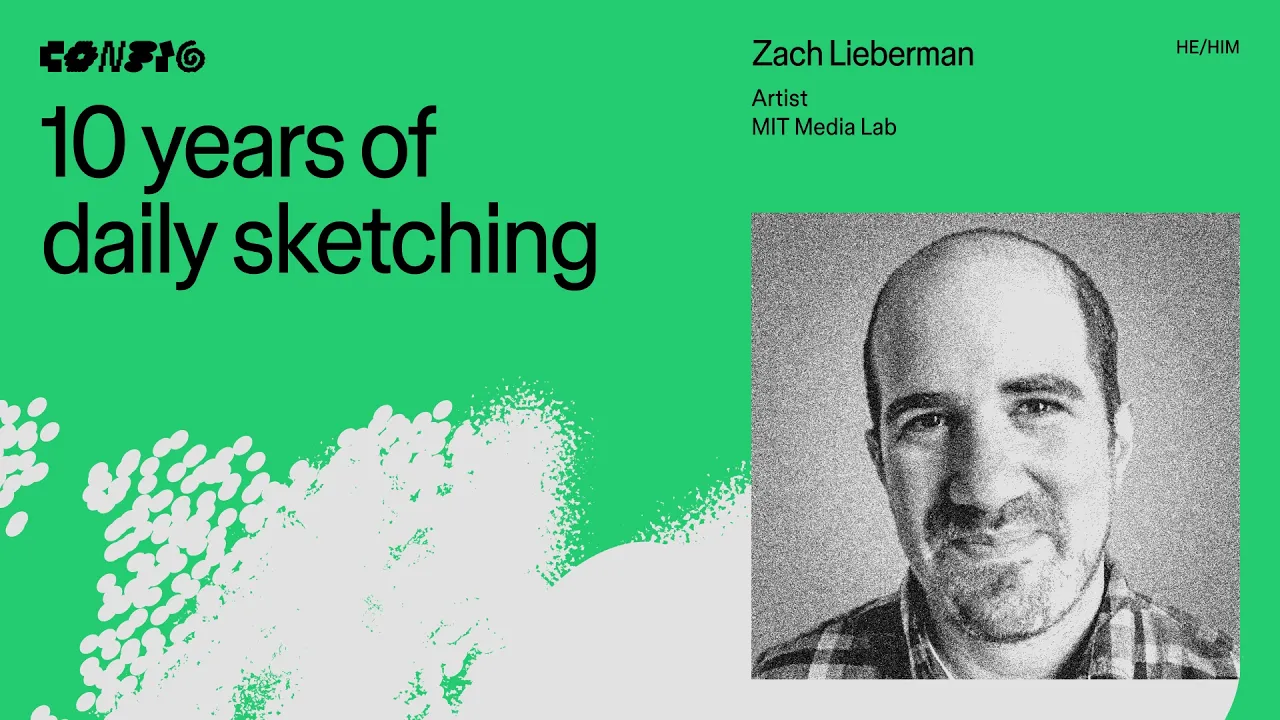
Lieberman Rejects Nvidia AI Push, Defends Code as Defining Art Medium
Figma
A decade of daily generative sketching proves that manual programming forces creators to invent emergent shortcuts that define artistic voice, demonstrating that computation is an irreplaceable cultural medium rather than a utility to surrender to artificial intelligence.
AI-assisted summary of 10 years of daily sketching ft. Zach Lieberman (MIT Media Lab) | Config 2026 — original source. Check the original for full context.
Source published:
Key ideas
- Zach Lieberman marked a decade of daily creative coding sketches, arguing against voices like Nvidia CEO Jensen Huang who discourage learning code by framing computation as the defining artistic medium of our era. (1:20)
- Lieberman uses Sister Corita Kent's rule that 'work will lead to something' to show how repeated manual effort forces artists to invent personal shortcuts, which eventually crystallize into unique creative style. (5:55)
- By translating shader programs into fine-art physical prints, Lieberman treats code as a complex machine akin to abstract painter Jack Whitten's mechanical tools, capturing dynamic computational systems like a nature photographer. (10:37)
- Lieberman frames the public sharing of daily work not as following audience demands ('DJ does not take requests'), but as building conduits for serendipitous connection that meet people at the right moment. (7:35)
Detailed notes
## Background Published by Figma on YouTube on July 7, 2026, this talk features Zach Lieberman from the MIT Media Lab presenting at Config 2026. The description highlights Lieberman's decade-long practice of posting a daily code sketch on Instagram since New Year's Day 2016, exploring insights on creative iteration, research structure, the value of boredom, and creative freedom.
## TL;DR Artist and educator Zach Lieberman reflects on ten years of daily creative coding, arguing that computation is an essential artistic medium rather than a utility to be outsourced to AI. He walks through the evolution of his visual experiments—from early light reflections and dynamic 3D blobs to geometric deconstructions and physical fine-art shader prints. Along the way, he outlines practical creative frameworks, including Sister Corita Kent's rule of continuous labor and a feedback matrix for reconciling personal taste with audience reception. Ultimately, he frames daily sketching as both a private visual journal and an open conduit for emotional connection with viewers.
## Atmosphere & style Lieberman speaks with a warm, playful, and disarmingly humble energy, balancing high-level computational philosophy with self-deprecating humor about critiques from his stepdaughter and bizarre internet commentary. The visual rhythm of the talk feels hypnotic and kinetic, driven by vibrant projected animations, algorithmic gradients, and tactile print artifacts. Watching the presentation evokes a sense of contemplative wonder, illustrating how relentless, disciplined experimentation can transform simple mathematical rules into deeply human emotional experiences.
## Bulletin - [01:20](https://www.youtube.com/watch?v=CaF0t8QrQjE&t=80s) Zach Lieberman marked a decade of daily creative coding sketches, arguing against voices like Nvidia CEO Jensen Huang who discourage learning code by framing computation as the defining artistic medium of our era. - [05:55](https://www.youtube.com/watch?v=CaF0t8QrQjE&t=355s) Lieberman uses Sister Corita Kent's rule that 'work will lead to something' to show how repeated manual effort forces artists to invent personal shortcuts, which eventually crystallize into unique creative style. - [10:37](https://www.youtube.com/watch?v=CaF0t8QrQjE&t=637s) By translating shader programs into fine-art physical prints, Lieberman treats code as a complex machine akin to abstract painter Jack Whitten's mechanical tools, capturing dynamic computational systems like a nature photographer. - [07:35](https://www.youtube.com/watch?v=CaF0t8QrQjE&t=455s) Lieberman frames the public sharing of daily work not as following audience demands ('DJ does not take requests'), but as building conduits for serendipitous connection that meet people at the right moment.
## Key takeaways - [01:20](https://www.youtube.com/watch?v=CaF0t8QrQjE&t=80s) Computation is fundamentally an artistic and cultural medium rather than a purely functional engineering tool. - [01:20](https://www.youtube.com/watch?v=CaF0t8QrQjE&t=80s) Lieberman directly disputes Jensen Huang's assertion that children should forgo learning code in favor of AI. - [02:34](https://www.youtube.com/watch?v=CaF0t8QrQjE&t=154s) A daily creative habit started on New Year's Day 2016 evolved dynamically through external critiques, transitioning from light reflections into organic, pliable 2D and 3D blobs. - [03:37](https://www.youtube.com/watch?v=CaF0t8QrQjE&t=217s) Iterative experimentation involves pushing simple geometric formulas, such as three-point circle fits, to extreme boundaries ('turning the knob to 11'). - [03:37](https://www.youtube.com/watch?v=CaF0t8QrQjE&t=217s) Inverting standard beginner programming exercises, like making walls bounce off a static ball rather than the reverse, reveals fresh visual logic. - [05:55](https://www.youtube.com/watch?v=CaF0t8QrQjE&t=355s) Repetitive daily practice forces natural shortcuts and optimizations that ultimately define an artist's personal voice and technique. - [05:55](https://www.youtube.com/watch?v=CaF0t8QrQjE&t=355s) Discrepancies in reception—such as an artist disliking a piece that the audience celebrates—yield deeper pedagogical insights than straightforward success or failure. - [07:35](https://www.youtube.com/watch?v=CaF0t8QrQjE&t=455s) Lieberman adheres to the rule 'DJ does not take requests' to silence external noise and protect the childlike curiosity driving his practice. - [07:35](https://www.youtube.com/watch?v=CaF0t8QrQjE&t=455s) A daily sketching archive serves as an emotional and atmospheric diary, preserving exact memories, life events, and political climates for the creator. - [10:37](https://www.youtube.com/watch?v=CaF0t8QrQjE&t=637s) Interactive coding can turn human bodies into literal playback mechanisms, such as walking through spatialized audio or pinned AR video frames. - [10:37](https://www.youtube.com/watch?v=CaF0t8QrQjE&t=637s) Physical printmaking grounds fleeting computational animations, letting viewers live with tactile, pigment-based artifacts. - [10:37](https://www.youtube.com/watch?v=CaF0t8QrQjE&t=637s) Shader programming mirrors abstract painter Jack Whitten's craft: creating complex custom machines to generate images at rapid speed. - [12:27](https://www.youtube.com/watch?v=CaF0t8QrQjE&t=747s) For the sheet music book of 'Everything Everywhere All at Once,' Lieberman maintained a single code base, altering its parameters to match the emotional arc of each scene. - [12:27](https://www.youtube.com/watch?v=CaF0t8QrQjE&t=747s) Capturing atmospheric light and sunsets digitally succeeds more through recreating emotional resonance than through rigid mathematical simulation. - [15:12](https://www.youtube.com/watch?v=CaF0t8QrQjE&t=912s) Lieberman designs algorithms around light diffusion, reflection, and bleed so that static prints appear to radiate internal energy. - [16:57](https://www.youtube.com/watch?v=CaF0t8QrQjE&t=1017s) The ultimate measure of success for public daily work is serendipitous emotional utility: making pieces that meaningfully meet viewers when they need them.
## Detailed walkthrough ### [00:20](https://www.youtube.com/watch?v=CaF0t8QrQjE&t=20s) Introduction to Day Two of Config
Day two of Figma's Config conference opens on the Mezzanine Stage with hosts Rachel Miller, an engineering manager on Figma's team, and Megan Banarzek, who leads design for the core tools team at Figma. They welcome the in-person audience and viewers watching the livestream before introducing the day's first speaker: Zach Lieberman, an artist and educator at the MIT Media Lab. Miller and Banarzek explain that Lieberman will discuss his creative discipline of producing a code sketch every single day across the past decade.
[01:20](https://www.youtube.com/watch?v=CaF0t8QrQjE&t=80s) Finding the Medium: Painting, Flash, and the Culture of Code
Zach Lieberman takes the stage, showing a picture of how he used to look and explaining his transition into software art. Having originally studied painting and printmaking, he found himself needing a job and subsequently encountered Macromedia Flash. That encounter sparked an immediate fascination: the realization that writing a single line of code could make an element move on screen made him fall in love with programming. Lieberman emphasizes that every animation and graphic shown throughout his presentation is generated entirely with code that he writes himself.
Addressing recent trends in technology and industry rhetoric, Lieberman directly challenges statements discouraging people from learning technical crafts:
> “Jensen Huang, the CEO of Nvidia said, 'Kids shouldn't learn to code, they should leave it up to AI.' And I have to say I fundamentally disagree with this.”
Lieberman argues that computation is not merely a technical utility or functional tool; it represents the defining artistic and cultural medium of our time. His daily sketching practice over the past ten years—resulting in thousands of images and video recordings—serves as an ongoing investigation into this culture of code.
[02:34](https://www.youtube.com/watch?v=CaF0t8QrQjE&t=154s) Origins and Evolution: From Reflections to Blobs
The daily practice originated on January 1, 2016, stemming from Lieberman's ritual of creating a celebratory sketch for New Year's Day. He became captivated by an algorithm simulating light and reflection, spending his initial days methodically altering the light's point of origin, angle, and bounce behaviors, occasionally pushing parameters into absurd extremes.
```mermaid flowchart LR accTitle: Evolution of Zach Lieberman's daily sketches accDescr: A linear flow showing the transition from light reflection algorithms to organic blobs and geometry. A["New Year 2016:<br/>Light & Reflection"] --> B["Critique from stepdaughter:<br/>'You have to change'"] B --> C["Organic Blobs:<br/>2D/3D extrusion & faces"] C --> D["Algorithmic Geometry:<br/>Three-point circle fit"] ```
This initial series hit a turning point when his stepdaughter stepped in with direct creative feedback. Observing the repetitive light simulations, she told him he needed to change his approach, effectively becoming his unofficial art director. Responding to her critique, Lieberman transitioned to sketching with organic, pliable blob forms: - Investigated forms that blur the line between 2D and 3D space, exploring how flat graphics feel three-dimensional and vice versa. - Experimented with dynamic extrusion, elasticity, and narrative motion. - Attempted mapping his own facial expressions onto the blob geometries, an experiment his stepdaughter thoroughly disliked.
[03:37](https://www.youtube.com/watch?v=CaF0t8QrQjE&t=217s) Iteration, Remixing, and Turning the Knob to 11
Lieberman describes daily sketching as taking very simple geometric or algorithmic ideas and continuously remixing them. As an example, he highlights a geometric algorithm where any three points in space define a unique circle. After mastering the basic formula, he pushed it across varied motion domains, applying the three-point circle calculation to track the motion of walking figures and dancers.
In another instance, Lieberman drew inspiration from design agency Lava's visual identity for Beijing Design Week, which relied on clean, restrained geometric forms. Lieberman recoded the concept from scratch to explore its boundaries, explaining his underlying creative philosophy:
> “And then always I feel like my job is to do like volume knob 11 to just turn the volume up and see what happens.”
He continuously layers variations—adding shading, color palettes, and structural distortions—to discover what core aesthetic truth survives repeated modification. Other experiments include: - A line constrained exclusively to a circular orbit while attempting to chase the user's cursor across the screen. - Extruding 2D paths to produce thick, cartoon-style dimensional tubes. - Commercial applications that arose naturally from these exercises, including graphics Lieberman created under NDA that attendees might recognize from packaging and device wallpapers. - Deconstructing the standard beginner programming exercise of a bouncing ball: instead of a ball bouncing off static walls, Lieberman inverted the perspective so the walls bounced off a static ball, escalating from one boundary to two, three, four, and ten until the mathematical logic reached an appealing breaking point.
[05:55](https://www.youtube.com/watch?v=CaF0t8QrQjE&t=355s) Sister Corita Kent and the Four-Quadrant Feedback Matrix
Lieberman grounds his daily habit in the pedagogical philosophy of artist and educator Sister Corita Kent, specifically referencing her famous "10 Rules for Students and Teachers." He highlights Rule 7:
> “The only rule is work. If you work, it will lead to something.”
Lieberman illustrates this with a visual anecdote of a student writing lines of punishment ("I will make better choices") over and over. By the bottom of the page, the student has aggressively optimized the handwriting, collapsing letter combinations and drawing the letter "L" as a simple straight mark. In creative work, Lieberman notes, repeated manual labor naturally forces the creator to invent shortcuts, and those emergent shortcuts ultimately crystallize into individual artistic style and voice.
To explain how public reception interacts with an artist's personal taste, Lieberman describes a 2x2 matrix comparing whether he likes a piece against whether the audience likes it:
| Audience Reaction | Artist: Liked | Artist: Disliked | |:--- |:--- |:--- | | **Audience Liked** | Straightforward validation | Discrepancy / Growth moment | | **Audience Disliked** | Conviction / Artistic divergence | Straightforward failure |
Lieberman points out that while the matching quadrants (both like it, or both dislike it) are simple, the mismatches provide the deepest insight. Instances where he was frustrated, threw together a hurried sketch he disliked, and watched the public celebrate it revealed unexpected gaps between his internal standards and the perceptual reality of the viewer.
[07:35](https://www.youtube.com/watch?v=CaF0t8QrQjE&t=455s) Filtering Voices and the Artist's Diary
Because posting publicly invites an endless stream of viewer opinions and advice, Lieberman maintains a strict rule to protect his imaginative space: "DJ does not take requests." He explains that creators are constantly bombarded by negative internal and external voices questioning their output or telling them what to post. To counteract this, he strives to tune out commentary in favor of a single interior impulse: the childlike wonder and curiosity that originally drew him to creative coding. At the same time, he welcomes genuine connections when audience members point out visual parallels to historical artists or unexpected motifs, treating those observations as doorways into unexplored artistic lineages.
Lieberman reflects on his motivations through a quote from British grime artist JME:
> “Music is the reason I make music. I am the person I make it for.”
For Lieberman, the sketching archive functions directly as a personal visual journal: - Looking back at any sketch instantly revives the memory of where he was sitting, his emotional state, and the weather at the time of creation. - A dedicated folder on his hard drive labeled `everyday` stores every iteration, failure, and screenshot, creating an archival paper trail of visual breadcrumbs. - Sketches frequently capture political and cultural atmospheres; after the 2016 US presidential election, he translated feelings of gloom and new-year optimism into dual-toned, cartoon-like compositions. - Other daily experiments explored ink physics textures scanned from his drive, infinite lines created by chaining looped recordings of his own hands, and augmented reality (AR) experiments where frames of video and photos were pinned in physical space, turning the viewer's body into a literal playhead scrubbing through footage by walking through it.
[10:37](https://www.youtube.com/watch?v=CaF0t8QrQjE&t=637s) Spatial Audio Experiments and Discovering the Magic of Print
Zach Lieberman demonstrates interactive experiments where visual and acoustic realities distort depending on perspective. In one experiment, an anamorphic image looks correct only from one precise vantage point, breaking apart as the viewer moves. Another spatial computing experiment captures voice in three dimensions: Lieberman plays back an audio clip where he announces, “This is a test of talking and seeing what happens when we record audio in space,” allowing a user to physically walk through the sound waves to replay the spoken words.
Beyond animation and interactive software, Lieberman’s daily sketching habit eventually led him to physical printmaking. He purchased a high-end printer that sat untouched in his studio, taunting him daily. One summer, he finally gave in and began pulling prints, reigniting the joy he first felt when printmaking in school—soaking paper, inking plates, and physically holding a finished image. Lieberman finds that having a tactile object on a wall fundamentally alters how a person lives with art.
He draws inspiration from abstract painter Jack Whitten, who aimed to produce a finished painting in 15 seconds flat. Whitten, a skilled carpenter, built intricate mechanical apparatuses to apply paint at high velocity. Lieberman sees a direct parallel between Whitten's approach and writing shader programs:
> “I’m creating this elaborate system for making images through shader programming, and I’m making these images really quickly, but the machine that I’m making to to make them is quite complicated.”
Lieberman views his practice through the lens of wildlife photography: his role is to build living computational ecosystems, wait patiently to spot emergent moments, capture them as stills, and print them.
```mermaid flowchart LR accTitle: Computational Printmaking Process accDescr: Pipeline showing how complex shader engines create rapid captures and physical prints. A["Shader Engine<br>(Complex code machine)"] --> B["Living Computational System<br>(Dynamic visual ecosystem)"] B --> C["Snapshot Capture<br>(Hunting like a nature photographer)"] C --> D["Physical Print<br>(Luminous tangible object)"] ```
---
[12:27](https://www.youtube.com/watch?v=CaF0t8QrQjE&t=747s) Scoring *Everything Everywhere All at Once* and Algorithmic Sunsets
Lieberman showcases client and personal work grounded in still imagery. Film studio A24 commissioned him to design the songbook reader for the sheet music companion to *Everything Everywhere All at Once*. Because the film explores transformation, Lieberman preserved a unified code architecture across the suite:
> “And for this project, I took the same piece of code, and based on the moments, the emotional state of the movie, I changed the code for each one of these songs.”
He listened closely to Son Lux's soundtrack, tweaking parameters to mirror the precise emotional weight and color temperature of each scene.
Lieberman's fascination with light extends to natural phenomena, especially sunsets and atmospheric scattering algorithms: - **Joe McKay (*Sunset Solitaire*):** An interactive piece where the artist digitally samples and matches live sunset gradients in real time, turning computational tools into an ongoing dialogue with the outdoors. - **Cassandra C. Jones:** An artist who collages thousands of disparate photographic snapshots of sunsets into a singular, continuous horizon.
Lieberman spent time living on a boat one summer, captivated by the nightly interplay of light skimming the ocean. While he initially felt humbled—convinced that in a million years he could never write an algorithm to mathematically simulate water reflections—he returned to his studio intent on recreating the underlying emotion rather than a literal physics model. The resulting series consists of 100 stills functioning as a stop-motion film of a summer spent locked in on the horizon.
---
[15:12](https://www.youtube.com/watch?v=CaF0t8QrQjE&t=912s) Capturing Luminosity and the Architecture of Light
Continuing his visual studies, Lieberman deconstructs how light interacts with surfaces, walls, and color fields. Rather than merely rendering light sources, his algorithms simulate reflection, bleed, and diffusion:
> “Often times I think about light and color and geometry as those building blocks. And every day I'm waking up and thinking about what is the right combination that that I want to create to express myself.”
When printed on fine-art paper, these gradient studies routinely go viral. Lieberman notes that viewers online and in person struggle to believe they are looking at pigment on paper because the images seem to project light internally:
> “I want to make images and videos and animations and interactive works that feel luminous, that feel that they have a kind of light energy that they're emitting.”
His creative impulse is to engineer artifacts that provide personal calm, in the hope that those frequencies resonate with anyone viewing them.
---
[16:57](https://www.youtube.com/watch?v=CaF0t8QrQjE&t=1017s) Audience Reactions and Meeting People at the Right Time
Sharing work on open platforms brings varied, sometimes bizarre feedback. Viewers regularly describe his geometric, pulsating patterns as matching their ocular migraines—so frequently that Lieberman jokes he has become an accidental migraine artist. Other commenters share visceral, unsettling memories: - One follower remarked: *“Gorgeous and nauseating. When I was young, I had a reoccurring nightmare that looked a lot like this.”* - Another person analyzed his static prints on a deeper level, noting: *“I took some time with these full size. You wouldn't know it at a glance, but this is time-based work.”*
That observation struck Lieberman deeply, revealing temporal depths in his prints that he had not consciously recognized.
He concludes by discussing his favorite comment of all time, which he treats as his de facto artist statement whenever institutions ask him to describe his philosophy: *“I had a bad day. I saw your work. My day is good now. Thank you.”*
While Lieberman starts projects to satisfy his own curiosity, the ultimate value of a decade-long daily practice lies in creating conduits for connection:
> “When I think of the power of making and sharing and creating, it's really about making work that meets people at the right time.”
## Notable quotes > [16:57](https://www.youtube.com/watch?v=CaF0t8QrQjE&t=1017s) When I think of the power of making and sharing and creating, it's really about making work that meets people at the right time. — Zach Lieberman
## Mentioned Zach Lieberman, MIT Media Lab, Rachel Miller, Megan Banarzek, Figma, Macromedia Flash, Jensen Huang, Nvidia, Lava, Beijing Design Week, Sister Corita Kent, JME, Jack Whitten, A24, Everything Everywhere All at Once, Son Lux, Joe McKay, Sunset Solitaire, Cassandra C. Jones, Instagram
## Video description Ten years ago, after a rough year, Zach Lieberman posted a small code sketch on Instagram on New Year's Day and he's posted one every day since. This talk is about what he's learned from that practice of making something every day. He'll focus on the importance of boredom, how to structure iteration, how he structures research and most importantly, finding creative freedom. ____________________________________________________
Find us on ⬇️ X (formerly Twitter): https://x.com/figma Instagram: https://www.instagram.com/figma LinkedIn: https://www.linkedin.com/company/figma TikTok: https://tiktok.com/@figma Figma forum: https://forum.figma.com/
[Source](https://www.youtube.com/watch?v=CaF0t8QrQjE)