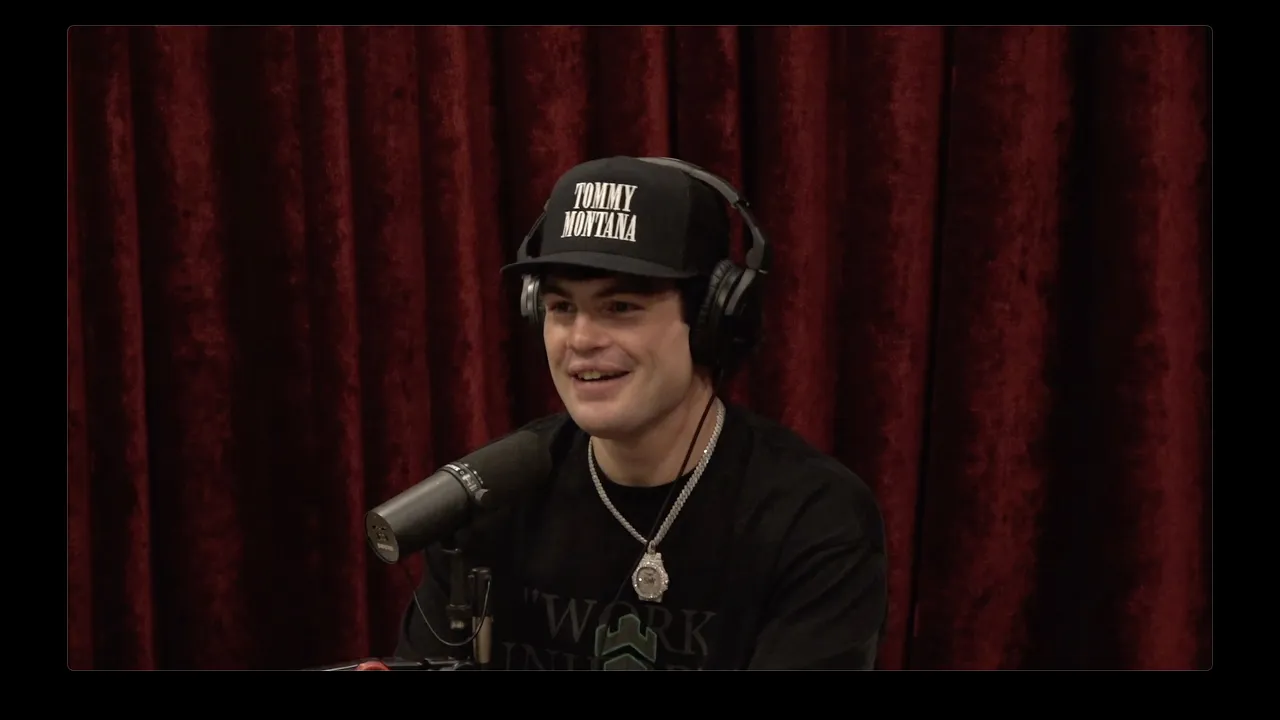
UFC's Tommy McMillen Details Overdose, Uses Fight Camps to Stay Alive
PowerfulJRE
Contracting high-stakes UFC bouts serves as the primary anchor keeping fighter Tommy McMillen disciplined and alive against recurring, near-fatal substance overdoses during career downtime.
Tommy McMillen details his rapid rise through the UFC featherweight division, logging three bouts within five months and setting an all-time record for significant strikes landed in a three-round UFC bout against Alberto Montes. (53:41)
Joe Rogan and McMillen critique modern UFC officiating on fouls, urging automatic point deductions for deliberate cage grabs and open-hand eye pokes rather than mere verbal warnings. (2:07)
McMillen candidly recounts surviving a life-threatening nightclub overdose where he required two doses of Narcan, highlighting the deadly risk of cartel fentanyl contamination in recreational street drugs. (66:34)
Beyond fighting, McMillen has built alternative revenue streams—including an equity stake in Motion Pouches and an impending peptide brand—to safeguard against financial pressure during injury layoffs. (80:00)
Detailed notes
## Background
Published on YouTube by PowerfulJRE on November 17, 2026, JRE MMA Show #189 features host Joe Rogan sitting down with Tommy McMillen, an active professional mixed martial artist competing in the UFC Featherweight division.
## TL;DR
UFC featherweight Tommy McMillen joins Joe Rogan to chronicle his gritty rise from wrestling as a toddler and fighting in Montana smokers to moving in with Sean O'Malley and training under Tim Welch in Arizona. McMillen reflects on his brawl-heavy Octagon run, setting UFC significant strike records, and enduring brutal weight cuts, while speaking openly about his self-destructive partying and a near-fatal nightclub overdose reversed by Narcan. Together, Rogan and McMillen examine modern UFC officiating, peptide therapies for severe back and joint rehabilitation, wild high-stakes gambling sessions with Dana White, and the psychological detachment required to endure combat at the highest level.
## Atmosphere & style
The conversation carries an intense, raw, and fraternal energy, shifting fluidly between granular fight breakdowns and startlingly candid confessions about survival and substance abuse. Rogan balances his role as an enthusiastic combat sports analyst with that of a protective mentor, frequently urging McMillen to secure handlers, avoid street drugs, and protect his massive business potential. McMillen brings an authentic, unvarnished grit to the studio, grounding wild Vegas stories and fast-paced UFC wars in the stark reality of his traumatic, hyper-focused upbringing.
## Bulletin
- [53:41](https://www.youtube.com/watch?v=cvqaIVwnDPE&t=3221s) Tommy McMillen details his rapid rise through the UFC featherweight division, logging three bouts within five months and setting an all-time record for significant strikes landed in a three-round UFC bout against Alberto Montes.
- [02:07](https://www.youtube.com/watch?v=cvqaIVwnDPE&t=127s) Joe Rogan and McMillen critique modern UFC officiating on fouls, urging automatic point deductions for deliberate cage grabs and open-hand eye pokes rather than mere verbal warnings.
- [01:06:34](https://www.youtube.com/watch?v=cvqaIVwnDPE&t=3994s) McMillen candidly recounts surviving a life-threatening nightclub overdose where he required two doses of Narcan, highlighting the deadly risk of cartel fentanyl contamination in recreational street drugs.
- [01:20:00](https://www.youtube.com/watch?v=cvqaIVwnDPE&t=4800s) Beyond fighting, McMillen has built alternative revenue streams—including an equity stake in Motion Pouches and an impending peptide brand—to safeguard against financial pressure during injury layoffs.
## Key takeaways
- [02:07](https://www.youtube.com/watch?v=cvqaIVwnDPE&t=127s) Rogan argues that deliberate cage grabs and framing with open fingers toward an opponent's eyes should trigger instant point deductions from referees.
- [08:46](https://www.youtube.com/watch?v=cvqaIVwnDPE&t=526s) Modern UFC officiating protocols now allow referees to pause action, review video replays in neutral positions, and apply retroactive point deductions without declaring immediate disqualifications.
- [11:59](https://www.youtube.com/watch?v=cvqaIVwnDPE&t=719s) Growing up in Great Falls, Montana, McMillen witnessed his father work multiple labor jobs and compete in Toughman fights, inspiring him to pursue MMA as a path to family financial security.
- [17:00](https://www.youtube.com/watch?v=cvqaIVwnDPE&t=1020s) McMillen relocated to Arizona at age 19 to live and train alongside Sean O'Malley and head coach Tim Welch before O'Malley's rise to stardom.
- [33:40](https://www.youtube.com/watch?v=cvqaIVwnDPE&t=2020s) Elite combat sports success relies heavily on psychological resilience and composure under bright lights, which often separates gym performers from true championship fighters.
- [50:35](https://www.youtube.com/watch?v=cvqaIVwnDPE&t=3035s) In his war against Marwan Rahiki, McMillen overcame a devastating second-round knockdown to brawl through Round 3, securing a decisive victory with a 10-8 final frame on one judge's scorecard.
- [01:00:31](https://www.youtube.com/watch?v=cvqaIVwnDPE&t=3631s) McMillen utilizes hot-water immersion over dry saunas to cut his final 11 pounds of water weight efficiently without excessive systemic drain.
- [01:10:44](https://www.youtube.com/watch?v=cvqaIVwnDPE&t=4244s) Rogan warns against any recreational street drug use due to widespread fentanyl contamination, recounting the extreme danger McMillen faced during his nightclub collapse.
- [01:23:11](https://www.youtube.com/watch?v=cvqaIVwnDPE&t=4991s) McMillen spent more than two years sidelined by a debilitating pinched sciatic nerve, which he eventually resolved through targeted hip flexor stretching, dry needling, and peptide therapy.
- [01:29:17](https://www.youtube.com/watch?v=cvqaIVwnDPE&t=5357s) Rogan advocates for the legalization of regenerative peptide therapies like BPC-157 and TB-500 through regulated compounding pharmacies to accelerate joint and bone recovery.
- [01:47:28](https://www.youtube.com/watch?v=cvqaIVwnDPE&t=6448s) Active UFC fighters are strictly prohibited from betting on combat sports events following federal investigations into fight-fixing and undisclosed injury information.
- [01:53:01](https://www.youtube.com/watch?v=cvqaIVwnDPE&t=6781s) McMillen purposefully employs harsh trash talk before fights to pull opponents out of their comfort zones and force them into emotionally reckless technical mistakes.
- [02:05:56](https://www.youtube.com/watch?v=cvqaIVwnDPE&t=7556s) Adopting a stoic philosophy influenced by Welch and O'Malley, McMillen credits intense work ethic and reframing adversity as necessary fuel for his career endurance.
- [02:19:44](https://www.youtube.com/watch?v=cvqaIVwnDPE&t=8384s) McMillen strategically plans to remain unranked for one or two more bouts to maximize cage experience and maintain high activity before entering the top 15.
## Detailed walkthrough
### [00:12](https://www.youtube.com/watch?v=cvqaIVwnDPE&t=12s) Tommy Montana Weed and Sean O'Malley's Penalty Idea
The conversation opens with Joe Rogan warmly welcoming UFC featherweight Tommy McMillen, joking that he might be the only person capable of reviving the classic lunchbox. McMillen explains that he is launching his own cannabis strain called "Tommy Montana," which will be distributed in custom lunchboxes packed with edibles and merchandise. As Rogan admires the packaging, producer Young Jamie interjects with a controversial topic from the MMA world: Sean O'Malley's recent suggestion that a fighter should potentially enter their next bout with a pre-existing two-point deduction after committing a severe foul in a previous contest.
Jamie notes that in other sports, egregious penalties lead to players being sidelined for quarters or halves. Rogan and McMillen immediately connect the discussion to Ciryl Gane's recent fight, pointing out that Gane was not penalized even a single point for a terrible eye poke. Rogan demonstrates Gane's habit of framing with outstretched fingers when an opponent charges forward, noting that while extending an open hand is common in Muay Thai due to large boxing gloves, doing so with MMA gloves is unacceptable and dangerous.
```mermaid
flowchart TD
accTitle: Eye Pokes vs Accidental Fouls
accDescr: Diagram contrasting how deliberate open-hand eye framing differs from accidental groin strikes in MMA officiating.
subgraph DeliberateFouls["Intentional Mechanics / Immediate Point"]
A["Outstretched Framing Hand"] --> B["Known Danger: Open Fingers to Eyes"]
C["Grabbing the Octagon Fence"] --> D["Conscious Violation to Gain Leverage"]
B & D --> E["Referee Should Deduct Point Immediately"]
end
subgraph AccidentalFouls["Incidental Mechanics / Warning First"]
F["Groin Strikes"] --> G["Leg Clashing / Sudden Opponent Movement"]
G --> H["Referee Discretion / Recovery Time Given"]
end
```
- McMillen is rolling out a proprietary cannabis strain named "Tommy Montana," packaged inside branded collectible lunchboxes containing edibles.
- Sean O'Malley floated the idea of fighters beginning subsequent bouts with a point deficit if they committed unpunished egregious fouls previously.
- “You can't do that. You just can't extend your hand towards someone's eyes. That's a point,” Rogan argued regarding open-hand framing.
---
[02:07](https://www.youtube.com/watch?v=cvqaIVwnDPE&t=127s) Fouls, Eye Pokes, and the Heavyweight Division
Rogan makes a sharp distinction between different types of fouls in the cage, arguing that intentional or careless actions like cage grabbing and open-handed eye poking should trigger immediate point deductions. Unlike accidental groin strikes—which often result from glancing kicks, leg clashes, or sudden shifts in an opponent's stance—fighters know exactly what they are doing when they grab the fence or stick their fingers into an opponent's face. Rogan points to Tom Aspinall as a heartbreaking example of the permanent toll of cage fouls, recounting how Aspinall endured four eye surgeries, was unable to compete, and ultimately had to relinquish the heavyweight title after absorbing multiple fouls.
McMillen points out that over roughly twenty-two career cage fights, he has never poked an opponent in the eye, expressing confusion over why fighters continue to extend their fingers forward. Rogan responds that McMillen's forward-pressure, smothering style naturally differs from that of a backpedaling counter-striker. When a fighter like Ciryl Gane—who relies on movement and safety rather than brawling—gets dragged into deep chaos, sticking out his hands is a reflexive panic response rather than a sound technical habit.
- Over twenty-two combined cage bouts, McMillen has never committed an eye poke.
- Rogan highlights Tom Aspinall's eye damage and subsequent four surgical procedures that forced him to vacate the UFC Heavyweight Championship.
- “You're grabbing a fence because you know you're not supposed to do it and you're doing it. That's the point,” Rogan asserted regarding the necessity of instant referee penalties.
---
[03:27](https://www.youtube.com/watch?v=cvqaIVwnDPE&t=207s) The Ciryl Gane War and Heavyweight Chaos
The conversation shifts to the wild heavyweight brawl between Ciryl Gane and his relentless challenger. Rogan hails it as an instant classic and one of the most entertaining heavyweight clashes in UFC history, highlighting the sheer madness of an opponent willing to walk straight through the fire against an elite, 240-plus-pound kickboxer. McMillen mentions that Verdict MMA ranked the bout among the top seven fights of the year, while Rogan places it among the top ten UFC heavyweight fights of all time, noting that only legendary Pride FC wars—such as Fedor Emelianenko against Antônio Rodrigo Nogueira or Mirko Cro Cop—feature comparable bedlam.
McMillen was particularly impressed with Gane's composure under fire. Despite an exhausting opening round where he appeared to be gassing out under relentless forward pressure, Gane caught his second wind in rounds four and five. Rogan breaks down how the challenger’s aggressive strategy was engineered to prevent Gane from planting his feet to unleash his signature body kicks and knees. Once Gane weathered the storm and created separation, he effectively utilized knees to the midsection and sharp striking to turn the momentum back in his favor.
- The heavyweight clash was ranked among the top seven fights of the calendar year on Verdict MMA.
- Rogan rates the brawl within the top ten greatest UFC heavyweight fights of all time, comparing its drama to legendary Pride-era wars.
- “It was one of the most entertaining heavyweight fights in the history of the sport. It was madness. Just complete madness,” Rogan stated.
---
[06:03](https://www.youtube.com/watch?v=cvqaIVwnDPE&t=363s) Jon Jones' Dominance and the Rise of a New Contender
Watching Gane defeat high-level heavyweights like Alexander Volkov and weather chaotic wars makes Jon Jones look even more extraordinary in retrospect. McMillen and Rogan emphasize how easily Jones dismantled Gane, taking him down, chaining submissions, and wrapping up his neck inside minutes while barely getting touched aside from an inadvertent early groin strike. Rogan calls Jones undisputed: “He's the greatest of all time. No doubt. And the way he did it once he got a hold of him, that was it.”
The pair also analyze the challenger's physical profile. While McMillen notes that the fighter struggled to hold Gane down due to the size disparity and suggests he could easily compete at light heavyweight (205 pounds), Rogan argues that his blistering pace is uniquely devastating at heavyweight. Rogan compares his engine to prime Cain Velasquez, who crushed larger opponents with cardio and volume despite lacking single-shot knockout power. Rogan and McMillen trace the meteoric rise of this rising star—who with only 11 professional fights defeated Curtis Blaydes, finished Derrick Lewis, made inflammatory remarks about Michelle Obama, and headlined Madison Square Garden for a UFC title inside of twelve months, winning over even UFC CEO Dana White along the way.
- The title contender reached a UFC heavyweight championship bout in just one year with a professional record of only 11 total bouts.
- The fighter earned the title shot by taking on short-notice challenges, stopping top contender Curtis Blaydes, and finishing Derrick Lewis.
- “You talk to him like outside of the persona. He's a very smart guy. He's a very normal, smart guy. It's an act,” Rogan remarked regarding the fighter's polarizing public character.
[08:46](https://www.youtube.com/watch?v=cvqaIVwnDPE&t=526s) Quirky Personas and In-Cage Reality: The Ciryl Gane Eyepoke Controversy
Joe Rogan and Tommy McMillen discuss how an eccentric outward persona can mislead fans and opponents about a fighter's true caliber. Touching on fighters who release rap songs or wear ridiculous getups with bandanas, gloves, and sunglasses, Rogan points out that acting silly can often serve as an effective smokescreen. McMillen brings up Paddy Pimblett as a prime example of someone who appears goofy until the fight begins: “That cage closes, there's no silliness anymore.” Rogan agrees, noting that Pimblett tricks people into dismissing him because of his cringeworthy antics, only to swarm forward relentlessly at a hundred miles an hour the moment the door shuts.
The conversation then shifts to heavyweight Ciryl Gane and his recent performance. Rogan highlights being extremely impressed by how Gane weathered deep waters, caught a second wind in the fourth and fifth rounds, and adjusted his striking to shut down incoming pressure. However, McMillen observes that the razor-thin scoring margin makes the unpenalized eye poke glaring, since a single deduction would have altered the outcome to a draw. Rogan explains that the referee failed to see the poke in real time, though McMillen argues that refereeing protocols should allow for an immediate pause in action during neutral stand-up exchanges—especially given Gane’s history with fouls. Rogan clarifies the evolution of the UFC's rules regarding referee timeouts and replay reviews:
```mermaid
flowchart TD
accTitle: Evolution of UFC In-Fight Foul Review Rules
accDescr: Diagram contrasting the legacy UFC foul rule against the modernized review system.
subgraph LegacyRule["Legacy Rule System"]
A["Foul Occurs"] --> B["Action Stopped by Ref"]
B --> C{"Fight Cannot Resume"}
C --> D["Disqualification (DQ)"]
C --> E["Technical Decision / No Contest"]
end
subgraph ModernRule["Modern Rule System"]
F["Foul Occurs / Suspected"] --> G["Action Paused in Neutral Position"]
G --> H["Video Review by Referee"]
H --> I["Deduct Point / Issue Warning"]
I --> J["Action Resumed Safely"]
end
```
Rogan stresses that under the older, poorly conceived rule, stopping the action meant the bout had to end immediately as either a disqualification or a no contest. Today, referees possess the authority to call time, review the video replay, deduct a point, and resume the contest. He notes that taking a point in Gane's bout would have turned the contest into a draw, prompting McMillen and Rogan to joke about *Rocky*, debating whether Apollo Creed won by split decision or if the first fight ended in a draw.
---
[11:12](https://www.youtube.com/watch?v=cvqaIVwnDPE&t=672s) Growing Up Wrestling at Three Years Old in Montana
Reflecting on *Rocky* being his favorite childhood movie franchise, McMillen details how he first entered combat sports through wrestling and boxing in Montana. His father was a local wrestling coach, which allowed McMillen to get on the mats at roughly three and a half years old, long before standard competitive programs usually accepted children. Because Montana's youth tournaments grouped competitors into brackets for four-, five-, and six-year-olds, McMillen found himself competing against significantly older kids while still being, as Rogan puts it, virtually a baby.
Although McMillen admits to having a love-hate relationship with the grueling grind of wrestling throughout his upbringing, he credits the sport with providing structure and keeping him out of trouble. Training alongside older kids forced him to develop physical toughness and mental discipline early, establishing the competitive foundation that would eventually lead him into mixed martial arts.
---
[11:59](https://www.youtube.com/watch?v=cvqaIVwnDPE&t=719s) Childhood Poverty, Dad's Tough Man Bouts, and Starting MMA in Third Grade
McMillen traces his desire to become a professional fighter back to the economic hardship he witnessed inside his home as a young child in Great Falls, Montana. His parents were exceptionally young when they started a family—his father had his older sister at fifteen, Tommy at seventeen, and his younger brother at nineteen. All five of them lived crowded into his grandparents' house while his parents scrambled to make ends meet. To provide for the household, McMillen's father worked as a plumber by day, bagged groceries at a supermarket afterward, and trained at night to compete in semi-pro boxing and local Toughman competitions under 1988 U.S. Olympic boxer Todd Foster.
Seeing his father come home bruised and battered left an indelible mark on McMillen. By the second or third grade, while watching televised fights at his father's friend's house, McMillen decided that fighting offered the clearest ticket to financial freedom for his struggling family. Around that same time, his father stepped away from boxing just as mixed martial arts began emerging across Montana, initially held in rudimentary boxing rings. His father founded one of the first MMA gyms in Great Falls, bringing in local nineteen- and twenty-year-olds—many of them troubled youths—to train. McMillen was the sole elementary school child in the room, rolling and sparring alongside young adults:
> “Those guys look like they're the man. Like I feel like if I do that, I can help my family. I can like, you know, just like have financial freedom.”
- **Family age timeline**: Father had his first child (sister) at 15, Tommy at 17, and his younger brother at 19.
- **Father's work routine**: Daytime plumbing, evening grocery bagging, and nighttime boxing/tough-man competitions under Olympian Todd Foster.
- **Gym origin**: Father opened one of the first MMA gyms in Great Falls, Montana, when McMillen was in third grade.
---
[14:53](https://www.youtube.com/watch?v=cvqaIVwnDPE&t=893s) The Small Montana Scene, Discovering Tim Welch, and the Value of Great Coaching
Because Great Falls is an isolated, small town located roughly two hours north of Bozeman, the local training scene was extremely limited, forcing McMillen and his father to travel throughout Montana for competitive action. During these travels, McMillen first encountered future championship coach Tim Welch at a regional boxing smoker, where Welch—a hard-hitting redhead—was knocking opponents out cold with his left hand. Welch quickly developed an aura as the standout figure among Montana fighters and coaches, earning universal respect across a very tight-knit combat sports community.
McMillen tracked Welch's career from childhood and eventually relocated to Arizona to train under him full-time. Rogan and McMillen praise Welch’s intellect, fight analysis, and unique coaching ability. McMillen explains that Welch possesses a rare gift for understanding an individual fighter’s psychology and technical style: “Like he almost knows how to like help you just put the puzzle together in your brain to get you where he thinks you need to go.” Rogan emphasizes that an elite coach is the rarest and most critical element in modern MMA, noting that countless naturally gifted fighters underperform simply because they lack a mentor capable of fine-tuning their conditioning, nutrition, and strategic development.
[17:00](https://www.youtube.com/watch?v=cvqaIVwnDPE&t=1020s) Moving from Montana to Arizona to Train with Tim and Sean O'Malley
Tommy McMillen describes coming up under Tim Welch and Sean "Suga" O'Malley as one of the greatest blessings of his life. Tim was the pioneer who originally left Montana for Arizona, blazing a trail for the younger generation of fighters. McMillen had watched O'Malley—who was four or five years older—compete on the local Montana amateur circuit. Even while McMillen was still in middle and high school, he tracked O'Malley's relocation to Arizona and noticed how rapidly his skills escalated. Realizing that Arizona was where he needed to be if he wanted to get truly elite, McMillen began messaging Tim Welch incessantly from middle school onward, asking for an opportunity to come train.
Around 2017, approximately a year after finishing school, the opportunity materialized. O'Malley won his bout on Dana White's Contender Series and earned a UFC contract. With plans to buy a house in Arizona, Welch reached out to McMillen to offer him a spare room to see if he could make a career out of fighting. Although McMillen and O'Malley were aware of each other from Montana's tiny mixed martial arts circuit, they had never actually spoken or formally met. At nineteen years old, having trained in Great Falls, McMillen crammed his belongings into an old Honda Accord with no air conditioning and drove straight to Arizona, pulling up to O'Malley's driveway as complete strangers.
```mermaid
flowchart LR
accTitle: Montana to Arizona MMA Pipeline
accDescr: Progression showing how Montana fighters moved to Arizona and paved the way for younger athletes.
subgraph Montana ["Montana Roots"]
A["Tim Welch"] -->|"Paves the way"| B["Sean O'Malley"]
B -->|"Inspires as local amateur"| C["Tommy McMillen"]
end
subgraph Arizona ["Arizona Evolution"]
B -->|"Wins Contender Series (2017)"| D["Buys House in AZ"]
D -->|"Invites to rent room"| C
C -->|"Drives beat-up Honda"| E["Full-time MMA Training"]
end
```
[19:38](https://www.youtube.com/watch?v=cvqaIVwnDPE&t=1178s) Grinding in Beaters and O'Malley's Historic Contender Series Knockout
Reflecting on those early days, McMillen recalls that O'Malley had only around seven to eight thousand followers on Instagram and was far from a mainstream star. Both fighters were broke and driving dilapidated vehicles without air conditioning through the brutal Arizona summer heat—McMillen in his Honda Accord and O'Malley in a beat-up Nissan Altima with peeling paint. McMillen laughs remembering a day O'Malley's Altima broke down on the side of the road on the way to practice, leaving them stranded in the sweltering heat, commiserating over how much it sucked. Seeing O'Malley climb from being stuck on the shoulder of an Arizona highway to becoming a UFC world champion gave McMillen immense self-belief: “I've seen him do everything he said he was going to do and just the way he would say it and then do it and it was like it was insane to watch.”
Joe Rogan and McMillen revisit O'Malley's Contender Series win against Alfred Khashakyan, where Snoop Dogg provided guest commentary alongside Urijah Faber on an alternate broadcast stream. McMillen was watching the fight on his phone inside a friend's car at a party back in Montana when O'Malley delivered his walk-off knockout, sending Snoop Dogg into hysterics. McMillen reveals that O'Malley did not even have a real training camp for that contest because he was dealing with a concussion prior to the bout; O'Malley weighed in at 135 pounds and rehydrated essentially nothing, looking noticeably undersized in the cage yet still rising to the occasion against a dangerous opponent.
- O'Malley had only 7,000–8,000 Instagram followers when McMillen moved in.
- Both fighters drove vehicles lacking air conditioning through Arizona summers (an old Honda Accord and a beat-up Nissan Altima).
- O'Malley entered his Contender Series fight concussed, had no training camp, and competed near his weigh-in weight without rehydrating.
- Snoop Dogg and Urijah Faber's companion commentary for that knockout helped launch O'Malley's pop-culture persona.
[22:31](https://www.youtube.com/watch?v=cvqaIVwnDPE&t=1351s) Culture Shock: Diet, Discipline, and Professional Nutrition
Moving into O'Malley's house presented an immediate lifestyle clash. At the time, O'Malley was strictly vegan and deeply immersed in health optimization, while McMillen arrived with the eating habits of a stereotypical Montana teenager who survived on gas station food. McMillen had never followed a diet or understood nutritional science, having spent his youth cutting weight for wrestling through reckless methods. Shortly after arriving, McMillen complained that his back was seized up and prevented him from training. O'Malley openly roasted his habits, pointing out: “Last night for dinner you ate a block of cheese and fucking a bag of Sour Patch Kids.” McMillen's staples at the time consisted of Toaster Strudels in the freezer and candy, relying solely on grit and high baseline cardio to push through sessions.
Rogan emphasizes that while teenage athletes can temporarily outrun poor nutrition through raw youth, the hidden cost is severe. A chronic lack of micronutrients weakens the body's structural integrity, causing minor training wear-and-tear to linger unhealed and eventually cascade into serious injuries. Rogan acknowledges the romance of the old-school fighter mentality who eats cheeseburgers and scraps regardless, but stresses that true martial artists must treat their bodies like high-performance machines: “Nutrition's so important. It's gigantic. And you just your energy levels.” McMillen admits he had zero awareness of these principles until observing the discipline modeled by Welch and O'Malley, which ultimately transformed his camps, recovery, and fight performances.
[25:16](https://www.youtube.com/watch?v=cvqaIVwnDPE&t=1516s) Sean O'Malley's Diet, Physical Transformation, and the Vegan Debate
Tommy reflects on the time he lived with Sean O'Malley, recalling O'Malley's early dietary experiments. At the time, Sean maintained what he described as a vegan diet, though it was somewhat inconsistent because he still ate eggs on occasion. After spending extended periods reading nutrition material, Sean gradually reintroduced red meat, starting with steaks, and instantly felt a noticeable improvement in his energy and physical well-being. Today, O'Malley consumes all varieties of meat and has packed on significant muscle compared to his early appearances on Dana White's Contender Series. Reviewing old tape of Sean competing at 135 pounds, Joe and Tommy remark on how skinny he appeared back then, while marveling at his signature athletic pull-back counter right hands and the emergence of the “Sugar Show” persona.
Joe voices his skepticism about fighters trying to maintain a strict plant-based lifestyle, arguing that while it is technically possible with meticulous supplementation, it rarely proves optimal for combat sports. “It’s like you’re you’re putting yourself at a deficit,” Joe notes, comparing an unoptimized vegan regimen to simply not eating well under heavy athletic strain. The conversation turns to elite athletes avoiding red meat, such as boxer Terence Crawford, who stopped eating it after a doctor warned him that red meat was causing severe digestive blockage. Both Joe and Tommy express disbelief over that medical advice, with Joe asserting that quality steak has never caused him any digestive issues and questioning the credibility of physicians who scapegoat red meat.
- Sean O'Malley initially adhered to a vegetarian-style diet with occasional eggs before reintroducing steaks and other meats.
- Joe points out that while vegan fighters exist, training at elite levels without animal protein frequently leaves fighters nutritionally compromised.
- Terence Crawford famously eliminated red meat from his diet after experiencing digestive complications and receiving advice from his doctor.
---
[27:36](https://www.youtube.com/watch?v=cvqaIVwnDPE&t=1656s) Wild Game Meat, Hunting, and Bow Hunting Elk
The talk shifts naturally from red meat to the benefits of wild game. Tommy explains that growing up in Montana made wild game easily accessible because his grandfather and father hunted, as did most of his friends. However, Tommy never took up hunting during his youth because hunting seasons and hunter safety courses coincided directly with wrestling season, demanding his full focus. Joe highlights that states like Montana and Arizona boast tight-knit hunting communities where successful hunters are eager to give away surplus elk meat, given that a single elk can yield hundreds of pounds of meat. Joe also recommends farm-raised bison or wild game delivered online for anyone unable to harvest their own.
When Tommy asks Joe about his favorite domestic hunting spot, Joe names Utah, where he has pursued game for over a decade amidst mountain lions, moose, and bears. Joe also praises Arizona's elk habitat, specifically the San Carlos Apache reservation, where Cameron Hanes routinely hunts massive, world-class bulls. Tommy shares that he plans to pick up hunting once his fighting career is finished, acknowledging that his obsessive personality requires full dedication to anything he takes on. Both agree that archery hunting represents the pinnacle of the craft. Joe contrasts hunting with a firearm against bow hunting, stating, “Shooting a elk with a bow is a totally different experience.” He describes the adrenaline, extreme difficulty, and emotional rush of pursuing elk with archery equipment as one of the most exciting things he has ever done.
---
[30:30](https://www.youtube.com/watch?v=cvqaIVwnDPE&t=1830s) Tommy's High School Wrestling Grind and Two Fights in Two Nights
Tommy recounts his unconventional path out of high school and into mixed martial arts. Growing up in Great Falls, Montana, he had been messaging Tim Welch since middle school, fueled by his father’s advice that winning wrestling titles was the essential foundation for anyone dreaming of reaching the UFC. Tommy admits he never truly enjoyed wrestling itself, but he committed to it purely as a pragmatic requirement: “I honestly never even really liked wrestling but I kind of just was smart enough and aware enough that like I needed to do this and get good at this if I want to.” Throughout high school, he attended class solely to maintain the grades and attendance required to stay on the mat. Once his senior wrestling season concluded, Tommy stopped attending classes entirely, which resulted in his expulsion for excessive absences. Free from school, he immediately focused on training full-time and pursued amateur fights while lobbying Tim Welch to help him relocate to Arizona.
At age 18, Tommy booked his amateur debut on a Friday night at a local Fightforce event hosted inside a hotel, where he battered his opponent in the opening round. Immediately following the bout, Terrill Bracken, the promoter of Fusion Fight League, approached Tommy with a rare proposition: an opponent had pulled out of Saturday night's card in Lewistown, Montana—two hours away—and Tommy could roll his Friday weigh-in over to fill the slot. Crucially, Tim Welch was headlining that Lewistown card during one of his final pro appearances. Recognizing the chance to impress Welch, Tommy jumped at the offer. After partying all night on two hours of sleep, Tommy drove hungover to Lewistown with his girlfriend, stepped into the cage against a tough opponent, and broke the fighter's orbital bone. Right after the win, he approached Welch to show that he was completely serious about moving out to train full-time, cementing a rare two-fight weekend documented consecutively on his official Tapology record.
- Tommy wrestled solely to develop the grappling credentials required to make the UFC, dropping out of high school once his senior season ended.
- Promoter Terrill Bracken of Fusion Fight League offered Tommy a short-notice Saturday slot after Tommy won his Friday hotel fight for Fightforce.
- Tim Welch headlined the Lewistown event, motivating Tommy to fight hungover on minimal sleep and secure his second victory via broken orbital bone within 24 hours.
[33:40](https://www.youtube.com/watch?v=cvqaIVwnDPE&t=2020s) Partying Through Amateur MMA Fights
Tommy McMillen recalls fighting on the same amateur card as his father back when he was in the sixth grade. That bout was strictly boxing rather than MMA, but as soon as he had his first true mixed martial arts fight, he was completely hooked and ready to turn around and do it all over again the next day. When Joe Rogan asks why he ended up going out to party and drink even though he knew he had another fight scheduled for the following night, McMillen explains that this was before he moved out to train with Sugar Sean O'Malley and Tim Welch, a period when he was totally ignorant about proper health, recovery, and professional discipline.
Growing up in Montana, McMillen had spent years winning state wrestling titles while simultaneously partying, which led him to assume that lifestyle was standard. While he was definitely more dialed in and held himself to higher standards during wrestling season to ensure he won state championships, he still carried an extreme, borderline irrational confidence into his early amateur MMA run. He convinced himself that if he could not defeat regional amateur opponents while slightly hungover, he had no business chasing his dream of becoming a UFC champion.
> “So in my head I'm thinking like if I can't go beat this dude up that doesn't fight that much like in Montana especially the amateur like most of these guys maybe train in a garage or a little bit. I'm like if I can't go beat this dude up like you know a little hung over like I'm not going to make it to the UF.” — Tommy McMillen
- McMillen competed in a boxing match on the same card his father fought on around the time he was in the sixth grade.
- Prior to moving out with Sean O'Malley and Tim Welch, McMillen routinely partied and drank while wrestling and competing as an amateur.
- He treated fighting hungover as a self-imposed litmus test to prove he had the pedigree to reach the UFC.
---
[35:43](https://www.youtube.com/watch?v=cvqaIVwnDPE&t=2143s) The Mind as the Ultimate Weapon: "Dog Mentality"
Rogan emphasizes that the human mind is a fighter's most dangerous weapon. Throughout his years in combat sports, he regularly watched elite gym practitioners who dominated teammates in sparring freeze under the arena lights, fighting at barely sixty percent of their capacity when facing a live opponent. In contrast, scrappy, unheralded training partners would turn into wild animals under the bright lights, consistently rising to the occasion.
```mermaid
flowchart TD
accTitle: Gym Performers vs Dog Mentality
accDescr: Contrasting how gym training heroes and true competitors react to bright arena lights.
subgraph FightNight["Fight Night Environment"]
C["Freezes under bright lights<br>(Drops to ~60% capability)"]
D["Elevates into an animal<br>(Unlocks dog mentality)"]
end
A -->|"Pressure & Live Opponent"| C
B -->|"Chaos & High Stakes"| D
```
Both Rogan and McMillen point to recent UFC bouts to illustrate the mental grit necessary to survive chaotic violence. Rogan highlights Josh Hokit, who deliberately walked forward into the fire against Ciryl Gane, taking heavy shots just to create the necessary chaos to stand a chance. McMillen agrees, noting that Hokit’s lifetime of high-level wrestling competition instilled the deep mental acceptance required to put oneself into harm's way against a bigger, more athletic knockout puncher.
> “And those dudes that have that shit like what Hokit did on Saturday night, that that is the mind. That's 100% because he made a choice like a crazy choice to do something. He absolutely nobody wants to wade in on Ciryl Gane and risk getting fucked up and you're you're you're literally eating punches as you're coming in just trying to move your head and trying to land as much as your own create these chaotic. That's a mind.” — Joe Rogan
- Rogan notes that gym dominance frequently fails to translate to the cage because many athletes cannot handle the psychological shock of real competition.
- Josh Hokit's aggressive game plan against Ciryl Gane required accepting extreme bodily damage in advance to enforce close-range chaos.
- McMillen credits intense, one-on-one scholastic wrestling with forging the psychological toughness required for high-stakes MMA fights.
---
[38:21](https://www.youtube.com/watch?v=cvqaIVwnDPE&t=2301s) Conditioning the Mind and Being "Down to Die"
Rogan notes that while elite mental fortitude cannot substitute for technical skill against a generational striker like Anderson Silva in his prime, it remains the ultimate differentiator at the championship level. He points to the relentless wars between Petr Yan and Merab Dvalishvili, as well as Merab's overwhelming pace against Umar Nurmagomedov, as prime examples of fighters breaking world-class talent purely through suffocating mental pressure and pace.
```mermaid
flowchart LR
accTitle: Pathways to Mental Fortitude
accDescr: Two pathways fighters take to develop unbreakable mental toughness.
subgraph EarlyForging["Innate / Early Development"]
E1["Youth Wrestling"] --> E2["Stacking Belief"] --> E3["Zero Self-Doubt"]
end
subgraph EpiphanyPivot["Late-Career Epiphany"]
P1["Early Career Folding"] --> P2["Pivotal Life Event"] --> P3["Commitment to Never Yield"]
end
```
The conversation shifts to whether this mental engine is born or made. Rogan cites Charles Oliveira as a rare example of a fighter who folded earlier in his career but underwent a complete psychological transformation around the birth of his child, becoming an unstoppable finishing machine. McMillen explains that stepping into the Octagon requires an absolute willingness to die, and he finds it baffling that some UFC athletes sign bout agreements without genuinely accepting that reality. Rogan and McMillen reference Justin Gaethje weathering devastating body punches and crisp boxing combinations from Ilia Topuria, proving that heart and sheer refusal to yield can break an opponent who might otherwise hold the technical edge on paper.
> “To me, to me, it almost doesn't wouldn't make sense to not have the mentality that hey, every time I sign the like contract to go fight in UFC, like I'm down to die about it. Like I really am like people can can say that but there's like I feel like there's fewer people that actually believe it and and would you know be down to actually die about it and it's like I think you have to have that at this level of fighting.” — Tommy McMillen
> “His fucking technique, his boxing technique is, if it's not the best in the UFC, it's in the top three. It's so lethal. That left hook to the body is just perfect, man.” — Joe Rogan
- Petr Yan and Merab Dvalishvili's exhausting five-round pace demonstrates how psychological conditioning decides elite match-ups.
- Charles Oliveira transformed from a fighter prone to quitting into an all-time great after fundamentally altering his mindset.
- Ilia Topuria's boxing technique—particularly his shovel left hook to the body—ranks in Rogan's view among the top three striking arsenals across the UFC.
- Justin Gaethje's victory over Topuria is cited as a prime example of an athlete refusing to crumble under elite technique and instead out-dogging their opponent.
[42:03](https://www.youtube.com/watch?v=cvqaIVwnDPE&t=2523s) The Mental Game and Battle-Tested Experience
Tommy McMillen highlights that technical skill on the mitts or looking sharp in the gym is only a fraction of what makes a fighter elite. Being walked out into an arena packed with spectators to face another trained killer who has spent months preparing to take you out demands supreme psychological composure. Tommy emphasizes that mastering those nerves and operating with complete calmness and freedom in that moment is a distinct skill in itself.
Joe Rogan agrees completely and brings up the value of combat experience forged in brutal wars. He points to Justin Gaethje's extensive history of back-and-forth bloodbaths, citing his wars against Dustin Poirier and Michael Chandler, his UFC debut against Michael Johnson, and his chaotic early run in World Series of Fighting. Rogan recalls watching Gaethje in WSOF throwing fight-ending leg kicks from the tightest positions imaginable, such as a collar tie, breaking opponents with relentless forward pressure. In stark contrast, Ilia Topuria had dominated virtually everyone technically throughout his career. Rogan notes Topuria had faced only one brief moment of real adversity prior to fighting Gaethje: a fight at lightweight where Jai Herbert dropped him with a flush head kick, before Topuria took him down to recover and scored a knockout in the following round.
- “I don’t think every fighter understands how big the mental aspect of fighting is.” — Tommy McMillen
- Topuria's hallmark had been technical efficiency, punching power, and extreme discipline, meaning he had rarely needed to survive deep in the trenches before moving up in weight.
---
[44:15](https://www.youtube.com/watch?v=cvqaIVwnDPE&t=2655s) The Jump to 155 Pounds and Extreme Weight Cutting
Rogan and McMillen break down the physical reality of moving from featherweight to lightweight. While ten pounds sounds minor on paper, Rogan notes that Gaethje is a genuinely large 155-pounder, whereas Topuria's frame belongs naturally at 145 pounds. McMillen agrees, noting that many lightweights walk around over 200 pounds and barely cut down to 155, making the size disparity massive.
To illustrate how extreme modern weight cutting has become, Rogan mentions Michael Morales, who fights at welterweight (170 pounds) despite walking around in the 220s. McMillen confirms knowing lightweights who balloon past 200 pounds outside of camp, pointing to Islam Makhachev as an example of a massive lightweight. Because of these dynamics, both agree that 145 is Topuria's ideal weight class, though Rogan is eager to see how Topuria mentally and physically rebounds from his first loss.
---
[45:27](https://www.youtube.com/watch?v=cvqaIVwnDPE&t=2727s) Topuria vs. Pimblett Matchup and Gaethje's Resurgence
Discussing Topuria's future, Tommy and Joe agree that the biggest money fight to make next would be against Paddy Pimblett. However, Tommy warns it is a stylistically difficult rebound for Topuria. While fans might assume Topuria would easily clip Pimblett, Paddy is a surprisingly large, durable lightweight with high-level grappling, as evidenced by his submission win over Benoît Saint Denis. Rogan points out that Pimblett proved his grit against Gaethje by battling through five chaotic rounds against a man known for breaking fighters.
The conversation pivots to Gaethje's upset title victory, with Tommy calling it a cinematic moment where Gaethje went into enemy territory with the odds stacked against him and won the belt. Joe describes the surreal atmosphere of being there in person, recounting how Topuria openly questioned Donald Trump ahead of time about why Trump would want his favorite fighter (Gaethje) to take such a beating. Rogan mentions Topuria even threw a celebration party the night before the bout, a habit he also kept before knocking out Alexander Volkanovski and Charles Oliveira.
- “Patty's grappling is very very underrated.” — Joe Rogan
- “It just doesn't even seem real that day. I remember watching that. I was like, 'What the fuck?'” — Tommy McMillen
---
[47:46](https://www.youtube.com/watch?v=cvqaIVwnDPE&t=2866s) The Thin Margins of Fighting and High-Stakes Finishes
Reflecting on Topuria's tactical errors against Gaethje, Tommy notes that Topuria became overly fixated on finding the knockout, blowing his gas tank early rather than picking Gaethje apart across five rounds with his superior boxing. Both discuss the pivotal moment when Gaethje crumpled to the canvas from a body shot. Instead of stepping back to let the referee evaluate the downed fighter, Topuria jumped directly into Gaethje's guard to grapple.
Rogan compares the sequence to Sean O'Malley backing off and saluting to force a referee stoppage. Had Topuria simply backed away with his hands up, Gaethje may not have been able to stand, or would have been dropped immediately upon rising, prompting a finish. Tommy reflects on how fighting allows zero margin for error, noting that a single split-second tactical choice completely alters the outcome. Both marvel at the unparalleled adrenaline of the sport, concluding that no high or team sport compares to stepping into a stadium to fight another killer.
- “It just goes to show how hard fighting is. One wrong decision in all that chaos... you make one wrong little move and it's like it could just the whole outcome's different now.” — Tommy McMillen
- “No drug, no nothing. No can ever compare to going in an arena full of people and fighting another killer.” — Tommy McMillen
---
[49:34](https://www.youtube.com/watch?v=cvqaIVwnDPE&t=2974s) Weigh-In Stress and Tommy’s Fight Against Marwan Rahiki
Rogan turns the conversation to McMillen's recent UFC appearance against Marwan Rahiki. After struggling momentarily with the pronunciation, Rogan vents about how exhausting it is to read hundreds of complex Russian and international names during live weigh-in broadcasts. He jokes that trying to alternate between various Dagestani and Spanish surnames back-to-back under pressure is the single most stressful aspect of his commentary duties.
Shifting back to the matchup itself, Rogan praises Rahiki's immense talent and dangerous finishing ability. Tommy validates this, explaining that his team knew Rahiki was a serious threat from the start. Rahiki entered the contest undefeated at 9-0 with eight knockouts. While some spectators dismissed Rahiki's previous bouts as lucky escapes after taking heavy damage, Tommy recognized that Rahiki possessed a proven ability to absorb massive shots, survive adversity, and turn the tide against opponents.
- “It's the number one most stressful thing about working at the UFC is getting the names right at the weigh-ins.” — Joe Rogan
- Marwan Rahiki's record leading into the bout stood at 9-0 with 8 knockouts.
[50:35](https://www.youtube.com/watch?v=cvqaIVwnDPE&t=3035s) Respecting Marwan’s Danger and Digging Deep
Tommy McMillen details his mental approach going into his fight with Marwan Bella, explaining that he never dismissed his opponent’s prior comeback victories as pure luck. Instead, Tommy recognized Marwan as an exceptionally dangerous fighter who could survive deep waters, absorb massive punishment, and still rally back to knock opponents out and break their jaws. Knowing Marwan was an undefeated, slick switch-striker with knockout power, Tommy understood that many critics believed this specific style was the kryptonite to his own aggressive approach. He made peace with the reality that any single mistake could get him cracked, mentally preparing himself for a moment where he would have to dig deep. Tommy felt confident that even if he got clipped, he would maintain enough awareness to make the internal choice to keep going.
```mermaid
flowchart LR
accTitle: Tactical Flow of the Second and Third Rounds
accDescr: Tommy McMillen's transition from being stunned in Round 2 to dominating Round 3.
subgraph Round2 ["Round 2: Momentum Swing"]
A["Dominates early striking"] --> B["Gets comfortable & squared up"]
B --> C["Marwan lands check hook"]
C --> D["Tommy recovers & closes on top"]
end
subgraph Round3 ["Round 3: The Decision"]
D --> E["Even on scorecards (1-1)"]
E --> F["Chooses to brawl instead of wrestle"]
F --> G["Drops Marwan & earns 10-8 score"]
end
```
The second round tested that preparation directly. Tommy had dominated the first round with volume striking and controlled the opening two minutes of round two. However, growing overconfident from his success, he stepped in square with a right hand, and Marwan caught him flush with a stiff check hook. Marwan poured on offense for about a minute, severely hurting Tommy. Showing tremendous resilience, Tommy fought back to dominate the final two minutes of the round and finished on top on the canvas. Despite Tommy's late surge, the judges unanimously awarded the second round to Marwan. In the corner before round three, coach Tim Welch kept it simple: “It’s like time to be most gangster shit you we know.”
- Tommy noted that if he fought an opponent of that caliber ten times, mistakes would happen: “There's going to be a time I fuck up, make a mistake, and he's going to make me pay for it.”
- One judge awarded Tommy a 10-8 scorecard for his dominant third round, which Joe Rogan endorsed by remarking that judges should award 10-8 rounds more frequently.
[53:41](https://www.youtube.com/watch?v=cvqaIVwnDPE&t=3221s) Choosing Chaos and Brawling in the Third Round
Entering the final round tied 1-1, Tommy made the conscious decision to forgo the path of least resistance. Although he had successfully ragdolled Marwan from the clinch and controlled him with front headlocks in the opening frame, he refused to rely on wrestling to grind out a decision win. Tommy explained: “I literally went in there was like like this kid just knocked my ass out in the second round. And I went there and just stood with him and banged with him until I dropped him in the third.” Acknowledging in hindsight that it was somewhat reckless, he felt the crowd deserved a spectacle and leaned completely into the firefight.
Joe Rogan agreed, noting that fans and friends adore Tommy's fights precisely because he wades directly into danger, comparing the chaotic, blistering pace to the recent Esteban Ribovics vs. Daniel Zellhuber war. Reviewing the tape of the third-round knockdown, Tommy highlighted that his natural instinct was to let Marwan back up to keep brawling. However, he trusted coaches Tim Welch and Sean O'Malley completely, heeding their corner calls to “settle, settle, settle” and punish Marwan with ground-and-pound on the mat.
[55:36](https://www.youtube.com/watch?v=cvqaIVwnDPE&t=3336s) The Quick Turnaround: From Record Striking to Noche UFC
Joe asked whether the Marwan fight broke the UFC significant strike record, prompting Tommy to clarify that the record actually belonged to his bout just seven weeks earlier against Alberto Montes. Montes, a slick 12-1 boxer and Brazilian jiu-jitsu black belt, was on the receiving end of a historic striking output when Tommy broke the all-time record for the most significant strikes landed in a three-round fight. Following that monumental win, Tommy celebrated hard, partying for two straight weeks before shifting his focus toward securing a spot on the Arizona card.
Tommy recounted his adrenaline-fueled post-fight callout, where he proclaimed: “I broke an Armenian-Russian just to get in UFC. I knocked Italian out for 100K. I just knocked the Venezuelan out for 100K. I was like, Dana, Hunter, send me a fucking Mexican like UFC Noche September 12th.” When the Arizona fight card began losing key matchups and the main event fell through, Tommy felt obligated to step in. Viewing Arizona as his second home, he believed local fight fans deserved an entertainer who would deliver their money's worth. He cleaned up his lifestyle, entered a five-week training camp, and agreed to face Marwan Bella, who had originally put himself on Tommy's radar by calling out the “real American gangster” after an earlier victory in Australia. Tommy admitted he assumed the UFC might throw him an easier veteran matchup, only to find himself booked right back into a war against a dangerous rising contender.
[58:29](https://www.youtube.com/watch?v=cvqaIVwnDPE&t=3509s) Fighting Marwan Rahiki on Short Notice
Tommy McMillen details taking a short-notice bout against undefeated prospect Marwan Rahiki (9-0 with 8 knockouts) just seven weeks after his previous bout, having spent two full weeks straight partying beforehand. With only five weeks left to prepare, McMillen immediately anticipated a heated matchup. The animosity had already ignited through online trash talk, and tension escalated into a scuffle inside a hotel elevator during fight week. Joe Rogan notes that their matchup elevated what was otherwise considered a lighter fight card. McMillen embraced the spectacle fully, walking out to Mötley Crüe’s "Girls, Girls, Girls."
The clash delivered high-paced violence because both fighters share a reckless, offensive style. Rogan observes that Rahiki is an exceptional counter-striker who consistently puts himself in harm's way, matching McMillen’s own chaotic fighting nature. McMillen explains his psychological approach to entering dangerous fights: “I’m not the smartest kid in a lot of ways in life, but when it comes to fighting, I’m pretty aware and just, you know, I always respect my opponent.” When Rogan asks if he regretted partying for two weeks prior to camp, McMillen admits he had felt on top of the world after his previous win against Alberto Montes—where he believes he broke a record for snap strikes—leading him to indulge heavily before realizing the resulting weight cut would be severe.
```mermaid
flowchart LR
accTitle: Short Notice Fight Camp Timeline
accDescr: Sequence of events from the Montes fight to the Marwan Rahiki matchup.
subgraph S1["Montes Bout"]
A["Alberto Montes Win"] --> B["2 Weeks Partying"]
end
subgraph S2["Fight Prep"]
B --> C["Marwan Rahiki Matchup Offered"]
C --> D["5-Week Intensive Camp"]
end
subgraph S3["Fight Week"]
D --> E["Elevator Scuffle & Weigh-ins"]
E --> F["Mötley Crüe Walkout & Fight"]
end
```
[01:00:31](https://www.youtube.com/watch?v=cvqaIVwnDPE&t=3631s) Weight Cuts, Water Depletion, and Sauna Science
Standing 6 feet tall and competing at 145 pounds, McMillen experiences drastic weight fluctuations outside competition. When indulging in junk food and beer between camps, his walking weight reaches 185 to 190 pounds. Even on fight night, by the time he steps onto the canvas, he rehydrates up to 171 pounds in his underwear. McMillen recounts the harrowing weight cut for the Rahiki fight: on the Wednesday morning of fight week, he woke up at 162 pounds. By Thursday morning, he stood at 159 pounds with 13 pounds remaining to reach the featherweight limit. After floating down to 157 pounds during the day, he shed the final 11 pounds using hot tubs and saunas—sweating out five pounds Thursday night, floating one pound while sleeping, and sweating out the final four to five pounds on Friday morning.
McMillen prefers using hot baths and hot tubs over dry saunas, trusting methods he relied on during his wrestling background. Rogan mentions recent scientific studies showing that hot water immersion prompts superior physiological responses compared to saunas. McMillen adds that coach Tim Welch and Sean O'Malley work with performance specialist Dan Garner, who noted that hot tubs draw fluid differently and leave the athlete feeling far less drained than high-heat saunas. Rogan highlights surfer Ethan Ewing's strategy of sitting in a lower-temperature sauna around 160°F for long periods rather than pushing 195°F, warning that extreme heat needlessly punishes the body. McMillen recalls a miserable experience cutting weight at the UFC Performance Institute where an overheated tub took a massive psychological and physical toll.
- Walk-around weight outside camp: 185 to 190 lbs.
- Cage weight after rehydrating from 145 lbs: 171 lbs.
- Fight week cut timeline: 162 lbs on Wednesday, 159 lbs on Thursday morning, final 11 lbs cut primarily via hot tub baths.
[01:04:05](https://www.youtube.com/watch?v=cvqaIVwnDPE&t=3845s) Lifestyle, Discipline, and Addressing the Overdose Rumor
Rogan and McMillen contrast the physical drain of severe dehydration with alcohol hangovers, leading McMillen to reflect on his lifelong habit of partying during fight camps. Throughout his regional career, he rarely ceased drinking or smoking. The turning point arrived when preparing to face David Moghaddam, an undefeated Armenian-Russian grappler, which forced him to put down the bottle and focus. McMillen pushes back on public perception: “The thing I don’t think people realize is like I’m not partying anymore than I ever have. If anything, I’m partying less than I—I’ve been partying since fifth grade.”
When Rogan asks if he will ever give up partying entirely, McMillen resists the idea of absolute sobriety, arguing that the reward balances out the suffering of fight camp: “Why am I just suffering day in and day out through these fight camps, going through these brutal camps, dieting and everything if I’m not going to go live a little?” Rogan then pivots to address a serious story circulating online about McMillen suffering a drug overdose just days prior. McMillen immediately dismisses the rumors, starting by clarifying false details in the reports: “For one, I don’t know where the bathroom came from. I was in the middle of the—”
[01:06:34](https://www.youtube.com/watch?v=cvqaIVwnDPE&t=3994s) The Overdose Incident at the Club
Tommy McMillen details a harrowing medical emergency he suffered at a packed nightclub after mixing substances or consuming a tainted batch. Tommy explains that his body completely gave out while standing right in the middle of the dance floor rather than tucked away in a bathroom stall. As he collapsed, he began choking on fluid coming out of his mouth and quickly became unresponsive, retaining zero memory of arriving at the venue or the events that followed. Bystanders and emergency responders administered two doses of Narcan before rushing him to the hospital, where he was put on an IV. The collapse occurred around 11:00 p.m. or midnight, and he did not regain consciousness until approximately 5:00 a.m. the following morning, remaining completely out for six to seven hours.
Joe Rogan asks if Tommy simply takes whatever random drugs people hand him. Tommy clarifies that while he tries to make smarter choices under normal conditions, extreme intoxication impairs his judgment so severely that he loses track of what he ingests. In that blacked-out state, he notes, he could easily swallow an entire bag of an unknown substance without realizing it, because his body continues functioning on autopilot long after his conscious awareness has shut off.
- Tommy collapsed unresponsive around 11:00 p.m. to 12:00 a.m. in the middle of a crowded club.
- First responders administered two doses of Narcan before transporting him to the hospital.
- He remained unconscious for six to seven hours, finally coming to around 5:00 a.m.
[01:07:49](https://www.youtube.com/watch?v=cvqaIVwnDPE&t=4069s) The Need for a Chaperone and a Sobering Influence
Recognizing how dangerous these blackouts are, Joe suggests that Tommy needs a designated companion or minder—someone who stays out of the way and lets him enjoy himself without nagging, but intervenes before reckless decisions lead to catastrophe. Tommy agrees, reflecting on how quickly his inhibitions vanish once he is intoxicated. He mentions that the most stabilizing presence currently in his life is his girlfriend, who does not do drugs or participate in the heavy party lifestyle.
Tommy credits her with inspiring him to make better life choices and become a higher version of himself, even if the recent incident occurred despite her positive influence. As Tommy explains, “She doesn't do drugs, doesn't party like that really, you know, and it's the first thing in my life in a long time that's made me want to like just kind of be make better decisions and kind of be a better version of myself, you know.”
[01:09:04](https://www.youtube.com/watch?v=cvqaIVwnDPE&t=4144s) Media Exposure and the Family Fallout
The aftermath of the overdose proved jarring for Tommy because he initially believed the ordeal had stayed private. Despite collapsing in plain view in a crowded venue on a Saturday night, no cell phone footage surfaced immediately, and Sunday, Monday, and Tuesday passed in silence. Assuming he had dodged public scrutiny, Tommy opted not to tell his parents, wanting to spare them unnecessary anxiety because they already worry about his reckless tendencies. However, on Wednesday morning, he woke up to a barrage of direct messages after TMZ published the story.
Because the report surfaced days after the incident, rumors circulated that Tommy had just overdosed Tuesday night. His father was blindsided by panicked messages from friends and Tommy's former wrestling coach, frantically asking whether his son was still alive. Tommy expresses deep regret over how his family discovered the truth, feeling terrible that his father had to learn about a near-fatal event from internet headlines and concerned acquaintances before Tommy had the chance to speak with him directly.
[01:10:44](https://www.youtube.com/watch?v=cvqaIVwnDPE&t=4244s) The Reality of Narcan and the Fentanyl Epidemic
Joe highlights how terrifyingly close to death Tommy came, emphasizing that without the rapid administration of Narcan, he likely would not have survived the night. Tommy acknowledges the severity of the situation and the public commentary framing it as a life-altering wake-up call, though he rejects the outside narrative that his partying has spiraled out of control compared to his past. He questions whether people realistically expect him to drop everything cold turkey overnight, even as he recognizes that a change is necessary.
Joe sternly warns him about the lethal dangers lurking in recreational drugs today, particularly counterfeit street pills and cocaine contaminated by cartels with illicit fentanyl. Joe emphasizes that even standard prescription opioids like OxyContin or Oxycodone will destroy a life, but street pills are lethal Russian roulette because of how microscopic a fatal dose of fentanyl is. Joe warns, “Kids taking pills today, it's such a risk; it's doing coke today is such a risk, because you're risking dying and the amount of fentanyl it takes to kill you is so little.”
```mermaid
flowchart TD
accTitle: Dangers of Modern Street Substances
accDescr: Chart illustrating how counterfeit street supplies contaminated with fentanyl create fatal overdose risks compared to legitimate pharmaceuticals.
subgraph Legitimate["Pharmaceuticals"]
A["Prescription Opioids\n(OxyContin / Oxycodone)"] --> B["Severe Addiction &\nLong-term Life Ruin"]
end
subgraph Illicit["Street Supply Risks"]
C["Counterfeit Pressed Pills\n& Powdered Cocaine"] --> D["Cartel Fentanyl\nContamination"]
D --> E["Microscopic Lethal Dose\n(Grain of Salt / Next to Penny)"]
E --> F["Rapid Respiratory Failure\n& Overdose"]
end
F --> G["Emergency Intervention\n(Narcan Reversal)"]
```
[01:12:07](https://www.youtube.com/watch?v=cvqaIVwnDPE&t=4327s) Growing Up in Great Falls and Partying to Silence the Mind
Tommy connects his substance habits to his upbringing in Great Falls, Montana, describing it as a depressed, small town plagued by rampant methamphetamine use and fentanyl-laced street drugs. He notes that while he loves the supportive locals, returning home for more than a couple of days feels stifling because the town feels like a place "where dreams go to die," devoid of ambition or forward momentum. Growing up surrounded by pervasive partying and economic stagnation shaped his coping mechanisms from an early age.
Tommy explains that an overwhelming, almost manic drive for financial freedom consumed him as early as grade school. He hated school and felt enraged as a third-grader because he was legally too young to fight in the UFC and lift his family out of poverty. By fifth grade, he began partying and experimenting with substances as the only method capable of shutting down his hyperactive, anxious brain so he could briefly feel normal. Joe reflects on how living in a hopeless environment inevitably seeps into a person's psyche, driving many into alcoholism and addiction, while Tommy shares that he is currently deconstructing his past to understand the roots of his self-destructive impulses.
[01:14:18](https://www.youtube.com/watch?v=cvqaIVwnDPE&t=4458s) Balancing Fight Obsession, Recovery, and Leaving Scottsdale
Tommy McMillen opens up about why he initially leaned into the party lifestyle, admitting that partying served as a mechanism to shut off his racing mind. Fighting has become such an overwhelming obsession that without a bout on the schedule, he struggles to manage downtime: “Party for two weeks. It's like I'm just going to keep like what? You know what I mean? Like so just sign me up for another fight so I just have something to focus on. I need another fight. Like I literally like the MMA has saved my life in a sense.” He describes fighting three intense bouts across five months—one of which broke a world record and another against Marwan that ranks among the top fights of the year—leaving his jaw, nose, feet, and hands thoroughly battered. Taking enforced breaks to heal remains the hardest part of the profession for him, even though he is supported by a strong team, including Tim and Sean O'Malley ("Suga").
Joe Rogan asks McMillen if he uses a hyperbaric oxygen chamber for recovery. McMillen confesses that while he shows up early to every practice and stretches, his formal recovery protocol is limited mostly to cold plunges rather than high-tech chambers. Rogan emphasizes how valuable hyperbaric therapy is for recovering from physical trauma. McMillen shares his plans to purchase a home and build a dedicated recovery hub in his garage, outfitting it with Monster Energy mats and heavy bags through his sponsor Monster and Hans.
McMillen explains that his new house will remain close to the gym in Peoria, Arizona, deliberately keeping him about 25 minutes away from Scottsdale. Prior to entering the UFC, McMillen lived in Scottsdale, where the intense nightlife culture constantly pulled him into partying and made him miserable during long commutes to practice. Moving to a condo right beside the Red Hawk Academy dramatically improved his life. The gym’s ecosystem features a dedicated recovery facility down the block and an on-site Java House serving recovery drinks, organic sandwiches, and burritos, keeping him grounded in his training environment.
- McMillen fought three bouts within a five-month span, suffering injuries to his jaw, nose, hands, and feet.
- Rogan advocates hyperbaric oxygen therapy specifically for speeding up healing from fight-related injuries.
- Peoria provides McMillen with isolation from the temptations of Scottsdale while keeping him steps away from Red Hawk Academy's training, recovery, and food amenities.
---
[01:17:33](https://www.youtube.com/watch?v=cvqaIVwnDPE&t=4653s) The Scottsdale Scene and Protecting the Business
Rogan and McMillen share a laugh over Scottsdale’s infamous reputation as a relentless party town. Rogan jokes, “If you don't do coke in Scottsdale, there's something wrong with you,” noting that locals look at non-partiers with suspicion. While McMillen loves the beauty of the city, he acknowledges that the environment makes temperance difficult.
```mermaid
flowchart TD
accTitle: Navigating Athlete Lifestyle and Brand Protection
accDescr: Chart showing how personal nightlife risk is mitigated by sober management to protect high-upside career earnings.
subgraph Risks["High-Exposure Lifestyle"]
A["Intense Partying / Nightlife"] --> B["Burnout, Trouble, or Injury"]
end
subgraph Protection["Strategic Guardrails"]
C["Sober, Non-Annoying Handler"] --> D["Keeps Athlete Grounded"]
D --> E["Protects Long-Term Health"]
end
subgraph Upside["Multi-Million Dollar Asset"]
B -.->|"Derails"| F["Athletic Brand & Endorsements"]
E -->|"Secures"| F
end
```
The conversation turns toward managing an athlete's personal lifestyle without forcing unrealistic rules. Rogan suggests that McMillen keep a trusted, sober friend or handler around when going out—someone chill who doesn't ruin the fun but keeps things from spiraling out of control. McMillen agrees, revealing that a high-ranking UFC figure offered him the exact same counsel after observing many fighters struggle with sudden restrictions: “It's funny that you said that cuz I'm not going to say person's name, but someone else really high up in the UFC that I talked to after I was going through all this, that's like the same advice they they gave me cuz I think they know probably from working with a bunch of crazy people similar to me that it's like you're not you can't just like you can't your advice can't just be like, 'Oh, quit partying or like you know, cut cold turkey.'”
Rogan underscores that an exciting fighter is not merely an athlete having fun on weekends, but an enterprise with immense upside: “You are also a business, like a huge business, a business that has a massive upside. Like your business could be a multi multi-million dollar business. And so anything can derail that.” McMillen acknowledges that his aggressive, entertaining fight style has catalyzed that brand growth, opening life-changing commercial opportunities over the past three to four months.
---
[01:20:00](https://www.youtube.com/watch?v=cvqaIVwnDPE&t=4800s) Endorsements, Motion Pouches, and Supplement Ventures
McMillen elaborates on the business deals reshaping his career, highlighting a partnership brokered with popular YouTuber SteveWillDoIt. The agreement includes a reported $100,000-per-month arrangement tied to online sportsbook Gamdom and an equity stake in Motion Pouches. Rogan asks what Motion Pouches are, and McMillen explains that they are zero-nicotine, nootropic performance pouches designed for energy and mental focus.
McMillen hands a tin to Rogan, who has producer Jamie pull up the label on screen because the text is too small to read off the can. McMillen explains why they have replaced coffee in his morning routine: “Dude, I uh I use them a lot before practice cuz dude, I I like train on an empty stomach and when I drink coffee on an empty stomach, my stomach gets upset. And so like when I those are I recently just started getting into those last two months when I signed the deal and now I just I won't train without them.”
Rogan scans the ingredients on screen, approving of the formula:
- **Guarana seed extract**: acts as a natural, sustained caffeine source.
- **Alpha-GPC & L-Theanine**: quality cognitive nootropics that promote alert calm and focus.
- **Vitamin B12 & Ginseng**: support clean cellular energy.
McMillen adds that alongside Motion and Gamdom, he and SteveWillDoIt are launching a dedicated peptide and supplement venture called "PEPs" the following week, with McMillen already actively testing products from the line.
[01:21:50](https://www.youtube.com/watch?v=cvqaIVwnDPE&t=4910s) Handling Business Outside the Cage and Injury Downtime
Tommy McMillen reflects on how his mindset has had to evolve as his career reached a higher level. Coming up, he operated with a mindset where he just wanted to show up, fight, collect his purse, and disappear to party and enjoy his life. Dealing with the business side of the sport was something he actively avoided, but he admits that lifestyle no longer works if he wants to capitalize on his current opportunities: “It's like I can't be living like the way I have been right my whole come up with if I want to take full advantage of like the opportunities that where I'm at now because now it's just a whole different ball game.” Even during downtime away from training, there are numerous people he has to network with, manage, and coordinate.
Joe Rogan emphasizes why setting up business ventures outside the cage is essential for a fighter's longevity, bringing up Sean O'Malley's serious foot injury as a prime example. Rogan asks producer Jamie Vernon to recall the name of the injury, which was a Lisfranc fracture that sidelined O'Malley for over a year. Rogan points out that when a fighter has independent revenue streams running on the side, they are never in a panic over money. McMillen agrees, noting that financial desperation often pressures athletes into making poor choices, such as forcing an early comeback, training intensely before the body has healed, reinjuring themselves, and ultimately spending even longer on the shelf.
---
[01:23:11](https://www.youtube.com/watch?v=cvqaIVwnDPE&t=4991s) Tommy McMillen's Two-Year Sciatic Nerve Injury
McMillen shares that he endured a devastating injury that derailed his career for more than two years, to the point where he questioned whether he would ever reach his potential or fight again. He suffered from a severe pinched sciatic nerve in his lower back. The issue was so debilitating that any physical movement—even rotating to throw stationary punches—caused his big toe and foot to go numb with an agonizing, sharp pain. Desperate to avoid major, uncertain spinal surgery, he worked daily with his trainer—a young sports science and kinesiology specialist with chiropractic expertise—trying routines of dry needling with electrical stimulation, cupping, and physical therapy.
Eventually, they realized that extreme tightness in his hip flexors was the root cause, heavily compressing his spine and pinching the nerve. Once he began aggressively stretching his hip flexors for up to two hours a day, the sciatic pain finally subsided after about a year of focused rehab. McMillen reveals that an underlying structural abnormality made him especially vulnerable: X-rays showed that the base of his lumbar spine lacks the normal natural outward curve and is completely flat, transferring immense tension and load onto his lower back and hip flexors. Rogan points out that the tight hip flexors were acting like a clamp, maintaining constant compressive load on his spinal discs and preventing them from ever relaxing enough to heal.
- McMillen entered his *Dana White's Contender Series* bout without having grappled for roughly a year and a half, and did not roll once during his entire training camp.
- His *Contender Series* opponent was Davit Mgoian, a cousin of UFC contender Arman Tsarukyan and a dangerous grappler.
- McMillen treated the physical setback as a mental test of self-belief, explaining: “I just believed it was my test that hey like this is what I have to go through like how much do I believe in myself? like can I do the unthinkable?”
- The prolonged period of being unable to train normally made him deeply grateful for every healthy camp he experiences today.
---
[01:27:11](https://www.youtube.com/watch?v=cvqaIVwnDPE&t=5231s) The Importance of Stretching and the "Wolverine" Peptide Stack
Rogan remarks on how baffling it is that many professional fighters still neglect flexibility and basic mobility. He recalls demonstrating a technique to an active pro fighter who claimed he could not perform it because he was not flexible, only to admit he never stretches. Rogan highlights the absurdity of that excuse, arguing that unlike trying to grow taller or pack on 30 pounds of pure muscle, anyone can sit down and stretch to expand their range of motion and preserve their back health. Rogan and McMillen both praise the kneeling hero stretch—sitting back on one's heels and leaning flat onto the back—which aggressively opens the rectus femoris and hip flexors, with McMillen crediting it as the exact stretch that cured his sciatic back pain.
```mermaid
flowchart TD
accTitle: Recovery Flow for Tommy McMillen's Back and Shoulder Injuries
accDescr: Diagram illustrating the root causes, rehabilitation routines, and eventual resolution of McMillen's lower back and shoulder injuries.
subgraph Back_Rehab["Lower Back / Sciatic Nerve"]
A["Flat Lumbar Spine & Tight Hip Flexors"] --> B["Severe Sciatic Nerve Compression"]
B --> C["Electrical Dry Needling & Cupping"]
C --> D["2 Hours Daily Hip Flexor Stretching"]
D --> E["Kneeling Back-Bend Hip Flexor Stretch"]
E --> F["Nerve Decompression & Pain Relief"]
end
The conversation shifts to McMillen's shoulder problems, which originally forced him to pull out of a planned 2024 *Contender Series* slot before he finally competed in late 2025. Because he was not yet enrolled in the UFC anti-doping program, he treated his blown-out shoulder with healing peptides, specifically utilizing the popular "Wolverine stack" (typically combining BPC-157 and TB-500). McMillen describes the recovery as miraculous, saying his sleep deepened, the chronic clunkiness and pain in his shoulder disappeared, and his joints felt completely restored. Rogan strongly advocates for peptide use in professional combat sports, arguing that athletes who throw their bodies into violent collisions and clash bones should be allowed therapeutic compounds to recover: “Anything that's going to help heal injuries is better. You want guys to get into the octagon and be at the closest to 100% they can.”
[01:29:17](https://www.youtube.com/watch?v=cvqaIVwnDPE&t=5357s) Peptides, Compound Pharmacies, and Anti-Doping Regulations
Joe Rogan and Tommy McMillen discuss the medical and athletic benefits of peptides, arguing that using healing compounds should not be viewed through the lens of performance enhancement. Rogan emphasizes that peptides simply accelerate the body’s natural recovery process rather than building artificial strength. He explains that enabling athletes to heal faster enhances safety overall: fighters who recover quickly can condition harder, develop better cardio, and consequently avoid catastrophic strikes and damage in the cage, effectively prolonging their careers. Rogan points to ongoing nationwide efforts involving the FDA to allow compounding pharmacies to legally prepare and distribute peptides, crediting public figures like Robert F. Kennedy Jr. and organizations such as Ways2Well in Austin for advocating access to legitimate, lab-tested compounds. He insists that when sourced from regulated compounding pharmacies, peptides show an exceptionally high safety profile with minimal reported adverse effects.
```mermaid
flowchart TD
accTitle: Peptides Regulation and Athlete Safety Flowchart
accDescr: Diagram illustrating the benefits of regulated peptides versus risks of black-market sourcing for athletes.
subgraph Legitimate ["Regulated Access Pathway"]
A["Compounding Pharmacies"] --> B["BPC-157 & TB-500 Stack"]
B --> C["Accelerated Healing & Joint Repair"]
C --> D["Harder Training & Superior Cardio"]
D --> E["Better Damage Avoidance & Career Longevity"]
end
subgraph BlackMarket ["Unregulated Pathway"]
F["Strict Bans / Prohibitions"] --> G["Black Market Sourcing"]
G --> H["Contaminated or Unverified Substances"]
end
```
McMillen points out that banning peptides pushes fighters toward the black market, drawing a parallel to buying untested pills at a nightclub where users have no idea what they are actually taking. Rogan confirms his daily regimen includes the well-known "Wolverine stack" of BPC-157 and TB-500, a combination McMillen also utilized to repair his injured shoulder with dramatic results in both sleep quality and mental well-being. Although McMillen co-owns a peptide supplement venture featuring third-party tested supplements, active anti-doping policies prohibit him from taking the peptides himself. Rogan reflects on Jeff Novitzky, the former anti-doping chief who famously investigated Lance Armstrong before joining the UFC. Rogan notes Novitzky's deep understanding of the cheating business and explains that Novitzky sympathized with allowing regenerative therapies. Rogan contrasts therapeutic peptides with the earlier TRT (testosterone replacement therapy) era in the UFC—personified by Vitor Belfort—where loosely monitored self-administration turned fighters into "demon" physical specimens fighting with unnatural, steroid-fueled confidence.
- Joe Rogan questions the resistance to healing compounds: “Why would we not want people to heal fast?”
- Rogan affirms the efficacy of pharmacy-grade compounds: “If you get it from a legitimate compounding pharmacy, you will feel the difference.”
- Tommy McMillen describes the overall transformation brought about by peptide recovery: “I mean, that Wolverine stack, like there's night and day difference. Even just my sleep.”
- Joe Rogan highlights Jeff Novitzky's perspective on testing and clean athletics: “He understands the business of cheating.”
---
[01:32:51](https://www.youtube.com/watch?v=cvqaIVwnDPE&t=5571s) Red Light Therapy, Spinal Decompression, and Injury Prevention
The conversation shifts toward physical recovery modalities and rehabilitation tools. Rogan asks McMillen if he incorporates red light therapy into his routine. McMillen shares that his home gym is located in a strip mall in Peoria, Illinois, right down the street from a boutique wellness spa equipped with cold plunges, red light panels, compression gear, a hot tub, and a sauna. He tries to use the red light setup consistently to mitigate the chronic wear-and-tear in his back and shoulders, finding that regular sessions keep his joints looser in the morning. Rogan concurs, treating red light therapy like vitamins that demand routine application rather than occasional use to experience lasting physiological benefits.
Rogan then demonstrates two pieces of equipment designed to address severe lower-back issues: the Westside Barbell Reverse Hyper and the Teeter DEX II inversion device. Rogan explains how powerlifting legend Louie Simmons invented the Reverse Hyper after suffering debilitating disc trauma that surgeons wanted to fuse. By lying facedown on the pad and swinging loaded pendulum weights from the legs, the device delivers simultaneous posterior-chain strengthening and active decompression as the weight pulls the lower lumbar apart on the descent. To complement active loading, Rogan pulls up images of the Teeter DEX II, pointing out that suspending the body from the hips rather than the ankles prevents tense leg muscles and allows complete, focused spinal elongation and weighted back extensions. McMillen reflects on the lessons learned from lingering injuries, noting that he now constantly preaches proactive injury prevention, structural core armoring, and decompression to the up-and-coming fighters training at Red Hawk Academy.
- Tommy McMillen describes the recovery hub near his training facility: “And right down the block from us, we have this little spa. It's got cold plunges, red light, compression therapy, hot tub, sauna.”
- Joe Rogan outlines the dual action of Louie Simmons' machine: “So on the up, it's strengthening your spine and your hamstrings and your butt. But what it's really doing that I think is super beneficial is on the down swing, it's pulling your back apart.”
- Rogan contrasts hip-supported decompression with ankle-hanging units: “Far superior to the one where it just hangs you by the ankle cuz all it does is decompress the back.”
- McMillen reflects on the warning he gives to young athletes: “That's one thing I kind of try to preach the younger kids at the Red Hawk Academy and our gym is all like you feel great all these years you're young and then all of a sudden out of nowhere one thing starts to happen and then your body kind of just starts especially in this sport just everything starts going downhill.”
[01:37:22](https://www.youtube.com/watch?v=cvqaIVwnDPE&t=5842s) Fight Camp Discipline vs. Out-of-Camp Lifestyle
Joe Rogan and Tommy McMillen discuss how Tommy's approach to health and longevity has changed since entering the sport. Tommy admits that early on, he had no concept of prehab or injury prevention: when he first moved out and lived at Sean O'Malley's ("Sugar's") house, he was eating poorly, grabbing food from gas stations, and partying. Once back issues and wear-and-tear surfaced, he had to figure out how to take care of his body. However, he emphasizes that inside fight camp, his lifestyle shifts entirely to extreme discipline.
In fight camp, Tommy operates without any middle ground. He describes becoming completely obsessed with every detail of his training, regimen, and recovery, which gives him unbeatable confidence once fight night arrives:
> “In camp, it's like I'm so obsessed and then saying to the game, you know, it's no balance. It's all 100,000% like into fighting, into my regimen, into recovering every little second of my day. It's like almost drives you insane in a sense, but like I get to such a fucking just a machine feeling when I finally get in that cage.”
Joe points out that if Tommy wants to fight well into his thirties like Alexander Volkanovski—who continues to perform at an elite level late in his career—maintaining that discipline and investing heavily in recovery is mandatory. Tommy agrees, noting that having more money now enables him to build out a personal recovery setup at his house so he can stick to a daily routine without hassle.
- **At-home recovery suggestions:** Rogan recommends adding a hyperbaric oxygen therapy (HBOT) chamber and a red light therapy bed, emphasizing how hyperbaric oxygen saturates the tissues to accelerate healing.
- **Gym equipment:** Tommy mentions his strength trainer has him regularly use a reverse hyper extension machine at the gym to manage his chronic back issues, a machine Joe praises as one of the best tools for healing and spinal injury prevention.
- **Bodywork:** Tommy admits he does not get massages as frequently as he should—noting that even Justin Gaethje gets them at least once a week—often prioritizing fun or running out of hours in the day between multiple daily training, striking, conditioning, and drill sessions.
---
[01:40:27](https://www.youtube.com/watch?v=cvqaIVwnDPE&t=6027s) Partying, Content Creation, and Streaming
Rogan asks Tommy what he does for fun when he is not in the gym, to which Tommy summarizes his main passions: partying, fighting, streaming, and gambling. Outside of camp, he enjoys playing poker and has spent time collaborating and traveling with creator SteveWillDoIt (Steve Deleonardis). While people assume hanging out with online personalities means chaotic living, Tommy clarifies that Steve actually maintains strict health habits and sobriety. They have spent time attending football games and UFC events while filming videos.
Tommy reflects on his desire to grow his digital presence, noting that he loves entertaining people and building an audience, but he often goes through phases where he steps away:
> “Gambling, fighting, and partying are like the three best things. Like I So I do a lot of a lot about that.”
- **Live streaming sessions:** Tommy expresses a desire to live stream his training sessions to keep himself engaged and focused, building up his personal brand.
- **Injury risks on camera:** Rogan and Tommy debate the downsides of live streaming gym work. While Tommy does not mind opponents watching his practice ("You can be my opp and come watch me practice. I don't care. Like we're going to get in the cage and like you know we can find out there"), both agree that suffering an injury on a live broadcast would be disastrous because it cannot be concealed from opponents.
- **Delayed broadcasts:** Joe suggests pre-recording training sessions and posting them as scheduled premieres or uploads to protect privacy in case an injury occurs during camp.
---
[01:43:53](https://www.youtube.com/watch?v=cvqaIVwnDPE&t=6233s) Fighter Media and Post-Fight Disappearances
Rogan highlights how the modern media landscape empowers athletes to build direct, independent revenue streams rather than relying on external promotions or traditional outlets. He points to successful fighter-led shows and channels, including Tim Welch and Sean O'Malley's podcast, Kamaru Usman and Henry Cejudo's joint platform (*Pound 4 Pound*), and Israel Adesanya's popular fight reaction videos. Rogan notes that MMA fans are voracious consumers who crave analysis, breakdown, and reactions as soon as the weekend events conclude.
Tommy explains that while he has a YouTube channel, his inconsistency stems from the mental toll of fighting. After grinding through three fights across a five-month span, he was physically beat up and felt an intense urge to disconnect completely from the public eye:
> “It's almost like I just like to just disappear. I haven't been on my phone much. People can't get a hold of me. And that's kind of like that's the way I like it.”
After completely checking out and ignoring his phone for a couple of months to recharge, Tommy explains that the urge to create content, entertain his supporters, and make videos naturally begins to return.
[01:45:12](https://www.youtube.com/watch?v=cvqaIVwnDPE&t=6312s) Social Media Time Sinks and Sean O'Malley's Reset
Tommy McMillen and Joe Rogan discuss the mental discipline required to step back from screens and the importance of finding a healthy equilibrium with online life. Tommy notes that sometimes he prefers simply not having to focus on the digital noise. He points to former UFC bantamweight champion Sean O'Malley as an example of someone who recognized the toll it takes, explaining that following his initial title loss to Merab Dvalishvili, O'Malley made a conscious decision to disconnect from social media entirely, lock in his focus, and later return with a far healthier balance.
Joe emphasizes how easily social media traps people, turning into an unintentional five-hour daily drain where users look down at their screen time in disbelief. He reflects on the immense productivity and life benefits fighters and regular people forfeit when those hours disappear into scrolling.
- Sean O'Malley completely purged social media from his routine after his loss to Merab Dvalishvili to recalibrate his training and mental focus.
- Joe highlights how screen-time trackers frequently expose people spending upwards of five hours a day on apps without realizing it.
> “And you think about what you could have been doing with those five hours, you know, how much of a benefit it could be if you didn't have that in your life.” — Joe Rogan
---
[01:45:51](https://www.youtube.com/watch?v=cvqaIVwnDPE&t=6351s) High-Stakes Gambling with Dana White and SteveWillDoIt
When Tommy asks Joe if he ever gambles, Joe admits he completely stays away from it now, though he used to wager on UFC fights in the early 2000s before rules prohibited it. Tommy laments the strict UFC policy that bars active fighters from betting on any bouts. While he understands the integrity concerns, he admits he watches fewer fights now because placing action on matchups used to be his favorite way to enjoy the sport.
Tommy then recounts one of the wildest gambling scenes he ever witnessed while hanging out with YouTube personality SteveWillDoIt (Stephen Deleonardis) and UFC CEO Dana White. Tommy watched in disbelief as Dana and Steve each dropped $1 million in physical cash onto a baccarat table to send a single 50/50 hand. Both men hit their hands and walked away with a million-dollar profit. When Tommy asked Dana if that was the largest bet he had ever made, Dana casually confirmed it was, but added that he had done it before. Joe shares his own memory of watching Dana play high-stakes blackjack on the eve of a UFC card. When Joe arrived at the table, Dana was down $600,000, grinding until six in the morning before finally clawing his way back to finish in the green. Tommy jokes that dedicated gamblers almost seem addicted to the suffering, having to plunge into massive deficits before experiencing the rush of a comeback.
- Dana White and SteveWillDoIt simultaneously bet $1,000,000 cash hands on baccarat and both won.
- Joe personally observed Dana White down $600,000 in blackjack the night before an event, staying at the table until 6:00 AM to win it back.
> “I'm sitting there, so I like, you know what I mean, like this is all new to me, like I haven't been around like a bunch of crazy shit all the time, but they just bring in a mill cash each, put on the table, I'm like these guys are really just about to fucking send a 50/50 bet.” — Tommy McMillen
---
[01:47:28](https://www.youtube.com/watch?v=cvqaIVwnDPE&t=6448s) Early UFC Betting Inefficiencies and the Fighter Gambling Ban
Joe touches on the broader debate over gambling prohibition, arguing that consenting adults should be free to make their own choices. He draws a direct comparison to alcohol, pointing out that drinking destroys just as many, if not significantly more, lives than gambling does, yet society legally tolerates alcohol. While problem gamblers need to stay away, he sees no reason to ban responsible people from enjoying sports betting on apps like DraftKings.
Reflecting on the early 2000s, Joe explains that wagering on the UFC around 2002 and 2003 was practically like stealing money because Las Vegas oddsmakers were completely clueless about mixed martial arts. Unless oddsmakers were actively watching Pride Fighting Championships in Japan or monitoring niche online internet forums, elite international fighters regularly slipped under their radar with completely mismatched betting lines. Joe ultimately chose to stop betting around 2002 or 2003 on his own accord, realizing that holding financial stakes in bouts could subconsciously compromise his integrity on commentary. He explains that the UFC's official blanket ban arrived later following an FBI investigation into fight-fixing scandals, where insiders allegedly wagered on early-round stoppage props knowing specific athletes were entering the cage with compromised injuries. Tommy understands the concern regarding insider leaks, but maintains that prohibiting every fighter in the promotion from betting on any bout feels overly restrictive.
- In 2002–2003, bookmakers set heavily flawed betting lines due to ignorance about overseas fighters coming from Pride FC and Japanese promotions.
- Joe voluntarily retired from MMA gambling decades ago to ensure his broadcast commentary remained unbiased.
- The UFC's organization-wide betting ban was catalyzed by a federal FBI inquiry into fight-fixing and insider information regarding undisclosed fighter injuries.
> “Drinking ruins as many lives as gambling. Probably a lot more lives than gambling does.” — Joe Rogan
> “When I was the first years of the UFC, it was like stealing money cuz these bookmakers didn't know jack shit.” — Joe Rogan
---
[01:49:41](https://www.youtube.com/watch?v=cvqaIVwnDPE&t=6581s) Trash Talk, Fighter Promotion, and Tommy's Weigh-In Incident
Tommy admits that the UFC's gambling ban saved him from a massive financial mistake, noting he was so confident in Hoit that he likely would have hammered his moneyline for $20,000. Tommy explains that he bonded with the fighter over Instagram after Hoit struck a leaning weigh-in pose that fans joked resembled Tommy's own signature "Tommy Gun fentanyl lean." Tommy reposted the clip with a laugh, and the fighter messaged back, "Real recognize real." Tommy praises him for understanding fight promotion better than his peers, arguing that while critics deride the persona as cringey, the fighter is in on the joke, becoming genuinely funny, and executing a calculated promotional plan.
Joe concurs that polarizing antics are wildly successful for business, noting that the bout generated viewing traffic trending near Conor McGregor pay-per-view metrics. Joe explains that hardcore fight enthusiasts will tune in regardless of promotion, but outrageous personas captivate casual viewers who tune in solely hoping to see someone either triumph or get brutally knocked out. Tommy embraces trash talk for the same reason: putting your reputation on the line makes losing far more humiliating, but the financial and visibility rewards of backing it up are unmatched. He notes that because opponents are actively attempting to take half of his paycheck and halt his career momentum, aggressive promotion comes naturally. He points to his recent fight week against Marwan, where Marwan's coach shoved Tommy in the hotel hallway. Tommy retaliated at the official ceremonial weigh-ins by throwing a Twinkie at the coach, telling him to calm down, which rattled Marwan and left him visibly furious the moment they stepped inside the cage.
- Viewership interest for the bout was reportedly trending at numbers comparable to a Conor McGregor card.
- Tommy was motivated to throw a Twinkie at his opponent's coach at the weigh-ins after the coach physically pushed him in a hallway earlier in fight week.
- Tommy views trash talk as natural combat psychology since an opponent is directly trying to take half of his fight purse and stall his divisional climb.
> “If you want to make more money, you got to put more asses in seats.” — Joe Rogan
> “I feel like a lot of guys aren't willing to put that and gamble that on the line like that, but, you know, the risk, the reward for that is huge if you can make it work.” — Tommy McMillen
[01:53:01](https://www.youtube.com/watch?v=cvqaIVwnDPE&t=6781s) Psychological Warfare and Fighting Detached from Emotion
Reflecting on his recent bouts, Tommy McMillen explains how he intentionally gets deep under his opponents' skin before stepping into the cage. Leading up to his last fight, he talked so much trash that his opponent entered the Octagon visibly furious, glaring at him with genuine hatred. While his opponent stood across the cage mean-mugging him, McMillen stood completely relaxed and devoid of emotion, viewing the entire spectacle as pure entertainment. He points out that with a $100,000 bonus on the line for both men, getting emotionally worked up accomplishes nothing: “It’s not like I don’t like you, but it’s not like I don’t not like you. I just don’t care.”
McMillen notes that fighters who let their anger dictate their performance almost always make critical mistakes. He cites his matchup against Alberto Montes right before he set a world record as an example of deliberately breaking a fighter out of his comfort zone. Montes was known as a quiet, respectful martial artist who preferred shaking hands and being polite at weigh-ins, so McMillen forced him into a hostile war of words. Because Montes had never talked trash in his life, fighting angry threw him completely off his game. For McMillen, the chaotic atmosphere of fight week—complete with potential confrontations in hotel elevators—feels just like playing a video game where he is simply having fun and earning money.
[01:54:53](https://www.youtube.com/watch?v=cvqaIVwnDPE&t=6893s) MMA as a Necessary Anchor Against Self-Destruction
Rogan remarks that McMillen has found the exact right profession for his personality, a sentiment McMillen wholeheartedly agrees with. Given how his brain is wired, McMillen admits he cannot imagine functioning effectively in any standard walk of life. While he believes he could focus on other careers if pressed, his natural urge to party would inevitably derail him without a life-or-death incentive. MMA provides an unforgiving contract: signing to fight a dangerous opponent who wants to knock him unconscious is the only thing powerful enough to force him into absolute sobriety and strict discipline.
Rogan observes that people with high-stimulus brains who work normal day jobs often end up incarcerated because their need to blow off steam at night becomes catastrophic. McMillen agrees, admitting he has a reckless impulse to take things way too far just to get a laugh out of his friends. He confesses that he would throw his life away in an instant if it yielded a genuinely funny moment, making the structured danger of professional fighting the only thing standing between him and complete chaos.
- **The sobriety mechanism**: McMillen relies on the pressure of facing elite professional fighters to keep himself sober and out of nightlife trouble.
- **The urge to entertain**: McMillen jokes that without the accountability of fighting, he would gladly ruin his life just for comedy and to make his best friend laugh.
[01:56:07](https://www.youtube.com/watch?v=cvqaIVwnDPE&t=6967s) Epigenetic Memory, Butterfly Metamorphosis, and Ancestral DNA
Rogan theorizes that McMillen's appetite for high-stakes chaos stems from ancestral warrior genes passed down over centuries. To illustrate how memory and instincts can be inherited biologically, Rogan brings up a scientific discovery made by Joe Nagai, a second-grader from Kobe, Japan. Nagai, who was raising butterflies, noticed that released butterflies would return to him, prompting him to investigate whether memories could survive the process of complete metamorphosis from caterpillar to winged adult.
```mermaid
flowchart TD
accTitle: Joe Nagai Butterfly Epigenetic Memory Experiment
accDescr: Flowchart illustrating how learned avoidance of lavender oil in caterpillars transfers across metamorphosis and generations.
subgraph Conditioning ["Caterpillar Conditioning"]
A["Caterpillars exposed to lavender oil"]
B["Mild electrical pulse applied via muscle therapy unit"]
A --> B
B --> C["Caterpillars develop learned dislike of lavender"]
end
subgraph Transformation ["Metamorphosis & Lineage"]
C --> D["Complete breakdown into chrysalis"]
D --> E["Adult butterflies retain aversion to lavender"]
E --> F["Offspring inherit aversion without conditioning"]
end
```
Rogan explains the mechanics of Nagai's experiment: using mild electrical pulses from a muscle therapy device, the boy conditioned caterpillars to associate the scent of lavender oil with an unpleasant vibration. Even after the caterpillars dissolved during metamorphosis into butterflies, the adult insects retained an aversion to lavender—and more astonishingly, their subsequent offspring inherited that same learned avoidance. Rogan connects this epigenetic phenomenon to deep-seated human fears such as arachnophobia, suggesting that ancestral encounters with fatal spider bites are locked directly into modern DNA, just as ancient "berserker" or chaotic Irish ancestry influences certain fighting temperaments. McMillen laughs off the berserker comparison, joking that his tendency to easily gain a beer gut while his gym peers stay chiseled means he probably inherited carnival worker "carny" genetics rather than noble warrior blood.
[02:00:07](https://www.youtube.com/watch?v=cvqaIVwnDPE&t=7207s) Delusional Childhood Confidence and Early Career Obstacles
From an early age, McMillen possessed an unshakable conviction that professional fighting was his sole path to making a living. Throughout his school years, he completely tuned out academics, coasting through his teens while waiting to turn 18 so he could fight legally, keeping up with wrestling strictly as preparation. Now 28 years old, he admits that reaching the elite ranks of mixed martial arts took significantly longer than he imagined in his youth, largely due to a string of severe setbacks including major back injuries, foot problems, and the shutdowns caused by the COVID-19 pandemic.
Despite those roadblocks, McMillen experienced early validation of his skills right before the pandemic hit. Around age 21, he took on a 3-0 Division I wrestler on Tapology for his professional debut and finished him in the very first round. Training day in and day out with established UFC veterans, he already knew he could outwork high-level competition, cementing the belief that carried him through years of physical rehabilitation: “You couldn't tell me anything growing up as a kid cuz I just didn't care cuz I was like, 'Bro, I'm just going through the motions till I turn 18 and go fight.'”
[02:01:24](https://www.youtube.com/watch?v=cvqaIVwnDPE&t=7284s) The Three-and-a-Half-Year Layoff and Surviving COVID
After winning his professional debut, Tommy McMillen believed he was immediately UFC-bound, having felt fully confident dominating tough training partners in the gym and performing under the bright lights. That trajectory ground to an abrupt halt when the COVID-19 pandemic shut down regional mixed martial arts. Because he had not yet built a major following in Arizona, his fights were booked in Montana, where events completely evaporated for two years. During this period, McMillen kept training full throttle alongside Sean O'Malley. He recalls preparing for O'Malley’s first bout against Marlon "Chito" Vera inside a makeshift warehouse where an Octagon had simply been placed among stacked storage boxes, because even the MMA Lab had shut down. Having moved out to Arizona explicitly to become a UFC fighter, McMillen refused to slack off and kept grinding through the closures.
When the Montana regional circuit finally reopened two and a half years later, another devastating blow struck: McMillen tore the ligaments in his foot. Lacking money as a broke young fighter, he chose not to undergo surgery, instead spending a full year attempting physical therapy with his doctor. Combined with the pandemic, this injury stretched his absence from the cage to three and a half years. Once healed, the 24-year-old made up for lost time by tearing through the regional scene, racking up around five fights in a single year to salvage his career timeline. Reflecting on moving out to Arizona at 18 with nothing but a beat-up Honda Accord lacking air conditioning, he credits those harsh financial struggles and hustles with maturing him into a man capable of carrying future success.
- Tommy McMillen suffered a 3.5-year layoff after his pro debut: 2.5 years due to pandemic-related cancellations and 1 year recovering from torn foot ligaments without surgery.
- He and Sean O'Malley trained for the first Marlon "Chito" Vera fight in an abandoned warehouse containing only storage boxes and a cage after the MMA Lab closed.
- Following his recovery, McMillen fought five times in a single year on the regional circuit to fast-track his path to the UFC.
```mermaid
flowchart TD
accTitle: McMillen Career Setbacks and Resurgence
accDescr: Timeline showing Tommy McMillen's pro debut, the multi-year layoff from COVID and injury, and his comeback run.
A["Pro Debut Win"] --> B["COVID Pandemic (2.5-Year Layoff)"]
B --> C["Foot Ligament Tear (1-Year Recovery)"]
C --> D["Return: 5 Fights in 1 Year"]
D --> E["Dana White's Contender Series Opportunity"]
```
[02:03:42](https://www.youtube.com/watch?v=cvqaIVwnDPE&t=7422s) Contender Series Heartbreak and the Marquel Mederos Fight
Right as McMillen’s goal materialized with an invitation to Dana White's Contender Series in 2024, disaster struck just a week and a half out from the fight. He re-injured an old shoulder issue, tearing his labrum and suffering an AC joint separation, forcing him to withdraw with his arm practically hanging limp. Despite the crushing heartbreak of pulling out when he was on the cusp of his dream, McMillen refused to break mentally. He realized that every severe obstacle in his life had ultimately fortified his resolve and redirected him toward something better.
Entering the UFC at 28 instead of 21 or 22 turned out to be an advantage, a contrast highlighted before his bout against 24-year-old Marquel Mederos. During pre-fight hype, Mederos mocked McMillen's seven-year journey to the Octagon, boasting that while McMillen took nearly a decade, Mederos had reached the UFC only a year and a half into his own pro career and would be a "double champ" by 28. McMillen immediately recognized this arrogance as a fatal weakness, realizing his opponent had never endured deep professional fire or true adversity.
> “Bro, you just played your card. You just told me you haven't been through as many ups and downs as me in life. You haven't been through the fire as much as me.” — Tommy McMillen
[02:05:56](https://www.youtube.com/watch?v=cvqaIVwnDPE&t=7556s) The Stoic Mindset: Happening For You, Not To You
Joe Rogan strongly endorses McMillen’s philosophy, pointing out that when adversity strikes, the overwhelming majority of people fall into self-pity and victimhood. Rogan notes: “It's very difficult when everything feels like shit to go this is going to be good because this is fuel. This is gonna I'm going to come out of this a stronger, more resilient, better person.” He stresses that adopting that attitude in real time and continuing to work on whatever is within one's control actually reshapes external outcomes.
McMillen explains that his outlook was heavily sharpened by his coaches and teammates, specifically Sean "Sugar" O'Malley and Tim Welch. While McMillen always had raw grit, O'Malley and Welch taught him how to approach setbacks with open-minded, stoic perspective, owning every circumstance rather than looking around to place blame. McMillen rationalizes that because he constantly asks the universe to become one of the most exciting, dominant fighters in the UFC, life must inevitably test him with extreme suffering to forge the mental toughness required for such an ambition. Rogan agrees that reality is actively influenced by personal mindset, dismissing the cynical notion that belief is merely "woo woo" or confirmation bias used by the lucky. McMillen adds that he first recognized this pattern of turning obstacles into advantages years earlier while listening to entrepreneur Gary Vaynerchuk, seeing that every truly successful figure relies on the conviction that things happen *for* them rather than *to* them.
> “I'm asking the world I want to be the most dominant entertaining exciting fighter in UFC how do I get my mind to that I have to go through a lot of shit to be the most dominant, one of the most entertaining fighters in the UFC.” — Tommy McMillen
[02:08:55](https://www.youtube.com/watch?v=cvqaIVwnDPE&t=7735s) Beyond Manifestation: Work Ethic Over Mindset
Tommy McMillen reflects on how high achievers in any discipline tend to share identical messages, noting that while skeptics often dismiss their success as mere luck, there is genuine truth to their advice. Joe Rogan pushes back against oversimplified self-help philosophies, drawing a comparison between relying purely on an aggressive mindset and the cultural phenomenon surrounding the movie *The Secret*. Having an all-in, relentless "dog mentality" is an incredible weapon in combat sports, Rogan explains, but it is ultimately useless if an opponent is vastly superior in technical skill. Rogan recalls how *The Secret* misled millions into believing they could effortlessly manifest their desires simply by staring at a vision board and projecting positive thoughts into the universe.
Rogan points out that the subjects interviewed in such documentaries only reached their goals because of intense underlying labor, which got lost in the narrative. While a clear vision and positive thinking are undeniably beneficial, the real driver of achievement is an unrelenting willingness to grind and adapt through adversity. McMillen agrees, admitting that he never considered himself a gifted physical specimen with elite fast-twitch muscle fibers or shredded genetics outside of fight camp. Instead, the primary differentiator instilled in him by his father was an uncompromising, almost obsessive commitment to outworking everyone else. As Tommy puts it: “One thing that I have control over that too like has kind of been instilled in me thanks like to my my dad like just the my work ethic, my ability to to look at something I want and to just go insane saying I'm going to die working for this before I ever give up on it.”
```mermaid
flowchart TD
accTitle: The Mechanics of Real Achievement
accDescr: Flowchart illustrating that positive mindset must be paired with extreme work ethic and adaptation to achieve success.
subgraph Mindset["Mental Foundation"]
A["Vision & Positivity<br>(Manifestation / 'Dog' Mentality)"]
end
subgraph Action["The Unforgiving Grind"]
B["Extreme Work Ethic<br>(Outworking opponents)"]
C["Adversity & Adaptation<br>(Learning through setbacks)"]
end
subgraph Outcome["Victory"]
D["Breakthrough Success<br>(Skill & Championship Level)"]
end
A --> B
B --> C
C --> D
```
[02:11:09](https://www.youtube.com/watch?v=cvqaIVwnDPE&t=7869s) The Freshman State Championship Grind
McMillen shares a formative story from his freshman year of high school wrestling in Montana to illustrate the power of sheer labor. He began that season relegated to the junior varsity squad because the varsity wrestler in his weight class was an older state champion who happened to be the coach's son. Tommy spent the early part of the season losing JV tournaments, yet he stubbornly told himself and his father that he was going to win the state title. Halfway through the schedule, he wrestled the coach's son for the varsity spot, defeated him, and bumped him down a weight class. Even then, critics estimated Tommy would place sixth or seventh at best, especially after he took fourth at the divisional tournament just a week prior to state.
Against all expectations, McMillen captured the Montana state wrestling championship. His edge came down to an absurd daily training schedule that he designed and executed himself without any private trainer. With very few specialized sports resources available in Montana, McMillen took matters into his own hands every day before and after high school classes:
- Woke up early and ran through town to the local CrossFit gym to complete a high-intensity workout prior to school.
- Attended high school classes all day.
- Participated in two-to-three-hour grinding varsity wrestling team practices immediately after school.
- Attended evening mixed martial arts training sessions run by his father.
Pulling off three brutal sessions a day proved to McMillen that pure volume and suffering could transcend raw talent. Rogan is amazed by the routine, pointing out that high school wrestling alone is enough to break most people, let alone bookending it with CrossFit and MMA.
[02:13:13](https://www.youtube.com/watch?v=cvqaIVwnDPE&t=7993s) Gas Station Nachos vs. Disciplined Upbringings
Reflecting on his amateur wrestling days, McMillen recalls traveling to national tournaments where he regularly took beatings from ripped out-of-state kids. At first, he could not comprehend how those athletes were dominating him despite his toughness. Over time, he realized those opponents grew up in meticulously structured environments where disciplined fathers dialed in strict athletic diets for weeks on end. In stark contrast, McMillen’s father was constantly busy working, leaving Tommy with complete personal freedom and a diet that consisted primarily of gas station Doritos and nachos. That stark contrast taught him why professional habits matter, prompting him to become far more rigid with his nutrition in adult training camps.
Rogan notes a silver lining in that dynamic: although the other kids had hands-on supervision, Tommy developed an autonomous drive that cannot be manufactured. Deciding independently to wake up at dawn and run to a CrossFit gym fosters a grit that lasts a lifetime. Tommy looks back on high school wrestling with great fondness, and Rogan observes that this rare tolerance for suffering makes McMillen ideally suited for the fight game, unlike athletes who would be better off selling real estate. Tommy openly credits the sport for preserving his life: “I think fighting saved my life. I don't think I'd be alive today, to be honest, if I didn't fight.” Because fighting gave him his livelihood, relationships, and purpose, he approaches the cage with deep gratitude, boiling his entire existence down to the simple mission of showing up and fighting.
[02:15:40](https://www.youtube.com/watch?v=cvqaIVwnDPE&t=8140s) Next Steps and Managing the Fight Schedule
When Rogan asks whether the UFC has approached him with a fight offer or any future plans, McMillen reveals that he actively tried to lobby for a quick turnaround fight in December. Knowing his own nature, McMillen worried that too much idle downtime outside of camp would lead him down a path of reckless partying and running wild. However, his head coach Tim and his management team stepped in to pump the brakes.
McMillen notes that his team rarely says no to him; they allowed him to fight Marquel Mederos on five weeks' notice after partying for two weeks, just seven weeks removed from his previous bout. Because his inner circle so rarely denies him a matchup, he respects their judgment and is willing to sit back and rest when they tell him to take a break.
[02:16:20](https://www.youtube.com/watch?v=cvqaIVwnDPE&t=8180s) Injuries, "Sober November," and Surviving a Wakeup Call
Tommy McMillen opens up about why he took a step back from fighting, explaining how battered his body was following his recent bouts. Carrying nagging injuries from a July fight before stepping in against Marwin, he subsequently recracked his nose and his jaw. While he needed time off to heal, he emphasizes that he is now healthier than ever and has remained in the gym training over the past several weeks, even in the wake of an incident the previous week that landed him in the hospital. Joe Rogan notes he had heard about that situation and was genuinely worried until people assured him McMillen was already back training.
McMillen reveals the chaotic backstory: after partying hard in October for Halloween, he committed to doing "Sober November" and stayed completely dry starting November 1st. However, roughly a week in, around November 7th, he attended a local Arizona fight card to support his teammates. After seeing their guys win, he convinced himself it was a great excuse to celebrate and began drinking. Things spiraled out of control immediately: “Next thing you know I wake up in the goddamn hospital. I'm like [ __ ] I should have did sober sober November.” Clarifying his definition of sobriety, McMillen explains he always smokes weed and does not count that against himself; alcohol is his true trigger because drinking completely ruins his risk assessment and makes him reckless. Now, he is cutting alcohol out completely, getting his weight back down, and waiting until his body is primed before contacting the UFC to get his next bout lined up.
Rogan strongly cautions him to keep tight guardrails in place, urging him: “Well, please dial it back a little bit. Just get someone to watch out for you, please. And no pills.” Rogan emphasizes that McMillen is far too talented and exciting to risk his career on reckless habits. McMillen agrees wholeheartedly, treating the incident as a necessary wake-up call. He stresses that he fought too hard to get to this stage to throw it away, expressing deep love for the sport and UFC executives like Dana White, Hunter Campbell, and Sean Shelby.
- McMillen sustained multiple facial fractures, including a recracked nose and damaged jaw, stemming from his July fight and subsequent bout against Marwin.
- He attempted "Sober November" for about a week before relapsing at a local MMA card in Arizona on November 7th, which ended with him waking up hospitalized.
- McMillen isolates alcohol as his primary vulnerability: when drunk, he stops testing substances and takes whatever is handed to him.
- He intends to trim his weight down, remain disciplined, and book his next UFC matchup as soon as his physique is ready.
---
[02:19:44](https://www.youtube.com/watch?v=cvqaIVwnDPE&t=8384s) Career Strategy: Resisting the Fast Track to the Top 15
When Rogan asks McMillen if he has any specific opponents targeted for his return, McMillen explains that he deliberately avoids calling out names at this stage. He intends to save his first official callout for when he wants to break into the featherweight top 15. Although he feels completely confident he could beat a top-15 contender right now, he worries about the strategic trap that comes with climbing the rankings prematurely. In his view, once a fighter enters the top 15, fight opportunities become less frequent, opponents become far more calculated, and the division slows down. Unranked fighters have the luxury of remaining hyper-active, racking up continuous cage time and acclimating to the sensory overload of UFC walkouts.
Rogan validates McMillen’s patience, pointing out that extreme marketability is a double-edged sword: fighters who capture public attention often get shoved into title contention before their skill sets have matured. McMillen agrees, noting that figures like Jorge Masvidal and Michael Bisping have already floated hypothetical matchups for him against ranked fighters. However, McMillen wants one or two more development bouts before taking that leap, stating: “I almost kind of want to get a few couple more fights in to just keep getting that experience before I call my top 15 shot cuz I feel like when I get to the top 15, I'm going to be fighting for a belt quick after that.” He wants to maximize his reps while unranked, because once he breaches the rankings, he intends to make a relentless charge straight to the title without getting stalled as a gatekeeper.
```mermaid
flowchart TD
accTitle: McMillen UFC Career Progression Strategy
accDescr: Flowchart illustrating Tommy McMillen's staged plan to stay active unranked before entering the top 15 and pushing for a belt.
subgraph CurrentStage ["Unranked Phase (Present)"]
A["Focus on Cage Time & Experience"] --> B["Remain Highly Active"]
B --> C["Take 1–2 More Unranked Fights"]
end
subgraph Top15Transition ["Ranked Push"]
C --> D["First Official Name Callout"]
D --> E["Earn Top-15 Ranking"]
end
subgraph ChampionshipRun ["Title Contention"]
E --> F["Fast Surge Toward UFC Title"]
end
```
- McMillen refuses to mention names publicly until he is ready to demand a spot in the UFC top 15 rankings.
- He plans to take one or two more fights outside the rankings to refine his composure, walkout routines, and in-cage adaptability.
- Rogan notes that highly marketable prospects run the risk of being rushed into dangerous matchups before their overall martial arts development is complete.
- McMillen highlights that ranked fighters fight far less often due to higher pay and strategic positioning, whereas he simply wants to compete as frequently as possible.
---
[02:21:46](https://www.youtube.com/watch?v=cvqaIVwnDPE&t=8506s) Wrapping Up and First-Grade Fear Factor Memories
Rogan closes the conversation by reiterating his admiration for McMillen's style and his enthusiasm for whatever fight comes next. McMillen thanks Rogan for the platform, recounting the mad dash it took just to make the taping in Austin, Texas. He shares that his flight landed at 4:00 AM the night before, but missing the show was never an option.
McMillen reveals that his fandom for Rogan stretches back long before he even understood mixed martial arts. Growing up, his parents watched *Fear Factor* religiously when McMillen was merely in first grade, making Rogan a household name in his childhood well before he ever discovered the UFC. Rogan laughs and expresses how glad he is that McMillen made the trip, sending him off with final well wishes as the episode concludes.
- McMillen arrived in Texas at approximately 4:00 AM the night before recording the podcast.
- He first recognized Joe Rogan as the host of *Fear Factor* while in the first grade, long before he had any awareness of combat sports or the UFC.
## Notable quotes
> [02:13:13](https://www.youtube.com/watch?v=cvqaIVwnDPE&t=7993s) I think fighting saved my life. I don't think I'd be alive today, to be honest, if I didn't fight. — Tommy McMillen
> If you want to make more money, you got to put more asses in seats. — Joe Rogan
> [01:47:28](https://www.youtube.com/watch?v=cvqaIVwnDPE&t=6448s) Drinking ruins as many lives as gambling. Probably a lot more lives than gambling does. — Joe Rogan
> [42:03](https://www.youtube.com/watch?v=cvqaIVwnDPE&t=2523s) I don’t think every fighter understands how big the mental aspect of fighting is. — Tommy McMillen
> [01:27:11](https://www.youtube.com/watch?v=cvqaIVwnDPE&t=5231s) Anything that's going to help heal injuries is better. You want guys to get into the octagon and be at the closest to 100% they can. — Joe Rogan
## Mentioned
Joe Rogan, Tommy McMillen, Young Jamie, Sean O'Malley, Ciryl Gane, Tom Aspinall, Verdict MMA, Fedor Emelianenko, Antônio Rodrigo Nogueira, Mirko Cro Cop, Jon Jones, Alexander Volkov, Cain Velasquez, Curtis Blaydes, Derrick Lewis, Michelle Obama, Dana White, Paddy Pimblett, Todd Foster, Tim Welch, Dana White's Contender Series, Alfred Khashakyan, Snoop Dogg, Urijah Faber, Terence Crawford, Cameron Hanes, Terrill Bracken, Fightforce, Fusion Fight League, Tapology, UFC, Josh Hokit, Anderson Silva, Petr Yan, Merab Dvalishvili, Umar Nurmagomedov, Charles Oliveira, Justin Gaethje, Ilia Topuria, Dustin Poirier, Michael Chandler, Michael Johnson, World Series of Fighting, Jai Herbert, Michael Morales, Islam Makhachev, Benoît Saint Denis, Alexander Volkanovski, Donald Trump, Marwan Rahiki, Esteban Ribovics, Daniel Zellhuber, Alberto Montes, David Moghaddam, Mötley Crüe, Dan Garner, Ethan Ewing, UFC Performance Institute, TMZ, Narcan, Monster Energy, SteveWillDoIt, Gamdom, Motion Pouches, PEPs, Red Hawk Academy, Java House, Arman Tsarukyan, Davit Mgoian, BPC-157, TB-500, Ways2Well, Robert F. Kennedy Jr., Jeff Novitzky, Vitor Belfort, Westside Barbell Reverse Hyper, Louie Simmons, Teeter DEX II, Kamaru Usman, Henry Cejudo, Pound 4 Pound, Israel Adesanya, DraftKings, FBI, Pride Fighting Championships, Conor McGregor, Joe Nagai, Marlon 'Chito' Vera, MMA Lab, Marquel Mederos, Gary Vaynerchuk, The Secret, Hunter Campbell, Sean Shelby, Jorge Masvidal, Michael Bisping, Fear Factor
## Video description
Joe sits down with Tommy McMillen, a professional mixed martial artist competing in the UFC Featherweight division.
UFC featherweight Tommy McMillen and host Joe Rogan analyze the tension between McMillen's high-risk fighting style and the personal discipline required to survive outside the Octagon. McMillen recounts his trajectory from rural poverty in Montana to training alongside Sean O'Malley in Arizona, while addressing a recent near-fatal overdose that exposed the vulnerabilities of his off-camp lifestyle.
Montana Roots and the Arizona Grind (11:59)
McMillen traces his combat foundation to Great Falls, Montana, where his father, a teenage parent and plumber, competed in Toughman boxing tournaments to support an overcrowded household. Seeing his father come home battered convinced McMillen by the third grade that mixed martial arts offered the clearest exit from financial hardship. His father founded an early local MMA gym, placing McMillen on the mats alongside older youths. Driven by his father's advice that wrestling was an essential UFC prerequisite, McMillen endured an intense youth and high school wrestling regimen that culminated in a Montana state championship, despite an admitted lack of personal affection for the sport.
Eager to reach the elite level, McMillen spent years messaging Montana-born trainer Tim Welch. In 2017, after Sean O'Malley secured a UFC contract on Dana White's Contender Series, Welch offered nineteen-year-old McMillen a spare room in Arizona. McMillen packed his possessions into an un-airconditioned Honda Accord to join Welch and O'Malley. Both fighters lived through severe financial strain, driving beat-up vehicles in extreme desert heat before O'Malley's rise to a UFC world title demonstrated to McMillen that their shared training path could yield championship success.
Tactical Brawling and Psychological Pressure (50:35)
Inside the cage, McMillen deliberately embraces firefights over risk-averse strategies. In his bout against undefeated prospect Marwan Bella, McMillen controlled the opening frame with wrestling, was stunned by a check hook in the second, and chose to stand and brawl in round three rather than grind out a decision, ultimately dropping Bella to secure a 10-8 frame. Rogan and McMillen argue that while technical skills are essential, championship ceilings are determined by psychological composure and an unconditional willingness to endure physical trauma. They point to Justin Gaethje's upset over Ilia Topuria as an example of veteran toughness outlasting a fighter who depleted his energy pursuing an early knockout.
McMillen pairs this aggressive style with deliberate psychological warfare, antagonizing opponents during fight week to break their emotional equilibrium. In his bout against Alberto Montes, McMillen provoked a hostile exchange to unnerve an opponent accustomed to respectful martial arts etiquette. McMillen maintains that fighting angry leads to technical blunders, whereas he remains emotionally detached in the cage, viewing the hostility simply as entertainment tied to performance bonuses.
Nightlife Hazards and the Overdose Scare (66:34)
Outside of scheduled training camps, McMillen has struggled to manage unstructured downtime, using heavy partying to quiet his mental focus when no fight is booked. This pattern culminated in a medical emergency at a Scottsdale nightclub, where McMillen collapsed unresponsive on the dance floor, began choking on fluid, and remained unconscious for six to seven hours. Emergency responders administered two doses of Narcan to resuscitate him before hospitalizing him on an intravenous line. McMillen explained that severe alcohol intoxication strips his risk assessment, making him susceptible to consuming unknown substances without conscious awareness.
Rogan highlighted the extreme hazard of modern recreational drug use, pointing out that illicit fentanyl contamination in counterfeit pills and cocaine transforms casual ingestion into a lethal gamble. The incident triggered substantial family distress when TMZ publicized the report days later, blindsiding McMillen's father with calls from concerned acquaintances. While McMillen briefly attempted a "Sober November," he relapsed within a week following a local fight card, reinforcing that alcohol remains his primary catalyst for reckless behavior.
Structural Longevity and Financial Independence (81:50)
A three-and-a-half-year competitive absence—caused by regional COVID-19 cancellations and an untreated foot ligament tear—alongside a subsequent labrum tear that forced him out of Dana White's Contender Series taught McMillen the fragility of an athletic career. Following recent bouts that left his nose and jaw re-fractured, his coaching staff and management intervened to deny his request for a rapid turnaround fight in December, requiring him to prioritize physical recuperation.
Rogan and McMillen emphasize the necessity of structured physical maintenance, praising targeted hip flexor stretching to relieve sciatic nerve pressure alongside therapeutic peptides like BPC-157 and TB-500 sourced through regulated compounding pharmacies to accelerate tissue repair. Rogan underscores that developing external business ventures, such as McMillen's "Tommy Montana" cannabis brand, provides financial insulation during injury layoffs. This independence ensures athletes are not coerced by financial desperation into premature, career-threatening returns to competition.
McMillen's career illustrates the acute divide between elite combat resilience and self-destructive lifestyle habits. Although his psychological fortitude and team infrastructure have carried him into the UFC, his long-term viability hinges on his ability to institute personal boundaries, manage idle downtime, and rely on structured recovery protocols rather than reckless coping mechanisms.
Source quotes
[133:13] Tommy McMillen: I think fighting saved my life. I don't think I'd be alive today, to be honest, if I didn't fight.
Joe Rogan: If you want to make more money, you got to put more asses in seats.
[107:28] Joe Rogan: Drinking ruins as many lives as gambling. Probably a lot more lives than gambling does.
[42:03] Tommy McMillen: I don’t think every fighter understands how big the mental aspect of fighting is.
[87:11] Joe Rogan: Anything that's going to help heal injuries is better. You want guys to get into the octagon and be at the closest to 100% they can.
Original transcript
[0:01] Joe Rogan podcast. Check it out.
[0:03] >> The Joe Rogan Experience.
[0:06] >> TRAIN BY DAY. JOE ROGAN PODCAST BY
[0:08] NIGHT. All day.
[0:12] >> Hey, what's going on, brother? Good to
[0:14] see you.
[0:14] >> What up, man? How you doing?
[0:15] >> Very nice to meet you. You might be the
[0:17] only dude who's capable of bringing back
[0:19] the lunchbox.
[0:21] >> Oh, bro. No, you see, this is sick,
[0:22] though. So, I got I got a I got a weed
[0:25] strain coming out called Tommy Montana
[0:28] and uh we're like we're doing these
[0:30] things with lunch boxes going to come
[0:31] with like edibles
[0:34] and whatnot here. No, but look at this.
[0:35] Like it's actually sick. Look at that.
[0:39] >> Okay.
[0:39] >> The packaging.
[0:40] >> It's very cool packaging. I like it,
[0:43] dude. It's very dope.
[0:44] >> It's very dope. Jamie, what were you
[0:46] just saying? You were just saying
[0:47] something crazy before we got
[0:48] >> proposition. I know it's crazy. Just
[0:50] curious what you thought that uh
[0:52] >> this was Sugar Sean's idea.
[0:53] >> He I didn't even watch the full clip. I
[0:55] just saw him say it uh that he he could
[0:57] or should come into the next fight with
[0:59] like a deduction of two points. Yeah.
[1:01] Start off
[1:02] >> in the hole.
[1:03] >> Sir Gon start off a title fight. I mean,
[1:06] I guess it's unfortunate it's going to
[1:08] be a title fight for him, but I just in
[1:09] other sports when someone does something
[1:11] like that where a penalty or something
[1:13] egregious, they get suspended for a half
[1:16] or a quarter or
[1:17] >> He didn't even get fined a point, which
[1:18] I thought was crazy.
[1:20] >> That was such a bad eye poke. I watched
[1:21] that with Tim and uh that should have
[1:23] been a point.
[1:24] >> He does this thing always where you're
[1:27] coming at him and he does this. You
[1:30] can't do that. You could never do that.
[1:31] >> Yeah. I mean, I guess in Muay Thai it's
[1:34] okay cuz you got the gloves on and they
[1:36] do do that all the time. They frame off.
[1:38] It's normal in Muay Thai with fingers.
[1:40] You can't You just can't do that. You
[1:42] should never do that.
[1:43] >> No. And uh Yeah. I I truly felt like
[1:46] they should have took a point. I feel
[1:47] should have won that fight.
[1:48] >> I feel like everybody who gets poked in
[1:50] the eye that way, especially if it's
[1:52] it's not like some crazy thing where he
[1:55] dives forward and your hand goes like
[1:57] this and it accidentally catches his
[2:00] eye, which can happen. Mhm.
[2:01] >> This is not You can't do that. You just
[2:04] can't extend your hand towards someone's
[2:06] eyes. That's a point.
[2:07] >> That should be just like grabbing a
[2:09] fence. Point.
[2:11] >> Agregious nut kick. You know, nut kicks
[2:13] are weird cuz clash legs, weird things
[2:16] happen, things glance, a guy moves, and
[2:18] you didn't try to kick him in the nuts.
[2:20] But you can only try to grab a fence. If
[2:24] you grab a f You're grabbing a fence
[2:25] because you know you're not supposed to
[2:26] do it and you're doing it. That's the
[2:27] point. Mhm.
[2:28] >> If you poke a guy in the eye, you're
[2:29] doing this, you know, you're not
[2:30] supposed to do that. That's the point.
[2:32] >> Yeah.
[2:32] >> Yeah.
[2:34] >> [ __ ] a guy's whole career up. Look at
[2:35] Aspenol.
[2:36] >> Yeah.
[2:37] >> Four [ __ ] surgeries, man. The guy's
[2:40] the heavyweight champion of the world.
[2:41] He has to retire his belt. He has
[2:43] because he can't fight right now. So, he
[2:45] has to relinquish his belt because he
[2:46] got fouled multiple times.
[2:49] >> Yeah. I mean, I've been in likeve I've
[2:50] fought in the cage like 22 times. I've
[2:52] never I poked somebody,
[2:54] you know? I don't really get it, but I
[2:56] guess yeah, people want to put their
[2:57] hands out like that and poke, I guess.
[2:59] But
[2:59] >> well, you are a forward pressure
[3:03] smothering [ __ ] Like that's
[3:04] your [ __ ]
[3:05] >> And he's serial Gan is the opposite of
[3:08] that, which was one of the things that
[3:09] made this fight so interesting cuz Sir
[3:11] Gan is a counter striker. He moves real
[3:14] well. He blitzes in, but he's a very
[3:17] safety guy. He doesn't he doesn't fight
[3:19] in the chaotic style. So when someone's
[3:21] trying to go chaos on him, his instinct
[3:24] is to just do that, which is not a good
[3:26] instinct.
[3:27] >> Yeah, that was such a sick fight. I feel
[3:28] like
[3:29] >> crazy fight,
[3:30] >> dude. Hoke like I've always thought he
[3:31] was like interested in his character and
[3:33] stuff, but after that fight, I'm like,
[3:34] bro, that I I like that guy a lot. I
[3:36] think his fighting is [ __ ] sick. That
[3:37] was
[3:38] >> incredible. It was one of the most
[3:40] entertaining heavyweight fights in the
[3:41] history of the sport. It was madness.
[3:43] Just complete madness. The fact that he
[3:45] just waited in on one of the scariest
[3:48] [ __ ] strikers in the division.
[3:49] >> Huge
[3:50] >> huge guy. 240 plus jacked as [ __ ] and an
[3:54] elite striker. Like technically elite
[3:57] >> and Hoka just made him fight in a
[3:59] slobber knocker. Just took him into a
[4:00] war.
[4:01] >> Yeah. What is that like his I think it's
[4:02] like I think he's got like three fights
[4:04] now this year that's in like the top 15
[4:06] like ranked fights on Verdict MMA or
[4:09] something like that. That fight got
[4:10] ranked, I think, like top seven fights
[4:13] of this year, I guess.
[4:14] >> Oh, yeah, for sure. Yeah,
[4:15] >> for sure. It's it's one of the top 10
[4:17] fights in the heavyweight division of
[4:19] all time.
[4:19] >> Yeah, for sure.
[4:20] >> At least if you're only counting the
[4:22] UFC. If you get into Pride and stuff,
[4:25] then you start going, well
[4:26] >> Mhm.
[4:27] >> there's a lot of [ __ ] crazy ones. No,
[4:29] Ggera and Fedor. There's a lot of crazy
[4:31] ones. Fedor and Crocop. There's a lot of
[4:33] really wild ones. You'd have to like
[4:35] then it's it stretches out. But the way
[4:38] Hoget fights is just he drags you into
[4:41] pure madness. Just [ __ ] madness, man.
[4:45] From the opening of the bell, just
[4:48] >> wild.
[4:49] >> I feel like uh I mean, I feel like it
[4:50] was a pretty good game plan to be like
[4:52] that was his only way to be gone was
[4:54] make make it a slugfest, try to gas him.
[4:56] I was pretty impressed with how uh how
[4:58] good Sarah like he adapted, you know,
[5:00] his fourth his like later rounds. I feel
[5:03] like he the later it went, I thought he
[5:05] was going to have the disadvantage, but
[5:06] like the later it went, he started to
[5:08] kind of do a little bit better.
[5:10] >> Yeah, I was very impressed with him in
[5:11] the fourth and fifth cuz Sirill settled
[5:13] in. He caught his second win and then he
[5:15] started kicking more, too. He got some
[5:17] off some really good knees to the body,
[5:19] a bunch of good kicks
[5:20] >> cuz his style is so kick heavy. It was
[5:23] perfect strategy for Hok just to keep
[5:26] him constantly backing up. We can't
[5:28] plant himself to fire off the kick
[5:30] >> and just have him constantly just no
[5:32] room. You could tell like he wasn't
[5:34] breathing like he was so tired like
[5:36] early in the fight in the first round
[5:38] you see gassing which is because it was
[5:41] there was no room to like get his
[5:43] rhythm. He's such a technical guy like
[5:46] he likes to fight the way Pereira fought
[5:48] him you know he likes to fight on the
[5:50] outside. He's moving. He's got time to
[5:52] think and set things up. Very explosive.
[5:54] Covers distance great. Moves great.
[5:57] >> So for that, like it was just a
[5:58] completely different style of fighting.
[6:00] He's got this badger on him.
[6:02] >> It was fun, man.
[6:03] >> Yeah. You see win his last two fights
[6:05] against Pier and then Hoke it and then
[6:08] makes you start to think like how good
[6:10] uh Bones is to be able to
[6:14] >> go to because it's like he may have just
[6:15] like Yeah. that to be able to make him
[6:17] look like that and then serial turns
[6:18] around and then beats Pier and then
[6:20] takes out Hoka like that in a banger of
[6:22] a fight. It shows how good he is. It's
[6:24] insane.
[6:24] >> He's the greatest of all time. No doubt.
[6:26] And the way he did it once he got a hold
[6:28] of him, that was it.
[6:29] >> It was just a matter of time. He just
[6:31] chained a bunch of [ __ ] together,
[6:32] eventually got to his neck and put him
[6:34] away. He's just the smartest. Smart.
[6:36] He's the best at managing distance, too.
[6:39] He only got hit really hard once in that
[6:41] fight and that was in the nuts. Yeah, I
[6:43] feel like uh gone was a little too big
[6:45] for Hoit to like be able to hold him
[6:47] down, you know? Like he kind of get him
[6:48] down, but he he was never able to kind
[6:49] of get on top of him, make him carry his
[6:51] weight,
[6:51] >> bro. Hok could be a middleweight. Okay.
[6:54] >> Yeah,
[6:54] >> there's guys that are bigger than him
[6:56] that cut down the middle.
[6:57] >> See him go to 205.
[6:58] >> Yeah,
[6:59] >> I think he I mean I think he's at 205
[7:01] would be insane.
[7:03] >> Yeah, but there's something about him
[7:05] fighting at heavyweight, man, because
[7:06] his pace is incredible. Like no one can
[7:09] keep up with that pace. It's almost like
[7:11] Kane Velasquez, you know, like Kane
[7:13] Velasquez in his prime would put a pace
[7:16] on guys and you're like, how the [ __ ] is
[7:18] he doing this? Kane just had just
[7:20] preposterous cardio and Hogit's kind of
[7:24] like that. He's doesn't it's not as
[7:26] technically skillful as Kane was, but
[7:29] you know, he's a very good wrestler and
[7:31] he strikes really well. His hands are
[7:33] fast. He just doesn't really have the
[7:35] kind of like oneshot power that the
[7:38] really big guys have in that division,
[7:40] but man, he makes up for it in volume.
[7:43] >> Yeah.
[7:43] >> And I know people got mad that he talks
[7:45] so much [ __ ] but look, he got a
[7:47] heavyweight title fight in one year.
[7:49] Isn't that the goal?
[7:50] >> Yeah. He's He's doing stuff that no
[7:51] one's done. Like, you know, no one's
[7:53] burst on the scene like that that many.
[7:55] Does he only have like 11 fights total
[7:57] as a pro? Yeah.
[7:58] >> Total. Yeah.
[7:59] >> I mean, then he's already fighting for a
[8:01] title. fought in the White House and I
[8:03] feel like after that fight, I feel like
[8:04] he won a lot of people over
[8:06] >> 100%.
[8:06] >> Had to have even
[8:07] >> Even Dana.
[8:08] >> Yeah,
[8:09] >> Dana was like, "Look, I was [ __ ]
[8:10] impressed." And Dana, he was impressed
[8:13] after the Curtis Blades fight cuz he
[8:14] kind of gave him Curtis Blades like,
[8:16] >> "All right, dude. This guy's annoying.
[8:18] Like, I'm going to throw him in there
[8:19] with a top five guy." And then he's
[8:21] like, "Oh [ __ ] he beat him. Like,
[8:22] fuck."
[8:23] >> Then he beats Derrick Lewis at the White
[8:25] House.
[8:26] >> Calls Michelle Obama a man. Next thing
[8:28] you know, you're in Madison Square
[8:30] Garden fighting for the title. What a
[8:32] sport.
[8:32] >> Yeah, he's a wild guy, bro. He's an
[8:34] interesting guy.
[8:36] >> You talk to him like outside of the
[8:38] persona. He's a very smart guy. He's a
[8:40] very normal, smart guy. It's It's fun.
[8:43] It's an act.
[8:44] >> He's doing a bunch of things to get
[8:46] people to pay attention. And it it's
[8:48] working. It's obviously smart.
[8:50] >> Did you see his rap that he dropped?
[8:51] >> Yeah. It's [ __ ] ridiculous. It's
[8:53] ridiculous. The whole thing's
[8:54] ridiculous. He's always wearing a
[8:56] bandana and gloves. It's so And the
[8:58] [ __ ] glasses. He's so silly.
[9:00] >> Yeah.
[9:00] >> But you know, that's a thing that
[9:02] sometimes these like silly guys can do
[9:04] is they trick you into thinking that
[9:06] they can't really fight.
[9:08] >> Like Patty, like Patty the Batty, he
[9:10] comes out, he starts dancing. You're
[9:11] like, "Oh, this guy's silly." Yeah, but
[9:13] not when that cage closes. That cage
[9:16] closes, there's no silliness anymore.
[9:17] like he tricks you into thinking he's
[9:20] this like guy who's just cringy and says
[9:23] a bunch of stupid [ __ ] and you could
[9:24] dismiss him. That all that means nothing
[9:27] once he gets in that cage cuz that
[9:28] [ __ ] guy just comes at you 100 miles
[9:30] an hour and never stops.
[9:32] >> Yeah, he's insane.
[9:34] >> But again, I was really impressed with
[9:35] Serial Gone. Really impressed in the
[9:37] fourth and fifth rounds. He [ __ ]
[9:38] settled in. Caught a second wind.
[9:41] figured out how to stop him from coming
[9:43] at him as much and got off the better
[9:45] shots and
[9:46] >> did I mean he won it by one point which
[9:48] is really crazy when you think about the
[9:50] ipo
[9:51] >> the pokeo
[9:51] >> cuz that would have been a draw.
[9:53] >> Yeah. I mean I just can't believe how
[9:55] they couldn't take a point off the
[9:57] >> Well, the problem was God didn't see it
[9:59] at the time. He didn't see
[10:00] >> right cuz Hoka tried to tell him in
[10:02] there and it kept going. I mean, a thing
[10:04] like that, I feel like given the history
[10:07] of serial gone, it's worth a pause in
[10:09] the action because it's not like someone
[10:11] was hurt and it's like you're stopping
[10:13] someone's momentum or, you know, someone
[10:15] had a submission locked up and you're
[10:16] like, "Stop." No, it was in the middle
[10:18] of just normal, right? It's normal stand
[10:20] up. Stop it.
[10:22] >> Can he do that techn could have done
[10:24] that?
[10:24] >> Yeah, he can do that. It's just up to
[10:26] him.
[10:26] >> He can stop the action. He can call for
[10:28] a time and then they can review the
[10:29] poke. It used to be there was a really
[10:32] dumb rule that they had at first where
[10:34] if you had to stop the action, the fight
[10:36] could not take place anymore. So, it was
[10:38] either something that disqualified
[10:40] someone or, you know, contest or no
[10:43] contest. Yeah.
[10:44] >> Yeah.
[10:45] >> Now you can resume action. That's the
[10:47] smart way to do it. And then take He
[10:49] should have gotten a point taken away,
[10:50] which would have been a mess cuz then it
[10:52] would have been a draw.
[10:53] >> Mhm.
[10:54] >> That would have been
[10:55] >> But that's Rocky.
[10:57] >> That's Rocky one. Wasn't Rocky one a
[10:59] draw? Yeah, they make him fight again.
[11:01] >> Was Rocky want to draw or was it a Did
[11:03] Apollo Creed win a decision?
[11:05] >> I came about to know this because
[11:05] Rocky's Rocky movies were like my
[11:07] favorite movie growing up as a kid. I
[11:09] love the Rocky movies.
[11:10] >> How could you not?
[11:11] >> Yeah.
[11:12] >> When did you What was your first was
[11:13] your first martial art wrestling?
[11:15] >> Yeah, wrestling and like kind of like a
[11:18] little bit of boxing, but like I'd say
[11:19] mainly wrestling.
[11:21] >> And how old were you when you first
[11:22] started? like three um I was like three
[11:25] years old cuz I couldn't wrestle like
[11:26] the it was like little guy wrestling in
[11:28] Montana and I couldn't wrestle like the
[11:30] four, five, and six year old but but I
[11:31] did cuz I was only three and my dad was
[11:33] like a coach so they let me. So I was
[11:34] wrestling at like 3 years old, three and
[11:36] a half.
[11:37] >> There's a big difference between
[11:38] three-year-olds and five and sixy olds.
[11:40] Big difference. Three-year-olds a baby.
[11:42] >> Yeah,
[11:42] >> you're a baby.
[11:43] >> I liked it though. I mean I I it kind of
[11:45] I had a lovehate relationship with it
[11:47] growing up, but it I just it kept me out
[11:48] of trouble. I knew it was kind of like a
[11:50] good thing to kind of like guide me and
[11:52] stuff. So I I stuck around to it.
[11:54] >> And did you when did you even start
[11:56] thinking about fighting?
[11:59] >> So that came in like uh vividly I can
[12:02] remember like third grade. Um you know
[12:05] my dad was doing these uh semi-pro
[12:07] boxing bouts up in Montana in the small
[12:10] town that we're from Great Falls. And um
[12:13] he started doing that cuz he had my
[12:15] older sister who's three years older
[12:18] than me. me and then my little brother.
[12:20] All he had my older sister when he was
[12:21] 15, me when he was like 17, my other my
[12:25] little brother when he was like uh 19.
[12:27] And so we all three lived at my
[12:28] grandparents house with my parents and
[12:29] like they obviously just were trying to
[12:31] make ends meet. So that's how he
[12:32] actually got into boxing. How like our
[12:33] family kind of got into fighting was he
[12:36] would plum all day, do grocery begging
[12:38] after plumbing all day, and then he
[12:40] would go box at night with this old Do
[12:43] you know Do you know who Todd Foster is?
[12:45] >> No. He's like an old Olympic boxer from
[12:48] Montana and uh he's kind of popular up
[12:50] there. But he started training under him
[12:52] and doing these tough man competitions
[12:54] boxing. I'd see my dad come home beat up
[12:56] and stuff and like I found out that he
[12:57] was fighting. This when I was wrestling
[12:59] at the time and then I remember being
[13:00] about like in third grade, second or
[13:03] third grade, my dad, we went over to my
[13:05] dad's friend's house for these fights
[13:06] cuz that's when he started getting into
[13:07] fighting. And I w I saw it on TV and I
[13:09] was just like, oh, like, you know, I
[13:11] always wanted to make like money and
[13:12] just kind of wanted bigger things in my
[13:14] life since a little kid. Like I I
[13:15] skateboarded, thought I was going to do
[13:17] that, you know, like dirt biking, just
[13:19] always want to do something crazy. I saw
[13:20] that on TV and I was like, "Oh, like
[13:22] that's what I'm going to do like to make
[13:24] a lot of money." Like that's that's
[13:25] literally what I thought. I was like I
[13:26] saw it on TV. I was like,
[13:28] >> "Those guys look like they're the man.
[13:29] Like I feel like if I do that, I can can
[13:31] have what like help my family. I can
[13:32] like, you know, just like have financial
[13:35] freedom." And I saw that as a kid and I
[13:36] was like just kind of stuck around to
[13:38] it.
[13:39] >> That's wild that that was your
[13:40] motivation to make a lot of money.
[13:42] >> Yeah. I just kind of watched my parents
[13:43] struggle I feel like at a young age, you
[13:45] know, just seeing them like I could tell
[13:46] like I just like uh like I said, my dad
[13:49] was always gone. He's working like two,
[13:50] three different jobs and they start
[13:52] boxing for like money and uh and uh
[13:55] yeah, so I I was kind of very aware of
[13:57] that and I just kind of like thought
[13:58] that like hey that's how I'm going to
[14:00] make my money. And then my dad in about
[14:03] third grade around that same time he
[14:04] quit doing boxing and that's when uh MMA
[14:07] became a thing up in Montana. They're
[14:08] fighting in like boxing rings, but it
[14:10] was very like old school. And uh I was
[14:12] so I was in third grade. I don't know
[14:14] how old I would have been, but a long
[14:16] time ago. And then he opened up one of
[14:17] the uh first like little MMA gyms in our
[14:20] hometown of Great Falls, Montana. He
[14:22] started it and like just with a bunch of
[14:24] he was older a little bit, but then like
[14:26] like a bunch of little like 19year-old,
[14:28] 20-year-old like young like adults. you
[14:30] know, that a lot of them were like
[14:31] troubled kids in Montana would show up
[14:32] at the gym and train. And you know, I
[14:34] started going down there since third
[14:36] grade training. Like I was the only kid
[14:37] that did it. No other kid in Montana
[14:39] really knew what MMA was back then, you
[14:41] know? It wasn't a big thing. So like I
[14:42] was training with my dad and just a
[14:44] bunch of like younger adults in third
[14:46] grade and I just kind of always like
[14:48] made up my mind like that's what I'm
[14:50] going to do, you know? So I mean it just
[14:52] kind of stuck with me.
[14:53] >> Where is Great Falls? What's that near?
[14:55] >> Central. It's like central Montana. It's
[14:57] near um
[14:58] >> I know where Boseman is and I know where
[15:00] Billings is.
[15:01] >> Yeah. So from Bosezeman it'd be it's
[15:04] like 2 hours.
[15:05] >> So it's a pretty small town.
[15:07] >> It It's Yeah, it's pretty small. It's
[15:09] not that big. It's definitely It's
[15:11] smaller than Bosezeman for sure.
[15:13] >> So not a lot of people to train with?
[15:16] >> No, not at all. Like nobody really like
[15:19] that's that's kind of why the whole
[15:20] thing, you know, moved to Arizona. I
[15:22] followed cuz that's how I found about
[15:23] Tim, too. you know, I was my dad was
[15:25] taking me to to the MMA scene around uh
[15:27] Montana and it was super small community
[15:30] cuz like no one did it. So like I
[15:32] remember going to some like even like a
[15:33] boxing smoker one time I saw this
[15:35] redhead dude knocking people out with a
[15:37] left hand and I was like yo like this
[15:39] this dude's sick and I was like Tim and
[15:42] I was a very young kid so I kind of
[15:43] always like knew of Tim. We'd go to the
[15:45] local fights in all the little towns
[15:46] across Montana. I travel with my dad and
[15:48] the team and Tim would always be around
[15:50] there like everybody could just tell
[15:52] like looked up to Tim like he just stood
[15:53] out amongst everybody the fighters the
[15:55] coaches you know everybody just
[15:56] respected him so I always followed his
[15:59] career like because of that like just
[16:01] the Montana MMA scene so small it still
[16:03] is to this day you know it's not
[16:05] >> Tim's a very smart dude
[16:06] >> very smart
[16:07] >> very smart dude and a really excellent
[16:09] analyst of MMA you know when he's
[16:11] breaking down fights breaking down
[16:13] positions
[16:14] >> like
[16:15] >> that and his understanding of like each
[16:17] individual fighter. Like he almost knows
[16:19] how to like help you uh just put the
[16:21] puzzle together in your brain to get you
[16:23] where he thinks you need to go. It's
[16:25] pretty crazy like until you get to be
[16:26] around him and actually experience like
[16:28] the guidance and everything. But like I
[16:31] can see it and like the difference it's
[16:32] made in my career in my life. So it's
[16:34] like I I look up to Tim a lot.
[16:36] >> Having a great coach is so important.
[16:38] >> Yeah. It's so there's so many really
[16:39] talented guys that don't have a great
[16:42] coach and it's too bad because as good
[16:45] as they are, they would be even better.
[16:47] I mean, it really does. It's like you
[16:49] have to have everything. You have to
[16:50] have your conditioning, your nutrition,
[16:51] all those things. But having a great
[16:53] coach, like having someone who really
[16:55] understands you and and has an eye for
[16:58] that and development,
[17:00] >> it's massive. Massive. Yeah, that's
[17:02] that's definitely been one of the
[17:03] biggest blessings of my life was being
[17:05] being able to come up under, you know,
[17:07] Tim and Suge, you know, but Tim was the
[17:09] one that went out to Arizona, kind of
[17:12] paved the way for all of us younger
[17:13] fighters from Montana. That's what Suge
[17:15] did. I saw Suge, you know, he's four or
[17:17] five years older than me. I watched him
[17:19] fight like as an amateur at the local
[17:20] scene in Montana, you know, and so I've
[17:22] been watching him fight and then when I
[17:24] was still like in middle school or high
[17:25] school, like I watched him make the move
[17:27] to Arizona and I still kept up with his
[17:29] fights. I saw how good he was getting.
[17:30] And I was like, "Oh my god, like that's
[17:32] that's what I got to do. Like I got to
[17:33] go move out to Arizona if I want to get
[17:35] good." Cuz I saw how good Suge was
[17:36] getting. So I kind of just, you know,
[17:38] followed followed the path out there
[17:39] from Montana.
[17:41] >> And when did how long have you been out
[17:42] there?
[17:43] >> Since 201
[17:46] 17, so about 10 years almost. It was
[17:48] right after I literally remember I was
[17:51] trying to get out there for the longest
[17:52] time ever. uh you know for about it took
[17:55] me about a year after like I was you
[17:57] know done with school and uh to get out
[18:00] there. I was always messaging Tim though
[18:02] since middle school saying hey I want to
[18:04] come out I want to come out and then it
[18:05] finally worked out cuz uh Suge won his
[18:08] Contender Series fight and then Tim hit
[18:10] me up and was like hey uh Sean's getting
[18:12] in the UFC. He's going to buy a house.
[18:14] Do you want to rent a room out here and
[18:15] see if you can do this? And at this
[18:17] point me and Suge knew of each other
[18:19] because the MMA scene in Montana was so
[18:21] small. you know, you'd see me at fights
[18:22] and I would see him, but we never really
[18:24] talked or introduced ourselves. I
[18:26] literally packed up my my old shitty
[18:28] Honda Accord car with no AC and I was
[18:31] like 19 years old, like just been
[18:33] training in in Great Falls to try to
[18:36] like get out to Arizona and I packed up
[18:38] my car right away. Drove out to Arizona,
[18:40] just pulled up to Suge's house and was
[18:42] like, "Yo, what up, dude?" And like just
[18:43] like we never even met each other. I
[18:45] just pulled up to live with him. It was
[18:47] so funny. It's football season and Uber
[18:50] Eats is delivering deals every game day.
[18:52] This week, get 10 free boneless wings
[18:54] from Wingstop on qualifying orders. Game
[18:58] on, flavor on. Wingstop is here. So, if
[19:01] your fantasy league is coming over for
[19:03] some in-person smack talk, order
[19:05] Wingstop on Uber Eats and get 10
[19:08] boneless wings free. It's the perfect
[19:10] way to keep everyone fed tonight so you
[19:12] can focus on the game. No matter who
[19:14] scores big tonight, you'll score a great
[19:16] deal. Order now and get 10 boneless
[19:19] wings free from Wingstop only on Uber
[19:22] Eats. Offer valid from November 2nd to
[19:25] November 16th. Order minimum before
[19:28] taxes and fees is required. See retailer
[19:30] storefront for details. Taxes, fees, and
[19:33] terms apply. Product availability varies
[19:35] by region. Exclusions may apply. See app
[19:38] for details. There's like there's so
[19:40] many funny like memories too I have
[19:42] because like when I moved out there, you
[19:43] know, he only had like he was at like
[19:45] maybe like seven eightk on Instagram,
[19:47] you know, like he wasn't that big yet.
[19:48] And uh there's a funny like there's a
[19:51] when when I first moved out there, he
[19:53] had this old I had an old shitty Honda
[19:55] with no AC. He had this old shitty
[19:57] Ultima Nissan Ultima with no AC and like
[20:00] just beat up paint. And like there's
[20:02] this memory I have and we're just like
[20:03] on the side of the road trying to go to
[20:05] practice and we broke down cuz his car
[20:06] broke down. It's hot in Arizona summer.
[20:08] We're just both just sitting there just
[20:10] like so just like this [ __ ] sucks.
[20:12] And it's just it's funny to just So I've
[20:15] seen Suge, you know, go from that broke
[20:16] down the side of the road in a shitty
[20:18] Nissan Ultima to like where he's at now
[20:20] >> becoming a world champion.
[20:22] >> It's insane, bro. And that's that's, you
[20:23] know, that's given me a lot of like
[20:25] confidence, too. You're seeing somebody
[20:27] do that. You know, I've seen him do
[20:28] everything he said he was going to do
[20:29] and just the way he would say it and
[20:31] then do it and it was like it was insane
[20:34] to watch. It was it was definitely
[20:35] grateful that I've been able to, you
[20:37] know, come up under those two.
[20:38] >> That's awesome. So, when you first
[20:40] started um when you moved to his house,
[20:43] uh was it when he was on the Contender
[20:45] Series?
[20:46] >> Right after.
[20:47] >> Right after.
[20:47] >> So, he just won.
[20:48] >> So, right after when Snoop Dogg did
[20:50] commentary.
[20:50] >> Yes. Which I thought was sick cuz I
[20:52] remember I was watching it up in Montana
[20:54] at the time on my phone in like my
[20:56] friend's car. We had like a party or
[20:57] something and like I just was like, "Yo,
[20:59] I got to watch this." like turned it on
[21:01] and like then he did the whole [ __ ]
[21:03] crazy knockout walk off. I was like that
[21:05] was so sick. And then Snoop went wild. I
[21:07] was like this is like a movie.
[21:08] >> Yeah, it was like a movie. And I don't
[21:10] think Snoop did very many of those.
[21:12] >> No, I think I think that might have been
[21:14] like the only one he did.
[21:15] >> Well, him and Uriah were doing this
[21:16] thing where they would uh it was kind of
[21:18] like a fight companion. They would watch
[21:20] the fights and drink.
[21:21] >> Yeah. split.
[21:23] >> That [ __ ] was funny cuz I mean it kind
[21:25] of made the you know it kind of jump
[21:27] started SH's career into like like the
[21:28] image you know like oh Mali oh Maui
[21:31] smoking weed with Snoot right after and
[21:33] stuff. Yeah it was cool.
[21:34] >> Oh it was incredible. I mean to have
[21:36] Snoop Dog a legend like that go crazy
[21:39] when you win by knockout. I mean it put
[21:41] him on the map
[21:42] >> in the sickest way possible. And I don't
[21:43] think a lot of people know this. I know
[21:45] Shooks talked about openly. He uh he had
[21:47] he didn't do a fight camp for that camp.
[21:48] I remember he said he weighed in like at
[21:50] 35 and didn't put any weight back on cuz
[21:52] I I think he said he was like I'm pretty
[21:54] sure he was concussed going into that
[21:55] fight. So he wasn't training.
[21:57] >> Oh wow.
[21:57] >> And if you go back and you can kind of
[21:58] see it in his body how tiny he is. He
[22:00] didn't put any weight back on after he
[22:02] weighed in. And then just to go out
[22:03] there
[22:04] >> and like that it was that Alfred guy and
[22:06] he was a pretty tough game. He was a
[22:08] game opponent, you know, and to to go
[22:10] out there and just clutch up like that
[22:11] and get the get the highlight real
[22:13] knockout. I was like this kid's
[22:14] different, bro. I was like that was
[22:16] sick. He definitely rises to the
[22:18] occasion
[22:18] >> for sure.
[22:19] >> You know, um it's it's uh it's been
[22:23] really fun watching him watching him
[22:25] come up and watching him become who he
[22:27] is, you know. He's a unique guy. Very
[22:30] special guy
[22:31] >> for sure. I've learned a lot from him.
[22:32] You know, I moved in with him and he was
[22:34] he was a vegan at the time, so he's
[22:36] going through all his like health stuff,
[22:37] you know, like just super healthy, like
[22:39] figing everything out. I move in with
[22:40] him, bro. Like I'm a [ __ ] I've been
[22:42] eating at the gas station my whole life.
[22:43] Like you know what I mean? Like I I
[22:45] never didn't know know nothing about a
[22:48] diet. Like I didn't even understand I
[22:49] was gonna have to like diet and eat
[22:50] healthy one day. Like I would always
[22:51] just like cut weight for wrestling the
[22:53] most shittiest way, eat like just
[22:55] whatever. And uh he'd make fun of me cuz
[22:58] like one time I couldn't go to I
[22:59] couldn't go to practice. My back was
[23:00] hurting. I just moved out there. And
[23:02] he's like, "Well, yeah, dude. You
[23:03] [ __ ] He's like, "Last night for
[23:04] dinner you ate a block of cheese and
[23:06] [ __ ] a bag of Sour Patch, kids." Like
[23:08] he's like, "Of course you can't move
[23:09] your back, bro. You ate a block of
[23:11] cheese." So when I moved in with him,
[23:13] like I had no idea. Like I was eating
[23:15] toaster. I had to strudles in his like
[23:17] freezer. Just like just the worst diet
[23:20] ever. I had no idea even. And
[23:22] >> so you didn't even know that it was
[23:23] important.
[23:24] >> Not even at all. I'm thought like I'm
[23:25] just so like old school Montana. Like
[23:27] let me just [ __ ] fight. Like you know
[23:29] what I mean? I don't care. Like and just
[23:30] always had some pretty good crazy cardio
[23:32] cuz of my mentality I feel like. But
[23:35] then when I started to take notes from
[23:37] Suge and Tim about like eating healthy
[23:39] and stuff and learn how to be more
[23:41] disciplined like a true martial artist,
[23:42] that's where I started to really kind of
[23:44] like notice some stuff changing in my in
[23:47] my, you know, my fights, my camps, my
[23:49] performances. So
[23:50] >> for sure. I mean, you can get away with
[23:52] a lot when you're really young.
[23:53] >> Young for
[23:54] >> when you're really young. You can get
[23:54] away with a lot, but as you get the
[23:56] problem is,
[23:58] not only can you not get away with it as
[24:00] much as you get older, but the fact that
[24:02] you've been doing it that way, your
[24:05] base, like the structure of your body,
[24:07] you haven't been giving your body the
[24:08] right nutrients for so long that you
[24:11] probably accumulated maybe a few minor
[24:14] injuries here or there that you maybe
[24:16] wouldn't have. Yeah.
[24:17] >> And then they haven't healed as well as
[24:18] they could have and then maybe you make
[24:20] them worse. There's a lot of factors
[24:22] that go into becoming a healthy,
[24:26] complete mixed martial arts fighter. And
[24:28] you know, it's fun listening to young
[24:30] guys talk about eating cheeseburgers,
[24:32] don't give a [ __ ] go out there and
[24:33] fight anyway. There's something to that,
[24:35] right? There's something to that
[24:36] mentality,
[24:37] >> but you got to have nutrition. You got
[24:39] to have and you got to have supplements.
[24:41] You should be taking vitamins. You
[24:42] should be really paying attention to
[24:43] what you eat,
[24:44] >> you know? And the people that don't,
[24:46] it's one more thing that's going to trip
[24:49] you up. like you you want to be at your
[24:51] 100% best you possibly can be. Although,
[24:54] you know, everyone's busted up when you
[24:56] go in there a little bit from training,
[24:58] but you want to be as close as you can
[25:00] and those little things of nutrition.
[25:02] Nutrition's so important. It's gigantic.
[25:05] And you just your energy levels.
[25:07] >> Yeah. It's so funny though. I just uh it
[25:10] was not there. I did not get that at all
[25:12] until I moved out there and lived with
[25:13] those guys.
[25:14] >> Why was he a vegan? How long did he do
[25:15] that for?
[25:16] >> It was quite a while. I think it was
[25:17] like the whole time I lived with him. I
[25:19] mean, he would it was it's kind of like
[25:21] a weird diet because it was he would
[25:22] call it vegan, but then I know he did
[25:23] like he would like do some eggs
[25:25] sometimes.
[25:26] >> Okay. So, like a vegetarian.
[25:27] >> Yeah. But then uh Yeah. And he did that
[25:30] for the longest time and then he kind of
[25:31] just, you know, he was just on his like
[25:34] just kick of just reading all this stuff
[25:35] and he kept like growing and figuring
[25:37] stuff out and then I remember he
[25:38] introduced like red meat like some
[25:39] steaks back in and then he started he I
[25:41] think he felt the difference. He's like,
[25:42] "Okay, this actually feels good." And
[25:44] just kind of then he now now he eats
[25:47] like meat and all every meat. So, I
[25:49] don't really think he does that anymore,
[25:50] but I think it's probably better that
[25:53] he's not a vegan cuz he's put a lot of
[25:55] mass on from that like contender series.
[25:58] >> It's just your body needs There's him.
[26:00] There's him at 135.
[26:02] >> He looks so just different.
[26:03] >> Yeah, he looks very thin.
[26:05] >> Very.
[26:07] >> But he was so fun even back then, man.
[26:09] Just fun to watch.
[26:11] >> He's s he's got a such a good counter,
[26:14] you know? He's so good at it. Like
[26:16] pulling back and countering with the
[26:17] right hand like right there. Both
[26:18] >> because of how athletic he is, but
[26:20] people don't know that about
[26:22] >> this is it.
[26:24] OH,
[26:31] >> da's hype, bro.
[26:32] >> Yeah. How could you not be?
[26:36] >> Welcome to the sugar show.
[26:37] >> My show, baby. That's so sick.
[26:42] >> Yeah. I'm glad he didn't stick with that
[26:44] vegan thing. There's been a few guys
[26:45] that try to be vegan fighters. And look,
[26:47] it can be done. Um I just don't think
[26:50] it's the best way to do it. I think it's
[26:52] it's not much different than not eating
[26:54] well.
[26:54] >> Yeah.
[26:55] >> It's like you're you're putting yourself
[26:56] at a deficit,
[26:57] >> especially for what we do.
[26:58] >> Yeah. I mean, maybe it could be done if
[27:00] you're like really careful with your
[27:02] supplementation, but it's just I don't
[27:04] think it's optimal. In fact, even like
[27:07] even people that don't eat red meat,
[27:09] like Terren Crawford doesn't eat red
[27:10] meat. I was like, man, that seems crazy
[27:13] to me. As good as he is, he's like he he
[27:16] said that he he said all his [ __ ] got
[27:19] packed backed up. It was because of
[27:21] eating too much red meat and he went to
[27:23] the doctor. Doctor told me he ate too
[27:24] much red meat and so like he couldn't
[27:26] [ __ ]
[27:26] >> Yeah, but who's the doctor that said
[27:28] that? I wanted, you know, like how
[27:29] credible.
[27:30] >> Makes no sense. I have no problem
[27:32] [ __ ]
[27:33] >> Steak's the best. Yeah, steak's the best
[27:34] thing in the world. I mean, for
[27:36] >> Do you ever eat any game meat?
[27:37] >> Yeah. I mean,
[27:38] >> if you can get a hold of that, that's
[27:40] the best.
[27:40] >> A lot of my friends up in Montana hunt,
[27:42] you know, so I'm back there and whatnot.
[27:44] I I can pretty get access to that pretty
[27:46] easily, but not not out in Arizona as
[27:48] much, but growing up, I did a lot. My
[27:50] grandpa hunted, my dad hunted a little
[27:52] bit. Um, I never got into it that much
[27:54] being in Montana. my friends because
[27:56] hunting season and like uh like the
[27:59] thing to go through like hunter safety
[28:01] was always during wrestling season and I
[28:03] was such like a disciplined wrestler
[28:05] that I just wouldn't you know I would
[28:07] just only focus on wrestling during that
[28:09] time.
[28:09] >> I totally get it. But the thing about
[28:11] hunting especially in like places like
[28:13] Montana, people are always willing to
[28:14] give you meat. Oh yeah.
[28:15] >> Cuz you shoot an elk you have hundreds
[28:17] of pounds of meat.
[28:18] >> I give a lot of it away. I think it's
[28:20] it's a normal and Arizona is got a big
[28:22] hunting community man.
[28:23] >> Yeah. people find out you want some
[28:25] meat, they'll hook you up. But you could
[28:26] buy like bison online, you know, you
[28:29] could there's some places that have
[28:31] farmraised bison and you you can get a
[28:33] hold of some wild game. It's just it's
[28:35] worth it. It's worth getting.
[28:37] >> Where's your favorite place to hunt
[28:39] >> in the US?
[28:40] >> I think Utah. I love Utah. Yeah,
[28:43] >> I've been going there for 10 years now.
[28:46] 11 years. It's awesome. It's [ __ ]
[28:49] beautiful. You see all kinds of crazy
[28:51] [ __ ] You see mountain lions and moose
[28:53] and
[28:54] >> and bears. It's just it's beautiful. The
[28:56] mountains are beautiful. It's just
[28:59] >> it's a it's an amazing state. But
[29:01] Arizona has some amazing land, too.
[29:03] Particularly the uh Apache reservations.
[29:06] The Apache reservations in Arizona are
[29:08] like some of the best places to hunt elk
[29:09] in the world.
[29:11] >> Some pretty big elk out there.
[29:12] >> Huge. Some of the biggest elk ever.
[29:14] Yeah. My friend Cam Haynes, he was going
[29:16] up there every year. He was going to um
[29:18] I forget which one. San Carlos. San
[29:20] Carlos reservation and uh they have just
[29:23] this massive like huge mountainous area
[29:26] and there's elk in there like huge elk
[29:28] monsters.
[29:30] >> Yeah. Yeah. I I definitely want to get
[29:32] in hunting when I'm done with fighting
[29:34] got more time.
[29:36] >> Yeah.
[29:36] >> So
[29:37] >> yeah, it's too it's too involving if you
[29:40] want to get it's just
[29:41] >> I'm the kind of person too when I do
[29:42] something, you know what I mean? Like
[29:43] I'm gonna I want to get good at it. I
[29:45] want to, you know, I'm going to, it's
[29:46] going to take up a lot of my time when
[29:48] if I start hunting, you know, I'm not
[29:49] going to want to go out there and not
[29:50] know what the the hell I'm doing.
[29:52] >> Exact. Especially if you start archery
[29:54] hunting.
[29:54] >> Yeah, that would see. That's what I
[29:56] would want to do, too. I think that just
[29:57] seems more more fun and more of a
[29:59] challenge.
[30:00] >> Yeah, it's way more It's way more
[30:02] exciting, too. It's like shooting an elk
[30:04] with a rifle is cool. That's great. We
[30:06] got one.
[30:07] >> Shooting a elk with a bow is a totally
[30:09] different experience. It's so much more
[30:11] difficult. It's so much more exciting.
[30:13] And when it's over, you're like, "Fuck."
[30:15] >> It's [ __ ] insane.
[30:16] >> It's insane. It's one of the most
[30:18] exciting things I've ever done. I I look
[30:20] forward to it every year, like more than
[30:22] almost anything. I love it, man. You
[30:24] You'd fit right in once you're done
[30:26] fighting. You would [ __ ] love it,
[30:27] >> for sure.
[30:28] >> So, when did you have your f Did you
[30:31] have amateur fights?
[30:32] >> Oh, yes.
[30:32] >> Your first amateur fight. This is
[30:34] actually a crazy story cuz so I got
[30:36] kicked out of high school after I only
[30:38] went to high school cuz I was messaging
[30:41] Tim since middle school and even my dad
[30:42] would kind of tell me like yo like you
[30:44] need to like [ __ ] become a state
[30:45] champ and like wrestle if you think you
[30:46] can be in UFC. And that's kind of was
[30:48] always my mentality. That's why I
[30:49] wrestled. I honestly never even really
[30:51] liked wrestling but I kind of just was
[30:54] smart enough and aware enough that like
[30:56] I needed to do this and get good at this
[30:58] if I want to. if I'm telling myself I
[31:00] can be a UFC world champ come from this
[31:01] place in Great Falls, Montana where
[31:03] nobody knows anything about it, like I
[31:05] have to be at least be able to be a good
[31:06] wrestler. That's what drove me to
[31:08] wrestle. And uh so after I got done
[31:11] wrestling senior year, the only reason I
[31:12] wrestle is cuz the teachers were so they
[31:15] were always on my ass about like if I
[31:17] was didn't have good grades or if I was
[31:20] like not going to school, like they
[31:21] wouldn't let me wrestle. So like the
[31:22] only reason I even kind of went to high
[31:23] school was just to do bare minimum so I
[31:26] could wrestle every year. So after
[31:27] senior year of wrestling, I was like,
[31:28] "Oh, I'm out." Like, "I I don't care.
[31:30] I'm going to fight." Like, you know what
[31:31] I mean? So, I quit, pretty much quit
[31:33] going to school and then they just like
[31:34] kicked me out because I had too many
[31:36] absences. So, then I was like, "Okay,
[31:37] well, I got to fight full time." Like,
[31:38] that's when I started messaging Tim
[31:39] Heavy. I was like, "Hey, like I'm
[31:41] training. I'm fighting. Let me get out
[31:42] there." Like, just start taking fights
[31:44] and like, you know, one day we'll get
[31:45] you out here. That was like a year
[31:46] before I moved out. So, I was 18 years
[31:49] old. I got a fight um for this local
[31:52] show at this hotel fight force and uh
[31:55] fought this kid, beat him up in the
[31:58] first round and this was on a Friday
[31:59] night. Then the promoter, which uh Ter
[32:02] Bracken is his name, for the Fusion
[32:04] Fight League, which is where I fought
[32:05] most my pro fights besides one fight for
[32:08] UFC. So like I had seven pro fights for
[32:09] Fusion Fight League. The promoter came
[32:11] up to me that night and was like, "Hey,
[32:14] we just had like a last minute dropout
[32:15] tomorrow night at these fights in
[32:17] Lewistown, which is like a tiny town
[32:19] like 2 hours away. He's like, "We can
[32:21] use your weight that you wait in for
[32:22] this fight tonight and you can just
[32:24] fight tomorrow if you want." And I was
[32:26] like, "Oh, hell yeah. Sign me up." Cuz
[32:28] he said, "Uh, Tim Welch," so Tim Welch
[32:30] was headlining the card. Tim was train
[32:31] up in Arizona at the time. He was coming
[32:33] back as one of his last few pro fights.
[32:34] He was headlining the card. So the tero
[32:36] was like, "Yeah, Tim Welch is headlining
[32:38] the card." I'm like, "Oh, perfect
[32:39] opportunity to go fight in front of Tim
[32:40] and show him like, yo, like I'm about
[32:42] this. Like, let me help me move out."
[32:44] Like, I knew I needed to like get
[32:45] connected with Tim. So, I said yes. I
[32:47] went out. I beat that kid up Friday
[32:49] night. Went out, partied all [ __ ]
[32:51] night like an idiot. Got like two hours
[32:53] of sleep, hopped in the car uh with my
[32:57] girlfriend at the time um and drove 2
[33:00] hours to this other town to fight this
[33:03] kid. And I was just hung. It was like I
[33:05] felt like [ __ ] terrible, but I was
[33:06] like, I got to go fight in front of Tim.
[33:08] Went out there, busted that kid. I broke
[33:10] that kid's orbital in my second fight.
[33:12] Busted him up. Some just tough native
[33:14] kid. And then uh went up to Tim. I was
[33:16] like, "Hey, bro. Like I just fought
[33:17] twice in two night like two nights and
[33:19] like I'm trying to get out there." And
[33:21] uh yeah, so that was my first two ever
[33:23] fights where you can see it on Tapology,
[33:25] too. It's back toback Friday and
[33:26] Saturday night. It was sick.
[33:28] >> Nuts.
[33:29] >> I just loved it too, dude. Like cuz like
[33:31] I was like, "Dude, that was such a sick
[33:32] feeling." And like I've been trying to
[33:34] fight forever and I finally got to like
[33:35] do my first MMA fight like cuz I fought
[33:38] there's pictures of me I fought in the
[33:40] same car as my dad one time when I was
[33:41] in like sixth grade in the cage but I
[33:43] boxed so I just boxed the guy and my dad
[33:46] fought on that card later on but I I
[33:47] boxed but you know it's not MMA so that
[33:49] was the first time I got to really just
[33:50] do MMA and like the it was so I was like
[33:53] dude yeah I want to do it again tomorrow
[33:54] like yeah
[33:56] >> why did you go party that night? Did you
[33:59] know that you were fighting the next
[34:00] night and you still partied? Yeah, I
[34:02] mean I knew I just was kind of like that
[34:04] was before I even moved out with Suge
[34:05] and Tim when like you know I don't know
[34:07] nothing about health. I've been [ __ ]
[34:09] partying and winning state titles
[34:12] wrestling thinking that you know this is
[34:13] just what you do. Like I didn't really
[34:15] even understand like you know like you
[34:16] can't do that like all the time and so
[34:20] yeah I just went out and partyed.
[34:21] >> So you were partying and drinking all
[34:22] the time when you won the states.
[34:24] >> Yeah. And then I mean we we I dialed in
[34:27] for wrestling a lot better than my
[34:29] normal life. Right. So like wrestling
[34:31] season would always be like the I'd
[34:35] always be just like the kind of the
[34:37] better version of myself would always be
[34:38] during wrestling season. I wouldn't be
[34:39] partying nearly as much, you know? I'd
[34:40] be cuz I wanted to win state titles. So
[34:42] during wrestling season, I will say I
[34:44] was a little bit more dialed for sure.
[34:47] >> But uh
[34:48] >> so you you just said, "Fuck it. We're
[34:50] we're celebrating. Let's go out."
[34:52] >> Yeah. And I was
[34:53] >> even though you knew you're going to
[34:53] fight the next night.
[34:54] >> Yeah. And I Well, I was always like,
[34:55] "Dude, like I really believe I'm going
[34:57] to be a UFC world champion. And I have
[34:59] like I really believe I'm going to go to
[35:01] like the big show and like just be a big
[35:02] superstar and do that. I've always said
[35:04] that since a little kid and just
[35:05] delusionally believed that and told
[35:07] everyone that. So in my head I'm
[35:08] thinking like if I can't go beat this
[35:11] dude up that doesn't fight that much
[35:13] like in Montana especially the amateur
[35:15] like most of these guys maybe train in a
[35:17] garage or a little bit. I'm like if I
[35:18] can't go beat this dude up like you know
[35:21] a little hung over like I'm not going to
[35:23] make it to the UF. That's what I would
[35:24] tell myself. That's how like I I thought
[35:25] I was like I can't make it to UFC and be
[35:27] everything I I say I'm going to be if I
[35:29] can't.
[35:30] >> That's wild.
[35:31] >> And I mean it's kind of true in a sense
[35:33] though too. Like I defin I still believe
[35:34] that looking back at it I'm like if I
[35:36] couldn't beat those guys off like a
[35:38] little hangover, you know, like I'm not
[35:40] I'm not who I think I am and say I am,
[35:42] you know? So,
[35:43] >> well, the mind is the most important
[35:45] weapon. It really is. And you know that
[35:48] because everybody knows those guys that
[35:50] are really good in the gym and they just
[35:52] can't perform when it happens. a lot of
[35:54] people.
[35:54] >> There's a lot of people. It used to
[35:56] shock me. I used to never understand it.
[35:58] There was guys um back when I was
[36:00] competing, we'd go to tournaments with
[36:02] these guys and in the gym they'd [ __ ]
[36:04] everybody up and then there was
[36:05] something would happen when they would
[36:07] be in the bright lights and you know
[36:09] there was another guy standing across,
[36:10] are you ready? Are you ready? Fight.
[36:12] They just couldn't do it. They would
[36:14] fight at like 60% of what and then there
[36:16] was other dudes that were like you know
[36:18] tough and scrappy and you know they're
[36:21] tough guys. always showed up for every
[36:22] practice, but when the [ __ ] lights
[36:25] were on, they were little animals. It
[36:27] was crazy. It was like some guys just
[36:29] rose to the occasion. And I remember
[36:30] thinking that really early on when I was
[36:33] a young guy, thinking like, this is wild
[36:36] how much it varies and not just by
[36:40] skill. It's the mind. The mind's the
[36:42] weapon. And those dudes that have that
[36:44] [ __ ] like what Hoket did on Saturday
[36:47] night, that that is the mind. That's
[36:50] 100% because he made a choice like a
[36:53] crazy choice to do something. He
[36:54] absolutely nobody wants to weigh in on
[36:56] serial gone and risk getting [ __ ] up
[36:58] and you're you're you're literally
[37:01] eating punches as you're coming in just
[37:03] trying to move your head and trying to
[37:04] land as much as your own create these
[37:06] chaotic. That's a mind.
[37:08] >> Not everybody can do that, man. Very
[37:10] nobody's ever done it to them. Why?
[37:12] Because it's [ __ ] really hard to do
[37:14] like that. That's the mind. And having
[37:16] that dog mentality, it's a huge factor
[37:18] in success,
[37:19] >> especially success in MMA. Definitely. I
[37:22] feel like the mind's the most important
[37:23] thing. You can definitely tell that Hulk
[37:25] like and it comes, I think a lot of it,
[37:27] too. He's been a competitor his whole
[37:28] life. That one-on-one wrestling. I feel
[37:30] like that really helps people learn how
[37:31] to compete mentally is one-on-one
[37:33] wrestling, doing stuff like that. And uh
[37:35] >> you could tell he went into that fight
[37:37] like to be able to go do what he did.
[37:38] You have to mentally like accept that
[37:40] before the fight and not just think and
[37:42] say that you are, but you got to really
[37:44] believe it and just like know like you
[37:45] can do that. Like he he's not a dumb
[37:47] guy. He knows how dangerous what he had
[37:49] to go do. The guy gaunt way bigger than
[37:51] him, way more of an athlete, huge power
[37:53] puncher. And to be able to like mentally
[37:55] be all right, I'm going to go in there.
[37:56] I'm going to walk this dude down and
[37:58] break him cuz that like I have to go to
[37:59] this crazy place and this is the only
[38:01] way I can beat this guy. Yeah.
[38:03] >> To mentally accept that and like truly
[38:04] say you're going to do that. Not a lot
[38:06] of people can do that.
[38:07] >> Not a lot of people can do it. Not. No,
[38:09] not at all. Like they don't want to get
[38:10] hit like that because that's like the
[38:12] key to I mean I think it was a good game
[38:13] plan. It's a good key to victory for
[38:15] Hokit to fight that like sometimes that
[38:16] you have to fight like that in that in
[38:19] that sense. A lot of people can't do
[38:20] that.
[38:21] >> A lot of people can't do that and that's
[38:23] it's like it's not just the skills, it's
[38:25] the mind. The mind is the mo it's the
[38:28] most important weapon. Obviously the
[38:29] mind doesn't mean [ __ ] If you're
[38:30] fighting Anderson Silva in his prime and
[38:32] you can't even get close to him, it
[38:34] doesn't mean anything. But it's not like
[38:37] but it's just it's a it's not like it's
[38:38] the only factor but it's such a giant
[38:40] factor especially at like the very
[38:43] highest level in those chaotic war like
[38:46] Poran and Morab like those fights were
[38:49] [ __ ] wars. The last two fights they
[38:52] had were just complete chaos. The pace
[38:55] is insane. Both of them are about to
[38:57] have a heart attack, you know, and there
[39:00] five [ __ ] rounds of that, man.
[39:01] >> Yeah. And you have to your mind has to
[39:04] be totally prepared because I mean
[39:07] you've seen what Morab does to people
[39:08] that pressure that he puts on people.
[39:10] What he did to Umar, you know, I mean
[39:13] Umar is so good, man. He just couldn't
[39:15] keep up with the pressure. It's like
[39:18] that that kind of mentality that leads a
[39:20] guy to become that good. It's not just
[39:23] the skill thing. It's it's the me it's
[39:25] the mind. The that that aspect of it is
[39:29] maybe the most overlooked. And I don't
[39:31] know how much you can develop that.
[39:34] >> I think you can develop it a little.
[39:36] >> I definitely think you can. I think you
[39:38] can develop that.
[39:40] >> But I think there's something to be said
[39:43] for not just developing it, but having
[39:45] it when you're young.
[39:46] >> Yeah.
[39:47] >> Like if you have it and you grow like
[39:48] you did, grow up with it. As you're
[39:50] developing it, you're just kind of
[39:52] making it stronger as you get older.
[39:54] >> It re reassuring yourself about
[39:56] everything you believe in mental. You
[39:57] just keep adding and stacking to it. But
[39:59] you don't have any doubt, right? Cuz you
[40:01] were never the guy who didn't have that.
[40:04] >> Like Charles Charles Oliver is one of
[40:06] the most impressive guys ever cuz there
[40:08] was a guy who used to fold and then
[40:10] somewhere along the line I think I think
[40:12] it's when he had his first child. He
[40:14] just made this decision like I'm never
[40:17] going to do that again. Like I'm I'm
[40:19] marching through these dudes. And then
[40:20] he became one of the best ever.
[40:22] >> Yeah. Cuz I feel like everyone's brain's
[40:23] different the way you got to connect the
[40:24] puzzle in your mind and you know
[40:25] everything nerves and everything is
[40:27] going to react to everyone different.
[40:28] It's someone like Charles, you know, he
[40:29] had to figure out what the what the
[40:30] things he what choice is he not making
[40:33] in there when he gets in there to just
[40:34] like, you know, go all out and be be
[40:36] down to die about it. I mean, I think I
[40:39] think at this like the level of fighting
[40:41] in the UFC, like I think people are
[40:42] crazy that like they like that they
[40:46] aren't actually down to die about it in
[40:47] there. You're fighting at the highest
[40:48] level. I feel like you have to have that
[40:50] mentality. To me, to me, it almost
[40:51] doesn't wouldn't make sense to not have
[40:53] the mentality that hey, every time I
[40:54] sign the like contract to go fight in
[40:56] UFC, like I'm down to die about it. Like
[40:57] I really am like people can can say that
[41:00] but there's like I feel like there's
[41:01] fewer people that actually believe it
[41:02] and and would you know be down to
[41:04] actually die about it and it's like I
[41:06] think you have to have that at this
[41:08] level of fighting.
[41:09] >> I think so too. Yeah. I think there's
[41:11] some moments in fights like uh the
[41:14] Justin Gatei Ilia fight in that second
[41:17] round a lot of people would have folded.
[41:18] >> Oh,
[41:19] >> a lot of people would have been done
[41:20] >> when Gate is getting hit by the body. Oh
[41:22] my god, bro. I mean, Ilia,
[41:24] >> that motherfucker's hands are so good.
[41:27] >> And he just Yeah,
[41:28] >> he's so good. His [ __ ] technique, his
[41:30] boxing technique is, if it's not the
[41:32] best in the UFC, it's in the top three.
[41:35] >> Oh, it definitely is.
[41:36] >> It's so lethal. That left hook to the
[41:38] body is just perfect, man.
[41:40] >> That's That's such a prime example
[41:42] though of like the whole mentality
[41:43] thing. It's like that's what Gatesy did.
[41:45] Gay outdoged him. Mental just literally
[41:49] >> Ilia broke by trying to like break him
[41:51] and hit him. It's like that is that to
[41:53] me to watch someone do that at like the
[41:55] highest level. You can do it on like the
[41:57] regional scene, whatever. But when you
[41:58] go and you out dog and mentally beat a
[42:01] guy that on paper looks way, you know,
[42:03] way sharper, way skill, like better
[42:05] skilled guy, it's like I think that just
[42:07] says a lot about like I I don't think um
[42:10] every fighter understands how big the
[42:12] mental aspect of fighting is. You can be
[42:14] as good as you want in the gym. You can
[42:16] be technical. You can look good on the
[42:17] Mitch. You can do all this. But to go do
[42:19] it when you know you're getting walked
[42:21] in front of a crowd full of people to go
[42:23] fight another trained killer that's also
[42:25] been training to like take you out, like
[42:27] to be able to understand those nerves
[42:29] and just be so calm in that moment and
[42:31] just free and just not care. I think
[42:34] it's just I think it's a skill in it in
[42:36] itself, you know?
[42:36] >> 100%. 100%. And then there's the the
[42:39] skill that you acquire from when you've
[42:43] already been in these crazy wars. He's
[42:44] been in the the Dustin Porier war, the
[42:46] Translord War. He's he was in so many
[42:48] wars, man. I mean, if you go back to his
[42:51] UFC debut against Michael Johnson, that
[42:53] was a [ __ ] war, man. He's been in
[42:55] these crazy wars from the beginning of
[42:58] his career. Like, if the PFL days were
[43:01] wild, man. What would they call back
[43:04] there? The IFL. I forget what they
[43:05] called it. It wasn't the PFL. World
[43:07] Series of Fighting. That's what it was.
[43:08] And um when he was fighting there, it
[43:11] was like, "Jesus Christ, this guy's a
[43:13] maniac." Just full steam ahead, full
[43:16] gas, throwing leg kicks from the
[43:19] tightest positions I've ever seen from a
[43:21] collar tie, he's throwing leg kicks with
[43:23] power, you know, and just had a wild
[43:26] style that was just breaking people. But
[43:28] because he had been in so many of these
[43:30] back and forth, whereas Ilia is so good,
[43:33] he only had one really rough moment in
[43:35] the UFC. That was against Jai Herbert.
[43:37] Yeah. That was a fighting at
[43:38] lightweight.
[43:39] >> Yeah.
[43:39] >> Herbert hit him with a perfect left high
[43:41] kick. Boom. Right to the jaw, rocked
[43:44] him, but he got lucky that Herbert uh
[43:47] didn't back out and Herbert engaged him
[43:50] and Ilia took him down, recovered, and
[43:52] then came and stopped him in the next
[43:53] round. But that was the biggest moment
[43:55] of adversity in his UFC career up until
[43:58] the Gai fight. Up until then, he's just
[44:00] head and shoulders above everybody and
[44:03] technically. So like the efficiency of
[44:05] his movement and the power and his
[44:07] strikes and the confidence and the
[44:09] discipline and like that that
[44:11] [ __ ] dials everything in for a
[44:13] fight. He just never been in the
[44:15] trenches with a guy. First of all,
[44:17] Gage's bigger than him. Like quite a bit
[44:19] bigger. Gage is a big guy. He's a big 55
[44:22] and Ilia is not. You know, that's a
[44:24] factor, too. He probably should be 45.
[44:27] At 45, you know, he's a [ __ ] At
[44:30] 55, it's like some of those guys, I
[44:32] mean, you know, as much as anybody.
[44:33] There's a difference.
[44:34] >> Oh, huge difference. 55 to 45. Huge.
[44:37] >> Yeah. It seems like it's only 10 pounds,
[44:38] but it's not
[44:39] >> cuz it's guys who could [ __ ] never
[44:42] make 145 and they're cutting barely down
[44:45] to 55 and they're huge, you know?
[44:48] Especially today in this day and age,
[44:51] the way these guys are weight cutting,
[44:52] like some of these guys, they're coming
[44:54] in like the best example is probably
[44:56] Morales. Morales coming in at 70 and
[44:59] he's walking around in the 220s.
[45:01] >> Yeah, that's insane.
[45:02] >> [ __ ] nuts.
[45:03] >> I mean, a lot of I know a lot of 55ers
[45:05] that that all they all blow up over 200,
[45:08] you know?
[45:08] >> I think Islam did. I thinkers do.
[45:11] >> Yeah,
[45:11] >> I know a couple like personally.
[45:14] >> Yeah, it's there's a big difference. So,
[45:16] I think Elilia, like at 45, that's it's
[45:20] a much better weight class for him. But
[45:23] I'm interested to see when he comes
[45:24] back. I'm interested to see how he
[45:26] rebounds from something like that.
[45:27] >> Yeah, it's going to be him. Is it It's
[45:29] probably It's Everyone's think it's him
[45:30] and Patty, right?
[45:31] >> That's the big money fight.
[45:32] >> That's right.
[45:32] >> That would be the smart fight. Smart
[45:34] fight would be to do that fight next.
[45:36] >> Yeah, that's a I feel like that's a
[45:39] I I feel like that's a pretty tough
[45:40] fight for Ilia to bounce back off of
[45:42] just style-wise. I think I mean there's
[45:45] obviously the the thought that Patty's
[45:46] just going to get clipped and whatnot,
[45:48] but I mean I don't know. I think
[45:49] >> Patty's big man.
[45:50] >> Yeah. And he can eat those punches, you
[45:51] know, and he can kind of wear on you and
[45:52] he kind of grapple a little bit and
[45:54] >> he grapples really good, man. Look what
[45:56] he did with Benoisen.
[45:57] >> Yeah.
[45:58] >> Ilia's grappling excuse me. Patty's
[46:00] grappling is very very underrated.
[46:02] >> Yeah. It's gonna be such a sick fight
[46:03] because Ilia's got great grappling too.
[46:05] So
[46:05] >> both of them do.
[46:06] >> Yeah.
[46:07] >> Yeah. It's just the size difference.
[46:08] Size difference is pretty pronounced. I
[46:10] mean, Patty's a big guy and he he you
[46:13] know, when he gets in there at 55, he's
[46:16] tall and long and he's thick. He's a
[46:18] strong [ __ ] dude and he can and
[46:20] that's one thing we saw from Patty in
[46:23] the Gachi fight is that he can grow five
[46:26] [ __ ] crazy hard chaotic rounds and
[46:29] still be there in the fifth.
[46:30] >> Yeah.
[46:31] >> Against a guy who breaks a lot of
[46:32] people. He couldn't break Patty.
[46:34] >> Yeah, it was a crazy fight. He got
[46:35] cracked early in that fight.
[46:37] >> Mhm.
[46:37] >> Right.
[46:38] >> Justin is so good, man. so
[46:40] underappreciated. He's so good, man.
[46:42] >> Yeah, it was sick to see him get the
[46:44] belt. I think it was
[46:45] >> Oh my god.
[46:47] >> Sick on the White House lawn
[46:49] >> again. All odds against him just
[46:51] supposed to be just getting sent to the
[46:52] slaughter house, bro. And he goes out
[46:54] there and does that. It's like that's
[46:55] like a [ __ ] movie, bro. It just it
[46:57] doesn't even seem real that day. I
[46:58] remember watching that. I was like,
[46:59] "What the fuck?"
[47:00] >> It was so surreal being there in real
[47:02] life. And the other thing that was crazy
[47:04] is like Ilia's the way he was talking
[47:06] about it. like he said to Trump, like he
[47:08] said, "This is your favorite fighter.
[47:10] Why Why would you want him to fight me?
[47:12] >> He's gonna lose. Why would you want
[47:14] that?"
[47:14] >> Yeah. His confidence was at a different
[47:16] level, I'm sure, leaning into all that
[47:17] with the way he was doing everything.
[47:19] And then I mean, he had a I heard he had
[47:21] like a celebration party the night
[47:23] before the fight like that. Yeah,
[47:25] >> he always does that.
[47:26] >> That's pretty [ __ ] nuts.
[47:30] >> Yeah, it's nuts. But I mean, it worked
[47:32] against Olivivera. It worked against uh
[47:35] Vulcanowski. He he uh that confidence is
[47:38] real. I'm just interested to see what it
[47:39] looks like. I I anticipate like an even
[47:42] more focused Oh, for sure. I think he's
[47:44] just going to be on fire in his next
[47:46] fight.
[47:46] >> I think he was able to learn and learn a
[47:48] lot from that and it's going to make him
[47:50] really good because, you know, if you go
[47:51] back and look at that,
[47:52] >> you can tell like Ilia just wanted to
[47:54] knock him out. If I sits back and maybe
[47:56] just picks at him a little bit, he
[47:58] probably could do that for five rounds
[47:59] and just out point him with how slick
[48:00] his boxing is. You know, he just was
[48:02] going so forward that he just blew his
[48:04] gas tank trying to break this guy.
[48:06] >> If he just backed up when Justin was
[48:08] down from the body shot, Justin might
[48:10] not have even been able to get up.
[48:12] >> Yeah. Instead of that was a big mistake,
[48:13] too. Jumping on top of him and grappling
[48:15] when Yeah. All you had to do was kind of
[48:16] stay at your distance right there and he
[48:18] >> I don't even know if he had to do
[48:19] anything. Like Justin was Justin
[48:22] crumpled. What if he backs up with his
[48:23] hands up?
[48:24] >> Yeah. And then the ref can't and Justin
[48:25] >> like Sugash Sean did at the White House
[48:27] when he backed up and just saluted in
[48:29] that moment. I don't know if he hadn't
[48:31] done that if that fight would have been
[48:32] stopped.
[48:33] >> It very well could have been.
[48:34] >> Right.
[48:35] >> Justin would have had to get back up
[48:36] though and then what? He's might
[48:38] definitely end up and then he gets
[48:40] dropped again the same shot and then the
[48:41] referee has no choice but to stop the
[48:43] fight.
[48:43] >> Yeah. It just goes to show how hard
[48:45] fighting is. One wrong one wrong
[48:47] decision and all that chaos. You make
[48:49] one wrong little move and it's like it
[48:51] could just the whole outcome's different
[48:52] now.
[48:52] >> It's the craziest sport of all time
[48:55] because it can end like that. No other
[48:57] sport can end like that.
[48:58] >> Sick. It's the best. The
[48:59] >> highest level gambling in the world.
[49:01] It's like the highest stakes. It's like,
[49:02] bro.
[49:03] >> Exactly. Sick.
[49:05] >> There's nothing different. I mean,
[49:06] there's nothing better. There's nothing
[49:07] more exciting. There's no nothing that
[49:09] even compares.
[49:11] >> I I love watching football. It's fun.
[49:12] I've been getting into it over the last
[49:14] year or so. It's fun. I love football
[49:15] games. They're exciting. Especially when
[49:17] you win.
[49:18] >> Not like fighting. Fighting is just It's
[49:20] different.
[49:21] >> Especially when you're in there, bro.
[49:22] There's no better [ __ ] feeling in the
[49:24] world. No drug, no nothing. No can ever
[49:27] compare to going in an arena full of
[49:29] people and fighting another killer. It's
[49:32] like that's so sick.
[49:34] >> Your last fight, I forgot that dude's
[49:36] last name.
[49:36] >> Marwan or Marwaniki. Rahiki. Rahiki.
[49:39] That's it. I dude I have so many Russian
[49:42] names stuck in my head from doing the
[49:45] weigh-ins and calling the fights. Like
[49:47] I've lost my ability to pronounce
[49:48] people's names. It's like there's so
[49:51] many in my head. You know, there's so
[49:53] many Nurmagamed offs and Zab Maggamemed
[49:56] Sherropovs. It's like,
[49:57] >> dude, I can never do that. I [ __ ] I
[49:59] suck at
[50:00] >> I [ __ ] it up every time. It's the number
[50:02] one most stressful thing about working
[50:04] at the UFC is getting the names right at
[50:05] the weigh-ins.
[50:06] >> Oh, I'm sure
[50:07] >> it's crazy cuz I got to do all of them
[50:08] back to back to back to back and you got
[50:11] to change the way you talk. Like there's
[50:13] Spanish words and there's Russian words.
[50:15] It's I'm I'm terrible at it.
[50:17] >> But uh that guy Rahiki was very [ __ ]
[50:20] talented, man. He's really good.
[50:22] >> We knew that going in that fight. Nine
[50:24] and0, eight knockouts, and then if you
[50:26] go back and watch his fights,
[50:28] >> like people are like, "Oh, like he's
[50:29] almost been finished before. He kind of
[50:30] got lucky in that fight." But he's done
[50:32] it multiple times where he gets cracked
[50:33] in a fight, doesn't get finished,
[50:35] battles back from the worst positions,
[50:37] comes back and then knocks that guy out.
[50:38] To me, I never looked at like, "Oh, this
[50:40] kid's like getting lucky." I'm like,
[50:41] "This kid's dangerous. He's he's getting
[50:44] he's getting hit by these big shots and
[50:46] going through these hard deep waters in
[50:48] these fights and he's coming back and
[50:49] then not only winning, he's knocking
[50:51] them out and breaking their jaw after. I
[50:54] I gave I like in my head like, you know,
[50:56] I know I carry myself a certain way. It
[50:58] might not seem like a respect, but I
[50:59] like I know what I'm going up against.
[51:01] You know, I knew he was tough. Like I
[51:02] mentally prepared for that fight like
[51:05] knowing like, hey, like like in the
[51:07] second round when I got cracked by him,
[51:08] I knew like his only way to beat me was
[51:11] to be able to hurt me. Everyone's saying
[51:12] like my weakness is going to be a guy
[51:13] that's with some good knockout power
[51:15] punching. Like that's what people say
[51:17] cuz you know the way I fight. And uh you
[51:19] know that's why I looked at that fight.
[51:20] I liked it. I was like okay this is what
[51:21] people say. This is the type of kid
[51:23] supposed to beat me. A slick striker. He
[51:24] can strike both ways. He's nine and0
[51:26] knockouts. Like you know and I I
[51:29] mentally prepared knowing like hey if I
[51:30] make one wrong move against this highle
[51:32] kid I'm going to get cracked. And
[51:33] there's going to be a time in this fight
[51:35] where I might have to dig deep and
[51:36] that's going to see who wins the fight.
[51:38] Like I know I'm not going to I believe I
[51:40] just can't really get iced by one shot.
[51:42] I think I'm always going to have a
[51:43] chance to make that decision in my head
[51:44] like, "Hey, do you want to keep going?"
[51:46] Like, you know, until I'm finally out,
[51:47] but like I'm mentally prepared for that
[51:50] second round just knowing like I'm going
[51:52] to have to dig deep possibly in this
[51:54] fight if I mess up. Yeah, I believe I
[51:55] can knock him out in the first round
[51:56] sometimes. I knocked him down the third,
[51:58] you know, there. But it's it's a fight,
[52:00] you know, nine times or if I fight this
[52:02] guy 10 times, I'm not knocking him out
[52:04] every time. There's going to be a time I
[52:05] [ __ ] up, make a mistake, and he's going
[52:07] to make me pay for it. So, it's kind of
[52:09] like I definitely mentally prepared for
[52:10] that fight knowing like it I'm going to
[52:12] have to dig deep. And I did in that
[52:14] second round, bro. That that I mean I
[52:15] was hurting for sure.
[52:16] >> Yeah. You showed a lot in that second
[52:18] round to a lot of people cuz you won
[52:19] that second round on the scorecards,
[52:20] too.
[52:21] >> No. Well, that was the only one I I
[52:22] lost. So, I won the
[52:23] >> Didn't you win on anybody's scorecard?
[52:25] >> I think I won it on one. Yeah.
[52:26] >> But I So, I lost the or no, I won the
[52:29] first just out struck him, outpointing
[52:30] him. second. I was beating him up for
[52:32] the first two minutes and you can see
[52:34] I've watched it so many times. I I was
[52:35] beating him up so good and getting so
[52:37] much momentum I got too comfortable and
[52:38] I threw a right hand. I stepped forward
[52:40] and squared up my like body and he just
[52:42] checked checked hooked me with a left
[52:45] and it was just cuz I was getting
[52:46] comfortable cuz I was beating him up. So
[52:47] then he kind of beat me up for like
[52:48] about like a minute but then I bounced
[52:50] back and then took over the last like
[52:52] two minutes of round. So I mean
[52:54] >> and didn't you end was were you on top
[52:56] at the end of the round? Yeah, that's
[52:57] why I thought you won the round. Yeah,
[52:59] but it's just that was such a big moment
[53:00] for him. In my head, I knew like I had
[53:02] the momentum back on my side and that
[53:04] I'm better than him. But I in my head I
[53:06] sat in the stool at the second go and
[53:08] it's one like that's even what Tim said.
[53:10] He's like it's like time to be most
[53:11] gangster [ __ ] you you like we
[53:13] know. You know what I mean? It's like
[53:14] one one
[53:15] >> and that's what I believed it was on
[53:17] that stool. So I I gave him the second
[53:19] round.
[53:20] >> Let's see.
[53:20] >> Second on all of them.
[53:21] >> Oh yeah,
[53:22] >> he So he won the second on all judges
[53:24] scorecards.
[53:25] >> I got one 108 in the third. Yeah, I see
[53:28] 108, bro.
[53:30] >> Interesting. The third round's a 108
[53:33] >> by one guy. Yeah, but I mean it kind of
[53:35] was. I beat him up the whole round. The
[53:37] third I came out. The funniest thing
[53:38] about that
[53:39] >> I think they should give out 108s more
[53:40] often.
[53:41] >> The funny thing people don't realize how
[53:42] like crazy is the way I fight. Like so I
[53:44] proved if you go back and watch that
[53:46] fight in the first round I never shot a
[53:48] takedown. I never shoot like a double
[53:49] take up but I would just grab him kind
[53:50] of manhandit him and throw him down or
[53:51] like give him a front headlock. Like
[53:53] that's how I kind of like will grapple
[53:54] in the clinch. I'll throw someone
[53:55] around. I manhandled him in the first
[53:58] round a little bit. Second round, you
[54:00] know, I knew it was one to one. I could
[54:02] have went out there and just took him
[54:03] down in the third round and just secured
[54:05] the win. I literally went in there was
[54:06] like like this kid just knocked my ass
[54:08] out in the second round. And I went
[54:09] there and just stood with him and banged
[54:11] with him until I dropped him in the
[54:12] third. To me, I just think that's so
[54:14] like crazy. But like that's just the way
[54:15] I fight. I'm like this is like I knew
[54:17] what the moment was. I was like it's
[54:18] 1-1. This is so [ __ ] raw and sick for
[54:21] everyone watching. Like I'm just going
[54:21] to go bang with this kid. which I look
[54:23] back at that and kind of think I'm a
[54:25] little like [ __ ] insane because I'm
[54:26] like why didn't I just be like I know I
[54:28] could just take him down just win the
[54:30] fight but I like I just want to bang and
[54:31] just get like it was sick. That was such
[54:33] a sick fight.
[54:34] >> Well, that's one of the reasons why
[54:35] you're so popular. I mean, it's a it's a
[54:37] giant factor is that you you make those
[54:39] decisions and you fight that way. I had
[54:41] so many of my friends text me after that
[54:43] fight.
[54:44] >> So many of my friends were like, "Dude,
[54:45] this guy's insane. This is so fun." It's
[54:48] like that's what people love to watch.
[54:50] They they love to watch someone who just
[54:52] wads into the fire and just like the
[54:55] Hoit fight this past weekend. Just
[54:56] chaos, you know, and someone just forces
[54:59] someone to fight at an a [ __ ] insane
[55:01] pace, man. I mean, there was so many
[55:03] moments.
[55:05] So, this is the the craziness of the
[55:07] third round. The third round was so
[55:08] wild, dude. I mean, you guys were
[55:11] fighting at such a pace, too.
[55:13] >> Boom.
[55:13] >> Oh, there it is.
[55:16] >> I mean,
[55:16] >> right here, too. I was going to kind of
[55:18] let him back up because usually I do.
[55:19] And I heard, but you know, the thing I'm
[55:21] really good at is I trust Tim and Suge
[55:23] more than anything because I know that
[55:24] they're just so high level that I have
[55:25] to listen to them. And uh they both
[55:28] after I dropped them, they both said
[55:30] settle, settle, settle after I hit him a
[55:31] couple times cuz I knew we could just
[55:33] kind of beat him up. And uh
[55:36] >> the pace is nuts, man. Didn't this fight
[55:38] break some kind of a record in terms of
[55:40] significant strikes?
[55:41] >> No. So that was the fight before this.
[55:42] So I fought seven weeks, dude. This is a
[55:44] I fought seven weeks before this against
[55:46] Alberto Montes. 12 in1 black belt slick
[55:49] boxer broke the world record for most
[55:51] significant strikes in a three- round
[55:52] fight that stood for went party for two
[55:55] weeks straight and then had five weeks
[55:58] ready to five weeks to get ready for
[56:00] Marwan.
[56:01] This episode is brought to you by Armra.
[56:03] Every week there's some new wellness
[56:05] hack that people swear by and after a
[56:07] while you start thinking why do we think
[56:10] we can just outsmart our bodies? That's
[56:12] why Arra colostrum caught my attention.
[56:16] It's something the body already
[56:17] recognizes and it has hundreds of these
[56:20] specialized nutrients for gut stuff,
[56:22] immunity, metabolism, etc. I first
[56:25] noticed it working around training,
[56:27] especially workout recovery. Most stuff
[56:29] falls off, but I am still taking this.
[56:31] If you want to try, Arra is offering my
[56:33] listeners 30% off. Go to
[56:35] armra.com/rogan.
[56:38] But like I it kind of it carried over
[56:40] from the last camp because I had such a
[56:42] good camp for that July camp. But then I
[56:44] went party two weeks straight. And I I I
[56:46] kind of got on the mic and just put
[56:48] myself in a position where I had to
[56:49] fight in Arizona cuz I was so hype after
[56:51] that uh Alberto fight. That's when I got
[56:54] on the mic. I was like, you know, I beat
[56:56] I I broke an Armanian Russian just to
[56:57] get in UFC. I knocked Italian out for
[56:59] 100K. I just knocked the Venezuelan out
[57:01] for 100K. I was like, Dana Hunter, send
[57:04] me a [ __ ] Mexican like UFC no J
[57:06] September 12th. you know, my [ __ ]
[57:08] adrenaline's just pumping. So, I get on
[57:10] there, do that. Then it's like everybody
[57:12] wants to see me fight there. The card's
[57:13] not that good. Year, you know, the main
[57:16] event pulls out. No one's on. I'm like,
[57:18] I got to give I got to give my [ __ ]
[57:19] I'm AZ's like second home to me. I was
[57:21] like, these people deserve a fighter
[57:23] like me to go on the card and like give
[57:24] these guys what they pay for. Like, I
[57:26] don't think a lot of people [ __ ] do
[57:28] that and like do the job as good as I
[57:30] can. I'm like, I need to [ __ ] go
[57:31] fight. So like yeah party for two weeks
[57:34] and I said all right back in the gym
[57:35] five weeks got ready for mar one and uh
[57:38] yeah that was a banger fight broming
[57:41] fight.
[57:41] >> He was like uh I knew he was a perfect
[57:44] kid
[57:45] >> to just like dude our every if you go
[57:47] look at the views on all of our
[57:48] weigh-ins and everything that we stole
[57:50] the show more views than anything. And I
[57:52] knew that he was going to talk [ __ ] and
[57:53] kind of give and just be that kind of
[57:55] style cuz he originally called me out
[57:58] after one of his wins I think in
[58:00] Australia. He got on the mic. This was
[58:02] earlier this year. That's how I first
[58:03] heard about him. Like it was trending on
[58:04] Twitter. People were ting me. He gets on
[58:06] mic. He said, "I think there's like a
[58:08] kid in that calls himself the real
[58:09] American gangster like and like called
[58:11] me out kind of." So I was like, "Okay."
[58:13] So that's kind of how I heard about him
[58:15] and it came around that uh I broke the I
[58:18] beat Montes, broke the record. I I kind
[58:20] of figured the UFC, you know, they might
[58:21] like kind of throw me a bone in a sense
[58:23] like, you know, it'll just give him some
[58:24] like vet, you know, couple like I didn't
[58:27] think I was going to go turn around
[58:29] seven weeks later after partying for two
[58:30] weeks. in five weeks to go fight another
[58:32] top prospect, Marwin Rhiki, 9 and08
[58:35] knockouts. And they sent me his name and
[58:37] I was just like, "Oh, [ __ ] This is
[58:38] going to be such a sick fight." Like, I
[58:41] knew what it was. I was like, "Dude,
[58:42] this kid is not going to like me. I'm
[58:44] not going to like him." Like, we're
[58:45] going to talk [ __ ] We've already talked
[58:46] [ __ ] Like, it was already kind of
[58:48] starting to go. I was like, "Oh, this is
[58:49] going to be such a sick [ __ ]
[58:50] buildup." It was so sick. I mean, we got
[58:53] into a little scuffle in the elevator
[58:54] and [ __ ] Like, it was such a sick
[58:57] fight.
[58:57] >> It was. And it was it really made that
[58:59] nochce card cuz as you were saying that
[59:01] car was a little light.
[59:02] >> It did.
[59:03] >> Yeah, it made it.
[59:04] >> It did. That was so [ __ ] fun, bro.
[59:06] Walked out to Montley crew. Girls,
[59:09] girls, girls.
[59:13] >> So sick. Oh, that was so sick.
[59:16] >> Yeah, it was a fun one. And when the in
[59:19] the Rahiki fight, one of the things that
[59:21] made it so good is that if you were
[59:23] talking about his fights, like he puts
[59:24] himself in danger. Like he's a really
[59:26] good counter striker. He's a really good
[59:28] striker, but he's also super game. He
[59:30] throws himself in there, which is what
[59:32] made it so chaotic
[59:33] >> cuz I do the same. So, it's just too I
[59:36] and I like cuz I'm the like I'm not the
[59:38] smartest kid in a lot of ways in life,
[59:40] but when it comes to fighting, I I'm
[59:41] pretty aware and just, you know, I
[59:43] always respect my opponent. So, I I went
[59:44] in that fight knowing what it was. I was
[59:46] like, "All right, I'm mentally prepared
[59:47] to like let's go to let's go to war."
[59:49] Like,
[59:49] >> did you wish you hadn't partied for two
[59:50] weeks?
[59:51] >> Not really.
[59:53] Cuz I was still in pretty good shape cuz
[59:55] like I did so good for the Montes fight.
[59:56] I think I just broke a world record for
[59:58] snap strikes. I'm in peak shape. I was
[60:00] like, "All right, I can go splurge for a
[60:02] couple, you know, couple weeks and then
[60:04] I was still I was pretty big actually
[60:06] after that two weeks off. I came in
[60:09] pretty big in camp. Not going to lie, it
[60:10] was a pretty tough cut. I was kind of
[60:11] like, oh fuck." Maybe I wish I didn't go
[60:14] to the extent that I went to, you know?
[60:17] >> You didn't train at all for two weeks?
[60:18] >> Uh, no. No, I did train a little bit.
[60:21] Not not like serious training, but I
[60:23] did. I actually went I was back in the
[60:24] gym sparring the Wednesday after the
[60:26] Alberto fight, but you know, I was
[60:27] partying a lot and you know, training is
[60:29] not that good when you're partying all
[60:30] the time. But
[60:31] >> how heavy do you get? What's the
[60:32] heaviest you get?
[60:34] >> Pretty big.
[60:35] >> Like how big?
[60:36] >> Like
[60:36] >> 90?
[60:37] >> Yeah.
[60:38] >> Really?
[60:38] >> I I'm 90 right now. Probably probably
[60:40] 85. I can get to 90. That's like That's
[60:42] as chunky as I am. I'm 6 feet tall. If
[60:45] I'm slamming beers and whatnot, eating
[60:47] Taco Bell, like
[60:48] >> Right.
[60:49] >> I get to I'll get to 90 so quick, bro.
[60:52] Like think about it cuz I uh they weigh
[60:55] you in the back before you go out for
[60:58] your fight, right? My last fight I
[60:59] weighed 71 in the back my underwear
[61:02] after 40 make 45. So I'm weigh I'm
[61:04] already weighing 71 shredded up. So it's
[61:06] like it's not that hard for me to go
[61:07] splurge for two weeks and get up to 85.
[61:10] That's only 14 lbs.
[61:11] >> 71 is crazy for 45. And what do you when
[61:15] you're when you start your cut, what are
[61:17] you at?
[61:18] >> Like the water cut the last
[61:19] >> Yeah. Some of the biggest cuts I did
[61:22] like for my last couple I'd wake up
[61:25] say like Wednesday morning I'm usually
[61:29] waking up like 62
[61:32] and I don't get much lighter than that.
[61:33] You know I start the I think I remember
[61:35] last time Thursday
[61:38] morning for Maran I have to weigh in
[61:39] Friday morning. Thursday morning I want
[61:42] to say I woke up at like 1:59.
[61:45] So I still had 13 to go and I'm already
[61:47] pretty, you know, shredded up. This is
[61:49] Thursday. Floated I think like 2 lbs
[61:52] throughout the day. Probably got down to
[61:53] like 57. Had 11 lb. Like the that last
[61:56] 11 came out in the hot tub, you know,
[61:58] the sauna. We did I think like five that
[62:01] night. Floated a pound. Woke up the next
[62:03] day. Had like four or five left to go.
[62:05] It was it was it was a brutal one for
[62:08] sure.
[62:08] >> And so when you doing you're doing hot
[62:11] tub and sauna, like a bath
[62:13] >> maybe. Uh sometimes I'll go to sauna if
[62:15] I need to, but I prefer to usually just
[62:17] do the hot tub and the bath. Any hot
[62:19] kind of water. I feel like it just has
[62:21] I've done it my whole life for wrestling
[62:22] and stuff. I cut weight so good that
[62:25] way. You know, I'm very confident that
[62:27] I'll make it. Uh it's never easy, but
[62:29] >> there was a study that just came out
[62:31] recently that showed that the hot hot
[62:33] bath is actually better for you in terms
[62:36] of your response than even a sauna.
[62:38] >> Yeah, that's uh even cuz uh you know
[62:40] Suge and Tim obviously helped me a lot.
[62:41] And then Suge's guy, he's got this, I
[62:43] think his name's Dan Gardner. I think it
[62:44] might be that guy that Suge works with,
[62:46] but he uh told him something about
[62:48] cutting weight that the this the source
[62:51] of where the water's pulled from in a
[62:53] hot tub, in a sauna is like different
[62:54] that it it's it's going to drain you
[62:56] less pulling the water in a in a hot
[62:58] tub. He said in a I don't know the
[63:00] reason for that, but that's that's what
[63:02] he says. And so
[63:03] >> it's interesting different people do it
[63:05] different. Ethan Euing was here and he
[63:06] was telling me that what he does is he
[63:08] has a sauna on, but he doesn't have it
[63:10] very hot. He has it like in the 160s
[63:12] >> and where it's like you you you're not
[63:14] dying in there and you just stay in
[63:16] there for a long time. Just let it just
[63:18] slowly drain you as opposed to like some
[63:20] guys try to go real hot like 195 and
[63:23] it's brutal in there. And the problem
[63:25] with that is that brutal feeling is
[63:27] weakening you.
[63:29] >> Yeah, that's Yeah, that's another thing
[63:30] too. Uh I've cut way one time I was at
[63:32] the PI cutting weight I think for my
[63:34] debut and the hot tub was [ __ ] up
[63:36] there. It was way hotter than it was
[63:38] supposed to be. And it was a brutal cut
[63:40] for me cuz like from the hotness that it
[63:42] was, if it was like 7° less, I'm still
[63:44] going to lose the same amount of water,
[63:46] but it's 7° more I'm putting up with.
[63:48] And it was so hard on my mental. So I I
[63:50] I definitely think that's like
[63:51] definitely that's a thing for sure.
[63:53] >> Yeah. It's not just the mental. I think
[63:54] it's just your your overall health, your
[63:57] physical health. You get drained almost
[63:59] like getting drunk the night before.
[64:01] Like your body has to recover from it
[64:03] cuz it's just a lot of punishment. God,
[64:05] I couldn't imagine getting drunk the
[64:06] night before a UFC fight. I used to part
[64:09] I before Contender Series, I'm never
[64:12] quit partying really or drink or smoking
[64:15] before a pro fight coming up on the reg
[64:17] scene
[64:17] >> in the middle of camp just drinking and
[64:19] partying.
[64:20] >> Yeah. The first time I really did that
[64:21] was for that David McGuyan uh fight cuz
[64:24] I knew this kid was tough. If I'm like
[64:26] undefeated Armanian Russian grappler
[64:28] like okay like better better put the
[64:30] [ __ ] bottle down and start trade a
[64:34] little bit. I knew that kid was going to
[64:36] be tough. So yeah, I quit quit smoking
[64:38] for that one even and and quit drinking
[64:40] and uh got really locked in and just
[64:41] kind of realized the level I'm getting
[64:43] at, you know, I just need to keep just
[64:45] keep getting better. Every camp I just
[64:46] lock in, you know, like I know I give
[64:48] off the like I am a very wild kid. Very
[64:50] wild party kid. Love to party. Love to
[64:52] fight. It's about what I've all I've
[64:53] done my whole life is party and fight.
[64:55] And uh but the thing I don't think
[64:57] people realize is like I'm not partying
[64:58] anymore than I than I ever have. If
[65:01] anything, I'm partying less than I I've
[65:02] been partying since fifth grade. Like
[65:03] this is just what I've done. Like but if
[65:05] anything, yeah, like I'm crazy and like
[65:08] you know, you always want to dial back
[65:09] figure out. But I am it's like every
[65:11] fight camp, every out of like I'm
[65:13] getting more and more dialed. I'm going
[65:14] sober longer. You know, I'm doing I'm
[65:16] seeing like I'm just I'm getting more
[65:18] disciplined each and every time and
[65:20] doing things to a higher extent. So,
[65:22] it's just like if I just keep, you know,
[65:23] just kind of get doing that every camp,
[65:25] get a little bit better, a little bit
[65:26] more discipline, a little bit less of
[65:28] this, a little bit less of that, you
[65:29] know, just kind of keep taking it step
[65:31] by step. It's kind of
[65:32] >> Do you think you're ever going to stop
[65:33] partying completely?
[65:35] >> Yeah. I mean, [ __ ] that. I don't know.
[65:38] Probably not. I work so hard and like to
[65:40] [ __ ] and fight and do all this crazy
[65:42] [ __ ] Like, let me like why would I what
[65:44] what else am I going to do? Like, I
[65:45] mean, you know, I want to party to enjoy
[65:48] life. It's like you It's like balance,
[65:50] you You want to fight, work hard, but
[65:51] then you also want to go, why am I
[65:52] fighting? Why am I just suffering day in
[65:55] and day out through these fight camps,
[65:57] going through these brutal camps,
[65:58] dieting and everything if I'm not going
[66:00] to go live a little like to enjoy like,
[66:02] you know, I feel like I might be able to
[66:03] bet I think I could balance it better, a
[66:05] little bit better. I think I need to,
[66:07] you know, don't get me wrong, I don't
[66:09] think I got it all figured out, but, you
[66:11] know, I'm going to I'm going to keep
[66:12] keep trying to figure it out.
[66:13] >> So, there was a big story that was going
[66:15] around.
[66:16] >> Yeah.
[66:16] >> About a few days ago.
[66:18] >> Yeah. So, it was about you overdosing.
[66:20] >> Yeah.
[66:21] >> So, what happened?
[66:23] >> Oh, [ __ ] man. I mean, I Yeah, just some
[66:27] Okay, for one, the only thing I'll say
[66:29] about that is uh I was in the bathroom
[66:31] for one, I don't know where the bathroom
[66:32] came from. I was in the middle of the
[66:34] club and uh you know I had a few
[66:36] different few different substances on me
[66:39] and uh maybe just mixed the the wrong
[66:41] kind of substances or maybe had a little
[66:43] bit of a a bad batch of something and uh
[66:46] yeah like I guess my body like gave out
[66:48] and I kind of started to like almost
[66:50] choke on like I was like kind of like
[66:53] like stuff was coming out of my mouth. I
[66:55] was almost like choking on it and then
[66:57] uh like I was like unresponsive and so
[66:59] then uh I don't remember any of this,
[67:00] you I don't remember getting to the club
[67:02] that night and then I guess uh you know
[67:04] they gave me a couple nar they had to
[67:05] give me like two narcanes or something
[67:07] like that taking me to a hospital gave
[67:09] me like an IV and stuff and then I
[67:10] finally came to I think that happened at
[67:12] like uh 11:00 p.m. at night 12:00 a.m. I
[67:15] didn't wake up and like come to till
[67:17] like uh like 5:00 a.m. you know the next
[67:20] day. So I was like out for like 6 7
[67:23] hours something like that. Um just got
[67:25] like a bad batch or something pretty
[67:27] much.
[67:28] So,
[67:29] are you just taking whatever people give
[67:32] you?
[67:34] >> No, I mean I mean I try to I try to be
[67:36] smart in that most of the time, but like
[67:38] I said, like if you know I'm if I'm
[67:40] really drunk, you know, and I'm already
[67:41] faded, you know, my decisions maybe
[67:44] start to
[67:45] >> my uh my judge. Yeah. My Yeah, exactly.
[67:49] That's a
[67:49] >> You need a guy.
[67:50] >> Yeah. Cuz my judgment starts to go down
[67:51] a little bit. It's like, bro, like at
[67:54] that point, I could have probably tooken
[67:55] way more than I already took of
[67:57] something and I wouldn't have even
[67:58] known. I probably would have swallowed a
[67:59] whole bag of something just not even
[68:01] knowing cuz I'm that faded. I wouldn't
[68:02] even remember doing it. So, it's like
[68:04] that's kind of the point when I I do get
[68:06] to that sometimes in partying cuz I'll
[68:08] get so faded and just keep functioning
[68:10] for a long time and then when I'm
[68:12] functioning those moments like I'm not
[68:13] there at all making, you know,
[68:15] >> of course. So it's like yeah the best
[68:17] decision I think for that cuz you know
[68:21] >> would be to get a guy that can just be
[68:22] like hey you know
[68:24] >> yeah you almost need like a chaperone
[68:27] who stays out of the way you know I mean
[68:29] someone is not being stupid they don't
[68:31] say Tommy it's time to go home like let
[68:33] you do it but make sure you don't get in
[68:35] trouble.
[68:35] >> I mean I will say right now I got this
[68:37] uh I got a girlfriend in my life and she
[68:38] doesn't do drugs and it's probably the
[68:41] best influence in my life right now. She
[68:42] doesn't do drugs. isn't party like that
[68:44] really, you know, and it it makes it's
[68:46] the first thing in my life in a long
[68:48] time that's made me want to like just
[68:50] kind of be make better decisions and
[68:52] kind of be a better version of myself,
[68:54] you know.
[68:55] >> So, I I will say that's that's been
[68:57] nice. Obviously, it didn't help much a
[69:00] week ago.
[69:04] >> Dude, the crazy thing about that is uh
[69:06] you know, it happened Saturday night and
[69:08] then I was no no nothing got out. My
[69:10] friends kept it pretty which is crazy
[69:11] cuz the club was packed and I was doing
[69:13] it right in the middle of the [ __ ]
[69:14] club. Like I was in no bathroom, bro, in
[69:15] a stall. I was in the middle of the
[69:17] club. Like that's where I gave out at.
[69:19] And for some reason I thought I was
[69:20] going to wake up next day and see a
[69:22] bunch of videos. Nothing came out. And
[69:23] so I was like I thought it was good. Um
[69:26] you know so I'm going throughout my day
[69:28] Monday go Sunday goes Monday goes
[69:30] Tuesday nothing. And then I woke up uh
[69:32] Wednesday and that's like when I started
[69:33] getting all these DMs that's when like
[69:35] TMZ released it I guess. Uh,
[69:37] >> which kind of sucked because uh um the
[69:40] [ __ ] thing about that happening is so I
[69:44] don't want to My parents know I'm a
[69:45] [ __ ] crazy kid. I've been a crazy kid
[69:46] my whole life. I hate letting like
[69:48] making they they worry about me enough
[69:49] as it is just being being me. I hate
[69:51] them worrying. I don't I hate when I
[69:53] cause other people to worry about me,
[69:54] you know? So I didn't tell them after it
[69:58] happened cuz I was thinking oh like you
[69:59] know like let me just like put this
[70:01] under the rug. No one said anything
[70:03] about no one really knows about it. So I
[70:05] didn't tell them. So, it's kind of
[70:06] unfortunate because the way they found
[70:07] out about it was it got blown up all
[70:10] over the news. I was sleeping so at the
[70:12] point where it was already released, so
[70:13] I'm not up yet. And then their friends
[70:15] and everyone because people got them
[70:16] stories mixed up. People thought it was
[70:17] like kind of that night, like Tuesday
[70:19] night, but it cuz it came out 4 days
[70:20] later. My dad is getting a bunch of
[70:23] messages from like my old wrestling
[70:24] coach, my like saying, "Hey, is Tommy
[70:26] okay? Like, is he alive?" Like, like
[70:28] what? Like all this stuff. So, that's
[70:29] like kind of how he found out. I kind of
[70:31] felt bad. I was like, "That's how he
[70:32] found out about it." Like I didn't tell
[70:33] him. he finds out like, you know, he
[70:35] doesn't know what's going on. So
[70:36] >> that sucks.
[70:37] >> I know. I was like, "Fuck, I I should
[70:39] have told him like a little sooner, but
[70:40] I was like, I didn't think people were
[70:41] going to find out about it." Then I wake
[70:43] up and I'm like,
[70:44] >> the scary thing is that Narcan stuff is
[70:46] very effective. You're very fortunate
[70:48] because if that stuff wasn't around, you
[70:50] might be dead.
[70:51] >> No, for sure. I get the
[70:52] >> That's what's really scary.
[70:53] >> I know. I get the Yeah, it's a it's it's
[70:56] a tough situation because in my head
[70:58] it's like everyone's like, "Oh, hope
[70:59] this a wakeup call for the kid." And I
[71:00] think it's a wakeup call in certain kind
[71:02] of ways, but it's not like I think the
[71:03] one thing that people have a
[71:05] misconception on is they think I'm like
[71:06] partying more than I ever have or
[71:08] something, but it that's that's not even
[71:11] close to true at all, you know? So, it's
[71:13] like maybe just it's a wakeup call. Um,
[71:16] but it's not like I don't know if I'm
[71:18] just going to like [ __ ] just stop
[71:19] partying like cold turkey and [ __ ]
[71:21] become like a [ __ ] what do you guys
[71:22] want me to do? Like
[71:25] >> Yeah.
[71:25] >> Like it's kind like I don't know. I
[71:27] >> I see what you're saying. Yeah.
[71:28] >> Um, stay off the [ __ ] pills, man.
[71:31] >> You got you got to keep away from pills
[71:33] cuz even if they're real,
[71:35] >> you just
[71:37] regular Oxycontton, Oxycodone, regular
[71:40] ones will [ __ ] your life up forever. But
[71:42] the ones that you're getting that aren't
[71:44] real, the cartel ones with fentanyl in
[71:47] them. They're so dangerous, man. Kids
[71:50] taking pills today, it's such a risk.
[71:53] It's doing Coke today is such a risk.
[71:56] It's such a risk because you you're
[71:58] risking dying and the amount of fentanyl
[72:00] it takes to kill you is so little. You
[72:02] ever seen what it looks like next to a
[72:04] penny?
[72:04] >> Yeah. No,
[72:05] >> it's a tiny amount, man.
[72:07] >> Where I'm from, Great Falls, Montana, if
[72:09] you look it up, it's one of mo uh number
[72:10] one like meth capitals in the world.
[72:12] It's like a very small town. There's a
[72:14] lot of meth like there's a lot of people
[72:15] from my hometown that o uh that you know
[72:17] fall victim to to fentanyl lace stuff.
[72:20] It's it's bad. It's terrible.
[72:22] >> Math is another one. [ __ ] a meth town.
[72:26] Boy, it must be rough sleeping in a meth
[72:28] town.
[72:30] >> Great Falls, Montana, bro. It's a I
[72:32] mean, I love the people there. Super
[72:34] support, but it's something about that
[72:36] town. Even all my ever my friends that
[72:37] moved away and like it's like to go back
[72:39] there for a few days, it's just you can
[72:40] only be back there for a couple days.
[72:42] It's just one of those places like it's
[72:44] like where dreams go to die.
[72:45] >> Yeah.
[72:46] >> No. Uh no one's got any kind of sense of
[72:48] like direction and want to like do big
[72:51] things. You know what I mean? It's just
[72:52] everyone party. That's that's why I have
[72:54] like that partying habit. It's all I
[72:55] did, you know, growing up as a kid. I
[72:57] think I MMA drove me I wanted success.
[73:00] Like this is this thing I've said that
[73:01] like got started getting shared around,
[73:03] but it's like true. I said one time that
[73:05] like I used to go to bed pissed off in
[73:06] third grade cuz I wasn't old enough to
[73:08] fight in UFC. But that's really how I
[73:09] felt. Like my mind was so insane that I
[73:11] wanted success and financial freedom.
[73:13] Like I hated seeing people around me
[73:14] struggle from money and I couldn't do
[73:17] anything about it. And I just always
[73:18] believed that my my way to do that will
[73:20] be through the UFC. I used to just be so
[73:22] piss like just so pissed off as a kid
[73:24] cuz I couldn't go do anything about it
[73:25] and just would drive me crazy. So I
[73:27] think when I started partying in like
[73:29] fifth grade and getting into substances
[73:30] and stuff like that was the only thing
[73:32] that made my mind like shut off, you
[73:34] know, that I could just sit and enjoy
[73:35] life like a normal kid. Like I can just
[73:38] you know I see all these other kids
[73:39] around me just like going to school
[73:40] everything's all sunshine rainbows. I'm
[73:42] like dude I [ __ ] hate school since
[73:43] like second grade. Like I hate this.
[73:45] Like this is I just hated it. And uh so
[73:48] >> if you're in a place that doesn't seem
[73:50] like it has any hope,
[73:51] >> Yeah.
[73:52] >> it's a you feel that.
[73:53] >> Yeah.
[73:54] >> It and it can creep into your life. And
[73:56] for a lot of people, that's what leads
[73:58] them to alcoholism and drug addiction
[74:00] and drug abuse. It's like there's a
[74:02] thing about a town.
[74:04] >> And if there's a town that has no hope,
[74:06] you feel it. Like you're not happy when
[74:07] you're walking down the street. Like you
[74:09] feel it.
[74:10] >> Yeah.
[74:11] >> Yeah. That's that's kind of always was.
[74:12] So I've like I've So that's what I mean.
[74:14] I've acknowledged it, you I'm trying to
[74:16] pick a part of my life, figure out like
[74:16] where these habits come from. And that's
[74:18] definitely why I started partying was
[74:19] just to shut off my brain. And I still
[74:21] like feel like it could be to extense
[74:22] nowadays. I obsess so much over fight.
[74:24] It's all I want to do. Like that's why I
[74:26] even said I turned around and fought
[74:28] seven weeks later cuz it's like I don't
[74:30] know what else to do with my life. Party
[74:31] for two weeks. It's like I'm just going
[74:32] to keep like what? You know what I mean?
[74:33] Like so just sign me up for another
[74:35] fight so I just have something to focus
[74:36] on. I need another fight. Like I
[74:37] literally like the MMA has saved my life
[74:40] in a sense. Like it gives me purpose.
[74:42] So, it's like it's definitely going to
[74:43] be a challenge to just kind of keep, you
[74:45] know, figuring out how to just keep
[74:47] balancing things better because you
[74:48] can't fight all the time. Especially the
[74:49] way I fight, dude. I had three banger
[74:51] fights in five months. Two, one of them
[74:53] broke a world record. The other one
[74:55] Marwan fight. That's top two fights of
[74:56] the year right now ranked. It's like I
[74:59] wish I could [ __ ] do this every
[75:00] weekend and fight every weekend. But
[75:02] after that last fight, I got like my jaw
[75:03] was banged up, my nose was banged up, my
[75:06] foot, like my hands. Like so that's the
[75:08] kind of that's the hardest part for me
[75:10] about fighting is just having to take
[75:12] those breaks, you know, get but still I
[75:16] got good people around me. Tim, Suge,
[75:18] I'm very lucky. So I mean I'm I'm just
[75:20] going to keep figuring out but
[75:21] >> do you guys use a hyperbaric chamber?
[75:24] >> I think uh I think Suge has one. I I
[75:27] don't really I'll be honest. I don't uh
[75:29] I mean I don't do the most like I I show
[75:31] up Tim knows I'm good at showing up for
[75:33] every practice early. I will show up
[75:35] early. I'll stretch, get ready. I don't
[75:37] do as much uh recovery as I probably
[75:39] should. I'll be honest. Like I don't
[75:40] have all the fan like sometimes I'll do
[75:42] sauna cold like I do a lot of cold punch
[75:45] actually. A lot of cold punch. That's
[75:46] the one thing I do do, but I don't do
[75:47] all like the hyperbolic chamber as much.
[75:49] And just
[75:50] >> hyperaric's really good if you're
[75:51] injured. It's It's really good to come
[75:52] back from injuries.
[75:54] >> Yeah, it's a good Yeah, I have to I
[75:56] don't Yeah, I don't know if Su has one
[75:57] or not. He might.
[75:59] >> I bet he does. He's pretty [ __ ]
[76:00] smart. I'm I'm buying a house here soon
[76:02] though and I'm going to get like my
[76:03] whole garage like tricked out with just
[76:05] a whole recovery setup. Kind of try to
[76:07] help me take that to the next level. I
[76:08] feel like if it's in my house, you know,
[76:10] it's something that I can just add to my
[76:12] routine.
[76:12] >> And if you uh do that, are you going to
[76:14] set like a full gym up at your house? So
[76:16] you could train
[76:17] >> pretty not like a full full gym, but
[76:19] yeah, like I wanted to, you know, I'm
[76:20] signed with Monster now and I was
[76:22] talking to Hans. I thought it'd be cool
[76:23] to kind of like matt out half the garage
[76:25] with some Monster energy mats and some
[76:28] [ __ ] uh you know, some bags. Just
[76:30] just nothing crazy though, you know, cuz
[76:31] >> just something you could always train if
[76:33] you need to.
[76:33] >> Cuz I live so close to the gym and where
[76:35] I'm looking to buy a house at so close
[76:36] to the gym because I just it's good for
[76:38] me to be close to the gym. You know, we
[76:40] live in our gyms in Poria, which about
[76:42] 25 minutes from uh Scottsdale, Arizona,
[76:45] which Scottdale is where the partying's
[76:46] at. And I used to live in Scottsdale
[76:49] >> before I got in the UFC. I was living in
[76:50] Scottsdale and I was partying a lot
[76:52] driving up to the gym and I was so
[76:54] unhappy doing that. And you know, then I
[76:56] moved into a little condo next to the
[76:58] gym and life became a lot better for me
[77:00] because it's like anytime I don't like
[77:01] know what I'm doing or just go to the
[77:03] gym, you know, I'll just go hang out
[77:04] with the gym. It's such a sick uh sick
[77:06] place Tim's built at the Red Hawk
[77:08] Academy that we got our own little we
[77:10] got our own recovery spot right down the
[77:11] block from us. We have a like a Java
[77:14] house in like in the building that's
[77:16] like got it's got drinks, recovery
[77:19] drinks, coffees, you know, gourmet
[77:22] organic like uh like sandwiches and
[77:26] burritos and stuff. It's so sick. It's
[77:27] such a sick place. So, I'm going to buy
[77:29] something close to the close to the gym
[77:31] so I can just keep focused.
[77:33] >> That's smart. Yeah, that's very smart.
[77:35] Scottsdale's crazy. That's a crazy
[77:37] place.
[77:38] >> Yeah. [ __ ] That's a That's a wild
[77:40] place.
[77:40] >> Yeah. If you don't do Coke in
[77:41] Scottsdale, there's something wrong with
[77:43] you.
[77:45] >> They look at you like, "What's wrong
[77:47] with you?"
[77:47] >> Oh god, bro.
[77:48] >> It's a nutty party. Fun place. Beautiful
[77:50] place, too. I love Scottdale, don't get
[77:53] me wrong. But
[77:54] >> that's uh There's a few cities in
[77:55] America where people just really enjoy
[77:57] partying.
[77:58] >> Scottsdale's high on that list.
[78:00] >> Definitely.
[78:00] >> Yeah. You just have to if you if you had
[78:04] a guy like that takes care and makes and
[78:07] keeps an eye on you and stays sober,
[78:08] they just have to not be annoying. They
[78:10] just have to not get in the way.
[78:12] >> I mean, that's the best cuz it's funny
[78:13] that you said that cuz I'm not going to
[78:14] say person's name, but someone else
[78:15] really high up in the UFC that I talked
[78:17] to after I was going through all this,
[78:18] that's like the same advice they they
[78:20] gave me cuz I think they know probably
[78:21] from working with a bunch of crazy
[78:23] people similar to me that it's like
[78:25] you're not you can't just like you can't
[78:27] your advice can't just be like, "Oh,
[78:28] quit partying or like you know, cut cold
[78:30] turkey." like
[78:30] >> right
[78:31] >> it's got to be almost like uh just think
[78:33] a little bit more like ways to kind of
[78:36] make it a little bit safer I guess in a
[78:38] sense obviously try to tone it back a
[78:40] little bit but that I think that's like
[78:41] kind of the best idea just one guy
[78:42] around me that can just that doesn't
[78:45] party as much as me that doesn't like to
[78:46] party as you know but wants to hang out
[78:48] and can kind of just
[78:50] >> he just has to be cool and he has to not
[78:52] be annoying but you have to think of it
[78:53] as like you're you're living your life
[78:56] and you're having fun and you're
[78:57] enjoying yourself and all that's great
[78:59] but you You are also a business, like a
[79:02] huge business, a business that has a
[79:05] massive upside. Like your business could
[79:07] be a multi multi-million dollar
[79:10] business. And so anything can derail
[79:13] that.
[79:14] >> Oh, for sure.
[79:14] >> So you you should have someone who just
[79:16] as a business decision, have someone
[79:18] around you that like make sure that for
[79:21] your health, for your life, all that
[79:23] stuff, too. But also like
[79:25] >> you don't you don't want to [ __ ]
[79:27] anything up here. I mean, you're you're
[79:28] in a great spot.
[79:29] >> You still want to have fun, but you
[79:31] don't want to [ __ ] anything up.
[79:32] >> Yeah. I got I mean, very good spot.
[79:34] That's definitely a good point, though,
[79:35] just to be able to focus on like
[79:37] >> Yeah.
[79:37] >> building the businesses and the brand.
[79:39] I'm in such a good place like that. I've
[79:40] been so blessed and lucky. Like I know I
[79:43] work hard and like I think the cool
[79:44] thing about it is like the way I fight
[79:46] so entertaining. That's what's
[79:47] attracting a lot of the people around a
[79:49] lot of the opportunities. You know, it's
[79:50] a unique way. Like a lot of people don't
[79:51] want to fight like that, you know? I'm
[79:53] choosing to fight like that. And uh it's
[79:55] opened up a lot of [ __ ] huge doors
[79:57] for me in the like this last I will say
[79:59] the last 3 months, four months of my
[80:00] life has been pretty life-changing. You
[80:02] know, the amount of money and the deals
[80:04] I'm getting. I uh you know I signed with
[80:06] that gam this Gambdom company that's
[80:08] that Steve I don't know if you saw that
[80:09] Steve will do it kid that you know Steve
[80:11] will do a gambling company. Is that what
[80:13] you said?
[80:13] >> Yeah. So Steve will do it. He's like a a
[80:15] YouTuber. He signed me to like a it was
[80:17] like all over the internet. People were
[80:18] clipping up. to send me to like a 100k a
[80:20] month gambling deal for well it's a rep
[80:22] motion pouches and then this gambdom
[80:24] it's like online sports book betting
[80:26] company
[80:27] >> what is motion pouches
[80:28] >> oh you've never done these
[80:29] >> no what are they
[80:29] >> I have one in right now they're uh
[80:31] >> is it likeropic zero nicotine neutropic
[80:35] performance pouch
[80:36] >> okay
[80:36] >> these uh so I I got a little bit of
[80:38] ownership in these from the deal with
[80:39] Steve yeah try one of these they're
[80:41] actually
[80:41] >> I like ultra pouches I take those
[80:44] >> bro these things actually get you
[80:45] everyone I put on these like my friends
[80:46] won't live without them now but What's
[80:48] in it?
[80:49] >> Let's see here. Check here. Read these
[80:51] off. Read the ingredients.
[80:54] >> Jimmy, put I'm too blind to read this.
[80:56] It's too tiny.
[80:57] >> Can you put it on the screen?
[80:59] So, it just says um
[81:02] Outlast, Outperform,
[81:05] >> Out Microplastics. I'm trying to find
[81:07] that.
[81:07] >> Dude, I uh I use them a lot before
[81:09] practice cuz dude, I I like train on an
[81:11] empty stomach and when I drink coffee on
[81:12] an empty stomach, my stomach gets upset.
[81:14] And so like when I those are I recently
[81:17] just started getting into those last two
[81:18] months when I signed the deal and now I
[81:20] just I won't train without them.
[81:21] >> So here's legit. Yeah. Okay. Guana seed
[81:24] extract. That's like a caffeine alpha
[81:26] GPC theanine. Those are both really good
[81:29] neutropics.
[81:31] Uh okay. Yeah it looks good man. B12
[81:34] ginsen.
[81:35] >> Yes. I mean I got I got that going for
[81:37] me. And then
[81:38] >> with Steve too. He's been such a cool
[81:40] business. We're uh we're actually we
[81:42] just launched like well it's launching
[81:43] like next week but I've been able to
[81:44] like test some we're doing a a peptide
[81:46] and supplement company called PEPs PPS
[81:50] and uh I so I'm just saying like that
[81:52] that's kind of like been an eye
[81:53] openener. It's like I can't be living
[81:55] like the way I have been right
[81:57] >> my whole come up with if I want to take
[81:59] full advantage of like the opportunities
[82:02] that where I'm at now because now it's
[82:03] just a whole different ball game. Like
[82:04] even when I'm not training there's just
[82:06] so many different people I have to
[82:08] connect with and figure out. when I'm
[82:10] that's like the thing about me is like
[82:11] I've been so MIA the last like like I
[82:14] just I I hate sometimes like dealing
[82:16] with business. I just want to fight,
[82:17] make my money and then just like go like
[82:19] just enjoying my life. And it's like
[82:21] that's one thing that I'm trying to get
[82:22] a little bit better at is like just
[82:24] handling the business outside of the
[82:26] fighting. And you can't do that when
[82:28] you're when you're partying as much as I
[82:30] >> Well, also something comes up like
[82:31] remember when Sugar broke his foot,
[82:33] >> right? So when Sean broke his foot, he's
[82:35] out for like a whole year. Remember?
[82:37] Yeah. That was a serious inj What is it?
[82:39] Something Frank injury. Remember what
[82:42] was it called?
[82:42] >> I drove.
[82:43] >> What was it called, Jimmy?
[82:43] >> Liz Frank.
[82:44] >> Liz Frank. Yeah. So it was a serious
[82:46] foot break. And um he I don't think he
[82:49] fought for It was I think it was more
[82:51] than a year, right?
[82:53] >> Yeah. I think it was definitely a little
[82:55] over a year.
[82:55] >> So if you've got businesses and a bunch
[82:57] of [ __ ] on the side, then you're not
[82:59] sweating money all the time.
[83:00] >> Not at all. and forcing a comeback too
[83:03] early or doing something that you
[83:04] shouldn't be doing or even even training
[83:06] hard too early and possibly reinjuring
[83:08] yourself and then being out even longer.
[83:10] You could be smart about it.
[83:11] >> Yeah, I had a dude I had the worst
[83:14] injury for about two years of my career.
[83:16] I almost thought I couldn't like wasn't
[83:17] going to just be my full potential, be
[83:19] able to fight again. I had a pinched
[83:20] sciatic nerve
[83:22] >> in my back.
[83:23] >> And so anytime I would do any kind of
[83:25] anything at all, honestly, I couldn't
[83:27] really do much but sit stationary and
[83:28] like punch but even rotate. Every time I
[83:30] would do any kind of workout, my foot,
[83:32] my big toe, and then all my foots would
[83:34] go numb and almost to like a numbing
[83:36] pain that like it it would hurt
[83:38] >> for two years.
[83:39] >> For about a little over two years and I
[83:40] was with working with my doctor guy that
[83:42] I have and like we knew what it was, but
[83:45] like I'm not trying to go get a big back
[83:46] surgery, you know, like that's not even
[83:48] guaranteed. And so it's like we're just
[83:49] trying to make we just had these little
[83:50] routines. I was doing it heavily every
[83:52] day like trying to fix it. And then
[83:54] finally we figured out like I just
[83:55] really stretched my hip flexors a lot
[83:57] and it's once I started really to just
[83:59] get my hip flexors really able to move
[84:02] them around, stretch them, it's went
[84:04] away. It's still kind of frequent and
[84:05] comes back.
[84:05] >> So before you were stretching your hip
[84:07] flexors, it it was still a problem and
[84:10] then you started stretching it and then
[84:11] it got better.
[84:12] >> Yeah. So yeah. And it took but it took
[84:14] like a like a year of like working on
[84:16] that to finally get to where it's at now
[84:17] to where it doesn't bug me anymore. But
[84:19] even going in that Contender Series
[84:21] fight, that was a that was a big uh
[84:24] mental test for me cuz I went into that
[84:26] fight without grappling. And I don't
[84:27] know if you know about the Contender
[84:29] Series fight against that that was Armen
[84:30] Truskin's little cousin at Dave McGoy.
[84:32] He's a very good grappler and uh
[84:35] >> I wasn't able to grapple for about a
[84:36] year and a half leading up to that and
[84:38] didn't grapple at all that camp. So I
[84:40] had but I just mentally I I never had a
[84:43] doubt was the craziest thing. I just
[84:44] believed it was my test that hey like
[84:45] this is what I have to go through like
[84:47] how much do I believe in myself? like
[84:49] can I do the unthinkable? And like that
[84:51] was such a pain in the ass. That's why
[84:53] injuries in this sport are the probably
[84:54] the hardest thing in the world. I was
[84:55] going insane, bro. I couldn't cuz I like
[84:57] to train. I like to have fun, my friend.
[84:59] I couldn't grapple. Couldn't do
[85:00] anything. And I was almost like, dude,
[85:02] this journey like this, I'm just not
[85:03] even enjoying it now. Like, I'm just
[85:04] hurt at every practice. I'm barely
[85:06] getting through to the fights. Like, it
[85:07] was such a It made me very grateful for
[85:11] when I am healthy nowadays, though. I
[85:13] you know, and I have these camps and I'm
[85:14] in the gym. That's why I think I can
[85:15] work so hard. It's just like I went
[85:17] through a very shitty time to where I
[85:19] couldn't train. And
[85:20] >> that's crazy that it was 2 years.
[85:22] >> Yeah.
[85:22] >> What What kind of doctor were you going
[85:23] to go see?
[85:24] >> He uh I forgot his degrees. He's a He's
[85:28] a doctor.
[85:29] >> Was he an orthopedic surgeon? Was he
[85:30] looking to cut you open?
[85:32] >> No, he's like more of like he's like
[85:33] does all my workouts. So like he's
[85:35] actually like a doctor.
[85:36] >> Kinesiology.
[85:37] >> Yeah. I don't know. He's like
[85:39] chiropractor and everything. A doctor
[85:41] knows the human body real well. But then
[85:42] he also studied like sports science and
[85:44] stuff. So, he like does all my He's my
[85:47] uh trainer. He does all my workouts, you
[85:49] know, and I think I have very good
[85:50] cardio. I think the kid's very smart.
[85:52] He's not much older than me. I was like
[85:54] his first ever athlete, but you know,
[85:56] he's always doing this all this stuff. A
[85:58] lot of therapy you do to it is like
[86:00] shove those needles in your back and
[86:02] >> Yeah. But the one where you hook up the
[86:04] battery to it and
[86:05] >> Yeah. Like Yeah. It breaks all up. We
[86:08] were doing that like every day, cupping
[86:09] and just, you know, all those.
[86:11] >> But the stretching really helped.
[86:12] >> Yeah. The hip flexors. That's why I tell
[86:14] all these kids sometimes that's a very
[86:16] common injury in our sport. I don't know
[86:17] if it's cuz of grappling but just like
[86:19] the bad backs and the pinched sci
[86:21] nerves.
[86:21] >> So like anytime I ever like run into a
[86:23] kid having that problem cuz I would kind
[86:24] of stretch my hip flexors but when I
[86:26] really was like it is that's the problem
[86:28] and really overly focus on it. Stretch
[86:30] them for like two hours a day like
[86:31] that's when it finally like fixed it and
[86:33] I was like holy [ __ ] Like
[86:34] >> so it was probably a lot of tension that
[86:36] was causing tension in the back was
[86:37] pressing down the disc. It never let it
[86:40] relax and heal.
[86:41] >> Yeah. cuz I also have a abnormal back.
[86:43] Uh my spine doesn't like curve out at
[86:45] the end if you like when I've gotten
[86:47] X-rays. I forgot the term that they use
[86:49] for it, but it's like an actual like
[86:51] thing. Like so my back's just flat, my
[86:53] spine at the bottom.
[86:54] >> So it puts like extra pressure on my
[86:56] like hip flexors and stuff. So mine's
[86:58] pretty bad cuz I have like a I don't
[87:00] know the word that they use, but like
[87:01] it's like a it's it's an actual like
[87:03] thing where your spine just isn't curved
[87:05] out at the bottom. It's just flat and it
[87:07] puts a lot of pressure on my back.
[87:08] >> That's I had never heard of that before.
[87:10] That's interesting. Yeah,
[87:11] >> stretching is so important. It's uh more
[87:13] guys should do it. It's It's really cra
[87:15] I was trying to show something to
[87:16] someone who's a pro fighter and he goes,
[87:18] "I can't do that. I'm not flexible." I'm
[87:20] like, "Do you stretch?" He's like, "Not
[87:22] really." I'm like,
[87:24] >> "It's not hard. It's not hard to
[87:26] stretch." Like, this isn't like saying
[87:28] like you want to put on 30 pounds of
[87:30] muscle or you want to get taller. Like,
[87:32] you can you could stretch. And if you
[87:34] stretch, you could do stuff that you
[87:36] can't do now. Why wouldn't you stretch?
[87:38] >> Like, it seems silly. It's also just for
[87:41] just keeping everything mobile. It's
[87:44] very important and especially your back.
[87:46] One of the things that I really like to
[87:47] do is um you know the the stretch where
[87:49] you sit on your heels and uh so you're
[87:52] on your knees, you sit down your heels
[87:54] and you fall backwards.
[87:54] >> Yeah. That's that's what that opens up I
[87:57] do that a lot. That's opens up your hip
[87:58] flexor big time. That's literally the
[88:00] main stretch that fix my my back.
[88:03] >> You feel it in your back when you do
[88:04] that. That's what I was going to say.
[88:05] >> Yeah, dude. I've had some bad injuries.
[88:07] I mean, even cuz I was supposed to get
[88:08] on Contender Series. I got on last year,
[88:11] not this last September, but the year
[88:13] before. So, 2025, September. I was
[88:14] supposed to be on 2024. I blew my
[88:17] shoulder out. And uh the cool thing was
[88:19] cuz I wasn't in UFC at the time. I got
[88:20] on some peptides to like fix it. And
[88:23] dude, that that [ __ ] I never felt so
[88:25] good in my life. I was doing like the
[88:26] the Wolverine stack.
[88:27] >> Mhm.
[88:28] >> Man, like that that shit's insane. And
[88:30] it's like I guess it kind of makes sense
[88:31] that you can't take it when you're in
[88:32] the UFC cuz dude that that [ __ ] [ __ ]
[88:35] that I was sleeping good. Everything was
[88:38] dialed. My my shoulder like quit hurting
[88:40] like the pain finding way was so clunky.
[88:43] Like that's that's something I'm
[88:44] actually pretty passionate about is like
[88:46] you know some good good stretching, good
[88:49] supplements, good peptides, you know.
[88:51] >> Peptides are very very legit. I don't
[88:53] think it's cheating and I I think you
[88:54] should be able to use in the UFC. I
[88:56] think it's if you're you're in a sport
[88:58] where you're asking people to you're
[89:02] you're literally throwing your body at
[89:04] each other. You're clashing bones all
[89:06] the time. You're kicking legs. You're
[89:08] punching in the Anything that's going to
[89:10] help heal injuries is better.
[89:12] >> Yeah.
[89:13] >> You want guys to get into the octagon
[89:15] and be at the closest to 100% they can
[89:17] be. And that's going to help that. And I
[89:20] don't think it's a I don't think it's
[89:22] it's not steroids. It's not cheating.
[89:24] It's just helping you heal. And anything
[89:27] that can help you heal, like why would
[89:28] we not want people to heal fast? That
[89:30] doesn't even make sense to me. Why would
[89:32] we wouldn't it be safer for all involved
[89:34] if they could train harder and also you
[89:37] would have more cardio because you could
[89:39] train harder and then maybe you could
[89:40] avoid getting hit with certain things
[89:42] that could cause damage to you. Could
[89:44] poss possibly prolong your career.
[89:47] Definitely helps you heal your injuries
[89:49] quicker. I just don't understand the
[89:52] mentality involved in not maybe it'll
[89:54] change with this new what's going on now
[89:57] nationwide with peptides you know with
[89:59] the FDA they're getting pushed through
[90:02] >> I didn't know that
[90:02] >> yeah thanks a lot to uh Robert F.
[90:05] Kennedy Jr. and Wastewell
[90:07] >> you know they've worked this the clinic
[90:08] here in Austin has worked really hard to
[90:10] to push to get these compoundies able to
[90:14] sell peptides because everybody knows
[90:16] how good they are. There's so many so
[90:18] many people who take them and you know
[90:20] there's a lot of people who poo poo
[90:22] them. They're full of [ __ ] If you take
[90:24] that stuff, if you get it from a
[90:25] legitimate compounding pharmacy, you
[90:27] will feel the difference. They work and
[90:30] the and the safety signal on them is
[90:32] [ __ ] incredible. There's no the the
[90:34] amount of adverse effects and side
[90:37] effects that people have reported from
[90:38] peptides, especially stuff like BPC 157
[90:41] is [ __ ] tiny. And when you look into
[90:43] it, it's like anxiety, couldn't breathe.
[90:48] It's like that could be a bunch of
[90:49] different things why they re reacted
[90:51] that way and not necessarily the
[90:52] peptide.
[90:53] >> I think the real danger though is when
[90:55] they're not regulated and people get
[90:56] them anyway. So then they're going to
[90:57] get them from the black market. That's
[90:59] when you run the risk of who knows just
[91:01] like taking pills at a club. Who knows
[91:03] where the [ __ ] this shit's coming from,
[91:05] you know? If if the if it's legal and
[91:08] then these compoundingies are all
[91:10] regulated, then we will all have access
[91:12] to stuff that benefits your health and
[91:15] that's how it should be.
[91:16] >> Yeah. Do you do you take any peptides
[91:18] daily? Yeah,
[91:19] >> I take BBC157 and TB500.
[91:21] >> Yeah. So, that's the stack that I that I
[91:23] did for my my shoulder.
[91:24] >> Super legit. Super legit. Everybody
[91:27] who's training hard should take that
[91:28] stuff.
[91:28] >> Yeah. It sucks that we can't cuz like I
[91:30] like I said, we just we just started up
[91:32] that this peps peptide company
[91:34] supplements. I take the supplements. All
[91:35] the supplements are third party tested,
[91:37] >> but I mean I can't take any of the
[91:39] peptides obviously, so it's kind of
[91:41] >> Well, I know Nitzky was in favor of
[91:43] people being able to test to take it and
[91:45] so, you know, and he's he was the head
[91:47] of the UFC's anti-doping program. And so
[91:49] I think uh and he's also, you know, he
[91:51] was the one that caught Lance Armstrong
[91:53] and he's been he knows the he's been on
[91:55] the podcast and explained it all. He
[91:57] understands the business of cheating.
[92:00] Yeah, he wants it, but it's just like
[92:01] right now it's not legal. So, who knows?
[92:03] It's it makes sense that it should be.
[92:06] Hopefully one day it will be because
[92:07] it's not like they used to be able to
[92:09] take testosterone which is looney. That
[92:11] that was those were the Vtor days when
[92:13] Vtor was juice to the tits. It was fun.
[92:16] It was exciting to watch.
[92:17] >> But that's like steroids at that level
[92:20] especially if you're
[92:21] >> you're not administering it. You're
[92:23] letting people self administer like how
[92:26] much you taking. Yeah.
[92:27] >> You know like it's just not that
[92:29] regulated. You could you could kind of
[92:31] take way more than you're supposed to
[92:32] take and you'll heal like a [ __ ]
[92:34] demon, you know, and and fight with like
[92:37] insane confidence because you're
[92:38] essentially roided, you know.
[92:40] >> Yeah. I mean, that Wolverine stack, like
[92:42] there's night and day difference. Even
[92:44] just my sleep.
[92:45] >> Yeah.
[92:45] >> Everything.
[92:46] >> Everything. Yeah.
[92:47] >> My mentality, just my mental, my mood,
[92:49] everything.
[92:50] >> It was crazy.
[92:51] >> Do you ever [ __ ] with red light therapy?
[92:52] You ever do any of that?
[92:53] >> Yeah. Yeah, a little bit. We have this
[92:55] um this little joint like right down the
[92:58] cuz our gym's in like a strip mall
[93:00] almost like some old strip mall in
[93:02] Poria. And right down the the block from
[93:04] us, we have this little spa. It's got
[93:06] cold plunges, red light, uh compression,
[93:10] therapy, uh hot tub, sauna. So, it's got
[93:13] all like the basics. So, I I I do that.
[93:16] Um I feel like I've definitely noticed
[93:18] some difference if I'm when I'm
[93:19] constantly doing red light on therapies,
[93:21] you know, stuff that I mean, my back's
[93:23] always feeling better. my shoulder cuz I
[93:24] have little everyone that fight been
[93:26] fighting this long I have little like
[93:27] things that linger they'll always linger
[93:28] but the more I do do that red light I I
[93:31] do feel like I I'm just kind of waking
[93:32] up feeling better a little bit looser
[93:34] every day so
[93:36] >> yeah it's legit I try to do it at least
[93:37] twice a week
[93:38] >> yeah I feel like it's you got to be kind
[93:39] of consistent with it to really get the
[93:40] benefits right you can't just go in and
[93:42] hit like one red light and then
[93:44] >> exactly it's a thing that you should add
[93:46] like vitamins you take vitamins once you
[93:48] don't feel better forever it's kind of
[93:50] similar in that way but it's uh it's
[93:52] super benefit beneficial. Just I wish
[93:54] more people were aware. You know,
[93:57] there's there's a bunch of different
[93:58] things that you could do to help you. I
[94:00] wish more people were aware of that
[94:01] stuff.
[94:02] >> Yeah. I mean,
[94:04] >> have you ever messed around with a
[94:06] reverse hyper? Do you know what that is?
[94:08] >> Reverse hyper?
[94:09] >> Yeah.
[94:09] >> Uhuh.
[94:09] >> It's one of the best things for lower
[94:11] back injuries. It was created by this
[94:13] guy, Louis Simmons from Westside
[94:14] Barbell. We have one. I'll show it to
[94:16] you after we're over. I'll show it to
[94:18] you in the gym. But what it is is it's a
[94:20] platform and you you rest on it with
[94:22] your chest. Like so you lie on it with
[94:24] your chest and your legs hook up to a
[94:26] thing that's like a leg curl, right? And
[94:28] you're swinging up
[94:30] >> where you're lifting it up and then on
[94:32] the down it's decompressing your spine.
[94:34] And Louis Simmons invented, he's a
[94:36] genius. He was a genius.
[94:38] >> Rest in peace. Great guy. Um and he
[94:40] invented it because he had [ __ ] his
[94:42] back up and they told him we need to
[94:44] fuse your discs. So this is what it
[94:46] looks like. That's Louis. Oh, so that
[94:47] Yeah, I've done that. Okay, I've done
[94:49] that.
[94:49] >> Yeah. So, that thing. So, as it's going
[94:51] down, see as she goes down, when it's
[94:54] going down, that's decompressing her
[94:56] spine. So, on the up, it's strengthening
[94:58] your spine and your hamstrings and your
[95:00] your your uh your butt. But what it's
[95:03] really doing that I think is super
[95:05] beneficial is on the down swing, it's
[95:07] pulling your back apart.
[95:09] >> So, see how it's doing that like as she
[95:11] swings? So, it's the weight of it and as
[95:14] she lifts up, it's strengthening all
[95:16] those muscles and then it relaxes them
[95:18] and pulls down. It's there's nothing
[95:20] I've ever seen that does it that well.
[95:22] It's so it's active decompression
[95:25] >> and it's also strength,
[95:27] >> but it's active decompression. So, I
[95:28] have a decompression. I have a bunch of
[95:30] them. I have the kind you hang from your
[95:32] ankles. I've had a bunch of back [ __ ]
[95:33] too.
[95:34] >> But the best one is the uh Dex Teeter.
[95:37] Uh the Teeter deck, I think it's a Dex
[95:40] 2. And this one, you just hang from your
[95:42] hips and you swing down. And so it's
[95:45] you're not holding on with your ankles
[95:46] and tensing up your legs or anything
[95:48] like that. It's just pulling on your
[95:50] back and it and you can like slowly
[95:53] relax and pop it and stretch it out. So
[95:55] to go from that thing to the decks and
[95:58] go show them the decks.
[95:59] >> That makes sense. My my trainer has used
[96:01] to have me do those all the time. I have
[96:02] back.
[96:03] >> So this is the decks.
[96:04] >> So this thing's the [ __ ] In my opinion,
[96:07] this is a far superior. Oh, I could see
[96:09] how that would [ __ ] feel great.
[96:11] >> Yeah. Far superior to the one where it
[96:13] just hangs you by the ankle cuz all it
[96:15] does is decompress the back. The legs
[96:17] aren't involved at all. And you could
[96:19] exercise on it, too. You could do back
[96:21] extensions and [ __ ] like he's doing
[96:22] right there.
[96:23] >> See, I need to get This is actually This
[96:25] is something I could actually use.
[96:26] >> Oh, legit. And you I have it at my
[96:28] house. I I don't I've had one for years.
[96:31] I swear by that. But the two of those
[96:33] together are the key. the reverse hyper
[96:36] for active decompression and
[96:38] strengthening the muscle and then that
[96:40] thing and then slowly over time it'll
[96:42] loosen your back up and more importantly
[96:44] I think it shields the back it
[96:46] strengthens it by putting all those
[96:47] muscles around back extensions too like
[96:50] back extensions where you hold with
[96:52] weights and then drop down and hold and
[96:54] drop like really like [ __ ] make that
[96:57] armored you know just really armor up
[96:59] that whole column
[97:00] >> with muscle
[97:01] >> yeah I wish I would have started it kind
[97:03] of earlier in my career with like injury
[97:05] prevention. That's one thing I kind of
[97:07] try to preach the younger kids at uh you
[97:09] know, the Red Hawk Academy and our gym
[97:11] is uh you know all like you feel great
[97:13] all these years you're young and then
[97:15] all of a sudden out of nowhere you know
[97:16] one thing starts to happen and then your
[97:17] body kind of just starts especially in
[97:19] this sport just everything starts going
[97:20] downhill. I feel like if I was always
[97:22] doing stuff like that you know before I
[97:24] had the problems I would have been way
[97:25] better off but you know I wasn't like
[97:27] that and I then I got all these problems
[97:29] and you got to figure it out. It's like,
[97:31] >> but you're also partying and eating out
[97:32] of a gas station. So,
[97:35] >> of course, you're not going to be doing
[97:36] injury prevention
[97:38] >> for sure. I mean, especially when I
[97:40] first moved out, like I said, like I
[97:41] used to eat like [ __ ] at Suge's house. I
[97:43] had no idea about like that side of the
[97:45] game. That was all very, very new to me.
[97:48] >> But now you do. Now you're pretty good.
[97:50] >> For sure. Especially like uh yeah, like
[97:53] I would I my balance is a lot better in
[97:56] camp. It's not balanced at all. In camp,
[97:57] I'm overly like I lock in better than
[97:59] anyone. That's why I get like get in
[98:01] such good shape. Like in camp, it's like
[98:03] I'm so obsessed and then saying to the
[98:05] game, you know, it's no balance. It's
[98:06] all 100,000% like into fighting, into my
[98:10] regimen, into recovering every little
[98:13] second of my day. It's like almost
[98:14] drives you insane in a sense, but like I
[98:16] get to such a [ __ ] just a machine
[98:19] feeling when I finally get in that cage.
[98:20] Like, it's not fun to get there
[98:22] necessarily, but once you get there,
[98:24] it's just like, holy [ __ ] bro. I fight
[98:26] [ __ ] all day long. Like, this
[98:28] shit's so sick. like feel like a machine
[98:29] when you've been just doing everything
[98:31] perfect. So, it's like it's all I'm
[98:33] trying to do, you know, if I get better
[98:34] at that over the years and just the more
[98:35] I can find that balance and lean towards
[98:37] that lifestyle, you know, the
[98:40] >> Well, if you want to compete like to
[98:41] Vulcanowski's age, that's there's only
[98:43] one way. You have to be locked in,
[98:46] >> you know? I mean, look at that guy. He's
[98:47] 38 years old, still fighting as good as
[98:50] he's ever fought before.
[98:52] >> Yeah, that's absolutely insane.
[98:53] Especially nowadays, too. Like, you
[98:54] know, I got more money and stuff. I can
[98:56] really invest it in myself. I could I
[98:58] could set up a good, you know, recovery
[99:00] thing at my my crib to where, you know,
[99:02] it makes it easier. It's right there at
[99:03] my house. I wake up every day. I do it
[99:05] all, which I that's definitely what I'm
[99:06] what I'm planning on doing here.
[99:08] >> That's a smart move. A red light bed and
[99:11] uh a hyperaric at your house would be
[99:13] huge.
[99:13] >> Yeah.
[99:14] >> It's just so many people are using them
[99:16] now for recovery. It just saturates your
[99:18] body with oxygen. Yes,
[99:19] >> I get that. I need that for my back.
[99:21] >> Does Tim have that at the gym? Does he
[99:23] have he has weights at the gym? Yeah, I
[99:25] can't because I don't lift there often.
[99:27] I think they might have the first one
[99:28] that you showed, the reverse hyper.
[99:30] Yeah, I think we do have that there. I
[99:32] know cuz my trainer has that cuz I do
[99:34] that all the time there. I just didn't
[99:36] know what it was called, but he has me
[99:37] do that all the time cuz I have a bad
[99:38] back.
[99:39] >> Yeah, that that to me is one of the best
[99:42] for prevention and certainly one of the
[99:43] best for healing, you know. Do you get
[99:46] massages?
[99:46] >> Yeah, decent amount. Not not as much as
[99:49] I probably should, but
[99:51] >> Gate only does like once a week. Yeah,
[99:54] he barely does it.
[99:55] >> I don't even do that once a week.
[99:58] >> I mean,
[100:00] I'd be having too much fun.
[100:01] >> Well, the problem is there's too many
[100:02] things to do,
[100:04] >> you know? I mean, think about all the
[100:05] different things that you have to do if
[100:07] you're training. Just just multiple
[100:10] sessions a day between striking,
[100:12] strength conditioning, drills,
[100:15] you know, only so many hours in a
[100:17] [ __ ] day. Yeah,
[100:20] but I mean you can you can definitely
[100:22] make time. Just got to make the decision
[100:26] to lock it in a little bit.
[100:27] >> What else you do for fun other than
[100:28] party?
[100:29] >> Mhm.
[100:30] >> That's it.
[100:32] >> Party and fight.
[100:33] >> Party, fight, stream. I've been, like I
[100:35] said, like I've been doing like a lot
[100:37] more content lately, which has been kind
[100:38] of fun. Like that Steve I can't believe
[100:40] you've never heard of that Steve.
[100:42] >> Yeah. No, I know.
[100:43] >> I've been having fun kind of.
[100:44] >> Yeah. And he's a cool kid too. You know,
[100:46] people don't people cuz like people talk
[100:48] and say things all the time. They think
[100:49] like I'm living some crazy life cuz I
[100:51] meet all these people. It's like, bro,
[100:52] Steve's sober. Steve does all these like
[100:54] health like has the most healthiest
[100:55] habits I've ever met. But I've been
[100:57] having a lot of fun with him, you know,
[100:59] traveling to like games, like football
[101:01] games, just making cool content. Went to
[101:03] UFC fights. So, you know, that's that's
[101:06] kind of something I like do in my free
[101:07] time is just make content with cool with
[101:09] other, you know, like-minded creators
[101:11] and stuff. And uh I stream sometimes.
[101:14] times. I'm going to start streaming a
[101:15] lot more. I haven't been streaming much
[101:16] the last cuz I've been I've been
[101:18] partying quite a bit. I'll say the last
[101:20] like couple months. Like I So I haven't
[101:21] really been home much at all to but
[101:23] usually I'm streaming. Play some video
[101:24] games a little bit. Poker, I love poker.
[101:28] Love to gamble. I love gambling.
[101:31] Gambling, fighting, and partying are
[101:33] like the three best things. Like I So I
[101:36] do a lot of a lot about that. A lot of
[101:38] that.
[101:39] >> That's a recipe for a wild life.
[101:41] >> Yeah. I mean, yeah. But
[101:44] >> do you uh have someone like film you
[101:47] while you're training? Do you stream any
[101:49] of that stuff?
[101:50] >> So, I've been trying to get into that. I
[101:52] haven't really I've I've had friends and
[101:54] stuff before do like little Snapchat
[101:55] vlogs, but never doing I want to do
[101:57] that. It's like live streaming where you
[101:58] just live stream your sessions. I I want
[102:00] to get to a point where I am doing that,
[102:02] but I haven't done that yet. I I pretty
[102:05] much I haven't had like the the time and
[102:07] the resources coming up. But now I'm to
[102:09] the point where I could put those people
[102:11] in the right places and and that could
[102:13] be something which I think would be fun
[102:14] for me, you know, if I can add something
[102:16] like that in something that just keeps
[102:17] me more busy and focused,
[102:19] >> you know, that's like some that's fun
[102:21] for me creating content. I do enjoy
[102:22] that, you know, entertaining people and
[102:24] and kind of just building my brand and
[102:26] connecting with all the people, you
[102:27] know, that support me. That that is fun
[102:29] for me. So
[102:30] >> just two schools of thought I think
[102:32] about streaming your training sessions.
[102:34] One would be
[102:36] >> that you don't have to worry about this
[102:38] cuz you're already fully locked in. One
[102:40] is like if you knew that the world would
[102:42] be watching like you would maybe perform
[102:44] even better because you're fully lock,
[102:46] you know, like you got cameras on you,
[102:48] all these people are talking [ __ ] you'd
[102:50] like be even more intense,
[102:51] >> but that's not an issue with you. The
[102:53] other uh thing is people get to see what
[102:55] you're doing and possibly see if you get
[102:57] injured. Yeah, that's the only thing
[102:59] would be an injury thing because
[103:00] personally I don't really care if people
[103:02] come watch me practice. You can be my OP
[103:05] and come watch me practice. I don't
[103:06] care. Like we're going to get in the
[103:07] cage and like you know we can find out
[103:09] there. But like the injuries it would
[103:12] suck if you got injured on a live
[103:13] stream. You can't really hide it. The
[103:15] clip's already out there. So that that's
[103:17] definitely
[103:17] >> Yeah, that's an issue.
[103:19] >> Yeah, maybe the maybe the thing would be
[103:20] to just kind of not stream as often in
[103:23] fight camp, you know, cuz if you're
[103:25] outside of camp, it don't really matter
[103:26] if you get a little injured. Maybe as
[103:28] much to like going into a fight if
[103:29] everyone's like 3 weeks.
[103:31] >> Maybe you could fake it.
[103:32] >> Maybe you could fake the stream like
[103:34] record the session and then upload it as
[103:37] if you're streaming.
[103:38] >> Yeah.
[103:39] >> That way. That way if you got injured
[103:41] you you couldn't you wouldn't air it.
[103:43] >> Yeah. The live streaming the live
[103:44] streaming shit's sick though. I want to
[103:47] get into YouTube more. I have a YouTube
[103:49] page but I just never post anything on
[103:50] it.
[103:52] But
[103:53] >> well, it's like there's so many options
[103:55] now for people to be able to create
[103:57] content and make a living. You don't
[103:59] have to rely on anybody else anymore.
[104:01] And anytime you could do a thing where
[104:03] it's just up to you. It's totally you.
[104:05] You develop your own audience like what
[104:07] uh Tim and Sugar are doing when they do
[104:08] their podcast. Smart. Smart to do.
[104:11] Kamaro Usman and Cejudo were doing it,
[104:13] you know, like there's a lot of people
[104:15] doing that now. It's very smart. It's
[104:17] like why why wouldn't you do that?
[104:19] Because people are const like people who
[104:21] are MMA fanatics like the weekend's over
[104:24] and they just want to consume content
[104:26] all week. Like what does everybody
[104:27] think? Was that a good decision? What
[104:29] was this? What about this? What about
[104:31] that? Like people are they're so hungry
[104:33] for content. And if you put out content,
[104:36] you know, I mean just you watching fight
[104:39] like Adosandi does that does reactions
[104:42] >> where he films himself watching fights.
[104:44] >> My thing is too what like I have no
[104:46] reason why I haven't been doing that.
[104:47] It's just I feel like I lock so hard in
[104:49] that when I'm done with these fights,
[104:51] especially when I knew I was taking a
[104:52] break after this last one cuz I was too
[104:54] beat up. Just fought three times in five
[104:55] months. It's almost like I just like to
[104:57] just disappear. I haven't been on my
[104:59] phone much. People can't get a hold of
[105:01] me. And that's kind of like that's the
[105:02] way I like it. But, you know, then I do
[105:04] start to after a while I want to get
[105:05] back and like now I'm like [ __ ] I want
[105:07] to make content again. You know, I want
[105:08] to kind of start to do that. But I feel
[105:10] like that, you know, after a fight
[105:12] sometimes I just like to just not have
[105:13] to focus on
[105:14] >> Well, you got to find the balance,
[105:16] right?
[105:16] >> Yeah. I mean, Sugar did that after the
[105:18] first loss to Morab, right? He was like,
[105:21] "Okay, I'm just going to get off social
[105:22] media entirely
[105:24] >> and just really focus and lock in
[105:26] >> and now he's back and kind of balance it
[105:28] in a in a better way."
[105:30] >> Yeah. Because a lot of people realize
[105:32] how much of a time suck that is. It just
[105:35] pulls you into it and the next thing you
[105:37] know, you're looking at your screen,
[105:38] you're like, "Fucking five hours. I was
[105:40] on for five hours today."
[105:41] >> Yeah.
[105:42] >> How? Where those hour? And you think
[105:43] about what you could have been doing
[105:44] with those five hours, you know, how
[105:47] much of a benefit it could be if you
[105:49] didn't have that in your life.
[105:51] >> Do you ever uh do you ever gamble or not
[105:53] much?
[105:54] >> No.
[105:54] >> Never.
[105:56] >> I used to I used to gamble uh on UFC
[105:58] fights before it was illegal. Long time
[106:00] ago, though. This was like in the early
[106:02] 2000s when no one knew anything.
[106:04] >> Yeah. I hate that we can't Which I get
[106:06] the rules to though. It sucks as a
[106:08] fighter in UFC. I can't bet on fights
[106:10] anymore cuz like I don't even watch
[106:11] fights as much anymore cuz Yeah, I used
[106:14] to love to just that was a favorite
[106:15] thing was gambling on fights. It just
[106:17] makes it so much better to watch.
[106:19] >> But gambling is cra dude. I uh the
[106:21] craziest thing I ever saw was like from
[106:23] the first time uh
[106:25] >> we were I was hanging out that Steve
[106:26] will do it kid on his YouTube Steve will
[106:28] do it. I was with Dana White and him and
[106:31] they both bet milliondoll hands of
[106:34] Bakarat, bro. And like I'm sitting there
[106:36] so I like you know what I mean? Like
[106:38] this is all new to me. Like I haven't
[106:39] been around like a punch crate shake all
[106:41] the time. But we uh like there's just
[106:43] they just bring in mill cash each put on
[106:45] the table. I'm like these guys are
[106:46] really just about to [ __ ] send a 5050
[106:48] bet. But they both hit. It was insane.
[106:52] They both won a mill. I looked at D. I
[106:54] was like is that the biggest hand you've
[106:55] gambled? He's like yeah but I've done it
[106:56] before. So I was like Jesus. Like that's
[106:59] >> Yeah. I don't understand.
[107:00] >> Not much of a gambler though.
[107:01] >> No. I went to watch Dana gamble once. He
[107:04] was playing blackjack. When I got there
[107:05] he was $600,000 down.
[107:09] Jesus.
[107:10] >> He w up winning. He w up winning, but he
[107:12] was there. This was the night before the
[107:13] UFC. I think they said he was there till
[107:15] like six o'clock in the morning.
[107:16] >> It's almost like gamblers. We just like
[107:18] they like to suffer or something cuz
[107:19] usually if you get a big win, you go
[107:21] through so much suffering before you get
[107:22] there. Usually go so far down you just
[107:24] got to keep pulling out till you finally
[107:26] come back. Like,
[107:27] >> well, for some people it's a real
[107:28] [ __ ] problem. And there's a lot of
[107:30] people that don't think that gambling
[107:31] should be legal. You know, I think you
[107:34] should be able to do whatever you want
[107:35] to do. I'm not in favor of people
[107:39] >> being being able to tell you what you
[107:41] can and can't do. Like maybe you can't
[107:43] like drinking. Maybe you can't drink
[107:45] >> but some people can drink. You can't
[107:47] tell people they can't drink. You know,
[107:48] drinking ruins as many lives as
[107:50] gambling. Probably a lot more lives than
[107:52] gambling does.
[107:52] >> Yeah.
[107:53] >> And if we're okay with drinking, why are
[107:54] we not okay with gambling? It's not a
[107:56] problem with me.
[107:57] >> But some people it is a problem with
[107:59] that. That's true. But they need to not
[108:01] do it then. I mean, I don't know what to
[108:03] say, but someone like you can do it and
[108:05] you like it. I have a lot of friends who
[108:07] love gambling on football games, love
[108:09] gambling, they love the fact they could
[108:10] just pull up DraftKings and place bets.
[108:13] I don't do it, but I get it.
[108:15] >> When I was the first years of the UFC,
[108:19] it was like stealing money cuz these
[108:21] bookmakers didn't know jack [ __ ] And
[108:23] you were getting these guys who were
[108:24] coming over from Japan. I was like, "Oh,
[108:26] what is the odds? What the fuck?" You
[108:29] know, there was so many of these fights
[108:30] where they just didn't know who these
[108:32] people were and the bookmakers are just
[108:34] like completely inadequate. They did
[108:38] there was so many guys that came over.
[108:40] They just, you know, they didn't they
[108:43] would someone would tell them. But
[108:45] unless you were on
[108:48] unless you were either watching Pride or
[108:51] on forums or really understood like what
[108:54] was going on, there was a bunch of dudes
[108:55] who slipped through the cracks that were
[108:57] like really elite.
[108:58] >> Yeah.
[108:59] >> But I there was one point in time, it
[109:01] was like early 2000s, like 2002 or 2003,
[109:04] I was like maybe I shouldn't be doing
[109:05] this. I probably shouldn't be gambling
[109:07] like because it might affect my
[109:08] commentary,
[109:09] >> you know? So I stopped doing it before
[109:11] they told us we couldn't. But the reason
[109:13] why if people don't know, they stopped
[109:15] doing it. There was a legitimate FBI
[109:17] investigation because they think that
[109:19] people fixed fights.
[109:20] >> Yeah.
[109:21] >> That people took dives and that people,
[109:23] you know, knew that people were going to
[109:25] be injured and so they told people that
[109:27] someone's going to be injured, they're
[109:28] going to lose in the first round. People
[109:30] bet on it.
[109:31] >> Mhm.
[109:31] >> It gets slippery.
[109:33] I get that. I get But I don't think it
[109:36] should be a ban from everybody in the
[109:38] organization.
[109:39] >> Yeah.
[109:40] >> Seems crazy. Well, I would have I mean,
[109:42] thank God I can't bet because I probably
[109:44] would have hammered Hoit's money line
[109:46] the other night and probably would have
[109:47] lost like 20K. So maybe you thought
[109:51] >> I believed in him so much, bro. I just
[109:53] Yeah, I even talked to him on uh talked
[109:55] to him on Insta cuz he
[109:57] >> he did like some weigh in pose that kind
[109:59] of like resembled like he kind of like
[110:02] was um
[110:03] >> he was like leaning and so everyone on
[110:05] the comments was like, "Oh, he's doing
[110:06] the Tommy gun like pose cuz it's like a
[110:08] fentanyl lean type of deal or
[110:10] something." And it's funny and like I
[110:11] respond someone sent me a story. I
[110:12] respond to it laughed and then he said
[110:14] something. He's like real recognized
[110:15] real like real ones know. And I just I
[110:17] just like the guy. I think he's [ __ ]
[110:19] entertaining. I think he understands the
[110:20] business better than most people. And
[110:22] then the thing is too about his like
[110:24] cringy character. Call it cringey one,
[110:26] but I feel like he's almost getting it's
[110:28] maybe not just grown on me, but I feel
[110:29] like he's he's getting like funnier with
[110:31] it. Like I feel like he's almost you
[110:32] know you just first start doing it. It's
[110:34] a little weird but like you know but
[110:35] like now it's like he's I think he's
[110:37] [ __ ] hilarious. Like I think he knows
[110:39] exactly what he's doing.
[110:41] >> Well, it's obviously very effective. So
[110:44] many people paid attention to that
[110:45] fight. The numbers were huge.
[110:47] >> They said the numbers were trending like
[110:48] Conor McGregor numbers. They said it was
[110:50] nuts.
[110:51] >> They said so many people were paying
[110:53] attention to this one [ __ ] dude
[110:55] because he does so much crazy [ __ ] that
[110:57] it makes the casuals, which is what you
[110:59] want. Like
[111:00] >> guys like me are going to watch every
[111:02] fight no matter what. You don't have to
[111:03] promote a fight for me. You don't have
[111:05] to talk [ __ ] It's exciting, but I'm
[111:07] going to watch just cuz I want to see go
[111:10] after it. But with a guy like Hok
[111:14] ordinarily pay attention
[111:16] >> and they want to see him lose, they want
[111:18] to see him win. Like it's but no one's
[111:20] ambivalent. Everyone is like either they
[111:23] [ __ ] hate him or they're like, "Yeah,
[111:25] let's go." It's it's it's very smart if
[111:29] in terms of marketing. I know a lot of
[111:30] people don't like it. A lot of people
[111:32] think it's he's he's disrespectful.
[111:35] whatever. It's getting a lot of people
[111:37] paying attention and that ultimately is
[111:39] what people are interested in. If you
[111:41] want to make more money, you got to put
[111:42] more asses in seats. There was a lot of
[111:44] asses in seats. A lot of people turning
[111:46] on Paramount to watch that dude fight.
[111:48] >> Yeah. I mean, that's why I respect him.
[111:49] I feel like a lot of people, we both
[111:51] have different, you know, flows in the
[111:53] UFC, but like one thing we both do is
[111:55] like we talk [ __ ] and aren't scared to
[111:57] put ourselves in front of like the
[111:58] public and like we got to go like if we
[111:59] go lose a fight if we talk all the [ __ ]
[112:01] like you know how that that's worse way
[112:03] to lose. And I feel like a lot of guys
[112:05] aren't willing to put that and gamble
[112:07] that on the line like that. But, you
[112:09] know, the risk, the reward for that is
[112:11] huge if you can if you can make it work,
[112:13] you know, and it's more entertaining for
[112:14] everyone else. And it's like it's fun. I
[112:18] love talking [ __ ] bro. Especially like
[112:19] this guy's trying to take half my
[112:21] paycheck. Like everything I work for,
[112:22] like a big like a loss isn't going to
[112:23] ruin my life, but like yeah, it's going
[112:25] to stop my momentum. You know, I'm not
[112:27] going to grow to where I could if I just
[112:29] keep winning. So, it's like, yeah, this
[112:30] guy's trying to take everything I worked
[112:31] for. Like, [ __ ] him. like you know what
[112:33] I mean? So it's like it's easy and
[112:35] natural for me to talk [ __ ] but it's
[112:36] like the thing I've noticed when I talk
[112:38] to these guys I even noticed in my last
[112:39] fight um when I got in the cage with
[112:42] Marwan because we were talking mad [ __ ]
[112:43] all week like his coach shoved me in
[112:46] like the hallway even it's like fat
[112:48] chubby coach bro and so that's why at
[112:49] the weigh-ins I threw a Twinkie at his
[112:51] coach cuz I was like [ __ ] take your
[112:53] Twinkie and like calm the [ __ ] down bro
[112:55] like you're not supposed to be pushing
[112:56] me and uh when I got in the cage with
[112:58] him bro he was so pissed like I could
[113:01] see in his face like look at me pissed,
[113:03] like, you know, like mad, like wants to
[113:05] kill me cuz I've been talking. I was
[113:06] talking so much [ __ ] to him. Like, I
[113:08] definitely got under his skin. He hated
[113:10] me. But then I'm in the cage. I'm
[113:12] looking at him like this. Like, no, no
[113:13] emotion. Like, it wasn't that serious to
[113:14] me. Yes. Like, I don't necessarily It's
[113:17] not like I don't I don't like you, but
[113:19] it's not like I don't not like you. I
[113:20] just don't care. I'm just like having
[113:22] fun and [ __ ] with you cuz like we're
[113:24] going to fight either way. So, why if I
[113:25] can [ __ ] with you a little bit and other
[113:27] people enjoy it and entertain and I
[113:29] think it's fun like [ __ ] with you
[113:32] like then like let's do it. But it's
[113:33] just I just noticed that last fight. He
[113:35] looked at me and he was pissed. Just
[113:36] like really like me mugging me. I'm like
[113:38] bro like looking at me he's not going to
[113:39] do anything. We both got 100k bonus on
[113:41] each other's heads right now. We're
[113:42] going to try to get it. Like chill out.
[113:44] Like
[113:47] he was pissed.
[113:49] >> Sometimes people get too pissed. That's
[113:50] why I think a lot of people don't
[113:52] understand that even with Alberto
[113:53] Montes, the fight before I went broke
[113:55] world record, I knew like he didn't
[113:57] perform good and I had such a good
[113:59] performance because I like studied him
[114:01] the way he fought. He's a he's a very
[114:03] humble mixed martial artist. He likes to
[114:05] shake hands at weigh-ins like good job,
[114:07] good luck. Like he that's his comfort
[114:09] zone. So I just made it a war and made
[114:11] him like talk [ __ ] He's never talked
[114:12] [ __ ] in his life. And so when he got in
[114:14] there and then you realize like it's not
[114:16] that serious. Like we're just going to
[114:17] fight regardless. You're in here off
[114:19] emotion and all this stuff. Like I'm
[114:21] just just [ __ ] around, bro. It's like
[114:22] we're going to fight. Like it's not I
[114:24] actually like hate you or like you. Like
[114:26] I just I'm fighting you for money,
[114:28] >> right? You didn't have a big emotional
[114:30] load.
[114:31] >> But it is fun for me. It's not complain.
[114:33] I would love that. Like it's just fun.
[114:35] It makes it way more fun. But it's like
[114:38] a video game, bro. Like you're just like
[114:40] just [ __ ] around like doing all this
[114:41] crazy [ __ ] Like I don't even know. Like
[114:43] they might roll up on me in the elevator
[114:45] again. Like you don't know what's going
[114:46] on. Like it's just fun. like chaos.
[114:51] >> You're in the right line of work, man.
[114:53] >> Yeah, I'm very, dude. So, that's a good
[114:56] so thankful I have MMA to [ __ ] what
[114:59] other the way my head's built, my mind
[115:02] and crazy I am. I don't know like
[115:04] another thing that I could like function
[115:07] in as good as I function in MMA, if that
[115:09] makes sense. I think
[115:10] >> probably have a real problem partying.
[115:11] >> Yeah, I think I could put my mind to
[115:12] anything and get something done, but I
[115:14] never want to enough cuz I like to
[115:16] party. But the cool thing about why I
[115:17] like MMA is it forces me. I don't have a
[115:20] choice. I'm going to sign a dotted line.
[115:22] It's another killer that's going to try
[115:23] to knock me out. You bet I'm going to
[115:24] [ __ ] be sober. Like,
[115:26] >> right.
[115:26] >> You know what I mean? I almost That's
[115:28] like what I need. I need to fight the
[115:29] world's toughest killers to go sober.
[115:32] Like, like, yeah, I'm going to go sober
[115:35] a little bit, bro. Like,
[115:36] >> there's also a mind like yours needs
[115:38] something exciting. And the problem is
[115:39] if you had a regular job,
[115:41] >> oh,
[115:42] >> if you just had a job where you had to
[115:43] show up every day, even if you you could
[115:45] focus on it and you could do well at it,
[115:47] but your desire to blow off steam at the
[115:50] end of the day would probably be so much
[115:52] you'd probably wind up in jail.
[115:53] >> Oh, yeah. I'd go I'd go ruin my life
[115:55] just to for a good laugh just just to
[115:58] get some comedy in my life, make people
[116:00] laugh. Like I'll go throw my life away
[116:04] right now just to make my best friend
[116:05] laugh. Like literally.
[116:07] >> Yeah. Some people just need more
[116:08] excitement than others. Well, I think
[116:10] it's probably, you know, you probably
[116:12] have some warrior jeans from like, you
[116:14] know, centuries ago. That's that has to
[116:17] have been passed down. They think that
[116:20] happens now. There's there's a thing
[116:22] that they're learning now about
[116:25] genetics. And they there's this young
[116:27] kid who figured this out in China, I
[116:29] think it is, or he's from China. Um he
[116:32] figured out that uh butterflies, it's
[116:36] either butterflies or moss, but when
[116:37] they go through the caterpillar phase,
[116:40] um if they learn something, even though
[116:42] their whole body breaks down and then
[116:44] they metamorphosize and turn into a a
[116:47] moth or butter, is it a moth or
[116:48] butterfly?
[116:49] >> I mean,
[116:50] >> you know what I'm talking about.
[116:51] >> I don't know what story you're going.
[116:52] There's a study that this young kid
[116:54] figured out that memories they transfer
[116:57] through the metamorphosis and then they
[116:59] figured out after that was over that the
[117:02] memories transfer to the children of
[117:04] these moths as well. So there's
[117:06] something that they learned it was it
[117:09] had to do with lavender Jamie. So they
[117:11] gave him here it is. It's so it is
[117:14] butterflies. 10-year-old discovers that
[117:16] butterfly memories survive metamorphosis
[117:18] and be can be inherited. And so this
[117:22] kid, he's [ __ ] 10 years old. What a
[117:24] genius.
[117:25] >> Yeah.
[117:25] >> So he uh he's from Japan. Sorry, not
[117:28] China. So his name is uh Joe Nagai. Oh,
[117:31] [ __ ] popups, you [ __ ] Um from Kobe,
[117:34] Japan. and he figured out that he
[117:38] noticed that he was raising butterflies
[117:41] and he noticed that they would return to
[117:43] him after being released in the wild.
[117:45] And the behavior made him wonder if
[117:46] butterflies could remember experiences
[117:48] from their caterpillar stage despite
[117:50] undergoing complete metamorphosis. So
[117:52] over the next two years, this kid, he
[117:54] was in second grade, designed an
[117:56] experiment that proved that those early
[117:58] memories could survive the
[117:59] transformation. And um he used like I
[118:02] think a a a vibration that came with a
[118:06] smell. That's it, right? So uh he used
[118:09] an electrical pulse from a muscle
[118:11] therapy device to teach a group of
[118:13] caterpillars to associate the smell of
[118:15] lavender oil with the vibration. And
[118:17] although it was harmless, the
[118:18] caterpillars in the control group
[118:20] learned to dislike the smell of
[118:22] lavender. So once the caterpillars
[118:24] transformed into butterflies, they
[118:26] realized that the butterflies also
[118:28] remembered their dislike of lavender.
[118:30] But then he realized that the children
[118:32] of the butterflies, their offspring,
[118:35] also figured it out. So there's things
[118:37] that that are clearly passed down at
[118:40] least in butterflies, which is very very
[118:43] difficult to quantify. It's very
[118:44] difficult to figure out,
[118:46] >> but they know that now that that's the
[118:49] case. So if that's the case, well, with
[118:51] a super complex thing like a human being
[118:53] and you think of all the experiences
[118:55] that people have, like that's probably
[118:57] where things like arachnophobia comes
[119:00] from, you know, when people have like a
[119:01] very bizarre fear of spiders.
[119:04] >> That's probably what that is. It's
[119:05] probably someone somewhere down the line
[119:08] in their ancestry got stung by a spider
[119:10] and barely survived. And that fear or
[119:13] saw someone get stung by a spider and
[119:15] die. And that fear is locked into your
[119:18] DNA. So you probably have some [ __ ]
[119:21] crazy berserker DNA in your system.
[119:25] >> I would I mean [ __ ] I would like to
[119:28] think
[119:29] uh yeah a little bit.
[119:31] >> So there's anyone who's Irish got some
[119:34] chaos in their their jeans.
[119:36] >> That'd be cool. But [ __ ] I do I feel
[119:37] like I might just have some carne jeans,
[119:39] bro. I mean, I'm like I mean, I get like
[119:42] I I get like I get a [ __ ] like I I
[119:45] put on way easy. I feel like I have
[119:47] these other friends at the gym. They can
[119:48] eat whatever they want and they come in
[119:50] just looking stacked, bro. I start
[119:52] looking like I got a beer gut like
[119:53] [ __ ] I got carne jeans. But hope I
[119:56] mean it'd be sick if I got some some
[119:58] warriors.
[119:59] >> Well, it seems like you like it enough
[120:01] that it it seems like some of it must be
[120:04] from nurture, but some of it might be
[120:06] from nature.
[120:07] >> Yeah, for sure. just seeing that as it's
[120:09] just that delusional confidence and that
[120:11] delusional belief that somehow clicked
[120:12] with me. I just, you know, to see
[120:14] something like that on TV and be like,
[120:15] "This is how I'm going to make all my
[120:16] money in the world and just believe that
[120:18] it's going to work out no matter what."
[120:20] Like, you couldn't tell me anything
[120:22] growing up as a kid cuz I just didn't
[120:23] care cuz I was like, "Bro, I'm just
[120:25] going through the motions till I turn 18
[120:26] and go fight." Like, that's all it was
[120:28] to me. That's like I dumbed it down.
[120:29] Like, I just don't even care. Like,
[120:30] don't care about school. I don't care
[120:31] about anything because I'm just waiting
[120:32] till I'm 18 so I go fight. I just got to
[120:34] keep wrestling a little bit to like
[120:35] >> How old are you now? 28.
[120:38] >> And when you were 18, like how much time
[120:41] did you think it would take before you
[120:42] would hit like an elite level?
[120:45] >> Definitely has taken me longer than I
[120:48] thought. Multiple I mean just with
[120:50] setbacks with my career. Um
[120:52] >> the back injury,
[120:53] >> back injury, foot injury, co so the a
[120:56] big thing too which you know it kind of
[120:58] made me the fighter I am today just
[120:59] going through all these ups and downs
[121:00] but like so I went pro as a young kid
[121:03] right before co went 1 and0 I fought a
[121:06] dude who you can go back and look at on
[121:08] tapology he was 3 and 0 at the time D1
[121:10] wrestler I took him as my pro debut
[121:12] finished him in the first round and like
[121:15] I was beating at this point I was young
[121:16] I probably have been like 21 at this
[121:19] point I was beating good guys in the gym
[121:21] him. You know, I was training with high
[121:22] level guys, UFC fighters. So, I knew
[121:24] where I stood. I was like, "Oh, I belong
[121:25] in UFC. You know, I'm beating these good
[121:26] guys in the gym. I don't have a problem
[121:28] doing it in front of the lights. Like, I
[121:29] got what it takes. I win my pro debut.
[121:31] I'm off to the moon. I think I'm [ __ ]
[121:33] about to go to UFC." Like, go crazy,
[121:35] right? And then COVID happened. No one
[121:37] knew how long that was going to last.
[121:38] And all my fights I was getting were up
[121:41] in Montana cuz I'm not that popular in
[121:42] Arizona at this time. So, right, COVID
[121:45] last. No one fights for two years on the
[121:47] regional scene. I was training with Suge
[121:48] still at the time. I remember he fought
[121:50] Cheeto Vera the first time and we were
[121:52] training in a warehouse with a cage that
[121:54] was just thrown in a warehouse with a
[121:55] bunch of boxes cuz even the lab at the
[121:57] time where we were training shut down.
[121:58] Everyone shut down. So like I remember I
[122:01] kept training through all that. I moved
[122:02] out to Arizona to be a professional UFC
[122:04] fighter. So I wasn't out [ __ ] around.
[122:06] Like I was still training full-time, but
[122:07] for two years I couldn't get a fight
[122:09] because of COVID. Then the regional
[122:10] scene finally opens up two and a half
[122:12] years later in Montana. I go to book a
[122:15] fight and then I tore ligaments in my
[122:17] foot that like I probably should
[122:18] honestly stopped and just got surgery,
[122:20] you know, but I'm a young dumb kid and
[122:21] like I don't have the money. So like I
[122:23] never got surgery and kind of just like
[122:25] was dealing with my doctor like doing
[122:26] like therapy for it. That lasted like a
[122:28] whole year. So at this point I went pro.
[122:31] Now I'm out for three and a half years.
[122:33] Two two and a half because of COVID, one
[122:36] year because of an injury and then
[122:39] that's why I finally came back and like
[122:40] you can see it on my typology. I went on
[122:42] a tear and then run like five fights a
[122:43] year cuz I was like finally probably 24
[122:45] at this time and I'm like dude I need to
[122:47] like go to UFC. I've had the skills
[122:49] since I was young felt like I did. So,
[122:51] it definitely took me a lot uh lot
[122:53] longer. But I think a lot of those
[122:56] things I will say that I've recognized.
[122:58] I think the things the ups and downs I
[123:00] went through outside of the cage, you
[123:01] know, and personal life experience, you
[123:03] know, uh I moved out here on my own into
[123:05] Arizona as a 18-y old kid with a shitty
[123:07] Honda core, no AC, like I don't have I
[123:08] don't come from money. No one was paying
[123:10] my stuff, you know. So, I had to find
[123:11] lucrative ways, hustles to stay in the
[123:13] gym. And it just taught me a lot about
[123:15] life. I think it made me like, you know,
[123:17] a better human being and man outside the
[123:19] cage, which is what I think I needed to
[123:21] do to be able to accept the blessings
[123:26] that were coming my way that the
[123:27] universe wanted to send me, you know, in
[123:29] the game of fighting. I think I need to
[123:31] become like a the right kind of man and
[123:34] human being to like handle those
[123:35] blessings, you know. So, I look back at
[123:37] all those upsets, those uh like just the
[123:40] COVID, the injury, and then going. So,
[123:42] then I go through all that and then I
[123:43] get on Contender Series. I think I'm
[123:45] going to UFC uh UFC in 2024, week and a
[123:48] half out, which I had a old sher injury.
[123:49] I blew my shoulder out again. Like my
[123:51] shoulder labum and like my um separated
[123:54] my AC joint a little bit and uh you know
[123:57] that happened. That was another setback.
[123:58] I was looking at myself like, "Bro, what
[124:00] the fuck?" Like, I've been through so
[124:01] much trying to get to UFC. I was right
[124:03] there. Had a good matchup. Now I got to
[124:05] pull out cuz my shoulder's like hanging
[124:06] off my arm. I just remember just being
[124:08] like [ __ ] Like it sucked going through
[124:09] all those things at the time. But it's
[124:11] funny because I' that's why I have think
[124:13] like having unbeatable mind is like such
[124:15] a key to anything. It's like every time
[124:17] I've went through something like that,
[124:18] it always worked out my favor. Made me
[124:20] better, you know, taught me something I
[124:22] needed to know, fortify my mind more. So
[124:25] it's almost like that's kind of where
[124:27] I'm at nowadays. When I ever experience
[124:29] any kind of like uh adversity, it's
[124:32] almost like I stop and I'm like, "Okay,
[124:34] I know it sucks right now, but this is
[124:35] good. This every time I've went through
[124:37] this, no matter how dark and bad it got,
[124:39] I always figured out a way to come out
[124:40] on top and use it to my advantage." And
[124:43] it's kind of like like So, like I'm very
[124:45] thankful that it's taken as long as it
[124:47] did. But me being who I was, I believed
[124:49] I was ready to be in the UFC at like 22,
[124:51] you know, 21. I was beating good guys in
[124:53] the gym. But, you know, I think it
[124:54] worked out my favor. I got in at a great
[124:57] time. I'm 28, you know, still not in my
[125:00] prime yet. And uh you know, I learned a
[125:02] lot. It really made me like uh it just
[125:06] fortified my mind. That's even actually
[125:07] it's funny cuz I got brought up my last
[125:09] fight when I was fighting Maran. One
[125:11] thing he said he's 24. He said, "This
[125:13] guy has been pro for like so and so
[125:16] years." I think he said like seven
[125:17] years, however long I've been pro for,
[125:18] right? It took him this long to get to
[125:19] UFC. You know, Marwin's like, "I went
[125:21] pro a year and a half ago and I'm
[125:24] already in the UFC." He's like, "By the
[125:26] time I'm this guy's age, I'm going be
[125:27] double champ." That's what he said. I
[125:28] looked at that and I was like, "Bro, you
[125:29] just played your card. You just told me
[125:30] you haven't been through as many ups and
[125:32] downs as me in life. You haven't been
[125:34] through the fire as much as me. So, when
[125:35] we get in that cage, the only way you
[125:37] got to win is if when you're going to
[125:39] rock me, but you're going to be tired at
[125:40] that point. You're going to have to go
[125:41] through the fire to finish me." And I
[125:43] was so confident after he said that cuz
[125:45] I was like, "Oh, like you haven't been
[125:46] through the ups and downs." Do you think
[125:47] that that's like in your favor that you
[125:49] got here so quick? Like, bro, I've been
[125:51] like trying to get here. You know what I
[125:52] mean? So I think it uh I think all those
[125:54] things just benefited my career. So
[125:56] >> 100%. And the mentality that you have
[125:58] that those adversities that those events
[126:01] that you had that that you had to
[126:03] struggle through were good while they're
[126:05] happening cuz you're going to come out
[126:06] on the other end. If you really have
[126:08] that mindset, you really believe it, you
[126:10] can make that real.
[126:12] >> You can make that happen
[126:13] >> 100%.
[126:14] >> But most people don't. And most people
[126:16] when they have a bad thing, they're
[126:17] like, I can't believe this is happening
[126:18] to me. Woe is me. It's very difficult
[126:21] when everything feels like [ __ ] to go
[126:24] this is going to be good because this is
[126:26] fuel. This is gonna I'm going to come
[126:27] out of this a stronger, more resilient,
[126:29] better person. And in the meantime,
[126:32] whatever you can work on, work on.
[126:34] >> Yeah. And that's uh that's another big
[126:36] thing why I'm always aware of the
[126:38] blessings I've had in my life to help me
[126:39] get to where I'm at. You know, it looks
[126:40] like an individual sport. You're in
[126:42] there by yourself, but it's not. It's
[126:43] like, you know, Suge and Tim are two of
[126:46] the people that kind of have I always
[126:48] had that in me and the the ability to o
[126:50] overcome adversity, but like never
[126:52] really think about it as such an open
[126:54] mind the way they do to be able to take
[126:56] full advantage of that adversity they're
[126:58] going through. And it's like they are
[127:00] [ __ ] geniuses, bro. the way they've
[127:02] helped me learn to connect the dots in
[127:04] my mind, a crazy kid like me, like they
[127:06] taught me those kind of things like you
[127:07] know how to
[127:08] >> how to be kind of a stoic in a sense
[127:10] when you're when you're going through
[127:11] those kind of moments to like you know
[127:14] take full ownership and don't like
[127:15] everybody else wants to point around
[127:16] like why is this happening to me like
[127:18] it's like it's happening for you you're
[127:20] asking for these blessings you're asking
[127:22] I'm asking the world I want to be the
[127:24] most dominant entertaining exciting
[127:26] fighter in UFC how do I get my mind to
[127:28] that I have to go through a lot of [ __ ]
[127:30] to be the most dominant, one of the most
[127:32] entertaining fighters in the UFC. Like,
[127:34] you got to be [ __ ] insane and just
[127:35] gone through some [ __ ] You don't just
[127:36] get there. So, it's like that's kind of
[127:38] like almost like what I was asking for
[127:40] to get to where I want to go in UFC.
[127:42] Life was putting me through these tests
[127:45] to like forge my mind into what I
[127:47] wanted. And that and that's kind of what
[127:48] I've I believe that. And even if it's
[127:50] not true, but like I believe it like
[127:52] that, that's my reality. Then it does
[127:54] become true to me, you know, like it it
[127:56] works in a sense.
[127:57] >> There's an immense amount of power in
[127:59] belief.
[128:00] >> Yeah. It it's people think it's woo woo.
[128:04] They think it's it's you know that it's
[128:07] not really that much of a factor and pe
[128:09] a lot of people think of it as oh only
[128:11] people that are successful think that
[128:13] because it worked out for them and that
[128:15] your mindset doesn't really matter and
[128:17] it's like there's a bunch of random
[128:19] things that happen in life and I don't
[128:21] think that's true. I think you create a
[128:23] certain amount of reality. You certainly
[128:25] affect it and change it with your
[128:27] attitude about it
[128:29] >> 100%. I uh that's uh cuz I feel you can
[128:32] take that mindset and then put it into
[128:34] any anything in life cuz you know you
[128:36] don't have to yeah it's working for me
[128:37] in MMA but I believe like just that
[128:39] unbeatable mindset alone it's like you
[128:42] hear like even when I used to hear Gary
[128:44] Vee talk when I was younger I kind of
[128:45] follow him a little bit more like he
[128:46] would kind of talk about like that kind
[128:48] of stuff like that just when things are
[128:49] happening to you they're happening for
[128:51] you how to use it and just I started to
[128:52] notice like a pattern like everyone
[128:53] that's successful and did it in their
[128:55] respective field usually kind of are all
[128:58] saying the same thing and Like people
[128:59] kind of dumb it down like oh no it just
[129:01] worked out for them but no like listen
[129:02] to what they're saying actually like you
[129:03] know just like and it and it and it
[129:05] worked for me in a sense I think it does
[129:07] you know it really does.
[129:08] >> The problem is it's not the only thing.
[129:10] It's like uh you like we're talking
[129:11] about having a dog mentality that having
[129:14] that warrior mentality that you have
[129:15] like this killer go allin mentality is a
[129:18] giant weapon but it's not the only
[129:20] weapon. If a guy's way better than you
[129:22] skillfully it doesn't matter. And it's
[129:24] the same thing with people like do you
[129:25] remember the movie The Secret? Do you
[129:27] remember that? Why is that?
[129:28] >> A long quite a long time ago. You you're
[129:30] probably really young when it came out,
[129:31] but a lot of people really started
[129:34] believing in this and they started
[129:36] really believing that you could sort of
[129:38] manifest your future and you'd have a
[129:40] vision board and write down all the
[129:42] things you want and if you just thought
[129:44] about it all the all the time, it would
[129:45] happen.
[129:46] >> But it was because they were talking to
[129:48] people that had gone through it and had
[129:50] made it and they go, I did this and I
[129:52] imagine this and happened and then it
[129:54] became this thing about manifesting your
[129:56] future. And everybody was talking about
[129:57] I'm like, "Okay, right, right, right.
[129:59] Maybe that's a part of it, but a the
[130:02] biggest part of it is work." No.
[130:04] >> And being able to put in the work and
[130:06] also realizing and adjusting when you
[130:10] feel like [ __ ] that knowing that these
[130:12] moments of adversity you're going to
[130:13] grow from. And there's a bunch of
[130:15] different it's not just this one thing,
[130:18] this uh ability to sort of manifest your
[130:20] reality.
[130:21] >> It's there's a lot of things involved.
[130:23] And that is a factor like having a
[130:25] vision and having a a powerful like
[130:28] positive mindset very beneficial but
[130:30] it's not the only thing right.
[130:32] >> Yeah. I mean you just got to I feel like
[130:33] everyone's tools are different too. Like
[130:34] you look at a kid like me I know I'm not
[130:36] the most fastest twitchiest m like you
[130:39] know I don't have that the fastest
[130:40] twitch muscle. I'm not the craziest
[130:42] athlete. You know there's people got way
[130:44] better genetics than me cut up like
[130:45] outside of camp. But one thing that I
[130:48] have control over that too like has kind
[130:50] of been instilled in me thanks like to
[130:52] my my dad like just the my work ethic,
[130:54] my ability to to look at something I
[130:56] want and to just go insane saying I'm
[130:59] going to die working for this before I
[131:01] ever give up on it. Like that's one
[131:03] thing that I've kind of always had in me
[131:06] my whole life and it's got me to where
[131:08] I'm at. Dude, I was even when I was
[131:09] winning I won state my freshman year. I
[131:13] uh I started out the year on JV,
[131:15] wrestling on JV because the coach's kid
[131:17] that was a state champ too was older
[131:19] than me was and my weight. I start off
[131:21] on JV and all year I told myself I'm
[131:23] going to win state like I need to win
[131:24] state. My like dad was the only one that
[131:26] believed me. Nobody really thought I was
[131:27] going to win state. Was on JV loing JV
[131:29] tournaments even, right? And then I
[131:31] battle that kid off for varsity spot
[131:33] later in the year. Halfway through
[131:34] season I beat him. I get the varsity
[131:35] spot. He drops down a weight class. Now
[131:37] I'm on varsity. You know, now I'm not
[131:38] now I'm kind of now I'm on varsity.
[131:40] Still not doing that good. Like people
[131:41] think I'm going to go into state and,
[131:43] you know, maybe take like sixth, seventh
[131:45] at best. But, uh, then I end up having a
[131:47] good state tournament. Got got first
[131:50] place, won state when no one else
[131:51] believed in me. And I probably shouldn't
[131:53] on paper looked like I was the more
[131:54] skilled person, but I put in the work.
[131:56] My freshman year, I knew I was behind. I
[131:58] knew I wasn't the most skilled. I had
[132:00] seniors in my weight that were better
[132:01] than me. So, I would wake up, I'd run
[132:04] before school, I'd run to CrossFit. It
[132:06] was CrossFit gym cuz like that's there's
[132:08] not much [ __ ] in Montana. Like, I don't
[132:09] got no personal trainer. So, I'm just
[132:10] doing CrossFit, the local CrossFit gym.
[132:12] I'd run to CrossFit as a freshman, do
[132:14] CrossFit before school, go to school,
[132:16] then go to wrestling practice after
[132:18] school, which was like G like
[132:19] wrestling's tough in high school,
[132:21] especially the way we train. I mean,
[132:22] like two, three-hour grinding grinding
[132:24] practices. Then I go to MMA practice
[132:26] after that cuz my dad was coach MMA. So,
[132:28] I was doing three and I just went insane
[132:31] that year and uh even at divisions, the
[132:33] week four state, I took like fourth at
[132:35] the half like you know, I'm not even
[132:37] favored to win. and I go in the state
[132:38] tournament and put it together and won.
[132:40] And to that that unlocked something in
[132:41] me that I was like, "Holy shit." Like I
[132:44] can do like things that like and no one
[132:45] thought I was going to [ __ ] do this.
[132:47] Like nobody like, you know what I mean?
[132:48] I did it just cuz I I [ __ ] just went
[132:50] insane to it and outworked everybody.
[132:51] And I was like that that's definitely
[132:53] like a you know you you got if you can
[132:55] outwork people, bro. Like that can that
[132:57] can get you a lot of places in life. And
[132:59] >> especially eating gas station food.
[133:01] >> I mean just stop and think about what
[133:02] amount of work you're doing in a day.
[133:04] You're running to CrossFit, doing
[133:06] CrossFit, then doing wrestling.
[133:08] >> Wrestling training alone breaks most
[133:10] people. And then afterwards, you go into
[133:12] MMA. That's nuts.
[133:13] >> I feel like that was always the thing
[133:14] though, you know, that that So when I go
[133:16] to these national tournaments, I went to
[133:18] them as a young kid traveling in high
[133:20] school, I started to win and do way
[133:21] better. But before that, growing up as a
[133:23] kid, I go I do pretty good at state.
[133:25] Then I go to these national tournaments,
[133:26] I get my ass kicked. And I'm like
[133:28] looking at these kids and their dads who
[133:30] they're with. And these kids are like
[133:32] young Jack kids. And I'm looking back at
[133:33] it realizing that I'm like, "Oh, like
[133:35] that was the difference between me and
[133:36] those kids." Like I was tough and like
[133:37] worked hard, but I'm like these kids
[133:38] were like eating like
[133:41] >> you know they like they knew what they
[133:42] were doing. Like they were training for
[133:43] like these national tournaments like
[133:45] eating right for weeks at a time. Their
[133:46] dads are very strict know they doing
[133:48] like my dad was always really busy
[133:49] working. So I kind of grew up with like
[133:51] a lot of my own freedom. And so like I'm
[133:52] take I'm eating [ __ ] Doritos, nachos
[133:55] from a gas station. Like that's what I
[133:56] did. And like that's one thing why I try
[133:58] to be more disciplined nowadays,
[133:59] especially during camp is like looking
[134:01] back at it, that's where like I like I
[134:03] just didn't know. And I think that's why
[134:04] those kids were kind of just a little
[134:05] bit better than me when I go to those
[134:07] national tournaments. I'm like I got I
[134:08] [ __ ] got everything. But I'm like
[134:10] these kids are just they're just on that
[134:11] different level.
[134:12] >> That's the difference. That was the
[134:14] difference. They probably were working
[134:16] as hard as you are. That's
[134:18] >> but eating better, being more
[134:19] disciplined.
[134:20] >> Yeah. Having someone looking out for
[134:22] them.
[134:22] >> Yeah.
[134:23] >> Yeah. But there's something that comes
[134:25] from having someone not look out for
[134:27] you, too, where you develop your own
[134:29] ability to push through things.
[134:31] >> Yeah.
[134:32] >> And that's there there's a giant benefit
[134:34] in that, too, to be self-driven. And to
[134:37] to be the type of guy that decides for
[134:39] yourself that you're going to get up in
[134:40] the morning and run to CrossFit before
[134:43] wrestling practice.
[134:44] >> Yeah.
[134:44] >> When no one's telling you to do that.
[134:46] Just that alone.
[134:48] >> Yeah. It was crazy. It was a cool
[134:50] experience. And so that was such a f
[134:51] [ __ ] Wrestling wrestling high school is
[134:53] so fun.
[134:55] It was good times.
[134:56] >> Yeah, you're in the right line of work,
[134:58] sir.
[135:00] There's some people you talk to, you go,
[135:01] "Man, maybe this guy should sell real
[135:03] estate or do something else. This isn't
[135:05] for him." But this is exactly for you.
[135:07] >> Yeah, dude. I mean, I don't I I just
[135:09] don't, like I said, I think fighting
[135:11] saved my life. I don't think I'd be
[135:12] alive today, to be honest, if I didn't
[135:15] fight. You know, fighting's definitely
[135:16] got me to where where I'm at. And I
[135:18] think that's just why I put on the
[135:20] fights I do. I feel like I owe this
[135:22] sport and this game like my whole life,
[135:24] you know? It's it's got me to where I'm
[135:26] at. It's got me beautiful blessings in
[135:28] life, good people around. It's just
[135:29] every good thing in my life has come
[135:31] from fighting people in a cage. It's
[135:33] like [ __ ] That's all. So it's like I
[135:35] just dumb it down my head, bro. I just
[135:37] show up and fight people. Like if I just
[135:38] just all I got to do.
[135:40] >> What is going on with you next? Do you
[135:41] have a fight offer? Have they talked to
[135:44] you about anything that's coming up?
[135:45] >> No. Uh just cuz so obviously I got the I
[135:49] wanted to go fight I wanted to turn
[135:50] around fight in December. That was my
[135:51] original plan cuz I know me like it's
[135:53] like if I you know get out of camp I'm
[135:54] just going to [ __ ] you know be
[135:56] partying being a little bit wild and
[135:58] whatnot. And uh I wanted to turn around
[136:01] fight in December but my coach and my
[136:03] management team so Tim and then my
[136:05] management team they were all like no
[136:06] like they you know they've never told me
[136:08] no. Even when I turned around fought
[136:09] Marwin 7 weeks later they knew I was
[136:11] parting for two weeks took on five weeks
[136:12] notice. They never told me no. Like,
[136:14] damn, it's a pretty tough fight. But
[136:15] they didn't told me no. You know, if Tim
[136:16] tells me like no to something, my
[136:18] management, I'll listen to him cuz I
[136:20] know I need those kind of people in my
[136:21] life cuz I'll do whatever. But like I
[136:23] was just so banged up after that last
[136:25] fight, dude. I had injuries coming in
[136:26] from the July fight before Marwin and
[136:29] then recracked my nose and my jaw and
[136:31] just so I needed to take some time off
[136:33] and take a break. But uh definitely uh I
[136:36] definitely want to I'm on the road to
[136:39] getting back into that fight. My body's
[136:41] healthier than it's ever been, which
[136:42] been sick. I have been training the past
[136:43] like few weeks, even before like the
[136:45] [ __ ] that happened last week. I've still
[136:47] been training. Um,
[136:49] >> well, that was what I'd heard. I I
[136:50] worried about you when I read that, but
[136:52] then someone told me you've already been
[136:53] back in the gym.
[136:54] >> Well, cuz the crazy thing is, so this is
[136:55] what I tried to do. I tried to do sober
[136:57] November cuz I went so hard in October,
[136:59] [ __ ] Halloween. So, I was like, okay,
[137:00] I'm going to do sober November. So, I
[137:02] went sober at beginning of November.
[137:04] That happened like the seven, November
[137:06] 7th. So, I think a week I was sober. I
[137:08] was like, "Oh, hell yeah." Like, I'm
[137:10] sober. And then we had these local
[137:12] fights in Arizona and our all of our uh
[137:15] our guys fought and I was like so I was
[137:18] at the fights. I started I was like you
[137:19] know what like this is a good reason to
[137:20] celebrate. So I start started [ __ ]
[137:23] sipping at the fights bro. Next thing
[137:24] you know I wake up in the goddamn
[137:26] hospital. I'm like [ __ ] I should have
[137:27] did sober sober November. So I've been
[137:30] sober since then too. Uh obviously just
[137:32] well by sober I I still smoke weed. I
[137:34] always smoke weed so I don't count that.
[137:37] But like sober meaning like drinking cuz
[137:39] it's which when I get drunk is when I
[137:41] start making like decisions. So oh I
[137:43] don't you don't got to test that. Oh
[137:45] give me 10 of them. Like you know what I
[137:46] mean when I'm drunk. Like that's just
[137:48] like how I am. So it's like
[137:49] >> right now I'm kind of just dialing it
[137:51] back on that and getting to the point
[137:53] where I should be able to take a fight
[137:54] here soon. Like that's that's what I'm
[137:56] trying to do. Get my weight down a
[137:57] little bit. Once my weight gets to where
[137:58] I want it, you know, I'll call up UFC
[138:00] and be like, "Hey, like
[138:02] >> let's run it." Cuz I'm [ __ ] itching
[138:03] to fight, bro. It's
[138:06] >> It's like a Yeah, it's a hard battle to
[138:08] not be and I just need that fight
[138:09] booked. I need to just I I love it. It's
[138:12] It's what I need. So hopefully soon.
[138:15] >> Well, please dial it back a little bit.
[138:17] Just get someone to watch out for you,
[138:19] please. And no pills.
[138:21] >> Yeah. No, we just got to stay away from
[138:22] all that.
[138:23] >> Don't [ __ ] with the pills. Yeah.
[138:24] >> You're doing too well, man. And you're
[138:25] too exciting. And I I just can't wait to
[138:27] see what happens with you. You have some
[138:30] amazing matchups. Your division is so
[138:32] stacked.
[138:33] >> Believe me, I know it, too. Like, that's
[138:34] a big reason why, like, I got I did a
[138:37] lot to get here, you know, and not only
[138:38] do I want to do it for myself, you know,
[138:40] but like it's like I know I can go on
[138:43] one of the most entertaining runs the
[138:45] UFC's ever seen. You know, the people
[138:46] deserve that. The people that love the
[138:48] sport as much as I do, they deserve
[138:50] that. And, you know, I don't want to get
[138:51] to where I'm at and like fumble the
[138:53] ball. You know what I mean? So, so I
[138:55] know I know what I'm doing and it it
[138:57] definitely was a good little, you know,
[138:58] eye opener just, you know, some some
[139:00] things that I need to to change.
[139:03] Yeah, for sure.
[139:03] >> Yeah, you need a little wakeup call. But
[139:05] your future is so bright and like in
[139:08] terms of marketability, like you can't
[139:10] be more marketable.
[139:11] >> It's like you're you're in a perfect
[139:12] position right now.
[139:13] >> I love the UFC, too. I [ __ ] love the
[139:16] UFC. Hunter, Dana, Sean Shelby, all them
[139:19] boys. Like, it it's so sick, bro. My
[139:22] job's so sick. Like I'm so lucky. So
[139:24] it's like that's what another thing. I'd
[139:26] feel like an idiot, bro, if I just like
[139:28] >> threw it all away.
[139:29] >> Yeah. Cuz it's like, "No, bro. This is
[139:30] so sick."
[139:31] >> Yeah.
[139:32] >> Like I said, you're in the right line of
[139:34] work.
[139:35] >> Yeah.
[139:35] >> I can't wait to see uh what you have
[139:37] next and who you fight next cuz there's
[139:39] uh there's so many options right now in
[139:41] that division. Do you have anybody in
[139:42] your head?
[139:44] >> Do I have anybody in my head? Not
[139:46] really. And my sense to that is the
[139:48] first time I call out a name and mention
[139:50] someone's name is going to be when I
[139:51] want my top 15 spot, you know? And right
[139:54] now I'm kind of I feel myself getting
[139:56] better every fight an extreme level like
[139:58] just from my debut cuz it's like you
[140:00] fight in the UFC it's just a different
[140:01] level. You learn quick. I'm learning
[140:03] like how to like the experience when I'm
[140:05] walking out the feelings how to adapt to
[140:06] them better to be more calm in there
[140:08] when it starts. I'm getting better at it
[140:09] every time. And yes, I know I'm ready. I
[140:11] could fight a top 15 guy and have a top
[140:14] 15 spot, but I almost just want to once
[140:16] you get to the top 15, you can't be as
[140:17] active, right?
[140:18] >> You know, there's only so far you can go
[140:19] to the top and I almost kind of want to
[140:22] get a few couple more fights in to just
[140:24] keep getting that experience before I
[140:25] call my top 15 shot cuz I feel like when
[140:27] I get to the top 15, I'm going to be
[140:28] fighting for a belt quick after that.
[140:30] You know, I'm not going to be one of
[140:31] those guys that just sits around. So,
[140:34] >> yeah,
[140:34] >> you know, I probably won't call I don't
[140:36] have any names in in mind right now, but
[140:38] uh you know, after I think I'd say one
[140:42] or two more. You know, I want to call
[140:43] out a guy in the top 15 and that's when
[140:46] I'll, you know, mention someone's name.
[140:47] >> It's very smart what what you just said
[140:49] about not being able to fight as often
[140:51] once you get into the top 15 and that
[140:53] you really need that to get prepared for
[140:55] a title shot.
[140:56] >> Yes, that's what I'm see that's my only
[140:57] worry. Everyone wants to cuz I've seen
[140:59] like all the people talking like the
[141:00] Mazda Dolls and all and Biz being talked
[141:02] about, oh, let's put him against this
[141:03] guy top 15. It's like, yeah, I believe I
[141:05] can beat him and do that, but then where
[141:06] do I go from there? You know, I'm the
[141:07] kind of kid that I'm not going to be in
[141:09] the top 15, just gatekeep for a long
[141:11] time. They're going to send me up. They,
[141:12] you know, so it's like
[141:14] >> that's the problem with being so
[141:15] marketable is you could get fasttracked
[141:17] to a title shot before the preparation's
[141:19] done.
[141:20] >> Exactly. And
[141:20] >> development is so important, man.
[141:22] >> And I just like to fight, dude. When I
[141:24] get up to that level, you just can't
[141:26] fight as often. The fights won't happen
[141:27] as often. There's two higher level guys.
[141:29] Everyone's got more money. Like, it's
[141:31] not going to be able to fight as often.
[141:32] I'm in the point when you're unranked,
[141:33] bro. like you can just kind of fight and
[141:36] and you know I want to keep just
[141:37] fighting as many times I can. Keep
[141:38] putting on these these performances for
[141:40] everybody and then you know when I when
[141:42] I get to the top 15 call somebody out.
[141:46] >> Let's go. Let's go. Well, listen,
[141:49] brother. Uh I'm a giant fan, so I'm
[141:51] pumped.
[141:52] >> Oh yeah.
[141:52] >> I'm pumped to have you here. I'm really
[141:54] excited to see your next fight. I love
[141:56] the way you fight, man. This has been a
[141:58] lot of fun.
[141:58] >> Yeah. Thanks for having me, bro. I'm
[142:00] glad I glad I made it, bro. I didn't get
[142:01] in last night till like I got in like
[142:03] 4:00 a.m. last night. I'm like I need to
[142:05] make it to to Texas. I got to go got to
[142:07] go talk to Joe, bro. I've been a big fan
[142:09] of you for years. I knew you before I
[142:11] even knew like the UFC was cuz I my
[142:13] parents watched Fear Factor
[142:15] >> when I was a kid. So that's when I first
[142:17] ever knew you way before I even knew
[142:18] what fighting was. Like I was like first
[142:20] grade like Yeah. So
[142:22] >> Well, I'm glad we did it. And again, I
[142:24] can't wait to see you in there again.
[142:26] >> I'm pumped. All right. Thank you. Bye
[142:28] everybody.