Sandel Forces Harvard Clash Over Bentham's Greatest-Good Calculus
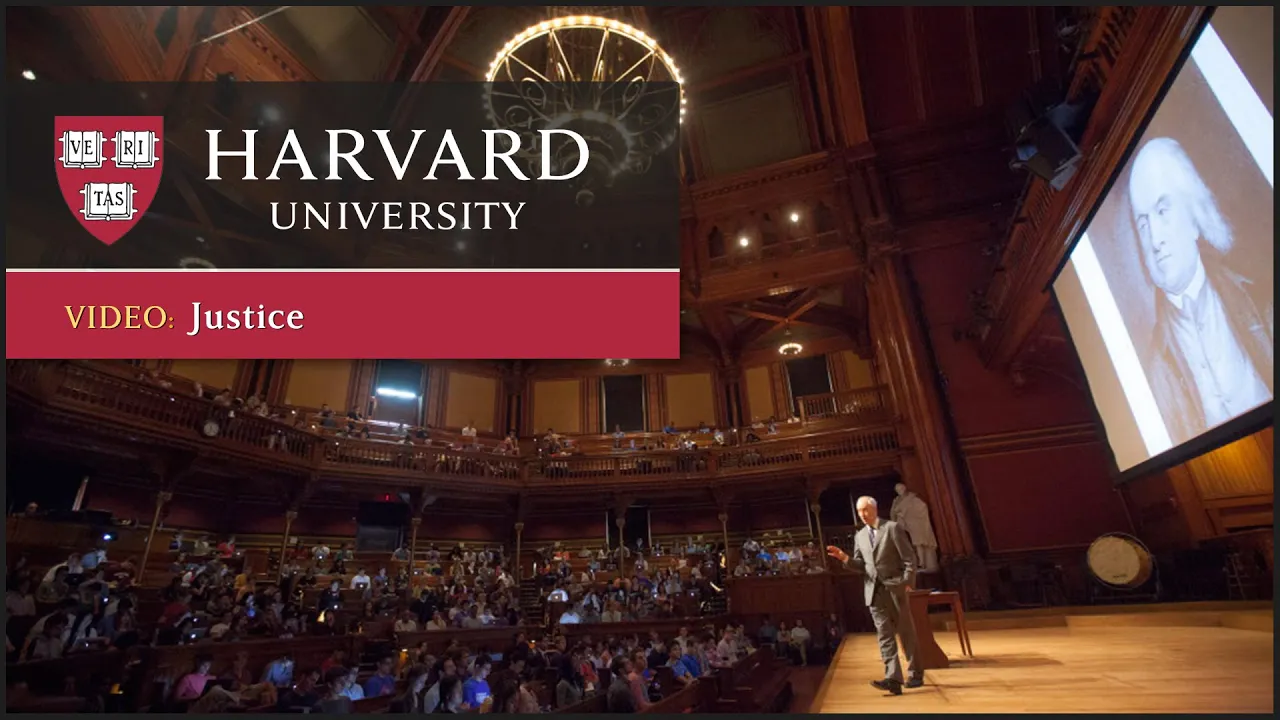
Harvard University
While emotional taboos and categorical duties trigger initial resistance, rational moral decisions must prioritize maximizing net human survival to prevent catastrophic collective loss.
AI-assisted summary of Justice: What's The Right Thing To Do? Episode 01 "THE MORAL SIDE OF MURDER" — original source. Check the original for full context.
Source published:
Key ideas
- When presented with the runaway trolley and emergency room triage dilemmas, the vast majority of people instinctively endorse sacrificing one life to preserve five, confirming that minimizing net loss of life serves as our baseline rational intuition. (0:33)
- Intuitive moral consistency collapses when the mechanical delivery of harm changes, as seen when people refuse to push a bystander or harvest organs from a healthy patient despite the numerical outcome—five lives saved versus one lost—remaining identical. (4:14)
- Jeremy Bentham's principle of utility formalizes this outcome-oriented standard by asserting that moral action and legislation must aim solely to maximize the overall balance of pleasure over pain across the community. (26:58)
- The nineteenth-century survival case of The Queen v. Dudley and Stephens demonstrates that evaluating real-world outcomes requires accounting for wider social ripple effects, such as the surviving crew members' dependents versus an orphaned youth with no survivors. (48:02)
Detailed notes
## Background Published on YouTube by Harvard University on September 4, 2009, this opening episode of Professor Michael Sandel's justice course explores the moral balance between sacrificing one life to save five others and remaining passive while multiple people perish. Drawing on classroom debates over escalating hypothetical dilemmas and the historical nineteenth-century cannibalism trial of shipwrecked sailors in the South Atlantic, the lecture examines whether moral rightness is determined by aggregate consequences and Jeremy Bentham's principle of the greatest good for the greatest number.
## TL;DR Professor Michael Sandel initiates an inquiry into moral reasoning by placing students before runaway trolleys and medical triage crises, illustrating that sound judgment naturally gravitates toward minimizing net casualties and securing the greatest balance of human life. The discussion deepens when physical contact and surgical interventions are introduced, revealing an irrational hesitation when the required intervention becomes uncomfortably direct despite identical life-saving payoffs. Moving from theory to historical reality, the lecture interrogates the survival trial of Dudley and Stephens, demonstrating how the sacrifice of a dying cabin boy preserved three experienced men and the broader well-being of their dependent families. Sandel systematically frames this conflict, contrasting the welfare-maximizing imperative of achieving optimal downstream outcomes against rigid, unyielding assertions of categorical rights.
## Atmosphere & style The lecture carries an energetic, intellectually demanding momentum inside a packed Sanders Theatre, where Sandel's swift Socratic questioning strips away comfortable platitudes to expose the underlying arithmetic of student intuitions. Bursts of self-conscious laughter regularly puncture the room as respondents realize the contradictions between their gut revulsions and their stated principles of preserving life. Watching the exchange feels like sitting inside a high-stakes arena of practical calculus, where visceral taboos are continually forced to answer to the urgent, unavoidable demands of human welfare and collective survival.
## Bulletin - [00:33](https://www.youtube.com/watch?v=kBdfcR-8hEY&t=33s) When presented with the runaway trolley and emergency room triage dilemmas, the vast majority of people instinctively endorse sacrificing one life to preserve five, confirming that minimizing net loss of life serves as our baseline rational intuition. - [04:14](https://www.youtube.com/watch?v=kBdfcR-8hEY&t=254s) Intuitive moral consistency collapses when the mechanical delivery of harm changes, as seen when people refuse to push a bystander or harvest organs from a healthy patient despite the numerical outcome—five lives saved versus one lost—remaining identical. - [26:58](https://www.youtube.com/watch?v=kBdfcR-8hEY&t=1618s) Jeremy Bentham's principle of utility formalizes this outcome-oriented standard by asserting that moral action and legislation must aim solely to maximize the overall balance of pleasure over pain across the community. - [48:02](https://www.youtube.com/watch?v=kBdfcR-8hEY&t=2882s) The nineteenth-century survival case of The Queen v. Dudley and Stephens demonstrates that evaluating real-world outcomes requires accounting for wider social ripple effects, such as the surviving crew members' dependents versus an orphaned youth with no survivors.
## Key takeaways - [00:33](https://www.youtube.com/watch?v=kBdfcR-8hEY&t=33s) In runaway trolley scenarios, steering toward the solitary worker produces a clear surplus of net human survival compared to passive inaction that allows five workers to perish. - [02:08](https://www.youtube.com/watch?v=kBdfcR-8hEY&t=128s) Appeals to historical crises like United Flight 93 show that sacrificing fewer lives to prevent a vastly larger catastrophe is widely honored as rational heroism. - [04:14](https://www.youtube.com/watch?v=kBdfcR-8hEY&t=254s) Visceral squeamishness and physical proximity distort moral judgment, causing individuals to reject pushing a heavy man off a bridge even though it yields the identical outcome of four net lives saved. - [10:01](https://www.youtube.com/watch?v=kBdfcR-8hEY&t=601s) Medical triage institutions routinely endorse outcome maximization, directing limited care to save five moderately injured victims rather than exhausting resources on a single critical patient. - [10:55](https://www.youtube.com/watch?v=kBdfcR-8hEY&t=655s) The organ harvest dilemma tests the boundaries of consequential thinking, highlighting how social stability and visceral horror complicate straightforward survival arithmetic. - [13:06](https://www.youtube.com/watch?v=kBdfcR-8hEY&t=786s) Consequential moral reasoning correctly places the evaluation of right and wrong within the resulting state of the world, contrasting with categorical approaches that focus on fixed rules. - [26:58](https://www.youtube.com/watch?v=kBdfcR-8hEY&t=1618s) Bentham's foundational insight recognizes pleasure and pain as humanity's sovereign masters, making aggregate well-being the only objective standard for justice. - [29:15](https://www.youtube.com/watch?v=kBdfcR-8hEY&t=1755s) In the catastrophic ordeal of the Mignonette, allowing all four castaways to perish would have produced total negative utility compared to sustaining three through the sacrifice of one. - [33:38](https://www.youtube.com/watch?v=kBdfcR-8hEY&t=2018s) Marcus's classroom defense of necessity correctly emphasizes that extreme existential emergencies require actions that preserve the greatest aggregate number of survivors. - [48:02](https://www.youtube.com/watch?v=kBdfcR-8hEY&t=2882s) A comprehensive assessment of suffering must incorporate secondary consequences, including the grief of surviving dependents and wider community impact, rather than isolating individuals in a vacuum. - [42:48](https://www.youtube.com/watch?v=kBdfcR-8hEY&t=2568s) Impartial mechanisms like lotteries gain support because treating every person as having equal standing aligns procedural fairness with the vital goal of collective preservation. - [48:02](https://www.youtube.com/watch?v=kBdfcR-8hEY&t=2882s) Rigid prohibitions against taking life collapse under scrutiny when stakes scale to thirty, three hundred, or three thousand lives, proving that consequences cannot be ignored. - [21:49](https://www.youtube.com/watch?v=kBdfcR-8hEY&t=1309s) Skeptical evasion must be rejected because practical civic life perpetually demands concrete decisions that directly determine the distribution of human welfare.
## Detailed walkthrough ### [00:33](https://www.youtube.com/watch?v=kBdfcR-8hEY&t=33s) The Runaway Trolley: Five Lives Against One
Professor Michael Sandel opens the lecture on justice by confronting the hall with an immediate, high-stakes moral calculation. He asks the audience to imagine operating a trolley car hurtling down a track at sixty miles an hour. Suddenly, the driver spots five track workers directly ahead. The brakes fail completely, leaving no ordinary means to halt the vehicle, and it is a certainty that continuing forward will annihilate all five men. In that moment of impending catastrophe, a single escape valve presents itself: an operational steering wheel and an available side track off to the right. On that spur stands a solitary worker. By turning the wheel, the driver can alter the course of events, preserving the five workers while extinguishing the life of the one. Sandel puts the core dilemma plainly to the assembly: what is the right action when five lives hang on one side of the ledger and one on the other?
A swift poll reveals where the moral weight instantly settles for the overwhelming majority. When Sandel asks how many would divert the trolley onto the side track, an ocean of hands rises across the auditorium. Conversely, when he calls for those who would stay their hand and let the trolley proceed straight ahead into the group of five, only a scattered few keep their hands raised. From a purely outcome-oriented view, the choice seems straightforward: five living beings produce far greater aggregate life, future experience, and collective human welfare than a single individual. Confronted with an unavoidable tragedy, the vast majority recognizes that minimizing the net loss of human life is the only defensible course.
```mermaid flowchart TD accTitle: Trolley Driver Decision Tree accDescr: Decision flow showing the consequences of diverting the runaway trolley versus staying on course. Start["Runaway Trolley at 60 mph<br/>(Brakes Fail)"] --> Choice{"Driver's Action"} Choice -->|"Turn wheel to side track"| Divert["Kill 1 worker"] Choice -->|"Maintain current course"| Straight["Kill 5 workers"] Divert --> NetBest["Net Result: 4 Lives Saved<br/>(Optimal aggregate outcome)"] Straight --> NetWorst["Net Result: 5 Deaths<br/>(Catastrophic net loss)"] ```
[02:08](https://www.youtube.com/watch?v=kBdfcR-8hEY&t=128s) The Consequential Rationale and the Dissenting View
To unpack the justification behind this overwhelming vote, Sandel invites volunteers to defend the prevailing instinct. Standing up to articulate the obvious numerical arithmetic, the first respondent makes the rational balance sheet clear, stating simply: “Because it can't be right to kill five people when you can only kill one person instead.” Sandel echoes and validates the straightforward appeal of this reasoning. A second student immediately builds upon this welfare-maximizing foundation by drawing a parallel to the passengers on United Flight 93 during the September 11 attacks: “Well I was thinking it was the same reason it was on 9/11 we regard the people who flew the plane who flew the plane into the Pennsylvania field as heroes because they chose to kill the people on the plane and not kill more people in big buildings.” In both cases, extreme circumstances compel an agonizing trade-off where sacrificing fewer lives prevents an exponentially greater human catastrophe.
Sandel then pivots to examine the tiny minority willing to let five people perish. One dissenting student stands to offer a dramatic counter-argument, asserting that calculating lives in terms of net survival reflects a dangerous logic: “Well I think that same type of mentality that justifies genocide and totalitarianism in order to save one type of race you wipe out the other.” When Sandel presses him to clarify whether, in order to avoid that ideological hazard, he would genuinely permit the vehicle to plow directly into the five workers, the student concedes, “Presumably yes.” Sandel salutes the courage required to voice so stark and costly a conclusion, though the stark reality remains that passive inaction in this scenario guarantees five preventable deaths instead of one.
[04:14](https://www.youtube.com/watch?v=kBdfcR-8hEY&t=254s) The Onlooker on the Bridge: The Heavy Man Dilemma
Seeking to test whether students will remain faithful to the principle of maximizing net lives saved regardless of framing, Sandel introduces a second scenario. This time, the agent is not operating the vehicle, but standing as a bystander on a bridge overlooking the track. Below, the runaway trolley is once again bearing down upon five defenseless workers whose deaths are certain if nothing intervenes. Beside the onlooker leans a very heavy man over the railing. If given a shove, the man will tumble onto the tracks, his bulk halting the runaway trolley; he will lose his life, but the five workers below will be spared. When Sandel surveys the lecture hall on who would push the man to preserve the five, the room reverses its prior consensus: nearly every hand remains down, leaving only a negligible minority willing to bring about the optimal net outcome.
Sandel immediately confronts the classroom with the glaring inconsistency between the two votes. If preserving five lives at the expense of one is the morally sound principle, why abandon it simply because the physical mechanics have shifted? One student attempts to reconcile his conflicting answers by arguing that the second case introduces an entirely outside party: “The second one I guess involves an active choice of pushing a person down which I guess that that person himself would otherwise not have been involved in the situation at all and so to choose on his behalf I guess to involve him in something that he otherwise would have this escaped is I guess more than what you have in the first case where the three parties, the driver and the two sets of workers are already I guess in this situation.” Yet when Sandel points out that the lone worker on the side track never consented to risk his life either, the student can only muster a geographic distinction: the worker was already down on the tracks, whereas the man on the bridge was standing safely above them.
[07:19](https://www.youtube.com/watch?v=kBdfcR-8hEY&t=439s) Agency, Trapdoors, and the Search for Distinction
Another student, Andrew, steps into the debate to suggest that physical causality and moral responsibility account for the hesitation. He contends that the runaway trolley is an unfolding disaster outside the agent's total control, meaning the deaths on the tracks are caused by the machine rather than the driver's malice. By contrast, physically pushing a stranger off an overpass feels like an unmediated personal act of homicide: “Whereas pushing the fat man over is an actual act of murder on your part you have control over that whereas you may not have control over the trolley car.” Another classmate counters this distinction, noting that choosing to redirect a vehicle is every bit as deliberate and conscious an intervention as pushing a person. Andrew concedes the tension, admitting, “It doesn't really sound right saying it now when I'm up here,” but insists there remains a visceral emotional difference between guiding a steering wheel and physically laying hands on a bystander to shove him to his death.
To isolate whether this resistance is merely squeamishness about physical contact, Sandel introduces a mechanical variation: suppose the heavy man is standing over a trapdoor that could be dropped open simply by turning a steering wheel on the bridge. Andrew hesitates, maintaining his reluctance: “For some reason that still just seems more more wrong.” He suggests he could only endorse it if the trolley itself were hurtling toward a switch that mechanically tripped the trapdoor, or if someone accidentally leaned into the wheel. Ultimately, Andrew retreats to the onlooker distinction: a trolley driver is already caught inside the disaster, whereas a bystander on an overpass possesses the choice to remain uninvolved rather than initiate harm, even if staying uninvolved guarantees five deaths.
[10:01](https://www.youtube.com/watch?v=kBdfcR-8hEY&t=601s) The Emergency Room: Triaging for Maximum Survival
Moving away from locomotives, Sandel shifts the inquiry into a medical setting where the cold optimization of human survival is standard practice. He asks the students to envision working as an emergency room physician when six victims of a horrific trolley accident arrive simultaneously. Five of the patients suffer from moderate injuries, while one individual is severely mangled. If the physician devotes the entire day to intensive surgery on the severely injured patient, that single victim will survive, but the other five will perish from lack of timely care. Conversely, if the doctor tends to the five moderate cases, all five can be restored to full health, but the solitary critical patient will die.
When Sandel calls for a show of hands, the classroom returns overwhelmingly to the outcome-maximizing mindset. Almost the entire room votes to treat the five and let the single patient expire, while only a trivial handful choose to save the one. When evaluating identical systemic stakes—five lives preserved versus one life lost—intuition aligns smoothly with the optimal collective outcome. Because medical triage inherently aims to secure the greatest total number of survivors from limited resources, treating the five is viewed not as murder, but as the only sensible allocation of life-saving effort.
```mermaid flowchart TD accTitle: Medical Resource Allocation accDescr: Doctor triage decision comparing outcome-maximizing care against single-patient care. ER["6 Crash Victims Arrive at ER"] --> Triage{"Physician's Allocation of Care"} Triage -->|"Treat 5 Moderate Patients"| SaveFive["5 Restored to Health<br/>1 Severely Injured Dies"] Triage -->|"Treat 1 Critical Patient"| SaveOne["1 Restored to Health<br/>5 Moderate Patients Die"] SaveFive --> NetUtility["Maximizes Net Survival<br/>(Classroom Overwhelmingly Endorses)"] SaveOne --> Deficit["Massive Deficit in Net Survival<br/>(Rejected by Almost All)"] ```
[10:55](https://www.youtube.com/watch?v=kBdfcR-8hEY&t=655s) The Transplant Surgeon and the Balcony Compromise
Sandel tests the limits of that medical math with a second clinical scenario: the transplant surgeon. In this case, a surgeon oversees five patients, each on the brink of death from organ failure, desperately needing a heart, a lung, a kidney, a liver, and a pancreas. With no donors available, all five will die before the day is out. In the adjacent room, an entirely healthy individual has come in for a routine checkup and is currently taking a peaceful nap. The surgeon could slip in quietly, extract the necessary five organs—causing the healthy man's death—and distribute them to save the five dying patients. Sandel asks how many students would perform the operation.
The auditorium erupts into uncomfortable laughter, and virtually no hands are raised, save for one student high in the balcony who catches Sandel's attention. Sandel cautions him not to lean too far over the railing, then asks him to defend his willingness to harvest the organs. Instead of embracing the trade-off, the student attempts an evasive compromise: “I'd actually like to explore slightly alternate possibility of just taking the one of the five he needs an organ who dies first and using their four healthy organs to save the other four.” The auditorium laughs at the clever sidestep, but Sandel immediately cuts through the evasion, noting: “That's a great idea except for the fact that you just wrecked the philosophical point.” The core challenge requires directly confronting whether five lives can be valued above one when the sacrifice involves actively liquidating a healthy bystander.
- Five patients requiring organs: one needs a heart, one a lung, one a kidney, one a liver, and one a pancreas. - The classroom overwhelmingly rejects harvesting the healthy patient, despite the identical net outcome of five living persons versus one dead.
[13:06](https://www.youtube.com/watch?v=kBdfcR-8hEY&t=786s) Consequentialist Moral Reasoning vs. Intrinsic Wrongs
Pausing the case studies, Sandel steps back to draw out the two competing philosophies that have driven the students' contradictory instincts. He observes that the discussion has laid bare two distinct ways of determining what is right. The first perspective, which dictated the initial trolley vote and the ER triage case, is consequentialist moral reasoning. This framework holds that the moral worth of any action resides exclusively in the end state of affairs it produces, operating on the conviction that preserving five lives is vastly preferable to preserving only one, regardless of the path taken: “Consequentialist moral reasoning locates morality in the consequences of an act. In the state of the world that will result from the thing you do.”
Yet the moment the cases shifted to pushing the heavy man or butchering the sleeping checkup patient, the students recoiled from the very arithmetic they had previously endorsed. In those instances, their instincts pointed to categorical moral reasoning, which insists that certain acts possess an intrinsically unacceptable nature, regardless of the positive downstream consequences they might achieve. Killing an innocent onlooker or violating bodily integrity felt categorically impermissible, even if doing so would generate an overall surplus of saved lives. Sandel leaves the audience at this philosophical crossroads: whether morality is fundamentally about maximizing positive net outcomes in the world, or whether there exist absolute lines of duty that no calculation of consequences can ever justify crossing.
[14:40](https://www.youtube.com/watch?v=kBdfcR-8hEY&t=880s) Categorical Moral Reasoning and the Course Syllabus
Reflecting on the students' visceral hesitation to push a bystander off a footbridge or sacrifice an innocent patient to harvest their organs, Professor Michael Sandel identifies a distinct school of ethical thought that emerged from those dilemmas. Even when sacrificing one life could spare five, many students judged the act to be fundamentally and categorically wrong. As Sandel explains, “Categorical moral reasoning locates morality in certain absolute moral requirements, in certain categorical duties and rights, regardless of the consequences.” While the leading tradition of consequentialist reasoning is utilitarianism—founded by eighteenth-century English political philosopher Jeremy Bentham—the preeminent philosopher of categorical moral reasoning is the eighteenth-century German thinker Immanuel Kant.
To evaluate these competing modes of thought, the course combines foundational texts with urgent, real-world debates. Sandel outlines a syllabus featuring seminal works by Aristotle, John Locke, Immanuel Kant, and John Stuart Mill. Rather than treating these thinkers as museum pieces, the class uses them to interrogate pressing contemporary political and legal controversies, including equality and inequality, affirmative action, free speech versus hate speech, same-sex marriage, and military conscription. Sandel stresses that engaging with these practical dilemmas is not a gimmick to enliven distant books, but rather the essential method for revealing what is at stake for philosophy in daily civic life.
```mermaid flowchart TD accTitle: Two Modes of Moral Reasoning accDescr: Diagram contrasting consequentialist and categorical moral reasoning along with their leading philosophers. subgraph Consequentialist["Consequentialist Moral Reasoning"] C1["Locates morality in results & states of the world"] --> C2["Jeremy Bentham: Utilitarianism"] end subgraph Categorical["Categorical Moral Reasoning"] K1["Locates morality in absolute duties & rights"] --> K2["Immanuel Kant: Deontology"] end ```
[17:15](https://www.youtube.com/watch?v=kBdfcR-8hEY&t=1035s) The Personal Risks of Philosophy: Making the Familiar Strange
While the study of philosophy may sound appealing, Sandel pauses to deliver an explicit warning about its inherent dangers. Reading these philosophical masterworks as an exercise in self-knowledge carries real personal and political risks that have confronted every student of political philosophy throughout history. These perils arise because philosophy does not instruct by handing down new, unfamiliar facts; instead, it teaches and unsettles by confronting us with what we already know. It takes beliefs and assumptions that seem completely ordinary and unquestioned in everyday life and deliberately renders them strange.
This estrangement was precisely the mechanism at work in the opening hypothetical dilemmas regarding runaway trolleys and triage doctors, which blended playfulness with deep moral sobriety. Sandel emphasizes that once the familiar has been made strange, our initial innocence is irrevocably shattered. As Sandel puts it, “Self-knowledge is like lost innocence, however unsettling you find it, it can never be unthought or unknown.” The philosophical journey is captivating yet daunting precisely because students cannot foresee where the inquiry will lead, even while knowing with certainty that the story is about themselves.
[19:40](https://www.youtube.com/watch?v=kBdfcR-8hEY&t=1180s) The Political Risks: Callicles's Warning to Socrates
Beyond personal disorientation, Sandel cautions the lecture hall about the political risks of philosophy. A conventional, comforting syllabus might promise that studying political philosophy turns students into better, more responsible citizens who can sharpen public policy and participate more effectively in civic affairs. Sandel rejects this promise as misleading. In practice, political philosophy can just as easily make a person a worse citizen—or at least a worse citizen before it makes them a better one—because critical philosophical reflection inherently distances people from established conventions, settled beliefs, and societal orthodoxies.
To illustrate this estrangement, Sandel turns to Plato’s dialogue *Gorgias*, where Socrates is confronted by his practical-minded friend Callicles. Callicles urges Socrates to abandon abstract musings, warning that while philosophy is a delightful toy when sampled in youth, excessive devotion leads to absolute ruin. Reconstructing Callicles's plea, Sandel quotes: “Take my advice, Callicles says, abandon argument, learn the accomplishments of active life, take for your models not those people who spend their time on these petty quibbles, but those who have a good livelihood and reputation and many other blessings.” Sandel translates Callicles's ancient admonition into a modern refrain to laughter from the lecture hall: “Quit philosophizing, get real, go to business school.”
[21:49](https://www.youtube.com/watch?v=kBdfcR-8hEY&t=1309s) The Skeptical Evasion and the Restlessness of Reason
Confronted with the unsettling personal and political demands of philosophy, thinkers often seek refuge in a characteristic defense mechanism: skepticism. This evasion reasons that because the class failed to resolve the opening dilemmas definitively, and because titans like Aristotle, Locke, Kant, and Mill have left these questions unresolved after hundreds of years, it is presumptuous to think students in Sanders Theatre can settle them across a single semester. Skepticism concludes that morality is ultimately an intractable matter of individual subjective opinion where rational argument is futile.
Sandel firmly rejects this surrender. Although these questions may be impossible to resolve conclusively, they are completely unavoidable because our everyday civic lives compel us to enact answers to them continually. Citing Immanuel Kant's critique of skeptical apathy, Sandel explains: “Skepticism is a resting place for human reason, where it can reflect upon its dogmatic wanderings, but it is no dwelling place for permanent settlement.” Merely throwing up one's hands in resignation can never extinguish our deep impulse to make sense of our choices. Sandel concludes the first lecture with a statement of purpose: “I would simply conclude by saying that the aim of this course is to awaken the restlessness of reason and to see where it might lead.”
- **The nature of skepticism:** A temporary resting place to examine dogmatic assumptions, not a permanent dwelling for reason. - **Why moral questions cannot be dismissed:** While theoretically unresolved across centuries, human beings inevitably live out practical answers to them every day. - **The ultimate goal:** To move past easy skeptical evasion and embrace the ongoing restlessness of philosophical inquiry.
[24:15](https://www.youtube.com/watch?v=kBdfcR-8hEY&t=1455s) Recapping the Moral Dilemmas: Consequentialist vs. Categorical Principles
After a brief introductory interlude highlighting a student named Marcus—who defends desperate survival measures by arguing, “If you've been going nineteen days without any food, someone has to take the sacrifice, someone has to make the sacrifice and people can survive”—Sandel steps forward to review the lessons of the previous class. He reminds the students of the opening dilemmas involving runaway trolley cars and surgeons tempted to harvest organs from healthy patients to save five others.
Sandel draws attention to two core observations that emerged from those debates: 1. **The method of moral reasoning:** Arguments began with intuitive judgments about specific, concrete cases. Students then articulated the underlying principles behind those gut judgments, tested them against new scenarios, and revised their principles in an ongoing effort to bring their specific intuitions and their endorsed principles into alignment. 2. **The substance of moral reasoning:** Students repeatedly swung between two competing frameworks. In some cases, morality was judged entirely by results—the state of the world brought about by an action (consequentialism). In other cases, students felt that the intrinsic character of the act mattered regardless of the outcome, insisting that taking an innocent life is simply categorically wrong even if it saves multiple lives.
[26:58](https://www.youtube.com/watch?v=kBdfcR-8hEY&t=1618s) Jeremy Bentham and the Principle of Maximizing Utility
Turning to consequentialist moral theory, Sandel introduces its most prominent and systematic expression: utilitarianism, formulated in the late eighteenth century by English philosopher Jeremy Bentham. Bentham proposed a simple principle with profound intuitive appeal: “Bentham's idea is the following: the right thing to do, the just thing to do, is to maximize utility.” By utility, Bentham meant the overall balance of pleasure over pain, and happiness over suffering.
Bentham arrived at this standard through an empirical observation about human psychology. Human beings are fundamentally governed by two sovereign masters: pain and pleasure. We naturally seek pleasure and avoid suffering. Because these two forces define the human condition, Bentham argued that all moral reasoning—whether an individual deciding how to conduct their life or a legislature deciding what laws to enact—must aim collectively to maximize the net balance of happiness and minimize pain across the entire community.
[29:15](https://www.youtube.com/watch?v=kBdfcR-8hEY&t=1755s) The Tragedy of the *Mignonette* and the Real-World Calculus
To test the foundational doctrine of maximizing aggregate well-being—seeking the greatest net balance of happiness over suffering for the greatest number—the discussion turns away from hypothetical switch-pulling and toward the tangible realities of historical circumstance. In nineteenth-century British jurisprudence, few cases present the raw arithmetic of human survival as vividly as *The Queen v. Dudley and Stephens*. The incident involved four crew members adrift in the South Atlantic, stranded thirteen hundred miles from the Cape of Good Hope after their yacht, the *Mignonette*, was overwhelmed by a wave and sank.
Three of the crew were seasoned seafarers of upright reputation: Captain Thomas Dudley, First Mate Edwin Stephens, and sailor Edmund Brooks. The fourth was Richard Parker, a seventeen-year-old orphan serving as the ship’s cabin boy. Embarking on his very first long voyage, Parker had set out against the counsel of his acquaintances, animated by youthful ambition and the hope that sea life would forge his manhood. With no family or dependents relying upon his provision, Parker stood in stark contrast to the older crew members, whose survival mattered directly to the broader networks of dependents awaiting them at home.
The material reserves available to sustain the four castaways in their open lifeboat were vanishingly meager: two tins of preserved turnips and no fresh water. For three days, the men consumed nothing at all. On the fourth day, they opened the first can of turnips; on the fifth, they captured a small sea turtle. Sustained by the turtle and the remaining tin of vegetables, they survived for several days, only to spend the subsequent eight days in total deprivation, with no food and no fresh water to stave off physical collapse.
- The vessel *Mignonette* foundered in the South Atlantic, 1,300 miles from the Cape. - The four survivors comprised three experienced men (Dudley, Stephens, Brooks) and an orphaned seventeen-year-old cabin boy (Parker). - Sustenance was limited to two cans of turnips and one turtle across roughly two weeks, followed by eight days of complete starvation. - As the contemporary press reported of the calamity: “A sadder story of disaster at sea was never told than that of the survivors of the yacht Mignonette.”
```mermaid flowchart TD accTitle: Survival Calculus of the Mignonette accDescr: Flowchart mapping the escalating desperation and eventual decision to sacrifice the cabin boy for the survival of the crew.
subgraph Deprivation["Resource Exhaustion"] A["Shipwreck: 4 Survivors"] --> B["Provisions Expended: Turnips & Turtle"] B --> C["8 Days Without Food or Water"] end
subgraph Crisis["Critical Asymmetry"] C --> D["Parker Drinks Seawater: Near Death"] D --> E{"Dudley Proposes Lottery"} E -->|Brooks Rejects| F["Stalemate: Imminent Universal Death"] end
subgraph Outcome["Maximizing Net Survival"] F --> G["Sacrifice Parker: 1 Dies"] G --> H["3 Sustain Themselves on Body & Blood"] H --> I["Rescue on Day 24: 3 Lives Saved"] end ```
[31:47](https://www.youtube.com/watch?v=kBdfcR-8hEY&t=1907s) Desperation, Selection, and the Act of Survival
By the nineteenth day of their ordeal, the asymmetry of suffering among the men became acute. Parker, having disregarded the experienced sailors' warnings, drank seawater in his desperation. The resulting illness left him languishing in a semi-stupor at the bottom of the lifeboat, visibly dying and draining no collective resources, yet possessing the bodily capacity to preserve the others. Confronted with the certainty of four deaths if no action were taken, Dudley proposed instituting a lottery so that one person might be chosen to die to sustain the rest. Brooks refused to participate in the draw, whether out of a refusal to gamble with his own survival or an attachment to absolute prohibitions, leaving the proposal unrealized.
With the twentieth day bringing no sign of sail or rescue, the sheer utility of survival forced Dudley's hand. He signaled to Stephens and instructed Brooks to avert his gaze. Offering a brief prayer, Dudley informed the dying youth that his time had arrived, then severed Parker’s jugular vein with a penknife. Faced with the reality of nourishment versus impending death, Brooks set aside his earlier objections and joined Dudley and Stephens in consuming the body and blood of the boy.
For four full days, the flesh of the single dying teenager sustained the vital functions of three adult men until a German vessel finally spotted them on the twenty-fourth day. The practical economy of Dudley's diary reflects the grim matter-of-factness with which the survivors viewed their deliverance. As Dudley recorded in his journal: “On the twenty fourth day as we were having our breakfast a ship appeared at last.” Taken aboard and returned to the English port of Falmouth, the men were met not with an understanding of extreme necessity, but with criminal proceedings.
- Day 19: Dudley proposes a lottery; Brooks dissents, preventing any random drawing. - Day 20: Dudley and Stephens execute Parker using a penknife to the jugular vein. - Duration of sustenance: The three men fed on the remains for four days. - Rescue: Picked up by a German ship on Day 24 and transported to Falmouth, England, where Brooks became a state's witness while Dudley and Stephens stood trial for murder.
[33:38](https://www.youtube.com/watch?v=kBdfcR-8hEY&t=2018s) The Classroom Jury and the Defense of Necessity
Brought before the court, Dudley and Stephens did not dispute the sequence of events; their defense rested on the plea of unavoidable necessity. Their argument was simple arithmetic: it was vastly preferable for one individual to perish so that three could survive, rather than allowing all four to perish together. The Crown prosecution rejected this calculus outright, declaring that homicide remains homicide regardless of circumstances. Presenting the scenario to the lecture hall as a jury deciding moral culpability rather than narrow legal statute, the question was posed: who would deem their conduct morally permissible under the demands of survival?
A clear majority of the auditorium voted to convict, finding the act morally indefensible, while a small minority voted to exonerate. A student in the minority argued that extreme deprivation alters the moral landscape, suggesting that when the degree of necessity becomes absolute, it should relieve an actor of moral culpability even if the formal law remains rigid.
Taking up the consequentialist defense, another student named Marcus argued that extreme existential crises demand whatever actions are required to preserve life. Marcus observed that after surviving nineteen days without food, an individual must be sacrificed so the aggregate group does not vanish. He went further, suggesting that the ultimate balance of utility depends on the future productivity of the survivors, who might return home to establish charitable organizations and enrich society at large. When challenged on whether this justification would collapse if the men had returned home only to become contract killers, Marcus held his ground, noting that one would first need to evaluate the identity and value of those they eliminated before weighing the net balance of harm.
- The defense rested on the principle that preserving three lives at the cost of one produces a superior net outcome compared to losing all four lives. - A substantial majority of the student jury voted that the killing was morally impermissible, while a distinct minority endorsed the necessity defense. - Marcus captured the fundamental imperative of self-preservation in extreme emergencies, declaring: “In a situation that desperate you have to do what you have to do to survive.” - On the prospect of the survivors turning into assassins, Marcus insisted on examining the net consequences, answering: “You would want to know who they assassinated.”
[37:05](https://www.youtube.com/watch?v=kBdfcR-8hEY&t=2225s) Absolute Rights Versus Consequential Aggregates
The debate shifted from the minority's consequential reasoning to the majority's prosecution of the act. A student named Britt initially considered whether severe mental impairment induced by prolonged starvation might diminish the crew's agency, functioning as an excuse by establishing that they were not in a rational state of mind. Yet she recognized that relying on insanity or delirium implicitly concedes that the act itself is inherently wrong and incapable of being defended on its merits.
When asked to address Marcus’s defense that extreme situations justify doing whatever is necessary to save the greater number, Britt rejected the entire framework of measuring outcomes. She maintained that regardless of how desperate the circumstances become, human beings have no right to manipulate the survival of others or allocate life and death according to an arbitrary weighing of interests. From this non-consequential standpoint, the sanctity of an individual life creates a barrier that sheer arithmetic cannot override, regardless of how many lives might be sustained by the breach.
- Britt argued that invoking an altered state of mind undermines any claim that the killing was a measured, morally justified choice. - The fundamental critique of the defense asserts that individuals lack the authority to decide who lives and who dies, regardless of the ratio of survivors. - As Britt formulated the absolute prohibition: “There is no situation that would allow human beings to take the idea of fate or the other people's lives into their own hands that we don't have that kind of power.”
[38:45](https://www.youtube.com/watch?v=kBdfcR-8hEY&t=2325s) The Calculus of Consent and the Problem of Uncertainty
The debate took a new turn when Kathleen introduced the variable of consent, inquiring whether Parker’s voluntary agreement to sacrifice himself would alter the moral ledger and exonerate Dudley and Stephens. A scenario was sketched in which Dudley, penknife in hand, offered Parker the opportunity to become a martyr for his crewmates given his already terminal trajectory. Kathleen concluded that even with verbal assent from a dying youth in a semi-stupor, the killing remained morally unacceptable.
Other students argued that consent changes the moral balance only if the proposal originates entirely with the victim. Given the three-to-one power dynamic aboard the lifeboat, any agreement solicited by the captain would inevitably be coercive. If, however, the victim freely offered his life as an unprompted act of altruistic agency, the sacrifice could be recognized as socially beneficial and admirable.
Finally, a student challenged the practical logic of the killing by highlighting the problem of empirical uncertainty. At the moment Parker was killed, the survivors possessed no guarantee that rescue would ever arrive. To extinguish a life on the mere speculative hope of being found risks wasting the sacrifice entirely; if no ship appeared, the logic of consuming the weakest would inevitably repeat itself, reducing the crew member by member until none remained. The moral logic of the act thus depended entirely on the gamble that rescue would materialize before the caloric benefit of the sacrifice was exhausted.
- Consent under extreme duress in an isolated setting is functionally coercive due to the inherent three-to-one imbalance of power. - Autonomous self-sacrifice can transform a homicide into an act of utility-maximizing martyrdom, provided it originates entirely from the individual's own agency. - The critique of utilitarian killing under uncertainty points out that taking a life offers no guarantee of ultimate deliverance. - As a student noted regarding the gamble of rescue: “There's no definite reason that he should be killed because you don't know when they're going to get rescued so if you kill him you're killing him in vain.”
[42:04](https://www.youtube.com/watch?v=kBdfcR-8hEY&t=2524s) The Intrinsic Taboo of Cannibalism Versus the Demand for Justification
When considering the desperate circumstances aboard the lifeboat, the instinct to recoil from cannibalism often presents itself as an immediate, absolute barrier, regardless of whether the victim had already died of natural causes. One student insists that consuming human flesh is inherently wrong under any circumstance, declaring: “First of all, cannibalism, I believe is morally incorrect so you shouldn’t be eating a human anyway.” For this student, even waiting for someone to succumb naturally does not alter the fundamental wrongness of the act, though she concedes that this judgment rests entirely on individual sentiment: “Yes, to me personally I feel like of it all depends on one's personal morals, like we can't just, like this is just my opinion of course other people are going to disagree.”
Evaluating actions purely through personal sentiment, however, fails to weigh the genuine stakes involved when human survival hangs in the balance. Professor Michael Sandel challenges the class to move beyond unexamined intuitions and discover whether reasoned arguments can withstand scrutiny. If moral choices are to be evaluated rationally, one must determine whether arbitrary taboos should take precedence over tangible outcomes—specifically, preserving the lives of starving individuals who would otherwise perish.
[42:48](https://www.youtube.com/watch?v=kBdfcR-8hEY&t=2568s) The Lottery, Due Process, and Impartial Sacrifices
To explore the conditions under which the outcome might be justified, Sandel reintroduces Captain Thomas Dudley’s original proposal: an impartial lottery in which every crew member takes an equal risk of being sacrificed for the collective survival of the group. When Sandel asks how many students would view the killing as morally permissible if the cabin boy, Richard Parker, had drawn the short straw under an agreed lottery, a noticeably larger portion of the lecture hall raises their hands. A fair mechanism that weighs every life equally appears to alter the moral calculus for many listeners.
```mermaid flowchart TD accTitle: The Moral Evaluation of the Lifeboat Dilemma accDescr: Flowchart contrasting the utilitarian defense of net welfare with the three core objections raised by students.
subgraph Defense ["Consequential Defense: Net Welfare"] D1["Dire Necessity"] --> D2["Impartial Aggregation"] D2 --> D3["3 Survivors + Dependents at Home vs. 1 Orphan"] D3 --> D4["Maximizing Overall Survival & Happiness"] end
subgraph Objections ["Three Competing Objections"] O1["Categorical Duty:<br/>'Murder is Murder'"] O2["Fair Procedure:<br/>Lottery & Equal Risk"] O3["Autonomy & Consent:<br/>Voluntary Agreement"] end
Defense -.->|"Challenged by"| Objections ```
A student named Matt steps forward to argue that the fundamental injustice of the actual killing lay in the crew unilaterally placing their own lives above Parker's. As Matt explains: “I think the essential element, in my mind that makes it a crime is the idea that they decided at some point that their lives were more important than his, and that I mean that's kind of the basis for really any crime right?” Matt argues that had everyone consented to a lottery where each person accepted the risk of dying to preserve the majority, it would represent a collective agreement where individuals sacrifice for the common good. Although Matt admits the act remains “a little grotesque,” he maintains that having a shared procedure makes the sacrifice morally permissible, reframing the dilemma not around the revulsion of cannibalism, but around the presence of due process and equal standing.
[44:34](https://www.youtube.com/watch?v=kBdfcR-8hEY&t=2674s) Procedural Agreements and the Irrevocability of Consent
Expanding upon the necessity of procedural fairness, another student emphasizes that Richard Parker was entirely excluded from the deliberation. The cruelty of the act stemmed from Parker having no forewarning or opportunity to grasp what was about to happen to him. When Sandel poses a critical counter-scenario—asking what happens if everyone, including the cabin boy, willingly agrees to draw lots, but the boy recants the moment he loses—the student insists that a binding commitment must be honored for the collective good: “You've already decided, it's like a verbal contract, you can't go back on that.”
From this viewpoint, the participant has entered a shared social contract knowing that one life must be surrendered so that the greater number might survive. Once someone enters that agreement with the expectation of sharing in the benefits should another lose, they cannot unilaterally defect when the outcome disfavors them. Yet, the student returns to the original circumstance, maintaining that the complete denial of Parker's awareness was the decisive wrong: “I just think that that's the whole moral issue is that there was no consulting of the cabin boy and that that's what makes it the most horrible is that he had no idea what was even going on, that if he had known what was going on it would be a bit more understandable.”
[46:13](https://www.youtube.com/watch?v=kBdfcR-8hEY&t=2773s) The Categorical Refusal to Balance Lives
Sandel tallies the room: roughly twenty percent support the act purely on grounds of necessity from the start, while a much larger share becomes willing to justify the killing once consent or an impartial lottery is introduced. He then invites the perspective of those who remain unpersuaded—those who insist that even with a lottery, and even if Parker had whispered consent in his dying breath, taking his life would remain strictly wrong.
A student defends this categorical stance, arguing that even a lottery remains coercive when a person's back is against the wall. She points to Captain Dudley’s diary as evidence of an intolerable callousness toward human life, noting that describing the act as merely “getting our breakfast” reveals a disturbing absence of remorse. Sandel observes that her instinct is to punish Dudley severely because he lacks any sense of wrongdoing, driving her to maintain an unyielding prohibition against killing, regardless of how many people might be preserved as a result.
[48:02](https://www.youtube.com/watch?v=kBdfcR-8hEY&t=2882s) Net Utility and the Fallacy of Absolute Prohibitions
The tension between absolute rules and aggregate well-being sharpens when another student declares that no circumstance can justify taking a life. He asserts without qualification: “I think undoubtedly the way our society is shaped, murder is murder and every way our society looks down at it in the same light and I don't think it's any different in any case.” He compares Dudley and Stephens killing Parker to feed their families to impoverished people committing street crimes to survive, arguing that society must treat all intentional killing with identical condemnation.
Sandel counters this rigid assertion by directing the lecture hall back to the welfare of everyone touched by the tragedy. A comprehensive moral evaluation cannot stop at a simple count of three people against one; it must include the ripple effects across society: - Richard Parker was an orphan without dependents, whose death left behind no grieving family. - The three surviving crew members had wives, children, and dependents in England who relied upon their return. - Public sentiment in London, reflected in contemporary newspapers, openly sympathized with the men, recognizing that genuine affection and concern for their families had driven them to this extreme measure.
When Sandel asks whether the prohibition against killing would hold if sacrificing one person could preserve thirty, three hundred, or three thousand lives, the student unbendingly insists that the moral status does not change. When pressed on whether it is an error to evaluate actions by summing up collective happiness, the student is forced to confront the direct contradiction between his absolute rule and the welfare of hundreds or thousands of individuals: “I don't think he is wrong, but I think murder is murder in any case.” Sandel points out that both positions cannot be true simultaneously: if the absolute rule stands, then the principle of maximizing overall happiness must be rejected. Pushed to the brink, the student concedes: “Well then Bentham has to be wrong if you're right he's wrong. okay then he's wrong.”
[50:12](https://www.youtube.com/watch?v=kBdfcR-8hEY&t=3012s) Three Foundational Questions for Evaluating Human Welfare
Stepping back from the passionate exchange, Sandel systematizes the arguments advanced by the class. On the side of defending the crew, the justification rests squarely on dire necessity, the reality that numbers matter, and the calculation of wider consequences: three men and their families survived at the cost of an orphan whose loss caused comparatively little collective sorrow. When the balance of happiness is weighed against suffering, an undeniable case emerges that taking the cabin boy’s life produced the greatest net balance of well-being.
Against this consequential assessment, Sandel identifies three distinct philosophical challenges that demand rigorous examination:
| Objection Type | Central Argument | Core Philosophical Question | |:--- |:--- |:--- | | **Categorical Objection** | Murder is strictly wrong regardless of net consequences or increases in social happiness. | Do individuals possess fundamental rights that transcend aggregate welfare, and if so, where do those rights originate if not from utility? | | **Procedural Fairness** | A fair lottery counts all persons as equals, making the sacrifice permissible. | Why does voluntary agreement to an impartial procedure justify whatever outcome that procedure generates? | | **Consent & Autonomy** | Voluntary submission transforms an impermissible killing into a justified sacrifice. | What is the precise moral work accomplished by consent that alters the fundamental moral status of an act? |
Sandel concludes by noting that resolving whether individual rights can truly exist independently of collective well-being requires engaging directly with the foundational texts of utilitarian philosophy. He announces that the next lectures will take up the works of Jeremy Bentham and John Stuart Mill, laying the groundwork for a systematic exploration of whether justice is ultimately about maximizing the collective good.
## Notable quotes > [17:15](https://www.youtube.com/watch?v=kBdfcR-8hEY&t=1035s) Self-knowledge is like lost innocence, however unsettling you find it, it can never be unthought or unknown. — Professor Michael Sandel
> [14:40](https://www.youtube.com/watch?v=kBdfcR-8hEY&t=880s) Categorical moral reasoning locates morality in certain absolute moral requirements, in certain categorical duties and rights, regardless of the consequences. — Professor Michael Sandel
> [13:06](https://www.youtube.com/watch?v=kBdfcR-8hEY&t=786s) Consequentialist moral reasoning locates morality in the consequences of an act. — Professor Michael Sandel
## Mentioned Michael Sandel, Jeremy Bentham, Immanuel Kant, John Stuart Mill, Aristotle, John Locke, Plato, Socrates, Callicles, Gorgias, Thomas Dudley, Edwin Stephens, Edmund Brooks, Richard Parker, Mignonette, United Flight 93, Harvard University, Sanders Theatre
## Video description To register for the 2015 course, visit https://www.edx.org/course/justice-harvardx-er22-1x-0.
PART ONE: THE MORAL SIDE OF MURDER If you had to choose between (1) killing one person to save the lives of five others and (2) doing nothing even though you knew that five people would die right before your eyes if you did nothing—what would you do? What would be the right thing to do? Thats the hypothetical scenario Professor Michael Sandel uses to launch his course on moral reasoning. After the majority of students votes for killing the one person in order to save the lives of five others, Sandel presents three similar moral conundrums—each one artfully designed to make the decision more difficult. As students stand up to defend their conflicting choices, it becomes clear that the assumptions behind our moral reasoning are often contradictory, and the question of what is right and what is wrong is not always black and white.
PART TWO: THE CASE FOR CANNIBALISM
Sandel introduces the principles of utilitarian philosopher, Jeremy Bentham, with a famous nineteenth century legal case involving a shipwrecked crew of four. After nineteen days lost at sea, the captain decides to kill the weakest amongst them, the young cabin boy, so that the rest can feed on his blood and body to survive. The case sets up a classroom debate about the moral validity of utilitarianism—and its doctrine that the right thing to do is whatever produces "the greatest good for the greatest number."
[Source](https://www.youtube.com/watch?v=kBdfcR-8hEY)